EP4455458A1 - System having axial-radial exhaust diffuser and method of use - Google Patents
System having axial-radial exhaust diffuser and method of use Download PDFInfo
- Publication number
- EP4455458A1 EP4455458A1 EP24169548.5A EP24169548A EP4455458A1 EP 4455458 A1 EP4455458 A1 EP 4455458A1 EP 24169548 A EP24169548 A EP 24169548A EP 4455458 A1 EP4455458 A1 EP 4455458A1
- Authority
- EP
- European Patent Office
- Prior art keywords
- axial
- radial
- diffuser
- wall
- central axis
- Prior art date
- Legal status (The legal status is an assumption and is not a legal conclusion. Google has not performed a legal analysis and makes no representation as to the accuracy of the status listed.)
- Pending
Links
Images





Classifications
-
- F—MECHANICAL ENGINEERING; LIGHTING; HEATING; WEAPONS; BLASTING
- F01—MACHINES OR ENGINES IN GENERAL; ENGINE PLANTS IN GENERAL; STEAM ENGINES
- F01D—NON-POSITIVE DISPLACEMENT MACHINES OR ENGINES, e.g. STEAM TURBINES
- F01D25/00—Component parts, details, or accessories, not provided for in, or of interest apart from, other groups
- F01D25/30—Exhaust heads, chambers, or the like
-
- F—MECHANICAL ENGINEERING; LIGHTING; HEATING; WEAPONS; BLASTING
- F01—MACHINES OR ENGINES IN GENERAL; ENGINE PLANTS IN GENERAL; STEAM ENGINES
- F01D—NON-POSITIVE DISPLACEMENT MACHINES OR ENGINES, e.g. STEAM TURBINES
- F01D13/00—Combinations of two or more machines or engines
- F01D13/02—Working-fluid interconnection of machines or engines
-
- F—MECHANICAL ENGINEERING; LIGHTING; HEATING; WEAPONS; BLASTING
- F01—MACHINES OR ENGINES IN GENERAL; ENGINE PLANTS IN GENERAL; STEAM ENGINES
- F01D—NON-POSITIVE DISPLACEMENT MACHINES OR ENGINES, e.g. STEAM TURBINES
- F01D15/00—Adaptations of machines or engines for special use; Combinations of engines with devices driven thereby
- F01D15/10—Adaptations for driving, or combinations with, electric generators
-
- F—MECHANICAL ENGINEERING; LIGHTING; HEATING; WEAPONS; BLASTING
- F01—MACHINES OR ENGINES IN GENERAL; ENGINE PLANTS IN GENERAL; STEAM ENGINES
- F01D—NON-POSITIVE DISPLACEMENT MACHINES OR ENGINES, e.g. STEAM TURBINES
- F01D25/00—Component parts, details, or accessories, not provided for in, or of interest apart from, other groups
- F01D25/30—Exhaust heads, chambers, or the like
- F01D25/305—Exhaust heads, chambers, or the like with fluid, e.g. liquid injection
-
- F—MECHANICAL ENGINEERING; LIGHTING; HEATING; WEAPONS; BLASTING
- F01—MACHINES OR ENGINES IN GENERAL; ENGINE PLANTS IN GENERAL; STEAM ENGINES
- F01K—STEAM ENGINE PLANTS; STEAM ACCUMULATORS; ENGINE PLANTS NOT OTHERWISE PROVIDED FOR; ENGINES USING SPECIAL WORKING FLUIDS OR CYCLES
- F01K23/00—Plants characterised by more than one engine delivering power external to the plant, the engines being driven by different fluids
- F01K23/02—Plants characterised by more than one engine delivering power external to the plant, the engines being driven by different fluids the engine cycles being thermally coupled
- F01K23/06—Plants characterised by more than one engine delivering power external to the plant, the engines being driven by different fluids the engine cycles being thermally coupled combustion heat from one cycle heating the fluid in another cycle
-
- F—MECHANICAL ENGINEERING; LIGHTING; HEATING; WEAPONS; BLASTING
- F01—MACHINES OR ENGINES IN GENERAL; ENGINE PLANTS IN GENERAL; STEAM ENGINES
- F01K—STEAM ENGINE PLANTS; STEAM ACCUMULATORS; ENGINE PLANTS NOT OTHERWISE PROVIDED FOR; ENGINES USING SPECIAL WORKING FLUIDS OR CYCLES
- F01K23/00—Plants characterised by more than one engine delivering power external to the plant, the engines being driven by different fluids
- F01K23/02—Plants characterised by more than one engine delivering power external to the plant, the engines being driven by different fluids the engine cycles being thermally coupled
- F01K23/06—Plants characterised by more than one engine delivering power external to the plant, the engines being driven by different fluids the engine cycles being thermally coupled combustion heat from one cycle heating the fluid in another cycle
- F01K23/10—Plants characterised by more than one engine delivering power external to the plant, the engines being driven by different fluids the engine cycles being thermally coupled combustion heat from one cycle heating the fluid in another cycle with exhaust fluid of one cycle heating the fluid in another cycle
-
- F—MECHANICAL ENGINEERING; LIGHTING; HEATING; WEAPONS; BLASTING
- F02—COMBUSTION ENGINES; HOT-GAS OR COMBUSTION-PRODUCT ENGINE PLANTS
- F02C—GAS-TURBINE PLANTS; AIR INTAKES FOR JET-PROPULSION PLANTS; CONTROLLING FUEL SUPPLY IN AIR-BREATHING JET-PROPULSION PLANTS
- F02C7/00—Features, components parts, details or accessories, not provided for in, or of interest apart form groups F02C1/00 - F02C6/00; Air intakes for jet-propulsion plants
- F02C7/12—Cooling of plants
- F02C7/14—Cooling of plants of fluids in the plant, e.g. lubricant or fuel
- F02C7/141—Cooling of plants of fluids in the plant, e.g. lubricant or fuel of working fluid
-
- F—MECHANICAL ENGINEERING; LIGHTING; HEATING; WEAPONS; BLASTING
- F22—STEAM GENERATION
- F22B—METHODS OF STEAM GENERATION; STEAM BOILERS
- F22B1/00—Methods of steam generation characterised by form of heating method
- F22B1/02—Methods of steam generation characterised by form of heating method by exploitation of the heat content of hot heat carriers
- F22B1/18—Methods of steam generation characterised by form of heating method by exploitation of the heat content of hot heat carriers the heat carrier being a hot gas, e.g. waste gas such as exhaust gas of internal-combustion engines
- F22B1/1807—Methods of steam generation characterised by form of heating method by exploitation of the heat content of hot heat carriers the heat carrier being a hot gas, e.g. waste gas such as exhaust gas of internal-combustion engines using the exhaust gases of combustion engines
- F22B1/1815—Methods of steam generation characterised by form of heating method by exploitation of the heat content of hot heat carriers the heat carrier being a hot gas, e.g. waste gas such as exhaust gas of internal-combustion engines using the exhaust gases of combustion engines using the exhaust gases of gas-turbines
-
- F—MECHANICAL ENGINEERING; LIGHTING; HEATING; WEAPONS; BLASTING
- F02—COMBUSTION ENGINES; HOT-GAS OR COMBUSTION-PRODUCT ENGINE PLANTS
- F02C—GAS-TURBINE PLANTS; AIR INTAKES FOR JET-PROPULSION PLANTS; CONTROLLING FUEL SUPPLY IN AIR-BREATHING JET-PROPULSION PLANTS
- F02C6/00—Plural gas-turbine plants; Combinations of gas-turbine plants with other apparatus; Adaptations of gas-turbine plants for special use
- F02C6/18—Plural gas-turbine plants; Combinations of gas-turbine plants with other apparatus; Adaptations of gas-turbine plants for special use using the waste heat of gas-turbine plants outside the plants themselves, e.g. gas-turbine power heat plants
Definitions
- the present application relates generally to a system and method for diffusing an exhaust gas from a gas turbine system for supply into a heat recovery steam generator (HRSG).
- HRSG heat recovery steam generator
- a combined cycle power plant routes an exhaust gas from a gas turbine system through an HRSG, which generates steam to drive a steam turbine system.
- the HRSG may be spaced a considerable distance away from the gas turbine system to allow for exhaust diffusion upstream of the HRSG, thereby consuming valuable space at a site of the combined cycle power plant.
- the undesirable gases may include carbon oxides (COx) such as carbon dioxide (CO 2 ) and carbon monoxide (CO), nitrogen oxides (NOx) such as nitrogen dioxide (NO 2 ), and/or sulfur oxides (SOx) such as sulfur dioxide (SO 2 ). Accordingly, a need exists to reduce the space consumption for exhaust diffusion, thereby increasing the available space for gas treatment.
- a system includes an exhaust diffuser system having an axial-radial diffuser and a transition duct.
- the axial-radial diffuser includes an inlet, an outlet, an axial diffuser portion between the inlet and the outlet, and a radial diffuser portion between the axial diffuser portion and the outlet, wherein the inlet is configured to couple to a gas turbine system.
- the transition duct is coupled to the axial-radial diffuser, wherein the outlet is disposed inside of an intake portion of the transition duct, and the transition duct includes a discharge portion configured to couple to a heat recovery steam generator (HRSG).
- HRSG heat recovery steam generator
- a method includes diffusing an exhaust gas from a gas turbine system through an axial-radial diffuser of an exhaust diffuser system.
- the axial-radial diffuser includes an inlet, an outlet, an axial diffuser portion between the inlet and the outlet, and a radial diffuser portion between the axial diffuser portion and the outlet, wherein the inlet is coupled to the gas turbine system.
- the method also includes transitioning the exhaust gas from the radial diffuser portion to a heat recovery steam generator (HRSG) through a transition duct of the exhaust diffuser system.
- the transition duct is coupled to the axial-radial diffuser, the outlet is disposed inside of an intake portion of the transition duct, and the transition duct includes a discharge portion coupled to the HRSG.
- a system includes an exhaust diffuser system configured to mount between a gas turbine system and a heat recovery steam generator (HRSG).
- the exhaust diffuser system includes a radial diffuser portion having a central hub with an inner wall disposed about a central axis, an outer wall disposed about the inner wall, and an exhaust passage between the inner and outer walls.
- the exhaust diffuser system includes a flow passage area adjustment system having a drive coupled to the central hub of the radial diffuser portion.
- the exhaust diffuser system also includes a controller coupled to the drive, wherein the controller is configured to control the drive to move the central hub of the radial diffuser portion to adjust a flow through the radial diffuser portion.
- the disclosed embodiments include systems and methods to reduce the space consumption for exhaust diffusion via an axial-radial diffuser between a gas turbine system and a heat recovery steam generator (HRSG).
- the axial-radial diffuser is relatively shorter in length compared with an axial diffuser, and thus enables closer placement of the HRSG relative to the gas turbine system.
- the reduced space consumption of the axial-radial diffuser provides additional space for gas treatment systems.
- the axial-radial diffuser may substantially improve the flow uniformity of the exhaust gas directed toward the tubes (e.g., tube bundles) of the HRSG, thereby helping to improve the efficiency of the HRSG.
- the disclosed embodiments may improve or expand a gas treatment system via one or more gas capture systems.
- the gas capture systems are configured to remove undesirable gases (e.g., CO 2 ) from the intake air and/or the exhaust gas of the combustion systems.
- the gas capture systems may include sorbent-based gas capture systems, solvent-based gas capture systems, cryogenic gas capture systems, or a combination thereof.
- the gas capture systems may include one or more temperature swing adsorption (TSA) units or adsorbers, which rely on temperature swings to adsorb undesirable gases at a first temperature (e.g., low temperature) and desorb the undesirable gases at a second temperature (e.g., high temperature).
- TSA temperature swing adsorption
- the sorbent-based gas capture systems are configured to adsorb the undesirable gases into a sorbent material, and then subsequently desorb the undesirable gases from the sorbent material using a heat source (e.g., steam from the HRSG, steam from the steam turbine system, or other steam source).
- a heat source e.g., steam from the HRSG, steam from the steam turbine system, or other steam source.
- the solvent-based gas capture systems may include an absorber configured to absorb the undesirable gas into a solvent, and a stripper configured to strip the undesirable gas from the solvent using steam (e.g., steam from the HRSG, steam from the steam turbine system, or other steam source).
- steam e.g., steam from the HRSG, steam from the steam turbine system, or other steam source.
- the solvent-based gas capture systems are discussed as using a solvent as an absorbent fluid, the disclosed embodiments may use any suitable absorbent fluid for capturing undesirable gases. Accordingly, the solvent-based gas capture system also may be described as a fluid absorbent-based gas capture system.
- the axial-radial diffuser may be used to save space (e.g., reduce the footprint for exhaust diffusion), thereby providing additional space for the gas treatment systems (e.g., gas capture systems).
- gas treatment systems e.g., gas capture systems
- the gas capture systems including but not limited to, sorbent-based gas capture systems, solvent-based gas capture systems, and cryogenic gas capture systems, may be added, expanded, and/or generally improved using the space savings achieved with the present axial-radial diffuser.
- the axial-radial diffuser also may provide space savings for other reasons.
- FIG. 1 is a block diagram of an embodiment of a combined cycle system 10 having a gas turbine system 12, a steam turbine system 14, a heat recovery steam generator (HRSG) 16, a gas treatment system 18 having one or more gas capture systems 20, and an exhaust diffuser system 22.
- the gas capture systems 20 are configured to capture an undesirable gas (e.g., CO 2 ) from a gas, such as exhaust gas and/or air.
- the gas capture systems 20 may include sorbent-based gas capture systems, solvent-based gas capture systems, cryogenic gas capture systems, or any combination thereof.
- the exhaust diffuser system 22 includes an axial-radial diffuser 24 coupled to a transition duct 26, wherein the axial-radial diffuser 24 is coupled to the gas turbine system 12 and the transition duct 26 is coupled to the HRSG 16.
- the axial-radial diffuser 24 is configured to diffuse the exhaust gas 152 from the gas turbine system 12 via axial diffusion and radial diffusion, thereby reducing the axial length and footprint of the exhaust diffuser system 22 relative to an axial only diffuser.
- the transition duct 26 is configured to transition the exhaust gas 152 from the axial-radial diffuser 24 to the HRSG 16 via flow conditioning to help provide a more uniform flow of the exhaust gas 152 into the HRSG 16.
- axial direction or axis 30 a radial direction or axis 32 extending radially away from the axial direction or axis 30, and a circumferential direction or axis 34 extending circumferentially around the axial direction or axis 30.
- the directions or axes 30, 32, and 34 may be in reference to a rotational axis 36 of the gas turbine system 12, for example. Additionally, the directions or axes 30, 32, and 34 may be in reference to a central axis of the exhaust diffuser system 22 (e.g., axis 270 shown in FIG. 3 ).
- the gas turbine system 12 may include an intake section 40, a compressor or compressor section 42, a combustor section 44, a gas (expansion) turbine or turbine section 46, and an exhaust section 48.
- the compressor section 42 may include at least one shaft 50 disposed along the rotational axis 36, a casing 52 (e.g., annular casing) disposed circumferentially about the at least one shaft 50, a plurality of rotating compressor blades 54 extending radially outward from the at least one shaft 50, and a plurality of stationary compressor vanes 56 extending radially inward from the casing 52 toward the at least one shaft 50.
- a casing 52 e.g., annular casing
- the compressor section 42 may include a plurality of compressor stages 58, each having a plurality of the compressor vanes 56 spaced circumferentially about the at least one shaft 50 at an axial position and a plurality of the compressor blades 54 spaced circumferentially about the at least one shaft 50 at a different axial position immediately adjacent to the axial position of the compressor vanes 56 (i.e., the compressor vanes 56 and the compressor blades 58 are axially spaced apart).
- the compressor section 42 is configured to receive a flow of an intake gas 60 from the intake section 40 and to progressively compress the intake gas 60 through the plurality of compressor stages 58.
- the intake gas 60 may include an intake air, an exhaust gas recirculation (EGR) flow or recirculated exhaust gas, or a combination thereof.
- EGR exhaust gas recirculation
- the combustor section 44 may include one or more combustors 62, such as a single annular combustor disposed circumferentially about the rotational axis 36 or a plurality of combustors 62 circumferentially spaced about the rotational axis 36.
- each combustor 62 includes a head end portion 64 coupled to a combustion portion 66.
- the combustion portion 66 includes a combustion chamber 68, a combustor liner 70 disposed circumferentially about the combustion chamber 68, a flow sleeve 72 disposed circumferentially about the combustor liner 70, and a passage 74 extending between the combustor liner 70 and the flow sleeve 72.
- the passage 74 is configured to route a compressed gas flow in an upstream direction 76 toward a head end chamber 78 disposed in the head end portion 64.
- the head end chamber 78 and the combustion chamber 68 of the combustor 62 are separated or divided from one another by an intermediate plate 80.
- a plurality of fuel nozzles 82 are coupled to the intermediate plate 80 and an end plate 84 of the head end portion 64.
- each combustor 62 receives a compressed gas 86 (e.g., air, EGR, etc.) from the compressor section 42, routes the compressed gas 86 along the passage 74 toward the head end chamber 78 as indicated by arrow 76, and routes the compressed gas through the fuel nozzles 82 into the combustion chamber 68.
- a compressed gas 86 e.g., air, EGR, etc.
- each combustor 62 may receive one or more fuel flows from a fuel system 88 coupled to the fuel nozzles 82, wherein the fuel system 88 includes a fuel supply system 90 coupled to one or more fuel circuits 92.
- the fuel circuits 92 may include fuel circuits 94, 96, and 98 coupled to different sets of the fuel nozzles 82.
- the fuel circuits 92 (e.g., 94, 96, and 98) may include fuel conduits, fuel manifolds, fuel valves, pressure regulators, and other flow controls.
- the fuel system 88 is configured to supply one or more fuels, such as liquid and/or gas fuels, into each of the fuel nozzles 82 for injection into the combustion chamber 68.
- the fuels may include natural gas, syngas generated from a gasifier, methane, hydrogen, biofuel, fuel oils, or any combination thereof.
- the fuel supply system 90 may include a plurality of components to control flows of the various fluids to the combustor 62.
- the fuel supply system 90 may include one or more components 100.
- the components 100 may include one or more fuel tanks, fuel pumps, valves, pressure regulators, flow regulators, filters, water removal units, particulate removal units, manifolds, flow controllers, or any combination thereof.
- the fuel nozzles 82 are configured to inject one or more fuels from the fuel system 88 and the compressed gas 86 from the compressor section 42.
- the fuel nozzles 82 are configured to inject a compressed air 104 from a compressor system 106 having an air compressor 108 coupled to a drive 110, such as an electric motor, a combustion engine, a shaft coupled to the gas turbine system 12, or another suitable drive.
- the compressor system 106 may be configured to receive air from ambient and/or from the intake section 40. Additionally, the compressor system 106 may be configured to enable multiple modes of operation, such as EGR mode or non-EGR mode.
- the compressor section 42 supplies the compressed gas 86 (e.g., compressed exhaust gas) to each combustor 62, while the compressor system 106 supplies the compressed air 104 to each combustor 62.
- the compressor section 42 supplies the compressed gas 86 (e.g., compressed air) to each combustor 62 without any need for additional air supplies.
- the compressor system 106 may optionally supply the compressed air 104 to each combustor 62.
- the fuel may be combusted with the air in the combustion chamber 68 of each combustor 62, thereby generating a hot combustion gas 112 for delivery from the combustion chamber 68 into the turbine section 46.
- the turbine section 46 includes at least one shaft 114 disposed along the rotational axis 36, a casing 116 (e.g., annular casing) disposed circumferentially about the at least one shaft 114, a plurality of rotating turbine blades 118 extending radially outward from the at least one shaft 114, and a plurality of stationary turbine vanes 120 extending radially inward from the casing 116 toward the at least one shaft 114.
- a casing 116 e.g., annular casing
- the turbine section 46 may include a plurality of turbine stages 122, each having a plurality of the turbine vanes 120 spaced circumferentially about the at least one shaft 114 at an axial position, and a plurality of the turbine blades 118 spaced circumferentially about the at least one shaft 114 at a different axial position immediately adjacent the axial position of the turbine blades 118 (i.e., the turbine vanes 120 and the turbine blades 118 are axially spaced apart).
- the at least one shaft 114 also may be coupled to the at least one shaft 50 of the compressor section 42 via at least one intermediate shaft 124.
- the at least one shaft 114 may be coupled to a load 126 via a shaft 128.
- the load 126 may include an electrical generator, a machine, a propulsion system for a vehicle, or any other suitable load.
- the load 126 may be an electrical generator, such that the combined cycle system 10 is a combined cycle power plant.
- the combustion gas 112 flows from the combustor 62 into the turbine section 46, wherein the combustion gas 112 progressively expands and drives rotation of the turbine blades 118 coupled to the at least one shaft 114 in each of the turbine stages 122.
- the combustion gas 112 drives the turbine section 46, which in turn drives the compressor section 42 and the load 126 via the interconnected shafts 50, 124, 114, and 128.
- the gas turbine system 12 may be configured with a common rotational direction of the shafts 50, 114, 124, and 128 and the connected compressor blades 54 and turbine blades 118.
- the shafts 50, 114, 124, and 128 may be removably coupled together with shaft connections, such as flanged joints.
- some of the shafts may be combined to reduce the number of shafts.
- all of the illustrated shafts 50, 114 and 124 may represent a common shaft rotating in the common rotational direction, such as a clockwise or counter-clockwise rotational direction.
- the gas turbine system 12 can be configured with or without the compressor system 106 and an exhaust gas recirculation (EGR) system 150.
- the EGR system 150 is configured to recirculate an exhaust gas 152 output by the turbine section 46 back into the compressor section 42 (e.g., via intake section 40) for compression and delivery to the combustor section 44.
- the gas turbine system 12 may exclude the EGR system 150 and intake only an airflow into the intake section 40 for compression by the compressor section 42.
- the recirculated exhaust gas 152 flows through the intake section 40 and each of the compressor stages 58 of the compressor section 42, thereby compressing the recirculated exhaust gas as the compressed gas 86 for delivery into combustor section 44.
- the combustor section 44 may receive compressed air 104 from the air compressor 108 of the compressor system 106 through the fuel nozzles 82.
- the combustor section 44 also receives the fuel from the fuel system 88, such as through the fuel nozzles 82.
- the fuel from the fuel system 88 then combusts with the air from the compressor system 106 to generate the combustion gases 112, which then flow through the turbine section 46 to drive rotation of the turbine blades 118 in each of the turbine stages 122.
- the recirculated exhaust gas helps to reduce the temperature and formation of certain emissions (e.g., nitrogen oxides (NOx)) associated with combustion in the combustor section 44.
- NOx nitrogen oxides
- the compressor section 42 receives an airflow from the intake section 40, progressively compresses the airflow via the compressor stages 58, and delivers the compressed airflow as the compressed gas 86 into the combustor section 44.
- the compressed airflow then facilitates combustion of the fuel from the fuel system 88, thereby generating the hot combustion gases 112 for delivery to the turbine section 46.
- the compressor system 106 may be excluded or included to provide additional compressed air 104 to the combustor section 44.
- the combustion gas 112 drives rotation of the turbine blades 118 in the turbine stages 122, thereby rotating the at least one shaft 114 coupled to the at least one shaft 50 of the compressor section 42 and the shaft 128 driving the load 126.
- the HRSG 16 may include a high-pressure section 160, an intermediate-pressure section 162, and a low-pressure section 164 in a series arrangement, thereby generating a high-pressure steam 166, an intermediate-pressure steam 168 and a low-pressure steam 170.
- the HRSG 16 may include a plurality of components, such as economizers, evaporators, superheaters, or any combination thereof, in each of the sections 160, 162, and 164.
- the components of the HRSG 16 also may form tube bundles, such as heat exchanger tube bundles, for each of the sections 160, 162, and 164.
- the components of the HRSG 16 may be coupled together via various conduits and headers.
- the components of the HRSG 16 include a finishing high-pressure superheater, a secondary re-heater, a primary re-heater, a primary high-pressure superheater, an inter-stage attemperator, a high-pressure evaporator, a high-pressure economizer, an intermediate-pressure evaporator, an intermediate-pressure economizer, a low-pressure evaporator, and a low-pressure economizer.
- the heat recovery steam generator 16 may route the high-pressure steam 166 to a high-pressure steam turbine 172, the intermediate-pressure steam 168 to an intermediate-pressure steam turbine 174, and the low-pressure steam 170 to a low-pressure steam turbine 176 of the steam turbine system 14.
- the steam drives rotation of blades within each of the steam turbines 172, 174, 176, thereby driving a shaft 178 coupled to a load 180, such as an electric generator.
- the low-pressure steam turbine 176 also may return a condensate 182 back to the low-pressure section 164 of the HRSG 16.
- the HRSG 16 may then output the exhaust gas 152 as a partially cooled exhaust gas 184, which may then pass through the gas treatment system 18.
- the gas treatment system 18 includes one or more gas capture systems 20.
- the gas capture systems 20 may include any one or any combination of gas capture systems 190, 192, and 194, each having a plurality of components (e.g., components 196, 198, 200, and 202).
- the gas capture systems 20 e.g., 190, 192, and 194 are configured to obtain a captured gas 204 from the intake gas 60 and/or the exhaust gas 152, 184.
- the gas capture systems 20 e.g., 190, 192, and 194 may capture and output carbon dioxide (CO 2 ) as the captured gas 204, which may further be directed to a compression system 206.
- the compression system 206 may include one or more compressors configured to compress the captured gas 204 (e.g., CO 2 ) and deliver the captured gas to storage and/or a pipeline 208.
- the gas capture system 190 is disposed at, in, or upstream of the intake section 40 for capturing undesirable gases from the intake air. Accordingly, the gas capture system 190 may be described as a direct air capture (DAC) system.
- the gas capture systems 192 and 194 are disposed downstream of the gas turbine system 12 and/or the HRSG 16 for capturing undesirable gases from the exhaust gas 152, 184.
- the gas capture systems 20 (e.g., 190, 192, and 194) may include sorbent-based gas capture systems, solvent-based gas capture systems, cryogenic gas capture systems, or any combination thereof, configured to remove and capture undesirable gases.
- the gas capture systems 20 may be configured to remove and capture undesirable gases, such as carbon oxides (COx) (e.g., carbon dioxide (CO 2 ) and carbon monoxide (CO)), and thus the gas capture systems 20 may be described as carbon capture systems.
- COx carbon oxides
- CO 2 carbon dioxide
- CO carbon monoxide
- the gas capture systems 20 may be configured to remove and capture undesirable gases, such as nitrogen oxides (NOx) (e.g., nitrogen dioxide (NO 2 )), and thus the gas capture systems 20 may be described as NOx capture systems.
- NOx nitrogen oxides
- the gas capture systems 20 may be configured to remove and capture undesirable gases, such as sulfur oxides (SOx) (e.g., sulfur dioxide (SO 2 )), and thus the gas capture systems 20 may be described as SOx capture systems.
- SOx sulfur oxides
- the gas capture systems 20 e.g., 190, 192, and 194 may be described as sorbent-based carbon capture systems using sorbent materials as an example and/or solvent-based carbon capture systems using liquid absorbents (e.g., solvents) as an example.
- the embodiments disclosed herein may use any type or configuration of gas capture systems 20 (e.g., 190, 192, and 194) as noted above.
- Each of the gas capture systems 20 may include components 196, 198, 200, and 202 suitable to support the type and configuration of the gas capture systems 20, such as components supporting sorbent-based gas capture systems, solvent-based gas capture systems, cryogenic gas capture systems, or any combination thereof.
- the components 196, 198, 200, and 202 may include adsorbers having sorbent materials, solvent-based absorbers and strippers, heat exchangers, cryogenic systems, or any combination thereof.
- one or more components 210, 212, and 214 may be disposed upstream from the gas capture systems 192 and 194, such as a dryer or water removal system (e.g., water gas separator), a particulate removal system (e.g., filter and/or solid gas separator), one or more booster fans, one or more coolers (e.g., a direct contact cooler (DCC)), or any combination thereof.
- a dryer or water removal system e.g., water gas separator
- a particulate removal system e.g., filter and/or solid gas separator
- booster fans e.g., one or more booster fans
- coolers e.g., a direct contact cooler (DCC)
- the exhaust gas 184 may partially or entirely bypass the gas treatment system 18 and flow to the EGR system 150, and/or the exhaust gas 184 may partially or entirely flow through the gas treatment system 18 before flowing to the EGR system 150.
- the EGR system 150 may include one or more conduits, valves, flow controls, coolers, blowers, or any combination thereof, configured to provide at least a portion of the exhaust gas 152, 184 (e.g., EGR flow) to the intake section 40 for recirculation through the compressor section 42.
- the cooler may be configured to cool the exhaust gas 152, 184 to a lower temperature (e.g., approximately ambient temperature) prior to recirculation into the compressor section 42.
- the blower may be configured to increase a pressure and flow of the exhaust gas 152, 184 to help overcome pressure losses in the EGR system 150.
- the combined cycle system 10 also includes a controller 220 coupled to the gas turbine system 12, the steam turbine system 14, the HRSG 16, the gas treatment system 18, the fuel system 88, the EGR system 150, the compression system 106, and various sensors 222 distributed throughout the combined cycle system 10.
- the controller 220 includes one or more processors 224, memory 226, instructions 228 stored on the memory 226 and executable by the processor 224, and communication circuitry 230 configured to communicate with the sensors 222 and various equipment throughout the combined cycle system 10.
- the controller 220 is configured to control the fuel delivery and distribution from the fuel system 88 to the fuel nozzles 82 in the combustor section 44.
- the controller 220 is configured to control operation of the gas capture systems 20 (e.g., 190, 192, and 194), such by controlling modes of operation (e.g., adsorption mode and desorption mode), controlling flows of various fluids through the gas capture systems 20, or any combination thereof.
- controlling modes of operation e.g., adsorption mode and desorption mode
- the sensors 222 are configured to monitor various operational parameters of the combined cycle system 10.
- the sensors 222 include temperature sensors, pressure sensors, flow rate sensors, fluid composition sensors (e.g., gas composition sensors), vibration sensors, clearance sensors, speed sensors, humidity and/or moisture sensors, or any combination thereof.
- the sensors 222 may monitor the parameters (e.g., temperature, pressure, flow rate, and fluid composition) at one or more locations of the compressor section 42, the combustor section 44, the turbine section 46, the gas treatment system 18, or any combination thereof.
- the sensors 222 may monitor compressor parameters (e.g., pressure ratio between the inlet and outlet of the compressor section 42), combustion gas parameters (e.g., firing temperature and combustion dynamics), turbine parameters (e.g., temperature and pressure at each turbine stage, the turbine inlet, and the turbine exhaust), and exhaust gas emissions.
- the exhaust gas emissions monitored by the sensors 222 may include carbon oxides (COx) such as carbon dioxide (CO 2 ) and carbon monoxide (CO), nitrogen oxides (NOx) such as nitrogen dioxide (NO 2 ), sulfur oxides (SOx) such as sulfur dioxide (SO 2 ), unburnt hydrocarbons, particulate matter, and other undesirable exhaust emissions.
- COx carbon oxides
- NOx nitrogen oxides
- SOx sulfur oxides
- SO 2 sulfur oxides
- the sensors 222 may monitor the temperature of the sorbent materials in sorbent-based gas capture systems, the temperature of solvent in solvent-based gas capture systems, or any combination thereof.
- the controller 220 may adjust the operating mode, fluid flows, heating, cooling, or any combination thereof, in the gas capture systems 20.
- the combined cycle system 10 includes the exhaust diffuser system 22 disposed between the gas turbine system 12 and the HRSG 16.
- the axial-radial diffuser 24 may be mounted to the gas turbine system 12 at the turbine section 46.
- the axial-radial diffuser 24 may be directly or indirectly mounted to an aft frame of the gas turbine system 12 coaxial with a rotational axis of the turbine section 46.
- the axial-radial diffuser 24 includes an axial diffuser portion 240 coupled to a radial diffuser portion 242.
- the axial-radial diffuser 24 also extends partially into the transition duct 26.
- the radial diffuser portion 242 and, in some embodiments part of the axial diffuser portion 240 extend into the transition duct 26.
- the axial-radial diffuser 24 also may be supported by a support structure 244.
- the radial diffuser portion 242 has a flow passage area adjustment system configured to adjust (e.g., increase or decrease) a flow through the radial diffuser portion 242 into the transition duct 26, one or more perforated walls configured to bypass a portion of the exhaust gas 152 through a central area of the radial diffuser portion 242, or a combination thereof. Additionally, in some embodiments, the radial diffuser portion 242 may be symmetric or asymmetric about a central axis of the axial-radial diffuser 24.
- the radial diffuser portion 242 may be asymmetric to help control a distribution of the exhaust gas 152 into and through the transition duct 26, thereby helping to provide a more uniform flow of the exhaust gas 152 to the tube bundles in the HRSG 16.
- the transition duct 26 may include various flow conditioning features to condition the exhaust gas 152 before entry into the HRSG 16.
- Various aspects and embodiments of the exhaust diffuser system 22 are discussed in further detail below.
- FIG. 2 is a schematic side view of an embodiment of the exhaust diffuser system 22 coupled to the HRSG 16 of FIG. 1 .
- the axial-radial diffuser 24 includes the axial diffuser portion 240 coupled to the radial diffuser portion 242, wherein the axial-radial diffuser 24 extends partially into the transition duct 26.
- the axial diffuser portion 240 includes a turbine coupling or mount 246 configured to couple the axial-radial diffuser 24 to the turbine section 46 of the gas turbine system 12.
- the turbine mount 246 may include a removable mount (e.g., overlapping walls or flanges bolted together) between the axial diffuser portion 240 and the turbine section 46.
- the radial diffuser portion 242 includes a duct coupling or mount 248 configured to couple the axial-radial diffuser 24 to the transition duct 26.
- the duct mount 248 may include a fixed mount (e.g., welded connector) or removable mount (e.g., overlapping walls or flanges bolted together) between the radial diffuser portion 242 and the transition duct 26.
- the transition duct 26 may include a duct coupling or mount 250 configured to couple the transition duct 26 to a duct 252 of the HRSG 16.
- the duct mount 250 may include a fixed mount (e.g., welded connector) or a removable mount (e.g., overlapping walls or flanges bolted together) between the transition duct 26 and the duct 252 of the HRSG 16.
- the duct 252 of the HRSG 16 houses the high-pressure section 160, the intermediate-pressure section 162, and the low-pressure section 164, which may include various tube bundles and components as discussed above.
- the exhaust diffuser system 22 is supported at the mounts 246, 248, and 250 and the support structure 244.
- the mounts 246, 248, and 250 also provide sealed connections to provide a sealed flow path of the exhaust gas 152 from the turbine section 46 to the HRSG 16, while the axial-radial diffuser 24 diffuses the exhaust gas 152 and the transition duct 26 conditions and distributes the exhaust gas 152 more uniformly into the duct 252 of the HRSG 16.
- the support structure 244 is coupled to the axial-radial diffuser 24 and a surrounding structure and/or a base 254.
- the support structure 244 may be coupled to the axial diffuser portion 240, the radial diffuser portion 242, or a combination thereof, via a framework 256 having a plurality of supports 258.
- the framework 256 has one or more supports 258 coupled to the radial diffuser portion 242.
- the supports 258 may include struts, rods, arms, legs, or any combination thereof.
- the supports 258 may extend outwardly and/or downwardly to the base 254, and thus may be described as legs.
- the supports 258 may include vertical supports, horizontal supports, acutely angled supports, or any combination thereof.
- the base 254 may include a ground base, such as a concrete support pad along the ground.
- the supports 258 may include fixed supports and/or adjustable supports configured to adjust the support and/or positioning of the axial-radial diffuser 24, such as the axial diffuser portion 240 and/or the radial diffuser portion 242.
- the exhaust diffuser system 22 includes a flow passage area adjustment system 260 having an actuator or drive 262 coupled to a transmission 264, which is configured to move a portion of the radial diffuser portion 242 to adjust a flow area of the exhaust gas 152 and thus a distribution of the exhaust gas 152.
- the transmission 264 is coupled to the support 258 of the support structure 244.
- the transmission 264 may be directly and/or indirectly coupled to the radial diffuser portion 242.
- the drive 262 may include an electric drive (e.g., electric motor), a fluid drive (e.g., hydraulic and/or pneumatic drive), a manual drive, or any combination thereof.
- the drive 262 also may be coupled to the controller 220, which may be configured to adjust the drive 262 to change (e.g., increase or decrease) a flow of the exhaust gas 152 through the radial diffuser portion 242.
- the flow passage area adjustment system 260 is discussed in further detail below.
- FIG. 3 is a schematic side view of an embodiment of the exhaust diffuser system 22 of FIGS. 1 and 2 , further illustrating details of the axial-radial diffuser 24 and the transition duct 26 of the exhaust diffuser system 22.
- the exhaust diffuser system 22 is the same as described above with reference to FIGS. 1 and 2 , and thus like element numbers are used in FIG. 3 .
- the axial-radial diffuser 24 extends axially along a central axis 270, which may be axially aligned with the rotational axis 36 of the gas turbine system 12.
- the axial-radial diffuser 24 may be coaxial or concentric with the central axis 270.
- the axial-radial diffuser 24 may be completely symmetric about the central axis 270, completely asymmetric about the central axis 270, or a combination of symmetric and asymmetric about the central axis 270.
- the axial diffuser portion 240 is symmetric about the central axis 270
- the radial diffuser portion 242 is asymmetric about the central axis 270.
- the axial-radial diffuser 24 includes a central hub 272 having an inner wall 274 disposed circumferentially about the central axis 270, an outer wall 276 disposed circumferentially about the central axis 270 and the inner wall 274, a flow passage 278 disposed between the inner and outer walls 274 and 276, and a plurality of radial supports 280 extending between the inner and outer walls 274 and 276.
- the inner and outer walls 274 and 276 are annular walls that gradually change in diameter in a flow direction 282 of the exhaust gas 152 through the flow passage 278 of the axial-radial diffuser 24 from an inlet 284 to an outlet 286.
- the flow passage 278 may be an annular flow passage that gradually increases in a cross-sectional area (e.g., a cross-sectional area perpendicular to the central axis 270) in the flow direction 282 from the inlet 284 to the outlet 286. Additionally, the flow passage 278 may be substantially straight or axially oriented along the central axis 270 in the axial diffuser portion 240, whereas the flow passage 278 may turn radially outward away from the central axis 270 in the radial diffuser portion 242.
- the inlet 284 may be an annular inlet or opening formed between the inner and outer walls 274 and 276.
- the inlet 284 may be aligned with and fluidly coupled to an annular outlet of the turbine section 46 of the gas turbine system 12.
- the outlet 286 may be an annular outlet or opening formed between the inner and outer walls 274 and 276.
- the outlet 286 may be oriented radially outward from the central axis 270 into the transition duct 26.
- the radial supports 280 may include cylindrical or annular supports, airfoil shaped supports, or any combination thereof. Additionally, the radial supports 280 may include solid supports (i.e., non-hollow supports), hollow supports, or any combination thereof. The radial supports 280 may be disposed at different circumferential positions about the central axis 270 between the inner and outer walls 274 and 276, different axial positions along the central axis 270, or any combination thereof. Additionally, the radial supports 280 may be spaced uniformly or non-uniformly at the different circumferential positions about the central axis 270. Collectively, the central hub 272, the inner wall 274, the outer wall 276, the flow passage 278, and the radial supports 280 define both the axial diffuser portion 240 and the radial diffuser portion 242 of the axial-radial diffuser 24.
- each of the axial and radial diffuser portions 240 and 242 includes portions of the central hub 272, the inner wall 274, the outer wall 276, the flow passage 278, and the radial supports 280.
- the axial diffuser portion 240 includes a central hub 288 (e.g., central hub portion of central hub 272) having an inner wall 290 (e.g., inner wall portion of inner wall 274) disposed circumferentially about the central axis 270, an outer wall 292 (e.g., outer wall portion of outer wall 276) disposed circumferentially about the central axis 270 and the inner wall 290, a flow passage 294 (e.g., flow passage portion of flow passage 278) disposed between the inner and outer walls 290 and 292, and a plurality of radial supports 296, 298, and 300 (e.g., each a portion of radial supports 280) extending between the inner and outer walls 290 and 292.
- a central hub 288 e.g., central hub portion of central
- the radial diffuser portion 242 includes a central hub 302 (e.g., central hub portion of central hub 272) having an inner wall 304 (e.g., inner wall portion of inner wall 274) disposed circumferentially about the central axis 270, an outer wall 306 (e.g., outer wall portion of outer wall 276) disposed circumferentially about the central axis 270 and the inner wall 304, and a flow passage 308 (e.g., flow passage portion of flow passage 278) disposed between the inner and outer walls 304 and 306.
- the radial diffuser portion 242 excludes radial supports 280 extending between the inner and outer walls 304 and 306.
- the radial diffuser portion 242 includes one or more radial supports 280 extending between the inner and outer walls 304 and 306.
- the axial and radial diffuser portions 240 and 242 are integrally formed as a single continuous structure, fixedly coupled together, or removably coupled together.
- the central hubs 288 and 302 of the central hub 272 may be disposed adjacent one another at a central hub interface 310
- the inner walls 290 and 304 of the inner wall 274 may be disposed adjacent one another at an inner wall interface 312
- the outer walls 292 and 306 of the outer wall 276 may be disposed adjacent one another at an outer wall interface 314.
- the central hub interface 310 has a central flange or plate 316 of the central hub 288 axially facing a central flange or plate 318 of the central hub 302.
- the central plates 316 and 318 may be fixedly coupled together (e.g., welded joint) and/or removably coupled together (e.g., threaded fasteners).
- the inner wall interface 312 has the inner walls 290 and 304 coupled together circumferentially about the central axis 270 (e.g., annular coupling).
- the inner walls 290 and 304 may be integrally formed as one continuous piece as the inner wall 274.
- the inner walls 290 and 304 may be fixedly coupled together (e.g., welded joint) and/or removably coupled together (e.g., threaded fasteners, support by support structure 244 and flow passage area adjustment system 260, etc.), wherein the inner walls 290 and 304 may be directly abutting, axially overlapping, and/or supported by flanged joints at the inner wall interface 312.
- the outer wall interface 314 has the outer walls 292 and 306 coupled together circumferentially about the central axis 270 (e.g., annular coupling).
- the outer walls 292 and 306 may be integrally formed as one continuous piece as the outer wall 276.
- the outer walls 292 and 306 may be fixedly coupled together (e.g., welded joint) and/or removably coupled together (e.g., threaded fasteners), wherein the outer walls 292 and 306 may be directly abutting, axially overlapping, and/or supported by flanged joints at the outer wall interface 314.
- the inner and outer walls 290 and 292 (e.g., annular walls) generally diverge relative to one another in the flow direction 282 from the inlet 284 toward the radial diffuser portion 242.
- the divergence of the inner and outer walls 290 and 292 causes a gradual increase in the cross-sectional area of the flow passage 294 in the flow direction 282, thereby helping to expand and diffuse the flow of the exhaust gas 152 in the axial direction 30.
- the inner wall 290 (e.g., annular wall) includes an inner wall 320 followed by an inner wall 322 in the flow direction 282, wherein the inner wall 320 is a constant diameter or cylindrical wall, and the inner wall 322 is a variable diameter or tapered annular wall.
- the inner wall 322 may include a frustoconical wall, a curved annular wall (e.g., variable diameter along a curved profile in the flow direction 282), or a combination thereof.
- the inner wall 322 gradually decreases in diameter in the flow direction 282 (e.g., converges toward the central axis 270), thereby helping to increase the cross-sectional area of the flow passage 278.
- the outer wall 292 (e.g., annular wall) includes an outer wall 324 followed by an outer wall 326 in the flow direction 282, wherein each of the outer walls 324 and 326 is a variable diameter or tapered annular wall.
- each of the outer walls 324 and 326 may include a frustoconical wall, a curved annular wall (e.g., variable diameter along a curved profile in the flow direction 282), or a combination thereof.
- the outer walls 324 and 326 also may be angled differently relative to the central axis 270.
- a first angle 328 between the outer wall 324 and the central axis 270 may be greater than a second angle 330 between the outer wall 326 and the central axis 270.
- the outer wall 324 extends along the inner wall 320, while the outer wall 326 extends along both the inner wall 320 and the inner wall 322.
- the inner and outer walls 290 and 292 define the gradually increasing cross-sectional area of the flow passage 278 (e.g., expanding annular flow passage) through the axial diffuser portion 240.
- the inner and outer walls 290 and 292 are symmetric (e.g., concentric) about the central axis 270.
- the radial supports 280 may include a variety of configurations.
- the radial supports 296 include a plurality of airfoil shaped supports extending between the inner and outer walls 290 and 292 at a first axial position 332 along the central axis 270, wherein the radial supports 296 may be solid and/or hollow, and the radial supports 296 may be uniformly or non-uniformly spaced circumferentially about the central axis 270.
- a cross-sectional area of the radial supports 296 may increase in the radial direction 32 from the inner wall 290 to the outer wall 292.
- an upstream or leading edge 295 may diverge from a downstream or trailing edge 297 of each radial support 296 in the radial direction 32 from the inner wall 290 to the outer wall 292.
- the leading edge 295 may be perpendicular to the central axis 270, whereas the trailing edge 297 may be angled at an acute angle (e.g., 60 to 80 degrees) in a downstream direction from the inner wall 290 to the outer wall 292.
- the radial supports 298 and 300 may be disposed at a second axial position 334 along the central axis 270 (e.g., downstream from first axial position), wherein the radial supports 298 and 300 are disposed at different circumferential positions about the central axis 270.
- the radial supports 298 may be disposed vertically above the radial supports 300 in an upper portion 336 of the flow passage 278, while the radial supports 300 may be disposed vertically below the radial supports 298 in a lower portion 338 of the flow passage 278.
- any circumferential spacing may be used for the radial supports 298 and 300.
- the radial supports 298 may be sized smaller and/or constructed differently than the radial supports 300.
- a width, diameter, or cross-sectional area 340 of the radial supports 298 may be less than 10, 20, 30, 40, or 50 percent of a corresponding width, diameter, or cross-sectional area 342 of the radial supports 300.
- the radial supports 298 may be solid supports (i.e., solid interior, non-hollow, without manway), whereas the radial supports 300 may be hollow supports (i.e., hollow interior 344 with manway).
- the radial supports 300 e.g., hollow interior 344) may also serve as manway supports, which enable user access through the hollow interior 344 (e.g., through passage) for inspections, maintenance, and repairs.
- a cross-sectional area of the radial supports 298 and 300 may be constant or variable (e.g., increasing or decreasing) in the radial direction 32 from the inner wall 290 to the outer wall 292.
- the radial supports 298 and 300 may be perpendicular and/or acutely angled (e.g., 60 to 80 degrees) relative to the central axis 270.
- the radial supports 298 and 300 have a constant cross-sectional area and an acute angle, which is oriented in a downstream direction from the inner wall 290 to the outer wall 292.
- the inner and outer walls 304 and 306 (e.g., annular walls) generally diverge relative to one another in the flow direction 282 from the axial diffuser portion 240 toward the outlet 286, while the inner and outer walls 304 and 306 also gradually turn from the axial direction 30 toward the radial direction 32.
- the divergence of the inner and outer walls 304 and 306 causes a gradual increase in the cross-sectional area of the flow passage 308 in the flow direction 282, thereby helping to expand and diffuse the flow of the exhaust gas 152.
- the inner wall 304 is a variable diameter or tapered inner annular wall
- the outer wall 306 is a variable diameter or tapered outer annular wall.
- each of the inner and outer walls 304 and 306 may include a frustoconical wall, a curved annular wall (e.g., variable diameter along a curved profile in the flow direction 282), or a combination thereof.
- the inner wall 304 may include a first radius of curvature defining a curved inner annular wall
- the outer wall 306 may include a second radius of curvature defining a curved outer annular wall.
- the first and second radii may be different from one another to define the expanding cross-sectional area of the flow passage 308.
- the first radius may be greater than the second radius.
- the first and second radii of curvature may be constant or variable in the flow direction 282, and the first and second radii of curvature may be constant or variable in the circumferential direction about the central axis 270.
- each of the inner and outer walls 304 and 306 continuously turns or curves from the axial diffuser portion 240 to the outlet 286, thereby gradually turning the flow of the exhaust gas 152 from the axial direction 30 toward the radial direction 32 to facilitate the radial diffusion of the exhaust gas 152 into the transition duct 26.
- the illustrated inner and outer walls 304 and 306 turn until the radial diffuser portion 242 reaches the outlet 286 oriented at an angle 346 between the central axis 270 and an axis 348 between the inner and outer walls 304 and 306.
- the angle 346 may be at least equal to or greater than 30, 40, 50, 60, 70, or 80 degrees, such as a range of 30 to 90, 40 to 70, or 50 to 60 degrees.
- the radial diffuser portion 242 may include a fixed geometry or a variable geometry.
- the radial diffuser portion 242 may include a variable geometry and flow area achieved via the flow passage area adjustment system 260.
- the flow passage area adjustment system 260 includes the drive 262 coupled to the transmission 264, wherein the transmission 264 is directly or indirectly coupled to the central hub 302 of the radial diffuser portion 242.
- the transmission 264 may be indirectly coupled to the central hub 302 via the support structure 244. Regardless of the particular connection, the transmission 264 is driven by the drive 262 to move the central hub 302 of the radial diffuser portion 242 along the central axis 270 in the axial direction 30 as indicated by arrow 350.
- the flow passage area adjustment system 260 is configured to move the central hub 302 (including the inner wall 304) in the axial direction 30 away from the axial diffuser portion 240 (i.e., downstream relative to flow direction 282) to increase a separation distance and cross-sectional area between the inner and outer walls 304 and 306, thereby increasing a flow area of the exhaust gas 152 through the radial diffuser portion 242.
- the flow passage area adjustment system 260 is configured to move the central hub 302 (including the inner wall 304) in the axial direction 30 toward the axial diffuser portion 240 (i.e., upstream relative to flow direction 282) to decrease a separation distance and cross-sectional area between the inner and outer walls 304 and 306, thereby decreasing a flow area of the exhaust gas 152 through the radial diffuser portion 242.
- the flow passage area adjustment system 260 may be configured to adjust the flow area through the radial diffuser portion 242 to help vary the exhaust distribution into the transition duct 26 and to help vary the diffusion and/or flow conditioning through the transition duct 26.
- the transition duct 26 includes a plurality of expansion stages 360, 362, and 364, each expanding in cross-sectional area and transitioning the flow of the exhaust gas 152 from the axial-radial diffuser 24 to the duct 252 of the HRSG 16.
- the expansion stages 360, 362, and 364 may have different rates of expansion of the cross-sectional area.
- the transition duct 26 is a rectangular duct having a rectangular cross-sectional area that gradually increases through the expansion stages 360, 362, and 364.
- the expansion stage 360 may be described as an intake portion (e.g., diffuser output receiving portion), the expansion stage 364 may be described as a discharge portion (e.g., transition duct output portion or HRSG connecting portion), and the expansion stage 362 may be described as an intermediate duct portion between the intake and discharge portions.
- intake portion e.g., diffuser output receiving portion
- discharge portion e.g., transition duct output portion or HRSG connecting portion
- expansion stage 362 may be described as an intermediate duct portion between the intake and discharge portions.
- the transition duct 26 includes an upstream or front wall 366 having an opening 368 (e.g., annular opening), wherein the axial-radial diffuser 24 extends through the opening 368 into the transition duct 26, and the outer wall 276 of the axial-radial diffuser 24 (e.g., outer wall 306 of the radial diffuser portion 242) is coupled to the front wall 366 at the duct mount 248.
- the transition duct 26 includes a top wall 370, a bottom wall 372, and opposite side walls 374 and 376 (see FIG. 4 ) coupled to and extending from the front wall 366 of the transition duct 26 to a front wall of the duct 252 of the HRSG 16.
- top wall 370, the bottom wall 372, and the opposite side walls 374 and 376 are coupled together to define a rectangular perimeter of the transition duct 26.
- the top wall 370, the bottom wall 372, and the opposite side walls 374 and 376 generally diverge and turn from the axial-radial diffuser 24 to the HRSG 16.
- each of the expansion stages 360, 362, and 364 includes portions of the top wall 370, the bottom wall 372, and the opposite side walls 374 and 376.
- the expansion stage 360 includes a first stage wall including a top wall 378 (e.g., top wall portion of top wall 370), a bottom wall 380 (e.g., bottom wall portion of bottom wall 372), and opposite side walls 382 and 384 (e.g., side wall portions of side walls 374 and 376, see FIG. 4 ) extending over a first axial distance 385 in the axial direction 30.
- the expansion stage 362 includes a second stage wall including a top wall 386 (e.g., top wall portion of top wall 370), a bottom wall 388 (e.g., bottom wall portion of bottom wall 372), and opposite side walls 390 and 392 (e.g., side wall portions of side walls 374 and 376, see FIG. 4 ) extending over a second axial distance 393 in the axial direction 30.
- the expansion stage 364 includes a third stage wall including a top wall 394 (e.g., top wall portion of top wall 370), a bottom wall 396 (e.g., bottom wall portion of bottom wall 372), and opposite side walls 398 and 400 (e.g., side wall portions of side walls 374 and 376, see FIG.
- the side walls 374 and 376 (e.g., side walls 382, 384, 390, 392, 398, and 400) generally diverge away from the central axis 270 in the flow direction from the axial-radial diffuser 24 toward the HRSG 16 as discussed in further detail below with reference to FIG. 4 . Additionally, the top and bottom walls 370 and 372 generally turn in an upward direction from the axial-radial diffuser 24 toward the HRSG 16.
- the top wall 378 is oriented at an angle 402 relative to the central axis 270
- the bottom wall 380 includes a bottom wall portion 404 oriented at an angle 406 relative to the central axis 270
- the bottom wall 380 includes a bottom wall portion 408 parallel to the central axis 270.
- the angles 402 and 406 may be the same or different from one another, wherein the angle 402 is oriented upwardly away from the central axis 270 and the angle 406 is oriented downwardly away from the central axis 270 in the axial direction 30 toward the HRSG 16.
- the top wall 378 and the bottom wall portion 404 generally diverge away from the central axis 270 and away from one another in the axial direction 30 toward the HRSG 16.
- the angle 402 may be greater than or less than the angle 406.
- the angle 402 may be between about 20 to 50 degrees, and the angle 406 may be between about 10 to 40 degrees.
- the top wall 378 extends over the first axial distance 385 of the expansion stage 360, while the bottom wall portions 404 and 408 collectively extend over the first axial distance 385 of the expansion stage 360. Additionally, the expansion stage 360 of the transition duct 26 extends over the first axial distance 385 overlapping with the radial diffuser portion 242, including the outlet 286. In the illustrated embodiment, the outlet 286 is generally directed at an angle toward the top wall 370 and the bottom wall 372.
- the top wall 378 and the bottom wall portion 404 generally diverge in the vicinity of the outlet 286 to help diffuse the exhaust gas 152 into the transition duct 26, while the bottom wall portion 408 is parallel to start a transition of the top and bottom walls 370 and 372 to an upward incline in the expansion stages 362 and 364.
- the side walls 382 and 384 also diverge in the expansion stage 360.
- the top wall 378, the bottom wall portion 404, and the side walls 382 and 384 provide an expanding cross-sectional area to help diffuse and uniformly distribute the exhaust gas 152 into the transition duct 26.
- the top wall 386 is oriented at an angle 410 relative to the central axis 270
- the bottom wall 388 is oriented at an angle 412 relative to the central axis 270.
- the angles 410 and 412 may be the same or different from one another, wherein the angle 410 is oriented upwardly away from the central axis 270, and the angle 412 is oriented upwardly toward the central axis 270 in the axial direction 30 toward the HRSG 16.
- the transition duct 26 along the expansion stage 362 may be described as inclined or angled (e.g., upwardly inclined or angled) relative to the central axis 270.
- the top wall 386 and the bottom wall 388 generally turn the transition duct 26 in an upwardly angled direction (e.g., angles 410 and 412) to turn the flow of the exhaust gas 152 in the upwardly angled direction from the radial diffuser portion 242 toward the HRSG 16 (e.g., upwardly angled flow path of the exhaust gas 152).
- the angle 410 may be greater than or less than the angle 412.
- the angle 410 may be between about 25 to 65 degrees, and the angle 412 may be between about 20 to 60 degrees.
- the angle 410 of the top wall 386 may be greater than the angle 402 of the top wall 378, such as at least 1, 2, 3, 4, 5, 6, 7, 8, 9, 10, 11, 12, 13, 14, or 15 degrees greater than the angle 402.
- the angle 412 of the bottom wall 388 may be greater than the angle 402 of the top wall 378, such as at least 1, 2, 3, 4, 5, 6, 7, 8, 9, 10, 11, 12, 13, 14, or 15 degrees greater than the angle 402.
- the side walls 390 and 392 also diverge in the expansion stage 362.
- the expansion stage 362 provides a flow path that is upwardly angled by the top and bottom walls 386 and 388 and diverging by the opposite side walls 390 and 392, thereby helping to further diffuse and uniformly distribute the flow of the exhaust gas 152 downstream from the expansion stage 360 that receives the exhaust gas 152 from the outlet 286 of the radial diffuser portion 242.
- the top wall 394 is oriented at an angle 414 relative to the central axis 270
- the bottom wall 396 is oriented at an angle 416 relative to the central axis 270.
- the angles 414 and 416 may be the same or different from one another, wherein the angle 414 is oriented upwardly away from the central axis 270, and the angle 416 is oriented upwardly toward the central axis 270 in the axial direction 30 toward the HRSG 16.
- the transition duct 26 along the expansion stage 364 may be described as inclined or angled (e.g., upwardly inclined or angled) relative to the central axis 270.
- the top wall 394 and the bottom wall 396 generally turn the transition duct 26 in an upwardly angled direction (e.g., angles 414 and 416) to turn the flow of the exhaust gas 152 in the upwardly angled direction from the radial diffuser portion 242 toward the HRSG 16 (e.g., upwardly angled flow path of the exhaust gas 152).
- the angle 414 may be greater than or less than the angle 416.
- the angle 414 may be between about 35 to 75 degrees, and the angle 416 may be between about 20 to 60 degrees, wherein the angle 414 may be at least 1, 2, 3, 4, 5, 6, 7, 8, 9, 10, 11, 12, 13, 14, or 15 degrees greater than the angle 416.
- the angle 414 of the top wall 394 may be greater than the angle 402 of the top wall 378 and the angle 410 of the top wall 386.
- the angle 414 of the top wall 394 may be at least 1, 2, 3, 4, 5, 6, 7, 8, 9, 10, 11, 12, 13, 14, or 15 degrees greater than the angle 410.
- the angle 416 of the bottom wall 396 may be equal to, less than, or greater than the angle 412 of the bottom wall 388.
- the side walls 398 and 400 also diverge in the expansion stage 364.
- the expansion stage 364 provides a flow path that is upwardly angled by the top and bottom walls 394 and 396 and diverging by the opposite side walls 398 and 400, thereby helping to further diffuse and uniformly distribute the flow of the exhaust gas 152 downstream from the expansion stage 364 and into the duct 252 of the HRSG 16. Additional aspects of the axial-radial diffuser 24 and the transition duct 26 are discussed in further detail below with reference to FIG. 4 .
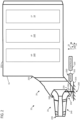
- FIG. 4 is a schematic top view of an embodiment of the exhaust diffuser system 22 of FIGS. 1-3 , further illustrating details of the axial-radial diffuser 24 and the transition duct 26 of the exhaust diffuser system 22.
- the exhaust diffuser system 22 is the same as described above with reference to FIGS. 1-3 , and thus like element numbers are used in FIG. 4 . Additional aspects of the radial supports 280 of the axial-radial diffuser 24, the support structure 244, the side walls 374 and 376 of the transition duct 26, and interior features in the transition duct 26 are discussed in detail below.
- the radial supports 280 extend in opposite radial directions 32 (e.g., opposite lateral directions) from the inner wall 290 toward the outer wall 292.
- the radial supports 280 may include any number (e.g., 2, 3, 4, 5, 6, 7, 8, 9, 10 or more) and configuration (e.g., symmetric or asymmetric) of the radial supports 296, 298, and 300.
- the radial supports 298 and 300 may be oriented at an angle 420 between the central axis 270 and a central axis 422 of the radial supports 298 and 300.
- the angle 420 may be an acute angle of 60 to 80 degrees.
- the radial supports 298 and 300 may be oriented at the same or different angles 420, the same or different axial positions in the axial direction 30 along the central axis 270, the same or different circumferential positions in the circumferential direction 34 about the central axis 34, or any combination thereof.
- at least some of the radial supports 298 and 300 may be arranged in a nested configuration with a radial support 298 extending internally through a radial support 300, and/or at least some of the radial supports 298 and 300 may be arranged independently in the axial-radial diffuser 24 (e.g., circumferentially spaced apart).
- the support structure 244 includes the framework 256 having the plurality of supports 258 extending laterally in opposite directions toward and/or beyond the side walls 374 and 376 of the transition duct 26.
- the plurality of supports 258 may extend internally through and/or externally outside of the transition duct 26 between the central hub 302 of the radial diffuser portion 242 and the base 254 (see FIGS. 2 and 3 ).
- the plurality of supports 258 may include horizontal supports, vertical supports, and/or angled supports (e.g., acutely angled supports) relative to the base 254. As illustrated in FIG.
- the plurality of supports 258 may extend from the inner wall 304 of the radial diffuser portion 242, through the outlet 286, through the transition duct 26 (e.g., through one or more walls), and to the base 254.
- the support structure 244 may be configured to hold the radial diffuser portion 242 in a fixed position and/or enable movement of the central hub 302 via the flow passage area adjustment system 260 (see FIGS. 2 and 3 ) to adjust a flow area of the exhaust gas 152 through the radial diffuser portion 242.
- the side walls 374 and 376 of the transition duct 26 generally diverge away from the central axis 270 in the downstream direction of flow of the exhaust gas 152 from the axial-radial diffuser 24 toward an outlet 424 (e.g., rectangular outlet) of the transition duct 26.
- the side walls 382 and 384 are oriented at an angle 426 relative to the central axis 270
- the side walls 390 and 392 are oriented at an angle 428 relative to the central axis 270
- the side walls 398 and 400 are oriented at an angle 430 relative to the central axis 270.
- the angles 426, 428, and 430 may be same or different (e.g., greater or lesser) from one another.
- the angle 426 is greater than the angles 428 and 430, thereby providing a more rapid expansion of the exhaust gas 152 in the expansion stage 360 disposed about the outlet 286 of the radial diffuser portion 242.
- the angle 426 may be at least 5, 10, 15, 20, 25, or 30 degrees greater than the angles 428 and 430.
- the angle 428 may be the same or different (e.g., greater or lesser than) the angle 430.
- the angle 426 may be about 20 to 60 degrees, 25 to 50 degrees, or 30 to 40 degrees, and the angles 428 and 430 may be about 5 to 40 degrees, 10 to 30 degrees, or 15 to 25 degrees.
- the axial lengths 385, 393, and 401 of the expansion stages 360, 362, and 364 may be the same or different (e.g., greater or lesser) from one another.
- the axial length 385 of the expansion stage 360 may be equal to, greater than, or less than the axial length 393 of the expansion stage 362, and/or the axial length 401 of the expansion stage 364.
- the axial length 393 of the expansion stage 362 may be equal to, greater than, or less than the axial length 385 of the expansion stage 360 and/or the axial length 401 of the expansion stage 364.
- the axial length 401 of the expansion stage 364 may be equal to, greater than, or less than the axial length 385 of the expansion stage 360 and/or the axial length 393 of the expansion stage 364.
- the axial length 385 of the expansion stage 360 is greater than each of the axial length 385 of the expansion stage 360 and the axial length 401 of the expansion stage 364, and the axial length 393 of the expansion stage 362 is greater than the axial length 401 of the expansion stage 364.
- the transition duct 26 also may include one or more internal flow conditioners 432, such as flow conditioners 434 and 436 coupled to the opposite side walls 374 and 376.
- the internal flow conditioners 432 e.g., flow conditioners 434 and 436) are coupled to the opposite side walls 398 and 400 in the expansion stage 362.
- the internal flow conditioners 432 may include one or more flow conditioners disposed in each of the expansion stages 360, 362, and 364, coupled to any of the walls (e.g., top, bottom, and side walls), or any combination thereof.
- the internal flow conditioners 432 may include perforated baffles 438 and 440 (e.g., perforated plates) having a plurality of openings to enable at least some flow of the exhaust gas 152 through the perforated baffles 438 and 440.
- the openings may include hundreds or thousands of openings, which may be sized from 1 to 50 mm in diameter.
- the perforated baffles 438 and 440 may be oriented at an angle 442 relative to the side walls 374 and 376 (e.g., side walls 398 and 400), such as between 20 to 90 degrees, 30 to 85 degrees, 40 to 80 degrees, or 50 to 75 degrees.
- the angle 442 may be at least equal to or greater than 20, 30, 40, 50, 60, 70, or 80 degrees.
- the perforated baffles 438 and 440 also may be oriented at an angle 444 relative to the central axis 270, such as an acute angle between 10 to 70 degrees, 20 to 60 degrees, or 30 to 50 degrees.
- the angle 444 may be oriented in a downstream direction toward the outlet 424 of the transition duct 26.
- the perforated baffles 438 and 440 also may extend a radial distance 446 in the radial direction 32 from the side walls 398 and 400 toward the central axis 270.
- the radial distance 446 of the perforated baffles 438 and 440 may be between 5 to 60 percent, 10 to 50 percent, or 15 to 40 percent of a radial distance 448 between the side walls 398 and 400 and the central axis 270 at the location of the perforated baffles 438 and 440.
- the perforated baffles 438 and 440 are configured to help redirect at least some of the flow of the exhaust gas 152 away from the side walls 374 and 376 toward a central region 450 of the transition duct 26, wherein the central region 450 includes or crosses over the central axis 270.
- the openings in the perforated baffles 438 and 440 still allow some of the flow of the exhaust gas 152 to pass through the perforated baffles 438 and 440 and flow along the side walls 374 and 376.
- the perforated baffles 438 and 440 are configured to help provide a more uniformly distributed flow of the exhaust gas 152 before discharge through the outlet 424 into the HRSG 16.
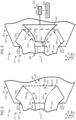
- FIG. 5 is a partial schematic side view of an embodiment of the exhaust diffuser system 22 of FIGS. 1-4 , further illustrating details of the radial diffuser portion 242 of the axial-radial diffuser 24 and the transition duct 26 of the exhaust diffuser system 22, wherein the radial diffuser portion 242 includes perforated wall portions 460 in the central hub 302.
- the central hub 302 of FIGS. 1-4 may include or exclude the perforated wall portions 460.
- the perforated wall portions 460 include a perforated wall portion 462 in the inner wall 304 of the central hub 302, and a perforated wall portion 464 in the central end plate 466.
- the perforated wall portion 462 may include an annular wall portion (e.g., curved annular wall portion) of the inner wall 304, wherein the perforated wall portion 462 includes a plurality of perforations or openings 468.
- the perforated wall portion 464 may include a disc-shaped portion of the central end plate 466, wherein the perforated wall portion 464 includes a plurality of perforations or openings 470.
- a portion of the flow of the exhaust gas 152 may flow through the openings 468 in the perforated wall portion 462, through a central cavity or passage 472 inside the central hub 302, and out through the openings 470 in the central end plate 466 toward the central region 450 of the transition duct 26.
- the perforated wall portions 460 direct at least some of the exhaust gas 152 into the central region 450, thereby helping to avoid a low velocity zone in the central region 450 downstream of the central hub 302.
- the perforated wall portions 460 e.g., perforated wall portions 462 and 464 help to distribute the exhaust gas 152 more uniformly throughout the transition duct 26.
- the perforated wall portions 460 may include any number, size, and shape of the openings 468 and 470.
- the openings 468 and 470 may include at least 10, 50, 100, 200, 300, 400, 500, 600, 700, 800, 900, 1000, or more openings.
- the openings 468 and 470 may be sized between 1 to 10 mm.
- the openings 468 and 470 may include circular, oval, square, triangular, or any other shape of opening.
- the central hub 302 may exclude the central end plate 466, such that the central hub 302 has a single large opening instead of the central end plate 466.
- FIG. 6 is a partial schematic side view of an embodiment of the exhaust diffuser system 22 of FIGS. 1-4 , further illustrating details of the radial diffuser portion 242 of the axial-radial diffuser 24 and the transition duct 26 of the exhaust diffuser system 22, wherein the central hub 302 of the radial diffuser portion 242 is movable (i.e., axially translatable) via the flow passage area adjustment system 260.
- the central hub 302 is coupled (e.g., directly or indirectly) to the drive 262 via the transmission 264 of the flow adjustment 260.
- the transmission 264 may be coupled directly to the central hub 302 or indirectly via the support structure 244.
- the drive 262 is controlled by the controller 220 to transfer motion through the transmission 264 to the central hub 302, thereby enabling axial movement of the central hub 302 between a first position 480 adj acent the axial diffuser portion 240 and a second position 482 axially offset away from the axial diffuser portion 240 as indicated by axial offset distance 484.
- a cross-sectional area 486 defined by the inner wall 302 and the outer wall 306 of the radial diffuser portion 242 increases to cause an increasing flow area through the radial diffuser portion 242.
- the controller 220 may control the drive 262 of the flow passage area adjustment system 260 to adjust the flow area through the radial diffuser portion 242 into the transition duct 26, thereby helping to adjust the distribution of the exhaust gas into the transition duct 26 and to help adjust the diffusion and/or flow conditioning through the transition duct 26.
- FIG. 7 is a schematic side view of an embodiment of the exhaust diffuser system of FIGS. 1-6 , further illustrating details of the radial diffuser portion 242 of the axial-radial diffuser 24.
- the axial-radial diffuser 24 is the same as described above with reference to FIGS. 1-6 , and thus like element numbers are used in FIG. 7 .
- the axial-radial diffuser 24 has an asymmetric configuration 490 about the central axis 270, wherein a first portion 492 (e.g., upper portion) differs from a second portion 494 (e.g., lower portion) on opposite sides of the central axis 270.
- the flow passage 278 may differ between the first and second portions 492 and 494, such that the flow passage 278 includes a first passage portion 496 (e.g., upper passage portion) in the first portion 492 and a second passage portion 498 (e.g., lower passage portion) in the second portion 494.
- first passage portion 496 e.g., upper passage portion
- second passage portion 498 e.g., lower passage portion
- the radial diffuser portion 242 may include a plurality of geometrical variations (e.g., progressively or continuously changing) in the circumferential direction 34 about the central axis 270, including but not limited to a distance 500 between the inner and outer walls 304 and 306, a radius 502 of curvature of the inner wall 304, a radius 504 of curvature of the outer wall, or any combination thereof.
- the distance 500 may be measured along a line perpendicular to the outer wall 306 and extending to the inner wall 304. However, at the outlet 286, the distance 500 may be measured from an end of the outer wall 306 to an end of the inner wall 304.
- the distance 500 between the inner and outer walls 304 and 306 may alternatingly increase and decrease in the circumferential direction 34 about the central axis 270.
- the distance 500 may reach a minimum at the first portion 492 and a maximum at the second portion 494.
- the distance 500 may be a minimum at the first portion 492 diametrically opposite from a maximum at the second portion 494.
- the variation in the distance 500 may be achieved at least in part by variations in the radius 502 of the inner wall 304 and/or variations in the radius 504 of the outer wall 306.
- the radius 502 of the inner wall 304 may be variable while the radius 504 of the outer wall 306 may be constant in the circumferential direction 34 about the central axis 270, or the radius 502 of the inner wall 304 may be constant while the radius 504 of the outer wall 306 may be variable in the circumferential direction 34 about the central axis 270.
- the distance 500 is variable, and the radius 502 of the inner wall 304 is variable in the circumferential direction 34 about the central axis 270, such that the passage 278 and the outlet 286 vary between the first and second portions 492 and 494 (e.g., upper and lower portions).
- the outlet 286 and the first passage portion 496 of the passage 278 in the first portion 492 may be smaller or more restricted as compared to the outlet 286 and the second passage portion 498 in the second portion 494 (e.g., lower portion 494).
- the variations in the distance 500 and the radius 502 of the inner wall 304 also may result in the central end plate 466 being oriented at an angle 506 relative to the central axis 270.
- the central end plate 466 may be angled in the downstream direction from the fist portion 492 to the second portion 494, wherein the angle 506 may be an acute angle between 60 to 85 degrees or between 65 to 75 degrees.
- the central end plate 466 may be described as an inclined central end plate.
- the asymmetric configuration 490 of the axial-radial diffuser 24 of FIG. 7 may be configured to distribute more of the flow of exhaust gas 152 toward a bottom portion of the transition duct 26 and less of the flow of exhaust gas 152 toward an upper portion of the transition duct 26 to help diffuse and distribute the exhaust gas 152 more uniformly throughout the transition duct 26.
- the axial-radial diffuser 24 may use the asymmetric configuration 490 of FIG. 7 in a reversed orientation (e.g., rotated 180 degrees about the central axis 270) or a sideways orientation (e.g., rotated 90 degrees about the central axis 270).
- the axial-radial diffuser 24 of FIG. 7 may be used with all aspects of the exhaust diffuser system 22 illustrated and described herein with reference to FIGS. 1-8 .
- FIG. 8 is a schematic side view of an embodiment of the exhaust diffuser system of FIGS. 1-6 , further illustrating details of the radial diffuser portion 242 of the axial-radial diffuser 24.
- the axial-radial diffuser 24 is the same as described above with reference to FIGS. 1-6 , and thus like element numbers are used in FIG. 8 .
- the axial-radial diffuser 24 has an S-curved profile 520 about the central axis 270, wherein the S-curved profile 520 includes an inner S-curved profile 522 of the inner wall 304 and an outer S-curved profile 524 of the outer wall 306 extending in the circumferential direction 34 about the central axis 270.
- the inner S-curved profile 522 includes an inwardly curved or concave profile 526 transitioning into an outwardly curved or convex profile 528 in the flow direction 282 along the central axis 270, wherein the inner S-curved profile 522 (e.g., with profiles 526 and 528) extends in the circumferential direction 34 about the central axis 270.
- the outer S-curved profile 524 includes an inwardly curved or concave profile 530 transitioning into an outwardly curved or convex profile 532 in the flow direction 282 along the central axis 270, wherein the outer S-curved profile 524 (e.g., with profiles 530 and 532) extends in the circumferential direction 34 about the central axis 270.
- the inner and outer S-curved profiles 522 and 524 are symmetric about the central axis 270. However, in some embodiments, the inner and outer S-curved profiles 522 and 524 are asymmetric about the central axis 270, such as in combination with the asymmetric configuration 490 of FIG. 7 .
- the inwardly curved profiles 526 and 530 of the inner and outer S-curved profiles 522 and 524 may be configured to provide the initial radial diffusion of the exhaust gas 152 from the axial diffuser portion 240, while the outwardly curved profiles 528 and 532 of the inner and outer S-curved profiles 522 and 524 may be configured to continue the radial diffusion and begin transitioning the flow of the exhaust gas 152 for discharge into the expansion stage 360 of the transition duct 26.
- the inwardly curved profiles 526 and 530 may be configured to turn the flow of the exhaust gas 152 from the axial direction 30 toward the radial direction 32
- the outwardly curved profiles 528 and 532 may be configured to turn the flow of the exhaust gas 152 from the radial direction 32 toward the axial direction 30
- the radius 502 of the inner wall 304 may continuously vary in the flow direction 282 along the inwardly curved profile 526 followed by the outwardly curved profile 528
- the radius 504 of the outer wall 306 may continuously vary in the flow direction 282 along the inwardly curved profile 530 followed by the outwardly curved profile 532.
- the axial-radial diffuser 24 of FIG. 8 may be used with all aspects of the exhaust diffuser system 22 illustrated and described herein with reference to FIGS. 1-7 .
- an exhaust diffuser system 22 having an axial-radial diffuser 24 coupled to a transition duct 26, which helps to diffuse an exhaust gas 152 between a gas turbine system 12 and a HRSG 16 in a reduced footprint to allow space for various gas treatment equipment.
- Embodiments of the exhaust diffuser system 22 have a reduced length by using the axial-radial diffuser 24 rather than only an axial diffuser.
- the axial-radial diffuser 24 may be adjustable to adjust a flow area and exhaust gas distribution into the transition duct 24, such as via a flow passage area adjustment system 260 coupled to a central hub 302 of a radial diffuser portion 242.
- the radial diffuser portion 242 also may include a perforated wall portions 460 to avoid low velocity regions downstream from the radial diffuser portion 242, an asymmetric configuration 490 to help distribute the exhaust gas 152 into the transition duct 26, and an S-curved profile 520 configured to help transition the flow of the exhaust gas 152 from the radial diffuser portion 242 into the transition duct 26.
- the transition duct 26 also may include a plurality of expansion stages 360, 362, and 364 configured to gradually expand and turn the flow of the exhaust gas 152 from the axial-radial diffuser 24 to the HRSG 16.
- the transition duct 26 also may include internal flow conditioners 432 configured to help direct the flow of the exhaust gas 152 away from walls of the transition duct 26 and distribute the flow of the exhaust gas 152 more uniformly upstream from the HRSG 16.
- a system includes an exhaust diffuser system having an axial-radial diffuser and a transition duct.
- the axial-radial diffuser includes an inlet, an outlet, an axial diffuser portion between the inlet and the outlet, and a radial diffuser portion between the axial diffuser portion and the outlet, wherein the inlet is configured to couple to a gas turbine system.
- the transition duct is coupled to the axial-radial diffuser, wherein the outlet is disposed inside of an intake portion of the transition duct, and the transition duct includes a discharge portion configured to couple to a heat recovery steam generator (HRSG).
- HRSG heat recovery steam generator
- the system of the preceding clause including the gas turbine system coupled to the exhaust diffuser system, the HRSG coupled to the exhaust diffuser system, a gas treatment system having a gas capture system downstream from the HRSG, or a combination thereof.
- transition duct is upwardly inclined from the axial-radial diffuser to a duct of the HRSG.
- transition duct has a cross-sectional area that expands in a flow direction from the axial-radial diffuser to the HRSG.
- transition duct includes a plurality of expansion stages having different rates of expansion of the cross-sectional area.
- the intake portion includes a first expansion stage of the plurality of expansion stages, wherein a first stage wall of the transition duct along the first expansion stage diverges away from a central axis of the axial-radial diffuser around the central axis.
- the first stage wall includes a first top wall, a first bottom wall, and first opposite side walls that diverge away from the central axis.
- a second expansion stage of the plurality of expansion stages includes second opposite side walls that diverge away from the central axis.
- discharge portion includes a third expansion stage of the plurality of expansion stages, and the third expansion stage includes third opposite side walls that diverge away from the central axis.
- the second expansion stage includes second top and bottom walls that are upwardly inclined relative to the central axis
- the third expansion stage includes third top and bottom walls that are upwardly inclined relative to the central axis.
- transition duct includes a plurality of perforated baffles oriented at an acute angle relative to a central axis of the axial-radial diffuser.
- the axial diffuser portion includes a first central hub having a first inner wall disposed about a central axis, a first outer wall disposed about the first inner wall, and a first exhaust passage between the first inner and outer walls
- the radial diffuser portion includes a second central hub having a second inner wall disposed about the central axis, a second outer wall disposed about the second inner wall, a second exhaust passage between the second inner and outer walls and fluidly coupled to the first exhaust passage, wherein the radial diffuser portion turns outward away from the central axis from the axial diffuser portion to the outlet.
- the axial diffuser portion includes a first plurality of radial supports between the first inner and outer walls at a first axial position along the central axis, and a second plurality of radial supports between the second inner and outer walls at a second axial position along the central axis, wherein the second plurality of radial supports includes one or more radial supports with a manway and one or more radial supports without a manway.
- the support structure includes first and second supports extending from the second central hub to the base.
- the second central hub is coupled to a drive of a flow passage area adjustment system, and the drive is configured to move the second central hub to adjust flow between the second inner and outer walls.
- a method includes diffusing an exhaust gas from a gas turbine system through an axial-radial diffuser of an exhaust diffuser system.
- the axial-radial diffuser includes an inlet, an outlet, an axial diffuser portion between the inlet and the outlet, and a radial diffuser portion between the axial diffuser portion and the outlet, wherein the inlet is coupled to the gas turbine system.
- the method also includes transitioning the exhaust gas from the radial diffuser portion to a heat recovery steam generator (HRSG) through a transition duct of the exhaust diffuser system.
- the transition duct is coupled to the axial-radial diffuser, the outlet is disposed inside of an intake portion of the transition duct, and the transition duct includes a discharge portion coupled to the HRSG.
- a system includes an exhaust diffuser system configured to mount between a gas turbine system and a heat recovery steam generator (HRSG).
- the exhaust diffuser system includes a radial diffuser portion having a central hub with an inner wall disposed about a central axis, an outer wall disposed about the inner wall, and an exhaust passage between the inner and outer walls.
- the exhaust diffuser system includes a flow passage area adjustment system having a drive coupled to the central hub of the radial diffuser portion.
- the exhaust diffuser system also includes a controller coupled to the drive, wherein the controller is configured to control the drive to move the central hub of the radial diffuser portion to adjust a flow through the radial diffuser portion.
Landscapes
- Engineering & Computer Science (AREA)
- Mechanical Engineering (AREA)
- General Engineering & Computer Science (AREA)
- Chemical & Material Sciences (AREA)
- Combustion & Propulsion (AREA)
- Life Sciences & Earth Sciences (AREA)
- Sustainable Development (AREA)
- Sustainable Energy (AREA)
- Physics & Mathematics (AREA)
- Thermal Sciences (AREA)
- Engine Equipment That Uses Special Cycles (AREA)
Abstract
Description
- This application claims priority to and benefit of
India Application No. 202311030098, filed on April 26, 2023 - The present application relates generally to a system and method for diffusing an exhaust gas from a gas turbine system for supply into a heat recovery steam generator (HRSG).
- A combined cycle power plant routes an exhaust gas from a gas turbine system through an HRSG, which generates steam to drive a steam turbine system. Unfortunately, the HRSG may be spaced a considerable distance away from the gas turbine system to allow for exhaust diffusion upstream of the HRSG, thereby consuming valuable space at a site of the combined cycle power plant. With various regulations and environmental concerns regarding global warming, additional space is needed to add gas treatment equipment to reduce the output of undesirable gases present in the exhaust gas. For example, the undesirable gases may include carbon oxides (COx) such as carbon dioxide (CO2) and carbon monoxide (CO), nitrogen oxides (NOx) such as nitrogen dioxide (NO2), and/or sulfur oxides (SOx) such as sulfur dioxide (SO2). Accordingly, a need exists to reduce the space consumption for exhaust diffusion, thereby increasing the available space for gas treatment.
- Certain embodiments commensurate in scope with the originally claimed subject matter are summarized below. These embodiments are not intended to limit the scope of the claimed embodiments, but rather these embodiments are intended only to provide a brief summary of possible forms of the subject matter. Indeed, the presently claimed embodiments may encompass a variety of forms that may be similar to or different from the embodiments set forth below.
- A system includes an exhaust diffuser system having an axial-radial diffuser and a transition duct. The axial-radial diffuser includes an inlet, an outlet, an axial diffuser portion between the inlet and the outlet, and a radial diffuser portion between the axial diffuser portion and the outlet, wherein the inlet is configured to couple to a gas turbine system. The transition duct is coupled to the axial-radial diffuser, wherein the outlet is disposed inside of an intake portion of the transition duct, and the transition duct includes a discharge portion configured to couple to a heat recovery steam generator (HRSG).
- A method includes diffusing an exhaust gas from a gas turbine system through an axial-radial diffuser of an exhaust diffuser system. The axial-radial diffuser includes an inlet, an outlet, an axial diffuser portion between the inlet and the outlet, and a radial diffuser portion between the axial diffuser portion and the outlet, wherein the inlet is coupled to the gas turbine system. The method also includes transitioning the exhaust gas from the radial diffuser portion to a heat recovery steam generator (HRSG) through a transition duct of the exhaust diffuser system. The transition duct is coupled to the axial-radial diffuser, the outlet is disposed inside of an intake portion of the transition duct, and the transition duct includes a discharge portion coupled to the HRSG.
- A system includes an exhaust diffuser system configured to mount between a gas turbine system and a heat recovery steam generator (HRSG). The exhaust diffuser system includes a radial diffuser portion having a central hub with an inner wall disposed about a central axis, an outer wall disposed about the inner wall, and an exhaust passage between the inner and outer walls. The exhaust diffuser system includes a flow passage area adjustment system having a drive coupled to the central hub of the radial diffuser portion. The exhaust diffuser system also includes a controller coupled to the drive, wherein the controller is configured to control the drive to move the central hub of the radial diffuser portion to adjust a flow through the radial diffuser portion.
- These and other features, aspects, and advantages of the presently disclosed system and techniques will become better understood when the following detailed description is read with reference to the accompanying drawings in which like characters represent like parts throughout the drawings, wherein:
-
FIG. 1 is a block diagram of an embodiment of a combined cycle system having a gas turbine system, a steam turbine system, a heat recovery steam generator (HRSG), a gas treatment system having one or more gas capture systems, and an exhaust diffuser system. -
FIG. 2 is a schematic side view of an embodiment of the exhaust diffuser system coupled to the HRSG ofFIG. 1 . -
FIG. 3 is a schematic side view of an embodiment of the exhaust diffuser system ofFIGS. 1 and2 , further illustrating details of an axial-radial diffuser and a transition duct of the exhaust diffuser system. -
FIG. 4 is a schematic top view of an embodiment of the exhaust diffuser system ofFIGS. 1-3 , further illustrating details of the axial-radial diffuser and the transition duct of the exhaust diffuser system. -
FIG. 5 is a partial schematic side view of an embodiment of the exhaust diffuser system ofFIGS. 1-4 , further illustrating details of a radial diffuser portion of the axial-radial diffuser and the transition duct of the exhaust diffuser system, in which the radial diffuser portion includes perforated wall portions in the central hub. -
FIG. 6 is a partial schematic side view of an embodiment of the exhaust diffuser system ofFIGS. 1-4 , further illustrating details of a radial diffuser portion of the axial-radial diffuser and the transition duct of the exhaust diffuser system, in which a central hub of the radial diffuser portion is movable via a flow passage area adjustment system. -
FIG. 7 is a schematic side view of an embodiment of the exhaust diffuser system ofFIGS. 1-6 , further illustrating details of the radial diffuser portion of the axial-radial diffuser having an asymmetric configuration. -
FIG. 8 is a schematic side view of an embodiment of the exhaust diffuser system ofFIGS. 1-6 , further illustrating details of the radial diffuser portion of the axial-radial diffuser having an S-curved profile. - One or more specific embodiments of the presently disclosed systems and methods are described below. In an effort to provide a concise description of these embodiments, all features of an actual implementation may not be described in the specification. It should be appreciated that in the development of any such actual implementation, as in any engineering or design project, numerous implementation-specific decisions must be made to achieve the developers' specific goals, such as compliance with system-related and business-related constraints, which may vary from one implementation to another. Moreover, it should be appreciated that such a development effort might be complex and time consuming, but would nevertheless be a routine undertaking of design, fabrication, and manufacture for those of ordinary skill having the benefit of this disclosure.
- When introducing elements of various embodiments of the presently disclosed embodiments, the articles "a," "an," "the," and "said" are intended to mean that there are one or more of the elements. The terms "comprising," "including," and "having" are intended to be inclusive and mean that there may be additional elements other than the listed elements.
- The disclosed embodiments include systems and methods to reduce the space consumption for exhaust diffusion via an axial-radial diffuser between a gas turbine system and a heat recovery steam generator (HRSG). The axial-radial diffuser is relatively shorter in length compared with an axial diffuser, and thus enables closer placement of the HRSG relative to the gas turbine system. The reduced space consumption of the axial-radial diffuser provides additional space for gas treatment systems. Additionally, the axial-radial diffuser may substantially improve the flow uniformity of the exhaust gas directed toward the tubes (e.g., tube bundles) of the HRSG, thereby helping to improve the efficiency of the HRSG.
- Using the space savings achieved with the axial-radial diffuser, the disclosed embodiments may improve or expand a gas treatment system via one or more gas capture systems. The gas capture systems are configured to remove undesirable gases (e.g., CO2) from the intake air and/or the exhaust gas of the combustion systems. The gas capture systems may include sorbent-based gas capture systems, solvent-based gas capture systems, cryogenic gas capture systems, or a combination thereof.
- For example, the gas capture systems (e.g., sorbent-based gas capture systems) may include one or more temperature swing adsorption (TSA) units or adsorbers, which rely on temperature swings to adsorb undesirable gases at a first temperature (e.g., low temperature) and desorb the undesirable gases at a second temperature (e.g., high temperature). For example, the sorbent-based gas capture systems are configured to adsorb the undesirable gases into a sorbent material, and then subsequently desorb the undesirable gases from the sorbent material using a heat source (e.g., steam from the HRSG, steam from the steam turbine system, or other steam source). The adsorption process is exothermic, while the desorption process is endothermic.
- By further example, the solvent-based gas capture systems may include an absorber configured to absorb the undesirable gas into a solvent, and a stripper configured to strip the undesirable gas from the solvent using steam (e.g., steam from the HRSG, steam from the steam turbine system, or other steam source). Although the solvent-based gas capture systems are discussed as using a solvent as an absorbent fluid, the disclosed embodiments may use any suitable absorbent fluid for capturing undesirable gases. Accordingly, the solvent-based gas capture system also may be described as a fluid absorbent-based gas capture system.
- As discussed below, the axial-radial diffuser may be used to save space (e.g., reduce the footprint for exhaust diffusion), thereby providing additional space for the gas treatment systems (e.g., gas capture systems). Although specific examples are provided below, the gas capture systems, including but not limited to, sorbent-based gas capture systems, solvent-based gas capture systems, and cryogenic gas capture systems, may be added, expanded, and/or generally improved using the space savings achieved with the present axial-radial diffuser. However, the axial-radial diffuser also may provide space savings for other reasons.
-
FIG. 1 is a block diagram of an embodiment of a combinedcycle system 10 having agas turbine system 12, asteam turbine system 14, a heat recovery steam generator (HRSG) 16, agas treatment system 18 having one or moregas capture systems 20, and anexhaust diffuser system 22. Thegas capture systems 20 are configured to capture an undesirable gas (e.g., CO2) from a gas, such as exhaust gas and/or air. As discussed below, thegas capture systems 20 may include sorbent-based gas capture systems, solvent-based gas capture systems, cryogenic gas capture systems, or any combination thereof. Theexhaust diffuser system 22 includes an axial-radial diffuser 24 coupled to atransition duct 26, wherein the axial-radial diffuser 24 is coupled to thegas turbine system 12 and thetransition duct 26 is coupled to theHRSG 16. The axial-radial diffuser 24 is configured to diffuse theexhaust gas 152 from thegas turbine system 12 via axial diffusion and radial diffusion, thereby reducing the axial length and footprint of theexhaust diffuser system 22 relative to an axial only diffuser. Additionally, thetransition duct 26 is configured to transition theexhaust gas 152 from the axial-radial diffuser 24 to theHRSG 16 via flow conditioning to help provide a more uniform flow of theexhaust gas 152 into theHRSG 16. - Before discussing details of the
gas treatment system 18 and theexhaust diffuser system 22, various aspects of the combinedcycle system 10 are discussed in further detail. For purposes of orientation in the drawings, reference may be made to an axial direction oraxis 30, a radial direction oraxis 32 extending radially away from the axial direction oraxis 30, and a circumferential direction oraxis 34 extending circumferentially around the axial direction oraxis 30. The directions oraxes rotational axis 36 of thegas turbine system 12, for example. Additionally, the directions oraxes axis 270 shown inFIG. 3 ). - The
gas turbine system 12 may include anintake section 40, a compressor orcompressor section 42, acombustor section 44, a gas (expansion) turbine orturbine section 46, and anexhaust section 48. Thecompressor section 42 may include at least oneshaft 50 disposed along therotational axis 36, a casing 52 (e.g., annular casing) disposed circumferentially about the at least oneshaft 50, a plurality ofrotating compressor blades 54 extending radially outward from the at least oneshaft 50, and a plurality ofstationary compressor vanes 56 extending radially inward from thecasing 52 toward the at least oneshaft 50. In the illustrated embodiment, thecompressor section 42 may include a plurality of compressor stages 58, each having a plurality of thecompressor vanes 56 spaced circumferentially about the at least oneshaft 50 at an axial position and a plurality of thecompressor blades 54 spaced circumferentially about the at least oneshaft 50 at a different axial position immediately adjacent to the axial position of the compressor vanes 56 (i.e., thecompressor vanes 56 and thecompressor blades 58 are axially spaced apart). Accordingly, thecompressor section 42 is configured to receive a flow of anintake gas 60 from theintake section 40 and to progressively compress theintake gas 60 through the plurality of compressor stages 58. As discussed in further detail below, theintake gas 60 may include an intake air, an exhaust gas recirculation (EGR) flow or recirculated exhaust gas, or a combination thereof. - The
combustor section 44 may include one ormore combustors 62, such as a single annular combustor disposed circumferentially about therotational axis 36 or a plurality ofcombustors 62 circumferentially spaced about therotational axis 36. In the illustrated embodiment, each combustor 62 includes ahead end portion 64 coupled to acombustion portion 66. In an exemplary arrangement, thecombustion portion 66 includes acombustion chamber 68, acombustor liner 70 disposed circumferentially about thecombustion chamber 68, a flow sleeve 72 disposed circumferentially about thecombustor liner 70, and a passage 74 extending between thecombustor liner 70 and the flow sleeve 72. The passage 74 is configured to route a compressed gas flow in anupstream direction 76 toward ahead end chamber 78 disposed in thehead end portion 64. Thehead end chamber 78 and thecombustion chamber 68 of thecombustor 62 are separated or divided from one another by anintermediate plate 80. In thehead end chamber 78, a plurality offuel nozzles 82 are coupled to theintermediate plate 80 and anend plate 84 of thehead end portion 64. In operation, each combustor 62 receives a compressed gas 86 (e.g., air, EGR, etc.) from thecompressor section 42, routes the compressedgas 86 along the passage 74 toward thehead end chamber 78 as indicated byarrow 76, and routes the compressed gas through thefuel nozzles 82 into thecombustion chamber 68. - In certain embodiments, each combustor 62 may receive one or more fuel flows from a
fuel system 88 coupled to thefuel nozzles 82, wherein thefuel system 88 includes afuel supply system 90 coupled to one ormore fuel circuits 92. For example, thefuel circuits 92 may includefuel circuits fuel nozzles 82. The fuel circuits 92 (e.g., 94, 96, and 98) may include fuel conduits, fuel manifolds, fuel valves, pressure regulators, and other flow controls. Thefuel system 88 is configured to supply one or more fuels, such as liquid and/or gas fuels, into each of thefuel nozzles 82 for injection into thecombustion chamber 68. The fuels may include natural gas, syngas generated from a gasifier, methane, hydrogen, biofuel, fuel oils, or any combination thereof. Thefuel supply system 90 may include a plurality of components to control flows of the various fluids to thecombustor 62. For example, thefuel supply system 90 may include one or more components 100. In certain embodiments, the components 100 may include one or more fuel tanks, fuel pumps, valves, pressure regulators, flow regulators, filters, water removal units, particulate removal units, manifolds, flow controllers, or any combination thereof. - The fuel nozzles 82 are configured to inject one or more fuels from the
fuel system 88 and the compressedgas 86 from thecompressor section 42. In certain embodiments, thefuel nozzles 82 are configured to inject acompressed air 104 from acompressor system 106 having anair compressor 108 coupled to adrive 110, such as an electric motor, a combustion engine, a shaft coupled to thegas turbine system 12, or another suitable drive. Thecompressor system 106 may be configured to receive air from ambient and/or from theintake section 40. Additionally, thecompressor system 106 may be configured to enable multiple modes of operation, such as EGR mode or non-EGR mode. - For example, in certain embodiments of the
gas turbine system 12 having exhaust gas recirculation (EGR), thecompressor section 42 supplies the compressed gas 86 (e.g., compressed exhaust gas) to each combustor 62, while thecompressor system 106 supplies thecompressed air 104 to eachcombustor 62. By further example, in certain embodiments of thegas turbine system 12 without exhaust gas recirculation (EGR), thecompressor section 42 supplies the compressed gas 86 (e.g., compressed air) to each combustor 62 without any need for additional air supplies. Thus, thecompressor system 106 may optionally supply thecompressed air 104 to eachcombustor 62. In operation, the fuel may be combusted with the air in thecombustion chamber 68 of each combustor 62, thereby generating ahot combustion gas 112 for delivery from thecombustion chamber 68 into theturbine section 46. - The
turbine section 46 includes at least oneshaft 114 disposed along therotational axis 36, a casing 116 (e.g., annular casing) disposed circumferentially about the at least oneshaft 114, a plurality ofrotating turbine blades 118 extending radially outward from the at least oneshaft 114, and a plurality ofstationary turbine vanes 120 extending radially inward from thecasing 116 toward the at least oneshaft 114. Theturbine section 46 may include a plurality of turbine stages 122, each having a plurality of theturbine vanes 120 spaced circumferentially about the at least oneshaft 114 at an axial position, and a plurality of theturbine blades 118 spaced circumferentially about the at least oneshaft 114 at a different axial position immediately adjacent the axial position of the turbine blades 118 (i.e., theturbine vanes 120 and theturbine blades 118 are axially spaced apart). The at least oneshaft 114 also may be coupled to the at least oneshaft 50 of thecompressor section 42 via at least oneintermediate shaft 124. - Additionally, the at least one
shaft 114 may be coupled to a load 126 via ashaft 128. In certain embodiments, the load 126 may include an electrical generator, a machine, a propulsion system for a vehicle, or any other suitable load. In the illustrated embodiment, the load 126 may be an electrical generator, such that the combinedcycle system 10 is a combined cycle power plant. In operation, thecombustion gas 112 flows from thecombustor 62 into theturbine section 46, wherein thecombustion gas 112 progressively expands and drives rotation of theturbine blades 118 coupled to the at least oneshaft 114 in each of the turbine stages 122. Thus, thecombustion gas 112 drives theturbine section 46, which in turn drives thecompressor section 42 and the load 126 via theinterconnected shafts - In certain embodiments, the
gas turbine system 12 may be configured with a common rotational direction of theshafts connected compressor blades 54 andturbine blades 118. Theshafts shafts - The
gas turbine system 12 can be configured with or without thecompressor system 106 and an exhaust gas recirculation (EGR)system 150. TheEGR system 150 is configured to recirculate anexhaust gas 152 output by theturbine section 46 back into the compressor section 42 (e.g., via intake section 40) for compression and delivery to thecombustor section 44. However, thegas turbine system 12 may exclude theEGR system 150 and intake only an airflow into theintake section 40 for compression by thecompressor section 42. - In certain embodiments of the
gas turbine system 12 having theEGR system 150, the recirculatedexhaust gas 152 flows through theintake section 40 and each of the compressor stages 58 of thecompressor section 42, thereby compressing the recirculated exhaust gas as thecompressed gas 86 for delivery intocombustor section 44. Additionally, thecombustor section 44 may receivecompressed air 104 from theair compressor 108 of thecompressor system 106 through thefuel nozzles 82. Thecombustor section 44 also receives the fuel from thefuel system 88, such as through thefuel nozzles 82. The fuel from thefuel system 88 then combusts with the air from thecompressor system 106 to generate thecombustion gases 112, which then flow through theturbine section 46 to drive rotation of theturbine blades 118 in each of the turbine stages 122. The recirculated exhaust gas helps to reduce the temperature and formation of certain emissions (e.g., nitrogen oxides (NOx)) associated with combustion in thecombustor section 44. - In certain embodiments of the
gas turbine system 12 without theEGR system 150, thecompressor section 42 receives an airflow from theintake section 40, progressively compresses the airflow via the compressor stages 58, and delivers the compressed airflow as thecompressed gas 86 into thecombustor section 44. The compressed airflow then facilitates combustion of the fuel from thefuel system 88, thereby generating thehot combustion gases 112 for delivery to theturbine section 46. In such embodiments, thecompressor system 106 may be excluded or included to provide additionalcompressed air 104 to thecombustor section 44. Regardless of the configuration, thecombustion gas 112 drives rotation of theturbine blades 118 in the turbine stages 122, thereby rotating the at least oneshaft 114 coupled to the at least oneshaft 50 of thecompressor section 42 and theshaft 128 driving the load 126. - The
exhaust gas 152 output by theturbine section 46 may then pass through theexhaust diffuser system 22 and into theHRSG 16 for transfer of heat from the exhaust gas into water to generate steam for thesteam turbine system 14. Various aspects of theexhaust diffuser system 22 are discussed in detail below. In the illustrated embodiment, theHRSG 16 may include a high-pressure section 160, an intermediate-pressure section 162, and a low-pressure section 164 in a series arrangement, thereby generating a high-pressure steam 166, an intermediate-pressure steam 168 and a low-pressure steam 170. TheHRSG 16 may include a plurality of components, such as economizers, evaporators, superheaters, or any combination thereof, in each of thesections HRSG 16 also may form tube bundles, such as heat exchanger tube bundles, for each of thesections HRSG 16 may be coupled together via various conduits and headers. In certain embodiments, the components of theHRSG 16 include a finishing high-pressure superheater, a secondary re-heater, a primary re-heater, a primary high-pressure superheater, an inter-stage attemperator, a high-pressure evaporator, a high-pressure economizer, an intermediate-pressure evaporator, an intermediate-pressure economizer, a low-pressure evaporator, and a low-pressure economizer. - The heat
recovery steam generator 16 may route the high-pressure steam 166 to a high-pressure steam turbine 172, the intermediate-pressure steam 168 to an intermediate-pressure steam turbine 174, and the low-pressure steam 170 to a low-pressure steam turbine 176 of thesteam turbine system 14. The steam drives rotation of blades within each of thesteam turbines 172, 174, 176, thereby driving ashaft 178 coupled to aload 180, such as an electric generator. The low-pressure steam turbine 176 also may return acondensate 182 back to the low-pressure section 164 of theHRSG 16. TheHRSG 16 may then output theexhaust gas 152 as a partially cooledexhaust gas 184, which may then pass through thegas treatment system 18. - As discussed above, the
gas treatment system 18 includes one or moregas capture systems 20. For example, thegas capture systems 20 may include any one or any combination ofgas capture systems components gas 204 from theintake gas 60 and/or theexhaust gas gas 204, which may further be directed to acompression system 206. For example, thecompression system 206 may include one or more compressors configured to compress the captured gas 204 (e.g., CO2) and deliver the captured gas to storage and/or apipeline 208. - The
gas capture system 190 is disposed at, in, or upstream of theintake section 40 for capturing undesirable gases from the intake air. Accordingly, thegas capture system 190 may be described as a direct air capture (DAC) system. Thegas capture systems gas turbine system 12 and/or theHRSG 16 for capturing undesirable gases from theexhaust gas - In certain embodiments, the gas capture systems 20 (e.g., 190, 192, and 194) may be configured to remove and capture undesirable gases, such as carbon oxides (COx) (e.g., carbon dioxide (CO2) and carbon monoxide (CO)), and thus the
gas capture systems 20 may be described as carbon capture systems. In certain embodiments, the gas capture systems 20 (e.g., 190, 192, and 194) may be configured to remove and capture undesirable gases, such as nitrogen oxides (NOx) (e.g., nitrogen dioxide (NO2)), and thus thegas capture systems 20 may be described as NOx capture systems. In certain embodiments, the gas capture systems 20 (e.g., 190, 192, and 194) may be configured to remove and capture undesirable gases, such as sulfur oxides (SOx) (e.g., sulfur dioxide (SO2)), and thus thegas capture systems 20 may be described as SOx capture systems. In the following discussion, the gas capture systems 20 (e.g., 190, 192, and 194) may be described as sorbent-based carbon capture systems using sorbent materials as an example and/or solvent-based carbon capture systems using liquid absorbents (e.g., solvents) as an example. However, the embodiments disclosed herein may use any type or configuration of gas capture systems 20 (e.g., 190, 192, and 194) as noted above. - Each of the gas capture systems 20 (e.g., 190, 192, and 194) may include
components gas capture systems 20, such as components supporting sorbent-based gas capture systems, solvent-based gas capture systems, cryogenic gas capture systems, or any combination thereof. For example, thecomponents more components gas capture systems - In certain embodiments, the
exhaust gas 184 may partially or entirely bypass thegas treatment system 18 and flow to theEGR system 150, and/or theexhaust gas 184 may partially or entirely flow through thegas treatment system 18 before flowing to theEGR system 150. TheEGR system 150 may include one or more conduits, valves, flow controls, coolers, blowers, or any combination thereof, configured to provide at least a portion of theexhaust gas 152, 184 (e.g., EGR flow) to theintake section 40 for recirculation through thecompressor section 42. The cooler may be configured to cool theexhaust gas compressor section 42. The blower may be configured to increase a pressure and flow of theexhaust gas EGR system 150. - In the illustrated embodiment, the combined
cycle system 10 also includes acontroller 220 coupled to thegas turbine system 12, thesteam turbine system 14, theHRSG 16, thegas treatment system 18, thefuel system 88, theEGR system 150, thecompression system 106, andvarious sensors 222 distributed throughout the combinedcycle system 10. In the illustrated embodiment, thecontroller 220 includes one ormore processors 224,memory 226,instructions 228 stored on thememory 226 and executable by theprocessor 224, and communication circuitry 230 configured to communicate with thesensors 222 and various equipment throughout the combinedcycle system 10. For example, thecontroller 220 is configured to control the fuel delivery and distribution from thefuel system 88 to thefuel nozzles 82 in thecombustor section 44. In certain embodiments, thecontroller 220 is configured to control operation of the gas capture systems 20 (e.g., 190, 192, and 194), such by controlling modes of operation (e.g., adsorption mode and desorption mode), controlling flows of various fluids through thegas capture systems 20, or any combination thereof. - The sensors 222 (designated with an "S") are configured to monitor various operational parameters of the combined
cycle system 10. In certain embodiments, thesensors 222 include temperature sensors, pressure sensors, flow rate sensors, fluid composition sensors (e.g., gas composition sensors), vibration sensors, clearance sensors, speed sensors, humidity and/or moisture sensors, or any combination thereof. Thesensors 222 may monitor the parameters (e.g., temperature, pressure, flow rate, and fluid composition) at one or more locations of thecompressor section 42, thecombustor section 44, theturbine section 46, thegas treatment system 18, or any combination thereof. - For example, the
sensors 222 may monitor compressor parameters (e.g., pressure ratio between the inlet and outlet of the compressor section 42), combustion gas parameters (e.g., firing temperature and combustion dynamics), turbine parameters (e.g., temperature and pressure at each turbine stage, the turbine inlet, and the turbine exhaust), and exhaust gas emissions. By further example, the exhaust gas emissions monitored by thesensors 222 may include carbon oxides (COx) such as carbon dioxide (CO2) and carbon monoxide (CO), nitrogen oxides (NOx) such as nitrogen dioxide (NO2), sulfur oxides (SOx) such as sulfur dioxide (SO2), unburnt hydrocarbons, particulate matter, and other undesirable exhaust emissions. By further example, thesensors 222 may monitor the temperature of the sorbent materials in sorbent-based gas capture systems, the temperature of solvent in solvent-based gas capture systems, or any combination thereof. In response to the feedback from thesensors 222, thecontroller 220 may adjust the operating mode, fluid flows, heating, cooling, or any combination thereof, in thegas capture systems 20. - As discussed above, the combined
cycle system 10 includes theexhaust diffuser system 22 disposed between thegas turbine system 12 and theHRSG 16. Although the axial-radial diffuser 24 is shown schematically separate from thegas turbine system 12, the axial-radial diffuser 24 may be mounted to thegas turbine system 12 at theturbine section 46. For example, the axial-radial diffuser 24 may be directly or indirectly mounted to an aft frame of thegas turbine system 12 coaxial with a rotational axis of theturbine section 46. The axial-radial diffuser 24 includes anaxial diffuser portion 240 coupled to aradial diffuser portion 242. The axial-radial diffuser 24 also extends partially into thetransition duct 26. For example, theradial diffuser portion 242 and, in some embodiments part of theaxial diffuser portion 240, extend into thetransition duct 26. The axial-radial diffuser 24 also may be supported by asupport structure 244. - In some embodiments, the
radial diffuser portion 242 has a flow passage area adjustment system configured to adjust (e.g., increase or decrease) a flow through theradial diffuser portion 242 into thetransition duct 26, one or more perforated walls configured to bypass a portion of theexhaust gas 152 through a central area of theradial diffuser portion 242, or a combination thereof. Additionally, in some embodiments, theradial diffuser portion 242 may be symmetric or asymmetric about a central axis of the axial-radial diffuser 24. For example, theradial diffuser portion 242 may be asymmetric to help control a distribution of theexhaust gas 152 into and through thetransition duct 26, thereby helping to provide a more uniform flow of theexhaust gas 152 to the tube bundles in theHRSG 16. Additionally, thetransition duct 26 may include various flow conditioning features to condition theexhaust gas 152 before entry into theHRSG 16. Various aspects and embodiments of theexhaust diffuser system 22 are discussed in further detail below. -
FIG. 2 is a schematic side view of an embodiment of theexhaust diffuser system 22 coupled to theHRSG 16 ofFIG. 1 . As illustrated, the axial-radial diffuser 24 includes theaxial diffuser portion 240 coupled to theradial diffuser portion 242, wherein the axial-radial diffuser 24 extends partially into thetransition duct 26. Theaxial diffuser portion 240 includes a turbine coupling or mount 246 configured to couple the axial-radial diffuser 24 to theturbine section 46 of thegas turbine system 12. For example, theturbine mount 246 may include a removable mount (e.g., overlapping walls or flanges bolted together) between theaxial diffuser portion 240 and theturbine section 46. Theradial diffuser portion 242 includes a duct coupling or mount 248 configured to couple the axial-radial diffuser 24 to thetransition duct 26. For example, theduct mount 248 may include a fixed mount (e.g., welded connector) or removable mount (e.g., overlapping walls or flanges bolted together) between theradial diffuser portion 242 and thetransition duct 26. Thetransition duct 26 may include a duct coupling or mount 250 configured to couple thetransition duct 26 to aduct 252 of theHRSG 16. For example, theduct mount 250 may include a fixed mount (e.g., welded connector) or a removable mount (e.g., overlapping walls or flanges bolted together) between thetransition duct 26 and theduct 252 of theHRSG 16. In the illustrated embodiment, theduct 252 of theHRSG 16 houses the high-pressure section 160, the intermediate-pressure section 162, and the low-pressure section 164, which may include various tube bundles and components as discussed above. - The
exhaust diffuser system 22 is supported at themounts support structure 244. Themounts exhaust gas 152 from theturbine section 46 to theHRSG 16, while the axial-radial diffuser 24 diffuses theexhaust gas 152 and thetransition duct 26 conditions and distributes theexhaust gas 152 more uniformly into theduct 252 of theHRSG 16. Thesupport structure 244 is coupled to the axial-radial diffuser 24 and a surrounding structure and/or abase 254. For example, thesupport structure 244 may be coupled to theaxial diffuser portion 240, theradial diffuser portion 242, or a combination thereof, via aframework 256 having a plurality ofsupports 258. In the illustrated embodiment, theframework 256 has one ormore supports 258 coupled to theradial diffuser portion 242. Thesupports 258 may include struts, rods, arms, legs, or any combination thereof. Thesupports 258 may extend outwardly and/or downwardly to thebase 254, and thus may be described as legs. In certain embodiments, thesupports 258 may include vertical supports, horizontal supports, acutely angled supports, or any combination thereof. The base 254 may include a ground base, such as a concrete support pad along the ground. Thesupports 258 may include fixed supports and/or adjustable supports configured to adjust the support and/or positioning of the axial-radial diffuser 24, such as theaxial diffuser portion 240 and/or theradial diffuser portion 242. - In the illustrated embodiment, the
exhaust diffuser system 22 includes a flow passagearea adjustment system 260 having an actuator or drive 262 coupled to atransmission 264, which is configured to move a portion of theradial diffuser portion 242 to adjust a flow area of theexhaust gas 152 and thus a distribution of theexhaust gas 152. In the illustrated embodiment, thetransmission 264 is coupled to thesupport 258 of thesupport structure 244. However, thetransmission 264 may be directly and/or indirectly coupled to theradial diffuser portion 242. Thedrive 262 may include an electric drive (e.g., electric motor), a fluid drive (e.g., hydraulic and/or pneumatic drive), a manual drive, or any combination thereof. Thedrive 262 also may be coupled to thecontroller 220, which may be configured to adjust thedrive 262 to change (e.g., increase or decrease) a flow of theexhaust gas 152 through theradial diffuser portion 242. The flow passagearea adjustment system 260 is discussed in further detail below. -
FIG. 3 is a schematic side view of an embodiment of theexhaust diffuser system 22 ofFIGS. 1 and2 , further illustrating details of the axial-radial diffuser 24 and thetransition duct 26 of theexhaust diffuser system 22. Theexhaust diffuser system 22 is the same as described above with reference toFIGS. 1 and2 , and thus like element numbers are used inFIG. 3 . The axial-radial diffuser 24 extends axially along acentral axis 270, which may be axially aligned with therotational axis 36 of thegas turbine system 12. For example, the axial-radial diffuser 24 may be coaxial or concentric with thecentral axis 270. In certain embodiments, the axial-radial diffuser 24 may be completely symmetric about thecentral axis 270, completely asymmetric about thecentral axis 270, or a combination of symmetric and asymmetric about thecentral axis 270. For example, in some embodiments, theaxial diffuser portion 240 is symmetric about thecentral axis 270, while theradial diffuser portion 242 is asymmetric about thecentral axis 270. - As illustrated in
FIG. 3 , the axial-radial diffuser 24 includes acentral hub 272 having aninner wall 274 disposed circumferentially about thecentral axis 270, anouter wall 276 disposed circumferentially about thecentral axis 270 and theinner wall 274, aflow passage 278 disposed between the inner andouter walls radial supports 280 extending between the inner andouter walls outer walls flow direction 282 of theexhaust gas 152 through theflow passage 278 of the axial-radial diffuser 24 from aninlet 284 to anoutlet 286. Theflow passage 278 may be an annular flow passage that gradually increases in a cross-sectional area (e.g., a cross-sectional area perpendicular to the central axis 270) in theflow direction 282 from theinlet 284 to theoutlet 286. Additionally, theflow passage 278 may be substantially straight or axially oriented along thecentral axis 270 in theaxial diffuser portion 240, whereas theflow passage 278 may turn radially outward away from thecentral axis 270 in theradial diffuser portion 242. Theinlet 284 may be an annular inlet or opening formed between the inner andouter walls inlet 284 may be aligned with and fluidly coupled to an annular outlet of theturbine section 46 of thegas turbine system 12. Similarly, theoutlet 286 may be an annular outlet or opening formed between the inner andouter walls outlet 286 may be oriented radially outward from thecentral axis 270 into thetransition duct 26. - The radial supports 280 may include cylindrical or annular supports, airfoil shaped supports, or any combination thereof. Additionally, the radial supports 280 may include solid supports (i.e., non-hollow supports), hollow supports, or any combination thereof. The radial supports 280 may be disposed at different circumferential positions about the
central axis 270 between the inner andouter walls central axis 270, or any combination thereof. Additionally, the radial supports 280 may be spaced uniformly or non-uniformly at the different circumferential positions about thecentral axis 270. Collectively, thecentral hub 272, theinner wall 274, theouter wall 276, theflow passage 278, and the radial supports 280 define both theaxial diffuser portion 240 and theradial diffuser portion 242 of the axial-radial diffuser 24. - In the illustrated embodiment, each of the axial and
radial diffuser portions central hub 272, theinner wall 274, theouter wall 276, theflow passage 278, and the radial supports 280. For example, theaxial diffuser portion 240 includes a central hub 288 (e.g., central hub portion of central hub 272) having an inner wall 290 (e.g., inner wall portion of inner wall 274) disposed circumferentially about thecentral axis 270, an outer wall 292 (e.g., outer wall portion of outer wall 276) disposed circumferentially about thecentral axis 270 and theinner wall 290, a flow passage 294 (e.g., flow passage portion of flow passage 278) disposed between the inner andouter walls radial supports outer walls - By further example, the
radial diffuser portion 242 includes a central hub 302 (e.g., central hub portion of central hub 272) having an inner wall 304 (e.g., inner wall portion of inner wall 274) disposed circumferentially about thecentral axis 270, an outer wall 306 (e.g., outer wall portion of outer wall 276) disposed circumferentially about thecentral axis 270 and theinner wall 304, and a flow passage 308 (e.g., flow passage portion of flow passage 278) disposed between the inner andouter walls radial diffuser portion 242 excludesradial supports 280 extending between the inner andouter walls radial diffuser portion 242 includes one or moreradial supports 280 extending between the inner andouter walls - In certain embodiments, the axial and
radial diffuser portions central hubs central hub 272 may be disposed adjacent one another at acentral hub interface 310, theinner walls inner wall 274 may be disposed adjacent one another at aninner wall interface 312, and theouter walls outer wall 276 may be disposed adjacent one another at anouter wall interface 314. In certain embodiments, thecentral hub interface 310 has a central flange orplate 316 of thecentral hub 288 axially facing a central flange orplate 318 of thecentral hub 302. Thecentral plates - The
inner wall interface 312 has theinner walls inner walls inner wall 274. However, in some embodiments, theinner walls support structure 244 and flow passagearea adjustment system 260, etc.), wherein theinner walls inner wall interface 312. - The
outer wall interface 314 has theouter walls outer walls outer wall 276. However, in some embodiments, theouter walls outer walls outer wall interface 314. - In the
axial diffuser portion 240, the inner andouter walls 290 and 292 (e.g., annular walls) generally diverge relative to one another in theflow direction 282 from theinlet 284 toward theradial diffuser portion 242. The divergence of the inner andouter walls flow passage 294 in theflow direction 282, thereby helping to expand and diffuse the flow of theexhaust gas 152 in theaxial direction 30. In the illustrated embodiment, the inner wall 290 (e.g., annular wall) includes aninner wall 320 followed by aninner wall 322 in theflow direction 282, wherein theinner wall 320 is a constant diameter or cylindrical wall, and theinner wall 322 is a variable diameter or tapered annular wall. For example, theinner wall 322 may include a frustoconical wall, a curved annular wall (e.g., variable diameter along a curved profile in the flow direction 282), or a combination thereof. By further example, theinner wall 322 gradually decreases in diameter in the flow direction 282 (e.g., converges toward the central axis 270), thereby helping to increase the cross-sectional area of theflow passage 278. - Additionally, in the
axial diffuser portion 240, the outer wall 292 (e.g., annular wall) includes anouter wall 324 followed by anouter wall 326 in theflow direction 282, wherein each of theouter walls outer walls outer walls central axis 270. For example, afirst angle 328 between theouter wall 324 and thecentral axis 270 may be greater than asecond angle 330 between theouter wall 326 and thecentral axis 270. In the illustrated embodiment, theouter wall 324 extends along theinner wall 320, while theouter wall 326 extends along both theinner wall 320 and theinner wall 322. Collectively, the inner andouter walls axial diffuser portion 240. In the illustrated embodiment, the inner andouter walls central axis 270. - Furthermore, in the
axial diffuser portion 240, the radial supports 280 may include a variety of configurations. In certain embodiments, the radial supports 296 include a plurality of airfoil shaped supports extending between the inner andouter walls axial position 332 along thecentral axis 270, wherein the radial supports 296 may be solid and/or hollow, and the radial supports 296 may be uniformly or non-uniformly spaced circumferentially about thecentral axis 270. In certain embodiments, a cross-sectional area of the radial supports 296 may increase in theradial direction 32 from theinner wall 290 to theouter wall 292. Additionally, in certain embodiments, an upstream orleading edge 295 may diverge from a downstream or trailingedge 297 of eachradial support 296 in theradial direction 32 from theinner wall 290 to theouter wall 292. For example, theleading edge 295 may be perpendicular to thecentral axis 270, whereas the trailingedge 297 may be angled at an acute angle (e.g., 60 to 80 degrees) in a downstream direction from theinner wall 290 to theouter wall 292. - The radial supports 298 and 300 may be disposed at a second
axial position 334 along the central axis 270 (e.g., downstream from first axial position), wherein the radial supports 298 and 300 are disposed at different circumferential positions about thecentral axis 270. For example, the radial supports 298 may be disposed vertically above the radial supports 300 in anupper portion 336 of theflow passage 278, while the radial supports 300 may be disposed vertically below the radial supports 298 in alower portion 338 of theflow passage 278. However, any circumferential spacing may be used for the radial supports 298 and 300. In the illustrated embodiment, the radial supports 298 may be sized smaller and/or constructed differently than the radial supports 300. For example, a width, diameter, orcross-sectional area 340 of the radial supports 298 may be less than 10, 20, 30, 40, or 50 percent of a corresponding width, diameter, orcross-sectional area 342 of the radial supports 300. - By further example, the radial supports 298 may be solid supports (i.e., solid interior, non-hollow, without manway), whereas the radial supports 300 may be hollow supports (i.e.,
hollow interior 344 with manway). The radial supports 300 (e.g., hollow interior 344) may also serve as manway supports, which enable user access through the hollow interior 344 (e.g., through passage) for inspections, maintenance, and repairs. In certain embodiments, a cross-sectional area of the radial supports 298 and 300 may be constant or variable (e.g., increasing or decreasing) in theradial direction 32 from theinner wall 290 to theouter wall 292. Additionally, in certain embodiments, the radial supports 298 and 300 may be perpendicular and/or acutely angled (e.g., 60 to 80 degrees) relative to thecentral axis 270. However, in the illustrated embodiment, the radial supports 298 and 300 have a constant cross-sectional area and an acute angle, which is oriented in a downstream direction from theinner wall 290 to theouter wall 292. - In the
radial diffuser portion 242, the inner andouter walls 304 and 306 (e.g., annular walls) generally diverge relative to one another in theflow direction 282 from theaxial diffuser portion 240 toward theoutlet 286, while the inner andouter walls axial direction 30 toward theradial direction 32. The divergence of the inner andouter walls flow passage 308 in theflow direction 282, thereby helping to expand and diffuse the flow of theexhaust gas 152. In the illustrated embodiment, theinner wall 304 is a variable diameter or tapered inner annular wall, and theouter wall 306 is a variable diameter or tapered outer annular wall. In certain embodiments, each of the inner andouter walls - For example, the
inner wall 304 may include a first radius of curvature defining a curved inner annular wall, while theouter wall 306 may include a second radius of curvature defining a curved outer annular wall. The first and second radii may be different from one another to define the expanding cross-sectional area of theflow passage 308. For example, the first radius may be greater than the second radius. Additionally, the first and second radii of curvature may be constant or variable in theflow direction 282, and the first and second radii of curvature may be constant or variable in the circumferential direction about thecentral axis 270. - In the illustrated embodiment, each of the inner and
outer walls axial diffuser portion 240 to theoutlet 286, thereby gradually turning the flow of theexhaust gas 152 from theaxial direction 30 toward theradial direction 32 to facilitate the radial diffusion of theexhaust gas 152 into thetransition duct 26. The illustrated inner andouter walls radial diffuser portion 242 reaches theoutlet 286 oriented at anangle 346 between thecentral axis 270 and anaxis 348 between the inner andouter walls angle 346 may be at least equal to or greater than 30, 40, 50, 60, 70, or 80 degrees, such as a range of 30 to 90, 40 to 70, or 50 to 60 degrees. - The
radial diffuser portion 242 may include a fixed geometry or a variable geometry. For example, theradial diffuser portion 242 may include a variable geometry and flow area achieved via the flow passagearea adjustment system 260. As discussed above, the flow passagearea adjustment system 260 includes thedrive 262 coupled to thetransmission 264, wherein thetransmission 264 is directly or indirectly coupled to thecentral hub 302 of theradial diffuser portion 242. For example, thetransmission 264 may be indirectly coupled to thecentral hub 302 via thesupport structure 244. Regardless of the particular connection, thetransmission 264 is driven by thedrive 262 to move thecentral hub 302 of theradial diffuser portion 242 along thecentral axis 270 in theaxial direction 30 as indicated byarrow 350. - In operation, in response to control by the
controller 220, the flow passagearea adjustment system 260 is configured to move the central hub 302 (including the inner wall 304) in theaxial direction 30 away from the axial diffuser portion 240 (i.e., downstream relative to flow direction 282) to increase a separation distance and cross-sectional area between the inner andouter walls exhaust gas 152 through theradial diffuser portion 242. In addition, in response to control by thecontroller 220, the flow passagearea adjustment system 260 is configured to move the central hub 302 (including the inner wall 304) in theaxial direction 30 toward the axial diffuser portion 240 (i.e., upstream relative to flow direction 282) to decrease a separation distance and cross-sectional area between the inner andouter walls exhaust gas 152 through theradial diffuser portion 242. For example, the flow passagearea adjustment system 260 may be configured to adjust the flow area through theradial diffuser portion 242 to help vary the exhaust distribution into thetransition duct 26 and to help vary the diffusion and/or flow conditioning through thetransition duct 26. - The
transition duct 26 includes a plurality ofexpansion stages exhaust gas 152 from the axial-radial diffuser 24 to theduct 252 of theHRSG 16. For example, the expansion stages 360, 362, and 364 may have different rates of expansion of the cross-sectional area. In certain embodiments, thetransition duct 26 is a rectangular duct having a rectangular cross-sectional area that gradually increases through the expansion stages 360, 362, and 364. In certain embodiments, theexpansion stage 360 may be described as an intake portion (e.g., diffuser output receiving portion), theexpansion stage 364 may be described as a discharge portion (e.g., transition duct output portion or HRSG connecting portion), and theexpansion stage 362 may be described as an intermediate duct portion between the intake and discharge portions. - As illustrated, the
transition duct 26 includes an upstream orfront wall 366 having an opening 368 (e.g., annular opening), wherein the axial-radial diffuser 24 extends through theopening 368 into thetransition duct 26, and theouter wall 276 of the axial-radial diffuser 24 (e.g.,outer wall 306 of the radial diffuser portion 242) is coupled to thefront wall 366 at theduct mount 248. Thetransition duct 26 includes atop wall 370, abottom wall 372, andopposite side walls 374 and 376 (seeFIG. 4 ) coupled to and extending from thefront wall 366 of thetransition duct 26 to a front wall of theduct 252 of theHRSG 16. Thetop wall 370, thebottom wall 372, and theopposite side walls transition duct 26. In the illustrated embodiment, thetop wall 370, thebottom wall 372, and theopposite side walls radial diffuser 24 to theHRSG 16. - In the illustrated embodiment, each of the expansion stages 360, 362, and 364 includes portions of the
top wall 370, thebottom wall 372, and theopposite side walls expansion stage 360 includes a first stage wall including a top wall 378 (e.g., top wall portion of top wall 370), a bottom wall 380 (e.g., bottom wall portion of bottom wall 372), andopposite side walls 382 and 384 (e.g., side wall portions ofside walls FIG. 4 ) extending over a firstaxial distance 385 in theaxial direction 30. Theexpansion stage 362 includes a second stage wall including a top wall 386 (e.g., top wall portion of top wall 370), a bottom wall 388 (e.g., bottom wall portion of bottom wall 372), andopposite side walls 390 and 392 (e.g., side wall portions ofside walls FIG. 4 ) extending over a secondaxial distance 393 in theaxial direction 30. Theexpansion stage 364 includes a third stage wall including a top wall 394 (e.g., top wall portion of top wall 370), a bottom wall 396 (e.g., bottom wall portion of bottom wall 372), andopposite side walls 398 and 400 (e.g., side wall portions ofside walls FIG. 4 ) extending over a thirdaxial distance 401 in theaxial direction 30. Theside walls 374 and 376 (e.g.,side walls central axis 270 in the flow direction from the axial-radial diffuser 24 toward theHRSG 16 as discussed in further detail below with reference toFIG. 4 . Additionally, the top andbottom walls radial diffuser 24 toward theHRSG 16. - In the
expansion stage 360, thetop wall 378 is oriented at anangle 402 relative to thecentral axis 270, thebottom wall 380 includes abottom wall portion 404 oriented at anangle 406 relative to thecentral axis 270, and thebottom wall 380 includes abottom wall portion 408 parallel to thecentral axis 270. Theangles angle 402 is oriented upwardly away from thecentral axis 270 and theangle 406 is oriented downwardly away from thecentral axis 270 in theaxial direction 30 toward theHRSG 16. In other words, thetop wall 378 and thebottom wall portion 404 generally diverge away from thecentral axis 270 and away from one another in theaxial direction 30 toward theHRSG 16. In certain embodiments, theangle 402 may be greater than or less than theangle 406. For example, theangle 402 may be between about 20 to 50 degrees, and theangle 406 may be between about 10 to 40 degrees. - The
top wall 378 extends over the firstaxial distance 385 of theexpansion stage 360, while thebottom wall portions axial distance 385 of theexpansion stage 360. Additionally, theexpansion stage 360 of thetransition duct 26 extends over the firstaxial distance 385 overlapping with theradial diffuser portion 242, including theoutlet 286. In the illustrated embodiment, theoutlet 286 is generally directed at an angle toward thetop wall 370 and thebottom wall 372. Thetop wall 378 and thebottom wall portion 404 generally diverge in the vicinity of theoutlet 286 to help diffuse theexhaust gas 152 into thetransition duct 26, while thebottom wall portion 408 is parallel to start a transition of the top andbottom walls FIG. 4 , theside walls 382 and 384 also diverge in theexpansion stage 360. Collectively, thetop wall 378, thebottom wall portion 404, and theside walls 382 and 384 (seeFIG. 4 ) provide an expanding cross-sectional area to help diffuse and uniformly distribute theexhaust gas 152 into thetransition duct 26. - In the
expansion stage 362, thetop wall 386 is oriented at anangle 410 relative to thecentral axis 270, and thebottom wall 388 is oriented at anangle 412 relative to thecentral axis 270. Theangles angle 410 is oriented upwardly away from thecentral axis 270, and theangle 412 is oriented upwardly toward thecentral axis 270 in theaxial direction 30 toward theHRSG 16. Thus, thetransition duct 26 along theexpansion stage 362 may be described as inclined or angled (e.g., upwardly inclined or angled) relative to thecentral axis 270. In other words, thetop wall 386 and thebottom wall 388 generally turn thetransition duct 26 in an upwardly angled direction (e.g., angles 410 and 412) to turn the flow of theexhaust gas 152 in the upwardly angled direction from theradial diffuser portion 242 toward the HRSG 16 (e.g., upwardly angled flow path of the exhaust gas 152). - In certain embodiments, the
angle 410 may be greater than or less than theangle 412. For example, theangle 410 may be between about 25 to 65 degrees, and theangle 412 may be between about 20 to 60 degrees. Additionally, theangle 410 of thetop wall 386 may be greater than theangle 402 of thetop wall 378, such as at least 1, 2, 3, 4, 5, 6, 7, 8, 9, 10, 11, 12, 13, 14, or 15 degrees greater than theangle 402. Similarly, theangle 412 of thebottom wall 388 may be greater than theangle 402 of thetop wall 378, such as at least 1, 2, 3, 4, 5, 6, 7, 8, 9, 10, 11, 12, 13, 14, or 15 degrees greater than theangle 402. - As illustrated in
FIG. 4 , theside walls expansion stage 362. Collectively, theexpansion stage 362 provides a flow path that is upwardly angled by the top andbottom walls opposite side walls exhaust gas 152 downstream from theexpansion stage 360 that receives theexhaust gas 152 from theoutlet 286 of theradial diffuser portion 242. - In the
expansion stage 364, thetop wall 394 is oriented at anangle 414 relative to thecentral axis 270, and thebottom wall 396 is oriented at anangle 416 relative to thecentral axis 270. Theangles angle 414 is oriented upwardly away from thecentral axis 270, and theangle 416 is oriented upwardly toward thecentral axis 270 in theaxial direction 30 toward theHRSG 16. Thus, thetransition duct 26 along theexpansion stage 364 may be described as inclined or angled (e.g., upwardly inclined or angled) relative to thecentral axis 270. In other words, thetop wall 394 and thebottom wall 396 generally turn thetransition duct 26 in an upwardly angled direction (e.g., angles 414 and 416) to turn the flow of theexhaust gas 152 in the upwardly angled direction from theradial diffuser portion 242 toward the HRSG 16 (e.g., upwardly angled flow path of the exhaust gas 152). - In certain embodiments, the
angle 414 may be greater than or less than theangle 416. For example, theangle 414 may be between about 35 to 75 degrees, and theangle 416 may be between about 20 to 60 degrees, wherein theangle 414 may be at least 1, 2, 3, 4, 5, 6, 7, 8, 9, 10, 11, 12, 13, 14, or 15 degrees greater than theangle 416. Additionally, theangle 414 of thetop wall 394 may be greater than theangle 402 of thetop wall 378 and theangle 410 of thetop wall 386. For example, theangle 414 of thetop wall 394 may be at least 1, 2, 3, 4, 5, 6, 7, 8, 9, 10, 11, 12, 13, 14, or 15 degrees greater than theangle 410. Theangle 416 of thebottom wall 396 may be equal to, less than, or greater than theangle 412 of thebottom wall 388. - As illustrated in
FIG. 4 , theside walls expansion stage 364. Collectively, theexpansion stage 364 provides a flow path that is upwardly angled by the top andbottom walls opposite side walls exhaust gas 152 downstream from theexpansion stage 364 and into theduct 252 of theHRSG 16. Additional aspects of the axial-radial diffuser 24 and thetransition duct 26 are discussed in further detail below with reference toFIG. 4 . -
FIG. 4 is a schematic top view of an embodiment of theexhaust diffuser system 22 ofFIGS. 1-3 , further illustrating details of the axial-radial diffuser 24 and thetransition duct 26 of theexhaust diffuser system 22. Theexhaust diffuser system 22 is the same as described above with reference toFIGS. 1-3 , and thus like element numbers are used inFIG. 4 . Additional aspects of the radial supports 280 of the axial-radial diffuser 24, thesupport structure 244, theside walls transition duct 26, and interior features in thetransition duct 26 are discussed in detail below. - As illustrated in
FIG. 4 , the radial supports 280 (e.g., 296, 298, and 300) extend in opposite radial directions 32 (e.g., opposite lateral directions) from theinner wall 290 toward theouter wall 292. As discussed above, the radial supports 280 may include any number (e.g., 2, 3, 4, 5, 6, 7, 8, 9, 10 or more) and configuration (e.g., symmetric or asymmetric) of the radial supports 296, 298, and 300. In the illustrated embodiment, the radial supports 298 and 300 may be oriented at anangle 420 between thecentral axis 270 and acentral axis 422 of the radial supports 298 and 300. For example, theangle 420 may be an acute angle of 60 to 80 degrees. Additionally, the radial supports 298 and 300 may be oriented at the same ordifferent angles 420, the same or different axial positions in theaxial direction 30 along thecentral axis 270, the same or different circumferential positions in thecircumferential direction 34 about thecentral axis 34, or any combination thereof. In certain embodiments, at least some of the radial supports 298 and 300 may be arranged in a nested configuration with aradial support 298 extending internally through aradial support 300, and/or at least some of the radial supports 298 and 300 may be arranged independently in the axial-radial diffuser 24 (e.g., circumferentially spaced apart). - The
support structure 244 includes theframework 256 having the plurality ofsupports 258 extending laterally in opposite directions toward and/or beyond theside walls transition duct 26. For example, the plurality ofsupports 258 may extend internally through and/or externally outside of thetransition duct 26 between thecentral hub 302 of theradial diffuser portion 242 and the base 254 (seeFIGS. 2 and3 ). The plurality ofsupports 258 may include horizontal supports, vertical supports, and/or angled supports (e.g., acutely angled supports) relative to thebase 254. As illustrated inFIG. 4 , the plurality ofsupports 258 may extend from theinner wall 304 of theradial diffuser portion 242, through theoutlet 286, through the transition duct 26 (e.g., through one or more walls), and to thebase 254. In certain embodiments, as discussed in detail above, thesupport structure 244 may be configured to hold theradial diffuser portion 242 in a fixed position and/or enable movement of thecentral hub 302 via the flow passage area adjustment system 260 (seeFIGS. 2 and3 ) to adjust a flow area of theexhaust gas 152 through theradial diffuser portion 242. - The
side walls transition duct 26 generally diverge away from thecentral axis 270 in the downstream direction of flow of theexhaust gas 152 from the axial-radial diffuser 24 toward an outlet 424 (e.g., rectangular outlet) of thetransition duct 26. In the illustrated embodiment, theside walls 382 and 384 are oriented at anangle 426 relative to thecentral axis 270, theside walls angle 428 relative to thecentral axis 270, and theside walls angle 430 relative to thecentral axis 270. Theangles angle 426 is greater than theangles exhaust gas 152 in theexpansion stage 360 disposed about theoutlet 286 of theradial diffuser portion 242. For example, theangle 426 may be at least 5, 10, 15, 20, 25, or 30 degrees greater than theangles angle 428 may be the same or different (e.g., greater or lesser than) theangle 430. In certain embodiments, theangle 426 may be about 20 to 60 degrees, 25 to 50 degrees, or 30 to 40 degrees, and theangles - In addition to the
angles axial lengths axial length 385 of theexpansion stage 360 may be equal to, greater than, or less than theaxial length 393 of theexpansion stage 362, and/or theaxial length 401 of theexpansion stage 364. Theaxial length 393 of theexpansion stage 362 may be equal to, greater than, or less than theaxial length 385 of theexpansion stage 360 and/or theaxial length 401 of theexpansion stage 364. Theaxial length 401 of theexpansion stage 364 may be equal to, greater than, or less than theaxial length 385 of theexpansion stage 360 and/or theaxial length 393 of theexpansion stage 364. In the illustrated embodiment, theaxial length 385 of theexpansion stage 360 is greater than each of theaxial length 385 of theexpansion stage 360 and theaxial length 401 of theexpansion stage 364, and theaxial length 393 of theexpansion stage 362 is greater than theaxial length 401 of theexpansion stage 364. - The
transition duct 26 also may include one or moreinternal flow conditioners 432, such asflow conditioners 434 and 436 coupled to theopposite side walls opposite side walls expansion stage 362. However, theinternal flow conditioners 432 may include one or more flow conditioners disposed in each of the expansion stages 360, 362, and 364, coupled to any of the walls (e.g., top, bottom, and side walls), or any combination thereof. The internal flow conditioners 432 (e.g., flow conditioners 434 and 436) may includeperforated baffles 438 and 440 (e.g., perforated plates) having a plurality of openings to enable at least some flow of theexhaust gas 152 through theperforated baffles - The perforated baffles 438 and 440 may be oriented at an
angle 442 relative to theside walls 374 and 376 (e.g.,side walls 398 and 400), such as between 20 to 90 degrees, 30 to 85 degrees, 40 to 80 degrees, or 50 to 75 degrees. For example, theangle 442 may be at least equal to or greater than 20, 30, 40, 50, 60, 70, or 80 degrees. The perforated baffles 438 and 440 also may be oriented at anangle 444 relative to thecentral axis 270, such as an acute angle between 10 to 70 degrees, 20 to 60 degrees, or 30 to 50 degrees. Theangle 444 may be oriented in a downstream direction toward theoutlet 424 of thetransition duct 26. - The perforated baffles 438 and 440 also may extend a
radial distance 446 in theradial direction 32 from theside walls central axis 270. Theradial distance 446 of theperforated baffles radial distance 448 between theside walls central axis 270 at the location of theperforated baffles perforated baffles exhaust gas 152 away from theside walls central region 450 of thetransition duct 26, wherein thecentral region 450 includes or crosses over thecentral axis 270. However, the openings in theperforated baffles exhaust gas 152 to pass through theperforated baffles side walls perforated baffles exhaust gas 152 before discharge through theoutlet 424 into theHRSG 16. -
FIG. 5 is a partial schematic side view of an embodiment of theexhaust diffuser system 22 ofFIGS. 1-4 , further illustrating details of theradial diffuser portion 242 of the axial-radial diffuser 24 and thetransition duct 26 of theexhaust diffuser system 22, wherein theradial diffuser portion 242 includes perforatedwall portions 460 in thecentral hub 302. In certain embodiments, thecentral hub 302 ofFIGS. 1-4 may include or exclude theperforated wall portions 460. As illustrated inFIG. 5 , theperforated wall portions 460 include aperforated wall portion 462 in theinner wall 304 of thecentral hub 302, and aperforated wall portion 464 in thecentral end plate 466. - The
perforated wall portion 462 may include an annular wall portion (e.g., curved annular wall portion) of theinner wall 304, wherein theperforated wall portion 462 includes a plurality of perforations oropenings 468. Similarly, theperforated wall portion 464 may include a disc-shaped portion of thecentral end plate 466, wherein theperforated wall portion 464 includes a plurality of perforations oropenings 470. In operation, a portion of the flow of theexhaust gas 152 may flow through theopenings 468 in theperforated wall portion 462, through a central cavity orpassage 472 inside thecentral hub 302, and out through theopenings 470 in thecentral end plate 466 toward thecentral region 450 of thetransition duct 26. Accordingly, the perforated wall portions 460 (e.g., perforatedwall portions 462 and 464) direct at least some of theexhaust gas 152 into thecentral region 450, thereby helping to avoid a low velocity zone in thecentral region 450 downstream of thecentral hub 302. Thus, the perforated wall portions 460 (e.g., perforatedwall portions 462 and 464) help to distribute theexhaust gas 152 more uniformly throughout thetransition duct 26. - The perforated wall portions 460 (e.g., perforated
wall portions 462 and 464) may include any number, size, and shape of theopenings openings openings openings central hub 302 may exclude thecentral end plate 466, such that thecentral hub 302 has a single large opening instead of thecentral end plate 466. -
FIG. 6 is a partial schematic side view of an embodiment of theexhaust diffuser system 22 ofFIGS. 1-4 , further illustrating details of theradial diffuser portion 242 of the axial-radial diffuser 24 and thetransition duct 26 of theexhaust diffuser system 22, wherein thecentral hub 302 of theradial diffuser portion 242 is movable (i.e., axially translatable) via the flow passagearea adjustment system 260. In the illustrated embodiment, thecentral hub 302 is coupled (e.g., directly or indirectly) to thedrive 262 via thetransmission 264 of theflow adjustment 260. As discussed above, thetransmission 264 may be coupled directly to thecentral hub 302 or indirectly via thesupport structure 244. However, in either configuration, thedrive 262 is controlled by thecontroller 220 to transfer motion through thetransmission 264 to thecentral hub 302, thereby enabling axial movement of thecentral hub 302 between afirst position 480 adj acent theaxial diffuser portion 240 and asecond position 482 axially offset away from theaxial diffuser portion 240 as indicated by axial offsetdistance 484. As thecentral hub 302 moves axially from thefirst position 480 toward thesecond position 482, across-sectional area 486 defined by theinner wall 302 and theouter wall 306 of theradial diffuser portion 242 increases to cause an increasing flow area through theradial diffuser portion 242. As thecentral hub 302 moves axially from thesecond position 482 toward thefirst position 480, thecross-sectional area 486 decreases to cause a decreasing flow area through theradial diffuser portion 242. Accordingly, thecontroller 220 may control thedrive 262 of the flow passagearea adjustment system 260 to adjust the flow area through theradial diffuser portion 242 into thetransition duct 26, thereby helping to adjust the distribution of the exhaust gas into thetransition duct 26 and to help adjust the diffusion and/or flow conditioning through thetransition duct 26. -
FIG. 7 is a schematic side view of an embodiment of the exhaust diffuser system ofFIGS. 1-6 , further illustrating details of theradial diffuser portion 242 of the axial-radial diffuser 24. Unless stated or shown otherwise, the axial-radial diffuser 24 is the same as described above with reference toFIGS. 1-6 , and thus like element numbers are used inFIG. 7 . As illustrated inFIG. 7 , the axial-radial diffuser 24 has anasymmetric configuration 490 about thecentral axis 270, wherein a first portion 492 (e.g., upper portion) differs from a second portion 494 (e.g., lower portion) on opposite sides of thecentral axis 270. For example, theflow passage 278 may differ between the first andsecond portions flow passage 278 includes a first passage portion 496 (e.g., upper passage portion) in thefirst portion 492 and a second passage portion 498 (e.g., lower passage portion) in thesecond portion 494. - In the illustrated embodiment, the
radial diffuser portion 242 may include a plurality of geometrical variations (e.g., progressively or continuously changing) in thecircumferential direction 34 about thecentral axis 270, including but not limited to adistance 500 between the inner andouter walls radius 502 of curvature of theinner wall 304, aradius 504 of curvature of the outer wall, or any combination thereof. In certain embodiments, thedistance 500 may be measured along a line perpendicular to theouter wall 306 and extending to theinner wall 304. However, at theoutlet 286, thedistance 500 may be measured from an end of theouter wall 306 to an end of theinner wall 304. At any particular axial position along thecentral axis 270, thedistance 500 between the inner andouter walls circumferential direction 34 about thecentral axis 270. In certain embodiments, thedistance 500 may reach a minimum at thefirst portion 492 and a maximum at thesecond portion 494. For example, at theoutlet 486, thedistance 500 may be a minimum at thefirst portion 492 diametrically opposite from a maximum at thesecond portion 494. - The variation in the
distance 500 may be achieved at least in part by variations in theradius 502 of theinner wall 304 and/or variations in theradius 504 of theouter wall 306. In some embodiments, at any particular axial position along thecentral axis 270, theradius 502 of theinner wall 304 may be variable while theradius 504 of theouter wall 306 may be constant in thecircumferential direction 34 about thecentral axis 270, or theradius 502 of theinner wall 304 may be constant while theradius 504 of theouter wall 306 may be variable in thecircumferential direction 34 about thecentral axis 270. In the illustrated embodiment, thedistance 500 is variable, and theradius 502 of theinner wall 304 is variable in thecircumferential direction 34 about thecentral axis 270, such that thepassage 278 and theoutlet 286 vary between the first andsecond portions 492 and 494 (e.g., upper and lower portions). For example, theoutlet 286 and thefirst passage portion 496 of thepassage 278 in the first portion 492 (e.g., upper portion) may be smaller or more restricted as compared to theoutlet 286 and thesecond passage portion 498 in the second portion 494 (e.g., lower portion 494). - The variations in the
distance 500 and theradius 502 of theinner wall 304 also may result in thecentral end plate 466 being oriented at anangle 506 relative to thecentral axis 270. For example, thecentral end plate 466 may be angled in the downstream direction from thefist portion 492 to thesecond portion 494, wherein theangle 506 may be an acute angle between 60 to 85 degrees or between 65 to 75 degrees. Thus, thecentral end plate 466 may be described as an inclined central end plate. - Overall, the
asymmetric configuration 490 of the axial-radial diffuser 24 ofFIG. 7 may be configured to distribute more of the flow ofexhaust gas 152 toward a bottom portion of thetransition duct 26 and less of the flow ofexhaust gas 152 toward an upper portion of thetransition duct 26 to help diffuse and distribute theexhaust gas 152 more uniformly throughout thetransition duct 26. In some embodiments, the axial-radial diffuser 24 may use theasymmetric configuration 490 ofFIG. 7 in a reversed orientation (e.g., rotated 180 degrees about the central axis 270) or a sideways orientation (e.g., rotated 90 degrees about the central axis 270). The axial-radial diffuser 24 ofFIG. 7 may be used with all aspects of theexhaust diffuser system 22 illustrated and described herein with reference toFIGS. 1-8 . -
FIG. 8 is a schematic side view of an embodiment of the exhaust diffuser system ofFIGS. 1-6 , further illustrating details of theradial diffuser portion 242 of the axial-radial diffuser 24. Unless stated or shown otherwise, the axial-radial diffuser 24 is the same as described above with reference toFIGS. 1-6 , and thus like element numbers are used inFIG. 8 . As illustrated inFIG. 8 , the axial-radial diffuser 24 has an S-curved profile 520 about thecentral axis 270, wherein the S-curved profile 520 includes an inner S-curved profile 522 of theinner wall 304 and an outer S-curved profile 524 of theouter wall 306 extending in thecircumferential direction 34 about thecentral axis 270. The inner S-curved profile 522 includes an inwardly curved orconcave profile 526 transitioning into an outwardly curved orconvex profile 528 in theflow direction 282 along thecentral axis 270, wherein the inner S-curved profile 522 (e.g., withprofiles 526 and 528) extends in thecircumferential direction 34 about thecentral axis 270. Similarly, the outer S-curved profile 524 includes an inwardly curved orconcave profile 530 transitioning into an outwardly curved orconvex profile 532 in theflow direction 282 along thecentral axis 270, wherein the outer S-curved profile 524 (e.g., withprofiles 530 and 532) extends in thecircumferential direction 34 about thecentral axis 270. In certain embodiments, the inner and outer S-curved profiles central axis 270. However, in some embodiments, the inner and outer S-curved profiles central axis 270, such as in combination with theasymmetric configuration 490 ofFIG. 7 . - In operation, the inwardly
curved profiles curved profiles exhaust gas 152 from theaxial diffuser portion 240, while the outwardlycurved profiles curved profiles exhaust gas 152 for discharge into theexpansion stage 360 of thetransition duct 26. In other words, the inwardlycurved profiles exhaust gas 152 from theaxial direction 30 toward theradial direction 32, while the outwardlycurved profiles exhaust gas 152 from theradial direction 32 toward theaxial direction 30. In the illustrated embodiment, theradius 502 of theinner wall 304 may continuously vary in theflow direction 282 along the inwardlycurved profile 526 followed by the outwardlycurved profile 528, and theradius 504 of theouter wall 306 may continuously vary in theflow direction 282 along the inwardlycurved profile 530 followed by the outwardlycurved profile 532. The axial-radial diffuser 24 ofFIG. 8 may be used with all aspects of theexhaust diffuser system 22 illustrated and described herein with reference toFIGS. 1-7 . - Technical effects of the invention include an
exhaust diffuser system 22 having an axial-radial diffuser 24 coupled to atransition duct 26, which helps to diffuse anexhaust gas 152 between agas turbine system 12 and aHRSG 16 in a reduced footprint to allow space for various gas treatment equipment. Embodiments of theexhaust diffuser system 22 have a reduced length by using the axial-radial diffuser 24 rather than only an axial diffuser. The axial-radial diffuser 24 may be adjustable to adjust a flow area and exhaust gas distribution into thetransition duct 24, such as via a flow passagearea adjustment system 260 coupled to acentral hub 302 of aradial diffuser portion 242. Theradial diffuser portion 242 also may include aperforated wall portions 460 to avoid low velocity regions downstream from theradial diffuser portion 242, anasymmetric configuration 490 to help distribute theexhaust gas 152 into thetransition duct 26, and an S-curved profile 520 configured to help transition the flow of theexhaust gas 152 from theradial diffuser portion 242 into thetransition duct 26. Thetransition duct 26 also may include a plurality ofexpansion stages exhaust gas 152 from the axial-radial diffuser 24 to theHRSG 16. Thetransition duct 26 also may includeinternal flow conditioners 432 configured to help direct the flow of theexhaust gas 152 away from walls of thetransition duct 26 and distribute the flow of theexhaust gas 152 more uniformly upstream from theHRSG 16. - The subject matter described in detail above may be defined by one or more clauses, as set forth below.
- A system includes an exhaust diffuser system having an axial-radial diffuser and a transition duct. The axial-radial diffuser includes an inlet, an outlet, an axial diffuser portion between the inlet and the outlet, and a radial diffuser portion between the axial diffuser portion and the outlet, wherein the inlet is configured to couple to a gas turbine system. The transition duct is coupled to the axial-radial diffuser, wherein the outlet is disposed inside of an intake portion of the transition duct, and the transition duct includes a discharge portion configured to couple to a heat recovery steam generator (HRSG).
- The system of the preceding clause, including the gas turbine system coupled to the exhaust diffuser system, the HRSG coupled to the exhaust diffuser system, a gas treatment system having a gas capture system downstream from the HRSG, or a combination thereof.
- The system of any preceding clause, wherein the transition duct is upwardly inclined from the axial-radial diffuser to a duct of the HRSG.
- The system of any preceding clause, wherein the transition duct has a cross-sectional area that expands in a flow direction from the axial-radial diffuser to the HRSG.
- The system of any preceding clause, wherein the transition duct includes a plurality of expansion stages having different rates of expansion of the cross-sectional area.
- The system of any preceding clause, wherein the intake portion includes a first expansion stage of the plurality of expansion stages, wherein a first stage wall of the transition duct along the first expansion stage diverges away from a central axis of the axial-radial diffuser around the central axis.
- The system of any preceding clause, wherein the first stage wall includes a first top wall, a first bottom wall, and first opposite side walls that diverge away from the central axis.
- The system of any preceding clause, wherein a second expansion stage of the plurality of expansion stages includes second opposite side walls that diverge away from the central axis.
- The system of any preceding clause, wherein the discharge portion includes a third expansion stage of the plurality of expansion stages, and the third expansion stage includes third opposite side walls that diverge away from the central axis.
- The system of any preceding clause, wherein the second expansion stage includes second top and bottom walls that are upwardly inclined relative to the central axis, and the third expansion stage includes third top and bottom walls that are upwardly inclined relative to the central axis.
- The system of any preceding clause, wherein the transition duct includes a plurality of perforated baffles oriented at an acute angle relative to a central axis of the axial-radial diffuser.
- The system of any preceding clause, wherein the axial diffuser portion includes a first central hub having a first inner wall disposed about a central axis, a first outer wall disposed about the first inner wall, and a first exhaust passage between the first inner and outer walls, wherein the radial diffuser portion includes a second central hub having a second inner wall disposed about the central axis, a second outer wall disposed about the second inner wall, a second exhaust passage between the second inner and outer walls and fluidly coupled to the first exhaust passage, wherein the radial diffuser portion turns outward away from the central axis from the axial diffuser portion to the outlet.
- The system of any preceding clause, wherein the axial diffuser portion includes a first plurality of radial supports between the first inner and outer walls at a first axial position along the central axis, and a second plurality of radial supports between the second inner and outer walls at a second axial position along the central axis, wherein the second plurality of radial supports includes one or more radial supports with a manway and one or more radial supports without a manway.
- The system of any preceding clause, including a support structure extending from the radial diffuser portion to a base.
- The system of any preceding clause, wherein the support structure includes first and second supports extending from the second central hub to the base.
- The system of any preceding clause, wherein the second inner wall of the second central hub includes a perforated wall portion.
- The system of any preceding clause, wherein the second central hub is coupled to a drive of a flow passage area adjustment system, and the drive is configured to move the second central hub to adjust flow between the second inner and outer walls.
- The system of any preceding clause, wherein the radial diffuser portion is asymmetric about a central axis of the axial-radial diffuser.
- A method includes diffusing an exhaust gas from a gas turbine system through an axial-radial diffuser of an exhaust diffuser system. The axial-radial diffuser includes an inlet, an outlet, an axial diffuser portion between the inlet and the outlet, and a radial diffuser portion between the axial diffuser portion and the outlet, wherein the inlet is coupled to the gas turbine system. The method also includes transitioning the exhaust gas from the radial diffuser portion to a heat recovery steam generator (HRSG) through a transition duct of the exhaust diffuser system. The transition duct is coupled to the axial-radial diffuser, the outlet is disposed inside of an intake portion of the transition duct, and the transition duct includes a discharge portion coupled to the HRSG.
- A system includes an exhaust diffuser system configured to mount between a gas turbine system and a heat recovery steam generator (HRSG). The exhaust diffuser system includes a radial diffuser portion having a central hub with an inner wall disposed about a central axis, an outer wall disposed about the inner wall, and an exhaust passage between the inner and outer walls. The exhaust diffuser system includes a flow passage area adjustment system having a drive coupled to the central hub of the radial diffuser portion. The exhaust diffuser system also includes a controller coupled to the drive, wherein the controller is configured to control the drive to move the central hub of the radial diffuser portion to adjust a flow through the radial diffuser portion.
- This written description uses examples to disclose the invention, including the best mode, and also to enable any person skilled in the art to practice the invention, including making and using any devices or systems and performing any incorporated methods. The patentable scope of the invention is defined by the claims and may include other examples that occur to those skilled in the art. Such other examples are intended to be within the scope of the claims if they have structural elements that do not differ from the literal language of the claims, or if they include equivalent structural elements with insubstantial differences from the literal language of the claims.
Claims (15)
- A system (10) comprising:
an exhaust diffuser system (22) comprising:an axial-radial diffuser (24) comprising an inlet (284), an outlet (286), an axial diffuser portion (240) between the inlet (284) and the outlet (286), a radial diffuser portion (242) between the axial diffuser portion (240) and the outlet (286), and a central axis (270), wherein the inlet (284) is configured to couple to a gas turbine system (12); anda transition duct (26) coupled to the axial-radial diffuser (24), wherein the transition duct (26) has a cross-sectional area that expands in a flow direction from the axial-radial diffuser (24) to the HRSG (16), the transition duct (26) comprising a plurality of expansion stages (360, 362, 364) having different rates of expansion of the cross-sectional area;wherein the outlet (286) of the axial-radial diffuser (24) is disposed inside of an intake portion (360) of the transition duct (26), and the transition duct (26) comprises a discharge portion (364) configured to couple to a heat recovery steam generator (HRSG) (16). - The system (10) of claim 1, comprising the gas turbine system (12) coupled to the exhaust diffuser system (22), the HRSG (16) coupled to the exhaust diffuser system (22), a gas treatment system (18) having a gas capture system (20) downstream from the HRSG (16), or a combination thereof.
- The system (10) of claim 1, wherein the radial diffuser portion (242) is asymmetric about the central axis (270) of the axial-radial diffuser (24).
- The system (10) of claim 1, wherein the transition duct (26) is upwardly inclined from the axial-radial diffuser (24) to a duct (252) of the HRSG (16).
- The system (10) of claim 1, wherein the intake portion (360) comprises a first expansion stage of the plurality of expansion stages (360, 362, 364), wherein the first expansion stage comprises a first top wall (378), a first bottom wall (380), and first opposite side walls (382, 384) that diverge away from the central axis (270) in a flow direction from the axial-radial diffuser (24) toward the HRSG (16).
- The system (10) of claim 1, wherein a second expansion stage (362) of the plurality of expansion stages (360, 362, 364) comprises second opposite side walls (390, 392) that diverge away from the central axis (270) of the axial-radial diffuser (24).
- The system (10) of claim 6, wherein the discharge portion (364) comprises a third expansion stage of the plurality of expansion stages (360, 362, 364), and the third expansion stage (364) comprises third opposite side walls (398, 400) that diverge away from the central axis (270) of the axial-radial diffuser (24).
- The system (10) of claim 7, wherein the second expansion stage (362) comprises second top and bottom walls (386, 388) that are upwardly inclined relative to the central axis (270), and the third expansion stage (364) comprises third top and bottom walls (394, 396) that are upwardly inclined relative to the central axis (270).
- The system (10) of claim 1, wherein the transition duct (26) comprises a plurality of perforated baffles (438, 440) extending a radial distance (446) from side walls (374, 376) of the transition duct (26) toward the central axis (24), each of the plurality of perforated baffles (438, 440) being oriented at an acute angle (444) relative to the central axis (270) of the axial-radial diffuser (24); and wherein the radial distance (446) is between 5 and 60 percent of a radial distance (448) between the side walls (374, 376) and the central axis (270) at an axial location of the plurality of perforated baffles (438, 440).
- The system (10) of claim 1, wherein the axial diffuser portion (240) comprises a first central hub (288) having a first inner wall (290) disposed about the central axis (270), a first outer wall (292) disposed about the first inner wall (290), and a first flow passage (294) between the first inner and outer walls (290, 292);wherein the radial diffuser portion (242) comprises a second central hub (302) having a second inner wall (304) disposed about the central axis (270), a second outer wall (306) disposed about the second inner wall (304), a second flow passage (308) between the second inner and outer walls (304, 306) and fluidly coupled to the first flow passage (294);wherein the radial diffuser portion (242) turns outward away from the central axis (270) from the axial diffuser portion (240) to the outlet (286).
- The system (10) of claim 10, wherein the axial-radial diffuser (24) comprises a first plurality of radial supports (280, 296) between the first inner and outer walls (290, 292) at a first axial position along the central axis (270) and a second plurality of radial supports (280, 298, 300) between the second inner and outer walls (304, 306) at a second axial position along the central axis (270), wherein the second plurality of radial supports (280, 298, 300) comprises one or more radial supports (300) with a manway and one or more radial supports (298) without a manway.
- The system (10) of claim 10, wherein the second inner wall (304) of the second central hub (302) comprises a perforated wall portion (460).
- The system (10) of claim 10, wherein the second central hub (302) is coupled to a drive (262) of a flow passage area adjustment system (260), and the drive (262) is configured to move the second central hub (302) to adjust flow between the second inner and outer walls (304, 306).
- The system (10) of claim 1, comprising a support structure (244) having first and second supports (258) extending from the radial diffuser portion (242) to a base (254).
- A method, comprising:diffusing an exhaust gas from a gas turbine system (12) through an axial-radial diffuser (24) of an exhaust diffuser system (22), wherein the axial-radial diffuser (24) comprises an inlet (284), an outlet (286), an axial diffuser portion (240) between the inlet (284) and the outlet (286), and a radial diffuser portion (242) between the axial diffuser portion (240) and the outlet (286), wherein the inlet (284) is coupled to the gas turbine system (12); andtransitioning the exhaust gas from the radial diffuser portion (242) to a heat recovery steam generator (HRSG) (16) through a transition duct (26) of the exhaust diffuser system (22),wherein:the transition duct (26) is coupled to the axial-radial diffuser (24);the transition duct (26) has a cross-sectional area that expands in a flow direction from the axial-radial diffuser (24) to the HRSG (16);the transition duct (26) comprises a plurality of expansion stages (360, 362, 364) having different rates of expansion of the cross-sectional area, the plurality of expansion stages (360, 362, 364) including an intake portion (360) and a discharge portion (364);the outlet (286) of the axial-radial diffuser (24) is disposed inside of the intake portion (360) of the transition duct (26); andthe discharge portion (364) of the transition duct (26) is coupled to the HRSG (16).
Applications Claiming Priority (1)
| Application Number | Priority Date | Filing Date | Title |
|---|---|---|---|
| IN202311030098 | 2023-04-26 |
Publications (1)
| Publication Number | Publication Date |
|---|---|
| EP4455458A1 true EP4455458A1 (en) | 2024-10-30 |
Family
ID=90720339
Family Applications (1)
| Application Number | Title | Priority Date | Filing Date |
|---|---|---|---|
| EP24169548.5A Pending EP4455458A1 (en) | 2023-04-26 | 2024-04-10 | System having axial-radial exhaust diffuser and method of use |
Country Status (4)
| Country | Link |
|---|---|
| US (1) | US12247495B2 (en) |
| EP (1) | EP4455458A1 (en) |
| JP (1) | JP2024160205A (en) |
| CN (1) | CN118896010A (en) |
Families Citing this family (1)
| Publication number | Priority date | Publication date | Assignee | Title |
|---|---|---|---|---|
| US12546272B1 (en) * | 2024-01-16 | 2026-02-10 | Eog Resources, Inc. | Systems and methods for heat recovery for carbon capture in oil and natural gas systems |
Citations (4)
| Publication number | Priority date | Publication date | Assignee | Title |
|---|---|---|---|---|
| US20120174586A1 (en) * | 2011-01-07 | 2012-07-12 | Braden Manufacturing, Llc | Duct with transition section for turbine exhaust |
| US20150000292A1 (en) * | 2013-06-28 | 2015-01-01 | General Electric Company | System and method for exhausting combustion gases from gas turbine engines |
| US20180058335A1 (en) * | 2016-08-25 | 2018-03-01 | General Electric Company | Systems and methods to improve shut-down purge flow in a gas turbine system |
| US20190186300A1 (en) * | 2017-12-20 | 2019-06-20 | General Electric Company | Exhaust device and an associated method thereof |
Family Cites Families (9)
| Publication number | Priority date | Publication date | Assignee | Title |
|---|---|---|---|---|
| US6851514B2 (en) * | 2002-04-15 | 2005-02-08 | Air Handling Engineering Ltd. | Outlet silencer and heat recovery structures for gas turbine |
| US8146341B2 (en) | 2008-09-22 | 2012-04-03 | General Electric Company | Integrated gas turbine exhaust diffuser and heat recovery steam generation system |
| ITFI20120221A1 (en) * | 2012-10-22 | 2014-04-23 | Nuovo Pignone Srl | "EXHAUST GAS COLLECTOR AND GAS TURBINE" |
| EP2896793B1 (en) * | 2014-01-21 | 2024-08-28 | Ansaldo Energia Switzerland AG | Method of operating a gas turbine assembly and the gas turbine assembly |
| JP6580494B2 (en) * | 2016-01-22 | 2019-09-25 | 三菱日立パワーシステムズ株式会社 | Exhaust frame |
| EP3354868A1 (en) * | 2017-01-30 | 2018-08-01 | General Electric Company | Asymmetric gas turbine exhaust diffuser |
| US20190170010A1 (en) * | 2017-12-04 | 2019-06-06 | General Electric Company | Methods, systems and apparatus relating to turbine engine exhaust diffusers |
| PL243501B1 (en) * | 2018-12-28 | 2023-09-04 | Gen Electric | Gas turbine system and method of installing a modular exhaust manifold |
| US20230030721A1 (en) * | 2021-07-29 | 2023-02-02 | Solar Turbines Incorporated | Narrow, high performance collector design |
-
2023
- 2023-06-30 US US18/217,108 patent/US12247495B2/en active Active
-
2024
- 2024-04-08 JP JP2024061946A patent/JP2024160205A/en active Pending
- 2024-04-10 EP EP24169548.5A patent/EP4455458A1/en active Pending
- 2024-04-25 CN CN202410505323.XA patent/CN118896010A/en active Pending
Patent Citations (4)
| Publication number | Priority date | Publication date | Assignee | Title |
|---|---|---|---|---|
| US20120174586A1 (en) * | 2011-01-07 | 2012-07-12 | Braden Manufacturing, Llc | Duct with transition section for turbine exhaust |
| US20150000292A1 (en) * | 2013-06-28 | 2015-01-01 | General Electric Company | System and method for exhausting combustion gases from gas turbine engines |
| US20180058335A1 (en) * | 2016-08-25 | 2018-03-01 | General Electric Company | Systems and methods to improve shut-down purge flow in a gas turbine system |
| US20190186300A1 (en) * | 2017-12-20 | 2019-06-20 | General Electric Company | Exhaust device and an associated method thereof |
Also Published As
| Publication number | Publication date |
|---|---|
| JP2024160205A (en) | 2024-11-13 |
| US12247495B2 (en) | 2025-03-11 |
| CN118896010A (en) | 2024-11-05 |
| US20240360774A1 (en) | 2024-10-31 |
Similar Documents
| Publication | Publication Date | Title |
|---|---|---|
| US9631542B2 (en) | System and method for exhausting combustion gases from gas turbine engines | |
| EP4455458A1 (en) | System having axial-radial exhaust diffuser and method of use | |
| JP2025529701A (en) | Multi-stage carbon capture system and method | |
| WO2024205604A1 (en) | System and method having oxidant supply for duct burner of heat recovery steam generator | |
| US12253004B1 (en) | Inlet duct system for a heat recovery steam generator | |
| WO2025136354A1 (en) | System and method for cooling exhaust gas in transition duct | |
| US12318727B2 (en) | System and method for controlling a temperature in an absorber | |
| WO2025128110A1 (en) | Gas capture system and method using steam from steam turbine supported by auxiliary boiler | |
| US20260027510A1 (en) | System and method for operating gas treatment system to treat exhaust gas or air | |
| WO2025128112A1 (en) | System and method for gas capture using heat from supercritical fluid power cycle | |
| WO2025136365A1 (en) | System and method having waste heat recovery for gas capture system | |
| WO2025136353A1 (en) | System and method for gas capture using multiple adsorption stages | |
| EP4584484A1 (en) | System and method for bypassing carbon capture system of gas turbine engine | |
| EP4642556A1 (en) | System and method having thermal control for gas capture system | |
| WO2026080076A1 (en) | System and method for carbon capture | |
| JP2026502429A (en) | System and method for operating a power plant in combustion and non-combustion control modes with gas processing - Patents.com | |
| CN120231639A (en) | Carbon dioxide cooling, heating and power trigeneration system based on supersonic expansion effect |
Legal Events
| Date | Code | Title | Description |
|---|---|---|---|
| PUAI | Public reference made under article 153(3) epc to a published international application that has entered the european phase |
Free format text: ORIGINAL CODE: 0009012 |
|
| STAA | Information on the status of an ep patent application or granted ep patent |
Free format text: STATUS: THE APPLICATION HAS BEEN PUBLISHED |
|
| AK | Designated contracting states |
Kind code of ref document: A1 Designated state(s): AL AT BE BG CH CY CZ DE DK EE ES FI FR GB GR HR HU IE IS IT LI LT LU LV MC ME MK MT NL NO PL PT RO RS SE SI SK SM TR |
|
| STAA | Information on the status of an ep patent application or granted ep patent |
Free format text: STATUS: REQUEST FOR EXAMINATION WAS MADE |
|
| 17P | Request for examination filed |
Effective date: 20250429 |
|
| RAP3 | Party data changed (applicant data changed or rights of an application transferred) |
Owner name: GE VERNOVA TECHNOLOGY GMBH |
|
| STAA | Information on the status of an ep patent application or granted ep patent |
Free format text: STATUS: EXAMINATION IS IN PROGRESS |