EP4455190A1 - Macromolecular compound - Google Patents
Macromolecular compound Download PDFInfo
- Publication number
- EP4455190A1 EP4455190A1 EP22910903.8A EP22910903A EP4455190A1 EP 4455190 A1 EP4455190 A1 EP 4455190A1 EP 22910903 A EP22910903 A EP 22910903A EP 4455190 A1 EP4455190 A1 EP 4455190A1
- Authority
- EP
- European Patent Office
- Prior art keywords
- state
- wavelength
- polymer
- polymer compound
- light
- Prior art date
- Legal status (The legal status is an assumption and is not a legal conclusion. Google has not performed a legal analysis and makes no representation as to the accuracy of the status listed.)
- Pending
Links
Images

Classifications
-
- C—CHEMISTRY; METALLURGY
- C08—ORGANIC MACROMOLECULAR COMPOUNDS; THEIR PREPARATION OR CHEMICAL WORKING-UP; COMPOSITIONS BASED THEREON
- C08G—MACROMOLECULAR COMPOUNDS OBTAINED OTHERWISE THAN BY REACTIONS ONLY INVOLVING UNSATURATED CARBON-TO-CARBON BONDS
- C08G77/00—Macromolecular compounds obtained by reactions forming a linkage containing silicon with or without sulfur, nitrogen, oxygen or carbon in the main chain of the macromolecule
- C08G77/04—Polysiloxanes
- C08G77/38—Polysiloxanes modified by chemical after-treatment
-
- C—CHEMISTRY; METALLURGY
- C08—ORGANIC MACROMOLECULAR COMPOUNDS; THEIR PREPARATION OR CHEMICAL WORKING-UP; COMPOSITIONS BASED THEREON
- C08G—MACROMOLECULAR COMPOUNDS OBTAINED OTHERWISE THAN BY REACTIONS ONLY INVOLVING UNSATURATED CARBON-TO-CARBON BONDS
- C08G77/00—Macromolecular compounds obtained by reactions forming a linkage containing silicon with or without sulfur, nitrogen, oxygen or carbon in the main chain of the macromolecule
- C08G77/42—Block-or graft-polymers containing polysiloxane sequences
- C08G77/442—Block-or graft-polymers containing polysiloxane sequences containing vinyl polymer sequences
-
- C—CHEMISTRY; METALLURGY
- C08—ORGANIC MACROMOLECULAR COMPOUNDS; THEIR PREPARATION OR CHEMICAL WORKING-UP; COMPOSITIONS BASED THEREON
- C08G—MACROMOLECULAR COMPOUNDS OBTAINED OTHERWISE THAN BY REACTIONS ONLY INVOLVING UNSATURATED CARBON-TO-CARBON BONDS
- C08G77/00—Macromolecular compounds obtained by reactions forming a linkage containing silicon with or without sulfur, nitrogen, oxygen or carbon in the main chain of the macromolecule
- C08G77/04—Polysiloxanes
- C08G77/12—Polysiloxanes containing silicon bound to hydrogen
-
- C—CHEMISTRY; METALLURGY
- C08—ORGANIC MACROMOLECULAR COMPOUNDS; THEIR PREPARATION OR CHEMICAL WORKING-UP; COMPOSITIONS BASED THEREON
- C08G—MACROMOLECULAR COMPOUNDS OBTAINED OTHERWISE THAN BY REACTIONS ONLY INVOLVING UNSATURATED CARBON-TO-CARBON BONDS
- C08G77/00—Macromolecular compounds obtained by reactions forming a linkage containing silicon with or without sulfur, nitrogen, oxygen or carbon in the main chain of the macromolecule
- C08G77/04—Polysiloxanes
- C08G77/14—Polysiloxanes containing silicon bound to oxygen-containing groups
-
- C—CHEMISTRY; METALLURGY
- C08—ORGANIC MACROMOLECULAR COMPOUNDS; THEIR PREPARATION OR CHEMICAL WORKING-UP; COMPOSITIONS BASED THEREON
- C08G—MACROMOLECULAR COMPOUNDS OBTAINED OTHERWISE THAN BY REACTIONS ONLY INVOLVING UNSATURATED CARBON-TO-CARBON BONDS
- C08G77/00—Macromolecular compounds obtained by reactions forming a linkage containing silicon with or without sulfur, nitrogen, oxygen or carbon in the main chain of the macromolecule
- C08G77/42—Block-or graft-polymers containing polysiloxane sequences
-
- C—CHEMISTRY; METALLURGY
- C08—ORGANIC MACROMOLECULAR COMPOUNDS; THEIR PREPARATION OR CHEMICAL WORKING-UP; COMPOSITIONS BASED THEREON
- C08G—MACROMOLECULAR COMPOUNDS OBTAINED OTHERWISE THAN BY REACTIONS ONLY INVOLVING UNSATURATED CARBON-TO-CARBON BONDS
- C08G77/00—Macromolecular compounds obtained by reactions forming a linkage containing silicon with or without sulfur, nitrogen, oxygen or carbon in the main chain of the macromolecule
- C08G77/48—Macromolecular compounds obtained by reactions forming a linkage containing silicon with or without sulfur, nitrogen, oxygen or carbon in the main chain of the macromolecule in which at least two but not all the silicon atoms are connected by linkages other than oxygen atoms
- C08G77/50—Macromolecular compounds obtained by reactions forming a linkage containing silicon with or without sulfur, nitrogen, oxygen or carbon in the main chain of the macromolecule in which at least two but not all the silicon atoms are connected by linkages other than oxygen atoms by carbon linkages
- C08G77/52—Macromolecular compounds obtained by reactions forming a linkage containing silicon with or without sulfur, nitrogen, oxygen or carbon in the main chain of the macromolecule in which at least two but not all the silicon atoms are connected by linkages other than oxygen atoms by carbon linkages containing aromatic rings
-
- C—CHEMISTRY; METALLURGY
- C08—ORGANIC MACROMOLECULAR COMPOUNDS; THEIR PREPARATION OR CHEMICAL WORKING-UP; COMPOSITIONS BASED THEREON
- C08J—WORKING-UP; GENERAL PROCESSES OF COMPOUNDING; AFTER-TREATMENT NOT COVERED BY SUBCLASSES C08B, C08C, C08F, C08G or C08H
- C08J3/00—Processes of treating or compounding macromolecular substances
- C08J3/24—Crosslinking, e.g. vulcanising, of macromolecules
-
- C—CHEMISTRY; METALLURGY
- C08—ORGANIC MACROMOLECULAR COMPOUNDS; THEIR PREPARATION OR CHEMICAL WORKING-UP; COMPOSITIONS BASED THEREON
- C08J—WORKING-UP; GENERAL PROCESSES OF COMPOUNDING; AFTER-TREATMENT NOT COVERED BY SUBCLASSES C08B, C08C, C08F, C08G or C08H
- C08J2383/00—Characterised by the use of macromolecular compounds obtained by reactions forming in the main chain of the macromolecule a linkage containing silicon with or without sulfur, nitrogen, oxygen, or carbon only; Derivatives of such polymers
- C08J2383/10—Block- or graft-copolymers containing polysiloxane sequences
Definitions
- the present invention relates to a polymer compound.
- Patent Document 1 describes a crosslinked polymer having photoresponsiveness that can be reversibly changed from a solid state to a liquid state by cleavage of crosslinks by a light stimulus.
- Patent Document 1 Japanese Unexamined Patent Application Publication No. 2017-149793
- one aspect of the present invention is to provide a reversibly changeable material whose state changes when a light stimulus is applied, the state after the change can be maintained even when the light stimulus is stopped, and the state can be returned to the original state by another stimulus.
- a polymer compound in which coumarin or a derivative thereof is bonded to at least one terminal of a skeletal polymer wherein a flow property of the polymer compound is reversibly changeable from a first state to a second state by irradiation with light at a first wavelength and from the second state to the first state by irradiation with light at a second wavelength different from the first wavelength.
- a reversibly changeable material whose state changes when a light stimulus is applied, the state after the change can be maintained even when the light stimulus is stopped, and the state can be returned to the original state by another stimulus, can be provided.
- An embodiment of the present invention is a polymer compound in which coumarin or a derivative thereof is bonded to at least one terminal of a skeletal polymer.
- the polymer compound has photoresponsiveness in that a flow property can be reversibly changed between a first state and a second state by a light stimulus. More specifically, the flow property of the polymer compound according to the present embodiment change from the first state to the second state by irradiation with light at a first wavelength, and can be returned from the second state to the original first state by irradiation with light at a second wavelength different from the first wavelength.
- a change in the flow property is a change in physical properties related to the property called viscosity, elasticity, or viscoelasticity of a compound. More specifically, the change in the flow property may be a change in one or more physical properties of elastic modulus such as storage modulus G' (Pa) and loss modulus G" (Pa); viscosity; shear rate (shear strength); thixotropic index; and other rheological physical properties.
- the change in the flow property may be a change from one of the three states of matter to another state. Thus, for example, it may be a change between a solid or gel state and a liquid or sol state.
- a change between the first state and the second state is not simply caused by a change in crystallinity and the like, but is caused by a change in the molecular structure itself.
- the change between the first state and the second state includes a change accompanied by the formation or cleavage of a covalent bond.
- the above change may be such that, for example, the difference in the storage modulus G' between the first state with high fluidity and the second state with low fluidity is preferably 300 Pa or more and 10,000 Pa or less.
- the difference in the loss modulus G" between the first state with high fluidity and the second state with low fluidity may be 300 Pa or more and 100,000 Pa or less.
- the light irradiated to change the state of the polymer compound is preferably ultraviolet light, both of the light at the first wavelength and the light at the second wavelength different from the first wavelength.
- the range of the first wavelength may be 300 nm or more and 390 nm or less, preferably 350 nm or more and 380 nm or less, and more preferably 360 nm or more and 370 nm or less.
- the range of the second wavelength may be 200 nm or more and 290 nm or less, preferably 230 nm or more and 270 nm or less, and more preferably 250 nm or more and 270 nm or less.
- the first wavelength is preferably 365 nm and the second wavelength is preferably 254 nm.
- irradiation with the light at the first wavelength causes molecules of the polymer compound to crosslink with each other to form a network structure, reducing the fluidity of the polymer compound, and irradiation with the light at the second wavelength causes cleavage of the crosslink.
- the first wavelength that causes crosslinking may be larger than the second wavelength that causes cleavage of the crosslink.
- the state of the flow property changed by the irradiation can be maintained. That is, when the first state is changed to the second state by the irradiation with the light at the first wavelength, even when the irradiation with the light at the first wavelength is stopped, the flow property of the second state can be maintained as long as there is no irradiation with the light at the second wavelength or other stimulus that causes a change to the first state.
- the flow property of the first state can be maintained as long as there is no irradiation with the light at the first wavelength or other stimulus that causes a change to the second state.
- the formed crosslink is maintained even when the irradiation is stopped, and when the crosslink between molecules is cleaved by the irradiation with the light at the second wavelength, the cleaved crosslink is maintained even when the irradiation is stopped. Therefore, for example, by alternately irradiating the light at the first wavelength and the light at the second wavelength, the polymer compound according to the present embodiment can repeatedly change reversibly between the first state and the second state.
- the light irradiation to the polymer compound according to the present embodiment may be carried out under the conditions of 0 to 100°C, and preferably is carried out at normal temperature (5 to 35°C).
- the intensity of the irradiated light is preferably 1 mW/cm 2 or more.
- the intensity of the light at the first wavelength is preferably 5 mW/cm 2 or more, and the intensity of the light at the second wavelength is preferably 1 mW/cm 2 or more.
- the change in the flow property due to the light irradiation may occur either in a system in which the polymer compound is mixed with another component such as a dispersion solvent, or in a system in which the polymer compound is not mixed with another component.
- another component such as a dispersion solvent
- the flow property of the polymer compound can be reversibly changed by the light irradiation of the polymer compound even in a system that does not contain a solvent, there is no need to consider evaporation of the solvent during use, and the polymer compound can be used in various applications.
- the polymer compound is one in which coumarin or a derivative thereof is bonded to at least one terminal of a skeletal polymer constituting a main chain.
- the skeletal polymer is not particularly limited as long as coumarin or a derivative thereof can be bonded to form a polymer compound whose flow property can be reversibly changed between the first state and the second state by irradiation with ultraviolet light of different wavelengths as described above.
- the skeletal polymer may have high fluidity at normal temperature, preferably in a liquid or sol state.
- the skeletal polymer examples include a polysiloxane polymer, a polyacrylate polymer, a polymethacrylate polymer, a polystyrene polymer, a polyethylene polymer, a polyamide polymer, a polyester polymer, a polyurethane polymer, and the like.
- a polysiloxane polymer is preferable, and polydimethylsiloxane (PDMS) is preferable.
- the skeletal polymer may be used alone or in combination of two or more of the above polymers.
- the number average molecular weight of the skeletal polymer may be preferably 500 or more and 100,000 or less, and more preferably 1,000 or more and 50,000 or less.
- the skeletal polymer may have a glass transition temperature of preferably -150°C or more and 25°C or less, and more preferably -120°C or more and 0°C or less.
- the skeletal polymer preferably has a branched structure, and more preferably has a structure in which a plurality of branched chains (arms) extend from a central core.
- the central core portion preferably includes a carbon atom or a benzene ring.
- the central core portion is a benzene ring, because the structure of the skeletal polymer, by extension, the structure of the polymer compound is stabilized, making it possible to more reliably change the flow property between the first state and the second state.
- the number of the branched chains (the number of the arms extending from the central core) bounded to the one central core is preferably 2 or more and 8 or less (that is, the skeletal polymer has a two- to eight-branched structure), more preferably 2 or more and 5 or less (that is, the skeletal polymer has a two- to five-branched structure), or more preferably 3 or more and 6 or less (that is, the skeletal polymer has a three- to six-branched structure).
- the number of the branched chains bounded to the central core in the skeletal polymer is more preferably 3 (that is, the skeletal polymer has a three-branched structure).
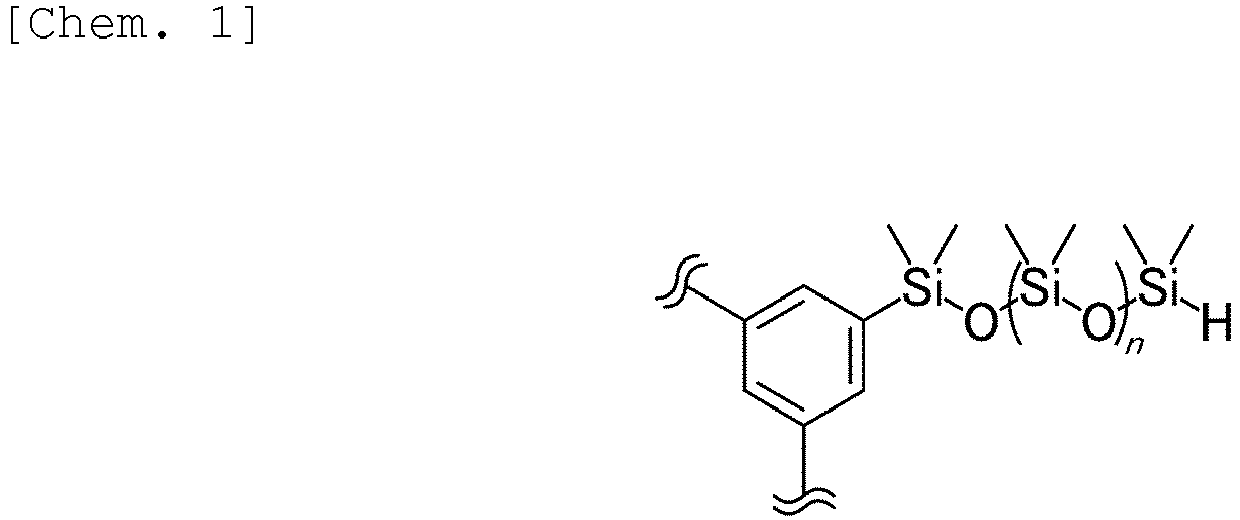
- the skeletal polymer is preferably a polydimethylsiloxane having a three-branched structure including a benzene ring as the central core. More specifically, the skeletal polymer is more preferably a three-armed star-shaped polydimethylsiloxane (PDMS) represented by the following formula. [In the formula, n is 1 or more and 150 or less, and all three branched chains have the same structure.] When the terminals of the branched chains are composed of hydrosilane as described above, the polymer may be called a three-armed star-shaped polydimethylsiloxane with hydrosilane terminals.
- PDMS three-armed star-shaped polydimethylsiloxane
- the polymer compound according to the present embodiment includes a group (a coumarin moiety) derived from coumarin or a derivative thereof bonded to at least one terminal of the skeletal polymer described above.
- the coumarin moiety of one molecule and the coumarin moiety of another molecule are bonded by irradiation with the light at the first wavelength, changing the flow property from the first state to the second state, and the bond is broken by irradiation with the light at the second wavelength, changing the flow property from the second state to the first state.
- Coumarin or a derivative thereof may be bonded to at least one terminal of the skeletal polymer, but it is preferable that coumarin or a derivative thereof is bonded to all terminals of the skeletal polymer, because the crosslinking points between the molecules increase. By bonding coumarin or a derivative thereof to the terminal of the skeletal polymer rather than as a side chain, it is possible to prevent aggregation of the coumarin moieties, which could cause phase separation.
- Coumarin or a derivative thereof is bonded to at least one terminal of the branched chains of the skeletal polymer.
- Coumarin or a derivative thereof may be bonded to preferably 50% or more, more preferably 60% or more, and even more preferably 80% or more of the branched chains of the skeletal polymer.
- Coumarin or a derivative thereof is preferably bonded to all the terminals of the branched chains of the skeletal polymer.
- the derivative of coumarin is not particularly limited as long as it does not interfere with the reversible change in the flow property of the polymer compound by the light irradiation with different wavelengths as described above in the present embodiment, and may be a derivative in which a substituent is introduced into coumarin.
- the polymer compound according to the present embodiment may be a polymer compound having a substituted or unsubstituted coumarin group (a coumaryl group) at the terminal of the skeletal polymer.
- the polymer compound according to the present embodiment having coumarin bonded to at the terminal may be, for example, a polysiloxane polymer represented by the following formula.
- R each independently represents hydrogen or an alkyl group, and n, m, and p are each independently an integer of 1 or more and 150 or less.
- R it is preferable that 1% or more of R in one branched chain is hydrogen, and that all of R is hydrogen.
- R is an alkyl group, it is preferably a linear or branched alkyl group having 1 to 20 carbon atoms.
- n, m, and p are the same, and it is more preferable that the three branched chains branched from benzene ring as the central core have the same structure.
- the polymer When coumarin is bonded to the terminals of the branched chains as described above, the polymer may be called a three-armed star-shaped polydimethylsiloxane with coumarin terminals.
- the first state in which a three-armed star-shaped polydimethylsiloxane (PDMS) having a coumarin group at the terminal of each branched chain is not crosslinked is illustrated in the upper row
- the second state in which the coumarin groups are bonded with each other and crosslinked between molecules is illustrated in the lower row.
- the first state is a high-flow state with high fluidity
- the second state is a low-flow state with low fluidity.
- n is an integer of 1 or more and 150 or less, and the three branched chains may have the same structure.
- n is an integer of 1 or more and 150 or less, and the three branched chains may have the same structure.
- the crosslinking reaction from the first state to the second state and the crosslinking cleavage reaction from the second state to the first state can be performed under conditions common in the art. However, an agent for accelerating the reaction may be used.
- the number average molecular weight of the polymer compound is preferably 500 or more and 100,000 or less, more preferably 1,000 or more and 50,000 or less.
- the tendency of the change in viscoelasticity may differ depending on the number average molecular weight of the polymer compound. Therefore, it is also possible to control the viscoelasticity of the compound by changing its molecular weight.
- the present embodiment may be a method of using a polymer compound.
- the method of using a polymer compound may include: irradiating a polymer compound to which coumarin or a derivative thereof is bonded to at least one terminal of a skeletal polymer with light with a first wavelength, thereby reversibly changing a flow property of the polymer compound from a first state to a second state; stopping the irradiating of the light with the first wavelength and maintaining the second state; and irradiating the polymer compound with light with a second wavelength different from the first wavelength, thereby reversibly changing the flow property of the polymer compound from the second state to the first state.
- the flow property of the polymer compound can be changed, for example, between a solid and a liquid state, or between a gel and a sol state, by different light stimuli without using heating or the like. Therefore, it can be suitably used in environments where heating is undesirable. Also, in the present embodiment, by irradiating only a part of the entire prepared volume of the polymer compound with ultraviolet light at a predetermined wavelength, the flow property of only the part of the volume can be changed.
- the changed flow property can be maintained even in an environment without light stimulus. Therefore, because the changed state can be maintained even in environments where continuous light irradiation is not possible, it can be suitably used as a material for 3D printers, for example.
- Polymer compounds having a coumarin group at the terminal were synthesized as follows.
- the reaction mixture was poured into excess water/hexane, and the hexane layer was washed with water and then dried and concentrated with sodium sulfate.
- the obtained oily crude product was washed with methanol and acetone. Chloroform was added to obtain a homogeneous solution, and the volatile component was distilled off under reduced pressure. Accordingly, a colorless oily three-armed star-shaped polydimethylsiloxane with hydrosilane terminals (three-armed star-shaped PDMS with hydrosilane terminals) was obtained. The yield was 10.1 g.
- a coumarin moiety was introduced at the terminal of the branched chain of the three-armed star-shaped PDMS with hydrosilane terminals as follows.
- the three-armed star-shaped PDMS with hydrosilane terminals (2.0 g), 7-allylcoumarin (260 mg), Karstedt catalyst (0.10 ml), and THF (5 ml) were mixed, and stirred under reflux for 14 hours.
- the reaction mixture was concentrated and washed with methanol and acetone, and the volatile component was distilled off under reduced pressure. Accordingly, 1.7 g of oily three-armed star-shaped PDMS with coumarin terminals represented by the above formula was obtained.
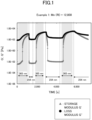
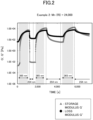
- Each of the samples of Examples 1 to 3 was alternately irradiated with ultraviolet light with a wavelength of 365 nm (UV 365 ) (150 mW/cm 2 ) and ultraviolet light with a wavelength of 254 nm (UV 254 ) (17 mW/cm 2 ), and a storage modulus G' (Pa) and a loss modulus G" (Pa) were measured over time.
- a rotary rheometer (MCR-102, manufactured by Anton Paar GmbH) was used for the measurement. The sample was applied to the surface of a lower glass plate to have a thickness of 0.10 mm, and a parallel plate (diameter 12 mm) was placed and rotated at a frequency of 5 Hz.
- UV irradiation with ultraviolet light was stopped when convergence was observed in the change in viscoelasticity, then irradiation with ultraviolet light with a different wavelength was started, and similarly stopped when convergence was observed in the change in viscoelasticity. More specifically, UV irradiation with a wavelength of 365 nm was carried out from the start of irradiation until the 1,000 second mark, and then UV irradiation with a wavelength of 254 nm was carried out from the 1,200 second mark until the 1,600 second mark. Thereafter, UV irradiation was carried out in the same manner as presented in Table 1.
- FIGS. 1 to 3 The results of the evaluation of Examples 1 to 3 are presented in FIGS. 1 to 3 , respectively.
- the viscoelasticity changed repeatedly and reversibly.
- the appearance of the polymer compound was also visually observed, and it was confirmed that the compound changed into a solid state by irradiation with ultraviolet light with a wavelength of 365 nm, and the compound changed into a liquid state by irradiation with ultraviolet light with a wavelength of 254 nm.
- Example 2 which has a small molecular weight
- Examples 2 and 3 which have a large molecular weight, tend to have stronger elasticity, with the storage modulus G' exceeding the loss modulus G" in the second state (in a solid or low-flow state).
Landscapes
- Chemical & Material Sciences (AREA)
- Health & Medical Sciences (AREA)
- Chemical Kinetics & Catalysis (AREA)
- Medicinal Chemistry (AREA)
- Polymers & Plastics (AREA)
- Organic Chemistry (AREA)
- General Chemical & Material Sciences (AREA)
- Silicon Polymers (AREA)
- Addition Polymer Or Copolymer, Post-Treatments, Or Chemical Modifications (AREA)
- Polymerisation Methods In General (AREA)
- Compositions Of Macromolecular Compounds (AREA)
Abstract
Description
- The present invention relates to a polymer compound.
- Materials whose state changes in response to external stimuli are known. For example, Patent Document 1 describes a crosslinked polymer having photoresponsiveness that can be reversibly changed from a solid state to a liquid state by cleavage of crosslinks by a light stimulus.
- Patent Document 1:
Japanese Unexamined Patent Application Publication No. 2017-149793 - However, in the case of the compound described in Patent Document 1, when the application of the light stimulus is stopped, the cleaved crosslinks are re-formed. Therefore, the compound cannot be used in an environment without the light stimulus in their state after being changed by the light stimulus. For such purposes, compounds with photoresponsiveness different from conventional ones are required.
- In view of the above, one aspect of the present invention is to provide a reversibly changeable material whose state changes when a light stimulus is applied, the state after the change can be maintained even when the light stimulus is stopped, and the state can be returned to the original state by another stimulus.
- In one aspect of the present invention for solving the problem, a polymer compound in which coumarin or a derivative thereof is bonded to at least one terminal of a skeletal polymer, wherein a flow property of the polymer compound is reversibly changeable from a first state to a second state by irradiation with light at a first wavelength and from the second state to the first state by irradiation with light at a second wavelength different from the first wavelength.
- According to one aspect of the present invention, a reversibly changeable material whose state changes when a light stimulus is applied, the state after the change can be maintained even when the light stimulus is stopped, and the state can be returned to the original state by another stimulus, can be provided.
-
- [
FIG. 1] FIG. 1 is a graph indicating a result of viscoelastic evaluation of Example 1. - [
FIG. 2] FIG. 2 is a graph indicating a result of viscoelastic evaluation of Example 2. - [
FIG. 3] FIG. 3 is a graph indicating a result of viscoelastic evaluation of Example 3. - An embodiment of the present invention is a polymer compound in which coumarin or a derivative thereof is bonded to at least one terminal of a skeletal polymer. The polymer compound has photoresponsiveness in that a flow property can be reversibly changed between a first state and a second state by a light stimulus. More specifically, the flow property of the polymer compound according to the present embodiment change from the first state to the second state by irradiation with light at a first wavelength, and can be returned from the second state to the original first state by irradiation with light at a second wavelength different from the first wavelength.
- In the present specification, a change in the flow property (or a change in fluidity) is a change in physical properties related to the property called viscosity, elasticity, or viscoelasticity of a compound. More specifically, the change in the flow property may be a change in one or more physical properties of elastic modulus such as storage modulus G' (Pa) and loss modulus G" (Pa); viscosity; shear rate (shear strength); thixotropic index; and other rheological physical properties. The change in the flow property may be a change from one of the three states of matter to another state. Thus, for example, it may be a change between a solid or gel state and a liquid or sol state. In the present specification, a change between the first state and the second state is not simply caused by a change in crystallinity and the like, but is caused by a change in the molecular structure itself. The change between the first state and the second state includes a change accompanied by the formation or cleavage of a covalent bond.
- The above change may be such that, for example, the difference in the storage modulus G' between the first state with high fluidity and the second state with low fluidity is preferably 300 Pa or more and 10,000 Pa or less. The difference in the loss modulus G" between the first state with high fluidity and the second state with low fluidity may be 300 Pa or more and 100,000 Pa or less.
- The light irradiated to change the state of the polymer compound is preferably ultraviolet light, both of the light at the first wavelength and the light at the second wavelength different from the first wavelength. The range of the first wavelength may be 300 nm or more and 390 nm or less, preferably 350 nm or more and 380 nm or less, and more preferably 360 nm or more and 370 nm or less. The range of the second wavelength may be 200 nm or more and 290 nm or less, preferably 230 nm or more and 270 nm or less, and more preferably 250 nm or more and 270 nm or less. The first wavelength is preferably 365 nm and the second wavelength is preferably 254 nm.
- In the present embodiment, it is preferable that irradiation with the light at the first wavelength causes molecules of the polymer compound to crosslink with each other to form a network structure, reducing the fluidity of the polymer compound, and irradiation with the light at the second wavelength causes cleavage of the crosslink. The first wavelength that causes crosslinking may be larger than the second wavelength that causes cleavage of the crosslink.
- In the polymer compound according to the present embodiment, once light irradiation is performed, even when the light irradiation is stopped, the state of the flow property changed by the irradiation can be maintained. That is, when the first state is changed to the second state by the irradiation with the light at the first wavelength, even when the irradiation with the light at the first wavelength is stopped, the flow property of the second state can be maintained as long as there is no irradiation with the light at the second wavelength or other stimulus that causes a change to the first state. Also, when the second state is changed to the first state by the irradiation with the light at the second wavelength, even when the irradiation with the light at the second wavelength is stopped, the flow property of the first state can be maintained as long as there is no irradiation with the light at the first wavelength or other stimulus that causes a change to the second state. In the polymer compound according to the present embodiment, after the crosslink between molecules is formed by the irradiation with the light at the first wavelength, the formed crosslink is maintained even when the irradiation is stopped, and when the crosslink between molecules is cleaved by the irradiation with the light at the second wavelength, the cleaved crosslink is maintained even when the irradiation is stopped. Therefore, for example, by alternately irradiating the light at the first wavelength and the light at the second wavelength, the polymer compound according to the present embodiment can repeatedly change reversibly between the first state and the second state.
- The light irradiation to the polymer compound according to the present embodiment may be carried out under the conditions of 0 to 100°C, and preferably is carried out at normal temperature (5 to 35°C). The intensity of the irradiated light is preferably 1 mW/cm2 or more. The intensity of the light at the first wavelength is preferably 5 mW/cm2 or more, and the intensity of the light at the second wavelength is preferably 1 mW/cm2 or more.
- The change in the flow property due to the light irradiation may occur either in a system in which the polymer compound is mixed with another component such as a dispersion solvent, or in a system in which the polymer compound is not mixed with another component. In the present embodiment, because the flow property of the polymer compound can be reversibly changed by the light irradiation of the polymer compound even in a system that does not contain a solvent, there is no need to consider evaporation of the solvent during use, and the polymer compound can be used in various applications.
- The polymer compound is one in which coumarin or a derivative thereof is bonded to at least one terminal of a skeletal polymer constituting a main chain. The skeletal polymer is not particularly limited as long as coumarin or a derivative thereof can be bonded to form a polymer compound whose flow property can be reversibly changed between the first state and the second state by irradiation with ultraviolet light of different wavelengths as described above. The skeletal polymer may have high fluidity at normal temperature, preferably in a liquid or sol state.
- Examples of the skeletal polymer include a polysiloxane polymer, a polyacrylate polymer, a polymethacrylate polymer, a polystyrene polymer, a polyethylene polymer, a polyamide polymer, a polyester polymer, a polyurethane polymer, and the like. Among these, a polysiloxane polymer is preferable, and polydimethylsiloxane (PDMS) is preferable. The skeletal polymer may be used alone or in combination of two or more of the above polymers.
- The number average molecular weight of the skeletal polymer may be preferably 500 or more and 100,000 or less, and more preferably 1,000 or more and 50,000 or less. The skeletal polymer may have a glass transition temperature of preferably -150°C or more and 25°C or less, and more preferably -120°C or more and 0°C or less.
- Further, the skeletal polymer preferably has a branched structure, and more preferably has a structure in which a plurality of branched chains (arms) extend from a central core. The central core portion preferably includes a carbon atom or a benzene ring. In particular, it is preferable that the central core portion is a benzene ring, because the structure of the skeletal polymer, by extension, the structure of the polymer compound is stabilized, making it possible to more reliably change the flow property between the first state and the second state. The number of the branched chains (the number of the arms extending from the central core) bounded to the one central core is preferably 2 or more and 8 or less (that is, the skeletal polymer has a two- to eight-branched structure), more preferably 2 or more and 5 or less (that is, the skeletal polymer has a two- to five-branched structure), or more preferably 3 or more and 6 or less (that is, the skeletal polymer has a three- to six-branched structure). The number of the branched chains bounded to the central core in the skeletal polymer is more preferably 3 (that is, the skeletal polymer has a three-branched structure).
- Further, the skeletal polymer is preferably a polydimethylsiloxane having a three-branched structure including a benzene ring as the central core. More specifically, the skeletal polymer is more preferably a three-armed star-shaped polydimethylsiloxane (PDMS) represented by the following formula.
- The polymer compound according to the present embodiment includes a group (a coumarin moiety) derived from coumarin or a derivative thereof bonded to at least one terminal of the skeletal polymer described above. In the present embodiment, the coumarin moiety of one molecule and the coumarin moiety of another molecule are bonded by irradiation with the light at the first wavelength, changing the flow property from the first state to the second state, and the bond is broken by irradiation with the light at the second wavelength, changing the flow property from the second state to the first state. Coumarin or a derivative thereof may be bonded to at least one terminal of the skeletal polymer, but it is preferable that coumarin or a derivative thereof is bonded to all terminals of the skeletal polymer, because the crosslinking points between the molecules increase. By bonding coumarin or a derivative thereof to the terminal of the skeletal polymer rather than as a side chain, it is possible to prevent aggregation of the coumarin moieties, which could cause phase separation.
- Coumarin or a derivative thereof is bonded to at least one terminal of the branched chains of the skeletal polymer. Coumarin or a derivative thereof may be bonded to preferably 50% or more, more preferably 60% or more, and even more preferably 80% or more of the branched chains of the skeletal polymer. Coumarin or a derivative thereof is preferably bonded to all the terminals of the branched chains of the skeletal polymer.
- The derivative of coumarin is not particularly limited as long as it does not interfere with the reversible change in the flow property of the polymer compound by the light irradiation with different wavelengths as described above in the present embodiment, and may be a derivative in which a substituent is introduced into coumarin. In other words, the polymer compound according to the present embodiment may be a polymer compound having a substituted or unsubstituted coumarin group (a coumaryl group) at the terminal of the skeletal polymer.
- The polymer compound according to the present embodiment having coumarin bonded to at the terminal may be, for example, a polysiloxane polymer represented by the following formula.

- Next, a structure change of the polymer compound by the light irradiation with different wavelengths will be described more specifically. In the formula below, the first state in which a three-armed star-shaped polydimethylsiloxane (PDMS) having a coumarin group at the terminal of each branched chain is not crosslinked is illustrated in the upper row, and the second state in which the coumarin groups are bonded with each other and crosslinked between molecules is illustrated in the lower row. In the present embodiment, the first state is a high-flow state with high fluidity, and the second state is a low-flow state with low fluidity.

- In the above formula, n is an integer of 1 or more and 150 or less, and the three branched chains may have the same structure. As illustrated in the above formula, by irradiating the light with the first wavelength, it is possible to change from the first state with high fluidity to the second state, and by irradiating the light with the second wavelength, the second state with low fluidity can be changed to the first state. Both the crosslinking reaction from the first state to the second state and the crosslinking cleavage reaction from the second state to the first state can be performed under conditions common in the art. However, an agent for accelerating the reaction may be used.
- The number average molecular weight of the polymer compound is preferably 500 or more and 100,000 or less, more preferably 1,000 or more and 50,000 or less. When compared under the same irradiation conditions (even when the first wavelength and the second wavelength are respectively the same), the tendency of the change in viscoelasticity may differ depending on the number average molecular weight of the polymer compound. Therefore, it is also possible to control the viscoelasticity of the compound by changing its molecular weight.
- The present embodiment may be a method of using a polymer compound. The method of using a polymer compound may include: irradiating a polymer compound to which coumarin or a derivative thereof is bonded to at least one terminal of a skeletal polymer with light with a first wavelength, thereby reversibly changing a flow property of the polymer compound from a first state to a second state; stopping the irradiating of the light with the first wavelength and maintaining the second state; and irradiating the polymer compound with light with a second wavelength different from the first wavelength, thereby reversibly changing the flow property of the polymer compound from the second state to the first state.
- According to the present embodiment, the flow property of the polymer compound can be changed, for example, between a solid and a liquid state, or between a gel and a sol state, by different light stimuli without using heating or the like. Therefore, it can be suitably used in environments where heating is undesirable. Also, in the present embodiment, by irradiating only a part of the entire prepared volume of the polymer compound with ultraviolet light at a predetermined wavelength, the flow property of only the part of the volume can be changed.
- In addition, in the polymer compound according to the present embodiment, even without continuing to apply light stimulation (without continuing light irradiation), once the flow property has changed, the changed flow property can be maintained even in an environment without light stimulus. Therefore, because the changed state can be maintained even in environments where continuous light irradiation is not possible, it can be suitably used as a material for 3D printers, for example.
- Polymer compounds having a coumarin group at the terminal were synthesized as follows.
-

- A trifunctional silanol (I3) (140 mg), 1,5,7-triazabicyclo[4.4.0]dec-5-ene (TBD) (97 mg), and tetrahydrofuran (THF) (11 ml) were mixed, and a solution of hexamethylcyclotrisiloxane (D3) (14 g) in THF (24 ml) was added, and the mixture was stirred at 25°C. After 1.5 hours, pyridine (6.7 ml) and chlorodimethylsilane (3.1 ml) were added in this order, and the mixture was stirred for another 23 hours. The reaction mixture was poured into excess water/hexane, and the hexane layer was washed with water and then dried and concentrated with sodium sulfate. The obtained oily crude product was washed with methanol and acetone. Chloroform was added to obtain a homogeneous solution, and the volatile component was distilled off under reduced pressure. Accordingly, a colorless oily three-armed star-shaped polydimethylsiloxane with hydrosilane terminals (three-armed star-shaped PDMS with hydrosilane terminals) was obtained. The yield was 10.1 g.
- In addition, a coumarin moiety was introduced at the terminal of the branched chain of the three-armed star-shaped PDMS with hydrosilane terminals as follows.

- The three-armed star-shaped PDMS with hydrosilane terminals (2.0 g), 7-allylcoumarin (260 mg), Karstedt catalyst (0.10 ml), and THF (5 ml) were mixed, and stirred under reflux for 14 hours. The reaction mixture was concentrated and washed with methanol and acetone, and the volatile component was distilled off under reduced pressure. Accordingly, 1.7 g of oily three-armed star-shaped PDMS with coumarin terminals represented by the above formula was obtained. As a result of GPC measurement, the number average molecular weight Mn (RI) of the three-armed star-shaped PDMS with coumarin terminals was 12,800 (D = 1.27).
- The synthesis was carried out in the same manner as in Example 1 except that the amount of raw material used in Example 1 was changed, and a three-armed star-shaped PDMS with coumarin terminals having a number average molecular weight of Mn (RI) 24,000 (D = 1.26) was obtained.
- The synthesis was carried out in the same manner as in Example 1 except that the amount of raw material used in Example 1 was changed, and a three-armed star-shaped PDMS with coumarin terminals having a number average molecular weight of Mn (RI) 23,900 (D = 1.47) was obtained.
- Each of the samples of Examples 1 to 3 was alternately irradiated with ultraviolet light with a wavelength of 365 nm (UV365) (150 mW/cm2) and ultraviolet light with a wavelength of 254 nm (UV254) (17 mW/cm2), and a storage modulus G' (Pa) and a loss modulus G" (Pa) were measured over time. A rotary rheometer (MCR-102, manufactured by Anton Paar GmbH) was used for the measurement. The sample was applied to the surface of a lower glass plate to have a thickness of 0.10 mm, and a parallel plate (diameter 12 mm) was placed and rotated at a frequency of 5 Hz.
- Irradiation with ultraviolet light was stopped when convergence was observed in the change in viscoelasticity, then irradiation with ultraviolet light with a different wavelength was started, and similarly stopped when convergence was observed in the change in viscoelasticity. More specifically, UV irradiation with a wavelength of 365 nm was carried out from the start of irradiation until the 1,000 second mark, and then UV irradiation with a wavelength of 254 nm was carried out from the 1,200 second mark until the 1,600 second mark. Thereafter, UV irradiation was carried out in the same manner as presented in Table 1.
[Table 1] TIME [s] 0 60 1000 1200 1600 1800 2740 2940 4400 4660 5600 5800 UV WAVELENGTH [nm] on/off off 365 on off 245 on off 365 on off 254 on off 365 on off 254 on - The results of the evaluation of Examples 1 to 3 are presented in
FIGS. 1 to 3 , respectively. As illustrated inFIGS. 1 to 3 , in all of the three-armed star-shaped PDMS with coumarin terminals with different molecular weights, when irradiated with ultraviolet light of different wavelengths alternately, the viscoelasticity changed repeatedly and reversibly. The appearance of the polymer compound was also visually observed, and it was confirmed that the compound changed into a solid state by irradiation with ultraviolet light with a wavelength of 365 nm, and the compound changed into a liquid state by irradiation with ultraviolet light with a wavelength of 254 nm. It was also found that compared to Example 1, which has a small molecular weight, Examples 2 and 3, which have a large molecular weight, tend to have stronger elasticity, with the storage modulus G' exceeding the loss modulus G" in the second state (in a solid or low-flow state). - The present invention has been described based on specific embodiments and specific Examples. However, these embodiments and Examples are merely presented as examples, and the present invention is not limited by the embodiments and Examples described above. Various changes, modifications, replacements, deletions, additions, and combinations are applicable within the scope of the disclosure of the present invention.
- The present application claims priority to
Japanese Patent Application No. 2021-207537 filed December 21, 2021
Claims (9)
- A polymer compound in which coumarin or a derivative thereof is bonded to at least one terminal of a skeletal polymer, wherein
a flow property of the polymer compound is reversibly changeable from a first state to a second state by irradiation with light at a first wavelength and from the second state to the first state by irradiation with light at a second wavelength different from the first wavelength. - The polymer compound according to claim 1, wherein groups derived from the coumarin or the derivative thereof form a crosslink with each other between molecules by irradiation with light at the first wavelength and the crosslink is cleaved by irradiation with light at the second wavelength.
- The polymer compound according to claim 1 or 2,
wherein the skeletal polymer is polysiloxane. - The polymer compound according to claim 1 or 2,
wherein the skeletal polymer has a glass transition temperature of -120°C or more and 0°C or less. - The polymer compound according to claim 1 or 2,
wherein the skeletal polymer is a branched polymer in which a number of branched chains is 3 or more and 6 or less. - The polymer compound according to claim 1 or 2, wherein
a structure of the polymer compound is represented by a formula below,
- The polymer compound according to claim 1 or 2,
wherein the skeletal polymer has a number average molecular weight of 1,000 or more and 100,000 or less. - The polymer compound according to claim 1 or 2,
wherein the first wavelength is 350 nm or more and the second wavelength is 260 nm or less. - A polymer compound, wherein
a structure of the polymer compound is represented by a formula below,
Applications Claiming Priority (2)
| Application Number | Priority Date | Filing Date | Title |
|---|---|---|---|
| JP2021207537 | 2021-12-21 | ||
| PCT/JP2022/045093 WO2023120191A1 (en) | 2021-12-21 | 2022-12-07 | Macromolecular compound |
Publications (2)
| Publication Number | Publication Date |
|---|---|
| EP4455190A1 true EP4455190A1 (en) | 2024-10-30 |
| EP4455190A4 EP4455190A4 (en) | 2025-04-16 |
Family
ID=86902268
Family Applications (1)
| Application Number | Title | Priority Date | Filing Date |
|---|---|---|---|
| EP22910903.8A Pending EP4455190A4 (en) | 2021-12-21 | 2022-12-07 | MACROMOLECULAR COMPOUND |
Country Status (7)
| Country | Link |
|---|---|
| US (1) | US20250026890A1 (en) |
| EP (1) | EP4455190A4 (en) |
| JP (1) | JPWO2023120191A1 (en) |
| KR (1) | KR20240121733A (en) |
| CN (1) | CN118284646A (en) |
| TW (1) | TW202336103A (en) |
| WO (1) | WO2023120191A1 (en) |
Families Citing this family (1)
| Publication number | Priority date | Publication date | Assignee | Title |
|---|---|---|---|---|
| JPWO2025229911A1 (en) * | 2024-05-01 | 2025-11-06 |
Family Cites Families (4)
| Publication number | Priority date | Publication date | Assignee | Title |
|---|---|---|---|---|
| JP3029322B2 (en) * | 1991-05-02 | 2000-04-04 | ジーイー東芝シリコーン株式会社 | Polysiloxane star polymer and method for producing the same |
| US20140066537A1 (en) * | 2012-09-06 | 2014-03-06 | Universite De Liege | Organic compositions for repeatedly adjustable optical elements and such elements |
| US9394390B2 (en) * | 2013-02-07 | 2016-07-19 | The University Of Massachusetts | Coumarin-functionalized polyolefin and associated cyclodimerization products, preparation methods, and electronic devices |
| JP6792850B2 (en) | 2016-02-22 | 2020-12-02 | 国立大学法人 東京大学 | Polymer material whose morphology can be controlled by light stimulation |
-
2022
- 2022-12-07 US US18/712,061 patent/US20250026890A1/en active Pending
- 2022-12-07 KR KR1020247018027A patent/KR20240121733A/en active Pending
- 2022-12-07 JP JP2023569286A patent/JPWO2023120191A1/ja active Pending
- 2022-12-07 CN CN202280077345.XA patent/CN118284646A/en active Pending
- 2022-12-07 EP EP22910903.8A patent/EP4455190A4/en active Pending
- 2022-12-07 TW TW111146961A patent/TW202336103A/en unknown
- 2022-12-07 WO PCT/JP2022/045093 patent/WO2023120191A1/en not_active Ceased
Also Published As
| Publication number | Publication date |
|---|---|
| CN118284646A (en) | 2024-07-02 |
| TW202336103A (en) | 2023-09-16 |
| WO2023120191A1 (en) | 2023-06-29 |
| US20250026890A1 (en) | 2025-01-23 |
| JPWO2023120191A1 (en) | 2023-06-29 |
| KR20240121733A (en) | 2024-08-09 |
| EP4455190A4 (en) | 2025-04-16 |
Similar Documents
| Publication | Publication Date | Title |
|---|---|---|
| DE69215950T2 (en) | Organosilicon compositions containing siloxane elastomers | |
| EP0771830B1 (en) | Curable composition containing cycloolefins, silane and filler | |
| DE69611023T2 (en) | Hydrosilylation crosslinkable compositions | |
| DE2433697C3 (en) | Manufacture of organopolysiloxane molding compounds that can be crosslinked to form elastomers | |
| DE60004934T2 (en) | High strength, fracture toughness silsesquioxane resin and process for its manufacture | |
| DE69223366T2 (en) | Silicon containing polymers | |
| EP0593684B1 (en) | High refractive index silicone compositions | |
| EP2254127A1 (en) | Organogel for electrical cable insulating layer | |
| DE202010017915U1 (en) | Novel silicone polyether copolymers | |
| DE60101292T2 (en) | Crosslinkable fluoropolyether compositions | |
| DE69621722T2 (en) | Organopolysiloxane DERIVATIVES | |
| DE3035866A1 (en) | WARM CROSSLINKABLE ORGANOPOLYSILOXANIZE | |
| CN115785447B (en) | Ultra-low viscosity liquid silicone rubber, cross-linking agent and preparation method thereof | |
| Madsen et al. | Enhancing the electro-mechanical properties of polydimethylsiloxane elastomers through blending with poly (dimethylsiloxane-co-methylphenylsiloxane) copolymers | |
| US20250026890A1 (en) | Polymer compound | |
| DE69601182T2 (en) | Silicone gel composition | |
| KR20110051155A (en) | Thermoplastic Silicone Resin Composition | |
| DE60118410T2 (en) | A melt-formable norbornene-based thermoplastic resin composition, and molded article and optical film both of which comprise | |
| EP1406950A1 (en) | Rtv-1-silicone-rubber blends which cross-link by means of alkoxy groups | |
| DE69813488T2 (en) | Curable compositions and hardened gel articles therefrom | |
| Zhu et al. | Thermoreversible supramolecular polyurethanes with self‐complementary quadruple hydrogen‐bonded end groups | |
| DE4436675B4 (en) | Polyphenylene oxide compositions | |
| DE69206053T2 (en) | Surface-treated aluminum and thermally conductive silicone composition that contains this filler. | |
| EP0709445A1 (en) | Crosslinkable nematic polyorganosiloxane | |
| DE69201298T2 (en) | Adhesive compositions. |
Legal Events
| Date | Code | Title | Description |
|---|---|---|---|
| STAA | Information on the status of an ep patent application or granted ep patent |
Free format text: STATUS: THE INTERNATIONAL PUBLICATION HAS BEEN MADE |
|
| PUAI | Public reference made under article 153(3) epc to a published international application that has entered the european phase |
Free format text: ORIGINAL CODE: 0009012 |
|
| STAA | Information on the status of an ep patent application or granted ep patent |
Free format text: STATUS: REQUEST FOR EXAMINATION WAS MADE |
|
| 17P | Request for examination filed |
Effective date: 20240521 |
|
| AK | Designated contracting states |
Kind code of ref document: A1 Designated state(s): AL AT BE BG CH CY CZ DE DK EE ES FI FR GB GR HR HU IE IS IT LI LT LU LV MC ME MK MT NL NO PL PT RO RS SE SI SK SM TR |
|
| DAV | Request for validation of the european patent (deleted) | ||
| DAX | Request for extension of the european patent (deleted) | ||
| A4 | Supplementary search report drawn up and despatched |
Effective date: 20250319 |
|
| RIC1 | Information provided on ipc code assigned before grant |
Ipc: C08K 5/1535 20060101ALI20250313BHEP Ipc: C08J 3/28 20060101ALI20250313BHEP Ipc: C08G 77/52 20060101AFI20250313BHEP |