EP4455127A1 - Arene-chlorination using chlorinated waste - Google Patents
Arene-chlorination using chlorinated waste Download PDFInfo
- Publication number
- EP4455127A1 EP4455127A1 EP23170105.3A EP23170105A EP4455127A1 EP 4455127 A1 EP4455127 A1 EP 4455127A1 EP 23170105 A EP23170105 A EP 23170105A EP 4455127 A1 EP4455127 A1 EP 4455127A1
- Authority
- EP
- European Patent Office
- Prior art keywords
- mol
- catalyst
- chlorine
- compound
- amount
- Prior art date
- Legal status (The legal status is an assumption and is not a legal conclusion. Google has not performed a legal analysis and makes no representation as to the accuracy of the status listed.)
- Withdrawn
Links
Classifications
-
- C—CHEMISTRY; METALLURGY
- C07—ORGANIC CHEMISTRY
- C07D—HETEROCYCLIC COMPOUNDS
- C07D215/00—Heterocyclic compounds containing quinoline or hydrogenated quinoline ring systems
- C07D215/02—Heterocyclic compounds containing quinoline or hydrogenated quinoline ring systems having no bond between the ring nitrogen atom and a non-ring member or having only hydrogen atoms or carbon atoms directly attached to the ring nitrogen atom
- C07D215/12—Heterocyclic compounds containing quinoline or hydrogenated quinoline ring systems having no bond between the ring nitrogen atom and a non-ring member or having only hydrogen atoms or carbon atoms directly attached to the ring nitrogen atom with substituted hydrocarbon radicals attached to ring carbon atoms
-
- C—CHEMISTRY; METALLURGY
- C07—ORGANIC CHEMISTRY
- C07D—HETEROCYCLIC COMPOUNDS
- C07D213/00—Heterocyclic compounds containing six-membered rings, not condensed with other rings, with one nitrogen atom as the only ring hetero atom and three or more double bonds between ring members or between ring members and non-ring members
- C07D213/02—Heterocyclic compounds containing six-membered rings, not condensed with other rings, with one nitrogen atom as the only ring hetero atom and three or more double bonds between ring members or between ring members and non-ring members having three double bonds between ring members or between ring members and non-ring members
- C07D213/04—Heterocyclic compounds containing six-membered rings, not condensed with other rings, with one nitrogen atom as the only ring hetero atom and three or more double bonds between ring members or between ring members and non-ring members having three double bonds between ring members or between ring members and non-ring members having no bond between the ring nitrogen atom and a non-ring member or having only hydrogen or carbon atoms directly attached to the ring nitrogen atom
- C07D213/24—Heterocyclic compounds containing six-membered rings, not condensed with other rings, with one nitrogen atom as the only ring hetero atom and three or more double bonds between ring members or between ring members and non-ring members having three double bonds between ring members or between ring members and non-ring members having no bond between the ring nitrogen atom and a non-ring member or having only hydrogen or carbon atoms directly attached to the ring nitrogen atom with substituted hydrocarbon radicals attached to ring carbon atoms
- C07D213/26—Radicals substituted by halogen atoms or nitro radicals
-
- C—CHEMISTRY; METALLURGY
- C07—ORGANIC CHEMISTRY
- C07D—HETEROCYCLIC COMPOUNDS
- C07D215/00—Heterocyclic compounds containing quinoline or hydrogenated quinoline ring systems
- C07D215/02—Heterocyclic compounds containing quinoline or hydrogenated quinoline ring systems having no bond between the ring nitrogen atom and a non-ring member or having only hydrogen atoms or carbon atoms directly attached to the ring nitrogen atom
- C07D215/16—Heterocyclic compounds containing quinoline or hydrogenated quinoline ring systems having no bond between the ring nitrogen atom and a non-ring member or having only hydrogen atoms or carbon atoms directly attached to the ring nitrogen atom with hetero atoms or with carbon atoms having three bonds to hetero atoms with at the most one bond to halogen, e.g. ester or nitrile radicals, directly attached to ring carbon atoms
- C07D215/38—Nitrogen atoms
- C07D215/40—Nitrogen atoms attached in position 8
-
- C—CHEMISTRY; METALLURGY
- C07—ORGANIC CHEMISTRY
- C07D—HETEROCYCLIC COMPOUNDS
- C07D231/00—Heterocyclic compounds containing 1,2-diazole or hydrogenated 1,2-diazole rings
- C07D231/02—Heterocyclic compounds containing 1,2-diazole or hydrogenated 1,2-diazole rings not condensed with other rings
- C07D231/10—Heterocyclic compounds containing 1,2-diazole or hydrogenated 1,2-diazole rings not condensed with other rings having two or three double bonds between ring members or between ring members and non-ring members
- C07D231/12—Heterocyclic compounds containing 1,2-diazole or hydrogenated 1,2-diazole rings not condensed with other rings having two or three double bonds between ring members or between ring members and non-ring members with only hydrogen atoms, hydrocarbon or substituted hydrocarbon radicals, directly attached to ring carbon atoms
-
- C—CHEMISTRY; METALLURGY
- C07—ORGANIC CHEMISTRY
- C07D—HETEROCYCLIC COMPOUNDS
- C07D231/00—Heterocyclic compounds containing 1,2-diazole or hydrogenated 1,2-diazole rings
- C07D231/54—Heterocyclic compounds containing 1,2-diazole or hydrogenated 1,2-diazole rings condensed with carbocyclic rings or ring systems
- C07D231/56—Benzopyrazoles; Hydrogenated benzopyrazoles
-
- C—CHEMISTRY; METALLURGY
- C07—ORGANIC CHEMISTRY
- C07D—HETEROCYCLIC COMPOUNDS
- C07D239/00—Heterocyclic compounds containing 1,3-diazine or hydrogenated 1,3-diazine rings
- C07D239/02—Heterocyclic compounds containing 1,3-diazine or hydrogenated 1,3-diazine rings not condensed with other rings
- C07D239/24—Heterocyclic compounds containing 1,3-diazine or hydrogenated 1,3-diazine rings not condensed with other rings having three or more double bonds between ring members or between ring members and non-ring members
- C07D239/26—Heterocyclic compounds containing 1,3-diazine or hydrogenated 1,3-diazine rings not condensed with other rings having three or more double bonds between ring members or between ring members and non-ring members with only hydrogen atoms, hydrocarbon or substituted hydrocarbon radicals, directly attached to ring carbon atoms
-
- C—CHEMISTRY; METALLURGY
- C07—ORGANIC CHEMISTRY
- C07D—HETEROCYCLIC COMPOUNDS
- C07D239/00—Heterocyclic compounds containing 1,3-diazine or hydrogenated 1,3-diazine rings
- C07D239/70—Heterocyclic compounds containing 1,3-diazine or hydrogenated 1,3-diazine rings condensed with carbocyclic rings or ring systems
- C07D239/72—Quinazolines; Hydrogenated quinazolines
- C07D239/74—Quinazolines; Hydrogenated quinazolines with only hydrogen atoms, hydrocarbon or substituted hydrocarbon radicals, attached to ring carbon atoms of the hetero ring
-
- C—CHEMISTRY; METALLURGY
- C07—ORGANIC CHEMISTRY
- C07D—HETEROCYCLIC COMPOUNDS
- C07D407/00—Heterocyclic compounds containing two or more hetero rings, at least one ring having oxygen atoms as the only ring hetero atoms, not provided for by group C07D405/00
- C07D407/02—Heterocyclic compounds containing two or more hetero rings, at least one ring having oxygen atoms as the only ring hetero atoms, not provided for by group C07D405/00 containing two hetero rings
- C07D407/12—Heterocyclic compounds containing two or more hetero rings, at least one ring having oxygen atoms as the only ring hetero atoms, not provided for by group C07D405/00 containing two hetero rings linked by a chain containing hetero atoms as chain links
-
- C—CHEMISTRY; METALLURGY
- C07—ORGANIC CHEMISTRY
- C07D—HETEROCYCLIC COMPOUNDS
- C07D409/00—Heterocyclic compounds containing two or more hetero rings, at least one ring having sulfur atoms as the only ring hetero atoms
- C07D409/02—Heterocyclic compounds containing two or more hetero rings, at least one ring having sulfur atoms as the only ring hetero atoms containing two hetero rings
- C07D409/12—Heterocyclic compounds containing two or more hetero rings, at least one ring having sulfur atoms as the only ring hetero atoms containing two hetero rings linked by a chain containing hetero atoms as chain links
Definitions
- the invention relates to a method for chlorination of a substrate compound containing an arene moiety and the use of a chlorine-containing solid or liquid organic compound, in particular an organic waste compound, as chlorine-donor for the chlorination of arenes.
- Chlorinated compounds are ubiquitous in industrialized societies as the physical and chemical properties of hydrocarbons are extensively modified and improved following chlorination.
- chlorine-containing hydrocarbons are widely used as plastics, rubbers, resins, solvents, and have applications as intermediates used in the synthesis of agrochemicals and pharmaceuticals or are even present in agrochemical and pharmaceutical products (see e.g. Naclerio, N. D.; Karsai, A.; Murray-Cooper, M.; Ozkan-Aydin, Y.; Aydin, E.; Goldman, D. I.; Hawkes, E. W., Sci. Robot. 2021, 6, eabe2922 Jordan, A. et al., Chem. Rev.
- Chlorine-containing hydrocarbons are widely used and may be persistent in the environment or decompose to release toxic compounds, which can accumulate in the food chain. Exposure to chlorinated waste is even associated with suppression of the immune system and cancer (see e.g. Z. Liew, P. Guo, Science 2022, 375, 720-721 ; A. L. Yee, J. A. Gilbert, Science 2016, 353, 348-349 ). However, methods to dispose of waste chlorine-containing hydrocarbons are currently inadequate.
- Chlorine-containing hydrocarbon waste is one of the most problematic types of waste for several reasons.
- the common industrial approaches lead to the formation of hazardous products including dioxins and corrosive gases, i.e. HCl and Clz.
- HCl and Clz corrosive gases
- These problems are amplified by the large amounts of chlorine-containing hydrocarbon waste.
- Pyrolysis and hydrocracking are also unsuitable as they result in the same problems as industrial incineration.
- Disposal of chlorinated waste with low environmental impact is therefore both highly desirable and highly challenging (see e.g. Martin, A. J.; Mondelli, C.; Jaydev, S. D.; Pérez-Ram ⁇ rez, J., Chem 2021, 7, 1487-1533 ; Ellis, L.
- catalytic hydrocracking has been extensively investigated for upgrading a range of polymers.
- catalyst deactivation is usually observed (see e.g. Chu, M.; Liu, Y.; Lou, X.; Zhang, Q.; Chen, J., ACS Catal. 2022, 12, 4659-4679 ; Lee, W.-T.; van Muyden, A.; Bobbink, F. D.; Mensi, M. D.; Carullo, J. R.; Dyson, P. J., Nat. Commun. 2022, 13, 4850 ; F. Zhang et al., Science 2020, 370, 437-441 ; R. J. Conk et al., Science 2022, 377, 1561-1566 ).
- waste chlorinated solvents are problematic with incineration being the conventional method used to dispose of them as bioremediation is slow (see e.g. A. Alberini, J. Bartholomew, Contemp. Econ. Policy 1999, 17, 309-320 ; D. Pekelney, J. Hazard. Mater. 1990, 23, 293-315 ).
- chlorinated compounds such as chlorinated solid and/or liquid waste streams
- chlorinated compounds could be efficiently employed as chlorine donors in the chlorination of arene compounds.
- the present invention provides an efficient route to safely dispose of hazardous chlorinated waste by its dechlorination and conversion to CO 2 , CO and H 2 O, while the resulting chlorine compounds can be used as convenient chlorine donors for the chlorination of arene compounds to aryl chlorides.
- the present invention overcomes the limitations of the prior art in terms of environmentally benign disposal of chlorinated hydrocarbon waste and simultaneously affords high-value aryl chlorides in good yields without the production of hazardous by-products.
- a range of aromatic and heteroaromatic compounds with arene moieties that have 3 to 20 carbon atoms are suitable substrates for the chlorination reaction, for example those based on pyridine or pyrimidine moieties. Additionally, substrates with electron-donating or -withdrawing substituents can also be chlorinated.
- the arene moiety with 3 to 20 carbon atoms in the substrate compound preferably consists of a single aromatic or heteroaromatic ring or a fused aromatic or heteroaromatic ring system that may be substituted with non-aromatic substituents or with aromatic substituents that are not conjugated with the ring or the ring system.
- the amount of carbon atoms preferably refers to the amount of carbon atoms within the ring or the ring system and excludes the carbon atoms of optional non-aromatic substituents and the aromatic substituents that are not conjugated with the ring or the ring system.
- 2-(p-methoxyphenyl)pyridine there are two arene moieties - an aromatic p-methoxyphenyl moiety having six carbon atoms connected to a heteroaromatic pyridine moiety having five carbon atoms.
- 7,8-benzoquinoline there is only one aromatic moiety having thirteen carbon atoms.
- the substrate compound may also consist of the aromatic moiety, as for example in 7,8-benzoquinoline.
- the invention provides for a method for the chlorination of a substrate compound containing an arene moiety with 3 to 20 carbon atoms in the presence of a catalyst, an oxidising agent, and a solvent, using an organic chlorine-donor.
- the chlorine-donor contains a chlorinated hydrocarbon compound.
- the chlorine-donor can also consist of a chlorinated hydrocarbon compound. Chlorinated hydrocarbon compounds can in particular be relatively easily handled and can be less expensive than specialised chlorination reagents such as chloramines.
- the chlorinated hydrocarbon compound can be solid or liquid at 25 °C. This simplifies the handling of the compounds and of the reaction mixture compared to gaseous chlorination reagents.
- the chlorinated hydrocarbon compound contains a chlorine atom connected to an aliphatic moiety.
- the chlorinated hydrocarbon compound contains a tertiary alkyl chloride moiety, a secondary alkyl chloride moiety, and/or a primary alkyl chloride moiety. More preferably, the chlorinated hydrocarbon compound contains a secondary alkyl chloride moiety, and/or a primary alkyl chloride moiety. Most preferably, the chlorinated hydrocarbon compound contains a primary alkyl chloride moiety.
- the chlorine-donor is selected from the group consisting of polyvinyl chloride, polyvinylidene chloride, polyepichlorohydrin, neoprene, poly(epichlorohydrin-co-ethylene oxide), poly(epichlorohydrin-co-CO 2 ), dichloromethane, chloroform, 1,2-dichloroethane, 1,1-dichloroethane, 1,1,2-trichloroethane, 1,2-dichloroethene, perchloroethene, 1,6-dichlorohexane, 2-chlorohexane, 1,4-dichlorobutene, chlorocyclohexane, (3-chlorobutyl)benzene, benzyl chloride, epichlorohydrin, epichlorohydrin carbonate, and mixtures thereof.
- the chlorine-donor is selected from the group consisting of polyvinyl chloride, polyvinylidene chloride, polyepichlorohydrin, neoprene, poly(epichlorohydrin-co-ethylene oxide), poly(epichlorohydrin-co-CO 2 ), dichloromethane, 1,2-dichloroethane, 1,1-dichloroethane, 1,2-dichloroethene, 1,6-dichlorohexane, 2-chlorohexane, 1,4-dichlorobutene, (3-chlorobutyl)benzene, benzyl chloride, epichlorohydrin, epichlorohydrin carbonate, and mixtures thereof.
- chlorine-donors are selected from the group consisting of polyvinyl chloride, polyvinylidene chloride, dichloromethane, 1,2-dichloroethane, benzyl chloride, and mixtures thereof. Most preferred is the use of polyvinyl chloride as chlorine-donor.
- the chlorine-donor can be employed in the form of chlorinated solvent waste or post-consumer plastic waste, such as polyvinyl chloride pipes.
- the chlorine-donor is advantageously employed in an amount of 1.0 to 5.0 equivalents, more preferably 1.0 to 3.0 equivalents, even more preferably 1.0 to 2.0 equivalents, most preferably 1.5 equivalents, based on the amount of substrate compound.
- the use of less than 1.0 equivalents could result in incomplete conversion, while the use of excessive amounts of chlorine-donor is disadvantageous from an economic perspective.
- a substrate compound containing an arene moiety is reacted with an organic chlorine-donor in the presence of a catalyst, an oxidising agent, and a solvent.
- the catalyst can be a heterogeneous or homogeneous, preferably a homogeneous, catalyst.
- the catalyst contains a metal selected from the group consisting of copper, nickel, cobalt, palladium, and mixtures thereof. More preferably the metal is copper and/or palladium, even more preferably a palladium compound and/or a copper salt. According to an embodiment, the catalyst contains palladium, in particular a palladium compound. Preferred palladium compounds are PdO, Pd(PPh 3 ) 4 , PdClz, and mixtures thereof. According to another embodiment, the catalyst contains copper, in particular a copper salt.
- Preferred copper salts are selected from the group consisting of CuClz, CuBr 2 , CuI 2 , Cu(OAc) 2 , Cu(OTf) 2 , CuSO 4 , Cu(acac) 2 , CuPF 6 (CH 3 CN) 2 , CuO, and/or Cu(NO 3 ) 2 , and mixtures thereof, more preferably selected from the group consisting of Cu(OAc)z, Cu(OTf) 2 , CuSO 4 , Cu(acac) 2 , CuPF 6 (CH 3 CN) 2 , CuO, and/or Cu(NO 3 ) 2 , and mixtures thereof.
- the catalyst contains a palladium compound and/or a copper salt selected from the group consisting of PdO, CuClz, CuBr 2 , CuI 2 , Cu(OAc)z, Cu(Otf) 2 , CuSO 4 , Cu(acac) 2 , CuPF 6 (CH 3 CN) 2 , CuO, Cu(NO 3 ) 2 , and mixtures thereof, preferably from the group consisting of PdO, Cu(OAc) 2 , Cu(OTf) 2 , CuSO 4 , Cu(acac) 2 , CuPF 6 (CH 3 CN) 2 , CuO, Cu(NO 3 ) 2 , and mixtures thereof.
- the substrate compound is reacted with the chlorine donor in the presence of Cu(NO 3 ) 2 .
- the copper salts reported herein encompass the water-free form as well as the known hydrates of these salts.
- the catalyst is advantageously present in the method according to the invention in an amount of 1 to 50 mol%, more preferably 5 to 40 mol%, even more preferably 10 to 30 mol%, most preferably 15 to 25 mol%, based on the amount of substrate compound.
- the use of less than 1 mol% catalyst may result in incomplete conversion and low reaction rates, while the use of excess amounts of catalyst higher than 50 mol% is costly and thus disadvantageous from an economic perspective.
- the catalyst is used in combination with a second catalyst, preferably a second metal catalyst.
- the second catalyst can be a heterogeneous or homogeneous catalyst, preferably a heterogeneous catalyst.
- the second catalyst is preferably a second metal catalyst selected from the group consisting of a palladium catalyst, a platinum catalyst, an iron catalyst, a nickel catalyst such as NiO, and mixtures thereof. More preferably, the second catalyst is a palladium catalyst.
- the second catalyst is PdO, 10%Pd/C, Pd(OH) 2 /C, Pd(OAC) 2 , Pd(TFA) 2 , Pd(dba) 2 , Pd(acac) 2 , Pd(NO 3 ) 2 ⁇ 2H 2 O, and/or PdSO 4 .
- the second catalyst is PdO.
- the use of PdO as second catalyst improves the yield of aryl chlorides compared to without a second catalyst or with different second catalysts.
- a second catalyst it is advantageously present in an amount of 0.01 to 50 mol%, more preferably 0.1 to 30 mol%, even more preferably 1 to 15 mol%, most preferably 2.5 to 7.5 mol% based on the amount of substrate compound.
- the use of less than 0.01 mol% of the second catalyst may result in incomplete conversion, while the use of excess amounts of the second catalyst higher than 50 mol% is costly and thus disadvantageous from an economic perspective.
- the substrate compound is reacted with the chlorine donor in the presence of an oxidising agent.
- the oxidising agent is selected from the group consisting of oxygen, air, nitrate, ozone, hydrogen peroxide, inorganic peroxides, chlorine, nitric acid, permanganate, dichromate, chlorate, sulfuric acid, osmium tetroxide, sodium perborate, nitrogen oxide gases, sodium bismuthate, ceric ammonium nitrate, ceric sulfate, lead dioxide, and mixtures thereof. While other oxidising agents may be suitable as well, the ones mentioned here have the advantage of being readily available on an industrial scale.
- the oxidising agent is a combination of a gaseous and a non-gaseous oxidising agent.
- oxygen or air can be used in combination with hydrogen peroxide, permanganate or a nitrate salt.
- the oxidising agent is a combination of oxygen and a nitrate salt, most preferably a combination of oxygen and sodium nitrate. In this way, a high yields of the aryl chloride products may be obtained.
- a gaseous oxidising agent is employed, preferably oxygen.
- the non-gaseous oxidising agent preferably sodium nitrate
- the non-gaseous oxidising agent is advantageously employed in an amount of 1 to 100 mol%, preferably 5 to 80 mol%, more preferably 10 to 50 mol%, most preferably 20 mol% based on the amount of substrate compound.
- the use of lower amounts of the non-gaseous oxidising agent may result in incomplete conversion, while the use of excess amounts of non-gaseous oxidising agent higher than 100 mol% is costly and thus disadvantageous from an economic perspective.
- the gaseous oxidising agent preferably oxygen
- Lower pressures may result in incomplete conversion, while pressures exceeding 100 bar necessitate special equipment and are unsuitable from an industrial perspective.
- the substrate compound is reacted in the presence of a solvent.
- the solvent is a proton-containing non-aromatic solvent, preferably a dipolar aprotic solvent, preferably dimethyl sulfoxide.
- the solvent preferably contains water in an amount of 0.001 to 1 wt.%, more preferably 0.05 to 1 wt.%, most preferably 0.05 to 0.1 wt.% based on the amount of solvent.
- the substrate compound contains an arene moiety with 3 to 20 carbon atoms.
- the substrate compound may contain more than one arene moiety.
- the substrate compound contains two arene moieties.
- the substrate compound may contain one or more heteroatoms. According to an embodiment, the substrate compound contains 1 to 20 heteroatoms, preferably 1 to 10 heteroatoms. Heteroatoms may be incorporated into the arene moiety or into another part of the substrate compound.
- the arene moiety of the substrate compound contains 1 to 8, preferably 1 to 3, heteroatoms selected from the group containing nitrogen, oxygen, sulfur, and phosphorus, preferably nitrogen.
- the chlorination preferably takes place on the arene moiety. If the substrate compound contains more than one arene moiety, chlorination may take place on each arene moiety. If the substrate compound contains more than one arene moiety and one of the arene moieties contains at least one heteroatom, in particular a nitrogen atom, chlorination preferably takes place on the arene moiety that does not contain a heteroatom, in particular a nitrogen atom.
- the arene moiety of the substrate compound contains additional functional groups containing heteroatoms, in particular amide groups.
- the additional functional groups containing heteroatoms on the substrate compound may aid in directing the site at which chlorination takes place.
- the method according to the invention can be conducted at various temperatures.
- the substrate compound is reacted with the chlorine donor at a temperature from 10 to 200 °C, preferably from 100 to 180 °C, more preferably from 130 to 150 °C. At these temperatures, the reaction proceeds sufficiently fast while the compounds are not degraded.
- the invention also relates to the use of a chlorine-containing solid or liquid organic compound as chlorine-donor for the chlorination of a substrate compound containing an arene moiety with 3 to 20 carbon atoms.
- the chlorine-containing solid or liquid organic compound is a chlorinated organic waste compound.
- the chlorine-containing solid or liquid organic compound is selected from solid polymer waste such as post-consumer waste plastic and rubber, liquid laboratory waste such as chlorinated solvents, and mixtures thereof.
- the chlorination is conducted in the presence of a catalyst, an oxidising agent, and a solvent.
- a catalyst an oxidising agent
- a solvent a solvent for the oxidising agent
- the details regarding the catalyst, the oxidising agent, and the solvent as described for the method according to the invention also apply to the use according to the invention.
- Inorganic salts including Cu salts, Pd salts and nitrates, solvents, alkyl chlorides and substrate compounds containing an arene moiety (if not specified) were purchased from Sigma-Aldrich and used directly unless specified otherwise.
- N 2 and O 2 were purchased from Carbagas.
- Polyvinylchloride (PVC) or neoprene-based water pipe and electrical conduit were obtained from Semadeni AG, electric wire was obtained from Helucht, and vacuum tube was obtained from maagtechnic AG.
- PVDC blisters Ibuprofen N Zentiva was purchased from SUN STORE Pharmacies in Lausanne. The equivalents of the chlorine-donor were calculated based on the content of chlorine in the material used, which for the post-consumer waste was determined by Schöniger combustion according to the method described in Schöniger, W., Mikrochim.
- GC gas chromatography
- FID hydrogen flame-ionization detector
- TCD thermal conductivity detector
- the GC yield was determined based on standard gas mixtures and integrated peak areas using an external standard method.
- Qualitative and quantitative analysis of crude liquid products was performed using an Agilent 7000C GCMS equipped with a hydrogen FID, electron ionization mass detector (EI-MS) and HP-5 nonpolar column. The GC yield was determined based on internal standard curves and integrated peak areas.
- the chlorination of substrate compounds containing an arene moiety proceeds in the presence of a chlorine-donor, a catalyst, an oxidising agent, and a solvent. Good yields can be obtained for different catalysts and catalyst combinations. The method allows for a great flexibility concerning the oxidising agent. Moreover, waste products containing chlorinated hydrocarbon compounds can be used directly as chlorine-donor in the method according to the invention.
Landscapes
- Chemical & Material Sciences (AREA)
- Organic Chemistry (AREA)
- Organic Low-Molecular-Weight Compounds And Preparation Thereof (AREA)
Abstract
Herein described is a method for chlorination of a substrate compound containing an arene moiety with 3 to 20 carbon atoms, wherein the substrate compound is reacted with an organic chlorine-donor in the presence of a catalyst, an oxidising agent, and a solvent. Also described is the use of a chlorine-containing solid or liquid organic compound, in particular a chlorinated organic waste compound, as chlorine-donor for the chlorination of a substrate compound containing an arene moiety with 3 to 20 carbon atoms.
Description
- The invention relates to a method for chlorination of a substrate compound containing an arene moiety and the use of a chlorine-containing solid or liquid organic compound, in particular an organic waste compound, as chlorine-donor for the chlorination of arenes.
- Chlorinated compounds are ubiquitous in industrialized societies as the physical and chemical properties of hydrocarbons are extensively modified and improved following chlorination. Thus, chlorine-containing hydrocarbons are widely used as plastics, rubbers, resins, solvents, and have applications as intermediates used in the synthesis of agrochemicals and pharmaceuticals or are even present in agrochemical and pharmaceutical products (see e.g. Naclerio, N. D.; Karsai, A.; Murray-Cooper, M.; Ozkan-Aydin, Y.; Aydin, E.; Goldman, D. I.; Hawkes, E. W., Sci. Robot. 2021, 6, eabe2922 Jordan, A. et al., Chem. Rev. 2021, 121, 1582-1622; Bhutani, P.; Joshi, G.; Raja, N.; Bachhav, N.; Rajanna, P. K.; Bhutani, H.; Paul, A. T.; Kumar, R., J. Med. Chem. 2021, 64, 2339-2381).
- Chlorine-containing hydrocarbons are widely used and may be persistent in the environment or decompose to release toxic compounds, which can accumulate in the food chain. Exposure to chlorinated waste is even associated with suppression of the immune system and cancer (see e.g. Z. Liew, P. Guo, Science 2022, 375, 720-721; A. L. Yee, J. A. Gilbert, Science 2016, 353, 348-349). However, methods to dispose of waste chlorine-containing hydrocarbons are currently inadequate.
- Chlorine-containing hydrocarbon waste is one of the most problematic types of waste for several reasons. The common industrial approaches (landfill and incineration) lead to the formation of hazardous products including dioxins and corrosive gases, i.e. HCl and Clz. These problems are amplified by the large amounts of chlorine-containing hydrocarbon waste. Pyrolysis and hydrocracking are also unsuitable as they result in the same problems as industrial incineration. Disposal of chlorinated waste with low environmental impact is therefore both highly desirable and highly challenging (see e.g. Martin, A. J.; Mondelli, C.; Jaydev, S. D.; Pérez-Ramírez, J., Chem 2021, 7, 1487-1533; Ellis, L. D.; Rorrer, N. A.; Sullivan, K. P.; Otto, M.; McGeehan, J. E.; Román-Leshkov, Y.; Wierckx, N.; Beckham, G. T., Nat. Catal. 2021, 4, 539-556; C. Jehanno et al., Nature 2022, 603, 803-814).
- Several methods have been reported in this respect.
- For example, catalytic hydrocracking has been extensively investigated for upgrading a range of polymers. However, when applied to chlorinated polymers, catalyst deactivation is usually observed (see e.g. Chu, M.; Liu, Y.; Lou, X.; Zhang, Q.; Chen, J., ACS Catal. 2022, 12, 4659-4679; Lee, W.-T.; van Muyden, A.; Bobbink, F. D.; Mensi, M. D.; Carullo, J. R.; Dyson, P. J., Nat. Commun. 2022, 13, 4850; F. Zhang et al., Science 2020, 370, 437-441; R. J. Conk et al., Science 2022, 377, 1561-1566).
- Further, a two-step process comprising dechlorination of the chlorinated waste followed by absorption of the resulting HCl and decomposition of the dechlorinated hydrocarbon compound has been reported. Although this process has a reduced environmental impact, it is expensive and largely unviable (see e.g. A. J. Martin et al., Chem 2021, 7, 1487-1533; Hou, Q.; Zhen, M.; Qian, H.; Nie, Y.; Bai, X.; Xia, T.; Laiq Ur Rehman, M.; Li, Q.; Ju, M., Cell Rep. Phys. Sci. 2021, 2, 100514).
- Recently an electrochemical dechlorination method was reported for polyvinylchloride (PVC), but only partial dechlorination (< 20% conversion of the Cl groups) was achieved and the method might be difficult to upscale (see D. E. Fagnani et al., Nat. Chem. 2022, doi.org/10.1038/s41557-022-01078-w). Other reported dechlorination methods for chlorinated hydrocarbon compounds suffer from low reaction rates and low Faradaic efficiencies (typically < 50%; see e.g. G. Gan et al., ACS Catal. 2021, 11, 14284-14292; G. Gan et al., ACS Nano 2020, 14, 9929-9937; C. Choi et al., Nat. Nanotechnol. 2022).
- In addition to chlorinated hydrocarbon waste such as PVC tubes, waste chlorinated solvents are problematic with incineration being the conventional method used to dispose of them as bioremediation is slow (see e.g. A. Alberini, J. Bartholomew, Contemp. Econ. Policy 1999, 17, 309-320; D. Pekelney, J. Hazard. Mater. 1990, 23, 293-315).
- It follows from the prior art elucidated above that there is no sustainable, economically viable, and scalable method to eliminate different chlorinated hydrocarbon wastes. Thus, it is an object of the present invention to provide a method to eliminate chlorine waste without the formation of toxic by-products. Ideally, the hydrocarbon components are eliminated simultaneously. The method is preferably economically viable and/or scalable.
- Other and further objects, features and advantages of the present invention will become apparent more fully from the following description.
- Some or all of these objects are achieved with the present invention by the method according to claim 1 and the use according to claim 15.
- It was surprisingly found that in the method according to the invention chlorinated compounds, such as chlorinated solid and/or liquid waste streams, could be efficiently employed as chlorine donors in the chlorination of arene compounds. Thus, the present invention provides an efficient route to safely dispose of hazardous chlorinated waste by its dechlorination and conversion to CO2, CO and H2O, while the resulting chlorine compounds can be used as convenient chlorine donors for the chlorination of arene compounds to aryl chlorides. The present invention overcomes the limitations of the prior art in terms of environmentally benign disposal of chlorinated hydrocarbon waste and simultaneously affords high-value aryl chlorides in good yields without the production of hazardous by-products.
- A range of aromatic and heteroaromatic compounds with arene moieties that have 3 to 20 carbon atoms are suitable substrates for the chlorination reaction, for example those based on pyridine or pyrimidine moieties. Additionally, substrates with electron-donating or -withdrawing substituents can also be chlorinated.
- The arene moiety with 3 to 20 carbon atoms in the substrate compound preferably consists of a single aromatic or heteroaromatic ring or a fused aromatic or heteroaromatic ring system that may be substituted with non-aromatic substituents or with aromatic substituents that are not conjugated with the ring or the ring system. The amount of carbon atoms preferably refers to the amount of carbon atoms within the ring or the ring system and excludes the carbon atoms of optional non-aromatic substituents and the aromatic substituents that are not conjugated with the ring or the ring system. For example, in 2-(p-methoxyphenyl)pyridine, there are two arene moieties - an aromatic p-methoxyphenyl moiety having six carbon atoms connected to a heteroaromatic pyridine moiety having five carbon atoms. In 7,8-benzoquinoline, there is only one aromatic moiety having thirteen carbon atoms. The substrate compound may also consist of the aromatic moiety, as for example in 7,8-benzoquinoline.
- The invention provides for a method for the chlorination of a substrate compound containing an arene moiety with 3 to 20 carbon atoms in the presence of a catalyst, an oxidising agent, and a solvent, using an organic chlorine-donor.
- Further advantageous embodiments of the invention are specified in the dependent claims and are elucidated in detail herein below.
- Various organic chlorine-containing compounds can be used as organic chlorine-donors in the method of the present invention. According to an embodiment of the invention, the chlorine-donor contains a chlorinated hydrocarbon compound. The chlorine-donor can also consist of a chlorinated hydrocarbon compound. Chlorinated hydrocarbon compounds can in particular be relatively easily handled and can be less expensive than specialised chlorination reagents such as chloramines.
- The chlorinated hydrocarbon compound can be solid or liquid at 25 °C. This simplifies the handling of the compounds and of the reaction mixture compared to gaseous chlorination reagents.
- According to a preferred embodiment, the chlorinated hydrocarbon compound contains a chlorine atom connected to an aliphatic moiety. Preferably, the chlorinated hydrocarbon compound contains a tertiary alkyl chloride moiety, a secondary alkyl chloride moiety, and/or a primary alkyl chloride moiety. More preferably, the chlorinated hydrocarbon compound contains a secondary alkyl chloride moiety, and/or a primary alkyl chloride moiety. Most preferably, the chlorinated hydrocarbon compound contains a primary alkyl chloride moiety.
- According to an embodiment, the chlorine-donor is selected from the group consisting of polyvinyl chloride, polyvinylidene chloride, polyepichlorohydrin, neoprene, poly(epichlorohydrin-co-ethylene oxide), poly(epichlorohydrin-co-CO2), dichloromethane, chloroform, 1,2-dichloroethane, 1,1-dichloroethane, 1,1,2-trichloroethane, 1,2-dichloroethene, perchloroethene, 1,6-dichlorohexane, 2-chlorohexane, 1,4-dichlorobutene, chlorocyclohexane, (3-chlorobutyl)benzene, benzyl chloride, epichlorohydrin, epichlorohydrin carbonate, and mixtures thereof. Preferably, the chlorine-donor is selected from the group consisting of polyvinyl chloride, polyvinylidene chloride, polyepichlorohydrin, neoprene, poly(epichlorohydrin-co-ethylene oxide), poly(epichlorohydrin-co-CO2), dichloromethane, 1,2-dichloroethane, 1,1-dichloroethane, 1,2-dichloroethene, 1,6-dichlorohexane, 2-chlorohexane, 1,4-dichlorobutene, (3-chlorobutyl)benzene, benzyl chloride, epichlorohydrin, epichlorohydrin carbonate, and mixtures thereof. In a particularly preferred embodiment, chlorine-donors are selected from the group consisting of polyvinyl chloride, polyvinylidene chloride, dichloromethane, 1,2-dichloroethane, benzyl chloride, and mixtures thereof. Most preferred is the use of polyvinyl chloride as chlorine-donor.
- Advantageously, the chlorine-donor can be employed in the form of chlorinated solvent waste or post-consumer plastic waste, such as polyvinyl chloride pipes.
- The chlorine-donor is advantageously employed in an amount of 1.0 to 5.0 equivalents, more preferably 1.0 to 3.0 equivalents, even more preferably 1.0 to 2.0 equivalents, most preferably 1.5 equivalents, based on the amount of substrate compound. The use of less than 1.0 equivalents could result in incomplete conversion, while the use of excessive amounts of chlorine-donor is disadvantageous from an economic perspective.
- In the method according to the invention, a substrate compound containing an arene moiety is reacted with an organic chlorine-donor in the presence of a catalyst, an oxidising agent, and a solvent. Advantageously, the catalyst can be a heterogeneous or homogeneous, preferably a homogeneous, catalyst.
- In a preferred embodiment of the method according to the invention, the catalyst contains a metal selected from the group consisting of copper, nickel, cobalt, palladium, and mixtures thereof. More preferably the metal is copper and/or palladium, even more preferably a palladium compound and/or a copper salt. According to an embodiment, the catalyst contains palladium, in particular a palladium compound. Preferred palladium compounds are PdO, Pd(PPh3)4, PdClz, and mixtures thereof. According to another embodiment, the catalyst contains copper, in particular a copper salt. Preferred copper salts are selected from the group consisting of CuClz, CuBr2, CuI2, Cu(OAc)2, Cu(OTf)2, CuSO4, Cu(acac)2, CuPF6(CH3CN)2, CuO, and/or Cu(NO3)2, and mixtures thereof, more preferably selected from the group consisting of Cu(OAc)z, Cu(OTf)2, CuSO4, Cu(acac)2, CuPF6(CH3CN)2, CuO, and/or Cu(NO3)2, and mixtures thereof.
- Thus according to an embodiment, the catalyst contains a palladium compound and/or a copper salt selected from the group consisting of PdO, CuClz, CuBr2, CuI2, Cu(OAc)z, Cu(Otf)2, CuSO4, Cu(acac)2, CuPF6(CH3CN)2, CuO, Cu(NO3)2, and mixtures thereof, preferably from the group consisting of PdO, Cu(OAc)2, Cu(OTf)2, CuSO4, Cu(acac)2, CuPF6(CH3CN)2, CuO, Cu(NO3)2, and mixtures thereof. Most preferably, the substrate compound is reacted with the chlorine donor in the presence of Cu(NO3)2. These catalysts improve the yield of aryl chlorides significantly compared to the examples without catalyst or employing other catalysts.
- The copper salts reported herein encompass the water-free form as well as the known hydrates of these salts.
- The catalyst is advantageously present in the method according to the invention in an amount of 1 to 50 mol%, more preferably 5 to 40 mol%, even more preferably 10 to 30 mol%, most preferably 15 to 25 mol%, based on the amount of substrate compound. The use of less than 1 mol% catalyst may result in incomplete conversion and low reaction rates, while the use of excess amounts of catalyst higher than 50 mol% is costly and thus disadvantageous from an economic perspective.
- According to a preferred embodiment of the method according to the invention, the catalyst is used in combination with a second catalyst, preferably a second metal catalyst. The second catalyst can be a heterogeneous or homogeneous catalyst, preferably a heterogeneous catalyst. The second catalyst is preferably a second metal catalyst selected from the group consisting of a palladium catalyst, a platinum catalyst, an iron catalyst, a nickel catalyst such as NiO, and mixtures thereof. More preferably, the second catalyst is a palladium catalyst. Even more preferably, the second catalyst is PdO, 10%Pd/C, Pd(OH)2/C, Pd(OAC)2, Pd(TFA)2, Pd(dba)2, Pd(acac)2, Pd(NO3)2·2H2O, and/or PdSO4. Most preferably, the second catalyst is PdO. The use of PdO as second catalyst improves the yield of aryl chlorides compared to without a second catalyst or with different second catalysts.
- If a second catalyst is used, it is advantageously present in an amount of 0.01 to 50 mol%, more preferably 0.1 to 30 mol%, even more preferably 1 to 15 mol%, most preferably 2.5 to 7.5 mol% based on the amount of substrate compound. The use of less than 0.01 mol% of the second catalyst may result in incomplete conversion, while the use of excess amounts of the second catalyst higher than 50 mol% is costly and thus disadvantageous from an economic perspective.
- In the method according to the invention, the substrate compound is reacted with the chlorine donor in the presence of an oxidising agent. In a preferred embodiment, the oxidising agent is selected from the group consisting of oxygen, air, nitrate, ozone, hydrogen peroxide, inorganic peroxides, chlorine, nitric acid, permanganate, dichromate, chlorate, sulfuric acid, osmium tetroxide, sodium perborate, nitrogen oxide gases, sodium bismuthate, ceric ammonium nitrate, ceric sulfate, lead dioxide, and mixtures thereof. While other oxidising agents may be suitable as well, the ones mentioned here have the advantage of being readily available on an industrial scale.
- In a preferred embodiment, the oxidising agent is a combination of a gaseous and a non-gaseous oxidising agent. For example, oxygen or air can be used in combination with hydrogen peroxide, permanganate or a nitrate salt. According to a preferred embodiment, the oxidising agent is a combination of oxygen and a nitrate salt, most preferably a combination of oxygen and sodium nitrate. In this way, a high yields of the aryl chloride products may be obtained.
- In a preferred embodiment of the method according to the invention, a gaseous oxidising agent is employed, preferably oxygen.
- The non-gaseous oxidising agent, preferably sodium nitrate, is advantageously employed in an amount of 1 to 100 mol%, preferably 5 to 80 mol%, more preferably 10 to 50 mol%, most preferably 20 mol% based on the amount of substrate compound. The use of lower amounts of the non-gaseous oxidising agent may result in incomplete conversion, while the use of excess amounts of non-gaseous oxidising agent higher than 100 mol% is costly and thus disadvantageous from an economic perspective.
- The gaseous oxidising agent, preferably oxygen, is advantageously employed at a pressure of 1 to 100 bar, preferably at 1 to 50 bar, more preferably at 1 to 10 bar, most preferably at 3 bar. Lower pressures may result in incomplete conversion, while pressures exceeding 100 bar necessitate special equipment and are unsuitable from an industrial perspective.
- In the method according to the invention, the substrate compound is reacted in the presence of a solvent. According to a preferred embodiment, the solvent is a proton-containing non-aromatic solvent, preferably a dipolar aprotic solvent, preferably dimethyl sulfoxide. The solvent preferably contains water in an amount of 0.001 to 1 wt.%, more preferably 0.05 to 1 wt.%, most preferably 0.05 to 0.1 wt.% based on the amount of solvent.
- In the method according to the invention, the substrate compound contains an arene moiety with 3 to 20 carbon atoms. The substrate compound may contain more than one arene moiety. According to an embodiment, the substrate compound contains two arene moieties.
- The substrate compound may contain one or more heteroatoms. According to an embodiment, the substrate compound contains 1 to 20 heteroatoms, preferably 1 to 10 heteroatoms. Heteroatoms may be incorporated into the arene moiety or into another part of the substrate compound.
- In an embodiment, the arene moiety of the substrate compound contains 1 to 8, preferably 1 to 3, heteroatoms selected from the group containing nitrogen, oxygen, sulfur, and phosphorus, preferably nitrogen.
- The chlorination preferably takes place on the arene moiety. If the substrate compound contains more than one arene moiety, chlorination may take place on each arene moiety. If the substrate compound contains more than one arene moiety and one of the arene moieties contains at least one heteroatom, in particular a nitrogen atom, chlorination preferably takes place on the arene moiety that does not contain a heteroatom, in particular a nitrogen atom.
- In a further embodiment, the arene moiety of the substrate compound contains additional functional groups containing heteroatoms, in particular amide groups. The additional functional groups containing heteroatoms on the substrate compound may aid in directing the site at which chlorination takes place.
- The method according to the invention can be conducted at various temperatures. Advantageously, the substrate compound is reacted with the chlorine donor at a temperature from 10 to 200 °C, preferably from 100 to 180 °C, more preferably from 130 to 150 °C. At these temperatures, the reaction proceeds sufficiently fast while the compounds are not degraded.
- In a preferred embodiment of the method according to the invention, no use of electrodes and/or current is required for the reaction to proceed.
- The invention also relates to the use of a chlorine-containing solid or liquid organic compound as chlorine-donor for the chlorination of a substrate compound containing an arene moiety with 3 to 20 carbon atoms.
- According to an embodiment of the use according to the invention, the chlorine-containing solid or liquid organic compound is a chlorinated organic waste compound. Preferably, the chlorine-containing solid or liquid organic compound is selected from solid polymer waste such as post-consumer waste plastic and rubber, liquid laboratory waste such as chlorinated solvents, and mixtures thereof.
- According to an embodiment of the use according to the invention, the chlorination is conducted in the presence of a catalyst, an oxidising agent, and a solvent. Preferably, the details regarding the catalyst, the oxidising agent, and the solvent as described for the method according to the invention also apply to the use according to the invention.
- In the following, the invention is further described by way of examples that are in no way meant to be limiting.
- Inorganic salts including Cu salts, Pd salts and nitrates, solvents, alkyl chlorides and substrate compounds containing an arene moiety (if not specified) were purchased from Sigma-Aldrich and used directly unless specified otherwise. Pure polymers including polyvinylidene chloride (PVDC) Mw≈50'000/10'000/250'000, polychloroprene (chloroprene rubber, CR), polyepichlorohydrin (PECH) Mw≈700'000, poly(epichlorohydrin-co-ethylene oxide) (PECHEO, epichlorohydrin 64-69 wt.%) Mw≈30'000 and poly(epichlorohydrin-co-CO2) (PECHC) Mw≈20'000 were purchased from Sigma-Aldrich. Compressed air, N2 and O2 were purchased from Carbagas. Polyvinylchloride (PVC) or neoprene-based water pipe and electrical conduit were obtained from Semadeni AG, electric wire was obtained from Helukabel, and vacuum tube was obtained from maagtechnic AG. PVDC blisters (Ibuprofen N Zentiva) was purchased from SUN STORE Pharmacies in Lausanne. The equivalents of the chlorine-donor were calculated based on the content of chlorine in the material used, which for the post-consumer waste was determined by Schöniger combustion according to the method described in Schöniger, W., Mikrochim. Acta 1955, 43, 123-129, wherein ion chromatography was used for the determination of the chlorine concentration in the absorption solution as described in Section 2.3.2 of Ma, W., Hoffmann, G., Schirmer, M., Chen, G., Rotter, V. S., J. Hazard. Mater. 2010, 178, 489-498.
- General reaction protocol for the chlorination of benzoquinoline as the substrate compound comprising an arene moiety using PVC water pipe as the chlorine-donor

- Qualitative and quantitative analysis of gas phase products was performed by gas chromatography (GC) using an Agilent 7890B instrument equipped with a hydrogen flame-ionization detector (FID) and a thermal conductivity detector (TCD). The GC yield was determined based on standard gas mixtures and integrated peak areas using an external standard method. Qualitative and quantitative analysis of crude liquid products was performed using an Agilent 7000C GCMS equipped with a hydrogen FID, electron ionization mass detector (EI-MS) and HP-5 nonpolar column. The GC yield was determined based on internal standard curves and integrated peak areas.
- Determination of the molecular weight and polydispersity of the polymers was performed using gel permeation chromatography (GPC, Agilent 390-MDS), equipped with a PL1513-5500 column (Agilent), refractive index detector (RI), and dual-angle light scattering detector. THF was used as eluent. For the measurement after reaction, to the DMSO solution (2 mL) brine (10 mL) was added and the organic components extracted with THF (3×5 mL). The THF extract was used for GPC.
- 1H and 13C NMR spectra were recorded on a Bruker Avance III HD 400 instrument equipped with a 5 mm BBFO probe. DMSO-d6 or CDCl3 were used as solvent. DMSO-d6 was used as the reaction solvent for the reaction that was monitored by 1H NMR spectroscopy. After centrifuging to remove the PdO catalyst, the crude reaction mixture (0.2 mL) was diluted with DMSO-d6 (0.4 mL) and directly used for 1H NMR experiment.
- According to the general reaction protocol described above, several syntheses as compiled in Table 1 were performed using different chlorine donors, and the yields as reported in Table 1 were obtained in these syntheses.
Table 1: Syntheses performed using different chlorine donors and respective yields Exp. No. Chlorine donor Equivalentsa Yieldb 1 PVC water pipe 1.5 99 2 PVC electrical conduit 1.5 80 3 PVC electric wire 1.5 96 4 PVDC raw powder 1.5 99 5 PVDC blisters 1.5 99 6 PECH 1.5 99 7 Neoprene raw chunks 1.5 80 8 Neoprene vacuum tube 1.5 82 9 PECHEO 1.5 99 10 PECHC 1.5 99 11 Dichloromethane 3 82 12 Chloroform 3 12 13 1,2-Dichloroethane 3 83 14 1,1-Dichloroethane 3 90 15 1,2,3-Trichloroethane 3 40 16 1,2-Dichloroethene 3 87 17 Perchloroethene 3 42 18 1,6-Dichlorohexane 1.5 91 19 2-Chlorohexane 1.5 95 20 1,4-Dichlorobutene 1.5 99 21 Chlorocyclohexane 3 3 22 (3-Chlorobutyl)benzene 1.5 91 23 Benzyl chloride 1.5 99 24 Epichlorohydrin 1.5 98 25 Epichlorohydrin carbonate 1.5 98 Explanations to Table 1: a - amount of chlorine donor in equivalents, based on the amount of substrate, and calculated based on the content of chlorine; the chlorine content of the post-consumer waste was determined by Schöniger combustion as described above; b - yield in % of 10-chlorobenzoquinoline, determined by GC. - According to the general reaction protocol described above, several syntheses as compiled in Table 2 were performed using PVC water pipe as chlorine donor and different substrate compounds as shown in Table 3, and the yields as shown in Table 2 of the products shown in Table 4 were obtained in these syntheses.
Table 2: Syntheses performed using different substrates and respective yields Exp. No. Substratea Productsb Yieldc Dichlorinated Monochlorinated Dichlorinated Monochlorinated 26 1a 1b 1b' 0 99 27 2a 2b 2b' 95 3 28 3a 3b 3b' 90 8 29 4a 4b 4b' 96 1 30 5a 5b 5b' 73 14 31 6a 6b 6b' 74 22 32 7a 7b 7b' 90 4 33 8a 8b 8b' 0 98 34 9a 9b 9b' 0 68 35 10a 10b 10b' 2 95 36 11a 11b 11b' 89 10 37 12a 12b 12b' 84 15 38 13a 13b 13b' 11 85 39 14a 14b 14b' 0 97 40 15a 15b 15b' 0 92 41 16a 16b 16b' 45 52 42 17a 17b 17b' 41 56 43 18a 18b 18b' 18 72 44 19a 19b 19b' 9 81 45 20a 20b 20b' 20 76 46 21a 21b 21b' 20 72 47 22a 22b 22b' 16 81 48 23a 23b 23b' 10 76 49 24a 24b 24b' 0 75 50 25a 25b 25b' 0 78 51 26a 26b 26b' 0 60 52 27a 27b 27b' 0 60 Explanations to Table 2: a - see Table 3 for structures; b - see Table 4 for structures; c -product yield in % as determined by GC. 


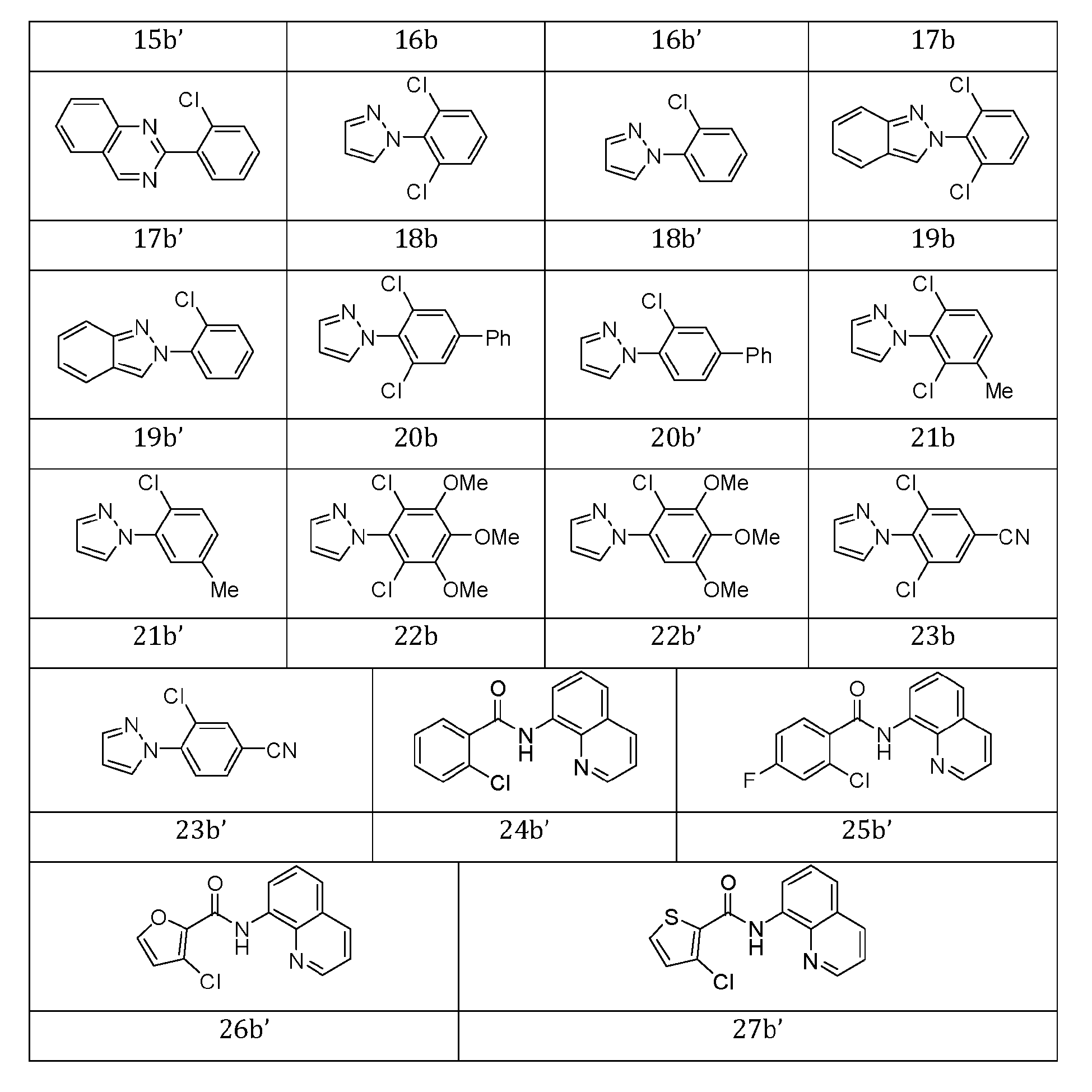
- The 1H and 13C NMR peaks of the products are listed below.
- 10-chlorobenzoquinoline (1b'):
1H NMR (400 MHz, DMSO) δ=9.07 (dd, J=4.3, 1.9 Hz, 1H), 8.46 (dd, J=8.0, 1.9 Hz, 1H), 8.07 (dd, J=7.9, 1.4 Hz, 1H), 8.01 (d, J=8.8 Hz, 1H), 7.95 (d, J=8.8 Hz, 1H), 7.87 (dd, J=7.7, 1.3 Hz, 1H), 7.77-7.66 ppm (m, 2H). 13C NMR (101 MHz, DMSO) δ=148.31, 145.85, 136.59, 136.53, 131.83, 131.51, 128.64, 128.50, 127.76, 127.48, 126.97, 122.76 ppm. - 2-(2,6-dichlorophenyl)pyridine (2b):
1H NMR (400 MHz, DMSO) δ=8.73 - 8.68 (m, 1H), 7.94 (t, J = 7.7 Hz, 1H), 7.59 (d, J = 8.1 Hz, 2H), 7.46 (dt, J = 17.0, 8.3 Hz, 3H). 13C NMR (101 MHz, DMSO) δ=155.29, 149.96, 138.66, 137.32, 134.07, 131.23, 128.82, 125.31, 123.86. - 2-(2,6-dichloro-4-methylphenyl)pyridine (3b):
1H NMR (400 MHz, DMSO) δ=8.70 (m, J=4.9, 1.8, 1.0 Hz, 1H), 7.91 (td, J=7.7, 1.8 Hz, 1H), 7.47-7.34 (m, 4H), 2.35 ppm (d, J=0.9 Hz, 3H).13C NMR (101 MHz, DMSO) δ 155.35, 149.91, 141.48, 137.15, 135.81, 133.65, 129.13, 125.45, 123.67, 20.65 ppm. - 2-(2,6-dichloro-4-methoxyphenyl)pyridine (4b):
1H NMR (400 MHz, DMSO) δ=8.68 (dt, J=4.8, 1.4 Hz, 1H), 7.91 (td, J=7.7, 1.9 Hz, 1H), 7.47-7.35 (m, 2H), 7.19 (s, 2H), 3.85 ppm (s, 3H).13C NMR (101 MHz, DMSO) δ=160.08, 155.22, 149.89, 137.19, 134.56, 131.19, 125.84, 123.65, 114.63, 56.62 ppm. - 2-(2,6-dichloro-4-(trifluoromethyll)phenyl)pyridine (5b):
1H NMR (400 MHz, DMSO) δ=8.74 (m, J=4.8, 1.8, 1.1 Hz, 1H), 8.03 (d, J=0.8 Hz, 2H), 7.98 (td, J=7.7, 1.8 Hz, 1H), 7.49 ppm (m, J=7.7, 5.6, 1.1 Hz, 2H).13C NMR (101 MHz, DMSO) δ=154.24, 150.17, 142.50, 137.53, 135.34, 132.08, 131.74, 131.41, 131.08, 127.06, 125.82, 125.78, 125.75, 125.71, 125.03, 124.34, 124.27, 121.63, 118.91 ppm. - 2-(2,6-dichloro-4-bromophenyl)pyridine (6b):
1H NMR (400 MHz, DMSO) δ=8.71 (m, J=4.9, 1.9, 1.0 Hz, 1H), 7.95 (td, J=7.7, 1.8 Hz, 1H), 7.91 (s, 2H), 7.51-7.40 ppm (m, 2H).13C NMR (101 MHz, DMSO) δ=154.48, 150.10, 138.03, 137.45, 135.09, 131.27, 125.32, 124.09, 122.46 ppm. - 2-(2,6-dichloro-phenyl)-3-methyl-pyridine (7b):
1H NMR (400 MHz, DMSO) δ=8.52 (m, J=4.8, 1.6, 0.7 Hz, 1H), 7.80 (m, J=7.7, 1.7, 0.9 Hz, 1H), 7.62 (dd, J=8.0, 0.8 Hz, 2H), 7.50 (dd, J=8.8, 7.3 Hz, 1H), 7.39 (dd, J=7.8, 4.8 Hz, 1H), 2.03 ppm (s, 3H). 13C NMR (101 MHz, DMSO) δ=154.91, 147.55, 138.41, 137.99, 133.91, 132.09, 131.24, 128.81, 124.12, 18.05 ppm. - 2-(2-chloronaphthalen-1-yl)pyridine (8b'):
1H NMR (400 MHz, CDCl3) δ=8.76 (m, J=4.9, 1.8, 1.0 Hz, 2H), 7.79 (m, J=8.5, 6.9, 4.9 Hz, 6H), 7.48 (d, J=8.8 Hz, 2H), 7.45-7.24 ppm (m, 10H).13C NMR (101 MHz, CDCl3) δ=156.66, 149.83, 136.41, 136.10, 133.24, 132.12, 130.70, 129.76, 128.04, 127.18, 126.01, 125.69, 122.67 ppm, - 2-(2-chloro-6-methoxyphenyl)pyridine (9b'):
1H NMR (400 MHz, CDCl3) δ=8.65 (m, J=4.9, 1.8, 1.0 Hz, 1H), 7.67 (td, J=7.7, 1.8 Hz, 1H), 7.27-7.16 (m, 3H), 7.01 (dd, J=8.1, 1.0 Hz, 1H), 6.81 (dd, J=8.4, 1.0 Hz, 1H), 3.64 ppm (s, 3H). 13C NMR (101 MHz, CDCl3) δ=158.25, 154.97, 149.47, 136.05, 134.13, 129.79, 129.20, 125.67, 122.36, 121.82, 109.53, 77.31, 56.11 ppm. - 3-(2-chlorophenyl)isoquinoline (10b'):
1H NMR (400 MHz, CDCl3) δ=8.19-8.07 (m, 2H), 7.81 (dd, J=8.0, 1.5 Hz, 1H), 7.72-7.64 (m, 2H), 7.66-7.58 (m, 1H), 7.51 (m, J=8.2, 6.9, 1.2 Hz, 1H), 7.44 (dd, J=7.2, 2.0 Hz, 1H), 7.33 ppm (pd, J=7.4, 1.8 Hz, 2H).13C NMR (101 MHz, CDCl3) δ=157.45, 148.11, 139.70, 135.67, 132.39, 131.71, 130.11, 129.89, 129.72, 129.69, 127.57, 127.19, 127.15, 126.79, 122.79, 77.23 ppm. - 1-(2,6-dichlorophenyl)isoquinoline (11b):
1H NMR (400 MHz, CDCl3) δ=8.61 (d, J=5.7 Hz, 1H), 7.86 (dt, J=8.3, 1.1 Hz, 1H), 7.72-7.59 (m, 2H), 7.51-7.38 (m, 4H), 7.32 ppm (dd, J=8.9, 7.2 Hz, 1H). 13C NMR (101 MHz, CDCl3) δ=156.70, 142.49, 136.96, 136.36, 135.20, 130.45, 130.24, 128.18, 127.80, 127.16, 126.04, 121.01, 77.23 ppm. - 2-(2,6-dichlorophenyl)pyrimidine (12b):
1H NMR (400 MHz, DMSO) δ=9.01 (d, J=5.0 Hz, 2H), 7.66-7.59 (m, 3H), 7.54 ppm (dd, J=9.0, 7.1 Hz, 1H). 13C NMR (101 MHz, DMSO) δ=163.64, 158.35, 137.82, 133.32, 131.65, 128.78, 121.38 ppm. - 2-(2-chloro-4,5-dimethoxyphenyl)pyrimidine (13b'):
1H NMR (400 MHz, CDCl3) δ=8.89 (d, J=4.9 Hz, 2H), 7.39 (s, 1H), 7.28 (t, J=4.9 Hz, 1H), 7.01 (s, 1H), 3.96 ppm (d, J=1.8 Hz, 6H). 13C NMR (101 MHz, CDCl3) δ=165.34, 157.23, 157.01, 150.39, 147.83, 129.50, 124.69, 118.95, 114.06, 113.52, 77.23, 56.28, 56.18 ppm. - 2-(2-chloro-6-methoxyphenyl)pyrimidine (14b'):
1H NMR (400 MHz, CDCl3) δ=8.83 (d, J=4.9 Hz, 2H), 7.30-7.17 (m, 2H), 7.02 (dd, J=8.1, 0.9 Hz, 1H), 6.84 (dd, J=8.4, 0.9 Hz, 1H), 3.68 ppm (s, 3H).13C NMR (101 MHz, CDCl3) δ=164.23, 158.11, 157.31, 133.54, 130.30, 128.29, 121.77, 119.55, 109.60, 77.23, 56.16 ppm. - 2-(2-chloro-4-methoxy-6-methylphenyl)pyrimidine (15b'):
1H NMR (400 MHz, CDCl3) δ=8.80 (d, J=4.9 Hz, 2H), 7.21 (t, J=4.9 Hz, 1H), 6.79 (d, J=2.5 Hz, 1H), 6.66 (dd, J=2.4, 0.9 Hz, 1H), 3.74 (s, 3H), 2.03 ppm (s, 3H). 13C NMR (101 MHz, CDCl3) δ=166.22, 159.75, 157.24, 139.05, 133.27, 131.14, 119.27, 114.77, 112.23, 55.52, 20.34 ppm. - 2-(2,6-dichlorophenyl)-5-methoxypyrimidine (16b):
1H NMR (500 MHz, CDCl3) δ=8.58 (s, 2H), 7.42 (d, J=8.0 Hz, 2H), 7.30 (dd, J=14.8, 6.5 Hz, 1H), 4.02 ppm (s, 3H). 13C NMR (126 MHz, CDCl3) δ=156.51, 152.19, 143.52, 137.29, 134.49, 130.12, 128.08, 56.03 ppm. - 2-(2-chlorophenyl)-5-methoxypyrimidine (16b'):
1H NMR (500 MHz, CDCl3) δ=8.56 (s, 3H), 7.72 (dd, J=6.1, 3.4 Hz, 2H), 7.55-7.48 (m, 2H), 7.45-7.28 (m, 4H), 4.01 ppm (s, 5H).13C NMR (126 MHz, CDCl3) δ=158.22, 151.90, 143.53, 143.20, 137.44, 132.63, 131.55, 130.51, 130.03, 128.08, 126.79, 56.03 ppm. - 2-(2,6-dichlorophenyl)quinazoline (17b):
1H NMR (500 MHz, CDCl3) δ=9.59 (s, 1H), 8.18 (d, J=8.5 Hz, 1H), 8.09-7.99 (m, 2H), 7.78 (m, J=8.1, 6.9, 1.1 Hz, 1H), 7.47 (d, J=8.1 Hz, 2H), 7.36 ppm (dd, J=8.7, 7.5 Hz, 1H). 13C NMR (126 MHz, CDCl3) δ=160.86, 160.38, 150.35, 137.90, 134.64, 134.26, 130.25, 128.71, 128.53, 128.19, 127.30, 123.61 ppm. - 2-(2-chlorophenyl)quinazoline (17b'):
1H NMR (500 MHz, CDCl3) δ=9.58 (d, J=16.0 Hz, 1H), 8.16 (d, J=8.2 Hz, 1H), 8.09-7.96 (m, 3H), 7.89-7.82 (m, 1H), 7.82-7.70 (m, 1H), 7.60-7.53 (m, 1H), 7.50-7.33 ppm (m, 3H).13C NMR (126 MHz, CDCl3) δ=162.02, 160.29, 150.38, 138.30, 134.64, 134.44, 132.92, 131.81, 130.58, 130.36, 130.25, 128.71, 128.68, 128.54, 128.19, 128.11, 127.31, 127.19, 126.93, 123.31 ppm. - 1-(2-chlorophenyl)-1H-pyrazole (18b'):
1H NMR (400 MHz, CDCl3) δ=7.81 (d, J=2.4 Hz, 3H), 7.68 (d, J=1.9 Hz, 3H), 7.56-7.47 (m, 3H), 7.47-7.35 (m, 3H), 7.35-7.21 (m, 6H), 6.47-6.37 ppm (m, 3H).13C NMR (101 MHz, CDCl3) δ=140.93, 131.30, 130.66, 130.63, 129.00, 128.68, 128.37, 127.82, 127.67, 106.69, 106.66 ppm. - 2-(2-chlorophenyl)-2H-indazole (19b'):
1H NMR (400 MHz, CDCl3) δ=8.27 (d, J=1.0 Hz, 1H), 7.76-7.58 (m, 3H), 7.57-7.46 (m, 1H), 7.44-7.24 (m, 3H), 7.07 ppm (m, J=8.5, 6.6, 0.9 Hz, 1H).13C NMR (101 MHz, CDCl3) δ=149.43, 138.64, 130.70, 129.97, 129.00, 128.59, 127.71, 126.95, 125.23, 122.45, 122.02, 120.53, 117.95, 77.23 ppm. - 1-(3-chloro-[1,1'-biphenyl]-4-yl)-1H-pyrazole (20b'):
1H NMR (400 MHz, CDCl3) δ=7.86 (dd, J=2.4, 0.6 Hz, 1H), 7.69 (dd, J=11.4, 1.9 Hz, 2H), 7.63-7.48 (m, 4H), 7.46-7.29 (m, 3H), 6.43 ppm (dd, J=2.5, 1.9 Hz, 1H). 13C NMR (101 MHz, CDCl3) δ=142.22, 141.01, 138.79, 137.13, 131.32, 129.11, 129.06, 128.40, 128.27, 127.92, 127.12, 126.30, 106.75, 77.23 ppm. - 1-(2-chloro-5-methylphenyl)-1H-pyrazole (21b'):
1H NMR (400 MHz, CDCl3) δ=7.90 (d, J=2.5 Hz, 1H), 7.76 (d, J=1.8 Hz, 1H), 7.46-7.38 (m, 2H), 7.16 (dd, J=8.4, 2.2 Hz, 1H), 6.49 (t, J=2.2 Hz, 1H), 2.40 ppm (s, 3H). 13C NMR (101 MHz, CDCl3) δ=140.79, 138.01, 137.79, 131.29, 130.27, 129.72, 128.26, 124.97, 106.55, 77.23, 20.77 ppm. - 1-(2-chloro-3,4,5-trimethoxyphenyl)-1H-pyrazole (22b'):
1H NMR (400 MHz, CDCl3) δ=7.89 (dd, J=2.5, 0.7 Hz, 1H), 7.73 (dd, J=1.7, 0.6 Hz, 1H), 6.93 (s, 2H), 6.48 (dd, J=2.5, 1.8 Hz, 1H), 3.95 (s, 7H), 3.89 ppm (s, 3H). 13C NMR (101 MHz, CDCl3) δ=153.77, 140.93, 136.71, 136.40, 127.02, 107.54, 97.29, 77.24, 61.05, 56.34 ppm. - 3-chloro-4-(1H-pyrazol-1-yl)benzonitrile (23b'):
1H NMR (400 MHz, CDCl3) δ=8.01 (dd, J=2.6, 0.6 Hz, 1H), 7.80-7.70 (m, 3H), 7.61 (dd, J=8.4, 1.8 Hz, 1H), 6.47 ppm (dd, J=2.6, 1.8 Hz, 1H). 13C NMR (101 MHz, CDCl3) δ=142.15, 141.55, 134.60, 131.41, 131.24, 127.86, 127.55, 116.90, 112.18, 107.93, 77.23 ppm. - 2-chloro-N-(quinolin-8-yl)benzamide (24b'):
1H NMR (400 MHz, CDCl3) δ=10.61 (s, 1H), 8.85-8.78 (m, 2H), 8.52 (dd, J=8.6, 1.7 Hz, 1H), 8.04-7.96 (m, 2H), 7.58 (d, J=8.4 Hz, 1H), 7.56-7.43 ppm (m, 4H). 13C NMR (101 MHz, CDCl3) δ=165.44, 148.79, 139.34, 134.91, 133.90, 133.50, 132.03, 128.87, 127.34, 127.30, 126.04, 124.51, 122.44, 116.49, 77.24 ppm. - 2-chloro-4-fluoro-N-(quinolin-8-yl)benzamide (25b'):
1H NMR (500 MHz, CDCl3) δ=10.38 (s, 1H), 9.31 (dt, J=8.9, 1.5 Hz, 1H), 9.07-9.01 (m, 1H), 8.98-8.89 (m, 1H), 8.64 (dd, J=8.8, 1.6 Hz, 1H), 8.61 (s, 0H), 7.80-7.74 (m, 1H), 7.30-7.17 ppm (m, 4H).13C NMR (126 MHz, CDCl3) δ=163.43, 162.44, 149.29, 139.81, 139.59, 137.60, 133.64, 133.41, 127.51, 124.83, 121.75, 116.49, 116.29, 114.51, 77.25 ppm. - 3-chloro-N-(quinolin-8-yl)furan-2-carboxamide (26b'):
1H NMR (500 MHz, CDCl3) δ=10.75 (s, 1H), 8.95 (dd, J=4.1, 1.6 Hz, 1H), 8.84 (d, J=8.3 Hz, 1H), 8.61 (dd, J=8.6, 1.8 Hz, 1H), 7.69-7.63 (m, 2H), 7.62 (dd, J=8.5, 4.2 Hz, 1H), 7.33 (d, J=3.5 Hz, 1H), 6.62 ppm (dd, J=3.5, 1.7 Hz, 1H). 13C NMR (126 MHz, CDCl3) δ=156.35, 148.91, 148.17, 144.66, 139.21, 133.50, 133.43, 127.28, 126.04, 124.65, 122.47, 116.57, 115.40, 112.55 ppm. - 3-chloro-N-(quinolin-8-yl)thiophene-2-carboxamide (27b'):
1H NMR (400 MHz, CDCl3) δ=11.29 (s, 1H), 8.85 (dd, J=4.2, 1.6 Hz, 1H), 8.77 (d, J=8.4 Hz, 1H), 8.53 (dd, J=8.6, 1.6 Hz, 1H), 7.61-7.46 (m, 3H), 7.02 ppm (d, J=5.2 Hz, 1H). 13C NMR (101 MHz, CDCl3) δ=158.69, 149.02, 139.47, 133.96, 133.82, 133.37, 130.20, 129.86, 127.27, 126.04, 125.02, 124.24, 122.46, 117.25, 77.23 ppm. - Further experiments were performed according to the general reaction protocol described above with varying reaction conditions using 7,8-benzoquinoline as substrate and PVC water pipe as chlorine donor as compiled in Table 5.
Table 5: Syntheses performed with varying reaction conditions Exp. No. Catalysta Second catalystb NaNO3 c Gaseous oxidising agent Temp.d Yielde 53 CuO, 20 mol% PdO, 5 mol% 20 O2, 3 bar 140 58 54 CuSO4, 20 mol% PdO, 5 mol% 20 O2, 3 bar 140 38 55 Cu(OAc)2, 20 mol% PdO, 5 mol% 20 O2, 3 bar 140 28 56 Cu(NO3)2, 20 mol% PdO, 5 mol% 20 O2, 3 bar 140 99 57 Cu(OTf)2, 20 mol% PdO, 5 mol% 20 O2, 3 bar 140 37 58 Cu(acac)2, 20 mol% PdO, 5 mol% 20 O2, 3 bar 140 36 59 CuPF6(CH3CN)2, 20 mol% PdO, 5 mol% 20 O2, 3 bar 140 37 60 PdO, 10 mol% - 100 O2, 3 bar 140 7 61 Cu(NO3)2, 5 mol% PdO, 10 mol% 100 O2, 3 bar 140 28 62 Cu(NO3)2, 10 mol% PdO, 10 mol% 100 O2, 3 bar 140 41 63 Cu(NO3)2, 20 mol% PdO, 10 mol% 100 O2, 3 bar 140 73 64 Cu(NO3)2, 30 mol% PdO, 10 mol% 100 O2, 3 bar 140 73 65 Cu(NO3)2, 20 mol% - 100 O2, 3 bar 140 29 66 Cu(NO3)2, 20 mol% 10% Pd/C, 10 mol% 100 O2, 3 bar 140 74 67 Cu(NO3)2, 20 mol% Pd(OH)2/C, 10 mol% 100 O2, 3 bar 140 75 68 Cu(NO3)2, 20 mol% Pd(OAc)2, 10 mol% 100 O2, 3 bar 140 34 69 Cu(NO3)2, 20 mol% Pd(TFA)2, 10 mol% 100 O2, 3 bar 140 39 70 Cu(NO3)2, 20 mol% Pd(dba)2, 10 mol% 100 O2, 3 bar 140 25 71 Cu(NO3)2, 20 mol% Pd(acac)2, 10 mol% 100 O2, 3 bar 140 52 72 Cu(NO3)2, 20 mol% Pd(NO3)2·2H2O, 10 mol% 100 O2, 3 bar 140 39 73 Cu(NO3)2, 20 mol% PdSO4, 10 mol% 100 O2, 3 bar 140 24 74 Cu(NO3)2, 20 mol% NiO, 10 mol% 100 O2, 3 bar 140 26 75 Cu(NO3)2, 20 mol% PdO, 2.5 mol% 100 O2, 3 bar 140 69 76 Cu(NO3)2, 20 mol% PdO, 5 mol% 0 O2, 3 bar 140 52 77 Cu(NO3)2, 20 mol% PdO, 5 mol% 10 O2, 3 bar 140 87 78 Cu(NO3)2, 20 mol% PdO, 5 mol% 40 O2, 3 bar 140 98 79 Cu(NO3)2, 20 mol% PdO, 5 mol% 60 O2, 3 bar 140 93 80 Cu(NO3)2, 20 mol% PdO, 5 mol% 100 O2, 3 bar 140 84 81 Cu(NO3)2, 20 mol% PdO, 5 mol% 160 O2, 3 bar 140 82 82 Cu(NO3)2, 20 mol% PdO, 5 mol% 240 O2, 3 bar 140 74 83 Cu(NO3)2, 20 mol% PdO, 5 mol% 20 O2, 3 bar 120 5 84 Cu(NO3)2, 20 mol% PdO, 5 mol% 20 O2, 3 bar 130 37 85 Cu(NO3)2, 20 mol% PdO, 5 mol% 20 O2, 3 bar 150 99 86 Cu(NO3)2, 20 mol% PdO, 5 mol% 20 O2, 1 bar 140 80 87 Cu(NO3)2, 20 mol% PdO, 5 mol% 20 O2, 5 bar 140 99 88 Cu(NO3)2, 20 mol% PdO, 5 mol% 20 Air, 1 bar 140 3 89 Cu(NO3)2, 20 mol% PdO, 5 mol% 20 Air, 10 bar 140 38 90f Cu(NO3)2, 20 mol% PdO, 5 mol% 20 N2, 1 bar 140 0 - Explanations to Table 5: a -amount of catalyst in mol% based on 7,8-benzoquinoline; b - amount of second catalyst in mol% based on 7,8-benzoquinoline; c - amount of NaNO3 in mol% based on 7,8-benzoquinoline; d - reaction temperature in °C; e - yield in % of 10-chlorobenzoquinoline, determined by GC, f - comparative example.
- As elucidated in the given examples, the chlorination of substrate compounds containing an arene moiety proceeds in the presence of a chlorine-donor, a catalyst, an oxidising agent, and a solvent. Good yields can be obtained for different catalysts and catalyst combinations. The method allows for a great flexibility concerning the oxidising agent. Moreover, waste products containing chlorinated hydrocarbon compounds can be used directly as chlorine-donor in the method according to the invention.
Claims (15)
- Method for chlorination of a substrate compound containing an arene moiety with 3 to 20 carbon atoms, wherein the substrate compound is reacted with an organic chlorine-donor in the presence of a catalyst, an oxidising agent, and a solvent.
- Method according to claim 1, wherein the chlorine-donor contains a chlorinated hydrocarbon compound.
- Method according to claims 1 and 2, wherein the chlorinated hydrocarbon compound can be solid or liquid at 25°C, preferably wherein the chlorinated hydrocarbon compound contains a chlorine atom connected to an aliphatic moiety.
- Method according to any of the preceding claims, wherein the chlorine-donor is selected from the group consisting of polyvinyl chloride, polyvinylidene chloride, polyepichlorohydrin, neoprene, poly(epichlorohydrin-co-ethylene oxide), poly(epichlorohydrin-co-CO2), dichloromethane, chloroform, 1,2-dichloroethane, 1,1-dichloroethane, 1,1,2-trichloroethane, 1,2-dichloroethene, perchloroethene, 1,6-dichlorohexane, 2-chlorohexane, 1,4-dichlorobutene, chlorocyclohexane, (3-chlorobutyl)benzene, benzyl chloride, epichlorohydrin, epichlorohydrin carbonate, and mixtures thereof, preferably selected from the group consisting of polyvinyl chloride, polyvinylidene chloride, polyepichlorohydrin, neoprene, poly(epichlorohydrin-co-ethylene oxide), poly(epichlorohydrin-co-CO2), dichloromethane, 1,2-dichloroethane, 1,1-dichloroethane, 1,2-dichloroethene, 1,6-dichlorohexane, 2-chlorohexane, 1,4-dichlorobutene, (3-chlorobutyl)benzene, benzyl chloride, epichlorohydrin, epichlorohydrin carbonate, and mixtures thereof.
- Method according to any of the preceding claims, wherein the catalyst contains a metal, preferably contains a metal selected from the group consisting of copper, nickel, cobalt, palladium, and mixtures thereof, more preferably contains copper and/or palladium, even more preferably contains a palladium compound and/or a copper salt selected from the group consisting of PdO, Cu(OAc)2, Cu(OTf)2, CuSO4, Cu(acac)2, CuPF6(CH3CN)2, CuO, and/or Cu(NO3)2 and mixtures thereof, most preferably contains Cu(NO3)2, and/or wherein the catalyst is a heterogeneous or homogeneous catalyst, preferably a homogeneous catalyst.
- Method according to any of the preceding claims, wherein the catalyst is preferably used in combination with a second catalyst, preferably a second metal catalyst selected from the group consisting of a palladium catalyst, a platinum catalyst, an iron catalyst, a nickel catalyst such as NiO, and mixtures thereof, more preferably a palladium catalyst, even more preferably PdO, 10%Pd/C, Pd(OH)2/C, Pd(OAC)2, Pd(TFA)2, Pd(dba)2, Pd(acac)2, Pd(NO3)2·2H2O, and/or PdSO4 and mixtures thereof, most preferably PdO.
- Method according to any of the preceding claims, wherein the oxidising agent contains a compound selected from the group consisting of oxygen, air, nitrate, ozone, hydrogen peroxide, inorganic peroxides, chlorine, nitric acid, permanganate, dichromate, chlorate, sulfuric acid, osmium tetroxide, sodium perborate, nitrogen oxide gases, sodium bismuthate, ceric ammonium nitrate, ceric sulfate, lead dioxide, and mixtures thereof.
- Method according to any of the preceding claims, wherein the oxidising agent is a combination of a gaseous and a non-gaseous oxidising agent, more preferably a combination of oxygen and a nitrate salt, in particular sodium nitrate,
and/or
wherein the solvent is a proton-containing non-aromatic solvent, preferably a dipolar aprotic solvent, preferably dimethyl sulfoxide, and/or wherein the solvent contains water, preferably contains water in an amount of 0.001 to 1 wt.%, more preferably 0.05 to 1 wt.%, most preferably 0.05 to 0.1 wt.% based on the amount of solvent. - Method according to any of the preceding claims, wherein the arene moiety of the substrate compound contains 1 to 8, preferably 1 to 3, heteroatoms selected from the group containing nitrogen, oxygen, sulfur, and phosphorus, preferably nitrogen.
- Method according to any of the preceding claims, wherein the chlorination takes place on the arene moiety.
- Method according to any of the preceding claims, wherein the substrate compound is reacted with the chlorine-donor at a temperature from 10 to 200 °C, preferably from 100 to 180 °C, more preferably from 130 to 150 °C, and/or wherein the chlorine-donor is employed in an amount of 1.0 to 5.0 equivalents, more preferably 1.0 to 3.0 equivalents, even more preferably 1.0 to 2.0 equivalents, most preferably 1.5 equivalents, based on the amount of substrate compound, and/or wherein the catalyst is employed in an amount of 1 to 50 mol% based on the amount of substrate compound, more preferably 5 to 40 mol%, even more preferably 10 to 30 mol%, most preferably 15 to 25 mol%.
- Method according to any of claims 6 to 11, wherein the second catalyst is employed in an amount of 0.01 to 50 mol% based on the amount of substrate compound, more preferably 0.1 to 30 mol%, even more preferably 1 to 15 mol%, most preferably 2.5 to 7.5 mol%.
- Method according to any of claims 7 to 12, wherein the non-gaseous oxidising agent is employed in an amount of 1 to 100 mol% based on the amount of substrate compound, preferably 5 to 80 mol%, more preferably 10 to 50 mol%, most preferably 20 mol%, and/or wherein the gaseous oxidising agent is employed at a pressure of 1 to 100 bar, preferably at 1 to 50 bar, more preferably at 1 to 10 bar, most preferably at 3 bar.
- Use of a chlorine-containing solid or liquid organic compound, in particular a chlorinated organic waste compound, as chlorine-donor for the chlorination of a substrate compound containing an arene moiety with 3 to 20 carbon atoms.
- Use according to claim 14, wherein the chlorine-containing solid or liquid organic compound is selected from solid polymer waste such as post-consumer waste plastic and rubber, liquid laboratory waste such as chlorinated solvents, and mixtures thereof, and/or wherein the chlorination is conducted in the presence of a catalyst, an oxidising agent, and a solvent, in particular as detailed in any one of claims 1 to 13.
Priority Applications (3)
| Application Number | Priority Date | Filing Date | Title |
|---|---|---|---|
| EP23170105.3A EP4455127A1 (en) | 2023-04-26 | 2023-04-26 | Arene-chlorination using chlorinated waste |
| PCT/EP2024/061559 WO2024223834A1 (en) | 2023-04-26 | 2024-04-26 | Arene-chlorination using chlorinated waste |
| EP24722568.3A EP4702008A1 (en) | 2023-04-26 | 2024-04-26 | Arene-chlorination using chlorinated waste |
Applications Claiming Priority (1)
| Application Number | Priority Date | Filing Date | Title |
|---|---|---|---|
| EP23170105.3A EP4455127A1 (en) | 2023-04-26 | 2023-04-26 | Arene-chlorination using chlorinated waste |
Publications (1)
| Publication Number | Publication Date |
|---|---|
| EP4455127A1 true EP4455127A1 (en) | 2024-10-30 |
Family
ID=86226690
Family Applications (2)
| Application Number | Title | Priority Date | Filing Date |
|---|---|---|---|
| EP23170105.3A Withdrawn EP4455127A1 (en) | 2023-04-26 | 2023-04-26 | Arene-chlorination using chlorinated waste |
| EP24722568.3A Pending EP4702008A1 (en) | 2023-04-26 | 2024-04-26 | Arene-chlorination using chlorinated waste |
Family Applications After (1)
| Application Number | Title | Priority Date | Filing Date |
|---|---|---|---|
| EP24722568.3A Pending EP4702008A1 (en) | 2023-04-26 | 2024-04-26 | Arene-chlorination using chlorinated waste |
Country Status (2)
| Country | Link |
|---|---|
| EP (2) | EP4455127A1 (en) |
| WO (1) | WO2024223834A1 (en) |
Citations (1)
| Publication number | Priority date | Publication date | Assignee | Title |
|---|---|---|---|---|
| CN108658755A (en) * | 2017-04-02 | 2018-10-16 | 成都中恒华铁科技有限公司 | A kind of synthetic method of pharmaceutical intermediate parachlorobenzoic-acid |
-
2023
- 2023-04-26 EP EP23170105.3A patent/EP4455127A1/en not_active Withdrawn
-
2024
- 2024-04-26 EP EP24722568.3A patent/EP4702008A1/en active Pending
- 2024-04-26 WO PCT/EP2024/061559 patent/WO2024223834A1/en not_active Ceased
Patent Citations (1)
| Publication number | Priority date | Publication date | Assignee | Title |
|---|---|---|---|---|
| CN108658755A (en) * | 2017-04-02 | 2018-10-16 | 成都中恒华铁科技有限公司 | A kind of synthetic method of pharmaceutical intermediate parachlorobenzoic-acid |
Non-Patent Citations (21)
| Title |
|---|
| A. ALBERINIJ. BARTHOLOMEW, CONTEMP. ECON. POLICY, vol. 17, 1999, pages 309 - 320 |
| A. L. YEEJ. A. GILBERT, SCIENCE, vol. 353, 2016, pages 348 - 349 |
| BHUTANI, P.JOSHI, G.RAJA, N.BACHHAV, N.RAJANNA, P. K.BHUTANI, H.PAUL, A. T.KUMAR, R., J. MED. CHEM., vol. 64, 2021, pages 2339 - 2381 |
| C. CHOI ET AL., NAT. NANOTECHNOL., 2022 |
| C. JEHANNO ET AL., NATURE, vol. 603, 2022, pages 803 - 814 |
| CARULLO, J. R.DYSON, P. J., NAT. COMMUN., vol. 13, 2022, pages 4850 |
| CHU, M.LIU, Y.LOU, X.ZHANG, Q.CHEN, J., ACS CATAL, vol. 12, 2022, pages 4659 - 4679 |
| D. E. FAGNANI ET AL., NAT. CHEM, 2022 |
| D. PEKELNEYJ. HAZARD, MATER, vol. 23, 1990, pages 293 - 315 |
| ELLIS, L. D.RORRER, N. A.SULLIVAN, K. P.OTTO, M.MCGEEHAN, J. E.ROMAN-LESHKOV, Y.WIERCKX, N.BECKHAM, G. T., NAT. CATAL., vol. 4, 2021, pages 539 - 556 |
| F. ZHANG ET AL., SCIENCE, vol. 370, 2020, pages 437 - 441 |
| FAGNANI DANIELLE E. ET AL: "Using waste poly(vinyl chloride) to synthesize chloroarenes by plasticizer-mediated electro(de)chlorination", NATURE CHEMISTRY, vol. 15, no. 2, 14 November 2022 (2022-11-14), London, pages 222 - 229, XP093075078, ISSN: 1755-4330, Retrieved from the Internet <URL:https://www.nature.com/articles/s41557-022-01078-w> DOI: 10.1038/s41557-022-01078-w * |
| G. GAN ET AL., ACS CATAL., vol. 11, 2021, pages 14284 - 14292 |
| G. GAN ET AL., ACS NANO, vol. 14, 2020, pages 9929 - 9937 |
| HOU, Q.ZHEN, M.QIAN, H.NIE, Y.BAI, X.XIA, T.LAIQ UR REHMAN, M.LI, Q.JU, M., CELL REP. PHYS. SCI., vol. 2, 2021, pages 100514 |
| JORDAN, A. ET AL., CHEM. REV., vol. 121, 2021, pages 1582 - 1622 |
| MA, W.HOFFMANN, G.SCHIRMER, M.CHEN, G.ROTTER, V. S., J. HAZARD. MATER., vol. 178, 2010, pages 489 - 498 |
| MARTIN, A. J.MONDELLI, C.JAYDEV, S. D.PEREZ-RAMIREZ, J., CHEM, vol. 7, 2021, pages 1487 - 1533 |
| NACLERIO, N. D.KARSAI, A.MURRAY-COOPER, M.OZKAN-AYDIN, Y.AYDIN, E.GOLDMAN, D. I.HAWKES, E. W., SCI. ROBOT., vol. 6, 2021 |
| R. J. CONK ET AL., SCIENCE, vol. 377, 2022, pages 1561 - 1566 |
| SCHBNIGER, W., MIKROCHIM. ACTA, vol. 43, 1955, pages 123 - 129 |
Also Published As
| Publication number | Publication date |
|---|---|
| EP4702008A1 (en) | 2026-03-04 |
| WO2024223834A1 (en) | 2024-10-31 |
Similar Documents
| Publication | Publication Date | Title |
|---|---|---|
| Wang et al. | Chloride ion-catalyzed generation of difluorocarbene for efficient preparation of gem-difluorinated cyclopropenes and cyclopropanes | |
| Umemoto et al. | Discovery of practical production processes for arylsulfur pentafluorides and their higher homologues, bis-and tris (sulfur pentafluorides): Beginning of a new era of “super-trifluoromethyl” arene chemistry and its industry | |
| Lu et al. | Palladium-catalyzed picolinamide-directed halogenation of ortho C–H bonds of benzylamine substrates | |
| Bigdeli et al. | Wet 2, 4, 6-trichloro [1, 3, 5] triazine (TCT) an efficient catalyst for synthesis of α, α′-bis (substituted-benzylidene) cycloalkanones under solvent-free conditions | |
| Chang et al. | A direct catalytic ring expansion approach to o-fluoronaphthols and o/p-fluorophenols from indanones and 2-cyclopentenones | |
| US5565689A (en) | Reactant for perfluoroalkylation of nucleophilic substrates with sodium perfluoroalkanesulphinates in an oxidizing medium | |
| Sun et al. | Efficient, versatile and practical palladium-catalyzed highly regioselective ortho-halogenation of azoxybenzenes | |
| Zielinska et al. | A solvent-free synthesis of (dichloroiodo) arenes from iodoarenes | |
| EP4702008A1 (en) | Arene-chlorination using chlorinated waste | |
| WO2004024663A1 (en) | Method for the organometallic production of organic intermediate products by halogen-metal exchange reactions | |
| Gatenyo et al. | Direct addition of fluorine to arylacetylenes | |
| KR102605005B1 (en) | Method for producing fluorinated sulfide compounds | |
| EP2366680A2 (en) | Method for manufacturing 4'-halogenalkyl-biphenyl-2-carboxylic acids | |
| Sasson et al. | Constructing the CF3 group; unique trifluorodecarboxylation induced by BrF3 | |
| Yang et al. | Regioselective Synthesis of 2, 6‐Dimethyl‐3, 5‐bis [(3‐aryl‐5‐trifluoromethyl)‐isoxazol‐4‐carbonyl]‐pyridine Derivatives | |
| Sott et al. | Synthesis of dioxin-like monofluorinated PCBs: for the use as internal standards for PCB analysis | |
| Chambers et al. | Reactions involving fluoride ion. Part 37.‘Proton Sponge’hydrofluoride as a fluoride ion donor | |
| Xu et al. | Visible-Light-Driven Oxidative Chlorination of Alkyl sp3 C–H Bonds with HCl/Air at Room Temperature | |
| CN104649934B (en) | A kind of synthetic method of medicine intermediate trifluoromethyl substituted arene compounds | |
| EP0032210B1 (en) | Fluorination of organic compounds with fluorine in porous metal tube reactor with perfluorinated diluent | |
| Jung et al. | Site-selective mono-oxidative addition of active zinc into carbon–bromine bond of dibrominated-thiophenes: preparation of thienylzinc reagents and their applications | |
| Jiang et al. | Photocatalytic Diverse Synthesis of Transformable SF5-Scaffolds Utilizing SF6 | |
| Nguyen et al. | Practical synthesis of Csp3 Chlorinated Compounds from Cyclopropanes, Olefins and CH Bonds via photolysis of Willgerodt-type reagents | |
| US20110229973A1 (en) | Congeneric, chlorinated, brominated and/or iodised, fluorinated aromatic compounds comprising two benzol rings in their basic structure, method for their production and use thereof | |
| Fang et al. | The nucleophilic addition reactions of difluorovinyl tosylates with O-and S-nucleophiles |
Legal Events
| Date | Code | Title | Description |
|---|---|---|---|
| PUAI | Public reference made under article 153(3) epc to a published international application that has entered the european phase |
Free format text: ORIGINAL CODE: 0009012 |
|
| STAA | Information on the status of an ep patent application or granted ep patent |
Free format text: STATUS: THE APPLICATION HAS BEEN PUBLISHED |
|
| AK | Designated contracting states |
Kind code of ref document: A1 Designated state(s): AL AT BE BG CH CY CZ DE DK EE ES FI FR GB GR HR HU IE IS IT LI LT LU LV MC ME MK MT NL NO PL PT RO RS SE SI SK SM TR |
|
| STAA | Information on the status of an ep patent application or granted ep patent |
Free format text: STATUS: THE APPLICATION IS DEEMED TO BE WITHDRAWN |
|
| 18D | Application deemed to be withdrawn |
Effective date: 20250501 |