EP4455090A1 - Titanium silicate molecular sieve, and nano-gold-loaded titanium silicate molecular sieve catalyst and preparation method therefor and use thereof - Google Patents

Titanium silicate molecular sieve, and nano-gold-loaded titanium silicate molecular sieve catalyst and preparation method therefor and use thereof Download PDF

Info

Publication number
EP4455090A1
EP4455090A1 EP22909630.0A EP22909630A EP4455090A1 EP 4455090 A1 EP4455090 A1 EP 4455090A1 EP 22909630 A EP22909630 A EP 22909630A EP 4455090 A1 EP4455090 A1 EP 4455090A1
Authority
EP
European Patent Office
Prior art keywords
molecular sieve
catalyst
titanium silicalite
silicalite molecular
surface area
Prior art date
Legal status (The legal status is an assumption and is not a legal conclusion. Google has not performed a legal analysis and makes no representation as to the accuracy of the status listed.)
Pending
Application number
EP22909630.0A
Other languages
German (de)
French (fr)
Other versions
EP4455090A4 (en
Inventor
Yujia Liu
Chenyang ZHAO
Hongwei Zhu
Bing Sun
Ning Shi
Wei Xu
Current Assignee (The listed assignees may be inaccurate. Google has not performed a legal analysis and makes no representation or warranty as to the accuracy of the list.)
China Petroleum and Chemical Corp
Sinopec Research Institute of Safety Engineering Co Ltd
Original Assignee
China Petroleum and Chemical Corp
Sinopec Research Institute of Safety Engineering Co Ltd
Priority date (The priority date is an assumption and is not a legal conclusion. Google has not performed a legal analysis and makes no representation as to the accuracy of the date listed.)
Filing date
Publication date
Priority claimed from CN202111579946.4A external-priority patent/CN116332200B/en
Priority claimed from CN202111579941.1A external-priority patent/CN116332194B/en
Priority claimed from CN202210239081.5A external-priority patent/CN116764676B/en
Application filed by China Petroleum and Chemical Corp, Sinopec Research Institute of Safety Engineering Co Ltd filed Critical China Petroleum and Chemical Corp
Publication of EP4455090A1 publication Critical patent/EP4455090A1/en
Publication of EP4455090A4 publication Critical patent/EP4455090A4/en
Pending legal-status Critical Current

Links

Images

Classifications

    • BPERFORMING OPERATIONS; TRANSPORTING
    • B01PHYSICAL OR CHEMICAL PROCESSES OR APPARATUS IN GENERAL
    • B01JCHEMICAL OR PHYSICAL PROCESSES, e.g. CATALYSIS OR COLLOID CHEMISTRY; THEIR RELEVANT APPARATUS
    • B01J29/00Catalysts comprising molecular sieves
    • B01J29/89Silicates, aluminosilicates or borosilicates of titanium, zirconium or hafnium
    • BPERFORMING OPERATIONS; TRANSPORTING
    • B01PHYSICAL OR CHEMICAL PROCESSES OR APPARATUS IN GENERAL
    • B01JCHEMICAL OR PHYSICAL PROCESSES, e.g. CATALYSIS OR COLLOID CHEMISTRY; THEIR RELEVANT APPARATUS
    • B01J29/00Catalysts comprising molecular sieves
    • B01J29/04Catalysts comprising molecular sieves having base-exchange properties, e.g. crystalline zeolites
    • B01J29/06Crystalline aluminosilicate zeolites; Isomorphous compounds thereof
    • B01J29/064Crystalline aluminosilicate zeolites; Isomorphous compounds thereof containing iron group metals, noble metals or copper
    • B01J29/068Noble metals
    • BPERFORMING OPERATIONS; TRANSPORTING
    • B01PHYSICAL OR CHEMICAL PROCESSES OR APPARATUS IN GENERAL
    • B01JCHEMICAL OR PHYSICAL PROCESSES, e.g. CATALYSIS OR COLLOID CHEMISTRY; THEIR RELEVANT APPARATUS
    • B01J21/00Catalysts comprising the elements, oxides, or hydroxides of magnesium, boron, aluminium, carbon, silicon, titanium, zirconium, or hafnium
    • B01J21/06Silicon, titanium, zirconium or hafnium; Oxides or hydroxides thereof
    • B01J21/063Titanium; Oxides or hydroxides thereof
    • BPERFORMING OPERATIONS; TRANSPORTING
    • B01PHYSICAL OR CHEMICAL PROCESSES OR APPARATUS IN GENERAL
    • B01JCHEMICAL OR PHYSICAL PROCESSES, e.g. CATALYSIS OR COLLOID CHEMISTRY; THEIR RELEVANT APPARATUS
    • B01J29/00Catalysts comprising molecular sieves
    • B01J29/04Catalysts comprising molecular sieves having base-exchange properties, e.g. crystalline zeolites
    • B01J29/06Crystalline aluminosilicate zeolites; Isomorphous compounds thereof
    • B01J29/061Crystalline aluminosilicate zeolites; Isomorphous compounds thereof containing metallic elements added to the zeolite
    • BPERFORMING OPERATIONS; TRANSPORTING
    • B01PHYSICAL OR CHEMICAL PROCESSES OR APPARATUS IN GENERAL
    • B01JCHEMICAL OR PHYSICAL PROCESSES, e.g. CATALYSIS OR COLLOID CHEMISTRY; THEIR RELEVANT APPARATUS
    • B01J35/00Catalysts, in general, characterised by their form or physical properties
    • B01J35/20Catalysts, in general, characterised by their form or physical properties characterised by their non-solid state
    • B01J35/23Catalysts, in general, characterised by their form or physical properties characterised by their non-solid state in a colloidal state
    • BPERFORMING OPERATIONS; TRANSPORTING
    • B01PHYSICAL OR CHEMICAL PROCESSES OR APPARATUS IN GENERAL
    • B01JCHEMICAL OR PHYSICAL PROCESSES, e.g. CATALYSIS OR COLLOID CHEMISTRY; THEIR RELEVANT APPARATUS
    • B01J35/00Catalysts, in general, characterised by their form or physical properties
    • B01J35/30Catalysts, in general, characterised by their form or physical properties characterised by their physical properties
    • BPERFORMING OPERATIONS; TRANSPORTING
    • B01PHYSICAL OR CHEMICAL PROCESSES OR APPARATUS IN GENERAL
    • B01JCHEMICAL OR PHYSICAL PROCESSES, e.g. CATALYSIS OR COLLOID CHEMISTRY; THEIR RELEVANT APPARATUS
    • B01J35/00Catalysts, in general, characterised by their form or physical properties
    • B01J35/40Catalysts, in general, characterised by their form or physical properties characterised by dimensions, e.g. grain size
    • BPERFORMING OPERATIONS; TRANSPORTING
    • B01PHYSICAL OR CHEMICAL PROCESSES OR APPARATUS IN GENERAL
    • B01JCHEMICAL OR PHYSICAL PROCESSES, e.g. CATALYSIS OR COLLOID CHEMISTRY; THEIR RELEVANT APPARATUS
    • B01J35/00Catalysts, in general, characterised by their form or physical properties
    • B01J35/40Catalysts, in general, characterised by their form or physical properties characterised by dimensions, e.g. grain size
    • B01J35/45Nanoparticles
    • BPERFORMING OPERATIONS; TRANSPORTING
    • B01PHYSICAL OR CHEMICAL PROCESSES OR APPARATUS IN GENERAL
    • B01JCHEMICAL OR PHYSICAL PROCESSES, e.g. CATALYSIS OR COLLOID CHEMISTRY; THEIR RELEVANT APPARATUS
    • B01J35/00Catalysts, in general, characterised by their form or physical properties
    • B01J35/60Catalysts, in general, characterised by their form or physical properties characterised by their surface properties or porosity
    • B01J35/61Surface area
    • B01J35/61310-100 m2/g
    • BPERFORMING OPERATIONS; TRANSPORTING
    • B01PHYSICAL OR CHEMICAL PROCESSES OR APPARATUS IN GENERAL
    • B01JCHEMICAL OR PHYSICAL PROCESSES, e.g. CATALYSIS OR COLLOID CHEMISTRY; THEIR RELEVANT APPARATUS
    • B01J35/00Catalysts, in general, characterised by their form or physical properties
    • B01J35/60Catalysts, in general, characterised by their form or physical properties characterised by their surface properties or porosity
    • B01J35/61Surface area
    • B01J35/615100-500 m2/g
    • BPERFORMING OPERATIONS; TRANSPORTING
    • B01PHYSICAL OR CHEMICAL PROCESSES OR APPARATUS IN GENERAL
    • B01JCHEMICAL OR PHYSICAL PROCESSES, e.g. CATALYSIS OR COLLOID CHEMISTRY; THEIR RELEVANT APPARATUS
    • B01J35/00Catalysts, in general, characterised by their form or physical properties
    • B01J35/60Catalysts, in general, characterised by their form or physical properties characterised by their surface properties or porosity
    • B01J35/63Pore volume
    • B01J35/633Pore volume less than 0.5 ml/g
    • BPERFORMING OPERATIONS; TRANSPORTING
    • B01PHYSICAL OR CHEMICAL PROCESSES OR APPARATUS IN GENERAL
    • B01JCHEMICAL OR PHYSICAL PROCESSES, e.g. CATALYSIS OR COLLOID CHEMISTRY; THEIR RELEVANT APPARATUS
    • B01J35/00Catalysts, in general, characterised by their form or physical properties
    • B01J35/60Catalysts, in general, characterised by their form or physical properties characterised by their surface properties or porosity
    • B01J35/64Pore diameter
    • B01J35/6472-50 nm
    • BPERFORMING OPERATIONS; TRANSPORTING
    • B01PHYSICAL OR CHEMICAL PROCESSES OR APPARATUS IN GENERAL
    • B01JCHEMICAL OR PHYSICAL PROCESSES, e.g. CATALYSIS OR COLLOID CHEMISTRY; THEIR RELEVANT APPARATUS
    • B01J37/00Processes, in general, for preparing catalysts; Processes, in general, for activation of catalysts
    • B01J37/02Impregnation, coating or precipitation
    • B01J37/0201Impregnation
    • B01J37/0203Impregnation the impregnation liquid containing organic compounds
    • BPERFORMING OPERATIONS; TRANSPORTING
    • B01PHYSICAL OR CHEMICAL PROCESSES OR APPARATUS IN GENERAL
    • B01JCHEMICAL OR PHYSICAL PROCESSES, e.g. CATALYSIS OR COLLOID CHEMISTRY; THEIR RELEVANT APPARATUS
    • B01J37/00Processes, in general, for preparing catalysts; Processes, in general, for activation of catalysts
    • B01J37/02Impregnation, coating or precipitation
    • B01J37/0201Impregnation
    • B01J37/0205Impregnation in several steps
    • BPERFORMING OPERATIONS; TRANSPORTING
    • B01PHYSICAL OR CHEMICAL PROCESSES OR APPARATUS IN GENERAL
    • B01JCHEMICAL OR PHYSICAL PROCESSES, e.g. CATALYSIS OR COLLOID CHEMISTRY; THEIR RELEVANT APPARATUS
    • B01J37/00Processes, in general, for preparing catalysts; Processes, in general, for activation of catalysts
    • B01J37/02Impregnation, coating or precipitation
    • B01J37/0201Impregnation
    • B01J37/0209Impregnation involving a reaction between the support and a fluid
    • BPERFORMING OPERATIONS; TRANSPORTING
    • B01PHYSICAL OR CHEMICAL PROCESSES OR APPARATUS IN GENERAL
    • B01JCHEMICAL OR PHYSICAL PROCESSES, e.g. CATALYSIS OR COLLOID CHEMISTRY; THEIR RELEVANT APPARATUS
    • B01J37/00Processes, in general, for preparing catalysts; Processes, in general, for activation of catalysts
    • B01J37/04Mixing
    • BPERFORMING OPERATIONS; TRANSPORTING
    • B01PHYSICAL OR CHEMICAL PROCESSES OR APPARATUS IN GENERAL
    • B01JCHEMICAL OR PHYSICAL PROCESSES, e.g. CATALYSIS OR COLLOID CHEMISTRY; THEIR RELEVANT APPARATUS
    • B01J37/00Processes, in general, for preparing catalysts; Processes, in general, for activation of catalysts
    • B01J37/08Heat treatment
    • CCHEMISTRY; METALLURGY
    • C01INORGANIC CHEMISTRY
    • C01BNON-METALLIC ELEMENTS; COMPOUNDS THEREOF; METALLOIDS OR COMPOUNDS THEREOF NOT COVERED BY SUBCLASS C01C
    • C01B39/00Compounds having molecular sieve and base-exchange properties, e.g. crystalline zeolites; Their preparation; After-treatment, e.g. ion-exchange or dealumination
    • C01B39/02Crystalline aluminosilicate zeolites; Isomorphous compounds thereof; Direct preparation thereof; Preparation thereof starting from a reaction mixture containing a crystalline zeolite of another type, or from preformed reactants; After-treatment thereof
    • C01B39/06Preparation of isomorphous zeolites characterised by measures to replace the aluminium or silicon atoms in the lattice framework by atoms of other elements, i.e. by direct or secondary synthesis
    • C01B39/08Preparation of isomorphous zeolites characterised by measures to replace the aluminium or silicon atoms in the lattice framework by atoms of other elements, i.e. by direct or secondary synthesis the aluminium atoms being wholly replaced
    • C01B39/085Group IVB- metallosilicates
    • CCHEMISTRY; METALLURGY
    • C01INORGANIC CHEMISTRY
    • C01PINDEXING SCHEME RELATING TO STRUCTURAL AND PHYSICAL ASPECTS OF SOLID INORGANIC COMPOUNDS
    • C01P2004/00Particle morphology
    • C01P2004/60Particles characterised by their size
    • C01P2004/62Submicrometer sized, i.e. from 0.1-1 micrometer
    • CCHEMISTRY; METALLURGY
    • C01INORGANIC CHEMISTRY
    • C01PINDEXING SCHEME RELATING TO STRUCTURAL AND PHYSICAL ASPECTS OF SOLID INORGANIC COMPOUNDS
    • C01P2006/00Physical properties of inorganic compounds
    • C01P2006/12Surface area
    • CCHEMISTRY; METALLURGY
    • C01INORGANIC CHEMISTRY
    • C01PINDEXING SCHEME RELATING TO STRUCTURAL AND PHYSICAL ASPECTS OF SOLID INORGANIC COMPOUNDS
    • C01P2006/00Physical properties of inorganic compounds
    • C01P2006/14Pore volume
    • CCHEMISTRY; METALLURGY
    • C01INORGANIC CHEMISTRY
    • C01PINDEXING SCHEME RELATING TO STRUCTURAL AND PHYSICAL ASPECTS OF SOLID INORGANIC COMPOUNDS
    • C01P2006/00Physical properties of inorganic compounds
    • C01P2006/16Pore diameter

Definitions

  • the invention relates to the field of the hydro-oxidation reaction, and in particular to a titanium silicalite molecular sieve, a catalyst of nanogold-supported titanium silicalite molecular sieve, and a preparation method therefor, and use thereof.
  • Heteroatom molecular sieves have a regular topological structure, and the introduction of framework metal atoms provides them with unique acidic properties, thus the heteroatom molecular sieves have emerged as the research hotspot in the chemical and chemical industries.
  • Taramasso et al first reported the TS-1 molecular sieve, wherein the transition metal titanium atoms replaced a small amount of framework silicon atoms of the all-silicon MFI structure molecular sieve, i.e., the titanium atoms were embedded in the tetra-coordinate form into the framework position of the molecular sieve.
  • the TS-1 molecular sieves can efficiently activate the H 2 O 2 molecule and organics of different functional groups to carry out the selective oxidation reaction, such as an olefin epoxidation reaction, a cycloolefin epoxidation reaction, a phenol hydroxylation reaction, and a cyclohexanone ammoximation reaction.
  • the H 2 O 2 /TS-1 catalytic oxidation process has advantages such as mild reaction conditions, a clean and efficient reaction process.
  • the invention aims to overcome the problem in the prior art about controlling the low micropore volume and micropore specific surface area of TS-1 molecular sieve carrier and the dispersity of its loaded metal nanoparticles, and provides a titanium silicalite molecular sieve and a preparation method therefor, and a catalyst of nanogold-supported titanium silicalite molecular sieve and a preparation method therefor and a use thereof.
  • the first aspect of the invention provides a titanium silicalite molecular sieve, wherein the titanium silicalite molecular sieve has a micropore specific surface area of 320-500 m 2 /g, a micropore volume of 0.1-0.4 cm 3 /g, a mesopore specific surface area of 50-100 m 2 /g, a mesopore volume of 0.075-0.1 cm 3 /g, and a particle size of 100-250nm, the micropore specific surface area accounts for 50-90% of the total specific surface area.
  • the second aspect of the invention provides a nanogold-supported titanium silicalite molecular sieve catalyst, wherein the catalyst comprises a carrier of titanium silicalite molecular sieve and a nano-gold supported on the carrier; wherein the catalyst has a micropore volume of 0.06-0.4 cm 3 /g, a micropore specific surface area of 160-450 m 2 /g, a mesopore volume of 0.05-0.08 cm 3 /g, a mesopore specific surface area of 40-85 m 2 /g, and a particle size of 100-250nm.
  • the third aspect of the invention provides a method for preparing a catalyst of nanogold-supported titanium silicalite molecular sieve catalyst, the method comprises steps of subjecting a titanium silicalite molecular sieve to an alkaline treatment with an aqueous aliphatic amine solution and then the nano-gold particles are supported on the treated titanium silicalite molecular sieve to obtain the catalyst;
  • titanium silicalite molecular sieve is the titanium silicalite molecular sieve according to the first aspect.
  • the invention provides a catalyst of nanogold-supported titanium silicalite molecular sieve produced by the method according to the third aspect.
  • the invention provides a use of a catalyst of nanogold-supported titanium substrate molecular sieve according to the second and fourth aspects in an olefin epoxidation reaction, a cycloolefin epoxidation reaction, a phenol hydroxylation reaction, and a cyclohexanone ammoximation reaction.
  • the high dispersity of nano-gold of the nanogold-supported titanium silicalite molecular sieve is achieved in the invention by supporting nano-gold particles onto a titanium silicalite molecular sieve with specific physical property parameters; when the resulting catalyst is used for the gas-phase epoxidation reaction of propylene, a high catalytic activity is obtained, the conversion rate of propylene is increased to 8%-14%, and the selectivity of epoxypropane is increased to 90-99%.
  • any value of the ranges disclosed herein are not limited to the precise ranges or values, such ranges or values shall be comprehended as comprising the values adjacent to the ranges or values.
  • numerical ranges the endpoint values of the various ranges, the endpoint values and the individual point values of the various ranges, and the individual point values may be combined with one another to produce one or more new numerical ranges, which should be deemed have been specifically disclosed herein.
  • the invention provides a titanium silicalite molecular sieve, the titanium silicalite molecular sieve has a micropore specific surface area of 320-500 m 2 /g, a micropore volume of 0.1-0.4 cm 3 /g, a mesopore specific surface area of 50-100 m 2 /g, a mesopore volume of 0.075-0.1 cm 3 /g, and a particle size of 100-250nm, the micropore specific surface area accounts for 50-90% of the total specific surface area.
  • micropore refers to the pore having a pore size of less than 2nm in the porous structure of the titanium silicalite molecular sieve.
  • the micropore specific surface area and micropore volume of the titanium silicalite molecular sieve are determined by analyzing and calculating with the t-plot method after measuring the static N 2 adsorption-desorption curve of the sample by using a static nitrogen adsorption instrument with a model Micro meritics ASAP 2460 under the liquid nitrogen temperature.
  • the mesopore specific surface area and mesopore volume of the titanium silicalite molecular sieve are determined by analyzing and calculating with the BJH method after measuring the static N 2 adsorption-desorption curve of the sample by using a static nitrogen adsorption instrument with a model Micro meritics ASAP 2460 under the liquid nitrogen temperature.
  • the total specific surface area of the titanium silicalite molecular sieve is measured with the BET method.
  • the particle size of the titanium silicalite molecular sieve is observed and measured by the High Angle Annular Dark Field Scanning Transmission Electron Microscopy (HAADF-STEM).
  • the micropore specific surface area of the titanium silicalite molecular sieve may be selected from 320m 2 /g, 350m 2 /g, 400m 2 /g, 405m 2 /g, 410m 2 /g, 445m 2 /g, 480m 2 /g, 500m 2 /g, and an arbitrary value within the range consisting of any two of the aforementioned numerical values.
  • the micropore volume of the titanium silicalite molecular sieve may be selected from 0.1cm 3 /g, 0.15cm 3 /g, 0.165cm 3 /g, 0.2cm 3 /g, 0.238cm 3 /g, 0.3cm 3 /g, 0.0.355cm 3 /g, 0.389cm 3 /g, 0.4cm 3 /g, and an arbitrary value within the range consisting of any two of the aforementioned numerical values.
  • the mesopore specific surface area of the titanium silicalite molecular sieve may be selected from 50m 2 /g, 60m 2 /g, 72m 2 /g, 80m 2 /g, 90m 2 /g, 95m 2 /g, 100m 2 /g, and an arbitrary value within the range consisting of any two of the aforementioned numerical values.
  • the mesopore volume of the titanium silicalite molecular sieve may be selected from 0.075cm 3 /g, 0.085cm 3 /g, 0.09cm 3 /g, 0.095cm 3 /g, 0.1cm 3 /g, and an arbitrary value within the range consisting of any two of the aforementioned numerical values.
  • the particle size of the titanium silicalite molecular sieve may be selected from 100nm, 125nm, 140nm, 158nm, 180nm, 200nm, 215nm, 230nm, 245nm, 250nm, and an arbitrary value within the range consisting of any two of the aforementioned numerical values.
  • the ratio of micropore specific surface area of the titanium silicalite molecule sieve to the total specific surface area may be selected from 50%, 60%, 70%, 80%, 90%, and an arbitrary value within the range consisting of any two of the aforementioned numerical values.
  • the titanium silicalite molecular sieve has a micropore specific surface area of 350-480 m 2 /g, a micropore volume of 0.13-0.37 cm 3 /g, a mesopore specific surface area of 70-100 m 2 /g, a mesopore volume of 0.08-0.1 cm 3 /g, and a particle size of 150-210nm, the micropore specific surface area accounts for 60-90% of the total specific surface area.
  • the titanium silicalite molecular sieve satisfies: 130% ⁇ surface Ti/Si (mol%) / bulk phase Ti/Si (mol%) ⁇ 100% ⁇ 220%.
  • the titanium content and the silicon content on the surface of the titanium silicalite molecular sieve are measured by using the X-ray Photoelectron Spectroscopy (XPS), a surface Ti/Si (mol%) of the sample is obtained by comparing the molar weight of titanium and silicon; the titanium content and silicon content of the bulk phase of the titanium silicalite molecular sieve are measured by using the X-ray Fluorescence Spectroscopy (XRF), a bulk phase Ti/Si (mol%) of the sample is obtained by comparing the molar weight of titanium and silicon; wherein the surface refers to a layer of surface on the titanium silicalite molecular sieve particles that is detectable by XPS, its theoretical depth is within the range of 8-10nm, and the bulk phase refers to the entirety of the titanium silicalite molecular sieve particles.
  • XPS X-ray Photoelectron Spectroscopy
  • a surface Ti/Si (mol%) of the sample is obtained by comparing the
  • the titanium silicalite molecular sieve satisfies: 145% ⁇ surface Ti/Si (mol%) / bulk phase Ti/Si (mol%) ⁇ 100% ⁇ 200%.
  • the molar ratio of titanium and silicon in the titanium silicalite molecular sieve is of 0.001-0.04: 1, preferably 0.005-0.025: 1.
  • the preparation method of the titanium silicalite molecular sieve comprises the following steps:
  • i is an integer from 1 to 6;
  • R 1 , R 2 , and R 3 are each independently selected from C 1 -C 6 alkyl;
  • R 4 and R 5 are each independently selected from hydrogen, methyl, and ethyl;
  • R 6 is selected from methyl, -SH, -NHR 7 ;
  • R 7 is selected from hydrogen or C 1 -C 6 alkyl.
  • C 1 -C 6 alkyl refers to the alkyl group having a total number of 1-6 carbon atoms, and for example, it may be one of methyl, ethyl, n-propyl, isopropyl, n-butyl, isobutyl, tert-butyl, n-pentyl, and n-hexyl.
  • R 1 , R 2 , and R 3 are each independently selected from C 1 -C 3 alkyl, which may be methyl, ethyl, n-propyl, or isopropyl, preferably R 1 , R 2 , and R 3 are each independently selected from methyl, ethyl or n-propyl.
  • R 1 R 2 , and R 3 may be the same or different, R 1 , R 2 , and R 3 are preferably the same.
  • a titanium silicalite molecular sieve having a micropore structure can be formed during the hydrothermal crystallization reaction process, and the titanium silicalite molecular sieve has a high amount of micropore, which is represented by a high micropore specific surface area and micropore volume, and a high surface titanium content (represented by a high ratio of surface Ti/Si / bulk phase Ti/Si), when it is used as a catalyst or a catalyst carrier and applied in the reaction, compared with the titanium silicalite molecular sieve having mesopore channels, the domain-limited space created by the micropore channels is more favorable for collision of reactant molecules with active centers of framework titanium on the pore walls, thereby adsorbing and performing the chemical reaction, and increasing conversion rate of the reactants; secondly, the increased secondary micropore structure can provide the abundant mass transfer channels to shorten the molecular diffusion paths, increase diffusion rates of the reactants and product
  • R 6 of the compound represented by formula (I) when R 6 of the compound represented by formula (I) is methyl, it forms a titanium silicalite molecular sieve with a secondary micropore structure during the hydrothermal crystallization reaction process through weak intermolecular interaction force between alkyl chains of the silylating reagent; when R 6 of the compound represented by formula (I) is -SH, it forms a titanium silicalite molecular sieve with a secondary micropore structure during the hydrothermal crystallization reaction process through the electrostatic interaction force between the thiol groups of silylating reagent; when R 6 of the compound represented by formula (1) is -NHR 7 , it forms the titanium silicalite molecular sieve with a secondary micropore structure during the hydrothermal crystallization reaction process through the hydrogen bond acting force between amino groups of silylating reagent and the flexible acting force of amino-linked outer terminal single chain alkyl (R 7 ).
  • the secondary micropore structure refers to the supplemented micropore structure
  • the used amount of a silylating reagent (compound represented by formula (I)) is excessively high, it will lead to that the crystallization property of titanium silica sol is deteriorated and the molecular sieve can not be obtained, if the used amount of the silylating reagent (compound represented by formula (I)) is too low, it will decrease the micropore specific surface area and micropore volume of the obtained titanium silica molecular sieve, affect the mass transfer efficiency, thus its catalytic activity is influenced.
  • the silicon source is calculated in terms of SiO 2
  • the alkaline template agent is calculated in terms of N when it contains nitrogen element
  • the alkaline template agent is calculated in terms of OH - when it does not contain nitrogen element
  • the titanium source is calculated in terms of TiO 2
  • the molar ratio of the silicon source, the alkaline template agent, the titanium source, water, alcohol compound, and the compound represented by formula (I) is 1: (0.05-0.4): (0.001-0.04): (5-40): (0.1-10): (0.01-0.3); preferably 1: (0.1-0.3): (0.005-0.025): (5-25): (0.1-5): (0.01-0.2).
  • the silicon source is at least one selected from the group consisting of tetramethyl silicate, tetraethyl silicate, tetrapropyl silicate, tetrabutyl silicate, white carbon black, and silica sol.
  • the alkaline template agent is at least one selected from the group consisting of quaternary ammonium base, aliphatic amine, and aliphatic alcohol amine, preferably at least one selected from the group consisting of tetramethyl ammonium hydroxide, tetraethyl ammonium hydroxide, tetrapropyl ammonium hydroxide, and tetrabutyl ammonium hydroxide.
  • the titanium source is selected from an organic titanium source and/or an inorganic titanium source.
  • the titanium source is at least one selected from the group consisting of titanium tetrachloride, titanium sulfate, titanium nitrate, tetraethyl titanate, tetrapropyl titanate, and tetrabutyl titanate.
  • the alcohol compound is C 1 -C 4 alcohol, preferably isopropanol.
  • step (1) further comprises the following operations: subjecting the silicon source, the alkaline template agent, and water to a first stirring and mixing to obtain a mixed system, then dropwise adding a mixed liquor of the titanium source and the alcohol compound into the mixed system and subjecting to a second stirring, to obtain a mixed solution.
  • the dropwise addition rate of the mixed liquor is preferably within the range of 0.01-0.5mL/min, and more preferably within the range of 0.1-0.5mL/min.
  • the first stirring time is preferably 0.1-2h.
  • the second stirring time is preferably 0.5-6h, more preferably 0.5-3h.
  • step (1) further comprises the following operations: subjecting the mixed solution to alcohol removal; which can remove the alcohol produced by hydrolysis of the silicon source and titanium source, the invention preferably uses an azeotropic distillation process to remove the alcohol produced in the system, and the loss of water from azeotropic distillation is simultaneously supplemented in the alcohol removal process to ensure that the proportions of materials in the titanium silica sol can meet the above requirements; and preferably, the alcohol removal conditions comprise: a temperature of 30-100°C and a time of 2-10 hours; preferably a temperature of 40-90°C and a time of 4-10 hours.
  • step (2) further comprises the following operations: adding the compound represented by formula (I) into the titanium silica sol and performing a third stirring for 0.1-24h, the third stirring time is preferably 0.5-10h, more preferably 1-3h.
  • the nucleation and growth rate of molecular sieves in a low-temperature state can be controlled by a rapid temperature rise, so as to obtain the molecular sieve particles with a small particle size, when the molecular sieve particles are loaded with nano-gold and subsequently applied in a catalytic reaction, the molecular sieve particles can shorten the inter-diffusion path of product molecules, which is conducive to improving selectivity; in addition, a rapid temperature rise process enables rapid hydrolysis of the silylating reagent during the molecular sieve growth process to construct the secondary micropore structure.
  • the hydrothermal crystallization process in step (2) preferably comprises: heating the mixture to the crystallization temperature in a time of 0.1-1h, and subsequently subjecting the mixture to crystallization at a crystallization temperature of 50-200°C for 10-100h; preferably, subjecting the mixture to crystallization at a crystallization temperature of 100-200°C for 20-80h; further preferably, the temperature rise time is 0.1-0.5h; more preferably, the hydrothermal crystallization condition comprises: a temperature of 120-180°C and a time of 20-80h; under the preferred conditions, the micropore specific surface area and micropore volume of the molecular sieve can be balanced; such that a molecular sieve having a particular micropore specific surface area and micropore volume is prepared.
  • the invention does not impose a particular limitation to the pressure of hydrothermal crystallization, which may be an autogenous pressure of the crystallization system.
  • the method further comprises the following steps: washing, filtering, and drying the product obtained by hydrothermal crystallization; wherein the washing, filtering, and drying processes may be respectively known among those skilled in the art.
  • the washing temperature may be 20-50°C
  • the washing solvent may be water
  • the used amount of said washing solvent is 1-20 times the mass of the crystallization product
  • the drying condition may comprise: a temperature of 40-150°C, and a time of 0.5-24h.
  • the conditions of calcination in step (2) comprise a temperature of 400-800°C, and a time of 1-15h.
  • the second aspect of the invention provides a catalyst of nanogold-supported titanium silicalite molecular sieve, wherein the catalyst comprises a carrier of titanium silicalite molecular sieve and a nano-gold supported on the carrier; wherein the catalyst has a micropore volume of 0.06-0.4 cm 3 /g, a micropore specific surface area of 160-450 m 2 /g, a mesopore volume of 0.05-0.08 cm 3 /g, a mesopore specific surface area of 40-85 m 2 /g, and a particle size of 100-250nm.
  • the micropore specific surface area and micropore volume of the catalyst are determined by analyzing and calculating with the t-plot method after measuring the static N 2 adsorption-desorption curve of the sample by using a static nitrogen adsorption instrument with a model Micro meritics ASAP 2460 under the liquid nitrogen temperature.
  • the mesopore specific surface area and mesopore volume of the catalyst are determined by analyzing and calculating with the BJH method after measuring the static N 2 adsorption-desorption curve of the sample by using a static nitrogen adsorption instrument with a model Micro meritics ASAP 2460 under the liquid nitrogen temperature.
  • the particle size of the catalyst is observed and measured by the High Angle Annular Dark Field Scanning Transmission Electron Microscopy (HAADF-STEM).
  • the micropore volume of the catalyst may be selected from 0.06cm 3 /g, 0.1cm 3 /g, 0.15cm 3 /g, 0.2cm 3 /g, 0.25cm 3 /g, 0.3cm 3 /g, 0.35cm 3 /g, 0.4cm 3 /g, and an arbitrary value within the range consisting of any two of the aforementioned numerical values.
  • the micropore specific surface area of the catalyst may be selected from 160m 2 /g, 200m 2 /g, 250m 2 /g, 280m 2 /g, 300m 2 /g, 320m 2 /g, 360m 2 /g, 400m 2 /g, 420m 2 /g, 450m 2 /g, and an arbitrary value within the range consisting of any two of the aforementioned numerical values.
  • the mesopore volume of the catalyst may be selected from 0.05cm 3 /g, 0.06cm 3 /g, 0.07cm 3 /g, 0.08cm 3 /g, and an arbitrary value within the range consisting of any two of the aforementioned numerical values.
  • the mesopore specific surface area of the catalyst may be selected from 40m 2 /g, 50m 2 /g, 60m 2 /g, 70m 2 /g, 75m 2 /g, 80m 2 /g, 85m 2 /g, and an arbitrary value within the range consisting of any two of the aforementioned numerical values.
  • the particle size of the catalyst may be selected from 100nm, 120nm, 140nm, 150nm, 180nm, 200nm, 220nm, 240nm, 250nm, and an arbitrary value within the range consisting of any two of the aforementioned numerical values.
  • the catalyst has a micropore volume of 0.1-0.3 cm 3 /g, a micropore specific surface area of 260-410 m 2 /g, a mesopore volume of 0.058-0.078 cm 3 /g, a mesopore specific surface area of 45-80 m 2 /g, and a particle size of 150-210nm.
  • the catalyst satisfies : 130% ⁇ surface Ti/Si (mol%) / bulk phase Ti/Si (mol%) ⁇ 100% ⁇ 220%.
  • the titanium content and the silicon content on the surface of the catalyst are measured by using X-ray Photoelectron Spectroscopy (XPS), a surface Ti/Si (mol%) of the sample is obtained by comparing the molar weight of titanium and silicon; the titanium content and silicon content of the bulk phase of the catalyst are measured by using the X-ray Fluorescence Spectroscopy (XRF), a bulk phase Ti/Si (mol%) of the sample is obtained by comparing the molar weight of titanium and silicon; wherein the surface refers to a layer of surface on the catalyst particles that is detectable by XPS, its theoretical depth is within the range of 8-10nm, and the bulk phase refers to the entirety of the catalyst particles.
  • XPS X-ray Photoelectron Spectroscopy
  • XRF X-ray Fluorescence Spectroscopy
  • the catalyst satisfies: 145% ⁇ surface Ti/Si (mol%) / bulk phase Ti/Si (mol%) ⁇ 100% ⁇ 200%.
  • more than 90% of gold in the nano-gold has a valence of zero.
  • the nano-gold valence is measured by using X-ray Photoelectron Spectroscopy (XPS), the measured XPS peak is divided by the software to obtain the small peaks corresponding to the Au valence 0, +1, and +3, respectively, and the content of the valence 0 nano-gold in the nano-gold is obtained by calculating the proportion of the peak area corresponding to the valence 0 to the total peak area.
  • XPS X-ray Photoelectron Spectroscopy
  • the number difference of nano-gold particles within any region of 50nm*50nm on the catalyst is not more than 30%.
  • the expression "the number difference of nano-gold particles within any region of 50nm*50nm on the catalyst does not more than 30%” refers to that in a HAADF-STEM photograph of a single nanogold-supported titanium silicalite molecular sieve particle, the nanogold-supported titanium silicalite molecular sieve is divided into several (not less than 3) adjacent regions of 50nm*50nm, and the number of nano-gold particles in each region of 50nm*50nm is calculated, wherein the region with the highest number of nano-gold particles is denoted as A1 region, the region with the lowest number of nano-gold particles is denoted as A2 region, (number of nano-gold particles in A1 region - number of nano-gold particles in A2 region)/ number of nano-gold particles in A1 region is less than or equal to 30%.
  • the number of nano-gold particles within any region of 50nm*50nm on the catalyst is within the range of 5-40.
  • the expression "the number of nano-gold particles within any region of 50nm*50nm on the catalyst is within the range of 5-40” refers to that in a HAADF-STEM photograph of a single nanogold-supported titanium silicalite molecular sieve particle, the nanogold-supported titanium silicalite molecular sieve is divided into several (not less than 3) adjacent regions of 50nm*50nm, and the number of nano-gold particles in each region of 50nm*50nm is within the range of 5-40.
  • the particle size of the nano-gold particles is within the range of 0.1-5nm.
  • the particle size of the nano-gold particles is observed and measured by the High Angle Annular Dark Field Scanning Transmission Electron Microscopy (HAADF-STEM); and the number of nano-gold particles in the region of 50nm*50nm is determined by using the High Angle Annular Dark Field Scanning Transmission Electron Microscopy (HAADF-STEM).
  • the molar ratio of titanium and silicon in the catalyst is 0.001-0.04: 1, preferably 0.005-0.025: 1.
  • the nano-gold is contained in an amount of 0.01wt%-1wt%, preferably 0.04wt%-0.8wt%, more preferably 0.04wt%-0.5wt%, based on the total amount of said catalyst.
  • the third aspect of the invention provides a method for preparing a catalyst of nanogold-supported titanium silicalite molecular sieve, the method comprises the following steps: subjecting a titanium silicalite molecular sieve to an alkaline treatment with an aqueous aliphatic amine solution, and then the nano-gold particles are supported on the treated titanium silicalite molecular sieve to obtain the catalyst;
  • titanium silicalite molecular sieve is the titanium silicalite molecular sieve according to the first aspect.
  • the method comprises the following steps:
  • the aliphatic amine in step (1) is at least one selected from ethylamine, n-propylamine, ethylenediamine, n-butylamine, di-n-propylamine, butanediamine, and hexanediamine.
  • the titanium silicalite molecular sieve is calculated in terms of SiO 2 , a molar ratio of the titanium silicalite molecular sieve to the aliphatic amine in the aqueous aliphatic amine solution, and water in the aqueous aliphatic amine solution is 1: (0.01-1): 2-20.
  • said mixing in step (1) is performed at a temperature range of 80-250°C for the time of 10-120 min.
  • an alkaline treatment of the titanium silicalite molecular sieve by an aqueous aliphatic amine solution will result in a large amount of hydroxyl defect in the titanium silicalite molecular sieve, which facilitates the uniform anchoring of more nano-gold particles onto the titanium silicalite molecular sieve.
  • it promotes the dispersion of nano-gold particles onto the titanium silicalite molecular sieve, which effectively improves the synthesis efficiency of an oxidant in the hydro-oxidation reaction, and ultimately enhances the reaction effect.
  • the nano-gold particles are uniformly subjected to the electronic induction effect by framework titanium atoms on the molecular sieve, the nano-gold particles are prone to convert to zero valence during the activation process, and the zero valence nano-gold can effectively catalyze the in-situ generation of H 2 O 2 oxidants from hydrogen gas and oxygen gas, thereby enhancing the product selectivity.
  • the aqueous gold-containing compound solution is selected from an aqueous chloroauric acid solution.
  • the chloroauric acid aqueous solution has a concentration within the range of 0.0001-0.1M, preferably 0.0005-0.05M, and more preferably 0.005-0.05M.
  • the excessively high dosage of chloroauric acid will result in the aggregation of nano-gold particles, cause side reactions during the reaction process, and reduced selectivity of the product; the excessively low dosage of chloroauric acid will cause a decreased catalytic activity of the prepared nanogold-supported titanium silicalite molecular sieve; preferably, the used amount of the aqueous chloroauric acid solution calculated in terms of gold is 0.01-5 wt%, preferably 0.1-5 wt% of the alkali treated titanium silicalite molecular sieve.
  • the pH regulator used to adjust the pH of the resulting mixture in step (2) is at least one selected from sodium hydroxide, potassium hydroxide, cesium hydroxide, urea, sodium carbonate, sodium bicarbonate, potassium carbonate, potassium bicarbonate, cesium carbonate, and cesium bicarbonate.
  • step (2) may comprise the following operations: blending the alkali treated titanium silicalite molecular sieve with an aqueous gold-containing compound solution, adding an alkalescent pH regulator, performing a heat treatment until pH of the obtained mixture is within the range of 5-6, further adding a strongly alkaline pH regulator adjusting the pH to the range of 7-9 to obtain a turbid liquid
  • an alkalescent pH regulator is initially added to slowly adjust the pH of the aqueous chloroauric acid solution to reduce the concentration gradient, a strongly alkaline pH regulator is then used for rapidly adjusting pH of the mixture to the desired range, the operation can prevent nano-gold particles from aggregation and growth into large particles, and avoid the side reaction catalyzed by the large nano-gold particles, thereby improving selectivity of the product.
  • the heat treatment in step (2) can increase the hydrolysis rate of the weak base, avoiding the excessively low production efficiency resulting from the too-slow hydrolysis process.
  • the alkalescent pH regulator in step (2) is at least one selected from urea, sodium carbonate, sodium bicarbonate, potassium carbonate, potassium bicarbonate, cesium carbonate, and cesium bicarbonate.
  • the strongly alkaline pH regulator in step (2) is at least one selected from sodium hydroxide, potassium hydroxide, and cesium hydroxide.
  • the temperature for heat treatment in step (2) is within the range of 50-95°C.
  • the conditions of activation in step (3) comprise a temperature of 150-500°C, a time of 1-5 hours, and an activating gas is selected from a mixture of nitrogen gas and any one of oxygen gas, hydrogen gas, and propylene, or a mixture of hydrogen gas, propylene, and nitrogen gas; preferably, the activating gas is a mixture of hydrogen gas and nitrogen gas.
  • the invention provides a catalyst of nanogold-supported titanium silicalite molecular sieve produced by the method according to the third aspect.
  • the catalyst comprises a carrier of titanium silicalite molecular sieve and a nano-gold supported on the carrier; wherein the catalyst has a micropore volume of 0.06-0.4 cm 3 /g, a micropore specific surface area of 160-450 m 2 /g, a mesopore volume of 0.05-0.08 cm 3 /g, a mesopore specific surface area of 40-85 m 2 /g, and a particle size of 100-250nm.
  • the catalyst has a micropore volume of 0.1-0.3 cm 3 /g, a micropore specific surface area of 260-410 m 2 /g, a mesopore volume of 0.058-0.078 cm 3 /g, a mesopore specific surface area of 45-80 m 2 /g, and a particle size of 150-210nm.
  • the catalyst satisfies: 130% ⁇ surface Ti/Si (mol%) / bulk phase Ti/Si (mol%) ⁇ 100% ⁇ 220%.
  • the catalyst satisfies: 145% ⁇ surface Ti/Si (mol%) / bulk phase Ti/Si (mol%) ⁇ 100% ⁇ 200%.
  • more than 90% of gold in the nano-gold has a valence of zero.
  • the number difference of nano-gold particles within any region of 50nm*50nm on the catalyst is not more than 30%.
  • the number of nano-gold particles within any region of 50nm*50nm on the catalyst is within the range of 5-40.
  • the nano-gold particles have a particle size within the range of 0.1-5nm.
  • the molar ratio of titanium and silicon in the catalyst is 0.001-0.04: 1, preferably 0.005-0.025: 1.
  • the nano-gold is contained in an amount of 0.01wt%-1wt%, preferably 0.04wt%-0.8wt%, more preferably 0.04wt%-0.5wt%, based on the total amount of said catalyst.
  • the fifth aspect of the invention provides a use of a catalyst of nanogold-supported titanium silicalite molecular sieve according to the second and fourth aspects in an olefin epoxidation reaction, a cycloolefin epoxidation reaction, a phenol hydroxylation reaction, and a cyclohexanone ammoximation reaction.
  • the olefin epoxidation reaction is a gas-phase epoxidation reaction of propylene.
  • the process that the olefin epoxidation reaction is a gas-phase epoxidation reaction of propylene comprises the following steps: Mixing the hydrogen gas, oxygen gas, and propylene and carrying out a reaction to obtain an epoxypropane under the protection of an inert gas and in the presence of a catalyst; the catalyst is the nanogold-supported titanium silicalite molecular sieve according to the second and fourth aspects.
  • the reaction conditions preferably comprise: the volumetric flow ratio of hydrogen gas, oxygen gas, and propylene is (0.5-2):(0.5-2):1; more preferably, the volumetric flow ratio of propylene and inert gas is1:(1-10).
  • reaction conditions further comprise a temperature of 120-220°C and a pressure of 0.1-0.5MPa.
  • FIG. 1 the reaction path diagram for the gas-phase epoxidation of propylene is shown in FIG. 1 .
  • Au catalyzes the H 2 and O 2 to generate H 2 O 2 , which forms the active site of Ti-OOH with TS-1.
  • Ti-OOH catalyzes propylene to form epoxypropane.
  • the process for the gas-phase epoxidation of propylene may be carried out in a continuous operation. Specifically, after the catalyst is charged into a reactor, a mixture of hydrogen gas, oxygen gas, propylene, and inert gas is continuously added to perform the reaction.
  • the catalyst may be nanogold-supported titanium silicalite molecular sieve powder, or further loaded on a carrier for use, it can be selected by those skilled in the art according to the kind of the reactor.
  • the separation of propylene gas phase epoxidation product from the catalyst can be adjusted according to the morphology of the catalyst and the practical requirements.
  • the separation of the product and the recycling of said catalyst can be achieved by means of sedimentation, filtration, centrifugation, evaporation, membrane separation, and the like.
  • the catalyst is nanogold-supported titanium silicalite molecular sieve supported on a carrier (i.e., the formed catalyst)
  • the formed catalyst can be packed into a fixed bed reactor, and the catalyst may be recovered after the reaction is completed.
  • room temperature refers to 25 ⁇ 5°C.
  • the raw materials used in the examples below are chemically pure reagents.
  • micropore specific surface area and micropore volume were determined by analyzing and calculating with the t-plot method after measuring the static N 2 adsorption-desorption curve of the sample by using a static nitrogen adsorption instrument with a model Micro meritics ASAP 2460 under the liquid nitrogen temperature.
  • the mesopore specific surface area and mesopore volume of the catalyst were determined by analyzing and calculating with the BJH method after measuring the static N 2 adsorption-desorption curve of the sample by using a static nitrogen adsorption instrument with a model Micro meritics ASAP 2460 under the liquid nitrogen temperature.
  • the total specific surface area was tested and obtained by using the BET method
  • the dried product was calcined at 550°C for 6h to prepare a titanium silicalite molecular sieve TS-1-1;
  • the physical property parameters of the titanium silicalite molecular sieve TS-1-1 obtained in the Preparation Example were shown in Table 2.
  • the pore size distribution of micropores and pore size distribution of titanium silicalite molecular sieve TS-1-1 were shown in FIG. 2 and FIG. 3 , respectively.
  • the titanium silicalite molecular sieve TS-1-1 comprised a large number of micropores with a pore size of about 0.55nm; as illustrated by FIG. 3 , the titanium silicalite molecular sieve TS-1-1 was substantially free of mesopore channels.
  • the titanium silicalite molecular sieve was prepared according to the same method as the Preparation Example 1, except that in step (2), compound (1) was replaced by compound (2), and the physical property parameters of the produced titanium silicalite molecular sieve TS-1-2 were shown in Table 2.
  • the titanium silicalite molecular sieve was prepared according to the same method as the Preparation Example 1, except that in step (2), compound (1) was replaced by compound (3), and the physical property parameters of the produced titanium silicalite molecular sieve TS-1-3 were shown in Table 2.
  • the titanium silicalite molecular sieve was prepared according to the same method as the Preparation Example 1, except that in step (2), the compound (1) was replaced by the compound (4), and the physical property parameters of the produced titanium silicalite molecular sieve TS-1-4 were shown in Table 2.
  • the titanium silicalite molecular sieve was prepared according to the same method as the Preparation Example 1, except that in step (2), compound (1) was replaced by compound (5), and the physical property parameters of the produced titanium silicalite molecular sieve TS-1-5 were shown in Table 2.
  • the titanium silicalite molecular sieve was prepared according to the same method as the Preparation Example 1, except that in step (2), compound (1) was replaced by compound (6), and the physical property parameters of the produced titanium silicalite molecular sieve TS-1-6 were shown in Table 2.
  • the dried product was calcined at 550°C for 6h to prepare a titanium silicalite molecular sieve TS-1-7;
  • the physical property parameters of the titanium silicalite molecular sieve TS-1-7 obtained in the Preparation Example were shown in Table 2.
  • the pore size distribution of titanium silicalite molecular sieve TS-1-7 was shown in FIG. 2 .
  • the titanium silicalite molecular sieve TS-1-7 obtained without adding the silylating reagent of the invention also comprised the micropore channels with a pore size of about 0.55nm, but its micropore content is significantly lower than that of the titanium silicalite molecular sieve TS-1-1.
  • the physical property parameters of the titanium silicalite molecular sieve TS-1-8 obtained in the Preparation Example were shown in Table 2, and the pore size distribution diagram of the titanium silicalite molecular sieve TS-1-8 were shown in FIG. 3 ; as can be seen from FIG. 3 , the titanium silicalite molecular sieve TS-1-8 contained micropore channels with a pore size of 2nm and abundant mesopore channels with a pore size of about 38nm. Therefore, although its micropore specific surface area was not low, the ratio of micropore specific surface area to the total specific surface area was low.
  • the catalyst was prepared according to the same method as that of Example 1, except that titanium silicalite molecular sieve TS-1-1 in step (1) was replaced with titanium silicalite molecular sieve TS-1-2 to obtain a nanogold-supported titanium silicalite molecular sieve catalyst Au/TS-1-2, and the physical property parameters of said nanogold-supported titanium silicalite molecular sieve Au/TS-1-2 were shown in Table 3.
  • the catalyst was prepared according to the same method as that of Example 1, except that titanium silicalite molecular sieve TS-1-1 in step (1) was replaced with titanium silicalite molecular sieve TS-1-3 to obtain a nanogold-supported titanium silicalite molecular sieve catalyst Au/TS-1-3, and the physical property parameters of said nanogold-supported titanium silicalite molecular sieve Au/TS-1-3 were shown in Table 3, the HAADF-STEM photograph of the catalyst Au/TS-1-3 was shown in FIG. 4 , as illustrated in FIG. 4 , the Au nanoparticles on the Au/TS-1-3 have uniform particle size (about 2.4nm) and were uniformly dispersed on the titanium silicalite molecular sieve TS-1-3.
  • the catalyst was prepared according to the same method as that of Example 1, except that titanium silicalite molecular sieve TS-1-1 in step (1) was replaced with titanium silicalite molecular sieve TS-1-4 to obtain a nanogold-supported titanium silicalite molecular sieve catalyst Au/TS-1-4, and the physical property parameters of said nanogold-supported titanium silicalite molecular sieve Au/TS-1-4 were shown in Table 3.
  • the catalyst was prepared according to the same method as that of Example 1, except that titanium silicalite molecular sieve TS-1-1 in step (1) was replaced with titanium silicalite molecular sieve TS-1-5 to obtain a nanogold-supported titanium silicalite molecular sieve catalyst Au/TS-1-5, and the physical property parameters of said nanogold-supported titanium silicalite molecular sieve Au/TS-1-5 were shown in Table 3.
  • the catalyst was prepared according to the same method as that of Example 1, except that titanium silicalite molecular sieve TS-1-1 in step (1) was replaced with titanium silicalite molecular sieve TS-1-6 to obtain a nanogold-supported titanium silicalite molecular sieve catalyst Au/TS-1-6, and the physical property parameters of said nanogold-supported titanium silicalite molecular sieve Au/TS-1-6 were shown in Table 3.
  • the catalyst was prepared according to the same method as that of Example 1, except that step (2) was changed to the following operations: 5g of alkaline post-treated titanium silicalite molecular sieve TS-1-1 was blended with 100mL of aqueous solution (having a concentration of 0.01M) of chloroauric acid (HAuCl 4 ), urea was added, the heat treatment was performed at 70°C until a pH of the mixture was 6, NaOH was further added, and a pH of the mixture was adjusted to 8 to obtain a second turbid liquid; a nanogold-supported titanium silicalite molecular sieve catalyst Au/TS-1-1-1 was prepared, the physical property parameters of the nanogold-supported titanium silicalite molecular sieve catalyst Au/TS-1-1-1 were shown in Table 3.
  • the catalyst was prepared according to the same method as that of Example 3, except that step (2) was changed to the following operations: 5g of alkaline post-treated titanium silicalite molecular sieve TS-1-3 was blended with 100mL of aqueous solution (having a concentration of 0.01M) of chloroauric acid (HAuCl 4 ), urea was added, the heat treatment was performed at 70°C until a pH of the mixture was 6, NaOH was further added, and a pH of the mixture was adjusted to 8 to obtain a second turbid liquid; a nanogold-supported titanium silicalite molecular sieve catalyst Au/TS-1-3-1 was prepared, the physical property parameters of the nanogold-supported titanium silicalite molecular sieve catalyst Au/TS-1-3-1 were shown in Table 3.
  • the catalyst was prepared according to the same method as that of Example 1, except that the alkaline post-treatment process of step (1) was omitted, 5g of alkaline post-treated titanium silicalite molecular sieve TS-1-1 was blended with 100mL of aqueous solution (having a concentration of 0.01M) of chloroauric acid (HAuCl 4 ), NaOH was added, and a pH of the mixture was adjusted to 8 to obtain a second turbid liquid;
  • the catalyst was prepared according to the same method as that of Example 3, except that the alkaline post-treatment process of step (1) was omitted, 5g of alkaline post-treated titanium silicalite molecular sieve TS-1-3 was blended with 100mL of aqueous solution (having a concentration of 0.01M) of chloroauric acid (HAuCl 4 ), NaOH was added, and a pH of the mixture was adjusted to 8 to obtain a second turbid liquid;
  • the catalyst was prepared according to the same method as that of Example 5, except that the alkaline post-treatment process of step (1) was omitted, 5g of alkaline post-treated titanium silicalite molecular sieve TS-1-5 was blended with 100mL of aqueous solution (having a concentration of 0.01M) of chloroauric acid (HAuCl 4 ), NaOH was added, and a pH of the mixture was adjusted to 8 to obtain a second turbid liquid;
  • the catalyst was prepared according to the same method as that of Example 1, except that titanium silicalite molecular sieve TS-1-1 in step (1) was replaced with titanium silicalite molecular sieve TS-1-7 to obtain a nanogold-supported titanium silicalite molecular sieve catalyst Au/TS-1-7, and the physical property parameters of said nanogold-supported titanium silicalite molecular sieve Au/TS-1-7 were shown in Table 3.
  • the catalyst was prepared according to the same method as that of Example 1, except that titanium silicalite molecular sieve TS-1-1 in step (1) was replaced with titanium silicalite molecular sieve TS-1-8 to obtain a nanogold-supported titanium silicalite molecular sieve catalyst Au/TS-1-8, and the physical property parameters of said nanogold-supported titanium silicalite molecular sieve Au/TS-1-8 were shown in Table 3.
  • the catalyst was prepared according to the same method as that of Example 1, except that titanium silicalite molecular sieve TS-1-1 in step (1) was replaced with titanium silicalite molecular sieve TS-1-9 to obtain a nanogold-supported titanium silicalite molecular sieve catalyst Au/TS-1-9, and the physical property parameters of said nanogold-supported titanium silicalite molecular sieve Au/TS-1-9 were shown in Table 3.
  • nanogold-supported titanium silicalite molecular sieves prepared in Examples 1-11 and the Comparative Examples 1-3 were respectively used as a catalyst, which was loaded into a tubular reactor with an inner diameter of 8mm, then heated to 180°C in the N 2 atmosphere, the hydrogen gas, oxygen gas, and propylene were introduced for starting the reaction, and after reaction for 1h, an on-line analysis on the product was performed; wherein the dosage of catalyst was 0.4g, the flow rate, reaction temperature and pressure of each gas were shown in Table 4, and the catalytic reaction results were shown in Table 5.
  • the analysis of the reactants and products in the evaluation system was carried out by using gas chromatography.
  • the analysis conditions of the gas chromatography were as follows: agilent-6890 type chromatograph, molecular sieve 5A and PoraBONDU chromatographic column, FID and TCD detectors.
  • the titanium silicalite molecular sieve having a larger micropore volume, micropore specific surface area, and ratio of micropore specific area to the total specific surface area can be prepared, and the obtained titanium silicalite molecular sieve has a high surface titanium content, and can improve the conversion rate of propylene and the selectivity of epoxypropane.
  • the alkali treatment of titanium silicalite molecular sieve before loading can improve the dispersity of Au particles and zero-valent gold content, and further improve the conversion rate of propylene and the selectivity of epoxypropane.

Landscapes

  • Chemical & Material Sciences (AREA)
  • Organic Chemistry (AREA)
  • Chemical Kinetics & Catalysis (AREA)
  • Engineering & Computer Science (AREA)
  • Materials Engineering (AREA)
  • Life Sciences & Earth Sciences (AREA)
  • General Life Sciences & Earth Sciences (AREA)
  • Geology (AREA)
  • Crystallography & Structural Chemistry (AREA)
  • Thermal Sciences (AREA)
  • Physics & Mathematics (AREA)
  • Inorganic Chemistry (AREA)
  • Catalysts (AREA)
  • Silicates, Zeolites, And Molecular Sieves (AREA)
  • Low-Molecular Organic Synthesis Reactions Using Catalysts (AREA)

Abstract

Provided are a titanium silicate molecular sieve, a nano-gold-loaded titanium silicate molecular sieve catalyst, and a preparation method for and the use of the catalyst. The titanium silicate molecular sieve has a micropore specific surface area of 320-500 m2/g, a micropore volume of 0.1-0.4 cm3/g, a mesopore specific surface area of 50-100 m2/g, a mesopore volume of 0.075-0.1 cm3/g, and a particle size of 100-250 nm, wherein the micropore specific surface area accounts for 50-90% of the total specific surface area. The catalyst comprises a titanium silicate molecular sieve carrier and loaded nano-gold, and the catalyst has a micropore volume of 0.06-0.4 cm3/g, a micropore specific surface area of 160-450 m2/g, a mesopore volume of 0.05-0.08 cm3/g, a mesopore specific surface area of 40-85 m2/g, and a particle size of 100-250 nm. The preparation method for the catalyst comprises the steps of subjecting a titanium silicate molecular sieve to an alkaline treatment with an aqueous aliphatic amine solution and then loading same with nano-gold particles. The catalyst is used for an olefin epoxidation reaction, a cycloolefin epoxidation reaction, a phenol hydroxylation reaction, and a cyclohexanone ammoximation reaction. By loading nano-gold particles onto a titanium silicate molecular sieve with specific physical property parameters, the high dispersity of nano-gold is achieved; and when the resulting catalyst is used for the gas-phase epoxidation reaction of propylene, a high catalytic activity is obtained, the conversion rate of propylene is increased to 8%-14%, and the selectivity of epoxypropane is increased to 90-99%.

Description

    CROSS-REFERENCE TO RELATED APPLICATIONS
  • The present application claims the benefit of Chinese patent application No. "202111579941.1", filed on December 22, 2021 , the content of which is entirely incorporated herein by reference.
  • The present application claims the benefit of Chinese patent application No. "202111579946.4", filed on December 22, 2021 , the content of which is entirely incorporated herein by reference.
  • The present application claims the benefit of Chinese patent application No. "202210239081.5", filed on March 11, 2022 , the content of which is entirely incorporated herein by reference.
  • TECHNICAL FIELD
  • The invention relates to the field of the hydro-oxidation reaction, and in particular to a titanium silicalite molecular sieve, a catalyst of nanogold-supported titanium silicalite molecular sieve, and a preparation method therefor, and use thereof.
  • BACKGROUND ART
  • Heteroatom molecular sieves have a regular topological structure, and the introduction of framework metal atoms provides them with unique acidic properties, thus the heteroatom molecular sieves have emerged as the research hotspot in the chemical and chemical industries. In 1983, Taramasso et al first reported the TS-1 molecular sieve, wherein the transition metal titanium atoms replaced a small amount of framework silicon atoms of the all-silicon MFI structure molecular sieve, i.e., the titanium atoms were embedded in the tetra-coordinate form into the framework position of the molecular sieve. Since the framework titanium species have Lewis acidity, the empty orbits of which can accept the extra-nuclear electrons of the oxygen atoms in the H2O2 molecule, the TS-1 molecular sieves can efficiently activate the H2O2 molecule and organics of different functional groups to carry out the selective oxidation reaction, such as an olefin epoxidation reaction, a cycloolefin epoxidation reaction, a phenol hydroxylation reaction, and a cyclohexanone ammoximation reaction. When compared with the conventional oxidation process, the H2O2/TS-1 catalytic oxidation process has advantages such as mild reaction conditions, a clean and efficient reaction process.
  • Currently, several sets of industrial application devices of H2O2/TS-1 catalytic oxidation systems have been put into use, such as propylene epoxidation (HPPO) and cyclohexanone ammoximation. Although the catalytic system has many advantages because the catalytic system requires the accompanying hydrogen peroxide production device, its promotion still confronts with problems: the storage and transportation conditions of hydrogen peroxide are harsh, and the on-site production device of hydrogen peroxide is necessary, which impose a limitation to the process layout; in addition, the high concentration of hydrogen peroxide suffers from difficulties in the preparation process and potential safety hazard during the storage process. In order to fundamentally eradicate the limitation, the researchers are considering the possibility of catalyzing the organics to carry out the selective oxidation reaction directly under the hydrogen (H2) and oxygen (O2) gas atmosphere. The gas-phase selective oxidation technology provides more flexibility in the industrial layout and also satisfies the development requirements for clean, efficient, green, and low-carbon.
  • In order to achieve hydro-oxidation, there is a need for catalyst improvements that can simultaneously complete the in-situ synthesis of H2O2 from hydrogen and oxygen and the oxidation reaction of organics.
  • SUMMARY OF THE INVENTION
  • The invention aims to overcome the problem in the prior art about controlling the low micropore volume and micropore specific surface area of TS-1 molecular sieve carrier and the dispersity of its loaded metal nanoparticles, and provides a titanium silicalite molecular sieve and a preparation method therefor, and a catalyst of nanogold-supported titanium silicalite molecular sieve and a preparation method therefor and a use thereof.
  • In order to fulfill the above purposes, the first aspect of the invention provides a titanium silicalite molecular sieve, wherein the titanium silicalite molecular sieve has a micropore specific surface area of 320-500 m2/g, a micropore volume of 0.1-0.4 cm3/g, a mesopore specific surface area of 50-100 m2/g, a mesopore volume of 0.075-0.1 cm3/g, and a particle size of 100-250nm, the micropore specific surface area accounts for 50-90% of the total specific surface area.
  • The second aspect of the invention provides a nanogold-supported titanium silicalite molecular sieve catalyst, wherein the catalyst comprises a carrier of titanium silicalite molecular sieve and a nano-gold supported on the carrier; wherein the catalyst has a micropore volume of 0.06-0.4 cm3/g, a micropore specific surface area of 160-450 m2/g, a mesopore volume of 0.05-0.08 cm3/g, a mesopore specific surface area of 40-85 m2/g, and a particle size of 100-250nm.
  • The third aspect of the invention provides a method for preparing a catalyst of nanogold-supported titanium silicalite molecular sieve catalyst, the method comprises steps of subjecting a titanium silicalite molecular sieve to an alkaline treatment with an aqueous aliphatic amine solution and then the nano-gold particles are supported on the treated titanium silicalite molecular sieve to obtain the catalyst;
  • Wherein the titanium silicalite molecular sieve is the titanium silicalite molecular sieve according to the first aspect.
  • In the fourth aspect, the invention provides a catalyst of nanogold-supported titanium silicalite molecular sieve produced by the method according to the third aspect.
  • In the fifth aspect, the invention provides a use of a catalyst of nanogold-supported titanium substrate molecular sieve according to the second and fourth aspects in an olefin epoxidation reaction, a cycloolefin epoxidation reaction, a phenol hydroxylation reaction, and a cyclohexanone ammoximation reaction.
  • Due to the aforementioned technical scheme, the high dispersity of nano-gold of the nanogold-supported titanium silicalite molecular sieve is achieved in the invention by supporting nano-gold particles onto a titanium silicalite molecular sieve with specific physical property parameters; when the resulting catalyst is used for the gas-phase epoxidation reaction of propylene, a high catalytic activity is obtained, the conversion rate of propylene is increased to 8%-14%, and the selectivity of epoxypropane is increased to 90-99%.
  • BRIEF DESCRIPTION OF THE DRAWINGS
    • FIG. 1 illustrates a reaction path diagram for the gas-phase epoxidation of propylene in the invention.
    • FIG. 2 is a graph showing the pore size distribution of the micropores of titanium silicalite molecular sieve prepared in Preparation Example 1 and Preparation Example 7 of the invention;
    • FIG. 3 is a graph showing the pore size distributions of titanium silicalite molecular sieves prepared in Preparation Example 1 and Preparation Example 8 of the invention;
    • FIG. 4 illustrates a HAADF-STEM image of the catalyst obtained in Example 3 of the invention;
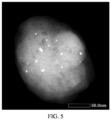
    • FIG. 5 illustrates a HAADF-STEM image of the catalyst obtained in Comparative Example 5 of the invention.
    DESCRIPTION OF THE PREFERRED EMBODIMENT
  • The terminals and any value of the ranges disclosed herein are not limited to the precise ranges or values, such ranges or values shall be comprehended as comprising the values adjacent to the ranges or values. As for numerical ranges, the endpoint values of the various ranges, the endpoint values and the individual point values of the various ranges, and the individual point values may be combined with one another to produce one or more new numerical ranges, which should be deemed have been specifically disclosed herein.
  • In the first aspect, the invention provides a titanium silicalite molecular sieve, the titanium silicalite molecular sieve has a micropore specific surface area of 320-500 m2/g, a micropore volume of 0.1-0.4 cm3/g, a mesopore specific surface area of 50-100 m2/g, a mesopore volume of 0.075-0.1 cm3/g, and a particle size of 100-250nm, the micropore specific surface area accounts for 50-90% of the total specific surface area.
  • In the invention, micropore refers to the pore having a pore size of less than 2nm in the porous structure of the titanium silicalite molecular sieve.
  • In the invention, the micropore specific surface area and micropore volume of the titanium silicalite molecular sieve are determined by analyzing and calculating with the t-plot method after measuring the static N2 adsorption-desorption curve of the sample by using a static nitrogen adsorption instrument with a model Micro meritics ASAP 2460 under the liquid nitrogen temperature.
  • In the invention, the mesopore specific surface area and mesopore volume of the titanium silicalite molecular sieve are determined by analyzing and calculating with the BJH method after measuring the static N2 adsorption-desorption curve of the sample by using a static nitrogen adsorption instrument with a model Micro meritics ASAP 2460 under the liquid nitrogen temperature.
  • In the invention, the total specific surface area of the titanium silicalite molecular sieve is measured with the BET method.
  • In the invention, the particle size of the titanium silicalite molecular sieve is observed and measured by the High Angle Annular Dark Field Scanning Transmission Electron Microscopy (HAADF-STEM).
  • The micropore specific surface area of the titanium silicalite molecular sieve may be selected from 320m2/g, 350m2/g, 400m2/g, 405m2/g, 410m2/g, 445m2/g, 480m2/g, 500m2/g, and an arbitrary value within the range consisting of any two of the aforementioned numerical values.
  • The micropore volume of the titanium silicalite molecular sieve may be selected from 0.1cm3/g, 0.15cm3/g, 0.165cm3/g, 0.2cm3/g, 0.238cm3/g, 0.3cm3/g, 0.0.355cm3/g, 0.389cm3/g, 0.4cm3/g, and an arbitrary value within the range consisting of any two of the aforementioned numerical values.
  • The mesopore specific surface area of the titanium silicalite molecular sieve may be selected from 50m2/g, 60m2/g, 72m2/g, 80m2/g, 90m2/g, 95m2/g, 100m2/g, and an arbitrary value within the range consisting of any two of the aforementioned numerical values.
  • The mesopore volume of the titanium silicalite molecular sieve may be selected from 0.075cm3/g, 0.085cm3/g, 0.09cm3/g, 0.095cm3/g, 0.1cm3/g, and an arbitrary value within the range consisting of any two of the aforementioned numerical values.
  • The particle size of the titanium silicalite molecular sieve may be selected from 100nm, 125nm, 140nm, 158nm, 180nm, 200nm, 215nm, 230nm, 245nm, 250nm, and an arbitrary value within the range consisting of any two of the aforementioned numerical values.
  • The ratio of micropore specific surface area of the titanium silicalite molecule sieve to the total specific surface area may be selected from 50%, 60%, 70%, 80%, 90%, and an arbitrary value within the range consisting of any two of the aforementioned numerical values.
  • In a preferred embodiment of the invention, the titanium silicalite molecular sieve has a micropore specific surface area of 350-480 m2/g, a micropore volume of 0.13-0.37 cm3/g, a mesopore specific surface area of 70-100 m2/g, a mesopore volume of 0.08-0.1 cm3/g, and a particle size of 150-210nm, the micropore specific surface area accounts for 60-90% of the total specific surface area.
  • In a preferred embodiment of the invention, the titanium silicalite molecular sieve satisfies: 130% < surface Ti/Si (mol%) / bulk phase Ti/Si (mol%) ×100% < 220%.
  • In the invention, the titanium content and the silicon content on the surface of the titanium silicalite molecular sieve are measured by using the X-ray Photoelectron Spectroscopy (XPS), a surface Ti/Si (mol%) of the sample is obtained by comparing the molar weight of titanium and silicon; the titanium content and silicon content of the bulk phase of the titanium silicalite molecular sieve are measured by using the X-ray Fluorescence Spectroscopy (XRF), a bulk phase Ti/Si (mol%) of the sample is obtained by comparing the molar weight of titanium and silicon; wherein the surface refers to a layer of surface on the titanium silicalite molecular sieve particles that is detectable by XPS, its theoretical depth is within the range of 8-10nm, and the bulk phase refers to the entirety of the titanium silicalite molecular sieve particles.
  • In a preferred embodiment of the invention, the titanium silicalite molecular sieve satisfies: 145% < surface Ti/Si (mol%) / bulk phase Ti/Si (mol%) ×100% < 200%.
  • In a preferred embodiment of the invention, the molar ratio of titanium and silicon in the titanium silicalite molecular sieve is of 0.001-0.04: 1, preferably 0.005-0.025: 1.
  • According to the invention, the preparation method of the titanium silicalite molecular sieve comprises the following steps:
    1. (1) Mixing a silicon source, an alkaline template agent, a titanium source, water, and an alcohol compound uniformly to obtain a titanium silica sol;
    2. (2) Adding the compound represented by formula (I) into the titanium silica sol, and subjecting the resultant mixture to hydrothermal crystallization and calcination to obtain a titanium silicalite molecular sieve;
      Figure imgb0001
  • Wherein i is an integer from 1 to 6; R1, R2, and R3 are each independently selected from C1-C6 alkyl; R4 and R5 are each independently selected from hydrogen, methyl, and ethyl; R6 is selected from methyl, -SH, -NHR7; R7 is selected from hydrogen or C1-C6 alkyl.
  • In the invention, C1-C6 alkyl refers to the alkyl group having a total number of 1-6 carbon atoms, and for example, it may be one of methyl, ethyl, n-propyl, isopropyl, n-butyl, isobutyl, tert-butyl, n-pentyl, and n-hexyl.
  • In some preferred embodiments of the invention, R1, R2, and R3 are each independently selected from C1-C3 alkyl, which may be methyl, ethyl, n-propyl, or isopropyl, preferably R1, R2, and R3 are each independently selected from methyl, ethyl or n-propyl. In the invention, R1 R2, and R3 may be the same or different, R1, R2, and R3 are preferably the same.
  • In the invention, when a compound represented by formula (I) is used as a silylating reagent, a titanium silicalite molecular sieve having a micropore structure can be formed during the hydrothermal crystallization reaction process, and the titanium silicalite molecular sieve has a high amount of micropore, which is represented by a high micropore specific surface area and micropore volume, and a high surface titanium content (represented by a high ratio of surface Ti/Si / bulk phase Ti/Si), when it is used as a catalyst or a catalyst carrier and applied in the reaction, compared with the titanium silicalite molecular sieve having mesopore channels, the domain-limited space created by the micropore channels is more favorable for collision of reactant molecules with active centers of framework titanium on the pore walls, thereby adsorbing and performing the chemical reaction, and increasing conversion rate of the reactants; secondly, the increased secondary micropore structure can provide the abundant mass transfer channels to shorten the molecular diffusion paths, increase diffusion rates of the reactants and product molecules, facilitate the timely desorption of product molecules to avoid side reactions, and enhance selectivity; the characteristic of high surface titanium content also causes that the diffusion paths of the reactants and product molecules are significantly shortened, while improving the contact efficiency of reactant with active centers and enhancing the desorption and external diffusion effects of the product molecules, thereby further enhancing the reactant conversion rate and product selectivity.
  • In the invention, when R6 of the compound represented by formula (I) is methyl, it forms a titanium silicalite molecular sieve with a secondary micropore structure during the hydrothermal crystallization reaction process through weak intermolecular interaction force between alkyl chains of the silylating reagent; when R6 of the compound represented by formula (I) is -SH, it forms a titanium silicalite molecular sieve with a secondary micropore structure during the hydrothermal crystallization reaction process through the electrostatic interaction force between the thiol groups of silylating reagent; when R6 of the compound represented by formula (1) is -NHR7, it forms the titanium silicalite molecular sieve with a secondary micropore structure during the hydrothermal crystallization reaction process through the hydrogen bond acting force between amino groups of silylating reagent and the flexible acting force of amino-linked outer terminal single chain alkyl (R7). The secondary micropore structure refers to the supplemented micropore structure obtained due to the addition of a silylating reagent, in addition to the intrinsic micropore of the titanium silicalite molecular sieve.
  • According to the invention, if the used amount of a silylating reagent (compound represented by formula (I)) is excessively high, it will lead to that the crystallization property of titanium silica sol is deteriorated and the molecular sieve can not be obtained, if the used amount of the silylating reagent (compound represented by formula (I)) is too low, it will decrease the micropore specific surface area and micropore volume of the obtained titanium silica molecular sieve, affect the mass transfer efficiency, thus its catalytic activity is influenced. Preferably, in step (1), the silicon source is calculated in terms of SiO2, the alkaline template agent is calculated in terms of N when it contains nitrogen element, the alkaline template agent is calculated in terms of OH- when it does not contain nitrogen element, and the titanium source is calculated in terms of TiO2, the molar ratio of the silicon source, the alkaline template agent, the titanium source, water, alcohol compound, and the compound represented by formula (I) is 1: (0.05-0.4): (0.001-0.04): (5-40): (0.1-10): (0.01-0.3); preferably 1: (0.1-0.3): (0.005-0.025): (5-25): (0.1-5): (0.01-0.2).
  • In a preferred embodiment of the invention, the silicon source is at least one selected from the group consisting of tetramethyl silicate, tetraethyl silicate, tetrapropyl silicate, tetrabutyl silicate, white carbon black, and silica sol.
  • In a preferred embodiment of the invention, the alkaline template agent is at least one selected from the group consisting of quaternary ammonium base, aliphatic amine, and aliphatic alcohol amine, preferably at least one selected from the group consisting of tetramethyl ammonium hydroxide, tetraethyl ammonium hydroxide, tetrapropyl ammonium hydroxide, and tetrabutyl ammonium hydroxide.
  • In a preferred embodiment of the invention, the titanium source is selected from an organic titanium source and/or an inorganic titanium source.
  • In a preferred embodiment of the invention, the titanium source is at least one selected from the group consisting of titanium tetrachloride, titanium sulfate, titanium nitrate, tetraethyl titanate, tetrapropyl titanate, and tetrabutyl titanate.
  • In a preferred embodiment of the invention, the alcohol compound is C1-C4 alcohol, preferably isopropanol.
  • According to the invention, it is preferable that step (1) further comprises the following operations: subjecting the silicon source, the alkaline template agent, and water to a first stirring and mixing to obtain a mixed system, then dropwise adding a mixed liquor of the titanium source and the alcohol compound into the mixed system and subjecting to a second stirring, to obtain a mixed solution.
  • In the invention, the dropwise addition rate of the mixed liquor is preferably within the range of 0.01-0.5mL/min, and more preferably within the range of 0.1-0.5mL/min.
  • In the invention, the first stirring time is preferably 0.1-2h.
  • In the invention, the second stirring time is preferably 0.5-6h, more preferably 0.5-3h.
  • In the invention, it is preferable that step (1) further comprises the following operations: subjecting the mixed solution to alcohol removal; which can remove the alcohol produced by hydrolysis of the silicon source and titanium source, the invention preferably uses an azeotropic distillation process to remove the alcohol produced in the system, and the loss of water from azeotropic distillation is simultaneously supplemented in the alcohol removal process to ensure that the proportions of materials in the titanium silica sol can meet the above requirements; and preferably, the alcohol removal conditions comprise: a temperature of 30-100°C and a time of 2-10 hours; preferably a temperature of 40-90°C and a time of 4-10 hours.
  • According to the invention, in order to uniformly disperse the silylating reagent in the titanium silica sol, it is preferable that step (2) further comprises the following operations: adding the compound represented by formula (I) into the titanium silica sol and performing a third stirring for 0.1-24h, the third stirring time is preferably 0.5-10h, more preferably 1-3h.
  • In the invention, the nucleation and growth rate of molecular sieves in a low-temperature state can be controlled by a rapid temperature rise, so as to obtain the molecular sieve particles with a small particle size, when the molecular sieve particles are loaded with nano-gold and subsequently applied in a catalytic reaction, the molecular sieve particles can shorten the inter-diffusion path of product molecules, which is conducive to improving selectivity; in addition, a rapid temperature rise process enables rapid hydrolysis of the silylating reagent during the molecular sieve growth process to construct the secondary micropore structure. According to the invention, the hydrothermal crystallization process in step (2) preferably comprises: heating the mixture to the crystallization temperature in a time of 0.1-1h, and subsequently subjecting the mixture to crystallization at a crystallization temperature of 50-200°C for 10-100h; preferably, subjecting the mixture to crystallization at a crystallization temperature of 100-200°C for 20-80h; further preferably, the temperature rise time is 0.1-0.5h; more preferably, the hydrothermal crystallization condition comprises: a temperature of 120-180°C and a time of 20-80h; under the preferred conditions, the micropore specific surface area and micropore volume of the molecular sieve can be balanced; such that a molecular sieve having a particular micropore specific surface area and micropore volume is prepared.
  • The invention does not impose a particular limitation to the pressure of hydrothermal crystallization, which may be an autogenous pressure of the crystallization system.
  • According to the invention, it is preferred that the method further comprises the following steps: washing, filtering, and drying the product obtained by hydrothermal crystallization; wherein the washing, filtering, and drying processes may be respectively known among those skilled in the art. Exemplarily, the washing temperature may be 20-50°C, the washing solvent may be water, and the used amount of said washing solvent is 1-20 times the mass of the crystallization product; the drying condition may comprise: a temperature of 40-150°C, and a time of 0.5-24h.
  • In a preferred embodiment of the invention, the conditions of calcination in step (2) comprise a temperature of 400-800°C, and a time of 1-15h.
  • The second aspect of the invention provides a catalyst of nanogold-supported titanium silicalite molecular sieve, wherein the catalyst comprises a carrier of titanium silicalite molecular sieve and a nano-gold supported on the carrier; wherein the catalyst has a micropore volume of 0.06-0.4 cm3/g, a micropore specific surface area of 160-450 m2/g, a mesopore volume of 0.05-0.08 cm3/g, a mesopore specific surface area of 40-85 m2/g, and a particle size of 100-250nm.
  • In the invention, the micropore specific surface area and micropore volume of the catalyst are determined by analyzing and calculating with the t-plot method after measuring the static N2 adsorption-desorption curve of the sample by using a static nitrogen adsorption instrument with a model Micro meritics ASAP 2460 under the liquid nitrogen temperature.
  • In the invention, the mesopore specific surface area and mesopore volume of the catalyst are determined by analyzing and calculating with the BJH method after measuring the static N2 adsorption-desorption curve of the sample by using a static nitrogen adsorption instrument with a model Micro meritics ASAP 2460 under the liquid nitrogen temperature.
  • In the invention, the particle size of the catalyst is observed and measured by the High Angle Annular Dark Field Scanning Transmission Electron Microscopy (HAADF-STEM).
  • The micropore volume of the catalyst may be selected from 0.06cm3/g, 0.1cm3/g, 0.15cm3/g, 0.2cm3/g, 0.25cm3/g, 0.3cm3/g, 0.35cm3/g, 0.4cm3/g, and an arbitrary value within the range consisting of any two of the aforementioned numerical values.
  • The micropore specific surface area of the catalyst may be selected from 160m2/g, 200m2/g, 250m2/g, 280m2/g, 300m2/g, 320m2/g, 360m2/g, 400m2/g, 420m2/g, 450m2/g, and an arbitrary value within the range consisting of any two of the aforementioned numerical values.
  • The mesopore volume of the catalyst may be selected from 0.05cm3/g, 0.06cm3/g, 0.07cm3/g, 0.08cm3/g, and an arbitrary value within the range consisting of any two of the aforementioned numerical values.
  • The mesopore specific surface area of the catalyst may be selected from 40m2/g, 50m2/g, 60m2/g, 70m2/g, 75m2/g, 80m2/g, 85m2/g, and an arbitrary value within the range consisting of any two of the aforementioned numerical values.
  • The particle size of the catalyst may be selected from 100nm, 120nm, 140nm, 150nm, 180nm, 200nm, 220nm, 240nm, 250nm, and an arbitrary value within the range consisting of any two of the aforementioned numerical values.
  • In a preferred embodiment of the invention, the catalyst has a micropore volume of 0.1-0.3 cm3/g, a micropore specific surface area of 260-410 m2/g, a mesopore volume of 0.058-0.078 cm3/g, a mesopore specific surface area of 45-80 m2/g, and a particle size of 150-210nm.
  • In a preferred embodiment of the invention, the catalyst satisfies : 130% < surface Ti/Si (mol%) / bulk phase Ti/Si (mol%) ×100% < 220%.
  • In the invention, the titanium content and the silicon content on the surface of the catalyst are measured by using X-ray Photoelectron Spectroscopy (XPS), a surface Ti/Si (mol%) of the sample is obtained by comparing the molar weight of titanium and silicon; the titanium content and silicon content of the bulk phase of the catalyst are measured by using the X-ray Fluorescence Spectroscopy (XRF), a bulk phase Ti/Si (mol%) of the sample is obtained by comparing the molar weight of titanium and silicon; wherein the surface refers to a layer of surface on the catalyst particles that is detectable by XPS, its theoretical depth is within the range of 8-10nm, and the bulk phase refers to the entirety of the catalyst particles.
  • In a preferred embodiment of the invention, the catalyst satisfies: 145% < surface Ti/Si (mol%) / bulk phase Ti/Si (mol%) × 100% < 200%.
  • In a preferred embodiment of the invention, more than 90% of gold in the nano-gold has a valence of zero.
  • In the invention, the nano-gold valence is measured by using X-ray Photoelectron Spectroscopy (XPS), the measured XPS peak is divided by the software to obtain the small peaks corresponding to the Au valence 0, +1, and +3, respectively, and the content of the valence 0 nano-gold in the nano-gold is obtained by calculating the proportion of the peak area corresponding to the valence 0 to the total peak area.
  • In a preferred embodiment of the invention, the number difference of nano-gold particles within any region of 50nm*50nm on the catalyst is not more than 30%.
  • In the invention, the expression "the number difference of nano-gold particles within any region of 50nm*50nm on the catalyst does not more than 30%" refers to that in a HAADF-STEM photograph of a single nanogold-supported titanium silicalite molecular sieve particle, the nanogold-supported titanium silicalite molecular sieve is divided into several (not less than 3) adjacent regions of 50nm*50nm, and the number of nano-gold particles in each region of 50nm*50nm is calculated, wherein the region with the highest number of nano-gold particles is denoted as A1 region, the region with the lowest number of nano-gold particles is denoted as A2 region, (number of nano-gold particles in A1 region - number of nano-gold particles in A2 region)/ number of nano-gold particles in A1 region is less than or equal to 30%.
  • In a preferred embodiment of the invention, the number of nano-gold particles within any region of 50nm*50nm on the catalyst is within the range of 5-40.
  • In the invention, the expression "the number of nano-gold particles within any region of 50nm*50nm on the catalyst is within the range of 5-40" refers to that in a HAADF-STEM photograph of a single nanogold-supported titanium silicalite molecular sieve particle, the nanogold-supported titanium silicalite molecular sieve is divided into several (not less than 3) adjacent regions of 50nm*50nm, and the number of nano-gold particles in each region of 50nm*50nm is within the range of 5-40.
  • In a preferred embodiment of the invention, the particle size of the nano-gold particles is within the range of 0.1-5nm.
  • In the invention, the particle size of the nano-gold particles is observed and measured by the High Angle Annular Dark Field Scanning Transmission Electron Microscopy (HAADF-STEM); and the number of nano-gold particles in the region of 50nm*50nm is determined by using the High Angle Annular Dark Field Scanning Transmission Electron Microscopy (HAADF-STEM).
  • In a preferred embodiment of the invention, the molar ratio of titanium and silicon in the catalyst is 0.001-0.04: 1, preferably 0.005-0.025: 1.
  • In a preferred embodiment of the invention, the nano-gold is contained in an amount of 0.01wt%-1wt%, preferably 0.04wt%-0.8wt%, more preferably 0.04wt%-0.5wt%, based on the total amount of said catalyst.
  • The third aspect of the invention provides a method for preparing a catalyst of nanogold-supported titanium silicalite molecular sieve, the method comprises the following steps: subjecting a titanium silicalite molecular sieve to an alkaline treatment with an aqueous aliphatic amine solution, and then the nano-gold particles are supported on the treated titanium silicalite molecular sieve to obtain the catalyst;
  • Wherein the titanium silicalite molecular sieve is the titanium silicalite molecular sieve according to the first aspect.
  • In a preferred embodiment of the invention, the method comprises the following steps:
    1. (1) Mixing the titanium silicalite molecular sieve with an aqueous aliphatic amine solution, and filtering the mixture to obtain an alkali treated titanium silicalite molecular sieve;
    2. (2) Blending the alkali treated titanium silicalite molecular sieve with an aqueous gold-containing compound solution, and adjusting pH of the obtained mixture to the range of 7-9 to obtain a turbid liquid;
    3. (3) Filtering the turbid liquid, and activating the obtained filter residue to obtain the catalyst;
    Wherein the titanium silicalite molecular sieve is the titanium silicalite molecular sieve according to the first aspect.
  • In a preferred embodiment of the invention, the aliphatic amine in step (1) is at least one selected from ethylamine, n-propylamine, ethylenediamine, n-butylamine, di-n-propylamine, butanediamine, and hexanediamine.
  • In a preferred embodiment of the invention, in step (1), the titanium silicalite molecular sieve is calculated in terms of SiO2, a molar ratio of the titanium silicalite molecular sieve to the aliphatic amine in the aqueous aliphatic amine solution, and water in the aqueous aliphatic amine solution is 1: (0.01-1): 2-20.
  • In a preferred embodiment of the invention, said mixing in step (1) is performed at a temperature range of 80-250°C for the time of 10-120 min.
  • In the invention, an alkaline treatment of the titanium silicalite molecular sieve by an aqueous aliphatic amine solution will result in a large amount of hydroxyl defect in the titanium silicalite molecular sieve, which facilitates the uniform anchoring of more nano-gold particles onto the titanium silicalite molecular sieve. On the one hand, it promotes the dispersion of nano-gold particles onto the titanium silicalite molecular sieve, which effectively improves the synthesis efficiency of an oxidant in the hydro-oxidation reaction, and ultimately enhances the reaction effect. In the other hand, the nano-gold particles are uniformly subjected to the electronic induction effect by framework titanium atoms on the molecular sieve, the nano-gold particles are prone to convert to zero valence during the activation process, and the zero valence nano-gold can effectively catalyze the in-situ generation of H2O2 oxidants from hydrogen gas and oxygen gas, thereby enhancing the product selectivity.
  • In a preferred embodiment of the invention, the aqueous gold-containing compound solution is selected from an aqueous chloroauric acid solution.
  • In a preferred embodiment of the invention, the chloroauric acid aqueous solution has a concentration within the range of 0.0001-0.1M, preferably 0.0005-0.05M, and more preferably 0.005-0.05M.
  • In the invention, the excessively high dosage of chloroauric acid will result in the aggregation of nano-gold particles, cause side reactions during the reaction process, and reduced selectivity of the product; the excessively low dosage of chloroauric acid will cause a decreased catalytic activity of the prepared nanogold-supported titanium silicalite molecular sieve; preferably, the used amount of the aqueous chloroauric acid solution calculated in terms of gold is 0.01-5 wt%, preferably 0.1-5 wt% of the alkali treated titanium silicalite molecular sieve.
  • In a preferred embodiment of the invention, the pH regulator used to adjust the pH of the resulting mixture in step (2) is at least one selected from sodium hydroxide, potassium hydroxide, cesium hydroxide, urea, sodium carbonate, sodium bicarbonate, potassium carbonate, potassium bicarbonate, cesium carbonate, and cesium bicarbonate.
  • According to a preferred embodiment of the invention, step (2) may comprise the following operations: blending the alkali treated titanium silicalite molecular sieve with an aqueous gold-containing compound solution, adding an alkalescent pH regulator, performing a heat treatment until pH of the obtained mixture is within the range of 5-6, further adding a strongly alkaline pH regulator adjusting the pH to the range of 7-9 to obtain a turbid liquid
  • In the invention, given that the aqueous chloroauric acid solution has relatively strong acidity, an alkalescent pH regulator is initially added to slowly adjust the pH of the aqueous chloroauric acid solution to reduce the concentration gradient, a strongly alkaline pH regulator is then used for rapidly adjusting pH of the mixture to the desired range, the operation can prevent nano-gold particles from aggregation and growth into large particles, and avoid the side reaction catalyzed by the large nano-gold particles, thereby improving selectivity of the product.
  • In the invention, the heat treatment in step (2) can increase the hydrolysis rate of the weak base, avoiding the excessively low production efficiency resulting from the too-slow hydrolysis process.
  • In a preferred embodiment of the invention, the alkalescent pH regulator in step (2) is at least one selected from urea, sodium carbonate, sodium bicarbonate, potassium carbonate, potassium bicarbonate, cesium carbonate, and cesium bicarbonate.
  • In a preferred embodiment of the invention, the strongly alkaline pH regulator in step (2) is at least one selected from sodium hydroxide, potassium hydroxide, and cesium hydroxide.
  • In a preferred embodiment of the invention, the temperature for heat treatment in step (2) is within the range of 50-95°C.
  • In a preferred embodiment of the invention, the conditions of activation in step (3) comprise a temperature of 150-500°C, a time of 1-5 hours, and an activating gas is selected from a mixture of nitrogen gas and any one of oxygen gas, hydrogen gas, and propylene, or a mixture of hydrogen gas, propylene, and nitrogen gas; preferably, the activating gas is a mixture of hydrogen gas and nitrogen gas.
  • In the fourth aspect, the invention provides a catalyst of nanogold-supported titanium silicalite molecular sieve produced by the method according to the third aspect.
  • In a preferred embodiment of the invention, the catalyst comprises a carrier of titanium silicalite molecular sieve and a nano-gold supported on the carrier; wherein the catalyst has a micropore volume of 0.06-0.4 cm3/g, a micropore specific surface area of 160-450 m2/g, a mesopore volume of 0.05-0.08 cm3/g, a mesopore specific surface area of 40-85 m2/g, and a particle size of 100-250nm.
  • In a preferred embodiment of the invention, the catalyst has a micropore volume of 0.1-0.3 cm3/g, a micropore specific surface area of 260-410 m2/g, a mesopore volume of 0.058-0.078 cm3/g, a mesopore specific surface area of 45-80 m2/g, and a particle size of 150-210nm.
  • In a preferred embodiment of the invention, the catalyst satisfies: 130% < surface Ti/Si (mol%) / bulk phase Ti/Si (mol%) ×100% < 220%.
  • In a preferred embodiment of the invention, the catalyst satisfies: 145% < surface Ti/Si (mol%) / bulk phase Ti/Si (mol%) ×100% < 200%.
  • In a preferred embodiment of the invention, more than 90% of gold in the nano-gold has a valence of zero.
  • In a preferred embodiment of the invention, the number difference of nano-gold particles within any region of 50nm*50nm on the catalyst is not more than 30%.
  • In a preferred embodiment of the invention, the number of nano-gold particles within any region of 50nm*50nm on the catalyst is within the range of 5-40.
  • In a preferred embodiment of the invention, the nano-gold particles have a particle size within the range of 0.1-5nm.
  • In a preferred embodiment of the invention, the molar ratio of titanium and silicon in the catalyst is 0.001-0.04: 1, preferably 0.005-0.025: 1.
  • In a preferred embodiment of the invention, the nano-gold is contained in an amount of 0.01wt%-1wt%, preferably 0.04wt%-0.8wt%, more preferably 0.04wt%-0.5wt%, based on the total amount of said catalyst.
  • The fifth aspect of the invention provides a use of a catalyst of nanogold-supported titanium silicalite molecular sieve according to the second and fourth aspects in an olefin epoxidation reaction, a cycloolefin epoxidation reaction, a phenol hydroxylation reaction, and a cyclohexanone ammoximation reaction.
  • In a preferred embodiment of the invention, the olefin epoxidation reaction is a gas-phase epoxidation reaction of propylene.
  • In a preferred embodiment of the invention, the process that the olefin epoxidation reaction is a gas-phase epoxidation reaction of propylene comprises the following steps:
    Mixing the hydrogen gas, oxygen gas, and propylene and carrying out a reaction to obtain an epoxypropane under the protection of an inert gas and in the presence of a catalyst; the catalyst is the nanogold-supported titanium silicalite molecular sieve according to the second and fourth aspects.
  • According to the invention, the reaction conditions preferably comprise: the volumetric flow ratio of hydrogen gas, oxygen gas, and propylene is (0.5-2):(0.5-2):1; more preferably, the volumetric flow ratio of propylene and inert gas is1:(1-10).
  • In some preferred embodiments of the invention, the reaction conditions further comprise a temperature of 120-220°C and a pressure of 0.1-0.5MPa.
  • In the invention, the reaction path diagram for the gas-phase epoxidation of propylene is shown in FIG. 1. As illustrated by FIG. 1, Au catalyzes the H2 and O2 to generate H2O2, which forms the active site of Ti-OOH with TS-1. Ti-OOH catalyzes propylene to form epoxypropane.
  • In the invention, the process for the gas-phase epoxidation of propylene may be carried out in a continuous operation. Specifically, after the catalyst is charged into a reactor, a mixture of hydrogen gas, oxygen gas, propylene, and inert gas is continuously added to perform the reaction.
  • The invention does not impose specific requirements on the morphology of the catalyst, the catalyst may be nanogold-supported titanium silicalite molecular sieve powder, or further loaded on a carrier for use, it can be selected by those skilled in the art according to the kind of the reactor.
  • In the invention, the separation of propylene gas phase epoxidation product from the catalyst can be adjusted according to the morphology of the catalyst and the practical requirements. For example, when the catalyst is nanogold-supported titanium silicalite molecular sieve powder, the separation of the product and the recycling of said catalyst can be achieved by means of sedimentation, filtration, centrifugation, evaporation, membrane separation, and the like. When the catalyst is nanogold-supported titanium silicalite molecular sieve supported on a carrier (i.e., the formed catalyst), the formed catalyst can be packed into a fixed bed reactor, and the catalyst may be recovered after the reaction is completed.
  • The invention will be described in detail below with reference to examples. In the following examples, room temperature refers to 25±5°C.
  • Unless otherwise specified in the invention, the raw materials used in the examples below are chemically pure reagents.
  • In the following Examples and Comparative Examples, the micropore specific surface area and micropore volume were determined by analyzing and calculating with the t-plot method after measuring the static N2 adsorption-desorption curve of the sample by using a static nitrogen adsorption instrument with a model Micro meritics ASAP 2460 under the liquid nitrogen temperature.
  • The mesopore specific surface area and mesopore volume of the catalyst were determined by analyzing and calculating with the BJH method after measuring the static N2 adsorption-desorption curve of the sample by using a static nitrogen adsorption instrument with a model Micro meritics ASAP 2460 under the liquid nitrogen temperature.
  • The total specific surface area was tested and obtained by using the BET method;
    • The pore size distribution map was calculated and obtained from the BJH formula;
    • The micropore pore size distribution map was calculated by using the t-plot method;
    • The particle size was observed and measured by the High Angle Annular Dark Field Scanning Transmission Electron Microscopy (HAADF-STEM);
    • The titanium content and the silicon content on the surface were measured by using the X-ray Photoelectron Spectroscopy (XPS);
    • The titanium content and silicon content of the bulk phase of the catalyst were measured by using the X-ray Fluorescence Spectroscopy (XRF);
    • The nano-gold valence was measured by using X-ray Photoelectron Spectroscopy (XPS), the measured XPS peak was divided by the software to obtain the small peaks corresponding to the Au valence 0, +1, and +3, respectively, and the content of the valence 0 nano-gold in the nano-gold was obtained by calculating the proportion of the peak area corresponding to the valence 0 to the total peak area;
    • The number of nano-gold particles in the region of 50nm*50nm on the titanium silicalite molecular sieve was measured by using the High Angle Annular Dark Field Scanning Transmission Electron Microscopy (HAADF-STEM).
  • In the following Preparation Examples, the specific chemical structural formulas of the silylating reagent used herein were shown in Table 1, wherein the respective substituents and parameters corresponding to formula (I) were shown in Table 1. Each of the compounds 1-6 was commercially available. Table 1
    Compound (1) Compound (2) Compound (3)
    i 2 1 4
    R1 Ethyl Methyl n-propyl
    R2 Ethyl Methyl n-propyl
    R3 Ethyl Methyl n-propyl
    R4 Hydrogen Hydrogen Hydrogen
    R5 Hydrogen Methyl Hydrogen
    R6 Methyl Methyl -SH
    Chemical structural formulas
    Figure imgb0002
    Figure imgb0003
    Figure imgb0004
    Table 1 (continued)
    Compound (4) Compound (5) Compound (6)
    i 1 1 4
    R1 Ethyl Methyl Methyl
    R2 Methyl Methyl Methyl
    R3 n-propyl Methyl Methyl
    R4 Hydrogen Hydrogen Hydrogen
    R5 Methyl Methyl Hydrogen
    R6 -SH -NHR7, R7 is ethyl -NHR7, R7 is methyl
    Chemical structural formulas
    Figure imgb0005
    Figure imgb0006
    Figure imgb0007
  • Preparation Examples 1-9 were used to illustrate the preparation process of titanium silicalite molecular sieve.
  • Preparation Example 1
    1. (1) Tetraethyl silicate, tetrapropyl ammonium hydroxide, and water were subjected to a first stirring and mixing at room temperature to obtain a mixed system, and during the stirring process, a mixed liquor of tetrabutyl titanate and isopropanol was dropwise added into the mixed system at a rate of 0.2mL/min, and a second stirring was carried out for 0.5h to obtain a mixed solution; tetraethyl silicate was calculated in terms of SiO2, tetrapropyl ammonium hydroxide was calculated in terms of N, tetrabutyl titanate was calculated in terms of TiO2, the molar ratio of tetraethyl silicate, tetrapropyl ammonium hydroxide, and water was 1:0.1:15; and the molar ratio of tetraethyl silicate, tetrabutyl titanate and isopropanol was 1:0.015:3;
      The mixed solution was then subjected to an alcohol removal process at 70°C for 8h to obtain a titanium silica sol;
    2. (2) The compound (1) was added into the titanium silica sol, and a third stirring was performed at room temperature for 1.5h to obtain a mixture, wherein the molar ratio of compound (1) to tetraethyl silicate was 0.1:1;
    3. (3) The mixture was heated to 170°C within 0.5h, and subjected to a hydrothermal crystallization at 170°C for 24h to obtain a crystallization product; the crystallization product was subjected to rinsing with water, filtering, and drying at 120°C for 2h sequentially.
  • The dried product was calcined at 550°C for 6h to prepare a titanium silicalite molecular sieve TS-1-1;
    The physical property parameters of the titanium silicalite molecular sieve TS-1-1 obtained in the Preparation Example were shown in Table 2. The pore size distribution of micropores and pore size distribution of titanium silicalite molecular sieve TS-1-1 were shown in FIG. 2 and FIG. 3, respectively. As can be seen in FIG. 2, the titanium silicalite molecular sieve TS-1-1 comprised a large number of micropores with a pore size of about 0.55nm; as illustrated by FIG. 3, the titanium silicalite molecular sieve TS-1-1 was substantially free of mesopore channels.
  • Preparation Example 2
  • The titanium silicalite molecular sieve was prepared according to the same method as the Preparation Example 1, except that in step (2), compound (1) was replaced by compound (2), and the physical property parameters of the produced titanium silicalite molecular sieve TS-1-2 were shown in Table 2.
  • Preparation Example 3
  • The titanium silicalite molecular sieve was prepared according to the same method as the Preparation Example 1, except that in step (2), compound (1) was replaced by compound (3), and the physical property parameters of the produced titanium silicalite molecular sieve TS-1-3 were shown in Table 2.
  • Preparation Example 4
  • The titanium silicalite molecular sieve was prepared according to the same method as the Preparation Example 1, except that in step (2), the compound (1) was replaced by the compound (4), and the physical property parameters of the produced titanium silicalite molecular sieve TS-1-4 were shown in Table 2.
  • Preparation Example 5
  • The titanium silicalite molecular sieve was prepared according to the same method as the Preparation Example 1, except that in step (2), compound (1) was replaced by compound (5), and the physical property parameters of the produced titanium silicalite molecular sieve TS-1-5 were shown in Table 2.
  • Preparation Example 6
  • The titanium silicalite molecular sieve was prepared according to the same method as the Preparation Example 1, except that in step (2), compound (1) was replaced by compound (6), and the physical property parameters of the produced titanium silicalite molecular sieve TS-1-6 were shown in Table 2.
  • Preparation Example 7
    1. (1) Tetraethyl silicate, tetrapropyl ammonium hydroxide, and water were subjected to a first stirring and mixing at room temperature to obtain a mixed system, and during the stirring process, a mixed liquor of tetrabutyl titanate and isopropanol was dropwise added into the mixed system at a rate of 0.2mL/min, and a second stirring was carried out for 0.5h to obtain a mixed solution; tetraethyl silicate was calculated in terms of SiO2, tetrapropyl ammonium hydroxide was calculated in terms of N, tetrabutyl titanate was calculated in terms of TiO2, the molar ratio of tetraethyl silicate, tetrapropyl ammonium hydroxide, and water was 1:0.1:15; and the molar ratio of tetraethyl silicate, tetrabutyl titanate and isopropanol was 1:0.015:3;
      The mixed solution was then subjected to an alcohol removal process at 70°C for 8h to obtain a titanium silica sol;
    2. (2) The mixture was heated to 170°C at a temperature rise rate of 1°C/min, and subjected to a hydrothermal crystallization at 170°C for 72h to obtain a crystallization product; the crystallization product was subjected to rinsing with water, filtering, and drying at 120°C for 2h sequentially.
  • The dried product was calcined at 550°C for 6h to prepare a titanium silicalite molecular sieve TS-1-7;
  • The physical property parameters of the titanium silicalite molecular sieve TS-1-7 obtained in the Preparation Example were shown in Table 2. The pore size distribution of titanium silicalite molecular sieve TS-1-7 was shown in FIG. 2. As can be seen in FIG. 2, the titanium silicalite molecular sieve TS-1-7 obtained without adding the silylating reagent of the invention also comprised the micropore channels with a pore size of about 0.55nm, but its micropore content is significantly lower than that of the titanium silicalite molecular sieve TS-1-1.
  • Preparation Example 8
    1. (1) 31.0g of tetraethyl silicate, 1.8g of tetrabutyl titanate, and 15g of tetrapropyl ammonium hydroxide solution (with a mass concentration of 24.4%) were mixed, 25g of deionized water was then added under the stirring condition, the mixture was hydrolyzed at the temperature of 80°C, and subjected to an alcohol removal process for 4 hours while supplemented with the evaporated water to obtain a yellowish transparent aqueous solution;
    2. (2) The product obtained in step (1) was charged into a stainless steel closed reaction kettle, and allowed to stand still at 80°C for 24 hours to obtain a pre-crystallization product;
      Figure imgb0008
    2.0g of the compound represented by formula (II) was added to the pre-crystallization product, and stirred at room temperature for 2 hours to form a transparent viscous liquid, the liquid was transferred to the stainless steel closed reaction kettle, preserved at a constant temperature of 90°C for 12 hours, then slowly heated to 165°C at the temperature rise rate of 1°C/min and preserved the constant temperature at 165°C for 2 days, the reaction product was then filtered, washed, and dried at 120°C for 12 hours, further calcined at 550°C for 6 hours to prepare a titanium silicalite molecular sieve TS-1-8;
  • The physical property parameters of the titanium silicalite molecular sieve TS-1-8 obtained in the Preparation Example were shown in Table 2, and the pore size distribution diagram of the titanium silicalite molecular sieve TS-1-8 were shown in FIG. 3; as can be seen from FIG. 3, the titanium silicalite molecular sieve TS-1-8 contained micropore channels with a pore size of 2nm and abundant mesopore channels with a pore size of about 38nm. Therefore, although its micropore specific surface area was not low, the ratio of micropore specific surface area to the total specific surface area was low.
  • Preparation Example 9
    1. (1) 31.0g of tetraethyl silicate, 1.8g of tetrabutyl titanate, and 15g of tetrapropyl ammonium hydroxide solution (with a mass concentration of 24.4%) were mixed, 25g of deionized water was then added under the stirring condition, the mixture was hydrolyzed at the temperature of 80°C, and subjected to an alcohol removal process for 4 hours while supplemented with the evaporated water to obtain a yellowish transparent aqueous solution;
    2. (2) The product obtained in step (1) was charged into a stainless steel closed reaction kettle, and allowed to stand still at 80°C for 24 hours to obtain a pre-crystallization product;
      Figure imgb0009
    • 2.0g of the compound represented by formula (III) was added to the pre-crystallization product and stirred at room temperature for 2 hours to form a transparent viscous liquid, the liquid was transferred to the stainless steel closed reaction kettle, preserved at a constant temperature of 90°C for 12 hours, then slowly heated to 165°C at the temperature rise rate of 1°C/min and preserved the constant temperature at 165°C for 2 days, the reaction product was then filtered, washed, and dried at 120°C for 12 hours, further calcined at 550°C for 6 hours to prepare a titanium silicalite molecular sieve TS-1-9;
    • The physical property parameters of the titanium silicalite molecular sieve TS-1-9 obtained in the Preparation Example were shown in Table 2
    Table 2
    Preparation Example 1 Preparation Example 2 Preparation Example 3 Preparation Example 4
    titanium silicalite molecular sieve TS-1-1 TS-1-2 TS-1-3 TS-1-4
    Micropore specific surface area (m2/g) 355.2 367.6 446.4 471.8
    Micropore volume (cm3/g) 0.178 0.182 0.355 0.362
    The ratio of micropore specific surface area to the total specific surface area (%) 61.2 63.2 85.5 83.8
    Mesopore specific surface area (m2/g) 71.2 77.8 89.7 85.5
    Mesopore volume (cm3/g) 0.082 0.085 0.099 0.098
    Particle size (nm) 185 180 152 163
    Surface Ti/Si(mol%) / bulk phase Ti/Si(mol%)×100% 152.1 185.1 171.5 168.2
    Molar ratio of silicon/titanium 1: 0.015 1: 0.015 1: 0.015 1: 0.015
    Table 2 (continued)
    Preparation Example 5 Preparation Example 6 Preparation Example 7 Preparation Example 8 Preparation Example 9
    titanium silicalite molecular sieve TS-1-5 TS-1-6 TS-1-7 TS-1-8 TS-1-9
    Micropore specific surface area (m2/g) 425.3 409.7 274.9 297.5 233.9
    Micropore volume (cm3/g) 0.283 0.221 0.113 0.170 0.169
    The ratio of micropore specific surface area to the total specific surface area (%) 78.1 73.2 54.3 26.3 50.3
    Mesopore specific surface area (m2/g) 94.3 98.1 81.2 177.1 151.6
    Mesopore volume (cm3/g) 0.097 0.095 0.127 0.203 0.132
    Particle size (nm) 190 210 140 300 310
    Surface Ti/Si(mol%) / bulk phase Ti/Si(mol%)×100% 145.6 169.3 113.6 94.6 89.3
    Molar ratio of silicon/titanium 1: 0.015 1: 0.015 1: 0.015 1: 0.035 1: 0.035
    Example 1
    1. (1) The titanium silicalite molecular sieve TS-1-1 was mixed with an ethylamine aqueous solution and then subjected to a high-temperature treatment to obtain a first turbid liquid, which was filtered to obtain an alkaline post-treated titanium silicalite molecular sieve; the titanium silicalite molecular sieve was calculated in terms of SiO2, the molar ratio of the titanium silicalite molecular sieve to the ethylamine in said ethylamine aqueous solution to water in said ethylamine aqueous solution was 1: 0.5: 10; the temperature of the high-temperature treatment was 120°C, and the time was 60 min;
    2. (2) 5g of alkaline post-treated titanium silicalite molecular sieve TS-1-1 was blended with 100mL of aqueous solution (having a concentration of 0.01M) of chloroauric acid (HAuCl4), NaOH was added, and a pH of the mixture was adjusted to 8 to obtain a second turbid liquid;
    3. (3) The second turbid liquid was filtered, and the obtained filter residue was activated to prepare a nanogold-supported titanium silicalite molecular sieve catalyst Au/TS - 1 - 1;
    • Wherein the activation conditions included: the temperature was 200°C, the time was 3h, and the activating gas was a mixed gas of hydrogen gas and nitrogen gas (with a volume ratio of 1: 7);
    • The physical property parameters of the nanogold-supported titanium silicalite molecular sieve catalyst Au/TS-1-1 were shown in Table 3.
    Example 2
  • The catalyst was prepared according to the same method as that of Example 1, except that titanium silicalite molecular sieve TS-1-1 in step (1) was replaced with titanium silicalite molecular sieve TS-1-2 to obtain a nanogold-supported titanium silicalite molecular sieve catalyst Au/TS-1-2, and the physical property parameters of said nanogold-supported titanium silicalite molecular sieve Au/TS-1-2 were shown in Table 3.
  • Example 3
  • The catalyst was prepared according to the same method as that of Example 1, except that titanium silicalite molecular sieve TS-1-1 in step (1) was replaced with titanium silicalite molecular sieve TS-1-3 to obtain a nanogold-supported titanium silicalite molecular sieve catalyst Au/TS-1-3, and the physical property parameters of said nanogold-supported titanium silicalite molecular sieve Au/TS-1-3 were shown in Table 3, the HAADF-STEM photograph of the catalyst Au/TS-1-3 was shown in FIG. 4, as illustrated in FIG. 4, the Au nanoparticles on the Au/TS-1-3 have uniform particle size (about 2.4nm) and were uniformly dispersed on the titanium silicalite molecular sieve TS-1-3.
  • Example 4
  • The catalyst was prepared according to the same method as that of Example 1, except that titanium silicalite molecular sieve TS-1-1 in step (1) was replaced with titanium silicalite molecular sieve TS-1-4 to obtain a nanogold-supported titanium silicalite molecular sieve catalyst Au/TS-1-4, and the physical property parameters of said nanogold-supported titanium silicalite molecular sieve Au/TS-1-4 were shown in Table 3.
  • Example 5
  • The catalyst was prepared according to the same method as that of Example 1, except that titanium silicalite molecular sieve TS-1-1 in step (1) was replaced with titanium silicalite molecular sieve TS-1-5 to obtain a nanogold-supported titanium silicalite molecular sieve catalyst Au/TS-1-5, and the physical property parameters of said nanogold-supported titanium silicalite molecular sieve Au/TS-1-5 were shown in Table 3.
  • Example 6
  • The catalyst was prepared according to the same method as that of Example 1, except that titanium silicalite molecular sieve TS-1-1 in step (1) was replaced with titanium silicalite molecular sieve TS-1-6 to obtain a nanogold-supported titanium silicalite molecular sieve catalyst Au/TS-1-6, and the physical property parameters of said nanogold-supported titanium silicalite molecular sieve Au/TS-1-6 were shown in Table 3.
  • Example 7
  • The catalyst was prepared according to the same method as that of Example 1, except that step (2) was changed to the following operations: 5g of alkaline post-treated titanium silicalite molecular sieve TS-1-1 was blended with 100mL of aqueous solution (having a concentration of 0.01M) of chloroauric acid (HAuCl4), urea was added, the heat treatment was performed at 70°C until a pH of the mixture was 6, NaOH was further added, and a pH of the mixture was adjusted to 8 to obtain a second turbid liquid; a nanogold-supported titanium silicalite molecular sieve catalyst Au/TS-1-1-1 was prepared, the physical property parameters of the nanogold-supported titanium silicalite molecular sieve catalyst Au/TS-1-1-1 were shown in Table 3.
  • Example 8
  • The catalyst was prepared according to the same method as that of Example 3, except that step (2) was changed to the following operations: 5g of alkaline post-treated titanium silicalite molecular sieve TS-1-3 was blended with 100mL of aqueous solution (having a concentration of 0.01M) of chloroauric acid (HAuCl4), urea was added, the heat treatment was performed at 70°C until a pH of the mixture was 6, NaOH was further added, and a pH of the mixture was adjusted to 8 to obtain a second turbid liquid; a nanogold-supported titanium silicalite molecular sieve catalyst Au/TS-1-3-1 was prepared, the physical property parameters of the nanogold-supported titanium silicalite molecular sieve catalyst Au/TS-1-3-1 were shown in Table 3.
  • Example 9
  • The catalyst was prepared according to the same method as that of Example 1, except that the alkaline post-treatment process of step (1) was omitted, 5g of alkaline post-treated titanium silicalite molecular sieve TS-1-1 was blended with 100mL of aqueous solution (having a concentration of 0.01M) of chloroauric acid (HAuCl4), NaOH was added, and a pH of the mixture was adjusted to 8 to obtain a second turbid liquid;
    • The second turbid liquid was filtered, and the obtained filter residue was activated to prepare a nanogold-supported titanium silicalite molecular sieve catalyst Au/TS-1-1-2;
    • The physical property parameters of the nanogold-supported titanium silicalite molecular sieve catalyst Au/TS-1-1-2 were shown in Table 3.
    Example 10
  • The catalyst was prepared according to the same method as that of Example 3, except that the alkaline post-treatment process of step (1) was omitted, 5g of alkaline post-treated titanium silicalite molecular sieve TS-1-3 was blended with 100mL of aqueous solution (having a concentration of 0.01M) of chloroauric acid (HAuCl4), NaOH was added, and a pH of the mixture was adjusted to 8 to obtain a second turbid liquid;
    • The second turbid liquid was filtered, and the obtained filter residue was activated to prepare a nanogold-supported titanium silicalite molecular sieve catalyst Au/TS-1-3-2;
    • The physical property parameters of the nanogold-supported titanium silicalite molecular sieve catalyst Au/TS-1-3-2 were shown in Table 3, the HAADF-STEM photograph of the catalyst Au/TS-1-3-2 was shown in FIG. 5, as illustrated in FIG. 5, the Au nanoparticles were slightly larger (about 3.8nm), and were unevenly distributed on the titanium silicalite molecular sieve TS-1-3-2.
    Example 11
  • The catalyst was prepared according to the same method as that of Example 5, except that the alkaline post-treatment process of step (1) was omitted, 5g of alkaline post-treated titanium silicalite molecular sieve TS-1-5 was blended with 100mL of aqueous solution (having a concentration of 0.01M) of chloroauric acid (HAuCl4), NaOH was added, and a pH of the mixture was adjusted to 8 to obtain a second turbid liquid;
    • The second turbid liquid was filtered, and the obtained filter residue was activated to prepare a nanogold-supported titanium silicalite molecular sieve catalyst Au/TS-1-5-1;
    • The physical property parameters of the nanogold-supported titanium silicalite molecular sieve catalyst Au/TS-1-5-1 were shown in Table 3.
    Comparative Example 1
  • The catalyst was prepared according to the same method as that of Example 1, except that titanium silicalite molecular sieve TS-1-1 in step (1) was replaced with titanium silicalite molecular sieve TS-1-7 to obtain a nanogold-supported titanium silicalite molecular sieve catalyst Au/TS-1-7, and the physical property parameters of said nanogold-supported titanium silicalite molecular sieve Au/TS-1-7 were shown in Table 3.
  • Comparative Example 2
  • The catalyst was prepared according to the same method as that of Example 1, except that titanium silicalite molecular sieve TS-1-1 in step (1) was replaced with titanium silicalite molecular sieve TS-1-8 to obtain a nanogold-supported titanium silicalite molecular sieve catalyst Au/TS-1-8, and the physical property parameters of said nanogold-supported titanium silicalite molecular sieve Au/TS-1-8 were shown in Table 3.
  • Comparative Example 3
  • The catalyst was prepared according to the same method as that of Example 1, except that titanium silicalite molecular sieve TS-1-1 in step (1) was replaced with titanium silicalite molecular sieve TS-1-9 to obtain a nanogold-supported titanium silicalite molecular sieve catalyst Au/TS-1-9, and the physical property parameters of said nanogold-supported titanium silicalite molecular sieve Au/TS-1-9 were shown in Table 3. Table 3
    Catalyst Au conten t (wt%) Molar ratio of silicon/titaniu m Micropor e volume (cm3/g) Particl e size (nm) Micropor e specific surface area (m2/g) Mesopor e volume (cm3/g)
    Example 1 Au/TS-1-1 0.23 1: 0.015 0.125 185 286.4 0.061
    Example 2 Au/TS-1-2 0.21 1: 0.015 0.139 180 306.3 0.063
    Example 3 Au/TS-1-3 0.22 1: 0.015 0.282 152 382.6 0.078
    Example 4 Au/TS-1-4 0.21 1: 0.015 0.295 163 401.5 0.072
    Example 5 Au/TS-1-5 0.21 1: 0.015 0.231 190 352.1 0.076
    Example 6 Au/TS-1-6 0.23 1: 0.015 0.177 210 342.9 0.074
    Example 7 Au/TS-1-1-1 0.25 1: 0.015 0.119 185 262.1 0.058
    Example 8 Au/TS-1-3-1 0.26 1: 0.015 0.273 152 356.2 0.071
    Example 9 Au/TS-1-1-2 0.18 1: 0.015 0.094 211 179 0.055
    Example 10 Au/TS-1-3-2 0.18 1: 0.015 0.332 149 426 0.057
    Example 11 Au/TS-1-5-1 0.17 1: 0.015 0.305 212 412 0.079
    Comparativ e Example 1 Au/TS-1-7 0.20 1: 0.015 0.066 140 201.3 0.103
    Comparativ e Example 2 Au/TS-1-8 0.21 1: 0.035 0.116 300 236.2 0.168
    Comparativ e Example 3 Au/TS-1-9 0.20 1: 0.035 0.112 310 176.9 0.099
    Table 3 (continued)
    Catalyst Mesopore specific surface area (m2/g) Surface Ti/Si(mol%) / bulk phase Ti/Si(mol%)×100% Content of Au with valence 0 (%) The average particle size of Au (nm) Number of Au particles1 Number difference of Au particles 2 (%)
    Example 1 Au/TS-1-1 55.3 152.1 91 2.3 14-16 12.5
    Example 2 Au/TS-1-2 55.6 185.1 92 2.2 15-18 16.7
    Example 3 Au/TS-1-3 68.7 171.5 91 2.4 13-16 18.7
    Example 4 Au/TS-1-4 66.5 168.2 93 2.2 14-17 17.6
    Example 5 Au/TS-1-5 78.2 145.6 92 2.2 12-15 20
    Example 6 Au/TS-1-6 76.5 169.3 91 2.3 13-15 13.3
    Example 7 Au/TS-1-1-1 48.2 152.1 94 1.8 15-18 16.7
    Example 8 Au/TS-1-3-1 55.1 171.5 95 1.7 15-19 21
    Example 9 Au/TS-1-1-2 42.5 136.1 90 2.1 13-15 13.3
    Example 10 Au/TS-1-3-2 44.2 142.5 91 2.2 14-17 17.6
    Example 11 Au/TS-1-5-1 80.1 144.6 90 2.2 14-16 12.5
    Comparative Example 1 Au/TS-1-7 59.6 113.6 91 3.1 10-13 23.1
    Comparative Example 2 Au/TS-1-8 134.9 94.6 91 2.8 11-13 15.4
    Comparative Example 3 Au/TS-1-9 107.8 89.3 91 2.7 12-14 14.3
    Note: 1 - in a HAADF-STEM photograph of a single nanogold-supported titanium silicalite molecular sieve particle, the nanogold-supported titanium silicalite molecular sieve was divided into several (not less than 3) adjacent regions of 50nm*50nm, the number of Au particles in each region of 50nm*50nm was calculated to obtain the number range of the Au particles.
    2 - in a HAADF-STEM photograph of a single nanogold-supported titanium silicalite molecular sieve particle, the nanogold-supported titanium silicalite molecular sieve was divided into several (not less than 3) adjacent regions of 50nm*50nm, and the number of Au particles in each region of 50nm*50nm was calculated, wherein the region with the highest number of Au particles was denoted as A1 region, the region with the lowest number of Au particles was denoted as A2 region, the number difference of Au particles = (number of Au particles in A1 region - number of Au particles in A2 region) / number of Au particles in A1 region.
  • Test Examples
  • The nanogold-supported titanium silicalite molecular sieves prepared in Examples 1-11 and the Comparative Examples 1-3 were respectively used as a catalyst, which was loaded into a tubular reactor with an inner diameter of 8mm, then heated to 180°C in the N2 atmosphere, the hydrogen gas, oxygen gas, and propylene were introduced for starting the reaction, and after reaction for 1h, an on-line analysis on the product was performed; wherein the dosage of catalyst was 0.4g, the flow rate, reaction temperature and pressure of each gas were shown in Table 4, and the catalytic reaction results were shown in Table 5.
  • In the invention, the analysis of the reactants and products in the evaluation system was carried out by using gas chromatography. Wherein the analysis conditions of the gas chromatography were as follows: agilent-6890 type chromatograph, molecular sieve 5A and PoraBONDU chromatographic column, FID and TCD detectors. Conversion rate of propylene % = (mole number of propylene in raw materials - mole number of propylene in product) / mole number of propylene in raw materials × 100% Epoxypropane selectivity % - mole number of epoxypropane in product / (mole number of propylene in raw materials - mole number of propylene in product) × 100% Table 4
    Catalysts Inert gas Flow rate mL/min Pressur e/MPa Temp erature /°C
    Hydrog en gas Oxygen gas propyl ene Inert gas
    Test Example 1 Au/TS-1-1 Nitrogen gas 2 2 2 14 0.1 180
    Test Example 2 Au/TS-1-2 Nitrogen gas 2 2 2 14 0.1 180
    Test Au/TS-1-3 Nitrogen 2 2 2 14 0.1 180
    Example 3 gas
    Test Example 4 Au/TS-1-4 Nitrogen gas 2 2 2 14 0.1 180
    Test Example 5 Au/TS-1-5 Argon gas 2 2 2 14 0.1 180
    Test Example 6 Au/TS-1-6 Helium gas 2 2 2 14 0.1 180
    Test Example 7 Au/TS-1-1-1 Nitrogen gas 2 2 2 14 0.1 180
    Test Example 8 Au/TS-1-3-1 Nitrogen gas 2 2 2 14 0.1 180
    Test Example 9 Au/TS-1-1-2 Nitrogen gas 2 2 2 14 0.1 180
    Test Example 10 Au/TS-1-3-2 Nitrogen gas 2 2 2 14 0.1 180
    Test Example 11 Au/TS-1-5-1 Nitrogen gas 2 2 2 14 0.1 180
    Test Example 12 Au/TS-1-7 Nitrogen gas 2 2 2 14 0.1 180
    Test Example 13 Au/TS-1-8 Nitrogen gas 2 2 2 14 0.1 180
    Test Example 14 Au/TS-1-9 Nitrogen gas 2 2 2 14 0.1 180
    Table 5
    The conversion rate of propylene / % Epoxypropane selectivity / %
    Test Example 1 8.9 92.2
    Test Example 2 9.4 92.4
    Test Example 3 12.3 93.1
    Test Example 4 12.8 94.6
    Test Example 5 11.5 92.9
    Test Example 6 10.6 91.8
    Test Example 7 13.6 97.7
    Test Example 8 13.5 98.5
    Test Example 9 8.2 91.5
    Test Example 10 8.1 91.2
    Test Example 11 8.4 90.5
    Test Example 12 4.5 85.1
    Test Example 13 5.3 88.6
    Test Example 14 6.7 86.3
  • As can be seen from the comparison results between Test Examples 1-11 and Test Examples 12-14, a use of the silylating reagent provided by the invention in combination with the specific crystallization conditions, the titanium silicalite molecular sieve having a larger micropore volume, micropore specific surface area, and ratio of micropore specific area to the total specific surface area can be prepared, and the obtained titanium silicalite molecular sieve has a high surface titanium content, and can improve the conversion rate of propylene and the selectivity of epoxypropane.
  • As indicated by the comparison results between Test Examples 1-8 and Test Examples 9-11, the alkali treatment of titanium silicalite molecular sieve before loading can improve the dispersity of Au particles and zero-valent gold content, and further improve the conversion rate of propylene and the selectivity of epoxypropane.
  • It is shown from the comparison results between Test Examples 1-6 and Test Examples 7-8, that the pH is adjusted step by step in the process of supporting nano-gold particles, so that the aggregation of Au particles into large particles can be desirably suppressed, thereby further improving the conversion rate of propylene and the selectivity of epoxypropane.
  • The above content describes in detail the preferred embodiments of the invention, but the invention is not limited thereto. A variety of simple modifications can be made in regard to the technical solutions of the invention within the scope of the technical concept of the invention, including a combination of individual technical features in any other suitable manner, such simple modifications and combinations thereof shall also be regarded as the content disclosed by the invention, each of them falls into the protection scope of the invention.

Claims (20)

  1. A titanium silicalite molecular sieve, wherein the titanium silicalite molecular sieve has a micropore specific surface area of 320-500 m2/g, a micropore volume of 0.1-0.4 cm3/g, a mesopore specific surface area of 50-100 m2/g, a mesopore volume of 0.075-0.1 cm3/g, and a particle size of 100-250nm, the micropore specific surface area accounts for 50-90% of the total specific surface area.
  2. The molecular sieve according to claim 1, wherein the titanium silicalite molecular sieve has a micropore specific surface area of 350-480 m2/g, a micropore volume of 0.13-0.37 cm3/g, a mesopore specific surface area of 70-100 m2/g, a mesopore volume of 0.08-0.1 cm3/g, and a particle size of 150-210nm, the micropore specific surface area accounts for 60-90% of the total specific surface area.
  3. The molecular sieve according to claims 1 or 2, wherein the titanium silicalite molecular sieve satisfies: 130% < surface Ti/Si (mol%) / bulk phase Ti/Si (mol%) ×100% < 220%.
  4. The molecular sieve according to claim 3, wherein the titanium silicalite molecular sieve satisfies: 145% < surface Ti/Si (mol%) / bulk phase Ti/Si (mol%) ×100% < 200%.
  5. The molecular sieve according to any one of claims 1-4, wherein the molar ratio of titanium and silicon in the titanium silicalite molecular sieve is 0.001-0.04: 1, preferably 0.005-0.025: 1.
  6. A catalyst of nanogold-supported titanium silicalite molecular sieve, wherein the catalyst comprises a carrier of titanium silicalite molecular sieve and a nano-gold supported on the carrier; wherein the catalyst has a micropore volume of 0.06-0.4 cm3/g, a micropore specific surface area of 160-450 m2/g, a mesopore volume of 0.05-0.08 cm3/g, a mesopore specific surface area of 40-85 m2/g, and a particle size of 100-250nm.
  7. The catalyst according to claim 6, wherein the catalyst has a micropore volume of 0.1-0.3 cm3/g, a micropore specific surface area of 260-410 m2/g, a mesopore volume of 0.058-0.078 cm3/g, a mesopore specific surface area of 45-80 m2/g, and a particle size of 150-210nm.
  8. The catalyst according to claim 6 or 7, wherein the catalyst satisfies: 130% < surface Ti/Si (mol%) / bulk phase Ti/Si (mol%) ×100% < 220%.
  9. The catalyst according to claim 8, wherein the catalyst satisfies: 145% < surface Ti/Si (mol%) / bulk phase Ti/Si (mol%) ×100% < 200%.
  10. The catalyst according to any one of claims 6-9, wherein more than 90% of gold in the nano-gold has a valence of zero.
  11. The catalyst according to any one of claims 6-10, wherein the number difference of nano-gold particles within any region of 50nm*50nm on the catalyst is not more than 30%.
  12. The catalyst according to any one of claims 6-11, wherein the number of nano-gold particles within any region of 50nm*50nm on the catalyst is within the range of 5-40;
    preferably, the nano-gold particles have a particle size within the range of 0.1-5nm.
  13. The catalyst according to any one of claims 6-12, wherein the molar ratio of titanium and silicon in the catalyst is 0.001-0.04: 1, preferably 0.005-0.025: 1.
  14. The catalyst according to any one of claims 6-13, wherein the nano-gold is contained in an amount of 0.01wt%-1wt%, preferably 0.04wt%-0.8wt%, more preferably 0.04wt%-0.5wt%, based on the total amount of said catalyst.
  15. A method for preparing a catalyst of nanogold-supported titanium silicalite molecular sieve, wherein the method comprises the following steps: subjecting a titanium silicalite molecular sieve to an alkaline treatment with an aqueous aliphatic amine solution, and then the nano-gold particles are supported on the treated titanium silicalite molecular sieve to obtain the catalyst;
    wherein the titanium silicalite molecular sieve is the titanium silicalite molecular sieve according to any one of claims 1-5.
  16. The method according to claim 15, wherein the method comprises the following steps:
    (1) mixing the titanium silicalite molecular sieve with an aqueous aliphatic amine solution, and filtering the mixture to obtain an alkali treated titanium silicalite molecular sieve;
    (2) blending the alkali treated titanium silicalite molecular sieve with an aqueous gold-containing compound solution, and adjusting the pH of the obtained mixture to the range of 7-9 to obtain a turbid liquid;
    (3) filtering the turbid liquid, and activating the obtained filter residue to obtain the catalyst.
  17. The method according to claim 15 or 16, wherein the aliphatic amine in step (1) is at least one selected from ethylamine, n-propylamine, ethylenediamine, n-butylamine, di-n-propylamine, butane diamine, and hexane diamine;
    the titanium silicalite molecular sieve is calculated in terms of SiO2, a molar ratio of
    the titanium silicalite molecular sieve to the aliphatic amine in the aqueous aliphatic amine solution, and water in the aqueous aliphatic amine solution is 1: (0.01-1): 2-20; preferably, said mixing in step (1) is performed at a temperature range of 80-250°C for a time of 10-120 min;
    preferably, the aqueous gold-containing compound solution in step (2) is selected from an aqueous chloroauric acid solution;
    the chloroauric acid aqueous solution has a concentration within the range of 0.0001-0.1M, preferably 0.0005-0.05M, and more preferably 0.005-0.05M;
    the used amount of the aqueous chloroauric acid solution calculated in terms of gold is 0.01-5 wt%, preferably 0.1-5 wt% of the alkali treated titanium silicalite molecular sieve.
  18. The method according to any one of claims 15-17, wherein step (2) comprises the following operations: blending the alkali treated titanium silicalite molecular sieve with an aqueous gold-containing compound solution, adding an alkalescent pH regulator, performing a heat treatment until pH of the obtained mixture is within the range of 5-6, further adding a strongly alkaline pH regulator, adjusting the pH to the range of 7-9 to obtain a turbid liquid;
    preferably, the temperature for heat treatment is within the range of 50-95°C.
  19. A catalyst of nanogold-supported titanium silicalite molecular sieve produced by the method according to any one of claims 15-18.
  20. Use of a catalyst of nanogold-supported titanium silicalite molecular sieve according to any one of claims 6-14 and 19 in an olefin epoxidation reaction, a cycloolefin epoxidation reaction, a phenol hydroxylation reaction, and a cyclohexanone ammoximation reaction;
    preferably, the olefin epoxidation reaction is a gas-phase epoxidation reaction of propylene.
EP22909630.0A 2021-12-22 2022-11-22 Titanium silicate molecular sieve and nanogold-loaded titanium silicate molecular sieve catalyst, as well as manufacturing methods for and uses thereof. Pending EP4455090A4 (en)

Applications Claiming Priority (4)

Application Number Priority Date Filing Date Title
CN202111579946.4A CN116332200B (en) 2021-12-22 2021-12-22 Titanium silicon molecular sieve and preparation method thereof, method for preparing cyclohexanone oxime, and method for preparing caprolactone
CN202111579941.1A CN116332194B (en) 2021-12-22 2021-12-22 Titanium-silicon molecular sieve, preparation method thereof and phenol hydroxylation method
CN202210239081.5A CN116764676B (en) 2022-03-11 2022-03-11 Nano-gold-loaded titanium silicon molecular sieve, preparation method thereof, and method for gas-phase epoxidation of propylene
PCT/CN2022/133454 WO2023116315A1 (en) 2021-12-22 2022-11-22 Titanium silicate molecular sieve, and nano-gold-loaded titanium silicate molecular sieve catalyst and preparation method therefor and use thereof

Publications (2)

Publication Number Publication Date
EP4455090A1 true EP4455090A1 (en) 2024-10-30
EP4455090A4 EP4455090A4 (en) 2025-11-05

Family

ID=86901196

Family Applications (1)

Application Number Title Priority Date Filing Date
EP22909630.0A Pending EP4455090A4 (en) 2021-12-22 2022-11-22 Titanium silicate molecular sieve and nanogold-loaded titanium silicate molecular sieve catalyst, as well as manufacturing methods for and uses thereof.

Country Status (4)

Country Link
US (1) US20250065313A1 (en)
EP (1) EP4455090A4 (en)
JP (1) JP7745771B2 (en)
WO (1) WO2023116315A1 (en)

Families Citing this family (1)

* Cited by examiner, † Cited by third party
Publication number Priority date Publication date Assignee Title
CN118002196A (en) * 2024-02-01 2024-05-10 青岛科技大学 A nano-flaky titanic acid/zeolite heterostructure catalyst and preparation method thereof

Family Cites Families (11)

* Cited by examiner, † Cited by third party
Publication number Priority date Publication date Assignee Title
GB0702327D0 (en) 2007-02-07 2007-03-21 Leuven K U Res & Dev Zeolite materials and synthesis method thereof
JP5071928B2 (en) 2007-05-08 2012-11-14 独立行政法人産業技術総合研究所 Complex of cerium-containing mesoporous silica and noble metal ultrafine particles, method of producing the complex, oxidative removal of trace amounts of carbon monoxide using the complex as a catalyst, and oxidative dehydrogenation of alcohols Methods for synthesizing ketones
CN101530814A (en) * 2008-03-10 2009-09-16 中国科学院成都有机化学有限公司 Nanosized gold catalyst used for preparing propylene oxide by direct propylene oxidation and preparation method thereof
CN102513151A (en) * 2010-03-08 2012-06-27 中国科学院成都有机化学有限公司 Method for preparing high-performance nano gold catalyst
CN103183355B (en) * 2011-12-30 2015-05-20 中国石油化工股份有限公司 Precious metal modification method of titanium silicalite molecular sieve
CN104556104B (en) 2013-10-29 2017-05-24 中国石油化工股份有限公司 Method for synthesizing titanium-silicalite molecular sieve employing organic quaternary ammonium salt template agent
DE102014222042A1 (en) * 2013-10-29 2015-04-30 China Petroleum And Chemical Corporation Titanium silicalite molecular sieve and its synthesis
CN104556115B (en) * 2013-10-29 2017-02-15 中国石油化工股份有限公司 Titanium silicalite molecular sieve synthesizing method
CN107840344B (en) * 2016-09-21 2020-08-18 中国石油化工股份有限公司 A kind of titanium silicon molecular sieve and its preparation method and application
CN108706716A (en) * 2018-06-22 2018-10-26 浙江海洋大学 The processing method of itrogenous organic substance in a kind of waste water
CN112007690B (en) * 2019-05-31 2022-12-09 中国石油化工股份有限公司 Titanium-silicon material with core-shell structure and preparation method thereof, and method for producing ketoxime by ammoximation reaction of macromolecular ketones

Also Published As

Publication number Publication date
US20250065313A1 (en) 2025-02-27
JP2024547135A (en) 2024-12-26
EP4455090A4 (en) 2025-11-05
WO2023116315A1 (en) 2023-06-29
JP7745771B2 (en) 2025-09-29

Similar Documents

Publication Publication Date Title
Du et al. Ionic liquid-enhanced immobilization of biosynthesized Au nanoparticles on TS-1 toward efficient catalysts for propylene epoxidation
TWI582066B (en) A method of producing dimethyl subunit
WO2010144558A2 (en) Nano-metal catalysts for polyol hydrogenolysis
CN105854942A (en) Method for preparing sulfonic acid group-modified mesoporous material-loaded heteropolyacid catalyst and application thereof during esterification reaction
JP6718017B2 (en) Method for producing 1,3-cyclohexanedimethanol
EP4455090A1 (en) Titanium silicate molecular sieve, and nano-gold-loaded titanium silicate molecular sieve catalyst and preparation method therefor and use thereof
CN111253217A (en) Method for preparing cyclohexanol by hydrating cyclohexene
CN112657510B (en) Catalyst for preparing isononanoic acid by catalytic oxidation of isononanol and preparation method and application thereof
Shima et al. IR observation of selective oxidation of cyclohexene with H2O2 over mesoporous Nb2O5
CN116332194B (en) Titanium-silicon molecular sieve, preparation method thereof and phenol hydroxylation method
CN116920922A (en) Limited domain type bifunctional catalyst, preparation method and application thereof
CN116178320B (en) Method for preparing 2, 5-furandicarboxylic acid by oxidizing 5-hydroxymethylfurfural
US20120259132A1 (en) Process to prepare an ethanol-derivate
JP7821306B2 (en) Method for producing a catalyst for producing vinyl acetate and method for producing vinyl acetate
Ma et al. Small-molecule-assisted formation of Pd nanoclusters on N-doped mesoporous carbon for improved semi‑hydrogenation of alkynols
CN109365002A (en) Application of magnetic ionic liquid immobilized catalyst in carbon dioxide cycloaddition reaction
CN115872842A (en) A method for catalytically synthesizing 1-phenyl-1,2-dimethoxyethane containing palladium-titanium silicate molecular sieve
CN116332195A (en) Hierarchical porous titanium silicon molecular sieve, preparation method thereof and method for catalytic oxidation of cyclohexene
CN106925346B (en) A highly catalytically active IL@SBA-15 material and its preparation method and application
CN116764676B (en) Nano-gold-loaded titanium silicon molecular sieve, preparation method thereof, and method for gas-phase epoxidation of propylene
CN116332198B (en) Titanium silicon molecular sieve, preparation method thereof and method for catalytic oxidation of cycloalkane
Liu et al. Bifunctional oxidation catalysis of new titanium-silicon molecular sieve (HTS-1) based on the reaction of allyl alcohol and hydrogen peroxide
CN105293517A (en) Titanium-silicon molecular sieve and preparation method and application thereof, and method for direct oxidation of olefin
CN116332200B (en) Titanium silicon molecular sieve and preparation method thereof, method for preparing cyclohexanone oxime, and method for preparing caprolactone
US20230173466A1 (en) Methods of producing catalysts for vinyl acetate production

Legal Events

Date Code Title Description
STAA Information on the status of an ep patent application or granted ep patent

Free format text: STATUS: THE INTERNATIONAL PUBLICATION HAS BEEN MADE

PUAI Public reference made under article 153(3) epc to a published international application that has entered the european phase

Free format text: ORIGINAL CODE: 0009012

STAA Information on the status of an ep patent application or granted ep patent

Free format text: STATUS: REQUEST FOR EXAMINATION WAS MADE

17P Request for examination filed

Effective date: 20240722

AK Designated contracting states

Kind code of ref document: A1

Designated state(s): AL AT BE BG CH CY CZ DE DK EE ES FI FR GB GR HR HU IE IS IT LI LT LU LV MC ME MK MT NL NO PL PT RO RS SE SI SK SM TR

DAV Request for validation of the european patent (deleted)
DAX Request for extension of the european patent (deleted)
A4 Supplementary search report drawn up and despatched

Effective date: 20251008

RIC1 Information provided on ipc code assigned before grant

Ipc: C01B 39/08 20060101AFI20251001BHEP

Ipc: C01B 37/00 20060101ALI20251001BHEP

Ipc: B01J 29/89 20060101ALI20251001BHEP