EP4454984A1 - Lever device, braking system, spring assembly - Google Patents
Lever device, braking system, spring assembly Download PDFInfo
- Publication number
- EP4454984A1 EP4454984A1 EP24171630.7A EP24171630A EP4454984A1 EP 4454984 A1 EP4454984 A1 EP 4454984A1 EP 24171630 A EP24171630 A EP 24171630A EP 4454984 A1 EP4454984 A1 EP 4454984A1
- Authority
- EP
- European Patent Office
- Prior art keywords
- lever
- primary
- primary lever
- elastic
- secondary lever
- Prior art date
- Legal status (The legal status is an assumption and is not a legal conclusion. Google has not performed a legal analysis and makes no representation as to the accuracy of the status listed.)
- Pending
Links
Images





Classifications
-
- B—PERFORMING OPERATIONS; TRANSPORTING
- B62—LAND VEHICLES FOR TRAVELLING OTHERWISE THAN ON RAILS
- B62L—BRAKES SPECIALLY ADAPTED FOR CYCLES
- B62L3/00—Brake-actuating mechanisms; Arrangements thereof
- B62L3/08—Mechanisms specially adapted for braking more than one wheel
-
- B—PERFORMING OPERATIONS; TRANSPORTING
- B62—LAND VEHICLES FOR TRAVELLING OTHERWISE THAN ON RAILS
- B62L—BRAKES SPECIALLY ADAPTED FOR CYCLES
- B62L3/00—Brake-actuating mechanisms; Arrangements thereof
- B62L3/02—Brake-actuating mechanisms; Arrangements thereof for control by a hand lever
- B62L3/023—Brake-actuating mechanisms; Arrangements thereof for control by a hand lever acting on fluid pressure systems
-
- B—PERFORMING OPERATIONS; TRANSPORTING
- B60—VEHICLES IN GENERAL
- B60T—VEHICLE BRAKE CONTROL SYSTEMS OR PARTS THEREOF; BRAKE CONTROL SYSTEMS OR PARTS THEREOF, IN GENERAL; ARRANGEMENT OF BRAKING ELEMENTS ON VEHICLES IN GENERAL; PORTABLE DEVICES FOR PREVENTING UNWANTED MOVEMENT OF VEHICLES; VEHICLE MODIFICATIONS TO FACILITATE COOLING OF BRAKES
- B60T7/00—Brake-action initiating means
- B60T7/02—Brake-action initiating means for personal initiation
- B60T7/08—Brake-action initiating means for personal initiation hand actuated
- B60T7/10—Disposition of hand control
-
- B—PERFORMING OPERATIONS; TRANSPORTING
- B60—VEHICLES IN GENERAL
- B60K—ARRANGEMENT OR MOUNTING OF PROPULSION UNITS OR OF TRANSMISSIONS IN VEHICLES; ARRANGEMENT OR MOUNTING OF PLURAL DIVERSE PRIME-MOVERS IN VEHICLES; AUXILIARY DRIVES FOR VEHICLES; INSTRUMENTATION OR DASHBOARDS FOR VEHICLES; ARRANGEMENTS IN CONNECTION WITH COOLING, AIR INTAKE, GAS EXHAUST OR FUEL SUPPLY OF PROPULSION UNITS IN VEHICLES
- B60K23/00—Arrangement or mounting of control devices for vehicle transmissions, or parts thereof, not otherwise provided for
- B60K23/02—Arrangement or mounting of control devices for vehicle transmissions, or parts thereof, not otherwise provided for for main transmission clutches
-
- B—PERFORMING OPERATIONS; TRANSPORTING
- B60—VEHICLES IN GENERAL
- B60T—VEHICLE BRAKE CONTROL SYSTEMS OR PARTS THEREOF; BRAKE CONTROL SYSTEMS OR PARTS THEREOF, IN GENERAL; ARRANGEMENT OF BRAKING ELEMENTS ON VEHICLES IN GENERAL; PORTABLE DEVICES FOR PREVENTING UNWANTED MOVEMENT OF VEHICLES; VEHICLE MODIFICATIONS TO FACILITATE COOLING OF BRAKES
- B60T11/00—Transmitting braking action from initiating means to ultimate brake actuator without power assistance or drive or where such assistance or drive is irrelevant
- B60T11/10—Transmitting braking action from initiating means to ultimate brake actuator without power assistance or drive or where such assistance or drive is irrelevant transmitting by fluid means, e.g. hydraulic
-
- B—PERFORMING OPERATIONS; TRANSPORTING
- B62—LAND VEHICLES FOR TRAVELLING OTHERWISE THAN ON RAILS
- B62K—CYCLES; CYCLE FRAMES; CYCLE STEERING DEVICES; RIDER-OPERATED TERMINAL CONTROLS SPECIALLY ADAPTED FOR CYCLES; CYCLE AXLE SUSPENSIONS; CYCLE SIDECARS, FORECARS, OR THE LIKE
- B62K23/00—Rider-operated controls specially adapted for cycles, i.e. means for initiating control operations, e.g. levers, grips
- B62K23/02—Rider-operated controls specially adapted for cycles, i.e. means for initiating control operations, e.g. levers, grips hand actuated
- B62K23/06—Levers
-
- F—MECHANICAL ENGINEERING; LIGHTING; HEATING; WEAPONS; BLASTING
- F16—ENGINEERING ELEMENTS AND UNITS; GENERAL MEASURES FOR PRODUCING AND MAINTAINING EFFECTIVE FUNCTIONING OF MACHINES OR INSTALLATIONS; THERMAL INSULATION IN GENERAL
- F16D—COUPLINGS FOR TRANSMITTING ROTATION; CLUTCHES; BRAKES
- F16D63/00—Brakes not otherwise provided for; Brakes combining more than one of the types of groups F16D49/00 - F16D61/00
-
- F—MECHANICAL ENGINEERING; LIGHTING; HEATING; WEAPONS; BLASTING
- F16—ENGINEERING ELEMENTS AND UNITS; GENERAL MEASURES FOR PRODUCING AND MAINTAINING EFFECTIVE FUNCTIONING OF MACHINES OR INSTALLATIONS; THERMAL INSULATION IN GENERAL
- F16F—SPRINGS; SHOCK-ABSORBERS; MEANS FOR DAMPING VIBRATION
- F16F1/00—Springs
- F16F1/02—Springs made of steel or other material having low internal friction; Wound, torsion, leaf, cup, ring or the like springs, the material of the spring not being relevant
- F16F1/14—Torsion springs consisting of bars or tubes
-
- G—PHYSICS
- G05—CONTROLLING; REGULATING
- G05G—CONTROL DEVICES OR SYSTEMS INSOFAR AS CHARACTERISED BY MECHANICAL FEATURES ONLY
- G05G5/00—Means for preventing, limiting or returning the movements of parts of a control mechanism, e.g. locking controlling member
- G05G5/05—Means for returning or tending to return controlling members to an inoperative or neutral position, e.g. by providing return springs or resilient end-stops
-
- G—PHYSICS
- G05—CONTROLLING; REGULATING
- G05G—CONTROL DEVICES OR SYSTEMS INSOFAR AS CHARACTERISED BY MECHANICAL FEATURES ONLY
- G05G2505/00—Means for preventing, limiting or returning the movements of parts of a control mechanism, e.g. locking controlling member
Definitions
- the present invention relates to a lever device for a handlebar vehicle, as well as to a combined front-rear type braking system, as well as to a spring assembly.
- Lever assemblies for handlebar vehicles comprising a grippable lever or primary lever rotatably connected to a support body constrainable to a handlebar of the handlebar vehicle to actuate a brake or clutch actuating device so that the actuating device can be actuated by rotating the grippable lever.
- a secondary lever rotatably connected to the support body which can be constrained to the handlebar, is also included between the grippable lever and a float of a master cylinder or brake pump.
- the secondary lever is drivable into rotation by the grippable lever, allowing the secondary lever to bias the float of the master cylinder or brake pump.
- the secondary lever is drivable into rotation by the activation of a combined braking mechanism irrespective of the rotation of the grippable lever. This type of solution is known for example from JP3754514B2 .
- the grippable lever comprises a thrust portion and the secondary lever comprises a counter-abutment portion, in which, when the grippable lever is driven into rotation, the thrust portion of the grippable lever comes abuts the counter-abutment portion of the secondary lever, biasing the float of the master cylinder or brake pump by means of the secondary lever.
- the grippable or primary lever is kept in a primary lever resting position by the elastic action of an elastic return element of primary lever and the secondary lever is kept in a secondary lever resting position by an elastic action of an elastic return element of secondary lever.
- the elastic return element of primary lever is a torsional spring acting between a portion of the support body constrainable to the handlebar, e.g., a bracket or an outer portion of the master cylinder body, and the primary lever by constantly and elastically opposing a rotation of the primary lever towards the handlebar.
- the elastic return element of secondary lever is a helical spring acting within the master cylinder body of the master cylinder or brake pump between the float and a portion of the master cylinder body, and in turn the float being in contact with the secondary lever biases the secondary lever into the secondary lever resting position.
- the grippable lever and secondary lever Under conditions of absence of external forces or braking actions applied to the grippable lever and secondary lever, the grippable lever and secondary lever are in the respective resting positions, in which the counter-abutment portion of the secondary lever abuts against the thrust portion of the grippable or primary lever.
- some solutions suggest avoiding a direct abutment between the thrust portion and the counter-abutment portion, positioning a rubber or element or rubber grommet on one of the two portions so that under conditions of absence of external forces or braking actions applied to the grippable lever and secondary lever, or under stress conditions of the grippable lever, the thrust portion and the counter-abutment portion sandwich the rubber grommet.
- the rubber grommet is subject to wear due to the repeated knocking between the thrust portion and the counter-abutment portion, as well as to the continuous stresses due to vibrations during normal use of the vehicle, which can in many cases lead to an early detachment of the rubber grommet, which makes a rapid replacement necessary of the rubber grommet itself to avoid the prolongation of direct contact between the thrust portion and the counter-abutment portion under conditions of absence of external forces or braking actions applied to the grippable lever and secondary lever and all the inconveniences deriving therefrom.
- a lever device to hydraulically actuate a first braking device or front braking device 101 of a handlebar vehicle is indicated by reference numeral 100.
- the lever device 100 comprises a master cylinder body 21 comprising connecting means 20 to constrain the master cylinder body 21 to a handlebar of the handlebar vehicle.
- Said master cylinder body 21 comprises cylinder walls 55 delimiting a cavity or cylinder 23.
- the lever device 100 comprises at least one float or piston 22 operatively associated with the master cylinder body 21, so as to be adapted to slide inside the cavity or cylinder 23 along a thrust direction X-X.
- the float or piston 22 comprises a piston bottom 56 defining, with the cylinder walls 55 of the master cylinder body 21, at least one pressure chamber 57 configured to accommodate an actuating fluid of the first braking device or front braking device 101.
- At least one of the cylinder walls 55 is interrupted to delimit at least one supply channel 58 configured to put in fluid communication the pressure chamber 57 with an associable fluid tank 24.
- the piston bottom 56 is movable with respect to said cylinder walls 55 between at least one end-of-stroke position, in which the volume of said pressure chamber 57 is maximum, and at least a first working position, in which in the at least a first working position said piston bottom fluidly isolates said pressure chamber 57 from said supply channel 58, pressurizing the actuating fluid in the pressure chamber 57.
- the lever device 100 comprises an elastic return element 5 arranged inside said cavity or cylinder and interposed between said piston bottom 56 and a cylinder seat or shoulder defined by the cylinder walls 55 so as to elastically bias the piston or float 22 constantly towards the end-of-stroke position.
- the elastic return element 5 allows a return to the end-of-stroke position of the piston or float 22 when the user ceases to actuate the lever device 100.
- the lever device 100 comprises a lever assembly 1, rotatably associated with the master cylinder body 21 so as to rotate about at least one pivot axis Y-Y. Said lever assembly 1 being either directly or indirectly connected to said float or piston 22.
- Said lever assembly 1 comprises a primary lever 2 rotatably associated with the master cylinder body 21, the primary lever comprising a primary lever thrust portion 7.
- Said lever assembly 1 comprises a secondary lever or hub 3 rotatably associated with the master cylinder body 21, the secondary lever 3 comprising a secondary lever counter-abutment portion 9.
- the secondary lever or hub 3 is connected either directly or indirectly to said float or piston 22.
- the primary lever 2 is rotatable about the at least one pivot axis Y-Y between a primary lever resting position, and at least one primary lever actuation position, in which in the at least one primary lever actuation position, the primary lever thrust portion 7 is in direct or indirect contact with the secondary lever counter-abutment portion 9, so as to bias, by means of the secondary lever or hub 3, the float or piston 22 at least when it is in the at least a first working position.
- the lever assembly 1 comprises an elastic return element 4 of primary lever configured to elastically bias the primary lever 2 to the primary lever resting position.
- the secondary lever 3 is rotatable about the at least one pivot axis Y-Y, or an axis parallel thereto, between a secondary lever resting position, and at least one secondary lever actuation position, where, in the at least one secondary lever actuation position, the secondary lever 3 biases an advancement of the float or piston 22 towards the at least one working position.
- the secondary lever 3 is elastically biased to the resting position by the elastic return element 5.
- the secondary lever 3 can rotate about the same pivot axis Y-Y about which the primary lever 2 is rotatable, or can rotate about a secondary lever pivot axis which is parallel to the at least one pivot axis Y-Y.
- the secondary lever 3 is operatively connectable to a combined braking mechanism 103 actuatable by a combined-action lever 104 so that the secondary lever 3 is also drivable into rotation from the secondary lever resting position to the at least one secondary lever actuation position by actuating a combined-action lever 104 connected to a second braking device or rear braking device 102 to activate the first braking device 101 and the second braking device 102 in a combined manner irrespective of an actuation of the primary lever 2.
- secondary lever 3 comprises a combined braking connecting portion 40 operatively connectable to the combined braking mechanism 103, e.g., by means of a shaped metal sheet 64.
- the shaped metal sheet 64 defines a linear guide 65 along which a sliding pin 66 of the combined braking connecting portion 40 is slidably guided when the secondary lever 3 is driven into rotation by the primary lever 2.
- the shaped metal sheet 64 is connectable to an actuating cable of the combined braking mechanism 103, so that by actuating the actuating cable, the shaped metal sheet 64 transmits the actuating force from the actuating cable to the combined braking connecting portion 40 allowing a rotation of the secondary lever 3 irrespective of the actuation of the primary lever 2.
- the lever assembly 1 comprises an elastic relative-load element 6 which is connected to the primary lever 2 and/or secondary lever 3.
- the elastic relative-load element 6 is interposed between a first primary lever connecting element 17 of the primary lever 2 and a secondary lever connecting element 18.
- the elastic relative-load element 6 is configured to apply an elastic spacing action which opposes an approach of the secondary lever counter-abutment portion 9 to the primary lever thrust portion 7, or vice versa, so that when the primary lever 2 and the secondary lever or hub 3 are in the respective resting positions, the elastic relative-load element 6 avoids the direct or indirect rubbing contact between the secondary lever counter-abutment portion 9 and the primary lever thrust portion 7.
- the elastic relative-load element 6 is configured to apply an elastic spacing action which opposes an approach of the secondary lever counter-abutment portion 9 to the primary lever thrust portion 7, or vice versa, so that the primary lever 2 is rotatable about the at least one pivot axis Y-Y between the primary lever resting position and the at least one primary lever actuation position by overcoming the elastic spacing action of the elastic relative load element 6, taking the primary lever thrust portion 7 close to the secondary lever counter-abutment portion 9 until it contacts it either directly or indirectly.
- the elastic relative-load element 6 allows avoiding a direct or indirect contact between the secondary lever counter-abutment portion 9 and the primary lever counter-abutment portion 7 until the elastic spacing action is completely overcome by the rotation of the primary lever 2 under the bias of a user by taking it close to the handlebar, contacting, in the at least one primary lever actuation position, the primary lever counter-abutment portion 7 with the secondary lever counter-abutment portion 9.
- the primary lever thrust portion 7 in the at least one primary lever actuation position, is in direct contact with the secondary lever counter-abutment portion 9, avoiding an interposition between the secondary lever counter-abutment portion 9 and the primary lever thrust portion 7 of non-metal elements subject to wear by rubbing.
- the primary lever connecting element 17 and the secondary lever connecting element 18 are distinct from the primary lever thrust portion 7 and the secondary lever counter-abutment portion 9, respectively.
- the elastic relative-load element 6 biases the first primary lever connecting element 17 and the secondary lever connecting element 18 while keeping a spacing clearance D between the primary lever thrust portion 7 and the secondary lever counter-abutment portion 9 between 0.05 mm and 5 mm, preferably between 0.1 mm and 1 mm.
- said lever device 100 comprises at least one thrust transmission element or actuation pin 29 interposed between the piston or float 22 and the lever assembly 1, in particular the secondary lever 3, and adapted to transmit the thrust action between the lever assembly 1 and the piston or float 22.
- said thrust transmission element 29 comprises a shaft 10 and a push rod 13.
- said thrust transmission element 29 is associated with a dust cuff 28 which prevents impurities from entering into the cavity 23 of the master cylinder body 21.
- the primary lever 2 comprises a primary lever bushing 14.
- the secondary lever or hub 3 comprises a secondary lever bushing 15.
- the primary lever bushing 14 and secondary lever bushing 15 comprise a respective substantially cylindrical body and a through hole coaxial to the pivot axis Y-Y.
- the primary lever bushing 14 is made in one piece with the primary lever body 11.
- the primary lever bushing 14 defines a cylindrical primary lever coupling surface on the primary lever body 11.
- the secondary lever bushing 15 is made in one piece with the secondary lever body 12.
- the secondary lever bushing 15 defines a cylindrical secondary lever coupling surface on the secondary lever body 12.
- the primary lever bushing 14 and the secondary lever bushing 15 are coaxial to the pivot axis Y-Y.
- the primary lever bushing 14 is configured to accommodate the secondary lever bushing 15, or vice versa, so as to allow a rotation of the primary lever 2 with respect to the secondary lever 3 about the pivot axis Y-Y when the primary lever bushing 14 and the secondary lever bushing 15 are mutually coupled.
- either the primary lever bushing 14 or the secondary lever bushing 15 is configured to accommodate a rotation pin 45.
- the lever device 100 comprises at least one connecting bracket 46, 47 constrained to the master cylinder body 21 or made in one piece with the master cylinder body to allow a rotatable connection between the master cylinder body and the lever assembly by means of the rotation pin 45.
- the lever device 100 comprises a first connecting bracket 46 and a second connecting bracket 47, where the connecting brackets 46, 47 are constrained to the master cylinder body 21 or made in one piece with the master cylinder body.
- the connecting brackets 46, 47 are spaced apart along a direction parallel to the pivot rotation axis Y-Y and have appropriate pierced seats made in the connecting brackets 46, 47 coaxial with the pivot rotation axis Y-Y to fix the rotation pin 45 to the master cylinder body 21.
- the lever device 100 comprises said rotation pin 45 to connect the lever assembly 1 fixed to the first connecting bracket 46 and to the second connecting bracket 47.
- the rotation pin 45 comprises a pin guide portion 48 which is a cylindrical portion extending without shoulders at least between the first connecting bracket 46 and the second connecting bracket 47 so that the primary lever bushing 14 and the secondary lever bushing 15 are guided over the entire length of the pin guide portion 48.
- the elastic relative-load element 6 is configured to mutually connect the primary lever 2 and the secondary lever or hub 3 irrespective of a connection of the primary lever 2 and the secondary lever 3 with the master cylinder body 21 by means of said rotation pin 45.
- the primary lever 2 comprises a primary lever stop wall 42 and where the secondary lever 3 comprises a secondary lever stop counter-wall 43.
- the elastic relative-load element 6 is interposed between the first primary lever connecting element 17 of the primary lever 2 and the secondary lever connecting element 18, by rotationally biasing the secondary lever counter-abutment portion 9 about the pivot axis Y-Y away from the primary lever thrust portion 7 and by rotationally biasing the primary lever stop wall 42 against the secondary lever counter-abutment wall 43 about the pivot axis Y-Y, or vice versa, mutually connecting the primary lever 2 and the secondary lever or hub 3 by friction between the primary lever stop wall 42 abutting against the secondary lever stop counter-wall 43 which avoids separation of the primary lever 2 from the secondary lever 3 along a direction parallel to the pivot axis Y-Y, irrespective of the connection of the primary lever 2 and the secondary lever 3 with the master cylinder body 21 by means of the rotation pin 45.
- the primary lever bushing 14 accommodates the secondary lever bushing 15.
- the primary lever bushing 14 comprises a bushing end 49 configured to abut against an annular seat 50 defined outside the base or root of the secondary lever bushing 15.
- the elastic return element 4 of primary lever comprises a first arm 30 of first elastic return element and a second arm 31 of first elastic return element.
- the elastic return element 4 of primary lever is a torsional spring comprising at least a first elastic return element winding 32, in which the first arm 30 of first elastic return element, and the second arm 31 of first elastic return element extend from said first elastic return element winding 32.
- the primary lever 2 comprises a primary lever body 11.
- the primary lever body 11 comprises an inner housing side wall 19 delimiting the housing 16.
- the primary lever body 11 comprises a bottom housing wall 59 connected to the housing side wall 19, and substantially orthogonal to the direction of the pivot axis Y-Y.
- the inner housing side wall 19 delimits the housing 16, either laterally or circumferentially, with respect to radial directions orthogonal to the direction of the pivot axis Y-Y.
- the inner housing side wall 19 extends forming a concave portion, preferably with concavity facing the pivot axis Y-Y.
- the inner housing side wall 19 comprises a first inner wall portion 36 and a second inner wall portion 39.
- the at least a first elastic return element winding 32 is fitted onto the outer surface of the primary lever bushing 14 and abuts between an annular secondary lever wall 52, extending about the base of the secondary lever bushing 15, and an annular primary lever wall 51 extending about the base of the primary lever bushing 14.
- the elastic relative-load element 6, the second arm 31 of first elastic return element, and the at least a first elastic return element winding 32 are arranged inside the housing 16 forming a weatherproof shell.
- the at least a first elastic return element winding 32 comprises a plurality of windings coaxial to the pivot Y-Y, in which the plurality of windings is configured to provide an axial thrust between the primary lever 2 and the secondary lever 3 so as to correct any clearance along directions parallel to the pivot axis Y-Y between the lever assembly 1 and the master cylinder body 21.
- the elastic relative-load element 6 comprises a first arm 33 of elastic relative-load element and a second arm 34 of elastic relative-load element.
- the elastic relative-load element 6 comprises an elastic element body, e.g., a metal wire body or metal plate, bent so that the first arm 33 of elastic relative-load element and the second arm 34 of elastic relative-load element elastically oppose a mutual approach.
- the primary lever 2 comprises a second primary lever connecting element 25.
- the second primary lever connecting element 25 is made on the second inner wall portion 39.
- the first primary lever connecting element 17 is made on the first inner wall portion 36.
- first primary lever connecting element 17 and the second primary lever connecting element 25 each comprise a respective primary lever connecting element coupling portion 26a, 26b configured to be coupled to the first arm 33 of elastic relative-load element and a proximal portion 53 of second arm of elastic relative-load element, respectively, so as to couple the elastic relative-load element 6 to the primary lever 2 irrespective of the presence of the secondary lever or hub 3.
- the secondary lever connecting element 18 comprises a secondary lever connecting element coupling portion 27 configured to couple a distal portion 54 of second arm of elastic relative-load element .
- the elastic return element of primary lever adapted to apply an elastic return action between primary lever and the supporting body which can be constrained to the handlebar so as to constantly bias the primary lever in the resting position thereof, is a torsional spring comprising a winding portion, a first connecting arm and a second connecting extending from the winding portion to apply the elastic return action.
- the torsional spring is positioned with the winding portion thereof along a rotation axis of the primary lever and/or secondary lever, e.g., defined by a rotation pin connectable to the supporting body which can be constrained to the handlebar so that the primary lever and/or secondary lever can rotate about the rotation pin, in which the first connecting arm abuts with the primary lever and the second connecting arm abuts with the body which can be constrained to the handlebar.
- the winding portion is axially clamped between a bracket of the body which can be constrained to the handlebar and the heat of the rotation pin.
- the winding portion is enclosed in a housing defined between the primary lever and secondary lever, in which the primary lever and secondary lever are rotatably constrained to the supporting body which can be constrained to the handlebar by means of the rotation pin.
- the elastic return element of primary lever In a step of assembly, the elastic return element of primary lever must be positioned in its assembly position on the spot, a user running the risk of making more than one positioning attempt before achieving the correct positioning and running the risk of dropping by gravity the elastic return element during the positioning attempts, which thus could be lost.
- the elastic return element of primary lever In a step of maintenance of the lever assembly, during a disassembly of the primary lever from the body constrainable to the handlebar, the elastic return element of primary lever must be separated from its assembly position on the field, and, therefore, the elastic return element may fall by gravity resulting in an accidental loss of the elastic return element, slowing down or compromising the reassembly of the lever assembly until the elastic return element is replaced. Therefore, the need is strongly felt in the industry for a lever assembly which is capable of simplifying the assembly and maintenance operations of a lever assembly, reducing the risk of dropping by gravity and losing the elastic return element configured to bias the grippable lever constantly in resting position.
- first arm 33 of elastic relative-load element and the second arm 34 of elastic relative-load element arm are coupled to the respective coupling portions 26 27 by biasing the primary lever 2 and the secondary lever 3 along directions transverse to the pivot axis Y-Y of the lever assembly 1, a separation is prevented between the primary lever 2 and the secondary lever 3 along directions parallel to the pivot axis Y-Y by moving the primary lever 2 and the secondary lever 3.
- each primary lever connecting element 17, 25 is a stud which is in relief with respect to an inner housing side wall 19 and each stud is adapted to limit the movements of the elastic relative-load element 6 along directions parallel to the pivot axis Y-Y.
- the first primary lever connecting element 17 is a first stud or first element in relief along a direction orthogonal to the pivot axis Y-Y with respect to the first inner wall portion 36, which comprises a groove adapted to accommodate at least one portion of the first arm 33 of elastic relative-load element.
- the second primary lever connecting element 25 is a second stud or second element in relief along a direction orthogonal to the pivot axis Y-Y with respect to the second inner wall portion 39, which comprises a groove adapted to accommodate a proximal portion 53 of the second arm 34 of elastic relative-load element.
- the secondary lever 3 comprises a secondary lever body 12, where the secondary lever connecting element 18 is a tab projecting from the secondary lever body 12 mainly along a direction parallel to the pivot axis Y-Y.
- each primary lever connecting element coupling portion 26a, 26b is an undercut portion adapted to limit the movements of the elastic relative-load element 6 along directions parallel to the pivot axis Y-Y.
- each primary lever connecting element coupling portion 27 is an undercut portion adapted to limit the movements of the elastic relative-load element 6 along directions parallel to the pivot axis Y-Y.
- each primary lever connecting element coupling portion 26 comprises a groove made in the respective primary lever connecting element 17, 25, where the groove is in a plane transverse to the pivot axis Y-Y.
- each secondary lever connecting element coupling portion 27 comprises a groove made in the respective secondary lever connecting element 18.
- the groove is in a plane transverse to the pivot axis Y-Y.
- the elastic relative-load element 6 is a torsional elastic element.
- the elastic relative-load element 6 is a wire spring.
- the elastic relative-load element 6 comprises at least one elastic relative-load element winding 35 wound about a direction parallel to the pivot axis Y-Y, where the first arm 33 of elastic relative-load element and the second arm 34 of elastic relative-load element extend from the at least one elastic relative-load element winding 35 to bias the primary lever 2 and the secondary lever 3 elastically.
- the elastic return element 4 of primary lever is a wire spring.
- the elastic return element 4 of primary lever and the elastic relative-load element 6 are integrated, preferably made from a wire.
- the primary lever 2 comprises a grippable portion 38 of primary lever configured to be gripped by a user to rotate the primary lever 2 with respect to the master cylinder body 21 towards the handlebar in the plurality of primary lever actuation positions.
- the secondary lever 3 comprises a combined braking connecting portion 40 configured to operatively connect the secondary lever 3 to the combined braking mechanism 103.
- the secondary lever 3 comprises a secondary lever anti-rotation portion 44 configured to abut against a second master cylinder body abutment portion 37 of the master cylinder body 21 defining the resting position of the secondary lever and preventing a rotation of the secondary lever 3 away from the handlebar towards the master cylinder body 21.
- the second abutment portion 37 of master cylinder body and the first abutment portion 41 of master cylinder body belong to the same master cylinder body surface.
- the first arm 33 of elastic relative-load element is coupled to the first primary lever connecting element 17 and the second arm 34 of elastic relative-load element is coupled, with a portion 53 thereof close to the at least one elastic relative-load element winding 35, to the second primary lever connecting element 25 so that when the elastic relative-load element 6 is inserted into the housing 16 of the primary lever 2 coupled to the first primary lever connecting element 17 and to the second primary lever connecting element 25, with the first arm 33 of elastic relative-load element elastically abutting against the first primary lever connecting element 17 and with the second arm 34 of elastic relative-load element elastically abutting against the second connecting element 25 of primary lever, the elastic relative-load element 6 is connected to the primary lever 2 avoiding possible gravity falling from the housing 16 irrespective of the presence of the secondary lever 3 and/or irrespective of the connection of the lever assembly 1 with the master cylinder body 21.
- the braking system comprises a front braking device 101 operatively connected to the lever device 100, preferably a disc brake.
- the braking system comprises a rear braking device 102, preferably a drum brake, where the combined braking mechanism is operatively connected to the rear braking device 102 and also to the first braking device 101 by means of the lever device 100, so that the actuation of the combined-action lever device activates the first braking device 101 and the second braking device 102 in a combined manner irrespective of an actuation of the primary lever 2.
- Said spring assembly comprises an elastic return element 4 of primary lever adapted to be interposed between the master cylinder body 21 and the primary lever and configured to elastically bias the primary lever 2 to a primary lever resting position.
- Said elastic return element 4 of primary lever comprises a first arm 30 of first elastic return element and a second arm 31 of first elastic return element, where the first arm 30 of first elastic return element is configured to abut against a portion of the master cylinder 21, and where the second arm 31 of first elastic return element is configured to abut against a portion of the primary lever 2.
- Said spring assembly comprises an elastic relative-load element 6 adapted to be interposed between a first primary lever connecting element 17 of the primary lever 2 and a secondary lever connecting element 18, where the elastic relative-load element 6 is configured to apply an elastic spacing action which opposes an approach of the secondary lever counter-abutment portion 9 to the primary lever thrust portion 7 or vice versa.
- the elastic relative-load element 6 comprises a first arm 33 of elastic relative-load element adapted to be connected to the first primary lever connecting element 17 and a second arm 34 of elastic relative-load element adapted to be connected to the secondary lever connecting element 18.
- the first arm 33 of elastic relative-load element is connected to the second arm 31 of first elastic return element.
- the first arm 33 of elastic relative-load element is integrated, preferably in one piece, with the second arm 31 of first elastic return element.
- the elastic relative-load element 6 and the elastic return element 4 of primary lever are integrated, preferably made by bending the same metal wire.
- the elastic relative-load element 6 is configured to be interposed between a first primary lever connecting element 17 of the primary lever 2 and a secondary lever connecting element 18, so that, when the primary lever 2 and the secondary lever or hub 3 are in the respective resting positions, the elastic relative-load element 6 avoids a direct or indirect contact by rubbing between the secondary lever counter-abutment portion 9 and the primary lever thrust portion 7, and so that the primary lever 2 is rotatable about the at least one pivot axis Y-Y between the primary lever resting position and the at least one primary lever actuation position, avoiding a direct or indirect contact between the secondary lever counter-abutment portion 9 and the primary lever thrust portion 7.
- the elastic return element 4 of primary lever is a torsional spring comprising at least a first elastic return element winding 32, in which the first arm 30 of first elastic return element, and the second arm 31 of first elastic return element extend from said first elastic return element winding 32.
- the elastic relative-load element 6 comprises at least one elastic relative-load element winding 35 wound about a direction parallel to the pivot axis Y-Y, where a first arm 33 of elastic relative-load element, and a second arm 34 of elastic relative-load element extend from the at least one elastic relative-load element winding 35 to elastically bias the primary lever 2 and the secondary lever 3.
- the at least a first elastic return element winding 32 comprises a plurality of windings coaxial to the pivot Y-Y, where the plurality of windings is configured to provide an axial thrust between the primary lever 2 and the secondary lever 3 so as to correct any clearance along directions parallel to the pivot axis Y-Y between the lever assembly 1 and the master cylinder body 21.
- the at least a first elastic return element winding 32 and the at least one elastic relative-load element winding 35 extend helically about axes parallel to each other and parallel to the direction of the pivot axis Y-Y.
- the first arm 30 of first elastic return element extends from the at least a first elastic return element winding 32 with a first fold 60 in a first plane perpendicular to the direction of the pivot axis Y-Y, a second fold 61 in a second plane perpendicular to the first plane, a curved portion 62, preferably forming a semi-circumference, with concavity opposite to the second fold 61 and facing the thrust direction X-X, and a first arm abutment portion 63 bent on the opposite side with respect to the curved portion 62.
- the first arm 30 of first elastic return element forms a U-bent portion or curved portion 62, adapted to be arranged in a plane substantially orthogonal to the thrust direction X-X and substantially parallel to a direction coincident with or parallel to the direction of the pivot axis Y-Y, when the spring assembly is assembled to the lever device 100.
Landscapes
- Engineering & Computer Science (AREA)
- Mechanical Engineering (AREA)
- General Engineering & Computer Science (AREA)
- Transportation (AREA)
- Physics & Mathematics (AREA)
- General Physics & Mathematics (AREA)
- Automation & Control Theory (AREA)
- Fluid Mechanics (AREA)
- Chemical & Material Sciences (AREA)
- Combustion & Propulsion (AREA)
- Mechanical Control Devices (AREA)
- Braking Elements And Transmission Devices (AREA)
Abstract
Description
- . The present invention relates to a lever device for a handlebar vehicle, as well as to a combined front-rear type braking system, as well as to a spring assembly.
- . Lever assemblies for handlebar vehicles are known, comprising a grippable lever or primary lever rotatably connected to a support body constrainable to a handlebar of the handlebar vehicle to actuate a brake or clutch actuating device so that the actuating device can be actuated by rotating the grippable lever.
- . In some lever assemblies for known handlebar vehicles, a secondary lever rotatably connected to the support body, which can be constrained to the handlebar, is also included between the grippable lever and a float of a master cylinder or brake pump. The secondary lever is drivable into rotation by the grippable lever, allowing the secondary lever to bias the float of the master cylinder or brake pump. In combined braking systems, the secondary lever is drivable into rotation by the activation of a combined braking mechanism irrespective of the rotation of the grippable lever. This type of solution is known for example from
JP3754514B2 - . In known solutions, the grippable lever comprises a thrust portion and the secondary lever comprises a counter-abutment portion, in which, when the grippable lever is driven into rotation, the thrust portion of the grippable lever comes abuts the counter-abutment portion of the secondary lever, biasing the float of the master cylinder or brake pump by means of the secondary lever.
- . Under conditions of absence of external forces or braking actions applied to the grippable lever and secondary lever, the grippable or primary lever is kept in a primary lever resting position by the elastic action of an elastic return element of primary lever and the secondary lever is kept in a secondary lever resting position by an elastic action of an elastic return element of secondary lever. For example, the elastic return element of primary lever is a torsional spring acting between a portion of the support body constrainable to the handlebar, e.g., a bracket or an outer portion of the master cylinder body, and the primary lever by constantly and elastically opposing a rotation of the primary lever towards the handlebar. For example, the elastic return element of secondary lever is a helical spring acting within the master cylinder body of the master cylinder or brake pump between the float and a portion of the master cylinder body, and in turn the float being in contact with the secondary lever biases the secondary lever into the secondary lever resting position.
- . Under conditions of absence of external forces or braking actions applied to the grippable lever and secondary lever, the grippable lever and secondary lever are in the respective resting positions, in which the counter-abutment portion of the secondary lever abuts against the thrust portion of the grippable or primary lever.
- . It has been found that the vibrations due to normal use of the vehicle, bias the thrust portion of the grippable or primary lever and the counter-abutment portion of the secondary lever, leading to rubbing between the two surfaces in contact of the two portions which on the one hand accelerate the wear thereof, which in some cases can compromise the comfort of braking or use of the lever, and on the other can lead to unwanted knocks and noises which affect the driving experience.
- . In order to avoid these drawbacks, some solutions suggest avoiding a direct abutment between the thrust portion and the counter-abutment portion, positioning a rubber or element or rubber grommet on one of the two portions so that under conditions of absence of external forces or braking actions applied to the grippable lever and secondary lever, or under stress conditions of the grippable lever, the thrust portion and the counter-abutment portion sandwich the rubber grommet.
- . Although these solutions are effective from some points of view, the rubber grommet is subject to wear due to the repeated knocking between the thrust portion and the counter-abutment portion, as well as to the continuous stresses due to vibrations during normal use of the vehicle, which can in many cases lead to an early detachment of the rubber grommet, which makes a rapid replacement necessary of the rubber grommet itself to avoid the prolongation of direct contact between the thrust portion and the counter-abutment portion under conditions of absence of external forces or braking actions applied to the grippable lever and secondary lever and all the inconveniences deriving therefrom.
- . Therefore, a need is felt in the industry to create alternative solutions to the use of a rubber grommet between the thrust portion and the counter-abutment portion which allow extending the lifespan of the lever assembly, and avoiding extraordinary maintenance interventions due to the accelerated wear of components interposed between the primary lever thrust portion and the secondary lever counter-abutment portion, maintaining a high reliability of use of the lever assembly over time.
- . It is the object of the present invention to provide a lever device, as well as a braking system, as well as a spring assembly, as well as a lever assembly for a handlebar vehicle.
- . This and other objects and advantages are achieved by a lever device, a braking system, as well as a spring assembly according to independent claims.
- . Some advantageous embodiments are the subject of the dependent claims.
- . By virtue of the suggested solutions, it is possible to keep a primary lever thrust portion and a counter-abutment portion of secondary lever spaced apart without direct or indirect contact from an elastic relative-load element when the primary lever and/or secondary lever are not activated by a user to actuate the braking system. The vibrations, e.g., due to the motion of the handlebar vehicle, transmitted to the primary lever and the secondary lever, are thus dampened by the elastic relative-load element, avoiding rubbing between the primary lever thrust portion and the counter-abutment portion of secondary lever, which can result in annoying noises as well as accelerated wear of the two facing surfaces and/or rubber or similar components constrained to one of the two facing surfaces.
- . By virtue of the suggested solutions, it is possible to achieve direct or indirect contact between the primary lever thrust portion and the counter-abutment portion of secondary lever only when the primary lever is activated by a user to actuate the braking system, e.g., a first braking device, overcoming the elastic spacing action generated by the elastic relative-load element, and avoiding that under the release conditions of the primary lever by the user, a direct or indirect contact occurs between the primary lever thrust portion and the counter-abutment portion of secondary lever.
- . By virtue of the suggested solutions, it is possible to achieve a direct, metal-surface-to-metal-surface contact between the primary lever thrust portion and the counter-abutment portion of secondary lever only when the primary lever is activated by a user to actuate the braking system.
- . Moreover, by virtue of the suggested solutions, it is possible to simplify the assembly of the lever device, by a pre-assembly of the primary lever and the secondary lever and/or between the primary lever and an elastic return element of primary lever and/or the elastic relative-load element, which allows avoiding detachments by gravity between the pre-assembled components, allowing the maintenance operations to be simplified.
- . Further features and advantages of the lever device, the braking system, the spring assembly and the lever assembly will be apparent from the following description of preferred embodiments, given by way of non-limiting example, with reference to the accompanying figures in which:
-
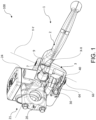
figure 1 depicts an axonometric view of a lever device according to the present invention, from a first direction of view, in which a lever assembly comprising a primary lever and a secondary lever rotatably connected to amaster cylinder body 21 can be seen, in which the primary lever comprises a primarylever thrust portion 7 and the secondary lever comprises a secondarylever counter-abutment portion 9, in which the primarylever thrust portion 7 and the secondarylever counter-abutment portion 9 are facing and spaced apart from each other; -
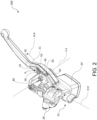
figure 2 depicts an axonometric view of the lever device infigure 1 from a second direction of view, in which an elastic relative-load element 6 can be seen, connected, preferably constrained, to the primary lever and interposed between the primary lever and the secondary lever, in which the elastic relative-load element 6 is configured to apply an elastic spacing action which opposes an approach of the secondarylever counter-abutment portion 9 to the primarylever thrust portion 7 or vice versa, visible infigure 1 ; -
figure 3 shows an axonometric exploded view of the lever device infigure 2 , in which the primary lever can be seen, the elastic relative-load element 6, anelastic return element 4 of primary lever configured to elastically bias theprimary lever 2 with respect to themaster cylinder body 21 in a primary lever resting position, anelastic return element 5 configured to elastically bias thesecondary lever 3 with respect to themaster cylinder body 21 in a secondary lever resting position, at least onerotation pin 45 adapted to rotatably connect the lever assembly to the connection brackets of the master cylinder body around the pivot axis Y-Y; -
figure 4 shows an axonometric view of the lever device infigure 1 in an exploded view; -
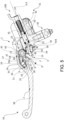
figure 5 shows a sectional view of the lever device along a plane of section A-A shown infigure 2 , in which the primary lever and secondary lever are visible in the respective resting positions, in which the elastic relative-load element acts between the first primary lever connecting element and the secondary lever connecting element opposing an approach of the primary lever thrust portion with the secondary lever counter-abutment portion, in which a primary lever second connecting element opposite the primary element first connecting element is also visible so that the elastic relative-load element 6 can be constrained to the primary lever irrespective of the presence of the secondary lever allowing an easy assembly of the lever assembly; -
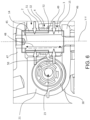
figure 6 shows a sectional view of the lever device along a plane of section B-B infigure 5 in which a primary lever bushing integral with the primary lever body and a secondary lever bushing integral with the secondary lever body are visible, mutually rotatably coupled along the pivot axis Y-Y, in which the primary lever bushing and the secondary lever bushing are guided for the entire length of the guide portion of the rotation pin, substantially equal to the distance along a direction parallel to the pivot axis Y-Y between the connecting brackets of the master cylinder body; -
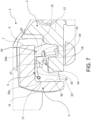
figure 7 shows a partially sectional view of the lever device, in which afirst arm 33 and asecond arm 34 of the elastic relative-load element 6 are visible, connected to each other so as to lie along opposite directions between the first primarylever connecting element 17 and the secondarylever connecting element 18 opposing an approach of the primarylever thrust portion 7 with the secondarylever counter-abutment portion 9, in which the primary lever second connectingelement 25 is also visible, opposite with respect to a direction transverse to the extension direction of the pivot axis Y-Y, to the first primarylever connecting element 17 to which the first elastic relative-load element arm 33 is connected, and to which a portion of the second elastic relative-load element arm 34 is connected so that the elastic relative-load element 6 can be constrained to the primary lever by elastically lying between the first primarylever connecting element 17 and the primary lever second connectingelement 25, regardless of the presence of the secondary lever, allowing an easy assembly of the lever assembly, and in which the coupling portions of the connectingelements load element 6 are also visible; -
figure 8 show a section view of the master cylinder body of the lever device, in which the piston or float movably inserted into the master cylinder body cavity can be seen, where the master cylinder body cavity is in fluid communication with an associable tank by means of a supply channel; -
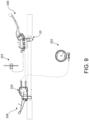
figure 9 diagrammatically shows a braking system of the combined front-rear type of the present invention, comprising a lever device infigure 1 operatively connected to a front brake and a second lever operatively connected to a rear brake and the lever device, in which the activation of the second lever activates both the rear brake, preferably a drum brake, and the front brake, preferably a disc brake; -
figure 10 shows an axonometric view of a spring assembly according to the present invention; -
figure 11 shows the lever device infigure 2 , in which the primary lever and the secondary lever are in the respective resting positions, and in which the thrust portion of the primary lever and the counter-abutment portion of the secondary lever are kept spaced apart from each other by the elastic relative-load element; -
figure 12 shows the lever device infigure 2 , in which the primary lever is driven into rotation by a user from the resting position to the at least one primary lever actuation position, and the secondary lever is rotated to the at least one secondary lever actuation position by the thrust action of the thrust portion against the counter-abutment portion of the secondary lever by actuating the braking device and/or the brake master cylinder; -
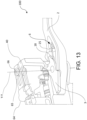
figure 13 shows the lever device infigure 2 , in which the primary lever is in the primary lever resting position, and the secondary lever rotated from the secondary lever resting position to the at least one secondary lever actuation position by the pulling action of the combined-action braking mechanism which pulls a combinedbraking connecting portion 40 of the secondary lever, e.g., by means of theshaped metal sheet 64. - . According to a general embodiment, a lever device to hydraulically actuate a first braking device or
front braking device 101 of a handlebar vehicle is indicated byreference numeral 100. - . The
lever device 100 comprises amaster cylinder body 21 comprising connecting means 20 to constrain themaster cylinder body 21 to a handlebar of the handlebar vehicle. Saidmaster cylinder body 21 comprisescylinder walls 55 delimiting a cavity orcylinder 23. - . The
lever device 100 comprises at least one float orpiston 22 operatively associated with themaster cylinder body 21, so as to be adapted to slide inside the cavity orcylinder 23 along a thrust direction X-X. The float orpiston 22 comprises a piston bottom 56 defining, with thecylinder walls 55 of themaster cylinder body 21, at least onepressure chamber 57 configured to accommodate an actuating fluid of the first braking device orfront braking device 101. At least one of thecylinder walls 55 is interrupted to delimit at least onesupply channel 58 configured to put in fluid communication thepressure chamber 57 with anassociable fluid tank 24. - . The piston bottom 56 is movable with respect to said
cylinder walls 55 between at least one end-of-stroke position, in which the volume of saidpressure chamber 57 is maximum, and at least a first working position, in which in the at least a first working position said piston bottom fluidly isolates saidpressure chamber 57 from saidsupply channel 58, pressurizing the actuating fluid in thepressure chamber 57. - . The
lever device 100 comprises anelastic return element 5 arranged inside said cavity or cylinder and interposed between said piston bottom 56 and a cylinder seat or shoulder defined by thecylinder walls 55 so as to elastically bias the piston or float 22 constantly towards the end-of-stroke position. In other words, theelastic return element 5 allows a return to the end-of-stroke position of the piston or float 22 when the user ceases to actuate thelever device 100. - . The
lever device 100 comprises alever assembly 1, rotatably associated with themaster cylinder body 21 so as to rotate about at least one pivot axis Y-Y.Said lever assembly 1 being either directly or indirectly connected to said float orpiston 22. - . Said
lever assembly 1 comprises aprimary lever 2 rotatably associated with themaster cylinder body 21, the primary lever comprising a primary lever thrustportion 7. - . Said
lever assembly 1 comprises a secondary lever orhub 3 rotatably associated with themaster cylinder body 21, thesecondary lever 3 comprising a secondary levercounter-abutment portion 9. The secondary lever orhub 3 is connected either directly or indirectly to said float orpiston 22. - . The
primary lever 2 is rotatable about the at least one pivot axis Y-Y between a primary lever resting position, and at least one primary lever actuation position, in which in the at least one primary lever actuation position, the primary lever thrustportion 7 is in direct or indirect contact with the secondary levercounter-abutment portion 9, so as to bias, by means of the secondary lever orhub 3, the float orpiston 22 at least when it is in the at least a first working position. - . The
lever assembly 1 comprises anelastic return element 4 of primary lever configured to elastically bias theprimary lever 2 to the primary lever resting position. - . The
secondary lever 3 is rotatable about the at least one pivot axis Y-Y, or an axis parallel thereto, between a secondary lever resting position, and at least one secondary lever actuation position, where, in the at least one secondary lever actuation position, thesecondary lever 3 biases an advancement of the float orpiston 22 towards the at least one working position. Thesecondary lever 3 is elastically biased to the resting position by theelastic return element 5. Thesecondary lever 3 can rotate about the same pivot axis Y-Y about which theprimary lever 2 is rotatable, or can rotate about a secondary lever pivot axis which is parallel to the at least one pivot axis Y-Y. - . The
secondary lever 3 is operatively connectable to a combinedbraking mechanism 103 actuatable by a combined-action lever 104 so that thesecondary lever 3 is also drivable into rotation from the secondary lever resting position to the at least one secondary lever actuation position by actuating a combined-action lever 104 connected to a second braking device orrear braking device 102 to activate thefirst braking device 101 and thesecond braking device 102 in a combined manner irrespective of an actuation of theprimary lever 2. According to an embodiment,secondary lever 3 comprises a combinedbraking connecting portion 40 operatively connectable to the combinedbraking mechanism 103, e.g., by means of a shapedmetal sheet 64. In an embodiment, the shapedmetal sheet 64 defines alinear guide 65 along which a slidingpin 66 of the combinedbraking connecting portion 40 is slidably guided when thesecondary lever 3 is driven into rotation by theprimary lever 2. In an embodiment, the shapedmetal sheet 64 is connectable to an actuating cable of the combinedbraking mechanism 103, so that by actuating the actuating cable, the shapedmetal sheet 64 transmits the actuating force from the actuating cable to the combinedbraking connecting portion 40 allowing a rotation of thesecondary lever 3 irrespective of the actuation of theprimary lever 2. - . Advantageously, the
lever assembly 1 comprises an elastic relative-load element 6 which is connected to theprimary lever 2 and/orsecondary lever 3. The elastic relative-load element 6 is interposed between a first primarylever connecting element 17 of theprimary lever 2 and a secondarylever connecting element 18. The elastic relative-load element 6 is configured to apply an elastic spacing action which opposes an approach of the secondary levercounter-abutment portion 9 to the primary lever thrustportion 7, or vice versa, so that when theprimary lever 2 and the secondary lever orhub 3 are in the respective resting positions, the elastic relative-load element 6 avoids the direct or indirect rubbing contact between the secondary levercounter-abutment portion 9 and the primary lever thrustportion 7. The elastic relative-load element 6 is configured to apply an elastic spacing action which opposes an approach of the secondary levercounter-abutment portion 9 to the primary lever thrustportion 7, or vice versa, so that theprimary lever 2 is rotatable about the at least one pivot axis Y-Y between the primary lever resting position and the at least one primary lever actuation position by overcoming the elastic spacing action of the elasticrelative load element 6, taking the primary lever thrustportion 7 close to the secondary levercounter-abutment portion 9 until it contacts it either directly or indirectly. In other words, the elastic relative-load element 6 allows avoiding a direct or indirect contact between the secondary levercounter-abutment portion 9 and the primary levercounter-abutment portion 7 until the elastic spacing action is completely overcome by the rotation of theprimary lever 2 under the bias of a user by taking it close to the handlebar, contacting, in the at least one primary lever actuation position, the primary levercounter-abutment portion 7 with the secondary levercounter-abutment portion 9. - . In an embodiment, in the at least one primary lever actuation position, the primary lever thrust
portion 7 is in direct contact with the secondary levercounter-abutment portion 9, avoiding an interposition between the secondary levercounter-abutment portion 9 and the primary lever thrustportion 7 of non-metal elements subject to wear by rubbing. - . In an embodiment, the primary
lever connecting element 17 and the secondarylever connecting element 18 are distinct from the primary lever thrustportion 7 and the secondary levercounter-abutment portion 9, respectively. - . In an embodiment, when the
primary lever 2 and the secondary lever orhub 3 are in the respective resting positions, the elastic relative-load element 6 biases the first primarylever connecting element 17 and the secondarylever connecting element 18 while keeping a spacing clearance D between the primary lever thrustportion 7 and the secondary levercounter-abutment portion 9 between 0.05 mm and 5 mm, preferably between 0.1 mm and 1 mm. - . In an embodiment, said
lever device 100 comprises at least one thrust transmission element oractuation pin 29 interposed between the piston or float 22 and thelever assembly 1, in particular thesecondary lever 3, and adapted to transmit the thrust action between thelever assembly 1 and the piston orfloat 22. In an embodiment, saidthrust transmission element 29 comprises ashaft 10 and apush rod 13. In an embodiment, saidthrust transmission element 29 is associated with adust cuff 28 which prevents impurities from entering into thecavity 23 of themaster cylinder body 21. - . In an embodiment, the
primary lever 2 comprises aprimary lever bushing 14. In an embodiment, the secondary lever orhub 3 comprises asecondary lever bushing 15. In an embodiment, theprimary lever bushing 14 andsecondary lever bushing 15 comprise a respective substantially cylindrical body and a through hole coaxial to the pivot axis Y-Y. In an embodiment, theprimary lever bushing 14 is made in one piece with theprimary lever body 11. In an embodiment, theprimary lever bushing 14 defines a cylindrical primary lever coupling surface on theprimary lever body 11. In an embodiment, thesecondary lever bushing 15 is made in one piece with thesecondary lever body 12. In an embodiment, thesecondary lever bushing 15 defines a cylindrical secondary lever coupling surface on thesecondary lever body 12. - . In an embodiment, the
primary lever bushing 14 and thesecondary lever bushing 15 are coaxial to the pivot axis Y-Y. In an embodiment, theprimary lever bushing 14 is configured to accommodate thesecondary lever bushing 15, or vice versa, so as to allow a rotation of theprimary lever 2 with respect to thesecondary lever 3 about the pivot axis Y-Y when theprimary lever bushing 14 and thesecondary lever bushing 15 are mutually coupled. - . In an embodiment, either the
primary lever bushing 14 or thesecondary lever bushing 15 is configured to accommodate arotation pin 45. - . In an embodiment, the
lever device 100 comprises at least one connectingbracket master cylinder body 21 or made in one piece with the master cylinder body to allow a rotatable connection between the master cylinder body and the lever assembly by means of therotation pin 45. - . In an embodiment, the
lever device 100 comprises a first connectingbracket 46 and a second connectingbracket 47, where the connectingbrackets master cylinder body 21 or made in one piece with the master cylinder body. In an embodiment, the connectingbrackets brackets rotation pin 45 to themaster cylinder body 21. - . In an embodiment, the
lever device 100 comprises saidrotation pin 45 to connect thelever assembly 1 fixed to the first connectingbracket 46 and to the second connectingbracket 47. - . In an embodiment, the
rotation pin 45 comprises apin guide portion 48 which is a cylindrical portion extending without shoulders at least between the first connectingbracket 46 and the second connectingbracket 47 so that theprimary lever bushing 14 and thesecondary lever bushing 15 are guided over the entire length of thepin guide portion 48. - . In an embodiment, the elastic relative-
load element 6 is configured to mutually connect theprimary lever 2 and the secondary lever orhub 3 irrespective of a connection of theprimary lever 2 and thesecondary lever 3 with themaster cylinder body 21 by means of saidrotation pin 45. - . In an embodiment, the
primary lever 2 comprises a primarylever stop wall 42 and where thesecondary lever 3 comprises a secondary lever stop counter-wall 43. - . In an embodiment, when the
primary lever 2 and thesecondary lever 3 are disconnected from themaster cylinder body 21, and when theprimary lever bushing 14 and thesecondary lever bushing 15 are mutually coupled, the elastic relative-load element 6 is interposed between the first primarylever connecting element 17 of theprimary lever 2 and the secondarylever connecting element 18, by rotationally biasing the secondary levercounter-abutment portion 9 about the pivot axis Y-Y away from the primary lever thrustportion 7 and by rotationally biasing the primarylever stop wall 42 against the secondary levercounter-abutment wall 43 about the pivot axis Y-Y, or vice versa, mutually connecting theprimary lever 2 and the secondary lever orhub 3 by friction between the primarylever stop wall 42 abutting against the secondary lever stop counter-wall 43 which avoids separation of theprimary lever 2 from thesecondary lever 3 along a direction parallel to the pivot axis Y-Y, irrespective of the connection of theprimary lever 2 and thesecondary lever 3 with themaster cylinder body 21 by means of therotation pin 45. - . In an embodiment, the
primary lever bushing 14 accommodates thesecondary lever bushing 15. In an embodiment, theprimary lever bushing 14 comprises abushing end 49 configured to abut against anannular seat 50 defined outside the base or root of thesecondary lever bushing 15. - . In an embodiment, the
elastic return element 4 of primary lever comprises afirst arm 30 of first elastic return element and asecond arm 31 of first elastic return element. - . In an embodiment, the
elastic return element 4 of primary lever is a torsional spring comprising at least a first elastic return element winding 32, in which thefirst arm 30 of first elastic return element, and thesecond arm 31 of first elastic return element extend from said first elastic return element winding 32. - . In an embodiment, the
primary lever 2 comprises aprimary lever body 11. - . In an embodiment, the
primary lever body 11 defines a primary lever recessed housing orseat 16 adapted to accommodate the elastic relative-load element 6. In an embodiment, the primary lever recessed housing orseat 16 is adapted to at least partially accommodate theelastic return element 4 of primary lever. - . In an embodiment, the
primary lever body 11 comprises an innerhousing side wall 19 delimiting thehousing 16. In an embodiment, theprimary lever body 11 comprises abottom housing wall 59 connected to thehousing side wall 19, and substantially orthogonal to the direction of the pivot axis Y-Y. In an embodiment, the innerhousing side wall 19 delimits thehousing 16, either laterally or circumferentially, with respect to radial directions orthogonal to the direction of the pivot axis Y-Y. In an embodiment, the innerhousing side wall 19 extends forming a concave portion, preferably with concavity facing the pivot axis Y-Y. In an embodiment, the innerhousing side wall 19 comprises a firstinner wall portion 36 and a secondinner wall portion 39. In an embodiment, the firstinner wall portion 36 and a secondinner wall portion 39 delimit thehousing 16 on opposite sides. In an embodiment, the firstinner wall portion 36 and the secondinner wall portion 39 delimit the concave portion of the housing on opposite sides. In an embodiment, the firstinner wall portion 36 and the secondinner wall portion 39 substantially face each other. In an embodiment, in a section of the primary lever body orthogonal to the direction of the pivot axis Y-Y, the innerhousing side wall 19 forms at least one U- or V-shaped portion, where the firstinner wall portion 36 and the secondinner wall portion 39 are on opposite sides of the U- or V-shaped portion and are connected by an inner wall connecting portion, preferably curved. - . In an embodiment, the
first arm 30 of first elastic return element is configured to abut against a portion of themaster cylinder body 21. - . In an embodiment, the
second arm 31 of first elastic return element is configured to abut against a portion of theprimary lever 2, preferably against the innerhousing side wall 19. - . In an embodiment, the at least a first elastic return element winding 32 is fitted onto the outer surface of the
primary lever bushing 14 and abuts between an annularsecondary lever wall 52, extending about the base of thesecondary lever bushing 15, and an annularprimary lever wall 51 extending about the base of theprimary lever bushing 14. - . In an embodiment, the elastic relative-
load element 6, thesecond arm 31 of first elastic return element, and the at least a first elastic return element winding 32 are arranged inside thehousing 16 forming a weatherproof shell. - . In an embodiment, the at least a first elastic return element winding 32 comprises a plurality of windings coaxial to the pivot Y-Y, in which the plurality of windings is configured to provide an axial thrust between the
primary lever 2 and thesecondary lever 3 so as to correct any clearance along directions parallel to the pivot axis Y-Y between thelever assembly 1 and themaster cylinder body 21. - . In an embodiment, the elastic relative-
load element 6 comprises afirst arm 33 of elastic relative-load element and asecond arm 34 of elastic relative-load element. In an embodiment, the elastic relative-load element 6 comprises an elastic element body, e.g., a metal wire body or metal plate, bent so that thefirst arm 33 of elastic relative-load element and thesecond arm 34 of elastic relative-load element elastically oppose a mutual approach. - . In an embodiment, the
primary lever 2 comprises a second primarylever connecting element 25. In an embodiment, the second primarylever connecting element 25 is made on the secondinner wall portion 39. In an embodiment, the first primarylever connecting element 17 is made on the firstinner wall portion 36. - . In an embodiment, the first primary
lever connecting element 17 and the second primarylever connecting element 25 each comprise a respective primary lever connectingelement coupling portion first arm 33 of elastic relative-load element and aproximal portion 53 of second arm of elastic relative-load element, respectively, so as to couple the elastic relative-load element 6 to theprimary lever 2 irrespective of the presence of the secondary lever orhub 3. - . In an embodiment, the secondary
lever connecting element 18 comprises a secondary lever connectingelement coupling portion 27 configured to couple adistal portion 54 of second arm of elastic relative-load element . - . It should be noted that in some solutions of known lever assemblies, the elastic return element of primary lever adapted to apply an elastic return action between primary lever and the supporting body which can be constrained to the handlebar so as to constantly bias the primary lever in the resting position thereof, is a torsional spring comprising a winding portion, a first connecting arm and a second connecting extending from the winding portion to apply the elastic return action. The torsional spring is positioned with the winding portion thereof along a rotation axis of the primary lever and/or secondary lever, e.g., defined by a rotation pin connectable to the supporting body which can be constrained to the handlebar so that the primary lever and/or secondary lever can rotate about the rotation pin, in which the first connecting arm abuts with the primary lever and the second connecting arm abuts with the body which can be constrained to the handlebar. In some solutions, the winding portion is axially clamped between a bracket of the body which can be constrained to the handlebar and the heat of the rotation pin. In other solutions, the winding portion is enclosed in a housing defined between the primary lever and secondary lever, in which the primary lever and secondary lever are rotatably constrained to the supporting body which can be constrained to the handlebar by means of the rotation pin. In a step of assembly, the elastic return element of primary lever must be positioned in its assembly position on the spot, a user running the risk of making more than one positioning attempt before achieving the correct positioning and running the risk of dropping by gravity the elastic return element during the positioning attempts, which thus could be lost. In a step of maintenance of the lever assembly, during a disassembly of the primary lever from the body constrainable to the handlebar, the elastic return element of primary lever must be separated from its assembly position on the field, and, therefore, the elastic return element may fall by gravity resulting in an accidental loss of the elastic return element, slowing down or compromising the reassembly of the lever assembly until the elastic return element is replaced. Therefore, the need is strongly felt in the industry for a lever assembly which is capable of simplifying the assembly and maintenance operations of a lever assembly, reducing the risk of dropping by gravity and losing the elastic return element configured to bias the grippable lever constantly in resting position.
- . In an embodiment, when the
first arm 33 of elastic relative-load element and thesecond arm 34 of elastic relative-load element arm are coupled to the respective coupling portions 26 27 by biasing theprimary lever 2 and thesecondary lever 3 along directions transverse to the pivot axis Y-Y of thelever assembly 1, a separation is prevented between theprimary lever 2 and thesecondary lever 3 along directions parallel to the pivot axis Y-Y by moving theprimary lever 2 and thesecondary lever 3. - . In an embodiment, each primary
lever connecting element housing side wall 19 and each stud is adapted to limit the movements of the elastic relative-load element 6 along directions parallel to the pivot axis Y-Y. In an embodiment, the first primarylever connecting element 17 is a first stud or first element in relief along a direction orthogonal to the pivot axis Y-Y with respect to the firstinner wall portion 36, which comprises a groove adapted to accommodate at least one portion of thefirst arm 33 of elastic relative-load element. In an embodiment, the second primarylever connecting element 25 is a second stud or second element in relief along a direction orthogonal to the pivot axis Y-Y with respect to the secondinner wall portion 39, which comprises a groove adapted to accommodate aproximal portion 53 of thesecond arm 34 of elastic relative-load element. - . In an embodiment, the
secondary lever 3 comprises asecondary lever body 12, where the secondarylever connecting element 18 is a tab projecting from thesecondary lever body 12 mainly along a direction parallel to the pivot axis Y-Y. - . In an embodiment, the secondary
lever connecting element 18 projects into thehousing 16 when theprimary lever 2 is connected to thesecondary lever 3. - . In an embodiment, each primary lever connecting
element coupling portion load element 6 along directions parallel to the pivot axis Y-Y. - . In an embodiment, each primary lever connecting
element coupling portion 27 is an undercut portion adapted to limit the movements of the elastic relative-load element 6 along directions parallel to the pivot axis Y-Y. - . In an embodiment, each primary lever connecting element coupling portion 26 comprises a groove made in the respective primary
lever connecting element - . In an embodiment, each secondary lever connecting
element coupling portion 27 comprises a groove made in the respective secondarylever connecting element 18. In an embodiment, the groove is in a plane transverse to the pivot axis Y-Y. - . In an embodiment, the elastic relative-
load element 6 is a torsional elastic element. - . In an embodiment, the elastic relative-
load element 6 is a wire spring. - . In an embodiment, the elastic relative-
load element 6 comprises at least one elastic relative-load element winding 35 wound about a direction parallel to the pivot axis Y-Y, where thefirst arm 33 of elastic relative-load element and thesecond arm 34 of elastic relative-load element extend from the at least one elastic relative-load element winding 35 to bias theprimary lever 2 and thesecondary lever 3 elastically. - . In an embodiment, the
elastic return element 4 of primary lever is a wire spring. - . In an embodiment, the
elastic return element 4 of primary lever and the elastic relative-load element 6 are integrated, preferably made from a wire. - . In an embodiment, the
primary lever 2 comprises agrippable portion 38 of primary lever configured to be gripped by a user to rotate theprimary lever 2 with respect to themaster cylinder body 21 towards the handlebar in the plurality of primary lever actuation positions. - . In an embodiment, the
primary lever 2 comprises a primarylever anti-rotation portion 8 configured to abut against a first master cylinderbody abutment portion 41 of themaster cylinder body 21 defining the resting position of the primary lever and preventing a rotation of theprimary lever 2 away from the handlebar towards themaster cylinder body 21. - . In an embodiment, the
secondary lever 3 comprises a combinedbraking connecting portion 40 configured to operatively connect thesecondary lever 3 to the combinedbraking mechanism 103. - . In an embodiment, the
secondary lever 3 comprises a secondarylever anti-rotation portion 44 configured to abut against a second master cylinderbody abutment portion 37 of themaster cylinder body 21 defining the resting position of the secondary lever and preventing a rotation of thesecondary lever 3 away from the handlebar towards themaster cylinder body 21. In an embodiment, thesecond abutment portion 37 of master cylinder body and thefirst abutment portion 41 of master cylinder body belong to the same master cylinder body surface. - . In an embodiment, the at least one elastic relative-load element winding 35 is accommodated inside the
housing 16. - . In an embodiment, the
first arm 33 of elastic relative-load element is coupled to the first primarylever connecting element 17 and thesecond arm 34 of elastic relative-load element is coupled, with aportion 53 thereof close to the at least one elastic relative-load element winding 35, to the second primarylever connecting element 25 so that when the elastic relative-load element 6 is inserted into thehousing 16 of theprimary lever 2 coupled to the first primarylever connecting element 17 and to the second primarylever connecting element 25, with thefirst arm 33 of elastic relative-load element elastically abutting against the first primarylever connecting element 17 and with thesecond arm 34 of elastic relative-load element elastically abutting against the second connectingelement 25 of primary lever, the elastic relative-load element 6 is connected to theprimary lever 2 avoiding possible gravity falling from thehousing 16 irrespective of the presence of thesecondary lever 3 and/or irrespective of the connection of thelever assembly 1 with themaster cylinder body 21. - . The present invention also relates to a braking system for a handlebar vehicle comprising a
lever device 100 according to any one of the previously described embodiments, connected or connectable to the handlebar of the handlebar vehicle. - . The braking system comprises a
front braking device 101 operatively connected to thelever device 100, preferably a disc brake. - . The braking system comprises a combinable action lever device comprising a combined
action lever 104 and a combinedbraking mechanism 103 actuatable by the combinedaction lever 104. - . The braking system comprises a
rear braking device 102, preferably a drum brake, where the combined braking mechanism is operatively connected to therear braking device 102 and also to thefirst braking device 101 by means of thelever device 100, so that the actuation of the combined-action lever device activates thefirst braking device 101 and thesecond braking device 102 in a combined manner irrespective of an actuation of theprimary lever 2. - . The present invention also relates to a spring assembly for a
lever assembly 1 of alever device 100. According to an embodiment, thelever device 100 is according to one or more of the previously described embodiments. Thelever device 100 is configured to hydraulically actuate a first braking device orfront braking device 101 of a handlebar vehicle, where saidlever assembly 1 comprises aprimary lever 2 and asecondary lever 3 rotatably associable with amaster cylinder body 21 to rotate about a pivot axis Y-Y, the primary lever comprising a primary lever thrustportion 7, the secondary lever orhub 3 being connectable directly or indirectly to a float orpiston 22 associated with themaster cylinder body 21, thesecondary lever 3 comprising a secondary levercounter-abutment portion 9. - . Said spring assembly comprises an
elastic return element 4 of primary lever adapted to be interposed between themaster cylinder body 21 and the primary lever and configured to elastically bias theprimary lever 2 to a primary lever resting position. Saidelastic return element 4 of primary lever comprises afirst arm 30 of first elastic return element and asecond arm 31 of first elastic return element, where thefirst arm 30 of first elastic return element is configured to abut against a portion of themaster cylinder 21, and where thesecond arm 31 of first elastic return element is configured to abut against a portion of theprimary lever 2. - . Said spring assembly comprises an elastic relative-
load element 6 adapted to be interposed between a first primarylever connecting element 17 of theprimary lever 2 and a secondarylever connecting element 18, where the elastic relative-load element 6 is configured to apply an elastic spacing action which opposes an approach of the secondary levercounter-abutment portion 9 to the primary lever thrustportion 7 or vice versa. - . The elastic relative-
load element 6 comprises afirst arm 33 of elastic relative-load element adapted to be connected to the first primarylever connecting element 17 and asecond arm 34 of elastic relative-load element adapted to be connected to the secondarylever connecting element 18. - . Advantageously, the
first arm 33 of elastic relative-load element is connected to thesecond arm 31 of first elastic return element. - . In an embodiment, the
first arm 33 of elastic relative-load element is integrated, preferably in one piece, with thesecond arm 31 of first elastic return element. - . In an embodiment, the elastic relative-
load element 6 and theelastic return element 4 of primary lever are integrated, preferably made by bending the same metal wire. - . In an embodiment, the elastic relative-
load element 6 is configured to be interposed between a first primarylever connecting element 17 of theprimary lever 2 and a secondarylever connecting element 18, so that, when theprimary lever 2 and the secondary lever orhub 3 are in the respective resting positions, the elastic relative-load element 6 avoids a direct or indirect contact by rubbing between the secondary levercounter-abutment portion 9 and the primary lever thrustportion 7, and so that theprimary lever 2 is rotatable about the at least one pivot axis Y-Y between the primary lever resting position and the at least one primary lever actuation position, avoiding a direct or indirect contact between the secondary levercounter-abutment portion 9 and the primary lever thrustportion 7. - . In an embodiment, the
elastic return element 4 of primary lever is a torsional spring comprising at least a first elastic return element winding 32, in which thefirst arm 30 of first elastic return element, and thesecond arm 31 of first elastic return element extend from said first elastic return element winding 32. - . In an embodiment, the elastic relative-
load element 6 comprises at least one elastic relative-load element winding 35 wound about a direction parallel to the pivot axis Y-Y, where afirst arm 33 of elastic relative-load element, and asecond arm 34 of elastic relative-load element extend from the at least one elastic relative-load element winding 35 to elastically bias theprimary lever 2 and thesecondary lever 3. - . In an embodiment, the at least a first elastic return element winding 32 comprises a plurality of windings coaxial to the pivot Y-Y, where the plurality of windings is configured to provide an axial thrust between the
primary lever 2 and thesecondary lever 3 so as to correct any clearance along directions parallel to the pivot axis Y-Y between thelever assembly 1 and themaster cylinder body 21. - . In an embodiment, the at least a first elastic return element winding 32 and the at least one elastic relative-load element winding 35 extend helically about axes parallel to each other and parallel to the direction of the pivot axis Y-Y.
- . In an embodiment, the
first arm 30 of first elastic return element extends from the at least a first elastic return element winding 32 with afirst fold 60 in a first plane perpendicular to the direction of the pivot axis Y-Y, asecond fold 61 in a second plane perpendicular to the first plane, acurved portion 62, preferably forming a semi-circumference, with concavity opposite to thesecond fold 61 and facing the thrust direction X-X, and a firstarm abutment portion 63 bent on the opposite side with respect to thecurved portion 62. In an embodiment, thefirst arm 30 of first elastic return element forms a U-bent portion orcurved portion 62, adapted to be arranged in a plane substantially orthogonal to the thrust direction X-X and substantially parallel to a direction coincident with or parallel to the direction of the pivot axis Y-Y, when the spring assembly is assembled to thelever device 100. -
- 1
- lever assembly
- 2
- primary lever
- 3
- secondary lever or hub
- 4
- first elastic return element of primary lever
- 5
- second elastic return element of secondary lever
- 6
- elastic relative-load element
- 7
- primary lever thrust portion
- 8
- primary lever anti-rotation portion
- 9
- secondary lever counter-abutment portion
- 10
- shaft
- 11
- primary lever body
- 12
- secondary lever body
- 13
- push rod
- 14
- primary lever bushing
- 15
- secondary lever bushing
- 16
- primary lever recessed housing or seat
- 17
- first primary lever connecting element
- 18
- secondary lever connecting element
- 19
- inner housing side wall
- 20
- body or bracket connecting means
- 21
- master cylinder body
- 22
- piston or float
- 23
- cavity or cylinder
- 24
- fluid tank
- 25
- second connecting element of primary lever
- 26a
- first primary lever connecting element coupling portion
- 26b
- second primary lever connecting element coupling portion
- 27
- secondary lever connecting element coupling portion
- 28
- dust cuff
- 29
- thrust transmission element or actuation pin
- 30
- first arm of first elastic return element
- 31
- second arm of first elastic return element
- 32
- first elastic return element winding
- 33
- first arm of elastic relative-load element
- 34
- second arm of elastic relative-load element
- 35
- elastic relative-load element winding
- 36
- first inner wall portion
- 37
- second abutment portion of master cylinder body
- 38
- grippable portion of primary lever
- 39
- second inner wall portion
- 40
- combined braking connecting portion
- 41
- first abutment portion of master cylinder body
- 42
- primary lever stop wall
- 43
- secondary lever stop counter-wall
- 44
- secondary lever anti-rotation portion
- 45
- rotation pin
- 46
- first connecting bracket
- 47
- second connecting bracket
- 48
- pin guide portion
- 49
- bushing end
- 50
- annular seat
- 51
- annular primary lever wall
- 52
- annular secondary lever wall
- 53
- proximal portion of second arm of elastic relative-load element
- 54
- distal portion of second arm of elastic relative-load element
- 55
- cylinder walls
- 56
- piston bottom
- 57
- pressure chamber
- 58
- supply channel
- 59
- housing bottom wall
- 60
- first fold
- 61
- second fold
- 62
- curved portion or U-bent portion
- 63
- abutment end portion
- 64
- shaped metal sheet
- 65
- linear guide
- 66
- sliding pin
- 100
- lever device
- 101
- first braking device or front braking device
- 102
- second braking device or rear braking device
- 103
- combined braking mechanism
- 104
- combined action lever
- Y-Y
- pivot axis
- X-X
- thrust direction
Claims (12)
- A lever device (100) for hydraulically actuating a first braking device or front braking device (101) of a handlebar vehicle, comprising- a master cylinder body (21) comprising connecting means (20) for constraining the master cylinder body (21) to a handlebar of the handlebar vehicle, said master cylinder body (21) comprising cylinder walls (55) delimiting a cavity or cylinder (23),- at least one float or piston (22), operatively associated with the master cylinder body (21), so as to be adapted to slide inside the cavity or cylinder (23) along a thrust direction (X-X), said float or piston (22) comprising a piston bottom (56) defining, with the cylinder walls (55) of the master cylinder body (21), at least one pressure chamber (57) configured to accommodate an actuating fluid of the first braking device or front braking device (101), wherein at least one of the cylinder walls (55) is interrupted to delimit at least one supply channel (58) configured to put the pressure chamber (57) in fluid communication with at least one associated fluid tank (24),wherein the piston bottom (56) is movable with respect to said cylinder walls (55), between:- at least one end-of-stroke position, in which the volume of said pressure chamber (57) is maximum,- and at least a first working position, in which said piston bottom fluidly isolates said pressure chamber (57) from said supply channel (58), pressurizing the actuating fluid in the pressure chamber (57),wherein the lever device (100) comprises an elastic return element (5) arranged inside said cavity or cylinder and interposed between said piston bottom (56) and a cylinder seat defined by the cylinder walls (55) so as to elastically bias the piston or float (22) constantly towards the end-of-stroke position,and wherein the lever device (100) comprises a lever assembly (1) rotatably associated with the master cylinder body (21) so as to rotate about at least one pivot axis (Y-Y), said lever assembly (1) being either directly or indirectly connected to said float or piston (22);said lever assembly (1) comprising:- a primary lever (2) rotatably associated with the master cylinder body (21), the primary lever comprising a primary lever thrust portion (7),- a secondary lever or hub (3) rotatably associated with the master cylinder body (21), the secondary lever or hub (3) being either directly or indirectly connected to said float or piston (22), the secondary lever (3) comprising a secondary lever counter-abutment portion (9),
the primary lever (2) being rotatable about the at least one pivot axis (Y-Y) between:a primary lever resting position,and at least one primary lever actuation position, in which the primary lever thrust portion (7) is in direct or indirect contact with the secondary lever counter-abutment portion (9), so as to bias, by means of the secondary lever or hub (3), the floater or piston (22) at least when it is in the at least a first working position,wherein the lever assembly (1) comprises an elastic return element (4) of primary lever configured to elastically bias the primary lever (2) to the primary lever resting position,the secondary lever (3) being rotatable about the at least one pivot axis (Y-Y), or an axis parallel thereto, between a secondary lever resting position,
and at least one secondary lever actuation position, in which the secondary lever (3) biases a forward movement of the float or piston (22) towards the at least one working position, in which the secondary lever (3) is elastically biased to the resting position by the elastic return element (5),wherein the secondary lever (3) is operatively connectable to a combined braking mechanism (103) actuatable by a combined-action lever (104) so that the secondary lever (3) is also rotationally actuatable from the secondary lever resting position to the at least one secondary lever actuation position by actuating the combined-action lever (104) connected to a second braking device or rear braking device (102) to activate the first braking device (101) and the second braking device (102) in a combined manner irrespective of an actuation of the primary lever (2),characterized in thatthe lever assembly (1) comprises an elastic relative-load element (6) which is connected to the primary lever (2) and/or secondary lever (3),wherein the elastic relative-load element (6) is interposed between a first primary lever connecting element (17) of the primary lever (2) and a secondary lever connecting element (18) of the secondary lever (3), wherein the elastic relative-load element (6) is configured to apply an elastic spacing action which opposes an approach of the secondary lever counter-abutment portion (9) to the primary lever thrust portion (7) or vice versa,such that, when the primary lever (2) and the secondary lever or hub (3) are in the respective resting positions, the elastic relative-load element (6) avoids direct or indirect contact by rubbing between the secondary lever counter-abutment portion (9) and the primary lever thrust portion (7), andsuch that the primary lever (2) is rotatable about the at least one pivot axis (Y-Y) between the primary lever resting position and the at least one primary lever actuation position by overcoming the elastic spacing action of the elastic relative-load element (6), taking the primary lever thrust portion (7) closer to the secondary lever counter-abutment portion (9) until it contacts it either directly or indirectly. - A lever device (100) according to the preceding claim, wherein in the at least one primary lever actuation position, the primary lever thrust portion (7) is in direct contact with the secondary lever counter-abutment portion (9), avoiding an interposition of non-metal elements subject to wear by rubbing between the secondary lever counter-abutment portion (9) and the primary lever thrust portion (7),
and/orwherein the first primary lever connecting element (17) and the secondary lever connecting element (18) are distinct from the primary lever thrust portion (7) and the secondary lever counter-abutment portion (9), respectively,and/or wherein when the primary lever (2) and the secondary lever or hub (3) are in the respective resting positions, the elastic relative-load element (6) biases the first primary lever connecting element (17) and the secondary lever connecting element (18) while maintaining a clearance (D) between the primary lever thrust portion (7) and the secondary lever counter-abutment portion (9) between 0.05mm and 5mm, preferably between 0.1mm and 1mm. - A lever device (100) according to any one of the preceding claims,wherein the primary lever (2) comprises a primary lever bushing (14), wherein the secondary lever or hub (3) comprises a secondary lever bushing (15), wherein the primary lever bushing (14) and secondary lever bushing (15) comprise a respective substantially cylindrical body and a through hole coaxial to the pivot axis (Y-Y), wherein the primary lever bushing (14) and secondary lever bushing (15) are coaxial to the pivot axis (Y-Y),wherein the primary lever bushing (14) is configured to accommodate the secondary lever bushing (15) or vice versa so as to allow a rotation of the primary lever (2) with respect to the secondary lever (3) about the pivot axis (Y-Y) when the primary lever bushing (14) and the secondary lever bushing (15) are mutually coupled,wherein the primary lever bushing (14) or the secondary lever bushing (15) is configured to accommodate a rotation pin (45),wherein the lever device (100) comprises a first connecting bracket (46) and a second connecting bracket (47), wherein the connecting brackets (46, 47) are constrained to the master cylinder body (21) or made in one piece with the master cylinder body, wherein the connecting brackets (46, 47) are spaced apart along a direction parallel to the pivot rotation axis (Y-Y) and have appropriate perforated seats made in the connecting brackets (46, 47) coaxial to the pivot rotation axis (Y-Y) to fix the rotation pin (45) to the master cylinder body (21),wherein the lever device (100) comprises said rotation pin (45) to connect the lever assembly (1) fixed to the first connecting bracket (46) and to the second connecting bracket (47).
- A lever device (100) according to the preceding claim, wherein the rotation pin (45) comprises a pin guide portion (48) which is a cylindrical portion extending without shoulders at least between the first connecting bracket (46) and the second connecting bracket (47) such that the primary lever bushing (14) and the secondary lever bushing (15) are guided over the entire length of the pin guide portion (48), and/or whereinthe elastic relative-load element (6) is configured to mutually connect the primary lever (2) and secondary lever or hub (3) irrespective of a connection of the primary lever (2) and the secondary lever (3) to the master cylinder body (21) by means of said rotation pin (45),wherein the primary lever (2) comprises a primary lever stop wall (42) and wherein the secondary lever (3) comprises a secondary lever stop counter-wall (43),wherein when the primary lever (2) and the secondary lever (3) are disconnected from the master cylinder body (21), and when the primary lever bushing (14) and the secondary lever bushing (15) are mutually coupled, the elastic relative-load element (6) is interposed between the first primary lever connecting element (17) of the primary lever (2) and the secondary lever connecting element (18), by rotationally biasing the secondary lever counter-abutment portion (9) about the pivot axis (Y-Y) away from the primary lever thrust portion (7) and by rotationally biasing the primary lever stop wall (42) against the secondary lever counter-abutment wall (43) about the pivot axis (Y-Y) or vice versa, mutually connecting the primary lever (2) and the secondary lever or hub (3) by friction between the primary lever stop wall (42) abutting against the secondary lever stop counter-wall (43), which avoids a separation of the primary lever (2) from the secondary lever (3) along a direction parallel to the pivot axis (Y-Y), irrespective of the connection of the primary lever (2) and the secondary lever (3) with the master cylinder body (21) by means of the rotation pin (45), and/or wherein the primary lever bushing (14) accommodates the secondary lever bushing (15), wherein the primary lever bushing (14) comprises a bushing end (49) configured to abut against an annular seat (50) defined outside the base of the secondary lever bushing (15).
- A lever device (100) according to any one of the preceding claims 3 to 4, wherein the elastic return element (4) of primary lever is a torsional spring comprising at least a first elastic return element winding (32), a first arm (30) of first elastic return element, and a second arm (31) of first elastic return element extending from said first elastic return element winding (32),wherein the primary lever (2) comprises a primary lever body (11),wherein the primary lever body (11) defines a primary lever recessed housing or seat (16) adapted to accommodate the elastic relative-load element (6) and at least partially the elastic return element (4) of primary lever, wherein the primary lever body (11) comprises an inner housing side wall (19) delimiting the housing (16),wherein the first arm (30) of first elastic return element is configured to abut against a portion of the master cylinder body (21),wherein the second arm (31) of first elastic return element is configured to abut against the inner housing side wall (19),and wherein the at least a first elastic return element winding (32) is fitted onto the outer surface of the primary lever bushing (14) and abuts between an annular secondary lever wall (52) extending about the base of the secondary lever bushing (15) and an annular primary lever wall (51) extending about the base of the primary lever bushing (14),wherein the elastic relative-load element (6), the second arm (31) of first elastic return element, and the at least a first elastic return element winding (32) are arranged inside the housing (16) forming a weather protection shell,and/or wherein the at least a first elastic return element winding (32) comprises a plurality of windings coaxial to the pivot axis (Y-Y), wherein the plurality of windings is configured to provide an axial thrust between the primary lever (2) and the secondary lever (3) so as to correct any play along directions parallel to the pivot axis (Y-Y) between the lever assembly (1) and the master cylinder body (21).
- A lever device (100) according to any one of the preceding claims,wherein the elastic relative-load element (6) comprises a first arm (33) of elastic relative-load element and a second arm (34) of elastic relative-load element,wherein the primary lever (2) comprises a second primary lever connecting element (25),wherein the first primary lever connecting element (17) and the second primary lever connecting element (25) each comprise a respective primary lever connecting element coupling portion (26) configured to couple the first arm (33) of elastic relative-load element and a proximal portion (53) of second arm of elastic relative-load element, respectively, so as to couple the elastic relative-load element (6) to the primary lever (2) irrespective of the presence of the secondary lever or hub (3),and wherein the secondary lever connecting element (18) comprises a secondary lever connecting element coupling portion (27) configured to couple a distal portion (34) of second arm of elastic relative-load element,wherein when the first arm (33) of elastic relative-load element and the second arm (34) of elastic relative-load element are coupled to the respective coupling portions (26, 27) by biasing the primary lever (2) and the secondary lever (3) along directions transverse to the pivot axis (Y-Y) of the lever assembly (1), a separation is prevented between the primary lever (2) and the secondary lever (3) along directions parallel to the pivot axis (Y-Y) by moving the primary lever (2) and the secondary lever (3).
- A lever device (100) according to the preceding claim,wherein the primary lever (2) comprises a primary lever body (11), wherein the primary lever body (11) defines a primary lever recessed housing or seat (16) adapted to accommodate the elastic relative-load element (6), wherein the primary lever body (11) comprises an inner housing side wall (19) delimiting the housing (16),wherein each primary lever connecting element (17, 25) is a stud, which is in relief with respect to an inner housing side wall (19) and is adapted to limit the movements of the elastic relative-load element (6) along directions parallel to the pivot axis (Y-Y)wherein the secondary lever (3) comprises a secondary lever body (12), wherein the secondary lever connecting element (18) is a tongue projecting from the secondary lever body (12) mainly along a direction parallel to the pivot axis (Y-Y),wherein each secondary lever connecting element (18) projects into the housing (16) when the primary lever (2) is connected to the secondary lever (3);wherein each primary lever connecting element coupling portion (26) is an undercut portion adapted to limit the movements of the elastic relative-load element (6) along directions parallel to the pivot axis (Y-Y),wherein each secondary lever connecting element coupling portion (27) is an undercut portion adapted to limit the movements of the elastic relative-load element (6) along directions parallel to the pivot axis (Y-Y), and/orwherein each primary lever connecting element coupling portion (26) comprises a groove made in the respective primary lever connecting element (17, 25), wherein the groove is on a plane transverse to the pivot axis (Y-Y), and/orwherein each secondary lever connecting element coupling portion (27) comprises a groove made in the respective secondary lever connecting element (18), wherein the groove is on a plane transverse to the pivot axis (Y-Y).
- A lever device (100) according to any one of the preceding claims, comprising one or more of the following features:wherein the elastic relative-load element (6) is a torsional elastic element; and/orwherein the elastic relative-load element (6) is a wire spring; and/orwherein the elastic relative-load element (6) comprises at least one elastic relative-load element winding (35) wound about a direction parallel to the pivot axis (Y-Y), a first arm (33) of elastic relative-load element, and a second arm (34) of elastic relative-load element extending from the at least one elastic relative-load element winding (35) to elastically bias the primary lever (2) and the secondary lever (3),and/or wherein the elastic return element (4) of primary lever is a wire spring,and/or wherein the elastic return element (4) of primary lever and the elastic relative-load element (6) are integrated, preferably made from a metal wire,and/or wherein the primary lever (2) comprises a grippable primary lever portion (38) configured to be gripped by a user to rotate the primary lever (2) with respect to the master cylinder body (21) as it approaches the handlebar in the plurality of primary lever actuation positions,and/or wherein the primary lever (2) comprises a primary lever anti-rotation portion (8) configured to abut against an abutment portion (41) of the master cylinder body (21) defining the primary lever resting position and preventing a rotation of the primary lever (2) away from the handlebar towards the master cylinder body (21),and/or wherein the secondary lever (3) comprises a combined braking connecting portion (40) configured to operatively connect the secondary lever (3) to the combined braking mechanism (103),wherein the secondary lever (3) comprises a secondary lever anti-rotation portion (44) configured to abut against the abutment portion (41) of the master cylinder body (21) defining the secondary lever resting position and preventing a rotation of the secondary lever (3) away from the handlebar towards the master cylinder body (21) .
- A lever device (100) for a handlebar vehicle, according to claim 6,wherein the primary lever (2) comprises a second primary lever connecting element (25),wherein the at least one elastic relative-load element winding (35) is accommodated inside the housing (16),wherein the first arm (33) of elastic relative-load element is coupled to the first primary lever connecting element (17),wherein the second arm (34) of elastic relative-load element is coupled, with a portion thereof close to the at least one elastic relative-load element winding (35), to the second primary lever connecting element (25),so that when the elastic relative-load element (6) is inserted into the housing (16) of the primary lever (2) coupled to the first primary lever connecting element (17) and to the second primary lever connecting element (25), with the first elastic load element arm (33) elastically abutting against the first primary lever connecting element (17) and with the second arm (34) of elastic relative-load element elastically abutting against the second primary lever connecting element (25), the elastic relative-load element (6) is connected to the primary lever (2) avoiding possible gravity falls from the housing (16) irrespective of the presence of the secondary lever (3) and/or irrespective of the connection of the lever assembly (1) with the master cylinder body (21).
- A braking system for a handlebar vehicle, comprising,a lever device (100) according to any one of the preceding claims, connected to the handlebar of the handlebar vehicle, a front braking device (101) operatively connected to the lever device (100), preferably a disc brake,a combinable action lever device comprising a combined action lever (104) and a combined braking mechanism (103) actuatable by the combined action lever (104),a rear braking device (102), preferably a drum brake, wherein the combined braking mechanism is operatively connected to the rear braking device (102) and to the first braking device (101) by means of the lever device (100), such that the actuation of the combined action lever device activates the first braking device (101) and the second braking device (102) in a combined manner irrespective of an actuation of the primary lever (2).
- A spring assembly for a lever assembly (1) of a lever device (100), wherein the lever device (100) is configured to hydraulically actuate a first braking device or front braking device (101) of a handlebar vehicle, wherein said lever assembly (1) comprises a primary lever (2) and a secondary lever (3) rotatably associable with a master cylinder body (21) to rotate about a pivot axis (Y-Y), the primary lever comprising a primary lever thrust portion (7), the secondary lever or hub (3) being connectable either directly or indirectly to a float or piston (22) associated with the master cylinder body (21), the secondary lever (3) comprising a secondary lever counter-abutment portion (9),said spring assembly comprising:- an elastic return element (4) of primary lever adapted to be interposed between the master cylinder body (21) and the primary lever and configured to elastically bias the primary lever (2) to a primary lever resting position, said elastic return element (4) of primary lever comprising a first arm (30) of first elastic return element and a second arm (31) of first elastic return element, wherein the first arm (30) of first elastic return element is configured to abut against a portion of the master cylinder body (21), and wherein the second arm (31) of first elastic return element is configured to abut against a portion of the primary lever portion (2),an elastic relative-load element (6) is interposed between a first primary lever connecting element (17) of the primary lever (2) and a secondary lever connecting element (18), wherein the elastic relative-load element (6) is configured to apply an elastic spacing action which opposes an approach of the secondary lever counter-abutment portion (9) to the primary lever thrust portion (7) or vice versa,wherein the elastic relative-load element (6) comprises a first arm (33) of elastic relative-load element adapted to be connected to the first primary lever connecting element (17)and a second arm (34) of elastic relative-load element adapted to be connected to the secondary lever connecting element (18),wherein the first arm (33) of elastic relative-load element is connected to the second arm (31) of first elastic return element.
- A spring assembly according to the preceding claim, whereinthe first arm (33) of elastic relative-load element is integrated, preferably in one piece, with the second arm (31) of first elastic return element, and/orwherein the elastic relative-load element (6) and the elastic return element (4) of primary lever are integrated, preferably made by bending the same metal wire, and/orwherein the elastic relative-load element (6) is configured to be interposed between a first primary lever connecting element (17) of the primary lever (2) and a secondary lever connecting element (18), such that, when the primary lever (2) and the secondary lever or hub (3) are in the respective resting positions, the elastic relative-load element (6) avoids direct or indirect contact by rubbing between the secondary lever counter-abutment portion (9) and the primary lever thrust portion (7), andsuch that the primary lever (2) is rotatable about the at least one pivot axis (Y-Y) between the primary lever resting position and the at least one primary lever actuation position, avoiding a direct or indirect contact between the secondary lever counter-abutment portion (9) and the primary lever thrust portion (7,and/or wherein the elastic return element (4) of primary lever is a torsional spring comprising at least a first elastic return element winding (32), wherein the first arm (30) of first elastic return element and the second arm (31) of first elastic return element extend from said first elastic return element winding (32),and wherein the elastic relative-load element (6) is a torsional spring and comprises at least one elastic relative-load element winding (35) wound about a direction parallel to the pivot axis (Y-Y), wherein the first arm (33) of elastic relative-load element and the second arm (34) of elastic relative-load element extend from the at least one elastic relative-load element winding (35) to elastically bias the primary lever (2) and the secondary lever (3).
Applications Claiming Priority (1)
| Application Number | Priority Date | Filing Date | Title |
|---|---|---|---|
| IT202300008235 | 2023-04-27 |
Publications (1)
| Publication Number | Publication Date |
|---|---|
| EP4454984A1 true EP4454984A1 (en) | 2024-10-30 |
Family
ID=88097590
Family Applications (1)
| Application Number | Title | Priority Date | Filing Date |
|---|---|---|---|
| EP24171630.7A Pending EP4454984A1 (en) | 2023-04-27 | 2024-04-22 | Lever device, braking system, spring assembly |
Country Status (4)
| Country | Link |
|---|---|
| US (1) | US20240359767A1 (en) |
| EP (1) | EP4454984A1 (en) |
| JP (1) | JP2024159661A (en) |
| CN (1) | CN118850015A (en) |
Citations (3)
| Publication number | Priority date | Publication date | Assignee | Title |
|---|---|---|---|---|
| FR2757127A1 (en) * | 1996-12-12 | 1998-06-19 | Honda Motor Co Ltd | Motorcycle brake control system |
| JP3754514B2 (en) | 1996-12-12 | 2006-03-15 | 本田技研工業株式会社 | Front / rear interlocking brake device for motorcycles |
| WO2014129090A1 (en) * | 2013-02-25 | 2014-08-28 | 曙ブレーキ工業株式会社 | Mechanism for operatively associating front and rear brakes |
-
2024
- 2024-04-22 EP EP24171630.7A patent/EP4454984A1/en active Pending
- 2024-04-25 JP JP2024071740A patent/JP2024159661A/en active Pending
- 2024-04-25 US US18/645,890 patent/US20240359767A1/en active Pending
- 2024-04-28 CN CN202410522234.6A patent/CN118850015A/en active Pending
Patent Citations (3)
| Publication number | Priority date | Publication date | Assignee | Title |
|---|---|---|---|---|
| FR2757127A1 (en) * | 1996-12-12 | 1998-06-19 | Honda Motor Co Ltd | Motorcycle brake control system |
| JP3754514B2 (en) | 1996-12-12 | 2006-03-15 | 本田技研工業株式会社 | Front / rear interlocking brake device for motorcycles |
| WO2014129090A1 (en) * | 2013-02-25 | 2014-08-28 | 曙ブレーキ工業株式会社 | Mechanism for operatively associating front and rear brakes |
Also Published As
| Publication number | Publication date |
|---|---|
| CN118850015A (en) | 2024-10-29 |
| JP2024159661A (en) | 2024-11-08 |
| US20240359767A1 (en) | 2024-10-31 |
Similar Documents
| Publication | Publication Date | Title |
|---|---|---|
| EP0327587B1 (en) | Hydraulic clutch activation system | |
| US4265340A (en) | Disk brake mounting | |
| EP4454984A1 (en) | Lever device, braking system, spring assembly | |
| WO2023187667A1 (en) | Integrated control unit for a hydraulic brake of a handlebar-guided vehicle | |
| EP4454960A1 (en) | Lever assembly, lever device | |
| US7178643B2 (en) | Drum brake apparatus | |
| EP0341082A2 (en) | Hydraulically actuated release mechanism for a clutch | |
| US20040016609A1 (en) | Disc brake for motor vehicles | |
| US7246690B2 (en) | Air disc brake adjuster | |
| CN114728649B (en) | Brake actuator, in particular electromechanical brake actuator for commercial vehicles | |
| EP0217589A2 (en) | Rail car brake apparatus | |
| EP0418232A1 (en) | Arrangement for centering a bearing unit of a pull-type clutch | |
| KR100487002B1 (en) | Clutches operated endstop in transfer cylinder housing with piston rod receiving endstop | |
| EP0177341A2 (en) | Clutch servos | |
| EP3752397B1 (en) | Combined front/rear braking system for a vehicle and vehicle equipped with such a braking system | |
| US5931266A (en) | Visual wear indicator for brake system | |
| CN100548786C (en) | Clutch operation assist device and vehicle equipped with the same | |
| JPH10500476A (en) | Fluid clutch controller, especially fluid clutch controller suitable for automobiles | |
| KR940002739Y1 (en) | Slack adjuster for rail vehicle brake | |
| EP1561047B1 (en) | Parking brake assemblies with automatic cable latching | |
| CN121341330A (en) | A floating self-adjusting dual-control brake handle | |
| CA2289812A1 (en) | Friction plate return mechanism | |
| CN121180344A (en) | A disc drum linkage braking system | |
| JP4288197B2 (en) | Vehicle disc brake | |
| KR100251366B1 (en) | Clutch pedal mounting structure |
Legal Events
| Date | Code | Title | Description |
|---|---|---|---|
| PUAI | Public reference made under article 153(3) epc to a published international application that has entered the european phase |
Free format text: ORIGINAL CODE: 0009012 |
|
| STAA | Information on the status of an ep patent application or granted ep patent |
Free format text: STATUS: THE APPLICATION HAS BEEN PUBLISHED |
|
| AK | Designated contracting states |
Kind code of ref document: A1 Designated state(s): AL AT BE BG CH CY CZ DE DK EE ES FI FR GB GR HR HU IE IS IT LI LT LU LV MC ME MK MT NL NO PL PT RO RS SE SI SK SM TR |
|
| STAA | Information on the status of an ep patent application or granted ep patent |
Free format text: STATUS: REQUEST FOR EXAMINATION WAS MADE |
|
| 17P | Request for examination filed |
Effective date: 20250415 |
|
| RIC1 | Information provided on ipc code assigned before grant |
Ipc: B62L 3/08 20060101AFI20251103BHEP Ipc: B62L 3/02 20060101ALI20251103BHEP Ipc: B62K 23/06 20060101ALI20251103BHEP |
|
| GRAP | Despatch of communication of intention to grant a patent |
Free format text: ORIGINAL CODE: EPIDOSNIGR1 |
|
| STAA | Information on the status of an ep patent application or granted ep patent |
Free format text: STATUS: GRANT OF PATENT IS INTENDED |
|
| INTG | Intention to grant announced |
Effective date: 20260107 |