EP4454965A1 - Controller and control method - Google Patents
Controller and control method Download PDFInfo
- Publication number
- EP4454965A1 EP4454965A1 EP24171659.6A EP24171659A EP4454965A1 EP 4454965 A1 EP4454965 A1 EP 4454965A1 EP 24171659 A EP24171659 A EP 24171659A EP 4454965 A1 EP4454965 A1 EP 4454965A1
- Authority
- EP
- European Patent Office
- Prior art keywords
- positional relationship
- motorcycle
- execution section
- rider
- execution
- Prior art date
- Legal status (The legal status is an assumption and is not a legal conclusion. Google has not performed a legal analysis and makes no representation as to the accuracy of the status listed.)
- Granted
Links
Images


Classifications
-
- B—PERFORMING OPERATIONS; TRANSPORTING
- B60—VEHICLES IN GENERAL
- B60W—CONJOINT CONTROL OF VEHICLE SUB-UNITS OF DIFFERENT TYPE OR DIFFERENT FUNCTION; CONTROL SYSTEMS SPECIALLY ADAPTED FOR HYBRID VEHICLES; ROAD VEHICLE DRIVE CONTROL SYSTEMS FOR PURPOSES NOT RELATED TO THE CONTROL OF A PARTICULAR SUB-UNIT
- B60W30/00—Purposes of road vehicle drive control systems not related to the control of a particular sub-unit, e.g. of systems using conjoint control of vehicle sub-units
- B60W30/14—Adaptive cruise control
- B60W30/16—Control of distance between vehicles, e.g. keeping a distance to preceding vehicle
-
- B—PERFORMING OPERATIONS; TRANSPORTING
- B60—VEHICLES IN GENERAL
- B60W—CONJOINT CONTROL OF VEHICLE SUB-UNITS OF DIFFERENT TYPE OR DIFFERENT FUNCTION; CONTROL SYSTEMS SPECIALLY ADAPTED FOR HYBRID VEHICLES; ROAD VEHICLE DRIVE CONTROL SYSTEMS FOR PURPOSES NOT RELATED TO THE CONTROL OF A PARTICULAR SUB-UNIT
- B60W30/00—Purposes of road vehicle drive control systems not related to the control of a particular sub-unit, e.g. of systems using conjoint control of vehicle sub-units
- B60W30/18—Propelling the vehicle
- B60W30/18009—Propelling the vehicle related to particular drive situations
- B60W30/18163—Lane change; Overtaking manoeuvres
-
- B—PERFORMING OPERATIONS; TRANSPORTING
- B60—VEHICLES IN GENERAL
- B60W—CONJOINT CONTROL OF VEHICLE SUB-UNITS OF DIFFERENT TYPE OR DIFFERENT FUNCTION; CONTROL SYSTEMS SPECIALLY ADAPTED FOR HYBRID VEHICLES; ROAD VEHICLE DRIVE CONTROL SYSTEMS FOR PURPOSES NOT RELATED TO THE CONTROL OF A PARTICULAR SUB-UNIT
- B60W50/00—Details of control systems for road vehicle drive control not related to the control of a particular sub-unit, e.g. process diagnostic or vehicle driver interfaces
- B60W50/08—Interaction between the driver and the control system
- B60W50/14—Means for informing the driver, warning the driver or prompting a driver intervention
-
- B—PERFORMING OPERATIONS; TRANSPORTING
- B60—VEHICLES IN GENERAL
- B60W—CONJOINT CONTROL OF VEHICLE SUB-UNITS OF DIFFERENT TYPE OR DIFFERENT FUNCTION; CONTROL SYSTEMS SPECIALLY ADAPTED FOR HYBRID VEHICLES; ROAD VEHICLE DRIVE CONTROL SYSTEMS FOR PURPOSES NOT RELATED TO THE CONTROL OF A PARTICULAR SUB-UNIT
- B60W2300/00—Indexing codes relating to the type of vehicle
- B60W2300/36—Cycles; Motorcycles; Scooters
-
- B—PERFORMING OPERATIONS; TRANSPORTING
- B60—VEHICLES IN GENERAL
- B60W—CONJOINT CONTROL OF VEHICLE SUB-UNITS OF DIFFERENT TYPE OR DIFFERENT FUNCTION; CONTROL SYSTEMS SPECIALLY ADAPTED FOR HYBRID VEHICLES; ROAD VEHICLE DRIVE CONTROL SYSTEMS FOR PURPOSES NOT RELATED TO THE CONTROL OF A PARTICULAR SUB-UNIT
- B60W2540/00—Input parameters relating to occupants
- B60W2540/20—Direction indicator values
-
- B—PERFORMING OPERATIONS; TRANSPORTING
- B60—VEHICLES IN GENERAL
- B60W—CONJOINT CONTROL OF VEHICLE SUB-UNITS OF DIFFERENT TYPE OR DIFFERENT FUNCTION; CONTROL SYSTEMS SPECIALLY ADAPTED FOR HYBRID VEHICLES; ROAD VEHICLE DRIVE CONTROL SYSTEMS FOR PURPOSES NOT RELATED TO THE CONTROL OF A PARTICULAR SUB-UNIT
- B60W2552/00—Input parameters relating to infrastructure
- B60W2552/10—Number of lanes
-
- B—PERFORMING OPERATIONS; TRANSPORTING
- B60—VEHICLES IN GENERAL
- B60W—CONJOINT CONTROL OF VEHICLE SUB-UNITS OF DIFFERENT TYPE OR DIFFERENT FUNCTION; CONTROL SYSTEMS SPECIALLY ADAPTED FOR HYBRID VEHICLES; ROAD VEHICLE DRIVE CONTROL SYSTEMS FOR PURPOSES NOT RELATED TO THE CONTROL OF A PARTICULAR SUB-UNIT
- B60W2754/00—Output or target parameters relating to objects
- B60W2754/10—Spatial relation or speed relative to objects
- B60W2754/30—Longitudinal distance
Definitions
- the present disclosure relates to a controller and a control method capable of improving drivability of a motorcycle.
- a driver-assistance system is disclosed in JP2009-116882A .
- the driver assistance system warns the motorcycle rider that the motorcycle inappropriately approaches an obstacle on the basis of information detected by a sensor device that detects the obstacle present in a travel direction or substantially in the travel direction.
- positional relationship adjustment operation is available as a technique for assisting with driving of a vehicle.
- acceleration or deceleration is automatically generated to an own vehicle, and a positional relationship between the own vehicle and a preceding vehicle is thereby controlled to a target positional relationship. It is considered to apply the positional relationship adjustment operation to the motorcycle.
- body behavior of the motorcycle is more unstable and agile than a four-wheeled automobile and the like, it is particularly desired to improve drivability such that the behavior of the motorcycle becomes in line with the rider's intention.
- the invention has been made with the above-described problem as the background and therefore obtains a controller and a control method capable of improving drivability of a motorcycle.
- a controller is a controller that controls behavior of a motorcycle, and includes an execution section that executes positional relationship adjustment operation to control a positional relationship between the motorcycle and a preceding vehicle of the motorcycle to a target positional relationship by automatically generating acceleration or deceleration to the motorcycle.
- the execution section executes: first control operation for enabling and suspending execution of positional relationship approaching operation in which the positional relationship between the motorcycle and the preceding vehicle is controlled to be closer than the target positional relationship; and second control operation for executing the positional relationship approaching operation when determining that a rider of the motorcycle has an intention to overtake the preceding vehicle while the positional relationship approaching operation is suspended.
- the execution section executes notification operation for notifying the rider of information on the positional relationship approaching operation.
- a control method is a control method for controlling behavior of a motorcycle, and includes executing positional relationship adjustment operation by an execution section of a controller to control a positional relationship between the motorcycle and a preceding vehicle of the motorcycle to a target positional relationship by automatically generating acceleration or deceleration to the motorcycle.
- the execution section executes: first control operation for enabling and suspending execution of positional relationship approaching operation in which the positional relationship between the motorcycle and the preceding vehicle is controlled to be closer than the target positional relationship; and second control operation for executing the positional relationship approaching operation when determining that a rider of the motorcycle has an intention to overtake the preceding vehicle while the positional relationship approaching operation is suspended.
- the execution section executes notification operation for notifying the rider of information on the positional relationship approaching operation.
- the execution section of the controller executes the positional relationship adjustment operation to control the positional relationship between the motorcycle and the preceding vehicle of the motorcycle to the target positional relationship by automatically generating the acceleration or the deceleration to the motorcycle.
- the execution section executes: the first control operation for enabling and suspending the execution of the positional relationship approaching operation in which the positional relationship between the motorcycle and the preceding vehicle is controlled to be closer than the target positional relationship; and the second control operation for executing the positional relationship approaching operation when determining that the rider of the motorcycle has the intention to overtake the preceding vehicle while the positional relationship approaching operation is suspended.
- the execution section executes the notification operation for notifying the rider of the information on the positional relationship approaching operation.
- the rider can drive the motorcycle while grasping the information on the positional relationship approaching operation. Therefore, it is possible to improve drivability of the motorcycle.
- a vehicle as a control target by the controller according to the invention may be a motorcycle other than the two-wheeled motorcycle.
- the motorcycles include a vehicle having an engine as a power source, a vehicle having an electric motor as the power source, and the like. Examples of the motorcycles include a motorbike, a scooter, and an electric scooter.
- the engine (more specifically, an engine 11 in Fig. 1 , which will be described below) is mounted as a drive source capable of outputting power for driving a drive wheel.
- a drive source other than the engine (for example, the electric motor) may be mounted, or a plurality of drive sources may be mounted.
- a control unit (more specifically, a hydraulic pressure control unit 12 in Fig. 1 , which will be described below) that controls a hydraulic pressure of a brake fluid is employed as a control unit for a braking force generated to a wheel.
- a control unit (a so-called brake-by-wire) that controls a position of a braking section itself for the wheel with an electric signal may be employed.
- the controller and the control method according to the invention are not limited to a case with such a configuration, such operation, and the like.
- Fig. 1 is a schematic view illustrating an outline configuration of the motorcycle 1.
- the motorcycle 1 is a two-wheeled motorcycle that corresponds to an example of the motorcycle according to the invention. As illustrated in Fig. 1 , the motorcycle 1 includes the engine 11, the hydraulic pressure control unit 12, a display device 13, a direction indicator 14, an input device 15, a surrounding environment sensor 16, a front-wheel rotational frequency sensor 17, a rear-wheel rotational frequency sensor 18, and a controller (ECU) 20.
- ECU controller
- the engine 11 corresponds to an example of a drive source for the motorcycle 1 and can output power for driving a drive wheel (more specifically, a rear wheel).
- the engine 11 is provided with: one or more cylinders, each of which is formed with a combustion chamber therein; a fuel injector that injects fuel into the combustion chamber; and an ignition plug.
- a fuel injector that injects fuel into the combustion chamber
- an ignition plug When the fuel is injected from the fuel injector, air-fuel mixture containing air and the fuel is produced in the combustion chamber, and the air-fuel mixture is then ignited by the ignition plug and burned. Consequently, a piston provided in the cylinder reciprocates to cause a crankshaft to rotate.
- a throttle valve is provided to an intake pipe of the engine 11, and an intake air amount to the combustion chamber varies according to a throttle opening amount that is an opening amount of the throttle valve.
- the hydraulic pressure control unit 12 is a unit that has a function of controlling a braking force generated to a wheel.
- the hydraulic pressure control unit 12 has components (for example, a control valve and a pump) that are provided on an oil channel connecting a master cylinder and a wheel cylinder to control a brake hydraulic pressure in the wheel cylinder.
- the braking force generated to the wheel is controlled when operation of the components of the hydraulic pressure control unit 12 is controlled.
- the hydraulic pressure control unit 12 may separately control the braking force generated to a front wheel and the braking force generated to the rear wheel, or may only control the braking force generated to one of the front wheel and the rear wheel.
- the display device 13 has a display function to visually display information to a rider.
- An example of the display device 13 is a liquid-crystal display.
- the display device 13 is provided in front of a handlebar in the motorcycle 1.
- arrangement of the display device 13 to a vehicle body is not particularly limited.
- the direction indicator 14 includes pairs of right and left lamps provided to a front portion and a rear portion of the motorcycle 1.
- the direction indicator 14 notifies surrounding vehicles of an advancing direction of the motorcycle 1 when the motorcycle 1 makes a right or left turn or changes a lane.
- the left direction indicator 14 is lit, the surrounding vehicles are notified that the motorcycle 1 soon makes the left turn or moves to a left lane.
- the right direction indicator 14 is lit, the surrounding vehicles are notified that the motorcycle 1 soon makes the right turn or moves to a right lane.
- the input device 15 accepts various operations by the rider.
- the input device 15 is provided to the handlebar and includes a push button and the like used for the rider's operation. Information on the rider's operation using the input device 15 is output to the controller 20.
- the surrounding environment sensor 16 detects surrounding environment information on surrounding environment of the motorcycle 1. More specifically, the surrounding environment sensor 16 is provided to the front portion of the motorcycle 1, and detects the surrounding environment information in front of the motorcycle 1. The surrounding environment information detected by the surrounding environment sensor 16 is output to the controller 20.
- the surrounding environment information detected by the surrounding environment sensor 16 may be information on a distance to or an orientation of a target object that is located around the motorcycle 1 (for example, a relative position, a relative distance, a relative speed, relative acceleration, or the like), or may be a characteristic of the target object that is located around the motorcycle 1 (for example, a type of the target object, a shape of the target object itself, a mark on the target object, or the like).
- Examples of the surrounding environment sensor 16 include a radar, a Lidar sensor, an ultrasonic sensor, and a camera.
- the surrounding environment information can also be detected by a surrounding environment sensor mounted to another vehicle or by an infrastructure facility.
- the controller 20 can also acquire the surrounding environment information via wireless communication with the other vehicle or the infrastructure facility.
- the front-wheel rotational frequency sensor 17 is a wheel rotational frequency sensor that detects a rotational frequency of the front wheel (for example, a rotational frequency of the front wheel per unit time [rpm], a travel distance of the front wheel per unit time [km/h], or the like), and outputs a detection result.
- the front-wheel rotational frequency sensor 17 may detect another physical quantity that can substantially be converted to the rotational frequency of the front wheel.
- the front-wheel rotational frequency sensor 17 is provided to the front wheel.
- the rear-wheel rotational frequency sensor 18 is a wheel rotational frequency sensor that detects a rotational frequency of the rear wheel (for example, the rotational frequency of the rear wheel per unit time [rpm], a travel distance of the rear wheel per unit time [km/h], or the like), and outputs a detection result.
- the rear-wheel rotational frequency sensor 18 may detect another physical quantity that can substantially be converted to the rotational frequency of the rear wheel.
- the rear-wheel rotational frequency sensor 18 is provided to the rear wheel.
- the controller 20 controls behavior of the motorcycle 1.
- a part or whole of the controller 20 is a microcomputer, a microprocessor unit, or the like.
- the part or the whole of the controller 20 may be one whose firmware and the like can be updated, or may be a program module or the like that is executed by a command from a CPU or the like, for example.
- the controller 20 may be provided as one unit or may be divided into multiple units, for example.
- the controller 20 includes an acquisition section 21 and an execution section 22, for example.
- the controller 20 communicates with each of the devices (for example, the engine 11, the hydraulic pressure control unit 12, the display device 13, the direction indicator 14, the input device 15, the surrounding environment sensor 16, the front-wheel rotational frequency sensor 17, and the rear-wheel rotational frequency sensor 18) of the motorcycle 1.
- the controller 20 can control operation of each of the devices (for example, the engine 11, the hydraulic pressure control unit 12, the display device 13, and the direction indicator 14) of the motorcycle 1.
- the acquisition section 21 acquires information from each of the devices in the motorcycle 1, and outputs the acquired information to the execution section 22.
- the acquisition section 21 acquires information from the input device 15, the surrounding environment sensor 16, the front-wheel rotational frequency sensor 17, and the rear-wheel rotational frequency sensor 18.
- the acquisition of the information can include extraction, generation (for example, calculation), and the like of the information.
- the execution section 22 executes various types of control by controlling operation of each of the devices in the motorcycle 1.
- the execution section 22 controls operation of the engine 11, the hydraulic pressure control unit 12, the display device 13, and the direction indicator 14.
- the execution section 22 can execute positional relationship adjustment operation.
- the positional relationship adjustment operation is operation to control a positional relationship between the motorcycle 1 and a preceding vehicle of the motorcycle 1 to a target positional relationship by automatically generating acceleration or deceleration to the motorcycle 1.
- the execution section 22 may control a positional relationship between the motorcycle 1 and a target other than the vehicle (for example, a traffic light or the like) to the target positional relationship.
- the positional relationship adjustment operation only needs to be operation for controlling the positional relationship between the motorcycle 1 and the preceding vehicle to the target positional relationship, and may be operation other than the adaptive cruise control.
- the positional relationship adjustment operation may be operation that is not canceled even with an accelerator operation by the rider and changes the target positional relationship according to an operation amount of the accelerator operation.
- the execution section 22 initiates the adaptive cruise control with the rider's operation using the input device 15 as a trigger, for example.
- the execution section 22 automatically controls a speed of the motorcycle 1 without relying on an accelerating/decelerating operation (that is, the accelerator operation and a brake operation) by the rider.
- the execution section 22 can control the speed of the motorcycle 1, for example, on the basis of information on the speed of the motorcycle 1 that is acquired on the basis of the rotational frequency of the front wheel and the rotational frequency of the rear wheel.
- speed control for the motorcycle 1 for example, the execution section 22 can automatically generate the acceleration to the motorcycle 1 by controlling the operation of the engine 11, and can automatically generate the deceleration to the motorcycle 1 by controlling the operation of the hydraulic pressure control unit 12.
- the adaptive cruise control is canceled when the rider performs a particular operation such as the brake operation.
- a target inter-vehicle distance is set as a target value of an inter-vehicle distance between the motorcycle 1 and the preceding vehicle, and the execution section 22 controls the speed of the motorcycle 1 such that the inter-vehicle distance between the motorcycle 1 and the preceding vehicle is maintained at the target inter-vehicle distance.
- the inter-vehicle distance may mean a distance in a direction along a lane (more specifically, a travel lane of the motorcycle 1) or may mean a linear distance.
- the acquisition section 21 acquires the inter-vehicle distance between the motorcycle 1 and the preceding vehicle on the basis of the surrounding environment information of the motorcycle 1. Then, based on the thus-acquired inter-vehicle distance, the execution section 22 can control the speed of the motorcycle 1 as described above.
- a target passing time difference that is a target value of a passing time difference (more specifically, a time taken for the motorcycle 1 to pass a current location of the preceding vehicle from a current time point) may be set, and the execution section 22 may control the speed of the motorcycle 1 such that the passing time difference is maintained to be the target passing time difference.
- a positional relationship with which the passing time difference matches the target passing time difference corresponds to the target positional relationship.
- the acquisition section 21 acquires the passing time difference on the basis of the surrounding environment information of the motorcycle 1. Then, based on the thus-acquired passing time difference, the execution section 22 can control the speed of the motorcycle 1 as described above.
- the execution section 22 can execute positional relationship approaching operation during the positional relationship adjustment operation (for example, the adaptive cruise control).
- the positional relationship approaching operation is operation for controlling the positional relationship between the motorcycle 1 and the preceding vehicle to be closer than the target positional relationship, and is operation to assist the rider in overtaking the preceding vehicle.
- the execution section 22 controls the positional relationship between the motorcycle 1 and the preceding vehicle to be closer than the target positional relationship by increasing the acceleration of the motorcycle 1.
- a case where the acceleration has a positive value corresponds to a case where the motorcycle 1 is being accelerated.
- a case where the acceleration has a negative value corresponds to a case where the motorcycle 1 is being decelerated.
- the increase in the acceleration of the motorcycle 1 includes: a reduction in an absolute value of the deceleration of the currently-decelerated motorcycle 1; shifting of the motorcycle 1 from a decelerated state to an accelerated state; and an increase in an absolute value of the acceleration of the currently-accelerated motorcycle 1.
- the positional relationship approaching operation can also include such operation that the positional relationship between the motorcycle 1 and the preceding vehicle is controlled to be closer than the target positional relationship although the acceleration of the motorcycle 1 is not increased.
- the following operation can also be included in the positional relationship approaching operation. In a situation where the motorcycle 1 and the preceding vehicle are being decelerated, operation is executed to control the positional relationship between the motorcycle 1 and the preceding vehicle to be closer than the target positional relationship as a result of controlling the absolute value of the deceleration of the motorcycle 1 to be smaller than an absolute value of deceleration of the preceding vehicle.
- Fig. 3 is a view illustrating a situation where the motorcycle 1 and a preceding vehicle 2 are traveling.
- a lane L1 and a lane L2 are adjacent to each other across a lane boundary LV.
- the motorcycle 1 and the preceding vehicle 2 are traveling in the lane L1.
- the preceding vehicle 2 is located in front of the motorcycle 1.
- the lane L2 is a passing lane.
- the preceding vehicle 2 is a positional relationship adjustment target in the positional relationship adjustment operation (for example, the adaptive cruise control).
- the preceding vehicle 2 is a four-wheeled automobile.
- the positional relationship adjustment target in the positional relationship adjustment operation may be a vehicle other than the four-wheeled automobile (for example, a motorcycle or the like).
- the positional relationship approaching operation is executed in the case where it is determined that the rider of the motorcycle 1 has the intention to overtake the preceding vehicle 2 in a state where the execution of the positional relationship approaching operation is enabled (that is, a state where the execution of the positional relationship approaching operation is permitted).
- a state where the execution of the positional relationship approaching operation is enabled that is, a state where the execution of the positional relationship approaching operation is permitted.
- the positional relationship approaching operation is executed, and the acceleration of the motorcycle 1 is increased.
- the rider can overtake the preceding vehicle 2. Details of processing for enabling or disabling the positional relationship approaching operation will be described below with reference to Fig. 4 and the like.
- the rider may hesitate to overtake the preceding vehicle 2 and may not overtake the preceding vehicle 2.
- the motorcycle 1 keeps traveling behind the preceding vehicle 2 and approaches the preceding vehicle 2.
- a deceleration request for returning the positional relationship between the motorcycle 1 and the preceding vehicle to the target positional relationship takes priority over an acceleration request by the positional relationship approaching operation.
- the speed of the motorcycle 1 is controlled in response to the deceleration request.
- the positional relationship between motorcycle 1 and the preceding vehicle is adjusted back to the target positional relationship, and the positional relationship approaching operation is terminated.
- Fig. 4 is a flowchart illustrating an example of a processing procedure that is executed by the controller 20.
- a control flow illustrated in Fig. 4 is initiated when the adaptive cruise control is being executed.
- Step S101 in Fig. 4 corresponds to the initiation of the control flow illustrated in Fig. 4 .
- step S102 the execution section 22 determines whether an enabling condition for the positional relationship approaching operation is satisfied.
- the positional relationship approaching operation is switched between being enabled and being disabled.
- a case where the positional relationship approaching operation is enabled means a state where the execution of the positional relationship approaching operation is enabled (that is, the execution of the positional relationship approaching operation is permitted).
- a case where the positional relationship approaching operation is disabled means a state where the execution of the positional relationship approaching operation is disabled (that is, the execution of the positional relationship approaching operation is prohibited).
- the enabling condition for the positional relationship approaching operation is that all of the following first, second, third, fourth, and fifth conditions are satisfied, for example.
- the first condition is that the speed of the motorcycle 1 is higher than a reference speed.
- the reference speed is set to a speed with which it is possible to determine whether there is no traffic jam in the lane where the motorcycle 1 is traveling and vehicles are advancing smoothly. In the case where the speed of the motorcycle 1 is higher than the reference speed, it is possible to determine that the vehicles are advancing smoothly in the lane where the motorcycle 1 is traveling.
- the acquisition section 21 can acquire the speed of the motorcycle 1 on the basis of the rotational frequency of the front wheel and the rotational frequency of the rear wheel, for example.
- the second condition is that presence of the preceding vehicle 2 (that is, the positional relationship adjustment target in the adaptive cruise control) has been detected.
- the execution section 22 can determine whether the presence of the preceding vehicle 2 has been detected on the basis of the surrounding environment information of the motorcycle 1, for example.
- the acquisition section 21 can acquire the surrounding environment information of the motorcycle 1 on the basis of the detection result by the surrounding environment sensor 16, for example.
- the third condition is that a travel road on which the motorcycle 1 is traveling has a passing lane (the lane L2 in the example of Fig. 3 ).
- the execution section 22 can determine whether the travel road on which the motorcycle 1 is traveling has the passing lane, for example, on the basis of the surrounding environment information of the motorcycle 1. For example, the execution section 22 acquires information on travel positions of a plurality of other surrounding vehicles (more specifically, a relative position of each thereof to the motorcycle 1) on the basis of the surrounding environment information of the motorcycle 1. Then, based on this information, the execution section 22 can determine whether the travel road on which the motorcycle 1 is traveling has a plurality of the lanes. Consequently, when determining that the travel road on which the motorcycle 1 is traveling has the plurality of the lanes, the execution section 22 can determine that the passing lane is present.
- the fourth condition is that the motorcycle 1 is traveling in the lane that is not the passing lane.
- the execution section 22 can determine whether the motorcycle 1 is traveling in the lane that is not the passing lane, for example, on the basis of the surrounding environment information of the motorcycle 1. For example, the execution section 22 acquires the information on the travel positions of the plurality of other surrounding vehicles (more specifically, the relative position of each thereof to the motorcycle 1) on the basis of the surrounding environment information of the motorcycle 1. Then, based on this information, the execution section 22 can determine whether the motorcycle 1 is traveling in the lane that is not the passing lane.
- the execution section 22 has to determine, in advance, whether the passing lane exists on the right side or the left side among the plurality of the lanes. For example, the execution section 22 acquires information on a surrounding traffic condition on the basis of the surrounding environment information of the motorcycle 1, and can make the above determination on the basis of this information.
- the fifth condition is that, in the passing lane, there is no other vehicle whose absolute value of a relative speed to the motorcycle 1 is smaller than a reference value.
- the reference value is set to a value with which it is possible to determine whether a collision possibility between the motorcycle 1 and the other vehicle exceeds a predetermined possibility when the motorcycle 1 changes the lane to the passing lane.
- the reference value is set to a value with which it is possible to determine whether a collision possibility between the motorcycle 1 and the other vehicle exceeds a predetermined possibility when the motorcycle 1 changes the lane to the passing lane.
- the execution section 22 can determine whether there is the other vehicle, whose absolute value of the relative speed to the motorcycle 1 is smaller than the reference value, in the passing lane, for example, on the basis of the surrounding environment information of the motorcycle 1. For example, when determining that there is no other vehicle in the passing lane on the basis of the surrounding environment information of the motorcycle 1, the execution section 22 can determine that the fifth condition is satisfied. Meanwhile, for example, when determining that there is the other vehicle in the passing lane on the basis of the surrounding environment information of the motorcycle 1, the execution section 22 can determine whether the absolute value of the relative speed of the other vehicle to the motorcycle 1 is smaller than the reference value on the basis of the surrounding environment information of the motorcycle 1.
- the execution section 22 switches between enabling and disabling of the positional relationship approaching operation, depending on whether the enabling condition for the positional relationship approaching operation is satisfied. Then, as described above, the execution section 22 determines whether the enabling condition for the positional relationship approaching operation is satisfied on the basis of various types of the information. That is, the execution section 22 switches between enabling and disabling of the positional relationship approaching operation on the basis of the various types of the information.
- the execution section 22 may switch between enabling and disabling of the positional relationship approaching operation on the basis of the surrounding environment information of the motorcycle 1.
- the execution section 22 determines whether the second, third, fourth, and fifth conditions are satisfied on the basis of the surrounding environment information of the motorcycle 1. In this way, the positional relationship approaching operation is switched between being enabled and being disabled on the basis of the surrounding environment information of the motorcycle 1.
- the execution section 22 may switch between enabling and disabling of the positional relationship approaching operation on the basis of the travel state information of the motorcycle 1 as in the above example.
- the travel state information includes various types of information on a travel state of the motorcycle 1 and can include, for example, the speed, the acceleration, jerk, and the like of the motorcycle 1.
- the execution section 22 determines whether the first condition is satisfied on the basis of the speed of the motorcycle 1. In this way, the positional relationship approaching operation is switched between being enabled and being disabled on the basis of the travel state information of the motorcycle 1.
- the acquisition section 21 may estimate the travel state information of the motorcycle 1 on the basis of travel state information of the preceding vehicle 2. For example, the acquisition section 21 may take a speed of the preceding vehicle 2 as the speed of the motorcycle 1.
- the above example is merely one example of the enabling condition for the positional relationship approaching operation.
- the enabling condition for the positional relationship approaching operation may be a condition set by making various modifications to the above example. For example, at least one arbitrary condition of the first, second, third, fourth, and fifth conditions may be eliminated from the above example.
- an additional condition for example, a condition that it is possible to determine that the lane change can be made safely on the basis of information sent from a Global Positioning System (GPS) satellite, or the like
- GPS Global Positioning System
- step S102/NO If it is determined that the enabling condition for the positional relationship approaching operation is not satisfied (step S102/NO), the processing proceeds to step S103.
- step S103 the execution section 22 disables the execution of the positional relationship approaching operation, and the processing returns to step S102.
- step S104 the execution section 22 enables and suspends the execution of the positional relationship approaching operation.
- operation for enabling and suspending the execution of the positional relationship approaching operation will be referred to as first control operation.
- step S105 the execution section 22 executes notification operation for notifying the rider of the information on the positional relationship approaching operation.
- the notification operation executed in step S105 (that is, notification operation executed during execution of the first control operation) will also be referred to as first notification operation.
- Notification operation executed in step S108 which will be described below, will also be referred to as second notification operation.
- the notification operation includes the first notification operation and the second notification operation.
- the execution section 22 executes the notification operation by using the display device 13 provided to the motorcycle 1.
- the notification in the notification operation is not limited to this example and can be made by any of various other methods.
- the notification in the notification operation may be made by means of display.
- the notification by display in the notification operation may be made by using the display device 13 mounted to the motorcycle 1, or may be made by using a display device mounted to a worn article (such as a helmet) by the rider.
- the notification in the notification operation may be made by sound.
- the notification by sound in the notification operation may be made by using a sound output device mounted to the motorcycle 1, or may be made by using a sound output device mounted to the worn article (such as the helmet) by the rider.
- the notification in the notification operation may be made by vibration.
- the notification by vibration in the notification operation may be made by using a vibration generator mounted to the motorcycle 1, or may be made by using a vibration generator mounted to the worn article (such as the helmet) by the rider.
- the notification in the notification operation may be made by generating instantaneous deceleration to the motorcycle 1.
- the instantaneous deceleration may be generated by using a control unit for the braking force generated to the wheel (for example, the hydraulic pressure control unit 12), by using the drive source of the motorcycle 1 (for example, the engine 11), or by using a transmission mechanism of the motorcycle 1.
- the notification in the notification operation may be made by combining any of the plural methods.
- the notification in the notification operation may be made by display and sound.
- the execution section 22 notifies the rider of information indicating that the positional relationship approaching operation is enabled and suspended.
- Fig. 5 is a view illustrating a display example of a case where the positional relationship approaching operation is disabled.
- the display example in Fig. 5 corresponds to a display example in a case where it is determined NO in step S102 and the positional relationship approaching operation is disabled in step S103.
- the display device 13 has a display area 31 displaying an actuation state of the direction indicator 14 on the passing lane side of the motorcycle 1 (the right direction indicator 14 in the example of Fig. 5 ) and a display area 32 capable of displaying a text string.
- the display area 31 has a lamp 31a that is lit when the direction indicator 14 on the passing lane side is actuated.
- Fig. 6 is a view illustrating a display example of a case where the positional relationship approaching operation is enabled and suspended.
- the display example in Fig. 6 corresponds to a display example in a case where it is determined YES in step S102 and the first notification operation is executed in step S105.
- the lamp 31a in the display area 31 is unlit. Meanwhile, the display area 32 displays a text string 32a indicating that the positional relationship approaching operation is enabled and suspended.
- the execution section 22 when the positional relationship approaching operation is enabled and suspended (that is, when the first control operation is executed), in the first notification operation, the execution section 22 notifies the rider of the information indicating that the positional relationship approaching operation is enabled and suspended by displaying the text string 32a. This allows the rider to recognize that the positional relationship approaching operation is enabled and suspended. On the other hand, when the positional relationship approaching operation is disabled, the text string 32a is not displayed, and the rider can thereby recognize that the positional relationship approaching operation is disabled.
- the rider can determine whether the positional relationship approaching operation can be used to overtake the preceding vehicle 2 or the rider himself/herself needs to perform the accelerator operation.
- step S106 the execution section 22 determines whether the direction indicator 14 on the passing lane side of the motorcycle 1 (the right direction indicator 14 in the example of Fig. 3 ) has been actuated.
- the execution section 22 can determine whether the rider of the motorcycle 1 has the intention to overtake the preceding vehicle 2 on the basis of whether the direction indicator 14 on the passing lane side of the motorcycle 1 has been actuated. More specifically, in the case where the direction indicator 14 on the passing lane side is actuated, the execution section 22 determines that the rider has the intention to overtake the preceding vehicle 2. On the other hand, in the case where the direction indicator 14 on the passing lane side is not actuated, the execution section 22 determines that the rider has no intention to overtake the preceding vehicle 2.
- the execution section 22 determines whether the direction indicator 14 on the passing lane side has been actuated on the basis of information on the operation of the direction indicator 14 by the rider. In this way, the execution section 22 can determine whether the rider has the intention to overtake the preceding vehicle 2. That is, the execution section 22 can determine presence or absence of the intention on the basis of the information on the operation of the direction indicator 14 by the rider.
- the execution section 22 may determine whether the rider has the intention to overtake the preceding vehicle 2 by a method other than the above. For example, the execution section 22 may determine whether the rider has the intention to overtake the preceding vehicle 2 on the basis of information on the rider's behavior (for example, behavior of a line of sight, or the like).
- step S106/NO If it is determined that the direction indicator 14 on the passing lane side has not been actuated (step S106/NO), the processing returns to step S102. On the other hand, if it is determined that the direction indicator 14 on the passing lane side has been actuated (step S106/YES), the processing proceeds to step S107. If it is determined YES in step S106, the first notification operation is terminated.
- step S107 the execution section 22 executes the positional relationship approaching operation.
- operation for executing the positional relationship approaching operation will also be referred to as second control operation.
- the positional relationship approaching operation is the operation for controlling the positional relationship between the motorcycle 1 and the preceding vehicle 2 to be closer than the target positional relationship and thereby assisting the rider in overtaking the preceding vehicle 2.
- the execution section 22 controls the positional relationship between the motorcycle 1 and the preceding vehicle 2 to be closer than the target positional relationship by increasing the acceleration of the motorcycle 1.
- the execution section 22 controls the engine 11 such that requested acceleration is generated to the motorcycle 1.
- the requested acceleration in the positional relationship approaching operation is basically a set value that is set in advance.
- the execution section 22 may reduce the requested acceleration in the positional relationship approaching operation to be lower than the set value.
- step S108 the execution section 22 executes the notification operation for notifying the rider of the information on the positional relationship approaching operation.
- the notification operation executed in step S108 (that is, the notification operation executed during execution of the second control operation) will also be referred to as second notification operation.
- the execution section 22 executes the second notification operation by using the display device 13 provided to the motorcycle 1.
- the second notification operation may be executed by another method.
- the execution section 22 notifies the rider of information indicating that the positional relationship approaching operation is enabled and being executed.
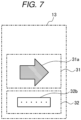
- Fig. 7 is a view illustrating a display example of a case where the positional relationship approaching operation is being executed.
- the display example in Fig. 7 corresponds to a display example in a case where it is determined YES in step S106 and the second notification operation is executed in step S108.
- the lamp 31a in the display area 31 is lit.
- the display area 32 displays a text string 32b indicating that the positional relationship approaching operation is enabled and being executed.
- the execution section 22 when the positional relationship approaching operation is enabled and being executed (that is, when the second control operation is executed), in the second notification operation, the execution section 22 notifies the rider of the information indicating that the positional relationship approaching operation is enabled and being executed by displaying the text string 32b. This allows the rider to recognize that the positional relationship approaching operation is enabled and being executed. In this way, it is possible to prevent the positional relationship approaching operation from being executed in conjunction with the operation of the direction indicator 14 in the state where the rider is unaware of enabling of the positional relationship approaching operation. Thus, it is possible to suppress the rider from feeling uneasy due to the acceleration of the motorcycle 1 by the positional relationship approaching operation.
- step S109 the execution section 22 determines whether a termination condition for the positional relationship approaching operation is satisfied.
- the positional relationship approaching operation is disabled and terminated when the termination condition in step S109 is satisfied. That is, the termination condition in step S109 is a condition for terminating the positional relationship approaching operation.
- the second notification operation is terminated in conjunction with the termination of the positional relationship approaching operation.
- the termination condition of the positional relationship approaching operation is completion of the lane change by the motorcycle 1.
- the execution section 22 can determine the completion of the lane change by the motorcycle 1.
- the acquisition section 21 can acquire the travel position information in the travel road of the motorcycle 1 on the basis of the detection result by the surrounding environment sensor 16, for example.
- the execution section 22 may determine whether to continue the notification operation on the basis of information on the lane change by the motorcycle 1.
- the information on the lane change by the motorcycle 1 can be any of various types of the information on the lane change by the motorcycle 1, and may be information other than the travel position information described above.
- the execution section 22 may determine the completion of the lane change by the motorcycle 1. In this case, information on presence or absence of the detection of the presence of the preceding vehicle 2 corresponds to the information on the lane change by the motorcycle 1.
- the termination condition of the positional relationship approaching operation is that a reference time has elapsed since the initiation of the positional relationship approaching operation.
- the reference time can be set longer than a time assumed to be required for the lane change by the motorcycle 1.
- the completion of the lane change by the motorcycle 1 is assumed in the case where the reference time has elapsed since the initiation of the positional relationship approaching operation.
- the lane change by the motorcycle 1 is not completed when the reference time has elapsed since the initiation of the positional relationship approaching operation.
- the positional relationship approaching operation is terminated.
- the execution section 22 may determine whether to continue the notification operation on the basis of time information.
- the time information may be any of various types of information on time, and may be information other than the information on the elapsed time since the initiation of the positional relationship approaching operation.
- the execution section 22 may determine whether to continue the notification operation on the basis of information on an elapsed time since the acceleration of the motorcycle 1 reaches the requested acceleration for the positional relationship approaching operation.
- the termination condition of the positional relationship approaching operation may be that the enabling condition for the positional relationship approaching operation in step S102 is no longer satisfied.
- the execution section 22 may determine that the termination condition of the positional relationship approaching operation is satisfied. In this case, as will be described below, the positional relationship approaching operation is disabled and terminated.
- the termination condition of the positional relationship approaching operation corresponds to the condition for switching between enabling and disabling of the positional relationship approaching operation.
- the execution section 22 may switch between enabling and disabling of the positional relationship approaching operation on the basis of the information on the lane change by the motorcycle 1 or the time information.
- the termination condition of the positional relationship approaching operation may be other than the above examples.
- the termination condition of the positional relationship approaching operation may include plural types of conditions.
- the termination condition of the positional relationship approaching operation may be that any one of the plural types of the conditions appropriately selected from the above examples is satisfied.
- step S110 the execution section 22 disables the execution of the positional relationship approaching operation and terminates the positional relationship approaching operation, and the processing returns to step S102.
- the processing executed by the controller 20 may be processing that is acquired by modifying the processing example described above.
- the rider in the above example, in the notification operation, the rider is notified of the information indicating that the positional relationship approaching operation is enabled (more specifically, the text string 32a or the text string 32b). That is, in the notification operation, the rider is notified that the positional relationship approaching operation is enabled.
- the execution section 22 may notify the rider that the positional relationship approaching operation is disabled. For example, when the execution of the positional relationship approaching operation is disabled, the execution section 22 may notify the rider information indicating that the positional relationship approaching operation is disabled by displaying a text string indicating that the positional relationship approaching operation is disabled.
- the execution section 22 may notify the rider of both enabling and disabling of the positional relationship approaching operation. That is, in the notification operation, the execution section 22 may notify the rider of at least either of enabling and disabling of the positional relationship approaching operation.
- the execution section 22 may vary at least one of the content and the mode of the notification to the rider in the notification operation according to whether the positional relationship approaching operation is enabled.
- the execution section 22 may display the text string indicating that the positional relationship approaching operation is enabled when the positional relationship approaching operation is enabled, and may display the text string indicating that the positional relationship approaching operation is disabled when the positional relationship approaching operation is disabled.
- the execution section 22 may change a color, a size, brightness, or the like of a displayed object such as the displayed text string between the case where the positional relationship approaching operation is enabled and the case where the positional relationship approaching operation is disabled.
- the execution section 22 may switch between enabling and disabling of the positional relationship approaching operation on the basis of the surrounding environment information of the motorcycle 1, the travel state information of the motorcycle 1, or the time information. That is, the execution section 22 may change at least one of the content and the mode of the notification to the rider in the notification operation on the basis of the surrounding environment information of the motorcycle 1, the travel state information of the motorcycle 1, or the time information.
- the execution section 22 may notify the rider of the mode of the positional relationship approaching operation.
- the execution section 22 may notify the rider of information on a control parameter for the positional relationship approaching operation.
- the control parameters for the positional relationship approaching operation include various parameters used for the control of the positional relationship approaching operation and can include the requested acceleration and the like in the positional relationship approaching operation, for example.
- the information on the control parameter can include a value itself of the control parameter, rough information indicating a magnitude of the value of the control parameter stepwise, or the like.
- the execution section 22 may notify the rider of the mode of the positional relationship approaching operation in the first notification operation.
- the execution section 22 may notify the rider of the mode of the positional relationship approaching operation in the second notification operation.
- the execution section 22 may notify the rider of the mode of the positional relationship approaching operation instead of or in addition to the notification of at least either of enabling and disabling of the positional relationship approaching operation to the rider.
- the first notification operation is executed during the execution of the first control operation
- the second notification operation is executed during the execution of the second control operation. That is, the notification operation is executed during the execution of both of the first control operation and the second control operation.
- the execution section 22 may execute only one of the first notification operation and the second notification operation. That is, the notification operation may be executed during the execution of only one of the first control operation or the second control operation.
- the controller 20 includes the execution section 22 that executes the positional relationship adjustment operation (in the above example, the adaptive cruise control) to control the positional relationship between the motorcycle 1 and the preceding vehicle 2 to the target positional relationship by automatically generating the acceleration or the deceleration to the motorcycle 1.
- the execution section 22 executes: the first control operation for enabling and suspending the execution of the positional relationship approaching operation in which the positional relationship between the motorcycle 1 and the preceding vehicle 2 is controlled to be closer than the target positional relationship; and the second control operation for executing the positional relationship approaching operation when determining that the rider of the motorcycle 1 has the intention to overtake the preceding vehicle 2 while the positional relationship approaching operation is suspended.
- the execution section 22 executes the notification operation for notifying the rider of the information on the positional relationship approaching operation.
- the rider can drive the motorcycle 1 while grasping the information on the positional relationship approaching operation. Therefore, it is possible to improve drivability of the motorcycle 1.
- the execution section 22 of the controller 20 notifies the rider of at least either of enabling and disabling of the positional relationship approaching operation.
- the rider can determine whether the positional relationship approaching operation can be used to overtake the preceding vehicle 2 or the rider himself/herself needs to perform the accelerator operation. Therefore, it is possible to reliably improve the drivability of the motorcycle 1.
- the execution section 22 of the controller 20 notifies the rider of the mode of the positional relationship approaching operation.
- the rider can drive the motorcycle 1 while grasping in which mode the positional relationship approaching operation is executed.
- the rider can determine whether to use the positional relationship approaching operation in consideration of the mode of the positional relationship approaching operation. Therefore, it is possible to reliably improve the drivability of the motorcycle 1.
- the execution section 22 of the controller 20 executes the notification operation.
- the rider can drive the motorcycle 1 while grasping the information on the positional relationship approaching operation (for example, the information on whether the positional relationship approaching operation is enabled and suspended or the mode of the positional relationship approaching operation). Therefore, it is possible to reliably improve the drivability of the motorcycle 1.
- the execution section 22 of the controller 20 executes the notification operation.
- the rider can drive the motorcycle 1 while grasping the information on the positional relationship approaching operation (for example, the information on whether the positional relationship approaching operation is enabled and executed or the mode of the positional relationship approaching operation). Therefore, it is possible to reliably improve the drivability of the motorcycle 1.
- the execution section 22 of the controller 20 determines the presence or the absence of the rider's intention to overtake the preceding vehicle 2 on the basis of the information on the operation of the direction indicator 14 of the motorcycle 1 by the rider. In this way, it is possible to appropriately determine whether the rider has the intention to overtake the preceding vehicle 2.
- the execution section 22 of the controller 20 switches between enabling and disabling of the positional relationship approaching operation on the basis of the surrounding environment information of the motorcycle 1. In this way, it is possible to switch between enabling and disabling of the positional relationship approaching operation after it is determined whether the preceding vehicle 2 can be overtaken safely on the basis of the surrounding environment information of the motorcycle 1.
- the execution section 22 of the controller 20 switches between enabling and disabling of the positional relationship approaching operation on the basis of the travel state information of the motorcycle 1. In this way, it is possible to switch between enabling and disabling of the positional relationship approaching operation after it is determined whether the preceding vehicle 2 can be overtaken safely on the basis of the travel state information of the motorcycle 1.
- the execution section 22 of the controller 20 switches between enabling and disabling of the positional relationship approaching operation on the basis of the time information. In this way, it is possible to switch between enabling and disabling of the positional relationship approaching operation without using the other type of the information such as the surrounding environment information of the motorcycle 1. For example, when the reference time has elapsed since the initiation of the positional relationship approaching operation, the positional relationship approaching operation can be terminated without using the other type of the information such as the surrounding environment information of the motorcycle 1.
- the execution section 22 of the controller 20 changes at least one of the content and the mode of the notification to the rider in the notification operation on the basis of the surrounding environment information of the motorcycle 1.
- the rider can recognize the switching between enabling and disabling of the positional relationship approaching operation.
- the execution section 22 of the controller 20 changes at least one of the content and the mode of the notification to the rider in the notification operation on the basis of the travel state information of the motorcycle 1.
- the rider can recognize the switching between enabling and disabling of the positional relationship approaching operation.
- the execution section 22 of the controller 20 changes at least one of the content and the mode of the notification to the rider in the notification operation on the basis of the time information.
- the rider can recognize the switching between enabling and disabling of the positional relationship approaching operation.
- the execution section 22 of the controller 20 determines whether to continue the notification operation on the basis of the information on the lane change by the motorcycle 1. In this way, when the positional relationship approaching operation is terminated in conjunction with the completion of the lane change by the motorcycle 1, the notification operation can be terminated.
- the execution section 22 of the controller 20 determines whether to continue the notification operation on the basis of the time information. In this way, when the positional relationship approaching operation is terminated in conjunction with the lapse of the time, the notification operation can be terminated.
- the invention is not limited to the embodiment that has been described. For example, only a part of the embodiment may be implemented.
Landscapes
- Engineering & Computer Science (AREA)
- Automation & Control Theory (AREA)
- Transportation (AREA)
- Mechanical Engineering (AREA)
- Human Computer Interaction (AREA)
- Traffic Control Systems (AREA)
- Control Of Driving Devices And Active Controlling Of Vehicle (AREA)
Abstract
Description
- The present disclosure relates to a controller and a control method capable of improving drivability of a motorcycle.
- Conventionally, various techniques for assisting with driving by a motorcycle rider have been proposed. For example, a driver-assistance system is disclosed in
JP2009-116882A - By the way, positional relationship adjustment operation is available as a technique for assisting with driving of a vehicle. In the positional relationship adjustment operation, acceleration or deceleration is automatically generated to an own vehicle, and a positional relationship between the own vehicle and a preceding vehicle is thereby controlled to a target positional relationship. It is considered to apply the positional relationship adjustment operation to the motorcycle. Here, since body behavior of the motorcycle is more unstable and agile than a four-wheeled automobile and the like, it is particularly desired to improve drivability such that the behavior of the motorcycle becomes in line with the rider's intention.
- The invention has been made with the above-described problem as the background and therefore obtains a controller and a control method capable of improving drivability of a motorcycle.
- A controller according to the invention is a controller that controls behavior of a motorcycle, and includes an execution section that executes positional relationship adjustment operation to control a positional relationship between the motorcycle and a preceding vehicle of the motorcycle to a target positional relationship by automatically generating acceleration or deceleration to the motorcycle. During execution of the positional relationship adjustment operation, the execution section executes: first control operation for enabling and suspending execution of positional relationship approaching operation in which the positional relationship between the motorcycle and the preceding vehicle is controlled to be closer than the target positional relationship; and second control operation for executing the positional relationship approaching operation when determining that a rider of the motorcycle has an intention to overtake the preceding vehicle while the positional relationship approaching operation is suspended. During the execution of the positional relationship adjustment operation, the execution section executes notification operation for notifying the rider of information on the positional relationship approaching operation.
- A control method according to the invention is a control method for controlling behavior of a motorcycle, and includes executing positional relationship adjustment operation by an execution section of a controller to control a positional relationship between the motorcycle and a preceding vehicle of the motorcycle to a target positional relationship by automatically generating acceleration or deceleration to the motorcycle. During execution of the positional relationship adjustment operation, the execution section executes: first control operation for enabling and suspending execution of positional relationship approaching operation in which the positional relationship between the motorcycle and the preceding vehicle is controlled to be closer than the target positional relationship; and second control operation for executing the positional relationship approaching operation when determining that a rider of the motorcycle has an intention to overtake the preceding vehicle while the positional relationship approaching operation is suspended. During the execution of the positional relationship adjustment operation, the execution section executes notification operation for notifying the rider of information on the positional relationship approaching operation.
- In the controller and the control method according to the invention, the execution section of the controller executes the positional relationship adjustment operation to control the positional relationship between the motorcycle and the preceding vehicle of the motorcycle to the target positional relationship by automatically generating the acceleration or the deceleration to the motorcycle. During the execution of the positional relationship adjustment operation, the execution section executes: the first control operation for enabling and suspending the execution of the positional relationship approaching operation in which the positional relationship between the motorcycle and the preceding vehicle is controlled to be closer than the target positional relationship; and the second control operation for executing the positional relationship approaching operation when determining that the rider of the motorcycle has the intention to overtake the preceding vehicle while the positional relationship approaching operation is suspended. During the execution of the positional relationship adjustment operation, the execution section executes the notification operation for notifying the rider of the information on the positional relationship approaching operation. In this way, during the execution of the positional relationship adjustment operation, the rider can drive the motorcycle while grasping the information on the positional relationship approaching operation. Therefore, it is possible to improve drivability of the motorcycle.
-
-
Fig. 1 is a schematic view illustrating an outline configuration of a motorcycle according to an embodiment of the invention. -
Fig. 2 is a block diagram illustrating an example of a functional configuration of a controller according to the embodiment of the invention. -
Fig. 3 is a view illustrating a situation where the motorcycle according to the embodiment of the invention and a preceding vehicle are traveling. -
Fig. 4 is a flowchart illustrating an example of a processing procedure that is executed by the controller according to the embodiment of the invention. -
Fig. 5 is a view illustrating a display example of a case where positional relationship approaching operation according to the embodiment of the invention is disabled. -
Fig. 6 is a view illustrating a display example of a case where the positional relationship approaching operation according to the embodiment of the invention is enabled and suspended. -
Fig. 7 is a view illustrating a display example of a case where the positional relationship approaching operation according to the embodiment of the invention is being executed. - A description will hereinafter be made on a controller and a control method according to the invention with reference to the drawings.
- The following description will be made on a controller used for a two-wheeled motorcycle (see a
motorcycle 1 inFig. 1 ). However, a vehicle as a control target by the controller according to the invention may be a motorcycle other than the two-wheeled motorcycle. The motorcycles include a vehicle having an engine as a power source, a vehicle having an electric motor as the power source, and the like. Examples of the motorcycles include a motorbike, a scooter, and an electric scooter. - In addition, the following description will be made on a case where the engine (more specifically, an
engine 11 inFig. 1 , which will be described below) is mounted as a drive source capable of outputting power for driving a drive wheel. However, as the drive source, a drive source other than the engine (for example, the electric motor) may be mounted, or a plurality of drive sources may be mounted. - Furthermore, the following description will be made on a case where a control unit (more specifically, a hydraulic
pressure control unit 12 inFig. 1 , which will be described below) that controls a hydraulic pressure of a brake fluid is employed as a control unit for a braking force generated to a wheel. However, as the control unit for the braking force generated to the wheel, a control unit (a so-called brake-by-wire) that controls a position of a braking section itself for the wheel with an electric signal may be employed. - A configuration, operation, and the like, which will be described below, merely constitute one example. The controller and the control method according to the invention are not limited to a case with such a configuration, such operation, and the like.
- The same or similar description will be simplified appropriately or will not be made below. In the drawings, the same or similar members or portions will not be denoted by a reference sign or will be denoted by the same reference sign. A detailed structure will appropriately be illustrated in a simplified manner or will not be illustrated.
- A description will be made on a configuration of the
motorcycle 1 according to an embodiment of the invention with reference toFig. 1 to Fig. 3 . -
Fig. 1 is a schematic view illustrating an outline configuration of themotorcycle 1. Themotorcycle 1 is a two-wheeled motorcycle that corresponds to an example of the motorcycle according to the invention. As illustrated inFig. 1 , themotorcycle 1 includes theengine 11, the hydraulicpressure control unit 12, adisplay device 13, adirection indicator 14, aninput device 15, a surroundingenvironment sensor 16, a front-wheelrotational frequency sensor 17, a rear-wheelrotational frequency sensor 18, and a controller (ECU) 20. - The
engine 11 corresponds to an example of a drive source for themotorcycle 1 and can output power for driving a drive wheel (more specifically, a rear wheel). For example, theengine 11 is provided with: one or more cylinders, each of which is formed with a combustion chamber therein; a fuel injector that injects fuel into the combustion chamber; and an ignition plug. When the fuel is injected from the fuel injector, air-fuel mixture containing air and the fuel is produced in the combustion chamber, and the air-fuel mixture is then ignited by the ignition plug and burned. Consequently, a piston provided in the cylinder reciprocates to cause a crankshaft to rotate. In addition, a throttle valve is provided to an intake pipe of theengine 11, and an intake air amount to the combustion chamber varies according to a throttle opening amount that is an opening amount of the throttle valve. - The hydraulic
pressure control unit 12 is a unit that has a function of controlling a braking force generated to a wheel. For example, the hydraulicpressure control unit 12 has components (for example, a control valve and a pump) that are provided on an oil channel connecting a master cylinder and a wheel cylinder to control a brake hydraulic pressure in the wheel cylinder. The braking force generated to the wheel is controlled when operation of the components of the hydraulicpressure control unit 12 is controlled. The hydraulicpressure control unit 12 may separately control the braking force generated to a front wheel and the braking force generated to the rear wheel, or may only control the braking force generated to one of the front wheel and the rear wheel. - The
display device 13 has a display function to visually display information to a rider. An example of thedisplay device 13 is a liquid-crystal display. For example, thedisplay device 13 is provided in front of a handlebar in themotorcycle 1. However, arrangement of thedisplay device 13 to a vehicle body is not particularly limited. - The
direction indicator 14 includes pairs of right and left lamps provided to a front portion and a rear portion of themotorcycle 1. Thedirection indicator 14 notifies surrounding vehicles of an advancing direction of themotorcycle 1 when themotorcycle 1 makes a right or left turn or changes a lane. When theleft direction indicator 14 is lit, the surrounding vehicles are notified that themotorcycle 1 soon makes the left turn or moves to a left lane. When theright direction indicator 14 is lit, the surrounding vehicles are notified that themotorcycle 1 soon makes the right turn or moves to a right lane. - The
input device 15 accepts various operations by the rider. For example, theinput device 15 is provided to the handlebar and includes a push button and the like used for the rider's operation. Information on the rider's operation using theinput device 15 is output to thecontroller 20. - The surrounding
environment sensor 16 detects surrounding environment information on surrounding environment of themotorcycle 1. More specifically, the surroundingenvironment sensor 16 is provided to the front portion of themotorcycle 1, and detects the surrounding environment information in front of themotorcycle 1. The surrounding environment information detected by the surroundingenvironment sensor 16 is output to thecontroller 20. - The surrounding environment information detected by the surrounding
environment sensor 16 may be information on a distance to or an orientation of a target object that is located around the motorcycle 1 (for example, a relative position, a relative distance, a relative speed, relative acceleration, or the like), or may be a characteristic of the target object that is located around the motorcycle 1 (for example, a type of the target object, a shape of the target object itself, a mark on the target object, or the like). Examples of the surroundingenvironment sensor 16 include a radar, a Lidar sensor, an ultrasonic sensor, and a camera. - However, the surrounding environment information can also be detected by a surrounding environment sensor mounted to another vehicle or by an infrastructure facility. In other words, the
controller 20 can also acquire the surrounding environment information via wireless communication with the other vehicle or the infrastructure facility. - The front-wheel
rotational frequency sensor 17 is a wheel rotational frequency sensor that detects a rotational frequency of the front wheel (for example, a rotational frequency of the front wheel per unit time [rpm], a travel distance of the front wheel per unit time [km/h], or the like), and outputs a detection result. The front-wheelrotational frequency sensor 17 may detect another physical quantity that can substantially be converted to the rotational frequency of the front wheel. The front-wheelrotational frequency sensor 17 is provided to the front wheel. - The rear-wheel
rotational frequency sensor 18 is a wheel rotational frequency sensor that detects a rotational frequency of the rear wheel (for example, the rotational frequency of the rear wheel per unit time [rpm], a travel distance of the rear wheel per unit time [km/h], or the like), and outputs a detection result. The rear-wheelrotational frequency sensor 18 may detect another physical quantity that can substantially be converted to the rotational frequency of the rear wheel. The rear-wheelrotational frequency sensor 18 is provided to the rear wheel. - The
controller 20 controls behavior of themotorcycle 1. For example, a part or whole of thecontroller 20 is a microcomputer, a microprocessor unit, or the like. Alternatively, the part or the whole of thecontroller 20 may be one whose firmware and the like can be updated, or may be a program module or the like that is executed by a command from a CPU or the like, for example. Thecontroller 20 may be provided as one unit or may be divided into multiple units, for example. - As illustrated in
Fig. 2 , thecontroller 20 includes anacquisition section 21 and anexecution section 22, for example. Thecontroller 20 communicates with each of the devices (for example, theengine 11, the hydraulicpressure control unit 12, thedisplay device 13, thedirection indicator 14, theinput device 15, the surroundingenvironment sensor 16, the front-wheelrotational frequency sensor 17, and the rear-wheel rotational frequency sensor 18) of themotorcycle 1. In addition, thecontroller 20 can control operation of each of the devices (for example, theengine 11, the hydraulicpressure control unit 12, thedisplay device 13, and the direction indicator 14) of themotorcycle 1. - The
acquisition section 21 acquires information from each of the devices in themotorcycle 1, and outputs the acquired information to theexecution section 22. For example, theacquisition section 21 acquires information from theinput device 15, the surroundingenvironment sensor 16, the front-wheelrotational frequency sensor 17, and the rear-wheelrotational frequency sensor 18. In the present specification, the acquisition of the information can include extraction, generation (for example, calculation), and the like of the information. - The
execution section 22 executes various types of control by controlling operation of each of the devices in themotorcycle 1. For example, theexecution section 22 controls operation of theengine 11, the hydraulicpressure control unit 12, thedisplay device 13, and thedirection indicator 14. - In particular, the
execution section 22 can execute positional relationship adjustment operation. The positional relationship adjustment operation is operation to control a positional relationship between themotorcycle 1 and a preceding vehicle of themotorcycle 1 to a target positional relationship by automatically generating acceleration or deceleration to themotorcycle 1. In the positional relationship adjustment operation, theexecution section 22 may control a positional relationship between themotorcycle 1 and a target other than the vehicle (for example, a traffic light or the like) to the target positional relationship. - Hereinafter, a description will be made on an example in which adaptive cruise control is executed as the positional relationship adjustment operation. However, the positional relationship adjustment operation only needs to be operation for controlling the positional relationship between the
motorcycle 1 and the preceding vehicle to the target positional relationship, and may be operation other than the adaptive cruise control. For example, the positional relationship adjustment operation may be operation that is not canceled even with an accelerator operation by the rider and changes the target positional relationship according to an operation amount of the accelerator operation. - The
execution section 22 initiates the adaptive cruise control with the rider's operation using theinput device 15 as a trigger, for example. In the adaptive cruise control, theexecution section 22 automatically controls a speed of themotorcycle 1 without relying on an accelerating/decelerating operation (that is, the accelerator operation and a brake operation) by the rider. Theexecution section 22 can control the speed of themotorcycle 1, for example, on the basis of information on the speed of themotorcycle 1 that is acquired on the basis of the rotational frequency of the front wheel and the rotational frequency of the rear wheel. In speed control for themotorcycle 1, for example, theexecution section 22 can automatically generate the acceleration to themotorcycle 1 by controlling the operation of theengine 11, and can automatically generate the deceleration to themotorcycle 1 by controlling the operation of the hydraulicpressure control unit 12. The adaptive cruise control is canceled when the rider performs a particular operation such as the brake operation. - In the adaptive cruise control, for example, a target inter-vehicle distance is set as a target value of an inter-vehicle distance between the
motorcycle 1 and the preceding vehicle, and theexecution section 22 controls the speed of themotorcycle 1 such that the inter-vehicle distance between themotorcycle 1 and the preceding vehicle is maintained at the target inter-vehicle distance. In other words, such a positional relationship that the inter-vehicle distance between themotorcycle 1 and the preceding vehicle is the target inter-vehicle distance corresponds to the target positional relationship. Here, the inter-vehicle distance may mean a distance in a direction along a lane (more specifically, a travel lane of the motorcycle 1) or may mean a linear distance. For example, theacquisition section 21 acquires the inter-vehicle distance between themotorcycle 1 and the preceding vehicle on the basis of the surrounding environment information of themotorcycle 1. Then, based on the thus-acquired inter-vehicle distance, theexecution section 22 can control the speed of themotorcycle 1 as described above. - However, in the adaptive cruise control, for example, a target passing time difference that is a target value of a passing time difference (more specifically, a time taken for the
motorcycle 1 to pass a current location of the preceding vehicle from a current time point) may be set, and theexecution section 22 may control the speed of themotorcycle 1 such that the passing time difference is maintained to be the target passing time difference. In this case, a positional relationship with which the passing time difference matches the target passing time difference corresponds to the target positional relationship. For example, theacquisition section 21 acquires the passing time difference on the basis of the surrounding environment information of themotorcycle 1. Then, based on the thus-acquired passing time difference, theexecution section 22 can control the speed of themotorcycle 1 as described above. - In addition, the
execution section 22 can execute positional relationship approaching operation during the positional relationship adjustment operation (for example, the adaptive cruise control). The positional relationship approaching operation is operation for controlling the positional relationship between themotorcycle 1 and the preceding vehicle to be closer than the target positional relationship, and is operation to assist the rider in overtaking the preceding vehicle. For example, in the positional relationship approaching operation, theexecution section 22 controls the positional relationship between themotorcycle 1 and the preceding vehicle to be closer than the target positional relationship by increasing the acceleration of themotorcycle 1. - A case where the acceleration has a positive value corresponds to a case where the
motorcycle 1 is being accelerated. A case where the acceleration has a negative value (that is, a case where the deceleration is generated) corresponds to a case where themotorcycle 1 is being decelerated. The increase in the acceleration of themotorcycle 1 includes: a reduction in an absolute value of the deceleration of the currently-deceleratedmotorcycle 1; shifting of themotorcycle 1 from a decelerated state to an accelerated state; and an increase in an absolute value of the acceleration of the currently-acceleratedmotorcycle 1. - However, the positional relationship approaching operation can also include such operation that the positional relationship between the
motorcycle 1 and the preceding vehicle is controlled to be closer than the target positional relationship although the acceleration of themotorcycle 1 is not increased. For example, the following operation can also be included in the positional relationship approaching operation. In a situation where themotorcycle 1 and the preceding vehicle are being decelerated, operation is executed to control the positional relationship between themotorcycle 1 and the preceding vehicle to be closer than the target positional relationship as a result of controlling the absolute value of the deceleration of themotorcycle 1 to be smaller than an absolute value of deceleration of the preceding vehicle. -
Fig. 3 is a view illustrating a situation where themotorcycle 1 and a precedingvehicle 2 are traveling. In an example illustrated inFig. 3 , a lane L1 and a lane L2 are adjacent to each other across a lane boundary LV. Themotorcycle 1 and the precedingvehicle 2 are traveling in the lane L1. The precedingvehicle 2 is located in front of themotorcycle 1. The lane L2 is a passing lane. In the example illustrated inFig. 3 , the precedingvehicle 2 is a positional relationship adjustment target in the positional relationship adjustment operation (for example, the adaptive cruise control). In the example illustrated inFig. 3 , the precedingvehicle 2 is a four-wheeled automobile. However, the positional relationship adjustment target in the positional relationship adjustment operation may be a vehicle other than the four-wheeled automobile (for example, a motorcycle or the like). - In the example illustrated in
Fig. 3 , the positional relationship approaching operation is executed in the case where it is determined that the rider of themotorcycle 1 has the intention to overtake the precedingvehicle 2 in a state where the execution of the positional relationship approaching operation is enabled (that is, a state where the execution of the positional relationship approaching operation is permitted). For example, when thedirection indicator 14 on the passing lane side (theright direction indicator 14 in the example ofFig. 3 ) of themotorcycle 1 is actuated, or the like, it is determined that the rider has the intention to overtake the precedingvehicle 2. Consequently, the positional relationship approaching operation is executed, and the acceleration of themotorcycle 1 is increased. Thus, as indicated by a solid arrow A1, the rider can overtake the precedingvehicle 2. Details of processing for enabling or disabling the positional relationship approaching operation will be described below with reference toFig. 4 and the like. - In the example illustrated in
Fig. 3 , even when the positional relationship approaching operation is executed, depending on a traffic condition in the lane L2, the rider may hesitate to overtake the precedingvehicle 2 and may not overtake the precedingvehicle 2. In this case, for example, as indicated by a broken arrow A2, themotorcycle 1 keeps traveling behind the precedingvehicle 2 and approaches the precedingvehicle 2. In such a case, a deceleration request for returning the positional relationship between themotorcycle 1 and the preceding vehicle to the target positional relationship takes priority over an acceleration request by the positional relationship approaching operation. Thus, the speed of themotorcycle 1 is controlled in response to the deceleration request. As a result, the positional relationship betweenmotorcycle 1 and the preceding vehicle is adjusted back to the target positional relationship, and the positional relationship approaching operation is terminated. - A description will be made on operation of the
controller 20 according to the embodiment of the invention with reference toFig. 4 to Fig. 7 . -
Fig. 4 is a flowchart illustrating an example of a processing procedure that is executed by thecontroller 20. A control flow illustrated inFig. 4 is initiated when the adaptive cruise control is being executed. Step S101 inFig. 4 corresponds to the initiation of the control flow illustrated inFig. 4 . - When the control flow illustrated in
Fig. 4 is initiated, in step S102, theexecution section 22 determines whether an enabling condition for the positional relationship approaching operation is satisfied. - In the adaptive cruise control, the positional relationship approaching operation is switched between being enabled and being disabled. A case where the positional relationship approaching operation is enabled means a state where the execution of the positional relationship approaching operation is enabled (that is, the execution of the positional relationship approaching operation is permitted). A case where the positional relationship approaching operation is disabled means a state where the execution of the positional relationship approaching operation is disabled (that is, the execution of the positional relationship approaching operation is prohibited).
- The enabling condition for the positional relationship approaching operation is that all of the following first, second, third, fourth, and fifth conditions are satisfied, for example.
- The first condition is that the speed of the
motorcycle 1 is higher than a reference speed. For example, the reference speed is set to a speed with which it is possible to determine whether there is no traffic jam in the lane where themotorcycle 1 is traveling and vehicles are advancing smoothly. In the case where the speed of themotorcycle 1 is higher than the reference speed, it is possible to determine that the vehicles are advancing smoothly in the lane where themotorcycle 1 is traveling. Theacquisition section 21 can acquire the speed of themotorcycle 1 on the basis of the rotational frequency of the front wheel and the rotational frequency of the rear wheel, for example. - The second condition is that presence of the preceding vehicle 2 (that is, the positional relationship adjustment target in the adaptive cruise control) has been detected. The
execution section 22 can determine whether the presence of the precedingvehicle 2 has been detected on the basis of the surrounding environment information of themotorcycle 1, for example. Theacquisition section 21 can acquire the surrounding environment information of themotorcycle 1 on the basis of the detection result by the surroundingenvironment sensor 16, for example. - The third condition is that a travel road on which the
motorcycle 1 is traveling has a passing lane (the lane L2 in the example ofFig. 3 ). Theexecution section 22 can determine whether the travel road on which themotorcycle 1 is traveling has the passing lane, for example, on the basis of the surrounding environment information of themotorcycle 1. For example, theexecution section 22 acquires information on travel positions of a plurality of other surrounding vehicles (more specifically, a relative position of each thereof to the motorcycle 1) on the basis of the surrounding environment information of themotorcycle 1. Then, based on this information, theexecution section 22 can determine whether the travel road on which themotorcycle 1 is traveling has a plurality of the lanes. Consequently, when determining that the travel road on which themotorcycle 1 is traveling has the plurality of the lanes, theexecution section 22 can determine that the passing lane is present. - The fourth condition is that the
motorcycle 1 is traveling in the lane that is not the passing lane. Theexecution section 22 can determine whether themotorcycle 1 is traveling in the lane that is not the passing lane, for example, on the basis of the surrounding environment information of themotorcycle 1. For example, theexecution section 22 acquires the information on the travel positions of the plurality of other surrounding vehicles (more specifically, the relative position of each thereof to the motorcycle 1) on the basis of the surrounding environment information of themotorcycle 1. Then, based on this information, theexecution section 22 can determine whether themotorcycle 1 is traveling in the lane that is not the passing lane. - Here, in regard to the third condition and the fourth condition described above, whether the passing lane exists on a right side or a left side among the plurality of the lanes varies by country. Thus, the
execution section 22 has to determine, in advance, whether the passing lane exists on the right side or the left side among the plurality of the lanes. For example, theexecution section 22 acquires information on a surrounding traffic condition on the basis of the surrounding environment information of themotorcycle 1, and can make the above determination on the basis of this information. - The fifth condition is that, in the passing lane, there is no other vehicle whose absolute value of a relative speed to the
motorcycle 1 is smaller than a reference value. For example, the reference value is set to a value with which it is possible to determine whether a collision possibility between themotorcycle 1 and the other vehicle exceeds a predetermined possibility when themotorcycle 1 changes the lane to the passing lane. In the case where there is the other vehicle, whose absolute value of the relative speed to themotorcycle 1 is smaller than the reference value, in the passing lane, it is possible to determine that the collision possibility between themotorcycle 1 and the other vehicle exceeds the predetermined possibility when themotorcycle 1 changes the lane to the passing lane. - The
execution section 22 can determine whether there is the other vehicle, whose absolute value of the relative speed to themotorcycle 1 is smaller than the reference value, in the passing lane, for example, on the basis of the surrounding environment information of themotorcycle 1. For example, when determining that there is no other vehicle in the passing lane on the basis of the surrounding environment information of themotorcycle 1, theexecution section 22 can determine that the fifth condition is satisfied. Meanwhile, for example, when determining that there is the other vehicle in the passing lane on the basis of the surrounding environment information of themotorcycle 1, theexecution section 22 can determine whether the absolute value of the relative speed of the other vehicle to themotorcycle 1 is smaller than the reference value on the basis of the surrounding environment information of themotorcycle 1. - As will be described below, the
execution section 22 switches between enabling and disabling of the positional relationship approaching operation, depending on whether the enabling condition for the positional relationship approaching operation is satisfied. Then, as described above, theexecution section 22 determines whether the enabling condition for the positional relationship approaching operation is satisfied on the basis of various types of the information. That is, theexecution section 22 switches between enabling and disabling of the positional relationship approaching operation on the basis of the various types of the information. - For example, as in the above example, the
execution section 22 may switch between enabling and disabling of the positional relationship approaching operation on the basis of the surrounding environment information of themotorcycle 1. In the above example, theexecution section 22 determines whether the second, third, fourth, and fifth conditions are satisfied on the basis of the surrounding environment information of themotorcycle 1. In this way, the positional relationship approaching operation is switched between being enabled and being disabled on the basis of the surrounding environment information of themotorcycle 1. - Alternatively, for example, the
execution section 22 may switch between enabling and disabling of the positional relationship approaching operation on the basis of the travel state information of themotorcycle 1 as in the above example. The travel state information includes various types of information on a travel state of themotorcycle 1 and can include, for example, the speed, the acceleration, jerk, and the like of themotorcycle 1. In the above example, theexecution section 22 determines whether the first condition is satisfied on the basis of the speed of themotorcycle 1. In this way, the positional relationship approaching operation is switched between being enabled and being disabled on the basis of the travel state information of themotorcycle 1. Here, theacquisition section 21 may estimate the travel state information of themotorcycle 1 on the basis of travel state information of the precedingvehicle 2. For example, theacquisition section 21 may take a speed of the precedingvehicle 2 as the speed of themotorcycle 1. - The above example is merely one example of the enabling condition for the positional relationship approaching operation. The enabling condition for the positional relationship approaching operation may be a condition set by making various modifications to the above example. For example, at least one arbitrary condition of the first, second, third, fourth, and fifth conditions may be eliminated from the above example. Alternatively, an additional condition (for example, a condition that it is possible to determine that the lane change can be made safely on the basis of information sent from a Global Positioning System (GPS) satellite, or the like) may be added to the above example.
- If it is determined that the enabling condition for the positional relationship approaching operation is not satisfied (step S102/NO), the processing proceeds to step S103. In step S103, the
execution section 22 disables the execution of the positional relationship approaching operation, and the processing returns to step S102. - On the other hand, if it is determined that the enabling condition for the positional relationship approaching operation is satisfied (step S102/YES), the processing proceeds to step S104. In step S104, the
execution section 22 enables and suspends the execution of the positional relationship approaching operation. Hereafter, operation for enabling and suspending the execution of the positional relationship approaching operation will be referred to as first control operation. - Following step S104, in step S105, the
execution section 22 executes notification operation for notifying the rider of the information on the positional relationship approaching operation. The notification operation executed in step S105 (that is, notification operation executed during execution of the first control operation) will also be referred to as first notification operation. Notification operation executed in step S108, which will be described below, will also be referred to as second notification operation. Just as described, the notification operation includes the first notification operation and the second notification operation. - Hereinafter, a description will be made on an example in which the
execution section 22 executes the notification operation by using thedisplay device 13 provided to themotorcycle 1. However, the notification in the notification operation is not limited to this example and can be made by any of various other methods. - For example, as in the above example using the
display device 13, the notification in the notification operation may be made by means of display. The notification by display in the notification operation may be made by using thedisplay device 13 mounted to themotorcycle 1, or may be made by using a display device mounted to a worn article (such as a helmet) by the rider. - Alternatively, for example, the notification in the notification operation may be made by sound. The notification by sound in the notification operation may be made by using a sound output device mounted to the
motorcycle 1, or may be made by using a sound output device mounted to the worn article (such as the helmet) by the rider. - Further alternatively, for example, the notification in the notification operation may be made by vibration. The notification by vibration in the notification operation may be made by using a vibration generator mounted to the
motorcycle 1, or may be made by using a vibration generator mounted to the worn article (such as the helmet) by the rider. - Further alternatively, for example, the notification in the notification operation may be made by generating instantaneous deceleration to the
motorcycle 1. In this case, the instantaneous deceleration may be generated by using a control unit for the braking force generated to the wheel (for example, the hydraulic pressure control unit 12), by using the drive source of the motorcycle 1 (for example, the engine 11), or by using a transmission mechanism of themotorcycle 1. - The above description has been made on the examples of the various methods for making the notification in the notification operation. However, the notification in the notification operation may be made by combining any of the plural methods. For example, the notification in the notification operation may be made by display and sound.
- For example, in the first notification operation, the
execution section 22 notifies the rider of information indicating that the positional relationship approaching operation is enabled and suspended. -
Fig. 5 is a view illustrating a display example of a case where the positional relationship approaching operation is disabled. The display example inFig. 5 corresponds to a display example in a case where it is determined NO in step S102 and the positional relationship approaching operation is disabled in step S103. - In
Fig. 5 , only a part of thedisplay device 13 is extracted. As illustrated inFig. 5 , thedisplay device 13 has adisplay area 31 displaying an actuation state of thedirection indicator 14 on the passing lane side of the motorcycle 1 (theright direction indicator 14 in the example ofFig. 5 ) and adisplay area 32 capable of displaying a text string. Thedisplay area 31 has alamp 31a that is lit when thedirection indicator 14 on the passing lane side is actuated. - In the display example of
Fig. 5 , since thedirection indicator 14 on the passing lane side is not actuated, thelamp 31a in thedisplay area 31 is unlit. In addition, no text string is displayed in thedisplay area 32. -
Fig. 6 is a view illustrating a display example of a case where the positional relationship approaching operation is enabled and suspended. The display example inFig. 6 corresponds to a display example in a case where it is determined YES in step S102 and the first notification operation is executed in step S105. - In the display example of
Fig. 6 , since thedirection indicator 14 on the passing lane side is not actuated as in the display example ofFig. 5 , thelamp 31a in thedisplay area 31 is unlit. Meanwhile, thedisplay area 32 displays atext string 32a indicating that the positional relationship approaching operation is enabled and suspended. - In the above example, when the positional relationship approaching operation is enabled and suspended (that is, when the first control operation is executed), in the first notification operation, the
execution section 22 notifies the rider of the information indicating that the positional relationship approaching operation is enabled and suspended by displaying thetext string 32a. This allows the rider to recognize that the positional relationship approaching operation is enabled and suspended. On the other hand, when the positional relationship approaching operation is disabled, thetext string 32a is not displayed, and the rider can thereby recognize that the positional relationship approaching operation is disabled. - In this way, it is possible to prevent the positional relationship approaching operation from being executed in conjunction with the operation of the
direction indicator 14 in a state where the rider does not recognize that the positional relationship approaching operation is enabled. Thus, it is possible to suppress the rider from feeling uneasy due to the acceleration of themotorcycle 1 by the positional relationship approaching operation. In addition, when the rider desires to overtake the precedingvehicle 2, the rider can determine whether the positional relationship approaching operation can be used to overtake the precedingvehicle 2 or the rider himself/herself needs to perform the accelerator operation. - Following step S105 in
Fig. 4 , in step S106, theexecution section 22 determines whether thedirection indicator 14 on the passing lane side of the motorcycle 1 (theright direction indicator 14 in the example ofFig. 3 ) has been actuated. - The
execution section 22 can determine whether the rider of themotorcycle 1 has the intention to overtake the precedingvehicle 2 on the basis of whether thedirection indicator 14 on the passing lane side of themotorcycle 1 has been actuated. More specifically, in the case where thedirection indicator 14 on the passing lane side is actuated, theexecution section 22 determines that the rider has the intention to overtake the precedingvehicle 2. On the other hand, in the case where thedirection indicator 14 on the passing lane side is not actuated, theexecution section 22 determines that the rider has no intention to overtake the precedingvehicle 2. - The
execution section 22 determines whether thedirection indicator 14 on the passing lane side has been actuated on the basis of information on the operation of thedirection indicator 14 by the rider. In this way, theexecution section 22 can determine whether the rider has the intention to overtake the precedingvehicle 2. That is, theexecution section 22 can determine presence or absence of the intention on the basis of the information on the operation of thedirection indicator 14 by the rider. - Here, the
execution section 22 may determine whether the rider has the intention to overtake the precedingvehicle 2 by a method other than the above. For example, theexecution section 22 may determine whether the rider has the intention to overtake the precedingvehicle 2 on the basis of information on the rider's behavior (for example, behavior of a line of sight, or the like). - If it is determined that the
direction indicator 14 on the passing lane side has not been actuated (step S106/NO), the processing returns to step S102. On the other hand, if it is determined that thedirection indicator 14 on the passing lane side has been actuated (step S106/YES), the processing proceeds to step S107. If it is determined YES in step S106, the first notification operation is terminated. - If it is determined YES in step S106, in step S107, the
execution section 22 executes the positional relationship approaching operation. Hereafter, operation for executing the positional relationship approaching operation will also be referred to as second control operation. - As described above, the positional relationship approaching operation is the operation for controlling the positional relationship between the
motorcycle 1 and the precedingvehicle 2 to be closer than the target positional relationship and thereby assisting the rider in overtaking the precedingvehicle 2. For example, in the positional relationship approaching operation, theexecution section 22 controls the positional relationship between themotorcycle 1 and the precedingvehicle 2 to be closer than the target positional relationship by increasing the acceleration of themotorcycle 1. - For example, in the positional relationship approaching operation, the
execution section 22 controls theengine 11 such that requested acceleration is generated to themotorcycle 1. The requested acceleration in the positional relationship approaching operation is basically a set value that is set in advance. However, in the case where the speed of themotorcycle 1 falls within a range near the reference speed in the first condition of the enabling condition for the positional relationship approaching operation described above, theexecution section 22 may reduce the requested acceleration in the positional relationship approaching operation to be lower than the set value. - Following step S107, in step S108, the
execution section 22 executes the notification operation for notifying the rider of the information on the positional relationship approaching operation. The notification operation executed in step S108 (that is, the notification operation executed during execution of the second control operation) will also be referred to as second notification operation. - Hereinafter, a description will be made on an example in which the
execution section 22 executes the second notification operation by using thedisplay device 13 provided to themotorcycle 1. However, as described above, the second notification operation may be executed by another method. - For example, in the second notification operation, the
execution section 22 notifies the rider of information indicating that the positional relationship approaching operation is enabled and being executed. -
Fig. 7 is a view illustrating a display example of a case where the positional relationship approaching operation is being executed. The display example inFig. 7 corresponds to a display example in a case where it is determined YES in step S106 and the second notification operation is executed in step S108. - In the display example of
Fig. 7 , since thedirection indicator 14 on the passing lane side is actuated, thelamp 31a in thedisplay area 31 is lit. In addition, thedisplay area 32 displays atext string 32b indicating that the positional relationship approaching operation is enabled and being executed. - In the above example, when the positional relationship approaching operation is enabled and being executed (that is, when the second control operation is executed), in the second notification operation, the
execution section 22 notifies the rider of the information indicating that the positional relationship approaching operation is enabled and being executed by displaying thetext string 32b. This allows the rider to recognize that the positional relationship approaching operation is enabled and being executed. In this way, it is possible to prevent the positional relationship approaching operation from being executed in conjunction with the operation of thedirection indicator 14 in the state where the rider is unaware of enabling of the positional relationship approaching operation. Thus, it is possible to suppress the rider from feeling uneasy due to the acceleration of themotorcycle 1 by the positional relationship approaching operation. - After step S108 in
Fig. 4 , in step S109, theexecution section 22 determines whether a termination condition for the positional relationship approaching operation is satisfied. - As will be described below, the positional relationship approaching operation is disabled and terminated when the termination condition in step S109 is satisfied. That is, the termination condition in step S109 is a condition for terminating the positional relationship approaching operation. When the termination condition in step S109 is satisfied, the second notification operation is terminated in conjunction with the termination of the positional relationship approaching operation.
- For example, the termination condition of the positional relationship approaching operation is completion of the lane change by the
motorcycle 1. For example, when determining that themotorcycle 1 has completed moving into the passing lane on the basis of travel position information in the travel road of themotorcycle 1, theexecution section 22 can determine the completion of the lane change by themotorcycle 1. Here, theacquisition section 21 can acquire the travel position information in the travel road of themotorcycle 1 on the basis of the detection result by the surroundingenvironment sensor 16, for example. - When the positional relationship approaching operation is terminated in conjunction with the completion of the lane change by the
motorcycle 1, the second notification operation is terminated. Just as described, theexecution section 22 may determine whether to continue the notification operation on the basis of information on the lane change by themotorcycle 1. However, the information on the lane change by themotorcycle 1 can be any of various types of the information on the lane change by themotorcycle 1, and may be information other than the travel position information described above. For example, when the presence of the precedingvehicle 2 is no longer detected, theexecution section 22 may determine the completion of the lane change by themotorcycle 1. In this case, information on presence or absence of the detection of the presence of the precedingvehicle 2 corresponds to the information on the lane change by themotorcycle 1. - Alternatively, for example, the termination condition of the positional relationship approaching operation is that a reference time has elapsed since the initiation of the positional relationship approaching operation. For example, the reference time can be set longer than a time assumed to be required for the lane change by the
motorcycle 1. The completion of the lane change by themotorcycle 1 is assumed in the case where the reference time has elapsed since the initiation of the positional relationship approaching operation. Here, as indicated by the broken arrow A2 inFig. 3 , in the case where the rider hesitates to overtake the precedingvehicle 2 and does not overtake the precedingvehicle 2, the lane change by themotorcycle 1 is not completed when the reference time has elapsed since the initiation of the positional relationship approaching operation. However, the positional relationship approaching operation is terminated. - When the positional relationship approaching operation is terminated with the lapse of the time, the second notification operation is terminated. Just as described, the
execution section 22 may determine whether to continue the notification operation on the basis of time information. However, the time information may be any of various types of information on time, and may be information other than the information on the elapsed time since the initiation of the positional relationship approaching operation. For example, theexecution section 22 may determine whether to continue the notification operation on the basis of information on an elapsed time since the acceleration of themotorcycle 1 reaches the requested acceleration for the positional relationship approaching operation. - Here, the termination condition of the positional relationship approaching operation may be that the enabling condition for the positional relationship approaching operation in step S102 is no longer satisfied. For example, when any one of the first, second, third, fourth, and fifth conditions included in the enabling condition for the positional relationship approaching operation in step S102 is no longer satisfied, the
execution section 22 may determine that the termination condition of the positional relationship approaching operation is satisfied. In this case, as will be described below, the positional relationship approaching operation is disabled and terminated. Just as described, similar to the enabling condition for the positional relationship approaching operation in step S102, the termination condition of the positional relationship approaching operation corresponds to the condition for switching between enabling and disabling of the positional relationship approaching operation. Thus, for example, it can be said that theexecution section 22 may switch between enabling and disabling of the positional relationship approaching operation on the basis of the information on the lane change by themotorcycle 1 or the time information. - The above description has been made on the examples of the termination condition of the positional relationship approaching operation. However, the termination condition of the positional relationship approaching operation may be other than the above examples. In addition, the termination condition of the positional relationship approaching operation may include plural types of conditions. For example, the termination condition of the positional relationship approaching operation may be that any one of the plural types of the conditions appropriately selected from the above examples is satisfied.
- Following step S109, in step S110, the
execution section 22 disables the execution of the positional relationship approaching operation and terminates the positional relationship approaching operation, and the processing returns to step S102. - The above description has been made on the processing example executed by the
controller 20 with reference to the flowchart inFig. 4 . However, the processing executed by thecontroller 20 may be processing that is acquired by modifying the processing example described above. - For example, in the above example, in the notification operation, the rider is notified of the information indicating that the positional relationship approaching operation is enabled (more specifically, the
text string 32a or thetext string 32b). That is, in the notification operation, the rider is notified that the positional relationship approaching operation is enabled. However, in the notification operation, theexecution section 22 may notify the rider that the positional relationship approaching operation is disabled. For example, when the execution of the positional relationship approaching operation is disabled, theexecution section 22 may notify the rider information indicating that the positional relationship approaching operation is disabled by displaying a text string indicating that the positional relationship approaching operation is disabled. Alternatively, in the notification operation, theexecution section 22 may notify the rider of both enabling and disabling of the positional relationship approaching operation. That is, in the notification operation, theexecution section 22 may notify the rider of at least either of enabling and disabling of the positional relationship approaching operation. - In the above example, whether the notification operation is executed varies according to whether the positional relationship approaching operation is enabled. However, the
execution section 22 may vary at least one of the content and the mode of the notification to the rider in the notification operation according to whether the positional relationship approaching operation is enabled. For example, theexecution section 22 may display the text string indicating that the positional relationship approaching operation is enabled when the positional relationship approaching operation is enabled, and may display the text string indicating that the positional relationship approaching operation is disabled when the positional relationship approaching operation is disabled. Alternatively, for example, theexecution section 22 may change a color, a size, brightness, or the like of a displayed object such as the displayed text string between the case where the positional relationship approaching operation is enabled and the case where the positional relationship approaching operation is disabled. - Here, as described above, the
execution section 22 may switch between enabling and disabling of the positional relationship approaching operation on the basis of the surrounding environment information of themotorcycle 1, the travel state information of themotorcycle 1, or the time information. That is, theexecution section 22 may change at least one of the content and the mode of the notification to the rider in the notification operation on the basis of the surrounding environment information of themotorcycle 1, the travel state information of themotorcycle 1, or the time information. - Furthermore, for example, in the notification operation, the
execution section 22 may notify the rider of the mode of the positional relationship approaching operation. For example, as the mode of the positional relationship approaching operation, theexecution section 22 may notify the rider of information on a control parameter for the positional relationship approaching operation. The control parameters for the positional relationship approaching operation include various parameters used for the control of the positional relationship approaching operation and can include the requested acceleration and the like in the positional relationship approaching operation, for example. The information on the control parameter can include a value itself of the control parameter, rough information indicating a magnitude of the value of the control parameter stepwise, or the like. - For example, during the execution of the first control operation, the
execution section 22 may notify the rider of the mode of the positional relationship approaching operation in the first notification operation. For example, during the execution of the second control operation, theexecution section 22 may notify the rider of the mode of the positional relationship approaching operation in the second notification operation. In the notification operation, theexecution section 22 may notify the rider of the mode of the positional relationship approaching operation instead of or in addition to the notification of at least either of enabling and disabling of the positional relationship approaching operation to the rider. - In the above example, the first notification operation is executed during the execution of the first control operation, and the second notification operation is executed during the execution of the second control operation. That is, the notification operation is executed during the execution of both of the first control operation and the second control operation. However, the
execution section 22 may execute only one of the first notification operation and the second notification operation. That is, the notification operation may be executed during the execution of only one of the first control operation or the second control operation. - A case where the adaptive cruise control is canceled during the execution of the control flow illustrated in
Fig. 4 is not described above. In the case where the adaptive cruise control is canceled during the execution of the control flow illustrated inFig. 4 , the control flow illustrated inFig. 4 is terminated in conjunction with cancellation of the adaptive cruise control. Here, in the case where the adaptive cruise control is canceled in the situation where the notification operation is executed, theexecution section 22 terminates the notification operation. - A description will be made on effects of the
controller 20 according to the embodiment of the invention. - The
controller 20 includes theexecution section 22 that executes the positional relationship adjustment operation (in the above example, the adaptive cruise control) to control the positional relationship between themotorcycle 1 and the precedingvehicle 2 to the target positional relationship by automatically generating the acceleration or the deceleration to themotorcycle 1. During the execution of the positional relationship adjustment operation, theexecution section 22 executes: the first control operation for enabling and suspending the execution of the positional relationship approaching operation in which the positional relationship between themotorcycle 1 and the precedingvehicle 2 is controlled to be closer than the target positional relationship; and the second control operation for executing the positional relationship approaching operation when determining that the rider of themotorcycle 1 has the intention to overtake the precedingvehicle 2 while the positional relationship approaching operation is suspended. Then, during the execution of the positional relationship adjustment operation, theexecution section 22 executes the notification operation for notifying the rider of the information on the positional relationship approaching operation. In this way, during the execution of the positional relationship adjustment operation, the rider can drive themotorcycle 1 while grasping the information on the positional relationship approaching operation. Therefore, it is possible to improve drivability of themotorcycle 1. - Preferably, in the notification operation, the
execution section 22 of thecontroller 20 notifies the rider of at least either of enabling and disabling of the positional relationship approaching operation. In this way, it is possible to prevent the positional relationship approaching operation from being executed in the state where the rider is unaware of enabling of the positional relationship approaching operation. Thus, it is possible to suppress the rider from feeling uneasy due to the acceleration of themotorcycle 1 by the positional relationship approaching operation. In addition, when the rider desires to overtake the precedingvehicle 2, the rider can determine whether the positional relationship approaching operation can be used to overtake the precedingvehicle 2 or the rider himself/herself needs to perform the accelerator operation. Therefore, it is possible to reliably improve the drivability of themotorcycle 1. - Preferably, in the notification operation, the
execution section 22 of thecontroller 20 notifies the rider of the mode of the positional relationship approaching operation. In this way, the rider can drive themotorcycle 1 while grasping in which mode the positional relationship approaching operation is executed. Thus, it is possible to suppress the rider from feeling uneasy due to the acceleration of themotorcycle 1 by the positional relationship approaching operation. In addition, when the rider desires to overtake the precedingvehicle 2, the rider can determine whether to use the positional relationship approaching operation in consideration of the mode of the positional relationship approaching operation. Therefore, it is possible to reliably improve the drivability of themotorcycle 1. - Preferably, during the execution of the first control operation, the
execution section 22 of thecontroller 20 executes the notification operation. In this way, during the execution of the first control operation, which is executed before the positional relationship approaching operation, the rider can drive themotorcycle 1 while grasping the information on the positional relationship approaching operation (for example, the information on whether the positional relationship approaching operation is enabled and suspended or the mode of the positional relationship approaching operation). Therefore, it is possible to reliably improve the drivability of themotorcycle 1. - Preferably, during the execution of the second control operation, the
execution section 22 of thecontroller 20 executes the notification operation. In this way, during the execution of the second control operation, which is executed during the execution of the positional relationship approaching operation, the rider can drive themotorcycle 1 while grasping the information on the positional relationship approaching operation (for example, the information on whether the positional relationship approaching operation is enabled and executed or the mode of the positional relationship approaching operation). Therefore, it is possible to reliably improve the drivability of themotorcycle 1. - Preferably, the
execution section 22 of thecontroller 20 determines the presence or the absence of the rider's intention to overtake the precedingvehicle 2 on the basis of the information on the operation of thedirection indicator 14 of themotorcycle 1 by the rider. In this way, it is possible to appropriately determine whether the rider has the intention to overtake the precedingvehicle 2. - Preferably, the
execution section 22 of thecontroller 20 switches between enabling and disabling of the positional relationship approaching operation on the basis of the surrounding environment information of themotorcycle 1. In this way, it is possible to switch between enabling and disabling of the positional relationship approaching operation after it is determined whether the precedingvehicle 2 can be overtaken safely on the basis of the surrounding environment information of themotorcycle 1. - Preferably, the
execution section 22 of thecontroller 20 switches between enabling and disabling of the positional relationship approaching operation on the basis of the travel state information of themotorcycle 1. In this way, it is possible to switch between enabling and disabling of the positional relationship approaching operation after it is determined whether the precedingvehicle 2 can be overtaken safely on the basis of the travel state information of themotorcycle 1. - Preferably, the
execution section 22 of thecontroller 20 switches between enabling and disabling of the positional relationship approaching operation on the basis of the time information. In this way, it is possible to switch between enabling and disabling of the positional relationship approaching operation without using the other type of the information such as the surrounding environment information of themotorcycle 1. For example, when the reference time has elapsed since the initiation of the positional relationship approaching operation, the positional relationship approaching operation can be terminated without using the other type of the information such as the surrounding environment information of themotorcycle 1. - Preferably, the
execution section 22 of thecontroller 20 changes at least one of the content and the mode of the notification to the rider in the notification operation on the basis of the surrounding environment information of themotorcycle 1. In this way, when the positional relationship approaching operation is switched between being enabled and being disabled on the basis of the surrounding environment information of themotorcycle 1, the rider can recognize the switching between enabling and disabling of the positional relationship approaching operation. - Preferably, the
execution section 22 of thecontroller 20 changes at least one of the content and the mode of the notification to the rider in the notification operation on the basis of the travel state information of themotorcycle 1. In this way, when the positional relationship approaching operation is switched between being enabled and being disabled on the basis of the travel state information of themotorcycle 1, the rider can recognize the switching between enabling and disabling of the positional relationship approaching operation. - Preferably, the
execution section 22 of thecontroller 20 changes at least one of the content and the mode of the notification to the rider in the notification operation on the basis of the time information. In this way, when the positional relationship approaching operation is switched between being enabled and being disabled on the basis of the time information, the rider can recognize the switching between enabling and disabling of the positional relationship approaching operation. - Preferably, the
execution section 22 of thecontroller 20 determines whether to continue the notification operation on the basis of the information on the lane change by themotorcycle 1. In this way, when the positional relationship approaching operation is terminated in conjunction with the completion of the lane change by themotorcycle 1, the notification operation can be terminated. - Preferably, the
execution section 22 of thecontroller 20 determines whether to continue the notification operation on the basis of the time information. In this way, when the positional relationship approaching operation is terminated in conjunction with the lapse of the time, the notification operation can be terminated. - The invention is not limited to the embodiment that has been described. For example, only a part of the embodiment may be implemented.
Claims (15)
- A controller (20) that controls behavior of a motorcycle (1), the controller comprising:an execution section (22) that executes positional relationship adjustment operation to control a positional relationship between the motorcycle (1) and a preceding vehicle (2) of the motorcycle (1) to a target positional relationship by automatically generating acceleration or deceleration to the motorcycle (1), whereinduring execution of the positional relationship adjustment operation, the execution section (22) executes:first control operation for enabling and suspending execution of positional relationship approaching operation in which the positional relationship between the motorcycle (1) and the preceding vehicle (2) is controlled to be closer than the target positional relationship; andsecond control operation for executing the positional relationship approaching operation when determining that a rider of the motorcycle (1) has an intention to overtake the preceding vehicle (2) while the positional relationship approaching operation is suspended, andduring the execution of the positional relationship adjustment operation, the execution section (22) executes notification operation for notifying the rider of information on the positional relationship approaching operation.
- The controller according to claim 1, wherein
in the notification operation, the execution section (22) notifies the rider of at least either of enabling and disabling of the positional relationship approaching operation. - The controller according to claim 1, wherein
in the notification operation, the execution section (22) notifies the rider of a mode of the positional relationship approaching operation. - The controller according to any one of claims 1 to 3, wherein
during execution of the first control operation, the execution section (22) executes the notification operation. - The controller according to any one of claims 1 to 3, wherein
during execution of the second control operation, the execution section (22) executes the notification operation. - The controller according to any one of claims 1 to 3, wherein
the execution section (22) determines presence or absence of the intention on the basis of information on an operation of a direction indicator (14) of the motorcycle (1) by the rider. - The controller according to any one of claims 1 to 3, wherein
the execution section (22) switches between enabling and disabling of the positional relationship approaching operation on the basis of surrounding environment information of the motorcycle (1). - The controller according to any one of claims 1 to 3, wherein
the execution section (22) switches between enabling and disabling of the positional relationship approaching operation on the basis of travel state information of the motorcycle (1). - The controller according to any one of claims 1 to 3, wherein
the execution section (22) switches between enabling and disabling of the positional relationship approaching operation on the basis of time information. - The controller according to any one of claims 1 to 3, wherein
the execution section (22) changes at least one of a content and a mode of notification to the rider in the notification operation on the basis of surrounding environment information of the motorcycle (1). - The controller according to any one of claims 1 to 3, wherein
the execution section (22) changes at least one of a content and a mode of notification to the rider in the notification operation on the basis of travel state information of the motorcycle (1). - The controller according to any one of claims 1 to 3, wherein
the execution section (22) changes at least one of a content and a mode of notification to the rider in the notification operation on the basis of time information. - The controller according to any one of claims 1 to 3, wherein
the execution section (22) determines whether to continue the notification operation on the basis of information on a lane change by the motorcycle (1). - The controller according to any one of claims 1 to 3, wherein
the execution section (22) determines whether to continue the notification operation on the basis of time information. - A control method for controlling behavior of a motorcycle (1), the control method comprising:executing positional relationship adjustment operation by an execution section (22) of a controller (20) to control a positional relationship between the motorcycle (1) and a preceding vehicle (2) of the motorcycle (1) to a target positional relationship by automatically generating acceleration or deceleration to the motorcycle (1), whereinduring execution of the positional relationship adjustment operation, the execution section (22) executes:first control operation for enabling and suspending execution of positional relationship approaching operation in which the positional relationship between the motorcycle (1) and the preceding vehicle (2) is controlled to be closer than the target positional relationship; andsecond control operation for executing the positional relationship approaching operation when determining that a rider of the motorcycle (1) has an intention to overtake the preceding vehicle while the positional relationship approaching operation is suspended, andduring the execution of the positional relationship adjustment operation, the execution section (22) executes notification operation for notifying the rider of information on the positional relationship approaching operation.
Applications Claiming Priority (1)
| Application Number | Priority Date | Filing Date | Title |
|---|---|---|---|
| JP2023071778A JP2024157419A (en) | 2023-04-25 | 2023-04-25 | Control device and control method |
Publications (2)
| Publication Number | Publication Date |
|---|---|
| EP4454965A1 true EP4454965A1 (en) | 2024-10-30 |
| EP4454965B1 EP4454965B1 (en) | 2026-01-28 |
Family
ID=90826402
Family Applications (1)
| Application Number | Title | Priority Date | Filing Date |
|---|---|---|---|
| EP24171659.6A Active EP4454965B1 (en) | 2023-04-25 | 2024-04-22 | Controller and control method |
Country Status (2)
| Country | Link |
|---|---|
| EP (1) | EP4454965B1 (en) |
| JP (1) | JP2024157419A (en) |
Citations (8)
| Publication number | Priority date | Publication date | Assignee | Title |
|---|---|---|---|---|
| JP2009116882A (en) | 2007-11-08 | 2009-05-28 | Robert Bosch Gmbh | Driver assistance system for motorcycles |
| US20110196592A1 (en) * | 2010-01-14 | 2011-08-11 | Ford Global Technologies, Llc | Method and device for assisting a lane change of a vehicle |
| DE102010041620A1 (en) * | 2010-09-29 | 2012-03-29 | Ford Global Technologies, Llc | Method and device for assisting a driver in an overtaking process |
| US20180126990A1 (en) * | 2016-11-07 | 2018-05-10 | Honda Motor Co., Ltd | Vehicle control system, vehicle control method, and vehicle control program |
| US20180178713A1 (en) * | 2016-12-26 | 2018-06-28 | Toyota Jidosha Kabushiki Kaisha | Lane change assist device for a vehicle |
| US20180345991A1 (en) * | 2017-06-02 | 2018-12-06 | Honda Motor Co., Ltd. | Vehicle control system, vehicle control method, and storage medium |
| US20190299855A1 (en) * | 2018-03-29 | 2019-10-03 | Honda Motor Co., Ltd. | Vehicle proximity system using heads-up display augmented reality graphics elements |
| EP3950449A1 (en) * | 2019-03-29 | 2022-02-09 | Robert Bosch GmbH | Control device for controlling operation of motorcycle, and control method |
-
2023
- 2023-04-25 JP JP2023071778A patent/JP2024157419A/en active Pending
-
2024
- 2024-04-22 EP EP24171659.6A patent/EP4454965B1/en active Active
Patent Citations (8)
| Publication number | Priority date | Publication date | Assignee | Title |
|---|---|---|---|---|
| JP2009116882A (en) | 2007-11-08 | 2009-05-28 | Robert Bosch Gmbh | Driver assistance system for motorcycles |
| US20110196592A1 (en) * | 2010-01-14 | 2011-08-11 | Ford Global Technologies, Llc | Method and device for assisting a lane change of a vehicle |
| DE102010041620A1 (en) * | 2010-09-29 | 2012-03-29 | Ford Global Technologies, Llc | Method and device for assisting a driver in an overtaking process |
| US20180126990A1 (en) * | 2016-11-07 | 2018-05-10 | Honda Motor Co., Ltd | Vehicle control system, vehicle control method, and vehicle control program |
| US20180178713A1 (en) * | 2016-12-26 | 2018-06-28 | Toyota Jidosha Kabushiki Kaisha | Lane change assist device for a vehicle |
| US20180345991A1 (en) * | 2017-06-02 | 2018-12-06 | Honda Motor Co., Ltd. | Vehicle control system, vehicle control method, and storage medium |
| US20190299855A1 (en) * | 2018-03-29 | 2019-10-03 | Honda Motor Co., Ltd. | Vehicle proximity system using heads-up display augmented reality graphics elements |
| EP3950449A1 (en) * | 2019-03-29 | 2022-02-09 | Robert Bosch GmbH | Control device for controlling operation of motorcycle, and control method |
Also Published As
| Publication number | Publication date |
|---|---|
| JP2024157419A (en) | 2024-11-07 |
| EP4454965B1 (en) | 2026-01-28 |
Similar Documents
| Publication | Publication Date | Title |
|---|---|---|
| EP4082859B1 (en) | Control device and control method | |
| JP2021127099A (en) | Control device and control method | |
| JP2020121575A (en) | Vehicle driving support device | |
| EP4292897B1 (en) | Controller and control method | |
| WO2021099931A1 (en) | Control system, controller, and control method | |
| US12539931B2 (en) | Controller and control method | |
| US12606163B2 (en) | Controller and control method | |
| EP4454965B1 (en) | Controller and control method | |
| US20250214584A1 (en) | Controller and control method | |
| EP4647311A1 (en) | Control device and control method | |
| US20250242810A1 (en) | Controller and control method for saddled vehicle | |
| JP2022122300A (en) | Control device and control method | |
| EP4647309A1 (en) | Control device and control method | |
| JP7592455B2 (en) | Control device and control method | |
| EP4597471A1 (en) | Control device and control method | |
| EP4467407A1 (en) | Controller and control method | |
| EP4654168A1 (en) | Control device and control method | |
| WO2025233710A1 (en) | Control device and control method | |
| WO2025210414A1 (en) | Processing device and processing method | |
| JP2023094711A (en) | Straddle-type vehicle control device and control method | |
| WO2025181922A1 (en) | Driving assistance system for saddle-riding type vehicle | |
| JP2026026843A (en) | Control device and control method |
Legal Events
| Date | Code | Title | Description |
|---|---|---|---|
| PUAI | Public reference made under article 153(3) epc to a published international application that has entered the european phase |
Free format text: ORIGINAL CODE: 0009012 |
|
| STAA | Information on the status of an ep patent application or granted ep patent |
Free format text: STATUS: THE APPLICATION HAS BEEN PUBLISHED |
|
| AK | Designated contracting states |
Kind code of ref document: A1 Designated state(s): AL AT BE BG CH CY CZ DE DK EE ES FI FR GB GR HR HU IE IS IT LI LT LU LV MC ME MK MT NL NO PL PT RO RS SE SI SK SM TR |
|
| STAA | Information on the status of an ep patent application or granted ep patent |
Free format text: STATUS: REQUEST FOR EXAMINATION WAS MADE |
|
| 17P | Request for examination filed |
Effective date: 20250430 |
|
| GRAP | Despatch of communication of intention to grant a patent |
Free format text: ORIGINAL CODE: EPIDOSNIGR1 |
|
| STAA | Information on the status of an ep patent application or granted ep patent |
Free format text: STATUS: GRANT OF PATENT IS INTENDED |
|
| INTG | Intention to grant announced |
Effective date: 20251014 |
|
| GRAS | Grant fee paid |
Free format text: ORIGINAL CODE: EPIDOSNIGR3 |
|
| GRAA | (expected) grant |
Free format text: ORIGINAL CODE: 0009210 |
|
| STAA | Information on the status of an ep patent application or granted ep patent |
Free format text: STATUS: THE PATENT HAS BEEN GRANTED |
|
| AK | Designated contracting states |
Kind code of ref document: B1 Designated state(s): AL AT BE BG CH CY CZ DE DK EE ES FI FR GB GR HR HU IE IS IT LI LT LU LV MC ME MK MT NL NO PL PT RO RS SE SI SK SM TR |
|
| REG | Reference to a national code |
Ref country code: CH Ref legal event code: F10 Free format text: ST27 STATUS EVENT CODE: U-0-0-F10-F00 (AS PROVIDED BY THE NATIONAL OFFICE) Effective date: 20260128 Ref country code: GB Ref legal event code: FG4D |
|
| REG | Reference to a national code |
Ref country code: DE Ref legal event code: R096 Ref document number: 602024002254 Country of ref document: DE |
|
| REG | Reference to a national code |
Ref country code: IE Ref legal event code: FG4D |