EP4454930A1 - Power supply system for electric vehicle or drone device - Google Patents
Power supply system for electric vehicle or drone device Download PDFInfo
- Publication number
- EP4454930A1 EP4454930A1 EP22911359.2A EP22911359A EP4454930A1 EP 4454930 A1 EP4454930 A1 EP 4454930A1 EP 22911359 A EP22911359 A EP 22911359A EP 4454930 A1 EP4454930 A1 EP 4454930A1
- Authority
- EP
- European Patent Office
- Prior art keywords
- group
- power supply
- atom
- battery
- metal
- Prior art date
- Legal status (The legal status is an assumption and is not a legal conclusion. Google has not performed a legal analysis and makes no representation as to the accuracy of the status listed.)
- Pending
Links
Images
Classifications
-
- H—ELECTRICITY
- H01—ELECTRIC ELEMENTS
- H01M—PROCESSES OR MEANS, e.g. BATTERIES, FOR THE DIRECT CONVERSION OF CHEMICAL ENERGY INTO ELECTRICAL ENERGY
- H01M4/00—Electrodes
- H01M4/02—Electrodes composed of, or comprising, active material
- H01M4/36—Selection of substances as active materials, active masses, active liquids
- H01M4/38—Selection of substances as active materials, active masses, active liquids of elements or alloys
-
- B—PERFORMING OPERATIONS; TRANSPORTING
- B60—VEHICLES IN GENERAL
- B60L—PROPULSION OF ELECTRICALLY-PROPELLED VEHICLES; SUPPLYING ELECTRIC POWER FOR AUXILIARY EQUIPMENT OF ELECTRICALLY-PROPELLED VEHICLES; ELECTRODYNAMIC BRAKE SYSTEMS FOR VEHICLES IN GENERAL; MAGNETIC SUSPENSION OR LEVITATION FOR VEHICLES; MONITORING OPERATING VARIABLES OF ELECTRICALLY-PROPELLED VEHICLES; ELECTRIC SAFETY DEVICES FOR ELECTRICALLY-PROPELLED VEHICLES
- B60L50/00—Electric propulsion with power supplied within the vehicle
- B60L50/50—Electric propulsion with power supplied within the vehicle using propulsion power supplied by batteries or fuel cells
- B60L50/60—Electric propulsion with power supplied within the vehicle using propulsion power supplied by batteries or fuel cells using power supplied by batteries
- B60L50/61—Electric propulsion with power supplied within the vehicle using propulsion power supplied by batteries or fuel cells using power supplied by batteries by batteries charged by engine-driven generators, e.g. series hybrid electric vehicles
- B60L50/62—Electric propulsion with power supplied within the vehicle using propulsion power supplied by batteries or fuel cells using power supplied by batteries by batteries charged by engine-driven generators, e.g. series hybrid electric vehicles charged by low-power generators primarily intended to support the batteries, e.g. range extenders
-
- B—PERFORMING OPERATIONS; TRANSPORTING
- B60—VEHICLES IN GENERAL
- B60L—PROPULSION OF ELECTRICALLY-PROPELLED VEHICLES; SUPPLYING ELECTRIC POWER FOR AUXILIARY EQUIPMENT OF ELECTRICALLY-PROPELLED VEHICLES; ELECTRODYNAMIC BRAKE SYSTEMS FOR VEHICLES IN GENERAL; MAGNETIC SUSPENSION OR LEVITATION FOR VEHICLES; MONITORING OPERATING VARIABLES OF ELECTRICALLY-PROPELLED VEHICLES; ELECTRIC SAFETY DEVICES FOR ELECTRICALLY-PROPELLED VEHICLES
- B60L58/00—Methods or circuit arrangements for monitoring or controlling batteries or fuel cells, specially adapted for electric vehicles
- B60L58/10—Methods or circuit arrangements for monitoring or controlling batteries or fuel cells, specially adapted for electric vehicles for monitoring or controlling batteries
- B60L58/12—Methods or circuit arrangements for monitoring or controlling batteries or fuel cells, specially adapted for electric vehicles for monitoring or controlling batteries responding to state of charge [SoC]
-
- B—PERFORMING OPERATIONS; TRANSPORTING
- B60—VEHICLES IN GENERAL
- B60L—PROPULSION OF ELECTRICALLY-PROPELLED VEHICLES; SUPPLYING ELECTRIC POWER FOR AUXILIARY EQUIPMENT OF ELECTRICALLY-PROPELLED VEHICLES; ELECTRODYNAMIC BRAKE SYSTEMS FOR VEHICLES IN GENERAL; MAGNETIC SUSPENSION OR LEVITATION FOR VEHICLES; MONITORING OPERATING VARIABLES OF ELECTRICALLY-PROPELLED VEHICLES; ELECTRIC SAFETY DEVICES FOR ELECTRICALLY-PROPELLED VEHICLES
- B60L58/00—Methods or circuit arrangements for monitoring or controlling batteries or fuel cells, specially adapted for electric vehicles
- B60L58/10—Methods or circuit arrangements for monitoring or controlling batteries or fuel cells, specially adapted for electric vehicles for monitoring or controlling batteries
- B60L58/12—Methods or circuit arrangements for monitoring or controlling batteries or fuel cells, specially adapted for electric vehicles for monitoring or controlling batteries responding to state of charge [SoC]
- B60L58/14—Preventing excessive discharging
-
- B—PERFORMING OPERATIONS; TRANSPORTING
- B60—VEHICLES IN GENERAL
- B60L—PROPULSION OF ELECTRICALLY-PROPELLED VEHICLES; SUPPLYING ELECTRIC POWER FOR AUXILIARY EQUIPMENT OF ELECTRICALLY-PROPELLED VEHICLES; ELECTRODYNAMIC BRAKE SYSTEMS FOR VEHICLES IN GENERAL; MAGNETIC SUSPENSION OR LEVITATION FOR VEHICLES; MONITORING OPERATING VARIABLES OF ELECTRICALLY-PROPELLED VEHICLES; ELECTRIC SAFETY DEVICES FOR ELECTRICALLY-PROPELLED VEHICLES
- B60L58/00—Methods or circuit arrangements for monitoring or controlling batteries or fuel cells, specially adapted for electric vehicles
- B60L58/10—Methods or circuit arrangements for monitoring or controlling batteries or fuel cells, specially adapted for electric vehicles for monitoring or controlling batteries
- B60L58/18—Methods or circuit arrangements for monitoring or controlling batteries or fuel cells, specially adapted for electric vehicles for monitoring or controlling batteries of two or more battery modules
-
- B—PERFORMING OPERATIONS; TRANSPORTING
- B60—VEHICLES IN GENERAL
- B60L—PROPULSION OF ELECTRICALLY-PROPELLED VEHICLES; SUPPLYING ELECTRIC POWER FOR AUXILIARY EQUIPMENT OF ELECTRICALLY-PROPELLED VEHICLES; ELECTRODYNAMIC BRAKE SYSTEMS FOR VEHICLES IN GENERAL; MAGNETIC SUSPENSION OR LEVITATION FOR VEHICLES; MONITORING OPERATING VARIABLES OF ELECTRICALLY-PROPELLED VEHICLES; ELECTRIC SAFETY DEVICES FOR ELECTRICALLY-PROPELLED VEHICLES
- B60L58/00—Methods or circuit arrangements for monitoring or controlling batteries or fuel cells, specially adapted for electric vehicles
- B60L58/10—Methods or circuit arrangements for monitoring or controlling batteries or fuel cells, specially adapted for electric vehicles for monitoring or controlling batteries
- B60L58/18—Methods or circuit arrangements for monitoring or controlling batteries or fuel cells, specially adapted for electric vehicles for monitoring or controlling batteries of two or more battery modules
- B60L58/20—Methods or circuit arrangements for monitoring or controlling batteries or fuel cells, specially adapted for electric vehicles for monitoring or controlling batteries of two or more battery modules having different nominal voltages
-
- B—PERFORMING OPERATIONS; TRANSPORTING
- B60—VEHICLES IN GENERAL
- B60L—PROPULSION OF ELECTRICALLY-PROPELLED VEHICLES; SUPPLYING ELECTRIC POWER FOR AUXILIARY EQUIPMENT OF ELECTRICALLY-PROPELLED VEHICLES; ELECTRODYNAMIC BRAKE SYSTEMS FOR VEHICLES IN GENERAL; MAGNETIC SUSPENSION OR LEVITATION FOR VEHICLES; MONITORING OPERATING VARIABLES OF ELECTRICALLY-PROPELLED VEHICLES; ELECTRIC SAFETY DEVICES FOR ELECTRICALLY-PROPELLED VEHICLES
- B60L58/00—Methods or circuit arrangements for monitoring or controlling batteries or fuel cells, specially adapted for electric vehicles
- B60L58/10—Methods or circuit arrangements for monitoring or controlling batteries or fuel cells, specially adapted for electric vehicles for monitoring or controlling batteries
- B60L58/18—Methods or circuit arrangements for monitoring or controlling batteries or fuel cells, specially adapted for electric vehicles for monitoring or controlling batteries of two or more battery modules
- B60L58/21—Methods or circuit arrangements for monitoring or controlling batteries or fuel cells, specially adapted for electric vehicles for monitoring or controlling batteries of two or more battery modules having the same nominal voltage
-
- B—PERFORMING OPERATIONS; TRANSPORTING
- B64—AIRCRAFT; AVIATION; COSMONAUTICS
- B64U—UNMANNED AERIAL VEHICLES [UAV]; EQUIPMENT THEREFOR
- B64U50/00—Propulsion; Power supply
- B64U50/30—Supply or distribution of electrical power
-
- C—CHEMISTRY; METALLURGY
- C07—ORGANIC CHEMISTRY
- C07F—ACYCLIC, CARBOCYCLIC OR HETEROCYCLIC COMPOUNDS CONTAINING ELEMENTS OTHER THAN CARBON, HYDROGEN, HALOGEN, OXYGEN, NITROGEN, SULFUR, SELENIUM OR TELLURIUM
- C07F1/00—Compounds containing elements of Groups 1 or 11 of the Periodic Table
- C07F1/005—Compounds containing elements of Groups 1 or 11 of the Periodic Table without C-Metal linkages
-
- C—CHEMISTRY; METALLURGY
- C07—ORGANIC CHEMISTRY
- C07F—ACYCLIC, CARBOCYCLIC OR HETEROCYCLIC COMPOUNDS CONTAINING ELEMENTS OTHER THAN CARBON, HYDROGEN, HALOGEN, OXYGEN, NITROGEN, SULFUR, SELENIUM OR TELLURIUM
- C07F15/00—Compounds containing elements of Groups 8, 9, 10 or 18 of the Periodic Table
- C07F15/02—Iron compounds
- C07F15/025—Iron compounds without a metal-carbon linkage
-
- H—ELECTRICITY
- H01—ELECTRIC ELEMENTS
- H01M—PROCESSES OR MEANS, e.g. BATTERIES, FOR THE DIRECT CONVERSION OF CHEMICAL ENERGY INTO ELECTRICAL ENERGY
- H01M10/00—Secondary cells; Manufacture thereof
- H01M10/42—Methods or arrangements for servicing or maintenance of secondary cells or secondary half-cells
- H01M10/44—Methods for charging or discharging
-
- H—ELECTRICITY
- H01—ELECTRIC ELEMENTS
- H01M—PROCESSES OR MEANS, e.g. BATTERIES, FOR THE DIRECT CONVERSION OF CHEMICAL ENERGY INTO ELECTRICAL ENERGY
- H01M12/00—Hybrid cells; Manufacture thereof
- H01M12/04—Hybrid cells; Manufacture thereof composed of a half-cell of the fuel-cell type and of a half-cell of the primary-cell type
- H01M12/06—Hybrid cells; Manufacture thereof composed of a half-cell of the fuel-cell type and of a half-cell of the primary-cell type with one metallic and one gaseous electrode
-
- H—ELECTRICITY
- H01—ELECTRIC ELEMENTS
- H01M—PROCESSES OR MEANS, e.g. BATTERIES, FOR THE DIRECT CONVERSION OF CHEMICAL ENERGY INTO ELECTRICAL ENERGY
- H01M16/00—Structural combinations of different types of electrochemical generators
-
- H—ELECTRICITY
- H01—ELECTRIC ELEMENTS
- H01M—PROCESSES OR MEANS, e.g. BATTERIES, FOR THE DIRECT CONVERSION OF CHEMICAL ENERGY INTO ELECTRICAL ENERGY
- H01M4/00—Electrodes
- H01M4/02—Electrodes composed of, or comprising, active material
- H01M4/36—Selection of substances as active materials, active masses, active liquids
- H01M4/38—Selection of substances as active materials, active masses, active liquids of elements or alloys
- H01M4/381—Alkaline or alkaline earth metals elements
- H01M4/382—Lithium
-
- H—ELECTRICITY
- H01—ELECTRIC ELEMENTS
- H01M—PROCESSES OR MEANS, e.g. BATTERIES, FOR THE DIRECT CONVERSION OF CHEMICAL ENERGY INTO ELECTRICAL ENERGY
- H01M4/00—Electrodes
- H01M4/02—Electrodes composed of, or comprising, active material
- H01M4/36—Selection of substances as active materials, active masses, active liquids
- H01M4/38—Selection of substances as active materials, active masses, active liquids of elements or alloys
- H01M4/42—Alloys based on zinc
-
- H—ELECTRICITY
- H01—ELECTRIC ELEMENTS
- H01M—PROCESSES OR MEANS, e.g. BATTERIES, FOR THE DIRECT CONVERSION OF CHEMICAL ENERGY INTO ELECTRICAL ENERGY
- H01M4/00—Electrodes
- H01M4/02—Electrodes composed of, or comprising, active material
- H01M4/36—Selection of substances as active materials, active masses, active liquids
- H01M4/60—Selection of substances as active materials, active masses, active liquids of organic compounds
-
- H—ELECTRICITY
- H01—ELECTRIC ELEMENTS
- H01M—PROCESSES OR MEANS, e.g. BATTERIES, FOR THE DIRECT CONVERSION OF CHEMICAL ENERGY INTO ELECTRICAL ENERGY
- H01M4/00—Electrodes
- H01M4/86—Inert electrodes with catalytic activity, e.g. for fuel cells
- H01M4/90—Selection of catalytic material
- H01M4/9008—Organic or organo-metallic compounds
-
- H—ELECTRICITY
- H01—ELECTRIC ELEMENTS
- H01M—PROCESSES OR MEANS, e.g. BATTERIES, FOR THE DIRECT CONVERSION OF CHEMICAL ENERGY INTO ELECTRICAL ENERGY
- H01M4/00—Electrodes
- H01M4/86—Inert electrodes with catalytic activity, e.g. for fuel cells
- H01M4/90—Selection of catalytic material
- H01M4/9041—Metals or alloys
-
- H—ELECTRICITY
- H01—ELECTRIC ELEMENTS
- H01M—PROCESSES OR MEANS, e.g. BATTERIES, FOR THE DIRECT CONVERSION OF CHEMICAL ENERGY INTO ELECTRICAL ENERGY
- H01M4/00—Electrodes
- H01M4/86—Inert electrodes with catalytic activity, e.g. for fuel cells
- H01M4/90—Selection of catalytic material
- H01M4/9075—Catalytic material supported on carriers, e.g. powder carriers
- H01M4/9083—Catalytic material supported on carriers, e.g. powder carriers on carbon or graphite
-
- H—ELECTRICITY
- H02—GENERATION; CONVERSION OR DISTRIBUTION OF ELECTRIC POWER
- H02J—ELECTRIC POWER NETWORKS; CIRCUIT ARRANGEMENTS OR SYSTEMS FOR SUPPLYING OR DISTRIBUTING ELECTRIC POWER; SYSTEMS FOR STORING ELECTRIC ENERGY
- H02J7/00—Circuit arrangements for charging or discharging batteries or for supplying loads from batteries
- H02J7/34—Parallel operation in networks using both storage and other DC sources, e.g. providing buffering
- H02J7/342—The other DC source being a battery actively interacting with the first one, i.e. battery to battery charging
-
- B—PERFORMING OPERATIONS; TRANSPORTING
- B60—VEHICLES IN GENERAL
- B60L—PROPULSION OF ELECTRICALLY-PROPELLED VEHICLES; SUPPLYING ELECTRIC POWER FOR AUXILIARY EQUIPMENT OF ELECTRICALLY-PROPELLED VEHICLES; ELECTRODYNAMIC BRAKE SYSTEMS FOR VEHICLES IN GENERAL; MAGNETIC SUSPENSION OR LEVITATION FOR VEHICLES; MONITORING OPERATING VARIABLES OF ELECTRICALLY-PROPELLED VEHICLES; ELECTRIC SAFETY DEVICES FOR ELECTRICALLY-PROPELLED VEHICLES
- B60L2200/00—Type of vehicles
- B60L2200/10—Air crafts
-
- H—ELECTRICITY
- H01—ELECTRIC ELEMENTS
- H01M—PROCESSES OR MEANS, e.g. BATTERIES, FOR THE DIRECT CONVERSION OF CHEMICAL ENERGY INTO ELECTRICAL ENERGY
- H01M2220/00—Batteries for particular applications
- H01M2220/20—Batteries in motive systems, e.g. vehicle, ship, plane
-
- H—ELECTRICITY
- H01—ELECTRIC ELEMENTS
- H01M—PROCESSES OR MEANS, e.g. BATTERIES, FOR THE DIRECT CONVERSION OF CHEMICAL ENERGY INTO ELECTRICAL ENERGY
- H01M2250/00—Fuel cells for particular applications; Specific features of fuel cell system
- H01M2250/20—Fuel cells in motive systems, e.g. vehicle, ship, plane
-
- H—ELECTRICITY
- H02—GENERATION; CONVERSION OR DISTRIBUTION OF ELECTRIC POWER
- H02J—ELECTRIC POWER NETWORKS; CIRCUIT ARRANGEMENTS OR SYSTEMS FOR SUPPLYING OR DISTRIBUTING ELECTRIC POWER; SYSTEMS FOR STORING ELECTRIC ENERGY
- H02J2105/00—Networks for supplying or distributing electric power characterised by their spatial reach or by the load
- H02J2105/30—Networks for supplying or distributing electric power characterised by their spatial reach or by the load the load networks being external to vehicles, i.e. exchanging power with vehicles
- H02J2105/32—Networks for supplying or distributing electric power characterised by their spatial reach or by the load the load networks being external to vehicles, i.e. exchanging power with vehicles for aircrafts
-
- H—ELECTRICITY
- H02—GENERATION; CONVERSION OR DISTRIBUTION OF ELECTRIC POWER
- H02J—ELECTRIC POWER NETWORKS; CIRCUIT ARRANGEMENTS OR SYSTEMS FOR SUPPLYING OR DISTRIBUTING ELECTRIC POWER; SYSTEMS FOR STORING ELECTRIC ENERGY
- H02J2105/00—Networks for supplying or distributing electric power characterised by their spatial reach or by the load
- H02J2105/30—Networks for supplying or distributing electric power characterised by their spatial reach or by the load the load networks being external to vehicles, i.e. exchanging power with vehicles
- H02J2105/33—Networks for supplying or distributing electric power characterised by their spatial reach or by the load the load networks being external to vehicles, i.e. exchanging power with vehicles exchanging power with road vehicles
- H02J2105/37—Networks for supplying or distributing electric power characterised by their spatial reach or by the load the load networks being external to vehicles, i.e. exchanging power with vehicles exchanging power with road vehicles exchanging power with electric vehicles [EV] or with hybrid electric vehicles [HEV]
-
- Y—GENERAL TAGGING OF NEW TECHNOLOGICAL DEVELOPMENTS; GENERAL TAGGING OF CROSS-SECTIONAL TECHNOLOGIES SPANNING OVER SEVERAL SECTIONS OF THE IPC; TECHNICAL SUBJECTS COVERED BY FORMER USPC CROSS-REFERENCE ART COLLECTIONS [XRACs] AND DIGESTS
- Y02—TECHNOLOGIES OR APPLICATIONS FOR MITIGATION OR ADAPTATION AGAINST CLIMATE CHANGE
- Y02T—CLIMATE CHANGE MITIGATION TECHNOLOGIES RELATED TO TRANSPORTATION
- Y02T10/00—Road transport of goods or passengers
- Y02T10/60—Other road transportation technologies with climate change mitigation effect
- Y02T10/70—Energy storage systems for electromobility, e.g. batteries
Definitions
- the present invention relates to a power supply system for an electric vehicle or a drone device.
- the power supply system for an electric vehicle or a drone device consists of a battery system for supplying power, which is made up of a plurality of lithium-ion batteries, nickel-metal hydride battery packs, or supercapacitors, and a charging and energy recovery system.
- a battery system for supplying power which is made up of a plurality of lithium-ion batteries, nickel-metal hydride battery packs, or supercapacitors, and a charging and energy recovery system.
- the battery capacity of the battery system needs to be increased. This requires an installation of many heavy lithium-ion batteries, which causes a problem of poor fuel efficiency due to the increased battery weight.
- Patent Document 1 Published Japanese Translation No. 2019-532605 of the PCT International Publication
- the present invention has been made in consideration of the circumstances described above, and an object thereof is to provide a lightweight and small power supply system for electric vehicles or drone devices.
- one aspect of the present invention is a power supply system for an electric vehicle that includes a battery system for supplying power to a drive unit of the electric vehicle, and a range extender unit for supplying power to the battery system when a charge capacity of the battery system decreases, in which a power supply source of the range extender unit is a metal-air battery.
- another aspect of the present invention is a power supply system for a drone device that includes a battery system for supplying power to a drive unit of the drone device, and a range extender unit for supplying power to the battery system when a charge capacity of the battery system decreases, in which a power supply source of the range extender unit is a metal-air battery.
- the range extender unit 2 supplies power to the battery system 3 in an auxiliary manner, the battery system 3 itself does not need to have a capacity for long-distance movement, and the like. This makes it possible to minimize the capacity and weight of the lithium-ion batteries, nickel-metal hydride batteries, and solid-state batteries used in the battery system 3, which are essential for driving the motor. As a result, it is possible to make the entire power supply system smaller, lighter, and simpler.
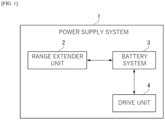
- FIG. 1 is a diagram which shows an overall structure of a device including a power supply system for an electric vehicle according to a first embodiment.
- FIG. 1 is a diagram which shows an overall configuration of the power supply system 1 for an electric vehicle according to the first embodiment.
- the power supply system 1 includes a range extender unit 2, a battery system 3, and a drive unit 4 of an electric vehicle.
- the battery system 3 supplies power to the drive unit 4.
- the drive unit 4 is a device that operates using power installed in the electric vehicle, such as a motor.
- the range extender unit 2 generates a direct current and supplies power to the battery system 3. For example, when a charge capacity of the battery system 3 decreases due to long-distance movement of the electric vehicle, the range extender unit 2 supplies power to the battery system 3. In an emergency, such as when power is not supplied from the battery system 3 to the drive unit 4, the range extender unit 2 may supply power to the drive unit 4.
- the range extender unit 2 includes a metal-air battery as a power supply source.
- the metal-air battery is of a replaceable type.
- the metal-air battery is preferably a stack of a plurality of metal-air battery cells in series or parallel depending on a voltage, an output, and a capacity required as a power supply source.
- the range extender unit 2 may be further configured to supply power to the battery system 3 when a predetermined condition is satisfied by a decrease in charge capacity of the battery system 3.
- the predetermined condition may be a case where the charge capacity is equal to or less than a first threshold value, a case where a rate of decrease in the charge capacity is equal to or less than a second threshold value, or a case where the charge capacity is equal to or less than the first threshold value and the rate of decrease in the charge capacity is equal to or less than the second threshold value. Note that the predetermined condition is not limited to these conditions.
- a storage unit of the metal-air battery of the range extender unit 2 may be provided in a vehicle near the passenger seat, in the trunk, or in the hood so that a user can replace the metal-air battery.
- the storage unit When the storage unit is provided in the vehicle, the user can replace the metal-air battery from inside the vehicle.
- the capacity of the metal-air battery decreases, the metal-air battery is replaced. Replacement of the metal-air battery may also be performed mechanically and automatically.
- the battery system 3 may include one or more battery packs and a battery management system (BMS) corresponding to each battery pack.
- BMS battery management system
- Examples of a battery type used in the battery system 3 include lithium-ion batteries, nickel-metal hydride batteries, solid-state batteries, and the like.
- the BMS controls connection and disconnection of a battery pack to the drive unit 4.
- the power supply system 1 may also include a controller for controlling a power supply mode of the range extender unit 2 and for controlling a connection state between the range extender unit 2 and the battery system 3, a connection state between the range extender unit 2 and the drive unit 4, and/or a connection state between the battery system 3 and the drive unit 4.
- a metal-air battery is a battery that uses oxygen as an active material of a positive electrode (air electrode) and a metal as an active material of a negative electrode.
- the negative electrode contains at least one of zinc, magnesium, aluminum, iron, lithium, and calcium.
- the air electrode contains a metal complex or an adduct thereof.
- the metal complex is represented by a following formula (1) or formula (2):
- M is a metal atom.
- D 1 to D 28 are each independently a nitrogen atom, a sulfur atom, or a carbon atom.
- each of the carbon atoms may be independently bonded to a hydrogen atom, a halogen atom, an alkyl group, a cycloalkyl group, an alkenyl group, an alkynyl group, an aryl group, an alkyl sulfonyl group, an alkoxy group, or an alkylthio group.
- a bond between the nitrogen atom and M means a coordination of the nitrogen atom to M.
- M may further be bonded to a halogen atom, a hydroxyl group, or a hydrocarbon group having 1 to 8 carbon atoms as a ligand.
- an anionic counter-ion may be present to give electrical neutrality.
- it may be present as an adduct to which an electrically neutral molecule is added.
- a valence of M is not particularly limited.
- a halogen atom, a hydroxyl group, or an alkoxy group having 1 to 8 carbon atoms may be bonded as a ligand (for example, an axial ligand), and an anionic counter-ion may be present.
- the anionic counter-ion include halide ions, hydroxide ions, nitrate ions, and sulfate ions.
- a structure of the alkyl group in the alkoxy group having 1 to 8 carbon atoms (an alkyloxy group) may be linear, branched, or cyclic.
- Examples of M include a scandium atom, a titanium atom, a vanadium atom, a chromium atom, a manganese atom, an iron atom, a cobalt atom, a nickel atom, a copper atom, a zinc atom, a yttrium atom, a zirconium atom, a niobium atom, a ruthenium atom, a rhodium atom, a palladium atom, a lanthanum atom, a cerium atom, a praseodymium atom, a neodymium atom, a promethium atom, a samarium atom, a europium atom, a gadolinium atom, a terbium atom, a dysprosium atom, a holmium atom, an erbium atom, a thulium atom, a ytterb
- M is preferably a manganese atom, an iron atom, a cobalt atom, a nickel atom, a copper atom, or a zinc atom, and more preferably an iron atom, a cobalt atom, a nickel atom, or a copper atom.
- examples of the halogen atom include fluorine, chlorine, bromine, and iodine.
- an alkyl group represents a linear or branched monovalent hydrocarbon group.
- the number of carbon atoms in the alkyl group is preferably 1 to 20, more preferably 1 to 12, and even more preferably 1 to 6.
- Examples of the alkyl group include a methyl group, an ethyl group, an n-propyl group, an isopropyl group, an n-butyl group, an isobutyl group, a sec-butyl group, a tert-butyl group, an n-pentyl group, an isopentyl group, a sec-pentyl group, a tert-pentyl group, and an n-hexyl group.
- a cycloalkyl group represents a cyclic monovalent hydrocarbon group.
- the number of carbon atoms in the cycloalkyl group is preferably 3 to 20, more preferably 3 to 12, and even more preferably 3 to 6.
- Examples of the cycloalkyl group include a cyclopropyl group, a cyclobutyl group, a cyclopentyl group, a cyclohexyl group, a 1-methylcyclopropyl group, a 2-methylcyclopropyl group, and a 2,2-dimethylcyclopropyl group.
- an alkenyl group represents a linear or branched monovalent hydrocarbon group containing a double bond.
- the number of carbon atoms in the alkenyl group is preferably 2 to 20, more preferably 2 to 12, and even more preferably 2 to 6.
- alkenyl group examples include a vinyl group, a 1-propenyl group, a 2-propenyl group, a 1-butenyl group, a 2-butenyl group, a 3-butenyl group, a 1-methyl-2-propenyl group, a 2-methyl-2-propenyl group, a 1-pentenyl group, a 2-pentenyl group, a 3-pentenyl group, a 4-pentenyl group, a 1-methyl-2-butenyl group, a 2-methyl-2-butenyl group, a 1-hexenyl group, a 2-hexenyl group, a 3-hexenyl group, a 4-hexenyl group, and a 5-hexenyl group.
- the alkynyl group represents a linear or branched monovalent hydrocarbon group containing a triple bond.
- the number of carbon atoms in the alkynyl group is preferably 2 to 20, more preferably 2 to 12, and even more preferably 2 to 6.
- alkynyl group examples include an ethynyl group, a 1-propynyl group, a 2-propynyl group, a (1-butynyl group) 1-butyn-1-yl group, a (2-butynyl group) 2-butyn-1-yl group, a (3-butynyl group) 3-butyn-1-yl group, a (1-methyl-2-propynyl group) 1-methyl-2-propyn-1-yl group, a (2-methyl-3-butynyl group) 2-methyl-3-butyn-2-yl group, a (1-pentynyl group) 1-pentyn-1-yl group, a (2-pentynyl group) 2-pentyn-1-yl group, a (3-pentynyl group) 3-pentyn-2-yl group, a (4-pentynyl group) 4-pentyn-1-yl group, a 1-methyl-2-but
- the aryl group represents a monovalent aromatic hydrocarbon group.
- the number of carbon atoms in the aryl group is preferably 6 to 40, and more preferably 6 to 30.
- the aryl group include a phenyl group, a biphenyl group, a terphenyl group, a naphthyl group, a fluorenyl group, a benzofluorenyl group, a dibenzofluorenyl group, a phenanthryl group, an anthracenyl group, a benzophenanthryl group, a benzoanthracenyl group, a chrysenyl group, a pyrenyl group, a fluoranthenyl group, a triphenylenyl group, a benzofluoranthenyl group, a dibenzoanthracenyl group, a perylenyl group, and a helicenyl group.
- the alkyl sulfonyl group represents a monovalent group in which an alkyl group is bonded to a sulfonyl group.
- the alkyl group in the alkyl sulfonyl group can be a group described above as the "alkyl group.”
- the number of carbon atoms in the alkyl sulfonyl group is preferably 1 to 20, more preferably 1 to 12, and even more preferably 1 to 6.
- Examples include a methyl sulfonyl group, an ethyl sulfonyl group, a normal propyl sulfonyl group, an isopropyl sulfonyl group, an n-butyl sulfonyl group, a sec-butyl sulfonyl group, a tert-butyl sulfonyl group, an n-pentyl sulfonyl group, an isopentyl sulfonyl group, a tert-pentyl sulfonyl group, a neopentyl sulfonyl group, a 2,3-dimethylpropyl sulfonyl group, a 1-ethylpropyl sulfonyl group, a 1-methylbutyl sulfonyl group, an n-hexyl sulfonyl group, an iso
- the alkoxy group represents a monovalent group in which a hydrocarbon group is bonded via an ether bond.
- the number of carbon atoms in the alkoxy group is preferably 1 to 20, more preferably 1 to 12, and even more preferably 1 to 6.
- Examples of the alkoxy group include a methoxy group, an ethoxy group, an n-propoxy group, an n-butoxy group, an n-pentyloxy group, an n-hexyloxy group, an isopropoxy group, an isobutoxy group, a sec-butoxy group, a tert-butoxy group, and an isohexyloxy group.
- the alkylthio group represents a group in which an oxygen atom in the ether bond of the alkoxy group is replaced with a sulfur atom.
- the number of carbon atoms in the alkylthio group is preferably 1 to 20, more preferably 1 to 16, and even more preferably 1 to 12.
- Examples of the alkylthio group include a methylthio group, an ethylthio group, an n-propylthio group, an n-butylthio group, an n-pentylthio group, an n-hexylthio group, and an isopropylthio group.
- the alkyl group, cycloalkyl group, alkenyl group, alkynyl group, aryl group, alkyl sulfonyl group, alkoxy group, and alkylthio group may be unsubstituted substituents, but each may be substituted by one or more substituents such as halogen, an alkyl group, an alkenyl group, an alkynyl group, an aryl group, an alkoxy group, an alkylthio group, a cyano group, a carbonyl group, a carboxyl group, an amino group, a nitro group, a silyl group, and a sulfo group.
- substituents such as halogen, an alkyl group, an alkenyl group, an alkynyl group, an aryl group, an alkoxy group, an alkylthio group, a cyano group, a carbonyl group, a carboxyl group, an amino group,
- D 1 to D 16 are preferably nitrogen atoms or carbon atoms
- D 17 to D 28 are preferably sulfur atoms or carbon atoms.
- the number of nitrogen atoms in D 1 to D 16 is preferably 2 to 12, more preferably 4 to 8.
- the number of sulfur atoms in D 17 to D 28 is preferably 2 to 10, more preferably 4 to 8.
- the metal complex or the adduct thereof is a compound represented by the following formula.
- a method for manufacturing the metal complex or the adduct thereof is not particularly limited, but an example thereof is a method of heating a dicyano compound such as pyridine-2,3-dicarbonitrile and a metal atom in an alcohol solvent in a presence of a basic substance.
- a dicyano compound such as pyridine-2,3-dicarbonitrile and a metal atom in an alcohol solvent
- the basic substance include inorganic bases such as potassium carbonate, sodium carbonate, calcium carbonate, sodium hydrogencarbonate, and sodium acetate, and organic bases such as triethylamine, tributylamine, and diazabicycloundecene.
- the power supply system 1 includes the battery system 3 for supplying power to the drive unit 4 of an electric vehicle, and the range extender unit 2 for supplying power to the battery system 3 when the charge capacity of the battery system 3 decreases.
- a power source of the range extender unit 2 is a metal-air battery.
- a metal-air battery has an energy density three to ten times higher than that of a secondary battery such as a lithium-ion battery.
- the range extender unit 2 which uses such a metal-air battery as a power supply source, supplies power to the battery system 3 in an auxiliary manner, the battery system 3 itself does not need to have a capacity for long-distance movement, and the like.
- a power supply system having the same functions and configuration as the power supply system according to the first embodiment is provided in a drone device.
- the power supply system 1 includes the battery system 3 for supplying power to the drive unit 4 of a drone device, and the range extender unit 2 for supplying power to the battery system 3 when the charge capacity of the battery system 3 decreases, and the power supply source of the range extender unit 2 is a metal-air battery.
- a metal-air battery has an energy density three to ten times higher than that of a secondary battery such as a lithium-ion battery.
- the range extender unit 2 which uses such a metal-air battery as a power supply source, supplies power to the battery system 3 in an auxiliary manner, the battery system 3 itself does not need to have a capacity for long-distance movement, and the like. For this reason, it is possible to minimize the capacity and weight of the lithium-ion batteries, nickel-metal hydride batteries, and all-solid-state batteries used in the battery system 3, which are essential for driving the motor. As a result, it is possible to make the entire power supply system smaller, lighter, and simpler.
- Example 1 zinc was used as a negative electrode of the metal-air battery.
- a catalyst for an air electrode a laminate cell was used, which uses a carbon electrode containing a complex in which a metal complex of a compound 28 was supported on carbon black.
- Example 2 a compound carrying manganese dioxide was used as the catalyst for an air electrode instead of the metal complex of the compound 28 in the laminate cell of Example 1.
- Comparative Example 1 was set in which AA alkaline batteries were used in the range extender unit.
- Each battery module of Examples 1, 2, and Comparative Example 1 is designed so that a battery module voltage is equivalent to that of a typical drone battery of 7.38 V by connecting five batteries in series.
- laminate cells of Example 1 and Example 2 were prepared so that weights of the battery modules of Example 1, Example 2, and Comparative Example 1 were the same as each other.
- Example 1 and Example 2 Compared to an alkaline battery of Comparative Example 1, in the zinc-air battery modules of Examples 1 and 2, the amount of electricity per unit weight was significantly increased by about 5 times or more, and it was confirmed that the energy density was excellent. In addition, when Example 1 and Example 2 are compared, it was confirmed that the voltage was improved in the zinc-air battery by changing the air electrode catalyst from manganese dioxide to the metal complex shown in the compound 28.
- Example 2 had a maximum output of 10 W/module, while Example 1 had a maximum output of 25 W/module, which was about 2.5 times higher, and it was confirmed that the metal complex containing the compound 28 was superior as an air electrode catalyst.
- Example 1 Comparative example 1 Battery type Zinc-air battery Zinc-air battery AA alkaline battery Air electrode catalyst Metal complex of compound 28 Manganese dioxide Voltage [V] 7.40 7.00 7.50 Capacity [mAh] 7,800 7,800 1,500 Amount of electricity [Wh] 58 55 11 Weight [g] 120 120 120 120
- the embodiments 1 and 2 described above are about an electric vehicle and a drone device, the present invention may be applied to other electric mobility devices for which it is beneficial to have a range extender.
- the present invention may be applied to land mobility devices such as electric bikes (two-wheeled and three-wheeled) and e-scooters (electric kickboards), air mobility devices such as aircraft and electric vertical take-off and landing aircraft (eVTOLs, flying cars, and the like), or water or underwater mobility devices such as electric ships, submarines, and underwater drones.
- land mobility devices such as electric bikes (two-wheeled and three-wheeled) and e-scooters (electric kickboards), air mobility devices such as aircraft and electric vertical take-off and landing aircraft (eVTOLs, flying cars, and the like), or water or underwater mobility devices such as electric ships, submarines, and underwater drones.
Landscapes
- Engineering & Computer Science (AREA)
- Chemical & Material Sciences (AREA)
- Chemical Kinetics & Catalysis (AREA)
- Electrochemistry (AREA)
- General Chemical & Material Sciences (AREA)
- Power Engineering (AREA)
- Sustainable Energy (AREA)
- Sustainable Development (AREA)
- Life Sciences & Earth Sciences (AREA)
- Transportation (AREA)
- Mechanical Engineering (AREA)
- Materials Engineering (AREA)
- Organic Chemistry (AREA)
- Manufacturing & Machinery (AREA)
- Combustion & Propulsion (AREA)
- Aviation & Aerospace Engineering (AREA)
- Hybrid Cells (AREA)
Abstract
Description
- The present invention relates to a power supply system for an electric vehicle or a drone device.
- The power supply system for an electric vehicle or a drone device consists of a battery system for supplying power, which is made up of a plurality of lithium-ion batteries, nickel-metal hydride battery packs, or supercapacitors, and a charging and energy recovery system. For long-distance movement and flight, the battery capacity of the battery system needs to be increased. This requires an installation of many heavy lithium-ion batteries, which causes a problem of poor fuel efficiency due to the increased battery weight.
- [Patent Document 1]
PublishedJapanese Translation No. 2019-532605 - As an approach to this problem, in the past, in addition to secondary batteries such as lithium-ion batteries, provision of a range extender that includes a fuel oil generating unit (a so-called engine) that uses gasoline or the like, and a generating unit such as a hydrogen fuel cell, has been proposed (Patent Document 1). However, since the fuel oil generating unit and the generating unit such as a hydrogen fuel cell have large and complex mechanisms, there were problems such as increases in the weight and size of the power supply system, and an increase in the frequency of breakdowns.
- The present invention has been made in consideration of the circumstances described above, and an object thereof is to provide a lightweight and small power supply system for electric vehicles or drone devices.
- To solve the problems described above, one aspect of the present invention is a power supply system for an electric vehicle that includes a battery system for supplying power to a drive unit of the electric vehicle, and a range extender unit for supplying power to the battery system when a charge capacity of the battery system decreases, in which a power supply source of the range extender unit is a metal-air battery.
- In addition, another aspect of the present invention is a power supply system for a drone device that includes a battery system for supplying power to a drive unit of the drone device, and a range extender unit for supplying power to the battery system when a charge capacity of the battery system decreases, in which a power supply source of the range extender unit is a metal-air battery.
- According to at least one of the aspects described above, since the
range extender unit 2 supplies power to thebattery system 3 in an auxiliary manner, thebattery system 3 itself does not need to have a capacity for long-distance movement, and the like. This makes it possible to minimize the capacity and weight of the lithium-ion batteries, nickel-metal hydride batteries, and solid-state batteries used in thebattery system 3, which are essential for driving the motor. As a result, it is possible to make the entire power supply system smaller, lighter, and simpler. -
FIG. 1 is a diagram which shows an overall structure of a device including a power supply system for an electric vehicle according to a first embodiment. - Hereinafter, a power supply system 1 according to a first embodiment will be described with reference to
FIG. 1. FIG. 1 is a diagram which shows an overall configuration of the power supply system 1 for an electric vehicle according to the first embodiment. - The power supply system 1 includes a
range extender unit 2, abattery system 3, and adrive unit 4 of an electric vehicle. Thebattery system 3 supplies power to thedrive unit 4. Thedrive unit 4 is a device that operates using power installed in the electric vehicle, such as a motor. Therange extender unit 2 generates a direct current and supplies power to thebattery system 3. For example, when a charge capacity of thebattery system 3 decreases due to long-distance movement of the electric vehicle, therange extender unit 2 supplies power to thebattery system 3. In an emergency, such as when power is not supplied from thebattery system 3 to thedrive unit 4, therange extender unit 2 may supply power to thedrive unit 4. Therange extender unit 2 includes a metal-air battery as a power supply source. The metal-air battery is of a replaceable type. - The metal-air battery is preferably a stack of a plurality of metal-air battery cells in series or parallel depending on a voltage, an output, and a capacity required as a power supply source.
- The
range extender unit 2 may be further configured to supply power to thebattery system 3 when a predetermined condition is satisfied by a decrease in charge capacity of thebattery system 3. For example, the predetermined condition may be a case where the charge capacity is equal to or less than a first threshold value, a case where a rate of decrease in the charge capacity is equal to or less than a second threshold value, or a case where the charge capacity is equal to or less than the first threshold value and the rate of decrease in the charge capacity is equal to or less than the second threshold value. Note that the predetermined condition is not limited to these conditions. - A storage unit of the metal-air battery of the
range extender unit 2 may be provided in a vehicle near the passenger seat, in the trunk, or in the hood so that a user can replace the metal-air battery. When the storage unit is provided in the vehicle, the user can replace the metal-air battery from inside the vehicle. When the capacity of the metal-air battery decreases, the metal-air battery is replaced. Replacement of the metal-air battery may also be performed mechanically and automatically. - The
battery system 3 may include one or more battery packs and a battery management system (BMS) corresponding to each battery pack. Examples of a battery type used in thebattery system 3 include lithium-ion batteries, nickel-metal hydride batteries, solid-state batteries, and the like. The BMS controls connection and disconnection of a battery pack to thedrive unit 4. The power supply system 1 may also include a controller for controlling a power supply mode of therange extender unit 2 and for controlling a connection state between therange extender unit 2 and thebattery system 3, a connection state between therange extender unit 2 and thedrive unit 4, and/or a connection state between thebattery system 3 and thedrive unit 4. - A metal-air battery is a battery that uses oxygen as an active material of a positive electrode (air electrode) and a metal as an active material of a negative electrode. For example, the negative electrode contains at least one of zinc, magnesium, aluminum, iron, lithium, and calcium. The air electrode contains a metal complex or an adduct thereof.
- The metal complex is represented by a following formula (1) or formula (2):


- A bond between the nitrogen atom and M means a coordination of the nitrogen atom to M. M may further be bonded to a halogen atom, a hydroxyl group, or a hydrocarbon group having 1 to 8 carbon atoms as a ligand. In addition, an anionic counter-ion may be present to give electrical neutrality. Furthermore, it may be present as an adduct to which an electrically neutral molecule is added.
- A valence of M is not particularly limited. To make the metal complex or the adduct thereof electrically neutral, a halogen atom, a hydroxyl group, or an alkoxy group having 1 to 8 carbon atoms (an alkyloxy group) may be bonded as a ligand (for example, an axial ligand), and an anionic counter-ion may be present. Examples of the anionic counter-ion include halide ions, hydroxide ions, nitrate ions, and sulfate ions. A structure of the alkyl group in the alkoxy group having 1 to 8 carbon atoms (an alkyloxy group) may be linear, branched, or cyclic.
- Examples of M include a scandium atom, a titanium atom, a vanadium atom, a chromium atom, a manganese atom, an iron atom, a cobalt atom, a nickel atom, a copper atom, a zinc atom, a yttrium atom, a zirconium atom, a niobium atom, a ruthenium atom, a rhodium atom, a palladium atom, a lanthanum atom, a cerium atom, a praseodymium atom, a neodymium atom, a promethium atom, a samarium atom, a europium atom, a gadolinium atom, a terbium atom, a dysprosium atom, a holmium atom, an erbium atom, a thulium atom, a ytterbium atom, a lutetium atom, an actinium atom, a thorium atom, a protactinium atom, a uranium atom, a neptunium atom, a plutonium atom, an americium atom, a curium atom, a berkelium atom, a californium atom, an einsteinium atom, a fermium atom, a mendelevium atom, a nobelium atom, and a lawrencium atom. Among these, M is preferably a manganese atom, an iron atom, a cobalt atom, a nickel atom, a copper atom, or a zinc atom, and more preferably an iron atom, a cobalt atom, a nickel atom, or a copper atom.
- In the present invention, examples of the halogen atom include fluorine, chlorine, bromine, and iodine.
- In the present invention, an alkyl group represents a linear or branched monovalent hydrocarbon group. The number of carbon atoms in the alkyl group is preferably 1 to 20, more preferably 1 to 12, and even more preferably 1 to 6. Examples of the alkyl group include a methyl group, an ethyl group, an n-propyl group, an isopropyl group, an n-butyl group, an isobutyl group, a sec-butyl group, a tert-butyl group, an n-pentyl group, an isopentyl group, a sec-pentyl group, a tert-pentyl group, and an n-hexyl group.
- In the present invention, a cycloalkyl group represents a cyclic monovalent hydrocarbon group. The number of carbon atoms in the cycloalkyl group is preferably 3 to 20, more preferably 3 to 12, and even more preferably 3 to 6. Examples of the cycloalkyl group include a cyclopropyl group, a cyclobutyl group, a cyclopentyl group, a cyclohexyl group, a 1-methylcyclopropyl group, a 2-methylcyclopropyl group, and a 2,2-dimethylcyclopropyl group.
- In the present invention, an alkenyl group represents a linear or branched monovalent hydrocarbon group containing a double bond. The number of carbon atoms in the alkenyl group is preferably 2 to 20, more preferably 2 to 12, and even more preferably 2 to 6. Examples of the alkenyl group include a vinyl group, a 1-propenyl group, a 2-propenyl group, a 1-butenyl group, a 2-butenyl group, a 3-butenyl group, a 1-methyl-2-propenyl group, a 2-methyl-2-propenyl group, a 1-pentenyl group, a 2-pentenyl group, a 3-pentenyl group, a 4-pentenyl group, a 1-methyl-2-butenyl group, a 2-methyl-2-butenyl group, a 1-hexenyl group, a 2-hexenyl group, a 3-hexenyl group, a 4-hexenyl group, and a 5-hexenyl group.
- In the present invention, the alkynyl group represents a linear or branched monovalent hydrocarbon group containing a triple bond. The number of carbon atoms in the alkynyl group is preferably 2 to 20, more preferably 2 to 12, and even more preferably 2 to 6. Examples of the alkynyl group include an ethynyl group, a 1-propynyl group, a 2-propynyl group, a (1-butynyl group) 1-butyn-1-yl group, a (2-butynyl group) 2-butyn-1-yl group, a (3-butynyl group) 3-butyn-1-yl group, a (1-methyl-2-propynyl group) 1-methyl-2-propyn-1-yl group, a (2-methyl-3-butynyl group) 2-methyl-3-butyn-2-yl group, a (1-pentynyl group) 1-pentyn-1-yl group, a (2-pentynyl group) 2-pentyn-1-yl group, a (3-pentynyl group) 3-pentyn-2-yl group, a (4-pentynyl group) 4-pentyn-1-yl group, a 1-methyl-2-butynyl group (1-methyl-2-butyn-1-yl group), a (2-methyl-3-pentynyl group) 2-methyl-3-pentyn-1-yl group, a (1-hexynyl group) 1-hexyn-1-yl group, and a (1,1-dimethyl-2-butynyl group) 1,1-dimethyl-2-butyn-1-yl group.
- In the present invention, the aryl group represents a monovalent aromatic hydrocarbon group. The number of carbon atoms in the aryl group is preferably 6 to 40, and more preferably 6 to 30. Examples of the aryl group include a phenyl group, a biphenyl group, a terphenyl group, a naphthyl group, a fluorenyl group, a benzofluorenyl group, a dibenzofluorenyl group, a phenanthryl group, an anthracenyl group, a benzophenanthryl group, a benzoanthracenyl group, a chrysenyl group, a pyrenyl group, a fluoranthenyl group, a triphenylenyl group, a benzofluoranthenyl group, a dibenzoanthracenyl group, a perylenyl group, and a helicenyl group.
- In the present invention, the alkyl sulfonyl group represents a monovalent group in which an alkyl group is bonded to a sulfonyl group. The alkyl group in the alkyl sulfonyl group can be a group described above as the "alkyl group." The number of carbon atoms in the alkyl sulfonyl group is preferably 1 to 20, more preferably 1 to 12, and even more preferably 1 to 6. Examples include a methyl sulfonyl group, an ethyl sulfonyl group, a normal propyl sulfonyl group, an isopropyl sulfonyl group, an n-butyl sulfonyl group, a sec-butyl sulfonyl group, a tert-butyl sulfonyl group, an n-pentyl sulfonyl group, an isopentyl sulfonyl group, a tert-pentyl sulfonyl group, a neopentyl sulfonyl group, a 2,3-dimethylpropyl sulfonyl group, a 1-ethylpropyl sulfonyl group, a 1-methylbutyl sulfonyl group, an n-hexyl sulfonyl group, an isohexyl sulfonyl group, and a 1,1,2-trimethylpropyl sulfonyl group.
- In the present invention, the alkoxy group represents a monovalent group in which a hydrocarbon group is bonded via an ether bond. The number of carbon atoms in the alkoxy group is preferably 1 to 20, more preferably 1 to 12, and even more preferably 1 to 6. Examples of the alkoxy group include a methoxy group, an ethoxy group, an n-propoxy group, an n-butoxy group, an n-pentyloxy group, an n-hexyloxy group, an isopropoxy group, an isobutoxy group, a sec-butoxy group, a tert-butoxy group, and an isohexyloxy group.
- In the present invention, the alkylthio group represents a group in which an oxygen atom in the ether bond of the alkoxy group is replaced with a sulfur atom. The number of carbon atoms in the alkylthio group is preferably 1 to 20, more preferably 1 to 16, and even more preferably 1 to 12. Examples of the alkylthio group include a methylthio group, an ethylthio group, an n-propylthio group, an n-butylthio group, an n-pentylthio group, an n-hexylthio group, and an isopropylthio group.
- The alkyl group, cycloalkyl group, alkenyl group, alkynyl group, aryl group, alkyl sulfonyl group, alkoxy group, and alkylthio group may be unsubstituted substituents, but each may be substituted by one or more substituents such as halogen, an alkyl group, an alkenyl group, an alkynyl group, an aryl group, an alkoxy group, an alkylthio group, a cyano group, a carbonyl group, a carboxyl group, an amino group, a nitro group, a silyl group, and a sulfo group.
- D1 to D16 are preferably nitrogen atoms or carbon atoms, and D17 to D28 are preferably sulfur atoms or carbon atoms. The number of nitrogen atoms in D1 to D16 is preferably 2 to 12, more preferably 4 to 8. The number of sulfur atoms in D17 to D28 is preferably 2 to 10, more preferably 4 to 8.
- Preferably, the metal complex or the adduct thereof is a compound represented by the following formula.





- A method for manufacturing the metal complex or the adduct thereof is not particularly limited, but an example thereof is a method of heating a dicyano compound such as pyridine-2,3-dicarbonitrile and a metal atom in an alcohol solvent in a presence of a basic substance. Examples of the basic substance include inorganic bases such as potassium carbonate, sodium carbonate, calcium carbonate, sodium hydrogencarbonate, and sodium acetate, and organic bases such as triethylamine, tributylamine, and diazabicycloundecene.
- The power supply system 1 according to the first embodiment includes the
battery system 3 for supplying power to thedrive unit 4 of an electric vehicle, and therange extender unit 2 for supplying power to thebattery system 3 when the charge capacity of thebattery system 3 decreases. A power source of therange extender unit 2 is a metal-air battery. A metal-air battery has an energy density three to ten times higher than that of a secondary battery such as a lithium-ion battery. In addition, since therange extender unit 2, which uses such a metal-air battery as a power supply source, supplies power to thebattery system 3 in an auxiliary manner, thebattery system 3 itself does not need to have a capacity for long-distance movement, and the like. For this reason, it is possible to minimize the capacity and weight of lithium-ion batteries, nickel-metal hydride batteries, and all-solid-state batteries used in thebattery system 3, which are essential for driving the motor. As a result, it is possible to make an entire power supply system smaller, lighter, and simpler. - In a second embodiment, a power supply system having the same functions and configuration as the power supply system according to the first embodiment is provided in a drone device.
- That is, the power supply system 1 according to the second embodiment includes the
battery system 3 for supplying power to thedrive unit 4 of a drone device, and therange extender unit 2 for supplying power to thebattery system 3 when the charge capacity of thebattery system 3 decreases, and the power supply source of therange extender unit 2 is a metal-air battery. A metal-air battery has an energy density three to ten times higher than that of a secondary battery such as a lithium-ion battery. - In addition, since the
range extender unit 2, which uses such a metal-air battery as a power supply source, supplies power to thebattery system 3 in an auxiliary manner, thebattery system 3 itself does not need to have a capacity for long-distance movement, and the like. For this reason, it is possible to minimize the capacity and weight of the lithium-ion batteries, nickel-metal hydride batteries, and all-solid-state batteries used in thebattery system 3, which are essential for driving the motor. As a result, it is possible to make the entire power supply system smaller, lighter, and simpler. - As an example of a power supply system for an electric vehicle and a drone, a comparison of voltage, capacity, and power consumption when batteries of the range extender unit are configured differently will be described. (Table 1)
- In Example 1, zinc was used as a negative electrode of the metal-air battery. As a catalyst for an air electrode, a laminate cell was used, which uses a carbon electrode containing a complex in which a metal complex of a compound 28 was supported on carbon black.
- In Example 2, a compound carrying manganese dioxide was used as the catalyst for an air electrode instead of the metal complex of the compound 28 in the laminate cell of Example 1.
- As a comparative example, Comparative Example 1 was set in which AA alkaline batteries were used in the range extender unit.
- Each battery module of Examples 1, 2, and Comparative Example 1 is designed so that a battery module voltage is equivalent to that of a typical drone battery of 7.38 V by connecting five batteries in series. In addition, laminate cells of Example 1 and Example 2 were prepared so that weights of the battery modules of Example 1, Example 2, and Comparative Example 1 were the same as each other.
- Compared to an alkaline battery of Comparative Example 1, in the zinc-air battery modules of Examples 1 and 2, the amount of electricity per unit weight was significantly increased by about 5 times or more, and it was confirmed that the energy density was excellent. In addition, when Example 1 and Example 2 are compared, it was confirmed that the voltage was improved in the zinc-air battery by changing the air electrode catalyst from manganese dioxide to the metal complex shown in the compound 28.
- When maximum outputs are compared, it was found that Example 2 had a maximum output of 10 W/module, while Example 1 had a maximum output of 25 W/module, which was about 2.5 times higher, and it was confirmed that the metal complex containing the compound 28 was superior as an air electrode catalyst.
[Table 1] Example 1 Example 2 Comparative example 1 Battery type Zinc-air battery Zinc-air battery AA alkaline battery Air electrode catalyst Metal complex of compound 28 Manganese dioxide Voltage [V] 7.40 7.00 7.50 Capacity [mAh] 7,800 7,800 1,500 Amount of electricity [Wh] 58 55 11 Weight [g] 120 120 120 - Although the
embodiments 1 and 2 described above are about an electric vehicle and a drone device, the present invention may be applied to other electric mobility devices for which it is beneficial to have a range extender. - Specifically, the present invention may be applied to land mobility devices such as electric bikes (two-wheeled and three-wheeled) and e-scooters (electric kickboards), air mobility devices such as aircraft and electric vertical take-off and landing aircraft (eVTOLs, flying cars, and the like), or water or underwater mobility devices such as electric ships, submarines, and underwater drones.
- As described above, several embodiments of the present invention have been described, but all of these embodiments are presented as examples and are not intended to limit the scope of the invention. These embodiments can be implemented in various other forms, and various omissions, substitutions, and modifications can be made within a range not departing from the gist of the invention. These embodiments and their modifications are included in the scope of the invention and its equivalents as described in the claims as well as in the scope and gist of the invention.
-
- 1 Power supply system
- 2 Range extender unit
- 3 Battery system
- 4 Drive unit
Claims (9)
- A power supply system for an electric mobility device comprising:a battery system for supplying power to a drive unit of the electric mobility device; anda range extender unit for supplying power to the battery system when a charge capacity of the battery system decreases,wherein a power supply source of the range extender unit is a metal-air battery.
- A power supply system for an electric vehicle comprising:a battery system for supplying power to a drive unit of the electric vehicle; anda range extender unit for supplying power to the battery system when a charge capacity of the battery system decreases,wherein a power supply source of the range extender unit is a metal-air battery.
- The power supply system for an electric vehicle according to claim 2,wherein the range extender unit is further configured to supply power to the battery system when a predetermined condition is satisfied by a decrease in charge capacity of the battery system, andthe predetermined condition is a case where the charge capacity is equal to or less than a first threshold value, a case where a rate of decrease of the charge capacity is equal to or less than a second threshold value, or a case where the charge capacity is equal to or less than the first threshold value and the rate of decrease of the charge capacity is equal to or less than the second threshold value.
- The power supply system for an electric vehicle according to claim 2 or 3,wherein a negative electrode of the metal-air battery contains at least one of zinc, magnesium, aluminum, iron, lithium, and calcium, andan air electrode of the metal-air battery contains a metal complex or an adduct thereof.
- The power supply system for an electric vehicle according to claim 4,
wherein the metal complex is represented by a following formula (1) or formula (2), M is a metal atom,D1 to D28 are each independently a nitrogen atom, a sulfur atom, or a carbon atom, andwhen D1 to D28 are carbon atoms, the carbon atoms are likely to be each independently bonded to a hydrogen atom, a halogen atom, an alkyl group, a cycloalkyl group, an alkenyl group, an alkynyl group, an aryl group, an alkyl sulfonyl group, an alkoxy group, or an alkylthio group.
 - A power supply system for a drone device comprising:a battery system for supplying power to a drive unit of the drone device; anda range extender unit for supplying power to the battery system when a charge capacity of the battery system decreases,wherein a power supply source of the range extender unit is a metal-air battery.
- The power supply system for a drone device according to claim 6,wherein the range extender unit is further configured to supply power to the battery system when a predetermined condition is satisfied by a decrease in charge capacity of the battery system, andthe predetermined condition is a case where the charge capacity is equal to or less than a first threshold value, a case where a rate of decrease of the charge capacity is equal to or less than a second threshold value, or a case where the charge capacity is equal to or less than the first threshold value and the rate of decrease of the charge capacity is equal to or less than the second threshold value.
- The power supply system for a drone device according to claim 6 or 7,wherein a negative electrode of the metal-air battery contains at least one of zinc, magnesium, aluminum, iron, lithium, and calcium, andan air electrode of the metal-air battery contains a metal complex or an adduct thereof.
- The power supply system for a drone device according to claim 8,
wherein the metal complex is represented by a following formula (1) or formula (2), M is a metal atom,D1 to D28 are each independently a nitrogen atom, a sulfur atom, or a carbon atom,when D1 to D28 are carbon atoms, the carbon atoms are likely to be each independently bonded to a hydrogen atom, a halogen atom, an alkyl group, a cycloalkyl group, an alkenyl group, an alkynyl group, an aryl group, an alkyl sulfonyl group, an alkoxy group, or an alkylthio group.
Applications Claiming Priority (2)
| Application Number | Priority Date | Filing Date | Title |
|---|---|---|---|
| JP2021208385 | 2021-12-22 | ||
| PCT/JP2022/047409 WO2023120657A1 (en) | 2021-12-22 | 2022-12-22 | Power supply system for electric vehicle or drone device |
Publications (2)
| Publication Number | Publication Date |
|---|---|
| EP4454930A1 true EP4454930A1 (en) | 2024-10-30 |
| EP4454930A4 EP4454930A4 (en) | 2025-12-24 |
Family
ID=86902744
Family Applications (1)
| Application Number | Title | Priority Date | Filing Date |
|---|---|---|---|
| EP22911359.2A Pending EP4454930A4 (en) | 2021-12-22 | 2022-12-22 | POWER SUPPLY SYSTEM FOR ELECTRIC VEHICLE OR DRONE DEVICE |
Country Status (4)
| Country | Link |
|---|---|
| US (1) | US20250065734A1 (en) |
| EP (1) | EP4454930A4 (en) |
| JP (1) | JP7592341B2 (en) |
| WO (1) | WO2023120657A1 (en) |
Family Cites Families (8)
| Publication number | Priority date | Publication date | Assignee | Title |
|---|---|---|---|---|
| JP6186845B2 (en) | 2013-04-26 | 2017-08-30 | 日産自動車株式会社 | Auxiliary battery system |
| WO2015045761A1 (en) | 2013-09-25 | 2015-04-02 | 日産自動車株式会社 | Battery system |
| CN110588288A (en) * | 2014-02-03 | 2019-12-20 | 斐源有限公司 | Service station for supplying heated electrolyte or heat accumulating liquid to electric vehicle |
| JP2017109553A (en) | 2015-12-15 | 2017-06-22 | シャープ株式会社 | Flight vehicle |
| JP2019121144A (en) | 2017-12-29 | 2019-07-22 | 井関農機株式会社 | Flying object for supporting agricultural work and agricultural work support system |
| EP3760310B1 (en) * | 2018-03-02 | 2025-05-21 | Azul Energy Inc. | Catalyst, liquid composition, electrode, catalyst electrode for electrochemical reaction, fuel cell, and air battery |
| US11374226B2 (en) * | 2018-04-24 | 2022-06-28 | Massachusetts Institute Of Technology | Corrosion mitigation of battery electrodes |
| EP4120444A4 (en) | 2020-03-13 | 2024-06-19 | Dai Nippon Printing Co., Ltd. | ELECTRICITY STORAGE DEVICE, ELECTRICITY STORAGE DEVICE ASSEMBLY AND MOVING BODY |
-
2022
- 2022-12-22 JP JP2023569542A patent/JP7592341B2/en active Active
- 2022-12-22 WO PCT/JP2022/047409 patent/WO2023120657A1/en not_active Ceased
- 2022-12-22 EP EP22911359.2A patent/EP4454930A4/en active Pending
- 2022-12-22 US US18/721,897 patent/US20250065734A1/en active Pending
Also Published As
| Publication number | Publication date |
|---|---|
| JP7592341B2 (en) | 2024-12-02 |
| EP4454930A4 (en) | 2025-12-24 |
| JPWO2023120657A1 (en) | 2023-06-29 |
| US20250065734A1 (en) | 2025-02-27 |
| WO2023120657A1 (en) | 2023-06-29 |
Similar Documents
| Publication | Publication Date | Title |
|---|---|---|
| US7910250B2 (en) | System and method for recharging a metal-air converter used for vehicle propulsion | |
| CN110767939B (en) | Electrolyte for lithium ion battery, battery module, battery pack and device | |
| CN205906226U (en) | A new forms of energy hybrid power supply system for high altitude unmanned aerial vehicle | |
| KR101815287B1 (en) | Hybrid power system for unmanned aerial vehicle | |
| JP6138350B2 (en) | Metal gas battery system | |
| CN102060107A (en) | Energy supply system for stratosphere electricity-electricity hybrid solar airship | |
| KR101491940B1 (en) | Lithium-ion rechargeable battery | |
| US20140178735A1 (en) | Redox flow battery system | |
| US20240332623A1 (en) | Liquid Electrolyte Composition, and Electrochemical Cell Comprising Said Electrolyte Composition | |
| US20130344403A1 (en) | Metal/Air Battery with Gas Driven Mixing | |
| JP2013005593A (en) | Power supply apparatus and power supply system | |
| KR20150034261A (en) | Lithium secondary cell and method for manufacturing same | |
| KR20090093044A (en) | Fuel cell system with a Hydrogen generation apparatus | |
| GB2405742A (en) | Energy and water autonomous generator | |
| US20180034081A1 (en) | Electrolytic storage of hydrogen | |
| EP4454930A1 (en) | Power supply system for electric vehicle or drone device | |
| EP4664600A1 (en) | Battery system, secondary battery, and electric aerial vehicle | |
| CN107585316A (en) | A kind of new energy mixed power supply system for High Altitude UAV | |
| Kuhn et al. | Renewable energy perspectives for aviation | |
| US20060071630A1 (en) | Hybrid power system | |
| US20240047750A1 (en) | Nonaqueous electrolyte, secondary battery, battery pack, vehicle, and stationary power supply | |
| JP2009227115A (en) | Mobile body for transporting automobile | |
| Jin et al. | Recent progress in aqueous underwater power batteries | |
| CN106848299B (en) | A kind of preparation method of the lithium ion secondary battery of high-power high-energy density | |
| CN114744247A (en) | Unmanned aerial vehicle control method and power system based on solid hydrogen fuel cell |
Legal Events
| Date | Code | Title | Description |
|---|---|---|---|
| STAA | Information on the status of an ep patent application or granted ep patent |
Free format text: STATUS: THE INTERNATIONAL PUBLICATION HAS BEEN MADE |
|
| PUAI | Public reference made under article 153(3) epc to a published international application that has entered the european phase |
Free format text: ORIGINAL CODE: 0009012 |
|
| STAA | Information on the status of an ep patent application or granted ep patent |
Free format text: STATUS: REQUEST FOR EXAMINATION WAS MADE |
|
| 17P | Request for examination filed |
Effective date: 20240717 |
|
| AK | Designated contracting states |
Kind code of ref document: A1 Designated state(s): AL AT BE BG CH CY CZ DE DK EE ES FI FR GB GR HR HU IE IS IT LI LT LU LV MC ME MK MT NL NO PL PT RO RS SE SI SK SM TR |
|
| DAV | Request for validation of the european patent (deleted) | ||
| DAX | Request for extension of the european patent (deleted) | ||
| A4 | Supplementary search report drawn up and despatched |
Effective date: 20251121 |
|
| RIC1 | Information provided on ipc code assigned before grant |
Ipc: B60L 50/62 20190101AFI20251117BHEP Ipc: B60L 50/64 20190101ALI20251117BHEP Ipc: B60L 58/12 20190101ALI20251117BHEP Ipc: B64C 39/02 20230101ALI20251117BHEP Ipc: H01M 4/38 20060101ALI20251117BHEP Ipc: H01M 4/90 20060101ALI20251117BHEP Ipc: H01M 10/44 20060101ALI20251117BHEP Ipc: H01M 12/06 20060101ALI20251117BHEP Ipc: H02J 7/00 20060101ALI20251117BHEP Ipc: B60L 58/14 20190101ALI20251117BHEP Ipc: B60L 58/18 20190101ALI20251117BHEP Ipc: B60L 58/20 20190101ALI20251117BHEP Ipc: B64U 50/30 20230101ALI20251117BHEP Ipc: H01M 12/08 20060101ALI20251117BHEP Ipc: H02J 7/34 20060101ALI20251117BHEP Ipc: H01M 16/00 20060101ALI20251117BHEP |