EP4454564A1 - Method of automatic qrs complex detection in electrocardiogram signal - Google Patents
Method of automatic qrs complex detection in electrocardiogram signal Download PDFInfo
- Publication number
- EP4454564A1 EP4454564A1 EP23180201.8A EP23180201A EP4454564A1 EP 4454564 A1 EP4454564 A1 EP 4454564A1 EP 23180201 A EP23180201 A EP 23180201A EP 4454564 A1 EP4454564 A1 EP 4454564A1
- Authority
- EP
- European Patent Office
- Prior art keywords
- module
- factor
- value
- ecg signal
- window
- Prior art date
- Legal status (The legal status is an assumption and is not a legal conclusion. Google has not performed a legal analysis and makes no representation as to the accuracy of the status listed.)
- Granted
Links
Images

Classifications
-
- A—HUMAN NECESSITIES
- A61—MEDICAL OR VETERINARY SCIENCE; HYGIENE
- A61B—DIAGNOSIS; SURGERY; IDENTIFICATION
- A61B5/00—Measuring for diagnostic purposes; Identification of persons
- A61B5/24—Detecting, measuring or recording bioelectric or biomagnetic signals of the body or parts thereof
- A61B5/316—Modalities, i.e. specific diagnostic methods
- A61B5/318—Heart-related electrical modalities, e.g. electrocardiography [ECG]
- A61B5/346—Analysis of electrocardiograms
- A61B5/349—Detecting specific parameters of the electrocardiograph cycle
- A61B5/352—Detecting R peaks, e.g. for synchronising diagnostic apparatus; Estimating R-R interval
-
- A—HUMAN NECESSITIES
- A61—MEDICAL OR VETERINARY SCIENCE; HYGIENE
- A61B—DIAGNOSIS; SURGERY; IDENTIFICATION
- A61B5/00—Measuring for diagnostic purposes; Identification of persons
- A61B5/24—Detecting, measuring or recording bioelectric or biomagnetic signals of the body or parts thereof
- A61B5/316—Modalities, i.e. specific diagnostic methods
- A61B5/318—Heart-related electrical modalities, e.g. electrocardiography [ECG]
- A61B5/346—Analysis of electrocardiograms
-
- A—HUMAN NECESSITIES
- A61—MEDICAL OR VETERINARY SCIENCE; HYGIENE
- A61B—DIAGNOSIS; SURGERY; IDENTIFICATION
- A61B5/00—Measuring for diagnostic purposes; Identification of persons
- A61B5/24—Detecting, measuring or recording bioelectric or biomagnetic signals of the body or parts thereof
- A61B5/316—Modalities, i.e. specific diagnostic methods
- A61B5/318—Heart-related electrical modalities, e.g. electrocardiography [ECG]
- A61B5/346—Analysis of electrocardiograms
- A61B5/349—Detecting specific parameters of the electrocardiograph cycle
-
- A—HUMAN NECESSITIES
- A61—MEDICAL OR VETERINARY SCIENCE; HYGIENE
- A61B—DIAGNOSIS; SURGERY; IDENTIFICATION
- A61B5/00—Measuring for diagnostic purposes; Identification of persons
- A61B5/24—Detecting, measuring or recording bioelectric or biomagnetic signals of the body or parts thereof
- A61B5/316—Modalities, i.e. specific diagnostic methods
- A61B5/318—Heart-related electrical modalities, e.g. electrocardiography [ECG]
- A61B5/346—Analysis of electrocardiograms
- A61B5/349—Detecting specific parameters of the electrocardiograph cycle
- A61B5/366—Detecting abnormal QRS complex, e.g. widening
-
- A—HUMAN NECESSITIES
- A61—MEDICAL OR VETERINARY SCIENCE; HYGIENE
- A61B—DIAGNOSIS; SURGERY; IDENTIFICATION
- A61B5/00—Measuring for diagnostic purposes; Identification of persons
- A61B5/72—Signal processing specially adapted for physiological signals or for diagnostic purposes
- A61B5/7235—Details of waveform analysis
- A61B5/725—Details of waveform analysis using specific filters therefor, e.g. Kalman or adaptive filters
-
- G—PHYSICS
- G01—MEASURING; TESTING
- G01N—INVESTIGATING OR ANALYSING MATERIALS BY DETERMINING THEIR CHEMICAL OR PHYSICAL PROPERTIES
- G01N7/00—Analysing materials by measuring the pressure or volume of a gas or vapour
-
- A—HUMAN NECESSITIES
- A61—MEDICAL OR VETERINARY SCIENCE; HYGIENE
- A61B—DIAGNOSIS; SURGERY; IDENTIFICATION
- A61B5/00—Measuring for diagnostic purposes; Identification of persons
- A61B5/24—Detecting, measuring or recording bioelectric or biomagnetic signals of the body or parts thereof
- A61B5/30—Input circuits therefor
- A61B5/307—Input circuits therefor specially adapted for particular uses
- A61B5/308—Input circuits therefor specially adapted for particular uses for electrocardiography [ECG]
Definitions
- the subject of the invention is a method of automatic QRS complex detection in an electrocardiogram signal ECG applicable in biomedical diagnostics.
- Electrocardiography is one of the most commonly performed diagnostic procedures that allows the analysis and assessment of the heart's electrical activity. Reading the potential difference between two electrodes placed on the body of a patient, mostly on the chest, allows plotting the so-called electrocardiographic curve (ECG curve) representing the course of the mentioned potential difference over time. Evaluation of the ECG curve requires analysis to be made by a doctor or a specialist in order to detect possible irregularities of the heart activity of the examined person. In order to support the interpretation and evaluation of the ECG curve, many devices and algorithms have been developed that allow to at least partially automate the ECG curve analysis, increase its reliability and accelerate the diagnosis.
- the ECG curve is cyclical due to the repetitive activity of the heart.
- there are characteristic waveform features corresponding to cardiac activity which most often include the P-wave, the QRS complex and the T-wave.
- the P-wave corresponds to depolarization of the atrial muscle
- the QRS complex corresponds to depolarization of the ventricular muscle
- the T-wave corresponds to ventricular repolarization.
- the description of the heart's activity and the interpretation of the ECG curve is the subject of numerous studies available in the art.
- an ABS_DIFF_SHORT signal generated on an output of an ABS_DIFF_SHORT_MODULE module which is the difference of the current instantaneous value of the ECG signal provided by an ECG_MODULE measuring module, and the mean value of a SHORT_AVG of the ECG signal calculated for a time interval T_SHORT, are monitored using the COMP comparator.
- the COMP comparator detects the moment when an ABS_DIFF_SHORT signal reaches a threshold TH value previously determined with a TH_MODULE module, and then, when the ABS_DIFF_SHORT signal reaches the threshold TH value, the countdown of a SEARCHING_WINDOW time window starts with a PULSE_GENERATOR pulse generator which has fixed-length for search for a R wave in the QRS complex of the ECG signal.
- the maximum value of the ABS_DIFF_LONG_MODULE module produced at its output is recorded during the SEARCHING_WINDOW time window of the ABS_DIFF_LONG signal, which is the difference of the current instantaneous value of the ECG signal and the average LONG_AVG value of the ECG signal calculated for a segment of a T_LONG time segment while the PEAK_DETECTOR detection module the moment of the detected maximum value of the ABS_DIFF_LONG signal is recorded during the SEARCHING_WINDOW time window.
- the maximum value of the ABS_DIFF_LONG signal detected by the PEAK_DETECTOR detection module is stored by means of a R_AMPLITUDE_MEMORY memory module, which is considered to be the R-wave amplitude in the QRS complex.
- the object of the present invention is to provide an improved method of automatic QRS complex detection in an electrocardiogram signal with increased reliability of R-wave detection. This object is solved by the method according to claim 1.
- a method of automatic QRS complex detection in an electrocardiogram signal consists in receiving an ECG signal obtained by means of a measuring module ECG MODULE monitoring electrical heart activity of a patient, wherein the ECG signal is represented in the form of samples provided by the measuring module ECG MODULE at equal time intervals measured by a clock and successively stored in a buffer BUF by means of a CLK signal generated in the measuring module ECG MODULE, and then in that
- the value of the parameter FACTOR which specifies how distinct local extreme the considered sample of the ECG signal is against the neighbouring samples of the ECG signal, is determined by means of the module FACTOR MODULE in such a way that
- the method according to the invention provides increased reliability of detecting R-waves even in the presence of cardiac anomalies and in the presence of interference or distortion of the ECG signal.
- the features of the method furthermore make it possible to keep the computational complexity low, whereby the method can be implemented in portable devices, e.g. by implementing in the form of computer program instructions on a storage medium.
- Fig. 1 is a simplified diagram of an electrocardiogram signal waveform (ECG) with marked P- and T- waves and QRS complex.
- ECG electrocardiogram signal
- the ECG signal is received by means of a measuring module through electrodes placed on the body of a patient.
- the ECG signal is characterized by a sequence of positive and negative deviations (so-called waves) from the isoelectric line, which correspond to periods of time in which no cardiac excitation is found.
- the group of the largest waves includes a negative deflection (Q-wave), a positive deflection (R-wave) and again a negative deflection (S-wave) and is referred to as the so-called QRS complex.
- the greatest amplitude in the QRS complex usually has the R-wave, so that the detection of the QRS complex often comes down to detection of the R-wave.
- the statistics of time intervals between R-waves and of amplitudes of the R-waves is an important diagnostic information used in medicine, among others, to identify abnormalities in the heart activity.
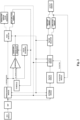
- Fig. 2 is a block diagram of a device for automatic QRS complex detection in an electrocardiogram signal for implementing the method according to the present invention.
- the exemplary device for implementing the method according to the present invention comprises a number of mutually connected modules, which are used to implement particular steps of the method according to the invention.
- an output of a module ECG MODULE is connected to an input of a buffer module BUF, whose output is connected to an input of a module PREPROCESSING MODULE.
- Outputs of the module PREPROCESSING MODULE and of a module TH MODULE are connected to inputs of a comparator COMPARATOR, whose output is connected to a module SEARCHING WINDOW PULSE GENERATOR.
- Inputs of a module PEAK DETECTOR are connected to outputs of the modules PREPROCESSING MODULE and SEARCHING WINDOW PULSE GENERATOR, respectively, whereas its outputs are connected to inputs of modules REFRACTORY WINDOW PULSE GENERATOR and PEAK AMPLITUDE MEMORY, respectively.
- Inputs of a module PULSE EXTENSION are connected to outputs of the modules PROCESSING MODULE and PEAK AMPLITUDE MEMORY, respectively, whereas its output is connected to an input of the module SEARCHING WINDOW PULSE GENERATOR.
- Inputs of a module EXTREMA MODULE are connected to inputs of the modules BUF, REFRACTORY WINDOW PULSE GENERATOR, SEARCHING WINDOW PULSE GENERATOR, respectively, whereas its output is connected to an input of a module FACTOR MODULE.
- modules FACTOR MEMORY Particular inputs of a module FACTOR MEMORY are connected to outputs of modules REFRACTORY WINDOW PULSE GENERATOR, SEARCHING WINDOW PULSE GENERATOR and TH FACTOR MODULE, respectively.
- a module FACTOR SELECTOR has two inputs connected to the modules FACTOR MEMORY and SEARCHING WINDOW PULSE GENERATOR, respectively, and two outputs connected to modules TIMESTAMP MEMORY and AMPLITUDE MEMORY, whose outputs are connected to inputs of a module OUTPUT MEMORY.
- the output of the module AMPLITUDE MEMORY is also connected to an input of the module TH FACTOR MODULE.
- the measuring module ECG MODULE provides an electrocardiogram signal (ECG) in the form of signal samples, which are delivered at a given frequency determined by a signal CLK, which frequency in the embodiment is 360Hz.
- ECG electrocardiogram signal
- an initial value of a threshold TH_PREPROCESSED is set, equal to a maximum value of a signal Y_ PREPROCESSED detected within first 3 seconds of the ECG signal obtained by means of the measuring module ECG MODULE
- MIN_TH_FACTOR 1.22 [mV].
- the resolution of the A/D converter is 5 ⁇ V.
- a value of a parameter FACTOR is determined for this sample of the ECG signal by means of the module FACTOR MODULE, which parameter specifies how distinct local extreme the considered sample of the ECG signal is against the neighbouring samples of the ECG signal, and for this purpose the parameter FACTOR is assigned a value the bigger, the greater the amplitude of the considered local extreme represented by the considered sample of the ECG signal than the values of the neighbouring samples of the ECG signal.
- the determined value of the parameter FACTOR is compared with the threshold TH_FACTOR previously determined by means of the module TH FACTOR MODULE, and if the value of the parameter FACTOR is greater than the set threshold TH_FACTOR, the value of the parameter FACTOR and the time instant of receiving the considered sample of the ECG signal previously registered by means of the module EXTREMA MODULE, for which time instant the parameter FACTOR has been determined, are stored in a list THRESHOLD_WINDOW_LIST in a memory of the module FACTOR MEMORY, wherein these operations are repeated the required number of times until a time instant of reaching the threshold TH_PREPROCESSED by the signal Y_PREPROCESSED is detected by means of the comparator COMPARATOR, whose value is systematically decreased every sampling interval of the ECG signal (1/360 s) by successive multiplying the value of the comparator COMPARATOR, whose value is systematically decreased every sampling interval of the ECG signal (1/360 s) by successive multiplying
- a time instant of occurrence of the maximum value FACTOR_MAX1 of the parameter FACTOR is stored in the module TIMESTAMP MEMORY, which is also recognized as the time instant of occurrence of the R-wave in the QRS complex, and then the time instant of occurrence of the maximum value FACTOR_MAX1 of the parameter FACTOR is copied to the output memory module OUTPUT MEMORY.
- a time instant of occurrence of the maximum value FACTOR_MAX2 of the parameter FACTOR is stored in the module TIMESTAMP MEMORY, which is also recognized as the time instant of occurrence of the previous R-wave in the QRS complex, than the R-wave previously detected for the value FACTOR_MAX1 of the parameter FACTOR, and then the time instant of occurrence of the maximum value FACTOR_MAX2 of the parameter FACTOR is copied to the output memory module OUTPUT MEMORY.
- the value of the parameter FACTOR which specifies how distinct local extreme the considered sample of the ECG signal is against the neighbouring samples of the ECG signal, is determined by means of the module FACTOR MODULE in such a way that
Landscapes
- Health & Medical Sciences (AREA)
- Life Sciences & Earth Sciences (AREA)
- Cardiology (AREA)
- Engineering & Computer Science (AREA)
- Pathology (AREA)
- Physics & Mathematics (AREA)
- General Health & Medical Sciences (AREA)
- Heart & Thoracic Surgery (AREA)
- Veterinary Medicine (AREA)
- Public Health (AREA)
- Animal Behavior & Ethology (AREA)
- Biophysics (AREA)
- Surgery (AREA)
- Biomedical Technology (AREA)
- Molecular Biology (AREA)
- Medical Informatics (AREA)
- Analytical Chemistry (AREA)
- Biochemistry (AREA)
- Chemical & Material Sciences (AREA)
- General Physics & Mathematics (AREA)
- Immunology (AREA)
- Artificial Intelligence (AREA)
- Computer Vision & Pattern Recognition (AREA)
- Physiology (AREA)
- Psychiatry (AREA)
- Signal Processing (AREA)
- Measurement And Recording Of Electrical Phenomena And Electrical Characteristics Of The Living Body (AREA)
Abstract
Description
- The subject of the invention is a method of automatic QRS complex detection in an electrocardiogram signal ECG applicable in biomedical diagnostics.
- Electrocardiography is one of the most commonly performed diagnostic procedures that allows the analysis and assessment of the heart's electrical activity. Reading the potential difference between two electrodes placed on the body of a patient, mostly on the chest, allows plotting the so-called electrocardiographic curve (ECG curve) representing the course of the mentioned potential difference over time. Evaluation of the ECG curve requires analysis to be made by a doctor or a specialist in order to detect possible irregularities of the heart activity of the examined person. In order to support the interpretation and evaluation of the ECG curve, many devices and algorithms have been developed that allow to at least partially automate the ECG curve analysis, increase its reliability and accelerate the diagnosis.
- The ECG curve is cyclical due to the repetitive activity of the heart. In each single cycle of the ECG curve, there are characteristic waveform features corresponding to cardiac activity, which most often include the P-wave, the QRS complex and the T-wave. The P-wave corresponds to depolarization of the atrial muscle, the QRS complex corresponds to depolarization of the ventricular muscle, and the T-wave corresponds to ventricular repolarization. The description of the heart's activity and the interpretation of the ECG curve is the subject of numerous studies available in the art.
- In order to enable an automated analysis of the ECG curve, it is essential to reliably detect the characteristic features of the ECG curve, in particular the above-mentioned QRS complex.
- From the publication Gutiérrez-Rivas, Raquel, et al. "Novel real-time low-complexity QRS complex detector based on adaptive thresholding." IEEE Sensors Journal, vol. 15, no. 10, s. 6036-6043, 2015 a QRS complex detector based on adaptive thresholding is known.
- From the application P.435394 a method of detecting a QRS complex in an electrocardiogram (ECG) signal is known, in which an ABS_DIFF_SHORT signal generated on an output of an ABS_DIFF_SHORT_MODULE module, which is the difference of the current instantaneous value of the ECG signal provided by an ECG_MODULE measuring module, and the mean value of a SHORT_AVG of the ECG signal calculated for a time interval T_SHORT, are monitored using the COMP comparator. Then, the COMP comparator detects the moment when an ABS_DIFF_SHORT signal reaches a threshold TH value previously determined with a TH_MODULE module, and then, when the ABS_DIFF_SHORT signal reaches the threshold TH value, the countdown of a SEARCHING_WINDOW time window starts with a PULSE_GENERATOR pulse generator which has fixed-length for search for a R wave in the QRS complex of the ECG signal. In the next step, using a PEAK_DETECTOR detection module, the maximum value of the ABS_DIFF_LONG_MODULE module produced at its output is recorded during the SEARCHING_WINDOW time window of the ABS_DIFF_LONG signal, which is the difference of the current instantaneous value of the ECG signal and the average LONG_AVG value of the ECG signal calculated for a segment of a T_LONG time segment while the PEAK_DETECTOR detection module the moment of the detected maximum value of the ABS_DIFF_LONG signal is recorded during the SEARCHING_WINDOW time window. After that, the maximum value of the ABS_DIFF_LONG signal detected by the PEAK_DETECTOR detection module is stored by means of a R_AMPLITUDE_MEMORY memory module, which is considered to be the R-wave amplitude in the QRS complex.
- From the application P.435396 a device for detecting the QRS complex of electrocardiogram signal is known.
- The object of the present invention is to provide an improved method of automatic QRS complex detection in an electrocardiogram signal with increased reliability of R-wave detection. This object is solved by the method according to claim 1.
- According to the present invention, a method of automatic QRS complex detection in an electrocardiogram signal consists in receiving an ECG signal obtained by means of a measuring module ECG MODULE monitoring electrical heart activity of a patient, wherein the ECG signal is represented in the form of samples provided by the measuring module ECG MODULE at equal time intervals measured by a clock and successively stored in a buffer BUF by means of a CLK signal generated in the measuring module ECG MODULE, and then in that
- a) by means of a module TH MODULE an initial value of a threshold TH_PREPROCESSED is set, and then
- b) a signal Y_PREPROCESSED generated at an output of a module PREPROCESSING MODULE is monitored by means of a comparator COMPARATOR , which signal is obtained by generating by means of the module PREPROCESSING MODULE a signal Y0 being the difference between a value Y of the considered sample of the ECG signal and a sample value of the ECG signal previously stored in the buffer BUF, which has been received a predetermined number Nd of samples earlier,
and determining by means of the module PREPROCESSING MODULE a signal Y1 being the sum of the considered sample of the signal Y0 and a value of a predetermined number N-1 of samples of the signal Y0 immediately preceding the considered sample of the signal Y0, and dividing this sum by a number N and squaring such obtained number, - c) by means of the module TH MODULE the value of the threshold TH_PREPROCESSED is systematically decreased every sampling interval of the ECG signal starting from its initial value previously determined by means of the module TH MODULE by multiplying the current threshold value TH_PREPROCESSED, in time instants of receiving successive samples of the ECG signal, by a predetermined and less than one constant value TH_REDUCING_FACTOR and these operations are repeated the required number of times until a time instant of reaching the threshold TH_PREPROCESSED by the signal Y_PREPROCESSED is detected by means of the comparator COMPARATOR,
- d) when the time instant of reaching the current value of the threshold TH_PREPROCESSED by the signal Y_PREPROCESSED is detected, a time window SEARCHING_WINDOW is started to be measured by means of a pulse generator SEARCHING WINDOW PULSE GENERATOR for searching for the R-wave in the QRS complex of the ECG signal,
- e) next, during the time window SEARCHING_WINDOW a maximum value of the signal Y_PREPROCESSED is detected by means of a detection module PEAK DETECTOR and this value is stored in a module PEAK AMPLITUDE MEMORY.
- The method according to the invention is characterized in that
- in step a) an initial value for a threshold TH_FACTOR is set by means of a module TH FACTOR MODULE,
- in step c) local extremes of the ECG signal are searched for by means of a module EXTREMA MODULE,
- after detecting by means of the module EXTREMA MODULE that the considered sample of the ECG signal is the local extreme of the ECG signal, a value of a parameter FACTOR is determined for this sample of the ECG signal by means of a module FACTOR MODULE, which parameter specifies how distinct local extreme the considered sample of the ECG signal is against the neighbouring samples of the ECG signal, and for this purpose the parameter FACTOR is assigned a value the bigger, the greater the amplitude of the considered local extreme represented by the considered sample of the ECG signal than the values of the neighbouring samples of the ECG signal,
- next, after determining the value of the parameter FACTOR for the considered sample of the ECG signal being the local extreme of the ECG signal, the determined value of the parameter FACTOR is compared with the threshold TH_FACTOR previously determined by means of the module TH FACTOR MODULE, and if the value of the parameter FACTOR is greater than the set threshold TH_FACTOR, the value of the parameter FACTOR and the time instant of receiving the considered sample of the ECG signal previously registered by means of the module EXTREMA MODULE, for which time instant the parameter FACTOR has been determined, are stored in a list THRESHOLD_WINDOW_LIST in a memory of a module FACTOR MEMORY,
- wherein these operations are repeated the required number of times until a time instant of reaching the threshold TH_PREPROCESSED by the signal Y_PREPROCESSED is detected by means of the comparator COMPARATOR, whose value is systematically decreased every sampling interval of the ECG signal by successive multiplying the value of the threshold TH_PREPROCESSED, in time instants of receiving successive samples of the ECG signal, by the predetermined and less than one constant value TH_REDUCING_FACTOR,
- wherein in step d) the time window SEARCHING_WINDOW has a determined minimal length SEARCHING_WINDOW_LEN_MIN,
- in step e) during the time window SEARCHING_WINDOW local extremes of the ECG signal are simultaneously determined by means of the module EXTREMA MODULE,
- next, for each one of the samples recognized as a local extreme it is determined, by determining a value of the parameter FACTOR by means of the module FACTOR MODULE, how distinct local extreme the considered sample of the ECG signal is against the neighbouring samples,
- for each detected local extreme the value of the parameter FACTOR and a time instant of receiving the considered sample of the ECG signal previously registered by means of the module EXTREMA MODULE, for which time instant the parameter FACTOR has been determined, are stored in a list SEARCHING_WINDOW_LIST in the memory module FACTOR MEMORY,
- after a set minimum duration SEARCHING_WINDOW_LEN_MIN of the time window SEARCHING_WINDOW the measurement of the time window SEARCHING_WINDOW is terminated by the pulse generator SEARCHING WINDOW PULSE GENERATOR, provided that the maximum value of the signal Y_PREPROCESSED registered during the time window SEARCHING_WINDOW and reduced by the current value of the signal Y_PREPROCESSED reaches a predetermined threshold MIN_DIFF, what is detected by a module PULSE EXTENSION,
- after the end of the time window SEARCHING_WINDOW such a value FACTOR_MAX1 of the parameter FACTOR is selected from the list SEARCHING_WINDOW_LIST by means of a module FACTOR SELECTOR, which is the greatest among those stored in the list SEARCHING_WINDOW_LIST and the maximum value FACTOR_MAX1 of the parameter FACTOR considered to be the double amplitude of the R-wave in the QRS complex is stored in a module AMPLITUDE MEMORY, and then the maximum value FACTOR_MAX1 of the parameter FACTOR is copied to an output memory module OUTPUT MEMORY,
- at the same time a time instant of occurrence of the maximum value FACTOR_MAX1 of the parameter FACTOR is stored in a module TIMESTAMP MEMORY, which is also recognized as the time instant of occurrence of the R-wave in the QRS complex, and then the time instant of occurrence of the maximum value FACTOR_MAX1 of the parameter FACTOR is copied to the output memory module OUTPUT MEMORY,
- next, from the list THRESHOLD_WINDOW_LIST in the module FACTOR MEMORY those values of the parameter FACTOR stored in this list are removed by means of the module FACTOR SELECTOR, whose time instant of occurrence precedes by less than a set time period R-TOR_MIN since the time instant of occurrence of the R-wave in the QRS complex stored in the output memory module OUTPUT MEMORY,
- next, provided that the number of remaining elements in the list THRESHOLD_WINDOW_LIST is not greater than a set constant MAX_ABOVE_TH, that value FACTOR_MAX2 of the parameter FACTOR is selected from the list THRESHOLD_WINDOW_LIST by means of a module FACTOR SELECTOR, which is the greatest among those stored in the list THRESHOLD_WINDOW_LIST and the maximum value FACTOR_MAX2 of the parameter FACTOR considered to be double the amplitude of the previous R-wave in the QRS complex, than the R-wave previously detected for the value FACTOR_MAX1 of the parameter FACTOR, and is stored in the module AMPLITUDE MEMORY, and then the maximum value FACTOR_MAX2 of the parameter FACTOR is copied to the output memory module OUTPUT MEMORY,
- at the same time a time instant of occurrence of the maximum value FACTOR_MAX2 of the parameter FACTOR is stored in the module TIMESTAMP MEMORY, which is also recognized as the time instant of occurrence of the previous R-wave in the QRS complex, than the R-wave previously detected for the value FACTOR_MAX1 of the parameter FACTOR, and then the time instant of occurrence of the maximum value FACTOR_MAX2 of the parameter FACTOR is copied to the output memory module OUTPUT MEMORY,
- next, the sum value of the values of the parameters FACTOR_MAX1 obtained so far is updated by means of the module TH FACTOR MODULE by adding the current value FACTOR_MAX1 to the previous sum value and a counter of performed algorithm work cycles is updated and on this basis an arithmetic mean of the values FACTOR found so far within time windows is calculated,
- and then the parameter TH_FACTOR is assigned that value among the pair MIN_TH_FACTOR and NEW_TH_FACTOR, which is not less than the second value in the pair MIN_TH_FACTOR and NEW_TH_FACTOR, wherein NEW_TH_FACTOR is the product of a parameter EXPECTED_TH_FACTOR and of a weighted mean with weights, respectively, (1 - TH_FACTOR_LAST_PEAK_COEF) and TH_FACTOR_LAST_PEAK_COEF of the arithmetic mean of values of the parameter FACTOR for the R-waves in the QRS complex found so far and the value of the parameter FACTOR_MAX1 for the last found R-wave,
- next, the sum value of the maximum values of the signal Y_PREPROCESSED obtained so far is updated by means of the module TH MODULE by adding the current maximum value Y_PREPROCESSED to the previous sum value and the counter of performed algorithm work cycles is updated and on this basis an arithmetic mean of the values Y_PREPROCESSED found so far within time windows is calculated,
- next, the parameter TH_PREPROCESSED is assigned a new value, which is a weighted mean with weights, respectively, (1 - TH_PREPROCESSED_LAST_PEAK_COEF) and TH_PREPROCESSED_LAST_PEAK_COEF of the arithmetic mean of maximum values of the signal Y_PREPROCESSED found so far within time windows for detecting R-waves in the QRS complex and of the maximum value of the signal Y_PREPROCESSED for the current time window SEARCHING_WINDOW, in which the last R-wave has been identified,
- next, by means of a module REFRACTORY WINDOW PULSE GENERATOR a measurement of a time window REFRACTORY_WINDOW is started, the end of which occurs after time REFRACTORY_LEN since the time instant of detecting the last R-wave,
- next, during REFRACTORY_WINDOW all the stored elements on the lists THRESHOLD_WINDOW_LIST and SEARCHING_WINDOW_LIST are removed from the module FACTOR MEMORY in order to prepare the module for the next work cycle,
- after terminating the measurement of the time window REFRACTORY_WINDOW, monitoring of the signal Y_PREPROCESSED generated at the output of the module PREPROCESSING MODULE by means of the comparator COMPARATOR is resumed, and then the cycle is repeated the desired number of times.
- In an advantageous embodiment of the method according to the invention, the local extremes of the ECG signal are searched for by means of the module EXTREMA MODULE in such a way that
- after receiving the considered sample of the ECG signal by means of the measuring module ECG MODULE and storing this sample of the ECG signal by means of the module BUF, a maximum value LOCAL_EXT_MAX_LEFT and a minimum value LOCAL_EXT_MIN_LEFT are determined by means of the EXTREMA MODULE for a set of predetermined number LOCAL_EXT_LEN of samples of the ECG signal stored in the buffer BUF that immediately precede the considered sample and of the considered sample of the ECG signal, and then the maximum value LOCAL_EXT_MAX_LEFT and the minimum value LOCAL_EXT_MIN_LEFT are stored by means of the module EXTREMA MODULE, and also
- after receiving by means of the measuring module ECG_MODULE and collecting in the buffer BUF the predetermined number LOCAL_EXT_LEN of samples of the ECG signal that follow immediately after the considered sample of the ECG signal, a maximum value LOCAL_EXT_MAX_RIGHT and a minimum value LOCAL_EXT_MIN_RIGHT are determined by means of the module EXTREMA MODULE for a set of predetermined number LOCAL_EXT_LEN of samples of the ECG signal and of the considered sample of the ECG signal, and then these maximum value LOCAL_EXT_MAX_RIGHT and minimum value LOCAL_EXT_MIN_RIGHT are stored by means of the module EXTREMA MODULE,
- next, the previously determined maximum value LOCAL_EXT_MAX_LEFT and the previously determined minimum value LOCAL_EXT_MIN_LEFT are successively compared by means of the module EXTREMA MODULE, for the predetermined number LOCAL_EXT_LEN of samples of the ECG signal immediately preceding the considered sample of the ECG signal and stored in the buffer BUF, with the value Y of the considered sample of the ECG signal,
- and also the previously determined maximum value LOCAL_EXT_MAX_ RIGHT and the previously determined LOCAL_EXT_MIN_RIGHT are successively compared by means of the module EXTREMA MODULE, for the predetermined number LOCAL_EXT_LEN of samples of the ECG signal that follow immediately after the considered sample of the ECG signal, with the value Y of the considered sample of the ECG signal,
- and if the result of the comparisons shows equality with the value Y of the considered sample of the ECG signal for at least one of the maximum values LOCAL_EXT_MAX_LEFT and LOCAL_EXT_MAX_ RIGHT or the minimum values LOCAL_EXT_MIN_LEFT and LOCAL_EXT_MIN_RIGHT obtained previously for the groups of samples immediately preceding and immediately following the considered sample of the ECG signal, then the considered sample of the ECG signal is recognized as a local extreme.
- In another advantageous embodiment of the method according to the invention, the value of the parameter FACTOR, which specifies how distinct local extreme the considered sample of the ECG signal is against the neighbouring samples of the ECG signal, is determined by means of the module FACTOR MODULE in such a way that
- a minimum value MIN_LEFT and a maximum value MAX_LEFT of samples of the ECG signal are determined for a predetermined number MAX_WIDTH of samples of the ECG signal that immediately precede the considered sample and are stored in the buffer BUF, and then, this maximum value MAX_LEFT and this minimum value MIN_LEFT are stored by means of the module FACTOR MODULE for the predetermined number MAX_WIDTH of samples of the ECG signal that immediately precede the considered sample, and also
- after receiving by means of the measuring module ECG MODULE and collecting in the buffer BUF the predetermined number MAX_WIDTH of samples of the ECG signal that follow immediately after the considered sample of the ECG signal, a maximum value MAX_RIGHT and a minimum value MIN_RIGHT are determined by means of the module FACTOR MODULE for the predetermined number MAX_WIDTH of samples of the ECG signal, and then the maximum value MAX_RIGHT and the minimum value MIN_RIGHT are stored by means of the module FACTOR MODULE for the predetermined number MAX_WIDTH of samples of the ECG signal that follow immediately after the considered sample of signal,
- and the value of the parameter FACTOR is determined by taking as the parameter FACTOR the value of that one among the pair of the parameters FACTOR_MAX and FACTOR_MIN, which is not less than the second one, where the values of the parameters FACTOR_MAX and FACTOR_MIN are determined according to the formulas:


- The method according to the invention provides increased reliability of detecting R-waves even in the presence of cardiac anomalies and in the presence of interference or distortion of the ECG signal. The features of the method furthermore make it possible to keep the computational complexity low, whereby the method can be implemented in portable devices, e.g. by implementing in the form of computer program instructions on a storage medium.
- The subject of the invention in embodiments is presented in the drawing, in which:
-
Fig. 1 is a simplified diagram of an electrocardiogram signal waveform with marked P- and T-waves and QRS complex; -
Fig. 2 is a block diagram of a device for automatic QRS complex detection in an electrocardiogram signal for implementing the method according to the present invention. -
Fig. 1 is a simplified diagram of an electrocardiogram signal waveform (ECG) with marked P- and T- waves and QRS complex. Such electrocardiogram signal (ECG) is received by means of a measuring module through electrodes placed on the body of a patient. The ECG signal is characterized by a sequence of positive and negative deviations (so-called waves) from the isoelectric line, which correspond to periods of time in which no cardiac excitation is found. The group of the largest waves includes a negative deflection (Q-wave), a positive deflection (R-wave) and again a negative deflection (S-wave) and is referred to as the so-called QRS complex. The greatest amplitude in the QRS complex usually has the R-wave, so that the detection of the QRS complex often comes down to detection of the R-wave. The statistics of time intervals between R-waves and of amplitudes of the R-waves is an important diagnostic information used in medicine, among others, to identify abnormalities in the heart activity. -
Fig. 2 is a block diagram of a device for automatic QRS complex detection in an electrocardiogram signal for implementing the method according to the present invention. As shown in the figure, the exemplary device for implementing the method according to the present invention comprises a number of mutually connected modules, which are used to implement particular steps of the method according to the invention. According to the presented block diagram, an output of a module ECG MODULE is connected to an input of a buffer module BUF, whose output is connected to an input of a module PREPROCESSING MODULE. Outputs of the module PREPROCESSING MODULE and of a module TH MODULE are connected to inputs of a comparator COMPARATOR, whose output is connected to a module SEARCHING WINDOW PULSE GENERATOR. Inputs of a module PEAK DETECTOR are connected to outputs of the modules PREPROCESSING MODULE and SEARCHING WINDOW PULSE GENERATOR, respectively, whereas its outputs are connected to inputs of modules REFRACTORY WINDOW PULSE GENERATOR and PEAK AMPLITUDE MEMORY, respectively. Inputs of a module PULSE EXTENSION are connected to outputs of the modules PROCESSING MODULE and PEAK AMPLITUDE MEMORY, respectively, whereas its output is connected to an input of the module SEARCHING WINDOW PULSE GENERATOR. Inputs of a module EXTREMA MODULE are connected to inputs of the modules BUF, REFRACTORY WINDOW PULSE GENERATOR, SEARCHING WINDOW PULSE GENERATOR, respectively, whereas its output is connected to an input of a module FACTOR MODULE. Particular inputs of a module FACTOR MEMORY are connected to outputs of modules REFRACTORY WINDOW PULSE GENERATOR, SEARCHING WINDOW PULSE GENERATOR and TH FACTOR MODULE, respectively. A module FACTOR SELECTOR has two inputs connected to the modules FACTOR MEMORY and SEARCHING WINDOW PULSE GENERATOR, respectively, and two outputs connected to modules TIMESTAMP MEMORY and AMPLITUDE MEMORY, whose outputs are connected to inputs of a module OUTPUT MEMORY. The output of the module AMPLITUDE MEMORY is also connected to an input of the module TH FACTOR MODULE. Functions of the individual modules and related steps of the method according to the invention are explained in the following detailed description of an embodiment. - The measuring module ECG MODULE provides an electrocardiogram signal (ECG) in the form of signal samples, which are delivered at a given frequency determined by a signal CLK, which frequency in the embodiment is 360Hz. By means of the module TH MODULE an initial value of a threshold TH_PREPROCESSED is set, equal to a maximum value of a signal Y_ PREPROCESSED detected within first 3 seconds of the ECG signal obtained by means of the measuring module ECG MODULE, and an initial value of a threshold TH_FACTOR is set by means of the module TH FACTOR MODULE, equal to a parameter MIN_TH_FACTOR = 1.22 [mV]. The full range of possible changes of the analogue ECG signal is +5mV. The resolution of the A/D converter in this embodiment is 2^11=2048, and therefore 1.22 mV corresponds to 244 "steps" of the A/D converter. The resolution of the A/D converter is 5µV. Next, a signal Y_PREPROCESSED generated at the output of the module PREPROCESSING MODULE is monitored by means of the comparator COMPARATOR, obtained by:
- generating by means of the module PREPROCESSING MODULE a signal Y0 being the difference between a value Y of the considered sample of the ECG signal and a sample value of the ECG signal previously stored in the buffer BUF, which has been received a predetermined number Nd = 7 samples earlier (for signal CLK=360Hz, which corresponds to time 19.4445 ms),
- and determining by means of the module PREPROCESSING MODULE a signal Y1 being the sum of the value Y0 of the considered sample of the signal Y0 and a value of a predetermined number of 7 samples (N-1=7; N=8) of the signal Y0 immediately preceding the considered sample of the signal Y0 (for signal CLK=360Hz), which corresponds to time 22.2222 ms, and dividing this sum by a number N=8 (CLK=360Hz) and squaring such obtained number.
- At the same time, by means of the module TH MODULE the value of the threshold TH_PREPROCESSED is systematically decreased every sampling interval of the ECG signal (1/360 s for signal CLK =360Hz) starting from its initial value previously determined by means of the module TH MODULE by multiplying the current threshold value TH_PREPROCESSED, in time instants of receiving successive samples of the ECG signal, by a predetermined and less than one constant value TH_REDUCING_FACTOR = 0.9818 (value for CLK=360Hz).
- At the same time, local extremes of the ECG signal are searched for by means of the module EXTREMA MODULE.
- After detecting by means of the module EXTREMA MODULE that the considered sample of the ECG signal is the local extreme of the ECG signal, a value of a parameter FACTOR is determined for this sample of the ECG signal by means of the module FACTOR MODULE, which parameter specifies how distinct local extreme the considered sample of the ECG signal is against the neighbouring samples of the ECG signal, and for this purpose the parameter FACTOR is assigned a value the bigger, the greater the amplitude of the considered local extreme represented by the considered sample of the ECG signal than the values of the neighbouring samples of the ECG signal.
- Next, after determining the value of the parameter FACTOR for the considered sample of the ECG signal being the local extreme of the ECG signal, the determined value of the parameter FACTOR is compared with the threshold TH_FACTOR previously determined by means of the module TH FACTOR MODULE, and if the value of the parameter FACTOR is greater than the set threshold TH_FACTOR, the value of the parameter FACTOR and the time instant of receiving the considered sample of the ECG signal previously registered by means of the module EXTREMA MODULE, for which time instant the parameter FACTOR has been determined, are stored in a list THRESHOLD_WINDOW_LIST in a memory of the module FACTOR MEMORY, wherein these operations are repeated the required number of times until a time instant of reaching the threshold TH_PREPROCESSED by the signal Y_PREPROCESSED is detected by means of the comparator COMPARATOR, whose value is systematically decreased every sampling interval of the ECG signal (1/360 s) by successive multiplying the value of the threshold TH_PREPROCESSED, in time instants of receiving successive samples of the ECG signal, by a predetermined and less than one constant value TH_REDUCING_FACTOR = 0.9818 (value for 360Hz).
- When the time instant of reaching the current value of the threshold TH_PREPROCESSED by the signal Y_PREPROCESSED is detected, a time window SEARCHING_WINDOW is started to be measured by means of the pulse generator SEARCHING WINDOW PULSE GENERATOR for searching for the R-wave in the QRS complex of the ECG signal having a determined minimal length SEARCHING_WINDOW_LEN_MIN = 260ms (which corresponds to duration of 93 samples).
- Next, during the time window SEARCHING_WINDOW a maximum value of the signal Y_PREPROCESSED is detected by means of the detection module PEAK DETECTOR and this value is stored in the module PEAK AMPLITUDE MEMORY.
- At the same time, during the time window SEARCHING_WINDOW local extremes of the ECG signal are determined by means of the module EXTREMA MODULE, and next, for each one of the samples recognized as a local extreme it is determined, by determining a value of the parameter FACTOR by means of the module FACTOR MODULE, how distinct local extreme the considered sample of the ECG signal is against the neighbouring samples.
- For each detected local extreme the value of the parameter FACTOR and a time instant of receiving the considered sample of the ECG signal previously registered by means of the module EXTREMA MODULE, for which time instant the parameter FACTOR has been determined, are stored in a list SEARCHING_WINDOW_LIST in the memory module FACTOR MEMORY.
- After a set minimum duration SEARCHING_WINDOW_LEN_MIN = 260ms of the time window SEARCHING_WINDOW the measurement of the time window SEARCHING_WINDOW is terminated by the pulse generator SEARCHING WINDOW PULSE GENERATOR, provided that the maximum value of the signal Y_PREPROCESSED registered during the time window SEARCHING_WINDOW and reduced by the current value of the signal Y_PREPROCESSED reaches a predetermined threshold MIN_DIFF = 0.062 [mV], what is detected by the module PULSE EXTENSION.
- After the end of the time window SEARCHING_WINDOW such a value FACTOR_MAX1 of the parameter FACTOR is selected from the list SEARCHING_WINDOW_LIST by means of a module FACTOR SELECTOR, which is the greatest among those stored in the list SEARCHING_WINDOW_LIST and the maximum value FACTOR_MAX1 of the parameter FACTOR considered to be the double amplitude of the R-wave in the QRS complex is stored in a module AMPLITUDE MEMORY, and next, the maximum value FACTOR_MAX1 of the parameter FACTOR is copied to the output memory module OUTPUT MEMORY.
- At the same time a time instant of occurrence of the maximum value FACTOR_MAX1 of the parameter FACTOR is stored in the module TIMESTAMP MEMORY, which is also recognized as the time instant of occurrence of the R-wave in the QRS complex, and then the time instant of occurrence of the maximum value FACTOR_MAX1 of the parameter FACTOR is copied to the output memory module OUTPUT MEMORY.
- Next, from the list THRESHOLD_WINDOW_LIST in the module FACTOR MEMORY those maximum values of the parameter FACTOR stored in this list are removed by means of the module FACTOR SELECTOR, whose time instant of occurrence precedes by less than a set time period R-TO-R_MIN = 200 ms (which corresponds to 72 samples at signal frequency CLK = 360Hz) since the time instant of occurrence of the R-wave in the QRS complex stored in the output memory module OUTPUT MEMORY.
- Next, provided that the number of remaining elements in the list THRESHOLD_WINDOW_LIST is not greater than a set constant MAX_ABOVE_TH = 2, that value FACTOR_MAX2 of the parameter FACTOR is selected from the list THRESHOLD_WINDOW_LIST by means of the module FACTOR SELECTOR, which is the greatest among those stored in the list THRESHOLD_WINDOW_LIST and the maximum value FACTOR_MAX2 of the parameter FACTOR considered to be double the amplitude of the previous R-wave in the QRS complex than the R-wave previously detected for the value FACTOR_MAX1 of the parameter FACTOR, and is stored in the module AMPLITUDE MEMORY,, and then the maximum value FACTOR_MAX2 of the parameter FACTOR is copied to the output memory module OUTPUT MEMORY.
- At the same time a time instant of occurrence of the maximum value FACTOR_MAX2 of the parameter FACTOR is stored in the module TIMESTAMP MEMORY, which is also recognized as the time instant of occurrence of the previous R-wave in the QRS complex, than the R-wave previously detected for the value FACTOR_MAX1 of the parameter FACTOR, and then the time instant of occurrence of the maximum value FACTOR_MAX2 of the parameter FACTOR is copied to the output memory module OUTPUT MEMORY.
- Next, the sum value of the values of the parameters FACTOR_MAX1 obtained so far is updated by means of the module TH FACTOR MODULE by adding the current value FACTOR_MAX1 to the previous sum value and a counter of performed algorithm work cycles is updated and on this basis an arithmetic mean of the values FACTOR found so far within time windows is calculated, and then the parameter TH_FACTOR is assigned that value among the pair MIN_TH_FACTOR = 1.22 [mV] and NEW_TH_FACTOR, which is not less than the second value in the pair MIN_TH_FACTOR and NEW_TH_FACTOR, wherein NEW_TH_FACTOR is the product of a parameter EXPECTED_TH_FACTOR = 0.48 and of a weighted mean with weights, respectively, (1 - TH_FACTOR_LAST_PEAK_COEF) = 0.6 and TH_FACTOR_LAST_PEAK_COEF = 0.4 of the arithmetic mean of values of the parameter FACTOR for the R-waves in the QRS complex found so far and the value of the parameter FACTOR_MAX1 for the last found R-wave.
- Next, the sum value of the maximum values of the signal Y_PREPROCESSED obtained so far is updated by means of the module TH MODULE by adding the current maximum value Y_PREPROCESSED to the previous sum value and the counter of performed algorithm work cycles is updated and on this basis an arithmetic mean of the values Y_PREPROCESSED found so far within time windows is calculated, and next, the parameter TH_PREPROCESSED is assigned a new value, which is a weighted mean with weights, respectively, (1 - TH_PREPROCESSED_LAST_PEAK_COEF) = 0.3 and TH_PREPROCESSED_LAST_PEAK_COEF = 0.7 of the arithmetic mean of maximum values of the signal Y_PREPROCESSED found so far within time windows for detecting R-waves in the QRS complex and of the maximum value of the signal Y_PREPROCESSED for the current time window SEARCHING_WINDOW, in which the last R-wave has been identified.
- Next, by means of the module REFRACTORY WINDOW PULSE GENERATOR a measurement of a time window REFRACTORY_WINDOW is started, the end of which occurs after time REFRACTORY_LEN = 200ms since the time instant of detecting the last R-wave.
- Next, during REFRACTORY_WINDOW all the stored elements on the lists THRESHOLD_WINDOW_LIST and SEARCHING_WINDOW_LIST are removed from the module FACTOR MEMORY in order to prepare the module for the next work cycle.
- After terminating the measurement of the time window REFRACTORY_WINDOW, monitoring of the signal Y_PREPROCESSED generated at the output of the module PREPROCESSING MODULE by means of the comparator COMPARATOR is resumed, and then the cycle is repeated the desired number of times.
- In an advantageous embodiment of the method according to the invention the local extremes of the ECG signal are searched for by means of the module EXTREMA MODULE in such a way that
- after receiving the considered sample of the ECG signal by means of the measuring module ECG MODULE and storing this sample of the ECG signal by means of the module BUF, a maximum value LOCAL_EXT_MAX_LEFT and a minimum value LOCAL_EXT_MIN_LEFT are determined by means of the EXTREMA MODULE for a set of predetermined number LOCAL_EXT_LEN = 6 samples (which corresponds to time 0.017 ms at signal frequency CLK = 360 Hz) of the ECG signal stored in the buffer BUF that immediately precede the considered sample and of the considered sample of the ECG signal, and then the maximum value LOCAL_EXT_MAX_LEFT and the minimum value LOCAL_EXT_MIN_LEFT are stored by means of the module EXTREMA MODULE, and also
- after receiving by means of the measuring module ECG_MODULE and collecting in the buffer BUF the predetermined number LOCAL_EXT_LEN = 6 samples of the ECG signal that follow immediately after the considered sample of the ECG signal, a maximum value LOCAL_EXT_MAX_RIGHT and a minimum value LOCAL_EXT_MIN_RIGHT are determined by means of the module EXTREMA MODULE for a set of predetermined number LOCAL_EXT_LEN of samples of the ECG signal and of the considered sample of the ECG signal, and then these maximum value LOCAL_EXT_MAX_RIGHT and minimum value LOCAL_EXT_MIN_RIGHT are stored by means of the module EXTREMA MODULE.
- Next, the previously determined maximum value LOCAL_EXT_MAX_LEFT and the previously determined minimum value LOCAL_EXT_MIN_LEFT are successively compared by means of the module EXTREMA MODULE, for the predetermined number LOCAL_EXT_LEN of samples of the ECG signal immediately preceding the considered sample of the ECG signal and stored in the buffer BUF, with the value Y of the considered sample of the ECG signal, and also the previously determined maximum value LOCAL_EXT_MAX_ RIGHT and the previously determined LOCAL_EXT_MIN_RIGHT are successively compared by means of the module EXTREMA MODULE, for the predetermined number LOCAL_EXT_LEN = 6 samples of the ECG signal that follow immediately after the considered sample of the ECG signal, with the value Y of the considered sample of the ECG signal. If the result of the comparisons shows equality with the value Y of the considered sample of the ECG signal for at least one of the maximum values LOCAL_EXT_MAX_LEFT and LOCAL_EXT_MAX_ RIGHT or the minimum values LOCAL_EXT_MIN_LEFT and LOCAL_EXT_MIN_RIGHT obtained previously for the groups of samples immediately preceding and immediately following the considered sample of the ECG signal, then the considered sample of the ECG signal is recognized as a local extreme.
- In another advantageous embodiment of the method according to the invention, the value of the parameter FACTOR, which specifies how distinct local extreme the considered sample of the ECG signal is against the neighbouring samples of the ECG signal, is determined by means of the module FACTOR MODULE in such a way that
- a minimum value MIN_LEFT and a maximum value MAX_LEFT of samples of the ECG signal are determined for a predetermined number MAX_WIDTH = 17 samples (which corresponds to 0,047ms for signal CLK=360Hz) of the ECG signal that immediately precede the considered sample and are stored in the buffer BUF, and then, this maximum value MAX_LEFT and this minimum value MIN_LEFT are stored by means of the module FACTOR MODULE for the predetermined number MAX_WIDTH = 17 samples of the ECG signal that immediately precede the considered sample, and also
- after receiving by means of the measuring module ECG MODULE and collecting in the buffer BUF the predetermined number MAX_WIDTH = 17 samples (which corresponds to 0,047ms for signal CLK=360Hz) of the ECG signal that follow immediately after the considered sample of the ECG signal, a maximum value MAX_RIGHT and a minimum value MIN_RIGHT are determined by means of the module FACTOR MODULE for the predetermined number MAX_WIDTH of samples of the ECG signal, and then the maximum value MAX_RIGHT and the minimum value MIN_RIGHT are stored by means of the module FACTOR MODULE for the predetermined number MAX_WIDTH = 17 samples of the ECG signal that follow immediately after the considered sample of signal, and the value of the parameter FACTOR is determined by taking as the parameter FACTOR the value of that one among the pair of the parameters FACTOR_MAX and FACTOR_MIN, which is not less than the second one, where the values of the parameters FACTOR_MAX and FACTOR_MIN are determined according to the formulas:


Claims (4)
- A method of QRS complex detection in an electrocardiogram signal (ECG) consisting in receiving the ECG signal obtained by means of a measuring module ECG MODULE monitoring electrical heart activity of a patient, wherein the ECG signal is represented in the form of samples provided by the measuring module ECG MODULE at equal time intervals measured by a clock and successively stored in a buffer BUF by means of a CLK signal generated in the measuring module ECG MODULE, and then in thata) by means of a module TH MODULE an initial value of a threshold TH_PREPROCESSED is set, and thenb) a signal Y_PREPROCESSED generated at an output of a module PREPROCESSING MODULE is monitored by means of a comparator COMPARATOR, which signal is obtained by generating by means of the module PREPROCESSING MODULE a signal Y0 being the difference between a value Y of the considered sample of the ECG signal and a sample value of the ECG signal previously stored in the buffer BUF, which has been received a predetermined number Nd of samples earlier,
and determining by means of the module PREPROCESSING MODULE a signal Y1 being the sum of the considered sample of the signal Y0 and a value of a predetermined number N-1 of samples of the signal Y0 immediately preceding the considered sample of the signal Y0, and dividing this sum by a number N and squaring such obtained number,c) by means of the module TH MODULE the value of the threshold TH_PREPROCESSED is systematically decreased every sampling interval of the ECG signal starting from its initial value previously determined by means of the module TH MODULE by multiplying the current threshold value TH_PREPROCESSED, in time instants of receiving successive samples of the ECG signal, by a predetermined and less than one constant value TH_REDUCING_FACTOR and these operations are repeated the required number of times until a time instant of reaching the threshold TH_PREPROCESSED by the signal Y_PREPROCESSED is detected by means of the comparator COMPARATOR,d) when the time instant of reaching the current value of the threshold TH_PREPROCESSED by the signal Y_PREPROCESSED is detected, a time window SEARCHING_WINDOW is started to be measured by means of a pulse generator SEARCHING WINDOW PULSE GENERATOR for searching for the R-wave in the QRS complex of the ECG signal,e) next, during the time window SEARCHING_WINDOW a maximum value of the signal Y_PREPROCESSED is detected by means of a detection module PEAK DETECTOR and this value is stored in a module PEAK AMPLITUDE MEMORY,characterized in thatin step a) an initial value for a threshold TH_FACTOR is set by means of a module TH FACTOR MODULE,in step c) local extremes of the ECG signal are searched for by means of a module EXTREMA MODULE,after detecting by means of the module EXTREMA MODULE that the considered sample of the ECG signal is the local extreme of the ECG signal, a value of a parameter FACTOR is determined for this sample of the ECG signal by means of a module FACTOR MODULE, which parameter specifies how distinct local extreme the considered sample of the ECG signal is against the neighbouring samples of the ECG signal, and for this purpose the parameter FACTOR is assigned a value the bigger, the greater the amplitude of the considered local extreme represented by the considered sample of the ECG signal than the values of the neighbouring samples of the ECG signal,next, after determining the value of the parameter FACTOR for the considered sample of the ECG signal being the local extreme of the ECG signal, the determined value of the parameter FACTOR is compared with the threshold TH_FACTOR previously determined by means of the module TH FACTOR MODULE, and if the value of the parameter FACTOR is greater than the set threshold TH_FACTOR, the value of the parameter FACTOR and the time instant of receiving the considered sample of the ECG signal previously registered by means of the module EXTREMA MODULE, for which time instant the parameter FACTOR has been determined, are stored in a list THRESHOLD_WINDOW_LIST in a memory of a module FACTOR MEMORY,wherein these operations are repeated the required number of times until a time instant of reaching the threshold TH_PREPROCESSED by the signal Y_PREPROCESSED is detected by means of the comparator COMPARATOR, whose value is systematically decreased every sampling interval of the ECG signal by successive multiplying the value of the threshold TH_PREPROCESSED, in time instants of receiving successive samples of the ECG signal, by the predetermined and less than one constant value TH_REDUCING_FACTOR,wherein in step d) the time window SEARCHING_WINDOW has a determined minimal length SEARCHING_WINDOW_LEN_MIN,in step e) during the time window SEARCHING_WINDOW local extremes of the ECG signal are simultaneously determined by means of the module EXTREMA MODULE, next, for each one of the samples recognized as a local extreme it is determined, by determining a value of the parameter FACTOR by means of the module FACTOR MODULE, how distinct local extreme the considered sample of the ECG signal is against the neighbouring samples,for each detected local extreme the value of the parameter FACTOR and a time instant of receiving the considered sample of the ECG signal previously registered by means of the module EXTREMA MODULE, for which time instant the parameter FACTOR has been determined, are stored in a list SEARCHING_WINDOW_LIST in the memory module FACTOR MEMORY,after a set minimum duration SEARCHING_WINDOW_LEN_MIN of the time window SEARCHING_WINDOW the measurement of the time window SEARCHING_WINDOW is terminated by the pulse generator SEARCHING WINDOW PULSE GENERATOR, provided that the maximum value of the signal Y_PREPROCESSED registered during the time window SEARCHING_WINDOW and reduced by the current value of the signal Y_PREPROCESSED reaches a predetermined threshold MIN_DIFF, what is detected by a module PULSE EXTENSION,after the end of the time window SEARCHING_WINDOW such a value FACTOR_MAX1 of the parameter FACTOR is selected from the list SEARCHING_WINDOW_LIST by means of a module FACTOR SELECTOR, which is the greatest among those stored in the list SEARCHING_WINDOW_LIST and the maximum value FACTOR_MAX1 of the parameter FACTOR considered to be double the amplitude of the R-wave in the QRS complex is stored in a module AMPLITUDE MEMORY, and then the maximum value FACTOR_MAX1 of the parameter FACTOR is copied to an output memory module OUTPUT MEMORY,at the same time a time instant of occurrence of the maximum value FACTOR_MAX1 of the parameter FACTOR is stored in a module TIMESTAMP MEMORY, which is also recognized as the time instant of occurrence of the R-wave in the QRS complex, and then the time instant of occurrence of the maximum value FACTOR_MAX1 of the parameter FACTOR is copied to the output memory module OUTPUT MEMORY,next, from the list THRESHOLD_WINDOW_LIST in the module FACTOR MEMORY those values of the parameter FACTOR stored in this list are removed by means of the module FACTOR SELECTOR, whose time instant of occurrence precedes by less than a set time period R-TOR_MIN since the time instant of occurrence of the R-wave in the QRS complex stored in the output memory module OUTPUT MEMORY,next, provided that the number of remaining elements in the list THRESHOLD_WINDOW_LIST is not greater than a set constant MAX_ABOVE_TH, that value FACTOR_MAX2 of the parameter FACTOR is selected from the list THRESHOLD_WINDOW_LIST by means of a module FACTOR SELECTOR, which is the greatest among those stored in the list THRESHOLD_WINDOW_LIST and the maximum value FACTOR_MAX2 of the parameter FACTOR considered to be double the amplitude of the previous R-wave in the QRS complex is stored in the module AMPLITUDE MEMORY, rather than the R-wave previously detected for the value FACTOR_MAX1 of the parameter FACTOR, and then the maximum value FACTOR_MAX2 of the parameter FACTOR is copied to the output memory module OUTPUT MEMORY,at the same time a time instant of occurrence of the maximum value FACTOR_MAX2 of the parameter FACTOR is stored in the module TIMESTAMP MEMORY, which is also recognized as the time instant of occurrence of the previous R-wave in the QRS complex, rather than the R-wave previously detected for the value FACTOR_MAX1 of the parameter FACTOR, and then the time instant of occurrence of the maximum value FACTOR_MAX2 of the parameter FACTOR is copied to the output memory module OUTPUT MEMORY,next, the sum value of the values of the parameters FACTOR_MAX1 obtained so far is updated by means of the module TH FACTOR MODULE by adding the current value FACTOR_MAX1 to the previous sum value and a counter of performed algorithm work cycles is updated and on this basis an arithmetic mean of the values FACTOR found so far within time windows is calculated,and then the parameter TH_FACTOR is assigned that value among the pair MIN_TH_FACTOR and NEW_TH_FACTOR, which is not less than the second value in the pair MIN_TH_FACTOR and NEW_TH_FACTOR, wherein NEW_TH_FACTOR is the product of a parameter EXPECTED_TH_FACTOR and of a weighted mean with weights, respectively, (1 - TH_FACTOR_LAST_PEAK_COEF) and TH_FACTOR_LAST_PEAK_COEF of the arithmetic mean of values of the parameter FACTOR for the R-waves in the QRS complex found so far and the value of the parameter FACTOR_MAX1 for the last found R-wave,next, the sum value of the maximum values of the signal Y_PREPROCESSED obtained so far is updated by means of the module TH MODULE by adding the current maximum value Y_PREPROCESSED to the previous sum value and the counter of performed algorithm work cycles is updated and on this basis an arithmetic mean of the values Y_PREPROCESSED found so far within time windows is calculated,next, the parameter TH_PREPROCESSED is assigned a new value, which is a weighted mean with weights, respectively, (1 - TH_PREPROCESSED_LAST_PEAK_COEF) and TH_PREPROCESSED_LAST_PEAK_COEF of the arithmetic mean of maximum values of the signal Y_PREPROCESSED found so far within time windows for detecting R-waves in the QRS complex and of the maximum value of the signal Y_PREPROCESSED for the current time window SEARCHING_WINDOW, in which the last R-wave has been identified,next, by means of a module REFRACTORY WINDOW PULSE GENERATOR a measurement of a time window REFRACTORY_WINDOW is started, the end of which occurs after time REFRACTORY_LEN since the time instant of detecting the last R-wave, next, during REFRACTORY_WINDOW all the stored elements on the lists THRESHOLD_WINDOW_LIST and SEARCHING_WINDOW_LIST are removed from the module FACTOR MEMORY in order to prepare the module for the next work cycle,after terminating the measurement of the time window REFRACTORY_WINDOW, monitoring of the signal Y_PREPROCESSED generated at the output of the module PREPROCESSING MODULE by means of the comparator COMPARATOR is resumed, and then the cycle is repeated the desired number of times. - The method according to claim 1 characterized in that the local extremes of the ECG signal are searched for by means of the module EXTREMA MODULE in such a way that- after receiving the considered sample of the ECG signal by means of the measuring module ECG MODULE and storing this sample of the ECG signal by means of the module BUF, a maximum value LOCAL_EXT_MAX_LEFT and a minimum value LOCAL_EXT_MIN_LEFT are determined by means of the EXTREMA MODULE for a set of predetermined number LOCAL_EXT_LEN of samples of the ECG signal stored in the buffer BUF that immediately precede the considered sample and of the considered sample of the ECG signal, and then the maximum value LOCAL_EXT_MAX_LEFT and the minimum value LOCAL_EXT_MIN_LEFT are stored by means of the module EXTREMA MODULE, and also- after receiving by means of the measuring module ECG_MODULE and collecting in the buffer BUF the predetermined number LOCAL_EXT_LEN of samples of the ECG signal that follow immediately after the considered sample of the ECG signal, a maximum value LOCAL_EXT_MAX_RIGHT and a minimum value LOCAL_EXT_MIN_RIGHT are determined by means of the module EXTREMA MODULE for a set of predetermined number LOCAL_EXT_LEN of samples of the ECG signal and of the considered sample of the ECG signal, and then these maximum value LOCAL_EXT_MAX_RIGHT and minimum value LOCAL_EXT_MIN_RIGHT are stored by means of the module EXTREMA MODULE,next, the previously determined maximum value LOCAL_EXT_MAX_LEFT and the previously determined minimum value LOCAL_EXT_MIN_LEFT are successively compared by means of the module EXTREMA MODULE, for the predetermined number LOCAL_EXT_LEN of samples of the ECG signal immediately preceding the considered sample of the ECG signal and stored in the buffer BUF, with the value Y of the considered sample of the ECG signal,and also the previously determined maximum value LOCAL_EXT_MAX_ RIGHT and the previously determined LOCAL_EXT_MIN_RIGHT are successively compared by means of the module EXTREMA MODULE, for the predetermined number LOCAL_EXT_LEN of samples of the ECG signal that follow immediately after the considered sample of the ECG signal, with the value Y of the considered sample of the ECG signal,and if the result of the comparisons shows equality with the value Y of the considered sample of the ECG signal for at least one of the maximum values LOCAL_EXT_MAX_LEFT and LOCAL_EXT_MAX_ RIGHT or the minimum values LOCAL_EXT_MIN_LEFT and LOCAL_EXT_MIN_RIGHT obtained previously for the groups of samples immediately preceding and immediately following the considered sample of the ECG signal, then the considered sample of the ECG signal is recognized as a local extreme.
- The method according to claim 1 characterized in that the value of the parameter FACTOR, which specifies how distinct local extreme the considered sample of the ECG signal is against the neighbouring samples of the ECG signal, is determined by means of the module FACTOR MODULE in such a way thata minimum value MIN_LEFT and a maximum value MAX_LEFT of samples of the ECG signal are determined for a predetermined number MAX_WIDTH of samples of the ECG signal that immediately precede the considered sample and are stored in the buffer BUF, and then, this maximum value MAX_LEFT and this minimum value MIN_LEFT are stored by means of the module FACTOR MODULE for the predetermined number MAX_WIDTH of samples of the ECG signal that immediately precede the considered sample, and also- after receiving by means of the measuring module ECG MODULE and collecting in the buffer BUF the predetermined number MAX_WIDTH of samples of the ECG signal that follow immediately after the considered sample of the ECG signal, a maximum value MAX_RIGHT and a minimum value MIN_RIGHT are determined by means of the module FACTOR MODULE for the predetermined number MAX_WIDTH of samples of the ECG signal, and then the maximum value MAX_RIGHT and the minimum value MIN_RIGHT are stored by means of the module FACTOR MODULE for the predetermined number MAX_WIDTH of samples of the ECG signal that follow immediately after the considered sample of signal,and the value of the parameter FACTOR is determined by taking as the parameter FACTOR the value of that one among the pair of the parameters FACTOR_MAX and FACTOR_MIN, which is not less than the second one, where the values of the parameters FACTOR_MAX and FACTOR_MIN are determined according to the formulas:


- A storage medium comprising computer executable instructions for implementing the method according to claims 1-3.
Applications Claiming Priority (1)
| Application Number | Priority Date | Filing Date | Title |
|---|---|---|---|
| PL444668A PL444668A1 (en) | 2023-04-28 | 2023-04-28 | Method of automatic detection of QRS complex in electrocardiogram signal |
Publications (3)
| Publication Number | Publication Date |
|---|---|
| EP4454564A1 true EP4454564A1 (en) | 2024-10-30 |
| EP4454564C0 EP4454564C0 (en) | 2025-04-30 |
| EP4454564B1 EP4454564B1 (en) | 2025-04-30 |
Family
ID=87580166
Family Applications (1)
| Application Number | Title | Priority Date | Filing Date |
|---|---|---|---|
| EP23180201.8A Active EP4454564B1 (en) | 2023-04-28 | 2023-06-20 | Method of automatic qrs complex detection in electrocardiogram signal |
Country Status (2)
| Country | Link |
|---|---|
| EP (1) | EP4454564B1 (en) |
| PL (2) | PL444668A1 (en) |
Citations (1)
| Publication number | Priority date | Publication date | Assignee | Title |
|---|---|---|---|---|
| EP3970615A1 (en) * | 2020-09-22 | 2022-03-23 | Akademia Gorniczo-Hutnicza im. Stanislawa Staszica w Krakowie | Method for detecting qrs complex of electrocardiogram signal |
-
2023
- 2023-04-28 PL PL444668A patent/PL444668A1/en unknown
- 2023-06-20 EP EP23180201.8A patent/EP4454564B1/en active Active
- 2023-06-20 PL PL23180201.8T patent/PL4454564T3/en unknown
Patent Citations (1)
| Publication number | Priority date | Publication date | Assignee | Title |
|---|---|---|---|---|
| EP3970615A1 (en) * | 2020-09-22 | 2022-03-23 | Akademia Gorniczo-Hutnicza im. Stanislawa Staszica w Krakowie | Method for detecting qrs complex of electrocardiogram signal |
Non-Patent Citations (4)
| Title |
|---|
| GUTIERREZ-RIVAS RAQUEL ET AL: "Novel Real-Time Low-Complexity QRS Complex Detector Based on Adaptive Thresholding", IEEE SENSORS JOURNAL, IEEE, USA, vol. 15, no. 10, 1 October 2015 (2015-10-01), pages 6036 - 6043, XP011666999, ISSN: 1530-437X, [retrieved on 20150818], DOI: 10.1109/JSEN.2015.2450773 * |
| GUTIERREZ-RIVAS, RAQUEL ET AL.: "Novel real-time low-complexity QRS complex detector based on adaptive thresholding", IEEE SENSORS JOURNAL, vol. 15, no. 10, 2015, pages 6036 - 6043, XP011666999, DOI: 10.1109/JSEN.2015.2450773 |
| JAIN SHWETA ET AL: "QRS detection using adaptive filters: A comparative study", ISA TRANSACTIONS, INSTRUMENT SOCIETY OF AMERICA. PITTSBURGH, US, vol. 66, 10 October 2016 (2016-10-10), pages 362 - 375, XP029903602, ISSN: 0019-0578, DOI: 10.1016/J.ISATRA.2016.09.023 * |
| XIAO RUPING ET AL: "Ultra-low power QRS detection using adaptive thresholding based on forward search interval technique", 2017 INTERNATIONAL CONFERENCE ON ELECTRON DEVICES AND SOLID-STATE CIRCUITS (EDSSC), IEEE, 18 October 2017 (2017-10-18), pages 1 - 2, XP033274171, DOI: 10.1109/EDSSC.2017.8126486 * |
Also Published As
| Publication number | Publication date |
|---|---|
| EP4454564C0 (en) | 2025-04-30 |
| EP4454564B1 (en) | 2025-04-30 |
| PL444668A1 (en) | 2024-11-04 |
| PL4454564T3 (en) | 2025-08-04 |
Similar Documents
| Publication | Publication Date | Title |
|---|---|---|
| JP4768095B2 (en) | A system for determining the characteristics of signals representing cardiac function | |
| US8755876B2 (en) | Methods and systems for atrial fibrillation detection | |
| US4492235A (en) | System and method for predicting ventricular tachycardia by derivative analysis | |
| US4181135A (en) | Method and apparatus for monitoring electrocardiographic waveforms | |
| Ajdaraga et al. | Analysis of sampling frequency and resolution in ECG signals | |
| US6668189B2 (en) | Method and system for measuring T-wave alternans by alignment of alternating median beats to a cubic spline | |
| EP3970615B1 (en) | Method for detecting qrs complex of electrocardiogram signal | |
| JPS5937107B2 (en) | electrocardiograph computer | |
| JPH10192251A5 (en) | ||
| JPH0211120A (en) | Method and apparatus for comparing waveform portions of time-varying signals | |
| US20170281021A1 (en) | Heartbeat detection method and heartbeat detection device | |
| US20190374123A1 (en) | Predicting atrial fibrillation or stroke using p-wave analysis | |
| JP2023532510A (en) | Methods and systems for pacing pulse detection and pacing artifact removal | |
| JPH10211180A (en) | Method for automatically diagnosing heart function | |
| EP2928363B1 (en) | Apparatus and method for determining the occurrence of a qrs complex in ecg data | |
| EP4454564B1 (en) | Method of automatic qrs complex detection in electrocardiogram signal | |
| EP4454565B1 (en) | Device for automatic qrs complex detection in electrocardiogram signal | |
| CN115770054A (en) | Electrocardiosignal processing method, portable electrocardiosignal acquisition equipment and storage medium | |
| EP3970616B1 (en) | A device for detecting the qrs complex of electrocardiogram signal | |
| WO1984003032A1 (en) | System and method for predicting ventricular tachycardia | |
| Mincholé et al. | Evaluation of a root mean squared based ischemia detector on the long-term ST database with body position change cancellation | |
| JPS63290544A (en) | Stertor detector | |
| EP3782540A1 (en) | Method for determining r peaks of electrocardiogram | |
| RU178010U1 (en) | Device for the formation of a synchronous ensemble of cardiocycles | |
| JPH07284483A (en) | Heart rate variability waveform analysis method and device |
Legal Events
| Date | Code | Title | Description |
|---|---|---|---|
| PUAI | Public reference made under article 153(3) epc to a published international application that has entered the european phase |
Free format text: ORIGINAL CODE: 0009012 |
|
| STAA | Information on the status of an ep patent application or granted ep patent |
Free format text: STATUS: THE APPLICATION HAS BEEN PUBLISHED |
|
| AK | Designated contracting states |
Kind code of ref document: A1 Designated state(s): AL AT BE BG CH CY CZ DE DK EE ES FI FR GB GR HR HU IE IS IT LI LT LU LV MC ME MK MT NL NO PL PT RO RS SE SI SK SM TR |
|
| STAA | Information on the status of an ep patent application or granted ep patent |
Free format text: STATUS: REQUEST FOR EXAMINATION WAS MADE |
|
| 17P | Request for examination filed |
Effective date: 20241118 |
|
| RBV | Designated contracting states (corrected) |
Designated state(s): AL AT BE BG CH CY CZ DE DK EE ES FI FR GB GR HR HU IE IS IT LI LT LU LV MC ME MK MT NL NO PL PT RO RS SE SI SK SM TR |
|
| GRAP | Despatch of communication of intention to grant a patent |
Free format text: ORIGINAL CODE: EPIDOSNIGR1 |
|
| STAA | Information on the status of an ep patent application or granted ep patent |
Free format text: STATUS: GRANT OF PATENT IS INTENDED |
|
| RIC1 | Information provided on ipc code assigned before grant |
Ipc: A61B 5/00 20060101ALI20250204BHEP Ipc: A61B 5/366 20210101ALI20250204BHEP Ipc: A61B 5/352 20210101AFI20250204BHEP |
|
| INTG | Intention to grant announced |
Effective date: 20250213 |
|
| GRAS | Grant fee paid |
Free format text: ORIGINAL CODE: EPIDOSNIGR3 |
|
| GRAA | (expected) grant |
Free format text: ORIGINAL CODE: 0009210 |
|
| STAA | Information on the status of an ep patent application or granted ep patent |
Free format text: STATUS: THE PATENT HAS BEEN GRANTED |
|
| AK | Designated contracting states |
Kind code of ref document: B1 Designated state(s): AL AT BE BG CH CY CZ DE DK EE ES FI FR GB GR HR HU IE IS IT LI LT LU LV MC ME MK MT NL NO PL PT RO RS SE SI SK SM TR |
|
| REG | Reference to a national code |
Ref country code: CH Ref legal event code: EP Ref country code: GB Ref legal event code: FG4D |
|
| REG | Reference to a national code |
Ref country code: DE Ref legal event code: R096 Ref document number: 602023003147 Country of ref document: DE |
|
| REG | Reference to a national code |
Ref country code: IE Ref legal event code: FG4D |
|
| U01 | Request for unitary effect filed |
Effective date: 20250505 |
|
| U07 | Unitary effect registered |
Designated state(s): AT BE BG DE DK EE FI FR IT LT LU LV MT NL PT RO SE SI Effective date: 20250509 |
|
| U20 | Renewal fee for the european patent with unitary effect paid |
Year of fee payment: 3 Effective date: 20250611 |
|
| PG25 | Lapsed in a contracting state [announced via postgrant information from national office to epo] |
Ref country code: ES Free format text: LAPSE BECAUSE OF FAILURE TO SUBMIT A TRANSLATION OF THE DESCRIPTION OR TO PAY THE FEE WITHIN THE PRESCRIBED TIME-LIMIT Effective date: 20250430 |
|
| PG25 | Lapsed in a contracting state [announced via postgrant information from national office to epo] |
Ref country code: NO Free format text: LAPSE BECAUSE OF FAILURE TO SUBMIT A TRANSLATION OF THE DESCRIPTION OR TO PAY THE FEE WITHIN THE PRESCRIBED TIME-LIMIT Effective date: 20250730 Ref country code: GR Free format text: LAPSE BECAUSE OF FAILURE TO SUBMIT A TRANSLATION OF THE DESCRIPTION OR TO PAY THE FEE WITHIN THE PRESCRIBED TIME-LIMIT Effective date: 20250731 |
|
| PG25 | Lapsed in a contracting state [announced via postgrant information from national office to epo] |
Ref country code: HR Free format text: LAPSE BECAUSE OF FAILURE TO SUBMIT A TRANSLATION OF THE DESCRIPTION OR TO PAY THE FEE WITHIN THE PRESCRIBED TIME-LIMIT Effective date: 20250430 |
|
| PG25 | Lapsed in a contracting state [announced via postgrant information from national office to epo] |
Ref country code: RS Free format text: LAPSE BECAUSE OF FAILURE TO SUBMIT A TRANSLATION OF THE DESCRIPTION OR TO PAY THE FEE WITHIN THE PRESCRIBED TIME-LIMIT Effective date: 20250731 |
|
| PG25 | Lapsed in a contracting state [announced via postgrant information from national office to epo] |
Ref country code: IS Free format text: LAPSE BECAUSE OF FAILURE TO SUBMIT A TRANSLATION OF THE DESCRIPTION OR TO PAY THE FEE WITHIN THE PRESCRIBED TIME-LIMIT Effective date: 20250830 |
|
| PG25 | Lapsed in a contracting state [announced via postgrant information from national office to epo] |
Ref country code: SM Free format text: LAPSE BECAUSE OF FAILURE TO SUBMIT A TRANSLATION OF THE DESCRIPTION OR TO PAY THE FEE WITHIN THE PRESCRIBED TIME-LIMIT Effective date: 20250430 |
|
| PG25 | Lapsed in a contracting state [announced via postgrant information from national office to epo] |
Ref country code: CZ Free format text: LAPSE BECAUSE OF FAILURE TO SUBMIT A TRANSLATION OF THE DESCRIPTION OR TO PAY THE FEE WITHIN THE PRESCRIBED TIME-LIMIT Effective date: 20250430 |
|
| PG25 | Lapsed in a contracting state [announced via postgrant information from national office to epo] |
Ref country code: SK Free format text: LAPSE BECAUSE OF FAILURE TO SUBMIT A TRANSLATION OF THE DESCRIPTION OR TO PAY THE FEE WITHIN THE PRESCRIBED TIME-LIMIT Effective date: 20250430 |
|
| PG25 | Lapsed in a contracting state [announced via postgrant information from national office to epo] |
Ref country code: MC Free format text: LAPSE BECAUSE OF FAILURE TO SUBMIT A TRANSLATION OF THE DESCRIPTION OR TO PAY THE FEE WITHIN THE PRESCRIBED TIME-LIMIT Effective date: 20250430 |
|
| PLBE | No opposition filed within time limit |
Free format text: ORIGINAL CODE: 0009261 |
|
| STAA | Information on the status of an ep patent application or granted ep patent |
Free format text: STATUS: NO OPPOSITION FILED WITHIN TIME LIMIT |
|
| REG | Reference to a national code |
Ref country code: CH Ref legal event code: L10 Free format text: ST27 STATUS EVENT CODE: U-0-0-L10-L00 (AS PROVIDED BY THE NATIONAL OFFICE) Effective date: 20260311 |
|
| 26N | No opposition filed |
Effective date: 20260202 |
|
| PG25 | Lapsed in a contracting state [announced via postgrant information from national office to epo] |
Ref country code: IE Free format text: LAPSE BECAUSE OF NON-PAYMENT OF DUE FEES Effective date: 20250620 |