EP4451608A1 - Low-entropy masking for cryptography over rings of polynomials - Google Patents

Low-entropy masking for cryptography over rings of polynomials Download PDF

Info

Publication number
EP4451608A1
EP4451608A1 EP24169298.7A EP24169298A EP4451608A1 EP 4451608 A1 EP4451608 A1 EP 4451608A1 EP 24169298 A EP24169298 A EP 24169298A EP 4451608 A1 EP4451608 A1 EP 4451608A1
Authority
EP
European Patent Office
Prior art keywords
coefficients
masking
polynomials
secret
polynomial function
Prior art date
Legal status (The legal status is an assumption and is not a legal conclusion. Google has not performed a legal analysis and makes no representation as to the accuracy of the status listed.)
Pending
Application number
EP24169298.7A
Other languages
German (de)
French (fr)
Inventor
Joost Roland Renes
Björn FAY
Current Assignee (The listed assignees may be inaccurate. Google has not performed a legal analysis and makes no representation or warranty as to the accuracy of the list.)
NXP BV
Original Assignee
NXP BV
Priority date (The priority date is an assumption and is not a legal conclusion. Google has not performed a legal analysis and makes no representation as to the accuracy of the date listed.)
Filing date
Publication date
Application filed by NXP BV filed Critical NXP BV
Publication of EP4451608A1 publication Critical patent/EP4451608A1/en
Pending legal-status Critical Current

Links

Images

Classifications

    • HELECTRICITY
    • H04ELECTRIC COMMUNICATION TECHNIQUE
    • H04LTRANSMISSION OF DIGITAL INFORMATION, e.g. TELEGRAPHIC COMMUNICATION
    • H04L9/00Cryptographic mechanisms or cryptographic arrangements for secret or secure communications; Network security protocols
    • H04L9/30Public key, i.e. encryption algorithm being computationally infeasible to invert or user's encryption keys not requiring secrecy
    • H04L9/3093Public key, i.e. encryption algorithm being computationally infeasible to invert or user's encryption keys not requiring secrecy involving Lattices or polynomial equations, e.g. NTRU scheme
    • HELECTRICITY
    • H04ELECTRIC COMMUNICATION TECHNIQUE
    • H04LTRANSMISSION OF DIGITAL INFORMATION, e.g. TELEGRAPHIC COMMUNICATION
    • H04L9/00Cryptographic mechanisms or cryptographic arrangements for secret or secure communications; Network security protocols
    • H04L9/002Countermeasures against attacks on cryptographic mechanisms

Definitions

  • System and method for masking secret polynomials for cryptography receives a secret polynomial function in a polynomial ring, which is masked with one or more masking polynomials in which at least some coefficients have a same value.
  • An arithmetic operation is performed on coefficients of the masking polynomials with repeated coefficients to produce an output having integer values.
  • a cryptographic operation is then performed with the output of the arithmetic operation.
  • a computer-implemented method for masking secret polynomials for cryptography comprises receiving a secret polynomial function in a polynomial ring, masking the secret polynomial function with one or more masking polynomials in which at least some coefficients have a same value, performing an arithmetic operation on coefficients of the masking polynomials with repeated coefficients to produce an output having integer values, and performing a cryptographic operation with the output of the arithmetic operation.
  • coefficients of a masked version of the secret polynomial function include k unique coefficients.
  • the method further comprises generating k uniformly random coefficients r i for the masked version of the secret polynomial function for each of the masking polynomials, where k is a positive integer and less than n.
  • performing the arithmetic operation includes executing a Number Theoretic Transform (NTT) on the masking polynomials with the repeated coefficients in registers of a processor.
  • NTT Number Theoretic Transform
  • performing the arithmetic operation includes multiplying the masked version of the secret polynomial function and a second polynomial function.
  • the method further comprises generating coefficients of a masked version of a second secret polynomial function such that at least some of the coefficients of the masked version of the second secret polynomial function have a same value.
  • a non-transitory computer-readable storage medium containing program instructions for masking secret polynomials for cryptography, wherein execution of the program instructions by one or more processors of a computer causes the one or more processors to perform steps that comprise receiving a secret polynomial function in a polynomial ring, masking the secret polynomial function with one or more masking polynomials in which at least some coefficients have a same value, performing an arithmetic operation on coefficients of the masking polynomials with repeated coefficients to produce an output having integer values, and performing a cryptographic operation with the output of the arithmetic operation.
  • coefficients of a masked version of the secret polynomial function include k unique coefficients.
  • the steps further comprise generating k uniformly random coefficients r i for the masked version of the secret polynomial function for each of the masking polynomials, where k is a positive integer and less than n.
  • performing the arithmetic operation includes executing a Number Theoretic Transform (NTT) on the masking polynomials with the repeated coefficients in registers of a processor.
  • NTT Number Theoretic Transform
  • performing the arithmetic operation includes multiplying the masked version of the secret polynomial function and a second polynomial function.
  • the steps further comprise generating coefficients of a masked version of a second secret polynomial function such that at least some of the coefficients of the masked version of the second secret polynomial function have a same value.
  • an electronic device for masking secret polynomials for cryptography comprises memory, and at least one processor, wherein the at least one processor is configured to receive a secret polynomial function in a polynomial ring, mask the secret polynomial function with one or more masking polynomials in which at least some coefficients have a same value, perform an arithmetic operation on coefficients of the masking polynomials with repeated coefficients to produce an output having integer values, and perform a cryptographic operation with the output of the arithmetic operation.
  • the at least one processor is configured to execute a Number Theoretic Transform (NTT) on the masking polynomials with the repeated coefficients in registers of the processor.
  • NTT Number Theoretic Transform
  • the at least one processor is configured to multiply the masked version of the secret polynomial function and a second polynomial function.
  • NTTs Number Theoretic Transforms
  • the focus of embodiments of the invention is on the setting with polynomial rings, where the coefficients are in a finite field F q of prime order q and the polynomials are taken modulo X n +1 for some n such that 2 n
  • q - 1 (i.e., 2 n divides ( q - 1)). That is, the embodiments work in the ring R q F q X / X n + 1 .
  • a completely analogous treatment can be done for the ring Z q X / X n + 1 .
  • be a 2n-th primitive root of unity, which exists since 2 n
  • CTR Chinese Remainder Theorem
  • the NTT transformation (i.e., f ⁇ ( f ( ⁇ 1 ), ... , f ( ⁇ 2i+1 ))) can be computed with exactly n /2 ⁇ log( n ) Cooley-Tukey butterflies [2], and so can its inverse NTT -1 .
  • the main arithmetic operations in ring-based lattice-based cryptography that determine their efficiency are polynomial multiplication and NTTs, which are typically performed on secret-key material.
  • NTTs typically performed on secret-key material.
  • Protecting against side-channel attacks on such secret keys involves "masking", which linearly increases the cost of the multiplication or NTT with the number of shares.
  • the goal is to perform a multiplication of polynomials f ⁇ g , where f is a publicly known value and g is secret.
  • NTT( f ) ⁇ NTT( g ) is computed as NTT f ⁇ NTT g 0 , ... , NTT f ⁇ NTT g t , by linearity of the NTT.
  • g be a (secret) polynomial for which the goal is to compute f ⁇ g for some known polynomial f .
  • b 1 uniformly random
  • An idea of the methods in accordance with embodiments of the invention is to reduce the cost of the additional multiplications f ⁇ b i , or the cost of NTT ( b i ), for i > 0, thereby reducing the cost of masking. To do so, the entropy of the masks b i is lowered. That is, a trade-off is provided between the randomness of the mask and the complexity of the polynomial operation. This allows practitioners to select whichever is appropriate for their setting and improve the efficiency of their implementation.
  • a prime q applies to Kyber and Dilithium, and a power-of-two q applies to Saber.
  • k be an integer such that k
  • ⁇ k-1 are the k primitive roots of unity of order 2 k in Z q , , followed by applying an NTT n / k of n / k layers to each of the entries in the output array of NTT k
  • ⁇ i 0 k ⁇ 1 r i ⁇ 0 i , ...
  • the computation of s j is again a small NTT with a polynomial whose coefficients are the random elements. This can be computed with complexity k ⁇ log k using butterflies.
  • the total cost for t shares is t ⁇ n multiplications and t ⁇ k ⁇ log( k ) butterflies.
  • k be an integer such that k
  • the choice of k determines the randomness in b.
  • k be an integer such that k
  • the coefficients can simply be summed up with ⁇ n additions, while there are only k 2 distinct multiplications. For t shares, t ⁇ n additions and t ⁇ k 2 multiplications are therefore required.
  • NTT( a i )NTT( b j ) is computed and the NTT is therefore applied to the low-entropy inputs separately. Then, the methods described above can be just applied directly.
  • the product a ⁇ b can now be described with Equation 3, replacing the coefficients of f by those of a.
  • the electronic device 100 includes a main processor (e.g., a central processing unit (CPU)) 102, system memory 104, non-volatile memory 106 and a coprocessor 108, which are all connected to a bus 110.
  • the electronic device 100 may include other electronic components depending on the cryptographic operations executed in the device.
  • a cryptographic operation is any operation using cryptography.
  • cryptographic operations include, but not limited to, generating secret keys and public keys, creating digital signatures, verifying digital signatures, encrypting digital messages and decrypting digital messages.
  • the main processor 102 can be any type of a processor, such as a CPU commonly found in a computer system.
  • the system memory 104 is volatile memory used for retrieving codes, such as algorithms for executing methods in accordance with embodiments of the invention, from the non-volatile memory 106 and processing data.
  • the system memory 104 may include, for example, one or more random access memory (RAM) modules.
  • the system memory 104 can be used to store instructions 105 for executing methods in accordance with embodiments of the invention described herein.
  • the non-volatile memory 106 can be any persistent memory, such as read-only memory (ROM).
  • the non-volatile memory 106 may be used to store the codes and pre-calculated values, such as NTT n / k (1 + . . . + X n / k- 1 ) .
  • the coprocessor 108 can be any type of a coprocessor, such as an arithmetic or integer coprocessor designed for classical public-key crypto
  • Operations for performing low-entropy masking in accordance with embodiments of the invention may be executed by the main processor 102 and/or the coprocessor 108.
  • the main processor 102 and/or the coprocessor 108 may perform operations for low-entropy masking in Z q X / X n + 1 or Z q X / X n ⁇ 1 using a prime q or power-of-two q to compute f ⁇ g , where f is a publicly known polynomial and g is a secret polynomial.
  • a main processor 200 which can be a central processing unit (CPU), that may be used in the electronic device 100 is illustrated.
  • the main processor 200 includes a control unit 202, an arithmetic and logic unit (ALU) 204 and a memory unit 206, which has multiple registers 208.
  • the control unit 202 operates to control and coordinate the overall functioning of the various components of the electronic device 100.
  • the control unit controls the flow of data between the components during processing using stored instructions.
  • the ALU 204 operates to perform all the necessary mathematical operations, such as additions, subtractions, multiplications and divisions.
  • the ALU 204 also performs all the necessary logical operations, such as testing values to determine whether the values are true or false, as well as comparative analysis, such as less than, greater than and equal to or not analyses.
  • the memory unit 206 is used to store data before the data is processed and to store the results after the data has been processed. Thus, for example, if two sets of data are being multiplied, both data sets are placed in the registers 208 of the memory unit 206 and multiplied by the ALU 204, and then the results are stored in another register of the memory unit.
  • the registers 208 are accessed using unique memory addresses.
  • the coprocessor 300 includes a control unit 302 and a numeric execution unit 304, which has multiple registers 308 that are similar to the registers 208 of the main processor 200.
  • the control unit 302 operates to synchronize the operation between the main processor, e.g., the main processor 200, and the coprocessor 300.
  • the control unit 302 controls the instruction execution for which the numeric execution unit 304 is responsible.
  • the numeric execution unit 304 operates to perform all operations that access and manipulate the numeric data in the registers 308.
  • the numeric execution unit 304 can perform mathematical operations using the registers 308 similar to the ALU 204 of the main processor 200 using the registers 208.
  • the registers 308 can be of any size. These registers 308 are accessed using unique memory addresses.
  • operations for performing low-entropy masking in accordance with embodiments of the invention may be executed by a main processor, such as the main processor 200, and/or a coprocessor, such as the coprocessor 300.
  • These random elements can be stored in the registers of the main processor 102 or the registers of the coprocessor 108, depending on whether the main processor or the coprocessor will be executing the low-entropy masking NTT operations.
  • These computations can be performed by the ALU of the main processor 102 or the numeric execution unit of the coprocessor 108.
  • s j NTT n / k (1 + . . . + X n / k -1 ) for all j 0, . . . , k - 1 are computed, as illustrated in state 406.
  • These computations involve computing the NTT for the polynomial of degree 4 on-the-fly, which is smaller than the NTT for the constant polynomial of degree 64.
  • the NTT for the constant polynomial of degree 64 can be precomputed and stored in memory, such as the non-volatile memory 106. Again, these computations can be performed by the ALU of the main processor 102 or the numeric execution unit of the coprocessor 108. The results of these computations can then be used for various applications, such as cryptography.
  • a secret polynomial g with n coefficients is obtained by a processor of the electronic device 100.
  • the processor of the electronic device may be the main processor 102 or the coprocessor 108.
  • the secret polynomial g may be generated by the processor or received from an external source, which may be stored in the non-volatile memory 106.
  • the coefficients of the secret polynomial may be in a data structure storing n values, where each value represents a corresponding integer coefficient of the secret polynomial.
  • t * k random coefficients r i for t shares are generated by the processor, where t is a positive integer. These shares are multiple polynomials derived from the secret polynomial g .
  • a masked version of the secret polynomial g is generated by the processor to derive 1 + t shares, i.e., the multiple polynomials. For masking in Z q X / X n + 1 or Z q X / X n ⁇ 1 using a prime q , Equation 1 is used to generate the k uniformly random elements r i for each share.
  • Equation 2 is used to generate the k uniformly random elements r i for each share.
  • steps 508-516 are performed to derive a product of a public polynomial f and the masked version of the secret polynomial g for each share.
  • NTT of the public polynomial f i.e., NTT( f )
  • NTT( f ) is computed.
  • each s j NTT n / k (1 + . . . + X n / k -1 ) is multiplied by NTT( f ) by the processor.
  • an inverse NTT is performed on the results of each NTT( f ) s j NTT n / k (1 + . . . + X n / k -1 ) multiplication to generate the product of f and the masked version of g .
  • the process then proceeds to step 520.
  • step 518 is performed to derive the product of the public polynomial f and the masked version of the secret polynomial g .
  • h l is computed by the processor of the electronic device 100 using Equation 3 to directly derive the product of f and the masked version of g .
  • h l is computed using the simplified version of Equation 3 to directly derive a product of f and masked version of g . The process then proceeds to step 520.
  • a cryptographic operation based on the product of f and the masked version of g is performed.
  • the product of f and the masked version of g may be produced as a vector output having integer values.
  • the cryptographic operation can be any operation using cryptography.
  • the cryptographic operation may be a secret or public key generating operation, a digital signature creating or verifying operation, or an encryption or decryption of a digital message.
  • a computer-implemented method for masking secret polynomials for cryptography in accordance with an embodiment of the invention is described with reference to a process flow diagram of Fig. 6 .
  • a secret polynomial function in a polynomial ring is received.
  • the secret polynomial function is masked with one or more masking polynomials in which at least some coefficients have a same value.
  • an arithmetic operation is performed on coefficients of the masking polynomials with repeated coefficients to produce an output having integer values.
  • a cryptographic operation is performed with the output of the arithmetic operation.
  • an embodiment of a computer program product includes a computer useable storage medium to store a computer readable program.
  • the computer-useable or computer-readable storage medium can be an electronic, magnetic, optical, electromagnetic, infrared, or semiconductor system (or apparatus or device).
  • Examples of non-transitory computer-useable and computer-readable storage media include a semiconductor or solid-state memory, magnetic tape, a removable computer diskette, a random-access memory (RAM), a read-only memory (ROM), a rigid magnetic disk, and an optical disk.
  • Current examples of optical disks include a compact disk with read only memory (CD-ROM), a compact disk with read/write (CD-R/W), and a digital video disk (DVD).
  • embodiments of the invention may be implemented entirely in hardware or in an implementation containing both hardware and software elements.
  • the software may include but is not limited to firmware, resident software, microcode, etc.

Landscapes

  • Engineering & Computer Science (AREA)
  • Computer Security & Cryptography (AREA)
  • Signal Processing (AREA)
  • Computer Networks & Wireless Communication (AREA)
  • Pure & Applied Mathematics (AREA)
  • Mathematical Physics (AREA)
  • Physics & Mathematics (AREA)
  • Mathematical Optimization (AREA)
  • Computing Systems (AREA)
  • Theoretical Computer Science (AREA)
  • Mathematical Analysis (AREA)
  • General Physics & Mathematics (AREA)
  • Algebra (AREA)
  • Complex Calculations (AREA)

Abstract

System and method for masking secret polynomials for cryptography receives a secret polynomial function in a polynomial ring, which is masked with one or more masking polynomials in which at least some coefficients have a same value. An arithmetic operation is performed on coefficients of the masking polynomials with repeated coefficients to produce an output having integer values. A cryptographic operation is then performed with the output of the arithmetic operation.

Description

    BACKGROUND
  • Recent significant advances in quantum computing have accelerated the research into post-quantum cryptography schemes for cryptographic algorithms, which run on classical computers but are believed to be still secure even when faced against an adversary with access to a quantum computer. This demand is driven by interest from standardization bodies, such as the call for proposals for new public-key cryptography standards by the National Institute of Standards and Technology (NIST).
  • There are various different families of problems to instantiate these post-quantum cryptographic approaches. Constructions based on the hardness of lattice problems are considered to be one of the most promising candidates to become the next standard. Most approaches considered within this family are a generalization of the Learning With Errors (LWE) framework, i.e., the Ring-Learning With Errors problem.
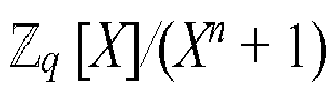
  • When implemented, the main computationally expensive operations are arithmetic with polynomials with integer coefficients. These computations are done in a ring R q = F q X / X n + 1
    Figure imgb0001
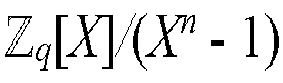
    or R q = F q X / X n 1
    Figure imgb0002
    for positive integers q and n, where the coefficients of the polynomial are in F q
    Figure imgb0003
    while the polynomial arithmetic is modulo Xn +1 or Xn -1. The choice of q has significant impact on the computations because if q is prime, cryptosystems can rely on number theoretic transforms (NTTs), while if q is a power of two, the cryptosystems can apply normal polynomial multiplication methods. These computations are typically performed for generation of secret keys. Protecting against side-channel attacks on such secret keys involves masking, which linearly increases the cost of the multiplication or NTTs with the number of shares. Thus, there is a need to lower the cost per share.
  • SUMMARY
  • System and method for masking secret polynomials for cryptography receives a secret polynomial function in a polynomial ring, which is masked with one or more masking polynomials in which at least some coefficients have a same value. An arithmetic operation is performed on coefficients of the masking polynomials with repeated coefficients to produce an output having integer values. A cryptographic operation is then performed with the output of the arithmetic operation.
  • In an embodiment, a computer-implemented method for masking secret polynomials for cryptography comprises receiving a secret polynomial function in a polynomial ring, masking the secret polynomial function with one or more masking polynomials in which at least some coefficients have a same value, performing an arithmetic operation on coefficients of the masking polynomials with repeated coefficients to produce an output having integer values, and performing a cryptographic operation with the output of the arithmetic operation.
  • In an embodiment, coefficients of a masked version of the secret polynomial function include k unique coefficients.
  • In an embodiment, the method further comprises generating k uniformly random coefficients ri for the masked version of the secret polynomial function for each of the masking polynomials, where k is a positive integer and less than n.
  • In an embodiment, performing the arithmetic operation includes executing a Number Theoretic Transform (NTT) on the masking polynomials with the repeated coefficients in registers of a processor.
  • In an embodiment, the method further comprises computing sj = i = 0 k 1 r i ζ j i
    Figure imgb0004
    for all k primitive 2k-th roots of unity ζj .
  • In an embodiment, performing the arithmetic operation includes computing sj NTT n/k (1 + . . . + X n/k-1) for all j = 0, . . . , k - 1.
  • In an embodiment, performing the arithmetic operation includes multiplying the masked version of the secret polynomial function and a second polynomial function.
  • In an embodiment, performing the arithmetic operation includes computing i = 0 n 1 r l i mod k f i 2 i = l + 1 n 1 r l i mod k f i
    Figure imgb0005
    to derive the product of the masked version of the secret polynomial function and the second polynomial function.
  • In an embodiment, the method further comprises generating coefficients of a masked version of a second secret polynomial function such that at least some of the coefficients of the masked version of the second secret polynomial function have a same value.
  • In an embodiment, the secret polynomial function is f = i = 0 n f i X i
    Figure imgb0006
    in a ring Rq = Fq [X]/(Xn + 1) or in a ring Rq = Fq [X]/(Xn - 1).
  • In an embodiment, a non-transitory computer-readable storage medium containing program instructions for masking secret polynomials for cryptography, wherein execution of the program instructions by one or more processors of a computer causes the one or more processors to perform steps that comprise receiving a secret polynomial function in a polynomial ring, masking the secret polynomial function with one or more masking polynomials in which at least some coefficients have a same value, performing an arithmetic operation on coefficients of the masking polynomials with repeated coefficients to produce an output having integer values, and performing a cryptographic operation with the output of the arithmetic operation.
  • In an embodiment, coefficients of a masked version of the secret polynomial function include k unique coefficients.
  • In an embodiment, the steps further comprise generating k uniformly random coefficients ri for the masked version of the secret polynomial function for each of the masking polynomials, where k is a positive integer and less than n.
  • In an embodiment, performing the arithmetic operation includes executing a Number Theoretic Transform (NTT) on the masking polynomials with the repeated coefficients in registers of a processor.
  • In an embodiment, the steps further comprise computing s j = i = 0 k 1 r i ζ j i
    Figure imgb0007
    for all k primitive 2k-th roots of unity ζj .
  • In an embodiment, performing the arithmetic operation includes multiplying the masked version of the secret polynomial function and a second polynomial function.
  • In an embodiment, the steps further comprise generating coefficients of a masked version of a second secret polynomial function such that at least some of the coefficients of the masked version of the second secret polynomial function have a same value.
  • In an embodiment, an electronic device for masking secret polynomials for cryptography comprises memory, and at least one processor, wherein the at least one processor is configured to receive a secret polynomial function in a polynomial ring, mask the secret polynomial function with one or more masking polynomials in which at least some coefficients have a same value, perform an arithmetic operation on coefficients of the masking polynomials with repeated coefficients to produce an output having integer values, and perform a cryptographic operation with the output of the arithmetic operation.
  • In an embodiment, the at least one processor is configured to execute a Number Theoretic Transform (NTT) on the masking polynomials with the repeated coefficients in registers of the processor.
  • In an embodiment, the at least one processor is configured to multiply the masked version of the secret polynomial function and a second polynomial function.
  • These and other aspects in accordance with embodiments will become apparent from the following detailed description, taken in conjunction with the accompanying drawings, illustrated by way of example of the principles of the embodiments.
  • BRIEF DESCRIPTION OF THE DRAWINGS
    • Fig. 1 is a block diagram of an electronic device in which embodiments of the invention can be implemented.
    • Fig. 2 is a block diagram of a main processor that may be used in the electronic device shown in Fig. 1.
    • Fig. 3 is a block diagram of a coprocessor that may be used in the electronic device shown in Fig. 1.
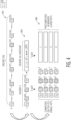
    • Fig. 4 illustrates operations for performing log-entropy masking in accordance with an embodiment of the invention.
    • Fig. 5 is a flow diagram of a process for low-entropy masking secret polynomials for cryptography in accordance with an embodiment of the invention.
    • Fig. 6 is a process flow diagram of a computer-implemented method for masking secret polynomials for cryptography in accordance with an embodiment of the invention.
  • Throughout the description, similar reference numbers may be used to identify similar elements.
  • DETAILED DESCRIPTION
  • It will be readily understood that the components of the embodiments as generally described herein and illustrated in the appended Figs. could be arranged and designed in a wide variety of different configurations. Thus, the following more detailed description of various embodiments, as represented in the Figures, is not intended to limit the scope of the present disclosure, but is merely representative of various embodiments. While the various aspects of the embodiments are presented in drawings, the drawings are not necessarily drawn to scale unless specifically indicated.
  • The present invention may be embodied in other specific forms without departing from its spirit or essential characteristics. The described embodiments are to be considered in all respects only as illustrative and not restrictive. The scope of the embodiments is, therefore, indicated by the appended claims rather than by this detailed description. All changes which come within the meaning and range of equivalency of the claims are to be embraced within their scope.
  • Reference throughout this specification to features, advantages, or similar language does not imply that all of the features and advantages that may be realized with the present invention should be or are in any single embodiment. Rather, language referring to the features and advantages is understood to mean that a specific feature, advantage, or characteristic described in connection with an embodiment is included in at least one embodiment of the present invention. Thus, discussions of the features and advantages, and similar language, throughout this specification may, but do not necessarily, refer to the same embodiment.
  • Furthermore, the described features, advantages, and characteristics of the invention may be combined in any suitable manner in one or more embodiments. One skilled in the relevant art will recognize, in light of the description herein, that the invention can be practiced without one or more of the specific features or advantages of a particular embodiment. In other instances, additional features and advantages may be recognized in certain embodiments that may not be present in all embodiments of the invention.
  • Reference throughout this specification to "one embodiment", "an embodiment", or similar language means that a particular feature, structure, or characteristic described in connection with the indicated embodiment is included in at least one embodiment of the present invention. Thus, the phrases "in one embodiment", "in an embodiment", and similar language throughout this specification may, but do not necessarily, all refer to the same embodiment.
  • Although Number Theoretic Transforms (NTTs) come in various shapes and forms, the focus of embodiments of the invention is on the setting with polynomial rings, where the coefficients are in a finite field F q
    Figure imgb0008
    of prime order q and the polynomials are taken modulo Xn +1 for some n such that 2n | q - 1 (i.e., 2n divides (q - 1)). That is, the embodiments work in the ring R q = F q X / X n + 1
    Figure imgb0009
    . A completely analogous treatment can be done for the ring q X / X n + 1
    Figure imgb0010
    . Let ζ be a 2n-th primitive root of unity, which exists since 2n | q - 1 and F q
    Figure imgb0011
    is a cyclic group of order q - 1. It follows that ζ is also a principal root of unity since the only square roots of 1 in F q
    Figure imgb0012
    are 1 and -1. It then follows that Xn + 1 = (X - ζ)(X - ζ 3) · · · (X - ζ 2n-1) and therefore that NTT = F q X / X n + 1 i = 0 n 1 F q X / X ζ 2 i + 1
    Figure imgb0013
    ƒ ƒ ζ 1 , , ƒ ζ 2 i + 1
    Figure imgb0014
    is an isomorphism by the Chinese Remainder Theorem (CRT). Clearly, the order of the product can change without repercussions, and this is often done to simplify implementation using bit reversals. The NTT transformation (i.e., f ↦ (f(ζ 1), ... , f(ζ 2i+1))) can be computed with exactly n/2 · log(n) Cooley-Tukey butterflies [2], and so can its inverse NTT-1.
  • Similarly, one can use a primitive, and therefore principal, 2k-th root of unity ζ2k = ζ n/k for some positive integer k | n. In that case, Xn + 1 = (X n/k - ζ 2 k ) X n / k ζ 2 k 3 X n / k ζ 2 k 2 k 1
    Figure imgb0015
    and by the CRT it follows that NTT k : F q X / X n + 1 i = 0 n 1 F q X / X n k ζ 2 k 2 i + k
    Figure imgb0016
    ƒ f mod X n / k ζ 2 k , , f mod X n / k ζ 2 k 2 k 1 .
    Figure imgb0017
  • This splits up the original polynomial of degree n into k polynomials of degree n/k each. This is a generalization of the case above. For k = n, the functions are equivalent. This and its inverse can be computed with butterfly algorithms with complexity O(n log(k)), which can be called "intermediate" or "early-abort" NTTs. These NTTs require only that 2k | q - 1 as opposed to 2n | q - 1, which is a weaker requirement on q.
  • By the convolution theorem, it is known that ƒ g = NTT k 1 NTT k f NTT k g
    Figure imgb0018
    for each such k and polynomials f , g F q X / X n + 1
    Figure imgb0019
    , and in particular that NTT k 1 NTT k f NTT k g = NTT l 1 NTT l f NTT l g
    Figure imgb0020
    for each l | n. In other words, the choice of k has no impact on the result of polynomial multiplication.
  • The main arithmetic operations in ring-based lattice-based cryptography that determine their efficiency are polynomial multiplication and NTTs, which are typically performed on secret-key material. Protecting against side-channel attacks on such secret keys involves "masking", which linearly increases the cost of the multiplication or NTT with the number of shares. Suppose the goal is to perform a multiplication of polynomials f · g, where f is a publicly known value and g is secret. Then, for some positive integer t, t random masks g1 , . . . , gt are selected and g 0 = g i = 1 t g i
    Figure imgb0021
    is set. The masked version of g is denoted by g = (g0 , ..., gt ) and ƒ g = ƒ g 0 , , ƒ g t ,
    Figure imgb0022
    is computed using t + 1 polynomial multiplications. Similarly, NTT(f) ·NTT( g ) is computed as NTT f NTT g 0 , , NTT f NTT g t ,
    Figure imgb0023
    by linearity of the NTT.
  • Methods for masking secret data in the form of polynomials in accordance with embodiments of the invention are now described. Let n be an integer, typically n = 256 (Kyber, Dilithium and Saber algorithms) or n = 509, 677, 821, 701 (NTRU algorithm). Here, the coefficients of polynomials all lie in q
    Figure imgb0024
    , where q is either prime or a power of two. For example, q = 3329 (Kyber), q = 8380417 (Dilithium), q = 8192 (Saber) or q = 2048, 4096, 8192 (NTRU). In case q is prime, the above cases all satisfy the requirement that a power of 2 divides q - 1, enabling the use of NTTs where the roots of unity have power-of-two degrees. Although the methods according to embodiments of the invention described herein are most applicable to that scenario (as that is what post-quantum cryptography (PQC) algorithms typically use), these methods straightforwardly extend to more general NTTs with roots of unity of different degrees. When q is a power of two, the methods do not rely on NTTs, but rather perform polynomial multiplication directly. Polynomial rings with moduli Xn - 1 and Xn + 1 are considered, altogether treating four (4) distinct cases, but very similar ideas can also apply to any other modulus.
  • In general, let g be a (secret) polynomial for which the goal is to compute f · g for some known polynomial f. To mask g with a mask of order t, uniformly random b 1, . . . , b t is chosen and b 0 = g i = 1 t b i
    Figure imgb0025
    is set, so that f g = i = 0 t f b i
    Figure imgb0026
    . If b 1, . . . , bt are uniformly random, then so is b 0 and the masked computation comes at the cost of t additional full multiplications. Similarly, if NTTs are used, then NTT f NTT g = i = 0 t NTT f NTT b i
    Figure imgb0027
    is computed and t additional forward NTTs and basepoint multiplications are necessary, and naively also inverse NTTs, though they can often be aggregated. Since the computations are always equivalent for all i, as explained below, the notation is eased and the indices are dropped in the description below. However, t is still included in the complexity analysis.
  • An idea of the methods in accordance with embodiments of the invention is to reduce the cost of the additional multiplications f · bi , or the cost of NTT(bi ), for i > 0, thereby reducing the cost of masking. To do so, the entropy of the masks bi is lowered. That is, a trade-off is provided between the randomness of the mask and the complexity of the polynomial operation. This allows practitioners to select whichever is appropriate for their setting and improve the efficiency of their implementation.
  • For masking in q X / X n + 1
    Figure imgb0028
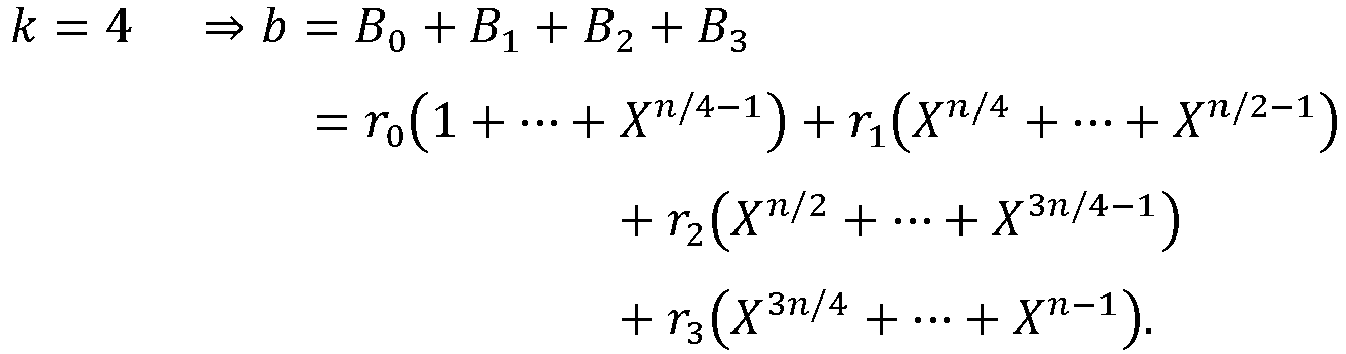
    , the modulus Xn + 1 is first treated. Here a prime q applies to Kyber and Dilithium, and a power-of-two q applies to Saber. For a prime q, let k be an integer such that k | n, let r 0, · · · , r k-1 be uniformly random and let b = j = 0 k 1 B j , where B j = r j l = 0 n k 1 X jn k + l .
    Figure imgb0029
    For example, k = 1 b = B 0 = r 0 1 + + X n 1 ,
    Figure imgb0030
    k = 2 b = B 0 + B 1 = r 0 1 + + X n / 2 1 + r 1 X n / 2 + + X n 1 ,
    Figure imgb0031
    k = 4 b = B 0 + B 1 + B 2 + B 3 = r 0 1 + + X n / 4 1 + r 1 X n / 4 + + X n / 2 1 + r 2 X n / 2 + + X 3 n / 4 1 + r 3 X 3 n / 4 + + X n 1 .
    Figure imgb0032
  • The choice of k determines the randomness in b, and also determines the number of unique random coefficients of b. For k = 1, all coefficients of b are equal, while b is a uniformly random polynomial for k = n. Now, since k | n, NTT(b) can be computed as the partial NTT of degree k (k layers) that maps NTT k : b b mod X n k ζ 0 , , b mod X n k ζ k 1 = i = 0 k 1 r i ζ 0 i 1 + + X n k 1 , , i = 0 k 1 r i ζ k 1 i 1 + + X n k 1 ,
    Figure imgb0033
    where ζ 0, . . . , ζ k-1 are the k primitive roots of unity of order 2k in q ,
    Figure imgb0034
    , followed by applying an NTT n/k of n/k layers to each of the entries in the output array of NTTk Now, i = 0 k 1 r i ζ 0 i , , i = 0 k 1 r i ζ k 1 i
    Figure imgb0035
    are constants and can be taken outside of the application of NTT n/k to each of the terms. But up to these constants, the terms in NTT k (b) are equal and in fact constant (independent of randomness), and so can be completely pre-computed and stored as n elements of the base field q
    Figure imgb0036
    .
  • To summarize, the steps to compute NTT(b) in accordance with embodiments of the invention are:
    1. 1. Generate k uniformly random elements ri ;
    2. 2. Compute s j = i = 0 k 1 r i ζ j i
      Figure imgb0037
      for all k primitive 2k-th roots of unity ζj ;
    3. 3. Compute sj NTT n/k (1 + ... + X n/k-1) for all j = 0, ... , k - 1, where NTT n/k (1 + . . . + X n/k-1) can be pre-computed and stored in some memory.
  • The cost of step 3 is simply n = k·n/k multiplications in q
    Figure imgb0038
    . Interestingly, in step 2, the computation of sj is again a small NTT with a polynomial whose coefficients are the random elements. This can be computed with complexity log k using butterflies. In particular, in case k = n, all multiplications are with 1, so step 3 is free. This case simply reduces to complexity log n, which is as expected for an NTT on a fully random polynomial. The total cost for t shares is t·n multiplications and t·k·log(k) butterflies.
  • Note that there is nothing special about the choice for Bj = rj · l = 0 n / k 1 X jk + l
    Figure imgb0039
    ; this can be further randomized by setting B j = r j l = 0 n / k 1 β l X jk + l
    Figure imgb0040
    for randomly chosen β 0, ..., β n/k-1. This would leave the method unchanged except for step 3, where NTT n/k (β 0 + β 1 X +. . . + β n/k-1 X n/k-1) is now pre-computed instead. As this is only part of the pre-computation phase, the efficiency is not affected. It is emphasized here that the β i are fixed throughout different executions of the method though. They do not provide additional randomness for each execution, but would rather serve to eliminate any unintentional structure in the computation of NTT n/k .
  • For a power-of-two q, let k be an integer such that k | n, let r 0, · · · , r k-1 be uniformly random and let b = j = 0 k 1 B j , where B j = r j l = 0 n k 1 X j + kl .
    Figure imgb0041
    Note that this is the same as above for the NTT except for the choice of Bj . In this case, k = 1 b = B 0 = r 0 1 + + X n 1 ,
    Figure imgb0042
    k = 2 b = B 0 + B 1 = r 0 1 + X 2 + + X n / 2 1 + r 1 X + + X n 1 ,
    Figure imgb0043
    k = 4 b = B 0 + B 1 + B 2 + B 3 = r 0 1 + + X n 4 + r 1 X + + X n 3 + r 2 X 2 + + X n 2 + r 3 X 3 + + X n 1 ,
    Figure imgb0044
    Again the choice of k determines the randomness in b. For k = 1, all coefficients of b are equal, while b is a uniformly random polynomial for k = n.
  • Writing fi for the i-th coefficient of f, so f = i = 0 n 1 f i x i
    Figure imgb0045
    , and h = f · b, then h l = i = 0 n 1 r l i mod k f i 2 i = l + 1 n 1 r l i mod k f i .
    Figure imgb0046
  • This can be computed by summing up appropriate coefficients of f in sums of k terms (≈ n additions) for the first sum, and one additional subtraction for each of the hl (≈ n subtractions). This way it is most convenient to compute h n-1 , h n-2, ... h 0 in that order. Finally, n·k distinct partial sums are left, each of which needs to be multiplied with one of the ri and summed together. Hence, in total, the cost is approximately 2n + (k - 1)n = (k + 1)n additions/subtractions and n·k multiplications. Note that for k = n, the complexity is n 2, which is the same as simple schoolbook multiplication. For t shares, the cost is t(k + 1)n additions/subtractions and t·n·k multiplications.
  • For masking in q X / X n 1
    Figure imgb0047
    using a prime q, the algorithm in this case works exactly as for masking in q X / X n + 1
    Figure imgb0048
    using a prime q, with the caveat β i = 1 should not be set for all i (as described above for masking in q X / X n + 1
    Figure imgb0049
    using prime q). As the NTT in that case always evaluates to zero, the masks are canceled in the NTT computation. However, a random choice for the β i is still possible and has the exact same efficiency. Using t shares, the cost is t·n multiplications and t·k log(k) butterflies.
  • For a power-of-two q, let k be an integer such that k | n, let r 0, · · · , r k-1 be uniformly random and let b = j = 0 k 1 B j ,
    Figure imgb0050
    where B j = r j l = 0 n k 1 X j + kl
    Figure imgb0051
    . Note that this is the same as in masking in q X / X n + 1
    Figure imgb0052
    using a power-of-two q. Again the choice of k determines the randomness in b. For k = 1 all, coefficients of b are equal, while b is a uniformly random polynomial for k = n. The method is much simpler, however. Again writing fi for the i-th coefficient of f and h = f · b, then h l = i = 0 n 1 r l i mod k f i = i = 0 k 1 r l i mod k j = 0 n k 1 f jk + i .
    Figure imgb0053
  • In this case, the coefficients can simply be summed up with ≈ n additions, while there are only k 2 distinct multiplications. For t shares, t·n additions and t·k 2 multiplications are therefore required.
  • The setting of operations f · g where both f and g are to be kept secret (i.e., two secret inputs) is now described. This is a less common scenario, but appears for example in NTRU decapsulation. In this case, masks a 1, . . . , at for f and b 1, . . . , bt for g are selected, and a 0 = f-a 1 -. . . at and b 0 = g - b 1 - . . . bt are set. A different number of masks for f and g are also selected and the ideas below would apply analogously. The multiplication f · g requires multiplying ai · bj for all i, j = 0, . . . , t and consists of three cases:
    • 1. i, j = 0. This is a generic multiplication or NTT.
    • 2. i = 0, j ≠ 0 or i ≠ 0, j = 0. This is the setting as described above, i.e., one of the inputs is a generic polynomial and the other a low-entropy mask.
    • 3. i, j > 0. This is a new setting where both inputs to the NTT or polynomial multiplication are low-entropy masks.
  • The third case is now described, as the previous two have been described above. The simplest setting is where NTTs are used. In that case, NTT(ai )NTT(bj ) is computed and the NTT is therefore applied to the low-entropy inputs separately. Then, the methods described above can be just applied directly.
  • The more involved setting is where a polynomial multiplication ai · bj is computed directly. As above, a = ai and b = bj are just written for ease of notation since the computation is independent of i and j (assuming they are non-zero). Similar to masking in q X / X n + 1
    Figure imgb0054
    and q X / X n 1
    Figure imgb0055
    using a power-of-two q, a is chosen such that a = j = 0 k 1 A j ,
    Figure imgb0056
    where A j = s j l = 0 n k 1 X j + kl
    Figure imgb0057
    , where sj are randomly chosen elements of q
    Figure imgb0058
    for j = 0, . . . , k - 1. For modulo Xn - 1, the product a · b can now be described with Equation 3, replacing the coefficients of f by those of a. But it immediately follows that j = 0 n / k 1 a jk + i = n / k s i
    Figure imgb0059
    , replacing each n/k additions by a single multiplication with a constant, requiring a total of k multiplications. Thus, the total cost of a·b is k+k 2 multiplications per share. As n/k is typically a power of two, the k multiplications can even be implemented by simple bit shifts. For modulo Xn + 1, the initial summing of all coefficients is also simplified because instead of n additions, k multiplications are required. Therefore, the total cost is k·n additions/subtractions and n·k multiplications per share.
  • Turning now to Fig. 1, an electronic device 100 in which embodiments of the invention can be implemented is shown. The electronic device 100 includes a main processor (e.g., a central processing unit (CPU)) 102, system memory 104, non-volatile memory 106 and a coprocessor 108, which are all connected to a bus 110. The electronic device 100 may include other electronic components depending on the cryptographic operations executed in the device. As used herein, a cryptographic operation is any operation using cryptography. Thus, as an example, cryptographic operations include, but not limited to, generating secret keys and public keys, creating digital signatures, verifying digital signatures, encrypting digital messages and decrypting digital messages.
  • The main processor 102 can be any type of a processor, such as a CPU commonly found in a computer system. The system memory 104 is volatile memory used for retrieving codes, such as algorithms for executing methods in accordance with embodiments of the invention, from the non-volatile memory 106 and processing data. The system memory 104 may include, for example, one or more random access memory (RAM) modules. The system memory 104 can be used to store instructions 105 for executing methods in accordance with embodiments of the invention described herein. The non-volatile memory 106 can be any persistent memory, such as read-only memory (ROM). The non-volatile memory 106 may be used to store the codes and pre-calculated values, such as NTT n/k (1 + . . . + X n/k-1). The coprocessor 108 can be any type of a coprocessor, such as an arithmetic or integer coprocessor designed for classical public-key cryptography.
  • Operations for performing low-entropy masking in accordance with embodiments of the invention may be executed by the main processor 102 and/or the coprocessor 108. Thus, the main processor 102 and/or the coprocessor 108 may perform operations for low-entropy masking in q X / X n + 1
    Figure imgb0060
    or q X / X n 1
    Figure imgb0061
    using a prime q or power-of-two q to compute f · g, where f is a publicly known polynomial and g is a secret polynomial.
  • Turning now to Fig. 2, an example of a main processor 200, which can be a central processing unit (CPU), that may be used in the electronic device 100 is illustrated. As shown in Fig. 2, the main processor 200 includes a control unit 202, an arithmetic and logic unit (ALU) 204 and a memory unit 206, which has multiple registers 208. The control unit 202 operates to control and coordinate the overall functioning of the various components of the electronic device 100. The control unit controls the flow of data between the components during processing using stored instructions. The ALU 204 operates to perform all the necessary mathematical operations, such as additions, subtractions, multiplications and divisions. The ALU 204 also performs all the necessary logical operations, such as testing values to determine whether the values are true or false, as well as comparative analysis, such as less than, greater than and equal to or not analyses.
  • The memory unit 206 is used to store data before the data is processed and to store the results after the data has been processed. Thus, for example, if two sets of data are being multiplied, both data sets are placed in the registers 208 of the memory unit 206 and multiplied by the ALU 204, and then the results are stored in another register of the memory unit. The registers 208 are accessed using unique memory addresses.
  • Turning now to Fig. 3, an example of a coprocessor 300 that may be used in the electronic device 100 is illustrated. As shown in Fig. 3, the coprocessor 300 includes a control unit 302 and a numeric execution unit 304, which has multiple registers 308 that are similar to the registers 208 of the main processor 200. The control unit 302 operates to synchronize the operation between the main processor, e.g., the main processor 200, and the coprocessor 300. The control unit 302 controls the instruction execution for which the numeric execution unit 304 is responsible. The numeric execution unit 304 operates to perform all operations that access and manipulate the numeric data in the registers 308. Thus, the numeric execution unit 304 can perform mathematical operations using the registers 308 similar to the ALU 204 of the main processor 200 using the registers 208. The registers 308 can be of any size. These registers 308 are accessed using unique memory addresses.
  • As noted above, operations for performing low-entropy masking in accordance with embodiments of the invention may be executed by a main processor, such as the main processor 200, and/or a coprocessor, such as the coprocessor 300. Thus, the main processor 200 and/or the coprocessor 300 can performed the steps of 1) generating k uniformly random elements ri , 2) computing s j = i = 0 k 1 r i ζ j i
    Figure imgb0062
    for all k primitive 2k-th roots of unity ζj , and 3) computing sj NTT n/k (1 + . . . + X n/k-1) for all j = 0, . . . , k - 1, where NTT n/k (1 + . . . + X n/k-1) can be pre-computed and stored in some memory. This is illustrated in Fig. 4 for n=256 and k=4.
  • As shown in Fig. 4, for the first step, k=4 random elements ri , i.e., r0 , r1 , r2 and r3 , are generated for a polynomial b of degree 256, as illustrated in state 402. These random elements can be stored in the registers of the main processor 102 or the registers of the coprocessor 108, depending on whether the main processor or the coprocessor will be executing the low-entropy masking NTT operations. For the second step, s j = i = 0 k 1 r i ζ j i
    Figure imgb0063
    for all k primitive 2k-th roots of unity ζj are computed, which results in a product of a constant polynomial of degree 64 and a polynomial of degree 4 with the random elements, as illustrated in state 404. These computations can be performed by the ALU of the main processor 102 or the numeric execution unit of the coprocessor 108. For the third step, sj NTT n/k (1 + . . . + X n/k-1) for all j = 0, . . . , k - 1 are computed, as illustrated in state 406. These computations involve computing the NTT for the polynomial of degree 4 on-the-fly, which is smaller than the NTT for the constant polynomial of degree 64. The NTT for the constant polynomial of degree 64 can be precomputed and stored in memory, such as the non-volatile memory 106. Again, these computations can be performed by the ALU of the main processor 102 or the numeric execution unit of the coprocessor 108. The results of these computations can then be used for various applications, such as cryptography.
  • A process for low-entropy masking secret polynomials for cryptography in accordance with embodiments of the invention is now described with reference to a flow diagram of Fig. 5. The process begins at step 502, where a secret polynomial g with n coefficients is obtained by a processor of the electronic device 100. As used herein, the processor of the electronic device may be the main processor 102 or the coprocessor 108. In an embodiment, the secret polynomial g may be generated by the processor or received from an external source, which may be stored in the non-volatile memory 106. The coefficients of the secret polynomial may be in a data structure storing n values, where each value represents a corresponding integer coefficient of the secret polynomial.
  • Next, at step 504, t*k random coefficients ri for t shares are generated by the processor, where t is a positive integer. These shares are multiple polynomials derived from the secret polynomial g. Next, at step 506, a masked version of the secret polynomial g is generated by the processor to derive 1+t shares, i.e., the multiple polynomials. For masking in q X / X n + 1
    Figure imgb0064
    or q X / X n 1
    Figure imgb0065
    using a prime q, Equation 1 is used to generate the k uniformly random elements ri for each share. However, for masking in q X / X n 1
    Figure imgb0066
    using a prime q, Bi should not be set to 1 for all i. For masking in q X / X n + 1
    Figure imgb0067
    or q X / X n 1
    Figure imgb0068
    using a power-of-two q, Equation 2 is used to generate the k uniformly random elements ri for each share.
  • When a prime q is used, steps 508-516 are performed to derive a product of a public polynomial f and the masked version of the secret polynomial g for each share. At step 508, for each share, sj are computed by the processor using the equation s j = i = 0 k 1 r i ζ j i
    Figure imgb0069
    for all k primitive 2k-th roots of unity ζj . Next, at step 510, for each share, sj NTT n/k(1 + . . . + X n/k-1), i.e., sj multiplied by NTT n/k (1 + . . . +X n/k-1), for all j = 0, . . . , k - 1 are computed by the processor.
  • Next, at step 512, NTT of the public polynomial f, i.e., NTT(f), is computed. Next, at step 514, for each share, each sj NTT n/k (1 + . . . + X n/k-1) is multiplied by NTT(f) by the processor. Next, at step 516, for each share, an inverse NTT is performed on the results of each NTT(f)sj NTT n/k (1 + . . . + X n/k-1) multiplication to generate the product of f and the masked version of g. The process then proceeds to step 520.
  • When a power-of-two q is used, step 518 is performed to derive the product of the public polynomial f and the masked version of the secret polynomial g. At step 518, hl is computed by the processor of the electronic device 100 using Equation 3 to directly derive the product of f and the masked version of g. For masking in q X / X n 1
    Figure imgb0070
    using a power-of-two q, hl is computed using the simplified version of Equation 3 to directly derive a product of f and masked version of g. The process then proceeds to step 520.
  • At step 520, a cryptographic operation based on the product of f and the masked version of g is performed. The product of f and the masked version of g may be produced as a vector output having integer values. The cryptographic operation can be any operation using cryptography. As an example, the cryptographic operation may be a secret or public key generating operation, a digital signature creating or verifying operation, or an encryption or decryption of a digital message.
  • A computer-implemented method for masking secret polynomials for cryptography in accordance with an embodiment of the invention is described with reference to a process flow diagram of Fig. 6. At block 602, a secret polynomial function in a polynomial ring is received. At block 604, the secret polynomial function is masked with one or more masking polynomials in which at least some coefficients have a same value. At block 606, an arithmetic operation is performed on coefficients of the masking polynomials with repeated coefficients to produce an output having integer values. At block 608, a cryptographic operation is performed with the output of the arithmetic operation.
  • Although the operations of the method(s) herein are shown and described in a particular order, the order of the operations of each method may be altered so that certain operations may be performed in an inverse order or so that certain operations may be performed, at least in part, concurrently with other operations. In another embodiment, instructions or sub-operations of distinct operations may be implemented in an intermittent and/or alternating manner.
  • It can also be noted that at least some of the operations for the methods described herein may be implemented using software instructions stored on a computer useable storage medium for execution by a computer. As an example, an embodiment of a computer program product includes a computer useable storage medium to store a computer readable program.
  • The computer-useable or computer-readable storage medium can be an electronic, magnetic, optical, electromagnetic, infrared, or semiconductor system (or apparatus or device). Examples of non-transitory computer-useable and computer-readable storage media include a semiconductor or solid-state memory, magnetic tape, a removable computer diskette, a random-access memory (RAM), a read-only memory (ROM), a rigid magnetic disk, and an optical disk. Current examples of optical disks include a compact disk with read only memory (CD-ROM), a compact disk with read/write (CD-R/W), and a digital video disk (DVD).
  • Alternatively, embodiments of the invention may be implemented entirely in hardware or in an implementation containing both hardware and software elements. In embodiments that use software, the software may include but is not limited to firmware, resident software, microcode, etc.
  • Although specific embodiments of the invention have been described and illustrated, the invention is not to be limited to the specific forms or arrangements of parts so described and illustrated. The scope of the invention is to be defined by the claims appended hereto and their equivalents.

Claims (15)

  1. A computer-implemented method for masking secret polynomials for cryptography, the method comprising:
    receiving a secret polynomial function in a polynomial ring;
    masking the secret polynomial function with one or more masking polynomials in which at least some coefficients have a same value;
    performing an arithmetic operation on coefficients of the masking polynomials with repeated coefficients to produce an output having integer values; and
    performing a cryptographic operation with the output of the arithmetic operation.
  2. The method of claim 1, wherein coefficients of a masked version of the secret polynomial function include k unique coefficients.
  3. The method of claim 2, further comprising generating k uniformly random coefficients ri for the masked version of the secret polynomial function for each of the masking polynomials, where k is a positive integer and less than n.
  4. The method of claim 3, wherein performing the arithmetic operation includes executing a Number Theoretic Transform (NTT) on the masking polynomials with the repeated coefficients in registers of a processor.
  5. The method of claim 4, further comprising computing s j = i = 0 k 1 r i ζ j i
    Figure imgb0071
    for all k primitive 2k-th roots of unity ζj .
  6. The method of claim 5, wherein performing the arithmetic operation includes computing sj NTT n/k (1 + . . . + X n/k-1) for all j = 0, . . . , k - 1.
  7. The method of any of claims 2 to 6, wherein performing the arithmetic operation includes multiplying the masked version of the secret polynomial function and a second polynomial function.
  8. The method of claim 7, wherein performing the arithmetic operation includes computing i = 0 n 1 r l i mod k f i 2 i = l + 1 n 1 r l i mod k f i
    Figure imgb0072
    to derive the product of the masked version of the secret polynomial function and the second polynomial function.
  9. The method of any preceding claim, further comprising:
    generating coefficients of a masked version of a second secret polynomial function such that at least some of the coefficients of the masked version of the second secret polynomial function have a same value.
  10. The method of any preceding claim, wherein the secret polynomial function is f = i = 0 n f i X i
    Figure imgb0073
    in a ring Rq = Fq [X]/(Xn + 1) or in a ring Rq = Fq [X]/(Xn - 1).
  11. A non-transitory computer-readable storage medium containing program instructions for masking secret polynomials for cryptography, wherein execution of the program instructions by one or more processors of a computer causes the one or more processors to perform steps comprising:
    receiving a secret polynomial function in a polynomial ring;
    masking the secret polynomial function with one or more masking polynomials in which at least some coefficients have a same value;
    performing an arithmetic operation on coefficients of the masking polynomials with repeated coefficients to produce an output having integer values; and
    performing a cryptographic operation with the output of the arithmetic operation.
  12. The non-transitory computer-readable storage medium of claim 11, wherein coefficients of a masked version of the secret polynomial function include k unique coefficients.
  13. The non-transitory computer-readable storage medium of claim 12, wherein steps further comprise generating k uniformly random coefficients ri for the masked version of the secret polynomial function for each of the masking polynomials, where k is a positive integer and less than n.
  14. The non-transitory computer-readable storage medium of claim 13, wherein performing the arithmetic operation includes executing a Number Theoretic Transform (NTT) on the masking polynomials with the repeated coefficients in registers of a processor.
  15. The non-transitory computer-readable storage medium of an of claims 12 to 14, wherein performing the arithmetic operation includes multiplying the masked version of the secret polynomial function and a second polynomial function.
EP24169298.7A 2023-04-18 2024-04-09 Low-entropy masking for cryptography over rings of polynomials Pending EP4451608A1 (en)

Applications Claiming Priority (1)

Application Number Priority Date Filing Date Title
US18/135,922 US20240356748A1 (en) 2023-04-18 2023-04-18 Low-entropy masking for cryptography

Publications (1)

Publication Number Publication Date
EP4451608A1 true EP4451608A1 (en) 2024-10-23

Family

ID=90720227

Family Applications (1)

Application Number Title Priority Date Filing Date
EP24169298.7A Pending EP4451608A1 (en) 2023-04-18 2024-04-09 Low-entropy masking for cryptography over rings of polynomials

Country Status (2)

Country Link
US (1) US20240356748A1 (en)
EP (1) EP4451608A1 (en)

Family Cites Families (19)

* Cited by examiner, † Cited by third party
Publication number Priority date Publication date Assignee Title
US8090957B2 (en) * 2005-10-19 2012-01-03 Panasonic Corporation Information security device, information security method, computer program, computer-readable recording medium, and integrated circuit
GB2515755A (en) * 2013-07-01 2015-01-07 Ibm Method and apparatus for performing a FFT computation
US10298385B2 (en) * 2017-04-11 2019-05-21 The Governing Council Of The University Of Toronto Homomorphic processing unit (HPU) for accelerating secure computations under homomorphic encryption
DE102018108313A1 (en) * 2018-04-09 2019-10-10 Infineon Technologies Ag A method and processing apparatus for performing a grid-based cryptographic operation
US11457214B2 (en) * 2018-08-23 2022-09-27 Interdigital Vc Holdings France, Sas Coding of quantization matrices using parametric models
DE102018122278A1 (en) * 2018-09-12 2020-03-12 Infineon Technologies Ag Perform a cryptographic operation
EP3903300A4 (en) * 2019-02-19 2022-09-07 Massachusetts Institute Of Technology Configurable lattice cryptography processor for the quantum-secure internet of things and related techniques
US11212082B2 (en) * 2019-09-30 2021-12-28 Pq Solutions Limited Ciphertext based quorum cryptosystem
JP7273753B2 (en) * 2020-03-06 2023-05-15 株式会社東芝 Arithmetic transformation processing device, Arithmetic transformation processing method and program
WO2022233605A1 (en) * 2021-05-04 2022-11-10 Zama Sas Blind rotation for use in fully homomorphic encryption
US11569994B2 (en) * 2021-06-24 2023-01-31 Intel Corporation Accelerating multiple post-quantum cryptograhy key encapsulation mechanisms
GB2608999A (en) * 2021-07-15 2023-01-25 Pqshield Ltd Cryptographic system for post-quantum cryptographic operations
US11847938B2 (en) * 2021-08-03 2023-12-19 Nxp B.V. Combining regular and symbolic NTTs using co-processors
KR20230078131A (en) * 2021-11-26 2023-06-02 삼성전자주식회사 Appratus and method of homomorphic encryption operation using iterative array number theoretic transform
US11818244B2 (en) * 2021-12-15 2023-11-14 The Governing Council Of The University Of Toronto Cryptographic processor for fully homomorphic encryption (FHE) applications
EP4199410A1 (en) * 2021-12-17 2023-06-21 Thales Dis France SAS Method secured against side-channel attacks performing a cryptographic algorithm comprising a polynomial operation
US12362904B2 (en) * 2022-02-18 2025-07-15 Samsung Electronics Co., Ltd. Homomorphic encryption operation accelerator, and operating method of homomorphic encryption operation accelerator
KR20230141045A (en) * 2022-03-31 2023-10-10 포항공과대학교 산학협력단 Crypto-processor Device and Data Processing Apparatus Employing the Same
US20240267212A1 (en) * 2023-02-03 2024-08-08 Intel Corporation Post-Quantum Cryptography Key Encapsulation Mechanism System

Non-Patent Citations (3)

* Cited by examiner, † Cited by third party
Title
AIKATA AIKATA ET AL: "Kavach: Lightweight masking techniques for polynomial arithmetic in lattice-based cryptography", vol. 20230410:163541, 10 April 2023 (2023-04-10), pages 1 - 25, XP061077481, Retrieved from the Internet <URL:https://eprint.iacr.org/archive/2023/517/1681144541.pdf> [retrieved on 20230410] *
FRITZMANN TIM ET AL: "Masked Accelerators and Instruction Set Extensions for Post-Quantum Cryptography", IACR TRANSACTIONS ON CRYPTOGRAPHIC HARDWARE AND EMBEDDED SYSTEMS, 19 November 2021 (2021-11-19), pages 414 - 460, XP093145935, ISSN: 2569-2925, DOI: 10.46586/tches.v2022.i1.414-460 *
JEROEN DELVAUX: "Roulette: A Diverse Family of Feasible Fault Attacks on Masked Kyber", vol. 20220808:061020, 8 August 2022 (2022-08-08), pages 1 - 29, XP061075371, Retrieved from the Internet <URL:https://eprint.iacr.org/archive/2021/1622/1659939020.pdf> [retrieved on 20220808] *

Also Published As

Publication number Publication date
US20240356748A1 (en) 2024-10-24

Similar Documents

Publication Publication Date Title
Liang et al. Number theoretic transform and its applications in lattice-based cryptosystems: A survey
Pedrouzo-Ulloa et al. Number theoretic transforms for secure signal processing
US8862651B2 (en) Method and apparatus for modulus reduction
CN110519058A (en) A kind of accelerated method for the public key encryption algorithm based on lattice
Tian et al. High-speed FPGA implementation of SIKE based on an ultra-low-latency modular multiplier
US20090180611A1 (en) Representation change of a point on an elliptic curve
US11847938B2 (en) Combining regular and symbolic NTTs using co-processors
Zijlstra et al. FPGA implementation and comparison of protections against SCAs for RLWE
Bootland et al. Efficiently processing complex-valued data in homomorphic encryption
Jalali et al. ARMv8 SIKE: Optimized supersingular isogeny key encapsulation on ARMv8 processors
Krieger et al. Aloha-he: a low-area hardware accelerator for client-side operations in homomorphic encryption
KR102451633B1 (en) Apparatus and Method of Cryptographic Processing for Homomorphic Encryption
Banerjee et al. SPRING: Fast pseudorandom functions from rounded ring products
US9722773B2 (en) Method of determining a representation of a product of a first element and a second element of a finite set, method of evaluating a function applied to an element of a finite set and associated devices
Nissim et al. Communication efficient secure linear algebra
CN111712816A (en) Using cryptographic blinding for efficient use of Montgomery multiplication
EP4447383A1 (en) Number theoretic transform with parallel coefficient processing
EP4451608A1 (en) Low-entropy masking for cryptography over rings of polynomials
WO2023084895A1 (en) Encryption processing device, encryption processing method, and encryption processing program
EP1703373A2 (en) Elliptic curve point octupling using single instruction multiple data processing
Cheon et al. OverModRaise: Reducing Modulus Consumption of CKKS Bootstrapping
WO2023232951A1 (en) Method and circuit for securely mapping a masked variable
Lee et al. Fault attack on SQIsign
US20250038977A1 (en) Masking with efficient unmasking via domain embedding in cryptographic devices and applications
US20250175328A1 (en) Method and apparatus for storing/recovering a plurality of secret shares

Legal Events

Date Code Title Description
PUAI Public reference made under article 153(3) epc to a published international application that has entered the european phase

Free format text: ORIGINAL CODE: 0009012

STAA Information on the status of an ep patent application or granted ep patent

Free format text: STATUS: THE APPLICATION HAS BEEN PUBLISHED

AK Designated contracting states

Kind code of ref document: A1

Designated state(s): AL AT BE BG CH CY CZ DE DK EE ES FI FR GB GR HR HU IE IS IT LI LT LU LV MC ME MK MT NL NO PL PT RO RS SE SI SK SM TR

STAA Information on the status of an ep patent application or granted ep patent

Free format text: STATUS: REQUEST FOR EXAMINATION WAS MADE

17P Request for examination filed

Effective date: 20250423

STAA Information on the status of an ep patent application or granted ep patent

Free format text: STATUS: EXAMINATION IS IN PROGRESS

17Q First examination report despatched

Effective date: 20251111