EP4451511A1 - Virtual machine provisioning device, virtual machine provisioning method, and program - Google Patents
Virtual machine provisioning device, virtual machine provisioning method, and program Download PDFInfo
- Publication number
- EP4451511A1 EP4451511A1 EP21968077.4A EP21968077A EP4451511A1 EP 4451511 A1 EP4451511 A1 EP 4451511A1 EP 21968077 A EP21968077 A EP 21968077A EP 4451511 A1 EP4451511 A1 EP 4451511A1
- Authority
- EP
- European Patent Office
- Prior art keywords
- virtual machine
- allocation
- base
- power generation
- renewable energy
- Prior art date
- Legal status (The legal status is an assumption and is not a legal conclusion. Google has not performed a legal analysis and makes no representation as to the accuracy of the status listed.)
- Pending
Links
Images





Classifications
-
- H—ELECTRICITY
- H02—GENERATION; CONVERSION OR DISTRIBUTION OF ELECTRIC POWER
- H02J—ELECTRIC POWER NETWORKS; CIRCUIT ARRANGEMENTS OR SYSTEMS FOR SUPPLYING OR DISTRIBUTING ELECTRIC POWER; SYSTEMS FOR STORING ELECTRIC ENERGY
- H02J13/00—Circuit arrangements for providing remote monitoring or remote control of equipment in a power distribution network
-
- G—PHYSICS
- G06—COMPUTING OR CALCULATING; COUNTING
- G06F—ELECTRIC DIGITAL DATA PROCESSING
- G06F9/00—Arrangements for program control, e.g. control units
- G06F9/06—Arrangements for program control, e.g. control units using stored programs, i.e. using an internal store of processing equipment to receive or retain programs
- G06F9/44—Arrangements for executing specific programs
- G06F9/455—Emulation; Interpretation; Software simulation, e.g. virtualisation or emulation of application or operating system execution engines
- G06F9/45533—Hypervisors; Virtual machine monitors
- G06F9/45558—Hypervisor-specific management and integration aspects
-
- G—PHYSICS
- G06—COMPUTING OR CALCULATING; COUNTING
- G06F—ELECTRIC DIGITAL DATA PROCESSING
- G06F1/00—Details not covered by groups G06F3/00 - G06F13/00 and G06F21/00
- G06F1/26—Power supply means, e.g. regulation thereof
- G06F1/32—Means for saving power
- G06F1/3203—Power management, i.e. event-based initiation of a power-saving mode
- G06F1/3234—Power saving characterised by the action undertaken
- G06F1/329—Power saving characterised by the action undertaken by task scheduling
-
- G—PHYSICS
- G06—COMPUTING OR CALCULATING; COUNTING
- G06F—ELECTRIC DIGITAL DATA PROCESSING
- G06F9/00—Arrangements for program control, e.g. control units
- G06F9/06—Arrangements for program control, e.g. control units using stored programs, i.e. using an internal store of processing equipment to receive or retain programs
- G06F9/46—Multiprogramming arrangements
- G06F9/50—Allocation of resources, e.g. of the central processing unit [CPU]
- G06F9/5083—Techniques for rebalancing the load in a distributed system
- G06F9/5088—Techniques for rebalancing the load in a distributed system involving task migration
-
- G—PHYSICS
- G06—COMPUTING OR CALCULATING; COUNTING
- G06F—ELECTRIC DIGITAL DATA PROCESSING
- G06F9/00—Arrangements for program control, e.g. control units
- G06F9/06—Arrangements for program control, e.g. control units using stored programs, i.e. using an internal store of processing equipment to receive or retain programs
- G06F9/46—Multiprogramming arrangements
- G06F9/50—Allocation of resources, e.g. of the central processing unit [CPU]
- G06F9/5094—Allocation of resources, e.g. of the central processing unit [CPU] where the allocation takes into account power or heat criteria
-
- H—ELECTRICITY
- H02—GENERATION; CONVERSION OR DISTRIBUTION OF ELECTRIC POWER
- H02J—ELECTRIC POWER NETWORKS; CIRCUIT ARRANGEMENTS OR SYSTEMS FOR SUPPLYING OR DISTRIBUTING ELECTRIC POWER; SYSTEMS FOR STORING ELECTRIC ENERGY
- H02J3/00—Circuit arrangements for AC mains or AC distribution networks
- H02J3/38—Arrangements for feeding a single network from two or more generators or sources in parallel; Arrangements for feeding already energised networks from additional generators or sources in parallel
-
- H—ELECTRICITY
- H02—GENERATION; CONVERSION OR DISTRIBUTION OF ELECTRIC POWER
- H02J—ELECTRIC POWER NETWORKS; CIRCUIT ARRANGEMENTS OR SYSTEMS FOR SUPPLYING OR DISTRIBUTING ELECTRIC POWER; SYSTEMS FOR STORING ELECTRIC ENERGY
- H02J3/00—Circuit arrangements for AC mains or AC distribution networks
- H02J3/38—Arrangements for feeding a single network from two or more generators or sources in parallel; Arrangements for feeding already energised networks from additional generators or sources in parallel
- H02J3/381—Dispersed generators
-
- G—PHYSICS
- G06—COMPUTING OR CALCULATING; COUNTING
- G06F—ELECTRIC DIGITAL DATA PROCESSING
- G06F9/00—Arrangements for program control, e.g. control units
- G06F9/06—Arrangements for program control, e.g. control units using stored programs, i.e. using an internal store of processing equipment to receive or retain programs
- G06F9/44—Arrangements for executing specific programs
- G06F9/455—Emulation; Interpretation; Software simulation, e.g. virtualisation or emulation of application or operating system execution engines
- G06F9/45533—Hypervisors; Virtual machine monitors
- G06F9/45558—Hypervisor-specific management and integration aspects
- G06F2009/4557—Distribution of virtual machine instances; Migration and load balancing
-
- G—PHYSICS
- G06—COMPUTING OR CALCULATING; COUNTING
- G06F—ELECTRIC DIGITAL DATA PROCESSING
- G06F2209/00—Indexing scheme relating to G06F9/00
- G06F2209/50—Indexing scheme relating to G06F9/50
- G06F2209/5019—Workload prediction
Definitions
- the present invention relates to a technique for allocating virtual machines to a plurality of bases that use electric power generated by renewable energy power generation.
- VMs virtual machines
- servers physical machines
- bases for example, data centers
- each base receives power supply from two systems: renewable energy power generation such as solar power generation, and commercial power supplied from an electric power company.
- renewable energy power generation such as solar power generation
- commercial power supplied from an electric power company such a case is assumed.
- an amount of power supply fluctuates from moment to moment. For that reason, for example, in a case in which an amount of renewable energy supply of a base A is reduced, a VM of the base A is moved to a base B having a margin in the amount of renewable energy supply, and thus renewable energy of the base B can be used without waste, and an amount of power purchase from an electric power company at the base A can be reduced.
- NPL 1 discloses a vector-based algorithm for calculating at which base each VM should be disposed in order to use renewable energy at each base as efficiently as possible.
- the present invention has been made in view of the above points, and an object thereof is to provide a technique for minimizing surplus power of renewable energy power generation at a plurality of bases at which supply of electric power is performed by renewable energy power generation.
- a virtual machine allocation device configured to perform allocation of virtual machines to a plurality of bases to which supply of electric power is performed by renewable energy power generation, the device including:
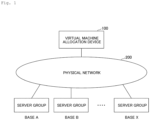
- Fig. 1 shows an example of an overall configuration of a system according to the present embodiment.
- a plurality of bases including a server group are connected to a physical network 200.
- a virtual machine allocation device 100 (virtual machine allocation apparatus) is connected to the physical network 200.
- Zero or more VMs are installed on each server at each base.
- Each VM can be moved between bases in accordance with a setting command from the virtual machine allocation device 100.
- Various existing techniques can be used for moving VMs (which may be referred to as migration).
- the virtual machine allocation device 100 derives an arrangement (allocation) of respective VMs to each base in consideration of surplus power of the renewable energy power generation at each base and power consumption of each VM and transmits a setting command for moving VMs to corresponding bases in accordance with results of the allocation processing.
- the virtual machine allocation device 100 can acquire information needed for allocation calculation (such as an amount of renewable energy power generation, or power consumption of each VM) from each base (or monitoring system, or the like).
- the virtual machine allocation device 100 first selects a VM serving as a moving target from among all VMs from the viewpoint of minimizing the surplus power of the renewable energy power generation prior to deriving the arrangement.
- a VM serving as a moving target from among all VMs from the viewpoint of minimizing the surplus power of the renewable energy power generation prior to deriving the arrangement.
- an approximation guarantee is obtained by sequentially allocating VMs such that a VM with the highest power consumption is allocated to a base and a time period with the highest surplus power.
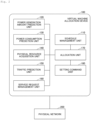
- Fig. 2 shows a configuration example of the virtual machine allocation device 100 according to the present embodiment.
- the virtual machine allocation device 100 has a schedule management unit 110, a power generation amount prediction unit 120, a power consumption prediction unit 130, a physical resource acquisition unit 140, a traffic prediction unit 150, a service request management unit 160, an allocation unit 170, and a setting command unit 180.
- the power generation amount prediction unit 120 and the power consumption prediction unit 130 may be collectively called a prediction unit.
- the schedule management unit 110 manages a schedule for executing a control pattern calculated by the allocation unit 170 from an updated state of prediction information and a control time constant of the physical network 200. For example, in a case in which it is known to take 30 minutes for control based on the control time constant, when preferable VM arrangement is desired at a certain time T, the schedule is managed so that the control (such as VM arrangement calculation and command transmission) is started 30 minutes before the time T.
- the power generation amount prediction unit 120 predicts an amount of power generation of renewable energy power generation equipment at each base from weather information or the like.
- the power consumption prediction unit 130 predicts power consumption for each moving load and non-moving load from past power consumption results or the like.
- the physical resource acquisition unit 140 acquires and manages information regarding physical resources (CPU capacity of each base, link bandwidth of each link, and the like).
- the traffic prediction unit 150 acquires an amount of traffic (an amount of predicted traffic) during the time when virtual network control is performed.
- the service request management unit 160 manages service requests.
- the allocation unit 170 calculates an optimal virtual network control pattern via the procedure described later, for example, in accordance with instructions from the schedule management unit 110.
- the setting command unit 180 transmits a virtual network setting command to each physical resource (for example, a server, various communication devices, and the like) to realize the optimal virtual network control pattern calculated by the allocation unit 170.
- each physical resource for example, a server, various communication devices, and the like
- the virtual machine allocation device 100 may be configured of one device (computer), or may be configured of a plurality of devices. Further, the virtual machine allocation device 100 may have only a function of determining allocation of VMs to bases, and a device other than the virtual machine allocation device 100 may perform a setting command for actual movement of VMs. In addition, for example, the virtual machine allocation device 100 may include the prediction unit and the allocation unit 170, and functions other than these may be provided outside the virtual machine allocation device 100.
- a predetermined time length is divided into a plurality of time periods, and allocation of VMs is performed for each time period.
- the predetermined time length is, for example, 24 hours. Also, one time period is, for example, 30 minutes.
- the time period is called a "frame" or "time frame.”
- control for each base is performed at a predetermined time interval (for example, 3 hours), and allocation is performed in units of frames each having a predetermined time length (for example, 24 hours) before the predetermined time for actual control.
- a predetermined time interval for example, 3 hours
- allocation is performed in units of frames each having a predetermined time length (for example, 24 hours) before the predetermined time for actual control.
- frames each having a time length of about 3 to 4 hours are used so that the figures can be easily understood.
- the power consumption prediction unit 130 acquires a predicted value of power consumption for a moving load and a predicted value of power consumption for a non-moving load for each base and each frame.
- the power generation amount prediction unit 120 acquires a prediction value of generated electric power of renewable energy for each base and each frame.
- Information of the acquired electric power is stored in a storage unit such as a memory of the virtual machine allocation device 100, read from the memory in subsequent processing, and used for processing.
- the moving load is a load that can move power consumption between bases and corresponds to a VM.
- the non-moving load is a load that cannot move power consumption between bases and corresponds to, for example, air conditioning equipment of a building, or the like.
- power consumption corresponding to the moving load will be referred to as moving load power
- power consumption corresponding to the non-moving load will be referred to as non-moving load power.
- electric power is assumed to be a predicted value even if not explicitly stated so.
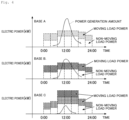
- Fig. 4 shows an example of information regarding a base A, a base B, and a base C acquired in S101. As illustrated, moving load power, non-moving load power, and an amount of power generation are acquired at each base.
- one square in the moving load power indicates moving load power of one VM in that frame.
- One square in the moving load power can also be regarded as one VM in that frame.
- the allocation unit 170 manages a VM group serving as a source of the moving load power in all bases as a control target VM group. That is, for example, information of the control target VM group is stored in the memory.
- Fig. 5 shows moving load power for each frame of the control target VM group. In Fig. 5 , it can be understood from hatchings whose VM (moving load power) the VM is among the bases A to C shown in Fig. 4 .
- the allocation unit 170 excludes, from the control target VM group, VMs of frames that generate (or increase) surplus power of renewable energy power generation when moved, on the basis of a predicted value of the renewable energy power generation.
- VMs moving load power
- VMs moving load power
- Fig. 7 shows a control target VM group obtained by excluding these from the entire control target VM group shown in Fig. 5 .
- the allocation unit 170 compares an amount of power generation with "non-moving load power+moving load power" for each base and each frame and determines whether or not there is surplus power.
- the moving load power here is electric power obtained by adding electric power of the VMs excluded from the control target (that is, electric power of the VMs not moved) and electric power of VMs rearranged in allocation processing, which will be described later.
- Fig. 8 shows "non-moving load power+moving load power" at this point of time for the bases A and B.
- the allocation unit 170 determines that there is surplus power if the "amount of power generation>(non-moving load power+moving load power)."
- the allocation unit 170 selects a base and a frame in which the surplus power of the renewable energy power generation is largest for each frame in all the bases. In the example shown in Fig. 8 , since the surplus power in the time frames shown in the figure at the base A is the largest among all the bases and all the frames, this is selected.
- the allocation unit 170 selects a VM having the largest electric power among the frames (time) selected in S105 from the control target VM group.
- the allocation unit 170 allocates the VM selected in S106 to the base selected in S105 and excludes the VM from the control target VM group. In S108, electric power of the allocated VM is added to power consumption of the base.
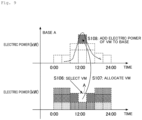
- Fig. 9 shows a specific example of S106 to S108.
- the VM having the largest electric power among the frames selected in S105 is the VM indicated by A, which is allocated to the base A, and its electric power is added to the corresponding frame.
- the allocation unit 170 repeats the operations of S105 to S108 until there is no VM in the control target VM group or the surplus power is no longer present at all the bases.
- the allocation unit 170 allocates, to original bases, the VMs (moving load power) in the control target VM group after there is no longer any the surplus power.
- the setting command unit 180 transmits a setting command to each base on the basis of allocation results calculated by the allocation unit 170.
- Example 2 After arrangement of the control target VM group to the base with surplus power is completed, when remaining VMs of the control target VM group are arranged to the bases, the arrangement is performed to further improve communication quality.
- Example 2 S110 in Fig. 3 is replaced with S111 to S114 shown in Fig. 10 .
- S101 to S109 are the same as in Example 1. The content of processing will be described according to the procedure of the flowchart of Fig. 10 .
- the allocation unit 170 randomly selects one VM for determining a migration destination from the remaining control target VM group.
- the allocation unit 170 determines a base having the smallest round trip delay time as an arrangement destination for the VM selected in Sill.
- the round trip delay time here is, for example, a round trip delay time of communication between a user terminal accessing the VM and the VM.
- the round trip delay time may be estimated on the basis of a distance between the user terminal and the VM, may be estimated using a measurement value measured in the past for communication between the user terminal and the base, or may be acquired or estimated by other methods.
- the allocation unit 170 excludes the VM for which the arrangement destination has been determined from the control target VM group.
- the allocation unit 170 determines whether or not any VMs remain in the control target VM group, returns to Sill if any VMs remain, and terminates the processing if no VMs remain. The allocation unit 170 repeats the S111 to S114 until there are no VMs left in the control target VM group.
- the round trip delay time has been used as an example of a communication quality parameter, but the present invention is not limited thereto.
- migration destinations of VMs may be determined in consideration of server resources (a CPU, a memory, a storage, and the like) of each base and free bands of each link.
- migration destinations of VMs may be determined by incorporating a plurality of these parameters.
- the physical resource acquisition unit 140 acquires server resources, and the traffic prediction unit 150 acquires free bands.
- a VM for executing an application for processing large amounts of data is disposed at a base at which remaining capacity of a memory is larger than a threshold
- a VM for executing an application requiring large capacity communication is disposed at a base having a free band larger than a threshold.
- the virtual machine allocation device 100 can be realized, for example, by causing a computer to execute a program.
- This computer may be a physical computer or a virtual machine on the cloud.
- the virtual machine allocation device 100 can be realized by executing a program corresponding to the processing performed by the virtual machine allocation device 100 using hardware resources such as a CPU and a memory built into a computer.
- the program can be recorded in a computer-readable recording medium (a portable memory or the like) to be stored or distributed.
- the program can also be provided through a network such as the Internet or an electronic mail.
- Fig. 11 is a diagram showing a hardware configuration example of the computer.
- the computer shown in Fig. 11 has a drive device 1000, an auxiliary storage device 1002, a memory device 1003, a CPU 1004, an interface device 1005, a display device 1006, an input device 1007, an output device 1008, and the like, which are connected to each other via a bus BS.
- a program for implementing processing in the computer is provided by, for example, a recording medium 1001 such as a CD-ROM or a memory card.
- a recording medium 1001 such as a CD-ROM or a memory card.
- the program is installed from the recording medium 1001 to the auxiliary storage device 1002 via the drive device 1000.
- the program need not necessarily be installed from the recording medium 1001 and may be downloaded from another computer via a network.
- the auxiliary storage device 1002 stores the installed program and also stores necessary files, data, and the like.
- the memory device 1003 reads and stores the program from the auxiliary storage device 1002 when an instruction to start the program is given.
- the CPU 1004 implements functions relating to the virtual machine allocation device 100 according to the program stored in the memory device 1003.
- the interface device 1005 is used as an interface for connection to a network or the like.
- the display device 1006 displays a Graphical User Interface (GUI) and the like according to the program.
- the input device 1007 is configured of a keyboard and a mouse, buttons, a touch panel, or the like and is used for inputting various operational instructions.
- the output device 1008 outputs calculation results.
- CSR corporate social responsibility
- the present specification discloses at least the following virtual machine allocation device, virtual machine allocation method, and program.
- a virtual machine allocation device configured to perform allocation of virtual machines to a plurality of bases to which supply of electric power is performed by renewable energy power generation, the device including:
- the virtual machine allocation device according to item 1, wherein the allocation unit sets one or more virtual machines excluding a virtual machine that generates the surplus power of the renewable energy power generation when moved from virtual machines for each time period at the plurality of bases as a control target virtual machine group.
- the virtual machine allocation device wherein the allocation unit selects a virtual machine having the largest power consumption among the selected time periods from the control target virtual machine group and allocates the virtual machine to the selected base and time period.
- the virtual machine allocation device according to any one of items 1 to 3, wherein, in a case in which there is no surplus power at any base, the allocation unit allocates each virtual machine remaining in the control target virtual machine group to original bases.
- the virtual machine allocation device according to any one of items 1 to 3, wherein, in a case in which there is no surplus power at any base, the allocation unit determines bases serving as allocation destinations of each virtual machine remaining in the control target virtual machine group to improve communication quality relating to the virtual machines.
- a program configured to cause a computer to function as each unit of the virtual machine allocation device according to any one of items 1 to 5.
Landscapes
- Engineering & Computer Science (AREA)
- Theoretical Computer Science (AREA)
- Software Systems (AREA)
- Physics & Mathematics (AREA)
- General Engineering & Computer Science (AREA)
- General Physics & Mathematics (AREA)
- Power Engineering (AREA)
- Supply And Distribution Of Alternating Current (AREA)
Abstract
Description
- The present invention relates to a technique for allocating virtual machines to a plurality of bases that use electric power generated by renewable energy power generation.
- In recent years, various network services and applications have been provided by virtual machines (hereinafter referred to as VMs) operating on servers (physical machines) at a plurality of bases (for example, data centers).
- In addition, in order to reduce power purchase costs, decarbonize, or the like, in many cases, each base receives power supply from two systems: renewable energy power generation such as solar power generation, and commercial power supplied from an electric power company. Here, such a case is assumed.
- In renewable energy power generation, an amount of power supply fluctuates from moment to moment. For that reason, for example, in a case in which an amount of renewable energy supply of a base A is reduced, a VM of the base A is moved to a base B having a margin in the amount of renewable energy supply, and thus renewable energy of the base B can be used without waste, and an amount of power purchase from an electric power company at the base A can be reduced.
- NPL 1 discloses a vector-based algorithm for calculating at which base each VM should be disposed in order to use renewable energy at each base as efficiently as possible.
- [NPL 1] Pape, C., Rieger, S., & Richter, H. (2016). Leveraging Renewable Energies in Distributed Private Clouds. In MATEC Web of Conferences (Vol. 68, p. 14008). EDP Sciences.
- However, in the known art disclosed in
NPL 1, since an amount of surplus power of the renewable energy for each base is not considered, there is a possibility that the renewable energy may be wasted in some time periods or at some bases. - The present invention has been made in view of the above points, and an object thereof is to provide a technique for minimizing surplus power of renewable energy power generation at a plurality of bases at which supply of electric power is performed by renewable energy power generation.
- According to the disclosed technique, a virtual machine allocation device (virtual machine allocation apparatus) configured to perform allocation of virtual machines to a plurality of bases to which supply of electric power is performed by renewable energy power generation, the device including:
- a prediction unit configured to acquire, for each base, a predicted value of an amount of power generation of renewable energy power generation and a predicted value of power consumption; and
- an allocation unit configured to repeatedly execute processing of selecting a base and a time period in which surplus power of the renewable energy power generation is maximized within a predetermined time length divided into a plurality of time periods at the plurality of bases, allocating a virtual machine selected from a control target virtual machine group including one or more movable virtual machines to the selected base and time period, and excluding the allocated virtual machine from the control target virtual machine group,
is provided. - According to the disclosed technique, it is possible to reduce the surplus power of the renewable energy power generation at the plurality of bases to which the supply of electric power is performed by the renewable energy power generation.
-
- [
Fig. 1] Fig. 1 is an overall configuration diagram of a system according to an embodiment of the present invention. - [
Fig. 2] Fig. 2 is a configuration diagram of a virtual machine allocation device according to an embodiment of the present invention. - [
Fig. 3] Fig. 3 is a flowchart for explaining operations according to Example 1. - [
Fig. 4] Fig. 4 is a diagram for explaining S101. - [
Fig. 5] Fig. 5 is a diagram for explaining S102. - [
Fig. 6] Fig. 6 is a diagram for explaining S103. - [
Fig. 7] Fig. 7 is a diagram for explaining S103. - [
Fig. 8] Fig. 8 is a diagram for explaining S104 to S105. - [
Fig. 9] Fig. 9 is a diagram for explaining S106 to S108. - [
Fig. 10] Fig. 10 is a flowchart for explaining operations according to Example 2. - [
Fig. 11] Fig. 11 is a diagram showing an example of a hardware configuration of the device. - An embodiment of the present invention (the present embodiment) will be described below with reference to the drawings. The embodiment described below is merely an example, and embodiments to which the present invention is applied are not limited to the following embodiment.
-
Fig. 1 shows an example of an overall configuration of a system according to the present embodiment. As shown inFig. 1 , a plurality of bases including a server group are connected to aphysical network 200. In addition, a virtual machine allocation device 100 (virtual machine allocation apparatus) is connected to thephysical network 200. - At each base, commercial power supplied from an electric power company is supplied, and electric power generated by renewable energy power generation is supplied. Also, there may be bases to which only commercial power supplied from an electric power company is supplied or bases to which only electric power of renewable energy power generation is supplied.
- Zero or more VMs are installed on each server at each base. Each VM can be moved between bases in accordance with a setting command from the virtual
machine allocation device 100. Various existing techniques can be used for moving VMs (which may be referred to as migration). - The virtual
machine allocation device 100 derives an arrangement (allocation) of respective VMs to each base in consideration of surplus power of the renewable energy power generation at each base and power consumption of each VM and transmits a setting command for moving VMs to corresponding bases in accordance with results of the allocation processing. The virtualmachine allocation device 100 can acquire information needed for allocation calculation (such as an amount of renewable energy power generation, or power consumption of each VM) from each base (or monitoring system, or the like). - The virtual
machine allocation device 100 first selects a VM serving as a moving target from among all VMs from the viewpoint of minimizing the surplus power of the renewable energy power generation prior to deriving the arrangement. In deriving the arrangement, an approximation guarantee is obtained by sequentially allocating VMs such that a VM with the highest power consumption is allocated to a base and a time period with the highest surplus power. -
Fig. 2 shows a configuration example of the virtualmachine allocation device 100 according to the present embodiment. As shown inFig. 2 , the virtualmachine allocation device 100 has a schedule management unit 110, a power generationamount prediction unit 120, a powerconsumption prediction unit 130, a physicalresource acquisition unit 140, atraffic prediction unit 150, a servicerequest management unit 160, anallocation unit 170, and asetting command unit 180. Also, the power generationamount prediction unit 120 and the powerconsumption prediction unit 130 may be collectively called a prediction unit. - The schedule management unit 110 manages a schedule for executing a control pattern calculated by the
allocation unit 170 from an updated state of prediction information and a control time constant of thephysical network 200. For example, in a case in which it is known to take 30 minutes for control based on the control time constant, when preferable VM arrangement is desired at a certain time T, the schedule is managed so that the control (such as VM arrangement calculation and command transmission) is started 30 minutes before the time T. - The power generation
amount prediction unit 120 predicts an amount of power generation of renewable energy power generation equipment at each base from weather information or the like. The powerconsumption prediction unit 130 predicts power consumption for each moving load and non-moving load from past power consumption results or the like. - The physical
resource acquisition unit 140 acquires and manages information regarding physical resources (CPU capacity of each base, link bandwidth of each link, and the like). - The
traffic prediction unit 150 acquires an amount of traffic (an amount of predicted traffic) during the time when virtual network control is performed. The servicerequest management unit 160 manages service requests. - The
allocation unit 170 calculates an optimal virtual network control pattern via the procedure described later, for example, in accordance with instructions from the schedule management unit 110. - The
setting command unit 180 transmits a virtual network setting command to each physical resource (for example, a server, various communication devices, and the like) to realize the optimal virtual network control pattern calculated by theallocation unit 170. - Also, the virtual
machine allocation device 100 may be configured of one device (computer), or may be configured of a plurality of devices. Further, the virtualmachine allocation device 100 may have only a function of determining allocation of VMs to bases, and a device other than the virtualmachine allocation device 100 may perform a setting command for actual movement of VMs. In addition, for example, the virtualmachine allocation device 100 may include the prediction unit and theallocation unit 170, and functions other than these may be provided outside the virtualmachine allocation device 100. - Next, detailed processing performed by the virtual
machine allocation device 100 according to Example 1 will be described along the procedure of the flowchart inFig. 3 .Figs. 4 to 9 will be referred to as needed in the description of the procedure. - In the present embodiment, a predetermined time length is divided into a plurality of time periods, and allocation of VMs is performed for each time period. The predetermined time length is, for example, 24 hours. Also, one time period is, for example, 30 minutes. The time period is called a "frame" or "time frame."
- Further, in the present embodiment, it is assumed that control for each base is performed at a predetermined time interval (for example, 3 hours), and allocation is performed in units of frames each having a predetermined time length (for example, 24 hours) before the predetermined time for actual control. In the figures used in the following description, for the sake of convenience, frames each having a time length of about 3 to 4 hours are used so that the figures can be easily understood.
- In S101 (step 101), the power
consumption prediction unit 130 acquires a predicted value of power consumption for a moving load and a predicted value of power consumption for a non-moving load for each base and each frame. In addition, the power generationamount prediction unit 120 acquires a prediction value of generated electric power of renewable energy for each base and each frame. Information of the acquired electric power is stored in a storage unit such as a memory of the virtualmachine allocation device 100, read from the memory in subsequent processing, and used for processing. - Further, the moving load is a load that can move power consumption between bases and corresponds to a VM. The non-moving load is a load that cannot move power consumption between bases and corresponds to, for example, air conditioning equipment of a building, or the like. Hereinafter, power consumption corresponding to the moving load will be referred to as moving load power, and power consumption corresponding to the non-moving load will be referred to as non-moving load power. Also, in the following description, unless otherwise specified, electric power is assumed to be a predicted value even if not explicitly stated so.
-
Fig. 4 shows an example of information regarding a base A, a base B, and a base C acquired in S101. As illustrated, moving load power, non-moving load power, and an amount of power generation are acquired at each base. InFig. 4 , one square in the moving load power indicates moving load power of one VM in that frame. One square in the moving load power can also be regarded as one VM in that frame. - In S102, the
allocation unit 170 manages a VM group serving as a source of the moving load power in all bases as a control target VM group. That is, for example, information of the control target VM group is stored in the memory.Fig. 5 shows moving load power for each frame of the control target VM group. InFig. 5 , it can be understood from hatchings whose VM (moving load power) the VM is among the bases A to C shown inFig. 4 . - In S103, the
allocation unit 170 excludes, from the control target VM group, VMs of frames that generate (or increase) surplus power of renewable energy power generation when moved, on the basis of a predicted value of the renewable energy power generation. - An example will be described with reference to
Fig. 6 . In the case ofFig. 6 (a) , since VMs (moving load power) indicated by A, B, and C respectively use electric power of renewable energy power generation, and thus in a case in which any of these is moved to another base, surplus power of the renewable energy power generation will be generated. The same applies to D, E, and F in (b). - In the case shown in
Fig. 4 , for the bases A and B, VMs (moving load power) in three central frames correspond to those which generate surplus power of renewable energy power generation when moved, and thus these are excluded from the control target VM group.Fig. 7 shows a control target VM group obtained by excluding these from the entire control target VM group shown inFig. 5 . - In S104, the
allocation unit 170 compares an amount of power generation with "non-moving load power+moving load power" for each base and each frame and determines whether or not there is surplus power. The moving load power here is electric power obtained by adding electric power of the VMs excluded from the control target (that is, electric power of the VMs not moved) and electric power of VMs rearranged in allocation processing, which will be described later.Fig. 8 shows "non-moving load power+moving load power" at this point of time for the bases A and B. - The
allocation unit 170 determines that there is surplus power if the "amount of power generation>(non-moving load power+moving load power)." - In S105, the
allocation unit 170 selects a base and a frame in which the surplus power of the renewable energy power generation is largest for each frame in all the bases. In the example shown inFig. 8 , since the surplus power in the time frames shown in the figure at the base A is the largest among all the bases and all the frames, this is selected. - In S106, the
allocation unit 170 selects a VM having the largest electric power among the frames (time) selected in S105 from the control target VM group. - In S107, the
allocation unit 170 allocates the VM selected in S106 to the base selected in S105 and excludes the VM from the control target VM group. In S108, electric power of the allocated VM is added to power consumption of the base. -
Fig. 9 shows a specific example of S106 to S108. In the example ofFig. 9 , the VM having the largest electric power among the frames selected in S105 is the VM indicated by A, which is allocated to the base A, and its electric power is added to the corresponding frame. - The
allocation unit 170 repeats the operations of S105 to S108 until there is no VM in the control target VM group or the surplus power is no longer present at all the bases. - In S110, the
allocation unit 170 allocates, to original bases, the VMs (moving load power) in the control target VM group after there is no longer any the surplus power. - After that, when the time of control managed by the schedule management unit 110 comes, the setting
command unit 180 transmits a setting command to each base on the basis of allocation results calculated by theallocation unit 170. - Next, Example 2 will be described. In Example 2, after arrangement of the control target VM group to the base with surplus power is completed, when remaining VMs of the control target VM group are arranged to the bases, the arrangement is performed to further improve communication quality.
- Specifically, in Example 2, S110 in
Fig. 3 is replaced with S111 to S114 shown inFig. 10 . S101 to S109 are the same as in Example 1. The content of processing will be described according to the procedure of the flowchart ofFig. 10 . - In Sill, the
allocation unit 170 randomly selects one VM for determining a migration destination from the remaining control target VM group. - In S112, the
allocation unit 170 determines a base having the smallest round trip delay time as an arrangement destination for the VM selected in Sill. The round trip delay time here is, for example, a round trip delay time of communication between a user terminal accessing the VM and the VM. The round trip delay time may be estimated on the basis of a distance between the user terminal and the VM, may be estimated using a measurement value measured in the past for communication between the user terminal and the base, or may be acquired or estimated by other methods. - In S113, the
allocation unit 170 excludes the VM for which the arrangement destination has been determined from the control target VM group. - In S114, the
allocation unit 170 determines whether or not any VMs remain in the control target VM group, returns to Sill if any VMs remain, and terminates the processing if no VMs remain. Theallocation unit 170 repeats the S111 to S114 until there are no VMs left in the control target VM group. - In the above example, the round trip delay time has been used as an example of a communication quality parameter, but the present invention is not limited thereto. For example, migration destinations of VMs may be determined in consideration of server resources (a CPU, a memory, a storage, and the like) of each base and free bands of each link. Alternatively, migration destinations of VMs may be determined by incorporating a plurality of these parameters.
- The physical
resource acquisition unit 140 acquires server resources, and thetraffic prediction unit 150 acquires free bands. - For example, a VM for executing an application for processing large amounts of data is disposed at a base at which remaining capacity of a memory is larger than a threshold, and a VM for executing an application requiring large capacity communication is disposed at a base having a free band larger than a threshold.
- The virtual
machine allocation device 100 can be realized, for example, by causing a computer to execute a program. This computer may be a physical computer or a virtual machine on the cloud. - That is, the virtual
machine allocation device 100 can be realized by executing a program corresponding to the processing performed by the virtualmachine allocation device 100 using hardware resources such as a CPU and a memory built into a computer. The program can be recorded in a computer-readable recording medium (a portable memory or the like) to be stored or distributed. The program can also be provided through a network such as the Internet or an electronic mail. -
Fig. 11 is a diagram showing a hardware configuration example of the computer. The computer shown inFig. 11 has adrive device 1000, anauxiliary storage device 1002, amemory device 1003, aCPU 1004, aninterface device 1005, adisplay device 1006, aninput device 1007, anoutput device 1008, and the like, which are connected to each other via a bus BS. - A program for implementing processing in the computer is provided by, for example, a
recording medium 1001 such as a CD-ROM or a memory card. When therecording medium 1001 storing the program is set in thedrive device 1000, the program is installed from therecording medium 1001 to theauxiliary storage device 1002 via thedrive device 1000. However, the program need not necessarily be installed from therecording medium 1001 and may be downloaded from another computer via a network. Theauxiliary storage device 1002 stores the installed program and also stores necessary files, data, and the like. - The
memory device 1003 reads and stores the program from theauxiliary storage device 1002 when an instruction to start the program is given. TheCPU 1004 implements functions relating to the virtualmachine allocation device 100 according to the program stored in thememory device 1003. Theinterface device 1005 is used as an interface for connection to a network or the like. Thedisplay device 1006 displays a Graphical User Interface (GUI) and the like according to the program. Theinput device 1007 is configured of a keyboard and a mouse, buttons, a touch panel, or the like and is used for inputting various operational instructions. Theoutput device 1008 outputs calculation results. - With the technique according to the present embodiment, it is possible to reduce surplus power of renewable energy at all bases, and to cover more electric power with the renewable energy.
- In addition, it will lead to corporate social responsibility (CSR) initiatives by improving a ratio of the renewable energy and can contribute to reducing power purchasing costs from electric power companies.
- The present specification discloses at least the following virtual machine allocation device, virtual machine allocation method, and program.
- A virtual machine allocation device configured to perform allocation of virtual machines to a plurality of bases to which supply of electric power is performed by renewable energy power generation, the device including:
- a prediction unit configured to acquire, for each base, a predicted value of an amount of power generation of renewable energy power generation and a predicted value of power consumption; and
- an allocation unit configured to repeatedly execute processing of selecting a base and a time period in which surplus power of the renewable energy power generation is maximized within a predetermined time length divided into a plurality of time periods at the plurality of bases, allocating a virtual machine selected from a control target virtual machine group including one or more movable virtual machines to the selected base and time period, and excluding the allocated virtual machine from the control target virtual machine group.
- The virtual machine allocation device according to
item 1, wherein
the allocation unit sets one or more virtual machines excluding a virtual machine that generates the surplus power of the renewable energy power generation when moved from virtual machines for each time period at the plurality of bases as a control target virtual machine group. - The virtual machine allocation device according to item 2, wherein
the allocation unit selects a virtual machine having the largest power consumption among the selected time periods from the control target virtual machine group and allocates the virtual machine to the selected base and time period. - The virtual machine allocation device according to any one of
items 1 to 3, wherein,
in a case in which there is no surplus power at any base, the allocation unit allocates each virtual machine remaining in the control target virtual machine group to original bases. - The virtual machine allocation device according to any one of
items 1 to 3, wherein,
in a case in which there is no surplus power at any base, the allocation unit determines bases serving as allocation destinations of each virtual machine remaining in the control target virtual machine group to improve communication quality relating to the virtual machines. - A virtual machine allocation method executed by a virtual machine allocation device configured to perform allocation of virtual machines to a plurality of bases to which supply of electric power is performed by renewable energy power generation, the method including:
- a prediction step configured to acquire, for each base, a predicted value of an amount of power generation of renewable energy power generation and a predicted value of power consumption; and
- an allocation step configured to repeatedly execute processing of selecting a base and a time period in which surplus power of the renewable energy power generation is maximized within a predetermined time length divided into a plurality of time periods at the plurality of bases, allocating a virtual machine selected from a control target virtual machine group including one or more movable virtual machines to the selected base and time period, and excluding the allocated virtual machine from the control target virtual machine group.
- A program configured to cause a computer to function as each unit of the virtual machine allocation device according to any one of
items 1 to 5. - Although the embodiment has been described above, the present invention is not limited to the specific embodiment, and various modifications and changes can be made within the scope of the gist of the present invention described in the claims.
-
- 100 Virtual machine allocation device
- 110 Schedule management unit
- 120 Power generation amount prediction unit
- 130 Power consumption prediction unit
- 140 Physical resource acquisition unit
- 150 Traffic prediction unit
- 160 Service request management unit
- 170 Allocation unit
- 180 Setting command unit
- 200 Physical network
- 1000 Drive device
- 1001 Recording medium
- 1002 Auxiliary storage device
- 1003 Memory device
- 1004 CPU
- 1005 Interface device
- 1006 Display device
- 1007 Input device
- 1008 Output device
Claims (7)
- A virtual machine allocation apparatus configured to perform allocation of virtual machines to a plurality of bases to which supply of electric power is performed by renewable energy power generation, the virtual machine allocation apparatus comprising:a prediction unit configured to acquire, for each base, a predicted value of an amount of power generation of renewable energy power generation and a predicted value of power consumption; andan allocation unit configured to repeatedly execute processing of selecting a base and a time period in which surplus power of the renewable energy power generation is maximized within a predetermined time length divided into a plurality of time periods at the plurality of bases, allocating a virtual machine selected from a control target virtual machine group including one or more movable virtual machines to the selected base and time period, and excluding the allocated virtual machine from the control target virtual machine group.
- The virtual machine allocation apparatus according to claim 1, wherein
the allocation unit sets one or more virtual machines excluding a virtual machine that generates surplus power of the renewable energy power generation when moved from virtual machines for each time period at the plurality of bases as a control target virtual machine group. - The virtual machine allocation apparatus according to claim 2, wherein
the allocation unit selects a virtual machine having the largest power consumption among the selected time periods from the control target virtual machine group and allocates the virtual machine to the selected base and time period. - The virtual machine allocation apparatus according to any one of claims 1 to 3, wherein,
in a case in which there is no surplus power at any base, the allocation unit allocates each virtual machine remaining in the control target virtual machine group to original bases. - The virtual machine allocation apparatus according to any one of claims 1 to 3, wherein,
in a case in which there is no surplus power at any base, the allocation unit determines bases serving as allocation destinations of each virtual machine remaining in the control target virtual machine group to improve communication quality relating to the virtual machines. - A virtual machine allocation method executed by a virtual machine allocation apparatus configured to perform allocation of virtual machines to a plurality of bases to which supply of electric power is performed by renewable energy power generation, the method comprising:a prediction step configured of acquiring, for each base, a predicted value of an amount of power generation of renewable energy power generation and a predicted value of power consumption; andan allocation step of repeatedly executing processing of selecting a base and a time period in which surplus power of the renewable energy power generation is maximized within a predetermined time length divided into a plurality of time periods at the plurality of bases, allocating a virtual machine selected from a control target virtual machine group including one or more movable virtual machines to the selected base and time period, and excluding the allocated virtual machine from the control target virtual machine group.
- A program configured to cause a computer to function as each unit of the virtual machine allocation apparatus according to any one of claims 1 to 5.
Applications Claiming Priority (1)
| Application Number | Priority Date | Filing Date | Title |
|---|---|---|---|
| PCT/JP2021/046098 WO2023112160A1 (en) | 2021-12-14 | 2021-12-14 | Virtual machine provisioning device, virtual machine provisioning method, and program |
Publications (2)
| Publication Number | Publication Date |
|---|---|
| EP4451511A1 true EP4451511A1 (en) | 2024-10-23 |
| EP4451511A4 EP4451511A4 (en) | 2025-10-08 |
Family
ID=86773740
Family Applications (1)
| Application Number | Title | Priority Date | Filing Date |
|---|---|---|---|
| EP21968077.4A Pending EP4451511A4 (en) | 2021-12-14 | 2021-12-14 | DEVICE FOR PROVIDING A VIRTUAL MACHINE, METHOD FOR PROVIDING A VIRTUAL MACHINE AND PROGRAM |
Country Status (4)
| Country | Link |
|---|---|
| US (1) | US20240419476A1 (en) |
| EP (1) | EP4451511A4 (en) |
| JP (1) | JP7841544B2 (en) |
| WO (1) | WO2023112160A1 (en) |
Families Citing this family (1)
| Publication number | Priority date | Publication date | Assignee | Title |
|---|---|---|---|---|
| WO2025177502A1 (en) * | 2024-02-21 | 2025-08-28 | Ntt株式会社 | Virtual network allocation device, virtual network allocation method, and program |
Family Cites Families (3)
| Publication number | Priority date | Publication date | Assignee | Title |
|---|---|---|---|---|
| JP6004451B2 (en) * | 2014-03-26 | 2016-10-05 | インターナショナル・ビジネス・マシーンズ・コーポレーションInternational Business Machines Corporation | Load balancing method between data centers and data centers |
| JP6451149B2 (en) * | 2014-09-01 | 2019-01-16 | 富士通株式会社 | Management device, migration control program, information processing system |
| JP7482688B2 (en) * | 2020-06-01 | 2024-05-14 | 株式会社日立製作所 | Data center system and its operation method, and data center system site design support device and method |
-
2021
- 2021-12-14 US US18/703,877 patent/US20240419476A1/en active Pending
- 2021-12-14 WO PCT/JP2021/046098 patent/WO2023112160A1/en not_active Ceased
- 2021-12-14 JP JP2023567348A patent/JP7841544B2/en active Active
- 2021-12-14 EP EP21968077.4A patent/EP4451511A4/en active Pending
Also Published As
| Publication number | Publication date |
|---|---|
| JP7841544B2 (en) | 2026-04-07 |
| EP4451511A4 (en) | 2025-10-08 |
| US20240419476A1 (en) | 2024-12-19 |
| WO2023112160A1 (en) | 2023-06-22 |
| JPWO2023112160A1 (en) | 2023-06-22 |
Similar Documents
| Publication | Publication Date | Title |
|---|---|---|
| Neely et al. | Efficient algorithms for renewable energy allocation to delay tolerant consumers | |
| US8434088B2 (en) | Optimized capacity planning | |
| Chaisiri et al. | Optimal virtual machine placement across multiple cloud providers | |
| EP2894827B1 (en) | Method, apparatus, and system for managing migration of virtual machine | |
| US7971078B2 (en) | System and method for measurement-based power and energy accounting for virtual machines | |
| US9424094B2 (en) | Server consolidation using virtual machine resource tradeoffs | |
| Guitart | Toward sustainable data centers: a comprehensive energy management strategy | |
| US20080295096A1 (en) | DYNAMIC PLACEMENT OF VIRTUAL MACHINES FOR MANAGING VIOLATIONS OF SERVICE LEVEL AGREEMENTS (SLAs) | |
| US20080222644A1 (en) | Risk-modulated proactive data migration for maximizing utility in storage systems | |
| US20220094742A1 (en) | Control apparatus, control method and program | |
| US20110196908A1 (en) | Optimized capacity planning | |
| Rehman et al. | Min-min scheduling algorithm for efficient resource distribution using cloud and fog in smart buildings | |
| US20210103456A1 (en) | Virtualized network function deployment | |
| CN111105050B (en) | Fan maintenance plan generation method, device, equipment and storage medium | |
| CN113381892A (en) | Network slice allocation method and device, electronic equipment and storage medium | |
| Leivadeas et al. | Resource management and orchestration for a dynamic service chain steering model | |
| CN105762843B (en) | The power output distribution method of non-accumulation energy type schedulable photovoltaic plant | |
| Qiu et al. | Dynamic demand prediction and allocation in cloud service brokerage | |
| CN114844791B (en) | Cloud service automatic management and distribution method and system based on big data and storage medium | |
| Cao et al. | Towards tenant demand-aware bandwidth allocation strategy in cloud datacenter | |
| EP4451511A1 (en) | Virtual machine provisioning device, virtual machine provisioning method, and program | |
| JP2011061951A (en) | Wind turbine generator system, control method, controller, and program | |
| JP7800567B2 (en) | Virtual machine power consumption prediction device, virtual machine power consumption prediction method, and program | |
| Yusoh et al. | A penalty-based grouping genetic algorithm for multiple composite saas components clustering in cloud | |
| US20210306230A1 (en) | Communication system and communication method |
Legal Events
| Date | Code | Title | Description |
|---|---|---|---|
| STAA | Information on the status of an ep patent application or granted ep patent |
Free format text: STATUS: THE INTERNATIONAL PUBLICATION HAS BEEN MADE |
|
| PUAI | Public reference made under article 153(3) epc to a published international application that has entered the european phase |
Free format text: ORIGINAL CODE: 0009012 |
|
| STAA | Information on the status of an ep patent application or granted ep patent |
Free format text: STATUS: REQUEST FOR EXAMINATION WAS MADE |
|
| 17P | Request for examination filed |
Effective date: 20240429 |
|
| AK | Designated contracting states |
Kind code of ref document: A1 Designated state(s): AL AT BE BG CH CY CZ DE DK EE ES FI FR GB GR HR HU IE IS IT LI LT LU LV MC MK MT NL NO PL PT RO RS SE SI SK SM TR |
|
| DAV | Request for validation of the european patent (deleted) | ||
| DAX | Request for extension of the european patent (deleted) | ||
| REG | Reference to a national code |
Ref country code: DE Ref legal event code: R079 Free format text: PREVIOUS MAIN CLASS: H02J0013000000 Ipc: G06F0009500000 |
|
| RAP3 | Party data changed (applicant data changed or rights of an application transferred) |
Owner name: NTT, INC. |
|
| A4 | Supplementary search report drawn up and despatched |
Effective date: 20250905 |
|
| RIC1 | Information provided on ipc code assigned before grant |
Ipc: G06F 9/50 20060101AFI20250901BHEP Ipc: H02J 13/00 20060101ALI20250901BHEP Ipc: H02J 3/38 20060101ALI20250901BHEP Ipc: G06F 1/329 20190101ALI20250901BHEP |