EP4451408A2 - Electrolyte for secondary batteries, secondary battery, and electronic apparatus - Google Patents
Electrolyte for secondary batteries, secondary battery, and electronic apparatus Download PDFInfo
- Publication number
- EP4451408A2 EP4451408A2 EP24166185.9A EP24166185A EP4451408A2 EP 4451408 A2 EP4451408 A2 EP 4451408A2 EP 24166185 A EP24166185 A EP 24166185A EP 4451408 A2 EP4451408 A2 EP 4451408A2
- Authority
- EP
- European Patent Office
- Prior art keywords
- lithium
- electrolyte
- negative electrode
- secondary battery
- additive
- Prior art date
- Legal status (The legal status is an assumption and is not a legal conclusion. Google has not performed a legal analysis and makes no representation as to the accuracy of the status listed.)
- Pending
Links
- 239000003792 electrolyte Substances 0.000 title claims abstract description 95
- 239000000654 additive Substances 0.000 claims abstract description 60
- 230000000996 additive effect Effects 0.000 claims abstract description 60
- 239000011356 non-aqueous organic solvent Substances 0.000 claims abstract description 39
- 229910052731 fluorine Inorganic materials 0.000 claims abstract description 23
- 239000011737 fluorine Substances 0.000 claims abstract description 23
- 150000001768 cations Chemical class 0.000 claims abstract description 20
- 150000001450 anions Chemical class 0.000 claims abstract description 17
- 150000003839 salts Chemical class 0.000 claims abstract description 6
- -1 lithium hexafluorophosphate Chemical compound 0.000 claims description 87
- 229910003002 lithium salt Inorganic materials 0.000 claims description 29
- 159000000002 lithium salts Chemical class 0.000 claims description 29
- 229910052744 lithium Inorganic materials 0.000 claims description 21
- 239000007773 negative electrode material Substances 0.000 claims description 21
- WHXSMMKQMYFTQS-UHFFFAOYSA-N Lithium Chemical compound [Li] WHXSMMKQMYFTQS-UHFFFAOYSA-N 0.000 claims description 13
- 125000001153 fluoro group Chemical group F* 0.000 claims description 12
- 125000004435 hydrogen atom Chemical group [H]* 0.000 claims description 12
- VDVLPSWVDYJFRW-UHFFFAOYSA-N lithium;bis(fluorosulfonyl)azanide Chemical compound [Li+].FS(=O)(=O)[N-]S(F)(=O)=O VDVLPSWVDYJFRW-UHFFFAOYSA-N 0.000 claims description 12
- BHPQYMZQTOCNFJ-UHFFFAOYSA-N Calcium cation Chemical compound [Ca+2] BHPQYMZQTOCNFJ-UHFFFAOYSA-N 0.000 claims description 6
- JLVVSXFLKOJNIY-UHFFFAOYSA-N Magnesium ion Chemical compound [Mg+2] JLVVSXFLKOJNIY-UHFFFAOYSA-N 0.000 claims description 6
- PTFCDOFLOPIGGS-UHFFFAOYSA-N Zinc dication Chemical compound [Zn+2] PTFCDOFLOPIGGS-UHFFFAOYSA-N 0.000 claims description 6
- 229910052782 aluminium Inorganic materials 0.000 claims description 6
- 229910001424 calcium ion Inorganic materials 0.000 claims description 6
- 229910001425 magnesium ion Inorganic materials 0.000 claims description 6
- 239000002210 silicon-based material Substances 0.000 claims description 5
- BTBUEUYNUDRHOZ-UHFFFAOYSA-N Borate Chemical compound [O-]B([O-])[O-] BTBUEUYNUDRHOZ-UHFFFAOYSA-N 0.000 claims description 4
- 229910019142 PO4 Inorganic materials 0.000 claims description 4
- 229910052796 boron Inorganic materials 0.000 claims description 4
- RTZKZFJDLAIYFH-UHFFFAOYSA-N ether Substances CCOCC RTZKZFJDLAIYFH-UHFFFAOYSA-N 0.000 claims description 4
- IIPYXGDZVMZOAP-UHFFFAOYSA-N lithium nitrate Chemical compound [Li+].[O-][N+]([O-])=O IIPYXGDZVMZOAP-UHFFFAOYSA-N 0.000 claims description 4
- QSZMZKBZAYQGRS-UHFFFAOYSA-N lithium;bis(trifluoromethylsulfonyl)azanide Chemical compound [Li+].FC(F)(F)S(=O)(=O)[N-]S(=O)(=O)C(F)(F)F QSZMZKBZAYQGRS-UHFFFAOYSA-N 0.000 claims description 4
- NBIIXXVUZAFLBC-UHFFFAOYSA-K phosphate Chemical compound [O-]P([O-])([O-])=O NBIIXXVUZAFLBC-UHFFFAOYSA-K 0.000 claims description 4
- 239000010452 phosphate Substances 0.000 claims description 4
- 125000006736 (C6-C20) aryl group Chemical group 0.000 claims description 2
- 125000000217 alkyl group Chemical group 0.000 claims description 2
- 229910003473 lithium bis(trifluoromethanesulfonyl)imide Inorganic materials 0.000 claims description 2
- 229910001496 lithium tetrafluoroborate Inorganic materials 0.000 claims description 2
- ACFSQHQYDZIPRL-UHFFFAOYSA-N lithium;bis(1,1,2,2,2-pentafluoroethylsulfonyl)azanide Chemical compound [Li+].FC(F)(F)C(F)(F)S(=O)(=O)[N-]S(=O)(=O)C(F)(F)C(F)(F)F ACFSQHQYDZIPRL-UHFFFAOYSA-N 0.000 claims description 2
- IGILRSKEFZLPKG-UHFFFAOYSA-M lithium;difluorophosphinate Chemical compound [Li+].[O-]P(F)(F)=O IGILRSKEFZLPKG-UHFFFAOYSA-M 0.000 claims description 2
- 238000003860 storage Methods 0.000 abstract description 67
- 230000001351 cycling effect Effects 0.000 abstract description 56
- YCKRFDGAMUMZLT-UHFFFAOYSA-N Fluorine atom Chemical compound [F] YCKRFDGAMUMZLT-UHFFFAOYSA-N 0.000 abstract description 11
- 238000004519 manufacturing process Methods 0.000 abstract description 11
- 150000001875 compounds Chemical class 0.000 abstract description 10
- 229910001416 lithium ion Inorganic materials 0.000 description 134
- HBBGRARXTFLTSG-UHFFFAOYSA-N Lithium ion Chemical compound [Li+] HBBGRARXTFLTSG-UHFFFAOYSA-N 0.000 description 53
- 239000010410 layer Substances 0.000 description 44
- 230000014759 maintenance of location Effects 0.000 description 30
- 230000008961 swelling Effects 0.000 description 23
- 238000002360 preparation method Methods 0.000 description 22
- 229910001290 LiPF6 Inorganic materials 0.000 description 21
- 230000000052 comparative effect Effects 0.000 description 21
- 239000007774 positive electrode material Substances 0.000 description 20
- 229910001415 sodium ion Inorganic materials 0.000 description 13
- FKNQFGJONOIPTF-UHFFFAOYSA-N Sodium cation Chemical compound [Na+] FKNQFGJONOIPTF-UHFFFAOYSA-N 0.000 description 12
- 238000000034 method Methods 0.000 description 12
- 239000011230 binding agent Substances 0.000 description 10
- 239000007789 gas Substances 0.000 description 10
- 239000006258 conductive agent Substances 0.000 description 8
- 230000008569 process Effects 0.000 description 8
- NPYPAHLBTDXSSS-UHFFFAOYSA-N Potassium ion Chemical group [K+] NPYPAHLBTDXSSS-UHFFFAOYSA-N 0.000 description 7
- 230000002708 enhancing effect Effects 0.000 description 7
- 150000002500 ions Chemical group 0.000 description 7
- 238000004806 packaging method and process Methods 0.000 description 7
- 229920000642 polymer Polymers 0.000 description 7
- 229910001414 potassium ion Inorganic materials 0.000 description 7
- 229940037179 potassium ion Drugs 0.000 description 7
- VZSRBBMJRBPUNF-UHFFFAOYSA-N 2-(2,3-dihydro-1H-inden-2-ylamino)-N-[3-oxo-3-(2,4,6,7-tetrahydrotriazolo[4,5-c]pyridin-5-yl)propyl]pyrimidine-5-carboxamide Chemical compound C1C(CC2=CC=CC=C12)NC1=NC=C(C=N1)C(=O)NCCC(N1CC2=C(CC1)NN=N2)=O VZSRBBMJRBPUNF-UHFFFAOYSA-N 0.000 description 6
- AFCARXCZXQIEQB-UHFFFAOYSA-N N-[3-oxo-3-(2,4,6,7-tetrahydrotriazolo[4,5-c]pyridin-5-yl)propyl]-2-[[3-(trifluoromethoxy)phenyl]methylamino]pyrimidine-5-carboxamide Chemical compound O=C(CCNC(=O)C=1C=NC(=NC=1)NCC1=CC(=CC=C1)OC(F)(F)F)N1CC2=C(CC1)NN=N2 AFCARXCZXQIEQB-UHFFFAOYSA-N 0.000 description 6
- 239000000956 alloy Substances 0.000 description 6
- 239000011267 electrode slurry Substances 0.000 description 6
- 239000010408 film Substances 0.000 description 6
- 229920000058 polyacrylate Polymers 0.000 description 6
- KMTRUDSVKNLOMY-UHFFFAOYSA-N Ethylene carbonate Chemical compound O=C1OCCO1 KMTRUDSVKNLOMY-UHFFFAOYSA-N 0.000 description 5
- 239000002033 PVDF binder Substances 0.000 description 5
- 239000004698 Polyethylene Substances 0.000 description 5
- 230000009471 action Effects 0.000 description 5
- 230000000694 effects Effects 0.000 description 5
- 229910000625 lithium cobalt oxide Inorganic materials 0.000 description 5
- BFZPBUKRYWOWDV-UHFFFAOYSA-N lithium;oxido(oxo)cobalt Chemical compound [Li+].[O-][Co]=O BFZPBUKRYWOWDV-UHFFFAOYSA-N 0.000 description 5
- 230000005012 migration Effects 0.000 description 5
- 238000013508 migration Methods 0.000 description 5
- 229920000573 polyethylene Polymers 0.000 description 5
- 229920002981 polyvinylidene fluoride Polymers 0.000 description 5
- 239000010703 silicon Substances 0.000 description 5
- 229910052710 silicon Inorganic materials 0.000 description 5
- OKTJSMMVPCPJKN-UHFFFAOYSA-N Carbon Chemical compound [C] OKTJSMMVPCPJKN-UHFFFAOYSA-N 0.000 description 4
- OIFBSDVPJOWBCH-UHFFFAOYSA-N Diethyl carbonate Chemical compound CCOC(=O)OCC OIFBSDVPJOWBCH-UHFFFAOYSA-N 0.000 description 4
- 239000004743 Polypropylene Substances 0.000 description 4
- XUIMIQQOPSSXEZ-UHFFFAOYSA-N Silicon Chemical compound [Si] XUIMIQQOPSSXEZ-UHFFFAOYSA-N 0.000 description 4
- 229910045601 alloy Inorganic materials 0.000 description 4
- 229910000905 alloy phase Inorganic materials 0.000 description 4
- 125000003118 aryl group Chemical group 0.000 description 4
- 239000011888 foil Substances 0.000 description 4
- 229920001155 polypropylene Polymers 0.000 description 4
- YKYONYBAUNKHLG-UHFFFAOYSA-N propyl acetate Chemical compound CCCOC(C)=O YKYONYBAUNKHLG-UHFFFAOYSA-N 0.000 description 4
- 238000009877 rendering Methods 0.000 description 4
- 239000002153 silicon-carbon composite material Substances 0.000 description 4
- 239000002002 slurry Substances 0.000 description 4
- 239000002904 solvent Substances 0.000 description 4
- 239000000758 substrate Substances 0.000 description 4
- 238000012360 testing method Methods 0.000 description 4
- XLYOFNOQVPJJNP-UHFFFAOYSA-N water Substances O XLYOFNOQVPJJNP-UHFFFAOYSA-N 0.000 description 4
- BOMJOFRVADHWPC-UHFFFAOYSA-N 1,3-dioxolan-2-one;ethyl acetate Chemical compound CCOC(C)=O.O=C1OCCO1 BOMJOFRVADHWPC-UHFFFAOYSA-N 0.000 description 3
- XEKOWRVHYACXOJ-UHFFFAOYSA-N Ethyl acetate Chemical compound CCOC(C)=O XEKOWRVHYACXOJ-UHFFFAOYSA-N 0.000 description 3
- XAGFODPZIPBFFR-UHFFFAOYSA-N aluminium Chemical compound [Al] XAGFODPZIPBFFR-UHFFFAOYSA-N 0.000 description 3
- 239000001768 carboxy methyl cellulose Substances 0.000 description 3
- 239000000470 constituent Substances 0.000 description 3
- ZWOYKDSPPQPUTC-UHFFFAOYSA-N dimethyl carbonate;1,3-dioxolan-2-one Chemical compound COC(=O)OC.O=C1OCCO1 ZWOYKDSPPQPUTC-UHFFFAOYSA-N 0.000 description 3
- 230000005684 electric field Effects 0.000 description 3
- 239000011572 manganese Substances 0.000 description 3
- 239000000463 material Substances 0.000 description 3
- VNWKTOKETHGBQD-UHFFFAOYSA-N methane Chemical compound C VNWKTOKETHGBQD-UHFFFAOYSA-N 0.000 description 3
- 239000004745 nonwoven fabric Substances 0.000 description 3
- 229920001495 poly(sodium acrylate) polymer Polymers 0.000 description 3
- 229920001343 polytetrafluoroethylene Polymers 0.000 description 3
- 239000004810 polytetrafluoroethylene Substances 0.000 description 3
- XAEFZNCEHLXOMS-UHFFFAOYSA-M potassium benzoate Chemical compound [K+].[O-]C(=O)C1=CC=CC=C1 XAEFZNCEHLXOMS-UHFFFAOYSA-M 0.000 description 3
- 229920005614 potassium polyacrylate Polymers 0.000 description 3
- 230000009467 reduction Effects 0.000 description 3
- 239000011734 sodium Substances 0.000 description 3
- NNMHYFLPFNGQFZ-UHFFFAOYSA-M sodium polyacrylate Chemical compound [Na+].[O-]C(=O)C=C NNMHYFLPFNGQFZ-UHFFFAOYSA-M 0.000 description 3
- 159000000000 sodium salts Chemical class 0.000 description 3
- 239000007787 solid Substances 0.000 description 3
- 229920003048 styrene butadiene rubber Polymers 0.000 description 3
- 239000000126 substance Substances 0.000 description 3
- 239000002335 surface treatment layer Substances 0.000 description 3
- XOLBLPGZBRYERU-UHFFFAOYSA-N tin dioxide Chemical compound O=[Sn]=O XOLBLPGZBRYERU-UHFFFAOYSA-N 0.000 description 3
- ZZXUZKXVROWEIF-UHFFFAOYSA-N 1,2-butylene carbonate Chemical compound CCC1COC(=O)O1 ZZXUZKXVROWEIF-UHFFFAOYSA-N 0.000 description 2
- HMUNWXXNJPVALC-UHFFFAOYSA-N 1-[4-[2-(2,3-dihydro-1H-inden-2-ylamino)pyrimidin-5-yl]piperazin-1-yl]-2-(2,4,6,7-tetrahydrotriazolo[4,5-c]pyridin-5-yl)ethanone Chemical compound C1C(CC2=CC=CC=C12)NC1=NC=C(C=N1)N1CCN(CC1)C(CN1CC2=C(CC1)NN=N2)=O HMUNWXXNJPVALC-UHFFFAOYSA-N 0.000 description 2
- DSMUTQTWFHVVGQ-UHFFFAOYSA-N 4,5-difluoro-1,3-dioxolan-2-one Chemical compound FC1OC(=O)OC1F DSMUTQTWFHVVGQ-UHFFFAOYSA-N 0.000 description 2
- YEJRWHAVMIAJKC-UHFFFAOYSA-N 4-Butyrolactone Chemical compound O=C1CCCO1 YEJRWHAVMIAJKC-UHFFFAOYSA-N 0.000 description 2
- SBLRHMKNNHXPHG-UHFFFAOYSA-N 4-fluoro-1,3-dioxolan-2-one Chemical compound FC1COC(=O)O1 SBLRHMKNNHXPHG-UHFFFAOYSA-N 0.000 description 2
- OZJPLYNZGCXSJM-UHFFFAOYSA-N 5-valerolactone Chemical compound O=C1CCCCO1 OZJPLYNZGCXSJM-UHFFFAOYSA-N 0.000 description 2
- 229910000838 Al alloy Inorganic materials 0.000 description 2
- KLZUFWVZNOTSEM-UHFFFAOYSA-K Aluminium flouride Chemical compound F[Al](F)F KLZUFWVZNOTSEM-UHFFFAOYSA-K 0.000 description 2
- XKRFYHLGVUSROY-UHFFFAOYSA-N Argon Chemical compound [Ar] XKRFYHLGVUSROY-UHFFFAOYSA-N 0.000 description 2
- 229920002134 Carboxymethyl cellulose Polymers 0.000 description 2
- RYGMFSIKBFXOCR-UHFFFAOYSA-N Copper Chemical compound [Cu] RYGMFSIKBFXOCR-UHFFFAOYSA-N 0.000 description 2
- SECXISVLQFMRJM-UHFFFAOYSA-N N-Methylpyrrolidone Chemical compound CN1CCCC1=O SECXISVLQFMRJM-UHFFFAOYSA-N 0.000 description 2
- NIPNSKYNPDTRPC-UHFFFAOYSA-N N-[2-oxo-2-(2,4,6,7-tetrahydrotriazolo[4,5-c]pyridin-5-yl)ethyl]-2-[[3-(trifluoromethoxy)phenyl]methylamino]pyrimidine-5-carboxamide Chemical compound O=C(CNC(=O)C=1C=NC(=NC=1)NCC1=CC(=CC=C1)OC(F)(F)F)N1CC2=C(CC1)NN=N2 NIPNSKYNPDTRPC-UHFFFAOYSA-N 0.000 description 2
- 239000004952 Polyamide Substances 0.000 description 2
- 239000004642 Polyimide Substances 0.000 description 2
- 239000004372 Polyvinyl alcohol Substances 0.000 description 2
- VYPSYNLAJGMNEJ-UHFFFAOYSA-N Silicium dioxide Chemical compound O=[Si]=O VYPSYNLAJGMNEJ-UHFFFAOYSA-N 0.000 description 2
- 229920002125 Sokalan® Polymers 0.000 description 2
- RTAQQCXQSZGOHL-UHFFFAOYSA-N Titanium Chemical compound [Ti] RTAQQCXQSZGOHL-UHFFFAOYSA-N 0.000 description 2
- XLOMVQKBTHCTTD-UHFFFAOYSA-N Zinc monoxide Chemical compound [Zn]=O XLOMVQKBTHCTTD-UHFFFAOYSA-N 0.000 description 2
- DPXJVFZANSGRMM-UHFFFAOYSA-N acetic acid;2,3,4,5,6-pentahydroxyhexanal;sodium Chemical compound [Na].CC(O)=O.OCC(O)C(O)C(O)C(O)C=O DPXJVFZANSGRMM-UHFFFAOYSA-N 0.000 description 2
- 229910021383 artificial graphite Inorganic materials 0.000 description 2
- TZCXTZWJZNENPQ-UHFFFAOYSA-L barium sulfate Chemical compound [Ba+2].[O-]S([O-])(=O)=O TZCXTZWJZNENPQ-UHFFFAOYSA-L 0.000 description 2
- 229940003871 calcium ion Drugs 0.000 description 2
- 150000007942 carboxylates Chemical class 0.000 description 2
- 239000011248 coating agent Substances 0.000 description 2
- 239000011247 coating layer Substances 0.000 description 2
- 238000000576 coating method Methods 0.000 description 2
- 239000002131 composite material Substances 0.000 description 2
- 239000011889 copper foil Substances 0.000 description 2
- 150000005676 cyclic carbonates Chemical class 0.000 description 2
- 239000008367 deionised water Substances 0.000 description 2
- 229910021641 deionized water Inorganic materials 0.000 description 2
- VUPKGFBOKBGHFZ-UHFFFAOYSA-N dipropyl carbonate Chemical compound CCCOC(=O)OCCC VUPKGFBOKBGHFZ-UHFFFAOYSA-N 0.000 description 2
- JBTWLSYIZRCDFO-UHFFFAOYSA-N ethyl methyl carbonate Chemical compound CCOC(=O)OC JBTWLSYIZRCDFO-UHFFFAOYSA-N 0.000 description 2
- FKRCODPIKNYEAC-UHFFFAOYSA-N ethyl propionate Chemical compound CCOC(=O)CC FKRCODPIKNYEAC-UHFFFAOYSA-N 0.000 description 2
- CYEDOLFRAIXARV-UHFFFAOYSA-N ethyl propyl carbonate Chemical compound CCCOC(=O)OCC CYEDOLFRAIXARV-UHFFFAOYSA-N 0.000 description 2
- 125000005842 heteroatom Chemical group 0.000 description 2
- 125000000623 heterocyclic group Chemical group 0.000 description 2
- 239000010954 inorganic particle Substances 0.000 description 2
- XEEYBQQBJWHFJM-UHFFFAOYSA-N iron Substances [Fe] XEEYBQQBJWHFJM-UHFFFAOYSA-N 0.000 description 2
- PQXKHYXIUOZZFA-UHFFFAOYSA-M lithium fluoride Chemical compound [Li+].[F-] PQXKHYXIUOZZFA-UHFFFAOYSA-M 0.000 description 2
- 239000002931 mesocarbon microbead Substances 0.000 description 2
- 229910052751 metal Inorganic materials 0.000 description 2
- 239000002184 metal Substances 0.000 description 2
- KKQAVHGECIBFRQ-UHFFFAOYSA-N methyl propyl carbonate Chemical compound CCCOC(=O)OC KKQAVHGECIBFRQ-UHFFFAOYSA-N 0.000 description 2
- 239000000203 mixture Substances 0.000 description 2
- PXHVJJICTQNCMI-UHFFFAOYSA-N nickel Substances [Ni] PXHVJJICTQNCMI-UHFFFAOYSA-N 0.000 description 2
- 229910052755 nonmetal Inorganic materials 0.000 description 2
- 238000011056 performance test Methods 0.000 description 2
- 239000002985 plastic film Substances 0.000 description 2
- 229920006255 plastic film Polymers 0.000 description 2
- 229920002037 poly(vinyl butyral) polymer Polymers 0.000 description 2
- 229920005569 poly(vinylidene fluoride-co-hexafluoropropylene) Polymers 0.000 description 2
- 239000004584 polyacrylic acid Substances 0.000 description 2
- 229920002239 polyacrylonitrile Polymers 0.000 description 2
- 229920002647 polyamide Polymers 0.000 description 2
- 229920001721 polyimide Polymers 0.000 description 2
- 229920002451 polyvinyl alcohol Polymers 0.000 description 2
- 229920001289 polyvinyl ether Polymers 0.000 description 2
- 229920000036 polyvinylpyrrolidone Polymers 0.000 description 2
- 239000001267 polyvinylpyrrolidone Substances 0.000 description 2
- 235000013855 polyvinylpyrrolidone Nutrition 0.000 description 2
- RUOJZAUFBMNUDX-UHFFFAOYSA-N propylene carbonate Chemical compound CC1COC(=O)O1 RUOJZAUFBMNUDX-UHFFFAOYSA-N 0.000 description 2
- 229910052814 silicon oxide Inorganic materials 0.000 description 2
- 235000019812 sodium carboxymethyl cellulose Nutrition 0.000 description 2
- 229920001027 sodium carboxymethylcellulose Polymers 0.000 description 2
- 239000000243 solution Substances 0.000 description 2
- 238000004804 winding Methods 0.000 description 2
- LMZHCMDKZAJNJS-UHFFFAOYSA-N 1,1,1,3,3,3-hexafluoropropan-2-yl acetate Chemical compound CC(=O)OC(C(F)(F)F)C(F)(F)F LMZHCMDKZAJNJS-UHFFFAOYSA-N 0.000 description 1
- XIRMSPZXBKNQNO-UHFFFAOYSA-N 1,1,1,3,3,3-hexafluoropropan-2-yl methyl carbonate Chemical compound COC(=O)OC(C(F)(F)F)C(F)(F)F XIRMSPZXBKNQNO-UHFFFAOYSA-N 0.000 description 1
- OPPLWOJNEKNGAT-UHFFFAOYSA-N 1,1,1,3,3,3-hexafluoropropan-2-yl propanoate Chemical compound CCC(=O)OC(C(F)(F)F)C(F)(F)F OPPLWOJNEKNGAT-UHFFFAOYSA-N 0.000 description 1
- OADJRHDTYUXHAR-UHFFFAOYSA-N 1,3-dioxolan-2-one;ethyl methyl carbonate Chemical compound O=C1OCCO1.CCOC(=O)OC OADJRHDTYUXHAR-UHFFFAOYSA-N 0.000 description 1
- BVNMPZLUIHQHGO-UHFFFAOYSA-N 1,3-dioxolan-2-one;ethyl propanoate Chemical compound O=C1OCCO1.CCOC(=O)CC BVNMPZLUIHQHGO-UHFFFAOYSA-N 0.000 description 1
- YIWGJFPJRAEKMK-UHFFFAOYSA-N 1-(2H-benzotriazol-5-yl)-3-methyl-8-[2-[[3-(trifluoromethoxy)phenyl]methylamino]pyrimidine-5-carbonyl]-1,3,8-triazaspiro[4.5]decane-2,4-dione Chemical compound CN1C(=O)N(c2ccc3n[nH]nc3c2)C2(CCN(CC2)C(=O)c2cnc(NCc3cccc(OC(F)(F)F)c3)nc2)C1=O YIWGJFPJRAEKMK-UHFFFAOYSA-N 0.000 description 1
- UXNHBGSSJKNMKN-UHFFFAOYSA-N 2,2,2-trifluoroethyl propanoate Chemical compound CCC(=O)OCC(F)(F)F UXNHBGSSJKNMKN-UHFFFAOYSA-N 0.000 description 1
- PFJLHSIZFYNAHH-UHFFFAOYSA-N 2,2-difluoroethyl acetate Chemical compound CC(=O)OCC(F)F PFJLHSIZFYNAHH-UHFFFAOYSA-N 0.000 description 1
- QOARFWDBTJVWJG-UHFFFAOYSA-N 2,2-difluoroethyl methyl carbonate Chemical compound COC(=O)OCC(F)F QOARFWDBTJVWJG-UHFFFAOYSA-N 0.000 description 1
- TUECBVIMNWXUIZ-UHFFFAOYSA-N 2,2-difluoroethyl propanoate Chemical compound CCC(=O)OCC(F)F TUECBVIMNWXUIZ-UHFFFAOYSA-N 0.000 description 1
- HZNVUJQVZSTENZ-UHFFFAOYSA-N 2,3-dichloro-5,6-dicyano-1,4-benzoquinone Chemical compound ClC1=C(Cl)C(=O)C(C#N)=C(C#N)C1=O HZNVUJQVZSTENZ-UHFFFAOYSA-N 0.000 description 1
- LDXJRKWFNNFDSA-UHFFFAOYSA-N 2-(2,4,6,7-tetrahydrotriazolo[4,5-c]pyridin-5-yl)-1-[4-[2-[[3-(trifluoromethoxy)phenyl]methylamino]pyrimidin-5-yl]piperazin-1-yl]ethanone Chemical compound C1CN(CC2=NNN=C21)CC(=O)N3CCN(CC3)C4=CN=C(N=C4)NCC5=CC(=CC=C5)OC(F)(F)F LDXJRKWFNNFDSA-UHFFFAOYSA-N 0.000 description 1
- UHOPWFKONJYLCF-UHFFFAOYSA-N 2-(2-sulfanylethyl)isoindole-1,3-dione Chemical compound C1=CC=C2C(=O)N(CCS)C(=O)C2=C1 UHOPWFKONJYLCF-UHFFFAOYSA-N 0.000 description 1
- YLZOPXRUQYQQID-UHFFFAOYSA-N 3-(2,4,6,7-tetrahydrotriazolo[4,5-c]pyridin-5-yl)-1-[4-[2-[[3-(trifluoromethoxy)phenyl]methylamino]pyrimidin-5-yl]piperazin-1-yl]propan-1-one Chemical compound N1N=NC=2CN(CCC=21)CCC(=O)N1CCN(CC1)C=1C=NC(=NC=1)NCC1=CC(=CC=C1)OC(F)(F)F YLZOPXRUQYQQID-UHFFFAOYSA-N 0.000 description 1
- GKZFQPGIDVGTLZ-UHFFFAOYSA-N 4-(trifluoromethyl)-1,3-dioxolan-2-one Chemical compound FC(F)(F)C1COC(=O)O1 GKZFQPGIDVGTLZ-UHFFFAOYSA-N 0.000 description 1
- DEXFNLNNUZKHNO-UHFFFAOYSA-N 6-[3-[4-[2-(2,3-dihydro-1H-inden-2-ylamino)pyrimidin-5-yl]piperidin-1-yl]-3-oxopropyl]-3H-1,3-benzoxazol-2-one Chemical compound C1C(CC2=CC=CC=C12)NC1=NC=C(C=N1)C1CCN(CC1)C(CCC1=CC2=C(NC(O2)=O)C=C1)=O DEXFNLNNUZKHNO-UHFFFAOYSA-N 0.000 description 1
- QTBSBXVTEAMEQO-UHFFFAOYSA-M Acetate Chemical compound CC([O-])=O QTBSBXVTEAMEQO-UHFFFAOYSA-M 0.000 description 1
- 239000004925 Acrylic resin Substances 0.000 description 1
- 229920000178 Acrylic resin Polymers 0.000 description 1
- ZOXJGFHDIHLPTG-UHFFFAOYSA-N Boron Chemical compound [B] ZOXJGFHDIHLPTG-UHFFFAOYSA-N 0.000 description 1
- OYPRJOBELJOOCE-UHFFFAOYSA-N Calcium Chemical compound [Ca] OYPRJOBELJOOCE-UHFFFAOYSA-N 0.000 description 1
- BVKZGUZCCUSVTD-UHFFFAOYSA-L Carbonate Chemical compound [O-]C([O-])=O BVKZGUZCCUSVTD-UHFFFAOYSA-L 0.000 description 1
- ZAMOUSCENKQFHK-UHFFFAOYSA-N Chlorine atom Chemical compound [Cl] ZAMOUSCENKQFHK-UHFFFAOYSA-N 0.000 description 1
- LFQSCWFLJHTTHZ-UHFFFAOYSA-N Ethanol Chemical compound CCO LFQSCWFLJHTTHZ-UHFFFAOYSA-N 0.000 description 1
- 229910000640 Fe alloy Inorganic materials 0.000 description 1
- 229910021135 KPF6 Inorganic materials 0.000 description 1
- 229910007857 Li-Al Inorganic materials 0.000 description 1
- 229910008365 Li-Sn Inorganic materials 0.000 description 1
- 229910008410 Li-Sn-O Inorganic materials 0.000 description 1
- 229910002986 Li4Ti5O12 Inorganic materials 0.000 description 1
- 229910001228 Li[Ni1/3Co1/3Mn1/3]O2 (NCM 111) Inorganic materials 0.000 description 1
- 229910008447 Li—Al Inorganic materials 0.000 description 1
- 229910006759 Li—Sn Inorganic materials 0.000 description 1
- 229910006763 Li—Sn—O Inorganic materials 0.000 description 1
- FYYHWMGAXLPEAU-UHFFFAOYSA-N Magnesium Chemical compound [Mg] FYYHWMGAXLPEAU-UHFFFAOYSA-N 0.000 description 1
- PWHULOQIROXLJO-UHFFFAOYSA-N Manganese Chemical compound [Mn] PWHULOQIROXLJO-UHFFFAOYSA-N 0.000 description 1
- RJUFJBKOKNCXHH-UHFFFAOYSA-N Methyl propionate Chemical compound CCC(=O)OC RJUFJBKOKNCXHH-UHFFFAOYSA-N 0.000 description 1
- 229910000861 Mg alloy Inorganic materials 0.000 description 1
- MKYBYDHXWVHEJW-UHFFFAOYSA-N N-[1-oxo-1-(2,4,6,7-tetrahydrotriazolo[4,5-c]pyridin-5-yl)propan-2-yl]-2-[[3-(trifluoromethoxy)phenyl]methylamino]pyrimidine-5-carboxamide Chemical compound O=C(C(C)NC(=O)C=1C=NC(=NC=1)NCC1=CC(=CC=C1)OC(F)(F)F)N1CC2=C(CC1)NN=N2 MKYBYDHXWVHEJW-UHFFFAOYSA-N 0.000 description 1
- VCUFZILGIRCDQQ-KRWDZBQOSA-N N-[[(5S)-2-oxo-3-(2-oxo-3H-1,3-benzoxazol-6-yl)-1,3-oxazolidin-5-yl]methyl]-2-[[3-(trifluoromethoxy)phenyl]methylamino]pyrimidine-5-carboxamide Chemical compound O=C1O[C@H](CN1C1=CC2=C(NC(O2)=O)C=C1)CNC(=O)C=1C=NC(=NC=1)NCC1=CC(=CC=C1)OC(F)(F)F VCUFZILGIRCDQQ-KRWDZBQOSA-N 0.000 description 1
- 229910019398 NaPF6 Inorganic materials 0.000 description 1
- OAICVXFJPJFONN-UHFFFAOYSA-N Phosphorus Chemical compound [P] OAICVXFJPJFONN-UHFFFAOYSA-N 0.000 description 1
- 239000004962 Polyamide-imide Substances 0.000 description 1
- ZLMJMSJWJFRBEC-UHFFFAOYSA-N Potassium Chemical compound [K] ZLMJMSJWJFRBEC-UHFFFAOYSA-N 0.000 description 1
- 229910020219 SiOw Inorganic materials 0.000 description 1
- 229910000681 Silicon-tin Inorganic materials 0.000 description 1
- KEAYESYHFKHZAL-UHFFFAOYSA-N Sodium Chemical compound [Na] KEAYESYHFKHZAL-UHFFFAOYSA-N 0.000 description 1
- 239000002174 Styrene-butadiene Substances 0.000 description 1
- NINIDFKCEFEMDL-UHFFFAOYSA-N Sulfur Chemical compound [S] NINIDFKCEFEMDL-UHFFFAOYSA-N 0.000 description 1
- GWEVSGVZZGPLCZ-UHFFFAOYSA-N Titan oxide Chemical compound O=[Ti]=O GWEVSGVZZGPLCZ-UHFFFAOYSA-N 0.000 description 1
- HCHKCACWOHOZIP-UHFFFAOYSA-N Zinc Chemical compound [Zn] HCHKCACWOHOZIP-UHFFFAOYSA-N 0.000 description 1
- FHKPLLOSJHHKNU-INIZCTEOSA-N [(3S)-3-[8-(1-ethyl-5-methylpyrazol-4-yl)-9-methylpurin-6-yl]oxypyrrolidin-1-yl]-(oxan-4-yl)methanone Chemical compound C(C)N1N=CC(=C1C)C=1N(C2=NC=NC(=C2N=1)O[C@@H]1CN(CC1)C(=O)C1CCOCC1)C FHKPLLOSJHHKNU-INIZCTEOSA-N 0.000 description 1
- JAWMENYCRQKKJY-UHFFFAOYSA-N [3-(2,4,6,7-tetrahydrotriazolo[4,5-c]pyridin-5-ylmethyl)-1-oxa-2,8-diazaspiro[4.5]dec-2-en-8-yl]-[2-[[3-(trifluoromethoxy)phenyl]methylamino]pyrimidin-5-yl]methanone Chemical compound N1N=NC=2CN(CCC=21)CC1=NOC2(C1)CCN(CC2)C(=O)C=1C=NC(=NC=1)NCC1=CC(=CC=C1)OC(F)(F)F JAWMENYCRQKKJY-UHFFFAOYSA-N 0.000 description 1
- HMDDXIMCDZRSNE-UHFFFAOYSA-N [C].[Si] Chemical class [C].[Si] HMDDXIMCDZRSNE-UHFFFAOYSA-N 0.000 description 1
- PFYQFCKUASLJLL-UHFFFAOYSA-N [Co].[Ni].[Li] Chemical compound [Co].[Ni].[Li] PFYQFCKUASLJLL-UHFFFAOYSA-N 0.000 description 1
- HFCVPDYCRZVZDF-UHFFFAOYSA-N [Li+].[Co+2].[Ni+2].[O-][Mn]([O-])(=O)=O Chemical compound [Li+].[Co+2].[Ni+2].[O-][Mn]([O-])(=O)=O HFCVPDYCRZVZDF-UHFFFAOYSA-N 0.000 description 1
- MKPXGEVFQSIKGE-UHFFFAOYSA-N [Mg].[Si] Chemical compound [Mg].[Si] MKPXGEVFQSIKGE-UHFFFAOYSA-N 0.000 description 1
- 239000006230 acetylene black Substances 0.000 description 1
- CSDREXVUYHZDNP-UHFFFAOYSA-N alumanylidynesilicon Chemical compound [Al].[Si] CSDREXVUYHZDNP-UHFFFAOYSA-N 0.000 description 1
- WNROFYMDJYEPJX-UHFFFAOYSA-K aluminium hydroxide Chemical compound [OH-].[OH-].[OH-].[Al+3] WNROFYMDJYEPJX-UHFFFAOYSA-K 0.000 description 1
- 229910003481 amorphous carbon Inorganic materials 0.000 description 1
- 229910052786 argon Inorganic materials 0.000 description 1
- VEZXCJBBBCKRPI-UHFFFAOYSA-N beta-propiolactone Chemical compound O=C1CCO1 VEZXCJBBBCKRPI-UHFFFAOYSA-N 0.000 description 1
- 230000015572 biosynthetic process Effects 0.000 description 1
- WLLOZRDOFANZMZ-UHFFFAOYSA-N bis(2,2,2-trifluoroethyl) carbonate Chemical compound FC(F)(F)COC(=O)OCC(F)(F)F WLLOZRDOFANZMZ-UHFFFAOYSA-N 0.000 description 1
- 229910001593 boehmite Inorganic materials 0.000 description 1
- 239000011575 calcium Substances 0.000 description 1
- 229910052791 calcium Inorganic materials 0.000 description 1
- AXCZMVOFGPJBDE-UHFFFAOYSA-L calcium dihydroxide Chemical compound [OH-].[OH-].[Ca+2] AXCZMVOFGPJBDE-UHFFFAOYSA-L 0.000 description 1
- 239000000920 calcium hydroxide Substances 0.000 description 1
- 229910001861 calcium hydroxide Inorganic materials 0.000 description 1
- BRPQOXSCLDDYGP-UHFFFAOYSA-N calcium oxide Chemical compound [O-2].[Ca+2] BRPQOXSCLDDYGP-UHFFFAOYSA-N 0.000 description 1
- 239000000292 calcium oxide Substances 0.000 description 1
- ODINCKMPIJJUCX-UHFFFAOYSA-N calcium oxide Inorganic materials [Ca]=O ODINCKMPIJJUCX-UHFFFAOYSA-N 0.000 description 1
- 239000003990 capacitor Substances 0.000 description 1
- 229910052799 carbon Inorganic materials 0.000 description 1
- 125000004432 carbon atom Chemical group C* 0.000 description 1
- 239000002134 carbon nanofiber Substances 0.000 description 1
- 239000002041 carbon nanotube Substances 0.000 description 1
- 150000004649 carbonic acid derivatives Chemical class 0.000 description 1
- NTIFKWPEJRPCOU-UHFFFAOYSA-N carbonic acid;hex-1-ene Chemical compound OC(O)=O.CCCCC=C NTIFKWPEJRPCOU-UHFFFAOYSA-N 0.000 description 1
- 235000010948 carboxy methyl cellulose Nutrition 0.000 description 1
- 239000008112 carboxymethyl-cellulose Substances 0.000 description 1
- CETPSERCERDGAM-UHFFFAOYSA-N ceric oxide Chemical compound O=[Ce]=O CETPSERCERDGAM-UHFFFAOYSA-N 0.000 description 1
- 229910000422 cerium(IV) oxide Inorganic materials 0.000 description 1
- 239000000460 chlorine Substances 0.000 description 1
- 229910052801 chlorine Inorganic materials 0.000 description 1
- LRJNNJLCNGFADW-UHFFFAOYSA-N diethyl carbonate;1,3-dioxolan-2-one Chemical compound O=C1OCCO1.CCOC(=O)OCC LRJNNJLCNGFADW-UHFFFAOYSA-N 0.000 description 1
- QHGJSLXSVXVKHZ-UHFFFAOYSA-N dilithium;dioxido(dioxo)manganese Chemical compound [Li+].[Li+].[O-][Mn]([O-])(=O)=O QHGJSLXSVXVKHZ-UHFFFAOYSA-N 0.000 description 1
- IEJIGPNLZYLLBP-UHFFFAOYSA-N dimethyl carbonate Chemical compound COC(=O)OC IEJIGPNLZYLLBP-UHFFFAOYSA-N 0.000 description 1
- 238000001035 drying Methods 0.000 description 1
- 238000003487 electrochemical reaction Methods 0.000 description 1
- NIQAXIMIQJNOKY-UHFFFAOYSA-N ethyl 2,2,2-trifluoroethyl carbonate Chemical compound CCOC(=O)OCC(F)(F)F NIQAXIMIQJNOKY-UHFFFAOYSA-N 0.000 description 1
- 125000001495 ethyl group Chemical group [H]C([H])([H])C([H])([H])* 0.000 description 1
- 238000011156 evaluation Methods 0.000 description 1
- 229910021389 graphene Inorganic materials 0.000 description 1
- 229910002804 graphite Inorganic materials 0.000 description 1
- 239000010439 graphite Substances 0.000 description 1
- 229910000449 hafnium oxide Inorganic materials 0.000 description 1
- WIHZLLGSGQNAGK-UHFFFAOYSA-N hafnium(4+);oxygen(2-) Chemical compound [O-2].[O-2].[Hf+4] WIHZLLGSGQNAGK-UHFFFAOYSA-N 0.000 description 1
- 229910021385 hard carbon Inorganic materials 0.000 description 1
- FAHBNUUHRFUEAI-UHFFFAOYSA-M hydroxidooxidoaluminium Chemical compound O[Al]=O FAHBNUUHRFUEAI-UHFFFAOYSA-M 0.000 description 1
- 230000006872 improvement Effects 0.000 description 1
- 230000001939 inductive effect Effects 0.000 description 1
- XWHPIFXRKKHEKR-UHFFFAOYSA-N iron silicon Chemical compound [Si].[Fe] XWHPIFXRKKHEKR-UHFFFAOYSA-N 0.000 description 1
- LQJIDIOGYJAQMF-UHFFFAOYSA-N lambda2-silanylidenetin Chemical compound [Si].[Sn] LQJIDIOGYJAQMF-UHFFFAOYSA-N 0.000 description 1
- 239000004973 liquid crystal related substance Substances 0.000 description 1
- XGZVUEUWXADBQD-UHFFFAOYSA-L lithium carbonate Chemical compound [Li+].[Li+].[O-]C([O-])=O XGZVUEUWXADBQD-UHFFFAOYSA-L 0.000 description 1
- 229910052808 lithium carbonate Inorganic materials 0.000 description 1
- GELKBWJHTRAYNV-UHFFFAOYSA-K lithium iron phosphate Chemical compound [Li+].[Fe+2].[O-]P([O-])([O-])=O GELKBWJHTRAYNV-UHFFFAOYSA-K 0.000 description 1
- DVATZODUVBMYHN-UHFFFAOYSA-K lithium;iron(2+);manganese(2+);phosphate Chemical compound [Li+].[Mn+2].[Fe+2].[O-]P([O-])([O-])=O DVATZODUVBMYHN-UHFFFAOYSA-K 0.000 description 1
- VTHJTEIRLNZDEV-UHFFFAOYSA-L magnesium dihydroxide Chemical compound [OH-].[OH-].[Mg+2] VTHJTEIRLNZDEV-UHFFFAOYSA-L 0.000 description 1
- 239000000347 magnesium hydroxide Substances 0.000 description 1
- 229910001862 magnesium hydroxide Inorganic materials 0.000 description 1
- 239000000395 magnesium oxide Substances 0.000 description 1
- CPLXHLVBOLITMK-UHFFFAOYSA-N magnesium oxide Inorganic materials [Mg]=O CPLXHLVBOLITMK-UHFFFAOYSA-N 0.000 description 1
- AXZKOIWUVFPNLO-UHFFFAOYSA-N magnesium;oxygen(2-) Chemical compound [O-2].[Mg+2] AXZKOIWUVFPNLO-UHFFFAOYSA-N 0.000 description 1
- 229910052748 manganese Inorganic materials 0.000 description 1
- GBPVMEKUJUKTBA-UHFFFAOYSA-N methyl 2,2,2-trifluoroethyl carbonate Chemical compound COC(=O)OCC(F)(F)F GBPVMEKUJUKTBA-UHFFFAOYSA-N 0.000 description 1
- 125000002496 methyl group Chemical group [H]C([H])([H])* 0.000 description 1
- 229940017219 methyl propionate Drugs 0.000 description 1
- 238000002156 mixing Methods 0.000 description 1
- 230000004048 modification Effects 0.000 description 1
- 238000012986 modification Methods 0.000 description 1
- SFMJNHNUOVADRW-UHFFFAOYSA-N n-[5-[9-[4-(methanesulfonamido)phenyl]-2-oxobenzo[h][1,6]naphthyridin-1-yl]-2-methylphenyl]prop-2-enamide Chemical compound C1=C(NC(=O)C=C)C(C)=CC=C1N1C(=O)C=CC2=C1C1=CC(C=3C=CC(NS(C)(=O)=O)=CC=3)=CC=C1N=C2 SFMJNHNUOVADRW-UHFFFAOYSA-N 0.000 description 1
- 239000005543 nano-size silicon particle Substances 0.000 description 1
- 239000002070 nanowire Substances 0.000 description 1
- 229910021382 natural graphite Inorganic materials 0.000 description 1
- 229910000480 nickel oxide Inorganic materials 0.000 description 1
- 229920000620 organic polymer Polymers 0.000 description 1
- 238000006864 oxidative decomposition reaction Methods 0.000 description 1
- TWNQGVIAIRXVLR-UHFFFAOYSA-N oxo(oxoalumanyloxy)alumane Chemical compound O=[Al]O[Al]=O TWNQGVIAIRXVLR-UHFFFAOYSA-N 0.000 description 1
- SIWVEOZUMHYXCS-UHFFFAOYSA-N oxo(oxoyttriooxy)yttrium Chemical compound O=[Y]O[Y]=O SIWVEOZUMHYXCS-UHFFFAOYSA-N 0.000 description 1
- GNRSAWUEBMWBQH-UHFFFAOYSA-N oxonickel Chemical compound [Ni]=O GNRSAWUEBMWBQH-UHFFFAOYSA-N 0.000 description 1
- RVTZCBVAJQQJTK-UHFFFAOYSA-N oxygen(2-);zirconium(4+) Chemical compound [O-2].[O-2].[Zr+4] RVTZCBVAJQQJTK-UHFFFAOYSA-N 0.000 description 1
- 239000011574 phosphorus Substances 0.000 description 1
- 229910052698 phosphorus Inorganic materials 0.000 description 1
- 229920003229 poly(methyl methacrylate) Polymers 0.000 description 1
- 229920002312 polyamide-imide Polymers 0.000 description 1
- 229920000139 polyethylene terephthalate Polymers 0.000 description 1
- 239000005020 polyethylene terephthalate Substances 0.000 description 1
- 239000004926 polymethyl methacrylate Substances 0.000 description 1
- 229960000380 propiolactone Drugs 0.000 description 1
- 238000000926 separation method Methods 0.000 description 1
- 238000007493 shaping process Methods 0.000 description 1
- HBMJWWWQQXIZIP-UHFFFAOYSA-N silicon carbide Chemical compound [Si+]#[C-] HBMJWWWQQXIZIP-UHFFFAOYSA-N 0.000 description 1
- 229910010271 silicon carbide Inorganic materials 0.000 description 1
- 229910021384 soft carbon Inorganic materials 0.000 description 1
- 239000011593 sulfur Substances 0.000 description 1
- 229910052717 sulfur Inorganic materials 0.000 description 1
- WMOVHXAZOJBABW-UHFFFAOYSA-N tert-butyl acetate Chemical compound CC(=O)OC(C)(C)C WMOVHXAZOJBABW-UHFFFAOYSA-N 0.000 description 1
- 238000010998 test method Methods 0.000 description 1
- 239000002562 thickening agent Substances 0.000 description 1
- 229910001887 tin oxide Inorganic materials 0.000 description 1
- OGIDPMRJRNCKJF-UHFFFAOYSA-N titanium oxide Inorganic materials [Ti]=O OGIDPMRJRNCKJF-UHFFFAOYSA-N 0.000 description 1
- 238000009461 vacuum packaging Methods 0.000 description 1
- 239000011701 zinc Substances 0.000 description 1
- 229910052725 zinc Inorganic materials 0.000 description 1
- 239000011787 zinc oxide Substances 0.000 description 1
- 229910001928 zirconium oxide Inorganic materials 0.000 description 1
Classifications
-
- H—ELECTRICITY
- H01—ELECTRIC ELEMENTS
- H01M—PROCESSES OR MEANS, e.g. BATTERIES, FOR THE DIRECT CONVERSION OF CHEMICAL ENERGY INTO ELECTRICAL ENERGY
- H01M10/00—Secondary cells; Manufacture thereof
- H01M10/05—Accumulators with non-aqueous electrolyte
- H01M10/052—Li-accumulators
- H01M10/0525—Rocking-chair batteries, i.e. batteries with lithium insertion or intercalation in both electrodes; Lithium-ion batteries
-
- H—ELECTRICITY
- H01—ELECTRIC ELEMENTS
- H01M—PROCESSES OR MEANS, e.g. BATTERIES, FOR THE DIRECT CONVERSION OF CHEMICAL ENERGY INTO ELECTRICAL ENERGY
- H01M10/00—Secondary cells; Manufacture thereof
- H01M10/05—Accumulators with non-aqueous electrolyte
- H01M10/052—Li-accumulators
-
- H—ELECTRICITY
- H01—ELECTRIC ELEMENTS
- H01M—PROCESSES OR MEANS, e.g. BATTERIES, FOR THE DIRECT CONVERSION OF CHEMICAL ENERGY INTO ELECTRICAL ENERGY
- H01M10/00—Secondary cells; Manufacture thereof
- H01M10/05—Accumulators with non-aqueous electrolyte
- H01M10/054—Accumulators with insertion or intercalation of metals other than lithium, e.g. with magnesium or aluminium
-
- H—ELECTRICITY
- H01—ELECTRIC ELEMENTS
- H01M—PROCESSES OR MEANS, e.g. BATTERIES, FOR THE DIRECT CONVERSION OF CHEMICAL ENERGY INTO ELECTRICAL ENERGY
- H01M10/00—Secondary cells; Manufacture thereof
- H01M10/05—Accumulators with non-aqueous electrolyte
- H01M10/056—Accumulators with non-aqueous electrolyte characterised by the materials used as electrolytes, e.g. mixed inorganic/organic electrolytes
- H01M10/0564—Accumulators with non-aqueous electrolyte characterised by the materials used as electrolytes, e.g. mixed inorganic/organic electrolytes the electrolyte being constituted of organic materials only
- H01M10/0566—Liquid materials
- H01M10/0567—Liquid materials characterised by the additives
-
- H—ELECTRICITY
- H01—ELECTRIC ELEMENTS
- H01M—PROCESSES OR MEANS, e.g. BATTERIES, FOR THE DIRECT CONVERSION OF CHEMICAL ENERGY INTO ELECTRICAL ENERGY
- H01M10/00—Secondary cells; Manufacture thereof
- H01M10/05—Accumulators with non-aqueous electrolyte
- H01M10/056—Accumulators with non-aqueous electrolyte characterised by the materials used as electrolytes, e.g. mixed inorganic/organic electrolytes
- H01M10/0564—Accumulators with non-aqueous electrolyte characterised by the materials used as electrolytes, e.g. mixed inorganic/organic electrolytes the electrolyte being constituted of organic materials only
- H01M10/0566—Liquid materials
- H01M10/0568—Liquid materials characterised by the solutes
-
- H—ELECTRICITY
- H01—ELECTRIC ELEMENTS
- H01M—PROCESSES OR MEANS, e.g. BATTERIES, FOR THE DIRECT CONVERSION OF CHEMICAL ENERGY INTO ELECTRICAL ENERGY
- H01M10/00—Secondary cells; Manufacture thereof
- H01M10/05—Accumulators with non-aqueous electrolyte
- H01M10/056—Accumulators with non-aqueous electrolyte characterised by the materials used as electrolytes, e.g. mixed inorganic/organic electrolytes
- H01M10/0564—Accumulators with non-aqueous electrolyte characterised by the materials used as electrolytes, e.g. mixed inorganic/organic electrolytes the electrolyte being constituted of organic materials only
- H01M10/0566—Liquid materials
- H01M10/0569—Liquid materials characterised by the solvents
-
- H—ELECTRICITY
- H01—ELECTRIC ELEMENTS
- H01M—PROCESSES OR MEANS, e.g. BATTERIES, FOR THE DIRECT CONVERSION OF CHEMICAL ENERGY INTO ELECTRICAL ENERGY
- H01M10/00—Secondary cells; Manufacture thereof
- H01M10/42—Methods or arrangements for servicing or maintenance of secondary cells or secondary half-cells
- H01M10/4235—Safety or regulating additives or arrangements in electrodes, separators or electrolyte
-
- H—ELECTRICITY
- H01—ELECTRIC ELEMENTS
- H01M—PROCESSES OR MEANS, e.g. BATTERIES, FOR THE DIRECT CONVERSION OF CHEMICAL ENERGY INTO ELECTRICAL ENERGY
- H01M4/00—Electrodes
- H01M4/02—Electrodes composed of, or comprising, active material
- H01M4/04—Processes of manufacture in general
- H01M4/0402—Methods of deposition of the material
- H01M4/0404—Methods of deposition of the material by coating on electrode collectors
-
- H—ELECTRICITY
- H01—ELECTRIC ELEMENTS
- H01M—PROCESSES OR MEANS, e.g. BATTERIES, FOR THE DIRECT CONVERSION OF CHEMICAL ENERGY INTO ELECTRICAL ENERGY
- H01M4/00—Electrodes
- H01M4/02—Electrodes composed of, or comprising, active material
- H01M4/36—Selection of substances as active materials, active masses, active liquids
- H01M4/38—Selection of substances as active materials, active masses, active liquids of elements or alloys
- H01M4/386—Silicon or alloys based on silicon
-
- H—ELECTRICITY
- H01—ELECTRIC ELEMENTS
- H01M—PROCESSES OR MEANS, e.g. BATTERIES, FOR THE DIRECT CONVERSION OF CHEMICAL ENERGY INTO ELECTRICAL ENERGY
- H01M4/00—Electrodes
- H01M4/02—Electrodes composed of, or comprising, active material
- H01M2004/026—Electrodes composed of, or comprising, active material characterised by the polarity
- H01M2004/027—Negative electrodes
-
- H—ELECTRICITY
- H01—ELECTRIC ELEMENTS
- H01M—PROCESSES OR MEANS, e.g. BATTERIES, FOR THE DIRECT CONVERSION OF CHEMICAL ENERGY INTO ELECTRICAL ENERGY
- H01M2300/00—Electrolytes
- H01M2300/0017—Non-aqueous electrolytes
- H01M2300/0025—Organic electrolyte
-
- H—ELECTRICITY
- H01—ELECTRIC ELEMENTS
- H01M—PROCESSES OR MEANS, e.g. BATTERIES, FOR THE DIRECT CONVERSION OF CHEMICAL ENERGY INTO ELECTRICAL ENERGY
- H01M2300/00—Electrolytes
- H01M2300/0017—Non-aqueous electrolytes
- H01M2300/0025—Organic electrolyte
- H01M2300/0028—Organic electrolyte characterised by the solvent
- H01M2300/0037—Mixture of solvents
-
- H—ELECTRICITY
- H01—ELECTRIC ELEMENTS
- H01M—PROCESSES OR MEANS, e.g. BATTERIES, FOR THE DIRECT CONVERSION OF CHEMICAL ENERGY INTO ELECTRICAL ENERGY
- H01M4/00—Electrodes
- H01M4/02—Electrodes composed of, or comprising, active material
- H01M4/36—Selection of substances as active materials, active masses, active liquids
- H01M4/362—Composites
- H01M4/364—Composites as mixtures
-
- H—ELECTRICITY
- H01—ELECTRIC ELEMENTS
- H01M—PROCESSES OR MEANS, e.g. BATTERIES, FOR THE DIRECT CONVERSION OF CHEMICAL ENERGY INTO ELECTRICAL ENERGY
- H01M4/00—Electrodes
- H01M4/02—Electrodes composed of, or comprising, active material
- H01M4/36—Selection of substances as active materials, active masses, active liquids
- H01M4/58—Selection of substances as active materials, active masses, active liquids of inorganic compounds other than oxides or hydroxides, e.g. sulfides, selenides, tellurides, halogenides or LiCoFy; of polyanionic structures, e.g. phosphates, silicates or borates
- H01M4/583—Carbonaceous material, e.g. graphite-intercalation compounds or CFx
- H01M4/587—Carbonaceous material, e.g. graphite-intercalation compounds or CFx for inserting or intercalating light metals
-
- Y—GENERAL TAGGING OF NEW TECHNOLOGICAL DEVELOPMENTS; GENERAL TAGGING OF CROSS-SECTIONAL TECHNOLOGIES SPANNING OVER SEVERAL SECTIONS OF THE IPC; TECHNICAL SUBJECTS COVERED BY FORMER USPC CROSS-REFERENCE ART COLLECTIONS [XRACs] AND DIGESTS
- Y02—TECHNOLOGIES OR APPLICATIONS FOR MITIGATION OR ADAPTATION AGAINST CLIMATE CHANGE
- Y02E—REDUCTION OF GREENHOUSE GAS [GHG] EMISSIONS, RELATED TO ENERGY GENERATION, TRANSMISSION OR DISTRIBUTION
- Y02E60/00—Enabling technologies; Technologies with a potential or indirect contribution to GHG emissions mitigation
- Y02E60/10—Energy storage using batteries
Definitions
- This application relates to the electrochemical field, and in particular, to an electrolyte for secondary batteries, a secondary battery, and an electronic apparatus.
- Secondary batteries such as lithium-ion batteries, are widely used in mobile phones, notebook computers, tablet computers, unmanned aerial vehicles, electric vehicles, electric tools, power storage systems, and the like due to their advantages such as high energy density, miniaturization, and light weight.
- the electrolyte has a significant influence on the properties of the positive electrode interface and the negative electrode interface.
- the positive and negative electrodes of a lithium-ion battery have significantly enhanced activity and react with the electrolyte, affecting the stability of the positive electrode interface and the negative electrode interface, inducing gas production and other problems, and affecting the high-temperature cycling performance of the secondary batteries.
- An objective this application is to provide an electrolyte for secondary batteries, a secondary battery, and an electronic apparatus, so as to improve high-temperature cycling performance of secondary batteries.
- a first aspect of this application provides an electrolyte for secondary batteries, including a non-aqueous organic solvent and an additive A, where the additive A includes a salt composed of anions and cations represented by formula (I); where Mi is selected from group IIIA elements; and Ri to R 4 are each independently selected from Ci-Cs alkyl with at least some hydrogen atoms substituted by fluorine, C 6 -C 20 aryl with at least some hydrogen atoms substituted by fluorine, C 7 -C 22 aralkyl with at least some hydrogen atoms substituted by fluorine, C 7 -C 20 alkylaryl with at least some hydrogen atoms substituted by fluorine, C 7 -C 20 alkylaryl containing ether bond with at least some hydrogen atoms substituted by fluorine, or C 2 -C 10 alkyl containing ether bond with at least some hydrogen atoms substituted by fluorine; two adjacent groups in Ri to R 4 are capable of being linked into a ring; the cations comprise
- the additive A When the electrolyte includes the additive A, the additive A has a relatively high reduction potential and is preferentially reduced in the first charging process of a secondary battery to obtain a group IIIA element.
- the group IIIA element can form an alloy phase with low activity with a negative electrode active material, thus enhancing the stability of the negative electrode interface.
- anions in the additive A under the action of electric field force, migrate to the positive electrode interface and are oxidatively decomposed into an inert fluorine-containing compound, forming an interface layer at the positive electrode interface. This is conducive to enhancing the stability of the positive electrode interface, reducing the high-temperature gas production of the electrolyte and thereby improving the high-temperature cycling performance and high-temperature storage performance of the secondary battery.
- the kinetic performance of the secondary battery can also be improved.
- x is too small, for example, less than 0.01, the percentage of additive A is too small, so that the group IIIA element cannot form an alloy phase with low activity with the negative electrode active material, and a complete interface layer of inert fluorine-containing compound cannot be formed on the surface of the positive electrode.
- This is not conducive to enhancing the stability of the positive electrode interface and the negative electrode interface, cannot reduce oxidative decomposition and gas production of the electrolyte at high temperatures, and is neither conducive to improving the high-temperature storage performance and high-temperature cycling performance of the secondary battery.
- x is too large, for example, greater than 65, the anions and cations in the additive A cannot be dissociated due to excessively high salt concentration so that no enough free-migrating ions can be provided. This is not conducive to improving the high-temperature cycling performance of the secondary battery and leads to excessive viscosity of the electrolyte, hindering the migration of ions (such as lithium ions and sodium ions) in the electrolyte and affecting the kinetic performance of the secondary battery.
- ions such as lithium ions and sodium ions
- the electrolyte with the additive A included and its mass percentage controlled within the range defined in this application is conducive to fully dissolving the additive A in the electrolyte and can enhance the stability of the negative electrode interface and the positive electrode interface, reducing the high-temperature gas production of the electrolyte and thereby improving the high-temperature cycling performance and high-temperature storage performance of the secondary battery. Moreover, due to the high ionic conductivity of the fluorine-containing compound formed by the additive A in the interface layer, the kinetic performance of the secondary battery can also be improved.
- two adjacent groups in Ri to R 4 are capable of being linked into a ring
- two adjacent groups in Ri to R 4 are linked by single bonds to form a five-membered, six-membered, seven-membered, or eight-membered heterocycle containing heteroatoms O and Mi, or the like.
- At least partially fluorinated aryl or fused ring aryl is obtained through a shared chemical bond between two adjacent groups in Ri to R 4 , and with O and Mi shown in formula (I), some carbon atoms in the aryl or fused ring aryl can form a five-membered, six-membered, seven-membered, or eight-membered heterocycle containing heteroatoms O and Mi, or the like.
- Mi is selected from Al or B, and the cations include Li + .
- the selection of the Mi element and cations within the above range is conducive for the additive A to have a relatively high reduction potential and be preferentially reductively decomposed in the first charging process of the secondary battery.
- Al or B can form an alloy phase with low activity with a negative electrode active material, thus enhancing the stability of the negative electrode interface.
- anions in the additive A under the action of electric field force, migrate to the positive electrode interface and are oxidatively decomposed into fluoroaluminate or fluoroborate to form an interface layer.
- 0.1 ⁇ x ⁇ 25 0.1 ⁇ x ⁇ 25.
- the stability of the negative electrode interface and the positive electrode interface can be further enhanced, reducing the high-temperature gas production of the electrolyte and thereby improving the high-temperature cycling performance, high-temperature storage performance, and kinetic performance of the secondary battery.
- Ri to R 4 are each independently selected from the following groups:
- the stability of the negative electrode interface and the positive electrode interface can be further enhanced, reducing the high-temperature gas production of the electrolyte and thereby improving the high-temperature cycling performance and high-temperature storage performance of the secondary battery.
- the kinetic performance of the secondary battery can also be improved.
- groups obtained by linking two adjacent groups in R 1 to R 4 into a ring are each independently selected from the following groups:
- the stability of the negative electrode interface and the positive electrode interface can be further enhanced, reducing the high-temperature gas production of the electrolyte and thereby improving the high-temperature cycling performance and high-temperature storage performance of the secondary battery.
- the kinetic performance of the secondary battery can also be improved.
- the anions represented by formula (I) include at least one of the following anions:
- the stability of the negative electrode interface and the positive electrode interface can be further enhanced, reducing the high-temperature gas production of the electrolyte and thereby improving the high-temperature cycling performance and high-temperature storage performance of the secondary battery.
- the kinetic performance of the secondary battery can also be improved.
- the electrolyte further includes a lithium salt, the lithium salt including at least one of lithium hexafluorophosphate (LiPF 6 ), lithium bis(fluorosulfonyl)imide (LiFSI), lithium bis(trifluoromethylsulfonyl)imide, lithium bis(oxalato)borate, lithium difluoro(oxalato)borate (LiDFOB), lithium difluorophosphate, lithium tetrafluoroborate, lithium nitrate, lithium hexafluoroantimonate, lithium hexafluoroarsenate, lithium bis(trifluoromethanesulfonyl)imide, lithium bis(pentafluoroethylsulfonyl)imide, lithium tris(trifluoromethanesulfonyl)methyl, lithium difluoro(oxalato)phosphate, or lithium tetrafluoro(oxalato)
- LiPF 6 lithium
- a mass percentage of the lithium salt is y%, with 7.5 ⁇ y ⁇ 23.
- the value of y may be 7.5, 8, 8.5, 9, 9.5, 10, 11.5, 12.5, 13, 15, 17, 19, 21, 23, or a range between any two of the above values.
- the electrolyte contains a lithium salt within the above range, and the percentage of the lithium salt is controlled within the above range.
- the lithium salt has high solubility in the electrolyte, rendering the electrolyte with high conductivity, thereby enabling the secondary battery to have good high-temperature cycling performance, high-temperature storage performance, and kinetic performance.
- the lithium salt includes at least one of lithium hexafluorophosphate or lithium bis(fluorosulfonyl)imide.
- the electrolyte containing a lithium salt within the above range can render the electrolyte with higher conductivity, thereby improving the kinetic performance of the secondary battery.
- the electrolyte when the secondary battery is a sodium-ion battery, the electrolyte further includes a sodium salt.
- the sodium salt may include but is not limited to sodium hexafluorophosphate.
- the electrolyte when the secondary battery is a potassium-ion battery, the electrolyte further includes a potassium salt.
- the potassium salt may include but is not limited to potassium hexafluorophosphate.
- 10 ⁇ x+y ⁇ 75 10 ⁇ x+y ⁇ 75.
- the value of x+y may be 10, 15, 20, 25, 30, 35, 37.5, 40, 45, 50, 60, 70, 75, or a range between any two of the above values.
- the electrolyte can have good conductivity without failing to dissociate due to excessively high salt concentration, and can provide enough free-migrating ions without causing excessively high viscosity of the electrolyte and impeding ion migration in the electrolyte, thereby enabling the secondary battery to have good high-temperature cycling performance, high-temperature storage performance, and kinetic performance.
- the value of x/y may be 0.0008, 0.001, 0.005, 0.01, 0.05, 0.1, 0.5, 1, 1.5, 2, 2.5, 3, 3.5, 4, 4.5, 5, 5.5, 6, or a range between any two of the above values.
- x/y controlled within the above range, it is conducive to enabling the secondary battery to have good high-temperature cycling performance, high-temperature storage performance, and kinetic performance.
- the non-aqueous organic solvent includes at least one of a cyclic carbonate compound, a linear carbonate compound, a carboxylic acid cyclic lactone compound, a linear carboxylate compound, a fluorinated cyclic carbonate compound, a fluorinated linear carbonate compound, or a fluorinated linear carboxylate compound; and based on the mass of the electrolyte, a mass percentage of the non-aqueous organic solvent is 25% to 90%.
- the non-aqueous organic solvent includes two or more of the cyclic carbonate compound, the linear carbonate compound, the carboxylic acid cyclic lactone compound, the linear carboxylate compound, the fluorinated cyclic carbonate compound, the fluorinated linear carbonate compound, or the fluorinated linear carboxylate compound.
- the proportion of constituents of non-aqueous organic solvent is not particularly limited in this application and can be adjusted according to actual requirements, provided that the objectives of this application can be achieved.
- the cyclic carbonate compound may include at least one of ethylene carbonate (EC), propylene carbonate (PC), butylene carbonate (BuC), or hexene carbonate (HeC).
- the fluorinated cyclic carbonate compound may include at least one of fluoroethylene carbonate (FEC), difluoroethylene carbonate (DFEC), or 3,3,3-trifluoropropylene carbonate.
- the linear carbonate compound may include at least one of dimethyl carbonate (DMC), diethyl carbonate (DEC), dipropyl carbonate (DPC), methyl propyl carbonate (MPC), ethyl propyl carbonate (EPC), or ethyl methyl carbonate (EMC).
- the fluorinated linear carbonate compound may include at least one of methyl difluoroethyl carbonate, methyl trifluoroethyl carbonate, ethyl trifluoroethyl carbonate, methyl hexafluoroisopropyl carbonate, or bis(2,2,2-trifluoroethyl) carbonate.
- the carboxylic acid cyclic lactone compound may include at least one of ⁇ -propiolactone, ⁇ -butyrolactone, or ⁇ -valerolactone.
- the linear carboxylate compound may be at least one of ethyl acetate, n-propyl acetate, tert-butyl acetate, methyl propionate, ethyl propionate, propyl propionate, methyl tert-butyrate, or ethyl tert-butyrate.
- the fluorinated linear carboxylate compound may include at least one of 2,2-difluoroethyl acetate, 2,2,2-trifluorooethyl acetate, hexafluoroisopropyl acetate, 2,2-difluoroethyl propionate, 2,2,2-trifluoroethyl propionate, or hexafluoroisopropyl propionate.
- the mass percentage of the non-aqueous organic solvent may be 25%, 30%, 35%, 40%, 50%, 60%, 70%, 80%, 85%, 90%, or a range between any two of the above values.
- the electrolyte contains the non-aqueous organic solvent within the above range, and the percentage of the non-aqueous organic solvent is controlled within the above range. This is conducive to improving the solubility of the additive A and lithium salt, rendering the electrolyte with low viscosity and high conductivity and thereby facilitating ion migration in the electrolyte.
- the secondary battery has stable positive electrode interface and negative electrode interface, further enabling the secondary battery to have good high-temperature cycling performance, high-temperature storage performance, and kinetic performance.
- the non-aqueous organic solvent includes a cyclic carbonate compound and a linear carbonate compound, and a mass ratio of the cyclic carbonate compound to the linear carbonate compound is 1:9 to 9:1; and based on the mass of the electrolyte, the mass percentage of the non-aqueous organic solvent is 25% to 90%.
- the mass ratio of the cyclic carbonate compound to the linear carbonate compound may be 1:9, 2:8, 3:7, 4:6, 5:5, 6:4, 7:3, 8:2, 9:1, or a range between any two of the above values, and the mass percentage of the non-aqueous organic solvent may be 25%, 30%, 35%, 40%, 50%, 60%, 70%, 80%, 85%, 90%, or a range between any two of the above values.
- the mass ratio of the cyclic carbonate compound to the linear carbonate compound controlled within the above range, it is conducive to improving the solubility of the additive A and lithium salt, rendering the electrolyte with low viscosity and high conductivity and thereby facilitating ion migration in the electrolyte.
- the secondary battery has stable positive electrode interface and negative electrode interface, further enabling the secondary battery to have good high-temperature cycling performance, high-temperature storage performance, and kinetic performance.
- the non-aqueous organic solvent includes a cyclic carbonate compound and a linear carboxylate compound, and the mass ratio of the cyclic carbonate compound to the linear carboxylate compound is 1:9 to 9:1; and based on the mass of the electrolyte, the mass percentage of the non-aqueous organic solvent is 25% to 90%.
- the mass ratio of the cyclic carbonate compound to the linear carboxylate compound may be 1:9, 2:8, 3:7, 4:6, 5:5, 6:4, 7:3, 8:2, 9: 1, or a range between any two of the above values
- the mass percentage of the non-aqueous organic solvent may be 25%, 30%, 35%, 40%, 50%, 60%, 70%, 80%, 85%, 90%, or a range between any two of the above values.
- a second aspect of this application provides a secondary battery, including a positive electrode plate, a negative electrode plate, and the electrolyte according to the first aspect of this application.
- the secondary battery according to the second aspect of this application has good high-temperature cycling performance, high-temperature storage performance, and kinetic performance.
- the negative electrode plate includes a negative electrode current collector and a negative electrode active material layer disposed on at least one surface of the negative electrode current collector, the negative electrode active material layer includes a negative electrode active material, and the negative electrode active material includes a silicon-based material.
- the silicon-based material has a high specific capacity. This is conducive to enabling the secondary battery to have good high-temperature cycling performance, high-temperature storage performance, and kinetic performance while also possessing a high energy density.
- silicon-based material is not particularly limited in this application, provided that the objectives of this application can be achieved.
- silicon-based materials may include but are not limited to silicon nanoparticles, silicon nanowires, micro-silicon, silicon oxide materials (SiO w , 0 ⁇ w ⁇ 2), silicon carbon composites (SiC), or silicon-based alloy materials, with a coating layer of LiF, AlF 3 , Li 2 CO 3 , amorphous carbon, graphitized carbon, or an organic polymer.
- the silicon-based alloy materials may include but are not limited to silicon-tin alloys, silicon-magnesium alloys, silicon-aluminum alloys, silicon-iron alloys, or the like.
- the negative electrode active material in the application may further include at least one of natural graphite, artificial graphite, a mesocarbon microbead (MCMB), hard carbon, soft carbon, Li-Sn alloys, Li-Sn-O alloys, Sn, SnO, SnO 2 , spinel-structure lithium titanate Li 4 Ti 5 O 12 , Li-Al alloys, lithium metal, or the like.
- MCMB mesocarbon microbead
- Thicknesses of the negative electrode current collector and the negative electrode active material layer are not particularly limited in this application, provided that the objectives of this application can be achieved.
- thickness of the negative electrode current collector is 4 ⁇ m to 12 ⁇ m
- thickness of a single-sided negative electrode active material layer is 30 ⁇ m to 130 ⁇ m.
- the negative electrode active material layer may be disposed on one or two surfaces of the negative electrode current collector in a thickness direction of the negative electrode current collector.
- the "surface" herein may be an entire region of the negative electrode current collector, or may be a partial region of the negative electrode current collector. This is not particularly limited in this application, provided that the objectives of this application can be achieved.
- the negative electrode active material layer of this application may further include a conductive agent and a binder.
- the negative electrode plate of this application may further include a conductive layer.
- the conductive layer may be disposed between the negative electrode current collector and the negative electrode active material layer, and the conductive layer may be disposed on one surface or two surfaces of the negative electrode current collector in the thickness direction of the negative electrode current collector.
- Composition of the conductive layer is not particularly limited in this application and may include a conductive agent and a binder.
- the positive electrode plate is not particularly limited in this application, provided that the objectives of this application can be achieved.
- the positive electrode plate includes a positive electrode current collector and a positive electrode active material layer disposed on at least one surface of the positive electrode current collector.
- the positive electrode current collector is not particularly limited in this application, provided that the objectives of this application can be achieved.
- the positive electrode current collector may include aluminum foil, aluminum alloy foil, or the like.
- the positive electrode active material layer in this application includes a positive electrode active material.
- a type of the positive electrode active material is not particularly limited in this application, provided that the objectives of this application can be achieved.
- the secondary battery is a lithium-ion battery
- the positive electrode active material may include at least one of lithium nickel cobalt manganate (NCM811, NCM622, NCM523, NCM111), lithium nickel cobalt aluminate, lithium iron phosphate, lithium-rich manganese-based materials, lithium cobalt oxide (LiCoO 2 ), lithium manganate, lithium iron manganese phosphate, lithium titanate, or the like.
- the secondary battery is a sodium-ion battery
- the positive electrode active material may include Na[Ni 1/3 Fe 1/3 Mn 1/3 ]O 2 .
- the positive electrode active material may include K m MnFe(CN) 6 , with 0 ⁇ m ⁇ 2, for example, K 1.89 MnFe(CN) 6 .
- the positive electrode active material may further include a non-metal element.
- the non-metal element includes at least one of fluorine, phosphorus, boron, chlorine, silicon, sulfur, or the like. These elements can further improve stability of the positive electrode active material.
- thicknesses of the positive electrode current collector and the positive electrode active material layer are not particularly limited, provided that the objectives of this application can be achieved.
- the thickness of the positive electrode current collector is 5 ⁇ m to 20 ⁇ m, and preferably 6 ⁇ m to 18 ⁇ m.
- a thickness of a one-sided positive electrode active material layer is 30 ⁇ m to 120 ⁇ m.
- the positive electrode active material layer may be disposed on one surface of the positive electrode current collector in a thickness direction, or may be disposed on two surfaces of the positive electrode current collector. It should be noted that the "surface" herein may be an entire region or a partial region of the positive electrode current collector. This is not particularly limited in this application, provided that the objectives of this application can be achieved.
- the positive electrode active material layer of this application may further include a conductive agent and a binder.
- the positive electrode plate may further include a conductive layer. The conductive layer is sandwiched between the positive electrode current collector and the positive electrode active material layer.
- the conductive agent and the binder are not particularly limited, provided that the objectives of this application can be achieved.
- the conductive agent may include at least one of conductive carbon black (Super P), carbon nanotubes (CNTs), carbon nanofibers, flake graphite, carbon dots, graphene, or the like.
- the binder may include at least one of polyacrylic alcohol, sodium polyacrylate, potassium polyacrylate, lithium polyacrylate, polyimide, polyamideimide, styrene butadiene rubber (SBR), polyvinyl alcohol (PVA), polyvinylidene fluoride (PVDF), polytetrafluoroethylene (PTFE), polyvinyl butyral (PVB), water-based acrylic resin, carboxymethyl cellulose (CMC), sodium carboxymethyl cellulose (CMC-Na), or the like.
- polyacrylic alcohol sodium polyacrylate, potassium polyacrylate, lithium polyacrylate
- polyimide polyamideimide
- SBR styrene butadiene rubber
- PVA polyvinyl alcohol
- PVDF polyvinylidene fluoride
- PTFE polytetrafluoroethylene
- PVB polyvinyl butyral
- water-based acrylic resin water-based acrylic resin
- CMC carboxymethyl cellulose
- CMC-Na sodium carboxymethyl
- the secondary battery of this application further includes a separator, and the separator is not particularly limited in this application, provided that the objectives of this application can be achieved.
- the separator may include a substrate layer and a surface treatment layer.
- the substrate layer may be a non-woven fabric, film, or composite film of a porous structure.
- the substrate layer may be made of at least one of polyethylene, polypropylene, polyethylene terephthalate, polyimide, or the like.
- a polypropylene porous film, a polyethylene porous film, a polypropylene nonwoven fabric, a polyethylene nonwoven fabric or a polypropylene-polyethylene-polypropylene porous composite film can be used.
- the surface treatment layer is provided on at least one surface of the substrate layer, and the surface treatment layer may be a polymer layer or an inorganic substance layer, or a layer formed by mixing a polymer and an inorganic substance.
- the inorganic layer includes inorganic particles and a binder.
- the inorganic particles are not particularly limited, and may be selected from, for example, at least one of aluminum oxide, silicon oxide, magnesium oxide, titanium oxide, hafnium oxide, tin oxide, ceria oxide, nickel oxide, zinc oxide, calcium oxide, zirconium oxide, yttrium oxide, silicon carbide, boehmite, aluminum hydroxide, magnesium hydroxide, calcium hydroxide, or barium sulfate.
- the binder is not particularly limited, and for example, may be at least one selected from polyvinylidene fluoride, polyvinylidene fluoride-hexafluoropropylene, polytetrafluoroethylene, polyhexafluoropropylene, polyamide, polyacrylonitrile, polyacrylate, polyacrylic acid, sodium polyacrylate, potassium polyacrylate, lithium polyacrylate, polyvinylpyrrolidone, polyvinylether, or polymethylmethacrylate.
- the polymer layer includes a polymer, and a material of the polymer includes at least one of polyamide, polyacrylonitrile, acrylate polymer, polyacrylic acid, sodium polyacrylate, potassium polyacrylate, lithium polyacrylate, polyvinylpyrrolidone, polyvinylether, polyvinylidene fluoride, polyvinylidene fluoride-hexafluoropropylene, or the like. Thickness of the separator is not particularly limited in this application, provided that the objectives of this application can be achieved. For example, the thickness of the separator may be 5 ⁇ m to 500 ⁇ m.
- the secondary battery of this application is not particularly limited and may include any apparatus in which electrochemical reactions take place.
- the secondary battery may include but is not limited to a lithium-ion secondary battery (lithium-ion battery), a lithium metal secondary battery, a sodium-ion secondary batteries (sodium-ion battery), a sodium metal secondary battery, a potassium-ion secondary battery (potassium-ion battery), a potassium metal secondary battery, a magnesium-ion secondary battery (magnesium-ion battery), a magnesium metal secondary battery, a calcium-ion secondary batteries (calcium-ion battery), a calcium metal secondary battery, a zinc-ion secondary batteries (zinc-ion battery), a zinc metal secondary battery, a lithium polymer secondary battery, a lithium-ion polymer secondary battery, or the like.
- a process for preparation of secondary battery is well known to persons skilled in the art, and is not particularly limited in this application.
- the process may include but is not limited to the following steps: a positive electrode plate, a separator, and a negative electrode plate are stacked in sequence and undergo operations such as winding and folding as needed to obtain an electrode assembly with a wound structure, the electrode assembly is put into a packaging bag, and the packaging bag is injected with an electrolyte and sealed to obtain a secondary battery; or a positive electrode plate, a separator, and a negative electrode plate are stacked in sequence, four corners of an entire laminated structure are fixed with tapes to obtain an electrode assembly with a laminated structure, the electrode assembly is put into a packaging bag, and the packaging bag is injected with an electrolyte and sealed to obtain a secondary battery.
- an overcurrent protection element, a guide plate, and the like may be placed as required in the packaging bag to prevent pressure increase, overcharge, and overdischarge in the secondary battery.
- the packaging bag is not particularly limited in this application, and persons skilled in the art can make selection according to actual requirements, provided that the objectives of this application can be achieved.
- aluminum-plastic film packaging bags can be used.
- a third aspect of the application provides an electronic apparatus including the secondary battery according to the second aspect of this application.
- the secondary battery according to the second aspect of this application has good high-temperature storage performance, high-temperature cycling performance, and kinetic performance. Therefore, the electronic apparatus of this application has a relatively long service life.
- the electronic apparatus of this application is not particularly limited and may be any known electronic apparatus used in the prior art.
- the electronic apparatus may include but is not limited to a notebook computer, a pen-input computer, a mobile computer, an electronic book player, a portable telephone, a portable fax machine, a portable copier, a portable printer, a stereo headset, a video recorder, a liquid crystal television, a portable cleaner, a portable CD player, a mini-disc, a transceiver, an electronic notepad, a calculator, a memory card, a portable recorder, a radio, a standby power source, a motor, an automobile, a motorcycle, a power-assisted bicycle, a bicycle, a lighting appliance, a toy, a game console, a clock, an electric tool, a flash lamp, a camera, a large household battery, or a lithium-ion capacitor.
- the electrolyte includes a non-aqueous organic solvent and an additive A, where the additive A includes a salt composed of anions and cations represented by formula (I); Mi is selected from group IIIA elements, and cations include any one of Li + , Na + , K + , Mg 2+ , Ca 2+ , and Zn 2+ ; and based on a mass of the electrolyte, a mass percentage of the additive A is x%, with 0.01 ⁇ x ⁇ 60.
- the electrolyte includes the additive A, and the mass percentage of the additive A is controlled within the range defined in this application.
- the additive A has a relatively high reduction potential and is preferentially reduced in the first charging process of a secondary battery to obtain a group IIIA element.
- the group IIIA element can form an alloy phase with low activity with a negative electrode active material, thus enhancing the stability of the negative electrode interface.
- anions in the additive A under the action of electric field force, migrate to the positive electrode interface and are oxidatively decomposed into an inert fluorine-containing compound, forming an interface layer. This is conducive to enhancing the stability of the positive electrode interface, reducing the high-temperature gas production of the electrolyte and thereby improving the high-temperature cycling performance and high-temperature storage performance of the secondary battery.
- the kinetic performance of the secondary batteries can also be improved.
- a lithium-ion battery, a sodium-ion battery, and the like are used as examples of the secondary battery to illustrate this application.
- the secondary battery of this application is not limited to the lithium-ion battery, the sodium-ion battery, and the like.
- a secondary battery (including lithium-ion battery, sodium-ion battery, potassium-ion battery, or the like) was put into a constant temperature test chamber set at 45°C and left standing for 30 minutes to reach a constant temperature.
- the secondary battery was charged at a constant current of 0.5C to 4.5 V, charged at a constant voltage to a current of 0.025C, left standing for 5 minutes, and then discharged at a constant current of 0.5C to 3.0 V.
- An initial discharge capacity was recorded as C 0 .
- the secondary battery was put into a constant temperature environment of 25°C and left standing for 30 minutes, so that the secondary battery reached a constant temperature.
- the secondary battery was charged to 4.5 V at a constant current of 0.5C, and then charged at a constant voltage to a current of 0.025C.
- a thickness of the secondary battery was recorded as an initial thickness.
- the secondary battery was put into a 60°C thermostat and stored there for 30 days. During this period, the lithium-ion battery was taken out every 6 days, and the thickness of the secondary battery was tested and recorded once. A tested thickness after 30 days was recorded as the storage thickness.
- the secondary battery was put into a 25°C thermostat, left standing for 120 minutes, charged to 4.5 V at a constant current of 0.5C, then charged at a constant voltage to 0.025C, left standing for 5 minutes, discharged to 3 V at 0.2C, with a discharge capacity of C 2 at 0.5C recorded, and left standing for 5 minutes.
- Positive electrode active material lithium cobaltate (LiCoO 2 ), conductive agent acetylene black (Super P), and binder (PVDF) were mixed at a mass ratio of 97:1.4:1.6, added with N-methylpyrrolidone (NMP) as the solvent, and prepared into a slurry with a solid content of 75 wt%, and the slurry was stirred under an action of a vacuum mixer to obtain a uniform positive electrode slurry.
- the positive electrode slurry was uniformly applied onto a surface of a positive electrode current collector aluminum foil with a thickness of 10 ⁇ m and dried at 85°C to obtain a positive electrode plate having a positive electrode active material coated on one surface, with a positive electrode active material coating layer of 110 ⁇ m in thickness.
- the foregoing steps were repeated on another surface of the positive electrode current collector aluminum foil to obtain a positive electrode plate coated with the positive electrode active material on two surfaces. After coating was completed, the positive electrode plate was cold pressed and cut into a size of 74 mm ⁇ 867 mm for later use.
- Negative electrode active material artificial graphite, silicon-carbon composite (SiC), conductive agent Super P, thickener sodium carboxymethyl cellulose (CMC), binder styrene-butadiene rubber (SBR), and lithium polyacrylate (PAALi) were mixed at a mass ratio of 67:25:1.5:0.5:1:5, and then added with deionized water as the solvent, and prepared into a negative electrode slurry with a solid content of 54 wt%, and the negative electrode slurry was stirred under an action of a vacuum mixer to obtain a uniform negative electrode slurry.
- Conductive agent Super P and binder SBR were mixed at a mass ratio of 9:1, and then added with deionized water as the solvent to prepare into a conductive layer slurry with a solid content of 10 wt%.
- the conductive layer slurry and the negative electrode slurry were uniformly applied onto a surface of a negative electrode current collector copper foil of 8 ⁇ m in thickness in sequence and dried at 85°C to obtain a single-side coated negative electrode plate with a conductive layer of 2 ⁇ m in thickness and a negative electrode active material layer of 100 ⁇ m in thickness. Then, the foregoing steps were repeated on another surface of the negative electrode current collector copper foil to obtain a double-side coated negative electrode plate. After coating was completed, the negative electrode plate was cold pressed and cut into a size of 76 mm ⁇ 851 mm for later use.
- PE polyethylene
- the prepared positive electrode plate, separator, and negative electrode plate were sequentially stacked so that the separator was sandwiched between the positive electrode plate and the negative electrode plate to provide separation. Then winding was performed to obtain an electrode assembly. After tabs were welded, the electrode assembly was put into an aluminum-plastic film package. The package was placed in a vacuum oven at 85°C for drying for 12 hours to remove moisture. The prepared electrolyte was injected, followed by processes such as vacuum packaging, standing, formation (charged to 3.5 V at a constant current of 0.02C, and then charged to 3.9 V at a constant current of 0.1C), shaping, and capacity testing, to obtain a lithium-ion battery, that is, a secondary battery.
- Example 1-1 These examples were the same as Example 1-1 except that in ⁇ Preparation of electrolyte>, the type and mass percentage of anions represented by formula (I) in the additive A were adjusted, the mass percentage of the non-aqueous organic solvent was changed accordingly, and the mass percentage of the lithium salt remained unchanged, according to Table 1.
- the example was the same as Example 1-72 except that in ⁇ Preparation of electrolyte>, the type of cations in the additive A was adjusted, and the lithium salt LiPF 6 was replaced by sodium salt NaPF 6 , according to Table 1; and that in ⁇ Preparation of positive electrode plate>, LiCoO 2 was replaced by positive electrode active material Na[Ni 1/3 Fe 1/3 Mn 1/3 ]O 2 ; and that in ⁇ Preparation of secondary battery>, the sodium-ion battery was prepared.
- the example was the same as Example 1-72 except that in ⁇ Preparation of electrolyte>, according to Table 1, the type of cations in the additive A was adjusted, the lithium salt LiPF 6 was replaced by potassium salt KPF 6 , and that in ⁇ Preparation of positive electrode plate>, LiCoO 2 was replaced by positive electrode active material K 1.89 MnFe(CN) 6 , and that in ⁇ Preparation of secondary battery>, the potassium-ion battery was prepared.
- Example 1 was the same as Example 1-72 except that in ⁇ Preparation of electrolyte>, the type of cations in the additive A was adjusted according to Table 1.
- Example 1 was the same as Example 1-72 except that in ⁇ Preparation of electrolyte>, the type of cations in the additive A was adjusted according to Table 1.
- Example 1 was the same as Example 1-72 except that in ⁇ Preparation of electrolyte>, the type of cations in the additive A was adjusted according to Table 1.
- Example 1-75 These examples were the same as Example 1-75 except that in ⁇ Preparation of electrolyte>, the mass percentage of the additive A and the type and mass percentage of the lithium salt were adjusted, and the mass percentage of the non-aqueous organic solvent was changed accordingly, according to Table 2.
- Example 1-75 These examples were the same as Example 1-75 except that in ⁇ Preparation of electrolyte>, the type of the non-aqueous organic solvent and the mass ratio of constituents in the non-aqueous organic solvent were adjusted, and the mass percentages of the additive A and the lithium salt remained unchanged, according to Table 3.
- the comparative example was the same as Example 1-1 except that in ⁇ Preparation of electrolyte>, additive A was not added, the mass percentage of the non-aqueous organic solvent was changed accordingly, and the mass percentage of the lithium salt remained unchanged.
- the comparative example was the same as Example 1-75 except that in ⁇ Preparation of electrolyte>, the mass percentages of the additive A and the lithium salt were adjusted, and the mass percentage of the non-aqueous organic solvent was changed accordingly, according to Table 2.
- the secondary batteries have a relatively high cycling capacity retention rate and relatively low high-temperature storage swelling rate when the electrolyte including the additive A is applied to the sodium-ion battery or the potassium-ion battery, indicating that the secondary batteries have good high-temperature cycling performance and high-temperature storage performance.
- the lithium-ion batteries have a good cycling capacity retention rate and relatively low high-temperature storage swelling rate when the additive A including cations within the range defined in this application is applied to the lithium-ion batteries, indicating that the lithium-ion batteries have good high-temperature cycling performance and high-temperature storage performance.
- the lithium-ion batteries When x satisfies 0.01 ⁇ x ⁇ 60, the lithium-ion batteries have a higher cycling capacity retention rate and lower high-temperature storage swelling rates, where when x satisfies 0.1 ⁇ x ⁇ 25, the lithium-ion battery can have a even higher cycling capacity retention rate and lower high-temperature storage swelling rate, and further addition of the additive A does not further improve the performance of the lithium-ion battery. Therefore, with x controlled within the range defined in this application, the lithium-ion batteries have a higher cycling capacity retention rate and lower high-temperature storage swelling rate. In other words, the lithium-ion batteries have better high-temperature cycling performance and high-temperature storage performance.
- the mass percentage y% of lithium salt generally affects the high-temperature storage performance, high-temperature cycling performance, and kinetic performance of lithium-ion batteries. From Examples 1-73, 2-3, and 2-13, it can be seen that when the value of y is within the range defined in this application, the lithium-ion batteries have a relatively low high-temperature storage swelling rate and a relatively high cycling capacity retention rate and discharge capacity retention rate at 2C, indicating that the lithium-ion batteries have good high-temperature storage performance, high-temperature cycling performance, and kinetic performance.
- lithium-ion batteries with lithium salts within the range defined in this application have a relatively low high-temperature storage swelling rate and a relatively high cycling capacity retention rate and discharge capacity retention rate at 2C, indicating that the lithium-ion batteries have good high-temperature storage performance, high-temperature cycling performance, and kinetic performance.
- the value of x+y generally affects the high-temperature storage performance, high-temperature cycling performance, and kinetic performance of lithium-ion batteries. From Examples 1-67 and 1-68, 1-70 to 1-73, 1-75, 2-1 to 2-15, Comparative example 2-1, and Comparative example 1-2, it can be seen that when the value of x+y is within the range defined in this application, the lithium-ion batteries have a relatively low high-temperature storage swelling rate and a higher cycling capacity retention rate and discharge capacity retention rate at 2C, indicating that the lithium-ion batteries have good high-temperature storage performance and better high-temperature cycling performance and kinetic performance.
- x/y generally affects the high-temperature storage performance, high-temperature cycling performance, and kinetic performance of lithium-ion batteries. From Examples 1-67 and 1-68, 1-70 to 1-73, 1-75, 2-1 to 2-15, and Comparative Example 2-1, it can be seen that when x/y satisfies 0.008 ⁇ x/y ⁇ 6, lithium-ion batteries have a relatively low high-temperature storage swelling rate and even higher discharge capacity retention rate at 2C, where when x/y satisfies 0.008 ⁇ x/y ⁇ 4, the lithium-ion batteries have a relatively low high-temperature storage swelling rate and higher discharge capacity retention rate at 2C.
- the value of x/y controlled within the range defined in this application can enable the lithium-ion batteries to have a relatively low high-temperature storage swelling rate and a higher cycling capacity retention rate and discharge capacity retention rate at 2C, indicating that the lithium-ion batteries have good high-temperature storage performance and better high-temperature cycling performance and kinetic performance.
- the mass percentage of the non-aqueous organic solvent generally affects the high-temperature storage performance, high-temperature cycling performance, and kinetic performance of lithium-ion batteries. From Examples 1-67 and 1-68, 1-70 to 1-73, 1-75, 2-1 to 2-15, Comparative example 2-1, and Comparative example 1-2, it can be seen that the lithium-ion batteries with a mass percentage of the non-aqueous organic solvent within the range defined in this application have a relatively low high-temperature storage swelling rate and a higher cycling capacity retention rate and discharge capacity retention rate at 2C, indicating that the lithium-ion batteries have good high-temperature storage performance and better high-temperature cycling performance and kinetic performance.
- Example 3-13 Ethylene carbonate 2,2-difluoroethyl acetate 3:7 26 80.1
- Example 3-14 Ethylene carbonate 2,2,2-trifluoroethyl acetate 3:7 27 79.5
- Example 3-15 Ethylene carbonate 2,2-difluoroethyl propionate 3:7 26 79.1
- Example 3 to 16 Ethylene carbonate 2,2,2-trifluoroethyl propionate 3:7 27 78.6
- Example 3-17 Ethylene carbonate Dimethyl carbonate 1:9 31 80.1
- Example 3-18 Ethylene carbonate Dimethyl carbonate 9:1 33 72.0
- Example 3-19 Ethylene carbonate Ethyl acetate 1:9 32 80.5
- Example 3-20 Ethylene carbonate Ethyl acetate 9:1 35 72.1
- the type of non-aqueous organic solvent generally affects the high-temperature storage performance and kinetic performance of lithium-ion batteries. From Examples 1-75, and 3-1 to 3-16, it can be seen that the lithium-ion batteries with a type of non-aqueous organic solvent within the range defined in this application have a relatively low high-temperature storage swelling rate and a relatively high discharge capacity retention rate at 2C, indicating that the lithium-ion batteries have good high-temperature storage performance and kinetic performance.
- the mass ratio of constituents of non-aqueous organic solvent generally affects the high-temperature storage performance and kinetic performance of lithium-ion batteries. From Examples 3-1, 3-17, and 3-18, it can be seen that the lithium-ion batteries with a mass ratio of the cyclic carbonate compound to the linear carbonate compound within the range defined in this application have a relatively low high-temperature storage swelling rate and a relatively high discharge capacity retention rate at 2C, indicating that the lithium-ion batteries have good high-temperature storage performance and kinetic performance.
- the lithium-ion batteries with a mass ratio of the cyclic carbonate compound to the linear carboxylate compound within the range defined in this application have a relatively low high-temperature storage swelling rate and a relatively high discharge capacity retention rate at 2C, indicating that the lithium-ion batteries have good high-temperature storage performance and kinetic performance.
Landscapes
- Chemical & Material Sciences (AREA)
- Engineering & Computer Science (AREA)
- Chemical Kinetics & Catalysis (AREA)
- Electrochemistry (AREA)
- General Chemical & Material Sciences (AREA)
- Manufacturing & Machinery (AREA)
- Physics & Mathematics (AREA)
- Condensed Matter Physics & Semiconductors (AREA)
- General Physics & Mathematics (AREA)
- Inorganic Chemistry (AREA)
- Materials Engineering (AREA)
- Secondary Cells (AREA)
Abstract
Description
- This application relates to the electrochemical field, and in particular, to an electrolyte for secondary batteries, a secondary battery, and an electronic apparatus.
- Secondary batteries, such as lithium-ion batteries, are widely used in mobile phones, notebook computers, tablet computers, unmanned aerial vehicles, electric vehicles, electric tools, power storage systems, and the like due to their advantages such as high energy density, miniaturization, and light weight.
- The electrolyte has a significant influence on the properties of the positive electrode interface and the negative electrode interface. At high temperatures, the positive and negative electrodes of a lithium-ion battery have significantly enhanced activity and react with the electrolyte, affecting the stability of the positive electrode interface and the negative electrode interface, inducing gas production and other problems, and affecting the high-temperature cycling performance of the secondary batteries.
- An objective this application is to provide an electrolyte for secondary batteries, a secondary battery, and an electronic apparatus, so as to improve high-temperature cycling performance of secondary batteries. Specific technical solutions are as follows:
- A first aspect of this application provides an electrolyte for secondary batteries, including a non-aqueous organic solvent and an additive A, where the additive A includes a salt composed of anions and cations represented by formula (I);

- When the electrolyte includes the additive A, the additive A has a relatively high reduction potential and is preferentially reduced in the first charging process of a secondary battery to obtain a group IIIA element. The group IIIA element can form an alloy phase with low activity with a negative electrode active material, thus enhancing the stability of the negative electrode interface. In addition, anions in the additive A, under the action of electric field force, migrate to the positive electrode interface and are oxidatively decomposed into an inert fluorine-containing compound, forming an interface layer at the positive electrode interface. This is conducive to enhancing the stability of the positive electrode interface, reducing the high-temperature gas production of the electrolyte and thereby improving the high-temperature cycling performance and high-temperature storage performance of the secondary battery. Moreover, due to the high ionic conductivity of the fluorine-containing compound formed by the additive A in the interface layer, the kinetic performance of the secondary battery can also be improved. When x is too small, for example, less than 0.01, the percentage of additive A is too small, so that the group IIIA element cannot form an alloy phase with low activity with the negative electrode active material, and a complete interface layer of inert fluorine-containing compound cannot be formed on the surface of the positive electrode. This is not conducive to enhancing the stability of the positive electrode interface and the negative electrode interface, cannot reduce oxidative decomposition and gas production of the electrolyte at high temperatures, and is neither conducive to improving the high-temperature storage performance and high-temperature cycling performance of the secondary battery. When x is too large, for example, greater than 65, the anions and cations in the additive A cannot be dissociated due to excessively high salt concentration so that no enough free-migrating ions can be provided. This is not conducive to improving the high-temperature cycling performance of the secondary battery and leads to excessive viscosity of the electrolyte, hindering the migration of ions (such as lithium ions and sodium ions) in the electrolyte and affecting the kinetic performance of the secondary battery. The electrolyte with the additive A included and its mass percentage controlled within the range defined in this application is conducive to fully dissolving the additive A in the electrolyte and can enhance the stability of the negative electrode interface and the positive electrode interface, reducing the high-temperature gas production of the electrolyte and thereby improving the high-temperature cycling performance and high-temperature storage performance of the secondary battery. Moreover, due to the high ionic conductivity of the fluorine-containing compound formed by the additive A in the interface layer, the kinetic performance of the secondary battery can also be improved.
- In this application, the phrase "two adjacent groups in Ri to R4 are capable of being linked into a ring" means that two adjacent groups in Ri to R4 are linked by single bonds to form a five-membered, six-membered, seven-membered, or eight-membered heterocycle containing heteroatoms O and Mi, or the like. Alternatively, at least partially fluorinated aryl or fused ring aryl is obtained through a shared chemical bond between two adjacent groups in Ri to R4, and with O and Mi shown in formula (I), some carbon atoms in the aryl or fused ring aryl can form a five-membered, six-membered, seven-membered, or eight-membered heterocycle containing heteroatoms O and Mi, or the like.
- In some embodiments of this application, Mi is selected from Al or B, and the cations include Li+. The selection of the Mi element and cations within the above range is conducive for the additive A to have a relatively high reduction potential and be preferentially reductively decomposed in the first charging process of the secondary battery. Al or B can form an alloy phase with low activity with a negative electrode active material, thus enhancing the stability of the negative electrode interface. In addition, anions in the additive A, under the action of electric field force, migrate to the positive electrode interface and are oxidatively decomposed into fluoroaluminate or fluoroborate to form an interface layer. This is conducive to enhancing the stability of the positive electrode interface, reducing the high-temperature gas production of the electrolyte, and thereby improving the high-temperature cycling performance and high-temperature storage performance of the secondary battery. Moreover, due to the high ionic conductivity of fluoroaluminate and fluoroborate formed by the additive A in the interface layer, the kinetic performance of the secondary battery can be improved.
- In some embodiments of this application, 0.1 ≤ x ≤ 25. With the value of x controlled within the above range, the stability of the negative electrode interface and the positive electrode interface can be further enhanced, reducing the high-temperature gas production of the electrolyte and thereby improving the high-temperature cycling performance, high-temperature storage performance, and kinetic performance of the secondary battery.
- In some embodiments of this application, Ri to R4 are each independently selected from the following groups:


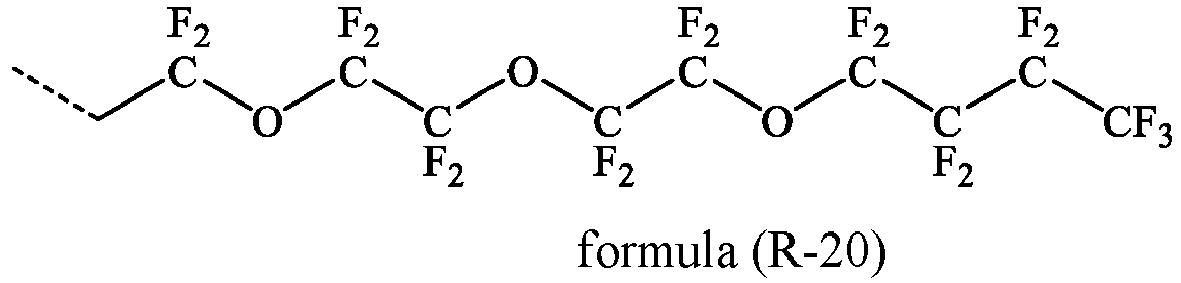


- With the application of the electrolyte, including the additive A with groups within the above range, to the secondary battery, the stability of the negative electrode interface and the positive electrode interface can be further enhanced, reducing the high-temperature gas production of the electrolyte and thereby improving the high-temperature cycling performance and high-temperature storage performance of the secondary battery. Moreover, due to the high ionic conductivity of the fluorine-containing compound formed by the additive A in the interface layer, the kinetic performance of the secondary battery can also be improved.
- In some embodiments of this application, groups obtained by linking two adjacent groups in R1 to R4 into a ring are each independently selected from the following groups:
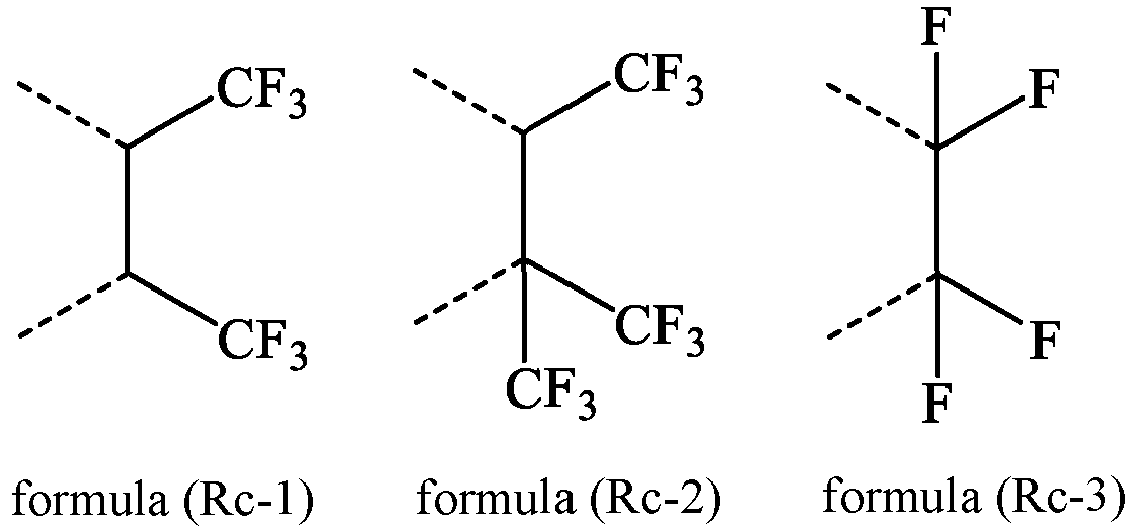


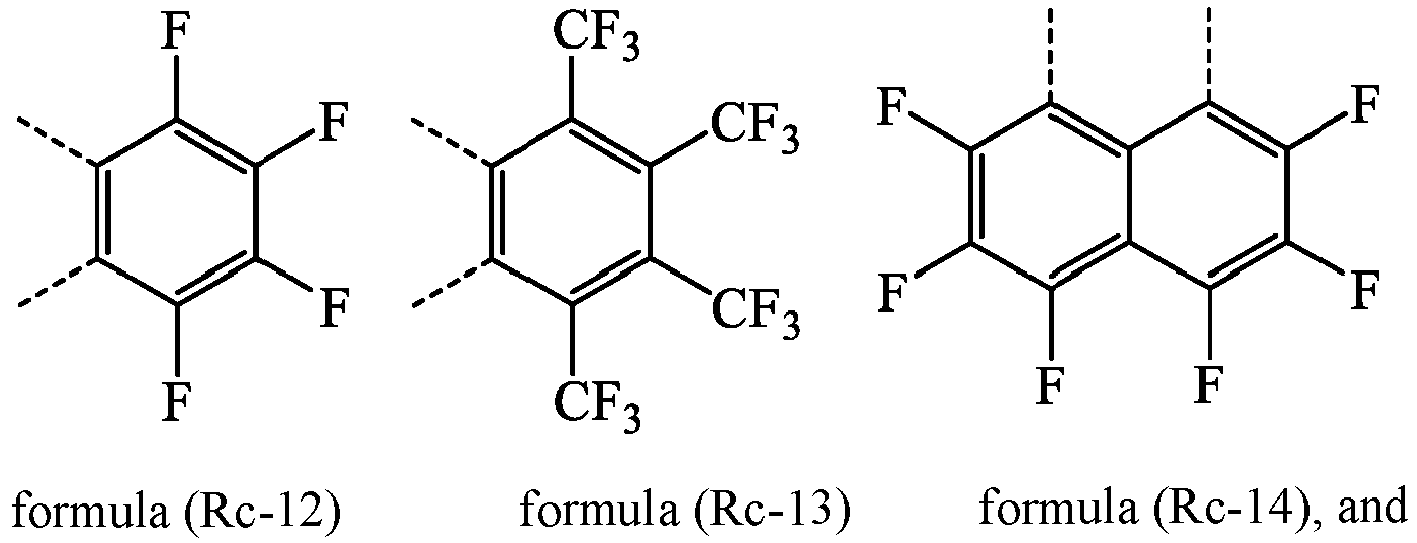

- With the application of the electrolyte, including the additive A with groups within the above range, to the secondary battery, the stability of the negative electrode interface and the positive electrode interface can be further enhanced, reducing the high-temperature gas production of the electrolyte and thereby improving the high-temperature cycling performance and high-temperature storage performance of the secondary battery. Moreover, due to the high ionic conductivity of the fluorine-containing compound formed by the additive A in the interface layer, the kinetic performance of the secondary battery can also be improved.
- In some embodiments of this application, the anions represented by formula (I) include at least one of the following anions:


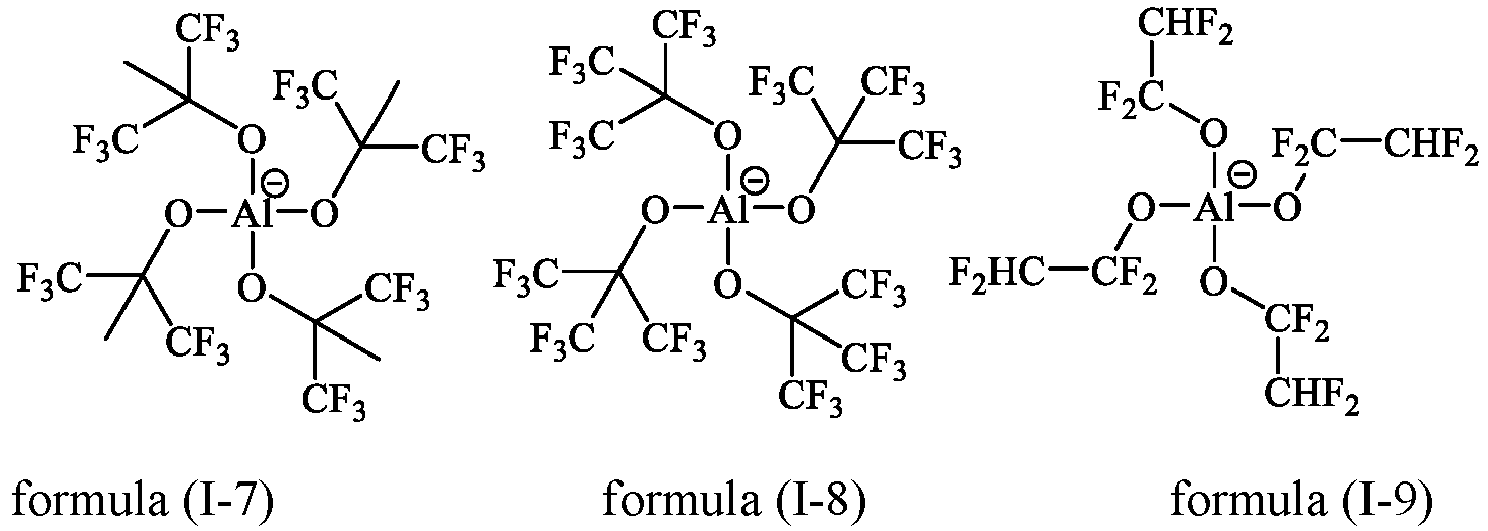


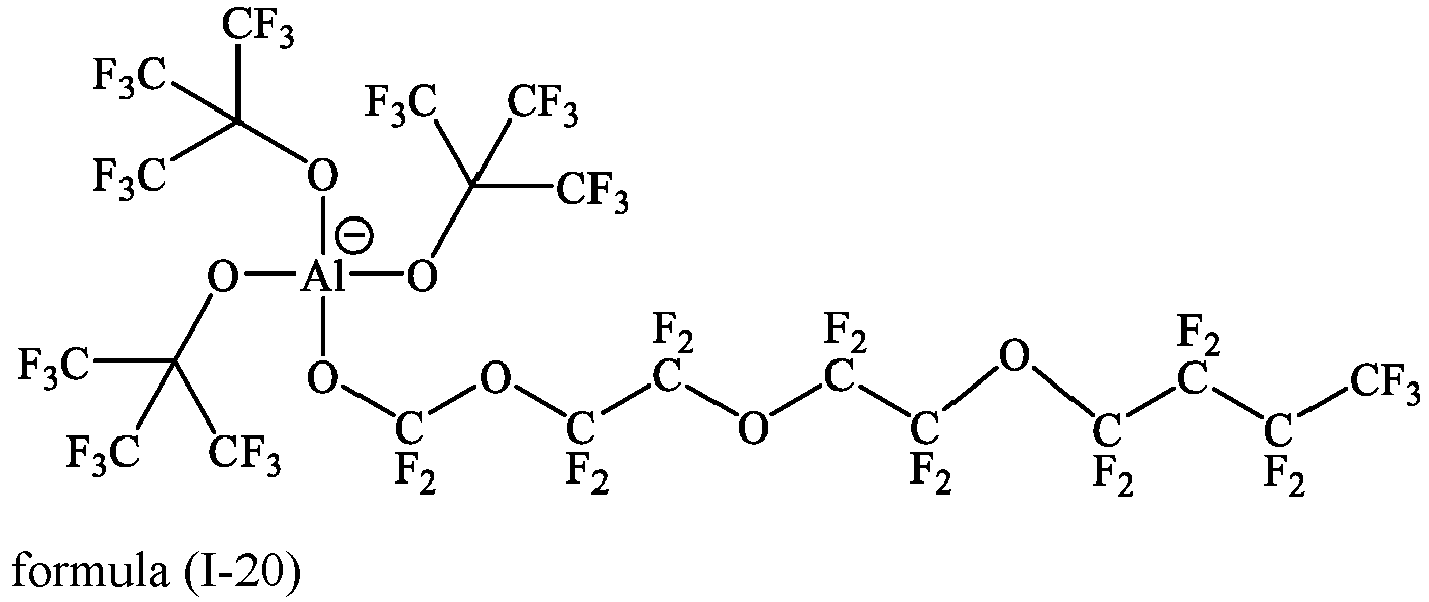

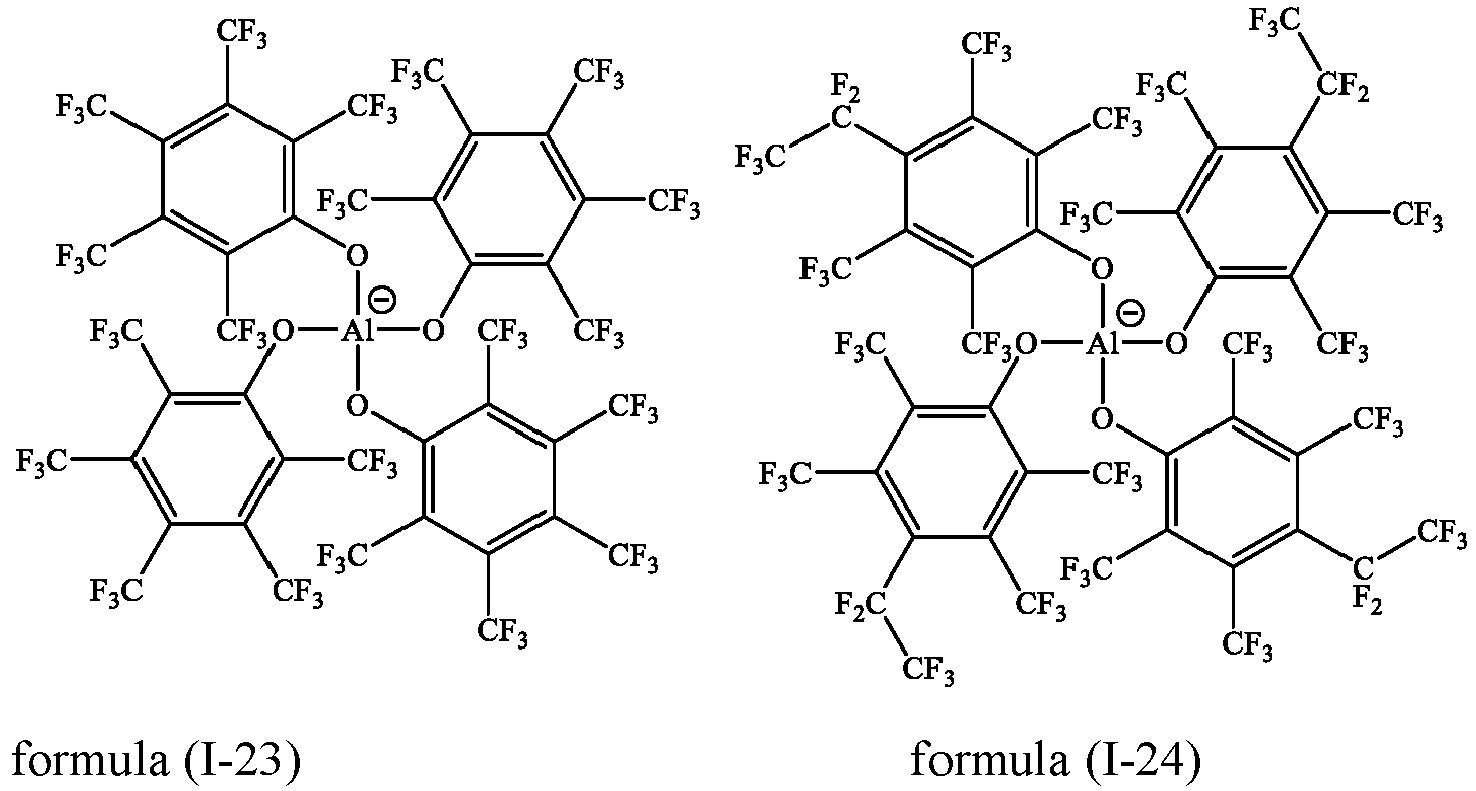

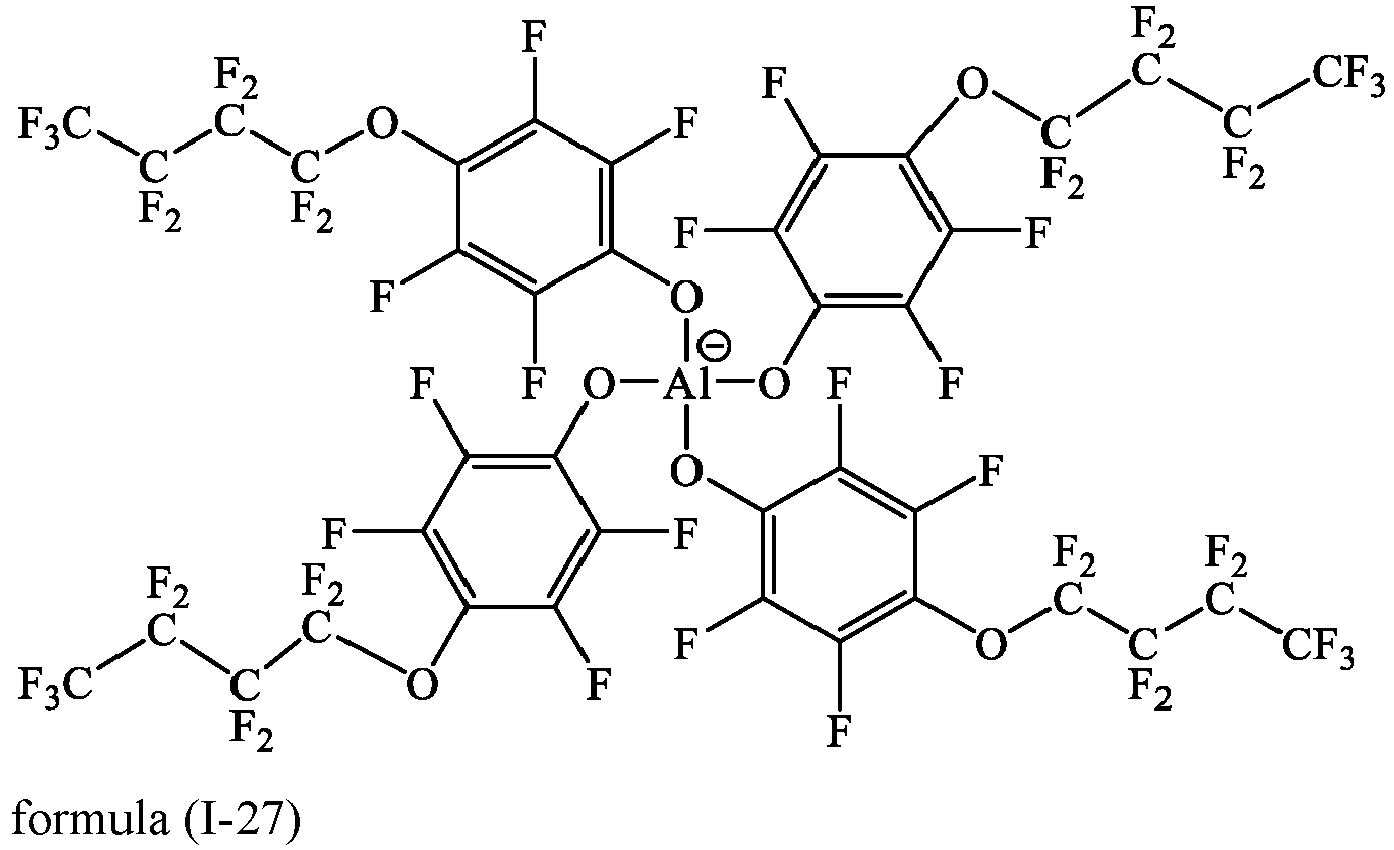


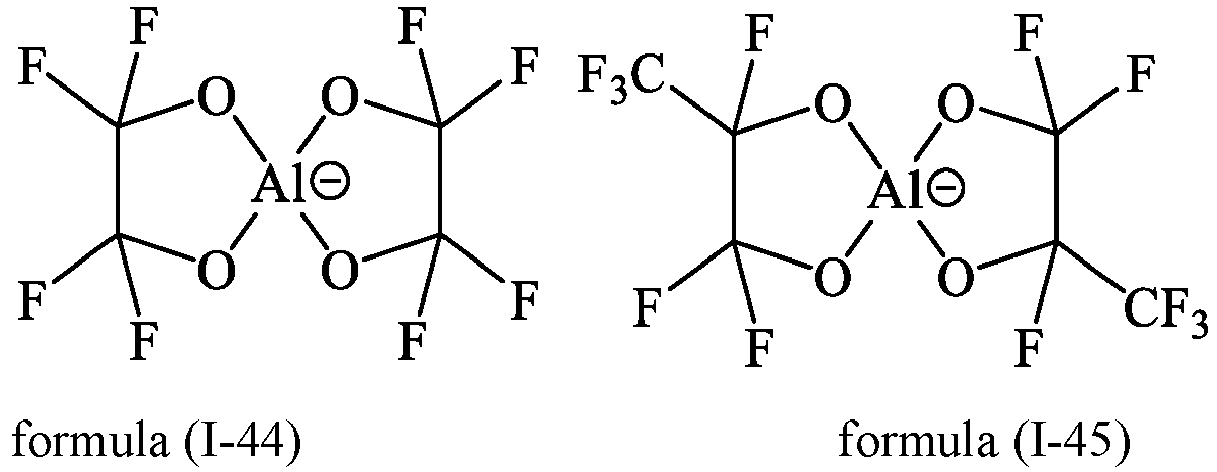


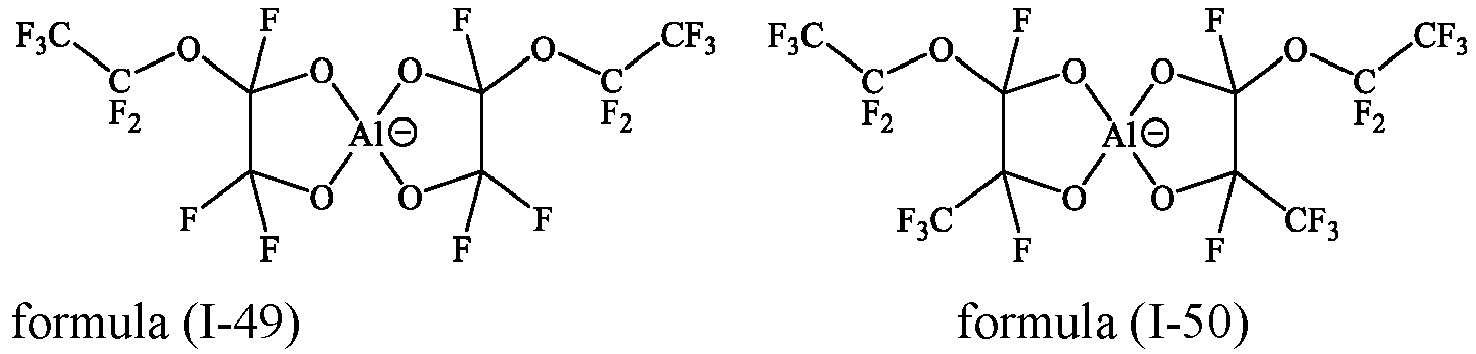


- With the application of the electrolyte, including anions represented by formula (I) within the above range, to the secondary battery, the stability of the negative electrode interface and the positive electrode interface can be further enhanced, reducing the high-temperature gas production of the electrolyte and thereby improving the high-temperature cycling performance and high-temperature storage performance of the secondary battery. Moreover, due to the high ionic conductivity of the fluorine-containing compound formed by the additive A in the interface layer, the kinetic performance of the secondary battery can also be improved.
- In some embodiments of this application, the electrolyte further includes a lithium salt, the lithium salt including at least one of lithium hexafluorophosphate (LiPF6), lithium bis(fluorosulfonyl)imide (LiFSI), lithium bis(trifluoromethylsulfonyl)imide, lithium bis(oxalato)borate, lithium difluoro(oxalato)borate (LiDFOB), lithium difluorophosphate, lithium tetrafluoroborate, lithium nitrate, lithium hexafluoroantimonate, lithium hexafluoroarsenate, lithium bis(trifluoromethanesulfonyl)imide, lithium bis(pentafluoroethylsulfonyl)imide, lithium tris(trifluoromethanesulfonyl)methyl, lithium difluoro(oxalato)phosphate, or lithium tetrafluoro(oxalato)phosphate. Based on the mass of the electrolyte, a mass percentage of the lithium salt is y%, with 7.5 ≤ y ≤ 23. For example, the value of y may be 7.5, 8, 8.5, 9, 9.5, 10, 11.5, 12.5, 13, 15, 17, 19, 21, 23, or a range between any two of the above values. The electrolyte contains a lithium salt within the above range, and the percentage of the lithium salt is controlled within the above range. The lithium salt has high solubility in the electrolyte, rendering the electrolyte with high conductivity, thereby enabling the secondary battery to have good high-temperature cycling performance, high-temperature storage performance, and kinetic performance.
- In some embodiments of this application, the lithium salt includes at least one of lithium hexafluorophosphate or lithium bis(fluorosulfonyl)imide. The electrolyte containing a lithium salt within the above range can render the electrolyte with higher conductivity, thereby improving the kinetic performance of the secondary battery.
- In some embodiments, when the secondary battery is a sodium-ion battery, the electrolyte further includes a sodium salt. For example, the sodium salt may include but is not limited to sodium hexafluorophosphate. In some embodiments, when the secondary battery is a potassium-ion battery, the electrolyte further includes a potassium salt. For example, the potassium salt may include but is not limited to potassium hexafluorophosphate.
- In some embodiments of this application, 10 ≤ x+y ≤ 75. For example, the value of x+y may be 10, 15, 20, 25, 30, 35, 37.5, 40, 45, 50, 60, 70, 75, or a range between any two of the above values. With the value of x+y controlled within the above range, the electrolyte can have good conductivity without failing to dissociate due to excessively high salt concentration, and can provide enough free-migrating ions without causing excessively high viscosity of the electrolyte and impeding ion migration in the electrolyte, thereby enabling the secondary battery to have good high-temperature cycling performance, high-temperature storage performance, and kinetic performance.
- In some embodiments of this application, 0.0008 ≤ x/y ≤ 6, preferably 0.0008 ≤ x/y ≤ 4. For example, the value of x/y may be 0.0008, 0.001, 0.005, 0.01, 0.05, 0.1, 0.5, 1, 1.5, 2, 2.5, 3, 3.5, 4, 4.5, 5, 5.5, 6, or a range between any two of the above values. With the value of x/y controlled within the above range, it is conducive to enabling the secondary battery to have good high-temperature cycling performance, high-temperature storage performance, and kinetic performance.
- In some embodiments of this application, the non-aqueous organic solvent includes at least one of a cyclic carbonate compound, a linear carbonate compound, a carboxylic acid cyclic lactone compound, a linear carboxylate compound, a fluorinated cyclic carbonate compound, a fluorinated linear carbonate compound, or a fluorinated linear carboxylate compound; and based on the mass of the electrolyte, a mass percentage of the non-aqueous organic solvent is 25% to 90%. In some embodiments, the non-aqueous organic solvent includes two or more of the cyclic carbonate compound, the linear carbonate compound, the carboxylic acid cyclic lactone compound, the linear carboxylate compound, the fluorinated cyclic carbonate compound, the fluorinated linear carbonate compound, or the fluorinated linear carboxylate compound. The proportion of constituents of non-aqueous organic solvent is not particularly limited in this application and can be adjusted according to actual requirements, provided that the objectives of this application can be achieved. The cyclic carbonate compound may include at least one of ethylene carbonate (EC), propylene carbonate (PC), butylene carbonate (BuC), or hexene carbonate (HeC). The fluorinated cyclic carbonate compound may include at least one of fluoroethylene carbonate (FEC), difluoroethylene carbonate (DFEC), or 3,3,3-trifluoropropylene carbonate. The linear carbonate compound may include at least one of dimethyl carbonate (DMC), diethyl carbonate (DEC), dipropyl carbonate (DPC), methyl propyl carbonate (MPC), ethyl propyl carbonate (EPC), or ethyl methyl carbonate (EMC). The fluorinated linear carbonate compound may include at least one of methyl difluoroethyl carbonate, methyl trifluoroethyl carbonate, ethyl trifluoroethyl carbonate, methyl hexafluoroisopropyl carbonate, or bis(2,2,2-trifluoroethyl) carbonate. The carboxylic acid cyclic lactone compound may include at least one of β-propiolactone, γ-butyrolactone, or δ-valerolactone. The linear carboxylate compound may be at least one of ethyl acetate, n-propyl acetate, tert-butyl acetate, methyl propionate, ethyl propionate, propyl propionate, methyl tert-butyrate, or ethyl tert-butyrate. The fluorinated linear carboxylate compound may include at least one of 2,2-difluoroethyl acetate, 2,2,2-trifluorooethyl acetate, hexafluoroisopropyl acetate, 2,2-difluoroethyl propionate, 2,2,2-trifluoroethyl propionate, or hexafluoroisopropyl propionate. The mass percentage of the non-aqueous organic solvent may be 25%, 30%, 35%, 40%, 50%, 60%, 70%, 80%, 85%, 90%, or a range between any two of the above values. The electrolyte contains the non-aqueous organic solvent within the above range, and the percentage of the non-aqueous organic solvent is controlled within the above range. This is conducive to improving the solubility of the additive A and lithium salt, rendering the electrolyte with low viscosity and high conductivity and thereby facilitating ion migration in the electrolyte. In this way, the secondary battery has stable positive electrode interface and negative electrode interface, further enabling the secondary battery to have good high-temperature cycling performance, high-temperature storage performance, and kinetic performance.
- In some embodiments of the application, the non-aqueous organic solvent includes a cyclic carbonate compound and a linear carbonate compound, and a mass ratio of the cyclic carbonate compound to the linear carbonate compound is 1:9 to 9:1; and based on the mass of the electrolyte, the mass percentage of the non-aqueous organic solvent is 25% to 90%. For example, the mass ratio of the cyclic carbonate compound to the linear carbonate compound may be 1:9, 2:8, 3:7, 4:6, 5:5, 6:4, 7:3, 8:2, 9:1, or a range between any two of the above values, and the mass percentage of the non-aqueous organic solvent may be 25%, 30%, 35%, 40%, 50%, 60%, 70%, 80%, 85%, 90%, or a range between any two of the above values. With the mass ratio of the cyclic carbonate compound to the linear carbonate compound controlled within the above range, it is conducive to improving the solubility of the additive A and lithium salt, rendering the electrolyte with low viscosity and high conductivity and thereby facilitating ion migration in the electrolyte. In this way, the secondary battery has stable positive electrode interface and negative electrode interface, further enabling the secondary battery to have good high-temperature cycling performance, high-temperature storage performance, and kinetic performance.
- In some embodiments of the application, the non-aqueous organic solvent includes a cyclic carbonate compound and a linear carboxylate compound, and the mass ratio of the cyclic carbonate compound to the linear carboxylate compound is 1:9 to 9:1; and based on the mass of the electrolyte, the mass percentage of the non-aqueous organic solvent is 25% to 90%. For example, the mass ratio of the cyclic carbonate compound to the linear carboxylate compound may be 1:9, 2:8, 3:7, 4:6, 5:5, 6:4, 7:3, 8:2, 9: 1, or a range between any two of the above values, and the mass percentage of the non-aqueous organic solvent may be 25%, 30%, 35%, 40%, 50%, 60%, 70%, 80%, 85%, 90%, or a range between any two of the above values. With the mass ratio of the cyclic carbonate compound to the linear carboxylate compound controlled within the above range, it is conducive to improving the solubility of the additive A and lithium salt, rendering the electrolyte with low viscosity and high conductivity and thereby facilitating ion migration in the electrolyte. In this way, the secondary battery has stable positive electrode interface and negative electrode interface, further enabling the secondary battery to have good high-temperature cycling performance, high-temperature storage performance, and kinetic performance.
- A second aspect of this application provides a secondary battery, including a positive electrode plate, a negative electrode plate, and the electrolyte according to the first aspect of this application. The secondary battery according to the second aspect of this application has good high-temperature cycling performance, high-temperature storage performance, and kinetic performance.
- In some embodiments of this application, the negative electrode plate includes a negative electrode current collector and a negative electrode active material layer disposed on at least one surface of the negative electrode current collector, the negative electrode active material layer includes a negative electrode active material, and the negative electrode active material includes a silicon-based material. With the selection of the negative electrode active material within the above range, the silicon-based material has a high specific capacity. This is conducive to enabling the secondary battery to have good high-temperature cycling performance, high-temperature storage performance, and kinetic performance while also possessing a high energy density.
- The silicon-based material is not particularly limited in this application, provided that the objectives of this application can be achieved. For example, silicon-based materials may include but are not limited to silicon nanoparticles, silicon nanowires, micro-silicon, silicon oxide materials (SiOw, 0 < w ≤ 2), silicon carbon composites (SiC), or silicon-based alloy materials, with a coating layer of LiF, AlF3, Li2CO3, amorphous carbon, graphitized carbon, or an organic polymer. The silicon-based alloy materials may include but are not limited to silicon-tin alloys, silicon-magnesium alloys, silicon-aluminum alloys, silicon-iron alloys, or the like. The negative electrode active material in the application may further include at least one of natural graphite, artificial graphite, a mesocarbon microbead (MCMB), hard carbon, soft carbon, Li-Sn alloys, Li-Sn-O alloys, Sn, SnO, SnO2, spinel-structure lithium titanate Li4Ti5O12, Li-Al alloys, lithium metal, or the like.
- Thicknesses of the negative electrode current collector and the negative electrode active material layer are not particularly limited in this application, provided that the objectives of this application can be achieved. For example, thickness of the negative electrode current collector is 4 µm to 12 µm, and thickness of a single-sided negative electrode active material layer is 30 µm to 130 µm. In this application, the negative electrode active material layer may be disposed on one or two surfaces of the negative electrode current collector in a thickness direction of the negative electrode current collector. It should be noted that the "surface" herein may be an entire region of the negative electrode current collector, or may be a partial region of the negative electrode current collector. This is not particularly limited in this application, provided that the objectives of this application can be achieved. The negative electrode active material layer of this application may further include a conductive agent and a binder. Optionally, the negative electrode plate of this application may further include a conductive layer. The conductive layer may be disposed between the negative electrode current collector and the negative electrode active material layer, and the conductive layer may be disposed on one surface or two surfaces of the negative electrode current collector in the thickness direction of the negative electrode current collector. Composition of the conductive layer is not particularly limited in this application and may include a conductive agent and a binder.
- The positive electrode plate is not particularly limited in this application, provided that the objectives of this application can be achieved. For example, the positive electrode plate includes a positive electrode current collector and a positive electrode active material layer disposed on at least one surface of the positive electrode current collector. The positive electrode current collector is not particularly limited in this application, provided that the objectives of this application can be achieved. For example, the positive electrode current collector may include aluminum foil, aluminum alloy foil, or the like. The positive electrode active material layer in this application includes a positive electrode active material. A type of the positive electrode active material is not particularly limited in this application, provided that the objectives of this application can be achieved. For example, in some embodiments, the secondary battery is a lithium-ion battery, and the positive electrode active material may include at least one of lithium nickel cobalt manganate (NCM811, NCM622, NCM523, NCM111), lithium nickel cobalt aluminate, lithium iron phosphate, lithium-rich manganese-based materials, lithium cobalt oxide (LiCoO2), lithium manganate, lithium iron manganese phosphate, lithium titanate, or the like. In some other embodiments, the secondary battery is a sodium-ion battery, and the positive electrode active material may include Na[Ni1/3Fe1/3Mn1/3]O2. When the secondary battery is a potassium-ion battery, the positive electrode active material may include KmMnFe(CN)6, with 0 ≤ m ≤ 2, for example, K1.89MnFe(CN)6. In this application, the positive electrode active material may further include a non-metal element. For example, the non-metal element includes at least one of fluorine, phosphorus, boron, chlorine, silicon, sulfur, or the like. These elements can further improve stability of the positive electrode active material. In this application, thicknesses of the positive electrode current collector and the positive electrode active material layer are not particularly limited, provided that the objectives of this application can be achieved. For example, the thickness of the positive electrode current collector is 5 µm to 20 µm, and preferably 6 µm to 18 µm. A thickness of a one-sided positive electrode active material layer is 30 µm to 120 µm. In this application, the positive electrode active material layer may be disposed on one surface of the positive electrode current collector in a thickness direction, or may be disposed on two surfaces of the positive electrode current collector. It should be noted that the "surface" herein may be an entire region or a partial region of the positive electrode current collector. This is not particularly limited in this application, provided that the objectives of this application can be achieved. The positive electrode active material layer of this application may further include a conductive agent and a binder. Optionally, the positive electrode plate may further include a conductive layer. The conductive layer is sandwiched between the positive electrode current collector and the positive electrode active material layer.
- The conductive agent and the binder are not particularly limited, provided that the objectives of this application can be achieved. For example, the conductive agent may include at least one of conductive carbon black (Super P), carbon nanotubes (CNTs), carbon nanofibers, flake graphite, carbon dots, graphene, or the like. The binder may include at least one of polyacrylic alcohol, sodium polyacrylate, potassium polyacrylate, lithium polyacrylate, polyimide, polyamideimide, styrene butadiene rubber (SBR), polyvinyl alcohol (PVA), polyvinylidene fluoride (PVDF), polytetrafluoroethylene (PTFE), polyvinyl butyral (PVB), water-based acrylic resin, carboxymethyl cellulose (CMC), sodium carboxymethyl cellulose (CMC-Na), or the like.
- The secondary battery of this application further includes a separator, and the separator is not particularly limited in this application, provided that the objectives of this application can be achieved. For example, the separator may include a substrate layer and a surface treatment layer. The substrate layer may be a non-woven fabric, film, or composite film of a porous structure. The substrate layer may be made of at least one of polyethylene, polypropylene, polyethylene terephthalate, polyimide, or the like. Optionally, a polypropylene porous film, a polyethylene porous film, a polypropylene nonwoven fabric, a polyethylene nonwoven fabric or a polypropylene-polyethylene-polypropylene porous composite film can be used. Optionally, the surface treatment layer is provided on at least one surface of the substrate layer, and the surface treatment layer may be a polymer layer or an inorganic substance layer, or a layer formed by mixing a polymer and an inorganic substance. For example, the inorganic layer includes inorganic particles and a binder. The inorganic particles are not particularly limited, and may be selected from, for example, at least one of aluminum oxide, silicon oxide, magnesium oxide, titanium oxide, hafnium oxide, tin oxide, ceria oxide, nickel oxide, zinc oxide, calcium oxide, zirconium oxide, yttrium oxide, silicon carbide, boehmite, aluminum hydroxide, magnesium hydroxide, calcium hydroxide, or barium sulfate. The binder is not particularly limited, and for example, may be at least one selected from polyvinylidene fluoride, polyvinylidene fluoride-hexafluoropropylene, polytetrafluoroethylene, polyhexafluoropropylene, polyamide, polyacrylonitrile, polyacrylate, polyacrylic acid, sodium polyacrylate, potassium polyacrylate, lithium polyacrylate, polyvinylpyrrolidone, polyvinylether, or polymethylmethacrylate. The polymer layer includes a polymer, and a material of the polymer includes at least one of polyamide, polyacrylonitrile, acrylate polymer, polyacrylic acid, sodium polyacrylate, potassium polyacrylate, lithium polyacrylate, polyvinylpyrrolidone, polyvinylether, polyvinylidene fluoride, polyvinylidene fluoride-hexafluoropropylene, or the like. Thickness of the separator is not particularly limited in this application, provided that the objectives of this application can be achieved. For example, the thickness of the separator may be 5 µm to 500 µm.
- The secondary battery of this application is not particularly limited and may include any apparatus in which electrochemical reactions take place. In an embodiment of this application, the secondary battery may include but is not limited to a lithium-ion secondary battery (lithium-ion battery), a lithium metal secondary battery, a sodium-ion secondary batteries (sodium-ion battery), a sodium metal secondary battery, a potassium-ion secondary battery (potassium-ion battery), a potassium metal secondary battery, a magnesium-ion secondary battery (magnesium-ion battery), a magnesium metal secondary battery, a calcium-ion secondary batteries (calcium-ion battery), a calcium metal secondary battery, a zinc-ion secondary batteries (zinc-ion battery), a zinc metal secondary battery, a lithium polymer secondary battery, a lithium-ion polymer secondary battery, or the like.
- A process for preparation of secondary battery is well known to persons skilled in the art, and is not particularly limited in this application. For example, the process may include but is not limited to the following steps: a positive electrode plate, a separator, and a negative electrode plate are stacked in sequence and undergo operations such as winding and folding as needed to obtain an electrode assembly with a wound structure, the electrode assembly is put into a packaging bag, and the packaging bag is injected with an electrolyte and sealed to obtain a secondary battery; or a positive electrode plate, a separator, and a negative electrode plate are stacked in sequence, four corners of an entire laminated structure are fixed with tapes to obtain an electrode assembly with a laminated structure, the electrode assembly is put into a packaging bag, and the packaging bag is injected with an electrolyte and sealed to obtain a secondary battery. In addition, an overcurrent protection element, a guide plate, and the like may be placed as required in the packaging bag to prevent pressure increase, overcharge, and overdischarge in the secondary battery. The packaging bag is not particularly limited in this application, and persons skilled in the art can make selection according to actual requirements, provided that the objectives of this application can be achieved. For example, aluminum-plastic film packaging bags can be used.
- A third aspect of the application provides an electronic apparatus including the secondary battery according to the second aspect of this application. The secondary battery according to the second aspect of this application has good high-temperature storage performance, high-temperature cycling performance, and kinetic performance. Therefore, the electronic apparatus of this application has a relatively long service life.
- The electronic apparatus of this application is not particularly limited and may be any known electronic apparatus used in the prior art. In some embodiments, the electronic apparatus may include but is not limited to a notebook computer, a pen-input computer, a mobile computer, an electronic book player, a portable telephone, a portable fax machine, a portable copier, a portable printer, a stereo headset, a video recorder, a liquid crystal television, a portable cleaner, a portable CD player, a mini-disc, a transceiver, an electronic notepad, a calculator, a memory card, a portable recorder, a radio, a standby power source, a motor, an automobile, a motorcycle, a power-assisted bicycle, a bicycle, a lighting appliance, a toy, a game console, a clock, an electric tool, a flash lamp, a camera, a large household battery, or a lithium-ion capacitor.
- This application provides an electrolyte for secondary batteries, a secondary battery, and an electronic apparatus. The electrolyte includes a non-aqueous organic solvent and an additive A, where the additive A includes a salt composed of anions and cations represented by formula (I); Mi is selected from group IIIA elements, and cations include any one of Li+, Na+, K+, Mg2+, Ca2+, and Zn2+; and based on a mass of the electrolyte, a mass percentage of the additive A is x%, with 0.01 ≤ x ≤ 60. The electrolyte includes the additive A, and the mass percentage of the additive A is controlled within the range defined in this application. The additive A has a relatively high reduction potential and is preferentially reduced in the first charging process of a secondary battery to obtain a group IIIA element. The group IIIA element can form an alloy phase with low activity with a negative electrode active material, thus enhancing the stability of the negative electrode interface. In addition, anions in the additive A, under the action of electric field force, migrate to the positive electrode interface and are oxidatively decomposed into an inert fluorine-containing compound, forming an interface layer. This is conducive to enhancing the stability of the positive electrode interface, reducing the high-temperature gas production of the electrolyte and thereby improving the high-temperature cycling performance and high-temperature storage performance of the secondary battery. Moreover, due to the high ionic conductivity of the fluorine-containing compound formed by the additive A in the interface layer, the kinetic performance of the secondary batteries can also be improved.
- Certainly, when any one of the products or methods of this application is implemented, all advantages described above are not necessarily demonstrated simultaneously.
- The following clearly and completely describes the technical solutions in some examples of this application. Apparently, the described examples are only some rather than all of the examples of this application. Based on the examples of this application, all other examples obtained by persons of ordinary skill in the art based on this application shall fall within the protection scope of this application.
- It should be noted that in specific embodiments of this application, a lithium-ion battery, a sodium-ion battery, and the like are used as examples of the secondary battery to illustrate this application. However, the secondary battery of this application is not limited to the lithium-ion battery, the sodium-ion battery, and the like.
- The following describes some embodiments of this application more specifically by using examples and comparative examples. Various tests and evaluations are performed in the following methods. In addition, unless otherwise specified, "part" and "%" are measured by mass.
- A secondary battery (including lithium-ion battery, sodium-ion battery, potassium-ion battery, or the like) was put into a constant temperature test chamber set at 45°C and left standing for 30 minutes to reach a constant temperature. The secondary battery was charged at a constant current of 0.5C to 4.5 V, charged at a constant voltage to a current of 0.025C, left standing for 5 minutes, and then discharged at a constant current of 0.5C to 3.0 V. An initial discharge capacity was recorded as C0. The steps were repeated for 100 cycles, the discharge capacity of C1 after 100 cycles was recorded, and the cycling capacity retention rate of the secondary battery was calculated. Cycling capacity retention rate = C1/C0 × 100%.
- The secondary battery was put into a constant temperature environment of 25°C and left standing for 30 minutes, so that the secondary battery reached a constant temperature. The secondary battery was charged to 4.5 V at a constant current of 0.5C, and then charged at a constant voltage to a current of 0.025C. A thickness of the secondary battery was recorded as an initial thickness. The secondary battery was put into a 60°C thermostat and stored there for 30 days. During this period, the lithium-ion battery was taken out every 6 days, and the thickness of the secondary battery was tested and recorded once. A tested thickness after 30 days was recorded as the storage thickness. A thickness swelling rate of the secondary battery was calculated and used as an indicator for evaluating the high-temperature storage performance of the secondary battery. High-temperature storage swelling rate = (storage thickness - initial thickness)/initial thickness × 100%.
- The secondary battery was put into a 25°C thermostat, left standing for 120 minutes, charged to 4.5 V at a constant current of 0.5C, then charged at a constant voltage to 0.025C, left standing for 5 minutes, discharged to 3 V at 0.2C, with a discharge capacity of C2 at 0.5C recorded, and left standing for 5 minutes. The secondary battery was charged to 4.5 V at a constant current of 0.5C, then charged at a constant voltage to 0.025C, left standing for 5 minutes, and discharged to 3 V at 2C. A discharge capacity of C3 at 2C was recorded. Discharge capacity retention rate at 2C = C3/C2 × 100%.
- In an argon glove box with water content less than < 10 ppm, non-aqueous organic solvents ethylene carbonate (EC) and diethyl carbonate (DEC) were mixed at a mass ratio of 3:7, then lithium salt LiPF6 was added to the non-aqueous organic solvents, dissolved and mixed well. Then additive A was added into a resulting mixture and stirred evenly to obtain an electrolyte. Based on a mass of the electrolyte, a mass percentage of lithium salt LiPF6 was 12.5%, a mass percentage of additive A was 0.5%, and the remainder was the base solvent. Anions represented by formula (I) in the additive A is denoted as formula (I-1), with the cation being Li+.
- Positive electrode active material lithium cobaltate (LiCoO2), conductive agent acetylene black (Super P), and binder (PVDF) were mixed at a mass ratio of 97:1.4:1.6, added with N-methylpyrrolidone (NMP) as the solvent, and prepared into a slurry with a solid content of 75 wt%, and the slurry was stirred under an action of a vacuum mixer to obtain a uniform positive electrode slurry. The positive electrode slurry was uniformly applied onto a surface of a positive electrode current collector aluminum foil with a thickness of 10 µm and dried at 85°C to obtain a positive electrode plate having a positive electrode active material coated on one surface, with a positive electrode active material coating layer of 110 µm in thickness. Then, the foregoing steps were repeated on another surface of the positive electrode current collector aluminum foil to obtain a positive electrode plate coated with the positive electrode active material on two surfaces. After coating was completed, the positive electrode plate was cold pressed and cut into a size of 74 mm × 867 mm for later use.
- Negative electrode active material artificial graphite, silicon-carbon composite (SiC), conductive agent Super P, thickener sodium carboxymethyl cellulose (CMC), binder styrene-butadiene rubber (SBR), and lithium polyacrylate (PAALi) were mixed at a mass ratio of 67:25:1.5:0.5:1:5, and then added with deionized water as the solvent, and prepared into a negative electrode slurry with a solid content of 54 wt%, and the negative electrode slurry was stirred under an action of a vacuum mixer to obtain a uniform negative electrode slurry. Conductive agent Super P and binder SBR were mixed at a mass ratio of 9:1, and then added with deionized water as the solvent to prepare into a conductive layer slurry with a solid content of 10 wt%. The conductive layer slurry and the negative electrode slurry were uniformly applied onto a surface of a negative electrode current collector copper foil of 8 µm in thickness in sequence and dried at 85°C to obtain a single-side coated negative electrode plate with a conductive layer of 2 µm in thickness and a negative electrode active material layer of 100 µm in thickness. Then, the foregoing steps were repeated on another surface of the negative electrode current collector copper foil to obtain a double-side coated negative electrode plate. After coating was completed, the negative electrode plate was cold pressed and cut into a size of 76 mm × 851 mm for later use.
- A polyethylene (PE) porous film (provided by Celgard) with a thickness of 5 µm was used.
- The prepared positive electrode plate, separator, and negative electrode plate were sequentially stacked so that the separator was sandwiched between the positive electrode plate and the negative electrode plate to provide separation. Then winding was performed to obtain an electrode assembly. After tabs were welded, the electrode assembly was put into an aluminum-plastic film package. The package was placed in a vacuum oven at 85°C for drying for 12 hours to remove moisture. The prepared electrolyte was injected, followed by processes such as vacuum packaging, standing, formation (charged to 3.5 V at a constant current of 0.02C, and then charged to 3.9 V at a constant current of 0.1C), shaping, and capacity testing, to obtain a lithium-ion battery, that is, a secondary battery.
- These examples were the same as Example 1-1 except that in <Preparation of electrolyte>, the type and mass percentage of anions represented by formula (I) in the additive A were adjusted, the mass percentage of the non-aqueous organic solvent was changed accordingly, and the mass percentage of the lithium salt remained unchanged, according to Table 1.
- The example was the same as Example 1-72 except that in <Preparation of electrolyte>, the type of cations in the additive A was adjusted, and the lithium salt LiPF6 was replaced by sodium salt NaPF6, according to Table 1; and that in <Preparation of positive electrode plate>, LiCoO2 was replaced by positive electrode active material Na[Ni1/3Fe1/3Mn1/3]O2; and that in <Preparation of secondary battery>, the sodium-ion battery was prepared.
- The example was the same as Example 1-72 except that in <Preparation of electrolyte>, according to Table 1, the type of cations in the additive A was adjusted, the lithium salt LiPF6 was replaced by potassium salt KPF6, and that in <Preparation of positive electrode plate>, LiCoO2 was replaced by positive electrode active material K1.89MnFe(CN)6, and that in <Preparation of secondary battery>, the potassium-ion battery was prepared.
- The example was the same as Example 1-72 except that in <Preparation of electrolyte>, the type of cations in the additive A was adjusted according to Table 1.
- The example was the same as Example 1-72 except that in <Preparation of electrolyte>, the type of cations in the additive A was adjusted according to Table 1.
- The example was the same as Example 1-72 except that in <Preparation of electrolyte>, the type of cations in the additive A was adjusted according to Table 1.
- These examples were the same as Example 1-75 except that in <Preparation of electrolyte>, the mass percentage of the additive A and the type and mass percentage of the lithium salt were adjusted, and the mass percentage of the non-aqueous organic solvent was changed accordingly, according to Table 2.
- These examples were the same as Example 1-75 except that in <Preparation of electrolyte>, the type of the non-aqueous organic solvent and the mass ratio of constituents in the non-aqueous organic solvent were adjusted, and the mass percentages of the additive A and the lithium salt remained unchanged, according to Table 3.
- The comparative example was the same as Example 1-1 except that in <Preparation of electrolyte>, additive A was not added, the mass percentage of the non-aqueous organic solvent was changed accordingly, and the mass percentage of the lithium salt remained unchanged.
- These comparative examples were the same as Example 1-73 except that in <Preparation of electrolyte>, the type and mass percentage of anions represented by formula (I) in the additive A were adjusted, the mass percentage of the non-aqueous organic solvent was changed accordingly, and the mass percentage of the lithium salt remained unchanged, according to Table 1.
- The comparative example was the same as Example 1-75 except that in <Preparation of electrolyte>, the mass percentages of the additive A and the lithium salt were adjusted, and the mass percentage of the non-aqueous organic solvent was changed accordingly, according to Table 2.
- Preparation parameters and performance parameters of examples and comparative examples are shown in Table 1 to Table 3.
Table 1 x Type of anions represented by formula (I) in additive A Type of cations in additive A x+y x/y Percentage of non-aqueous organic solvent (%) Cycling capacity retention rate (%) High-temperature storage swelling rate (%) Example 1-1 0.5 formula (I-1) Li+ 13 0.04 87 72 51 Example 1-2 0.5 formula (I-2) Li+ 13 0.04 87 75 51 Example 1-3 0.5 formula (I-3) Li+ 13 0.04 87 74 49 Example 1-4 0.5 formula (I-4) Li+ 13 0.04 87 79 45 Example 1-5 0.5 formula (I-5) Li+ 13 0.04 87 76 45 Example 1-6 0.5 formula (I-6) Li+ 13 0.04 87 77 50 Example 1-7 0.5 formula (I-7) Li+ 13 0.04 87 79 47 Example 1-8 0.5 formula (I-8) Li+ 13 0.04 87 72 52 Example 1-9 0.5 formula (I-9) Li+ 13 0.04 87 74 43 Example 1-10 0.5 formula (I-10) Li+ 13 0.04 87 78 45 Example 1-11 0.5 formula (I-11) Li+ 13 0.04 87 77 50 Example 1-12 0.5 formula (I-12) Li+ 13 0.04 87 73 51 Example 1-13 0.5 formula (I-13) Li+ 13 0.04 87 79 50 Example 1-14 0.5 formula (I-14) Li+ 13 0.04 87 75 43 Example 1-15 0.5 formula (I-15) Li+ 13 0.04 87 74 48 Example 1-16 0.5 formula (I-16) Li+ 13 0.04 87 77 47 Example 1-17 0.5 formula (I-17) Li+ 13 0.04 87 75 44 Example 1-18 0.5 formula (I-18) Li+ 13 0.04 87 78 47 Example 1-19 0.5 formula (I-19) Li+ 13 0.04 87 74 47 Example 1-20 0.5 formula (I-20) Li+ 13 0.04 87 79 47 Example 1-21 0.5 formula (I-21) Li+ 13 0.04 87 81 41 Example 1-22 0.5 formula (I-22) Li+ 13 0.04 87 74 51 Example 1-23 0.5 formula (I-23) Li+ 13 0.04 87 80 50 Example 1-24 0.5 formula (I-24) Li+ 13 0.04 87 76 52 Example 1-25 0.5 formula (I-25) Li+ 13 0.04 87 76 52 Example 1-26 0.5 formula (I-26) Li+ 13 0.04 87 78 45 Example 1-27 0.5 formula (I-27) Li+ 13 0.04 87 80 44 Example 1-28 0.5 formula (I-28) Li+ 13 0.04 87 75 47 Example 1-29 0.5 formula (I-29) Li+ 13 0.04 87 77 46 Example 1-30 0.5 formula (I-30) Li+ 13 0.04 87 72 49 Example 1-31 0.5 formula (I-31) Li+ 13 0.04 87 79 43 Example 1-32 0.5 formula (I-32) Li+ 13 0.04 87 77 50 Example 1-33 0.5 formula (I-33) Li+ 13 0.04 87 80 51 Example 1-34 0.5 formula (I-34) Li+ 13 0.04 87 75 46 Example 1-35 0.5 formula (I-35) Li+ 13 0.04 87 78 48 Example 1-36 0.5 formula (I-36) Li+ 13 0.04 87 80 47 Example 1-37 0.5 formula (I-37) Li+ 13 0.04 87 73 46 Example 1-38 0.5 formula (I-38) Li+ 13 0.04 87 78 43 Example 1-39 0.5 formula (I-39) Li+ 13 0.04 87 79 41 Example 1-40 0.5 formula (I-40) Li+ 13 0.04 87 79 42 Example 1-41 0.5 formula (I-41) Li+ 13 0.04 87 73 50 Example 1-42 0.5 formula (I-42) Li+ 13 0.04 87 79 44 Example 1-43 0.5 formula (I-43) Li+ 13 0.04 87 76 43 Example 1-44 0.5 formula (I-44) Li+ 13 0.04 87 73 51 Example 1-45 0.5 formula (I-45) Li+ 13 0.04 87 74 42 Example 1-46 0.5 formula (I-46) Li+ 13 0.04 87 76 44 Example 1-47 0.5 formula (I-47) Li+ 13 0.04 87 75 48 Example 1-48 0.5 formula (I-48) Li+ 13 0.04 87 78 41 Example 1-49 0.5 formula (I-49) Li+ 13 0.04 87 74 52 Example 1-50 0.5 formula (I-50) Li+ 13 0.04 87 79 49 Example 1-51 0.5 formula (I-51) Li+ 13 0.04 87 78 49 Example 1-52 0.5 formula (I-52) Li+ 13 0.04 87 76 41 Example 1-53 0.5 formula (I-53) Li+ 13 0.04 87 78 46 Example 1-54 0.5 formula (I-54) Li+ 13 0.04 87 77 42 Example 1-55 0.5 formula (I-55) Li+ 13 0.04 87 75 45 Example 1-56 0.5 formula (I-56) Li+ 13 0.04 87 78 42 Example 1-57 0.5 formula (I-57) Li+ 13 0.04 87 73 41 Example 1-58 0.5 formula (I-58) Li+ 13 0.04 87 72 44 Example 1-59 0.5 formula (I-59) Li+ 13 0.04 87 76 51 Example 1-60 0.5 formula (I-60) Li+ 13 0.04 87 77 43 Example 1-61 0.5 formula (I-61) Li+ 13 0.04 87 72 44 Example 1-62 0.5 formula (I-62) Li+ 13 0.04 87 75 51 Example 1-63 0.5 formula (I-63) Li+ 13 0.04 87 75 41 Example 1-64 0.5 formula (I-64) Li+ 13 0.04 87 75 41 Example 1-65 0.5 formula (I-65) Li+ 13 0.04 87 72 52 Example 1-66 0.05 formula (I-21) Li+ 12.55 0.004 87.45 71 52 Example 1-67 0.1 formula (I-21) Li+ 12.6 0.008 87.4 74 47 Example 1-68 1 formula (I-21) Li+ 13.5 0.08 86.5 83 39 Example 1-69 2 formula (I-21) Li+ 14.5 0.16 85.5 84 38 Example 1-70 5 formula (I-21) Li+ 17.5 0.4 82.5 85 36 Example 1-71 10 formula (I-21) Li+ 22.5 0.8 77.5 87 32 Example 1-72 15 formula (I-21) Li+ 27.5 1.2 72.5 89 30 Example 1-73 25 formula (I-21) Li+ 37.5 2 62.5 90 29 Example 1-74 40 formula (I-21) Li+ 52.5 3.2 47.5 89 28 Example 1-75 60 formula (I-21) Li+ 72.5 4.8 27.5 88 27 Example 1-76 15 formula (I-21) Na+ 27.5 1.2 72.5 91 25 Example 1-77 15 formula (I-21) K+ 27.5 1.2 72.5 87 29 Example 1-78 15 formula (I-21) Mg2+ 27.5 1.2 72.5 88 31 Example 1-79 15 formula (I-21) Ca2+ 27.5 1.2 72.5 87 26 Example 1-80 15 formula (I-21) Zn2+ 27.5 1.2 72.5 83 27 Comparative example 1-1 / / / 12.5 / 87.5 60 65 Comparative example 1-2 65 formula (I-21) Li+ 77.5 5.2 22.5 63 37 Comparative example 1-3 0.005 formula (I-21) Li+ 12.505 0.0004 87.495 67 54 Note: "/"in Table 1 indicates that there are no relevant parameters. - From Examples 1-1 to 1-75 and Comparative examples 1-1 to 1-3, it can be seen that the lithium-ion batteries have a higher cycling capacity retention rate and lower high-temperature storage swelling rate when the electrolyte containing the additive A is applied to the lithium-ion batteries, indicating that the lithium-ion batteries have better high-temperature cycling performance and high-temperature storage performance.
- From Examples 1-76 and 1-77, it can be seen that the secondary batteries have a relatively high cycling capacity retention rate and relatively low high-temperature storage swelling rate when the electrolyte including the additive A is applied to the sodium-ion battery or the potassium-ion battery, indicating that the secondary batteries have good high-temperature cycling performance and high-temperature storage performance.
- From Examples 1-72, and 1-78 to 1-80, it can be seen that the lithium-ion batteries have a good cycling capacity retention rate and relatively low high-temperature storage swelling rate when the additive A including cations within the range defined in this application is applied to the lithium-ion batteries, indicating that the lithium-ion batteries have good high-temperature cycling performance and high-temperature storage performance.
- From Examples 1-66 to 1-75 and Comparative examples 1-2, it can be seen that when X is too large, the lithium-ion batteries have a relatively low cycling capacity retention rate despite having a high-temperature storage swelling rate, indicating that the lithium-ion batteries cannot take both the cycling performance and the high-temperature storage performance into account when x is too large. From Examples 1-66 to 1-75 and Comparative examples 1-3, it can be seen that when x is too small, the lithium-ion batteries have a relatively low cycling capacity retention rate and relatively high high-temperature storage swelling rate, indicating that the high-temperature storage performance and high-temperature cycling performance of the lithium-ion batteries cannot be improved when x is too small. When x satisfies 0.01 ≤ x ≤ 60, the lithium-ion batteries have a higher cycling capacity retention rate and lower high-temperature storage swelling rates, where when x satisfies 0.1 ≤ x ≤ 25, the lithium-ion battery can have a even higher cycling capacity retention rate and lower high-temperature storage swelling rate, and further addition of the additive A does not further improve the performance of the lithium-ion battery. Therefore, with x controlled within the range defined in this application, the lithium-ion batteries have a higher cycling capacity retention rate and lower high-temperature storage swelling rate. In other words, the lithium-ion batteries have better high-temperature cycling performance and high-temperature storage performance.
Table 2 x Type of lithium salt y x+y x/y Percentage of non-aqueous organic solvent (%) Discharge capacity retention rate at 2C (%) Cycling capacity retention rate (%) High-temperature storage swelling rate (%) Example 1-67 0.1 LiPF6 12.5 12.6 0.008 87.4 80.3 74 47 Example 1-68 1 LiPF6 12.5 13.5 0.08 86.5 81.2 83 39 Example 1-70 5 LiPF6 12.5 17.5 0.4 82.5 85.4 85 36 Example 1-71 10 LiPF6 12.5 22.5 0.8 77.5 86.3 87 32 Example 1-72 15 LiPF6 12.5 27.5 1.2 72.5 84.2 89 30 Example 1-73 25 LiPF6 12.5 37.5 2 62.5 78.4 90 29 Example 1-75 60 LiPF6 12.5 72.5 4.8 27.5 70.0 88 27 Example 2-1 0.01 LiPF6 12.5 12.51 0.0008 87.49 78.3 72 53 Example 2-2 40 LiPF6 7.5 47.5 5.3333 52.5 70.1 90 28 Example 2-3 25 LiPF6 7.5 32.5 3.3333 67.5 75.4 91 29 Example 2-4 18 LiPF6 8.75 26.75 2.0571 73.25 76.4 91 31 Example 2-5 12 LiPF6 10 22 1.2 78 80.2 90 33 Example 2-6 6 LiPF6 11.25 17.25 0.5333 82.75 77.5 87 37 Example 2-7 2.5 LiPF6 7.5 10 0.3333 90 73.5 85 38 Example 2-8 40 LiFSI 9.24 49.24 4.3290 50.76 70.5 91 30 Example 2-9 25 LiFSI 9.24 34.24 2.7056 65.76 87.3 90 31 Example 2-10 18 LiFSI 10.78 28.78 1.6697 71.22 86.4 90 33 Example 2-11 12 LiFSI 12.32 24.32 0.9740 75.68 88.7 89 34 Example 2-12 6 LiFSI 13.86 19.86 0.4329 80.14 89.1 86 39 Example 2-13 25 LiFSI 23 48 1.0869 52 86.5 84 32 Example 2-14 25 LiFSI 12.5 37.5 2 62.5 79.1 87 29 Example 2-15 25 LiDFOB 12.5 37.5 2 62.5 75.2 81 35 Comparative example 2-1 65 LiPF6 10.5 75.5 6.19 24.5 58.5 64 28 Comparative example 1-2 65 LiPF6 12.5 77.5 5.2 22.5 53.7 63 37 - The mass percentage y% of lithium salt generally affects the high-temperature storage performance, high-temperature cycling performance, and kinetic performance of lithium-ion batteries. From Examples 1-73, 2-3, and 2-13, it can be seen that when the value of y is within the range defined in this application, the lithium-ion batteries have a relatively low high-temperature storage swelling rate and a relatively high cycling capacity retention rate and discharge capacity retention rate at 2C, indicating that the lithium-ion batteries have good high-temperature storage performance, high-temperature cycling performance, and kinetic performance.
- The type of lithium salt generally affects the high-temperature storage performance, high-temperature cycling performance, and kinetic performance of lithium-ion batteries. From Examples 1-73, 2-14, and 2-15, it can be seen that lithium-ion batteries with lithium salts within the range defined in this application have a relatively low high-temperature storage swelling rate and a relatively high cycling capacity retention rate and discharge capacity retention rate at 2C, indicating that the lithium-ion batteries have good high-temperature storage performance, high-temperature cycling performance, and kinetic performance.
- The value of x+y generally affects the high-temperature storage performance, high-temperature cycling performance, and kinetic performance of lithium-ion batteries. From Examples 1-67 and 1-68, 1-70 to 1-73, 1-75, 2-1 to 2-15, Comparative example 2-1, and Comparative example 1-2, it can be seen that when the value of x+y is within the range defined in this application, the lithium-ion batteries have a relatively low high-temperature storage swelling rate and a higher cycling capacity retention rate and discharge capacity retention rate at 2C, indicating that the lithium-ion batteries have good high-temperature storage performance and better high-temperature cycling performance and kinetic performance.
- The value of x/y generally affects the high-temperature storage performance, high-temperature cycling performance, and kinetic performance of lithium-ion batteries. From Examples 1-67 and 1-68, 1-70 to 1-73, 1-75, 2-1 to 2-15, and Comparative Example 2-1, it can be seen that when x/y satisfies 0.008 ≤ x/y ≤ 6, lithium-ion batteries have a relatively low high-temperature storage swelling rate and even higher discharge capacity retention rate at 2C, where when x/y satisfies 0.008 ≤ x/y ≤ 4, the lithium-ion batteries have a relatively low high-temperature storage swelling rate and higher discharge capacity retention rate at 2C. Therefore, the value of x/y controlled within the range defined in this application can enable the lithium-ion batteries to have a relatively low high-temperature storage swelling rate and a higher cycling capacity retention rate and discharge capacity retention rate at 2C, indicating that the lithium-ion batteries have good high-temperature storage performance and better high-temperature cycling performance and kinetic performance.
- The mass percentage of the non-aqueous organic solvent generally affects the high-temperature storage performance, high-temperature cycling performance, and kinetic performance of lithium-ion batteries. From Examples 1-67 and 1-68, 1-70 to 1-73, 1-75, 2-1 to 2-15, Comparative example 2-1, and Comparative example 1-2, it can be seen that the lithium-ion batteries with a mass percentage of the non-aqueous organic solvent within the range defined in this application have a relatively low high-temperature storage swelling rate and a higher cycling capacity retention rate and discharge capacity retention rate at 2C, indicating that the lithium-ion batteries have good high-temperature storage performance and better high-temperature cycling performance and kinetic performance.
Table 3 Type of cyclic carbonates Type of linear carbonates/carboxylates Mass ratio of cyclic carbonate to linear carbonate/carboxylate High-temperature storage swelling rate (%) Discharge capacity retention rate at 2C (%) Example 1-75 Ethylene carbonate Diethyl carbonate 3:7 29 72.6 Example 3-1 Ethylene carbonate Dimethyl carbonate 3:7 30 81.1 Example 3-2 Ethylene carbonate Ethyl methyl carbonate 3:7 29 78.4 Example 3-3 Ethylene carbonate Methyl difluoroethyl carbonate 3:7 26 76.5 Example 3-4 Ethylene carbonate Methyl trifluoroethyl carbonate 3:7 27 76.4 Example 3-5 Ethylene carbonate Bis(2,2,2-trifluoroethyl) carbonate 3:7 28 75.1 Example 3-6 Ethylene carbonate Ethyl acetate 3:7 30 81.2 Example 3-7 Ethylene carbonate N-propyl acetate 3:7 28 79.4 Example 3-8 Ethylene carbonate Methyl propionate 3:7 29 79.0 Example 3-9 Ethylene carbonate Ethyl propionate 3:7 28 78.8 Example 3-10 Ethylene carbonate Propyl propionate 3:7 26 75.2 Example 3-11 Ethylene carbonate Methyl tert-butyrate 3:7 27 78.9 Example 3-12 Ethylene carbonate Ethyl tert-butyrate 3:7 28 77 . 6 Example 3-13 Ethylene carbonate 2,2-difluoroethyl acetate 3:7 26 80.1 Example 3-14 Ethylene carbonate 2,2,2-trifluoroethyl acetate 3:7 27 79.5 Example 3-15 Ethylene carbonate 2,2-difluoroethyl propionate 3:7 26 79.1 Example 3 to 16 Ethylene carbonate 2,2,2-trifluoroethyl propionate 3:7 27 78.6 Example 3-17 Ethylene carbonate Dimethyl carbonate 1:9 31 80.1 Example 3-18 Ethylene carbonate Dimethyl carbonate 9:1 33 72.0 Example 3-19 Ethylene carbonate Ethyl acetate 1:9 32 80.5 Example 3-20 Ethylene carbonate Ethyl acetate 9:1 35 72.1 - The type of non-aqueous organic solvent generally affects the high-temperature storage performance and kinetic performance of lithium-ion batteries. From Examples 1-75, and 3-1 to 3-16, it can be seen that the lithium-ion batteries with a type of non-aqueous organic solvent within the range defined in this application have a relatively low high-temperature storage swelling rate and a relatively high discharge capacity retention rate at 2C, indicating that the lithium-ion batteries have good high-temperature storage performance and kinetic performance.
- The mass ratio of constituents of non-aqueous organic solvent generally affects the high-temperature storage performance and kinetic performance of lithium-ion batteries. From Examples 3-1, 3-17, and 3-18, it can be seen that the lithium-ion batteries with a mass ratio of the cyclic carbonate compound to the linear carbonate compound within the range defined in this application have a relatively low high-temperature storage swelling rate and a relatively high discharge capacity retention rate at 2C, indicating that the lithium-ion batteries have good high-temperature storage performance and kinetic performance. From Examples 3-6, 3-19, and 3-20, it can be seen that the lithium-ion batteries with a mass ratio of the cyclic carbonate compound to the linear carboxylate compound within the range defined in this application have a relatively low high-temperature storage swelling rate and a relatively high discharge capacity retention rate at 2C, indicating that the lithium-ion batteries have good high-temperature storage performance and kinetic performance.
- It should be noted that the terms "include", "comprise", or any other variations thereof are intended to cover a non-exclusive inclusion, so that a process, a method, or an item including a set of elements not only includes those elements but also includes other elements that are not expressly listed, or further includes elements inherent to such process, method, or item.
- Some embodiments in this specification are described in a related manner. For a part that is the same or similar between some embodiments, reference may be made between some embodiments. Each embodiment focuses on differences from other embodiments.
- The foregoing descriptions are merely preferred examples of this application, and are not intended to limit the protection scope of this application. Any modification, equivalent replacement, improvement, or the like made without departing from the spirit and principle of this application shall fall within the protection scope of this application.
Claims (16)
- An electrolyte for secondary batteries, comprising a non-aqueous organic solvent and an additive A, characterized in that, the additive A comprises a salt composed of anions and cations represented by formula (I);
 wherein Mi is selected from group IIIA elements; and Ri to R4 are each independently selected from Ci-Cs alkyl with at least some hydrogen atoms substituted by fluorine, C6-C20 aryl with at least some hydrogen atoms substituted by fluorine, C7-C22 aralkyl with at least some hydrogen atoms substituted by fluorine, C7-C20 alkylaryl with at least some hydrogen atoms substituted by fluorine, C7-C20 alkylaryl containing ether bond with at least some hydrogen atoms substituted by fluorine, or C2-C10 alkyl containing ether bond with at least some hydrogen atoms substituted by fluorine;two adjacent groups in Ri to R4 are capable of being linked into a ring;the cations comprise any one of Li+, Na+, K+, Mg2+, Ca2+, and Zn2+; andbased on a mass of the electrolyte, a mass percentage of the additive A is x%, and 0.01 ≤ x ≤ 60.
 - The electrolyte according to claim 1, characterized in that, Mi is selected from Al or B, and the cations comprise Li+.
- The electrolyte according to claim 1, characterized in that, 0.1 ≤ x ≤ 25.
- The electrolyte according to claim 1, characterized in that, Ri to R4 are each independently selected from the following groups:


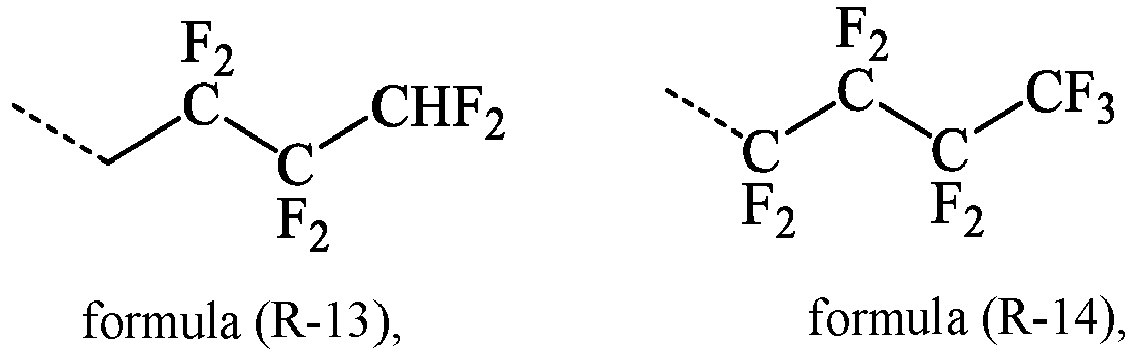


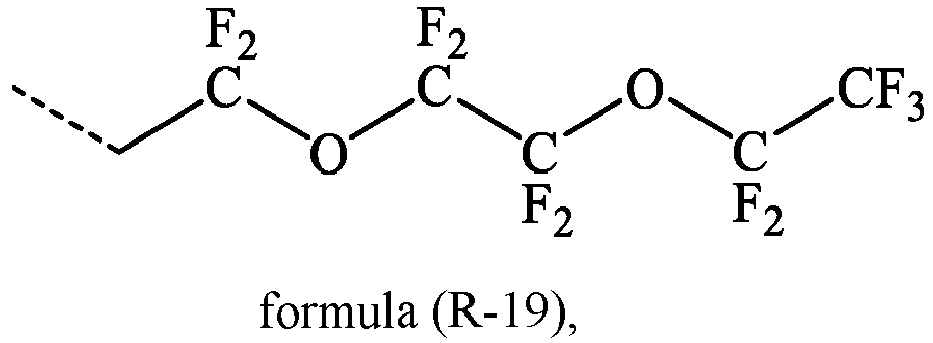


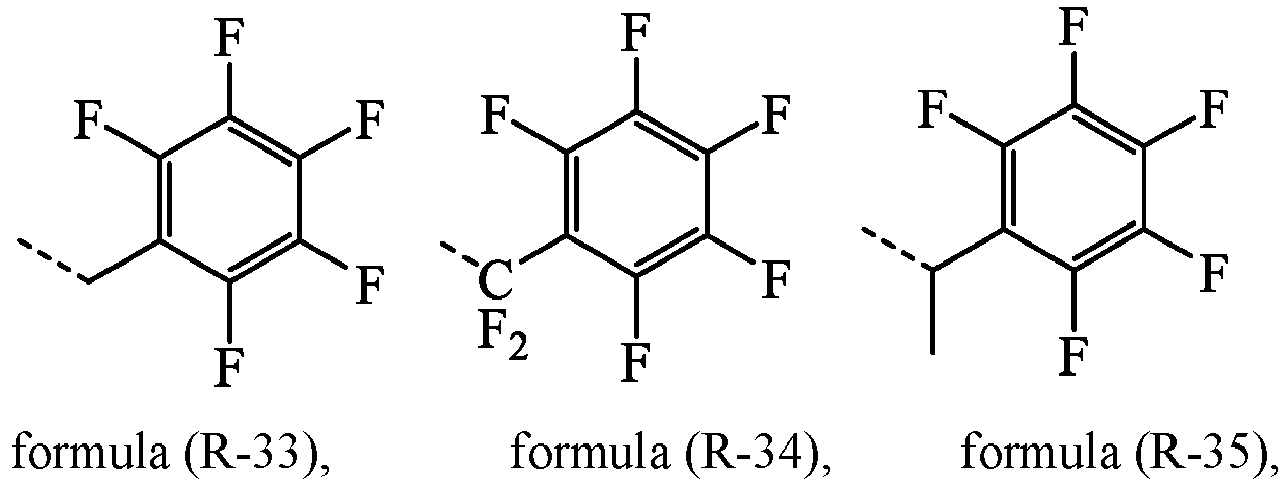
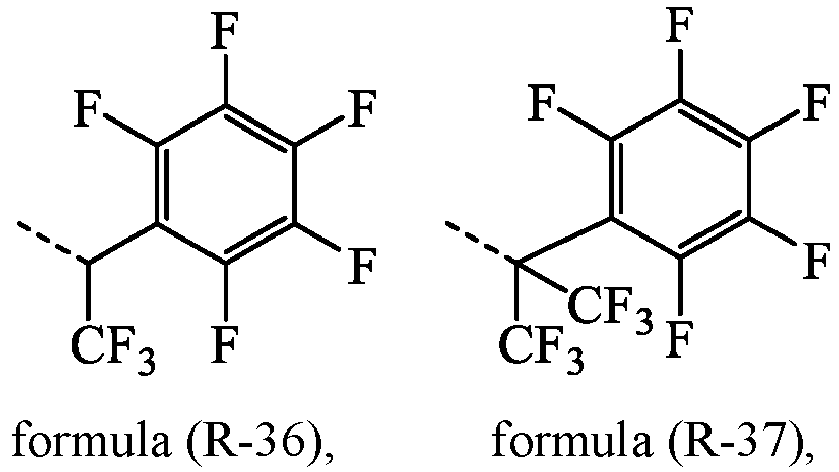
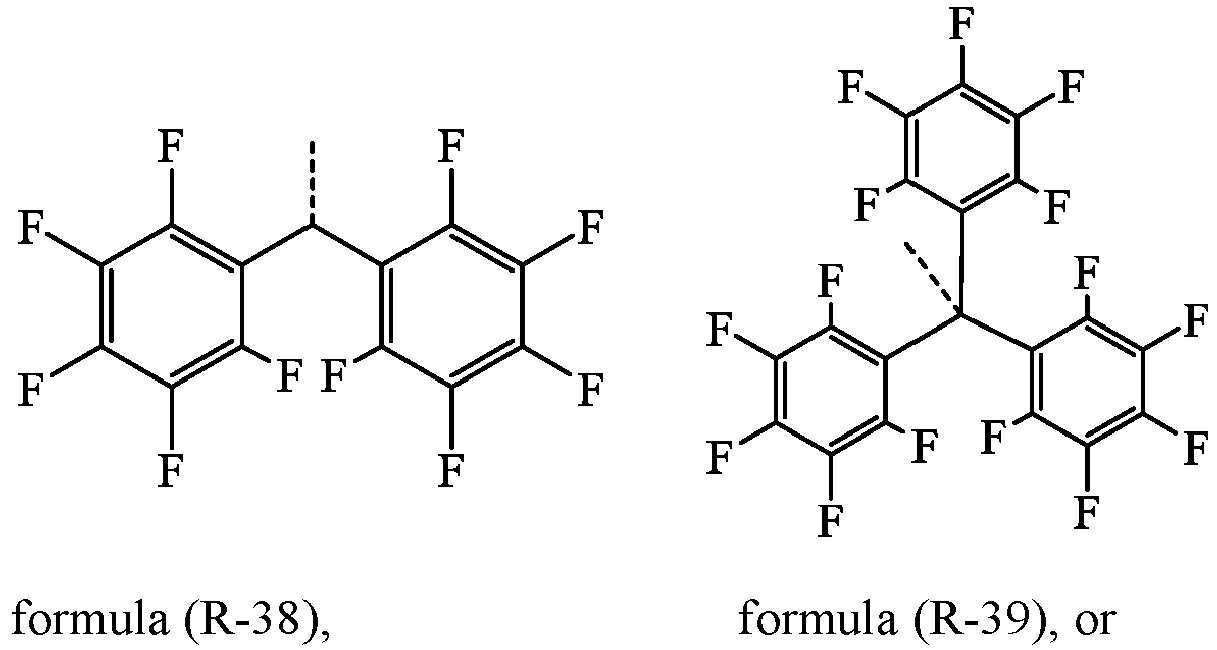

- The electrolyte according to claim 1, characterized in that, two adjacent groups from Ri to R4 are linked to form a ring and are each independently selected from the following groups:
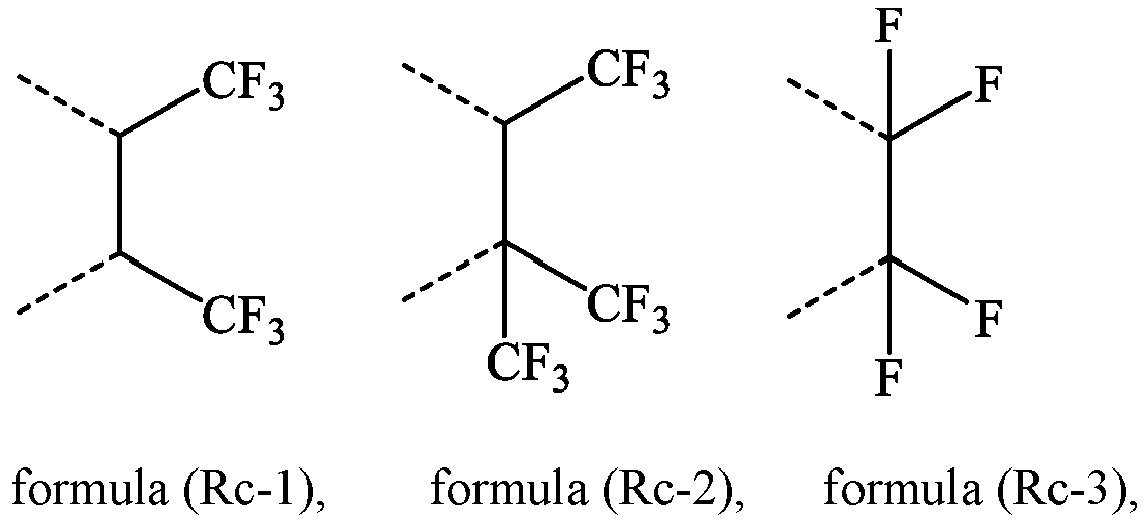


- The electrolyte according to claim 1, characterized in that, the anions represented by formula (I) comprise at least one of the following anions:
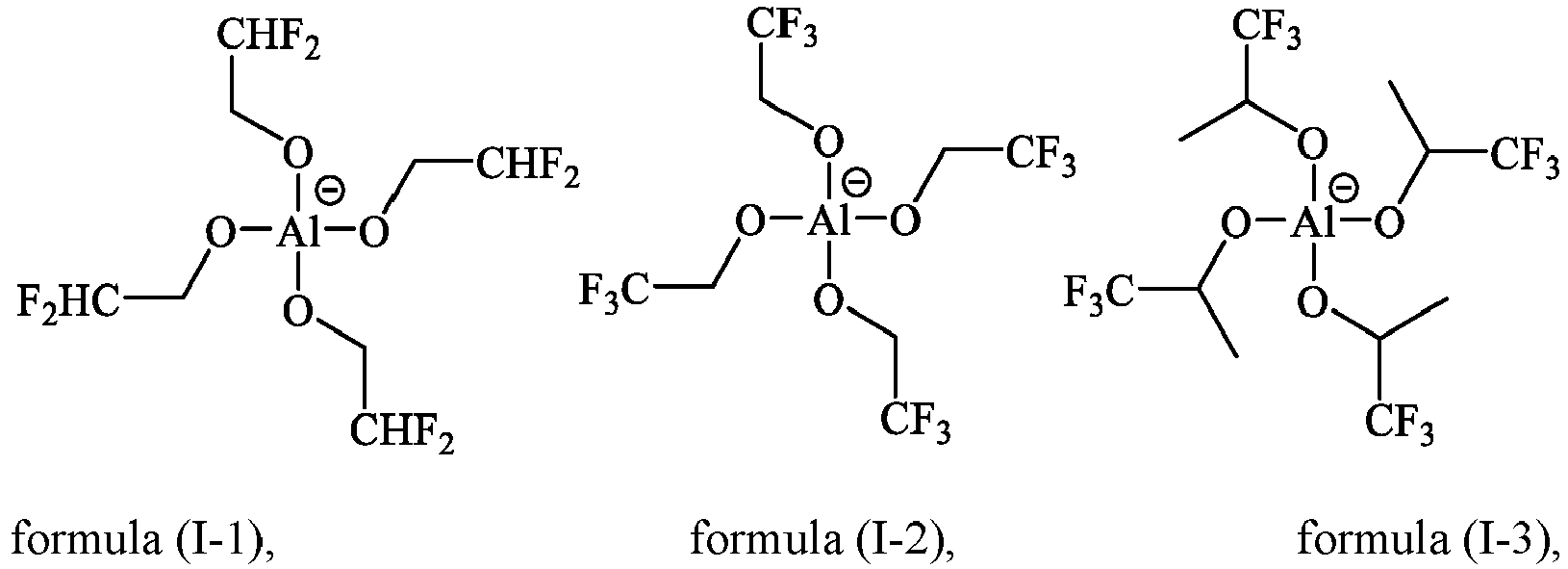

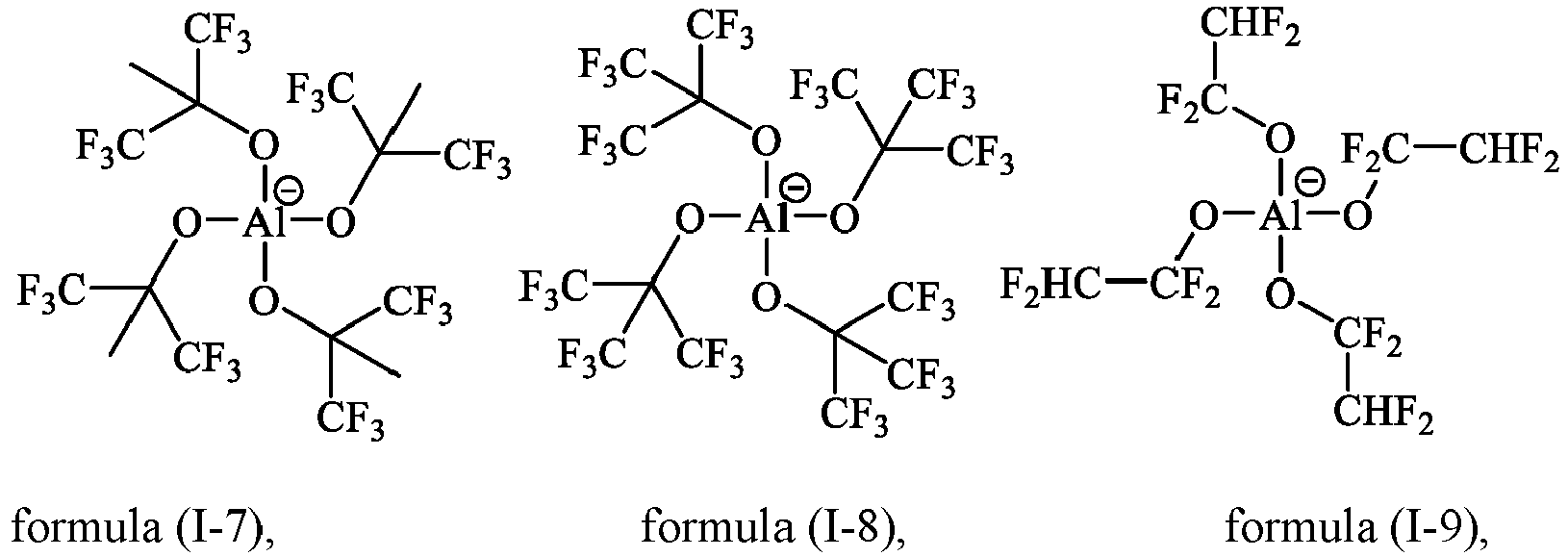
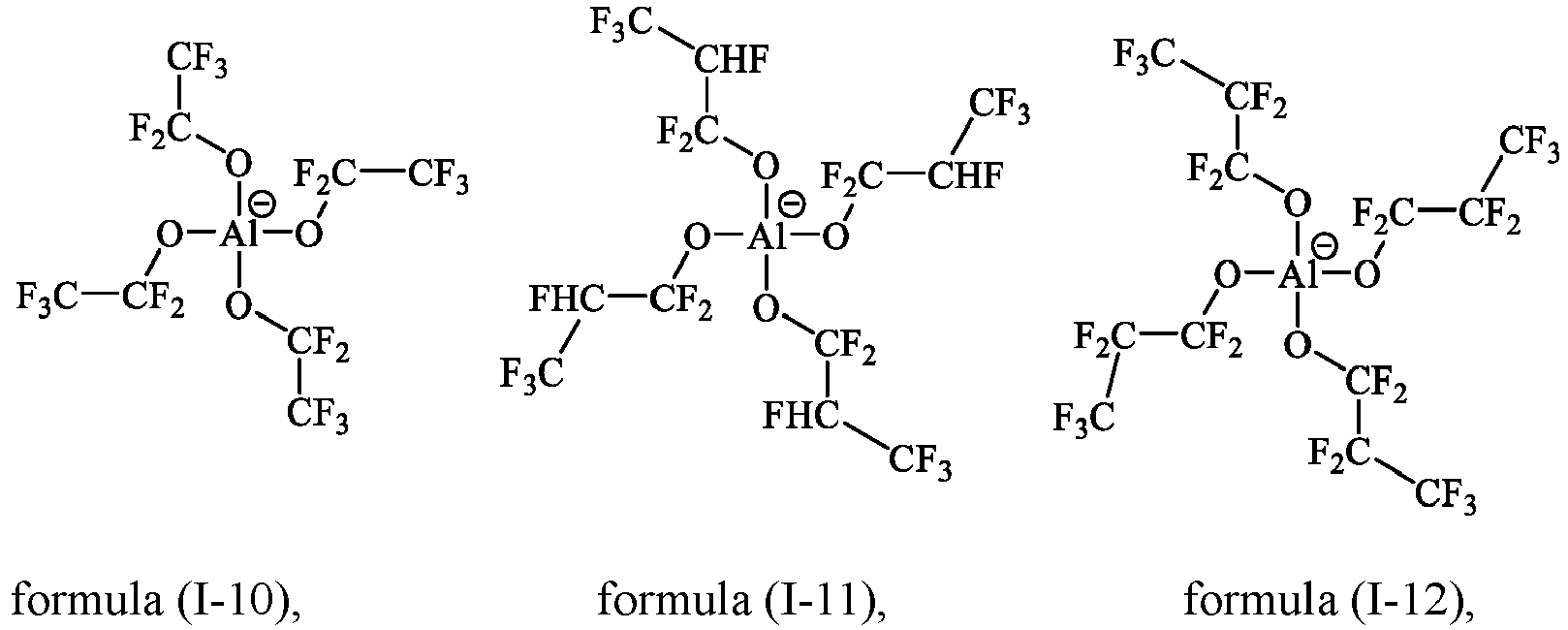


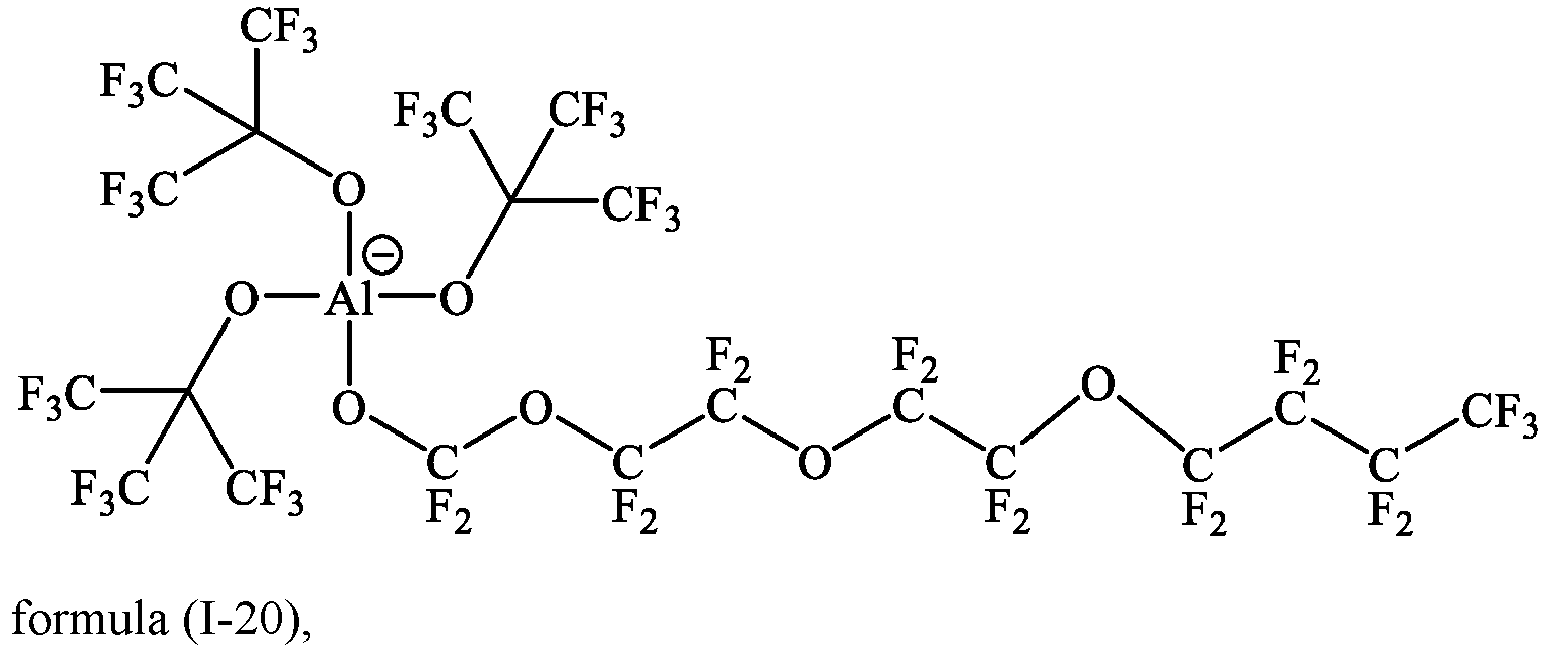


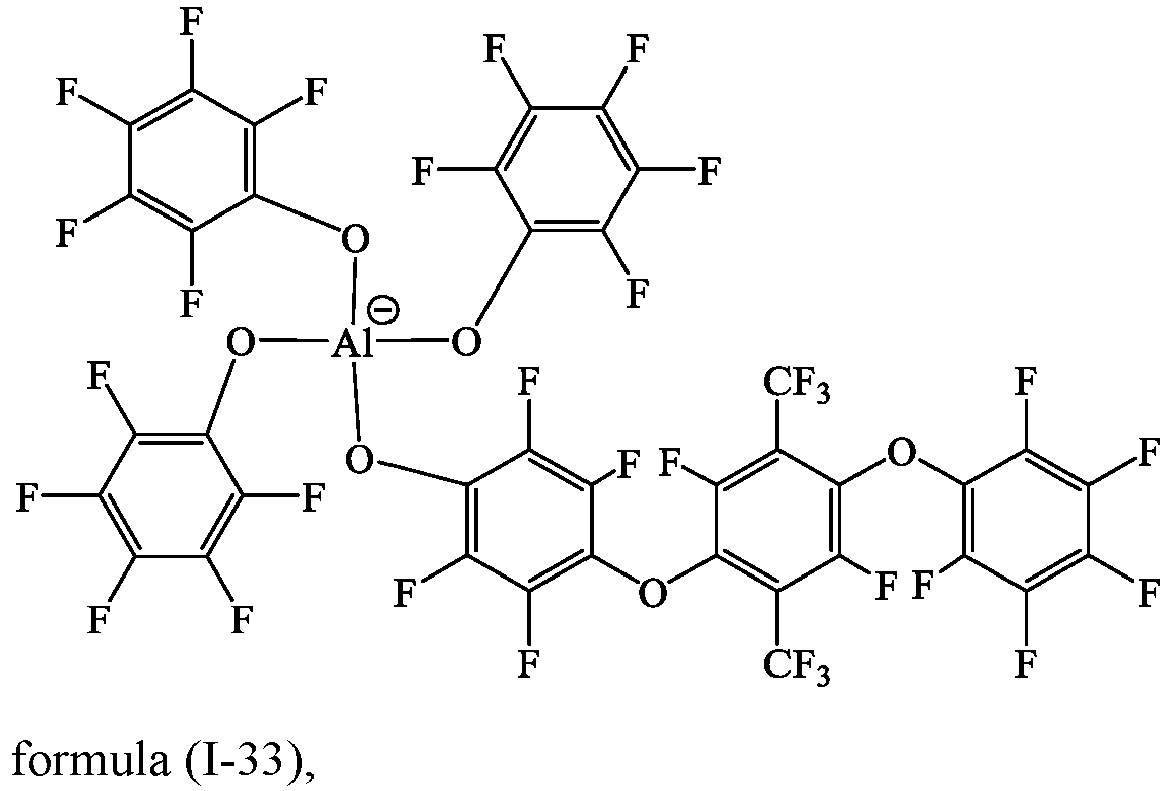
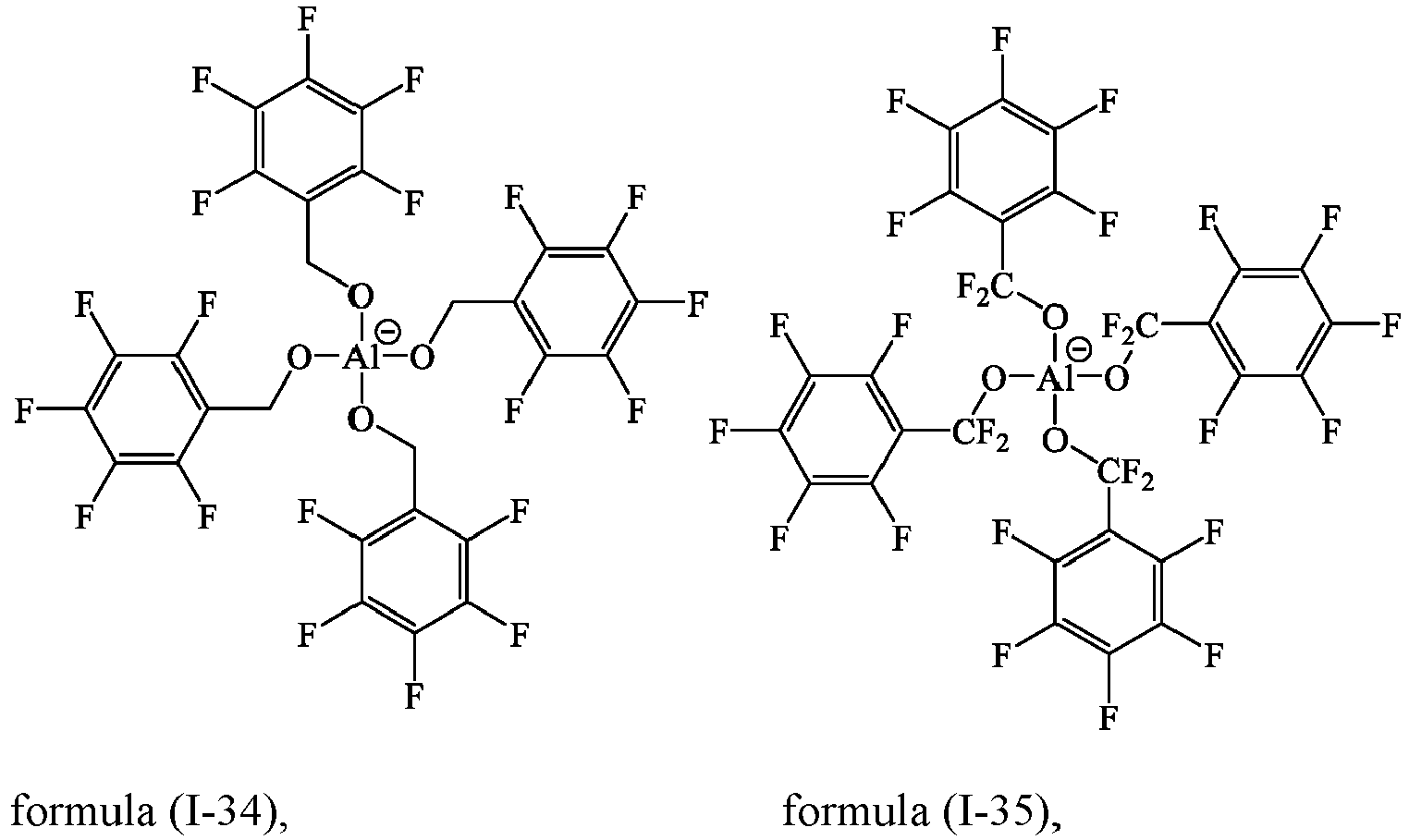

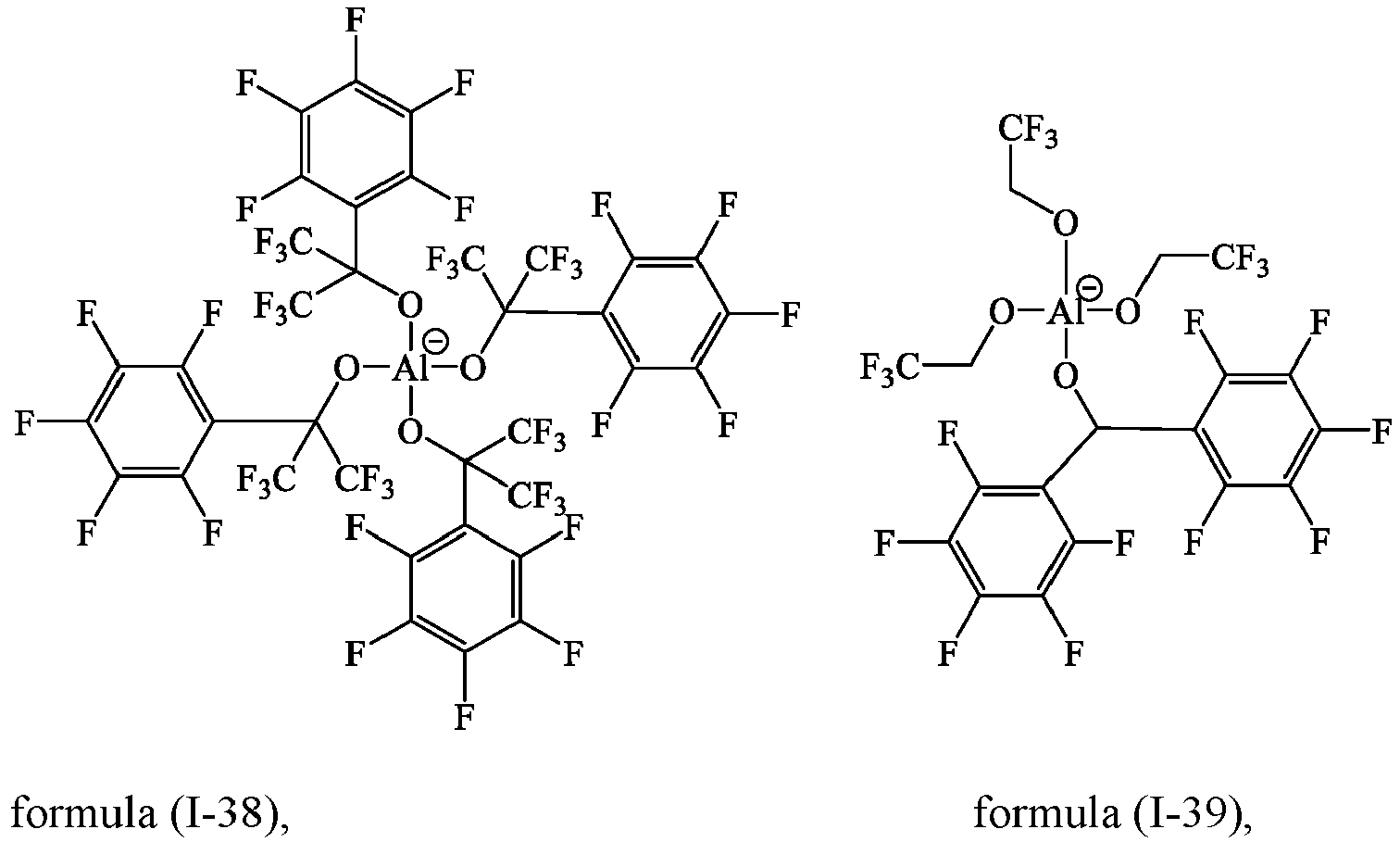


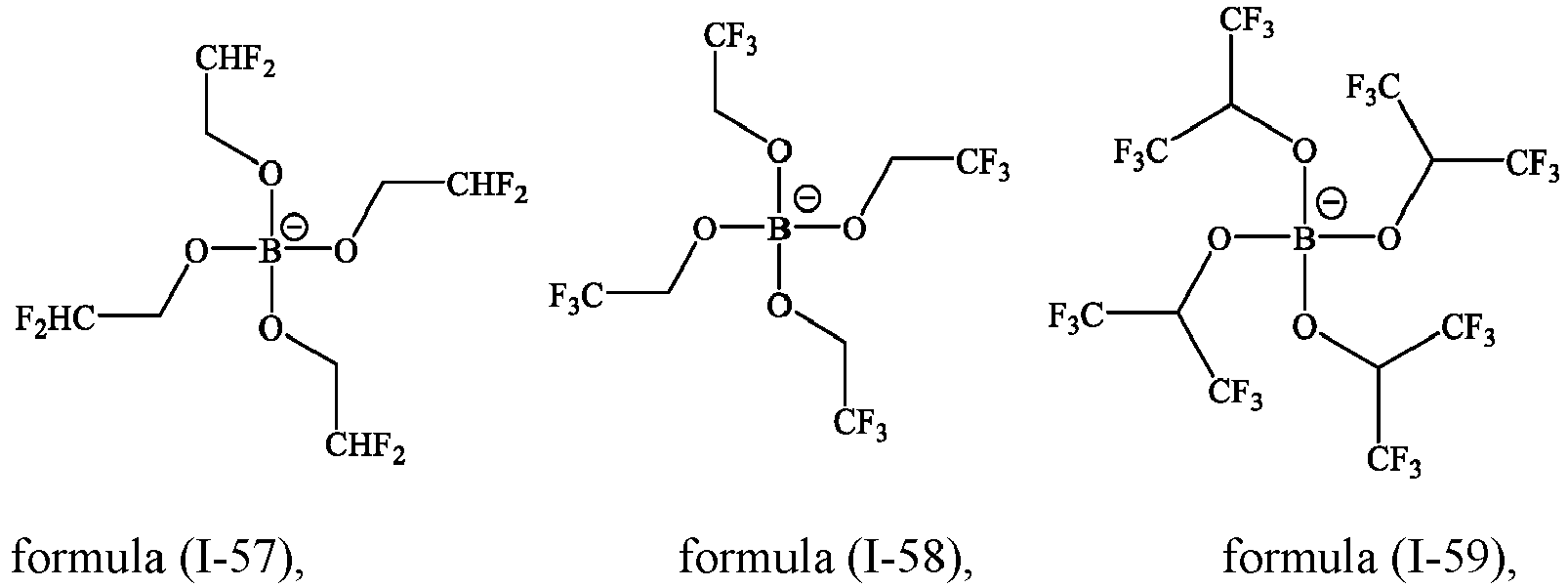


- The electrolyte according to claim 1, characterized in that, the electrolyte further comprises a lithium salt, the lithium salt comprising at least one of lithium hexafluorophosphate, lithium bis(fluorosulfonyl)imide, lithium bis(trifluoromethylsulfonyl)imide, lithium bis(oxalato)borate, lithium difluoro(oxalato)borate, lithium difluorophosphate, lithium tetrafluoroborate, lithium nitrate, lithium hexafluoroantimonate, lithium hexafluoroarsenate, lithium bis(trifluoromethanesulfonyl)imide, lithium bis(pentafluoroethylsulfonyl)imide, lithium tris(trifluoromethanesulfonyl)methyl, lithium difluoro(oxalato)phosphate, or lithium tetrafluoro(oxalato)phosphate; and
based on the mass of the electrolyte, a mass percentage of the lithium salt is y%, and 7.5 ≤ y ≤ 23. - The electrolyte according to claim 7, characterized in that, the lithium salt comprises at least one of lithium hexafluorophosphate or lithium bis(fluorosulfonyl)imide.
- The electrolyte according to claim 7, characterized in that, 10 ≤ x+y ≤ 75.
- The electrolyte according to claim 7, characterized in that, 0.0008 ≤ x/y ≤ 6.
- The electrolyte according to claim 7, characterized in that, 0.0008 ≤ x/y ≤ 4.
- The electrolyte according to claim 1, characterized in that, the non-aqueous organic solvent comprises at least one of a cyclic carbonate compound, a linear carbonate compound, a carboxylic acid cyclic lactone compound, a linear carboxylate compound, a fluorinated cyclic carbonate compound, a fluorinated linear carbonate compound, or a fluorinated linear carboxylate compound; and
based on the mass of the electrolyte, a mass percentage of the non-aqueous organic solvent is 25% to 90%. - The electrolyte according to claim 1, characterized in that, the non-aqueous organic solvent comprises a cyclic carbonate compound and a linear carbonate compound, and a mass ratio of the cyclic carbonate compound to the linear carbonate compound is 1:9 to 9:1; and
based on the mass of the electrolyte, a mass percentage of the non-aqueous organic solvent is 25% to 90%. - The electrolyte according to claim 1, characterized in that, the non-aqueous organic solvent comprises a cyclic carbonate compound and a linear carboxylate compound, and a mass ratio of the cyclic carbonate compound to the linear carboxylate compound is 1:9 to 9:1; and
based on the mass of the electrolyte, a mass percentage of the non-aqueous organic solvent is 25% to 90%. - A secondary battery comprising a positive electrode plate, a negative electrode plate, and the electrolyte according to any one of claims 1 to 14.
- The secondary battery according to claim 15, characterized in that, the negative electrode plate comprises a negative electrode current collector and a negative electrode active material layer disposed on at least one surface of the negative electrode current collector, the negative electrode active material layer comprises a negative electrode active material, and the negative electrode active material comprises a silicon-based material.
Applications Claiming Priority (1)
| Application Number | Priority Date | Filing Date | Title |
|---|---|---|---|
| CN202310323562.9A CN116053591B (en) | 2023-03-30 | 2023-03-30 | Electrolyte of secondary battery, secondary battery and electronic device |
Publications (2)
| Publication Number | Publication Date |
|---|---|
| EP4451408A2 true EP4451408A2 (en) | 2024-10-23 |
| EP4451408A3 EP4451408A3 (en) | 2024-12-18 |
Family
ID=86129877
Family Applications (1)
| Application Number | Title | Priority Date | Filing Date |
|---|---|---|---|
| EP24166185.9A Pending EP4451408A3 (en) | 2023-03-30 | 2024-03-26 | Electrolyte for secondary batteries, secondary battery, and electronic apparatus |
Country Status (3)
| Country | Link |
|---|---|
| US (1) | US20240332619A1 (en) |
| EP (1) | EP4451408A3 (en) |
| CN (1) | CN116053591B (en) |
Families Citing this family (5)
| Publication number | Priority date | Publication date | Assignee | Title |
|---|---|---|---|---|
| CN116779976B (en) * | 2023-06-27 | 2024-07-16 | 宁德时代新能源科技股份有限公司 | Electrolyte, battery cell and preparation method thereof, battery and electrical device |
| CN117334917B (en) * | 2023-12-01 | 2024-07-12 | 宁德时代新能源科技股份有限公司 | Secondary battery and electricity utilization device |
| CN117457989A (en) * | 2023-12-22 | 2024-01-26 | 合肥国轩高科动力能源有限公司 | Lithium-ion battery electrolyte, lithium battery |
| CN118888848A (en) * | 2024-09-10 | 2024-11-01 | 深圳市豪鹏科技股份有限公司 | Electrolyte additive, electrolyte and electrochemical energy storage device |
| CN120565822B (en) * | 2025-04-29 | 2025-10-14 | 宁德时代新能源科技股份有限公司 | Battery monomer, battery device and electric equipment |
Family Cites Families (10)
| Publication number | Priority date | Publication date | Assignee | Title |
|---|---|---|---|---|
| JP3463926B2 (en) * | 1999-11-15 | 2003-11-05 | セントラル硝子株式会社 | Electrolyte for electrochemical devices |
| EP2827430A1 (en) * | 2013-07-19 | 2015-01-21 | Basf Se | Use of lithium alkoxyborates and lithium alkoxyaluminates as conducting salts in electrolytes of lithium ion batteries |
| CN103985906B (en) * | 2014-06-06 | 2016-06-08 | 东莞市杉杉电池材料有限公司 | A kind of lithium-ion battery electrolytes taking into account high temperature performance |
| DE102016200079A1 (en) * | 2016-01-07 | 2017-07-13 | Robert Bosch Gmbh | Electrolyte and battery cell containing this |
| CN108365205A (en) * | 2018-03-12 | 2018-08-03 | 成都新柯力化工科技有限公司 | A kind of method of modifying of the nickelic ternary electrode material of lithium battery |
| PL3772129T3 (en) * | 2019-07-31 | 2021-09-27 | Innolith Technology AG | SO2-BASED ELECTROLYTE FOR A MULTIPLE CHARGING BATTERY CELL AND A MULTIPLE CHARGING BATTERY CELL WITH THIS ELECTROLYTE |
| CN110797575A (en) * | 2019-10-29 | 2020-02-14 | 珠海冠宇电池有限公司 | Non-aqueous electrolyte of lithium ion battery and lithium ion battery using same |
| CN113013486A (en) * | 2021-02-25 | 2021-06-22 | 珠海冠宇电池股份有限公司 | Electrolyte and lithium ion battery comprising same |
| EP4341237A2 (en) * | 2021-05-19 | 2024-03-27 | Sumitomo Chemical Co., Ltd. | Ionic liquid electrolytes based on fluorinated alcoholic borates and aluminates |
| CN114024030B (en) * | 2021-10-21 | 2022-09-16 | 珠海冠宇电池股份有限公司 | Non-aqueous electrolyte and battery containing same |
-
2023
- 2023-03-30 CN CN202310323562.9A patent/CN116053591B/en active Active
-
2024
- 2024-03-26 EP EP24166185.9A patent/EP4451408A3/en active Pending
- 2024-03-28 US US18/619,244 patent/US20240332619A1/en active Pending
Also Published As
| Publication number | Publication date |
|---|---|
| CN116053591B (en) | 2023-06-27 |
| EP4451408A3 (en) | 2024-12-18 |
| CN116053591A (en) | 2023-05-02 |
| US20240332619A1 (en) | 2024-10-03 |
Similar Documents
| Publication | Publication Date | Title |
|---|---|---|
| EP4451408A2 (en) | Electrolyte for secondary batteries, secondary battery, and electronic apparatus | |
| CN108886166B (en) | Nonaqueous electrolyte additive, and nonaqueous electrolyte for lithium secondary battery and lithium secondary battery containing the same | |
| EP3920303A1 (en) | Electrolyte and electrochemical device | |
| US20220109191A1 (en) | Non-aqueous electrolyte for a lithium ion battery and lithium ion battery | |
| EP4447143A1 (en) | Electrochemical device and electronic device | |
| CN118676437A (en) | Lithium ion battery electrolyte, lithium ion battery and electrochemical equipment | |
| EP4475219A1 (en) | Electrochemical device and electronic device comprising electrochemical device | |
| EP4738453A1 (en) | Electrode assembly, electrochemical device and electric device | |
| EP4708404A2 (en) | Electrolyte, electrochemical apparatus, and electronic apparatus | |
| WO2026001106A1 (en) | Electrolyte of secondary battery, secondary battery, and electronic device | |
| EP4235893A1 (en) | Electrochemical device and electronic device comprising same | |
| CN114335685A (en) | Electrochemical device and electronic device comprising same | |
| US20240162434A1 (en) | Electrochemical apparatus and electric device including same | |
| US20240079635A1 (en) | Electrochemical Apparatus and Electronic Apparatus Containing Same | |
| EP4641737A1 (en) | Electrolyte and sodium metal battery containing same, and electrochemical device | |
| CN101593851B (en) | Additive composition, electrolyte containing same and lithium ion secondary battery | |
| EP4579848A1 (en) | Electrochemical device and electronic device | |
| EP4560766A2 (en) | Secondary battery and electronic apparatus | |
| WO2023184143A1 (en) | Electrolyte, electrochemical apparatus, and electronic apparatus | |
| EP4668365A1 (en) | Secondary battery and electronic apparatus | |
| EP4693563A1 (en) | Electrochemical device and electronic device | |
| WO2024197800A1 (en) | Electrochemical apparatus and electronic apparatus | |
| CN116435601B (en) | Electrolyte and application thereof | |
| EP4708440A1 (en) | Electrolyte, electrochemical apparatus, and electronic device | |
| EP4636889A1 (en) | Electrolyte, electrochemical device and electronic device |
Legal Events
| Date | Code | Title | Description |
|---|---|---|---|
| PUAI | Public reference made under article 153(3) epc to a published international application that has entered the european phase |
Free format text: ORIGINAL CODE: 0009012 |
|
| STAA | Information on the status of an ep patent application or granted ep patent |
Free format text: STATUS: REQUEST FOR EXAMINATION WAS MADE |
|
| 17P | Request for examination filed |
Effective date: 20240326 |
|
| AK | Designated contracting states |
Kind code of ref document: A2 Designated state(s): AL AT BE BG CH CY CZ DE DK EE ES FI FR GB GR HR HU IE IS IT LI LT LU LV MC ME MK MT NL NO PL PT RO RS SE SI SK SM TR |
|
| PUAL | Search report despatched |
Free format text: ORIGINAL CODE: 0009013 |
|
| AK | Designated contracting states |
Kind code of ref document: A3 Designated state(s): AL AT BE BG CH CY CZ DE DK EE ES FI FR GB GR HR HU IE IS IT LI LT LU LV MC ME MK MT NL NO PL PT RO RS SE SI SK SM TR |
|
| RIC1 | Information provided on ipc code assigned before grant |
Ipc: H01M 10/0569 20100101ALN20241112BHEP Ipc: H01M 10/0568 20100101ALN20241112BHEP Ipc: H01M 4/587 20100101ALN20241112BHEP Ipc: H01M 4/36 20060101ALN20241112BHEP Ipc: H01M 4/38 20060101ALI20241112BHEP Ipc: H01M 10/42 20060101ALI20241112BHEP Ipc: H01M 10/054 20100101ALI20241112BHEP Ipc: H01M 10/0525 20100101ALI20241112BHEP Ipc: H01M 10/0567 20100101AFI20241112BHEP |