EP4451130A1 - Rules-based task allocation for edge networks - Google Patents
Rules-based task allocation for edge networks Download PDFInfo
- Publication number
- EP4451130A1 EP4451130A1 EP24168221.0A EP24168221A EP4451130A1 EP 4451130 A1 EP4451130 A1 EP 4451130A1 EP 24168221 A EP24168221 A EP 24168221A EP 4451130 A1 EP4451130 A1 EP 4451130A1
- Authority
- EP
- European Patent Office
- Prior art keywords
- nodes
- task
- cloudlet
- rule engine
- worker nodes
- Prior art date
- Legal status (The legal status is an assumption and is not a legal conclusion. Google has not performed a legal analysis and makes no representation as to the accuracy of the status listed.)
- Pending
Links
Images




Classifications
-
- G—PHYSICS
- G06—COMPUTING OR CALCULATING; COUNTING
- G06F—ELECTRIC DIGITAL DATA PROCESSING
- G06F9/00—Arrangements for program control, e.g. control units
- G06F9/06—Arrangements for program control, e.g. control units using stored programs, i.e. using an internal store of processing equipment to receive or retain programs
- G06F9/46—Multiprogramming arrangements
- G06F9/50—Allocation of resources, e.g. of the central processing unit [CPU]
- G06F9/5061—Partitioning or combining of resources
- G06F9/5072—Grid computing
-
- G—PHYSICS
- G06—COMPUTING OR CALCULATING; COUNTING
- G06F—ELECTRIC DIGITAL DATA PROCESSING
- G06F9/00—Arrangements for program control, e.g. control units
- G06F9/06—Arrangements for program control, e.g. control units using stored programs, i.e. using an internal store of processing equipment to receive or retain programs
- G06F9/46—Multiprogramming arrangements
- G06F9/48—Program initiating; Program switching, e.g. by interrupt
- G06F9/4806—Task transfer initiation or dispatching
- G06F9/4843—Task transfer initiation or dispatching by program, e.g. task dispatcher, supervisor, operating system
- G06F9/4881—Scheduling strategies for dispatcher, e.g. round robin, multi-level priority queues
-
- G—PHYSICS
- G06—COMPUTING OR CALCULATING; COUNTING
- G06F—ELECTRIC DIGITAL DATA PROCESSING
- G06F9/00—Arrangements for program control, e.g. control units
- G06F9/06—Arrangements for program control, e.g. control units using stored programs, i.e. using an internal store of processing equipment to receive or retain programs
- G06F9/44—Arrangements for executing specific programs
- G06F9/445—Program loading or initiating
- G06F9/44521—Dynamic linking or loading; Link editing at or after load time, e.g. Java class loading
- G06F9/44526—Plug-ins; Add-ons
-
- G—PHYSICS
- G06—COMPUTING OR CALCULATING; COUNTING
- G06F—ELECTRIC DIGITAL DATA PROCESSING
- G06F9/00—Arrangements for program control, e.g. control units
- G06F9/06—Arrangements for program control, e.g. control units using stored programs, i.e. using an internal store of processing equipment to receive or retain programs
- G06F9/46—Multiprogramming arrangements
- G06F9/54—Interprogram communication
- G06F9/541—Interprogram communication via adapters, e.g. between incompatible applications
Definitions
- the present invention generally relates to edge networks, and more specifically to the allocation of tasks to nodes in the edge networks.
- the system includes a control station.
- the system includes a cloudlet.
- the cloudlet is communicatively coupled to the control station by a network.
- the cloudlet is described in accordance with one or more embodiments of the present disclosure.
- the cloudlet includes a plurality of worker nodes.
- the cloudlet comprises a master node.
- the master node includes a memory maintaining program instructions.
- the master node includes one or more processors configured to execute the program instructions.
- the program instructions may cause the one or more processors to execute a stack comprising a command processor application programming interface (CpApi), a cloudlet monitor, a rule engine, a task engine, and a plurality of plugins.
- the CpApi is configured to receive a node mission configuration of a plurality of worker nodes, a rule engine context, and a task execution request.
- the task execution request comprises a high-level task which is not individually executable by the master node.
- the cloudlet monitor is configured to monitor status information of the plurality of worker nodes.
- the rule engine is configured to receive and maintain the node mission configuration and the status information as a plurality of facts.
- the rule engine is configured to receive the rule engine context and maintain the rule engine context as a plurality of rules.
- the task engine receives the high-level task from the CpApi and delegates the high-level task to one plugin of the plurality of plugins.
- the one plugin divides the high-level task into a plurality of low-level tasks.
- the rule engine generates a list of one or more of the worker nodes for each of the plurality of low-level tasks based on the plurality of facts and the plurality of rules in the expert system.
- the plurality of low-level tasks are individually executable by the one or more of the worker nodes.
- the one plugin assigns the plurality of low-level tasks to worker nodes in the list of the one or more worker nodes for each of the plurality of low-level tasks.
- a letter following a reference numeral is intended to reference an embodiment of the feature or element that may be similar, but not necessarily identical, to a previously described element or feature bearing the same reference numeral (e.g., 1, 1a, 1b).
- reference numeral e.g. 1, 1a, 1b
- Such shorthand notations are used for purposes of convenience only and should not be construed to limit the disclosure in any way unless expressly stated to the contrary.
- any reference to “one embodiment” or “some embodiments” means that a particular element, feature, structure, or characteristic described in connection with the embodiment is included in at least one embodiment disclosed herein.
- the appearances of the phrase “in some embodiments” in various places in the specification are not necessarily all referring to the same embodiment, and embodiments may include one or more of the features expressly described or inherently present herein, or any combination or sub-combination of two or more such features, along with any other features which may not necessarily be expressly described or inherently present in the instant disclosure.
- Embodiments of the present disclosure are generally directed to a general-purpose rule engine.
- the rule engine describes the capabilities of an edge network and the requirements for mission tasks.
- the rule engine includes policy-based mission customization and programmatic interfaces for optimal matching of tasks to nodes.
- the rule engine takes into account platform capability and dynamic conditions when assigning tasks.
- the extensible approach considers a fixed capability of the edge assets and dynamic conditions regarding the edge assets.
- the extensible approach includes a rule engine describing the capabilities of the edge assets and the requirements for mission tasks.
- the rule engine includes policy-based mission customization and programmatic interfaces for optimal matching of tasks to nodes.
- the extensible approach applies to "edge networks" that can be assigned various execution tasks in real-time, such as, but not limited to, the "Battlefield of Things.”
- the extensible approach uses "Internet of Things" descriptors for platforms to advertise capability.
- U.S. Patent Number 9,466,219, titled “Unmanned vehicle mission planning, coordination and collaboration”, filed on June 27, 2014 ; provide background information.
- the system 100 may also be referred to as an edge network or an edge management system.
- the system 100 may include one or more nodes 102, a network 104, a control station 106, a server 108, and the like.
- the nodes 102 may be any connected node.
- the connected nodes may include, but are not limited to, ground sensors, handheld radios, back-back computers, aerial vehicles, unmanned aerial vehicles and the like.
- the nodes 102 may also be embodied in a variety of applications, such as, but not limited to, aircraft domains, delivery systems, large-scale distributed computing clusters, and the like.
- the nodes 102 may be referred to as edge assets in an edge network.
- the nodes 102 may be any edge asset.
- the nodes 102 may be aerial vehicle, a rover, a manned vehicle, and the like.
- the nodes 102 may generally include any computational node that can perform tasks during a mission.
- the nodes 102 are aerial vehicles.
- the aerial vehicles may include any type of aerial vehicle such as, but not limited to, fixed-wing aircraft, a rotorcraft, jet-propelled vehicle (e.g., rocket), balloon, airship, and the like.
- Fixed-wing aircraft may refer to aircraft with wings which are fixed to a bulkhead or fuselage of the aircraft.
- Rotorcraft may refer to aircraft with wings or rotors mounted on a spinning shaft.
- the aerial vehicles are unmanned aerial vehicles (UAVs).
- the UAVs may include any type of the previously described aerial vehicles.
- the UAVs may include any unmanned aerial vehicle including, but not limited to, civilian drones, commercial drones, military drones, transport drones, and the like.
- the UAVs may also be referred to as a drone, an unmanned aircraft, and the like.
- the control station 106 may be positioned remotely with respect to the nodes 102.
- the control station 106 may be positioned within any ground control station, operation center, mobile control station, airborne control station, or the like.
- the control station 106 is an airborne early warning and control system (AWACS) aircraft.
- the control station 106 may provide tasks to the nodes 102.
- the unmanned aircraft system 100 may be referred to as a remotely piloted aircraft system (RPAS) when the nodes 102 are piloted by the control station 106.
- RPAS remotely piloted aircraft system
- control station 106 may provide a command and control (C2) link to the nodes 102.
- the C2 link may generate one or more command and control (C2) signals configured to cause the nodes 102 to perform various tasks, functions, and/or prescribed flight plan maneuvers.
- the nodes 102 may receive the C2 signals and execute the various control commands.
- the control commands may cause the nodes 102 (e.g., via onboard processing) to execute one or more flight maneuvers.
- the one or more flight maneuvers may include any flight maneuvers including, but not limited to, a change in altitude, a change in attitude (e.g., orientation with respect to one or more rotational axes), a change in heading, a change in position, follow a flight plan, a backtracking maneuver (e.g., backtracking along a flight path), a homing maneuver (e.g., returning to the control station 106), a hover-and-hold maneuver, a climb-and-hold maneuver, and the like.
- the control commands may be associated with non-aerial vehicles where the nodes 102 are a non-aerial vehicle node.
- the control commands may also include a deploy payload command.
- the deploy payload command may cause the nodes 102 (e.g., via onboard processing) to deploy a payload.
- the nodes 102 may execute the various control commands on one or more computing systems by applications above an operating system layer.
- the unmanned aircraft system 100 is described as including the control station 106, this is not intended as a limitation of the present disclosure.
- the control station 106 is provided solely for illustrative purposes, and is not to be regarded as a limitation of the present disclosure, unless noted otherwise herein.
- the nodes 102 may be an autonomous aircraft. In this regard, one or more functions of the control station 106 may be performed autonomously by the nodes 102.
- the server 108 may include a processor and a memory.
- the server 108 may include a cloud-based architecture.
- the server 108 may include a hosted server and/or cloud computing platform including, but not limited to, Amazon Web Services (e.g., Amazon EC2, and the like).
- system 100 may include a software as a service (SaaS) configuration, in which various functions or steps of the present disclosure are carried out by a remote server.
- SaaS software as a service
- the server 108 may be considered a global hosted cloud.
- the nodes 102, the control station 106, and/or the server 108 may be communicatively coupled by the network 104 in any manner known in the art.
- the nodes 102, the control station 106, and/or the server 108 may be directly coupled such that signals may be transmitted directly between the nodes 102, the control station 106, and/or the server 108.
- the nodes 102, the control station 106, and/or the server 108 may be communicatively coupled by an indirect coupling via the network 104.
- nodes 102, the control station 106, and/or the server 108 may each include network interface circuitry configured to interface with the network 104.
- the network interface circuitry may include any wireline or wireless network interface circuitry.
- the network 104 may include any network known in the art.
- the network 104 may include, but is not limited to, a network of terrestrial communication nodes (e.g., communication towers), a network of mobile communication nodes (e.g., mobile terrestrial communication nodes, mobile airborne communication nodes), and the like.
- the nodes 102, the control station 106, and/or the server 108 may be directly and/or indirectly (via network 104) communicatively coupled to one another via any communication protocols known in the art including, but not limited to, Link-16, Control and Non-Payload Communications (CNPC), GSM, GPRS, CDMA, EV-DO, EDGE, WiMAX, 3G, 4G, 4G LTE, 5G, WiFi protocols, radio frequency (RF), LoRa, and the like.
- the nodes 102, the control station 106, and/or the server 108 may transmit data between each other, directly and/or via network 104, utilizing the L-band or C-band.
- the nodes 102, the control station 106, and/or the server 108 may utilize signals in the range of 450 MHz-5 GHz, or any frequency or range of frequencies known in the art.
- the network 104 may also include any wireline communication protocol (e.g., DSL-based interconnection, cable-based interconnection, and the like). Interactions between the nodes 102, control station 106, and/or the server 108 may be determined based on one or more characteristics including, but not limited to, IP addresses, MAC addresses, and the like.
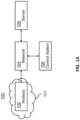
- the system 100 include a cloudlet 101.
- the cloudlet 101 may include the nodes 102.
- the cloudlet 101 may be formed dynamically.
- the cloudlet 101 may further be formed with any number of the nodes 102.
- the system 100 may also include multiple of the cloudlets 101.
- the nodes 102 in the cloudlet 101 perform operation under control from the control station 106.
- the control station 106 issues commands to control the cloudlet 101 over the network 104.
- the cloudlet 101 may refer to a set of UAVs and the like.
- the cloudlet 101 may include various manned assets, such as, vehicles (manned vehicles and/or unmanned vehicles), such as, but not limited to, aircraft (e.g., manned aircraft and/or unmanned aerial systems (UAS)), spacecraft, ground vehicles, ships, soldiers, military installations, and the like. It is further contemplated that the cloudlet 101 may include various commercial drone delivery nodes and the like, and is not intended to be limited to military contexts.
- vehicles manned vehicles and/or unmanned vehicles
- aircraft e.g., manned aircraft and/or unmanned aerial systems (UAS)
- UAS unmanned aerial systems
- the control station 106 may allocate specific tasks to each node 102 in the cloudlet 101. However, the number of tasks and nodes may be beyond the capability of human operators in the control station 106 to allocate specific task to each node 102 in the cloudlet 101. In embodiments, the control station 106 may issue a command with a high-level task.
- the high-level task may be within the capability of the human operator in the control station 106 to allocate to the cloudlet 101.
- the high-level task may also be referred to as a playbook command.
- the nodes 102 may include master nodes 102 and work nodes 102.
- the cloudlet 101 may include two types of computational units.
- the master nodes 102 include a master computation unit and the worker nodes 102 may include worker computational units.
- the master nodes 102 may receive a high-level task from the control station 106.
- the master node 102 and the worker nodes 102 may be unable to directly perform the high-level task. Instead, the master nodes 102 may divide the high-level task into multiple low-level tasks and delegate the low-level tasks to the worker nodes 102.
- the master node may execute a stack 300.
- the stack 300 may cause the master node to delegate low-level tasks to the worker nodes.
- the master nodes 102 and the worker nodes 102 may be any remote edge node that can compute and talk on the cloudlet 101.
- the cloudlet 101 may generally include at least one of the master nodes 102.
- the cloudlet may include one to M of the master nodes, where M is a positive integer.
- M is a positive integer.
- recitations of the term a master node should be interpreted to refer to one or more of the master nodes or from one to M of the master nodes.
- the cloudlet 101 may include zero or more of the worker nodes 102.
- the cloudlet 101 may include zero to N of the worker nodes 102, where N is a positive integer.
- each of the nodes may be considered master nodes.
- each of the nodes 102 in the cloudlet 101 may execute the tactical cloud software stack (TCSS).
- TCSS tactical cloud software stack
- any of the nodes 102 may receive the COMMAND and assign the tasks.
- the nodes 102 may include one or more components, such as, but not limited to, a memory 202, one or more processors 204, a network interface 206, a power system 208, control surfaces 210, engines 212, sensors 214, actuators 216, and the like.
- One or more of components of the nodes 102 may be communicatively coupled by one or more control buses or the like.
- the memory 202 may include any storage medium known in the art.
- the storage medium may include a non-transitory memory medium.
- the non-transitory memory medium may include, but is not limited to, a read-only memory (ROM), a random-access memory (RAM), a magnetic or optical memory device (e.g., disk), a solid-state drive and the like.
- ROM read-only memory
- RAM random-access memory
- magnetic or optical memory device e.g., disk
- solid-state drive e.g., solid-state drive and the like.
- memory may be housed in a common controller housing with the one or more processor(s).
- the memory and the processor may be housed in a processing unit, or the like.
- the memory may be located remotely with respect to the physical location of the processor.
- the memory maintains program instructions for causing the processor(s) to carry out the various steps described through the present disclosure.
- the memory may include an operating system, program instructions, and the like, as will be described further herein.
- the program instructions may be executable by the processors 204, causing the processors 204 to execute a stack 300.
- the one or more processors 204 may include any processing unit known in the art.
- the processors may include a multi-core processor, a single-core processor, a reconfigurable logic device (e.g., FPGAs), a digital signal processor (DSP), a special purpose logic device (e.g., ASICs), or other integrated formats.
- a reconfigurable logic device e.g., FPGAs
- DSP digital signal processor
- ASICs special purpose logic device
- aspects of the embodiments disclosed herein, in whole or in part, can be equivalently implemented in integrated circuits, as one or more computer programs running on one or more computers (e.g., as one or more programs running on one or more computing systems), as one or more programs running on one or more processors (e.g., as one or more programs running on one or more microprocessors), as firmware, or as virtually any combination thereof, and that designing the circuitry and/or writing the code for the software/and or firmware would be well within the skill of one skilled in the art in light of this disclosure.
- Such hardware, software, and/or firmware implementation may be a design choice based on various cost, efficiency, or other metrics.
- the processor(s) may include any microprocessor-type device configured to execute software algorithms and/or instructions.
- the term "processor” may be broadly defined to encompass any device having one or more processing elements, which execute program instructions from memory, from firmware, or by hardware implemented functions. It should be recognized that the steps described throughout the present disclosure may be carried out by the processors.
- the processors 204 may be configured to receive control commands from the ground station 106, and perform one or more tasks, functions, or flight maneuvers in response to the received control commands.
- the network interface 206 may include any suitable network interface for interfacing with the network 104, such as, but not limited to, a wired or a wireless network interface.
- the network interface may include mechanical, electrical, or signaling circuitry for communicating data to and from the network and subsequently to various other nodes.
- the nodes 102 may be configured to receive various input signals and transmit various output signals from the network interface 206.
- the network interface 206 may couple the nodes 102 to the network 104.
- the network interface 206 may wirelessly communicate with the network 104 (e.g., via one or more radio signals).
- the nodes 102 may include a power system 208.
- the power system 208 may provide power to any of the various components of the nodes 102.
- the power system 208 may include any system suitable for providing the power, such as, but not limited to, an electrical power system.
- the electrical power system includes one or more batteries 220.
- the electrical power system may monitor a state of charge of the batteries 220. The state of charge may also be referred to as a battery percentage.
- the power system 208 may also refer to a non-battery powered power system, such as a liquid fuel power system.
- the liquid fuel power system may include a fuel level.
- the nodes 102 may include control surfaces 210 and/or engines 212.
- the control surfaces 210 and/or engines 212 may be adjusted to control the flight of the nodes 102 according to the control commands.
- the control surfaces 210 may include any control surface of a fixed-wing UAV.
- control surfaces 210 may include, but are not limited to ailerons, elevators, rudders, spoilers, flaps, slats, air brakes, and the like.
- the nodes 102 are described in reference to the control surfaces 210 and/or engines 212 this is not intended to be limiting. However, the nodes 102 may generally include the surfaces 210 and/or engines 212 in the contexts where the nodes 102 are aerial vehicles.
- the nodes 102 may include sensors 214.
- the sensors 214 may include any type of sensor, such as, but not limited to a GNSS sensor (e.g., GPS sensor), accelerometers, gyroscopes, magnetometers, barometers, inertial measurement units (IMUs), image sensors, RF sensors, radars, thermometers, acoustic sensors, and the like.
- the image sensors may include but are not limited to, an electro-optic (EO) sensor, an infrared (IR) sensor, and the like.
- the processors 204 may receive sensor data from the sensors 214.
- the processors 204 may control the control surfaces 210 and/or engines 212 using one or more control loops based on the sensor data.
- the nodes 102 may include actuators 216.
- the actuators 216 may control and/or deploy a payload 218 of the nodes 102.
- the payload 218 may include any payload suitable to be carried by UAVs, such as, but not limited to, boxed packages, ordinance payloads, and the like.
- the ordinance payloads may include a type, such as, but not limited to, bombs, missiles, rockets, and gun ammunition.
- the actuators 216 may also include any actuator allowing the nodes 102 to interact with the world.
- the actuators 216 may include, but are not limited to, turning on lights, generating a jamming signal (e.g., GPS or RF jamming signal), deploying a water valve, playing a sound, dropping fire retardant, deploying a net or rope ladder, and the like.
- a jamming signal e.g., GPS or RF jamming signal
- the stack 300 may also be referred to as a tactical cloud software stack (TCSS).
- the stack 300 may be maintained in the memory 202 and executable by the processors 204.
- the stack 300 is a set of services. Each service in the set of services performs a dedicated task.
- the set of services communicate with each other for sharing various data.
- the set of services includes a command processor (Cp) application programming interface (Api) (CpApi) 302, a cloudlet monitor 304, a rule engine 306, a task engine 308, and one or more plugins 310.
- the stack 300 may provide a management system for remote nodes, where a control (master) node delegates tasks to worker nodes, and those delegation rules are configurable at run-time.
- the stack 300 is a microservices architecture.
- the microservice architecture may refer to splitting one or more services in the stack into independent services that are coupled together.
- the microservice architecture employs services that are independently employable.
- Many services within the microservice architecture are encapsulated within the stack.
- the independent services may include, but are not limited to, CpApi 302, cloudlet monitor 304, rule engine 306, task engine 308, and plugins 310.
- the services may be coupled by an application programming interface (API).
- API application programming interface
- the services may be coupled by Crisp (TM) API or the like.
- TM inclusive API
- the ability of the microservice architecture to parse an application into independent, loosely-coupled, individually deployable set of services allow for increased flexibility in application delivery, updating, and error correction.
- the stack 300 is described in the context of a microservices architecture, this is not intended to be limiting. Functions of the stack 300 may be implemented in a monolithic piece of software.
- the stack 300 is an event-driven architecture.
- the event-driven architecture may include detecting an event.
- the event may include, but is not limited to, receiving various commands from the CpApi 302.
- the event-driven architecture may drive one or more responses in response to the command.
- the CpApi 302 is now described.
- the CpApi 302 is a gateway or entry point into the stack 300.
- the CpApi 302 accepts one or more commands.
- the control station 106 may send the commands.
- the CpApi 302 receives the commands.
- the commands received by the CpApi 302 may include, but are not limited to, node mission configurations 316, rule engine contexts 318, and task execution requests 320.
- the CpApi 302 may then analyze the commands and determine whether the commands are valid or not valid.
- the CpApi 302 determines whether the commands are valid or not valid based on the commands having required data.
- the CpApi 302 may accept and validate the node mission configurations 316, rule engine contexts 318, and/or task execution requests 320.
- the node mission configurations 316 are now described.
- the node mission configurations 316 may also be referred to as authenticated descriptors.
- the node mission configurations 316 define the capability of the nodes.
- the node mission configurations 316 may be shared on initiation of the nodes 102 to the network 104.
- the node mission configurations 316 may be a command to update configurations about the nodes 102 in the cloudlet 101.
- the node mission configurations 316 may include various information about the nodes 102, such as, but not limited to, a type of the nodes 102 (e.g., a type of the unmanned aerial vehicles of the nodes 102), a type of the sensors 214, a type of the actuators 216 (e.g., a type of a payload 218), a top speed, and the like.
- a type of the nodes 102 e.g., a type of the unmanned aerial vehicles of the nodes 102
- a type of the sensors 214 e.g., a type of the actuators 216 (e.g., a type of a payload 218), a top speed, and the like.
- the rule engine contexts 318 are now described.
- the rule engine contexts 318 may be a command to update the contexts of the rule engine 306.
- the context of the rule engine may include, but is not limited to, "task allocation.”
- the rule engine contexts 318 may also include the rules 322 of the rule engine 306.
- the CpApi 302 may receive the command with the rule engine contexts 318.
- the CpApi may then provide the rule engine contexts 318 to the rule engine 306.
- the rule engine 306 may receive and maintain the rule engine contexts 318 as the rules 322.
- the task execution requests 320 may be a command to execute tasks 312.
- the tasks 312 may be high-level tasks 312 which are not individually executable by the nodes 102.
- the high-level tasks 312 may be broken into low-level tasks 352 which are individually executable by the nodes 102.
- the low-level tasks 352 may be referred to as subtasks of the high-level task 312.
- the high-level task 352 may include surveil an area.
- the low-level tasks associated with the high-level task of surveying the area may include assigning specific nodes with cameras and sensors to fly to and surveil the area using the cameras and sensors.
- the CpApi 302 may maintain tasks 312 and/or node configurations 314.
- the tasks 312 and/or node configurations 314 may be maintained in memory 202.
- the CpApi 302 may maintain the tasks 312 based on the task execution requests 320.
- the tasks 312 may include a status of the task and/or a state of the task.
- the CpApi 302 may detect a new high-level task 312 has been received in the task execution request 320 and send the task changed 336 to the task engine 308.
- the CpApi 302 may maintain node configurations 314.
- the node configurations 314 may include the node mission configurations 316 received from the network 104.
- the CpApi 302 may detect a change in the node configurations 314 and send the configuration 326 to the rule engine 306.
- the CpApi 302 may provide the configuration 326 to the rule engine 306.
- the configuration 326 may include the node configurations 314 of the nodes 102 in the cloudlet 101.
- the cloudlet monitor 304 may be considered an edge telemetry layer to gather dynamic status information of the nodes 102.
- the cloudlet monitor 304 is software that monitors status information of the nodes 102 in the cloudlet 101.
- the cloudlet monitor may monitor various status information, such as, the number of nodes, status of nodes, CPU load, location, current tasks, and the like.
- the cloudlet monitor 304 may receive and monitor the state 344 of the cloudlet 101.
- the state 344 may include real-time data regarding the status of the cloudlet 101.
- the state 344 of the cloudlet 101 may refer to status information about the nodes 102 in the cloudlet 101. In this regard, the cloudlet monitor 304 may monitor information about the nodes 102.
- the information about the nodes 102 may include, but is not limited to, a network condition (e.g., communication status available, bandwidth, and the like), location of nodes, heading of nodes, loads (e.g., processor loads, memory loads, and the like), remaining payload, fuel remaining, state of charge of a battery, and the like.
- the state 344 may refer to a dynamic node status.
- the dynamic node status is determined by periodic node telemetry.
- the cloudlet monitor 304 may receive the state 344 of the cloudlet 101 from the nodes 102 in the cloudlet 101. Individuals of the nodes 102 share the state 344 data to allow the stack 300 to make low-level task 352 allocation decisions.
- the nodes 102 may implement a gossip protocol to share the state 344 of the cloudlet 101 between the nodes 102 in the cloudlet 101.
- the gossip protocol may disseminate the state 344 between the nodes 102.
- the gossip protocol may indicate that the nodes do not directly request for data between the nodes 102. Instead, each of the nodes 102 generates the state 344 regarding the state 344 of itself and automatically sends the data to surrounding nodes 102.
- the surrounding nodes 102 receive the state 344 and relay the state 344 to other nodes in the cloudlet 101. The state 344 is then disseminated between and spread across the nodes 102.
- the cloudlet monitor 304 may cause the nodes 102 to transmit and/or receive the state 344.
- the cloudlet monitor 304 may cause the nodes 102 to transmit and/or receive the state 344 via the network interface 206.
- the cloudlet monitor 304 may cause the nodes 102 to transmit the state in response to generating the state 344 about itself and/or to relay the state 344 from another node.
- the cloudlet monitor 304 may cause the nodes 102 to receive the state from another of the nodes 102.
- the cloudlet monitor 304 may provide status information 330 of the worker nodes 102b to the rule engine 306.
- the rule engine 306 may receive and maintain the status information 330 as facts 324.
- the cloudlet monitor 304 may monitor the cloudlet 101 for changes to the nodes 102.
- the cloudlet monitor 304 may detect changes in the cloudlet 101 and/or the nodes 102.
- the cloudlet monitor 304 may then provide updated statuses 332 to the rule engine 306.
- the rule engine 306 may receive and maintain the status information 330 as facts 324.
- the facts 324 may be considered real-time facts by being updated in response to receiving the updated statuses 332.
- the facts 324 may also be referred to as configured contexts.
- the cloudlet monitor 304 may provide data 328 to the CpApi 302.
- the data 328 may include a data regarding the status of the cloudlet 101.
- the rule engine 306 may decide what rules 322 should be applied in a situation.
- the rule engine 306 may receive and maintain rules 322 and facts 324.
- the rule engine 306 may apply the rules 322 to the facts 324 deterministically.
- the rule engine 306 may deterministically produce the allocation of nodes 102 to low-level tasks 352 based on the rules 322 and the facts 324.
- the rule engine 306 finds solutions to constraint networks based on formally expressed rules.
- the rule engine 306 is deterministic and executes discrete logic with complete precision.
- the rule engine 306 relies on knowledge expressed in the form of rules 322.
- the deterministic property is preferable for high-assurance, mission-critical command & control, certification, and the like.
- the rule engine 306 may support formal proofs of correct behavior.
- the rule engine 306 is generic to each of the plugins 310. Each of the plugins 310 reuse the rule engine 306.
- the capability of the worker nodes 102b may be maintained as the facts 324.
- the capability may be based on the node configuration 316 and/or the state 344 of the nodes 102.
- the rule engine 306 may perform a binary determination or a scalar determination.
- the binary determination may be based on a sensor type of the nodes 102.
- the scalar determination may be based on a distance from nodes 102 to a target.
- Various other binary and scalar determinations may also be performed.
- the rule engine 306 may generate a list 350 of one or more worker nodes 102b for each of the low-level tasks 352.
- the rule engine 306 generates the lists 350 to match the requirements of the low-level tasks 352.
- the rule engine 306 may generate the list 350 based on the facts 324 and the rules 322.
- the list 350 may be ranked or prioritized.
- the ranking of the list 350 may recommend the best nodes based on the requirements.
- the plurality of low-level tasks 352 are individually executable by the worker nodes 102b in the list 350.
- the rule engine 306 may return the list 350 to the plugins 310.
- the rule engine 306 allows programmatic allocation of low-level tasks 352 to the nodes 102.
- the programmatic allocation is matched to the capability of the platform of the nodes 102, such as aircraft type, sensor capabilities, munition type, top speed, turn rate, and the like.
- the programmatic allocation is also matched to the current status of the platform of the nodes 102, such as health, position, fuel remaining, computational load, network condition, presence of other nodes (e.g., hostile or enemy nodes), remaining munitions, and the like.
- the programmatic allocation is matched to both the static and dynamic properties of the nodes 102.
- the static properties of the nodes 102 may refer to the capability of the platform of the nodes 102, such as aircraft type, sensor capabilities, munition type, top speed, turn rate, and the like.
- the dynamic properties of the nodes 102 may refer to the current status of the platform of the nodes 102, such as health, position, fuel remaining, computational load, network condition, presence of other nodes (e.g., hostile or enemy nodes), remaining munitions, and the like.
- the rule engine 306 may include an expert system.
- the expert system defines prerequisite logic for executing specific tasks.
- the expert language defines the rules 322 and the facts 324.
- the expert systems may be a computer algorithm which applies the rules 322 to the facts 324.
- the rule engine 306 matches requirements of the low-level tasks 352 to the worker nodes 102b using the expert system.
- the expert system may be deterministic. The deterministic property of the expert system indicates that the expert system will always produce the same output given the same initial input.
- the rule engine may be a passive service.
- the expert system may allow the stack 300 to automatically match low-level tasks 352 to the nodes 102 based on complex criteria.
- the expert system may be implemented in one or more computer programming languages.
- the expert system may be implemented in C Language Integrated Production System (CLIPS).
- CLIPS C Language Integrated Production System
- the rules 322 are logical statements or logical expressions.
- the rule engine may include rules 322.
- the rules 322 may be maintained in a human-readable format.
- the rules 322 may be maintained in JavaScript Object Notation (JSON).
- JSON JavaScript Object Notation
- the rules 322 may be updated at run-time.
- the rules for a given application can be customized, without modification to the rules engine software itself.
- the rule engine 306 may receive the rule engine context 318 and maintain the rule engine context as the rules 322. Changing the rules 322 (e.g., via the rule engine contexts 318) may cause the cloudlet 101 and the nodes 102 to behave differently.
- the rules 322 are fully customizable for different missions.
- the rules 322 are defined dynamically.
- the rules 322 may be dynamically updated during a mission.
- the rules 322 may be changed by redeploying the stack 300 or the like.
- the rules 322 may include if-then statements, decision tables, and the like. An example of the rules 322 are now provided. For example, the rules 322 may be defined based a proximity to an area. If the nodes 102 are within a range to the area, then the nodes 102 are eligible to be delegated the low-level tasks 352. By way of another example, the rules 322 may be defined based on the type of the sensors 214. If the nodes 102 include an image sensor, then the nodes 102 are eligible to be delegated low-level tasks 352 from a surveillance plugin. By way of another example, the rules 322 may be defined based on the network status.
- the rules 322 may define a minimum network condition of the node 102 on the network 104. The rules dictate if the network condition of the node 102 degrades below the minimum network condition, the task is reallocated to another node.
- the facts 324 may include static facts regarding the node mission configuration 316 of the nodes 102 in the cloudlet 101.
- the rule engine 306 is configured to receive and maintain the node mission configuration 316 as the facts 324.
- the node mission configuration 316 may include the static facts.
- the facts 324 may include dynamic facts regarding the current state 344 of the nodes 102 in the cloudlet 101.
- the rule engine 306 is configured to receive and maintain the state 344 as the facts 324. In this regard, the rule engine 306 knows the position of the nodes 102, memory allocations, and the like of the nodes 102 in the cloudlet 101.
- the task engine 308 is now described.
- the task engine 308 is a framework which allows the plugins 310 to be loaded.
- the task engine 308 receives the high-level task 312 from the CpApi 302.
- the task engine 308 receives the high-level task 312 from the CpApi 302 in a task changed 336 notification.
- the task engine 308 receives and processes the high-level task 312.
- the task engine 308 delegates the high-level task 312 to one plugin of the plugins 310.
- the task engine 308 includes a plugin registry 348 of each of the plugins 310.
- the task engine 308 may look up the plugins 310 in the plugin registry 348.
- the task engine 308 may follow a behavior.
- the behavior of the task engine 308 is hard coded.
- the task engine 308 decides what to do with high-level task 312 given the behavior.
- the task engine 308 may know the task received from the CpApi 302 in the task changed 336 notification is the high-level task 312.
- the behavior may also cause the task engine 308 to delegate the high-level task 312 to the one plugin.
- the task engine 308 may delegate the high-level task 312 to the plugin in a process task 342 request.
- the task engine 308 may also receive allocations of the low-level tasks 352 to allocated worker nodes of the worker nodes 102b from the plugins 310 in a process task 342 response.
- the task engine 308 may then transmit 346 the low-level tasks 352 to the allocated worker nodes.
- the task engine 308 may also control and monitor the tasks (e.g., the high-level tasks 312 and/or the low-level tasks 352). For example, the task engine 308 may control and monitor the low-level tasks 352 which are performed or executed by the nodes 102 which are allocated the low-level tasks 352. The task engine 308 may detect the plugins 310 did not assign the low-level tasks 352, such that the high-level task 312 has failed. The task engine 308 may reload the plugins 308 in response to detecting the failure.
- the tasks e.g., the high-level tasks 312 and/or the low-level tasks 352
- the task engine 308 may detect the plugins 310 did not assign the low-level tasks 352, such that the high-level task 312 has failed.
- the task engine 308 may reload the plugins 308 in response to detecting the failure.
- the task engine 308 receives a validate task request 334 from the CpApi 302.
- the task engine 308 validates the high-level tasks 312 by request.
- the task engine 308 monitors the state of the cloudlet 101.
- the task engine 308 may receive a state change 338 notification from the cloudlet monitor 304.
- the state change 338 notification may indicate the cloudlet 101 is online, offline, and the like.
- the state change 338 notification may also indicate the states of the nodes 102 in the cloudlet 101.
- the plugins 310 are now described.
- the plugins 310 may also be referred to as task engine plugins.
- the plugins 310 are software components that add specific features to the task engine 308.
- the plugins 310 receives the high-level task 312.
- the plugins 310 divide the high-level task 312 into low-level tasks 352.
- the plugins 310 may divide the high-level tasks 312 into the low-level tasks 352 by one or more rules maintained in the plugins 310.
- the task engine 308 does not perform individual tasks for the nodes 102, such as navigation, surveillance, DILR, and the like. Rather, the task engine 308 delegates the tasks to the plugins 310.
- the individual tasks for the nodes 102 are then performed by the plugins 310.
- the functionality of the plugins 310 may be modified without changing the task engine 308.
- the plugins 310 execute operations as a set of low-level tasks 352 allocated to the worker nodes 102b.
- the plugins 310 may allocate the low-level tasks 352 to the worker nodes 102b based on the capability of the worker nodes 102b.
- the plugins 310 decides what to do by asking the rule engine 306.
- the plugins 310 may send a task allocation 340 request to the rule engine 306.
- the task allocation 340 request may include the requirements of the low-level tasks 352. For example, the plugins 310 may ask the rule engine if I have these facts, what is my instruction.
- the plugins 310 may receive the list 350 from the rule engine 306.
- the plugins 310 may assign the low-level tasks 352 to allocated worker nodes in the list 350 of the one or more worker nodes for each of the low-level tasks 352.
- the plugins 310 relays the delegation to the task engine 308 in the process task 342.
- the task engine 308 then assigns the nodes to the low-level tasks 352 according to the delegation.
- the stack 300 may assign the low-level tasks 352 to the nodes 102 automatically or without a human having to manually assign the low-level tasks to individual nodes.
- the plugins 310 may process task redistribution requests.
- Task redistribution requests may refer to redistributed the allocation of the low-level tasks 352 to the nodes 102.
- the task redistribution requests may allow re-tasking for resiliency.
- the plugins 310 may process task reinforcement requests.
- the plugins 310 are mission-specific plug-ins.
- the plugins 310 are an implementation or execution in a specific task.
- the plugins 310 may implement different tasks.
- the plugins 310 may include plugins for different type of tasks and different operations of the nodes 102.
- the plugins 310 may include a surveillance plugin, a Detect, Identify, Locate and Report (DILR) plugin, flight control plugins, payload plugins, and the like.
- DILR Locate and Report
- the plugins 310 may access one or more devices of the nodes 102, such as, but not limited to, cameras, flight systems, gyroscopes, actuators, sensors, lidar, RGB camera, heat-thermal camera, and the like.
- the flight plugins may control the control surfaces 210 and/or the engines 212 of the nodes 102.
- the flight plugins may actuate the control surfaces 210 and/or the engines 212 to control a flight of the nodes 102.
- the flight plugins may control the flight of the nodes 102 within one or more operational parameters.
- the operational parameters may include altitudes (e.g., maximum altitude, minimum altitude), position (e.g., latitude coordinates and longitude coordinates), speed (e.g., minimum speed, maximum speed), G-forces (e.g., maximum G-force), maneuvers, and the like.
- the surveillance plugins and/or the DILR plugins may control one or more of the sensors 214 of the nodes 102.
- the surveillance plugins and/or the DILR plugins may control image sensors of the nodes 102.
- the payload plugins may control one or more of the actuators 216 of the nodes 102.
- the payload applications 316 may actuate the actuators 216 to deploy the payloads 218 of the nodes 102.
- plugins 310 are described in the context of an node which is an aerial vehicle, this is not intended as a limitation of the present disclosure. It is further contemplated that the plugins 310 may be applied across a variety of types of nodes.
- the plugins 310 may be any edge processing function that can be programmatically delegated to a selection of edge worker nodes.
- the stack 300 is extensible.
- the stack 300 may be extensible allowing introducing new types of tasks.
- the new types of tasks may use new or updated copies of the plugins 310.
- the task engine 308 may register the new or updated copies of the plugins 310 in the plugin registry 348.
- the plugins 310 may be updated or changed by registering the plugin registry 348.
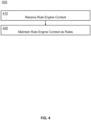
- the method 400 may describe maintaining the rules 322 in the rule engine 306.
- the method 400 may be further understood with reference to the stack 300.
- the method 400 may be one workflow in the stack 300.
- the rule engine context 318 is received.
- the CpApi 302 may receive the rule engine context 318.
- the CpApi 302 may receive the rule engine context 318 by the network interface 206 from the control station 106 via the network 104.
- the rule engine 306 is configured to receive the rule engine context 318 and maintain the rule engine context 318 as rules 322.
- the rule engine 306 may receive the rule engine context 318 via the configuration 326 from the CpAPi 302 to the rule engine 306.
- the steps 410 and 420 may be performed during initialization of the rule engine 306. The steps 410 and 420 may then be iteratively repeated to update the rules 322. Additional rule engine context 318 may be received by the CpApi 302. The CpApi 302 may validate the additional rule engine context 318 and send additional configuration 326 to the rule engine 306. The rule engine 306 receives the additional rule engine context 318 and maintains the additional rule engine contexts 318 as additional rules 322.
- the method 500 may describe maintaining the facts 324 in the rule engine 306.
- the method 500 may be further understood with reference to the stack 300.
- the method 500 may be a second workflow in the stack 300.
- a step 510 status information of the worker nodes 102b is monitored.
- the cloudlet monitor 304 receives the state 344 from the worker nodes 102b. Each node 102 inside the cloudlet 101 gets the states 344 from other nodes in the cloudlet 101.
- the cloudlet monitor 304 receives the state 344 from the worker nodes 102b via the network interface 206. The cloudlet monitor 304 then monitors the status information of the worker nodes 102b based on the state 344.
- the rule engine 306 is configured to receive and maintain the status information as facts 324.
- the rule engine 306 may receive the status information status information 330 of the worker nodes 102b to the rule engine 306.
- the cloudlet monitor 304 may also detect changes in the cloudlet 101 and/or the nodes 102.
- the cloudlet monitor 304 may then provide updated statuses 332 to the rule engine 306.
- the rule engine 306 then maintains a real-time list of the facts 324 regarding the nodes 102.
- the method 600 may describe assigning or allocating low-level tasks 352 in response to receiving high-level tasks 312.
- the method 600 may be further understood with reference to the stack 300.
- the method 600 may be a third workflow in the stack 300.
- the task execution request 320 is sent to the CpApi 302.
- the task execution request 320 is sent to the CpApi 302 from the control station 106 over the network 104.
- the task execution request 320 is sent to the CpApi 302 of the node 102 (e.g., the master node 102a).
- the CpApi 302 receives the task execution request 320.
- the CpApi 302 receives the task execution request 320 from the network 104 by the network interface 206.
- the CpApi 302 validates the task execution request 320.
- the task execution request 320 includes the high-level task 312 which is not individually executable by the node 102 (e.g., by the master node 102a and/or by the worker nodes 102b).
- the high-level task 312 is sent to the task engine 308.
- the high-level task 312 is sent to the task engine 308 from the CpApi 302.
- the task engine 308 receives the high-level task 312 from the CpApi 302.
- the high-level task 312 is delegated to one plugin of the plugins 310.
- the task engine 308 delegates the high-level task 312 to the one plugin.
- the task engine 308 delegates the high-level task 312 to the one plugin based on a type of the high-level task.
- the task engine 308 delegates the high-level task 312 to the plugin in the process task 342.
- the plugin divides the high-level tasks 312 into the low-level tasks 352.
- the plugin divides the high-level tasks 312 into the low-level tasks 352 based on rules maintained in the plugins 310.
- the plugin may include surveillance rules for dividing a high-level surveillance task into low-level surveillance tasks.
- the plugin may include DILR rules for dividing a high-level DILR task into low-level DILR tasks.
- the low-level tasks 352 are subtasks of the high-level tasks 312.
- the plugin assigns the low-level tasks 352 to the worker nodes 102b based on the facts 324 and rules 322 in the rule engine 306.
- the plugin asks the rule engine 306 to return a set of the work nodes 102b that are available to execute each of the low-level tasks 352.
- the plugin asks the rule engine 306 in the task allocation request 340.
- the rule engine evaluates the requirements in the task allocation request 340. For example, the rule engine 306 may consider the availability of the nodes, the load of the nodes, and the like.
- the rule engine 306 then returns the set of the work nodes 102b that are available to execute each of the low-level tasks 352 to the plugin.
- the plugin 310 receives the list 350 of nodes that meet the requirements and assigns the low-levels tasks to allocated nodes within the list 350 of nodes.
- the low-level tasks 352 are then individually executable by the worker nodes 102b (e.g., by the allocated nodes).
- the plugin 310 may then relay the allocation of the low-levels tasks with the allocated nodes to the task engine 308. For example, the plugin 310 may then relay the allocation of the low-levels tasks to the allocated nodes to the task engine 308 in the process task 342.
- the task engine 308 transmits 346 the low-level tasks to the worker nodes 102b.
- the task engine 308 may cause the network interface 206 to transmit 346 the low-level tasks to the worker nodes 102b over the network 104.
- the task engine 308 is configured to transmit 346 the low-level tasks 352 to the worker nodes 102b over the network 104 by the network interface 206.
- the task engine 308 may transmit 346 the low-level tasks 352 to the worker nodes 102b over the network 104 by the network interface 206 directly, via the gossip protocol, or via another protocol.
- the allocated nodes receive the low-level tasks and executes the low-level tasks.
- the allocated nodes may receive the low-level tasks directly from the master node 102a and/or indirectly (e.g., by a gossip protocol, or the like).
- the allocated nodes may include the plugins 310 for executing the low-level tasks.
- the plugins 310 may cause the allocated nodes to fly to a location using the control surfaces 210 and engines 212.
- the plugins 310 may cause the allocated nodes to perform surveillance at the location using sensors 214.
- the plugins 310 may cause the allocated nodes to engage the actuators 216 to deploy the payloads 218 at the location using sensors 214.
- the timing diagram 700 may describe an example utilization of the system 100.
- the timing diagram 700 includes a node1 702 (N1), a node2 704 (N2), a node3 706 (N3), and a control station 708 (CS).
- the node1 702, node2 704, node3 706 may be examples of the nodes 102.
- the node1 702 and node2 704 may be considered worker nodes 102b.
- the node3 706 may be considered master node 102a.
- the control station 708 may be an example of control station 106.
- the node1 702, node2 704 are UAV assets.
- the node1 702, node2 704 may be one of many UAV assets in an edge network. Not all of the UAVs in the edge network are depicted. Additionally, not all of the UAVs in the edge network may include a capability to meet subtask requirements.
- the node3 706 is a manned aircraft. Consider UAV assets that get paired with a manned aircraft to perform a Detect - Identify - Locate - Report (DILR) mission.
- DILR Detect - Identify - Locate - Report
- the nodes are described in the context of UAV assets, this is not intended as a limitation of the present disclosure. It is further contemplated that the nodes may be applied across a variety of types of nodes.
- the UAVs (i.e., node1 702, node2 704) send the node configuration 316 to the manned platform (i.e., the node3 706).
- the node1 702, node2 704 may send the node configuration 316 on joining the cloudlet 101.
- the node configuration 316 of node1 is that node1 includes an electro-optic (EO) sensor and has a top speed of 60 miles per hour.
- the node configuration 316 of node2 is that node2 includes an infrared (IR) sensor and a top speed of 45 miles per hour.
- the UAVs (i.e., node1 702, node2 704) send the states 344 to the manned platform.
- the node1 702, node2 704 may send the states 344 to the node3 706 at a regular interval. As depicted, one of the states 344 is sent, although this is not intended to be limiting.
- the control station 708 directs the node3 706 to perform DILR in the task execution request 320.
- the perform DILR is communicated as a high-level "playbook" command.
- the control station 708 sends the node3 706 the task execution request 320 with a high-level task 312 to perform DILR in a region.
- Perform DILR in the region is not a task which is individually executable by any of the node1, node2, node3, or other UAVs in the cloudlet 101. Instead, the perform DILR in the region task must be divided into subtasks which are executable by the node1 702, node2 704, or other UAVs in the cloudlet.
- the node3 706 includes the stack 300 with a DILR plugin.
- the task engine 308 receives the perform DILR task and identifies the DILR plugin as the suitable plugin for executing the perform DILR task.
- the task engine 308 delegates the DILR plugin to execute the perform DILR task.
- the DILR plugin divides the perform DILR task into low-level or subtasks, such as, but not limited to, search for air defense near a first position (A) and search for mobile forces near a second position (B). Each of the subtasks has specific operational requirements.
- the DILR plugin then sends the task allocation request 340 to the rule engine 306 for both the search for air defense near the first position (A) and search for mobile forces near the second position (B) subtasks.
- the rule engine 306 matches subtask requirements to available nodes (based on static (capability) and dynamic criteria), and generates a list with the best match.
- the rule engine 306 responds with the lists 350 of nodes for both the search for air defense near the first position (A) and search for mobile forces near the second position (B) subtasks.
- the node1 is in the list of nodes for the search for air defense near the first position (A) subtask and the node2 is in the list of nodes that can search for mobile forces near the second position (B) subtask.
- the DILR plugin then assigns the node1 to the search for air defense near the first position (A) subtask and assigns the node2 to the search for mobile forces near the second position (B) subtask.
- the node1 is the allocated worker node from the list of worker nodes for the low-level task of search for air defense near the first position (A). Furthermore, the node2 is the allocated worker node from the list of worker nodes for the low-level task of search for mobile forces near the second position (B).
- the task engine 308 receives the allocation from the DILR plugin and transmits 346 the allocation to the node1 702 and the node2 704.
- Node1 702 may then execute the subtask of searching for air defense near the first position (A).
- the node1 702 may include a DILR plugin which includes causes the node1 to fly to the first position (A) and search for air defense using one or more sensors of the node1.
- Node2 704 may then execute the subtask of searching for mobile forces near the second position (B).
- the node2 704 may include a DILR plugin which causes the node2 704 to fly to the second position (B) and search for air defense using one or more sensors of the node2.
- the embodiments and the enabling technology described previously herein in the context of the system 100, the node 102, and the stack 300 should be interpreted to extend to the methods 400, 500, 600.
- the methods may be implemented by the system 100, the node 102, and the stack 300.
- the payload 218 is described as including munitions, this is not intended as a limitation of the present disclosure. It is contemplated the system 100 may include several uses, such as, but not limited to, the orchestration of commercial UAV fleets, factory automation, and the like.
- the methods, operations, and/or functionality disclosed may be implemented as sets of instructions or software readable by a device.
- the steps may include computations which may be performed simultaneously, in parallel, or sequentially.
- the specific order or hierarchy of steps in the methods, operations, and/or functionality disclosed are examples of exemplary approaches. Based upon design preferences, it is understood that the specific order or hierarchy of steps in the methods, operations, and/or functionality can be rearranged while remaining within the scope of the inventive concepts disclosed herein.
- the accompanying claims may present elements of the various steps in a sample order, and are not necessarily meant to be limited to the specific order or hierarchy presented. It is to be understood that embodiments of the methods according to the inventive concepts disclosed herein may include one or more of the steps described herein.
- steps may be carried out in any desired order and two or more of the steps may be carried out simultaneously with one another.
- Two or more of the steps disclosed herein may be combined in a single step, and in some embodiments, one or more of the steps may be carried out as two or more sub-steps. Further, other steps or sub-steps may be carried in addition to, or as substitutes to one or more of the steps disclosed herein.
- a processor may include any processing unit known in the art.
- the processor may include a multi-core processor, a single-core processor, a reconfigurable logic device (e.g., FPGAs), a digital signal processor (DSP), a special purpose logic device (e.g., ASICs)), or other integrated formats.
- a reconfigurable logic device e.g., FPGAs
- DSP digital signal processor
- ASICs special purpose logic device
- the processor(s) may include any microprocessor-type device configured to execute software algorithms and/or instructions.
- processor may be broadly defined to encompass any device having one or more processing elements, which execute program instructions from memory, from firmware, or by hardware implemented functions. It should be recognized that the steps described throughout the present disclosure may be carried out by the processors.
- a memory may include any storage medium known in the art.
- the storage medium may include a non-transitory memory medium.
- the non-transitory memory medium may include, but is not limited to, a read-only memory (ROM), a random-access memory (RAM), a magnetic or optical memory device (e.g., disk), a solid-state drive and the like.
- memory may be housed in a common controller housing with the one or more processor(s).
- the memory and the processor may be housed in a processing unit, a desktop computer, or the like.
- the memory may be located remotely with respect to the physical location of the processor.
- the memory maintains program instructions for causing the processor(s) to carry out the various steps described through the present disclosure.
- inventive concepts disclosed herein are well adapted to carry out the objects and to attain the advantages mentioned herein as well as those inherent in the inventive concepts disclosed herein. While presently preferred embodiments of the inventive concepts disclosed herein have been described for purposes of this disclosure, it will be understood that numerous changes may be made which will readily suggest themselves to those skilled in the art and which are within the scope of the invention defined by the claims.
Landscapes
- Engineering & Computer Science (AREA)
- Software Systems (AREA)
- Theoretical Computer Science (AREA)
- Physics & Mathematics (AREA)
- General Engineering & Computer Science (AREA)
- General Physics & Mathematics (AREA)
- Mathematical Physics (AREA)
- Testing And Monitoring For Control Systems (AREA)
- Selective Calling Equipment (AREA)
- Management, Administration, Business Operations System, And Electronic Commerce (AREA)
Abstract
A stack is described. The stack (300) includes a rule engine (306). The rule engine is accessed via application programming interface (API) (302) from any plug-in mission service. The rule engine includes rules and facts. The rules and facts are loaded separately from the API and from a cloudlet monitor. The rules and facts do not require source code updates to change. The stack is executable on processors of a node within a cloudlet. The cloudlet includes multiple of the nodes. The stack divides high-level tasks into low-level tasks which are individually executable by the nodes in the cloudlet.
Description
- The present invention generally relates to edge networks, and more specifically to the allocation of tasks to nodes in the edge networks.
- Military edge networks have increasingly more devices of heterogenous types. Mission operations require complex coordination between the devices. The speed and scale of the mission is difficult for human operators to decide and manage the devices in a timely manner. Therefore, it would be advantageous to provide a device, system, and method that addresses the shortcomings described above.
- A system is described in accordance with one or more embodiments of the present disclosure. In some embodiments, the system includes a control station. In some embodiments, the system includes a cloudlet. In some embodiments, the cloudlet is communicatively coupled to the control station by a network.
- The cloudlet is described in accordance with one or more embodiments of the present disclosure. In some embodiments, the cloudlet includes a plurality of worker nodes. In some embodiments, the cloudlet comprises a master node.
- The master node is described in accordance with one or more embodiments of the present disclosure. In some embodiments, the master node includes a memory maintaining program instructions. In some embodiments, the master node includes one or more processors configured to execute the program instructions. In some embodiments, the program instructions may cause the one or more processors to execute a stack comprising a command processor application programming interface (CpApi), a cloudlet monitor, a rule engine, a task engine, and a plurality of plugins. In some embodiments, the CpApi is configured to receive a node mission configuration of a plurality of worker nodes, a rule engine context, and a task execution request. In some embodiments, the task execution request comprises a high-level task which is not individually executable by the master node. In some embodiments, the cloudlet monitor is configured to monitor status information of the plurality of worker nodes. In some embodiments, the rule engine is configured to receive and maintain the node mission configuration and the status information as a plurality of facts. In some embodiments, the rule engine is configured to receive the rule engine context and maintain the rule engine context as a plurality of rules. In some embodiments, the task engine receives the high-level task from the CpApi and delegates the high-level task to one plugin of the plurality of plugins. In some embodiments, the one plugin divides the high-level task into a plurality of low-level tasks. In some embodiments, the rule engine generates a list of one or more of the worker nodes for each of the plurality of low-level tasks based on the plurality of facts and the plurality of rules in the expert system. In some embodiments, the plurality of low-level tasks are individually executable by the one or more of the worker nodes. In some embodiments, the one plugin assigns the plurality of low-level tasks to worker nodes in the list of the one or more worker nodes for each of the plurality of low-level tasks.
- Implementations of the concepts disclosed herein may be better understood when consideration is given to the following detailed description thereof. Such description makes reference to the included drawings, which are not necessarily to scale, and in which some features may be exaggerated and some features may be omitted or may be represented schematically in the interest of clarity. Like reference numerals in the drawings may represent and refer to the same or similar element, feature, or function. In the drawings:
-
FIG. 1A depicts a simplified block diagram of a system, in accordance with one or more embodiments of the present disclosure. -
FIG. 1B depicts a simplified block diagram of cloudlet of the system ofFIG. 1A , in accordance with one or more embodiments of the present disclosure. -
FIG. 2 depicts a node, in accordance with one or more embodiments of the present disclosure. -
FIG. 3 depicts a stack, in accordance with one or more embodiments of the present disclosure. -
FIGS. 4-6 depict a flow diagram of a method, in accordance with one or more embodiments of the present disclosure. -
FIG. 7 depicts an exemplary timing diagram, in accordance with one or more embodiments of the present disclosure. - Before explaining one or more embodiments of the disclosure in detail, it is to be understood that the embodiments are not limited in their application to the details of construction and the arrangement of the components or steps or methodologies set forth in the following description or illustrated in the drawings. In the following detailed description of embodiments, numerous specific details are set forth in order to provide a more thorough understanding of the disclosure. However, it will be apparent to one of ordinary skill in the art having the benefit of the instant disclosure that the embodiments disclosed herein may be practiced without some of these specific details. In other instances, well-known features may not be described in detail to avoid unnecessarily complicating the instant disclosure.
- As used herein a letter following a reference numeral is intended to reference an embodiment of the feature or element that may be similar, but not necessarily identical, to a previously described element or feature bearing the same reference numeral (e.g., 1, 1a, 1b). Such shorthand notations are used for purposes of convenience only and should not be construed to limit the disclosure in any way unless expressly stated to the contrary.
- Further, unless expressly stated to the contrary, "or" refers to an inclusive or and not to an exclusive or. For example, a condition A or B is satisfied by any one of the following: A is true (or present) and B is false (or not present), A is false (or not present) and B is true (or present), and both A and B are true (or present).
- In addition, use of "a" or "an" may be employed to describe elements and components of embodiments disclosed herein. This is done merely for convenience and "a" and "an" are intended to include "one" or "at least one," and the singular also includes the plural unless it is obvious that it is meant otherwise.
- Finally, as used herein any reference to "one embodiment" or "some embodiments" means that a particular element, feature, structure, or characteristic described in connection with the embodiment is included in at least one embodiment disclosed herein. The appearances of the phrase "in some embodiments" in various places in the specification are not necessarily all referring to the same embodiment, and embodiments may include one or more of the features expressly described or inherently present herein, or any combination or sub-combination of two or more such features, along with any other features which may not necessarily be expressly described or inherently present in the instant disclosure.
- Referring generally now to one or more embodiments of the present disclosure. Embodiments of the present disclosure are generally directed to a general-purpose rule engine. The rule engine describes the capabilities of an edge network and the requirements for mission tasks. The rule engine includes policy-based mission customization and programmatic interfaces for optimal matching of tasks to nodes. Advantageously, the rule engine takes into account platform capability and dynamic conditions when assigning tasks.
- An extensible approach for programmatically assigning mission tasks to nodes is described. The extensible approach considers a fixed capability of the edge assets and dynamic conditions regarding the edge assets. The extensible approach includes a rule engine describing the capabilities of the edge assets and the requirements for mission tasks. The rule engine includes policy-based mission customization and programmatic interfaces for optimal matching of tasks to nodes. The extensible approach applies to "edge networks" that can be assigned various execution tasks in real-time, such as, but not limited to, the "Battlefield of Things." In embodiments, the extensible approach uses "Internet of Things" descriptors for platforms to advertise capability.
-
U.S. Patent Number 11,345,473, titled "System and method for preventing inadvertent loss of surveillance coverage for an unmanned aerial system (UAS)", filed on December 5, 2019 U.S. Patent Number 9,466,219, titled "Unmanned vehicle mission planning, coordination and collaboration", filed on June 27, 2014 - Referring now to
FIGS. 1A-1B , asystem 100 is described, in accordance with one or more embodiments of the present disclosure. Thesystem 100 may also be referred to as an edge network or an edge management system. Thesystem 100 may include one ormore nodes 102, anetwork 104, acontrol station 106, aserver 108, and the like. - The
nodes 102 may be any connected node. The connected nodes may include, but are not limited to, ground sensors, handheld radios, back-back computers, aerial vehicles, unmanned aerial vehicles and the like. Thenodes 102 may also be embodied in a variety of applications, such as, but not limited to, aircraft domains, delivery systems, large-scale distributed computing clusters, and the like. Thenodes 102 may be referred to as edge assets in an edge network. Thenodes 102 may be any edge asset. For example, thenodes 102 may be aerial vehicle, a rover, a manned vehicle, and the like. Thenodes 102 may generally include any computational node that can perform tasks during a mission. In embodiments, thenodes 102 are aerial vehicles. The aerial vehicles may include any type of aerial vehicle such as, but not limited to, fixed-wing aircraft, a rotorcraft, jet-propelled vehicle (e.g., rocket), balloon, airship, and the like. Fixed-wing aircraft may refer to aircraft with wings which are fixed to a bulkhead or fuselage of the aircraft. Rotorcraft may refer to aircraft with wings or rotors mounted on a spinning shaft. In embodiments, the aerial vehicles are unmanned aerial vehicles (UAVs). The UAVs may include any type of the previously described aerial vehicles. The UAVs may include any unmanned aerial vehicle including, but not limited to, civilian drones, commercial drones, military drones, transport drones, and the like. The UAVs may also be referred to as a drone, an unmanned aircraft, and the like. - The
control station 106 may be positioned remotely with respect to thenodes 102. Thecontrol station 106 may be positioned within any ground control station, operation center, mobile control station, airborne control station, or the like. In embodiments, thecontrol station 106 is an airborne early warning and control system (AWACS) aircraft. Thecontrol station 106 may provide tasks to thenodes 102. Theunmanned aircraft system 100 may be referred to as a remotely piloted aircraft system (RPAS) when thenodes 102 are piloted by thecontrol station 106. - In embodiments, the
control station 106 may provide a command and control (C2) link to thenodes 102. The C2 link may generate one or more command and control (C2) signals configured to cause thenodes 102 to perform various tasks, functions, and/or prescribed flight plan maneuvers. Thenodes 102 may receive the C2 signals and execute the various control commands. The control commands may cause the nodes 102 (e.g., via onboard processing) to execute one or more flight maneuvers. For example, the one or more flight maneuvers may include any flight maneuvers including, but not limited to, a change in altitude, a change in attitude (e.g., orientation with respect to one or more rotational axes), a change in heading, a change in position, follow a flight plan, a backtracking maneuver (e.g., backtracking along a flight path), a homing maneuver (e.g., returning to the control station 106), a hover-and-hold maneuver, a climb-and-hold maneuver, and the like. It is further contemplated that the control commands may be associated with non-aerial vehicles where thenodes 102 are a non-aerial vehicle node. The control commands may also include a deploy payload command. The deploy payload command may cause the nodes 102 (e.g., via onboard processing) to deploy a payload. In embodiments, thenodes 102 may execute the various control commands on one or more computing systems by applications above an operating system layer. - Although the
unmanned aircraft system 100 is described as including thecontrol station 106, this is not intended as a limitation of the present disclosure. Thecontrol station 106 is provided solely for illustrative purposes, and is not to be regarded as a limitation of the present disclosure, unless noted otherwise herein. In embodiments, thenodes 102 may be an autonomous aircraft. In this regard, one or more functions of thecontrol station 106 may be performed autonomously by thenodes 102. - The
server 108 may include a processor and a memory. Theserver 108 may include a cloud-based architecture. For instance, it is contemplated herein that theserver 108 may include a hosted server and/or cloud computing platform including, but not limited to, Amazon Web Services (e.g., Amazon EC2, and the like). In this regard,system 100 may include a software as a service (SaaS) configuration, in which various functions or steps of the present disclosure are carried out by a remote server. Theserver 108 may be considered a global hosted cloud. - In embodiments, the
nodes 102, thecontrol station 106, and/or theserver 108 may be communicatively coupled by thenetwork 104 in any manner known in the art. For example, thenodes 102, thecontrol station 106, and/or theserver 108 may be directly coupled such that signals may be transmitted directly between thenodes 102, thecontrol station 106, and/or theserver 108. By way of another example, thenodes 102, thecontrol station 106, and/or theserver 108 may be communicatively coupled by an indirect coupling via thenetwork 104. In embodiments,nodes 102, thecontrol station 106, and/or theserver 108 may each include network interface circuitry configured to interface with thenetwork 104. The network interface circuitry may include any wireline or wireless network interface circuitry. - The
network 104 may include any network known in the art. For example, thenetwork 104 may include, but is not limited to, a network of terrestrial communication nodes (e.g., communication towers), a network of mobile communication nodes (e.g., mobile terrestrial communication nodes, mobile airborne communication nodes), and the like. It is further noted herein that thenodes 102, thecontrol station 106, and/or theserver 108 may be directly and/or indirectly (via network 104) communicatively coupled to one another via any communication protocols known in the art including, but not limited to, Link-16, Control and Non-Payload Communications (CNPC), GSM, GPRS, CDMA, EV-DO, EDGE, WiMAX, 3G, 4G, 4G LTE, 5G, WiFi protocols, radio frequency (RF), LoRa, and the like. For example, thenodes 102, thecontrol station 106, and/or theserver 108 may transmit data between each other, directly and/or vianetwork 104, utilizing the L-band or C-band. By way of another example, thenodes 102, thecontrol station 106, and/or theserver 108 may utilize signals in the range of 450 MHz-5 GHz, or any frequency or range of frequencies known in the art. Thenetwork 104 may also include any wireline communication protocol (e.g., DSL-based interconnection, cable-based interconnection, and the like). Interactions between thenodes 102,control station 106, and/or theserver 108 may be determined based on one or more characteristics including, but not limited to, IP addresses, MAC addresses, and the like. - In embodiments, the
system 100 include acloudlet 101. Thecloudlet 101 may include thenodes 102. In embodiments, thecloudlet 101 may be formed dynamically. Thecloudlet 101 may further be formed with any number of thenodes 102. Thesystem 100 may also include multiple of thecloudlets 101. Thenodes 102 in thecloudlet 101 perform operation under control from thecontrol station 106. Thecontrol station 106 issues commands to control thecloudlet 101 over thenetwork 104. For example, thecloudlet 101 may refer to a set of UAVs and the like. By way of another example, thecloudlet 101 may include various manned assets, such as, vehicles (manned vehicles and/or unmanned vehicles), such as, but not limited to, aircraft (e.g., manned aircraft and/or unmanned aerial systems (UAS)), spacecraft, ground vehicles, ships, soldiers, military installations, and the like. It is further contemplated that thecloudlet 101 may include various commercial drone delivery nodes and the like, and is not intended to be limited to military contexts. - The
control station 106 may allocate specific tasks to eachnode 102 in thecloudlet 101. However, the number of tasks and nodes may be beyond the capability of human operators in thecontrol station 106 to allocate specific task to eachnode 102 in thecloudlet 101. In embodiments, thecontrol station 106 may issue a command with a high-level task. The high-level task may be within the capability of the human operator in thecontrol station 106 to allocate to thecloudlet 101. The high-level task may also be referred to as a playbook command. - Referring now to
FIG. 1B , thecloudlet 101 is described. In embodiments, thenodes 102 may includemaster nodes 102 and worknodes 102. Thecloudlet 101 may include two types of computational units. Themaster nodes 102 include a master computation unit and theworker nodes 102 may include worker computational units. Themaster nodes 102 may receive a high-level task from thecontrol station 106. Themaster node 102 and theworker nodes 102 may be unable to directly perform the high-level task. Instead, themaster nodes 102 may divide the high-level task into multiple low-level tasks and delegate the low-level tasks to theworker nodes 102. In embodiments, the master node may execute astack 300. Thestack 300 may cause the master node to delegate low-level tasks to the worker nodes. Themaster nodes 102 and theworker nodes 102 may be any remote edge node that can compute and talk on thecloudlet 101. - In embodiments, the
cloudlet 101 may generally include at least one of themaster nodes 102. For example, the cloudlet may include one to M of the master nodes, where M is a positive integer. In this regard, recitations of the term a master node should be interpreted to refer to one or more of the master nodes or from one to M of the master nodes. In embodiments, thecloudlet 101 may include zero or more of theworker nodes 102. For example, thecloudlet 101 may include zero to N of theworker nodes 102, where N is a positive integer. - Although the
cloudlet 101 is described as including the master node executing thestack 300, this is not intended as a limitation of the present disclosure. In embodiments, each of the nodes may be considered master nodes. For example, each of thenodes 102 in thecloudlet 101 may execute the tactical cloud software stack (TCSS). In this regard, any of thenodes 102 may receive the COMMAND and assign the tasks. - Referring now to
FIG. 2 , thenodes 102 are described, in accordance with one or more embodiments of the present disclosure. Thenodes 102 may include one or more components, such as, but not limited to, amemory 202, one ormore processors 204, anetwork interface 206, apower system 208,control surfaces 210,engines 212,sensors 214,actuators 216, and the like. One or more of components of thenodes 102 may be communicatively coupled by one or more control buses or the like. - The
memory 202 may include any storage medium known in the art. For example, the storage medium may include a non-transitory memory medium. For instance, the non-transitory memory medium may include, but is not limited to, a read-only memory (ROM), a random-access memory (RAM), a magnetic or optical memory device (e.g., disk), a solid-state drive and the like. It is further noted that memory may be housed in a common controller housing with the one or more processor(s). For example, the memory and the processor may be housed in a processing unit, or the like. In an alternative embodiment, the memory may be located remotely with respect to the physical location of the processor. In another embodiment, the memory maintains program instructions for causing the processor(s) to carry out the various steps described through the present disclosure. The memory may include an operating system, program instructions, and the like, as will be described further herein. The program instructions may be executable by theprocessors 204, causing theprocessors 204 to execute astack 300. - The one or
more processors 204 may include any processing unit known in the art. For example, the processors may include a multi-core processor, a single-core processor, a reconfigurable logic device (e.g., FPGAs), a digital signal processor (DSP), a special purpose logic device (e.g., ASICs), or other integrated formats. Those skilled in the art will recognize that aspects of the embodiments disclosed herein, in whole or in part, can be equivalently implemented in integrated circuits, as one or more computer programs running on one or more computers (e.g., as one or more programs running on one or more computing systems), as one or more programs running on one or more processors (e.g., as one or more programs running on one or more microprocessors), as firmware, or as virtually any combination thereof, and that designing the circuitry and/or writing the code for the software/and or firmware would be well within the skill of one skilled in the art in light of this disclosure. Such hardware, software, and/or firmware implementation may be a design choice based on various cost, efficiency, or other metrics. In this sense, the processor(s) may include any microprocessor-type device configured to execute software algorithms and/or instructions. In general, the term "processor" may be broadly defined to encompass any device having one or more processing elements, which execute program instructions from memory, from firmware, or by hardware implemented functions. It should be recognized that the steps described throughout the present disclosure may be carried out by the processors. For example, theprocessors 204 may be configured to receive control commands from theground station 106, and perform one or more tasks, functions, or flight maneuvers in response to the received control commands. - The
network interface 206 may include any suitable network interface for interfacing with thenetwork 104, such as, but not limited to, a wired or a wireless network interface. The network interface may include mechanical, electrical, or signaling circuitry for communicating data to and from the network and subsequently to various other nodes. Thenodes 102 may be configured to receive various input signals and transmit various output signals from thenetwork interface 206. Thenetwork interface 206 may couple thenodes 102 to thenetwork 104. Thenetwork interface 206 may wirelessly communicate with the network 104 (e.g., via one or more radio signals). - The
nodes 102 may include apower system 208. Thepower system 208 may provide power to any of the various components of thenodes 102. Thepower system 208 may include any system suitable for providing the power, such as, but not limited to, an electrical power system. In embodiments, the electrical power system includes one ormore batteries 220. The electrical power system may monitor a state of charge of thebatteries 220. The state of charge may also be referred to as a battery percentage. Thepower system 208 may also refer to a non-battery powered power system, such as a liquid fuel power system. The liquid fuel power system may include a fuel level. - In embodiments, the
nodes 102 may includecontrol surfaces 210 and/orengines 212. The control surfaces 210 and/orengines 212 may be adjusted to control the flight of thenodes 102 according to the control commands. The control surfaces 210 may include any control surface of a fixed-wing UAV. For example,control surfaces 210 may include, but are not limited to ailerons, elevators, rudders, spoilers, flaps, slats, air brakes, and the like. Although thenodes 102 are described in reference to thecontrol surfaces 210 and/orengines 212 this is not intended to be limiting. However, thenodes 102 may generally include thesurfaces 210 and/orengines 212 in the contexts where thenodes 102 are aerial vehicles. - In embodiments, the
nodes 102 may includesensors 214. Thesensors 214 may include any type of sensor, such as, but not limited to a GNSS sensor (e.g., GPS sensor), accelerometers, gyroscopes, magnetometers, barometers, inertial measurement units (IMUs), image sensors, RF sensors, radars, thermometers, acoustic sensors, and the like. For example, the image sensors may include but are not limited to, an electro-optic (EO) sensor, an infrared (IR) sensor, and the like. Theprocessors 204 may receive sensor data from thesensors 214. Theprocessors 204 may control thecontrol surfaces 210 and/orengines 212 using one or more control loops based on the sensor data. - In embodiments, the
nodes 102 may includeactuators 216. Theactuators 216 may control and/or deploy a payload 218 of thenodes 102. The payload 218 may include any payload suitable to be carried by UAVs, such as, but not limited to, boxed packages, ordinance payloads, and the like. The ordinance payloads may include a type, such as, but not limited to, bombs, missiles, rockets, and gun ammunition. Theactuators 216 may also include any actuator allowing thenodes 102 to interact with the world. For example, theactuators 216 may include, but are not limited to, turning on lights, generating a jamming signal (e.g., GPS or RF jamming signal), deploying a water valve, playing a sound, dropping fire retardant, deploying a net or rope ladder, and the like. - Referring now to
FIG. 3 , astack 300 is described, in accordance with one or more embodiments of the present disclosure. Thestack 300 may also be referred to as a tactical cloud software stack (TCSS). Thestack 300 may be maintained in thememory 202 and executable by theprocessors 204. Thestack 300 is a set of services. Each service in the set of services performs a dedicated task. The set of services communicate with each other for sharing various data. The set of services includes a command processor (Cp) application programming interface (Api) (CpApi) 302, acloudlet monitor 304, arule engine 306, atask engine 308, and one or more plugins 310. Thestack 300 may provide a management system for remote nodes, where a control (master) node delegates tasks to worker nodes, and those delegation rules are configurable at run-time. - In embodiments, the
stack 300 is a microservices architecture. The microservice architecture may refer to splitting one or more services in the stack into independent services that are coupled together. Generally, the microservice architecture employs services that are independently employable. Many services within the microservice architecture are encapsulated within the stack. The independent services may include, but are not limited to, CpApi 302,cloudlet monitor 304,rule engine 306,task engine 308, andplugins 310. The services may be coupled by an application programming interface (API). For example, the services may be coupled by Crisp(™) API or the like. The ability of the microservice architecture to parse an application into independent, loosely-coupled, individually deployable set of services allow for increased flexibility in application delivery, updating, and error correction. Although thestack 300 is described in the context of a microservices architecture, this is not intended to be limiting. Functions of thestack 300 may be implemented in a monolithic piece of software. - In embodiments, the
stack 300 is an event-driven architecture. The event-driven architecture may include detecting an event. The event may include, but is not limited to, receiving various commands from the CpApi 302. The event-driven architecture may drive one or more responses in response to the command. - The CpApi 302 is now described. The CpApi 302 is a gateway or entry point into the
stack 300. The CpApi 302 accepts one or more commands. For example, thecontrol station 106 may send the commands. The CpApi 302 receives the commands. The commands received by the CpApi 302 may include, but are not limited to,node mission configurations 316,rule engine contexts 318, and task execution requests 320. The CpApi 302 may then analyze the commands and determine whether the commands are valid or not valid. The CpApi 302 determines whether the commands are valid or not valid based on the commands having required data. For example, the CpApi 302 may accept and validate thenode mission configurations 316,rule engine contexts 318, and/or task execution requests 320. - The
node mission configurations 316 are now described. Thenode mission configurations 316 may also be referred to as authenticated descriptors. Thenode mission configurations 316 define the capability of the nodes. Thenode mission configurations 316 may be shared on initiation of thenodes 102 to thenetwork 104. Thenode mission configurations 316 may be a command to update configurations about thenodes 102 in thecloudlet 101. Thenode mission configurations 316 may include various information about thenodes 102, such as, but not limited to, a type of the nodes 102 (e.g., a type of the unmanned aerial vehicles of the nodes 102), a type of thesensors 214, a type of the actuators 216 (e.g., a type of a payload 218), a top speed, and the like. - The
rule engine contexts 318 are now described. Therule engine contexts 318 may be a command to update the contexts of therule engine 306. For example, the context of the rule engine may include, but is not limited to, "task allocation." Therule engine contexts 318 may also include therules 322 of therule engine 306. In this regard, the CpApi 302 may receive the command with therule engine contexts 318. The CpApi may then provide therule engine contexts 318 to therule engine 306. Therule engine 306 may receive and maintain therule engine contexts 318 as therules 322. - The task execution requests 320 are now described. The task execution requests 320 may be a command to execute
tasks 312. Thetasks 312 may be high-level tasks 312 which are not individually executable by thenodes 102. The high-level tasks 312 may be broken into low-level tasks 352 which are individually executable by thenodes 102. The low-level tasks 352 may be referred to as subtasks of the high-level task 312. For example, the high-level task 352 may include surveil an area. The low-level tasks associated with the high-level task of surveying the area may include assigning specific nodes with cameras and sensors to fly to and surveil the area using the cameras and sensors. - The CpApi 302 may maintain
tasks 312 and/ornode configurations 314. Thetasks 312 and/ornode configurations 314 may be maintained inmemory 202. - The CpApi 302 may maintain the
tasks 312 based on the task execution requests 320. Thetasks 312 may include a status of the task and/or a state of the task. The CpApi 302 may detect a new high-level task 312 has been received in thetask execution request 320 and send the task changed 336 to thetask engine 308. - The CpApi 302 may maintain
node configurations 314. Thenode configurations 314 may include thenode mission configurations 316 received from thenetwork 104. The CpApi 302 may detect a change in thenode configurations 314 and send theconfiguration 326 to therule engine 306. In embodiments, the CpApi 302 may provide theconfiguration 326 to therule engine 306. Theconfiguration 326 may include thenode configurations 314 of thenodes 102 in thecloudlet 101. - The cloudlet monitor 304 is now described. The cloudlet monitor 304 may be considered an edge telemetry layer to gather dynamic status information of the
nodes 102. The cloudlet monitor 304 is software that monitors status information of thenodes 102 in thecloudlet 101. The cloudlet monitor may monitor various status information, such as, the number of nodes, status of nodes, CPU load, location, current tasks, and the like. The cloudlet monitor 304 may receive and monitor thestate 344 of thecloudlet 101. Thestate 344 may include real-time data regarding the status of thecloudlet 101. Thestate 344 of thecloudlet 101 may refer to status information about thenodes 102 in thecloudlet 101. In this regard, thecloudlet monitor 304 may monitor information about thenodes 102. The information about thenodes 102 may include, but is not limited to, a network condition (e.g., communication status available, bandwidth, and the like), location of nodes, heading of nodes, loads (e.g., processor loads, memory loads, and the like), remaining payload, fuel remaining, state of charge of a battery, and the like. Thestate 344 may refer to a dynamic node status. The dynamic node status is determined by periodic node telemetry. - The cloudlet monitor 304 may receive the
state 344 of thecloudlet 101 from thenodes 102 in thecloudlet 101. Individuals of thenodes 102 share thestate 344 data to allow thestack 300 to make low-level task 352 allocation decisions. In embodiments, thenodes 102 may implement a gossip protocol to share thestate 344 of thecloudlet 101 between thenodes 102 in thecloudlet 101. The gossip protocol may disseminate thestate 344 between thenodes 102. The gossip protocol may indicate that the nodes do not directly request for data between thenodes 102. Instead, each of thenodes 102 generates thestate 344 regarding thestate 344 of itself and automatically sends the data to surroundingnodes 102. The surroundingnodes 102 receive thestate 344 and relay thestate 344 to other nodes in thecloudlet 101. Thestate 344 is then disseminated between and spread across thenodes 102. - In embodiments, the
cloudlet monitor 304 may cause thenodes 102 to transmit and/or receive thestate 344. The cloudlet monitor 304 may cause thenodes 102 to transmit and/or receive thestate 344 via thenetwork interface 206. For example, thecloudlet monitor 304 may cause thenodes 102 to transmit the state in response to generating thestate 344 about itself and/or to relay thestate 344 from another node. By way of another example, thecloudlet monitor 304 may cause thenodes 102 to receive the state from another of thenodes 102. - The cloudlet monitor 304 may provide
status information 330 of theworker nodes 102b to therule engine 306. Therule engine 306 may receive and maintain thestatus information 330 asfacts 324. In embodiments, thecloudlet monitor 304 may monitor thecloudlet 101 for changes to thenodes 102. The cloudlet monitor 304 may detect changes in thecloudlet 101 and/or thenodes 102. The cloudlet monitor 304 may then provide updatedstatuses 332 to therule engine 306. Therule engine 306 may receive and maintain thestatus information 330 asfacts 324. Thefacts 324 may be considered real-time facts by being updated in response to receiving the updatedstatuses 332. Thefacts 324 may also be referred to as configured contexts. - In embodiments, the
cloudlet monitor 304 may providedata 328 to the CpApi 302. Thedata 328 may include a data regarding the status of thecloudlet 101. - The
rule engine 306 is now described. Therule engine 306 may decide whatrules 322 should be applied in a situation. Therule engine 306 may receive and maintainrules 322 andfacts 324. Therule engine 306 may apply therules 322 to thefacts 324 deterministically. Therule engine 306 may deterministically produce the allocation ofnodes 102 to low-level tasks 352 based on therules 322 and thefacts 324. Therule engine 306 finds solutions to constraint networks based on formally expressed rules. Therule engine 306 is deterministic and executes discrete logic with complete precision. Therule engine 306 relies on knowledge expressed in the form ofrules 322. The deterministic property is preferable for high-assurance, mission-critical command & control, certification, and the like. Therule engine 306 may support formal proofs of correct behavior. Therule engine 306 is generic to each of theplugins 310. Each of theplugins 310 reuse therule engine 306. - The capability of the
worker nodes 102b may be maintained as thefacts 324. The capability may be based on thenode configuration 316 and/or thestate 344 of thenodes 102. Therule engine 306 may perform a binary determination or a scalar determination. For example, the binary determination may be based on a sensor type of thenodes 102. By way of another example, the scalar determination may be based on a distance fromnodes 102 to a target. Various other binary and scalar determinations may also be performed. - The
rule engine 306 may generate alist 350 of one ormore worker nodes 102b for each of the low-level tasks 352. Therule engine 306 generates thelists 350 to match the requirements of the low-level tasks 352. Therule engine 306 may generate thelist 350 based on thefacts 324 and therules 322. Thelist 350 may be ranked or prioritized. The ranking of thelist 350 may recommend the best nodes based on the requirements. The plurality of low-level tasks 352 are individually executable by theworker nodes 102b in thelist 350. Therule engine 306 may return thelist 350 to theplugins 310. - The
rule engine 306 allows programmatic allocation of low-level tasks 352 to thenodes 102. The programmatic allocation is matched to the capability of the platform of thenodes 102, such as aircraft type, sensor capabilities, munition type, top speed, turn rate, and the like. The programmatic allocation is also matched to the current status of the platform of thenodes 102, such as health, position, fuel remaining, computational load, network condition, presence of other nodes (e.g., hostile or enemy nodes), remaining munitions, and the like. In embodiments, the programmatic allocation is matched to both the static and dynamic properties of thenodes 102. The static properties of thenodes 102 may refer to the capability of the platform of thenodes 102, such as aircraft type, sensor capabilities, munition type, top speed, turn rate, and the like. The dynamic properties of thenodes 102 may refer to the current status of the platform of thenodes 102, such as health, position, fuel remaining, computational load, network condition, presence of other nodes (e.g., hostile or enemy nodes), remaining munitions, and the like. - In embodiments, the
rule engine 306 may include an expert system. The expert system defines prerequisite logic for executing specific tasks. The expert language defines therules 322 and thefacts 324. The expert systems may be a computer algorithm which applies therules 322 to thefacts 324. Therule engine 306 matches requirements of the low-level tasks 352 to theworker nodes 102b using the expert system. The expert system may be deterministic. The deterministic property of the expert system indicates that the expert system will always produce the same output given the same initial input. The rule engine may be a passive service. The expert system may allow thestack 300 to automatically match low-level tasks 352 to thenodes 102 based on complex criteria. - The expert system may be implemented in one or more computer programming languages. For example, the expert system may be implemented in C Language Integrated Production System (CLIPS).
- The
rules 322 are logical statements or logical expressions. The rule engine may includerules 322. Therules 322 may be maintained in a human-readable format. For example, therules 322 may be maintained in JavaScript Object Notation (JSON). Therules 322 may be updated at run-time. In embodiments, the rules for a given application can be customized, without modification to the rules engine software itself. For example, therule engine 306 may receive therule engine context 318 and maintain the rule engine context as therules 322. Changing the rules 322 (e.g., via the rule engine contexts 318) may cause thecloudlet 101 and thenodes 102 to behave differently. Therules 322 are fully customizable for different missions. In embodiments, therules 322 are defined dynamically. Therules 322 may be dynamically updated during a mission. Therules 322 may be changed by redeploying thestack 300 or the like. - The
rules 322 may include if-then statements, decision tables, and the like. An example of therules 322 are now provided. For example, therules 322 may be defined based a proximity to an area. If thenodes 102 are within a range to the area, then thenodes 102 are eligible to be delegated the low-level tasks 352. By way of another example, therules 322 may be defined based on the type of thesensors 214. If thenodes 102 include an image sensor, then thenodes 102 are eligible to be delegated low-level tasks 352 from a surveillance plugin. By way of another example, therules 322 may be defined based on the network status. If thenodes 102 are available for communication, then thenodes 102 are eligible to be delegated the low-level tasks 352. For instance, therules 322 may define a minimum network condition of thenode 102 on thenetwork 104. The rules dictate if the network condition of thenode 102 degrades below the minimum network condition, the task is reallocated to another node. - The
facts 324 may include static facts regarding thenode mission configuration 316 of thenodes 102 in thecloudlet 101. Therule engine 306 is configured to receive and maintain thenode mission configuration 316 as thefacts 324. Thenode mission configuration 316 may include the static facts. - The
facts 324 may include dynamic facts regarding thecurrent state 344 of thenodes 102 in thecloudlet 101. Therule engine 306 is configured to receive and maintain thestate 344 as thefacts 324. In this regard, therule engine 306 knows the position of thenodes 102, memory allocations, and the like of thenodes 102 in thecloudlet 101. - The
task engine 308 is now described. Thetask engine 308 is a framework which allows theplugins 310 to be loaded. Thetask engine 308 receives the high-level task 312 from the CpApi 302. Thetask engine 308 receives the high-level task 312 from the CpApi 302 in a task changed 336 notification. Thetask engine 308 receives and processes the high-level task 312. Thetask engine 308 delegates the high-level task 312 to one plugin of theplugins 310. Thetask engine 308 includes aplugin registry 348 of each of theplugins 310. Thetask engine 308 may look up theplugins 310 in theplugin registry 348. - The
task engine 308 may follow a behavior. The behavior of thetask engine 308 is hard coded. Thetask engine 308 decides what to do with high-level task 312 given the behavior. For example, thetask engine 308 may know the task received from the CpApi 302 in the task changed 336 notification is the high-level task 312. The behavior may also cause thetask engine 308 to delegate the high-level task 312 to the one plugin. Thetask engine 308 may delegate the high-level task 312 to the plugin in aprocess task 342 request. Thetask engine 308 may also receive allocations of the low-level tasks 352 to allocated worker nodes of theworker nodes 102b from theplugins 310 in aprocess task 342 response. Thetask engine 308 may then transmit 346 the low-level tasks 352 to the allocated worker nodes. - The
task engine 308 may also control and monitor the tasks (e.g., the high-level tasks 312 and/or the low-level tasks 352). For example, thetask engine 308 may control and monitor the low-level tasks 352 which are performed or executed by thenodes 102 which are allocated the low-level tasks 352. Thetask engine 308 may detect theplugins 310 did not assign the low-level tasks 352, such that the high-level task 312 has failed. Thetask engine 308 may reload theplugins 308 in response to detecting the failure. - In embodiments, the
task engine 308 receives a validatetask request 334 from the CpApi 302. Thetask engine 308 validates the high-level tasks 312 by request. - In embodiments, the
task engine 308 monitors the state of thecloudlet 101. For example, thetask engine 308 may receive astate change 338 notification from thecloudlet monitor 304. Thestate change 338 notification may indicate thecloudlet 101 is online, offline, and the like. Thestate change 338 notification may also indicate the states of thenodes 102 in thecloudlet 101. - The
plugins 310 are now described. Theplugins 310 may also be referred to as task engine plugins. Theplugins 310 are software components that add specific features to thetask engine 308. Theplugins 310 receives the high-level task 312. For example, theplugins 310 receives the high-level task 312 as aprocess task 342 link. Theplugins 310 divide the high-level task 312 into low-level tasks 352. Theplugins 310 may divide the high-level tasks 312 into the low-level tasks 352 by one or more rules maintained in theplugins 310. Thetask engine 308 does not perform individual tasks for thenodes 102, such as navigation, surveillance, DILR, and the like. Rather, thetask engine 308 delegates the tasks to theplugins 310. The individual tasks for thenodes 102 are then performed by the plugins 310.The functionality of theplugins 310 may be modified without changing thetask engine 308. - The
plugins 310 execute operations as a set of low-level tasks 352 allocated to theworker nodes 102b. Theplugins 310 may allocate the low-level tasks 352 to theworker nodes 102b based on the capability of theworker nodes 102b. Theplugins 310 decides what to do by asking therule engine 306. Theplugins 310 may send atask allocation 340 request to therule engine 306. Thetask allocation 340 request may include the requirements of the low-level tasks 352. For example, theplugins 310 may ask the rule engine if I have these facts, what is my instruction. - The
plugins 310 may receive thelist 350 from therule engine 306. Theplugins 310 may assign the low-level tasks 352 to allocated worker nodes in thelist 350 of the one or more worker nodes for each of the low-level tasks 352. Theplugins 310 relays the delegation to thetask engine 308 in theprocess task 342. Thetask engine 308 then assigns the nodes to the low-level tasks 352 according to the delegation. In this regard, thestack 300 may assign the low-level tasks 352 to thenodes 102 automatically or without a human having to manually assign the low-level tasks to individual nodes. - In embodiments, the
plugins 310 may process task redistribution requests. Task redistribution requests may refer to redistributed the allocation of the low-level tasks 352 to thenodes 102. The task redistribution requests may allow re-tasking for resiliency. - In embodiments, the
plugins 310 may process task reinforcement requests. - The
plugins 310 are mission-specific plug-ins. Theplugins 310 are an implementation or execution in a specific task. Theplugins 310 may implement different tasks. Theplugins 310 may include plugins for different type of tasks and different operations of thenodes 102. For example, theplugins 310 may include a surveillance plugin, a Detect, Identify, Locate and Report (DILR) plugin, flight control plugins, payload plugins, and the like. - The
plugins 310 may access one or more devices of thenodes 102, such as, but not limited to, cameras, flight systems, gyroscopes, actuators, sensors, lidar, RGB camera, heat-thermal camera, and the like. The flight plugins may control thecontrol surfaces 210 and/or theengines 212 of thenodes 102. The flight plugins may actuate thecontrol surfaces 210 and/or theengines 212 to control a flight of thenodes 102. The flight plugins may control the flight of thenodes 102 within one or more operational parameters. For example, the operational parameters may include altitudes (e.g., maximum altitude, minimum altitude), position (e.g., latitude coordinates and longitude coordinates), speed (e.g., minimum speed, maximum speed), G-forces (e.g., maximum G-force), maneuvers, and the like. The surveillance plugins and/or the DILR plugins may control one or more of thesensors 214 of thenodes 102. For example, the surveillance plugins and/or the DILR plugins may control image sensors of thenodes 102. The payload plugins may control one or more of theactuators 216 of thenodes 102. Thepayload applications 316 may actuate theactuators 216 to deploy the payloads 218 of thenodes 102. Although theplugins 310 are described in the context of an node which is an aerial vehicle, this is not intended as a limitation of the present disclosure. It is further contemplated that theplugins 310 may be applied across a variety of types of nodes. Theplugins 310 may be any edge processing function that can be programmatically delegated to a selection of edge worker nodes. - In embodiments, the
stack 300 is extensible. Thestack 300 may be extensible allowing introducing new types of tasks. The new types of tasks may use new or updated copies of theplugins 310. In embodiments, thetask engine 308 may register the new or updated copies of theplugins 310 in theplugin registry 348. In this regard, theplugins 310 may be updated or changed by registering theplugin registry 348. - Referring now to
FIG. 4 , a flow diagram of amethod 400 is described, in accordance with one or more embodiments of the present disclosure. Themethod 400 may describe maintaining therules 322 in therule engine 306. Themethod 400 may be further understood with reference to thestack 300. For example, themethod 400 may be one workflow in thestack 300. - In a
step 410, therule engine context 318 is received. The CpApi 302 may receive therule engine context 318. The CpApi 302 may receive therule engine context 318 by thenetwork interface 206 from thecontrol station 106 via thenetwork 104. - In a
step 420, therule engine 306 is configured to receive therule engine context 318 and maintain therule engine context 318 asrules 322. Therule engine 306 may receive therule engine context 318 via theconfiguration 326 from the CpAPi 302 to therule engine 306. - The
steps rule engine 306. Thesteps rules 322. Additionalrule engine context 318 may be received by the CpApi 302. The CpApi 302 may validate the additionalrule engine context 318 and sendadditional configuration 326 to therule engine 306. Therule engine 306 receives the additionalrule engine context 318 and maintains the additionalrule engine contexts 318 asadditional rules 322. - Referring now to
FIG. 5 , a flow diagram of amethod 500 is described, in accordance with one or more embodiments of the present disclosure. Themethod 500 may describe maintaining thefacts 324 in therule engine 306. Themethod 500 may be further understood with reference to thestack 300. For example, themethod 500 may be a second workflow in thestack 300. - In a
step 510, status information of theworker nodes 102b is monitored. The cloudlet monitor 304 receives thestate 344 from theworker nodes 102b. Eachnode 102 inside thecloudlet 101 gets thestates 344 from other nodes in thecloudlet 101. The cloudlet monitor 304 receives thestate 344 from theworker nodes 102b via thenetwork interface 206. The cloudlet monitor 304 then monitors the status information of theworker nodes 102b based on thestate 344. - In a
step 520, therule engine 306 is configured to receive and maintain the status information asfacts 324. Therule engine 306 may receive the statusinformation status information 330 of theworker nodes 102b to therule engine 306. The cloudlet monitor 304 may also detect changes in thecloudlet 101 and/or thenodes 102. The cloudlet monitor 304 may then provide updatedstatuses 332 to therule engine 306. Therule engine 306 then maintains a real-time list of thefacts 324 regarding thenodes 102. - Referring now to
FIG. 6 , a flow diagram of amethod 600 is described, in accordance with one or more embodiments of the present disclosure. Themethod 600 may describe assigning or allocating low-level tasks 352 in response to receiving high-level tasks 312. Themethod 600 may be further understood with reference to thestack 300. For example, themethod 600 may be a third workflow in thestack 300. - In a
step 610, thetask execution request 320 is sent to the CpApi 302. Thetask execution request 320 is sent to the CpApi 302 from thecontrol station 106 over thenetwork 104. Thetask execution request 320 is sent to the CpApi 302 of the node 102 (e.g., themaster node 102a). The CpApi 302 receives thetask execution request 320. The CpApi 302 receives thetask execution request 320 from thenetwork 104 by thenetwork interface 206. The CpApi 302 validates thetask execution request 320. Thetask execution request 320 includes the high-level task 312 which is not individually executable by the node 102 (e.g., by themaster node 102a and/or by theworker nodes 102b). - In a
step 620, the high-level task 312 is sent to thetask engine 308. The high-level task 312 is sent to thetask engine 308 from the CpApi 302. Thetask engine 308 receives the high-level task 312 from the CpApi 302. - In a
step 630, the high-level task 312 is delegated to one plugin of theplugins 310. Thetask engine 308 delegates the high-level task 312 to the one plugin. Thetask engine 308 delegates the high-level task 312 to the one plugin based on a type of the high-level task. Thetask engine 308 delegates the high-level task 312 to the plugin in theprocess task 342. - In a
step 640, the plugin divides the high-level tasks 312 into the low-level tasks 352. The plugin divides the high-level tasks 312 into the low-level tasks 352 based on rules maintained in theplugins 310. For example, the plugin may include surveillance rules for dividing a high-level surveillance task into low-level surveillance tasks. By way of another example, the plugin may include DILR rules for dividing a high-level DILR task into low-level DILR tasks. The low-level tasks 352 are subtasks of the high-level tasks 312. - In a
step 650, the plugin assigns the low-level tasks 352 to theworker nodes 102b based on thefacts 324 andrules 322 in therule engine 306. The plugin asks therule engine 306 to return a set of thework nodes 102b that are available to execute each of the low-level tasks 352. The plugin asks therule engine 306 in thetask allocation request 340. The rule engine evaluates the requirements in thetask allocation request 340. For example, therule engine 306 may consider the availability of the nodes, the load of the nodes, and the like. Therule engine 306 then returns the set of thework nodes 102b that are available to execute each of the low-level tasks 352 to the plugin. Theplugin 310 receives thelist 350 of nodes that meet the requirements and assigns the low-levels tasks to allocated nodes within thelist 350 of nodes. The low-level tasks 352 are then individually executable by theworker nodes 102b (e.g., by the allocated nodes). Theplugin 310 may then relay the allocation of the low-levels tasks with the allocated nodes to thetask engine 308. For example, theplugin 310 may then relay the allocation of the low-levels tasks to the allocated nodes to thetask engine 308 in theprocess task 342. - In a
step 660, thetask engine 308 transmits 346 the low-level tasks to theworker nodes 102b. Thetask engine 308 may cause thenetwork interface 206 to transmit 346 the low-level tasks to theworker nodes 102b over thenetwork 104. Thetask engine 308 is configured to transmit 346 the low-level tasks 352 to theworker nodes 102b over thenetwork 104 by thenetwork interface 206. For example, thetask engine 308 may transmit 346 the low-level tasks 352 to theworker nodes 102b over thenetwork 104 by thenetwork interface 206 directly, via the gossip protocol, or via another protocol. - In a
step 670, the allocated nodes receive the low-level tasks and executes the low-level tasks. The allocated nodes may receive the low-level tasks directly from themaster node 102a and/or indirectly (e.g., by a gossip protocol, or the like). The allocated nodes may include theplugins 310 for executing the low-level tasks. For example, theplugins 310 may cause the allocated nodes to fly to a location using thecontrol surfaces 210 andengines 212. By way of another example, theplugins 310 may cause the allocated nodes to perform surveillance at thelocation using sensors 214. By way of another example, theplugins 310 may cause the allocated nodes to engage theactuators 216 to deploy the payloads 218 at thelocation using sensors 214. - Referring now to
FIG. 7 , a timing diagram 700 is described, in accordance with one or more embodiments of the present disclosure. The timing diagram 700 may describe an example utilization of thesystem 100. The timing diagram 700 includes a node1 702 (N1), a node2 704 (N2), a node3 706 (N3), and a control station 708 (CS). Thenode1 702,node2 704,node3 706 may be examples of thenodes 102. For example, thenode1 702 andnode2 704 may be consideredworker nodes 102b. By way of another example, thenode3 706 may be consideredmaster node 102a. Thecontrol station 708 may be an example ofcontrol station 106. - The
node1 702,node2 704 are UAV assets. Thenode1 702,node2 704 may be one of many UAV assets in an edge network. Not all of the UAVs in the edge network are depicted. Additionally, not all of the UAVs in the edge network may include a capability to meet subtask requirements. Thenode3 706 is a manned aircraft. Consider UAV assets that get paired with a manned aircraft to perform a Detect - Identify - Locate - Report (DILR) mission. Although the nodes are described in the context of UAV assets, this is not intended as a limitation of the present disclosure. It is further contemplated that the nodes may be applied across a variety of types of nodes. - The UAVs (i.e.,
node1 702, node2 704) send thenode configuration 316 to the manned platform (i.e., the node3 706). Thenode1 702,node2 704 may send thenode configuration 316 on joining thecloudlet 101. As depicted, thenode configuration 316 of node1 is that node1 includes an electro-optic (EO) sensor and has a top speed of 60 miles per hour. As depicted, thenode configuration 316 of node2 is that node2 includes an infrared (IR) sensor and a top speed of 45 miles per hour. - The UAVs (i.e.,
node1 702, node2 704) send thestates 344 to the manned platform. Thenode1 702,node2 704 may send thestates 344 to thenode3 706 at a regular interval. As depicted, one of thestates 344 is sent, although this is not intended to be limiting. - The
control station 708 directs thenode3 706 to perform DILR in thetask execution request 320. The perform DILR is communicated as a high-level "playbook" command. Thecontrol station 708 sends thenode3 706 thetask execution request 320 with a high-level task 312 to perform DILR in a region. Perform DILR in the region is not a task which is individually executable by any of the node1, node2, node3, or other UAVs in thecloudlet 101. Instead, the perform DILR in the region task must be divided into subtasks which are executable by thenode1 702,node2 704, or other UAVs in the cloudlet. - The
node3 706 includes thestack 300 with a DILR plugin. Thetask engine 308 receives the perform DILR task and identifies the DILR plugin as the suitable plugin for executing the perform DILR task. Thetask engine 308 delegates the DILR plugin to execute the perform DILR task. The DILR plugin divides the perform DILR task into low-level or subtasks, such as, but not limited to, search for air defense near a first position (A) and search for mobile forces near a second position (B). Each of the subtasks has specific operational requirements. The DILR plugin then sends thetask allocation request 340 to therule engine 306 for both the search for air defense near the first position (A) and search for mobile forces near the second position (B) subtasks. Therule engine 306 matches subtask requirements to available nodes (based on static (capability) and dynamic criteria), and generates a list with the best match. Therule engine 306 responds with thelists 350 of nodes for both the search for air defense near the first position (A) and search for mobile forces near the second position (B) subtasks. In this example, the node1 is in the list of nodes for the search for air defense near the first position (A) subtask and the node2 is in the list of nodes that can search for mobile forces near the second position (B) subtask. The DILR plugin then assigns the node1 to the search for air defense near the first position (A) subtask and assigns the node2 to the search for mobile forces near the second position (B) subtask. In this regard, the node1 is the allocated worker node from the list of worker nodes for the low-level task of search for air defense near the first position (A). Furthermore, the node2 is the allocated worker node from the list of worker nodes for the low-level task of search for mobile forces near the second position (B). - The
task engine 308 receives the allocation from the DILR plugin and transmits 346 the allocation to thenode1 702 and thenode2 704.Node1 702 may then execute the subtask of searching for air defense near the first position (A). For example, thenode1 702 may include a DILR plugin which includes causes the node1 to fly to the first position (A) and search for air defense using one or more sensors of the node1.Node2 704 may then execute the subtask of searching for mobile forces near the second position (B). For example, thenode2 704 may include a DILR plugin which causes thenode2 704 to fly to the second position (B) and search for air defense using one or more sensors of the node2. - Referring generally again to
FIGS. 1A-7 . - The embodiments and the enabling technology described previously herein in the context of the
system 100, thenode 102, and thestack 300 should be interpreted to extend to themethods system 100, thenode 102, and thestack 300. - Although the payload 218 is described as including munitions, this is not intended as a limitation of the present disclosure. It is contemplated the
system 100 may include several uses, such as, but not limited to, the orchestration of commercial UAV fleets, factory automation, and the like. - The methods, operations, and/or functionality disclosed may be implemented as sets of instructions or software readable by a device. The steps may include computations which may be performed simultaneously, in parallel, or sequentially. Further, it is understood that the specific order or hierarchy of steps in the methods, operations, and/or functionality disclosed are examples of exemplary approaches. Based upon design preferences, it is understood that the specific order or hierarchy of steps in the methods, operations, and/or functionality can be rearranged while remaining within the scope of the inventive concepts disclosed herein. The accompanying claims may present elements of the various steps in a sample order, and are not necessarily meant to be limited to the specific order or hierarchy presented. It is to be understood that embodiments of the methods according to the inventive concepts disclosed herein may include one or more of the steps described herein. Further, such steps may be carried out in any desired order and two or more of the steps may be carried out simultaneously with one another. Two or more of the steps disclosed herein may be combined in a single step, and in some embodiments, one or more of the steps may be carried out as two or more sub-steps. Further, other steps or sub-steps may be carried in addition to, or as substitutes to one or more of the steps disclosed herein.
- A processor may include any processing unit known in the art. For example, the processor may include a multi-core processor, a single-core processor, a reconfigurable logic device (e.g., FPGAs), a digital signal processor (DSP), a special purpose logic device (e.g., ASICs)), or other integrated formats. Those skilled in the art will recognize that aspects of the embodiments disclosed herein, in whole or in part, can be equivalently implemented in integrated circuits, as one or more computer programs running on one or more computers (e.g., as one or more programs running on one or more computer systems), as one or more programs running on one or more processors (e.g., as one or more programs running on one or more microprocessors), as firmware, or as virtually any combination thereof, and that designing the circuitry and/or writing the code for the software/and or firmware would be well within the skill of one skilled in the art in light of this disclosure. Such hardware, software, and/or firmware implementation may be a design choice based on various cost, efficiency, or other metrics. In this sense, the processor(s) may include any microprocessor-type device configured to execute software algorithms and/or instructions. In general, the term "processor" may be broadly defined to encompass any device having one or more processing elements, which execute program instructions from memory, from firmware, or by hardware implemented functions. It should be recognized that the steps described throughout the present disclosure may be carried out by the processors.
- A memory may include any storage medium known in the art. For example, the storage medium may include a non-transitory memory medium. For instance, the non-transitory memory medium may include, but is not limited to, a read-only memory (ROM), a random-access memory (RAM), a magnetic or optical memory device (e.g., disk), a solid-state drive and the like. It is further noted that memory may be housed in a common controller housing with the one or more processor(s). For example, the memory and the processor may be housed in a processing unit, a desktop computer, or the like. In an alternative embodiment, the memory may be located remotely with respect to the physical location of the processor. In another embodiment, the memory maintains program instructions for causing the processor(s) to carry out the various steps described through the present disclosure.
- From the above description, the inventive concepts disclosed herein are well adapted to carry out the objects and to attain the advantages mentioned herein as well as those inherent in the inventive concepts disclosed herein. While presently preferred embodiments of the inventive concepts disclosed herein have been described for purposes of this disclosure, it will be understood that numerous changes may be made which will readily suggest themselves to those skilled in the art and which are within the scope of the invention defined by the claims.
Claims (15)
- A master node comprising:a memory (202) maintaining program instructions; andone or more processors (204) configured to execute the program instructions causing the one or more processors to execute a stack (300) comprising a command processor application programming interface, CpApi, (302), a cloudlet monitor (304), a rule engine (306), a task engine (308), and a plurality of plugins (310);wherein the CpApi is configured to receive a node mission configuration of a plurality of worker nodes (102), a rule engine context, and a task execution request; wherein the task execution request comprises a high-level task which is not individually executable by the master node;wherein the cloudlet monitor is configured to monitor status information of the plurality of worker nodes;wherein the rule engine is configured to receive and maintain the node mission configuration and the status information as a plurality of facts; wherein the rule engine is configured to receive the rule engine context and maintain the rule engine context as a plurality of rules;wherein the task engine receives the high-level task from the CpApi and delegates the high-level task to one plugin of the plurality of plugins;wherein the one plugin divides the high-level task into a plurality of low-level tasks;wherein the rule engine generates a list of one or more of the plurality of worker nodes for each of the plurality of low-level tasks based on the plurality of facts and the plurality of rules; wherein the plurality of low-level tasks are individually executable by the one or more of the plurality of worker nodes;wherein the one plugin assigns the plurality of low-level tasks to allocated worker nodes in the list of the one or more of the plurality of worker nodes for each of the plurality of low-level tasks.
- The master node of claim 1, wherein the rule engine (306) is an expert system comprising the plurality of rules and the plurality of facts; wherein the expert system is deterministic.
- The master node of claim 1 or 2, wherein the plurality of worker nodes (102) comprise unmanned aerial vehicles; wherein the node mission configuration comprises a type of the unmanned aerial vehicles, and optionally wherein the plurality of task plugins (310) comprise at least one of a surveillance plugin or a detect, identify, locate, report, DILR, plugin; wherein the plurality of worker nodes comprise sensors (214); wherein the node mission configuration comprises a type of the sensors.
- The master node of claim 1 or 2, wherein the cloudlet monitor (304) is configured to detect a change in the status information; wherein the cloudlet monitor is configured to cause the rule engine to update facts with the change in the status information, and optionally wherein the plurality of worker nodes comprise unmanned aerial vehicles; the status information comprising a position and a heading of the plurality of worker nodes.
- The master node of claim 4, wherein the plurality of worker nodes comprises processors; the status information comprising processor loads of the processors of the plurality of worker nodes, or wherein the plurality of worker nodes comprising batteries (220); the status information comprising a state of charge of the batteries.
- The master node of claim 4, wherein the master node comprises a network interface; wherein the CpApi is configured to receive the node mission configuration, the rule engine context, and the task execution request from a network by the network interface, and optionally wherein the status information comprises a network condition of the plurality of worker nodes over the network.
- The master node of any preceding claim, wherein the master node is an unmanned aerial vehicle.
- The master node of any preceding claim, wherein the task engine validates the high-level task in response to receiving the high-level task from the CpApi.
- The master node of any preceding claim, wherein the stack is a microservices architecture.
- The master node of any preceding claim, wherein the master node comprises a network interface; wherein the task engine is configured to transmit the plurality of low-level tasks to the plurality of worker nodes over a network by the network interface.
- The master node of any preceding claim, wherein the plurality of low-level tasks are subtasks of the high-level task.
- A cloudlet comprising:a plurality of worker nodes (102);a master node (102) as claimed in claim 1.
- The cloudlet of claim 12, wherein the task engine monitors a state of the cloudlet.
- The cloudlet of claim 12 or 13, wherein the plurality of worker nodes implement a gossip protocol to share the node mission configuration of the plurality of worker nodes with the CpApi.
- A system comprising:a control station (106);a cloudlet (101) communicatively coupled to the control station by a network, the cloudlet comprising:a plurality of worker nodes;a master node as claimed in claim 1.
Applications Claiming Priority (1)
| Application Number | Priority Date | Filing Date | Title |
|---|---|---|---|
| US18/130,746 US12547451B2 (en) | 2023-04-04 | 2023-04-04 | Rules-based task allocation for edge networks |
Publications (1)
| Publication Number | Publication Date |
|---|---|
| EP4451130A1 true EP4451130A1 (en) | 2024-10-23 |
Family
ID=90717619
Family Applications (1)
| Application Number | Title | Priority Date | Filing Date |
|---|---|---|---|
| EP24168221.0A Pending EP4451130A1 (en) | 2023-04-04 | 2024-04-03 | Rules-based task allocation for edge networks |
Country Status (2)
| Country | Link |
|---|---|
| US (1) | US12547451B2 (en) |
| EP (1) | EP4451130A1 (en) |
Families Citing this family (2)
| Publication number | Priority date | Publication date | Assignee | Title |
|---|---|---|---|---|
| US12452136B1 (en) * | 2024-04-22 | 2025-10-21 | Rockwell Collins, Inc. | Smart radio-based tasking allocation for edge networks |
| CN119847012B (en) * | 2024-12-06 | 2025-12-30 | 深圳开鸿数字产业发展有限公司 | A task execution method, device, terminal, and medium based on a rule engine |
Citations (2)
| Publication number | Priority date | Publication date | Assignee | Title |
|---|---|---|---|---|
| US9466219B1 (en) | 2014-06-27 | 2016-10-11 | Rockwell Collins, Inc. | Unmanned vehicle mission planning, coordination and collaboration |
| US11345473B1 (en) | 2019-12-05 | 2022-05-31 | Rockwell Collins, Inc. | System and method for preventing inadvertent loss of surveillance coverage for an unmanned aerial system (UAS) |
Family Cites Families (35)
| Publication number | Priority date | Publication date | Assignee | Title |
|---|---|---|---|---|
| US7634806B2 (en) * | 2002-05-30 | 2009-12-15 | Microsoft Corporation | Peer assembly inspection |
| US7519569B1 (en) | 2004-11-10 | 2009-04-14 | Raytheon Company | System, apparatus, and method to dynamically allocate resources |
| US7454427B2 (en) | 2005-01-31 | 2008-11-18 | Cassatt Corporation | Autonomic control of a distributed computing system using rule-based sensor definitions |
| US8078319B2 (en) | 2005-02-16 | 2011-12-13 | Lockheed Martin Corporation | Hierarchical contingency management system for mission planners |
| US7823185B1 (en) * | 2005-06-08 | 2010-10-26 | Federal Home Loan Mortgage Corporation | System and method for edge management of grid environments |
| US7734386B2 (en) | 2005-07-25 | 2010-06-08 | Lockheed Martin Corporation | System for intelligently controlling a team of vehicles |
| US7451023B2 (en) | 2005-07-25 | 2008-11-11 | Lockheed Martin Corporation | Collaborative system for a team of unmanned vehicles |
| US8543255B2 (en) | 2008-06-27 | 2013-09-24 | Raytheon Company | Apparatus and method for controlling an unmanned vehicle |
| US20100205021A1 (en) | 2009-02-10 | 2010-08-12 | Jewett Stephen P | System and method for cognitive decision support in a condition based fleet support system |
| US8452475B1 (en) | 2009-10-02 | 2013-05-28 | Rockwell Collins, Inc. | Systems and methods for dynamic aircraft maintenance scheduling |
| US20120042075A1 (en) | 2010-08-16 | 2012-02-16 | Raytheon Company | Adaptive services command and control infrastructure |
| EP2645196B1 (en) | 2012-03-30 | 2018-12-12 | The Boeing Company | Network of unmanned vehicles |
| US9460417B2 (en) | 2013-03-15 | 2016-10-04 | Futurewei Technologies, Inc. | Using dynamic object modeling and business rules to dynamically specify and modify behavior |
| US9671790B2 (en) | 2014-05-20 | 2017-06-06 | Verizon Patent And Licensing Inc. | Scheduling of unmanned aerial vehicles for mission performance |
| US20160246297A1 (en) | 2015-02-24 | 2016-08-25 | Siemens Corporation | Cloud-based control system for unmanned aerial vehicles |
| WO2017079623A1 (en) | 2015-11-06 | 2017-05-11 | Massachusetts Institute Of Technology | Dynamic task allocation in an autonomous multi-uav mission |
| US10249197B2 (en) | 2016-03-28 | 2019-04-02 | General Electric Company | Method and system for mission planning via formal verification and supervisory controller synthesis |
| US10261652B1 (en) | 2016-07-07 | 2019-04-16 | Northrop Grumman Systems Corporation | 4D interactive mission analytics for visualization of unmanned vehicle performance indicators |
| GB2558919A (en) | 2017-01-18 | 2018-07-25 | Bae Systems Plc | Unmanned aerial systems |
| US10656643B1 (en) | 2017-06-21 | 2020-05-19 | Rockwell Collins, Inc. | Safe and secure practical autonomy |
| US10540898B2 (en) | 2017-07-21 | 2020-01-21 | General Electric Company | Decision support system for air missioncommander dynamic mission re-planning |
| US10872533B1 (en) | 2017-09-29 | 2020-12-22 | DroneUp, LLC | Multiplexed communications of telemetry data, video stream data and voice data among piloted aerial drones via a common software application |
| WO2019061501A1 (en) * | 2017-09-30 | 2019-04-04 | Intel Corporation | Technologies for managing accelerator resources by cloud resource manager |
| US11483349B2 (en) | 2018-01-05 | 2022-10-25 | Goodrich Corporation | Multi-domain operational environment utilizing a common information layer |
| US11209816B2 (en) | 2018-01-26 | 2021-12-28 | Above Daas, Inc. | Autonomous long range aerial vehicles and fleet management system |
| US11323886B2 (en) | 2018-03-14 | 2022-05-03 | United States Of America As Represented By The Secretary Of The Air Force | Cooperative target execution system for unmanned aerial vehicle networks |
| US11341859B1 (en) | 2018-06-21 | 2022-05-24 | Rockwell Collins, Inc. | Multiple-client unmanned aircraft management station |
| US12230150B2 (en) | 2019-04-12 | 2025-02-18 | Northeastern University | Software defined drone network control system |
| US11473913B2 (en) | 2019-09-20 | 2022-10-18 | Prince Sultan University | System and method for service oriented cloud based management of internet of drones |
| US11705009B2 (en) | 2019-12-05 | 2023-07-18 | Rockwell Collins, Inc. | System and method for optimizing mission fulfillment by unmanned aircraft systems (UAS) via dynamic atmospheric modeling |
| US11423789B2 (en) | 2019-12-05 | 2022-08-23 | Rockwell Collins, Inc. | System and method for preventing inadvertent loss of command and control link to an unmanned aerial system |
| US11948466B2 (en) | 2020-09-28 | 2024-04-02 | Rockwell Collins, Inc. | Mission reasoner system and method |
| US11119485B1 (en) | 2020-10-07 | 2021-09-14 | Accenture Global Solutions Limited | Drone operational advisory engine |
| US12135995B2 (en) * | 2021-04-08 | 2024-11-05 | The Boeing Company | Distributed edge computing platform for vehicles |
| US20230350708A1 (en) * | 2022-04-28 | 2023-11-02 | Microsoft Technology Licensing, Llc | Dynamic on-demand datacenter creation |
-
2023
- 2023-04-04 US US18/130,746 patent/US12547451B2/en active Active
-
2024
- 2024-04-03 EP EP24168221.0A patent/EP4451130A1/en active Pending
Patent Citations (2)
| Publication number | Priority date | Publication date | Assignee | Title |
|---|---|---|---|---|
| US9466219B1 (en) | 2014-06-27 | 2016-10-11 | Rockwell Collins, Inc. | Unmanned vehicle mission planning, coordination and collaboration |
| US11345473B1 (en) | 2019-12-05 | 2022-05-31 | Rockwell Collins, Inc. | System and method for preventing inadvertent loss of surveillance coverage for an unmanned aerial system (UAS) |
Non-Patent Citations (2)
| Title |
|---|
| JIN WANG ED - JIANG HE: "Edge artificial intelligence-based affinity task offloading under resource adjustment in a 5G network", APPLIED INTELLIGENCE, KLUWER ACADEMIC PUBLISHERS, DORDRECHT, NL, vol. 52, no. 7, 21 October 2021 (2021-10-21), pages 8167 - 8188, XP037816972, ISSN: 0924-669X, [retrieved on 20211021], DOI: 10.1007/S10489-021-02786-5 * |
| JIN WENQUAN ET AL: "Distributed Rule-Enabled Interworking Architecture Based on the Transparent Rule Proxy in Heterogeneous IoT Networks", SENSORS, vol. 23, no. 4, 8 February 2023 (2023-02-08), CH, pages 1893, XP093192881, ISSN: 1424-8220, DOI: 10.3390/s23041893 * |
Also Published As
| Publication number | Publication date |
|---|---|
| US12547451B2 (en) | 2026-02-10 |
| US20240338244A1 (en) | 2024-10-10 |
Similar Documents
| Publication | Publication Date | Title |
|---|---|---|
| US12255827B2 (en) | Distributed unmanned aerial vehicle architecture | |
| JP2023538588A5 (en) | ||
| US12547451B2 (en) | Rules-based task allocation for edge networks | |
| US8977410B2 (en) | Apparatus and method for controlling an unmanned vehicle | |
| US20130311009A1 (en) | Flight technical control management for an unmanned aerial vehicle | |
| KR20200013436A (en) | Multi-drone system and operating method thereof | |
| Qays et al. | Design and implementation of autonomous quadcopter using SITL simulator | |
| US10216186B2 (en) | Task allocation and variable autonomy levels | |
| Rodrigues et al. | Service-oriented architectures for a flexible and safe use of unmanned aerial vehicles | |
| Suresh et al. | Role of information and communication in redefining unmanned aerial vehicle autonomous control levels | |
| Kakamoukas et al. | High level drone application enabler: An open source architecture | |
| Tanzi et al. | Towards a new architecture for autonomous data collection | |
| Areias et al. | A control and communications platform for procedural mission planning with multiple aerial drones | |
| Lorenz et al. | Design and flight testing of a gyrocopter drone technology demonstrator | |
| US12452136B1 (en) | Smart radio-based tasking allocation for edge networks | |
| Grigoropoulos et al. | Flexible deployment and enforcement of flight and privacy restrictions for drone applications | |
| Rajashekharaiah et al. | Coordinated UAV for efficient field inspection | |
| EP4506922A1 (en) | Apparatuses, computer-implemented methods, and computer program products for vehicle handover and roaming using ground control stations | |
| Marconato et al. | LARISSA: Layered architecture model for interconnection of systems in UAS | |
| US20230221732A1 (en) | Systems and methods for autonomous drone flight control | |
| Bakirci et al. | Involvement of unmanned aerial vehicles and swarm intelligence in future modern warfare: an overview | |
| Caballero et al. | On the design of an UAV-based store and forward transport network for wildlife inventory in the western Amazon rainforest | |
| US11500374B2 (en) | Intelligent multi-level safe autonomous flight ecosystem | |
| Marconato et al. | Unmanned aerial vehicles & service-oriented architecture: Larissa and knowledge based framework’s first study | |
| Lee et al. | UAV swarm real-time rerouting by edge computing under a changing environment |
Legal Events
| Date | Code | Title | Description |
|---|---|---|---|
| PUAI | Public reference made under article 153(3) epc to a published international application that has entered the european phase |
Free format text: ORIGINAL CODE: 0009012 |
|
| STAA | Information on the status of an ep patent application or granted ep patent |
Free format text: STATUS: THE APPLICATION HAS BEEN PUBLISHED |
|
| AK | Designated contracting states |
Kind code of ref document: A1 Designated state(s): AL AT BE BG CH CY CZ DE DK EE ES FI FR GB GR HR HU IE IS IT LI LT LU LV MC ME MK MT NL NO PL PT RO RS SE SI SK SM TR |
|
| STAA | Information on the status of an ep patent application or granted ep patent |
Free format text: STATUS: REQUEST FOR EXAMINATION WAS MADE |
|
| 17P | Request for examination filed |
Effective date: 20250422 |