EP4450987A1 - Device for identifying remaining capacity of rechargeable battery - Google Patents
Device for identifying remaining capacity of rechargeable battery Download PDFInfo
- Publication number
- EP4450987A1 EP4450987A1 EP23914919.8A EP23914919A EP4450987A1 EP 4450987 A1 EP4450987 A1 EP 4450987A1 EP 23914919 A EP23914919 A EP 23914919A EP 4450987 A1 EP4450987 A1 EP 4450987A1
- Authority
- EP
- European Patent Office
- Prior art keywords
- rechargeable battery
- checking
- remaining capacity
- unit
- lithium
- Prior art date
- Legal status (The legal status is an assumption and is not a legal conclusion. Google has not performed a legal analysis and makes no representation as to the accuracy of the status listed.)
- Pending
Links
Images


Classifications
-
- G—PHYSICS
- G01—MEASURING; TESTING
- G01R—MEASURING ELECTRIC VARIABLES; MEASURING MAGNETIC VARIABLES
- G01R31/00—Arrangements for testing electric properties; Arrangements for locating electric faults; Arrangements for electrical testing characterised by what is being tested not provided for elsewhere
- G01R31/36—Arrangements for testing, measuring or monitoring the electrical condition of accumulators or electric batteries, e.g. capacity or state of charge [SoC]
-
- H—ELECTRICITY
- H01—ELECTRIC ELEMENTS
- H01M—PROCESSES OR MEANS, e.g. BATTERIES, FOR THE DIRECT CONVERSION OF CHEMICAL ENERGY INTO ELECTRICAL ENERGY
- H01M10/00—Secondary cells; Manufacture thereof
- H01M10/42—Methods or arrangements for servicing or maintenance of secondary cells or secondary half-cells
- H01M10/48—Accumulators combined with arrangements for measuring, testing or indicating the condition of cells, e.g. the level or density of the electrolyte
- H01M10/488—Cells or batteries combined with indicating means for external visualization of the condition, e.g. by change of colour or of light density
-
- G—PHYSICS
- G01—MEASURING; TESTING
- G01R—MEASURING ELECTRIC VARIABLES; MEASURING MAGNETIC VARIABLES
- G01R31/00—Arrangements for testing electric properties; Arrangements for locating electric faults; Arrangements for electrical testing characterised by what is being tested not provided for elsewhere
- G01R31/36—Arrangements for testing, measuring or monitoring the electrical condition of accumulators or electric batteries, e.g. capacity or state of charge [SoC]
- G01R31/3644—Constructional arrangements
- G01R31/3646—Constructional arrangements for indicating electrical conditions or variables, e.g. visual or audible indicators
-
- G—PHYSICS
- G01—MEASURING; TESTING
- G01R—MEASURING ELECTRIC VARIABLES; MEASURING MAGNETIC VARIABLES
- G01R31/00—Arrangements for testing electric properties; Arrangements for locating electric faults; Arrangements for electrical testing characterised by what is being tested not provided for elsewhere
- G01R31/36—Arrangements for testing, measuring or monitoring the electrical condition of accumulators or electric batteries, e.g. capacity or state of charge [SoC]
- G01R31/3644—Constructional arrangements
- G01R31/3648—Constructional arrangements comprising digital calculation means, e.g. for performing an algorithm
-
- G—PHYSICS
- G01—MEASURING; TESTING
- G01R—MEASURING ELECTRIC VARIABLES; MEASURING MAGNETIC VARIABLES
- G01R31/00—Arrangements for testing electric properties; Arrangements for locating electric faults; Arrangements for electrical testing characterised by what is being tested not provided for elsewhere
- G01R31/36—Arrangements for testing, measuring or monitoring the electrical condition of accumulators or electric batteries, e.g. capacity or state of charge [SoC]
- G01R31/371—Arrangements for testing, measuring or monitoring the electrical condition of accumulators or electric batteries, e.g. capacity or state of charge [SoC] with remote indication, e.g. on external chargers
-
- G—PHYSICS
- G01—MEASURING; TESTING
- G01R—MEASURING ELECTRIC VARIABLES; MEASURING MAGNETIC VARIABLES
- G01R31/00—Arrangements for testing electric properties; Arrangements for locating electric faults; Arrangements for electrical testing characterised by what is being tested not provided for elsewhere
- G01R31/36—Arrangements for testing, measuring or monitoring the electrical condition of accumulators or electric batteries, e.g. capacity or state of charge [SoC]
- G01R31/382—Arrangements for monitoring battery or accumulator variables, e.g. SoC
-
- G—PHYSICS
- G08—SIGNALLING
- G08B—SIGNALLING SYSTEMS, e.g. PERSONAL CALLING SYSTEMS; ORDER TELEGRAPHS; ALARM SYSTEMS
- G08B21/00—Alarms responsive to a single specified undesired or abnormal condition and not otherwise provided for
- G08B21/18—Status alarms
- G08B21/182—Level alarms, e.g. alarms responsive to variables exceeding a threshold
-
- H—ELECTRICITY
- H01—ELECTRIC ELEMENTS
- H01M—PROCESSES OR MEANS, e.g. BATTERIES, FOR THE DIRECT CONVERSION OF CHEMICAL ENERGY INTO ELECTRICAL ENERGY
- H01M10/00—Secondary cells; Manufacture thereof
- H01M10/05—Accumulators with non-aqueous electrolyte
- H01M10/052—Li-accumulators
- H01M10/0525—Rocking-chair batteries, i.e. batteries with lithium insertion or intercalation in both electrodes; Lithium-ion batteries
-
- H—ELECTRICITY
- H01—ELECTRIC ELEMENTS
- H01M—PROCESSES OR MEANS, e.g. BATTERIES, FOR THE DIRECT CONVERSION OF CHEMICAL ENERGY INTO ELECTRICAL ENERGY
- H01M10/00—Secondary cells; Manufacture thereof
- H01M10/42—Methods or arrangements for servicing or maintenance of secondary cells or secondary half-cells
- H01M10/425—Structural combination with electronic components, e.g. electronic circuits integrated to the outside of the casing
- H01M10/4257—Smart batteries, e.g. electronic circuits inside the housing of the cells or batteries
-
- H—ELECTRICITY
- H01—ELECTRIC ELEMENTS
- H01M—PROCESSES OR MEANS, e.g. BATTERIES, FOR THE DIRECT CONVERSION OF CHEMICAL ENERGY INTO ELECTRICAL ENERGY
- H01M10/00—Secondary cells; Manufacture thereof
- H01M10/42—Methods or arrangements for servicing or maintenance of secondary cells or secondary half-cells
- H01M10/4285—Testing apparatus
-
- H—ELECTRICITY
- H01—ELECTRIC ELEMENTS
- H01M—PROCESSES OR MEANS, e.g. BATTERIES, FOR THE DIRECT CONVERSION OF CHEMICAL ENERGY INTO ELECTRICAL ENERGY
- H01M10/00—Secondary cells; Manufacture thereof
- H01M10/42—Methods or arrangements for servicing or maintenance of secondary cells or secondary half-cells
- H01M10/46—Accumulators structurally combined with charging apparatus
-
- H—ELECTRICITY
- H01—ELECTRIC ELEMENTS
- H01M—PROCESSES OR MEANS, e.g. BATTERIES, FOR THE DIRECT CONVERSION OF CHEMICAL ENERGY INTO ELECTRICAL ENERGY
- H01M10/00—Secondary cells; Manufacture thereof
- H01M10/42—Methods or arrangements for servicing or maintenance of secondary cells or secondary half-cells
- H01M10/48—Accumulators combined with arrangements for measuring, testing or indicating the condition of cells, e.g. the level or density of the electrolyte
-
- H—ELECTRICITY
- H01—ELECTRIC ELEMENTS
- H01M—PROCESSES OR MEANS, e.g. BATTERIES, FOR THE DIRECT CONVERSION OF CHEMICAL ENERGY INTO ELECTRICAL ENERGY
- H01M50/00—Constructional details or processes of manufacture of the non-active parts of electrochemical cells other than fuel cells, e.g. hybrid cells
- H01M50/10—Primary casings; Jackets or wrappings
- H01M50/147—Lids or covers
- H01M50/155—Lids or covers characterised by the material
-
- H—ELECTRICITY
- H01—ELECTRIC ELEMENTS
- H01M—PROCESSES OR MEANS, e.g. BATTERIES, FOR THE DIRECT CONVERSION OF CHEMICAL ENERGY INTO ELECTRICAL ENERGY
- H01M50/00—Constructional details or processes of manufacture of the non-active parts of electrochemical cells other than fuel cells, e.g. hybrid cells
- H01M50/10—Primary casings; Jackets or wrappings
- H01M50/147—Lids or covers
- H01M50/166—Lids or covers characterised by the methods of assembling casings with lids
-
- H—ELECTRICITY
- H01—ELECTRIC ELEMENTS
- H01M—PROCESSES OR MEANS, e.g. BATTERIES, FOR THE DIRECT CONVERSION OF CHEMICAL ENERGY INTO ELECTRICAL ENERGY
- H01M50/00—Constructional details or processes of manufacture of the non-active parts of electrochemical cells other than fuel cells, e.g. hybrid cells
- H01M50/10—Primary casings; Jackets or wrappings
- H01M50/172—Arrangements of electric connectors penetrating the casing
-
- H—ELECTRICITY
- H01—ELECTRIC ELEMENTS
- H01M—PROCESSES OR MEANS, e.g. BATTERIES, FOR THE DIRECT CONVERSION OF CHEMICAL ENERGY INTO ELECTRICAL ENERGY
- H01M50/00—Constructional details or processes of manufacture of the non-active parts of electrochemical cells other than fuel cells, e.g. hybrid cells
- H01M50/50—Current conducting connections for cells or batteries
- H01M50/569—Constructional details of current conducting connections for detecting conditions inside cells or batteries, e.g. details of voltage sensing terminals
-
- H—ELECTRICITY
- H02—GENERATION; CONVERSION OR DISTRIBUTION OF ELECTRIC POWER
- H02J—ELECTRIC POWER NETWORKS; CIRCUIT ARRANGEMENTS OR SYSTEMS FOR SUPPLYING OR DISTRIBUTING ELECTRIC POWER; SYSTEMS FOR STORING ELECTRIC ENERGY
- H02J7/00—Circuit arrangements for charging or discharging batteries or for supplying loads from batteries
- H02J7/80—Circuit arrangements for charging or discharging batteries or for supplying loads from batteries including monitoring or indicating arrangements
- H02J7/82—Control of state of charge [SOC]
-
- H—ELECTRICITY
- H01—ELECTRIC ELEMENTS
- H01M—PROCESSES OR MEANS, e.g. BATTERIES, FOR THE DIRECT CONVERSION OF CHEMICAL ENERGY INTO ELECTRICAL ENERGY
- H01M10/00—Secondary cells; Manufacture thereof
- H01M10/42—Methods or arrangements for servicing or maintenance of secondary cells or secondary half-cells
- H01M10/425—Structural combination with electronic components, e.g. electronic circuits integrated to the outside of the casing
-
- H—ELECTRICITY
- H01—ELECTRIC ELEMENTS
- H01M—PROCESSES OR MEANS, e.g. BATTERIES, FOR THE DIRECT CONVERSION OF CHEMICAL ENERGY INTO ELECTRICAL ENERGY
- H01M10/00—Secondary cells; Manufacture thereof
- H01M10/42—Methods or arrangements for servicing or maintenance of secondary cells or secondary half-cells
- H01M10/425—Structural combination with electronic components, e.g. electronic circuits integrated to the outside of the casing
- H01M2010/4278—Systems for data transfer from batteries, e.g. transfer of battery parameters to a controller, data transferred between battery controller and main controller
-
- H—ELECTRICITY
- H01—ELECTRIC ELEMENTS
- H01M—PROCESSES OR MEANS, e.g. BATTERIES, FOR THE DIRECT CONVERSION OF CHEMICAL ENERGY INTO ELECTRICAL ENERGY
- H01M50/00—Constructional details or processes of manufacture of the non-active parts of electrochemical cells other than fuel cells, e.g. hybrid cells
- H01M50/10—Primary casings; Jackets or wrappings
- H01M50/102—Primary casings; Jackets or wrappings characterised by their shape or physical structure
- H01M50/107—Primary casings; Jackets or wrappings characterised by their shape or physical structure having curved cross-section, e.g. round or elliptic
-
- H—ELECTRICITY
- H01—ELECTRIC ELEMENTS
- H01M—PROCESSES OR MEANS, e.g. BATTERIES, FOR THE DIRECT CONVERSION OF CHEMICAL ENERGY INTO ELECTRICAL ENERGY
- H01M50/00—Constructional details or processes of manufacture of the non-active parts of electrochemical cells other than fuel cells, e.g. hybrid cells
- H01M50/10—Primary casings; Jackets or wrappings
- H01M50/147—Lids or covers
- H01M50/148—Lids or covers characterised by their shape
- H01M50/152—Lids or covers characterised by their shape for cells having curved cross-section, e.g. round or elliptic
-
- H—ELECTRICITY
- H02—GENERATION; CONVERSION OR DISTRIBUTION OF ELECTRIC POWER
- H02J—ELECTRIC POWER NETWORKS; CIRCUIT ARRANGEMENTS OR SYSTEMS FOR SUPPLYING OR DISTRIBUTING ELECTRIC POWER; SYSTEMS FOR STORING ELECTRIC ENERGY
- H02J2207/00—Details of circuit arrangements for charging or discharging batteries or supplying loads from batteries
- H02J2207/30—Charge provided using DC bus or data bus of a computer
-
- Y—GENERAL TAGGING OF NEW TECHNOLOGICAL DEVELOPMENTS; GENERAL TAGGING OF CROSS-SECTIONAL TECHNOLOGIES SPANNING OVER SEVERAL SECTIONS OF THE IPC; TECHNICAL SUBJECTS COVERED BY FORMER USPC CROSS-REFERENCE ART COLLECTIONS [XRACs] AND DIGESTS
- Y02—TECHNOLOGIES OR APPLICATIONS FOR MITIGATION OR ADAPTATION AGAINST CLIMATE CHANGE
- Y02E—REDUCTION OF GREENHOUSE GAS [GHG] EMISSIONS, RELATED TO ENERGY GENERATION, TRANSMISSION OR DISTRIBUTION
- Y02E60/00—Enabling technologies; Technologies with a potential or indirect contribution to GHG emissions mitigation
- Y02E60/10—Energy storage using batteries
Definitions
- the present invention relates to a device for checking the remaining capacity of a rechargeable battery, and more particularly, to a device capable of checking the remaining capacity of a rechargeable battery with a portable terminal.
- Portable electronic devices usually operate using at least one DC 1.5V battery, and as their functionalities diversify, power consumption increases, leading to higher battery consumption, prompting the need to recharge the batteries for continued use.
- the battery was stored in the housing of the charging device and supplied with commercial AC power or vehicle cigar power through a charging cable extending from one side of the housing, which was then converted to match the charging voltage of the battery, enabling the charging process.
- the object of the present invention to solve the above problems is to provide a device for checking the remaining capacity of a rechargeable battery that capable of allowing users to monitor the remaining capacity of a rechargeable battery through a portable terminal application.
- a device for checking the remaining capacity of a rechargeable battery of the present invention is characterized by comprising: a rechargeable battery comprising a lithium-ion battery and a circuit unit; and a portable terminal for displaying, storing, and managing data of said rechargeable battery stored in the storage unit of the circuit unit through an app, such as the manufacturing date, remaining battery capacity during charging, charging start time, charging completion time, number of charges, remaining battery capacity during discharging, discharging start time, discharging completion time, and number of discharges.
- Said circuit unit is characterized by comprising: a power supply unit for supplying power and having a charge protection circuit function; a storage unit for storing said data; a control unit for controlling the power supply unit, storage unit, LED, and communication unit, and transmitting said data of the storage unit to the portable terminal upon request through the communication unit; an LED for indicating the charging status of said lithium-ion battery; and a communication unit for transmitting said data of the storage unit to the portable terminal.
- Said rechargeable battery is characterized by comprising: a circuit unit and lithium-ion battery embedded inside a case; a cover fixedly coupled to the upper part of said case; and a circular anode (+) plate inserted and fixed to the upper surface of said cover.
- Said rechargeable battery is characterized by having a circuit unit, USB c-type connection terminal and lithium-ion battery embedded inside a case; a cover fixedly coupled to the upper part of said case; a semicircular anode (+) plate inserted and fixed to one side of the upper surface of said cover; and a USB c-type connection terminal inside a hole formed through the cover on the side of said semicircular anode (+) plate.
- Said USB c-type connection terminal is characterized by providing on the side of the circuit unit.
- Said rechargeable battery is characterized by comprising: a circuit unit and lithium-ion battery embedded inside a case; a cover fixedly coupled to the upper part of said case; a USB a-type connection terminal fixedly coupled to the upper surface of said cover; a lid covering said USB a-type connection terminal; and a circular anode (+) plate in contact with the USB a-type connection terminal on the upper surface of said lid.
- Said lid is characterized by being detachable from the case, with a magnet embedded along the circular perimeter of its lower end.
- Said cover is characterized by being made of transparent or semi-transparent plastic material.
- Said control unit is characterized by calculating the self-discharge rate based on the interval between the charging completion time of the storage unit and the start time of use, and transmitting it to the portable terminal through the communication unit.
- Said control unit is characterized by setting an alarm when the lithium-ion battery is discharged to 20% or less and when charged to 95% or more, and transmitting this to the portable terminal through the communication unit.
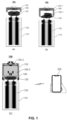
- FIG. 1 is a configuration diagram showing a device for checking the remaining capacity of a rechargeable battery according to the present invention
- FIG. 2 is a block diagram showing the circuit unit of a device for checking the remaining capacity of a rechargeable battery according to the present invention.
- the device for checking the remaining capacity of a rechargeable battery of the present invention may be configured to comprise a rechargeable battery 100 and a portable terminal 200.
- a circuit unit 130 and a lithium-ion battery 120 may be embedded inside a case 110.
- said circuit unit 130 may be provided on the upper of the lithium-ion battery 120, but is not limited thereto.
- a cover 140 may be fixedly coupled to the upper part of said case 110, and a circular anode (+) plate 150 may be inserted and fixed to the upper surface of said cover 140.
- the circuit unit 130, USB c-type connection terminal 160 and lithium-ion battery 120 may be embedded inside said case 110.
- said circuit unit 130 may be provided on the upper of the lithium-ion battery 120, and the USB c-type connection terminal 160-1 is provided on the side of said circuit unit 130, but is not limited thereto.
- the cover 140 may be fixedly coupled to the upper part of said case 110.
- the semicircular anode (+) plate 150-1 may be inserted and fixed to one side of the upper surface of said cover 140, and the USB c-type connection terminal 160-1 may be provided inside a hole formed through the cover 140 on the side of said semicircular anode (+) plate 150-1.
- the circuit unit 130 and lithium-ion battery 120 may be embedded inside the case 110.
- said circuit unit 130 may be provided on the upper of the lithium-ion battery 120, but is not limited thereto.
- the cover 140 may be fixedly coupled to the upper part of said case 110, and a USB a-type connection terminal 160-2 may be fixedly coupled to the upper surface of said cover 140.
- Said USB a-type connection terminal 160-2 may be covered by a lid 170, with said lid 170 being detachable from the case 110.
- said lid 170 may have a circular anode (+) plate 150-2 formed on its upper surface that is in contact with the USB a-type connection terminal 160-2.
- said lid 170 may have a magnet embedded along the circular perimeter of its lower end, allowing it to be detached from the USB a-type connection terminal 160-2 and attached to the case 110 when charging. As a result, loss of the lid 170 may be fundamentally prevented.
- Said cover 140 may be made of transparent or semi-transparent plastic material.
- Said circuit unit 130 may be configured to comprise a power supply unit 131, a storage unit 132, a control unit 133, an LED 134, and a communication unit 135.
- Said power supply unit 131 may fundamentally protect the lithium-ion battery 120 since a voltage conversion circuit is configured with 5V power supply and a charge protection circuit function.
- Said storage unit 132 may store data of the rechargeable battery 100, such as the manufacturing date, remaining battery capacity during charging, charging start time, charging completion time, number of charges, remaining battery capacity during discharging, discharging start time, discharging completion time, and number of discharges.
- Said control unit 133 may transmit the data of the storage unit 132 through the communication unit 135 upon request from the portable terminal 200. That is, said control unit 133 may transmit data stored in the storage unit 132 through the communication unit 135 upon request from the portable terminal 200, such as the manufacturing date, remaining battery capacity during charging, charging start time, charging completion time, number of charges, remaining battery capacity during discharging, discharging start time, discharging completion time, and number of discharges.
- control unit 133 may calculate the self-discharge rate (self-discharge time) based on the interval between the charging completion time of the storage unit 132 and the start time of use and transmit it to the portable terminal 200 through the communication unit 135.
- said control unit 133 may set an alarm when the lithium-ion battery 120 is discharged to 20% or less and when charged to 95% or more, and transmit it to the portable terminal 200 app through the communication unit 134. At this time, said alarm setting may be sent to the portable terminal 200.
- control unit 133 may control the power supply unit 131, the storage unit 132, the LED 134, and the communication unit 135.
- Said LED 134 is a green LED that indicates the charging state of the lithium-ion battery, repeatedly flashing on and off for one-second intervals during charging, and remaining illuminated once charging is complete. At this time, it is possible to check the charging status through the green LED light emitted by passing through the cover 140 made of transparent or semi-transparent plastic material.
- Said communication unit 135 may transmit data from the storage unit 132 to the portable terminal 200.
- said communication unit 135 may wirelessly transmit through ZigBee, Wi-Fi, Bluetooth, etc., and preferably may wirelessly transmit through Bluetooth.
- the portable terminal 200 may display, store, and manage data of the rechargeable battery 100 through an app.
- FIG. 3 is a block diagram showing the charging and discharging circuit according to the present invention.
- the StepDown Regulator 310 is operated for 1.5V discharging, and the Charge Control 320 may be disabled. At this time, the voltage/current output from the lithium-ion battery 120 may be detected and sent to the outside through the BLE 330 when necessary.
- the BLE 330 may monitor the voltage to select discharge/charge.
- the battery When the voltage at the (+) terminal 340 is detected to be 4.2V, which is higher than 1.5V, the battery may be charged by enabling charge control and operating Charge Control 320. At this time, the operation of the StepDown Regulator 310 may be stopped by disabling the discharge control. Here, the StepDown Regulator 3I0 may be protected against reverse current using the Blocking Diode 350.
Landscapes
- Chemical & Material Sciences (AREA)
- General Chemical & Material Sciences (AREA)
- Chemical Kinetics & Catalysis (AREA)
- Electrochemistry (AREA)
- Engineering & Computer Science (AREA)
- Manufacturing & Machinery (AREA)
- General Physics & Mathematics (AREA)
- Physics & Mathematics (AREA)
- Microelectronics & Electronic Packaging (AREA)
- Materials Engineering (AREA)
- Power Engineering (AREA)
- Business, Economics & Management (AREA)
- Emergency Management (AREA)
- Charge And Discharge Circuits For Batteries Or The Like (AREA)
- Secondary Cells (AREA)
- Tests Of Electric Status Of Batteries (AREA)
Abstract
Description
- The present invention relates to a device for checking the remaining capacity of a rechargeable battery, and more particularly, to a device capable of checking the remaining capacity of a rechargeable battery with a portable terminal.
- Portable electronic devices usually operate using at least one DC 1.5V battery, and as their functionalities diversify, power consumption increases, leading to higher battery consumption, prompting the need to recharge the batteries for continued use.
- To charge such a battery, the battery was stored in the housing of the charging device and supplied with commercial AC power or vehicle cigar power through a charging cable extending from one side of the housing, which was then converted to match the charging voltage of the battery, enabling the charging process.
- Recently, a USB rechargeable battery that connects a USB terminal to a USB connection terminal to charge a lithium battery cell has been disclosed, as in
Korean Patent Publication No. 10-2269644 - However, such a conventional USB rechargeable battery has a problem that it is difficult to check the remaining capacity when charging and using it.
- The object of the present invention to solve the above problems is to provide a device for checking the remaining capacity of a rechargeable battery that capable of allowing users to monitor the remaining capacity of a rechargeable battery through a portable terminal application.
- In order to achieve the above object, a device for checking the remaining capacity of a rechargeable battery of the present invention is characterized by comprising: a rechargeable battery comprising a lithium-ion battery and a circuit unit; and a portable terminal for displaying, storing, and managing data of said rechargeable battery stored in the storage unit of the circuit unit through an app, such as the manufacturing date, remaining battery capacity during charging, charging start time, charging completion time, number of charges, remaining battery capacity during discharging, discharging start time, discharging completion time, and number of discharges.
- Said circuit unit is characterized by comprising: a power supply unit for supplying power and having a charge protection circuit function; a storage unit for storing said data; a control unit for controlling the power supply unit, storage unit, LED, and communication unit, and transmitting said data of the storage unit to the portable terminal upon request through the communication unit; an LED for indicating the charging status of said lithium-ion battery; and a communication unit for transmitting said data of the storage unit to the portable terminal.
- Said rechargeable battery is characterized by comprising: a circuit unit and lithium-ion battery embedded inside a case; a cover fixedly coupled to the upper part of said case; and a circular anode (+) plate inserted and fixed to the upper surface of said cover.
- Said rechargeable battery is characterized by having a circuit unit, USB c-type connection terminal and lithium-ion battery embedded inside a case; a cover fixedly coupled to the upper part of said case; a semicircular anode (+) plate inserted and fixed to one side of the upper surface of said cover; and a USB c-type connection terminal inside a hole formed through the cover on the side of said semicircular anode (+) plate.
- Said USB c-type connection terminal is characterized by providing on the side of the circuit unit.
- Said rechargeable battery is characterized by comprising: a circuit unit and lithium-ion battery embedded inside a case; a cover fixedly coupled to the upper part of said case; a USB a-type connection terminal fixedly coupled to the upper surface of said cover; a lid covering said USB a-type connection terminal; and a circular anode (+) plate in contact with the USB a-type connection terminal on the upper surface of said lid.
- Said lid is characterized by being detachable from the case, with a magnet embedded along the circular perimeter of its lower end.
- Said cover is characterized by being made of transparent or semi-transparent plastic material.
- Said control unit is characterized by calculating the self-discharge rate based on the interval between the charging completion time of the storage unit and the start time of use, and transmitting it to the portable terminal through the communication unit.
- Said control unit is characterized by setting an alarm when the lithium-ion battery is discharged to 20% or less and when charged to 95% or more, and transmitting this to the portable terminal through the communication unit.
- As described above, according to the present invention, since the remaining capacity of the rechargeable battery may be checked through the portable terminal app, charging and replacement may be conveniently managed.
-
-
FIG. 1 is a configuration diagram showing a device for checking the remaining capacity of a rechargeable battery according to the present invention. -
FIG. 2 is a block diagram showing a circuit unit of the device for checking the remaining capacity of a rechargeable battery according to the present invention. -
FIG. 3 is a block diagram showing the charging and discharging circuit according to the present invention. - Below, with reference to the attached drawings, embodiments of the present invention will be described in detail so that those skilled in the art may readily implement the present invention. However, the present invention may be implemented in various different forms and is not limited to the embodiments described herein.
- Next, an embodiment of a device for checking the remaining capacity of a rechargeable battery according to the present invention will be described in detail.
-
FIG. 1 is a configuration diagram showing a device for checking the remaining capacity of a rechargeable battery according to the present invention, andFIG. 2 is a block diagram showing the circuit unit of a device for checking the remaining capacity of a rechargeable battery according to the present invention. - Referring to
FIGs. 1 and2 , the device for checking the remaining capacity of a rechargeable battery of the present invention may be configured to comprise arechargeable battery 100 and aportable terminal 200. - Referring to
FIG. 1(a) , in saidrechargeable battery 100, acircuit unit 130 and a lithium-ion battery 120 may be embedded inside acase 110. Here, saidcircuit unit 130 may be provided on the upper of the lithium-ion battery 120, but is not limited thereto. - A
cover 140 may be fixedly coupled to the upper part of saidcase 110, and a circular anode (+)plate 150 may be inserted and fixed to the upper surface of saidcover 140. - Referring to
FIG. 1(b) , in saidrechargeable battery 100, thecircuit unit 130, USB c-type connection terminal 160 and lithium-ion battery 120 may be embedded inside saidcase 110. Here, saidcircuit unit 130 may be provided on the upper of the lithium-ion battery 120, and the USB c-type connection terminal 160-1 is provided on the side of saidcircuit unit 130, but is not limited thereto. - The
cover 140 may be fixedly coupled to the upper part of saidcase 110. Here, The semicircular anode (+) plate 150-1 may be inserted and fixed to one side of the upper surface of saidcover 140, and the USB c-type connection terminal 160-1 may be provided inside a hole formed through thecover 140 on the side of said semicircular anode (+) plate 150-1. - Referring to
FIG. 1(c) , in saidrechargeable battery 100, thecircuit unit 130 and lithium-ion battery 120 may be embedded inside thecase 110. Here, saidcircuit unit 130 may be provided on the upper of the lithium-ion battery 120, but is not limited thereto. - The
cover 140 may be fixedly coupled to the upper part of saidcase 110, and a USB a-type connection terminal 160-2 may be fixedly coupled to the upper surface of saidcover 140. - Said USB a-type connection terminal 160-2 may be covered by a
lid 170, with saidlid 170 being detachable from thecase 110. Here, saidlid 170 may have a circular anode (+) plate 150-2 formed on its upper surface that is in contact with the USB a-type connection terminal 160-2. - Meanwhile, said
lid 170 may have a magnet embedded along the circular perimeter of its lower end, allowing it to be detached from the USB a-type connection terminal 160-2 and attached to thecase 110 when charging. As a result, loss of thelid 170 may be fundamentally prevented. - Said
cover 140 may be made of transparent or semi-transparent plastic material. - Said
circuit unit 130 may be configured to comprise apower supply unit 131, astorage unit 132, acontrol unit 133, anLED 134, and acommunication unit 135. - Said
power supply unit 131 may fundamentally protect the lithium-ion battery 120 since a voltage conversion circuit is configured with 5V power supply and a charge protection circuit function. - Said
storage unit 132 may store data of therechargeable battery 100, such as the manufacturing date, remaining battery capacity during charging, charging start time, charging completion time, number of charges, remaining battery capacity during discharging, discharging start time, discharging completion time, and number of discharges. - Said
control unit 133 may transmit the data of thestorage unit 132 through thecommunication unit 135 upon request from theportable terminal 200. That is, saidcontrol unit 133 may transmit data stored in thestorage unit 132 through thecommunication unit 135 upon request from theportable terminal 200, such as the manufacturing date, remaining battery capacity during charging, charging start time, charging completion time, number of charges, remaining battery capacity during discharging, discharging start time, discharging completion time, and number of discharges. - In addition, said
control unit 133 may calculate the self-discharge rate (self-discharge time) based on the interval between the charging completion time of thestorage unit 132 and the start time of use and transmit it to theportable terminal 200 through thecommunication unit 135. - Then, said
control unit 133 may set an alarm when the lithium-ion battery 120 is discharged to 20% or less and when charged to 95% or more, and transmit it to theportable terminal 200 app through thecommunication unit 134. At this time, said alarm setting may be sent to theportable terminal 200. - Furthermore, said
control unit 133 may control thepower supply unit 131, thestorage unit 132, theLED 134, and thecommunication unit 135. - Said
LED 134 is a green LED that indicates the charging state of the lithium-ion battery, repeatedly flashing on and off for one-second intervals during charging, and remaining illuminated once charging is complete. At this time, it is possible to check the charging status through the green LED light emitted by passing through thecover 140 made of transparent or semi-transparent plastic material. - Said
communication unit 135 may transmit data from thestorage unit 132 to theportable terminal 200. Here, saidcommunication unit 135 may wirelessly transmit through ZigBee, Wi-Fi, Bluetooth, etc., and preferably may wirelessly transmit through Bluetooth. - The
portable terminal 200 may display, store, and manage data of therechargeable battery 100 through an app. -
FIG. 3 is a block diagram showing the charging and discharging circuit according to the present invention. - Referring to
FIG. 3 , the StepDown Regulator 310 is operated for 1.5V discharging, and the Charge Control 320 may be disabled. At this time, the voltage/current output from the lithium-ion battery 120 may be detected and sent to the outside through the BLE 330 when necessary. Here, the BLE 330 may monitor the voltage to select discharge/charge. - When the voltage at the (+) terminal 340 is detected to be 4.2V, which is higher than 1.5V, the battery may be charged by enabling charge control and operating
Charge Control 320. At this time, the operation of theStepDown Regulator 310 may be stopped by disabling the discharge control. Here, the StepDown Regulator 3I0 may be protected against reverse current using theBlocking Diode 350. - Although the embodiments of the present invention have been described in detail above, the scope of the present invention is not limited thereto, and various modifications and improvements by those skilled in the art using the basic concepts of the present invention, as defined in the following claims, also belong to the scope of the present invention.
Claims (9)
- A device for checking the remaining capacity of a rechargeable battery, comprising:a rechargeable battery comprising a lithium-ion battery and a circuit unit; anda portable terminal for displaying, storing, and managing data of the rechargeable battery stored in the storage unit of the circuit unit through an app, such as the manufacturing date, remaining battery capacity during charging, charging start time, charging completion time, number of charges, remaining battery capacity during discharging, discharging start time, discharging completion time, and number of discharges;wherein the circuit unit comprises:a power supply unit for supplying power and having a charge protection circuit function;a storage unit for storing the data;a control unit for controlling the power supply unit, storage unit, LED, and communication unit, and transmitting the data of the storage unit to the portable terminal upon request through the communication unit;an LED for indicating the charging status of the lithium-ion battery; anda communication unit for transmitting the data of the storage unit to the portable terminal.
- The device for checking the remaining capacity of a rechargeable battery according to claim 1, wherein the rechargeable battery comprises:a circuit unit and lithium-ion battery embedded inside a case;a cover fixedly coupled to the upper part of the case; anda circular anode (+) plate inserted and fixed to the upper surface of the cover.
- The device for checking the remaining capacity of a rechargeable battery according to claim 1, wherein the rechargeable battery has:a circuit unit, USB c-type connection terminal and lithium-ion battery embedded inside a case;a cover fixedly coupled to the upper part of the case;a semicircular anode (+) plate inserted and fixed to one side of the upper surface of the cover; anda USB c-type connection terminal inside a hole formed through the cover on the side of the semicircular anode (+) plate.
- The device for checking the remaining capacity of a rechargeable battery according to claim 3, wherein the USB c-type connection terminal is provided on the side of the circuit unit.
- The device for checking the remaining capacity of a rechargeable battery according to claim 1, wherein the rechargeable battery comprises:a circuit unit and lithium-ion battery embedded inside a case;a cover fixedly coupled to the upper part of the case;a USB a-type connection terminal fixedly coupled to the upper surface of the cover;a lid covering the USB a-type connection terminal; anda circular anode (+) plate in contact with the USB a-type connection terminal on the upper surface of the lid.
- The device for checking the remaining capacity of a rechargeable battery according to claim 5, wherein the lid is detachable from the case, with a magnet embedded along the circular perimeter of its lower end.
- The device for checking the remaining capacity of a rechargeable battery according to any one of claims 2 to 6, wherein the cover is made of transparent or semi-transparent plastic material.
- The device for checking the remaining capacity of a rechargeable battery according to claim 1, wherein the control unit calculates the self-discharge rate based on the interval between the charging completion time of the storage unit and the start time of use and transmits it to the portable terminal through the communication unit.
- The device for checking the remaining capacity of a rechargeable battery according to claim 1, wherein the control unit sets an alarm when the lithium-ion battery is discharged to 20% or less and when charged to 95% or more, and transmits this to the portable terminal through the communication unit.
Applications Claiming Priority (2)
| Application Number | Priority Date | Filing Date | Title |
|---|---|---|---|
| KR1020230000721A KR20240109321A (en) | 2023-01-03 | 2023-01-03 | Device for remaining chargeable battery |
| PCT/KR2023/016675 WO2024147455A1 (en) | 2023-01-03 | 2023-10-25 | Device for identifying remaining capacity of rechargeable battery |
Publications (2)
| Publication Number | Publication Date |
|---|---|
| EP4450987A1 true EP4450987A1 (en) | 2024-10-23 |
| EP4450987A4 EP4450987A4 (en) | 2025-06-11 |
Family
ID=91803770
Family Applications (1)
| Application Number | Title | Priority Date | Filing Date |
|---|---|---|---|
| EP23914919.8A Pending EP4450987A4 (en) | 2023-01-03 | 2023-10-25 | Device for detecting the remaining capacity of a rechargeable battery |
Country Status (6)
| Country | Link |
|---|---|
| US (1) | US20250105385A1 (en) |
| EP (1) | EP4450987A4 (en) |
| JP (1) | JP7808896B2 (en) |
| KR (2) | KR20240109321A (en) |
| CN (1) | CN118613732A (en) |
| WO (1) | WO2024147455A1 (en) |
Family Cites Families (11)
| Publication number | Priority date | Publication date | Assignee | Title |
|---|---|---|---|---|
| GB2420659B (en) * | 2004-11-25 | 2006-10-11 | Simon Richard Daniel | Collapsible rechargeable battery assembly with integral connector |
| WO2006056744A1 (en) * | 2004-11-25 | 2006-06-01 | Moixa Energy Holdings Limited | Rechargeable battery assembly |
| KR100656588B1 (en) * | 2006-02-10 | 2006-12-13 | 삼성전자주식회사 | Portable terminal capable of displaying remaining battery information for easy identification of additional external battery installation and method thereof |
| CN105191051B (en) * | 2013-03-29 | 2018-01-02 | 松下知识产权经营株式会社 | Battery pack |
| KR101505664B1 (en) * | 2014-08-08 | 2015-03-24 | (주) 제이앤케이사이언스 | Rechargeable battery with universal serial bus connecter |
| GB2529857B (en) * | 2014-09-04 | 2017-11-01 | Samsung Electronics Co Ltd | Method and apparatus for battery charge monitoring |
| KR20190072035A (en) * | 2017-12-15 | 2019-06-25 | 정유진 | usb |
| KR102096462B1 (en) * | 2019-08-21 | 2020-04-02 | 박용진 | System for managing electric wheelchair |
| KR102269644B1 (en) | 2020-05-08 | 2021-06-25 | 주식회사 바스맨테크놀러지 | Battery of USB Charge Type |
| CN212085112U (en) * | 2020-06-24 | 2020-12-04 | 刘晓晓 | Rechargeable battery with USB charging function |
| JP2022071900A (en) * | 2020-10-29 | 2022-05-17 | シェアード・モビリティ・ネットワークス株式会社 | Estimation system, and estimation program |
-
2023
- 2023-01-03 KR KR1020230000721A patent/KR20240109321A/en not_active Ceased
- 2023-10-25 JP JP2024553361A patent/JP7808896B2/en active Active
- 2023-10-25 EP EP23914919.8A patent/EP4450987A4/en active Pending
- 2023-10-25 CN CN202380018323.0A patent/CN118613732A/en active Pending
- 2023-10-25 US US18/730,344 patent/US20250105385A1/en active Pending
- 2023-10-25 WO PCT/KR2023/016675 patent/WO2024147455A1/en not_active Ceased
-
2024
- 2024-09-15 KR KR1020240126286A patent/KR20240144024A/en active Pending
Also Published As
| Publication number | Publication date |
|---|---|
| CN118613732A (en) | 2024-09-06 |
| US20250105385A1 (en) | 2025-03-27 |
| KR20240109321A (en) | 2024-07-11 |
| KR20240144024A (en) | 2024-10-02 |
| JP7808896B2 (en) | 2026-01-30 |
| EP4450987A4 (en) | 2025-06-11 |
| WO2024147455A1 (en) | 2024-07-11 |
| JP2025511501A (en) | 2025-04-16 |
Similar Documents
| Publication | Publication Date | Title |
|---|---|---|
| US11764593B2 (en) | Power supply unit | |
| JP3666307B2 (en) | Portable electronic device having a method for displaying the remaining amount of secondary battery and a method for displaying the remaining amount of secondary battery | |
| KR200469779Y1 (en) | Auxiliary battery charger for mobile phone | |
| EP2800195B1 (en) | Smart charging algorithm of lithium ion battery | |
| WO2018195676A1 (en) | Multifunctional charging box | |
| US20160043585A1 (en) | Rapid Charging Mobile Electronic Device Battery Case | |
| JP2008131707A (en) | Charger for mobile phone | |
| CN110940230B (en) | Chargeable sighting telescope support and sighting telescope with same | |
| CN104734281A (en) | Wearable portable power source and power supply control method thereof | |
| US12567754B2 (en) | Multi-port charger and battery pack multi-port charger set | |
| KR101618954B1 (en) | Battery charging device for electric chemical light, having alarm function | |
| EP4450987A1 (en) | Device for identifying remaining capacity of rechargeable battery | |
| US20230231211A1 (en) | Hybrid Battery Cartridge | |
| KR101762701B1 (en) | A system for supplying mobile power to mobile device | |
| CN201608750U (en) | Battery-replaceable standby power supply of mobile phone | |
| JP2018121401A (en) | Charging adaptor | |
| CN211626252U (en) | A rechargeable sight holder and sight having the same | |
| CN113595191A (en) | Outdoor portable energy storage power supply of explosion-proof type | |
| JP2026508033A (en) | Mobile power supply control system, mobile power supply and charging station | |
| WO2018057705A1 (en) | Rechargeable product with on board disposable battery charging | |
| CN210536324U (en) | Multifunctional charger | |
| KR20150106296A (en) | Auxliary battery for mobile device | |
| CN217183481U (en) | Bluetooth worker's tablet and bluetooth worker's tablet equipment | |
| KR20080004844U (en) | Portable Cradle Charger for Mobile Devices | |
| JP2004071243A (en) | Battery pack |
Legal Events
| Date | Code | Title | Description |
|---|---|---|---|
| STAA | Information on the status of an ep patent application or granted ep patent |
Free format text: STATUS: THE INTERNATIONAL PUBLICATION HAS BEEN MADE |
|
| PUAI | Public reference made under article 153(3) epc to a published international application that has entered the european phase |
Free format text: ORIGINAL CODE: 0009012 |
|
| STAA | Information on the status of an ep patent application or granted ep patent |
Free format text: STATUS: REQUEST FOR EXAMINATION WAS MADE |
|
| 17P | Request for examination filed |
Effective date: 20240719 |
|
| AK | Designated contracting states |
Kind code of ref document: A1 Designated state(s): AL AT BE BG CH CY CZ DE DK EE ES FI FR GB GR HR HU IE IS IT LI LT LU LV MC ME MK MT NL NO PL PT RO RS SE SI SK SM TR |
|
| STAA | Information on the status of an ep patent application or granted ep patent |
Free format text: STATUS: EXAMINATION IS IN PROGRESS |
|
| A4 | Supplementary search report drawn up and despatched |
Effective date: 20250513 |
|
| RIC1 | Information provided on ipc code assigned before grant |
Ipc: H01M 50/152 20210101ALI20250507BHEP Ipc: H01M 50/107 20210101ALI20250507BHEP Ipc: H01M 10/052 20100101ALI20250507BHEP Ipc: H01M 50/569 20210101ALI20250507BHEP Ipc: G01R 31/371 20190101ALI20250507BHEP Ipc: G01R 31/382 20190101ALI20250507BHEP Ipc: G01R 31/36 20200101AFI20250507BHEP |
|
| 17Q | First examination report despatched |
Effective date: 20250523 |
|
| DAV | Request for validation of the european patent (deleted) | ||
| DAX | Request for extension of the european patent (deleted) |