EP4450876A1 - Combustion device comprising orthogonally arranged channels - Google Patents
Combustion device comprising orthogonally arranged channels Download PDFInfo
- Publication number
- EP4450876A1 EP4450876A1 EP22907570.0A EP22907570A EP4450876A1 EP 4450876 A1 EP4450876 A1 EP 4450876A1 EP 22907570 A EP22907570 A EP 22907570A EP 4450876 A1 EP4450876 A1 EP 4450876A1
- Authority
- EP
- European Patent Office
- Prior art keywords
- fuel
- channels
- pilot
- air
- main
- Prior art date
- Legal status (The legal status is an assumption and is not a legal conclusion. Google has not performed a legal analysis and makes no representation as to the accuracy of the status listed.)
- Pending
Links
Images






Classifications
-
- F—MECHANICAL ENGINEERING; LIGHTING; HEATING; WEAPONS; BLASTING
- F23—COMBUSTION APPARATUS; COMBUSTION PROCESSES
- F23R—GENERATING COMBUSTION PRODUCTS OF HIGH PRESSURE OR HIGH VELOCITY, e.g. GAS-TURBINE COMBUSTION CHAMBERS
- F23R3/00—Continuous combustion chambers using liquid or gaseous fuel
- F23R3/28—Continuous combustion chambers using liquid or gaseous fuel characterised by the fuel supply
-
- F—MECHANICAL ENGINEERING; LIGHTING; HEATING; WEAPONS; BLASTING
- F23—COMBUSTION APPARATUS; COMBUSTION PROCESSES
- F23R—GENERATING COMBUSTION PRODUCTS OF HIGH PRESSURE OR HIGH VELOCITY, e.g. GAS-TURBINE COMBUSTION CHAMBERS
- F23R3/00—Continuous combustion chambers using liquid or gaseous fuel
- F23R3/28—Continuous combustion chambers using liquid or gaseous fuel characterised by the fuel supply
- F23R3/34—Feeding into different combustion zones
- F23R3/343—Pilot flames, i.e. fuel nozzles or injectors using only a very small proportion of the total fuel to insure continuous combustion
-
- F—MECHANICAL ENGINEERING; LIGHTING; HEATING; WEAPONS; BLASTING
- F23—COMBUSTION APPARATUS; COMBUSTION PROCESSES
- F23R—GENERATING COMBUSTION PRODUCTS OF HIGH PRESSURE OR HIGH VELOCITY, e.g. GAS-TURBINE COMBUSTION CHAMBERS
- F23R3/00—Continuous combustion chambers using liquid or gaseous fuel
- F23R3/02—Continuous combustion chambers using liquid or gaseous fuel characterised by the air-flow or gas-flow configuration
- F23R3/04—Air inlet arrangements
-
- F—MECHANICAL ENGINEERING; LIGHTING; HEATING; WEAPONS; BLASTING
- F23—COMBUSTION APPARATUS; COMBUSTION PROCESSES
- F23R—GENERATING COMBUSTION PRODUCTS OF HIGH PRESSURE OR HIGH VELOCITY, e.g. GAS-TURBINE COMBUSTION CHAMBERS
- F23R3/00—Continuous combustion chambers using liquid or gaseous fuel
- F23R3/02—Continuous combustion chambers using liquid or gaseous fuel characterised by the air-flow or gas-flow configuration
- F23R3/16—Continuous combustion chambers using liquid or gaseous fuel characterised by the air-flow or gas-flow configuration with devices inside the flame tube or the combustion chamber to influence the air or gas flow
- F23R3/18—Flame stabilising means, e.g. flame holders for after-burners of jet-propulsion plants
-
- F—MECHANICAL ENGINEERING; LIGHTING; HEATING; WEAPONS; BLASTING
- F23—COMBUSTION APPARATUS; COMBUSTION PROCESSES
- F23R—GENERATING COMBUSTION PRODUCTS OF HIGH PRESSURE OR HIGH VELOCITY, e.g. GAS-TURBINE COMBUSTION CHAMBERS
- F23R3/00—Continuous combustion chambers using liquid or gaseous fuel
- F23R3/28—Continuous combustion chambers using liquid or gaseous fuel characterised by the fuel supply
- F23R3/283—Attaching or cooling of fuel injecting means including supports for fuel injectors, stems, or lances
-
- F—MECHANICAL ENGINEERING; LIGHTING; HEATING; WEAPONS; BLASTING
- F23—COMBUSTION APPARATUS; COMBUSTION PROCESSES
- F23R—GENERATING COMBUSTION PRODUCTS OF HIGH PRESSURE OR HIGH VELOCITY, e.g. GAS-TURBINE COMBUSTION CHAMBERS
- F23R3/00—Continuous combustion chambers using liquid or gaseous fuel
- F23R3/42—Continuous combustion chambers using liquid or gaseous fuel characterised by the arrangement or form of the flame tubes or combustion chambers
- F23R3/46—Combustion chambers comprising an annular arrangement of several essentially tubular flame tubes within a common annular casing or within individual casings
-
- F—MECHANICAL ENGINEERING; LIGHTING; HEATING; WEAPONS; BLASTING
- F02—COMBUSTION ENGINES; HOT-GAS OR COMBUSTION-PRODUCT ENGINE PLANTS
- F02C—GAS-TURBINE PLANTS; AIR INTAKES FOR JET-PROPULSION PLANTS; CONTROLLING FUEL SUPPLY IN AIR-BREATHING JET-PROPULSION PLANTS
- F02C3/00—Gas-turbine plants characterised by the use of combustion products as the working fluid
- F02C3/20—Gas-turbine plants characterised by the use of combustion products as the working fluid using a special fuel, oxidant, or dilution fluid to generate the combustion products
-
- F—MECHANICAL ENGINEERING; LIGHTING; HEATING; WEAPONS; BLASTING
- F05—INDEXING SCHEMES RELATING TO ENGINES OR PUMPS IN VARIOUS SUBCLASSES OF CLASSES F01-F04
- F05D—INDEXING SCHEME FOR ASPECTS RELATING TO NON-POSITIVE-DISPLACEMENT MACHINES OR ENGINES, GAS-TURBINES OR JET-PROPULSION PLANTS
- F05D2240/00—Components
- F05D2240/35—Combustors or associated equipment
-
- F—MECHANICAL ENGINEERING; LIGHTING; HEATING; WEAPONS; BLASTING
- F23—COMBUSTION APPARATUS; COMBUSTION PROCESSES
- F23R—GENERATING COMBUSTION PRODUCTS OF HIGH PRESSURE OR HIGH VELOCITY, e.g. GAS-TURBINE COMBUSTION CHAMBERS
- F23R2900/00—Special features of, or arrangements for continuous combustion chambers; Combustion processes therefor
- F23R2900/00002—Gas turbine combustors adapted for fuels having low heating value [LHV]
Definitions
- the present disclosure relates to combustion devices, and more specifically, to a combustion device including channels arranged orthogonally.
- a combustion device in which fuel channels and air channels are arranged orthogonally to increase a flame density and reduce generation of NOx.
- a combustion device includes a fuel manifold configured to distribute fuel flowing into one or more fuel inlets, a plurality of fuel channels configured to receive the fuel from the fuel manifold and including one or more fuel spraying holes in one end, an air inlet duct arranged to surround the plurality of fuel channels, a combustion plate configured to support one end of each of the fuel channels and including a plurality of air channels that guide air introduced into the air inlet duct in a direction perpendicular to a fuel spraying direction of the fuel injection holes, and a combustion chamber disposed toward the combustion plate.
- the one or more fuel spraying holes may be disposed in a lateral surface of one end of the fuel channel, and the plurality of air channels may be holes or slits formed in the combustion plate to correspond to the plurality of fuel spraying holes.
- the combustion plate may be disposed more inward in a direction toward the fuel inlet than the fuel spraying hole.
- a plurality of fuel spraying holes may be disposed in a lateral surface of the fuel channel at regular intervals, and the plurality of air channels may be arranged in a cross shape to correspond to the plurality of fuel spraying holes.
- the one or more fuel inlets may include a main fuel inlet configured to supply main fuel to a plurality of main fuel channels among the plurality of fuel channels, and a pilot fuel inlet configured to supply pilot fuel to a plurality of pilot fuel channels among the plurality of fuel channels.
- the combustion plate may include a plurality of segments arranged in a first direction and a second direction perpendicular to the first direction, the plurality of main fuel channels may be respectively disposed at nodes where corners of the plurality of segments meet each other, and the plurality of pilot fuel channels may be disposed at respective centers of the segments.
- a fuel spraying hole of the main fuel channel and a fuel spraying hole of the pilot fuel channel may have different fuel spraying angles.
- a fuel spraying hole of the main fuel channel may be disposed such that a fuel spraying angle is inclined by 45 degrees with respect to a fuel spraying angle of a fuel spraying hole of the pilot fuel channel.
- the plurality of air channels may include a plurality of main air channels corresponding to fuel spraying holes of the main fuel channel, and a plurality of pilot air channels corresponding to fuel spraying holes of the pilot fuel channel, and an imaginary line extending through the plurality of main air channels and an imaginary line extending through the plurality of pilot air channels may intersect each other at an angle other than a right angle.
- the plurality of main fuel channels may not be arranged on the imaginary line extending through the plurality of pilot air channels, and the plurality of pilot fuel channels may be arranged on the imaginary line extending through the plurality of main air channels.
- the fuel manifold may include one or more fuel distribution guides configured to guide main fuel flowing in from the main fuel inlet and pilot fuel flowing in from the pilot fuel inlet to different paths, respectively, and one or more distribution plates including a plurality of fuel distribution holes for supplying the main fuel and the pilot fuel distributed along the fuel distribution guide to respective one ends of the plurality of main fuel channels and respective one ends of the plurality of pilot fuel channels.
- the one or more distribution plates may include a first distribution plate and a second distribution plate sequentially arranged in a movement direction of the fuel, and a pair of fuel distribution guides may be disposed on a front surface and a rear surface of the first distribution plate, respectively.
- the plurality of fuel distribution holes included in the first distribution plate and the plurality of fuel distribution holes included in the second distribution plate may be arranged so as not to overlap each other.
- the combustion device may further include one or more air distribution plates disposed inside the air inlet duct to support the plurality of fuel channels, and including a plurality of air distribution holes.
- a combustion device includes a plurality of fuel channels having a plurality of fuel injection holes in one side, and a combustion plate including a plurality of air channels arranged to correspond to the fuel spraying holes to support respective one ends of the plurality of fuel channels and guide air perpendicularly with a fuel spraying angle of the fuel spraying holes.
- the plurality of fuel channels may include a plurality of pilot fuel channels supplying pilot fuel and a plurality of main fuel channels supplying main fuel, and a fuel spraying hole of the main fuel channel may be disposed such that a fuel spraying angle of the fuel spraying hole is inclined at a predetermined angle with respect to a fuel spraying angle of a fuel spraying hole of the pilot fuel channel.
- main fuel channels and pilot fuel channels may be arranged to cross each other while supplying main fuel and pilot fuel separately, thereby increasing flame stability and reducing NOx emissions.
- the fuel spraying angle of the main fuel channels and the fuel injection angle of the pilot fuel channels may cross each other, while the main fuel channels and the pilot fuel channels are arranged at right angles, thereby minimizing interference between adjacent flames and increasing a flame density.
- the fuel spraying angle of fuel channels and the air inlet angle of air channels may be right angles, thereby increasing combustion efficiency, minimizing interference between adjacent flames, and increasing a flame density.
- a combustion device includes a fuel manifold configured to distribute fuel flowing into one or more fuel inlets, a plurality of fuel channels configured to receive fuel from the fuel manifold and including one or more fuel spraying holes on one end, an air inlet duct arranged to surround the plurality of fuel channels, a combustion plate configured to support one end of each of the fuel channels and including a plurality of air channels that guide air introduced into the air inlet duct perpendicularly with a fuel spraying direction of the fuel injection holes, and a combustion chamber disposed toward the combustion plate.
- an x-axis, a y-axis, and a z-axis are not limited to the three axes of an orthogonal coordinate system, and may be interpreted in a broader sense.
- the x-axis, y-axis, and z-axis may be orthogonal to each other, but may refer to different directions that are not orthogonal to each other.
- a specific process order may be performed differently from the described order.
- two consecutively described processes may be performed substantially at the same time or performed in an order opposite to the described order.
- FIG. 1 shows a gas turbine engine 1 according to an embodiment of the present disclosure
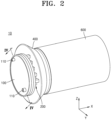
- FIG. 2 shows a combustion device 10 according to an embodiment of the present disclosure
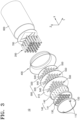
- FIG. 3 is an exploded perspective view of the combustion device 10 according to an embodiment of the present disclosure
- FIG. 4 is a cross-section taken along line IV-IV of FIG. 2
- FIGS. 5 and 6 show a fuel distribution guide 130 and a distribution plate 140 according to an embodiment of the present disclosure
- FIGS. 7 , 8 and 9 show a fuel channel 200 and a combustion plate 300 according to an embodiment of the present disclosure
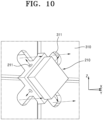
- FIG. 10 shows a main fuel channel 210 and a main air channel 311 according to an embodiment of the present disclosure
- FIG. 11 shows a pilot fuel channel 220 and a pilot air channel 312 according to an embodiment of the present disclosure.
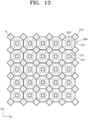
- FIGS. 12 and 13 show a fuel channel 200 and a combustion plate 300 according to an embodiment of the present disclosure
- FIG. 14 shows the gas turbine engine 1 including the combustion device 10 according to an embodiment of the present disclosure.
- the combustion device 10 may be used in the gas turbine engine 1.
- the gas turbine engine 1 may be an aviation gas turbine engine or a power generation gas turbine engine.
- the gas turbine engine 1 may be a hydrogen gas turbine engine that uses hydrogen or fuel in which liquefied natural gas and hydrogen are mixed.
- the gas turbine engine 1 may include a compressor 2, a turbine 3, a rotating shaft 4, and the combustion device 10.
- the air is compressed through the compressor 2 and then flows into the combustion device 10, and is combusted with fuel (e.g., hydrogen).
- fuel e.g., hydrogen
- the combustion gas flows into the turbine 3 to drive the turbine 3, and the rotation shaft 4 connected to the turbine 3 drives a load L.
- the combustion device 10 may include a fuel manifold 100, a fuel channel 200, an air inlet duct 400, a combustion plate 300, and a combustion chamber 600.
- the fuel manifold 100 receives fuel (e.g., hydrogen) from a fuel storage tank (not shown) and distributes the fuel to the fuel channel 200.
- the fuel manifold 100 may include one or more fuel inlets 110.
- the fuel inlet 110 may include a main fuel inlet 111 through which main fuel flows and a pilot fuel inlet 112 through which pilot fuel flows. That is, the combustion device 10 according to an embodiment of the present disclosure, which is a dual fuel combustion device 10, supplies only pilot fuel through the pilot fuel inlet 112 when the gas turbine engine 1 with a low flame temperature starts, and then, supplies only main fuel through the main fuel inlet 111 when the gas turbine engine 1 operates and thus the flame temperature rises.
- the combustion device 10 when the gas turbine engine 1 operates, supplies the pilot fuel and the main fuel together.
- the main fuel flowing in from the main fuel inlet 111 may be supplied to the main fuel channel 210, and the pilot fuel flowing in from the pilot fuel inlet 112 may be supplied to the pilot fuel channel 220.
- the fuel manifold 100 may include a support plate 120, a fuel distribution guide 130, and a distribution plate 140.
- the support plate 120 may be disposed at a front end of the combustion device 10, and one or more fuel inlets 110 may be disposed on one side of the support plate 120.
- the support plate 120 may be disposed to face the distribution plate 140, and the fuel distribution guide 130 may be disposed on one side of the support plate 120, so that the fuel flowing into the fuel inlet 110 may be distributed along the fuel distribution guide 130.
- the support plate 120 may be a circular plate or a polygonal plate.
- the fuel distribution guide 130 may be disposed on one side of the support plate 120, for example, at the rear thereof, and may also may be disposed on one side of the distribution plate 140, for example, at the front thereof.
- the fuel distribution guide 130 disposed between the support plate 120 and the distribution plate 140 may be disposed to correspond to the one or more fuel inlets 110, for example, the main fuel inlet 111 and the pilot fuel inlet 112.
- the fuel distribution guide 130 may have a curved shape to guide the main fuel flowing in from the main fuel inlet 111 and the pilot fuel flowing in from the pilot fuel inlet 112 through different paths.
- the fuel distribution guide 130 may have a shape in which a U-shape and an inverted U-shape are consecutively and repeatedly arranged.
- a height of the fuel distribution guide 130 may corresponds to a gap between the support plate 120 and the distribution plate 140 to prevent the fuel flowing into the fuel inlet 110 from moving beyond the fuel distribution guide 130 to another area.
- the fuel distribution guide 130 may partition a plurality of fuel distribution holes 143 formed in the distribution plate 140.
- the fuel distribution guide 130 may be arranged to separate the plurality of fuel distribution holes 143 into main fuel distribution holes 143a and pilot fuel distribution holes 143b. That is, the main fuel entering through the main fuel inlet 111 may pass through the distribution plate 140 only through the main fuel distribution hole 143a by the fuel distribution guide 130 and may flow into the main fuel channel 210, and the pilot fuel entering through the pilot fuel inlet 112 may pass through the distribution plate 140 only through the pilot fuel distribution hole 143b by the fuel distribution guide 130 and flow into the pilot fuel channel 220.
- the fuel distribution guides 130 may be provided as a pair having the same or different shapes. As shown in FIG. 6 , a pair of fuel distribution guides 130 may be disposed on both sides of the distribution plate 140, more specifically, a first distribution plate 141. One fuel distribution plate 140 may be disposed between the support plate 120 and the first distribution plate 141, and the remaining fuel distribution plates 140 may be disposed between the first distribution plate 141 and a second distribution plate 142.
- the distribution plate 140 may distribute the fuel flowing in through the fuel inlet 110 into different paths and supply the fuel to a plurality of fuel channels 200.
- the distribution plate 140 may be disposed between the fuel inlets 110 and the fuel channels 200 and may include a plurality of fuel distribution holes 143.
- the distribution plate 140 may include the main fuel distribution holes 143a and the pilot fuel distribution holes 143b.
- the main fuel distribution holes 143a and the pilot fuel distribution holes 143b may be arranged alternately in a plurality of rows.
- a plurality of main fuel distribution holes 143a and a plurality of pilot fuel distribution holes 143b may be arranged so as not to overlap each other in a horizontal direction and a vertical direction.
- each main fuel distribution hole 143a may have a greater cross-sectional area than each pilot fuel distribution hole 143b.
- the distribution plate 140 may include the first distribution plate 141 and the second distribution plate 142. As shown in FIGS. 3 and 4 , the first distribution plate 141 and the second distribution plate 142 may be arranged in order in a fuel inflow direction. The first distribution plate 141 may face the support plate 120, and the second distribution plate 142 may be connected to the fuel channels 200. Additionally, the fuel distribution guide 130 may be disposed between the first distribution plate 141 and the second distribution plate 142.
- the fuel distribution holes 143 of the first distribution plate 141 and those of the second distribution plate 142 may be different in terms of at least one of the number, a shape, and an arrangement.
- the fuel distribution holes 143 formed in the first distribution plate 141 and the fuel distribution hole 143 formed in the second distribution plate 142 may be arranged so as not to overlap each other in the direction of movement of the fuel, and may also be provided in different numbers.
- the fuel distribution holes 143 of the second distribution plate 142 may be provided to correspond to the number of fuel channels 200 and the arrangement thereof.
- the fuel distribution holes 143 of the second distribution plate 142 may include 25 main fuel distribution holes 143a, and may include 16 pilot fuel distribution holes 143b between them.
- the fuel distribution holes 143 of the first distribution plate 141 may be arranged so as not to overlap the fuel distribution holes 143 of the second distribution plate 142. Accordingly, the fuel flowing into the fuel inlet 110 may be distributed more smoothly and supplied to the fuel channels 200.
- the fuel channels 200 may receive fuel from the fuel manifold 100 and spray the fuel into the combustion chamber 600. Respective one ends of the plurality of fuel channels 200 may be connected to an end of the fuel manifold 100, for example, to the second distribution plate 142, and the other ends thereof may each protrude into the combustion chamber 600.
- Each fuel channel 200 may have a cylindrical shape or a square pipe shape.
- each fuel channel 200 may have a square pillar or rectangular parallelepiped shape extending in the direction in which the fuel moves.
- each fuel channel 200 may have a prismatic shape of which both ends are N-polygonal or a cylindrical shape.
- each fuel channel 200 may include a plurality of fuel spraying holes 230 on its lateral surface.
- the plurality of fuel spraying holes 230 may be disposed at equal intervals on the lateral surface of an end of the fuel channel 200 protruding into the combustion chamber 600.
- the fuel channel 200 may include the main fuel channel 210 and the pilot fuel channel 220.
- the main fuel channel 210 may include one or more main fuel spraying holes 231 on its end.
- the main fuel channel 210 may include a total of four main fuel spraying holes 231 by arranging one main fuel spraying hole 231 on each lateral surface of the other end of the main fuel channel 210 that faces the combustion chamber 600.
- Each main fuel spraying hole 231 may be disposed on each of the four lateral surfaces of the main fuel channel 210 to spray the main fuel.
- the sprayed main fuel may be burned together with air flowing in along an air channel 320 of the combustion plate 300, which will be described later.
- the pilot fuel channel 220 may include one or more pilot fuel spraying holes 232 on its end.
- the pilot fuel channel 220 may include a total of four pilot fuel spraying holes 232 by arranging one main fuel spraying hole 231 on each lateral surface of the other end of the pilot fuel channel 220 that faces the combustion chamber 600.
- Each pilot fuel spraying hole 232 may be disposed on each of the four lateral surfaces of the pilot fuel channel 220 to spray the pilot fuel.
- the sprayed pilot fuel may be burned together with air flowing in along an air channel 320 of the combustion plate 300, which will be described later.
- the main fuel spraying hole 231 and the pilot fuel spraying hole 232 may have different fuel spraying angles.
- the main fuel channel 210 may be disposed such that edges on an end are inclined at predetermined angles with respect to a horizontal direction and a vertical direction (for example, a Y-axis direction and a Z-axis direction in FIG. 7 ).
- the main fuel spraying holes 231 may be disposed on the lateral surfaces of the main fuel channel 210 such that the spraying angle of the main fuel is inclined at a predetermined angle with respect to the horizontal and vertical directions.
- the spraying angle of the main fuel may be inclined at 30 to 60 degrees, preferably, 45 degrees, with respect to the horizontal direction and the vertical direction.
- the pilot fuel channel 220 may be arranged such that edges of its end are parallel to the horizontal direction and the vertical direction.
- the pilot fuel spraying holes 232 are disposed on the lateral surfaces of the pilot fuel channel 220, and thus the pilot fuel may be sprayed in parallel to the horizontal direction and the vertical direction.
- This arrangement of the fuel spraying angle of the main fuel channel 210 and the fuel spraying angle of the pilot fuel channel 220 to form a predetermined angle may prevent flames caused by the fuel sprayed from the main fuel channel 210 and the pilot fuel channel 220 from overlapping with each other.
- the main fuel channel 210 is inclined at a predetermined angle, for example, 45 degrees, thereby minimizing flame interference between adjacent main fuel channels 210. That is, compared to a case where the main fuel channels 210 are arranged parallel to the horizontal direction and the vertical direction, a distance between fuels injected from adjacent main fuel channels 210 increases, thereby reducing an area where flames overlap. Accordingly, flame stability in various operating modes may increase, and NOx emissions may be reduced.
- the pilot fuel channel 220 may be disposed between main fuel channels 210.
- the pilot fuel channel 220 may be placed at the center of four adjacent main fuel channels 210.
- the four adjacent main fuel channels 210 may be arranged in a square shape.
- the main fuel channel 210 may be disposed between pilot fuel channels 220.
- the main fuel channel 210 may be disposed at the center of four adjacent main fuel channels 210 arranged in a square shape.
- the number of main fuel channels 210 and the number of pilot fuel channels 220 are not particularly limited. For example, there may be 25 main fuel channels 210 and 16 pilot fuel channels 220.
- the plurality of main fuel channels 210 may be arranged in a square shape, and the plurality of pilot fuel channels 220 may be arranged in a square shape.
- the plurality of fuel channels 200 may include different numbers of fuel spraying holes 230, respectively.
- main fuel channels 210 disposed on the outer side among the plurality of main fuel channels 210 may include main fuel spraying holes 231 only in their inner sides, namely, only in their sides facing the pilot fuel channels 220.
- a main fuel channel 210 arranged at each corner may have one main fuel inlet 231, and the remaining main fuel channels 210 arranged on edges may have two main fuel inlets 231.
- the other main fuel channels 210 may include four main fuel spraying holes 231.
- the fuel inlet 230 is arranged to correspond to the air channel 310 of the combustion plate 300, which will be described later, thereby increasing combustion efficiency and suppressing combustion instability by adjusting the distribution of a flame equivalence ratio.
- the combustion plate 300 is disposed between the air inlet duct 400 and the combustion chamber 600 and supports the fuel channel 200.
- the combustion plate 300 may be arranged to support an end of the fuel channel 200 disposed inside the combustion chamber 600.
- the combustion plate 300 includes the air channel 310 guiding the air introduced from the air inlet duct 400 to the fuel inlet 230 of the fuel channel 200, and burns fuel through the air channel 310.
- the air channel 310 may guide the air introduced from the air inlet duct 400 perpendicularly with the fuel spraying direction of the fuel spraying hole 230. That is, as shown in FIGS. 10 and 11 , the air inflow direction of the air channel 310 may be an X-axis direction, and the fuel spraying angle of the fuel spraying hole 230 may be perpendicular to the air inflow direction of the air channel 310.
- the air channel 310 may be a hole or slit formed in the combustion plate 300 to correspond to the fuel spraying hole 230 of the fuel channel 200.
- the air introduced through the air inlet duct 400 may be sprayed through the air channel 310 and may meet the fuel sprayed from the fuel spraying hole 230 and thus may be burnt.
- the combustion plate 300 may be disposed more inward in a direction toward the fuel spraying hole 110 than the fuel spraying hole 230.
- one end of the fuel channel 200 that includes the fuel spraying hole 230 may be disposed inside the combustion chamber 600 beyond the combustion plate 300. Accordingly, the air meets the fuel sprayed from the fuel spraying hole 230 while passing through the air channel 310 of the combustion plate 300, and thus may be burnt inside the combustion chamber 600.
- the air channel 310 may be disposed to surround a plurality of fuel spraying holes 230. As shown in FIGS. 7 , 10 , and 11 , air channels 310 may be formed in the combustion plate 300 to have one-to-one correspondence with fuel spraying holes 230. For example, a plurality of air channels 310 may be arranged in a cross shape to surround the fuel spraying holes 230.
- the plurality of air channels 310 may include main air channels 311 and pilot air channels 312.
- the main air channel 311 may be disposed to surround an end of the main fuel channel 210.
- the main air channel 311 may be a hole or slit formed in the combustion plate 300 to correspond to main fuel spraying holes 231.
- the main air channel 311 may be formed in the same number as the number of main fuel spraying holes 231.
- four main fuel spraying holes 231 may be formed to correspond to the four main fuel spraying holes 231 respectively formed on the four lateral surfaces of a rectangular prism.
- the air introduced through the main air channel 311 may be guided perpendicular to the fuel sprayed from the main fuel spraying hole 231.
- the main air channels 311 may be disposed inclined at predetermined angles with respect to a horizontal direction and a vertical direction (for example, a Y-axis direction and a Z-axis direction in FIG. 8 ). In more detail, the main air channels 311 may be disposed at an angle of 45 degrees to the horizontal and vertical directions.
- the pilot air channel 312 may be disposed to surround an end of the pilot fuel channel 220.
- the pilot air channel 312 may be a hole or slit formed in the combustion plate 300 to correspond to pilot fuel spraying holes 232.
- the pilot air channel 312 may be formed in the same number as the number of pilot fuel spraying holes 232.
- four pilot fuel spraying holes 232 may be formed to correspond to the four pilot fuel spraying holes 232 respectively formed on the four lateral surfaces of a rectangular prism.
- the air introduced through the pilot air channel 312 may be guided perpendicular to the fuel sprayed from the pilot fuel spraying hole 232.
- the pilot air channels 321 may be disposed parallel to the horizontal and vertical directions.
- the combustion plate 300 may be composed of a plurality of segments 330.
- the combustion plate 300 may be arranged in plurality in a first direction (e.g., the Y-axis direction in FIG. 7 ) and a second direction (e.g., the Z-axis direction in FIG. 7 ) perpendicular to the first direction.
- each of the segments 330 may have a rectangular, square, diamond, parallelogram, or trapezoid shape. For convenience of explanation, a description will focus on a case where the segments 330 are squares of the same sizes and same shapes.
- a plurality of main fuel channels 210 may be disposed at nodes N where the corners of the plurality of segments 330 contact each other. That is, as shown in FIGS. 8 and 9 , the combustion plate 300 may have the plurality of segments 330 arranged to form a square, and may have a node N where the corners of adjacent segments 330 contact each other.
- a plurality of pilot fuel channels 220 may be disposed at respective centers of the segments 330.
- One main air channel 311 may be formed in each of a plurality of segments 330 arranged to surround one main fuel channel 210.
- one main air channel 311 is formed in each of four adjacent segments 330 around one node N, and may be disposed to surround each main fuel spraying hole 231.
- a plurality of pilot air channels 321 may be formed in one segment 330.
- four pilot air channels 321 may be formed to surround four pilot fuel channels 220 formed at the center of one segment 330.
- an imaginary line extending through a plurality of main air channels 311 and an imaginary line extending through a plurality of pilot air channels 312 may intersect each other at an angle other than a right angle.
- the imaginary line extending through the plurality of pilot air channels 312 may have a square pattern arranged parallel to the Y-axis direction and the Z-axis direction.
- the imaginary line extending through the plurality of main pilot air channels 311 may be arranged inclined at a predetermined angle, for example, 45 degrees, to the Y-axis direction and the Z-axis direction.
- the air channels 310 may be disposed such that the main air channels 311 and the pilot air channels 312 form a predetermined angle, for example, 45 degrees. Accordingly, an area where flames formed by the fuel sprayed from the fuel spraying hole 230 and the air sprayed from the air channel 310 overlap may be minimized, and also the density of the number of flames that may be formed within the combustion plate 300 may be increased.
- a plurality of pilot fuel channels 220 may be arranged on an imaginary line extending through a plurality of main air channels 311. As shown in FIG. 9 , a plurality of main fuel channels 210 may not be arranged on an imaginary line extending through a plurality of pilot air channels 312. This arrangement may prevent interference between the flames generated through the main fuel channel 210 and the pilot fuel channel 220, and also increase the density of the flames.
- the air inlet duct 400 is disposed between the fuel manifold 100 and the combustion chamber 600 to introduce air into the combustion chamber 600.
- the air inlet duct 400 may have a shape in which a cross-sectional area narrows from a front end to a rear end in the fuel inlet direction.
- a plurality of fuel channels 200 may be disposed inside the air inlet duct 400. Air may be introduced through an edge area between the fuel manifold 100 and the air inlet duct 400 and then may be uniformly distributed across the entire cross-section through the air distribution plate 500. Thereafter, air may be sprayed from an end of the air inlet duct 400 through the air channel 310 of the combustion plate 300 and burned together with the fuel.
- the air distribution plate 500 is disposed inside the air inlet duct 400 and uniformly distributes introduced air.
- the plurality of fuel channels 200 may be arranged to pass through the air distribution plate 500.
- a plurality of air distribution plates 500 may be arranged in the air inlet direction and may include a plurality of air distribution holes 540.
- the air distribution plate 500 may include channel seating holes 550 corresponding to the shapes of the fuel channels 200. Accordingly, the air distribution plate 500 may evenly distribute the air introduced into the air inlet duct 400 and also support the fuel channels 200.
- the air distribution plate 500 may include a first air distribution plate 510, a second air distribution plate 520, and a third air distribution plate 530.
- the first air distribution plate 520, the second air distribution plate 530, and the third air distribution plate 400 may be inserted into the air inlet duct 400 sequentially in the air inlet direction.
- the air flowing into an inlet of the air inlet duct 400 may be uniformly dispersed while sequentially passing through the air distribution holes 540 of the first air distribution plate 510, the second air distribution plate 520, and the third air distribution plate 530, and then may be sprayed through the air channels 310 of the combustion plate 300.
- the number of air distribution plates 500 is not limited to three, and two or fewer or four or more air distribution plates 500 may be arranged.
- the combustion chamber 600 is disposed at the rear of the combustion device 10, and the fuel sprayed from the fuel channel 200 and the air introduced through the air inlet duct 400 are burned.
- the shape of the fuel channel 600 is not limited particularly, and may have a cylindrical shape or a prismatic shape.
- An inlet end of the combustion chamber 600 may be connected to an outlet end of the air inlet duct 400, and a fixing plate 700 may be disposed inside the combustion chamber 600.
- the fixing plate 700 is disposed inside the combustion chamber 600 to support the combustion plate 300.
- the fixing plate 700 may be arranged to the inlet end of the combustion chamber 600, and the plurality of fuel channels 200 and the fixing plate 700 may be inserted inside the combustion chamber 600.
- the fuel channels 200 include 25 main fuel channels 210 and 16 pilot fuel channels 220, and the combustion plate 300 is composed of 16 (4*4) segments 330 has been described.
- embodiments of the present disclosure are not limited thereto.
- the combustion plate 300 may be composed of nine (3*3) segments 330, 16 main fuel channels 210 may be disposed at nodes N of the segments 330, and nine pilot fuel channels 220 may be disposed at respective centers of the segments 330.
- the combustion plate 300 may be composed of 25 (5*5) segments 330, 36 main fuel channels 210 may be disposed at nodes N of the segments 330, and 25 pilot fuel channels 220 may be disposed at respective centers of the segments 330.
- the plurality of fuel channels 200 and the combustion plate 300 are not necessarily limited to being arranged in a square shape.
- the plurality of fuel channels 200 and the plurality of segments 330 may be arranged in a rectangle form, or the numbers of fuel channels 200 and segments 330 included in one column may be greater or less than the numbers of fuel channels 200 and segments 330 included in another column.
- FIG. 14 illustrates a portion of the gas turbine engine 1 including the combustion device 10 according to an embodiment of the present disclosure.
- the combustion device 10 may be arranged within the gas turbine engine 1, and the plurality of fuel channels 200 and the combustion plate 300 may be arranged inside the combustion device 10.
- the plurality of fuel channels 200 and the combustion plate 300 may be arranged along the gas turbine engine 1 in an annular shape.
- the combustion device 10 may modularize the number of segments 330 constituting the combustion plate 300, the arrangement of segments 330, the number of fuel channels 200, and the arrangement of the plurality of fuel channels 200 in various ways. Accordingly, the combustion device 10 is applicable to gas turbine engines 1 with various sizes, shapes, and performances, and may be quickly and easily assembled and disassembled.
- the main fuel channels 210 and the pilot fuel channels 220 may be arranged to cross each other while supplying main fuel and pilot fuel separately, thereby increasing flame stability and reducing NOx emissions.
- the fuel spraying angle of the main fuel channels 210 and the fuel injection angle of the pilot fuel channels 220 may cross each other, while the main fuel channels 210 and the pilot fuel channels 220 may be arranged at right angles, thereby minimizing interference between adjacent flames and increasing a flame density.
- the fuel spraying angle of the fuel channels 200 and the air inlet angle of the air channels 310 may be right angles, thereby increasing combustion efficiency, minimizing interference between adjacent flames, and increasing a flame density.
- the present disclosure is usable in industries related to combustion devices.
Landscapes
- Engineering & Computer Science (AREA)
- Chemical & Material Sciences (AREA)
- Combustion & Propulsion (AREA)
- Mechanical Engineering (AREA)
- General Engineering & Computer Science (AREA)
Abstract
Description
- The present disclosure relates to combustion devices, and more specifically, to a combustion device including channels arranged orthogonally.
- In general, aircraft engines or industrial gas turbines generate thrust or power by converting chemical energy stored in fuel into heat energy or kinetic energy. Most fuels contain hydrocarbons, and thus, carbon dioxide is inevitably generated during combustion. Recently, combustion devices using hydrogen gas have been attracting attention to suppress the generation of carbon dioxide, which is a greenhouse gas.
- However, in a conventional hydrogen gas combustion device, fuel inlets are arranged in an annular shape, so an air hydraulic area per cross-sectional area of a combustion internal space is very small and pressure loss is large. Additionally, in the case of hydrogen gas combustion devices, carbon dioxide is not generated, but NOx is still generated in high temperature areas.
- The technology disclosed in this Background section was already known to the inventors of the disclosure before achieving the disclosure or is technical information acquired in the process of achieving the disclosure. Therefore, it may contain technology that does not form the prior art that is already known in this country to a person of ordinary skill in the art.
- Provided is a combustion device in which fuel channels and air channels are arranged orthogonally to increase a flame density and reduce generation of NOx.
- However, these embodiments are exemplary, and embodiments of the present disclosure are not limited thereto.
- A combustion device according to an embodiment of the present disclosure includes a fuel manifold configured to distribute fuel flowing into one or more fuel inlets, a plurality of fuel channels configured to receive the fuel from the fuel manifold and including one or more fuel spraying holes in one end, an air inlet duct arranged to surround the plurality of fuel channels, a combustion plate configured to support one end of each of the fuel channels and including a plurality of air channels that guide air introduced into the air inlet duct in a direction perpendicular to a fuel spraying direction of the fuel injection holes, and a combustion chamber disposed toward the combustion plate.
- In the combustion device according to an embodiment of the present disclosure, the one or more fuel spraying holes may be disposed in a lateral surface of one end of the fuel channel, and the plurality of air channels may be holes or slits formed in the combustion plate to correspond to the plurality of fuel spraying holes.
- In the combustion device according to an embodiment of the present disclosure, the combustion plate may be disposed more inward in a direction toward the fuel inlet than the fuel spraying hole.
- In the combustion device according to an embodiment of the present disclosure, a plurality of fuel spraying holes may be disposed in a lateral surface of the fuel channel at regular intervals, and the plurality of air channels may be arranged in a cross shape to correspond to the plurality of fuel spraying holes.
- In the combustion device according to an embodiment of the present disclosure, the one or more fuel inlets may include a main fuel inlet configured to supply main fuel to a plurality of main fuel channels among the plurality of fuel channels, and a pilot fuel inlet configured to supply pilot fuel to a plurality of pilot fuel channels among the plurality of fuel channels.
- In the combustion device according to an embodiment of the present disclosure, the combustion plate may include a plurality of segments arranged in a first direction and a second direction perpendicular to the first direction, the plurality of main fuel channels may be respectively disposed at nodes where corners of the plurality of segments meet each other, and the plurality of pilot fuel channels may be disposed at respective centers of the segments.
- In the combustion device according to an embodiment of the present disclosure, a fuel spraying hole of the main fuel channel and a fuel spraying hole of the pilot fuel channel may have different fuel spraying angles.
- In the combustion device according to an embodiment of the present disclosure, a fuel spraying hole of the main fuel channel may be disposed such that a fuel spraying angle is inclined by 45 degrees with respect to a fuel spraying angle of a fuel spraying hole of the pilot fuel channel.
- In the combustion device according to an embodiment of the present disclosure, the plurality of air channels may include a plurality of main air channels corresponding to fuel spraying holes of the main fuel channel, and a plurality of pilot air channels corresponding to fuel spraying holes of the pilot fuel channel, and an imaginary line extending through the plurality of main air channels and an imaginary line extending through the plurality of pilot air channels may intersect each other at an angle other than a right angle.
- In the combustion device according to an embodiment of the present disclosure, the plurality of main fuel channels may not be arranged on the imaginary line extending through the plurality of pilot air channels, and the plurality of pilot fuel channels may be arranged on the imaginary line extending through the plurality of main air channels.
- In the combustion device according to an embodiment of the present disclosure, the fuel manifold may include one or more fuel distribution guides configured to guide main fuel flowing in from the main fuel inlet and pilot fuel flowing in from the pilot fuel inlet to different paths, respectively, and one or more distribution plates including a plurality of fuel distribution holes for supplying the main fuel and the pilot fuel distributed along the fuel distribution guide to respective one ends of the plurality of main fuel channels and respective one ends of the plurality of pilot fuel channels.
- In the combustion device according to an embodiment of the present disclosure, the one or more distribution plates may include a first distribution plate and a second distribution plate sequentially arranged in a movement direction of the fuel, and a pair of fuel distribution guides may be disposed on a front surface and a rear surface of the first distribution plate, respectively.
- In the combustion device according to an embodiment of the present disclosure, the plurality of fuel distribution holes included in the first distribution plate and the plurality of fuel distribution holes included in the second distribution plate may be arranged so as not to overlap each other.
- The combustion device according to an embodiment of the present disclosure may further include one or more air distribution plates disposed inside the air inlet duct to support the plurality of fuel channels, and including a plurality of air distribution holes.
- A combustion device according to an embodiment of the present disclosure includes a plurality of fuel channels having a plurality of fuel injection holes in one side, and a combustion plate including a plurality of air channels arranged to correspond to the fuel spraying holes to support respective one ends of the plurality of fuel channels and guide air perpendicularly with a fuel spraying angle of the fuel spraying holes. The plurality of fuel channels may include a plurality of pilot fuel channels supplying pilot fuel and a plurality of main fuel channels supplying main fuel, and a fuel spraying hole of the main fuel channel may be disposed such that a fuel spraying angle of the fuel spraying hole is inclined at a predetermined angle with respect to a fuel spraying angle of a fuel spraying hole of the pilot fuel channel.
- These and/or other aspects will become apparent and more readily appreciated from the following description of the embodiments, taken in conjunction with the accompanying drawings.
- In a combustion device according to an embodiment of the present disclosure, main fuel channels and pilot fuel channels may be arranged to cross each other while supplying main fuel and pilot fuel separately, thereby increasing flame stability and reducing NOx emissions.
- In the combustion device according to an embodiment of the present disclosure, the fuel spraying angle of the main fuel channels and the fuel injection angle of the pilot fuel channels may cross each other, while the main fuel channels and the pilot fuel channels are arranged at right angles, thereby minimizing interference between adjacent flames and increasing a flame density.
- In the combustion device according to an embodiment of the present disclosure, the fuel spraying angle of fuel channels and the air inlet angle of air channels may be right angles, thereby increasing combustion efficiency, minimizing interference between adjacent flames, and increasing a flame density.
-
-
FIG. 1 shows a gas turbine engine according to an embodiment of the present disclosure. -
FIG. 2 shows a combustion device according to an embodiment of the present disclosure. -
FIG. 3 is an exploded perspective view of a combustion device according to an embodiment of the present disclosure. -
FIG. 4 is a cross-section taken along line IV-IV ofFIG. 2 . -
FIGS. 5 and6 show a fuel distribution guide and a distribution plate according to an embodiment of the present disclosure. -
FIGS. 7 ,8 and9 show a fuel channel and a combustion plate according to an embodiment of the present disclosure. -
FIG. 10 shows a main fuel channel and a main air channel according to an embodiment of the present disclosure. -
FIG. 11 shows a pilot fuel channel and a pilot air channel according to an embodiment of the present disclosure. -
FIGS. 12 and13 show a fuel channel and a combustion plate according to an embodiment of the present disclosure. -
FIG. 14 illustrates a portion of a gas turbine engine including a combustion device according to an embodiment of the present disclosure. - A combustion device according to an embodiment of the present disclosure includes a fuel manifold configured to distribute fuel flowing into one or more fuel inlets, a plurality of fuel channels configured to receive fuel from the fuel manifold and including one or more fuel spraying holes on one end, an air inlet duct arranged to surround the plurality of fuel channels, a combustion plate configured to support one end of each of the fuel channels and including a plurality of air channels that guide air introduced into the air inlet duct perpendicularly with a fuel spraying direction of the fuel injection holes, and a combustion chamber disposed toward the combustion plate.
- As the disclosure allows for various changes and numerous embodiments, particular embodiments will be illustrated in the drawings and described in detail in the written description. However, this is not intended to limit the disclosure to particular embodiments, and it is to be appreciated that all changes, equivalents, and substitutes that do not depart from the spirit and technical scope of the disclosure are encompassed in the disclosure. In the description of the disclosure, even though shown in other embodiments, the same reference characters or numerals are used for the same components.
- Hereinafter, the disclosure will be described in detail by explaining exemplary embodiments of the disclosure with reference to the attached drawings. Like reference numerals in the drawings denote like components, and thus their description will be omitted.
- It will be understood that although the terms "first," "second," etc. may be used herein to describe various components, these components should not be limited by these terms. These components are only used to distinguish one component from another.
- As used herein, the singular forms "a," "an "and "the "are intended to include the plural forms as well, unless the context clearly indicates otherwise.
- It will be further understood that the terms "comprises" and/or "comprising" used herein specify the presence of stated features or components, but do not preclude the presence or addition of one or more other features or components.
- Sizes of components in the drawings may be exaggerated for convenience of explanation. In other words, since sizes and thicknesses of components in the drawings are arbitrarily illustrated for convenience of explanation, the following embodiments are not limited thereto.
- In the following embodiments, an x-axis, a y-axis, and a z-axis are not limited to the three axes of an orthogonal coordinate system, and may be interpreted in a broader sense. For example, the x-axis, y-axis, and z-axis may be orthogonal to each other, but may refer to different directions that are not orthogonal to each other.
- When a certain embodiment may be implemented differently, a specific process order may be performed differently from the described order. For example, two consecutively described processes may be performed substantially at the same time or performed in an order opposite to the described order.
- The terms used in the present specification are merely used to describe particular embodiments, and are not intended to limit the disclosure. In the present specification, it is to be understood that the terms such as "including "or "having, "etc., are intended to indicate the existence of the features, numbers, steps, actions, components, parts, or combinations thereof disclosed in the specification, and are not intended to preclude the possibility that one or more other features, numbers, steps, actions, components, parts, or combinations thereof may exist or may be added.
-
FIG. 1 shows agas turbine engine 1 according to an embodiment of the present disclosure,FIG. 2 shows acombustion device 10 according to an embodiment of the present disclosure,FIG. 3 is an exploded perspective view of thecombustion device 10 according to an embodiment of the present disclosure,FIG. 4 is a cross-section taken along line IV-IV ofFIG. 2 ,FIGS. 5 and6 show afuel distribution guide 130 and adistribution plate 140 according to an embodiment of the present disclosure,FIGS. 7 ,8 and9 show afuel channel 200 and acombustion plate 300 according to an embodiment of the present disclosure,FIG. 10 shows amain fuel channel 210 and amain air channel 311 according to an embodiment of the present disclosure, andFIG. 11 shows apilot fuel channel 220 and apilot air channel 312 according to an embodiment of the present disclosure.FIGS. 12 and13 show afuel channel 200 and acombustion plate 300 according to an embodiment of the present disclosure, andFIG. 14 shows thegas turbine engine 1 including thecombustion device 10 according to an embodiment of the present disclosure. - Referring to
FIG. 1 , thecombustion device 10 according to an embodiment of the present disclosure may be used in thegas turbine engine 1. Thegas turbine engine 1 may be an aviation gas turbine engine or a power generation gas turbine engine. Thegas turbine engine 1 may be a hydrogen gas turbine engine that uses hydrogen or fuel in which liquefied natural gas and hydrogen are mixed. - As illustrated in
FIG. 1 , thegas turbine engine 1 may include acompressor 2, aturbine 3, arotating shaft 4, and thecombustion device 10. The air is compressed through thecompressor 2 and then flows into thecombustion device 10, and is combusted with fuel (e.g., hydrogen). The combustion gas flows into theturbine 3 to drive theturbine 3, and therotation shaft 4 connected to theturbine 3 drives a load L. - Referring to
FIGS. 2 through 4 , thecombustion device 10 according to an embodiment of the present disclosure may include afuel manifold 100, afuel channel 200, anair inlet duct 400, acombustion plate 300, and acombustion chamber 600. - The
fuel manifold 100 receives fuel (e.g., hydrogen) from a fuel storage tank (not shown) and distributes the fuel to thefuel channel 200. As shown inFIG. 2 , thefuel manifold 100 may include one ormore fuel inlets 110. In more detail, thefuel inlet 110 may include amain fuel inlet 111 through which main fuel flows and apilot fuel inlet 112 through which pilot fuel flows. That is, thecombustion device 10 according to an embodiment of the present disclosure, which is a dualfuel combustion device 10, supplies only pilot fuel through thepilot fuel inlet 112 when thegas turbine engine 1 with a low flame temperature starts, and then, supplies only main fuel through themain fuel inlet 111 when thegas turbine engine 1 operates and thus the flame temperature rises. Alternatively, when thegas turbine engine 1 operates, thecombustion device 10 according to an embodiment of the present disclosure supplies the pilot fuel and the main fuel together. The main fuel flowing in from themain fuel inlet 111 may be supplied to themain fuel channel 210, and the pilot fuel flowing in from thepilot fuel inlet 112 may be supplied to thepilot fuel channel 220. - According to an embodiment, the
fuel manifold 100 may include asupport plate 120, afuel distribution guide 130, and adistribution plate 140. - As shown in
FIGS. 2 through 5 , thesupport plate 120 may be disposed at a front end of thecombustion device 10, and one ormore fuel inlets 110 may be disposed on one side of thesupport plate 120. Thesupport plate 120 may be disposed to face thedistribution plate 140, and thefuel distribution guide 130 may be disposed on one side of thesupport plate 120, so that the fuel flowing into thefuel inlet 110 may be distributed along thefuel distribution guide 130. For example, thesupport plate 120 may be a circular plate or a polygonal plate. - The
fuel distribution guide 130 may be disposed on one side of thesupport plate 120, for example, at the rear thereof, and may also may be disposed on one side of thedistribution plate 140, for example, at the front thereof. Thefuel distribution guide 130 disposed between thesupport plate 120 and thedistribution plate 140 may be disposed to correspond to the one ormore fuel inlets 110, for example, themain fuel inlet 111 and thepilot fuel inlet 112. - According to an embodiment, as shown in
FIGS. 5 and6 , thefuel distribution guide 130 may have a curved shape to guide the main fuel flowing in from themain fuel inlet 111 and the pilot fuel flowing in from thepilot fuel inlet 112 through different paths. For example, thefuel distribution guide 130 may have a shape in which a U-shape and an inverted U-shape are consecutively and repeatedly arranged. A height of thefuel distribution guide 130 may corresponds to a gap between thesupport plate 120 and thedistribution plate 140 to prevent the fuel flowing into thefuel inlet 110 from moving beyond thefuel distribution guide 130 to another area. - According to an embodiment, the
fuel distribution guide 130 may partition a plurality of fuel distribution holes 143 formed in thedistribution plate 140. For example, as shown inFIGS. 5 and6 , thefuel distribution guide 130 may be arranged to separate the plurality of fuel distribution holes 143 into mainfuel distribution holes 143a and pilotfuel distribution holes 143b. That is, the main fuel entering through themain fuel inlet 111 may pass through thedistribution plate 140 only through the mainfuel distribution hole 143a by thefuel distribution guide 130 and may flow into themain fuel channel 210, and the pilot fuel entering through thepilot fuel inlet 112 may pass through thedistribution plate 140 only through the pilotfuel distribution hole 143b by thefuel distribution guide 130 and flow into thepilot fuel channel 220. - According to an embodiment, the fuel distribution guides 130 may be provided as a pair having the same or different shapes. As shown in
FIG. 6 , a pair of fuel distribution guides 130 may be disposed on both sides of thedistribution plate 140, more specifically, afirst distribution plate 141. Onefuel distribution plate 140 may be disposed between thesupport plate 120 and thefirst distribution plate 141, and the remainingfuel distribution plates 140 may be disposed between thefirst distribution plate 141 and asecond distribution plate 142. - The
distribution plate 140 may distribute the fuel flowing in through thefuel inlet 110 into different paths and supply the fuel to a plurality offuel channels 200. For example, as shown inFIGS. 3 and4 , thedistribution plate 140 may be disposed between thefuel inlets 110 and thefuel channels 200 and may include a plurality of fuel distribution holes 143. - According to an embodiment, the
distribution plate 140 may include the mainfuel distribution holes 143a and the pilotfuel distribution holes 143b. For example, as shown inFIG. 5 , the mainfuel distribution holes 143a and the pilotfuel distribution holes 143b may be arranged alternately in a plurality of rows. According to an embodiment, considering the arrangement of thefuel channels 200, a plurality of mainfuel distribution holes 143a and a plurality of pilotfuel distribution holes 143b may be arranged so as not to overlap each other in a horizontal direction and a vertical direction. According to an embodiment, each mainfuel distribution hole 143a may have a greater cross-sectional area than each pilotfuel distribution hole 143b. - According to an embodiment, the
distribution plate 140 may include thefirst distribution plate 141 and thesecond distribution plate 142. As shown inFIGS. 3 and4 , thefirst distribution plate 141 and thesecond distribution plate 142 may be arranged in order in a fuel inflow direction. Thefirst distribution plate 141 may face thesupport plate 120, and thesecond distribution plate 142 may be connected to thefuel channels 200. Additionally, thefuel distribution guide 130 may be disposed between thefirst distribution plate 141 and thesecond distribution plate 142. - According to an embodiment, the fuel distribution holes 143 of the
first distribution plate 141 and those of thesecond distribution plate 142 may be different in terms of at least one of the number, a shape, and an arrangement. For example, the fuel distribution holes 143 formed in thefirst distribution plate 141 and the fuel distribution hole 143 formed in thesecond distribution plate 142 may be arranged so as not to overlap each other in the direction of movement of the fuel, and may also be provided in different numbers. In more detail, as shown inFIGS. 3 and4 , the fuel distribution holes 143 of thesecond distribution plate 142 may be provided to correspond to the number offuel channels 200 and the arrangement thereof. For example, the fuel distribution holes 143 of thesecond distribution plate 142 may include 25 mainfuel distribution holes 143a, and may include 16 pilot fuel distribution holes 143b between them. The fuel distribution holes 143 of thefirst distribution plate 141 may be arranged so as not to overlap the fuel distribution holes 143 of thesecond distribution plate 142. Accordingly, the fuel flowing into thefuel inlet 110 may be distributed more smoothly and supplied to thefuel channels 200. - The
fuel channels 200 may receive fuel from thefuel manifold 100 and spray the fuel into thecombustion chamber 600. Respective one ends of the plurality offuel channels 200 may be connected to an end of thefuel manifold 100, for example, to thesecond distribution plate 142, and the other ends thereof may each protrude into thecombustion chamber 600. - Each
fuel channel 200 may have a cylindrical shape or a square pipe shape. For example, as shown inFIG. 7 , eachfuel channel 200 may have a square pillar or rectangular parallelepiped shape extending in the direction in which the fuel moves. Alternatively, eachfuel channel 200 may have a prismatic shape of which both ends are N-polygonal or a cylindrical shape. - According to an embodiment, each
fuel channel 200 may include a plurality of fuel spraying holes 230 on its lateral surface. For example, the plurality of fuel spraying holes 230 may be disposed at equal intervals on the lateral surface of an end of thefuel channel 200 protruding into thecombustion chamber 600. - According to an embodiment, the
fuel channel 200 may include themain fuel channel 210 and thepilot fuel channel 220. - One end of the
main fuel channel 210 is connected to the mainfuel distribution hole 143a of thedistribution plate 140, and sprays the main fuel into thecombustion chamber 600. Themain fuel channel 210 may include one or more main fuel spraying holes 231 on its end. For example, as shown inFIGS. 7 and10 , themain fuel channel 210 may include a total of four main fuel spraying holes 231 by arranging one main fuel spraying hole 231 on each lateral surface of the other end of themain fuel channel 210 that faces thecombustion chamber 600. Each main fuel spraying hole 231 may be disposed on each of the four lateral surfaces of themain fuel channel 210 to spray the main fuel. The sprayed main fuel may be burned together with air flowing in along an air channel 320 of thecombustion plate 300, which will be described later. - One end of the
pilot fuel channel 220 is connected to the pilotfuel distribution hole 143b of thedistribution plate 140, and sprays the pilot fuel into thecombustion chamber 600. Thepilot fuel channel 220 may include one or more pilot fuel spraying holes 232 on its end. For example, as shown inFIGS. 7 and11 , thepilot fuel channel 220 may include a total of four pilot fuel spraying holes 232 by arranging one main fuel spraying hole 231 on each lateral surface of the other end of thepilot fuel channel 220 that faces thecombustion chamber 600. Each pilot fuel spraying hole 232 may be disposed on each of the four lateral surfaces of thepilot fuel channel 220 to spray the pilot fuel. The sprayed pilot fuel may be burned together with air flowing in along an air channel 320 of thecombustion plate 300, which will be described later. - According to an embodiment, the main fuel spraying hole 231 and the pilot fuel spraying hole 232 may have different fuel spraying angles. For example, as shown in
FIGS. 7 ,10 , and11 , themain fuel channel 210 may be disposed such that edges on an end are inclined at predetermined angles with respect to a horizontal direction and a vertical direction (for example, a Y-axis direction and a Z-axis direction inFIG. 7 ). The main fuel spraying holes 231 may be disposed on the lateral surfaces of themain fuel channel 210 such that the spraying angle of the main fuel is inclined at a predetermined angle with respect to the horizontal and vertical directions. For example, the spraying angle of the main fuel may be inclined at 30 to 60 degrees, preferably, 45 degrees, with respect to the horizontal direction and the vertical direction. - The
pilot fuel channel 220 may be arranged such that edges of its end are parallel to the horizontal direction and the vertical direction. The pilot fuel spraying holes 232 are disposed on the lateral surfaces of thepilot fuel channel 220, and thus the pilot fuel may be sprayed in parallel to the horizontal direction and the vertical direction. - This arrangement of the fuel spraying angle of the
main fuel channel 210 and the fuel spraying angle of thepilot fuel channel 220 to form a predetermined angle may prevent flames caused by the fuel sprayed from themain fuel channel 210 and thepilot fuel channel 220 from overlapping with each other. - Additionally, the
main fuel channel 210 is inclined at a predetermined angle, for example, 45 degrees, thereby minimizing flame interference between adjacentmain fuel channels 210. That is, compared to a case where themain fuel channels 210 are arranged parallel to the horizontal direction and the vertical direction, a distance between fuels injected from adjacentmain fuel channels 210 increases, thereby reducing an area where flames overlap. Accordingly, flame stability in various operating modes may increase, and NOx emissions may be reduced. - According to an embodiment, the
pilot fuel channel 220 may be disposed betweenmain fuel channels 210. For example, as shown inFIG. 7 , thepilot fuel channel 220 may be placed at the center of four adjacentmain fuel channels 210. The four adjacentmain fuel channels 210 may be arranged in a square shape. Likewise, themain fuel channel 210 may be disposed betweenpilot fuel channels 220. Themain fuel channel 210 may be disposed at the center of four adjacentmain fuel channels 210 arranged in a square shape. - Through this arrangement, interference between flames sprayed from the
main fuel channel 210 and thepilot fuel channel 220 may be minimized. - The number of
main fuel channels 210 and the number ofpilot fuel channels 220 are not particularly limited. For example, there may be 25main fuel channels 210 and 16pilot fuel channels 220. The plurality ofmain fuel channels 210 may be arranged in a square shape, and the plurality ofpilot fuel channels 220 may be arranged in a square shape. - According to an embodiment, the plurality of
fuel channels 200 may include different numbers of fuel spraying holes 230, respectively. For example, as shown inFIGS. 7 through 9 ,main fuel channels 210 disposed on the outer side among the plurality ofmain fuel channels 210 may include main fuel spraying holes 231 only in their inner sides, namely, only in their sides facing thepilot fuel channels 220. In detail, amain fuel channel 210 arranged at each corner may have one main fuel inlet 231, and the remainingmain fuel channels 210 arranged on edges may have two main fuel inlets 231. The othermain fuel channels 210 may include four main fuel spraying holes 231. - Through this configuration, the fuel inlet 230 is arranged to correspond to the
air channel 310 of thecombustion plate 300, which will be described later, thereby increasing combustion efficiency and suppressing combustion instability by adjusting the distribution of a flame equivalence ratio. - The
combustion plate 300 is disposed between theair inlet duct 400 and thecombustion chamber 600 and supports thefuel channel 200. For example, as shown inFIGS. 4 and7 , thecombustion plate 300 may be arranged to support an end of thefuel channel 200 disposed inside thecombustion chamber 600. - According to an embodiment, the
combustion plate 300 includes theair channel 310 guiding the air introduced from theair inlet duct 400 to the fuel inlet 230 of thefuel channel 200, and burns fuel through theair channel 310. According to an embodiment, theair channel 310 may guide the air introduced from theair inlet duct 400 perpendicularly with the fuel spraying direction of the fuel spraying hole 230. That is, as shown inFIGS. 10 and11 , the air inflow direction of theair channel 310 may be an X-axis direction, and the fuel spraying angle of the fuel spraying hole 230 may be perpendicular to the air inflow direction of theair channel 310. By arranging fuel spraying channels and air inflow channels at right angles as described above, air and fuel may be mixed more smoothly, and the density of flames per unit area may be increased and also interference between adjacent flames may be minimized. - The
air channel 310 may be a hole or slit formed in thecombustion plate 300 to correspond to the fuel spraying hole 230 of thefuel channel 200. The air introduced through theair inlet duct 400 may be sprayed through theair channel 310 and may meet the fuel sprayed from the fuel spraying hole 230 and thus may be burnt. - According to an embodiment, the
combustion plate 300 may be disposed more inward in a direction toward thefuel spraying hole 110 than the fuel spraying hole 230. In other words, as shown inFIG. 4 , one end of thefuel channel 200 that includes the fuel spraying hole 230 may be disposed inside thecombustion chamber 600 beyond thecombustion plate 300. Accordingly, the air meets the fuel sprayed from the fuel spraying hole 230 while passing through theair channel 310 of thecombustion plate 300, and thus may be burnt inside thecombustion chamber 600. - According to an embodiment, the
air channel 310 may be disposed to surround a plurality of fuel spraying holes 230. As shown inFIGS. 7 ,10 , and11 ,air channels 310 may be formed in thecombustion plate 300 to have one-to-one correspondence with fuel spraying holes 230. For example, a plurality ofair channels 310 may be arranged in a cross shape to surround the fuel spraying holes 230. - According to an embodiment, the plurality of
air channels 310 may includemain air channels 311 andpilot air channels 312. - The
main air channel 311 may be disposed to surround an end of themain fuel channel 210. For example, as shown inFIGS. 7 and10 , themain air channel 311 may be a hole or slit formed in thecombustion plate 300 to correspond to main fuel spraying holes 231. Themain air channel 311 may be formed in the same number as the number of main fuel spraying holes 231. For example, four main fuel spraying holes 231 may be formed to correspond to the four main fuel spraying holes 231 respectively formed on the four lateral surfaces of a rectangular prism. The air introduced through themain air channel 311 may be guided perpendicular to the fuel sprayed from the main fuel spraying hole 231. - According to an embodiment, the
main air channels 311 may be disposed inclined at predetermined angles with respect to a horizontal direction and a vertical direction (for example, a Y-axis direction and a Z-axis direction inFIG. 8 ). In more detail, themain air channels 311 may be disposed at an angle of 45 degrees to the horizontal and vertical directions. - The
pilot air channel 312 may be disposed to surround an end of thepilot fuel channel 220. For example, as shown inFIGS. 7 and11 , thepilot air channel 312 may be a hole or slit formed in thecombustion plate 300 to correspond to pilot fuel spraying holes 232. Thepilot air channel 312 may be formed in the same number as the number of pilot fuel spraying holes 232. For example, four pilot fuel spraying holes 232 may be formed to correspond to the four pilot fuel spraying holes 232 respectively formed on the four lateral surfaces of a rectangular prism. The air introduced through thepilot air channel 312 may be guided perpendicular to the fuel sprayed from the pilot fuel spraying hole 232. According to an embodiment, the pilot air channels 321 may be disposed parallel to the horizontal and vertical directions. - According to an embodiment, the
combustion plate 300 may be composed of a plurality of segments 330. For example, as shown inFIG. 7 , thecombustion plate 300 may be arranged in plurality in a first direction (e.g., the Y-axis direction inFIG. 7 ) and a second direction (e.g., the Z-axis direction inFIG. 7 ) perpendicular to the first direction. According to an embodiment, each of the segments 330 may have a rectangular, square, diamond, parallelogram, or trapezoid shape. For convenience of explanation, a description will focus on a case where the segments 330 are squares of the same sizes and same shapes. - According to an embodiment, a plurality of
main fuel channels 210 may be disposed at nodes N where the corners of the plurality of segments 330 contact each other. That is, as shown inFIGS. 8 and9 , thecombustion plate 300 may have the plurality of segments 330 arranged to form a square, and may have a node N where the corners of adjacent segments 330 contact each other. A plurality ofpilot fuel channels 220 may be disposed at respective centers of the segments 330. - One
main air channel 311 may be formed in each of a plurality of segments 330 arranged to surround onemain fuel channel 210. For example, as shown inFIG. 8 , onemain air channel 311 is formed in each of four adjacent segments 330 around one node N, and may be disposed to surround each main fuel spraying hole 231. - A plurality of pilot air channels 321 may be formed in one segment 330. For example, as shown in
FIG. 8 , four pilot air channels 321 may be formed to surround fourpilot fuel channels 220 formed at the center of one segment 330. - According to an embodiment, an imaginary line extending through a plurality of
main air channels 311 and an imaginary line extending through a plurality ofpilot air channels 312 may intersect each other at an angle other than a right angle. For example, as shown inFIG. 8 , the imaginary line extending through the plurality ofpilot air channels 312 may have a square pattern arranged parallel to the Y-axis direction and the Z-axis direction. As shown inFIG. 9 , the imaginary line extending through the plurality of mainpilot air channels 311 may be arranged inclined at a predetermined angle, for example, 45 degrees, to the Y-axis direction and the Z-axis direction. - That is, similar to the fuel spraying holes 230, the
air channels 310 may be disposed such that themain air channels 311 and thepilot air channels 312 form a predetermined angle, for example, 45 degrees. Accordingly, an area where flames formed by the fuel sprayed from the fuel spraying hole 230 and the air sprayed from theair channel 310 overlap may be minimized, and also the density of the number of flames that may be formed within thecombustion plate 300 may be increased. - According to an embodiment, as shown in
FIG. 8 , a plurality ofpilot fuel channels 220 may be arranged on an imaginary line extending through a plurality ofmain air channels 311. As shown inFIG. 9 , a plurality ofmain fuel channels 210 may not be arranged on an imaginary line extending through a plurality ofpilot air channels 312. This arrangement may prevent interference between the flames generated through themain fuel channel 210 and thepilot fuel channel 220, and also increase the density of the flames. - The
air inlet duct 400 is disposed between thefuel manifold 100 and thecombustion chamber 600 to introduce air into thecombustion chamber 600. For example, theair inlet duct 400 may have a shape in which a cross-sectional area narrows from a front end to a rear end in the fuel inlet direction. A plurality offuel channels 200 may be disposed inside theair inlet duct 400. Air may be introduced through an edge area between thefuel manifold 100 and theair inlet duct 400 and then may be uniformly distributed across the entire cross-section through theair distribution plate 500. Thereafter, air may be sprayed from an end of theair inlet duct 400 through theair channel 310 of thecombustion plate 300 and burned together with the fuel. - The
air distribution plate 500 is disposed inside theair inlet duct 400 and uniformly distributes introduced air. The plurality offuel channels 200 may be arranged to pass through theair distribution plate 500. For example, a plurality ofair distribution plates 500 may be arranged in the air inlet direction and may include a plurality of air distribution holes 540. Theair distribution plate 500 may include channel seating holes 550 corresponding to the shapes of thefuel channels 200. Accordingly, theair distribution plate 500 may evenly distribute the air introduced into theair inlet duct 400 and also support thefuel channels 200. - According to an embodiment, the
air distribution plate 500 may include a firstair distribution plate 510, a secondair distribution plate 520, and a thirdair distribution plate 530. The firstair distribution plate 520, the secondair distribution plate 530, and the thirdair distribution plate 400 may be inserted into theair inlet duct 400 sequentially in the air inlet direction. - The air flowing into an inlet of the
air inlet duct 400 may be uniformly dispersed while sequentially passing through the air distribution holes 540 of the firstair distribution plate 510, the secondair distribution plate 520, and the thirdair distribution plate 530, and then may be sprayed through theair channels 310 of thecombustion plate 300. - The number of
air distribution plates 500 is not limited to three, and two or fewer or four or moreair distribution plates 500 may be arranged. - The
combustion chamber 600 is disposed at the rear of thecombustion device 10, and the fuel sprayed from thefuel channel 200 and the air introduced through theair inlet duct 400 are burned. The shape of thefuel channel 600 is not limited particularly, and may have a cylindrical shape or a prismatic shape. An inlet end of thecombustion chamber 600 may be connected to an outlet end of theair inlet duct 400, and a fixingplate 700 may be disposed inside thecombustion chamber 600. - The fixing
plate 700 is disposed inside thecombustion chamber 600 to support thecombustion plate 300. For example, as shown inFIGS. 3 and4 , the fixingplate 700 may be arranged to the inlet end of thecombustion chamber 600, and the plurality offuel channels 200 and the fixingplate 700 may be inserted inside thecombustion chamber 600. - In the above-described embodiment, the
fuel channels 200 include 25main fuel channels 210 and 16pilot fuel channels 220, and thecombustion plate 300 is composed of 16 (4*4) segments 330 has been described. However, embodiments of the present disclosure are not limited thereto. - For example, as shown in
FIG. 12 , thecombustion plate 300 may be composed of nine (3*3) segments 330, 16main fuel channels 210 may be disposed at nodes N of the segments 330, and ninepilot fuel channels 220 may be disposed at respective centers of the segments 330. - Alternatively, as shown in
FIG. 13 , thecombustion plate 300 may be composed of 25 (5*5) segments 330, 36main fuel channels 210 may be disposed at nodes N of the segments 330, and 25pilot fuel channels 220 may be disposed at respective centers of the segments 330. - Although not shown in the drawings, the plurality of
fuel channels 200 and thecombustion plate 300 are not necessarily limited to being arranged in a square shape. For example, the plurality offuel channels 200 and the plurality of segments 330 may be arranged in a rectangle form, or the numbers offuel channels 200 and segments 330 included in one column may be greater or less than the numbers offuel channels 200 and segments 330 included in another column. -
FIG. 14 illustrates a portion of thegas turbine engine 1 including thecombustion device 10 according to an embodiment of the present disclosure. - As shown in
FIG. 14 , thecombustion device 10 may be arranged within thegas turbine engine 1, and the plurality offuel channels 200 and thecombustion plate 300 may be arranged inside thecombustion device 10. The plurality offuel channels 200 and thecombustion plate 300 may be arranged along thegas turbine engine 1 in an annular shape. - As described above, the
combustion device 10 according to an embodiment of the present disclosure may modularize the number of segments 330 constituting thecombustion plate 300, the arrangement of segments 330, the number offuel channels 200, and the arrangement of the plurality offuel channels 200 in various ways. Accordingly, thecombustion device 10 is applicable togas turbine engines 1 with various sizes, shapes, and performances, and may be quickly and easily assembled and disassembled. - In the
combustion device 10 according to an embodiment of the present disclosure, themain fuel channels 210 and thepilot fuel channels 220 may be arranged to cross each other while supplying main fuel and pilot fuel separately, thereby increasing flame stability and reducing NOx emissions. - In the
combustion device 10 according to an embodiment of the present disclosure, the fuel spraying angle of themain fuel channels 210 and the fuel injection angle of thepilot fuel channels 220 may cross each other, while themain fuel channels 210 and thepilot fuel channels 220 may be arranged at right angles, thereby minimizing interference between adjacent flames and increasing a flame density. - In the
combustion device 10 according to an embodiment of the present disclosure, the fuel spraying angle of thefuel channels 200 and the air inlet angle of theair channels 310 may be right angles, thereby increasing combustion efficiency, minimizing interference between adjacent flames, and increasing a flame density. - The disclosure has been described above with reference to the embodiment shown in the drawings, but this is only an example. It will be understood by those skilled in the art that various modifications and equivalent other embodiments are possible from the embodiment. Therefore, the scope of the disclosure should be determined based on the accompanying claims.
- Specific technical contents described in the embodiment are embodiments, and do not limit the technical scope of the embodiment. In order to concisely and clearly describe the description of the disclosure, descriptions of conventional general techniques and configurations may be omitted. Furthermore, the connecting lines, or connectors shown in the various figures presented are intended to represent exemplary functional relationships and/or physical or logical couplings between the various elements. It should be noted that many alternative or additional functional relationships, physical connections or logical connections may be present in a practical device. Moreover, no item or component is essential for application of the disclosure unless the item or component is specifically described as "essential" or "critical".
- In the description and claims, "above" or similar referents may refer to both the singular and the plural unless otherwise specified. Furthermore, recitation of ranges of values herein are merely intended to serve as a shorthand method of referring individually to each separate value falling within the range, unless otherwise indicated herein, and each separate value is incorporated into the specification as if it were individually recited herein. The operations that constitute a method described herein can be performed in any suitable order unless otherwise indicated herein or otherwise clearly contradicted by context. Embodiments are not limited to the described order of the operations. The use of any and all examples, or exemplary language (e.g., "such as") provided herein, is intended merely to better illuminate the disclosure and does not pose a limitation on the scope of the disclosure unless otherwise claimed. Numerous modifications and adaptations will be readily apparent to one of ordinary skill in the art in accordance with design conditions and factors without departing from the spirit and scope of the disclosure.
- The present disclosure is usable in industries related to combustion devices.
Claims (15)
- A combustion device comprising:a fuel manifold configured to distribute fuel flowing into one or more fuel inlets;a plurality of fuel channels configured to receive the fuel from the fuel manifold and including one or more fuel spraying holes in one end;an air inlet duct arranged to surround the plurality of fuel channels;a combustion plate configured to support one end of each of the fuel channels and including a plurality of air channels that guide air introduced into the air inlet duct in a direction perpendicular to a fuel spraying direction of the fuel injection holes; anda combustion chamber disposed toward the combustion plate.
- The combustion device of claim 1, whereinthe one or more fuel spraying holes are disposed in a lateral surface of one end of the fuel channel, andthe plurality of air channels are holes or slits formed in the combustion plate to correspond to the plurality of fuel spraying holes, respectively.
- The combustion device of claim 2, wherein
the combustion plate is disposed more inward in a direction toward the fuel inlet than the fuel spraying hole. - The combustion device of claim 2, whereina plurality of fuel spraying holes are disposed in a lateral surface of the fuel channel at regular intervals, andthe plurality of air channels are arranged in a cross shape to correspond to the plurality of fuel spraying holes.
- The combustion device of claim 1, wherein the one or more fuel inlets comprise:a main fuel inlet configured to supply main fuel to a plurality of main fuel channels among the plurality of fuel channels; anda pilot fuel inlet configured to supply pilot fuel to a plurality of pilot fuel channels among the plurality of fuel channels.
- The combustion device of claim 5, whereinthe combustion plate includes a plurality of segments arranged in a first direction and a second direction perpendicular to the first direction,the plurality of main fuel channels are respectively disposed at nodes where corners of the plurality of segments meet each other, andthe plurality of pilot fuel channels are disposed at respective centers of the segments.
- The combustion device of claim 5, wherein a fuel spraying hole of the main fuel channel and a fuel spraying hole of the pilot fuel channel have different fuel spraying angles.
- The combustion device of claim 5, wherein a fuel spraying hole of the main fuel channel is disposed such that a fuel spraying angle is inclined by 45 degrees with respect to a fuel spraying angle of a fuel spraying hole of the pilot fuel channel.
- The combustion device of claim 5, wherein the plurality of air channels comprise:a plurality of main air channels corresponding to fuel spraying holes of the main fuel channel; anda plurality of pilot air channels corresponding to fuel spraying holes of the pilot fuel channel, andan imaginary line extending through the plurality of main air channels and an imaginary line extending through the plurality of pilot air channels intersect each other at an angle other than a right angle.
- The combustion device of claim 5, whereinthe plurality of main fuel channels are not arranged on the imaginary line extending through the plurality of pilot air channels, andthe plurality of pilot fuel channels are arranged on the imaginary line extending through the plurality of main air channels.
- The combustion device of claim 5, wherein the fuel manifold comprises:one or more fuel distribution guides configured to guide main fuel flowing in from the main fuel inlet and pilot fuel flowing in from the pilot fuel inlet to different paths, respectively; andone or more distribution plates including a plurality of fuel distribution holes for supplying the main fuel and the pilot fuel distributed along the fuel distribution guide to respective one ends of the plurality of main fuel channels and respective one ends of the plurality of pilot fuel channels.
- The combustion device of claim 11, whereinthe one or more distribution plates include a first distribution plate and a second distribution plate sequentially arranged in a movement direction of the fuel, anda pair of fuel distribution guides are disposed on a front surface and a rear surface of the first distribution plate, respectively.
- The combustion device of claim 12, wherein the plurality of fuel distribution holes included in the first distribution plate and the plurality of fuel distribution holes included in the second distribution plate are arranged so as not to overlap each other.
- The combustion device of claim 1, further comprising one or more air distribution plates disposed inside the air inlet duct to support the plurality of fuel channels, and including a plurality of air distribution holes.
- A combustion device including a plurality of fuel channels having a plurality of fuel injection holes in one side, and a combustion plate including a plurality of air channels arranged to correspond to the fuel spraying holes to support respective one ends of the plurality of fuel channels and guide air perpendicularly with a fuel spraying angle of the fuel spraying holes,
wherein the plurality of fuel channels include a plurality of pilot fuel channels supplying pilot fuel and a plurality of main fuel channels supplying main fuel, and a fuel spraying hole of the main fuel channel is disposed such that a fuel spraying angle of the fuel spraying hole is inclined at a predetermined angle with respect to a fuel spraying angle of a fuel spraying hole of the pilot fuel channel.
Applications Claiming Priority (2)
| Application Number | Priority Date | Filing Date | Title |
|---|---|---|---|
| KR1020210180857A KR20230091605A (en) | 2021-12-16 | 2021-12-16 | Burner including channel arranged orthogonally |
| PCT/KR2022/000801 WO2023113097A1 (en) | 2021-12-16 | 2022-01-17 | Combustion device comprising orthogonally arranged channels |
Publications (2)
| Publication Number | Publication Date |
|---|---|
| EP4450876A1 true EP4450876A1 (en) | 2024-10-23 |
| EP4450876A4 EP4450876A4 (en) | 2025-09-10 |
Family
ID=86774596
Family Applications (1)
| Application Number | Title | Priority Date | Filing Date |
|---|---|---|---|
| EP22907570.0A Pending EP4450876A4 (en) | 2021-12-16 | 2022-01-17 | COMBUSTION DEVICE WITH ORTHOGONALLY ARRANGED CHANNELS |
Country Status (4)
| Country | Link |
|---|---|
| US (1) | US20250354691A1 (en) |
| EP (1) | EP4450876A4 (en) |
| KR (1) | KR20230091605A (en) |
| WO (1) | WO2023113097A1 (en) |
Family Cites Families (9)
| Publication number | Priority date | Publication date | Assignee | Title |
|---|---|---|---|---|
| DE19547506B4 (en) | 1995-12-19 | 2008-06-05 | Airbus Deutschland Gmbh | Method and burner for burning hydrogen |
| US20100162711A1 (en) * | 2008-12-30 | 2010-07-01 | General Electric Compnay | Dln dual fuel primary nozzle |
| CA2892229A1 (en) * | 2013-02-14 | 2014-08-21 | Clearsign Combustion Corporation | Startup method and mechanism for a burner having a perforated flame holder |
| CN106461211B (en) * | 2014-05-30 | 2019-03-22 | 川崎重工业株式会社 | Combustion device of gas turbine engine |
| JP6262616B2 (en) * | 2014-08-05 | 2018-01-17 | 三菱日立パワーシステムズ株式会社 | Gas turbine combustor |
| JP6822894B2 (en) * | 2017-04-28 | 2021-01-27 | 三菱パワー株式会社 | Fuel injector and gas turbine |
| US10982593B2 (en) * | 2017-06-16 | 2021-04-20 | General Electric Company | System and method for combusting liquid fuel in a gas turbine combustor with staged combustion |
| JP7489759B2 (en) * | 2018-11-20 | 2024-05-24 | 三菱重工業株式会社 | Combustor and gas turbine |
| CN113531584B (en) * | 2020-04-15 | 2023-05-23 | 上海慕帆动力科技有限公司 | Combustion device of gas turbine |
-
2021
- 2021-12-16 KR KR1020210180857A patent/KR20230091605A/en active Pending
-
2022
- 2022-01-17 EP EP22907570.0A patent/EP4450876A4/en active Pending
- 2022-01-17 US US18/714,463 patent/US20250354691A1/en active Pending
- 2022-01-17 WO PCT/KR2022/000801 patent/WO2023113097A1/en not_active Ceased
Also Published As
| Publication number | Publication date |
|---|---|
| WO2023113097A1 (en) | 2023-06-22 |
| EP4450876A4 (en) | 2025-09-10 |
| KR20230091605A (en) | 2023-06-23 |
| US20250354691A1 (en) | 2025-11-20 |
Similar Documents
| Publication | Publication Date | Title |
|---|---|---|
| US10775047B2 (en) | Combustor for gas turbine engine | |
| US9719419B2 (en) | Gas turbine combustor with top hat nozzle arrangements | |
| EP2163819B1 (en) | Gas turbine combustor | |
| US20170307210A1 (en) | Gas turbine combustor and gas turbine | |
| EP3099979B1 (en) | Combustor with staged, axially offset combustion | |
| US20170074521A1 (en) | Combustion device for gas turbine engine | |
| US8511092B2 (en) | Dimpled/grooved face on a fuel injection nozzle body for flame stabilization and related method | |
| US20160290646A1 (en) | Gas Turbine Combustor | |
| US20170284677A1 (en) | Fuel injection nozzle, fuel injection module and gas turbine | |
| US11692710B2 (en) | Burner, combustor including same, and gas turbine | |
| US9803856B2 (en) | Rich-lean combustion apparatus | |
| JP7379265B2 (en) | Burner assembly, gas turbine combustor and gas turbine | |
| JP2019168198A (en) | Combustor and gas turbine equipped with the same | |
| KR20240030505A (en) | Premixed Structure and Combined Flame Combustor for Hydrogen Co-firing Combustion | |
| KR102116903B1 (en) | Swirler assembly | |
| EP4450876A1 (en) | Combustion device comprising orthogonally arranged channels | |
| KR20170006209A (en) | Combustor | |
| AU2015354930B2 (en) | Rich lean combustion apparatus | |
| KR20250168416A (en) | Burner assembly, gas turbine combustor and gas turbine | |
| KR102921241B1 (en) | Combustors and gas turbines | |
| JP2020139701A (en) | Multi-nozzle burner and combustor | |
| EP3392570B1 (en) | Combustor nozzle assembly and gas turbine having the same | |
| JP2016128740A (en) | Injection systems for fuel and gas | |
| CN117212840B (en) | Micro-mixing duty nozzle, combustion nozzle and gas turbine | |
| US20050274827A1 (en) | Flow restriction device for a fuel nozzle assembly |
Legal Events
| Date | Code | Title | Description |
|---|---|---|---|
| STAA | Information on the status of an ep patent application or granted ep patent |
Free format text: STATUS: THE INTERNATIONAL PUBLICATION HAS BEEN MADE |
|
| PUAI | Public reference made under article 153(3) epc to a published international application that has entered the european phase |
Free format text: ORIGINAL CODE: 0009012 |
|
| STAA | Information on the status of an ep patent application or granted ep patent |
Free format text: STATUS: REQUEST FOR EXAMINATION WAS MADE |
|
| 17P | Request for examination filed |
Effective date: 20240607 |
|
| AK | Designated contracting states |
Kind code of ref document: A1 Designated state(s): AL AT BE BG CH CY CZ DE DK EE ES FI FR GB GR HR HU IE IS IT LI LT LU LV MC MK MT NL NO PL PT RO RS SE SI SK SM TR |
|
| DAV | Request for validation of the european patent (deleted) | ||
| DAX | Request for extension of the european patent (deleted) | ||
| A4 | Supplementary search report drawn up and despatched |
Effective date: 20250812 |
|
| RIC1 | Information provided on ipc code assigned before grant |
Ipc: F23R 3/28 20060101AFI20250806BHEP Ipc: F23R 3/18 20060101ALI20250806BHEP Ipc: F23R 3/46 20060101ALI20250806BHEP Ipc: F02C 3/20 20060101ALI20250806BHEP Ipc: F23R 3/34 20060101ALI20250806BHEP |