EP4450687A1 - Aerogel fiber having specific section morphology feature, and preparation method and device therefor - Google Patents
Aerogel fiber having specific section morphology feature, and preparation method and device therefor Download PDFInfo
- Publication number
- EP4450687A1 EP4450687A1 EP21967520.4A EP21967520A EP4450687A1 EP 4450687 A1 EP4450687 A1 EP 4450687A1 EP 21967520 A EP21967520 A EP 21967520A EP 4450687 A1 EP4450687 A1 EP 4450687A1
- Authority
- EP
- European Patent Office
- Prior art keywords
- fiber
- graphene
- graphene oxide
- nanosheets
- dimensional
- Prior art date
- Legal status (The legal status is an assumption and is not a legal conclusion. Google has not performed a legal analysis and makes no representation as to the accuracy of the status listed.)
- Pending
Links
Images



Classifications
-
- D—TEXTILES; PAPER
- D01—NATURAL OR MAN-MADE THREADS OR FIBRES; SPINNING
- D01D—MECHANICAL METHODS OR APPARATUS IN THE MANUFACTURE OF ARTIFICIAL FILAMENTS, THREADS, FIBRES, BRISTLES OR RIBBONS
- D01D10/00—Physical treatment of artificial filaments or the like during manufacture, i.e. during a continuous production process before the filaments have been collected
- D01D10/02—Heat treatment
-
- D—TEXTILES; PAPER
- D01—NATURAL OR MAN-MADE THREADS OR FIBRES; SPINNING
- D01D—MECHANICAL METHODS OR APPARATUS IN THE MANUFACTURE OF ARTIFICIAL FILAMENTS, THREADS, FIBRES, BRISTLES OR RIBBONS
- D01D10/00—Physical treatment of artificial filaments or the like during manufacture, i.e. during a continuous production process before the filaments have been collected
- D01D10/06—Washing or drying
-
- D—TEXTILES; PAPER
- D01—NATURAL OR MAN-MADE THREADS OR FIBRES; SPINNING
- D01D—MECHANICAL METHODS OR APPARATUS IN THE MANUFACTURE OF ARTIFICIAL FILAMENTS, THREADS, FIBRES, BRISTLES OR RIBBONS
- D01D13/00—Complete machines for producing artificial threads
-
- D—TEXTILES; PAPER
- D01—NATURAL OR MAN-MADE THREADS OR FIBRES; SPINNING
- D01D—MECHANICAL METHODS OR APPARATUS IN THE MANUFACTURE OF ARTIFICIAL FILAMENTS, THREADS, FIBRES, BRISTLES OR RIBBONS
- D01D5/00—Formation of filaments, threads, or the like
- D01D5/04—Dry spinning methods
-
- D—TEXTILES; PAPER
- D01—NATURAL OR MAN-MADE THREADS OR FIBRES; SPINNING
- D01D—MECHANICAL METHODS OR APPARATUS IN THE MANUFACTURE OF ARTIFICIAL FILAMENTS, THREADS, FIBRES, BRISTLES OR RIBBONS
- D01D5/00—Formation of filaments, threads, or the like
- D01D5/06—Wet spinning methods
-
- D—TEXTILES; PAPER
- D01—NATURAL OR MAN-MADE THREADS OR FIBRES; SPINNING
- D01D—MECHANICAL METHODS OR APPARATUS IN THE MANUFACTURE OF ARTIFICIAL FILAMENTS, THREADS, FIBRES, BRISTLES OR RIBBONS
- D01D5/00—Formation of filaments, threads, or the like
- D01D5/24—Formation of filaments, threads, or the like with a hollow structure; Spinnerette packs therefor
- D01D5/247—Discontinuous hollow structure or microporous structure
-
- D—TEXTILES; PAPER
- D01—NATURAL OR MAN-MADE THREADS OR FIBRES; SPINNING
- D01F—CHEMICAL FEATURES IN THE MANUFACTURE OF ARTIFICIAL FILAMENTS, THREADS, FIBRES, BRISTLES OR RIBBONS; APPARATUS SPECIALLY ADAPTED FOR THE MANUFACTURE OF CARBON FILAMENTS
- D01F1/00—General methods for the manufacture of artificial filaments or the like
- D01F1/02—Addition of substances to the spinning solution or to the melt
- D01F1/10—Other agents for modifying properties
-
- D—TEXTILES; PAPER
- D01—NATURAL OR MAN-MADE THREADS OR FIBRES; SPINNING
- D01F—CHEMICAL FEATURES IN THE MANUFACTURE OF ARTIFICIAL FILAMENTS, THREADS, FIBRES, BRISTLES OR RIBBONS; APPARATUS SPECIALLY ADAPTED FOR THE MANUFACTURE OF CARBON FILAMENTS
- D01F9/00—Artificial filaments or the like of other substances; Manufacture thereof; Apparatus specially adapted for the manufacture of carbon filaments
- D01F9/08—Artificial filaments or the like of other substances; Manufacture thereof; Apparatus specially adapted for the manufacture of carbon filaments of inorganic material
-
- D—TEXTILES; PAPER
- D01—NATURAL OR MAN-MADE THREADS OR FIBRES; SPINNING
- D01F—CHEMICAL FEATURES IN THE MANUFACTURE OF ARTIFICIAL FILAMENTS, THREADS, FIBRES, BRISTLES OR RIBBONS; APPARATUS SPECIALLY ADAPTED FOR THE MANUFACTURE OF CARBON FILAMENTS
- D01F9/00—Artificial filaments or the like of other substances; Manufacture thereof; Apparatus specially adapted for the manufacture of carbon filaments
- D01F9/08—Artificial filaments or the like of other substances; Manufacture thereof; Apparatus specially adapted for the manufacture of carbon filaments of inorganic material
- D01F9/12—Carbon filaments; Apparatus specially adapted for the manufacture thereof
-
- D—TEXTILES; PAPER
- D10—INDEXING SCHEME ASSOCIATED WITH SUBLASSES OF SECTION D, RELATING TO TEXTILES
- D10B—INDEXING SCHEME ASSOCIATED WITH SUBLASSES OF SECTION D, RELATING TO TEXTILES
- D10B2101/00—Inorganic fibres
- D10B2101/10—Inorganic fibres based on non-oxides other than metals
- D10B2101/12—Carbon; Pitch
-
- D—TEXTILES; PAPER
- D10—INDEXING SCHEME ASSOCIATED WITH SUBLASSES OF SECTION D, RELATING TO TEXTILES
- D10B—INDEXING SCHEME ASSOCIATED WITH SUBLASSES OF SECTION D, RELATING TO TEXTILES
- D10B2401/00—Physical properties
- D10B2401/08—Physical properties foamed
-
- D—TEXTILES; PAPER
- D10—INDEXING SCHEME ASSOCIATED WITH SUBLASSES OF SECTION D, RELATING TO TEXTILES
- D10B—INDEXING SCHEME ASSOCIATED WITH SUBLASSES OF SECTION D, RELATING TO TEXTILES
- D10B2401/00—Physical properties
- D10B2401/16—Physical properties antistatic; conductive
Definitions
- the present disclosure relates to the field of nanomaterials, in particular to aerogel fibers having specific cross-sectional morphological feature, and preparation methods and devices therefor.
- Aerogel fiber is a new material that combines the excellent properties of aerogel and fiber, which is a fiber obtained by subjecting gel fiber prepared by wet spinning to freeze drying or ambient pressure drying or the like, with lightweight, high specific surface area and high porosity.
- Two-dimensional sheet-like molecules are monolayer molecules with a large width-thickness ratio. Taking graphene as an example, it has extremely high tensile strength, Young's modulus, high conductivity, and the highest thermal conductivity at room temperature.
- aerogel fibers prepared with two-dimensional sheet-like molecules as assembly units also have excellent mechanical-electrical-thermal properties.
- the unregulated cross-sectional arrangement will also affect the effective transfer of electrons and phonons between the two-dimensional nanosheets with high electrical conductivity and high thermal conductivity, affecting the conductive properties of the aerogel fibers. Therefore, the method for effectively and precisely regulating the arrangement of the two-dimensional nanosheets in aerogel fibers becomes a research hotspot. By precisely regulating the arrangement of two-dimensional nanosheets in the aerogel fibers, aerogel fibers having specific cross-sectional morphological features can be prepared, thereby promoting the practical applications of aerogel fibers.
- the Gao Chao Research Group of Zhejiang University invented a macroscopic graphene fiber with monolayer graphene as the assembly unit, creating a new way to prepare carbon fibers using natural graphite as raw material.
- pure graphene fiber shows excellent performances in terms of thermal conductivity, which is much higher than that of traditional carbon fibers.
- the mechanical properties of graphene fiber are poor, although the mechanical strength of its monofilament can reach 3.4 GPa, its modulus has not yet exceeded 400 GPa, which is inconsistent with the law of simultaneous improvement of modulus and thermal conductivity in traditional carbon fibers.
- the thermal conductivity of graphene fiber far exceeds that of traditional carbon fibers, but its modulus is lower than that of traditional carbon fibers.
- High thermal conductivity and high modulus are two key indicators that can be improved simultaneously in traditional carbon fibers, which are usually closely related to the orientation and density of the fiber.
- the orientation degree of graphene fiber can reach more than 90%.
- graphene fibers are obtained by directly assembling monolayer graphenes.
- Graphene has a typical two-dimensional macromolecular structure, and its arrangement determines the density of the graphene fiber. Therefore, improving the arrangement of the two-dimensional graphene sheets in the graphene fiber will improve the density of the graphene fiber, in order to prepare a graphene fiber with high modulus and high thermal conductivity.
- the present disclosure provides an aerogel fiber having specific cross-sectional morphological feature and its preparation method and device, and provides a graphene fiber with high modulus and high thermal conductivity.
- a good lyotropic liquid crystal phenomenon is occurred.
- the dynamic stability of liquid crystals is good.
- a hydrogel fiber with specific structure is formed.
- an aerogel fiber having specific cross-sectional morphology is obtained.
- an as-formed graphene oxide fiber can be obtained.
- the as-formed graphene oxide fiber can be plasticized, stretched, chemically reduced and heat treated to obtain graphene fiber with high modulus and high thermal conductivity.
- the present disclosure discloses an aerogel fiber having specific cross-sectional morphological feature, which is consisted of two-dimensional nanosheets, and has a cross section in a concentric sheet-like arrangement or a radially spiral sheet-like arrangement.
- the preparation method of the above-mentioned aerogel fiber includes: extruding a dispersion of two-dimensional nanosheets into a coagulation bath with an extrusion speed including an axial speed along an extrusion direction and a circumferential rotation speed perpendicular to the axial speed, and performing structural fixation after coagulation to obtain the aerogel fiber having specific cross-sectional morphological feature.
- the method includes introducing a circumferential rotational shear force into the dispersion of two-dimensional nanosheets to provide the circumferential rotation speed.
- the two-dimensional nanosheets are one or more nanosheets with two-dimensional anisotropy selected from a group consisting of graphene oxide, graphene, Mxene, molybdenum disulfide and montmorillonite.
- the dispersion of two-dimensional nanosheets has a concentration greater than 1 mg/g.
- the present disclosure further discloses a device for preparing an aerogel fiber having specific cross-sectional morphological feature, which at least includes an extrusion device, a coagulation bath and a freeze-drying system; wherein the extrusion device includes a spinning tube which has a circumferential rotational shear force therein.
- the spinning tube has a rotor therein, and the rotor is located at an axis of the spinning tube.
- the rotor in the spinning tube rotates about its axis.
- the present disclosure further discloses a graphene fiber with high modulus and high thermal conductivity, which is consisted of two-dimensional graphene nanosheets, and has a cross section in a concentric sheet-like arrangement, wherein the two-dimensional graphene nanosheets are axially oriented and constitute multiple graphite crystals with an axial length above 200 nm and a radial length above 100 nm; and the graphene fiber has a density greater than or equal to 1.9 g/cm 3 .
- the present disclosure further discloses a method for preparing the above-mentioned graphene fiber, including extruding a dispersion of two-dimensional graphene oxide nanosheets into a coagulation bath with an extrusion speed including an axial speed along an extrusion direction and a circumferential rotation speed perpendicular to the axial speed and drying to obtain an as-formed graphene oxide fiber; and performing plasticizing and stretching, chemical reduction and heat treatment to obtain the graphene fiber with high modulus and high thermal conductivity.
- the method includes introducing a circumferential rotational shear force into the dispersion of two-dimensional nanosheets to provide the circumferential rotation speed.
- the dispersion of two-dimensional graphene oxide nanosheets is an aqueous-phase dispersion, a DMF-phase dispersion, a DMAc-phase dispersion, or a DMSO-phase dispersion of graphene oxide
- the coagulation bath is one or more coagulation baths selected from a group consisting of ethyl acetate, methylene chloride, acetic acid, ethanol, isopropyl alcohol, chloroform and acetone, or a coagulation bath of an aqueous solution of high-valent salt which is calcium chloride, ferrous chloride or ferric sulfate.
- the plasticizing and stretching includes immersing the fiber in a plasticizer for stretching, and wherein the plasticizer is one or more selected from a group consisting of glycerol, propylene glycol, ethylene glycol, triethylene glycol, acetone, isopropyl alcohol, acetic acid, methanol, tetraethylene glycol, pentaethylene glycol, hydrochloric acid, diluted sulfuric acid and organic amine.
- the plasticizer is one or more selected from a group consisting of glycerol, propylene glycol, ethylene glycol, triethylene glycol, acetone, isopropyl alcohol, acetic acid, methanol, tetraethylene glycol, pentaethylene glycol, hydrochloric acid, diluted sulfuric acid and organic amine.
- the chemical reduction uses a reagent selected from hydroiodic acid, hydrazine hydrate, sodium ascorbate and stannous chloride, and the heat treatment adopts a temperature in a range of 1300 to 3000 °C.
- the present disclosure further provides use of the above fibers in sensing, phase change energy storage, and catalytic energy.
- the aerogel fiber has specific cross-sectional morphological features, solving the problem that the sheet arrangement of the two-dimensional nanosheets in the aerogel fiber cannot be precisely regulated, improving the mechanical property and conductive property of the aerogel fiber and promoting the practical applications of the aerogel fiber.
- the present disclosure improves the orderliness of the arrangement of graphene sheets in the fiber, thereby increasing the density of the resulted heat-treated graphene fiber and significantly improving the crystallinity of graphene during the heat treatment process.
- the crystal size is significantly increased, and the thermal conductivity and modulus of the graphene fiber are greatly improved.
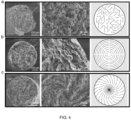
- the cross-sectional morphology of the prepared graphene oxide aerogel fiber is shown in FIG. 4a .
- the cross-sectional morphology of the prepared graphene oxide aerogel fiber is shown in FIG. 4b .
- the graphene oxide is a macromolecule and the liquid crystal has good dynamic stability, its specific structure can be maintained after passing through the rotating flow field.
- the final arrangement of graphene macromolecules after passing through the rotating flow field can be kept to the graphene oxide aerogel fiber and corresponding graphene aerogel fiber.
- the concentration of graphene oxide and the rotor speed are adjusted.
- the results are shown in FIG. 3 .
- the cross-sectional morphology of the aerogel fiber is mainly determined by the concentration of the graphene oxide liquid crystal spinning solution and the rotor speed.
- the concentration of graphene oxide solution determines whether liquid crystal can be formed.
- liquid crystal can be formed when the concentration of graphene oxide solution is above 0.1 wt%.
- the cross-section of the graphene oxide aerogel fiber Under a fixed concentration, as the rotor speed increases, the cross-section of the graphene oxide aerogel fiber first assumes a concentric circle structure, and then assumes a spiral structure when the rotation speed is further increased. It is common knowledge in the art to control the concentration of graphene oxide to form liquid crystals. Those skilled in the art can control the cross-sectional morphology of the gel fiber according to the above-mentioned rotation speed regularity.
- the cross-sectional morphology of the prepared graphene oxide aerogel fiber is shown in FIG. 4c .
- the resulted heat-treated graphene aerogel fiber has high thermal conductivity up to 15 W/(mK).
- the thermal conductivity of random graphene aerogel fibers is less than 10 W/(mK).
- the graphene aerogel fiber with high thermal conductivity can be applied to thermal-, electrical-, or light-responsive functional materials.
- the graphene fiber prepared from the gel fiber with a concentric circle structure has a strength of 3 GPa, a modulus of 833 GPa, and a thermal conductivity of 1590 W/(mK).
- the mechanical curve is shown in FIG. 5 depicted as Concentric GF.
- This comparative example is similar to Example 7, except that a spinning tube without a rotor is used for extrusion.
- the graphene fiber without microfibrillation has a strength of 3.1 GPa, a modulus of 343 GPa, and a thermal conductivity of 1400 W/(mK).
- the mechanical curve is shown in FIG. 5 depicted as Random GF.
- the graphene fiber prepared under the above conditions has a strength of 2 GPa, a modulus of 650 GPa, and a thermal conductivity of 1490 W/(mK).
- This comparative example is similar to Example 8, except that the rotor speed is 500 rpm, and a spiral structure is formed.
- the graphene fiber prepared under the above conditions has a strength of 1.8 GPa, a modulus of 500 GPa, and a thermal conductivity of 1360 W/(mK).
Landscapes
- Engineering & Computer Science (AREA)
- Textile Engineering (AREA)
- Mechanical Engineering (AREA)
- Chemical & Material Sciences (AREA)
- Chemical Kinetics & Catalysis (AREA)
- General Chemical & Material Sciences (AREA)
- Physics & Mathematics (AREA)
- Thermal Sciences (AREA)
- Manufacturing & Machinery (AREA)
- Inorganic Fibers (AREA)
- Carbon And Carbon Compounds (AREA)
Abstract
Description
- The present disclosure relates to the field of nanomaterials, in particular to aerogel fibers having specific cross-sectional morphological feature, and preparation methods and devices therefor.
- Aerogel fiber is a new material that combines the excellent properties of aerogel and fiber, which is a fiber obtained by subjecting gel fiber prepared by wet spinning to freeze drying or ambient pressure drying or the like, with lightweight, high specific surface area and high porosity. Two-dimensional sheet-like molecules are monolayer molecules with a large width-thickness ratio. Taking graphene as an example, it has extremely high tensile strength, Young's modulus, high conductivity, and the highest thermal conductivity at room temperature. In addition to typical properties such as high porosity, aerogel fibers prepared with two-dimensional sheet-like molecules as assembly units also have excellent mechanical-electrical-thermal properties.
- However, the existing researches on aerogel fibers assembled with two-dimensional nanosheets are mainly focused on the preparation methods therefor. There is no method to regulate the internal structure of aerogel fibers in the prior art. Especially, two-dimensional nanosheets have two-dimensional anisotropy in space, which are not only axially oriented in the fibers, but also randomly oriented in the circumferential cross-sectional direction of the fibers. The random arrangement of the two-dimensional nanosheets in the circumferential cross-sectional direction of the aerogel fiber will inevitably lead to a decrease in the compression resistance of the aerogel fibers, affecting the applications of the aerogel fibers in practice. Further, the unregulated cross-sectional arrangement will also affect the effective transfer of electrons and phonons between the two-dimensional nanosheets with high electrical conductivity and high thermal conductivity, affecting the conductive properties of the aerogel fibers. Therefore, the method for effectively and precisely regulating the arrangement of the two-dimensional nanosheets in aerogel fibers becomes a research hotspot. By precisely regulating the arrangement of two-dimensional nanosheets in the aerogel fibers, aerogel fibers having specific cross-sectional morphological features can be prepared, thereby promoting the practical applications of aerogel fibers.
- In 2011, the Gao Chao Research Group of Zhejiang University invented a macroscopic graphene fiber with monolayer graphene as the assembly unit, creating a new way to prepare carbon fibers using natural graphite as raw material. At present, pure graphene fiber shows excellent performances in terms of thermal conductivity, which is much higher than that of traditional carbon fibers. However, the mechanical properties of graphene fiber are poor, although the mechanical strength of its monofilament can reach 3.4 GPa, its modulus has not yet exceeded 400 GPa, which is inconsistent with the law of simultaneous improvement of modulus and thermal conductivity in traditional carbon fibers. In other words, the thermal conductivity of graphene fiber far exceeds that of traditional carbon fibers, but its modulus is lower than that of traditional carbon fibers.
- High thermal conductivity and high modulus are two key indicators that can be improved simultaneously in traditional carbon fibers, which are usually closely related to the orientation and density of the fiber. At present, the orientation degree of graphene fiber can reach more than 90%. However, graphene fibers are obtained by directly assembling monolayer graphenes. Graphene has a typical two-dimensional macromolecular structure, and its arrangement determines the density of the graphene fiber. Therefore, improving the arrangement of the two-dimensional graphene sheets in the graphene fiber will improve the density of the graphene fiber, in order to prepare a graphene fiber with high modulus and high thermal conductivity.
- In order to overcome the above-mentioned existing technical shortcomings, the present disclosure provides an aerogel fiber having specific cross-sectional morphological feature and its preparation method and device, and provides a graphene fiber with high modulus and high thermal conductivity.
- In the present disclosure, based on the unique large width-thickness ratio of two-dimensional planar nanosheets, a good lyotropic liquid crystal phenomenon is occurred. Based on the unique macromolecules of two-dimensional planar nanosheets, the dynamic stability of liquid crystals is good. After the liquid crystal spinning solution of two-dimensional planar nanosheets passes through the rotating flow field, a hydrogel fiber with specific structure is formed. After freeze-drying of such gel fiber, an aerogel fiber having specific cross-sectional morphology is obtained. After drying and densifying the hydrogel fiber, an as-formed graphene oxide fiber can be obtained. The as-formed graphene oxide fiber can be plasticized, stretched, chemically reduced and heat treated to obtain graphene fiber with high modulus and high thermal conductivity.
- In one aspect, the present disclosure discloses an aerogel fiber having specific cross-sectional morphological feature, which is consisted of two-dimensional nanosheets, and has a cross section in a concentric sheet-like arrangement or a radially spiral sheet-like arrangement.
- The preparation method of the above-mentioned aerogel fiber includes: extruding a dispersion of two-dimensional nanosheets into a coagulation bath with an extrusion speed including an axial speed along an extrusion direction and a circumferential rotation speed perpendicular to the axial speed, and performing structural fixation after coagulation to obtain the aerogel fiber having specific cross-sectional morphological feature.
- Further, the method includes introducing a circumferential rotational shear force into the dispersion of two-dimensional nanosheets to provide the circumferential rotation speed.
- Further, the two-dimensional nanosheets are one or more nanosheets with two-dimensional anisotropy selected from a group consisting of graphene oxide, graphene, Mxene, molybdenum disulfide and montmorillonite.
- Further, the dispersion of two-dimensional nanosheets has a concentration greater than 1 mg/g.
- The present disclosure further discloses a device for preparing an aerogel fiber having specific cross-sectional morphological feature, which at least includes an extrusion device, a coagulation bath and a freeze-drying system; wherein the extrusion device includes a spinning tube which has a circumferential rotational shear force therein.
- Further, the spinning tube has a rotor therein, and the rotor is located at an axis of the spinning tube.
- Further, the rotor in the spinning tube rotates about its axis.
- In another aspect, the present disclosure further discloses a graphene fiber with high modulus and high thermal conductivity, which is consisted of two-dimensional graphene nanosheets, and has a cross section in a concentric sheet-like arrangement, wherein the two-dimensional graphene nanosheets are axially oriented and constitute multiple graphite crystals with an axial length above 200 nm and a radial length above 100 nm; and the graphene fiber has a density greater than or equal to 1.9 g/cm3.
- The present disclosure further discloses a method for preparing the above-mentioned graphene fiber, including extruding a dispersion of two-dimensional graphene oxide nanosheets into a coagulation bath with an extrusion speed including an axial speed along an extrusion direction and a circumferential rotation speed perpendicular to the axial speed and drying to obtain an as-formed graphene oxide fiber; and performing plasticizing and stretching, chemical reduction and heat treatment to obtain the graphene fiber with high modulus and high thermal conductivity.
- Further, the method includes introducing a circumferential rotational shear force into the dispersion of two-dimensional nanosheets to provide the circumferential rotation speed.
- Further, the dispersion of two-dimensional graphene oxide nanosheets is an aqueous-phase dispersion, a DMF-phase dispersion, a DMAc-phase dispersion, or a DMSO-phase dispersion of graphene oxide, and the coagulation bath is one or more coagulation baths selected from a group consisting of ethyl acetate, methylene chloride, acetic acid, ethanol, isopropyl alcohol, chloroform and acetone, or a coagulation bath of an aqueous solution of high-valent salt which is calcium chloride, ferrous chloride or ferric sulfate.
- Further, the plasticizing and stretching includes immersing the fiber in a plasticizer for stretching, and wherein the plasticizer is one or more selected from a group consisting of glycerol, propylene glycol, ethylene glycol, triethylene glycol, acetone, isopropyl alcohol, acetic acid, methanol, tetraethylene glycol, pentaethylene glycol, hydrochloric acid, diluted sulfuric acid and organic amine.
- Further, the chemical reduction uses a reagent selected from hydroiodic acid, hydrazine hydrate, sodium ascorbate and stannous chloride, and the heat treatment adopts a temperature in a range of 1300 to 3000 °C.
- At last, the present disclosure further provides use of the above fibers in sensing, phase change energy storage, and catalytic energy.
- The beneficial effects of the present disclosure include:
- 1) By precisely regulating the arrangement of the two-dimensional nanosheets in the aerogel fiber, the aerogel fiber has specific cross-sectional morphological features, solving the problem that the sheet arrangement of the two-dimensional nanosheets in the aerogel fiber cannot be precisely regulated, improving the mechanical property and conductive property of the aerogel fiber and promoting the practical applications of the aerogel fiber.
- 2) By constructing the graphene fiber with a specific structure, the present disclosure improves the orderliness of the arrangement of graphene sheets in the fiber, thereby increasing the density of the resulted heat-treated graphene fiber and significantly improving the crystallinity of graphene during the heat treatment process. The crystal size is significantly increased, and the thermal conductivity and modulus of the graphene fiber are greatly improved.
-
-
FIG. 1 is a schematic view of a self-made rotation-extrusion-spinning device. -
FIG. 2 shows the rotor in the rotation-extrusion-spinning device. -
FIG. 3 shows the cross-sectional morphology of graphene oxide aerogel fibers prepared under different graphene liquid crystal spinning solution concentrations and different rotor speeds. -
FIG. 4 shows the cross-sectional morphology of three typical a graphene oxide aerogel fiber, including a, with a random cross-sectional structure; b, with a concentric cross-sectional structure; c, with a spiral cross-sectional structure. -
FIG. 5 shows the mechanical curves of graphene fibers, wherein the Concentric GF curve refers to the graphene fiber formed by coagulation, drying and heat treatment of concentric gel fiber; and the Random GF curve refers to the graphene fiber formed by coagulation, drying and heat treatment of random gel fiber. -
- (1) An aqueous graphene oxide liquid crystal spinning solution with a concentration of 6 mg/g is extruded into a circular spinning tube with a diameter of 500 µm at a speed of 0.2 mL/min. When being extruded into the spinning tube, the liquid crystal spinning solution passes through a device rotating a rotor, and the rotor speed is 0 rpm, so that the graphene oxide liquid crystal spinning solution has not experienced the shearing effect of a rotating rotor;
- (2) Then the graphene oxide liquid crystal spinning solution is further extruded into a coagulation bath of calcium chloride aqueous solution with a concentration of 3 wt%, to obtain a graphene oxide gel fiber after coagulation. The gel fiber is soaked in deionized water three times to clean away excess free calcium ions;
- (3) The graphene oxide gel fiber is frozen in a refrigerator at -80 °C for one hour, and then put into a freeze dryer for freeze-drying to obtain a graphene oxide aerogel fiber after drying.
- The cross-sectional morphology of the prepared graphene oxide aerogel fiber is shown in
FIG. 4a . -
- (1) An aqueous graphene oxide liquid crystal spinning solution with a concentration of 6 mg/g is extruded into a circular spinning tube with a diameter of 500 µm at a speed of 0.2 mL/min. When being extruded into the spinning tube, the liquid crystal spinning solution passes through a device rotating a rotor, and the rotor speed is 100 rpm, so that the graphene oxide liquid crystal spinning solution forms a concentric circle arrangement through the shearing effect of the rotating rotor;
- (2) Then the graphene oxide liquid crystal spinning solution with a concentric circle arrangement is further extruded into a coagulation bath of calcium chloride aqueous solution with a concentration of 3 wt%, to obtain a graphene oxide gel fiber after coagulation. The gel fiber is soaked in deionized water three times to clean away excess free calcium ions;
- (3) The graphene oxide gel fiber is frozen in a refrigerator at -80 °C for one hour, and then put into a freeze dryer for freeze-drying to obtain a graphene oxide aerogel fiber after drying.
- The cross-sectional morphology of the prepared graphene oxide aerogel fiber is shown in
FIG. 4b . As the graphene oxide is a macromolecule and the liquid crystal has good dynamic stability, its specific structure can be maintained after passing through the rotating flow field. The final arrangement of graphene macromolecules after passing through the rotating flow field can be kept to the graphene oxide aerogel fiber and corresponding graphene aerogel fiber. - On the basis of Example 1, the concentration of graphene oxide and the rotor speed are adjusted. The results are shown in
FIG. 3 . The cross-sectional morphology of the aerogel fiber is mainly determined by the concentration of the graphene oxide liquid crystal spinning solution and the rotor speed. The concentration of graphene oxide solution determines whether liquid crystal can be formed. As common knowledge in the field, liquid crystal can be formed when the concentration of graphene oxide solution is above 0.1 wt%. Under a fixed concentration, as the rotor speed increases, the cross-section of the graphene oxide aerogel fiber first assumes a concentric circle structure, and then assumes a spiral structure when the rotation speed is further increased. It is common knowledge in the art to control the concentration of graphene oxide to form liquid crystals. Those skilled in the art can control the cross-sectional morphology of the gel fiber according to the above-mentioned rotation speed regularity. -
- (1) An aqueous graphene oxide liquid crystal spinning solution with a concentration of 6 mg/g is extruded into a circular spinning tube with a diameter of 500 µm at a speed of 0.2 mL/min. When being extruded into the spinning tube, the liquid crystal spinning solution passes through a device rotating a rotor, and the rotor speed is 500 rpm, so that the graphene oxide liquid crystal spinning solution forms a spiral arrangement through the shearing effect of the rotating rotor;
- (2) Then the graphene oxide liquid crystal spinning solution with a spiral arrangement is further extruded into a coagulation bath of calcium chloride aqueous solution with a concentration of 3 wt%, to obtain a graphene oxide gel fiber after coagulation. The gel fiber is soaked in deionized water three times to clean away excess free calcium ions;
- (3) The graphene oxide gel fiber is frozen in a refrigerator at -80 °C for one hour, and then put into a freeze dryer for freeze-drying to obtain a graphene oxide aerogel fiber after drying.
- The cross-sectional morphology of the prepared graphene oxide aerogel fiber is shown in
FIG. 4c . -
- (1) An aqueous graphene oxide liquid crystal spinning solution with a concentration of 8 mg/g is extruded into a circular spinning tube with a diameter of 300 µm at a speed of 0.2 mL/min. When being extruded into the spinning tube, the liquid crystal spinning solution passes through a device rotating a rotor, and the rotor speed is 50 rpm, so that the graphene oxide liquid crystal spinning solution forms a concentric circle arrangement through the shearing effect of the rotating rotor;
- (2) Then the graphene oxide liquid crystal spinning solution with a concentric circle arrangement is further extruded into a coagulation bath of ferrous chloride aqueous solution with a concentration of 3 wt%, to obtain a graphene oxide gel fiber after coagulation. The gel fiber is soaked in deionized water three times to clean away excess free ferrous ions;
- (3) The cleaned graphene oxide gel fiber is soaked in 1% sodium ascorbate aqueous solution, heated to 80 °C, and reduced for 12 hours to obtain a chemically reduced graphene gel fiber, which is cleaned by deionized water;
- (4) The prepared graphene gel fiber is frozen in a liquid nitrogen environment at - 120 °C for one hour, and then put into a freeze dryer for freeze-drying to obtain a graphene aerogel fiber after drying.
- (5) The dried graphene aerogel fiber with a concentric circle arrangement is subjected to heat treatment at 2800 °C in an argon environment to obtain a pure graphene aerogel fiber.
- After testing, the resulted heat-treated graphene aerogel fiber has high thermal conductivity up to 15 W/(mK). By contrast, the thermal conductivity of random graphene aerogel fibers is less than 10 W/(mK). The graphene aerogel fiber with high thermal conductivity can be applied to thermal-, electrical-, or light-responsive functional materials.
-
- (1) An Mxene spinning solution with a concentration of 6 mg/g is extruded into a circular spinning tube with a diameter of 500 µm at a speed of 0.2 mL/min. When being extruded into the spinning tube, the spinning solution passes through a device rotating a rotor, and the rotor speed is 200 rpm, so that the spinning solution forms a concentric circle arrangement through the shearing effect of the rotating rotor;
- (2) Then the Mxene spinning solution with a concentric circle arrangement is further extruded into a coagulation bath of ammonium chloride aqueous solution with a concentration of 6 wt %, to obtain an Mxene gel fiber after coagulation. The gel fiber is soaked in deionized water three times to clean away the excess free ions;
- (3) The Mxene gel fiber is frozen in a refrigerator at -80 °C for one hour, and then put into a freeze dryer for freeze-drying to obtain an Mxene aerogel fiber after drying.
-
- (1) An aqueous graphene oxide liquid crystal spinning solution with a concentration of 6 mg/g is extruded into a circular spinning tube with a diameter of 500 µm at a speed of 0.2 mL/min. When being extruded into the spinning tube, the liquid crystal spinning solution is rotated by the spinning tube which is rotated under external mechanical action, in such a way that the two-dimensional graphene oxide nanosheets form a concentric circle arrangement under the circumferential rotational shearing effect;
- (2) Then the graphene oxide liquid crystal spinning solution with a concentric circle arrangement is further extruded into a coagulation bath of calcium chloride aqueous solution with a concentration of 3 wt%, to obtain a graphene oxide gel fiber after coagulation. The gel fiber is soaked in deionized water three times to clean away excess free calcium ions;
- (3) The graphene oxide gel fiber is frozen in a refrigerator at -80 °C for one hour, and then put into a freeze dryer for freeze-drying to obtain a graphene oxide aerogel fiber after drying.
-
- (1) A spinning solution of graphene oxide and montmorillonite with a concentration of 10 mg/g is extruded into a circular spinning tube with a diameter of 500 µm at a speed of 0.2 mL/min. When being extruded into the spinning tube, the spinning solution passes through a device rotating a rotor, and the rotor speed is 400 rpm, so that the spinning solution forms a spiral arrangement through the shearing effect of the rotating rotor;
- (2) Then the spinning solution with a spiral arrangement is further extruded into a coagulation bath of calcium chloride aqueous solution with a concentration of 4 wt%, to obtain a mixed gel fiber of graphene oxide and montmorillonite after coagulation. The gel fiber is soaked in deionized water three times to clean away excess free ions;
- (3) The mixed gel fiber of graphene oxide and montmorillonite is frozen in a liquid nitrogen environment for one hour, and then put into a freeze dryer for freeze-drying to obtain a mixed aerogel fiber of graphene oxide and montmorillonite after drying.
-
- (1) A DMF-phase graphene oxide liquid crystal spinning solution with a concentration of 6 mg/g is extruded into a circular spinning tube with a diameter of 100 µm at a speed of 0.2 mL/min. Before being extruded into the spinning tube, the liquid crystal spinning solution passes through a device rotating a rotor, and the rotor speed is 100 rpm, so that the graphene oxide liquid crystal is driven by the rotating rotor into a concentric circle structure, as shown in
FIG. 2 ; - (2) Then the graphene oxide liquid crystal spinning solution with a concentric circle structure is further extruded into a coagulation bath of ethyl acetate, to obtain an as-formed graphene oxide fiber after drying;
- (3) The as-formed graphene oxide fiber is soaked into acetic acid for plasticization, and the plasticized graphene oxide fiber is stretched with a stretching rate of 30%, and then dried while maintaining the current length;
- (4) The dried graphene oxide fiber is subjected to chemical reduction with hydriodic acid and heat treatment at 2700 °C to obtain a graphene fiber with high modulus and high thermal conductivity.
- After mechanical testing, the graphene fiber prepared from the gel fiber with a concentric circle structure has a strength of 3 GPa, a modulus of 833 GPa, and a thermal conductivity of 1590 W/(mK). The mechanical curve is shown in
FIG. 5 depicted as Concentric GF. - This comparative example is similar to Example 7, except that a spinning tube without a rotor is used for extrusion.
- (1) A DMF-phase graphene oxide liquid crystal spinning solution with a concentration of 6 mg/g is extruded into a circular spinning tube with a flow channel diameter of 100 µm at a speed of 0.2 mL/min. There is no rotor in the spinning tube, so the graphene oxide liquid crystal is not driven by a rotating flow field into a concentric circle structure, which is in a typical unregulated random state;
- (2) Then the random graphene oxide liquid crystal spinning solution is further extruded into a coagulation bath of ethyl acetate, to obtain an as-formed graphene oxide fiber after drying;
- (3) The as-formed graphene oxide fiber is soaked into acetic acid for plasticization, and the plasticized graphene oxide fiber is stretched with a stretching rate of 30%, and then dried while maintaining the current length;
- (4) The dried graphene oxide fiber is subjected to chemical reduction with hydriodic acid and heat treatment at 2700 °C to obtain a graphene fiber prepared from the random gel fiber.
- After mechanical testing, the graphene fiber without microfibrillation has a strength of 3.1 GPa, a modulus of 343 GPa, and a thermal conductivity of 1400 W/(mK). The mechanical curve is shown in
FIG. 5 depicted as Random GF. -
- (1) A DMF-phase graphene oxide liquid crystal spinning solution with a concentration of 8 mg/g is extruded into a circular spinning tube with a diameter of 100 µm at a speed of 0.2 mL/min. Before being extruded into the spinning tube, the liquid crystal spinning solution passes through a device rotating a rotor, and the rotor speed is 50 rpm, so that the graphene oxide liquid crystal is driven by the rotating rotor into a concentric circle structure;
- (2) Then the graphene oxide liquid crystal spinning solution with a concentric circle structure is further extruded into a coagulation bath of ethyl acetate, to obtain an as-formed graphene oxide fiber after drying;
- (3) The as-formed graphene oxide fiber is soaked into ethanol for plasticization, and the plasticized graphene oxide fiber is stretched with a stretching rate of 10%, and then dried while maintaining the current length;
- (4) The dried graphene oxide fiber is subjected to chemical reduction with hydriodic acid and heat treatment at 2700 °C to obtain the graphene fiber.
- After mechanical testing, the graphene fiber prepared under the above conditions has a strength of 2 GPa, a modulus of 650 GPa, and a thermal conductivity of 1490 W/(mK).
- This comparative example is similar to Example 8, except that the rotor speed is 500 rpm, and a spiral structure is formed.
- (1) A DMF-phase graphene oxide liquid crystal spinning solution with a concentration of 8 mg/g is extruded into a circular spinning tube with a diameter of 100 µm at a speed of 0.2 mL/min. Before being extruded into the spinning tube, the liquid crystal spinning solution passes through a device rotating a rotor, and the rotor speed is 500 rpm, so that the graphene oxide liquid crystal is driven by the rotating rotor into a spiral structure;
- (2) Then the graphene oxide liquid crystal spinning solution with a spiral structure is further extruded into a coagulation bath of ethyl acetate, to obtain an as-formed graphene oxide fiber after drying;
- (3) The as-formed graphene oxide fiber is soaked into ethanol for plasticization, and the plasticized graphene oxide fiber is stretched with a stretching rate of 10%, and then dried while maintaining the current length;
- (4) The dried graphene oxide fiber is subjected to chemical reduction with hydriodic acid and heat treatment at 2700 °C to obtain the graphene fiber.
- After mechanical testing, the graphene fiber prepared under the above conditions has a strength of 1.8 GPa, a modulus of 500 GPa, and a thermal conductivity of 1360 W/(mK).
Claims (15)
- An aerogel fiber having specific cross-sectional morphological feature, which is consisted of two-dimensional nanosheets, and has a cross section in a concentric sheet-like arrangement or a radially spiral sheet-like arrangement.
- A method for preparing the aerogel fiber according to claim 1, comprising:extruding a dispersion of two-dimensional nanosheets into a coagulation bath with an extrusion speed comprising an axial speed along an extrusion direction and a circumferential rotation speed perpendicular to the axial speed, andperforming structural fixation after coagulation to obtain the aerogel fiber having specific cross-sectional morphological feature.
- The method according to claim 2, comprising introducing a circumferential rotational shear force into the dispersion of two-dimensional nanosheets to provide the circumferential rotation speed.
- The method according to claim 2, wherein the two-dimensional nanosheets are one or more nanosheets with two-dimensional anisotropy selected from a group consisting of graphene oxide, graphene, Mxene, molybdenum disulfide and montmorillonite.
- The method according to claim 2, wherein the dispersion of two-dimensional nanosheets has a concentration greater than 1 mg/g.
- A device for preparing an aerogel fiber having specific cross-sectional morphological feature, which at least comprises an extrusion device, a coagulation bath and a freeze-drying system; wherein the extrusion device comprises a spinning tube which has a circumferential rotational shear force therein.
- The device according to claim 6, wherein the spinning tube has a rotor therein, and the rotor is located at an axis of the spinning tube.
- The device according to claim 6, wherein the rotor in the spinning tube rotates about its axis.
- A graphene fiber with high modulus and high thermal conductivity, which is consisted of two-dimensional graphene nanosheets, and has a cross section in a concentric sheet-like arrangement, wherein the two-dimensional graphene nanosheets are axially oriented and constitute multiple graphite crystals with an axial length above 200 nm and a radial length above 100 nm; and the graphene fiber has a density greater than or equal to 1.9 g/cm3.
- A method for preparing the graphene fiber according to claim 9, comprising:extruding a dispersion of two-dimensional graphene oxide nanosheets into a coagulation bath with an extrusion speed comprising an axial speed along an extrusion direction and a circumferential rotation speed perpendicular to the axial speed and drying to obtain an as-formed graphene oxide fiber; andperforming plasticizing and stretching, chemical reduction and heat treatment to obtain the graphene fiber with high modulus and high thermal conductivity.
- The method according to claim 10, comprising introducing a circumferential rotational shear force into the dispersion of two-dimensional nanosheets to provide the circumferential rotation speed.
- The method according to claim 10, wherein the dispersion of two-dimensional graphene oxide nanosheets is an aqueous-phase dispersion, a DMF-phase dispersion, a DMAc-phase dispersion, or a DMSO-phase dispersion of graphene oxide, and the coagulation bath is one or more coagulation baths selected from a group consisting of ethyl acetate, methylene chloride, acetic acid, ethanol, isopropyl alcohol, chloroform and acetone, or a coagulation bath of an aqueous solution of high-valent salt which is calcium chloride, ferrous chloride or ferric sulfate.
- The method according to claim 10, wherein the plasticizing and stretching comprises immersing the fiber in a plasticizer for stretching, and wherein the plasticizer is one or more selected from a group consisting of glycerol, propylene glycol, ethylene glycol, triethylene glycol, acetone, isopropyl alcohol, acetic acid, methanol, tetraethylene glycol, pentaethylene glycol, hydrochloric acid, diluted sulfuric acid, and organic amine.
- The method according to claim 10, wherein the chemical reduction uses a reagent selected from hydroiodic acid, hydrazine hydrate, sodium ascorbate and stannous chloride, and the heat treatment adopts a temperature in a range of 1300 to 3000 °C.
- Use of the fiber according to any one of claims 1 to 14 in sensing, phase change energy storage, catalytic energy, and structural material.
Applications Claiming Priority (1)
| Application Number | Priority Date | Filing Date | Title |
|---|---|---|---|
| PCT/CN2021/137642 WO2023108378A1 (en) | 2021-12-14 | 2021-12-14 | Aerogel fiber having specific section morphology feature, and preparation method and device therefor |
Publications (2)
| Publication Number | Publication Date |
|---|---|
| EP4450687A1 true EP4450687A1 (en) | 2024-10-23 |
| EP4450687A4 EP4450687A4 (en) | 2025-10-15 |
Family
ID=86774927
Family Applications (1)
| Application Number | Title | Priority Date | Filing Date |
|---|---|---|---|
| EP21967520.4A Pending EP4450687A4 (en) | 2021-12-14 | 2021-12-14 | Aerogel fiber with specific cross-sectional morphology, and manufacturing method and device therefor |
Country Status (4)
| Country | Link |
|---|---|
| US (1) | US12435447B2 (en) |
| EP (1) | EP4450687A4 (en) |
| JP (1) | JP7716780B2 (en) |
| WO (1) | WO2023108378A1 (en) |
Families Citing this family (3)
| Publication number | Priority date | Publication date | Assignee | Title |
|---|---|---|---|---|
| CN117431653B (en) * | 2023-11-17 | 2025-09-19 | 电子科技大学长三角研究院(湖州) | Hollow functional fiber prepared based on impregnation and freeze drying processes and method thereof |
| CN118704156B (en) * | 2024-08-29 | 2024-11-08 | 展鹰(福建)新材料科技研发中心有限公司 | Bio-based fabric, garment and preparation method thereof |
| CN119685946B (en) * | 2024-12-18 | 2026-03-24 | 浙江大学 | A superfine high-strength meta-aramid fiber and its preparation method |
Family Cites Families (13)
| Publication number | Priority date | Publication date | Assignee | Title |
|---|---|---|---|---|
| JP3525159B2 (en) * | 1995-04-26 | 2004-05-10 | 東海カーボン株式会社 | Carbon fiber for porous electrode substrate of phosphoric acid type fuel cell |
| CN100506710C (en) * | 2007-05-09 | 2009-07-01 | 山东大学 | A kind of preparation method of nanometer TiO2 fiber sleeve |
| KR20140125416A (en) * | 2012-02-16 | 2014-10-28 | 코넬 유니버시티 | Ordered porious nanofibers, methods, and applications |
| US8927065B2 (en) * | 2013-04-15 | 2015-01-06 | Nanotek Instruments, Inc. | Process for producing continuous graphitic fibers from living graphene molecules |
| CN103726133B (en) * | 2014-01-02 | 2016-04-06 | 东华大学 | High strength, compact neat porous graphene fiber and continuous production method thereof |
| CN103806128B (en) * | 2014-01-15 | 2015-12-30 | 北京理工大学 | A kind of graphene oxide fiber and its preparation method and application |
| CN106183142B (en) * | 2016-07-18 | 2018-02-09 | 浙江大学 | It is a kind of based on graphene fiber non-woven fabrics from hotting mask |
| CN106192201B (en) * | 2016-07-18 | 2018-09-14 | 浙江大学 | A kind of graphene fiber non-woven fabrics and preparation method thereof |
| JP6877108B2 (en) * | 2016-08-26 | 2021-05-26 | 日本グラファイトファイバー株式会社 | Manufacturing method of pitch-based carbon fiber mill, heat conductive molded body and pitch-based carbon fiber mill |
| WO2018213446A1 (en) * | 2017-05-16 | 2018-11-22 | Cornell University | Graphenic fibers, yarns, composites, and methods of making the same |
| CN108568926B (en) * | 2017-11-21 | 2020-05-15 | 中国科学院金属研究所 | A method for efficiently preparing highly oriented and dense two-dimensional material thin films |
| CN110117839B (en) * | 2019-05-22 | 2021-06-29 | 中国科学院苏州纳米技术与纳米仿生研究所南昌研究院 | Spiral TiO2/graphene composite fiber, its preparation method and application |
| CN111676591A (en) * | 2020-06-11 | 2020-09-18 | 南京信息工程大学 | A kind of graphene oxide aerogel fiber fabric and its preparation method and application |
-
2021
- 2021-12-14 EP EP21967520.4A patent/EP4450687A4/en active Pending
- 2021-12-14 WO PCT/CN2021/137642 patent/WO2023108378A1/en not_active Ceased
- 2021-12-14 JP JP2023574187A patent/JP7716780B2/en active Active
-
2024
- 2024-02-06 US US18/434,741 patent/US12435447B2/en active Active
Also Published As
| Publication number | Publication date |
|---|---|
| EP4450687A4 (en) | 2025-10-15 |
| WO2023108378A1 (en) | 2023-06-22 |
| US12435447B2 (en) | 2025-10-07 |
| JP2024520603A (en) | 2024-05-24 |
| JP7716780B2 (en) | 2025-08-01 |
| US20240175169A1 (en) | 2024-05-30 |
Similar Documents
| Publication | Publication Date | Title |
|---|---|---|
| US12435447B2 (en) | Aerogel fiber having specific cross-sectional morphological feature, graphene fiber and preparation method and device therefor | |
| EP3878809B1 (en) | Flexible boron nitride nano-belt aerogel and preparation method therefor | |
| CN114250529A (en) | Aerogel fiber with specific section morphological characteristics and preparation method and device thereof | |
| Chen et al. | Regenerated bacterial cellulose/multi-walled carbon nanotubes composite fibers prepared by wet-spinning | |
| CN111793853B (en) | A kind of spinning method of PEDOT:PSS conductive fiber with high elongation | |
| CN111394833B (en) | Carbon nano tube/graphene composite fiber and preparation method thereof | |
| CN110359128B (en) | Fiber material, fiber gel, stretchable conductive composite fiber with superelasticity and frost resistance and preparation method thereof | |
| CN116770454B (en) | Polymer foamed fiber and preparation method and application thereof | |
| Liu et al. | TEMPO-oxidized nanochitin based hydrogels and inter-structure tunable cryogels prepared by sequential chemical and physical crosslinking | |
| CN113136640A (en) | Method for preparing graphene-based carbon fibers at room temperature | |
| KR102556948B1 (en) | Carbon nanotube nanocomposite conducting multifiber and manufacturing method the same | |
| An et al. | Tuning the surface grooves of carbon fibers by dry-jet gel-spinning | |
| CN111909397B (en) | Preparation and application method of porous boron nitride nanofiber/polyvinyl alcohol composite hydrogel | |
| CN110483830B (en) | Ultra-light and high elastic silk fibroin micro-nanofiber aerogel and its preparation method and application | |
| CN113151935B (en) | Graphene material with high strength and high toughness and preparation method thereof | |
| CN106591992B (en) | A modified gelatin fiber | |
| CN118127654A (en) | A kind of air gel fiber and its preparation method at normal temperature and pressure | |
| CN112030268B (en) | Continuous dry-wet combined spinning method for graphene | |
| WO2017011828A1 (en) | Graphene fiber and method of manufacturing same | |
| CN112521630A (en) | Preparation method and application of green flexible conductive anti-freezing hydrogel | |
| Araki et al. | A preliminary study for fiber spinning of mixed solutions of polyrotaxane and cellulose in a dimethylacetamide/lithium chloride (DMAc/LiCl) solvent system | |
| CN114411282A (en) | Preparation method and product of high-strength skin-core structure porous aerogel fiber and application of porous aerogel fiber | |
| WO2022236510A1 (en) | Graphene material having both high strength and high toughness and preparation method therefor | |
| WO2022236509A1 (en) | Method for preparing graphene-based carbon fibers at room temperature | |
| CN112522953B (en) | Polyaniline/thermoplastic polymer conductive nanofiber aerogel and preparation method thereof |
Legal Events
| Date | Code | Title | Description |
|---|---|---|---|
| STAA | Information on the status of an ep patent application or granted ep patent |
Free format text: STATUS: THE INTERNATIONAL PUBLICATION HAS BEEN MADE |
|
| PUAI | Public reference made under article 153(3) epc to a published international application that has entered the european phase |
Free format text: ORIGINAL CODE: 0009012 |
|
| STAA | Information on the status of an ep patent application or granted ep patent |
Free format text: STATUS: REQUEST FOR EXAMINATION WAS MADE |
|
| 17P | Request for examination filed |
Effective date: 20240207 |
|
| AK | Designated contracting states |
Kind code of ref document: A1 Designated state(s): AL AT BE BG CH CY CZ DE DK EE ES FI FR GB GR HR HU IE IS IT LI LT LU LV MC MK MT NL NO PL PT RO RS SE SI SK SM TR |
|
| DAV | Request for validation of the european patent (deleted) | ||
| DAX | Request for extension of the european patent (deleted) | ||
| A4 | Supplementary search report drawn up and despatched |
Effective date: 20250916 |
|
| RIC1 | Information provided on ipc code assigned before grant |
Ipc: D01F 9/12 20060101AFI20250910BHEP Ipc: D01D 13/00 20060101ALI20250910BHEP Ipc: D01D 5/06 20060101ALI20250910BHEP Ipc: D01F 9/08 20060101ALI20250910BHEP Ipc: D01D 5/04 20060101ALI20250910BHEP Ipc: D01D 5/247 20060101ALI20250910BHEP Ipc: D01D 10/02 20060101ALI20250910BHEP Ipc: D01D 10/06 20060101ALI20250910BHEP Ipc: D01F 1/10 20060101ALI20250910BHEP |
|
| STAA | Information on the status of an ep patent application or granted ep patent |
Free format text: STATUS: EXAMINATION IS IN PROGRESS |
|
| 17Q | First examination report despatched |
Effective date: 20260227 |