EP4450657A1 - Recovery method of lithium ion - Google Patents
Recovery method of lithium ion Download PDFInfo
- Publication number
- EP4450657A1 EP4450657A1 EP22907971.0A EP22907971A EP4450657A1 EP 4450657 A1 EP4450657 A1 EP 4450657A1 EP 22907971 A EP22907971 A EP 22907971A EP 4450657 A1 EP4450657 A1 EP 4450657A1
- Authority
- EP
- European Patent Office
- Prior art keywords
- lithium
- residue
- lithium ion
- solution
- cake
- Prior art date
- Legal status (The legal status is an assumption and is not a legal conclusion. Google has not performed a legal analysis and makes no representation as to the accuracy of the status listed.)
- Pending
Links
Images
Classifications
-
- C—CHEMISTRY; METALLURGY
- C22—METALLURGY; FERROUS OR NON-FERROUS ALLOYS; TREATMENT OF ALLOYS OR NON-FERROUS METALS
- C22B—PRODUCTION AND REFINING OF METALS; PRETREATMENT OF RAW MATERIALS
- C22B3/00—Extraction of metal compounds from ores or concentrates by wet processes
- C22B3/20—Treatment or purification of solutions, e.g. obtained by leaching
-
- C—CHEMISTRY; METALLURGY
- C22—METALLURGY; FERROUS OR NON-FERROUS ALLOYS; TREATMENT OF ALLOYS OR NON-FERROUS METALS
- C22B—PRODUCTION AND REFINING OF METALS; PRETREATMENT OF RAW MATERIALS
- C22B26/00—Obtaining alkali, alkaline earth metals or magnesium
- C22B26/10—Obtaining alkali metals
- C22B26/12—Obtaining lithium
-
- B—PERFORMING OPERATIONS; TRANSPORTING
- B01—PHYSICAL OR CHEMICAL PROCESSES OR APPARATUS IN GENERAL
- B01D—SEPARATION
- B01D11/00—Solvent extraction
- B01D11/02—Solvent extraction of solids
- B01D11/028—Flow sheets
-
- B—PERFORMING OPERATIONS; TRANSPORTING
- B01—PHYSICAL OR CHEMICAL PROCESSES OR APPARATUS IN GENERAL
- B01D—SEPARATION
- B01D11/00—Solvent extraction
- B01D11/02—Solvent extraction of solids
- B01D11/028—Flow sheets
- B01D11/0284—Multistage extraction
-
- B—PERFORMING OPERATIONS; TRANSPORTING
- B01—PHYSICAL OR CHEMICAL PROCESSES OR APPARATUS IN GENERAL
- B01D—SEPARATION
- B01D11/00—Solvent extraction
- B01D11/02—Solvent extraction of solids
- B01D11/0288—Applications, solvents
-
- B—PERFORMING OPERATIONS; TRANSPORTING
- B01—PHYSICAL OR CHEMICAL PROCESSES OR APPARATUS IN GENERAL
- B01D—SEPARATION
- B01D15/00—Separating processes involving the treatment of liquids with solid sorbents; Apparatus therefor
- B01D15/02—Separating processes involving the treatment of liquids with solid sorbents; Apparatus therefor with moving adsorbents
-
- B—PERFORMING OPERATIONS; TRANSPORTING
- B01—PHYSICAL OR CHEMICAL PROCESSES OR APPARATUS IN GENERAL
- B01D—SEPARATION
- B01D15/00—Separating processes involving the treatment of liquids with solid sorbents; Apparatus therefor
- B01D15/08—Selective adsorption, e.g. chromatography
- B01D15/10—Selective adsorption, e.g. chromatography characterised by constructional or operational features
- B01D15/16—Selective adsorption, e.g. chromatography characterised by constructional or operational features relating to the conditioning of the fluid carrier
- B01D15/161—Temperature conditioning
-
- B—PERFORMING OPERATIONS; TRANSPORTING
- B01—PHYSICAL OR CHEMICAL PROCESSES OR APPARATUS IN GENERAL
- B01J—CHEMICAL OR PHYSICAL PROCESSES, e.g. CATALYSIS OR COLLOID CHEMISTRY; THEIR RELEVANT APPARATUS
- B01J20/00—Solid sorbent compositions or filter aid compositions; Sorbents for chromatography; Processes for preparing, regenerating or reactivating thereof
- B01J20/02—Solid sorbent compositions or filter aid compositions; Sorbents for chromatography; Processes for preparing, regenerating or reactivating thereof comprising inorganic material
-
- B—PERFORMING OPERATIONS; TRANSPORTING
- B01—PHYSICAL OR CHEMICAL PROCESSES OR APPARATUS IN GENERAL
- B01J—CHEMICAL OR PHYSICAL PROCESSES, e.g. CATALYSIS OR COLLOID CHEMISTRY; THEIR RELEVANT APPARATUS
- B01J20/00—Solid sorbent compositions or filter aid compositions; Sorbents for chromatography; Processes for preparing, regenerating or reactivating thereof
- B01J20/30—Processes for preparing, regenerating, or reactivating
- B01J20/3078—Thermal treatment, e.g. calcining or pyrolizing
-
- B—PERFORMING OPERATIONS; TRANSPORTING
- B01—PHYSICAL OR CHEMICAL PROCESSES OR APPARATUS IN GENERAL
- B01J—CHEMICAL OR PHYSICAL PROCESSES, e.g. CATALYSIS OR COLLOID CHEMISTRY; THEIR RELEVANT APPARATUS
- B01J20/00—Solid sorbent compositions or filter aid compositions; Sorbents for chromatography; Processes for preparing, regenerating or reactivating thereof
- B01J20/30—Processes for preparing, regenerating, or reactivating
- B01J20/3085—Chemical treatments not covered by groups B01J20/3007 - B01J20/3078
-
- B—PERFORMING OPERATIONS; TRANSPORTING
- B09—DISPOSAL OF SOLID WASTE; RECLAMATION OF CONTAMINATED SOIL
- B09B—DISPOSAL OF SOLID WASTE NOT OTHERWISE PROVIDED FOR
- B09B3/00—Destroying solid waste or transforming solid waste into something useful or harmless
- B09B3/30—Destroying solid waste or transforming solid waste into something useful or harmless involving mechanical treatment
-
- B—PERFORMING OPERATIONS; TRANSPORTING
- B09—DISPOSAL OF SOLID WASTE; RECLAMATION OF CONTAMINATED SOIL
- B09B—DISPOSAL OF SOLID WASTE NOT OTHERWISE PROVIDED FOR
- B09B3/00—Destroying solid waste or transforming solid waste into something useful or harmless
- B09B3/40—Destroying solid waste or transforming solid waste into something useful or harmless involving thermal treatment, e.g. evaporation
-
- B—PERFORMING OPERATIONS; TRANSPORTING
- B09—DISPOSAL OF SOLID WASTE; RECLAMATION OF CONTAMINATED SOIL
- B09B—DISPOSAL OF SOLID WASTE NOT OTHERWISE PROVIDED FOR
- B09B3/00—Destroying solid waste or transforming solid waste into something useful or harmless
- B09B3/70—Chemical treatment, e.g. pH adjustment or oxidation
-
- C—CHEMISTRY; METALLURGY
- C01—INORGANIC CHEMISTRY
- C01D—COMPOUNDS OF ALKALI METALS, i.e. LITHIUM, SODIUM, POTASSIUM, RUBIDIUM, CAESIUM, OR FRANCIUM
- C01D15/00—Lithium compounds
- C01D15/08—Carbonates; Bicarbonates
-
- C—CHEMISTRY; METALLURGY
- C02—TREATMENT OF WATER, WASTE WATER, SEWAGE, OR SLUDGE
- C02F—TREATMENT OF WATER, WASTE WATER, SEWAGE, OR SLUDGE
- C02F1/00—Treatment of water, waste water, or sewage
- C02F1/42—Treatment of water, waste water, or sewage by ion-exchange
-
- C—CHEMISTRY; METALLURGY
- C22—METALLURGY; FERROUS OR NON-FERROUS ALLOYS; TREATMENT OF ALLOYS OR NON-FERROUS METALS
- C22B—PRODUCTION AND REFINING OF METALS; PRETREATMENT OF RAW MATERIALS
- C22B1/00—Preliminary treatment of ores or scrap
- C22B1/02—Roasting processes
-
- C—CHEMISTRY; METALLURGY
- C22—METALLURGY; FERROUS OR NON-FERROUS ALLOYS; TREATMENT OF ALLOYS OR NON-FERROUS METALS
- C22B—PRODUCTION AND REFINING OF METALS; PRETREATMENT OF RAW MATERIALS
- C22B1/00—Preliminary treatment of ores or scrap
- C22B1/02—Roasting processes
- C22B1/06—Sulfating roasting
-
- C—CHEMISTRY; METALLURGY
- C22—METALLURGY; FERROUS OR NON-FERROUS ALLOYS; TREATMENT OF ALLOYS OR NON-FERROUS METALS
- C22B—PRODUCTION AND REFINING OF METALS; PRETREATMENT OF RAW MATERIALS
- C22B1/00—Preliminary treatment of ores or scrap
- C22B1/26—Cooling of roasted, sintered, or agglomerated ores
-
- C—CHEMISTRY; METALLURGY
- C22—METALLURGY; FERROUS OR NON-FERROUS ALLOYS; TREATMENT OF ALLOYS OR NON-FERROUS METALS
- C22B—PRODUCTION AND REFINING OF METALS; PRETREATMENT OF RAW MATERIALS
- C22B3/00—Extraction of metal compounds from ores or concentrates by wet processes
- C22B3/04—Extraction of metal compounds from ores or concentrates by wet processes by leaching
-
- C—CHEMISTRY; METALLURGY
- C22—METALLURGY; FERROUS OR NON-FERROUS ALLOYS; TREATMENT OF ALLOYS OR NON-FERROUS METALS
- C22B—PRODUCTION AND REFINING OF METALS; PRETREATMENT OF RAW MATERIALS
- C22B3/00—Extraction of metal compounds from ores or concentrates by wet processes
- C22B3/04—Extraction of metal compounds from ores or concentrates by wet processes by leaching
- C22B3/06—Extraction of metal compounds from ores or concentrates by wet processes by leaching in inorganic acid solutions, e.g. with acids generated in situ; in inorganic salt solutions other than ammonium salt solutions
-
- C—CHEMISTRY; METALLURGY
- C22—METALLURGY; FERROUS OR NON-FERROUS ALLOYS; TREATMENT OF ALLOYS OR NON-FERROUS METALS
- C22B—PRODUCTION AND REFINING OF METALS; PRETREATMENT OF RAW MATERIALS
- C22B3/00—Extraction of metal compounds from ores or concentrates by wet processes
- C22B3/04—Extraction of metal compounds from ores or concentrates by wet processes by leaching
- C22B3/06—Extraction of metal compounds from ores or concentrates by wet processes by leaching in inorganic acid solutions, e.g. with acids generated in situ; in inorganic salt solutions other than ammonium salt solutions
- C22B3/065—Nitric acids or salts thereof
-
- C—CHEMISTRY; METALLURGY
- C22—METALLURGY; FERROUS OR NON-FERROUS ALLOYS; TREATMENT OF ALLOYS OR NON-FERROUS METALS
- C22B—PRODUCTION AND REFINING OF METALS; PRETREATMENT OF RAW MATERIALS
- C22B3/00—Extraction of metal compounds from ores or concentrates by wet processes
- C22B3/04—Extraction of metal compounds from ores or concentrates by wet processes by leaching
- C22B3/06—Extraction of metal compounds from ores or concentrates by wet processes by leaching in inorganic acid solutions, e.g. with acids generated in situ; in inorganic salt solutions other than ammonium salt solutions
- C22B3/08—Sulfuric acid, other sulfurated acids or salts thereof
-
- C—CHEMISTRY; METALLURGY
- C22—METALLURGY; FERROUS OR NON-FERROUS ALLOYS; TREATMENT OF ALLOYS OR NON-FERROUS METALS
- C22B—PRODUCTION AND REFINING OF METALS; PRETREATMENT OF RAW MATERIALS
- C22B3/00—Extraction of metal compounds from ores or concentrates by wet processes
- C22B3/04—Extraction of metal compounds from ores or concentrates by wet processes by leaching
- C22B3/06—Extraction of metal compounds from ores or concentrates by wet processes by leaching in inorganic acid solutions, e.g. with acids generated in situ; in inorganic salt solutions other than ammonium salt solutions
- C22B3/10—Hydrochloric acid, other halogenated acids or salts thereof
-
- C—CHEMISTRY; METALLURGY
- C22—METALLURGY; FERROUS OR NON-FERROUS ALLOYS; TREATMENT OF ALLOYS OR NON-FERROUS METALS
- C22B—PRODUCTION AND REFINING OF METALS; PRETREATMENT OF RAW MATERIALS
- C22B3/00—Extraction of metal compounds from ores or concentrates by wet processes
- C22B3/20—Treatment or purification of solutions, e.g. obtained by leaching
- C22B3/22—Treatment or purification of solutions, e.g. obtained by leaching by physical processes, e.g. by filtration, by magnetic means, or by thermal decomposition
-
- C—CHEMISTRY; METALLURGY
- C22—METALLURGY; FERROUS OR NON-FERROUS ALLOYS; TREATMENT OF ALLOYS OR NON-FERROUS METALS
- C22B—PRODUCTION AND REFINING OF METALS; PRETREATMENT OF RAW MATERIALS
- C22B3/00—Extraction of metal compounds from ores or concentrates by wet processes
- C22B3/20—Treatment or purification of solutions, e.g. obtained by leaching
- C22B3/22—Treatment or purification of solutions, e.g. obtained by leaching by physical processes, e.g. by filtration, by magnetic means, or by thermal decomposition
- C22B3/24—Treatment or purification of solutions, e.g. obtained by leaching by physical processes, e.g. by filtration, by magnetic means, or by thermal decomposition by adsorption on solid substances, e.g. by extraction with solid resins
-
- C—CHEMISTRY; METALLURGY
- C22—METALLURGY; FERROUS OR NON-FERROUS ALLOYS; TREATMENT OF ALLOYS OR NON-FERROUS METALS
- C22B—PRODUCTION AND REFINING OF METALS; PRETREATMENT OF RAW MATERIALS
- C22B3/00—Extraction of metal compounds from ores or concentrates by wet processes
- C22B3/20—Treatment or purification of solutions, e.g. obtained by leaching
- C22B3/42—Treatment or purification of solutions, e.g. obtained by leaching by ion-exchange extraction
-
- C—CHEMISTRY; METALLURGY
- C22—METALLURGY; FERROUS OR NON-FERROUS ALLOYS; TREATMENT OF ALLOYS OR NON-FERROUS METALS
- C22B—PRODUCTION AND REFINING OF METALS; PRETREATMENT OF RAW MATERIALS
- C22B3/00—Extraction of metal compounds from ores or concentrates by wet processes
- C22B3/20—Treatment or purification of solutions, e.g. obtained by leaching
- C22B3/44—Treatment or purification of solutions, e.g. obtained by leaching by chemical processes
-
- C—CHEMISTRY; METALLURGY
- C22—METALLURGY; FERROUS OR NON-FERROUS ALLOYS; TREATMENT OF ALLOYS OR NON-FERROUS METALS
- C22B—PRODUCTION AND REFINING OF METALS; PRETREATMENT OF RAW MATERIALS
- C22B7/00—Working up raw materials other than ores, e.g. scrap, to produce non-ferrous metals and compounds thereof; Methods of a general interest or applied to the winning of more than two metals
-
- C—CHEMISTRY; METALLURGY
- C01—INORGANIC CHEMISTRY
- C01P—INDEXING SCHEME RELATING TO STRUCTURAL AND PHYSICAL ASPECTS OF SOLID INORGANIC COMPOUNDS
- C01P2002/00—Crystal-structural characteristics
- C01P2002/70—Crystal-structural characteristics defined by measured X-ray, neutron or electron diffraction data
- C01P2002/72—Crystal-structural characteristics defined by measured X-ray, neutron or electron diffraction data by d-values or two theta-values, e.g. as X-ray diagram
-
- C—CHEMISTRY; METALLURGY
- C01—INORGANIC CHEMISTRY
- C01P—INDEXING SCHEME RELATING TO STRUCTURAL AND PHYSICAL ASPECTS OF SOLID INORGANIC COMPOUNDS
- C01P2006/00—Physical properties of inorganic compounds
- C01P2006/80—Compositional purity
-
- C—CHEMISTRY; METALLURGY
- C02—TREATMENT OF WATER, WASTE WATER, SEWAGE, OR SLUDGE
- C02F—TREATMENT OF WATER, WASTE WATER, SEWAGE, OR SLUDGE
- C02F1/00—Treatment of water, waste water, or sewage
- C02F1/42—Treatment of water, waste water, or sewage by ion-exchange
- C02F2001/425—Treatment of water, waste water, or sewage by ion-exchange using cation exchangers
-
- C—CHEMISTRY; METALLURGY
- C02—TREATMENT OF WATER, WASTE WATER, SEWAGE, OR SLUDGE
- C02F—TREATMENT OF WATER, WASTE WATER, SEWAGE, OR SLUDGE
- C02F2209/00—Controlling or monitoring parameters in water treatment
- C02F2209/02—Temperature
-
- C—CHEMISTRY; METALLURGY
- C02—TREATMENT OF WATER, WASTE WATER, SEWAGE, OR SLUDGE
- C02F—TREATMENT OF WATER, WASTE WATER, SEWAGE, OR SLUDGE
- C02F2209/00—Controlling or monitoring parameters in water treatment
- C02F2209/06—Controlling or monitoring parameters in water treatment pH
-
- C—CHEMISTRY; METALLURGY
- C02—TREATMENT OF WATER, WASTE WATER, SEWAGE, OR SLUDGE
- C02F—TREATMENT OF WATER, WASTE WATER, SEWAGE, OR SLUDGE
- C02F2303/00—Specific treatment goals
- C02F2303/16—Regeneration of sorbents, filters
-
- Y—GENERAL TAGGING OF NEW TECHNOLOGICAL DEVELOPMENTS; GENERAL TAGGING OF CROSS-SECTIONAL TECHNOLOGIES SPANNING OVER SEVERAL SECTIONS OF THE IPC; TECHNICAL SUBJECTS COVERED BY FORMER USPC CROSS-REFERENCE ART COLLECTIONS [XRACs] AND DIGESTS
- Y02—TECHNOLOGIES OR APPLICATIONS FOR MITIGATION OR ADAPTATION AGAINST CLIMATE CHANGE
- Y02P—CLIMATE CHANGE MITIGATION TECHNOLOGIES IN THE PRODUCTION OR PROCESSING OF GOODS
- Y02P10/00—Technologies related to metal processing
- Y02P10/20—Recycling
Definitions
- the present exemplary embodiment relates to a lithium ion recovery method. More particularly, the present disclosure relates to a method for selectively recovering lithium ions among solutions.
- Lithium is a key element in lithium ion battery and is a very important material in the development of environmentally-friendly technology.
- Lithium is collected from brine, ore, or waste-water. In the case of a solution containing lithium, it is recovered in the form of lithium carbonate or lithium hydroxide after going through a process to remove impurity.
- the impurity of this lithium salt is strictly limited in the final industry, so the impurity must be removed as much as possible before recovering the lithium salt.
- Impurities dissolved with lithium include Mg, Ca, Al, Si, Na, K, Fe, etc.
- divalent or trivalent ions can be removed relatively easily by adjusting pH or using a precipitation agent.
- the lithium adsorption agent is a method based on aluminum hydroxide, etc., and its use is limited because it dissolves in acidic or alkali solutions rather than neutral, and the selectivity of ion-exchange resin to lithium is still significantly low.
- the present exemplary embodiment provides a lithium ion recovery method that can selectively separate lithium ions from a solution in which lithium ions are dissolved.
- the recovery method of lithium ion includes: adding a residue after leaching lithium from an ore containing spodumene into a solution in which a lithium ion is dissolved; absorbing a lithium ion into the residue by reacting the solution containing the residue at 50-90°C; and recovering a cake containing a lithium from the residue in which the lithium ion has been absorbed by performing solid-liquid separation.
- the amount of constant dried residue is preferably 100-500g per 1L of solution in which lithium ion is dissolved, and more preferably 100-300g.
- the reaction is preferably carried out for 0.5-7 hours.
- the reaction is preferably performed at pH 7 or higher.
- the concentration of the lithium ion is preferably 0.01-32g/L.
- the solution in which the lithium ion is dissolved contains sodium and potassium as impurities, and the concentration of the impurity is preferably 0.01-30g/L.
- the step of absorbing the lithium ion into the residue can be performed under stirring.
- the step of adding the residue can be performed by adding a solution in which the lithium ion is dissolved in the column filled with the residue.
- the residue after leaching a lithium from the ore containing spodumene can be manufactured by a method including the steps below: heating and then cooling the ore containing the spodumene; mixing the cooled ore with sulfuric acid, heating and then cooling; mixing the cooled product with water, stirring it, and then separating solid and liquid; and washing the solid-liquid separated cake with distilled water and drying it.
- the residue can comprise, 0 to 1 wt% lithium (Li), 5 to 20 wt% aluminum (Al), 20 to 40 wt% of silicon (Si), 0 to 1 wt% magnesium (Mg), 0 to 5 wt% calcium (Ca), 0 to 1 wt% sodium (Na), 0 to 1 wt% potassium (K), 0 to 5 wt% sulfur (S), 0 to 1 wt% of manganese (Mn), 0 to 1 wt% iron (Fe), and/or 0 to 1 wt% phosphorus (P).
- the lithium ion recovery method according to the exemplary embodiment may further include the step of removing the layer water from the lithium-containing cake using distilled water.
- the lithium ion recovery method according to the exemplary embodiment may further include dissolving the lithium ion by dissolving the lithium-containing cake into an inorganic acid solution to dissolve the lithium from the cake.
- the inorganic acid is preferably one selected from the group consisting of sulfuric acid, hydrochloric acid, and nitric acid.
- the lithium ion recovery method further includes the step of mixing the lithium-containing cake with high concentration sulfuric acid, subjecting it to heat treatment at 150-300°C, and then adding it to distilled water to dissolve the lithium ion.
- the heat treatment is preferably performed for more than 10 minutes.
- lithium can be selectively recovered from a solution containing lithium ions and heterogeneous ions.
- lithium can be leached from ore containing spodumene and the remaining residue can be recycled.
- An exemplary embodiment provides a method for recovering lithium ions in solution using the remaining material (residue) after leaching lithium from ore containing spodumene through calcination, roasting, and leaching.
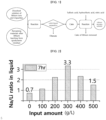
- FIG. 1 briefly shows the process diagram for recovering lithium ions in solution according to this exemplary embodiment.
- the residue after lithium leaching from spodumene is put into a solution in which lithium ion and impurity are dissolved.
- Lithium is absorbed into the residue, solid-liquid separation is performed, and lithium-containing material (cake) is recovered from the lithium-absorbed residue.
- lithium is recovered by adding inorganic acids such as sulfuric acid, hydrochloric acid, and nitric acid to react with the lithium-containing material (cake) to dissolve lithium from the lithium-containing material (cake).
- the ore containing spodumene is heated at 1,000-1,200 °C for more than 30 minutes.
- the heating temperature and heating time can be determined depending on the particle size of the ore. If the particle is large, the heating temperature can be increased and the heating time can be lengthened.
- the ore cooled after heating is mixed with sulfuric acid. Cooling can be performed by air cooling.
- the mixing ratio of ore and sulfuric acid is preferably 10 to 40 sulfuric acid per 100 ore. Heat the ore mixed with sulfuric acid at 150-300oC for more than 30 minutes. Heating temperature and heating time can be determined depending on the particle size of the ore. At this time, the hydrogen of sulfuric acid is exchanged with the lithium of the ore, and lithium becomes lithium sulfate, which is easily soluble in water.
- the heat treatment product in the form of the lithium sulfate is mixed with water at room temperature and stirred.
- the mixing ratio of the heat treatment product and water is preferably a weight ratio of 100 to 1,000 water per 100 heat treatment product.
- the lithium in the heat treatment product converted to the form of lithium sulfate is dissolved in water.
- Ca(OH) 2 can be added to adjust pH, which can reduce Al and Si ions dissolved with lithium. It is preferable to add 5-20wt% of Ca(OH) 2 to the weight of the heat treatment product.
- the ore in which lithium is dissolved has the same form as HAlSi 2 O 6 .
- the cake obtained by performing solid-liquid separation after stirring is washed with distilled water and dried to constant weight to prepare the residue.
- the remaining material (residue) is put into a solution in which lithium ion is dissolved and the lithium ion is absorbed into the residue.
- the reaction in which lithium ion is absorbed into the residue is preferably carried out at 50-100 °C.
- the reaction in which lithium ion is absorbed into the residue is preferably carried out for 0.5-7 hours, more preferably 3-7 hours. If the reaction time is below the lower limit of the range, the amount of reaction is small, and if it exceeds the upper limit of the range, lithium absorption no longer increases significantly even as the time increases.
- the lithium ion concentration is preferably 0.01g/L-32g/L.
- the solution in which the lithium ion is dissolved may contain impurities such as sodium and potassium, and the concentration of these impurities is preferably 0.01g/L-30g/L. When the concentration of the impurity exceeds the upper limit of the range, lithium absorption tends to decrease.
- the pH of the solution is preferably above 7. If the pH is below the range and the solution in which lithium is dissolved is acidic, the absorption of lithium ions is deteriorated.
- the remaining material (residue) after lithium leaching from spodumene is filled in a column, etc., and then a solution containing lithium ions dissolved in the column is allowed to flow through the column to absorb the lithium ions into the residue.
- the remaining material (residue) is put into a solution containing lithium ion, and the slurry residue, which has absorbed lithium ion, is recovered as a cake-shaped material containing lithium through solid-liquid separation. At this time, the layer water in the cake can be removed using distilled water.
- the material containing lithium (cake) is put into an inorganic acid solution to convert the cake into lithium ion form and dissolve the lithium ion.
- the inorganic acid can be sulfuric acid, hydrochloric acid, nitric acid, etc.
- a dissolving method can be used as another method of recovering lithium ions from a lithium-containing material (cake).
- the lithium-containing material (cake) is mixed with high concentration sulfuric acid, subjected to heat treatment at 150-300 °C, and then placed in distilled water to recover lithium ions.
- Heat treatment time varies depending on the heat treatment temperature, and usually 10 minutes or more is sufficient at 250°C.
- 100g of ore containing spodumene was placed in a crucible, heat treated at 1,100 °C for 1 hour, and then air cooled.
- the heat treatment product and sulfuric acid 98% were mixed in a weight ratio of 100:23 and heat treated at 250°C for 1 hour.
- the heat treatment product and distilled water were mixed at a weight ratio of 1:2, stirred for 30 minutes, and then separated into solid and liquid.
- 10% of Ca(OH) 2 by weight of the heat treatment product was added.
- solid-liquid separation was performed, and the cake formed by solid-liquid separation was washed with distilled water three times as much as the cake. The washed cake was dried at 45 °C to constant weight to obtain a residue.
- Table 1 is the chemical composition of the dried material (residue).
- Table 1 Atom Li Al Si Mg Ca Na K S Mn Fe P O etc. Content (wt%) 0.3 11.6 25.8 0.1 3.3 0.1 0.4 3.1 0.1 0.6 0.1 remain
- a solution containing lithium ion and impurity was prepared.
- the composition of the prepared solution is shown in the following Table 2.
- the pH is 12.7. (Table 2) Atom Li S K Na Si concentration(mg/L) 24.6 6.1 6.0 17.7 0.01
- the dried material (residue) prepared in Preparation Example 1 was added to 1L of the lithium ion solution prepared in the Preparation Example 2 and reacted to obtain a slurry-like material in which the lithium ion was absorbed into the residue.
- the temperature during reaction was 90 °C and the stirring speed was 300rpm.
- the slurry was separated into solid and liquid using a filtration device to obtain a material containing lithium (cake).
- the lithium concentration in the solution decreased rapidly when the residue input amount was up to 300 g/L, and at 300 g/L, the initial lithium concentration decreased from 24.6 g/L to 4.4 g/L. However, above 400g/L, the lithium concentration did not decrease any further and tended to increase slightly. This result indicates that the dissolved lithium ion was recovered through reaction or ion exchange with the input material (residue).
- potassium and sodium concentrations showed little change up to 200 g/L, and tended to decrease beyond that. In this way, the lithium concentration in the solution decreases, and the potassium and sodium concentrations remain unchanged, showing that the added material (residue) is selectively recovering lithium.
- FIG. 2 shows the Na/Li ratio in the liquid filtrate according to the amount of material remaining (residue) after lithium leaching when reacting for 7 hours to recover lithium ions in the solution according to an exemplary embodiment.
- an initial Na/Li ratio without residue added was 0.7, and as the amount of residue added increases, the Na/Li ratio in the remaining liquid filtrate after lithium is recovered increases.
- the residue amount was 300 g/L
- the Na/Li ratio in the liquid filtrate reached its maximum at 3.3
- the residue amount exceeded 300 g/L the Na/Li ratio in the liquid filtrate decreased. Therefore, it can be seen that when the amount of residue input is increased to a certain level, the amount of remaining lithium in the filtrate decreases and the amount of lithium recovered in the residue increases.
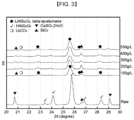
- FIG. 3 is the mineral phase analysis result of the slurry phase material in which lithium was recovered after 7 hours of reaction to recover lithium ions in the solution according to an exemplary embodiment, and it can be confirmed that LiAlSi 2 O 6 was generated. From this, it can be confirmed that the residue absorbed lithium and formed a cake containing lithium. However, it is believed that lithium recovery by mechanisms other than LiAlSi 2 O 6 may also have an effect.
- the reaction temperature was variously selected from 25 to 90°C, the contents of lithium and impurity in the solution were measured, and the results are listed in Table 4 below.
- the Li/Na ratio in the initial solution in Table 2 was 1.39 and the Li/K ratio was 4.1
- the Li/Na ratio at 25 °C in Table 4 was with 3.11 and Li/K ratio was 7.8. It can be seen that the impurity ratio was greatly improved by 2.2 times for Na and 1.9 times for K
Landscapes
- Chemical & Material Sciences (AREA)
- Engineering & Computer Science (AREA)
- Organic Chemistry (AREA)
- Materials Engineering (AREA)
- Environmental & Geological Engineering (AREA)
- Life Sciences & Earth Sciences (AREA)
- Geology (AREA)
- General Life Sciences & Earth Sciences (AREA)
- Manufacturing & Machinery (AREA)
- Metallurgy (AREA)
- Mechanical Engineering (AREA)
- Geochemistry & Mineralogy (AREA)
- Chemical Kinetics & Catalysis (AREA)
- Inorganic Chemistry (AREA)
- Analytical Chemistry (AREA)
- General Chemical & Material Sciences (AREA)
- Thermal Sciences (AREA)
- Physics & Mathematics (AREA)
- Health & Medical Sciences (AREA)
- General Health & Medical Sciences (AREA)
- Toxicology (AREA)
- Hydrology & Water Resources (AREA)
- Water Supply & Treatment (AREA)
- Manufacture And Refinement Of Metals (AREA)
Abstract
Description
- The present exemplary embodiment relates to a lithium ion recovery method. More particularly, the present disclosure relates to a method for selectively recovering lithium ions among solutions.
- Lithium is a key element in lithium ion battery and is a very important material in the development of environmentally-friendly technology.
- Lithium is collected from brine, ore, or waste-water. In the case of a solution containing lithium, it is recovered in the form of lithium carbonate or lithium hydroxide after going through a process to remove impurity. The impurity of this lithium salt is strictly limited in the final industry, so the impurity must be removed as much as possible before recovering the lithium salt.
- Impurities dissolved with lithium include Mg, Ca, Al, Si, Na, K, Fe, etc. Among these, divalent or trivalent ions can be removed relatively easily by adjusting pH or using a precipitation agent.
- However, since most of the salts of Na and K have high solubility and cannot be removed by precipitation method, lithium adsorption agents, ion exchange resins, etc. are being researched.
- The lithium adsorption agent is a method based on aluminum hydroxide, etc., and its use is limited because it dissolves in acidic or alkali solutions rather than neutral, and the selectivity of ion-exchange resin to lithium is still significantly low.
- As described above, since potassium and sodium ions are inevitably present along with lithium ions in solutions treated from brine, ore or waste-water containing lithium, if a technology to selectively separate lithium ions is developed, the purity of lithium salt will increase and processing efficiency can be increased.
- The present exemplary embodiment provides a lithium ion recovery method that can selectively separate lithium ions from a solution in which lithium ions are dissolved.
- The recovery method of lithium ion according to an exemplary embodiment includes:
adding a residue after leaching lithium from an ore containing spodumene into a solution in which a lithium ion is dissolved; absorbing a lithium ion into the residue by reacting the solution containing the residue at 50-90°C; and recovering a cake containing a lithium from the residue in which the lithium ion has been absorbed by performing solid-liquid separation. - In the step of adding the residue, the amount of constant dried residue is preferably 100-500g per 1L of solution in which lithium ion is dissolved, and more preferably 100-300g.
- In the step of absorbing the lithium ion into the residue, the reaction is preferably carried out for 0.5-7 hours.
- In the step of absorbing the lithium ion into the residue, the reaction is preferably performed at pH 7 or higher.
- In a solution in which the lithium ion is dissolved, the concentration of the lithium ion is preferably 0.01-32g/L.
- The solution in which the lithium ion is dissolved contains sodium and potassium as impurities, and the concentration of the impurity is preferably 0.01-30g/L.
- The step of absorbing the lithium ion into the residue can be performed under stirring.
- The step of adding the residue can be performed by adding a solution in which the lithium ion is dissolved in the column filled with the residue.
- The residue after leaching a lithium from the ore containing spodumene can be manufactured by a method including the steps below:
heating and then cooling the ore containing the spodumene; mixing the cooled ore with sulfuric acid, heating and then cooling; mixing the cooled product with water, stirring it, and then separating solid and liquid; and washing the solid-liquid separated cake with distilled water and drying it. - The residue can comprise, 0 to 1 wt% lithium (Li), 5 to 20 wt% aluminum (Al), 20 to 40 wt% of silicon (Si), 0 to 1 wt% magnesium (Mg), 0 to 5 wt% calcium (Ca), 0 to 1 wt% sodium (Na), 0 to 1 wt% potassium (K), 0 to 5 wt% sulfur (S), 0 to 1 wt% of manganese (Mn), 0 to 1 wt% iron (Fe), and/or 0 to 1 wt% phosphorus (P).
- The lithium ion recovery method according to the exemplary embodiment may further include the step of removing the layer water from the lithium-containing cake using distilled water.
- The lithium ion recovery method according to the exemplary embodiment may further include dissolving the lithium ion by dissolving the lithium-containing cake into an inorganic acid solution to dissolve the lithium from the cake. The inorganic acid is preferably one selected from the group consisting of sulfuric acid, hydrochloric acid, and nitric acid.
- The lithium ion recovery method according to the exemplary embodiment further includes the step of mixing the lithium-containing cake with high concentration sulfuric acid, subjecting it to heat treatment at 150-300°C, and then adding it to distilled water to dissolve the lithium ion. The heat treatment is preferably performed for more than 10 minutes.
- According to an exemplary embodiment, lithium can be selectively recovered from a solution containing lithium ions and heterogeneous ions.
- Additionally, according to an exemplary embodiment, lithium can be leached from ore containing spodumene and the remaining residue can be recycled.
-
-
FIG. 1 briefly shows the process diagram for recovering lithium ions in solution according to an exemplary embodiment. -
FIG. 2 shows the Na/Li ratio in the liquid filtrate according to the amount of remaining material (residue) after lithium leaching when reacting for 7 hours to recover lithium ions in the solution according to an exemplary embodiment. -
FIG. 3 is the mineral analysis result of the material in which lithium was recovered after 7 hours of reaction to recover lithium ions in solution, according to an exemplary embodiment. - The terminology used herein is only intended to refer to specific exemplary embodiments and is not intended to limit the present invention. Singular forms used herein include plural forms as long as phrases do not clearly indicate an opposite meaning. The term "including/comprising/containing" as used herein concretely indicates specific characteristics, regions, integer numbers, steps, operations, elements, and/or components, and is not to exclude presence or addition of other specific characteristics, regions, integer numbers, steps, operations, elements, and/or components.
- Unless defined otherwise, all terms including technical terms and scientific terms as used herein have the same meaning as the meaning generally understood by a person of an ordinary skill in the art to which the present invention pertains. Terms defined in a generally used dictionary are additionally interpreted as having the meaning matched to the related art document and the currently disclosed contents and are not interpreted as ideal or formal meaning unless defined.
- Hereinafter, an exemplary embodiment will be described in detail so that a person of an ordinary skill can easily practice it in the technical field to which the present invention belongs. As those skilled in the art would realize, the described embodiments may be modified in various different ways, all without departing from the spirit or scope of the present invention.
- An exemplary embodiment provides a method for recovering lithium ions in solution using the remaining material (residue) after leaching lithium from ore containing spodumene through calcination, roasting, and leaching.
FIG. 1 briefly shows the process diagram for recovering lithium ions in solution according to this exemplary embodiment. - According to
FIG. 1 , the residue after lithium leaching from spodumene is put into a solution in which lithium ion and impurity are dissolved. Lithium is absorbed into the residue, solid-liquid separation is performed, and lithium-containing material (cake) is recovered from the lithium-absorbed residue. Furthermore, lithium is recovered by adding inorganic acids such as sulfuric acid, hydrochloric acid, and nitric acid to react with the lithium-containing material (cake) to dissolve lithium from the lithium-containing material (cake). - This will be described in more detail below.
- First, one of the methods for producing the remaining material (residue) after lithium leaching from spodumene is explained as follows.
- The ore containing spodumene is heated at 1,000-1,200 °C for more than 30 minutes. At this time, the heating temperature and heating time can be determined depending on the particle size of the ore. If the particle is large, the heating temperature can be increased and the heating time can be lengthened. The ore cooled after heating is mixed with sulfuric acid. Cooling can be performed by air cooling. The mixing ratio of ore and sulfuric acid is preferably 10 to 40 sulfuric acid per 100 ore. Heat the ore mixed with sulfuric acid at 150-300oC for more than 30 minutes. Heating temperature and heating time can be determined depending on the particle size of the ore. At this time, the hydrogen of sulfuric acid is exchanged with the lithium of the ore, and lithium becomes lithium sulfate, which is easily soluble in water.
- The heat treatment product in the form of the lithium sulfate is mixed with water at room temperature and stirred. The mixing ratio of the heat treatment product and water is preferably a weight ratio of 100 to 1,000 water per 100 heat treatment product. At this time, the lithium in the heat treatment product converted to the form of lithium sulfate is dissolved in water. When dissolving lithium, Ca(OH)2 can be added to adjust pH, which can reduce Al and Si ions dissolved with lithium. It is preferable to add 5-20wt% of Ca(OH)2 to the weight of the heat treatment product. The ore in which lithium is dissolved has the same form as HAlSi2O6.
- The cake obtained by performing solid-liquid separation after stirring is washed with distilled water and dried to constant weight to prepare the residue.
- After leaching lithium from the spodumene, the remaining material (residue) is put into a solution in which lithium ion is dissolved and the lithium ion is absorbed into the residue.
- At this time, it is preferable to add 100-500g of dried material (residue) per 1L of solution in which lithium ion is dissolved, and it is even more preferable to add 100-300g. If the input amount is less than the lower limit of the range, absorption efficiency per hour decreases, and if it exceeds the upper limit of the range, absorption efficiency decreases relative to the input amount.
- The reaction in which lithium ion is absorbed into the residue is preferably carried out at 50-100 °C. The higher the temperature, the faster the absorption speed of lithium ion. If the reaction temperature is below the lower limit of the range, problems may occur in which the lithium absorption speed and amount of lithium absorption are lowered, and if the reaction temperature exceeds the upper limit of the range, problems may occur in which it cannot be implemented in an aqueous solution.
- The reaction in which lithium ion is absorbed into the residue is preferably carried out for 0.5-7 hours, more preferably 3-7 hours. If the reaction time is below the lower limit of the range, the amount of reaction is small, and if it exceeds the upper limit of the range, lithium absorption no longer increases significantly even as the time increases.
- In a solution in which the lithium ion is dissolved, the lithium ion concentration is preferably 0.01g/L-32g/L.
- The solution in which the lithium ion is dissolved may contain impurities such as sodium and potassium, and the concentration of these impurities is preferably 0.01g/L-30g/L. When the concentration of the impurity exceeds the upper limit of the range, lithium absorption tends to decrease.
- At the stage when the lithium ion is absorbed into the residue, the pH of the solution is preferably above 7. If the pH is below the range and the solution in which lithium is dissolved is acidic, the absorption of lithium ions is deteriorated.
- As another method of absorbing lithium ions into the residue, the remaining material (residue) after lithium leaching from spodumene is filled in a column, etc., and then a solution containing lithium ions dissolved in the column is allowed to flow through the column to absorb the lithium ions into the residue.
- After leaching lithium from spodumene, the remaining material (residue) is put into a solution containing lithium ion, and the slurry residue, which has absorbed lithium ion, is recovered as a cake-shaped material containing lithium through solid-liquid separation. At this time, the layer water in the cake can be removed using distilled water.
- In order to recover lithium ions from a material containing lithium (cake), the material containing lithium (cake) is put into an inorganic acid solution to convert the cake into lithium ion form and dissolve the lithium ion. At this time, the inorganic acid can be sulfuric acid, hydrochloric acid, nitric acid, etc.
- As another method of recovering lithium ions from a lithium-containing material (cake), a dissolving method can be used. The lithium-containing material (cake) is mixed with high concentration sulfuric acid, subjected to heat treatment at 150-300 °C, and then placed in distilled water to recover lithium ions. Heat treatment time varies depending on the heat treatment temperature, and usually 10 minutes or more is sufficient at 250°C.
- In this way, the impurity concentration of the solution in which lithium ions are dissolved is greatly reduced, and lithium ions can be effectively recovered from this.
- Below, a specific exemplary embodiment of the present invention is described. However, the exemplary embodiment below is only a specific exemplary embodiment of the present invention, and the present invention is not limited to the exemplary embodiment below.
- 100g of ore containing spodumene was placed in a crucible, heat treated at 1,100 °C for 1 hour, and then air cooled. The heat treatment product and sulfuric acid 98% were mixed in a weight ratio of 100:23 and heat treated at 250°C for 1 hour. The heat treatment product and distilled water were mixed at a weight ratio of 1:2, stirred for 30 minutes, and then separated into solid and liquid. At this time, after 10 minutes of stirring, 10% of Ca(OH)2 by weight of the heat treatment product was added. After 30 minutes of stirring, solid-liquid separation was performed, and the cake formed by solid-liquid separation was washed with distilled water three times as much as the cake. The washed cake was dried at 45 °C to constant weight to obtain a residue.
- The following Table 1 is the chemical composition of the dried material (residue).
(Table 1) Atom Li Al Si Mg Ca Na K S Mn Fe P O etc. Content (wt%) 0.3 11.6 25.8 0.1 3.3 0.1 0.4 3.1 0.1 0.6 0.1 remain - A solution containing lithium ion and impurity was prepared. The composition of the prepared solution is shown in the following Table 2. The pH is 12.7.
(Table 2) Atom Li S K Na Si concentration(mg/L) 24.6 6.1 6.0 17.7 0.01 - The dried material (residue) prepared in Preparation Example 1 was added to 1L of the lithium ion solution prepared in the Preparation Example 2 and reacted to obtain a slurry-like material in which the lithium ion was absorbed into the residue. The temperature during reaction was 90 °C and the stirring speed was 300rpm. Then, the slurry was separated into solid and liquid using a filtration device to obtain a material containing lithium (cake).
- In the process of recovering the material containing lithium (cake) described above, the amount of residue was changed to 100-500 g, and samples were collected during the reaction by adjusting the reaction time to 3, 5, and 7 hours for each amount. The collected sample was separated into solid and liquid, and the ion concentration of the liquid filtrate was measured, and the results are listed in the following Table 3.
- As can be seen in the following Table 3, the lithium concentration in the solution decreased rapidly when the residue input amount was up to 300 g/L, and at 300 g/L, the initial lithium concentration decreased from 24.6 g/L to 4.4 g/L. However, above 400g/L, the lithium concentration did not decrease any further and tended to increase slightly. This result indicates that the dissolved lithium ion was recovered through reaction or ion exchange with the input material (residue).
- In addition, potassium and sodium concentrations showed little change up to 200 g/L, and tended to decrease beyond that. In this way, the lithium concentration in the solution decreases, and the potassium and sodium concentrations remain unchanged, showing that the added material (residue) is selectively recovering lithium.
(Table 3) Input (g/L) Time (hr) Concentration (g/L) Li S K Na Si Al Undiluted solution 24.6 6.1 6.0 17.7 0.01 - 100 3 16.8 9.4 6.3 18.1 0.1 0.7 5 16.5 9.3 6.2 18.2 0.1 0.6 7 15.7 9.2 6.2 17.7 0.1 0.7 200 3 9.3 12.3 6.2 17.5 0.4 0.8 5 8.5 12.3 6.2 17.5 0.4 0.7 7 7.9 12.5 6.4 17.7 0.4 0.7 300 3 6.0 15.4 5.5 16.0 0.9 0.2 5 5.0 15.1 5.2 15.3 0.9 0.1 7 4.4 14.8 4.9 14.6 0.9 0.1 400 3 6.4 20.7 4.4 15.2 0.9 0.1 5 6.2 21.2 4.0 14.5 0.9 0.1 7 5.9 21.0 3.7 13.8 0.8 0.1 500 3 6.9 23.8 3.0 12.3 0.7 0.1 5 7.0 24.3 2.5 11.4 0.6 - 7 7.3 24.7 2.3 11.1 0.6 - -
FIG. 2 shows the Na/Li ratio in the liquid filtrate according to the amount of material remaining (residue) after lithium leaching when reacting for 7 hours to recover lithium ions in the solution according to an exemplary embodiment. As shown inFIG. 2 . an initial Na/Li ratio without residue added was 0.7, and as the amount of residue added increases, the Na/Li ratio in the remaining liquid filtrate after lithium is recovered increases. When the residue amount was 300 g/L, the Na/Li ratio in the liquid filtrate reached its maximum at 3.3, and when the residue amount exceeded 300 g/L, the Na/Li ratio in the liquid filtrate decreased. Therefore, it can be seen that when the amount of residue input is increased to a certain level, the amount of remaining lithium in the filtrate decreases and the amount of lithium recovered in the residue increases. -
FIG. 3 is the mineral phase analysis result of the slurry phase material in which lithium was recovered after 7 hours of reaction to recover lithium ions in the solution according to an exemplary embodiment, and it can be confirmed that LiAlSi2O6 was generated. From this, it can be confirmed that the residue absorbed lithium and formed a cake containing lithium. However, it is believed that lithium recovery by mechanisms other than LiAlSi2O6 may also have an effect. - In the
exemplary embodiment 1, 5 g of the cake, which was filtered using a filtration device after 7 hours of slurry at an input amount of 300 g/L, was added to 300 mL of 0.4N sulfuric acid solution and stirred at 300 rpm for 30 minutes to dissolve lithium ions. - At this time, the reaction temperature was variously selected from 25 to 90°C, the contents of lithium and impurity in the solution were measured, and the results are listed in Table 4 below. As can be seen from the following Table 4 and the Table 2, the Li/Na ratio in the initial solution in Table 2 was 1.39 and the Li/K ratio was 4.1, and the Li/Na ratio at 25 °C in Table 4 was with 3.11 and Li/K ratio was 7.8. It can be seen that the impurity ratio was greatly improved by 2.2 times for Na and 1.9 times for K
- At this time, the lithium concentration increases slightly as the temperature increases, but it can be seen that most ion concentrations, including lithium, are hardly affected by temperature. From this result, it can be confirmed that lithium can be selectively recovered from a solution in which lithium and impurity are dissolved.
(Table 4) Temperatu re (°C) Concentration (g/L) Li S Ca K Na Si Al 25 0.554 6.343 0.347 0.071 0.178 0.746 0.655 50 0.565 6.419 0.340 0.069 0.174 0.671 0.638 70 0.569 6.466 0.339 0.070 0.177 0.646 0.651 90 0.585 6.519 0.352 0.072 0.182 0.578 0.684
Claims (16)
- A method of recovery lithium ion, comprising:adding a residue after leaching lithium from an ore containing spodumene into a solution in which a lithium ion is dissolved;absorbing a lithium ion into the residue by reacting the solution containing the residue at 50-90°C; andrecovering a cake containing a lithium from the residue in which the lithium ion has been absorbed by performing solid-liquid separation.
- The method of claim 1, wherein:
in the step of adding the residue, a constant amount of dried residue added is 100-500 g per 1L of solution in which a lithium ion is dissolved. - The method of claim 2, wherein:
in the step of adding the residue, the constant amount of dried residue added is 100-300 g per 1L of solution in which a lithium ion is dissolved. - The method of claim 1, wherein:
in the step of absorbing the lithium ion into the residue, the reaction is carried out for 0.5-7 hours. - The method of claim 1, wherein:
in the step of absorbing the lithium ion into the residue, the reaction is carried out at pH 7 or higher. - The method of claim 1, wherein:
in the solution in which a lithium ion is dissolved, the concentration of the lithium ion is 0.01-32 g/L. - The method of claim 1, wherein:
the solution in which the lithium ion is dissolved contains sodium and potassium as impurities, and the concentration of the impurity is 0.01-30g/L. - The method of claim 1, wherein:
the step of absorbing the lithium ion into the residue is carried out under stirring. - The method of claim 1, wherein:
the step of adding the residue is performed by adding the solution containing the lithium ion dissolved in a column filled with the residue. - The method of claim 1, wherein:
the residue after leaching a lithium from the ore containing spodumene is manufactured by a method including the steps below:heating and then cooling the ore containing the spodumene;mixing the cooled ore with sulfuric acid, heating and then cooling;mixing the cooled product with water, stirring it, and then separating solid and liquid; andwashing the solid-liquid separated cake with distilled water and drying it. - The method of claim 1, wherein:
the residue comprises:0 to 1 wt% lithium (Li),5 to 20 wt% aluminum (Al),20 to 40 wt% of silicon (Si),0 to 1 wt% magnesium (Mg),0 to 5 wt% calcium (Ca),0 to 1 wt% sodium (Na),0 to 1 wt% potassium (K),0 to 5 wt% sulfur (S),0 to 1 wt% of manganese (Mn),0 to 1 wt% iron (Fe),0 to 1 wt% phosphorus (P). - The method of claim 1, further comprising:
a step of removing the layer water from the lithium-containing cake using distilled water. - The method of claim 1, further comprising:
a step of dissolving the lithium ion by dissolving the lithium-containing cake into an inorganic acid solution to dissolve the lithium from the cake. - The method of claim 13, wherein:
the inorganic acid is any one selected from the group consisting of sulfuric acid, hydrochloric acid, or nitric acid. - The method of claim 1, further comprising:
a step of mixing the lithium-containing cake with high concentration sulfuric acid, heat treating it at 150-300°C, and then adding it to distilled water to dissolve the lithium ion. - The method of claim 15, wherein:
the heat treatment is performed for more than 10 minutes.
Applications Claiming Priority (2)
| Application Number | Priority Date | Filing Date | Title |
|---|---|---|---|
| KR1020210181816A KR102656287B1 (en) | 2021-12-17 | 2021-12-17 | Recovery method of lithium ion |
| PCT/KR2022/020481 WO2023113504A1 (en) | 2021-12-17 | 2022-12-15 | Recovery method of lithium ion |
Publications (2)
| Publication Number | Publication Date |
|---|---|
| EP4450657A1 true EP4450657A1 (en) | 2024-10-23 |
| EP4450657A4 EP4450657A4 (en) | 2026-04-08 |
Family
ID=86773134
Family Applications (1)
| Application Number | Title | Priority Date | Filing Date |
|---|---|---|---|
| EP22907971.0A Pending EP4450657A4 (en) | 2021-12-17 | 2022-12-15 | METHOD FOR LITHIUM ION RECOVERY |
Country Status (6)
| Country | Link |
|---|---|
| US (1) | US20250059624A1 (en) |
| EP (1) | EP4450657A4 (en) |
| KR (1) | KR102656287B1 (en) |
| CN (1) | CN118434890A (en) |
| AU (1) | AU2022414975B2 (en) |
| WO (1) | WO2023113504A1 (en) |
Families Citing this family (2)
| Publication number | Priority date | Publication date | Assignee | Title |
|---|---|---|---|---|
| KR20250094459A (en) * | 2023-12-18 | 2025-06-25 | 포스코홀딩스 주식회사 | Recovering method of lithium |
| CN120082735A (en) * | 2025-03-12 | 2025-06-03 | 荆门市格林美新材料有限公司 | A method for recycling lithium-containing waste |
Family Cites Families (6)
| Publication number | Priority date | Publication date | Assignee | Title |
|---|---|---|---|---|
| KR102521570B1 (en) * | 2018-08-27 | 2023-04-12 | 주식회사 엘지화학 | Lithium ion adsorbent and a method for recovering lithium ion using the same |
| KR20200041816A (en) * | 2018-10-12 | 2020-04-22 | 세종대학교산학협력단 | Lithium Ion Sieve and Lithium Ion Extraction Method Using the Same |
| KR102164661B1 (en) * | 2018-12-06 | 2020-10-12 | 주식회사 에코프로이노베이션 | Preparation method of lithium hydroxide from lithium concentration by calcination with sodium sulfate |
| KR102252283B1 (en) * | 2019-11-28 | 2021-05-14 | 주식회사 셀젠 | High concentration of lithium using adsorption means |
| KR102412474B1 (en) * | 2019-12-20 | 2022-06-22 | 주식회사 포스코 | Heat treatment method of spodumene |
| CN111439762A (en) * | 2020-03-16 | 2020-07-24 | 东北大学 | A kind of method for extracting lithium by suspension roasting of spodumene concentrate |
-
2021
- 2021-12-17 KR KR1020210181816A patent/KR102656287B1/en active Active
-
2022
- 2022-12-15 EP EP22907971.0A patent/EP4450657A4/en active Pending
- 2022-12-15 WO PCT/KR2022/020481 patent/WO2023113504A1/en not_active Ceased
- 2022-12-15 US US18/720,948 patent/US20250059624A1/en active Pending
- 2022-12-15 AU AU2022414975A patent/AU2022414975B2/en active Active
- 2022-12-15 CN CN202280083527.8A patent/CN118434890A/en active Pending
Also Published As
| Publication number | Publication date |
|---|---|
| KR20230092434A (en) | 2023-06-26 |
| AU2022414975A1 (en) | 2024-08-01 |
| US20250059624A1 (en) | 2025-02-20 |
| KR102656287B1 (en) | 2024-04-09 |
| CN118434890A (en) | 2024-08-02 |
| AU2022414975B2 (en) | 2026-02-12 |
| EP4450657A4 (en) | 2026-04-08 |
| WO2023113504A1 (en) | 2023-06-22 |
Similar Documents
| Publication | Publication Date | Title |
|---|---|---|
| JP7225681B2 (en) | Lithium leaching method and lithium recovery method | |
| CN102502720B (en) | Process for producing battery-grade lithium carbonate through processing carbonate type lithium concentrate by deep carbonation method | |
| US6921522B2 (en) | Production of lithium compounds directly from lithium containing brines | |
| US4115513A (en) | Processing of ammonium paratungstate from tungsten ores | |
| EP4140952A1 (en) | Method for producing lithium hydroxide | |
| JP2023090706A (en) | Method for producing lithium hydroxide | |
| KR20200029809A (en) | Manufacturing method of lithium compound | |
| CN88103282A (en) | Method for extracting and purifying gallium from Bayer liquor | |
| CN103979581B (en) | A kind of triphane concentrate produces the technique of lithium fluoride | |
| AU2022414975B2 (en) | Recovery method of lithium ion | |
| CN116005006A (en) | Method for extracting lithium from electrolytic aluminum waste residues and application thereof | |
| CN108557890A (en) | A kind of preparation method of ammonium paratungstate | |
| CN111592017A (en) | Method for preparing battery-grade lithium chloride by pressing and soaking spodumene | |
| WO2024084233A1 (en) | Production of battery grade chemicals | |
| WO2024089394A1 (en) | Production of battery grade chemicals | |
| US4366129A (en) | Process for producing alumina and ferric oxide from aluminium carriers with high iron and silicon content | |
| JPS6242853B2 (en) | ||
| JPS58500711A (en) | Recovery of tungsten from tungsten concentrate by caustic digestion | |
| JPS61286220A (en) | Recovery of gallium component using adsorbent | |
| EP4450155A1 (en) | Sodium ion adsorbent, preparation method thereof, and method of removing sodium ion | |
| JPS589820B2 (en) | Method for recovering gallium from alkaline aluminate solutions obtained from processing aluminum-containing ores | |
| KR20220075904A (en) | Manufacturing method of zeolite using lithium residue | |
| JPS6242854B2 (en) | ||
| KR102856817B1 (en) | Method for recovering lithium hydroxide from lithium containing ores | |
| KR102325755B1 (en) | Method of manufacturing lithium compound |
Legal Events
| Date | Code | Title | Description |
|---|---|---|---|
| STAA | Information on the status of an ep patent application or granted ep patent |
Free format text: STATUS: THE INTERNATIONAL PUBLICATION HAS BEEN MADE |
|
| PUAI | Public reference made under article 153(3) epc to a published international application that has entered the european phase |
Free format text: ORIGINAL CODE: 0009012 |
|
| STAA | Information on the status of an ep patent application or granted ep patent |
Free format text: STATUS: REQUEST FOR EXAMINATION WAS MADE |
|
| 17P | Request for examination filed |
Effective date: 20240717 |
|
| AK | Designated contracting states |
Kind code of ref document: A1 Designated state(s): AL AT BE BG CH CY CZ DE DK EE ES FI FR GB GR HR HU IE IS IT LI LT LU LV MC ME MK MT NL NO PL PT RO RS SE SI SK SM TR |
|
| DAV | Request for validation of the european patent (deleted) | ||
| DAX | Request for extension of the european patent (deleted) | ||
| REG | Reference to a national code |
Ref country code: DE Ref legal event code: R079 Free format text: PREVIOUS MAIN CLASS: C22B0026120000 Ipc: B01D0011020000 |
|
| A4 | Supplementary search report drawn up and despatched |
Effective date: 20260309 |
|
| RIC1 | Information provided on ipc code assigned before grant |
Ipc: B01D 11/02 20060101AFI20260304BHEP Ipc: B01D 15/02 20060101ALI20260304BHEP Ipc: B01D 15/08 20060101ALI20260304BHEP Ipc: B01D 1/16 20060101ALI20260304BHEP Ipc: B01D 15/36 20060101ALI20260304BHEP Ipc: B01D 15/42 20060101ALI20260304BHEP Ipc: B01J 6/00 20060101ALI20260304BHEP Ipc: B01J 8/00 20060101ALI20260304BHEP Ipc: B01J 20/02 20060101ALI20260304BHEP Ipc: B01J 20/12 20060101ALI20260304BHEP Ipc: B01J 20/16 20060101ALI20260304BHEP Ipc: B01J 20/18 20060101ALI20260304BHEP Ipc: B01J 20/30 20060101ALI20260304BHEP Ipc: B01J 20/34 20060101ALI20260304BHEP Ipc: C22B 1/02 20060101ALI20260304BHEP Ipc: C22B 3/06 20060101ALI20260304BHEP Ipc: C22B 3/20 20060101ALI20260304BHEP Ipc: C22B 3/42 20060101ALI20260304BHEP Ipc: C22B 3/44 20060101ALI20260304BHEP Ipc: C22B 7/00 20060101ALI20260304BHEP |