EP4450539A1 - Blown film - Google Patents
Blown film Download PDFInfo
- Publication number
- EP4450539A1 EP4450539A1 EP23169120.5A EP23169120A EP4450539A1 EP 4450539 A1 EP4450539 A1 EP 4450539A1 EP 23169120 A EP23169120 A EP 23169120A EP 4450539 A1 EP4450539 A1 EP 4450539A1
- Authority
- EP
- European Patent Office
- Prior art keywords
- ethylene
- propylene copolymer
- range
- propylene
- blown film
- Prior art date
- Legal status (The legal status is an assumption and is not a legal conclusion. Google has not performed a legal analysis and makes no representation as to the accuracy of the status listed.)
- Granted
Links
Classifications
-
- C—CHEMISTRY; METALLURGY
- C08—ORGANIC MACROMOLECULAR COMPOUNDS; THEIR PREPARATION OR CHEMICAL WORKING-UP; COMPOSITIONS BASED THEREON
- C08J—WORKING-UP; GENERAL PROCESSES OF COMPOUNDING; AFTER-TREATMENT NOT COVERED BY SUBCLASSES C08B, C08C, C08F, C08G or C08H
- C08J5/00—Manufacture of articles or shaped materials containing macromolecular substances
- C08J5/18—Manufacture of films or sheets
-
- C—CHEMISTRY; METALLURGY
- C08—ORGANIC MACROMOLECULAR COMPOUNDS; THEIR PREPARATION OR CHEMICAL WORKING-UP; COMPOSITIONS BASED THEREON
- C08K—Use of inorganic or non-macromolecular organic substances as compounding ingredients
- C08K5/00—Use of organic ingredients
- C08K5/49—Phosphorus-containing compounds
- C08K5/51—Phosphorus bound to oxygen
- C08K5/52—Phosphorus bound to oxygen only
- C08K5/521—Esters of phosphoric acids, e.g. of H3PO4
- C08K5/523—Esters of phosphoric acids, e.g. of H3PO4 with hydroxyaryl compounds
-
- C—CHEMISTRY; METALLURGY
- C08—ORGANIC MACROMOLECULAR COMPOUNDS; THEIR PREPARATION OR CHEMICAL WORKING-UP; COMPOSITIONS BASED THEREON
- C08L—COMPOSITIONS OF MACROMOLECULAR COMPOUNDS
- C08L23/00—Compositions of homopolymers or copolymers of unsaturated aliphatic hydrocarbons having only one carbon-to-carbon double bond; Compositions of derivatives of such polymers
- C08L23/02—Compositions of homopolymers or copolymers of unsaturated aliphatic hydrocarbons having only one carbon-to-carbon double bond; Compositions of derivatives of such polymers not modified by chemical after-treatment
- C08L23/16—Ethylene-propylene or ethylene-propylene-diene copolymers
-
- C—CHEMISTRY; METALLURGY
- C08—ORGANIC MACROMOLECULAR COMPOUNDS; THEIR PREPARATION OR CHEMICAL WORKING-UP; COMPOSITIONS BASED THEREON
- C08L—COMPOSITIONS OF MACROMOLECULAR COMPOUNDS
- C08L71/00—Compositions of polyethers obtained by reactions forming an ether link in the main chain; Compositions of derivatives of such polymers
- C08L71/02—Polyalkylene oxides
-
- B—PERFORMING OPERATIONS; TRANSPORTING
- B29—WORKING OF PLASTICS; WORKING OF SUBSTANCES IN A PLASTIC STATE IN GENERAL
- B29C—SHAPING OR JOINING OF PLASTICS; SHAPING OF MATERIAL IN A PLASTIC STATE, NOT OTHERWISE PROVIDED FOR; AFTER-TREATMENT OF THE SHAPED PRODUCTS, e.g. REPAIRING
- B29C48/00—Extrusion moulding, i.e. expressing the moulding material through a die or nozzle which imparts the desired form; Apparatus therefor
- B29C48/03—Extrusion moulding, i.e. expressing the moulding material through a die or nozzle which imparts the desired form; Apparatus therefor characterised by the shape of the extruded material at extrusion
- B29C48/09—Articles with cross-sections having partially or fully enclosed cavities, e.g. pipes or channels
- B29C48/10—Articles with cross-sections having partially or fully enclosed cavities, e.g. pipes or channels flexible, e.g. blown foils
-
- C—CHEMISTRY; METALLURGY
- C08—ORGANIC MACROMOLECULAR COMPOUNDS; THEIR PREPARATION OR CHEMICAL WORKING-UP; COMPOSITIONS BASED THEREON
- C08J—WORKING-UP; GENERAL PROCESSES OF COMPOUNDING; AFTER-TREATMENT NOT COVERED BY SUBCLASSES C08B, C08C, C08F, C08G or C08H
- C08J2323/00—Characterised by the use of homopolymers or copolymers of unsaturated aliphatic hydrocarbons having only one carbon-to-carbon double bond; Derivatives of such polymers
- C08J2323/02—Characterised by the use of homopolymers or copolymers of unsaturated aliphatic hydrocarbons having only one carbon-to-carbon double bond; Derivatives of such polymers not modified by chemical after treatment
- C08J2323/16—Ethene-propene or ethene-propene-diene copolymers
-
- C—CHEMISTRY; METALLURGY
- C08—ORGANIC MACROMOLECULAR COMPOUNDS; THEIR PREPARATION OR CHEMICAL WORKING-UP; COMPOSITIONS BASED THEREON
- C08J—WORKING-UP; GENERAL PROCESSES OF COMPOUNDING; AFTER-TREATMENT NOT COVERED BY SUBCLASSES C08B, C08C, C08F, C08G or C08H
- C08J2471/00—Characterised by the use of polyethers obtained by reactions forming an ether link in the main chain; Derivatives of such polymers
- C08J2471/02—Polyalkylene oxides
-
- C—CHEMISTRY; METALLURGY
- C08—ORGANIC MACROMOLECULAR COMPOUNDS; THEIR PREPARATION OR CHEMICAL WORKING-UP; COMPOSITIONS BASED THEREON
- C08K—Use of inorganic or non-macromolecular organic substances as compounding ingredients
- C08K5/00—Use of organic ingredients
- C08K5/0008—Organic ingredients according to more than one of the "one dot" groups of C08K5/01 - C08K5/59
- C08K5/0083—Nucleating agents promoting the crystallisation of the polymer matrix
-
- C—CHEMISTRY; METALLURGY
- C08—ORGANIC MACROMOLECULAR COMPOUNDS; THEIR PREPARATION OR CHEMICAL WORKING-UP; COMPOSITIONS BASED THEREON
- C08L—COMPOSITIONS OF MACROMOLECULAR COMPOUNDS
- C08L2203/00—Applications
- C08L2203/16—Applications used for films
Definitions
- the present invention is directed to a blown film comprising a polypropylene composition comprising an ethylene-propylene copolymer and a polyalkylene glycol-block copolymer as well as to the use of said composition for the manufacture of a blown film.
- Blown film extrusion is a technology that is the most common method to make plastic films, especially for the packaging industry.
- the process involves extruding a tube of molten polymer, typically of polyethylene or polypropylene, through a die and inflating the same to several times its initial diameter to form a thin film bubble, which solidifies by cooling and crystallization. This bubble is then collapsed and used as a lay-flat film or can be made into bags.
- two major processes are known, which basically differ in the kind of cooling of the film bubble. The more common process uses air cooling, and the more complex one water cooling.
- processing aids based on fluoropolymers (e.g. Dynamar from 3M) are used. For long time being, this type of solution worked perfectly and cost efficiently. However, recently it was recognized that such processing aids cause healthy, safety and environmental problems in the production of blown films, due to the fluorine compounds, which accumulate in the produced films. Moreover, such processing aids have long lasting effects in extruders and risks the following production with cross contamination.
- fluoropolymers e.g. Dynamar from 3M
- US20050070644A1 discloses extrudable compositions for the manufacture of thermoplastic films comprising a thermoplastic polyethylene and polyethylene glycol.
- EP3234004B1 discloses thermoplastic compositions comprising polyethylene and a polymer processing additive composition comprising a polyethylene glycol and a metal salt of a carboxylic acid, sulfonic acid, or alkylsulfate.
- processing aids are desired which can be used for the production of blown films based on polypropylenes obtained by the use of metallocene catalyst.
- the present invention is directed to a blown film comprising a polypropylene composition comprising
- Preferred embodiments of the polypropylene composition from which the blown film is produced are defined in the claims dependent on claim 1.
- the invention is directed to the use of the polymer processing aid as defined in claim 1 and its dependent claims for improving the critical shear rate of the propylene composition by at least 100 s -1 compared to a propylene composition being identical as defined in any one of the claims but without any polymer processing aid.
- Blown films are known to the skilled person. As stated above blown films are obtained by extrusion technology in which a tube of the molten polypropylene composition according to this invention is extruded through a die and inflated to several times its initial diameter to form a thin film bubble. This bubble is then collapsed obtaining a film. Said film can be for instance used as a lay-flat film or can be converted into bags. In the present case air cooling of the film bubble is preferred.
- manufacture of blown films from polypropylene reference is made inter alia to the " Polypropylene Handbook" of "Nello Pasquini, 2nd edition (pages 412 to 414 ).
- the blown film of this invention is made from, i.e. comprises, preferably consists of, a polypropylene composition.
- the blown film comprises the polypropylene composition as the by far major component. Accordingly, it is preferred, that the blown film is comprised of at least 95 wt.-% of the polypropylene composition, based on the total weight of the blown film. More preferably, the blown film consists of, i.e. 100 wt.-%, the polypropylene composition.
- the polypropylene composition according to the present invention is defined in the following.
- the by far major part of the polypropylene composition is an ethylene-propylene copolymer, i.e. at least 98.0 wt.-%, more preferably at least 98.5 wt.-%, still more preferably at least 99.0 wt.-%, of the polypropylene composition is the ethylene-propylene copolymer.
- ethylene-propylene copolymer indicates that said copolymer consists only of units derived from ethylene and propylene, wherein the propylene units make up the major part of the ethylene-propylene copolymer.
- the ethylene content of the ethylene-propylene copolymer is in the range of 0.5 to 7.0 wt.-%, preferably in the range of 0.7 to 4.0 wt.-%, more preferably in the range of 0.8 to 2.7 wt.-%, yet more preferably in the range of 0.9 to 2.3 wt.-%, measured by 13 C-NMR.
- the ethylene-propylene copolymer according to this invention must be produced with a metallocene catalyst, which is reflected by the presence of 2,1 erythro regio-defects in the polymer chain. Further information regarding the polymerization conditions is provided in detail below. Accordingly, the ethylene-propylene copolymer according to this invention has 2,1 erythro regio-defects, measured by 13 C NMR, in the range of > 0.10 to 1.00 mol-%, more preferably in the range of 0.35 to 0.85 mol-%, yet more preferably in the range of 0.45 to 0.75 mol-%.
- the ethylene-propylene copolymer has a xylene cold soluble (XCS) fraction, determined at 25 °C according to ISO 16152, in the range of 0.1 to 5.0 wt.-%, more preferably in the range of 0.2 to 3.0 wt.-%, yet more preferably in the range of 0.3 to 1.0 wt.-%.
- XCS xylene cold soluble
- ethylene-propylene copolymer shall further indicated that the copolymer is not a heterophasic system. Accordingly the ethylene-propylene copolymer according to this invention is monophasic as well understood by the skilled person. In other words, the ethylene-propylene copolymer does not comprise polymer components, which are not miscible with each other, as this is the case for heterophasic propylene copolymers. In contrast to monophasic systems, heterophasic systems comprise a continuous polymer phase, like a polypropylene, in which a further non-miscible polymer, like an elastomeric polymer, is dispersed as inclusions.
- Said polypropylene systems containing a polypropylene matrix and inclusions as a second polymer phase would by contrast be called heterophasic and are not part of the present invention.
- the presence of second polymer phases or the so-called inclusions is for instance visible by high resolution microscopy, like electron microscopy or atomic force microscopy, or by dynamic mechanical thermal analysis (DMTA).
- DMTA dynamic mechanical thermal analysis
- the presence of a multiphase structure can be identified by the presence of at least two distinct glass transition temperatures.
- the ethylene-propylene copolymer has a molecular weight distribution (MWD), defined as the ratio between the weight average molar mass (Mw) and the number average molar mass (Mn) and determined by Gel Permeation Chromatography (GPC) in the range of 2.0 to 5.0, more preferably in the range of 2.1 to 4.5, still more preferably in the range of 2.2 to 3.5.
- MWD molecular weight distribution
- the molecular weight of the ethylene-propylene copolymer must be high enough that a blown film can be produced from the polypropylene composition in which the ethylene-propylene copolymer is the major component.
- the ethylene-propylene copolymer has a melt flow rate MFR 2 (230 °C; 2.16 kg), measured according to ISO 1133, in the range of 0.1 to 5.0 g/10min, more preferably in the range of 0.5 to 4.0 g/10min, still more preferably in the range of 0.8 to 3.2 g/10 min.
- the ethylene-propylene copolymer comprises two ethylene-propylene copolymer fractions. That is, the ethylene-propylene copolymer comprises, preferably consists of,
- the ethylene-propylene copolymer complies with the equation (1), preferably with the equation (1a) C 2 PPC C 2 F 1 ⁇ F 1 / PPC > 3.00 5.00 > C 2 PPC C 2 F 1 ⁇ F 1 / PPC > 3.00 wherein
- the ethylene content between the first ethylene-propylene copolymer fraction (F1) and the second ethylene-propylene copolymer fraction (F2) differs in the range of 1.5 to 6.0 wt.-%, more preferably in the range of 2.0 to 5.0 wt.-%.
- the ethylene content of the second ethylene-propylene copolymer fraction (F2) is in the range of 1.9 to 11.0 wt.-%, more preferably in the range of 2.2 to 10.0 wt.-%, still more preferably in the range of 2.5 to 6.0 wt.-%.
- the ethylene-propylene copolymer according to this invention must be produced with a metallocene catalyst.
- the ethylene-propylene copolymer is produced in a sequential polymerization process using a specific metallocene catalyst.
- the ethylene-propylene copolymer can be produced with a metallocene catalyst as disclosed in WO 2019/179959 , which is incorporated by reference herewith.
- a specifically preferred metallocene catalyst complex is rac-anti-dimethylsilanediyl[2-methyl-4,8-bis-(3',5'-dimethylphenyl)-1,5,6,7-tetrahydro-s-indacen-1-yl] [2-methyl-4-(3 ', 5' -dimethylphenyl)-5 -methoxy-6-tert-butylinden-1 -yl] zirconium dichloride (MC-2).
- the preferred cocatalysts are also disclosed in WO 2019/179959 .
- SSCS1 single site catalyst system 1
- the polymerization conditions in the sequential polymerization of the ethylene-propylene copolymer are nothing specific and well known to the skilled person.
- the first ethylene-propylene copolymer fraction (F1) is produced in a slurry reactor and the second ethylene-propylene copolymer fraction (F2) is produced in a gas phase reactor in the presence of the first ethylene-propylene copolymer fraction (F1).
- a preferred process is a "loop-gas phase"-process, such as developed by Borealis A/S, Denmark (known as BORSTAR ® technology) described e.g.
- the first ethylene-propylene copolymer fraction (F1) is preferably produced in a slurry phase polymerization step, i.e. in the liquid phase.
- the temperature in the slurry polymerization is typically from 50 to 110 °C, preferably from 60 to 100 °C and in particular from 65 to 95 °C.
- the pressure is from 1 to 150 bar, preferably from 10 to 100 bar.
- the slurry polymerization may be conducted in any known reactor used for slurry polymerization.
- reactors include a continuous stirred tank reactor and a loop reactor.
- Loop reactors are generally known in the art and examples are given, for instance, in US-A-4582816 , US-A-3405109 , US-A-3324093 , EP-A-479186 and US-A-5391654 .
- the residence time can vary in the reactor zones identified above.
- the residence time in the slurry reactor for example a loop reactor, is in the range of from 0.5 to 5 hours, for example 0.5 to 2 hours, while the residence time in the gas phase reactor generally will be in the range from 1 to 8 hours, like from 1.5 to 4 hours.
- the slurry polymerization stage is followed by the gas phase polymerization stage in which the second ethylene-propylene copolymer fraction (F2) is produced. It is preferred to conduct the slurry directly into the gas phase polymerization zone without a flash step between the stages. This kind of direct feed is described in EP-A-887379 , EP-A-887380 , EP-A-887381 and EP-A-991684 .
- reaction product of the slurry phase polymerization i.e. the first ethylene-propylene copolymer fraction (F1), which preferably is carried out in a loop reactor, is then transferred to the subsequent gas phase reactor in which the second ethylene-propylene copolymer fraction (F2) is produced.
- the polymerization in gas phase may be conducted in fluidized bed reactors, in fast fluidized bed reactors or in settled bed reactors or in any combination of these. When a combination of reactors is used then the polymer is transferred from one polymerization reactor to another. However, it is preferred that the second ethylene-propylene copolymer fraction (F2) is produced in one gas phase reactor.
- the gas phase reactor is operated at a temperature within the range of from 50 to 100 °C, preferably from 65 to 95 °C.
- the pressure is suitably from 10 to 40 bar, preferably from 15 to 30 bar.
- the first ethylene-propylene copolymer fraction (F1) is produced in the first step, i.e. in a first reactor, e.g. the loop reactor, whereas the second ethylene-propylene copolymer fraction (F2) is produced in the subsequent step, i.e. in the second reactor, e.g. the gas phase reactor.
- the first ethylene-propylene copolymer fraction (F 1) is the polymer produced in the prepolymerization together with the polymer produced in the subsequent first step, in the first reactor, e.g. the loop reactor, whereas the second ethylene-propylene copolymer fraction (F2) is the product of the second reactor, e.g. the gas phase reactor.
- the amount of polymer produced in the prepolymerization step is comparatively small compared to the quantities produced in the first reactor and therefore has no great influence on the properties of the ethylene-propylene copolymer from the first reactor.
- the preferred properties of the first ethylene-propylene copolymer fraction (F 1) and the second ethylene-propylene copolymer fraction (F2) have been mentioned above.
- the polymer processing aid is the polymer processing aid
- Polymer processing aids are used to eliminate or at least to reduce melt fracture, to increase gloss and to reduce surface defects improving surface smoothness.
- fluoropolymers are the first choice as polymer processing aid.
- a polyalkylene glycol-block copolymer comprising polyethylene glycol (EO) and polypropylene glycol (PO) blocks is an excellent alternative to the commonly used fluoropolymers, for the manufacture of blown films based on the ethylene-propylene copolymer according to this invention.
- Polyalkylene glycol-block copolymers comprising poly(ethylene glycol (EO)) and polypropylene glycol (PO)) blocks are known in the art.
- the amount of polymer processing aid is in the range of 0.01 to 1.0 wt.-%, preferably 0.05 to 0.8 wt.-%, based on the total weight of the polypropylene composition.
- sequence and lengths of the polyEO and polyPO blocks are not particularly limited and various polyalkylene glycol-block copolymers are known in the art.
- typical block sequences are as follows: EO x PO y , EO x PO y EO x' , or PO y EO x PO y' , with x,x',y and y' typically in the range of 1 to 500.
- diblock (EO x PO y ) or triblock units (EO x PO y EO x' , PO y EO x PO y' ) can be connected to further polyalkylene glycol block units either directly or by a linker unit, such as alkylene diamine.
- the polyalkylene glycol-block copolymers of the present invention may comprise other polyalkylene glycol blocks, such as poly(butylene glycol (BO)), but it is preferred that they only comprise poly(ethylene glycol (EO)) and polypropylene glycol (PO)) blocks.
- the weight average molar mass (Mw), as determined by GPC, of the polyalkylene glycol-block copolymer is preferably in the range of 4,000 to 80,000 g/mol, more preferably 4,000 to 50,000 g/mol.
- the ethylene glycol (EO) content, measured by 13 C NMR, of the polyalkylene glycol-block copolymer is preferably ⁇ 50 wt.-%, more preferably ⁇ 60 wt.-%, even more preferably in the range of 65 wt.-% to 90 wt.-%, based on the total weight of the polyalkylene glycol-block copolymer.
- the propylene glycol (PO) content, measured by 13 C NMR, of the polyalkylene glycol-block copolymer is preferably ⁇ 50 wt.-%, more preferably ⁇ 40 wt.-%, even more preferably in the range of 10 wt.-% to 35 wt.-%, based on the total weight of the polyalkylene glycol-block copolymer.
- the polyalkylene glycol-block copolymers almost exclusively consist of ethylene glycol (EO) and propylene glycol (PO) units. Accordingly, it is preferred that the combined content of ethylene glycol (EO) and propylene glycol (PO) is in the range of 90 to 100 wt.-%, preferably 95 to 100 wt.-%, based on the total weight of the polyalkylene glycol-block copolymer.
- the polyalkylene glycol-block copolymer comprises a triblock unit represented by EO x PO y EO x' , wherein x+x' is on average from 10 to 500, preferably from 50 to 350 and y is on average from 5 to 100, preferably from 10 to 80; and/or at least one, preferably at least two diblock units represented by EOxPOy, wherein x is on average from 10 to 500, preferably from 20 to 200 and y is on average from 5 to 100, preferably from 10 to 80.
- EOxPOy triblock unit represented by EOxPOy
- the average x+x' and y can be determined from the weight average molar mass (Mw), determined by GPC and the ratio of EO content and PO content, measured by 13 C NMR of the polyalkylene glycol-block copolymers.
- the polyalkylene glycol-block copolymer comprises a triblock unit represented by EO x PO y EO x'
- the polyalkylene glycol-block copolymer is a linear poloxamere consisting of one triblock unit represented by EO x PO y EO x' , wherein x+x' is on average from 10 to 500, preferably from 50 to 350 and y is on average from 5 to 100, preferably from 10 to 80.
- x and x' have the identical average number.
- the ratio ( x + x ′ y ) of the triblock unit is in the range of 1.5 to 7.5.
- the polyalkylene glycol-block copolymer comprises diblock units represented by EOxPOy
- the polyalkylene glycol-block copolymer is a poloxamine having 4 diblock units represented by EOxPOy, wherein x is on average from 10 to 500, preferably from 20 to 200, y is on average from 5 to 100, preferably from 10 to 80, and the 4 diblock units are connected to an alkylene diamine, preferably ethylene diamine.
- the ratio ( x y ) of the diblock unit is in the range of 1.5 to 7.5.
- the poloxamine can be represented by the following formula (i): wherein
- polyalkylene glycol-block copolymers according to this invention are commercially available. Their preparation is known by the skilled person. For instance, for the preparation of the polyalkylene glycol-block copolymer comprising a triblock unit represented by EO x PO y EO x' reference is made to US 3,740,421 . The preparation of poloxamines is described for instance by Carmen Alvarez-Lorenzo et al, "Poloxamine-based nanomaterials for drug delivery", Frontiers in bioscience (Elite edition), January 2010 .
- the propylene composition of the present invention preferably does not contain fluoropolymers.
- the polyalkylene glycol-block copolymer is the sole polymer processing aid in the polypropylene composition.
- the polymer processing aid as described above, is suitable for substantially increasing the critical shear rate of a propylene composition, as described herein.
- the polymer processing aid is used for improving the critical shear rate, determined according to ISO 11443 at 190°C of the propylene composition by at least 100 s -1 , preferably 200 s -1 , more preferably by at least 200 to 500 s -1 , compared to a propylene composition being identical, as described above, but without any polymer processing aid.
- the polypropylene composition according to this invention may be further alpha-nucleated.
- the polypropylene composition comprises additionally an alpha-nucleating agent which is present in the range of 0.0001 to 1.0 wt.-%, more preferably in the range of 0.0003 to 0.8 wt.-%, yet more preferably in the range of 0.0005 to 0.5 wt.-%, based on the total weight of the composition.
- alpha-nucleating agents are disclosed in " Plastics Additives Handbook", Hans Zweifel, 6th Edition, p. 967 - 990 .
- 1,2-cyclohexane-dicarboxylic acid, calcium salt as for instance used in Hyperform familiy of Milliken (e.g. HPN-20E), hydroxy-bis[2,4,8,10-tetrakis(1,1-dimethylethyl)-6-hydroxy-12H-dibenzo-[d,g]-dioxa-phoshocin-6-oxidato] aluminium as used in the nucleating agents ADK NA-21, NA-21 E, NA-21 F, etc., metal salts of 2,2'-methylene bis(4,6-di-tert-butylphenyl)phosphat, like sodium-2,2'-methylene-bis(4,6-di-t-butylphenyl)phosphate (ADK NA-11), aluminium-hydroxy-bis[2,2'-methylene-bis(4,6-di-t-butyl-phenyl)-phosphate], 2,2'- methylene bis-(2,6
- butylphenyl) phosphate lithium salt (as used in ADK STAB NA-71), sorbitol-based nucleating agents, i.e. di(alkylbenzylidene)sorbitols like 1,3:2,4-25 dibenzylidene sorbitol, 1,3:2,4-di(4-methylbenzylidene) sorbitol, 1,3:2,4-di(4- ethylbenzylidene) sorbitol and 1,3:2,4-Bis(3,4-dimethylbenzylidene) sorbitol, as well as nonitol derivatives, like 1,2,3-trideoxy-4,6;5,7-bis-O-[(4-propylphenyl)methylene] nonitol, and benzenetrisamides like substituted 1,3,5-benzenetrisamides as N,N',N"-tris-tert-butyl-1,3,5-benzenetric
- butylphenyl) phosphate lithium salt e.g. NA-71
- 1,2-cyclohexane-dicarboxylic acid e.g. HPN-20E
- polymeric nucleating agents selected from the group consisting of vinylcycloalkane polymers and vinylalkane polymers are particularly preferred.
- the polymer composition contains at least one alpha-nucleating agent selected from the group consisting of metal salt of 2,2'-methylene bis(4,6-di-tert-butylphenyl)phosphat, hydroxy-bis[2,4,8,10-tetrakis(1,1-dimethylethyl)-6-hydroxy-12H-dibenzo-[d,g]-dioxa-phoshocin-6-oxidato] aluminium (e.g. NA-21), polymeric nucleating agent and 1,2-cyclohexane-dicarboxylic acid, calcium salt (HPN-20E).
- alpha-nucleating agent selected from the group consisting of metal salt of 2,2'-methylene bis(4,6-di-tert-butylphenyl)phosphat, hydroxy-bis[2,4,8,10-tetrakis(1,1-dimethylethyl)-6-hydroxy-12H-dibenzo-[d,g]-dioxa-phoshocin-6
- the alpha-nucleating agent(s) is/are selected from the group consisting of 2,2'- methylene bis-(2,6-di-tert. butylphenyl) phosphate lithium salt (e.g. NA-71), bicyclo (2.2.1) heptane-2,3-dicarboxylic acid, di-sodium salt (e.g. HPN-E20) and poly vinylcyclohexane (p-VCH).
- the alpha-nucleating agent(s) present in the polymer composition is/are selected from the group consisting of 2,2'- methylene bis-(2,6-di-tert. butylphenyl) phosphate lithium salt (e.g.
- NA-71 hydroxy-bis[2,4,8,10-tetrakis(1,1-dimethylethyl)-6-hydroxy-12H-dibenzo-[d,g]-dioxa-phoshocin-6-oxidato] aluminium (like NA-21), 1,2-cyclohexane-dicarboxylic acid, calcium salt (HPN-20E) and poly vinylcyclohexane (p-VCH).
- the alpha-nucleating agent(s) present in the polypropylene composition is/are selected from the group consisting of hydroxy-bis[2,4,8,10-tetrakis(1,1-dimethylethyl)-6-hydroxy-12H-dibenzo-[d,g]-dioxa-phoshocin-6-oxidato] aluminium (e.g. NA-21), poly vinylcyclohexane (p-VCH), 2,2'- methylene bis-(2,6-di-tert. butylphenyl) phosphate lithium salt (e.g.
- NA-71) and 1,2-cyclohexane-dicarboxylic acid, calcium salt HPN-20E
- HPN-20E 1,2-cyclohexane-dicarboxylic acid, calcium salt
- the polypropylene composition must comprise the ethylene-propylene copolymer as main component and a polymer processing aid.
- the polypropylene composition may comprise an alpha-nucleating agent as mentioned above and typical additives other than the alpha-nucleating agent, like antioxidants, antistatic agents and antifogging agents.
- additives do not cover alpha-nucleating agents and polymer processing aids.
- Such additives may be premixed with a carrier material, which is typically a polypropylene. According to this invention such carrier material, e.g. such additional polypropylene, is considered as being part of the additives.
- the total amount of additives which also includes the amount of carrier material, based on the polypropylene composition, shall not exceed 1.0 wt.-%, preferably is in the range of 0.05 to 1.0 wt.-%.
- the polypropylene composition according to this invention comprises, preferably consists of,
- the polypropylene composition according to this invention has been tailored to be suited for the manufacture of blown films.
- the polypropylene composition according to this invention preferably has a melt flow rate MFR 2 (230 °C; 2.16 kg), measured according to ISO 1133, in the range of 0.1 to 5 g/10min, more preferably in the range of 0.5 to 4.0 g/10min, still more preferably in the range of 0.8 to 3.5 g/10 min.
- the polypropylene composition according to this invention can be defined further by its melting behavior.
- the propylene composition has a melting temperature Tm in the range of 125 to 162 °C. It is in particular preferred that the polypropylene composition according to this invention has at least one melting peak temperature (T p,m ) in the range of 125 to 150 °C, more preferably in the range of 130 to 148 °C.
- the present polypropylene composition is especially characterized by the presence of at least two melting peak temperatures, whereby one melting peak temperature (T p1,m ) is in the range of 141 to 150 °C, more preferably in the range of 143 to 148 °C and another melting peak temperature (T p2,m ) is in the range of 130 to 139 °C, more preferably in the range of 131 to 137 °C.
- T p1,m melting peak temperature
- T p2,m another melting peak temperature
- the present invention is directed to a blown film consisting of a polypropylene composition
- a polypropylene composition comprising
- the present invention is in particular directed to a blown film consisting of a polypropylene composition, said polypropylene composition comprising
- the present invention is directed to a blown film consisting of a polypropylene composition, said polypropylene composition consisting of
- Standard single-pulse excitation was employed utilising the NOE and bi-level WALTZ 16 decoupling scheme ( Zhou, Z., Kuemmerle, R., Qiu, X., Redwine, D., Cong, R., Taha, A., Baugh, D. Winniford, B., J. Mag. Reson. 187 (2007) 225 ; Busico, V., Carbonniere, P., Cipullo, R., Pellecchia, R., Severn, J., Talarico, G., Macromol. Rapid Commun. 2007, 28, 11289 ). A total of 8192 (8k) transients were acquired per spectra.
- Quantitative 13 C ⁇ 1 H ⁇ NMR spectra were processed, integrated and relevant quantitative properties determined from the integrals using proprietary computer programs.
- the tacticity distribution was quantified through integration of the methyl region between 23.6-19.7 ppm correcting for any sites not related to the stereo sequences of interest ( Busico, V., Cipullo, R., Prog. Polym. Sci. 26 (2001) 443 ; Busico, V., Cipullo, R., Monaco, G., Vacatello, M., Segre, A.L., Macromolecules 30 (1997) 6251 ).
- the comonomer fraction was quantified using the method of Wang et. al. ( Wang, W-J., Zhu, S., Macromolecules 33 (2000), 1157 ) through integration of multiple signals across the whole spectral region in the 13 C ⁇ 1 H ⁇ spectra. This method was chosen for its robust nature and ability to account for the presence of regio-defects when needed. Integral regions were slightly adjusted to increase applicability across the whole range of encountered comonomer contents.
- the melt flow rate (MFR) was determined according to ISO 1133 and is indicated in g/10 min.
- the MFR is an indication of the flowability, and hence the processability, of the polymer.
- the MFR 2 of the polypropylene was determined at a temperature of 230 °C and a load of 2.16 kg.
- MFR PP 2 10 log MFR PP ⁇ w PP 1 ⁇ log MFR PP 1 w PP 2
- GPC Gel Permeation Chromatography
- a PolymerChar GPC instrument equipped with infrared (IR) detector was used with 3 x Olexis and 1x Olexis Guard columns from Polymer Laboratories and 1,2,4-trichlorobenzene (TCB, stabilized with 250 mg/l 2,6-Di-tert-butyl-4-methyl-phenol) as solvent at 160 °C and at a constant flow rate of 1 ml/min. 200 ⁇ L of sample solution were injected per analysis. The column set was calibrated using universal calibration (according to ISO 16014-2:2003) with at least 15 narrow MWD polystyrene (PS) standards in the range of 0.5 kg/mol to 11500 kg/mol.
- PS narrow MWD polystyrene
- the amount of the polymer soluble in xylene was determined at 25 °C according to ISO 16152; 5th edition; 2005-07-01.
- Crystallization peak temperature (T p,c ) and crystallization enthalpy (H c ) were determined from the cooling step, while the melting peak temperature (T p1,m ) and the melting peak temperature (T p2,m ) and the melting enthalpy (H m1/2 ) were determined from the second heating step.
- the certified ink (starting with 22 mN/m) was applied to the film in MD and TD. It was visually assessed whether the ink remained on the film for at least 3 seconds. If the ink remained on the film, the next higher ink was tested. This was done until the ink did not longer adhere to the film. The value is given with the highest measured test ink that adheres to the film for at least 3s.
- the measured surface tension results from a visual assessment with different test inks (in ascending order) and serves as a meaningful assessment of the surface tension.
- a steel reactor equipped with a mechanical stirrer and a filter net was flushed with nitrogen and the reactor temperature was set to 20°C.
- silica grade DM-L-303 from AGC Si-Tech Co pre-calcined at 600°C (5.0 kg) was added from a feeding drum followed by careful pressuring and depressurising with nitrogen using manual valves. Then toluene (22 kg) was added. The mixture was stirred for 15 min.
- 30 wt.-% solution of MAO in toluene (9.0 kg) from Lanxess was added via feed line on the top of the reactor within 70 min. The reaction mixture was then heated up to 90°C and stirred at 90°C for additional two hours.
- the resulting solution was added to a stirred cake of MAO-silica support prepared as described above over 1 hour.
- the cake was allowed to stay for 12 hours, followed by drying under N 2 flow at 60°C for 2 h and additionally for 5 h under vacuum (-0.5 barg) under stirring.
- the ethylene-propylene copolymer was compounded in a ZSK 57 twin screw extruder, with a melt temperature of 210°C, together with different additives mentioned in table 2 to obtain the polypropylene compositions of examples CE1 and IE1 to IE3.
- butyl-4-hydroxyphenyl)-propionate (CAS-no. 6683-19-8 , commercially available as Irganox 1010 from BASF SE, Germany) and the phosphorous based antioxidant tris (2,4-di-t-butylphenyl) phosphite ( CAS-no. 31570-04-4 , commercially available as Irgafos 168 from BASF SE, Germany) in the weight ratio of 1:2;
- SHT is the acid scavenger Hycite 713 of BASF SE, Germany, a magnesium/aluminium-hydrotalcite ( CAS-no.
- NA is the commercial alpha-nucleating agent ADK STAB NA-71 of Adeka Corporation, Japan, a mixture comprising 2,2'-Methylenebis(2,6-di-tert-butylphenyl)phosphate lithium salt ( CAS-no. 85209-93-4 );
- F-108 is the linear poly(ethylene glycol)-block-poly(propylene glycol)-block-poly(ethylene glycol) block copolymer (EO x PO y EO x' ) Pluronic ® F-108 ( CAS-no.
- F87 is the linear poly(ethylene glycol)-block-poly(propylene glycol)-block-poly(ethylene glycol) block copolymer (EO x PO y EO x' ) Synperonic TM PE/F87 (INCI name: Poloxamer 237) commercially available from Croda company, having an EO content of 70 wt.-%, PO content of 30 wt.-%, M w 7,700 g/mol, average number of EO units of 122 ( ⁇ x+x') and an average number of PO units of 40 ( ⁇ y);
- T/908 is the X shaped poloxamine Synperonic TM T/908 commercially available from Croda company, having an EO content of 80.0 wt.-%, PO content of 19.8 wt.-%, M w 25,000 g/mol, and 4 diblock units EO x PO y connected to ethylene diamine with each block having an average number of EO units of 114 ( ⁇ x) and an
- the blown films were produced on a Windmöller & Hölscher (W&H) semi-commercial blown film line, with blow-up ratio of 1:2.5 and film thickness of 50 ⁇ m.
- the melt temperature was fixed at 220°C and the uptake speed was 14m/min.
- the surface quality of the films were observed by man skilled in the art.
- the polyalkylene glycol-block copolymers increase the critical shear rate significantly.
- CSR is a measure of the on-set of melt fracture. This means the IEs have improved processing in blown film while the CE has clear visible melt fracture and all the IEs have a glossy and smooth surface. Moreover, the measured surface tension of the IEs is slightly higher, meaning the surface polarity is not reduced by the block copolymers, which has a slightly positive effect of surface adhesion.
Landscapes
- Chemical & Material Sciences (AREA)
- Health & Medical Sciences (AREA)
- Chemical Kinetics & Catalysis (AREA)
- Medicinal Chemistry (AREA)
- Polymers & Plastics (AREA)
- Organic Chemistry (AREA)
- Engineering & Computer Science (AREA)
- Manufacturing & Machinery (AREA)
- Materials Engineering (AREA)
- Compositions Of Macromolecular Compounds (AREA)
- Manufacture Of Macromolecular Shaped Articles (AREA)
Abstract
Description
- The present invention is directed to a blown film comprising a polypropylene composition comprising an ethylene-propylene copolymer and a polyalkylene glycol-block copolymer as well as to the use of said composition for the manufacture of a blown film.
- Blown film extrusion is a technology that is the most common method to make plastic films, especially for the packaging industry. The process involves extruding a tube of molten polymer, typically of polyethylene or polypropylene, through a die and inflating the same to several times its initial diameter to form a thin film bubble, which solidifies by cooling and crystallization. This bubble is then collapsed and used as a lay-flat film or can be made into bags. In principle two major processes are known, which basically differ in the kind of cooling of the film bubble. The more common process uses air cooling, and the more complex one water cooling.
- One difficulty which occurs in the blown film process is melt fracture reducing the performance and limiting the application. To overcome this problem, typically processing aids based on fluoropolymers (e.g. Dynamar from 3M) are used. For long time being, this type of solution worked perfectly and cost efficiently. However, recently it was recognized that such processing aids cause healthy, safety and environmental problems in the production of blown films, due to the fluorine compounds, which accumulate in the produced films. Moreover, such processing aids have long lasting effects in extruders and risks the following production with cross contamination.
- Consequently, efforts have been made to substitute these fluoropolymer processing aids.
US20050070644A1 discloses extrudable compositions for the manufacture of thermoplastic films comprising a thermoplastic polyethylene and polyethylene glycol.EP3234004B1 discloses thermoplastic compositions comprising polyethylene and a polymer processing additive composition comprising a polyethylene glycol and a metal salt of a carboxylic acid, sulfonic acid, or alkylsulfate. - However, there is still the desire to find other processing aids which can replace the fluoropolymers used in the production of blown films based on polypropylene, as the knowledge gained for polyethylenes cannot be transferred to polypropylenes in a straightforward manner.
- Especially processing aids are desired which can be used for the production of blown films based on polypropylenes obtained by the use of metallocene catalyst.
- The present invention is directed to a blown film comprising a polypropylene composition comprising
- a) at least 98.0 wt.-% of an ethylene-propylene copolymer, based on the total weight of the polypropylene composition, and
- b) 0.01 to 1.0 wt.-% of a polymer processing aid, based on the total weight of the polypropylene composition, wherein said polymer processing aid is a polyalkylene glycol-block copolymer comprising poly(ethylene glycol (EO)) and polypropylene glycol (PO)) blocks,
- i) an ethylene content, measured by 13C-NMR, in the range of 0.5 to 7.0 wt.-%,
- ii) 2,1 erythro regio-defects, measured by 13C NMR, in the range of > 0.10 to 1.00 mol-%, and
- iii) a MFR2 (230 °C; 2.16 kg), measured according to ISO 1133, in the range of 0.1 to 5.0 g/lOmin.
- Preferred embodiments of the polypropylene composition from which the blown film is produced are defined in the claims dependent on claim 1.
- Additionally the invention is directed to the use of the polymer processing aid as defined in claim 1 and its dependent claims for improving the critical shear rate of the propylene composition by at least 100 s-1 compared to a propylene composition being identical as defined in any one of the claims but without any polymer processing aid.
- In the following the invention is defined in more detail.
- Blown films are known to the skilled person. As stated above blown films are obtained by extrusion technology in which a tube of the molten polypropylene composition according to this invention is extruded through a die and inflated to several times its initial diameter to form a thin film bubble. This bubble is then collapsed obtaining a film. Said film can be for instance used as a lay-flat film or can be converted into bags. In the present case air cooling of the film bubble is preferred. Regarding the manufacture of blown films from polypropylene reference is made inter alia to the "Polypropylene Handbook" of "Nello Pasquini, 2nd edition (pages 412 to 414).
- The blown film of this invention is made from, i.e. comprises, preferably consists of, a polypropylene composition. The blown film comprises the polypropylene composition as the by far major component. Accordingly, it is preferred, that the blown film is comprised of at least 95 wt.-% of the polypropylene composition, based on the total weight of the blown film. More preferably, the blown film consists of, i.e. 100 wt.-%, the polypropylene composition. The polypropylene composition according to the present invention is defined in the following.
- First the individual components of the polypropylene composition are described and subsequently the polypropylene composition as such.
- The by far major part of the polypropylene composition is an ethylene-propylene copolymer, i.e. at least 98.0 wt.-%, more preferably at least 98.5 wt.-%, still more preferably at least 99.0 wt.-%, of the polypropylene composition is the ethylene-propylene copolymer.
- The term "ethylene-propylene copolymer" indicates that said copolymer consists only of units derived from ethylene and propylene, wherein the propylene units make up the major part of the ethylene-propylene copolymer. Accordingly, the ethylene content of the ethylene-propylene copolymer is in the range of 0.5 to 7.0 wt.-%, preferably in the range of 0.7 to 4.0 wt.-%, more preferably in the range of 0.8 to 2.7 wt.-%, yet more preferably in the range of 0.9 to 2.3 wt.-%, measured by 13C-NMR.
- Further the ethylene-propylene copolymer according to this invention must be produced with a metallocene catalyst, which is reflected by the presence of 2,1 erythro regio-defects in the polymer chain. Further information regarding the polymerization conditions is provided in detail below. Accordingly, the ethylene-propylene copolymer according to this invention has 2,1 erythro regio-defects, measured by 13C NMR, in the range of > 0.10 to 1.00 mol-%, more preferably in the range of 0.35 to 0.85 mol-%, yet more preferably in the range of 0.45 to 0.75 mol-%.
- A further characteristic of the ethylene-propylene copolymer, due to its manufacture with a metallocene catalyst, is its rather low amounts of xylene cold solubles. Thus, it is preferred that the ethylene-propylene copolymer has a xylene cold soluble (XCS) fraction, determined at 25 °C according to ISO 16152, in the range of 0.1 to 5.0 wt.-%, more preferably in the range of 0.2 to 3.0 wt.-%, yet more preferably in the range of 0.3 to 1.0 wt.-%.
- The term "ethylene-propylene copolymer" shall further indicated that the copolymer is not a heterophasic system. Accordingly the ethylene-propylene copolymer according to this invention is monophasic as well understood by the skilled person. In other words, the ethylene-propylene copolymer does not comprise polymer components, which are not miscible with each other, as this is the case for heterophasic propylene copolymers. In contrast to monophasic systems, heterophasic systems comprise a continuous polymer phase, like a polypropylene, in which a further non-miscible polymer, like an elastomeric polymer, is dispersed as inclusions. Said polypropylene systems containing a polypropylene matrix and inclusions as a second polymer phase would by contrast be called heterophasic and are not part of the present invention. The presence of second polymer phases or the so-called inclusions is for instance visible by high resolution microscopy, like electron microscopy or atomic force microscopy, or by dynamic mechanical thermal analysis (DMTA). Specifically in DMTA, the presence of a multiphase structure can be identified by the presence of at least two distinct glass transition temperatures.
- Further it is preferred that the the ethylene-propylene copolymer has a molecular weight distribution (MWD), defined as the ratio between the weight average molar mass (Mw) and the number average molar mass (Mn) and determined by Gel Permeation Chromatography (GPC) in the range of 2.0 to 5.0, more preferably in the range of 2.1 to 4.5, still more preferably in the range of 2.2 to 3.5.
- Additionally the molecular weight of the ethylene-propylene copolymer must be high enough that a blown film can be produced from the polypropylene composition in which the ethylene-propylene copolymer is the major component. Hence it is preferred that the ethylene-propylene copolymer has a melt flow rate MFR2 (230 °C; 2.16 kg), measured according to ISO 1133, in the range of 0.1 to 5.0 g/10min, more preferably in the range of 0.5 to 4.0 g/10min, still more preferably in the range of 0.8 to 3.2 g/10 min.
- In a preferred embodiment, the ethylene-propylene copolymer comprises two ethylene-propylene copolymer fractions. That is, the ethylene-propylene copolymer comprises, preferably consists of,
- (a) a first ethylene-propylene copolymer fraction (F1) having an ethylene content, measured by 13C-NMR, is in the range of 0.4 to 5.0 wt.-%, preferably in the range of 0.5 to 2.0 wt.-%, more preferably in the range of 0.6 to 1.5 wt.-%, measured by 13C-NMR, and
- (b) a second ethylene-propylene copolymer fraction (F2),
- the amount of ethylene in the first ethylene-propylene copolymer fraction (F1) and second ethylene-propylene copolymer fraction (F2) is different, with the proviso that the ethylene content in the first ethylene-propylene copolymer fraction (F1) is lower than in the second ethylene-propylene copolymer fraction (F2),
- the weight ratio between the first ethylene-propylene copolymer fraction (F1) and the second ethylene-propylene copolymer fraction (F2) [(F1)/(F2)] is in the range of 70/30 to 50/50, preferably in the range of 65/35 to 55/45, and
- the total amount of the first ethylene-propylene copolymer fraction (F1) and the second ethylene-propylene copolymer fraction (F2) together, based on the ethylene-propylene copolymer, is at least 98 wt.-%, preferably the ethylene-propylene copolymer consists of the first propylene ethylene-copolymer fraction (F1) and the second ethylene-propylene copolymer fraction (F2).
- Accordingly it is preferred that the ethylene-propylene copolymer complies with the equation (1), preferably with the equation (1a)


- "C2 (PPC)" is the ethylene content [wt.-%], measured by 13C NMR, of the ethylene-propylene copolymer;
- "C (F1)" is the ethylene content [wt.-%], measured by 13C NMR, of the first ethylene-propylene copolymer fraction (F1);
- "(F1)/(PPC)" is the amount of the first ethylene-propylene copolymer fraction (F1) in the ethylene-propylene copolymer divided by the amount of the ethylene-propylene copolymer.
- Accordingly it is further preferred that the ethylene content between the first ethylene-propylene copolymer fraction (F1) and the second ethylene-propylene copolymer fraction (F2) differs in the range of 1.5 to 6.0 wt.-%, more preferably in the range of 2.0 to 5.0 wt.-%.
- Therefore it is preferred that the ethylene content of the second ethylene-propylene copolymer fraction (F2) is in the range of 1.9 to 11.0 wt.-%, more preferably in the range of 2.2 to 10.0 wt.-%, still more preferably in the range of 2.5 to 6.0 wt.-%.
- As mentioned above the ethylene-propylene copolymer according to this invention must be produced with a metallocene catalyst.
- Preferably, the ethylene-propylene copolymer is produced in a sequential polymerization process using a specific metallocene catalyst. Accordingly, the ethylene-propylene copolymer can be produced with a metallocene catalyst as disclosed in
WO 2019/179959 , which is incorporated by reference herewith. - A specifically preferred metallocene catalyst complex is rac-anti-dimethylsilanediyl[2-methyl-4,8-bis-(3',5'-dimethylphenyl)-1,5,6,7-tetrahydro-s-indacen-1-yl] [2-methyl-4-(3 ', 5' -dimethylphenyl)-5 -methoxy-6-tert-butylinden-1 -yl] zirconium dichloride (MC-2).
- The preferred cocatalysts are also disclosed in
WO 2019/179959 . - Regarding catalyst manufacture, reference is also made to
WO 2019/179959 . - The most preferred catalyst system is defined in the example section below (single site catalyst system 1 (SSCS1)).
- The polymerization conditions in the sequential polymerization of the ethylene-propylene copolymer are nothing specific and well known to the skilled person. Typically the first ethylene-propylene copolymer fraction (F1) is produced in a slurry reactor and the second ethylene-propylene copolymer fraction (F2) is produced in a gas phase reactor in the presence of the first ethylene-propylene copolymer fraction (F1). Regarding such multistage processes a preferred process is a "loop-gas phase"-process, such as developed by Borealis A/S, Denmark (known as BORSTAR® technology) described e.g. in patent literature, such as in
EP 0 887 379 ,WO 92/12182 WO 2004/000899 ,WO 2004/111095 ,WO 99/24478 WO 99/24479 WO 00/68315 WO2015/082379 or inWO2015/011134 . - It is well known that prior to the main polymerization a prepolymerization may take place.
- Regarding the prepolymerization, reference is made to
WO2015/011134 . - In case a prepolymerization step is performed, all of the catalyst mixture is introduced to the prepolymerization step.
- As mentioned above the first ethylene-propylene copolymer fraction (F1) is preferably produced in a slurry phase polymerization step, i.e. in the liquid phase.
- The temperature in the slurry polymerization is typically from 50 to 110 °C, preferably from 60 to 100 °C and in particular from 65 to 95 °C. The pressure is from 1 to 150 bar, preferably from 10 to 100 bar.
- The slurry polymerization may be conducted in any known reactor used for slurry polymerization. Such reactors include a continuous stirred tank reactor and a loop reactor. Loop reactors are generally known in the art and examples are given, for instance, in
US-A-4582816 ,US-A-3405109 ,US-A-3324093 ,EP-A-479186 US-A-5391654 . - The residence time can vary in the reactor zones identified above. In one embodiment, the residence time in the slurry reactor, for example a loop reactor, is in the range of from 0.5 to 5 hours, for example 0.5 to 2 hours, while the residence time in the gas phase reactor generally will be in the range from 1 to 8 hours, like from 1.5 to 4 hours.
- Into the slurry polymerization stage other components may also be introduced as it is known in the art. Thus, hydrogen is added to control the molecular weight of the polymer.
- The slurry polymerization stage is followed by the gas phase polymerization stage in which the second ethylene-propylene copolymer fraction (F2) is produced. It is preferred to conduct the slurry directly into the gas phase polymerization zone without a flash step between the stages. This kind of direct feed is described in
EP-A-887379 EP-A-887380 EP-A-887381 EP-A-991684 - That is, the reaction product of the slurry phase polymerization, i.e. the first ethylene-propylene copolymer fraction (F1), which preferably is carried out in a loop reactor, is then transferred to the subsequent gas phase reactor in which the second ethylene-propylene copolymer fraction (F2) is produced.
- The polymerization in gas phase may be conducted in fluidized bed reactors, in fast fluidized bed reactors or in settled bed reactors or in any combination of these. When a combination of reactors is used then the polymer is transferred from one polymerization reactor to another. However, it is preferred that the second ethylene-propylene copolymer fraction (F2) is produced in one gas phase reactor.
- Typically the gas phase reactor is operated at a temperature within the range of from 50 to 100 °C, preferably from 65 to 95 °C. The pressure is suitably from 10 to 40 bar, preferably from 15 to 30 bar.
- According to this invention, the first ethylene-propylene copolymer fraction (F1) is produced in the first step, i.e. in a first reactor, e.g. the loop reactor, whereas the second ethylene-propylene copolymer fraction (F2) is produced in the subsequent step, i.e. in the second reactor, e.g. the gas phase reactor. In case the polymerization process of the first ethylene-propylene copolymer fraction (F 1) and the second ethylene-propylene copolymer fraction (F2) contains also a prepolymerization step, then the first ethylene-propylene copolymer fraction (F 1) according to this invention is the polymer produced in the prepolymerization together with the polymer produced in the subsequent first step, in the first reactor, e.g. the loop reactor, whereas the second ethylene-propylene copolymer fraction (F2) is the product of the second reactor, e.g. the gas phase reactor. The amount of polymer produced in the prepolymerization step is comparatively small compared to the quantities produced in the first reactor and therefore has no great influence on the properties of the ethylene-propylene copolymer from the first reactor.
- The preferred properties of the first ethylene-propylene copolymer fraction (F 1) and the second ethylene-propylene copolymer fraction (F2) have been mentioned above.
- Polymer processing aids are used to eliminate or at least to reduce melt fracture, to increase gloss and to reduce surface defects improving surface smoothness. Typically fluoropolymers are the first choice as polymer processing aid. However, in the present invention it has been found that a polyalkylene glycol-block copolymer comprising polyethylene glycol (EO) and polypropylene glycol (PO) blocks is an excellent alternative to the commonly used fluoropolymers, for the manufacture of blown films based on the ethylene-propylene copolymer according to this invention.
- Polyalkylene glycol-block copolymers comprising poly(ethylene glycol (EO)) and polypropylene glycol (PO)) blocks are known in the art.
- In this invention, the amount of polymer processing aid is in the range of 0.01 to 1.0 wt.-%, preferably 0.05 to 0.8 wt.-%, based on the total weight of the polypropylene composition.
- The sequence and lengths of the polyEO and polyPO blocks are not particularly limited and various polyalkylene glycol-block copolymers are known in the art.
- For example, typical block sequences are as follows:
EOxPOy, EOxPOyEOx', or POyEOxPOy', with x,x',y and y' typically in the range of 1 to 500. - These diblock (EOxPOy) or triblock units (EOxPOyEOx', POyEOxPOy') can be connected to further polyalkylene glycol block units either directly or by a linker unit, such as alkylene diamine.
- The polyalkylene glycol-block copolymers of the present invention may comprise other polyalkylene glycol blocks, such as poly(butylene glycol (BO)), but it is preferred that they only comprise poly(ethylene glycol (EO)) and polypropylene glycol (PO)) blocks.
- The weight average molar mass (Mw), as determined by GPC, of the polyalkylene glycol-block copolymer is preferably in the range of 4,000 to 80,000 g/mol, more preferably 4,000 to 50,000 g/mol.
- Further, the ethylene glycol (EO) content, measured by 13C NMR, of the polyalkylene glycol-block copolymer is preferably ≥ 50 wt.-%, more preferably ≥ 60 wt.-%, even more preferably in the range of 65 wt.-% to 90 wt.-%, based on the total weight of the polyalkylene glycol-block copolymer.
- The propylene glycol (PO) content, measured by 13C NMR, of the polyalkylene glycol-block copolymer is preferably ≤ 50 wt.-%, more preferably ≤ 40 wt.-%, even more preferably in the range of 10 wt.-% to 35 wt.-%, based on the total weight of the polyalkylene glycol-block copolymer.
- It is preferred, that the polyalkylene glycol-block copolymers almost exclusively consist of ethylene glycol (EO) and propylene glycol (PO) units. Accordingly, it is preferred that the combined content of ethylene glycol (EO) and propylene glycol (PO) is in the range of 90 to 100 wt.-%, preferably 95 to 100 wt.-%, based on the total weight of the polyalkylene glycol-block copolymer.
- Preferably, the polyalkylene glycol-block copolymer comprises a triblock unit represented by EOxPOyEOx', wherein x+x' is on average from 10 to 500, preferably from 50 to 350 and y is on average from 5 to 100, preferably from 10 to 80; and/or at least one, preferably at least two diblock units represented by EOxPOy, wherein x is on average from 10 to 500, preferably from 20 to 200 and y is on average from 5 to 100, preferably from 10 to 80.
- The average x+x' and y can be determined from the weight average molar mass (Mw), determined by GPC and the ratio of EO content and PO content, measured by 13C NMR of the polyalkylene glycol-block copolymers.
- When the polyalkylene glycol-block copolymer comprises a triblock unit represented by EOxPOyEOx', it is preferred that the polyalkylene glycol-block copolymer is a linear poloxamere consisting of one triblock unit represented by EOxPOyEOx', wherein x+x' is on average from 10 to 500, preferably from 50 to 350 and y is on average from 5 to 100, preferably from 10 to 80. In a preferred embodiment x and x' have the identical average number.
- In this case it is further preferred, that the ratio (

- When the polyalkylene glycol-block copolymer comprises diblock units represented by EOxPOy, it is preferred that the polyalkylene glycol-block copolymer is a poloxamine having 4 diblock units represented by EOxPOy, wherein x is on average from 10 to 500, preferably from 20 to 200, y is on average from 5 to 100, preferably from 10 to 80, and the 4 diblock units are connected to an alkylene diamine, preferably ethylene diamine.
- In this case it is further preferred, that the ratio (

- The poloxamine can be represented by the following formula (i):

- x is on average from 10 to 500, preferably from 20 to 200, y is on average from 5 to 100, preferably from 10 to 80;
- and preferably the ratio (

- The polyalkylene glycol-block copolymers according to this invention are commercially available. Their preparation is known by the skilled person. For instance, for the preparation of the polyalkylene glycol-block copolymer comprising a triblock unit represented by EOxPOyEOx' reference is made to
US 3,740,421 . The preparation of poloxamines is described for instance by Carmen Alvarez-Lorenzo et al, "Poloxamine-based nanomaterials for drug delivery", Frontiers in bioscience (Elite edition), January 2010. - The preparation of polyalkylene glycol-block copolymers according to this invention is also described by Jana Herzberger et al, "Polymerization of Ethylene Oxide, Propylene Oxide, and Other Alkylene Oxides: Synthesis, Novel Polymer Architectures, and Bioconjugation", Chem. Rev. 2016, 116, 4, 2170-2243.
- Since the polyalkylene glycol-block copolymers have been found to be excellent alternatives to fluoropolymer processing aids, the propylene composition of the present invention preferably does not contain fluoropolymers.
- Even more preferably the polyalkylene glycol-block copolymer is the sole polymer processing aid in the polypropylene composition.
- The polymer processing aid, as described above, is suitable for substantially increasing the critical shear rate of a propylene composition, as described herein.
- Accordingly, the polymer processing aid is used for improving the critical shear rate, determined according to ISO 11443 at 190°C of the propylene composition by at least 100 s-1, preferably 200 s-1 , more preferably by at least 200 to 500 s-1, compared to a propylene composition being identical, as described above, but without any polymer processing aid.
- The polypropylene composition according to this invention may be further alpha-nucleated. In a preferred embodiment of the present invention, the polypropylene composition comprises additionally an alpha-nucleating agent which is present in the range of 0.0001 to 1.0 wt.-%, more preferably in the range of 0.0003 to 0.8 wt.-%, yet more preferably in the range of 0.0005 to 0.5 wt.-%, based on the total weight of the composition.
- Preferred examples of the alpha-nucleating agents are disclosed in "Plastics Additives Handbook", Hans Zweifel, 6th Edition, p. 967 - 990.
- Among all alpha-nucleating agents, 1,2-cyclohexane-dicarboxylic acid, calcium salt as for instance used in Hyperform familiy of Milliken (e.g. HPN-20E), hydroxy-bis[2,4,8,10-tetrakis(1,1-dimethylethyl)-6-hydroxy-12H-dibenzo-[d,g]-dioxa-phoshocin-6-oxidato] aluminium as used in the nucleating agents ADK NA-21, NA-21 E, NA-21 F, etc., metal salts of 2,2'-methylene bis(4,6-di-tert-butylphenyl)phosphat, like sodium-2,2'-methylene-bis(4,6-di-t-butylphenyl)phosphate (ADK NA-11), aluminium-hydroxy-bis[2,2'-methylene-bis(4,6-di-t-butyl-phenyl)-phosphate], 2,2'- methylene bis-(2,6-di-tert. butylphenyl) phosphate lithium salt (as used in ADK STAB NA-71), sorbitol-based nucleating agents, i.e. di(alkylbenzylidene)sorbitols like 1,3:2,4-25 dibenzylidene sorbitol, 1,3:2,4-di(4-methylbenzylidene) sorbitol, 1,3:2,4-di(4- ethylbenzylidene) sorbitol and 1,3:2,4-Bis(3,4-dimethylbenzylidene) sorbitol, as well as nonitol derivatives, like 1,2,3-trideoxy-4,6;5,7-bis-O-[(4-propylphenyl)methylene] nonitol, and benzenetrisamides like substituted 1,3,5-benzenetrisamides as N,N',N"-tris-tert-butyl-1,3,5-benzenetricarboxamide, N,N',N"-tris-cyclohexyl-1,3,5-benzene-tricarboxamide and N-[3,5-bis-(2,2-dimethyl-propionylamino)-phenyl]-2,2-dimethyl-propionamide, wherein metal salts of 2,2'-methylene bis(4,6-di-tert-butylphenyl)phosphat, like 2,2'-methylene bis-(2,6-di-tert. butylphenyl) phosphate lithium salt (e.g. NA-71), 1,2-cyclohexane-dicarboxylic acid, calcium salt (e.g. HPN-20E), hydroxy-bis[2,4,8,10-tetrakis(1,1-dimethylethyl)-6-hydroxy-12H-dibenzo-[d,g]-dioxa-phoshocin-6-oxidato] aluminium( e.g. NA-21), and polymeric nucleating agents selected from the group consisting of vinylcycloalkane polymers and vinylalkane polymers are particularly preferred.
- Preferably, the polymer composition contains at least one alpha-nucleating agent selected from the group consisting of metal salt of 2,2'-methylene bis(4,6-di-tert-butylphenyl)phosphat, hydroxy-bis[2,4,8,10-tetrakis(1,1-dimethylethyl)-6-hydroxy-12H-dibenzo-[d,g]-dioxa-phoshocin-6-oxidato] aluminium (e.g. NA-21), polymeric nucleating agent and 1,2-cyclohexane-dicarboxylic acid, calcium salt (HPN-20E). Still more preferably the alpha-nucleating agent(s) is/are selected from the group consisting of 2,2'- methylene bis-(2,6-di-tert. butylphenyl) phosphate lithium salt (e.g. NA-71), bicyclo (2.2.1) heptane-2,3-dicarboxylic acid, di-sodium salt (e.g. HPN-E20) and poly vinylcyclohexane (p-VCH). Yet more preferably, the alpha-nucleating agent(s) present in the polymer composition is/are selected from the group consisting of 2,2'- methylene bis-(2,6-di-tert. butylphenyl) phosphate lithium salt (e.g. NA-71), hydroxy-bis[2,4,8,10-tetrakis(1,1-dimethylethyl)-6-hydroxy-12H-dibenzo-[d,g]-dioxa-phoshocin-6-oxidato] aluminium (like NA-21), 1,2-cyclohexane-dicarboxylic acid, calcium salt (HPN-20E) and poly vinylcyclohexane (p-VCH).
- Thus, it is especially preferred that the alpha-nucleating agent(s) present in the polypropylene composition is/are selected from the group consisting of hydroxy-bis[2,4,8,10-tetrakis(1,1-dimethylethyl)-6-hydroxy-12H-dibenzo-[d,g]-dioxa-phoshocin-6-oxidato] aluminium (e.g. NA-21), poly vinylcyclohexane (p-VCH), 2,2'- methylene bis-(2,6-di-tert. butylphenyl) phosphate lithium salt (e.g. NA-71) and 1,2-cyclohexane-dicarboxylic acid, calcium salt (HPN-20E), wherein further the total amount of the alpha-nucleating agent(s), based on the total weight of the polypropylene composition, is in the range of 0.0005 to 0.5 wt.-%.
- As stated above the polypropylene composition must comprise the ethylene-propylene copolymer as main component and a polymer processing aid. Additionally the polypropylene composition may comprise an alpha-nucleating agent as mentioned above and typical additives other than the alpha-nucleating agent, like antioxidants, antistatic agents and antifogging agents. Accordingly, the term "additive(s)" according to this invention does not cover alpha-nucleating agents and polymer processing aids. Such additives may be premixed with a carrier material, which is typically a polypropylene. According to this invention such carrier material, e.g. such additional polypropylene, is considered as being part of the additives.
- Typically, the total amount of additives, which also includes the amount of carrier material, based on the polypropylene composition, shall not exceed 1.0 wt.-%, preferably is in the range of 0.05 to 1.0 wt.-%.
- Accordingly, the polypropylene composition according to this invention comprises, preferably consists of,
- (a) at least 98.0 wt.-%, more preferably at least 99.0 wt.-%, based on the total weight of the composition, of the ethylene-propylene copolymer,
- (b) 0.01 to 1.0 wt.-%, more preferably 0.05 to 0.8 wt.-%, based on the total weight of the polypropylene composition, of a polymer processing aid, wherein said polymer processing aid is a polyalkylene glycol-block copolymer comprising poly(ethylene glycol (EO)) and polypropylene glycol (PO)) blocks,
- (c) 0.0001 to 1.0 wt.-%, more preferably 0.0005 to 0.5 wt.-%, based on the total weight of the polypropylene composition, of an alpha-nucleating agent, said alpha-nucleating agent being preferably selected from the group consisting of hydroxy-bis[2,4,8,10-tetrakis(1, 1-dimethylethyl)-6-hydroxy-12H-dibenzo-[d,g]-dioxa-phoshocin-6-oxidato] aluminium, poly vinylcyclohexane (p-VCH), 2,2'- methylene bis-(2,6-di-tert. butylphenyl) phosphate lithium salt, and 1,2-cyclohexane-dicarboxylic acid, calcium salt, and mixtures thereof, and
- (d) 0.05 to 1.0 wt.-%, based on the total weight of the polypropylene composition, of additives,
- The polypropylene composition according to this invention has been tailored to be suited for the manufacture of blown films. Hence, the polypropylene composition according to this invention preferably has a melt flow rate MFR2 (230 °C; 2.16 kg), measured according to ISO 1133, in the range of 0.1 to 5 g/10min, more preferably in the range of 0.5 to 4.0 g/10min, still more preferably in the range of 0.8 to 3.5 g/10 min.
- The polypropylene composition according to this invention can be defined further by its melting behavior. Preferably, the propylene composition has a melting temperature Tm in the range of 125 to 162 °C. It is in particular preferred that the polypropylene composition according to this invention has at least one melting peak temperature (Tp,m) in the range of 125 to 150 °C, more preferably in the range of 130 to 148 °C.
- The present polypropylene composition is especially characterized by the presence of at least two melting peak temperatures, whereby one melting peak temperature (Tp1,m) is in the range of 141 to 150 °C, more preferably in the range of 143 to 148 °C and another melting peak temperature (Tp2,m) is in the range of 130 to 139 °C, more preferably in the range of 131 to 137 °C.
- Any combination of preferred features and embodiments, as described herein, is within the disclosure of this invention.
- In the following some especially preferred embodiments of the invention are listed. Accordingly, the present invention is directed to a blown film consisting of a polypropylene composition comprising
- a) at least 98.0 wt.-% of the ethylene-propylene copolymer, based on the total weight of the polypropylene composition, and
- b) 0.01 to 1.0 wt.-% of a polymer processing aid, based on the total weight of the polypropylene composition, wherein said polymer processing aid is a polyalkylene glycol-block copolymer comprising poly(ethylene glycol (EO)) and polypropylene glycol (PO)) blocks,
- i) an ethylene content, measured by 13C-NMR, in the range of 0.5 to 7.0 wt.-%,
- ii) 2,1 erythro regio-defects, measured by 13C NMR, in the range of > 0.10 to 1.00 mol-%, and
- iii) a MFR2 (230 °C; 2.16 kg), measured according to ISO 1133, in the range of 0.1 to 5.0 g/lOmin.
- The present invention is in particular directed to a blown film consisting of a polypropylene composition, said polypropylene composition comprising
- (a) at least 98.0 wt.-%, more preferably at least 99.0 wt.-%, based on the total weight of the composition, of the ethylene-propylene copolymer,
- (b) 0.01 to 1.0 wt.-%, more preferably 0.05 to 0.8 wt.-%, based on the total weight of the polypropylene composition, of a polymer processing aid, wherein said polymer processing aid is a polyalkylene glycol-block copolymer comprising poly(ethylene glycol (EO)) and polypropylene glycol (PO)) blocks,
- (c) 0.0001 to 1.0 wt.-%, more preferably 0.0005 to 0.5 wt.-%, based on the total weight of the polypropylene composition, of an alpha-nucleating agent, said alpha-nucleating agent being preferably selected from the group consisting of hydroxy-bis[2,4,8,10-tetrakis(1,1-dimethylethyl)-6-hydroxy-12H-dibenzo-[d,g]-dioxa-phoshocin-6-oxidato] aluminium, poly vinylcyclohexane (p-VCH), 2,2'- methylene bis-(2,6-di-tert. butylphenyl) phosphate lithium salt, and 1,2-cyclohexane-dicarboxylic acid, calcium salt, and mixtures thereof,
- i) an ethylene content, measured by 13C-NMR, in the range of 0.5 to 7.0 wt.-%,
- ii) 2,1 erythro regio-defects, measured by 13C NMR, in the range of > 0.10 to 1.00 mol-%, and
- iii) a MFR2 (230 °C; 2.16 kg), measured according to ISO 1133, in the range of 0.1 to 5.0 g/lOmin.
- Even more preferred the present invention is directed to a blown film consisting of a polypropylene composition, said polypropylene composition consisting of
- (a) at least 98.0 wt.-%, more preferably at least 99.0 wt.-%, based on the total weight of the composition, of the ethylene-propylene copolymer,
- (b) 0.01 to 1.0 wt.-%, more preferably 0.05 to 0.8 wt.-%, based on the total weight of the polypropylene composition, of a polymer processing aid, wherein said polymer processing aid is a polyalkylene glycol-block copolymer comprising poly(ethylene glycol (EO)) and polypropylene glycol (PO)) blocks,
- (c) 0.0001 to 1.0 wt.-%, more preferably 0.0005 to 0.5 wt.-%, based on the total weight of the polypropylene composition, of an alpha-nucleating agent, said alpha-nucleating agent being preferably selected from the group consisting of hydroxy-bis[2,4,8,10-tetrakis(1,1-dimethylethyl)-6-hydroxy-12H-dibenzo-[d,g]-dioxa-phoshocin-6-oxidato] aluminium, poly vinylcyclohexane (p-VCH), 2,2'- methylene bis-(2,6-di-tert. butylphenyl) phosphate lithium salt, and 1,2-cyclohexane-dicarboxylic acid, calcium salt, and mixtures thereof, and
- (d) 0.05 to 1.0 wt.-%, based on the total weight of the polypropylene composition, of additives,
- i) an ethylene content, measured by 13C-NMR, in the range of 0.5 to 7.0 wt.-%,
- ii) 2,1 erythro regio-defects, measured by 13C NMR, in the range of > 0.10 to 1.00 mol-%, and
- iii) a MFR2 (230 °C; 2.16 kg), measured according to ISO 1133, in the range of 0.1 to 5.0 g/10min, and
- In the following the invention is described by way of examples.
- The following definitions of terms and determination methods apply for the above general description of the invention including the claims as well as to the below examples unless otherwise defined.
- Quantitative nuclear-magnetic resonance (NMR) spectroscopy was used to quantify the isotacticity and regio-regularity of the ethylene-propylene copolymer. Quantitative 13C{1H} NMR spectra were recorded in the solution-state using a Bruker Advance III 400 NMR spectrometer operating at 400.15 and 100.62 MHz for 1H and 13C respectively. All spectra were recorded using a 13C optimised 10 mm extended temperature probehead at 125°C using nitrogen gas for all pneumatics. Approximately 200 mg of material was dissolved in 1,2-tetrachloroethane-d 2 (TCE-d2 ). To ensure a homogenous solution, after initial sample preparation in a heat block, the NMR tube was further heated in a rotatary oven for at least 1 hour. Upon insertion into the magnet the tube was spun at 10 Hz. This setup was chosen primarily for the high resolution needed for tacticity distribution quantification (Busico, V., Cipullo, R., Prog. Polym. Sci. 26 (2001) 443; Busico, V.; Cipullo, R., Monaco, G., Vacatello, M., Segre, A.L., Macromolecules 30 (1997) 6251). Standard single-pulse excitation was employed utilising the NOE and bi-level WALTZ 16 decoupling scheme (Zhou, Z., Kuemmerle, R., Qiu, X., Redwine, D., Cong, R., Taha, A., Baugh, D. Winniford, B., J. Mag. Reson. 187 (2007) 225; Busico, V., Carbonniere, P., Cipullo, R., Pellecchia, R., Severn, J., Talarico, G., Macromol. Rapid Commun. 2007, 28, 11289). A total of 8192 (8k) transients were acquired per spectra.
- Quantitative 13C{1H} NMR spectra were processed, integrated and relevant quantitative properties determined from the integrals using proprietary computer programs.
- All chemical shifts are internally referenced to the methyl isotactic pentad (mmmm) at 21.85 ppm.
- Characteristic signals corresponding to regio defects (Resconi, L., Cavallo, L., Fait, A., Piemontesi, F., Chem. Rev. 2000, 100, 1253; Wang, W-J., Zhu, S., Macromolecules 33 (2000), 1157; Cheng, H. N., Macromolecules 17 (1984), 1950) or comonomer were observed.
- The tacticity distribution was quantified through integration of the methyl region between 23.6-19.7 ppm correcting for any sites not related to the stereo sequences of interest (Busico, V., Cipullo, R., Prog. Polym. Sci. 26 (2001) 443; Busico, V., Cipullo, R., Monaco, G., Vacatello, M., Segre, A.L., Macromolecules 30 (1997) 6251).
- Specifically the influence of regio-defects and comonomer on the quantification of the tacticity distribution was corrected for by subtraction of representative regio-defect and comonomer integrals from the specific integral regions of the stereo sequences.
- The isotacticity was determined at the pentad level and reported as the percentage of isotactic pentad (mmmm) sequences with respect to all pentad sequences:

- The presence of 2,1 erythro regio-defects was indicated by the presence of the two methyl sites at 17.7 and 17.2 ppm and confirmed by other characteristic sites. Characteristic signals corresponding to other types of regio-defects were not observed (Resconi, L., Cavallo, L., Fait, A., Piemontesi, F., Chem. Rev. 2000, 100, 1253).
- The amount of 2,1 erythro regio-defects was quantified using the average integral of the two characteristic methyl sites at 17.7 and 17.2 ppm:

- The amount of 1,2 primary inserted propene was quantified based on the methyl region with correction undertaken for sites included in this region not related to primary insertion and for primary insertion sites excluded from this region:

- The total amount of propene was quantified as the sum of primary inserted propene and all other present regio-defects:

- The mole percent of 2,1 erythro regio-defects was quantified with respect to all propene:

- The comonomer fraction was quantified using the method of Wang et. al. (Wang, W-J., Zhu, S., Macromolecules 33 (2000), 1157) through integration of multiple signals across the whole spectral region in the 13C{1H} spectra. This method was chosen for its robust nature and ability to account for the presence of regio-defects when needed. Integral regions were slightly adjusted to increase applicability across the whole range of encountered comonomer contents.
- For systems where only isolated ethylene in PPEPP sequences was observed the method of Wang et. al. was modified to reduce the influence of non-zero integrals of sites that are known to not be present. This approach reduced the overestimation of ethylene content for such systems and was achieved by reduction of the number of sites used to determine the absolute ethylene content to:

- Through the use of this set of sites the corresponding integral equation becomes:

- The mole percent comonomer incorporation was calculated from the mole fraction:

- The weight percent comonomer incorporation was calculated from the mole fraction:

- The melt flow rate (MFR) was determined according to ISO 1133 and is indicated in g/10 min. The MFR is an indication of the flowability, and hence the processability, of the polymer. The higher the melt flow rate, the lower the viscosity of the polymer. The MFR2 of the polypropylene was determined at a temperature of 230 °C and a load of 2.16 kg.
- Calculation of melt flow rate MFR2 (230 °C) of the second polypropylene (PP2):

- w(PP 1) is the weight fraction [in wt.-%] of the first ethylene-propylene copolymer fraction (F1) ,
- w(PP2) is the weight fraction [in wt.-%] of the second ethylene-propylene copolymer fraction (F2) ,
- MFR(PP1) is the melt flow rate MFR2 (230 °C) [in g/10min] the first ethylene-propylene copolymer fraction (F1),
- MFR(PP) is the melt flow rate MFR2 (230 °C) [in of the reactor powder of the ethylene-propylene copolymer,
- MFR(PP2) is the calculated melt flow rate MFR2 (230 °C) [in of the second ethylene-propylene copolymer fraction (F2).
- Molar mass averages (Mz, Mw and Mn) and molecular weight distribution (MWD), i.e. Mw/Mn, were determined by Gel Permeation Chromatography (GPC) according to ISO 16014-4:2003 and ASTM D 6474-99 using the following formulas:

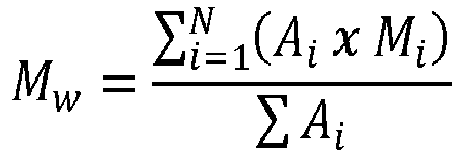

- A PolymerChar GPC instrument, equipped with infrared (IR) detector was used with 3 x Olexis and 1x Olexis Guard columns from Polymer Laboratories and 1,2,4-trichlorobenzene (TCB, stabilized with 250 mg/l 2,6-Di-tert-butyl-4-methyl-phenol) as solvent at 160 °C and at a constant flow rate of 1 ml/min. 200 µL of sample solution were injected per analysis. The column set was calibrated using universal calibration (according to ISO 16014-2:2003) with at least 15 narrow MWD polystyrene (PS) standards in the range of 0.5 kg/mol to 11500 kg/mol. Mark Houwink constants used for PS, PE and PP are as described per ASTM D 6474-99. All samples were prepared by dissolving 5.0 to 9.0 mg of polymer in 8 ml (at 160 °C) of stabilized TCB (same as mobile phase) for 2.5 hours for PP or 3 hours for PE at 160 °C under continuous gentle shaking in the autosampler of the GPC instrument.
- The molar mass averages (Mz, Mw and Mn) and the molar mass distribution of Polyalkylene glycol block copolymer was determined by gel permeation chromatography (GPC) in chloroform (CHCl3) at 23 °C.
- The amount of the polymer soluble in xylene was determined at 25 °C according to ISO 16152; 5th edition; 2005-07-01.
- DSC analysis, melting peak temperature (Tp,m) and melting enthalpy (Hm), crystallization peak temperature (Tp,c) and crystallization enthalpy (Hc): measured with a TA Instrument Q200 differential scanning calorimetry (DSC) on 5 to 7 mg samples. DSC was run according to ISO 11357 / part 3 /method C2 in a heat / cool / heat cycle with a scan rate of 10 °C/min in the temperature range of -30 to +225 °C. Crystallization peak temperature (Tp,c) and crystallization enthalpy (Hc) were determined from the cooling step, while the melting peak temperature (Tp1,m) and the melting peak temperature (Tp2,m) and the melting enthalpy (Hm1/2) were determined from the second heating step.
- Surface tension was determined using test inks from Arcotest (22-48 mN/m [2 mN/m steps]).
- The certified ink (starting with 22 mN/m) was applied to the film in MD and TD. It was visually assessed whether the ink remained on the film for at least 3 seconds. If the ink remained on the film, the next higher ink was tested. This was done until the ink did not longer adhere to the film. The value is given with the highest measured test ink that adheres to the film for at least 3s.
- The measured surface tension results from a visual assessment with different test inks (in ascending order) and serves as a meaningful assessment of the surface tension.
- Determination of the beginning of flow instabilities at high shear rates was determined by using a RHEOGRAPH 75 high-pressure capillary rheometers (GÖTTFERT) according to ISO 11443 at 190 °C. Capillary L/D: 30/2.
- The following metallocene complex has been used as described in
WO 2019/179959 :
- A steel reactor equipped with a mechanical stirrer and a filter net was flushed with nitrogen and the reactor temperature was set to 20°C. Next silica grade DM-L-303 from AGC Si-Tech Co, pre-calcined at 600°C (5.0 kg) was added from a feeding drum followed by careful pressuring and depressurising with nitrogen using manual valves. Then toluene (22 kg) was added. The mixture was stirred for 15 min. Next 30 wt.-% solution of MAO in toluene (9.0 kg) from Lanxess was added via feed line on the top of the reactor within 70 min. The reaction mixture was then heated up to 90°C and stirred at 90°C for additional two hours. The slurry was allowed to settle and the mother liquor was filtered off. The catalyst was washed twice with toluene (22 kg) at 90°C, following by settling and filtration. The reactor was cooled off to 60°C and the solid was washed with heptane (22.2 kg). Finally MAO treated SiO2 was dried at 60°C under nitrogen flow for 2 hours and then for 5 hours under vacuum (-0.5 barg) with stirring. MAO treated support was collected as a free-flowing white powder found to contain 12.2% Al by weight.
- 30 wt.-% MAO in toluene (0.7 kg) was added into a steel nitrogen blanked reactor via a burette at 20 °C. Toluene (5.4 kg) was then added under stirring. The metallocene complex as described above (93 g) was added from a metal cylinder followed by flushing with 1 kg toluene. The mixture was stirred for 60 minutes at 20°C. Trityl tetrakis(pentafluorophenyl) borate (91 g) was then added from a metal cylinder followed by a flush with 1 kg of toluene. The mixture was stirred for 1 h at room temperature. The resulting solution was added to a stirred cake of MAO-silica support prepared as described above over 1 hour. The cake was allowed to stay for 12 hours, followed by drying under N2 flow at 60°C for 2 h and additionally for 5 h under vacuum (-0.5 barg) under stirring.
- Dried catalyst was sampled in the form of pink free flowing powder containing 13.9% Al and 0.11% Zr.
Table 1: Polymerization conditions Polymer Poly1 Catalyst SSCS1 Prepoly reactor Temp. [°C] 18 Press. [kPa] 4994 Residence time [h] 0.4 Loop reactor Temp. [°C] 68 Press. [kPa] 4985 Feed H2/C3 ratio [mol/kmol] 0.1 Feed C2/C3 ratio [mol/kmol] 15.3 Polymer Split* [wt.-%] 60 MFR2 ∗ [g/10 min] 3.9 Total C2* [wt.-%] 0.66 Total C2* [mol-%] 0.99 XCS* [wt.-%] 0.51 GPR (F2) Temp. [°C] 83 Press. [kPa] 2500 H2/C3 ratio [mol/kmol] 0.7 C2/C3 ratio [mol/kmol] 95.8 Polymer Split [wt.-%] 40 C2** [wt.-%] 3.01 C2∗∗ [mol-%] 4.45 MFR2 ∗∗∗ [g/10 min] 0.65 Pellet MFR2 [g/10 min] 1.9 MWD [-] 2.9 Total C2 [wt.-%] 1.6 Total C2 [mol-%] 2.4 2,1 erythro [mol-%] 0.61 XCS [wt.-%] 0.49 ∗ "MFR2", "Total C2", "XCS" and "Polymer Split" are measured in the loop reactor, i.e. is the combination of Prepoly Reactor and Loop reactor and considered as the first propylene copolymer fraction (F1) ∗∗ "C2" is calculated from the "Total C2" measured in the loop reactor and "Total C2" measured from the pellet ∗∗∗ "MFR2" is calculated from the MFR2 measured in the loop reactor and the MFR2 of the pellet using the formula given above defining the measurement of MFR2 - The ethylene-propylene copolymer was compounded in a ZSK 57 twin screw extruder, with a melt temperature of 210°C, together with different additives mentioned in table 2 to obtain the polypropylene compositions of examples CE1 and IE1 to IE3.
Table 2: Polymer composition and blown film properties Polymer composition CE1 IE1 IE2 IE3 Poly1 [wt.-%] 99.75 99.55 99.55 99.55 AO1 [wt.-%] 0.1 0.1 0.1 0.1 SHT [wt.-%] 0.05 0.05 0.05 0.05 NA [wt.-%] 0.1 0.1 0.1 0.01 F-108 [wt.-%] - 0.2 - F87 [wt.-%] - - 0.2 T/908 [wt.-%] 0.2 Polymer composition properties MFR2 [g/10min] 1.9 3.0 2.9 2.8 Tp,c [°C] 116 116 116 116 Tp1,m [°C] 146 147 146 146 Tp2,m [°C] 134 135 134 134 CSR [s-1] 230 576 576 576 Blown film properties Surface tension [dyn] 28 30 30 30 Film surface Melt fracture No melt fracture No melt fracture No melt fracture "CSR" is the critical shear rate;
"AO1" is a mixture of the sterically hindered phenol pentaerythrityl-tetrakis(3-(3',5'-di-tert. butyl-4-hydroxyphenyl)-propionate (CAS-no. 6683-19-8, commercially available as Irganox 1010 from BASF SE, Germany) and the phosphorous based antioxidant tris (2,4-di-t-butylphenyl) phosphite (CAS-no. 31570-04-4, commercially available as Irgafos 168 from BASF SE, Germany) in the weight ratio of 1:2; "SHT" is the acid scavenger Hycite 713 of BASF SE, Germany, a magnesium/aluminium-hydrotalcite (CAS-no. 11097-59-9);
"NA" is the commercial alpha-nucleating agent ADK STAB NA-71 of Adeka Corporation, Japan, a mixture comprising 2,2'-Methylenebis(2,6-di-tert-butylphenyl)phosphate lithium salt (CAS-no. 85209-93-4);
"F-108" is the linear poly(ethylene glycol)-block-poly(propylene glycol)-block-poly(ethylene glycol) block copolymer (EOxPOyEOx') Pluronic® F-108 (CAS-no. 9003-11-6) commercially available from Sigma-Aldrich, having an EO content of 82.6 wt.-%, a PO content of 17.4 wt.-%, Mw 14,600 g/mol, average number of EO units of 265 (≙x+x') and an average number of PO units of 50 (≙y).
"F87" is the linear poly(ethylene glycol)-block-poly(propylene glycol)-block-poly(ethylene glycol) block copolymer (EOxPOyEOx') Synperonic™ PE/F87 (INCI name: Poloxamer 237) commercially available from Croda company, having an EO content of 70 wt.-%, PO content of 30 wt.-%, Mw 7,700 g/mol, average number of EO units of 122 (≙x+x') and an average number of PO units of 40 (≙y);
"T/908" is the X shaped poloxamine Synperonic™ T/908 commercially available from Croda company, having an EO content of 80.0 wt.-%, PO content of 19.8 wt.-%, Mw 25,000 g/mol, and 4 diblock units EOxPOy connected to ethylene diamine with each block having an average number of EO units of 114 (≙x) and an average number of PO units of 21 (≙y). - The blown films were produced on a Windmöller & Hölscher (W&H) semi-commercial blown film line, with blow-up ratio of 1:2.5 and film thickness of 50 µm. The melt temperature was fixed at 220°C and the uptake speed was 14m/min. The surface quality of the films were observed by man skilled in the art.
- As seen in Table 2, the polyalkylene glycol-block copolymers increase the critical shear rate significantly. CSR is a measure of the on-set of melt fracture. This means the IEs have improved processing in blown film while the CE has clear visible melt fracture and all the IEs have a glossy and smooth surface. Moreover, the measured surface tension of the IEs is slightly higher, meaning the surface polarity is not reduced by the block copolymers, which has a slightly positive effect of surface adhesion.
Claims (15)
- Blown film comprising a polypropylene composition comprisinga) at least 98.0 wt.-% of an ethylene-propylene copolymer, based on the total weight of the polypropylene composition, andb) 0.01 to 1.0 wt.-% of a polymer processing aid, based on the total weight of the polypropylene composition, wherein said polymer processing aid is a polyalkylene glycol-block copolymer comprising poly(ethylene glycol (EO)) and polypropylene glycol (PO)) blocks,wherein the ethylene-propylene copolymer hasi) an ethylene content, measured by 13C-NMR, in the range of 0.5 to 7.0 wt.-%,ii) 2,1 erythro regio-defects, measured by 13C NMR, in the range of >0.10 to 1.00 mol-%, andiii) a MFR2 (230 °C; 2.16 kg), measured according to ISO 1133, in the range of 0.1 to 5.0 g/lOmin.
- The blown film according to claim 1, wherein the polyalkylene glycol-block copolymer has- an ethylene glycol (EO) content, measured by 13C NMR, of ≥ 50 wt.-%, preferably ≥ 65 wt.-%, based on the total weight of the polyalkylene glycol-block copolymer; and- an propylene glycol (PO) content, measured by 13C NMR, of ≤ 50 wt.-%, preferably ≤ 35 wt.-%, based on the total weight of the polyalkylene glycol-block copolymer; and- optionally a combined content of ethylene glycol (EO) and propylene glycol (PO) in the range of 90 to 100 wt.-%, preferably 95 to 100 wt.-%, based on the total weight of the polyalkylene glycol-block copolymer.
- The blown film according to claim 1 or 2, wherein the polyalkylene glycol-block copolymer has a weight average molar mass (Mw), determined by GPC, in the range of 4,000 to 80,000 g/mol, preferably 4,000 to 50,000 g/mol.
- The blown film according to any of the preceding claims, wherein the polyalkylene glycol-block copolymer comprises- a triblock unit represented by EOxPOyEOx', wherein x+x' is on average from 10 to 500, preferably 50 to 350, and y is on average from 5 to 100, preferably 10 to 80, and/or- at least one, preferably at least two diblock units represented by EOxPOy, wherein x is on average from 10 to 500, preferably 20 to 200 and y is on average from 5 to 100, preferably from 10 to 80.
- The blown film according to claim 4, wherein the polyalkylene glycol-block copolymer is a linear poloxamere consisting of one triblock unit represented by EOxPOyEOx', wherein x+x' is on average from 10 to 500, preferably 50 to 350 and y is on average from 5 to 100, preferably 10 to 80, and wherein the ratio (

- The blown film according to claim 4, wherein the polyalkylene glycol-block copolymer is a poloxamine having 4 diblock units represented by EOxPOy, wherein x is on average from 10 to 500, preferably 20 to 200, y is on average from 5 to 100, preferably from 10 to 80, the 4 diblock units are connected to an alkylene diamine, and wherein the ratio (

- The blown film according to claim 6, wherein the poloxamine is represented by the following formula (i):

- The blown film according to any of the preceding claims, wherein the polypropylene composition does not contain fluoropolymers, preferably contains solely the polyalkylene glycol-block copolymer as the polymer processing aid.
- The blown film according to any of the preceding claims, wherein the polypropylene composition has- a MFR2 (230 °C; 2.16 kg), measured according to ISO 1133, in the range of 0.1 to 5.0 g/10min; and- optionally a melting temperature Tm, determined according to ISO 11357-3, in the range of 125 to 162 °C.
- The blown film according to any of the preceding claims, wherein the ethylene-propylene copolymer has- a molecular weight distribution (MWD) determined by Gel Permeation Chromatography (GPC) in the range of 2.0 to 5.0; and- optionally a xylene cold soluble (XCS) fraction, determined at 25 °C, according to ISO 16152, in the range of 0.1 to 5.0 wt.-%.
- The blown film according to any of the preceding claims, wherein the polypropylene composition comprises additionally an alpha-nucleating agent in the range of 0.0001 to 1.0 wt.-%, based on the total amount of the polypropylene composition, wherein the alpha-nucleating agent is preferably selected from the group consisting of hydroxy-bis[2,4,8,10-tetrakis(1,1-dimethylethyl)-6-hydroxy-12H-dibenzo-[d,g]-dioxa-phoshocin-6-oxidato] aluminium, poly vinylcyclohexane (p-VCH), 2,2'- methylene bis-(2,6-di-tert. butylphenyl) phosphate lithium salt, and 1,2-cyclohexane-dicarboxylic acid, calcium salt, and mixtures thereof.
- The blown film according to any of the preceding claims, wherein the ethylene-propylene copolymer comprises, preferably consists of,(a) a first ethylene-propylene copolymer fraction (F1) having an ethylene content, measured by 13C-NMR, in the range of 0.4 to 5.0 wt.-%, and(b) a second ethylene-propylene copolymer fraction (F2),wherein- the amount of ethylene in the first ethylene-propylene copolymer fraction (F1) and second ethylene-propylene copolymer fraction (F2) is different, with the proviso that the ethylene content in the first ethylene-propylene copolymer fraction (F1) is lower than in the second ethylene-propylene copolymer fraction (F2),- the weight ratio between the first ethylene-propylene copolymer fraction (F1) and the second ethylene-propylene copolymer fraction (F2) [(F1)/(F2)] is in the range of 70/30 to 50/50, and- the total amount of the first ethylene-propylene copolymer fraction (F1) and the second ethylene-propylene copolymer fraction (F2) together, based on the ethylene-propylene copolymer, is at least 98 wt.-%, preferably the ethylene-propylene copolymer consists of the first propylene ethylene-copolymer fraction (F1) and the second ethylene-propylene copolymer fraction (F2).
- Blown film according to claim 12, wherein the ethylene-propylene copolymer complies with the equation (1)
 "C2 (PPC)" is the ethylene content [wt.-%], measured by 13C NMR, of the ethylene-propylene copolymer;"C2 (F1)" is the ethylene content [wt.-%], measured by 13C NMR, of the first ethylene-propylene copolymer fraction (F1);"(F1)/(PPC)" is the amount of the first propylene ethylene-copolymer fraction (F1) in the ethylene-propylene copolymer divided by the amount of the ethylene-propylene copolymer.
 - Blown film according to claim 12 or 13, wherein the ethylene content between the first ethylene-propylene copolymer fraction (F1) and the second ethylene-propylene copolymer fraction (F2) differs in the range of 1.5 to 6.0 wt.-%.
- Use of the polymer processing aid as defined in any of claims 1 to 7 for improving the critical shear rate, determined according to ISO 11443 at 190 °C of the propylene composition according to any of the claims 1 to 14 by at least 100 s-1, preferably 200 s-1 compared to a propylene composition being identical as defined in any one of the preceding claims but without any polymer processing aid.
Priority Applications (4)
| Application Number | Priority Date | Filing Date | Title |
|---|---|---|---|
| ES23169120T ES3055700T3 (en) | 2023-04-21 | 2023-04-21 | Blown film |
| EP23169120.5A EP4450539B1 (en) | 2023-04-21 | 2023-04-21 | Blown film |
| PCT/EP2024/060722 WO2024218301A1 (en) | 2023-04-21 | 2024-04-19 | Blown film |
| CN202480026621.9A CN120981514A (en) | 2023-04-21 | 2024-04-19 | blown film |
Applications Claiming Priority (1)
| Application Number | Priority Date | Filing Date | Title |
|---|---|---|---|
| EP23169120.5A EP4450539B1 (en) | 2023-04-21 | 2023-04-21 | Blown film |
Publications (2)
| Publication Number | Publication Date |
|---|---|
| EP4450539A1 true EP4450539A1 (en) | 2024-10-23 |
| EP4450539B1 EP4450539B1 (en) | 2025-10-29 |
Family
ID=86282321
Family Applications (1)
| Application Number | Title | Priority Date | Filing Date |
|---|---|---|---|
| EP23169120.5A Active EP4450539B1 (en) | 2023-04-21 | 2023-04-21 | Blown film |
Country Status (4)
| Country | Link |
|---|---|
| EP (1) | EP4450539B1 (en) |
| CN (1) | CN120981514A (en) |
| ES (1) | ES3055700T3 (en) |
| WO (1) | WO2024218301A1 (en) |
Citations (25)
| Publication number | Priority date | Publication date | Assignee | Title |
|---|---|---|---|---|
| US3324093A (en) | 1963-10-21 | 1967-06-06 | Phillips Petroleum Co | Loop reactor |
| US3405109A (en) | 1960-10-03 | 1968-10-08 | Phillips Petroleum Co | Polymerization process |
| US3740421A (en) | 1966-09-19 | 1973-06-19 | Basf Wyandotte Corp | Polyoxyethylene-polyoxypropylene aqueous gels |
| US4013622A (en) * | 1975-06-23 | 1977-03-22 | Cities Service Company | Method of reducing breakdown in polyethylene film |
| US4582816A (en) | 1985-02-21 | 1986-04-15 | Phillips Petroleum Company | Catalysts, method of preparation and polymerization processes therewith |
| EP0479186A2 (en) | 1990-10-01 | 1992-04-08 | Phillips Petroleum Company | Apparatus and method for producing ethylene polymer |
| WO1992012182A1 (en) | 1990-12-28 | 1992-07-23 | Neste Oy | Multi-stage process for producing polyethylene |
| US5391654A (en) | 1990-12-28 | 1995-02-21 | Neste Oy | Method for homo- or copolymerizing ethene |
| EP0887379A1 (en) | 1997-06-24 | 1998-12-30 | Borealis A/S | Process and apparatus for preparing propylene homopolymers and copolymers |
| EP0887381A1 (en) | 1997-06-24 | 1998-12-30 | Borealis A/S | Process for preparing propylene polymers and impact modified polymers |
| EP0887380A1 (en) | 1997-06-24 | 1998-12-30 | Borealis A/S | Process for preparing propylene copolymers |
| WO1999024478A1 (en) | 1997-11-07 | 1999-05-20 | Borealis A/S | Process for preparing polypropylene |
| WO1999024479A1 (en) | 1997-11-07 | 1999-05-20 | Borealis A/S | Novel propylene polymers and products thereof |
| EP0991684A1 (en) | 1997-06-24 | 2000-04-12 | Borealis A/S | Process for preparing polypropylene alloys |
| WO2000068315A1 (en) | 1999-05-07 | 2000-11-16 | Borealis Technology Oy | High-stiffness propylene polymers and a process for the preparation thereof |
| WO2004000899A1 (en) | 2002-06-25 | 2003-12-31 | Borealis Technology Oy | Polyolefin with improved scratch resistance and process for producing the same |
| WO2004111095A1 (en) | 2003-06-06 | 2004-12-23 | Borealis Technology Oy | Process for the catalytic polymerization of olefins, a reactor system, its use in the process, the polyolefins obtained and their use |
| US20050070644A1 (en) | 2003-09-26 | 2005-03-31 | Nova Chemicals (International) S.A. | High molecular weight polyethylene glycol as polymer process aids |
| DE60112565T2 (en) * | 2000-01-21 | 2006-06-29 | Mitsui Chemicals, Inc. | OLEFINBLOCKCOPOLYMERE, METHOD OF MANUFACTURING THE SAME AND THEIR USE |
| WO2015011134A1 (en) | 2013-07-24 | 2015-01-29 | Borealis Ag | Process |
| WO2015082379A1 (en) | 2013-12-04 | 2015-06-11 | Borealis Ag | Phthalate-free pp homopolymers for meltblown fibers |
| WO2019179959A1 (en) | 2018-03-19 | 2019-09-26 | Borealis Ag | Catalysts for olefin polymerization |
| EP3234004B1 (en) | 2014-12-19 | 2020-07-01 | 3M Innovative Properties Company | Poly(oxyalkylene) polymer processing additive, compositions, and methods |
| EP3960797A1 (en) * | 2020-08-27 | 2022-03-02 | Borealis AG | Polypropylene based film |
| US20230024578A1 (en) * | 2021-09-30 | 2023-01-26 | Exxonmobil Chemical Patents Inc. | Polyethylene Glycol-Based Polymer Processing Aid Masterbatches |
-
2023
- 2023-04-21 ES ES23169120T patent/ES3055700T3/en active Active
- 2023-04-21 EP EP23169120.5A patent/EP4450539B1/en active Active
-
2024
- 2024-04-19 WO PCT/EP2024/060722 patent/WO2024218301A1/en not_active Ceased
- 2024-04-19 CN CN202480026621.9A patent/CN120981514A/en active Pending
Patent Citations (25)
| Publication number | Priority date | Publication date | Assignee | Title |
|---|---|---|---|---|
| US3405109A (en) | 1960-10-03 | 1968-10-08 | Phillips Petroleum Co | Polymerization process |
| US3324093A (en) | 1963-10-21 | 1967-06-06 | Phillips Petroleum Co | Loop reactor |
| US3740421A (en) | 1966-09-19 | 1973-06-19 | Basf Wyandotte Corp | Polyoxyethylene-polyoxypropylene aqueous gels |
| US4013622A (en) * | 1975-06-23 | 1977-03-22 | Cities Service Company | Method of reducing breakdown in polyethylene film |
| US4582816A (en) | 1985-02-21 | 1986-04-15 | Phillips Petroleum Company | Catalysts, method of preparation and polymerization processes therewith |
| EP0479186A2 (en) | 1990-10-01 | 1992-04-08 | Phillips Petroleum Company | Apparatus and method for producing ethylene polymer |
| WO1992012182A1 (en) | 1990-12-28 | 1992-07-23 | Neste Oy | Multi-stage process for producing polyethylene |
| US5391654A (en) | 1990-12-28 | 1995-02-21 | Neste Oy | Method for homo- or copolymerizing ethene |
| EP0887379A1 (en) | 1997-06-24 | 1998-12-30 | Borealis A/S | Process and apparatus for preparing propylene homopolymers and copolymers |
| EP0887381A1 (en) | 1997-06-24 | 1998-12-30 | Borealis A/S | Process for preparing propylene polymers and impact modified polymers |
| EP0887380A1 (en) | 1997-06-24 | 1998-12-30 | Borealis A/S | Process for preparing propylene copolymers |
| EP0991684A1 (en) | 1997-06-24 | 2000-04-12 | Borealis A/S | Process for preparing polypropylene alloys |
| WO1999024479A1 (en) | 1997-11-07 | 1999-05-20 | Borealis A/S | Novel propylene polymers and products thereof |
| WO1999024478A1 (en) | 1997-11-07 | 1999-05-20 | Borealis A/S | Process for preparing polypropylene |
| WO2000068315A1 (en) | 1999-05-07 | 2000-11-16 | Borealis Technology Oy | High-stiffness propylene polymers and a process for the preparation thereof |
| DE60112565T2 (en) * | 2000-01-21 | 2006-06-29 | Mitsui Chemicals, Inc. | OLEFINBLOCKCOPOLYMERE, METHOD OF MANUFACTURING THE SAME AND THEIR USE |
| WO2004000899A1 (en) | 2002-06-25 | 2003-12-31 | Borealis Technology Oy | Polyolefin with improved scratch resistance and process for producing the same |
| WO2004111095A1 (en) | 2003-06-06 | 2004-12-23 | Borealis Technology Oy | Process for the catalytic polymerization of olefins, a reactor system, its use in the process, the polyolefins obtained and their use |
| US20050070644A1 (en) | 2003-09-26 | 2005-03-31 | Nova Chemicals (International) S.A. | High molecular weight polyethylene glycol as polymer process aids |
| WO2015011134A1 (en) | 2013-07-24 | 2015-01-29 | Borealis Ag | Process |
| WO2015082379A1 (en) | 2013-12-04 | 2015-06-11 | Borealis Ag | Phthalate-free pp homopolymers for meltblown fibers |
| EP3234004B1 (en) | 2014-12-19 | 2020-07-01 | 3M Innovative Properties Company | Poly(oxyalkylene) polymer processing additive, compositions, and methods |
| WO2019179959A1 (en) | 2018-03-19 | 2019-09-26 | Borealis Ag | Catalysts for olefin polymerization |
| EP3960797A1 (en) * | 2020-08-27 | 2022-03-02 | Borealis AG | Polypropylene based film |
| US20230024578A1 (en) * | 2021-09-30 | 2023-01-26 | Exxonmobil Chemical Patents Inc. | Polyethylene Glycol-Based Polymer Processing Aid Masterbatches |
Non-Patent Citations (9)
| Title |
|---|
| BUSICO, V.CARBONNIERE, P.CIPULLO, R.PELLECCHIA, R.SEVERN, J.TALARICO, G., MACROMOL. RAPID COMMUN., vol. 28, 2007, pages 11289 |
| BUSICO, V.CIPULLO, R., PROG. POLYM. SCI., vol. 26, 2001, pages 443 - 990 |
| BUSICO, V.CIPULLO, R.MONACO, G.VACATELLO, M.SEGRE, A.L., MACROMOLECULES, vol. 30, 1997, pages 6251 |
| CARMEN ALVAREZ-LORENZO ET AL.: "Frontiers in bioscience", January 2010, article "Poloxamine-based nanomaterials for drug delivery", pages: 412 - 414 |
| CHENG, H. N., MACROMOLECULES, vol. 17, 1984, pages 1950 |
| JANA HERZBERGER ET AL.: "Polymerization of Ethylene Oxide, Propylene Oxide, and Other Alkylene Oxides: Synthesis, Novel Polymer Architectures, and Bioconjugation", CHEM. REV., vol. 116, no. 4, 2016, pages 2170 - 2243, XP055266674, DOI: 10.1021/acs.chemrev.5b00441 |
| RESCONI, L.CAVALLO, L.FAIT, A.PIEMONTESI, F., CHEM. REV., vol. 100, 2000, pages 1253 |
| WANG, W-J.ZHU, S., MACROMOLECULES, vol. 33, 2000, pages 1157 |
| ZHOU, Z.KUEMMERLE, R.QIU, X.REDWINE, D.CONG, R.TAHA, A.BAUGH, D.WINNIFORD, B., J. MAG. RESON., vol. 187, 2007, pages 225 |
Also Published As
| Publication number | Publication date |
|---|---|
| EP4450539B1 (en) | 2025-10-29 |
| ES3055700T3 (en) | 2026-02-13 |
| CN120981514A (en) | 2025-11-18 |
| WO2024218301A1 (en) | 2024-10-24 |
Similar Documents
| Publication | Publication Date | Title |
|---|---|---|
| EP3502177B1 (en) | Polypropylene composition | |
| EP3735441B1 (en) | Polypropylene composition with improved sealing behaviour | |
| EP3126411B1 (en) | Heterophasic propylene copolymer with low extractables | |
| EP3212712B2 (en) | Heterophasic polypropylene with improved puncture respectively impact strength/stiffness balance | |
| KR101529401B1 (en) | High flow and stiff polymer material with good transparency and impact properties | |
| EP4253453A1 (en) | Blown film | |
| EP3473674A1 (en) | Polypropylene composition | |
| EP3567079B1 (en) | Heterophasic polypropylene with propylene hexene random copolymer as matrix | |
| US20230257567A1 (en) | Polypropylene based film | |
| EP4194503B1 (en) | Heterophasic propylene-ethylene copolymer/propylene-butylene random copolymer blend | |
| EP3873983B1 (en) | A moulded article comprising a polypropylene composition suitable for gamma-ray sterilization | |
| EP4038137B1 (en) | Polymer composition suitable for making blown films | |
| EP4038138B1 (en) | Polymer composition suitable for making blown films | |
| EP3914644B1 (en) | Foamable polypropylene composition with excellent mechanical performance | |
| EP3873982B1 (en) | A polymer composition suitable for gamma-ray sterilization | |
| EP4450539B1 (en) | Blown film | |
| EP4450538A1 (en) | Blown film | |
| EP3421537B1 (en) | Polypropylene composition with outstanding impact performance | |
| US20250145797A1 (en) | Polypropylene composition with improved optical characteristics | |
| WO2025242653A1 (en) | Polyolefin compositions for blown films | |
| US20230203334A1 (en) | Polypropylene coating composition | |
| EP4491642A1 (en) | Low stress whitening polypropylene homopolymer composition | |
| EP4556499B1 (en) | Multimodal polypropylene homopolymer for film applications | |
| EP4636015A1 (en) | Biaxially oriented polyethylene (bope) films comprising a polymeric nucleating agent | |
| EP4552843A1 (en) | Machine direction oriented (mdo) multilayer film |
Legal Events
| Date | Code | Title | Description |
|---|---|---|---|
| PUAI | Public reference made under article 153(3) epc to a published international application that has entered the european phase |
Free format text: ORIGINAL CODE: 0009012 |
|
| STAA | Information on the status of an ep patent application or granted ep patent |
Free format text: STATUS: THE APPLICATION HAS BEEN PUBLISHED |
|
| AK | Designated contracting states |
Kind code of ref document: A1 Designated state(s): AL AT BE BG CH CY CZ DE DK EE ES FI FR GB GR HR HU IE IS IT LI LT LU LV MC ME MK MT NL NO PL PT RO RS SE SI SK SM TR |
|
| STAA | Information on the status of an ep patent application or granted ep patent |
Free format text: STATUS: REQUEST FOR EXAMINATION WAS MADE |
|
| 17P | Request for examination filed |
Effective date: 20250219 |
|
| REG | Reference to a national code |
Ref legal event code: R079 Ipc: C08K0005000000 Ref country code: DE Ref legal event code: R079 Ref document number: 602023007901 Country of ref document: DE Free format text: PREVIOUS MAIN CLASS: C08J0005180000 Ipc: C08K0005000000 |
|
| GRAP | Despatch of communication of intention to grant a patent |
Free format text: ORIGINAL CODE: EPIDOSNIGR1 |
|
| STAA | Information on the status of an ep patent application or granted ep patent |
Free format text: STATUS: GRANT OF PATENT IS INTENDED |
|
| RAP3 | Party data changed (applicant data changed or rights of an application transferred) |
Owner name: BOREALIS GMBH |
|
| RIC1 | Information provided on ipc code assigned before grant |
Ipc: C08K 5/00 20060101AFI20250626BHEP Ipc: C08K 5/523 20060101ALI20250626BHEP Ipc: C08J 5/18 20060101ALI20250626BHEP Ipc: C08L 23/16 20060101ALI20250626BHEP Ipc: C08L 71/02 20060101ALI20250626BHEP |
|
| INTG | Intention to grant announced |
Effective date: 20250708 |
|
| GRAS | Grant fee paid |
Free format text: ORIGINAL CODE: EPIDOSNIGR3 |
|
| GRAA | (expected) grant |
Free format text: ORIGINAL CODE: 0009210 |
|
| STAA | Information on the status of an ep patent application or granted ep patent |
Free format text: STATUS: THE PATENT HAS BEEN GRANTED |
|
| P01 | Opt-out of the competence of the unified patent court (upc) registered |
Free format text: CASE NUMBER: UPC_APP_6398_4450539/2025 Effective date: 20250909 |
|
| AK | Designated contracting states |
Kind code of ref document: B1 Designated state(s): AL AT BE BG CH CY CZ DE DK EE ES FI FR GB GR HR HU IE IS IT LI LT LU LV MC ME MK MT NL NO PL PT RO RS SE SI SK SM TR |
|
| REG | Reference to a national code |
Ref country code: CH Ref legal event code: F10 Free format text: ST27 STATUS EVENT CODE: U-0-0-F10-F00 (AS PROVIDED BY THE NATIONAL OFFICE) Effective date: 20251029 Ref country code: GB Ref legal event code: FG4D |
|
| REG | Reference to a national code |
Ref country code: DE Ref legal event code: R096 Ref document number: 602023007901 Country of ref document: DE |
|
| REG | Reference to a national code |
Ref country code: IE Ref legal event code: FG4D |
|
| REG | Reference to a national code |
Ref country code: ES Ref legal event code: FG2A Ref document number: 3055700 Country of ref document: ES Kind code of ref document: T3 Effective date: 20260213 |
|
| REG | Reference to a national code |
Ref country code: NL Ref legal event code: MP Effective date: 20251029 |
|
| REG | Reference to a national code |
Ref country code: LT Ref legal event code: MG9D |
|
| PG25 | Lapsed in a contracting state [announced via postgrant information from national office to epo] |
Ref country code: NO Free format text: LAPSE BECAUSE OF FAILURE TO SUBMIT A TRANSLATION OF THE DESCRIPTION OR TO PAY THE FEE WITHIN THE PRESCRIBED TIME-LIMIT Effective date: 20260129 |
|
| PG25 | Lapsed in a contracting state [announced via postgrant information from national office to epo] |
Ref country code: HR Free format text: LAPSE BECAUSE OF FAILURE TO SUBMIT A TRANSLATION OF THE DESCRIPTION OR TO PAY THE FEE WITHIN THE PRESCRIBED TIME-LIMIT Effective date: 20251029 Ref country code: AT Free format text: LAPSE BECAUSE OF FAILURE TO SUBMIT A TRANSLATION OF THE DESCRIPTION OR TO PAY THE FEE WITHIN THE PRESCRIBED TIME-LIMIT Effective date: 20251029 Ref country code: FI Free format text: LAPSE BECAUSE OF FAILURE TO SUBMIT A TRANSLATION OF THE DESCRIPTION OR TO PAY THE FEE WITHIN THE PRESCRIBED TIME-LIMIT Effective date: 20251029 |
|
| REG | Reference to a national code |
Ref country code: AT Ref legal event code: MK05 Ref document number: 1851531 Country of ref document: AT Kind code of ref document: T Effective date: 20251029 |
|
| PG25 | Lapsed in a contracting state [announced via postgrant information from national office to epo] |
Ref country code: NL Free format text: LAPSE BECAUSE OF FAILURE TO SUBMIT A TRANSLATION OF THE DESCRIPTION OR TO PAY THE FEE WITHIN THE PRESCRIBED TIME-LIMIT Effective date: 20251029 |
|
| PG25 | Lapsed in a contracting state [announced via postgrant information from national office to epo] |
Ref country code: RS Free format text: LAPSE BECAUSE OF FAILURE TO SUBMIT A TRANSLATION OF THE DESCRIPTION OR TO PAY THE FEE WITHIN THE PRESCRIBED TIME-LIMIT Effective date: 20260129 |
|
| PG25 | Lapsed in a contracting state [announced via postgrant information from national office to epo] |
Ref country code: IS Free format text: LAPSE BECAUSE OF FAILURE TO SUBMIT A TRANSLATION OF THE DESCRIPTION OR TO PAY THE FEE WITHIN THE PRESCRIBED TIME-LIMIT Effective date: 20260228 |
|
| PG25 | Lapsed in a contracting state [announced via postgrant information from national office to epo] |
Ref country code: PT Free format text: LAPSE BECAUSE OF FAILURE TO SUBMIT A TRANSLATION OF THE DESCRIPTION OR TO PAY THE FEE WITHIN THE PRESCRIBED TIME-LIMIT Effective date: 20260302 |
|
| PG25 | Lapsed in a contracting state [announced via postgrant information from national office to epo] |
Ref country code: PL Free format text: LAPSE BECAUSE OF FAILURE TO SUBMIT A TRANSLATION OF THE DESCRIPTION OR TO PAY THE FEE WITHIN THE PRESCRIBED TIME-LIMIT Effective date: 20251029 |
|
| PG25 | Lapsed in a contracting state [announced via postgrant information from national office to epo] |
Ref country code: LV Free format text: LAPSE BECAUSE OF FAILURE TO SUBMIT A TRANSLATION OF THE DESCRIPTION OR TO PAY THE FEE WITHIN THE PRESCRIBED TIME-LIMIT Effective date: 20251029 |
|
| PG25 | Lapsed in a contracting state [announced via postgrant information from national office to epo] |
Ref country code: BG Free format text: LAPSE BECAUSE OF FAILURE TO SUBMIT A TRANSLATION OF THE DESCRIPTION OR TO PAY THE FEE WITHIN THE PRESCRIBED TIME-LIMIT Effective date: 20251029 |