EP4450501A1 - Cdk9 inhibitor and use thereof - Google Patents
Cdk9 inhibitor and use thereof Download PDFInfo
- Publication number
- EP4450501A1 EP4450501A1 EP22906704.6A EP22906704A EP4450501A1 EP 4450501 A1 EP4450501 A1 EP 4450501A1 EP 22906704 A EP22906704 A EP 22906704A EP 4450501 A1 EP4450501 A1 EP 4450501A1
- Authority
- EP
- European Patent Office
- Prior art keywords
- alkyl
- amino
- membered
- alkoxy
- halogenated
- Prior art date
- Legal status (The legal status is an assumption and is not a legal conclusion. Google has not performed a legal analysis and makes no representation as to the accuracy of the status listed.)
- Pending
Links
Classifications
-
- C—CHEMISTRY; METALLURGY
- C07—ORGANIC CHEMISTRY
- C07D—HETEROCYCLIC COMPOUNDS
- C07D471/00—Heterocyclic compounds containing nitrogen atoms as the only ring hetero atoms in the condensed system, at least one ring being a six-membered ring with one nitrogen atom, not provided for by groups C07D451/00 - C07D463/00
- C07D471/02—Heterocyclic compounds containing nitrogen atoms as the only ring hetero atoms in the condensed system, at least one ring being a six-membered ring with one nitrogen atom, not provided for by groups C07D451/00 - C07D463/00 in which the condensed system contains two hetero rings
- C07D471/04—Ortho-condensed systems
-
- A—HUMAN NECESSITIES
- A61—MEDICAL OR VETERINARY SCIENCE; HYGIENE
- A61K—PREPARATIONS FOR MEDICAL, DENTAL OR TOILETRY PURPOSES
- A61K31/00—Medicinal preparations containing organic active ingredients
- A61K31/33—Heterocyclic compounds
- A61K31/395—Heterocyclic compounds having nitrogen as a ring hetero atom, e.g. guanethidine or rifamycins
- A61K31/435—Heterocyclic compounds having nitrogen as a ring hetero atom, e.g. guanethidine or rifamycins having six-membered rings with one nitrogen as the only ring hetero atom
- A61K31/4353—Heterocyclic compounds having nitrogen as a ring hetero atom, e.g. guanethidine or rifamycins having six-membered rings with one nitrogen as the only ring hetero atom ortho- or peri-condensed with heterocyclic ring systems
- A61K31/4375—Heterocyclic compounds having nitrogen as a ring hetero atom, e.g. guanethidine or rifamycins having six-membered rings with one nitrogen as the only ring hetero atom ortho- or peri-condensed with heterocyclic ring systems the heterocyclic ring system containing a six-membered ring having nitrogen as a ring heteroatom, e.g. quinolizines, naphthyridines, berberine, vincamine
-
- A—HUMAN NECESSITIES
- A61—MEDICAL OR VETERINARY SCIENCE; HYGIENE
- A61K—PREPARATIONS FOR MEDICAL, DENTAL OR TOILETRY PURPOSES
- A61K31/00—Medicinal preparations containing organic active ingredients
- A61K31/33—Heterocyclic compounds
- A61K31/395—Heterocyclic compounds having nitrogen as a ring hetero atom, e.g. guanethidine or rifamycins
- A61K31/435—Heterocyclic compounds having nitrogen as a ring hetero atom, e.g. guanethidine or rifamycins having six-membered rings with one nitrogen as the only ring hetero atom
- A61K31/439—Heterocyclic compounds having nitrogen as a ring hetero atom, e.g. guanethidine or rifamycins having six-membered rings with one nitrogen as the only ring hetero atom the ring forming part of a bridged ring system, e.g. quinuclidine
-
- A—HUMAN NECESSITIES
- A61—MEDICAL OR VETERINARY SCIENCE; HYGIENE
- A61K—PREPARATIONS FOR MEDICAL, DENTAL OR TOILETRY PURPOSES
- A61K31/00—Medicinal preparations containing organic active ingredients
- A61K31/33—Heterocyclic compounds
- A61K31/395—Heterocyclic compounds having nitrogen as a ring hetero atom, e.g. guanethidine or rifamycins
- A61K31/435—Heterocyclic compounds having nitrogen as a ring hetero atom, e.g. guanethidine or rifamycins having six-membered rings with one nitrogen as the only ring hetero atom
- A61K31/44—Non condensed pyridines; Hydrogenated derivatives thereof
- A61K31/4427—Non condensed pyridines; Hydrogenated derivatives thereof containing further heterocyclic ring systems
- A61K31/444—Non condensed pyridines; Hydrogenated derivatives thereof containing further heterocyclic ring systems containing a six-membered ring with nitrogen as a ring heteroatom, e.g. amrinone
-
- A—HUMAN NECESSITIES
- A61—MEDICAL OR VETERINARY SCIENCE; HYGIENE
- A61K—PREPARATIONS FOR MEDICAL, DENTAL OR TOILETRY PURPOSES
- A61K31/00—Medicinal preparations containing organic active ingredients
- A61K31/33—Heterocyclic compounds
- A61K31/395—Heterocyclic compounds having nitrogen as a ring hetero atom, e.g. guanethidine or rifamycins
- A61K31/435—Heterocyclic compounds having nitrogen as a ring hetero atom, e.g. guanethidine or rifamycins having six-membered rings with one nitrogen as the only ring hetero atom
- A61K31/44—Non condensed pyridines; Hydrogenated derivatives thereof
- A61K31/445—Non condensed piperidines, e.g. piperocaine
- A61K31/4523—Non condensed piperidines, e.g. piperocaine containing further heterocyclic ring systems
- A61K31/4545—Non condensed piperidines, e.g. piperocaine containing further heterocyclic ring systems containing a six-membered ring with nitrogen as a ring hetero atom, e.g. pipamperone, anabasine
-
- A—HUMAN NECESSITIES
- A61—MEDICAL OR VETERINARY SCIENCE; HYGIENE
- A61K—PREPARATIONS FOR MEDICAL, DENTAL OR TOILETRY PURPOSES
- A61K31/00—Medicinal preparations containing organic active ingredients
- A61K31/33—Heterocyclic compounds
- A61K31/395—Heterocyclic compounds having nitrogen as a ring hetero atom, e.g. guanethidine or rifamycins
- A61K31/495—Heterocyclic compounds having nitrogen as a ring hetero atom, e.g. guanethidine or rifamycins having six-membered rings with two or more nitrogen atoms as the only ring heteroatoms, e.g. piperazine or tetrazines
- A61K31/505—Pyrimidines; Hydrogenated pyrimidines, e.g. trimethoprim
- A61K31/519—Pyrimidines; Hydrogenated pyrimidines, e.g. trimethoprim ortho- or peri-condensed with heterocyclic rings
-
- A—HUMAN NECESSITIES
- A61—MEDICAL OR VETERINARY SCIENCE; HYGIENE
- A61K—PREPARATIONS FOR MEDICAL, DENTAL OR TOILETRY PURPOSES
- A61K31/00—Medicinal preparations containing organic active ingredients
- A61K31/33—Heterocyclic compounds
- A61K31/395—Heterocyclic compounds having nitrogen as a ring hetero atom, e.g. guanethidine or rifamycins
- A61K31/535—Heterocyclic compounds having nitrogen as a ring hetero atom, e.g. guanethidine or rifamycins having six-membered rings with at least one nitrogen and one oxygen as the ring hetero atoms, e.g. 1,2-oxazines
- A61K31/5375—1,4-Oxazines, e.g. morpholine
- A61K31/5377—1,4-Oxazines, e.g. morpholine not condensed and containing further heterocyclic rings, e.g. timolol
-
- A—HUMAN NECESSITIES
- A61—MEDICAL OR VETERINARY SCIENCE; HYGIENE
- A61K—PREPARATIONS FOR MEDICAL, DENTAL OR TOILETRY PURPOSES
- A61K31/00—Medicinal preparations containing organic active ingredients
- A61K31/33—Heterocyclic compounds
- A61K31/395—Heterocyclic compounds having nitrogen as a ring hetero atom, e.g. guanethidine or rifamycins
- A61K31/535—Heterocyclic compounds having nitrogen as a ring hetero atom, e.g. guanethidine or rifamycins having six-membered rings with at least one nitrogen and one oxygen as the ring hetero atoms, e.g. 1,2-oxazines
- A61K31/5375—1,4-Oxazines, e.g. morpholine
- A61K31/5386—1,4-Oxazines, e.g. morpholine spiro-condensed or forming part of bridged ring systems
-
- A—HUMAN NECESSITIES
- A61—MEDICAL OR VETERINARY SCIENCE; HYGIENE
- A61K—PREPARATIONS FOR MEDICAL, DENTAL OR TOILETRY PURPOSES
- A61K31/00—Medicinal preparations containing organic active ingredients
- A61K31/33—Heterocyclic compounds
- A61K31/395—Heterocyclic compounds having nitrogen as a ring hetero atom, e.g. guanethidine or rifamycins
- A61K31/55—Heterocyclic compounds having nitrogen as a ring hetero atom, e.g. guanethidine or rifamycins having seven-membered rings, e.g. azelastine, pentylenetetrazole
-
- A—HUMAN NECESSITIES
- A61—MEDICAL OR VETERINARY SCIENCE; HYGIENE
- A61K—PREPARATIONS FOR MEDICAL, DENTAL OR TOILETRY PURPOSES
- A61K45/00—Medicinal preparations containing active ingredients not provided for in groups A61K31/00 - A61K41/00
- A61K45/06—Mixtures of active ingredients without chemical characterisation, e.g. antiphlogistics and cardiaca
-
- A—HUMAN NECESSITIES
- A61—MEDICAL OR VETERINARY SCIENCE; HYGIENE
- A61P—SPECIFIC THERAPEUTIC ACTIVITY OF CHEMICAL COMPOUNDS OR MEDICINAL PREPARATIONS
- A61P35/00—Antineoplastic agents
-
- A—HUMAN NECESSITIES
- A61—MEDICAL OR VETERINARY SCIENCE; HYGIENE
- A61P—SPECIFIC THERAPEUTIC ACTIVITY OF CHEMICAL COMPOUNDS OR MEDICINAL PREPARATIONS
- A61P35/00—Antineoplastic agents
- A61P35/02—Antineoplastic agents specific for leukemia
-
- C—CHEMISTRY; METALLURGY
- C07—ORGANIC CHEMISTRY
- C07D—HETEROCYCLIC COMPOUNDS
- C07D519/00—Heterocyclic compounds containing more than one system of two or more relevant hetero rings condensed among themselves or condensed with a common carbocyclic ring system not provided for in groups C07D453/00 or C07D455/00
Definitions
- the present invention relates to the technical field of pharmaceuticals, and particularly to a cyclin-dependent kinase 9 inhibitor compound of formula (I) or a pharmaceutically acceptable salt or an isomer thereof, and use thereof.
- Cyclin-dependent kinases are a group of serine/threonine protein kinases that act synergistically with cyclin.
- CDKs Cyclin-dependent kinases
- CMGC kinase family including cyclin-dependent kinase, mitogen-activated protein kinase, glycogen synthase kinase and CDC-like kinase, 20 of which belong to CDK family
- CDK inhibitors may fall into two categories based on the mechanism of action: control of the cell cycle (e.g., CDKs 1, 2, 4, 6) and control of cell transcription (e.g., CDKs 7, 8, 9, 12, 13).
- CDKs 1, 2, 4, 6 control of cell transcription
- CDK9 cyclin-dependent kinase 9
- RNApoly II RNA polymerase II
- MCL-1 and BCL-2 are involved in forming positive transcription elongation factor b (P-TEFb), which can phosphorylate the C-terminal domain (CTD) of RNA polymerase II (RNApoly II) to drive transcriptional elongation of mRNA.
- CDK9 plays an important role in the transcription and can regulate the expression of downstream short-cycle anti-apoptotic proteins such as MCL-1 and BCL-2.
- MCL-1 highly expressed in many cancers is closely related to the growth and survival of tumor cells, and tumor cells require continuously activated P-TEFb in order to maintain MCL-1 having a long half-life in a highly expressed state.
- CDK9 A Comprehensive Review of Its Biology, and Its Role as a Potential Target for Anti-Cancer Agents[J]. Frontiers in Oncology, 2021, 11:678559 .
- MYC protein is an important transcription regulator in cells and plays an important role in cell proliferation, differentiation, maintenance and other physiological processes. Normal MYC protein and mRNA have a short half-life, MYC transcription level is reduced after upstream signaling pathway stimulation is removed, protein level is rapidly reduced, and cell proliferation and differentiation are stopped. While MYC genes in cancer cells are mutated, amplified or translocated, resulting in MYC overexpression or overactivation, and the cancer cells begin irregulated proliferation and differentiation. Thus the MYC gene is one of the important proto-oncogenes.
- MYC protein Due to the protein-protein interaction of MYC protein and the lack of protein binding pocket that small molecules can recognize and bind, the development of an inhibitor directly targeting MYC protein is full of challenges, and therefore, MYC protein is considered as an undruggable target by the pharmaceutical industry, and no drug aiming at the MYC target is approved currently.
- the inhibition against CDK9 also provides a new therapeutic approach for MYC-related tumors.
- CDK9 inhibitors Although several CDK9 inhibitors have been put into clinical researches, the inhibitors are broad spectrum CDK inhibitors due to the conservation of CDK family structure and may cause unexpected side effects. For example, clinical researches on roniclib have been suspended due to severe toxic side effects. [4] Wu T, Qin Z, Tian Y, et al. Recent Developments in the Biology and Medicinal Chemistry of CDK9 Inhibitors: An Update[J]. Journal of Medicinal Chemistry, 2020, 63(22): 13228-13257 . Thus there is a clinical need for the development of CDK9 inhibitors with high activity and high selectivity to improve the safety and efficacy of the compounds.
- One purpose of the present invention is to provide a class of CDK9 inhibitors or pharmaceutically acceptable salts or isomers thereof.
- the compounds disclosed herein have good inhibitory activity against CDK9 and better selectivity for CDK9 compared with CDK1, 2, 3 and 5.
- the compounds disclosed herein can treat or prevent CDK9-mediated related diseases such as cancers.
- the present invention provides the compound represented by formula (I), its pharmaceutically acceptable salt or isomer thereof:
- Some embodiments of the present invention relate to the compound shown in formula (I), or the pharmaceutically acceptable salt or the isomer thereof,
- Some embodiments of the present invention relate to the compound shown in formula (I), or the pharmaceutically acceptable salt or the isomer thereof,
- Some embodiments of the present invention relate to the compound shown in formula (I), or the pharmaceutically acceptable salt or the isomer thereof,
- Some embodiments of the present invention relate to the compound shown in formula (II), or the pharmaceutically acceptable salt or the isomer thereof, wherein L is bond, and n is 0:
- Some embodiments of the present invention relate to the compound shown in formula (II), or the pharmaceutically acceptable salt or the isomer thereof,
- Some embodiments of the present invention relate to the compound shown in formula (II), or the pharmaceutically acceptable salt or the isomer thereof,
- Some embodiments of the present invention relate to the compound shown in formula (II), or the pharmaceutically acceptable salt or the isomer thereof,
- Some embodiments of the present invention relate to the compound shown in formula (III), or the pharmaceutically acceptable salt or the isomer thereof, wherein L is -C(O)-, n is 1:
- Some embodiments of the present invention relate to the compound shown in formula (III), or the pharmaceutically acceptable salt or the isomer thereof,
- Some embodiments of the present invention relate to the compound shown in formula (IV), or the pharmaceutically acceptable salt or the isomer thereof, wherein L is-(CH 2 )p-, p is 1, and n is 1:
- Some embodiments of the present invention relate to the compound shown in formula (IV), or the pharmaceutically acceptable salt or the isomer thereof,
- A is selected from the group consisting of 3-8 membered cycloalkyl, 6-11 membered ortho-fused cycloalkyl, 6-11 membered bridged cycloalkyl, 7-12 membered spirocycloalkyl, 3-8 membered monocycloalkenyl, 7-11 membered spiro cycloalkenyl, 7-11 membered ortho-fused cycloalkenyl, 6-11 membered bridged cycloalkenyl, 3-8 membered heterocyclyl, 6-12 membered ortho-fused heterocyclyl, 6-12 membered spiro heterocyclyl, 6-12 membered bridged heterocyclyl, 5-10 membered heteroaryl, wherein the heteroatoms of 3-8 membered heterocyclyl, 6-12 membered ortho-fused heterocyclyl, 6-12 membered s
- Some embodiments of the present invention relate to the compound shown in formula (I), or the pharmaceutically acceptable salt or the isomer thereof, A is selected from or
- Some embodiments of the present invention relate to the compound shown in formula (I), or the pharmaceutically acceptable salt or the isomer thereof,
- Some embodiments of the present invention relate to the compound shown in formula (I), or the pharmaceutically acceptable salt or the isomer thereof,
- Some embodiments of the present invention relate to the compound shown in formula (I), or the pharmaceutically acceptable salt or the isomer thereof,
- Some embodiments of the present invention relate to the compound shown in formula (I), or the pharmaceutically acceptable salt or the isomer thereof,
- Some embodiments of the present invention relate to the compound shown in formula (I), or the pharmaceutically acceptable salt or the isomer thereof,
- the present invention also provides a pharmaceutical composition
- a pharmaceutical composition comprising a compound shown in formula (I), (II), (III)or (IV), or a pharmaceutically acceptable salt or isomer thereof, and one or more second therapeutically active agents.
- the present invention also provides a pharmaceutical formulation comprising a compound shown in formula (I), (II), (III)or (IV), or a pharmaceutically acceptable salt or isomer thereof, and one or more pharmaceutically acceptable carriers.
- the present invention also provides a pharmaceutical formulation having cyclin-dependent kinase 9 inhibitory activity, comprising a compound shown in formula (I), (II), (III)or (IV), or pharmaceutically acceptable salt or isomer thereof, and one or more pharmaceutically acceptable carriers.
- the present invention also provides use of the compound shown in formula(I), (II), (III)or (IV), or a pharmaceutically acceptable salt or isomer, the pharmaceutical composition or the pharmaceutical formulation in the manufacture of a medicament for treating or preventing a CDK9-mediated related disease.
- the CDK9-mediated related diseases are cancer
- the cancer is solid tumor or hematological malignancies
- the cancer is selected from adrenal tumor, melanoma, head and neck cancer, kidney cancer, bladder cancer, prostate cancer, endometrial carcinoma, cervical cancer, gastric carcinoma, colon cancer, pancreatic cancer, rectal cancer, esophageal cancer, liver cancer, lung cancer, sarcoma, breast cancer ovarian cancer, non hodgkin's lymphoma, acute myeloid leukemia, acute lymphoblastic leukemia or myeloma.
- Some embodiments of the present invention relate to the compound shown in formula (I), (II), or pharmaceutically acceptable salts or isomer thereof,
- Some embodiments of the present invention relate to the compound shown in formula (I), (II), or pharmaceutically acceptable salts or isomer thereof,
- Some embodiments of the present invention relate to the compound shown in formula (I), (II), or pharmaceutically acceptable salts or isomer thereof, A is selected from
- Some embodiments of the present invention relate to the compound shown in formula (I), (II), or pharmaceutically acceptable salts or isomer thereof,
- Some embodiments of the present invention relate to the compound shown in formula (I), (II), or pharmaceutically acceptable salts or isomer thereof,
- Some embodiments of the present invention relate to the compound shown in formula (I), (II), or pharmaceutically acceptable salts or isomer thereof,
- R 6 is hydrogen
- Some embodiments of the present invention relate to the compound shown in formula (I), or pharmaceutically acceptable salts or isomer thereof,
- Some embodiments of the present invention relate to the compound shown in formula (I), or pharmaceutically acceptable salts or isomer thereof,
- Some embodiments of the present invention relate to the compound shown in formula (I), or pharmaceutically acceptable salts or isomer thereof,
- the present invention provides the compound represented by formula (I), its pharmaceutically acceptable salt or isomer: provided that
- Some embodiments of the present invention relate to the compound shown in formula (I), or pharmaceutically acceptable salts or stereoisomers thereof,
- R 1 is selected from hydrogen, halogen, hydroxyl, carboxyl, amino, C 1-6 alkyl, C 1-6 alkoxy, C 1-6 alkylamino, (C 1-6 alkyl) 2 amino, halogenated C 1-6 alkyl , halogenated C 1-6 alkoxy, C 2-8 alkenyl, C 2-8 alkynyl, C 1-6 alkylcarbonylamino, C 1-6 alkylaminocarbonyl, (C 1-6 alkyl) 2 aminocarbonyl, C 1-6 alkoxycarbonyl, C 1-6 alkylcarbonyl, C 1-6 alkylsulfonyl, aminosulfonyl, C 1-6 alkylthio, 3-12 membered cycloalkyl, 3-12 membered heterocyclyl, 3-12 membered cycloalkenyl, wherein the heteroatoms of
- R 3 is selected from hydrogen, hydroxy, amino, carboxy, cyano, nitro, halogen, C 1-6 alkyl, C 1-6 alkoxy, C 1-6 alkylamino, (C 1-6 alkyl) 2 amino, halogenated C 1-6 alkyl, halogenated C 1-6 alkoxy, C 2-8 alkenyl, C 2-8 alkynyl, C 1-6 alkylcarbonyl, C 1-6 alkylsulfonyl, C 1-6 alkylthio , 3-12 membered cycloalkyl, 3-12 membered cycloalkenyl, 3-12 membered heterocyclyl, wherein the amino, C 1-6 alkyl, C 1-6 alkoxy, C 1-6 alkylamino, (C 1-6 alkyl) 2 amino, halogenated C 1-6 alkyl, halogenated C 1-6 alkyl, wherein the amino, C 1-6 alkyl, C 1-6 alkoxy, C 1-6 alkylamin
- Some embodiments of the present invention relate to the compound shown in formula (I), or pharmaceutically acceptable salts or stereoisomers thereof,
- Some embodiments of the present invention relate to the compound shown in formula (I), or pharmaceutically acceptable salts or stereoisomers thereof,
- Some embodiments of the present invention relate to the compound shown in formula (II), or pharmaceutically acceptable salts or stereoisomers thereof,
- Some embodiments of the present invention relate to the compound shown in formula (I), or pharmaceutically acceptable salts or stereoisomers thereof,
- Some embodiments of the present invention relate to the compound shown in formula (II), or pharmaceutically acceptable salts or stereoisomers thereof,
- Some embodiments of the present invention relate to the compound shown in formula (II), or pharmaceutically acceptable salts or stereoisomers thereof,
- A is selected from the group consisting of 3-8 membered cycloalkyl, 6-11 membered ortho-fused cycloalkyl, 6-11 membered bridged cycloalkyl, 7-12 membered spirocycloalkyl, 3-8 membered monocycloalkenyl, 7-11 membered spiro cycloalkenyl, 7-11 membered ortho-fused cycloalkenyl, 6-11 membered bridged cycloalkenyl, 3-8 membered heterocyclyl, 6-12 membered ortho-fused heterocyclyl, 6-12 membered spiro heterocyclyl, 6-12 membered bridged heterocyclyl, wherein the heteroatoms of 3-8 membered heterocyclyl, 6-12 membered ortho-fused heterocyclyl, 6-12 membered
- Some embodiments of the present invention relate to the compound shown in formula (I), (II), (III) or (IV)" or pharmaceutically acceptable salts or stereoisomers thereof, A is selected from
- R 1 is selected from hydrogen, halogen, hydroxyl, carboxyl, amino, C 1-6 alkyl, C 1-6 alkoxy, C 1-6 alkylamino, (C 1-6 alkyl) 2 amino, halogenated C 1-6 alkyl , halogenated C 1-6 alkoxy, C 2-8 alkenyl, C 2-8 alkynyl, C 1-6 alkylcarbonylamino, C 1-6 alkylaminocarbonyl, (C 1-6 alkyl) 2 aminocarbonyl, C 1-6 alkoxycarbonyl, C 1-6 alkylcarbonyl, C 1-6 alkylsulfonyl, aminosulfonyl, C 1-6 alkylthio, 3-12 membered cycloalkyl, 3-12 membered heterocyclyl, 3-12 membered cycloalkenyl, wherein the heteroatoms of
- R 3 is selected from hydrogen, hydroxy, amino, carboxy, cyano, nitro, halogen, C 1-6 alkyl, C 1-6 alkoxy, C 1-6 alkylamino, (C 1-6 alkyl) 2 amino, halogenated C 1-6 alkyl, halogenated C 1-6 alkoxy, C 2-8 alkenyl, C 2-8 alkynyl, C 1-6 alkylcarbonyl, C 1-6 alkylsulfonyl, C 1-6 alkylthio , 3-12 membered cycloalkyl, 3-12 membered cycloalkenyl, 3-12 membered heterocyclyl, wherein the amino, C 1-6 alkyl, C 1-6 alkoxy, C 1-6 alkylamino, (C 1-6 alkyl) 2 amino, halogenated C 1-6 alkyl, halogenated C 1-6 alkyl, wherein the amino, C 1-6 alkyl, C 1-6 alkoxy, C 1-6 alkylamin
- Some embodiments of the present invention relate to the compound shown in formula (I), or pharmaceutically acceptable salts or stereoisomers thereof,
- Some embodiments of the present invention relate to the compound shown in formula (I), or pharmaceutically acceptable salts or stereoisomers thereof,
- the compounds or pharmaceutically acceptable salts or stereoisomers thereof are shown in Table 1: Table 1 1 2 3 4 5 6 7 8 9 10 11 12 13 14 15 16 17 18 19 20 21 22 23 24 25 26 27 28 29 30 31 32 33 34 35 36 37 38 39 40 41 42 43 44 45 46 47 48 49 50 51 52 53 54 55 56 57 58 59 60 61 62 63 64 65 66 67 68 69 70 71 72 73 74 75 76 77 78 79 80 81 82 83 84 85 86 87 88 89 90 91 92 93 94 95 96 97 98 99 100 101 102 103 104 105 106 107 108 109 110 111 112 113 114 115 116 117 118 119 120 121 122 123 124 125 126 127 128 129 130 131 132 133 134 135 136 138 139 140 141 142 143 144 145 146 147 149 149
- the present invention also provides a pharmaceutical composition
- a pharmaceutical composition comprising a compound shown in formula (I), (II), (III) or (IV), or a pharmaceutically acceptable salt or a isomer thereof, and one or more second therapeutically active agents.
- the present invention also provides a pharmaceutical formulation comprising the compound shown in formula (I), (II), (III) or (IV), or pharmaceutically acceptable salts or a isomer thereof, and one or more pharmaceutically acceptable carriers.
- the present invention also provides a pharmaceutical formulation having cyclin-dependent kinase 9 inhibitory activity, comprising the compound shown in formula (I), (II), (III) or (IV), or pharmaceutically acceptable salts or a isomer thereof, and one or more pharmaceutically acceptable carriers.
- the invention also provides use of the compound shown in formula (I), (II), (III) or (IV), or a pharmaceutically acceptable salt or a isomer thereof, the pharmaceutical composition or the pharmaceutical formulation in the manufacture of a medicament for treating or preventing a CDK9-mediated related disease.
- the CDK9-mediated related disease is cancer.
- the cancer is solid tumor or hematological malignancies.
- the compounds of the present invention show obvious inhibition effect on CDK9, and compared with CDK1, 2, 3 and 5, the compounds of the present invention have better selectivity for CDK9, which indicates that the compounds of the present invention has better clinical application potential in treating CDK9-mediated diseases, which can reduce the side effects caused by drug off-target.
- halogen refers to fluorine, chlorine, bromine, iodine and the like, and preferably fluorine and chlorine.
- halogenated means that any hydrogen atom in a substituent can be substituted with one or more identical or different halogen atoms.
- Halogen is defined as above.
- C 1-6 alkyl refers to linear or branched alkyl derived by removing one hydrogen atom from a hydrocarbon moiety containing 1 to 6 carbon atoms, such as methyl, ethyl, n -propyl, isopropyl, n -butyl, isobutyl, sec -butyl, tert- butyl, n -pentyl, isopentyl, 2-methylbutyl, neopentyl, 1-ethylpropyl, n -hexyl, isohexyl, 4-methylpentyl, 3-methylpentyl, 2-methylpentyl, 1-methylpentyl, 3,3-dimethylbutyl, 2,2-dimethylbutyl, 1,1-dimethylbutyl, 1,2-dimethylbutyl, 1,3-dimethylbutyl, 2,3-dimethylbutyl, 2-ethylbutyl and 1-methyl-2
- C 2-8 alkenyl refers to linear, branched or cyclic alkenyl derived by removing one hydrogen atom from an alkene moiety containing 2 to 8 carbon atoms and a carbon-carbon double bond, such as vinyl, 1-propenyl, 2-propenyl, 1-butenyl, 2-butenyl, 1,3-butadienyl, 1-pentenyl, 2-pentenyl, 3-pentenyl, 1,3-pentadienyl, 1,4-pentadienyl, 1-hexenyl and 1,4-hexadienyl.
- C 2-8 alkynyl refers to linear or branched alkynyl derived by removing one hydrogen atom from an alkyne moiety containing 2 to 8 carbon atoms and a carbon-carbon triple bond, such as ethynyl, propynyl, 2-butynyl, 2-pentynyl, 3-pentynyl, 4-methyl-2-pentynyl, 2-hexynyl and 3-hexynyl.
- C 1-6 alkylamino refers to C 1-6 alkyl-NH-, (C 1-6 alkyl)(C 1-6 alkyl)N-, C 1-6 alkyl-C(O)-NH-, C 1-6 alkyl-S(O) 2 -NH 2 -, C 1-6 alkyl-NH-C(O)-, (C 1-6 alkyl)(C 1-6 alkyl)
- the "polycyclic ring” described herein refers to a multi-ring system structure formed by two or more ring structures connected by an ortho-fused, spiro- or bridged linkage.
- the ortho-fused ring refers to a polycyclic structure formed by two or more ring structures sharing two adjacent ring atoms (i.e., sharing a bond) with each other.
- the bridged ring refers to a polycyclic structure formed by two or more ring structures sharing two non-adjacent ring atoms with each other.
- the spiro-ring refers to a polycyclic structure formed by two or more ring structures sharing a ring atom with each other.
- the "3-12 membered cycloalkenyl" described herein includes all possibly formed monocyclic and polycyclic (including fused in the form of ortho-, spiro- or bridged) cases, such as 3-8 membered monocyclic cycloalkenyl, 7-11 membered spiro-cycloalkenyl, 7-11 membered ortho-fused cycloalkenyl and 6-11 membered bridged cycloalkenyl.
- cycloalkyl described herein includes all possibly formed monocyclic and polycyclic (including fused in the form of ortho-, spiro- or bridged) cases.
- "3-12 membered cycloalkyl” can be a monocyclic, bicyclic or polycyclic cycloalkyl system (also referred to as a polycyclic ring system).
- the monocyclic ring system is a cyclic hydrocarbon group containing 3 to 8 carbon atoms.
- 3-8 membered cycloalkyl examples include, but are not limited to: cyclopropyl, cyclobutyl, cyclopentyl, cyclohexyl, cycloheptyl, cyclooctyl, bicyclo[1.1.1]pentyl and the like.
- Polycyclic cycloalkyl includes ortho-fused cycloalkyl, bridged cycloalkyl and spiro-cycloalkyl.
- Ortho-fused cycloalkyl may be 6-11 membered ortho-fused cycloalkyl or 7-10 membered ortho-fused cycloalkyl, and the representative examples thereof include, but are not limited to, bicyclo[3.1.1]heptane, bicyclo[2.2.1]heptane, bicyclo[2.2.2]octane, bicyclo[3.2.2]nonane, bicyclo[3.3.1]nonane and bicyclo[4.2.1]nonane.
- the spiro-cycloalkyl may be 7-12 membered spiro-cycloalkyl or 7-11 membered spiro-cycloalkyl, and the examples thereof include, but are not limited to:
- the bridged cycloalkyl may be 6-11 membered bridged cycloalkyl or 7-10 membered bridged cycloalkyl, and the examples thereof include, but are not limited to:
- heterocyclyl refers to a 3-12 membered non-aromatic cyclic group in which at least one ring carbon atom is replaced with a heteroatom selected from O, S and N, and preferably 1 to 3 heteroatoms are present, wherein a carbon atom, a nitrogen atom and a sulfur atom may be oxidized.
- the monocyclic heterocyclyl may be 3-8 membered heterocyclyl, 3-8 membered saturated heterocyclyl, 3-6 membered heterocyclyl, 4-7 membered heterocyclyl, 5-7 membered heterocyclyl, 5-6 membered heterocyclyl, 5-6 membered oxygen-containing heterocyclyl, 3-8 membered nitrogen-containing heterocyclyl, 5-6 membered nitrogen-containing heterocyclyl, 5-6 membered saturated heterocyclyl, or the like.
- Examples of the "3-8 membered partially saturated heterocyclyl" include, but are not limited to, 4,5-dihydroisoxazolyl, 4,5-dihydrooxazolyl, 2,5-dihydrooxazolyl, 2,3-dihydrooxazolyl, 3,4-dihydro-2 H -pyrrolyl, 2,3-dihydro-1 H -pyrrolyl, 2,5-dihydro-1 H -imidazolyl, 4,5-dihydro-1 H -imidazolyl, 4,5-dihydro-1 H -pyrazolyl, 4,5-dihydro-3 H -pyrazolyl, 4,5-dihydrothiazolyl, 2,5-dihydrothiazolyl, 2 H -pyranyl, 4 H -pyranyl, 2 H -thiapyranyl, 4 H- thiapyranyl, 2,3,4,5-tetrahydropyridinyl, 1,2-iso
- Polycyclic heterocyclyl may be 5-6 membered monocyclic heterocyclyl ring which is fused to a benzene ring, 5-6 membered monocyclic cycloalkyl, 5-6 membered monocyclic cycloalkenyl, 5-6 membered monocyclic heterocyclyl or 5-6 membered monocyclic heteroaryl.
- the ortho-fused heterocyclyl may be 6-12 membered ortho-fused heterocyclyl, 7-10 membered ortho-fused heterocyclyl, 6-10 membered ortho-fused heterocyclyl or 6-12 membered saturated ortho-fused heterocyclyl, and representative examples include, but are not limited to: 3-azabicyclo[3.1.0]hexyl, 3,6-diazabicyclo[3.2.0]heptyl, 3,8-diazabicyclo[4.2.0]octyl, 3,7-diazabicyclo[4.2.0]octyl, octahydropyrrolo[3,4-c]pyrrolyl, octahydropyrrolo[3,4- b ]pyrrolyl, octahydropyrrolo[3,4- b ][1,4]oxazinyl, octahydro-1 H -pyrrolo[3,4-c]pyridinyl, 2,3-dihydr
- the spiro-heterocyclyl may be 6-12 membered spiro-heterocyclyl, 7-11 membered spiro-heterocyclyl or 6-12 membered saturated spiro-heterocyclyl, and examples thereof include, but are not limited to:
- the bridged heterocyclyl may be 6-12 membered bridged heterocyclyl, 7-11 membered bridged heterocyclyl or 6-12 membered saturated bridged heterocyclyl, and examples thereof include, but are not limited to and
- the "3-12 membered heterocyclyloxy” described herein refers to a 3-12 membered heterocyclyl-O- group, wherein the "3-12 membered heterocyclyl” is defined as above.
- the "3-12 membered cycloalkyloxy" described herein refers to a 3-12 membered cycloalkyl-O- group, wherein the "3-12 membered cycloalkyl" is defined as above.
- the "3-12 membered heterocyclyl-CH 2 -amino" described herein refers to a 3-12 membered heterocyclyl-CH 2 -NH- group, wherein the "3-12 membered heterocyclyl” is defined as above.
- the "3-12 membered cycloalkyl amino" described herein refers to a 3-12 membered cycloalkyl -NH- group, wherein the "3-12 membered cycloalkyl " is defined as above.
- aryl refers to a cyclic aromatic group containing 6 to 14 carbon atoms, including phenyl, naphthalene, phenanthrene, and the like.
- heteroaryl described herein includes all possibly formed monocyclic, polycyclic, fully aromatic and partially aromatic cases.
- heteroaryl refers to an aromatic cyclic group in which at least one ring carbon atom is substituted with a heteroatom selected from O, S and N, and preferably 1 to 3 heteroatoms are present.
- carbon atoms or sulfur atoms are oxidized is included.
- carbon atoms are replaced with C(O) and sulfur atoms are substituted by S(O) or S(O) 2 .
- heteroaryl includes monocyclic heteroaryl and polycyclic heteroaryl.
- Monocyclic heteroaryl may be 5-7 membered heteroaryl or 5-6 membered heteroaryl, and examples thereof include, but are not limited to, furanyl, imidazolyl, isoxazolyl, thiazolyl, isothiazolyl, oxadiazolyl, oxazolyl, pyridinyl, pyridazinyl, pyrimidinyl, pyrazinyl, pyrazolyl, pyrrolyl, tetrazolyl, thiadiazolyl, thienyl, triazolyl and triazinyl.
- polycyclic heteroaryl refers to a group in which a monocyclic heteroaromatic ring is fused to phenyl, cycloalkenyl, heteroaryl, cycloalkyl or heterocyclyl.
- Polycyclic heteroaryl may be 8-12 membered ortho-fused heteroaryl or 9-10 membered ortho-fused heteroaryl, and examples include, but are not limited to, benzimidazolyl, benzofuranyl, benzothienyl, benzoxadiazolyl, benzothiadiazolyl, benzothiazolyl, cinnolinyl, 5,6-dihydroquinolin-2-yl, 5,6-dihydroisoquinolin-1-yl, furopyridinyl, indazolyl, indolyl, isoindolyl, isoquinolinyl, naphthyridinyl, purinyl, quinolinyl, 5,6,7,8-tetra
- the "pharmaceutically acceptable salt” described herein refers to a pharmaceutically acceptable addition salt of acid and base or a solvate thereof.
- Such pharmaceutically acceptable salts include salts of the following acids: hydrochloric acid, phosphoric acid, hydrobromic acid, sulfuric acid, sulfurous acid, formic acid, toluenesulfonic acid, methanesulfonic acid, nitric acid, benzoic acid, citric acid, tartaric acid, maleic acid, hydroiodic acid, alkanoic acid (such as acetic acid, HOOC-(CH 2 )n-COOH (wherein n is 0-4)), and the like.
- the following salts of bases are also included: sodium salt, potassium salt, calcium salt, ammonium salt, and the like. Those skilled in the art know a variety of pharmaceutically acceptable non-toxic addition salts.
- the "isomer” described herein refers to a stereoisomer and a tautomer.
- the stereoisomer refers to an enantiomer in the case that atoms are asymmetric in a compound, and a cis-trans isomer in the case that a double bond or a cyclic structure exists in a compound. All enantiomers, diastereomers, racemic isomers, cis-trans isomers, geometric isomers, epimers and mixtures thereof of the compound of formula (I) are included in the scope of the present invention.
- the "tautomer” means a functional group isomer that is produced due to the rapid shifting of a certain atom between two positions in a molecule, and the tautomer is a special functional group isomer. Examples include tautomerization of a carbonyl compound containing ⁇ -H, specifically as follows: and The "tautomer” may be, for example, other prototropic tautomers, specifically such as a phenol-keto tautomer, a nitroso-oximino tautomer and an imine-enamine tautomer.
- T, T 1 and T 2 are each independently selected from any group meeting the bonding rule of compounds.
- L is preferably bond.
- A is preferably 3-12 membered cycloalkyl or 3-12 membered heterocyclyl.
- the 3-12 membered cycloalkyl of A is preferably cyclobutyl.
- the 3-12 membered heterocyclyl of A is preferably piperidinyl, azepan-3-yl,
- R 1 is preferably hydrogen, hydroxyl, C 1-6 alkyl, C 1-6 alkoxy, amino, (C 1-6 alkyl) 2 amino, C 1-6 alkylcarbonyl or 3-12 membered heterocyclyl.
- the C 1-6 alkyl of R 1 is preferably methyl, methyl substituted with amino, methyl substituted with hydroxyl, or methyl substituted with dimethylaminocarbonyl.
- the C 1-6 alkoxy of R 1 is preferably methoxy.
- the amino of R 1 is preferably amino substituted with methyl.
- the (C 1-6 alkyl) 2 amino of R 1 is preferably dimethylamino.
- the C 1-6 alkylcarbonyl of R 1 is preferably acethyl.
- the 3-12 membered heterocyclyl of R 1 is preferably
- R 2 is preferably amino, C 1-6 alkylamino, or 3-12 membered heterocyclyl.
- the amino of R 2 is preferably amino, amino substituted with furan, amino substituted with pyran, amino substituted with bicyclo[1.1.1]pentyl.
- the C 1-6 alkylamino of R 2 is preferably ter-butylamino, isopropylamino, isopropylamino substituted with methoxy, propylamino, sec-butylamino, ethylamino, or ethylamino substituted with cyclopropyl.
- the 3-12 membered heterocyclyl of R 2 is preferably piperidinyl.
- R 3 is preferably cyano, C 1-6 alkyl, or amino carbonyl.
- the C 1-6 alkyl of R 3 is preferably methyl, difluoromethyl or trifluoromethyl.
- R 6 is preferably hydrogen.
- n is preferably 0.
- m is preferably 1 or 2.
- the "optionally substituted by one or more groups” means optionally substituted by one groups, optionally substituted by two groups, optionally substituted by three groups, optionally substituted by four groups, or optionally substituted by five groups.
- LDA lithium diisopropylamide
- THF tetrahydrofuran
- EA ethyl acetate
- PE petroleum ether
- DIPEA N , N -diisopropylethylamine
- DCM dichloromethane
- DMSO dimethyl sulfoxide
- IBX 2-iodoxybenzoic acid
- DMAC N , N -dimethylacetamide
- DMF N , N -dimethylformamide
- MTBE methyl tert -butyl ether
- BINAP ( ⁇ )-2,2'-bis-(diphenylphosphino)-1,1'-dinaphthalene
- TFA trifluoroacetic acid
- DAST diethylaminosulfur trifluoride
- HATU 1-[Bis(dimethylamino)methylene]-1H-1,2,3-triazolo[4,5-b]pyridinium 3-Oxide Hexa
- Step 1 synthesis of 3-(difluoromethyl)-7-((diphenylmethylene)amino)- N -isopropyl-2,6-naphthyridin-1 -amine
- reaction solution was added with ethyl acetate (80 mL), stirred for 5 min and filtered, the filter cake was rinsed with ethyl acetate, and the filtrate was concentrated under reduced pressure to give a crude product, which was purified by silica gel column chromatography to give the product (1450 mg, yield: 82.1%).
- Step 2 synthesis of 3-(difluoromethyl)- N 1-isopropyl-2,6-naphthyridine-1,7-diamine
- Step 3 synthesis of tert -butyl ((1 R ,3 S )-3-((7-(difluoromethyl)-5-(isopropylamino)-2,6-naphthyridin-3-yl)carbamoyl)cyclohexyl)carbamate
- reaction solution was cooled to 0 °C to 5 °C, added with 1-chloro- N , N ,2-trimethylprop-1-en-1-amine (316 mg, 2.38 mmol, 1.2 eq.), reacted at 0 °C to 5 °C for 1.5 h, added with a solution of 3-(difluoromethyl)-N1-isopropyl-2,6-naphthyridine-1,7-diamine (500 mg, 1.98 mmol, 1.0 eq.) and pyridine (0.48 mL, 5.95 mmol, 3.0 eq.) in DCM (5 mL). The reaction mixture was stirred at rt for overnight.
- Step 4 synthesis of (1 S ,3 R )-3-amino- N -(7-(difluoromethyl)-5-(isopropylamino)-2,6-naphthyridin-3-yl)cyclohexane-1-carboxamide
- Step 5 synthesis of (1S,3R)-3-acetamido- N -(7-(difluoromethyl)-5-(isopropylamino)-2,6-naphthyridin-3-yl)cyclohexane-1-carboxamide
- Step 1 synthesis of 5-bromo-2-chloroisonicotinaldehyde
- reaction solution was added dropwise with DMF (18 mL, 233.85 mol, 3.0 eq.) and reacted at -70 °C to -65 °C for 1 h after addition.
- DMF 18 mL, 233.85 mol, 3.0 eq.
- the reaction solution was added dropwise to a saturated ammonium solution (500 mL), stirred for 10 min, dissolved in water (100 mL) and extracted with ethyl acetate (500 mL ⁇ 2).
- Step 2 synthesis of 3-(6-chloro-4-formylpyridin-3-yl)prop-2-yn-1-yl benzoate
- the filter cake was rinsed by ethyl acetate, the liquid separation was performed, the organic phase was retained, and the aqueous phase was extracted with ethyl acetate (100 mL ⁇ 2).
- Step 3 synthesis of ( E )-3-(6-chloro-4-((hydroxyimino)methyl)pyridin-3-yl)prop-2-yn-1-yl benzoate
- Step 4 synthesis of 3-((benzoyloxy)methyl)-7-chloro-2,6-naphthyridine 2-oxide
- reaction solution When there were a small amount of materials left, as detected by TLC, the reaction solution was concentrated under reduced pressure, slurried with diethyl ether (100 mL) for 0.5 h and filtered, and the filter cake was rinsed with diethyl ether (50 mL) and dried to give the product (4.8 g, yield: 86.1%).
- Step 5 synthesis of (1,7-dichloro-2,6-naphthyridin-3-yl)methyl benzoate
- the reaction solution was supplemented with DIPEA (5.9 g, 45.75 mmol, 3.0 eq.) and oxalyl chloride (3.87 g, 30.50 mmol, 2.0 eq.) and reacted for 1 h.
- the reaction solution was added with water (100 mL), concentrated under reduced pressure and extracted with ethyl acetate (200 mL ⁇ 2).
- Step 6 synthesis of (7-chloro-1-(isopropylamino)-2,6-naphthyridin-3-yl)methyl benzoate
- Step 7 synthesis of (7-chloro-1-(isopropylamino)-2,6-naphthyridin-3-yl)methanol
- Step 8 synthesis of 7-chloro-1-(isopropylamino)-2,6-naphthyridine-3-carbaldehyde
- Step 9 synthesis of (Z)-7-chloro-1-(isopropylamino)-2,6-naphthyridine-3-carbaldehyde oxime
- Step 10 synthesis of 7-chloro-1-(isopropylamino)-2,6-naphthyridine-3-carbonitrile
- Step 11 synthesis of 7-((diphenylmethylene)amino)-1-(isopropylamino)-2,6-naphthyridine-3-carbonitrile
- Step 12 synthesis of 7-amino-1-(isopropylamino)-2,6-naphthyridine-3-carbonitrile
- Step 13 synthesis of tert -butyl ((1 R ,3 S )-3-((7-cyano-5-(isopropylamino)-2,6-naphthyridin-3-yl)carbamoyl)cyclohexyl)carbamate
- reaction solution was cooled to 0 °C to 5 °C, added with 1-chloro- N , N ,2-trimethylprop-1-en-1-amine (mass fraction: 95%, 157.5 mg, 1.12 mmol, 1.5 eq.), reacted at 0 °C to 5 °C for 1.5 h, added with a solution of 7-amino-1-(isopropylamino)-2,6-naphthyridine-3-carbonitrile (170 mg, 0.75 mmol, 1.0 eq.) and pyridine (177.9 mg, 2.25 mmol, 3.0 eq.) in THF (3 mL), and incubated at room temperature for 19 h.
- Step 14 synthesis of (1 S ,3 R )-3-amino- N -(7-cyano-5-(isopropylamino)-2,6-naphthyridin-3-yl)cyclohexane-1-carboxamide
- the filter cake was dissolved in water (50 mL) and back-extracted with ethyl acetate (30 mL ⁇ 2).
- the aqueous phase was retained, adjusted to pH of about 8 with sodium bicarbonate and extracted with ethyl acetate (30 mL ⁇ 3).
- the organic phases were combined, dried over anhydrous sodium sulfate and filtered, and the filtrate was concentrated under reduced pressure to give the product (128 mg, yield: 54.8%).
- Step 15 synthesis of (1 S ,3 R )-3-acetamido- N -(7-cyano-5-(isopropylamino)-2,6-naphthyridin-3-yl)cyclohexane-1-carboxamide
- the reaction solution was poured into water (20 mL) and extracted with ethyl acetate (20 mL ⁇ 3). The organic phases were combined, dried over anhydrous sodium sulfate and filtered. The filtrate was concentrated under reduced pressure to give a crude product, which was slurried with a mixed solution of diethyl ether (10 mL) and petroleum ether (10 mL) and filtered, and the filter cake was dried to give the product (91.5 mg, yield: 64.4%).
- Step 1 synthesis of 2-amino-8-(isopropylamino)pyrido[3,4- d ]pyrimidine-6-carbonitrile
- 6-chloro- N 8 -isopropylpyrido[3,4- d ]pyrimidine-2,8-diamine 500 mg, 2.10 mmol, 1.0 eq.
- zinc cyanide 494 mg, 4.21 mmol, 2.0 eq.
- tetrakis(triphenylphosphine)palladium(0) 485 mg, 0.42 mmol, 0.2 eq.
- Step 2 synthesis of tert -butyl ((1 R ,3 S )-3-((6-cyano-8-(isopropylamino)pyrido[3,4- d ]pyrimidin-2-yl)carbamoyl)cyclohexyl)carbamate
- Step 3 synthesis of (1 S ,3 R )-3-amino- N -(6-cyano-8-(isopropylamino)pyrido[3,4-d]pyrimidin-2-yl)cyclohexane-1 -carboxamide
- Step 4 synthesis of (1 S ,3 R )-3-acetamido- N -(6-cyano-8-(isopropylamino)pyrido[3,4- d ]pyrimidin-2-yl)cyclohexane-1 -carboxamide
- the reaction system was added with water (5 mL), the aqueous phase was extracted with DCM (5 mL ⁇ 3), and the organic phase was dried and concentrated to give a crude product.
- the crude product was slurried with MTBE (5 mL) and filtered under vacuum, and the filter cake was dried at 50 °C to give the product (30 mg, yield: 26.8%).
- Step 1 synthesis of methyl 3-amino-2,6-dichloroisonicotinate
- Methyl 3-aminoisonicotinate (105 g, 690.11 mmol, 1.0 eq.) and N- chlorosuccinimide (193.52 g, 1449.23 mmol, 2.1 eq.) were dissolved in DMF (500 mL), and the reaction solution was reacted at 30 °C for 22 h. After the reaction was completed, as detected by TLC, the reaction solution was poured into water (2 L), a large amount of solid was precipitated, and the reaction solution was stirred for 1 h and filtered under vacuum. The filter cake was dissolved by EA (2 L), dried and filtered, and the filtrate was concentrated under reduced pressure to give the product (152.54 g, yield: 100%).
- Step 2 synthesis of (3-amino-2,6-dichloropyridin-4-yl)methanol
- Methyl 3-amino-2,6-dichloroisonicotinate (152.54 g, 690.11 mmol, 1.0 eq.) was dissolved in THF (1.5 L), and the reaction solution was cooled to 0 °C, added with lithium aluminum hydride (26.18 g, 690.11 mmol, 1.0 eq.) in batches and reacted at 0 °C to 5 °C for 40 min. After the reaction was completed, as detected by TLC, the reaction solution was added with a proper amount of water to quench lithium aluminum hydride, then added with a proper amount of anhydrous sodium sulfate, stirred for 30 min and filtered.
- Step 3 synthesis of N -((2,6-dichloro-4-(hydroxymethyl)pyridin-3-yl)carbamothioyl)benzamide
- Step 4 synthesis of methyl ( E )- N -benzoyl- N '-(2,6-dichloro-4-(hydroxymethyl)pyridin-3-yl)carbamimidothioate
- N -((2,6-dichloro-4-(hydroxymethyl)pyridin-3-yl)carbamothioyl)benzamide (151 g, 423.90 mmol, 1.0 eq.), iodomethane (66.19 g, 466.29 mmol, 1.1 eq.) and potassium carbonate (64.35 g, 466.29 mmol, 1.1 eq.) were dissolved in THF (1.5 L), and the reaction solution was reacted at room temperature for 12 h. When there were no materials left, as detected by LC-MS, the reaction solution was filtered. The filtrate was concentrated under reduced pressure to give a crude product, which was slurried with MTBE (500 mL) and filtered, and the filtrate was concentrated under reduced pressure to give the product (50 g, yield: 31.8%).
- Step 5 synthesis of methyl ( E )- N -benzoyl- N '-(2,6-dichloro-4-formylpyridin-3-yl)carbamimidothioate
- Step 6 synthesis of 6,8-dichloro-2-(methylthio)pyrido[3,4- d ]pyrimidine
- Step 7 synthesis of 6-chloro- N -isopropyl-2-(methylthio)pyrido[3,4- d ]pyrimidin-8-amine
- Step 8 synthesis of 6-chloro- N -isopropyl-2-(methylsulfonyl)pyrido[3,4- d ]pyrimidin-8-amine
- 6-chloro- N- isopropyl-2-(methylthio)pyrido[3,4- d ]pyrimidin-8-amine (11 g, 40.92 mmol, 1.0 eq.) was dissolved in DCM (220 mL), and the reaction solution was added with m -chloroperoxybenzoic acid (mass fraction: 80%, 19.42 g, 90.02 mmol, 2.2 eq.) under an ice bath.
- reaction solution was poured into saturated aqueous sodium carbonate (100 mL), the liquid separation was performed, the aqueous phase was extracted with DCM (100 mL), and the organic phases were combined, dried and concentrated to give the product (10 g, yield: 81.3%).
- Step 9 synthesis of 6-chloro- N 8 -isopropylpyiido[3,4- d ]pyiimidine-2,8-diamine
- Step 10 synthesis of tert -butyl ((1 R ,3 S )-3-((6-chloro-8-(isopropylamino)pyrido[3,4- d ]pyrimidin-2-yl)carbamoyl)cyclohexyl)carbamate
- Step 11 synthesis of (1 S ,3 R )-3-amino- N -(6-chloro-8-(isopropylamino)pyrido[3,4- d ]pyrimidin-2-yl)cyclohexane-1-carboxamide hydrochloride
- reaction solution was added with MTBE (4 mL), stirred for 10 min and filtered under vacuum, and the filter cake was dried to give the product (160 mg, yeild: 92.7%).
- Step 12 synthesis of (1 S ,3 R )-3-acetamido- N -(6-chloro-8-(isopropylamino)pyrido[3,4- d ]pyrimidin-2-yl)cyclohexane-1 -carboxamide
- Step 1 synthesis of N 8 -isopropyl-6-(methylsulfonyl)pyrido[3,4- d ]pylimidine-2,8-diamine
- Step 2 synthesis of tert -butyl ((1 R ,3 S )-3-((8-(isopropylamino)-6-(methylsulfonyl)pyrido[3,4- d ]pyrimidin-2-yl)carbamoyl)cyclohexyl)carbamate
- N 8 -isopropyl-6-(methylsulfonyl)pyrido[3,4- d ]pyrimidine-2,8-diamine 160 mg, 0.57 mmol, 1.0 eq.
- (1 S ,3 R )-3-(( tert -butoxycarbonyl)amino)cyclohexane-1-carboxylic acid 152 mg, 0.62 mmol, 1.1 eq.
- pyridine 3 mL
- phosphorus oxychloride 436 mg, 2.84 mmol, 5.0 eq.
- reaction solution was poured into hydrochloric acid (20 mL), the aqueous phase was extracted with EA (15 mL ⁇ 3), and the organic phase was dried and concentrated to give a crude product.
- Step 3 synthesis of (1 S ,3 R )-3-amino- N -(8-(isopropylamino)-6-(methylsulfonyl)pyrido[3,4- d ]pyrimidin-2-yl)cyclohexane-1-carboxamide hydrochloride
- Step 4 synthesis of (1 S ,3 R )-3-acetamido- N- (8-(isopropylamino)-6-(methylsulfonyl)pyrido[3,4- d ]pyrimidin-2-yl)cyclohexane-1-carboxamide
- reaction solution was poured into water (5 mL) and extracted with DCM (10 mL ⁇ 2). The organic phase was dried and concentrated to give a crude product, which was slurried with EA (3 mL) and filtered under vacuum, and the filter cake was dried to give the product (50 mg, yield: 32.9%).
- Step 1 synthesis of tert -butyl ( S )-3-((6-cyano-8-(isopropylamino)pyrido[3,4- d ]pyrimidin-2-yl)carbamoyl)piperidine-1-carboxylate
- Step 2 synthesis of ( S )- N -(6-cyano-8-(isopropylamino)pyrido[3,4- d ]pyrimidin-2-yl)piperidine-3-carboxamide hydrochloride
- Step 3 synthesis of ( S )-1-acetyl- N -(6-cyano-8-(isopropylamino)pyrido[3,4- d ]pyrimidin-2-yl)piperidine-3-carboxamide
- Step 1 synthesis of 2-amino-8-(isopropylamino)pyrido[3,4- d ]pyrimidine-6-carbaldehyde
- Step 2 synthesis of 6-(difluoromethyl)- N 8 -isopropylpyrido[3,4- d ]pyrimidine-2,8-diamine
- Step 3 synthesis of tert -butyl ((1 R ,3 S )-3-((6-(difluoromethyl)-8-(isopropylamino)pyrido[3,4- d ]pyrimidin-2-yl)carbamoyl)cyclohexyl)carbamate
- 6-(difluoromethyl)- N 8 -isopropylpyrido[3,4-d]pyrimidine-2,8-diamine (40 mg, 0.16 mmol, 1.0 eq.) and (1 S ,3 R )-3-(( tert -butoxycarbonyl)amino)cyclohexane-1-carboxylic acid (42 mg, 0.17 mmol, 1.1 eq.) were dissolved in pyridine (1 mL), and the reaction solution was added with phosphorus oxychloride (121 mg, 0.79 mmol, 5.0 eq.) and reacted at room temperature for 10 min.
- phosphorus oxychloride 121 mg, 0.79 mmol, 5.0 eq.
- Step 4 synthesis of (1 S ,3 R )-3-amino- N -(6-(difluoromethyl)-8-(isopropylamino)pyrido[3,4- d ]pyrimidin-2-yl)cyclohexane-1-carboxamide hydrochloride
- Step 5 synthesis of (1 S ,3 R )-3-acetamido- N -(6-(difluoromethyl)-8-(isopropylamino)pyrido[3,4- d ]pyrimidin-2-yl)cyclohexane-1-carboxamide
- reaction solution was poured into water (3 mL) and extracted with EA (5 mL ⁇ 2). The organic phase was dried and concentrated to give a crude product, which was slurried with MTBE (1 mL) and purified to give the product (4 mg, yield: 25.0%).
- Step 1 synthesis of N 8 -isopropyl-6-methylpyrido[3,4-d]pyrimidine-2,8-diamine
- 6-chloro- N 8 -isopropylpyiido[3,4- d ]pyiimidine-2,8-diamine (500 mg, 2.10 mmol, 1.0 eq.), 50% trimethylboroxine (2.11 g, 8.41 mmol, 4.0 eq.), cesium carbonate (1.37 g, 4.21 mmol, 2.0 eq.) and [1,1'-bis(diphenylphosphino)ferrocene]palladium dichloride (307 mg, 0.42 mmol, 0.2 eq.) were dissolved in H 2 O (2 mL) and 1,4-dioxane (10 mL), and the reaction solution was reacted at 100 °C for 16 h in nitrogen atmosphere.
- Step 2 synthesis of tert -butyl ((1 R ,3 S )-3-((8-(isopropylamino)-6-methylpyrido[3,4- d ]pyrimidin-2-yl)carbamoyl)cyclohexyl)carbamate
- N 8 -isopropyl-6-methylpyrido[3,4- d ]pyrimidine-2,8-diamine 300 mg, 1.38 mmol, 1.0 eq.
- (1 S ,3 R )-3-(( tert -butoxycarbonyl)amino)cyclohexane-1-carboxylic acid 370 mg, 1.52 mmol, 1.1 eq.
- pyridine 5 mL
- phosphorus oxychloride (1.06 g, 6.90 mmol, 5.0 eq.
- Step 3 synthesis of (1 S ,3 R )-3-amino- N- (8-(isopropylamino)-6-methylpyrido[3,4- d ]pyrimidin-2-yl)cyclohexane-1-carboxamide hydrochloride
- Step 4 synthesis of (1 S ,3 R )-3-acetamido- N -(8-(isopropylamino)-6-methylpyrido[3,4- d ]pyrimidin-2-yl)cyclohexane-1 -carboxamide
- Step 1 synthesis of 6-ethyl- N 8 -isopropylpyiido[3,4- d ]pyiimidine-2,8-diamine
- N 8 -isopropyl-6-vinylpyrido[3,4- d ]pyrimidine-2,8-diamine 200 mg, 0.87 mmol, 1.0 eq.
- 10% palladium on carbon 40 mg
- MeOH MeOH
- the reaction solution was filtered, and the filtrate was concentrated under reduced pressure to give the product (201 mg, yield: 100%).
- Step 2 synthesis of tert -butyl ((1 R ,3 S )-3-((6-ethyl-8-(isopropylamino)pyrido[3,4- d ]pyrimidin-2-yl)carbamoyl)cyclohexyl)carbamate
- 6-ethyl- N 8 -isopropylpyrido[3,4- d ]pyrimidine-2,8-diamine (201 mg, 0.87 mmol, 1.0 eq.) and (1S,3R)-3-(( tert -butoxycarbonyl)amino)cyclohexane-1-carboxylic acid (234 mg, 0.96 mmol, 1.1 eq.) were dissolved in pyridine (4 mL), and the reaction solution was added with phosphorus oxychloride (667 mg, 4.35 mmol, 5.0 eq.) and reacted at room temperature for 20 min.
- reaction solution was poured into hydrochloric acid (20 mL), and the aqueous phase was extracted with EA (20 mL ⁇ 2). The organic phase was dried and concentrated to give a crude product, which was slurried with MTBE (10 mL) and filtered under vacuum, and the filter cake was dried to give the product (200 mg, yield: 50.3%).
- Step 3 synthesis of (1 S ,3 R )-3-amino- N- (6-ethyl-8-(isopropylamino)pyrido[3,4- d ]pyrimidin-2-yl)cyclohexane-1-carboxamide hydrochloride
- Step 4 synthesis of (1 S ,3 R )-3-acetamido- N -(6-ethyl-8-(isopropylamino)pyrido[3,4- d ]pyrimidin-2-yl)cyclohexane-1 -carboxamide
- Step 1 synthesis of N 8 -isopropyl-6-vinylpyrido[3,4- d ]pyrimidine-2,8-diamine
- Step 2 synthesis of tert -butyl ((1 R ,3 S )-3-((8-(isopropylamino)-6-vinylpyrido[3,4- d ]pyrimidin-2-yl)carbamoyl)cyclohexyl)carbamate
- N 8 -isopropyl-6-vinylpyrido[3,4- d ]pyrimidine-2,8-diamine 300 mg, 1.31 mmol, 1.0 eq.
- (1 S ,3 R )-3-(( tert- butoxycarbonyl)amino)cyclohexane-1-carboxylic acid 350 mg, 1.44 mmol, 1.1 eq.
- pyridine 3 mL
- phosphorus oxychloride 1.0 g, 6.54 mmol, 5.0 eq.
- Step 3 synthesis of (1 S ,3 R )-3-amino- N -(8-(isopropylamino)-6-vinylpyrido[3,4- d ]pyrimidin-2-yl)cyclohexane-1-carboxamide hydrochloride
- Step 4 synthesis of (1 S ,3 R )-3-acetamido- N -(8-(isopropylamino)-6-vinylpylido[3,4- d ]pyrimidin-2-yl)cyclohexane-1-carboxamide
- Step 1 synthesis of tert -butyl (8-(isopropylamino)-2-(methylthio)pyrido[3,4- d ]pyrimidin-6-yl)(methyl)carbamate
- 6-chloro- N- isopropyl-2-(methylthio)pyrido[3,4- d ]pyrimidin-8-amine (1.5 g, 5.58 mmol, 1.0 eq.), tert -butyl methylcarbamate (1.10 g, 8.37 mmol, 1.5 eq.), 2-di- tert- butylphosphino-2',4',6' -triisopropylbiphenyl (476 mg, 1.12 mmol, 0.2 eq.), cesium carbonate (3.64 g, 11.16 mmol, 2.0 eq.) and allylpalladium chloride dimer (204 mg, 0.56 mmol, 0.1 eq.) were dispersed in dioxane (20 mL), and the reaction solution was reacted at 80 °C for 4.5 h in nitrogen atmosphere.
- Step 2 synthesis of tert -butyl (8-(isopropylamino)-2-(methylsulfinyl)pyrido[3,4- d ]pyrimidin-6-yl)(methyl)carbamate
- reaction solution was poured into saturated aqueous potassium carbonate (20 mL), the liquid separation was performed, the aqueous phase was extracted with DCM (20 mL ⁇ 2), and the organic phases were combined, dried and concentrated to give the product (1.1 g, yield: 81.4%).
- Step 3 synthesis of tert -butyl (2-amino-8-(isopropylamino)pyrido[3,4- d ]pyrimidin-6-yl)(methyl)carbamate
- Step 4 synthesis of tert -butyl (2-((1 S ,3 R )-3-acetamidocyclohexane-1-carboxamido)-8-(isopropylamino)pyrido[3,4- d ]pyrimidin-6-yl)(methyl)carbamate
- Step 5 synthesis of tert -butyl (2-((1 S ,3 R )-3-acetamidocyclohexane-1-carboxamido)-8-(isopropylamino)pyrido[3,4- d ]pyrimidin-6-yl)(methyl)carbamate
- reaction solution was poured into water (10 mL) and extracted with DCM (10 mL ⁇ 3). The organic phase was washed with saturated aqueous sodium bicarbonate solution (10 mL), dried and concentrated to give a crude product, which was slurried for 1h with MTBE (10 mL) and filtered under vacuum, and the filter cake was dried to give the product (56 mg, yield: 58.3%).
- Step 1 synthesis of (1 S ,3 R )-3-aminocyclohexane-1-carboxylic acid hydrochloride
- Step 2 synthesis of (1 S ,3 R )-3-acetamidocyclohexane-1-carboxylic acid
- the aqueous phase was extracted with EA (20 mL ⁇ 3).
- Step 3 synthesis of N -isopropyl-6-methoxy-2-(methylthio)pyrido[3,4- d ]pyrimidin-8-amine
- 6-chloro- N- isopropyl-2-(methylthio)pyrido[3,4- d ]pyrimidin-8-amine (1.5 g, 5.58 mmol, 1.0 eq.)
- 2-di- tert -butylphosphino-2',4',6' -triisopropylbiphenyl (476 mg, 1.12 mmol, 0.2 eq.)
- cesium carbonate (3.64 g, 11.16 mmol, 2.0 eq.
- allylpalladium chloride dimer 205 mg, 0.56 mmol, 0.1 eq.
- Step 4 synthesis of N- isopropyl-6-methoxy-2-(methylsulfinyl)pyrido[3,4- d ]pyrimidin-8-amine
- Step 5 synthesis of N -isopropyl-6-methoxypyrido[3,4- d ]pyrimidine-2,8-diamine
- Step 6 synthesis of (1 S ,3 R )-3-acetamido- N- (8-(isopropylamino)-6-methoxypyrido[3,4- d ]pyrimidin-2-yl)cyclohexane-1-carboxamide
- N 8 -isopropyl-6-methoxypyiido[3,4- d ]pyiimidine-2,8-diamine (100 mg, 0.42 mmol, 1.0 eq.) and (1 S ,3 R )-3-acetamidocyclohexane-1-carboxylic acid (85 mg, 0.46 mmol, 1.1 eq.) were dissolved in pyridine (2 mL), and the reaction solution was added with phosphorus oxychloride (193 mg, 1.26 mmol, 3.0 eq.) and reacted at room temperature for 5 min. When a product was generated, as detected by TLC, the reaction solution was poured into EA (20 mL).
- EA phase was washed with aqueous citric acid solution (20 mL ⁇ 3), and washed with saturated aqueous sodium bicarbonate solution (20 mL). The organic phase was dried and concentrated to give a crude product, which was slurried with EA (3 mL) and filter under vacuum to give the product (20 mg, yield: 11.9%).
- Step 1 synthesis of 7-((diphenylmethylene)amino)-1-(isopropylamino)-2,6-naphthyridine-3-carbaldehyde
- Step 2 synthesis of 7-amino-1-(isopropylamino)-2,6-naphthyridine-3-carbaldehyde
- Step 3 synthesis of (1 S ,3 R )-3-acetamido- N- (7-formyl-5-(isopropylamino)-2,6-naphthyridin-3-yl)cyclohexane-1-carboxamide
- reaction solution was added with saturated aqueous sodium carbonate (20 mL) and extracted with ethyl acetate (20 mL ⁇ 3). The organic phases were combined, dried over anhydrous sodium sulfate and filtered, and the filtrate was concentrated under reduced pressure to give the product (150 mg, yield: 75.5%).
- Step 4 synthesis of (1 S ,3 R )-3-acetamido- N- (7-ethynyl-5-(isopropylamino)-2,6-naphthyridin-3-yl)cyclohexane-1-carboxamide
- Step 1 synthesis of ( E )-7-chloro- N -isopropyl-3-(2-methoxyvinyl)-2,6-naphthyridin-1-amine
- reaction solution was added dropwise with 7-chloro-1-(isopropylamino)-2,6-naphthyridine-3-carbaldehyde (1.2 g, 4.8 mmol, 1.0 eq.) in anhydrous THF (10 mL), and incubated at room temperature for 48 h. When there were materials left, as detected by TLC, the reaction solution was added with water (30 mL) and extracted with ethyl acetate (50 mL ⁇ 2).
- Step 2 synthesis of 2-(7-chloro-1-(isopropylamino)-2,6-naphthyridin-3-yl)acetaldehyde
- Step 3 synthesis of 2-(7-chloro-1-(isopropylamino)-2,6-naphthyridin-3-yl)ethanol
- Step 4 synthesis of 2-(7-((diphenylmethylene)amino)-1-(isopropylamino)-2,6-naphthyridin-3 -yl)ethan-1 -ol
- Step 5 synthesis of 2-(7-amino-1-(isopropylamino)-2,6-naphthyridin-3-yl)ethan-1-ol
- Step 6 synthesis of 3-(2-(( tert -butyldimethylsilyl)oxy)ethyl)- N 1 -isopropyl-2,6-naphthyridine-1,7-diamine
- Step 7 synthesis of (1 S ,3R)-3-acetamido- N -(7-(2-(( tert -butyldimethylsilyl)oxy)ethyl)-5-(isopropylamino)-2,6-naphthyridin-3-yl)cyclohexane-1-carboxamide
- Step 8 synthesis of (1 S ,3 R )-3-acetamido- N -(7-(2-hydroxyethyl)-5-(isopropylamino)-2,6-naphthyridin-3-yl)cyclohexane-1-carboxamide
- Step 1 synthesis of (1 S ,3 R )-3-acetamido- N -(5-( tert -butylamino)-7-cyano-2,6-naphthyridin-3-yl)cyclohexane-1-carboxamide
- Step 1 synthesis of (1 S ,3 R )-3-acetamido- N- (7-cyano-5-(cyclopropylamino)-2,6-naphthyridin-3-yl)cyclohexane-1-carboxamide
- Step 1 synthesis of dimethyl 3-(benzylamino)pentanedioate
- Step 4 synthesis of (1 S ,3 R )-3-acetamido- N -(7-cyano-5-((1,5-dihydroxypentan-3-yl)amino)-2,6-naphthyridin-3-yl)cyclohexane-1-carboxamide
- Step 1 synthesis of (1 S ,3 R )-3-acetamido- N -(7-cyano-5-(( R )-3-hydroxypyrrolidin-1-yl)-2,6-naphthyridin-3-yl)cyclohexane-1-carboxamide
- reaction solution was concentrated under reduced pressure to give a crude product, which was slurried with DCM (3 mL) and filtered under vacuum. The filter cake was dried at 50 °C to give the product (20 mg, yield: 25%).
- Example 20 synthesis of (1 S ,3 R )-3-acetamido- N -(5-(( R )-3-aminopyrrolidin-1-yl)-7-cyano-2,6-naphthyridin-3-yl)cyclohexane-1-carboxamide (compound 20)
- Step 1 synthesis of tert -butyl (( R )-1-(7-((1 S ,3 R )-3-acetamidocyclohexane-1-carboxamido)-3-cyano-2,6-naphthyridin-1-yl)pyrrolidin-3-yl)carbamate
- Step 2 synthesis of (1 S ,3 R )-3-acetamido- N- (5-(( R )-3-aminopyrrolidin-1-yl)-7-cyano-2,6-naphthyridin-3-yl)cyclohexane-1-carboxamide
- Step 1 synthesis of 2-chloro-5-(3,3-diethoxyprop-1-yn-1-yl)isonicotinaldehyde
- Step 2 synthesis of ( E )-2-chloro-5-(3,3-diethoxyprop-1-yn-1-yl)isonicotinaldehyde oxime
- Step 3 synthesis of 7-chloro-3-(diethoxymethyl)-2,6-naphthyridine 2-oxide
- Step 4 synthesis of 1,7-dichloro-3-(diethoxymethyl)-2,6-naphthyridine
- Step 5 synthesis of 7-chloro-3-(diethoxymethyl)-1-(methylthio)-2,6-naphthyridine
- 1,7-dichloro-3-(diethoxymethyl)-2,6-naphthyridine (12 g, 39.84 mmol, 1.0 eq.) was dissolved in THF (150 mL), and the reaction solution was added with aqueous sodium thiomethoxide solution (mass fraction: 20%, 15.36 g, 43.82 mmol, 1.0 eq.) and reacted for 16 h. After the reaction was completed, as detected by TLC, the reaction solution was directly used in the next step without any treatment.
- Step 6 synthesis of 7-chloro-1-(methylthio)-2,6-naphthyridine-3-carbaldehyde
- Step 7 synthesis of ( E )-7-chloro-1-(methylthio)-2,6-naphthyridine-3-carbaldehyde oxime
- reaction solution was concentrated under reduced pressure to give a crude product, slurried with water (100 mL) and filtered under vacuum, and the filter cake was dried to give the product (10.62 g, yield: 100%).
- Step 8 synthesis of 7-chloro-1-(methylthio)-2,6-naphthyridine-3-carbonitrile
- Step 9 synthesis of 7-((diphenylmethylene)amino)-1-(methylthio)-2,6-naphthyridine-3-carbonitrile
- Step 10 synthesis of 7-amino-1-(methylthio)-2,6-naphthyridine-3-carbonitrile
- Step 11 synthesis of (1 S ,3 R )-3-acetamido- N -(7-cyano-5-(methylthio)-2,6-naphthyridin-3-yl)cyclohexane-1-carboxamide
- Step 12 synthesis of (1 S ,3 R )-3-acetamido- N -(7-cyano-5-(methylsulfonyl)-2,6-naphthyridin-3-yl)cyclohexane-1-carboxamide
- reaction solution was poured into water (20 mL), added with a proper amount of potassium carbonate, and extracted with DCM (20 mL ⁇ 3). The organic phase was dried and concentrated to give a crude product, which was slurried with MTBE (20 mL) and filtered under vacuum, and the filter cake was dried to give the product (1.36 g, yield: 90%).
- Step 13 synthesis of (1 S ,3 R )-3-acetamido- N -(7-cyano-5-morpholino-2,6-naphthyridin-3-yl)cyclohexane-1-carboxamide
- Step 1 synthesis of (7-chloro-1-(4,4-difluoropiperidin-1-yl)-2,6-naphthyridin-3-yl)methyl acetate
- Step 2 synthesis of (7-chloro-1-(4,4-difluoropiperidin-1-yl)-2,6-naphthyridin-3-yl)methanol
- Step 3 synthesis of 7-chloro-1-(4,4-difluoropiperidin-1-yl)-2,6-naphthyridine-3-carbaldehyde
- Step 4 synthesis of 7-chloro-1-(4,4-difluoropiperidin-1-yl)-2,6-naphthyridine-3-carbonitrile
- Step 5 synthesis of 1-(4,4-difluoropiperidin-1-yl)-7-((diphenylmethylene)amino)-2,6-naphthyridine-3-carbonitrile
- Step 6 synthesis of 7-amino-1-(4,4-difluoropiperidin-1-yl)-2,6-naphthyridine-3-carbonitrile
- Step 7 synthesis of (1S,3R)-3-acetamido-N (7-cyano-5-(4,4-difluoropiperidin-1-yl)-2,6-naphthyridin-3-yl)cyclohexane-1-carboxamide
- Step 1 synthesis of tert -butyl ( S )-3-((7-cyano-5-(isopropylamino)-2,6-naphthyridin-3-yl)carbamoyl)piperidine-1-carboxylate
- Step 2 synthesis of ( S )- N -(7-cyano-5-(isopropylamino)-2,6-naphthyridin-3-yl)piperidine-3-carboxamide
- the aqueous phase was retained, adjusted to pH of about 8 with sodium bicarbonate and extracted with ethyl acetate (20 mL ⁇ 2).
- the organic phases were combined, dried over anhydrous sodium sulfate and filtered, and the filtrate was concentrated under reduced pressure to give the product (68 mg, yield: 74.4%).
- Step 3 synthesis of ( S )-1-acetyl- N -(7-cyano-5-(isopropylamino)-2,6-naphthyridin-3-yl)piperidine-3-carboxamide
- Step 1 synthesis of tert -butyl ((1 R ,3 S )-3-((7-cyano-5-(isopropylamino)-2,6-naphthyridin-3-yl)carbamoyl)cyclohexyl)carbamate
- Step 2 synthesis of (1 S ,3 R )-3-amino- N -(7-cyano-5-(isopropylamino)-2,6-naphthyridin-3-yl)cyclohexane-1-carboxamide
- Step 1 synthesis of tert -butyl ((1 S ,3 S )-3-((7-cyano-5-(isopropylamino)-2,6-naphthyridin-3-yl)carbamoyl)cyclohexyl)carbamate
- reaction solution was cooled to 0 °C to 5 °C in an ice water bath, added with 1-chloro- N,N ,2-trimethylprop-1-en-1-amine (mass fraction: 95%, 220.8 mg, 1.57 mmol, 1.5 eq.), reacted at 0 °C to 5 °C for 1.5 h, added with a solution of 7-amino-1-(isopropylamino)-2,6-naphthyridine-3-carbonitrile (240 mg, 1.05 mmol, 1.0 eq.) and pyridine (249.1 mg, 3.15 mmol, 3.0 eq.) in THF (10 mL), and incubated at room temperature for 18 h.
- Step 2 synthesis of (1 S ,3 S )-3-amino- N -(7-cyano-5-(isopropylamino)-2,6-naphthyridin-3-yl)cyclohexane-1-carboxamide
- Example 28 Synthesis of 7-(((1 S ,3 S )-3-aminocyclopentyl)amino)-1-(isopropylamino)-2,6-naphthyridine-3-carbonitrile (compound 28)
- Step 1 synthesis of 7-chloro-1-(isopropylamino)-2,6-naphthyridine-3-carbonitrile
- Step 2 synthesis of tert -butyl ((1 S ,3 S )-3-((6-cyano-8-(isopropylamino)pyrido[3,4- d ]pyrimidin-2-yl)amino)cyclopentyl)carbamate
- Step 3 synthesis of 7-(((1 S ,3 S )-3-aminocyclopentyl)amino)-1-(isopropylamino)-2,6-naphthyridine-3-carbonitrile
- reaction solution When there were no materials left, as detected by LC-MS, the reaction solution was filtered, and the filter cake was dissolved in water (10 mL) and back-extracted with ethyl acetate (5 mL ⁇ 2). The aqueous phase was retained, adjusted to pH of about 8 with sodium bicarbonate and extracted with ethyl acetate (10 mL ⁇ 4).
- Step 1 synthesis of tert -butyl ((1 R ,3 S )-3-((7-cyano-5-(isopropylamino)-2,6-naphthyridin-3-yl)amino)cyclopentyl)carbamate
- Step 2 synthesis of 7-(((1 S ,3 R )-3-aminocyclopentyl)amino)-1-(isopropylamino)-2,6-naphthyridine-3-carbonitrile
- Step 1 synthesis of tert -butyl ((1 R ,3 R )-3-((7-cyano-5-(isopropylamino)-2,6-naphthyridin-3-yl)amino)cyclopentyl)carbamate
- Step 2 synthesis of 7-(((1 R ,3 R )-3-aminocyclopentyl)amino)-1-(isopropylamino)-2,6-naphthyridine-3-carbonitrile
- Step 1 synthesis of tert -butyl ( S )-3-((7-cyano-5-(isopropylamino)-2,6-naphthyridin-3-yl)amino)pyrrolidine-1 -carboxylate
- Step 2 synthesis of ( S )-1-(isopropylamino)-7-(pyrrolidin-3-ylamino)-2,6-naphthyridine-3-carbonitrile
- Step 1 synthesis of tert -butyl ((1 R ,3 S )-3-(tritylamino)cyclopentyl)carbamate
- Step 2 synthesis of (1 R ,3 S )- N 1 -methyl- N 3 -tritylcyclopentane-1,3-diamine
- reaction solution was added with water (376.5 mg) and stirred for 2 min, added with sodium hydroxide solution (mass fraction: 10%, 376.5 mg) and stirred for 2 min, then added with water (1.1 g) and stirred for 5 min, added with ethyl acetate (50 mL), dried over anhydrous magnesium sulfate and filtered, and the filtrate was concentrated under reduced pressure to give the product (884.1 mg, yield: 100%).
- Step 3 synthesis of tert -butyl methyl ((1 R ,3 S )-3-(tritylamino)cyclopentyl)carbamate
- Step 4 synthesis of tert -butyl ((1 R ,3 S )-3-aminocyclopentyl)(methyl)carbamate
- Step 5 synthesis of tert -butyl ((1 R ,3, S )-3-((7-cyano-5-(isopropylamino)-2,6-naphthyridin-3-yl)amino)cyclopentyl)(methyl)carbamate
- the mixture was reacted at 100 °C for 15 h in a sealed tube in nitrogen atmosphere.
- the reaction solution was added with water (30 mL) and extracted with ethyl acetate (30 mL ⁇ 2).
- Step 6 synthesis of 1-(isopropylamino)-7-(((1 S ,3 R )-3-(methylamino)cyclopentyl)amino)-2,6-naphthyridine-3-carbonitrile
- Step 1 synthesis of 1-( tert -butylamino)-7-chloro-2,6-naphthyridine-3-carbonitrile
- Step 2 synthesis of tert -butyl ((1 S ,3 S )-3-((5-( tert -butylamino)-7-cyano-2,6-naphthyridin-3-yl)amino)cyclopentyl)carbamate
- Step 3 synthesis of 7-(((1 S ,3 S )-3-aminocyclopentyl)amino)-1-( tert -butylamino)-2,6-naphthyridine-3-carbonitrile
- the mixture was reacted at 120 °C for 17 h in a sealed tube in nitrogen atmosphere.
- the reaction solution was added with water (20 mL) and extracted with ethyl acetate (30 mL ⁇ 3).
- Example 36 Synthesis of 7-(((1 S ,3 R )-3-hydroxycyclopentyl)amino)-1-(isopropylamino)-2,6-naphthyridine-3-carbonitrile (compound 36)
- Step 1 synthesis of tert- butyl (2 S ,4 S )-4-((7-cyano-5-(isopropylamino)-2,6-naphthyridin-3-yl)amino)-2-(hydroxymethyl)pyrrolidine-1-carboxylate
- Step 2 synthesis of 7-(((3 S ,5 S )-5-(hydroxymethyl)pyrrolidin-3-yl)amino)-1-(isopropylamino)-2,6-naphthyridine-3-carbonitrile
- Step 1 synthesis of tert -butyl ( S )-3-((7-cyano-5-(isopropylamino)-2,6-naphthyridin-3-yl)amino)piperidine-1-carboxylate:
- the mixture was reacted at 120 °C for 18 h in a sealed tube in nitrogen atmosphere.
- the reaction solution was added with water (20 mL) and extracted with ethyl acetate (20 mL ⁇ 3).
- Step 2 synthesis of ( S )-1-(isopropylamino)-7-(piperidin-3-ylamino)-2,6-naphthyridine-3-carbonitrile
- Step 1 synthesis of tert -butyl ( R )-3-((7-cyano-5-(isopropylamino)-2,6-naphthyridin-3-yl)amino)piperidine-1-carboxylate
- the mixture was reacted at 120 °C for 16 h in a sealed tube in nitrogen atmosphere.
- the reaction solution was added with water (20 mL) and extracted with ethyl acetate (20 mL ⁇ 3).
- Step 2 synthesis of ( R )-1-(isopropylamino)-7-(piperidin-3-ylamino)-2,6-naphthyridine-3-carbonitrile
- Example 40 Synthesis of 7-(((1 S ,3 R )-3-aminocyclohexyl)amino)-1-(isopropylamino)-2,6-naphthyridine-3-carbonitrile (compound 40)
- Step 1 synthesis of tert -butyl ((1 R ,3 S )-3-((7-cyano-5-(isopropylamino)-2,6-naphthyridin-3-yl)amino)cyclohexyl)carbamate
- Step 2 synthesis of 7-(((1 S ,3 R )-3-aminocyclohexyl)amino)-1-(isopropylamino)-2,6-naphthyridine-3-carbonitrile
- Step 1 synthesis of tert -butyl (3 R ,4 S )-3-((7-cyano-5-(isopropylamino)-2,6-naphthyridin-3-yl)amino)-4-fluoropiperidine-1-carboxylate
- the mixture was reacted at 100 °C for 17 h in a sealed tube in nitrogen atmosphere.
- the reaction solution was added with water (30 mL) and extracted with ethyl acetate (30 mL ⁇ 2).
- Step 2 synthesis of 7-(((3 R ,4 S )-4-fluoropiperidin-3-yl)amino)-1-(isopropylamino)-2,6-naphthyridine-3-carbonitrile
- Step 1 synthesis of tert -butyl ( S )-5-((7-cyano-5-(isopropylamino)-2,6-naphthyridin-3-yl)amino)-3,3-difluoropiperidine-1-carboxylate
- the mixture was reacted at 100 °C for 15 h in a sealed tube in nitrogen atmosphere.
- the reaction solution was added with water (30 mL) and extracted with ethyl acetate (30 mL ⁇ 2).
- Step 2 synthesis of ( S )-7-((5,5-difluoropiperidin-3-yl)amino)-1-(isopropylamino)-2,6-naphthyridine-3-carbonitrile
- Step 1 synthesis of 8-(isopropylamino)-2-(methylthio)pyrido[3,4- d ]pyrimidine-6-carbonitrile
- Step 2 synthesis of 8-(isopropylamino)-2-(methylsulfonyl)pyrido[3,4- d ]pyrimidine-6-carbonitrile
- Step 3 synthesis of tert- butyl ((1 S ,3 S )-3-((6-cyano-8-(isopropylamino)pyrido[3,4- d ]pyrimidin-2-yl)amino)cyclopentyl)carbamate
- Step 4 synthesis of 2-(((1 S ,3 S )-3-aminocyclopentyl)amino)-8-(isopropylamino)pyrido[3,4- d ]pyrimidine-6-carbonitrile
- Step 1 synthesis of 2-(((1 S ,3 S )-3-aminocyclopentyl)amino)-8-(isopropylamino)pyrido[3,4- d ]pyrimidine-6-carbonitrile
- Step 1 synthesis of tert -butyl ((1 R ,3 S )-3-((7-cyano-5-(isopropylamino)-2,6-naphthyridin-3-yl)amino)cyclopentyl)carbamate
- the mixture was reacted at 120 °C for 14 h in a sealed tube in nitrogen atmosphere.
- the reaction solution was added with water (20 mL) and extracted with ethyl acetate (20 mL ⁇ 3).
- Step 2 synthesis of 7-(((1 S ,3 R )-3-aminocyclopentyl)amino)-1-(isopropylamino)-2,6-naphthyridine-3-carbonitrile
- Step 3 synthesis of N- ((1 R ,3 S )-3-((7-cyano-5-(isopropylamino)-2,6-naphthyridin-3-yl)amino)cyclopentyl)acetamide
- Example 48 Synthesis of 7-(((1 S ,3 S )-3-aminocyclopentyl)amino)-1-(pentan-3-ylamino)-2,6-naphthyridine-3-carbonitrile (compound 48)
- Step 1 synthesis of tert -butyl ((1 S ,3 S )-3-((7-cyano-5-(methylthio)-2,6-naphthyridin-3-yl)amino)cyclopentyl)carbamate:
- Step 2 synthesis of tert -butyl ((1 S ,3 S )-3-((7-cyano-5-(methylsulfonyl)-2,6-naphthyridin-3-yl)amino)cyclopentyl)carbamate
- Step 3 synthesis of tert- butyl ((1 S ,3 S )-3-((7-cyano-5-(pentan-3-ylamino)-2,6-naphthyridin-3-yl)amino)cyclopentyl)carbamate
- Step 4 synthesis of 7-(((1 S ,3 S )-3-aminocyclopentyl)amino)-1-(pentan-3-ylamino)-2,6-naphthyridine-3-carbonitrile
- Step 1 synthesis of 7-chloro-1-(methylsulfonyl)-2,6-naphthyridine-3-carbonitrile
- Step 2 synthesis of 7-chloro-1-(cyclopentylamino)-2,6-naphthyridine-3-carbonitrile
- Step 3 synthesis of tert -butyl ((1 S ,3 S) -3-((7-cyano-5-(cyclopentylamino)-2,6-naphthyridin-3-yl)amino)cyclopentyl)carbamate
- Step 4 synthesis of 7-(((1 S ,3 S )-3-aminocyclopentyl)amino)-1-(cyclopentylamino)-2,6-naphthyridine-3-carbonitrile
- Example 50 Synthesis of 7-(((1 S ,3 S )-3-aminocyclopentyl)amino)-1-((1-methylcyclopropyl)amino)-2,6-naphthyridine-3-carbonitrile (compound 50)
- Step 1 synthesis of 7-chloro-1-((1-methylcyclopropyl)amino)-2,6-naphthyridine-3-carbonitrile
- Step 2 synthesis of tert -butyl ((1 S ,3 S )-3-((7-cyano-5-((1-methylcyclopropyl)amino)-naphthyridin-3-yl)amino)cyclopentyl)carbamate
- Step 3 synthesis of 7-(((1 S, 3 S )-3-aminocyclopentyl)amino)-1-((1-methylcyclopropyl)amino)-2,6-naphthyridine-3-carbonitrile
- Step 1 synthesis of 7-chloro-1-isopropoxy-2,6-naphthyridine-3-carbonitrile
- Step 2 synthesis of tert -butyl ((1 S ,3 S )-3-((7-cyano-5-isoropoxy-2,6-naphthyridin-3-yl)amino)cyclopentyl)carbamate
- the mixture was reacted at 120 °C for 17 h in a sealed tube in nitrogen atmosphere.
- the reaction solution was added with water (30 mL) and extracted with ethyl acetate (30 mL ⁇ 3).
- Step 3 synthesis of 7-(((1 S ,3 S )-3-aminocyclopentyl)amino)-1-isopropoxy-2,6-naphthyridine-3-carbonitrile
- Step 1 synthesis of 7-chloro-3-(difluoromethyl)- N -isopropyl-2,6-naphthyridin-1-amine
- Step 2 synthesis of tert -butyl ((1 S ,3 S )-3-((7-(difluoromethyl)-5-(isopropylamino)-2,6-naphthyridin-3-yl)amino)cyclopentyl)carbamate
- Step 3 synthesis of N 7 -((1 S ,3 S )-3-aminocyclopentyl)-3-(difluoromethyl)- N 1 -isopropyl-2,6-naphthyridine-1,7-diamine
- the aqueous phase was retained, adjusted to pH of about 8 with sodium carbonate and extracted with dichloromethane (15 mL ⁇ 2).
- the organic phases were combined, dried over anhydrous magnesium sulfate and filtered, and the filtrate was concentrated under reduced pressure.
- the residue was dissolved with methanol (1 mL) and water (5 mL), and lyophilized to give the product (45 mg, yield: 63.9%).
- Step 1 synthesis of tert -butyl ((1 R ,3 S )-3-((7-(difluoromethyl)-5-(isopropylamino)-2,6-naphthyridin-3-yl)amino)cyclopentyl)carbamate
- the mixture was reacted at 120 °C for 20 h in a sealed tube in nitrogen atmosphere.
- the reaction solution was added with water (30 mL) and extracted with ethyl acetate (30 mL ⁇ 3).
- Step 2 synthesis of N 7 -((1 S ,3 R )-3-aminocyclopentyl)-3-(difluoromethyl)- N 1 -isopropyl-2,6-naphthyridine-1,7-diamine
- Step 1 synthesis of tert -butyl ( S )-3-((7-(difluoromethyl)-5-(isopropylamino)-2,6-naphthyridin-3-yl)amino)piperidine-1-carboxylate
- the mixture was reacted at 100 °C for 18 h in a sealed tube in nitrogen atmosphere.
- the reaction solution was added with water (30 mL) and extracted with ethyl acetate (30 mL ⁇ 3).
- Step 2 synthesis of ( S )-3-(difluoromethyl)- N 1 -isopropyl- N 7 -(piperidin-3-yl)-2,6-naphthyridine-1,7-diamine
- Step 1 synthesis of 8-(isopropylamino)-2-(methylthio)pyrido[3,4-d]pyrimidine-6-carbonitrile
- Step 2 synthesis of 8-(isopropylamino)-2-(methylsulfonyl)pyrido[3,4- d ]pyrimidine-6-carbonitrile
- Step 3 synthesis of tert -butyl ( S )-3-((6-cyano-8-(isopropylamino)pyrido[3,4- d ]pyrimidin-2-yl)amino)piperidine-1-carboxylate
- Step 4 synthesis of ( S )-8-(isopropylamino)-2-(piperidin-3-ylamino)pyrido[3,4- d ]pyrimidine-6-carbonitrile
Landscapes
- Health & Medical Sciences (AREA)
- Chemical & Material Sciences (AREA)
- Organic Chemistry (AREA)
- General Health & Medical Sciences (AREA)
- Veterinary Medicine (AREA)
- Pharmacology & Pharmacy (AREA)
- Life Sciences & Earth Sciences (AREA)
- Animal Behavior & Ethology (AREA)
- Medicinal Chemistry (AREA)
- Public Health (AREA)
- Epidemiology (AREA)
- Chemical Kinetics & Catalysis (AREA)
- General Chemical & Material Sciences (AREA)
- Nuclear Medicine, Radiotherapy & Molecular Imaging (AREA)
- Hematology (AREA)
- Oncology (AREA)
- Pharmaceuticals Containing Other Organic And Inorganic Compounds (AREA)
Abstract
Description
- The present invention relates to the technical field of pharmaceuticals, and particularly to a cyclin-dependent kinase 9 inhibitor compound of formula (I) or a pharmaceutically acceptable salt or an isomer thereof, and use thereof.
- Cyclin-dependent kinases (CDKs) are a group of serine/threonine protein kinases that act synergistically with cyclin. In the kinases of CMGC kinase family including cyclin-dependent kinase, mitogen-activated protein kinase, glycogen synthase kinase and CDC-like kinase, 20 of which belong to CDK family, and CDK inhibitors may fall into two categories based on the mechanism of action: control of the cell cycle (e.g., CDKs 1, 2, 4, 6) and control of cell transcription (e.g., CDKs 7, 8, 9, 12, 13). [1]Structural insights into the functional diversity of the CDK-cyclin family[J]. Open Biology, 2018, 8(9):180112.
- Heterodimers formed by cyclin-dependent kinase 9 (CDK9) and cyclin T or K are involved in forming positive transcription elongation factor b (P-TEFb), which can phosphorylate the C-terminal domain (CTD) of RNA polymerase II (RNApoly II) to drive transcriptional elongation of mRNA. CDK9 plays an important role in the transcription and can regulate the expression of downstream short-cycle anti-apoptotic proteins such as MCL-1 and BCL-2. MCL-1 highly expressed in many cancers is closely related to the growth and survival of tumor cells, and tumor cells require continuously activated P-TEFb in order to maintain MCL-1 having a long half-life in a highly expressed state. The inhibition against CDK9 can inhibit transcription, reducing the expression level of MCL-1 and thereby promoting the apoptosis of tumor cells. [2] CDK9: A Comprehensive Review of Its Biology, and Its Role as a Potential Target for Anti-Cancer Agents[J]. Frontiers in Oncology, 2021, 11:678559.
- In order to maintain MYC in a highly expressed state similar to MCL, tumor cells also require continuously activated P-TEFb. MYC protein is an important transcription regulator in cells and plays an important role in cell proliferation, differentiation, maintenance and other physiological processes. Normal MYC protein and mRNA have a short half-life, MYC transcription level is reduced after upstream signaling pathway stimulation is removed, protein level is rapidly reduced, and cell proliferation and differentiation are stopped. While MYC genes in cancer cells are mutated, amplified or translocated, resulting in MYC overexpression or overactivation, and the cancer cells begin irregulated proliferation and differentiation. Thus the MYC gene is one of the important proto-oncogenes. Due to the protein-protein interaction of MYC protein and the lack of protein binding pocket that small molecules can recognize and bind, the development of an inhibitor directly targeting MYC protein is full of challenges, and therefore, MYC protein is considered as an undruggable target by the pharmaceutical industry, and no drug aiming at the MYC target is approved currently. [3] Dang C V, Reddy E P, Shokat K M, et al. Drugging the 'undruggable' cancer targets[J]. Nature Reviews Cancer, 2017. Thus the inhibition against CDK9 also provides a new therapeutic approach for MYC-related tumors.
- Although several CDK9 inhibitors have been put into clinical researches, the inhibitors are broad spectrum CDK inhibitors due to the conservation of CDK family structure and may cause unexpected side effects. For example, clinical researches on roniclib have been suspended due to severe toxic side effects. [4] Wu T, Qin Z, Tian Y, et al. Recent Developments in the Biology and Medicinal Chemistry of CDK9 Inhibitors: An Update[J]. Journal of Medicinal Chemistry, 2020, 63(22): 13228-13257. Thus there is a clinical need for the development of CDK9 inhibitors with high activity and high selectivity to improve the safety and efficacy of the compounds.
- One purpose of the present invention is to provide a class of CDK9 inhibitors or pharmaceutically acceptable salts or isomers thereof. The compounds disclosed herein have good inhibitory activity against CDK9 and better selectivity for CDK9 compared with CDK1, 2, 3 and 5. The compounds disclosed herein can treat or prevent CDK9-mediated related diseases such as cancers.
- The technical solution of the present invention is as follows.
- The present invention provides the compound represented by formula (I), its pharmaceutically acceptable salt or isomer thereof:

- X1 is selected from N or CR4;
- X2 is selected from N or CR5;
- L is selected from bond, -C(O)-, -(CH2)p-;
- A is selected from bond, 3-12 membered cycloalkyl, 3-12 membered cycloalkenyl, 3-12 membered heterocyclyl, aryl, 5-10 membered heteroaryl, wherein the heteroatoms of the 3-12 membered heterocyclyl are selected from one of O, S, N or any combination thereof, C atom can be optionally oxidized to C(O), S atom can be optionally oxidized to S(O) or S(O)2, the heteroatoms of the 5-10 membered heteroaryl are selected from one of O, S, and N or any combination thereof;
- R1 is selected from hydrogen, halogen, hydroxyl, carboxyl, amino, C1-6 alkyl, C1-6 alkoxy, C1-6 alkylamino, (C1-6 alkyl)2 amino, halogenated C1-6 alkyl, halogenated C1-6 alkoxy, C2-8 alkenyl, C2-8 alkynyl, C1-6 alkylcarbonylamino, C1-6 alkylaminocarbonyl, (C1-6 alkyl)2 aminocarbonyl, C1-6 alkoxycarbonyl, C1-6 alkylcarbonyl, C1-6 alkylsulfonyl, aminosulfonyl, C1-6 alkylthio, 3-12 membered cycloalkyl, 3-12 membered heterocyclyl, 3-12 membered cycloalkenyl,
- wherein the heteroatoms of the 3-12 membered heterocyclyl are selected from one of O, S, N or any combination thereof, C atom can be optionally oxidized to C(O), S atom can be optionally oxidized to S(O) or S(O)2, the heteroatoms of the 5-10 membered heteroaryl are selected from one of O, S, and N or any combination thereof,
- wherein the amino, C1-6 alkyl, C1-6 alkoxy, C1-6 alkylamino, (C1-6 alkyl)2 amino, halogenated C1-6 alkyl , halogenated C1-6 alkoxy, C2-8 alkenyl, C2-8 alkynyl, C1-6 alkylcarbonylamino, C1-6 alkylaminocarbonyl, (C1-6 alkyl)2 aminocarbonyl, C1-6 alkoxycarbonyl,C1-6 alkylcarbonyl, C1-6 alkylsulfonyl, aminosulfonyl, C1-6 alkylthio, 3-12 membered cycloalkyl, 3-12 membered heterocyclyl, 3-12 membered cycloalkenyl are unsubstituted or optionally substituted by one or more groups selected from hydroxyl, amino, carboxy, cyano, nitro, halogen, C1-6 alkyl, C1-6 alkoxy, halogenated C1-6 alkyl, halogenated C1-6 alkoxy, C1-6 alkylamino, (C1-6 alkyl)2 amino, C1-6 alkylsulfonyl, HS(O)(=NH)-, C1-6 alkyl-S(O)(=NH)-, (C1-6 alkyl)2 aminocarbonyl, C1-6 alkyl carbonyl, 3-12 membered cycloalkyl, 3-12 membered heterocyclyl;
- R2 is selected from halogen, cyano, hydroxyl, carboxyl, amino, C1-6 alkyl, C1-6 alkoxy, C1-6 alkylthio, C1-6 alkylamino, (C1-6 alkyl)2 amino, 3-12 membered cycloalkyl, 3-12 membered heterocyclyl, 3-12 membered cycloalkenyl, 3-12 membered heterocyclyloxy, 3-12 membered cycloalkyloxy, 3-12 membered cycloalkyl amino, 3-12 membered heterocyclyl-CH2-amino, wherein the amino, C1-6 alkyl, C1-6 alkoxy, C1-6 alkylthio, C1-6 alkylamino, (C1-6 alkyl)2 amino, 3-12 membered cycloalkyl, 3-12 membered heterocyclyl, 3-12 membered cycloalkenyl, 3-12 membered heterocyclyloxy, 3-12 membered cycloalkyloxy, 3-12 membered cycloalkyl amino, 3-12 membered heterocyclyl-CH2-amino are unsubstituted or optionally substituted by one or more groups selected from halogen, cyano, hydroxyl, carboxy, amino, C1-6 alkyl, C1- 6 alkoxy, halogenated C1-6 alkyl, halogenated C1-6 alkoxy, C1-6 alkylamino, (C1-6 alkyl)2 amino, 3-12 membered cycloalkyl, 3-12 membered heterocyclyl, aryl, 3-12 membered cycloalkenyl and 5-10 membered heteroaryl;
- R3 is selected from hydrogen, hydroxy, amino, carboxy, aminocarbonyl, cyano, nitro, halogen, C1-6 alkyl, C1-6 alkoxy, C1-6 alkylamino, (C1-6 alkyl)2 amino, halogenated C1-6 alkyl, halogenated C1-6 alkoxy, C2-8 alkenyl, C2-8 alkynyl, C1-6 alkylcarbonyl, C1-6 alkylsulfonyl, C1-6 alkylthio , 3-12 membered cycloalkyl, 3-12 membered cycloalkenyl, 3-12 membered heterocyclyl, wherein the amino, aminocarbonyl, C1-6 alkyl, C1-6 alkoxy, C1-6 alkylamino, (C1-6 alkyl)2 amino, halogenated C1-6 alkyl, halogenated C1-6 alkoxy, C2-8 alkenyl, C2-8 alkynyl, C1-6 alkylcarbonyl, C1-6 alkylsulfonyl, C1-6 alkylthio, 3-12 membered cycloalkyl, 3-12 membered cycloalkenyl, 3-12 membered heterocyclyl are unsubstituted or optionally substituted by one or more groups selected from hydroxyl, amino, carboxyl, cyano, nitro, halogen, C1-6 alkyl, C1-6 alkoxy, C1-6 alkoxyC1-6 alkoxy, C1-6 alkylamino, (C1-6 alkyl)2 amino, C1-6 alkylcarbonylamino and C1-6 alkylsulfonylamino;
- n is 0 or 1;
- m is 0, 1, 2 or 3;
- p is 1, 2 or 3;
- R4, R5 and R6 are each independently selected from hydrogen, halogen, hydroxy, amino, carboxy, cyano, nitro, C1-6 alkyl, C2-8 alkenyl, C2-8 alkynyl, and halogenated C1-6 alkyl.
- Some embodiments of the present invention relate to the compound shown in formula (I), or the pharmaceutically acceptable salt or the isomer thereof,
- the following cases are excluded from the compound represented by formula (I) ; case (i) X1 is N, X2 is N, n is 0, A is piperidinyl, and R1 is selected from C1-6 alkylsulfonyl, aminosulfonyl or C1-6 alkylaminosulfonyl,
- case (ii) X1 is N, X2 is N, n is 0, A is bond and R1 is piperidinyl, wherein the piperidinyl is substituted by C1-6 alkylsulfonyl, aminosulfonyl or C1-6 alkylaminosulfonyl.
- Some embodiments of the present invention relate to the compound shown in formula (I), or the pharmaceutically acceptable salt or the isomer thereof,
- X1 is selected from N or CR4;
- X2 is selected from N or CR5;
- L is selected from bond, -C(O)-, -(CH2)p-;
- A is selected from bond, 3-12 membered cycloalkyl, 3-12 membered cycloalkenyl, 3-12 membered heterocyclyl, aryl, 5-10 membered heteroaryl, wherein the heteroatoms of the 3-12 membered heterocyclyl are selected from one of O, S, N or any combination thereof, C atom can be optionally oxidized to C(O), S atom can be optionally oxidized to S(O) or S(O)2, the heteroatoms of the 5-10 membered heteroaryl are selected from one of O, S, and N or any combination thereof;
- R1 is selected from hydrogen, halogen, hydroxyl, carboxyl, amino, C1-6 alkyl, C1-6 alkoxy, C1-6 alkylamino, (C1-6 alkyl)2 amino, halogenated C1-6 alkyl, halogenated C1-6 alkoxy, C2-8 alkenyl, C2-8 alkynyl, C1-6 alkylcarbonylamino, C1-6 alkylaminocarbonyl, (C1-6 alkyl)2 aminocarbonyl, C1-6 alkoxycarbonyl, C1-6 alkylcarbonyl, C1-6 alkylsulfonyl, aminosulfonyl, C1-6 alkylthio, 3-12 membered cycloalkyl, 3-12 membered heterocyclyl, 3-12 membered cycloalkenyl, wherein the heteroatoms of the 3-12 membered heterocyclyl are selected from one of O, S, N or any combination thereof, C atom can be optionally oxidized to C(O), S atom can be optionally oxidized to S(O) or S(O)2, the heteroatoms of the 5-10 membered heteroaryl are selected from one of O, S, and N or any combination thereof, wherein the amino, C1-6 alkyl, C1-6 alkoxy, C1-6 alkylamino, (C1-6 alkyl)2 amino, halogenated C1-6 alkyl , halogenated C1-6 alkoxy, C2-8 alkenyl, C2-8 alkynyl, C1-6 alkylcarbonylamino, C1-6 alkylaminocarbonyl, (C1-6 alkyl)2 aminocarbonyl, C1-6 alkoxycarbonyl,C1-6 alkylcarbonyl, C1-6 alkylsulfonyl, aminosulfonyl, C1-6 alkylthio, 3-12 membered cycloalkyl, 3-12 membered heterocyclyl, 3-12 membered cycloalkenyl are unsubstituted or optionally substituted by one or more groups selected from hydroxyl, amino, carboxy, cyano, nitro, halogen, C1-6 alkyl, C1-6 alkoxy, halogenated C1-6 alkyl, halogenated C1-6 alkoxy, C1-6 alkylamino, (C1-6 alkyl)2 amino, C1-6 alkylsulfonyl, 3-12 membered cycloalkyl, 3-12 membered heterocyclyl;
- R2 is selected from halogen, cyano, hydroxyl, carboxyl, amino, C1-6 alkyl, C1-6 alkoxy, C1-6 alkylamino, (C1-6 alkyl)2 amino, 3-12 membered cycloalkyl, 3-12 membered heterocyclyl, 3-12 membered cycloalkenyl, wherein the amino, C1-6 alkyl, C1-6 alkoxy, C1-6 alkylamino, (C1-6 alkyl)2 amino, 3-12 membered cycloalkyl, 3-12 membered heterocyclyl, 3-12 membered cycloalkenyl are unsubstituted or optionally substituted by one or more groups selected from halogen, cyano, hydroxyl, carboxy, amino, C1-6 alkyl, C1- 6 alkoxy, halogenated C1-6 alkyl, halogenated C1-6 alkoxy, C1-6 alkylamino, (C1-6 alkyl)2 amino, 3-12 membered cycloalkyl, 3-12 membered heterocyclyl, aryl and 5-10 membered heteroaryl;
- R3 is selected from hydrogen, hydroxy, amino, carboxy, cyano, nitro, halogen, C1-6 alkyl, C1-6 alkoxy, C1-6 alkylamino, (C1-6 alkyl)2 amino, halogenated C1-6 alkyl, halogenated C1-6 alkoxy, C2-8 alkenyl, C2-8 alkynyl, C1-6 alkylcarbonyl, C1-6 alkylsulfonyl, C1-6 alkylthio , 3-12 membered cycloalkyl, 3-12 membered cycloalkenyl, 3-12 membered heterocyclyl, wherein the amino, C1-6 alkyl, C1-6 alkoxy, C1-6 alkylamino, (C1-6 alkyl)2 amino, halogenated C1-6 alkyl, halogenated C1-6 alkoxy, C2-8 alkenyl, C2-8 alkynyl, C1-6 alkylcarbonyl, C1-6 alkylsulfonyl, C1-6 alkylthio, 3-12 membered cycloalkyl, 3-12 membered cycloalkenyl, 3-12 membered heterocyclyl are unsubstituted or optionally substituted by one or more groups selected from hydroxyl, amino, carboxyl, cyano, nitro, halogen, C1-6 alkyl, C1-6 alkoxy, C1-6 alkoxyC1-6 alkoxy, C1-6 alkylamino, (C1-6 alkyl)2 amino, C1-6 alkylcarbonylamino and C1-6 alkylsulfonylamino;
- n is 0 or 1;
- m is 0, 1, 2 or 3;
- p is 1, 2 or 3;
- R4, R5 and R6 are each independently selected from hydrogen, halogen, hydroxy, amino, carboxy, cyano, nitro, C1-6 alkyl, C2-8 alkenyl, C2-8 alkynyl, and halogenated C1-6 alkyl.
- Some embodiments of the present invention relate to the compound shown in formula (I), or the pharmaceutically acceptable salt or the isomer thereof,
- X1 is N;
- X2 is N;
- L is selected from bond -C(O)-, or -(CH2)p-;
- A is selected from bond, 3-12 membered cycloalkyl, or 3-12 membered heterocyclyl , wherein the heteroatoms of the 3-12 membered heterocyclyl are selected from any one of O, S, N or any combination thereof;
- R1 is selected from hydrogen, hydroxyl, C1-6 alkyl, C1-6 alkoxy, amino, (C1-6 alkyl)2 amino, C1-6 alkylcarbonyl, 3-12 membered heterocyclyl, halogen, carboxyl, or 3-12 membered cycloalkyl,
- wherein the heteroatoms of the 3-12 membered heterocyclyl are selected from any one of O, S, N or any combination thereof,
- wherein the C1-6 alkyl, C1-6 alkoxy, amino, (C1-6 alkyl)2 amino, C1-6 alkylcarbonyl, 3-12 membered heterocyclyl and 3-12 membered cycloalkyl are optionally substituted by any one or more groups selected from hydroxyl, amino, carboxy, cyano, nitro, halogen, C1-6 alkyl, C1-6 alkoxy, halogenated C1-6 alkyl, halogenated C1-6 alkoxy, C1-6 alkylamino, (C1-6 alkyl)2 aminocarbonyl, C1-6 alkyl carbonyl, (C1-6 alkyl)2 amino, C1-6 alkylsulfonyl, 3-12 membered cycloalkyl, or 3-12 membered heterocyclyl; R2 is selected from amino, C1-6 alkylamino, 3-12 membered heterocyclyl, or 3-12 membered cycloalkyl amino, halogen, cyano, hydroxyl, or (C1-6 alkyl)2 amino, wherein the heteroatoms of the 3-12 membered heterocyclyl are selected from any one of O, S, N or any combination thereof,
- wherein the amino, C1-6 alkylamino, 3-12 membered heterocyclyl, 3-12 membered cycloalkyl amino, and (C1-6 alkyl)2 amino are optionally substituted by any one or more groups selected from C1-6 alkyl, C1-6 alkoxy, 3-12membered cycloalkyl, 3-12 membered heterocyclyl, or 3-12 membered cycloalkenyl;
- R3 is selected from cyano, C1-6 alkyl, aminocarbonyl, hydrogen, hydroxy, amino, halogen, or C1-6 alkoxy,
- wherein the C1-6 alkyl, aminocarbonyl, amino and C1-6 alkoxy are optionally substituted by any one or more groups selected from halogen;
- R6 is selected from hydrogen, halogen, hydroxy, amino, or C1-6 alkyl;
- n is 0 or 1;
- m is 0, 1, 2 or 3;
- p is 1, 2 or 3;
- provided that
- a case in which .n is 0, A is bond, R1 is piperidinyl, and m is 1, and wherein the piperidinyl is substituted by C1-6 alkylsulfonyl is excluded.
- Some embodiments of the present invention relate to the compound shown in formula (II), or the pharmaceutically acceptable salt or the isomer thereof, wherein L is bond, and n is 0:

- X1 is selected from N or CR4;
- X2 is selected from N or CR5;
- A is selected from 3-12 membered cycloalkyl, 3-12 membered cycloalkenyl, 3-12 membered heterocyclyl, aryl, 5-10 membered heteroaryl, wherein the heteroatoms of the 3-12 membered heterocyclyl are selected from one of O, S, N or any combination thereof, C atom can be optionally oxidized to C(O), S atom can be optionally oxidized to S(O) or S(O)2, the heteroatoms of the 5-10 membered heteroaryl are selected from one of O, S, and N or any combination thereof;
- R1 is selected from hydrogen, halogen, hydroxyl, carboxyl, amino, C1-6 alkyl, C1-6 alkoxy, C1-6 alkylamino, (C1-6 alkyl)2 amino, halogenated C1-6 alkyl, halogenated C1-6 alkoxy, C2-8 alkenyl, C2-8 alkynyl, C1-6 alkylcarbonylamino, C1-6 alkylaminocarbonyl, (C1-6 alkyl)2 aminocarbonyl, C1-6 alkoxycarbonyl, C1-6 alkylcarbonyl, C1-6 alkylsulfonyl, aminosulfonyl, C1-6 alkylthio, 3-12 membered cycloalkyl, 3-12 membered heterocyclyl, 3-12 membered cycloalkenyl, wherein the heteroatoms of the 3-12 membered heterocyclyl are selected from one of O, S, N or any combination thereof, C atom can be optionally oxidized to C(O), S atom can be optionally oxidized to S(O) or S(O)2, the heteroatoms of the 5-10 membered heteroaryl are selected from one of O, S, and N or any combination thereof, wherein the amino, C1-6 alkyl, C1-6 alkoxy, C1-6 alkylamino, (C1-6 alkyl)2 amino, halogenated C1-6 alkyl , halogenated C1-6 alkoxy, C2-8 alkenyl, C2-8 alkynyl, C1-6 alkylcarbonylamino, C1-6 alkylaminocarbonyl, (C1-6 alkyl)2 aminocarbonyl, C1-6 alkoxycarbonyl,C1-6 alkylcarbonyl, C1-6 alkylsulfonyl, aminosulfonyl, C1-6 alkylthio, 3-12 membered cycloalkyl, 3-12 membered heterocyclyl, 3-12 membered cycloalkenyl are unsubstituted or optionally substituted by one or more groups selected from hydroxyl, amino, carboxy, cyano, nitro, halogen, C1-6 alkyl, C1-6 alkoxy, halogenated C1-6 alkyl, halogenated C1-6 alkoxy, C1-6 alkylamino, (C1-6 alkyl)2 amino, C1-6 alkylsulfonyl, HS(O)(=NH)-, C1-6 alkyl-S(O)(=NH)-, 3-12 membered cycloalkyl, 3-12 membered heterocyclyl;
- R2 is selected from halogen, cyano, hydroxyl, carboxyl, amino, C1-6 alkyl, C1-6 alkoxy, C1-6 alkylamino, (C1-6 alkyl)2 amino, 3-12 membered cycloalkyl, 3-12 membered heterocyclyl, 3-12 membered cycloalkenyl, 3-12 membered heterocyclyloxy, 3-12 membered cycloalkyl amino, 3-12 membered heterocyclyl-CH2-amino, wherein the amino, C1-6 alkyl, C1-6 alkoxy, C1-6 alkylamino, (C1-6 alkyl)2 amino, 3-12 membered cycloalkyl, 3-12 membered heterocyclyl, 3-12 membered cycloalkenyl, 3-12 membered heterocyclyloxy, 3-12 membered cycloalkyl amino, 3-12 membered heterocyclyl-CH2-amino are unsubstituted or optionally substituted by one or more groups selected from halogen, cyano, hydroxyl, carboxy, amino, C1-6 alkyl, C1- 6 alkoxy, halogenated C1-6 alkyl, halogenated C1-6 alkoxy, C1-6 alkylamino, (C1-6 alkyl)2 amino, 3-12 membered cycloalkyl, 3-12 membered heterocyclyl, aryl and 5-10 membered heteroaryl;
- R3 is selected from hydrogen, hydroxy, amino, carboxy, cyano, nitro, halogen, C1-6 alkyl, C1-6 alkoxy, C1-6 alkylamino, (C1-6 alkyl)2 amino, halogenated C1-6 alkyl, halogenated C1-6 alkoxy, C2-8 alkenyl, C2-8 alkynyl, C1-6 alkylcarbonyl, C1-6 alkylsulfonyl, C1-6 alkylthio , 3-12 membered cycloalkyl, 3-12 membered cycloalkenyl, 3-12 membered heterocyclyl, wherein the amino, C1-6 alkyl, C1-6 alkoxy, C1-6 alkylamino, (C1-6 alkyl)2 amino, halogenated C1-6 alkyl, halogenated C1-6 alkoxy, C2-8 alkenyl, C2-8 alkynyl, C1-6 alkylcarbonyl, C1-6 alkylsulfonyl, C1-6 alkylthio , 3-12 membered cycloalkyl, 3-12 membered cycloalkenyl, 3-12 membered heterocyclyl are unsubstituted or optionally substituted by one or more groups selected from hydroxyl, amino, carboxyl, cyano, nitro, halogen, C1-6 alkyl, C1-6 alkoxy, C1-6 alkoxyC1-6 alkoxy, C1-6 alkylamino, (C1-6 alkyl)2 amino, C1-6 alkylcarbonylamino and C1-6 alkylsulfonylamino;
- m is 0, 1, 2 or 3;
- R4, R5 and R6 are each independently selected from hydrogen, halogen, hydroxy, amino, carboxy, cyano, nitro, C1-6 alkyl, C2-8 alkenyl, C2-8 alkynyl, and halogenated C1-6 alkyl;
- preferably, at least one of X1 and X2 is N.
- Some embodiments of the present invention relate to the compound shown in formula (II), or the pharmaceutically acceptable salt or the isomer thereof,
- X1 is selected from N or CR4;
- X2 is selected from N or CR5;
- A is selected from 3-12 membered cycloalkyl, 3-12 membered cycloalkenyl, 3-12 membered heterocyclyl, aryl, 5-10 membered heteroaryl, wherein the heteroatoms of the 3-12 membered heterocyclyl are selected from one of O, S, N or any combination thereof, C atom can be optionally oxidized to C(O), S atom can be optionally oxidized to S(O) or S(O)2, the heteroatoms of the 5-10 membered heteroaryl are selected from one of O, S, and N or any combination thereof;
- R1 is selected from hydrogen, halogen, hydroxyl, carboxyl, amino, C1-6 alkyl, C1-6 alkoxy, C1-6 alkylamino, (C1-6 alkyl)2 amino, halogenated C1-6 alkyl, halogenated C1-6 alkoxy, C2-8 alkenyl, C2-8 alkynyl, C1-6 alkylcarbonylamino, C1-6 alkylaminocarbonyl, (C1-6 alkyl)2 aminocarbonyl, C1-6 alkoxycarbonyl, C1-6 alkylcarbonyl, C1-6 alkylsulfonyl, aminosulfonyl, C1-6 alkylthio, 3-12 membered cycloalkyl, 3-12 membered heterocyclyl, 3-12 membered cycloalkenyl, wherein the heteroatoms of the 3-12 membered heterocyclyl are selected from one of O, S, N or any combination thereof, C atom can be optionally oxidized to C(O), S atom can be optionally oxidized to S(O) or S(O)2, the heteroatoms of the 5-10 membered heteroaryl are selected from one of O, S, and N or any combination thereof, wherein the amino, C1-6 alkyl, C1-6 alkoxy, C1-6 alkylamino, (C1-6 alkyl)2 amino, halogenated C1-6 alkyl , halogenated C1-6 alkoxy, C2-8 alkenyl, C2-8 alkynyl, C1-6 alkylcarbonylamino, C1-6 alkylaminocarbonyl, (C1-6 alkyl)2 aminocarbonyl, C1-6 alkoxycarbonyl,C1-6 alkylcarbonyl, C1-6 alkylsulfonyl, aminosulfonyl, C1-6 alkylthio, 3-12 membered cycloalkyl, 3-12 membered heterocyclyl, 3-12 membered cycloalkenyl are unsubstituted or optionally substituted by one or more groups selected from hydroxyl, amino, carboxy, cyano, nitro, halogen, C1-6 alkyl, C1-6 alkoxy, halogenated C1-6 alkyl, halogenated C1-6 alkoxy, C1-6 alkylamino, (C1-6 alkyl)2 amino, C1-6 alkylsulfonyl, 3-12 membered cycloalkyl, 3-12 membered heterocyclyl;
- R2 is selected from halogen, cyano, hydroxyl, carboxyl, amino, C1-6 alkyl, C1-6 alkoxy, C1-6 alkylamino, (C1-6 alkyl)2 amino, 3-12 membered cycloalkyl, 3-12 membered heterocyclyl, 3-12 membered cycloalkenyl, wherein the amino, C1-6 alkyl, C1-6 alkoxy, C1-6 alkylamino, (C1-6 alkyl)2 amino, 3-12 membered cycloalkyl, 3-12 membered heterocyclyl, 3-12 membered cycloalkenyl are unsubstituted or optionally substituted by one or more groups selected from halogen, cyano, hydroxyl, carboxy, amino, C1-6 alkyl, C1- 6 alkoxy, halogenated C1-6 alkyl, halogenated C1-6 alkoxy, C1-6 alkylamino, (C1-6 alkyl)2 amino, 3-12 membered cycloalkyl, 3-12 membered heterocyclyl, aryl and 5-10 membered heteroaryl;
- R3 is selected from hydrogen, hydroxy, amino, carboxy, cyano, nitro, halogen, C1-6 alkyl, C1-6 alkoxy, C1-6 alkylamino, (C1-6 alkyl)2 amino, halogenated C1-6 alkyl, halogenated C1-6 alkoxy, C2-8 alkenyl, C2-8 alkynyl, C1-6 alkylcarbonyl, C1-6 alkylsulfonyl, C1-6 alkylthio , 3-12 membered cycloalkyl, 3-12 membered cycloalkenyl, 3-12 membered heterocyclyl, wherein the amino, C1-6 alkyl, C1-6 alkoxy, C1-6 alkylamino, (C1-6 alkyl)2 amino, halogenated C1-6 alkyl, halogenated C1-6 alkoxy, C2-8 alkenyl, C2-8 alkynyl, C1-6 alkylcarbonyl, C1-6 alkylsulfonyl, C1-6 alkylthio , 3-12 membered cycloalkyl, 3-12 membered cycloalkenyl, 3-12 membered heterocyclyl are unsubstituted or optionally substituted by one or more groups selected from hydroxyl, amino, carboxyl, cyano, nitro, halogen, C1-6 alkyl, C1-6 alkoxy, C1-6 alkoxyC1-6 alkoxy, C1-6 alkylamino, (C1-6 alkyl)2 amino, C1-6 alkylcarbonylamino and C1-6 alkylsulfonylamino;
- m is 0, 1, 2 or 3;
- R4, R5 and R6 are each independently selected from hydrogen, halogen, hydroxy, amino, carboxy, cyano, nitro, C1-6 alkyl, C2-8 alkenyl, C2-8 alkynyl, and halogenated C1-6 alkyl;
- preferably, at least one of X1 and X2 is N.
- Some embodiments of the present invention relate to the compound shown in formula (II), or the pharmaceutically acceptable salt or the isomer thereof,
- R1 is selected from hydrogen, halogen, hydroxyl, carboxyl, amino, C1-6 alkyl, C1-6 alkoxy, C1-6 alkylamino, (C1-6 alkyl)2 amino, halogenated C1-6 alkyl , halogenated C1-6 alkoxy, C2-8 alkenyl, C2-8 alkynyl, C1-6 alkylaminocarbonyl, (C1-6 alkyl)2 aminocarbonyl, C1-6 alkoxycarbonyl, C1-6 alkylcarbonyl, C1-6 alkylsulfonyl, C1-6 alkylthio, 3-12 membered cycloalkyl, 3-12 membered heterocyclyl, 3-12 membered cycloalkenyl, wherein the amino, C1-6 alkyl, C1-6 alkoxy, C1-6 alkylamino, (C1-6 alkyl)2 amino, halogenated C1-6 alkyl , halogenated C1-6 alkoxy, C2-8 alkenyl, C2-8 alkynyl, C1-6 alkylaminocarbonyl, (C1-6 alkyl)2 aminocarbonyl, C1-6 alkoxycarbonyl, C1-6 alkylcarbonyl, C1-6 alkylsulfonyl, C1-6 alkylthio, 3-12 membered cycloalkyl, 3-12 membered heterocyclyl, 3-12 membered cycloalkenyl are unsubstituted or optionally substituted by one or more groups selected from hydroxyl, amino, carboxy, cyano, nitro, halogen, C1-6 alkyl, C1-6 alkoxy, halogenated C1-6 alkyl, halogenated C1-6 alkoxy, C1-6 alkylamino, (C1-6 alkyl)2 amino, C1-6 alkylsulfonyl, HS(O)(=NH)-, C1-6 alkyl-S(O)(=NH)-, 3-12 membered cycloalkyl, 3-12 membered heterocyclyl;
- R3 is selected from cyano, and halogenated C1-6 alkyl.
- Some embodiments of the present invention relate to the compound shown in formula (II), or the pharmaceutically acceptable salt or the isomer thereof,
- X1 is N;
- X2 is N;
- A is selected from bond, 3-12 membered cycloalkyl, or 3-12 membered heterocyclyl , wherein the heteroatoms of the 3-12 membered heterocyclyl are selected from any one of O, S, N or any combination thereof;
- R1 is selected from hydrogen, hydroxyl, C1-6 alkyl, C1-6 alkoxy, amino, (C1-6 alkyl)2 amino, C1-6 alkylcarbonyl, 3-12 membered heterocyclyl, halogen, carboxyl, or 3-12 membered cycloalkyl,
- wherein the heteroatoms of the 3-12 membered heterocyclyl are selected from any one of O, S, N or any combination thereof,
- wherein the C1-6 alkyl, C1-6 alkoxy, amino, (C1-6 alkyl)2 amino, C1-6 alkylcarbonyl, 3-12 membered heterocyclyl and 3-12 membered cycloalkyl are optionally substituted by any one or more groups selected from hydroxyl, amino, carboxy, cyano, nitro, halogen, C1-6 alkyl, C1-6 alkoxy, halogenated C1-6 alkyl, halogenated C1-6 alkoxy, C1-6 alkylamino, (C1-6 alkyl)2 aminocarbonyl, C1-6 alkyl carbonyl, (C1-6 alkyl)2 amino, C1-6 alkyl sulfonyl, 3-12 membered cycloalkyl, or 3-12 membered heterocyclyl; R2 is selected from amino, C1-6 alkylamino, 3-12 membered heterocyclyl, or 3-12 membered cycloalkyl amino, halogen, cyano, hydroxyl, or (C1-6 alkyl)2 amino,
- wherein the heteroatoms of the 3-12 membered heterocyclyl, or 3-12 membered cycloalkyl amino, are selected from any one of O, S, N or any combination thereof, wherein the amino, C1-6 alkylamino, 3-12 membered heterocyclyl and (C1-6 alkyl)2 amino are optionally substituted by any one or more groups selected from C1-6 alkyl, C1-6 alkoxy, 3-12membered cycloalkyl, 3-12 membered heterocyclyl, or 3-12 membered cycloalkenyl;
- R3 is selected from cyano, C1-6 alkyl, aminocarbonyl, hydrogen, hydroxy, amino, halogen, or C1-6 alkoxy,
- wherein the C1-6 alkyl, aminocarbonyl, amino and C1-6 alkoxy are optionally substituted by any one or more groups selected from halogen;
- R6 is selected from hydrogen, halogen, hydroxy, amino, or C1-6 alkyl;
- m is 0, 1, 2 or 3;
- p is 1, 2 or 3.
- Some embodiments of the present invention relate to the compound shown in formula (III), or the pharmaceutically acceptable salt or the isomer thereof, wherein L is -C(O)-, n is 1:

- X1 is selected from N or CR4;
- X2 is selected from N or CR5;
- A is selected from 3-12 membered cycloalkyl, 3-12 membered cycloalkenyl, 3-12 membered heterocyclyl, aryl, 5-10 membered heteroaryl, wherein the heteroatoms of the 3-12 membered heterocyclyl are selected from one of O, S, N or any combination thereof, C atom can be optionally oxidized to C(O), S atom can be optionally oxidized to S(O) or S(O)2, the heteroatoms of the 5-10 membered heteroaryl are selected from one of O, S, and N or any combination thereof;
- R1 is selected from hydrogen, halogen, hydroxyl, carboxyl, amino, C1-6 alkyl, C1-6 alkoxy, C1-6 alkylamino, (C1-6 alkyl)2 amino, halogenated C1-6 alkyl, halogenated C1-6 alkoxy, C2-8 alkenyl, C2-8 alkynyl, C1-6 alkylcarbonylamino, C1-6 alkylaminocarbonyl, (C1-6 alkyl)2 aminocarbonyl, C1-6 alkoxycarbonyl, C1-6 alkylcarbonyl, C1-6 alkylsulfonyl, aminosulfonyl, C1-6 alkylthio, 3-12 membered cycloalkyl, 3-12 membered heterocyclyl, 3-12 membered cycloalkenyl, wherein the heteroatoms of the 3-12 membered heterocyclyl are selected from one of O, S, N or any combination thereof, C atom can be optionally oxidized to C(O), S atom can be optionally oxidized to S(O) or S(O)2, the heteroatoms of the 5-10 membered heteroaryl are selected from one of O, S, and N or any combination thereof, wherein the amino, C1-6 alkyl, C1-6 alkoxy, C1-6 alkylamino, (C1-6 alkyl)2 amino, halogenated C1-6 alkyl , halogenated C1-6 alkoxy, C2-8 alkenyl, C2-8 alkynyl, C1-6 alkylcarbonylamino, C1-6 alkylaminocarbonyl, (C1-6 alkyl)2 aminocarbonyl, C1-6 alkoxycarbonyl,C1-6 alkylcarbonyl, C1-6 alkylsulfonyl, aminosulfonyl, C1-6 alkylthio, 3-12 membered cycloalkyl, 3-12 membered heterocyclyl, 3-12 membered cycloalkenyl are unsubstituted or optionally substituted by one or more groups selected from hydroxyl, amino, carboxy, cyano, nitro, halogen, C1-6 alkyl, C1-6 alkoxy, halogenated C1-6 alkyl, halogenated C1-6 alkoxy, C1-6 alkylamino, (C1-6 alkyl)2 amino, C1-6 alkylsulfonyl, HS(O)(=NH)-, C1-6 alkyl-S(O)(=NH)-, 3-12 membered cycloalkyl, 3-12 membered heterocyclyl;
- R2 is selected from halogen, cyano, hydroxyl, carboxyl, amino, C1-6 alkyl, C1-6 alkoxy, C1-6 alkylamino, (C1-6 alkyl)2 amino, 3-12 membered cycloalkyl, 3-12 membered heterocyclyl, 3-12 membered cycloalkenyl, 3-12 membered heterocyclyloxy, 3-12 membered cycloalkyl amino, 3-12 membered heterocyclyl-CH2-amino, wherein the amino, C1-6 alkyl, C1-6 alkoxy, C1-6 alkylamino, (C1-6 alkyl)2 amino, 3-12 membered cycloalkyl, 3-12 membered heterocyclyl, 3-12 membered cycloalkenyl, 3-12 membered heterocyclyloxy, 3-12 membered cycloalkyl amino, 3-12 membered heterocyclyl-CH2-amino are unsubstituted or optionally substituted by one or more groups selected from halogen, cyano, hydroxyl, carboxy, amino, C1-6 alkyl, C1- 6 alkoxy, halogenated C1-6 alkyl, halogenated C1-6 alkoxy, C1-6 alkylamino, (C1-6 alkyl)2 amino, 3-12 membered cycloalkyl, 3-12 membered heterocyclyl, aryl and 5-10 membered heteroaryl;
- R3 is selected from hydrogen, hydroxy, amino, carboxy, cyano, nitro, halogen, C1-6 alkyl, C1-6 alkoxy, C1-6 alkylamino, (C1-6 alkyl)2 amino, halogenated C1-6 alkyl, halogenated C1-6 alkoxy, C2-8 alkenyl, C2-8 alkynyl, C1-6 alkylcarbonyl, C1-6 alkylsulfonyl, C1-6 alkylthio , 3-12 membered cycloalkyl, 3-12 membered cycloalkenyl, 3-12 membered heterocyclyl, wherein the amino, C1-6 alkyl, C1-6 alkoxy, C1-6 alkylamino, (C1-6 alkyl)2 amino, halogenated C1-6 alkyl, halogenated C1-6 alkoxy, C2-8 alkenyl, C2-8 alkynyl, C1-6 alkylcarbonyl, C1-6 alkylsulfonyl, C1-6 alkylthio , 3-12 membered cycloalkyl, 3-12 membered cycloalkenyl, 3-12 membered heterocyclyl are unsubstituted or optionally substituted by one or more groups selected from hydroxyl, amino, carboxyl, cyano, nitro, halogen, C1-6 alkyl, C1-6 alkoxy, C1-6 alkoxyC1-6 alkoxy, C1-6 alkylamino, (C1-6 alkyl)2 amino, C1-6 alkylcarbonylamino and C1-6 alkylsulfonylamino;
- m is 0, 1, 2 or 3;
- R4, R5 and R6 are each independently selected from hydrogen, halogen, hydroxy, amino, carboxy, cyano, nitro,C1-6 alkyl, C2-8 alkenyl, C2-8 alkynyl, and halogenated C1-6 alkyl;
- preferably, at least one of X1 and X2 is N.
- Some embodiments of the present invention relate to the compound shown in formula (III), or the pharmaceutically acceptable salt or the isomer thereof,
- X1 is selected from N or CR4;
- X2 is selected from N or CR5;
- A is selected from 3-12 membered cycloalkyl, 3-12 membered cycloalkenyl, 3-12 membered heterocyclyl, aryl, 5-10 membered heteroaryl, wherein the heteroatoms of the 3-12 membered heterocyclyl are selected from one of O, S, N or any combination thereof, C atom can be optionally oxidized to C(O), S atom can be optionally oxidized to S(O) or S(O)2, the heteroatoms of the 5-10 membered heteroaryl are selected from one of O, S, and N or any combination thereof;
- R1 is selected from hydrogen, halogen, hydroxyl, carboxyl, amino, C1-6 alkyl, C1-6 alkoxy, C1-6 alkylamino, (C1-6 alkyl)2 amino, halogenated C1-6 alkyl, halogenated C1-6 alkoxy, C2-8 alkenyl, C2-8 alkynyl, C1-6 alkylcarbonylamino, C1-6 alkylaminocarbonyl, (C1-6 alkyl)2 aminocarbonyl, C1-6 alkoxycarbonyl, C1-6 alkylcarbonyl, C1-6 alkylsulfonyl, aminosulfonyl, C1-6 alkylthio, 3-12 membered cycloalkyl, 3-12 membered heterocyclyl, 3-12 membered cycloalkenyl, wherein the heteroatoms of the 3-12 membered heterocyclyl are selected from one of O, S, N or any combination thereof, C atom can be optionally oxidized to C(O), S atom can be optionally oxidized to S(O) or S(O)2, the heteroatoms of the 5-10 membered heteroaryl are selected from one of O, S, and N or any combination thereof, wherein the amino, C1-6 alkyl, C1-6 alkoxy, C1-6 alkylamino, (C1-6 alkyl)2 amino, halogenated C1-6 alkyl , halogenated C1-6 alkoxy, C2-8 alkenyl, C2-8 alkynyl, C1-6 alkylcarbonylamino, C1-6 alkylaminocarbonyl, (C1-6 alkyl)2 aminocarbonyl, C1-6 alkoxycarbonyl,C1-6 alkylcarbonyl, C1-6 alkylsulfonyl, aminosulfonyl, C1-6 alkylthio, 3-12 membered cycloalkyl, 3-12 membered heterocyclyl, 3-12 membered cycloalkenyl are unsubstituted or optionally substituted by one or more groups selected from hydroxyl, amino, carboxy, cyano, nitro, halogen, C1-6 alkyl, C1-6 alkoxy, halogenated C1-6 alkyl, halogenated C1-6 alkoxy, C1-6 alkylamino, (C1-6 alkyl)2 amino, C1-6 alkylsulfonyl, 3-12 membered cycloalkyl, 3-12 membered heterocyclyl;
- R2 is selected from halogen, cyano, hydroxyl, carboxyl, amino, C1-6 alkyl, C1-6 alkoxy, C1-6 alkylamino, (C1-6 alkyl)2 amino, 3-12 membered cycloalkyl, 3-12 membered heterocyclyl, 3-12 membered cycloalkenyl, wherein the amino, C1-6 alkyl, C1-6 alkoxy, C1-6 alkylamino, (C1-6 alkyl)2 amino, 3-12 membered cycloalkyl, 3-12 membered heterocyclyl, 3-12 membered cycloalkenyl are unsubstituted or optionally substituted by one or more groups selected from halogen, cyano, hydroxyl, carboxy, amino, C1-6 alkyl, C1- 6 alkoxy, halogenated C1-6 alkyl, halogenated C1-6 alkoxy, C1-6 alkylamino, (C1-6 alkyl)2 amino, 3-12 membered cycloalkyl, 3-12 membered heterocyclyl, aryl and 5-10 membered heteroaryl;
- R3 is selected from hydrogen, hydroxy, amino, carboxy, cyano, nitro, halogen, C1-6 alkyl, C1-6 alkoxy, C1-6 alkylamino, (C1-6 alkyl)2 amino, halogenated C1-6 alkyl, halogenated C1-6 alkoxy, C2-8 alkenyl, C2-8 alkynyl, C1-6 alkylcarbonyl, C1-6 alkylsulfonyl, C1-6 alkylthio , 3-12 membered cycloalkyl, 3-12 membered cycloalkenyl, 3-12 membered heterocyclyl, wherein the amino, C1-6 alkyl, C1-6 alkoxy, C1-6 alkylamino, (C1-6 alkyl)2 amino, halogenated C1-6 alkyl, halogenated C1-6 alkoxy, C2-8 alkenyl, C2-8 alkynyl, C1-6 alkylcarbonyl, C1-6 alkylsulfonyl, C1-6 alkylthio , 3-12 membered cycloalkyl, 3-12 membered cycloalkenyl, 3-12 membered heterocyclyl are unsubstituted or optionally substituted by one or more groups selected from hydroxyl, amino, carboxyl, cyano, nitro, halogen, C1-6 alkyl, C1-6 alkoxy, C1-6 alkoxyC1-6 alkoxy, C1-6 alkylamino, (C1-6 alkyl)2 amino, C1-6 alkylcarbonylamino and C1-6 alkylsulfonylamino;
- m is 0, 1, 2 or 3;
- R4, R5 and R6 are each independently selected from hydrogen, halogen, hydroxy, amino, carboxy, cyano, nitro,C1-6 alkyl, C2-8 alkenyl, C2-8 alkynyl, and halogenated C1-6 alkyl;
- preferably, at least one of X1 and X2 is N.
- Some embodiments of the present invention relate to the compound shown in formula (IV), or the pharmaceutically acceptable salt or the isomer thereof, wherein L is-(CH2)p-, p is 1, and n is 1:

- X1 is selected from N or CR4;
- X2 is selected from N or CR5;
- A is selected from 3-12 membered cycloalkyl, 3-12 membered cycloalkenyl, 3-12 membered heterocyclyl, aryl, 5-10 membered heteroaryl, wherein the heteroatoms of the 3-12 membered heterocyclyl are selected from one of O, S, N or any combination thereof, C atom can be optionally oxidized to C(O), S atom can be optionally oxidized to S(O) or S(O)2, the heteroatoms of the 5-10 membered heteroaryl are selected from one of O, S, and N or any combination thereof;
- R1 is selected from hydrogen, halogen, hydroxyl, carboxyl, amino, C1-6 alkyl, C1-6 alkoxy, C1-6 alkylamino, (C1-6 alkyl)2 amino, halogenated C1-6 alkyl, halogenated C1-6 alkoxy, C2-8 alkenyl, C2-8 alkynyl, C1-6 alkylcarbonylamino, C1-6 alkylaminocarbonyl, (C1-6 alkyl)2 aminocarbonyl, C1-6 alkoxycarbonyl, C1-6 alkylcarbonyl, C1-6 alkylsulfonyl, aminosulfonyl, C1-6 alkylthio, 3-12 membered cycloalkyl, 3-12 membered heterocyclyl, 3-12 membered cycloalkenyl, wherein the heteroatoms of the 3-12 membered heterocyclyl are selected from one of O, S, N or any combination thereof, C atom can be optionally oxidized to C(O), S atom can be optionally oxidized to S(O) or S(O)2, the heteroatoms of the 5-10 membered heteroaryl are selected from one of O, S, and N or any combination thereof, wherein the amino, C1-6 alkyl, C1-6 alkoxy, C1-6 alkylamino, (C1-6 alkyl)2 amino, halogenated C1-6 alkyl , halogenated C1-6 alkoxy, C2-8 alkenyl, C2-8 alkynyl, C1-6 alkylcarbonylamino, C1-6 alkylaminocarbonyl, (C1-6 alkyl)2 aminocarbonyl, C1-6 alkoxycarbonyl,C1-6 alkylcarbonyl, C1-6 alkylsulfonyl, aminosulfonyl, C1-6 alkylthio, 3-12 membered cycloalkyl, 3-12 membered heterocyclyl, 3-12 membered cycloalkenyl are unsubstituted or optionally substituted by one or more groups selected from hydroxyl, amino, carboxy, cyano, nitro, halogen, C1-6 alkyl, C1-6 alkoxy, halogenated C1-6 alkyl, halogenated C1-6 alkoxy, C1-6 alkylamino, (C1-6 alkyl)2 amino, C1-6 alkylsulfonyl, HS(O)(=NH)-, C1-6 alkyl -S(O)(=NH)-, 3-12 membered cycloalkyl, 3-12 membered heterocyclyl;
- R2 is selected from halogen, cyano, hydroxyl, carboxyl, amino, C1-6 alkyl, C1-6 alkoxy, C1-6 alkylamino, (C1-6 alkyl)2 amino, 3-12 membered cycloalkyl, 3-12 membered heterocyclyl, 3-12 membered cycloalkenyl, 3-12 membered heterocyclyloxy, 3-12 membered cycloalkyl amino, 3-12 membered heterocyclyl-CH2-amino, wherein the amino, C1-6 alkyl, C1-6 alkoxy, C1-6 alkylamino, (C1-6 alkyl)2 amino, 3-12 membered cycloalkyl, 3-12 membered heterocyclyl, 3-12 membered cycloalkenyl, 3-12 membered heterocyclyloxy, 3-12 membered cycloalkyl amino, 3-12 membered heterocyclyl-CH2-amino are unsubstituted or optionally substituted by one or more groups selected from halogen, cyano, hydroxyl, carboxy, amino, C1-6 alkyl, C1- 6 alkoxy, halogenated C1-6 alkyl, halogenated C1-6 alkoxy, C1-6 alkylamino, (C1-6 alkyl)2 amino, 3-12 membered cycloalkyl, 3-12 membered heterocyclyl, aryl and 5-10 membered heteroaryl;
- R3 is selected from hydrogen, hydroxy, amino, carboxy, cyano, nitro, halogen, C1-6 alkyl, C1-6 alkoxy, C1-6 alkylamino, (C1-6 alkyl)2 amino, halogenated C1-6 alkyl, halogenated C1-6 alkoxy, C2-8 alkenyl, C2-8 alkynyl, C1-6 alkylcarbonyl, C1-6 alkylsulfonyl, C1-6 alkylthio , 3-12 membered cycloalkyl, 3-12 membered cycloalkenyl, 3-12 membered heterocyclyl, wherein the amino, C1-6 alkyl, C1-6 alkoxy, C1-6 alkylamino, (C1-6 alkyl)2 amino, halogenated C1-6 alkyl, halogenated C1-6 alkoxy, C2-8 alkenyl, C2-8 alkynyl, C1-6 alkylcarbonyl, C1-6 alkylsulfonyl, C1-6 alkylthio , 3-12 membered cycloalkyl, 3-12 membered cycloalkenyl, 3-12 membered heterocyclyl are unsubstituted or optionally substituted by one or more groups selected from hydroxyl, amino, carboxyl, cyano, nitro, halogen, C1-6 alkyl, C1-6 alkoxy, C1-6 alkoxyC1-6 alkoxy, C1-6 alkylamino, (C1-6 alkyl)2 amino, C1-6 alkylcarbonylamino and C1-6 alkylsulfonylamino;
- m is 0, 1, 2 or 3;
- R4, R5 and R6 are each independently selected from hydrogen, halogen, hydroxy, amino, carboxy, cyano, nitro, C1-6 alkyl, C2-8 alkenyl, C2-8 alkynyl, and halogenated C1-6 alkyl;
- preferably, at least one of X1 and X2 is N.
- Some embodiments of the present invention relate to the compound shown in formula (IV), or the pharmaceutically acceptable salt or the isomer thereof,
- X1 is selected from N or CR4;
- X2 is selected from N or CR5;
- A is selected from 3-12 membered cycloalkyl, 3-12 membered cycloalkenyl, 3-12 membered heterocyclyl, aryl, 5-10 membered heteroaryl, wherein the heteroatoms of the 3-12 membered heterocyclyl are selected from one of O, S, N or any combination thereof, C atom can be optionally oxidized to C(O), S atom can be optionally oxidized to S(O) or S(O)2, the heteroatoms of the 5-10 membered heteroaryl are selected from one of O, S, and N or any combination thereof;
- R1 is selected from hydrogen, halogen, hydroxyl, carboxyl, amino, C1-6 alkyl, C1-6 alkoxy, C1-6 alkylamino, (C1-6 alkyl)2 amino, halogenated C1-6 alkyl, halogenated C1-6 alkoxy, C2-8 alkenyl, C2-8 alkynyl, C1-6 alkylcarbonylamino, C1-6 alkylaminocarbonyl, (C1-6 alkyl)2 aminocarbonyl, C1-6 alkoxycarbonyl, C1-6 alkylcarbonyl, C1-6 alkylsulfonyl, aminosulfonyl, C1-6 alkylthio, 3-12 membered cycloalkyl, 3-12 membered heterocyclyl, 3-12 membered cycloalkenyl, wherein the heteroatoms of the 3-12 membered heterocyclyl are selected from one of O, S, N or any combination thereof, C atom can be optionally oxidized to C(O), S atom can be optionally oxidized to S(O) or S(O)2, the heteroatoms of the 5-10 membered heteroaryl are selected from one of O, S, and N or any combination thereof, wherein the amino, C1-6 alkyl, C1-6 alkoxy, C1-6 alkylamino, (C1-6 alkyl)2 amino, halogenated C1-6 alkyl , halogenated C1-6 alkoxy, C2-8 alkenyl, C2-8 alkynyl, C1-6 alkylcarbonylamino, C1-6 alkylaminocarbonyl, (C1-6 alkyl)2 aminocarbonyl, C1-6 alkoxycarbonyl,C1-6 alkylcarbonyl, C1-6 alkylsulfonyl, aminosulfonyl, C1-6 alkylthio, 3-12 membered cycloalkyl, 3-12 membered heterocyclyl, 3-12 membered cycloalkenyl are unsubstituted or optionally substituted by one or more groups selected from hydroxyl, amino, carboxy, cyano, nitro, halogen, C1-6 alkyl, C1-6 alkoxy, halogenated C1-6 alkyl, halogenated C1-6 alkoxy, C1-6 alkylamino, (C1-6 alkyl)2 amino, C1-6 alkylsulfonyl, 3-12 membered cycloalkyl, 3-12 membered heterocyclyl;
- R2 is selected from halogen, cyano, hydroxyl, carboxyl, amino, C1-6 alkyl, C1-6 alkoxy, C1-6 alkylamino, (C1-6 alkyl)2 amino, 3-12 membered cycloalkyl, 3-12 membered heterocyclyl, 3-12 membered cycloalkenyl, wherein the amino, C1-6 alkyl, C1-6 alkoxy, C1-6 alkylamino, (C1-6 alkyl)2 amino, 3-12 membered cycloalkyl, 3-12 membered heterocyclyl, 3-12 membered cycloalkenyl are unsubstituted or optionally substituted by one or more groups selected from halogen, cyano, hydroxyl, carboxy, amino, C1-6 alkyl, C1- 6 alkoxy, halogenated C1-6 alkyl, halogenated C1-6 alkoxy, C1-6 alkylamino, (C1-6 alkyl)2 amino, 3-12 membered cycloalkyl, 3-12 membered heterocyclyl, aryl and 5-10 membered heteroaryl;
- R3 is selected from hydrogen, hydroxy, amino, carboxy, cyano, nitro, halogen, C1-6 alkyl, C1-6 alkoxy, C1-6 alkylamino, (C1-6 alkyl)2 amino, halogenated C1-6 alkyl, halogenated C1-6 alkoxy, C2-8 alkenyl, C2-8 alkynyl, C1-6 alkylcarbonyl, C1-6 alkylsulfonyl, C1-6 alkylthio , 3-12 membered cycloalkyl, 3-12 membered cycloalkenyl, 3-12 membered heterocyclyl, wherein the amino, C1-6 alkyl, C1-6 alkoxy, C1-6 alkylamino, (C1-6 alkyl)2 amino, halogenated C1-6 alkyl, halogenated C1-6 alkoxy, C2-8 alkenyl, C2-8 alkynyl, C1-6 alkylcarbonyl, C1-6 alkylsulfonyl, C1-6 alkylthio , 3-12 membered cycloalkyl, 3-12 membered cycloalkenyl, 3-12 membered heterocyclyl are unsubstituted or optionally substituted by one or more groups selected from hydroxyl, amino, carboxyl, cyano, nitro, halogen, C1-6 alkyl, C1-6 alkoxy, C1-6 alkoxyC1-6 alkoxy, C1-6 alkylamino, (C1-6 alkyl)2 amino, C1-6 alkylcarbonylamino and C1-6 alkylsulfonylamino;
- m is 0, 1, 2 or 3;
- R4, R5 and R6 are each independently selected from hydrogen, halogen, hydroxy, amino, carboxy, cyano, nitro, C1-6 alkyl, C2-8 alkenyl, C2-8 alkynyl, and halogenated C1-6 alkyl;
- preferably, at least one of X1 and X2 is N.
- Some embodiments of the present invention relate to the compound shown in formula (I), or the pharmaceutically acceptable salt or the isomer thereof,
A is selected from the group consisting of 3-8 membered cycloalkyl, 6-11 membered ortho-fused cycloalkyl, 6-11 membered bridged cycloalkyl, 7-12 membered spirocycloalkyl, 3-8 membered monocycloalkenyl, 7-11 membered spiro cycloalkenyl, 7-11 membered ortho-fused cycloalkenyl, 6-11 membered bridged cycloalkenyl, 3-8 membered heterocyclyl, 6-12 membered ortho-fused heterocyclyl, 6-12 membered spiro heterocyclyl, 6-12 membered bridged heterocyclyl, 5-10 membered heteroaryl, wherein the heteroatoms of 3-8 membered heterocyclyl, 6-12 membered ortho-fused heterocyclyl, 6-12 membered spiro heterocyclyl, 6-12 membered bridged heterocyclyl are selected from one of O, S, N or any combination thereof, the C atom can be optionally oxidized to C(O), and the S atom can be optionally oxidized to S(O) or S(O)2, The heteroatoms of the 5-10 membered heteroaryl are selected from one of O, S, and N or any combination thereof. - Some embodiments of the present invention relate to the compound shown in formula (I), or the pharmaceutically acceptable salt or the isomer thereof,
A is selected from


- Some embodiments of the present invention relate to the compound shown in formula (I), or the pharmaceutically acceptable salt or the isomer thereof,
- X1 is N;
- X2 is CR5;
- L is selected from bond or -C(O)-;
- A is selected from 3-12 membered heterocyclyl, 3-12 membered cycloalkyl, or 5-10 membered heteroaryl,
- wherein the heteroatoms of the 3-12 membered heterocyclyl and 5-10 membered heteroaryl are N;
- R1 is selected from hydrogen, hydroxyl, amino, C1-6 alkyl, or C1-6 alkylcarbonylamino,
- wherein the amino, C1-6 alkyl, or C1-6 alkylcarbonylamino are unsubstituted or optionally substituted by one or more groups selected from HS(O)(=NH)-, C1-6 alkyl-S(O)(=NH)-;
- R2 is selected from amino, C1-6 alkylamino, (C1-6 alkyl)2 amino, C1-6 alkoxy, 3-12 membered heterocyclyloxy, 3-12 membered heterocyclyl, or 3-12 membered cycloalkenyl, 3-12 membered cycloalkyl amino;
- wherein the heteroatoms of the 3-12 membered heterocyclyl and 3-12 membered heterocyclyloxy are N, O, or any combination thereof,
- wherein the amino, C1-6 alkylamino, (C1-6 alkyl)2 amino, C1-6 alkoxy, 3-12 membered heterocyclyloxy, 3-12 membered heterocyclyl, or 3-12 membered cycloalkenyl, 3-12 membered cycloalkyl amino are unsubstituted or optionally substituted by one or more groups selected from 3-12 membered cycloalkyl, 3-12 membered heterocyclyl, aryl, C1-6 alkyl;
- R3 is selected from cyano, or halogenated C1-6 alkyl;
- R5 and R6 are each independently hydrogen;
- n is 0 or 1;
- m is 0 or 1.
- Some embodiments of the present invention relate to the compound shown in formula (I), or the pharmaceutically acceptable salt or the isomer thereof,
- X1 is selected from N or CR4;
- X2 is selected from N or CR5;
- L is selected from bond, -C(O)-, -(CH2)p-;
- A is bond;
- R1 is selected from hydrogen, halogen, hydroxyl, carboxyl, amino, C1-6 alkyl, C1-6 alkoxy, C1-6 alkylamino, (C1-6 alkyl)2 amino, halogenated C1-6 alkyl, halogenated C1-6 alkoxy, C2-8 alkenyl, C2-8 alkynyl, C1-6 alkylcarbonylamino, C1-6 alkylaminocarbonyl, (C1-6 alkyl)2 aminocarbonyl, C1-6 alkoxycarbonyl, C1-6 alkylcarbonyl, C1-6 alkylsulfonyl, aminosulfonyl, C1-6 alkylthio, 3-12 membered cycloalkyl, 3-12 membered heterocyclyl, 3-12 membered cycloalkenyl, wherein the heteroatoms of the 3-12 membered heterocyclyl are selected from one of O, S, N or any combination thereof, C atom can be optionally oxidized to C(O), S atom can be optionally oxidized to S(O) or S(O)2, the heteroatoms of the 5-10 membered heteroaryl are selected from one of O, S, and N or any combination thereof, wherein the amino, C1-6 alkyl, C1-6 alkoxy, C1-6 alkylamino, (C1-6 alkyl)2 amino, halogenated C1-6 alkyl , halogenated C1-6 alkoxy, C2-8 alkenyl, C2-8 alkynyl, C1-6 alkylcarbonylamino, C1-6 alkylaminocarbonyl, (C1-6 alkyl)2 aminocarbonyl, C1-6 alkoxycarbonyl,C1-6 alkylcarbonyl, C1-6 alkylsulfonyl, aminosulfonyl, C1-6 alkylthio, 3-12 membered cycloalkyl, 3-12 membered heterocyclyl, 3-12 membered cycloalkenyl are unsubstituted or optionally substituted by one or more groups selected from hydroxyl, amino, carboxy, cyano, nitro, halogen, C1-6 alkyl, C1-6 alkoxy, halogenated C1-6 alkyl, halogenated C1-6 alkoxy, C1-6 alkylamino, (C1-6 alkyl)2 amino, C1-6 alkylsulfonyl, 3-12 membered cycloalkyl, 3-12 membered heterocyclyl;
- R2 is selected from halogen, cyano, hydroxyl, carboxyl, amino, C1-6 alkyl, C1-6 alkoxy, C1-6 alkylamino, (C1-6 alkyl)2 amino, 3-12 membered cycloalkyl, 3-12 membered heterocyclyl, 3-12 membered cycloalkenyl, wherein the amino, C1-6 alkyl, C1-6 alkoxy, C1-6 alkylamino, (C1-6 alkyl)2 amino, 3-12 membered cycloalkyl, 3-12 membered heterocyclyl, 3-12 membered cycloalkenyl are unsubstituted or optionally substituted by one or more groups selected from halogen, cyano, hydroxyl, carboxy, amino, C1-6 alkyl, C1- 6 alkoxy, halogenated C1-6 alkyl, halogenated C1-6 alkoxy, C1-6 alkylamino, (C1-6 alkyl)2 amino, 3-12 membered cycloalkyl, 3-12 membered heterocyclyl, aryl and 5-10 membered heteroaryl;
- R3 is selected from hydrogen, hydroxy, amino, carboxy, cyano, nitro, halogen, C1-6 alkyl, C1-6 alkoxy, C1-6 alkylamino, (C1-6 alkyl)2 amino, halogenated C1-6 alkyl, halogenated C1-6 alkoxy, C2-8 alkenyl, C2-8 alkynyl, C1-6 alkylcarbonyl, C1-6 alkylsulfonyl, C1-6 alkylthio , 3-12 membered cycloalkyl, 3-12 membered cycloalkenyl, 3-12 membered heterocyclyl, wherein the amino, C1-6 alkyl, C1-6 alkoxy, C1-6 alkylamino, (C1-6 alkyl)2 amino, halogenated C1-6 alkyl, halogenated C1-6 alkoxy, C2-8 alkenyl, C2-8 alkynyl, C1-6 alkylcarbonyl, C1-6 alkylsulfonyl, C1-6 alkylthio , 3-12 membered cycloalkyl, 3-12 membered cycloalkenyl, 3-12 membered heterocyclyl are unsubstituted or optionally substituted by one or more groups selected from hydroxyl, amino, carboxyl, cyano, nitro, halogen, C1-6 alkyl, C1-6 alkoxy, C1-6 alkoxyC1-6 alkoxy, C1-6 alkylamino, (C1-6 alkyl)2 amino, C1-6 alkylcarbonylamino and C1-6 alkylsulfonylamino;
- n is 0 or 1;
- m is 0, 1, 2 or 3;
- p is 1, 2 or 3;
- R4, R5 and R6 are each independently selected from hydrogen, halogen, hydroxy, amino, carboxy, cyano, nitro, C1-6 alkyl, C2-8 alkenyl, C2-8 alkynyl, and halogenated C1-6 alkyl.
- Some embodiments of the present invention relate to the compound shown in formula (I), or the pharmaceutically acceptable salt or the isomer thereof,
- X1 is N;
- X2 is N;
- L is bond;
- A is selected from 3-12 membered cycloalkyl, or 3-12 membered heterocyclyl, wherein the heteroatoms of the 3-12 membered heterocyclyl are N,
- R1 is selected from hydrogen, hydroxyl, C1-6 alkyl, C1-6 alkoxy, amino, (C1-6 alkyl)2 amino, C1-6 alkylcarbonyl, or 3-12 membered heterocyclyl,
- wherein the heteroatoms of the 3-12 membered heterocyclyl are selected from any one of O, N or any combination thereof,
- wherein the C1-6 alkyl, C1-6 alkoxy, amino, (C1-6 alkyl)2 amino, C1-6 alkylcarbonyl and 3-12 membered heterocyclyl are optionally substituted by any one or more groups selected from hydroxyl, amino, C1-6 alkyl, (C1-6 alkyl)2 aminocarbonyl or C1-6 alkyl carbonyl;
- R2 is selected from amino, C1-6 alkylamino, 3-12 membered heterocyclyl, or 3-12 membered cycloalkyl amino,
- wherein the heteroatoms of the 3-12 membered heterocyclyl are selected from any one of O, N, any combination thereof,
- wherein the amino, C1-6 alkylamino, 3-12 membered heterocyclyl, or 3-12 membered cycloalkyl amino are optionally substituted by any one or more groups selected from C1-6 alkyl, C1-6 alkoxy, 3-12membered cycloalkyl, or 3-12 membered heterocyclyl; R3 is selected from cyano, C1-6 alkyl, aminocarbonyl, hydrogen, hydroxy, amino, halogen, or C1-6 alkoxy,
- wherein the C1-6 alkyl and aminocarbonyl are optionally substituted by any one or more halogen;
- R6 is hydrogen;
- n is 0;
- m is 0, 1, 2 or 3;
- p is 1, 2 or 3.
- Some embodiments of the present invention relate to the compound shown in formula (I), or the pharmaceutically acceptable salt or the isomer thereof,
- X1 is N;
- X2 is CR5;
- L is bond;
- n is 0;
- A is selected from 3-12 membered cycloalkyl, or 3-12 membered heterocyclyl; wherein the heteroatoms of the 3-12 membered heterocyclyl is N; the 3-12 membered cycloalkyl is substituted by amino;
- R1 is hydrogen;
- R2 is selected from amino, C1-6 alkoxy or 3-12 membered heterocyclyloxy, wherein the amino is substituted by 3-12 membered heterocyclyl;
- R3 is selected from cyano or halogenated C1-6 alkyl;
- R5 and R6 are each independently hydrogen; and
- m is 1.
- Some embodiments of the present invention relate to the compound shown in formula (I), or the pharmaceutically acceptable salt or the isomer thereof,
- X1 is selected from N or CR4;
- X2 is selected from N or CR5;
- L is selected from bond, -C(O)-, -(CH2)p-;
- A is selected from bond, 3-12 membered cycloalkyl, 3-12 membered cycloalkenyl, 3-12 membered heterocyclyl, aryl, 5-10 membered heteroaryl, wherein the heteroatoms of the 3-12 membered heterocyclyl are selected from one of O, S, N or any combination thereof, C atom can be optionally oxidized to C(O), S atom can be optionally oxidized to S(O) or S(O)2, the heteroatoms of the 5-10 membered heteroaryl are selected from one of O, S, and N or any combination thereof;
- R1 is selected from hydrogen, halogen, hydroxyl, carboxyl, amino, C1-6 alkyl, C1-6 alkoxy, C1-6 alkylamino, (C1-6 alkyl)2 amino, halogenated C1-6 alkyl, halogenated C1-6 alkoxy, C2-8 alkenyl, C2-8 alkynyl, C1-6 alkylcarbonylamino, C1-6 alkylaminocarbonyl, (C1-6 alkyl)2 aminocarbonyl, C1-6 alkoxycarbonyl, C1-6 alkylcarbonyl, C1-6 alkylsulfonyl, aminosulfonyl, C1-6 alkylthio, 3-12 membered cycloalkyl, 3-12 membered heterocyclyl, 3-12 membered cycloalkenyl,
- wherein the heteroatoms of the 3-12 membered heterocyclyl are selected from one of O, S, N or any combination thereof, C atom can be optionally oxidized to C(O), S atom can be optionally oxidized to S(O) or S(O)2, the heteroatoms of the 5-10 membered heteroaryl are selected from one of O, S, and N or any combination thereof,
- wherein the amino, C1-6 alkyl, C1-6 alkoxy, C1-6 alkylamino, (C1-6 alkyl)2 amino, halogenated C1-6 alkyl , halogenated C1-6 alkoxy, C2-8 alkenyl, C2-8 alkynyl, C1-6 alkylcarbonylamino, C1-6 alkylaminocarbonyl, (C1-6 alkyl)2 aminocarbonyl, C1-6 alkoxycarbonyl,C1-6 alkylcarbonyl, C1-6 alkylsulfonyl, aminosulfonyl, C1-6 alkylthio, 3-12 membered cycloalkyl, 3-12 membered heterocyclyl, 3-12 membered cycloalkenyl are unsubstituted or optionally substituted by one or more groups selected from hydroxyl, amino, carboxy, cyano, nitro, halogen, C1-6 alkyl, C1-6 alkoxy, halogenated C1-6 alkyl, halogenated C1-6 alkoxy, C1-6 alkylamino, (C1-6 alkyl)2 amino, C1-6 alkylsulfonyl, HS(O)(=NH)-, C1-6 alkyl-S(O)(=NH)-, (C1-6 alkyl)2 aminocarbonyl, C1-6 alkyl carbonyl, 3-12 membered cycloalkyl, 3-12 membered heterocyclyl;
- R2 is selected from halogen, cyano, hydroxyl, carboxyl, amino, C1-6 alkyl, C1-6 alkoxy, C1-6 alkylamino, (C1-6 alkyl)2 amino, 3-12 membered cycloalkyl, 3-12 membered heterocyclyl, 3-12 membered cycloalkenyl, 3-12 membered heterocyclyloxy, 3-12 membered cycloalkyl amino, 3-12 membered heterocyclyl-CH2-amino, wherein the amino, C1-6 alkyl, C1-6 alkoxy, C1-6 alkylamino, (C1-6 alkyl)2 amino, 3-12 membered cycloalkyl, 3-12 membered heterocyclyl, 3-12 membered cycloalkenyl, 3-12 membered heterocyclyloxy, 3-12 membered cycloalkyl amino, 3-12 membered heterocyclyl-CH2-amino are unsubstituted or optionally substituted by one or more groups selected from halogen, cyano, hydroxyl, carboxy, amino, C1-6 alkyl, C1- 6 alkoxy, halogenated C1-6 alkyl, halogenated C1-6 alkoxy, C1-6 alkylamino, (C1-6 alkyl)2 amino, 3-12 membered cycloalkyl, 3-12 membered heterocyclyl, aryl and 5-10 membered heteroaryl;
- R3 is selected from hydrogen, hydroxy, amino, carboxy, cyano, nitro, halogen, C1-6 alkyl, C1-6 alkoxy, C1-6 alkylamino, (C1-6 alkyl)2 amino, halogenated C1-6 alkyl, halogenated C1-6 alkoxy, C2-8 alkenyl, C2-8 alkynyl, C1-6 alkylcarbonyl, C1-6 alkylsulfonyl, C1-6 alkylthio , 3-12 membered cycloalkyl, 3-12 membered cycloalkenyl, 3-12 membered heterocyclyl, wherein the amino, C1-6 alkyl, C1-6 alkoxy, C1-6 alkylamino, (C1-6 alkyl)2 amino, halogenated C1-6 alkyl, halogenated C1-6 alkoxy, C2-8 alkenyl, C2-8 alkynyl, C1-6 alkylcarbonyl, C1-6 alkylsulfonyl, C1-6 alkylthio, 3-12 membered cycloalkyl, 3-12 membered cycloalkenyl, 3-12 membered heterocyclyl are unsubstituted or optionally substituted by one or more groups selected from hydroxyl, amino, carboxyl, cyano, nitro, halogen, C1-6 alkyl, C1-6 alkoxy, C1-6 alkoxyC1-6 alkoxy, C1-6 alkylamino, (C1-6 alkyl)2 amino, C1-6 alkylcarbonylamino and C1-6 alkylsulfonylamino;
- n is 0 or 1;
- m is 0, 1, 2 or 3;
- p is 1, 2 or 3;
- R4, R5 and R6 are each independently selected from hydrogen, halogen, hydroxy, amino, carboxy, cyano, nitro, C1-6 alkyl, C2-8 alkenyl, C2-8 alkynyl, and halogenated C1-6 alkyl.
- The present invention also provides a pharmaceutical composition comprising a compound shown in formula (I), (II), (III)or (IV), or a pharmaceutically acceptable salt or isomer thereof, and one or more second therapeutically active agents.
- The present invention also provides a pharmaceutical formulation comprising a compound shown in formula (I), (II), (III)or (IV), or a pharmaceutically acceptable salt or isomer thereof, and one or more pharmaceutically acceptable carriers.
- The present invention also provides a pharmaceutical formulation having cyclin-dependent kinase 9 inhibitory activity, comprising a compound shown in formula (I), (II), (III)or (IV), or pharmaceutically acceptable salt or isomer thereof, and one or more pharmaceutically acceptable carriers.
- The present invention also provides use of the compound shown in formula(I), (II), (III)or (IV), or a pharmaceutically acceptable salt or isomer, the pharmaceutical composition or the pharmaceutical formulation in the manufacture of a medicament for treating or preventing a CDK9-mediated related disease.
- In particular, the CDK9-mediated related diseases are cancer, preferably, the cancer is solid tumor or hematological malignancies, more preferably, the cancer is selected from adrenal tumor, melanoma, head and neck cancer, kidney cancer, bladder cancer, prostate cancer, endometrial carcinoma, cervical cancer, gastric carcinoma, colon cancer, pancreatic cancer, rectal cancer, esophageal cancer, liver cancer, lung cancer, sarcoma, breast cancer ovarian cancer, non hodgkin's lymphoma, acute myeloid leukemia, acute lymphoblastic leukemia or myeloma.
- Some embodiments of the present invention relate to the compound shown in formula (I), (II), or pharmaceutically acceptable salts or isomer thereof,
- A is selected from 3-12 membered cycloalkyl, or 3-12 membered heterocyclyl,
- wherein the heteroatoms of the 3-12 membered heterocyclyl are N.
- Some embodiments of the present invention relate to the compound shown in formula (I), (II), or pharmaceutically acceptable salts or isomer thereof,
- A is selected from 3-8 membered cycloalkyl, 3-8 membered heterocyclyl, 6-12 membered ortho-fused heterocyclyl, or 6-12 membered spiro heterocyclyl,
- wherein the heteroatoms of the 3-12 membered heterocyclyl, 6-12 membered ortho-fused heterocyclyl and 6-12 membered spiro heterocyclyl are N.
- Some embodiments of the present invention relate to the compound shown in formula (I), (II), or pharmaceutically acceptable salts or isomer thereof,
A is selected from
- Some embodiments of the present invention relate to the compound shown in formula (I), (II), or pharmaceutically acceptable salts or isomer thereof,
- R1 is selected from hydrogen, hydroxyl, C1-6 alkyl, C1-6 alkoxy, amino, (C1-6 alkyl)2 amino, C1-6 alkylcarbonyl, or 3-12 membered heterocyclyl,
- wherein the heteroatoms of the 3-12 membered heterocyclyl are selected from any one of O, N or any combination thereof,
- wherein the C1-6 alkyl, C1-6 alkoxy, amino, (C1-6 alkyl)2 amino, C1-6 alkylcarbonyl and 3-12 membered heterocyclyl are optionally substituted by any one or more groups selected from hydroxyl, amino, C1-6 alkyl, (C1-6 alkyl)2 aminocarbonyl, or C1-6 alkyl carbonyl.
- Some embodiments of the present invention relate to the compound shown in formula (I), (II), or pharmaceutically acceptable salts or isomer thereof,
- R2 is selected from amino, C1-6 alkylamino, 3-12 membered heterocyclyl, or 3-12 membered cycloalkyl amino,
- wherein the heteroatoms of the 3-12 membered heterocyclyl are selected from any one of O, N or any combination thereof,
- wherein the amino, C1-6 alkylamino, 3-12 membered heterocyclyl and 3-12 membered cycloalkyl amino are optionally substituted by any one or more groups selected from C1-6 alkyl, C1-6 alkoxy, 3-12 membered cycloalkyl, or 3-12 membered heterocyclyl.
- Some embodiments of the present invention relate to the compound shown in formula (I), (II), or pharmaceutically acceptable salts or isomer thereof,
- R3 is selected from cyano, C1-6 alkyl, aminocarbonyl, hydrogen, hydroxy, amino, halogen, or C1-6 alkoxy,
- wherein the C1-6 alkyl and aminocarbonyl are optionally substituted by any one or more halogen.
- Some embodiments of the present invention relate to the compound shown in formula (I), (II), or pharmaceutically acceptable salts or isomer thereof,
R6 is hydrogen. - Some embodiments of the present invention relate to the compound shown in formula (I), or pharmaceutically acceptable salts or isomer thereof,
- when L is bond, n is 0, A is selected from 3-12 membered cycloalkyl, or 3-12 membered heterocyclyl, wherein the heteroatoms of the 3-12 membered heterocyclyl are N,
- R1 and R3 are selected from the following (i) or (ii),
- (i) when R1 is selected from C1-6 alkyl, amino or (C1-6 alkyl)2 amino, R3 is selected from cyano, aminocarbonyl, hydroxy or amino,
wherein the C1-6 alkyl, amino and (C1-6 alkyl)2 amino in R1 are optionally substituted by any one or more groups selected from hydroxyl, amino, C1-6 alkyl, or (C1-6 alkyl)2 aminocarbonyl or C1-6 alkyl carbonyl, wherein the aminocarbonyl and amino in R3 are optionally substituted by any one or more groups selected from halogen, - (ii) when R1 is selected from hydrogen, hydroxyl, C1-6 alkoxy, C1-6 alkylcarbonyl, 3-12 membered heterocyclyl, halogen, carboxyl, or 3-12 membered cycloalkyl, R3 is selected from cyano, C1-6 alkyl, aminocarbonyl, hydrogen, hydroxy, amino, halogen, or C1-6 alkoxy,
- (i) when R1 is selected from C1-6 alkyl, amino or (C1-6 alkyl)2 amino, R3 is selected from cyano, aminocarbonyl, hydroxy or amino,
- wherein the heteroatoms of the 3-12 membered heterocyclyl are selected from any one of O, N or any combination thereof;
- wherein the C1-6 alkoxy, C1-6 alkylcarbonyl, 3-12 membered heterocyclyl and 3-12 membered cycloalkyl in R1 are optionally substituted by any one or more groups selected from hydroxyl, amino, C1-6 alkyl, or (C1-6 alkyl)2 aminocarbonyl or C1-6 alkyl carbonyl, wherein the C1-6 alkyl, aminocarbonyl, amino and C1-6 alkoxy in R3 are optionally substituted by any one or more groups selected from halogen,
and - when L is bond or -(CH2)p-, A is bond, and R1 is selected from 3-12 membered cycloalkyl, or 3-12 membered heterocyclyl, wherein the heteroatoms of the 3-12 membered heterocyclyl are N, and wherein R1 is not substituted with amino, C1-6 alkyl, halogenated C1-6 alkyl, C1-6 alkylamino, (C1-6 alkyl)2 amino or C1-6 alkylsulfonyl.
- Some embodiments of the present invention relate to the compound shown in formula (I), or pharmaceutically acceptable salts or isomer thereof,
- R2 is selected from C1-6 alkylamino or (C1-6 alkyl)2 amino; and
- R3 is cyano.
- Some embodiments of the present invention relate to the compound shown in formula (I), or pharmaceutically acceptable salts or isomer thereof,
- L is bond;
- n is 0;
- A is 3-12 membered cycloalkyl;
- R1 is amino;
- R2 is selected from C1-6 alkylamino or (C1-6 alkyl)2 amino;
- R3 is cyano;
- R6 is hydrogen; and
- m is 1.
- The present invention provides the compound represented by formula (I), its pharmaceutically acceptable salt or isomer:
provided that - a case in which X1 is N, X2 is N, n is 0, A is piperidinyl, R1 is C1-6 alkylsulfonyl, aminosulfonyl or C1-6 alkyl aminosulfonyl and m is 1, and,
- a case in which X1 is N, X2 is N, n is 0, A is bond, R1 is piperidinyl, and m is 1, and wherein the piperidinyl is substituted by C1-6 alkylsulfonyl, are excluded.
- Some embodiments of the present invention relate to the compound shown in formula (I), or pharmaceutically acceptable salts or stereoisomers thereof,
- X1 is selected from N or CR4;
- X2 is selected from N or CR5;
- L is selected from bond, -C(O)-, -(CH2)p-;
- A is bond;
- R1 is selected from hydrogen, halogen, hydroxyl, carboxyl, amino, C1-6 alkyl, C1-6 alkoxy, C1-6 alkylamino, (C1-6 alkyl)2 amino, halogenated C1-6 alkyl , halogenated C1-6 alkoxy, C2-8 alkenyl, C2-8 alkynyl, C1-6 alkylcarbonylamino, C1-6 alkylaminocarbonyl, (C1-6 alkyl)2 aminocarbonyl, C1-6 alkoxycarbonyl, C1-6 alkylcarbonyl, C1-6 alkylsulfonyl, aminosulfonyl, C1-6 alkylthio, 3-12 membered cycloalkyl, 3-12 membered heterocyclyl, 3-12 membered cycloalkenyl, wherein the heteroatoms of the 3-12 membered heterocyclyl are selected from one of O, S, N or any combination thereof, C atom can be optionally oxidized to C(O), S atom can be optionally oxidized to S(O) or S(O)2, the heteroatoms of the 5-10 membered heteroaryl are selected from one of O, S, and N or any combination thereof, wherein the amino, C1-6 alkyl, C1-6 alkoxy, C1-6 alkylamino, (C1-6 alkyl)2 amino, halogenated C1-6 alkyl , halogenated C1-6 alkoxy, C2-8 alkenyl, C2-8 alkynyl, C1-6 alkylcarbonylamino, C1-6 alkylaminocarbonyl, (C1-6 alkyl)2 aminocarbonyl, C1-6 alkoxycarbonyl,C1-6 alkylcarbonyl, C1-6 alkylsulfonyl, aminosulfonyl, C1-6 alkylthio, 3-12 membered cycloalkyl, 3-12 membered heterocyclyl, 3-12 membered cycloalkenyl are unsubstituted or optionally substituted by one or more groups selected from hydroxyl, amino, carboxy, cyano, nitro, halogen, C1-6 alkyl, C1-6 alkoxy, halogenated C1-6 alkyl, halogenated C1-6 alkoxy, C1-6 alkylamino, (C1-6 alkyl)2 amino, C1-6 alkylsulfonyl, HS(O)(=NH)-, C1-6 alkyl-S(O)(=NH)-, 3-12 membered cycloalkyl, 3-12 membered heterocyclyl;
- R2 is selected from halogen, cyano, hydroxyl, carboxyl, amino, C1-6 alkyl, C1-6 alkoxy, C1-6 alkylamino, (C1-6 alkyl)2 amino, 3-12 membered cycloalkyl, 3-12 membered heterocyclyl, 3-12 membered cycloalkenyl, 3-12 membered heterocyclyloxy, 3-12 membered cycloalkyl amino, 3-12 membered heterocyclyl-CH2-amino wherein the amino, C1-6 alkyl, C1-6 alkoxy, C1-6 alkylamino, (C1-6 alkyl)2 amino, 3-12 membered cycloalkyl, 3-12 membered heterocyclyl, 3-12 membered cycloalkenyl, 3-12 membered heterocyclyloxy, 3-12 membered cycloalkyl amino, 3-12 membered heterocyclyl-CH2-amino are unsubstituted or optionally substituted by one or more groups selected from halogen, cyano, hydroxyl, carboxy, amino, C1-6 alkyl, C1- 6 alkoxy, halogenated C1-6 alkyl, halogenated C1-6 alkoxy, C1-6 alkylamino, (C1-6 alkyl)2 amino, 3-12 membered cycloalkyl, 3-12 membered heterocyclyl, aryl and 5-10 membered heteroaryl;
- R3 is selected from hydrogen, hydroxy, amino, carboxy, cyano, nitro, halogen, C1-6 alkyl, C1-6 alkoxy, C1-6 alkylamino, (C1-6 alkyl)2 amino, halogenated C1-6 alkyl, halogenated C1-6 alkoxy, C2-8 alkenyl, C2-8 alkynyl, C1-6 alkylcarbonyl, C1-6 alkylsulfonyl, C1-6 alkylthio , 3-12 membered cycloalkyl, 3-12 membered cycloalkenyl, 3-12 membered heterocyclyl, wherein the amino, C1-6 alkyl, C1-6 alkoxy, C1-6 alkylamino, (C1-6 alkyl)2 amino, halogenated C1-6 alkyl, halogenated C1-6 alkoxy, C2-8 alkenyl, C2-8 alkynyl, C1-6 alkylcarbonyl, C1-6 alkylsulfonyl, C1-6 alkylthio , 3-12 membered cycloalkyl, 3-12 membered cycloalkenyl, 3-12 membered heterocyclyl are unsubstituted or optionally substituted by one or more groups selected from hydroxyl, amino, carboxyl, cyano, nitro, halogen, C1-6 alkyl, C1-6 alkoxy, C1-6 alkoxyC1-6 alkoxy, C1-6 alkylamino, (C1-6 alkyl)2 amino, C1-6 alkylcarbonylamino and C1-6 alkylsulfonylamino;
- n is 0 or 1;
- m is 0, 1, 2 or 3;
- p is 1, 2 or 3;
- R4, R5 and R6 are each independently selected from hydrogen, halogen, hydroxy, amino, carboxy, cyano, nitro, C1-6 alkyl, C2-8 alkenyl, C2-8 alkynyl, and halogenated C1-6 alkyl.
- Some embodiments of the present invention relate to the compound shown in formula (I), or pharmaceutically acceptable salts or stereoisomers thereof,
R1 is selected from hydrogen, halogen, hydroxyl, carboxyl, amino, C1-6 alkyl, C1-6 alkoxy, C1-6 alkylamino, (C1-6 alkyl)2 amino, halogenated C1-6 alkyl , halogenated C1-6 alkoxy, C2-8 alkenyl, C2-8 alkynyl, C1-6 alkylcarbonylamino, C1-6 alkylaminocarbonyl, (C1-6 alkyl)2 aminocarbonyl, C1-6 alkoxycarbonyl, C1-6 alkylcarbonyl, C1-6 alkylsulfonyl, aminosulfonyl, C1-6 alkylthio, 3-12 membered cycloalkyl, 3-12 membered heterocyclyl, 3-12 membered cycloalkenyl, wherein the heteroatoms of the 3-12 membered heterocyclyl are selected from one of O, S, N or any combination thereof, C atom can be optionally oxidized to C(O), S atom can be optionally oxidized to S(O) or S(O)2, the heteroatoms of the 5-10 membered heteroaryl are selected from one of O, S, and N or any combination thereof, wherein the amino, C1-6 alkyl, C1-6 alkoxy, C1-6 alkylamino, (C1-6 alkyl)2 amino, halogenated C1-6 alkyl , halogenated C1-6 alkoxy, C2-8 alkenyl, C2-8 alkynyl, C1-6 alkylcarbonylamino, C1-6 alkylaminocarbonyl, (C1-6 alkyl)2 aminocarbonyl, C1-6 alkoxycarbonyl,C1-6 alkylcarbonyl, C1-6 alkylsulfonyl, aminosulfonyl, C1-6 alkylthio, 3-12 membered cycloalkyl, 3-12 membered heterocyclyl, 3-12 membered cycloalkenyl are unsubstituted or optionally substituted by one or more groups selected from hydroxyl, amino, carboxy, cyano, nitro, halogen, C1-6 alkyl, C1-6 alkoxy, halogenated C1-6 alkyl, halogenated C1-6 alkoxy, C1-6 alkylamino, C1-6 alkylsulfonyl, HS(O)(=NH)-, C1-6 alkyl-S(O)(=NH)-, 3-12 membered cycloalkyl, 3-12 membered heterocyclyl; - Some embodiments of the present invention relate to the compound shown in formula (I), or pharmaceutically acceptable salts or stereoisomers thereof,
R3 is selected from hydrogen, hydroxy, amino, carboxy, cyano, nitro, halogen, C1-6 alkyl, C1-6 alkoxy, C1-6 alkylamino, (C1-6 alkyl)2 amino, halogenated C1-6 alkyl, halogenated C1-6 alkoxy, C2-8 alkenyl, C2-8 alkynyl, C1-6 alkylcarbonyl, C1-6 alkylsulfonyl, C1-6 alkylthio , 3-12 membered cycloalkyl, 3-12 membered cycloalkenyl, 3-12 membered heterocyclyl, wherein the amino, C1-6 alkyl, C1-6 alkoxy, C1-6 alkylamino, (C1-6 alkyl)2 amino, halogenated C1-6 alkyl, halogenated C1-6 alkoxy, C2-8 alkenyl, C2-8 alkynyl, C1-6 alkylcarbonyl, C1-6 alkylsulfonyl, C1-6 alkylthio , 3-12 membered cycloalkyl, 3-12 membered cycloalkenyl, 3-12 membered heterocyclyl are unsubstituted or optionally substituted by one or more groups selected from amino, carboxyl, cyano, nitro, halogen, C1-6 alkyl, C1-6 alkoxy, C1-6 alkoxyC1-6 alkoxy, C1-6 alkylamino, (C1-6 alkyl)2 amino, C1-6 alkylcarbonylamino and C1-6 alkylsulfonylamino. - Some embodiments of the present invention relate to the compound shown in formula (I), or pharmaceutically acceptable salts or stereoisomers thereof,
- X1 is selected from N or CR4;
- X2 is selected from N or CR5;
- L is selected from bond, -C(O)-, -(CH2)p-;
- A is selected from bond, 3-12 membered cycloalkyl, 3-12 membered heterocyclyl, wherein the heteroatoms of the 3-12 membered heterocyclyl is N;
- R1 is selected from hydrogen, halogen, hydroxyl, carboxyl, amino, C1-6 alkyl, C1-6 alkylamino, C1-6 alkylcarbonylamino, C1-6 alkylaminocarbonyl, C1-6 alkylcarbonyl, C1-6 alkylsulfonyl, 3-12 membered heterocyclyl, wherein the amino, C1-6 alkyl, C1-6 alkylamino, C1-6 alkylcarbonylamino, C1-6 alkylaminocarbonyl, C1-6 alkylcarbonyl, C1-6 alkylsulfonyl, 3-12 membered heterocyclyl, are unsubstituted or optionally substituted by one or more groups selected from hydroxyl, amino, carboxy, cyano, nitro, halogen, C1-6 alkyl, C1-6 alkoxy, halogenated C1-6 alkyl, halogenated C1-6 alkoxy, C1-6 alkylamino, (C1-6 alkyl)2 amino, C1-6 alkylsulfonyl, HS(O)(=NH)-, C1-6 alkyl-S(O)(=NH)-, 3-12 membered cycloalkyl, 3-12 membered heterocyclyl;
- R2 is selected from amino, C1-6 alkyl, C1-6 alkoxy, C1-6 alkylamino, (C1-6 alkyl)2 amino, 3-12 membered heterocyclyl, 3-12 membered heterocyclyloxy, 3-12 membered cycloalkyl amino, 3-12 membered heterocyclyl-CH2-amino, wherein the amino, C1-6 alkyl, C1-6 alkoxy, C1-6 alkylamino, (C1-6 alkyl)2 amino, 3-12 membered heterocyclyl, 3-12 membered heterocyclyloxy, 3-12 membered cycloalkyl amino, 3-12 membered heterocyclyl-CH2-amino are unsubstituted or optionally substituted by one or more groups selected from halogen, cyano, hydroxyl, carboxy, amino, C1-6 alkyl, C1- 6 alkoxy, halogenated C1-6 alkyl, halogenated C1-6 alkoxy, C1-6 alkylamino, (C1-6 alkyl)2 amino, 3-12 membered cycloalkyl, 3-12 membered heterocyclyl, aryl;
- R3 is selected from hydrogen, hydroxy, amino, carboxy, cyano, nitro, halogen, C1-6 alkyl, C1-6 alkoxy, C1-6 alkylamino, , halogenated C1-6 alkyl, , C2-8 alkenyl, C2-8 alkynyl, C1-6 alkylcarbonyl, C1-6 alkylsulfonyl, , 3-12 membered cycloalkyl, 3-12 membered heterocyclyl,
- wherein the amino, C1-6 alkyl, C1-6 alkoxy, C1-6 alkylamino, halogenated C1-6 alkyl, C2-8 alkenyl, C1-6 alkylcarbonyl, C1-6 alkylsulfonyl, 3-12 membered cycloalkyl, 3-12 membered heterocyclyl are unsubstituted or optionally substituted by one or more groups selected from hydroxyl, amino, carboxyl, cyano, nitro, halogen, C1-6 alkyl, C1-6 alkoxy, C1-6 alkoxyC1-6 alkoxy, C1-6 alkylamino, (C1-6 alkyl)2 amino, C1-6 alkylcarbonylamino and C1-6 alkylsulfonylamino;
- n is 0 or 1;
- m is 0, 1, 2 or 3;
- p is 1, 2 or 3;
- R4, R5 and R6 are each independently selected from hydrogen, and halogen.
- Some embodiments of the present invention relate to the compound shown in formula (I), or pharmaceutically acceptable salts or stereoisomers thereof,
- X1 is N;
- X2 is selected from N or CR5;
- L is selected from bond or -C(O)-;
- A is selected from 3-12 membered cycloalkyl, 3-12 membered heterocyclyl, wherein the heteroatoms of the 3-12 membered heterocyclyl are N,
- R1 is selected from hydrogen, halogen, hydroxyl, amino, C1-6 alkyl, C1-6 alkylamino, C1-6 alkylcarbonylamino, wherein the C1-6 alkyl, C1-6 alkylamino, C1-6 alkylcarbonylamino are unsubstituted or optionally substituted by one or more groups selected from hydroxyl, C1-6 alkoxy, (C1-6 alkyl)2 amino, HS(O)(=NH)-, C1-6 alkyl-S(O)(=NH)-;
- R2 is selected from amino, C1-6 alkoxy, C1-6 alkylamino, 3-12 membered heterocyclyloxy, 3-12 membered cycloalkyl amino, 3-12 membered heterocyclyl-CH2-amino, wherein the amino, C1-6 alkylamino, 3-12 membered heterocyclyloxy, 3-12 membered cycloalkyl amino, 3-12 membered heterocyclyl-CH2-amino are unsubstituted or optionally substituted by 3-12 membered cycloalkyl, aryl;
- R3 is selected from cyano, C1-6 alkyl, wherein the C1-6 alkyl are unsubstituted or optionally substituted by one or more groups selected from hydroxyl, halogen;
- n is 0 or 1;
- m is 0 or 1
- R4, R5 and R6 are each independently selected from hydrogen or halogen.
- Some embodiments of the present invention relate to the compound shown in formula (II), or pharmaceutically acceptable salts or stereoisomers thereof,
- R1 is selected from hydrogen, halogen, hydroxyl, carboxyl, amino, C1-6 alkyl, C1-6 alkoxy, C1-6 alkylamino, (C1-6 alkyl)2 amino, halogenated C1-6 alkyl , halogenated C1-6 alkoxy, C2-8 alkenyl, C2-8 alkynyl, C1-6 alkylcarbonylamino, C1-6 alkylaminocarbonyl, (C1-6 alkyl)2 aminocarbonyl, C1-6 alkoxycarbonyl, C1-6 alkylcarbonyl, C1-6 alkylsulfonyl, aminosulfonyl, C1-6 alkylthio, 3-12 membered cycloalkyl, 3-12 membered heterocyclyl, 3-12 membered cycloalkenyl, wherein the heteroatoms of the 3-12 membered heterocyclyl are selected from one of O, S, N or any combination thereof, C atom can be optionally oxidized to C(O), S atom can be optionally oxidized to S(O) or S(O)2, the heteroatoms of the 5-10 membered heteroaryl are selected from one of O, S, and N or any combination thereof, wherein the amino, C1-6 alkyl, C1-6 alkoxy, C1-6 alkylamino, (C1-6 alkyl)2 amino, halogenated C1-6 alkyl , halogenated C1-6 alkoxy, C2-8 alkenyl, C2-8 alkynyl, C1-6 alkylcarbonylamino, C1-6 alkylaminocarbonyl, (C1-6 alkyl)2 aminocarbonyl, C1-6 alkoxycarbonyl,C1-6 alkylcarbonyl, C1-6 alkylsulfonyl, aminosulfonyl, C1-6 alkylthio, 3-12 membered cycloalkyl, 3-12 membered heterocyclyl, 3-12 membered cycloalkenyl are unsubstituted or optionally substituted by one or more groups selected from hydroxyl, amino, carboxy, cyano, nitro, halogen, C1-6 alkyl, C1-6 alkoxy, halogenated C1-6 alkyl, halogenated C1-6 alkoxy, C1-6 alkylamino, C1-6 alkylsulfonyl, HS(O)(=NH)-, C1-6 alkyl-S(O)(=NH)-, 3-12 membered cycloalkyl, 3-12 membered heterocyclyl;
- R3 is selected from hydrogen, hydroxy, amino, carboxy, cyano, nitro, halogen, C1-6 alkyl, C1-6 alkoxy, C1-6 alkylamino, (C1-6 alkyl)2 amino, halogenated C1-6 alkyl, halogenated C1-6 alkoxy, C2-8 alkenyl, C2-8 alkynyl, C1-6 alkylcarbonyl, C1-6 alkylsulfonyl, C1-6 alkylthio , 3-12 membered cycloalkyl, 3-12 membered cycloalkenyl, 3-12 membered heterocyclyl, wherein the amino, C1-6 alkyl, C1-6 alkoxy, C1-6 alkylamino, (C1-6 alkyl)2 amino, halogenated C1-6 alkyl, halogenated C1-6 alkoxy, C2-8 alkenyl, C2-8 alkynyl, C1-6 alkylcarbonyl, C1-6 alkylsulfonyl, C1-6 alkylthio , 3-12 membered cycloalkyl, 3-12 membered cycloalkenyl, 3-12 membered heterocyclyl are unsubstituted or optionally substituted by one or more groups selected from amino, carboxyl, cyano, nitro, halogen, C1-6 alkyl, C1-6 alkoxy, C1-6 alkoxyC1-6 alkoxy, C1-6 alkylamino, (C1-6 alkyl)2 amino, C1-6 alkylcarbonylamino and C1-6 alkylsulfonylamino.
- Some embodiments of the present invention relate to the compound shown in formula (I), or pharmaceutically acceptable salts or stereoisomers thereof,
- X1 is N;
- X2 is CR5;
- L is bond;
- n is 0;
- A is 3-12 membered heterocyclyl;
- wherein the heteroatoms of the 3-12 membered heterocyclyl is N;
- R1 is hydrogen;
- R2 is selected from C1-6 alkylamino, C1-6 alkoxy or 3-12 membered cycloalkyl amino,
- wherein C1-6 alkylamino, C1-6 alkoxy or 3-12 membered cycloalkyl amino are unsubstituted or optionally substituted by C1-6 alkyl;
- R3 is cyano;
- R5 and R6 are each independently hydrogen; and
- m is 1.
- Some embodiments of the present invention relate to the compound shown in formula (II), or pharmaceutically acceptable salts or stereoisomers thereof,
- R1 is selected from hydrogen, halogen, hydroxyl, carboxyl, amino, C1-6 alkyl, C1-6 alkoxy, C1-6 alkylamino, (C1-6 alkyl)2 amino, halogenated C1-6 alkyl , halogenated C1-6 alkoxy, C2-8 alkenyl, C2-8 alkynyl, C1-6 alkylcarbonylamino, C1-6 alkylaminocarbonyl, (C1-6 alkyl)2 aminocarbonyl, C1-6 alkoxycarbonyl, C1-6 alkylcarbonyl, C1-6 alkylsulfonyl, aminosulfonyl, C1-6 alkylthio, 3-12 membered cycloalkyl, 3-12 membered heterocyclyl, 3-12 membered cycloalkenyl, wherein the heteroatoms of the 3-12 membered heterocyclyl are selected from one of O, S, N or any combination thereof, C atom can be optionally oxidized to C(O), S atom can be optionally oxidized to S(O) or S(O)2, the heteroatoms of the 5-10 membered heteroaryl are selected from one of O, S, and N or any combination thereof, wherein the amino, C1-6 alkyl, C1-6 alkoxy, C1-6 alkylamino, (C1-6 alkyl)2 amino, halogenated C1-6 alkyl , halogenated C1-6 alkoxy, C2-8 alkenyl, C2-8 alkynyl, C1-6 alkylcarbonylamino, C1-6 alkylaminocarbonyl, (C1-6 alkyl)2 aminocarbonyl, C1-6 alkoxycarbonyl,C1-6 alkylcarbonyl, C1-6 alkylsulfonyl, aminosulfonyl, C1-6 alkylthio, 3-12 membered cycloalkyl, 3-12 membered heterocyclyl, 3-12 membered cycloalkenyl are unsubstituted or optionally substituted by one or more groups selected from hydroxyl, amino, carboxy, cyano, nitro, halogen, C1-6 alkyl, C1-6 alkoxy, halogenated C1-6 alkyl, halogenated C1-6 alkoxy, C1-6 alkylamino, C1-6 alkylsulfonyl, 3-12 membered cycloalkyl, 3-12 membered heterocyclyl;
- R3 is selected from hydrogen, hydroxy, amino, carboxy, cyano, nitro, halogen, C1-6 alkyl, C1-6 alkoxy, C1-6 alkylamino, (C1-6 alkyl)2 amino, halogenated C1-6 alkyl, halogenated C1-6 alkoxy, C2-8 alkenyl, C2-8 alkynyl, C1-6 alkylcarbonyl, C1-6 alkylsulfonyl, C1-6 alkylthio , 3-12 membered cycloalkyl, 3-12 membered cycloalkenyl, 3-12 membered heterocyclyl, wherein the amino, C1-6 alkyl, C1-6 alkoxy, C1-6 alkylamino, (C1-6 alkyl)2 amino, halogenated C1-6 alkyl, halogenated C1-6 alkoxy, C2-8 alkenyl, C2-8 alkynyl, C1-6 alkylcarbonyl, C1-6 alkylsulfonyl, C1-6 alkylthio , 3-12 membered cycloalkyl, 3-12 membered cycloalkenyl, 3-12 membered heterocyclyl are unsubstituted or optionally substituted by one or more groups selected from amino, carboxyl, cyano, nitro, halogen, C1-6 alkyl, C1-6 alkoxy, C1-6 alkoxyC1-6 alkoxy, C1-6 alkylamino, (C1-6 alkyl)2 amino, C1-6 alkylcarbonylamino and C1-6 alkylsulfonylamino.
- Some embodiments of the present invention relate to the compound shown in formula (II), or pharmaceutically acceptable salts or stereoisomers thereof,
- R1 is selected from hydrogen, halogen, hydroxyl, carboxyl, amino, C1-6 alkyl, C1-6 alkoxy, C1-6 alkylamino, (C1-6 alkyl)2 amino, halogenated C1-6 alkyl , halogenated C1-6 alkoxy, C2-8 alkenyl, C2-8 alkynyl, C1-6 alkylaminocarbonyl, (C1-6 alkyl)2 aminocarbonyl, C1-6 alkoxycarbonyl, C1-6alkylcarbonyl, C1-6 alkylsulfonyl, C1-6 alkylthio, 3-12 membered cycloalkyl, 3-12 membered heterocyclyl, 3-12 membered cycloalkenyl, wherein the amino, C1-6 alkyl, C1-6 alkoxy, C1-6 alkylamino, (C1-6 alkyl)2 amino, halogenated C1-6 alkyl , halogenated C1-6 alkoxy, C2-8 alkenyl, C2-8 alkynyl, C1-6 alkylaminocarbonyl, (C1-6 alkyl)2 aminocarbonyl, C1-6 alkoxycarbonyl,C1-6 alkylcarbonyl, C1-6 alkylsulfonyl, C1-6 alkylthio, 3-12 membered cycloalkyl, 3-12 membered heterocyclyl, 3-12 membered cycloalkenyl are unsubstituted or optionally substituted by one or more groups selected from hydroxyl, amino, carboxy, cyano, nitro, halogen, C1-6 alkyl, C1-6 alkoxy, halogenated C1-6 alkyl, halogenated C1-6 alkoxy, C1-6 alkylamino, (C1-6 alkyl)2 amino, C1-6 alkylsulfonyl, 3-12 membered cycloalkyl, 3-12 membered heterocyclyl;
- R3 is selected from cyano, and halogenated C1-6 alkyl.
- Some embodiments of the present invention relate to the compound shown in formula (I), (II), (III) or (IV), or pharmaceutically acceptable salts or stereoisomers thereof,
A is selected from the group consisting of 3-8 membered cycloalkyl, 6-11 membered ortho-fused cycloalkyl, 6-11 membered bridged cycloalkyl, 7-12 membered spirocycloalkyl, 3-8 membered monocycloalkenyl, 7-11 membered spiro cycloalkenyl, 7-11 membered ortho-fused cycloalkenyl, 6-11 membered bridged cycloalkenyl, 3-8 membered heterocyclyl, 6-12 membered ortho-fused heterocyclyl, 6-12 membered spiro heterocyclyl, 6-12 membered bridged heterocyclyl, wherein the heteroatoms of 3-8 membered heterocyclyl, 6-12 membered ortho-fused heterocyclyl, 6-12 membered spiro heterocyclyl, 6-12 membered bridged heterocyclyl are selected from one of O, S, N or any combination thereof, the C atom can be optionally oxidized to C(O), and the S atom can be optionally oxidized to S(O) or S(O)2. The heteroatoms of the 5-10 membered heteroaryl are selected from one of O, S, and N or any combination thereof. - Some embodiments of the present invention relate to the compound shown in formula (I), (II), (III) or (IV)" or pharmaceutically acceptable salts or stereoisomers thereof,
A is selected from

- Some embodiments of the present invention relate to the compound shown in formula (I), or pharmaceutically acceptable salts or stereoisomers thereof,
R1 is selected from hydrogen, halogen, hydroxyl, carboxyl, amino, C1-6 alkyl, C1-6 alkoxy, C1-6 alkylamino, (C1-6 alkyl)2 amino, halogenated C1-6 alkyl , halogenated C1-6 alkoxy, C2-8 alkenyl, C2-8 alkynyl, C1-6 alkylcarbonylamino, C1-6 alkylaminocarbonyl, (C1-6 alkyl)2 aminocarbonyl, C1-6 alkoxycarbonyl, C1-6 alkylcarbonyl, C1-6 alkylsulfonyl, aminosulfonyl, C1-6 alkylthio, 3-12 membered cycloalkyl, 3-12 membered heterocyclyl, 3-12 membered cycloalkenyl, wherein the heteroatoms of the 3-12 membered heterocyclyl are selected from one of O, S, N or any combination thereof, C atom can be optionally oxidized to C(O), S atom can be optionally oxidized to S(O) or S(O)2, the heteroatoms of the 5-10 membered heteroaryl are selected from one of O, S, and N or any combination thereof, wherein the amino, C1-6 alkyl, C1-6 alkoxy, C1-6 alkylamino, (C1-6 alkyl)2 amino, halogenated C1-6 alkyl , halogenated C1-6 alkoxy, C2-8 alkenyl, C2-8 alkynyl, C1-6 alkylcarbonylamino, C1-6 alkylaminocarbonyl, (C1-6 alkyl)2 aminocarbonyl, C1-6 alkoxycarbonyl,C1-6 alkylcarbonyl, C1-6 alkylsulfonyl, aminosulfonyl, C1-6 alkylthio, 3-12 membered cycloalkyl, 3-12 membered heterocyclyl, 3-12 membered cycloalkenyl are unsubstituted or optionally substituted by one or more groups selected from hydroxyl, amino, carboxy, cyano, nitro, halogen, C1-6 alkyl, C1-6 alkoxy, halogenated C1-6 alkyl, halogenated C1-6 alkoxy, C1-6 alkylamino, C1-6 alkylsulfonyl, 3-12 membered cycloalkyl, 3-12 membered heterocyclyl. - Some embodiments of the present invention relate to the compound shown in formula (I), or pharmaceutically acceptable salts or stereoisomers thereof,
R3 is selected from hydrogen, hydroxy, amino, carboxy, cyano, nitro, halogen, C1-6 alkyl, C1-6 alkoxy, C1-6 alkylamino, (C1-6 alkyl)2 amino, halogenated C1-6 alkyl, halogenated C1-6 alkoxy, C2-8 alkenyl, C2-8 alkynyl, C1-6 alkylcarbonyl, C1-6 alkylsulfonyl, C1-6 alkylthio , 3-12 membered cycloalkyl, 3-12 membered cycloalkenyl, 3-12 membered heterocyclyl, wherein the amino, C1-6 alkyl, C1-6 alkoxy, C1-6 alkylamino, (C1-6 alkyl)2 amino, halogenated C1-6 alkyl, halogenated C1-6 alkoxy, C2-8 alkenyl, C2-8 alkynyl, C1-6 alkylcarbonyl, C1-6 alkylsulfonyl, C1-6 alkylthio , 3-12 membered cycloalkyl, 3-12 membered cycloalkenyl, 3-12 membered heterocyclyl are unsubstituted or optionally substituted by one or more groups selected from amino, carboxyl, cyano, nitro, halogen, C1-6 alkyl, C1-6 alkoxy, C1-6 alkoxyC1-6 alkoxy, C1-6 alkylamino, (C1-6 alkyl)2 amino, C1-6 alkylcarbonylamino and C1-6 alkylsulfonylamino. - Some embodiments of the present invention relate to the compound shown in formula (I), or pharmaceutically acceptable salts or stereoisomers thereof,
- X1 is selected from N or CR4;
- X2 is selected from N or CR5;
- L is selected from bond, -C(O)-, -(CH2)p-;
- A is selected from bond, 3-12 membered cycloalkyl, 3-12 membered heterocyclyl, wherein the heteroatoms of the 3-12 membered heterocyclyl is N;
- R1 is selected from hydrogen, halogen, hydroxyl, carboxyl, amino, C1-6 alkyl, C1-6 alkylamino, C1-6 alkylcarbonylamino, C1-6 alkylaminocarbonyl, C1-6 alkylcarbonyl, C1-6 alkylsulfonyl, 3-12 membered heterocyclyl,
- wherein the amino, C1-6 alkyl, C1-6 alkylamino, C1-6 alkylcarbonylamino, C1-6 alkylaminocarbonyl, C1-6 alkylcarbonyl, C1-6 alkylsulfonyl, 3-12 membered heterocyclyl, are unsubstituted or optionally substituted by one or more groups selected from hydroxyl, amino, carboxy, cyano, nitro, halogen, C1-6 alkyl, C1-6 alkoxy, halogenated C1-6 alkyl, halogenated C1-6 alkoxy, C1-6 alkylamino, (C1-6 alkyl)2 amino, C1-6 alkylsulfonyl, 3-12 membered cycloalkyl, 3-12 membered heterocyclyl;
- R2 is selected from amino, C1-6 alkyl, C1-6 alkoxy, C1-6 alkylamino, (C1-6 alkyl)2 amino, 3-12 membered heterocyclyl, wherein the amino, C1-6 alkyl, C1-6 alkoxy, C1-6 alkylamino, (C1-6 alkyl)2 amino, 3-12 membered heterocyclyl are unsubstituted or optionally substituted by one or more groups selected from halogen, cyano, hydroxyl, carboxy, amino, C1-6 alkyl, C1-6 alkoxy, halogenated C1-6 alkyl, halogenated C1-6 alkoxy, C1-6 alkylamino, (C1-6 alkyl)2 amino, 3-12 membered cycloalkyl, 3-12 membered heterocyclyl;
- R3 is selected from hydrogen, hydroxy, amino, carboxy, cyano, nitro, halogen, C1-6 alkyl, C1-6 alkoxy, C1-6 alkylamino, , halogenated C1-6 alkyl, , C2-8 alkenyl, C2-8 alkynyl, C1-6 alkylcarbonyl, C1-6 alkylsulfonyl, , 3-12 membered cycloalkyl, 3- 12 membered heterocyclyl,
- wherein the amino, C1-6 alkyl, C1-6 alkoxy, C1-6 alkylamino, halogenated C1-6 alkyl, C2-8 alkenyl, C1-6 alkylcarbonyl, C1-6 alkylsulfonyl, 3-12 membered cycloalkyl, 3-12 membered heterocyclyl are unsubstituted or optionally substituted by one or more groups selected from hydroxyl, amino, carboxyl, cyano, nitro, halogen, C1-6 alkyl, C1-6 alkoxy, C1-6 alkoxyC1-6 alkoxy, C1-6 alkylamino, (C1-6 alkyl)2 amino, C1-6 alkylcarbonylamino and C1-6 alkylsulfonylamino;
- n is 0 or 1;
- m is 0, 1, 2 or 3;
- p is 1, 2 or 3;
- R4, R5 and R6 are each independently selected from hydrogen, and halogen.
- Some embodiments of the present invention relate to the compound shown in formula (I), or pharmaceutically acceptable salts or stereoisomers thereof,
- Xi is N;
- X2 is selected from N or CR5;
- L is selected from bond or -C(O)-;
- A is selected from 3-12 membered cycloalkyl, 3-12 membered heterocyclyl, wherein the heteroatoms of the 3-12 membered heterocyclyl are N,
- R1 is selected from hydrogen, halogen, hydroxyl, amino, C1-6 alkylamino, C1-6 alkylcarbonylamino, wherein the C1-6 alkyl, C1-6 alkylamino, C1-6 alkylcarbonylamino are unsubstituted or optionally substituted by one or more groups selected from hydroxyl, C1-6 alkoxy, (C1-6 alkyl)2 amino;
- R2 is selected from amino, C1-6 alkoxy, C1-6 alkylamino, wherein the amino, C1-6 alkylamino are unsubstituted or optionally substituted by 3-12 membered cycloalkyl;
- R3 is selected from cyano, C1-6 alkyl, wherein the C1-6 alkyl are unsubstituted or optionally substituted by one or more groups selected from hydroxyl, halogen;
- n is 0 or 1;
- m is 0 or 1
- R4, R5 and R6 are halogen.
- In one embodiment of the present invention, the compounds or pharmaceutically acceptable salts or stereoisomers thereof are shown in Table 1:
Table 1 1 
2 
3 
4 
5 
6 
7 
8 
9 
10 
11 
12 
13 
14 
15 
16 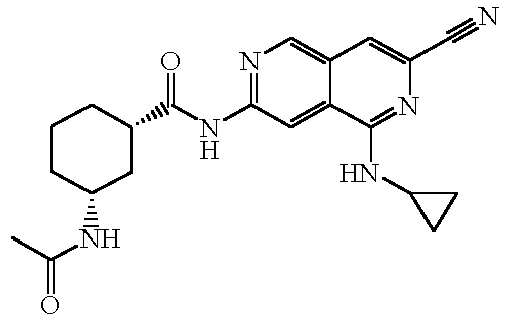
17 
18 
19 
20 
21 
22 
23 
24 
25 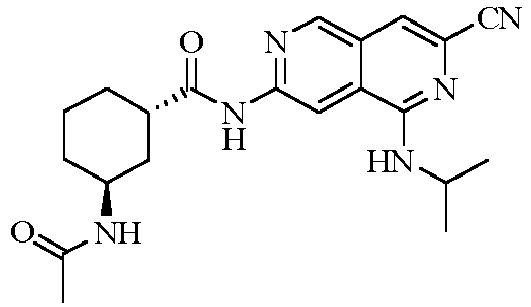
26 
27 
28 
29 
30 
31 
32 
33 
34 
35 
36 
37 
38 
39 
40 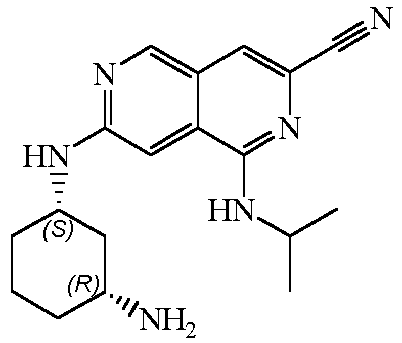
41 
42 
43 
44 
45 
46 
47 
48 
49 
50 
51 
52 
53 
54 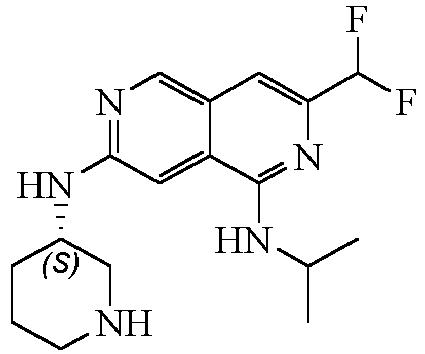
55 
56 
57 
58 
59 
60 
61 
62 63 
64 
65 
66 
67 
68 
69 
70 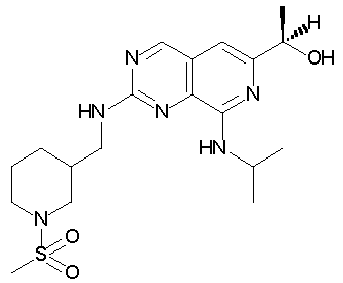
71 
72 
73 
74 
75 
76 
77 
78 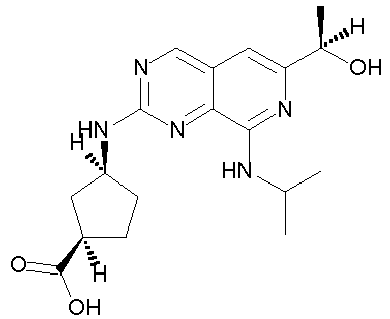
79 
80 
81 
82 
83 
84 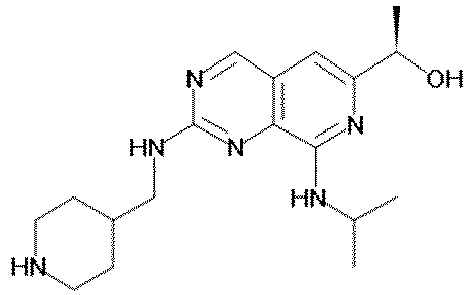
85 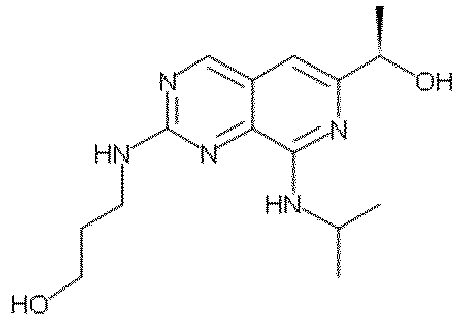
86 
87 
88 
89 
90 
91 
92 
93 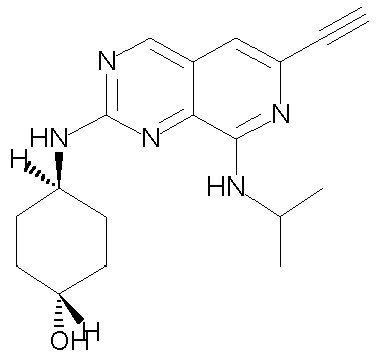
94 
95 
96 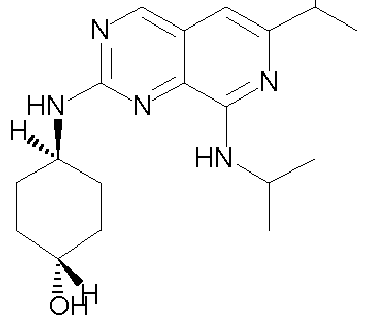
97 
98 
99 
100 
101 
102 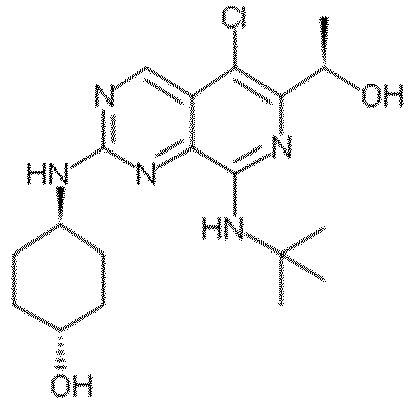
103 104 105 
106 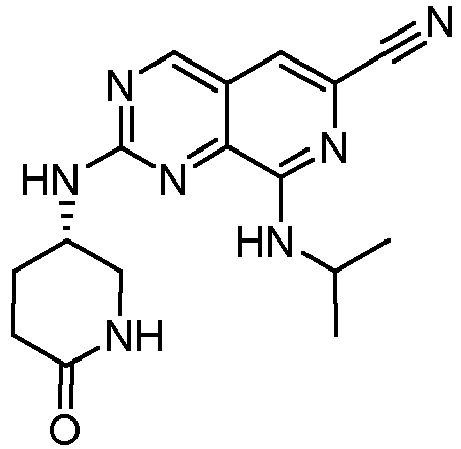
107 
108 
109 
110 
111 
112 
113 
114 
115 
116 
117 
118 
119 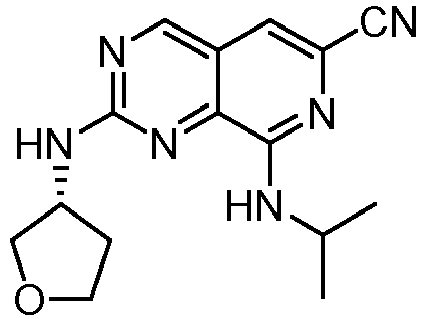
120 
121 
122 
123 
124 
125 
126 
127 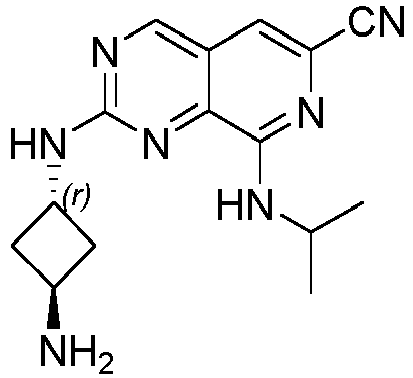
128 
129 
130 
131 
132 
133 
134 
135 
136 
137 
138 
139 
140 
141 
142 
143 
144 
145 
146 
147 
148 
149 
150 
151 
152 
153 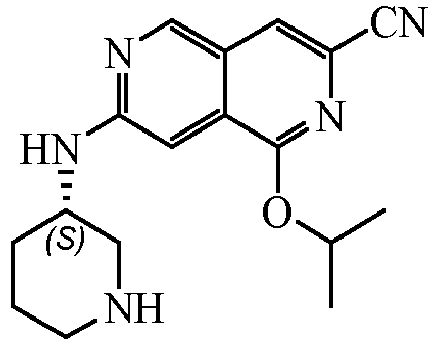
154 
155 
156 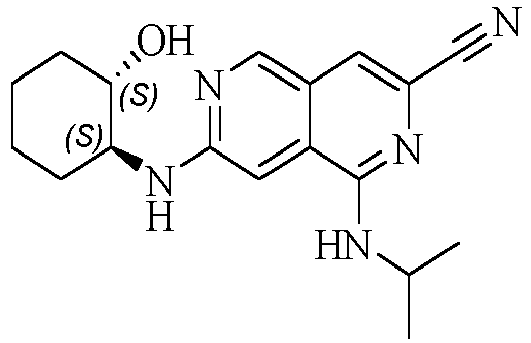
157 
158 
159 
160 
161 
162 
163 
164 
165 
166 
167 
168 
169 
170 
171 
172 
173 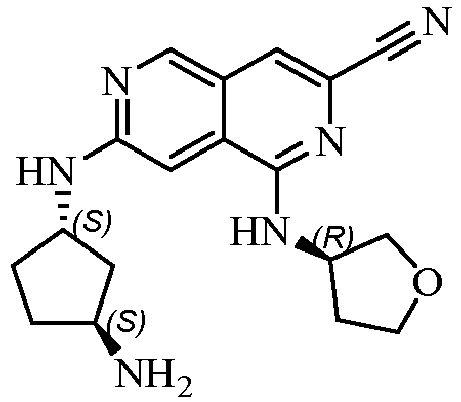
174 
175 
176 
177 
178 
179 
180 
181 
182 
183 
184 
185 
186 
187 
188 
189 
190 
191 
192 
193 
194 
195 
196 
197 
198 
199 
200 
201 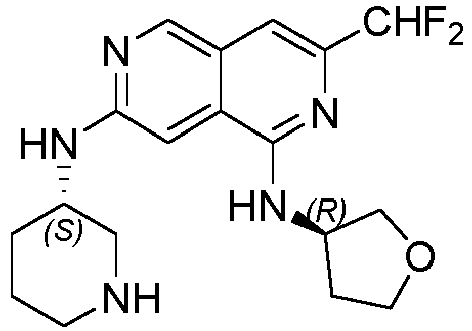
202 
203 
204 
205 
206 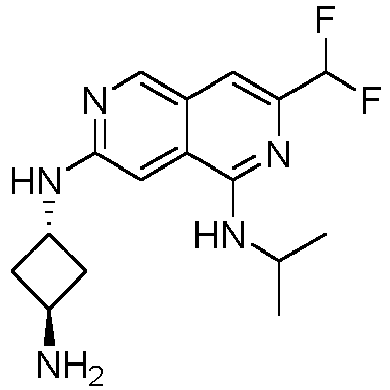
207 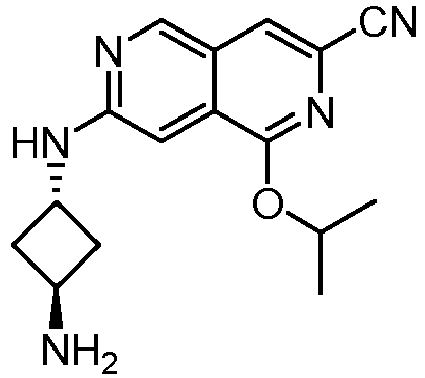
208 
209 
210 
211 
C1 
C2 
C3 
C4 
C5 
C6 
C7 
C8 
C9 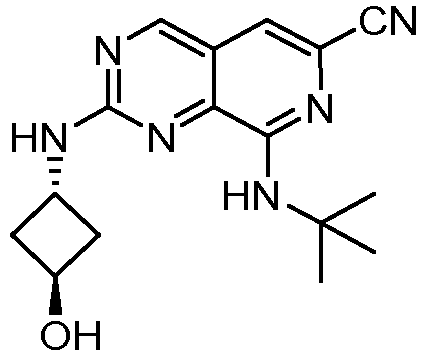
C10 
C11 
C12 
C13 
C14 
C15 
C16 
C17 
C18 
C19 
C20 
C21 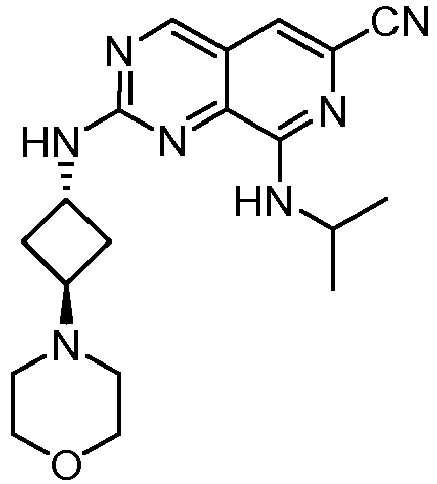
C22 
C23 
C24 
C25 
C26 
C27 
C28 
C29 
C30 
C31 
C32 
C33 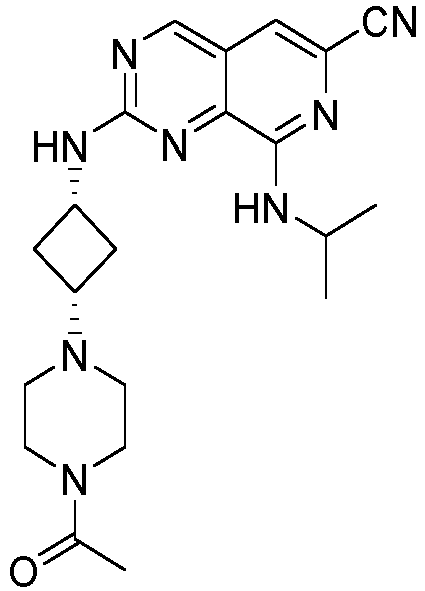
C34 
C35 
C36 
C37 
C38 
C39 
C40 
C41 
C42 
C43 
C44 
C45 
C46 
C47 
C48 
C49 
- The present invention also provides a pharmaceutical composition comprising a compound shown in formula (I), (II), (III) or (IV), or a pharmaceutically acceptable salt or a isomer thereof, and one or more second therapeutically active agents.
- The present invention also provides a pharmaceutical formulation comprising the compound shown in formula (I), (II), (III) or (IV), or pharmaceutically acceptable salts or a isomer thereof, and one or more pharmaceutically acceptable carriers.
- The present invention also provides a pharmaceutical formulation having cyclin-dependent kinase 9 inhibitory activity, comprising the compound shown in formula (I), (II), (III) or (IV), or pharmaceutically acceptable salts or a isomer thereof, and one or more pharmaceutically acceptable carriers.
- The invention also provides use of the compound shown in formula (I), (II), (III) or (IV), or a pharmaceutically acceptable salt or a isomer thereof, the pharmaceutical composition or the pharmaceutical formulation in the manufacture of a medicament for treating or preventing a CDK9-mediated related disease. In particular, the CDK9-mediated related disease is cancer. Preferably, the cancer is solid tumor or hematological malignancies. More specifically, the cancer is selected from adrenal tumor, melanoma, head and neck cancer, kidney cancer, bladder cancer, prostate cancer, endometrial carcinoma, cervical cancer, gastric carcinoma, colon cancer, pancreatic cancer, rectal cancer, esophageal cancer, liver cancer, lung cancer, sarcoma, breast cancer, ovarian cancer, non hodgkin's lymphoma, acute myeloid leukemia, acute lymphoblastic leukemia, myeloma.
- Also, the compounds of the present invention show obvious inhibition effect on CDK9, and compared with CDK1, 2, 3 and 5, the compounds of the present invention have better selectivity for CDK9, which indicates that the compounds of the present invention has better clinical application potential in treating CDK9-mediated diseases, which can reduce the side effects caused by drug off-target.
- The "halogen" described herein refers to fluorine, chlorine, bromine, iodine and the like, and preferably fluorine and chlorine.
- The "halogenated" described herein means that any hydrogen atom in a substituent can be substituted with one or more identical or different halogen atoms. "Halogen" is defined as above.
- The "C1-6 alkyl" described herein refers to linear or branched alkyl derived by removing one hydrogen atom from a hydrocarbon moiety containing 1 to 6 carbon atoms, such as methyl, ethyl, n-propyl, isopropyl, n-butyl, isobutyl, sec-butyl, tert-butyl, n-pentyl, isopentyl, 2-methylbutyl, neopentyl, 1-ethylpropyl, n-hexyl, isohexyl, 4-methylpentyl, 3-methylpentyl, 2-methylpentyl, 1-methylpentyl, 3,3-dimethylbutyl, 2,2-dimethylbutyl, 1,1-dimethylbutyl, 1,2-dimethylbutyl, 1,3-dimethylbutyl, 2,3-dimethylbutyl, 2-ethylbutyl and 1-methyl-2-methylpropyl. The "C1-4 alkyl" refers to the aforementioned examples containing 1 to 4 carbon atoms.
- The "C2-8 alkenyl" described herein refers to linear, branched or cyclic alkenyl derived by removing one hydrogen atom from an alkene moiety containing 2 to 8 carbon atoms and a carbon-carbon double bond, such as vinyl, 1-propenyl, 2-propenyl, 1-butenyl, 2-butenyl, 1,3-butadienyl, 1-pentenyl, 2-pentenyl, 3-pentenyl, 1,3-pentadienyl, 1,4-pentadienyl, 1-hexenyl and 1,4-hexadienyl.
- The "C2-8 alkynyl" described herein refers to linear or branched alkynyl derived by removing one hydrogen atom from an alkyne moiety containing 2 to 8 carbon atoms and a carbon-carbon triple bond, such as ethynyl, propynyl, 2-butynyl, 2-pentynyl, 3-pentynyl, 4-methyl-2-pentynyl, 2-hexynyl and 3-hexynyl.
- The "C1-6 alkoxy" described herein refers to a group in which the "C1-6 alkyl" defined above is linked to a parent molecule via an oxygen atom, i.e., a "C1-6 alkyl-O-" group, such as methoxy, ethoxy, n-propoxy, isopropoxy, n-butoxy, tert-butoxy, n-pentyloxy, neopentyloxy and n-hexyloxy. The "C1-4 alkoxy" refers to the aforementioned examples containing 1 to 4 carbon atoms, i.e., a "C1-4 alkyl-O-" group.
- The "C1-6 alkylamino", "(C1-6 alkyl)2amino", "C1-6 alkylcarbonylamino", "C1-6 alkylsulfonylamino", "C1-6 alkylaminocarbonyl", "(C1-6 alkyl)2aminocarbonyl", "C1-6 alkoxycarbonyl", "C1-6 alkylsulfonyl", "C1-6 alkylthio", "C1-6 alkylcarbonyl", "C1-6 alkoxy C1-6 alkoxy" and "C1-6 alkylaminosulfonyl" described herein refer to C1-6 alkyl-NH-, (C1-6 alkyl)(C1-6alkyl)N-, C1-6 alkyl-C(O)-NH-, C1-6 alkyl-S(O)2-NH2-, C1-6 alkyl-NH-C(O)-, (C1-6 alkyl)(C1-6 alkyl)N-C(O)-, C1-6 alkyl-O-C(O)-, C1-6 alkyl-S(O)2-, C1-6 alkyl-S-, C1-6 alkyl-C(O)-, C1-6 alkyl-O- C1-6 alkyl-O- and C1-6 alkyl-S(O)2-NH-, respectively, wherein the "C1-6 alkyl" is defined as above, and is preferably "C1-4 alkyl".
- The "C1-6 alkyl" in "C1-6 alkyl-S(O)(=NH)-" is defined as above, and is preferably "C1-4 alkyl".
- The "polycyclic ring" described herein refers to a multi-ring system structure formed by two or more ring structures connected by an ortho-fused, spiro- or bridged linkage. The ortho-fused ring refers to a polycyclic structure formed by two or more ring structures sharing two adjacent ring atoms (i.e., sharing a bond) with each other. The bridged ring refers to a polycyclic structure formed by two or more ring structures sharing two non-adjacent ring atoms with each other. The spiro-ring refers to a polycyclic structure formed by two or more ring structures sharing a ring atom with each other.
- Unless otherwise specified, the "3-12 membered cycloalkenyl" described herein includes all possibly formed monocyclic and polycyclic (including fused in the form of ortho-, spiro- or bridged) cases, such as 3-8 membered monocyclic cycloalkenyl, 7-11 membered spiro-cycloalkenyl, 7-11 membered ortho-fused cycloalkenyl and 6-11 membered bridged cycloalkenyl.
- The cycloalkyl described herein includes all possibly formed monocyclic and polycyclic (including fused in the form of ortho-, spiro- or bridged) cases. For example, "3-12 membered cycloalkyl" can be a monocyclic, bicyclic or polycyclic cycloalkyl system (also referred to as a polycyclic ring system). Unless otherwise specified, the monocyclic ring system is a cyclic hydrocarbon group containing 3 to 8 carbon atoms. Examples of 3-8 membered cycloalkyl include, but are not limited to: cyclopropyl, cyclobutyl, cyclopentyl, cyclohexyl, cycloheptyl, cyclooctyl, bicyclo[1.1.1]pentyl and the like.
- Polycyclic cycloalkyl includes ortho-fused cycloalkyl, bridged cycloalkyl and spiro-cycloalkyl.
- Ortho-fused cycloalkyl may be 6-11 membered ortho-fused cycloalkyl or 7-10 membered ortho-fused cycloalkyl, and the representative examples thereof include, but are not limited to, bicyclo[3.1.1]heptane, bicyclo[2.2.1]heptane, bicyclo[2.2.2]octane, bicyclo[3.2.2]nonane, bicyclo[3.3.1]nonane and bicyclo[4.2.1]nonane. The spiro-cycloalkyl may be 7-12 membered spiro-cycloalkyl or 7-11 membered spiro-cycloalkyl, and the examples thereof include, but are not limited to:



- The "heterocyclyl" described herein refers to a 3-12 membered non-aromatic cyclic group in which at least one ring carbon atom is replaced with a heteroatom selected from O, S and N, and preferably 1 to 3 heteroatoms are present, wherein a carbon atom, a nitrogen atom and a sulfur atom may be oxidized.
- "3-12 membered heterocyclyl" refers to a monocyclic heterocyclyl, bicyclic heterocyclyl, or polycyclic heterocyclyl system (also referred to as a fused ring system), including saturated and partially saturated heterocyclyl groups, but excluding aromatic rings. Unless otherwise specified, all possibly formed monocyclic, polycyclic (including fused in the form of ortho-, spiro- or bridged), saturated, partially saturated cases are included.
- The monocyclic heterocyclyl may be 3-8 membered heterocyclyl, 3-8 membered saturated heterocyclyl, 3-6 membered heterocyclyl, 4-7 membered heterocyclyl, 5-7 membered heterocyclyl, 5-6 membered heterocyclyl, 5-6 membered oxygen-containing heterocyclyl, 3-8 membered nitrogen-containing heterocyclyl, 5-6 membered nitrogen-containing heterocyclyl, 5-6 membered saturated heterocyclyl, or the like. Examples of the "3-8 membered saturated heterocyclyl" include, but are not limited to, aziridinyl, oxiranyl, thiiranyl, azetidinyl, oxetanyl, thietanyl, tetrahydrofuranyl, pyrrolidinyl, tetrahydrothienyl, imidazolidinyl, pyrazolidinyl, 1,2-oxazolidinyl, 1,3-oxazolidinyl, 1,2-thiazolidinyl, 1,3-thiazolidinyl, tetrahydro-2H-pyranyl, tetrahydro-2H-thiapyranyl, piperidinyl, piperazinyl, morpholinyl, 1,4-dioxanyl and 1,4-oxathianyl. Examples of the "3-8 membered partially saturated heterocyclyl" include, but are not limited to, 4,5-dihydroisoxazolyl, 4,5-dihydrooxazolyl, 2,5-dihydrooxazolyl, 2,3-dihydrooxazolyl, 3,4-dihydro-2H-pyrrolyl, 2,3-dihydro-1H-pyrrolyl, 2,5-dihydro-1H-imidazolyl, 4,5-dihydro-1H-imidazolyl, 4,5-dihydro-1H-pyrazolyl, 4,5-dihydro-3H-pyrazolyl, 4,5-dihydrothiazolyl, 2,5-dihydrothiazolyl, 2H-pyranyl, 4H-pyranyl, 2H-thiapyranyl, 4H-thiapyranyl, 2,3,4,5-tetrahydropyridinyl, 1,2-isoxazinyl, 1,4-isoxazinyl, 6H-1,3-oxazinyl and the like.Polycyclic heterocyclyl includes ortho-fused heterocyclyl, spiro-heterocyclyl and bridged heterocyclyl, which may be saturated, partially saturated or unsaturated, but non-aromatic. Polycyclic heterocyclyl may be 5-6 membered monocyclic heterocyclyl ring which is fused to a benzene ring, 5-6 membered monocyclic cycloalkyl, 5-6 membered monocyclic cycloalkenyl, 5-6 membered monocyclic heterocyclyl or 5-6 membered monocyclic heteroaryl. The ortho-fused heterocyclyl may be 6-12 membered ortho-fused heterocyclyl, 7-10 membered ortho-fused heterocyclyl, 6-10 membered ortho-fused heterocyclyl or 6-12 membered saturated ortho-fused heterocyclyl, and representative examples include, but are not limited to: 3-azabicyclo[3.1.0]hexyl, 3,6-diazabicyclo[3.2.0]heptyl, 3,8-diazabicyclo[4.2.0]octyl, 3,7-diazabicyclo[4.2.0]octyl, octahydropyrrolo[3,4-c]pyrrolyl, octahydropyrrolo[3,4-b]pyrrolyl, octahydropyrrolo[3,4-b][1,4]oxazinyl, octahydro-1H-pyrrolo[3,4-c]pyridinyl, 2,3-dihydrobenzofuran-2-yl, 2,3-dihydrobenzofuran-3-yl, indolin-1-yl, indolin-2-yl, indolin-3-yl, 2,3-dihydrobenzothiophen-2-yl, octahydro-1H-indolyl and octahydrobenzofuranyl. The spiro-heterocyclyl may be 6-12 membered spiro-heterocyclyl, 7-11 membered spiro-heterocyclyl or 6-12 membered saturated spiro-heterocyclyl, and examples thereof include, but are not limited to:


- The bridged heterocyclyl may be 6-12 membered bridged heterocyclyl, 7-11 membered bridged heterocyclyl or 6-12 membered saturated bridged heterocyclyl, and examples thereof include, but are not limited to


- The "3-12 membered heterocyclyloxy" described herein refers to a 3-12 membered heterocyclyl-O- group, wherein the "3-12 membered heterocyclyl" is defined as above.
- The "3-12 membered cycloalkyloxy " described herein refers to a 3-12 membered cycloalkyl-O- group, wherein the "3-12 membered cycloalkyl" is defined as above.
- The "3-12 membered heterocyclyl-CH2-amino" described herein refers to a 3-12 membered heterocyclyl-CH2-NH- group, wherein the "3-12 membered heterocyclyl" is defined as above.
- The "3-12 membered cycloalkyl amino" described herein refers to a 3-12 membered cycloalkyl -NH- group, wherein the "3-12 membered cycloalkyl " is defined as above.
- The "aryl" described herein refers to a cyclic aromatic group containing 6 to 14 carbon atoms, including phenyl, naphthalene, phenanthrene, and the like.
- The heteroaryl described herein includes all possibly formed monocyclic, polycyclic, fully aromatic and partially aromatic cases. For example,"5-10 membered heteroaryl" refers to an aromatic cyclic group in which at least one ring carbon atom is substituted with a heteroatom selected from O, S and N, and preferably 1 to 3 heteroatoms are present. Moreover, the case where carbon atoms or sulfur atoms are oxidized is included. For example, carbon atoms are replaced with C(O) and sulfur atoms are substituted by S(O) or S(O)2. Unless otherwise specified, heteroaryl includes monocyclic heteroaryl and polycyclic heteroaryl. Monocyclic heteroaryl may be 5-7 membered heteroaryl or 5-6 membered heteroaryl, and examples thereof include, but are not limited to, furanyl, imidazolyl, isoxazolyl, thiazolyl, isothiazolyl, oxadiazolyl, oxazolyl, pyridinyl, pyridazinyl, pyrimidinyl, pyrazinyl, pyrazolyl, pyrrolyl, tetrazolyl, thiadiazolyl, thienyl, triazolyl and triazinyl. In certain examples, polycyclic heteroaryl refers to a group in which a monocyclic heteroaromatic ring is fused to phenyl, cycloalkenyl, heteroaryl, cycloalkyl or heterocyclyl. Polycyclic heteroaryl may be 8-12 membered ortho-fused heteroaryl or 9-10 membered ortho-fused heteroaryl, and examples include, but are not limited to, benzimidazolyl, benzofuranyl, benzothienyl, benzoxadiazolyl, benzothiadiazolyl, benzothiazolyl, cinnolinyl, 5,6-dihydroquinolin-2-yl, 5,6-dihydroisoquinolin-1-yl, furopyridinyl, indazolyl, indolyl, isoindolyl, isoquinolinyl, naphthyridinyl, purinyl, quinolinyl, 5,6,7,8-tetrahydroquinolin-2-yl, 5,6,7,8-tetrahydroquinolinyl, 5,6,7,8-tetrahydroquinolin-4-yl, 5,6,7,8-tetrahydroisoquinolin-1-yl, thienopyridinyl, 4,5,6,7-tetrahydro[c][1,2,5]oxadiazolyl and 6,7-dihydro[c][1,2,5]oxadiazol-4(5H)keto.
- The "pharmaceutically acceptable salt" described herein refers to a pharmaceutically acceptable addition salt of acid and base or a solvate thereof. Such pharmaceutically acceptable salts include salts of the following acids: hydrochloric acid, phosphoric acid, hydrobromic acid, sulfuric acid, sulfurous acid, formic acid, toluenesulfonic acid, methanesulfonic acid, nitric acid, benzoic acid, citric acid, tartaric acid, maleic acid, hydroiodic acid, alkanoic acid (such as acetic acid, HOOC-(CH2)n-COOH (wherein n is 0-4)), and the like. The following salts of bases are also included: sodium salt, potassium salt, calcium salt, ammonium salt, and the like. Those skilled in the art know a variety of pharmaceutically acceptable non-toxic addition salts.
- The "isomer" described herein refers to a stereoisomer and a tautomer.
- The stereoisomer refers to an enantiomer in the case that atoms are asymmetric in a compound, and a cis-trans isomer in the case that a double bond or a cyclic structure exists in a compound. All enantiomers, diastereomers, racemic isomers, cis-trans isomers, geometric isomers, epimers and mixtures thereof of the compound of formula (I) are included in the scope of the present invention.
- The "tautomer" means a functional group isomer that is produced due to the rapid shifting of a certain atom between two positions in a molecule, and the tautomer is a special functional group isomer. Examples include tautomerization of a carbonyl compound containing α-H, specifically as follows:

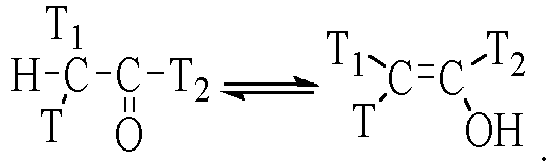
- T, T1 and T2 are each independently selected from any group meeting the bonding rule of compounds.
- In one embodiment of the present invention, L is preferably bond.
- In one embodiment of the present invention, A is preferably 3-12 membered cycloalkyl or 3-12 membered heterocyclyl. The 3-12 membered cycloalkyl of A is preferably cyclobutyl. The 3-12 membered heterocyclyl of A is preferably piperidinyl, azepan-3-yl,
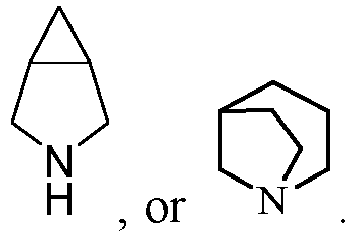
- In one embodiment of the present invention, R1 is preferably hydrogen, hydroxyl, C1-6 alkyl, C1-6 alkoxy, amino, (C1-6 alkyl)2 amino, C1-6 alkylcarbonyl or 3-12 membered heterocyclyl. The C1-6 alkyl of R1 is preferably methyl, methyl substituted with amino, methyl substituted with hydroxyl, or methyl substituted with dimethylaminocarbonyl. The C1-6 alkoxy of R1 is preferably methoxy. The amino of R1 is preferably amino substituted with methyl. The (C1-6 alkyl)2 amino of R1 is preferably dimethylamino. The C1-6 alkylcarbonyl of R1 is preferably acethyl. The 3-12 membered heterocyclyl of R1 is preferably

- In one embodiment of the present invention, R2 is preferably amino, C1-6 alkylamino, or 3-12 membered heterocyclyl. The amino of R2 is preferably amino, amino substituted with furan, amino substituted with pyran, amino substituted with bicyclo[1.1.1]pentyl. The C1-6 alkylamino of R2 is preferably ter-butylamino, isopropylamino, isopropylamino substituted with methoxy, propylamino, sec-butylamino, ethylamino, or ethylamino substituted with cyclopropyl. The 3-12 membered heterocyclyl of R2 is preferably piperidinyl.
- In one embodiment of the present invention, R3 is preferably cyano, C1-6 alkyl, or amino carbonyl. The C1-6 alkyl of R3 is preferably methyl, difluoromethyl or trifluoromethyl.
- In one embodiment of the present invention, R6 is preferably hydrogen.
- In one embodiment of the present invention, n is preferably 0.
- In one embodiment of the present invention, m is preferably 1 or 2.
- The "optionally substituted by one or more groups" means optionally substituted by one groups, optionally substituted by two groups, optionally substituted by three groups, optionally substituted by four groups, or optionally substituted by five groups.
- LDA: lithium diisopropylamide; THF: tetrahydrofuran; EA: ethyl acetate; PE: petroleum ether; DIPEA: N,N-diisopropylethylamine; DCM: dichloromethane; DMSO: dimethyl sulfoxide; IBX: 2-iodoxybenzoic acid; DMAC: N,N-dimethylacetamide; DMF: N,N-dimethylformamide; MTBE: methyl tert-butyl ether; BINAP: (±)-2,2'-bis-(diphenylphosphino)-1,1'-dinaphthalene; TFA: trifluoroacetic acid; DAST: diethylaminosulfur trifluoride; HATU: 1-[Bis(dimethylamino)methylene]-1H-1,2,3-triazolo[4,5-b]pyridinium 3-Oxide Hexafluorophosphate; NCS: N-chlorosuccinimide; DCE: dichloroethane; mCPBA: m-chloroperoxybenzoic acid; and DMA: dimethylacetamide.
-

-

-

- 7-chloro-3-(difluoromethyl)-N-isopropyl-2,6-naphthyridin-1-amine (1150 mg, 4.2 mmol, 1.0 eq.), diphenylmethanimine (0.86 mL, 1.2 mmol, 1.2 eq.), Pd2(dba)3 (389 mg, 0.42 mmol, 0.1 eq.), BINAP (528 mg, 0.85 mmol, 0.2 eq.) and cesium carbonate (4148 mg, 12.7 mmol, 3.0 eq.) were added into 1,4-dioxane (30 mL). The mixture was reacted at 120 °C for overnight in a sealed tube in nitrogen atmosphere. When there were no materials left, as detected by TLC, the reaction solution was added with ethyl acetate (80 mL), stirred for 5 min and filtered, the filter cake was rinsed with ethyl acetate, and the filtrate was concentrated under reduced pressure to give a crude product, which was purified by silica gel column chromatography to give the product (1450 mg, yield: 82.1%).
-

- 3-(difluoromethyl)-7-((diphenylmethylene)amino)-N-isopropyl-2,6-naphthyridin-1-amine (1600 mg, 3.85 mmol, 1.0 eq.) was dissolved in THF (20 mL). The reaction solution was added with 2N aqueous citric acid solution (10 mL) and reacted at room temperature for 3 h. When there were no materials left, as detected by TLC, the solvent was removed under reduced pressure and compound was extracted with ethyl acetate (30 mL × 3). The organic phases were combined, dried over anhydrous sodium sulfate and filtered, and the filtrate was concentrated under reduced pressure to give a crude product, which was purified by silica gel column chromatography (DCM:MeOH = 98:2-95:5) to give the product (990 mg,) which has some impurities .
-

- (1S,3R)-3-((tert-butoxycarbonyl)amino)cyclohexane-1-carboxylic acid (482.1 mg, 1.98 mmol, 1.0 eq.) was dissolved in DCM (10 mL). The reaction solution was cooled to 0 °C to 5 °C, added with 1-chloro-N,N,2-trimethylprop-1-en-1-amine (316 mg, 2.38 mmol, 1.2 eq.), reacted at 0 °C to 5 °C for 1.5 h, added with a solution of 3-(difluoromethyl)-N1-isopropyl-2,6-naphthyridine-1,7-diamine (500 mg, 1.98 mmol, 1.0 eq.) and pyridine (0.48 mL, 5.95 mmol, 3.0 eq.) in DCM (5 mL). The reaction mixture was stirred at rt for overnight. When LCMS showed SM was consumed, the reaction solution was added with water (20 mL) and extracted with DCM (20 mL × 3). The organic phases were combined, washed with brine (20 mL) successively, concentrated under reduced pressure to give a crude product, which was purified by silica gel column chromatography to give the product (478 mg, yield: 71.8%).
-

- tert-Butyl ((1R,3S)-3-((7-(difluoromethyl)-5-(isopropylamino)-2,6-naphthyridin-3-yl)carbamoyl)cyclohexyl)carbamate (180 mg, 0.38 mmol, 1.0 eq.) was dissolved in DCM (3 mL). The reaction solution was cooled down in an ice water bath, added with TFA (2 mL) and reacted at room temperature for 4 h. When there were no materials left, as detected by TLC, the reaction solution was concentrated under reduced pressure. The crude was used in the next step.
-

- (1S,3R)-3-amino-N-(7-(difluoromethyl)-5-(isopropylamino)-2,6-naphthyridin-3-yl)cyclohexane-1-carboxamide (143 mg, 0.38 mmol, 1.0 eq.) was dissolved in DCM (3 mL). The reaction solution was cooled down in an ice water bath, added with pyridine (0.3mL, 3.78 mmol, 10.0 eq.) and acetic anhydride (0.047 mL, 0.49 mmol, 1.3 eq.) and reacted at room temperature for 3 h. When there were no materials left, as detected by LC-MS, the reaction solution was poured into water (20 mL) and extracted with ethyl acetate (20 mL × 3). The organic phases were combined, dried over anhydrous sodium sulfate and filtered. The filtrate was concentrated under reduced pressure to give a crude product, which was purified by silica gel column chromatography (DCM:MeOH = 98:2-95:5) to give the product (40 mg, yield: 26%,).
1HNMR(400 MHz, DMSO) δ(ppm):10.6 (s, 1H), 9.02 (s, 1H), 8.64 (s, 1H), 7.80 (d, 1H), 7.55 (d, 1H), 7.24 (s, 1H), 6.78 (t, 1H), 4.47-4.38 (m, 1H), 3.62-3.59 (m, 1H), 2.71-2.63 (m, 1H), 1.96-1.93 (m, 1H), 1.80-1.78 (m, 6H), 1.36-1.11 (m, 9H), 1.12-108 (m, 1H).
Molecular formula: C21H27F2N5O2 Exact mass: 419.21 LC-MS (Pos, m/z)=420.4 [M+H]+. -

-

-

- A solution of LDA (2 mol/L) in THF (58.5 mL, 116.93 mmol, 1.5 eq.) was added into anhydrous THF (50 mL). The reaction solution was cooled to -70 °C in nitrogen atmosphere, added dropwise with a solution of 5-bromo-2-chloropyridin (15 g, 77.95 mmol, 1.0 eq.) in anhydrous THF (100 mL), and reacted at -70 °C to -65 °C for 0.5 h after 1 h of addition. The reaction solution was added dropwise with DMF (18 mL, 233.85 mol, 3.0 eq.) and reacted at -70 °C to -65 °C for 1 h after addition. When there were no materials left, as detected by TLC, the reaction solution was added dropwise to a saturated ammonium solution (500 mL), stirred for 10 min, dissolved in water (100 mL) and extracted with ethyl acetate (500 mL × 2). The organic phases were combined, dried over anhydrous sodium sulfate and filtered, and the filtrate was concentrated under reduced pressure to give a crude product, which was purified by silica gel column chromatography (EA:PE = 1:40) to give the product (10.6 g, yield: 62.3%).
-

- DIPEA (16.5 g, 127.92 mmol, 3.0 eq.), Pd(dppf)Cl2CH2Cl2 (2.5 g, 3.14 mmol, 0.08 eq.) and CuI (811.3 mg, 4.26 mmol, 0.1 eq.) were added into anhydrous THF (100 mL). The mixture was stirred for 10 min in nitrogen atmosphere, added with a solution of 5-bromo-2-chloroisonicotinaldehyde (9.4 g, 42.64 mmol, 1.0 eq.) in anhydrous THF (50 mL), cooled down in an ice water bath after addition, and added with a solution of propargyl benzoate (8.2 g, 51.17 mmol, 1.2 eq.) in anhydrous THF (50 mL). After addition, the mixture was incubated at room temperature for 22 h. When there were no materials left, as detected by TLC, the reaction solution was added with water (200 mL), stirred for 10 min, and filtered. The filter cake was rinsed by ethyl acetate, the liquid separation was performed, the organic phase was retained, and the aqueous phase was extracted with ethyl acetate (100 mL × 2). The organic phases were combined, dried over anhydrous sodium sulfate and filtered, and the filtrate was concentrated under reduced pressure to give a crude product, which was purified by silica gel column chromatography (EA:PE = 1:30-1:10) to give the product (5.8 g, yield: 45.6%).
-

- (E)-3-(6-chloro-4-((hydroxyimino)methyl)pyridin-3-yl)prop-2-yn-1-yl benzoate (5.5 g, 18.35 mmol, 1.0 eq.) was dissolved in absolute ethanol (800 mL). The reaction solution was added with hydroxylamine hydrochloride (1.9 g, 27.53 mmol, 1.5 eq.) and sodium acetate (2.2 g, 27.53 mmol, 1.5 eq.), and reacted at room temperature for 5 h. When there were no materials left, as detected by TLC, the reaction solution was concentrated under reduced pressure, added with water (50 mL) and extracted with ethyl acetate (50 mL × 3). The organic phases were combined, dried over anhydrous sodium sulfate and filtered, and the filter cake was concentrated under reduced pressure to give the product (5.57 g, yield: 96.5%).
-

- (E)-3-(6-chloro-4-((hydroxyimino)methyl)pyridin-3-yl)prop-2-yn-1-yl benzoate (5.57 g, 17.70 mmol, 1.0 eq.) was dissolved in DCM (80 mL). The reaction solution was added with silver trifluoromethanesulfonate (454.7 mg, 1.77 mmol, 0.1 eq.) and reacted at room temperature for 15h. When there were a small amount of materials left, as detected by TLC, the reaction solution was concentrated under reduced pressure, slurried with diethyl ether (100 mL) for 0.5 h and filtered, and the filter cake was rinsed with diethyl ether (50 mL) and dried to give the product (4.8 g, yield: 86.1%).
-

- 3-((benzoyloxy)methyl)-7-chloro-2,6-naphthyridine 2-oxide (4.8 g, 15.25 mmol, 1.0 eq.) and DIPEA(5.9 g, 45.75 mmol, 3.0 eq.) were dissolved in DCM (100 mL). The reaction solution was cooled to 0 °C to 5 °C, added dropwise with oxalyl chloride (3.87 g, 30.50 mmol, 2.0 eq.) and reacted for 2 h. When a large number of materials were left, as detected by TLC, the reaction solution was supplemented with DIPEA (5.9 g, 45.75 mmol, 3.0 eq.) and oxalyl chloride (3.87 g, 30.50 mmol, 2.0 eq.) and reacted for 1 h. When there were no materials left, as detected by TLC, the reaction solution was added with water (100 mL), concentrated under reduced pressure and extracted with ethyl acetate (200 mL × 2). The organic phases were combined, dried over anhydrous magnesium sulfate and filtered, and the filtrate was concentrated under reduced pressure to give a crude product, which was purified by silica gel column chromatography (EA:PE = 1:30-1:20) to give the product (3.5 g, yield: 70%).
-

- (1,7-dichloro-2,6-naphthyridin-3-yl)methyl benzoate (3.5 g, 10.51 mmol, 1.0 eq.) and isopropylamine (7.4 g, 126.12 mmol, 12.0 eq.) were added into anhydrous THF (20 mL). The mixture was reacted at 100 °C for 6 h in a sealed tube. When there were no materials left, as detected by TLC, the reaction solution was concentrated under reduced pressure to give a light yellow product, which was used in the next step according to a theoretical amount.
-

- (7-chloro-1-(isopropylamino)-2,6-naphthyridin-3-yl)methyl benzoate (10.51 mmol, 1.0 eq.) and lithium hydroxide monohydrate (1.3 g, 31.53 mmol, 3.0 eq.) were dissolved in a mixed solution of THF (30 mL), methanol (15 mL) and water (15 mL), and the reaction solution was reacted at room temperature for 16 h. When there were no materials left, as detected by TLC, the reaction solution was concentrated under reduced pressure, added with water (30 mL) and extracted with ethyl acetate (30 mL × 2). The organic phases were combined, dried over anhydrous sodium sulfate and filtered, and the filtrate was concentrated under reduced pressure to give a crude product, which was purified by silica gel column chromatography (EA:PE = 1:20-1:6) to give the product (2.48 g, two-step yield: 95.3%).
-

- (7-chloro-1-(isopropylamino)-2,6-naphthyridin-3-yl)methanol (2.48 g, 9.85 mmol, 1.0 eq.) was dissolved in DMSO (25 mL), and the reaction solution was added with IBX (4.1 g, 14.77 mmol, 1.5 eq.) and reacted at room temperature for 1 h. When there were no materials left, as detected by TLC, the reaction solution was poured into water (200 mL) and extracted with ethyl acetate (100 mL × 2). The organic phases were combined, dried over anhydrous sodium sulfate and filtered, and the filtrate was concentrated under reduced pressure to give the product, which was used in the next step according to a theoretical amount.
-

- 7-chloro-1-(isopropylamino)-2,6-naphthyridine-3-carbaldehyde (9.85 mmol, 1.0 eq.) was dissolved in absolute ethanol (25 mL). The mixture was added with hydroxylamine hydrochloride (1.03 g, 14.77 mmol, 1.5 eq.) and sodium acetate (1.2 g, 14.77 mmol, 1.5 eq.), and reacted at room temperature for 16 h. When there were no materials left, as detected by TLC, the reaction solution was concentrated under reduced pressure, added with water (50 mL) and extracted with ethyl acetate (50 mL × 2). The organic phases were combined, dried over anhydrous sodium sulfate and filtered, and the filtrate was concentrated under reduced pressure to give the product (2.1 g, two-step yield: 80.7%).
-

- (Z)-7-chloro-1-(isopropylamino)-2,6-naphthyridine-3-carbaldehyde oxime (2.1 g, 7.93 mmol, 1.0 eq.) was dissolved in acetic anhydride (10 mL). The reaction solution was heated to 120 °C and reacted for 15 h. When there were no materials left, as detected by TLC, the reaction solution was concentrated under reduced pressure, added with water (20 mL) and extracted with ethyl acetate (20 mL × 3). The organic phases were combined, dried over anhydrous sodium sulfate and filtered, and the filtrate was concentrated under reduced pressure to give a crude product, which was purified by silica gel column chromatography (EA:PE = 1:20-1:15) to give the product (522 mg, yield: 27.4%).
-

- 7-chloro-1-(isopropylamino)-2,6-naphthyridine-3-carbonitrile (520 mg, 2.11 mmol, 1.0 eq.), diphenylmethanimine (458.9 mg, 2.53 mmol, 1.2 eq.), Pd2(dba)3 (192.3 mg, 0.21 mmol, 0.1 eq.), BINAP (262.8 mg, 0.42 mmol, 0.2 eq.) and cesium carbonate (1.7 g, 5.27 mmol, 2.5 eq.) were added into 1,4-dioxane (15 mL). The mixture was reacted at 120 °C for 23 h in a sealed tube in nitrogen atmosphere. When there were no materials left, as detected by TLC, the reaction solution was filtered, and the filtrate was concentrated under reduced pressure to give the product, which was used in the next step according to a theoretical amount.
-

- 7-((diphenylmethylene)amino)-1-(isopropylamino)-2,6-naphthyridine-3-carbonitrile (2.11 mmol, 1.0 eq.) was dissolved in THF (10 mL). The reaction solution was added with aqueous citric acid solution (mass fraction: 10%, 5 mL) and reacted at room temperature for 23 h. When there were no materials left, as detected by TLC, the reaction solution was added with water (20 mL) and extracted with ethyl acetate (15 mL × 3). The organic phases were combined, dried over anhydrous sodium sulfate and filtered, and the filtrate was concentrated under reduced pressure to give a crude product, which was purified by silica gel column chromatography (EA:PE = 1:5-1:1) to give the product (310 mg, two-step yield: 64.6%).
-
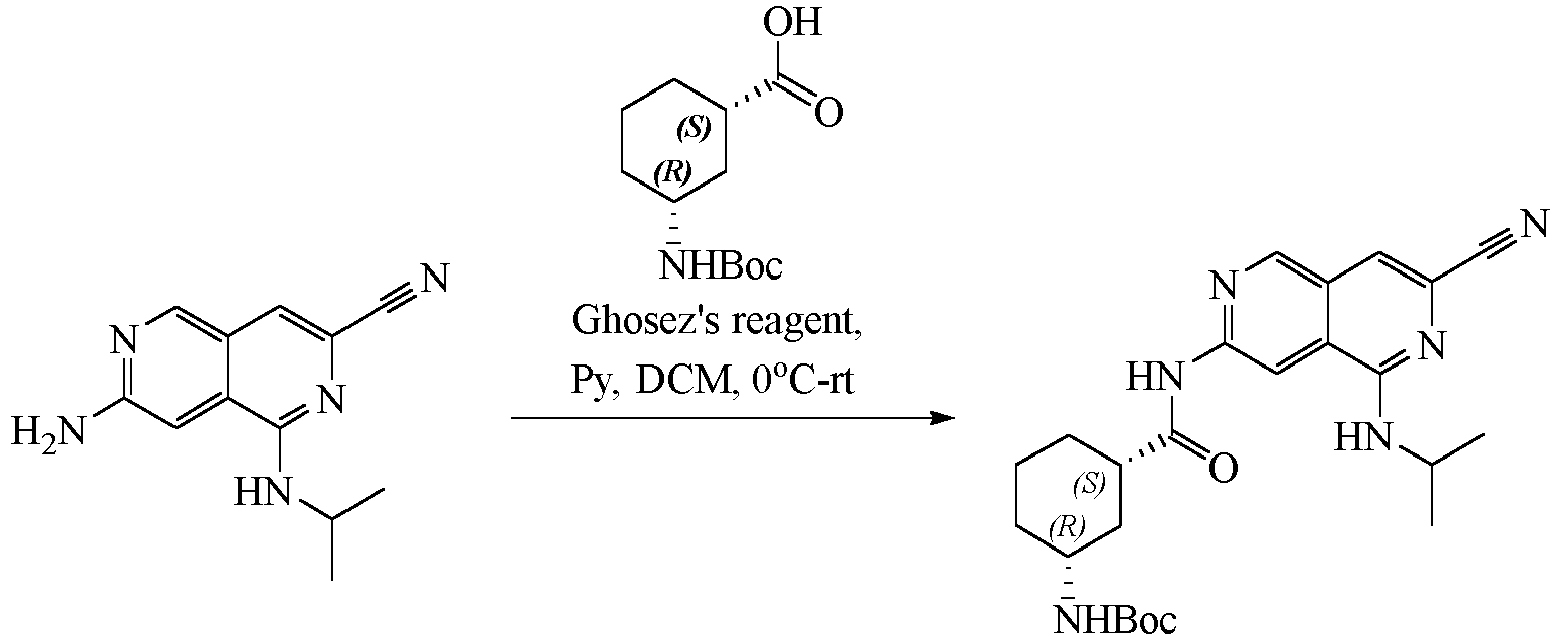
- (1S,3R)-3-((tert-butoxycarbonyl)amino)cyclohexane-1-carboxylic acid (192.2 mg, 0.79 mmol, 1.05 eq.) was dissolved in DCM (3 mL). The reaction solution was cooled to 0 °C to 5 °C, added with 1-chloro-N,N,2-trimethylprop-1-en-1-amine (mass fraction: 95%, 157.5 mg, 1.12 mmol, 1.5 eq.), reacted at 0 °C to 5 °C for 1.5 h, added with a solution of 7-amino-1-(isopropylamino)-2,6-naphthyridine-3-carbonitrile (170 mg, 0.75 mmol, 1.0 eq.) and pyridine (177.9 mg, 2.25 mmol, 3.0 eq.) in THF (3 mL), and incubated at room temperature for 19 h. When there were a small amount of materials left, as detected by TLC, the reaction solution was added with water (20 mL) and extracted with ethyl acetate (20 mL × 3). The organic phases were combined, washed with water (20 mL) and brine (20 mL) successively, concentrated under reduced pressure to give a crude product, which was purified by silica gel column chromatography (EA:PE = 1:3) to give the product (300 mg, yield: 88.4%).
-

- Tert-butyl ((1R,3S)-3-((7-cyano-5-(isopropylamino)-2,6-naphthyridin-3-yl)carbamoyl)cyclohexyl)carbamate (300 mg, 0.66 mmol, 1.0 eq.) was dissolved in DCM (10 mL). The reaction solution was cooled down in an ice water bath, added with hydrogen chloride ethanol solution (10 mol/L, 2 mL) and reacted at room temperature for 20 h. When there were no materials left, as detected by TLC, the reaction solution was concentrated under reduced pressure, slurried with ethyl acetate (20 mL) for 10 min and filtered. The filter cake was dissolved in water (50 mL) and back-extracted with ethyl acetate (30 mL × 2). The aqueous phase was retained, adjusted to pH of about 8 with sodium bicarbonate and extracted with ethyl acetate (30 mL × 3). The organic phases were combined, dried over anhydrous sodium sulfate and filtered, and the filtrate was concentrated under reduced pressure to give the product (128 mg, yield: 54.8%).
-

- (1S,3R)-3-amino-N-(7-cyano-5-(isopropylamino)-2,6-naphthyridin-3-yl)cyclohexane-1-carboxamide (128 mg, 0.36 mmol, 1.0 eq.) was dissolved in DCM (3 mL). The reaction solution was cooled down in an ice water bath, added with DIPEA (139.5 mg, 1.08 mmol, 3.0 eq.) and acetic anhydride (55 mg, 0.54 mmol, 1.5 eq.) and reacted at room temperature for 3 h. When there were no materials left, as detected by LC-MS, the reaction solution was poured into water (20 mL) and extracted with ethyl acetate (20 mL × 3). The organic phases were combined, dried over anhydrous sodium sulfate and filtered. The filtrate was concentrated under reduced pressure to give a crude product, which was slurried with a mixed solution of diethyl ether (10 mL) and petroleum ether (10 mL) and filtered, and the filter cake was dried to give the product (91.5 mg, yield: 64.4%).
1HNMR(300 MHz, CD3OD) δ(ppm): 8.93 (s, 1H), 8.52 (s, 1H), 7.50 (s, 1H), 4.52-4.43 (m, 1H), 3.37-3.72 (m, 1H), 2.71-2.63 (m, 1H), 2.12-2.10 (m, 1H), 1.95 (m, 6H), 1.55-1.47 (m, 3H), 1.36-1.34 (m, 7H).
Molecular formula: C21H26N6O2 Exact mass: 394.21 LC-MS(Pos, m/z)=395.27 [M+H]+. -

-

- 6-chloro-N 8-isopropylpyrido[3,4-d]pyrimidine-2,8-diamine (500 mg, 2.10 mmol, 1.0 eq.), zinc cyanide (494 mg, 4.21 mmol, 2.0 eq.) and tetrakis(triphenylphosphine)palladium(0) (485 mg, 0.42 mmol, 0.2 eq.) were dissolved in DMAC (10 mL), and the reaction solution was reacted at 120 °C for 24 h in nitrogen atmosphere. When there were a small amount of materials left, as detected by LC-MS, the reaction solution was cooled to room temperature, poured into water (20 mL) and extracted with EA (20 mL × 2). The organic phases were washed with saturated aqueous sodium chloride solution (15 mL × 2), concentrated under reduced pressure to give a crude product, which was purified by silica gel column chromatography (PE:EA= 3:1) to give the product (320 mg, yield: 66.6%).
-

- 2-amino-8-(isopropylamino)pyrido[3,4-d]pyrimidine-6-carbonitrile (160 mg, 0.71 mmol, 1.0 eq.) and (1S,3R)-3-((tert-butoxycarbonyl)amino)cyclohexane-1-carboxylic acid (188 mg, 0.77 mmol, 1.1 eq.) were dissolved in pyridine (3 mL), and the reaction solution was added with phosphorus oxychloride (107 mg, 0.71 mmol, 1.0 eq.) and reacted at room temperature for 23 h. When there were materials left, as detected by TLC, the reaction solution was poured into water (10 mL) and extracted with EA (15 mL × 2). The organic phase was washed with hydrochloric acid (10 mL × 3), dried and concentrated to give a crude product, which was purified by silica gel column chromatography (PE:EA= 3:1) to give the product (160 mg, yield: 50.4%).
-

- Tert-butyl ((1R,3S)-3-((6-cyano-8-(isopropylamino)pyrido[3,4-d]pyrimidin-2-yl)carbamoyl)cyclohexyl)carbamate (160 mg, 0.35 mmol, 1.0 eq.) was dissolved in EA (4 mL). The reaction solution was added dropwise with a solution of HCl in 1,4-dioxane (4 mol/L, 2 mL) and reacted at room temperature for 4 h. After the reaction was substantially completed, as detected by LC-MS, the crude product was dissolved with saturated aqueous sodium carbonate solution (20 mL). The aqueous phase was extracted with DCM (10 mL × 3). The organic phase was dried and concentrated to give the product (100 mg, yield: 80.2%).
-

- (1S,3R)-3-amino-N-(6-cyano-8-(isopropylamino)pyrido[3,4-d]pyrimidin-2-yl)cyclohexane-1-carboxamide (100 mg, 0.28 mmol, 1.0 eq.), DIPEA (109 mg, 0.84 mmol, 3.0 eq.) and acetic anhydride (43 mg, 0.43 mmol, 1.5 eq.) were dissolved in DCM (2 mL), and the reaction solution was reacted at room temperature for 5 h. After the reaction was completed, as detected by LC-MS, the reaction system was added with water (5 mL), the aqueous phase was extracted with DCM (5 mL × 3), and the organic phase was dried and concentrated to give a crude product. The crude product was slurried with MTBE (5 mL) and filtered under vacuum, and the filter cake was dried at 50 °C to give the product (30 mg, yield: 26.8%).
1HNMR(300 MHz, DMSO-d 6) δ(ppm):11.10 (s, 1H), 9.38 (s, 1H), 7.81-7.78 (d, 1H), 7.65 (s, 1H), 6.93-6.90 (d, 1H), 4.29-4.22 (m ,1H), 3.60-3.57 (t, 1H), 2.76-2.73 (d, 1H), 1.96-1.92 (d, 1H), 1.77 (s, 6H), 1.29-1.27 (d, 10H).
Molecular formula: C20H25N7O2 Exact mass: 395.21 LC-MS(Pos, m/z)=396.28[M+H]+. -


-

- Methyl 3-aminoisonicotinate (105 g, 690.11 mmol, 1.0 eq.) and N-chlorosuccinimide (193.52 g, 1449.23 mmol, 2.1 eq.) were dissolved in DMF (500 mL), and the reaction solution was reacted at 30 °C for 22 h. After the reaction was completed, as detected by TLC, the reaction solution was poured into water (2 L), a large amount of solid was precipitated, and the reaction solution was stirred for 1 h and filtered under vacuum. The filter cake was dissolved by EA (2 L), dried and filtered, and the filtrate was concentrated under reduced pressure to give the product (152.54 g, yield: 100%).
-

- Methyl 3-amino-2,6-dichloroisonicotinate (152.54 g, 690.11 mmol, 1.0 eq.) was dissolved in THF (1.5 L), and the reaction solution was cooled to 0 °C, added with lithium aluminum hydride (26.18 g, 690.11 mmol, 1.0 eq.) in batches and reacted at 0 °C to 5 °C for 40 min. After the reaction was completed, as detected by TLC, the reaction solution was added with a proper amount of water to quench lithium aluminum hydride, then added with a proper amount of anhydrous sodium sulfate, stirred for 30 min and filtered. The filtrate was concentrated under reduced pressure to give a crude product, which was slurried for 1 h with (PE: EA = 5:1, 1.2 L) and filtered, and the filter cake was dried to give the product (84 g, yield: 63%).
-

- (3-amino-2,6-dichloropyridin-4-yl)methanol (84 g, 435.16 mmol, 1.0 eq.) and benzoyl isothiocyanate (78.12 g, 478.68 mmol, 1.1 eq.) were dissolved in THF (840 mL), and the reaction solution was reacted for 4 h. After the reaction was completed, as detected by TLC, the reaction solution was concentrated under reduced pressure to give a crude product, which was slurried for 0.5 h with (PE:EA = 20:1, 1.05 L) and filtered under vacuum, and the filter cake was dried to give the product (151 g, yield: 97.4%).
-

- N-((2,6-dichloro-4-(hydroxymethyl)pyridin-3-yl)carbamothioyl)benzamide (151 g, 423.90 mmol, 1.0 eq.), iodomethane (66.19 g, 466.29 mmol, 1.1 eq.) and potassium carbonate (64.35 g, 466.29 mmol, 1.1 eq.) were dissolved in THF (1.5 L), and the reaction solution was reacted at room temperature for 12 h. When there were no materials left, as detected by LC-MS, the reaction solution was filtered. The filtrate was concentrated under reduced pressure to give a crude product, which was slurried with MTBE (500 mL) and filtered, and the filtrate was concentrated under reduced pressure to give the product (50 g, yield: 31.8%).
-

- Methyl (E)-N-benzoyl-N'-(2,6-dichloro-4-(hydroxymethyl)pyridin-3-yl)carbamimidothioate (50 g, 135.04 mmol, 1.0 eq.) and IBX (37.81 g, 135.04 mmol, 1.0 eq.) were dissolved in DMSO (250 mL), and the reaction solution was reacted at room temperature for 1 h. After the reaction was completed, as detected by TLC, the reaction solution was poured into saturated aqueous potassium carbonate (500 mL) and extracted with MTBE (500 mL × 3). The organic phases were combined, washed with water (500 mL × 2), dried and filtered, and the filtrate was concentrated under reduced pressure to give the product (40 g, yield: 80.4%).
-

- Methyl (E)-N-benzoyl-N'-(2,6-dichloro-4-formylpyridin-3-yl)carbamimidothioate (40 g, 108.63 mmol, 1.0 eq.) and potassium carbonate (15.01 g, 108.63 mmol, 1.0 eq.) were dissolved in acetonitrile (400 mL), and the reaction solution was reacted at 90 °C for 1 h. After the reaction was completed, as detected by TLC, the reaction solution was concentrated under reduced pressure, added with water (100 mL) and extracted with ethyl acetate (100 mL × 2). The organic phase was dried and concentrated under reduced pressure to give a crude product, which was slurried with a small amount of ethyl acetate (50 mL), and filtered under vacuum to give the product (13.3 g, yield: 49.8 %).
-

- 6,8-dichloro-2-(methylthio)pyrido[3,4-d]pyrimidine (13.3 g, 54.04 mmol, 1.0 eq.) and isopropylamine (15.97 g, 270.21 mmol, 5.0 eq.) were dissolved in THF (150 mL), and the reaction solution was reacted at 35 °C for 14 h. After the reaction was completed, as detected by TLC, the reaction solution was concentrated under reduced pressure to give a crude product, which was slurried with ethyl acetate (50 mL) to give the product (11 g, yield: 75.7%).
-

- 6-chloro-N-isopropyl-2-(methylthio)pyrido[3,4-d]pyrimidin-8-amine (11 g, 40.92 mmol, 1.0 eq.) was dissolved in DCM (220 mL), and the reaction solution was added with m-chloroperoxybenzoic acid (mass fraction: 80%, 19.42 g, 90.02 mmol, 2.2 eq.) under an ice bath. After the reaction was completed, as detected by TLC, the reaction solution was poured into saturated aqueous sodium carbonate (100 mL), the liquid separation was performed, the aqueous phase was extracted with DCM (100 mL), and the organic phases were combined, dried and concentrated to give the product (10 g, yield: 81.3%).
-

- 6-chloro-N-isopropyl-2-(methylsulfonyl)pyrido[3,4-d]pyrimidin-8-amine (10 g, 33.25 mmol, 1.0 eq.) was dissolved in a solution of ammonia in isopropanol (3.5 mol/L, 100 mL), and the reaction solution was reacted at 60 °C for 17.5 h. After the reaction was completed, as detected by LC-MS, the reaction solution was concentrated to give a crude product, which was purified by silica gel column chromatography (PE:EA = 5:1) to give the product (6.0 g, yield: 75.9%).
-

- (1S,3R)-3-((tert-butoxycarbonyl)amino)cyclohexane-1-carboxylic acid (512 mg, 2.10 mmol, 1.0 eq.), 1-chloro-N,N,2-trimethylprop-1-en-1-amine (365 mg, 2.73 mmol, 1.3 eq.) and pyridine (499 mg, 6.31 mmol, 3.0 eq.) were dissolved in DCM (10 mL), and the reaction solution was reacted at 0 °C for 0.5 h in nitrogen atmosphere. The reaction solution was added with 6-chloro-N 8-isopropylpyrido[3,4-d]pyrimidine-2,8-diamine (500 mg, 2.10 mmol, 1.0 eq.), and incubated at room temperature for 12 h. When there were a small amount of materials left, as detected by LC-MS, the reaction solution was concentrated to give a crude product, which was purified by silica gel column chromatography (PE:EA= 3:1) to give the product (250 mg, yield: 25.6%).
-

- Tert-butyl ((1R,3S)-3-((6-chloro-8-(isopropylamino)pyrido[3,4-d]pyrimidin-2-yl)carbamoyl)cyclohexyl)carbamate (200 mg, 0.43 mmol, 1.0 eq.) was dissolved in EA (4 mL). The reaction solution was added dropwise with a solution of HCl in 1,4-dioxane (4 mol/L, 2 mL) and reacted at room temperature for 3 h. After the reaction was substantially completed, as detected by LC-MS, the reaction solution was added with MTBE (4 mL), stirred for 10 min and filtered under vacuum, and the filter cake was dried to give the product (160 mg, yeild: 92.7%).
-

- (1S,3R)-3-amino-N-(6-chloro-8-(isopropylamino)pyrido[3,4-d]pyrimidin-2-yl)cyclohexane-1-carboxamide hydrochloride (160 mg, 0.40 mmol, 1.0 eq.) and pyridine (95 mg, 1.21 mmol, 3.0 eq.) were dissolved in DCM (3 mL), and the reaction solution was reacted at room temperature for 5 min, added with acetic anhydride (61 mg, 0.60 mmol, 1.5 eq.) and reacted at room temperature for 7 h. After the reaction was completed, as detected by LC-MS, the reaction solution was concentrated to give a crude product, which was dissolved with EA (15 mL) and washed with dilute hydrochloric acid (10 mL × 2). The organic phase was dried and concentrated to give a crude product, which was slurried with MTBE (10 mL) and filtered under vacuum, and the filter cake was dried to give the product (82 mg, yield: 50.5%).
1HNMR (300 MHz, DMSO-d6 ) δ(ppm): 10.89 (s, 1H), 9.27 (s, 1H), 7.81-7.78 (d, 1H), 7.01 (s, 1H), 6.89-6.86 (d, 1H), 4.27-4.20 (m ,1H), 3.60-3.56 (m, 1H), 2.73 (s, 1H), 1.95-1.91 (d, 1H), 1.77 (s, 6H), 1.35-1.23 (m, 10H).
Molecular formula: C19H25ClN6O2 Exact mass: 404.17 LC-MS(Pos, m/z)=405.12[M+H]+. -

-

- 6-chloro-N 8-isopropylpyiido[3,4-d]pyiimidine-2,8-diamine(500 mg, 2.10 mmol, 1.0 eq.), N,N'-dimethyl-1,2-cyclohexanediamine (150 mg, 1.05 mmol, 0.5 eq.), sodium methylenesulfonate (430 mg, 4.21 mmol, 2.0 eq.) cuprous iodide (200 mg, 1.05 mmol, 0.5 eq.) and potassium phosphate (1.34 g, 6.31 mmol, 3.0 eq.) were dissolved in DMSO (10 mL), and the reaction solution was reacted at 120 °C for 21 h in nitrogen atmosphere. After the reaction was completed, as detected by LC-MS, the reaction solution was poured into water (50 mL) and the aqueous phase was extracted with EA (50 mL × 2). The organic phase was washed with saturated brine (50 mL × 2), dried and concentrated to give a crude product, which was purified by silica gel column chromatography (PE:EA= 2:1) to give the product (160 mg, yield: 27.04%).
-

- N 8-isopropyl-6-(methylsulfonyl)pyrido[3,4-d]pyrimidine-2,8-diamine (160 mg, 0.57 mmol, 1.0 eq.) and (1S,3R)-3-((tert-butoxycarbonyl)amino)cyclohexane-1-carboxylic acid (152 mg, 0.62 mmol, 1.1 eq.) were dissolved in pyridine (3 mL), and the reaction solution was added with phosphorus oxychloride (436 mg, 2.84 mmol, 5.0 eq.) and reacted at room temperature for 0.5 h. After the reaction was completed, as detected by TLC, the reaction solution was poured into hydrochloric acid (20 mL), the aqueous phase was extracted with EA (15 mL × 3), and the organic phase was dried and concentrated to give a crude product. The crude product was slurried with (PE:EA = 5:1, 60 mL) and filtered under vacuum, and the filter cake was dried at 50 °C to give the product (190 mg, yield: 65.9%).
-
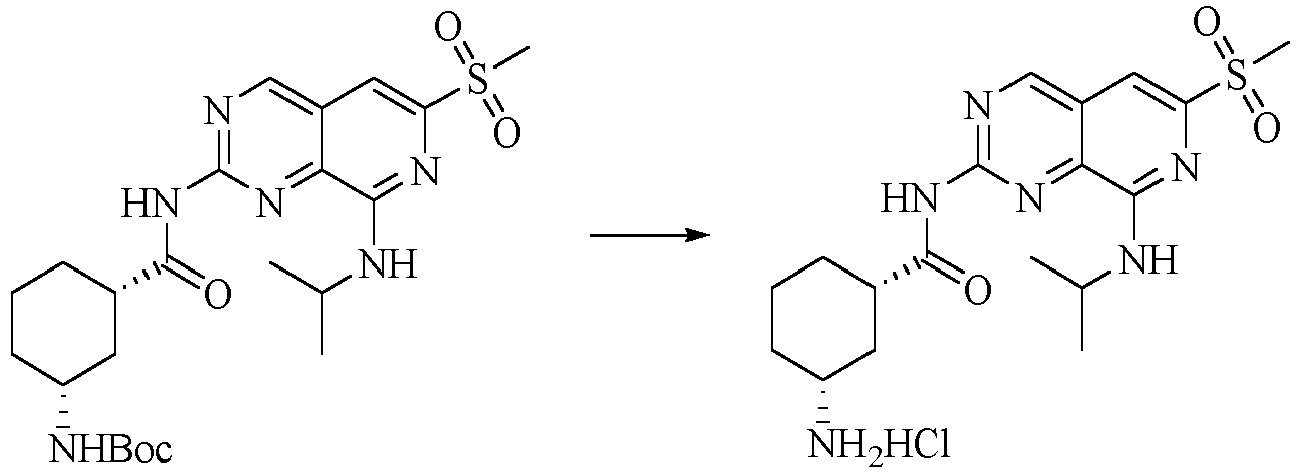
- Tert-butyl ((1R,3S)-3-((8-(isopropylamino)-6-(methylsulfonyl)pyrido[3,4-d]pyrimidin-2-yl)carbamoyl)cyclohexyl)carbamate (180 mg, 0.36 mmol, 1.0 eq.) was dissolved in EA (2 mL). The reaction solution was added dropwise with a solution of HCl in 1,4-dioxane (4 mol/L, 2 mL) and reacted at room temperature for 3 h. After the reaction was substantially completed, as detected by LC-MS, the reaction solution was filtered under vacuum give the product (150 mg, yeild: 95.3%).
-

- (1S,3R)-3-amino-N-(8-(isopropylamino)-6-(methylsulfonyl)pyrido[3,4-d]pyrimidin-2-yl)cyclohexane-1-carboxamide hydrochloride (150 mg, 0.34 mmol, 1.0 eq.), DIPEA (131.3 mg, 1.02 mmol, 3.0 eq.) and acetic anhydride (52 mg, 0.51 mmol, 1.5 eq.) were dissolved in DCM (3 mL), and the reaction solution was reacted at room temperature for 1 h. After the reaction was completed, as detected by LC-MS, the reaction solution was poured into water (5 mL) and extracted with DCM (10 mL × 2). The organic phase was dried and concentrated to give a crude product, which was slurried with EA (3 mL) and filtered under vacuum, and the filter cake was dried to give the product (50 mg, yield: 32.9%).
1HNMR (300 MHz, DMSO-d6 ) δ(ppm): 11.08 (s, 1H), 9.55 (s, 1H), 7.82-7.80 (d, 1H), 6.69 (s, 1H), 7.01-6.98 (d, 1H), 4.34-4.25 (m, 1H), 3.61-3.59 (t, 1H), 3.23 (s, 3H), 2.78-2.75 (d, 1H), 1.96-1.94 (d 1H), 1.78 (s, 6H), 1.33-1.31 (d, 10H).
Molecular formula: C20H28N6O4S Exact mass: 448.19 LC-MS(Pos, m/z)=449.08[M+H]+. -

-

- (S)-1-(tert-butoxycarbonyl)piperidine-3-carboxylic acid (177 mg, 0.77 mmol, 1.0 eq.), 1-chloro-N,N,2-trimethylprop-1-en-1-amine (140 mg, 1.05 mmol, 1.5 eq.) and pyridine (166 mg, 2.10 mmol, 3.0 eq.) were dissolved in DCM (4 mL), and the reaction solution was reacted at 0 °C for 1.5 h. The reaction solution was added with 2-amino-8-(isopropylamino)pyrido[3,4-d]pyrimidine-6-carbonitrile (1600 mg, 0.7 mmol, 1.0 eq.), and incubated at room temperature for 16 h. After the reaction was completed, as detected by TLC, the reaction solution was concentrated to give a crude product, which was purified by silica gel column chromatography (PE:EA = 3:1) to give the product (160 mg, yield: 51.9%).
-

- Tert-butyl (S)-3-((6-cyano-8-(isopropylamino)pyrido[3,4-d]pyrimidin-2-yl)carbamoyl)piperidine-1-carboxylate (160 mg, 0.36 mmol, 1.0 eq.) was dissolved in EA (2 mL). The reaction solution was added dropwise with a solution of HCl in 1,4-dioxane (4 mol/L, 2 mL) and reacted at room temperature for 15 h. After the reaction was substantially completed, as detected by LC-MS, the reaction solution was filtered under vacuum give the product (136 mg, yeild: 100%).
-

- (S)-N-(6-cyano-8-(isopropylamino)pyrido[3,4-d]pyrimidin-2-yl)piperidine-3-carboxamide hydrochloride (136 mg, 0.36 mmol, 1.0 eq.), DIPEA (140 mg, 1.09 mmol, 3.0 eq.) and acetic anhydride (55 mg, 0.54 mmol, 1.5 eq.) were dissolved in DCM (3 mL), and the reaction solution was reacted at room temperature for 3 h. After the reaction was completed, as detected by LC-MS, the reaction solution was concentrated under reduced pressure to give a crude product, which was purified by silica gel column chromatography (DCM:MeOH = 50:1) to give the product (30 mg, yield: 21.7%).
1HNMR (300 MHz, DMSO-d6 ) δ(ppm): 11.27-11.24 (d, 1H), 9.42-9.41 (d, 1H), 7.68-7.67 (d, 1H), 7.93-7.90 (d, 1H), 6.93-6.90 (d, 1H), 4.45-4.24 (m ,2H), 3.96-3.77 (m, 1H), 3.23-3.16 (t, 1H), 3.08-2.86 (m, 1H), 2.74-2.73 (d, 1H), 2.71-2.60 (m, 1H), 2.05-2.02 (d, 4H), 1.74-1.63 (m, 2H), 1.29-1.27 (d, 6H).
Molecular formula: C19H23N7O2 Exact mass: 381.19 LC-MS(Pos, m/z)=382.15[M+H]+. -

-

- N 8-isopropyl-6-vinylpyrido[3,4-d]pyrimidine-2,8-diamine (900 mg, 3.93 mmol, 1.0 eq.), sodium periodate (2.52 g, 11.78 mmol, 3.0 eq.) and potassium osmate dihydrate (144 mg, 0.39 mmol, 0.1 eq.) were dissolved in H2O (4 mL) and THF (9 mL), and the reaction solution was reacted at room temperature for 18 h. After the reaction was completed, as detected by LC-MS, the reaction solution was poured into water (20 mL) and extracted with EA (20 mL × 3). The organic phase was dried and concentrated to give a crude product, which was purified by silica gel column chromatography (PE:EA= 5:1) to give the product (200 mg, yield: 22.0%).
-

- 2-amino-8-(isopropylamino)pyrido[3,4-d]pyrimidine-6-carbaldehyde (200 mg, 0.86 mmol, 1.0 eq.) and bis(2-methoxyethyl)aminosulfur trifluoride (951 mg, 4.30 mmol, 5.0 eq.) were dissolved in DCM (9 mL), and the reaction solution was reacted at 40 °C for 17 h. The reaction solution was concentrated under reduced pressure to give a crude product, which was purified by silica gel column chromatography (PE:EA = 6:1) to give the product (40 mg, yield: 18.2%).
-

- 6-(difluoromethyl)-N 8-isopropylpyrido[3,4-d]pyrimidine-2,8-diamine (40 mg, 0.16 mmol, 1.0 eq.) and (1S,3R)-3-((tert-butoxycarbonyl)amino)cyclohexane-1-carboxylic acid (42 mg, 0.17 mmol, 1.1 eq.) were dissolved in pyridine (1 mL), and the reaction solution was added with phosphorus oxychloride (121 mg, 0.79 mmol, 5.0 eq.) and reacted at room temperature for 10 min. After the reaction was completed, as detected by TLC, the reaction solution was poured into water (3 mL) and extracted with EA (5 mL × 2). The organic phase was dried and concentrated to give a crude product, which was purified by preparative thin-layer chromatography (PE:EA= 2:1) to give the product (20 mg, yield: 26.4%).
-

- Tert-butyl ((1R,3S)-3-((6-(difluoromethyl)-8-(isopropylamino)pyrido[3,4-d]pyrimidin-2-yl)carbamoyl)cyclohexyl)carbamate (20 mg, 0.04 mmol, 1.0 eq.) was dissolved in EA (1 mL). The reaction solution was added dropwise with a solution of HCl in 1,4-dioxane (4 mol/L, 0.5 mL) and reacted at room temperature for 18 h. After the reaction was substantially completed, as detected by LC-MS, the reaction solution was filtered under vacuum give the product (16 mg, yeild: 100%).
-

- (1S,3R)-3-amino-N-(6-(difluoromethyl)-8-(isopropylamino)pyrido[3,4-d]pyrimidin-2-yl)cyclohexane-1-carboxamide hydrochloride (16 mg, 0.038 mmol, 1.0 eq.), DIPEA (15.5 mg, 0.12 mmol, 3.0 eq.) and acetic anhydride (6 mg, 0.058 mmol, 1.5 eq.) were dissolved in DCM (1 mL), and the reaction solution was reacted at room temperature for 20 min. After the reaction was completed, as detected by TLC, the reaction solution was poured into water (3 mL) and extracted with EA (5 mL × 2). The organic phase was dried and concentrated to give a crude product, which was slurried with MTBE (1 mL) and purified to give the product (4 mg, yield: 25.0%).
1HNMR (300 MHz, DMSO-d6 ) δ(ppm): 10.97 (s, 1H), 9.44 (s, 1H), 7.82-7.79 (d, 1H), 7.27 (s, 1H), 7.02 (s, 0.3H), 6.84 (s, 0.5H), 6.79-6.76 (d, 1H), 6.66 (s, 0.3H), 4.36-4.25 (m, 1H), 3.61-3.59 (t, 1H), 2.77-2.73 (d,1H), 1.93-1.91 (d, 3H), 1.78 (s, 4H), 1.33-1.24 (d, 10H).
Molecular formula: C20H26F2N6O2 Exact mass: 420.21 LC-MS(Pos, m/z)=421.14[M+H]+ . -

-

- 6-chloro-N 8-isopropylpyiido[3,4-d]pyiimidine-2,8-diamine(500 mg, 2.10 mmol, 1.0 eq.), 50% trimethylboroxine (2.11 g, 8.41 mmol, 4.0 eq.), cesium carbonate (1.37 g, 4.21 mmol, 2.0 eq.) and [1,1'-bis(diphenylphosphino)ferrocene]palladium dichloride (307 mg, 0.42 mmol, 0.2 eq.) were dissolved in H2O (2 mL) and 1,4-dioxane (10 mL), and the reaction solution was reacted at 100 °C for 16 h in nitrogen atmosphere. After the reaction was completed, as detected by LC-MS, the reaction solution was poured into water (20 mL) and extracted with EA (30 mL × 2). The organic phase was dried and concentrated to give a crude product, which was purified by silica gel column chromatography (PE:EA= 3:1) to give the product (300 mg, yield: 65.6%).
-

- N 8-isopropyl-6-methylpyrido[3,4-d]pyrimidine-2,8-diamine (300 mg, 1.38 mmol, 1.0 eq.) and (1S,3R)-3-((tert-butoxycarbonyl)amino)cyclohexane-1-carboxylic acid (370 mg, 1.52 mmol, 1.1 eq.) were dissolved in pyridine (5 mL), and the reaction solution was added with phosphorus oxychloride (1.06 g, 6.90 mmol, 5.0 eq.) and reacted at room temperature for 0.5 h. After the reaction was completed, as detected by TLC, the reaction solution was poured into hydrochloric acid (20 mL) and extracted with EA (15 mL × 3). The organic phase was dried and concentrated to give a crude product, which was purified by silica gel column chromatography (PE:EA = 3:1) to give the product (80 mg, yield: 13.1%).
-

- Tert-butyl ((1R,3S)-3-((8-(isopropylamino)-6-methylpyrido[3,4-d]pyrimidin-2-yl)carbamoyl)cyclohexyl)carbamate (80 mg, 0.18 mmol, 1.0 eq.) was dissolved in EA (1 mL). The reaction solution was added dropwise with a solution of HCl in 1,4-dioxane (4 mol/L, 0.5 mL) and reacted at room temperature for 19 h. After the reaction was substantially completed, as detected by LC-MS, the reaction solution was filtered under vacuum give the product (68 mg, yeild: 100%).
-

- (1S,3R)-3-amino-N-(8-(isopropylamino)-6-methylpyrido[3,4-d]pyrimidin-2-yl)cyclohexane-1-carboxamide hydrochloride (68 mg, 0.18 mmol, 1.0 eq.), DIPEA (69 mg, 0.54 mmol, 3.0 eq.) and acetic anhydride (28 mg, 0.27 mmol, 1.5 eq.) were dissolved in DCM (2 mL), and the reaction solution was reacted at room temperature for 20 min. After the reaction was completed, as detected by LC-MS, the reaction solution was concentrated under reduced pressure to give a crude product, which was purified by silica gel column chromatography (MeOH:DCM = 1:20) and slurried with MTBE (2 mL) to give the product (14 mg, yield: 20.3%).
1HNMR (300 MHz, DMSO-d6 ) δ(ppm): 10.77 (s, 1H), 9.23 (s, 1H), 7.82-7.79 (d, 1H), 6.76 (s, 1H), 6.53-6.50 (d, 1H), 4.35-4.26 (d ,1H), 3.60-3.58 (d, 1H), 2.73 (s, 1H), 2.40 (s, 1H), 1.95-1.91 (d, 1H), 1.78 (s, 6H), 1.28-1.26 (d, 10H).
Molecular formula: C20H28N6O2 Exact mass: 384.23 LC-MS(Pos, m/z)=385.15[M+H]+. -

-

- N 8-isopropyl-6-vinylpyrido[3,4-d]pyrimidine-2,8-diamine (200 mg, 0.87 mmol, 1.0 eq.) and 10% palladium on carbon (40 mg) were added into MeOH (5 mL), and the reaction solution was reacted for 3 h under hydrogen atmosphere. After the reaction was completed, as detected by TLC, the reaction solution was filtered, and the filtrate was concentrated under reduced pressure to give the product (201 mg, yield: 100%).
-

- 6-ethyl-N 8-isopropylpyrido[3,4-d]pyrimidine-2,8-diamine (201 mg, 0.87 mmol, 1.0 eq.) and (1S,3R)-3-((tert-butoxycarbonyl)amino)cyclohexane-1-carboxylic acid (234 mg, 0.96 mmol, 1.1 eq.) were dissolved in pyridine (4 mL), and the reaction solution was added with phosphorus oxychloride (667 mg, 4.35 mmol, 5.0 eq.) and reacted at room temperature for 20 min. After the reaction was completed, as detected by TLC, the reaction solution was poured into hydrochloric acid (20 mL), and the aqueous phase was extracted with EA (20 mL × 2). The organic phase was dried and concentrated to give a crude product, which was slurried with MTBE (10 mL) and filtered under vacuum, and the filter cake was dried to give the product (200 mg, yield: 50.3%).
-

- Tert-butyl ((1R,3S)-3-((6-ethyl-8-(isopropylamino)pyrido[3,4-d]pyrimidin-2-yl)carbamoyl)cyclohexyl)carbamate (200 mg, 0.44 mmol, 1.0 eq.) was dissolved in EA (4 mL), and the reaction solution was added dropwise a solution of hydrogen chloride in 1,4-dioxane (4 mol/L, 2 mL) and reacted at room temperature for 17 h. After the reaction was substantially completed, as detected by LC-MS, the reaction solution was filtered under vacuum give the product (172 mg, yeild: 100%).
-

- (1S,3R)-3-amino-N-(6-ethyl-8-(isopropylamino)pyrido[3,4-d]pyrimidin-2-yl)cyclohexane-1-carboxamide hydrochloride (172 mg, 0.44 mmol, 1.0 eq.), DIPEA (170 mg, 1.32 mmol, 3.0 eq.) and acetic anhydride (67 mg, 0.66 mmol, 1.5 eq.) were dissolved in DCM (4 mL), and the reaction solution was reacted at room temperature for 20 min. After the reaction was completed, as detected by LC-MS, the reaction solution was concentrated under reduced pressure to give a crude product, which was slurried with EA (10 mL) and filtered under vacuum. The filter cake was dried to give the product (40 mg, yield: 17.4%).
1HNMR (300 MHz, DMSO-d6 ) δ(ppm): 10.76 (s, 1H), 9.25 (s, 1H), 7.82-7.79 (d, 1H), 6.77 (s, 1H), 6.51-6.48 (d, 1H), 4.34-4.27 (m, 1H), 3.61-3.58 (t, 1H), 2.74-2.63 (m, 3H), 1.96-1.91 (d, 1H), 1.78 (s, 6H), 1.29-1.23 (m, 12H), 1.11-1.08 (t, 1H).
Molecular formula: C21H30N6O2 Exact mass: 398.24 LC-MS(Pos, m/z)=399.16[M+H]+. -

-

- 6-chloro-N 8-isopropylpyiido[3,4-d]pyiimidine-2,8-diamine(2.0 g, 8.41 mmol, 1.0 eq.), potassium vinylfluoroborate (2.25 g, 16.83 mmol, 2.0 eq.), cesium carbonate (5.48 g, 16.83 mmol, 2.0 eq.) and [1,1'-bis(diphenylphosphino)ferrocene]palladium dichloride (614 mg, 0.84 mmol, 0.1 eq.) were dissolved in H2O (5 mL) and dioxane (25 mL), and the reaction solution was reacted at 100 °C for 21 h in nitrogen atmosphere. After the reaction was completed, as detected by LC-MS, the reaction solution was poured into water (20 mL) and extracted with EA (30 mL × 2). The organic phase was dried and concentrated to give a crude product, which was purified by silica gel column chromatography (PE:EA= 5:1) to give the product (1.2 g, yield: 62.1%).
-
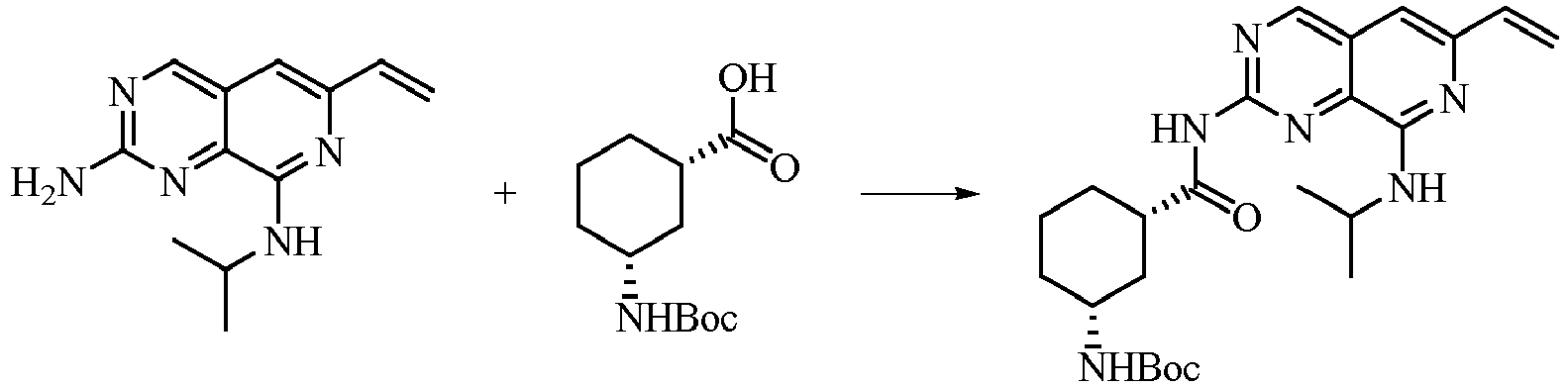
- N 8-isopropyl-6-vinylpyrido[3,4-d]pyrimidine-2,8-diamine (300 mg, 1.31 mmol, 1.0 eq.) and (1S,3R)-3-((tert-butoxycarbonyl)amino)cyclohexane-1-carboxylic acid (350 mg, 1.44 mmol, 1.1 eq.) were dissolved in pyridine (3 mL), and the reaction solution was added with phosphorus oxychloride (1.0 g, 6.54 mmol, 5.0 eq.) and reacted at room temperature for 0.5 h. After the reaction was completed, as detected by TLC, the reaction solution was poured into hydrochloric acid (20 mL) and extracted with EA (15 mL × 3). The organic phase was dried and concentrated to give a crude product, which was slurried with (PE:EA = 5:1, 12 mL) and filtered under vacuum, and the filter cake was dried to give the product (350 mg, yield: 58.8%).
-

- Tert-butyl ((1R,3S)-3-((8-(isopropylamino)-6-vinylpyrido[3,4-d]pyrimidin-2-yl)carbamoyl)cyclohexyl)carbamate (350 mg, 0.77 mmol, 1.0 eq.) was dissolved in EA (5 mL). The reaction solution was added dropwise with a solution of HCl in 1,4-dioxane (4 mol/L, 3 mL) and reacted at room temperature for 18 h. After the reaction was substantially completed, as detected by LC-MS, the reaction solution was filtered under vacuum give the product (300 mg, yeild: 100%).
-

- (1S,3R)-3-amino-N-(8-(isopropylamino)-6-vinylpyrido[3,4-d]pyrimidin-2-yl)cyclohexane-1-carboxamide hydrochloride (300 mg, 0.76 mmol, 1.0 eq.), DIPEA (298 mg, 2.13 mmol, 3.0 eq.) and acetic anhydride (117 mg, 1.15 mmol, 1.5 eq.) were dissolved in DCM (5 mL) and reacted at room temperature for 2.5 h. After the reaction was completed, as detected by LC-MS, the reaction solution was concentrated under reduced pressure to give a crude product, which was purified by silica gel column chromatography (MeOH:DCM = 1:50) to give the product (120 mg, yield: 39.4%).
1HNMR (300 MHz, DMSO-d6 ) δ(ppm): 10.84 (s, 1H), 9.28 (s, 1H), 7.82-7.80 (d, 1H), 6.91 (s, 1H), 6.80-6.71 (m, 1H), 6.59-6.56 (d, 1H), 6.27-6.21 (d, 1H), 5.39-5.36 (d, 1H), 4.37-4.25 (d, 1H), 3.58 (s, 1H), 2.75 (s, 1H), 1.96 (s, 1H), 1.78 (s, 6H), 1.32-1.30 (d, 9H), 1.11 (s, 1H).
Molecular formula: C21H28N6O2 Exact mass: 396.23 LC-MS(Pos, m/z)=397.18[M+H]+. -

-

- 6-chloro-N-isopropyl-2-(methylthio)pyrido[3,4-d]pyrimidin-8-amine (1.5 g, 5.58 mmol, 1.0 eq.), tert-butyl methylcarbamate (1.10 g, 8.37 mmol, 1.5 eq.), 2-di-tert-butylphosphino-2',4',6' -triisopropylbiphenyl (476 mg, 1.12 mmol, 0.2 eq.), cesium carbonate (3.64 g, 11.16 mmol, 2.0 eq.) and allylpalladium chloride dimer (204 mg, 0.56 mmol, 0.1 eq.) were dispersed in dioxane (20 mL), and the reaction solution was reacted at 80 °C for 4.5 h in nitrogen atmosphere. After the reaction was completed, as detected by TLC, the reaction solution was concentrated under reduced pressure to give a crude product, which was purified by silica gel column chromatography (PE:EA = 30:1) to give the product (1.3 g, yield: 64.3%).
-

- Tert-butyl (8-(isopropylamino)-2-(methylthio)pyrido[3,4-d]pyrimidin-6-yl)(methyl)carbamate (1.3 g, 3.57 mmol, 1.0 eq.) was dissolved in DCM (200 mL), and the reaction solution was added with m-chloroperoxybenzoic acid (mass fraction: 80%, 771 mg, 3.57 mmol, 1.0 eq.). After the reaction was completed, as detected by TLC, the reaction solution was poured into saturated aqueous potassium carbonate (20 mL), the liquid separation was performed, the aqueous phase was extracted with DCM (20 mL × 2), and the organic phases were combined, dried and concentrated to give the product (1.1 g, yield: 81.4%).
-

- Tert-butyl (8-(isopropylamino)-2-(methylsulfinyl)pyrido[3,4-d]pyrimidin-6-yl)(methyl)carbamate (1.1 g, 2.90 mmol, 1.0 eq.) was dissolved in a solution of amino in isopropanol (3.5 mol/L, 20 mL), and the reaction solution was reacted at 150 °C for 15 h. After the reaction was completed, as detected by TLC, the reaction solution was concentrated under reduced pressure to give a crude product, which was purified by silica gel column chromatography (PE:EA = 4:1) to give the product (500 mg, yield: 51.9%).
-

- Tert-butyl (2-amino-8-(isopropylamino)pyrido[3,4-d]pyrimidin-6-yl)(methyl)carbamate (300 mg, 0.90 mmol, 1.0 eq.) and (1S,3R)-3-acetamidocyclohexane-1-carboxylic acid (183 mg, 0.99 mmol, 1.1 eq.) were dissolved in pyridine (3 mL), and the reaction solution was added with phosphorus oxychloride (414 mg, 2.70 mmol, 3.0 eq.) and reacted at room temperature for 5 min. When the reaction was performed and there were materials left, as detected by TLC, the reaction solution was poured into EA (20 mL), washed with aqueous citric acid solution (30 mL × 3), and washed with saturated aqueous sodium bicarbonate solution (30 mL). The organic phase was dried and concentrated to give a crude product, which was purified by silica gel column chromatography (MeOH:DCM = 1:40) to give the product (130 mg, yield: 28.9%).
-

- Tert-butyl (2-((1S,3R)-3-acetamidocyclohexane-1-carboxamido)-8-(isopropylamino)pyrido[3,4-d]pyrimidin-6-yl)(methyl)carbamate (120 mg, 0.24 mmol, 1.0 eq.) and 2,6-dimethylpyridine (386 mg, 3.60 mmol, 15 eq.) were dissolved in DCM (2 mL), and the reaction solution was cooled to 5 °C, added with trimethylsilyl trifluoromethanesulfonate (533 mg, 2.40 mmol, 10 eq.), and reacted for 20 min. After the reaction was completed, as detected by TLC, the reaction solution was poured into water (10 mL) and extracted with DCM (10 mL × 3). The organic phase was washed with saturated aqueous sodium bicarbonate solution (10 mL), dried and concentrated to give a crude product, which was slurried for 1h with MTBE (10 mL) and filtered under vacuum, and the filter cake was dried to give the product (56 mg, yield: 58.3%).
1HNMR (300 MHz, DMSO-d6 ) δ(ppm): 10.40 (s, 1H), 8.96 (s, 1H), 7.79-7.76 (d, 1H), 6.42-6.40 (d, 1H), 6.20-6.18 (d, 1H), 5.65 (s, 1H), 4.27-4.20 (m ,1H), 3.58-3.55 (t, 1H), 2.74-2.72 (d, 3H), 2.65-2.62 (d, 1H), 1.91-1.87 (d, 1H), 1.79 (s, 6H), 1.25-1.23 (d, 10H).
Molecular formula: C20H29N7O2 Exact mass: 399.24 LC-MS(Pos, m/z)=400.46[M+H]+. -

-

- (1S,3R)-3-((tert-butoxycarbonyl)amino)cyclohexane-1-carboxylic acid (2.0 g, 8.22 mmol, 1.0 eq.) was dissolved in EA (20 mL), and the reaction solution was added with a solution of hydrogen chloride in 1,4-dioxane (4 mol/L, 10 mL) and reacted at room temperature for 17 h. The reaction solution was filtered under vacuum give the product (1.476 g, yeild: 100%).
-

- (1S,3R)-3-((tert-butoxycarbonyl)amino)cyclohexane-1-carboxylic acid (1.476 g, 8.22 mmol, 1.0 eq.) and triethylamine (2.49 g, 24.65 mmol, 3.0 eq.) were dissolved in DCM (20 mL) and isopropanol (2 mL), and the reaction solution was added with acetic anhydride (1.26 mg, 12.32 mmol, 1.5 eq.) and reacted at room temperature for 16 min. After the reaction was completed, as detected by LC-MS, the reaction solution was concentrated under reduced pressure to give a crude product, which was dissolved with water (20 mL) and adjusted to pH = 1 with hydrochloric acid. The aqueous phase was extracted with EA (20 mL × 3). The organic phase was dried and concentrated to give a crude product, which was slurried with (PE:MTBE = 1:1, 30 mL) and filtered under vacuum, and the filter cake was dried to give the product (1.3 g, yield: 85.56%).
-
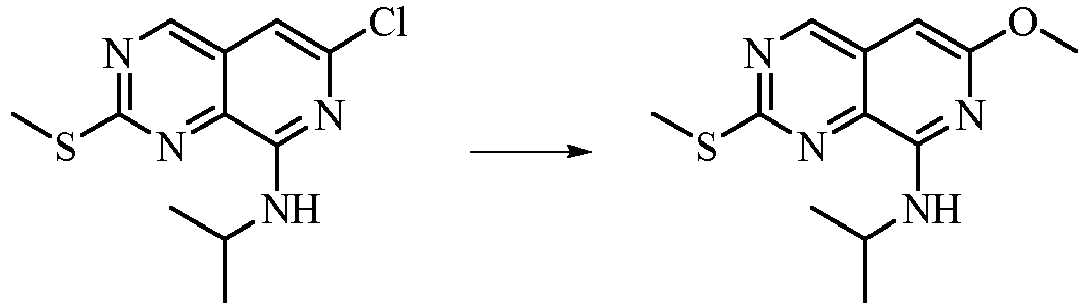
- 6-chloro-N-isopropyl-2-(methylthio)pyrido[3,4-d]pyrimidin-8-amine (1.5 g, 5.58 mmol, 1.0 eq.), 2-di-tert-butylphosphino-2',4',6' -triisopropylbiphenyl (476 mg, 1.12 mmol, 0.2 eq.), cesium carbonate (3.64 g, 11.16 mmol, 2.0 eq.) and allylpalladium chloride dimer (205 mg, 0.56 mmol, 0.1 eq.) were dispersed in methanol (5 mL) and 1,4-dioxane (15 mL), and the reaction solution was reacted at 80 °C for 0.5 h in nitrogen atmosphere. After the reaction was completed, as detected by TLC, the reaction solution was concentrated under reduced pressure to give a crude product, which was purified by silica gel column chromatography (PE:EA = 20: 1) to give the product (1.2 g, yield: 81.6%).
-
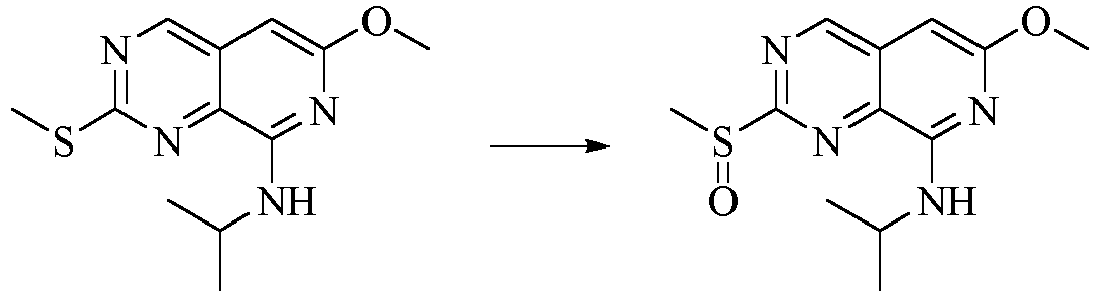
- 8-(isopropylamino)-2-(methylthio)pyrido[3,4-d]pyrimidine-6-carbonitrile (1.2 g, 4.54 mmol, 1.0 eq.) was dissolved in DCM (200 mL), and the reaction solution was added with m-chloroperoxybenzoic acid (mass fraction: 80%, 979 mg, 4.54 mmol, 1.0 eq.). After the reaction was completed, as detected by TLC, the reaction solution was poured into saturated aqueous sodium carbonate (20 mL) and extracted with DCM (15 mL × 2). The organic phase was dried and concentrated to give a crude product, which was purified by silica gel column chromatography (MeOH: DCM = 1:80) to give the product (1.0 g, yield: 78.7%).
-

- N-isopropyl-6-methoxy-2-(methylsulfinyl)pyrido[3,4-d]pyrimidin-8-amine (1.0 g, 3.56 mmol, 1.0 eq.) was dissolved in a solution of amino in isopropanol (3.5 mol/L, 20 mL), and the reaction solution was reacted at 150 °C for 17 h. After the reaction was completed, as detected by TLC, the reaction solution was cooled to room temperature and concentrated under reduced pressure to give a crude product, which was purified by silica gel column chromatography (PE:EA= 3:1) to give the product (200 mg, yield: 24.0%).
-

- N 8-isopropyl-6-methoxypyiido[3,4-d]pyiimidine-2,8-diamine (100 mg, 0.42 mmol, 1.0 eq.) and (1S,3R)-3-acetamidocyclohexane-1-carboxylic acid (85 mg, 0.46 mmol, 1.1 eq.) were dissolved in pyridine (2 mL), and the reaction solution was added with phosphorus oxychloride (193 mg, 1.26 mmol, 3.0 eq.) and reacted at room temperature for 5 min. When a product was generated, as detected by TLC, the reaction solution was poured into EA (20 mL). EA phase was washed with aqueous citric acid solution (20 mL × 3), and washed with saturated aqueous sodium bicarbonate solution (20 mL). The organic phase was dried and concentrated to give a crude product, which was slurried with EA (3 mL) and filter under vacuum to give the product (20 mg, yield: 11.9%).
1HNMR (300 MHz, DMSO-d6 ) δ(ppm): 10.63 (s, 1H), 9.18 (s, 1H), 7.79-7.77 (d, 1H), 6.71-6.68 (d, 1H), 6.21 (s, 1H), 4.26-4.22 (t, 1H), 3.83 (s, 3H), 3.58 (s, 2H), 2.70 (s, 1H), 1.93-1.89 (d, 1H), 1.77 (s, 5H), 1.29-1.27 (d, 10H).
Molecular formula: C20H28N6O3 Exact mass: 400.22 LC-MS(Pos, m/z)=401.20[M+H]+. -

-


-
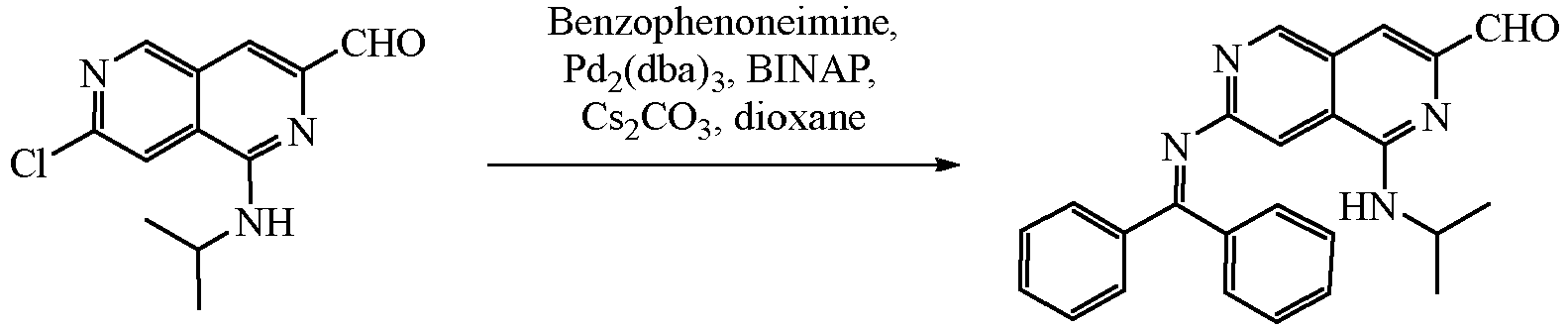
- 7-chloro-1-(isopropylamino)-2,6-naphthyridine-3-carbaldehyde (249.7 mg, 1 mmol, 1.0 eq.), diphenylmethanimine (217.5 mg, 1.2 mmol, 1.2 eq.), Pd2(dba)3 (91.5 mg, 0.1 mmol, 0.1 eq.), BINAP (124.5 mg, 0.2 mmol, 0.2 eq.) and cesium carbonate (814.5 mg, 5.27 mmol, 2.5 eq.) were added into 1,4-dioxane (10 mL). The mixture was reacted at 120 °C for 18 h in a sealed tube in nitrogen atmosphere. When there were no materials left, as detected by TLC, the reaction solution was added with ethyl acetate (20 mL), stirred for 5 min and filtered, the filter cake was rinsed with ethyl acetate, and the filtrate was concentrated under reduced pressure to give a crude product, which was purified by silica gel column chromatography (EA:PE = 1:20-1:6) to give the product (340 mg, yield: 86.1%).
-

- 7-((diphenylmethylene)amino)-1-(isopropylamino)-2,6-naphthyridine-3-carbaldehyde (340 mg, 0.86 mmol, 1.0 eq.) was dissolved in THF (5 mL). The reaction solution was added with aqueous citric acid solution (mass fraction: 10%, 5 mL) and reacted at room temperature for 17 h. When there were no materials left, as detected by TLC, the reaction solution was added with saturated aqueous sodium carbonate (20 mL) and extracted with ethyl acetate (30 mL × 3). The organic phases were combined, dried over anhydrous sodium sulfate and filtered, and the filtrate was concentrated under reduced pressure to give a crude product, which was purified by silica gel column chromatography (EA:PE = 1:10-1:1) to give the product (123 mg, yield: 62.1%).
-

- (1S,3R)-3-acetamidocyclohexane-1-carboxylic acid (101.8 mg, 0.55 mmol, 1.1 eq.) was dissolved in DCM (5 mL). The reaction solution was cooled to 0 °C to 5 °C in an ice water bath, added with 1-chloro-N,N,2-trimethylprop-1-en-1-amine (mass fraction: 95%, 105.4 mg, 0.75 mmol, 1.5 eq.), reacted at 0 °C to 5 °C for 1.5 h, added with a solution of 7-amino-1-(isopropylamino)-2,6-naphthyridine-3-carbaldehyde (115 mg, 0.50 mmol, 1.0 eq.) and pyridine (118.6 mg, 1.50 mmol, 3.0 eq.) in THF (10 mL), and incubated at room temperature for 17 h. When there were a small amount of materials left, as detected by TLC, the reaction solution was added with saturated aqueous sodium carbonate (20 mL) and extracted with ethyl acetate (20 mL × 3). The organic phases were combined, dried over anhydrous sodium sulfate and filtered, and the filtrate was concentrated under reduced pressure to give the product (150 mg, yield: 75.5%).
-

- (1S,3R)-3-acetamido-N-(7-formyl-5-(isopropylamino)-2,6-naphthyridin-3-yl)cyclohexane-1-carboxamide (150 mg, 0.37 mmol, 1.0 eq.), dimethyl (1-diazo-2-oxopropyl)phosphonate (107.6 mg, 0.56 mmol, 1.5 eq.) and potassium carbonate (153.2 mg, 1.11 mmol, 3.0 eq.) were dissolved in methanol (5 mL), and the reaction solution was reacted at room temperature for 2 h. When there were no materials left, as detected by TLC, the reaction solution was added with saturated aqueous sodium carbonate (20 mL) and extracted with ethyl acetate (30 mL × 3). The organic phases were combined, dried over anhydrous sodium sulfate and filtered, and the filtrate was concentrated under reduced pressure to give a crude product, which was purified by preparative thin-layer chromatography (MeOH:DCM = 1:20) to give the product (41 mg, yield: 28.2%).
1HNMR (400 MHz, CD3OD) δ(ppm): 8.83 (s, 1H), 8.44 (s, 1H), 7.19 (s, 1H), 4.52-4.46 (m, 1H), 3.80-3.75 (m, 1H), 3.50 (m, 1H), 2.69-2.63 (m, 1H), 2.13-2.10 (m, 1H), 1.95 (s, 3H), 1.54-1.48 (m,4H), 1.35-1.31(m, 9H).
Molecular formula: C22H27N5O2 Exact mass: 393.22 LC-MS (Pos, m/z) =394.27 [M+H]+. -

-

-

- (Methoxymethyl)triphenylphosphonium (4.9 g, 14.4 mmol, 3.0 eq.) was added into anhydrous THF (30 mL). The reaction solution was cooled to 0 °C in an ice water bath in nitrogen atmosphere, added dropwise with a solution of potassium tert-butoxide (1.6 g, 14.4 mmol, 3.0 eq.) in anhydrous THF (5 mL), and reacted at 0 °C to 5 °C for 40 min after addition. The reaction solution was added dropwise with 7-chloro-1-(isopropylamino)-2,6-naphthyridine-3-carbaldehyde (1.2 g, 4.8 mmol, 1.0 eq.) in anhydrous THF (10 mL), and incubated at room temperature for 48 h. When there were materials left, as detected by TLC, the reaction solution was added with water (30 mL) and extracted with ethyl acetate (50 mL × 2). The organic phases were combined, dried over anhydrous sodium sulfate and filtered, and the filtrate was concentrated under reduced pressure to give a crude product, which was purified by silica gel column chromatography (EA:PE = 1:50-1:30) to give the product (710 mg, yield: 54.6%).
-

- (E)-7-chloro-N-isopropyl-3-(2-methoxyvinyl)-2,6-naphthyridin-1-amine (710 mg, 2.56 mmol, 1.0 eq.) was dissolved in THF (12 mL), and the reaction solution was added with aqueous hydrochloric acid solution (4 mol/L, 3 mL), heated to 80 °C and reacted for 1 h. When there were no materials left, as detected by TLC, the reaction solution was concentrated under reduced pressure, added with water (20 mL), adjusted to pH of about 8 with sodium carbonate and extracted with ethyl acetate (20 mL × 3). The organic phases were combined, dried over anhydrous sodium sulfate and filtered, and the filtrate was concentrated under reduced pressure to give the product, which was used in the next step according to a theoretical amount.
-
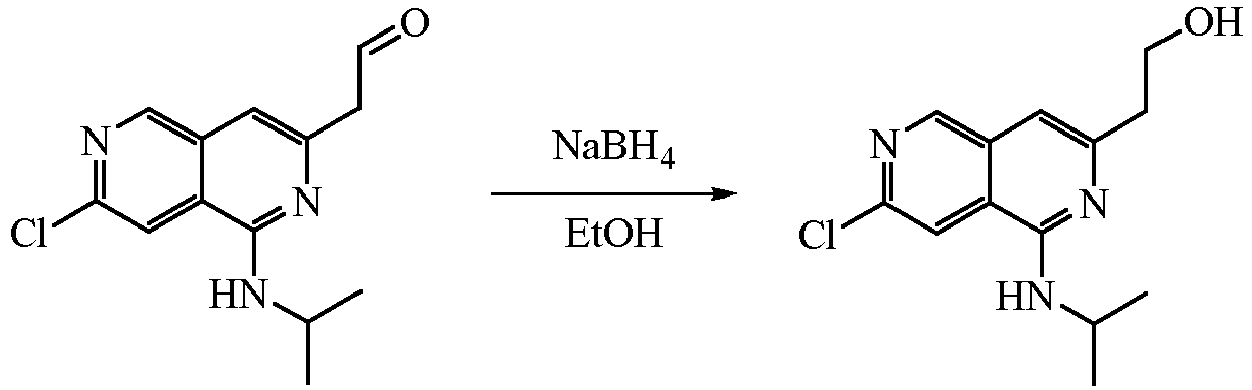
- 2-(7-chloro-1-(isopropylamino)-2,6-naphthyridin-3-yl)acetaldehyde (2.56 mmol, 1.0 eq.) was dissolved in absolute ethanol (10 mL). The reaction solution was added with sodium triacetoxyborohydride (968.4 mg, 25.6 mmol, 10 eq.) and reacted at room temperature for 0.5 h. When there were no materials left, as detected by TLC, the reaction solution was concentrated under reduced pressure, added with water (10 mL), and extracted with ethyl acetate (20 mL × 3). The organic phases were combined, dried over anhydrous sodium sulfate and filtered, and the filtrate was concentrated under reduced pressure to give a crude product, which was purified by silica gel column chromatography (EA:PE = 1:10-1:3) to give the product (353 mg, two-step yield: 54.6%).
-

- 2-(7-chloro-1-(isopropylamino)-2,6-naphthyridin-3-yl)ethanol (350 mg, 1.32 mmol, 1.0 eq.), diphenylmethanimine (286.3 mg, 1.58 mmol, 1.2 eq.), Pd2(dba)3 (119 mg, 0.13 mmol, 0.1 eq.), BINAP (161.9 mg, 0.26 mmol, 0.2 eq.) and cesium carbonate (1.1 g, 3.3 mmol, 2.5 eq.) were added into 1,4-dioxane (15 mL). The mixture was reacted at 120 °C for 16 h in a sealed tube in nitrogen atmosphere. When there were no materials left, as detected by TLC, the reaction solution was added with ethyl acetate (20 mL), stirred for 20 min and filtered, and the filtrate was concentrated under reduced pressure to give a crude product, which was purified by silica gel column chromatography (EA:PE = 1:10-1:3) to give the product (457 mg, yield: 84.3%).
-

- 2-(7-((diphenylmethylene)amino)-1-(isopropylamino)-2,6-naphthyridin-3-yl)ethan-1-ol (457 mg, 1.11 mmol, 1.0 eq.) was dissolved in THF (10 mL). The reaction solution was added with aqueous citric acid solution (mass fraction: 10%, 10 mL) and reacted at room temperature for 1 h. When there were no materials left, as detected by TLC, the reaction solution was added with water (10 mL), adjusted to pH of about 8 with sodium carbonate and extracted with ethyl acetate (20 mL × 2). The organic phases were combined, dried over anhydrous sodium sulfate and filtered, and the filtrate was concentrated under reduced pressure to give a crude product, which was slurried for 5 min with methyl tert-butyl ether (5 mL) and filtered, and the filter cake was dried to give the product (191 mg, yield: 69.8%).
-

- 2-(7-amino-1-(isopropylamino)-2,6-naphthyridin-3-yl)ethanol (190 mg, 0.77 mmol, 1.0 eq.) was dissolved in DCM (5 mL). The reaction solution was added with imidazole (157.3 mg, 2.31 mmol, 3.0 eq.) and tert-butyldimethylsilyl chloride (173.3 mg, 1.15 mmol, 1.5 eq.), and reacted at room temperature for 15 h. When there was about 50% materials left, as detected by TLC, the reaction solution was concentrated under reduced pressure, added with water (20 mL), and extracted with ethyl acetate (20 mL × 3). The organic phases were combined, dried over anhydrous sodium sulfate and filtered, and the filtrate was concentrated under reduced pressure to give a crude product, which was purified by preparative thin-layer chromatography (MeOH:DCM = 1:20) to give the product (110 mg, yield: 39.6%).
-

- (1S,3R)-3-acetamidocyclohexane-1-carboxylic acid (66.7 mg, 0.36 mmol, 1.2 eq.) was dissolved in DCM (3 mL). The reaction solution was cooled to 0 °C to 5 °C in an ice water bath, added with 1-chloro-N,N,2-trimethylprop-1-en-1-amine (mass fraction: 95%, 63.3 mg, 0.45 mmol, 1.5 eq.), reacted at 0 °C to 5 °C for 1.5 h, added with a solution of 3-(2-((tert-butyldimethylsilyl)oxy)ethyl)-N 1-isopropyl-2,6-naphthyridine-1,7-diamine (110 mg, 0.30 mmol, 1.0 eq.) and pyridine (71.2 mg, 0.90 mmol, 3.0 eq.) in DCM (2 mL), and incubated at room temperature for 18 h. When there were 16% materials left, as detected by LC-MS, the reaction solution was added with water (20 mL), adjusted to pH of about 8 with sodium carbonate and extracted with ethyl acetate (20 mL × 3). The organic phases were combined, dried over anhydrous sodium sulfate and filtered, and the filtrate was concentrated under reduced pressure to give a crude product, which was purified by preparative thin-layer chromatography (MeOH:DCM = 1:20) to give the product (48 mg, yield: 30.3%).
-

- (1S,3R)-3-acetamido-N-(7-(2-((tert-butyldimethylsilyl)oxy)ethyl)-5-(isopropylamino)-2,6-naphthyridin-3-yl)cyclohexane-1-carboxamide (48 mg, 0.09 mmol, 1.0 eq.) was dissolved in THF (2 mL), and the reaction solution was added with a solution of tetra-n-butylammonium fluoridereacted (1 mol/L) in THF (0.18 mL, 0.18 mmol, 2.0 eq.), and reacted at room temperature for 2 h. When there were no materials left, as detected by TLC, the reaction solution was added with water (10 mL) and extracted with DCM (10 mL × 4). The organic phases were combined, dried over anhydrous sodium sulfate and filtered, and the filtrate was concentrated under reduced pressure to give a crude product, which was purified by preparative thin-layer chromatography (MeOH:DCM = 1: 10) to give the product (27 mg, yield: 72.5%).
1HNMR (400 MHz, CD3OD) δ(ppm): 8.79 (s, 1H), 8.39 (s, 1H), 6.83 (s, 1H), 4.44-4.00 (m, 1H), 3.98-3.81 (m, 2H), 3.79-3.75 (m, 1H), 3.28-3.24 (m, 2H), 2.95-2.92 (m, 2H), 2.68-2.62 (m, 1H), 2.13-2.10 (m, 1H), 2.00 (s, 3H), 1.70-1.66 (m, 1H), 1.55-1.49 (m, 2H), 1.47-1.41 (m, 2H), 1.40-1.36 (m, 6H).
Molecular formula: C22H31N5O2 Exact mass: 413.24 LC-MS (Pos, m/z) =414.33 [M+H]+. -

-

- (1S,3R)-3-acetamido-N-(7-cyano-5-(methylsulfonyl)-2,6-naphthyridin-3-yl)cyclohexane-1-carboxamide (80 mg, 0.19 mmol, 1.0 eq.) and tert-butylamine (69 mg, 0.95 mmol, 5.0 eq.) were dissolved in THF (3 mL), and the reaction solution was reacted at 80 °C for 20 h. After the reaction was completed, as detected by TLC, the reaction solution was concentrated under reduced pressure to give a crude product, which was slurried with DCM (2 mL) and filtered under vacuum. The filter cake was dried at 50 °C to give the product (25 mg, yield: 31.6%).
1HNMR (300 MHz, DMSO-d6 ) δ(ppm): 10.83 (s, 1H), 9.01 (s, 1H), 8.67 (s, 1H), 7.83-7.81 (d, 1H), 7.70 (s, 1H), 7.06 (s ,1H), 3.62-3.59 (d, 1H), 2.68 (s, 1H), 1.96-1.92 (d, 1H), 1.79 (s, 6H), 1.52 (s, 9 H), 1.34-1.25 (m, 4H).
Molecular formula: C22H28N6O2 Exact mass: 408.23 LC-MS(Pos, m/z)=409.22[M+H]+. -

-

- (1S,3R)-3-acetamido-N-(7-cyano-5-(methylsulfonyl)-2,6-naphthyridin-3-yl)cyclohexane-1-carboxamide (80 mg, 0.19 mmol, 1.0 eq.) and cyclopropylamine (54 mg, 0.95 mmol, 5.0 eq.) were dissolved in THF (2 mL), and the reaction solution was reacted at 40 °C for 2 h. After the reaction was completed, as detected by LC-MS, the reaction system was poured into water (5 mL) and extracted with EA (10 mL × 3). The organic phase was dried and concentrated to give a crude product. The crude product was slurried with (MTBE:EA= 1:1) and filtered under vacuum, and the filter cake was dried at 50 °C to give the product (30 mg, yield: 40.5%).
1HNMR (300 MHz, DMSO-d6 ) δ(ppm): 10.83 (s, 1H), 9.04 (s, 1H), 8.65 (s, 1H), 8.26 (s, 1H), 7.84-7.81 (d, 1H), 7.74 (s, 1H), 3.6 (s ,1H), 2.93-2.92 (d, 1H), 2.70-2.67 (d, 1H), 1.95-1.92 (d, 1H), 1.79 (s, 6H), 1.33-1.24 (t, 4H), 0.79-0.78 (d, 2H), 0.65 (s, 2H).
Molecular formula: C21H24N6O2 Exact mass: 392.20 LC-MS(Pos, m/z)=393.17[M+H]+. -

-

- (1S,3R)-3-acetamido-N-(7-cyano-5-(methylsulfonyl)-2,6-naphthyridin-3 - yl)cyclohexane-1-carboxamide (100 mg, 0.24 mmol, 1.0 eq.) was dissolved in THF (3 mL), and the reaction solution was added with DIPEA (248 mg, 1.92 mmol, 8.0 eq.) and 1-methylcyclopropan-1-amine hydrochloride (129 mg, 1. 2 mmol, 5.0 eq.), and reacted at 100 °C for 16 h in a sealed tube. When there were no materials left, as detected by LC-MS, the reaction solution was added with water (20 mL) and extracted with ethyl acetate (20 mL × 3). The organic phases were combined, washed with hydrochloric acid solution (0.1 mol/L, 30 mL), dried over anhydrous sodium sulfate and filtered, and the filtrate was concentrated under reduced pressure to give a crude product, which was purified by preparative thin-layer chromatography (MeOH:DCM = 1:20) to give the product (11 mg, yield: 11.2%).
1HNMR (400 MHz, MeOD) δ(ppm): 8.95 (s, 1H), 8.49 (s, 1H), 7.57 (s, 1H), 3.80-3.74 (m, 1H), 2.69-2.64 (m, 1H), 2.12-2.09 (m, 1H), 1.95 (m, 4H), 1.54 (m, 4H), 1.31 (m, 5H), 0.92-0.88 (m, 2H), 0.80 (m, 2H).
Molecular formula: C22H26N6O2 Exact mass: 406.21 LC-MS (Pos, m/z) =407.39 [M+H]+. -

-

- Dimethyl (E)-pent-2-enedioate (2.0 g, 12.64 mmol, 1.0 eq.) and benzylamine (1.42 g, 13.27 mmol, 1.05 eq.) were dissolved in methanol (200 mL), and the reaction solution was reacted at 65 °C for 17 h. When a product was generated, as detected by LC-MS, the reaction solution was concentrated under reduced pressure to give a crude product, which was purified by silica gel column chromatography (PE:EA = 2:1) to give the product (2.5 g, yield: 74.6%).
-

- Dimethyl 3-(benzylamino)pentanedioate (2.5 g, 9.42 mmol, 1.0 eq.) was dissolved in THF (50 mL), and the reaction solution was added with lithium aluminum hydride (714 mg, 18.84 mmol, 2.0 eq.) in batches at room temperature, and reacted for 10 min. The reaction solution was added with water (714 mg), 15% aqueous NaOH solution (714 mg) and water (2.142 g) successively, added with a proper amount of anhydrous sodium sulfate, stirred for 30 min and filtered under vacuum, and the filtrate was concentrated under reduced pressure to give the product (1.97 g, yield: 100%).
-

- 3-(benzylamino)pentane-1,5-diol (1.97 g, 9.42 mmol, 1.0 eq.) and 20% Pd(OH)2 (200 mg) were dissolved in methanol (20 mL), and the reaction solution was reacted for 16 h under hydrogen atmosphere and filtered, and the filtrate was concentrated under reduced pressure to give the product (1.0 g, yield: 89.2%).
-

- (1S,3R)-3-acetamido-N-(7-cyano-5-(methylsulfonyl)-2,6-naphthyridin-3-yl)cyclohexane-1-carboxamide (80 mg, 0.19 mmol, 1.0 eq.), 3-aminopentane-1,5-diol (226 mg, 1.90 mmol, 10 eq.) and DIPEA (74 mg, 0.57 mmol, 3.0 eq.) were dissolved in THF (2 mL), and the reaction solution was reacted at 30 °C for 17 h. When a product was generated, as detected by LC-MS, the reaction solution was poured into water (5 mL) and extracted with EA (5 mL × 4). The organic phase was dried and concentrated to give a crude product, which was purified by preparative thin-layer chromatography (MeOH:DCM = 1:10) to give the product (20 mg, yield: 23.2%).
1HNMR (300 MHz, DMSO-d6 ) δ(ppm): 10.84 (s, 1H), 9.02 (s, 1H), 8.68 (s, 1H), 7.86-7.82 (m, 2H), 7.65 (s, 1H), 4.50-4.46 (m, 1H), 3.48-3.46 (d, 5H), 2.74-2.68 (d, 1H), 2.02-1.93 (m, 3H), 1.79 (s, 9 h), 1.34-1.30 (d, 4H).
Molecular formula: C23H30N6O4 Exact mass: 454.23 LC-MS(Pos, m/z)=455.32[M+H]+. -

-

- (1S,3R)-3-acetamido-N-(7-cyano-5-(methylsulfonyl)-2,6-naphthyridin-3-yl)cyclohexane-1-carboxamide (80 mg, 0.19 mmol, 1.0 eq.), (R)-pyrrolidin-3-ol (24 mg, 0.28 mmol, 1.5 eq.) and DIPEA(74 mg, 0.57 mmol, 3.0 eq.) were dissolved in THF (3 mL), and the reaction solution was reacted at room temperature for 2 h. When a product was generated and there were no materials left, as detected by TLC, the reaction solution was concentrated under reduced pressure to give a crude product, which was slurried with DCM (3 mL) and filtered under vacuum. The filter cake was dried at 50 °C to give the product (20 mg, yield: 25%).
1HNMR (300 MHz, DMSO-d6 ) δ(ppm): 10.92 (s, 1H), 9.11-9.05 (d, 2H), 7.81-7.76 (t, 2H), 5.09 (s, 1H), 4.44 (s, 1H), 4.01-3.97 (t ,2H), 3.83-3.78 (t, 1H), 3.36-3.58 (m, 2H), 2.68 (s, 1H), 2.05 (s, 3H), 1.79 (s, 6H), 1.34-1.24 (m, 4H).
Molecular formula: C22H26N6O3 Exact mass: 422.21 LC-MS(Pos, m/z)=423.22[M+H]+. -

-

- (1S,3R)-3-acetamido-N-(7-cyano-5-(methylsulfonyl)-2,6-naphthyridin-3-yl)cyclohexane-1-carboxamide (180 mg, 0.43 mmol, 1.0 eq.), tert-butyl (R)-pyrrolidin-3-ylcarbamate (119 mg, 0.64 mmol, 1.5 eq.) and DIPEA(167 mg, 1.29 mmol, 3.0 eq.) were dissolved in THF (5 mL), and the reaction solution was reacted at 40 °C for 2 h. After the reaction was completed, as detected by LC-MS, the reaction solution was concentrated under reduced pressure to give a crude product, which was slurried with EA (5 mL) and filtered under vacuum. The filter cake was dried to give the product (100 mg, yield: 44.6%).
-

- Tert-butyl ((R)-1-(7-((1S,3R)-3-acetamidocyclohexane-1-carboxamido)-3-cyano-2,6-naphthyridin-1-yl)pyrrolidin-3-yl)carbamate (100 mg, 0.19 mmol, 1.0 eq.) was dissolved in EA (2 mL). The reaction solution was added dropwise with a solution of hydrogen chloride in 1,4-dioxane (4 mol/L, 1 mL), reacted at room temperature for 17 h, and filtered under vacuum. The filter cake was dissolved in water (3 mL), and added with saturated aqueous sodium bicarbonate solution with stirring to adjust pH=9. A white solid was precipitated. Filtration under vacuum was performed, and the filter cake was dried at 60 °C to give the product (20 mg, yield: 25%).
1HNMR (300 MHz, DMSO-d6 ) δ(ppm): 10.90 (s, 1H), 9.11-9.04 (d, 2H), 7.81-7.74 (t, 2H), 3.95 (s, 2H), 3.60-3.54 (d, 2H), 2.74-2.67 (d, 2H), 2.04-1.92 (m, 4H), 1.79 (s, 6H), 1.33-1.25 (t, 6H).
Molecular formula: C22H27N7O2 Exact mass: 421.22 LC-MS(Pos, m/z)=422.20[M+H]+. -
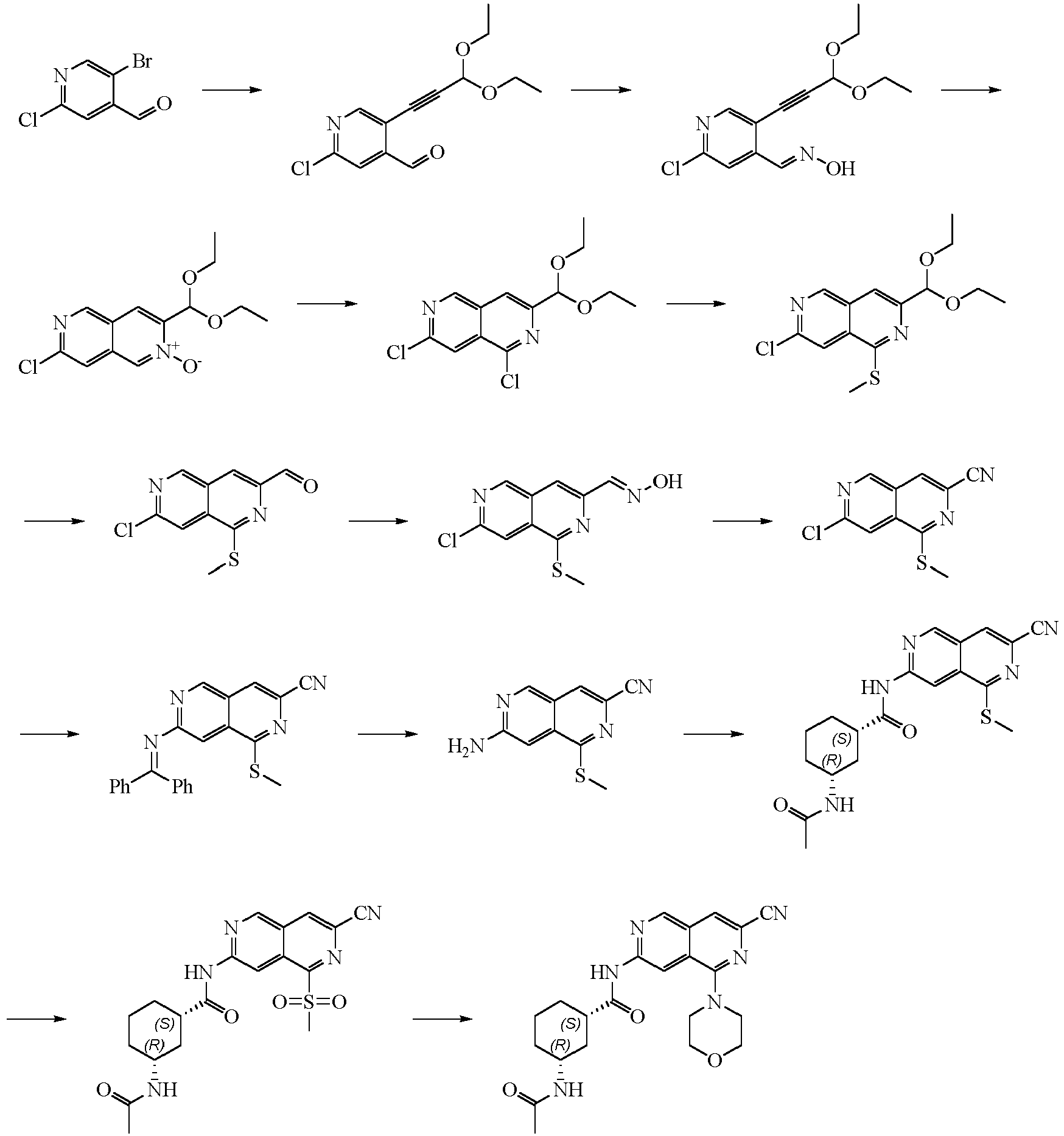
-

- 5-bromo-2-chloroisonicotinaldehyde (30 g, 136.08 mmol, 1.0 eq.), cuprous iodide (2.59 g, 13.6 mmol, 0.1 eq.), bis(triphenylphosphine)palladium(II) chloride (7.64 g, 10.89 mmol, 0.08 eq.) and DIPEA (52.76 g, 408.24 mmol, 3.0 eq.) were dispersed in THF (300 mL), and the reaction solution was cooled to 0 °C to 5 °C, reacted for 30 min, added dropwise with 3,3-diethoxyprop-1-yn (20.93 g, 163.30 mmol, 1.2 eq.), and reacted at 0 °C to 5 °C for 20 h. After the reaction was completed, as detected by TLC, the reaction solution was poured into water (300 mL) and extracted with EA (300 mL × 2). The organic phase was dried and concentrated to give a crude product, which was purified by silica gel column chromatography (PE:EA = 20:1) to give the product (23 g, yield: 63.1%).
-

- 2-chloro-5-(3,3-diethoxyprop-1-yn-1-yl)isonicotinaldehyde (23 g, 85.91 mmol, 1.0 eq.), sodium acetate (10.6 g, 128.86 mmol, 1.5 eq.) and hydroxylamine hydrochloride (8.95 g, 128.86 mmol, 1.5 eq.) were dispersed in ethanol (230 mL), and the reaction solution was reacted at room temperature for 1 h. After the reaction was completed, as detected by TLC, the reaction solution was concentrated under reduced pressure to give a crude product. The crude product was added into water (100 mL) and extracted with (100 mL × 2). The organic phase was dried and concentrated to give the product (24.29 g, yield: 100%).
-

- (E)-2-chloro-5-(3,3-diethoxyprop-1-yn-1-yl)isonicotinaldehyde oxime (24.29 g, 85.91 mmol, 1.0 eq.) was dissolved in DCM (250 mL), and the reaction solution was added with silver trifluoromethanesulfonate (2.21 g, 8.6 mmol, 0.1 eq.) and reacted at room temperature for 16 h. After the reaction was completed, as detected by TLC, the reaction solution was filtered, and the filtrate was directly used in the next step.
-

- DIPEA (33.31 g, 257.73 mmol, 3.0 eq.) was added into 1,7-dichloro-3-(diethoxymethyl)-2,6-naphthyridine (85.91 mmol, 1.0 eq.) solution obtained in the previous step, and the reaction solution was added dropwise with oxalyl chloride (16.1 g, 126.86 mmol, 1.5 eq.) at room temperature and reacted for 20 min. After the reaction was completed, as detected by TLC, the reaction solution was concentrated under reduced pressure to give a crude product, which was purified by silica gel column chromatography (PE:EA= 10:1) to give the product (12.4 g, yield: 47.9%).
-

- 1,7-dichloro-3-(diethoxymethyl)-2,6-naphthyridine (12 g, 39.84 mmol, 1.0 eq.) was dissolved in THF (150 mL), and the reaction solution was added with aqueous sodium thiomethoxide solution (mass fraction: 20%, 15.36 g, 43.82 mmol, 1.0 eq.) and reacted for 16 h. After the reaction was completed, as detected by TLC, the reaction solution was directly used in the next step without any treatment.
-

- Water (20 mL) and TFA (20 mL) were added into 7-chloro-1-(methylthio)-2,6-naphthyridine-3-carbaldehyde (12.46 g, 39.84 mmol, 1.0 eq.) obtained from the previous step at room temperature, and the mixture was reacted at room temperature for 3 h. After the reaction was completed, as detected by TLC, the reaction solution was concentrated under reduced pressure to the residual 80 mL, which was filtered, and the filter cake was dried to give the product (10 g, yield: 100 %).
-

- 7-chloro-1-(methylthio)-2,6-naphthyridine-3-carbaldehyde (10 g, 41.89 mmol, 1.0 eq.), sodium acetate (5.2 g, 64.34 mmol, 1.5 eq.) and hydroxylamine hydrochloride (4.47 g, 64.34 mmol, 1.5 eq.) were dispersed in ethanol (200 mL), and the reaction solution was reacted at room temperature for 1 h. After the reaction was completed, as detected by TLC, the reaction solution was concentrated under reduced pressure to give a crude product, slurried with water (100 mL) and filtered under vacuum, and the filter cake was dried to give the product (10.62 g, yield: 100%).
-

- (E)-7-chloro-1-(methylthio)-2,6-naphthyridine-3-carbaldehyde oxime (10.62 g, 41.89 mmol, 1.0 eq.) was dissolved in acetic anhydride (200 mL), and the reaction solution was reacted at 120 °C for 143 h. After the reaction was completed, as detected by LC-MS, the reaction solution was concentrated under reduced pressure to give a crude product, which was slurried with (PE:MTBE = 1:1, 150 mL) and filtered under vacuum, and the filter cake was dried to give the product (6.1 g, yield: 61.8%).
-

- 7-chloro-1-(methylthio)-2,6-naphthyridine-3-carbonitrile (3 g, 12.73 mmol, 1.0 eq.), diphenylmethanimine (2.77 g, 15.27 mmol, 1.2 eq.), Pd2(dba)3 (1.16 g, 1.27 mmol, 0.1 eq.), BINAP (1.58 g, 2.54 mmol, 0.2 eq.) and cesium carbonate (8.30 g, 25.46 mmol, 2.0 eq.) were dispersed in 1,4-dioxane (60 mL). The mixture was reacted at 100 °C for 19 h in nitrogen atmosphere. After the reaction was completed, as detected by TLC, the reaction solution was concentrated under reduced pressure to give a crude product, which was purified by silica gel column chromatography (PE:EA = 10:1) to give the product (3.2 g, yield: 66.1%).
-

- 7-((diphenylmethylene)amino)-1-(methylthio)-2,6-naphthyridine-3-carbonitrile (3.2 g, 8.41 mmol, 1.0 eq.) and citric acid (4.85 g, 25.23 mmol, 3.0 eq.) were dissolved in a mixed solution of THF (32 mL) and H2O (16 mL), and the reaction solution was reacted at room temperature for 40 min. After the reaction was completed, as detected by TLC-MS, the reaction solution was concentrated under reduced pressure to give a crude product, which was slurried with water (30 mL) and filtered under vacuum, the filter cake was slurried with (PE:EA = 5:1, 60 mL) and filtered under vacuum, and the obtained filter cake was dried to give the product (1.7 g, yield: 93.4%).
-

- 7-amino-1-(methylthio)-2,6-naphthyridine-3-carbonitrile (1.7 g, 7.86 mmol, 1.0 eq.) and (1S,3R)-3-acetamidocyclohexane-1-carboxylic acid (2.18 g, 11.79 mmol, 1.5 eq.) were dissolved in pyridine (20 mL), and the reaction solution was added with phosphorus oxychloride (3.62 g, 23.58 mmol, 3.0 eq.) and reacted at room temperature for 10 min. After the reaction was completed, as detected by TLC, the reaction solution was poured into ice water (50 mL) and extracted with EA (30 mL × 3). The organic phase was concentrated under reduced pressure to give a crude product, which was purified by silica gel column chromatography (MeOH:DCM = 1:50) to give the product (1.4 g, yield: 46.5%).
-

- (1S,3R)-3-acetamido-N-(7-cyano-5-(methylthio)-2,6-naphthyridin-3-yl)cyclohexane-1-carboxamide (1.4 g, 0.40 mmol, 1.0 eq.) was dissolved in DCM (30 mL), and the reaction solution was added with m-chloroperoxybenzoic acid (mass fraction: 80%, 1.65 g, 7.66 mmol, 2.1 eq.) and reacted at room temperature for 0.5 h. After the reaction was completed, as detected by TLC, the reaction solution was poured into water (20 mL), added with a proper amount of potassium carbonate, and extracted with DCM (20 mL × 3). The organic phase was dried and concentrated to give a crude product, which was slurried with MTBE (20 mL) and filtered under vacuum, and the filter cake was dried to give the product (1.36 g, yield: 90%).
-

- (1S,3R)-3-acetamido-N-(7-cyano-5-(methylsulfonyl)-2,6-naphthyridin-3-yl)cyclohexane-1-carboxamide (80 mg, 0.19 mmol, 1.0 eq.) and morpholine (50 mg, 0.57 mmol, 3.0 eq.) were dissolved in THF (2 mL), and the reaction solution was reacted at 40 °C for 19 h. After the reaction was completed, as detected by LC-MS, the reaction solution was poured into water (5 mL) and extracted with EA (5 mL × 3). The organic phase was dried and concentrated to give a crude product, which was purified by preparative thin-layer chromatography (MeOH:DCM = 1:15) to give the product (25 mg, yield: 31.2%).
1HNMR (300 MHz, DMSO-d6 ) δ(ppm): 11.03 (s, 1H), 9.22 (s, 1H), 8.72 (s, 1H), 8.18 (s, 1H), 7.82-7.79 (d, 1H), 3.85 (s, 4H), 3.59-3.58 (d, 1H), 3.46 (s, 4H), 2.73-2.69 (d, 1H), 1.95-1.92 (d, 1H), 1.79 (s, 6H), 1.40-1.25 (m, 4H).
Molecular formula: C22H26N6O3 Exact mass: 422.21 LC-MS(Pos, m/z)=423.21 [M+H]+. -

-

- (1S,3R)-3-acetamido-N-(7-cyano-5-(methylsulfonyl)-2,6-naphthyridin-3-yl)cyclohexane-1-carboxamide (200 mg, 0.48 mmol, 1.0 eq.) was dissolved in THF (3 mL), and the reaction solution was added with DIPEA (248 mg, 1.92 mmol, 4.0 eq.) and (R)-3-methylpyrrolidin-3-ol (97.3 mg, 0.48 mmol, 1.0 eq.), and reacted at room temperature for 16 h. When there were no materials left, as detected by LC-MS, the reaction solution was cooled at room temperature, added with water (20 mL) and extracted with ethyl acetate (20 mL × 3). The organic phases were combined, washed with hydrochloric acid solution (0.1 mol/L, 30 mL), dried over anhydrous sodium sulfate and filtered, and the filtrate was concentrated under reduced pressure to give a crude material, which was purified by preparative thin-layer chromatography (MeOH:DCM = 1:20) to give a crude product (150 mg). The crude product was dissolved with water (10 mL) and extracted with ethyl acetate (10 mL), the organic phase was dried over anhydrous magnesium sulfate and filtered, and the filtrate was concentrated under reduced pressure, slurried with a mixed solution (5 mL) of ethyl acetate methyl tert-butyl ether = 1:10 and filtered, and the filter cake was dried to give the product (42 mg, yield: 20%).
1HNMR (400 MHz, DMSO) δ(ppm): 10.92 (s, 1H), 9.08-9.05 (s, 2H), 7.83-7.80 (s, 1H), 7.75 (s, 1H), 4.92 (s, 1H), 4.11-4.02 (m, 1H), 3.84-3.74 (m, 2H), 3.67-3.58 (m, 2H), 2.68 (m, 1H), 1.96-1.93 (m, 3H), 1.79 (s, 6H), 1.39 (m, 3H), 1.36-1.31 (m, 3H), 1.11 (m, 1H).
Molecular formula: C23H28N6O3 Exact mass: 436.22 LC-MS (Pos, m/z) =436.52[M+H]+. -
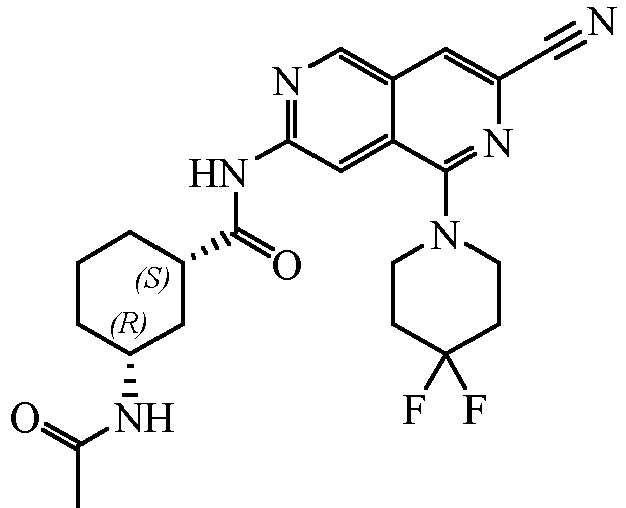
-

-

- (1,7-dichloro-2,6-naphthyridin-3-yl)methyl acetate (2.0 g, 7.38 mmol, 1.0 eq.), 4,4-difluoropiperidine (2.68 g, 22.14 mmol, 3.0 eq.) and DIPEA (2.86 g, 22.14 mmol, 3.0 eq.) were dissolved in anhydrous THF (20 mL), and the reaction solution was reacted at 100 °C for 4 h in a sealed tube. When there were no materials left, as detected by TLC, the reaction solution was concentrated under reduced pressure, added with water (30 mL) and extracted with ethyl acetate (30 mL × 2). The organic phases were combined, washed with hydrochloric acid solution (0.5 mol/L, 50 mL), dried over anhydrous sodium sulfate and filtered, and the filtrate was concentrated under reduced pressure to give the product, which was used in the next step according to a theoretical amount.
-

- (7-chloro-1-(4,4-difluoropiperidin-1-yl)-2,6-naphthyridin-3-yl)methyl acetate (7.38 mmol, 1.0 eq.) and lithium hydroxide monohydrate (928.7 mg, 22.14 mmol, 3.0 eq.) were dissolved in a mixed solution of THF (20 mL), methanol (10 mL) and water (10 mL), and the reaction solution was reacted at room temperature for 16 h. When there were no materials left, as detected by TLC, the reaction solution was concentrated under reduced pressure, added with water (20 mL) and extracted with ethyl acetate (20 mL × 3). The organic phases were combined, dried over anhydrous sodium sulfate and filtered, and the filtrate was concentrated under reduced pressure to give the product (2.2 g, yield: 95.6%).
-

- (7-chloro-1-(4,4-difluoropiperidin-1-yl)-2,6-naphthyridin-3-yl)methanol (2.2 g, 7.0 mmol, 1.0 eq.) was dissolved in DMSO (30 mL), and the reaction solution was added with IBX (2.9 g, 10.5 mmol, 1.5 eq.) and reacted at room temperature for 2 h. When there were no materials left, as detected by TLC, the reaction solution was poured into water (200 mL) and filtered, and the filter cake was retained, slurried with 2-methyltetrahydrofuran (50 mL × 2) and filtered. The organic phases were combined, and the filtrate was extracted with ethyl acetate (50 mL × 2), combined with the organic phase described above, washed with saturated aqueous sodium carbonate solution (100 mL), dried over anhydrous sodium sulfate and filtered, and the filtrate was concentrated under reduced pressure to give the product (2.1 g, yield: 96.3%).
-

- 7-chloro-1-(4,4-difluoropiperidin-1-yl)-2,6-naphthyridine-3-carbaldehyde (1 g, 3.2 mmol, 1.0 eq.) was dissolved in THF (30 mL). The reaction solution was added with aqueous ammonia (mass fraction: 28%, 30 mL), added with iodine (974.6 mg, 3.84 mmol, 1.2 eq.) and reacted at room temperature for 18 h. When there were no materials left, as detected by TLC, the reaction solution was added with water (30 mL) and extracted with ethyl acetate (50 mL × 2). The organic phases were combined, washed with aqueous sodium thiosulfate solution (mass fraction: 10%, 50 mL), dried over anhydrous sodium sulfate and filtered, and the filtrate was concentrated under reduced pressure to give a crude product, which was purified by silica gel column chromatography (EA:PE = 1:10-1:5) to give the product (970 mg, yield: 98.2%).
-

- 7-chloro-1-(4,4-difluoropiperidin-1-yl)-2,6-naphthyridine-3-carbonitrile (600 mg, 1.94 mmol, 1.0 eq.), diphenylmethanimine (422.3 mg, 2.33 mmol, 1.2 eq.), Pd2(dba)3 (177.6 mg, 0.19 mmol, 0.1 eq.), BINAP (236.6 mg, 0.38 mmol, 0.2 eq.) and cesium carbonate (1.58 g, 4.85 mmol, 2.5 eq.) were added into 1,4-dioxane (30 mL). The mixture was reacted at 120 °C for 18 h in a sealed tube in nitrogen atmosphere. When there were no materials left, as detected by TLC, the reaction solution was added with water (50 mL) and extracted with ethyl acetate (50 mL × 2). The organic phases were combined, dried over anhydrous sodium sulfate and filtered, and the filtrate was concentrated under reduced pressure to give a crude product, which was purified by silica gel column chromatography (EA:PE = 1:15-1:10) to give the product (546 mg, yield: 62%).
-

- 1-(4,4-difluoropiperidin-1-yl)-7-((diphenylmethylene)amino)-2,6-naphthyridine-3-carbonitrile (546 mg, 1.20 mmol, 1.0 eq.) was dissolved in THF (10 mL). The reaction solution was added with aqueous citric acid solution (mass fraction: 10%, 10 mL) and reacted at room temperature for 1 h. When there were no materials left, as detected by TLC, the reaction solution was added with water (30 mL), adjusted to pH of about 8 with sodium carbonate and extracted with ethyl acetate (30 mL × 3). The organic phases were combined, dried over anhydrous sodium sulfate and filtered, and the filtrate was concentrated under reduced pressure to give a crude product, which was purified by silica gel column chromatography (EA:PE = 1:5-EA = 100%) to give the product (268 mg, yield: 77.2%).
-

- 7-amino-1-(4,4-difluoropiperidin-1-yl)-2,6-naphthyridine-3-carbonitrile (268 mg, 0.93 mmol, 1.0 eq.) and (1S,3R)-3-acetamidocyclohexane-1-carboxylic acid (254.4 mg, 1.39 mmol, 1.5 eq.) were dissolved in pyridine (3 mL), and the reaction solution was added dropwise with phosphorus oxychloride (213.1 mg, 1.39 mmol, 1.5 eq.) and reacted at room temperature for 1 h. When there were no materials left, as detected by TLC, the reaction solution was added with water (30 mL) and extracted with ethyl acetate (30 mL × 3). The organic phases were combined, washed with hydrochloric acid solution (0.2 mol/L, 50 mL × 2) and aqueous sodium carbonate solution (50 mL) successively, dried over anhydrous sodium sulfate and filtered, and the filtrate was concentrated under reduced pressure to give a crude product, which was purified by preparative thin-layer chromatography (MeOH:DCM = 1:20) to give the product (175 mg, yield: 41.2%).
1HNMR (300 MHz, CD3OD) δ(ppm): 9.12 (s, 1H), 8.78 (s, 1H), 7.96 (s, 1H), 3.81-3.76 (m, 1H), 3.69-3.67 (m, 4H), 2.71-2.65 (m, 1H), 2.32-2.25 (m, 4H), 2.13-2.10 (m, 1H), 1.95 (m, 5H), 1.53-1.44 (m, 3H), 1.36-1.33 (m, 2H).
Molecular formula: C23H26F2N6O2 Exact mass: 456.21 LC-MS (Pos, m/z) =457.50 [M+H]+. -

-

- (S)-1-(tert-butoxycarbonyl)piperidine-3-carboxylic acid (110 mg, 0.48 mmol, 1.1 eq.) was dissolved in DCM (3 mL). The reaction solution was cooled to 0 °C to 5 °C in an ice water bath, added with 1-chloro-N,N,2-trimethylprop-1-en-1-amine (mass fraction: 95%, 92.5 mg, 0.66 mmol, 1.5 eq.), reacted at 0 °C to 5 °C for 1.5 h, added with a solution of 7-amino-1-(isopropylamino)-2,6-naphthyridine-3-carbonitrile (100 mg, 0.44 mmol, 1.0 eq.) and pyridine (104.3 mg, 1.32 mmol, 3.0 eq.) in THF (3 mL), and incubated at room temperature for 22 h. When there were no materials left, as detected by TLC, the reaction solution was added with water (20 mL) and extracted with ethyl acetate (20 mL × 2). The organic phases were combined, washed with water (20 mL) and concentrated under reduced pressure to give a crude product, which was purified by silica gel column chromatography (EA:PE = 1:3) to give the product (120 mg, yield: 62.2%).
-

- Tert-butyl (S)-3-((7-cyano-5-(isopropylamino)-2,6-naphthyridin-3-yl)carbamoyl)piperidine-1-carboxylate (120 mg, 0.27 mmol, 1.0 eq.) was dissolved in DCM (4 mL). The reaction solution was added dropwise with a solution of hydrogen chloride (4 mol/L) in dioxane (2 mL) and reacted at room temperature for 21 h. When there were no materials left, as detected by TLC, the reaction solution was concentrated under reduced pressure, added with water (20 mL) and back-extracted with ethyl acetate (20 mL × 2). The aqueous phase was retained, adjusted to pH of about 8 with sodium bicarbonate and extracted with ethyl acetate (20 mL × 2). The organic phases were combined, dried over anhydrous sodium sulfate and filtered, and the filtrate was concentrated under reduced pressure to give the product (68 mg, yield: 74.4%).
-

- (S)-N-(7-cyano-5-(isopropylamino)-2,6-naphthyridin-3-yl)piperidine-3-carboxamide (68 mg, 0.20 mmol, 1.0 eq.) was dissolved in DCM (3 mL). The reaction solution was added with DIPEA (77.5 mg, 0.60 mmol, 3.0 eq.) and acetic anhydride (30.7 mg, 0.30 mmol, 1.5 eq.) and reacted at room temperature for 3 h. When there were no materials left, as detected by TLC, the reaction solution was poured into water (20 mL) and extracted with ethyl acetate (20 mL × 3). The organic phases were combined, dried over anhydrous sodium sulfate and filtered. The filtrate was concentrated under reduced pressure to give a crude product, which was purified by preparative thin-layer chromatography (MeOH:DCM = 1:20) to give the product (45 mg, yield: 59.2%).
1HNMR(300 MHz, CD3OD) δ(ppm): 8.94 (s, 1H), 8.54 (s, 1H), 7.51 (s, 1H), 4.42-4.25 (m, 2H), 4.05-3.89 (m, 1H), 3.56-3.48 (m, 1H), 3.28-3.19 (m, 1H), 3.08-2.92 (m, 1H), 2.83-2.63 (m, 1H), 2.19-2.16 (m, 4H), 1.94-1.82 (m, 2H), 1.38-1.35 (m, 6H).
Molecular formula: C20H24N6O2 Exact mass: 380.20 LC-MS (Pos, m/z) =381.25 [M+H]+. -
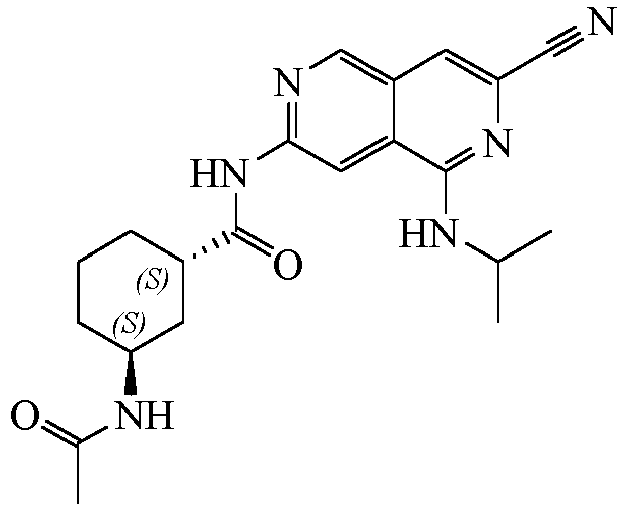
-

- (1S,3S)-3-acetamido-N-(7-cyano-5-(isopropylamino)-2,6-naphthyridin-3-yl)cyclohexane-1-carboxamide (73 mg, 0.21 mmol, 1.0 eq.) was dissolved in DCM (3 mL). The reaction solution was added with DIPEA (81.3 mg, 0.63 mmol, 3.0 eq.) and acetic anhydride (32 mg, 0.31 mmol, 1.5 eq.) and reacted at room temperature for 1 h. When there were no materials left, as detected by TLC, the reaction solution was added with water (20 mL) and extracted with ethyl acetate (20 mL × 3). The organic phases were combined, dried over anhydrous sodium sulfate and filtered. The filtrate was concentrated under reduced pressure to give a crude product, which was purified by preparative thin-layer chromatography (MeOH:DCM = 1:20) to give the product (68 mg, yield: 82.1%).
1HNMR (400 MHz, CD3OD) δ(ppm): 8.97 (s, 1H), 8.64 (s, 1H), 7.58 (s, 1H), 4.50-4.43 (m, 1H), 4.25-4.24 (m, 1H), 2.89-2.87 (m, 1H), 2.00 (m, 4H), 1.90-1.71 (m, 6H), 1.63-1.60 (m, 1H), 1.39-1.37 (m, 6H).
Molecular formula: C21H26N6O2 Exact mass: 394.21 LC-MS (Pos, m/z) =395.18 [M+H]+. -

-

- 7-amino-1-(isopropylamino)-2,6-naphthyridine-3-carbonitrile (120 mg, 0.53 mmol, 1.0 eq.) and (1S,3R)-3-((tert-butoxycarbonyl)amino)cyclohexane-1-carboxylic acid (128.9 mg, 0.53 mmol, 1.0 eq.) were dissolved in pyridine (1 mL), and the reaction solution was added with phosphorus oxychloride (162.4 mg, 1.06 mmol, 2 eq.) and reacted at room temperature for 0.5-1 h. When there were no materials left, as detected by TLC, the reaction solution was added with water (20 mL) and extracted with ethyl acetate (20 mL × 3). The organic phases were combined, washed with hydrochloric acid (1 mol/L, 30 mL × 2), dried over anhydrous sodium sulfate and filtered, and the filtrate was concentrated under reduced pressure to give a crude product, which was purified by silica gel column chromatography (EA:PE = 1:10-1:2) to give the product (115 mg, yield: 47.9%).
-

- Tert-butyl ((1R,3S)-3-((7-cyano-5-(isopropylamino)-2,6-naphthyridin-3-yl)carbamoyl)cyclohexyl)carbamate (115 mg, 0.25 mmol, 1.0 eq.) was dissolved in DCM (6 mL). The reaction solution was added dropwise with a solution of hydrogen chloride (4 mol/L) in dioxane (4 mL) and reacted at room temperature for 18 h. When there were no materials left, as detected by LC-MS, the reaction solution was filtered, and the filter cake was dissolved in water (5 mL) and lyophilized to give the product (86 mg, yield: 88.4%).
1HNMR(400 MHz, CD3OD) δ(ppm): 9.07 (s, 1H), 8.80 (s, 1H), 7.78 (s, 1H), 4.46-4.40 (m, 1H), 3.33-3.24 (m, 1H), 2.79-2.73 (m, 1H), 2.28-2.25 (m, 1H), 2.12-2.02 (m, 4H), 1.78-1.53 (m, 1H), 1.51-1.43 (m,2H), 1.41-1.40 (m, 6H).
Molecular formula: C19H25N6 Cl O Exact mass: 388.18 LC-MS (Pos, m/z) =353.17 [M+H]+. -

-

- (1S,3S)-3-((tert-butoxycarbonyl)amino)cyclohexane-1-carboxylic acid (267.6 mg, 1.10 mmol, 1.05 eq.) was dissolved in DCM (5 mL). The reaction solution was cooled to 0 °C to 5 °C in an ice water bath, added with 1-chloro-N,N,2-trimethylprop-1-en-1-amine (mass fraction: 95%, 220.8 mg, 1.57 mmol, 1.5 eq.), reacted at 0 °C to 5 °C for 1.5 h, added with a solution of 7-amino-1-(isopropylamino)-2,6-naphthyridine-3-carbonitrile (240 mg, 1.05 mmol, 1.0 eq.) and pyridine (249.1 mg, 3.15 mmol, 3.0 eq.) in THF (10 mL), and incubated at room temperature for 18 h. The supernate was poured into water (20 mL) and extracted with ethyl acetate (20 mL × 2). The organic phases were combined, washed with hydrochloric acid solution (1 mol/L, 20 mL), dried over anhydrous sodium sulfate and filtered, and the filtrate was concentrated under reduced pressure to give a crude product, which was purified by silica gel column chromatography (EA:PE = 1:5-1:2) to give the product (269 mg, yield: 56.6%).
-

- Tert-butyl ((1S,3S)-3-((7-cyano-5-(isopropylamino)-2,6-naphthyridin-3-yl)carbamoyl)cyclohexyl)carbamate (269 mg, 0.59 mmol, 1.0 eq.) was dissolved in DCM (8 mL). The reaction solution was added dropwise with a solution of hydrogen chloride (4 mol/L) in dioxane (4 mL) and reacted at room temperature for 3 h. When there were no materials left, as detected by LC-MS, the reaction solution was filtered, and a part of filter cake (68 mg) was dissolved in water (10 mL), adjusted to pH of about 8 with sodium bicarbonate and extracted with ethyl acetate (20 mL × 3). The organic phases were combined, dried over anhydrous sodium sulfate and filtered, and the filtrate was concentrated under reduced pressure to give a crude product, which was purified by preparative thin-layer chromatography (MeOH:DCM = 1:20) to give the product (31 mg, yield: 30.9%).
1HNMR(400 MHz, CD3OD) δ(ppm): 8.94 (s, 1H), 8.54 (s, 1H), 7.51 (s, 1H), 4.52-4.46 (m, 1H), 3.51-3.46 (m, 1H), 3.00-2.96 (m, 1H), 2.12-2.11 (m, 1H), 1.87-1.82 (m, 2H), 1.76-1.72 (m, 3H), 1.52-1.47 (m,2H), 1.37-1.35 (m, 6H).
Molecular formula: C19H24N6O Exact mass: 352.20 LC-MS (Pos, m/z) =353.17 [M+H]+. -

-


-

- 7-chloro-1-(isopropylamino)-2,6-naphthyridine-3-carbaldehyde (2.5 g, 10 mmol, 1.0 eq.) was dissolved in THF (50 mL). The reaction solution was added with aqueous ammonia (mass fraction: 28%, 50 mL), added with iodine (2.54 g, 10 mmol, 1.0 eq.) and reacted at room temperature for 4 h. When there were no materials left, as detected by TLC, the reaction solution was added with water (100 mL) and extracted with ethyl acetate (100 mL × 4). The organic phases were combined, washed with aqueous sodium thiosulfate solution (mass fraction: 10%, 200 mL), dried over anhydrous sodium sulfate and filtered, and the filtrate was concentrated under reduced pressure to give a crude product, which was purified by silica gel column chromatography (EA:PE = 1:10-1:5) to give the product (1.8 g, yield: 73.2%).
-

- 7-chloro-1-(isopropylamino)-2,6-naphthyridine-3-carbonitrile (100 mg, 0.41 mmol, 1.0 eq.), tert-butyl ((1S,3S)-3-aminocyclopentyl)carbamate (98.1 mg, 0.49 mmol, 1.2 eq.), Pd2(dba)3 (36.6 mg, 0.04 mmol, 0.1 eq.), BINAP (49.8 mg, 0.08 mmol, 0.2 eq.) and cesium carbonate (335.6 mg, 1.03 mmol, 2.5 eq.) were added into 1,4-dioxane (6 mL). The mixture was reacted at 120 °C for 22 h in a sealed tube in nitrogen atmosphere. When there were no materials left, as detected by TLC, the reaction solution was filtered, and the filtrate was concentrated under reduced pressure to give a crude product, which was purified by silica gel column chromatography (MeOH:DCM = 1:150-1:100) to give the product (86 mg, yield: 50.9%).
-

- Tert-butyl ((1S,3S)-3-((6-cyano-8-(isopropylamino)pyrido[3,4-d]pyrimidin-2-yl) amino)cyclopentyl)carbamate (85 mg, 0.20 mmol, 1.0 eq.) was dissolved in DCM (4 mL). The reaction solution was added dropwise with a solution of hydrogen chloride (4 mol/L) in dioxane (3 mL) and reacted at room temperature for 4 h. When there were no materials left, as detected by LC-MS, the reaction solution was filtered, and the filter cake was dissolved in water (10 mL) and back-extracted with ethyl acetate (5 mL × 2). The aqueous phase was retained, adjusted to pH of about 8 with sodium bicarbonate and extracted with ethyl acetate (10 mL × 4). The organic phases were combined, dried over anhydrous magnesium sulfate and filtered, and the filtrate was concentrated under reduced pressure to give a crude product, which was dissolved in methanol (2 mL), added with hydrogen chloride ethanol solution (10 mol/L, 0.1 mL), stirred for 5 min, added with water (10 mL) and lyophilized to give the product (42.5 mg, yield: 61.3%).
1HNMR(300 MHz, CD3OD) δ(ppm): 8.83 (s, 1H), 7.73 (s, 1H), 7.68 (s, 1H), 4.68-4.65 (m, 1H), 4.44-4.37 (m, 1H), 3.90-3.87 (m, 1H), 2.44-2.35 (m, 2H), 2.31-2.24 (m, 2H), 2.21-2.16 (m, 2H), 1.85-1.83 (m,6H).
Molecular formula: C17H23N6Cl Exact mass: 346.17 LC-MS (Pos, m/z) =311.17 [M+H]+. -

-

- 7-chloro-1-(isopropylamino)-2,6-naphthyridine-3-carbonitrile (130 mg, 0.53 mmol, 1.0 eq.), tert-butyl ((1R,3S)-3-aminocyclopentyl)carbamate (128.2 mg, 0.64 mmol, 1.2 eq.), Pd2(dba)3 (73.2 mg, 0.08 mmol, 0.15 eq.), BINAP (99.6 mg, 0.16 mmol, 0.3 eq.) and cesium carbonate (433.3 mg, 1.33 mmol, 2.5 eq.) were added into 1,4-dioxane (10 mL). The mixture was reacted at 120 °C for 17 h in a sealed tube in nitrogen atmosphere. When there were no materials left, as detected by TLC, the obtained crude material was purified by silica gel column chromatography (MeOH:DCM = 1:100) to give a crude product (145 mg), and the crude product was purified by preparative thin-layer chromatography (MeOH:DCM = 1:20) to give the product (86 mg, yield: 39.5%).
-

- Tert-butyl ((1R,3S)-3-((7-cyano-5-(isopropylamino)-2,6-naphthyridin-3-yl)amino)cyclopentyl)carbamate (86 mg, 0.21 mmol, 1.0 eq.) was dissolved in DCM (4 mL). The reaction solution was added dropwise with a solution of hydrogen chloride (4 mol/L) in dioxane (4 mL) and reacted at room temperature for 2 h. When there were no materials left, as detected by LC-MS, the reaction solution was added with water (10 mL) and back-extracted with ethyl acetate (10 mL × 3). The aqueous phase was retained, adjusted to pH of about 8 with sodium bicarbonate and extracted with dichloromethane (10 mL × 3). The organic phases were combined, dried over anhydrous sodium sulfate and filtered, and the filtrate was concentrated under reduced pressure to give a crude product, which was purified by preparative thin-layer chromatography (MeOH:DCM = 1:20) to give the product (27 mg, yield: 41.4%).
1HNMR (400 MHz, CD3OD) δ(ppm): 8.67 (s, 1H), 7.37 (s, 1H), 6.93 (s, 1H), 4.48-4.45 (m, 1H), 4.33-4.23 (m, 1H), 3.58-3.54 (m, 1H), 2.67-2.58 (m, 1H), 2.23-2.06 (m, 1H), 1.81-1.73 (m, 2H), 1.53-1.45 (m, 2H), 1.35-1.33 (m, 6H).
Molecular formula: C17H22N6 Exact mass: 310.19 LC-MS (Pos, m/z) =311.27 [M+H]+. -
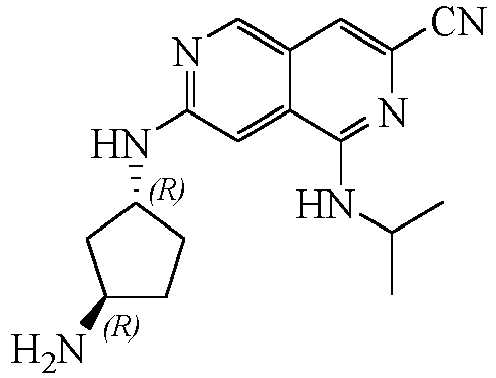
-
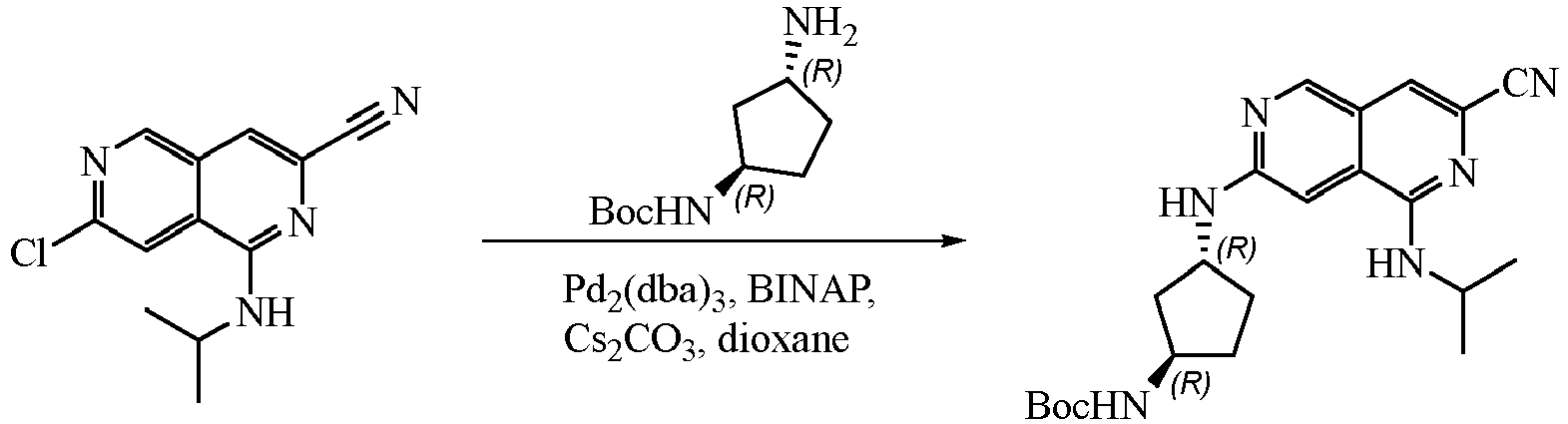
- 7-chloro-1-(isopropylamino)-2,6-naphthyridine-3-carbonitrile (150 mg, 0.61 mmol, 1.0 eq.), tert-butyl ((1R,3R)-3-aminocyclopentyl)carbamate (146.2 mg, 0.73 mmol, 1.2 eq.), Pd2(dba)3 (82.4 mg, 0.09 mmol, 0.15 eq.), BINAP (112 mg, 0.18 mmol, 0.3 eq.) and cesium carbonate (498.5 mg, 1.53 mmol, 2.5 eq.) were added into 1,4-dioxane (10 mL). The mixture was reacted at 120 °C for 17 h in a sealed tube in nitrogen atmosphere. When there were no materials left, as detected by TLC, the obtained crude material was purified by silica gel column chromatography (MeOH:DCM = 1:100) to give a crude product (215 mg), and the crude product was purified by preparative thin-layer chromatography (MeOH:DCM = 1:20) to give the product (88 mg, yield: 35.1%).
-
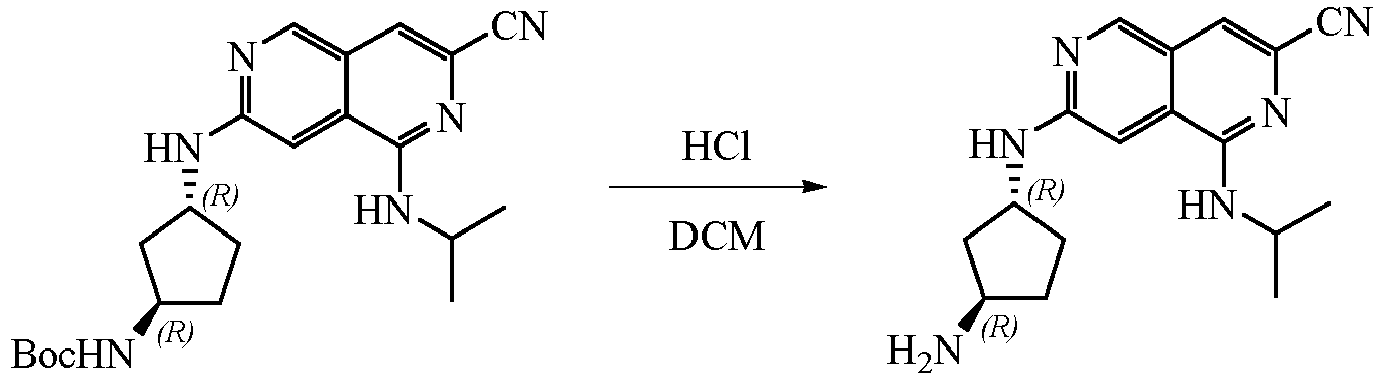
- Tert-butyl ((1R,3R)-3-((7-cyano-5-(isopropylamino)-2,6-naphthyridin-3-yl)amino)cyclopentyl)carbamate (88 mg, 0.21 mmol, 1.0 eq.) was dissolved in DCM (3 mL). The reaction solution was added dropwise with hydrogen chloride ethanol solution (10 mol/L, 3 mL) and reacted at room temperature for 2 h. When there were no materials left, as detected by LC-MS, the reaction solution was added with water (10 mL) and back-extracted with ethyl acetate (10 mL × 3). The aqueous phase was retained, adjusted to pH of about 8 with sodium bicarbonate and extracted with dichloromethane (10 mL × 3). The organic phases were combined, dried over anhydrous sodium sulfate and filtered, and the filtrate was concentrated under reduced pressure to give a crude product, which was purified by preparative thin-layer chromatography (MeOH:DCM = 1: 10) to give the product (34 mg, yield: 52.1%).
1HNMR (400 MHz, CD3OD) δ(ppm): 8.68 (s, 1H), 7.37 (s, 1H), 6.90 (s, 1H), 4.47-4.42 (m, 2H), 3.77-3.72 (m, 1H), 2.39-2.28 (m, 2H), 2.10-2.06 (m, 2H), 1.74-1.63 (m, 2H), 1.35-1.33 (m, 6H).
Molecular formula: C17H22N6 Exact mass: 310.19 LC-MS (Pos, m/z) =311.37 [M+H]+. -

-

- 7-chloro-1-(isopropylamino)-2,6-naphthyridine-3-carbonitrile (150 mg, 0.61 mmol, 1.0 eq.), tert-butyl (S)-3-aminopyrrolidine-1-carboxylate (136 mg, 0.73 mmol, 1.2 eq.), Pd2(dba)3 (82.4 mg, 0.09 mmol, 0.15 eq.), BINAP (112 mg, 0.18 mmol, 0.3 eq.) and cesium carbonate (498.5 mg, 1.53 mmol, 2.5 eq.) were added into 1,4-dioxane (10 mL). The mixture was reacted at 120 °C for 17 h in a sealed tube in nitrogen atmosphere. When there were no materials left, as detected by TLC, the obtained crude material was purified by silica gel column chromatography (MeOH:DCM = 1:100) to give a crude product (146 mg), and the crude product was purified by preparative thin-layer chromatography (MeOH:DCM = 1:30) to give the product (83 mg, yield: 34.3%).
-

- Tert-butyl (S)-3-((7-cyano-5-(isopropylamino)-2,6-naphthyridin-3-yl)amino)pyrrolidine-1-carboxylate (83 mg, 0.21 mmol, 1.0 eq.) was dissolved in DCM (3 mL). The reaction solution was added dropwise with hydrogen chloride ethanol solution (10 mol/L, 3 mL) and reacted at room temperature for 1 h. When there were no materials left, as detected by LC-MS, the reaction solution was added with water (10 mL) and back-extracted with ethyl acetate (10 mL × 2). The aqueous phase was retained, adjusted to pH of about 8-9 with sodium bicarbonate and extracted with dichloromethane (10 mL × 3). The organic phases were combined, dried over anhydrous sodium sulfate and filtered, and the filtrate was concentrated under reduced pressure to give a crude product, which was purified by preparative thin-layer chromatography (MeOH:DCM = 1:10) to give the product (18 mg, yield: 28.9%).
1HNMR (400 MHz, DMSO+D2O) δ(ppm): 8.67 (s, 1H), 7.44 (s, 1H), 6.86 (s, 1H), 4.31-4.21 (m, 2H), 2.20-2.14 (m, 1H), 1.93-1.86 (m, 2H), 1.69-1.60 (m, 1H), 1.51-1.35 (m, 2H), 1.22-1.20 (m, 6H).
Molecular formula: C16H20N6 Exact mass: 296.17 LC-MS (Pos, m/z) =297.22 [M+H]+. -

-
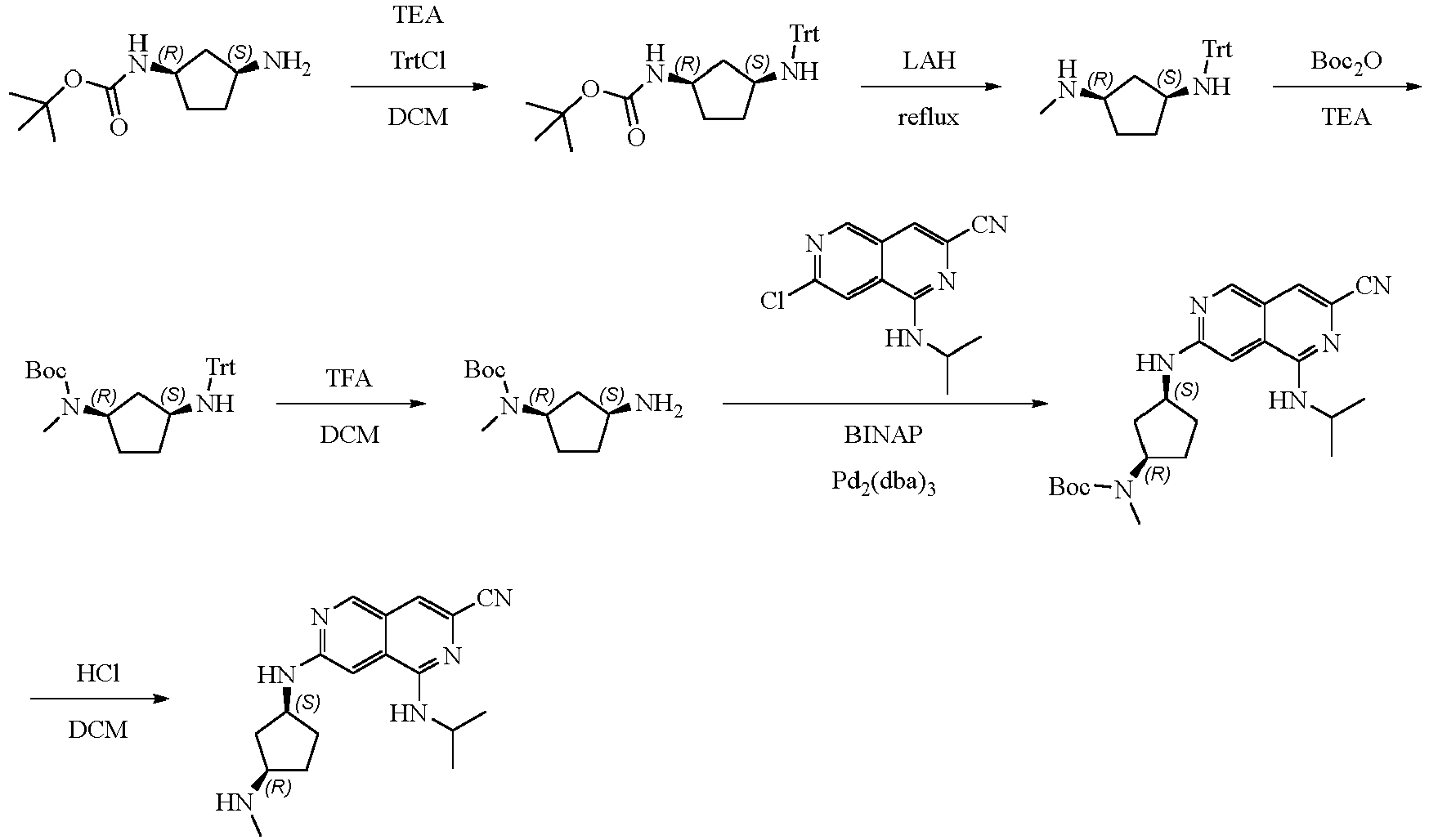
-

- Tert-butyl ((1R,3S)-3-aminocyclopentyl)carbamate (550 mg, 2.75 mmol, 1.0 eq.), triphenylchloromethane (1.15 g, 4.13 mmol, 1.5 eq.) and triethylamine (556.5 mg, 5.5 mmol, 2.0 eq.) were dissolved in DCM (20 mL), and the reaction solution was reacted at room temperature for 3 h. When there were no materials left, as detected by TLC, the reaction solution was added with water (30 mL) and extracted with ethyl acetate (30 mL × 3). The organic phases were combined, dried over anhydrous sodium sulfate and filtered. The filtrate was concentrated under reduced pressure to give a crude product, which was purified by silica gel column chromatography (EA:PE = 1:20-1:15) to give the product (1.16 g, yield: 96.6%).
-

- Tert-butyl ((1R,3S)-3-(tritylamino)cyclopentyl)carbamate (1.1 g, 2.48 mmol, 1.0 eq.) was dissolved in anhydrous THF (25 mL), and the reaction solution was added with lithium aluminum hydride (376.5 mg, 9.92 mmol, 4.0 eq.) in batches and heated to reflux for 1 h. When there were no materials left, as detected by TLC, the reaction solution was added with water (376.5 mg) and stirred for 2 min, added with sodium hydroxide solution (mass fraction: 10%, 376.5 mg) and stirred for 2 min, then added with water (1.1 g) and stirred for 5 min, added with ethyl acetate (50 mL), dried over anhydrous magnesium sulfate and filtered, and the filtrate was concentrated under reduced pressure to give the product (884.1 mg, yield: 100%).
-

- (1R,3S)-N 1-methyl-N 3-tritylcyclopentane-1,3-diamine (880 mg, 2.47 mmol, 1.0 eq.) was dissolved in DCM (10 mL), and the reaction solution was added with triethylamine (499.9 mg, 4.94 mmol, 2.0 eq.) and di-tert-butyl dicarbonate (646 mg, 2.96 mmol, 1.2 eq.), and reacted at room temperature for 15 h. When there were no materials left, as detected by TLC, the reaction solution was added with water (20 mL) and extracted with ethyl acetate (30 mL × 2). The organic phases were combined, washed with aqueous citric acid solution (mass fraction: 5%, 30 mL) and water (30 mL) successively, dried over anhydrous sodium sulfate and filtered, and the filtrate was concentrated under reduced pressure to give the product (1.1 g, yield: 100 %).
-

- Tert-butyl methyl((1R,3S)-3-(tritylamino)cyclopentyl)carbamate (1.1 g, 2.47 mmol, 1.0 eq.) was dissolved in 1% (v/v) TFA/DCM (50 mL), and the reaction solution was reacted at room temperature for 18 h. When there were new spots generated, as detected by TLC, the reaction solution was added with water (20 mL) and adjusted to pH of about 9 with sodium hydroxide. The liquid separation was performed, the organic phase was retained, and the aqueous phase was extracted with DCM (30 mL). The organic phase was combined, dried over anhydrous sodium sulfate and filtered, and the filtrate was concentrated under reduced pressure to give a crude product, which was purified by silica gel column chromatography (MeOH:DCM = 1:20) to give the product (234 mg, yield: 44.2 %).
-

- 7-chloro-1-(isopropylamino)-2,6-naphthyridine-3-carbonitrile (200 mg, 0.81 mmol, 1.0 eq.), tert-butyl ((1R,3S)-3-aminocyclopentyl)(methyl)carbamate (225 mg, 1.05 mmol, 1.2 eq.), Pd2(dba)3 (109.9 mg, 0.12 mmol, 0.15 eq.), BINAP (149.4 mg, 0.24 mmol, 0.3 eq.) and cesium carbonate (658.1 mg, 2.02 mmol, 2.5 eq.) were added into 1,4-dioxane (20 mL). The mixture was reacted at 100 °C for 15 h in a sealed tube in nitrogen atmosphere. When there were no materials left, as detected by TLC, the reaction solution was added with water (30 mL) and extracted with ethyl acetate (30 mL × 2). The organic phases were combined, washed with hydrochloric acid solution (0.2 mol/L, 30 mL), dried over anhydrous sodium sulfate and filtered, and the filtrate was concentrated under reduced pressure to give a crude product, which was purified by preparative thin-layer chromatography (EA:PE = 1:2) to give the product (163 mg, yield: 47.4%).
-
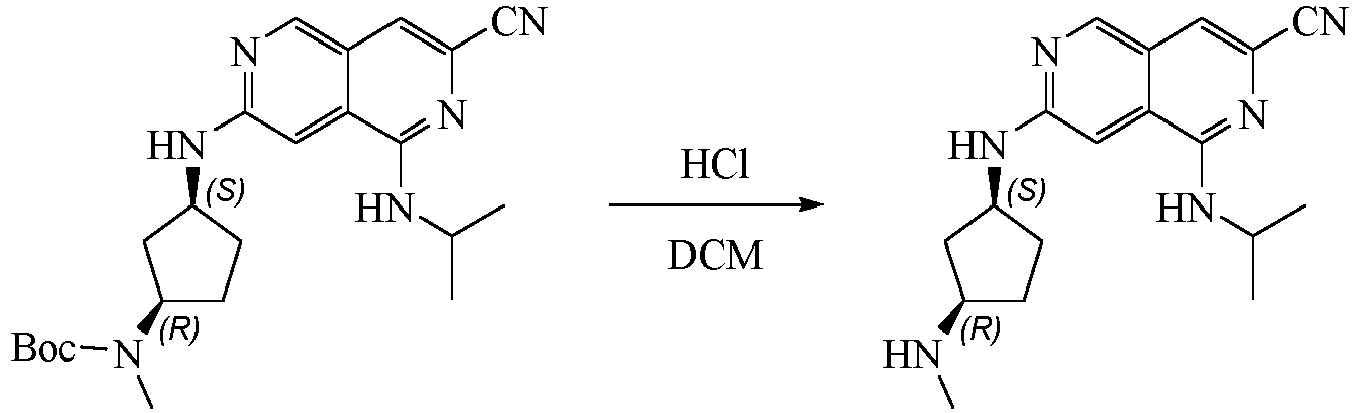
- Tert-butyl ((1R,3S)-3-((7-cyano-5-(isopropylamino)-2,6-naphthyridin-3-yl)amino)cyclopentyl)(methyl)carbamate (163 mg, 0.38 mmol, 1.0 eq.) was dissolved in DCM (3 mL). The reaction solution was added dropwise with hydrogen chloride ethanol solution (10 mol/L, 3 mL) and reacted at room temperature for 1 h. When there were no materials left, as detected by TLC, the reaction solution was added with water (20 mL) and back-extracted with DCM (20 mL × 2). The aqueous phase was retained, adjusted to pH of about 8 with sodium bicarbonate and extracted with DCM (30 mL × 2). The organic phases were combined, dried over anhydrous sodium sulfate and filtered, and the filtrate was concentrated under reduced pressure to give a crude product, which was purified by preparative thin-layer chromatography (MeOH:DCM = 1: 10) to give the product (90 mg, yield: 72.9%).
1HNMR (400 MHz, CD3OD) δ(ppm): 8.86 (s, 1H), 7.36 (s, 1H), 6.94 (s, 1H), 4.49-4.43 (m, 1H), 4.29-4.25 (m, 1H), 3.46-3.43 (m, 1H), 2.70-2.63 (m, 1H), 2.61 (s, 3H), 2.14-2.12 (m, 2H), 1.86-1.79 (m, 2H), 1.61-1.53 (m, 1H), 1.35-1.33 (m, 6H).
Molecular formula: C18H24N6 Exact mass: 324.21 LC-MS (Pos, m/z) =325.35 [M+H]+. -

-

- 7-chloro-1-(isopropylamino)-2,6-naphthyridine-3-carbonitrile (150 mg, 0.61 mmol, 1.0 eq.), (1S,3S)-3-aminocyclopentan-1-ol hydrochloride (100.5 mg, 0.73 mmol, 1.2 eq.), Pd2(dba)3 (82.4 mg, 0.09 mmol, 0.15 eq.), BINAP (112 mg, 0.18 mmol, 0.3 eq.) and cesium carbonate (697.2 mg, 2.14 mmol, 3.5 eq.) were added into 1,4-dioxane (10 mL). The mixture was reacted at 120 °C for 18 h in a sealed tube in nitrogen atmosphere. When there were no materials left, as detected by TLC, the obtained crude material was purified by silica gel column chromatography (MeOH:DCM = 1:100) to give a crude product (150 mg), and the crude product was purified 2 times by preparative thin-layer chromatography (MeOH:DCM = 1:20) to give the product (34 mg, yield: 17.9%).
1HNMR (400 MHz, DMSO) δ(ppm): 8.70 (s, 1H), 7.47 (s, 1H), 7.40-7.37 (d, 1H), 7.09-7.07 (d, 1H), 6.93 (s, 1H), 4.61-4.60 (m, 1H), 4.39-4.25 (m, 3H), 2.27-2.18 (m, 1H), 2.17-1.88 (m, 2H), 1.75-1.67 (m, 1H), 1.54-1.38 (m, 2H), 1.27-1.25 (m, 6H).
Molecular formula: C17H21N5O Exact mass: 311.17 LC-MS (Pos, m/z) =312.27 [M+H]+. -

-

- 7-chloro-1-(methylsulfonyl)-2,6-naphthyridine-3-carbonitrile (400 mg, 1.49 mmol, 1.0 eq.) and tert-butylamine (545 mg, 7.45 mmol, 5.0 eq.) were dissolved in THF (10 mL), and the reaction solution was reacted at 80 °C for 3 h. After the reaction was completed, as detected by TLC, the reaction solution was poured into water (10 mL) and extracted with EA(10 mL × 3). The organic phase was dried and concentrated to give the product (360 mg, yield: 92.7%).
-

- 1-(tert-butylamino)-7-chloro-2,6-naphthyridine-3-carbonitrile (180 mg, 0.69 mmol, 1.0 eq.), tert-butyl ((1S,3S)-3-aminocyclopentyl)carbamate (166 mg, 0.83 mmol, 1.2 eq.), Pd2(dba)3 (63 mg, 0.069 mmol, 0.1 eq.), BINAP (86 mg, 0.138 mmol, 0.2 eq.) and cesium carbonate (450 mg, 1.38 mmol, 2.0 eq.) were dispersed in 1,4-dioxane (5 mL), and the reaction solution was reacted at 100 °C for 22 h in nitrogen atmosphere. After the reaction was completed, as detected by TLC, the reaction solution was concentrated under reduced pressure to give a crude product, which was purified by silica gel column chromatography (PE:EA = 2:1) to give the product (70 mg, yield: 23.9%).
-

- Tert-butyl ((1S,3S)-3-((5-(tert-butylamino)-7-cyano-2,6-naphthyridin-3-yl)amino)cyclopentyl)carbamate (70 mg, 0.16 mmol, 1.0 eq.) was dissolved in EA (2 mL), and the reaction solution was added dropwise a solution of hydrogen chloride in 1,4-dioxane (4 mol/L, 1 mL) and reacted at room temperature for 20 h. After the reaction was substantially completed, as detected by LC-MS, the reaction solution was poured into water (5 mL), and the liquid separation was performed. The aqueous phase was retained, adjusted to pH of 9 with sodium carbonate, and extracted with (MeOH:DCM = 1:10, 10 mL × 4). The organic phase was dried and concentrated to give a crude product, which was purified by preparative thin-layer chromatography (MeOH:DCM = 1:5) to give the product (40 mg, yield: 76.9%).
1HNMR (400 MHz, MeOD) δ(ppm): 8.69 (s, 1H), 7.39 (s, 1H), 6.86 (s, 1H), 4.56-4.53 (t, 1H), 3.83-3.80 (t, 1H), 2.37-2.34 (t, 2H), 2.16-2.12 (m, 2H), 1.76-1.73 (m, 2H), 1.58 (s, 9H).
Molecular formula: C18H24N6 Exact mass: 324.21 LC-MS(Pos, m/z)=325.36[M+H]+ . -

-

- 1-(tert-butylamino)-7-chloro-2,6-naphthyridine-3-carbonitrile (130 mg, 0.50 mmol, 1.0 eq.), (1S,3S)-3-aminocyclopentan-1-ol hydrochloride (103.2 mg, 0.75 mmol, 1.5 eq.), Pd2(dba)3 (68.7 mg, 0.075 mmol, 0.15 eq.), BINAP (93.4 mg, 0.15 mmol, 0.3 eq.) and cesium carbonate (570.2 mg, 1.75 mmol, 3.5 eq.) were added into 1,4-dioxane (15 mL). The mixture was reacted at 120 °C for 17 h in a sealed tube in nitrogen atmosphere. When there were no materials left, as detected by TLC, the reaction solution was added with water (20 mL) and extracted with ethyl acetate (30 mL × 3). The organic phases were combined, washed with hydrochloric acid solution (0.2 mol/L, 50 mL), dried over anhydrous sodium sulfate and filtered to give a crude material, the obtained crude material was purified by silica gel column chromatography (EA:PE = 1:5-EA = 100%) to give a crude product (87 mg), and the crude product was purified by preparative thin-layer chromatography (MeOH:DCM = 1:20) to give the product (52 mg, yield: 31.9%).
1HNMR (400 MHz, MeOD) δ(ppm): 8.65 (s, 1H), 7.37 (s, 1H), 6.83 (s, 1H), 4.46-4.40 (m, 2H), 2.39-2.30 (m, 1H), 2.18-2.08 (m, 2H), 1.82-1.75 (m, 1H), 1.71-1.67 (m, 1H), 1.58 (m, 9H), 1.32-1.31 (m, 1H).
Molecular formula: C18H23N5O Exact mass: 325.19 LC-MS (Pos, m/z)=326.34 [M+H]+. -

-

- 7-chloro-1-(isopropylamino)-2,6-naphthyridine-3-carbonitrile (100 mg, 0.40 mmol, 1.0 eq.), (1R,3S)-3-aminocyclopentan-1-ol hydrochloride (66 mg, 0.48 mmol, 1.2 eq.), Pd2(dba)3 (55 mg, 0.06 mmol, 0.15 eq.), BINAP (74.7 mg, 0.12 mmol, 0.3 eq.) and cesium carbonate (456.1 mg, 1.4 mmol, 3.5 eq.) were added into 1,4-dioxane (10 mL). The mixture was reacted at 120 °C for 17 h in a sealed tube in nitrogen atmosphere. When there were no materials left, as detected by TLC, the reaction solution was added with water (20 mL) and extracted with DCM (20 mL × 3). The organic phases were combined, washed with hydrochloric acid solution (0.1 mol/L, 30 mL), dried over anhydrous sodium sulfate and filtered, and the filtrate was concentrated under reduced pressure to give a crude product, which was purified by preparative thin-layer chromatography (MeOH:DCM = 1:20) to give the product (13 mg, yield: 10.4%).
1HNMR (400 MHz, MeOD) δ(ppm): 8.64 (s, 1H), 7.36 (s, 1H), 6.94 (s, 1H), 4.48-4.44 (m, 1H), 4.38-4.36 (m, 1H), 4.29-4.24 (m, 1H), 2.24-2.35 (m, 1H), 2.20-2.21 (m, 1H), 1.94-1.89 (m, 1H), 1.85-1.78 (m, 2H), 1.66-1.60 (m, 1H), 1.35-1.33 (m, 6H).
Molecular formula: C17H21N5O Exact mass: 311.17 LC-MS (Pos, m/z) =312.27 [M+H]+. -

-

- 7-chloro-1-(isopropylamino)-2,6-naphthyridine-3-carbonitrile (150 mg, 0.61 mmol, 1.0 eq.), tert-butyl (2S,4S) -4-amino-2-(hydroxymethyl) pyrrolidine-1-carboxylate hydrochloride (308.3 mg, 1.22 mmol, 1.2 eq.), Pd2(dba)3 (82.4 mg, 0.09 mmol, 0.15 eq.), BINAP (112 mg, 0.18 mmol, 0.3 eq.) and cesium carbonate (697.2 mg, 2.14 mmol, 3.5 eq.) were added into 1,4-dioxane (10 mL). The mixture was reacted at 120 °C for 15 h in a sealed tube in nitrogen atmosphere. When there were no materials left, as detected by TLC, the reaction solution was added with water (20 mL) and extracted with ethyl acetate (20 mL × 3). The organic phases were combined, washed with hydrochloric acid solution (0.1 mol/L, 30 mL), dried over anhydrous sodium sulfate and filtered, and the filtrate was concentrated under reduced pressure to give a crude product, which was purified by preparative thin-layer chromatography (MeOH:DCM = 1:20) to give the product (151 mg, yield: 58%).
-

- Tert-butyl (2S,4S)-4-((7-cyano-5-(isopropylamino)-2,6-naphthyridin-3-yl)amino)-2-(hydroxymethyl)pyrrolidine-1-carboxylate (150 mg, 0.35 mmol, 1.0 eq.) was dissolved in DCM (3 mL). The reaction solution was added dropwise with hydrogen chloride ethanol solution (10 mol/L, 3 mL) and reacted at room temperature for 2 h. When there were no materials left, as detected by TLC, the reaction solution was added with water (20 mL) and back-extracted with DCM (20 mL × 2). The aqueous phase was retained, adjusted to pH of about 8 with sodium carbonate and extracted with ethyl acetate (20 mL × 3). The organic phases were combined, dried over anhydrous sodium sulfate and filtered, and the filtrate was concentrated under reduced pressure to give a crude product, which was purified by preparative thin-layer chromatography (MeOH:DCM = 1:10) to give the product (33 mg, yield: 28.9%).
1HNMR (400 MHz, CD3OD) δ(ppm): 8.75 (s, 1H), 7.40 (s, 1H), 7.04 (s, 1H), 4.71-4.68 (m, 1H), 4.47-4.44 (m, 1H), 3.96-3.87 (m, 2H), 3.82-3.77 (m, 1H), 3.71-3.66 (m, 1H), 2.68-2.61 (m, 1H), 2.02-1.94 (m, 1H), 1.51-1.45 (m, 1H), 1.35-1.33 (m, 6H).
Molecular formula: C17H22N6O Exact mass: 326.19 LC-MS (Pos, m/z) =327.29[M+H]+. -

-

- 7-chloro-1-(isopropylamino)-2,6-naphthyridine-3-carbonitrile (150 mg, 0.61 mmol, 1.0 eq.), tert-butyl (S)-3-aminopiperidine-1-carboxylate (146.2 mg, 0.73 mmol, 1.2 eq.), Pd2(dba)3 (82.4 mg, 0.09 mmol, 0.15 eq.), BINAP (112 mg, 0.18 mmol, 0.3 eq.) and cesium carbonate (498.5 mg, 1.53 mmol, 2.5 eq.) were added into 1,4-dioxane (10 mL). The mixture was reacted at 120 °C for 18 h in a sealed tube in nitrogen atmosphere. When there were no materials left, as detected by TLC, the reaction solution was added with water (20 mL) and extracted with ethyl acetate (20 mL × 3). The organic phases were combined, washed with hydrochloric acid solution (0.2 mol/L, 20 mL), dried over anhydrous sodium sulfate and filtered, and the filtrate was concentrated under reduced pressure to give a crude product, which was purified by silica gel column chromatography (EA:PE = 1:10-1:2) to give the product (128 mg, yield: 51.1%).
-

- Tert-butyl (S)-3-((7-cyano-5-(isopropylamino)-2,6-naphthyridin-3-yl)amino)piperidine-1-carboxylate (128 mg, 0.31 mmol, 1.0 eq.) was dissolved in DCM (3 mL). The reaction solution was added dropwise with hydrogen chloride ethanol solution (10 mol/L, 3 mL) and reacted at room temperature for 3 h. When there were no materials left, as detected by TLC, the reaction solution was added with water (20 mL), adjusted to pH of about 8 with sodium carbonate and extracted with DCM (20 mL × 3). The organic phases were combined, dried over anhydrous sodium sulfate and filtered, and the filtrate was concentrated under reduced pressure to give a crude product, which was purified by preparative thin-layer chromatography (MeOH:DCM = 1:20) to give the product (61 mg, yield: 63.4%).
1HNMR (400 MHz, CD3OD) δ(ppm): 8.68 (s, 1H), 7.36 (s, 1H), 6.93 (s, 1H), 4.47-4.42 (m, 1H), 3.97-3.92 (m, 1H), 3.08-3.04 (m, 1H), 2.76-2.70 (m, 1H), 2.65-2.59 (m, 1H), 2.15-2.11 (m, 1H), 1.93-1.88 (m, 1H), 1.76-1.70 (m, 1H), 1.64-1.58 (m, 1H), 1.35-1.33 (m, 7H).
Molecular formula: C17H22N6 Exact mass: 310.19 LC-MS (Pos, m/z) =311.17 [M+H]+. -

-

- 7-chloro-1-(isopropylamino)-2,6-naphthyridine-3-carbonitrile (150 mg, 0.61 mmol, 1.0 eq.), tert-butyl (R)-3-aminopiperidine-1-carboxylate (184.3 mg, 0.92 mmol, 1.5 eq.), Pd2(dba)3 (82.4 mg, 0.09 mmol, 0.15 eq.), BINAP (112 mg, 0.18 mmol, 0.3 eq.) and cesium carbonate (498.5 mg, 1.53 mmol, 2.5 eq.) were added into 1,4-dioxane (15 mL). The mixture was reacted at 120 °C for 16 h in a sealed tube in nitrogen atmosphere. When there were no materials left, as detected by TLC, the reaction solution was added with water (20 mL) and extracted with ethyl acetate (20 mL × 3). The organic phases were combined, washed with hydrochloric acid solution (0.2 mol/L, 30 mL), dried over anhydrous sodium sulfate and filtered, and the filtrate was concentrated under reduced pressure to give a crude product, which was purified by silica gel column chromatography (EA:PE = 1:5-1:2) to give the product (183 mg, yield: 73.1%).
-

- Tert-butyl (R)-3-((7-cyano-5-(isopropylamino)-2,6-naphthyridin-3-yl)amino)piperidine-1-carboxylate (180 mg, 0.44 mmol, 1.0 eq.) was dissolved in DCM (3 mL). The reaction solution was added dropwise with hydrogen chloride ethanol solution (10 mol/L, 3 mL) and reacted at room temperature for 2 h. When there were no materials left, as detected by TLC, the reaction solution was added with water (30 mL) and back-extracted with ethyl acetate (30 mL × 2). The aqueous phase was retained, adjusted to pH of about 8 with sodium carbonate and extracted with DCM (30 mL × 2). The organic phases were combined, dried over anhydrous sodium sulfate and filtered, and the filtrate was concentrated under reduced pressure to give a crude product, which was purified by preparative thin-layer chromatography (MeOH:DCM = 1:10) to give the product (100 mg, yield: 73.2%).
1HNMR (400 MHz, CD3OD) δ(ppm): 8.71 (s, 1H), 7.38 (s, 1H), 6.95 (s, 1H), 4.47-4.44 (m, 1H), 4.14-4.12 (m, 1H), 3.49-3.46 (m, 1H), 3.23-3.20 (m, 1H), 2.93-2.86 (m, 1H), 2.83-2.77 (m, 1H), 2.19-2.14 (m, 1H), 2.04-1.99 (m, 1H), 1.86-1.80 (m, 1H), 1.69-1.67 (m, 1H), 1.35-1.33 (m, 6H).
Molecular formula: C17H22N6 Exact mass: 310.19 LC-MS (Pos, m/z) =311.31[M+H]+. -

-

- 7-chloro-1-(isopropylamino)-2,6-naphthyridine-3-carbonitrile (150 mg, 0.61 mmol, 1.0 eq.), tert-butyl ((1R,3S)-3-aminocyclohexyl)carbamate (169.3 mg, 0.79 mmol, 1.3 eq.), Pd2(dba)3 (82.4 mg, 0.09 mmol, 0.15 eq.), BINAP (112 mg, 0.18 mmol, 0.3 eq.) and cesium carbonate (498.5 mg, 1.53 mmol, 2.5 eq.) were added into 1,4-dioxane (15 mL). The mixture was reacted at 120 °C for 17 h in a sealed tube in nitrogen atmosphere. When there were no materials left, as detected by TLC, the reaction solution was added with water (20 mL) and extracted with ethyl acetate (20 mL × 3). The organic phases were combined, washed with hydrochloric acid solution (0.1 mol/L, 30 mL), dried over anhydrous sodium sulfate and filtered, and the filtrate was concentrated under reduced pressure to give a crude product, which was purified by preparative thin-layer chromatography (MeOH:DCM = 1:20) to give the product (150 mg, yield: 57.9%).
-

- Tert-butyl ((1R,3S)-3-((7-cyano-5-(isopropylamino)-2,6-naphthyridin-3-yl)amino)cyclohexyl)carbamate (150 mg, 0.35 mmol, 1.0 eq.) was dissolved in DCM (3 mL). The reaction solution was added dropwise with hydrogen chloride ethanol solution (10 mol/L, 3 mL) and reacted at room temperature for 0.5 h. When there were no materials left, as detected by TLC, the reaction solution was concentrated under reduced pressure, added with water (20 mL) and back-extracted with DCM (20 mL × 2). The aqueous phase was retained, adjusted to pH of about 8 with sodium carbonate and extracted with ethyl acetate (20 mL × 3). The organic phases were combined, dried over anhydrous sodium sulfate and filtered, and the filtrate was concentrated under reduced pressure to give a crude product, which was purified by preparative thin-layer chromatography (MeOH:DCM = 1:10) to give the product (30 mg, yield: 26.4%).
1HNMR (400 MHz, CD3OD) δ(ppm): 8.68 (s, 1H), 7.37 (s, 1H), 6.93 (s, 1H), 4.49-4.93 (m, 1H), 3.96-3.90 (m, 1H), 3.26-3.23 (m, 1H), 2.47-2.44 (m, 1H), 2.14-2.07 (m, 2H), 2.03-1.98 (m, 1H), 1.61-1.54 (m, 1H), 1.43-1.39 (m, 2H), 1.35-1.33 (m, 6H), 1.31 (m, 1H).
Molecular formula: C18 H24N6 Exact mass: 324.21 LC-MS (Pos, m/z) =325.45 [M+H]+. -
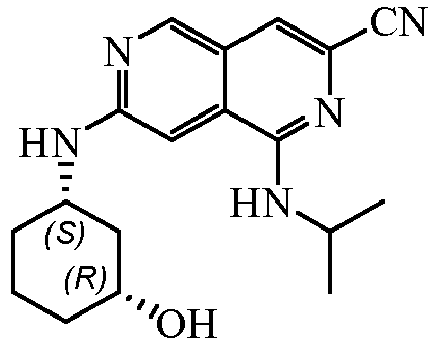
-

- 7-chloro-1-(isopropylamino)-2,6-naphthyridine-3-carbonitrile (100 mg, 0.40 mmol, 1.0 eq.), (1R,3S)-3-aminocyclohexyl-1-ol hydrochloride (121.3 mg, 0.80 mmol, 2.0 eq.), Pd2(dba)3 (55 mg, 0.06 mmol, 0.15 eq.), BINAP (74.7 mg, 0.12 mmol, 0.3 eq.) and cesium carbonate (456.1 mg, 1.4 mmol, 3.5 eq.) were added into 1,4-dioxane (10 mL). The mixture was reacted at 120 °C for 17 h in a sealed tube in nitrogen atmosphere. When there were no materials left, as detected by TLC, the reaction solution was added with water (20 mL) and extracted with ethyl acetate (30 mL × 3). The organic phases were combined, washed with hydrochloric acid solution (0.1 mol/L, 30 mL), dried over anhydrous sodium sulfate and filtered, and the filtrate was concentrated under reduced pressure to give a crude product, which was purified by preparative thin-layer chromatography (MeOH:DCM = 1:20) to give the product (45 mg, yield: 34.5%).
1HNMR (400 MHz, MeOD) δ(ppm): 8.64 (s, 1H), 7.35 (s, 1H), 6.91 (s, 1H), 4.49-4.43 (m, 1H), 3.85-3.70 (m, 2H), 2.33-2.30 (m, 1H), 2.03-1.96 (m, 2H), 1.90-1.85 (m, 1H), 1.50-1.43 (m, 1H), 1.34-1.33 (m, 6H), 1.31-1.29 (m, 2H), 1.27 (m, 1H).
Molecular formula: C1sH23NsO Exact mass: 325.19 LC-MS (Pos, m/z) =326.27 [M+H]+. -
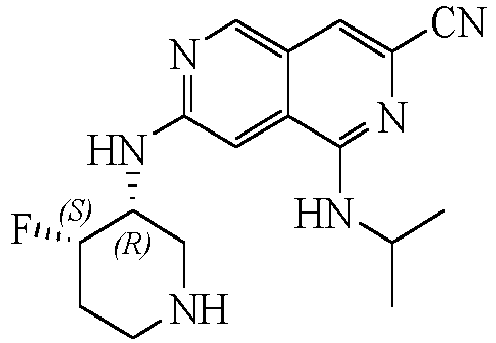
-

- 7-chloro-1-(isopropylamino)-2,6-naphthyridine-3-carbonitrile (150 mg, 0.61 mmol, 1.0 eq.), tert-butyl (3R,4S)-3-amino-4-fluoropiperidine-1-carboxylate (174.6 mg, 0.80 mmol, 1.3 eq.), Pd2(dba)3 (82.4 mg, 0.09 mmol, 0.15 eq.), BINAP (112 mg, 0.18 mmol, 0.3 eq.) and cesium carbonate (498.5 mg, 1.53 mmol, 2.5 eq.) were added into 1,4-dioxane (15 mL). The mixture was reacted at 100 °C for 17 h in a sealed tube in nitrogen atmosphere. When there were no materials left, as detected by TLC, the reaction solution was added with water (30 mL) and extracted with ethyl acetate (30 mL × 2). The organic phases were combined, washed with hydrochloric acid solution (0.5 mol/L, 50 mL), dried over anhydrous sodium sulfate and filtered, and the filtrate was concentrated under reduced pressure to give a crude product, which was purified by silica gel column chromatography (EA:PE = 1:5-1:3) to give the product (100 mg, yield: 38.2%).
-

- Tert-butyl (3R,4S)-3-((7-cyano-5-(isopropylamino)-2,6-naphthyridin-3-yl)amino)-4-fluoropiperidine-1-carboxylate (100 mg, 0.23 mmol, 1.0 eq.) was dissolved in DCM (5 mL). The reaction solution was added dropwise with hydrogen chloride ethanol solution (10 mol/L, 3 mL) and reacted at room temperature for 1 h. When there were no materials left, as detected by TLC, the reaction solution was added with water (20 mL) and back-extracted with DCM (20 mL × 2). The aqueous phase was retained, adjusted to pH of about 8 with potassium carbonate and extracted with DCM (20 mL × 3). The organic phases were combined, dried over anhydrous sodium sulfate and filtered, and the filtrate was concentrated under reduced pressure to give a crude product, which was purified by preparative thin-layer chromatography (MeOH:DCM = 1: 10) to give the product (62 mg, yield: 82.1%).
1HNMR (400 MHz, CD3OD) δ(ppm): 8.75 (s, 1H), 7.39 (s, 1H), 7.07 (s, 1H), 5.19-5.06 (s, 1H), 4.77-4.66 (m, 1H), 4.47-4.42 (m, 1H), 3.56-3.52 (m, 1H), 3.40-3.37 (m, 1H), 3.26-3.21 (m, 2H), 2.41 (m,1H), 2.31-2.14 (m, 1H), 1.35-1.33 (m, 6H).
Molecular formula: C17H21FN6 Exact mass: 328.18 LC-MS (Pos, m/z) =329.31 [M+H]+. -

-

- 7-chloro-1-(isopropylamino)-2,6-naphthyridine-3-carbonitrile (150 mg, 0.61 mmol, 1.0 eq.), tert-butyl (S)-5-amino-3,3-difluoropiperidine-1-carboxylate (189 mg, 0.80 mmol, 1.3 eq.), Pd2(dba)3 (82.4 mg, 0.09 mmol, 0.15 eq.), BINAP (112 mg, 0.18 mmol, 0.3 eq.) and cesium carbonate (498.5 mg, 1.53 mmol, 2.5 eq.) were added into 1,4-dioxane (15 mL). The mixture was reacted at 100 °C for 15 h in a sealed tube in nitrogen atmosphere. When there were no materials left, as detected by TLC, the reaction solution was added with water (30 mL) and extracted with ethyl acetate (30 mL × 2). The organic phases were combined, washed with hydrochloric acid solution (0.5 mol/L, 50 mL), dried over anhydrous sodium sulfate and filtered, and the filtrate was concentrated under reduced pressure to give a crude product, which was purified by silica gel column chromatography (EA:PE = 1:5-1:3) to give the product (164 mg, yield: 60.2%).
-

- Tert-butyl (S)-5-((7-cyano-5-(isopropylamino)-2,6-naphthyridin-3-yl)amino)-3,3-difluoropiperidine-1-carboxylate (164 mg, 0.36 mmol, 1.0 eq.) was dissolved in DCM (5 mL). The reaction solution was added dropwise with hydrogen chloride ethanol solution (10 mol/L, 3 mL) and reacted at room temperature for 2 h. When there were no materials left, as detected by TLC, the reaction solution was added with water (20 mL) and back-extracted with DCM (20 mL × 2). The aqueous phase was retained, adjusted to pH of about 8 with potassium carbonate and extracted with DCM (20 mL × 3). The organic phases were combined, dried over anhydrous sodium sulfate and filtered, and the filtrate was concentrated under reduced pressure to give a crude product, which was purified by preparative thin-layer chromatography (MeOH:DCM = 1:10) to give the product (56.3 mg, yield: 45.1%).
1HNMR (400 MHz, CD3OD) δ(ppm): 8.78 (s, 1H), 7.38 (s, 1H), 6.97 (s, 1H), 4.48-4.42 (m, 1H), 4.24-4.19 (m, 1H), 3.26-3.23 (m, 1H), 3.16-3.11 (m, 1H), 2.98-2.94 (m, 1H), 2.92-2.88 (m, 1H), 2.59-2.50 (m, 2H), 2.10-2.00 (m, 1H), 1.35-1.33 (m, 6H).
Molecular formula: C17H20F2N6 Exact mass: 346.17 LC-MS (Pos, m/z) =347.34 [M+H]+. -

-

- 7-chloro-1-(isopropylamino)-2,6-naphthyridine-3-carbonitrile (150 mg, 0.61 mmol, 1.0 eq.), (S)-quinuclidin-3-amine (100.9 mg, 0.80 mmol, 1.3 eq.), Pd2(dba)3 (82.4 mg, 0.09 mmol, 0.15 eq.), BINAP (112 mg, 0.18 mmol, 0.3 eq.) and cesium carbonate (498.5 mg, 1.53 mmol, 2.5 eq.) were added into 1,4-dioxane (15 mL). The mixture was reacted at 100 °C for 22 h in a sealed tube in nitrogen atmosphere. When there were no materials left, as detected by TLC, the reaction solution was added with water (30 mL) and back-extracted with ethyl acetate (30 mL × 3). The aqueous phase was retained, adjusted to pH of about 8 with sodium carbonate and extracted with ethyl acetate (30 mL × 3). The organic phases were combined, dried over anhydrous sodium sulfate and filtered, and the filtrate was concentrated under reduced pressure to give a crude product, which was purified by preparative thin-layer chromatography (MeOH:DCM = 1:10) to give the product (125 mg, yield: 60.9%).
1HNMR (400 MHz, MeOD) δ(ppm): 8.78 (s, 1H), 7.38 (s, 1H), 7.02 (s, 1H), 4.49-4.42 (m, 2H), 3.97-3.91 (m, 1H), 3.47-3.37 (m, 4H), 3.25-3.21 (m, 1H), 2.43-2.41 (m, 1H), 2.35-2.34 (m, 1H), 2.17-2.13 (m, 2H), 1.99-1.95 (m, 1H), 1.35-1.33 (m, 6H).
Molecular formula: C19H24N6 Exact mass: 336.21 LC-MS (Pos, m/z) =337.39 [M+H]+. -

-

- 6-chloro-N-isopropyl-2-(methylthio)pyrido[3,4-d]pyrimidin-8-amine (1.0 g, 3.72 mmol, 1.0 eq.), zinc cyanide (874 mg, 7.44 mmol, 2.0 eq.) and tetrakis(triphenylphosphine)palladium(0) (855 mg, 0.74 mmol, 0.2 eq.) were dissolved in DMAC (10 mL), and the reaction solution was reacted at 120 °C for 1.5 h in nitrogen atmosphere. After the reaction was completed, as detected by TLC, the reaction solution was poured into water (20 mL) and extracted with MTBE (20 mL × 2). The organic phase was washed with water (20 mL), dried and concentrated to give a crude product, which was purified by silica gel column chromatography (PE:EA = 30:1) to give the product (400 mg, yield: 41.1%).
-
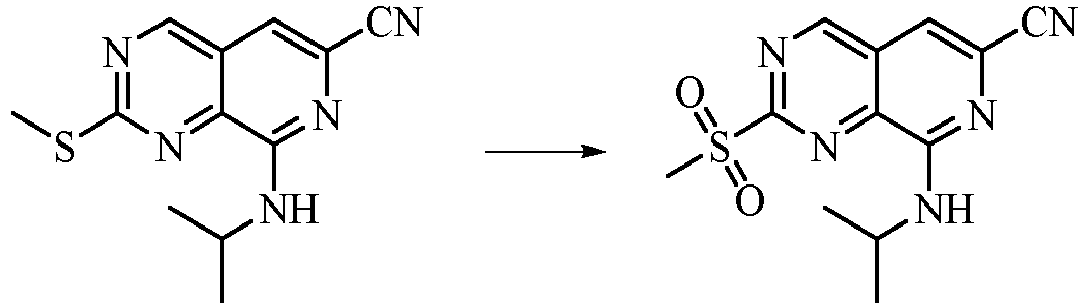
- 8-(isopropylamino)-2-(methylthio)pyrido[3,4-d]pyrimidine-6-carbonitrile (400 mg, 1.54 mmol, 1.0 eq.) was dissolved in DCM (8 mL), and the reaction solution was added with m-chloroperoxybenzoic acid (mass fraction: 80%, 664 mg, 3.08 mmol, 2.0 eq.). After the reaction was completed, as detected by TLC, the reaction solution was concentrated under reduced pressure to give a crude product, which was purified by silica gel column chromatography (PE:EA = 2:1) to give the product (360 mg, yield: 80.0%).
-

- 6-chloro-N-isopropyl-2-(methylsulfonyl)pyrido[3,4-d]pyrimidin-8-amine (360 mg, 1.23 mmol, 1.0 eq.), Tert-butyl ((1S,3S)-3-aminocyclopentyl)carbamate (270 mg, 1.35 mmol, 1.1 eq.) and DIPEA (477 mg, 3.69 mmol, 3.0 eq.) were dissolved in ethanol (5 mL), and the reaction solution was reacted at 85 °C for 2.5 h. After the reaction was completed, as detected by LC-MS, the reaction solution was concentrated to give a crude product, which was purified by silica gel column chromatography (PE:EA= 3:1) to give the product (230 mg, yield: 45.4%).
-

- Tert-butyl ((1S,3S)-3-((6-cyano-8-(isopropylamino)pyrido[3,4-d]pyrimidin-2-yl)amino)cyclopentyl)carbamate (220 mg, 0.53 mmol, 1.0 eq.) was dissolved in EA (5 mL), and the reaction solution was added dropwise a solution of hydrogen chloride in 1,4-dioxane (4 mol/L, 3 mL) and reacted at room temperature for 4 h. After the reaction was substantially completed, as detected by TLC, the reaction solution was filtered under vacuum. The filter cake was dissolved with (MeOH:DCM = 1:10, 10 mL), washed with saturated aqueous sodium carbonate (10 mL × 2), dried and concentrated to give a crude product, which was slurried with EA (5 mL), and the filter cake was dried to give the product (110 mg, yield: 66.6%).
1HNMR (400 MHz, MeOD) δ(ppm): 8.95 (s, 1H), 7.33 (s, 1H), 4.71-4.68 (t, 1H), 4.37-4.31 (m, 1H), 3.87-3.80 (m, 1H), 2.40-2.33 (m ,2H), 2.20-2.17 (t, 2H), 1.81-1.76 (m, 2H), 1.35-1.34 (d, 6H).
Molecular formula: C16H21N7 Exact mass: 311.19 LC-MS(Pos, m/z)=312.14 [M+H]+. -

-

- 2-(((1S,3S)-3-aminocyclopentyl)amino)-8-(isopropylamino)pyrido[3,4-d]pyrimidine-6-carbonitrile (30 mg, 0.096 mmol, 1.0 eq.), DIPEA (37 mg, 0.29 mmol, 3.0 eq.) and acetic anhydride (15 mg, 0.15 mmol, 1.5 eq.) were dissolved in DCM (2 mL), and the reaction solution was reacted at room temperature for 10 min. After the reaction was completed, as detected by TLC, the reaction solution was concentrated under reduced pressure to give a crude product, which was slurried with MTBE (5 mL) and filtered under vacuum. The filter cake was dried to give the product (24 mg, yield: 70.6%).
1HNMR (400 MHz, MeOD) δ(ppm): 8.93 (s, 1H), 7.33 (s, 1H), 4.58-4.54 (t, 1H), 4.36-4.30 (m, 2H), 2.30 (s, 1H), 2.24-2.16 (m , 1H), 2.03-2.01 (d, 2H), 1.96 (s, 3H), 1.70-1.54 (m, 2H), 1.35-1.33 (d, 6H).
Molecular formula: C18H23N7O Exact mass: 353.20 LC-MS(Pos, m/z)=354.16[M+H]+. -

-
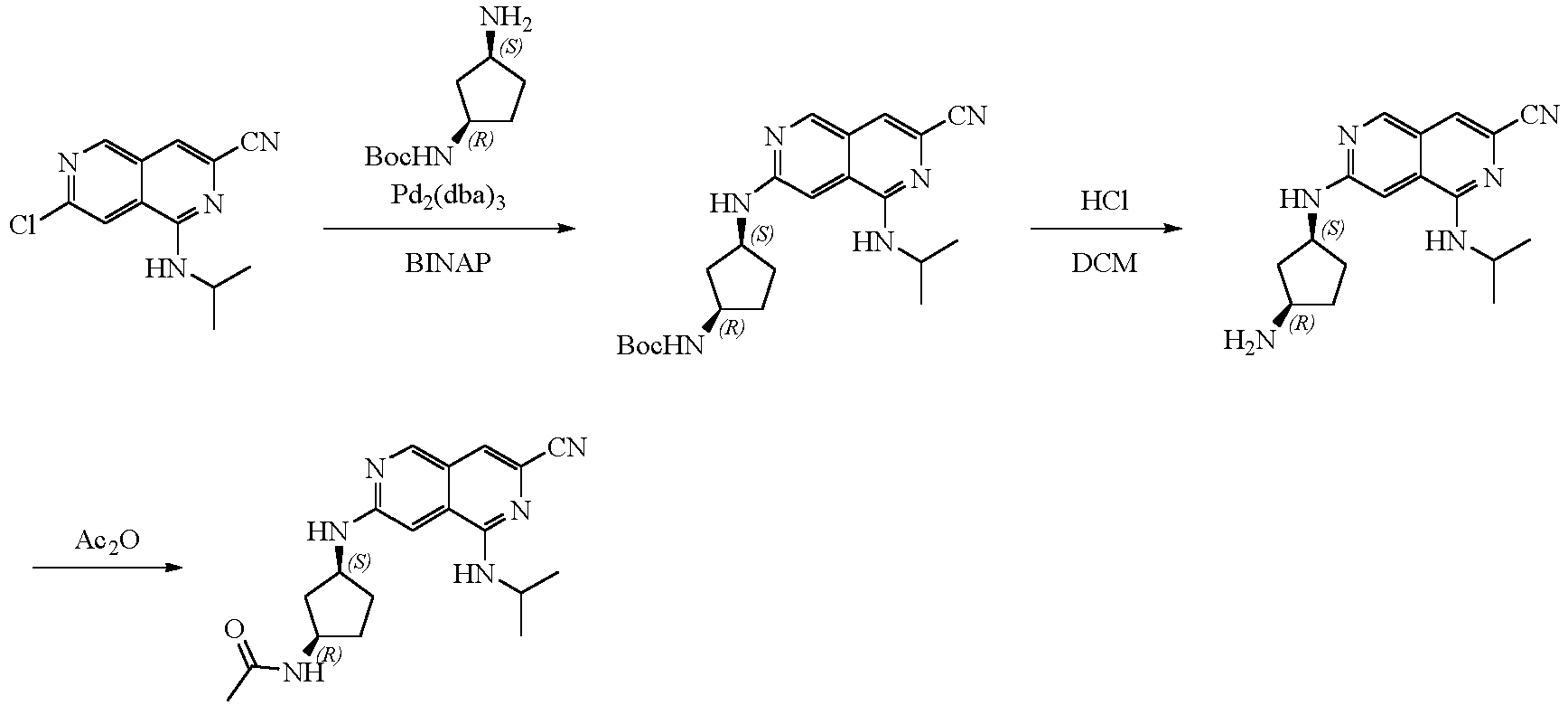
-

- 7-chloro-1-(isopropylamino)-2,6-naphthyridine-3-carbonitrile (246.7 mg, 1 mmol, 1.0 eq.), tert-butyl ((1R,3S)-3-aminocyclopentyl)carbamate (240.3 mg, 1.2 mmol, 1.2 eq.), Pd2(dba)3 (137.4 mg, 0.15 mmol, 0.15 eq.), BINAP (186.8 mg, 0.3 mmol, 0.3 eq.) and cesium carbonate (814.6 mg, 2.5 mmol, 2.5 eq.) were added into 1,4-dioxane (10 mL). The mixture was reacted at 120 °C for 14 h in a sealed tube in nitrogen atmosphere. When there were no materials left, as detected by TLC, the reaction solution was added with water (20 mL) and extracted with ethyl acetate (20 mL × 3). The organic phases were combined, washed with hydrochloric acid solution (0.2 mol/L, 30 mL), dried over anhydrous sodium sulfate and filtered, and the filtrate was concentrated under reduced pressure to give a crude product, which was purified by silica gel column chromatography (EA:PE = 1:10-1:2) to give the product (196 mg, yield: 47.7%).
-

- Tert-butyl ((1R,3S)-3-((7-cyano-5-(isopropylamino)-2,6-naphthyridin-3-yl)amino)cyclopentyl)carbamate (196 mg, 0.48 mmol, 1.0 eq.) was dissolved in DCM (5 mL). The reaction solution was added dropwise with hydrogen chloride ethanol solution (10 mol/L, 4 mL) and reacted at room temperature for 2 h. When there were no materials left, as detected by TLC, the reaction solution was added with water (20 mL), adjusted to pH of about 8 with sodium bicarbonate and extracted with DCM (20 mL × 3). The organic phases were combined, dried over anhydrous sodium sulfate and filtered, and the filtrate was concentrated under reduced pressure to give the product (134 mg, yield: 89.9%).
-

- 7-(((1S,3R)-3-aminocyclopentyl)amino)-1-(isopropylamino)-2,6-naphthyridine-3-carbonitrile (134 mg, 0.43 mmol, 1.0 eq.) was dissolved in DCM (4 mL). The reaction solution was added with DIPEA (167.9 mg, 1.30 mmol, 3.0 eq.) and acetic anhydride (65.8 mg, 0.65 mmol, 1.5 eq.) and reacted at room temperature for 1 h. When there were no materials left, as detected by TLC, the reaction solution was added with water (20 mL) and extracted with ethyl acetate (20 mL × 3). The organic phases were combined, dried over anhydrous sodium sulfate and filtered. The filtrate was concentrated under reduced pressure to give a crude product, which was purified by preparative thin-layer chromatography (MeOH:DCM = 1:20) to give the product (45 mg, yield: 29.7%).
1HNMR (400 MHz, CD3OD) δ(ppm): 8.66 (s, 1H), 7.36 (s, 1H), 6.93 (s, 1H), 4.50-4.43 (m, 1H), 4.23-4.16 (m, 2H), 2.65-2.58 (m, 1H), 2.23-2.13 (m, 1H), 2.11-2.04 (m, 1H), 1.95 (s, 3H), 1.76-1.71 (m, 2H), 1.49-1.42 (m, 1H), 1.35-1.33 (m, 6H).
Molecular formula: C19H24N6O Exact mass: 352.20 LC-MS (Pos, m/z) =353.31 [M+H]+. -

-

-

- 7-chloro-1-(methylthio)-2,6-naphthyridine-3-carbonitrile (500 mg, 2.12 mmol, 1.0 eq.), tert-butyl ((1S,3S)-3-aminocyclopentyl)carbamate (508.7 mg, 2.54 mmol, 1.0 eq.), Pd2(dba)3 (293 mg, 0.32 mmol, 0.15 eq.), BINAP (398.5 mg, 0.64 mmol, 0.3 eq.) and cesium carbonate (1.7 g, 5.30 mmol, 2.5 eq.) were added into 1,4-dioxane (25 mL). The mixture was reacted at 120 °C for 16 h in a sealed tube in nitrogen atmosphere. When there were no materials left, as detected by TLC, the reaction solution was added with water (30 mL) and extracted with ethyl acetate (30 mL × 3). The organic phases were combined, dried over anhydrous sodium sulfate and filtered, and the filtrate was concentrated under reduced pressure to give a crude product, which was purified by silica gel column chromatography (EA:PE = 1:10-1:3) to give the product (385 mg, yield: 45.4%).
-

- Tert-butyl ((1S,3S)-3-((7-cyano-5-(methylthio)-2,6-naphthyridin-3-yl)amino)cyclopentyl)carbamate (150 mg, 0.37 mmol, 1.0 eq.) was dissolved in DCM (5 mL). The reaction solution was added with mCPBA (mass fraction: 80%, 162 mg, 0.75 mmol, 2.0 eq.) and reacted at room temperature for 0.5 h. When there were no materials left, as detected by TLC, the reaction solution was added with water (20 mL) and extracted with ethyl acetate (20 mL × 3). The organic phases were combined, dried over anhydrous sodium sulfate and filtered, and the filtrate was concentrated under reduced pressure to give a crude product, which was purified by preparative thin-layer chromatography (EA:PE = 1:2) to give the product (100 mg, yield: 61.8%).
-
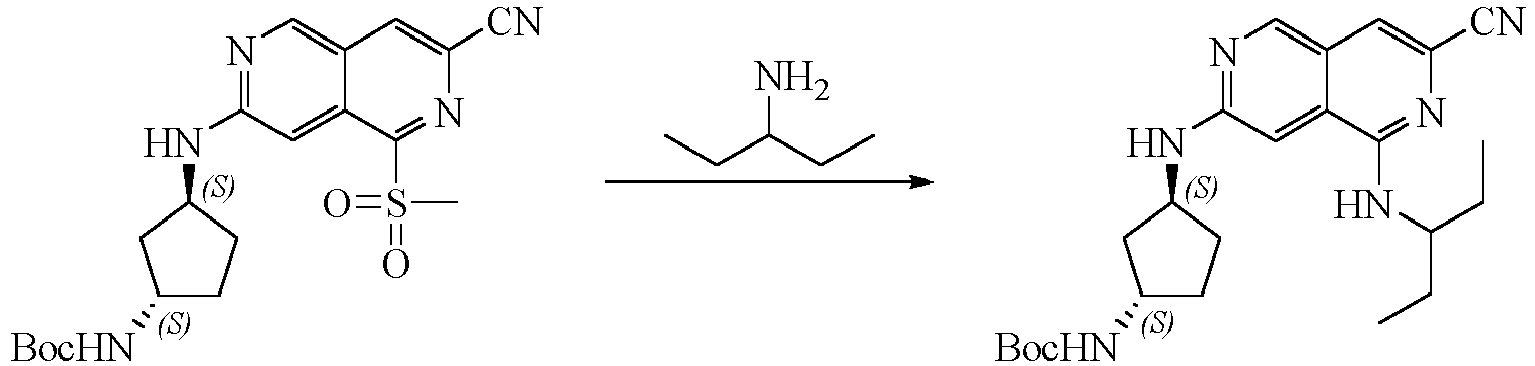
- Tert-butyl ((1S,3S)-3-((7-cyano-5-(methylsulfonyl)-2,6-naphthyridin-3-yl)amino)cyclopentyl)carbamate (100 mg, 0.23 mmol, 1.0 eq.) was dissolved in 3-pentylamine (2 mL). The reaction solution was reacted at 120 °C for 21 h. When there were no materials left, as detected by TLC, the reaction solution was concentrated under reduced pressure, added with water (20 mL) and extracted with ethyl acetate (20 mL × 3). The organic phases were combined, dried over anhydrous sodium sulfate and filtered, and the filtrate was concentrated under reduced pressure to give a crude product, which was purified by preparative thin-layer chromatography (EA:PE = 1:2) to give the product (30 mg, yield: 29.7%).
-

- Tert-butyl ((1S,3S)-3-((7-cyano-5-(pentan-3-ylamino)-2,6-naphthyridin-3-yl)amino)cyclopentyl)carbamate (30 mg, 0.06 mmol, 1.0 eq.) was dissolved in DCM (2 mL). The reaction solution was added dropwise with hydrogen chloride ethanol solution (10 mol/L, 1 mL) and reacted at room temperature for 2 h. When there were no materials left, as detected by TCL, the reaction solution was added with water (10 mL), adjusted to pH of about 8 with sodium carbonate and extracted with DCM (10 mL × 3). The organic phases were combined, dried over anhydrous sodium sulfate and filtered, and the filtrate was concentrated under reduced pressure to give a crude product, which was dissolved with methanol (0.5 mL) and water (3 mL), and lyophilized to give the product (20 mg, yield: 98.5%).
1HNMR (400 MHz, CD3OD) δ(ppm): 8.65 (s, 1H), 7.34 (s, 1H), 6.93 (s, 1H), 4.37-4.33 (m, 1H), 4.24 (m, 1H), 3.56-3.53 (m, 1H), 2.40-2.31 (m, 1H), 2.21-2.13 (m, 1H), 1.94-1.90 (m, 2H), 1.78-1.64 (m, 5H), 1.50-1.45 (m, 1H), 1.00-0.96 (m, 6H).
Molecular formula: C19H26N6 Exact mass: 338.22 LC-MS (Pos, m/z) =339.34[M+H]+. -

-

- 7-chloro-1-(methylthio)-2,6-naphthyridine-3-carbonitrile (1 g, 4.24 mmol, 1.0 eq.) was dissolved in DCM (20 mL), and the reaction solution was added with m-chloroperoxybenzoic acid (mass fraction: 80%, 1.83 g, 8.48 mmol, 2.0 eq.) and reacted at room temperature for 0.5 h. After the reaction was completed, as detected by TLC, the reaction solution was poured into water (10 mL) and adjusted to pH of 8 with sodium carbonate. The liquid separation was performed. The aqueous phase was extracted with DCM (20 mL). The organic phases were combined, dried and concentrated to give a crude product, which was slurried with (PE:EA = 10:1, 20 mL) and filtered under vacuum, and the filter cake was dried to give the product (1.1 g, yield: 97.3%).
-

- 7-chloro-1-(methylsulfonyl)-2,6-naphthyridine-3-carbonitrile (200 mg, 0.75 mmol, 1.0 eq.), cyclopentylamine (128 mg, 1.50 mmol, 2.0 eq.) and DIPEA (290 mg, 2.25 mmol, 3.0 eq.) were dissolved in THF (5 mL), and the reaction solution was reacted at 40 °C for 30 min. After the reaction was completed, as detected by TLC, the reaction solution was poured into water (10 mL) and extracted with EA (10 mL × 2). The organic phase was dried and concentrated to give the product (200 mg, yield: 98%).
-

- 7-chloro-1-(cyclopentylamino)-2,6-naphthyridine-3-carbonitrile (200 mg, 0.73 mmol, 1.0 eq.), tert-butyl ((1S,3S)-3-aminocyclopentyl)carbamate (176 mg, 0.88 mmol, 1.2 eq.), Pd2(dba)3 (67 mg, 0.073 mmol, 0.1 eq.), BINAP (91 mg, 0.146 mmol, 0.2 eq.) and cesium carbonate (476 mg, 1.46 mmol, 2.0 eq.) were dispersed in 1,4-dioxane (5 mL), and the reaction solution was reacted at 100 °C for 19.5 h in nitrogen atmosphere. When there were no materials left, as detected by TLC, the reaction solution was concentrated under reduced pressure to give a crude product, which was purified by silica gel column chromatography (PE:EA = 2:1) to give the product (160 mg, yield: 50.3%).
-

- Tert-butyl ((1S,3S)-3-((7-cyano-5-(cyclopentylamino)-2,6-naphthyridin-3-yl)amino)cyclopentyl)carbamate (160 mg, 0.36 mmol, 1.0 eq.) was dissolved in EA (4 mL), and the reaction solution was added dropwise a solution of hydrogen chloride in 1,4-dioxane (4 mol/L, 2 mL) and reacted at room temperature for 3.5 h. After the reaction was substantially completed, as detected by LC-MS, the reaction solution was filtered, and the filter cake was dissolved with water (5 mL) and adjusted to pH of 9 with sodium carbonate. The aqueous phase was extracted with (MeOH:DCM = 1: 10, 10 mL × 4). The organic phase was dried and concentrated to give a crude product, which was purified by preparative thin-layer chromatography (MeOH:DCM = 1:5) to give the product (13 mg, yield: 10.7%).
1HNMR (400 MHz, MeOD) δ(ppm): 8.69 (s, 1H), 7.38 (s, 1H), 6.94 (s, 1H), 4.58-4.49 (m, 2H), 3.83-3.79 (t, 1H), 2.38-2.35 (m, 2H), 2.19-2.12 (m, 4H), 1.84-1.82 (t, 2H), 1.78-1.68 (m, 6H).
Molecular formula: C19 H24N6 Exact mass: 336.21 LC-MS(Pos, m/z)=337.38[M+H]+. -

-

- 7-chloro-1-(methylsulfonyl)-2,6-naphthyridine-3-carbonitrile (200 mg, 0.75 mmol, 1.0 eq.), 1-methylcyclopropan-1-amine hydrochloride (161 mg, 1.50 mmol, 2.0 eq.) and DIPEA (290 mg, 2.25 mmol, 3.0 eq.) were dissolved in THF (5 mL), and the reaction solution was reacted at 80 °C for 3 h. After the reaction was completed, as detected by TLC, the reaction solution was poured into water (10 mL) and extracted with EA (10 mL × 2). The organic phase was dried and concentrated to give the product (160 mg, yield: 82.5%).
-

- 7-chloro-1-((1-methylcyclopropyl)amino)-2,6-naphthyridine-3-carbonitrile (160 mg, 0.62 mmol, 1.0 eq.), tert-butyl ((1S,3S)-3-aminocyclopentyl)carbamate (149 mg, 0.74 mmol, 1.2 eq.), Pd2(dba)3 (57 mg, 0.062 mmol, 0.1 eq.), BINAP (77 mg, 0.124 mmol, 0.2 eq.) and cesium carbonate (404 mg, 1.24 mmol, 2.0 eq.) were dispersed in 1,4-dioxane (5 mL), and the reaction solution was reacted at 100 °C for 23 h in nitrogen atmosphere. After the reaction was completed, as detected by TLC, the reaction solution was concentrated under reduced pressure to give a crude product, which was purified by silica gel column chromatography (PE:EA = 2:1) to give the product (70 mg, yield: 26.7%).
-

- Tert-butyl ((1S,3S)-3-((7-cyano-5-((1-methylcyclopropyl)amino)-naphthyridin-3-yl)amino)cyclopentyl)carbamate (70 mg, 0.16 mmol, 1.0 eq.) was dissolved in EA (2 mL), and the reaction solution was added dropwise a solution of hydrogen chloride in 1,4-dioxane (4 mol/L, 1 mL) and reacted at room temperature for 18 h. After the reaction was completed, as detected by LC-MS, the reaction solution was poured into water (5 mL), and the liquid separation was performed. The aqueous phase was retained, adjusted to pH of 9 with sodium carbonate, and extracted with (MeOH:DCM = 1:10, 10 mL × 4). The organic phase was dried and concentrated to give a crude product, which was purified by preparative thin-layer chromatography (MeOH:DCM = 1:5) to give the product (20 mg, yield: 38.4%).
1HNMR (400 MHz, MeOD) δ(ppm): 8.69 (s, 1H), 7.42 (s, 1H), 6.82 (s, 1H), 4.57-4.54 (t, 1H), 3.80-3.77 (t, 1H), 2.37-2.33 (m, 2H), 2.13-2.10 (t, 2H), 1.76-1.68 (m, 2H), 1.58 (s, 3H), 0.87 (s, 2H), 0.78 (s, 2H).
Molecular formula: C18H22N6 Exact mass: 322.19 LC-MS(Pos, m/z)=323.24[M+H]+. -

-
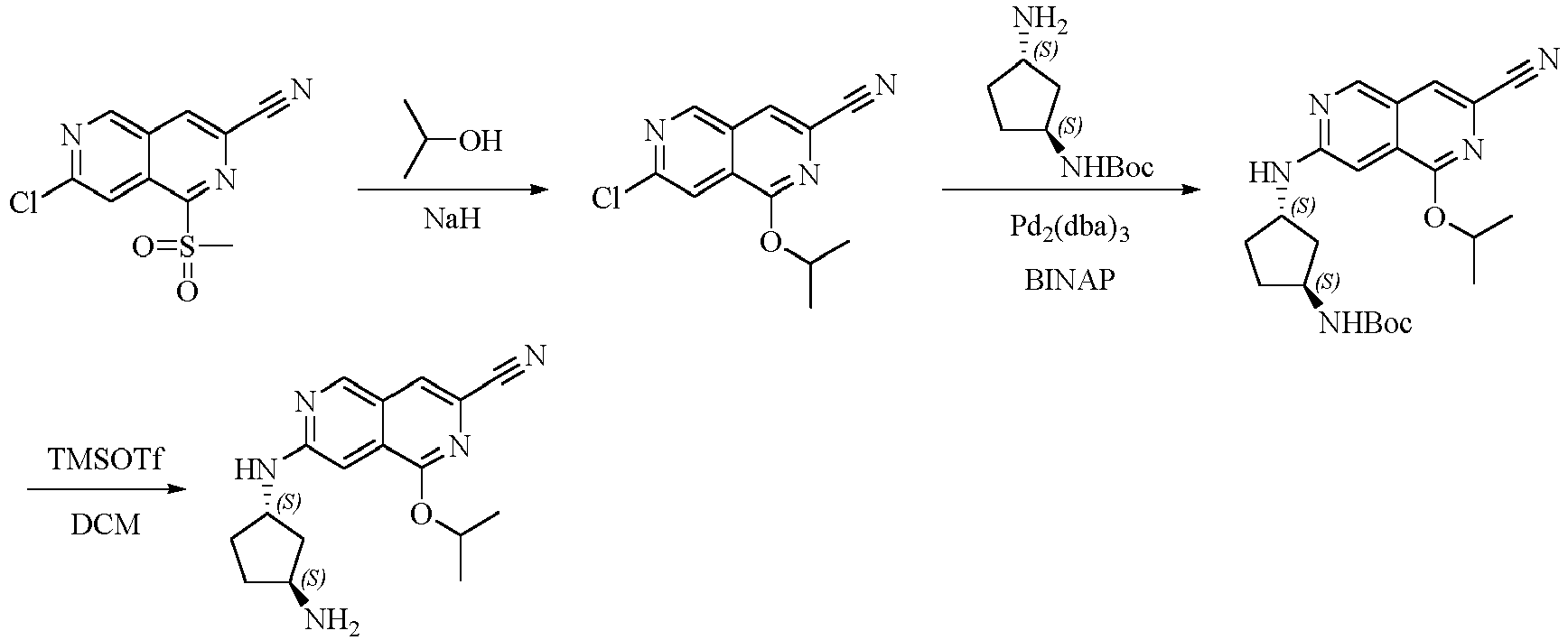
-

- Sodium hydride (mass fraction: 60%, 52.8 mg, 1.32 mmol, 1.1 eq.) was dissolved in isopropanol (10 mL), and the reaction solution was reacted at room temperature for 0.5 h, added with a solution of 7-chloro-1-(methylsulfonyl)-2,6-naphthyridine-3-carbonitrile (300 mg, 1.12 mmol, 1.0 eq.) in 1,4-dioxane (5 mL) and heated to 60 °C for 1 h. When there were no materials left, as detected by TLC, the reaction solution was added with water (20 mL) and extracted with ethyl acetate (20 mL × 3). The organic phases were combined, dried over anhydrous magnesium sulfate and filtered, and the filtrate was concentrated under reduced pressure to give the product (274 mg, yield: 98.7%).
-

- 7-chloro-1-isopropoxy-2,6-naphthyridine-3-carbonitrile (270 mg, 1.09 mmol, 1.0 eq.), tert-butyl ((1S,3S)-3-aminocyclopentyl)carbamate (284.4 mg, 1.42 mmol, 1.2 eq.), Pd2(dba)3 (146.5 mg, 0.16 mmol, 0.15 eq.), BINAP (199.3 mg, 0.32 mmol, 0.3 eq.) and cesium carbonate (889.5 mg, 2.73 mmol, 2.5 eq.) were added into 1,4-dioxane (20 mL). The mixture was reacted at 120 °C for 17 h in a sealed tube in nitrogen atmosphere. When there were no materials left, as detected by TLC, the reaction solution was added with water (30 mL) and extracted with ethyl acetate (30 mL × 3). The organic phases were combined, washed with hydrochloric acid solution (0.2 mol/L, 40 mL), dried over anhydrous sodium sulfate and filtered, and the filtrate was concentrated under reduced pressure to give a crude product, which was purified by preparative thin-layer chromatography (EA:PE = 1:3) to give the product (105 mg, yield: 23.4%).
-

- Tert-butyl ((1S,3S)-3-((7-cyano-5-isopropoxy-2,6-naphthyridin-3-yl)amino)cyclopentyl)carbamate (105 mg, 0.25 mmol, 1.0 eq.) was dissolved in DCM (5 mL), and the reaction solution was cooled in an ice water bath, added with 2,6-lutidine (401.8 mg, 3.75 mmol, 15.0 eq.) and trimethylsilyl trifluoromethanesulfonate (555.6 mg, 2.5 mmol, 10.0 eq.), and reacted at 0 °C to 5 °C for 2 h. When there were no materials left, as detected by TLC, the reaction solution was added with water (30 mL) and extracted with ethyl acetate (30 mL × 3). The organic phases were combined, washed with saturated aqueous sodium carbonate (30 mL) and water (30 mL) successively, dried over anhydrous sodium sulfate and filtered, and the filtrate was concentrated under reduced pressure to give a crude product, which was purified by preparative thin-layer chromatography (MeOH:DCM = 1:10) to give the product (58 mg, yield: 64.3 %).
1HNMR (400 MHz, CD3OD) δ(ppm): 8.86 (s, 1H), 7.76 (s, 1H), 6.91 (s, 1H), 5.54-5.48 (m, 1H), 4.40-4.37 (m, 1H), 3.57-3.54 (m, 1H), 2.35-2.83 (m, 1H), 2.20-2.14 (m, 1H), 1.96-1.92 (m, 2H), 1.65-1.61 (m, 1H), 1.59-1.50 (m, 1H), 1.47-1.45 (m, 6H).
Molecular formula: C17H21N5O Exact mass: 311.17 LC-MS (Pos, m/z) =312.27 [M+H]+. -

-

-

- 7-chloro-1-(isopropylamino)-2,6-naphthyridine-3-carbaldehyde (1 g, 4.0 mmol, 1.0 eq.) was dissolved in DCM (20 mL), and the reaction solution was cooled to 0 °C to 5 °C in an ice water bath, added dropwise with DAST (2.6 g, 16 mmol, 4.0 eq.), and reacted at 0 °C to 5 °C for 2 h after addition, and incubated at room temperature for 16 h. When there were no materials left, as detected by TLC, the reaction solution was added with water (20 mL) and adjusted to pH of about 8 with sodium carbonate. The liquid separation was performed. The organic phase was retained. The aqueous phase was extracted with DCM (20 mL × 2). The organic phases were combined, washed with water (20 mL) and brine (20 mL) successively, dried over anhydrous sodium sulfate and filtered, and the filtrate was concentrated under reduced pressure to give a crude product, which was purified by silica gel column chromatography (EA:PE = 1:30) to give the product (982 mg, yield: 90.9%).
-
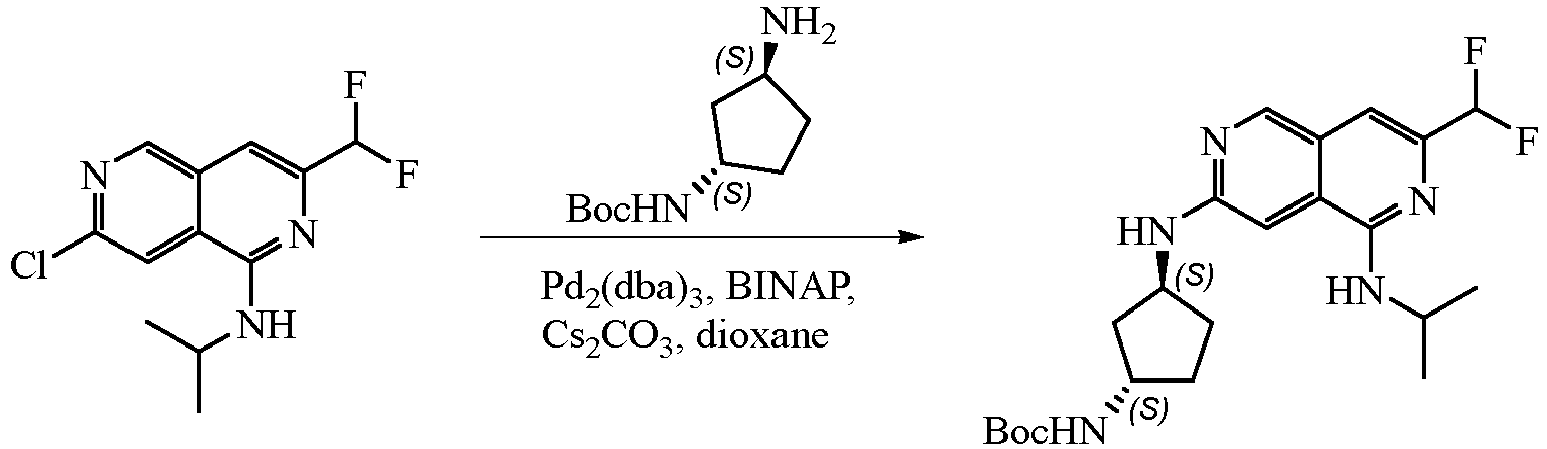
- 7-chloro-3-(difluoromethyl)-N-isopropyl-2,6-naphthyridin-1-amine (166 mg, 0.61 mmol, 1.0 eq.), tert-butyl ((1S,3S)-3-aminocyclopentyl)carbamate (146.2 mg, 0.73 mmol, 1.2 eq.), Pd2(dba)3 (82.4 mg, 0.09 mmol, 0.15 eq.), BINAP (112 mg, 0.18 mmol, 0.3 eq.) and cesium carbonate (498.5 mg, 1.53 mmol, 2.5 eq.) were added into 1,4-dioxane (10 mL). The mixture was reacted at 120 °C for 17 h in a sealed tube in nitrogen atmosphere. When there were no materials left, as detected by TLC, the reaction solution was added with water (10 mL) and extracted with ethyl acetate (10 mL × 3). The organic phases were combined, washed with hydrochloric acid solution (0.2 mol/L, 30 mL), dried over anhydrous sodium sulfate and filtered, and the filtrate was concentrated under reduced pressure to give a crude product, which was firstly purified by silica gel column chromatography (EA:PE = 1:10-1:2) and then purified by preparative thin-layer chromatography (EA:PE = 1:2) to give the product (93 mg, yield: 35%).
-

- Tert-butyl ((1S,3S)-3-((7-(difluoromethyl)-5-(isopropylamino)-2,6-naphthyridin-3-yl)amino)cyclopentyl)carbamate (93 mg, 0.21 mmol, 1.0 eq.) was dissolved in DCM (3 mL). The reaction solution was added dropwise with hydrogen chloride ethanol solution (10 mol/L, 3 mL) and reacted at room temperature for 2 h. When there were no materials left, as detected by LC-MS, the reaction solution was added with water (15 mL) and back-extracted with DCM (15 mL × 2). The aqueous phase was retained, adjusted to pH of about 8 with sodium carbonate and extracted with dichloromethane (15 mL × 2). The organic phases were combined, dried over anhydrous magnesium sulfate and filtered, and the filtrate was concentrated under reduced pressure. The residue was dissolved with methanol (1 mL) and water (5 mL), and lyophilized to give the product (45 mg, yield: 63.9%).
1HNMR (400 MHz, MeOD) δ(ppm): 8.66 (s, 1H), 7.07 (s, 1H), 6.90 (s, 1H), 6.65-6.37 (s, 1H), 4.54-4.48 (m, 1H), 4.35-4.31 (m, 1H), 3.59-3.56 (m, 1H), 2.39-2.32 (m, 1H), 2.21-2.16 (m, 1H), 1.96-1.93 (m, 2H), 1.64-1.48 (m, 2H), 1.35-1.33 (m, 6H).
Molecular formula: C17H23F2N5 Exact mass: 335.19 LC-MS (Pos, m/z) =336.20 [M+H]+. -

-

- 7-chloro-3-(difluoromethyl)-N-sopropyl-2,6-naphthyridin-1-amine (166 mg, 0.61 mmol, 1.0 eq.), tert-butyl ((1R,3S)-3-aminocyclopentyl)carbamate (146.2 mg, 0.73 mmol, 1.2 eq.), Pd2(dba)3 (82.4 mg, 0.09 mmol, 0.15 eq.), BINAP (112 mg, 0.18 mmol, 0.3 eq.) and cesium carbonate (498.5 mg, 1.53 mmol, 2.5 eq.) were added into 1,4-dioxane (15 mL). The mixture was reacted at 120 °C for 20 h in a sealed tube in nitrogen atmosphere. When there were no materials left, as detected by TLC, the reaction solution was added with water (30 mL) and extracted with ethyl acetate (30 mL × 3). The organic phases were combined, washed with hydrochloric acid solution (0.2 mol/L, 50 mL), dried over anhydrous sodium sulfate and filtered, and the filtrate was concentrated under reduced pressure to give a crude product, which was purified by silica gel column chromatography (EA:PE = 1:5-1:2) to give the product (100 mg, yield: 37.6%).
-
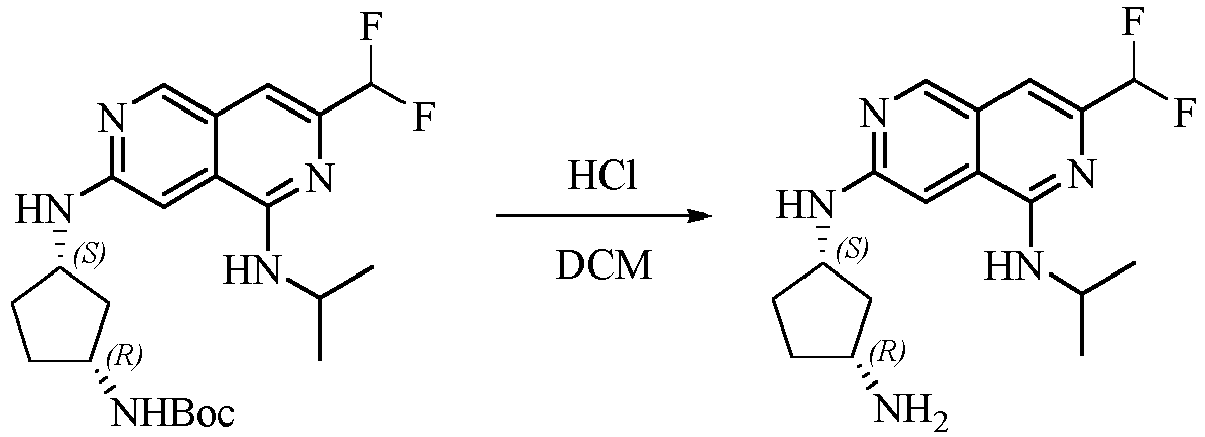
- Tert-butyl ((1R,3S)-3-((7-(difluoromethyl)-5-(isopropylamino)-2,6-naphthyridin-3-yl)amino)cyclopentyl)carbamate (100 mg, 0.23 mmol, 1.0 eq.) was dissolved in DCM (2 mL). The reaction solution was added dropwise with hydrogen chloride ethanol solution (10 mol/L, 2 mL) and reacted at room temperature for 1 h. When there were no materials left, as detected by TLC, the reaction solution was concentrated under reduced pressure, added with water (30 mL) and back-extracted with ethyl acetate (30 mL × 2). The aqueous phase was retained, adjusted to pH of about 8 with sodium carbonate and extracted with DCM (30 mL × 3). The organic phases were combined, dried over anhydrous sodium sulfate and filtered, and the filtrate was concentrated under reduced pressure to give a crude product, which was purified by preparative thin-layer chromatography (MeOH:DCM = 1:20) to give the product (45 mg, yield: 58.3%).
1HNMR (400 MHz, CD3OD) δ(ppm): 8.68 (s, 1H), 7.08 (s, 1H), 6.94 (s, 1H), 6.65-6.37 (s, 1H), 4.53-4.50 (m, 1H), 4.26-4.22 (m, 1H), 3.62-3.59 (m, 1H), 2.69-2.63 (m, 1H), 2.23-2.14 (m, 2H), 1.83-1.81 (m, 2H), 1.58-1.51 (m, 1H), 1.35-1.33 (m, 6H).
Molecular formula: C17H23F2N5 Exact mass: 335.19 LC-MS (Pos, m/z) =336.34[M+H]+. -

-

- 7-chloro-3-(difluoromethyl)-N-isopropyl-2,6-naphthyridin-1-amine (150 mg, 0.55 mmol, 1.0 eq.), tert-butyl (S)-3-aminopiperidine-1-carboxylate (144.2 mg, 0.42 mmol, 1.3 eq.), Pd2(dba)3 (73.2 mg, 0.08 mmol, 0.15 eq.), BINAP (99.6 mg, 0.16 mmol, 0.3 eq.) and cesium carbonate (449.6 mg, 1.38 mmol, 2.5 eq.) were added into 1,4-dioxane (15 mL). The mixture was reacted at 100 °C for 18 h in a sealed tube in nitrogen atmosphere. When there were no materials left, as detected by TLC, the reaction solution was added with water (30 mL) and extracted with ethyl acetate (30 mL × 3). The organic phases were combined, washed with hydrochloric acid solution (0.2 mol/L, 50 mL), dried over anhydrous sodium sulfate and filtered, and the filtrate was concentrated under reduced pressure to give a crude product, which was purified by silica gel column chromatography (EA:PE = 1:7-1:5) to give the product (160 mg, yield: 66.8%).
-

- Tert-butyl (S)-3-((7-(difluoromethyl)-5-(isopropylamino)-2,6-naphthyridin-3-yl)amino)piperidine-1-carboxylate (160 mg, 0.36 mmol, 1.0 eq.) was dissolved in DCM (3 mL). The reaction solution was added dropwise with hydrogen chloride ethanol solution (10 mol/L, 3 mL) and reacted at room temperature for 1 h. When there were no materials left, as detected by TLC, the reaction solution was added with water (20 mL) and back-extracted with DCM (30 mL × 2). The aqueous phase was retained, adjusted to pH of about 8 with potassium carbonate and extracted with DCM (20 mL × 3). The organic phases were combined, dried over anhydrous sodium sulfate and filtered, and the filtrate was concentrated under reduced pressure to give a crude product, which was purified by preparative thin-layer chromatography (MeOH:DCM = 1:10) to give the product (106 mg, yield: 28.9%).
1HNMR (400 MHz, CD3OD) δ(ppm): 8.78 (s, 1H), 7.10 (s, 1H), 7.02 (s, 1H), 6.66-6.38 (s, 1H), 4.52-4.49 (m, 1H), 4.29-4.26 (m, 1H), 3.64-3.60 (m, 1H), 3.37-3.36 (m, 1H), 3.10-2.97 (m, 2H), 2.20-2.11 (m, 2H), 1.95-1.92 (m, 1H), 1.78-1.75 (m, 1H), 1.35-1.33 (m, 6H).
Molecular formula: C17H23F2N5 Exact mass: 335.19 LC-MS (Pos, m/z) =336.40[M+H]+. -

-
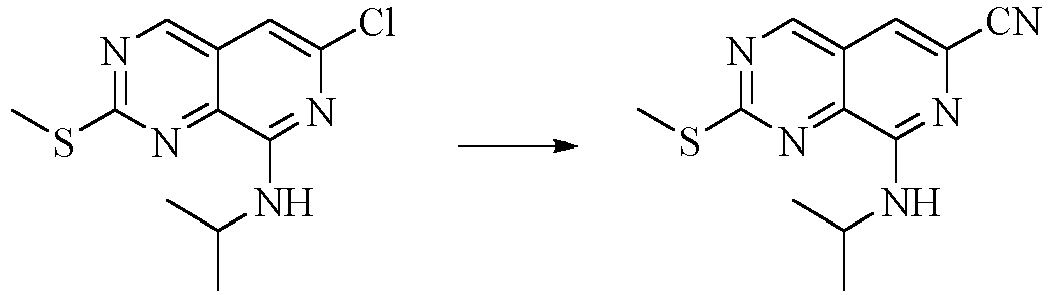
- 6-chloro-N isopropyl-2-(methylthio)pyrido[3,4-d]pyrimidin-8-amine (1.0 g, 3.72 mmol, 1.0 eq.), zinc cyanide (437 mg, 3.72 mmol, 1.0 eq.) and tetrakis(triphenylphosphine)palladium(0) (647 mg, 0.56 mmol, 0.15 eq.) were dispersed in DMA (10 mL), and the reaction solution was reacted at 120 °C for 17 h in nitrogen atmosphere. After the reaction was completed, as detected by TLC, the reaction solution was poured into water (20 mL) and extracted with MTBE (20 mL × 2). The organic phase was dried and concentrated under reduced pressure to give a crude product, which was purified by silica gel column chromatography (PE:EA = 20:1) to give the product (400 mg, yield: 41.4%).
-

- 8-(isopropylamino)-2-(methylsulfonyl)pyrido[3,4-d]pyrimidine-6-carbonitrile (400 mg, 1.54 mmol, 1.0 eq.) was dissolved in DCM (20 mL), and the reaction solution was added with m-chloroperoxybenzoic acid (mass fraction: 80%, 664 mg, 3.08 mmol, 2.0 eq.) at room temperature, and reacted at room temperature for 30 min. After the reaction was completed, as detected by TLC, the reaction solution was added with saturated aqueous sodium carbonate (10 mL), the liquid separation was performed, and the aqueous phase was extracted with DCM (10 mL). The organic phases were combined, dried and concentrated to give a crude product, which was slurried with PE:MTBE = 2:1 (15 mL) and filtered under vacuum, and the filter cake was dried to give the product (360 mg, yield: 80.4%).
-

- 8-(isopropylamino)-2-(methylsulfonyl)pyrido[3,4-d]pyrimidine-6-carbonitrile (360 mg, 1.23 mmol, 1.0 eq.) and tert-butyl (S)-3-aminopiperidine-1-carboxylate (739 mg, 3.69 mmol, 3.0 eq.) were dissolved in ethanol (8 mL), and the reaction solution was reacted at 80 °C for 2 h. After the reaction was completed, as detected by TLC, the reaction solution was concentrated to give a crude product, which was purified by silica gel column chromatography (PE:EA= 3:1) to give the product (175 mg, yield: 34.6%).
-

- Tert-butyl (S)-3-((6-cyano-8-(isopropylamino)pyrido[3,4-d]pyrimidin-2-yl)amino)piperidine-1-carboxylate (175 mg, 0.42 mmol, 1.0 eq.) was dissolved in EA (2 mL). The reaction solution was added dropwise with a solution of hydrogen chloride in 1,4-dioxane (4 mol/L, 1 mL) and reacted at room temperature for 20 h. After the reaction was substantially completed, as detected by LC-MS, the reaction solution was poured into saturated aqueous potassium carbonate (5 mL) and extracted with EA (10 mL × 3). The organic phase was dried and concentrated to give a crude product, which was purified by preparative thin-layer chromatography (MeOH:DCM = 1:10) to give the product (76 mg, yield: 58.4%).
1HNMR (400 MHz,MeOD) δ(ppm): 8.96 (s, 1H), 7.30 (s, 1H), 4.36 (s, 2H), 3.53-3.50 (t, 1H), 3.27-3.24 (d, 1H), 2.95-2.81 (m, 2H), 2.18-2.14 (m, 1H), 2.06-2.01 (m, 1H), 1.89-1.86 (d, 1H), 1.78-1.68 (m, 1H), 1.36-1.34 (d, 6H).
Molecular formula: C16H21N7 Exact mass: 311.19 LC-MS(Pos, m/z)=312.33 [M+H]+. -

-

- 7-(((1S,3S)-3-aminocyclopentyl)amino)-1-(isopropylamino)-2,6-naphthyridine-3-carbonitrile (220 mg, 0.71 mmol, 1.0 eq.), 1-bromo-2-methoxyethane (98.7 mg,0.71 mmol, 1.0 eq.) and potassium carbonate (98 mg, 0.71 mmol, 1.0 eq.) were dissolved in DMA (3 mL). The reaction solution was heated to 100 °C and reacted for 20 h in nitrogen atmosphere. When there were no materials left, as detected by TLC, the reaction solution was added with water (20 mL) and extracted with ethyl acetate (20 mL × 3). The organic phases were combined, washed with water (20 mL × 2). dried over anhydrous sodium sulfate and filtered. The filtrate was concentrated under reduced pressure to give a crude product, which was purified by preparative thin-layer chromatography (MeOH:DCM = 1:20) to give the product (20 mg, yield: 7.6%).
1HNMR (400 MHz, DMSO) δ(ppm): 8.71(s, 1H), 7.47 (s, 1H), 6.90 (s, 1H), 4.33-4.26 (m, 2H), 3.55 (m, 2H), 3.29 (s, 3H), 3.07 (m, 2H), 2.19 (m, 2H), 2.07-1.96 (m, 2H), 1.60-1.58 (m, 2H), 1.23-1.21 (m, 7H).
Molecular formula: C20H28N6O Exact mass: 368.23 LC-MS (Pos, m/z) =369.38 [M+H]+. -

-

- (S)-1-(isopropylamino)-7-(piperidin-3-ylamino)-2,6-naphthyridine-3-carbonitrile (108 mg, 0.35 mmol, 1.0 eq.) was dissolved in methanol (3 mL), and the reaction solution was added with acetic acid (21 mg, 0.35 mmol, 1.0 eq.) and aqueous formaldehyde solution (mass function: 37%, 56.8 mg, 0.70 mmol, 2.0 eq.) and reacted at room temperature for 1 h, and then added with sodium cyanoborohydride (66 mg, 1.05 mmol, 3.0 eq.) and reacted at room temperature for 1 h. When there were no materials left, as detected by TLC, the reaction solution was concentrated under reduced pressure, added with water (20 mL) and extracted with ethyl acetate (20 mL × 3). The organic phases were combined, dried over anhydrous sodium sulfate and filtered, and the filtrate was concentrated under reduced pressure to give a crude product, which was purified by preparative thin-layer chromatography (MeOH:DCM = 1:10) to give the product (66 mg, yield: 58.1%).
1HNMR (400 MHz, MeOD) δ(ppm): 8.72 (s, 1H), 7.38 (s, 1H), 7.00 (s, 1H), 4.47-4.44 (m, 1H), 4.27-4.24 (m, 1H), 3.50 (m, 1H), 3.28-3.26 (m, 1H), 2.87 (m, 3H), 2.77 (s, 3H), 2.12-2.07 (m, 2H), 1.93-1.87 (m, 1H), 1.67-1.65 (m, 1H), 1.35-1.33 (m, 6H), 1.31 (m, 1H).
Molecular formula: C18 H24N6 Exact mass: 324.21 LC-MS (Pos, m/z) =325.31 [M+H]+. -

- The titled compound was prepared as same as example 38 using corresponding chemicals.
- 1H-NMR (400 MHz, CD3OD) 6(ppm): 9.00 (s, 1H), 8.08 (s, 1H), 6.99 (s, 1H), 4.54-4.60 (m, 1H), 3.79-3.86 (m, 1H), 3.34-3.37 (m, 1H), 2.32-2.42 (m, 2H), 2.10-2.22 (m, 2H), 1.89-2.00 (m, 2H), 1.72-1.83 (m, 4H), 0.81-0.84 (t, 6H).
Molecular formula:C16H25N5 Exact mass: 323.21 LC-MS(Pos, m/z)=324.14 [M+H]+ -

- The titled compound was prepared as same as example 34 using corresponding chemicals.
- 1HNMR (400 MHz, MeOD) δ(ppm): 8.73 (s, 1H), 7.48 (s, 1H), 6.88 (s, 1H), 4.39-4.32 (t, 1H), 4.01-3.99 (d, 2H), 3.96-3.94 (t, 2H), 3.71-3.64 (m, 2H), 3.61-3.58 (t, 1H), 2.41-2.33 (m, 1H), 2.19-2.16 (m, 1H), 1.99-1.95 (m, 2H), 1.91-1.87 (m, 4H), 1.96-1.60 (m, 1H), 1.57-1.52 (m, 1H).
- Molecular formula:C21H25N7O Exact mass: 391.21 LC-MS(Pos, m/z)=392.15[M+H]+.
-

- The titled compound was prepared as same as example 38 using corresponding chemicals.
- 1HNMR (400 MHz, MeOD) δ(ppm): 8.76 (s, 1H), 7.53 (s, 1H), 7.00 (s, 1H), 5.42-5.35 (m, 1H), 3.91 (m, 1H), 3.29 (m, 1H), 3.05-3.01 (m, 2H), 2.72-2.67 (m, 2H), 2.2.62-2.56 (m, 1H), 2.14-2.12 (m, 1H), 2.00 (s, 3H), 1.88-1.86 (m, 1H), 1.71-1.57 (m, 2H), 1.52-1.50 (d, 3H).
- Molecular formula: C17H19F3N6 Exact mass: 364.38 LC-MS (Pos, m/z) =365.31 [M+H]+.
-

-

-

- (R)-1-(8-(isopropylamino)-2-(methylsulfonyl)pyrido[3,4-d]pyrimidin-6-yl)ethyl benzoate (200 mg, 0.48 mmol, 1.0 eq.) was dissolved in dioxane (2 mL), and the reaction solution was added with trans-cyclohexane-1,4-diamine (276 mg, 2.41 mmol, 5.0 eq.) and reacted at 100 °C for overnight. When there were no materials left, as detected by LCMS, the reaction solution was added with water (10 mL) and extracted with ethyl acetate (20 mL × 2). The organic phases were combined, dried over anhydrous sodium sulfate and filtered, and the filtrate was concentrated under reduced pressure to give a crude product, which was purified by amino column chromatography to give the product (199 mg, yield: 91.9%).
-

- (R)-1-(2-(((1r,4R)-4-aminocyclohexyl)amino)-8-(isopropylamino)pyrido[3,4-d]pyrimidin-6-yl)ethyl benzoate (40 mg, 0.089 mmol, 1.0 eq.) and N,N-Dimethylglycine (10 mg, 0.099 mmol, 1.1 eq.) were dissolved in CH3CN (0.9 mL), and the reaction solution was added with HATU (51 mg, 0.13 mmol, 1.5 eq.) and DIPEA (45 mg, 0.45 mmol, 5.0 eq.). The mixture was stirred at room temperature for overnight. When there were no materials left, as detected by LCMS, the reaction solution was added with water (10 mL) and extracted with ethyl acetate (20 mL × 3). The organic phases were combined, dried over anhydrous sodium sulfate and filtered, and the filtrate was concentrated under reduced pressure to give a crude product, which was used in the next step without further purification.
-

- (R)-1-(2-(((1r,4R)-4-(2-(dimethylamino)acetamido)cyclohexyl)amino)-8-(isopropylamino)pyrido[3,4-d]pyrimidin-6-yl)ethyl benzoate (0.089 mmol, 1.0 eq.) was dissolved in MeOH (0.9 mL), and the reaction solution was added with K2CO3 (62 mg, 0.45 mmol, 5.0 eq.). The mixture was stirred at room temperature for 3 h. When there were no materials left, as detected by LCMS, the reaction solution was added with water (10 mL) and extracted with ethyl acetate (20 mL × 3). The organic phases were combined, dried over anhydrous sodium sulfate and filtered, and the filtrate was concentrated under reduced pressure to give a crude product, which was purified by HPLC to give the product (16.9 mg, yield: 44.0%).
1H-NMR (DMSO) δ(ppm): 8.96 (br-s, 1H), 7.51 (d, 1H), 7.30 (br-s, 1H), 6.80 (s, 1H), 6.24 (d, 1H), 5.05 (br-s, 1H), 4.54 (br-s, 1H), 4.17 (br-s, 1H), 3.77 (br-s, 1H), 3.57 (br-s, 1H), 2.80 (br-s, 2H), 2.16 (br-s, 6H), 1.94 (br-s, 2H), 1.75 (m, 2H), 1.50-1.10 (m, 13H).
Molecular formula: C22H35N7O2 Exact mass: 429.29 LC-MS (Pos, m/z) =430.54 [M+H]+. -

- The titled compound was prepared as same as example 63 using corresponding chemicals.
- 1HNMR (400 MHz, DMSO) δ(ppm): 8.97 (s, 1H), 7.64 (d, 1H), 7.42 (br-s, 1H), 6.81 (s, 1H), 6.57 (t, 1H), 5.06 (d, 1H), 4.54 (t, 1H), 3.73 (s, 1H), 3.59 (s, 1H), 3.42-3.27 (m, 3H), 2.92 (s, 2H), 2.23 (s, 6H), 2.06 (s, 1H), 1.78 (s, 2H), 1.38-1.32 (m, 7H), 0.94 (s, 9H).
- Molecular formula: C24H39N7O2 Exact mass: 457.32 LC-MS (Pos, m/z) =458.35 [M+H]+.
-

-

-

- (R)-1-(2-(((1r,4R)-4-aminocyclohexyl)amino)-8-(isopropylamino)pyrido[3,4-d]pyrimidin-6-yl)ethyl benzoate (250 mg, 0.56 mmol, 1.0 eq.) was dissolved in pyridine (1.1 mL). The reaction solution was added with acetic anhydride (0.105 mL, 1.11 mmol, 2.0 eq.) and reacted at room temperature for 2 h. When there were no materials left, as detected by LC-MS, the reaction solution was poured into water (10 mL) and extracted with ethyl acetate (30 mL × 2). The organic phases were combined, dried over anhydrous sodium sulfate and filtered. The filtrate was concentrated under reduced pressure to give a crude product, which was purified by silica gel column chromatography to give the product (265 mg, yield: 98.9%,).
-

- (R)-1-(2-(((1r,4R)-4-acetamidocyclohexyl)amino)-8-(isopropylamino)pyrido[3,4-d]pyrimidin-6-yl)ethyl benzoate (265 mg, 0.54 mmol, 1.0 eq.) was dissolved in MeOH (10 mL), and the reaction solution was added with K2CO3 (300 mg, 2.17 mmol, 4.0 eq.). The mixture was stirred at room temperature for 6 h. When there were no materials left, as detected by LCMS, the reaction solution was added with water (10 mL) and concentrated under reduced pressure. The crude was extracted with ethyl acetate (40 mL × 2). The organic phases were combined, dried over anhydrous sodium sulfate and filtered, and the filtrate was concentrated under reduced pressure to give a crude product, which was purified by silica gel column chromatography to give the product (178 mg, yield:82.6%).
1H-NMR (DMSO) δ(ppm): 8.97 (s, 1H), 7.75 (d, 1H), 7.30 (br-s, 1H), 6.82 (s, 1H), 6.28 (s, 1H), 5.06 (br-s, 1H), 4.56 (d, 1H), 4.25-4.14 (m, 1H), 3.80 (br-s, 1H), 3.53-3.45 (m, 1H), 1.97 (br-s, 2H), 1.82 (d, 2H), 1.77 (s, 3H), 1.38-1.18 (m, 13H).
Molecular formula: C20H30N6O2 Exact mass: 386.24 LC-MS (Pos, m/z) = 387.25 [M+H]+. -

- The titled compound was prepared as same as example 63 using corresponding chemicals.
- 1H-NMR (DMSO) δ(ppm): 8.99 (s, 1H), 8.05 (d, 1H), 7.57 (d, 1H), 7.45 (s, 1H), 6.72 (d, 1H), 4.19 (br-s, 1H), 3.88 (br-s, 1H), 3.59 (br-s, 1H), 2.85 (s, 2H), 2.20 (s, 6H), 2.00-1.73 (m, 4H), 1.47-1.35 (m, 4H), 1.27-1.20 (m, 6H).
- Molecular formula: C21H30N8O Exact mass: 410.25 LC-MS (Pos, m/z) = 411.25 [M+H]+.
-

- The titled compound was prepared as same as step 1 and step 3 of example 63 using corresponding chemicals.
- 1H-NMR (DMSO) δ(ppm): 8.97 (s, 1H), 7.28 (br-s, 1H), 6.82 (s, 1H), 6.28 (d, 2H), 5.06 (d, 1H), 4.52-4.60 (m, 1H), 4.16-4.27 (m, 1H), 3.75-3.77 (br-s, 1H), 2.49 (br-s, 4H), 2.30-2.34 (m, 5H), 2.21 (s, 3H), 2.13 (2H, br s), 1.83 (br-s, 2H), 1.27-1.37 (m, 7H), 1.15-1.24 (m, 6H).
- Molecular formula: C23H37N7O Exact mass: 427.31 LC-MS (Pos, m/z) = 428.3 [M+H]+.
-
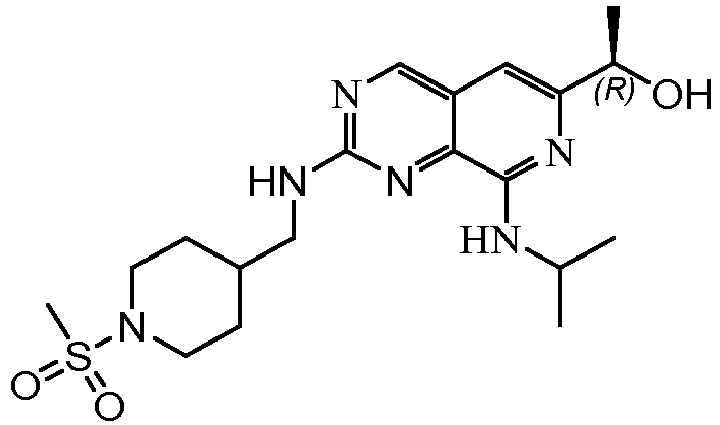
-

-

- (R)-1-(8-(isopropylamino)-2-(methylsulfonyl)pyrido[3,4-d]pyrimidin-6-yl)ethyl benzoate (80 mg, 0.193 mmol, 1.0 eq.) was dissolved in dioxane (2 mL), and the reaction solution was added with tert-butyl 4-(aminomethyl)piperidine-1-carboxylate (124 mg, 0.579 mmol, 3.0 eq.) and reacted at 100 °C for 6 h. When there were no materials left, as detected by LCMS, the reaction solution was added with water (10 mL) and extracted with ethyl acetate (20 mL × 2). The organic phases were combined, dried over anhydrous sodium sulfate and filtered, and the filtrate was concentrated under reduced pressure to give a crude product, which was purified by silica gel column chromatography to give the product (98 mg, yield: 92.5%).
-

- tert-butyl (R)-4-(((6-(1-(benzoyloxy)ethyl)-8-(isopropylamino)pyrido[3,4-d]pyrimidin-2-yl)amino)methyl)piperidine-1-carboxylate (204 mg, 0.372 mmol, 1.0 eq.) was dissolved in DCM (3 mL). The reaction solution was added dropwise with TFA (0.5 mL) and reacted at room temperature for 5 h. When there were no materials left, as detected by LCMS, the reaction solution was concentrated under reduced pressure to give a crude product, which was used in the next step without further purification.
-

- (R)-1-(8-(isopropylamino)-2-((piperidin-4-ylmethyl)amino)pyrido[3,4-d]pyrimidin-6-yl)ethyl benzoate TFA salt (67 mg, 0.120 mmol, 1.0 eq.) was dissolved in DMF (1 mL), and the reaction solution was added with MsCl (21 mg, 0.180 mmol, 1.5 eq.) and TEA (0.034 mL, 0.240 mmol, 2.0 eq.) and reacted at room temperature for 2 h. When there were no materials left, as detected by LCMS, the reaction solution was added with water (10 mL) and extracted with ethyl acetate (20 mL × 2). The organic phases were combined, dried over anhydrous sodium sulfate and filtered, and the filtrate was concentrated under reduced pressure to give a crude product, which was used in the next step without further purification.
-

- (R)-1-(8-(isopropylamino)-2-(((1-(methylsulfonyl)piperidin-4-yl)methyl)amino)pyrido[3,4-d]pyrimidin-6-yl)ethyl benzoate (0.120 mmol, 1.0 eq.) was dissolved in MeOH (3 mL), and the reaction solution was added with K2CO3 (100 mg, 0.723 mmol, 6.0 eq.). The mixture was stirred at room temperature for 6 h. When there were no materials left, as detected by LCMS, the reaction solution was added with water (10 mL) and extracted with ethyl acetate (20 mL × 3). The organic phases were combined, dried over anhydrous sodium sulfate and filtered, and the filtrate was concentrated under reduced pressure to give a crude product, which was purified by HPLC to give the product (13.9 mg, yield: 27.4%).
Molecular formula: C19H30N6O3S Exact mass: 422.21 LC-MS (Pos, m/z) =423.1 [M+H]+. -

-

-
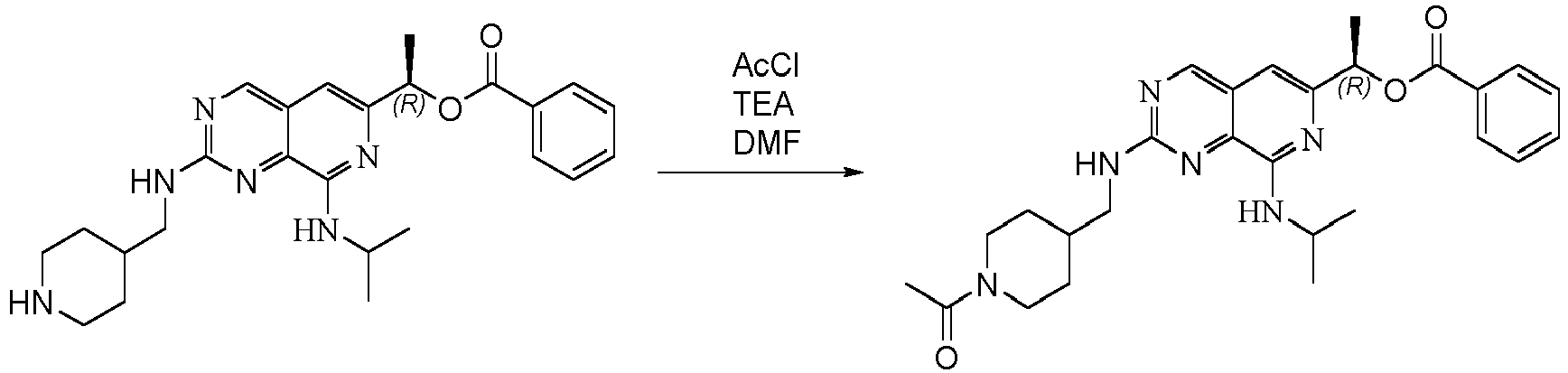
- (R)-1-(8-(isopropylamino)-2-((piperidin-4-ylmethyl)amino)pyrido[3,4-d]pyrimidin-6-yl)ethyl benzoate TFA salt (67 mg, 0.120 mmol, 1.0 eq.) was dissolved in DMF (1 mL), and the reaction solution was added with AcCl (14 mg, 0.180 mmol, 1.5 eq.) and TEA (0.034 mL, 0.240 mmol, 2.0 eq.) and reacted at room temperature for 1 h. When there were no materials left, as detected by LCMS, the reaction solution was added with water (10 mL) and extracted with ethyl acetate (20 mL × 2). The organic phases were combined, dried over anhydrous sodium sulfate and filtered, and the filtrate was concentrated under reduced pressure to give a crude product, which was used in the next step without further purification.
-

- (R)-1-(2-(((1-acetylpiperidin-4-yl)methyl)amino)-8-(isopropylamino)pyrido[3,4-d]pyrimidin-6-yl)ethyl benzoate (0.120 mmol, 1.0 eq.) was dissolved in MeOH (3 mL), and the reaction solution was added with K2CO3 (100 mg, 0.723 mmol, 6.0 eq.). The mixture was stirred at room temperature for 6 h. When there were no materials left, as detected by LCMS, the reaction solution was added with water (10 mL) and extracted with ethyl acetate (20 mL × 3). The organic phases were combined, dried over anhydrous sodium sulfate and filtered, and the filtrate was concentrated under reduced pressure to give a crude product, which was purified by HPLC to give the product (35.2 mg, yield: 75.9%).
1H-NMR (DMSO) δ(ppm): 8.96 (s, 1H), 7.54 (br-s, 1H), 6.82 (s, 1H), 6.32 (d, 1H), 5.07 (d, 1H), 4.54-4.58 (m, 1H), 4.34 (d, 1H), 4.18-4.25 (m, 1H), 3.79 (d, 1H), 3.28-3.33 (m, 3H), 2.96 (t, 1H), 1.96 (s, 3H), 1.68-1.90 (m, 3H), 1.34 (d, 3H), 1.04-1.25 (m, 8H). Molecular formula: C20H30N6O2 Exact mass: 386.24 LC-MS (Pos, m/z) =387.1 [M+H]+. -
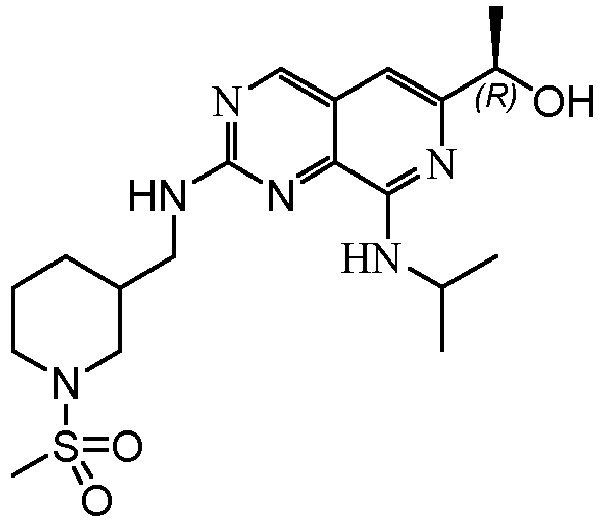
- The titled compound was prepared as same as example 68 using corresponding chemicals.
- 1H-NMR (DMSO) δ(ppm): 8.98 (s, 1H), 7.60 (br-s, 1H), 7.17 (t, 1H), 6.83 (s, 1H), 6.31 (d, 1H), 5.08 (br-s, 1H), 4.55 (br-s, 1H), 4.19-4.24 (m, 1H), 3.59 (d, 1H), 3.43 (d, 1H), 3.31-3.33 (m, 1H), 2.81 (s, 3H), 2.68 (t, 1H), 2.48-2.53 (m, 1H), 1.87-1.93 (m, 1H), 1.72-1.79 (m, 2H), 1.40-1.49 (m, 1H), 1.35 (d, 3H), 1.10-1.25 (m, 7H).
- Molecular formula: C19H30N6O3S Exact mass: 422.21 LC-MS (Pos, m/z) =423.1 [M+H]+.
-

- The titled compound was prepared as same as example 69 using corresponding chemicals.
- Molecular formula: C20H30N6O2 Exact mass: 386.24 LC-MS (Pos, m/z) =387.1 [M+H]+.
-

- The titled compound was prepared as same as example 69 using corresponding chemicals.
- 1H-NMR (DMSO) δ(ppm): 8.95 (s, 1H), 7.67 (d, 1H), 7.49 (br-s, 1H), 6.81 (s, 1H), 6.29 (d, 1H), 5.07 (d, 1H), 4.52-4.58 (m, 1H), 4.16-4.25 (m, 1H), 3.40-3.50 (m, 1H), 3.22 (t, 1H), 1.73-1.79 (m, 7H), 1.56-1.59 (m, 1H), 1.37 (d, 3H), 1.24 (d, 6H), 0.95-1.15 (m, 4H).
- Molecular formula: C21H32N6O2 Exact mass: 400.26 LC-MS (Pos, m/z) =401.15 [M+H]+.
-

- The titled compound was prepared as same as example 68 using corresponding chemicals.
- 1H-NMR (DMSO) δ(ppm): 8.95 (s, 1H), 7.48 (br-s, 1H), 6.96 (d, 1H), 6.82 (s, 1H), 6.29 (d, 1H), 5.07 (d, 1H), 4.54-4.57 (m, 1H), 4.16-4.25 (m, 1H), 3.23 (t, 2H), 3.00-3.07 (m, 1H), 2.88 (s, 3H), 1.90 (br-d, 2H), 1.79 (br-d, 2H), 1.48-1.60 (m, 1H), 1.34 (d, 3H), 1.24 (d, 6H), 1.00-1.20 (m, 4H).
- Molecular formula: C20H32N6O3S Exact mass: 436.23 LC-MS (Pos, m/z) =437.15 [M+H]+.
-

-

-

- (R)-1-(2-(((1r,4R)-4-aminocyclohexyl)amino)-8-(isopropylamino)pyrido[3,4-d]pyrimidin-6-yl)ethyl benzoate (44.9 mg, 0.10 mmol, 1.0 eq.) and tetrahydropyran-4-one (12 mg, 0.120 mmol, 1.2 eq.) were dissolved in DCM (1 mL). After the reaction solution was stirred at room temperature for 30 min, the reaction solution was added with NaBH(OAc)3 (53 mg, 0.250 mmol, 2.5 eq.) and reacted at room temperature for 3 h. When there were no materials left, as detected by LCMS, the reaction solution was added with sat-NaHCO3 aq (5 mL) and extracted with ethyl acetate (20 mL × 2). The organic phases were combined, dried over anhydrous sodium sulfate and filtered, and the filtrate was concentrated under reduced pressure to give a crude product, which was used in the next step without further purification.
-

- (R)-1-(8-(isopropylamino)-2-(((1r,4R)-4-((tetrahydro-2H-pyran-4-yl)amino)cyclohexyl)amino)pyrido[3,4-d]pyrimidin-6-yl)ethyl benzoate (0.10 mmol, 1.0 eq.) was dissolved in MeOH (1 mL) and THF (1 mL), and the reaction solution was added with 4M LiOH aq ( 0.075 mL, 0.30 mmol, 3.0 eq.). The mixture was stirred at room temperature for 3 h. When there were no materials left, as detected by LCMS, the reaction solution was added with water (3 mL) and extracted with ethyl acetate (30 mL × 2). The organic phases were combined, dried over anhydrous sodium sulfate and filtered, and the filtrate was concentrated under reduced pressure to give a crude product, which was purified by HPLC to give the product (17.5 mg, yield: 40.8%).
Molecular formula: C23H36N6O2 Exact mass: 428.29 LC-MS (Pos, m/z) =429.4 [M+H]+. -

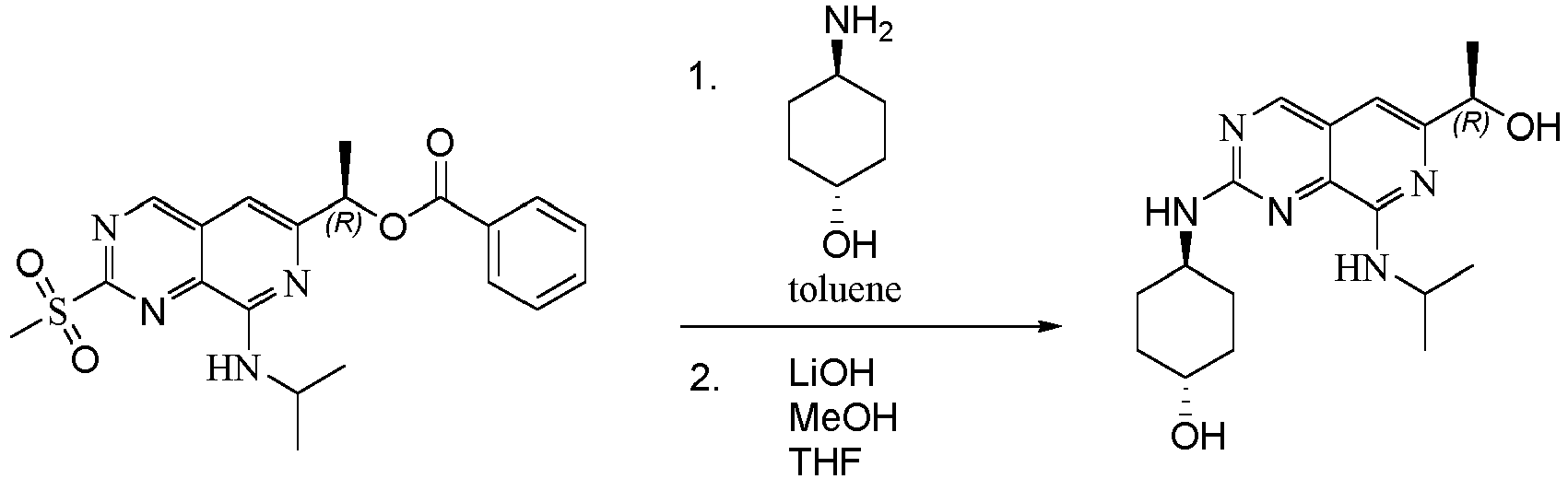
- (R)-1-(8-(isopropylamino)-2-(methylsulfonyl)pyrido[3,4-d]pyrimidin-6-yl)ethyl benzoate (41 mg, 0.10 mmol, 1.0 eq.) was dissolved in toluene (0.5 mL), and the reaction solution was added with 4-aminocyclohexanol (46 mg, 0.40 mmol, 4.0 eq.) and reacted at 120 °C for 48 h. When there were no materials left, as detected by LCMS, the reaction solution was cool to room temperature and added with MeOH (0.5 mL), THF (0.5 mL) and 4M LiOH aq (0.10 mL, 0.40 mmol, 4.0 eq.). The mixture was stirred at room temperature for overnight. When there were no materials left, as detected by LCMS, the reaction solution was added with water (3 mL) and extracted with ethyl acetate (30 mL × 2). The organic phases were combined, dried over anhydrous sodium sulfate and filtered, and the filtrate was concentrated under reduced pressure to give a crude product, which was purified by HPLC to give the product (5.7 mg, yield: 17%). 1H-NMR (CDCl3) δ(ppm): 8.79 (s, 1H), 6.56 (s, 1H), 6.22 (d, 1H), 5.10 (d, 1H), 4.74 (q, 1H), 4.30-4.36 (m, 1H), 3.85-3.90 (m, 1H), 3.65-3.77 (m, 1H), 2.16-2.22 (m, 2H), 2.04-2.08 (m, 2H), 1.44-1.60 (m, 5H), 1.30-1.47 (m, 8H).
Molecular formula: C18H27N5O2 Exact mass: 345.22 LC-MS (Pos, m/z) =346.3 [M+H]+. -


- (R)-1-(2-(((1r,4R)-4-aminocyclohexyl)amino)-8-(isopropylamino)pyrido[3,4-d]pyrimidin-6-yl)ethyl benzoate (22 mg, 0.05 mmol, 1.0 eq.) was dissolved in MeOH (0.3 mL) and THF (0.3 mL), and the reaction solution was added with 4M LiOH aq ( 0.05 mL, 0.20 mmol, 4.0 eq.). The mixture was stirred at room temperature for 2 h. When there were no materials left, as detected by LCMS, the reaction solution was added with water (3 mL) and extracted with ethyl acetate (30 mL × 2). The organic phases were combined, dried over anhydrous sodium sulfate and filtered, and the filtrate was concentrated under reduced pressure to give a crude product, which was purified by HPLC to give the product (8.3 mg, yield:48%).
Molecular formula: C18H28N6O Exact mass: 344.23 LC-MS (Pos, m/z) =345.3 [M+H]+. -


- (R)-1-(8-(isopropylamino)-2-(methylsulfonyl)pyrido[3,4-d]pyrimidin-6-yl)ethyl benzoate (41 mg, 0.10 mmol, 1.0 eq.) was dissolved in dioxane (0.5 mL), and the reaction solution was added with (1S,3R)-3-aminocyclopentanecarboxylic acid (26 mg, 0.20 mmol, 2.0 eq.) and K2CO3 (55 mg, 0.40 mmol, 4.0 eq.). The mixture was reacted at 120 °C for 48 h. When there were no materials left, as detected by LCMS, the reaction solution was cool to room temperature and added with MeOH (0.5 mL), THF (0.5 mL) and 4M LiOH aq (0.10 mL, 0.40 mmol, 4.0 eq.). The mixture was stirred at room temperature for overnight. When there were no materials left, as detected by LCMS, the reaction solution was acidified with 4M HCl aq and extracted with a mixuture of ethyl acetate and THF (40 mL × 2). The organic phases were combined, dried over anhydrous sodium sulfate and filtered, and the filtrate was concentrated under reduced pressure to give a crude product, which was purified by HPLC to give the product (9.2 mg, yield: 20%).
Molecular formula: C18H25N5O3 Exact mass: 359.20 LC-MS (Pos, m/z) =360.2 [M+H]+. -

- The titled compound was prepared as same as example 77 using corresponding chemicals.
- Molecular formula: C18H25N5O3 Exact mass: 359.20 LC-MS (Pos, m/z) =360.19 [M+H]+.
-


- (1S,3R)-3-((6-((R)-1-hydroxyethyl)-8-(isopropylamino)pyrido[3,4-d]pyrimidin-2-yl)amino)cyclopentane-1-carboxylic acid (8.5 mg, 0.024 mmol, 1.0 eq.) and methylamine (2.9 mg, 0.028 mmol, 1.2 eq.) were dissolved in DMF (0.12 mL), and the reaction solution was added with HATU (12 mg, 0.031 mmol, 1.3 eq.) and TEA (0.01 mL, 0.071 mmol, 3.0 eq.). The mixture was stirred at room temperature for 1 h. When there were no materials left, as detected by LCMS, the reaction solution was added with water (3 mL) and extracted with ethyl acetate (30 mL × 2). The organic phases were combined, dried over anhydrous sodium sulfate and filtered, and the filtrate was concentrated under reduced pressure to give a crude product, which was purified by HPLC to give the product (7.1 mg, yield:81%).
1H-NMR (CDCl3) δ(ppm): 8.78 (s, 1H), 6.53 (br-s, 2H), 6.30 (s, 1H), 5.57 (s, 1H), 4.74 (d, 1H), 4.51 (d, 1H), 4.25-4.38 (m, 2H), 2.84 (s, 3H), 2.70-2.74 (m, 1H), 2.17-2.23 (m, 1H), 1.91-2.03 (m, 4H), 1.48 (d, 3H), 1.33 (d, 6H).
Molecular formula: C19H28N6O2 Exact mass: 372.23 LC-MS (Pos, m/z) =373.3 [M+H]+. -

- The titled compound was prepared as same as example 74 using corresponding chemicals.
- 1H-NMR (CDCl3) δ(ppm): 8.78 (s, 1H), 6.55 (s, 1H), 6.20 (d, 1H), 5.11 (d, 1H), 4.81-4.85 (m, 2H), 4.74 (q, 1H), 4.40-4.44 (m, 2H), 4.29-4.37 (m, 1H), 4.05-4.11 (m, 1H), 3.81-3.90 (m, 1H), 2.40-2.50 (m, 1H), 2.18-2.47 (m, 2H), 1.85-1.93 (m, 2H), 1.48 (d, 3H), 1.22-1.33 (m, 10H).
- Molecular formula: C21H32N6O2 Exact mass: 400.26 LC-MS (Pos, m/z) =401.3 [M+H]+.
-

-

-

- (R)-1-(8-chloro-2-(methylthio)pyrido[3,4-d]pyrimidin-6-yl)ethyl benzoate (3000 mg, 8.33 mmol, 1.0 eq.) was dissolved in DCM (83 mL), and the reaction solution was added with mCPBA (4317 mg, 17.5 mmol, 2.1 eq.) at 0 °C and reacted at room temperature for overnight. When there were no materials left, as detected by LCMS, the reaction solution was added with sat-NaHCO3 aq (100 mL) and extracted with DCM (150 mL × 2). The organic phases were combined, dried over anhydrous sodium sulfate and filtered, and the filtrate was concentrated under reduced pressure to give a crude product, which was purified by silica gel column chromatography to give the product (2350 mg, yield: 71.9%).
-

- (R)-1-(2-(((1-acetylpiperidin-4-yl)methyl)amino)-8-(isopropylamino)pyrido[3,4-d]pyrimidin-6-yl)ethyl benzoate (274 mg, 0.70 mmol, 1.0 eq.) was dissolved in THF (83 mL), and the reaction solution was added with 2M NH3 in isopropanol (0.39 mL, 0.77 mmol, 1.1 eq.) and reacted at room temperature for overnight. When there were no materials left, as detected by LCMS, the reaction solution was concentrated under reduced pressure to give a crude product, which was used in the next step without further purification.
-

- (R)-1-(2-amino-8-chloropyrido[3,4-d]pyrimidin-6-yl)ethyl benzoate (0.70 mmol, 1.0 eq.) was dissolved in dioxane (5 mL), and the reaction solution was added with propan-2-amine (1.0 mL) and reacted at 120 °C for overnight. When there were no materials left, as detected by LCMS, the reaction solution was concentrated under reduced pressure to give a crude product, which was purified by silica gel column chromatography to give the product (213 mg, yield: 86.6%).
-

- (R)-1-(2-amino-8-(isopropylamino)pyrido[3,4-d]pyrimidin-6-yl)ethyl benzoate (24.6 mg, 0.070 mmol, 1.0 eq.) was dissolved in DCM (0.7 mL), and the reaction solution was added with 2-methylpropanoyl chloride (0.0089 mL, 00.84 mmol, 1.2 eq.) and pyridine (0.011 mL, 0.14 mmol, 2.0 eq.) at 0 °C and reacted at room temperature. When there were no materials left, as detected by LCMS, the reaction solution was added with sat-NaHCO3 aq (2 mL) and extracted with ethyl acetate (20 mL × 2). The organic phases were combined, dried over anhydrous sodium sulfate and filtered, and the filtrate was concentrated under reduced pressure to give a crude product, which was used in the next step without further purification.
-

- (R)-1-(2-isobutyramido-8-(isopropylamino)pyrido[3,4-d]pyrimidin-6-yl)ethyl benzoate (0.07 mmol, 1.0 eq.) was dissolved in MeOH (0.7 mL) and THF (0.7 mL), and the reaction solution was added with 4M LiOH aq ( 0.07 mL, 0.28 mmol, 4.0 eq.). The mixture was stirred at room temperature for 2 h. When there were no materials left, as detected by LCMS, the reaction solution was concentrated under reduced pressure to give a crude product, which was purified by silica gel column chromatography and HPLC to give the product (3.9 mg, yield:17%).
Molecular formula: C16H23N5O2 Exact mass: 317.19 LC-MS (Pos, m/z) =318.2 [M+H]+. -

-

-

- (R)-1-(8-(isopropylamino)-2-(methylsulfonyl)pyrido[3,4-d]pyrimidin-6-yl)ethyl benzoate (750 mg, 1.81 mmol, 1.0 eq.) was dissolved in dioxane (5 mL), and the reaction solution was added with tert- butyl N-[4-(aminomethyl)cyclohexyl]carbamate (830 mg, 3.64 mmol, 2.0 eq.) and K2CO3 (500 mg, 3.64 mmol, 2.0 eq.) and reacted at 100 °C for 3 h. When there were no materials left, as detected by LCMS, the reaction solution was added with water and extracted with ethyl acetate twice. The organic phases were combined, dried over anhydrous sodium sulfate and filtered, and the filtrate was concentrated under reduced pressure to give a crude product, which was purified by silica gel column chromatography to give the product (694 mg, yield: 68.2%).
-

- (R)-1-(2-((((1r,4R)-4-((tert-butoxycarbonyl)amino)cyclohexyl)methyl)amino)-8-(isopropylamino)pyrido[3,4-d]pyrimidin-6-yl)ethyl benzoate (694 mg, 1.23 mmol, 1.0 eq.) was dissolved in DCM (5 mL). The reaction solution was added dropwise with TFA (1 mL) and reacted at room temperature for overnight. When there were no materials left, as detected by LCMS, the reaction solution was concentrated under reduced pressure to give a crude product, which was used in the next step without further purification.
-

- (R)-1-(2-((((1r,4R)-4-aminocyclohexyl)methyl)amino)-8-(isopropylamino)pyrido[3,4-d]pyrimidin-6-yl)ethyl benzoate (32 mg, 0.069 mmol, 1.0 eq.) was dissolved in MeOH (2 mL), and the reaction solution was added with 4M LiOH aq (0.2 mL, 0.80 mmol, 12.0 eq.). The mixture was stirred at room temperature for 2 h. When there were no materials left, as detected by LCMS, the reaction solution was concentrated under reduced pressure to give a crude product, which was purified by HPLC to give the product (21 mg, yield:84.7%).
Molecular formula: C19H30N6O Exact mass: 358.25 LC-MS (Pos, m/z) =359.3 [M+H]+. -

-

-

- (R)-1-(1,7-dichloro-2,6-naphthyridin-3-yl)ethyl benzoate (278 mg, 0.80 mmol, 1.0 eq.) was dissolved in dioxane (5 mL), and the reaction solution was added with piperidine (0.5 mL) and reacted at 100 °C. When there were no materials left, as detected by LCMS, the reaction solution was concentrated under reduced pressure to give a crude product, which was purified by silica gel column chromatography to give the product (308 mg, yield: 97.2%).
-

- (R)-1-(7-chloro-1-(piperidin-1-yl)-2,6-naphthyridin-3-yl)ethyl benzoate (72.2 mg, 0.182 mmol, 1.0 eq.) was dissolved in THF (0.9 mL), and the reaction solution was added with Pd2(dba)3, (12.8 mg, 0.018 mmol, 0.1 eq.), 2-(Dicyclohexylphosphino)biphenyl (12.8 mg, 0.037 mmol, 0.2 eq.) and 1.3M LHMDS in THF (0.17 mL, 0.22 mmol, 1.2 eq.) and reacted at 65 °C. When there were no materials left, as detected by LCMS, the reaction solution was added with 1M HCl aq (0.2 mL) and stirred at room temperature for 20 min. The mixture was added with water (5 mL) and extracted with ethyl acetate (40 mL × 2). The organic phases were combined, dried over anhydrous sodium sulfate and filtered, and the filtrate was concentrated under reduced pressure to give a crude product, which was purified by silica gel column chromatography to give the product (22 mg, yield: 32.2%).
-

- (R)-1-(7-amino-1-(piperidin-1-yl)-2,6-naphthyridin-3-yl)ethyl benzoate (22.2 mg, 0.059 mmol, 1.0 eq.) was dissolved in DCM (0.59 mL), and the reaction solution was added with 2-methylpropanoyl chloride (0.0075 mL, 0.071 mmol, 1.2 eq.) and pyridine (0.014 mL, 0.18 mmol, 3.0 eq.) at 0 °C and reacted at room temperature for 1 h. When there were no materials left, as detected by LCMS, the reaction solution was added with sat-NaHCO3 aq (2 mL) and extracted with ethyl acetate (20 mL × 2). The organic phases were combined, dried over anhydrous sodium sulfate and filtered, and the filtrate was concentrated under reduced pressure to give a crude product, which was used in the next step without further purification.
-

- (R)-1-(7-isobutyramido-1-(piperidin-1-yl)-2,6-naphthyridin-3-yl)ethyl benzoate (0.059 mmol, 1.0 eq.) was dissolved in MeOH (0.59 mL) and THF (0.59 mL), and the reaction solution was added with K2CO3 (24.5 mg, 0.18 mmol, 3.0 eq.). The mixture was stirred at room temperature for overnight. When there were no materials left, as detected by LCMS, the reaction solution was passed through filter and concentrated under reduced pressure to give a crude product, which was purified by HPLC to give the product (15.2 mg, yield:74.8%).
1H-NMR (CDCl3) δ(ppm): 8.83 (s, 1H), 8.72 (s, 1H), 8.07 (s, 1H), 7.06 (s, 1H), 4.84-4.88 (m, 1H), 3.48-3.51 (m, 4H), 2.57-2.64 (m, 1H), 1.80-1.86 (m, 4H), 1.70-1.73 (m, 2H), 1.53 (d, 3H), 1.30 (d, 6H).
Molecular formula: C19H26N4O2 Exact mass: 342.21 LC-MS (Pos, m/z) =343.3 [M+H]+. -

- The titled compound was prepared as same as example 82 using corresponding chemicals.
- 1H-NMR (CDCl3) δ(ppm): 8.76 (s, 1H), 6.54 (s, 1H), 6.22 (d, 1H), 5.45 (br-s, 1H), 4.72 (q, 1H), 4.28-4.37 (m, 1H), 3.37 (br-s, 2H), 3.08-3.11 (m, 2H), 2.58-2.65 (m, 2H), 1.44-1.49 (m, 3H), 1.47 (d, 3H), 1.22-1.36 (m, 8H).
- Molecular formula: C18H28N6O Exact mass: 344.23 LC-MS (Pos, m/z) =345.3 [M+H]+.
-

- The titled compound was prepared as same as example 75 using corresponding chemicals.
- 1H-NMR (CDCl3) δ(ppm): 8.80 (s, 1H), 6.57 (s, 1H), 6.19 (br-s, 1H), 5.49 (br-s, 1H), 4.72-4.76 (m, 1H), 4.32-4.38 (m, 1H), 4.17 (br-s, 1H), 3.56-3.75 (m, 4H), 1.84-1.90 (m, 2H), 1.49 (d, 3H), 1.32 (d, 6H).
- Molecular formula: C15H23N5O2 Exact mass: 305.19 LC-MS (Pos, m/z) =306.3 [M+H]+.
-

-

-

- (R)-1-(1,7-dichloro-2,6-naphthyridin-3-yl)ethyl benzoate (1000 mg, 2.88 mmol, 1.0 eq.) was dissolved in dioxane (7 mL), and the reaction solution was added with propan-2-amine (1.5 mL) and reacted at 115 °C for overnight. When there were no materials left, as detected by LCMS, the reaction solution was concentrated under reduced pressure to give a crude product, which was purified by silica gel column chromatography to give the product (952 mg, yield: 89.5%).
-

- (R)-1-(7-chloro-1-(isopropylamino)-2,6-naphthyridin-3-yl)ethyl benzoate (100 mg, 0.27 mmol, 1.0 eq.), diphenylmethanimine (0.054 mL, 0.32 mmol, 1.2 eq.) was dissolved in dioxane (1.4 mL), and the reaction solution was added with Pd2(dba)3 (25 mg, 0.027 mmol, 0.1 eq.), BINAP (34 mg, 0.054 mmol, 0.2 eq.) and cesium carbonate (264 mg, 0.81 mmol, 3.0 eq.). The mixture was reacted at 120 °C for overnight in a sealed tube in nitrogen atmosphere. When there were no materials left, as detected by LCMS, the reaction solution was added with ethyl acetate (80 mL), stirred for 5 min and filtered, the filter cake was rinsed with ethyl acetate, and the filtrate was concentrated under reduced pressure to give a crude product, which was used in the next step without further purification.
-

- (R)-1-(7-((diphenylmethylene)amino)-1-(isopropylamino)-2,6-naphthyridin-3-yl)ethyl benzoate (0.27 mmol, 1.0 eq.) was dissolved in THF (2.7 mL). The reaction solution was added with 2N aqueous citric acid solution (0.68 mL) and reacted at room temperature for overnight. When there were no materials left, as detected by LCMS, the reaction solution was added with sat-NaHCO3 aq (2 mL) and extracted with ethyl acetate (20 mL × 2). The organic phases were combined, dried over anhydrous sodium sulfate and filtered, and the filtrate was concentrated under reduced pressure to give a crude product, which was purified by amino column chromatography to give the product (43.2 mg, yield: 45.6%)
-

- (R)-1-(7-amino-1-(isopropylamino)-2,6-naphthyridin-3-yl)ethyl benzoate (43.2 mg, 0.123 mmol, 1.0 eq.) and (3R)-1-tert-butoxycarbonylpiperidine-3-carboxylic acid (34 mg, 0.148 mmol, 1.2 eq.) were dissolved in DCM (0.6 mL), and the reaction solution was added with HATU (56 mg, 0.15 mmol, 1.2 eq.) and TEA (0.026 mL, 0.19 mmol, 1.5 eq.). The mixture was stirred at room temperature for overnight. When there were no materials left, as detected by LCMS, the reaction solution was added with water (5 mL) and extracted with ethyl acetate (20 mL × 2). The organic phases were combined, dried over anhydrous sodium sulfate and filtered, and the filtrate was concentrated under reduced pressure to give a crude product, which was used in the next step without further purification.
-

- tert-butyl (R)-3-((7-((R)-1-(benzoyloxy)ethyl)-5-(isopropylamino)-2,6-naphthyridin-3-yl)carbamoyl)piperidine-1-carboxylate (0.123 mmol, 1.0 eq.) was dissolved in MeOH (2 mL) and THF (2 mL), and the reaction solution was added with K2CO3 (100 mg, 0.723 mmol, 5.9 eq.). The mixture was stirred at room temperature for overnight. When there were no materials left, as detected by LCMS, the reaction solution was concentrated under reduced pressure, added with water (5 mL) and extracted with ethyl acetate (20 mL × 2). The organic phases were combined, washed with brine, dried over anhydrous sodium sulfate and filtered, and the filtrate was concentrated under reduced pressure to give a crude product, which was used in the next step without further purification.
-

- tert-butyl (R)-3-((7-((R)-1-hydroxyethyl)-5-(isopropylamino)-2,6-naphthyridin-3-yl)carbamoyl)piperidine-1-carboxylate (0.123 mmol, 1.0 eq.) was dissolved in DCM (1 mL). The reaction solution was added dropwise with TFA(1 mL) and reacted at room temperature for 2 h. When there were no materials left, as detected by LCMS, the reaction solution was concentrated under reduced pressure to give a crude product, which was purified by HPLC to give the product (10.7 mg, yield:24.3%).
Molecular formula: C19H27N5O2 Exact mass: 357.22 LC-MS (Pos, m/z) =358.19 [M+H]+. -

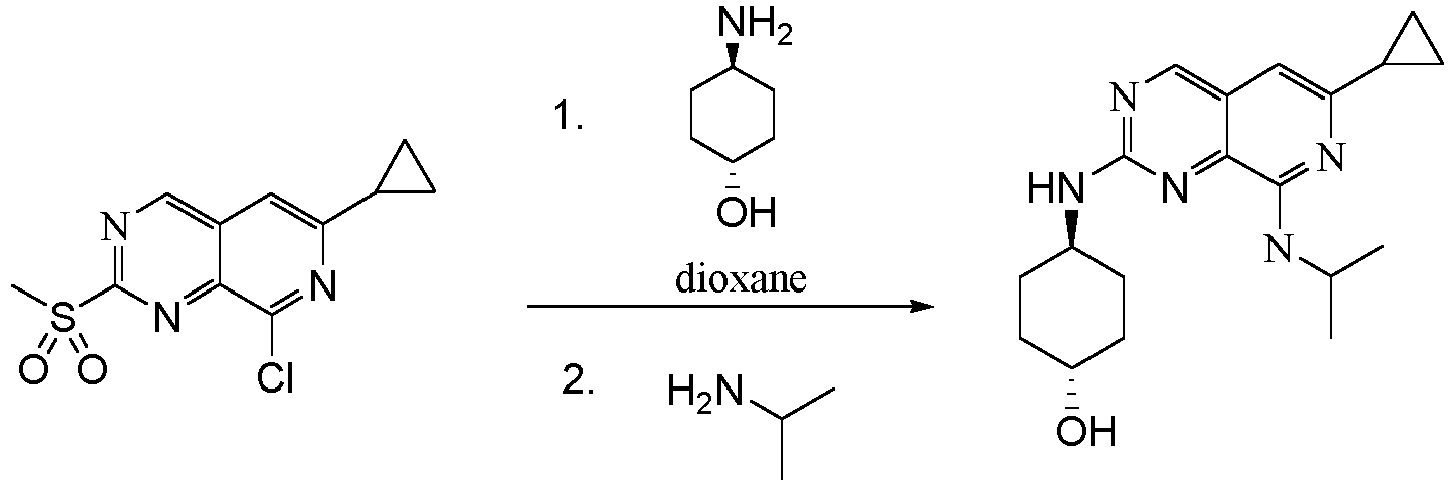
- 8-chloro-6-cyclopropyl-2-(methylsulfonyl)pyrido[3,4-d]pyrimidine (50 mg, 0.177 mmol, 1.0 eq.) was dissolved in dioxane (0.89 mL), and the reaction solution was added with 4-aminocyclohexanol (61 mg, 0.53 mmol, 3.0 eq.) and reacted at room temperature. When there were no materials left, as detected by LCMS, the reaction solution was added with propan-2-amine (0.88 mL) and reacted at 100 °C for overnight. When there were no materials left, as detected by LCMS, the reaction solution was was concentrated under reduced pressure to give a crude product, which was purified by HPLC to give the product (12.3 mg, yield: 20.4%).
Molecular formula: C19H27N5O Exact mass: 341.22 LC-MS (Pos, m/z) =342.3 [M+H]+. -

-

-

- (R)-1-(8-(isopropylamino)-2-(methylthio)pyrido[3,4-d]pyrimidin-6-yl)ethyl benzoate (1595 mg, 4.17 mmol, 1.0 eq.) was dissolved in MeOH (10 mL) and THF (10 mL), and the reaction solution was added with 4M LiOH aq (1.1 mL, 4.4 mmol, 1.1 eq.). The mixture was stirred at room temperature for 3 h. When there were no materials left, as detected by LCMS, the reaction solution was added with water (20 mL) and extracted with ethyl acetate (100 mL × 2). The organic phases were combined, dried over anhydrous sodium sulfate and filtered, and the filtrate was concentrated under reduced pressure to give a crude product, which was purified by silica gel column chromatography to give the product (1050 mg, yield: 90.5%).
-

- (R)-1-(8-(isopropylamino)-2-(methylthio)pyrido[3,4-d]pyrimidin-6-yl)ethan-1-ol (1050 mg, 3.77 mmol, 1.0 eq.) was dissolved in DCM (30 mL), and the reaction solution was added with MnO2 (16.3 g, 189 mmol, 50 eq.). The mixture was stirred at room temperature for 5 h. When there were no materials left, as detected by LCMS, the reaction solution was passed through Celite pad and concentrated under reduced pressure to give a crude product, which was purified by silica gel column chromatography to give the product (849 mg, yield: 81.4%).
-

- 1-(8-(isopropylamino)-2-(methylthio)pyrido[3,4-d]pyrimidin-6-yl)ethan-1-one (100 mg, 0.276 mmol, 1.0 eq.) was dissolved in DCM (6 mL), and the reaction solution was added with mCPBA (98 mg, 0.40 mmol, 1.1 eq.) at 0 °C and reacted at 0 °C for 3 h. When there were no materials left, as detected by LCMS, the reaction solution was passed through Celite pad. The solution was added with sat-NaHCO3 aq (10 mL) and extracted with ethyl acetate (40 mL × 2). The organic phases were combined, dried over anhydrous sodium sulfate and filtered, and the filtrate was concentrated under reduced pressure to give a crude product, which was used in the next step without further purification.
-

- 1-(8-(isopropylamino)-2-(methylsulfinyl)pyrido[3,4-d]pyrimidin-6-yl)ethan-1-one (53 mg, 0.18 mmol, 1.0 eq.) was dissolved in dioxane (0.9 mL), and the reaction solution was added with 4-aminocyclohexanol (100 mg, 0.90 mmol, 5.0 eq.) and reacted at 120 °C for overnight. When there were no materials left, as detected by LCMS, the reaction solution was concentrated under reduced pressure to give a crude product, which was purified by HPLC to give the product (22.4 mg, yield: 36.1%).
Molecular formula: C18H25N5O2 Exact mass: 343.20 LC-MS (Pos, m/z) =344.3 [M+H]+. -

-

-
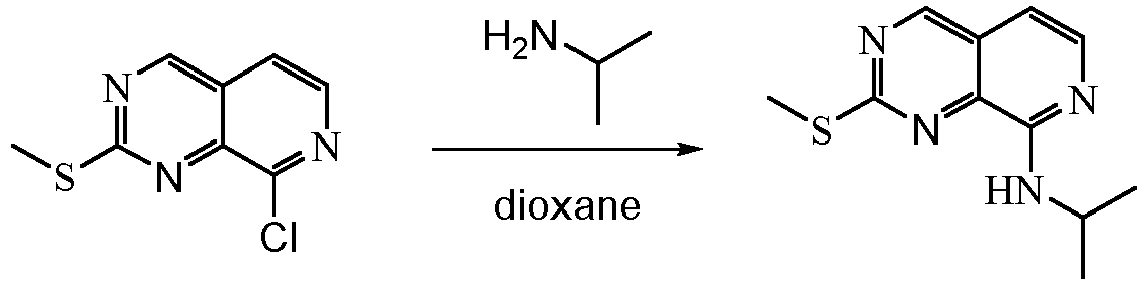
- 8-chloro-2-(methylthio)pyrido[3,4-d]pyrimidine (100 mg, 0.47 mmol, 1.0 eq.) was dissolved in dioxane (2 mL), and the reaction solution was added with propan-2-amine (1.5 mL) and reacted at 100 °C for overnight. When there were no materials left, as detected by LCMS, the reaction solution was added with water (10 mL) and extracted with ethyl acetate (30 mL × 2). The organic phases were combined, dried over anhydrous sodium sulfate and filtered, and the filtrate was concentrated under reduced pressure to give a crude product, which was purified by silica gel column chromatography to give the product (106 mg, yield: 95.8%).
-
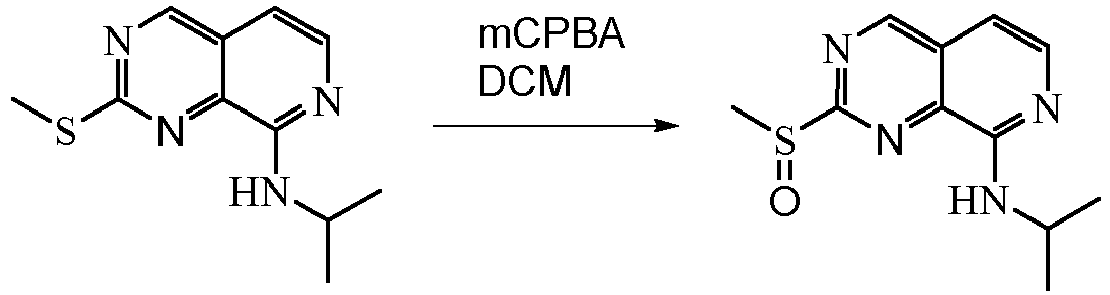
- N-isopropyl-2-(methylthio)pyrido[3,4-d]pyrimidin-8-amine (140 mg, 0.60 mmol, 1.0 eq.) was dissolved in DCM (4 mL), and the reaction solution was added with mCPBA (160 mg, 0.66 mmol, 1.1 eq.) at 0 °C and reacted at 0 °C for 2 h. When there were no materials left, as detected by LCMS, the reaction solution was passed through Celite pad. The solution was added with sat-NaHCO3 aq (10 mL) and extracted with ethyl acetate (40 mL × 2). The organic phases were combined, dried over anhydrous sodium sulfate and filtered, and the filtrate was concentrated under reduced pressure to give a crude product, which was used in the next step without further purification.
-

- N-isopropyl-2-(methylsulfinyl)pyrido[3,4-d]pyrimidin-8-amine (75 mg, 0.30 mmol, 1.0 eq.) was dissolved in dioxane (0.5 mL), and the reaction solution was added with 4-aminocyclohexanol (173 mg, 1.5 mmol, 5.0 eq.) and reacted at 120 °C for 2 d. When there were no materials left, as detected by LCMS, the reaction solution was concentrated under reduced pressure to give a crude product, which was purified by HPLC to give the product (38.4 mg, yield: 42.5%).
Molecular formula: C16H23N5O Exact mass: 301.19 LC-MS (Pos, m/z) =302.2 [M+H]+. -

- The titled compound was prepared as same as example 89 using corresponding chemicals.
- Molecular formula: C18H27N5O Exact mass: 329.22 LC-MS (Pos, m/z) =330.3 [M+H]+.
-

- The titled compound was prepared as same as example 89 using corresponding chemicals.
- Molecular formula: C17H23F2N5O Exact mass: 351.19 LC-MS (Pos, m/z) =352.3 [M+H]+.
-

- The titled compound was prepared as same as example 89 using corresponding chemicals.
- Molecular formula: C17H25N5O Exact mass: 315.21 LC-MS (Pos, m/z) =316.3 [M+H]+.
-

- The titled compound was prepared as same as example 89 using corresponding chemicals.
- Molecular formula: C18H23N5O Exact mass: 325.19 LC-MS (Pos, m/z) =326.3 [M+H]+.
-

- The titled compound was prepared as same as example 89 using corresponding chemicals.
- Molecular formula: C17H22N6O Exact mass: 326.19 LC-MS (Pos, m/z) =327.2 [M+H]+.
-

- The titled compound was prepared as same as example 89 using corresponding chemicals.
- Molecular formula: C19H27N5O2 Exact mass: 357.22 LC-MS (Pos, m/z) =358.3 [M+H]+.
-

- The titled compound was prepared as same as example 89 using corresponding chemicals.
- Molecular formula: C19H29N5O Exact mass: 343.24 LC-MS (Pos, m/z) =344.3 [M+H]+.
-

- The titled compound was prepared as same as example 75 using corresponding chemicals.
- Molecular formula: C17H25N5O2 Exact mass: 331.20 LC-MS (Pos, m/z) =332.3 [M+H]+.
-

- The titled compound was prepared as same as example 1 using corresponding chemicals.
- 1H-NMR (CDCl3) δ(ppm): 8.75 (s, 1H), 8.45 (s, 1H), 8.28 (s, 1H), 6.81 (s, 1H), 5.44 (d, 1H), 5.30 (d, 1H), 4.77-4.82 (m, 1H), 4.42-4.49 (m, 1H), 3.81-3.90 (m, 1H), 2.45-2.55 (m, 1H), 2.28-2.33 (m, 1H), 1.90-2.01 (m, 6H), 1.35-1.53 (m, 6H), 1.32 (d, 6H).
- Molecular formula: C22H31N5O3 Exact mass: 413.24 LC-MS (Pos, m/z) =414.3 [M+H]+.
-

- The titled compound was prepared as same as example 1 using corresponding chemicals.
- Molecular formula: C22H29N5O2 Exact mass: 395.23 LC-MS (Pos, m/z) = 396.3 [M+H]+.
-

- The titled compound was prepared as same as example 75 using corresponding chemicals.
- Molecular formula: C19H29N5O2 Exact mass: 359.23 LC-MS (Pos, m/z) = 360.29 [M+H]+.
-

-

-

- (R)-1-(7-chloro-1-(isopropylamino)-2,6-naphthyridin-3-yl)ethyl benzoate (110 mg, 0.30 mmol, 1.0 eq.), tert-butyl N-(4-aminocyclohexyl)carbamate (130 mg, 0.60 mmol, 2.0 eq.) was dissolved in dioxane (1.5 mL), and the reaction solution was added with Pd2(dba)3 (55 mg, 0.06 mmol, 0.2 eq.), SPhos (49 mg, 0.124 mmol, 0.4 eq.) and cesium carbonate (290 mg, 0.9 mmol, 3.0 eq.). The mixture was reacted at 120 °C for 2 h in a sealed tube in nitrogen atmosphere. When there were no materials left, as detected by LCMS, The solution was added with water (15 mL) and extracted with ethyl acetate (30 mL × 3). The organic phases were combined, dried over anhydrous sodium sulfate and filtered, and the filtrate was concentrated under reduced pressure to give a crude product, which was used in the next step without further purification.
-

- (R)-1-(7-(((1r,4R)-4-((tert-butoxycarbonyl)amino)cyclohexyl)amino)-1-(isopropylamino)-2,6-naphthyridin-3-yl)ethyl benzoate (0.3 mmol, 1.0 eq.) was dissolved in DCM (1 mL). The reaction solution was added dropwise with TFA (1 mL) and reacted at room temperature for 2 h. When there were no materials left, as detected by LCMS, the reaction solution was concentrated under reduced pressure to give a crude product, which was purified by cation exchange resin to give the product (52.5 mg).
-

- (R)-1-(7-(((1r,4R)-4-aminocyclohexyl)amino)-1-(isopropylamino)-2,6-naphthyridin-3-yl)ethyl benzoate (52.5 mg, 0.12 mmol, 1.0 eq.) and oxetan-3-one (9 mg, 0.13 mmol, 1.1 eq.) were dissolved in DCM (1.2 mL). After the reaction solution was stirred at room temperature for 30 min, the reaction solution was added with NaBH(OAc)3 (62 mg, 0.29 mmol, 2.5 eq.) and reacted at room temperature for 3 h. When there were no materials left, as detected by LCMS, the reaction solution was added with sat-NaHCO3 aq (5 mL) and extracted with ethyl acetate (20 mL × 2). The organic phases were combined, dried over anhydrous sodium sulfate and filtered, and the filtrate was concentrated under reduced pressure to give a crude product, which was used in the next step without further purification.
-

- (R)-1-(1-(isopropylamino)-7-(((1r,4R)-4-(oxetan-3-ylamino)cyclohexyl)amino)-2,6-naphthyridin-3-yl)ethyl benzoate (0.12 mmol, 1.0 eq.) was dissolved in MeOH (1.2 mL) and THF (1.2 mL), and the reaction solution was added with 4M LiOH aq (0.088 mL, 0.35 mmol, 3.0 eq.). The mixture was stirred at room temperature for 2 h. When there were no materials left, as detected by LCMS, the reaction solution was concentrated under reduced pressure to give a crude product, which was purified by HPLC to give the product (11.4 mg, yield:28%).
Molecular formula: C22H33N5O2 Exact mass: 399.26 LC-MS (Pos, m/z) =400.3 [M+H]+. -


- (1R,4r)-4-((8-(tert-butylamino)-6-((R)-1-hydroxyethyl)pyrido[3,4-d]pyrimidin-2-yl)amino)cyclohexan-1-ol (17.9 mg, 0.05 mmol, 1.0 eq.) was dissolved in DCE (0.5 mL), and the reaction solution was added with N-chlorosuccinimide (8 mg, 0.06 mmol, 1.2 eq.) and reacted at 65 °C for 2 h. When there were no materials left, as detected by LCMS, the reaction solution was added with propan-2-amine (0.88 mL) and reacted at 100 °C for overnight. When there were no materials left, as detected by LCMS, the reaction solution was was concentrated under reduced pressure to give a crude product, which was purified by HPLC to give the product (7 mg, yield: 35.9%).
Molecular formula: C19H28ClN5O2 Exact mass: 393.19 LC-MS (Pos, m/z) =394.2 [M+H]+. -
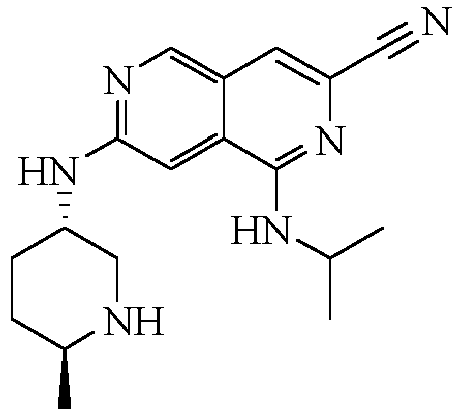
-

- 7-Chloro-1-(isopropylamino)-2,6-naphthyridine-3-carbonitrile (150 mg, 0.61 mmol, 1.0 eq.), benzyl (2S,5S)-5-amino-2-methylpiperidine-1-carboxylate (181.3 mg, 0.73 mmol, 1.3 eq.), Pd2(dba)3 (82.4 mg, 0.09 mmol, 0.15 eq.), BINAP (112 mg, 0.18 mmol, 0.3 eq.) and cesium carbonate (498.5 mg, 1.53 mmol, 2.5 eq.) were added to 1,4-dioxane (15 mL). The mixture was reacted at 100 °C for 23 h in a sealed tube in nitrogen atmosphere. When there were no starting materials left as detected by TLC, water (20 mL) was added, and the mixture was extracted with ethyl acetate (20 mL × 3). The organic phases were combined, dried over anhydrous sodium sulfate and filtered, and the filtrate was concentrated under reduced pressure to give a crude product, which was purified by silica gel column chromatography (EA:PE = 1:10-1:2) to give the product (195 mg, yield: 69.7%).
-

- Benzyl (2S,5S)-5-((7-cyano-5-(isopropylamino)-2,6-naphthyridin-3-yl)amino)-2-methylpiperidine-1-carboxylate (195 mg, 0.42 mmol, 1.0 eq.) was dissolved in TFA (5 mL), and the reaction solution was heated at reflux for 1 h. When there were no starting materials left as detected by TLC, the reaction solution was concentrated under reduced pressure. Water (20 mL) was added, and the pH was adjusted to about 8 with sodium carbonate. The mixture was extracted with ethyl acetate (20 mL × 3). The organic phases were combined, dried over anhydrous sodium sulfate and filtered, and the filtrate was concentrated under reduced pressure to give a crude product, which was purified by preparative thin-layer chromatography (MeOH:DCM = 1:10) to give the product (100 mg, yield: 73.4%).
- 1HNMR (400 MHz, CD3OD) δ(ppm): 8.72 (s, 1H), 7.37 (s, 1H), 7.02 (s, 1H), 4.48-4.41 (m, 1H), 4.35-4.30 (m, 1H), 3.72-3.68 (m, 1H), 3.29-3.26 (m, 1H), 2.85-2.79 (m, 2H), 2.23-2.10 (m, 1H), 2.14-2.11 (m, 1H), 1.76-1.72 (m, 2H), 1.71 (d, 3H), 1.40-1.39 (m, 6H).
- Molecular formula: C18H24N6 Molecular weight: 324.43 LC-MS (Pos, m/z) = 325.25[M+H]+.
-
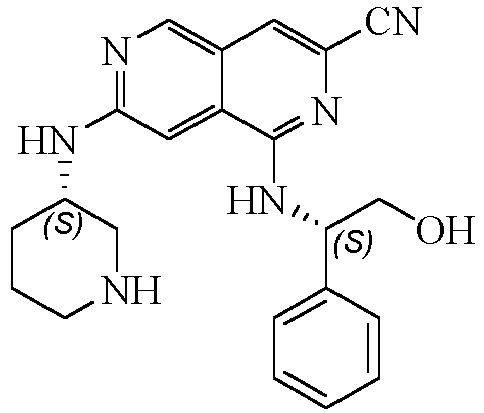
- The titled compound was prepared as same as example 147 using corresponding chemicals.
- 1HNMR (400 MHz, MeOD) δ(ppm): 8.69 (s, 1H), 7.49-7.47 (d, 2H), 7.39 (s, 1H), 7.38-7.32 (m, 2H), 7.27-7.23 (m, 1H), 7.04 (s, 1H), 5.51-5.46 (m, 1H), 3.99-3.97 (m, 3H), 3.34 (s, 1H), 3.06-3.02 (m, 1H), 2.74-2.68 (m, 1H), 2.63-2.57 (m, 1H), 2.16-2.13 (t,1H), 1.92-1.87 (m, 1H), 1.74-1.70 (m, 1H), 1.67-1.59 (m, 1H).
- Molecular formula:C22H24N6O Exact mass: 388.20 LC-MS(Pos, m/z)=389.14[M+H]+.
-

- The titled compound was prepared as same as example 45 using corresponding chemicals.
- 1HNMR (400 MHz, MeOD) δ(ppm): 8.96 (s, 1H), 7.31 (s, 1H), 4.55 (s, 1H), 4.38-4.32 (m, 1H), 3.69-3.65 (m, 1H), 3.30-3.27 (t ,1H), 2.56-2.53 (t, 2H), 2.21-2.15 (m, 1H), 2.08-2.02 (m, 1H), 1.33-1.34 (d, 6H).
- Molecular formula:C16H19N7O Exact mass: 325.17 LC-MS(Pos, m/z)=326.10[M+H]+.
-

- The titled compound was prepared as same as example 55 using corresponding chemicals.
- 1HNMR (400 MHz, MeOD) δ(ppm): 8.90 (s, 1H), 7.30 (s, 1H), 4.38 (s, 1H), 4.11-4.03 (m, 1H), 3.37 (s, 1H), 2.70-2.66 (d, 1H), 2.49-2.43 (t, 1H), 2.12-2.09 (t, 1H), 1.86-1.82 (m, 1H), 1.60-1.51 (m, 1H), 1.35-1.34 (d, 7H), 1.17-1.15 (d, 3H).
- Molecular formula:C17H23N7 Exact mass: 325.20 LC-MS(Pos, m/z)=326.14[M+H]+.
-

- The titled compound was prepared as same as example 38 using corresponding chemicals.
- 1HNMR (400 MHz, MeOD) δ(ppm): 9.01-9.03 (d, 1H), 8.12 (s, 1H), 7.04 (s, 1H), 4.27-4.33 (m, 1H), 3.54-3.58 (q, 1H), 3.26-3.30 (m, 1H), 2.88-3.02 (m, 4H), 2.23-2.31 (m, 1H), 2.16-2.21 (s, 1H), 2.04-2.12 (s, 1H), 1.82-1.93 (s, 1H), 1.68-1.78 (s, 1H), 1.00-1.01 (d, 6H).
- Molecular formula: C18H23N5 Exact mass: 309.20 LC-MS(Pos, m/z)=310.13 [M+H]+.
-

-

-

- 6-(difluoromethyl)-N-isopropyl-2-(methylsulfonyl)pyrido[3,4-d]pyrimidin-8-amine (660 mg, 2.1 mmol, 1.0 eq.) and NBS (446 mg, 2.5 mmol, 1.2 eq.) were added into DCE (10 mL). The mixture was reacted at 65 °C for overnight. When there were no materials left, as detected by LCMS, the reaction solution was added with sat-NaHCO3 aq (10 mL) and extracted with DCM (10 mL × 2). The organic phases were combined, dried over anhydrous sodium sulfate and filtered, and the filtrate was concentrated under reduced pressure to give a crude product, which was purified by silica gel column chromatography to give the product (740 mg, yield: 89.7%). Exact mass: 393.99, LC-MS (Pos, m/z)= 395.0 [M+H]+.
-

- 5-bromo-6-(difluoromethyl)-N-isopropyl-2-(methylsulfonyl)pyrido[3,4-d]pyrimidin-8-amine (582 mg, 1.47 mmol, 1.0 eq.), Pd(PPh3)4 (340 mg, 0.29 mmol, 0.2 eq.) and zinc cyanide (346 mg, 2.95 mmol, 2.0 eq.) were added into DMF (15 mL). The mixture was reacted at 60 °C for overnight in a sealed tube in nitrogen atmosphere. When there were no materials left, as detected by LCMS, the reaction solution was added with sat-NaHCO3 aq and extracted with ethyl acetate (30 mL × 3). The organic phases were combined, washed with brine, dried over anhydrous sodium sulfate and filtered, and the filtrate was concentrated under reduced pressure to give a crude product, which was purified by silica gel column chromatography to give the product (453 mg, yield: 90.1%). Exact mass: 341.08, LC-MS (Pos, m/z): 342.1 [M+H]+.
-

- The titled compound was prepared as same as example 55 using corresponding chemicals.
- Molecular formula: C17H21F2N7 Exact mass: 361.18 LC-MS (Pos, m/z): 362.1 [M+H]+.
-
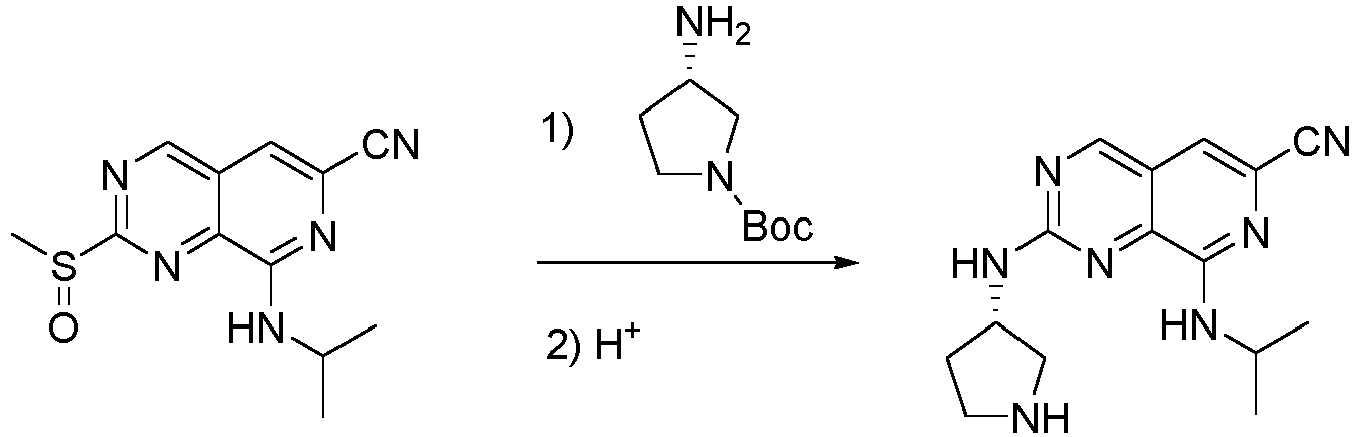
- The titled compound was prepared as same as example 55 using corresponding chemicals.
- Molecular formula: C15H19N7 Exact mass: 297.17 LC-MS (Pos, m/z): 298.1 [M+H]+.
-

- The titled compound was prepared as same as example 55 using corresponding chemicals.
- Molecular formula: C15H19N7 Exact mass: 297.17 LC-MS (Pos, m/z): 298.1 [M+H]+.
-

- The titled compound was prepared as same as example 55 using corresponding chemicals.
- Molecular formula: C16H21N7 Exact mass: 311.19 LC-MS (Pos, m/z): 312.1 [M+H]+.
-
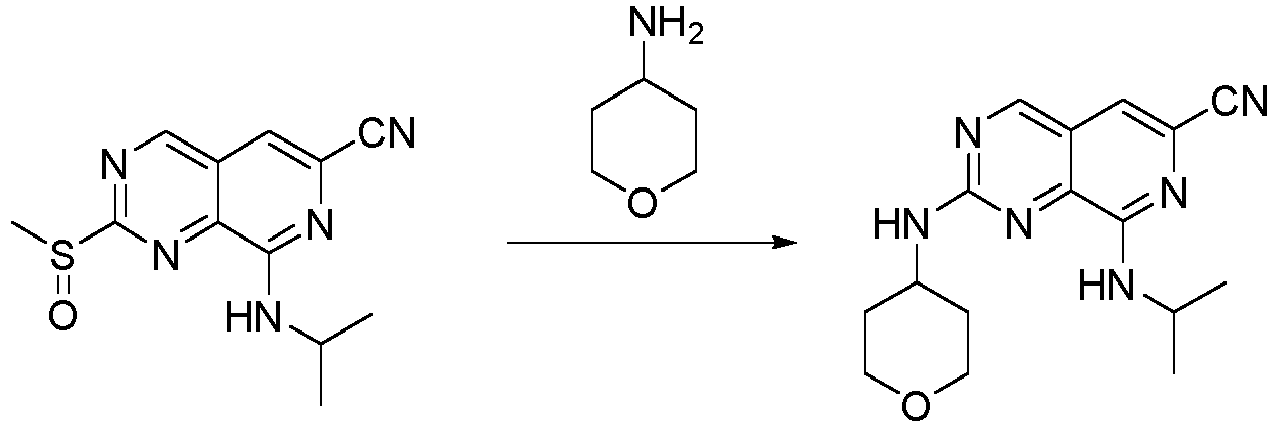
- The titled compound was prepared as same as example 89 using corresponding chemicals.
- Molecular formula: C16H20N6O Exact mass: 312.17 LC-MS (Pos, m/z): 313.1 [M+H]+.
-

- The titled compound was prepared as same as example 89 using corresponding chemicals.
- Molecular formula: C16H20N6O Exact mass: 312.17 LC-MS (Pos, m/z): 313.2 [M+H]+.
-

- The titled compound was prepared as same as example 89 using corresponding chemicals.
- Molecular formula: C16H20N6O Exact mass: 312.17 LC-MS (Pos, m/z): 313.0 [M+H]+.
-

- The titled compound was prepared as same as example 89 using corresponding chemicals.
- Molecular formula: C15H18N6O Exact mass: 298.15 LC-MS (Pos, m/z): 299.0 [M+H]+.
-

- The titled compound was prepared as same as example 89 using corresponding chemicals.
- Molecular formula: C15H18N6O Exact mass: 298.15 LC-MS (Pos, m/z): 299.2 [M+H]+.
-

- The titled compound was prepared as same as example 89 using corresponding chemicals.
- Molecular formula: C16H20N6O2S Exact mass: 360.14 LC-MS (Pos, m/z): 361.1 [M+H]+.
-

- The titled compound was prepared as same as example 89 using corresponding chemicals.
- Molecular formula: C16H20N6O2S Exact mass: 360.14 LC-MS (Pos, m/z): 361.0 [M+H]+.
-

- The titled compound was prepared as same as example 89 using corresponding chemicals.
- Molecular formula: C16H20N6O Exact mass: 312.17 LC-MS (Pos, m/z): 313.1 [M+H]+.
-

- The titled compound was prepared as same as example 89 using corresponding chemicals.
- Molecular formula: C15H17N7O Exact mass: 311.15 LC-MS (Pos, m/z): 312.0 [M+H]+.
-

- The titled compound was prepared as same as example 89 using corresponding chemicals.
- Molecular formula: C15H17N7O Exact mass: 311.15 LC-MS (Pos, m/z): 312.0 [M+H]+.
-

- The titled compound was prepared as same as example 89 using corresponding chemicals.
- Molecular formula: C17H22N6O Exact mass: 326.19 LC-MS (Pos, m/z): 327.1 [M+H]+.
-

- The titled compound was prepared as same as example 55 using corresponding chemicals.
- Molecular formula: C15H19N7 Exact mass: 297.17 LC-MS (Pos, m/z): 298.0 [M+H]+.
-

- The titled compound was prepared as same as example 55 using corresponding chemicals.
- Molecular formula: C15H19N7 Exact mass: 297.17 LC-MS (Pos, m/z): 298.2 [M+H]+.
-

- The titled compound was prepared as same as example 55 using corresponding chemicals..
- Molecular formula: C16H19N7 Exact mass: 309.17 LC-MS (Pos, m/z): 310.0 [M+H]+.
-

- The titled compound was prepared as same as example 55 using corresponding chemicals.
- Molecular formula: C14H17N7 Exact mass: 283.15 LC-MS (Pos, m/z): 284.0 [M+H]+.
-

- The titled compound was prepared as same as example 55 using corresponding chemicals.
- Molecular formula: C17H21N7 Exact mass: 323.19 LC-MS (Pos, m/z): 324.2 [M+H]+.
-

- The titled compound was prepared as same as example 55 using corresponding chemicals.
- Molecular formula: C17H23N7 Exact mass: 325.20 LC-MS (Pos, m/z): 326.2 [M+H]+.
-

- The titled compound was prepared as same as example 55 using corresponding chemicals.
- Molecular formula: C17H23N7 Exact mass: 325.20 LC-MS (Pos, m/z): 326.2 [M+H]+.
-

- The titled compound was prepared as same as example 89 using corresponding chemicals.
- Molecular formula: C15H18N6O Exact mass: 298.15 LC-MS (Pos, m/z): 299.0 [M+H]+.
-

- The titled compound was prepared as same as example 89 using corresponding chemicals..
- Molecular formula: C15H18N6O Exact mass: 298.15 LC-MS (Pos, m/z): 299.1 [M+H]+.
-

- The titled compound was prepared as same as example 89 using corresponding chemicals.
- Molecular formula: C17H23N7 Exact mass: 325.20 LC-MS (Pos, m/z): 326.2 [M+H]+.
-

- The titled compound was prepared as same as example 55 using corresponding chemicals.
- Molecular formula: C17H23N7 Exact mass: 325.20 LC-MS (Pos, m/z): 326.1 [M+H]+.
-

- The titled compound was prepared as same as example 89 using corresponding chemicals.
- Molecular formula: C19H27N7 Exact mass: 353.23 LC-MS (Pos, m/z): 354.3 [M+H]+.
-

- The titled compound was prepared as same as example 55 using corresponding chemicals.
- Molecular formula: C18H23N7O Exact mass: 353.20 LC-MS (Pos, m/z): 354.2 [M+H]+.
-

- The titled compound was prepared as same as example 89 using corresponding chemicals.
- Molecular formula: C21H29N7O Exact mass: 395.24 LC-MS (Pos, m/z): 396.1 [M+H]+.
-

- The titled compound was prepared as same as example 38 using corresponding chemicals.
- 1HNMR (400 MHz, DMSO-d 6) δ(ppm): 8.70 (s, 1H), 7.47 (s, 1H), 7.30-7.28 (d, 1H), 6.98 (s, 1H), 6.81-6.78 (d, 1H), 4.36-4.31 (m, 1H), 3.96 (m, 1H), 3.01-2.97 (m, 1H), 2.84-2.75 (m, 2H), 2.72-2.67 (m, 1H), 1.85-1.83 (m, 1H), 1.70-1.60 (m, 4H), 1.55-1.50 (m, 1H), 1.26-1.24 (m, 7H).
- Molecular formula: C18H24N6 Exact mass: 324.21 LC-MS (Pos, m/z) =325.20 [M+H]+.
-

- The titled compound was prepared as same as example 44 using corresponding chemicals.
- 1HNMR (400 MHz, MeOD) δ(ppm): 8.63 (s, 1H), 7.34 (s, 1H), 6.97 (s, 1H), 4.47-4.44 (m, 1H), 3.66-3.61 (m, 1H), 3.53-3.49 (m, 1H), 2.14-2.07 (m, 2H), 1.84-1.75 (m, 2H), 1.49-1.40 (m, 3H), 1.34-1.33 (m, 7H).
- Molecular formula: C18H23N5O Exact mass: 325.19 LC-MS (Pos, m/z) =326.18[M+H]+.
-

-

- 7-chloro-1-(methylthio)-2,6-naphthyridine-3-carbonitrile (500 mg, 2.12 mmol, 1.0 eq.), tert-butyl (S)-3-aminopiperidine-1-carboxylate (509 mg, 2.54 mmol, 1.2 eq.), Pd2(dba)3 (192 mg, 0.21 mmol, 0.1 eq.), BINAP (131 mg, 0.21 mmol, 0.1 eq.) and cesium carbonate (1.38 g, 4.24 mmol, 2.0 eq.) were dispersed in 1,4-dioxane (10 mL), and the reaction solution was reacted at 100 °C for 16 h in nitrogen atmosphere. After the reaction was completed, as detected by TLC, the reaction solution was concentrated under reduced pressure to give a crude product, which was purified by silica gel column chromatography (PE:EA = 2: 1) to give the product (847 mg, yield: 100%).
-

- Tert-butyl (S)-3-((7-cyano-5-(methylthio)-2,6-naphthyridin-3-yl)amino)piperidine-1-carboxylate (847 mg, 2.12 mmol, 1.0 eq.) was dissolved in DCM (15 mL),and meta-chloroperoxybenzoic acid (mass fraction: 85%; 861 mg, 4.24 mmol, 2.0 eq.) was added. After the reaction was completed, as detected by TLC, the reaction solution was poured into saturated aqueous sodium bicarbonate solution (20 mL). The aqueous phase was extracted with DCM (10 mL × 2), and the organic phase was dried and concentrated to give a crude product, which was purified by silica gel column chromatography (PE:EA = 3:1) to give the product (375 mg, yield: 41.0%).
-

- Tert-butyl (S)-3-((7-cyano-5-(methylsulfonyl)-2,6-naphthyridin-3-yl)amino)piperidine-1-carboxylate (120 mg, 0.27 mmol, 1.0 eq.) and cyclobutylamine (96 mg, 1.35 mmol, 5.0 eq.) were dissolved in THF (3 mL), and the reaction solution was reacted at 60 °C for 24 h. After the reaction was completed, as detected by TLC, the reaction solution was concentrated under reduced pressure to give a crude product, which was purified by silica gel column chromatography (PE:EA= 3:1) to give the product (100 mg, yield: 87.7%).
-

- Tert-butyl (S)-3-((7-cyano-5-(cyclobutylamino)-2,6-naphthyridin-3-yl)amino) piperidine-1-carboxylate (100 mg, 0.20 mmol, 1.0 eq.) was dissolved in EA (2 mL), and a solution of hydrogen chloride in 1,4-dioxane (4 mol/L, 2 mL) was added dropwise. The reaction solution was reacted at room temperature for 1 h. After the reaction was completed, as detected by LC-MS, the reaction solution was poured into saturated aqueous sodium bicarbonate solution (5 mL), and the resulting mixture was extracted with DCM (5 mL × 3). The organic phase was dried and concentrated to give a crude product, which was purified by silica gel preparative thin-layer chromatography (MeOH:DCM = 1:10) to give the product (45 mg, yield: 60.8%).
- 1HNMR (400 MHz, CDCl3) δ(ppm): 8.68 (s, 1H), 7.32 (s, 1H), 6.38 (s, 1H), 5.41-5.32 (t, 1H), 5.27-5.26 (d, 1H), 4.76-4.66 (m, 1H), 3.81-3.79 (t, 1H), 3.32-3.29 (d, 1H), 2.99-2.96 (d, 1H), 2.79-2.74 (m, 1H), 2.66-2.61 (m, 1H), 2.58-2.51 (m, 2H), 2.04-1.93 (m, 4H), 1.88-1.83 (m, 3H), 1.66-1.59 (m, 2H).
- Molecular formula: C18H22N6 Exact mass: 322.19 LC-MS (Pos, m/z) = 323.11[M+H]+.
-
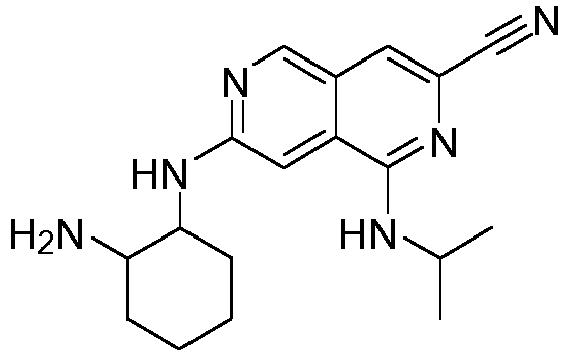
- The titled compound was prepared as same as example 38 using corresponding chemicals.
- 1HNMR (400 MHz, DMSO-d 6) δ(ppm): 8.70 (s, 1H), 7.47 (s, 1H), 7.30-7.28 (d, 1H), 6.98 (s, 1H), 6.81-6.78 (d, 1H), 4.36-4.31 (m, 1H), 3.96 (m, 1H), 3.01-2.97 (m, 1H), 2.82-2.76 (m, 2H), 2.72-2.67 (m, 1H), 1.87-1.82 (m, 1H), 1.70-1.60 (m, 4H), 1.54-1.50 (m, 1H), 1.25-1.24 (m, 7H).
- Molecular formula: C18H24N6 Exact mass: 324.21 LC-MS (Pos, m/z) =325.23 [M+H]+.
-

- The titled compound was prepared as same as example 38 using corresponding chemicals.
- 1HNMR (400 MHz, MeOD) δ(ppm): 8.66 (s, 1H), 7.36-7.35 (s, 1H), 6.98-6.93 (s, 1H), 4.48-4.45 (m, 1H), 4.07-4.05 (m, 0.2H), 3.59-3.53 (m, 0.8H), 3.16-3.13 (m, 0.2H), 2.72-2.66 (m, 0.8H), 2.09-2.03 (m, 1H), 1.83-1.66 (m, 2H), 1.51-1.45 (m, 2H), 1.35-1.33 (m, 7H).
- Molecular formula: C17H22N6 Exact mass: 310.19 LC-MS (Pos, m/z) =311.2 [M+H]+.
-

-

- 7-chloro-1-(methylsulfonyl)-2,6-naphthyridine-3-carbonitrile (200 mg, 0.75 mmol, 1.0 eq.) and (R)-1-phenylethane-1-amine (273 mg, 2.25 mmol, 3.0 eq.) were dissolved in THF (4 mL), and the reaction solution was reacted at 60 °C for 4 h. After the reaction was completed, as detected by TLC, the reaction solution was concentrated under reduced pressure to give a crude product, which was purified by silica gel column chromatography (PE:EA= 5:1) to give the product (200 mg, yield: 86.6%).
-

- (R)-7-chloro-1-((1-phenylethyl)amino)-2,6-naphthyridine-3-carbonitrile (200 mg, 0.65 mmol, 1.0 eq.), tert-butyl (S)-3-aminopiperidine-1-carboxylate (156 mg, 0.78 mmol, 1.2 eq.), Pd2(dba)3 (64 mg, 0.07 mmol, 0.1 eq.), BINAP (44 mg, 0.07 mmol, 0.1 eq.) and cesium carbonate (424 mg, 1.30 mmol, 2.0 eq.) were dispersed in 1,4-dioxane (5 mL), and the reaction solution was reacted at 100 °C for 12 h in nitrogen atmosphere. After the reaction was completed, as detected by TLC, the reaction solution was concentrated under reduced pressure to give a crude product, which was purified by silica gel column chromatography (PE:EA = 2:1) to give the product (220 mg, yield: 71.4%).
-

- Tert-butyl (S)-3-((7-cyano-5-(((R)-1-phenylethyl)amino)-2,6-naphthyridin-3-yl) amino)piperidine-1-carboxylate (220 mg, 0.46 mmol, 1.0 eq.) was dissolved in EA (2 mL), and a solution of hydrogen chloride in 1,4-dioxane (4 mol/L, 2 mL) was added dropwise. The reaction solution was reacted at room temperature for 1.5 h. After the reaction was completed, as detected by LC-MS, the reaction solution was concentrated under reduced pressure to give a crude product, which was dissolved in water (5 mL). The aqueous phase was adjusted to pH = 9 with saturated aqueous NaHCO3 solution and then extracted with DCM (10 mL × 3). The organic phase was dried and concentrated to give a crude product, which was purified by silica gel preparative thin-layer chromatography (MeOH:DCM = 1:10) to give the product (120 mg, yield: 70.2%).
- 1HNMR (400 MHz, CDCl3) δ(ppm): 8.67 (s, 1H), 7.49-7.47 (d, 2H), 7.40-7.36 (t, 2H), 7.31-7.29 (d, 2H), 6.41 (s, 1H), 5.57-5.51 (m, 2H), 5.28-5.26 (d, 1H), 3.83-3.81 (t, 1H), 2.29-3.26 (d,1H), 2.96-2.92 (t, 1H), 2.78-2.74 (t, 1H), 2.66-2.61 (m, 1H), 2.00 (s, 3H), 1.84-1.80 (m, 1H), 1.69-1.68 (d, 3H), 1.62-1.60 (d, 1H).
- Molecular formula: C22H24N6 Exact mass: 372.21 LC-MS (Pos, m/z) = 373.18[M+H]+.
-

-

- 7-Chloro-1-(methylsulfonyl)-2,6-naphthyridine-3-carbonitrile (200 mg, 0.75 mmol, 1.0 eq.), 1-methylcyclopropan-1-amine hydrochloride (242 mg, 2.25 mmol, 3.0 eq.) and TEA (380 mg, 3.75 mmol, 5.0 eq.) were dissolved in THF (5 mL), and the reaction solution was reacted at 60 °C for 4.5 h. After the reaction was completed as detected by TLC, the reaction solution was concentrated under reduced pressure, and the residue was purified by silica gel column chromatography (PE:EA = 5:1) to give the product (150 mg, yield: 77.3%).
-

- 7-Chloro-1-((1-methylcyclopropyl)amino)-2,6-naphthyridine-3-carbonitrile (150 mg, 0.58 mmol, 1.0 eq.), tert-butyl (S)-3-aminopiperidine-1-carboxylate (140 mg, 0.70 mmol, 1.2 eq.), Pd2(dba)3 (55 mg, 0.06 mmol, 0.1 eq.), BINAP (37 mg, 0.06 mmol, 0.1 eq.) and cesium carbonate (378 mg, 1.16 mmol, 2.0 eq.) were dispersed in 1,4-dioxane (5 mL), and the reaction solution was reacted at 100 °C for 12 h in nitrogen atmosphere. After the reaction was completed as detected by TLC, the reaction solution was concentrated under reduced pressure, and the crude product was purified by silica gel column chromatography (PE:EA = 2: 1) to give the product (150 mg, yield: 61.2%).
-

- 1HNMR (400 MHz, CDCl3) δ(ppm): 8.68 (s, 1H), 7.35 (s, 1H), 6.30 (s, 1H), 5.65 (s, 1H), 5.26-5.25 (d, 1H), 3.77-3.75 (t, 1H), 3.30-3.28 (d, 1H), 2.98-2.94 (t, 1H), 2.78-2.73 (t, 1H), 2.65-2.60 (m, 1H), 2.02-1.93 (t,3H), 1.85-1.81 (m, 1H), 1.62-1.60 (d, 2H), 1.52 (s, 3H), 0.87-0.85 (t, 2H), 0.81-0.78 (t, 3H).
- Molecular formula: C18H22N6 Exact mass: 322.19 LC-MS (Pos, m/z) = 323.20[M+H]+.
-

-

- 7-Chloro-1-(methylsulfonyl)-2,6-naphthyridine-3-carbonitrile (200 mg, 0.75 mmol, 1.0 eq.) and tert-butylamine (274 mg, 3.75 mmol, 5.0 eq.) were dissolved in THF (4 mL), and the reaction solution was reacted at 55 °C for 22 h. After the reaction was completed as detected by TLC, the reaction solution was concentrated under reduced pressure, and the crude product was purified by silica gel column chromatography (PE:EA = 5:1) to give the product (175 mg, yield: 89.7%).
-

- 1-(tert-Butylatmino)-7-chloro-2,6-naphthyridine-3-carbonitrile (175 mg, 0.67 mmol, 1.0 eq.), tert-butyl (S)-3-aminopiperidine-1-carboxylate (160 mg, 0.80 mmol, 1.2 eq.), Pd2(dba)3 (64 mg, 0.07 mmol, 0.1 eq.), BINAP (44 mg, 0.07 mmol, 0.1 eq.) and cesium carbonate (437 mg, 1.34 mmol, 2.0 eq.) were dispersed in 1,4-dioxane (5 mL), and the reaction solution was reacted at 100 °C for 16 h in nitrogen atmosphere. After the reaction was completed as detected by TLC, the reaction solution was concentrated under reduced pressure, and the crude product was purified by silica gel column chromatography (PE:EA = 3:1) to give the product (220 mg, yield: 77.4%).
-

- tert-Butyl (S)-3-((5-(tert-butylamino)-7-cyano-2,6-naphthyridin-3-yl)amino)piperidine-1-carboxylate (220 mg, 0.52 mmol, 1.0 eq.) was dissolved in EA (2 mL), and a solution of hydrogen chloride in 1,4-dioxane (4 mol/L, 2 mL) was added dropwise. The reaction solution was reacted at room temperature for 1 h. After the reaction was completed as detected by LC-MS, the reaction solution was concentrated under reduced pressure to give a crude product, which was dissolved in water (5 mL). The aqueous phase was adjusted to pH = 9 with saturated aqueous potassium carbonate solution and then extracted with DCM (10 mL × 3). The organic phase was dried and concentrated to give a crude product, which was purified by silica gel preparative thin-layer chromatography (MeOH:DCM = 1:10) to give the product (125 mg, yield: 74.4%).
- 1HNMR (400 MHz, CDCl3) δ(ppm): 8.66 (s, 1H), 7.29 (s, 1H), 6.31 (s, 1H), 5.28-5.26 (d, 1H), 5.05 (s, 1H), 3.88-3.86 (t, 1H), 3.27-3.24 (m, 1H), 2.96-2.92 (m, 1H), 2.80-2.75 (m, 1H), 2.70-2.65 (m, 1H), 1.99 (s, 2H), 1.83-1.78 (m, 1H), 1.64-1.60 (m, 2H), 1.57 (s, 9H).
- Molecular formula: C18H24N6 Exact mass: 324.21 LC-MS (Pos, m/z) = 325.12[M+H]+.
-

- The titled compound was prepared as same as example 49 using corresponding chemicals.
- 1HNMR (400 MHz, MeOD) δ(ppm): 8.70 (s, 1H), 7.43 (s, 1H), 6.95 (s, 1H), 4.75-4.74 (m, 1H), 4.12-4.03 (m, 2H), 3.91-3.79 (m, 3H), 3.27-3.24 (m, 1H), 3.01-2.98 (m, 1H), 2.68-2.62 (m, 1H), 2.56-2.50 (m, 1H), 2.43-2.39 (m, 1H), 2.14-2.07 (m, 2H), 1.87-1.82 (m, 1H), 1.70-1.54 (m, 2H).
- Molecular formula: C18H22N6O Exact mass: 338.19 LC-MS (Pos, m/z) =339.19 [M+H]+.
-
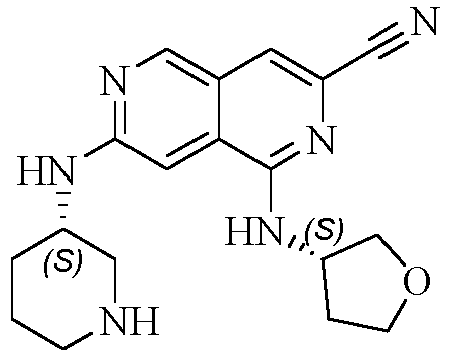
- The titled compound was prepared as same as example 49 using corresponding chemicals.
- 1HNMR (400 MHz, MeOD) δ(ppm): 8.69 (s, 1H), 7.43 (s, 1H), 6.94 (s, 1H), 4.76-4.73 (m, 1H), 4.13-4.04 (m, 2H), 3.90-3.79 (m, 3H), 3.26-3.24 (m, 1H), 3.00-2.97 (m, 1H), 2.64-2.60 (m, 1H), 2.53-2.48 (m, 1H), 2.43-2.39 (m, 1H), 2.13-2.10 (m, 2H), 1.85-1.82 (m, 1H), 1.68-1.54 (m, 2H).
- Molecular formula: C18H22N6O Exact mass: 338.19 LC-MS (Pos, m/z) =339.19 [M+H]+.
-

- The titled compound was prepared as same as example 153 using corresponding chemicals.
- 1HNMR (400 MHz, MeOD) δ(ppm): 8.80 (s, 1H), 7.74 (s, 1H), 6.94 (s, 1H), 3.99-3.94 (m, 1H), 3.30-3.26 (m, 1H), 3.00-2.96 (m, 1H), 2.67-2.60 (m, 1H), 2.54-2.49 (m, 1H), 2.12-2.08 (m, 1H), 1.86-1.81 (m, 1H), 1.73 (s, 9H), 1.70-1.67 (m, 1H), 1.66-1.64 (t, 1H).
- Molecular formula:C18H23N5O Exact mass: 325.19 LC-MS(Pos, m/z)=326.14[M+H]+.
-

-

- 1-(Isopropoxy)-7-chloro-2,6-naphthyridine-3-carbonitrile (120 mg, 0.48 mmol, 1.0 eq.), tert-butyl (S)-3-aminopiperidine-1-carboxylate (116 mg, 0.58 mmol, 1.2 eq.), Pd2(dba)3 (46 mg, 0.05 mmol, 0.1 eq.), BINAP (31 mg, 0.05 mmol, 0.1 eq.) and cesium carbonate (313 mg, 0.96 mmol, 2.0 eq.) were dispersed in 1,4-dioxane (5 mL), and the reaction solution was reacted at 100 °C for 14 h in nitrogen atmosphere. After the reaction was completed as detected by TLC, the reaction solution was concentrated under reduced pressure, and the crude product was purified by silica gel column chromatography (PE:EA = 6:1) to give the product (150 mg, yield: 76.1%).
-

- tert-Butyl (S)-3-((5-(isopropoxy)-7-cyano-2,6-naphthyridin-3-yl)amino)piperidine-1-carboxylate (150 mg, 0.36 mmol, 1.0 eq.) was dissolved in DCM (5 mL) and 2,6-dimethylpyridine (193 mg, 1.80 mmol, 5.0 eq.), and TMSOTf (240 mg, 1.08 mmol, 3.0 eq.) was added dropwise. The reaction solution was reacted at room temperature for 10 min. After the reaction was completed as detected by TLC, the reaction solution was poured into water (10 mL), and the resulting mixture was extracted with DCM (10 mL × 2). The organic phase was dried and concentrated to give a crude product, which was purified by silica gel preparative thin-layer chromatography (MeOH:DCM = 1: 10) to give the product (80 mg, yield: 71.4%).
- 1HNMR (400 MHz, MeOD) δ(ppm): 8.81 (s, 1H), 7.75 (s, 1H), 6.95 (s, 1H), 5.53-5.47 (m, 1H), 3.96-3.91 (s, 1H), 3.29-3.25 (m, 1H), 2.99-2.95 (m, 1H), 2.65-2.59 (m, 1H), 2.53-2.47 (m, 1H), 2.12-2.09 (t, 1H), 1.85-1.80 (m, 1H), 1.70-1.61 (m, 2H), 1.58-1.52 (m, 1H), 1.47-1.45 (d, 6H).
- Molecular formula: C17H21N5O Exact mass: 311.17 LC-MS (Pos, m/z) = 312.07[M+H]+.
-

-

- (R)-tetrahydrofuran-3-ol (78 mg, 0.89 mmol, 1.2 eq.) and sodium hydride (mass fraction: 60%; 38 mg, 0.96 mmol, 1.3 eq.) were dispersed in THF (4 mL), and the reaction solution was reacted at room temperature for 10 min. 7-chloro-1-(methylsulfonyl)-2,6-naphthyridine-3-carbonitrile (200 mg, 0.74 mmol, 1.0 eq.) was added, and the resulting reaction solution was reacted for 10 min. After the reaction was completed, as detected by TLC, the reaction solution was poured into water (5 mL), and EA (10 mL × 2) was added for extraction. The organic phase was dried and concentrated to give a crude product, which was purified by silica gel column chromatography (PE:EA= 3:1) to give the product (125 mg, yield: 61.3%).
-

- (R)-7-chloro-1-((tetrahydrofuran-3-yl)oxy)-2,6-naphthyridine-3-carbonitrile (120 mg, 0.44 mmol, 1.0 eq.), tert-butyl (S)-3-aminopiperidine-1-carboxylate (106 mg, 0.53 mmol, 1.2 eq.), Pd2(dba)3 (37 mg, 0.04 mmol, 0.1 eq.), BINAP (25 mg, 0.04 mmol, 0.1 eq.) and cesium carbonate (287 mg, 0.88 mmol, 2.0 eq.) were dispersed in 1,4-dioxane (5 mL), and the reaction solution was reacted at 100 °C for 14 h in nitrogen atmosphere. After the reaction was completed, as detected by TLC, the reaction solution was concentrated under reduced pressure to give a crude product, which was purified by silica gel column chromatography (PE:EA = 3:1) to give the product (150 mg, yield: 77.7%).
-

- Tert-butyl (S)-3-((7-cyano-5-(((R)-tetrahydrofuran-3-yl)oxy)-2,6-naphthyridin-3-yl) amino)piperidine-1-carboxylate (150 mg, 0.34 mmol, 1.0 eq.) was dissolved in DCM (5 mL) and 2,6-dimethylpyridine (182 mg, 1.70 mmol, 5 eq.), and TMSOTf (227 mg, 1.02 mmol, 3 eq.) was added dropwise. The reaction solution was reacted at room temperature for 10 min. After the reaction was completed, as detected by TLC, the reaction solution was poured into water (5 mL), and the resulting mixture was extracted with DCM (10 mL × 2). The organic phase was dried and concentrated to give a crude product, which was purified by silica gel preparative thin-layer chromatography (MeOH:DCM = 1:10) to give the product (95 mg, yield: 82.6%).
- 1HNMR (400 MHz, MeOD) δ(ppm): 8.84 (s, 1H), 7.81 (s, 1H), 6.94 (s, 1H), 5.77-5.75 (t, 1H), 4.12-4.02 (m, 3H), 3.97-3.92 (m, 2H), 3.28-3.24 (m, 1H), 2.99-2.95 (m, 1H), 2.64-2.58 (m, 1H), 2.52-2.37 (m, 2H), 2.29-2.23 (m, 1H), 2.12-2.08 (m, 1H), 1.85-1.80 (m, 1H), 1.51-1.47 (m, 2H).
- Molecular formula: C18H21N5O2 Exact mass: 339.17 LC-MS (Pos, m/z) = 340.10[M+H]+.
-

-
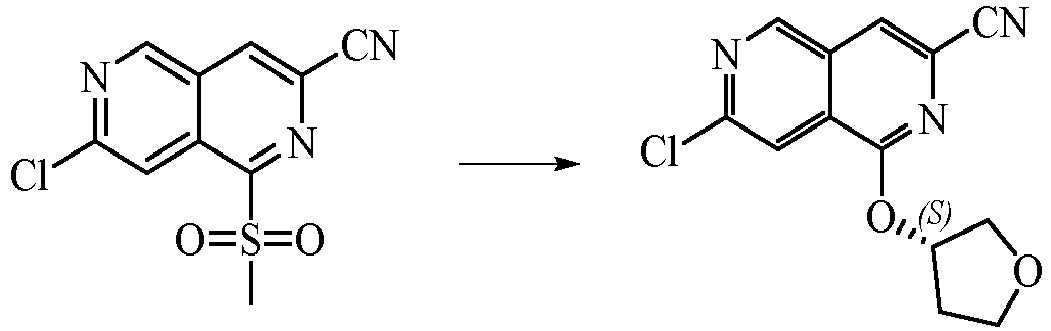
- (R)-tetrahydrofuran-3-ol (78 mg, 0.89 mmol, 1.2 eq.) and sodium hydride (mass fraction: 60%; 38 mg, 0.96 mmol, 1.3 eq.) were dispersed in THF (4 mL), and the reaction solution was reacted at room temperature for 10 min. 7-chloro-1-(methylsulfonyl)-2,6-naphthyridine-3-carbonitrile (200 mg, 0.74 mmol, 1.0 eq.) was added, and the resulting reaction solution was reacted for 30 min. After the reaction was completed, as detected by TLC, the reaction solution was poured into water (5 mL), and EA (10 mL × 2) was added for extraction. The organic phase was dried and concentrated to give a crude product, which was purified by silica gel column chromatography (PE:EA= 5:1) to give the product (120 mg, yield: 58.8%).
-

- (S)-7-chloro-1-((tetrahydrofuran-3-yl)oxy)-2,6-naphthyridine-3-carbonitrile (120 mg, 0.44 mmol, 1.0 eq.), tert-butyl (S)-3-aminopiperidine-1-carboxylate (106 mg, 0.53 mmol, 1.2 eq.), Pd2(dba)3 (37 mg, 0.04 mmol, 0.1 eq.), BINAP (25 mg, 0.04 mmol, 0.1 eq.) and cesium carbonate (287 mg, 0.88 mmol, 2.0 eq.) were dispersed in 1,4-dioxane (5 mL), and the reaction solution was reacted at 100 °C for 14 h in nitrogen atmosphere. After the reaction was completed, as detected by TLC, the reaction solution was concentrated under reduced pressure to give a crude product, which was purified by silica gel column chromatography (PE:EA = 3:1) to give the product (150 mg, yield: 77.7%).
-

- Tert-butyl (S)-3-((7-cyano-5-(((S)-tetrahydrofuran-3-yl)oxy)-2,6-naphthyridin-3-yl) amino)piperidine-1-carboxylate (150 mg, 0.34 mmol, 1.0 eq.) was dissolved in DCM (3 mL) and 2,6-dimethylpyridine (547 mg, 5.10 mmol, 15.0 eq.), and TMSOTf (756 mg, 3.40 mmol, 10.0 eq.) was added dropwise. The reaction solution was reacted at room temperature for 10 min. After the reaction was completed, as detected by TLC, the reaction solution was poured into water (5 mL), and the resulting mixture was extracted with DCM (10 mL × 2). The organic phase was dried and concentrated to give a crude product, which was slurried with DCM (2 mL) to give the product (85 mg, yield: 73.9%).
- 1HNMR (400 MHz, MeOD) δ(ppm): 8.84 (s, 1H), 7.81 (s, 1H), 6.94 (s, 1H), 5.77-5.75 (t, 1H), 4.12-4.02 (m, 3H), 3.96-3.91 (m, 2H), 3.27-3.23 (m,1H), 2.97-2.94 (m, 1H), 2.63-2.56 (m, 1H), 2.50-2.41 (m, 2H), 2.29-2.24 (m, 1H), 2.11-2.08 (t, 1H), 1.83-1.79 (m, 1H), 1.67-1.63 (m, 1H), 1.57-1.47 (m, 2H).
- Molecular formula: C18H21N5O2 Exact mass: 339.17 LC-MS (Pos, m/z) = 340.08[M+H]+.
-

- The titled compound was prepared as same as example 44 using corresponding chemicals.
- 1HNMR (400 MHz, MeOD) δ(ppm): 8.63 (s, 1H), 7.35-7.34 (s, 1H), 6.97 (s, 1H), 4.47-4.42 (m, 1H), 3.67-3.61 (m, 1H), 3.53-3.47 (m, 1H), 2.13-2.06 (m, 2H), 1.84-1.75 (m, 2H), 1.49-1.40 (m, 3H), 1.35-1.33 (m, 7H).
- Molecular formula: C18H23N5O Exact mass: 325.19 LC-MS (Pos, m/z) =326.21[M+H]+.
-

- The titled compound was prepared as same as example 38 using corresponding chemicals.
- 1HNMR (400 MHz, MeOD) δ(ppm): 8.67 (s, 1H), 7.35 (s, 1H), 6.98 (s, 1H), 4.47-4.44 (m, 1H), 4.14-4.12 (m, 1H), 3.56-3.53 (m, 1H), 2.14-2.05 (m, 2H), 1.91-1.88 (m, 1H), 1.77-1.62 (m, 3H), 1.34-1.33 (m, 6H).
- Molecular formula: C17H22N6 Exact mass: 310.19 LC-MS (Pos, m/z) =311.2 [M+H]+.
-
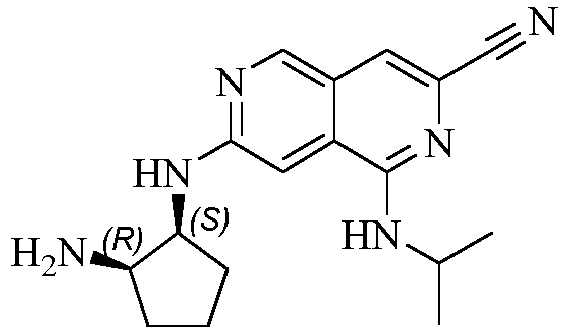
- The titled compound was prepared as same as example 38 using corresponding chemicals.
- 1HNMR (400 MHz, MeOD) δ(ppm): 8.66 (s, 1H), 7.34 (s, 1H), 6.92 (s, 1H), 4.47-4.44 (m, 1H), 3.87-3.85 (m, 1H), 3.21-3.16 (m, 1H), 2.35-2.28 (m, 1H), 2.12-2.03 (m, 1H), 1.91-1.80 (m, 2H), 1.62-1.50 (m, 2H), 1.35-1.32 (m, 6H).
- Molecular formula: C17H22N6 Exact mass: 310.19 LC-MS (Pos, m/z) =311.2 [M+H]+.
-

-

- 7-chloro-1-(isopropylamino)-2,6-naphthyridine-3-carbonitrile (100 mg, 0.41 mmol, 1.0 eq.), (1R,2R)-2-aminocyclohexyl-1-ol (61 mg, 0.53 mmol, 1.3 eq.), Pd2(dba)3 (54.9 mg, 0.06 mmol, 0.15 eq.), BINAP (74.7 mg, 0.12 mmol, 0.3 eq.) and cesium carbonate (332.3 mg, 1.02 mmol, 2.5 eq.) were added into 1,4-dioxane (10 mL). The reaction solution was heated to 120 °C and reacted for 18 h in a sealed tube in nitrogen atmosphere. When there were no materials left, as detected by TLC, the reaction solution was cooled to room temperature, water (30 mL) was added, and then ethyl acetate (30 mL × 3) was added for extraction. The organic phases were combined, dried over anhydrous sodium sulfate and filtered, and the filtrate was concentrated under reduced pressure to give a crude product, which was purified by preparative thin-layer chromatography (MeOH:DCM = 1:20) to give the product (65 mg, yield: 48.7%).
- 1HNMR (400 MHz, MeOD) δ(ppm): 8.63 (s, 1H), 7.34 (s, 1H), 6.96 (s, 1H), 4.48-4.44 (m, 1H), 3.67-3.61 (m, 1H), 3.52-3.47 (m, 1H), 2.13-2.07 (m, 2H), 1.83-1.77 (m, 2H), 1.48-1.40 (m, 10H).
- Molecular formula: C18H23N5O Exact mass: 325.19 LC-MS (Pos, m/z) = 326.21[M+H]+.
-

-

- 7-chloro-1-(isopropylamino)-2,6-naphthyridine-3-carbonitrile (100 mg, 0.41 mmol, 1.0 eq.), (1R,2S)-2-aminocyclohexyl-1-ol hydrochloride (80.4 mg, 0.53 mmol, 1.3 eq.), Pd2(dba)3 (54.9 mg, 0.06 mmol, 0.15 eq.), BINAP (74.7 mg, 0.12 mmol, 0.3 eq.) and cesium carbonate (469.2 mg, 1.44 mmol, 3.5 eq.) were added into 1,4-dioxane (10 mL). The reaction solution was heated to 120 °C and reacted for 18 h in a sealed tube in nitrogen atmosphere. When there were no materials left, as detected by TLC, the reaction solution was cooled to room temperature, water (30 mL) was added, and then ethyl acetate (30 mL × 3) was added for extraction. The organic phases were combined, dried over anhydrous sodium sulfate and filtered, and the filtrate was concentrated under reduced pressure to give a crude product, which was purified by preparative thin-layer chromatography (MeOH:DCM = 1:20) to give the product (70 mg, yield: 52.5%). 1HNMR (400 MHz, MeOD) δ(ppm): 8.64 (s, 1H), 7.35 (s, 1H), 6.99 (s, 1H), 4.49-4.42 (m, 1H), 4.06-4.04 (m, 1H), 3.90-3.88 (m, 1H), 1.90-1.87 (m, 1H), 1.77-1.68 (m, 4H), 1.51-1.48 (m, 2H), 1.35-1.33 (m, 7H).
- Molecular formula: C18H23N5O Exact mass: 325.19 LC-MS (Pos, m/z) = 326.21[M+H]+.
-

-

- 7-chloro-1-(isopropylamino)-2,6-naphthyridine-3-carbonitrile (100 mg, 0.41 mmol, 1.0 eq.), (1S,2R)-2-aminocyclohexyl-1-ol hydrochloride (80.4 mg, 0.53 mmol, 1.3 eq.), Pd2(dba)3 (54.9 mg, 0.06 mmol, 0.15 eq.), BINAP (74.7 mg, 0.12 mmol, 0.3 eq.) and cesium carbonate (469.2 mg, 1.44 mmol, 3.5 eq.) were added into 1,4-dioxane (10 mL). The reaction solution was heated to 120 °C and reacted for 18 h in a sealed tube in nitrogen atmosphere. When there were no materials left, as detected by TLC, the reaction solution was cooled to room temperature, water (30 mL) was added, and then ethyl acetate (30 mL × 3) was added for extraction. The organic phases were combined, dried over anhydrous sodium sulfate and filtered, and the filtrate was concentrated under reduced pressure to give a crude product, which was purified by preparative thin-layer chromatography (MeOH:DCM = 1:20) to give the product (62 mg, yield: 46.5%). 1HNMR (400 MHz, MeOD) δ(ppm): 8.64 (s, 1H), 7.35 (s, 1H), 6.99 (s, 1H), 4.49-4.44 (m, 1H), 4.05 (m, 1H), 3.89 (m, 1H), 1.90 (m, 1H), 1.77-1.70 (m, 4H), 1.50 (m, 3H), 1.35-1.33 (m, 6H).
- Molecular formula: C18H23N5O Exact mass: 325.19 LC-MS (Pos, m/z) = 326.21[M+H]+.
-

-

- 7-chloro-1-(isopropylamino)-2,6-naphthyridine-3-carbonitrile (100 mg, 0.41 mmol, 1.0 eq.), tert-butyl ((1S,2R)-2-aminocyclopentyl)carbamate (98.1 mg, 0.49 mmol, 1.2 eq.), Pd2(dba)3 (54.9 mg, 0.06 mmol, 0.15 eq.), BINAP (74.7 mg, 0.12 mmol, 0.3 eq.) and cesium carbonate (332.3 mg, 1.02 mmol, 2.5 eq.) were added into 1,4-dioxane (10 mL). The reaction solution was heated to 100 °C and reacted for 18 h in a sealed tube in nitrogen atmosphere. When there were no materials left, as detected by TLC, the reaction solution was cooled to room temperature, water (30 mL) was added, and then ethyl acetate (30 mL × 3) was added for extraction. The organic phases were combined, dried over anhydrous sodium sulfate and filtered, and the filtrate was concentrated under reduced pressure to give a crude product, which was purified by silica gel column chromatography (MeOH:DCM = 1:150-1:100) to give the product (106 mg, yield: 59.4%).
-

- Tert-butyl ((1S,2R)-2-((7-cyano-5-(isopropylamino)-2,6-naphthyridin-3-yl)amino) cyclopentyl)carbamate (106 mg, 0.26 mmol, 1.0 eq.) was dissolved in DCM (3 mL), and hydrogen chloride ethanol solution (10 mol/L, 3 mL) was added dropwise. The reaction solution was reacted at room temperature for 1 h. When there were no materials left, as detected by TLC, the reaction solution was concentrated under reduced pressure, water (30 mL) was added, and DCM (30 mL × 2) was added for back-extraction. The aqueous phase was adjusted to pH of about 8 with aqueous potassium carbonate solution and extracted with DCM (30 mL × 3). The organic phases were combined, dried over anhydrous sodium sulfate and filtered, and the filtrate was concentrated under reduced pressure to give a crude product, which was purified by preparative thin-layer chromatography (MeOH:DCM = 1:10) to give the product (35 mg, yield: 43.4%). 1HNMR (400 MHz, MeOD) δ(ppm): 8.67 (s, 1H), 7.36 (s, 1H), 6.98 (s, 1H), 4.47-4.44 (m, 1H), 4.14-4.12 (m, 1H), 3.56-3.52 (m, 1H), 2.14-2.03 (m, 2H), 1.91-1.88 (m, 1H), 1.77-1.59 (m, 3H), 1.35-1.33 (m, 6H).
- Molecular formula: C17H22N6 Exact mass: 310.19 LC-MS (Pos, m/z) = 311.2[M+H]+.
-

-

- 7-chloro-3-(difluoromethyl)-N-isopropyl-2,6-naphthyridin-1-amine (800 mg, 2.94 mmol, 1.0 eq.), 4-((methylthio)methyl)pyridin-2-amine (453 mg, 2.94 mmol, 1.0 eq.), Pd(PPh3)4 (335 mg, 0.29 mmol, 0.1 eq.), Xantphos (168 mg, 0.29 mmol, 0.1 eq.) and cesium carbonate (1.92 g, 5.88 mmol, 2.0 eq.) were dispersed in 1,4-dioxane (20 mL), and the reaction solution was reacted at 100 °C for 16 h in nitrogen atmosphere. After the reaction was completed, as detected by TLC, the reaction solution was concentrated under reduced pressure to give a crude product, which was purified by silica gel column chromatography (MeOH:DCM = 1:50) to give the product (800 mg, yield: 70.1%).
-

- Sodium tert-butoxide (197 mg, 2.05 mmol, 1.0 eq.) was dispersed in THF (2 mL), and the reaction solution was cooled to 5 °C, followed by addition of a solution of trifluoroacetamide (348 mg, 3.08 mmol, 1.5 eq.) in THF (2 mL). The reaction solution was reacted for 5 min, followed by addition of a solution of dibromohydantoin (352 mg, 1.23 mmol, 0.6 eq.) in THF (2 mL). The reaction solution was then reacted for 5 min, followed by addition of a solution of 3-(difluoromethyl)-N1 -isopropyl-N7 -(4-((methylthio)methyl)pyridin-2-yl)-2,6-naphthyridine-1,7-diamine (800 mg, 2.05 mmol, 1.0eq.) in THF (20 mL). The resulting reaction solution was reacted for 20 min. After the reaction was completed, as detected by TLC, the reaction solution was poured into aqueous solution (20 mL), and the aqueous phase was extracted with EA (20 mL × 2). The organic phase was dried and concentrated to give a crude product, which was purified by silica gel column chromatography (MeOH:DCM = 1:80) to give the product (650 mg, yield: 63.1%).
-

- N-(((2-((7-(difluoromethyl)-5-(isopropylamino)-2,6-naphthyridin-3-yl)amino)pyridin-4-yl)methyl)(methyl)- λ 4-sulfaneylidene)-2,2,2-trifluoroacetamide (500 mg, 1.00 mmol, 1.0 eq.) was dispersed in methanol (10 mL) and water (5 mL), Oxone (557 mg, 0.90 mmol, 0.9 eq.) was added, and aqueous NaOH solution (1 mol/L, 1 mL) was added dropwise. The reaction solution was reacted for 30 min. After the reaction was completed, as detected by TLC, the reaction solution was concentrated under reduced pressure, and the aqueous phase was extracted with EA (10 mL × 3). The organic phase was dried and concentrated to give a crude product, which was purified by silica gel column chromatography (MeOH:DCM = 1:50) to give the product (150 mg, yield: 47.6%).
- 1HNMR (400 MHz, DMSO-d 6) δ(ppm): 9.88 (s, 1H), 8.98 (s, 1H), 8.43 (s, 2H), 8.30-8.29 (d, 1H), 7.37 (s, 1H), 7.23-7.20 (t, 2H), 6.98-6.97 (t, 1H), 6.91-6.64 (t, 1H), 4.40 (s, 3H), 3.80 (s, 1H), 2.90 (s, 3H), 1.29-1.27 (s, 6H).
- Molecular formula: C19H22F2N6OS Exact mass: 420.15 LC-MS (Pos, m/z) = 421.03[M+H]+.
-

- The titled compound was prepared as same as example 38 using corresponding chemicals.
- 1HNMR (400 MHz, MeOD) δ(ppm): 8.65 (s, 1H), 7.36 (s, 1H), 6.87 (s, 1H), 4.47-4.43 (m, 1H), 3.96-3.92 (m, 1H), 3.26-3.22 (m, 1H), 2.93-2.87 (m, 2H), 1.80-1.73 (m, 2H), 1.35-1.33 (m, 6H).
- Molecular formula: C16H20N6 Exact mass: 296.17 LC-MS (Pos, m/z) =297.14 [M+H]+.
-

- The titled compound was prepared as same as example 38 using corresponding chemicals.
- 1HNMR (400 MHz, MeOD) δ(ppm): 8.67 (s, 1H), 7.36 (s, 1H), 6.93 (s, 1H), 4.48-4.45 (m, 1H), 3.88-3.86 (m, 1H), 3.22-3.17 (m, 1H), 2.35-2.30 (m, 1H), 2.11-2.08 (m, 1H), 1.1.89-1.82 (m, 2H), 1.61-1.53 (m, 2H), 1.35-1.33 (m, 6H).
- Molecular formula: C17H22N6 Exact mass: 310.19 LC-MS (Pos, m/z) =311.2 [M+H]+.
-

- The titled compound was prepared as same as example 44 using corresponding chemicals.
- 1HNMR (400 MHz, MeOD) δ(ppm): 8.66 (s, 1H), 7.36 (s, 1H), 6.79 (s, 1H), 4.53-4.43 (m, 2H), 4.34-4.30 (m, 1H), 2.48-2.42 (m, 2H), 2.36-2.30 (m, 2H), 1.35-1.33 (m, 6H). Molecular formula: C16H19N5O Exact mass: 297.16 LC-MS (Pos, m/z) =298.13 [M+H]+.
-
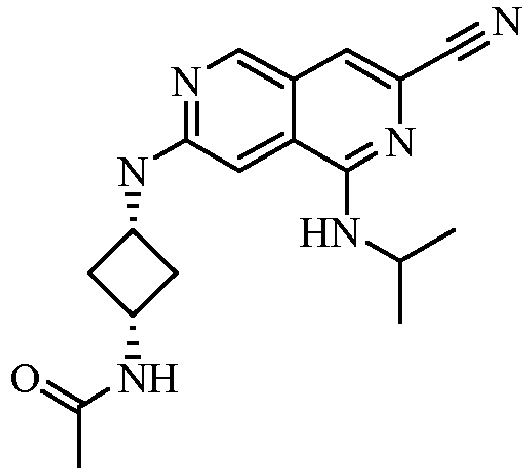
- The titled compound was prepared as same as example 47 using corresponding chemicals.
- 1HNMR (400 MHz, MeOD) δ(ppm): 8.66 (s, 1H), 7.36 (s, 1H), 6.89 (s, 1H), 4.49-4.43 (m, 1H), 4.13-3.99 (m, 2H), 2.97-2.91 (m, 2H), 1.95 (s, 3H), 1.93-1.90 (m, 2H), 1.35-1.33 (m, 6H).
- Molecular formula: C18H22N6 O Exact mass: 338.19 LC-MS (Pos, m/z) =339.17 [M+H]+.
-

- The titled compound was prepared as same as example 148 using corresponding chemicals.
- 1HNMR (400 MHz, MeOD) δ(ppm): 8.64 (s, 1H), 7.34 (s, 1H), 6.91 (s, 1H), 4.51-4.47 (t, 1H), 3.84-3.81 (m, 1H), 3.26-3.22 (m, 1H), 2.99-2.96 (t, 1H), 2.66-2.60 (m, 1H), 2.53-2.48 (m, 1H), 2.19-2.09 (m, 3H), 1.85-1.80 (m, 3H), 1.69-1.52 (m, 3H).
- Molecular formula:C19H24N6 Exact mass: 336.21 LC-MS(Pos, m/z)=337.11[M+H]+.
-

- The titled compound was prepared as same as example 148 using corresponding chemicals.
- 1HNMR (400 MHz, MeOD) δ(ppm): 8.65 (s, 1H), 7.36 (s, 1H), 7.11 (s, 1H), 3.90-3.87 (t, 1H), 3.85-3.80 (m, 4H), 3.28-3.24 (m, 1H), 2.99-2.94 (m, 1H), 2.64-2.61 (m, 1H), 2.50-2.45 (m, 1H), 2.13-2.10 (m, 1H), 2.05-2.01 (m, 2H), 1.84-1.78 (m, 1H), 1.69-1.60 (m, 1H), 1.56-1.47 (m, 1H).
- Molecular formula: C18H22N6 Exact mass: 322.19 LC-MS (Pos, m/z)=323.11[M+H]+.
-
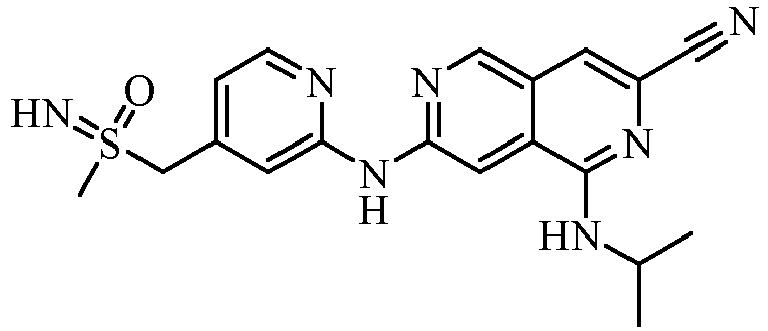
- The titled compound was prepared as same as example 163 using corresponding chemicals.
- 1HNMR (400 MHz, DMSO-d 6) δ(ppm): 10.09 (s, 1H), 8.95 (s, 1H), 8.47 (s, 1H), 8.32-8.31 (d, 1H), 7.63 (s, 1H), 7.47-7.45 (d, 1H), 7.37 (s, 1H), 7.02-7.01 (d, 1H), 4.41-4.34 (m, 3H), 3.8 (s, 1H), 2.90 (s, 3H), 1.28-1.27 (m, 6H).
- Molecular formula: C19H21N7OS Exact mass: 395.15 LC-MS (Pos, m/z) =396.17[M+H]+.
-

- The titled compound was prepared as same as example 148 using corresponding chemicals.
- 1HNMR (400 MHz, MeOD) δ(ppm): 8.79 (s, 1H), 7.63 (s, 1H), 6.83 (s, 1H), 3.96-3.90 (m, 1H), 3.53-3.48 (m, 4H), 3.29-3.28 (d,1H), 3.03-2.98 (m, 1H), 2.70-2.64 (m, 1H), 2.60-2.55 (m, 1H), 2.15-2.11 (m, 1H), 1.88-1.83 (m, 1H), 1.72-1.65 (m, 2H), 1.28-1.25 (t, 6H).
- Molecular formula: C18H24N6 Exact mass: 324.21 LC-MS(Pos, m/z)=325.12[M+H]+.
-

- The titled compound was prepared as same as example 179 using corresponding chemicals.
- 1HNMR (400 MHz, MeOD) 6(ppm): 8.65 (s, 1H), 7.37-7.36 (d, 1H), 6.81 (s, 1H), 4.08-4.03 (m, 1H), 3.30-3.29 (d, 1H), 2.92-2.86 (m , 2H), 1.87-1.80 (m, 2H), 1.58 (s, 9H). Molecular formula: C17H22N6 Exact mass: 310.19 LC-MS(Pos, m/z)=311.07[M+H]+.
-

- The titled compound was prepared as same as example 179 using corresponding chemicals.
- 1HNMR (400 MHz, MeOD) δ(ppm): 8.68 (s, 1H), 6.41 (s, 1H), 6.96 (s, 1H), 4.75-4.72 (m, 1H), 4.43-4.40 (t, 1H), 4.13-4.08 (m, 2H), 3.91-3.86 (m, 1H), 3.83-3.79 (m, 1H), 3.69-3.66 (t, 2H), 2.43-2.34 (m, 2H), 2.27-2.23 (m, 1H), 2.16-2.13 (m, 1H), 2.05-2.01 (m, 2H), 1.70-1.58 (m, 1H).
- Molecular formula: C18H22N6O Exact mass: 338.19 LC-MS(Pos, m/z)=339.07[M+H]+.
-

- The titled compound was prepared as same as example 179 using corresponding chemicals.
- 1HNMR (400 MHz, MeOD) δ(ppm): 8.71 (s, 1H), 7.45 (s, 1H), 6.94 (s, 1H), 4.77-4.74 (m, 1H), 4.65 (s, 1H), 4.13-4.08 (m, 2H), 3.92-3.86 (m, 1H), 3.83-3.80 (t, 1H), 3.50-3.45 (m, 1H), 2.99-2.92 (m, 2H), 2.44-2.39 (m, 1H), 2.15-2.11 (m, 1H), 2.06-1.98 (m, 2H).
- Molecular formula:C17H20N6O Exact mass: 324.17 LC-MS (Pos, m/z)=325.08[M+H]+.
-

-

- 7-Chloro-1-(methylsulfonyl)-2,6-naphthyridine-3-carbonitrile (500 mg, 1.87 mmol, 1.0 eq.) and cyclopropylamine (320 mg, 5.61 mmol, 3.0 eq.) were dissolved in THF (10 mL), and the reaction solution was reacted at room temperature for 30 min. After the reaction was completed as monitored by TLC, the reaction solution was poured into water (10 mL) and extracted with EA (10 mL × 2). The organic phase was dried and concentrated to give the product (458 mg, yield: 100%).
-

- 7-Chloro-1-(cyclopropylamino)-2,6-naphthyridine-3-carbonitrile (458 mg, 1.87 mmol, 1.0 eq.), tert-butyl (S)-3-aminopiperidine-1-carboxylate (449 mg, 2.24 mmol, 1.2 eq.), Pd2(dba)3 (174 mg, 0.19 mmol, 0.1 eq.), BINAP (118 mg, 0.19 mmol, 0.1 eq.) and cesium carbonate (1.22 g, 3.74 mmol, 2.0 eq.) were dispersed in 1,4-dioxane (10 mL), and the reaction solution was reacted at 100 °C for 16 h in nitrogen atmosphere. After the reaction was completed as monitored by TLC, the reaction solution was concentrated under reduced pressure to give a crude product, which was purified by silica gel column chromatography (MeOH:DCM = 1:100) to give the product (400 mg, yield: 52.4%).
-

- tert-Butyl (S)-3-((7-cyano-5-(cyclopropylamino)-2,6-naphthyridin-3-yl)amino)piperidine-1-carboxylate (400 mg, 0.98 mmol, 1.0 eq.) was dissolved in EA (10 mL), and a solution of hydrogen chloride in 1,4-dioxane (4 mol/L, 5 mL) was added dropwise. The reaction solution was reacted at room temperature for 60 min. After the reaction was completed as monitored by TLC, the reaction solution was poured into water (10 mL), and the liquid separation was performed. The aqueous phase was adjusted to pH of 10 with saturated aqueous potassium carbonate solution, and extracted with DCM (10 mL × 4). The organic phase was dried and concentrated, and the crude product was purified by silica gel preparative thin-layer chromatography (MeOH:DCM = 1:10) to give the product (240 mg, yield: 79.5%).
- 1HNMR (400 MHz, MeOD) δ(ppm): 8.71 (s, 1H), 7.46 (s, 1H), 6.85 (s, 1H), 3.92-3.89 (m, 1H), 3.08-3.04 (m, 1H), 2.95-2.89 (m, 1H), 2.76-2.69 (m, 1H), 2.64-2.58 (m, 1H), 2.15-2.11 (m, 1H), 1.92-1.87 (m, 1H), 1.73-1.70 (m, 1H), 1.63-1.60 (t, 1H), 1.32-1.31 (d, 1H), 0.92-0.87 (m, 2H), 0.67-0.63 (m, 2H).
- Molecular formula: C17H20N6 Exact mass: 308.17 LC-MS (Pos, m/z) = 309.11[M+H]+.
-

- The titled compound was prepared as same as example 179 using corresponding chemicals.
- 1HNMR (400 MHz, MeOD) δ(ppm): 8.68 (s, 1H), 7.43 (s, 1H), 6.89 (s, 1H), 4.76 (m, 1H), 4.13-4.02 (m, 3H), 3.92-3.79 (m, 3H), 2.93-2.90 (m, 2H), 2.44-2.39 (m, 1H), 2.15-2.07 (m, 1H), 1.91-1.88 (m, 2H).
- Molecular formula: C17H19N5O2 Exact mass: 325.15 LC-MS (Pos, m/z) =326.17 [M+H]+.
-

- The titled compound was prepared as same as example 178 using corresponding chemicals.
- 1H-NMR (CDCl3) δ(ppm): 11.65 (brs, 1H), 8.82 (s, 1H), 8.56 (s, 1H), 7.35 (s, 1H), 5.43 (s, 1H), 3.48 (s, 1H), 3.32-3.36 (m, 1H), 3.14-3.18 (m, 1H), 2.95-3.00 (m, 1H), 2.76 (t, 1H, J = 10.4 Hz), 2.60-2.63 (m, 1H), 2.07-2.11 (m, 1H), 1.75-1.91 (m, 3H), 1.55 (s, 9H).
- Molecular formula: C19H24N6O Exact mass: 352.20 LC-MS (Pos, m/z) =353.1 [M+H]+.
-

-

-

- (1,7-dichloro-2,6-naphthyridin-3-yl)methyl benzoate (3.0 g, 9.04 mmol) and tBuNH2 (18.9 ml, 180 mmol, 20 eq.) were dissolved in dry THF (20 mL) and the reaction mixture was heated to 100°C for overnight. LCMS showed SM was major compound along with desired product. The reaction was continued for another 60 h. The reaction mixture was cooled to rt, diluted with water and extracted with EA (100 mLx3). Combined EA layers were further washed with brine, dried over anhydrous sodium sulfate, filtered and concentrated under reduced pressure to get the crude. The crude was purified by silica gel column chromatography to obtain the desired product (1.2 g, yield: 36%) and the SM was recovered. Exact mass: 369.12, LC-MS (Pos, m/z) = 370.0 [M+H]+.
-

- To a stirred solution of (1-(tert-butylamino)-7-chloro-2,6-naphthyridin-3-yl)methyl benzoate (2.8 g, 7.58 mmol) in a mixture of solvents THF (15mL), MeOH (7.0 mL) and water (7.0 mL) was added LiOH.H2O (0.933 g, 22.7 mmol, 3.0 eq.) and stirred at rt for overnight. After TLC showed SM was consumed and polar spot was formed, the solvent was removed under reduced pressure to get the crude product. The crude was dissolved in EA and washed with water and brine, dried over anhydrous sodium sulfate and concentrated under reduced pressure to get the crude. The crude was purified by silica gel column chromatography using 10-15% EA in hexane as eluent to get the pure compound (1.95 g, yield: 97%). Exact mass: 265.10, LC-MS (Pos, m/z) = 266.0 [M+H]+.
-

- To a stirred solution of (1-(tert-butylamino)-7-chloro-2,6-naphthyridin-3-yl)methanol (1.6 g, 6.038 mmol) in DMSO (40 mL) was added IBX (3.38 g, 12.08 mmol, 2.0 eq.) at 0°C and stirred at rt for 30 min. After TLC showed SM was consumed, the reaction mixture was diluted with cold water (100 mL) and extracted with EA(150 mLx2). The combined organic layers were washed with brine, dried over anhydrous sodium sulfate and concentrated under reduced pressure to get the crude which was used in the next step without further purification. Exact mass: 263.08, LC-MS (Pos, m/z) = 264.0 [M+H]+.
-

- To a stirred solution of 1-(tert-butylamino)-7-chloro-2,6-naphthyridine-3-carbaldehyde (4.1 g, crude, 15.59 mmol) in acetonitrile (60.0 mL) was added TEA (6.31 mL, 62.36 mmol, 4.0 eq.) followed by NH2OH.HCl (2.38 g, 34.30 mmol, 2.2 eq.) and the reaction mixture was heated to reflux for 2h. After TLC showed SM was consumed, the reaction mixture was cooled to rt and concentrated under reduced pressure. The crude was diluted with water and extracted with EA (150 mLx2). The combined organic layers were dried over anhydrous sodium sulfate, filtered and concentrated under reduced pressure to get the crude oxime intermediate (2.5 g), which was further treated with Ac2O (29.72 mL, 311.78 mmol, 20 eq.) and reaction mixture was heated at 120°C for 18 h. TLC showed desired nonpolar spot formed along with little intermediate. Further added Ac2O (10 mL) and continued for another overnight. The reaction mixture was cooled to rt, diluted with 20% EA in hexane (150 mL) and stayed for overnight at rt. The desired product (1.3 g) was isolated by filtration. The mother liquid was concentrated under reduced pressure to get the crude. The crude mixture was purified by silica gel column chromatography using 10-20% EA in hexane as eluent to give another desired product (400 mg). The combined compound (1.7 g, yield: 45%) was used in the next step.
-

- 1-(tert-butylamino)-7-chloro-2,6-naphthyridine-3-carbonitrile (0.9 g, 3.462 mmol), benzophenone imine (0.87 mL, 5.19 mmol, 1.5 eq.), Pd2(dba)3 (317 mg, 0.346 mmol, 0.1 eq.), BINAP (431 mg, 0.692 mmol, 0.2 eq.) and Cs2CO3 (3.4 g, 10.39 mmol, 3.0 eq.) were dissolved in 1,4-dioxane (30 mL) and the reaction mixture was heated to 120°C for overnight. After LCMS showed SM was consumed, the reaction mixture was cooled to rt, filtered through celite pad, washed with EA. The organic layer was washed with brine, dried over anhydrous sodium sulfate, filtered and concentrated under reduced pressure to get the crude. The crude was purified by Combiflash chromatography to obtain the desired compound (1.15 g, yield: 82%). Exact mass: 405.20, LC-MS (Pos, m/z) = 406.0 [M+H]+.
-

- To a stirred solution of 1-(tert-butylamino)-7-((diphenylmethylene)amino)-2,6-naphthyridine-3-carbonitrile (1.15 g, 2.83 mmol) in THF (18.0 mL) was added aq. 10% citric acid solution (10 mL) and stirred at rt for 3 h. After TLC showed SM was consumed, THF was removed under reduced pressure. The reaction mixture was extracted with EA. The organic layer was washed with water and brine, dried over anhydrous sodium sulfate and concentrated under reduced pressure to get the crude compound. The crude was purified by Combiflash chromatography to get the pure compound as grey solid (575 mg, yield: 84%). Exact mass: 241.13, LC-MS (Pos, m/z) = 242.2 [M+H]+.
-

- 7-amino-1-(tert-butylamino)-2,6-naphthyridine-3-carbonitrile (24.1 mg, 0.10 mmol) was dissolved in DCM (0.5 mL). The reaction solution was cooled to 0 °C, added with 1-chloro-N,N,2-trimethylprop-1-en-1-amine (mass fraction: 95%, 20.0 mg, 0.15 mmol, 1.5 eq.) and reacted at 0 °C for 1 h. (R)-1-(tert-butoxycarbonyl)piperidine-3-carboxylic acid (27.5 mg, 0.12 mmol, 1.2 eq.) and pyridine (24.2 uL, 0.30 mmol, 3.0 eq.) were added to the reaction mixture and the solution was stirred at rt for overnight. When there were no materials left, as detected by LCMS, the reaction solution was added with TFA (1.0 mL) and reacted at rt for 1 h. When there were no materials left, the reaction solution was concentrated under reduced pressure. The crude was purified by HPLC to give the product (17.2 mg, yield: 49%).
- 1H-NMR (CDCl3) δ(ppm): 11.60 (brs, 1H), 8.81 (s, 1H), 8.55 (s, 1H), 7.34 (s, 1H), 5.46 (s, 1H), 3.32-3.36 (m, 1H), 3.14-3.17 (m, 1H), 2.96-3.00 (m, 1H), 2.77 (t, 1H, J = 11.2 Hz), 2.62-2.64 (m, 1H), 2.06-2.10 (m, 1H), 1.78-1.90 (m, 4H), 1.55 (s, 9H).
- Molecular formula: C19H24N6O Exact mass: 352.20 LC-MS (Pos, m/z) = 353.2 [M+H]+.
-

-

- (R)-7-chloro-1-((tetrahydrofuran-3-yl)amino)-2,6-naphthyridine-3-carbonitrile (300 mg, 1.09 mmol, 1.0 eq.), tert-butyl (trans)-3-aminocyclobutyl)carbamate (244 mg, 1.31 mmol, 1.2 eq.), tetrakis(triphenylphosphine)palladium (127.2 mg, 0.11 mmol, 0.1 eq.), Xantphos (127.3 mg, 0.22 mmol, 0.2 eq.) and cesium carbonate (889.5 mg, 2.73 mmol, 2.5 eq.) were added to 1,4-dioxane (20 mL), and the reaction solution was heated to 100 °C and reacted for 12 h in a sealed tube in nitrogen atmosphere. The reaction solution was then concentrated under reduced pressure to give a crude product, which was purified by silica gel column chromatography (MeOH:DCM = 1:100-1:50) to give the product (200 mg, yield: 68.7%).
-

- Tert-butyl ((trans)-3-((7-cyano-5-(((R)-tetrahydrofuran-3-yl)amino)-2,6-naphthyridin-3-yl)amino)cyclobutyl)carbamate (200 mg, 0.47 mmol, 1.0 eq.) was dissolved in DCM (3 mL), and hydrogen chloride ethanol solution (10 mol/L, 3 mL) was added dropwise. The reaction solution was reacted at room temperature for 1 h. When there were no materials left, as detected by TLC, the reaction solution was concentrated under reduced pressure, water (30 mL) was added, and DCM (30 mL × 2) was added for back-extraction. The aqueous phase was adjusted to pH of about 8 with aqueous potassium carbonate solution and extracted with DCM (30 mL × 5). The organic phases were combined, dried over anhydrous sodium sulfate and filtered, and the filtrate was concentrated under reduced pressure to give a crude product, which was purified by preparative thin-layer chromatography (MeOH:DCM = 1:10) to give the product (62 mg, yield: 40.7%).
- 1HNMR (400 MHz, MeOD) δ(ppm): 8.69 (s, 1H), 7.43 (s, 1H), 6.80 (s, 1H), 4.77-4.74 (m, 1H), 4.31-4.28 (m, 1H), 4.13-4.03 (m, 2H), 3.92-3.86 (m, 1H), 3.82-3.79 (m, 1H), 3.71-3.68 (m, 1H), 2.55-2.30 (m, 5H), 2.13-2.11 (m, 1H).
- Molecular formula: C17H20N6O Exact mass: 324.17 LC-MS (Pos, m/z) = 325.11[M+H]+.
-

- The titled compound was prepared as same as example 38 using corresponding chemicals.
- 1HNMR (400 MHz, MeOD) 6(ppm): 8.97 (d, 1H), 8.08 (s, 1H), 7.03 (s, 1H), 6.06-6.08 (m, 1H), 4.03-4.09 (m, 1H), 3.35-3.36 (m, 1H), 3.03-3.08 (m, 1H), 2.68-2.75 (m, 1H), 2.59-2.64 (m, 1H), 2.46-2.49 (m, 2H), 2.34-2.36 (m, 2H), 2.10-2.14 (m, 1H), 1.87-1.93 (m, 3H), 1.79-1.85 (m, 2H), 1.65-1.75 (m, 1H) ,1.53-1.62 (m, 1H).
- Molecular formula:C20H23N5 Exact mass: 333.20 LC-MS (Pos, m/z)=334.07[M+H]+.
-

- The titled compound was prepared as same as example 38 using corresponding chemicals.
- 1HNMR (400 MHz, MeOD) δ(ppm): 8.97 (s, 1H), 8.05 (s, 1H), 7.20 (s, 1H), 6.47-6.48 (m, 1H), 4.12-4.17 (m, 1H), 3.41-3.45 (m, 1H), 3.12-3.17 (m, 1H), 2.92-2.97 (m, 2H), 2.79-2.85 (m, 1H), 2.70-2.76 (m, 3H), 2.06-2.17 (m, 3H), 1.94-2.00 (m, 1H), 1.72-1.83 (m, 1H), 1.59-1.68 (m, 1H).
- Molecular formula:C19H21N5 Exact mass: 319.18 LC-MS(Pos, m/z)=320.08[M+H]+.
-

- The titled compound was prepared as same as example 154 using corresponding chemicals.
- 1HNMR (400 MHz, MeOD) δ(ppm): 8.71 (s, 1H), 7.46 (s, 1H), 6.96 (s, 1H), 5.21-5.17 (m, 1H), 5.08-5.04 (m, 2H), 4.77-4.74 (m, 2H), 3.89-3.84 (m, 1H), 3.28-3.27(m, 1H), 3.03-2.99 (m, 1H), 2.71-2.64 (m, 1H), 2.59-2.54 (m, 1H), 2.15-2.12 (m, 1H), 1.89-1.84 (m, 1H), 1.72-1.57 (m, 2H).
- Molecular formula: C17H20N6O Exact mass: 324.17 LC-MS (Pos, m/z) =325.22 [M+H]+.
-
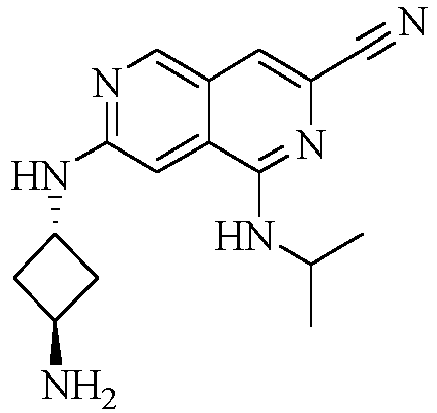
- The titled compound was prepared as same as example 38 using corresponding chemicals.
- 1HNMR (400 MHz, MeOD) δ(ppm): 8.66 (s, 1H), 7.36 (s, 1H), 6.78 (s, 1H), 4.47-4.44 (m, 1H), 4.33-4.30 (m, 1H), 3.73-3.69 (m, 1H), 2.35-2.32 (m, 4H), 1.34-1.33(m, 6H).
- Molecular formula: C16H20N6 Exact mass: 296.17 LC-MS (Pos, m/z) =297.14 [M+H]+.
-

-

- 7-Chloro-1-(methylsulfonyl)-2,6-naphthyridine-3-carbonitrile (500 mg, 1.87 mmol, 1.0 eq) and a 65% (by mass) aqueous ethylamine solution (5 mL) was added to anhydrous tetrahydrofuran (5 mL), and the reaction solution was reacted at room temperature for 0.5 h. When there were no starting materials left as monitored by TLC, water (30 mL) was added, and the mixture was extracted with ethyl acetate (30 mL × 3). The organic phases were combined, dried over anhydrous sodium sulfate and filtered, and the filtrate was concentrated under reduced pressure to give the product (420 mg, yield: 96.5%).
-

- 7-Chloro-1-(ethylamino)-2,6-naphthyridine-3-carbonitrile (420 mg, 1.81 mmol, 1.0 eq), tert-butyl ((trans)-3-aminocyclobutyl)carbamate (404.2 mg, 2.17 mmol, 1.2 eq), Pd2(dba)3 (247.2 mg, 0.27 mmol, 0.15 eq), BINAP (336.2 mg, 0.54 mmol, 0.3 eq) and cesium carbonate (1.47 g, 4.53 mmol, 2.5 eq) were added to 1,4-dioxane (30 mL). The reaction solution was heated to 100 °C and reacted for 14 h in a sealed tube in nitrogen atmosphere. When there were no starting materials left as monitored by TLC, water (30 mL) was added, and then ethyl acetate (30 mL × 3) was added for extraction. The organic phases were combined, dried over anhydrous sodium sulfate and filtered, and the filtrate was concentrated under reduced pressure to give a crude product, which was purified by silica gel column chromatography (MeOH:DCM = 1:200-1:100) to give the product (242 mg, yield: 35%).
-

- tert-Butyl ((trans)-3-((7-cyano-5-(ethylamino)-2,6-naphthyridin-3-yl)amino)cyclobutyl)carbamate (240 mg, 0.63 mmol, 1.0 eq) was dissolved in DCM (4 mL), and hydrogen chloride ethanol solution (10 mol/L, 4 mL) was added dropwise. The reaction solution was reacted at room temperature for 2 h. When there were no materials left as monitored by TLC, the reaction solution was concentrated at room temperature under reduced pressure, water (30 mL) was added, and DCM (30 mL × 2) was added for back-extraction. The aqueous phase was adjusted to pH of about 8 with potassium carbonate and extracted with DCM (30 mL × 4). The organic phases were combined, dried over anhydrous sodium sulfate and filtered, and the filtrate was concentrated under reduced pressure to give a crude product, which was purified by preparative thin-layer chromatography (MeOH:DCM = 1:10) to give the product (38 mg, yield: 21.4%).
- 1HNMR (400 MHz, MeOD) δ(ppm): 8.66 (s, 1H), 7.37 (s, 1H), 6.70 (s, 1H), 4.29-4.26 (m, 1H), 3.72-3.69 (m, 1H), 3.62-3.57 (m, 2H), 2.35-2.31 (m, 4H), 1.34-1.31(m, 3H).
- Molecular formula: C15H18N6 Exact mass: 282.16 LC-MS (Pos, m/z) =283.14 [M+H]+.
-

- The titled compound was prepared as same as example 205 using corresponding chemicals.
- 1HNMR (400 MHz, MeOD) δ(ppm): 8.82 (s, 1H), 7.76 (s, 1H), 6.96 (s, 1H), 5.64-5.61 (m, 1H), 4.03-3.98 (m, 1H), 3.06-3.00 (m, 1H), 2.72-2.66 (m, 1H), 2.61-2.55 (m, 1H), 2.12-2.07 (m, 3H), 1.94-1.85 (m, 6H), 1.76-1.71 (m, 3H), 1.61-1.55 (m, 1H). Molecular formula: C19H23N5O Exact mass: 337.19 LC-MS (Pos, m/z) =338.22 [M+H]+.
-

-

- 7-Chloro-1-(ethylamino)-2,6-naphthyridine-3-carbonitrile (240 mg, 1.03 mmol, 1.0 eq), tert-butyl (S)-3-aminopiperidine-1-carboxylate (248.3 mg, 1.24 mmol, 1.2 eq), Pd2(dba)3 (137.4 mg, 0.15 mmol, 0.15 eq), BINAP (186.8 mg, 0.3 mmol, 0.3 eq) and cesium carbonate (837.4 mg, 2.57 mmol, 2.5 eq) were added to 1,4-dioxane (20 mL). The mixture was reacted at 100 °C for 14 h in a sealed tube in nitrogen atmosphere. When there were no starting materials left as monitored by TLC, water (30 mL) was added, and the mixture was extracted with ethyl acetate (30 mL × 3). The organic phases were combined, dried over anhydrous sodium sulfate and filtered, and the filtrate was concentrated under reduced pressure to give a crude product, which was purified by silica gel column chromatography (EA:PE = 1:6-1:2) to give the product (300 mg, yield: 73.4%).
-
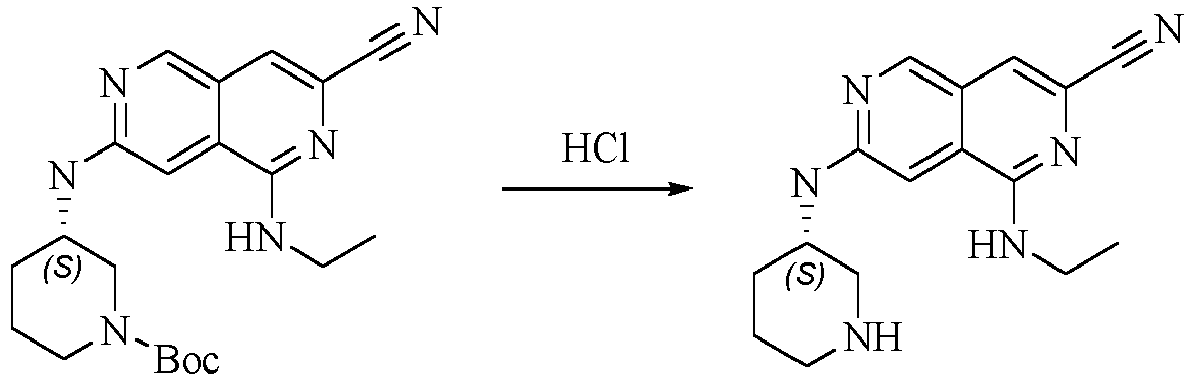
- tert-Butyl (S)-3-((7-cyano-5-(ethylamino)-2,6-naphthyridin-3-yl)amino)piperidine-1-carboxylate (300 mg, 0.76 mmol, 1.0 eq.) was dissolved in DCM (4 mL), and hydrogen chloride ethanol solution (10 mol/L, 4 mL) was added dropwise. The reaction solution was reacted at room temperature for 2 h. When there were no materials left as monitored by TLC, the reaction solution was concentrated at room temperature under reduced pressure, water (30 mL) was added, and DCM (30 mL × 2) was added for back-extraction. The aqueous phase was adjusted to pH of about 8 with potassium carbonate and extracted with DCM (30 mL × 3). The organic phases were combined, dried over anhydrous sodium sulfate and filtered, and the filtrate was concentrated under reduced pressure to give a crude product, which was purified by preparative thin-layer chromatography (MeOH:DCM = 1:10) to give the product (139 mg, yield: 61.7%). 1HNMR (400 MHz, MeOD) δ(ppm): 8.66 (s, 1H), 7.37 (s, 1H), 6.86 (s, 1H), 3.85-3.83 (m, 1H), 3.59-3.57 (m, 2H), 3.29-3.26 (m, 1H), 3.02-2.99 (m, 1H), 2.69-2.63 (m, 1H), 2.57-2.52 (m, 1H), 2.12-2.11 (m, 1H), 1.87-1.83 (m, 1H), 1.69-1.55 (m, 2H), 1.34-1.31 (m, 3H).
- Molecular formula: C16H20N6 Exact mass: 296.17 LC-MS (Pos, m/z) = 297.14[M+H]+.
-

- The titled compound was prepared as same as example 38 using corresponding chemicals.
- 1H-NMR (400 MHz, CD3OD) δ(ppm): 9.01 (s, 1H), 8.08 (s, 1H), 7.12 (s, 1H), 4.32-4.39 (m, 1H), 3.82-3.89 (m, 1H), 3.61-3.66 (m, 1H), 3.35-3.38 (m, 1H), 3.03-3.09 (m, 1H), 2.96-3.02 (m, 1H), 2.18-2.22 (m, 1H), 2.13-2.17 (m, 2H), 2.08-2.12 (m, 1H), 2.00-2.06 (m, 2H), 1.92-1.98 (m, 1H), 1.81-1.92 (m, 4H), 1.72-1.80 (m, 1H).
- Molecular formula:C19H23N5 Exact mass: 321.20 LC-MS(Pos, m/z)=322.13 [M+H]+
-

- The titled compound was prepared as same as example 38 using corresponding chemicals.
- 1H-NMR (400 MHz, CD3OD) δ(ppm): 9.04 (s, 1H), 8.11 (s, 1H), 7.14 (s, 1H), 4.31-4.38 (m, 1H), 3.58-3.62 (m, 1H), 3.34-3.40 (m, 1H), 3.00-3.07 (m, 1H), 2.93-2.99 (m, 1H), 2.18-2.22 (m, 1H), 2.09-2.15 (m, 1H), 1.87-2.00 (m, 3H), 1.71-1.86 (m, 4H), 0.80-0.84 (m, 6H).
- Molecular formula:C19H25N5 Exact mass: 323.21 LC-MS(Pos, m/z)=324.15 [M+H]+
-

- The titled compound was prepared as same as example 38 using corresponding chemicals.
- 1H-NMR (400 MHz, CD3OD) δ(ppm): 9.03 (s, 1H), 8.12 (s, 1H), 7.04 (s, 1H), 4.30-4.37 (m, 1H), 3.59-3.63 (m, 1H), 3.34-3.37 (m, 1H), 3.15-3.20 (m, 2H), 3.00-3.07 (m, 1H), 2.93-2.98 (m, 1H), 2.18-2.23 (m, 1H), 2.08-2.16 (m, 1H), 1.85-1.96 (m, 1H), 1.71-1.80 (m, 1H), 1.39-1.42 (t, 3H).
- Molecular formula:C16H19N5 Exact mass: 281.16 LC-MS(Pos, m/z)=282.16 [M+H]+
-

- The titled compound was prepared as same as example 38 using corresponding chemicals.
- 1HNMR (400 MHz, CD3OD) δ(ppm): 9.00-8.99 (d, 1H), 8.22 (s, 1H), 6.84 (s, 1H), 3.97-3.91 (m, 1H), 3.28 (s, 1H), 3.05-2.99 (m, 1H), 2.71-2.64 (m ,1H), 2.60-2.54 (m, 1H), 2.15-2.11 (m, 1H), 1.89-1.83 (m, 1H), 1.73-1.70 (m, 1H), 1.69-1.67 (m, 1H).
- Molecular formula:C14H15N5 Exact mass:253.13 LC-MS(Pos, m/z)=254.07[M+H]+.
-

- The titled compound was prepared as same as example 51 using corresponding chemicals.
- 1HNMR (400 MHz, MeOD) δ(ppm): 8.83 (s, 1H), 7.79 (s, 1H), 6.83 (s, 1H), 4.59-4.54 (m, 2H), 4.43-4.40 (m, 1H), 3.79-3.73 (m, 1H), 2.41-2.38 (m, 4H), 1.53-1.48 (m, 3H).
- Molecular formula: C15H17N5O Exact mass: 283.14 LC-MS (Pos, m/z) =284.21 [M+H]+.
-

- The titled compound was prepared as same as example 38 using corresponding chemicals.
- 1HNMR (400 MHz, CD3OD) δ(ppm): 8.89 (s, 1H), 7.89 (s, 1H), 6.86 (s, 1H), 4.04-3.99 (m, 1H), 3.30 (s, 1H), 3.06-3.01 (m, 1H), 2.72-2.71 (d ,1H), 2.67 (s, 3H), 2.61-2.56 (m, 1H), 2.15-2.11 (m, 1H), 1.90-1.85 (m, 1H), 1.74-1.70 (m, 1H), 1.69-1.64 (m, 1H). Molecular formula: C15H17N5S Exact mass: 299.12 LC-MS(Pos, m/z)=300.05[M+H]+.
-

- The titled compound was prepared as same as example 38 using corresponding chemicals.
- 1H-NMR (400 MHz, CD3OD) δ(ppm): 8.98 (s, 1H), 8.05 (s, 1H), 7.02 (s, 1H), 4.10-4.19 (m, 1H), 3.34-3.50 (m, 2H), 3.12-3.17 (m, 1H), 2.70-2.85 (m, 2H), 2.14-2.18 (m, 1H), 1.93-2.00 (m, 4H), 1.82-1.86 (m, 1H), 1.73-1.81 (m, 2H), 1.53-1.72 (m, 4H), 1.34-1.45 (m, 2H).
- Molecular formula:C20H25N5 Exact mass: 335.21 LC-MS(Pos, m/z)=336.13 [M+H]+
-
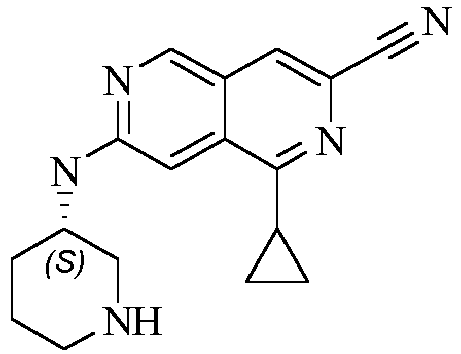
- The titled compound was prepared as same as example 38 using corresponding chemicals.
- 1HNMR (400 MHz, MeOD) δ(ppm): 8.92 (s, 1H), 7.95 (s, 1H), 7.13 (s, 1H), 3.98-3.93 (m, 1H), 3.28 (m, 1H), 3.00-2.97 (m, 1H), 2.66-2.60 (m, 2H), 2.55-2.49 (m, 1H), 2.15-2.12 (m, 1H), 1.86-1.81 (m, 1H), 1.71-1.55 (m, 2H), 1.21-1.15 (m, 4H). Molecular formula: C17H19N5 Exact mass: 293.16 LC-MS (Pos, m/z) =294.16 [M+H]+.
-

- The titled compound was prepared as same as example 51 using corresponding chemicals.
- 1HNMR (400 MHz, MeOD) δ(ppm): 8.81-8.80 (d, 1H), 7.75 (s, 1H), 6.83 (s, 1H), 5.53-5.47 (m, 1H), 3.98-3.90 (s, 1H), 3.27-3.19 (m, 1H), 2.87-2.81 (m, 1H), 1.78-1.71 (m, 2H), 1.47-1.46 (d, 6H).
- Molecular formula:C16H19N5O Exact mass: 297.16 LC-MS(Pos, m/z)=298.09[M+H]+.
-

- The titled compound was prepared as same as example 38 using corresponding chemicals.
- 1HNMR (400 MHz, MeOD) δ(ppm): 8.93 (s, 1H), 8.06 (s, 1H), 6.83 (s, 1H), 3.96-3.93 (m, 1H), 3.29-3.26 (m, 1H), 2.99-2.98 (m, 1H), 2.76 (s, 3H), 2.65-2.59 (m, 1H), 2.53-2.48 (m, 1H), 2.13-2.10 (m, 1H), 1.86-1.80 (m, 1H), 1.70-1.52 (m, 2H). Molecular formula: C15H17N5 Exact mass: 267.15 LC-MS (Pos, m/z) =268.14 [M+H]+.
-

- The titled compound was prepared as same as example 205 using corresponding chemicals.
- 1HNMR (400 MHz, MeOD) δ(ppm): 8.82 (s, 1H), 7.80 (s, 1H), 6.83 (s, 1H), 4.53-4.48 (m, 1H), 3.92-3.88 (m, 1H), 3.27-3.23 (m, 1H), 2.98-2.95 (m, 1H), 2.64-2.58 (m, 1H), 2.52-2.46 (m, 1H), 2.11-2.08 (m, 1H), 1.84-1.79 (m, 1H), 1.66-1.51 (m, 2H), 0.92-0.85 (m, 4H).
- Molecular formula: C17H19N5O Exact mass: 309.16 LC-MS (Pos, m/z) =310.14 [M+H]+.
-

- The titled compound was prepared as same as example 205 using corresponding chemicals.
- 1HNMR (400 MHz, MeOD) δ(ppm): 8.81 (s, 1H), 7.76 (s, 1H), 6.95 (s, 1H), 4.57-4.52 (m, 2H), 3.94-3.89 (m, 1H), 3.28-3.24 (m, 1H), 2.98-2.95 (m, 1H), 2.65-2.58 (m ,1H), 2.53-2.47 (m, 1H), 2.12-2.09 (t, 1H), 1.85-1.79 (m, 1H), 1.69-1.61 (m, 1H), 1.60-1.55 (m, 1H), 1.52-1.48 (t, 3H).
- Molecular formula:C16H19N5O Exact mass: 297.16 LC-MS(Pos, m/z)=298.05[M+H]+.
-
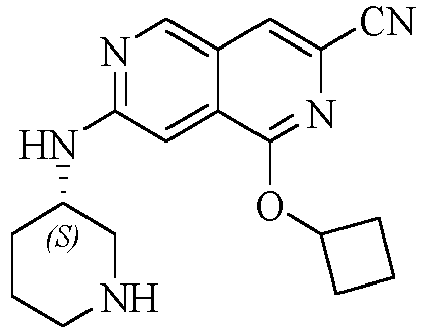
- The titled compound was prepared as same as example 205 using corresponding chemicals.
- 1HNMR (400 MHz, MeOD) δ(ppm): 8.81 (s, 1H), 7.75 (s, 1H), 6.95 (s, 1H), 5.38-5.33 (m, 1H), 3.96-3.92 (m, 1H), 3.31-3.27 (m, 1H), 3.01-2.98 (m, 1H), 2.67-2.50 (m ,4H), 2.30-2.20 (m, 2H), 2.13-2.09 (t, 1H), 1.96-1.89 (m, 1H), 1.86-1.77 (m, 2H), 1.71-1.62 (m, 1H), 1.60-1.53 (m, 1H).
- Molecular formula:C18H21N5O Exact mass: 323.17 LC-MS(Pos, m/z)=324.08[M+H]+.
-

-

- 7-Chloro-1-(methylthio)-2,6-naphthyridine-3-carbaldehyde (6.0 g, 25.13 mmol, 1.0 eq.) was dissolved in DCM (60 mL), and DAST (4.46 mg, 27.64 mmol, 1.1 eq.) was added. The reaction solution was reacted at room temperature for 1 h. After the reaction was completed as monitored by TLC, the reaction solution was slowly added dropwise to water (100 mL). The pH was adjusted to about 10 with potassium carbonate, and DCM (50 mL × 3) was added for extraction. The organic phase was dried and concentrated to give a crude product, which was purified by silica gel column chromatography (PE:EA = 10: 1) to give the product (5.0 g, yield: 76.3%).
-

- 7-Chloro-3-(difluoromethyl)-1-(methylthio)-2,6-naphthyridine (5.0 g, 19.18 mmol, 1.0 eq.) was dissolved in DCM (100 mL), and 85% meta-chloroperoxybenzoic acid (7.79 g, 38.36 mmol, 2.0 eq.) was added. The reaction solution was reacted for 30 min. After the reaction was completed as monitored by TLC, the reaction solution was poured into water (100 mL). The pH was adjusted to about 10 with potassium carbonate, and DCM (50 mL × 2) was added for extraction. The organic phase was dried and concentrated, and the crude product was slurried with a mixed solvent of PE and EA (50 mL, 10:1). The mixture was filtered under vacuum, and the filter cake was dried under vacuum to give the product (5.0 g, yield: 89.1%).
-

- 7-Chloro-3-(difluoromethyl)-1-(methylsulfonyl)-2,6-naphthyridine (1.0 g, 3.42 mmol, 1.0 eq.) and potassium carbonate (2.36 g, 17.10 mmol, 5.0 eq.) were dispersed in ethanol (20 mL), and the reaction solution was reacted at room temperature for 17 h. After the reaction was completed as monitored by TLC, the reaction solution was concentrated under reduced pressure. The crude product was slurried with DCM (50 mL), and the mixture was filtered. The filtrate was concentrated under reduced pressure to give the product (800 mg, yield: 90.5%).
-

- 7-Chloro-3-(difluoromethyl)-1-ethoxy-2,6-naphthyridine (800 mg, 3.09 mmol, 1.0 eq.), tert-butyl ((trans)-3-aminocyclobutyl)carbamate (691 mg, 3.71 mmol, 1.2 eq.), Pd2(dba)3 (284 mg, 0.31 mmol, 0.1 eq.), BINAP (193 mg, 0.31 mmol, 0.1 eq.) and cesium carbonate (2.01 g, 6.18 mmol, 2.0 eq.) were dispersed in 1,4-dioxane (20 mL), and the reaction solution was reacted at 100 °C for 14 h in nitrogen atmosphere. After the reaction was completed as monitored by TLC, the reaction solution was cooled to room temperature and filtered through celite, and the filtrate was concentrated under reduced pressure to give a crude product (1.26 g, yield: 100%).
-

- tert-Butyl ((trans)-3-((7-(difluoromethyl)-5-ethoxy-2,6-naphthyridin-3 - yl)amino)cyclobutyl)carbamate (1.26 g, 3.09 mmol, 1.0 eq.) and 2,6-dimethylpyridine (1.66 g, 15.45 mmol, 5.0 eq.) were dissolved in DCM (20 mL), and TMSOTF (2.06 g, 9.27 mmol, 3.0 eq.) was added dropwise. The reaction solution was reacted at room temperature for 10 min. After the reaction was completed as monitored by TLC, the reaction solution was poured into water (20 mL). The pH was adjusted to about 10 with potassium carbonate, and DCM (20 mL × 2) was added for extraction. The organic phase was dried and concentrated, and the residue was purified first by silica gel column chromatography (MeOH:DCM = 1:20) and then by preparative thin-layer chromatography (MeOH:DCM = 1:10) to give the product (70 mg, yield: 7.4%).
- 1HNMR (400 MHz, MeOD) δ(ppm): 8.83 (s, 1H), 7.48 (s, 1H), 6.84 (s, 1H), 6.76 (s, 0.25H), 6.72 (s, 0.5H), 6.48 (s, 0.25H), 4.61-4.56 (m, 2H), 4.37-4.31 (m, 1H), 3.78-3.71 (m, 1H), 2.38-2.35 (t, 4H), 1.52-1.48 (t, 3H).
- Molecular formula: C15H18F2N4O Exact mass: 308.14 LC-MS (Pos, m/z) = 309.04[M+H]+.
-

-

- 7-Chloro-3-(difluoromethyl)-1-(methylsulfonyl)-2,6-naphthyridine (0.5 g, 1.71 mmol, 1.0 eq.), (R)-tetrahydrofuran-3-amine hydrochloride (316 mg, 2.56 mmol, 1.5 eq.) and triethylamine (519 mg, 5.13 mmol, 3.0 eq.) were dissolved in THF (10 mL), and the reaction solution was reacted at room temperature for 24 h. After the reaction was completed as monitored by TLC, the reaction solution was poured into water (10 mL) and extracted with EA (10 mL × 2). The organic phase was dried and concentrated to give the product (420 mg, yield: 82.0%).
-

- (R)-7-chloro-3-(difluoromethyl)-N-(tetrahydrofuran-3-yl)-2,6-naphthyridine-1-amine (420 mg, 1.40 mmol, 1.0 eq.), tert-butyl (5)-3-aminopiperidine-1-carboxylate (336 mg, 1.68 mmol, 1.2 eq.), Pd2(dba)3 (128 mg, 0.14 mmol, 0.1 eq.), BINAP (87 mg, 0.14 mmol, 0.1 eq.) and cesium carbonate (912 mg, 2.80 mmol, 2.0 eq.) were dispersed in 1,4-dioxane (20 mL), and the reaction solution was reacted at 100 °C for 14 h in nitrogen atmosphere. After the reaction was completed as monitored by TLC, the reaction solution was cooled to room temperature and filtered through celite, and the filtrate was concentrated under reduced pressure to give a crude product (649 mg, yield: 100%).
-

- tert-Butyl (S)-3 -((7-(difluoromethyl)-5-(((R)-tetrahydrofuran-3-yl)amino)-2,6-naphthyridin-3-yl)amino)piperidine-1-carboxylate (649 mg, 1.40 mmol, 1.0 eq.) was dissolved in EA (10 mL), and a solution of hydrogen chloride in 1,4-dioxane (4 mol/L, 10 mL) was added dropwise. The reaction solution was reacted at room temperature for 1 h. After the reaction was completed as monitored by LC-MS, the reaction solution was poured into water (10 mL), and the liquid separation was performed. The aqueous phase was retained, adjusted to pH of about 10 with K2CO3, and extracted with DCM (10 mL × 2). The organic phase was dried and concentrated, and the crude product was purified by preparative thin-layer chromatography (MeOH:DCM = 1: 10) to give the product (260 mg, yield: 51.2%).
- 1HNMR (400 MHz, MeOD) δ(ppm): 8.69 (s, 1H), 7.13 (s, 1H), 6.95 (s, 1H), 6.67 (s, 0.25H), 6.53 (s, 0.5H), 6.39 (s, 0.25H), 4.81-4.75 (m, 1H), 4.15-4.11 (m, 1H), 4.08-4.03 (m, 1H), 3.91-3.86 (m, 1H), 3.82-3.77 (m, 2H), 3.28-3.24 (t, 1H), 3.00-2.96 (m, 1H), 2.68-2.61 (m, 1H), 2.54-2.49 (m, 1H), 2.43-2.38 (m, 1H), 2.16-2.10 (m, 2H), 1.85-1.81 (m, 1H), 1.68-1.65 (m, 1H), 1.56-1.50 (m, 1H).
- Molecular formula: C18H23F2N5O Exact mass: 363.19 LC-MS (Pos, m/z) = 364.09[M+H]+.
-

-

- (R)-Tetrahydrofuran-3-ol (301.3 mg, 3.42 mmol, 2.0 eq) was added to anhydrous tetrahydrofuran (10 mL), and 60% (by mass) sodium hydride (75.2 mg, 1.88 mmol, 1.1 eq) was added. The reaction solution was reacted at room temperature for 0.5 h. 7-Chloro-3-(difluoromethyl)-1-(methylsulfonyl)-2,6-naphthyridine (500 mg, 1.71 mmol, 1.0 eq) was added. The reaction solution was heated to 50 °C and reacted for 22 h. When there were no starting materials left as monitored by TLC, water (30 mL) was added, and ethyl acetate (30 mL × 3) was added for extraction. The organic phases were combined, dried over anhydrous sodium sulfate and filtered, and the filtrate was concentrated under reduced pressure. The crude product was purified by silica gel column chromatography (EA:PE = 1:15) to give the product (411 mg, yield: 79.9%).
-

- (R)-7-Chloro-3-(difluoromethyl)-1-((tetrahydrofuran-3-yl)oxy)-2,6-naphthyridine (210 mg, 0.70 mmol, 1.0 eq.), tert-butyl (S)-3-aminopiperidine-1-carboxylate (168.2 mg, 0.84 mmol, 1.2 eq.), Pd2(dba)3 (64.1 mg, 0.07 mmol, 0.10 eq.), BINAP (87.2 mg, 0.14 mmol, 0.20 eq.) and cesium carbonate (570.2 mg, 1.75 mmol, 2.5 eq.) were added to 1,4-dioxane (15 mL). The mixture was reacted at 100 °C for 14 h in a sealed tube in nitrogen atmosphere. When there were no starting materials left as monitored by TLC, water (30 mL) was added, and the mixture was extracted with ethyl acetate (30 mL × 3). The organic phases were combined, dried over anhydrous sodium sulfate and filtered, and the filtrate was concentrated under reduced pressure to give a crude product, which was purified by silica gel column chromatography (EA:PE = 1:7) to give the product (230 mg, yield: 70.7%).
-

- tert-Butyl (S)-3-((7-(difluoromethyl)-5-(((R)-tetrahydrofuran-3-yl)oxy)-2,6-naphthyridin-3-yl)amino)piperidine-1-carboxylate (230 mg, 0.49 mmol, 1.0 eq) was dissolved in DCM (5 mL), and 2,6-dimethylpyridine (315 mg, 2.94 mmol, 6.0 eq) and trimethylsilyl trifluoromethanesulfonate (326.7 mg, 1.47 mmol, 3.0 eq) were added. The reaction solution was reacted at room temperature for 1 h. When there were no starting materials left as monitored by TLC, water (30 mL) was added. The pH was adjusted to about 8 with potassium carbonate, and DCM (30 mL × 3) was added for extraction. The organic phases were combined, dried over anhydrous sodium sulfate and filtered, and the filtrate was concentrated under reduced pressure. The crude product was purified by preparative thin-layer chromatography (MeOH:DCM = 1:10) to give the product (140 mg, yield: 78.4%).
- 1HNMR (400 MHz, MeOD) δ(ppm): 8.84 (s, 1H), 7.50 (s, 1H), 6.97 (s, 1H), 6.76 (s, 0.25H), 6.26 (s, 0.5H), 6.48 (s, 0.25H), 5.79 (m, 1H), 4.13-4.10 (m, 1H), 4.06-4.00 (m, 2H), 3.97-3.89 (m, 2H), 3.29-3.26 (m, 1H), 2.99-2.96 (m, 1H), 2.66-2.60 (m, 1H), 2.53-2.48 (m, 1H), 2.43-2.36 (m, 1H), 2.29-2.24 (m, 1H), 2.12-2.09 (m, 1H), 1.85-1.80 (m, 1H), 1.67-1.61 (m, 1H), 1.58-1.53 (m, 1H).
- Molecular formula: C18H22F2N4O2 Exact mass: 364.17 LC-MS (Pos, m/z) = 365.18[M+H]+.
-

- The titled compound was prepared as same as example 201 using corresponding chemicals.
- 1HNMR (400 MHz, MeOD) δ(ppm): 8.64 (s, 1H), 7.07 (s, 1H), 6.79 (s, 1H), 6.65 (s, 0.25H), 6.51 (s, 0.5H), 6.37 (s, 0.25H), 3.98-3.94 (m, 1H), 3.24-3.20 (m, 1H), 2.91-2.84 (m, 2H), 1.74-1.71 (m, 2H), 1.56 (s, 9H).
- Molecular formula: C17H23F2N5 Exact mass: 335.19 LC-MS (Pos, m/z) =336.22[M+H]+.
-
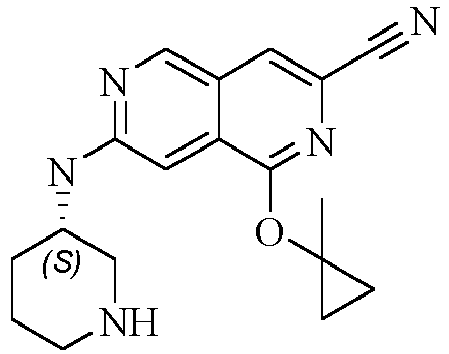
-
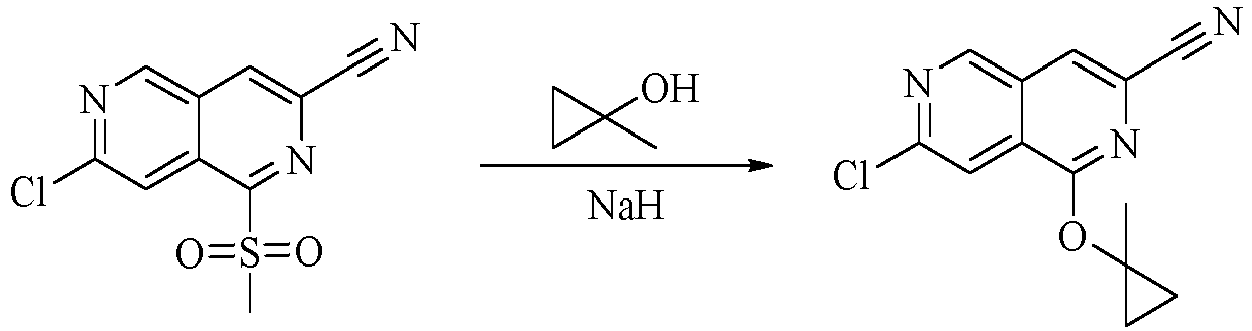
- 1-Methoxypropan-1-ol (323 mg, 4.48 mmol, 2.0 eq) was dissolved in anhydrous THF (10 mL), and 60% (by mass) sodium hydride (98.4 mg, 2.46 mmol, 1.1 eq) was added. The reaction solution was reacted at room temperature for 0.5 h. 7-Chloro-1-(methylsulfonyl)-2,6-naphthyridine-3-carbonitrile (600 mg, 2.24 mmol, 1.0 eq) was added. The reaction solution was heated to 60 °C and reacted for 22 h. When a new dot was present as monitored by TLC, the reaction solution was cooled to room temperature. Water (30 mL) was added, and ethyl acetate (30 mL × 3) was added for extraction. The organic phases were combined, dried over anhydrous sodium sulfate and filtered, and the filtrate was concentrated under reduced pressure. The crude product was purified by silica gel column chromatography (EA:PE = 1:40-1:20) to give the product (154 mg, yield: 26.5%).
-

- 7-Chloro-1-(1-methylcyclopropoxy)-2,6-naphthyridine-3-carbonitrile (154 mg, 0.59 mmol, 1.0 eq), tert-butyl (S)-3-aminopiperidine-1-carboxylate (142.2 mg, 0.71 mmol, 1.2 eq), Pd2(dba)3 (54.9 mg, 0.06 mmol, 0.1 eq), BINAP (74.7 mg, 0.12 mmol, 0.2 eq) and cesium carbonate (478.9 mg, 1.47 mmol, 2.5 eq.) were added to 1,4-dioxane (15 mL). The mixture was reacted at 100 °C for 14 h in a sealed tube in nitrogen atmosphere. When there were no starting materials left as monitored by TLC, water (30 mL) was added, and the mixture was extracted with ethyl acetate (30 mL × 3). The organic phases were combined, dried over anhydrous sodium sulfate and filtered, and the filtrate was concentrated under reduced pressure to give a crude product, which was purified by silica gel column chromatography (EA:PE = 1:6) to give the product (107 mg, yield: 42.8%).
-

- tert-Butyl (S)-3-(7-cyano-5-(1-methylcyclopropoxy)-2,6-naphthyridin-3-yl)aminopiperidine-1-carboxylate (107 mg, 0.25 mmol, 1.0 eq) was dissolved in DCM (5 mL), and 2,6-dimethylpyridine (160.7 mg, 1.5 mmol, 6.0 eq) and trimethylsilyl trifluoromethanesulfonate (166.7 mg, 0.75 mmol, 3.0 eq) were added. The reaction solution was reacted at room temperature for 1 h. When there were no starting materials left as monitored by TLC, water (30 mL) was added. The pH was adjusted to about 8 with potassium carbonate, and DCM (30 mL × 2) was added for extraction. The organic phases were combined, dried over anhydrous sodium sulfate and filtered, and the filtrate was concentrated under reduced pressure. The crude product was purified by thin-layer chromatography (MeOH:DCM = 1:10) to give the product (18 mg, yield: 22.3 %).
- 1HNMR(400 MHz, CD3OD) δ(ppm): 8.83 (s, 1H), 7.80 (s, 1H), 6.87 (s, 1H), 3.93-3.88 (m, 1H), 3.28-3.24 (m, 1H), 3.00-2.95 (m, 1H), 2.65-2.59 (m, 1H), 2.52-2.47 (m, 1H), 2.12-2.08 (m, 1H), 1.85-1.83 (m, 1H), 1.75 (s, 3H), 1.67-1.54 (m, 2H), 1.06-1.02 (m, 2H), 0.87-0.84 (m, 2H).
- Molecular formula: C18H21N5O Exact mass: 323.17 LC-MS (Pos, m/z) = 324.21[M+H]+.
-

- The titled compound was prepared as same as example 38 using corresponding chemicals.
- 1HNMR (400 MHz, CD3OD) δ(ppm): 8.68 (s, 1H), 7.35 (s, 1H), 6.91 (s, 1H), 4.55-4.42 (m, 1H), 3.58-3.55 (m, 1H), 2.98-2.95 (m, 1H), 2.73-2.67 (m, 2H), 2.39-2.36 (m, 1H), 1.76-1.70 (m, 1H), 1.63-1.58 (m, 2H), 1.47 (s, 3H), 1.34-1.32 (m, 6H).
- Molecular formula: C18H24N6 Exact mass: 324.21 LC-MS (Pos, m/z) =325.25 [M+H]+.
-
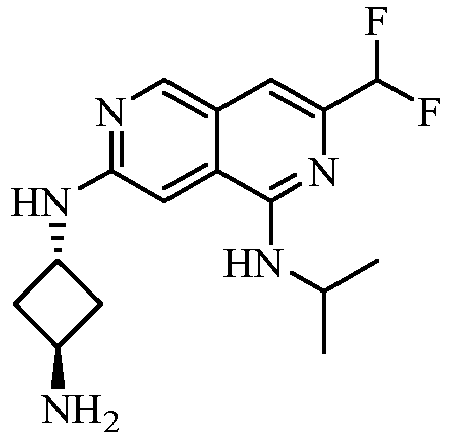
- The titled compound was prepared as same as example 184 using corresponding chemicals.
- 1HNMR (400 MHz, MeOD) δ(ppm): 8.67 (s, 1H), 7.07 (s, 1H), 6.77 (s, 1H), 6.65 (s, 0.25H), 6.51 (s, 0.5H), 6.37 (s, 0.25H), 4.53-4.49 (m, 1H), 4.33-4.30 (m, 1H), 3.74-3.70 (m, 1H), 2.35-2.32 (m, 4H), 1.35-1.33 (m, 6H).
- Molecular formula: C16H21F2N5 Exact mass: 321.18 LC-MS (Pos, m/z) =322.21 [M+H]+.
-

- The titled compound was prepared as same as example 51 using corresponding chemicals.
- 1HNMR (400 MHz, MeOD) δ (ppm): 8.82 (s, 1H), 7.77 (s, 1H), 6.80 (s, 1H), 5.54-5.48 (m, 1H), 4.36-4.34 (m, 1H), 3.71-3.67 (m, 1H), 2.34-2.30 (m, 4H), 1.47-1.46 (m, 6H). Molecular formula: C16H19N5O Exact mass: 297.16 LC-MS (Pos, m/z) =298.30 [M+H]+.
-

- The titled compound was prepared as same as example 210 using corresponding chemicals.
- 1HNMR (400 MHz, MeOD) δ(ppm): 8.67 (s, 1H), 7.38 (s, 1H), 6.71 (s, 1H), 4.35-4.32 (m, 1H), 3.63-3.58 (m, 2H), 2.60-2.54 (m, 2H), 2.09-2.04 (m, 2H) 1.41 (s, 3H), 1.33-1.32 (m, 6H).
- Molecular formula: C16H20N6 Exact mass: 296.17 LC-MS (Pos, m/z) =297.17 [M+H]+.
-

-

- 7-Chloro-1-(isopropylamino)-2,6-naphthyridine-3-carbonitrile (246.7 mg, 1 mmol, 1.0 eq), tert-butyl ((trans)-3-amino-1-methylcyclobutyl)carbamate (240.3 mg, 1.2 mmol, 1.2 eq), Pd2(dba)3 (91.6 mg, 0.1 mmol, 0.1 eq), BINAP (124.5 mg, 0.2 mmol, 0.2 eq) and cesium carbonate (814.5 mg, 2.5 mmol, 2.5 eq) were added to 1,4-dioxane (20 mL). The reaction solution was heated to 100 °C and reacted for 17 h in a sealed tube in nitrogen atmosphere. When there were no starting materials left as monitored by TLC, water (30 mL) was added, and then ethyl acetate (30 mL × 3) was added for extraction. The organic phases were combined, dried over anhydrous sodium sulfate and filtered, and the filtrate was concentrated under reduced pressure to give a crude product, which was purified by silica gel column chromatography (EA:PE = 1:10-1:2) to give the product (100 mg, yield: 24.4%).
-

- tert-Butyl ((trans)-3-(7-cyano-5-(isopropylamino)-2,6-naphthyl-3-yl)amino)-1-methylcyclobutyl)carbamate (100 mg, 0.24 mmol, 1.0 eq) was dissolved in DCM (6 mL), 2,6-dimethylpyridine (154.3 mg, 1.44 mmol, 6.0 eq) was added, and a solution of trimethylsilyl trifluoromethanesulfonate (160 mg, 0.72 mmol, 3.0 eq) in DCM (1 mL) was added dropwise. The reaction solution was reacted at room temperature for 1 h. When there were no starting materials left as monitored by TLC, water (30 mL) was added. The pH was adjusted to about 8 with potassium carbonate, and DCM (30 mL × 3) was added for extraction. The organic phases were combined, dried over anhydrous sodium sulfate and filtered, and the filtrate was concentrated under reduced pressure. The crude product was purified first by silica gel column chromatography (MeOH:DCM = 1:100-1:10) and then by thin-layer chromatography (MeOH:DCM = 1:10) to give the product (30 mg, yield: 40.3 %).
- 1HNMR (400 MHz, MeOD) δ(ppm): 8.66 (s, 1H), 7.37 (s, 1H), 6.78 (s, 1H), 4.48-4.34 (m, 2H), 2.56-2.51 (m, 2H), 2.07-2.02 (m, 2H), 1.40 (s, 3H), 1.35-1.33 (m, 6H). Molecular formula: C17H22N6 Exact mass: 310.19 LC-MS (Pos, m/z) = 311.25[M+H]+.
-

-

- 7-Chloro-1-(methylsulfonyl)-2,6-naphthyridine-3-carbonitrile (803.1 mg, 3.0 mmol, 1.0 eq), cyclopropylamine (856.6 mg, 15.0 mmol, 5.0 eq) and DIPEA (1.9 g, 15.0 mmol, 5.0 eq) were dissolved in 1,4-dioxane (10 mL), and the reaction solution was heated to 100 °C and reacted for 2 h. When there were no starting materials left as monitored by TLC, the reaction solution was cooled to room temperature. Water (50 mL) was added, and ethyl acetate (100 mL × 3) was added for extraction. The organic phases were combined, dried over anhydrous sodium sulfate and filtered, and the filtrate was concentrated under reduced pressure. The crude product was purified by silica gel column chromatography (EA:PE = 1:5) to give the product (700 mg, yield: 95.4%).
-

- 7-Chloro-1-(cyclopropylamine)-2,6-naphthyridine-3-carbonitrile (416 mg, 1.7 mmol, 1.0 eq), tert-butyl ((trans)-3-amino-1-methylcyclobutyl)carbamate (408.6 mg, 2.04 mmol, 1.2 eq), Pd2(dba)3 (155.7 mg, 0.17 mmol, 0.1 eq), BINAP (211.7 mg, 0.34 mmol, 0.2 eq) and cesium carbonate (1.38 g, 4.25 mmol, 2.5 eq) were dissolved in 1,4-dioxane (15 mL). The reaction solution was heated to 100 °C and reacted for 16 h in a sealed tube in nitrogen atmosphere. When there were no starting materials left as monitored by TLC, water (30 mL) was added, and then ethyl acetate (30 mL × 3) was added for extraction. The organic phases were combined, dried over anhydrous sodium sulfate and filtered, and the filtrate was concentrated under reduced pressure to give a crude product, which was purified by silica gel column chromatography (EA:PE = 1:10-1:2) to give the product (243 mg, yield: 35%).
-

- tert-Butyl ((trans)-3-(7-cyano-5-(cyclopropylamine)-2,6-naphthyridin-3-yl)amino)-1-methylcyclobutyl)carbamate (243 mg, 0.59 mmol, 1.0 eq) was dissolved in DCM (10 mL), 2,6-dimethylpyridine (379.3 mg, 3.54 mmol, 6.0 eq) was added, and a solution of trimethylsilyl trifluoromethanesulfonate (393.4 mg, 1.77 mmol, 3.0 eq) in DCM (2 mL) was added dropwise. The reaction solution was reacted at room temperature for 1 h. When there were no starting materials left as monitored by TLC, water (30 mL) was added. The pH was adjusted to about 8 with potassium carbonate, and DCM (30 mL × 3) was added for extraction. The organic phases were combined, dried over anhydrous sodium sulfate and filtered, and the filtrate was concentrated under reduced pressure. The crude product was purified first by silica gel column chromatography (MeOH:DCM = 1:100-1:10) and then by thin-layer chromatography (MeOH:DCM = 1:10) to give the product (61 mg, yield: 33.5%).
- 1HNMR (400 MHz, MeOD) δ(ppm): 8.68 (s, 1H), 7.45 (s, 1H), 6.69 (s, 1H), 4.32-4.29 (m, 1H), 2.92-2.90 (m, 1H), 2.55-2.50 (m, 2H), 2.05-2.00 (m, 2H) 1.39 (s, 3H), 0.91-0.88 (m, 2H).
- Molecular formula: C17H20N6 Exact mass: 308.17 LC-MS (Pos, m/z) = 309.31[M+H]+.
-

-

- 1-Methylcyclopropylamine hydrochloride (806.8 mg, 7.5 mmol, 2.5 eq) was dissolved in 1,4-dioxane (10 mL), and DIPEA (1.9 g, 15.0 mmol, 5.0 eq) was added. The mixture was stirred for 10 min, and 7-chloro-1-(methylsulfonyl)-2,6-naphthyridine-3-carbonitrile (803.1 mg, 3.0 mmol, 1.0 eq) was added. The reaction solution was heated to 80 °C and reacted for 18 h. When there were no starting materials left as monitored by TLC, the reaction solution was cooled to room temperature. Water (50 mL) was added, and ethyl acetate (50 mL × 3) was added for extraction. The organic phases were combined, dried over anhydrous sodium sulfate and filtered, and the filtrate was concentrated under reduced pressure. The crude product was purified by silica gel column chromatography (EA:PE = 1:5) to give the product (446 mg, yield: 57.5%).
-

- 7-Chloro-1-((1-methylcyclopropyl)amino)-2,6-naphthyridine-3-carbonitrile (440 mg, 1.7 mmol, 1.0 eq), tert-butyl ((trans)-3-amino-1-methylcyclobutyl)carbamate (408.6 mg, 2.04 mmol, 1.2 eq), Pd2(dba)3 (155.7 mg, 0.17 mmol, 0.1 eq), BINAP (211.7 mg, 0.34 mmol, 0.2 eq) and cesium carbonate (1.38 g, 4.25 mmol, 2.5 eq) were dissolved in 1,4-dioxane (15 mL). The reaction solution was heated to 100 °C and reacted for 16 h in a sealed tube in nitrogen atmosphere. When there were no starting materials left as monitored by TLC, water (30 mL) was added, and then ethyl acetate (30 mL × 3) was added for extraction. The organic phases were combined, dried over anhydrous sodium sulfate and filtered, and the filtrate was concentrated under reduced pressure to give a crude product, which was purified by silica gel column chromatography (EA:PE = 1:10-1:2) to give the product (220 mg, yield: 30.6%).
-

- tert-Butyl ((trans)-3-((7-cyano-5-(1-methylcyclopropyl)amino)-2,6-naphthyridin-3-yl)amino-1-methylcyclobutyl)carbamate (220 mg, 0.52 mmol, 1.0 eq) was dissolved in DCM (10 mL), 2,6-dimethylpyridine (334.3 mg, 3.12 mmol, 6.0 eq) was added, and a solution of trimethylsilyl trifluoromethanesulfonate (346.7 mg,1.56 mmol, 3.0 eq) in DCM (2 mL) was added dropwise. The reaction solution was reacted at room temperature for 1 h. When there were no starting materials left as monitored by TLC, water (30 mL) was added. The pH was adjusted to about 8 with potassium carbonate, and DCM (30 mL × 3) was added for extraction. The organic phases were combined, dried over anhydrous sodium sulfate and filtered, and the filtrate was concentrated under reduced pressure. The crude product was purified first by silica gel column chromatography (MeOH:DCM = 1:100-1:10) and then by thin-layer chromatography (MeOH:DCM = 1:10) to give the product (57 mg, yield: 34 %).
- 1HNMR (400 MHz, MeOD) δ(ppm): 8.69 (s, 1H), 7.43 (s, 1H), 6.72 (s, 1H), 4.47-4.43 (m, 1H), 2.75-2.69 (m, 2H), 2.20-2.14 (m, 2H), 1.53-1.51 (s, 6H), 0.87 (m, 2H), 0.78 (m, 2H).
- Molecular formula: C18H22N6 Exact mass: 322.19 LC-MS (Pos, m/z) = 323.30[M+H]+.
-


- N-(tert-butyl)-6-(difluoromethyl)-2-(methylsulfonyl)pyrido[3,4-d]pyrimidin-8-amine (94 mg, 0.3 mmol, 1.0 eq.) and tert-butyl (3S)-3-aminopiperidine-1-carboxylate (72 mg, 0.36 mmol, 1.2 eq.) were dissolved in 1,4-dioxane (1.5 mL). The mixture was reacted at 100°C for 2 h. When there were no materials left, as detected by LCMS, the reaction solution was concentrated under reduced pressure. HCl (4N in 1,4-dioxane, 0.5 mL, 2.0 mmol) was added to the crude. The mixture was reacted at room temperature for overnight. When there were no materials left, as detected by LCMS, the reaction solution was concentrated under reduced pressure to give a crude product, which was purified by HPLC to give the product (37.7 mg, yield: 36%).
- Molecular formula: C17H24F2N6, Exact mass: 350.20, LC-MS (Pos, m/z): 351.2 [M+H]+.
-

- The titled compound was prepared as same as example 301 using corresponding chemicals.
- Molecular formula: C17H24F2N6, Exact mass: 350.20, LC-MS (Pos, m/z): 351.1 [M+H]+.
-

- 8-(isopropylamino)-2-(methylsulfinyl)pyrido[3,4-d]pyrimidine-6-carbonitrile (40 mg, 0.145 mmol, 1.0 eq.) and 2-(4-aminopiperidin-1-yl)-N,N-dimethylacetamide (30 mg, 0.16 mmol, 1.1 eq.) were dissolved in 1,4-dioxane (10 mL). The mixture was reacted at 100°C for 2 h. When there were no materials left, as detected by LCMS, the reaction solution was concentrated under reduced pressure to give a crude product, which was purified by HPLC to give the product (13 mg, yield: 23%). Molecular formula: C20H28N8O, Exact mass: 396.24, LC-MS (Pos, m/z): 397.1 [M+H]+.
-

- The titled compound was prepared as same as example 301 using corresponding chemicals.
- Molecular formula: C17H22F2N6, Exact mass: 348.19, LC-MS (Pos, m/z): 349.2 [M+H]+.
-

- 8-(isopropylamino)-2-(methylsulfinyl)pyrido[3,4-d]pyrimidine-6-carbonitrile (27.5 mg, 0.1 mmol, 1.0 eq.) and tert-butyl (R)-3-aminoazepane-1-carboxylate (32 mg, 0.15 mmol, 1.5 eq.) were dissolved in 1,4-dioxane (0.5 mL). The mixture was reacted at 100°C for 2 h. When there were no materials left, as detected by LCMS, the reaction solution was concentrated under reduced pressure. HCl (4N in 1,4-dioxane, 0.5 mL, 2.0 mmol) was added to the crude. The mixture was reacted at room temperature for overnight. When there were no materials left, as detected by LCMS, the reaction solution was concentrated under reduced pressure to give a crude product, which was purified by HPLC to give the product (16.9 mg, yield: 52%).
Molecular formula: C17H23N7, Exact mass: 325.20, LC-MS (Pos, m/z): 326.3 [M+H]+. -

- The titled compound was prepared as same as example 305 using corresponding chemicals.
- Molecular formula: C17H23N7, Exact mass: 325.20, LC-MS (Pos, m/z): 326.2 [M+H]+.
-

- The titled compound was prepared as same as example 305 using corresponding chemicals.
- Molecular formula: C17H23N7, Exact mass: 325.20, LC-MS (Pos, m/z): 326.2 [M+H]+.
-

- The titled compound was prepared as same as example 303 using corresponding chemicals.
- Molecular formula: C16H21F2N5O, Exact mass: 337.17, LC-MS (Pos, m/z): 338.0 [M+H]+.
-

- The titled compound was prepared as same as example 303 using corresponding chemicals.
- Molecular formula: C16H20N6O, Exact mass: 312.17, LC-MS (Pos, m/z): 313.0 [M+H]+.
-

- The titled compound was prepared as same as example 303 using corresponding chemicals.
- Molecular formula: C16H20N6O, Exact mass: 312.17, LC-MS (Pos, m/z): 313.0 [M+H]+.
-

- The titled compound was prepared as same as example 303 using corresponding chemicals.
- Molecular formula: C16H20N6O, Exact mass: 312.17, LC-MS (Pos, m/z): 313.0 [M+H]+.
-

- The titled compound was prepared as same as example 303 using corresponding chemicals.
- Molecular formula: C16H20N6O, Exact mass: 312.17, LC-MS (Pos, m/z): 313.0 [M+H]+.
-

-

-

- To a stirred solution of (8-chloro-2-(methylthio)pyrido[3,4-d]pyrimidin-6-yl)methyl benzoate (4.0 g, 11.59 mmol) in THF (50 mL) was added aq LiOH solution (1.4 g, 34.78 mmol, in 15 mL of H2O) and stirred the resulting reaction mixture at room temperature for 4 h. Monitored by TLC which shows reaction completed. Neutralized the reaction mixture by aq. solution of citric acid and extracted with ethyl acetate (2x50 mL). Combined organic part was washed with saturated aq NaHCO3 solution, dried over Na2SO4 and evaporated the solvent to get crude (2.0 g) compound which was pure enough to forwarded to next step.
-

- To a stirred solution of (8-chloro-2-(methylthio)pyrido[3,4-d]pyrimidin-6-yl)methanol (1.0 g, 4.19 mmol) in DMSO (15.0 ml) was added IBX (2.3 g, 8.30 mmol) at 0°C. Stirred the resulting reaction mixture at room temperature for 0.5 h. Monitored by TLC which shows reaction completed. the reaction mixture was quenched with cold water (25 ml) and extracted with ethyl acetate (3x25 mL). Combined organic part was further washed with cold water (3x50 mL) and then with brine, dried over Na2SO4 and concentrated under redsuced pressure to get crude (1.0 g) compound which was pure enough and forwarded to next step.
-

- To a stirred solution of 8-chloro-2-(methylthio)pyrido[3,4-d]pyrimidine-6-carbaldehyde (2.6 g, 10.88 mmol) in THF (35.0 mL) were added NH4OH (20 mL) and I2 (3.02 g, 11.97 mmol) and stirred the reaction mixture at room temperature for 4h. Reaction was monitored by TLC which shows SM was consumed. The reaction mixture was quenched with aq. sodium thiosulphate (20 ml) and extracted with ethyl acetate (3x50 mL). Combined organic part was washed with brine, dried over Na2SO4 and concentrated under reduced pressure to get crude compound. Crude was purified by silics gel column chromatography to get the compound (850 mg, yield: 33%).
-

- To a stirred solution of 8-chloro-2-(methylthio)pyrido[3,4-d]pyrimidine-6-carbonitrile (94.7 mg, 0.4 mmol) in 1,4-dioxane (2 mL) was added (3R)-tetrahydrofuran-3-amine hydrochloride (59.3 mg, 0.48 mmol) and TEA (0.139 mL, 1.0 mmol) and stirred the reaction mixture at 100°C for overnight. Reaction was monitored by LCMS which shows SM was consumed. The reaction mixture was quenched with water and extracted with ethyl acetate (2x20 mL). Combined organic part was washed with brine, dried over Na2SO4 and concentrated under reduced pressure to get crude compound which was used in the next step without further purification. Exact mass: 287.08, LC-MS (Pos, m/z): 288.7 [M+H]+.
-

- To a stirred solution of (R)-2-(methylthio)-8-((tetrahydrofuran-3-yl)amino)pyrido[3,4-d]pyrimidine-6-carbonitrile (0.4 mmol) in DCM (2.0 mL) was added mCPBA (127 mg, 0.48 mmol, 65%) and stirred the reaction mixture at 0°C for 4h. Reaction was monitored by LCMS which shows SM was consumed. The reaction mixture was quenched with saturated aq NaHCO3 solution and extracted with ethyl acetate (2x20 mL). Combined organic part was washed with brine, dried over Na2SO4 and concentrated under reduced pressure to get crude compound which was purified by short silica gel. The crude was used in the next step without further purification. Exact mass: 303.08, LC-MS (Pos, m/z): 304.8 [M+H]+.
-

- 2-(methylsulfinyl)-8-(((R)-tetrahydrofuran-3-yl)amino)pyrido[3,4-d]pyrimidine-6-carbonitrile (30.3 mg, 0.1 mmol, 1.0 eq.) and tert-butyl N-(3-aminocyclobutyl)carbamate (20.5 mg, 0.11 mmol, 1.1 eq.) were dissolved in 1,4-dioxane (0.5 mL). The mixture was reacted at 100°C for 1 h. When there were no materials left, as detected by LCMS, the reaction solution was concentrated under reduced pressure. HCl (4N in 1,4-dioxane, 0.5 mL, 2.0 mmol) was added to the crude. The mixture was reacted at room temperature for overnight. When there were no materials left, as detected by LCMS, the reaction solution was concentrated under reduced pressure to give a crude product, which was purified by HPLC to give the product (17.5 mg, yield: 54%).
Molecular formula: C16H19N7O, Exact mass: 325.17, LC-MS (Pos, m/z): 326.2 [M+H]+. -

-

- The titled compound was prepared as same as the step 4 of example 313 using corresponding chemicals.
- The titled compound was prepared as same as the step 5 of example 313 using corresponding chemicals.
- Exact mass: 275.08, LC-MS (Pos, m/z): 276.0 [M+H]+.
- The titled compound was prepared as same as the step 6 of example 313 using corresponding chemicals.
- Molecular formula: C15H19N7, Exact mass: 297.17, LC-MS (Pos, m/z): 298.2 [M+H]+.
-

-

- The titled compound was prepared as same as the step 4 of example 313 using corresponding chemicals.
- The titled compound was prepared as same as the step 5 of example 313 using corresponding chemicals.
- Exact mass: 301.10, LC-MS (Pos, m/z): 302.05 [M+H]+.
- The titled compound was prepared as same as the step 6 of example 313 using corresponding chemicals.
- Molecular formula: C17H21N7, Exact mass: 323.19, LC-MS (Pos, m/z): 324.2 [M+H]+.
-

- The titled compound was prepared as same as example 305 using corresponding chemicals.
- Molecular formula: C16H21N7, Exact mass: 311.19, LC-MS (Pos, m/z): 312.2 [M+H]+.
-

- The titled compound was prepared as same as example 305 using corresponding chemicals.
- Molecular formula: C16H21N7, Exact mass: 311.19, LC-MS (Pos, m/z): 312.2 [M+H]+.
-

- The titled compound was prepared as same as example 305 using corresponding chemicals.
- Molecular formula: C16H21N7, Exact mass: 311.19, LC-MS (Pos, m/z): 312.2 [M+H]+.
-

-

- The titled compound was prepared as same as the step 4 of example 313 using corresponding chemicals.
- Exact mass: 273.10, LC-MS (Pos, m/z): 274.1 [M+H]+.
- The titled compound was prepared as same as the step 5 of example 313 using corresponding chemicals.
- Exact mass: 289.10, LC-MS (Pos, m/z): 290.1 [M+H]+.
- The titled compound was prepared as same as the step 6 of example 313 using corresponding chemicals.
- Molecular formula: C16H21N7, Exact mass: 311.19, LC-MS (Pos, m/z): 312.2 [M+H]+ (compound C18).
- Molecular formula: C16H23N7O, Exact mass: 329.20, LC-MS (Pos, m/z): 329.95 [M+H]+ (compound C19).
-

- The titled compound was prepared as same as example 305 using corresponding chemicals.
- Molecular formula: C16H21N7, Exact mass: 311.19, LC-MS (Pos, m/z): 312.0 [M+H]+.
-

- The titled compound was prepared as same as example 303 using corresponding chemicals.
- Molecular formula: C19H25N7O, Exact mass: 367.21, LC-MS (Pos, m/z): 368.0 [M+H]+.
-

- The titled compound was prepared as same as example 303 using corresponding chemicals.
- Molecular formula: C20H28N8, Exact mass: 380.24, LC-MS (Pos, m/z): 381.0 [M+H]+.
-

- The titled compound was prepared as same as example 303 using corresponding chemicals.
- Molecular formula: C20H28N8, Exact mass: 380.24, LC-MS (Pos, m/z): 381.1 [M+H]+.
-

- The titled compound was prepared as same as example 303 using corresponding chemicals.
- Molecular formula: C17H23N7, Exact mass: 325.20, LC-MS (Pos, m/z): 326.0 [M+H]+.
-

-

- The titled compound was prepared as same as the step 4 of example 313 using corresponding chemicals.
- Exact mass: 273.10, LC-MS (Pos, m/z): 274.1 [M+H]+.
- The titled compound was prepared as same as the step 5 of example 313 using corresponding chemicals.
- Exact mass: 289.10, LC-MS (Pos, m/z): 290.1 [M+H]+.
- The titled compound was prepared as same as the step 6 of example 313 using corresponding chemicals.
- Molecular formula: C16H21N7, Exact mass: 311.19, LC-MS (Pos, m/z): 312.07 [M+H]+.
-

- The titled compound was prepared as same as example 305 using corresponding chemicals.
- Molecular formula: C16H21N7, Exact mass: 311.19, LC-MS (Pos, m/z): 312.07 [M+H]+.
-

- The titled compound was prepared as same as example 305 using corresponding chemicals.
- Molecular formula: C16H21N7, Exact mass: 311.19, LC-MS (Pos, m/z): 312.07 [M+H]+.
-

-

- The titled compound was prepared as same as the step 4 of example 313 using corresponding chemicals.
- Exact mass: 245.07, LC-MS (Pos, m/z): 245.95 [M+H]+.
- The titled compound was prepared as same as the step 5 of example 313 using corresponding chemicals.
- Exact mass: 261.07, LC-MS (Pos, m/z): 261.95 [M+H]+.
- The titled compound was prepared as same as the step 6 of example 313 using corresponding chemicals.
- Molecular formula: C14H17N7, Exact mass: 283.15, LC-MS (Pos, m/z): 284.2 [M+H]+.
-

- The titled compound was prepared as same as example 303 using corresponding chemicals.
- Molecular formula: C16H2oN6O, Exact mass: 312.17, LC-MS (Pos, m/z): 313.2 [M+H]+.
-

-

- The titled compound was prepared as same as the step 4 of example 313 using corresponding chemicals.
- Exact mass: 301.10, LC-MS (Pos, m/z): 302.8 [M+H]+.
- The titled compound was prepared as same as the step 5 of example 313 using corresponding chemicals.
- Exact mass: 317.09, LC-MS (Pos, m/z): 318.1 [M+H]+.
- The titled compound was prepared as same as the step 6 of example 313 using corresponding chemicals.
- Molecular formula: C17H21N7O, Exact mass: 339.18, LC-MS (Pos, m/z): 339.95 [M+H]+.
-

- The titled compound was prepared as same as example 303 using corresponding chemicals.
- Molecular formula: C16H2oN6O, Exact mass: 312.17, LC-MS (Pos, m/z): 312.95 [M+H]+.
-

- The titled compound was prepared as same as example 303 using corresponding chemicals.
- Molecular formula: C21H28N8O, Exact mass: 408.24, LC-MS (Pos, m/z): 409.0 [M+H]+.
-

- The titled compound was prepared as same as example 303 using corresponding chemicals.
- Molecular formula: C21H28N8O, Exact mass: 408.24, LC-MS (Pos, m/z): 409.05 [M+H]+.
-

-
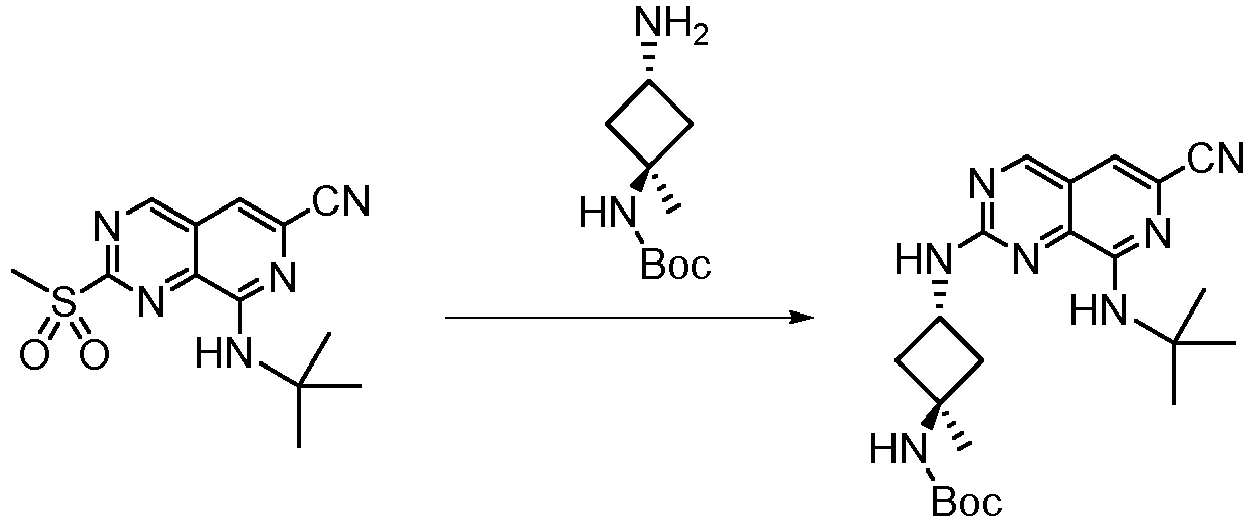
- 8-(tert-butylamino)-2-(methylsulfonyl)pyrido[3,4-d]pyrimidine-6-carbonitrile (30 mg, 0.10 mmol, 1.0 eq.) and tert-butyl ((1r,3r)-3-amino-1-methylcyclobutyl)carbamate (22 mg, 0.11 mmol, 1.1 eq.) were dissolved in dioxane (0.5 mL), and the reaction solution was reacted at 100 °C for 1 h. After the reaction was completed, as detected by LC-MS, the reaction solution was quenched with water and extracted with EA. The organic layer was concentrated to give a crude product, which was used in the next step without further purification.
-

- The mixture of
tert-butyl ((1r,3r)-3-((8-(tert-butylamino)-6-cyanopyrido[3,4-d]pyrimidin-2-yl)amino)-1-methylcyclobutyl)carbamate (0.10 mmol) and TFA (0.2 mL) was stirred at room temperature for 2 h. After the reaction was completed, as detected by LC-MS, the reaction solution was concentrated under reduced pressure to give a crude product, which was purified by HPLC to give the product (12.6 mg, yield: 38.7%). - 1HNMR (400 MHz, CDCl3) δ(ppm): 8.77 (s, 1H), 7.11 (s, 1H), 6.57 (br-s, 1H), 5.68 (br-s 1H), 4.50 (br-s, 1H), 2.47-2.40 (m, 2H), 2.02-1.97 (m, 2H), 1.52 (s, 9H), 1.37 (s, 3H).
- Molecular formula: C17H23N7, Exact mass: 325.20, LC-MS (Pos, m/z): 326.2 [M+H]+.
-

-

- The titled compound was prepared as same as the step 4 of example 313 using corresponding chemicals.
- Exact mass: 271.09, LC-MS (Pos, m/z): 272.1 [M+H]+.
- The titled compound was prepared as same as the step 5 of example 313 using corresponding chemicals.
- Exact mass: 287.08, LC-MS (Pos, m/z): 288.1 [M+H]+.
- Step 3: synthesis of 2-(((1r,3r)-3-aminocyclobutyl)amino)-8-((1-methylcyclopropyl)amino)pyrido[3,4-d]pyrimidine-6-carbonitrile The titled compound was prepared as same as the step 6 of example 313 using corresponding chemicals.
- Molecular formula: C16H19N7, Exact mass: 309.17, LC-MS (Pos, m/z): 310.2 [M+H]+.
-

-

- The titled compound was prepared as same as the step 4 of example 313 using corresponding chemicals.
- Exact mass: 283.09, LC-MS (Pos, m/z): 284.1 [M+H]+.
- The titled compound was prepared as same as the step 5 of example 313 using corresponding chemicals.
- Exact mass: 299.08, LC-MS (Pos, m/z): 300.1 [M+H]+.
- The titled compound was prepared as same as the step 6 of example 313 using corresponding chemicals.
- Molecular formula: C17H19N7, Exact mass: 321.17, LC-MS (Pos, m/z): 322.2 [M+H]+.
-

- The titled compound was prepared as same as example 305 using corresponding chemicals.
- Molecular formula: C17H21N7, Exact mass: 323.19, LC-MS (Pos, m/z): 324.2 [M+H]+.
-

-

- 8-(ethylamino)-2-(methylsulfonyl)pyrido[3,4-d]pyrimidine-6-carbonitrile (27.7 mg, 0.10 mmol, 1.0 eq.) and tert-butyl ((1r,3r)-3-amino-1-methylcyclobutyl)carbamate (24 mg, 0.12 mmol, 1.2 eq.) were dissolved in dioxane (0.5 mL), and the reaction solution was reacted at 100 °C for 1 h. After the reaction was completed, as detected by LC-MS, the reaction solution was quenched with water and extracted with EA. The organic layer was concentrated to give a crude product, which was used in the next step without further purification.
-

- The mixture of tert-butyl ((1r,3r)-3-((6-cyano-8-(ethylamino)pyrido[3,4-d]pyrimidin-2-yl)amino)-1-methylcyclobutyl)carbamate (0.10 mmol) and TFA (0.2 mL) was stirred at room temperature for 2 h. After the reaction was completed, as detected by LC-MS, the reaction solution was concentrated under reduced pressure to give a crude product, which was purified by HPLC to give the product (25.8 mg, yield: 86.8%).
1HNMR (400 MHz, CDCl3) δ(ppm): 8.77 (s, 1H), 7.12 (s, 1H), 6.53 (br-s, 1H), 5.75 (br-s 1H), 4.68-4.56 (m, 1H), 3.62-3.55 (m, 2H), 2.48-2.43 (m, 2H), 1.99-1.94 (m, 2H), 1.37 (s, 3H), 1.29 (t, 3H).
Molecular formula: C15H19N7, Exact mass: 297.17, LC-MS (Pos, m/z): 298.1 [M+H]+. -

-

- The titled compound was prepared as same as the step 4 of example 313 using corresponding chemicals.
- Exact mass: 301.10, LC-MS (Pos, m/z): 302.1 [M+H]+.
- The titled compound was prepared as same as the step 5 of example 313 using corresponding chemicals.
- Exact mass: 317.09, LC-MS (Pos, m/z): 318.1 [M+H]+.
- The titled compound was prepared as same as the step 6 of example 313 using corresponding chemicals.
- Molecular formula: C17H21N7O, Exact mass: 339.18, LC-MS (Pos, m/z): 340.2 [M+H]+.
-

- The titled compound was prepared as same as example 303 using corresponding chemicals.
- Molecular formula: C20H27N7O, Exact mass: 381.23, LC-MS (Pos, m/z): 382.3 [M+H]+.
-
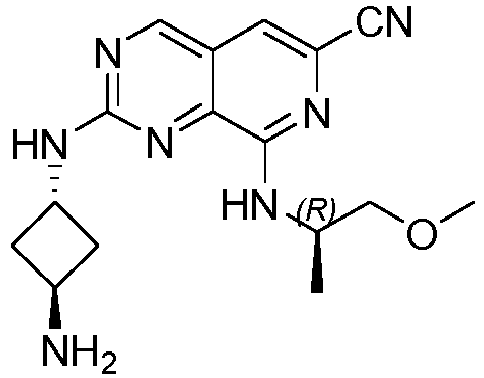
-

- The titled compound was prepared as same as the step 4 of example 313 using corresponding chemicals.
- Exact mass: 289.10, LC-MS (Pos, m/z): 290.1 [M+H]+.
- The titled compound was prepared as same as the step 5 of example 313 using corresponding chemicals.
- Exact mass: 305.09, LC-MS (Pos, m/z): 306.1 [M+H]+.
- The titled compound was prepared as same as the step 6 of example 313 using corresponding chemicals.
- Molecular formula: C16H21N7O, Exact mass: 327.18, LC-MS (Pos, m/z): 328.2 [M+H]+.
-

-

- The titled compound was prepared as same as the step 4 of example 313 using corresponding chemicals.
- Exact mass: 289.10, LC-MS (Pos, m/z): 290.1 [M+H]+.
- The titled compound was prepared as same as the step 5 of example 313 using corresponding chemicals.
- Exact mass: 305.09, LC-MS (Pos, m/z): 306.1 [M+H]+.
- The titled compound was prepared as same as the step 6 of example 313 using corresponding chemicals.
- Molecular formula: C16H21N7O, Exact mass: 327.18, LC-MS (Pos, m/z): 328.2 [M+H]+.
-
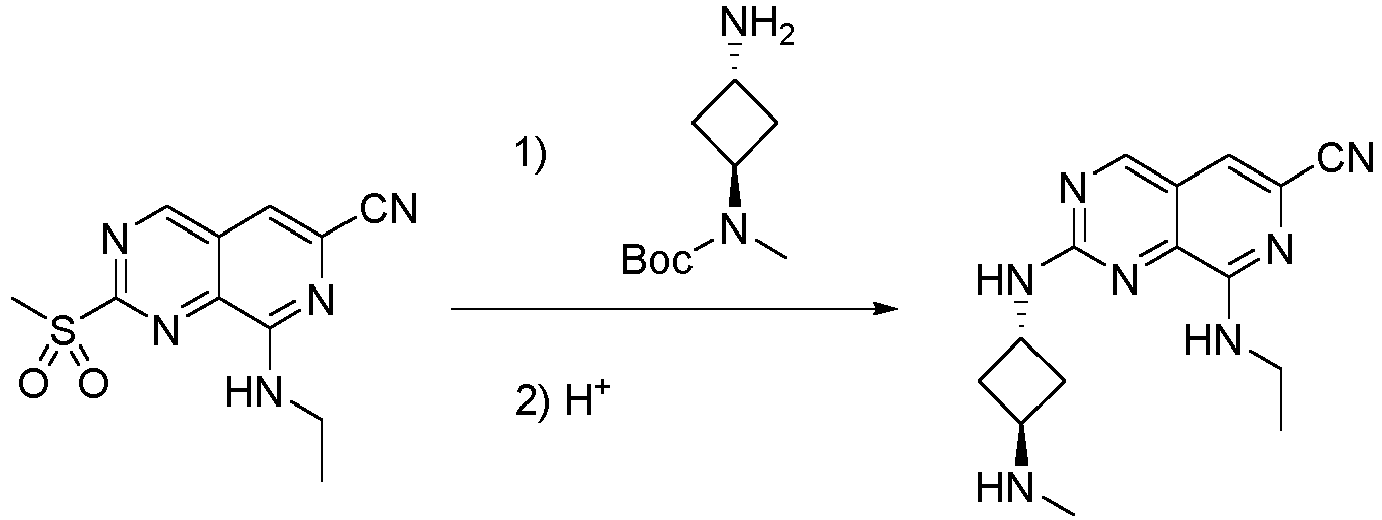
- The titled compound was prepared as same as example 305 using corresponding chemicals.
- Molecular formula: C15H19N7, Exact mass: 297.17, LC-MS (Pos, m/z): 298.2 [M+H]+.
-

- The titled compound was prepared as same as example 305 using corresponding chemicals.
- Molecular formula: C16H21N7, Exact mass: 311.19, LC-MS (Pos, m/z): 312.09[M+H]+.
-

- The titled compound was prepared as same as example 303 using corresponding chemicals.
- Molecular formula: C18H23N7, Exact mass: 337.20, LC-MS (Pos, m/z): 338.14 [M+H]+.
-

-

- 2-chloro-6-(trifluoromethyl)pyridin-3-amine (15 g, 76.31 mmol, 1.0 eq.) and N-bromosuccinimide (14.94 g, 83.94 mmol, 1.1 eq.) were dissolved in DMF (150 mL), and the reaction solution was reacted at 40 °C for 4h. After the reaction was completed as detected by TLC, the reaction solution was poured into water (300 mL), and the aqueous phase was extracted with MTBE (300 mL × 2) and washed with water (300 mL × 2). The organic phase was dried and concentrated, and the crude product was purified by silica gel column chromatography (PE:EA = 10: 1) to give the product (20.5 g, yield: 97.5%).
-

- 4-bromo-2-chloro-6-(trifluoromethyl)pyridin-3-amine (18 g, 65.35 mmol, 1.0 eq.), phenyl formate (8.78 g, 71.88 mmol, 2.1 eq.), palladium acetate (1.47 g, 6.54 mmol, 0.1 eq.), xanthphos (3.78 g, 6.54 mmol, 0.1 eq.) and TEA (9.92 g, 98.02 mmol, 1.5 eq.) were dissolved in toluene (400 mL), and the reaction solution was reacted at 80 °C for 21 h under nitrogen atmosphere. After the reaction was completed as detected by TLC, the reaction solution was concentrated under reduced pressure, and the crude product was purified by silica gel column chromatography (PE:EA = 20:1) to give the product (7.7 g, yield: 37.2%).
-

- Phenyl 3-amino-2-chloro-6-(trifluoromethyl)isonicotinate (7.7 g, 24.31 mmol, 1.0 eq.) was dissolved in THF (150 mL), and the reaction solution was cooled to 5 °C, added with lithium aluminum hydride (922 mg, 24.31 mmol, 1.0 eq.) in portions and reacted for 10 min. After the reaction was completed as detected by TLC, the reaction solution was added with water (0.92 mL), 15% aqueous NaOH solution (0.92 mL), water (2.8 mL) and an appropriate amount of anhydrous sodium sulfate in sequence, stirred for 10 min, and filtered, and the filtrate was concentrated under reduced pressure to give the product (5.0 g, yield: 63%).
-

- (3-amino-2-chloro-6-(trifluoromethyl)pyridin-4-yl)methanol (5.0 g, 22.06 mmol, 1.0 eq.) and benzoyl isothiocyanate (3.96 g, 24.27 mmol, 1.1 eq.) were dissolved in THF (100 mL), and the reaction solution was reacted at 50 °C for 17 h. After the reaction was completed as detected by TLC, the reaction solution was concentrated under reduced pressure, and the crude product was purified by silica gel column chromatography (PE:EA = 4:1) to give the product (8.2 g, yield: 95.3%).
-

- N ((2-chloro-4-(hydroxymethyl)-6-(trifluoromethyl)pyridin-3-yl)aminomethylthio)benzamide (8.2 g, 21.04 mmol, 1.0 eq.), iodomethane (3.28 g, 23.14 mmol, 1.1 eq.) and potassium carbonate (3.2 g, 23.14 mmol, 1.1 eq.) were dissolved in DMF (50 mL), and the reaction solution was reacted at room temperature for 0.5 h. After the reaction was completed as monitored by LC-MS, the reaction solution was poured into water(100 mL), and the aqueous phase was extracted with EA (100 mL × 3) and washed with water (150 mL × 2). The organic phase was dried and concentrated to give the product (8.5 g, yield: 100%).
-

- Methyl N-benzoyl-N'-(2-chloro-4-(hydroxymethyl)-6-(trifluoromethyl)pyridin-3-yl)thiocarbamate (8.5 g, 21.04 mmol, 1.0 eq.) and IBX (5.89 g, 21.04 mmol, 1.0 eq.) were dissolved in DMSO (50 mL), and the reaction solution was reacted for 20 min. After the reaction was completed as monitored by TLC, the reaction solution was poured into saturated aqueous potassium carbonate (100 mL), and extracted with MTBE (100 mL × 3). The organic phase was dried and concentrated to give the product (8.45 g, yield: 100%).
-

- Methyl N-benzoyl-N'-(2-chloro-4-formyl-6-(trifluoromethyl)pyridin-3-yl)thiocarbamate (8.45 g, 21.04 mmol, 1.0 eq.) and potassium carbonate (3.2 g, 21.04 mmol, 1.0 eq.) were dissolved in acetonitrile (90 mL), and the reaction solution was reacted at 90 °C for 20 min. After the reaction was completed as detected by TLC, the reaction solution was concentrated under reduced pressure, and the crude product was purified by silica gel column chromatography (PE:EA = 10:1) to give the product (1.4 g, yield: 23.8 %).
-

- 8-chloro-2-(methylthio)-6-(trifluoromethyl)pyrido[3,4-d]pyrimidine (1.4 g, 5.00 mmol, 1.0 eq.) and isopropylamine (1.48 g, 25.00 mmol, 5.0 eq.) were dissolved in EA (28 mL), and the reaction solution was reacted at 80 °C for 20 min. After the reaction was completed as detected by TLC, the reaction solution was concentrated under reduced pressure, and the crude product was purified by silica gel column chromatography (PE:EA = 20:1) to give the product (1.35 g, yield: 89.4%).
-

- N isopropyl-2-(methylthio)-6-(trifluoromethyl)pyrido[3,4-d]pyrimidin-8-amine (1.3 g, 4.30 mmol, 1.0 eq.) was dissolved in DCM (26 mL), and m-chloroperoxybenzoic acid (1.83 g, 9.03 mmol, 2.1 eq.) was added at a mass fraction of 85%. After the reaction was completed as monitored by TLC, the reaction solution was poured into saturated aqueous potassium carbonate (50 mL), the liquid separation was performed, and the aqueous phase was extracted with DCM (20 mL). The organic phase was dried and concentrated to give the product (1.4 g, yield: 97.9%).
-

- N-isopropyl-2-(methylsulfonyl)-6-(trifluoromethyl)pyrido[3,4-d]pyrimidin-8-amine (200 mg, 0.60 mmol, 1.0 eq.) and tert-butyl (S)-3-aminopiperidine-1-carboxylate (360 mg, 1.80 mmol, 3.0 eq.) were dissolved in 1,4-dioxane (4 mL), and the reaction solution was reacted at 100 °C for 23 h. After the reaction was completed as monitored by TLC, the reaction solution was concentrated, and the crude product was purified by silica gel column chromatography (PE:EA = 5:1) to give the product (260 mg, yield: 95.6%).
-
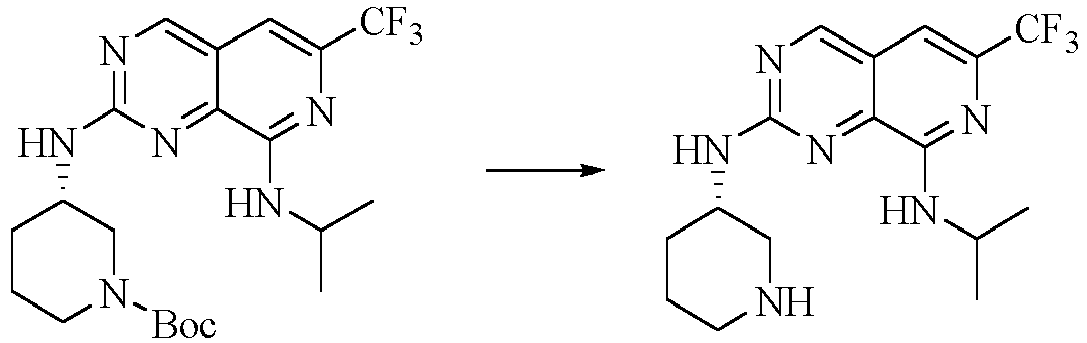
- Tert-butyl (S)-3-((8-(isopropylamino)-6-(trifluoromethyl)pyrido[3,4-d]pyrimidin-2-yl)amino)piperidine-1-carboxylate (260 mg, 0.57 mmol, 1.0 eq.) was dissolved in EA (5 mL), and the reaction solution was added dropwise with a solution of hydrogen chloride in 1,4-dioxane (4 mol/L, 5 mL) and reacted at room temperature for 1 h. After the reaction was substantially completed as detected by LC-MS, the reaction solution was poured into saturated aqueous potassium carbonate (10 mL) and extracted with DCM (10 mL × 2). The organic phase was dried and concentrated, and the crude product was purified by silica gel column chromatography (MeOH:DCM = 1:15) to give the product (180 mg, yield: 89.1%).
- 1HNMR (400 MHz, CDCl3) δ(ppm): 8.87 (s, 1H), 7.07 (s, 1H), 6.36-6.34 (d, 1H), 5.80-5.79 (d, 1H), 4.44-4.39 (m, 1H), 4.16-4.12 (m, 1H), 3.27-3.24 (d, 1H), 2.93-2.91 (t, 1H), 2.84-2.72 (m, 2H), 1.99 (s, 1H), 1.89 (s, 1H), 1.84-1.80 (m, 1H), 1.69-1.64 (m, 2H), 1.35-1.34 (d, 6H).
- Molecular formula: C16H21F3N6 Exact mass: 354.18 LC-MS(Pos, m/z)=355.17[M+H]+
-

- The titled compound was prepared as same as example 55 using corresponding chemicals.
- 1HNMR (400 MHz, CDCl3) δ(ppm): 9.02-8.93 (t, 1H), 7.56 (s, 1H), 6.07-5.91 (m, 1H), 4.65 (s, 3H), 3.76 (s, 1H), 2.29 (s, 4H), 1.54-1.52 (d, 3H).
- Molecular formula: C14H16N6O Exact mass: 284.14 LC-MS(Pos, m/z)=285.02[M+H]+.
-

- The titled compound was prepared as same as example 55 using corresponding chemicals.
- 1HNMR (400 MHz, MeOD) δ(ppm): 8.93 (s, 1H), 7.31 (s, 1H), 4.33-4.27 (m, 1H), 3.57-3.54 (d, 1H), 2.96-2.93 (t, 1H), 2.71-2.62 (m ,2H), 2.48-2.46 (d, 1H), 1.74-1.68 (m, 1H), 1.63-1.53 (m, 2H), 1.50 (s, 3H),1.34-1.32 (d, 6H).
- Molecular formula:C17H23N7 Exact mass:325.20 LC-MS(Pos, m/z)=326.14[M+H]+.
-

- The titled compound was prepared as same as example 55 using corresponding chemicals.
- 1HNMR(400 MHz, CD3OD) δ(ppm): 9.15-9.04 (s, 1H), 7.75 (s, 1H), 5.54-5.48 (m, 1H), 4.17 (m, 1H), 3.28 (m, 1H), 2.97-2.94 (m, 1H), 2.64-2.54 (m, 2H), 2.12-2.09 (m, 1H), 1.84-1.80 (m, 1H), 1.67-1.61 (m, 2H), 1.47-1.45 (m, 6H).
- Molecular formula: C16H20N6O Exact mass:312.17 LC-MS (Pos, m/z) =313.25 [M+H]+.
- The present invention can be better understood according to the following examples. However, it is easily understood by those skilled in the art that the content described in the examples are only used to illustrate the present invention, and should not and will not limit the present invention described in detail in the claims.
- Test samples: the compounds of the present invention, having structures shown above.
- ADP-Glo Kinase Assay(ADP-Glo kinase kit), DMSO (dimethyl sulfoxide), CDK9/CycT1 (cyclin-dependent kinase 9/cyclin T1), CDK tide(cyclin-dependent kinase substrate peptide fragments), CDK1/CycE1 (cyclin-dependent kinase 1/cyclin E1), CDK2/CycA2 (cyclin-dependent kinase 2/cyclin A2), CDK3/CycE1 (cyclin-dependent kinase 3/cyclin E1), CDK4/CycD3 (cyclin-dependent kinase 4/cyclin D3), CDK5/p25NCK (cyclin-dependent kinase 5/p25), and AZD 4573.
- A 384-well white plate, a 96-well plate, a microplate oscillator, a centrifuge, and a microplate reader.
- The compounds were dissolved in DMSO and diluted 4-fold in the 96-well plate to obtain stock solutions with 10 concentration gradients, and added into a 384-well plate system to obtain a series of 10 concentration gradients of compound solutions with final concentrations of 10 µM starting and 4-fold gradient decreasing. 1 µM AZD4573 was used as compound positive control (PC) and 0.5% DMSO as solvent vehicle control (VC), ten duplicated wells each for PC and VC.
- 1 µL of compound solution and 2 µL of 2× kinase solution were transferred to each well, and the plate was centrifuged at 1000 g for 30 s and left at room temperature for 10 min. A mixture of 2× substrate and ATP was prepared in 1× kinase buffer. The reaction was started after adding 2 µL of substrate and ATP into the plate. The plate was centrifuged at 1000 g for 30 s. The assay plate was closed and left at room temperature for 60 min. The reaction system was added with 4 µL of ADP Glo reagent, centrifuged at 1000 rpm for 1 min, and incubated at room temperature for 40 min. The reaction system was added with 8 µL of kinase assay reagent, centrifuged at 1000 rpm for 1 min and incubated at room temperature for 40 min. The fluorescence was read on Biotek.
- The inhibition rate was calculated according to the following formula:

- Lumcmpd: compound fluorescence reading;
Lum positive: average value of the fluorescence reading of positive compound control;Lum vehicle: average value of the fluorescence reading of solvent vehicle control. - IC50 values were fitted using GraphPad 7.0 based on inhibition rates of compounds at different concentrations.
- The test results are shown in Table 3-a, 3-b and 3-c.
Table 3-a: Inhibitory activities of compounds of the present invention on CDK kinases (IC50) Compound CDK9/Cy cT1/nM CDK 1/Cy cE1/nM CDK2/Cy cA2/nM CDK3/Cy cE1/nM CDK5/p25 NCK/nM Compound 2 8 / 669 179 783 Compound 7 44 Compound 10 46 Compound 13 13 / 402 41 527 Compound 14 11 / 284 91 187 Compound 15 1 / 182 273 770 Compound 16 20 / 1456 951 2502 Compound 17 4 / 279 750 664 Compound 18 15 / 3374 >10000 >10000 Compound 19 26 / 2367 1473 6079 Compound 20 11 / 2154 1753 4317 Compound 22 17 / 4512 1911 >10000 Compound 23 38 / 3871 5648 >10000 Compound 24 26 / 3335 862 5344 Compound 25 12 / 521 602 1210 Compound 27 51 / 2520 1633 3964 Compound 28 3 220 50 97 96 Compound 29 4 / 514 1207 461 Compound 30 2 / 15 95 31 Compound 31 4 / 594 1297 1481 Compound 32 7 / 1079 2046 1580 Compound 33 1 / 3 9 3 Compound 34 2 / 128 137 238 Compound 35 1 / 14 35 36 Compound 36 1 / 4 23 7 Compound 37 5 / 520 1130 941 Compound 38 2 83 110 66 103 Compound 39 2 / 84 278 161 Compound 41 6 / / 90 / Compound 42 18 / 2023 1296 3041 Compound 43 2 / 13 75 23 Compound 44 2 / 1171 288 3635 Compound 45 2 114 47 85 153 Compound 46 3 / 33 271 72 Compound 47 17 / 494 987 1047 Compound 48 2 / 199 477 266 Compound 49 2 / 57 105 93 Compound 50 2 / 73 208 119 Compound 51 1 / 73 88 142 Compound 52 1 / 12 23 16 Compound 53 2 709 161 315 549 Compound 54 1 / 15 14 10 Compound 55 1 43 60 24 56 Compound 56 3 / 656 1112 927 Compound 57 30 / 427 2517 1762 Compound 60 29 / 1809 12090 8391 Compound 61 3 173 227 124 484 Compound 103 3 206 167 398 294 Compound 104 10 / 888 550 2202 Compound 106 4 26 / 29 / Compound 107 18 947 443 831 435 Compound 111 69 Compound 112 17 Compound 113 9 Compound 114 9 216 504 413 1171 Compound 115 6 Compound 116 2 114 29 92 63 Compound 117 6 Compound 118 12 Compound 119 6 Compound 120 32 Compound 121 14 Compound 122 1 3 6 8 17 Compound 124 26 Compound 125 9 Compound 126 2 95 181 287 238 Compound 127 1 10 14 8 46 Compound 128 2 43 54 34 65 Compound 129 7 Compound 130 2 25 74 32 447 Compound 131 6 678 388 629 1534 Compound 132 12 Compound 133 2 29 10 Compound 134 1 11 5 Compound 136 2 315 13 27 116 Compound 137 10 Compound 138 3 166 49 Compound 139 6 Compound 141 2 197 23 Table 3-b: Inhibitory activities of compounds of the present invention on CDK kinases (IC50) Compound CDK9/Cy cT1/nM CDK1/Cy cE1/nM CDK2/Cy cA2/nM CDK3/Cy cE1/nM CDK5/p25 NCK/nM Compound 142 2 90 600 66 306 Compound 143 12 / / / / Compound 144 2 90 146 28 195 Compound 146 9 / / / / Compound 147 3 158 531 215 2232 Compound 148 1 104 171 49 165 Compound 149 1 42 126 60 295 Compound 150 2 608 450 281 1460 Compound 151 8 411 1291 832 4143 Compound 152 2 110 267 124 1001 Compound 153 2 133 562 67 706 Compound 154 5 1016 2319 371 3842 Compound 155 33 / / / / Compound 156 14 / / / / Compound 158 3 / / / / Compound 159 22 / / / / Compound 160 26 / / / / Compound 161 14 / / / / Compound 163 2 31 7 / / Compound 164 1 138 135 / / Compound 165 47 / / / / Compound 166 2 14 10 / / Compound 167 2 55 19 / / Compound 168 1 63 125 / / Compound 169 5 798 2207 / / Compound 170 4 144 34 / / Compound 171 4 638 815 / / Compound 172 1 395 287 / / Compound 173 4 952 436 / / Compound 174 2 871 510 / / Compound 175 3 234 489 1476 435 Compound 176 3 / / / / Compound 177 19 / / / / Compound 178 7 / / / / Compound 179 1 272 144 / / Compound 180 7 204 844 / / Compound 181 7 518 153 / / Compound 182 15 Compound 183 1 50 28 Compound 184 1 163 125 990 96 Compound 185 3 134 356 Compound 186 3 336 352 915 176 Compound 187 8 413 958 Compound 188 10 Compound 191 5 1948 1108 Compound 192 11 Compound 193 5 398 679 Compound 194 15 Compound 195 2 14 540 Compound 197 14 Compound 198 12 Compound 199 4 Compound 200 2 149 244 1101 263 Compound 201 2 215 83 189 53 Compound 202 4 521 337 398 168 Compound 203 1 Compound 204 2 903 1014 1412 523 Compound 206 1 25 6 Compound 207 1 126 29 Compound 208 7 Compound 209 2 170 306 Compound 210 12 Compound 211 3 233 434 Table 3-c: Inhibitory activities of compounds of the present invention on CDK kinases (IC50) Compounds CDK9/Cy cT1/nM CDK1/Cy cE1/nM CDK2/Cy cA2/nM CDK3/Cy cE1/nM CDK5/p25 NCK/nM Compound C1 2 7 21 7 17 Compound C2 4 48 48 53 465 Compound C3 27 Compound C4 9 Compound C5 50 Compound C6 4 202 330 Compound C7 3 74 144 Compound C8 2 8 5 Compound C9 1 8 8 Compound C10 8 Compound C11 1 Compound C12 2 Compound C13 2 187 85 Compound C14 2 127 32 Compound C15 2 114 253 Compound C16 2 81 22 Compound C17 2 Compound C18 2 23 8 Compound C19 10 Compound C20 1 71 18 Compound C21 4 Compound C22 2 218 24 Compound C23 6 288 59 Compound C24 2 142 115 Compound C25 1 86 34 Compound C26 1 34 93 Compound C27 19 Compound C28 1 186 34 Compound C29 3 51 35 Compound C30 2 99 83 Compound C31 2 21 5 Compound C32 4 Compound C33 19 Compound C34 1 Compound C35 1 112 19 Compound C36 2 25 32 Compound C37 2 Compound C38 1 Compound C39 1 Compound C40 5 Compound C41 1 540 82 Compound C42 2 Compound C43 1 Compound C44 20 Compound C45 6 467 1311 340 7980 Compound C46 2 19 33 8 60 Compound C47 24 Compound C49 20 - It can be seen from the results in Table 3-a, 3-b and 3-c that the compounds of the present invention show obvious inhibition effect on CDK9, and compared with CDK1, 2, 3 and 5, the compounds of the present invention have better selectivity for CDK9, which indicates that the compounds of the present invention has better clinical application potential in treating CDK9-mediated diseases, which can reduce the side effects caused by drug off-target.
- Prepare 100x concentrated Test compound stock solutions with DMSO. Then, Dilute the solution 25 times with Assay Buffer(20 mM HEPES, 0.01% Triton X-100, 2 mM DTT, pH7.5) to prepare 4x test compound solutions.
-
Kinase Description CDK9/CycT1 Full-length human CDK9 [1-372(end) amino acids of accession number NP_001252.1] was co-expressed as N-terminal GST-fusion protein (70 kDa) with His-CyclinT1 [1-726(end) amino acids of accession number NP_001231.2] using baculovirus expression system GST-CDK9 was purified by using glutathione sepharose chromatography. - Test compounds were evaluated at 4-point concentration(0.0016, 0.008, 0.04, 0.2 uM).
- 1) Mix 5 uL of 4x test compound solution with 5 uL of 4x substrate/ATP/Metal solution and 10 uL of 2x kinase solution in 384-well polypropylene plate. Incubate for 5 hours at room temperature.
- 2) Add 70 uL of Termination Buffer (QuickScout Screening Assist MSA; Carna Biosciences) to stop the reaction.
- 3) Separate and detect unphosphorylated/phosphorylated substrate peptides in the reactant using LabChip system (Perkin Elmer).
- 4) Evaluate kinase reaction from product ratio(P/(P+S)) calculated by peak height of unphosphorylated substrate(S) and peak height of phosphorylated substrate(P).
-
Kinase Platform Substrate ATP (µM) Metal Positive control Name (nM) Km Assay Name (mM) CDK9/CycT1 1) MSA CDK9 substrate 1000 9.4 10 Mg 5 Staurosporine 1) Reaction time is 5 hours. - The test results are shown in Table 4.
Table 4: Inhibitory activities of compounds of the present invention on CDK kinases Compound CDK9/CycT1/nM Compound 1 7 Compound 63 14 Compound 64 26 Compound 65 21 Compound 66 5 Compound 67 10 Compound 68 82 Compound 69 81 Compound 70 61 Compound 72 97 Compound 73 61 Compound 74 19 Compound 75 36 Compound 76 10 Compound 77 85 Compound 79 23 Compound 80 12 Compound 82 63 Compound 84 47 Compound 85 64 Compound 86 50 Compound 88 44 Compound 89 24 Compound 91 6 Compound 92 64 Compound 93 7 Compound 94 4 Compound 95 34 Compound 97 17 Compound 98 28 Compound 99 29 Compound 100 5 Compound 101 15 Compound 102 10 - It can be seen from the results in Table 4 that the compounds of the present invention show obvious inhibition effect on CDK9, which indicates that the compounds of the present invention has better clinical application potential in treating CDK9-mediated diseases.
- Test samples: the compounds of the present invention, having structures shown above.
- RMPI 1640, Fetal Bovine Serum (FBS), a CCK-8 method cell proliferation assay kit, DMSO (dimethyl sulfoxide), a 96-well cell culture plate, an Iscov'Modified Dulbecco's culture medium (IMDM), a multifunctional microplate reader,
MV-4-11 (human myelomonocytic leukemia cells) and NCI-H929 (human myeloma cells). - The compounds were dissolved in DMSO and diluted 3-fold in the 96-well plate to obtain stock solutions with 11 concentration gradients. Each cell was inoculated into a 96-well plate, and the diluted compound stock solution was added to the 96-well plate to obtain a series of 11 concentration gradients of compound solutions with final concentrations of 5000 nM starting and 3-fold gradient decreasing, wherein the final DMSO content was 1‰. There was a medium containing 1‰ DMSO in the negative control well. The treated cells were incubated at 37 °C with 5% CO2 and 95% humidity, wherein MV-4-11 were incubated for 24 h and NCI-H929 for 72 h. After incubation was completed, each well was added with 10 µL of CCK-8 reagent, incubated for 1-3 h at room temperature and placed in the microplate reader, and the absorbance was read at 450 nm.
- The inhibition rate was calculated according to the following formula:

- ODcmpd: compound absorbance;
OD positive: average value of the absorbance of positive control without compound;OD vehicle: average value of the absorbance of solvent vehicle control. - IC50 values were fitted using GraphPad 7.0 based on inhibition rates of compounds at different concentrations.
- The test results are shown in Table 5-a, 5-b and 5-c. A represents an IC50 value<0.4 µM, B represents an IC50 value ≥ 0.4 µM, and <1.0 µM, C represents an IC50 value≥ 1.0 µM.
Table 5-a: Inhibitory activities of compounds of the present invention on MV-4-11 cell proliferation No. MV-4-11 Compound 1 A Compound 2 A Compound 3 C Compound 4 C Compound 5 C Compound 6 C Compound 7 C Compound 8 C Compound 9 C Compound 10 C Compound 11 C Compound 12 C Compound 13 A Compound 14 A Compound 15 B Compound 16 C Compound 17 B Compound 18 C Compound 19 C Compound 20 C Compound 21 C Compound 22 B Compound 23 C Compound 24 A Compound 25 B Compound 26 A Compound 27 B Compound 28 A Compound 29 A Compound 30 A Compound 31 B Compound 32 B Compound 33 A Compound 34 A Compound 35 A Compound 36 B Compound 37 C Compound 38 A Compound 39 A Compound 40 B Compound 41 C Compound 42 C Compound 43 A Compound 44 A Compound 45 A Compound 46 B Compound 47 B Compound 48 A Compound 49 A Compound 50 A Compound 51 A Compound 52 A Compound 53 B Compound 54 A Compound 55 A Compound 56 B Compound 57 C Compound 58 A Compound 60 A Compound 61 A Compound 103 A Compound 104 A Compound 106 B Compound 107 B Compound 108 B Compound 112 B Compound 113 B Compound 114 B Compound 115 C Compound 116 A Compound 117 C Compound 118 C Compound 119 C Compound 121 B Compound 122 A Compound 125 C Compound 126 A Compound 127 A Compound 128 A Compound 129 C Compound 130 A Compound 131 A Compound 132 B Compound 133 A Compound 134 A Compound 136 A Compound 137 C Compound 138 A Compound 139 C Compound 141 A Table 5-b: Inhibitory activities of compounds of the present invention on MV-4-11 cell proliferation No. MV-4-11 Compound 142 A Compound 143 C Compound 144 A Compound 146 C Compound 147 B Compound 148 A Compound 149 A Compound 150 A Compound 151 A Compound 152 A Compound 153 A Compound 154 A Compound 158 B Compound 163 A Compound 164 A Compound 166 A Compound 167 A Compound 168 A Compound 169 A Compound 170 A Compound 171 A Compound 172 A Compound 173 A Compound 174 A Compound 175 A Compound 176 A Compound 177 C Compound 178 B Compound 179 A Compound 180 A Compound 181 A Compound 183 A Compound 184 A Compound 185 A Compound 186 A Compound 187 A Compound 191 A Compound 193 B Compound 194 C Compound 195 B Compound 196 C Compound 197 C Compound 198 A Compound 199 A Compound 200 A Compound 201 A Compound 202 A Compound 203 A Compound 204 A Compound 206 A Compound 207 A Compound 208 B Compound 209 A Compound 210 B Compound 211 A Table 5-c: Inhibitory activities of compounds of the present invention on MV-4-11 cell proliferation No. MV-4-11 Compound C1 A Compound C2 A Compound C4 B Compound C5 B Compound C6 A Compound C7 A Compound C8 A Compound C9 A Compound C10 C Compound C11 A Compound C12 A Compound C13 A Compound C14 A Compound C15 A Compound C16 A Compound C17 A Compound C18 A Compound C19 B Compound C20 A Compound C21 A Compound C22 A Compound C23 A Compound C24 A Compound C25 A Compound C26 A Compound C27 C Compound C28 A Compound C29 B Compound C30 A Compound C31 A Compound C32 A Compound C33 C Compound C34 A Compound C35 A Compound C36 A Compound C37 A Compound C38 A Compound C39 A Compound C40 A Compound C41 A Compound C42 A Compound C43 A Compound C45 A Compound C46 A Table 6: Inhibitory activities of compounds of the present invention on NCI-H929 cell proliferation No. NCI-H929/nM Compound 28 25 Compound 30 14 Compound 33 8 Compound 45 22 Compound 52 9 Compound 55 26.10 - It can be seen from the results in Tables 5-a, 5-b, 5-c and 6 that the compounds of the present invention have good inhibition activities on the proliferation of tumor cells, which indicates that the compounds of the present invention have greater potential in treating tumors.
- Also, the compounds of the present invention have good selectivity for CDK9.
Claims (24)
- A compound represented by formula (I), its pharmaceutically acceptable salt or isomer:
 X1 is selected from N or CR4;X2 is selected from N or CR5;L is selected from bond, -C(O)-, -(CH2)p-;A is selected from bond, 3-12 membered cycloalkyl, 3-12 membered cycloalkenyl, 3-12 membered heterocyclyl, aryl, 5-10 membered heteroaryl, wherein the heteroatoms of the 3-12 membered heterocyclyl are selected from one of O, S, N or any combination thereof, C atom can be optionally oxidized to C(O), S atom can be optionally oxidized to S(O) or S(O)2, the heteroatoms of the 5-10 membered heteroaryl are selected from one of O, S, and N or any combination thereof;R1 is selected from hydrogen, halogen, hydroxyl, carboxyl, amino, C1-6 alkyl, C1-6 alkoxy, C1-6 alkylamino, (C1-6 alkyl)2 amino, halogenated C1-6 alkyl, halogenated C1-6 alkoxy, C2-8 alkenyl, C2-8 alkynyl, C1-6 alkylcarbonylamino, C1-6 alkylaminocarbonyl, (C1-6 alkyl)2 aminocarbonyl, C1-6 alkoxycarbonyl, C1-6 alkylcarbonyl, C1-6 alkylsulfonyl, aminosulfonyl, C1-6 alkylthio, 3-12 membered cycloalkyl, 3-12 membered heterocyclyl, 3-12 membered cycloalkenyl,wherein the heteroatoms of the 3-12 membered heterocyclyl are selected from one of O, S, N or any combination thereof, C atom can be optionally oxidized to C(O), S atom can be optionally oxidized to S(O) or S(O)2, the heteroatoms of the 5-10 membered heteroaryl are selected from one of O, S, and N or any combination thereof,wherein the amino, C1-6 alkyl, C1-6 alkoxy, C1-6 alkylamino, (C1-6 alkyl)2 amino, halogenated C1-6 alkyl , halogenated C1-6 alkoxy, C2-8 alkenyl, C2-8 alkynyl, C1-6 alkylcarbonylamino, C1-6 alkylaminocarbonyl, (C1-6 alkyl)2 aminocarbonyl, C1-6 alkoxycarbonyl,C1-6 alkylcarbonyl, C1-6 alkylsulfonyl, aminosulfonyl, C1-6 alkylthio, 3-12 membered cycloalkyl, 3-12 membered heterocyclyl, 3-12 membered cycloalkenyl are unsubstituted or optionally substituted by one or more groups selected from hydroxyl, amino, carboxy, cyano, nitro, halogen, C1-6 alkyl, C1-6 alkoxy, halogenated C1-6 alkyl, halogenated C1-6 alkoxy, C1-6 alkylamino, (C1-6 alkyl)2 amino, C1-6 alkylsulfonyl, HS(O)(=NH)-, C1-6 alkyl-S(O)(=NH)-, (C1-6 alkyl)2 aminocarbonyl, C1-6 alkyl carbonyl, 3-12 membered cycloalkyl, 3-12 membered heterocyclyl;R2 is selected from halogen, cyano, hydroxyl, carboxyl, amino, C1-6 alkyl, C1-6 alkoxy, C1-6 alkylthio, C1-6 alkylamino, (C1-6 alkyl)2 amino, 3-12 membered cycloalkyl, 3-12 membered heterocyclyl, 3-12 membered cycloalkenyl, 3-12 membered heterocyclyloxy, 3-12 membered cycloalkyloxy, 3-12 membered cycloalkyl amino, 3-12 membered heterocyclyl-CH2-amino, wherein the amino, C1-6 alkyl, C1-6 alkoxy, C1-6 alkylthio, C1-6 alkylamino, (C1-6 alkyl)2 amino, 3-12 membered cycloalkyl, 3-12 membered heterocyclyl, 3-12 membered cycloalkenyl, 3-12 membered heterocyclyloxy, 3-12 membered cycloalkyloxy, 3-12 membered cycloalkyl amino, 3-12 membered heterocyclyl-CH2-amino are unsubstituted or optionally substituted by one or more groups selected from halogen, cyano, hydroxyl, carboxy, amino, C1-6 alkyl, C1- 6 alkoxy, halogenated C1-6 alkyl, halogenated C1-6 alkoxy, C1-6 alkylamino, (C1-6 alkyl)2 amino, 3-12 membered cycloalkyl, 3-12 membered heterocyclyl, aryl, 3-12 membered cycloalkenyl and 5-10 membered heteroaryl;R3 is selected from hydrogen, hydroxy, amino, carboxy, aminocarbonyl, cyano, nitro, halogen, C1-6 alkyl, C1-6 alkoxy, C1-6 alkylamino, (C1-6 alkyl)2 amino, halogenated C1-6 alkyl, halogenated C1-6 alkoxy, C2-8 alkenyl, C2-8 alkynyl, C1-6 alkylcarbonyl, C1-6 alkylsulfonyl, C1-6 alkylthio , 3-12 membered cycloalkyl, 3-12 membered cycloalkenyl, 3-12 membered heterocyclyl, wherein the amino, aminocarbonyl, C1-6 alkyl, C1-6 alkoxy, C1-6 alkylamino, (C1-6 alkyl)2 amino, halogenated C1-6 alkyl, halogenated C1-6 alkoxy, C2-8 alkenyl, C2-8 alkynyl, C1-6 alkylcarbonyl, C1-6 alkylsulfonyl, C1-6 alkylthio, 3-12 membered cycloalkyl, 3-12 membered cycloalkenyl, 3-12 membered heterocyclyl are unsubstituted or optionally substituted by one or more groups selected from hydroxyl, amino, carboxyl, cyano, nitro, halogen, C1-6 alkyl, C1-6 alkoxy, C1-6 alkoxyC1-6 alkoxy, C1-6 alkylamino, (C1-6 alkyl)2 amino, C1-6 alkylcarbonylamino and C1-6 alkylsulfonylamino;n is 0 or 1;m is 0, 1, 2 or 3;p is 1, 2 or 3;R4, R5 and R6 are each independently selected from hydrogen, halogen, hydroxy, amino, carboxy, cyano, nitro, C1-6 alkyl, C2-8 alkenyl, C2-8 alkynyl, and halogenated C1-6 alkyl.
 - The compound or the pharmaceutically acceptable salt or the isomer thereof according to claim 1, the following cases are excluded from the compound represented by formula (I) ;case (i) X1 is N, X2 is N, n is 0, A is piperidinyl, and R1 is selected from C1-6 alkylsulfonyl, aminosulfonyl or C1-6 alkylaminosulfonyl,case (ii) X1 is N, X2 is N, n is 0, A is bond and R1 is piperidinyl, wherein the piperidinyl is substituted by C1-6 alkylsulfonyl, aminosulfonyl or C1-6 alkylaminosulfonyl.
- The compound or the pharmaceutically acceptable salt or the isomer thereof according to claim 1 or 2,X1 is selected from N or CR4;X2 is selected from N or CR5;L is selected from bond, -C(O)-, -(CH2)p-;A is selected from bond, 3-12 membered cycloalkyl, 3-12 membered cycloalkenyl, 3-12 membered heterocyclyl, aryl, 5-10 membered heteroaryl, wherein the heteroatoms of the 3-12 membered heterocyclyl are selected from one of O, S, N or any combination thereof, C atom can be optionally oxidized to C(O), S atom can be optionally oxidized to S(O) or S(O)2, the heteroatoms of the 5-10 membered heteroaryl are selected from one of O, S, and N or any combination thereof;R1 is selected from hydrogen, halogen, hydroxyl, carboxyl, amino, C1-6 alkyl, C1-6 alkoxy, C1-6 alkylamino, (C1-6 alkyl)2 amino, halogenated C1-6 alkyl, halogenated C1-6 alkoxy, C2-8 alkenyl, C2-8 alkynyl, C1-6 alkylcarbonylamino, C1-6 alkylaminocarbonyl, (C1-6 alkyl)2 aminocarbonyl, C1-6 alkoxycarbonyl, C1-6 alkylcarbonyl, C1-6 alkylsulfonyl, aminosulfonyl, C1-6 alkylthio, 3-12 membered cycloalkyl, 3-12 membered heterocyclyl, 3-12 membered cycloalkenyl, wherein the heteroatoms of the 3-12 membered heterocyclyl are selected from one of O, S, N or any combination thereof, C atom can be optionally oxidized to C(O), S atom can be optionally oxidized to S(O) or S(O)2, the heteroatoms of the 5-10 membered heteroaryl are selected from one of O, S, and N or any combination thereof, wherein the amino, C1-6 alkyl, C1-6 alkoxy, C1-6 alkylamino, (C1-6 alkyl)2 amino, halogenated C1-6 alkyl , halogenated C1-6 alkoxy, C2-8 alkenyl, C2-8 alkynyl, C1-6 alkylcarbonylamino, C1-6 alkylaminocarbonyl, (C1-6 alkyl)2 aminocarbonyl, C1-6 alkoxycarbonyl,C1-6 alkylcarbonyl, C1-6 alkylsulfonyl, aminosulfonyl, C1-6 alkylthio, 3-12 membered cycloalkyl, 3-12 membered heterocyclyl, 3-12 membered cycloalkenyl are unsubstituted or optionally substituted by one or more groups selected from hydroxyl, amino, carboxy, cyano, nitro, halogen, C1-6 alkyl, C1-6 alkoxy, halogenated C1-6 alkyl, halogenated C1-6 alkoxy, C1-6 alkylamino, (C1-6 alkyl)2 amino, C1-6 alkylsulfonyl, 3-12 membered cycloalkyl, 3-12 membered heterocyclyl;R2 is selected from halogen, cyano, hydroxyl, carboxyl, amino, C1-6 alkyl, C1-6 alkoxy, C1-6 alkylamino, (C1-6 alkyl)2 amino, 3-12 membered cycloalkyl, 3-12 membered heterocyclyl, 3-12 membered cycloalkenyl, wherein the amino, C1-6 alkyl, C1-6 alkoxy, C1-6 alkylamino, (C1-6 alkyl)2 amino, 3-12 membered cycloalkyl, 3-12 membered heterocyclyl, 3-12 membered cycloalkenyl are unsubstituted or optionally substituted by one or more groups selected from halogen, cyano, hydroxyl, carboxy, amino, C1-6 alkyl, C1- 6 alkoxy, halogenated C1-6 alkyl, halogenated C1-6 alkoxy, C1-6 alkylamino, (C1-6 alkyl)2 amino, 3-12 membered cycloalkyl, 3-12 membered heterocyclyl, aryl and 5-10 membered heteroaryl;R3 is selected from hydrogen, hydroxy, amino, carboxy, cyano, nitro, halogen, C1-6 alkyl, C1-6 alkoxy, C1-6 alkylamino, (C1-6 alkyl)2 amino, halogenated C1-6 alkyl, halogenated C1-6 alkoxy, C2-8 alkenyl, C2-8 alkynyl, C1-6 alkylcarbonyl, C1-6 alkylsulfonyl, C1-6 alkylthio , 3-12 membered cycloalkyl, 3-12 membered cycloalkenyl, 3-12 membered heterocyclyl, wherein the amino, C1-6 alkyl, C1-6 alkoxy, C1-6 alkylamino, (C1-6 alkyl)2 amino, halogenated C1-6 alkyl, halogenated C1-6 alkoxy, C2-8 alkenyl, C2-8 alkynyl, C1-6 alkylcarbonyl, C1-6 alkylsulfonyl, C1-6 alkylthio, 3-12 membered cycloalkyl, 3-12 membered cycloalkenyl, 3-12 membered heterocyclyl are unsubstituted or optionally substituted by one or more groups selected from hydroxyl, amino, carboxyl, cyano, nitro, halogen, C1-6 alkyl, C1-6 alkoxy, C1-6 alkoxyC1-6 alkoxy, C1-6 alkylamino, (C1-6 alkyl)2 amino, C1-6 alkylcarbonylamino and C1-6 alkylsulfonylamino;n is 0 or 1;m is 0, 1, 2 or 3;p is 1, 2 or 3;R4, R5 and R6 are each independently selected from hydrogen, halogen, hydroxy, amino, carboxy, cyano, nitro, C1-6 alkyl, C2-8 alkenyl, C2-8 alkynyl, and halogenated C1-6 alkyl.
- The compound or the pharmaceutically acceptable salt or the isomer thereof according to claim 1 or 2,X1 is N;X2 is N;L is selected from bond -C(O)-, or -(CH2)p-;A is selected from bond, 3-12 membered cycloalkyl, or 3-12 membered heterocyclyl , wherein the heteroatoms of the 3-12 membered heterocyclyl are selected from any one of O, S, N or any combination thereof;R1 is selected from hydrogen, hydroxyl, C1-6 alkyl, C1-6 alkoxy, amino, (C1-6 alkyl)2 amino, C1-6 alkylcarbonyl, 3-12 membered heterocyclyl, halogen, carboxyl, or 3-12 membered cycloalkyl,wherein the heteroatoms of the 3-12 membered heterocyclyl are selected from any one of O, S, N or any combination thereof,wherein the C1-6 alkyl, C1-6 alkoxy, amino, (C1-6 alkyl)2 amino, C1-6 alkylcarbonyl, 3-12 membered heterocyclyl and 3-12 membered cycloalkyl are optionally substituted by any one or more groups selected from hydroxyl, amino, carboxy, cyano, nitro, halogen, C1-6 alkyl, C1-6 alkoxy, halogenated C1-6 alkyl, halogenated C1-6 alkoxy, C1-6 alkylamino, (C1-6 alkyl)2 aminocarbonyl, C1-6 alkyl carbonyl, (C1-6 alkyl)2 amino, C1-6 alkylsulfonyl, 3-12 membered cycloalkyl, or 3-12 membered heterocyclyl;R2 is selected from amino, C1-6 alkylamino, 3-12 membered heterocyclyl, or 3-12 membered cycloalkyl amino, halogen, cyano, hydroxyl, or (C1-6 alkyl)2 amino, wherein the heteroatoms of the 3-12 membered heterocyclyl are selected from any one of O, S, N or any combination thereof,wherein the amino, C1-6 alkylamino, 3-12 membered heterocyclyl, 3-12 membered cycloalkyl amino, and (C1-6 alkyl)2 amino are optionally substituted by any one or more groups selected from C1-6 alkyl, C1-6 alkoxy, 3-12membered cycloalkyl, 3-12 membered heterocyclyl, or 3-12 membered cycloalkenyl;R3 is selected from cyano, C1-6 alkyl, aminocarbonyl, hydrogen, hydroxy, amino, halogen, or C1-6 alkoxy,wherein the C1-6 alkyl, aminocarbonyl, amino and C1-6 alkoxy are optionally substituted by any one or more groups selected from halogen;R6 is selected from hydrogen, halogen, hydroxy, amino, or C1-6 alkyl;n is 0 or 1;m is 0, 1, 2 or 3;p is 1, 2 or 3;provided thata case in which .n is 0, A is bond, R1 is piperidinyl, and m is 1, and wherein the piperidinyl is substituted by C1-6 alkylsulfonyl is excluded.
- The compound or the pharmaceutically acceptable salt or the isomer thereof according to claim 1 or 2, when L is bond, and n is 0, wherein the general formula (I) has a structure of general formula (II),
 X1 is selected from N or CR4;X2 is selected from N or CR5;A is selected from 3-12 membered cycloalkyl, 3-12 membered cycloalkenyl, 3-12 membered heterocyclyl, aryl, 5-10 membered heteroaryl, wherein the heteroatoms of the 3-12 membered heterocyclyl are selected from one of O, S, N or any combination thereof, C atom can be optionally oxidized to C(O), S atom can be optionally oxidized to S(O) or S(O)2, the heteroatoms of the 5-10 membered heteroaryl are selected from one of O, S, and N or any combination thereof;R1 is selected from hydrogen, halogen, hydroxyl, carboxyl, amino, C1-6 alkyl, C1-6 alkoxy, C1-6 alkylamino, (C1-6 alkyl)2 amino, halogenated C1-6 alkyl , halogenated C1-6 alkoxy, C2-8 alkenyl, C2-8 alkynyl, C1-6 alkylcarbonylamino, C1-6 alkylaminocarbonyl, (C1-6 alkyl)2 aminocarbonyl, C1-6 alkoxycarbonyl,C1-6 alkylcarbonyl, C1-6 alkylsulfonyl, aminosulfonyl, C1-6 alkylthio, 3-12 membered cycloalkyl, 3-12 membered heterocyclyl, 3-12 membered cycloalkenyl, wherein the heteroatoms of the 3-12 membered heterocyclyl are selected from one of O, S, N or any combination thereof, C atom can be optionally oxidized to C(O), S atom can be optionally oxidized to S(O) or S(O)2, the heteroatoms of the 5-10 membered heteroaryl are selected from one of O, S, and N or any combination thereof, wherein the amino, C1-6 alkyl, C1-6 alkoxy, C1-6 alkylamino, (C1-6 alkyl)2 amino, halogenated C1-6 alkyl , halogenated C1-6 alkoxy, C2-8 alkenyl, C2-8 alkynyl, C1-6 alkylcarbonylamino, C1-6 alkylaminocarbonyl, (C1-6 alkyl)2 aminocarbonyl, C1-6 alkoxycarbonyl,C1-6 alkylcarbonyl, C1-6 alkylsulfonyl, aminosulfonyl, C1-6 alkylthio, 3-12 membered cycloalkyl, 3-12 membered heterocyclyl, 3-12 membered cycloalkenyl are unsubstituted or optionally substituted by one or more groups selected from hydroxyl, amino, carboxy, cyano, nitro, halogen, C1-6 alkyl, C1-6 alkoxy, halogenated C1-6 alkyl, halogenated C1-6 alkoxy, C1-6 alkylamino, (C1-6 alkyl)2 amino, C1-6 alkylsulfonyl, HS(O)(=NH)-, C1-6 alkyl-S(O)(=NH)-, 3-12 membered cycloalkyl, 3-12 membered heterocyclyl;R2 is selected from halogen, cyano, hydroxyl, carboxyl, amino, C1-6 alkyl, C1-6 alkoxy, C1-6 alkylamino, (C1-6 alkyl)2 amino, 3-12 membered cycloalkyl, 3-12 membered heterocyclyl, 3-12 membered cycloalkenyl, 3-12 membered heterocyclyloxy, 3-12 membered cycloalkyl amino, 3-12 membered heterocyclyl-CH2-amino, wherein the amino, C1-6 alkyl, C1-6 alkoxy, C1-6 alkylamino, (C1-6 alkyl)2 amino, 3-12 membered cycloalkyl, 3-12 membered heterocyclyl, 3-12 membered cycloalkenyl, 3-12 membered heterocyclyloxy, 3-12 membered cycloalkyl amino, 3-12 membered heterocyclyl-CH2-amino are unsubstituted or optionally substituted by one or more groups selected from halogen, cyano, hydroxyl, carboxy, amino, C1-6 alkyl, C1- 6 alkoxy, halogenated C1-6 alkyl, halogenated C1-6 alkoxy, C1-6 alkylamino, (C1-6 alkyl)2 amino, 3-12 membered cycloalkyl, 3-12 membered heterocyclyl, aryl and 5-10 membered heteroaryl;R3 is selected from hydrogen, hydroxy, amino, carboxy, cyano, nitro, halogen, C1-6 alkyl, C1-6 alkoxy, C1-6 alkylamino, (C1-6 alkyl)2 amino, halogenated C1-6 alkyl, halogenated C1-6 alkoxy, C2-8 alkenyl, C2-8 alkynyl, C1-6 alkylcarbonyl, C1-6 alkylsulfonyl, C1-6 alkylthio , 3-12 membered cycloalkyl, 3-12 membered cycloalkenyl, 3-12 membered heterocyclyl, wherein the amino, C1-6 alkyl, C1-6 alkoxy, C1-6 alkylamino, (C1-6 alkyl)2 amino, halogenated C1-6 alkyl, halogenated C1-6 alkoxy, C2-8 alkenyl, C2-8 alkynyl, C1-6 alkylcarbonyl, C1-6 alkylsulfonyl, C1-6 alkylthio , 3-12 membered cycloalkyl, 3-12 membered cycloalkenyl, 3-12 membered heterocyclyl are unsubstituted or optionally substituted by one or more groups selected from hydroxyl, amino, carboxyl, cyano, nitro, halogen, C1-6 alkyl, C1-6 alkoxy, C1-6 alkoxyC1-6 alkoxy, C1-6 alkylamino, (C1-6 alkyl)2 amino, C1-6 alkylcarbonylamino and C1-6 alkylsulfonylamino;m is 0, 1, 2 or 3;R4, R5 and R6 are each independently selected from hydrogen, halogen, hydroxy, amino, carboxy, cyano, nitro, C1-6 alkyl, C2-8 alkenyl, C2-8 alkynyl, and halogenated C1-6 alkyl;preferably, at least one of X1 and X2 is N.
 - The compound or the pharmaceutically acceptable salt or the isomer thereof according to claim 5,X1 is selected from N or CR4;X2 is selected from N or CR5;A is selected from 3-12 membered cycloalkyl, 3-12 membered cycloalkenyl, 3-12 membered heterocyclyl, aryl, 5-10 membered heteroaryl, wherein the heteroatoms of the 3-12 membered heterocyclyl are selected from one of O, S, N or any combination thereof, C atom can be optionally oxidized to C(O), S atom can be optionally oxidized to S(O) or S(O)2, the heteroatoms of the 5-10 membered heteroaryl are selected from one of O, S, and N or any combination thereof;R1 is selected from hydrogen, halogen, hydroxyl, carboxyl, amino, C1-6 alkyl, C1-6 alkoxy, C1-6 alkylamino, (C1-6 alkyl)2 amino, halogenated C1-6 alkyl , halogenated C1-6 alkoxy, C2-8 alkenyl, C2-8 alkynyl, C1-6 alkylcarbonylamino, C1-6 alkylaminocarbonyl, (C1-6 alkyl)2 aminocarbonyl, C1-6 alkoxycarbonyl,C1-6 alkylcarbonyl, C1-6 alkylsulfonyl, aminosulfonyl, C1-6 alkylthio, 3-12 membered cycloalkyl, 3-12 membered heterocyclyl, 3-12 membered cycloalkenyl, wherein the heteroatoms of the 3-12 membered heterocyclyl are selected from one of O, S, N or any combination thereof, C atom can be optionally oxidized to C(O), S atom can be optionally oxidized to S(O) or S(O)2, the heteroatoms of the 5-10 membered heteroaryl are selected from one of O, S, and N or any combination thereof, wherein the amino, C1-6 alkyl, C1-6 alkoxy, C1-6 alkylamino, (C1-6 alkyl)2 amino, halogenated C1-6 alkyl , halogenated C1-6 alkoxy, C2-8 alkenyl, C2-8 alkynyl, C1-6 alkylcarbonylamino, C1-6 alkylaminocarbonyl, (C1-6 alkyl)2 aminocarbonyl, C1-6 alkoxycarbonyl,C1-6 alkylcarbonyl, C1-6 alkylsulfonyl, aminosulfonyl, C1-6 alkylthio, 3-12 membered cycloalkyl, 3-12 membered heterocyclyl, 3-12 membered cycloalkenyl are unsubstituted or optionally substituted by one or more groups selected from hydroxyl, amino, carboxy, cyano, nitro, halogen, C1-6 alkyl, C1-6 alkoxy, halogenated C1-6 alkyl, halogenated C1-6 alkoxy, C1-6 alkylamino, (C1-6 alkyl)2 amino, C1-6 alkylsulfonyl, 3-12 membered cycloalkyl, 3-12 membered heterocyclyl;R2 is selected from halogen, cyano, hydroxyl, carboxyl, amino, C1-6 alkyl, C1-6 alkoxy, C1-6 alkylamino, (C1-6 alkyl)2 amino, 3-12 membered cycloalkyl, 3-12 membered heterocyclyl, 3-12 membered cycloalkenyl, wherein the amino, C1-6 alkyl, C1-6 alkoxy, C1-6 alkylamino, (C1-6 alkyl)2 amino, 3-12 membered cycloalkyl, 3-12 membered heterocyclyl, 3-12 membered cycloalkenyl are unsubstituted or optionally substituted by one or more groups selected from halogen, cyano, hydroxyl, carboxy, amino, C1-6 alkyl, C1- 6 alkoxy, halogenated C1-6 alkyl, halogenated C1-6 alkoxy, C1-6 alkylamino, (C1-6 alkyl)2 amino, 3-12 membered cycloalkyl, 3-12 membered heterocyclyl, aryl and 5-10 membered heteroaryl;R3 is selected from hydrogen, hydroxy, amino, carboxy, cyano, nitro, halogen, C1-6 alkyl, C1-6 alkoxy, C1-6 alkylamino, (C1-6 alkyl)2 amino, halogenated C1-6 alkyl, halogenated C1-6 alkoxy, C2-8 alkenyl, C2-8 alkynyl, C1-6 alkylcarbonyl, C1-6 alkylsulfonyl, C1-6 alkylthio , 3-12 membered cycloalkyl, 3-12 membered cycloalkenyl, 3-12 membered heterocyclyl, wherein the amino, C1-6 alkyl, C1-6 alkoxy, C1-6 alkylamino, (C1-6 alkyl)2 amino, halogenated C1-6 alkyl, halogenated C1-6 alkoxy, C2-8 alkenyl, C2-8 alkynyl, C1-6 alkylcarbonyl, C1-6 alkylsulfonyl, C1-6 alkylthio , 3-12 membered cycloalkyl, 3-12 membered cycloalkenyl, 3-12 membered heterocyclyl are unsubstituted or optionally substituted by one or more groups selected from hydroxyl, amino, carboxyl, cyano, nitro, halogen, C1-6 alkyl, C1-6 alkoxy, C1-6 alkoxyC1-6 alkoxy, C1-6 alkylamino, (C1-6 alkyl)2 amino, C1-6 alkylcarbonylamino and C1-6 alkylsulfonylamino;m is 0, 1, 2 or 3;R4, R5 and R6 are each independently selected from hydrogen, halogen, hydroxy, amino, carboxy, cyano, nitro, C1-6 alkyl, C2-8 alkenyl, C2-8 alkynyl, and halogenated C1-6 alkyl;preferably, at least one of X1 and X2 is N.
- The compound or the pharmaceutically acceptable salt or the isomer thereof according to Claim 5,R1 is selected from hydrogen, halogen, hydroxyl, carboxyl, amino, C1-6 alkyl, C1-6 alkoxy, C1-6 alkylamino, (C1-6 alkyl)2 amino, halogenated C1-6 alkyl , halogenated C1-6 alkoxy, C2-8 alkenyl, C2-8 alkynyl, C1-6 alkylaminocarbonyl, (C1-6 alkyl)2 aminocarbonyl, C1-6 alkoxycarbonyl, C1-6 alkylcarbonyl, C1-6 alkylsulfonyl, C1-6 alkylthio, 3-12 membered cycloalkyl, 3-12 membered heterocyclyl, 3-12 membered cycloalkenyl, wherein the amino, C1-6 alkyl, C1-6 alkoxy, C1-6 alkylamino, (C1-6 alkyl)2 amino, halogenated C1-6 alkyl , halogenated C1-6 alkoxy, C2-8 alkenyl, C2-8 alkynyl, C1-6 alkylaminocarbonyl, (C1-6 alkyl)2 aminocarbonyl, C1-6 alkoxycarbonyl, C1-6 alkylcarbonyl, C1-6 alkylsulfonyl, C1-6 alkylthio, 3-12 membered cycloalkyl, 3-12 membered heterocyclyl, 3-12 membered cycloalkenyl are unsubstituted or optionally substituted by one or more groups selected from hydroxyl, amino, carboxy, cyano, nitro, halogen, C1-6 alkyl, C1-6 alkoxy, halogenated C1-6 alkyl, halogenated C1-6 alkoxy, C1-6 alkylamino, (C1-6 alkyl)2 amino, C1-6 alkylsulfonyl, HS(O)(=NH)-, C1-6 alkyl-S(O)(=NH)-, 3-12 membered cycloalkyl, 3-12 membered heterocyclyl;R3 is selected from cyano, and halogenated C1-6 alkyl.
- The compound or the pharmaceutically acceptable salt or the isomer thereof according to claim 5,X1 is N;X2 is N;A is selected from bond, 3-12 membered cycloalkyl, or 3-12 membered heterocyclyl , wherein the heteroatoms of the 3-12 membered heterocyclyl are selected from any one of O, S, N or any combination thereof;R1 is selected from hydrogen, hydroxyl, C1-6 alkyl, C1-6 alkoxy, amino, (C1-6 alkyl)2 amino, C1-6 alkylcarbonyl, 3-12 membered heterocyclyl, halogen, carboxyl, or 3-12 membered cycloalkyl,wherein the heteroatoms of the 3-12 membered heterocyclyl are selected from any one of O, S, N or any combination thereof,wherein the C1-6 alkyl, C1-6 alkoxy, amino, (C1-6 alkyl)2 amino, C1-6 alkylcarbonyl, 3-12 membered heterocyclyl and 3-12 membered cycloalkyl are optionally substituted by any one or more groups selected from hydroxyl, amino, carboxy, cyano, nitro, halogen, C1-6 alkyl, C1-6 alkoxy, halogenated C1-6 alkyl, halogenated C1-6 alkoxy, C1-6 alkylamino, (C1-6 alkyl)2 aminocarbonyl, C1-6 alkyl carbonyl, (C1-6 alkyl)2 amino, C1-6 alkyl sulfonyl, 3-12 membered cycloalkyl, or 3-12 membered heterocyclyl;R2 is selected from amino, C1-6 alkylamino, 3-12 membered heterocyclyl, or 3-12 membered cycloalkyl amino, halogen, cyano, hydroxyl, or (C1-6 alkyl)2 amino, wherein the heteroatoms of the 3-12 membered heterocyclyl, or 3-12 membered cycloalkyl amino, are selected from any one of O, S, N or any combination thereof, wherein the amino, C1-6 alkylamino, 3-12 membered heterocyclyl and (C1-6 alkyl)2 amino are optionally substituted by any one or more groups selected from C1-6 alkyl, C1-6 alkoxy, 3-12membered cycloalkyl, 3-12 membered heterocyclyl, or 3-12 membered cycloalkenyl;R3 is selected from cyano, C1-6 alkyl, aminocarbonyl, hydrogen, hydroxy, amino, halogen, or C1-6 alkoxy,wherein the C1-6 alkyl, aminocarbonyl, amino and C1-6 alkoxy are optionally substituted by any one or more groups selected from halogen;R6 is selected from hydrogen, halogen, hydroxy, amino, or C1-6 alkyl;m is 0, 1, 2 or 3;p is 1, 2 or 3.
- The compound or the pharmaceutically acceptable salt or the isomer thereof according to claim 1 or 2, when L is -C(O)-, n is 1, wherein the general formula (I) has a structure of general formula (III),
 X1 is selected from N or CR4;X2 is selected from N or CR5;A is selected from 3-12 membered cycloalkyl, 3-12 membered cycloalkenyl, 3-12 membered heterocyclyl, aryl, 5-10 membered heteroaryl, wherein the heteroatoms of the 3-12 membered heterocyclyl are selected from one of O, S, N or any combination thereof, C atom can be optionally oxidized to C(O), S atom can be optionally oxidized to S(O) or S(O)2, the heteroatoms of the 5-10 membered heteroaryl are selected from one of O, S, and N or any combination thereof;R1 is selected from hydrogen, halogen, hydroxyl, carboxyl, amino, C1-6 alkyl, C1-6 alkoxy, C1-6 alkylamino, (C1-6 alkyl)2 amino, halogenated C1-6 alkyl , halogenated C1-6 alkoxy, C2-8 alkenyl, C2-8 alkynyl, C1-6 alkylcarbonylamino, C1-6 alkylaminocarbonyl, (C1-6 alkyl)2 aminocarbonyl, C1-6 alkoxycarbonyl,C1-6 alkylcarbonyl, C1-6 alkylsulfonyl, aminosulfonyl, C1-6 alkylthio, 3-12 membered cycloalkyl, 3-12 membered heterocyclyl, 3-12 membered cycloalkenyl, wherein the heteroatoms of the 3-12 membered heterocyclyl are selected from one of O, S, N or any combination thereof, C atom can be optionally oxidized to C(O), S atom can be optionally oxidized to S(O) or S(O)2, the heteroatoms of the 5-10 membered heteroaryl are selected from one of O, S, and N or any combination thereof, wherein the amino, C1-6 alkyl, C1-6 alkoxy, C1-6 alkylamino, (C1-6 alkyl)2 amino, halogenated C1-6 alkyl , halogenated C1-6 alkoxy, C2-8 alkenyl, C2-8 alkynyl, C1-6 alkylcarbonylamino, C1-6 alkylaminocarbonyl, (C1-6 alkyl)2 aminocarbonyl, C1-6 alkoxycarbonyl,C1-6 alkylcarbonyl, C1-6 alkylsulfonyl, aminosulfonyl, C1-6 alkylthio, 3-12 membered cycloalkyl, 3-12 membered heterocyclyl, 3-12 membered cycloalkenyl are unsubstituted or optionally substituted by one or more groups selected from hydroxyl, amino, carboxy, cyano, nitro, halogen, C1-6 alkyl, C1-6 alkoxy, halogenated C1-6 alkyl, halogenated C1-6 alkoxy, C1-6 alkylamino, (C1-6 alkyl)2 amino, C1-6 alkylsulfonyl, HS(O)(=NH)-, C1-6 alkyl-S(O)(=NH)-, 3-12 membered cycloalkyl, 3-12 membered heterocyclyl;R2 is selected from halogen, cyano, hydroxyl, carboxyl, amino, C1-6 alkyl, C1-6 alkoxy, C1-6 alkylamino, (C1-6 alkyl)2 amino, 3-12 membered cycloalkyl, 3-12 membered heterocyclyl, 3-12 membered cycloalkenyl, 3-12 membered heterocyclyloxy, 3-12 membered cycloalkyl amino, 3-12 membered heterocyclyl-CH2-amino, wherein the amino, C1-6 alkyl, C1-6 alkoxy, C1-6 alkylamino, (C1-6 alkyl)2 amino, 3-12 membered cycloalkyl, 3-12 membered heterocyclyl, 3-12 membered cycloalkenyl, 3-12 membered heterocyclyloxy, 3-12 membered cycloalkyl amino, 3-12 membered heterocyclyl-CH2-amino are unsubstituted or optionally substituted by one or more groups selected from halogen, cyano, hydroxyl, carboxy, amino, C1-6 alkyl, C1- 6 alkoxy, halogenated C1-6 alkyl, halogenated C1-6 alkoxy, C1-6 alkylamino, (C1-6 alkyl)2 amino, 3-12 membered cycloalkyl, 3-12 membered heterocyclyl, aryl and 5-10 membered heteroaryl;R3 is selected from hydrogen, hydroxy, amino, carboxy, cyano, nitro, halogen, C1-6 alkyl, C1-6 alkoxy, C1-6 alkylamino, (C1-6 alkyl)2 amino, halogenated C1-6 alkyl, halogenated C1-6 alkoxy, C2-8 alkenyl, C2-8 alkynyl, C1-6 alkylcarbonyl, C1-6 alkylsulfonyl, C1-6 alkylthio , 3-12 membered cycloalkyl, 3-12 membered cycloalkenyl, 3-12 membered heterocyclyl, wherein the amino, C1-6 alkyl, C1-6 alkoxy, C1-6 alkylamino, (C1-6 alkyl)2 amino, halogenated C1-6 alkyl, halogenated C1-6 alkoxy, C2-8 alkenyl, C2-8 alkynyl, C1-6 alkylcarbonyl, C1-6 alkylsulfonyl, C1-6 alkylthio , 3-12 membered cycloalkyl, 3-12 membered cycloalkenyl, 3-12 membered heterocyclyl are unsubstituted or optionally substituted by one or more groups selected from hydroxyl, amino, carboxyl, cyano, nitro, halogen, C1-6 alkyl, C1-6 alkoxy, C1-6 alkoxyC1-6 alkoxy, C1-6 alkylamino, (C1-6 alkyl)2 amino, C1-6 alkylcarbonylamino and C1-6 alkylsulfonylamino;m is 0, 1, 2 or 3;R4, R5 and R6 are each independently selected from hydrogen, halogen, hydroxy, amino, carboxy, cyano, nitro,C1-6 alkyl, C2-8 alkenyl, C2-8 alkynyl, and halogenated C1-6 alkyl;preferably, at least one of X1 and X2 is N.
 - The compound or the pharmaceutically acceptable salt or the isomer thereof according to claim 9,X1 is selected from N or CR4;X2 is selected from N or CR5;A is selected from 3-12 membered cycloalkyl, 3-12 membered cycloalkenyl, 3-12 membered heterocyclyl, aryl, 5-10 membered heteroaryl, wherein the heteroatoms of the 3-12 membered heterocyclyl are selected from one of O, S, N or any combination thereof, C atom can be optionally oxidized to C(O), S atom can be optionally oxidized to S(O) or S(O)2, the heteroatoms of the 5-10 membered heteroaryl are selected from one of O, S, and N or any combination thereof;R1 is selected from hydrogen, halogen, hydroxyl, carboxyl, amino, C1-6 alkyl, C1-6 alkoxy, C1-6 alkylamino, (C1-6 alkyl)2 amino, halogenated C1-6 alkyl , halogenated C1-6 alkoxy, C2-8 alkenyl, C2-8 alkynyl, C1-6 alkylcarbonylamino, C1-6 alkylaminocarbonyl, (C1-6 alkyl)2 aminocarbonyl, C1-6 alkoxycarbonyl,C1-6 alkylcarbonyl, C1-6 alkylsulfonyl, aminosulfonyl, C1-6 alkylthio, 3-12 membered cycloalkyl, 3-12 membered heterocyclyl, 3-12 membered cycloalkenyl, wherein the heteroatoms of the 3-12 membered heterocyclyl are selected from one of O, S, N or any combination thereof, C atom can be optionally oxidized to C(O), S atom can be optionally oxidized to S(O) or S(O)2, the heteroatoms of the 5-10 membered heteroaryl are selected from one of O, S, and N or any combination thereof, wherein the amino, C1-6 alkyl, C1-6 alkoxy, C1-6 alkylamino, (C1-6 alkyl)2 amino, halogenated C1-6 alkyl , halogenated C1-6 alkoxy, C2-8 alkenyl, C2-8 alkynyl, C1-6 alkylcarbonylamino, C1-6 alkylaminocarbonyl, (C1-6 alkyl)2 aminocarbonyl, C1-6 alkoxycarbonyl,C1-6 alkylcarbonyl, C1-6 alkylsulfonyl, aminosulfonyl, C1-6 alkylthio, 3-12 membered cycloalkyl, 3-12 membered heterocyclyl, 3-12 membered cycloalkenyl are unsubstituted or optionally substituted by one or more groups selected from hydroxyl, amino, carboxy, cyano, nitro, halogen, C1-6 alkyl, C1-6 alkoxy, halogenated C1-6 alkyl, halogenated C1-6 alkoxy, C1-6 alkylamino, (C1-6 alkyl)2 amino, C1-6 alkylsulfonyl, 3-12 membered cycloalkyl, 3-12 membered heterocyclyl;R2 is selected from halogen, cyano, hydroxyl, carboxyl, amino, C1-6 alkyl, C1-6 alkoxy, C1-6 alkylamino, (C1-6 alkyl)2 amino, 3-12 membered cycloalkyl, 3-12 membered heterocyclyl, 3-12 membered cycloalkenyl, wherein the amino, C1-6 alkyl, C1-6 alkoxy, C1-6 alkylamino, (C1-6 alkyl)2 amino, 3-12 membered cycloalkyl, 3-12 membered heterocyclyl, 3-12 membered cycloalkenyl are unsubstituted or optionally substituted by one or more groups selected from halogen, cyano, hydroxyl, carboxy, amino, C1-6 alkyl, C1- 6 alkoxy, halogenated C1-6 alkyl, halogenated C1-6 alkoxy, C1-6 alkylamino, (C1-6 alkyl)2 amino, 3-12 membered cycloalkyl, 3-12 membered heterocyclyl, aryl and 5-10 membered heteroaryl;R3 is selected from hydrogen, hydroxy, amino, carboxy, cyano, nitro, halogen, C1-6 alkyl, C1-6 alkoxy, C1-6 alkylamino, (C1-6 alkyl)2 amino, halogenated C1-6 alkyl, halogenated C1-6 alkoxy, C2-8 alkenyl, C2-8 alkynyl, C1-6 alkylcarbonyl, C1-6 alkylsulfonyl, C1-6 alkylthio , 3-12 membered cycloalkyl, 3-12 membered cycloalkenyl, 3-12 membered heterocyclyl, wherein the amino, C1-6 alkyl, C1-6 alkoxy, C1-6 alkylamino, (C1-6 alkyl)2 amino, halogenated C1-6 alkyl, halogenated C1-6 alkoxy, C2-8 alkenyl, C2-8 alkynyl, C1-6 alkylcarbonyl, C1-6 alkylsulfonyl, C1-6 alkylthio , 3-12 membered cycloalkyl, 3-12 membered cycloalkenyl, 3-12 membered heterocyclyl are unsubstituted or optionally substituted by one or more groups selected from hydroxyl, amino, carboxyl, cyano, nitro, halogen, C1-6 alkyl, C1-6 alkoxy, C1-6 alkoxyC1-6 alkoxy, C1-6 alkylamino, (C1-6 alkyl)2 amino, C1-6 alkylcarbonylamino and C1-6 alkylsulfonylamino;m is 0, 1, 2 or 3;R4, R5 and R6 are each independently selected from hydrogen, halogen, hydroxy, amino, carboxy, cyano, nitro,C1-6 alkyl, C2-8 alkenyl, C2-8 alkynyl, and halogenated C1-6 alkyl;preferably, at least one of X1 and X2 is N.
- The compound or the pharmaceutically acceptable salt or the isomer thereof according to claim 1 or 2, when L is-(CH2)p-, p is 1, and n is 1,wherein the general formula (I) has a structure of general formula (IV),
 X1 is selected from N or CR4;X2 is selected from N or CR5;A is selected from 3-12 membered cycloalkyl, 3-12 membered cycloalkenyl, 3-12 membered heterocyclyl, aryl, 5-10 membered heteroaryl, wherein the heteroatoms of the 3-12 membered heterocyclyl are selected from one of O, S, N or any combination thereof, C atom can be optionally oxidized to C(O), S atom can be optionally oxidized to S(O) or S(O)2, the heteroatoms of the 5-10 membered heteroaryl are selected from one of O, S, and N or any combination thereof;R1 is selected from hydrogen, halogen, hydroxyl, carboxyl, amino, C1-6 alkyl, C1-6 alkoxy, C1-6 alkylamino, (C1-6 alkyl)2 amino, halogenated C1-6 alkyl , halogenated C1-6 alkoxy, C2-8 alkenyl, C2-8 alkynyl, C1-6 alkylcarbonylamino, C1-6 alkylaminocarbonyl, (C1-6 alkyl)2 aminocarbonyl, C1-6 alkoxycarbonyl, C1-6 alkylcarbonyl, C1-6 alkylsulfonyl, aminosulfonyl, C1-6 alkylthio, 3-12 membered cycloalkyl, 3-12 membered heterocyclyl, 3-12 membered cycloalkenyl, wherein the heteroatoms of the 3-12 membered heterocyclyl are selected from one of O, S, N or any combination thereof, C atom can be optionally oxidized to C(O), S atom can be optionally oxidized to S(O) or S(O)2, the heteroatoms of the 5-10 membered heteroaryl are selected from one of O, S, and N or any combination thereof, wherein the amino, C1-6 alkyl, C1-6 alkoxy, C1-6 alkylamino, (C1-6 alkyl)2 amino, halogenated C1-6 alkyl , halogenated C1-6 alkoxy, C2-8 alkenyl, C2-8 alkynyl, C1-6 alkylcarbonylamino, C1-6 alkylaminocarbonyl, (C1-6 alkyl)2 aminocarbonyl, C1-6 alkoxycarbonyl,C1-6 alkylcarbonyl, C1-6 alkylsulfonyl, aminosulfonyl, C1-6 alkylthio, 3-12 membered cycloalkyl, 3-12 membered heterocyclyl, 3-12 membered cycloalkenyl are unsubstituted or optionally substituted by one or more groups selected from hydroxyl, amino, carboxy, cyano, nitro, halogen, C1-6 alkyl, C1-6 alkoxy, halogenated C1-6 alkyl, halogenated C1-6 alkoxy, C1-6 alkylamino, (C1-6 alkyl)2 amino, C1-6 alkylsulfonyl, HS(O)(=NH)-, C1-6 alkyl -S(O)(=NH)-, 3-12 membered cycloalkyl, 3-12 membered heterocyclyl;R2 is selected from halogen, cyano, hydroxyl, carboxyl, amino, C1-6 alkyl, C1-6 alkoxy, C1-6 alkylamino, (C1-6 alkyl)2 amino, 3-12 membered cycloalkyl, 3-12 membered heterocyclyl, 3-12 membered cycloalkenyl, 3-12 membered heterocyclyloxy, 3-12 membered cycloalkyl amino, 3-12 membered heterocyclyl-CH2-amino, wherein the amino, C1-6 alkyl, C1-6 alkoxy, C1-6 alkylamino, (C1-6 alkyl)2 amino, 3-12 membered cycloalkyl, 3-12 membered heterocyclyl, 3-12 membered cycloalkenyl, 3-12 membered heterocyclyloxy, 3-12 membered cycloalkyl amino, 3-12 membered heterocyclyl-CH2-amino are unsubstituted or optionally substituted by one or more groups selected from halogen, cyano, hydroxyl, carboxy, amino, C1-6 alkyl, C1- 6 alkoxy, halogenated C1-6 alkyl, halogenated C1-6 alkoxy, C1-6 alkylamino, (C1-6 alkyl)2 amino, 3-12 membered cycloalkyl, 3-12 membered heterocyclyl, aryl and 5-10 membered heteroaryl;R3 is selected from hydrogen, hydroxy, amino, carboxy, cyano, nitro, halogen, C1-6 alkyl, C1-6 alkoxy, C1-6 alkylamino, (C1-6 alkyl)2 amino, halogenated C1-6 alkyl, halogenated C1-6 alkoxy, C2-8 alkenyl, C2-8 alkynyl, C1-6 alkylcarbonyl, C1-6 alkylsulfonyl, C1-6 alkylthio , 3-12 membered cycloalkyl, 3-12 membered cycloalkenyl, 3-12 membered heterocyclyl, wherein the amino, C1-6 alkyl, C1-6 alkoxy, C1-6 alkylamino, (C1-6 alkyl)2 amino, halogenated C1-6 alkyl, halogenated C1-6 alkoxy, C2-8 alkenyl, C2-8 alkynyl, C1-6 alkylcarbonyl, C1-6 alkylsulfonyl, C1-6 alkylthio , 3-12 membered cycloalkyl, 3-12 membered cycloalkenyl, 3-12 membered heterocyclyl are unsubstituted or optionally substituted by one or more groups selected from hydroxyl, amino, carboxyl, cyano, nitro, halogen, C1-6 alkyl, C1-6 alkoxy, C1-6 alkoxyC1-6 alkoxy, C1-6 alkylamino, (C1-6 alkyl)2 amino, C1-6 alkylcarbonylamino and C1-6 alkylsulfonylamino;m is 0, 1, 2 or 3;R4, R5 and R6 are each independently selected from hydrogen, halogen, hydroxy, amino, carboxy, cyano, nitro, C1-6 alkyl, C2-8 alkenyl, C2-8 alkynyl, and halogenated C1-6 alkyl;preferably, at least one of X1 and X2 is N.
 - The compound or the pharmaceutically acceptable salt or the isomer thereof according to claim 11,X1 is selected from N or CR4;X2 is selected from N or CR5;A is selected from 3-12 membered cycloalkyl, 3-12 membered cycloalkenyl, 3-12 membered heterocyclyl, aryl, 5-10 membered heteroaryl, wherein the heteroatoms of the 3-12 membered heterocyclyl are selected from one of O, S, N or any combination thereof, C atom can be optionally oxidized to C(O), S atom can be optionally oxidized to S(O) or S(O)2, the heteroatoms of the 5-10 membered heteroaryl are selected from one of O, S, and N or any combination thereof;R1 is selected from hydrogen, halogen, hydroxyl, carboxyl, amino, C1-6 alkyl, C1-6 alkoxy, C1-6 alkylamino, (C1-6 alkyl)2 amino, halogenated C1-6 alkyl , halogenated C1-6 alkoxy, C2-8 alkenyl, C2-8 alkynyl, C1-6 alkylcarbonylamino, C1-6 alkylaminocarbonyl, (C1-6 alkyl)2 aminocarbonyl, C1-6 alkoxycarbonyl, C1-6 alkylcarbonyl, C1-6 alkylsulfonyl, aminosulfonyl, C1-6 alkylthio, 3-12 membered cycloalkyl, 3-12 membered heterocyclyl, 3-12 membered cycloalkenyl, wherein the heteroatoms of the 3-12 membered heterocyclyl are selected from one of O, S, N or any combination thereof, C atom can be optionally oxidized to C(O), S atom can be optionally oxidized to S(O) or S(O)2, the heteroatoms of the 5-10 membered heteroaryl are selected from one of O, S, and N or any combination thereof, wherein the amino, C1-6 alkyl, C1-6 alkoxy, C1-6 alkylamino, (C1-6 alkyl)2 amino, halogenated C1-6 alkyl , halogenated C1-6 alkoxy, C2-8 alkenyl, C2-8 alkynyl, C1-6 alkylcarbonylamino, C1-6 alkylaminocarbonyl, (C1-6 alkyl)2 aminocarbonyl, C1-6 alkoxycarbonyl,C1-6 alkylcarbonyl, C1-6 alkylsulfonyl, aminosulfonyl, C1-6 alkylthio, 3-12 membered cycloalkyl, 3-12 membered heterocyclyl, 3-12 membered cycloalkenyl are unsubstituted or optionally substituted by one or more groups selected from hydroxyl, amino, carboxy, cyano, nitro, halogen, C1-6 alkyl, C1-6 alkoxy, halogenated C1-6 alkyl, halogenated C1-6 alkoxy, C1-6 alkylamino, (C1-6 alkyl)2 amino, C1-6 alkylsulfonyl, 3-12 membered cycloalkyl, 3-12 membered heterocyclyl;R2 is selected from halogen, cyano, hydroxyl, carboxyl, amino, C1-6 alkyl, C1-6 alkoxy, C1-6 alkylamino, (C1-6 alkyl)2 amino, 3-12 membered cycloalkyl, 3-12 membered heterocyclyl, 3-12 membered cycloalkenyl, wherein the amino, C1-6 alkyl, C1-6 alkoxy, C1-6 alkylamino, (C1-6 alkyl)2 amino, 3-12 membered cycloalkyl, 3-12 membered heterocyclyl, 3-12 membered cycloalkenyl are unsubstituted or optionally substituted by one or more groups selected from halogen, cyano, hydroxyl, carboxy, amino, C1-6 alkyl, C1- 6 alkoxy, halogenated C1-6 alkyl, halogenated C1-6 alkoxy, C1-6 alkylamino, (C1-6 alkyl)2 amino, 3-12 membered cycloalkyl, 3-12 membered heterocyclyl, aryl and 5-10 membered heteroaryl;R3 is selected from hydrogen, hydroxy, amino, carboxy, cyano, nitro, halogen, C1-6 alkyl, C1-6 alkoxy, C1-6 alkylamino, (C1-6 alkyl)2 amino, halogenated C1-6 alkyl, halogenated C1-6 alkoxy, C2-8 alkenyl, C2-8 alkynyl, C1-6 alkylcarbonyl, C1-6 alkylsulfonyl, C1-6 alkylthio , 3-12 membered cycloalkyl, 3-12 membered cycloalkenyl, 3-12 membered heterocyclyl, wherein the amino, C1-6 alkyl, C1-6 alkoxy, C1-6 alkylamino, (C1-6 alkyl)2 amino, halogenated C1-6 alkyl, halogenated C1-6 alkoxy, C2-8 alkenyl, C2-8 alkynyl, C1-6 alkylcarbonyl, C1-6 alkylsulfonyl, C1-6 alkylthio , 3-12 membered cycloalkyl, 3-12 membered cycloalkenyl, 3-12 membered heterocyclyl are unsubstituted or optionally substituted by one or more groups selected from hydroxyl, amino, carboxyl, cyano, nitro, halogen, C1-6 alkyl, C1-6 alkoxy, C1-6 alkoxyC1-6 alkoxy, C1-6 alkylamino, (C1-6 alkyl)2 amino, C1-6 alkylcarbonylamino and C1-6 alkylsulfonylamino;m is 0, 1, 2 or 3;R4, R5 and R6 are each independently selected from hydrogen, halogen, hydroxy, amino, carboxy, cyano, nitro, C1-6 alkyl, C2-8 alkenyl, C2-8 alkynyl, and halogenated C1-6 alkyl;preferably, at least one of X1 and X2 is N.
- The compound or the pharmaceutically acceptable salt or the isomer thereof according to claim 1 or 2,
A is selected from the group consisting of 3-8 membered cycloalkyl, 6-11 membered ortho-fused cycloalkyl, 6-11 membered bridged cycloalkyl, 7-12 membered spirocycloalkyl, 3-8 membered monocycloalkenyl, 7-11 membered spiro cycloalkenyl, 7-11 membered ortho-fused cycloalkenyl, 6-11 membered bridged cycloalkenyl, 3-8 membered heterocyclyl, 6-12 membered ortho-fused heterocyclyl, 6-12 membered spiro heterocyclyl, 6-12 membered bridged heterocyclyl, 5-10 membered heteroaryl, wherein the heteroatoms of 3-8 membered heterocyclyl, 6-12 membered ortho-fused heterocyclyl, 6-12 membered spiro heterocyclyl, 6-12 membered bridged heterocyclyl are selected from one of O, S, N or any combination thereof, the C atom can be optionally oxidized to C(O), and the S atom can be optionally oxidized to S(O) or S(O)2, The heteroatoms of the 5-10 membered heteroaryl are selected from one of O, S, and N or any combination thereof. - The compound or the pharmaceutically acceptable salt or the isomer thereof according to claim 13,
A is selected from


- The compound or the pharmaceutically acceptable salt or the isomer thereof according to claim 1 or 2,X1 is N;X2 is CR5;L is selected from bond or -C(O)-;A is selected from 3-12 membered heterocyclyl, 3-12 membered cycloalkyl, or 5-10 membered heteroaryl,wherein the heteroatoms of the 3-12 membered heterocyclyl and 5-10 membered heteroaryl are N;R1 is selected from hydrogen, hydroxyl, amino, C1-6 alkyl, or C1-6 alkylcarbonylamino,wherein the amino, C1-6 alkyl, or C1-6 alkylcarbonylamino are unsubstituted or optionally substituted by one or more groups selected from HS(O)(=NH)-, C1-6 alkyl-S(O)(=NH)-;R2 is selected from amino, C1-6 alkylamino, (C1-6 alkyl)2 amino, C1-6 alkoxy, 3-12 membered heterocyclyloxy, 3-12 membered heterocyclyl, or 3-12 membered cycloalkenyl, 3-12 membered cycloalkyl amino;wherein the heteroatoms of the 3-12 membered heterocyclyl and 3-12 membered heterocyclyloxy are N, O, or any combination thereof,wherein the amino, C1-6 alkylamino, (C1-6 alkyl)2 amino, C1-6 alkoxy, 3-12 membered heterocyclyloxy, 3-12 membered heterocyclyl, or 3-12 membered cycloalkenyl, 3-12 membered cycloalkyl amino are unsubstituted or optionally substituted by one or more groups selected from 3-12 membered cycloalkyl, 3-12 membered heterocyclyl, aryl, C1-6 alkyl;R3 is selected from cyano, or halogenated C1-6 alkyl;R5 and R6 are each independently hydrogen;n is 0 or 1;m is 0 or 1.
- The compound or the pharmaceutically acceptable salt or the isomer thereof according to claim 1 or 2,X1 is selected from N or CR4;X2 is selected from N or CR5;L is selected from bond, -C(O)-, -(CH2)p-;A is bond;R1 is selected from hydrogen, halogen, hydroxyl, carboxyl, amino, C1-6 alkyl, C1-6 alkoxy, C1-6 alkylamino, (C1-6 alkyl)2 amino, halogenated C1-6 alkyl , halogenated C1-6 alkoxy, C2-8 alkenyl, C2-8 alkynyl, C1-6 alkylcarbonylamino, C1-6 alkylaminocarbonyl, (C1-6 alkyl)2 aminocarbonyl, C1-6 alkoxycarbonyl, C1-6 alkylcarbonyl, C1-6 alkylsulfonyl, aminosulfonyl, C1-6 alkylthio, 3-12 membered cycloalkyl, 3-12 membered heterocyclyl, 3-12 membered cycloalkenyl, wherein the heteroatoms of the 3-12 membered heterocyclyl are selected from one of O, S, N or any combination thereof, C atom can be optionally oxidized to C(O), S atom can be optionally oxidized to S(O) or S(O)2, the heteroatoms of the 5-10 membered heteroaryl are selected from one of O, S, and N or any combination thereof, wherein the amino, C1-6 alkyl, C1-6 alkoxy, C1-6 alkylamino, (C1-6 alkyl)2 amino, halogenated C1-6 alkyl , halogenated C1-6 alkoxy, C2-8 alkenyl, C2-8 alkynyl, C1-6 alkylcarbonylamino, C1-6 alkylaminocarbonyl, (C1-6 alkyl)2 aminocarbonyl, C1-6 alkoxycarbonyl,C1-6 alkylcarbonyl, C1-6 alkylsulfonyl, aminosulfonyl, C1-6 alkylthio, 3-12 membered cycloalkyl, 3-12 membered heterocyclyl, 3-12 membered cycloalkenyl are unsubstituted or optionally substituted by one or more groups selected from hydroxyl, amino, carboxy, cyano, nitro, halogen, C1-6 alkyl, C1-6 alkoxy, halogenated C1-6 alkyl, halogenated C1-6 alkoxy, C1-6 alkylamino, (C1-6 alkyl)2 amino, C1-6 alkylsulfonyl, 3-12 membered cycloalkyl, 3-12 membered heterocyclyl;R2 is selected from halogen, cyano, hydroxyl, carboxyl, amino, C1-6 alkyl, C1-6 alkoxy, C1-6 alkylamino, (C1-6 alkyl)2 amino, 3-12 membered cycloalkyl, 3-12 membered heterocyclyl, 3-12 membered cycloalkenyl, wherein the amino, C1-6 alkyl, C1-6 alkoxy, C1-6 alkylamino, (C1-6 alkyl)2 amino, 3-12 membered cycloalkyl, 3-12 membered heterocyclyl, 3-12 membered cycloalkenyl are unsubstituted or optionally substituted by one or more groups selected from halogen, cyano, hydroxyl, carboxy, amino, C1-6 alkyl, C1- 6 alkoxy, halogenated C1-6 alkyl, halogenated C1-6 alkoxy, C1-6 alkylamino, (C1-6 alkyl)2 amino, 3-12 membered cycloalkyl, 3-12 membered heterocyclyl, aryl and 5-10 membered heteroaryl;R3 is selected from hydrogen, hydroxy, amino, carboxy, cyano, nitro, halogen, C1-6 alkyl, C1-6 alkoxy, C1-6 alkylamino, (C1-6 alkyl)2 amino, halogenated C1-6 alkyl, halogenated C1-6 alkoxy, C2-8 alkenyl, C2-8 alkynyl, C1-6 alkylcarbonyl, C1-6 alkylsulfonyl, C1-6 alkylthio , 3-12 membered cycloalkyl, 3-12 membered cycloalkenyl, 3-12 membered heterocyclyl, wherein the amino, C1-6 alkyl, C1-6 alkoxy, C1-6 alkylamino, (C1-6 alkyl)2 amino, halogenated C1-6 alkyl, halogenated C1-6 alkoxy, C2-8 alkenyl, C2-8 alkynyl, C1-6 alkylcarbonyl, C1-6 alkylsulfonyl, C1-6 alkylthio , 3-12 membered cycloalkyl, 3-12 membered cycloalkenyl, 3-12 membered heterocyclyl are unsubstituted or optionally substituted by one or more groups selected from hydroxyl, amino, carboxyl, cyano, nitro, halogen, C1-6 alkyl, C1-6 alkoxy, C1-6 alkoxyC1-6 alkoxy, C1-6 alkylamino, (C1-6 alkyl)2 amino, C1-6 alkylcarbonylamino and C1-6 alkylsulfonylamino;n is 0 or 1;m is 0, 1, 2 or 3;p is 1, 2 or 3;R4, R5 and R6 are each independently selected from hydrogen, halogen, hydroxy, amino, carboxy, cyano, nitro, C1-6 alkyl, C2-8 alkenyl, C2-8 alkynyl, and halogenated C1-6 alkyl.
- The compound or the pharmaceutically acceptable salt or the isomer thereof according to claim 1 or 2,X1 is N;X2 is N;L is bond;A is selected from 3-12 membered cycloalkyl, or 3-12 membered heterocyclyl,wherein the heteroatoms of the 3-12 membered heterocyclyl are N,R1 is selected from hydrogen, hydroxyl, C1-6 alkyl, C1-6 alkoxy, amino, (C1-6 alkyl)2 amino, C1-6 alkylcarbonyl, or 3-12 membered heterocyclyl,wherein the heteroatoms of the 3-12 membered heterocyclyl are selected from any one of O, N or any combination thereof,wherein the C1-6 alkyl, C1-6 alkoxy, amino, (C1-6 alkyl)2 amino, C1-6 alkylcarbonyl and 3-12 membered heterocyclyl are optionally substituted by any one or more groups selected from hydroxyl, amino, C1-6 alkyl, (C1-6 alkyl)2 aminocarbonyl or C1-6 alkyl carbonyl; R2 is selected from amino, C1-6 alkylamino, 3-12 membered heterocyclyl, or 3-12 membered cycloalkyl amino,wherein the heteroatoms of the 3-12 membered heterocyclyl are selected from any one of O, N, any combination thereof,wherein the amino, C1-6 alkylamino, 3-12 membered heterocyclyl, or 3-12 membered cycloalkyl amino are optionally substituted by any one or more groups selected from C1-6 alkyl, C1-6 alkoxy, 3-12membered cycloalkyl, or 3-12 membered heterocyclyl;R3 is selected from cyano, C1-6 alkyl, aminocarbonyl, hydrogen, hydroxy, amino, halogen, or C1-6 alkoxy,wherein the C1-6 alkyl and aminocarbonyl are optionally substituted by any one or more halogen;R6 is hydrogen;n is 0;m is 0, 1, 2 or 3;p is 1, 2 or 3.
- The compound or the pharmaceutically acceptable salt or the isomer thereof according to any one of claim 1,X1 is N;X2 is CR5;L is bond;n is 0;A is selected from 3-12 membered cycloalkyl, or 3-12 membered heterocyclyl; wherein the heteroatoms of the 3-12 membered heterocyclyl is N; the 3-12 membered cycloalkyl is substituted by amino;R1 is hydrogen;R2 is selected from amino, C1-6 alkoxy or 3-12 membered heterocyclyloxy, wherein the amino is substituted by 3-12 membered heterocyclyl;R3 is selected from cyano or halogenated C1-6 alkyl;R5 and R6 are each independently hydrogen; andm is 1.
- A compound or the pharmaceutically acceptable salt or the isomer thereof, selected from the group consisting of:


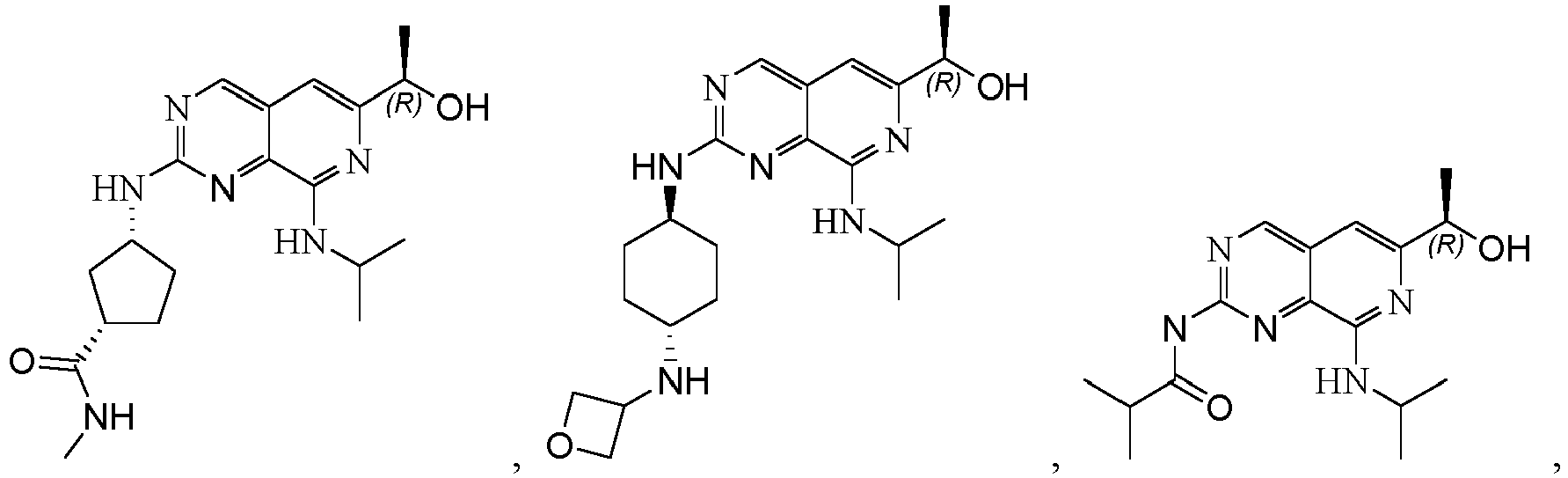


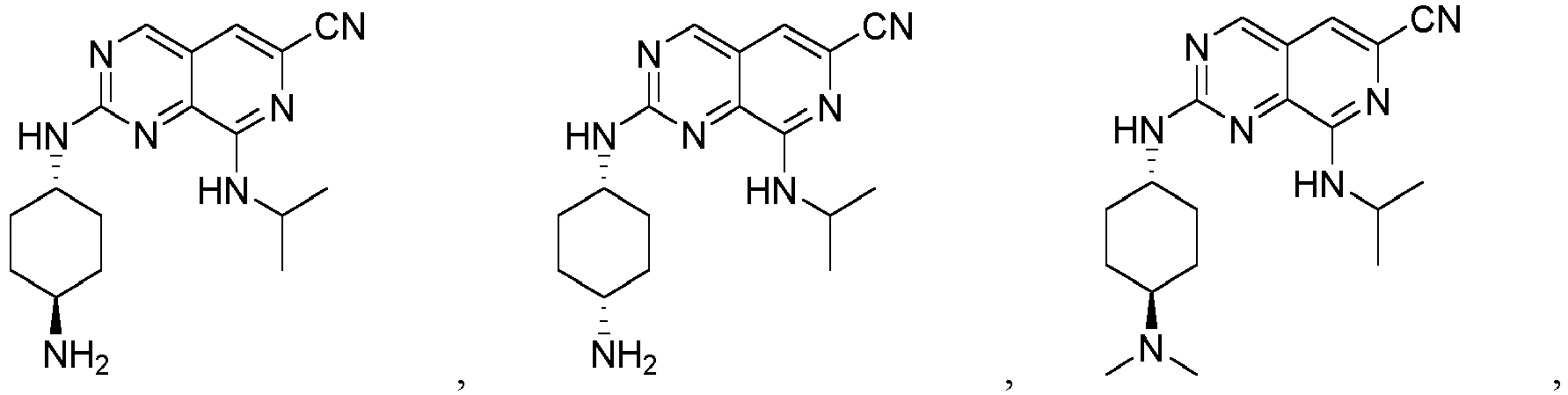


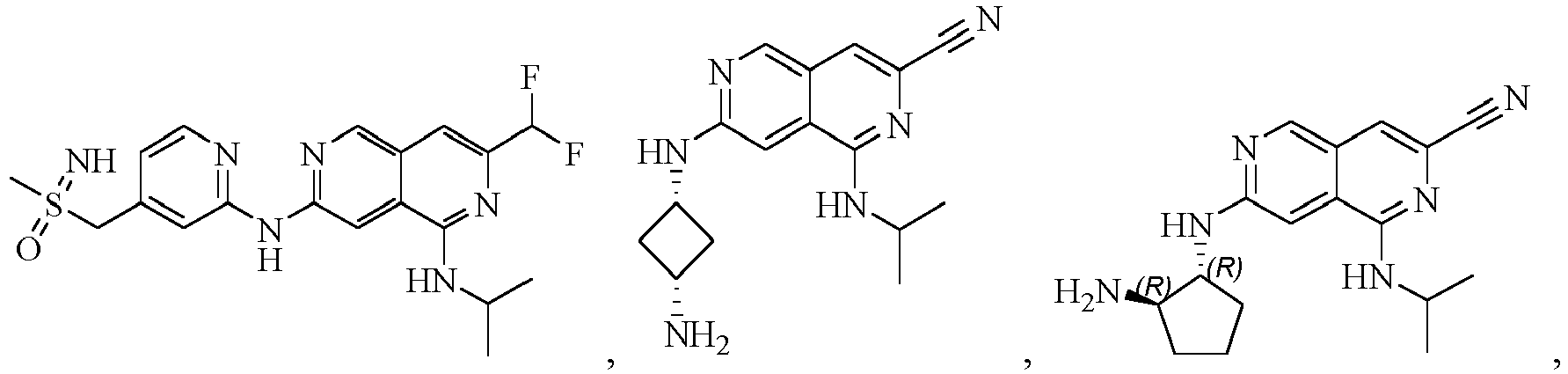

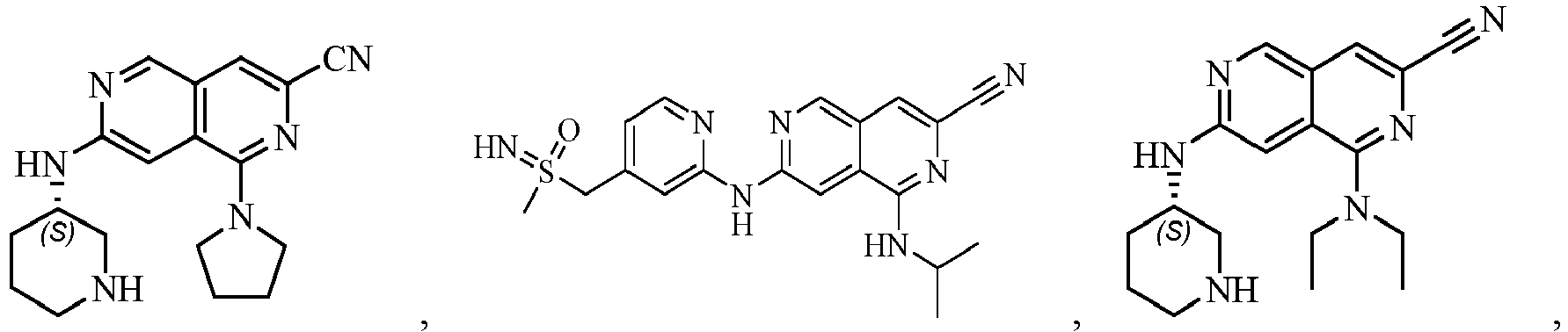
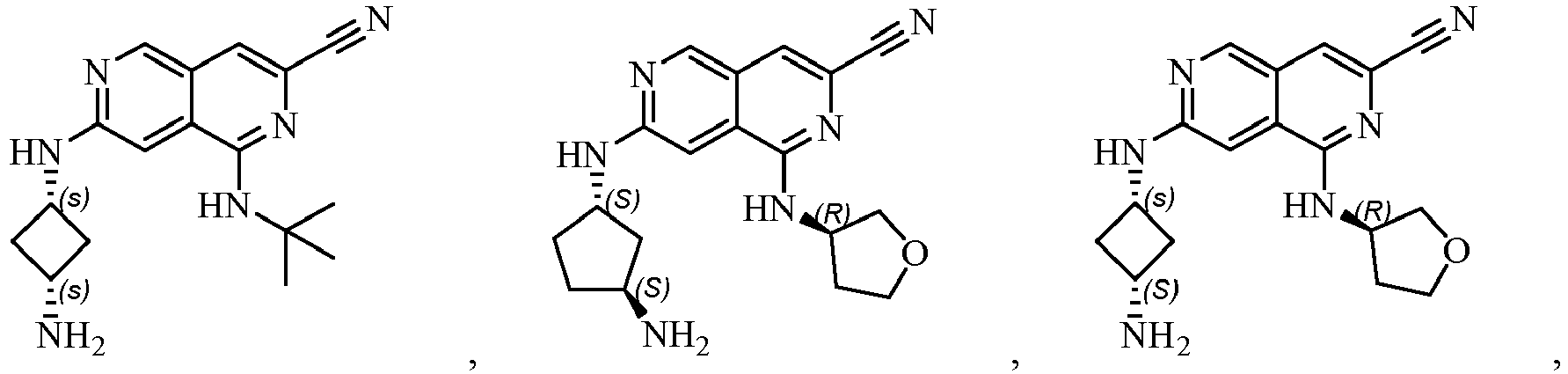


- The compound or the pharmaceutically acceptable salt or the isomer thereof according to claim 1 or 2:X1 is selected from N or CR4;X2 is selected from N or CR5;L is selected from bond, -C(O)-, -(CH2)p-;A is selected from bond, 3-12 membered cycloalkyl, 3-12 membered cycloalkenyl, 3-12 membered heterocyclyl, aryl, 5-10 membered heteroaryl, wherein the heteroatoms of the 3-12 membered heterocyclyl are selected from one of O, S, N or any combination thereof, C atom can be optionally oxidized to C(O), S atom can be optionally oxidized to S(O) or S(O)2, the heteroatoms of the 5-10 membered heteroaryl are selected from one of O, S, and N or any combination thereof;R1 is selected from hydrogen, halogen, hydroxyl, carboxyl, amino, C1-6 alkyl, C1-6 alkoxy, C1-6 alkylamino, (C1-6 alkyl)2 amino, halogenated C1-6 alkyl, halogenated C1-6 alkoxy, C2-8 alkenyl, C2-8 alkynyl, C1-6 alkylcarbonylamino, C1-6 alkylaminocarbonyl, (C1-6 alkyl)2 aminocarbonyl, C1-6 alkoxycarbonyl, C1-6 alkylcarbonyl, C1-6 alkylsulfonyl, aminosulfonyl, C1-6 alkylthio, 3-12 membered cycloalkyl, 3-12 membered heterocyclyl, 3-12 membered cycloalkenyl,wherein the heteroatoms of the 3-12 membered heterocyclyl are selected from one of O, S, N or any combination thereof, C atom can be optionally oxidized to C(O), S atom can be optionally oxidized to S(O) or S(O)2, the heteroatoms of the 5-10 membered heteroaryl are selected from one of O, S, and N or any combination thereof,wherein the amino, C1-6 alkyl, C1-6 alkoxy, C1-6 alkylamino, (C1-6 alkyl)2 amino, halogenated C1-6 alkyl , halogenated C1-6 alkoxy, C2-8 alkenyl, C2-8 alkynyl, C1-6 alkylcarbonylamino, C1-6 alkylaminocarbonyl, (C1-6 alkyl)2 aminocarbonyl, C1-6 alkoxycarbonyl,C1-6 alkylcarbonyl, C1-6 alkylsulfonyl, aminosulfonyl, C1-6 alkylthio, 3-12 membered cycloalkyl, 3-12 membered heterocyclyl, 3-12 membered cycloalkenyl are unsubstituted or optionally substituted by one or more groups selected from hydroxyl, amino, carboxy, cyano, nitro, halogen, C1-6 alkyl, C1-6 alkoxy, halogenated C1-6 alkyl, halogenated C1-6 alkoxy, C1-6 alkylamino, (C1-6 alkyl)2 amino, C1-6 alkylsulfonyl, HS(O)(=NH)-, C1-6 alkyl-S(O)(=NH)-, (C1-6 alkyl)2 aminocarbonyl, C1-6 alkyl carbonyl, 3-12 membered cycloalkyl, 3-12 membered heterocyclyl;R2 is selected from halogen, cyano, hydroxyl, carboxyl, amino, C1-6 alkyl, C1-6 alkoxy, C1-6 alkylamino, (C1-6 alkyl)2 amino, 3-12 membered cycloalkyl, 3-12 membered heterocyclyl, 3-12 membered cycloalkenyl, 3-12 membered heterocyclyloxy, 3-12 membered cycloalkyl amino, 3-12 membered heterocyclyl-CH2-amino, wherein the amino, C1-6 alkyl, C1-6 alkoxy, C1-6 alkylamino, (C1-6 alkyl)2 amino, 3-12 membered cycloalkyl, 3-12 membered heterocyclyl, 3-12 membered cycloalkenyl, 3-12 membered heterocyclyloxy, 3-12 membered cycloalkyl amino, 3-12 membered heterocyclyl-CH2-amino are unsubstituted or optionally substituted by one or more groups selected from halogen, cyano, hydroxyl, carboxy, amino, C1-6 alkyl, C1- 6 alkoxy, halogenated C1-6 alkyl, halogenated C1-6 alkoxy, C1-6 alkylamino, (C1-6 alkyl)2 amino, 3-12 membered cycloalkyl, 3-12 membered heterocyclyl, aryl and 5-10 membered heteroaryl;R3 is selected from hydrogen, hydroxy, amino, carboxy, cyano, nitro, halogen, C1-6 alkyl, C1-6 alkoxy, C1-6 alkylamino, (C1-6 alkyl)2 amino, halogenated C1-6 alkyl, halogenated C1-6 alkoxy, C2-8 alkenyl, C2-8 alkynyl, C1-6 alkylcarbonyl, C1-6 alkylsulfonyl, C1-6 alkylthio , 3-12 membered cycloalkyl, 3-12 membered cycloalkenyl, 3-12 membered heterocyclyl, wherein the amino, C1-6 alkyl, C1-6 alkoxy, C1-6 alkylamino, (C1-6 alkyl)2 amino, halogenated C1-6 alkyl, halogenated C1-6 alkoxy, C2-8 alkenyl, C2-8 alkynyl, C1-6 alkylcarbonyl, C1-6 alkylsulfonyl, C1-6 alkylthio, 3-12 membered cycloalkyl, 3-12 membered cycloalkenyl, 3-12 membered heterocyclyl are unsubstituted or optionally substituted by one or more groups selected from hydroxyl, amino, carboxyl, cyano, nitro, halogen, C1-6 alkyl, C1-6 alkoxy, C1-6 alkoxyC1-6 alkoxy, C1-6 alkylamino, (C1-6 alkyl)2 amino, C1-6 alkylcarbonylamino and C1-6 alkylsulfonylamino;n is 0 or 1;m is 0, 1, 2 or 3;p is 1, 2 or 3;R4, R5 and R6 are each independently selected from hydrogen, halogen, hydroxy, amino, carboxy, cyano, nitro, C1-6 alkyl, C2-8 alkenyl, C2-8 alkynyl, and halogenated C1-6 alkyl.
- A pharmaceutical composition comprising a compound or a pharmaceutically acceptable salt or isomer thereof according to any one of claims 1-20, and any one or more second therapeutically active agents.
- A pharmaceutical formulation having cyclin-dependent kinase 9 inhibitory activity, comprising a compound or a pharmaceutically acceptable salt or isomer thereof according to any one of claims 1-20, and any one or more pharmaceutically acceptable carriers.
- Use of a compound or a pharmaceutically acceptable salt or isomer thereof according to any one of claims 1-20 in the manufacture of a medicament for treating or preventing CDK9-mediated related diseases.
- The use according to claim 23, wherein the CDK9-mediated related diseases are cancer, preferably, the cancer is solid tumor or hematological malignancies, more preferably, the cancer is selected from adrenal tumor, melanoma, head and neck cancer, kidney cancer, bladder cancer, prostate cancer, endometrial carcinoma, cervical cancer, gastric carcinoma, colon cancer, pancreatic cancer, rectal cancer, esophageal cancer, liver cancer, lung cancer, sarcoma, breast cancer ovarian cancer, non hodgkin's lymphoma, acute myeloid leukemia, acute lymphoblastic leukemia or myeloma.
Applications Claiming Priority (4)
| Application Number | Priority Date | Filing Date | Title |
|---|---|---|---|
| CN202111543257 | 2021-12-16 | ||
| CN202210632338 | 2022-06-02 | ||
| CN202210928526 | 2022-08-03 | ||
| PCT/CN2022/139704 WO2023109959A1 (en) | 2021-12-16 | 2022-12-16 | Cdk9 inhibitor and use thereof |
Publications (2)
| Publication Number | Publication Date |
|---|---|
| EP4450501A1 true EP4450501A1 (en) | 2024-10-23 |
| EP4450501A4 EP4450501A4 (en) | 2025-11-19 |
Family
ID=86774913
Family Applications (1)
| Application Number | Title | Priority Date | Filing Date |
|---|---|---|---|
| EP22906704.6A Pending EP4450501A4 (en) | 2021-12-16 | 2022-12-16 | CDK9 HIBITOR AND USE OF IT |
Country Status (12)
| Country | Link |
|---|---|
| US (1) | US20250163043A1 (en) |
| EP (1) | EP4450501A4 (en) |
| JP (1) | JP2024545518A (en) |
| KR (1) | KR20240130693A (en) |
| CN (1) | CN116354957A (en) |
| AR (1) | AR128015A1 (en) |
| AU (1) | AU2022412837A1 (en) |
| CA (1) | CA3240763A1 (en) |
| IL (1) | IL313513A (en) |
| MX (1) | MX2024006975A (en) |
| TW (1) | TW202327592A (en) |
| WO (1) | WO2023109959A1 (en) |
Families Citing this family (5)
| Publication number | Priority date | Publication date | Assignee | Title |
|---|---|---|---|---|
| TW202412784A (en) * | 2022-07-18 | 2024-04-01 | 美商依安彼克醫療有限公司 | Aza-quinazoline compounds and methods of use |
| CN121548580A (en) * | 2023-05-15 | 2026-02-17 | 亚历克西亚治疗公司 | CDK inhibitor compounds |
| TW202545531A (en) * | 2024-01-17 | 2025-12-01 | 美商依安彼克醫療有限公司 | Methods of use for aza-quinazoline compounds |
| WO2025240517A1 (en) * | 2024-05-14 | 2025-11-20 | Aleksia Therapeutics, Inc. | Cdk4 inhibitor naphthyridine compounds |
| WO2026083260A1 (en) * | 2024-10-14 | 2026-04-23 | Janssen Pharmaceutica Nv | (2,6-naphthyridin-1-yl)amine derivatives as bfl-1 inhibitors for the treatment of cancer |
Family Cites Families (9)
| Publication number | Priority date | Publication date | Assignee | Title |
|---|---|---|---|---|
| DE602008005729D1 (en) * | 2007-04-06 | 2011-05-05 | Novartis Ag | Ä2,6-ünaphthyridine als proteinkinasehemmer |
| EP2398797B1 (en) * | 2009-02-17 | 2013-11-06 | Boehringer Ingelheim International GmbH | Pyrimido[5,4-d]pyrimidine derivatives for the inhibition of tyrosine kinases |
| GB201216017D0 (en) * | 2012-09-07 | 2012-10-24 | Cancer Rec Tech Ltd | Inhibitor compounds |
| US10124004B2 (en) * | 2015-05-29 | 2018-11-13 | Teijin Pharma Limited | Pyrido[3,4-d]pyrimidine derivative and pharmaceutically acceptable salt thereof |
| HUE053220T2 (en) * | 2016-11-28 | 2021-06-28 | Teijin Pharma Ltd | ((Pyridin-2-yl) amino) pyrido [3,4-d] pyrimidine and ((pyridazin-3-yl) amino) pyrido [3,4-d] pyrimidine derivatives as CDK4 / 6 inhibitors e.g. for the treatment of rheumatoid arthritis, atherosclerosis, pulmonary fibrosis, cerebral infarction or cancer |
| TWI755452B (en) * | 2016-11-28 | 2022-02-21 | 日商帝人製藥股份有限公司 | Crystals of pyrido[3,4-d]pyrimidine derivatives or their solvates |
| DK4034535T3 (en) * | 2019-09-26 | 2026-04-07 | Novartis Ag | AZA-QUINOLINE COMPOUNDS AND THEIR USES |
| CN115942937B (en) * | 2020-08-17 | 2025-07-25 | 浙江扬厉医药技术有限公司 | Pyrimido cyclic compounds |
| US20230399327A1 (en) * | 2020-10-28 | 2023-12-14 | Adlai Nortye Biopharma Co., Ltd. | High activity hpk1 kinase inhibitor |
-
2022
- 2022-12-16 AR ARP220103490A patent/AR128015A1/en unknown
- 2022-12-16 WO PCT/CN2022/139704 patent/WO2023109959A1/en not_active Ceased
- 2022-12-16 KR KR1020247020936A patent/KR20240130693A/en active Pending
- 2022-12-16 CN CN202211622489.7A patent/CN116354957A/en active Pending
- 2022-12-16 JP JP2024536015A patent/JP2024545518A/en active Pending
- 2022-12-16 EP EP22906704.6A patent/EP4450501A4/en active Pending
- 2022-12-16 US US18/719,765 patent/US20250163043A1/en active Pending
- 2022-12-16 AU AU2022412837A patent/AU2022412837A1/en active Pending
- 2022-12-16 CA CA3240763A patent/CA3240763A1/en active Pending
- 2022-12-16 IL IL313513A patent/IL313513A/en unknown
- 2022-12-16 MX MX2024006975A patent/MX2024006975A/en unknown
- 2022-12-16 TW TW111148625A patent/TW202327592A/en unknown
Also Published As
| Publication number | Publication date |
|---|---|
| TW202327592A (en) | 2023-07-16 |
| US20250163043A1 (en) | 2025-05-22 |
| MX2024006975A (en) | 2024-08-27 |
| CN116354957A (en) | 2023-06-30 |
| CA3240763A1 (en) | 2023-06-22 |
| AR128015A1 (en) | 2024-03-20 |
| JP2024545518A (en) | 2024-12-09 |
| AU2022412837A1 (en) | 2024-06-13 |
| KR20240130693A (en) | 2024-08-29 |
| EP4450501A4 (en) | 2025-11-19 |
| WO2023109959A1 (en) | 2023-06-22 |
| IL313513A (en) | 2024-08-01 |
Similar Documents
| Publication | Publication Date | Title |
|---|---|---|
| EP3932919B1 (en) | Jak inhibitor compound and use thereof | |
| EP3788042B1 (en) | Bcl-2 inhibitors | |
| EP2300478B1 (en) | 1-heterocyclyl-1,5-dihydro-pyrazolo[3,4-d]pyrimidin-4-one derivatives and their use as pde9a modulators | |
| EP3068785B1 (en) | Substituted 4,5,6,7-tetrahydropyrazolo[1,5-a]pyrazine derivatives as casein kinase 1 d/e inhibitors | |
| EP3957633A1 (en) | A class of bifunctional chimeric heterocyclic compounds for targeted degradation of androgen receptors and use thereof | |
| CN101379061B (en) | E1 activating enzyme inhibitor | |
| EP4442686A1 (en) | Kras inhibitors, preparation method therefor, and pharmaceutical use thereof | |
| EP2763990B1 (en) | Pyrrolopyrazine kinase inhibitors | |
| EP3130592B1 (en) | Analogues of 4h-pyrazolo[1,5- ]benzimidazole compound as parp inhibitors | |
| EP4079734B1 (en) | Triazolopyridazine derivative, preparation method therefor, pharmaceutical composition thereof, and use thereof | |
| EP2727920B1 (en) | 1,5-naphthyridine derivative or salt thereof | |
| EP3386992B1 (en) | Inhibitors of bruton's tyrosine kinase and methods of their use | |
| EP4137491A1 (en) | Imidazolinone derivative and use thereof in medicine | |
| EP3964518B1 (en) | Cd73 inhibitor, preparation method therefor and application thereof | |
| EP3112370A1 (en) | Tricyclic heterocyclic compounds and jak inhibitors | |
| EP4137484A1 (en) | Tricyclic compounds as egfr inhibitors | |
| EP3138842A1 (en) | Polyfluorinated compounds acting as bruton's tyrosine kinase inhibitors | |
| EP3372601B1 (en) | Novel bicyclic heterocyclic compound | |
| JP2024545518A (en) | CDK9 inhibitors and uses thereof | |
| EP4373817B1 (en) | Substituted pyrazine-2-carboxamides as hpk1 inhibitors for the treatment of cancer | |
| EP4293023A1 (en) | Imidazole-containing condensed ring derivative, preparation method therefor, and application thereof in medicine | |
| EP4288426B1 (en) | Quinoxaline derivatives and uses thereof | |
| HK40114959A (en) | Cdk9 inhibitor and use thereof | |
| EP4592283A1 (en) | Cyclin-dependent kinase 7 inhibitors | |
| HK40104947B (en) | Quinoxaline derivatives and uses thereof |
Legal Events
| Date | Code | Title | Description |
|---|---|---|---|
| STAA | Information on the status of an ep patent application or granted ep patent |
Free format text: STATUS: THE INTERNATIONAL PUBLICATION HAS BEEN MADE |
|
| PUAI | Public reference made under article 153(3) epc to a published international application that has entered the european phase |
Free format text: ORIGINAL CODE: 0009012 |
|
| STAA | Information on the status of an ep patent application or granted ep patent |
Free format text: STATUS: REQUEST FOR EXAMINATION WAS MADE |
|
| 17P | Request for examination filed |
Effective date: 20240710 |
|
| AK | Designated contracting states |
Kind code of ref document: A1 Designated state(s): AL AT BE BG CH CY CZ DE DK EE ES FI FR GB GR HR HU IE IS IT LI LT LU LV MC ME MK MT NL NO PL PT RO RS SE SI SK SM TR |
|
| REG | Reference to a national code |
Ref country code: HK Ref legal event code: DE Ref document number: 40114959 Country of ref document: HK |
|
| DAV | Request for validation of the european patent (deleted) | ||
| DAX | Request for extension of the european patent (deleted) | ||
| A4 | Supplementary search report drawn up and despatched |
Effective date: 20251017 |
|
| RIC1 | Information provided on ipc code assigned before grant |
Ipc: C07D 471/04 20060101AFI20251013BHEP Ipc: C07D 519/00 20060101ALI20251013BHEP Ipc: A61P 35/00 20060101ALI20251013BHEP Ipc: A61P 35/02 20060101ALI20251013BHEP Ipc: A61K 31/519 20060101ALI20251013BHEP Ipc: A61K 31/4375 20060101ALI20251013BHEP Ipc: A61K 31/5377 20060101ALI20251013BHEP Ipc: A61K 31/439 20060101ALI20251013BHEP Ipc: A61K 31/55 20060101ALI20251013BHEP Ipc: A61K 31/5386 20060101ALI20251013BHEP |
|
| STAA | Information on the status of an ep patent application or granted ep patent |
Free format text: STATUS: EXAMINATION IS IN PROGRESS |