EP4450482A1 - Hydrochlorination of alkenes under mild conditions - Google Patents
Hydrochlorination of alkenes under mild conditions Download PDFInfo
- Publication number
- EP4450482A1 EP4450482A1 EP23305585.4A EP23305585A EP4450482A1 EP 4450482 A1 EP4450482 A1 EP 4450482A1 EP 23305585 A EP23305585 A EP 23305585A EP 4450482 A1 EP4450482 A1 EP 4450482A1
- Authority
- EP
- European Patent Office
- Prior art keywords
- compound
- solution
- process according
- hydrochloric acid
- hydrochlorination
- Prior art date
- Legal status (The legal status is an assumption and is not a legal conclusion. Google has not performed a legal analysis and makes no representation as to the accuracy of the status listed.)
- Withdrawn
Links
Images

Classifications
-
- C—CHEMISTRY; METALLURGY
- C07—ORGANIC CHEMISTRY
- C07C—ACYCLIC OR CARBOCYCLIC COMPOUNDS
- C07C17/00—Preparation of halogenated hydrocarbons
- C07C17/07—Preparation of halogenated hydrocarbons by addition of hydrogen halides
- C07C17/08—Preparation of halogenated hydrocarbons by addition of hydrogen halides to unsaturated hydrocarbons
-
- C—CHEMISTRY; METALLURGY
- C07—ORGANIC CHEMISTRY
- C07C—ACYCLIC OR CARBOCYCLIC COMPOUNDS
- C07C253/00—Preparation of carboxylic acid nitriles
- C07C253/30—Preparation of carboxylic acid nitriles by reactions not involving the formation of cyano groups
-
- C—CHEMISTRY; METALLURGY
- C07—ORGANIC CHEMISTRY
- C07C—ACYCLIC OR CARBOCYCLIC COMPOUNDS
- C07C29/00—Preparation of compounds having hydroxy or O-metal groups bound to a carbon atom not belonging to a six-membered aromatic ring
- C07C29/62—Preparation of compounds having hydroxy or O-metal groups bound to a carbon atom not belonging to a six-membered aromatic ring by introduction of halogen; by substitution of halogen atoms by other halogen atoms
-
- C—CHEMISTRY; METALLURGY
- C07—ORGANIC CHEMISTRY
- C07C—ACYCLIC OR CARBOCYCLIC COMPOUNDS
- C07C41/00—Preparation of ethers; Preparation of compounds having groups, groups or groups
- C07C41/01—Preparation of ethers
- C07C41/18—Preparation of ethers by reactions not forming ether-oxygen bonds
- C07C41/22—Preparation of ethers by reactions not forming ether-oxygen bonds by introduction of halogens; by substitution of halogen atoms by other halogen atoms
-
- C—CHEMISTRY; METALLURGY
- C07—ORGANIC CHEMISTRY
- C07C—ACYCLIC OR CARBOCYCLIC COMPOUNDS
- C07C45/00—Preparation of compounds having >C = O groups bound only to carbon or hydrogen atoms; Preparation of chelates of such compounds
- C07C45/61—Preparation of compounds having >C = O groups bound only to carbon or hydrogen atoms; Preparation of chelates of such compounds by reactions not involving the formation of >C = O groups
- C07C45/63—Preparation of compounds having >C = O groups bound only to carbon or hydrogen atoms; Preparation of chelates of such compounds by reactions not involving the formation of >C = O groups by introduction of halogen; by substitution of halogen atoms by other halogen atoms
-
- C—CHEMISTRY; METALLURGY
- C07—ORGANIC CHEMISTRY
- C07C—ACYCLIC OR CARBOCYCLIC COMPOUNDS
- C07C51/00—Preparation of carboxylic acids or their salts, halides or anhydrides
- C07C51/347—Preparation of carboxylic acids or their salts, halides or anhydrides by reactions not involving formation of carboxyl groups
- C07C51/363—Preparation of carboxylic acids or their salts, halides or anhydrides by reactions not involving formation of carboxyl groups by introduction of halogen; by substitution of halogen atoms by other halogen atoms
-
- C—CHEMISTRY; METALLURGY
- C07—ORGANIC CHEMISTRY
- C07C—ACYCLIC OR CARBOCYCLIC COMPOUNDS
- C07C67/00—Preparation of carboxylic acid esters
- C07C67/28—Preparation of carboxylic acid esters by modifying the hydroxylic moiety of the ester, such modification not being an introduction of an ester group
- C07C67/287—Preparation of carboxylic acid esters by modifying the hydroxylic moiety of the ester, such modification not being an introduction of an ester group by introduction of halogen; by substitution of halogen atoms by other halogen atoms
-
- C—CHEMISTRY; METALLURGY
- C07—ORGANIC CHEMISTRY
- C07D—HETEROCYCLIC COMPOUNDS
- C07D209/00—Heterocyclic compounds containing five-membered rings, condensed with other rings, with one nitrogen atom as the only ring hetero atom
- C07D209/02—Heterocyclic compounds containing five-membered rings, condensed with other rings, with one nitrogen atom as the only ring hetero atom condensed with one carbocyclic ring
- C07D209/44—Iso-indoles; Hydrogenated iso-indoles
- C07D209/48—Iso-indoles; Hydrogenated iso-indoles with oxygen atoms in positions 1 and 3, e.g. phthalimide
-
- C—CHEMISTRY; METALLURGY
- C07—ORGANIC CHEMISTRY
- C07C—ACYCLIC OR CARBOCYCLIC COMPOUNDS
- C07C2601/00—Systems containing only non-condensed rings
- C07C2601/12—Systems containing only non-condensed rings with a six-membered ring
-
- C—CHEMISTRY; METALLURGY
- C07—ORGANIC CHEMISTRY
- C07C—ACYCLIC OR CARBOCYCLIC COMPOUNDS
- C07C2601/00—Systems containing only non-condensed rings
- C07C2601/18—Systems containing only non-condensed rings with a ring being at least seven-membered
Definitions
- the present invention belongs to the field of the preparation of alkyl chlorides, and relates more specifically to a process to prepare such alkyl chlorides.
- Alkyl chlorides are undoubtedly one of the most important classes of organic compounds. They are commonly encountered in pharmaceuticals, agrochemicals and natural products. However, and more importantly, their potential to serve as electrophiles and after metal insertion as nucleophiles renders their chemistry extremely rich. The synthesis of alkyl chlorides mainly relies on functional group transformations of alcohols. Hydrochlorination of feedstock olefins is a highly attractive alternative but was somewhat hampered in the past by low reactions rates, a limited functional group tolerance and the lack of control concerning the product distribution.
- alkenes have a long history and is often utilized as an example in many organic textbooks to explain the Markovnikow rule.
- alkenes e.g. trisubstituted ones
- Others such as monosubstituted or 1,2-disubstituted alkenes react very sluggishly.
- the hydrochlorination of alkenes can be separated into two major categories, the nucleophilic and radical addition pathway.
- the radical hydrochlorination has appeared relatively recently with a first report of Gaspar et al. in [1]. Concerning the nucleophilic hydrochlorination, it is initiated by the protonation of the alkene followed by the trapping on the cationic intermediate by a chloride anion. When using HCl gas one needs to break the H-Cl bond (427 kJ/mol) which is stronger than a C-C bond (347 kJ/mol). This explains why additives such as FeCl 3 , AlCl 3 or water which can favor the dissociation of H-Cl have an accelerating effect on the reaction, as described in ref. [2]. The same is true for polar solvents which can stabilize the cationic intermediates.
- hydrochloric acid a widely available bulk chemical has been rarely employed for hydrochlorination reactions.
- the present invention thus deals with a process for the hydrochlorination of alkenes involving a hydrochloric acid solution and taking place in preferably less than 24 hours, ideally less than 12 hours.
- the invention therefore relates to a process for the hydrochlorination of alkenes, comprising the following steps:
- step a) the organic solvent is used preferably if the compound is a solid. Nevertheless, it is also possible to avoid the solvent even if the alkene is a solid, providing in this case slower reaction.
- the compound (I) is a solid compound.
- the ratio of hydrochloric acid over each alkene function of compound (I), in the mixture comprising solution A and solution B corresponds to at least 1.2 equivalents of hydrochloric acid for one alkene function of the compound A, preferably at least 6 equivalents of hydrochloric acid for one alkene function of the compound A, and more preferably at least 12 equivalents of hydrochloric acid for one alkene function of compound A.
- the compound (I) contains one alkene function and the solution B is a hydrochloric solution in the range of 33 - 37%.
- Hydrochloric acid is a solution of HCl gas in water.
- Commercially avaible hydrochloric acid has a maximum concentration of 37% (fuming hydrochloric acid, 12 M), and is easier to handle in comparison to HCl gas.
- the stirring speed is of at least 1000 rpm, preferably 1150 rpm.
- the stirring speed is from 1250 to 1750 rpm, preferably 1350 to 1650, and most preferably from 1450 to 1550 rpm.
- Rotation rates of 1500 rpm (revolutions per minute) are not accessible with all kind of stirring plates, and it is used preferably the stirring plate IKA ® RCT basic IKAMAG TM safety control.
- Vigorous stirring typically from 500 to 2000 rpm is preferably required on a 1-1000 mmol scale of compound (I) for efficient reactions.
- Larger scale reactions typically when the quantity of compound (I) is higher than 1 mol, can achieve similar conversions with lower stirring rates, i.e. 100 and 500 rpm. This is due to the increased surface of the aqueous and organic phase in a large reactor.
- the temperature of the reaction in step c)- is from 10 to 90°C; preferably from 20 to 80°C; and most preferably from 30 to 70°C.
- reaction time at step c)- is in the range of 55 min to 8 h, preferably in the range of 2 to 7 h, and most preferably in the range of 3 to 6 h.
- an other acid is added to the mixture, preferably selected among a bronsted acid and a lewis acid, the bronsted acid being advantageously an organic acid and the lewis acid being a metal chloride.
- the organic acid is preferably a carboxylic acid is selected preferably in between AcOH (acetic acid), monochloroacetic acid, dichloroacetic acid, trichloroacetic acid and TFA (trifluoroacetic acid), and the metal chloride is chosen from FeCl 3 , InCl 3 , SbCl 5 and ZnCl 2 , most preferably FeCl 3 .
- R1 group and R2 group are connected together to form a cycle, and compound (I) is preferably selected among
- the compound (I) is selected among:
- NMR spectra were recorded on a Bruker AV III 300 spectrometer operating at 300 MHz for 1H, equipped with a BBFO. All experiments were carried out at 25 °C, and references for chemical shifts are external. Coupling constants J were calculated in hertz (Hz). Multiplicity are annotated as s (singlet), d (doublet), t (triplet), m (multiplet), or o (overlapping signals).
- a one dram vial (4 mL) was charged with a stirring bar, 1-Methyl-1-cyclohexene (118 ⁇ L, 98 mg, 1.0 mmol, 1.0 equiv), n-decane (97.5 ⁇ L, 71.2 mg, 0.5 mmol, 0.5 equiv.), AcOH (0.25 mL), and HCl (37%, 1.0 mL).
- HCl HCl
- Annex - table 2 (a)All reactions performed a 1.0 mmol scale with 1500 rpm stirring rate. (b)GC area percentage. (c)Determined by 1H-NMR analysis of the crude reaction mixture.
- the inventors demonstrate that unexpectedly, the acceleration of the reaction of monosubstituted non-activated alkenes is clearly not the result of acetate formation and subsequent displacement. They hence postulate that the role of acetic acid is that of a proton transfer reagent. Acetic acid is miscible with hydrochloric acid and thus protonates partially by HCl and then probably delivers the proton unto the alkene in the organic phase.
- Annex - table 3 (a)All reactions performed a 1.0 mmol scale with 1500 rpm stirring rate. (b)GC area percentage. (c)Determined by 1H-NMR analysis of the crude reaction mixture.
- Example 7 study of cyclic alkenes as reagent in the hydrochlorination process
Landscapes
- Chemical & Material Sciences (AREA)
- Organic Chemistry (AREA)
- Chemical Kinetics & Catalysis (AREA)
- Engineering & Computer Science (AREA)
- Oil, Petroleum & Natural Gas (AREA)
- Organic Low-Molecular-Weight Compounds And Preparation Thereof (AREA)
Abstract
Process for the hydrochlorination of alkenes, comprising the following steps:
a)- preparing an organic solution A of a compound (I) comprising at least one alkene function by dissolving it potentially in an organic solvent;
b)- mixing the solution A with a aqueous solution B comprising hydrochloric acid;
c)- stirring the mixture comprising solution A and solution B at stirring speed of at least 500 rpm, and at a temperature in the range from -5 to 105°C for at least half an hour.
a)- preparing an organic solution A of a compound (I) comprising at least one alkene function by dissolving it potentially in an organic solvent;
b)- mixing the solution A with a aqueous solution B comprising hydrochloric acid;
c)- stirring the mixture comprising solution A and solution B at stirring speed of at least 500 rpm, and at a temperature in the range from -5 to 105°C for at least half an hour.
Description
- The present invention belongs to the field of the preparation of alkyl chlorides, and relates more specifically to a process to prepare such alkyl chlorides.
- In the description below, references between [] refer to the list of references at the end of the examples.
- Alkyl chlorides are undoubtedly one of the most important classes of organic compounds. They are commonly encountered in pharmaceuticals, agrochemicals and natural products. However, and more importantly, their potential to serve as electrophiles and after metal insertion as nucleophiles renders their chemistry extremely rich. The synthesis of alkyl chlorides mainly relies on functional group transformations of alcohols. Hydrochlorination of feedstock olefins is a highly attractive alternative but was somewhat hampered in the past by low reactions rates, a limited functional group tolerance and the lack of control concerning the product distribution.
- The hydrochlorination of alkenes has a long history and is often utilized as an example in many organic textbooks to explain the Markovnikow rule. However, in practice only certain alkenes (e.g. trisubstituted ones) readily undergo hydrochlorination when exposed to HCl gas. Others, such as monosubstituted or 1,2-disubstituted alkenes react very sluggishly.
- The hydrochlorination of alkenes can be separated into two major categories, the nucleophilic and radical addition pathway. The radical hydrochlorination has appeared relatively recently with a first report of Gaspar et al. in [1]. Concerning the nucleophilic hydrochlorination, it is initiated by the protonation of the alkene followed by the trapping on the cationic intermediate by a chloride anion. When using HCl gas one needs to break the H-Cl bond (427 kJ/mol) which is stronger than a C-C bond (347 kJ/mol). This explains why additives such as FeCl3, AlCl3 or water which can favor the dissociation of H-Cl have an accelerating effect on the reaction, as described in ref. [2]. The same is true for polar solvents which can stabilize the cationic intermediates.
- Concerning the hydrochlorination of alkenes using HCl gas by bubbling it into or onto solutions of the corresponding neat alkenes, even though the hydrochlorination of alkene like propene is an exothermic process, the reaction with HCl gas does not take place at pressures of 1 atm or less [2]; and requires to work at a higher pressure and the reaction is sometimes difficult to implement in particular on an industrial scale.
- Interestingly, hydrochloric acid, a widely available bulk chemical has been rarely employed for hydrochlorination reactions. The two major studies by Landini et al. [3] and Tanemura et al. [4] using phase transfer catalyst or silica gel activation demonstrated that hydrochlorination reactions can be carried out with hydrochloric acid, though necessitating in many cases several days for complete conversion.
- To avoid the inconveniences of the background art, investigations have to be made to obtain secondary and tertiary alkyl chlorides through a simple hydrochlorination procedure avoiding the use of HCl gas, under atmospheric pressure and relatively short reaction times.
- The applicant has developed a new synthetic method or process for the preparation of alkyl chloride compounds that solves all the problems listed above.
- The present invention thus deals with a process for the hydrochlorination of alkenes involving a hydrochloric acid solution and taking place in preferably less than 24 hours, ideally less than 12 hours.
- The invention therefore relates to a process for the hydrochlorination of alkenes, comprising the following steps:
- a)- preparing an organic solution A of a compound (I) comprising at least one alkene function by dissolving it potentially in an organic solvent;
- b)- mixing the solution A with a aqueous solution B comprising hydrochloric acid;
- c)- stirring the mixture comprising solution A and solution B at a stirring speed of at least 500 rpm, and at a temperature in the range from -5 to 105°C for at least half an hour, and preferably less than one day.
- In step a) the organic solvent is used preferably if the compound is a solid. Nevertheless, it is also possible to avoid the solvent even if the alkene is a solid, providing in this case slower reaction.
- Preferably, the compound (I) is a solid compound.
- Advantageously, the ratio of hydrochloric acid over each alkene function of compound (I), in the mixture comprising solution A and solution B, corresponds to at least 1.2 equivalents of hydrochloric acid for one alkene function of the compound A, preferably at least 6 equivalents of hydrochloric acid for one alkene function of the compound A, and more preferably at least 12 equivalents of hydrochloric acid for one alkene function of compound A.
- Advantageously, the compound (I) contains one alkene function and the solution B is a hydrochloric solution in the range of 33 - 37%. Hydrochloric acid is a solution of HCl gas in water. Commercially avaible hydrochloric acid has a maximum concentration of 37% (fuming hydrochloric acid, 12 M), and is easier to handle in comparison to HCl gas.
- Advantageously, the stirring speed is of at least 1000 rpm, preferably 1150 rpm.
- Advantageously, the stirring speed is from 1250 to 1750 rpm, preferably 1350 to 1650, and most preferably from 1450 to 1550 rpm. Rotation rates of 1500 rpm (revolutions per minute) are not accessible with all kind of stirring plates, and it is used preferably the stirring plate IKA® RCT basic IKAMAG™ safety control.
- Vigorous stirring typically from 500 to 2000 rpm is preferably required on a 1-1000 mmol scale of compound (I) for efficient reactions. Larger scale reactions, typically when the quantity of compound (I) is higher than 1 mol, can achieve similar conversions with lower stirring rates, i.e. 100 and 500 rpm. This is due to the increased surface of the aqueous and organic phase in a large reactor.
- Advantageously, the temperature of the reaction in step c)- is from 10 to 90°C; preferably from 20 to 80°C; and most preferably from 30 to 70°C.
- Advantageously, the reaction time at step c)- is in the range of 55 min to 8 h, preferably in the range of 2 to 7 h, and most preferably in the range of 3 to 6 h.
- Advantageously, at step b)- an other acid is added to the mixture, preferably selected among a bronsted acid and a lewis acid, the bronsted acid being advantageously an organic acid and the lewis acid being a metal chloride. The organic acid is preferably a carboxylic acid is selected preferably in between AcOH (acetic acid), monochloroacetic acid, dichloroacetic acid, trichloroacetic acid and TFA (trifluoroacetic acid), and the metal chloride is chosen from FeCl3, InCl3, SbCl5 and ZnCl2, most preferably FeCl3.
- Advantageously, the compound (I) has a molecular structure according to the formula represented below:

- Advantageously, the R1 group and R2 group are connected together to form a cycle, and compound (I) is preferably selected among

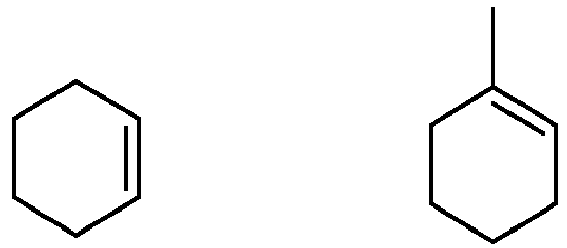

- Advantageously, the compound (I) is selected among:



- NMR spectra were recorded on a Bruker AV III 300 spectrometer operating at 300 MHz for 1H, equipped with a BBFO. All experiments were carried out at 25 °C, and references for chemical shifts are external. Coupling constants J were calculated in hertz (Hz). Multiplicity are annotated as s (singlet), d (doublet), t (triplet), m (multiplet), or o (overlapping signals). The conversion in equivalents of HCl is according to the following: 1 mL of HCl = 12 mmol of HCl; for example of a dosage 1mL/mmol corresponds to 12 equivalents of HCl with respect to the committed alkene function. Entry 1 in table 1, thus corresponds to 1.2 equivalents of HCl.
-
Table 1: Optimization of reaction conditions for the hydrochlorination of alkene 1a A) 
entry HCl (mL/mmol) additive (mL/mmol) rpmb yield (2) (%)c 1 0.1 none 1500 11 2 0.5 none 1500 61 3 1.0 none 1500 81 4 2.0 none 1500 84 5 0.5 AcOH (0.5 mL) 1500 96 (81)d 6 1.0 AcOH (0.25 mL) 1500 87 7 1.0 AcOH (0.5 mL) 1500 90 8 1.0 AcOH (1.0 mL) 1500 98 9 2.0 AcOH (1.0 mL) 1500 97 10 1.0 AcOH (1.0 mL) 0 5 11 1.0 AcOH (1.0 mL) 500 8 12 1.0 AcOH (1.0 mL) 1000 16 - Annex concerning Table 1: (a)Reactions performed a 1.0 mmol scale with 37% hydrochloric acid. (b)Revolutions per minute. (c)Yield determined by GC with decane as internal standard; no side-products were observed by GC. (d)Isolated yield on a 100 mmol scale, 2 hours reaction time; volatile product.
- The first experiment afforded the product within 20 minutes albeit with relatively low yield (entry 1). Increasing the amount of hydrochloric acid from 0.1 mL to 2.0 mL / mmol of alkene let to a GC-yield of 84% (entry 4). The inventors have shown that the addition of 0.5 mL of acetic acid increased the yield from 61 to 96% (entries 2 and 5). They have also demonstrated that further variation of the amounts of hydrochloric acid and acetic acid showed that equal volumes of both reagents work best (entries 5 and 8).
- Carrying out a large-scale reaction (100 mmol of 1) afford an isolated pure alkyl chloride 2 in 81% yield. In this case conditions shown in entry 5 have been performed with half of the volumes of HCl and AcOH compared to entry 8. From the beginning on they worked under highly agitated conditions (1500 rpm), when changing the rotation rate to 0, 500 and 1000 rpm a drastic drop in GC-yield is observed (entries 10-12).
- A one dram vial (4 mL) was charged with a stirring bar, 1-Methyl-1-cyclohexene (118 µL, 98 mg, 1.0 mmol, 1.0 equiv), n-decane (97.5 µL, 71.2 mg, 0.5 mmol, 0.5 equiv.), AcOH (0.25 mL), and HCl (37%, 1.0 mL). Immediately, after addition of HCl (37%) the vial was placed on a IKA RCT basic stirring plate which was already stirring at a rate of 1500 rpm. After 20 minutes of stirring at 20 °C the vial was removed from the stirring plate and 4 µL of the oily phase floating on top of the acidic phase was subjected to GC-analysis. GC-traces were recorded on a Agilent 8890 instrument equipped with a HP-5 column (30 m × 320 µm × 0.25 µm) as stationary phase. The following temperature protocol was used: 70 °C initial temperature (Hold time 3 min), Ramp 1 (10 °C/ min) from 70 -130 °C, then Ramp 2 (20 °C/ min ) from 130 °C - 300 °C (Hold time 3 minutes). Flow rate (H2) = 3.5 mL / min; Average velocity = 63.72 cm / sec. Integration of the signal of the internal standard (decane) and the corresponding product 1-chloro-1-methylcyclohexane (2) indicated a GC-yield of 2 of 87%.
- The hydrochlorination of several other alkenes (Scheme 1) is also investigated. Hydrochlorination of trisubstituted alkenes proceeded smoothly, affording tertiary chlorides 4 and 5 in good yields. It is noteworthy that tertiary benzylic chloride 5 is thermally unstable and gave elimination product during attempted distillation. As expected cyclooctene reacted more sluggishly and required prolonged reaction times and heating to achieve full conversion. Interestingly, this reaction allows to access high-value added products such as chlorocyclooctane 6, in only one step from cyclooctene, an inexpensive bulk chemical. The robustness of the hydrochlorination protocol was demonstrated for the synthesis of 7 from styrene on a 500 mmol scale with an excellent 97% yield (see scheme 1).

- Annex - scheme 1 :(a)For all
reactions 37% hydrochloric acid was used and the reactions were stirred at 1500 rpm. - The hydrochlorination of styrene also served as a benchmark reaction in order to evaluate the influence of several carboxylic acids on the reaction rate (Scheme 2 and
Figure 1 ). A strong dependence of the reaction rate on the pKa of the corresponding carboxylic acid is observed. Trifluoracetic acid and dichloroacetic acid gave >90% conversion within less than 5 minutes at room temperature which is an outstanding result in comparison to previous results reported in the literature (in general several hours reaction time are required).
- Hydrochlorination of 1-
octene 10 and allylbenzene 14 gave significant amounts of acetate 13 and 17 which are very slowly transformed into the corresponding chlorides 11 and 15 (see Table 2). Indeed, the displacement of acetate 13 into 2-chlorooctane 11 is a very slow process requiring 14 hours at 80 °C for 64% conversion.Table 2: Hydrochlorination of 1- octene 10 and allyl benzene 14 aA) Hydrochlorination of 1-octene 
Conditions 10 (%)b [11+12] (%)b 11:12 c [11+12] : 13 c No acetic acid, 0.5 h 92 6 79:21 -- No acetic acid, 14 h 31 67 81:19 -- With acetic acid, 0.5 h 78 17 95:5 75:25 With acetic acid, 6 h 2 83 87:13 85:15 With acetic acid, 14 h 0 99 81:19 99:1 B) Hydrochlorination of allyl benzene 
Conditions 14 (%) b [15+16] (%) b 15:16c [15+16] : 17 c No acetic acid, 4 h 17 79 88:12 -- No acetic acid, 14 h 1 96 88:12 -- With acetic acid, 4 h 1 88 89:11 89:11 With acetic acid, 14 h 0 90 90:10 95:5 - Annex - table 2: (a)All reactions performed a 1.0 mmol scale with 1500 rpm stirring rate. (b)GC area percentage. (c)Determined by 1H-NMR analysis of the crude reaction mixture.
- The inventors demonstrate that unexpectedly, the acceleration of the reaction of monosubstituted non-activated alkenes is clearly not the result of acetate formation and subsequent displacement. They hence postulate that the role of acetic acid is that of a proton transfer reagent. Acetic acid is miscible with hydrochloric acid and thus protonates partially by HCl and then probably delivers the proton unto the alkene in the organic phase.
- Trifluoro acetic acid and FeCl3 promoted the reaction of allyl benzene at room temperature with almost complete conversion within as few as 30 minutes in the case of FeCl3 (Table 3, entry 6). With both additives (TFA and FeCl3) a multitude of unidentified trace side products were observed by GC-analysis, all with significantly higher retention times. The regioselectivity increased with reaction time and that with both, CF3CO2H and FeCl3 as additive (Table 3).
Table 3: Evaluation of several additives for the hydrochlorination of allylbenzenea 
entry Additive t [h] 14 [%]b 15+16 [%]b 15:16 [%]c Other [%]b 1 AcOH 14 84 15 92:8 1 2 CF3CO2H 0.5 81 18 85:15 1 3 CF3CO2H 6 4 87 90:10 9 4 CF3CO2H 14 1 85 94:6 15 5 CF3CO2H 48 0 84 97:3 16 6 FeCl3 (7.0 equiv) 0.5 3 82 91:9 15 7 FeCl3 (7.0 equiv) 6 0 80 >98:2 20 - Annex - table 3: (a)All reactions performed a 1.0 mmol scale with 1500 rpm stirring rate. (b)GC area percentage. (c)Determined by 1H-NMR analysis of the crude reaction mixture.
- In the case of allyl benzene, it is demonstrated that prolonged reaction times increases the regioselectivity.
-
- para-chloro substituted styrene afforded the desired
product 20 in 90% yield. It is noteworthy that several reported protocols in the literature failed for this particular styrene or styrenes in general [1, 5]. - para-methoxy styrene, a strongly activated alkene, was submitted to the hydrochlorination protocol according to the invention. The standard conditions (1 mL/mmol HCl and AcOH) afforded full conversion in less than 15 minutes at room temperature, but only a gel like product was obtained. Dilution of the styrene in dichloromethane and only 5 equivalents of hydrochloric afforded the product in 42% NMR-yield accompanied with what we believe to be a oligo- or polymer side-product.
- In accordance with the results obtained with allylbenzene, 4-allyl anisole gave pure 22 with FeCl3 as additive and subsequent distillation in reasonable yield.
- Ketones tolerate the relatively harsh reaction conditions, and the corresponding chloride 23 was isolated in 57% yield.
- carvone give an inseparable 24:25 mixture of the desired product 24 and eugenol 25.
- Phtalimid and aldehyde substituted alkenes give the corresponding products 26 and 27 respectively without formation of a significant amount of regiomers.
- The hydrochlorination of a benzonitrile substrate gave concomitant nitrile hydrolysis and decomposition resulting in a low yield of
carboxylic acid 28. - Iron trichloride as additive preserved the nitrile group and we were able to isolate the desired
product 29 in 62% yield. - Citronellol give the hydrochlorinated citronellol 31 in high yield. This demonstrates that the process according to the invention does not require protection of primary alcohols when reactive alkenes are hydrochlorinated.
- Hydrochlorination of isoprene 32 was followed by 1H-NMR. After 30 minutes full consumption of isoprene was observed affording a 72:28 mixture of prenyl chloride 33 and dichloride 34 when carrying out the reaction with only hydrochloric acid (0.5 mL/ mmol). In contrast, the reaction with 0.5 mL / mmol TFA as additive gave 100% conversion of isoprene in only 5 minutes and a 8:92 mixture of 33:34 thus demonstrating the rate acceleration with trifluoro acetic acid as additive. On a large scale 400 mmol of isoprene was fully hydrochlorinated with hydrochloric acid (37%) to 34 in a 90% yield after 2 days of reaction. Pure hydrochloric acid was preferential in this case compared to TFA and acetic acid due to side-reactions with the two additives (see scheme 3).
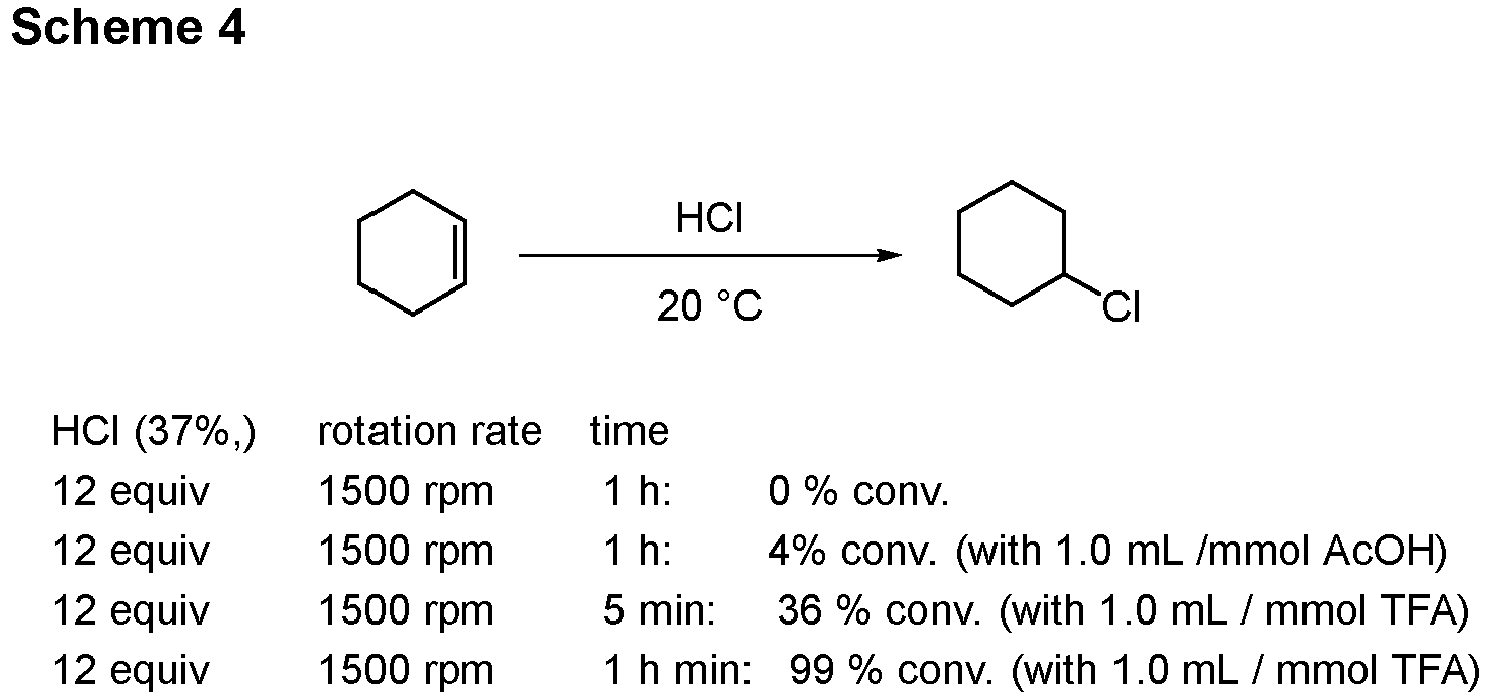
- The process according to the invention is also tested starting from other alkenes as shown in scheme 4.
-
- [1] Gaspar, B.; Carreira, E. M. Catalytic Hydrochlorination of Unactivated Olefins with Para-Toluenesulfonyl Chloride. Angewandte Chemie International Edition 2008, 47 (31), 5758-5760. https://doi.org/10.1002/anie.200801760.
- [2]
US 6 617 479 . - [3] Landini, D.; Rolla, F. Addition of Hydrohalogenic Acids to Alkenes in Aqueous-Organic, Two-Phase Systems in the Presence of Catalytic Amounts of Onium Salts. J. Org. Chem. 1980, 45 (17), 3527-3529_https://doi.org/10.1021/jo01305a038 ;
- [4] Tanemura, K. Silica Gel-Mediated Hydrohalogenation of Unactivated Alkenes Using Hydrohalogenic Acids under Organic Solvent-Free Conditions. Tetrahedron Letters 2018, 59 (49), 4293-4298_https://doi.org/10.1016/j.tetlet.2018.10.043 ;
- [5] Yadav, V. K.; Babu, K. G. A Remarkably Efficient Markovnikov Hydrochlorination of Olefins and Transformation of Nitriles into Imidates by Use of AcCI and an Alcohol. European Journal of Organic Chemistry 2005, 2005 (2), 452-456. https://doi.org/10.1002/ejoc.200400591;


Claims (10)
- Process for the hydrochlorination of alkenes, comprising the following steps:a)- preparing a organic solution A of a compound (I) comprising at least one alkene function by dissolving it potentially in an organic solvent;b)- mixing the solution A with a aqueous solution B comprising hydrochloric acid;c)- stirring the mixture comprising solution A and solution B at a stirring speed of at least 500 rpm, and at a temperature in the range from -5 to 105°C for at least half an hour, and preferably less than one day.
- Process according to claim 1, wherein the ratio of hydrochloric acid over each alkene function of compound (I), in the mixture comprising solution A and solution B, corresponds to at least 1.2 equivalents of hydrochloric acid for one alkene function of the compound A, preferably at least 6 equivalents of hydrochloric acid for one alkene function of the compound A, and more preferably at least 12 equivalents of hydrochloric acid for one alkene function of compound A.
- Process according to claim 1 or 2, wherein the compound (I) contains one alkene function and the solution B is a hydrochloric solution in the range of 33 - 37%.
- Process according to anyone of claims 1 to 3, wherein the stirring speed is from 1250 to 1750 rpm, preferably 1350 to 1650, and most preferably from 1450 to 1550 rpm.
- Process according to anyone of claims 1 to 4, wherein the temperature of the reaction in step c)- is from 10 to 90°C; preferably from 20 to 80°C; and most preferably from 30 to 70°C.
- Process according to anyone of claims 1 to 5, wherein the reaction time at step c)- is in the range of 55 min to 8 h, preferably in the range of 2 to 7 h, and most preferably in the range of 3 to 6 h.
- Process according to anyone of claims 1 to 6, wherein at step b)- an other acid is added to the mixture, preferably selected among an organic acid and a metal chloride.
- Process according to anyone of claims 1 to 7, wherein the compound (I) has a molecular structure according to the formula represented below:

- Process according to claim 8, wherein the R1 group and R2 group are connected together to form a cycle, and compound (I) is preferably selected among:


- Process according to claim 8, wherein the compound (I) is selected among:


Priority Applications (3)
| Application Number | Priority Date | Filing Date | Title |
|---|---|---|---|
| EP23305585.4A EP4450482A1 (en) | 2023-04-18 | 2023-04-18 | Hydrochlorination of alkenes under mild conditions |
| PCT/EP2024/060437 WO2024218160A1 (en) | 2023-04-18 | 2024-04-17 | Hydrochlorination of alkenes under mild conditions |
| EP24718259.5A EP4698509A1 (en) | 2023-04-18 | 2024-04-17 | Hydrochlorination of alkenes under mild conditions |
Applications Claiming Priority (1)
| Application Number | Priority Date | Filing Date | Title |
|---|---|---|---|
| EP23305585.4A EP4450482A1 (en) | 2023-04-18 | 2023-04-18 | Hydrochlorination of alkenes under mild conditions |
Publications (1)
| Publication Number | Publication Date |
|---|---|
| EP4450482A1 true EP4450482A1 (en) | 2024-10-23 |
Family
ID=86330469
Family Applications (2)
| Application Number | Title | Priority Date | Filing Date |
|---|---|---|---|
| EP23305585.4A Withdrawn EP4450482A1 (en) | 2023-04-18 | 2023-04-18 | Hydrochlorination of alkenes under mild conditions |
| EP24718259.5A Pending EP4698509A1 (en) | 2023-04-18 | 2024-04-17 | Hydrochlorination of alkenes under mild conditions |
Family Applications After (1)
| Application Number | Title | Priority Date | Filing Date |
|---|---|---|---|
| EP24718259.5A Pending EP4698509A1 (en) | 2023-04-18 | 2024-04-17 | Hydrochlorination of alkenes under mild conditions |
Country Status (2)
| Country | Link |
|---|---|
| EP (2) | EP4450482A1 (en) |
| WO (1) | WO2024218160A1 (en) |
Citations (4)
| Publication number | Priority date | Publication date | Assignee | Title |
|---|---|---|---|---|
| US5831137A (en) * | 1996-02-08 | 1998-11-03 | Huels Aktiengesellschaft | Process for the preparation of alkyl halides |
| CN109574816A (en) * | 2018-12-11 | 2019-04-05 | 南通鸿富达利化工有限公司 | A kind of dichloro pinacoline production technology |
| CN112409187A (en) * | 2020-11-30 | 2021-02-26 | 山东华夏神舟新材料有限公司 | Synthetic method of 6-amino-1-(4-aminophenyl)-1,3,3-trimethylindane |
| WO2022233339A1 (en) * | 2021-11-22 | 2022-11-10 | 山东省科学院菏泽分院 | Preparation method for pinacolone |
-
2023
- 2023-04-18 EP EP23305585.4A patent/EP4450482A1/en not_active Withdrawn
-
2024
- 2024-04-17 WO PCT/EP2024/060437 patent/WO2024218160A1/en not_active Ceased
- 2024-04-17 EP EP24718259.5A patent/EP4698509A1/en active Pending
Patent Citations (4)
| Publication number | Priority date | Publication date | Assignee | Title |
|---|---|---|---|---|
| US5831137A (en) * | 1996-02-08 | 1998-11-03 | Huels Aktiengesellschaft | Process for the preparation of alkyl halides |
| CN109574816A (en) * | 2018-12-11 | 2019-04-05 | 南通鸿富达利化工有限公司 | A kind of dichloro pinacoline production technology |
| CN112409187A (en) * | 2020-11-30 | 2021-02-26 | 山东华夏神舟新材料有限公司 | Synthetic method of 6-amino-1-(4-aminophenyl)-1,3,3-trimethylindane |
| WO2022233339A1 (en) * | 2021-11-22 | 2022-11-10 | 山东省科学院菏泽分院 | Preparation method for pinacolone |
Non-Patent Citations (8)
| Title |
|---|
| FAHEY ROBERT C ET AL: "The Mechanism of the Hydrochlorination of f-Butylethylene and Styrene in Acetic Acid1", JOURNAL OF THE AMERICAN CHEMICAL SOCIETY, vol. 91, no. 14, 1 January 1969 (1969-01-01), pages 3865 - 3869, XP093087769, Retrieved from the Internet <URL:https://pubs.acs.org/doi/pdf/10.1021/ja01042a030> * |
| FAHEY ROBERT C. ET AL: "Hydrochlorination of cyclohexene in acetic acid. Kinetic and product studies", JOURNAL OF THE AMERICAN CHEMICAL SOCIETY, vol. 92, no. 9, 1 May 1970 (1970-05-01), pages 2810 - 2815, XP093087854, ISSN: 0002-7863, DOI: 10.1021/ja00712a034 * |
| LAFONT O ET AL: "Influence of lipophilicity variation upon the biodegradation of branched side chains: case of 5-methyl 5-(2-methylpropyl) barbituric acid", EUROPEAN JOURNAL OF MEDICINAL CHEMISTRY, ELSEVIER, AMSTERDAM, NL, vol. 25, no. 2, 1 March 1990 (1990-03-01), pages 179 - 186, XP023870397, ISSN: 0223-5234, [retrieved on 19900301], DOI: 10.1016/0223-5234(90)90026-Y * |
| LANDINI DARIO ET AL: "Addition of hydrohalogenic acids to alkenes in aqueous-organic, two-phase systems in the presence of catalytic amounts of onium salts", THE JOURNAL OF ORGANIC CHEMISTRY, vol. 45, no. 17, 1 August 1980 (1980-08-01), pages 3527 - 3529, XP093085866, ISSN: 0022-3263, DOI: 10.1021/jo01305a038 * |
| LANDINI, D.ROLLA, F.: "Addition of Hydrohalogenic Acids to Alkenes in Aqueous-Organic, Two-Phase Systems in the Presence of Catalytic Amounts of Onium Salts", J. ORG. CHEM., vol. 45, no. 17, 1980, pages 3527 - 3529, Retrieved from the Internet <URL:https://doi.org/10.1021/jo01305a038> |
| TANEMURA KIYOSHI: "Silica gel-mediated hydrohalogenation of unactivated alkenes using hydrohalogenic acids under organic solvent-free conditions", TETRAHEDRON LETTERS, ELSEVIER, AMSTERDAM , NL, vol. 59, no. 49, 1 November 2018 (2018-11-01), pages 4293 - 4298, XP085533588, ISSN: 0040-4039, DOI: 10.1016/J.TETLET.2018.10.043 * |
| TANEMURA, K: "Silica Gel-Mediated Hydrohalogenation of Unactivated Alkenes Using Hydrohalogenic Acids under Organic Solvent-Free Conditions", TETRAHEDRON LETTERS, vol. 59, no. 49, 2018, pages 4293 - 4298, XP085533588, Retrieved from the Internet <URL:https://doi.org/10.1016/j.tetlet.2018.10.043> DOI: 10.1016/j.tetlet.2018.10.043 |
| YADAV, V. K.BABU, K. G.: "A Remarkably Efficient Markovnikov Hydrochlorination of Olefins and Transformation of Nitriles into Imidates by Use of AcCI and an Alcohol", EUROPEAN JOURNAL OF ORGANIC CHEMISTRY, vol. 2005, no. 2, 2005, pages 452 - 456, XP072105155, Retrieved from the Internet <URL:https://doi.org/10.1002/ejoc.200400591> DOI: 10.1002/ejoc.200400591 |
Also Published As
| Publication number | Publication date |
|---|---|
| EP4698509A1 (en) | 2026-02-25 |
| WO2024218160A1 (en) | 2024-10-24 |
Similar Documents
| Publication | Publication Date | Title |
|---|---|---|
| EP1406856B1 (en) | In situ process for preparing quaternary ammonium bicarbonates and quaternary ammonium carbonates | |
| Zhu et al. | Direct nucleophilic substitution reaction of alcohols mediated by a zinc-based ionic liquid | |
| US20090043121A1 (en) | Method for producing vitamin a acetate | |
| Xie et al. | Lanthanide triflates catalyzed reactions of imines with indole in protic media | |
| EP4450482A1 (en) | Hydrochlorination of alkenes under mild conditions | |
| US8242311B2 (en) | Process for preparing 2,2-difluoroethylamine and salts thereof proceeding from difluoroacetonitrile | |
| US20140357886A1 (en) | Process for the preparation of 2-cyanophenylboronic acid and esters thereof | |
| JP2022188826A (en) | Production method of chloro-substituted phenyl trifluoromethyl ketones | |
| US20100048910A1 (en) | Process for preparing isoxazole compounds | |
| JP2004534871A5 (en) | ||
| EP2032522B1 (en) | Shortened synthesis using paraformaldehyde or trioxane | |
| US20150038687A1 (en) | Method for the preparation of diazoalkanes | |
| EP0320783B1 (en) | Process for preparing alkylthioethylamine salts | |
| US6407029B1 (en) | Mixtures comprising tetrakis(pyrrolidino/piperdino)phosphonium salts | |
| EP1926704B1 (en) | Method for the production of beta-aminopropionic acid derivatives | |
| Alam et al. | Synthesis of-Amino Alcohols by Regioselective Ring Opening of Epoxides with Aromatic Amines Catalyzed by Tin (II) Chloride | |
| US10865163B2 (en) | Carbon dioxide as a directing group for C—H functionalization reactions involving Lewis basic amines, alcohols, thiols, and phosphines for the synthesis of compounds | |
| CN102448927A (en) | Method for dimethylation of active methylene groups | |
| US6545166B2 (en) | Process for producing spiro acetal derivative | |
| EP3634943B1 (en) | Method for preparation of difluoromethylornithine | |
| JP2009149595A (en) | Method for producing cyanoethyl ethers | |
| RU2169729C1 (en) | Method of n,n'-tetramethylmethylenediamine salts preparing | |
| KR20040018373A (en) | Chloromethylation of thiophene | |
| US20040171863A1 (en) | Process for poducing beta-oxonitrile compound or alkali metal salt thereof | |
| EP1490322B1 (en) | Method for producing 2,2-dichloro or dibromo-phenyl alkyl acetates |
Legal Events
| Date | Code | Title | Description |
|---|---|---|---|
| PUAI | Public reference made under article 153(3) epc to a published international application that has entered the european phase |
Free format text: ORIGINAL CODE: 0009012 |
|
| STAA | Information on the status of an ep patent application or granted ep patent |
Free format text: STATUS: THE APPLICATION HAS BEEN PUBLISHED |
|
| AK | Designated contracting states |
Kind code of ref document: A1 Designated state(s): AL AT BE BG CH CY CZ DE DK EE ES FI FR GB GR HR HU IE IS IT LI LT LU LV MC ME MK MT NL NO PL PT RO RS SE SI SK SM TR |
|
| STAA | Information on the status of an ep patent application or granted ep patent |
Free format text: STATUS: THE APPLICATION IS DEEMED TO BE WITHDRAWN |
|
| 18D | Application deemed to be withdrawn |
Effective date: 20250424 |