EP4449988A1 - Wrinkle evaluation method, wrinkle evaluation system, fat infiltration evaluation method, fat infiltration evaluation system, computer program, skin sensing method for wrinkle evaluation purposes, recommendation method on basis of wrinkle evaluation, and method for predicting future state of fat infiltration and/or future state of wrinkles - Google Patents
Wrinkle evaluation method, wrinkle evaluation system, fat infiltration evaluation method, fat infiltration evaluation system, computer program, skin sensing method for wrinkle evaluation purposes, recommendation method on basis of wrinkle evaluation, and method for predicting future state of fat infiltration and/or future state of wrinkles Download PDFInfo
- Publication number
- EP4449988A1 EP4449988A1 EP22907246.7A EP22907246A EP4449988A1 EP 4449988 A1 EP4449988 A1 EP 4449988A1 EP 22907246 A EP22907246 A EP 22907246A EP 4449988 A1 EP4449988 A1 EP 4449988A1
- Authority
- EP
- European Patent Office
- Prior art keywords
- wrinkles
- cavitation
- state
- evaluation
- forehead
- Prior art date
- Legal status (The legal status is an assumption and is not a legal conclusion. Google has not performed a legal analysis and makes no representation as to the accuracy of the status listed.)
- Withdrawn
Links
Images



Classifications
-
- A—HUMAN NECESSITIES
- A61—MEDICAL OR VETERINARY SCIENCE; HYGIENE
- A61B—DIAGNOSIS; SURGERY; IDENTIFICATION
- A61B5/00—Measuring for diagnostic purposes; Identification of persons
-
- A—HUMAN NECESSITIES
- A61—MEDICAL OR VETERINARY SCIENCE; HYGIENE
- A61B—DIAGNOSIS; SURGERY; IDENTIFICATION
- A61B5/00—Measuring for diagnostic purposes; Identification of persons
- A61B5/0059—Measuring for diagnostic purposes; Identification of persons using light, e.g. diagnosis by transillumination, diascopy, fluorescence
- A61B5/0062—Arrangements for scanning
- A61B5/0064—Body surface scanning
-
- A—HUMAN NECESSITIES
- A61—MEDICAL OR VETERINARY SCIENCE; HYGIENE
- A61B—DIAGNOSIS; SURGERY; IDENTIFICATION
- A61B5/00—Measuring for diagnostic purposes; Identification of persons
- A61B5/0059—Measuring for diagnostic purposes; Identification of persons using light, e.g. diagnosis by transillumination, diascopy, fluorescence
- A61B5/0077—Devices for viewing the surface of the body, e.g. camera, magnifying lens
-
- A—HUMAN NECESSITIES
- A61—MEDICAL OR VETERINARY SCIENCE; HYGIENE
- A61B—DIAGNOSIS; SURGERY; IDENTIFICATION
- A61B5/00—Measuring for diagnostic purposes; Identification of persons
- A61B5/103—Measuring devices for testing the shape, pattern, colour, size or movement of the body or parts thereof, for diagnostic purposes
- A61B5/107—Measuring physical dimensions, e.g. size of the entire body or parts thereof
-
- A—HUMAN NECESSITIES
- A61—MEDICAL OR VETERINARY SCIENCE; HYGIENE
- A61B—DIAGNOSIS; SURGERY; IDENTIFICATION
- A61B5/00—Measuring for diagnostic purposes; Identification of persons
- A61B5/44—Detecting, measuring or recording for evaluating the integumentary system, e.g. skin, hair or nails
- A61B5/441—Skin evaluation, e.g. for skin disorder diagnosis
- A61B5/442—Evaluating skin mechanical properties, e.g. elasticity, hardness, texture, wrinkle assessment
-
- A—HUMAN NECESSITIES
- A61—MEDICAL OR VETERINARY SCIENCE; HYGIENE
- A61B—DIAGNOSIS; SURGERY; IDENTIFICATION
- A61B8/00—Diagnosis using ultrasonic, sonic or infrasonic waves
- A61B8/08—Clinical applications
- A61B8/0858—Clinical applications involving measuring tissue layers, e.g. skin, interfaces
-
- A—HUMAN NECESSITIES
- A61—MEDICAL OR VETERINARY SCIENCE; HYGIENE
- A61B—DIAGNOSIS; SURGERY; IDENTIFICATION
- A61B8/00—Diagnosis using ultrasonic, sonic or infrasonic waves
- A61B8/52—Devices using data or image processing specially adapted for diagnosis using ultrasonic, sonic or infrasonic waves
- A61B8/5215—Devices using data or image processing specially adapted for diagnosis using ultrasonic, sonic or infrasonic waves involving processing of medical diagnostic data
- A61B8/5223—Devices using data or image processing specially adapted for diagnosis using ultrasonic, sonic or infrasonic waves involving processing of medical diagnostic data for extracting a diagnostic or physiological parameter from medical diagnostic data
Definitions
- the present invention relates to a method for evaluating wrinkles in human skin, and more specifically it relates to a method for evaluating wrinkles whereby the state of cavitation (fat infiltration) in the dermis of the forehead is used as the basis for assessment.
- Skin aging is the alteration of skin caused by numerous factors including internal factors such as aging, hormones and metabolism, and external factors such as ultraviolet rays and drying. Skin aging can usually be observed based on exterior appearances such as skin spots, wrinkles, sagging and shrinkage, but aging also proceeds with non-visible changes in the interior skin tissue structure and its constituent components. In PTL 1, for example, aging is assessed based on blood vitamin D levels. In PTL 2, expression of genes such as the E-cadherin gene and T-cadherin gene in skin is used as an index. In PTL 3, expression of genes such as OLFML2A and/or CRLF1 in fibroblasts is used as the index.
- PTL 4 discloses dermal cavitation as one cause of sagging of cheek skin, and further discloses an ameliorator for skin sagging or aging caused by dermal cavitation, which includes an adipose stem cell inducer comprising licorice extract or rosemary extract.
- One object of the disclosure is to provide a method for evaluating wrinkles wherein the state of cavitation (fat infiltration) in the dermis of the forehead of a subject is used as the basis for assessment, and in particular to provide a method for evaluating transient expression of wrinkles which are not easy to evaluate based on outer appearance.
- Transiently appearing expression wrinkles are a major factor in the appearance of human aging, and are the primary cause of formation of established wrinkles.
- the term "transient (expression) wrinkles” will be used to refer to wrinkles transiently formed by changes in facial expression. Wrinkles resulting with establishment of transient wrinkles, even without changes in facial expression, will be referred to as "fixed transient wrinkles" or "fixed wrinkles”.
- Wrinkles due to facial expressions are formed from both transient wrinkles and fixed transient wrinkles.
- Another object of the disclosure is to provide a system for evaluating wrinkles, which evaluates wrinkles including not only fixed wrinkles that can be easily measured based on outer appearance, but also transient wrinkles, with the state of cavitation (fat infiltration) in the dermis of the forehead of a subject as the basis for assessment.
- the present inventors have found that it is possible to evaluate wrinkles, and especially transient wrinkles which are not easy to evaluate based on outer appearance, using the state of cavitation (fat infiltration) in the dermis of the forehead of a subject as the basis for assessment.
- the present disclosure therefore provides a method and system for evaluating wrinkles, comprising not only fixed wrinkles but also transient wrinkles, using the state of cavitation (fat infiltration) in the dermis of the forehead as the basis for assessment. More specifically, the present disclosure relates to the following aspects:
- a method for evaluating wrinkles wherein the state of cavitation (fat infiltration) in the dermis of the forehead of a subject is used as the basis for assessment.
- the method according to aspect 1, comprising a step of measuring the state of cavitation by echo or laser microscope.
- cavitation is evaluated by the distance from the skin surface to a cavity, as measured by echo or laser microscope.
- a system for evaluating wrinkles wherein the wrinkles are evaluated using the state of cavitation (fat infiltration) in the dermis of the forehead of a subject as the basis for assessment.
- the measuring unit is configured so as to measure the state of cavitation by echo or laser microscope.
- a method for evaluating cavitation wherein the state of wrinkles on the forehead of a subject is used as the basis for assessment.
- a system for evaluating cavitation wherein the state of cavitation is evaluated using the state of wrinkles on the forehead of a subject as the basis for assessment.
- cavitation evaluating unit carries out evaluation by comparing the measured value with a predetermined reference value.
- a skin sensing method for evaluation of wrinkles wherein the state of cavitation (fat infiltration) in the dermis of the forehead of a subject is included as a measured parameter.
- One aspect of the disclosure provides a method for evaluating wrinkles wherein the state of cavitation (fat infiltration) in the dermis of the forehead of a subject is used as the basis for assessment, and more particularly it provides a method for evaluating expression wrinkles which are not easy to evaluate based on outer appearance.
- Transient wrinkles are wrinkles transiently formed due to facial expression muscles.
- forehead wrinkles can form due to sagging or drooping of the eyelids.
- the forehead muscles attempt to open the eyes, causing transient wrinkles on the forehead.
- the transient wrinkles When transient wrinkles are left untreated, the transient wrinkles eventually become fixed wrinkles, leaving wrinkles even in the absence of the facial expression.
- wrinkles can be evaluated by examining the state of cavitation in the dermis of the forehead of a subject.
- the state of cavitation can be measured by echo (ultrasound) or laser microscope methods.
- Transiently appearing wrinkles have previously been difficult to measure and evaluate, but the method of the disclosure allows not only fixed wrinkles but also transient wrinkles to be conveniently evaluated by measuring dermal cavitation.
- Dermal cavities are cavities formed by partial rising of subcutaneous tissue on the dermis layer side, by aging or by some other cause ( Fig. 1 ).
- the sizes of dermal cavities range from 10 ⁇ m to 1000 ⁇ m in diameter with approximately spherical shapes, though the shapes are not consistent.
- the dermal cavity interiors are filled by subcutaneous tissue, they may be referred to as "filled dermal cavities".
- cellular components and interstitial components in the dermis layer are not found in dermal cavities, they form wrinkles.
- it is evaluated that the risk of wrinkle formation is high or that wrinkles are numerous when cavitation has occurred. For example, when cavitation has occurred, even if no wrinkles are observed, the potential for transient wrinkle formation is normally high with changes in facial expression, and such transient wrinkles are highly likely to progress to fixed wrinkles in the future.
- the extent of dermal cavities can be measured by estimating the dermal thickness, i.e. the thickness from the boundary with the epidermis to the boundary with the subcutaneous tissue, in a fixed-length skin cross-section.
- the dermal thickness i.e. the thickness from the boundary with the epidermis to the boundary with the subcutaneous tissue
- the dermal thickness i.e. the thickness from the boundary with the epidermis to the boundary with the subcutaneous tissue
- the thickness of the dermis decreases. Since the thickness of the epidermis is normally constant and somewhat thinner compared to the dermis, it can be calculated by simply estimating the thickness from the skin surface to the subcutaneous tissue. According to several aspects of the disclosure, therefore, cavitation can be evaluated by the distance from the skin surface to a cavity, as measured by echo or laser microscope. Because the extent of dermal cavities is correlated with elasticity of skin, an index of skin elasticity such as the Uv/Ue value may be measured instead, using a device that measures skin elasticity, such as a
- wrinkles may be transient wrinkles and/or fixed wrinkles.
- Transient wrinkles are wrinkles transiently formed due to facial expression muscles.
- forehead wrinkles can form due to sagging or drooping of the eyelids.
- the forehead muscles attempt to open the eyes, causing transient wrinkles on the forehead.
- the transient wrinkles eventually become fixed wrinkles (also known as established wrinkles), leaving wrinkles even in the absence of the facial expression. Since transient wrinkles are transient with changes in facial expression and do not permanently remain, their measurement and evaluation has been difficult in the past.
- the method of the disclosure allows the extent of wrinkles to be calculated based on the extent of cavitation.
- a high risk of transient wrinkles or numerous transient wrinkles may be associated with future evaluation a high risk of fixed wrinkles or numerous fixed wrinkles.
- the risk of fixed wrinkle formation is high or that fixed wrinkles are numerous when cavitation has occurred.
- the method of the disclosure is useful not only for evaluation of the current state of wrinkles but also for prediction of the future state of wrinkles.
- One aspect of the disclosure relates to a method for predicting future cavitation state and/or wrinkle state, based on the state of cavitation (fat infiltration) in the dermis of the forehead of a subject at a measuring time point.
- X represents age or elapsed years
- Y represents degree of cavitation (distance (mm) to the epidermis, with a smaller number indicating greater cavitation).
- the degree of cavitation after 10 years for example, can be calculated as: (current degree of cavitation) - 0.02 ⁇ 10 years. Since the degree of wrinkles can also be calculated from the degree of cavitation, calculating the current state of cavitation allows the degree of transient wrinkles and fixed wrinkles after 10 years to be predicted.
- One aspect of the disclosure therefore, relates to a method for predicting the state of cavitation Y2 after X years, based on the state of cavitation (fat infiltration) in the dermis of the forehead of a subject at a measuring time point Y1, wherein Y2 is calculated based on the following Formula 2.
- Y2 Y1 ⁇ 0.02 X
- One aspect of the disclosure therefore, relates to a method for predicting the degree of transient wrinkles Z1 after X years, based on the state of cavitation (fat infiltration) in the dermis of the forehead of a subject at a measuring time point Y1, wherein Z1 is calculated based on Formula 3 above.
- the following formula derived from Fig. 4 may be used to also predict the degree of fixed wrinkles Z2.
- One aspect of the disclosure therefore, relates to a method for predicting the degree of fixed wrinkles Z2 after X years, based on the state of cavitation (fat infiltration) in the dermis of the forehead of a subject at a measuring time point Y1, wherein Z2 is calculated based on Formula 4 above.
- a composition containing rosemary extract and/or licorice extract may be applied to the skin for treatment.
- One aspect of the disclosure relates to a method for evaluating cavitation (fat infiltration), wherein the state of wrinkles on the forehead of a subject is used as the basis for assessment.
- wrinkles can be evaluated by examining the state of cavitation in the dermis of the forehead of a subject.
- this also means that cavitation can be evaluated using the state of wrinkles on the forehead of a subject as the basis for assessment.
- the state of wrinkles can be evaluated using a Visia Evolution image analyzer by Canfield Scientific, or by replica analysis, photograph-based grade assessment, or visual assessment.
- the state of wrinkles may be graded on a multi-level scale (such as 5 levels from 0 to 4).
- wrinkles are transient wrinkles and/or fixed wrinkles. According to a partial aspect of the disclosure, it may be evaluated that cavitation has occurred when transient wrinkles and/or fixed wrinkles have been formed.
- a composition containing rosemary extract and/or licorice extract may be applied to the skin for treatment.
- One aspect of the disclosure relates to a skin sensing method for evaluation of wrinkles, wherein the state of cavitation (fat infiltration) in the dermis of the forehead of a subject is included as a measured parameter.
- Other measured parameters include, but are not limited to, parameters relating to skin color tone, moisture and elasticity.
- the measured state of cavitation (fat infiltration) is visualized and displayed on a display device such as a liquid crystal display for presentation to the subject. The visualization may be carried out based on the results of future prediction of the state of cavitation or wrinkles.
- cavitation in the dermis of the forehead of a customer may be measured (sensed) at a cosmetic retailer and the measurement results or prediction results displayed in a visualized manner as material for promoting a cosmetic product or cosmetic method to the customer.
- a recommendation method based on evaluation of wrinkles using sensing data obtained by the method of the disclosure.
- Such recommendation may relate to a cosmetic product and/or a cosmetic method.
- One aspect of the disclosure relates to a method in which a subject is recommended an appropriate cosmetic, drug or cosmetic method based on the state of cavitation (fat infiltration) and wrinkles of the subject as evaluated by the method of the disclosure.
- a subject when an evaluation of high risk of wrinkles or numerous wrinkles has been obtained for the forehead of a subject by the method of the disclosure, the subject may be recommended the use of a cosmetic, drug or cosmetic method suited for improving wrinkles.
- the subject may be recommended the use of a cosmetic, drug or cosmetic method suited for improving cavitation.
- the cosmetic, drug or cosmetic method recommended based on the condition of skin of the subject may also be recorded in a previously created database.
- a recommended cosmetic may be, for example, a product containing rosemary extract and/or licorice extract.
- the system includes (i) a measuring unit that measures the state of cavitation in the dermis of the forehead of the subject, (ii) an analysis unit that analyzes the measured state of cavitation, (iii) a wrinkle evaluating unit that evaluates wrinkles based on the analysis results and (iv) a results output unit that outputs the evaluation results.
- the system may have the (i) measuring unit that measures the state of cavitation in the dermis of the forehead of the subject, the (ii) analysis unit that analyzes the measured state of cavitation, the (iii) wrinkle evaluating unit that evaluates wrinkles based on the analysis results and the (iv) results output unit that outputs the evaluation results, located in physically separated locations.
- the system may further include a future prediction unit that predicts the future state of wrinkles based on analysis results, either instead of or in addition to the wrinkle evaluating unit of (iii) above.
- the system comprises (i) measuring means configured so as to measure the state of cavitation in the dermis of the forehead of the subject, (ii) analysis means configured so as to analyze the measured state of cavitation, (iii) wrinkle evaluating means configured so as to evaluate wrinkles based on the analysis results and (iv) results output means configured so as to output the evaluation results.
- the system may further include future prediction means that predicts the future state of wrinkles based on analysis results, either instead of or in addition to the wrinkle evaluating means of (iii) above.
- the measuring unit may be configured so as to measure the state of cavitation based on an echo or laser microscope, but the method of measurement is not particularly restricted.
- the wrinkle evaluating unit can carry out the evaluation by comparing the measured value or analysis results with a predetermined reference value, or by insertion into the predetermined calculation formula.
- the predetermined reference value may be set based on data such as state of cavitation, state of transient wrinkles, state of fixed wrinkles, age or gender collected from multiple subjects. For example, wrinkles may be evaluated by deciding on the presence or absence of cavitation simply using a fixed size as the reference.
- the device 100 depicted in Fig. 5 constitutes all or part of the system of the disclosure, and it has a measuring unit 110, an analysis unit 120, a wrinkle evaluating unit 130 and a results output unit 140.
- the device 100 has a computing device such as a CPU (Central Processing Unit), and a storage device such as ROM/RAM, hard disk or flash memory.
- the storage device is able to store a program for control of the device and data, and acquired data (images, parameters).
- the computing device can cause the device 100 to function as the measuring unit 110, analysis unit 120, wrinkle evaluating unit 130 and results output unit 140, by executing the program stored in the storage device. That is, the measuring unit 110, analysis unit 120, wrinkle evaluating unit 130 and results output unit 140 may be constructed as functions of the CPU.
- the device 100 may also operate in cooperation with a computing device and storage device of a server connected by a network (such as a cloud server).
- a network such as a cloud server.
- the system of the disclosure may considered to be a system constructed with a server 60 and a terminal 62 connected to the server by a network 61 ( Fig. 7 ).
- the measuring unit 110 can receive information on cavitation, from an external source.
- the measuring unit 110 may also include an echo device or laser microscope for evaluation of cavitation.
- the measuring unit 110 may receive image data from an external device such as an echo device or laser microscope connected in a wired or wireless manner.
- the analysis unit 120 can analyze inputted information, recognize cavitation in the dermis, and calculate the presence or absence and the size of cavitation. Any analysis method or machine learning method known to those skilled in the art may be used for analysis of the information, using a computer.
- the wrinkle evaluating unit 130 evaluates wrinkles based on the data obtained from the analysis unit. For example, the wrinkle evaluating unit 130 may evaluate that the risk of wrinkle formation is high or that wrinkles are numerous, based on the presence or absence of dermal cavitation, or its size and/or number. Wrinkles may be transient wrinkles or fixed wrinkles. When numerous transient wrinkles are already visible, it may be evaluated that the risk of formation of fixed wrinkles is high.
- the system may further include a future prediction unit that predicts the future state of wrinkles based on analysis results, either instead of or in addition to the wrinkle evaluating unit 130.
- the wrinkle evaluating unit 130 may further include a recommendation unit which recommends a cosmetic, drug or cosmetic method depending on evaluation of wrinkles or the state of cavitation.
- the recommendation unit may also include a database (DB) that stores information relating to cosmetics, drugs or cosmetic methods.
- DB database
- the system of the disclosure which includes a recommendation unit may also be referred to as a "recommendation device”.
- the results output unit 140 may further include a display, printer and speaker for display of information to the user.
- the results output unit 140 may also output the results to an external device in a wired or wireless manner.
- the system comprises (i) an image acquisition unit that acquires an image of wrinkles on the forehead of the subject, (ii) an image analyzing unit that analyzes the acquired image, (iii) a cavitation evaluating unit that evaluates the state of cavitation based on the analysis results and (iv) a results output unit that outputs the evaluation results.
- the system may have the (i) image acquisition unit that acquires an image of wrinkles on the forehead of the subject, the (ii) image analyzing unit that analyzes the acquired image, the (iii) cavitation evaluating unit that evaluates the state of cavitation based on the analysis results and the (iv) results output unit that outputs the evaluation results, located in physically separated locations.
- the system comprises (i) image acquisition means configured so as to acquire an image of wrinkles on the forehead of the subject, (ii) image analysis means configured so as to analyze the acquired image, (iii) cavitation evaluating means configured so as to evaluate the state of cavitation based on the analysis results and (iv) results output means configured so as to output the evaluation results.
- the image acquisition unit can receive a skin image and/or shape from an external source.
- the image acquisition unit may also include hardware such as a camera which photographs images, illumination means, and a control processor.
- the image acquisition unit may receive image data from an external device such as a wired or wireless connected camera.
- an external device such as a wired or wireless connected camera.
- the system described in Japanese Patent No. 5528692 may be connected to the system of the disclosure in a wireless or wired manner, or it may be integrated as part of the system of the disclosure.
- the image acquisition unit may also include a database (DB) that stores inputted images and/or shapes.
- DB database
- the image analyzing unit analyzes the inputted image and/or shape to allow evaluation of wrinkles on the forehead of the subject.
- Any image analysis method or machine learning method known to those skilled in the art may be used for analysis of the images and/or shapes, using a computer.
- the cavitation evaluating unit may carry out evaluation of cavitation by comparing the measured value for wrinkles with a predetermined reference value.
- the predetermined reference value may be set based on data such as state of cavitation, state of transient wrinkles, state of fixed wrinkles, age or gender collected from multiple subjects, for example.
- Cavitation may be evaluated, for example, by deciding on the presence or absence of wrinkles simply using a fixed size as the reference.
- Wrinkles may be transient wrinkles or fixed wrinkles.
- the device 200 depicted in Fig. 6 constitutes all or part of the system of the disclosure, and it has an image acquisition unit 210, an image analyzing unit 220, a cavitation evaluating unit 230 and a results output unit 240.
- the device 200 has a computing device such as a CPU (Central Processing Unit), and a storage device such as ROM/RAM, hard disk or flash memory.
- the storage device is able to store a program for control of the device and data, and acquired data (images, parameters).
- the computing device can cause the device 200 to function as the image acquisition unit 210, image analyzing unit 220, cavitation evaluating unit 230 and results output unit 240, by executing the program stored in the storage device.
- the image acquisition unit 210, image analyzing unit 220, cavitation evaluating unit 230 and results output unit 240 may be constructed as functions of the CPU.
- the device 200 may also operate in cooperation with a computing device and storage device of a server connected by a network (such as a cloud server).
- the system of the disclosure may be considered to be a system constructed with a server 60 and a terminal 62 connected to the server by a network 61 ( Fig. 7 ).
- the image acquisition unit 210 can receive images of wrinkles from an external source.
- the image acquisition unit 210 may also include hardware such as a camera which photographs images, illumination means, and a control processor, as explained above.
- the image acquisition unit 210 may receive data from an external device connected in a wired or wireless manner.
- the image analyzing unit 220 analyzes the inputted information to allow evaluation of wrinkles on the forehead of the subject. Any analysis method or machine learning method known to those skilled in the art may be used for analysis of the information, using a computer.
- the cavitation evaluating unit 230 evaluates cavitation based on the data obtained from the analysis unit. For example, the cavitation evaluating unit 230 may carry out evaluation of cavitation by comparing the measured value for wrinkles with a predetermined reference value, as explained above.
- the predetermined reference value may be set based on data such as state of cavitation, state of transient wrinkles, state of fixed wrinkles, age or gender collected from multiple subjects, for example.
- Cavitation may be evaluated, for example, by deciding on the presence or absence of wrinkles simply using a fixed size as the reference. Wrinkles may be transient wrinkles or fixed wrinkles.
- the cavitation evaluating unit 230 may further include a recommendation unit which recommends a cosmetic, drug or cosmetic method depending on evaluation of wrinkles or the state of cavitation.
- the recommendation unit may also include a database (DB) that stores information relating to cosmetics, drugs or cosmetic methods.
- DB database
- the system of the disclosure which includes a recommendation unit may also be referred to as a "recommendation device”.
- the results output unit 240 may further include a display, printer and speaker for display of information to the user.
- the results output unit 240 may also output the results to an external device in a wired or wireless manner.
- processing may be carried out by creating an execution program that can execute each function with a computer, and installing the execution program in a general personal computer or server, for example, or a combination thereof.
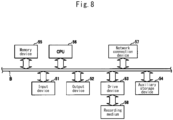
- Fig. 8 is a diagram showing an example of a hardware configuration that can carry out processing according to the present disclosure.
- the computer body shown in Fig. 8 is constructed so as to comprise an input device 51, an output device 52, a drive device 53, an auxiliary storage device 54, a memory device 55, a CPU (Central Processing Unit) 56 which carries out various control operations, and a network connection device 57, all of which are mutually connected with a system bus B.
- a CPU Central Processing Unit
- the input device 51 has a keyboard and a pointing device such as a mouse which are operated by a user, with different operation signals for program execution, for example, being inputted by the user.
- the input device 51 may also input various data such as facial images of a subject obtained from an external device connected to the network connection device 57, via a communication network.
- the output device 52 has a display which displays windows or data necessary for operation of the computer body for processing according to the disclosure, allowing display of the process or results of program execution by the control program in the CPU 56.
- the output device 52 can also print the processing results on a print medium such as paper for presentation to the user.
- the execution program installed in the computer body according to the disclosure is provided, for example, by a recording medium 58, such as a USB (Universal Serial Bus) memory, or a CD-ROM or DVD.
- the recording medium 58 in which the program is recorded may be set in the drive device 53, the execution program in the recording medium 58 being installed in the auxiliary storage device 54 from the recording medium 58 through the drive device 53.
- the auxiliary storage device 54 is storage means such as a hard disk, and it can store the execution program of the disclosure, or a control program provided in a computer, with input/output as necessary.
- the memory device 55 stores an execution program read out from the auxiliary storage device 54 by the CPU 56.
- the memory device 55 consists of a ROM (Read Only Memory) or RAM (Random Access Memory), for example.
- All or part of the execution program may also be downloaded from an external device as necessary, via an optional network.
- An auxiliary storage device 54 in which the execution program is installed and/or a memory device 55 storing the installed execution program, may also be provided in an external device.
- the external device may be a server.
- the server may be a specialized server or an undefined server such as a cloud infrastructure.
- the execution program may be provided by a subscription-type service.
- a subscription-type service is one form of computer software usage, as a service which is paid for during the period in which the software is used.
- the manner of usage of the execution program may be in any form, with no particular restrictions.
- the CPU 56 can control processing of the entire computer to carry out processing, including computing and input/output of data to the hardware configuration units, based on a control program on an OS (Operating System) and the execution program stored in the memory device 55.
- the necessary information during execution of the program can be acquired from the auxiliary storage device 54, and the results of execution may be stored.
- the network connection device 57 can connect with a communication network or the like to obtain the execution program from another terminal or a server connected to the communication network, or to provide the obtained program execution results or the execution program itself to another terminal or server.
- the analysis processing of the disclosure can be executed by such a hardware configuration. Installing the program allows processing according to the disclosure to be easily executed on a general personal computer, smartphone or tablet.
- the program of the disclosure may be a method that is fully or partially executed on a computer.
- the program of the disclosure may be a program that executes on a computer a process which includes: (i) a step of acquiring information on cavitation in the dermis of the forehead of a subject (step 100), (ii) a step of analyzing the information and analyzing the state of cavitation (step 110), (iii) a step of comparing the analysis result obtained in step (ii) with a predetermined reference value or inserting the result into a predetermined formula (step 120), and (iv) a step of evaluating the condition of wrinkles based on the comparison result or calculated result of step (iii) (step 130).
- Fig. 9 shows an example of processing with a device. Steps 100 to 130 are carried out by executing a program by a CPU of the device (optionally including
- the program may execute a step of predicting the future state of wrinkles based on analysis results, either instead of or in addition to steps (iii) and (iv).
- a partial aspect of the disclosure relates to a computer-readable medium storing in a non-transitory manner a command to execute the following steps by a processor: (i) a step of acquiring information on cavitation in the dermis of the forehead of the subject (step 100), (ii) a step of analyzing the information and analyzing the state of cavitation (step 110), (iii) a step of comparing the analysis result obtained in step (ii) with a predetermined reference value or inserting the result into a predetermined formula (step 120), and (iv) a step of evaluating the condition of wrinkles based on the comparison result or calculated result of step (iii) (step 130).
- the computer-readable medium may store a command to execute a step of predicting the future state of wrinkles based on analysis results, either instead of or in addition to steps (iii) and (iv).
- the program of the disclosure acquires information regarding cavitation in the dermis of the forehead of the subject.
- the information may be, but is not limited to, measured values from an echo or laser microscope, for example.
- the program of the disclosure analyzes inputted information in step 110, and calculates the presence or absence of cavitation and its size and/or number. Any image analysis method or machine learning method known to those skilled in the art may be used for analysis of the information, using a computer.
- step 120 the program of the disclosure compares the presence or absence of cavitation and its size and/or number with a predetermined reference value.
- the predetermined reference value may be set based on data such as state of cavitation, state of transient wrinkles, state of fixed wrinkles, age or gender collected from multiple subjects, for example.
- the degree of cavitation may be entered into a predetermined formula to calculate the state of wrinkles.
- the program of the disclosure evaluates the state of wrinkles in step 130 based on the comparison result in step 120.
- wrinkles may be evaluated by deciding on the presence or absence of cavitation simply using a fixed size as the reference.
- it may evaluate that the risk of wrinkle formation is high or that wrinkles are numerous, based on the size of dermal cavitation, and/or its number.
- Wrinkles may be transient wrinkles or fixed wrinkles. When numerous transient wrinkles are already visible, it may be evaluated that the risk of formation of fixed wrinkles is high.
- the state of wrinkles may be evaluated on a 5-level scale of 0 to 4, for example, based on the calculation result of step 120.
- the program of the disclosure may further include in step 130 a step of recommending an appropriate cosmetic, drug or cosmetic method, based on evaluation of the state of cavitation.
- the program of the disclosure refers to a database (DB) storing information for cosmetics, drugs and cosmetic methods.
- the program of the disclosure may further include, in step 140, outputting the obtained evaluation results or recommendation results.
- Output of the results may be via any of different devices (such as a display, printer or speaker) connected in a wired or wireless manner.
- the program of the disclosure may be a program that executes on a computer a process which includes: (i) a step of acquiring an image of wrinkles in the dermis of the forehead of a subject (step 200), (ii) a step of analyzing the image and analyzing the state of wrinkles (step 210), (iii) a step of comparing the analysis results obtained in step (ii) with a predetermined reference value or inserting the results into a predetermined formula (step 220), and (iv) a step of evaluating the state of cavitation based on the comparison results or calculated results of step (iii) (step 230).
- Fig. 10 shows an example of processing with a device. Steps 200 to 230 are carried out by executing a program by a CPU of the device (optionally including a server).
- a partial aspect of the disclosure relates to a computer-readable medium storing in a non-transitory manner a command to carry out the following steps executed by a processor: (i) a step of acquiring an image of wrinkles in the dermis of the forehead of the subject (step 200), (ii) a step of analyzing the image and analyzing the state of wrinkles (step 210), (iii) a step of comparing the analysis results obtained in step (ii) with a predetermined reference value or inserting the results into a predetermined formula (step 220), and (iv) a step of evaluating the state of cavitation based on the comparison results or calculated results of step (iii) (step 230).
- the program of the disclosure acquires an image and/or shape of wrinkles in the dermis of the forehead of the subject.
- the image data may be acquired from an external device such as a wired or wireless connected camera, for example.
- the program of the disclosure analyzes an inputted image in step 210, and calculates the presence or absence of wrinkles and their sizes and/or number. Any known image analysis method or machine learning method may be used for analysis of the images.
- the program of the disclosure compares the presence or absence of wrinkles and their size and/or number with a predetermined reference value.
- the predetermined reference value may be set based on data such as state of cavitation, state of transient wrinkles, state of fixed wrinkles, age or gender collected from multiple subjects, for example.
- the program of the disclosure evaluates the state of cavitation in step 230 based on the comparison results in step 220.
- cavitation may be evaluated by deciding on the presence or absence of wrinkles simply using a fixed size as the reference.
- it may evaluate the state of cavitation based on the sizes of wrinkles, and/or their number.
- Wrinkles may be transient wrinkles or fixed wrinkles.
- the program of the disclosure may further include in step 230 a step of recommending an appropriate cosmetic, drug or cosmetic method, based on evaluation of the estimated state of cavitation.
- the program of the disclosure refers to a database (DB) storing information for cosmetics, drugs and cosmetic methods.
- the program of the disclosure may further include, in step 240, outputting the obtained evaluation results or recommendation results.
- Output of the results may be via any of different devices (such as a display, printer or speaker) connected in a wired or wireless manner.
- the program of the disclosure may be installed in a smartphone or tablet for use.
- partial processing may also be carried out on a server connected via a network.
- the program of the disclosure may be installed on the server for use.
- the image data may be acquired from a smartphone or tablet connected through the network, and the evaluation results may be outputted to the smartphone or tablet connected through the network.
- the internal structure of the dermis layer of the forehead of a subject was observed in a noninvasive manner by ultrasound.
- a Prosound Alpha 5 (Aloka Co., Ltd., Tokyo, Japan), as a 13 MHz probe, was applied perpendicular to the skin that was covered with a thin-layer of ultrasonic gel, and the skin structure was measured using B mode.
- the shortest distance from the epidermis to the adipose layer was measured using Image J, and the sign-inverted value (mm) was recorded as the extent of dermal cavitation.
- Fig. 1 shows the results of observation of a middle aged woman. As shown at right in Fig. 1 , the results indicated cavitation with aging of the forehead skin.
- Fig. 2 shows the results of examining correlation between the degree of transient wrinkles and cavitation (fat infiltration) in the forehead of a subject.
- Transient wrinkles were defined as wrinkles observed on the forehead when the eyes were directed to look upwards (as evaluated by trained judges on a 5-level scale from 0 to 4).
- Fig. 3 shows the results of examining correlation between transient wrinkles and fixed wrinkles in the forehead of a subject.
- Fixed wrinkles were defined as wrinkles observed on the forehead when the eyes were closed (as evaluated by trained judges on a 6-level scale from 0 to 5).
- Fig. 4 shows the results of examining correlation between the degree of fixed wrinkles and cavitation (fat infiltration) in the forehead of a subject.
Landscapes
- Health & Medical Sciences (AREA)
- Life Sciences & Earth Sciences (AREA)
- Engineering & Computer Science (AREA)
- Medical Informatics (AREA)
- Surgery (AREA)
- Pathology (AREA)
- Veterinary Medicine (AREA)
- Biophysics (AREA)
- Biomedical Technology (AREA)
- Heart & Thoracic Surgery (AREA)
- Physics & Mathematics (AREA)
- Molecular Biology (AREA)
- Public Health (AREA)
- Animal Behavior & Ethology (AREA)
- General Health & Medical Sciences (AREA)
- Nuclear Medicine, Radiotherapy & Molecular Imaging (AREA)
- Radiology & Medical Imaging (AREA)
- Physiology (AREA)
- Computer Vision & Pattern Recognition (AREA)
- Dermatology (AREA)
- Dentistry (AREA)
- Oral & Maxillofacial Surgery (AREA)
- Measuring And Recording Apparatus For Diagnosis (AREA)
Abstract
Description
- The present invention relates to a method for evaluating wrinkles in human skin, and more specifically it relates to a method for evaluating wrinkles whereby the state of cavitation (fat infiltration) in the dermis of the forehead is used as the basis for assessment.
- Skin aging is the alteration of skin caused by numerous factors including internal factors such as aging, hormones and metabolism, and external factors such as ultraviolet rays and drying. Skin aging can usually be observed based on exterior appearances such as skin spots, wrinkles, sagging and shrinkage, but aging also proceeds with non-visible changes in the interior skin tissue structure and its constituent components. In
PTL 1, for example, aging is assessed based on blood vitamin D levels. InPTL 2, expression of genes such as the E-cadherin gene and T-cadherin gene in skin is used as an index. InPTL 3, expression of genes such as OLFML2A and/or CRLF1 in fibroblasts is used as the index. - Although several indicators exist for assessing skin aging, it is important to achieve even more proper evaluation of skin condition and to adopt countermeasures to prevent or improve its aging, and therefore more methods are still desired for evaluation of skin condition.
-
PTL 4 discloses dermal cavitation as one cause of sagging of cheek skin, and further discloses an ameliorator for skin sagging or aging caused by dermal cavitation, which includes an adipose stem cell inducer comprising licorice extract or rosemary extract. -
-
PTL 1Japanese Unexamined Patent Publication No. 2016-216435 -
PTL 2Japanese Unexamined Patent Publication No. 2010-115131 -
PTL 3Japanese Unexamined Patent Publication No. 2013-116088 -
PTL 4WO2017/022091 - One object of the disclosure is to provide a method for evaluating wrinkles wherein the state of cavitation (fat infiltration) in the dermis of the forehead of a subject is used as the basis for assessment, and in particular to provide a method for evaluating transient expression of wrinkles which are not easy to evaluate based on outer appearance. Transiently appearing expression wrinkles are a major factor in the appearance of human aging, and are the primary cause of formation of established wrinkles. As used herein, the term "transient (expression) wrinkles" will be used to refer to wrinkles transiently formed by changes in facial expression. Wrinkles resulting with establishment of transient wrinkles, even without changes in facial expression, will be referred to as "fixed transient wrinkles" or "fixed wrinkles". Wrinkles due to facial expressions are formed from both transient wrinkles and fixed transient wrinkles. Another object of the disclosure is to provide a system for evaluating wrinkles, which evaluates wrinkles including not only fixed wrinkles that can be easily measured based on outer appearance, but also transient wrinkles, with the state of cavitation (fat infiltration) in the dermis of the forehead of a subject as the basis for assessment.
- The present inventors have found that it is possible to evaluate wrinkles, and especially transient wrinkles which are not easy to evaluate based on outer appearance, using the state of cavitation (fat infiltration) in the dermis of the forehead of a subject as the basis for assessment. The present disclosure therefore provides a method and system for evaluating wrinkles, comprising not only fixed wrinkles but also transient wrinkles, using the state of cavitation (fat infiltration) in the dermis of the forehead as the basis for assessment. More specifically, the present disclosure relates to the following aspects:
- A method for evaluating wrinkles, wherein the state of cavitation (fat infiltration) in the dermis of the forehead of a subject is used as the basis for assessment.
- The method according to
aspect 1, comprising a step of measuring the state of cavitation by echo or laser microscope. - The method according to
aspect - The method according to any one of
aspects 1 to 3, wherein the wrinkles are transient wrinkles and/or fixed wrinkles. - The method according to any one of
aspects 1 to 4, wherein cavitation is evaluated by the distance from the skin surface to a cavity, as measured by echo or laser microscope. - A system for evaluating wrinkles, wherein the wrinkles are evaluated using the state of cavitation (fat infiltration) in the dermis of the forehead of a subject as the basis for assessment.
- The system according to aspect 6, which comprising:
- a measuring unit that measures the state of cavitation in the dermis of the forehead of the subject,
- an analysis unit that analyzes the measured state of cavitation,
- a wrinkle evaluating unit that evaluates wrinkles based on the analysis results and
- a results output unit that outputs the evaluation results.
- The system according to aspect 7, wherein the measuring unit is configured so as to measure the state of cavitation by echo or laser microscope.
- The system according to aspect 7 or 8, wherein the wrinkle evaluating unit carries out evaluation by comparing the measured value with a predetermined reference value.
- A computer program for executing the method according to any one of
aspects 1 to 5 in a system according to any one of aspects 7 to 9. - A method for evaluating cavitation (fat infiltration), wherein the state of wrinkles on the forehead of a subject is used as the basis for assessment.
- The method according to aspect 11, wherein the wrinkles are transient wrinkles and/or fixed wrinkles.
- The method according to aspect 11 or 12, wherein it is evaluated that cavitation has occurred when wrinkles have formed.
- A system for evaluating cavitation (fat infiltration), wherein the state of cavitation is evaluated using the state of wrinkles on the forehead of a subject as the basis for assessment.
- The system according to aspect 14, comprising:
- an image acquisition unit that acquires an image of wrinkles on the forehead of a subject,
- an analysis unit that analyzes the acquired image,
- a cavitation evaluating unit that evaluates the state of cavitation based on the analysis results and
- a results output unit that outputs the evaluation results.
- The system according to aspect 15, wherein the cavitation evaluating unit carries out evaluation by comparing the measured value with a predetermined reference value.
- A computer program for executing the method according to any one of aspects 11 to 13 in a system according to any one of aspects 14 to 16.
- A skin sensing method for evaluation of wrinkles, wherein the state of cavitation (fat infiltration) in the dermis of the forehead of a subject is included as a measured parameter.
- A recommendation method based on evaluation of wrinkles using sensing data obtained by the method according to aspect 18.
- A method for predicting future cavitation state and/or wrinkle state, based on the state of cavitation (fat infiltration) in the dermis of the forehead of a subject at a measuring time point.
-
-
Fig. 1 is an echo image showing dermis without cavitation (left) and dermis with cavitation (right). -
Fig. 2 is a graph showing the correlation between transient wrinkles and degree of cavitation. -
Fig. 3 is a graph showing the correlation between transient wrinkles and degree of fixed wrinkles. -
Fig. 4 is a graph showing the correlation between fixed wrinkles and degree of cavitation. -
Fig. 5 shows an example of the construction of the system of the disclosure. -
Fig. 6 shows an example of the construction of the system of the disclosure. -
Fig. 7 shows an example of the construction of the system of the disclosure. -
Fig. 8 is a diagram showing an example of a hardware configuration capable of carrying out processing according to the disclosure. -
Fig. 9 is a flow chart showing an example of processing (a program) carried out by the system of the disclosure. -
Fig. 10 is a flow chart showing an example of processing (a program) carried out by the system of the disclosure. - One aspect of the disclosure provides a method for evaluating wrinkles wherein the state of cavitation (fat infiltration) in the dermis of the forehead of a subject is used as the basis for assessment, and more particularly it provides a method for evaluating expression wrinkles which are not easy to evaluate based on outer appearance. Transient wrinkles are wrinkles transiently formed due to facial expression muscles. For example, forehead wrinkles can form due to sagging or drooping of the eyelids. With impaired field of view due to sagging or drooping of eyelids, the forehead muscles attempt to open the eyes, causing transient wrinkles on the forehead. When transient wrinkles are left untreated, the transient wrinkles eventually become fixed wrinkles, leaving wrinkles even in the absence of the facial expression. As mentioned above, the present inventors have found that wrinkles can be evaluated by examining the state of cavitation in the dermis of the forehead of a subject. For example, the state of cavitation can be measured by echo (ultrasound) or laser microscope methods. Transiently appearing wrinkles have previously been difficult to measure and evaluate, but the method of the disclosure allows not only fixed wrinkles but also transient wrinkles to be conveniently evaluated by measuring dermal cavitation.
- Dermal cavities are cavities formed by partial rising of subcutaneous tissue on the dermis layer side, by aging or by some other cause (
Fig. 1 ). The sizes of dermal cavities range from 10 µm to 1000 µm in diameter with approximately spherical shapes, though the shapes are not consistent. Because the dermal cavity interiors are filled by subcutaneous tissue, they may be referred to as "filled dermal cavities". Since cellular components and interstitial components in the dermis layer are not found in dermal cavities, they form wrinkles. According to one aspect of the disclosure, it is evaluated that the risk of wrinkle formation is high or that wrinkles are numerous when cavitation has occurred. For example, when cavitation has occurred, even if no wrinkles are observed, the potential for transient wrinkle formation is normally high with changes in facial expression, and such transient wrinkles are highly likely to progress to fixed wrinkles in the future. - The extent of dermal cavities can be measured by estimating the dermal thickness, i.e. the thickness from the boundary with the epidermis to the boundary with the subcutaneous tissue, in a fixed-length skin cross-section. When dermal cavities are present, the subcutaneous tissue rises to the dermis layer side, and the thickness of the dermis decreases. Since the thickness of the epidermis is normally constant and somewhat thinner compared to the dermis, it can be calculated by simply estimating the thickness from the skin surface to the subcutaneous tissue. According to several aspects of the disclosure, therefore, cavitation can be evaluated by the distance from the skin surface to a cavity, as measured by echo or laser microscope. Because the extent of dermal cavities is correlated with elasticity of skin, an index of skin elasticity such as the Uv/Ue value may be measured instead, using a device that measures skin elasticity, such as a Cutometer.
- According to several aspects of the disclosure, wrinkles may be transient wrinkles and/or fixed wrinkles. Transient wrinkles are wrinkles transiently formed due to facial expression muscles. For example, forehead wrinkles can form due to sagging or drooping of the eyelids. With impaired field of view due to sagging or drooping of eyelids, the forehead muscles attempt to open the eyes, causing transient wrinkles on the forehead. When transient wrinkles are left untreated, the transient wrinkles eventually become fixed wrinkles (also known as established wrinkles), leaving wrinkles even in the absence of the facial expression. Since transient wrinkles are transient with changes in facial expression and do not permanently remain, their measurement and evaluation has been difficult in the past.
- According to one aspect of the disclosure, it is evaluated that the risk of transient wrinkle formation is high or that transient wrinkles are numerous when cavitation has occurred. The method of the disclosure allows the extent of wrinkles to be calculated based on the extent of cavitation. A high risk of transient wrinkles or numerous transient wrinkles may be associated with future evaluation a high risk of fixed wrinkles or numerous fixed wrinkles. According to one aspect of the disclosure, therefore, it is evaluated that the risk of fixed wrinkle formation is high or that fixed wrinkles are numerous when cavitation has occurred. In other words, the method of the disclosure is useful not only for evaluation of the current state of wrinkles but also for prediction of the future state of wrinkles.
- One aspect of the disclosure relates to a method for predicting future cavitation state and/or wrinkle state, based on the state of cavitation (fat infiltration) in the dermis of the forehead of a subject at a measuring time point. The present inventors have found the following correlation between cavitation and age.

- Here, X represents age or elapsed years, Y represents degree of cavitation (distance (mm) to the epidermis, with a smaller number indicating greater cavitation). Using the coefficient -0.02, the degree of cavitation after 10 years, for example, can be calculated as: (current degree of cavitation) - 0.02 ×10 years. Since the degree of wrinkles can also be calculated from the degree of cavitation, calculating the current state of cavitation allows the degree of transient wrinkles and fixed wrinkles after 10 years to be predicted.
- One aspect of the disclosure, therefore, relates to a method for predicting the state of cavitation Y2 after X years, based on the state of cavitation (fat infiltration) in the dermis of the forehead of a subject at a measuring time point Y1, wherein Y2 is calculated based on the following
Formula 2.
- Based on the calculated values of Y2, or Y1 and X, the following formula derived from
Fig. 2 may be used to also predict the degree of transient wrinkles Z1.
- One aspect of the disclosure, therefore, relates to a method for predicting the degree of transient wrinkles Z1 after X years, based on the state of cavitation (fat infiltration) in the dermis of the forehead of a subject at a measuring time point Y1, wherein Z1 is calculated based on
Formula 3 above. - Likewise, based on the calculated values of Y2, or Y1 and X, the following formula derived from
Fig. 4 may be used to also predict the degree of fixed wrinkles Z2.
Formula 4 above. - According to one aspect of the disclosure, when wrinkles have formed due to cavitation, a composition containing rosemary extract and/or licorice extract may be applied to the skin for treatment.
- One aspect of the disclosure relates to a method for evaluating cavitation (fat infiltration), wherein the state of wrinkles on the forehead of a subject is used as the basis for assessment. As mentioned above, the present inventors have found that wrinkles can be evaluated by examining the state of cavitation in the dermis of the forehead of a subject. Conversely, this also means that cavitation can be evaluated using the state of wrinkles on the forehead of a subject as the basis for assessment. For example, the state of wrinkles can be evaluated using a Visia Evolution image analyzer by Canfield Scientific, or by replica analysis, photograph-based grade assessment, or visual assessment. For example, the state of wrinkles may be graded on a multi-level scale (such as 5 levels from 0 to 4).
- According to a partial aspect of the disclosure, wrinkles are transient wrinkles and/or fixed wrinkles. According to a partial aspect of the disclosure, it may be evaluated that cavitation has occurred when transient wrinkles and/or fixed wrinkles have been formed.
- According to one aspect of the disclosure, when cavitation has occurred in the forehead dermis, a composition containing rosemary extract and/or licorice extract may be applied to the skin for treatment.
- One aspect of the disclosure relates to a skin sensing method for evaluation of wrinkles, wherein the state of cavitation (fat infiltration) in the dermis of the forehead of a subject is included as a measured parameter. Other measured parameters include, but are not limited to, parameters relating to skin color tone, moisture and elasticity. According to several aspects of the disclosure, the measured state of cavitation (fat infiltration) is visualized and displayed on a display device such as a liquid crystal display for presentation to the subject. The visualization may be carried out based on the results of future prediction of the state of cavitation or wrinkles. For example, cavitation in the dermis of the forehead of a customer may be measured (sensed) at a cosmetic retailer and the measurement results or prediction results displayed in a visualized manner as material for promoting a cosmetic product or cosmetic method to the customer. Several aspects of the disclosure therefore relate to a recommendation method based on evaluation of wrinkles using sensing data obtained by the method of the disclosure. Such recommendation may relate to a cosmetic product and/or a cosmetic method.
- One aspect of the disclosure relates to a method in which a subject is recommended an appropriate cosmetic, drug or cosmetic method based on the state of cavitation (fat infiltration) and wrinkles of the subject as evaluated by the method of the disclosure. For example, when an evaluation of high risk of wrinkles or numerous wrinkles has been obtained for the forehead of a subject by the method of the disclosure, the subject may be recommended the use of a cosmetic, drug or cosmetic method suited for improving wrinkles. When an evaluation of cavitation has been obtained for the forehead of a subject by the method of the disclosure, the subject may be recommended the use of a cosmetic, drug or cosmetic method suited for improving cavitation. The cosmetic, drug or cosmetic method recommended based on the condition of skin of the subject may also be recorded in a previously created database. A recommended cosmetic may be, for example, a product containing rosemary extract and/or licorice extract.
- One aspect of the disclosure relates to a system for evaluating wrinkles, wherein the wrinkles are evaluated using the state of cavitation (fat infiltration) in the dermis of the forehead of a subject as the basis for assessment. According to a partial aspect, the system includes (i) a measuring unit that measures the state of cavitation in the dermis of the forehead of the subject, (ii) an analysis unit that analyzes the measured state of cavitation, (iii) a wrinkle evaluating unit that evaluates wrinkles based on the analysis results and (iv) a results output unit that outputs the evaluation results. According to a partial aspect, the system may have the (i) measuring unit that measures the state of cavitation in the dermis of the forehead of the subject, the (ii) analysis unit that analyzes the measured state of cavitation, the (iii) wrinkle evaluating unit that evaluates wrinkles based on the analysis results and the (iv) results output unit that outputs the evaluation results, located in physically separated locations.
- According to a partial aspect, the system may further include a future prediction unit that predicts the future state of wrinkles based on analysis results, either instead of or in addition to the wrinkle evaluating unit of (iii) above.
- According to a partial aspect, the system comprises (i) measuring means configured so as to measure the state of cavitation in the dermis of the forehead of the subject, (ii) analysis means configured so as to analyze the measured state of cavitation, (iii) wrinkle evaluating means configured so as to evaluate wrinkles based on the analysis results and (iv) results output means configured so as to output the evaluation results.
- According to a partial aspect, the system may further include future prediction means that predicts the future state of wrinkles based on analysis results, either instead of or in addition to the wrinkle evaluating means of (iii) above.
- According to a partial aspect, the measuring unit may be configured so as to measure the state of cavitation based on an echo or laser microscope, but the method of measurement is not particularly restricted. According to a partial aspect, the wrinkle evaluating unit can carry out the evaluation by comparing the measured value or analysis results with a predetermined reference value, or by insertion into the predetermined calculation formula. The predetermined reference value may be set based on data such as state of cavitation, state of transient wrinkles, state of fixed wrinkles, age or gender collected from multiple subjects. For example, wrinkles may be evaluated by deciding on the presence or absence of cavitation simply using a fixed size as the reference. The formula for calculating the degree of transient wrinkles X from the degree of cavitation Y (mm) can be expressed as: Y = -0.1X + 1.5. The formula for calculating the degree of fixed wrinkles X from the degree of cavitation Y (mm) can be expressed as: Y = -0.1X + 1.3.
- The
device 100 depicted inFig. 5 constitutes all or part of the system of the disclosure, and it has a measuringunit 110, ananalysis unit 120, awrinkle evaluating unit 130 and aresults output unit 140. Thedevice 100 has a computing device such as a CPU (Central Processing Unit), and a storage device such as ROM/RAM, hard disk or flash memory. The storage device is able to store a program for control of the device and data, and acquired data (images, parameters). The computing device can cause thedevice 100 to function as the measuringunit 110,analysis unit 120,wrinkle evaluating unit 130 andresults output unit 140, by executing the program stored in the storage device. That is, the measuringunit 110,analysis unit 120,wrinkle evaluating unit 130 andresults output unit 140 may be constructed as functions of the CPU. Thedevice 100 may also operate in cooperation with a computing device and storage device of a server connected by a network (such as a cloud server). The system of the disclosure may considered to be a system constructed with aserver 60 and a terminal 62 connected to the server by a network 61 (Fig. 7 ). - The measuring
unit 110 can receive information on cavitation, from an external source. The measuringunit 110 may also include an echo device or laser microscope for evaluation of cavitation. Alternatively, the measuringunit 110 may receive image data from an external device such as an echo device or laser microscope connected in a wired or wireless manner. - The
analysis unit 120 can analyze inputted information, recognize cavitation in the dermis, and calculate the presence or absence and the size of cavitation. Any analysis method or machine learning method known to those skilled in the art may be used for analysis of the information, using a computer. - The
wrinkle evaluating unit 130 evaluates wrinkles based on the data obtained from the analysis unit. For example, thewrinkle evaluating unit 130 may evaluate that the risk of wrinkle formation is high or that wrinkles are numerous, based on the presence or absence of dermal cavitation, or its size and/or number. Wrinkles may be transient wrinkles or fixed wrinkles. When numerous transient wrinkles are already visible, it may be evaluated that the risk of formation of fixed wrinkles is high. - According to an embodiment, the system may further include a future prediction unit that predicts the future state of wrinkles based on analysis results, either instead of or in addition to the
wrinkle evaluating unit 130. - According to one embodiment, the
wrinkle evaluating unit 130 may further include a recommendation unit which recommends a cosmetic, drug or cosmetic method depending on evaluation of wrinkles or the state of cavitation. The recommendation unit may also include a database (DB) that stores information relating to cosmetics, drugs or cosmetic methods. For the purpose of the present specification, the system of the disclosure which includes a recommendation unit may also be referred to as a "recommendation device". - The
results output unit 140 may further include a display, printer and speaker for display of information to the user. Theresults output unit 140 may also output the results to an external device in a wired or wireless manner. - One aspect of the disclosure relates to a system for evaluating cavitation, wherein cavitation is evaluated using the state of wrinkles on the forehead of a subject as the basis for assessment. According to a partial aspect, the system comprises (i) an image acquisition unit that acquires an image of wrinkles on the forehead of the subject, (ii) an image analyzing unit that analyzes the acquired image, (iii) a cavitation evaluating unit that evaluates the state of cavitation based on the analysis results and (iv) a results output unit that outputs the evaluation results. According to a partial aspect, the system may have the (i) image acquisition unit that acquires an image of wrinkles on the forehead of the subject, the (ii) image analyzing unit that analyzes the acquired image, the (iii) cavitation evaluating unit that evaluates the state of cavitation based on the analysis results and the (iv) results output unit that outputs the evaluation results, located in physically separated locations.
- According to a partial aspect, the system comprises (i) image acquisition means configured so as to acquire an image of wrinkles on the forehead of the subject, (ii) image analysis means configured so as to analyze the acquired image, (iii) cavitation evaluating means configured so as to evaluate the state of cavitation based on the analysis results and (iv) results output means configured so as to output the evaluation results.
- According to a partial aspect, the image acquisition unit can receive a skin image and/or shape from an external source. The image acquisition unit may also include hardware such as a camera which photographs images, illumination means, and a control processor. Alternatively, the image acquisition unit may receive image data from an external device such as a wired or wireless connected camera. For example, the system described in
Japanese Patent No. 5528692 - According to a partial aspect, the image analyzing unit analyzes the inputted image and/or shape to allow evaluation of wrinkles on the forehead of the subject. Any image analysis method or machine learning method known to those skilled in the art may be used for analysis of the images and/or shapes, using a computer.
- According to a partial aspect, the cavitation evaluating unit may carry out evaluation of cavitation by comparing the measured value for wrinkles with a predetermined reference value. The predetermined reference value may be set based on data such as state of cavitation, state of transient wrinkles, state of fixed wrinkles, age or gender collected from multiple subjects, for example. Cavitation may be evaluated, for example, by deciding on the presence or absence of wrinkles simply using a fixed size as the reference. Wrinkles may be transient wrinkles or fixed wrinkles.
- The
device 200 depicted inFig. 6 constitutes all or part of the system of the disclosure, and it has animage acquisition unit 210, animage analyzing unit 220, acavitation evaluating unit 230 and aresults output unit 240. Thedevice 200 has a computing device such as a CPU (Central Processing Unit), and a storage device such as ROM/RAM, hard disk or flash memory. The storage device is able to store a program for control of the device and data, and acquired data (images, parameters). The computing device can cause thedevice 200 to function as theimage acquisition unit 210,image analyzing unit 220,cavitation evaluating unit 230 andresults output unit 240, by executing the program stored in the storage device. That is, theimage acquisition unit 210,image analyzing unit 220,cavitation evaluating unit 230 andresults output unit 240 may be constructed as functions of the CPU. Thedevice 200 may also operate in cooperation with a computing device and storage device of a server connected by a network (such as a cloud server). The system of the disclosure may be considered to be a system constructed with aserver 60 and a terminal 62 connected to the server by a network 61 (Fig. 7 ). - The
image acquisition unit 210 can receive images of wrinkles from an external source. Theimage acquisition unit 210 may also include hardware such as a camera which photographs images, illumination means, and a control processor, as explained above. Alternatively, theimage acquisition unit 210 may receive data from an external device connected in a wired or wireless manner. - The
image analyzing unit 220 analyzes the inputted information to allow evaluation of wrinkles on the forehead of the subject. Any analysis method or machine learning method known to those skilled in the art may be used for analysis of the information, using a computer. - The
cavitation evaluating unit 230 evaluates cavitation based on the data obtained from the analysis unit. For example, thecavitation evaluating unit 230 may carry out evaluation of cavitation by comparing the measured value for wrinkles with a predetermined reference value, as explained above. The predetermined reference value may be set based on data such as state of cavitation, state of transient wrinkles, state of fixed wrinkles, age or gender collected from multiple subjects, for example. Cavitation may be evaluated, for example, by deciding on the presence or absence of wrinkles simply using a fixed size as the reference. Wrinkles may be transient wrinkles or fixed wrinkles. - According to one embodiment, the
cavitation evaluating unit 230 may further include a recommendation unit which recommends a cosmetic, drug or cosmetic method depending on evaluation of wrinkles or the state of cavitation. The recommendation unit may also include a database (DB) that stores information relating to cosmetics, drugs or cosmetic methods. For the purpose of the present specification, the system of the disclosure which includes a recommendation unit may also be referred to as a "recommendation device". - The
results output unit 240 may further include a display, printer and speaker for display of information to the user. Theresults output unit 240 may also output the results to an external device in a wired or wireless manner. - In the device described above, processing may be carried out by creating an execution program that can execute each function with a computer, and installing the execution program in a general personal computer or server, for example, or a combination thereof.
- An example of the hardware configuration of a computer that can carry out processing according to the disclosure will now be explained with reference to the accompanying drawings.
-
Fig. 8 is a diagram showing an example of a hardware configuration that can carry out processing according to the present disclosure. The computer body shown inFig. 8 is constructed so as to comprise aninput device 51, anoutput device 52, adrive device 53, anauxiliary storage device 54, amemory device 55, a CPU (Central Processing Unit) 56 which carries out various control operations, and anetwork connection device 57, all of which are mutually connected with a system bus B. - The
input device 51 has a keyboard and a pointing device such as a mouse which are operated by a user, with different operation signals for program execution, for example, being inputted by the user. Theinput device 51 may also input various data such as facial images of a subject obtained from an external device connected to thenetwork connection device 57, via a communication network. - The
output device 52 has a display which displays windows or data necessary for operation of the computer body for processing according to the disclosure, allowing display of the process or results of program execution by the control program in theCPU 56. Theoutput device 52 can also print the processing results on a print medium such as paper for presentation to the user. - The execution program installed in the computer body according to the disclosure is provided, for example, by a
recording medium 58, such as a USB (Universal Serial Bus) memory, or a CD-ROM or DVD. Therecording medium 58 in which the program is recorded may be set in thedrive device 53, the execution program in therecording medium 58 being installed in theauxiliary storage device 54 from therecording medium 58 through thedrive device 53. - The
auxiliary storage device 54 is storage means such as a hard disk, and it can store the execution program of the disclosure, or a control program provided in a computer, with input/output as necessary. - The
memory device 55 stores an execution program read out from theauxiliary storage device 54 by theCPU 56. Thememory device 55 consists of a ROM (Read Only Memory) or RAM (Random Access Memory), for example. - All or part of the execution program may also be downloaded from an external device as necessary, via an optional network. An
auxiliary storage device 54 in which the execution program is installed and/or amemory device 55 storing the installed execution program, may also be provided in an external device. The external device may be a server. The server may be a specialized server or an undefined server such as a cloud infrastructure. The execution program may be provided by a subscription-type service. A subscription-type service is one form of computer software usage, as a service which is paid for during the period in which the software is used. The manner of usage of the execution program may be in any form, with no particular restrictions. - The
CPU 56 can control processing of the entire computer to carry out processing, including computing and input/output of data to the hardware configuration units, based on a control program on an OS (Operating System) and the execution program stored in thememory device 55. The necessary information during execution of the program can be acquired from theauxiliary storage device 54, and the results of execution may be stored. - The
network connection device 57 can connect with a communication network or the like to obtain the execution program from another terminal or a server connected to the communication network, or to provide the obtained program execution results or the execution program itself to another terminal or server. - The analysis processing of the disclosure can be executed by such a hardware configuration. Installing the program allows processing according to the disclosure to be easily executed on a general personal computer, smartphone or tablet.
- One partial aspect of the disclosure relates to a program that causes the method of the disclosure to be executed on a computer. Stated differently, the program of the disclosure may be a method that is fully or partially executed on a computer. According to a partial aspect, the program of the disclosure may be a program that executes on a computer a process which includes: (i) a step of acquiring information on cavitation in the dermis of the forehead of a subject (step 100), (ii) a step of analyzing the information and analyzing the state of cavitation (step 110), (iii) a step of comparing the analysis result obtained in step (ii) with a predetermined reference value or inserting the result into a predetermined formula (step 120), and (iv) a step of evaluating the condition of wrinkles based on the comparison result or calculated result of step (iii) (step 130).
Fig. 9 shows an example of processing with a device.Steps 100 to 130 are carried out by executing a program by a CPU of the device (optionally including a server). - According to a partial aspect, the program may execute a step of predicting the future state of wrinkles based on analysis results, either instead of or in addition to steps (iii) and (iv).
- A partial aspect of the disclosure relates to a computer-readable medium storing in a non-transitory manner a command to execute the following steps by a processor: (i) a step of acquiring information on cavitation in the dermis of the forehead of the subject (step 100), (ii) a step of analyzing the information and analyzing the state of cavitation (step 110), (iii) a step of comparing the analysis result obtained in step (ii) with a predetermined reference value or inserting the result into a predetermined formula (step 120), and (iv) a step of evaluating the condition of wrinkles based on the comparison result or calculated result of step (iii) (step 130).
- According to a partial aspect, the computer-readable medium may store a command to execute a step of predicting the future state of wrinkles based on analysis results, either instead of or in addition to steps (iii) and (iv).
- According to a partial aspect, in
step 100, the program of the disclosure acquires information regarding cavitation in the dermis of the forehead of the subject. The information may be, but is not limited to, measured values from an echo or laser microscope, for example. - According to a partial aspect, the program of the disclosure analyzes inputted information in
step 110, and calculates the presence or absence of cavitation and its size and/or number. Any image analysis method or machine learning method known to those skilled in the art may be used for analysis of the information, using a computer. - According to a partial aspect, in
step 120 the program of the disclosure compares the presence or absence of cavitation and its size and/or number with a predetermined reference value. The predetermined reference value may be set based on data such as state of cavitation, state of transient wrinkles, state of fixed wrinkles, age or gender collected from multiple subjects, for example. Alternatively instep 120, the degree of cavitation may be entered into a predetermined formula to calculate the state of wrinkles. - According to a partial aspect, the program of the disclosure evaluates the state of wrinkles in
step 130 based on the comparison result instep 120. For example, wrinkles may be evaluated by deciding on the presence or absence of cavitation simply using a fixed size as the reference. Alternatively, for example, it may evaluate that the risk of wrinkle formation is high or that wrinkles are numerous, based on the size of dermal cavitation, and/or its number. Wrinkles may be transient wrinkles or fixed wrinkles. When numerous transient wrinkles are already visible, it may be evaluated that the risk of formation of fixed wrinkles is high. Alternatively instep 130, the state of wrinkles may be evaluated on a 5-level scale of 0 to 4, for example, based on the calculation result ofstep 120. - According to a partial aspect, the program of the disclosure may further include in step 130 a step of recommending an appropriate cosmetic, drug or cosmetic method, based on evaluation of the state of cavitation. In this case, the program of the disclosure refers to a database (DB) storing information for cosmetics, drugs and cosmetic methods.
- According to a partial aspect, the program of the disclosure may further include, in
step 140, outputting the obtained evaluation results or recommendation results. Output of the results may be via any of different devices (such as a display, printer or speaker) connected in a wired or wireless manner. - According to a partial aspect, the program of the disclosure may be a program that executes on a computer a process which includes: (i) a step of acquiring an image of wrinkles in the dermis of the forehead of a subject (step 200), (ii) a step of analyzing the image and analyzing the state of wrinkles (step 210), (iii) a step of comparing the analysis results obtained in step (ii) with a predetermined reference value or inserting the results into a predetermined formula (step 220), and (iv) a step of evaluating the state of cavitation based on the comparison results or calculated results of step (iii) (step 230).
Fig. 10 shows an example of processing with a device.Steps 200 to 230 are carried out by executing a program by a CPU of the device (optionally including a server). - A partial aspect of the disclosure relates to a computer-readable medium storing in a non-transitory manner a command to carry out the following steps executed by a processor: (i) a step of acquiring an image of wrinkles in the dermis of the forehead of the subject (step 200), (ii) a step of analyzing the image and analyzing the state of wrinkles (step 210), (iii) a step of comparing the analysis results obtained in step (ii) with a predetermined reference value or inserting the results into a predetermined formula (step 220), and (iv) a step of evaluating the state of cavitation based on the comparison results or calculated results of step (iii) (step 230).
- According to a partial aspect, in
step 200, the program of the disclosure acquires an image and/or shape of wrinkles in the dermis of the forehead of the subject. The image data may be acquired from an external device such as a wired or wireless connected camera, for example. - According to a partial aspect, the program of the disclosure analyzes an inputted image in
step 210, and calculates the presence or absence of wrinkles and their sizes and/or number. Any known image analysis method or machine learning method may be used for analysis of the images. - According to a partial aspect, in
step 220 the program of the disclosure compares the presence or absence of wrinkles and their size and/or number with a predetermined reference value. The predetermined reference value may be set based on data such as state of cavitation, state of transient wrinkles, state of fixed wrinkles, age or gender collected from multiple subjects, for example. - According to a partial aspect, the program of the disclosure evaluates the state of cavitation in
step 230 based on the comparison results instep 220. For example, cavitation may be evaluated by deciding on the presence or absence of wrinkles simply using a fixed size as the reference. Alternatively, for example, it may evaluate the state of cavitation based on the sizes of wrinkles, and/or their number. Wrinkles may be transient wrinkles or fixed wrinkles. - According to a partial aspect, the program of the disclosure may further include in step 230 a step of recommending an appropriate cosmetic, drug or cosmetic method, based on evaluation of the estimated state of cavitation. In this case, the program of the disclosure refers to a database (DB) storing information for cosmetics, drugs and cosmetic methods.
- According to a partial aspect, the program of the disclosure may further include, in
step 240, outputting the obtained evaluation results or recommendation results. Output of the results may be via any of different devices (such as a display, printer or speaker) connected in a wired or wireless manner. - According to a partial aspect, the program of the disclosure may be installed in a smartphone or tablet for use. In this case, partial processing may also be carried out on a server connected via a network. According to another partial aspect, the program of the disclosure may be installed on the server for use. In this case, the image data may be acquired from a smartphone or tablet connected through the network, and the evaluation results may be outputted to the smartphone or tablet connected through the network.
- The internal structure of the dermis layer of the forehead of a subject was observed in a noninvasive manner by ultrasound. A Prosound Alpha 5 (Aloka Co., Ltd., Tokyo, Japan), as a 13 MHz probe, was applied perpendicular to the skin that was covered with a thin-layer of ultrasonic gel, and the skin structure was measured using B mode. The shortest distance from the epidermis to the adipose layer was measured using Image J, and the sign-inverted value (mm) was recorded as the extent of dermal cavitation.
-
Fig. 1 shows the results of observation of a middle aged woman. As shown at right inFig. 1 , the results indicated cavitation with aging of the forehead skin. -
Fig. 2 shows the results of examining correlation between the degree of transient wrinkles and cavitation (fat infiltration) in the forehead of a subject. Transient wrinkles were defined as wrinkles observed on the forehead when the eyes were directed to look upwards (as evaluated by trained judges on a 5-level scale from 0 to 4). The data inFig. 2 indicate that a significant correlation exists between the degree of transient wrinkles and the degree of cavitation (correlation coefficient R = -0.6; P < 0.001), and that the relationship between the degree of cavitation Y (mm) and the degree of transient wrinkles X can be expressed as Y = -0.1X + 1.5. These results demonstrate that by examining the degree of dermal cavitation of a subject it is possible to estimate the degree of transient wrinkles, and that conversely by examining the degree of transient wrinkles of a subject it is possible to estimate the degree of dermal cavitation. -
Fig. 3 shows the results of examining correlation between transient wrinkles and fixed wrinkles in the forehead of a subject. Fixed wrinkles were defined as wrinkles observed on the forehead when the eyes were closed (as evaluated by trained judges on a 6-level scale from 0 to 5). The data inFig. 3 indicate that increased transient wrinkles results in increased fixed wrinkles as well (correlation coefficient R = 0.9; P < 0.001). The relationship between the degree of fixed wrinkles Y and the degree of transient wrinkles X can be expressed as Y = -0.1X - 0.2. -
Fig. 4 shows the results of examining correlation between the degree of fixed wrinkles and cavitation (fat infiltration) in the forehead of a subject. The data inFig. 4 indicate that a significant correlation exists between the degree of fixed wrinkles and the degree of cavitation (correlation coefficient R = -0.6; P < 0.01), and that the relationship between the degree of cavitation Y (mm) and the degree of fixed wrinkles X can be expressed as: Y = -0.1X + 1.3. These results demonstrate that by examining the degree of dermal cavitation of a subject it is possible to estimate the degree of fixed wrinkles, and that conversely by examining the degree of fixed wrinkles of a subject it is possible to estimate the degree of dermal cavitation. - As a result of analyzing the foreheads of healthy female subjects (aged 30 to 50, N=30), a significant correlation was also found between age and cavitation (correlation coefficient R = - 0.7; P < 0.01). The relationship between cavitation Y and age X can be expressed as: Y = -0.02X + 2.2 (P < 0.01). These results demonstrated that the degree of cavitation Y (mm) can be calculated from information for age X.
- All of the publications mentioned throughout the present specification are incorporated herein in their entirety by reference. The technical scope of the disclosure is limited solely by the content of the present Claims, whereas the Examples described herein do not restrict the technical scope in any way. Modifications of the invention, such as additions, deletions or substitutions to the constituent features of the disclosure, are possible so long as the gist of the disclosure is maintained.
-
- 51 Input device
- 52 Output device
- 53 Drive device
- 54 Auxiliary storage device
- 55 Memory device
- 56 CPU
- 57 Network connection device
- 58 Recording medium
- 60 Server
- 61 Network
- 62 Terminal
- 100 Device
- 110 Measuring unit
- 120 Analysis unit
- 130 Wrinkle evaluating unit
- 140 Results output unit
- 200 Device
- 210 Image acquisition unit
- 220 Image analyzing unit
- 230 Cavitation evaluating unit
- 240 Results output unit
Claims (20)
- A method for evaluating wrinkles, wherein the state of cavitation (fat infiltration) in the dermis of the forehead of a subject is used as the basis for assessment.
- The method according to claim 1, comprising a step of measuring the state of cavitation by echo or laser microscope.
- The method according to claim 1 or 2, wherein it is evaluated that the risk of wrinkle formation is high or that wrinkles are numerous when cavitation has occurred.
- The method according to any one of claims 1 to 3, wherein the wrinkles are transient wrinkles and/or fixed wrinkles.
- The method according to any one of claims 1 to 4, wherein cavitation is evaluated by the distance from the skin surface to a cavity, as measured by echo or laser microscope.
- A system for evaluating wrinkles, wherein the wrinkles are evaluated using the state of cavitation (fat infiltration) in the dermis of the forehead of a subject as the basis for assessment.
- The system according to claim 6, comprising:a measuring unit that measures the state of cavitation in the dermis of the forehead of the subject,an analysis unit that analyzes the measured state of cavitation,a wrinkle evaluating unit that evaluates wrinkles based on the analysis results anda results output unit that outputs the evaluation results.
- The system according to claim 7, wherein the measuring unit is configured so as to measure the state of cavitation by echo or laser microscope.
- The system according to claim 7 or 8, wherein the wrinkle evaluating unit carries out evaluation by comparing the measured value with a predetermined reference value.
- A computer program for executing the method according to any one of claims 1 to 5 in a system according to any one of claims 7 to 9.
- A method for evaluating cavitation (fat infiltration), wherein the state of wrinkles on the forehead of a subject is used as the basis for assessment.
- The method according to claim 11, wherein the wrinkles are transient wrinkles and/or fixed wrinkles.
- The method according to claim 11 or 12, wherein it is evaluated that cavitation has occurred when wrinkles have formed.
- A system for evaluating cavitation (fat infiltration), wherein the state of cavitation is evaluated using the state of wrinkles on the forehead of a subject as the basis for assessment.
- The system according to claim 14, comprising:an image acquisition unit that acquires an image of wrinkles on the forehead of a subject,an image analyzing unit that analyzes the acquired image,a cavitation evaluating unit that evaluates the state of cavitation based on the analysis results anda results output unit that outputs the evaluation results.
- The system according to claim 15, wherein the cavitation evaluating unit carries out evaluation by comparing the measured value with a predetermined reference value.
- A computer program for executing the method according to any one of claims 11 to 13 in a system according to any one of claims 14 to 16.
- A skin sensing method for evaluation of wrinkles, wherein the state of cavitation (fat infiltration) in the dermis of the forehead of a subject is included as a measured parameter.
- A recommendation method based on evaluation of wrinkles using sensing data obtained by the method according to claim 18.
- A method for predicting future cavitation state and/or wrinkle state, based on the state of cavitation (fat infiltration) in the dermis of the forehead of a subject at a measuring time point.
Applications Claiming Priority (2)
| Application Number | Priority Date | Filing Date | Title |
|---|---|---|---|
| JP2021205185 | 2021-12-17 | ||
| PCT/JP2022/044536 WO2023112718A1 (en) | 2021-12-17 | 2022-12-02 | Wrinkle evaluation method, wrinkle evaluation system, fat infiltration evaluation method, fat infiltration evaluation system, computer program, skin sensing method for wrinkle evaluation purposes, recommendation method on basis of wrinkle evaluation, and method for predicting future state of fat infiltration and/or future state of wrinkles |
Publications (2)
| Publication Number | Publication Date |
|---|---|
| EP4449988A1 true EP4449988A1 (en) | 2024-10-23 |
| EP4449988A4 EP4449988A4 (en) | 2025-07-30 |
Family
ID=86774600
Family Applications (1)
| Application Number | Title | Priority Date | Filing Date |
|---|---|---|---|
| EP22907246.7A Withdrawn EP4449988A4 (en) | 2021-12-17 | 2022-12-02 | Wrinkle evaluation method, wrinkle evaluation system, fat infiltration evaluation method, fat infiltration evaluation system, computer program, skin sensing method for wrinkle evaluation purposes, recommendation method on basis of wrinkle evaluation, and method for predicting future state of fat infiltration and/or future state of wrinkles |
Country Status (4)
| Country | Link |
|---|---|
| EP (1) | EP4449988A4 (en) |
| JP (1) | JPWO2023112718A1 (en) |
| CN (1) | CN118284362A (en) |
| WO (1) | WO2023112718A1 (en) |
Family Cites Families (11)
| Publication number | Priority date | Publication date | Assignee | Title |
|---|---|---|---|---|
| JP4575619B2 (en) * | 2001-05-08 | 2010-11-04 | ポーラ化成工業株式会社 | Real age estimation method |
| US9044192B2 (en) * | 2008-04-07 | 2015-06-02 | Mayo Foundation For Medical Education And Research | System and method for non-invasively measuring tissue viscoelasticity using surface waves |
| JP2010115131A (en) | 2008-11-12 | 2010-05-27 | Kao Corp | Evaluation method and method for screening skin ageing improving agent and skin aging preventive |
| JP5528692B2 (en) * | 2008-11-17 | 2014-06-25 | 株式会社 資生堂 | Wrinkle evaluation method, wrinkle evaluation apparatus, wrinkle evaluation program, and recording medium on which the program is recorded |
| JP2010148548A (en) * | 2008-12-24 | 2010-07-08 | Kao Corp | Method of predicting wrinkle |
| JP2012161371A (en) * | 2011-02-03 | 2012-08-30 | Shiseido Co Ltd | Skin texture evaluation method by checking viscoelasticity on skin surface |
| JP2013116088A (en) | 2011-12-05 | 2013-06-13 | Shiseido Co Ltd | Evaluation method of cell aging state of fibroblast |
| JP6637244B2 (en) * | 2015-03-20 | 2020-01-29 | マクセルホールディングス株式会社 | Content recommendation system and content recommendation method |
| JP2016216435A (en) | 2015-05-18 | 2016-12-22 | 共栄化学工業株式会社 | Evaluation method |
| EP3332765B1 (en) * | 2015-08-04 | 2024-06-05 | Shiseido Company Ltd. | Fat stem cell attractant-containing agent for improving skin looseness or aging caused by dermal cavitation |
| JP7253430B2 (en) * | 2019-04-10 | 2023-04-06 | ポーラ化成工業株式会社 | Skin age level estimation method, skin age level estimation system |
-
2022
- 2022-12-02 EP EP22907246.7A patent/EP4449988A4/en not_active Withdrawn
- 2022-12-02 CN CN202280076714.3A patent/CN118284362A/en active Pending
- 2022-12-02 WO PCT/JP2022/044536 patent/WO2023112718A1/en not_active Ceased
- 2022-12-02 JP JP2023567691A patent/JPWO2023112718A1/ja active Pending
Also Published As
| Publication number | Publication date |
|---|---|
| EP4449988A4 (en) | 2025-07-30 |
| WO2023112718A1 (en) | 2023-06-22 |
| JPWO2023112718A1 (en) | 2023-06-22 |
| CN118284362A (en) | 2024-07-02 |
Similar Documents
| Publication | Publication Date | Title |
|---|---|---|
| JP5639060B2 (en) | Objective model, method and use of apparent age | |
| US20150099947A1 (en) | Skin youthfulness index, methods and applications thereof | |
| Rakowska et al. | Dermoscopy in female androgenic alopecia: method standardization and diagnostic criteria | |
| KR20170117840A (en) | Customized Skin diagnostic and Managing System | |
| US11515043B1 (en) | Method and device for hair loss prediction and personalized scalp care | |
| Flament et al. | Developing an Artificial Intelligence (AI)‐based descriptor of facial appearance that fits with the assessments of makeup experts | |
| Lu et al. | Different colour predictions of facial preference by Caucasian and Chinese observers | |
| Chen et al. | In vivo detection of healthy skin: Comparison of multiphoton microscopy and reflectance confocal microscopy | |
| CN118252472A (en) | Method and equipment for evaluating apparent age, aging degree and anti-aging efficacy of face | |
| Osuji et al. | Age and gender differences in skin characteristics: a study of 2543 Japanese individuals using advanced skin imaging techniques | |
| KR20210087672A (en) | Method for evaluating anti-aging performance of cosmetics and system performing the same | |
| WO2023112718A1 (en) | Wrinkle evaluation method, wrinkle evaluation system, fat infiltration evaluation method, fat infiltration evaluation system, computer program, skin sensing method for wrinkle evaluation purposes, recommendation method on basis of wrinkle evaluation, and method for predicting future state of fat infiltration and/or future state of wrinkles | |
| Zhang et al. | High-speed image analysis reveals chaotic vibratory behaviors of pathological vocal folds | |
| Kurtti et al. | New diagnostic tools to evaluate hair loss | |
| JP7509735B2 (en) | Combined skin physiological parameter analysis method | |
| JP7626353B2 (en) | Skin condition estimation device | |
| JP2023184181A (en) | Physical index estimation method | |
| Dicanio et al. | Calculation of apparent age by linear combination of facial skin parameters: a predictive tool to evaluate the efficacy of cosmetic treatments and to assess the predisposition to accelerated aging | |
| EP4410191A1 (en) | Method for evaluating aging of skin and appearance by hair | |
| Kim et al. | Skin microrelief profiles as a cutaneous aging index | |
| Hasegawa et al. | Skin Diagnostic Method Using Fontana-Masson Stained Images of Stratum Corneum Cells | |
| JP7671287B2 (en) | How to assess skin wrinkles | |
| EP4487760A1 (en) | Evaluation method, evaluation device, and program | |
| Cho et al. | A machine learning-driven approach to computational physiological modeling of skin cancer | |
| CN106030659A (en) | Aging analysis method and aging analysis device |
Legal Events
| Date | Code | Title | Description |
|---|---|---|---|
| STAA | Information on the status of an ep patent application or granted ep patent |
Free format text: STATUS: THE INTERNATIONAL PUBLICATION HAS BEEN MADE |
|
| PUAI | Public reference made under article 153(3) epc to a published international application that has entered the european phase |
Free format text: ORIGINAL CODE: 0009012 |
|
| STAA | Information on the status of an ep patent application or granted ep patent |
Free format text: STATUS: REQUEST FOR EXAMINATION WAS MADE |
|
| 17P | Request for examination filed |
Effective date: 20240516 |
|
| AK | Designated contracting states |
Kind code of ref document: A1 Designated state(s): AL AT BE BG CH CY CZ DE DK EE ES FI FR GB GR HR HU IE IS IT LI LT LU LV MC ME MK MT NL NO PL PT RO RS SE SI SK SM TR |
|
| DAV | Request for validation of the european patent (deleted) | ||
| DAX | Request for extension of the european patent (deleted) | ||
| A4 | Supplementary search report drawn up and despatched |
Effective date: 20250627 |
|
| RIC1 | Information provided on ipc code assigned before grant |
Ipc: A61B 5/107 20060101AFI20250623BHEP Ipc: A61B 5/00 20060101ALI20250623BHEP Ipc: A61B 8/14 20060101ALI20250623BHEP |
|
| STAA | Information on the status of an ep patent application or granted ep patent |
Free format text: STATUS: THE APPLICATION IS DEEMED TO BE WITHDRAWN |
|
| 18D | Application deemed to be withdrawn |
Effective date: 20260116 |