EP4449926A1 - Helmet with chin guard - Google Patents
Helmet with chin guard Download PDFInfo
- Publication number
- EP4449926A1 EP4449926A1 EP23382357.4A EP23382357A EP4449926A1 EP 4449926 A1 EP4449926 A1 EP 4449926A1 EP 23382357 A EP23382357 A EP 23382357A EP 4449926 A1 EP4449926 A1 EP 4449926A1
- Authority
- EP
- European Patent Office
- Prior art keywords
- chin guard
- visor
- arm
- helmet
- axis
- Prior art date
- Legal status (The legal status is an assumption and is not a legal conclusion. Google has not performed a legal analysis and makes no representation as to the accuracy of the status listed.)
- Granted
Links
Images


Classifications
-
- A—HUMAN NECESSITIES
- A42—HEADWEAR
- A42B—HATS; HEAD COVERINGS
- A42B3/00—Helmets; Helmet covers ; Other protective head coverings
- A42B3/32—Collapsible helmets; Helmets made of separable parts ; Helmets with movable parts, e.g. adjustable
- A42B3/326—Helmets with movable or separable chin or jaw guard
Definitions
- the present application refers to a helmet, of the type commonly used for riding motorcycles, with a folding or collapsing chin guard. It presents a layout that allows the chin guard to be moved towards the rear with greater smoothness and precision while maintaining efficiency in the event of an accident.
- helmets with a visor are known in the state of the art. E.g., those used in competition. These helmets have a helmet body, arranged around the head, and a transparent visor or front. This transparent visor is often movable to allow the user to talk, eat or do other activities without removing the helmet.
- helmets that can also move the chin guard is also known. Some examples can be seen in EP1101419A1 , EP2976957A1 or ES2359494T3 .
- the movement of the chin guard must comprise a first movement to misalign both elements. This movement implies that the helmet has a possible point of structural failure in the event of an accident, making it less safe than desirable.
- the chin guard must protrude from the visor in all directions, so the aerodynamic shape is less than optimal.
- the invention consists of a helmet with a chin guard according to the independent claims and whose variants solve the problems of the state of the art.
- the chin guard helmet comprises a helmet body with a front opening for the wearer's face, a transparent visor or screen and a chin guard.
- the visor and chin guard are movable between a forward position in front of the opening and a position where they are withdrawn.
- the visor is articulated to the body by a first axis from which an arm connecting to the visor emerges.
- the chin guard has a slot through which a projection attached to the body slides. This projection is closer to the opening than the first axis.
- the chin guard is articulated to a crank finished in a second axis that includes a cam attached to the crank. The second axis lies above the first axis and closer to the opening than the projection.
- the mechanism also comprises a lever below the connecting crank and the arm.
- the ends of the lever are supported by the cam and the arm.
- the dimensions and shape of the cam are designed so that it releases the lever, that is, not pushes it, when the chin guard is in the extreme positions. In return, the cam impinges on the lever in any other position of the chin guard, raising the arm and, thus, the visor.
- FIGS 1-6 a first embodiment of a helmet according to the invention is shown. It comprises a helmet body (1) with a frontal opening (11) covered by a visor (2) and a chin guard (3).
- the represented example has a solar screen (4) protecting against the sun, which is not relevant to the invention.
- FIGS. 2 to 4 show the different stages.
- the visor (2) is articulated on a first axis (21) to which it is attached by an arm (22).
- This arm (22) has a first radial section and a second transversal section attached to the side of the visor (2).
- the chin guard (3) is connected to a projection (31) attached to the body (1).
- the projection (31) is arranged closer to the front opening (11) of the body (1) than the first axis (21). It is placed lower than the arm (22).
- a crank (32) joins the chin guard (3) to a second axis (33), arranged above the first axis (21) and the projection (31) and closest to the frontal opening (11) than both.
- the crank (32) is connected by a joint (34) to the chin guard (3).
- the chin guard (3) has a general C-shape so that it is hinged at both ends to the body (1). It comprises a slot (36) through which the projection (31) slides, so that rotation around both the protrusion (31) and the second axis (33) is allowed.
- the mechanism also has a lever (5) arranged equally close to the cam (35) and the arm (22) and below both, so that if the cam (35) pushes the lever (5) downwards, the arm (22) goes up.
- the cam (35) is dimensioned so that it releases the lever (5) when the chin guard (3) is in both extreme positions and pushes on the lever (5) in the rest of the positions of the chin guard (3).
- the visor (2) might be mounted on a return spring on the arm (22), so the distance between the first axis (21) and the visor (2) may be varied.
- the chin guard (3) is tighter to the body (1) than in the front position.
- the projections (31), braces (32), slots (36) and other elements can be arranged on both sides or only on one. It is more preferable to arrange them in both to maintain the symmetry and stability of the ensemble.
- All the elements can be covered by a shell, so that the possibility of introducing dirt into the mechanism is reduced.
Landscapes
- Helmets And Other Head Coverings (AREA)
Abstract
Description
- The present application refers to a helmet, of the type commonly used for riding motorcycles, with a folding or collapsing chin guard. It presents a layout that allows the chin guard to be moved towards the rear with greater smoothness and precision while maintaining efficiency in the event of an accident.
- The existence of helmets with a visor is known in the state of the art. E.g., those used in competition. These helmets have a helmet body, arranged around the head, and a transparent visor or front. This transparent visor is often movable to allow the user to talk, eat or do other activities without removing the helmet.
- The existence of helmets that can also move the chin guard is also known. Some examples can be seen in
EP1101419A1 ,EP2976957A1 orES2359494T3 - The problem arises when you want to make the movement of the chin rest fluid and without the need to manually act on the visor. For the helmet to be reasonably airtight and for air not to enter the face through the gap between the chin guard and the visor, the latter rests on the chin guard. Therefore, the movement of the chin guard must comprise a first movement to misalign both elements. This movement implies that the helmet has a possible point of structural failure in the event of an accident, making it less safe than desirable. In addition, the chin guard must protrude from the visor in all directions, so the aerodynamic shape is less than optimal.
- Moreover, most movable chin guards require an exact position of the visor in order to be foldable.
- The applicant is not aware of any system that makes it possible to solve all these problems as efficiently as the invention.
- The invention consists of a helmet with a chin guard according to the independent claims and whose variants solve the problems of the state of the art.
- The chin guard helmet comprises a helmet body with a front opening for the wearer's face, a transparent visor or screen and a chin guard. The visor and chin guard are movable between a forward position in front of the opening and a position where they are withdrawn.
- The visor is articulated to the body by a first axis from which an arm connecting to the visor emerges. For its part, the chin guard has a slot through which a projection attached to the body slides. This projection is closer to the opening than the first axis. The chin guard is articulated to a crank finished in a second axis that includes a cam attached to the crank. The second axis lies above the first axis and closer to the opening than the projection.
- The mechanism also comprises a lever below the connecting crank and the arm. The ends of the lever are supported by the cam and the arm. The dimensions and shape of the cam are designed so that it releases the lever, that is, not pushes it, when the chin guard is in the extreme positions. In return, the cam impinges on the lever in any other position of the chin guard, raising the arm and, thus, the visor.
- Other variants are appreciated in the rest of the specification.
- For a better understanding of the invention, the following figures are included, showing exemplary embodiments.
-
Figure 1 : View of an exemplary embodiment. -
Figure 2 : Starting position of the chin guard and the visor, showing the position of the cam, the lever and the arm. -
Figure 3 : Position of the cam, the lever and the arm as the chin guard starts its movement upwards. -
Figure 4 : Starting position of the chin guard and the visor, showing the position of the cam, the lever and the arm. -
Figure 5 : Position of the crank, the cam, the lever and the arm as the chin guard in the starting position. -
Figure 6 : The helmet when the chin guard is placed at the back, showing the slot and the projection. -
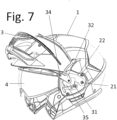
Figure 7 : Position of the crank, the cam, the lever and the arm as the chin guard in the middle position. Part of the chin guard has been remover to better show the mechanism. - An embodiment of the invention is briefly described below, as an illustrative and nonlimiting example thereof.
- In
figures 1-6 a first embodiment of a helmet according to the invention is shown. It comprises a helmet body (1) with a frontal opening (11) covered by a visor (2) and a chin guard (3). The represented example has a solar screen (4) protecting against the sun, which is not relevant to the invention. - The visor (2) and the chin guard (3) are articulated so that the user can move them and place them behind the body (1) of the helmet, in a withdrawn position.
Figures 2 to 4 show the different stages. - The visor (2) is articulated on a first axis (21) to which it is attached by an arm (22). This arm (22) has a first radial section and a second transversal section attached to the side of the visor (2).
- For its part, the chin guard (3) is connected to a projection (31) attached to the body (1). The projection (31) is arranged closer to the front opening (11) of the body (1) than the first axis (21). It is placed lower than the arm (22). A crank (32) joins the chin guard (3) to a second axis (33), arranged above the first axis (21) and the projection (31) and closest to the frontal opening (11) than both. The crank (32) is connected by a joint (34) to the chin guard (3). On the second axis (33) there is a cam (35) that rotates integral with the crank (32).
- The chin guard (3) has a general C-shape so that it is hinged at both ends to the body (1). It comprises a slot (36) through which the projection (31) slides, so that rotation around both the protrusion (31) and the second axis (33) is allowed.
- The mechanism also has a lever (5) arranged equally close to the cam (35) and the arm (22) and below both, so that if the cam (35) pushes the lever (5) downwards, the arm (22) goes up. The cam (35) is dimensioned so that it releases the lever (5) when the chin guard (3) is in both extreme positions and pushes on the lever (5) in the rest of the positions of the chin guard (3). Thus, when the visor (2) is in front of the opening (11), any movement of the chin rest (3) forces the visor (2) to rise from its position. This allows the chin guard (3) to come out or back to the frontal position. The visor (2) might be mounted on a return spring on the arm (22), so the distance between the first axis (21) and the visor (2) may be varied.
- As the second axis (33) is closer to the frontal opening (11) of the helmet, in the rear position the chin guard (3) is tighter to the body (1) than in the front position.
- The projections (31), braces (32), slots (36) and other elements can be arranged on both sides or only on one. It is more preferable to arrange them in both to maintain the symmetry and stability of the ensemble.
- As shown in the figures, mainly in
figure 4 , when the chin guard (3) is placed at the back of the helmet, the visor (2) can be freely moved. The cam (35) does not affect the lever (5), nor the arm (22). - All the elements can be covered by a shell, so that the possibility of introducing dirt into the mechanism is reduced.
Claims (1)
- Helmet with chin guard, comprising a helmet body (1) with a front opening (11) for the user's face, a transparent visor (2) and a chin guard (3), the visor (2) and the chin guard (3) each being mobile between a frontal position in front of the opening (11) and a withdrawn position, characterized in that:the visor (2) is articulated to the body (1) by a first axis (21) from which an arm (22) connecting to the visor (2) emerges;the chin guard (3) has a slot (36) through which a projection (31), attached to the body (1) slides, the projection (31) being closer to the opening (11) than the first axis (21);the chin guard (3) is articulated to a crank (32) hinged to a second axis (33) that includes a cam (35) attached to the crank (32), the second axis (33) being above the first axis (21) and closer to the opening (11) than the projection (31); anda lever (5) below the cam (35) and the arm (22), the ends of the lever (5) resting on both the cam (35) and the arm (22);
so thatthe cam (5) is dimensioned so that it releases the lever (5) when the chin guard (3) is in both extreme positions and impinges on it in the rest of the travel, raising the arm.
Priority Applications (1)
| Application Number | Priority Date | Filing Date | Title |
|---|---|---|---|
| EP23382357.4A EP4449926B1 (en) | 2023-04-18 | 2023-04-18 | Helmet with chin guard |
Applications Claiming Priority (1)
| Application Number | Priority Date | Filing Date | Title |
|---|---|---|---|
| EP23382357.4A EP4449926B1 (en) | 2023-04-18 | 2023-04-18 | Helmet with chin guard |
Publications (2)
| Publication Number | Publication Date |
|---|---|
| EP4449926A1 true EP4449926A1 (en) | 2024-10-23 |
| EP4449926B1 EP4449926B1 (en) | 2026-04-08 |
Family
ID=86095904
Family Applications (1)
| Application Number | Title | Priority Date | Filing Date |
|---|---|---|---|
| EP23382357.4A Active EP4449926B1 (en) | 2023-04-18 | 2023-04-18 | Helmet with chin guard |
Country Status (1)
| Country | Link |
|---|---|
| EP (1) | EP4449926B1 (en) |
Cited By (1)
| Publication number | Priority date | Publication date | Assignee | Title |
|---|---|---|---|---|
| WO2026087940A1 (en) * | 2024-10-25 | 2026-04-30 | Strategic Sports Limited | A helmet with a mouth guard that can be rotated 180 degrees |
Citations (6)
| Publication number | Priority date | Publication date | Assignee | Title |
|---|---|---|---|---|
| EP1101419A1 (en) | 1999-11-16 | 2001-05-23 | CESARE LANDI S.r.l. | Crash-helmet for motorcyclists |
| US20080196148A1 (en) * | 2005-06-03 | 2008-08-21 | Cbm Distribution | Protective Helmet With Mobile Visor |
| ES2359494T3 (en) | 2001-06-15 | 2011-05-24 | A & G PHARMACEUTICALS, INC. | PROCEDURES AND COMPOSITIONS TO INHIBIT, PREVENT OR REDUCE TUMOR CELL GROWTH IN PATIENTS RESISTANT TO ANTINEOPLASTIC EFFECTS OF ANTIESTROGENIC TRERAPY. |
| US20160015114A1 (en) * | 2014-07-21 | 2016-01-21 | Shark | Protective helmet with moveable chin guard with automatic shield lifting mechanism |
| US20180213877A1 (en) * | 2016-06-08 | 2018-08-02 | Jiangmen Pengcheng Helmets Ltd. | Helmet with transformable jaw protecting structure based on gear constraint |
| WO2022173097A1 (en) * | 2021-02-09 | 2022-08-18 | 주식회사 에이치제이씨 | Chin guard pivoting mechanism |
-
2023
- 2023-04-18 EP EP23382357.4A patent/EP4449926B1/en active Active
Patent Citations (7)
| Publication number | Priority date | Publication date | Assignee | Title |
|---|---|---|---|---|
| EP1101419A1 (en) | 1999-11-16 | 2001-05-23 | CESARE LANDI S.r.l. | Crash-helmet for motorcyclists |
| ES2359494T3 (en) | 2001-06-15 | 2011-05-24 | A & G PHARMACEUTICALS, INC. | PROCEDURES AND COMPOSITIONS TO INHIBIT, PREVENT OR REDUCE TUMOR CELL GROWTH IN PATIENTS RESISTANT TO ANTINEOPLASTIC EFFECTS OF ANTIESTROGENIC TRERAPY. |
| US20080196148A1 (en) * | 2005-06-03 | 2008-08-21 | Cbm Distribution | Protective Helmet With Mobile Visor |
| US20160015114A1 (en) * | 2014-07-21 | 2016-01-21 | Shark | Protective helmet with moveable chin guard with automatic shield lifting mechanism |
| EP2976957A1 (en) | 2014-07-21 | 2016-01-27 | Shark | Protective helmet with movable chin guard with automatic lifting mechanism for the screen |
| US20180213877A1 (en) * | 2016-06-08 | 2018-08-02 | Jiangmen Pengcheng Helmets Ltd. | Helmet with transformable jaw protecting structure based on gear constraint |
| WO2022173097A1 (en) * | 2021-02-09 | 2022-08-18 | 주식회사 에이치제이씨 | Chin guard pivoting mechanism |
Cited By (1)
| Publication number | Priority date | Publication date | Assignee | Title |
|---|---|---|---|---|
| WO2026087940A1 (en) * | 2024-10-25 | 2026-04-30 | Strategic Sports Limited | A helmet with a mouth guard that can be rotated 180 degrees |
Also Published As
| Publication number | Publication date |
|---|---|
| EP4449926B1 (en) | 2026-04-08 |
Similar Documents
| Publication | Publication Date | Title |
|---|---|---|
| EP3998892B1 (en) | Protective helmet with face protection shield and linkage mechanism | |
| EP3866632B1 (en) | Visor carrier assembly | |
| US6438763B2 (en) | Protective helmet | |
| US7703153B2 (en) | Combination hat and sunglasses/goggles | |
| US4918752A (en) | Helmet with detachable front section | |
| EP4011232B1 (en) | Helmet with associated rotation of chin guard and face mask | |
| EP4449926B1 (en) | Helmet with chin guard | |
| US11033433B2 (en) | Removable shield for protective headwear | |
| EP1670329B1 (en) | Protective helmet | |
| EP1607013B1 (en) | Safety helmet with screening element | |
| CN102281782A (en) | Protective headwear | |
| AU2021328139A1 (en) | Hard hat attachment system and sun visor | |
| EP3692847A1 (en) | Visor locking mechanism and helmet | |
| ES2352812T3 (en) | PROTECTIVE HELMET, ESPECIALLY FOR USE IN AUTOMOBILISM AND SPORTS IN GENERAL. | |
| EP4424194B1 (en) | Head proctection | |
| US11234476B2 (en) | Protective helmet, in particular motorcycle helmet, having a swivelable and removable chin part | |
| CA1088872A (en) | Ear defenders | |
| CN114727681A (en) | Face protection mechanism for protective helmet | |
| JP2003049316A (en) | Helmet with face protection plate | |
| US4291418A (en) | Crash-helmet | |
| WO2023092826A1 (en) | Helmet | |
| EP1765103B1 (en) | Protective helmets | |
| CN119453611A (en) | A rotating structure of a helmet chin guard | |
| HK40032408A (en) | Visor carrier assembly | |
| CN119453610A (en) | A connection structure for a helmet |
Legal Events
| Date | Code | Title | Description |
|---|---|---|---|
| PUAI | Public reference made under article 153(3) epc to a published international application that has entered the european phase |
Free format text: ORIGINAL CODE: 0009012 |
|
| STAA | Information on the status of an ep patent application or granted ep patent |
Free format text: STATUS: THE APPLICATION HAS BEEN PUBLISHED |
|
| AK | Designated contracting states |
Kind code of ref document: A1 Designated state(s): AL AT BE BG CH CY CZ DE DK EE ES FI FR GB GR HR HU IE IS IT LI LT LU LV MC ME MK MT NL NO PL PT RO RS SE SI SK SM TR |
|
| STAA | Information on the status of an ep patent application or granted ep patent |
Free format text: STATUS: REQUEST FOR EXAMINATION WAS MADE |
|
| 17P | Request for examination filed |
Effective date: 20250414 |
|
| GRAP | Despatch of communication of intention to grant a patent |
Free format text: ORIGINAL CODE: EPIDOSNIGR1 |
|
| STAA | Information on the status of an ep patent application or granted ep patent |
Free format text: STATUS: GRANT OF PATENT IS INTENDED |
|
| INTG | Intention to grant announced |
Effective date: 20250909 |
|
| GRAJ | Information related to disapproval of communication of intention to grant by the applicant or resumption of examination proceedings by the epo deleted |
Free format text: ORIGINAL CODE: EPIDOSDIGR1 |
|
| GRAP | Despatch of communication of intention to grant a patent |
Free format text: ORIGINAL CODE: EPIDOSNIGR1 |
|
| INTG | Intention to grant announced |
Effective date: 20251211 |
|
| GRAS | Grant fee paid |
Free format text: ORIGINAL CODE: EPIDOSNIGR3 |
|
| GRAA | (expected) grant |
Free format text: ORIGINAL CODE: 0009210 |
|
| STAA | Information on the status of an ep patent application or granted ep patent |
Free format text: STATUS: THE PATENT HAS BEEN GRANTED |
|
| AK | Designated contracting states |
Kind code of ref document: B1 Designated state(s): AL AT BE BG CH CY CZ DE DK EE ES FI FR GB GR HR HU IE IS IT LI LT LU LV MC ME MK MT NL NO PL PT RO RS SE SI SK SM TR |
|
| REG | Reference to a national code |
Ref country code: CH Ref legal event code: F10 Free format text: ST27 STATUS EVENT CODE: U-0-0-F10-F00 (AS PROVIDED BY THE NATIONAL OFFICE) Effective date: 20260408 Ref country code: GB Ref legal event code: FG4D |
|
| REG | Reference to a national code |
Ref country code: DE Ref legal event code: R096 Ref document number: 602023014857 Country of ref document: DE |