EP4447382A1 - Privacy-protected data aggregation device and privacy-protected data aggregation system - Google Patents
Privacy-protected data aggregation device and privacy-protected data aggregation system Download PDFInfo
- Publication number
- EP4447382A1 EP4447382A1 EP22922085.0A EP22922085A EP4447382A1 EP 4447382 A1 EP4447382 A1 EP 4447382A1 EP 22922085 A EP22922085 A EP 22922085A EP 4447382 A1 EP4447382 A1 EP 4447382A1
- Authority
- EP
- European Patent Office
- Prior art keywords
- aggregation
- attribute information
- data
- user
- combinations
- Prior art date
- Legal status (The legal status is an assumption and is not a legal conclusion. Google has not performed a legal analysis and makes no representation as to the accuracy of the status listed.)
- Pending
Links
Images














Classifications
-
- H—ELECTRICITY
- H04—ELECTRIC COMMUNICATION TECHNIQUE
- H04L—TRANSMISSION OF DIGITAL INFORMATION, e.g. TELEGRAPHIC COMMUNICATION
- H04L9/00—Cryptographic mechanisms or cryptographic arrangements for secret or secure communications; Network security protocols
- H04L9/30—Public key, i.e. encryption algorithm being computationally infeasible to invert or user's encryption keys not requiring secrecy
-
- G—PHYSICS
- G06—COMPUTING OR CALCULATING; COUNTING
- G06F—ELECTRIC DIGITAL DATA PROCESSING
- G06F21/00—Security arrangements for protecting computers, components thereof, programs or data against unauthorised activity
- G06F21/60—Protecting data
- G06F21/62—Protecting access to data via a platform, e.g. using keys or access control rules
- G06F21/6218—Protecting access to data via a platform, e.g. using keys or access control rules to a system of files or objects, e.g. local or distributed file system or database
- G06F21/6245—Protecting personal data, e.g. for financial or medical purposes
- G06F21/6254—Protecting personal data, e.g. for financial or medical purposes by anonymising data, e.g. decorrelating personal data from the owner's identification
-
- G—PHYSICS
- G06—COMPUTING OR CALCULATING; COUNTING
- G06F—ELECTRIC DIGITAL DATA PROCESSING
- G06F21/00—Security arrangements for protecting computers, components thereof, programs or data against unauthorised activity
- G06F21/60—Protecting data
- G06F21/62—Protecting access to data via a platform, e.g. using keys or access control rules
-
- H—ELECTRICITY
- H04—ELECTRIC COMMUNICATION TECHNIQUE
- H04L—TRANSMISSION OF DIGITAL INFORMATION, e.g. TELEGRAPHIC COMMUNICATION
- H04L9/00—Cryptographic mechanisms or cryptographic arrangements for secret or secure communications; Network security protocols
- H04L9/008—Cryptographic mechanisms or cryptographic arrangements for secret or secure communications; Network security protocols involving homomorphic encryption
Definitions
- the present disclosure relates to a privacy-protected data aggregation device and a privacy-protected data aggregation system.
- Patent Literature 1 Japanese Unexamined Patent Publication No. 2010-108488
- Patent Literature 1 does not disclose any measures to prevent the above-described unintended disclosure due to unstructured zeros, and accordingly, such preventive measures have been demanded.
- the present disclosure has been made to solve the aforementioned problem, and it is an object of the present disclosure to prevent unintended disclosure due to unstructured zeros.
- a privacy-protected data aggregation device includes: an attribute information encryption unit that encrypts attribute information in user data to be aggregated, which includes a plurality of pieces of attribute information, using a homomorphic encryption method that enables aggregation processing; an aggregation processing unit that aggregates user data with attribute information encrypted by the attribute information encryption unit, for all combinations of possible values of the plurality of pieces of attribute information in domain data that defines possible values of each of the pieces of attribute information included in the user data, to obtain aggregated data including an aggregation result and encrypted attribute information; an anonymization processing unit that performs anonymization processing on the aggregated data obtained by the aggregation processing unit; and a decryption unit that decrypts aggregated data subjected to the anonymization processing to obtain aggregated data including an aggregation result after the anonymization processing and decrypted attribute information.
- the attribute information encryption unit encrypts attribute information in the user data to be aggregated, which includes a plurality of pieces of attribute information, using a homomorphic encryption method that enables aggregation processing, and the aggregation processing unit aggregates user data with encrypted attribute information, for all combinations of possible values of the plurality of pieces of attribute information in the domain data, to obtain aggregated data including an aggregation result and encrypted attribute information. In this manner, all possible combinations of values of a plurality of attribute information in the domain data are aggregated, and totaled data including the aggregation results and encrypted attribute information is obtained.
- the anonymization processing unit performs anonymization processing on the aggregated data obtained by the aggregation processing unit, so that the aggregated data is anonymized, and the decryption unit decrypts aggregated data subjected to the anonymization processing to obtain aggregated data including an aggregation result after the anonymization processing and decrypted attribute information.
- the aggregation result after the anonymization processing can be output in a format that can be checked by the user.
- aggregation is performed for all combinations of the possible values of a plurality of pieces of attribute information in the domain data. Therefore, since it is possible to avoid a situation in which unstructured zeros (that is, combinations that exist structurally but are not output) occur, it is possible to prevent unintended disclosure due to unstructured zeros.
- first to eighth embodiments of the present disclosure will be described in order with reference to the diagrams.
- first embodiment a form of preventing unintended disclosure due to unstructured zeros in a privacy-protected data aggregation device will be described
- second to fourth embodiments three forms of preventing unintended disclosure due to structured zero in the privacy-protected data aggregation device according to the first embodiment will be described.
- a privacy-protected data aggregation device 10 includes, as functional blocks, a user data storage unit 11, a domain data storage unit 12, an attribute information encryption unit 13, an aggregation processing unit 14, an anonymization processing unit 15, and a decryption unit 16.
- a user data storage unit 11 includes, as functional blocks, a user data storage unit 11, a domain data storage unit 12, an attribute information encryption unit 13, an aggregation processing unit 14, an anonymization processing unit 15, and a decryption unit 16.
- the user data storage unit 11 is a functional unit that stores user data to be aggregated, including a plurality of pieces of attribute information, and stores user data such as ID, place of departure, and place of arrival, for example, as "user data" shown in FIG. 3 .
- the domain data storage unit 12 is a functional unit that stores domain data that defines the possible values of each piece of attribute information included in the user data, and stores domain data indicating the possible values (Narita, Haneda, Naha, ..., Kagoshima) of "place of departure” and the possible values (Narita, Haneda, Naha, ..., Kagoshima) of "place of arrival", for example, as "domain data” shown in FIG. 3 .
- user data and domain data are stored in advance in the privacy-protected data aggregation device 10.
- these pieces of data may also be input to the privacy-protected data aggregation device 10 from an external device.
- the user data storage unit 11 and the domain data storage unit 12 are not components of the privacy-protected data aggregation device 10.
- the attribute information encryption unit 13 is a functional unit that encrypts attribute information in the user data to be aggregated, which includes a plurality of pieces of attribute information, using a homomorphic encryption method that enables aggregation processing.
- a homomorphic encryption method that enables aggregation processing for example, an encryption method having additive homomorphism or complete homomorphism can be adopted.
- the aggregation processing unit 14 is a functional unit that aggregates user data with attribute information encrypted by the attribute information encryption unit 13, for all combinations of possible values of a plurality of pieces of attribute information in the above-described domain data, to obtain aggregated data including the aggregation result and the encrypted attribute information.
- the anonymization processing unit 15 is a functional unit that performs anonymization processing on the aggregated data obtained by the aggregation processing unit 14.
- the decryption unit 16 is a functional unit that decrypts the aggregated data subjected to the anonymization processing to obtain aggregated data that includes the aggregation result after the anonymization processing and the decrypted attribute information, and the decryption unit 16 outputs the obtained aggregated data.
- user data stored in the user data storage unit 11 and domain data stored in the domain data storage unit 12 are read and acquired so that these can be executed in subsequent processing (step S1).
- these pieces of data may be acquired by being input (received) from an external device.
- the attribute information encryption unit 13 encrypts the attribute information of the user data using a homomorphic encryption method that enables aggregation processing (for example, an encryption method having additive homomorphism or complete homomorphism) (step S2).
- the aggregation processing unit 14 aggregates the user data with the encrypted attribute information for all combinations of requirements in the domain data to generate aggregated data with the encrypted attribute information (step S3).
- aggregated data including the aggregation result (the number of people) with encrypted attribute information (place of departure, place of arrival) is generated.
- all combinations that exist structurally are aggregation targets without omission even if these do not exist in the user data.
- user data for the combination of place of departure "Kagoshima” and place of arrival “Naha” does not exist in the user data and the aggregation result (the number of people) is "0 people”, but the user data for the combination of place of departure "Kagoshima” and place of arrival "Naha” is not omitted from the aggregated data and is included in the aggregated data as an aggregation result of "0 people”. That is, it is possible to avoid a situation in which unstructured zeros (combinations that exist structurally but are not output) occur.
- the anonymization processing unit 15 performs anonymization processing on the above-described aggregated data (step S4), and the decryption unit 16 decrypts the aggregation result after anonymization processing to obtain aggregated data including the aggregation result after anonymization processing and the decrypted attribute information, and outputs the aggregated data in plain text (step S5).
- aggregated data after anonymization processing aggregated data in which the attribute information (place of departure, place of arrival) has been decrypted and the aggregation result (the number of people) has been subjected to anonymization processing is obtained and output.
- the user data for the combination of place of departure "Kagoshima” and place of arrival “Naha” does not exist in the user data and the aggregation result (the number of people) is "0 people"
- the user data for the combination of place of departure "Kagoshima” and place of arrival "Naha” is included as an aggregation result of "0 people” in the aggregated data before the anonymization processing and is included as an aggregation result of "2 people” in the aggregated data after the anonymization processing.
- the second embodiment in addition to the first embodiment in which unintended disclosure due to unstructured zeros is prevented, a form of preventing a situation, in which the aggregation results of structured zero combinations become non-zero values and the usefulness of the aggregation results (statistical information) is lowered, by excluding the structured zero combinations from anonymization processing targets and fixing the aggregation results to zero will be further described.
- the anonymization processing unit 15 has a feature of fixing the aggregation result of a flagged combination in the aggregated data to zero and performing anonymization processing on an unflagged combination in the aggregated data by referring to a flagged list in which non-existent combinations, among all combinations of the possible values of a plurality of pieces of attribute information in the domain data, are flagged.
- the above-described “flagged list” may be generated in advance and stored in the domain data storage unit 12, or may be generated from the domain data at that time by the domain data storage unit 12 as described below.
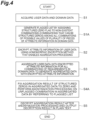
- FIG. 4 a process shown in FIG. 4 is performed.
- the same step numbers are given to the same processes as those in the first embodiment ( FIG. 2 ), and detailed descriptions thereof will be omitted.
- step S1 user data stored in the user data storage unit 11 and domain data stored in the domain data storage unit 12 are acquired so that these can be executed in subsequent processing (step S1). Then, the domain data storage unit 12 generates the above-described "flagged list" by assigning a structured zero flag to non-existent combinations (combinations that can be structured zeros) among all combinations of the possible values of a plurality of pieces of attribute information in the domain data at that time (step S1A). For example, as shown in the "flagged list" in FIG.
- a structured zero flag "1" is assigned to a combination of place of departure “Narita” and place of arrival “Narita”, which does not exist, and similarly, a structured zero flag "1” is assigned to a combination of place of departure “Narita” and place of arrival “Haneda”, which does not exist.
- the flag is set to "0".
- Such a flagged list is transmitted from the domain data storage unit 12 to the anonymization processing unit 15 through the aggregation processing unit 14.
- the attribute information encryption unit 13 encrypts the attribute information of the user data using a homomorphic encryption method that enables aggregation processing (for example, an encryption method having additive homomorphism or complete homomorphism) (step S2), and the aggregation processing unit 14 aggregates the user data with the encrypted attribute information for all combinations of requirements in the domain data to generate aggregated data with the encrypted attribute information (step S3).
- a homomorphic encryption method that enables aggregation processing
- the aggregation processing unit 14 aggregates the user data with the encrypted attribute information for all combinations of requirements in the domain data to generate aggregated data with the encrypted attribute information (step S3).
- aggregated data including the aggregation result (the number of people) with encrypted attribute information (place of departure, place of arrival) is generated.
- the anonymization processing unit 15 fixes the aggregation result of a flagged combination in the aggregated data to zero and performs anonymization processing on an unflagged combination in the aggregated data by referring to the flagged list (step S4A). Therefore, it is possible to prevent a situation in which the aggregation results of flagged non-existent combinations (combinations that can be structured zeros) become non-zero values by anonymization processing and the usefulness of the aggregation results (statistical information) is lowered.
- the decryption unit 16 decrypts the aggregation result after step S4A, in which non-existent combinations are fixed to zero, to obtain aggregated data including the aggregation result after anonymization processing and the decrypted attribute information, and outputs the aggregated data in plain text (step S5).
- aggregated data after anonymization processing aggregated data in which the attribute information (place of departure, place of arrival) has been decrypted and the aggregation result (the number of people) has been subjected to anonymization processing is obtained and output.
- the aggregation results (the number of people) of non-existent combinations that can be structured zeros are fixed to zero and output. Therefore, it is possible to prevent a situation in which the aggregation results of non-existent combinations become non-zero values by anonymization processing and the usefulness of the aggregation results (statistical information) is lowered.
- a form of preventing a situation in which the aggregation results of structured zero combinations become non-zero values by subsequent anonymization processing and the usefulness of the aggregation results (statistical information) is lowered, by excluding the structured zero combinations from aggregation processing targets so as not to be included in aggregated data.
- the aggregation processing unit 14 has a feature of aggregating the above user data for combinations that are not flagged, among all the above combinations, by referring to a flagged list in which non-existent combinations among all combinations of the possible values of a plurality of pieces of attribute information in the domain data are flagged.
- the above-described “flagged list” may be generated in advance and stored in the domain data storage unit 12, or may be generated from the domain data at that time by the domain data storage unit 12 as described below.
- FIG. 6 a process shown in FIG. 6 is performed.
- the same step numbers are given to the same processes as those in the first embodiment ( FIG. 2 ), and detailed descriptions thereof will be omitted.
- the domain data storage unit 12 generates the above-described "flagged list" by assigning a structured zero flag to non-existent combinations (combinations that can be structured zeros) among all combinations of the possible values of a plurality of pieces of attribute information in the domain data at that time. For example, as shown in "flagged list" in FIG.
- a structured zero flag "1" is assigned to a combination of place of departure “Narita” and place of arrival “Narita”, which does not exist, and similarly, a structured zero flag "1” is assigned to a combination of place of departure “Narita” and place of arrival “Haneda”, which does not exist.
- the flag is set to "0".
- Such a flagged list is transmitted from the domain data storage unit 12 to the anonymization processing unit 15 through the aggregation processing unit 14.
- the attribute information encryption unit 13 encrypts the attribute information of the user data using a homomorphic encryption method that enables aggregation processing (for example, an encryption method having additive homomorphism or complete homomorphism) (step S2), and the aggregation processing unit 14 aggregates the user data with the encrypted attribute information for combinations (combinations with a flag "0" in the example of FIG. 5 ) excluding combinations with the above flag assigned from all combinations of requirements by referring to the flagged list, thereby generating aggregated data with the encrypted attribute information (step S3A).
- a homomorphic encryption method that enables aggregation processing
- the aggregation processing unit 14 aggregates the user data with the encrypted attribute information for combinations (combinations with a flag "0" in the example of FIG. 5 ) excluding combinations with the above flag assigned from all combinations of requirements by referring to the flagged list, thereby generating aggregated data with the encrypted attribute information (step S3A).
- aggregated data including the aggregation result (the number of people) with encrypted attribute information (place of departure, place of arrival) is generated.
- combinations that do not exist are excluded from aggregation processing targets so as not to be included in the aggregated data. Therefore, it is possible to prevent a situation in which the aggregation results of flagged non-existent combinations (combinations that can be structured zeros) become non-zero values by anonymization processing and the usefulness of the aggregation results (statistical information) is lowered.
- the anonymization processing unit 15 performs anonymization processing on the above-described aggregated data (aggregated data with non-existent combinations removed) (step S4), and the decryption unit 16 decrypts the aggregated data after the anonymization processing to obtain aggregated data including the aggregation result after anonymization processing and the decrypted attribute information, and outputs the aggregated data in plain text (step S5).
- aggregated data after anonymization processing in FIG. 7 , aggregated data after non-existent combinations are removed, in which the attribute information (place of departure, place of arrival) has been decrypted and the aggregation result (the number of people) has been subjected to anonymization processing, is obtained and output.
- the aggregation results (the number of people) of non-existent combinations that can be structured zeros for example, a combination of place of departure "Narita” and place of arrival “Narita” and a combination of place of departure “Narita” and place of arrival “Haneda" are not output. Therefore, it is possible to prevent a situation in which the aggregation results of non-existent combinations become non-zero values by anonymization processing and the usefulness of the aggregation results (statistical information) is lowered.
- the fourth embodiment in addition to the first embodiment in which unintended disclosure due to unstructured zeros is prevented, a form of preventing a situation, in which the aggregation results of structured zero combinations become non-zero values by subsequent anonymization processing and the usefulness of the aggregation results (statistical information) is lowered, by narrowing down the aggregation targets based on the aggregation target list excluding the structured zero combinations and then performing aggregation processing will be further described.
- the aggregation processing unit 14 has a feature of aggregating the above user data for combinations included in the aggregation target list by referring to the aggregation target list in which combinations excluding non-existent combinations from all combinations of the possible values of a plurality of pieces of attribute information in the domain data are listed.
- the above-described “aggregation target list” may be generated in advance as described below and stored in the domain data storage unit 12, or may be generated from the domain data at that time by the domain data storage unit 12.
- FIG. 8 a process shown in FIG. 8 is performed.
- the same step numbers are given to the same processes as those in the first embodiment ( FIG. 2 ), and detailed descriptions thereof will be omitted.
- step S1B user data stored in the user data storage unit 11 and the above-described aggregation target list stored in the domain data storage unit 12 (a list in which combinations of attribute information that are not structured zeros (that are aggregation targets) are described) are acquired (step S1B).
- the aggregation target list is a list that includes all possible “combinations of departure and place of arrivals", and all the combinations in the list are aggregation targets.
- the attribute information encryption unit 13 encrypts the attribute information of the user data using a homomorphic encryption method that enables aggregation processing (for example, an encryption method having additive homomorphism or complete homomorphism) (step S2).
- the aggregation processing unit 14 aggregates the user data with the encrypted attribute information for all combinations described in the aggregation target list, thereby generating aggregated data with the encrypted attribute information (step S3B).
- aggregated data including the aggregation result (the number of people) with encrypted attribute information (place of departure, place of arrival) is generated for all combinations described in the aggregation target list.
- the anonymization processing unit 15 performs anonymization processing on the above-described aggregated data (aggregated data with non-existent combinations removed) (step S4), and the decryption unit 16 decrypts the aggregated data after the anonymization processing to obtain aggregated data including the aggregation results after the anonymization processing and the decrypted attribute information, and outputs the same in plain text (step S5).
- aggregated data after anonymization processing aggregated data that non-existent combinations are removed, in which the attribute information (place of departure, place of arrival) has been decrypted and the aggregation result (the number of people) has been subjected to anonymization processing, is obtained and output.
- the aggregation results (the number of people) of non-existent combinations that can be structured zeros for example, a combination of place of departure "Narita” and place of arrival “Narita” and a combination of place of departure “Narita” and place of arrival “Haneda" are not output. Therefore, it is possible to prevent a situation in which the aggregation results of non-existent combinations become non-zero values by anonymization processing and the usefulness of the aggregation results (statistical information) is lowered.
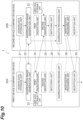
- a privacy-protected data aggregation system 1 includes a first device 20A that provides a first service and a second device 20B that provides a second service, and counts a number of target users through cooperation between the first device 20A and the second device 20B by processes described below.
- the first device 20A and the second device 20B share the role of performing a series of processes.
- the first device 20A includes a domain data storage unit 21, an aggregation image generation unit 22, a user data storage unit 23, a first encryption unit 24, and a decryption unit 29, all of which are shown by solid lines in FIG.
- the second device 20B includes a domain data storage unit 21, an aggregation image generation unit 22, a user data storage unit 23, a second encryption unit 25, a matching unit 26, an aggregation processing unit 27, and an anonymization processing unit 28, all of which are shown by solid lines in FIG. 10 .
- the above-described division of roles, in which the second device 20B performs matching, aggregation processing, and anonymization processing and the first device 20A finally performs decryption and output is an example.
- the first device 20A and the second device 20B may have a common functional block configuration in both devices by including functional units shown by dashed lines in FIG. 10 .
- the user data storage unit 23 of the first device 20A is a functional unit that stores first user data including a first user ID and first attribute information regarding a user of the first service
- the domain data storage unit 21 is a functional unit that stores domain data that defines possible values of the first attribute information
- the user data storage unit 23 of the second device 20B is a functional unit that stores second user data including a second user ID and second attribute information regarding a user of the second service
- the domain data storage unit 21 is a functional unit that stores domain data that defines possible values of the second attribute information.
- the aggregation image generation unit 22 included in both the first device 20A and the second device 20B generates an aggregation image, in which all combinations of the first attribute information and the second attribute information are described, based on first domain data that defines the possible values of the first attribute information and second domain data that defines the possible values of the second attribute information, and shares the generated aggregation image with the second device 20B.
- the first encryption unit 24 is a functional unit that encrypts the first user ID with a private key for user ID of the first device and encrypts the first attribute information with a private key for attribute information of the first device and transmits first user data including the encrypted first user ID and first attribute information to the second device 20B and that receives an encrypted second user ID, which is obtained by encrypting the second user ID with a private key for user ID of the second device 20B, from the second device 20B, encrypts the encrypted second user ID with the private key for user ID of the first device 20A, and transmits the encryption result to the second device 20B.
- the second encryption unit 25 is a functional unit that further encrypts the first user ID, which is encrypted with the private key for user ID of the first device by the first encryption unit 24, with a private key for user ID of the second device 20B and that encrypts the second user ID with the private key for user ID of the second device 20B, transmits the encrypted second user ID to the first device 20A, and acquires the second user ID that has been further encrypted with the private key for user ID of the first device 20A by the first device 20A.
- the matching unit 26 is a functional unit that matches the first user data encrypted by the first encryption unit 24 with the second user data by comparing the first user ID and the second user ID, both of which are encrypted with the private key for user ID of the first device 20A and the private key for user ID of the second device 20B.
- the aggregation processing unit 27 is a functional unit that categorizes the matched data based on the unencrypted second attribute information in the second user data and aggregates the categorized matched data for all combinations described in the above aggregation image to obtain aggregated data including aggregation results for each combination of the encrypted first attribute information and the unencrypted second attribute information.
- the anonymization processing unit 28 is a functional unit that performs anonymization processing on the aggregated data by adding noise generated based on the published computation key of the first device 20A to the aggregated data obtained by the aggregation processing unit 27.
- the aggregated data after noise is added satisfies differential privacy.
- types of noise for example, a Laplace mechanism, a Gaussian mechanism, and an exponential mechanism can be adopted. The same applies to "noise" described in the following embodiments.
- the decryption unit 29 is a functional unit that decrypts the aggregated data subjected to anonymization processing based on the published computation key of the first device 20A and the private key for attribute information of the first device 20A to obtain aggregated data including the decrypted anonymized aggregation results for each combination of the decrypted first attribute information and the unencrypted second attribute information.
- the first user data stored in the user data storage unit 23 and the domain data stored in the domain data storage unit 21 are read and acquired so that these can be executed in subsequent processing (step S11A).
- the first user data includes a user ID (ID A ), a place of departure, and place of arrival
- the above-described domain data includes possible values (Haneda, Naha, Fukuoka, %) for the "place of departure” and possible values (Haneda, Naha, Fukuoka, ...) for the "place of arrival”.
- the name of the airport is used for the "place of departure” and the "place of arrival” in the first user data and domain data related to the first device (company A's device).
- the second device also called company B's device 20B as well, the second user data stored in the user data storage unit 23 and the domain data stored in the domain data storage unit 21 are acquired so that these can be executed in subsequent processing (step S 11B). As illustrated in FIG.
- the second user data includes a user ID (ID B ), a place of departure, place of arrival, and means of transportation
- the above-described domain data includes possible values (Haneda, Naha, Fukuoka, %) for the "place of departure”, possible values (Haneda, Naha, Fukuoka, %) for the "place of arrival” (Haneda, Naha, Fukuoka, %), and possible values (airplane, Shinkansen, car, %) for the "means of transportation”.
- the names of prefectures are used for the "place of departure” and the "place of arrival" in the second user data and domain data related to the second device (company B's device).
- the aggregation image generation units 22 of the first and second devices cooperate with each other to generate an aggregation image such as that shown in FIG. 13 , in which all combinations of the first attribute information and the second attribute information are described, based on the first domain data that defines the possible values of the first attribute information and the second domain data that defines the possible values of the second attribute information, and share the generated aggregation image with each other.
- the aggregation image includes all combinations of the first attribute information (company A's "place of departure” and "place of arrival”) and the second attribute information (company B's "place of departure", "place of arrival", and “means of transportation”), and an "aggregation result" column is provided for each combination.
- the first encryption unit 24 of the first device (company A's device) 20A encrypts the first user ID A in the first user data with the company A's private key a and encrypts the first attribute information (place of departure, place of arrival) with company A's private key A, and transmits the encrypted first user data to the second encryption unit 25 of the second device (company B's device) 20B (step S13).
- the second encryption unit 25 of the second device (company B's device) 20B further encrypts the first user ID A in the transmitted encrypted first user data with the company B's private key b (step S14), and as shown in FIG. 16 , the second encryption unit 25 of the second device (company B's device) 20B encrypts the second user ID B in the second user data with company B's private key b and transmits the encrypted second user ID B to the first encryption unit 24 of the first device (company A's device) 20A (step S15).
- the first encryption unit 24 of the first device (company A's device) 20A further encrypts the transmitted encrypted second user ID B with the company A's private key a, and transmits the encrypted second user ID B to the second encryption unit 25 of the second device (company B's device) 20B (step S16).
- the encrypted second user ID B received by the second encryption unit 25 of the second device (company B's device) 20B is transmitted to the matching unit 26.
- the matching unit 26 of the second device (company B's device) 20B matches the second user data including the encrypted second user ID B with the first user data including the encrypted first user ID A based on the first and second user IDs encrypted with the private keys a and b (step S17) to obtain matched data.
- the matched data obtained herein includes a combination of first and second user data with matching IDs, and includes first attribute information (place of departure, place of arrival) encrypted with company A's private key A and unencrypted second attribute information (place of departure, place of arrival, means of transportation) as illustrated in FIG. 17 .
- the matched data is transmitted to the aggregation processing unit 27.
- the aggregation processing unit 27 of the second device (company B's device) 20B categorizes the matched data according to whether or not the unencrypted second attribute information (company B's attribute information) is common (step S18). Then, as shown in FIG. 19 , the aggregation processing unit 27 of the second device (company B's device) 20B aggregates the categorized matched data for each category to generate aggregated data (step S19).
- the "place of departure, place of arrival, means of transportation" in the second attribute information is categorized into data of "Chiba, Okinawa, airplane” and data of "Tokyo, Osaka, Shinkansen".
- the first attribute information (Narita, Naha) is encrypted with the company A's private key A. Therefore, since it can be determined that the same bit string is set and the first attribute information is the same although the contents are not known, the aggregation result is "2".
- the first attribute information is also encrypted with the company A's private key A. Therefore, although the contents are not known, depending on whether the bit string is the same or not, data with first attribute information of "Haneda, Itami” and data with first attribute information of "Haneda, Kansai International" are aggregated separately.
- the aggregation result is "2"
- the aggregation result is "1”.
- the aggregation result is encrypted with the company A's computation key, which is a kind of public key.
- steps S18 and S19 described above is performed on all combinations of the first attribute information and the second attribute information included in the aggregation image of FIG. 13 . Therefore, since all combinations that exist structurally are aggregation targets without omission even if these do not exist in the user data, it is possible to avoid a situation in which unstructured zeros (combinations that exist structurally but are not output) occur.
- the anonymization processing unit 28 of the second device (company B's device) 20B performs anonymization processing (as an example, adding noise generated by the company B using the company A's computation key as shown in FIG. 20 ) on the aggregated data, and transmits the aggregated data after anonymization processing to the decryption unit 29 of the first device (company A's device) 20A(step S20).
- the decryption unit 29 of the first device (company A's device) 20A decrypts the transmitted aggregated data after anonymization processing, and outputs the decryption result as plain text's statistical information shown on the right side of FIG. 21 (step S21).
- the first attribute information included in the aggregated data after anonymization processing is encrypted with the company A's private key A.
- the decryption unit 29 can decrypt the first attribute information because the decryption unit 29 can use its own private key A.
- the aggregation result included in the aggregated data after anonymization processing is encrypted with the company A's computation key.
- the decryption unit 29 can also decrypt the aggregation result because the decryption unit 29 can use its own computation key.
- processing such as aggregation is performed on all combinations of the first attribute information and the second attribute information. Therefore, since all combinations that exist structurally are aggregation targets without omission even if these do not exist in the user data, it is possible to avoid a situation in which unstructured zeros (combinations that exist structurally but are not output) occur. As a result, it is possible to prevent unintended disclosure due to unstructured zeros.
- the functional block configuration of a privacy-protected data aggregation system 1 is the same as the above configuration shown in FIG. 10 , repeated descriptions thereof will be omitted.
- the aggregation image generation unit 22 has a feature of generating a flagged list by assigning a flag to non-existent combinations (that is, structured zero combinations), among the combinations described in the aggregation image, based on the generated aggregation image, and the anonymization processing unit 28 has a feature of fixing the aggregation results for flagged combinations in the aggregated data to zero and performing anonymization processing on combinations that are not flagged in the aggregated data by referring to the flagged list.
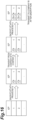
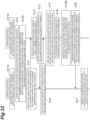
- FIG. 22 a pattern in which structured zero occurs in the user data of companies A and B will be described. As shown in FIG. 22 , there are four patterns (1) to (4) in total that result in structured zeros.
- Pattern (1) is a pattern in which the attribute information of the data of the company A (or the company B) is the same. For example, a pattern in which the "place of departure” and the “place of arrival” in the attribute information of the company A are both “Haneda airport” can be mentioned. In addition, in the table of FIG. 22 , “*" indicates any value. Any pattern in which the "place of departure” and the “place of arrival” in the attribute information of the company A are both "Haneda airport” corresponds to pattern (1) regardless of the value of the company B's attribute information.
- Pattern (2) is a pattern in which the attribute information of the data of the company A (or the company B) is different but the combination does not exist.
- a pattern in which the "place of departure” and the "place of arrival” in the attribute information of the company A are "Haneda airport” and “Narita Point", respectively, but the combination does not exist can be mentioned.
- Pattern (3) is a pattern in which the attribute information "place of departure” related to the "place of departure” in the company A's data and the attribute information related to the "place of arrival” in the company B's data are the same.
- a pattern in which the "place of departure” in the attribute information of the company A and the "place of arrival” in the attribute information of the company B are both "Haneda airport” can be mentioned. That is, this is a pattern in which the attribute information of the company A and the attribute information of the company B may exist individually but combining these forms a combination that does not exist.
- Pattern (4) is a pattern in which the attribute information "place of departure” related to the "place of departure” in the company A's data and the attribute information related to the "place of arrival” in the company B's data are different but the combination does not exist.
- a pattern in which the "place of departure” in the attribute information of the company A is "Haneda airport” and the "place of arrival” in the attribute information of the company B is "Tokyo” but the combination does not exist can be mentioned.
- this is also a pattern in which the attribute information of the company A and the attribute information of the company B may exist individually but combining these forms a combination that does not exist.
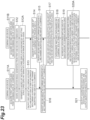
- FIG. 23 a process shown in FIG. 23 is performed.
- the same step numbers are given to the same processes as those in the fifth embodiment ( FIG. 11 ), and detailed descriptions thereof will be omitted.
- first user data and domain data of the company A's device 20A and second user data and domain data of the company B's device 20B are acquired so that these can be executed in subsequent processing (steps S11A and S11B).
- the aggregation image generation units 22 of the first and second devices cooperate with each other to generate an aggregation image such as that shown in FIG. 13 , in which all combinations of the first attribute information and the second attribute information are described, and share the generated aggregation image with each other (step S12).
- step S12A by inputting structured zero patterns into the aggregation image on both sides, a flagged list with structured zero flags assigned as shown in FIG. 24 is generated (step S12A).
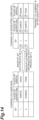
- FIG. 24 illustrates an example of a flagged list in which a column for "structured zero flag” is added to the aggregation image.
- a structured zero flag set to "1”
- the flag is set to "0" for combinations of attribute information that are not structured zeros.
- steps S13 to S18 in FIG. 23 are executed in the same manner as in the fifth embodiment.
- the aggregation processing unit 27 of the company B's device 20B aggregates the user data (matched data) categorized based on the attribute information of the company B for each category (step S19).
- the aggregation processing unit 27 of the company B's device 20B aggregates the user data (matched data) categorized based on the attribute information of the company B for each category (step S19).
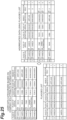
- an aggregation result for each combination in the flagged list is obtained, and aggregated data is obtained by encrypting the aggregation result with the published computation key of the company A.
- the anonymization processing unit 28 of the company B's device 20B fixes the aggregation results for combinations with a flag "1" in the aggregated data to zero and performs anonymization processing (adding noise generated by the company B using the company A's computation key) on unflagged combinations in the aggregated data by referring to the flagged list, and transmits the aggregated data after anonymization processing to the decryption unit 29 of the first device (company A's device) 20A (step S20A).
- the decryption unit 29 of the first device (company A's device) 20A decrypts the transmitted aggregated data after anonymization processing, and outputs the decryption result as plain text's statistical information shown on the right side of FIG. 27 (step S21).
- the aggregation results for combinations with a flag " 1" (combinations that can be structured zeros) in the flagged list are fixed to zero without anonymization processing and output. Therefore, it is possible to prevent a situation in which the aggregation results of non-existent combinations become non-zero values by anonymization processing and the usefulness of the aggregation results (statistical information) is lowered.
- the fifth embodiment since all combinations that exist structurally are aggregation targets without omission even if these do not exist in the user data, it is possible to avoid a situation in which unstructured zeros (combinations that exist structurally but are not output) occur. As a result, it is possible to prevent unintended disclosure due to unstructured zeros.
- the seventh embodiment in addition to the fifth embodiment in which unintended disclosure due to unstructured zeros is prevented, a form of preventing a situation, in which the aggregation results of structured zero combinations become non-zero values and the usefulness of the aggregation results (statistical information) is lowered, by excluding the structured zero combinations from anonymization processing targets and fixing the aggregation results to zero will be further described.
- the aggregation image generation unit 22 has a feature of generating a flagged list by assigning a flag to non-existent combinations (that is, structured zero combinations), among the combinations described in the aggregation image, based on the aggregation image in which all combinations of the first attribute information and the second attribute information are described, and the aggregation processing unit 27 has a feature of aggregating user data for combinations that are not flagged by referring to the flagged list.
- FIG. 28 a process shown in FIG. 28 is performed.
- the same step numbers are given to the same processes as those in the fifth embodiment ( FIG. 11 ), and detailed descriptions thereof will be omitted.
- first user data and domain data of the company A's device 20A and second user data and domain data of the company B's device 20B are acquired so that these can be executed in subsequent processing (steps S11A, S11B).
- an aggregation image such as that shown in FIG. 13 , in which all combinations of the first attribute information and the second attribute information are described, is generated and shared (step S12).
- a flagged list with structured zero flags assigned as shown in FIG. 24 is generated (step S12A).
- steps S13 to S18 in FIG. 23 are executed in the same manner as in the fifth embodiment, and the aggregation processing unit 27 of the company B's device 20B aggregates the user data (matched data) categorized based on the company B's attribute information for each category.
- the aggregation processing unit 27 of the company B's device 20B aggregates the user data (matched data) categorized based on the company B's attribute information for each category.
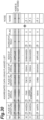
- flagged combinations are excluded, and user data is aggregated for unflagged combinations (step S19A).
- steps S19A combinations that are excluded from aggregation targets are crossed out.
- the anonymization processing unit 28 of the company B's device 20B performs anonymization processing (here, adding noise generated by the company B using the company A's computation key) on the aggregated data (here, aggregated data from which structured zeros have already been removed), and transmits the aggregated data after anonymization processing to the decryption unit 29 of the first device (company A's device) 20A (step S20).
- the decryption unit 29 of the first device (company A's device) 20A decrypts the transmitted aggregated data after anonymization processing, and outputs the decryption result as plain text's statistical information shown on the right side of FIG. 31 (step S21).
- combinations with a flag "1" (combinations that can be structured zeros) in the flagged list are excluded from aggregation targets and are not included in the aggregation results. Therefore, it is possible to prevent a situation in which the aggregation results of non-existent combinations become non-zero values by anonymization processing and the usefulness of the aggregation results (statistical information) is lowered.
- the fifth embodiment since all combinations that exist structurally are aggregation targets without omission even if these do not exist in the user data, it is possible to avoid the occurrence of unstructured zeros (combinations that exist structurally but are not output). As a result, it is possible to prevent unintended disclosure due to unstructured zeros.
- the aggregation results for combinations with a flag "1" (combinations that can be structured zeros) in the flagged list are not output.
- a form may be adopted in which the aggregation results for combinations with a flag "1" are fixed to zero and output.
- the eighth embodiment in addition to the fifth embodiment in which unintended disclosure due to unstructured zeros is prevented, a form of preventing a situation, in which the aggregation results of structured zero combinations become non-zero values by subsequent anonymization processing and the usefulness of the aggregation results (statistical information) is lowered, by narrowing down the aggregation targets based on the aggregation target list excluding non-existent combinations and then performing aggregation processing will be further described.
- the functional block configuration of the privacy-protected data aggregation system 1 is the same as the above configuration shown in FIG. 10 , repeated descriptions thereof will be omitted.
- the aggregation image generation unit 22 has a feature of generating an aggregation target list in which combinations excluding non-existent combinations from the combinations described in the generated aggregation image are listed, and the aggregation processing unit 27 has a feature of aggregating user data for combinations included in the aggregation target list by referring to the aggregation target list.
- FIG. 32 a process shown in FIG. 32 is performed.
- the same step numbers are given to the same processes as those in the fifth embodiment ( FIG. 11 ), and detailed descriptions thereof will be omitted.
- first user data and domain data of the company A's device 20A and second user data and domain data of the company B's device 20B are acquired so that these can be executed in subsequent processing (steps S11A, S11B).
- an aggregation image such as that shown in FIG. 13 , in which all combinations of the first attribute information and the second attribute information are described, is generated and shared (step S12).
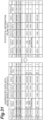
- the aggregation image generation unit 22 generates an aggregation target list illustrated on the lower left of FIG. 33 , in which combinations excluding non-existent combinations from the combinations described in the generated aggregation image are listed (step S12B).
- the anonymization processing unit 28 of the company B's device 20B performs anonymization processing (here, adding noise generated by the company B using the company A's computation key) on the aggregated data (here, aggregated data from which structured zeros have already been removed), and transmits the aggregated data after anonymization processing to the decryption unit 29 of the first device (company A's device) 20A (step S20).
- the decryption unit 29 of the first device (company A's device) 20A decrypts the transmitted aggregated data after anonymization processing, and outputs the decryption result as plain text's statistical information (step S21).
- the eighth embodiment described above only the combinations described in the aggregation target list excluding non-existent combinations are aggregation targets. Therefore, it is possible to prevent a situation in which the aggregation results of non-existent combinations (combinations that can be structured zeros) become non-zero values by anonymization processing and the usefulness of the aggregation results (statistical information) is lowered.
- all combinations that exist structurally are aggregation targets without omission even if these do not exist in the user data, it is possible to avoid a situation in which unstructured zeros (combinations that exist structurally but are not output) occur. As a result, it is possible to prevent unintended disclosure due to unstructured zeros.
- the eighth embodiment an example is shown in which the aggregation results for combinations that are described in the aggregation image but are not described in the aggregation target list (combinations that can be structured zeros) are not output.
- a form may be adopted in which the aggregation results for the above combinations are fixed to zero and output.
- each functional block may be realized using one physically or logically coupled device, or may be realized by connecting two or more physically or logically separated devices directly or indirectly (for example, using a wired or wireless connection) and using the plurality of devices.
- Each functional block may be realized by combining the above-described one device or the above-described plurality of devices with software.
- Functions include determining, judging, computing, calculating, processing, deriving, investigating, searching, ascertaining, receiving, transmitting, outputting, accessing, resolving, selecting, choosing, establishing, comparing, assuming, expecting, regarding, broadcasting, notifying, communicating, forwarding, configuring, reconfiguring, allocating, mapping, assigning, and the like, but are not limited thereto.
- a functional block (configuration unit) that makes the transmission work is called a transmitting unit or a transmitter.
- the implementation method is not particularly limited.
- the privacy-protected data aggregation device may function as a computer that performs the processing according to the present embodiment.
- FIG. 34 is a diagram illustrating an example of the hardware configuration of the privacy-protected data aggregation device 10 according to an embodiment of the present disclosure.
- the privacy-protected data aggregation device 10 described above may be physically configured as a computer device including a processor 1001, a memory 1002, a storage 1003, a communication device 1004, an input device 1005, an output device 1006, a bus 1007, and the like.
- the first device 20A and the second device 20B shown in FIG. 10 may be configured similarly to the privacy-protected data aggregation device 10.
- the hardware configuration of the privacy-protected data aggregation device 10 may include one or more devices for each device shown in the diagram, or may not include some devices.
- Each function of the privacy-protected data aggregation device 10 is realized by reading predetermined software (program) onto hardware, such as the processor 1001 and the memory 1002, so that the processor 1001 performs an operation and controlling communication by the communication device 1004 or controlling at least one of reading and writing of data in the memory 1002 and the storage 1003.
- predetermined software program
- the processor 1001 performs an operation and controlling communication by the communication device 1004 or controlling at least one of reading and writing of data in the memory 1002 and the storage 1003.
- the processor 1001 controls the entire computer by operating an operating system, for example.
- the processor 1001 may be a central processing unit (CPU) including an interface with peripheral devices, a control device, a calculation device, a register, and the like.
- CPU central processing unit
- the processor 1001 reads a program (program code), a software module, data, and the like into the memory 1002 from at least one of the storage 1003 and the communication device 1004, and performs various kinds of processing according to these.
- a program program code
- a program causing a computer to execute at least a part of the operation described in the above embodiment is used.
- the processor 1001 may be implemented by one or more chips.
- the program may be transmitted from a network through a telecommunication line.
- the memory 1002 is a computer-readable recording medium, and may be at least one of, for example, a ROM (Read Only Memory), an EPROM (Erasable Programmable ROM), an EEPROM (Electrically Erasable Programmable ROM), and a RAM (Random Access Memory).
- the memory 1002 may be called a register, a cache, a main memory (main storage device), and the like.
- the memory 1002 can store a program (program code), a software module, and the like that can be executed to implement the wireless communication method according to an embodiment of the present disclosure.
- the storage 1003 is a computer-readable recording medium, and may be at least one of, for example, an optical disk such as a CD-ROM (Compact Disc ROM), a hard disk drive, a flexible disk, and a magnetooptical disk (for example, a compact disk, a digital versatile disk, and a Blu-ray (Registered trademark) disk), a smart card, a flash memory (for example, a card, a stick, a key drive), a floppy (registered trademark) disk, and a magnetic strip.
- the storage 1003 may be called an auxiliary storage device.
- the storage medium described above may be, for example, a database including at least one of the memory 1002 and the storage 1003, a server, or other appropriate media.
- the communication device 1004 is hardware (transmitting and receiving device) for performing communication between computers through at least one of a wired network and a wireless network, and is also referred to as, for example, a network device, a network controller, a network card, and a communication module.
- the input device 1005 is an input device (for example, a keyboard, a mouse, a microphone, a switch, a button, and a sensor) for receiving an input from the outside.
- the output device 1006 is an output device (for example, a display, a speaker, and an LED lamp) that performs output to the outside.
- the input device 1005 and the output device 1006 may be integrated (for example, a touch panel).
- respective devices, such as the processor 1001 and the memory 1002 are connected to each other by the bus 1007 for communicating information.
- the bus 1007 may be configured using a single bus, or may be configured using a different bus for each device.
- notification of predetermined information is not limited to being explicitly performed, and may be performed implicitly (for example, without the notification of the predetermined information).
- Information and the like that are input and output may be stored in a specific place (for example, a memory) or may be managed using a management table.
- the information and the like that are input and output can be overwritten, updated, or added.
- the information and the like that are output may be deleted.
- the information and the like that are input may be transmitted to another device.
- the expression "A and B are different” may mean “A and B are different from each other”. In addition, the expression may mean that "A and B each are different from C”. Terms such as “separate”, “coupled” may be interpreted similarly to “different”.
- 1 privacy-protected data aggregation system
- 10 privacy-protected data aggregation device
- 11 user data storage unit
- 12 domain data storage unit
- 13 attribute information encryption unit
- 14 aggregation processing unit
- 15 anonymization processing unit
- 16 decryption unit
- 20A first device
- 20B second device
- 21 domain data storage unit
- 22 aggregation image generation unit
- 23 user data storage unit
- 24 first encryption unit
- 26 matching unit
- 27 aggregation processing unit
- 28 anonymization processing unit
- 29 decryption unit
- 1002 memory
- 1003 storage
- 1004 communication device
- 1005 input device
- 1006 output device
- 1007 bus.
Landscapes
- Engineering & Computer Science (AREA)
- Theoretical Computer Science (AREA)
- Bioethics (AREA)
- General Health & Medical Sciences (AREA)
- Health & Medical Sciences (AREA)
- Computer Security & Cryptography (AREA)
- Software Systems (AREA)
- Computer Hardware Design (AREA)
- Physics & Mathematics (AREA)
- General Engineering & Computer Science (AREA)
- General Physics & Mathematics (AREA)
- Databases & Information Systems (AREA)
- Medical Informatics (AREA)
- Computer Networks & Wireless Communication (AREA)
- Signal Processing (AREA)
- Computing Systems (AREA)
- Information Retrieval, Db Structures And Fs Structures Therefor (AREA)
- Traffic Control Systems (AREA)
Abstract
Description
- The present disclosure relates to a privacy-protected data aggregation device and a privacy-protected data aggregation system.
- It is widely demanded by society to perform aggregation processing while protecting personal information in a database. Such a technology is disclosed in, for example,
Patent Literature 1. In addition, differential privacy is known as a technology that enables statistical analysis while protecting personal information in a database from attackers. In data aggregation technology related to differential privacy, the concepts of "structured zero" and "unstructured zero" when counting a number of users corresponding to a combination of a plurality of pieces of attribute information are known. Of these, "structured zero" means that the output (aggregation result) is "0" due to a combination that does not exist structurally, and "unstructured zero" means that the aggregation result is not output even though the combination exists structurally. - Patent Literature 1:
Japanese Unexamined Patent Publication No. 2010-108488 - Considering a case where individual-form data is aggregated using secure computation and anonymization processing is performed on the aggregation result, if data of a combination of attribute information that structurally exists does not actually exist in the individual-form data, the aggregation result is not output because the combination is not an aggregation target. As a result, there is a problem that a third party becomes aware that the data of the combination does not exist in the individual-form data. That is, since the data of the combination corresponds to the unstructured zero described above, unintended disclosure due to the unstructured zero occurs.
- However,
Patent Literature 1 does not disclose any measures to prevent the above-described unintended disclosure due to unstructured zeros, and accordingly, such preventive measures have been demanded. - The present disclosure has been made to solve the aforementioned problem, and it is an object of the present disclosure to prevent unintended disclosure due to unstructured zeros.
- A privacy-protected data aggregation device according to the present disclosure includes: an attribute information encryption unit that encrypts attribute information in user data to be aggregated, which includes a plurality of pieces of attribute information, using a homomorphic encryption method that enables aggregation processing; an aggregation processing unit that aggregates user data with attribute information encrypted by the attribute information encryption unit, for all combinations of possible values of the plurality of pieces of attribute information in domain data that defines possible values of each of the pieces of attribute information included in the user data, to obtain aggregated data including an aggregation result and encrypted attribute information; an anonymization processing unit that performs anonymization processing on the aggregated data obtained by the aggregation processing unit; and a decryption unit that decrypts aggregated data subjected to the anonymization processing to obtain aggregated data including an aggregation result after the anonymization processing and decrypted attribute information.
- In the privacy-protected data aggregation device described above, the attribute information encryption unit encrypts attribute information in the user data to be aggregated, which includes a plurality of pieces of attribute information, using a homomorphic encryption method that enables aggregation processing, and the aggregation processing unit aggregates user data with encrypted attribute information, for all combinations of possible values of the plurality of pieces of attribute information in the domain data, to obtain aggregated data including an aggregation result and encrypted attribute information. In this manner, all possible combinations of values of a plurality of attribute information in the domain data are aggregated, and totaled data including the aggregation results and encrypted attribute information is obtained. Then, the anonymization processing unit performs anonymization processing on the aggregated data obtained by the aggregation processing unit, so that the aggregated data is anonymized, and the decryption unit decrypts aggregated data subjected to the anonymization processing to obtain aggregated data including an aggregation result after the anonymization processing and decrypted attribute information. In this manner, the aggregation result after the anonymization processing can be output in a format that can be checked by the user. In the series of processes described above, aggregation is performed for all combinations of the possible values of a plurality of pieces of attribute information in the domain data. Therefore, since it is possible to avoid a situation in which unstructured zeros (that is, combinations that exist structurally but are not output) occur, it is possible to prevent unintended disclosure due to unstructured zeros.
- According to the present disclosure, it is possible to prevent unintended disclosure due to unstructured zeros.
-
- [
FIG. 1] FIG. 1 is a functional block diagram of a privacy-protected data aggregation device according to each of first to fourth embodiments. - [
FIG. 2] FIG. 2 is a flow chart showing a process in the first embodiment. - [
FIG. 3] FIG. 3 is a diagram for explaining the process in the first embodiment. - [
FIG. 4] FIG. 4 is a flowchart showing a process in a second embodiment. - [
FIG. 5] FIG. 5 is a diagram for explaining the process in the second embodiment. - [
FIG. 6] FIG. 6 is a flowchart showing a process in a third embodiment. - [
FIG. 7] FIG. 7 is a diagram for explaining the process in the third embodiment. - [
FIG. 8] FIG. 8 is a flowchart showing a process in a fourth embodiment. - [
FIG. 9] FIG. 9 is a diagram for explaining the process in the fourth embodiment. - [
FIG. 10] FIG. 10 is a functional block diagram of a privacy-protected data aggregation device according to each of fifth to eighth embodiments. - [
FIG. 11] FIG. 11 is a flowchart showing a process in the fifth embodiment. -
FIG. 12(a) is a diagram showing an example of user data and domain data of a company A, andFIG. 12(b) is a diagram showing an example of user data and domain data of a company B. - [
FIG. 13] FIG. 13 is a diagram showing an aggregation image. - [
FIG. 14] FIG. 14 is a diagram showing the encryption of the company A's user data by the company A. - [
FIG. 15] FIG. 15 is a diagram showing the encryption of a user ID in the company A's user data by the company B. - [
FIG. 16] FIG. 16 is a diagram showing the encryption of a user ID in the company B's user data by the company B and the company A. - [
FIG. 17] FIG. 17 is a diagram showing matching processing by the company B. - [
FIG. 18] FIG. 18 is a diagram showing the categorization of matched data by the company B. - [
FIG. 19] FIG. 19 is a diagram showing aggregation processing by the company B. - [
FIG. 20] FIG. 20 is a diagram showing anonymization processing by the company B. - [
FIG. 21] FIG. 21 is a diagram showing decryption processing by the company A. - [
FIG. 22] FIG. 22 is a diagram for explaining patterns that result in structured zeros. - [
FIG. 23] FIG. 23 is a flowchart showing a process in a sixth embodiment. - [
FIG. 24] FIG. 24 is a diagram showing an example of a list with a structured zero flag (flagged list). - [
FIG. 25] FIG. 25 is a diagram showing aggregation processing by the company B in the sixth embodiment. - [
FIG. 26] FIG. 26 is a diagram showing anonymization processing by the company B in the sixth embodiment. - [
FIG. 27] FIG. 27 is a diagram showing decryption processing by the company A in the sixth embodiment. - [
FIG. 28] FIG. 28 is a flowchart showing a process in a seventh embodiment. - [
FIG. 29] FIG. 29 is a diagram showing aggregation processing by the company B in the seventh embodiment. - [
FIG. 30] FIG. 30 is a diagram showing anonymization processing by the company B in the seventh embodiment. - [
FIG. 31] FIG. 31 is a diagram showing decryption processing by the company A in the seventh embodiment. - [
FIG. 32] FIG. 32 is a flowchart showing a process in an eighth embodiment. - [
FIG. 33] FIG. 33 is a diagram showing aggregation processing by the company B in the eighth embodiment. - [
FIG. 34] FIG. 34 is a diagram showing an example of the hardware configuration of the privacy-protected data aggregation device. - Hereinafter, first to eighth embodiments of the present disclosure will be described in order with reference to the diagrams. Among these, in the first embodiment, a form of preventing unintended disclosure due to unstructured zeros in a privacy-protected data aggregation device will be described, and in the second to fourth embodiments, three forms of preventing unintended disclosure due to structured zero in the privacy-protected data aggregation device according to the first embodiment will be described. In the fifth embodiment, a form of preventing unintended disclosure due to unstructured zeros by cooperation between first and second devices included in a privacy-protected data aggregation system will be described, and in the sixth to eighth embodiments, three forms of further preventing unintended disclosure due to structured zero in the privacy-protected data aggregation system according to the fifth embodiment will be described.
- In the first embodiment, focusing on preventing unintended disclosure due to unstructured zeros, a form of preventing unintended disclosure due to unstructured zeros in a single privacy-protected data aggregation device will be described.
- As shown in
FIG. 1 , a privacy-protecteddata aggregation device 10 according to the first embodiment includes, as functional blocks, a userdata storage unit 11, a domaindata storage unit 12, an attributeinformation encryption unit 13, anaggregation processing unit 14, ananonymization processing unit 15, and adecryption unit 16. Hereinafter, an overview of each functional unit will be given. - The user
data storage unit 11 is a functional unit that stores user data to be aggregated, including a plurality of pieces of attribute information, and stores user data such as ID, place of departure, and place of arrival, for example, as "user data" shown inFIG. 3 . - The domain
data storage unit 12 is a functional unit that stores domain data that defines the possible values of each piece of attribute information included in the user data, and stores domain data indicating the possible values (Narita, Haneda, Naha, ..., Kagoshima) of "place of departure" and the possible values (Narita, Haneda, Naha, ..., Kagoshima) of "place of arrival", for example, as "domain data" shown inFIG. 3 . - In addition, in the present embodiment, an example will be described in which user data and domain data are stored in advance in the privacy-protected
data aggregation device 10. However, these pieces of data may also be input to the privacy-protecteddata aggregation device 10 from an external device. In this case, the userdata storage unit 11 and the domaindata storage unit 12 are not components of the privacy-protecteddata aggregation device 10. - The attribute
information encryption unit 13 is a functional unit that encrypts attribute information in the user data to be aggregated, which includes a plurality of pieces of attribute information, using a homomorphic encryption method that enables aggregation processing. As a homomorphic encryption method that enables aggregation processing, for example, an encryption method having additive homomorphism or complete homomorphism can be adopted. - The
aggregation processing unit 14 is a functional unit that aggregates user data with attribute information encrypted by the attributeinformation encryption unit 13, for all combinations of possible values of a plurality of pieces of attribute information in the above-described domain data, to obtain aggregated data including the aggregation result and the encrypted attribute information. - The
anonymization processing unit 15 is a functional unit that performs anonymization processing on the aggregated data obtained by theaggregation processing unit 14. - The
decryption unit 16 is a functional unit that decrypts the aggregated data subjected to the anonymization processing to obtain aggregated data that includes the aggregation result after the anonymization processing and the decrypted attribute information, and thedecryption unit 16 outputs the obtained aggregated data. - In the privacy-protected
data aggregation device 10 including the functional blocks described above, a process shown inFIG. 2 is performed. - First, user data stored in the user
data storage unit 11 and domain data stored in the domaindata storage unit 12 are read and acquired so that these can be executed in subsequent processing (step S1). In addition, as described above, these pieces of data may be acquired by being input (received) from an external device. - Then, the attribute
information encryption unit 13 encrypts the attribute information of the user data using a homomorphic encryption method that enables aggregation processing (for example, an encryption method having additive homomorphism or complete homomorphism) (step S2). - Then, the
aggregation processing unit 14 aggregates the user data with the encrypted attribute information for all combinations of requirements in the domain data to generate aggregated data with the encrypted attribute information (step S3). In this manner, as shown in "aggregated data" inFIG. 3 , aggregated data including the aggregation result (the number of people) with encrypted attribute information (place of departure, place of arrival) is generated. At this time, since user data is aggregated for all combinations of requirements in the domain data, all combinations that exist structurally are aggregation targets without omission even if these do not exist in the user data. For example, user data for the combination of place of departure "Kagoshima" and place of arrival "Naha" does not exist in the user data and the aggregation result (the number of people) is "0 people", but the user data for the combination of place of departure "Kagoshima" and place of arrival "Naha" is not omitted from the aggregated data and is included in the aggregated data as an aggregation result of "0 people". That is, it is possible to avoid a situation in which unstructured zeros (combinations that exist structurally but are not output) occur. - Then, the
anonymization processing unit 15 performs anonymization processing on the above-described aggregated data (step S4), and thedecryption unit 16 decrypts the aggregation result after anonymization processing to obtain aggregated data including the aggregation result after anonymization processing and the decrypted attribute information, and outputs the aggregated data in plain text (step S5). In this manner, as shown in "aggregated data after anonymization processing" inFIG. 3 , aggregated data in which the attribute information (place of departure, place of arrival) has been decrypted and the aggregation result (the number of people) has been subjected to anonymization processing is obtained and output. As a result, although the user data for the combination of place of departure "Kagoshima" and place of arrival "Naha" does not exist in the user data and the aggregation result (the number of people) is "0 people", the user data for the combination of place of departure "Kagoshima" and place of arrival "Naha" is included as an aggregation result of "0 people" in the aggregated data before the anonymization processing and is included as an aggregation result of "2 people" in the aggregated data after the anonymization processing. - As described above, according to the first embodiment, it is possible to avoid a situation in which unstructured zeros (combinations that exist structurally but are not output) occur. As a result, it is possible to prevent unintended disclosure due to unstructured zeros.
- In the second embodiment, in addition to the first embodiment in which unintended disclosure due to unstructured zeros is prevented, a form of preventing a situation, in which the aggregation results of structured zero combinations become non-zero values and the usefulness of the aggregation results (statistical information) is lowered, by excluding the structured zero combinations from anonymization processing targets and fixing the aggregation results to zero will be further described.
- Since the functional block configuration of the privacy-protected
data aggregation device 10 according to the second embodiment is the same as the above configuration shown inFIG. 1 , repeated descriptions thereof will be omitted. However, among the functional units inFIG. 1 , theanonymization processing unit 15 has a feature of fixing the aggregation result of a flagged combination in the aggregated data to zero and performing anonymization processing on an unflagged combination in the aggregated data by referring to a flagged list in which non-existent combinations, among all combinations of the possible values of a plurality of pieces of attribute information in the domain data, are flagged. - For example, the above-described "flagged list" may be generated in advance and stored in the domain
data storage unit 12, or may be generated from the domain data at that time by the domaindata storage unit 12 as described below. - In the privacy-protected
data aggregation device 10 according to the second embodiment, a process shown inFIG. 4 is performed. In addition, inFIG. 4 , the same step numbers are given to the same processes as those in the first embodiment (FIG. 2 ), and detailed descriptions thereof will be omitted. - First, user data stored in the user
data storage unit 11 and domain data stored in the domaindata storage unit 12 are acquired so that these can be executed in subsequent processing (step S1). Then, the domaindata storage unit 12 generates the above-described "flagged list" by assigning a structured zero flag to non-existent combinations (combinations that can be structured zeros) among all combinations of the possible values of a plurality of pieces of attribute information in the domain data at that time (step S1A). For example, as shown in the "flagged list" inFIG. 5 , a structured zero flag "1" is assigned to a combination of place of departure "Narita" and place of arrival "Narita", which does not exist, and similarly, a structured zero flag "1" is assigned to a combination of place of departure "Narita" and place of arrival "Haneda", which does not exist. For existent combinations (for example, a combination of place of departure "Narita" and place of arrival "Naha"), the flag is set to "0". Such a flagged list is transmitted from the domaindata storage unit 12 to theanonymization processing unit 15 through theaggregation processing unit 14. - Thereafter, as in the first embodiment, the attribute
information encryption unit 13 encrypts the attribute information of the user data using a homomorphic encryption method that enables aggregation processing (for example, an encryption method having additive homomorphism or complete homomorphism) (step S2), and theaggregation processing unit 14 aggregates the user data with the encrypted attribute information for all combinations of requirements in the domain data to generate aggregated data with the encrypted attribute information (step S3). In this manner, as shown in "aggregated data" inFIG. 5 , aggregated data including the aggregation result (the number of people) with encrypted attribute information (place of departure, place of arrival) is generated. At this time, since user data is aggregated for all combinations of requirements in the domain data, all combinations that exist structurally are aggregation targets without omission even if these do not exist in the user data. Therefore, as in the first embodiment, it is possible to avoid a situation in which unstructured zeros (combinations that exist structurally but are not output) occur. - Then, the
anonymization processing unit 15 fixes the aggregation result of a flagged combination in the aggregated data to zero and performs anonymization processing on an unflagged combination in the aggregated data by referring to the flagged list (step S4A). Therefore, it is possible to prevent a situation in which the aggregation results of flagged non-existent combinations (combinations that can be structured zeros) become non-zero values by anonymization processing and the usefulness of the aggregation results (statistical information) is lowered. - Thereafter, the
decryption unit 16 decrypts the aggregation result after step S4A, in which non-existent combinations are fixed to zero, to obtain aggregated data including the aggregation result after anonymization processing and the decrypted attribute information, and outputs the aggregated data in plain text (step S5). In this manner, as shown in "aggregated data after anonymization processing" inFIG. 5 , aggregated data in which the attribute information (place of departure, place of arrival) has been decrypted and the aggregation result (the number of people) has been subjected to anonymization processing is obtained and output. - According to the second embodiment described above, the aggregation results (the number of people) of non-existent combinations that can be structured zeros (for example, a combination of place of departure "Narita" and place of arrival "Narita" and a combination of place of departure "Narita" and place of arrival "Haneda") are fixed to zero and output. Therefore, it is possible to prevent a situation in which the aggregation results of non-existent combinations become non-zero values by anonymization processing and the usefulness of the aggregation results (statistical information) is lowered. In addition, as in the first embodiment, since all combinations that exist structurally are aggregation targets without omission even if these do not exist in the user data, it is possible to avoid a situation in which unstructured zeros (combinations that exist structurally but are not output) occur. As a result, it is possible to prevent unintended disclosure due to unstructured zeros.
- In the third embodiment, in addition to the first embodiment in which unintended disclosure due to unstructured zeros is prevented, a form of preventing a situation, in which the aggregation results of structured zero combinations become non-zero values by subsequent anonymization processing and the usefulness of the aggregation results (statistical information) is lowered, by excluding the structured zero combinations from aggregation processing targets so as not to be included in aggregated data.
- Since the functional block configuration of the privacy-protected
data aggregation device 10 according to the third embodiment is the same as the above configuration shown inFIG. 1 , repeated descriptions thereof will be omitted. However, among the functional units inFIG. 1 , theaggregation processing unit 14 has a feature of aggregating the above user data for combinations that are not flagged, among all the above combinations, by referring to a flagged list in which non-existent combinations among all combinations of the possible values of a plurality of pieces of attribute information in the domain data are flagged. - For example, the above-described "flagged list" may be generated in advance and stored in the domain
data storage unit 12, or may be generated from the domain data at that time by the domaindata storage unit 12 as described below. - In the privacy-protected
data aggregation device 10 according to the third embodiment, a process shown inFIG. 6 is performed. In addition, inFIG. 6 , the same step numbers are given to the same processes as those in the first embodiment (FIG. 2 ), and detailed descriptions thereof will be omitted. - First, user data stored in the user
data storage unit 11 and domain data stored in the domaindata storage unit 12 are acquired so that these can be executed in subsequent processing (step S1). Then, as in the second embodiment, the domaindata storage unit 12 generates the above-described "flagged list" by assigning a structured zero flag to non-existent combinations (combinations that can be structured zeros) among all combinations of the possible values of a plurality of pieces of attribute information in the domain data at that time. For example, as shown in "flagged list" inFIG. 7 , a structured zero flag "1" is assigned to a combination of place of departure "Narita" and place of arrival "Narita", which does not exist, and similarly, a structured zero flag "1" is assigned to a combination of place of departure "Narita" and place of arrival "Haneda", which does not exist. For existent combinations (for example, a combination of place of departure "Narita" and place of arrival "Naha"), the flag is set to "0". Such a flagged list is transmitted from the domaindata storage unit 12 to theanonymization processing unit 15 through theaggregation processing unit 14. - Then, as in the first embodiment, the attribute
information encryption unit 13 encrypts the attribute information of the user data using a homomorphic encryption method that enables aggregation processing (for example, an encryption method having additive homomorphism or complete homomorphism) (step S2), and theaggregation processing unit 14 aggregates the user data with the encrypted attribute information for combinations (combinations with a flag "0" in the example ofFIG. 5 ) excluding combinations with the above flag assigned from all combinations of requirements by referring to the flagged list, thereby generating aggregated data with the encrypted attribute information (step S3A). In this manner, as shown in "aggregated data" inFIG. 7 , aggregated data including the aggregation result (the number of people) with encrypted attribute information (place of departure, place of arrival) is generated. In this case, as shown by the strikethrough inFIG. 7 , combinations that do not exist (combinations that can be structured zeros) are excluded from aggregation processing targets so as not to be included in the aggregated data. Therefore, it is possible to prevent a situation in which the aggregation results of flagged non-existent combinations (combinations that can be structured zeros) become non-zero values by anonymization processing and the usefulness of the aggregation results (statistical information) is lowered. On the other hand, among all combinations of requirements, structured zero combinations are excluded from aggregation processing targets, but combinations other than the structured zero combinations are aggregation targets even if the combinations other than the structured zero combinations do not exist in the user data. Therefore, as in the first embodiment, it is possible to avoid a situation in which unstructured zeros (combinations that exist structurally but are not output) occur. - Thereafter, the
anonymization processing unit 15 performs anonymization processing on the above-described aggregated data (aggregated data with non-existent combinations removed) (step S4), and thedecryption unit 16 decrypts the aggregated data after the anonymization processing to obtain aggregated data including the aggregation result after anonymization processing and the decrypted attribute information, and outputs the aggregated data in plain text (step S5). In this manner, as shown in "aggregated data after anonymization processing" inFIG. 7 , aggregated data after non-existent combinations are removed, in which the attribute information (place of departure, place of arrival) has been decrypted and the aggregation result (the number of people) has been subjected to anonymization processing, is obtained and output. - According to the third embodiment described above, the aggregation results (the number of people) of non-existent combinations that can be structured zeros (for example, a combination of place of departure "Narita" and place of arrival "Narita" and a combination of place of departure "Narita" and place of arrival "Haneda") are not output. Therefore, it is possible to prevent a situation in which the aggregation results of non-existent combinations become non-zero values by anonymization processing and the usefulness of the aggregation results (statistical information) is lowered. In addition, as in the first embodiment, since all combinations that exist structurally are aggregation targets without omission even if these do not exist in the user data, it is possible to avoid a situation in which unstructured zeros (combinations that exist structurally but are not output) occur. As a result, it is possible to prevent unintended disclosure due to unstructured zeros.
- In the fourth embodiment, in addition to the first embodiment in which unintended disclosure due to unstructured zeros is prevented, a form of preventing a situation, in which the aggregation results of structured zero combinations become non-zero values by subsequent anonymization processing and the usefulness of the aggregation results (statistical information) is lowered, by narrowing down the aggregation targets based on the aggregation target list excluding the structured zero combinations and then performing aggregation processing will be further described.
- Since the functional block configuration of the privacy-protected
data aggregation device 10 according to the fourth embodiment is the same as the above configuration shown inFIG. 1 , repeated descriptions thereof will be omitted. However, among the functional units inFIG. 1 , theaggregation processing unit 14 has a feature of aggregating the above user data for combinations included in the aggregation target list by referring to the aggregation target list in which combinations excluding non-existent combinations from all combinations of the possible values of a plurality of pieces of attribute information in the domain data are listed. - For example, the above-described "aggregation target list" may be generated in advance as described below and stored in the domain
data storage unit 12, or may be generated from the domain data at that time by the domaindata storage unit 12. - In the privacy-protected
data aggregation device 10 according to the fourth embodiment, a process shown inFIG. 8 is performed. In addition, inFIG. 8 , the same step numbers are given to the same processes as those in the first embodiment (FIG. 2 ), and detailed descriptions thereof will be omitted. - First, user data stored in the user
data storage unit 11 and the above-described aggregation target list stored in the domain data storage unit 12 (a list in which combinations of attribute information that are not structured zeros (that are aggregation targets) are described) are acquired (step S1B). As illustrated as "aggregation target list" inFIG. 9 , the aggregation target list is a list that includes all possible "combinations of departure and place of arrivals", and all the combinations in the list are aggregation targets. - Then, as in the first embodiment, the attribute
information encryption unit 13 encrypts the attribute information of the user data using a homomorphic encryption method that enables aggregation processing (for example, an encryption method having additive homomorphism or complete homomorphism) (step S2). Then, theaggregation processing unit 14 aggregates the user data with the encrypted attribute information for all combinations described in the aggregation target list, thereby generating aggregated data with the encrypted attribute information (step S3B). In this manner, as shown in "aggregated data" inFIG. 9 , aggregated data including the aggregation result (the number of people) with encrypted attribute information (place of departure, place of arrival) is generated for all combinations described in the aggregation target list. At this time, since combinations that do not exist (combinations that can be structured zeros) are excluded from the aggregation target list, the combinations that do not exist (combinations that can be structured zeros) are not aggregation processing targets and accordingly not included in the aggregated data. Therefore, it is possible to prevent a situation in which the aggregation results of non-existent combinations (combinations that can be structured zeros) become non-zero values by anonymization processing and the usefulness of the aggregation results (statistical information) is lowered. On the other hand, among all combinations of requirements, structured zero combinations are excluded from aggregation processing targets, but combinations other than the structured zero combinations are aggregation targets even if the combinations other than the structured zero combinations do not exist in the user data. Therefore, as in the first embodiment, it is possible to avoid a situation in which unstructured zeros (combinations that exist structurally but are not output) occur. - Thereafter, the
anonymization processing unit 15 performs anonymization processing on the above-described aggregated data (aggregated data with non-existent combinations removed) (step S4), and thedecryption unit 16 decrypts the aggregated data after the anonymization processing to obtain aggregated data including the aggregation results after the anonymization processing and the decrypted attribute information, and outputs the same in plain text (step S5). In this manner, as shown in "aggregated data after anonymization processing" inFIG. 9 , aggregated data that non-existent combinations are removed, in which the attribute information (place of departure, place of arrival) has been decrypted and the aggregation result (the number of people) has been subjected to anonymization processing, is obtained and output. - According to the fourth embodiment described above, the aggregation results (the number of people) of non-existent combinations that can be structured zeros (for example, a combination of place of departure "Narita" and place of arrival "Narita" and a combination of place of departure "Narita" and place of arrival "Haneda") are not output. Therefore, it is possible to prevent a situation in which the aggregation results of non-existent combinations become non-zero values by anonymization processing and the usefulness of the aggregation results (statistical information) is lowered. In addition, as in the first embodiment, since all combinations that exist structurally are aggregation targets without omission even if these do not exist in the user data, it is possible to avoid a situation in which unstructured zeros (combinations that exist structurally but are not output) occur. As a result, it is possible to prevent unintended disclosure due to unstructured zeros.
- In the fifth embodiment, a form will be described in which unintended disclosure due to unstructured zeros is prevented by cooperation between first and second device included in a privacy-protected data aggregation system.
- As shown in
FIG. 10 , a privacy-protecteddata aggregation system 1 according to the fifth embodiment includes afirst device 20A that provides a first service and asecond device 20B that provides a second service, and counts a number of target users through cooperation between thefirst device 20A and thesecond device 20B by processes described below. - In the present embodiment, the
first device 20A and thesecond device 20B share the role of performing a series of processes. Although detailed descriptions will be given later, a form in which thesecond device 20B performs matching, aggregation processing, and anonymization processing and thefirst device 20A finally performs decryption and output will be described as an example. As functional blocks for this purpose, thefirst device 20A includes a domaindata storage unit 21, an aggregationimage generation unit 22, a userdata storage unit 23, afirst encryption unit 24, and adecryption unit 29, all of which are shown by solid lines inFIG. 10 , and thesecond device 20B includes a domaindata storage unit 21, an aggregationimage generation unit 22, a userdata storage unit 23, asecond encryption unit 25, amatching unit 26, anaggregation processing unit 27, and ananonymization processing unit 28, all of which are shown by solid lines inFIG. 10 . - However, the above-described division of roles, in which the
second device 20B performs matching, aggregation processing, and anonymization processing and thefirst device 20A finally performs decryption and output, is an example. For example, thefirst device 20A and thesecond device 20B may have a common functional block configuration in both devices by including functional units shown by dashed lines inFIG. 10 . In this case, it is possible to realize a division of roles in which thefirst device 20A performs matching, aggregation processing, and anonymization processing and thesecond device 20B finally performs decryption and output. - Hereinafter, an overview of each functional unit will be given. The user
data storage unit 23 of thefirst device 20A is a functional unit that stores first user data including a first user ID and first attribute information regarding a user of the first service, and the domaindata storage unit 21 is a functional unit that stores domain data that defines possible values of the first attribute information. Similarly, the userdata storage unit 23 of thesecond device 20B is a functional unit that stores second user data including a second user ID and second attribute information regarding a user of the second service, and the domaindata storage unit 21 is a functional unit that stores domain data that defines possible values of the second attribute information. - The aggregation
image generation unit 22 included in both thefirst device 20A and thesecond device 20B generates an aggregation image, in which all combinations of the first attribute information and the second attribute information are described, based on first domain data that defines the possible values of the first attribute information and second domain data that defines the possible values of the second attribute information, and shares the generated aggregation image with thesecond device 20B. - The
first encryption unit 24 is a functional unit that encrypts the first user ID with a private key for user ID of the first device and encrypts the first attribute information with a private key for attribute information of the first device and transmits first user data including the encrypted first user ID and first attribute information to thesecond device 20B and that receives an encrypted second user ID, which is obtained by encrypting the second user ID with a private key for user ID of thesecond device 20B, from thesecond device 20B, encrypts the encrypted second user ID with the private key for user ID of thefirst device 20A, and transmits the encryption result to thesecond device 20B. - The
second encryption unit 25 is a functional unit that further encrypts the first user ID, which is encrypted with the private key for user ID of the first device by thefirst encryption unit 24, with a private key for user ID of thesecond device 20B and that encrypts the second user ID with the private key for user ID of thesecond device 20B, transmits the encrypted second user ID to thefirst device 20A, and acquires the second user ID that has been further encrypted with the private key for user ID of thefirst device 20A by thefirst device 20A. - The matching
unit 26 is a functional unit that matches the first user data encrypted by thefirst encryption unit 24 with the second user data by comparing the first user ID and the second user ID, both of which are encrypted with the private key for user ID of thefirst device 20A and the private key for user ID of thesecond device 20B. - The
aggregation processing unit 27 is a functional unit that categorizes the matched data based on the unencrypted second attribute information in the second user data and aggregates the categorized matched data for all combinations described in the above aggregation image to obtain aggregated data including aggregation results for each combination of the encrypted first attribute information and the unencrypted second attribute information. - The
anonymization processing unit 28 is a functional unit that performs anonymization processing on the aggregated data by adding noise generated based on the published computation key of thefirst device 20A to the aggregated data obtained by theaggregation processing unit 27. Here, the aggregated data after noise is added satisfies differential privacy. In addition, as types of noise, for example, a Laplace mechanism, a Gaussian mechanism, and an exponential mechanism can be adopted. The same applies to "noise" described in the following embodiments. - The
decryption unit 29 is a functional unit that decrypts the aggregated data subjected to anonymization processing based on the published computation key of thefirst device 20A and the private key for attribute information of thefirst device 20A to obtain aggregated data including the decrypted anonymized aggregation results for each combination of the decrypted first attribute information and the unencrypted second attribute information. - In the privacy-protected
data aggregation system 1 configured as described above, a process shown inFIG. 11 is performed. - First, in the first device (also called company A's device) 20A, the first user data stored in the user
data storage unit 23 and the domain data stored in the domaindata storage unit 21 are read and acquired so that these can be executed in subsequent processing (step S11A). As illustrated inFIG. 12(a) , the first user data includes a user ID (IDA), a place of departure, and place of arrival, and the above-described domain data includes possible values (Haneda, Naha, Fukuoka, ...) for the "place of departure" and possible values (Haneda, Naha, Fukuoka, ...) for the "place of arrival". The name of the airport is used for the "place of departure" and the "place of arrival" in the first user data and domain data related to the first device (company A's device). On the other hand, in the second device (also called company B's device) 20B as well, the second user data stored in the userdata storage unit 23 and the domain data stored in the domaindata storage unit 21 are acquired so that these can be executed in subsequent processing (step S 11B). As illustrated inFIG. 12(b) , the second user data includes a user ID (IDB), a place of departure, place of arrival, and means of transportation, and the above-described domain data includes possible values (Haneda, Naha, Fukuoka, ...) for the "place of departure", possible values (Haneda, Naha, Fukuoka, ...) for the "place of arrival" (Haneda, Naha, Fukuoka, ...), and possible values (airplane, Shinkansen, car, ...) for the "means of transportation". The names of prefectures are used for the "place of departure" and the "place of arrival" in the second user data and domain data related to the second device (company B's device). - Then, the aggregation
image generation units 22 of the first and second devices cooperate with each other to generate an aggregation image such as that shown inFIG. 13 , in which all combinations of the first attribute information and the second attribute information are described, based on the first domain data that defines the possible values of the first attribute information and the second domain data that defines the possible values of the second attribute information, and share the generated aggregation image with each other. As shown inFIG. 13 , the aggregation image includes all combinations of the first attribute information (company A's "place of departure" and "place of arrival") and the second attribute information (company B's "place of departure", "place of arrival", and "means of transportation"), and an "aggregation result" column is provided for each combination. - Then, as shown in
FIG. 14 , thefirst encryption unit 24 of the first device (company A's device) 20A encrypts the first user IDA in the first user data with the company A's private key a and encrypts the first attribute information (place of departure, place of arrival) with company A's private key A, and transmits the encrypted first user data to thesecond encryption unit 25 of the second device (company B's device) 20B (step S13). - Then, as shown in
FIG. 15 , thesecond encryption unit 25 of the second device (company B's device) 20B further encrypts the first user IDA in the transmitted encrypted first user data with the company B's private key b (step S14), and as shown inFIG. 16 , thesecond encryption unit 25 of the second device (company B's device) 20B encrypts the second user IDB in the second user data with company B's private key b and transmits the encrypted second user IDB to thefirst encryption unit 24 of the first device (company A's device) 20A (step S15). - Then, as shown in
FIG. 16 , thefirst encryption unit 24 of the first device (company A's device) 20A further encrypts the transmitted encrypted second user IDB with the company A's private key a, and transmits the encrypted second user IDB to thesecond encryption unit 25 of the second device (company B's device) 20B (step S16). The encrypted second user IDB received by thesecond encryption unit 25 of the second device (company B's device) 20B is transmitted to thematching unit 26. - Then, as shown in
FIG. 17 , the matchingunit 26 of the second device (company B's device) 20B matches the second user data including the encrypted second user IDB with the first user data including the encrypted first user IDA based on the first and second user IDs encrypted with the private keys a and b (step S17) to obtain matched data. The matched data obtained herein includes a combination of first and second user data with matching IDs, and includes first attribute information (place of departure, place of arrival) encrypted with company A's private key A and unencrypted second attribute information (place of departure, place of arrival, means of transportation) as illustrated inFIG. 17 . The matched data is transmitted to theaggregation processing unit 27. - Then, as shown in
FIG. 18 , theaggregation processing unit 27 of the second device (company B's device) 20B categorizes the matched data according to whether or not the unencrypted second attribute information (company B's attribute information) is common (step S18). Then, as shown inFIG. 19 , theaggregation processing unit 27 of the second device (company B's device) 20B aggregates the categorized matched data for each category to generate aggregated data (step S19). Here, as shown inFIG. 18 , the "place of departure, place of arrival, means of transportation" in the second attribute information is categorized into data of "Chiba, Okinawa, airplane" and data of "Tokyo, Osaka, Shinkansen". Of these, for the data of "Chiba, Okinawa, airplane", the first attribute information (Narita, Naha) is encrypted with the company A's private key A. Therefore, since it can be determined that the same bit string is set and the first attribute information is the same although the contents are not known, the aggregation result is "2". On the other hand, for the data of "Tokyo, Osaka, Shinkansen", the first attribute information is also encrypted with the company A's private key A. Therefore, although the contents are not known, depending on whether the bit string is the same or not, data with first attribute information of "Haneda, Itami" and data with first attribute information of "Haneda, Kansai International" are aggregated separately. For the data with the first attribute information of "Haneda, Itami", the aggregation result is "2", and for the data with the first attribute information of "Haneda, Kansai International", the aggregation result is "1". In addition, in the present embodiment, the aggregation result is encrypted with the company A's computation key, which is a kind of public key. - The processing of steps S18 and S19 described above is performed on all combinations of the first attribute information and the second attribute information included in the aggregation image of
FIG. 13 . Therefore, since all combinations that exist structurally are aggregation targets without omission even if these do not exist in the user data, it is possible to avoid a situation in which unstructured zeros (combinations that exist structurally but are not output) occur. - Then, the
anonymization processing unit 28 of the second device (company B's device) 20B performs anonymization processing (as an example, adding noise generated by the company B using the company A's computation key as shown inFIG. 20 ) on the aggregated data, and transmits the aggregated data after anonymization processing to thedecryption unit 29 of the first device (company A's device) 20A(step S20). - Then, the
decryption unit 29 of the first device (company A's device) 20A decrypts the transmitted aggregated data after anonymization processing, and outputs the decryption result as plain text's statistical information shown on the right side ofFIG. 21 (step S21). At this time, the first attribute information included in the aggregated data after anonymization processing is encrypted with the company A's private key A. However, thedecryption unit 29 can decrypt the first attribute information because thedecryption unit 29 can use its own private key A. In addition, the aggregation result included in the aggregated data after anonymization processing is encrypted with the company A's computation key. However, thedecryption unit 29 can also decrypt the aggregation result because thedecryption unit 29 can use its own computation key. - According to the fifth embodiment described above, processing such as aggregation is performed on all combinations of the first attribute information and the second attribute information. Therefore, since all combinations that exist structurally are aggregation targets without omission even if these do not exist in the user data, it is possible to avoid a situation in which unstructured zeros (combinations that exist structurally but are not output) occur. As a result, it is possible to prevent unintended disclosure due to unstructured zeros.
- In the sixth embodiment, in addition to the fifth embodiment in which unintended disclosure due to unstructured zeros is prevented, a form of preventing a situation, in which the aggregation results of structured zero combinations become non-zero values and the usefulness of the aggregation results (statistical information) is lowered, by excluding the structured zero combinations from anonymization processing targets and fixing the aggregation results to zero will be further described.
- Since the functional block configuration of a privacy-protected
data aggregation system 1 according to the sixth embodiment is the same as the above configuration shown inFIG. 10 , repeated descriptions thereof will be omitted. However, among the functional units inFIG. 10 , the aggregationimage generation unit 22 has a feature of generating a flagged list by assigning a flag to non-existent combinations (that is, structured zero combinations), among the combinations described in the aggregation image, based on the generated aggregation image, and theanonymization processing unit 28 has a feature of fixing the aggregation results for flagged combinations in the aggregated data to zero and performing anonymization processing on combinations that are not flagged in the aggregated data by referring to the flagged list. - First, referring to
FIG. 22 , a pattern in which structured zero occurs in the user data of companies A and B will be described. As shown inFIG. 22 , there are four patterns (1) to (4) in total that result in structured zeros. - Pattern (1) is a pattern in which the attribute information of the data of the company A (or the company B) is the same. For example, a pattern in which the "place of departure" and the "place of arrival" in the attribute information of the company A are both "Haneda airport" can be mentioned. In addition, in the table of
FIG. 22 , "*" indicates any value. Any pattern in which the "place of departure" and the "place of arrival" in the attribute information of the company A are both "Haneda airport" corresponds to pattern (1) regardless of the value of the company B's attribute information. - Pattern (2) is a pattern in which the attribute information of the data of the company A (or the company B) is different but the combination does not exist. For example, a pattern in which the "place of departure" and the "place of arrival" in the attribute information of the company A are "Haneda airport" and "Narita Point", respectively, but the combination does not exist can be mentioned.
- Pattern (3) is a pattern in which the attribute information "place of departure" related to the "place of departure" in the company A's data and the attribute information related to the "place of arrival" in the company B's data are the same. For example, a pattern in which the "place of departure" in the attribute information of the company A and the "place of arrival" in the attribute information of the company B are both "Haneda airport" can be mentioned. That is, this is a pattern in which the attribute information of the company A and the attribute information of the company B may exist individually but combining these forms a combination that does not exist.
- Pattern (4) is a pattern in which the attribute information "place of departure" related to the "place of departure" in the company A's data and the attribute information related to the "place of arrival" in the company B's data are different but the combination does not exist. For example, a pattern in which the "place of departure" in the attribute information of the company A is "Haneda airport" and the "place of arrival" in the attribute information of the company B is "Tokyo" but the combination does not exist can be mentioned. Similarly to the above pattern (3), this is also a pattern in which the attribute information of the company A and the attribute information of the company B may exist individually but combining these forms a combination that does not exist.
- In the privacy-protected
data aggregation system 1 according to the sixth embodiment, a process shown inFIG. 23 is performed. In addition, inFIG. 23 , the same step numbers are given to the same processes as those in the fifth embodiment (FIG. 11 ), and detailed descriptions thereof will be omitted. - First, first user data and domain data of the company A's
device 20A and second user data and domain data of the company B'sdevice 20B are acquired so that these can be executed in subsequent processing (steps S11A and S11B). The aggregationimage generation units 22 of the first and second devices cooperate with each other to generate an aggregation image such as that shown inFIG. 13 , in which all combinations of the first attribute information and the second attribute information are described, and share the generated aggregation image with each other (step S12). In addition, by inputting structured zero patterns into the aggregation image on both sides, a flagged list with structured zero flags assigned as shown inFIG. 24 is generated (step S12A).FIG. 24 illustrates an example of a flagged list in which a column for "structured zero flag" is added to the aggregation image. In addition, although only data with a structured zero flag set to "1" is shown inFIG. 24 , it is needless to say that the flag is set to "0" for combinations of attribute information that are not structured zeros. - Thereafter, steps S13 to S18 in
FIG. 23 are executed in the same manner as in the fifth embodiment. In addition, theaggregation processing unit 27 of the company B'sdevice 20B aggregates the user data (matched data) categorized based on the attribute information of the company B for each category (step S19). Here, for example, using a flagged list as shown inFIG. 25 , an aggregation result for each combination in the flagged list is obtained, and aggregated data is obtained by encrypting the aggregation result with the published computation key of the company A. - Then, as shown in
FIG. 26 , theanonymization processing unit 28 of the company B'sdevice 20B fixes the aggregation results for combinations with a flag "1" in the aggregated data to zero and performs anonymization processing (adding noise generated by the company B using the company A's computation key) on unflagged combinations in the aggregated data by referring to the flagged list, and transmits the aggregated data after anonymization processing to thedecryption unit 29 of the first device (company A's device) 20A (step S20A). In addition, thedecryption unit 29 of the first device (company A's device) 20A decrypts the transmitted aggregated data after anonymization processing, and outputs the decryption result as plain text's statistical information shown on the right side ofFIG. 27 (step S21). - According to the sixth embodiment described above, the aggregation results for combinations with a flag " 1" (combinations that can be structured zeros) in the flagged list are fixed to zero without anonymization processing and output. Therefore, it is possible to prevent a situation in which the aggregation results of non-existent combinations become non-zero values by anonymization processing and the usefulness of the aggregation results (statistical information) is lowered. In addition, as in the fifth embodiment, since all combinations that exist structurally are aggregation targets without omission even if these do not exist in the user data, it is possible to avoid a situation in which unstructured zeros (combinations that exist structurally but are not output) occur. As a result, it is possible to prevent unintended disclosure due to unstructured zeros.
- In addition, in the sixth embodiment, an example is shown in which the aggregation results for combinations with a flag "1" (combinations that can be structured zeros) in the flagged list are fixed to zero and output. However, instead of this, a form may be adopted in which the aggregation results for combinations with a flag "1" are not output.
- In the seventh embodiment, in addition to the fifth embodiment in which unintended disclosure due to unstructured zeros is prevented, a form of preventing a situation, in which the aggregation results of structured zero combinations become non-zero values and the usefulness of the aggregation results (statistical information) is lowered, by excluding the structured zero combinations from anonymization processing targets and fixing the aggregation results to zero will be further described.
- Since the functional block configuration of the privacy-protected
data aggregation system 1 according to the seventh embodiment is the same as the above configuration shown inFIG. 10 , repeated descriptions thereof will be omitted. However, among the functional units inFIG. 10 , the aggregationimage generation unit 22 has a feature of generating a flagged list by assigning a flag to non-existent combinations (that is, structured zero combinations), among the combinations described in the aggregation image, based on the aggregation image in which all combinations of the first attribute information and the second attribute information are described, and theaggregation processing unit 27 has a feature of aggregating user data for combinations that are not flagged by referring to the flagged list. - In the privacy-protected
data aggregation system 1 according to the seventh embodiment, a process shown inFIG. 28 is performed. In addition, inFIG. 28 , the same step numbers are given to the same processes as those in the fifth embodiment (FIG. 11 ), and detailed descriptions thereof will be omitted. - First, first user data and domain data of the company A's
device 20A and second user data and domain data of the company B'sdevice 20B are acquired so that these can be executed in subsequent processing (steps S11A, S11B). As in the sixth embodiment, an aggregation image such as that shown inFIG. 13 , in which all combinations of the first attribute information and the second attribute information are described, is generated and shared (step S12). By inputting structured zero patterns into the aggregation image, a flagged list with structured zero flags assigned as shown inFIG. 24 is generated (step S12A). - Thereafter, steps S13 to S18 in
FIG. 23 are executed in the same manner as in the fifth embodiment, and theaggregation processing unit 27 of the company B'sdevice 20B aggregates the user data (matched data) categorized based on the company B's attribute information for each category. At this time, as shown inFIG. 29 , flagged combinations are excluded, and user data is aggregated for unflagged combinations (step S19A). InFIG. 29 , combinations that are excluded from aggregation targets are crossed out. - Thereafter, as shown in
FIG. 30 , theanonymization processing unit 28 of the company B'sdevice 20B performs anonymization processing (here, adding noise generated by the company B using the company A's computation key) on the aggregated data (here, aggregated data from which structured zeros have already been removed), and transmits the aggregated data after anonymization processing to thedecryption unit 29 of the first device (company A's device) 20A (step S20). In addition, thedecryption unit 29 of the first device (company A's device) 20A decrypts the transmitted aggregated data after anonymization processing, and outputs the decryption result as plain text's statistical information shown on the right side ofFIG. 31 (step S21). - According to the seventh embodiment described above, combinations with a flag "1" (combinations that can be structured zeros) in the flagged list are excluded from aggregation targets and are not included in the aggregation results. Therefore, it is possible to prevent a situation in which the aggregation results of non-existent combinations become non-zero values by anonymization processing and the usefulness of the aggregation results (statistical information) is lowered. In addition, as in the fifth embodiment, since all combinations that exist structurally are aggregation targets without omission even if these do not exist in the user data, it is possible to avoid the occurrence of unstructured zeros (combinations that exist structurally but are not output). As a result, it is possible to prevent unintended disclosure due to unstructured zeros.
- In addition, in the seventh embodiment, an example is shown in which the aggregation results for combinations with a flag "1" (combinations that can be structured zeros) in the flagged list are not output. However, instead of this, a form may be adopted in which the aggregation results for combinations with a flag "1" are fixed to zero and output.
- In the eighth embodiment, in addition to the fifth embodiment in which unintended disclosure due to unstructured zeros is prevented, a form of preventing a situation, in which the aggregation results of structured zero combinations become non-zero values by subsequent anonymization processing and the usefulness of the aggregation results (statistical information) is lowered, by narrowing down the aggregation targets based on the aggregation target list excluding non-existent combinations and then performing aggregation processing will be further described.
- Since the functional block configuration of the privacy-protected
data aggregation system 1 according to the eighth embodiment is the same as the above configuration shown inFIG. 10 , repeated descriptions thereof will be omitted. However, among the functional units inFIG. 10 , the aggregationimage generation unit 22 has a feature of generating an aggregation target list in which combinations excluding non-existent combinations from the combinations described in the generated aggregation image are listed, and theaggregation processing unit 27 has a feature of aggregating user data for combinations included in the aggregation target list by referring to the aggregation target list. - In the privacy-protected
data aggregation system 1 according to the eighth embodiment, a process shown inFIG. 32 is performed. In addition, inFIG. 32 , the same step numbers are given to the same processes as those in the fifth embodiment (FIG. 11 ), and detailed descriptions thereof will be omitted. - First, first user data and domain data of the company A's
device 20A and second user data and domain data of the company B'sdevice 20B are acquired so that these can be executed in subsequent processing (steps S11A, S11B). As in the sixth and seventh embodiments, an aggregation image such as that shown inFIG. 13 , in which all combinations of the first attribute information and the second attribute information are described, is generated and shared (step S12). - Then, the aggregation
image generation unit 22 generates an aggregation target list illustrated on the lower left ofFIG. 33 , in which combinations excluding non-existent combinations from the combinations described in the generated aggregation image are listed (step S12B). - Thereafter, steps S13 to S18 in
FIG. 23 are executed in the same manner as in the fifth embodiment. In addition, as shown inFIG. 33 , theaggregation processing unit 27 of the company B'sdevice 20B aggregates the user data (matched data) categorized based on the company B's attribute information for each category, for the combinations described in the aggregation target list, by referring to the above-described aggregation target list, thereby generating aggregated data (step S19B). - Thereafter, the
anonymization processing unit 28 of the company B'sdevice 20B performs anonymization processing (here, adding noise generated by the company B using the company A's computation key) on the aggregated data (here, aggregated data from which structured zeros have already been removed), and transmits the aggregated data after anonymization processing to thedecryption unit 29 of the first device (company A's device) 20A (step S20). In addition, thedecryption unit 29 of the first device (company A's device) 20A decrypts the transmitted aggregated data after anonymization processing, and outputs the decryption result as plain text's statistical information (step S21). - According to the eighth embodiment described above, only the combinations described in the aggregation target list excluding non-existent combinations are aggregation targets. Therefore, it is possible to prevent a situation in which the aggregation results of non-existent combinations (combinations that can be structured zeros) become non-zero values by anonymization processing and the usefulness of the aggregation results (statistical information) is lowered. In addition, as in the fifth embodiment, since all combinations that exist structurally are aggregation targets without omission even if these do not exist in the user data, it is possible to avoid a situation in which unstructured zeros (combinations that exist structurally but are not output) occur. As a result, it is possible to prevent unintended disclosure due to unstructured zeros.
- In addition, in the eighth embodiment, an example is shown in which the aggregation results for combinations that are described in the aggregation image but are not described in the aggregation target list (combinations that can be structured zeros) are not output. However, instead of this, a form may be adopted in which the aggregation results for the above combinations are fixed to zero and output.
- In addition, the block diagrams used in the description of the above embodiment and modification examples show blocks in functional units. These functional blocks (configuration units) are realized by any combination of at least one of hardware and software. In addition, a method of realizing each functional block is not particularly limited. That is, each functional block may be realized using one physically or logically coupled device, or may be realized by connecting two or more physically or logically separated devices directly or indirectly (for example, using a wired or wireless connection) and using the plurality of devices. Each functional block may be realized by combining the above-described one device or the above-described plurality of devices with software.
- Functions include determining, judging, computing, calculating, processing, deriving, investigating, searching, ascertaining, receiving, transmitting, outputting, accessing, resolving, selecting, choosing, establishing, comparing, assuming, expecting, regarding, broadcasting, notifying, communicating, forwarding, configuring, reconfiguring, allocating, mapping, assigning, and the like, but are not limited thereto. For example, a functional block (configuration unit) that makes the transmission work is called a transmitting unit or a transmitter. In any case, as described above, the implementation method is not particularly limited.
- For example, the privacy-protected data aggregation device according to an embodiment of the present disclosure may function as a computer that performs the processing according to the present embodiment.
FIG. 34 is a diagram illustrating an example of the hardware configuration of the privacy-protecteddata aggregation device 10 according to an embodiment of the present disclosure. The privacy-protecteddata aggregation device 10 described above may be physically configured as a computer device including aprocessor 1001, amemory 1002, astorage 1003, acommunication device 1004, aninput device 1005, anoutput device 1006, abus 1007, and the like. In addition, thefirst device 20A and thesecond device 20B shown inFIG. 10 may be configured similarly to the privacy-protecteddata aggregation device 10. - In the following description, the term "device" can be read as a circuit, a unit, and the like. The hardware configuration of the privacy-protected
data aggregation device 10 may include one or more devices for each device shown in the diagram, or may not include some devices. - Each function of the privacy-protected
data aggregation device 10 is realized by reading predetermined software (program) onto hardware, such as theprocessor 1001 and thememory 1002, so that theprocessor 1001 performs an operation and controlling communication by thecommunication device 1004 or controlling at least one of reading and writing of data in thememory 1002 and thestorage 1003. - The
processor 1001 controls the entire computer by operating an operating system, for example. Theprocessor 1001 may be a central processing unit (CPU) including an interface with peripheral devices, a control device, a calculation device, a register, and the like. - In addition, the
processor 1001 reads a program (program code), a software module, data, and the like into thememory 1002 from at least one of thestorage 1003 and thecommunication device 1004, and performs various kinds of processing according to these. As the program, a program causing a computer to execute at least a part of the operation described in the above embodiment is used. Although it has been described that the various kinds of processes described above are performed by oneprocessor 1001, the various kinds of processes described above may be performed simultaneously or sequentially by two ormore processors 1001. Theprocessor 1001 may be implemented by one or more chips. In addition, the program may be transmitted from a network through a telecommunication line. - The
memory 1002 is a computer-readable recording medium, and may be at least one of, for example, a ROM (Read Only Memory), an EPROM (Erasable Programmable ROM), an EEPROM (Electrically Erasable Programmable ROM), and a RAM (Random Access Memory). Thememory 1002 may be called a register, a cache, a main memory (main storage device), and the like. Thememory 1002 can store a program (program code), a software module, and the like that can be executed to implement the wireless communication method according to an embodiment of the present disclosure. - The
storage 1003 is a computer-readable recording medium, and may be at least one of, for example, an optical disk such as a CD-ROM (Compact Disc ROM), a hard disk drive, a flexible disk, and a magnetooptical disk (for example, a compact disk, a digital versatile disk, and a Blu-ray (Registered trademark) disk), a smart card, a flash memory (for example, a card, a stick, a key drive), a floppy (registered trademark) disk, and a magnetic strip. Thestorage 1003 may be called an auxiliary storage device. The storage medium described above may be, for example, a database including at least one of thememory 1002 and thestorage 1003, a server, or other appropriate media. - The
communication device 1004 is hardware (transmitting and receiving device) for performing communication between computers through at least one of a wired network and a wireless network, and is also referred to as, for example, a network device, a network controller, a network card, and a communication module. - The
input device 1005 is an input device (for example, a keyboard, a mouse, a microphone, a switch, a button, and a sensor) for receiving an input from the outside. Theoutput device 1006 is an output device (for example, a display, a speaker, and an LED lamp) that performs output to the outside. In addition, theinput device 1005 and theoutput device 1006 may be integrated (for example, a touch panel). In addition, respective devices, such as theprocessor 1001 and thememory 1002, are connected to each other by thebus 1007 for communicating information. Thebus 1007 may be configured using a single bus, or may be configured using a different bus for each device. - Each aspect/embodiment described in the present disclosure may be used alone, may be used in combination, or may be switched and used according to execution. In addition, the notification of predetermined information (for example, notification of "X") is not limited to being explicitly performed, and may be performed implicitly (for example, without the notification of the predetermined information).
- While the present disclosure has been described in detail, it is apparent to those skilled in the art that the present disclosure is not limited to the embodiment described in the present disclosure. The present disclosure can be implemented as modified and changed aspects without departing from the spirit and scope of the present disclosure defined by the description of the claims. Therefore, the description of the present disclosure is intended for illustrative purposes, and has no restrictive meaning to the present disclosure.
- In the processing procedure, sequence, flowchart, and the like in each aspect/embodiment described in the present disclosure, the order may be changed as long as there is no contradiction. For example, for the methods described in the present disclosure, elements of various steps are presented using an exemplary order. However, the present invention is not limited to the specific order presented.
- Information and the like that are input and output may be stored in a specific place (for example, a memory) or may be managed using a management table. The information and the like that are input and output can be overwritten, updated, or added. The information and the like that are output may be deleted. The information and the like that are input may be transmitted to another device.
- The description "based on" used in the present disclosure does not mean "based only on" unless otherwise specified. In other words, the description "based on" means both "based only on" and "based at least on".
- When "include", "including", and variations thereof are used in the present disclosure, these terms are intended to be inclusive similarly to the term "comprising". In addition, the term "or" used in the present disclosure is intended not to be an exclusive-OR.
- In the present disclosure, when articles, for example, a, an, and the in English, are added by translation, the present disclosure may include that nouns subsequent to these articles are plural.
- In the present disclosure, the expression "A and B are different" may mean "A and B are different from each other". In addition, the expression may mean that "A and B each are different from C". Terms such as "separate", "coupled" may be interpreted similarly to "different".
- 1: privacy-protected data aggregation system, 10: privacy-protected data aggregation device, 11: user data storage unit, 12: domain data storage unit, 13: attribute information encryption unit, 14: aggregation processing unit, 15: anonymization processing unit, 16: decryption unit, 20A: first device, 20B: second device, 21: domain data storage unit, 22: aggregation image generation unit, 23: user data storage unit, 24: first encryption unit, 25: second encryption unit, 26: matching unit, 27: aggregation processing unit, 28: anonymization processing unit, 29: decryption unit, 1001: processor, 1002: memory, 1003: storage, 1004: communication device, 1005: input device, 1006: output device, 1007: bus.
Claims (8)
- A privacy-protected data aggregation device, comprising:an attribute information encryption unit that encrypts attribute information in user data to be aggregated, which includes a plurality of pieces of attribute information, using a homomorphic encryption method that enables aggregation processing;an aggregation processing unit that aggregates user data with attribute information encrypted by the attribute information encryption unit, for all combinations of possible values of the plurality of pieces of attribute information in domain data that defines possible values of each of the pieces of attribute information included in the user data, to obtain aggregated data including an aggregation result and encrypted attribute information;an anonymization processing unit that performs anonymization processing on the aggregated data obtained by the aggregation processing unit; anda decryption unit that decrypts aggregated data subjected to the anonymization processing to obtain aggregated data including an aggregation result after the anonymization processing and decrypted attribute information.
- The privacy-protected data aggregation device according to claim 1,
wherein, by referring to a flagged list in which a flag is assigned to a non-existent combination among all combinations of possible values of the plurality of pieces of attribute information in the domain data, the anonymization processing unit fixes an aggregation result of a combination with the flag in the aggregated data to zero and performs anonymization processing on a combination without the flag in the aggregated data. - The privacy-protected data aggregation device according to claim 1,
wherein, by referring to a flagged list in which a flag is assigned to a non-existent combination among all combinations of possible values of the plurality of pieces of attribute information in the domain data, the aggregation processing unit aggregates the user data for a combination without the flag among all the combinations. - The privacy-protected data aggregation device according to claim 1,
wherein, by referring to an aggregation target list in which combinations excluding non-existent combinations from all combinations of possible values of the plurality of pieces of attribute information in the domain data are listed, the aggregation processing unit aggregates the user data for combinations included in the aggregation target list. - A privacy-protected data aggregation system, comprising:a first device that provides a first service; anda second device that provides a second service,wherein the first device stores first user data including a first user ID and first attribute information related to a user of the first service, and the second device stores second user data including a second user ID and second attribute information related to a user of the second service,a number of target users is counted through cooperation between the first device and the second device,the first device and the second device include an aggregation image generation unit that generates an aggregation image, in which all combinations of the first attribute information and the second attribute information are described, based on first domain data defining possible values of the first attribute information and second domain data defining possible values of the second attribute information and shares the aggregation image between the first device and the second device,the first device includes a first encryption unit that encrypts the first user ID with a private key for user ID of the first device and encrypts the first attribute information with a private key for attribute information of the first device and transmits first user data including the encrypted first user ID and first attribute information to the second device and that receives an encrypted second user ID, which is obtained by encrypting the second user ID with a private key for user ID of the second device, from the second device, encrypts the encrypted second user ID with the private key for user ID of the first device, and transmits an encryption result to the second device,the second device includes:a second encryption unit that further encrypts the first user ID, which is encrypted with the private key for user ID of the first device by the first encryption unit, with the private key for user ID of the second device and that encrypts the second user ID with the private key for user ID of the second device, transmits the encrypted second user ID to the first device, and acquires the second user ID that has been further encrypted with the private key for user ID of the first device by the first device;a matching unit that matches the first user data encrypted by the first encryption unit with the second user data by comparing the first user ID and the second user ID, both of which are encrypted with the private key for user ID of the first device and the private key for user ID of the second device;an aggregation processing unit that categorizes matched data based on unencrypted second attribute information in the second user data and aggregates the categorized matched data for all combinations described in the aggregation image to obtain aggregated data including an aggregation result for each combination of the encrypted first attribute information and the unencrypted second attribute information; andan anonymization processing unit that performs anonymization processing on the aggregated data by adding noise generated based on a published computation key of the first device to the aggregated data obtained by the aggregation processing unit, andthe first device further includes a decryption unit that decrypts aggregated data subjected to the anonymization processing based on the published computation key of the first device and the private key for attribute information of the first device to obtain aggregated data including a decrypted anonymized aggregation result for each combination of the decrypted first attribute information and the unencrypted second attribute information.
- The privacy-protected data aggregation system according to claim 5,wherein the aggregation image generation unit generates a flagged list in which a flag is assigned to a non-existent combination among the combinations described in the generated aggregation image, andthe anonymization processing unit fixes an aggregation result for a combination with the flag in the aggregated data to zero and performs anonymization processing on a combination without the flag in the aggregated data by referring to the flagged list.
- The privacy-protected data aggregation system according to claim 5,wherein the aggregation image generation unit generates a flagged list in which a flag is assigned to a non-existent combination among the combinations described in the generated aggregation image, andthe aggregation processing unit aggregates the user data for a combination without the flag by referring to the flagged list.
- The privacy-protected data aggregation system according to claim 5,wherein the aggregation image generation unit generates an aggregation target list in which combinations excluding non-existent combinations from the combinations described in the generated aggregation image are listed, andthe aggregation processing unit aggregates the user data for combinations included in the aggregation target list by referring to the aggregation target list.
Applications Claiming Priority (2)
| Application Number | Priority Date | Filing Date | Title |
|---|---|---|---|
| JP2022007911 | 2022-01-21 | ||
| PCT/JP2022/043974 WO2023139934A1 (en) | 2022-01-21 | 2022-11-29 | Privacy-protected data aggregation device and privacy-protected data aggregation system |
Publications (2)
| Publication Number | Publication Date |
|---|---|
| EP4447382A1 true EP4447382A1 (en) | 2024-10-16 |
| EP4447382A4 EP4447382A4 (en) | 2025-03-26 |
Family
ID=87348068
Family Applications (1)
| Application Number | Title | Priority Date | Filing Date |
|---|---|---|---|
| EP22922085.0A Pending EP4447382A4 (en) | 2022-01-21 | 2022-11-29 | PRIVACY-PROTECTED DATA AGGREGATION DEVICE AND PRIVACY-PROTECTED DATA AGGREGATION SYSTEM |
Country Status (5)
| Country | Link |
|---|---|
| US (1) | US20250094632A1 (en) |
| EP (1) | EP4447382A4 (en) |
| JP (1) | JPWO2023139934A1 (en) |
| CN (1) | CN118592009A (en) |
| WO (1) | WO2023139934A1 (en) |
Families Citing this family (2)
| Publication number | Priority date | Publication date | Assignee | Title |
|---|---|---|---|---|
| WO2021185589A1 (en) * | 2020-03-17 | 2021-09-23 | Sony Group Corporation | Privacy preserving verification of user data |
| CN119051836B (en) * | 2024-10-30 | 2025-01-03 | 上海爱可生信息技术股份有限公司 | Homomorphic encryption data layering processing method and readable storage medium |
Family Cites Families (13)
| Publication number | Priority date | Publication date | Assignee | Title |
|---|---|---|---|---|
| JP5307678B2 (en) | 2008-10-03 | 2013-10-02 | 日本電信電話株式会社 | Aggregation system, aggregation processing device, information provider terminal, aggregation method and program |
| US9876766B2 (en) * | 2012-11-28 | 2018-01-23 | Telefónica Germany Gmbh & Co Ohg | Method for anonymisation by transmitting data set between different entities |
| JP5939580B2 (en) * | 2013-03-27 | 2016-06-22 | インターナショナル・ビジネス・マシーンズ・コーポレーションInternational Business Machines Corporation | Name identification system for identifying anonymized data, method and computer program therefor |
| US20150371059A1 (en) * | 2014-06-18 | 2015-12-24 | Palo Alto Research Center Incorporated | Privacy-sensitive ranking of user data |
| US10657286B2 (en) * | 2015-01-14 | 2020-05-19 | Hewlett Packard Enterprise Development Lp | System, apparatus and method for anonymizing data prior to threat detection analysis |
| US9842215B2 (en) * | 2015-11-03 | 2017-12-12 | Palo Alto Research Center Incorporated | Computer-implemented system and method for anonymizing encrypted data |
| WO2017077600A1 (en) * | 2015-11-04 | 2017-05-11 | 株式会社 東芝 | Anonymization system |
| US10783263B2 (en) * | 2017-08-11 | 2020-09-22 | Palo Alto Research Center Incorporated | System and architecture for supporting analytics on encrypted databases |
| EP3724804B1 (en) * | 2017-12-12 | 2022-07-13 | Telefonaktiebolaget LM Ericsson (publ) | Privacy-preserving data verification |
| US11115204B2 (en) * | 2017-12-18 | 2021-09-07 | Adobe Inc. | Cooperative platform for generating, securing, and verifying device graphs and contributions to device graphs |
| WO2019132972A2 (en) * | 2017-12-29 | 2019-07-04 | Google Llc | Smart context subsampling on-device system |
| GB201916230D0 (en) * | 2019-11-07 | 2019-12-25 | Ellen Peter | System and method |
| JP7283583B2 (en) * | 2020-01-17 | 2023-05-30 | 富士通株式会社 | Control method, control program, and information processing device |
-
2022
- 2022-11-29 CN CN202280089206.9A patent/CN118592009A/en active Pending
- 2022-11-29 WO PCT/JP2022/043974 patent/WO2023139934A1/en not_active Ceased
- 2022-11-29 JP JP2023575102A patent/JPWO2023139934A1/ja active Pending
- 2022-11-29 US US18/727,143 patent/US20250094632A1/en active Pending
- 2022-11-29 EP EP22922085.0A patent/EP4447382A4/en active Pending
Also Published As
| Publication number | Publication date |
|---|---|
| WO2023139934A1 (en) | 2023-07-27 |
| CN118592009A (en) | 2024-09-03 |
| JPWO2023139934A1 (en) | 2023-07-27 |
| EP4447382A4 (en) | 2025-03-26 |
| US20250094632A1 (en) | 2025-03-20 |
Similar Documents
| Publication | Publication Date | Title |
|---|---|---|
| EP3166041B1 (en) | Format preserving masking system and method | |
| JP7598460B2 (en) | Privacy protection data sharing system | |
| EP4447382A1 (en) | Privacy-protected data aggregation device and privacy-protected data aggregation system | |
| CN110489985B (en) | Data processing method and device, computer readable storage medium and electronic equipment | |
| US20100198846A1 (en) | Method for order invariant correlated encrypting of data and sql queries for maintaining data privacy and securely resolving customer defects | |
| CN114881247B (en) | Vertical federation feature derivation method, device, and medium based on privacy computing | |
| JP7315032B2 (en) | Encrypted data analysis device, encrypted data analysis method, program | |
| US20130097430A1 (en) | Encrypting data and characterization data that describes valid contents of a column | |
| JP7250390B1 (en) | Data sharing system, data sharing method, and data sharing program | |
| CN115098877A (en) | File encryption and decryption method and device, electronic equipment and medium | |
| US10673627B2 (en) | Encryption device, search device, computer readable medium, encryption method, and search method | |
| JP2012248940A (en) | Data generation device, data generation method, data generation program and database system | |
| CN114826736A (en) | Information sharing method, device, equipment and storage medium | |
| CN113904865A (en) | Log transmission method and device based on asymmetric algorithm | |
| US11442922B2 (en) | Data management method, data management apparatus, and non-transitory computer readable medium | |
| US11101987B2 (en) | Adaptive encryption for entity resolution | |
| US12182309B2 (en) | Method and system for unifying de-identified data from multiple sources | |
| KR102513228B1 (en) | Electronic apparatus that can automatically convert and migrate the display format of data according to data conversion rules and the operating method thereof | |
| EP3582133A1 (en) | Method for de-identifying data | |
| JP2024021523A (en) | Software information management device, software information management method | |
| EP4546309A1 (en) | Information processing device and privacy protection data linkage system | |
| RU2791954C1 (en) | A method, system and machine-readable medium for filing anonymous corporate complaints | |
| CN118246050B (en) | Encryption and decryption method, device, equipment and medium for database key manager | |
| JP6918253B2 (en) | Confidential search system and Confidential search method | |
| WO2025262731A1 (en) | Machine learning device and machine learning method |
Legal Events
| Date | Code | Title | Description |
|---|---|---|---|
| STAA | Information on the status of an ep patent application or granted ep patent |
Free format text: STATUS: THE INTERNATIONAL PUBLICATION HAS BEEN MADE |
|
| PUAI | Public reference made under article 153(3) epc to a published international application that has entered the european phase |
Free format text: ORIGINAL CODE: 0009012 |
|
| STAA | Information on the status of an ep patent application or granted ep patent |
Free format text: STATUS: REQUEST FOR EXAMINATION WAS MADE |
|
| 17P | Request for examination filed |
Effective date: 20240709 |
|
| AK | Designated contracting states |
Kind code of ref document: A1 Designated state(s): AL AT BE BG CH CY CZ DE DK EE ES FI FR GB GR HR HU IE IS IT LI LT LU LV MC ME MK MT NL NO PL PT RO RS SE SI SK SM TR |
|
| A4 | Supplementary search report drawn up and despatched |
Effective date: 20250221 |
|
| RIC1 | Information provided on ipc code assigned before grant |
Ipc: H04L 9/00 20220101ALI20250217BHEP Ipc: G06F 21/62 20130101ALI20250217BHEP Ipc: H04L 9/30 20060101AFI20250217BHEP |
|
| DAV | Request for validation of the european patent (deleted) | ||
| DAX | Request for extension of the european patent (deleted) | ||
| STAA | Information on the status of an ep patent application or granted ep patent |
Free format text: STATUS: EXAMINATION IS IN PROGRESS |
|
| 17Q | First examination report despatched |
Effective date: 20250828 |
|
| GRAP | Despatch of communication of intention to grant a patent |
Free format text: ORIGINAL CODE: EPIDOSNIGR1 |
|
| STAA | Information on the status of an ep patent application or granted ep patent |
Free format text: STATUS: GRANT OF PATENT IS INTENDED |