EP4447182A1 - Electrolyte solution, secondary battery and semi-solid battery - Google Patents
Electrolyte solution, secondary battery and semi-solid battery Download PDFInfo
- Publication number
- EP4447182A1 EP4447182A1 EP22904145.4A EP22904145A EP4447182A1 EP 4447182 A1 EP4447182 A1 EP 4447182A1 EP 22904145 A EP22904145 A EP 22904145A EP 4447182 A1 EP4447182 A1 EP 4447182A1
- Authority
- EP
- European Patent Office
- Prior art keywords
- electrolyte solution
- lithium
- carbonate
- solution according
- butyrolactone
- Prior art date
- Legal status (The legal status is an assumption and is not a legal conclusion. Google has not performed a legal analysis and makes no representation as to the accuracy of the status listed.)
- Pending
Links
Images

Classifications
-
- H—ELECTRICITY
- H01—ELECTRIC ELEMENTS
- H01M—PROCESSES OR MEANS, e.g. BATTERIES, FOR THE DIRECT CONVERSION OF CHEMICAL ENERGY INTO ELECTRICAL ENERGY
- H01M10/00—Secondary cells; Manufacture thereof
- H01M10/05—Accumulators with non-aqueous electrolyte
- H01M10/056—Accumulators with non-aqueous electrolyte characterised by the materials used as electrolytes, e.g. mixed inorganic/organic electrolytes
- H01M10/0564—Accumulators with non-aqueous electrolyte characterised by the materials used as electrolytes, e.g. mixed inorganic/organic electrolytes the electrolyte being constituted of organic materials only
- H01M10/0566—Liquid materials
- H01M10/0568—Liquid materials characterised by the solutes
-
- H—ELECTRICITY
- H01—ELECTRIC ELEMENTS
- H01M—PROCESSES OR MEANS, e.g. BATTERIES, FOR THE DIRECT CONVERSION OF CHEMICAL ENERGY INTO ELECTRICAL ENERGY
- H01M10/00—Secondary cells; Manufacture thereof
- H01M10/05—Accumulators with non-aqueous electrolyte
- H01M10/052—Li-accumulators
- H01M10/0525—Rocking-chair batteries, i.e. batteries with lithium insertion or intercalation in both electrodes; Lithium-ion batteries
-
- H—ELECTRICITY
- H01—ELECTRIC ELEMENTS
- H01M—PROCESSES OR MEANS, e.g. BATTERIES, FOR THE DIRECT CONVERSION OF CHEMICAL ENERGY INTO ELECTRICAL ENERGY
- H01M10/00—Secondary cells; Manufacture thereof
- H01M10/05—Accumulators with non-aqueous electrolyte
- H01M10/056—Accumulators with non-aqueous electrolyte characterised by the materials used as electrolytes, e.g. mixed inorganic/organic electrolytes
- H01M10/0564—Accumulators with non-aqueous electrolyte characterised by the materials used as electrolytes, e.g. mixed inorganic/organic electrolytes the electrolyte being constituted of organic materials only
- H01M10/0566—Liquid materials
- H01M10/0567—Liquid materials characterised by the additives
-
- H—ELECTRICITY
- H01—ELECTRIC ELEMENTS
- H01M—PROCESSES OR MEANS, e.g. BATTERIES, FOR THE DIRECT CONVERSION OF CHEMICAL ENERGY INTO ELECTRICAL ENERGY
- H01M10/00—Secondary cells; Manufacture thereof
- H01M10/05—Accumulators with non-aqueous electrolyte
- H01M10/056—Accumulators with non-aqueous electrolyte characterised by the materials used as electrolytes, e.g. mixed inorganic/organic electrolytes
- H01M10/0564—Accumulators with non-aqueous electrolyte characterised by the materials used as electrolytes, e.g. mixed inorganic/organic electrolytes the electrolyte being constituted of organic materials only
- H01M10/0566—Liquid materials
- H01M10/0569—Liquid materials characterised by the solvents
-
- H—ELECTRICITY
- H01—ELECTRIC ELEMENTS
- H01M—PROCESSES OR MEANS, e.g. BATTERIES, FOR THE DIRECT CONVERSION OF CHEMICAL ENERGY INTO ELECTRICAL ENERGY
- H01M4/00—Electrodes
- H01M4/02—Electrodes composed of, or comprising, active material
- H01M4/36—Selection of substances as active materials, active masses, active liquids
- H01M4/58—Selection of substances as active materials, active masses, active liquids of inorganic compounds other than oxides or hydroxides, e.g. sulfides, selenides, tellurides, halogenides or LiCoFy; of polyanionic structures, e.g. phosphates, silicates or borates
- H01M4/5825—Oxygenated metallic salts or polyanionic structures, e.g. borates, phosphates, silicates, olivines
-
- H—ELECTRICITY
- H01—ELECTRIC ELEMENTS
- H01M—PROCESSES OR MEANS, e.g. BATTERIES, FOR THE DIRECT CONVERSION OF CHEMICAL ENERGY INTO ELECTRICAL ENERGY
- H01M4/00—Electrodes
- H01M4/02—Electrodes composed of, or comprising, active material
- H01M4/36—Selection of substances as active materials, active masses, active liquids
- H01M4/58—Selection of substances as active materials, active masses, active liquids of inorganic compounds other than oxides or hydroxides, e.g. sulfides, selenides, tellurides, halogenides or LiCoFy; of polyanionic structures, e.g. phosphates, silicates or borates
- H01M4/583—Carbonaceous material, e.g. graphite-intercalation compounds or CFx
-
- H—ELECTRICITY
- H01—ELECTRIC ELEMENTS
- H01M—PROCESSES OR MEANS, e.g. BATTERIES, FOR THE DIRECT CONVERSION OF CHEMICAL ENERGY INTO ELECTRICAL ENERGY
- H01M4/00—Electrodes
- H01M4/02—Electrodes composed of, or comprising, active material
- H01M4/36—Selection of substances as active materials, active masses, active liquids
- H01M4/58—Selection of substances as active materials, active masses, active liquids of inorganic compounds other than oxides or hydroxides, e.g. sulfides, selenides, tellurides, halogenides or LiCoFy; of polyanionic structures, e.g. phosphates, silicates or borates
- H01M4/583—Carbonaceous material, e.g. graphite-intercalation compounds or CFx
- H01M4/587—Carbonaceous material, e.g. graphite-intercalation compounds or CFx for inserting or intercalating light metals
-
- H—ELECTRICITY
- H01—ELECTRIC ELEMENTS
- H01M—PROCESSES OR MEANS, e.g. BATTERIES, FOR THE DIRECT CONVERSION OF CHEMICAL ENERGY INTO ELECTRICAL ENERGY
- H01M4/00—Electrodes
- H01M4/02—Electrodes composed of, or comprising, active material
- H01M2004/026—Electrodes composed of, or comprising, active material characterised by the polarity
- H01M2004/027—Negative electrodes
-
- H—ELECTRICITY
- H01—ELECTRIC ELEMENTS
- H01M—PROCESSES OR MEANS, e.g. BATTERIES, FOR THE DIRECT CONVERSION OF CHEMICAL ENERGY INTO ELECTRICAL ENERGY
- H01M4/00—Electrodes
- H01M4/02—Electrodes composed of, or comprising, active material
- H01M2004/026—Electrodes composed of, or comprising, active material characterised by the polarity
- H01M2004/028—Positive electrodes
-
- H—ELECTRICITY
- H01—ELECTRIC ELEMENTS
- H01M—PROCESSES OR MEANS, e.g. BATTERIES, FOR THE DIRECT CONVERSION OF CHEMICAL ENERGY INTO ELECTRICAL ENERGY
- H01M2300/00—Electrolytes
- H01M2300/0017—Non-aqueous electrolytes
- H01M2300/0025—Organic electrolyte
- H01M2300/0028—Organic electrolyte characterised by the solvent
- H01M2300/0037—Mixture of solvents
-
- H—ELECTRICITY
- H01—ELECTRIC ELEMENTS
- H01M—PROCESSES OR MEANS, e.g. BATTERIES, FOR THE DIRECT CONVERSION OF CHEMICAL ENERGY INTO ELECTRICAL ENERGY
- H01M2300/00—Electrolytes
- H01M2300/0017—Non-aqueous electrolytes
- H01M2300/0025—Organic electrolyte
- H01M2300/0028—Organic electrolyte characterised by the solvent
- H01M2300/0037—Mixture of solvents
- H01M2300/004—Three solvents
-
- H—ELECTRICITY
- H01—ELECTRIC ELEMENTS
- H01M—PROCESSES OR MEANS, e.g. BATTERIES, FOR THE DIRECT CONVERSION OF CHEMICAL ENERGY INTO ELECTRICAL ENERGY
- H01M2300/00—Electrolytes
- H01M2300/0017—Non-aqueous electrolytes
- H01M2300/0048—Molten electrolytes used at high temperature
- H01M2300/0051—Carbonates
-
- H—ELECTRICITY
- H01—ELECTRIC ELEMENTS
- H01M—PROCESSES OR MEANS, e.g. BATTERIES, FOR THE DIRECT CONVERSION OF CHEMICAL ENERGY INTO ELECTRICAL ENERGY
- H01M2300/00—Electrolytes
- H01M2300/0085—Immobilising or gelification of electrolyte
-
- Y—GENERAL TAGGING OF NEW TECHNOLOGICAL DEVELOPMENTS; GENERAL TAGGING OF CROSS-SECTIONAL TECHNOLOGIES SPANNING OVER SEVERAL SECTIONS OF THE IPC; TECHNICAL SUBJECTS COVERED BY FORMER USPC CROSS-REFERENCE ART COLLECTIONS [XRACs] AND DIGESTS
- Y02—TECHNOLOGIES OR APPLICATIONS FOR MITIGATION OR ADAPTATION AGAINST CLIMATE CHANGE
- Y02E—REDUCTION OF GREENHOUSE GAS [GHG] EMISSIONS, RELATED TO ENERGY GENERATION, TRANSMISSION OR DISTRIBUTION
- Y02E60/00—Enabling technologies; Technologies with a potential or indirect contribution to GHG emissions mitigation
- Y02E60/10—Energy storage using batteries
Definitions
- the present disclosure relates to an electrolyte solution, a secondary battery, and a semisolid battery.
- Patent Literature 1 A known technique is described in, for example, Patent Literature 1.
- Patent Literature 1 Japanese Unexamined Patent Application Publication No. 2013-101900
- an electrolyte solution contains a lithium electrolyte containing lithium hexafluorophosphate, a carbonate solvent containing ⁇ -butyrolactone and ethylene carbonate, and an additive containing at least one of maleic anhydride or lithium bis(oxalato)borate.
- the electrolyte solution contains more ⁇ -butyrolactone than ethylene carbonate.
- an electrolyte solution contains a lithium electrolyte containing lithium bis(fluorosulfonyl)imide, a carbonate solvent containing ⁇ -butyrolactone and ethylene carbonate, and an additive containing at least one of maleic anhydride or lithium bis(oxalato)borate.
- the electrolyte solution contains more ⁇ -butyrolactone than ethylene carbonate.
- a secondary battery contains a negative electrode active material being graphite, and the electrolyte solution according to any one of the above aspects.
- a secondary battery contains a positive electrode active material being lithium iron phosphate, and the electrolyte solution according to any one of the above aspects.
- a semisolid battery contains a positive electrode active material and the electrolyte solution according to any one of the above aspects, and a negative electrode active material and the electrolyte solution according to any one of the above aspects.
- Patent Literature 1 describes an electrolyte solution that has less deterioration in ionic conductivity in a low temperature environment.
- a secondary battery with the structure that forms the basis of a secondary battery according to one or more embodiments of the present disclosure is used as a rechargeable power source for various products including home appliances, information processors, and electric vehicles.
- Secondary batteries include lithium-ion batteries that use lithium compounds as the electrolyte. Lithium-ion batteries can have high outputs (high voltages) and compact sizes.
- Patent Literature 1 describes an electrolyte solution that can have less deterioration in ionic conductivity in a low temperature environment.
- the electrolyte solution with the structure that forms the basis of the electrolyte solution according to one or more embodiments of the present disclosure contains solvents with relatively high volatility such as dimethyl carbonate, diethyl carbonate, and ethyl methyl carbonate.
- solvents with relatively high volatility such as dimethyl carbonate, diethyl carbonate, and ethyl methyl carbonate.
- Such solvents volatilize in the battery manufacturing process, thus changing the composition of the electrolyte solution.
- the solvents with relatively low volatility include a carbonate solvent being a combination of ⁇ -butyrolactone and ethylene carbonate.
- the carbonate solvent with relatively low volatility (low-volatile carbonate-based solvent) volatilizes by a lesser degree, with a smaller composition change of the electrolyte solution.
- lithium hexafluorophosphate or lithium bis(fluorosulfonyl)imide can be used as a lithium electrolyte.
- the electrolyte solution containing the low-volatile carbonate solvent in combination with lithium hexafluorophosphate or lithium bis(fluorosulfonyl)imide has properties that vary based on ambient temperature.
- the electrolyte containing more ⁇ -butyrolactone than ethylene carbonate in the low-volatile carbonate solvent is less susceptible to ambient temperature.
- the electrolyte solution containing at least one of maleic anhydride or lithium bis(oxalato)borate as an additive is still less susceptible to ambient temperature.
- the electrolyte solution contains a lithium electrolyte solution containing lithium hexafluorophosphate or lithium bis(fluorosulfonyl)imide, a carbonate solvent containing ⁇ -butyrolactone and ethylene carbonate, and an additive containing at least one of maleic anhydride or lithium bis(oxalato)borate.
- the electrolyte solution contains more ⁇ -butyrolactone than ethylene carbonate.
- the electrolyte solution has a smaller composition change resulting from solvent volatilization and can have less variation in the battery characteristics including susceptibility to ambient temperature.
- the electrolyte solution can be used in any type of lithium-ion battery, which is a secondary battery.
- the electrolyte solution may be used either in a liquid form in which the electrolyte solution remains as liquid or in a semisolid form in which the electrolyte solution is in the form of a gel or slurry using, for example, polymers.
- the electrolyte solution contains lithium hexafluorophosphate (LiPF 6 ) or lithium bis(fluorosulfonyl)imide (LiFSI) as a lithium electrolyte.
- the electrolyte solution containing lithium hexafluorophosphate or lithium bis(fluorosulfonyl)imide as a lithium electrolyte solution may contain, for example, other lithium salts that are typically used as lithium electrolytes for electrolyte solutions.
- the electrolyte solution may contain both LiPF 6 and LiFSI as lithium electrolytes.
- the other lithium salts include LiBF 4 and LiClO 4 .
- the content of LiFSI may be greater than or equal to 12.4 wt% of the total amount of lithium electrolytes.
- the lithium electrolyte solution contains LiPF 6 alone, contains LiFSI alone, contains LiPF 6 and LiFSI, contains LiPF 6 and at least one of the other lithium salts described above, or contains LiFSI and at least one of the other lithium salts described above.
- the concentration of the lithium-ion electrolyte in the electrolyte solution is, for example, 0.6 to 1.4 mol/L.
- the lithium electrolyte solution may contain LiPF 6 , LiFSI, and at least one of the other lithium salts described above.
- the electrolyte solution contains, as a carbonate-based solvent, ⁇ -butyrolactone and ethylene carbonate.
- the electrolyte solution contains more ⁇ -butyrolactone than ethylene carbonate.
- the solvent in the present embodiment has lower volatility than solvents used in known electrolyte solutions, with a smaller composition change in the manufacturing process.
- the ratio Cb/Ce is, for example, 1.28 to 7.70, where Cb (vol%) is the ⁇ -butyrolactone content and Ce (vol%) is the ethylene carbonate content.
- the electrolyte solution containing ⁇ -butyrolactone and ethylene carbonate as carbonate-based solvents may contain other solvents that are typically used as solvents for electrolyte solutions.
- the other solvents include propylene carbonate, ethylene carbonate, dimethyl carbonate, dimethoxyethane, diethyl carbonate, tetrahydrofuran, and triethylene glycol dimethyl ether.
- the carbonate solvent may have a vapor pressure less than 0.1 kPa at 25 °C.
- the carbonate solvent contains ⁇ -butyrolactone and ethylene carbonate or contains ⁇ -butyrolactone, ethylene carbonate, and at least one of the other solvents described above.
- the concentration of the carbonate solvent in the electrolyte solution is, for example, 9.40 to 36.2 wt%.
- the electrolyte solution contains at least one of maleic anhydride or lithium bis(oxalato)borate as an additive.
- the electrolyte solution contains, as an additive, maleic anhydride alone, lithium bis(oxalato)borate alone, or both maleic anhydride and lithium bis(oxalato)borate.
- the electrolyte solution containing maleic anhydride as an additive is less susceptible to ambient temperature and achieves higher battery characteristics (at least one of the capacity retention, the resistance, or the energy efficiency) particularly in a high temperature environment (45 °C).
- the maleic anhydride content is 0.4 to 1.6 wt% of the entire electrolyte solution.
- the electrolyte solution containing lithium bis(oxalato)borate (LiBOB) as an additive is less susceptible to ambient temperature and achieves higher battery characteristics (the capacity retention, the resistance, and the energy efficiency) particularly in a low temperature environment (-25 °C).
- the lithium bis(oxalato)borate content is 1.0 to 4.0 wt% of the entire electrolyte solution.
- the electrolyte solution containing an additive is less susceptible to ambient temperature.
- the electrolyte solution may contain maleic anhydride in a high temperature environment and LiBOB in a low temperature environment.
- the electrolyte solution containing both maleic anhydride and LiBOB achieves higher battery characteristics in both a high temperature environment and a low temperature environment.
- the LiBOB content is to be higher than the maleic anhydride content.
- a second embodiment differs from the first embodiment in the solvent.
- the other components are the same as in the first embodiment.
- the solvent will be described below.
- a carbonate solvent contains propylene carbonate in addition to ⁇ -butyrolactone and ethylene carbonate. More specifically, in the present embodiment, the carbonate solvent includes three solvents, or specifically, ⁇ -butyrolactone, ethylene carbonate, and propylene carbonate.
- the volume ratio of the solvents in the electrolyte solution is expressed by Formula 1 below, where EC is the volume of ethylene carbonate, GBL is the volume of ⁇ -butyrolactone, and PC is the volume of propylene carbonate.
- EC:GBL:PC 0.5x:(100 - x):0.5x (5 ⁇ x ⁇ 55) (1)
- the electrolyte solution containing, as a carbonate-based solvent, a combination of three solvents, or ⁇ -butyrolactone, ethylene carbonate, and propylene carbonate, mixed at the volume ratio expressed by Formula 1 achieves higher battery characteristics particularly in a low temperature environment.
- a third embodiment differs from the first embodiment in the additive.
- the other components are the same as in the first embodiment.
- the additive will be described below.
- the electrolyte solution contains an additive being vinylene carbonate with a content of 1.0 to 6.0 wt%.
- vinylene carbonate is used as an additive in place of maleic anhydride and lithium bis(oxalato)borate.
- the electrolyte solution contains no maleic anhydride and no lithium bis(oxalato)borate, but contains vinylene carbonate as an additive.
- the electrolyte solution may contain maleic anhydride and lithium bis(oxalato)borate in addition to vinylene carbonate as additives.
- the additive contains vinylene carbonate and at least one of maleic anhydride or lithium bis(oxalato)borate.
- the additive contains vinylene carbonate and maleic anhydride, contains vinylene carbonate and lithium bis(oxalato)borate, or contains vinylene carbonate, maleic anhydride, and lithium bis(oxalato)borate.
- the additive contains vinylene carbonate and may contain no maleic anhydride and no lithium bis(oxalato)borate.
- the electrolyte solution containing vinylene carbonate as an additive achieves higher battery characteristics particularly in a room temperature environment.
- a fourth embodiment differs from the first embodiment in the additive.
- the other components are the same as in the first embodiment.
- the additive will be described below.
- the electrolyte solution contains an additive being biphenyl with a content of 1.0 to 4.0 wt%.
- biphenyl is used as an additive in place of maleic anhydride and lithium bis(oxalato)borate. More specifically, the electrolyte solution contains no maleic anhydride and no lithium bis(oxalato)borate, but contains biphenyl as an additive.
- the electrolyte solution may contain maleic anhydride and lithium bis(oxalato)borate in addition to biphenyl as additives.
- the additive contains biphenyl and at least one of maleic anhydride or lithium bis(oxalato)borate.
- the additive contains biphenyl and maleic anhydride, contains biphenyl and lithium bis(oxalato)borate, or contains biphenyl, maleic anhydride, and lithium bis(oxalato)borate.
- the additive contains biphenyl and may contain no maleic anhydride and no lithium bis(oxalato)borate.
- the electrolyte solution containing biphenyl as an additive achieves higher battery characteristics particularly in a high temperature environment.
- FIG. 1 is a plan view of an example semisolid battery according to an embodiment of the present disclosure.
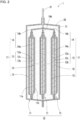
- FIG. 2 is a cross-sectional view taken along line A-A in FIG. 1 .
- a semisolid battery 1 includes a cell stack 10 and an outer case 20.
- the cell stack 10 is a stack of multiple unit cells 11. Each unit cell 11 is plate-like.
- the unit cell 11 is the smallest unit member functioning as a battery in the semisolid battery 1.
- the unit cell 11 has a main surface 11a and the other main surface 11b opposite to the main surface 11a.
- the unit cell 11 may be, for example, rectangular, square, circular, oval, or in any other shape as viewed in the stacking direction (the lateral direction in FIG. 2 , or hereafter simply referred to as a first direction) of the cell stack 10.
- the unit cell 11 is substantially rectangular as viewed in the first direction.
- the unit cell 11 has, for example, a long side of 50 to 500 mm and a short side of 50 to 300 mm as viewed in the first direction.
- the unit cell 11 has a thickness of, for example, 0.1 to 2 mm in the first direction.
- the unit cell 11 includes an electricity generator 12, a casing 13, a positive electrode terminal 14, and a negative electrode terminal 15.
- the electricity generator 12 charges and discharges through an electrochemical reaction.
- the electricity generator 12 includes, for example, a positive electrode 12a, a negative electrode 12b, and a separator 12c between the positive electrode 12a and the negative electrode 12b.
- the electricity generator 12 can exchange cations and anions between the positive electrode 12a and the negative electrode 12b through the separator 12c.
- the electricity generator 12 with the positive electrode 12a and the negative electrode 12b electrically connected to an external device can supply electricity to the external device.
- the positive electrode 12a contains a positive electrode active material and an electrolyte solution and is electrochemically active.
- the negative electrode 12b contains a negative electrode active material and the electrolyte solution and is electrochemically active.
- the electrolyte solution may be the electrolyte solution according to any one of the above embodiments.
- the positive electrode 12a may contain, for example, lithium nickel cobalt aluminum oxide (NCA), lithium manganese oxide spinel (LMO), lithium iron phosphate (LFP), lithium cobalt oxide (LCO), or lithium nickel cobalt manganese oxide (NCM) as the positive electrode active material.
- the positive electrode 12a may contain, for example, solid-state compounds used for, for example, nickel metal hydride batteries and nickel-cadmium batteries.
- the positive electrode 12a may contain, for example, Mg-doped LiCoO 2 and LiNiO 2 .
- the negative electrode 12b may contain, for example, carbon-based materials such as graphite, hard carbon, soft carbon, carbon nanotubes, and graphene as the negative electrode active material.
- the negative electrode 12b may contain, for example, titanium oxide such as lithium titanate and titanium dioxide.
- the negative electrode 12b may contain, for example, a transition metal compound containing, for example, iron, cobalt, copper, manganese, or nickel.
- the separator 12c prevents a short circuit between the positive electrode 12a and the negative electrode 12b.
- the separator 12c may have submicron-sized pores for passage of cations and anions.
- the separator 12c may be made of, for example, a porous insulating material. Examples of the porous insulating material used for the separator 12c include polyolefin and polyvinyl chloride.
- the electricity generator 12 may be, for example, rectangular, square, circular, oval, or in any other shape as viewed in the first direction.
- the electricity generator 12 is rectangular as viewed in the first direction.
- the electricity generator 12 has, for example, a long side of 50 to 500 mm and a short side of 50 to 300 mm as viewed in the first direction.
- the electricity generator 12 has a thickness of, for example, 0.1 to 2 mm in the first direction.
- the multiple unit cells 11 are electrically connected to one another in parallel. This can increase the capacity of the semisolid battery 1.
- the multiple unit cells 11 may be electrically connected to one another in series. This can increase the voltage across the semisolid battery 1.
- the casing 13 electrically insulates the electricity generator 12 from the external environment to protect the electricity generator 12 from the external environment.
- the casing 13 entirely covers and accommodates the electricity generator 12.
- the casing 13 is, for example, a flat bag.
- the casing 13 includes, for example, two laminated films welded together.
- the casing 13 may include, for example, a laminated film shaped into a flat bag.
- the casing 13 may be, for example, rectangular, square, or in any other shape as viewed in the first direction. In the present embodiment, the casing 13 is rectangular as viewed in the first direction.
- the casing 13 contains, for example, an insulating material. This can reduce the likelihood of a short circuit between the external environment and the electricity generator 12 through the casing 13, protecting the electricity generator 12 from the external environment.
- the casing 13 includes, for example, a resin material.
- the resin material may be, for example, polyethylene terephthalate or polyethylene.
- the casing 13 may be, for example, multilayered.
- the casing 13 may contain, for example, a thermally adhesive resin material and a heat-resistant resin material.
- the thermally adhesive resin material melts, for example, at temperatures lower than 150 °C.
- the thermally adhesive resin material may be, for example, polyethylene or polypropylene.
- the heat-resistant resin material melts, for example, at temperatures of 150 to 300 °C inclusive.
- the heat-resistant resin material may be, for example, polyethylene terephthalate or polyethylene naphthalate.
- the positive electrode terminal 14 and the negative electrode terminal 15 are used to output electricity charged in the electricity generator 12 from the casing 13.
- the positive electrode terminal 14 and the negative electrode terminal 15 extend from the inside to the outside of the casing 13.
- the positive electrode terminal 14 is electrically connected to the positive electrode 12a.
- the positive electrode terminal 14 is electrically insulated from the negative electrode 12b and the negative electrode terminal 15.
- the positive electrode terminal 14 is made of, for example, a metal material. Examples of the metal material used for the positive electrode terminal 14 include aluminum.
- the positive electrode terminal 14 includes a first positive electrode terminal portion 14a inside the casing 13 and a second positive electrode terminal portion 14b outside the casing 13.
- the first positive electrode terminal portion 14a may be in contact with the positive electrode 12a.
- the first positive electrode terminal portion 14a may be located between the casing 13 and the positive electrode 12a.
- the second positive electrode terminal portion 14b is connected to a connection terminal of the semisolid battery 1.
- the second positive electrode terminal portion 14b may be, for example, a rectangular or square plate, or in any other shape. In the present embodiment, the second positive electrode terminal portion 14b is rectangular as viewed in the first direction.
- the second positive electrode terminal portion 14b has, for example, a long side of 30 to 100 mm and a short side of 10 to 100 mm as viewed in the first direction.
- the second positive electrode terminal portion 14b has a thickness of, for example, 3 to 30 ⁇ m in the first direction.
- the negative electrode terminal 15 is electrically connected to the negative electrode 12b.
- the negative electrode terminal 15 is electrically insulated from the positive electrode 12a and the positive electrode terminal 14.
- the negative electrode terminal 15 is made of, for example, a metal material. Examples of the metal material used for the negative electrode terminal 15 include copper.
- the negative electrode terminal 15 includes a first negative electrode terminal portion inside the casing 13 and a second negative electrode terminal portion outside the casing 13, similarly to or in the same manner as the positive electrode terminal 14.
- the first negative electrode terminal portion may be in contact with the negative electrode 12b.
- the first negative electrode terminal portion may be located between the casing 13 and the negative electrode 12b.
- the second negative electrode terminal portion is connected to the connection terminal of the semisolid battery 1.
- the second negative electrode terminal portion may be, for example, a rectangular or square plate, or in any other shape. In the present embodiment, the second negative electrode terminal portion is rectangular as viewed in the first direction.
- the second negative electrode terminal portion has, for example, a long side of 30 to 100 mm and a short side of 10 to 100 mm as viewed in the first direction.
- the second negative electrode terminal portion has a thickness of, for example, 3 to 30 ⁇ m in the first direction.
- the second positive electrode terminal portion 14b and the second negative electrode terminal portion may extend, for example, outward from one side of the casing 13 as viewed in the first direction.
- the second positive electrode terminal portion 14b and the second negative electrode terminal portion may extend outward from different sides of the casing 13 as viewed in the first direction.
- the outer case 20 protects the cell stack 10 from the external environment.
- the external environment includes, for example, oxygen and moisture in the air.
- the outer case 20 entirely covers and accommodates the cell stack 10.
- the outer case 20 may be, for example, a cylinder, a bag, or in any other shape.
- the outer case 20 may include, for example, two members welded together into a bag.
- the outer case 20 may be, for example, a single member shaped into a bag.
- the outer case 20 may be, for example, rectangular, square, or in any other shape as viewed in the first direction. In the present embodiment, as illustrated in, for example, FIG. 1 , the outer case 20 is rectangular as viewed in the first direction.
- the outer case 20 has its long-side and short-side directions substantially corresponding to the long-side and short-side directions of the cell stack 10 as viewed in the first direction.
- the outer case 20 has, for example, a long side of 50 to 600 mm and a short side of 50 to 400 mm as viewed in the first direction.
- the outer case 20 has its portion overlapping the cell stack 10 with a thickness of, for example, 50 to 300 ⁇ m as viewed in the first direction.
- the semisolid battery 1 includes a connection terminal 30.
- the connection terminal 30 is used to output electricity charged in the cell stack 10 from the outer case 20.
- the connection terminal 30 includes a first connection terminal 31 and a second connection terminal 32.
- the first connection terminal 31 and the second connection terminal 32 extend from the inside to the outside of the outer case 20.
- the portion of the first connection terminal 31 inside the outer case 20 is bonded to the multiple positive electrode terminals 14 connected to one another.
- the portion of the second connection terminal 32 inside the outer case 20 is bonded to the multiple negative electrode terminals 15 connected to one another.
- the first connection terminal 31 and the second connection terminal 32 are made of, for example, a metal material. Examples of the metal material for the first connection terminal 31 and the second connection terminal 32 include copper and aluminum.
- the outer case 20 contains, for example, an insulating material. This can reduce the likelihood of a short circuit between the external environment and the cell stack 10 through the outer case 20, protecting the cell stack 10 from the external environment.
- the insulating material may be, for example, a resin material such as polyethylene terephthalate or polyethylene.
- the outer case 20 may be, for example, multilayered.
- the outer case 20 may be, for example, three-layered.
- the outer case 20 may include, for example, a first insulating layer, a moisture-proof layer, and a second insulating layer.
- the moisture-proof layer is located between the first insulating layer and the second insulating layer.
- the moisture-proof layer may be covered with the first insulating layer and the second insulating layer.
- the moisture-proof layer may be in direct contact with the first insulating layer and the second insulating layer.
- the first insulating layer may be the outermost layer of the three layers in the outer case 20.
- the first insulating layer may contain a resin material such as polyethylene terephthalate or polyethylene naphthalate.
- the moisture-proof layer reduces oxygen or moisture penetrating the first insulating layer and reaching the second insulating layer.
- the moisture-proof layer may contain a metal material such as copper or aluminum.
- the second insulating layer may contain a resin material such as polypropylene or polypropylene.
- the outer case 20 may include a liquid layer 21 to transmit external pressure to the unit cells 11.
- the liquid layer 21 is located between two adjacent unit cells 11.
- the liquid layer 21 may be in direct contact with the two adjacent unit cells 11.
- the liquid layer 21 can thus be located in any recess on the main surfaces 11a and the main surfaces 11b of the unit cells 11 to allow pressure to be applied uniformly to the two adjacent unit cells 11.
- this structure allows the two adjacent unit cells 11 to perform charging and discharging reactions without varying interface resistances.
- the unit cells 11 are thus less likely to deteriorate.
- the semisolid battery 1 can thus have a longer service life.
- the liquid layer 21 may be located between the cell stack 10 and the outer case 20 as illustrated in, for example, FIG. 2 .
- the cell stack 10 is thus less likely to be misaligned in the outer case 20. This reduces the likelihood of damage at the joint between the connection terminal 30 and the positive electrode terminals 14 or between the connection terminal 30 and the negative electrode terminals 15.
- the liquid layer 21 may be, for example, an organic solvent.
- the organic solvent used for the liquid layer 21 include ethylene carbonate and ⁇ -butyrolactone.
- the liquid layer 21 may be made of, for example, a flowable low-molecular-weight polymer material such as polyethylene oxide.
- the liquid layer 21 may contain, for example, a silicon-based polymer material such as silicone.
- the liquid layer 21 may contain, for example, a water-absorbent material such as a water-absorbent polymer.
- the liquid layer 21 can thus absorb moisture entering the outer case 20 and reduce entry of moisture into the unit cells 11.
- the semisolid battery 1 can thus have a longer service life.
- Examples of the water-absorbent polymer used for the liquid layer 21 include polyacrylonitrile.
- the liquid layer 21 may contain, for example, an inorganic material such as a porous filler.
- the liquid layer 21 can thus absorb moisture entering the outer case 20 and reduce entry of moisture into the unit cells 11.
- the semisolid battery 1 can thus have a longer service life.
- the porous filler used for the liquid layer 21 may be, for example, zeolite.
- the liquid layer 21 may contains a metal filler reactive with oxygen and water. Oxygen and water entering the outer case 20 react with the metal filler and are thus less likely to enter the unit cells 11.
- the semisolid battery 1 can thus have a longer service life.
- the metal filler used for the liquid layer 21 include iron, copper, and aluminum.
- the liquid layer 21 may be made of a material having higher thermal conductivity than an electrolyte solution used in the electricity generators 12. This facilitates transfer of heat generated in the unit cells 11 to the liquid layer 21. The unit cells 11 are thus less likely to accumulate heat. The semisolid battery 1 can thus have a longer service life.
- the liquid layer 21 may be made of a material having higher viscosity than the electrolyte solution used in the electricity generators 12.
- the cell stack 10 is thus less likely to be misaligned in the outer case 20. This reduces the likelihood of damage at the joint between the connection terminal 30 and the positive electrode terminals 14 or between the connection terminal 30 and the negative electrode terminals 15.
- the semisolid battery 1 can thus have a longer service life.
- the electrolyte solution according to one or more embodiments of the present disclosure may be implemented in forms 1 to 13 described below.
- the electrolyte solution according to one or more embodiments of the present disclosure has a smaller composition change resulting from solvent volatilization and thus has less variation in the battery characteristics of a secondary battery and a semisolid battery.
Landscapes
- Chemical & Material Sciences (AREA)
- General Chemical & Material Sciences (AREA)
- Chemical Kinetics & Catalysis (AREA)
- Electrochemistry (AREA)
- Inorganic Chemistry (AREA)
- Engineering & Computer Science (AREA)
- Manufacturing & Machinery (AREA)
- General Physics & Mathematics (AREA)
- Condensed Matter Physics & Semiconductors (AREA)
- Physics & Mathematics (AREA)
- Crystallography & Structural Chemistry (AREA)
- Materials Engineering (AREA)
- Secondary Cells (AREA)
Abstract
Description
- The present disclosure relates to an electrolyte solution, a secondary battery, and a semisolid battery.
- A known technique is described in, for example, Patent Literature 1.
- Patent Literature 1:
Japanese Unexamined Patent Application Publication No. 2013-101900 - In an aspect of the present disclosure, an electrolyte solution contains a lithium electrolyte containing lithium hexafluorophosphate, a carbonate solvent containing γ-butyrolactone and ethylene carbonate, and an additive containing at least one of maleic anhydride or lithium bis(oxalato)borate. The electrolyte solution contains more γ-butyrolactone than ethylene carbonate.
- In an aspect of the present disclosure, an electrolyte solution contains a lithium electrolyte containing lithium bis(fluorosulfonyl)imide, a carbonate solvent containing γ-butyrolactone and ethylene carbonate, and an additive containing at least one of maleic anhydride or lithium bis(oxalato)borate. The electrolyte solution contains more γ-butyrolactone than ethylene carbonate.
- In an aspect of the present disclosure, a secondary battery contains a negative electrode active material being graphite, and the electrolyte solution according to any one of the above aspects. In an aspect of the present disclosure, a secondary battery contains a positive electrode active material being lithium iron phosphate, and the electrolyte solution according to any one of the above aspects.
- In an aspect of the present disclosure, a semisolid battery contains a positive electrode active material and the electrolyte solution according to any one of the above aspects, and a negative electrode active material and the electrolyte solution according to any one of the above aspects.
- The objects, features, and advantages of the present disclosure will become more apparent from the following detailed description and the drawings.
-
FIG. 1 is a plan view of an example semisolid battery according to an embodiment of the present disclosure. -
FIG. 2 is a cross-sectional view taken along line A-A inFIG. 1 . - An electrolyte solution with the structure that forms the basis of an electrolyte solution according to one or more embodiments of the present disclosure will now be described.
- Electrolyte solutions used in lithium-ion batteries have been improved to achieve higher battery characteristics. For example, Patent Literature 1 describes an electrolyte solution that has less deterioration in ionic conductivity in a low temperature environment.
- A secondary battery with the structure that forms the basis of a secondary battery according to one or more embodiments of the present disclosure is used as a rechargeable power source for various products including home appliances, information processors, and electric vehicles. Secondary batteries include lithium-ion batteries that use lithium compounds as the electrolyte. Lithium-ion batteries can have high outputs (high voltages) and compact sizes.
- Electrolyte solutions used in lithium-ion batteries have been improved to achieve higher battery characteristics. For example, Patent Literature 1 describes an electrolyte solution that can have less deterioration in ionic conductivity in a low temperature environment.
- The electrolyte solution with the structure that forms the basis of the electrolyte solution according to one or more embodiments of the present disclosure contains solvents with relatively high volatility such as dimethyl carbonate, diethyl carbonate, and ethyl methyl carbonate. Such solvents volatilize in the battery manufacturing process, thus changing the composition of the electrolyte solution. This may be overcome by selecting solvents with relatively low volatility. The solvents with relatively low volatility include a carbonate solvent being a combination of γ-butyrolactone and ethylene carbonate. The carbonate solvent with relatively low volatility (low-volatile carbonate-based solvent) volatilizes by a lesser degree, with a smaller composition change of the electrolyte solution.
- For an electrolyte solution containing such a low-volatile carbonate-based solvent, lithium hexafluorophosphate or lithium bis(fluorosulfonyl)imide can be used as a lithium electrolyte.
- Further, the electrolyte solution containing the low-volatile carbonate solvent in combination with lithium hexafluorophosphate or lithium bis(fluorosulfonyl)imide has properties that vary based on ambient temperature. The electrolyte containing more γ-butyrolactone than ethylene carbonate in the low-volatile carbonate solvent is less susceptible to ambient temperature. The electrolyte solution containing at least one of maleic anhydride or lithium bis(oxalato)borate as an additive is still less susceptible to ambient temperature.
- As described above, the electrolyte solution according to one or more embodiments of the present disclosure contains a lithium electrolyte solution containing lithium hexafluorophosphate or lithium bis(fluorosulfonyl)imide, a carbonate solvent containing γ-butyrolactone and ethylene carbonate, and an additive containing at least one of maleic anhydride or lithium bis(oxalato)borate. The electrolyte solution contains more γ-butyrolactone than ethylene carbonate. The electrolyte solution has a smaller composition change resulting from solvent volatilization and can have less variation in the battery characteristics including susceptibility to ambient temperature.
- The electrolyte solution according to one or more embodiments of the present disclosure will now be described in detail with reference to the drawings. In one or more embodiments of the present disclosure, the electrolyte solution can be used in any type of lithium-ion battery, which is a secondary battery. For example, the electrolyte solution may be used either in a liquid form in which the electrolyte solution remains as liquid or in a semisolid form in which the electrolyte solution is in the form of a gel or slurry using, for example, polymers.
- In the present embodiment, the electrolyte solution contains lithium hexafluorophosphate (LiPF6) or lithium bis(fluorosulfonyl)imide (LiFSI) as a lithium electrolyte. In the present embodiment, the electrolyte solution containing lithium hexafluorophosphate or lithium bis(fluorosulfonyl)imide as a lithium electrolyte solution may contain, for example, other lithium salts that are typically used as lithium electrolytes for electrolyte solutions. In the present embodiment, the electrolyte solution may contain both LiPF6 and LiFSI as lithium electrolytes.
- Examples of the other lithium salts include LiBF4 and LiClO4. For the electrolyte solution containing at least one of the other lithium salts in addition to LiFSI, the content of LiFSI may be greater than or equal to 12.4 wt% of the total amount of lithium electrolytes.
- In the present embodiment, the lithium electrolyte solution contains LiPF6 alone, contains LiFSI alone, contains LiPF6 and LiFSI, contains LiPF6 and at least one of the other lithium salts described above, or contains LiFSI and at least one of the other lithium salts described above. In either case, the concentration of the lithium-ion electrolyte in the electrolyte solution is, for example, 0.6 to 1.4 mol/L.
- In another embodiment of the present disclosure, the lithium electrolyte solution may contain LiPF6, LiFSI, and at least one of the other lithium salts described above. Carbonate-based Solvent
- In the present embodiment, the electrolyte solution contains, as a carbonate-based solvent, γ-butyrolactone and ethylene carbonate. The electrolyte solution contains more γ-butyrolactone than ethylene carbonate. The solvent in the present embodiment has lower volatility than solvents used in known electrolyte solutions, with a smaller composition change in the manufacturing process. In the carbonate solvent in the present embodiment, the ratio Cb/Ce is, for example, 1.28 to 7.70, where Cb (vol%) is the γ-butyrolactone content and Ce (vol%) is the ethylene carbonate content.
- The electrolyte solution containing γ-butyrolactone and ethylene carbonate as carbonate-based solvents may contain other solvents that are typically used as solvents for electrolyte solutions. Examples of the other solvents include propylene carbonate, ethylene carbonate, dimethyl carbonate, dimethoxyethane, diethyl carbonate, tetrahydrofuran, and triethylene glycol dimethyl ether. For the electrolyte solution containing at least one of the other solvents in addition to γ-butyrolactone and ethylene carbonate, the carbonate solvent may have a vapor pressure less than 0.1 kPa at 25 °C.
- In the present embodiment, the carbonate solvent contains γ-butyrolactone and ethylene carbonate or contains γ-butyrolactone, ethylene carbonate, and at least one of the other solvents described above. In either case, the concentration of the carbonate solvent in the electrolyte solution is, for example, 9.40 to 36.2 wt%.
- In the present embodiment, the electrolyte solution contains at least one of maleic anhydride or lithium bis(oxalato)borate as an additive. In other words, the electrolyte solution contains, as an additive, maleic anhydride alone, lithium bis(oxalato)borate alone, or both maleic anhydride and lithium bis(oxalato)borate.
- The electrolyte solution containing maleic anhydride as an additive is less susceptible to ambient temperature and achieves higher battery characteristics (at least one of the capacity retention, the resistance, or the energy efficiency) particularly in a high temperature environment (45 °C). The maleic anhydride content is 0.4 to 1.6 wt% of the entire electrolyte solution.
- The electrolyte solution containing lithium bis(oxalato)borate (LiBOB) as an additive is less susceptible to ambient temperature and achieves higher battery characteristics (the capacity retention, the resistance, and the energy efficiency) particularly in a low temperature environment (-25 °C). The lithium bis(oxalato)borate content is 1.0 to 4.0 wt% of the entire electrolyte solution.
- As described above, the electrolyte solution containing an additive is less susceptible to ambient temperature. In particular, the electrolyte solution may contain maleic anhydride in a high temperature environment and LiBOB in a low temperature environment. The electrolyte solution containing both maleic anhydride and LiBOB achieves higher battery characteristics in both a high temperature environment and a low temperature environment. For the electrolyte solution containing both maleic anhydride and LiBOB, the LiBOB content is to be higher than the maleic anhydride content.
- A second embodiment differs from the first embodiment in the solvent. The other components are the same as in the first embodiment. The solvent will be described below. Carbonate-based Solvent
- In the present embodiment, a carbonate solvent contains propylene carbonate in addition to γ-butyrolactone and ethylene carbonate. More specifically, in the present embodiment, the carbonate solvent includes three solvents, or specifically, γ-butyrolactone, ethylene carbonate, and propylene carbonate. The volume ratio of the solvents in the electrolyte solution is expressed by Formula 1 below, where EC is the volume of ethylene carbonate, GBL is the volume of γ-butyrolactone, and PC is the volume of propylene carbonate.
EC:GBL:PC = 0.5x:(100 - x):0.5x (5 ≤ x ≤ 55) (1)
- The electrolyte solution containing, as a carbonate-based solvent, a combination of three solvents, or γ-butyrolactone, ethylene carbonate, and propylene carbonate, mixed at the volume ratio expressed by Formula 1 achieves higher battery characteristics particularly in a low temperature environment.
- A third embodiment differs from the first embodiment in the additive. The other components are the same as in the first embodiment. The additive will be described below.
- In the present embodiment, the electrolyte solution contains an additive being vinylene carbonate with a content of 1.0 to 6.0 wt%. In the present embodiment, vinylene carbonate is used as an additive in place of maleic anhydride and lithium bis(oxalato)borate. More specifically, the electrolyte solution contains no maleic anhydride and no lithium bis(oxalato)borate, but contains vinylene carbonate as an additive. The electrolyte solution may contain maleic anhydride and lithium bis(oxalato)borate in addition to vinylene carbonate as additives. In other words, the additive contains vinylene carbonate and at least one of maleic anhydride or lithium bis(oxalato)borate. More specifically, the additive contains vinylene carbonate and maleic anhydride, contains vinylene carbonate and lithium bis(oxalato)borate, or contains vinylene carbonate, maleic anhydride, and lithium bis(oxalato)borate. The additive contains vinylene carbonate and may contain no maleic anhydride and no lithium bis(oxalato)borate.
- The electrolyte solution containing vinylene carbonate as an additive achieves higher battery characteristics particularly in a room temperature environment.
- A fourth embodiment differs from the first embodiment in the additive. The other components are the same as in the first embodiment. The additive will be described below.
- In the present embodiment, the electrolyte solution contains an additive being biphenyl with a content of 1.0 to 4.0 wt%. In the present embodiment, biphenyl is used as an additive in place of maleic anhydride and lithium bis(oxalato)borate. More specifically, the electrolyte solution contains no maleic anhydride and no lithium bis(oxalato)borate, but contains biphenyl as an additive. The electrolyte solution may contain maleic anhydride and lithium bis(oxalato)borate in addition to biphenyl as additives. In other words, the additive contains biphenyl and at least one of maleic anhydride or lithium bis(oxalato)borate. More specifically, the additive contains biphenyl and maleic anhydride, contains biphenyl and lithium bis(oxalato)borate, or contains biphenyl, maleic anhydride, and lithium bis(oxalato)borate. The additive contains biphenyl and may contain no maleic anhydride and no lithium bis(oxalato)borate. The electrolyte solution containing biphenyl as an additive achieves higher battery characteristics particularly in a high temperature environment.
-
FIG. 1 is a plan view of an example semisolid battery according to an embodiment of the present disclosure.FIG. 2 is a cross-sectional view taken along line A-A inFIG. 1 . - In the present embodiment, a semisolid battery 1 includes a
cell stack 10 and anouter case 20. Thecell stack 10 is a stack ofmultiple unit cells 11. Eachunit cell 11 is plate-like. Theunit cell 11 is the smallest unit member functioning as a battery in the semisolid battery 1. - The
unit cell 11 has amain surface 11a and the othermain surface 11b opposite to themain surface 11a. Theunit cell 11 may be, for example, rectangular, square, circular, oval, or in any other shape as viewed in the stacking direction (the lateral direction inFIG. 2 , or hereafter simply referred to as a first direction) of thecell stack 10. In the present embodiment, theunit cell 11 is substantially rectangular as viewed in the first direction. Theunit cell 11 has, for example, a long side of 50 to 500 mm and a short side of 50 to 300 mm as viewed in the first direction. Theunit cell 11 has a thickness of, for example, 0.1 to 2 mm in the first direction. - The
unit cell 11 includes anelectricity generator 12, acasing 13, apositive electrode terminal 14, and anegative electrode terminal 15. Theelectricity generator 12 charges and discharges through an electrochemical reaction. Theelectricity generator 12 includes, for example, apositive electrode 12a, anegative electrode 12b, and aseparator 12c between thepositive electrode 12a and thenegative electrode 12b. Theelectricity generator 12 can exchange cations and anions between thepositive electrode 12a and thenegative electrode 12b through theseparator 12c. Theelectricity generator 12 with thepositive electrode 12a and thenegative electrode 12b electrically connected to an external device can supply electricity to the external device. - The
positive electrode 12a contains a positive electrode active material and an electrolyte solution and is electrochemically active. Thenegative electrode 12b contains a negative electrode active material and the electrolyte solution and is electrochemically active. The electrolyte solution may be the electrolyte solution according to any one of the above embodiments. - The
positive electrode 12a may contain, for example, lithium nickel cobalt aluminum oxide (NCA), lithium manganese oxide spinel (LMO), lithium iron phosphate (LFP), lithium cobalt oxide (LCO), or lithium nickel cobalt manganese oxide (NCM) as the positive electrode active material. Thepositive electrode 12a may contain, for example, solid-state compounds used for, for example, nickel metal hydride batteries and nickel-cadmium batteries. Thepositive electrode 12a may contain, for example, Mg-doped LiCoO2 and LiNiO2. - The
negative electrode 12b may contain, for example, carbon-based materials such as graphite, hard carbon, soft carbon, carbon nanotubes, and graphene as the negative electrode active material. Thenegative electrode 12b may contain, for example, titanium oxide such as lithium titanate and titanium dioxide. Thenegative electrode 12b may contain, for example, a transition metal compound containing, for example, iron, cobalt, copper, manganese, or nickel. - The
separator 12c prevents a short circuit between thepositive electrode 12a and thenegative electrode 12b. For example, theseparator 12c may have submicron-sized pores for passage of cations and anions. Theseparator 12c may be made of, for example, a porous insulating material. Examples of the porous insulating material used for theseparator 12c include polyolefin and polyvinyl chloride. - The
electricity generator 12 may be, for example, rectangular, square, circular, oval, or in any other shape as viewed in the first direction. In the present embodiment, theelectricity generator 12 is rectangular as viewed in the first direction. Theelectricity generator 12 has, for example, a long side of 50 to 500 mm and a short side of 50 to 300 mm as viewed in the first direction. Theelectricity generator 12 has a thickness of, for example, 0.1 to 2 mm in the first direction. - In the present embodiment, the
multiple unit cells 11 are electrically connected to one another in parallel. This can increase the capacity of the semisolid battery 1. Themultiple unit cells 11 may be electrically connected to one another in series. This can increase the voltage across the semisolid battery 1. - The
casing 13 electrically insulates theelectricity generator 12 from the external environment to protect theelectricity generator 12 from the external environment. Thecasing 13 entirely covers and accommodates theelectricity generator 12. Thecasing 13 is, for example, a flat bag. Thecasing 13 includes, for example, two laminated films welded together. Thecasing 13 may include, for example, a laminated film shaped into a flat bag. Thecasing 13 may be, for example, rectangular, square, or in any other shape as viewed in the first direction. In the present embodiment, thecasing 13 is rectangular as viewed in the first direction. - The
casing 13 contains, for example, an insulating material. This can reduce the likelihood of a short circuit between the external environment and theelectricity generator 12 through thecasing 13, protecting theelectricity generator 12 from the external environment. Thecasing 13 includes, for example, a resin material. The resin material may be, for example, polyethylene terephthalate or polyethylene. - The
casing 13 may be, for example, multilayered. Thecasing 13 may contain, for example, a thermally adhesive resin material and a heat-resistant resin material. The thermally adhesive resin material melts, for example, at temperatures lower than 150 °C. The thermally adhesive resin material may be, for example, polyethylene or polypropylene. The heat-resistant resin material melts, for example, at temperatures of 150 to 300 °C inclusive. The heat-resistant resin material may be, for example, polyethylene terephthalate or polyethylene naphthalate. - The
positive electrode terminal 14 and thenegative electrode terminal 15 are used to output electricity charged in theelectricity generator 12 from thecasing 13. Thepositive electrode terminal 14 and thenegative electrode terminal 15 extend from the inside to the outside of thecasing 13. - The
positive electrode terminal 14 is electrically connected to thepositive electrode 12a. Thepositive electrode terminal 14 is electrically insulated from thenegative electrode 12b and thenegative electrode terminal 15. Thepositive electrode terminal 14 is made of, for example, a metal material. Examples of the metal material used for thepositive electrode terminal 14 include aluminum. - The
positive electrode terminal 14 includes a first positiveelectrode terminal portion 14a inside thecasing 13 and a second positiveelectrode terminal portion 14b outside thecasing 13. The first positiveelectrode terminal portion 14a may be in contact with thepositive electrode 12a. The first positiveelectrode terminal portion 14a may be located between thecasing 13 and thepositive electrode 12a. The second positiveelectrode terminal portion 14b is connected to a connection terminal of the semisolid battery 1. The second positiveelectrode terminal portion 14b may be, for example, a rectangular or square plate, or in any other shape. In the present embodiment, the second positiveelectrode terminal portion 14b is rectangular as viewed in the first direction. The second positiveelectrode terminal portion 14b has, for example, a long side of 30 to 100 mm and a short side of 10 to 100 mm as viewed in the first direction. The second positiveelectrode terminal portion 14b has a thickness of, for example, 3 to 30 µm in the first direction. - The
negative electrode terminal 15 is electrically connected to thenegative electrode 12b. Thenegative electrode terminal 15 is electrically insulated from thepositive electrode 12a and thepositive electrode terminal 14. Thenegative electrode terminal 15 is made of, for example, a metal material. Examples of the metal material used for thenegative electrode terminal 15 include copper. - Although not illustrated, the
negative electrode terminal 15 includes a first negative electrode terminal portion inside thecasing 13 and a second negative electrode terminal portion outside thecasing 13, similarly to or in the same manner as thepositive electrode terminal 14. The first negative electrode terminal portion may be in contact with thenegative electrode 12b. The first negative electrode terminal portion may be located between thecasing 13 and thenegative electrode 12b. The second negative electrode terminal portion is connected to the connection terminal of the semisolid battery 1. The second negative electrode terminal portion may be, for example, a rectangular or square plate, or in any other shape. In the present embodiment, the second negative electrode terminal portion is rectangular as viewed in the first direction. The second negative electrode terminal portion has, for example, a long side of 30 to 100 mm and a short side of 10 to 100 mm as viewed in the first direction. The second negative electrode terminal portion has a thickness of, for example, 3 to 30 µm in the first direction. - The second positive
electrode terminal portion 14b and the second negative electrode terminal portion may extend, for example, outward from one side of thecasing 13 as viewed in the first direction. The second positiveelectrode terminal portion 14b and the second negative electrode terminal portion may extend outward from different sides of thecasing 13 as viewed in the first direction. - The
outer case 20 protects thecell stack 10 from the external environment. The external environment includes, for example, oxygen and moisture in the air. Theouter case 20 entirely covers and accommodates thecell stack 10. Theouter case 20 may be, for example, a cylinder, a bag, or in any other shape. Theouter case 20 may include, for example, two members welded together into a bag. Theouter case 20 may be, for example, a single member shaped into a bag. Theouter case 20 may be, for example, rectangular, square, or in any other shape as viewed in the first direction. In the present embodiment, as illustrated in, for example,FIG. 1 , theouter case 20 is rectangular as viewed in the first direction. Theouter case 20 has its long-side and short-side directions substantially corresponding to the long-side and short-side directions of thecell stack 10 as viewed in the first direction. Theouter case 20 has, for example, a long side of 50 to 600 mm and a short side of 50 to 400 mm as viewed in the first direction. Theouter case 20 has its portion overlapping thecell stack 10 with a thickness of, for example, 50 to 300 µm as viewed in the first direction. - The semisolid battery 1 includes a
connection terminal 30. Theconnection terminal 30 is used to output electricity charged in thecell stack 10 from theouter case 20. Theconnection terminal 30 includes afirst connection terminal 31 and asecond connection terminal 32. Thefirst connection terminal 31 and thesecond connection terminal 32 extend from the inside to the outside of theouter case 20. The portion of thefirst connection terminal 31 inside theouter case 20 is bonded to the multiplepositive electrode terminals 14 connected to one another. The portion of thesecond connection terminal 32 inside theouter case 20 is bonded to the multiplenegative electrode terminals 15 connected to one another. Thefirst connection terminal 31 and thesecond connection terminal 32 are made of, for example, a metal material. Examples of the metal material for thefirst connection terminal 31 and thesecond connection terminal 32 include copper and aluminum. - The
outer case 20 contains, for example, an insulating material. This can reduce the likelihood of a short circuit between the external environment and thecell stack 10 through theouter case 20, protecting thecell stack 10 from the external environment. The insulating material may be, for example, a resin material such as polyethylene terephthalate or polyethylene. - The
outer case 20 may be, for example, multilayered. Theouter case 20 may be, for example, three-layered. Theouter case 20 may include, for example, a first insulating layer, a moisture-proof layer, and a second insulating layer. The moisture-proof layer is located between the first insulating layer and the second insulating layer. The moisture-proof layer may be covered with the first insulating layer and the second insulating layer. The moisture-proof layer may be in direct contact with the first insulating layer and the second insulating layer. - The first insulating layer may be the outermost layer of the three layers in the
outer case 20. The first insulating layer may contain a resin material such as polyethylene terephthalate or polyethylene naphthalate. The moisture-proof layer reduces oxygen or moisture penetrating the first insulating layer and reaching the second insulating layer. The moisture-proof layer may contain a metal material such as copper or aluminum. The second insulating layer may contain a resin material such as polypropylene or polypropylene. - The
outer case 20 may include aliquid layer 21 to transmit external pressure to theunit cells 11. Theliquid layer 21 is located between twoadjacent unit cells 11. Theliquid layer 21 may be in direct contact with the twoadjacent unit cells 11. Theliquid layer 21 can thus be located in any recess on themain surfaces 11a and themain surfaces 11b of theunit cells 11 to allow pressure to be applied uniformly to the twoadjacent unit cells 11. In other words, this structure allows the twoadjacent unit cells 11 to perform charging and discharging reactions without varying interface resistances. Theunit cells 11 are thus less likely to deteriorate. The semisolid battery 1 can thus have a longer service life. - The
liquid layer 21 may be located between thecell stack 10 and theouter case 20 as illustrated in, for example,FIG. 2 . Thecell stack 10 is thus less likely to be misaligned in theouter case 20. This reduces the likelihood of damage at the joint between theconnection terminal 30 and thepositive electrode terminals 14 or between theconnection terminal 30 and thenegative electrode terminals 15. - The
liquid layer 21 may be, for example, an organic solvent. Examples of the organic solvent used for theliquid layer 21 include ethylene carbonate and γ-butyrolactone. Theliquid layer 21 may be made of, for example, a flowable low-molecular-weight polymer material such as polyethylene oxide. Theliquid layer 21 may contain, for example, a silicon-based polymer material such as silicone. - The
liquid layer 21 may contain, for example, a water-absorbent material such as a water-absorbent polymer. Theliquid layer 21 can thus absorb moisture entering theouter case 20 and reduce entry of moisture into theunit cells 11. The semisolid battery 1 can thus have a longer service life. Examples of the water-absorbent polymer used for theliquid layer 21 include polyacrylonitrile. - The
liquid layer 21 may contain, for example, an inorganic material such as a porous filler. Theliquid layer 21 can thus absorb moisture entering theouter case 20 and reduce entry of moisture into theunit cells 11. The semisolid battery 1 can thus have a longer service life. The porous filler used for theliquid layer 21 may be, for example, zeolite. - The
liquid layer 21 may contains a metal filler reactive with oxygen and water. Oxygen and water entering theouter case 20 react with the metal filler and are thus less likely to enter theunit cells 11. The semisolid battery 1 can thus have a longer service life. Examples of the metal filler used for theliquid layer 21 include iron, copper, and aluminum. - The
liquid layer 21 may be made of a material having higher thermal conductivity than an electrolyte solution used in theelectricity generators 12. This facilitates transfer of heat generated in theunit cells 11 to theliquid layer 21. Theunit cells 11 are thus less likely to accumulate heat. The semisolid battery 1 can thus have a longer service life. - The
liquid layer 21 may be made of a material having higher viscosity than the electrolyte solution used in theelectricity generators 12. Thecell stack 10 is thus less likely to be misaligned in theouter case 20. This reduces the likelihood of damage at the joint between theconnection terminal 30 and thepositive electrode terminals 14 or between theconnection terminal 30 and thenegative electrode terminals 15. The semisolid battery 1 can thus have a longer service life. - The electrolyte solution according to one or more embodiments of the present disclosure may be implemented in forms 1 to 13 described below.
- (1) An electrolyte solution, comprising:
- a lithium electrolyte comprising lithium hexafluorophosphate;
- a carbonate solvent comprising γ-butyrolactone and ethylene carbonate; and
- an additive comprising at least one of maleic anhydride or lithium bis(oxalato)borate,
- wherein the electrolyte solution comprises more γ-butyrolactone than ethylene carbonate.
- (2) An electrolyte solution, comprising:
- a lithium electrolyte comprising lithium bis(fluorosulfonyl)imide;
- a carbonate solvent comprising γ-butyrolactone and ethylene carbonate; and
- an additive comprising at least one of maleic anhydride or lithium bis(oxalato)borate,
- wherein the electrolyte solution comprises more γ-butyrolactone than ethylene carbonate.
- (3) The electrolyte solution according to (1) or (2), wherein
the carbonate solvent has a vapor pressure less than 0.1 kPa at 25 °C. - (4) The electrolyte solution according to any one of (1) to (3), wherein
the lithium ion electrolyte has a concentration of 0.6 to 1.4 mol/L. - (5) The electrolyte solution according to any one of (1) to (4), further comprising:
an additive being vinylene carbonate with a content of 1.0 to 6.0 wt%. - (6) The electrolyte solution according to any one of (1) to (4), further comprising:
an additive being biphenyl with a content of 1.0 to 4.0 wt%. - (7) The electrolyte solution according to any one of (1) to (6), wherein
the electrolyte solution comprises more lithium bis(oxalato)borate than maleic anhydride. - (8) The electrolyte solution according to any one of (1) to (7), wherein
the electrolyte solution comprises the lithium bis(oxalato)borate with a content of 1.0 to 4.0 wt%. - (9) The electrolyte solution according to any one of (1) to (8), wherein
the electrolyte solution comprises the maleic anhydride with a content of 0.4 to 1.6 wt%. - (10) The electrolyte solution according to any one of (1) to (9), wherein
- the carbonate solvent further comprises propylene carbonate, and
- a volume ratio of ethylene carbonate, γ-butyrolactone, and propylene carbonate in the electrolyte solution is expressed by

- where EC is a volume of ethylene carbonate, GBL is a volume of γ-butyrolactone, and PC is a volume of propylene carbonate.
- (11) A secondary battery, comprising:
- a negative electrode active material being graphite; and
- the electrolyte solution according to any one of (1) to (10).
- (12) A secondary battery, comprising:
- a positive electrode active material being lithium iron phosphate; and
- the electrolyte solution according to any one of (1) to (10).
- (13) A semisolid battery, comprising:
- a positive electrode active material and the electrolyte solution according to any one of (1) to (10); and
- a negative electrode active material and the electrolyte solution according to any one of (1) to (10).
- The electrolyte solution according to one or more embodiments of the present disclosure has a smaller composition change resulting from solvent volatilization and thus has less variation in the battery characteristics of a secondary battery and a semisolid battery.
- Although one or more embodiments of the present disclosure have been described in detail, the present disclosure is not limited to the embodiments described above, and may be changed or varied in various manners without departing from the spirit and scope of the present disclosure. The components described in the above embodiments may be entirely or partially combined as appropriate unless any contradiction arises.
-
- 1
- electrochemical cell
- 10
- cell stack
- 11
- unit cell
- 11a
- main surface
- 11b
- other main surface
- 12
- electricity generator
- 12a
- positive electrode
- 12b
- negative electrode
- 12c
- separator
- 13
- casing
- 14
- positive electrode terminal
- 14a
- first positive electrode terminal portion
- 14b
- second positive electrode terminal portion
- 15
- negative electrode terminal
- 20
- outer case
- 30
- connection terminal
- 31
- first connection terminal
- 32
- second connection terminal
Claims (13)
- An electrolyte solution, comprising:a lithium electrolyte comprising lithium hexafluorophosphate;a carbonate solvent comprising γ-butyrolactone and ethylene carbonate; andan additive comprising at least one of maleic anhydride or lithium bis(oxalato)borate,wherein the electrolyte solution comprises more γ-butyrolactone than ethylene carbonate.
- An electrolyte solution, comprising:a lithium electrolyte comprising lithium bis(fluorosulfonyl)imide;a carbonate solvent comprising γ-butyrolactone and ethylene carbonate; andan additive comprising at least one of maleic anhydride or lithium bis(oxalato)borate,wherein the electrolyte solution comprises more γ-butyrolactone than ethylene carbonate.
- The electrolyte solution according to claim 1 or claim 2, wherein
the carbonate solvent has a vapor pressure less than 0.1 kPa at 25 °C. - The electrolyte solution according to any one of claims 1 to 3, wherein
the lithium ion electrolyte has a concentration of 0.6 to 1.4 mol/L. - The electrolyte solution according to any one of claims 1 to 4, further comprising:
an additive being vinylene carbonate with a content of 1.0 to 6.0 wt%. - The electrolyte solution according to any one of claims 1 to 4, further comprising:
an additive being biphenyl with a content of 1.0 to 4.0 wt%. - The electrolyte solution according to any one of claims 1 to 6, wherein
the electrolyte solution comprises more lithium bis(oxalato)borate than maleic anhydride. - The electrolyte solution according to any one of claims 1 to 7, wherein
the electrolyte solution comprises the lithium bis(oxalato)borate with a content of 1.0 to 4.0 wt%. - The electrolyte solution according to any one of claims 1 to 8, wherein
the electrolyte solution comprises the maleic anhydride with a content of 0.4 to 1.6 wt%. - The electrolyte solution according to any one of claims 1 to 9, whereinthe carbonate solvent further comprises propylene carbonate, anda volume ratio of ethylene carbonate, γ-butyrolactone, and propylene carbonate in the electrolyte solution is expressed by
 where EC is a volume of ethylene carbonate, GBL is a volume of γ-butyrolactone, and PC is a volume of propylene carbonate.
 - A secondary battery, comprising:a negative electrode active material being graphite; andthe electrolyte solution according to any one of claims 1 to 10.
- A secondary battery, comprising:a positive electrode active material being lithium iron phosphate; andthe electrolyte solution according to any one of claims 1 to 10.
- A semisolid battery, comprising:a positive electrode comprising a positive electrode active material and the electrolyte solution according to any one of claims 1 to 10; anda negative electrode comprising a negative electrode active material and the electrolyte solution according to any one of claims 1 to 10.
Applications Claiming Priority (2)
| Application Number | Priority Date | Filing Date | Title |
|---|---|---|---|
| JP2021200301 | 2021-12-09 | ||
| PCT/JP2022/044454 WO2023106214A1 (en) | 2021-12-09 | 2022-12-01 | Electrolyte solution, secondary battery and semi-solid battery |
Publications (2)
| Publication Number | Publication Date |
|---|---|
| EP4447182A1 true EP4447182A1 (en) | 2024-10-16 |
| EP4447182A4 EP4447182A4 (en) | 2026-03-25 |
Family
ID=86730345
Family Applications (1)
| Application Number | Title | Priority Date | Filing Date |
|---|---|---|---|
| EP22904145.4A Pending EP4447182A4 (en) | 2021-12-09 | 2022-12-01 | ELECTROLYTE SOLUTION, SECONDARY BATTERY AND SEMI-SOLID BATTERY |
Country Status (5)
| Country | Link |
|---|---|
| US (1) | US20240413402A1 (en) |
| EP (1) | EP4447182A4 (en) |
| JP (1) | JP7753389B2 (en) |
| CN (1) | CN118369805A (en) |
| WO (1) | WO2023106214A1 (en) |
Families Citing this family (1)
| Publication number | Priority date | Publication date | Assignee | Title |
|---|---|---|---|---|
| WO2025192647A1 (en) * | 2024-03-15 | 2025-09-18 | 富士フイルム株式会社 | Slurry for forming electrode for non-aqueous electrolyte secondary battery, non-aqueous electrolyte secondary battery, and method for manufacturing non-aqueous electrolyte secondary battery |
Family Cites Families (9)
| Publication number | Priority date | Publication date | Assignee | Title |
|---|---|---|---|---|
| JP2697365B2 (en) * | 1991-05-30 | 1998-01-14 | 松下電器産業株式会社 | Non-aqueous electrolyte secondary battery |
| KR100603303B1 (en) * | 2003-10-29 | 2006-07-20 | 삼성에스디아이 주식회사 | Lithium Battery with Efficient Performance |
| EP2697453B1 (en) * | 2011-04-11 | 2018-10-10 | Shenzhen Capchem Technology Co. Ltd. | Non-aqueous electrolytic solutions and electrochemical cells comprising the same |
| WO2013036802A1 (en) * | 2011-09-07 | 2013-03-14 | 24M Technologies, Inc. | Stationary semi-solid battery module and method of manufacture |
| JP6038463B2 (en) | 2011-10-12 | 2016-12-07 | 株式会社日本触媒 | Non-aqueous electrolyte and power storage device using the same |
| JP2014203748A (en) * | 2013-04-08 | 2014-10-27 | 株式会社日本触媒 | Nonaqueous electrolytic solution for lithium ion secondary batteries, and lithium ion secondary battery having the same |
| JP6355163B2 (en) * | 2014-11-18 | 2018-07-11 | 国立研究開発法人産業技術総合研究所 | Lithium ion battery |
| US20170025674A1 (en) * | 2015-02-03 | 2017-01-26 | Taison Tan | Optimum electronic and ionic conductivity ratios in semi-solid electrodes |
| CN107293791A (en) * | 2017-08-06 | 2017-10-24 | 长沙小新新能源科技有限公司 | A kind of tertiary cathode material lithium-ion battery electrolytes and the lithium ion battery comprising the electrolyte |
-
2022
- 2022-12-01 JP JP2023566280A patent/JP7753389B2/en active Active
- 2022-12-01 WO PCT/JP2022/044454 patent/WO2023106214A1/en not_active Ceased
- 2022-12-01 US US18/716,932 patent/US20240413402A1/en active Pending
- 2022-12-01 EP EP22904145.4A patent/EP4447182A4/en active Pending
- 2022-12-01 CN CN202280080734.8A patent/CN118369805A/en active Pending
Also Published As
| Publication number | Publication date |
|---|---|
| US20240413402A1 (en) | 2024-12-12 |
| WO2023106214A1 (en) | 2023-06-15 |
| JPWO2023106214A1 (en) | 2023-06-15 |
| JP7753389B2 (en) | 2025-10-14 |
| EP4447182A4 (en) | 2026-03-25 |
| CN118369805A (en) | 2024-07-19 |
Similar Documents
| Publication | Publication Date | Title |
|---|---|---|
| CN109411811B (en) | Lithium metal battery with mixed electrolyte system | |
| CN111384399B (en) | Protective coating for lithium metal electrodes | |
| CN105493309B (en) | Module case of unit module with heat dissipation structure and battery module including the module case | |
| JP4204237B2 (en) | Lithium secondary cell and connection structure of lithium secondary cell | |
| KR100724009B1 (en) | Gel Electrolyte and Gel Electrolyte Battery | |
| US11735768B2 (en) | Gel electrolyte for solid-state battery | |
| CN114128023A (en) | Secondary batteries, battery packs, electronic equipment, power tools, electric aircraft and electric vehicles | |
| CN101529648B (en) | Power storage device and cooling system | |
| US20190036179A1 (en) | Electrochemical cell with getter and method of forming same | |
| EP1150374A1 (en) | Gel electrolyte and gel electrolyte battery | |
| CN115939504A (en) | Gel electrolyte system for solid state batteries | |
| CN103119764A (en) | Battery comprising cuboid cells which contain a bipolar electrode | |
| CN116826158A (en) | Methods for fabricating polymer-based bipolar batteries via in-situ polymerization | |
| JP2001167797A (en) | Gel electrolyte and gel electrolyte battery | |
| US20230060060A1 (en) | Electrochemical cell and electrochemical cell module | |
| CN114551855A (en) | Electrode and electrochemical cell comprising a dendrite inhibitor protective coating | |
| US12519131B2 (en) | Polymer blend gel electrolytes | |
| CN116565156A (en) | Electroactive materials for high-performance batteries | |
| CN114430069A (en) | Propylene carbonate-based electrolytes with extended long cycle life | |
| CN117393847A (en) | Gel polymer electrolyte with sulfolane additive | |
| EP4447182A1 (en) | Electrolyte solution, secondary battery and semi-solid battery | |
| CN116266621A (en) | High nickel content positive electrode with improved thermal stability | |
| CN115732761A (en) | Electrolyte for electrochemical cells | |
| US20150064533A1 (en) | Bipolar Solid State Battery with Insulating Package | |
| CN116666728A (en) | Solid Interlayers for Solid State Batteries |
Legal Events
| Date | Code | Title | Description |
|---|---|---|---|
| STAA | Information on the status of an ep patent application or granted ep patent |
Free format text: STATUS: THE INTERNATIONAL PUBLICATION HAS BEEN MADE |
|
| PUAI | Public reference made under article 153(3) epc to a published international application that has entered the european phase |
Free format text: ORIGINAL CODE: 0009012 |
|
| STAA | Information on the status of an ep patent application or granted ep patent |
Free format text: STATUS: REQUEST FOR EXAMINATION WAS MADE |
|
| 17P | Request for examination filed |
Effective date: 20240701 |
|
| AK | Designated contracting states |
Kind code of ref document: A1 Designated state(s): AL AT BE BG CH CY CZ DE DK EE ES FI FR GB GR HR HU IE IS IT LI LT LU LV MC ME MK MT NL NO PL PT RO RS SE SI SK SM TR |
|
| DAV | Request for validation of the european patent (deleted) | ||
| DAX | Request for extension of the european patent (deleted) | ||
| REG | Reference to a national code |
Ref country code: DE Ref legal event code: R079 Free format text: PREVIOUS MAIN CLASS: H01M0010056900 Ipc: H01M0004580000 |
|
| A4 | Supplementary search report drawn up and despatched |
Effective date: 20260220 |
|
| RIC1 | Information provided on ipc code assigned before grant |
Ipc: H01M 4/58 20100101AFI20260216BHEP Ipc: H01M 4/587 20100101ALI20260216BHEP Ipc: H01M 4/62 20060101ALI20260216BHEP Ipc: H01M 10/0567 20100101ALI20260216BHEP Ipc: H01M 10/0568 20100101ALI20260216BHEP Ipc: H01M 10/0569 20100101ALI20260216BHEP |