EP4447143A1 - Electrochemical device and electronic device - Google Patents
Electrochemical device and electronic device Download PDFInfo
- Publication number
- EP4447143A1 EP4447143A1 EP24167836.6A EP24167836A EP4447143A1 EP 4447143 A1 EP4447143 A1 EP 4447143A1 EP 24167836 A EP24167836 A EP 24167836A EP 4447143 A1 EP4447143 A1 EP 4447143A1
- Authority
- EP
- European Patent Office
- Prior art keywords
- lithium
- formula
- electrolyte
- positive electrode
- active material
- Prior art date
- Legal status (The legal status is an assumption and is not a legal conclusion. Google has not performed a legal analysis and makes no representation as to the accuracy of the status listed.)
- Pending
Links
- 239000007774 positive electrode material Substances 0.000 claims abstract description 118
- 239000003792 electrolyte Substances 0.000 claims abstract description 101
- 239000000654 additive Substances 0.000 claims abstract description 98
- 230000000996 additive effect Effects 0.000 claims abstract description 96
- 150000001875 compounds Chemical class 0.000 claims abstract description 80
- NRJJZXGPUXHHTC-UHFFFAOYSA-N [Li+].[O--].[O--].[O--].[O--].[Zr+4].[La+3] Chemical compound [Li+].[O--].[O--].[O--].[O--].[Zr+4].[La+3] NRJJZXGPUXHHTC-UHFFFAOYSA-N 0.000 claims abstract description 48
- CVJYOKLQNGVTIS-UHFFFAOYSA-K aluminum;lithium;titanium(4+);phosphate Chemical compound [Li+].[Al+3].[Ti+4].[O-]P([O-])([O-])=O CVJYOKLQNGVTIS-UHFFFAOYSA-K 0.000 claims abstract description 45
- CEMTZIYRXLSOGI-UHFFFAOYSA-N lithium lanthanum(3+) oxygen(2-) titanium(4+) Chemical compound [Li+].[O--].[O--].[O--].[O--].[Ti+4].[La+3] CEMTZIYRXLSOGI-UHFFFAOYSA-N 0.000 claims abstract description 24
- FVXHSJCDRRWIRE-UHFFFAOYSA-H P(=O)([O-])([O-])[O-].[Ge+2].[Al+3].[Li+].P(=O)([O-])([O-])[O-] Chemical compound P(=O)([O-])([O-])[O-].[Ge+2].[Al+3].[Li+].P(=O)([O-])([O-])[O-] FVXHSJCDRRWIRE-UHFFFAOYSA-H 0.000 claims abstract description 12
- SZEFOBMPGYTUDO-UHFFFAOYSA-N [O-2].[Ta+5].[La+3].[Li+] Chemical compound [O-2].[Ta+5].[La+3].[Li+] SZEFOBMPGYTUDO-UHFFFAOYSA-N 0.000 claims abstract description 10
- 239000010936 titanium Substances 0.000 claims description 43
- 239000002245 particle Substances 0.000 claims description 38
- 239000002000 Electrolyte additive Substances 0.000 claims description 30
- 229910052744 lithium Inorganic materials 0.000 claims description 24
- WHXSMMKQMYFTQS-UHFFFAOYSA-N Lithium Chemical compound [Li] WHXSMMKQMYFTQS-UHFFFAOYSA-N 0.000 claims description 23
- VAYTZRYEBVHVLE-UHFFFAOYSA-N 1,3-dioxol-2-one Chemical compound O=C1OC=CO1 VAYTZRYEBVHVLE-UHFFFAOYSA-N 0.000 claims description 19
- FSSPGSAQUIYDCN-UHFFFAOYSA-N 1,3-Propane sultone Chemical compound O=S1(=O)CCCO1 FSSPGSAQUIYDCN-UHFFFAOYSA-N 0.000 claims description 13
- BTBUEUYNUDRHOZ-UHFFFAOYSA-N Borate Chemical compound [O-]B([O-])[O-] BTBUEUYNUDRHOZ-UHFFFAOYSA-N 0.000 claims description 6
- HBBGRARXTFLTSG-UHFFFAOYSA-N Lithium ion Chemical compound [Li+] HBBGRARXTFLTSG-UHFFFAOYSA-N 0.000 description 81
- 229910001416 lithium ion Inorganic materials 0.000 description 81
- 239000010410 layer Substances 0.000 description 55
- 230000014759 maintenance of location Effects 0.000 description 49
- 229910000664 lithium aluminum titanium phosphates (LATP) Inorganic materials 0.000 description 40
- 229910009515 Li1.5Al0.5Ti1.5(PO4)3 Inorganic materials 0.000 description 37
- 229910052723 transition metal Inorganic materials 0.000 description 31
- 150000003624 transition metals Chemical class 0.000 description 31
- 230000000052 comparative effect Effects 0.000 description 25
- -1 carbonate compound Chemical class 0.000 description 24
- 230000001276 controlling effect Effects 0.000 description 18
- 239000002904 solvent Substances 0.000 description 17
- 239000000470 constituent Substances 0.000 description 16
- 238000010406 interfacial reaction Methods 0.000 description 16
- 229910003002 lithium salt Inorganic materials 0.000 description 16
- 159000000002 lithium salts Chemical class 0.000 description 16
- 238000000034 method Methods 0.000 description 14
- 239000011230 binding agent Substances 0.000 description 13
- 239000010408 film Substances 0.000 description 13
- 229920002981 polyvinylidene fluoride Polymers 0.000 description 13
- 238000000151 deposition Methods 0.000 description 12
- 238000004090 dissolution Methods 0.000 description 12
- 239000007773 negative electrode material Substances 0.000 description 12
- 229910021102 Li0.5La0.5TiO3 Inorganic materials 0.000 description 11
- 239000006258 conductive agent Substances 0.000 description 11
- 229910002984 Li7La3Zr2O12 Inorganic materials 0.000 description 10
- 238000012360 testing method Methods 0.000 description 10
- 230000004888 barrier function Effects 0.000 description 9
- 230000007704 transition Effects 0.000 description 9
- 229910052782 aluminium Inorganic materials 0.000 description 8
- 229910000625 lithium cobalt oxide Inorganic materials 0.000 description 8
- BFZPBUKRYWOWDV-UHFFFAOYSA-N lithium;oxido(oxo)cobalt Chemical compound [Li+].[O-][Co]=O BFZPBUKRYWOWDV-UHFFFAOYSA-N 0.000 description 8
- 238000001035 drying Methods 0.000 description 7
- 229920000642 polymer Polymers 0.000 description 7
- 239000000758 substrate Substances 0.000 description 7
- 229910020717 Li0.33La0.56TiO3 Inorganic materials 0.000 description 6
- 229910009178 Li1.3Al0.3Ti1.7(PO4)3 Inorganic materials 0.000 description 6
- 229910010615 Li6.75La3 Inorganic materials 0.000 description 6
- SECXISVLQFMRJM-UHFFFAOYSA-N N-Methylpyrrolidone Chemical compound CN1CCCC1=O SECXISVLQFMRJM-UHFFFAOYSA-N 0.000 description 6
- XAGFODPZIPBFFR-UHFFFAOYSA-N aluminium Chemical compound [Al] XAGFODPZIPBFFR-UHFFFAOYSA-N 0.000 description 6
- 238000007600 charging Methods 0.000 description 6
- 238000005520 cutting process Methods 0.000 description 6
- 239000011888 foil Substances 0.000 description 6
- 230000016507 interphase Effects 0.000 description 6
- 230000008569 process Effects 0.000 description 6
- RYGMFSIKBFXOCR-UHFFFAOYSA-N Copper Chemical compound [Cu] RYGMFSIKBFXOCR-UHFFFAOYSA-N 0.000 description 5
- 229910010629 Li6.75La3Zr1.75Nb0.25O12 Inorganic materials 0.000 description 5
- 229910019142 PO4 Inorganic materials 0.000 description 5
- 239000004698 Polyethylene Substances 0.000 description 5
- 239000004743 Polypropylene Substances 0.000 description 5
- 239000000919 ceramic Substances 0.000 description 5
- VNWKTOKETHGBQD-UHFFFAOYSA-N methane Chemical compound C VNWKTOKETHGBQD-UHFFFAOYSA-N 0.000 description 5
- 229920000058 polyacrylate Polymers 0.000 description 5
- 229920000573 polyethylene Polymers 0.000 description 5
- 229920001155 polypropylene Polymers 0.000 description 5
- 238000003756 stirring Methods 0.000 description 5
- 239000013589 supplement Substances 0.000 description 5
- 229910020719 Li0.33 La0.56 Inorganic materials 0.000 description 4
- PNEYBMLMFCGWSK-UHFFFAOYSA-N aluminium oxide Inorganic materials [O-2].[O-2].[O-2].[Al+3].[Al+3] PNEYBMLMFCGWSK-UHFFFAOYSA-N 0.000 description 4
- 239000011889 copper foil Substances 0.000 description 4
- 230000003247 decreasing effect Effects 0.000 description 4
- 239000011267 electrode slurry Substances 0.000 description 4
- 238000010884 ion-beam technique Methods 0.000 description 4
- 238000002156 mixing Methods 0.000 description 4
- 239000007787 solid Substances 0.000 description 4
- 239000000126 substance Substances 0.000 description 4
- WEVYAHXRMPXWCK-UHFFFAOYSA-N Acetonitrile Chemical compound CC#N WEVYAHXRMPXWCK-UHFFFAOYSA-N 0.000 description 3
- OKTJSMMVPCPJKN-UHFFFAOYSA-N Carbon Chemical compound [C] OKTJSMMVPCPJKN-UHFFFAOYSA-N 0.000 description 3
- OIFBSDVPJOWBCH-UHFFFAOYSA-N Diethyl carbonate Chemical compound CCOC(=O)OCC OIFBSDVPJOWBCH-UHFFFAOYSA-N 0.000 description 3
- XEKOWRVHYACXOJ-UHFFFAOYSA-N Ethyl acetate Chemical compound CCOC(C)=O XEKOWRVHYACXOJ-UHFFFAOYSA-N 0.000 description 3
- KMTRUDSVKNLOMY-UHFFFAOYSA-N Ethylene carbonate Chemical compound O=C1OCCO1 KMTRUDSVKNLOMY-UHFFFAOYSA-N 0.000 description 3
- 229910001290 LiPF6 Inorganic materials 0.000 description 3
- ZMXDDKWLCZADIW-UHFFFAOYSA-N N,N-Dimethylformamide Chemical compound CN(C)C=O ZMXDDKWLCZADIW-UHFFFAOYSA-N 0.000 description 3
- PXHVJJICTQNCMI-UHFFFAOYSA-N Nickel Chemical compound [Ni] PXHVJJICTQNCMI-UHFFFAOYSA-N 0.000 description 3
- 230000001351 cycling effect Effects 0.000 description 3
- 238000007599 discharging Methods 0.000 description 3
- 238000009826 distribution Methods 0.000 description 3
- 230000006872 improvement Effects 0.000 description 3
- 150000002484 inorganic compounds Chemical class 0.000 description 3
- 229910010272 inorganic material Inorganic materials 0.000 description 3
- 239000007788 liquid Substances 0.000 description 3
- 239000000463 material Substances 0.000 description 3
- 239000004745 nonwoven fabric Substances 0.000 description 3
- 238000004806 packaging method and process Methods 0.000 description 3
- 238000005498 polishing Methods 0.000 description 3
- 229920001495 poly(sodium acrylate) polymer Polymers 0.000 description 3
- 229920001343 polytetrafluoroethylene Polymers 0.000 description 3
- 239000004810 polytetrafluoroethylene Substances 0.000 description 3
- 229920005614 potassium polyacrylate Polymers 0.000 description 3
- RUOJZAUFBMNUDX-UHFFFAOYSA-N propylene carbonate Chemical compound CC1COC(=O)O1 RUOJZAUFBMNUDX-UHFFFAOYSA-N 0.000 description 3
- 238000007789 sealing Methods 0.000 description 3
- 239000002002 slurry Substances 0.000 description 3
- NNMHYFLPFNGQFZ-UHFFFAOYSA-M sodium polyacrylate Chemical compound [Na+].[O-]C(=O)C=C NNMHYFLPFNGQFZ-UHFFFAOYSA-M 0.000 description 3
- 230000001502 supplementing effect Effects 0.000 description 3
- 239000002335 surface treatment layer Substances 0.000 description 3
- 229910052719 titanium Inorganic materials 0.000 description 3
- ZZXUZKXVROWEIF-UHFFFAOYSA-N 1,2-butylene carbonate Chemical compound CCC1COC(=O)O1 ZZXUZKXVROWEIF-UHFFFAOYSA-N 0.000 description 2
- YEJRWHAVMIAJKC-UHFFFAOYSA-N 4-Butyrolactone Chemical compound O=C1CCCO1 YEJRWHAVMIAJKC-UHFFFAOYSA-N 0.000 description 2
- BJWMSGRKJIOCNR-UHFFFAOYSA-N 4-ethenyl-1,3-dioxolan-2-one Chemical compound C=CC1COC(=O)O1 BJWMSGRKJIOCNR-UHFFFAOYSA-N 0.000 description 2
- SBLRHMKNNHXPHG-UHFFFAOYSA-N 4-fluoro-1,3-dioxolan-2-one Chemical compound FC1COC(=O)O1 SBLRHMKNNHXPHG-UHFFFAOYSA-N 0.000 description 2
- OZJPLYNZGCXSJM-UHFFFAOYSA-N 5-valerolactone Chemical compound O=C1CCCCO1 OZJPLYNZGCXSJM-UHFFFAOYSA-N 0.000 description 2
- XTHFKEDIFFGKHM-UHFFFAOYSA-N Dimethoxyethane Chemical compound COCCOC XTHFKEDIFFGKHM-UHFFFAOYSA-N 0.000 description 2
- IAZDPXIOMUYVGZ-UHFFFAOYSA-N Dimethylsulphoxide Chemical compound CS(C)=O IAZDPXIOMUYVGZ-UHFFFAOYSA-N 0.000 description 2
- 229910009511 Li1.5Al0.5Ge1.5(PO4)3 Inorganic materials 0.000 description 2
- 239000004952 Polyamide Substances 0.000 description 2
- 239000004642 Polyimide Substances 0.000 description 2
- 239000004372 Polyvinyl alcohol Substances 0.000 description 2
- 229920002125 Sokalan® Polymers 0.000 description 2
- WYURNTSHIVDZCO-UHFFFAOYSA-N Tetrahydrofuran Chemical compound C1CCOC1 WYURNTSHIVDZCO-UHFFFAOYSA-N 0.000 description 2
- 229910010252 TiO3 Inorganic materials 0.000 description 2
- XLOMVQKBTHCTTD-UHFFFAOYSA-N Zinc monoxide Chemical compound [Zn]=O XLOMVQKBTHCTTD-UHFFFAOYSA-N 0.000 description 2
- DPXJVFZANSGRMM-UHFFFAOYSA-N acetic acid;2,3,4,5,6-pentahydroxyhexanal;sodium Chemical compound [Na].CC(O)=O.OCC(O)C(O)C(O)C(O)C=O DPXJVFZANSGRMM-UHFFFAOYSA-N 0.000 description 2
- TZCXTZWJZNENPQ-UHFFFAOYSA-L barium sulfate Chemical compound [Ba+2].[O-]S([O-])(=O)=O TZCXTZWJZNENPQ-UHFFFAOYSA-L 0.000 description 2
- 239000001768 carboxy methyl cellulose Substances 0.000 description 2
- 239000011248 coating agent Substances 0.000 description 2
- 238000000576 coating method Methods 0.000 description 2
- 239000002131 composite material Substances 0.000 description 2
- 239000013256 coordination polymer Substances 0.000 description 2
- 239000013078 crystal Substances 0.000 description 2
- 238000013479 data entry Methods 0.000 description 2
- 238000010586 diagram Methods 0.000 description 2
- VUPKGFBOKBGHFZ-UHFFFAOYSA-N dipropyl carbonate Chemical compound CCCOC(=O)OCCC VUPKGFBOKBGHFZ-UHFFFAOYSA-N 0.000 description 2
- RTZKZFJDLAIYFH-UHFFFAOYSA-N ether Substances CCOCC RTZKZFJDLAIYFH-UHFFFAOYSA-N 0.000 description 2
- JBTWLSYIZRCDFO-UHFFFAOYSA-N ethyl methyl carbonate Chemical compound CCOC(=O)OC JBTWLSYIZRCDFO-UHFFFAOYSA-N 0.000 description 2
- FKRCODPIKNYEAC-UHFFFAOYSA-N ethyl propionate Chemical compound CCOC(=O)CC FKRCODPIKNYEAC-UHFFFAOYSA-N 0.000 description 2
- 229910002804 graphite Inorganic materials 0.000 description 2
- 239000010439 graphite Substances 0.000 description 2
- CJNBYAVZURUTKZ-UHFFFAOYSA-N hafnium(iv) oxide Chemical compound O=[Hf]=O CJNBYAVZURUTKZ-UHFFFAOYSA-N 0.000 description 2
- 239000010954 inorganic particle Substances 0.000 description 2
- 238000004255 ion exchange chromatography Methods 0.000 description 2
- 239000002931 mesocarbon microbead Substances 0.000 description 2
- 229910052751 metal Inorganic materials 0.000 description 2
- TZIHFWKZFHZASV-UHFFFAOYSA-N methyl formate Chemical compound COC=O TZIHFWKZFHZASV-UHFFFAOYSA-N 0.000 description 2
- KKQAVHGECIBFRQ-UHFFFAOYSA-N methyl propyl carbonate Chemical compound CCCOC(=O)OC KKQAVHGECIBFRQ-UHFFFAOYSA-N 0.000 description 2
- 238000001000 micrograph Methods 0.000 description 2
- 239000003960 organic solvent Substances 0.000 description 2
- 229920002037 poly(vinyl butyral) polymer Polymers 0.000 description 2
- 239000004584 polyacrylic acid Substances 0.000 description 2
- 229920002239 polyacrylonitrile Polymers 0.000 description 2
- 229920002647 polyamide Polymers 0.000 description 2
- 229920001721 polyimide Polymers 0.000 description 2
- 229920002451 polyvinyl alcohol Polymers 0.000 description 2
- 229920001289 polyvinyl ether Polymers 0.000 description 2
- 229920000036 polyvinylpyrrolidone Polymers 0.000 description 2
- 239000001267 polyvinylpyrrolidone Substances 0.000 description 2
- 235000013855 polyvinylpyrrolidone Nutrition 0.000 description 2
- 238000002360 preparation method Methods 0.000 description 2
- 238000003825 pressing Methods 0.000 description 2
- 239000000047 product Substances 0.000 description 2
- YKYONYBAUNKHLG-UHFFFAOYSA-N propyl acetate Chemical compound CCCOC(C)=O YKYONYBAUNKHLG-UHFFFAOYSA-N 0.000 description 2
- 230000001105 regulatory effect Effects 0.000 description 2
- 238000007086 side reaction Methods 0.000 description 2
- 239000010703 silicon Substances 0.000 description 2
- 229910052710 silicon Inorganic materials 0.000 description 2
- 235000019812 sodium carboxymethyl cellulose Nutrition 0.000 description 2
- 229920001027 sodium carboxymethylcellulose Polymers 0.000 description 2
- 230000000087 stabilizing effect Effects 0.000 description 2
- 229920003048 styrene butadiene rubber Polymers 0.000 description 2
- XLYOFNOQVPJJNP-UHFFFAOYSA-N water Substances O XLYOFNOQVPJJNP-UHFFFAOYSA-N 0.000 description 2
- 238000004804 winding Methods 0.000 description 2
- LZDKZFUFMNSQCJ-UHFFFAOYSA-N 1,2-diethoxyethane Chemical compound CCOCCOCC LZDKZFUFMNSQCJ-UHFFFAOYSA-N 0.000 description 1
- CYSGHNMQYZDMIA-UHFFFAOYSA-N 1,3-Dimethyl-2-imidazolidinon Chemical compound CN1CCN(C)C1=O CYSGHNMQYZDMIA-UHFFFAOYSA-N 0.000 description 1
- DURPTKYDGMDSBL-UHFFFAOYSA-N 1-butoxybutane Chemical compound CCCCOCCCC DURPTKYDGMDSBL-UHFFFAOYSA-N 0.000 description 1
- MYCXIDKAJBXPCZ-UHFFFAOYSA-N 1-ethoxy-1-methoxyethane Chemical compound CCOC(C)OC MYCXIDKAJBXPCZ-UHFFFAOYSA-N 0.000 description 1
- UHOPWFKONJYLCF-UHFFFAOYSA-N 2-(2-sulfanylethyl)isoindole-1,3-dione Chemical compound C1=CC=C2C(=O)N(CCS)C(=O)C2=C1 UHOPWFKONJYLCF-UHFFFAOYSA-N 0.000 description 1
- YEVQZPWSVWZAOB-UHFFFAOYSA-N 2-(bromomethyl)-1-iodo-4-(trifluoromethyl)benzene Chemical compound FC(F)(F)C1=CC=C(I)C(CBr)=C1 YEVQZPWSVWZAOB-UHFFFAOYSA-N 0.000 description 1
- JWUJQDFVADABEY-UHFFFAOYSA-N 2-methyltetrahydrofuran Chemical compound CC1CCCO1 JWUJQDFVADABEY-UHFFFAOYSA-N 0.000 description 1
- PPDFQRAASCRJAH-UHFFFAOYSA-N 2-methylthiolane 1,1-dioxide Chemical compound CC1CCCS1(=O)=O PPDFQRAASCRJAH-UHFFFAOYSA-N 0.000 description 1
- VUZHZBFVQSUQDP-UHFFFAOYSA-N 4,4,5,5-tetrafluoro-1,3-dioxolan-2-one Chemical compound FC1(F)OC(=O)OC1(F)F VUZHZBFVQSUQDP-UHFFFAOYSA-N 0.000 description 1
- CRJXZTRTJWAKMU-UHFFFAOYSA-N 4,4,5-trifluoro-1,3-dioxolan-2-one Chemical compound FC1OC(=O)OC1(F)F CRJXZTRTJWAKMU-UHFFFAOYSA-N 0.000 description 1
- ZTTYKFSKZIRTDP-UHFFFAOYSA-N 4,4-difluoro-1,3-dioxolan-2-one Chemical compound FC1(F)COC(=O)O1 ZTTYKFSKZIRTDP-UHFFFAOYSA-N 0.000 description 1
- DSMUTQTWFHVVGQ-UHFFFAOYSA-N 4,5-difluoro-1,3-dioxolan-2-one Chemical compound FC1OC(=O)OC1F DSMUTQTWFHVVGQ-UHFFFAOYSA-N 0.000 description 1
- 229920000178 Acrylic resin Polymers 0.000 description 1
- 239000004925 Acrylic resin Substances 0.000 description 1
- 229910000838 Al alloy Inorganic materials 0.000 description 1
- WXNUAYPPBQAQLR-UHFFFAOYSA-N B([O-])(F)F.[Li+] Chemical compound B([O-])(F)F.[Li+] WXNUAYPPBQAQLR-UHFFFAOYSA-N 0.000 description 1
- ZOXJGFHDIHLPTG-UHFFFAOYSA-N Boron Chemical compound [B] ZOXJGFHDIHLPTG-UHFFFAOYSA-N 0.000 description 1
- IYTXQFMZEDAPHE-UHFFFAOYSA-N C(O)(O)=O.FC(=CF)C Chemical compound C(O)(O)=O.FC(=CF)C IYTXQFMZEDAPHE-UHFFFAOYSA-N 0.000 description 1
- 229920002134 Carboxymethyl cellulose Polymers 0.000 description 1
- ZAMOUSCENKQFHK-UHFFFAOYSA-N Chlorine atom Chemical compound [Cl] ZAMOUSCENKQFHK-UHFFFAOYSA-N 0.000 description 1
- 229910000881 Cu alloy Inorganic materials 0.000 description 1
- LFQSCWFLJHTTHZ-UHFFFAOYSA-N Ethanol Chemical compound CCO LFQSCWFLJHTTHZ-UHFFFAOYSA-N 0.000 description 1
- PXGOKWXKJXAPGV-UHFFFAOYSA-N Fluorine Chemical compound FF PXGOKWXKJXAPGV-UHFFFAOYSA-N 0.000 description 1
- 239000005279 LLTO - Lithium Lanthanum Titanium Oxide Substances 0.000 description 1
- 229910020731 Li0.35La0.55TiO3 Inorganic materials 0.000 description 1
- 229910007549 Li2SiF6 Inorganic materials 0.000 description 1
- 229910015044 LiB Inorganic materials 0.000 description 1
- 229910013375 LiC Inorganic materials 0.000 description 1
- 229910000552 LiCF3SO3 Inorganic materials 0.000 description 1
- 229910013406 LiN(SO2CF3)2 Inorganic materials 0.000 description 1
- 229910001228 Li[Ni1/3Co1/3Mn1/3]O2 (NCM 111) Inorganic materials 0.000 description 1
- 229910000572 Lithium Nickel Cobalt Manganese Oxide (NCM) Inorganic materials 0.000 description 1
- PWHULOQIROXLJO-UHFFFAOYSA-N Manganese Chemical compound [Mn] PWHULOQIROXLJO-UHFFFAOYSA-N 0.000 description 1
- RJUFJBKOKNCXHH-UHFFFAOYSA-N Methyl propionate Chemical compound CCC(=O)OC RJUFJBKOKNCXHH-UHFFFAOYSA-N 0.000 description 1
- 239000002033 PVDF binder Substances 0.000 description 1
- OAICVXFJPJFONN-UHFFFAOYSA-N Phosphorus Chemical compound [P] OAICVXFJPJFONN-UHFFFAOYSA-N 0.000 description 1
- 239000004962 Polyamide-imide Substances 0.000 description 1
- XBDQKXXYIPTUBI-UHFFFAOYSA-M Propionate Chemical compound CCC([O-])=O XBDQKXXYIPTUBI-UHFFFAOYSA-M 0.000 description 1
- VYPSYNLAJGMNEJ-UHFFFAOYSA-N Silicium dioxide Chemical compound O=[Si]=O VYPSYNLAJGMNEJ-UHFFFAOYSA-N 0.000 description 1
- XUIMIQQOPSSXEZ-UHFFFAOYSA-N Silicon Chemical compound [Si] XUIMIQQOPSSXEZ-UHFFFAOYSA-N 0.000 description 1
- NINIDFKCEFEMDL-UHFFFAOYSA-N Sulfur Chemical compound [S] NINIDFKCEFEMDL-UHFFFAOYSA-N 0.000 description 1
- GWEVSGVZZGPLCZ-UHFFFAOYSA-N Titan oxide Chemical compound O=[Ti]=O GWEVSGVZZGPLCZ-UHFFFAOYSA-N 0.000 description 1
- RTAQQCXQSZGOHL-UHFFFAOYSA-N Titanium Chemical compound [Ti] RTAQQCXQSZGOHL-UHFFFAOYSA-N 0.000 description 1
- FBDMTTNVIIVBKI-UHFFFAOYSA-N [O-2].[Mn+2].[Co+2].[Ni+2].[Li+] Chemical compound [O-2].[Mn+2].[Co+2].[Ni+2].[Li+] FBDMTTNVIIVBKI-UHFFFAOYSA-N 0.000 description 1
- FDLZQPXZHIFURF-UHFFFAOYSA-N [O-2].[Ti+4].[Li+] Chemical compound [O-2].[Ti+4].[Li+] FDLZQPXZHIFURF-UHFFFAOYSA-N 0.000 description 1
- KXKVLQRXCPHEJC-UHFFFAOYSA-N acetic acid trimethyl ester Natural products COC(C)=O KXKVLQRXCPHEJC-UHFFFAOYSA-N 0.000 description 1
- 239000002390 adhesive tape Substances 0.000 description 1
- WNROFYMDJYEPJX-UHFFFAOYSA-K aluminium hydroxide Chemical compound [OH-].[OH-].[OH-].[Al+3] WNROFYMDJYEPJX-UHFFFAOYSA-K 0.000 description 1
- NDPGDHBNXZOBJS-UHFFFAOYSA-N aluminum lithium cobalt(2+) nickel(2+) oxygen(2-) Chemical compound [Li+].[O--].[O--].[O--].[O--].[Al+3].[Co++].[Ni++] NDPGDHBNXZOBJS-UHFFFAOYSA-N 0.000 description 1
- 238000004458 analytical method Methods 0.000 description 1
- 239000012300 argon atmosphere Substances 0.000 description 1
- 229910021383 artificial graphite Inorganic materials 0.000 description 1
- 230000009286 beneficial effect Effects 0.000 description 1
- 230000015572 biosynthetic process Effects 0.000 description 1
- 229910001593 boehmite Inorganic materials 0.000 description 1
- 229910052796 boron Inorganic materials 0.000 description 1
- AXCZMVOFGPJBDE-UHFFFAOYSA-L calcium dihydroxide Chemical compound [OH-].[OH-].[Ca+2] AXCZMVOFGPJBDE-UHFFFAOYSA-L 0.000 description 1
- 239000000920 calcium hydroxide Substances 0.000 description 1
- 229910001861 calcium hydroxide Inorganic materials 0.000 description 1
- BRPQOXSCLDDYGP-UHFFFAOYSA-N calcium oxide Chemical compound [O-2].[Ca+2] BRPQOXSCLDDYGP-UHFFFAOYSA-N 0.000 description 1
- 239000000292 calcium oxide Substances 0.000 description 1
- ODINCKMPIJJUCX-UHFFFAOYSA-N calcium oxide Inorganic materials [Ca]=O ODINCKMPIJJUCX-UHFFFAOYSA-N 0.000 description 1
- 239000003990 capacitor Substances 0.000 description 1
- 239000002134 carbon nanofiber Substances 0.000 description 1
- 239000002041 carbon nanotube Substances 0.000 description 1
- LUNGBIXLCFCTBN-UHFFFAOYSA-N carbonic acid;1,1,2-trifluoroprop-1-ene Chemical compound OC(O)=O.CC(F)=C(F)F LUNGBIXLCFCTBN-UHFFFAOYSA-N 0.000 description 1
- LEGITHRSIRNTQV-UHFFFAOYSA-N carbonic acid;3,3,3-trifluoroprop-1-ene Chemical compound OC(O)=O.FC(F)(F)C=C LEGITHRSIRNTQV-UHFFFAOYSA-N 0.000 description 1
- 238000005119 centrifugation Methods 0.000 description 1
- CETPSERCERDGAM-UHFFFAOYSA-N ceric oxide Chemical compound O=[Ce]=O CETPSERCERDGAM-UHFFFAOYSA-N 0.000 description 1
- 229910000422 cerium(IV) oxide Inorganic materials 0.000 description 1
- 239000000460 chlorine Substances 0.000 description 1
- 229910052801 chlorine Inorganic materials 0.000 description 1
- 229910017052 cobalt Inorganic materials 0.000 description 1
- 239000010941 cobalt Substances 0.000 description 1
- GUTLYIVDDKVIGB-UHFFFAOYSA-N cobalt atom Chemical compound [Co] GUTLYIVDDKVIGB-UHFFFAOYSA-N 0.000 description 1
- 229910052802 copper Inorganic materials 0.000 description 1
- 239000010949 copper Substances 0.000 description 1
- 125000004093 cyano group Chemical group *C#N 0.000 description 1
- 230000007123 defense Effects 0.000 description 1
- 239000008367 deionised water Substances 0.000 description 1
- 229910021641 deionized water Inorganic materials 0.000 description 1
- SBZXBUIDTXKZTM-UHFFFAOYSA-N diglyme Chemical compound COCCOCCOC SBZXBUIDTXKZTM-UHFFFAOYSA-N 0.000 description 1
- IEJIGPNLZYLLBP-UHFFFAOYSA-N dimethyl carbonate Chemical compound COC(=O)OC IEJIGPNLZYLLBP-UHFFFAOYSA-N 0.000 description 1
- SNQXJPARXFUULZ-UHFFFAOYSA-N dioxolane Chemical compound C1COOC1 SNQXJPARXFUULZ-UHFFFAOYSA-N 0.000 description 1
- 238000010325 electrochemical charging Methods 0.000 description 1
- 238000010326 electrochemical discharging Methods 0.000 description 1
- 238000003487 electrochemical reaction Methods 0.000 description 1
- 238000004146 energy storage Methods 0.000 description 1
- 238000005516 engineering process Methods 0.000 description 1
- BVWQQMASDVGFGI-UHFFFAOYSA-N ethene propyl hydrogen carbonate Chemical compound C(CC)OC(O)=O.C=C BVWQQMASDVGFGI-UHFFFAOYSA-N 0.000 description 1
- 238000011156 evaluation Methods 0.000 description 1
- 238000000605 extraction Methods 0.000 description 1
- 238000005562 fading Methods 0.000 description 1
- 239000011737 fluorine Substances 0.000 description 1
- 229910052731 fluorine Inorganic materials 0.000 description 1
- 230000006870 function Effects 0.000 description 1
- IFYYFLINQYPWGJ-UHFFFAOYSA-N gamma-decalactone Chemical compound CCCCCCC1CCC(=O)O1 IFYYFLINQYPWGJ-UHFFFAOYSA-N 0.000 description 1
- 238000002290 gas chromatography-mass spectrometry Methods 0.000 description 1
- 229910021389 graphene Inorganic materials 0.000 description 1
- 238000000227 grinding Methods 0.000 description 1
- 229910021385 hard carbon Inorganic materials 0.000 description 1
- FAHBNUUHRFUEAI-UHFFFAOYSA-M hydroxidooxidoaluminium Chemical compound O[Al]=O FAHBNUUHRFUEAI-UHFFFAOYSA-M 0.000 description 1
- 150000002500 ions Chemical class 0.000 description 1
- 230000002427 irreversible effect Effects 0.000 description 1
- 229910052746 lanthanum Inorganic materials 0.000 description 1
- 239000004973 liquid crystal related substance Substances 0.000 description 1
- GELKBWJHTRAYNV-UHFFFAOYSA-K lithium iron phosphate Chemical compound [Li+].[Fe+2].[O-]P([O-])([O-])=O GELKBWJHTRAYNV-UHFFFAOYSA-K 0.000 description 1
- 229910002102 lithium manganese oxide Inorganic materials 0.000 description 1
- MHCFAGZWMAWTNR-UHFFFAOYSA-M lithium perchlorate Chemical compound [Li+].[O-]Cl(=O)(=O)=O MHCFAGZWMAWTNR-UHFFFAOYSA-M 0.000 description 1
- 229910001486 lithium perchlorate Inorganic materials 0.000 description 1
- 229910001496 lithium tetrafluoroborate Inorganic materials 0.000 description 1
- QSZMZKBZAYQGRS-UHFFFAOYSA-N lithium;bis(trifluoromethylsulfonyl)azanide Chemical compound [Li+].FC(F)(F)S(=O)(=O)[N-]S(=O)(=O)C(F)(F)F QSZMZKBZAYQGRS-UHFFFAOYSA-N 0.000 description 1
- DVATZODUVBMYHN-UHFFFAOYSA-K lithium;iron(2+);manganese(2+);phosphate Chemical compound [Li+].[Mn+2].[Fe+2].[O-]P([O-])([O-])=O DVATZODUVBMYHN-UHFFFAOYSA-K 0.000 description 1
- VLXXBCXTUVRROQ-UHFFFAOYSA-N lithium;oxido-oxo-(oxomanganiooxy)manganese Chemical compound [Li+].[O-][Mn](=O)O[Mn]=O VLXXBCXTUVRROQ-UHFFFAOYSA-N 0.000 description 1
- VTHJTEIRLNZDEV-UHFFFAOYSA-L magnesium dihydroxide Chemical compound [OH-].[OH-].[Mg+2] VTHJTEIRLNZDEV-UHFFFAOYSA-L 0.000 description 1
- 239000000347 magnesium hydroxide Substances 0.000 description 1
- 229910001862 magnesium hydroxide Inorganic materials 0.000 description 1
- 239000000395 magnesium oxide Substances 0.000 description 1
- CPLXHLVBOLITMK-UHFFFAOYSA-N magnesium oxide Inorganic materials [Mg]=O CPLXHLVBOLITMK-UHFFFAOYSA-N 0.000 description 1
- AXZKOIWUVFPNLO-UHFFFAOYSA-N magnesium;oxygen(2-) Chemical compound [O-2].[Mg+2] AXZKOIWUVFPNLO-UHFFFAOYSA-N 0.000 description 1
- 229910052748 manganese Inorganic materials 0.000 description 1
- 239000011572 manganese Substances 0.000 description 1
- 230000003446 memory effect Effects 0.000 description 1
- 229940017219 methyl propionate Drugs 0.000 description 1
- 238000012986 modification Methods 0.000 description 1
- 230000004048 modification Effects 0.000 description 1
- 229910021382 natural graphite Inorganic materials 0.000 description 1
- 229910052759 nickel Inorganic materials 0.000 description 1
- 229910000480 nickel oxide Inorganic materials 0.000 description 1
- TWNQGVIAIRXVLR-UHFFFAOYSA-N oxo(oxoalumanyloxy)alumane Chemical compound O=[Al]O[Al]=O TWNQGVIAIRXVLR-UHFFFAOYSA-N 0.000 description 1
- SIWVEOZUMHYXCS-UHFFFAOYSA-N oxo(oxoyttriooxy)yttrium Chemical compound O=[Y]O[Y]=O SIWVEOZUMHYXCS-UHFFFAOYSA-N 0.000 description 1
- GNRSAWUEBMWBQH-UHFFFAOYSA-N oxonickel Chemical compound [Ni]=O GNRSAWUEBMWBQH-UHFFFAOYSA-N 0.000 description 1
- RVTZCBVAJQQJTK-UHFFFAOYSA-N oxygen(2-);zirconium(4+) Chemical compound [O-2].[O-2].[Zr+4] RVTZCBVAJQQJTK-UHFFFAOYSA-N 0.000 description 1
- 239000011574 phosphorus Substances 0.000 description 1
- 229910052698 phosphorus Inorganic materials 0.000 description 1
- 229920003229 poly(methyl methacrylate) Polymers 0.000 description 1
- 229920005569 poly(vinylidene fluoride-co-hexafluoropropylene) Polymers 0.000 description 1
- 229920002312 polyamide-imide Polymers 0.000 description 1
- 229920000139 polyethylene terephthalate Polymers 0.000 description 1
- 239000005020 polyethylene terephthalate Substances 0.000 description 1
- 239000004926 polymethyl methacrylate Substances 0.000 description 1
- 229920000131 polyvinylidene Polymers 0.000 description 1
- 230000002265 prevention Effects 0.000 description 1
- 238000001878 scanning electron micrograph Methods 0.000 description 1
- 238000004626 scanning electron microscopy Methods 0.000 description 1
- 238000009517 secondary packaging Methods 0.000 description 1
- 238000000926 separation method Methods 0.000 description 1
- 238000007493 shaping process Methods 0.000 description 1
- HBMJWWWQQXIZIP-UHFFFAOYSA-N silicon carbide Chemical compound [Si+]#[C-] HBMJWWWQQXIZIP-UHFFFAOYSA-N 0.000 description 1
- 229910010271 silicon carbide Inorganic materials 0.000 description 1
- 229910052814 silicon oxide Inorganic materials 0.000 description 1
- 239000002153 silicon-carbon composite material Substances 0.000 description 1
- 239000011734 sodium Substances 0.000 description 1
- 229910021384 soft carbon Inorganic materials 0.000 description 1
- HXJUTPCZVOIRIF-UHFFFAOYSA-N sulfolane Chemical compound O=S1(=O)CCCC1 HXJUTPCZVOIRIF-UHFFFAOYSA-N 0.000 description 1
- 239000011593 sulfur Substances 0.000 description 1
- 229910052717 sulfur Inorganic materials 0.000 description 1
- AKEJUJNQAAGONA-UHFFFAOYSA-N sulfur trioxide Inorganic materials O=S(=O)=O AKEJUJNQAAGONA-UHFFFAOYSA-N 0.000 description 1
- 230000002195 synergetic effect Effects 0.000 description 1
- WMOVHXAZOJBABW-UHFFFAOYSA-N tert-butyl acetate Chemical compound CC(=O)OC(C)(C)C WMOVHXAZOJBABW-UHFFFAOYSA-N 0.000 description 1
- 238000010998 test method Methods 0.000 description 1
- ZUHZGEOKBKGPSW-UHFFFAOYSA-N tetraglyme Chemical compound COCCOCCOCCOCCOC ZUHZGEOKBKGPSW-UHFFFAOYSA-N 0.000 description 1
- YLQBMQCUIZJEEH-UHFFFAOYSA-N tetrahydrofuran Natural products C=1C=COC=1 YLQBMQCUIZJEEH-UHFFFAOYSA-N 0.000 description 1
- 239000002562 thickening agent Substances 0.000 description 1
- XOLBLPGZBRYERU-UHFFFAOYSA-N tin dioxide Chemical compound O=[Sn]=O XOLBLPGZBRYERU-UHFFFAOYSA-N 0.000 description 1
- 229910001887 tin oxide Inorganic materials 0.000 description 1
- OGIDPMRJRNCKJF-UHFFFAOYSA-N titanium oxide Inorganic materials [Ti]=O OGIDPMRJRNCKJF-UHFFFAOYSA-N 0.000 description 1
- DQWPFSLDHJDLRL-UHFFFAOYSA-N triethyl phosphate Chemical compound CCOP(=O)(OCC)OCC DQWPFSLDHJDLRL-UHFFFAOYSA-N 0.000 description 1
- WVLBCYQITXONBZ-UHFFFAOYSA-N trimethyl phosphate Chemical compound COP(=O)(OC)OC WVLBCYQITXONBZ-UHFFFAOYSA-N 0.000 description 1
- 238000003466 welding Methods 0.000 description 1
- 239000011787 zinc oxide Substances 0.000 description 1
- 229910001928 zirconium oxide Inorganic materials 0.000 description 1
- PAPBSGBWRJIAAV-UHFFFAOYSA-N ε-Caprolactone Chemical compound O=C1CCCCCO1 PAPBSGBWRJIAAV-UHFFFAOYSA-N 0.000 description 1
Images

Classifications
-
- H—ELECTRICITY
- H01—ELECTRIC ELEMENTS
- H01M—PROCESSES OR MEANS, e.g. BATTERIES, FOR THE DIRECT CONVERSION OF CHEMICAL ENERGY INTO ELECTRICAL ENERGY
- H01M10/00—Secondary cells; Manufacture thereof
- H01M10/05—Accumulators with non-aqueous electrolyte
- H01M10/056—Accumulators with non-aqueous electrolyte characterised by the materials used as electrolytes, e.g. mixed inorganic/organic electrolytes
- H01M10/0564—Accumulators with non-aqueous electrolyte characterised by the materials used as electrolytes, e.g. mixed inorganic/organic electrolytes the electrolyte being constituted of organic materials only
- H01M10/0566—Liquid materials
- H01M10/0567—Liquid materials characterised by the additives
-
- H—ELECTRICITY
- H01—ELECTRIC ELEMENTS
- H01M—PROCESSES OR MEANS, e.g. BATTERIES, FOR THE DIRECT CONVERSION OF CHEMICAL ENERGY INTO ELECTRICAL ENERGY
- H01M10/00—Secondary cells; Manufacture thereof
- H01M10/05—Accumulators with non-aqueous electrolyte
- H01M10/052—Li-accumulators
- H01M10/0525—Rocking-chair batteries, i.e. batteries with lithium insertion or intercalation in both electrodes; Lithium-ion batteries
-
- H—ELECTRICITY
- H01—ELECTRIC ELEMENTS
- H01M—PROCESSES OR MEANS, e.g. BATTERIES, FOR THE DIRECT CONVERSION OF CHEMICAL ENERGY INTO ELECTRICAL ENERGY
- H01M4/00—Electrodes
- H01M4/02—Electrodes composed of, or comprising, active material
- H01M4/13—Electrodes for accumulators with non-aqueous electrolyte, e.g. for lithium-accumulators; Processes of manufacture thereof
- H01M4/131—Electrodes based on mixed oxides or hydroxides, or on mixtures of oxides or hydroxides, e.g. LiCoOx
-
- H—ELECTRICITY
- H01—ELECTRIC ELEMENTS
- H01M—PROCESSES OR MEANS, e.g. BATTERIES, FOR THE DIRECT CONVERSION OF CHEMICAL ENERGY INTO ELECTRICAL ENERGY
- H01M4/00—Electrodes
- H01M4/02—Electrodes composed of, or comprising, active material
- H01M4/36—Selection of substances as active materials, active masses, active liquids
- H01M4/362—Composites
- H01M4/364—Composites as mixtures
-
- H—ELECTRICITY
- H01—ELECTRIC ELEMENTS
- H01M—PROCESSES OR MEANS, e.g. BATTERIES, FOR THE DIRECT CONVERSION OF CHEMICAL ENERGY INTO ELECTRICAL ENERGY
- H01M4/00—Electrodes
- H01M4/02—Electrodes composed of, or comprising, active material
- H01M4/36—Selection of substances as active materials, active masses, active liquids
- H01M4/48—Selection of substances as active materials, active masses, active liquids of inorganic oxides or hydroxides
- H01M4/52—Selection of substances as active materials, active masses, active liquids of inorganic oxides or hydroxides of nickel, cobalt or iron
- H01M4/525—Selection of substances as active materials, active masses, active liquids of inorganic oxides or hydroxides of nickel, cobalt or iron of mixed oxides or hydroxides containing iron, cobalt or nickel for inserting or intercalating light metals, e.g. LiNiO2, LiCoO2 or LiCoOxFy
-
- H—ELECTRICITY
- H01—ELECTRIC ELEMENTS
- H01M—PROCESSES OR MEANS, e.g. BATTERIES, FOR THE DIRECT CONVERSION OF CHEMICAL ENERGY INTO ELECTRICAL ENERGY
- H01M4/00—Electrodes
- H01M4/02—Electrodes composed of, or comprising, active material
- H01M2004/021—Physical characteristics, e.g. porosity, surface area
-
- H—ELECTRICITY
- H01—ELECTRIC ELEMENTS
- H01M—PROCESSES OR MEANS, e.g. BATTERIES, FOR THE DIRECT CONVERSION OF CHEMICAL ENERGY INTO ELECTRICAL ENERGY
- H01M4/00—Electrodes
- H01M4/02—Electrodes composed of, or comprising, active material
- H01M2004/026—Electrodes composed of, or comprising, active material characterised by the polarity
- H01M2004/028—Positive electrodes
-
- H—ELECTRICITY
- H01—ELECTRIC ELEMENTS
- H01M—PROCESSES OR MEANS, e.g. BATTERIES, FOR THE DIRECT CONVERSION OF CHEMICAL ENERGY INTO ELECTRICAL ENERGY
- H01M2300/00—Electrolytes
- H01M2300/0017—Non-aqueous electrolytes
- H01M2300/0025—Organic electrolyte
-
- Y—GENERAL TAGGING OF NEW TECHNOLOGICAL DEVELOPMENTS; GENERAL TAGGING OF CROSS-SECTIONAL TECHNOLOGIES SPANNING OVER SEVERAL SECTIONS OF THE IPC; TECHNICAL SUBJECTS COVERED BY FORMER USPC CROSS-REFERENCE ART COLLECTIONS [XRACs] AND DIGESTS
- Y02—TECHNOLOGIES OR APPLICATIONS FOR MITIGATION OR ADAPTATION AGAINST CLIMATE CHANGE
- Y02E—REDUCTION OF GREENHOUSE GAS [GHG] EMISSIONS, RELATED TO ENERGY GENERATION, TRANSMISSION OR DISTRIBUTION
- Y02E60/00—Enabling technologies; Technologies with a potential or indirect contribution to GHG emissions mitigation
- Y02E60/10—Energy storage using batteries
Definitions
- This application relates to the field of electrochemical technology, and in particular, to an electrochemical device and an electronic device.
- Electrochemical devices such as a lithium-ion battery
- a lithium-ion battery are widely used in the fields such as portable electronic products, electric transportation, national defense aviation, and energy storage by virtue of a high energy density, high cycle performance, environment-friendliness, safety, and no memory effect.
- the prior art by increasing the voltage of the lithium-ion battery, more lithium ions can be extracted from a crystal structure of positive active material, thereby increasing the capacity of the positive active material, and in turn, increasing the energy density of the lithium-ion battery.
- An objective of this application is to provide an electrochemical device and an electronic device to improve cycle performance of the electrochemical device.
- a first aspect of this application provides an electrochemical device.
- the electrochemical device includes a positive electrode plate and an electrolyte.
- the positive electrode plate includes a positive current collector and a positive active material layer disposed on at least one surface of the positive current collector.
- the positive active material layer includes a positive active material and a positive electrode additive.
- the positive electrode additive includes at least one of lithium titanium aluminum phosphate, lithium lanthanum titanium oxide, lithium lanthanum tantalum oxide, lithium aluminum germanium phosphate, lithium lanthanum zirconium oxide, niobium-doped lithium lanthanum zirconium oxide, or tantalum-doped lithium lanthanum zirconium oxide. Based on a mass of the positive active material layer, a mass percent of the positive electrode additive is p%, satisfying: 0.1 ⁇ p ⁇ 1.2.
- the electrolyte includes a compound represented by Formula (I):
- R 1 is selected from where a, b, c, d, e, f, g, h, i, m, and n each are independently integers from 0 to 10; c and d are not both 0; and, based on a mass of the electrolyte, a mass percent of the compound represented by Formula (I) is q%, satisfying: 0.1 ⁇ q ⁇ 12.
- the positive electrode plate includes the positive electrode additive, the electrolyte includes the compound of Formula (I), and the values of p and q are controlled to fall within the ranges specified herein.
- the positive electrode additive can form a physical barrier between the positive active material and the electrolyte, thereby reducing interfacial reactions between the positive active material and the electrolyte.
- the positive electrode additive can be used as a lithium source for supplementing lithium to alleviate the delithiation-induced structural phase transition of the positive active material.
- the positive active material keeps delithiating, thereby gradually generating stress and strain. The stress and strain lead to a tendency to weaken the contact between the positive electrode additive and the positive active material.
- the positive electrode additive When the contact between the positive electrode additive and the positive active material becomes weak, the positive electrode additive is less capable of suppressing the interfacial reactions between the positive active material and the electrolyte.
- the compound of Formula (I) can reduce the interfacial reactions, stabilize the positive active material and the positive electrode additive, and maintain the physical barrier and lithium supplement provided by the positive electrode additive, thereby improving the cycle performance, high-temperature intermittent cycle performance, and expansion resistance of the electrochemical device under a high voltage.
- the compound represented by Formula (I) includes the following compounds:
- this application can reduce dissolution of transition metals (such as cobalt) and the possibility of depositing the transition metals on the surface of a negative electrode plate, thereby improving the cycle performance and high-temperature intermittent cycle performance of the electrochemical device.
- transition metals such as cobalt
- the value of q satisfies: 0.5 ⁇ q ⁇ 12.
- p and q satisfy: 0.025 ⁇ p/q ⁇ 1.
- a particle diameter of the positive electrode additive is D nm, and D satisfies: 300 ⁇ D ⁇ 500.
- molar ratios between elements at a position between particles of the positive active material in a cross-section of the positive electrode plate satisfy at least one of the following characteristics: (a) 0.5 ⁇ Ti/Al ⁇ 5; (b) 1 ⁇ Ti/La ⁇ 7; (c) 1 ⁇ La/Zr ⁇ 3; (d) 1 ⁇ La/Ta ⁇ 12; or (e) 0.5 ⁇ Ge/Al ⁇ 3.
- the electrolyte further includes a compound represented by Formula (II).
- the compound represented by Formula (II) includes the following compounds:
- a mass percent of the compound represented by Formula (II) is x%, satisfying: 0.1 ⁇ x ⁇ 5.
- the electrolyte further includes an electrolyte additive.
- the electrolyte additive includes at least one of 1,3-propane sultone, vinylene carbonate, 1,3,2-dioxazolethiophene-2,2-dioxide, or lithium bis(oxalato)borate. Based on the mass of the electrolyte, a mass percent of the electrolyte additive is 0.01% to 7%.
- this application makes the cathode electrolyte interphase film more stable, and further reduces the dissolution of transition metals and the possibility of depositing the transition metals on the surface of the negative electrode plate, thereby improving the cycle performance, high-temperature intermittent cycle performance, and expansion resistance of the electrochemical device.
- the electrolyte additive includes 1,3-propane sultone and vinylene carbonate. Based on the total mass of the electrolyte, an aggregate mass percent of the 1,3-propane sultone and the vinylene carbonate is y%, satisfying: 0.5 ⁇ q/y ⁇ 1.6.
- this application makes the cathode electrolyte interphase film more stable, makes the transition metals more stable on the surface of the positive active material layer, and reduces the dissolution of the transition metals and the possibility of depositing the transition metals on the surface of the negative electrode plate, thereby further improving the cycle performance, high-temperature intermittent cycle performance, and expansion resistance of the electrochemical device.
- a second aspect of this application provides an electronic device.
- the electronic device includes the electrochemical device according to the first aspect of this application.
- the electrochemical device according to this application exhibits good cycle performance, high-temperature intermittent cycle performance, and expansion resistance. Therefore, the electronic device of this application exhibits a relatively long lifespan.
- the electrochemical device includes a positive electrode plate, a negative electrode plate, and an electrolyte.
- the positive electrode plate includes a positive current collector and a positive active material layer disposed on at least one surface of the positive current collector.
- the positive active material layer includes a positive active material and a positive electrode additive.
- the positive electrode additive includes at least one of lithium titanium aluminum phosphate, lithium lanthanum titanium oxide, lithium lanthanum tantalum oxide, lithium aluminum germanium phosphate, lithium lanthanum zirconium oxide, niobium-doped lithium lanthanum zirconium oxide, or tantalum-doped lithium lanthanum zirconium oxide.
- a mass percent of the positive electrode additive is p%, satisfying: 0.1 ⁇ p ⁇ 1.2.
- the electrolyte includes a compound represented by Formula (I). Based on a mass of the electrolyte, a mass percent of the compound represented by Formula (I) is q%, satisfying: 0.1 ⁇ q ⁇ 12.
- the positive electrode plate includes the positive electrode additive, the electrolyte includes the compound of Formula (I), and the values of p and q are controlled to fall within the ranges specified herein. Therefore, the positive electrode additive can form a physical barrier between the positive active material and the electrolyte, thereby reducing interfacial reactions between the positive active material and the electrolyte.
- the positive electrode additive when the positive active material is highly delithiated, can be used as a lithium source for supplementing lithium to alleviate the delithiation-induced structural phase transition of the positive active material.
- the positive active material keeps delithiating, thereby gradually generating stress and strain. The stress and strain lead to a tendency to weaken the contact between the positive electrode additive and the positive active material.
- the positive electrode additive is less capable of suppressing the interfacial reactions between the positive active material and the electrolyte.
- the compound of Formula (I) can reduce the interfacial reactions, stabilize the positive active material and the positive electrode additive, and maintain the physical barrier and lithium supplement provided by the positive electrode additive, thereby improving the cycle performance, high-temperature intermittent cycle performance, and expansion resistance of the electrochemical device under a high voltage.
- this application is construed by using a lithium-ion battery as an example of the electrochemical device, but the electrochemical device according to this application is not limited to the lithium-ion battery.
- a first aspect of this application provides an electrochemical device.
- the electrochemical device includes a positive electrode plate and an electrolyte.
- the positive electrode plate includes a positive current collector and a positive active material layer disposed on at least one surface of the positive current collector.
- the positive active material layer includes a positive active material and a positive electrode additive.
- the positive electrode additive includes at least one of lithium titanium aluminum phosphate, lithium lanthanum titanium oxide, lithium lanthanum tantalum oxide, lithium aluminum germanium phosphate, lithium lanthanum zirconium oxide, niobium-doped lithium lanthanum zirconium oxide, or tantalum-doped lithium lanthanum zirconium oxide.
- a mass percent of the positive electrode additive is p%, satisfying: 0.1 ⁇ p ⁇ 1.2.
- p may be 0.1, 0.3, 0.4, 0.6, 0.7, 0.9, 1.1, 1.2, or a value falling within a range formed by any two thereof.
- the electrolyte includes a compound represented by Formula (I):
- R 1 is selected from where a, b, c, d, e, f, g, h, i, m, and n each are independently integers from 0 to 10, for example, a, b, c, d, e, f, g, h, i, m, and n each may independently be 0, 1, 2, 3, 4, 5, 6, 7, 8, 9, or 10; and c and d are not both 0.
- a mass percent of the compound represented by Formula (I) is q%, satisfying: 0.1 ⁇ q ⁇ 12, and optionally 0.5 ⁇ q ⁇ 12.
- the value of q may be 0.1, 0.4, 0.9, 1.5, 2.5, 3.5, 4.5, 6.5, 8.5, 10, 12, or a value falling within a range formed by any two thereof.
- the positive electrode plate includes the positive electrode additive, the electrolyte includes the compound of Formula (I), and the values of p and q are controlled to fall within the ranges specified herein. Therefore, the positive electrode additive can form a physical barrier between the positive active material and the electrolyte, thereby reducing interfacial reactions between the positive active material and the electrolyte.
- the positive electrode additive can be used as a lithium source for supplementing lithium to alleviate the delithiation-induced structural phase transition of the positive active material.
- the positive active material keeps delithiating, thereby gradually generating stress and strain.
- the stress and strain lead to a tendency to weaken the contact between the positive electrode additive and the positive active material.
- the positive electrode additive is less capable of suppressing the interfacial reactions between the positive active material and the electrolyte.
- the compound of Formula (I) can reduce the interfacial reactions, stabilize the positive active material and the positive electrode additive, and maintain the physical barrier and lithium supplement provided by the positive electrode additive, thereby improving the cycle performance, high-temperature intermittent cycle performance, and expansion resistance of the electrochemical device under a high voltage.
- the positive electrode additive When the value of p is unduly small, the positive electrode additive is insignificant in playing an improvement role, unable to provide a physical barrier between the positive active material layer and the electrolyte, insignificant in reducing the side reactions between the positive active material and the electrolyte and alleviating the delithiation-induced structural phase transition of the positive active material, and unfavorable to improving the cycle performance and high-temperature intermittent cycle performance of the electrochemical device.
- the value of p When the value of p is unduly large, the content of the positive electrode additive is unduly high, thereby being unfavorable to the transport of lithium ions in the positive active material layer and unfavorable to improving the cycle performance of the electrochemical device.
- the compound of Formula (I) is insignificant in playing an improvement role, and unable to play a role in reducing the interfacial reactions between the positive active material and the electrolyte, or a role in stabilizing the positive active material layer and the positive electrode additive, or a role in maintaining the physical barrier and lithium supplement provided by the positive electrode additive, thereby being unfavorable to improving the cycle performance, high-temperature intermittent cycle performance, and expansion resistance of the electrochemical device.
- the compound represented by Formula (I) includes the following compounds:
- the transition metals on the surface of the positive active material layer are further complexed with by using the cyano group in the compound of Formula (I), thereby making the transition metals more stable on the surface of the positive active material layer, reducing the dissolution of the transition metals and the possibility of depositing the transition metals on the surface of the negative electrode plate, reducing the interfacial reactions between the positive active material and the electrolyte, stabilizing the positive active material layer and the positive electrode additive, maintaining the physical barrier and lithium supplement provided by the positive electrode additive, and in turn, improving the cycle performance, high-temperature intermittent cycle performance, and expansion resistance of the electrochemical device.
- p and q satisfy: 0.025 ⁇ p/q ⁇ 1.
- the p/q ratio may be 0.025, 0.03, 0.05, 0.1, 0.3, 0.4, 0.5, 0.75, 0.9, 1, or a value falling within a range formed by any two thereof.
- this application can well exert the synergistic effect between the positive electrode additive and the compound of Formula (I), further reduce the interfacial reactions between the positive active material and the electrolyte, alleviate the delithiation-induced structural phase transition of the positive active material, and reduce the dissolution of transition metals and the possibility of depositing the transition metals on the surface of the negative electrode plate, thereby further improving the cycle performance, high-temperature intermittent cycle performance, and expansion resistance of the electrochemical device.
- a particle diameter of the positive electrode additive is D nm, and D satisfies: 300 ⁇ D ⁇ 500.
- D may be 300, 340, 380, 400, 420, 460, 500, or a value falling within a range formed by any two thereof.
- the particle diameter D of the positive electrode additive is an average particle diameter of the positive electrode additive.
- molar ratios between elements at a position between particles of the positive active material in a cross-section of the positive electrode plate satisfy at least one of the following characteristics: (a) 0.5 ⁇ Ti/Al ⁇ 5; (b) 1 ⁇ Ti/La ⁇ 7; (c) 1 ⁇ La/Zr ⁇ 3; (d) 1 ⁇ La/Ta ⁇ 12; or (e) 0.5 ⁇ Ge/Al ⁇ 3.
- the molar ratio between Ti and Al may be 0.5, 1, 2, 3, 4, 5, or a value falling within a range formed by any two thereof;
- the Ti/La molar ratio may be 1, 2, 3, 3.5, 4, 5, 6, 7, or a value falling within a range formed by any two thereof;
- the La/Zr molar ratio may be 1, 1.2, 1.5, 1.8, 2.2, 2.5, 2.8, 3, or a value falling within a range formed by any two thereof;
- the La/Ta molar ratio may be 1, 1.5, 3.5, 4.5, 6.5, 8.5, 10, 12, or a value falling within a range formed by any two thereof;
- the Ge/Al molar ratio may be 0.5, 0.8, 1.2, 1.5, 1.8, 2.2, 2.6, 3, or a value falling within a range formed by any two thereof.
- this application can reduce the interfacial reactions between the positive active material and the electrolyte, further alleviate the delithiation-induced structural phase transition of the positive active material, and reduce the dissolution of transition metals and the possibility of depositing the transition metals on the surface of the negative electrode plate, thereby further improving the cycle performance, high-temperature intermittent cycle performance, and expansion resistance of the electrochemical device.
- the cross-section of the positive electrode plate is formed by sectioning the positive active material layer in a direction perpendicular to the thickness direction of the positive electrode plate.
- the sectioning depth and sectioning method are not particularly limited herein, as long as the cutting surface is flat and even and the scanning electron microscopy image enables visibility of the particle interface of the positive active material and the positive electrode additive at the position between particles of the positive active material.
- the sectioning method may include, but is not limited to, cutting by means of ion beam cross-section polishing.
- the process parameters of the ion beam cross-section polishing are not particularly limited herein, as long as the objectives of this application can be achieved.
- the general formula of the lithium aluminum titanium phosphate is Li 1+u Al u Ti 2-u (PO 4 ) 3 , 0 ⁇ u ⁇ 0.5, for example, Li 1.3 Al 0.3 Ti 1.7 (PO 4 ) 3 , Li 1.5 Al 0.5 Ti 1.5 (PO 4 ) 3 .
- the general formula of the lithium lanthanum titanium oxide (LLTO) is Li 3v La 2/3-v TiO 3 , 0 ⁇ v ⁇ 0.2, for example, Li 0.5 La 0.5 TiO 3 , Li 0.33 La 0.56 TiO 3 , Li 0.35 La 0.55 TiO 3 .
- the chemical formula of lithium lanthanum tantalum oxide is Li 0.33 La 0.56 Ta 0.8 O 3 .
- the general formula of the lithium aluminum germanium phosphate is Li 1+w Al w Ge 2-w (PO 4 ) 3 , 0 ⁇ w ⁇ 0.5, for example, Li 1.5 Al 0.5 Ge 1.5 (PO 4 ) 3 .
- the chemical formula of the lithium lanthanum zirconium oxide (LLZO) is Li 7 La 3 Zr 2 O 12 .
- the chemical formula of the niobium-doped lithium lanthanum zirconium oxide is Li 7-z La 3 Zr 2-z Nb z O 12 , 0 ⁇ z ⁇ 0.25, for example, Li 6.75 La 3 Zr 1.75 Nb 0.25 O 12 , or Li 6.8 La 3 Zr 1.8 Nb 0.2 O 12 .
- the general formula of the tantalum-doped lithium lanthanum zirconium oxide is Li 7-r La 3 Zr 2-r Ta r O 12 , 0 ⁇ r ⁇ 0.5, for example, Li 6.5 La 3 Zr 1.5 Ta 0.5 O 12 , or Li 6.75 La 3 Zr 1.75 Ta 0.25 O 12 .
- the particle diameter of the positive electrode additive can be changed by selecting positive electrode additives of different particle diameters.
- the Ti/Al molar ratio at the position between particles of the positive active material in the cross-section of the positive electrode plate can be caused to satisfy 0.5 ⁇ Ti/Al ⁇ 5 by adjusting the mass percent of one of two types of lithium aluminum titanium phosphates containing Ti and Al at different mass ratios.
- the positive electrode additive includes constituents Li 1.3 Al 0.3 Ti 1.7 (PO 4 ) 3 and Li 1.5 Al 0.5 Ti 1.5 (PO 4 ) 3 , and the Ti/Al molar ratio can be regulated by adjusting the mass ratio between the two constituents, and specifically, by adjusting the mass percent of one of the constituents.
- the Ti/Al molar ratio is increased by increasing the mass percent of Li 1.3 Al 0.3 Ti 1.7 (PO 4 ) 3
- the Ti/Al mass ratio is decreased by decreasing the mass percent of Li 1.3 Al 0.3 Ti 1.7 (PO 4 ) 3
- Other constituents such as lithium lanthanum titanium oxide and lithium aluminum germanium phosphate may be added, and the Ti/Al molar ratio at the position between particles of the positive active material in the cross-section of the positive electrode plate can be caused to satisfy 0.5 ⁇ Ti/Al ⁇ 5 by adjusting the mass ratio between lithium aluminum titanium phosphate and such constituents.
- the Ti/La molar ratio at the position between particles of the positive active material in the cross-section of the positive electrode plate can be caused to satisfy 0.5 ⁇ Ti/La ⁇ 2 by adjusting the mass percent of one of two types of lithium lanthanum titanium oxides containing Ti and La at different mass ratios.
- the positive electrode additive includes constituents Li 0.5 La 0.5 TiO 3 and Li 0.33 La 0.56 TiO 3 .
- the Ti/La molar ratio is increased by increasing the mass percent of Li 0.5 La 0.5 TiO 3
- the Ti/La molar ratio is decreased by decreasing the mass percent of Li 0.5 La 0.5 TiO 3 .
- lithium aluminum titanium phosphate lithium lanthanum titanium oxide, lithium lanthanum tantalum oxide, lithium lanthanum zirconium oxide, niobium-doped lithium lanthanum zirconium oxide, or tantalum-doped lithium lanthanum zirconium oxide may be added.
- the Ti/Al molar ratio at the position between particles of the positive active material in the cross-section of the positive electrode plate can be caused to satisfy 0.5 ⁇ Ti/Al ⁇ 5 by adjusting the mass ratio between lithium lanthanum titanium oxide and such constituents.
- the La/Zr molar ratio, the La/Ta molar ratio, and the Ge/Al molar ratio may be regulated with reference to the above method, the details of which are omitted here.
- the electrolyte further includes a compound represented by Formula (II).
- the compound represented by Formula (II) includes the following compounds:
- this application makes the cathode electrolyte interphase film more stable, makes the transition metals more stable on the surface of the positive active material layer, and reduces the dissolution of the transition metals and the possibility of depositing the transition metals on the surface of the negative electrode plate, thereby further improving the cycle performance, high-temperature intermittent cycle performance, and expansion resistance of the electrochemical device.
- the electrolyte further includes an electrolyte additive.
- the electrolyte additive includes at least one of 1,3-propane sultone (PS), vinylene carbonate (VC), 1,3,2-dioxazolethiophene-2,2-dioxide (DTD), or lithium bis(oxalato)borate (LiBOB). Based on the mass of the electrolyte, a mass percent of the electrolyte additive is 0.01% to 7%.
- the electrolyte additive includes 1,3-propane sultone and vinylene carbonate. Based on the total mass of the electrolyte, an aggregate mass percent of the 1,3-propane sultone and the vinylene carbonate is y%, satisfying: 0.5 ⁇ q/y ⁇ 1.6.
- the q/y ratio may be 0.5, 0.75, 0.9, 1, 1.2, 1.3, 1.4, 1.5, 1.6, or a value falling within a range formed by any two thereof.
- this application makes the cathode electrolyte interphase film more stable, makes the transition metals more stable on the surface of the positive active material layer, and reduces the dissolution of the transition metals and the possibility of depositing the transition metals on the surface of the negative electrode plate, thereby further improving the cycle performance, high-temperature intermittent cycle performance, and expansion resistance of the electrochemical device.
- the mass percent of the lithium salt is 8% to 15%.
- the mass percent of the lithium salt is 8%, 9%, 10%, 11%, 13%, 15%, or a value falling within a range formed by any two thereof.
- the nonaqueous solvent is not particularly limited in this application, as long as the objectives of this application can be achieved.
- the nonaqueous solvent may include, but is not limited to, at least one of a carbonate compound, a carboxylate compound, an ether compound, or other organic solvents.
- the carbonate compound may include, but is not limited to, at least one of a chain carbonate compound, a cyclic carbonate compound, or a fluorocarbonate compound.
- the chain carbonate compound may include, but is not limited to, at least one of dimethyl carbonate (DMC), diethyl carbonate (DEC), dipropyl carbonate (DPC), methyl propyl carbonate (MPC), ethylene propyl carbonate (EPC), or ethyl methyl carbonate (EMC).
- the cyclic carbonate compound may include, but is not limited to, at least one of ethylene carbonate (EC), propylene carbonate (PC), butylene carbonate (BC), or vinyl ethylene carbonate (VEC).
- the fluorocarbonate compound may include, but is not limited to, at least one of fluoroethylene carbonate (FEC), 1,2-difluoroethylene carbonate, 1,1-difluoroethylene carbonate, 1,1,2-trifluoroethylene carbonate, 1,1,2,2-tetrafluoroethylene carbonate, 1-fluoro-2-methyl ethylene, 1-fluoro-1-methyl ethylene carbonate, 1,2-difluoro-1-methyl ethylene carbonate, 1,1,2-trifluoro-2-methyl ethylene carbonate, or trifluoromethyl ethylene carbonate.
- FEC fluoroethylene carbonate
- 1,2-difluoroethylene carbonate 1,1-difluoroethylene carbonate
- 1,1,2-trifluoroethylene carbonate 1,1,2,2-tetrafluoroethylene carbonate
- 1-fluoro-2-methyl ethylene 1-fluoro-1-methyl ethylene carbonate
- 1,2-difluoro-1-methyl ethylene carbonate 1,1,2-trifluoro-2-methyl ethylene carbonate
- the carboxylate compound may include, but is not limited to, at least one of methyl formate, methyl acetate, ethyl acetate, n-propyl acetate, tert-butyl acetate, methyl propionate, ethyl propionate, propyl propionate, ⁇ -butyrolactone, decanolactone, valerolactone, or caprolactone.
- the ether compound may include, but is not limited to, at least one of dibutyl ether, tetraglyme, diglyme, 1,2-dimethoxyethane, 1,2-diethoxyethane, 1-ethoxy-1-methoxyethane, 2-methyltetrahydrofuran, or tetrahydrofuran.
- the other organic solvent may include, but is not limited to, at least one of dimethyl sulfoxide, 1,2-dioxolane, sulfolane, methyl sulfolane, 1,3-dimethyl-2-imidazolidinone, N-methyl-2-pyrrolidone, dimethylformamide, acetonitrile, trimethyl phosphate, triethyl phosphate, or trioctyl phosphate.
- the mass percent of the nonaqueous solvent may be 65% to 90%, for example, may be 65%, 70%, 75%, 80%, 86%, 88%, 90%, or a value falling within a range formed by any two thereof.
- the positive current collector is not particularly limited in this application, as long as the objectives of this application can be achieved.
- the positive current collector may include aluminum foil, aluminum alloy foil, or the like.
- the positive active material layer in this application includes a positive active material.
- the type of the positive active material is not particularly limited in this application, as long as the objectives of this application can be achieved.
- the positive active material may include at least one of lithium nickel cobalt manganese oxide (NCM811, NCM622, NCM523, NCM111), lithium nickel cobalt aluminum oxide, lithium iron phosphate, a lithium-rich manganese-based material, lithium cobalt oxide (LiCoO 2 ), lithium manganese oxide, lithium manganese iron phosphate, lithium titanium oxide, or the like.
- the positive active material may further include a non-metallic element.
- the non-metallic elements include at least one of fluorine, phosphorus, boron, chlorine, silicon, or sulfur. Such elements can further improve the stability of the positive active material.
- the thicknesses of the positive current collector and the positive active material layer are not particularly limited, as long as the objectives of this application can be achieved.
- the thickness of the positive current collector is 5 ⁇ m to 20 ⁇ m, and preferably 6 ⁇ m to 18 ⁇ m.
- the thickness of the positive active material layer on a single side is 30 ⁇ m to 120 ⁇ m.
- the positive active material layer may be disposed on one surface of the positive current collector in a thickness direction or on both surfaces of the positive current collector in the thickness direction. It is hereby noted that the "surface” here may be the entire region of the positive current collector, or a partial region of the positive current collector, without being particularly limited in this application, as long as the objectives of the application can be achieved.
- the positive active material layer in this application may include a conductive agent and a binder.
- the electrochemical device in this application further includes a negative electrode plate.
- the negative electrode plate is not particularly limited herein, as long as the objectives of this application can be achieved.
- the negative electrode plate includes a negative current collector and a negative active material layer disposed on at least one surface of the negative current collector.
- the negative current collector is not particularly limited in this application, as long as the objectives of this application can be achieved.
- the negative current collector may include copper foil, copper alloy foil, nickel foil, titanium foil, foamed nickel, foamed copper, or the like.
- the negative active material layer in this application includes a negative active material.
- the type of the negative active material is not particularly limited in this application, as long as the objectives of this application can be achieved.
- the negative active material may include at least one of natural graphite, artificial graphite, mesocarbon microbead (MCMB), hard carbon, soft carbon, silicon, a silicon-carbon composite, SiO k (0 ⁇ k ⁇ 2), metallic lithium, or the like.
- the thicknesses of the negative current collector and the negative active material layer are not particularly limited herein, as long as the objectives of this application can be achieved.
- the thickness of the negative current collector is 4 ⁇ m to 12 ⁇ m, and the thickness of the negative active material layer on a single side is 30 ⁇ m to 130 ⁇ m.
- the negative active material layer may be disposed on one surface of the negative current collector in the thickness direction or on both surfaces of the negative current collector in the thickness direction.
- the negative active material layer in this application may include a conductive agent and a binder.
- the conductive agent and binder are not particularly limited as long as the objectives of this application can be achieved.
- the conductive agent may include at least one of conductive carbon black (Super P), carbon nanotubes (CNTs), carbon nanofibers, flake graphite, carbon dots, graphene, or the like.
- the binder may include at least one of polypropylene alcohol, sodium polyacrylate, potassium polyacrylate, lithium polyacrylate, polyimide, polyamide imide, styrene butadiene rubber (SBR), polyvinyl alcohol (PVA), polyvinylidene difluoride (PVDF), polytetrafluoroethylene (PTFE), polyvinyl butyral (PVB), water-based acrylic resin, carboxymethyl cellulose (CMC), sodium carboxymethyl cellulose (CMC-Na), or the like.
- SBR styrene butadiene rubber
- PVA polyvinyl alcohol
- PVDF polyvinylidene difluoride
- PTFE polytetrafluoroethylene
- PVB polyvinyl butyral
- water-based acrylic resin carboxymethyl cellulose
- CMC carboxymethyl cellulose
- CMC-Na sodium carboxymethyl cellulose
- the electrochemical device in this application further includes a separator.
- the separator is disposed between the positive electrode plate and the negative electrode plate, and is configured to separate the positive electrode plate from the negative electrode plate, prevent an internal short circuit of the secondary battery, and allow electrolyte ions to pass freely without affecting the electrochemical charging and discharging processes.
- the separator is not particularly limited herein, as long as the objectives of this application can be achieved.
- the separator may include a substrate layer and a surface treatment layer.
- the substrate layer may be a non-woven fabric, film or composite film, which, in each case, is porous.
- the material of the substrate layer may include at least one of polyethylene, polypropylene, polyethylene terephthalate, polyimide, or the like.
- the substrate layer may be a polypropylene porous film, a polyethylene porous film, a polypropylene non-woven fabric, a polyethylene non-woven fabric, or a polypropylene-polyethylene-polypropylene porous composite film.
- the surface treatment layer is disposed on at least one surface of the substrate layer.
- the surface treatment layer may be a polymer layer or an inorganic compound layer, or a layer compounded of a polymer and an inorganic compound.
- the inorganic compound layer includes inorganic particles and a binder.
- the inorganic particles are not particularly limited, and may be at least one selected from: aluminum oxide, silicon oxide, magnesium oxide, titanium oxide, hafnium dioxide, tin oxide, ceria, nickel oxide, zinc oxide, calcium oxide, zirconium oxide, yttrium oxide, silicon carbide, boehmite, aluminum hydroxide, magnesium hydroxide, calcium hydroxide, barium sulfate, or the like.
- the binder is not particularly limited, and may be at least one selected from, for example, polyvinylidene difluoride, poly(vinylidene difluoride-co-hexafluoropropylene), polytetrafluoroethylene, polyhexafluoropropylene, polyamide, polyacrylonitrile, polyacrylate, polyacrylic acid, sodium polyacrylate, potassium polyacrylate, lithium polyacrylate, polyvinylpyrrolidone, polyvinyl ether, polymethylmethacrylate, or the like.
- the polymer layer includes a polymer.
- the material of the polymer includes at least one of polyamide, polyacrylonitrile, an acrylate polymer, polyacrylic acid, sodium polyacrylate, potassium polyacrylate, lithium polyacrylate, polyvinylpyrrolidone, polyvinyl ether, polyvinylidene fluoride, poly(vinylidene fluoride-co-hexafluoropropylene), or the like.
- the thickness of the separator is not particularly limited in this application, as long as the objectives of this application can be achieved. For example, the thickness of the separator may be 5 ⁇ m to 500 ⁇ m.
- the electrochemical device in this application is not particularly limited, and may be any device in which an electrochemical reaction occurs.
- the electrochemical device may be, but is not limited to, a lithium-ion secondary battery (lithium-ion battery), a lithium metal secondary battery, a lithium polymer secondary battery, a lithium-ion polymer secondary battery, or the like.
- the preparation process may include, but without being limited to, the following steps: stacking the positive electrode plate, the separator, and the negative electrode plate in sequence, and performing operations such as winding and folding as required to obtain a jelly-roll electrode assembly; putting the electrode assembly into a package, injecting the electrolyte into the package, and sealing the package to obtain an electrochemical device; or, stacking the positive electrode plate, the separator, and the negative electrode plate in sequence, and then fixing the four corners of the entire stacked structure by use of adhesive tape to obtain a stacked-type electrode assembly, putting the electrode assembly into a package, injecting the electrolyte into the package, and sealing the package to obtain an electrochemical device.
- an overcurrent prevention element, a guide plate, and the like may be placed into the package as required, so as to prevent the rise of internal pressure, overcharge, and overdischarge of the electrochemical device.
- the packaging bag is not particularly limited in this application, and may be selected by a person skilled in the art as actually required, as long as the objectives of this application can be achieved.
- the packaging bag may be an aluminum laminated film.
- a second aspect of this application provides an electronic device.
- the electronic device includes the electrochemical device according to the first aspect of this application.
- the electrochemical device provided in this application exhibits good cycle performance and high-temperature intermittent cycle performance. Therefore, the electronic device of this application exhibits a relatively long lifespan.
- the electronic device is not particularly limited, and may be any electronic device known in the prior art.
- the electronic device may include, but is not limited to, a notebook computer, pen-inputting computer, mobile computer, e-book player, portable phone, portable fax machine, portable photocopier, portable printer, stereo headset, video recorder, liquid crystal display television set, handheld cleaner, portable CD player, mini CD-ROM, transceiver, electronic notepad, calculator, memory card, portable voice recorder, radio, backup power supply, motor, automobile, motorcycle, power-assisted bicycle, bicycle, lighting appliance, toy, game console, watch, electric tool, flashlight, camera, large household battery, lithium-ion capacitor, or the like.
- Thickness growth rate (H 1 - H 0 )/H 0 ⁇ 100%, where H 0 is the initial thickness of the lithium-ion battery fully charged at the end of the first cycle, and H 1 is the thickness of the lithium-ion battery fully charged at the end of the 136 th cycle.
- the thickness growth rate serves as a metric for evaluating the expansion resistance of the lithium-ion battery.
- Disassembling and centrifuging a discharged lithium-ion battery to obtain a liquid specimen Performing an ion chromatography (IC) test on the liquid specimen to obtain the content of the lithium salt in the electrolyte. Testing, by using a gas chromatography mass spectrometry (GC-MS) instrument, the liquid specimen obtained by centrifugation to determine the mass ratio between constituents in the electrolyte. Calculating the mass percent of each constituent in the electrolyte with reference to the content of the lithium salt determined above.
- IC ion chromatography
- GC-MS gas chromatography mass spectrometry
- the resultant polished surface is a CP cutting surface, that is, a cross-section of the positive electrode plate, serving as a specimen ready for surface morphology analysis and surface element testing of the positive electrode plate.
- ZEISS SEM scanning electron microscope
- OXFORD EDS energy dispersive X-ray spectrometer
- LiCoO 2 as a positive active material
- conductive carbon black as a conductive agent
- PVDF polyvinylidene difluoride
- lithium aluminum titanium phosphate Li 1.5 Al 0.5 Ti 1.5 (PO 4 ) 3
- NMP N-methyl-pyrrolidone
- Embodiment 1-1 Identical to Embodiment 1-1 except that, in ⁇ Preparing a positive electrode plate>, the mass percent of the positive electrode additive is adjusted according to Table 1A and Table 1B, the mass percent of the positive active material LiCoO 2 is changed accordingly, and the aggregate mass percent of the conductive agent and the binder remains unchanged.
- Embodiment 1-3 Identical to Embodiment 1-3 except that, in ⁇ Preparing a positive electrode plate>, the type of the positive electrode additive is adjusted according to Table 1A and Table 1B.
- Embodiment 1-3 Identical to Embodiment 1-3 except: (i) in ⁇ Preparing a positive electrode plate>, the type and mass percent of the positive electrode additive are adjusted according to Table 1A and Table 1B, the mass percent of the positive active material LiCoO 2 varies with the mass percent of the positive electrode additive, and the aggregate mass percent of the conductive agent and the binder remains unchanged; and (ii) in ⁇ Preparing an electrolyte>, the type and mass percent of the compound represented by Formula (I) are adjusted according to Table 1A and Table 1B, the mass percent of the base solvent varies with the mass percent of the compound represented by Formula (I), and the mass percent of the lithium salt remains unchanged.
- Embodiment 1-3 Identical to Embodiment 1-3 except that, in ⁇ Preparing a positive electrode plate>, the value of D and the type and mass percent of the positive electrode additive are adjusted according to Table 2A and Table 2B to satisfy the molar ratios between elements specified in Table 2A and Table 2B.
- Embodiment 1-24 Identical to Embodiment 1-24 except that, in ⁇ Preparing a positive electrode plate>, the value of D and the type and mass percent of the positive electrode additive are adjusted according to Table 2A and Table 2B to satisfy the molar ratios between elements specified in Table 2A and Table 2B.
- Embodiment 1-25 Identical to Embodiment 1-25 except that, in ⁇ Preparing a positive electrode plate>, the value of D and the type and mass percent of the positive electrode additive are adjusted according to Table 2A and Table 2B to satisfy the molar ratios between elements specified in Table 2A and Table 2B.
- Embodiment 1-3 Identical to Embodiment 1-3 except that, in ⁇ Preparing a positive electrode plate>, the value of D and the type and mass percent of the positive electrode additive are adjusted according to Table 2A and Table 2B to satisfy the molar ratios between elements specified in Table 2A and Table 2B.
- an electrolyte additive is further added according to Table 4A and Table 4B, the type and mass percent of the electrolyte additive are adjusted according to Table 4A and Table 4B, the mass percent of the base solvent is changed accordingly, and the mass percent of the lithium salt remains unchanged.
- an electrolyte additive is further added according to Table 4A and Table 4B, the type and mass percent of the compound represented by Formula I as well as the type and mass percent of the electrolyte additive are adjusted according to Table 4A and Table 4B, the mass percent of the base solvent is changed accordingly, and the mass percent of the lithium salt remains unchanged.
- an electrolyte additive is further added according to Table 4A and Table 4B, the type and mass percent of the electrolyte additive are adjusted according to Table 4A and Table 4B, the mass percent of the base solvent is changed accordingly, and the mass percent of the lithium salt remains unchanged.
- Embodiment 1-1 Identical to Embodiment 1-1 except that, in ⁇ Preparing a positive electrode plate>, no positive electrode additive is added, the mass percent of the positive active material LiCoO 2 is changed accordingly, and the aggregate mass percent of the conductive agent and the binder remains unchanged.
- Embodiment 1-1 Identical to Embodiment 1-1 except that, in ⁇ Preparing an electrolyte>, no compound represented by Formula (I) is added, the mass percent of the base solvent is changed accordingly, and the mass percent of the lithium salt remains unchanged.
- Embodiment 1-1 Identical to Embodiment 1-1 except that, in ⁇ Preparing an electrolyte>, the mass percent of the compound represented by Formula (I) is adjusted according to Table 1A and Table 1B, the mass percent of the base solvent is changed accordingly, and the mass percent of the lithium salt remains unchanged.
- Embodiment 1-3 Identical to Embodiment 1-3 except: (i) in ⁇ Preparing a positive electrode plate>, the mass percent of the positive electrode additive is adjusted according to Table 1A and Table 1B, the mass percent of the positive active material LiCoO 2 is changed accordingly, and the aggregate mass percent of the conductive agent and the binder remains unchanged; and (ii) in ⁇ Preparing an electrolyte>, the mass percent of the compound represented by Formula (I) is adjusted according to Table 1A and Table 1B, the mass percent of the base solvent is changed accordingly, and the mass percent of the lithium salt remains unchanged.
- Table 1A and Table 1B to Table 4A and Table 4B show the preparation parameters and performance parameters of the embodiments and comparative embodiments.
- Table 1A Positive electrode additive Molecular formula of positive electrode additive p Compound represented by Formula (I) Embodiment 1-1 Lithium aluminum titanium phosphate Li 1.5 Al 0.5 Ti 1.5 (PO 4 ) 3 0.1 Formula (I-1) Embodiment 1-2 Lithium aluminum titanium phosphate Li 1.5 Al 0.5 Ti 1.5 (PO 4 ) 3 0.2 Formula (I-1) Embodiment 1-3 Lithium aluminum titanium phosphate Li 1.5 Al 0.5 Ti 1.5 (PO 4 ) 3 0.5 Formula (I-1) Embodiment 1-4 Lithium aluminum titanium phosphate Li 1.5 Al 0.5 Ti 1.5 (PO 4 ) 3 0.8 Formula (I-1) Embodiment 1-5 Lithium aluminum titanium phosphate Li 1.5 Al 0.5 Ti 1.5 (PO 4 ) 3 1 Formula (I-1) Embodiment 1-5 Embodiment 1-6 Lithium aluminum titanium phosphate Li 1.3 Al 0.3 Ti
- Embodiments 1-1 to 1-39 versus Comparative Embodiments 1, 2, and 7 when the positive electrode additive and the compound represented by Formula (I) falling within the range of this application are applied to the lithium-ion battery, by adjusting the content of the additive and the compound to fall within the range specified herein, this application can improve the cycle capacity retention rate of the lithium-ion battery cycled at 45 °C for 500 cycles and the high-temperature intermittent cycle capacity retention rate of the battery cycled for 136 cycles, and reduce the thickness growth rate of the lithium-ion battery.
- the lithium-ion battery provided in an embodiment of this application is improved in terms of cycle performance, high-temperature intermittent cycle performance, and expansion resistance.
- the value p of the mass percent of the positive electrode additive generally affects the cycle performance, high-temperature intermittent cycle performance, and expansion resistance of the lithium-ion battery.
- Embodiments 1-1 to 1-5 versus Comparative Embodiments 3 and 4
- the value of p when the value of p is unduly small, the content of the positive electrode additive is unduly low, and therefore, the cycle capacity retention rate and high-temperature intermittent cycle capacity retention rate of the lithium-ion battery are relatively low, and the thickness growth rate is relatively high.
- the value of p is unduly large, the content of the positive electrode additive is unduly high, and therefore, the cycle capacity retention rate and high-temperature intermittent cycle capacity retention rate of the lithium-ion battery are relatively low, and the thickness growth rate is relatively high.
- the cycle capacity retention rate and high-temperature intermittent cycle capacity retention rate of the lithium-ion battery are higher, and the thickness growth rate is lower. Therefore, by controlling the value of p to fall within the range specified herein, the lithium-ion battery is improved in terms of cycle performance, high-temperature intermittent cycle performance, and expansion resistance.
- the type of the positive electrode additive generally affects the cycle performance, high-temperature intermittent cycle performance, and expansion resistance of the lithium-ion battery. As can be seen from Embodiments 1-6 to 1-12, when the type of the positive electrode additive falls within the range specified herein, the cycle capacity retention rate and the high-temperature intermittent cycle capacity retention rate of the lithium-ion battery are high, and the thickness growth rate is low, indicating that the lithium-ion battery exhibits good cycle performance, high-temperature intermittent cycle performance, and expansion resistance.
- the type of the compound represented by Formula (I) generally affects the cycle performance, high-temperature intermittent cycle performance, and expansion resistance of the lithium-ion battery.
- the type of the compound represented by Formula (I) falls within the range specified herein, the cycle capacity retention rate and the high-temperature intermittent cycle capacity retention rate of the lithium-ion battery are high, and the thickness growth rate is low, indicating that the lithium-ion battery exhibits good cycle performance, high-temperature intermittent cycle performance, and expansion resistance.
- the value q of the mass percent of the compound represented by Formula (I) generally affects the cycle performance, high-temperature intermittent cycle performance, and expansion resistance of the lithium-ion battery.
- Embodiment 1-6, Embodiments 1-17 to 1-22, and Embodiments 1-29 to 1-34 versus Comparative Embodiments 5 and 6 when the value of q is unduly small, the content of the compound represented by Formula (I) is unduly low, and therefore, the cycle capacity retention rate and high-temperature intermittent cycle capacity retention rate of the lithium-ion battery are relatively low, and the thickness growth rate is relatively high.
- the cycle capacity retention rate and high-temperature intermittent cycle capacity retention rate of the lithium-ion battery are relatively low, and the thickness growth rate is relatively high.
- the cycle capacity retention rate and high-temperature intermittent cycle capacity retention rate of the lithium-ion battery are relatively high, and the thickness growth rate is relatively low.
- the cycle capacity retention rate and high-temperature intermittent cycle capacity retention rate of the lithium-ion battery are even higher, and the thickness growth rate is even lower. Therefore, by controlling the value of q to fall within the range specified herein, the lithium-ion battery is improved in terms of cycle performance, high-temperature intermittent cycle performance, and expansion resistance.
- the ratio of the value p of the mass percent of the positive electrode additive to the value q of the mass percent of the compound represented by Formula (I), denoted as p/q, generally affects the cycle performance, high-temperature intermittent cycle performance, and expansion resistance of the lithium-ion battery.
- p/q the ratio of the value p of the mass percent of the positive electrode additive to the value q of the mass percent of the compound represented by Formula (I), denoted as p/q
- the lithium-ion battery exhibits good cycle performance, high-temperature intermittent cycle performance, and expansion resistance.
- Table 2A Type of positive electrode additive Molecular formula and content of positive electrode additive D (nm) Embodiment 1-3 Lithium aluminum titanium phosphate 0.5% Li 1.5 Al 0.5 Ti 1.5 (PO 4 ) 3 350 Embodiment 2-1 Lithium aluminum titanium phosphate 0.75% Li 1.3 Al 0.3 Ti 1.7 (PO 4 ) 3 + 0.25%Li 1.5 Al 0.5 Ti 1.5 (PO 4 ) 3 350/300 a Embodiment 2-2 Lithium aluminum titanium phosphate + lithium aluminum germanium phosphate 0.17% Li 1.5 Al 0.5 Ti 1.5 (PO 4 ) 3 + 0.83% Li 1.5 A1 0.5 Ge 1.5 (PO 4 ) 3 350/400 a Embodiment 1-24 Lithium lanthanum titanium oxide 1% Li 0.5 La 0.5 TiO 3 480 Embodiment 2-3 Lithium aluminum titanium phosphate
- the value of the particle diameter D of the positive electrode additive generally affects the cycle performance, high-temperature intermittent cycle performance, and expansion resistance of the lithium-ion battery.
- the cycle capacity retention rate and the high-temperature intermittent cycle capacity retention rate of the lithium-ion battery are high, and the thickness growth rate is low. In this way, the lithium-ion battery exhibits good cycle performance, high-temperature intermittent cycle performance, and expansion resistance.
- the molar ratio between elements at the position between particles of the positive active material in the cross-section of the positive electrode plate generally affects the cycle performance, high-temperature intermittent cycle performance, and expansion resistance of the lithium-ion battery.
- Embodiment 1-3, Embodiments 1-24 to 1-27, Embodiments 1-35 to 1-39, and Embodiments 2-1 to 2-8 when the molar ratio between elements at the position between particles of the positive active material in the cross-section of the positive electrode plate falls within the range specified herein, the cycle capacity retention rate and the high-temperature intermittent cycle capacity retention rate of the lithium-ion battery are high, and the thickness growth rate is low, indicating that the lithium-ion battery exhibits good cycle performance, high-temperature intermittent cycle performance, and expansion resistance.
- FIG. 1 is a scanning electron microscope image of a positive active material layer according to Embodiment 1-3 of this application.
- the large-diameter particle in FIG. 1 is the positive active material particle 10.
- a positive electrode additive 20 exists at a position between the positive active material particles 10.
- FIG. 2 is a distribution diagram of Ti element at the position between particles of the positive active material in a cross-section of a positive electrode plate according to Embodiment 1-3 of this application.
- the distribution of Ti element at the position indicated by the dashed box in FIG. 2 is sharply different, and this position may be deemed as a position of the positive electrode additive.
- the Ti/Al molar percent at this position is measured and recorded in Table 2A and Table 2B above.
- the type of the compound represented by Formula (II) generally affects the cycle performance, high-temperature intermittent cycle performance, and expansion resistance of the lithium-ion battery. As can be seen from Embodiment 1-30 and Embodiments 3-1 to 3-11, when the type of the compound represented by Formula (II) falls within the range specified herein, the cycle capacity retention rate and the high-temperature intermittent cycle capacity retention rate of the lithium-ion battery are higher, and the thickness growth rate is lower.
- the compound represented by Formula (II) is further introduced in the electrolyte, thereby making the lithium-ion battery exhibit better cycle performance, high-temperature intermittent cycle performance, and expansion resistance.
- the value x of the mass percent of the compound represented by Formula (II) generally affects the cycle performance, high-temperature intermittent cycle performance, and expansion resistance of the lithium-ion battery.
- x satisfies 0.1 ⁇ x ⁇ 5
- the cycle capacity retention rate and the high-temperature intermittent cycle capacity retention rate of the lithium-ion battery are high, and the thickness growth rate is low. Therefore, by controlling the value of x to fall within the range specified herein, the lithium-ion battery exhibits good cycle performance, high-temperature intermittent cycle performance, and expansion resistance.
- the type of the electrolyte additive generally affects the cycle performance, high-temperature intermittent cycle performance, and expansion resistance of the lithium-ion battery.
- the type of the electrolyte additive falls within the range specified herein, the cycle capacity retention rate and the high-temperature intermittent cycle capacity retention rate of the lithium-ion battery are higher, and the thickness growth rate is lower.
- the electrolyte additive is further introduced in the electrolyte, thereby making the lithium-ion battery exhibit better cycle performance, high-temperature intermittent cycle performance, and expansion resistance.
- q/y ratio satisfies 0.5 ⁇ q/y ⁇ 1.6
- the cycle capacity retention rate and the high-temperature intermittent cycle capacity retention rate of the lithium-ion battery are higher, and the thickness growth rate is lower. Therefore, by controlling the q/y ratio to fall within the range specified herein, the lithium-ion battery is improved in terms of cycle performance, high-temperature intermittent cycle performance, and expansion resistance.
- Embodiments 4-3 and 4-4 and Embodiments 4-6 and 4-7 when the electrolyte includes both the 1,3-propane sultone and the vinylene carbonate, by controlling the q/y ratio to fall within the range specified herein, the cycle capacity retention rate and the high-temperature intermittent cycle capacity retention rate of the lithium-ion battery are higher, and the thickness growth rate is lower, indicating that the lithium-ion battery exhibits better cycle performance, high-temperature intermittent cycle performance, and expansion resistance.
- Embodiment 1-30 and Embodiment 4-8 in a case that the positive active material layer of the lithium-ion battery includes the positive electrode additive and the electrolyte includes the compound represented by Formula (I), both the compound represented by Formula (II) and the electrolyte additive are further introduced in the electrolyte. Therefore, the cycle capacity retention rate and high-temperature intermittent cycle capacity retention rate of the lithium-ion battery are higher, and the thickness growth rate is lower, indicating that the lithium-ion battery exhibits better cycle performance, high-temperature intermittent cycle performance, and expansion resistance.
Landscapes
- Chemical & Material Sciences (AREA)
- Chemical Kinetics & Catalysis (AREA)
- Electrochemistry (AREA)
- General Chemical & Material Sciences (AREA)
- Engineering & Computer Science (AREA)
- Inorganic Chemistry (AREA)
- Materials Engineering (AREA)
- Manufacturing & Machinery (AREA)
- Physics & Mathematics (AREA)
- Condensed Matter Physics & Semiconductors (AREA)
- General Physics & Mathematics (AREA)
- Composite Materials (AREA)
- Battery Electrode And Active Subsutance (AREA)
- Secondary Cells (AREA)
Abstract
An electrochemical device includes a positive electrode plate and an electrolyte. The positive electrode plate includes a positive active material layer. The positive active material layer includes a positive active material and a positive electrode additive. The positive electrode additive includes at least one of lithium titanium aluminum phosphate, lithium lanthanum titanium oxide, lithium lanthanum tantalum oxide, lithium aluminum germanium phosphate, lithium lanthanum zirconium oxide, niobium-doped lithium lanthanum zirconium oxide, or tantalum-doped lithium lanthanum zirconium oxide. The electrolyte includes a compound represented by Formula (I). Based on a mass of the positive active material layer, a mass percent of the positive electrode additive is p%, satisfying: 0.1 ≤ p ≤ 1.2. Based on a mass of the electrolyte, a mass percent of the compound represented by Formula (I) is q%, satisfying: 0.1 ≤ q ≤ 12.
Description
- This application relates to the field of electrochemical technology, and in particular, to an electrochemical device and an electronic device.
- Electrochemical devices, such as a lithium-ion battery, are widely used in the fields such as portable electronic products, electric transportation, national defense aviation, and energy storage by virtue of a high energy density, high cycle performance, environment-friendliness, safety, and no memory effect. In the prior art, by increasing the voltage of the lithium-ion battery, more lithium ions can be extracted from a crystal structure of positive active material, thereby increasing the capacity of the positive active material, and in turn, increasing the energy density of the lithium-ion battery.
- However, when the voltage of the lithium-ion battery rises to a higher level, the extraction of lithium ions from the crystal structure of the positive active material leads to a series of irreversible phase transitions, and greatly reduces the cycle performance of the positive active material. In addition, this leads to an increase in interfacial side reactions between a positive electrode plate and an electrolyte under a high voltage, more electrolyte is decomposed, and transition metal is dissolved out severely, thereby resulting in capacity fading of the positive active material, and impairing the cycle performance of the lithium-ion battery.
- An objective of this application is to provide an electrochemical device and an electronic device to improve cycle performance of the electrochemical device.
- A first aspect of this application provides an electrochemical device. The electrochemical device includes a positive electrode plate and an electrolyte. The positive electrode plate includes a positive current collector and a positive active material layer disposed on at least one surface of the positive current collector. The positive active material layer includes a positive active material and a positive electrode additive. The positive electrode additive includes at least one of lithium titanium aluminum phosphate, lithium lanthanum titanium oxide, lithium lanthanum tantalum oxide, lithium aluminum germanium phosphate, lithium lanthanum zirconium oxide, niobium-doped lithium lanthanum zirconium oxide, or tantalum-doped lithium lanthanum zirconium oxide. Based on a mass of the positive active material layer, a mass percent of the positive electrode additive is p%, satisfying: 0.1 ≤ p ≤ 1.2. The electrolyte includes a compound represented by Formula (I):

- In Formula (I) above, R1 is selected from
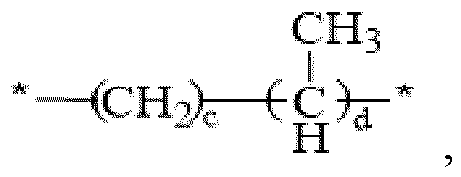

- In some embodiments of this application, the compound represented by Formula (I) includes the following compounds:


- By applying the electrolyte containing the compounds of Formula (I) falling within the above ranges to the electrochemical device, this application can reduce dissolution of transition metals (such as cobalt) and the possibility of depositing the transition metals on the surface of a negative electrode plate, thereby improving the cycle performance and high-temperature intermittent cycle performance of the electrochemical device.
- In some embodiments of this application, the value of q satisfies: 0.5 ≤ q ≤ 12. By controlling the mass percent of the compound of Formula (I) to fall within the above range, this application reduces the dissolution of transition metals and the possibility of depositing the transition metals on the surface of the negative electrode plate, thereby improving the cycle performance, high-temperature intermittent cycle performance, and expansion resistance of the electrochemical device.
- In some embodiments of this application, p and q satisfy: 0.025 ≤ p/q ≤ 1. By controlling the value of the p/q ratio to fall within the above range, this application can further reduce the interfacial reactions between the positive active material and the electrolyte, and reduce the dissolution of transition metals and the possibility of depositing the transition metals on the surface of the negative electrode plate, thereby improving the cycle performance and high-temperature intermittent cycle performance of the electrochemical device.
- In some embodiments of this application, a particle diameter of the positive electrode additive is D nm, and D satisfies: 300 ≤ D ≤ 500. By controlling the value of D to fall within the above range, this application further reduces the interfacial reactions between the positive active material and the electrolyte, and further alleviate the delithiation-induced structural phase transition of the positive active material, thereby improving the cycle performance and high-temperature intermittent cycle performance of the electrochemical device.
- In some embodiments of this application, molar ratios between elements at a position between particles of the positive active material in a cross-section of the positive electrode plate satisfy at least one of the following characteristics: (a) 0.5 ≤ Ti/Al ≤ 5; (b) 1 ≤ Ti/La ≤ 7; (c) 1 ≤ La/Zr ≤ 3; (d) 1 ≤ La/Ta ≤ 12; or (e) 0.5 ≤ Ge/Al ≤ 3. By applying the positive electrode plate of the above characteristics to the electrochemical device, this application can endow the electrochemical device with good cycle performance, high-temperature intermittent cycle performance, and expansion resistance.
- In some embodiments of this application, the electrolyte further includes a compound represented by Formula (II). The compound represented by Formula (II) includes the following compounds:


- Based on the mass of the electrolyte, a mass percent of the compound represented by Formula (II) is x%, satisfying: 0.1 ≤ x ≤ 5. With the electrolyte containing the compound of Formula (II) falling within the above range, by controlling the content of the compound to fall within the above range, this application makes the cathode electrolyte interphase film more stable, and further reduces the dissolution of transition metals and the possibility of depositing the transition metals on the surface of the negative electrode plate, thereby improving the cycle performance, high-temperature intermittent cycle performance, and expansion resistance of the electrochemical device.
- In some embodiments of this application, the electrolyte further includes an electrolyte additive. The electrolyte additive includes at least one of 1,3-propane sultone, vinylene carbonate, 1,3,2-dioxazolethiophene-2,2-dioxide, or lithium bis(oxalato)borate. Based on the mass of the electrolyte, a mass percent of the electrolyte additive is 0.01% to 7%. With the electrolyte containing the electrolyte additive falling within the above range, by controlling the content of the additive to fall within the above range, this application makes the cathode electrolyte interphase film more stable, and further reduces the dissolution of transition metals and the possibility of depositing the transition metals on the surface of the negative electrode plate, thereby improving the cycle performance, high-temperature intermittent cycle performance, and expansion resistance of the electrochemical device.
- In some embodiments of this application, the electrolyte additive includes 1,3-propane sultone and vinylene carbonate. Based on the total mass of the electrolyte, an aggregate mass percent of the 1,3-propane sultone and the vinylene carbonate is y%, satisfying: 0.5 ≤ q/y ≤ 1.6. With the electrolyte containing the electrolyte additive falling within the above range, by controlling the value of the q/y ratio to fall within the above range, this application makes the cathode electrolyte interphase film more stable, makes the transition metals more stable on the surface of the positive active material layer, and reduces the dissolution of the transition metals and the possibility of depositing the transition metals on the surface of the negative electrode plate, thereby further improving the cycle performance, high-temperature intermittent cycle performance, and expansion resistance of the electrochemical device.
- A second aspect of this application provides an electronic device. The electronic device includes the electrochemical device according to the first aspect of this application. The electrochemical device according to this application exhibits good cycle performance, high-temperature intermittent cycle performance, and expansion resistance. Therefore, the electronic device of this application exhibits a relatively long lifespan.
- This application provides an electrochemical device and an electronic device. The electrochemical device includes a positive electrode plate, a negative electrode plate, and an electrolyte. The positive electrode plate includes a positive current collector and a positive active material layer disposed on at least one surface of the positive current collector. The positive active material layer includes a positive active material and a positive electrode additive. The positive electrode additive includes at least one of lithium titanium aluminum phosphate, lithium lanthanum titanium oxide, lithium lanthanum tantalum oxide, lithium aluminum germanium phosphate, lithium lanthanum zirconium oxide, niobium-doped lithium lanthanum zirconium oxide, or tantalum-doped lithium lanthanum zirconium oxide. Based on a mass of the positive active material layer, a mass percent of the positive electrode additive is p%, satisfying: 0.1 ≤ p ≤ 1.2. The electrolyte includes a compound represented by Formula (I). Based on a mass of the electrolyte, a mass percent of the compound represented by Formula (I) is q%, satisfying: 0.1 ≤ q ≤ 12. The positive electrode plate includes the positive electrode additive, the electrolyte includes the compound of Formula (I), and the values of p and q are controlled to fall within the ranges specified herein. Therefore, the positive electrode additive can form a physical barrier between the positive active material and the electrolyte, thereby reducing interfacial reactions between the positive active material and the electrolyte. In addition, when the positive active material is highly delithiated, the positive electrode additive can be used as a lithium source for supplementing lithium to alleviate the delithiation-induced structural phase transition of the positive active material. However, during cycling of the electrochemical device, the positive active material keeps delithiating, thereby gradually generating stress and strain. The stress and strain lead to a tendency to weaken the contact between the positive electrode additive and the positive active material. When the contact between the positive electrode additive and the positive active material becomes weak, the positive electrode additive is less capable of suppressing the interfacial reactions between the positive active material and the electrolyte. In this case, the compound of Formula (I) can reduce the interfacial reactions, stabilize the positive active material and the positive electrode additive, and maintain the physical barrier and lithium supplement provided by the positive electrode additive, thereby improving the cycle performance, high-temperature intermittent cycle performance, and expansion resistance of the electrochemical device under a high voltage.
- Definitely, a single product or method implemented according to this application does not necessarily achieve all of the above advantages concurrently.
- To describe the technical solutions in some embodiments of this application or the prior art more clearly, the following outlines the drawings to be used in the description of some embodiments of this application or the prior art. Evidently, the drawings outlined below merely illustrate some embodiments of this application, and a person of ordinary skill in the art may derive other embodiments from the drawings.
-
FIG. 1 is a scanning electron microscope image of a positive active material layer according to Embodiment 1-3 of this application; and -
FIG. 2 is a distribution diagram of Ti element at a position between particles of a positive active material in a cross-section of a positive electrode plate according to Embodiment 1-3 of this application. - The following describes the technical solutions in some embodiments of this application clearly in detail with reference to the drawings appended hereto. Evidently, the described embodiments are merely a part of but not all of the embodiments of this application. All other embodiments derived by a person of ordinary skill in the art based on the embodiments of this application without making any creative efforts still fall within the protection scope of this application.
- It is hereby noted that in specific embodiments of this application, this application is construed by using a lithium-ion battery as an example of the electrochemical device, but the electrochemical device according to this application is not limited to the lithium-ion battery.
- A first aspect of this application provides an electrochemical device. The electrochemical device includes a positive electrode plate and an electrolyte. The positive electrode plate includes a positive current collector and a positive active material layer disposed on at least one surface of the positive current collector. The positive active material layer includes a positive active material and a positive electrode additive. The positive electrode additive includes at least one of lithium titanium aluminum phosphate, lithium lanthanum titanium oxide, lithium lanthanum tantalum oxide, lithium aluminum germanium phosphate, lithium lanthanum zirconium oxide, niobium-doped lithium lanthanum zirconium oxide, or tantalum-doped lithium lanthanum zirconium oxide. Based on a mass of the positive active material layer, a mass percent of the positive electrode additive is p%, satisfying: 0.1 ≤ p ≤ 1.2. For example, p may be 0.1, 0.3, 0.4, 0.6, 0.7, 0.9, 1.1, 1.2, or a value falling within a range formed by any two thereof. The electrolyte includes a compound represented by Formula (I):

- In Formula (I) above, R1 is selected from


- The positive electrode plate includes the positive electrode additive, the electrolyte includes the compound of Formula (I), and the values of p and q are controlled to fall within the ranges specified herein. Therefore, the positive electrode additive can form a physical barrier between the positive active material and the electrolyte, thereby reducing interfacial reactions between the positive active material and the electrolyte. In addition, when the positive active material is highly delithiated, the positive electrode additive can be used as a lithium source for supplementing lithium to alleviate the delithiation-induced structural phase transition of the positive active material. However, during cycling of the electrochemical device, the positive active material keeps delithiating, thereby gradually generating stress and strain. The stress and strain lead to a tendency to weaken the contact between the positive electrode additive and the positive active material. When the contact between the positive electrode additive and the positive active material becomes weak, the positive electrode additive is less capable of suppressing the interfacial reactions between the positive active material and the electrolyte. In this case, the compound of Formula (I) can reduce the interfacial reactions, stabilize the positive active material and the positive electrode additive, and maintain the physical barrier and lithium supplement provided by the positive electrode additive, thereby improving the cycle performance, high-temperature intermittent cycle performance, and expansion resistance of the electrochemical device under a high voltage. When the value of p is unduly small, the positive electrode additive is insignificant in playing an improvement role, unable to provide a physical barrier between the positive active material layer and the electrolyte, insignificant in reducing the side reactions between the positive active material and the electrolyte and alleviating the delithiation-induced structural phase transition of the positive active material, and unfavorable to improving the cycle performance and high-temperature intermittent cycle performance of the electrochemical device. When the value of p is unduly large, the content of the positive electrode additive is unduly high, thereby being unfavorable to the transport of lithium ions in the positive active material layer and unfavorable to improving the cycle performance of the electrochemical device. When the value of q is unduly small, the compound of Formula (I) is insignificant in playing an improvement role, and unable to play a role in reducing the interfacial reactions between the positive active material and the electrolyte, or a role in stabilizing the positive active material layer and the positive electrode additive, or a role in maintaining the physical barrier and lithium supplement provided by the positive electrode additive, thereby being unfavorable to improving the cycle performance, high-temperature intermittent cycle performance, and expansion resistance of the electrochemical device. When the value of q is unduly large, the content of the compound of Formula (I) is unduly high, the steric hindrance of transport of lithium ions in the electrolyte will be unduly high, and the interfacial resistance between the positive active material and the electrolyte will be unduly high, thereby being unfavorable to the transport of lithium ions and unfavorable to improving the cycle performance of the electrochemical device. Therefore, by applying the positive electrode additive and the compound of Formula (I) specified herein to the lithium-ion battery and controlling the values of p and q to fall within the ranges specified herein, this application can improve the cycle performance, high-temperature intermittent cycle performance, and expansion resistance of the electrochemical device. In this application, "high temperature" means a temperature higher than or equal to 45 °C.
- In some embodiments of this application, the compound represented by Formula (I) includes the following compounds:


- When the electrolyte containing the compound of Formula (I) falling within the above range to the electrochemical device, the transition metals on the surface of the positive active material layer are further complexed with by using the cyano group in the compound of Formula (I), thereby making the transition metals more stable on the surface of the positive active material layer, reducing the dissolution of the transition metals and the possibility of depositing the transition metals on the surface of the negative electrode plate, reducing the interfacial reactions between the positive active material and the electrolyte, stabilizing the positive active material layer and the positive electrode additive, maintaining the physical barrier and lithium supplement provided by the positive electrode additive, and in turn, improving the cycle performance, high-temperature intermittent cycle performance, and expansion resistance of the electrochemical device.
- In some embodiments of this application, p and q satisfy: 0.025 ≤ p/q ≤ 1. For example, the p/q ratio may be 0.025, 0.03, 0.05, 0.1, 0.3, 0.4, 0.5, 0.75, 0.9, 1, or a value falling within a range formed by any two thereof. By controlling the value of the p/q ratio to fall within the above range, this application can well exert the synergistic effect between the positive electrode additive and the compound of Formula (I), further reduce the interfacial reactions between the positive active material and the electrolyte, alleviate the delithiation-induced structural phase transition of the positive active material, and reduce the dissolution of transition metals and the possibility of depositing the transition metals on the surface of the negative electrode plate, thereby further improving the cycle performance, high-temperature intermittent cycle performance, and expansion resistance of the electrochemical device.
- In some embodiments of this application, a particle diameter of the positive electrode additive is D nm, and D satisfies: 300 ≤ D ≤ 500. For example, D may be 300, 340, 380, 400, 420, 460, 500, or a value falling within a range formed by any two thereof. By controlling the value of D to fall within the above range, this application further reduces the interfacial reactions between the positive active material and the electrolyte, and further alleviate the delithiation-induced structural phase transition of the positive active material, thereby improving the cycle performance and high-temperature intermittent cycle performance of the electrochemical device. In this application, the particle diameter D of the positive electrode additive is an average particle diameter of the positive electrode additive.
- In some embodiments of this application, molar ratios between elements at a position between particles of the positive active material in a cross-section of the positive electrode plate satisfy at least one of the following characteristics: (a) 0.5 ≤ Ti/Al ≤ 5; (b) 1 ≤ Ti/La ≤ 7; (c) 1 ≤ La/Zr ≤ 3; (d) 1 ≤ La/Ta ≤ 12; or (e) 0.5 ≤ Ge/Al ≤ 3. For example, the molar ratio between Ti and Al, denoted as Ti/Al molar ratio, may be 0.5, 1, 2, 3, 4, 5, or a value falling within a range formed by any two thereof; the Ti/La molar ratio may be 1, 2, 3, 3.5, 4, 5, 6, 7, or a value falling within a range formed by any two thereof; the La/Zr molar ratio may be 1, 1.2, 1.5, 1.8, 2.2, 2.5, 2.8, 3, or a value falling within a range formed by any two thereof; the La/Ta molar ratio may be 1, 1.5, 3.5, 4.5, 6.5, 8.5, 10, 12, or a value falling within a range formed by any two thereof; and the Ge/Al molar ratio may be 0.5, 0.8, 1.2, 1.5, 1.8, 2.2, 2.6, 3, or a value falling within a range formed by any two thereof. By applying the positive electrode plate of the above characteristics to the electrochemical device, this application can reduce the interfacial reactions between the positive active material and the electrolyte, further alleviate the delithiation-induced structural phase transition of the positive active material, and reduce the dissolution of transition metals and the possibility of depositing the transition metals on the surface of the negative electrode plate, thereby further improving the cycle performance, high-temperature intermittent cycle performance, and expansion resistance of the electrochemical device.
- In this application, the cross-section of the positive electrode plate is formed by sectioning the positive active material layer in a direction perpendicular to the thickness direction of the positive electrode plate. The sectioning depth and sectioning method are not particularly limited herein, as long as the cutting surface is flat and even and the scanning electron microscopy image enables visibility of the particle interface of the positive active material and the positive electrode additive at the position between particles of the positive active material. For example, the sectioning method may include, but is not limited to, cutting by means of ion beam cross-section polishing. The process parameters of the ion beam cross-section polishing are not particularly limited herein, as long as the objectives of this application can be achieved.
- In this application, the general formula of the lithium aluminum titanium phosphate (LATP) is Li1+uAluTi2-u(PO4)3, 0 < u ≤ 0.5, for example, Li1.3Al0.3Ti1.7(PO4)3, Li1.5Al0.5Ti1.5(PO4)3. The general formula of the lithium lanthanum titanium oxide (LLTO) is Li3vLa2/3-vTiO3, 0 < v ≤ 0.2, for example, Li0.5La0.5TiO3, Li0.33La0.56TiO3, Li0.35La0.55TiO3. The chemical formula of lithium lanthanum tantalum oxide is Li0.33La0.56Ta0.8O3. The general formula of the lithium aluminum germanium phosphate is Li1+wAlwGe2-w(PO4)3, 0 < w ≤ 0.5, for example, Li1.5Al0.5Ge1.5(PO4)3. The chemical formula of the lithium lanthanum zirconium oxide (LLZO) is Li7La3Zr2O12. The chemical formula of the niobium-doped lithium lanthanum zirconium oxide is Li7-zLa3Zr2-zNbzO12, 0 < z ≤ 0.25, for example, Li6.75La3Zr1.75Nb0.25O12, or Li6.8La3Zr1.8Nb0.2O12. The general formula of the tantalum-doped lithium lanthanum zirconium oxide is Li7-rLa3Zr2-rTarO12, 0 ≤ r ≤ 0.5, for example, Li6.5La3Zr1.5Ta0.5O12, or Li6.75La3Zr1.75Ta0.25O12.
- Generally, the particle diameter of the positive electrode additive can be changed by selecting positive electrode additives of different particle diameters. The Ti/Al molar ratio at the position between particles of the positive active material in the cross-section of the positive electrode plate can be caused to satisfy 0.5 ≤ Ti/Al ≤ 5 by adjusting the mass percent of one of two types of lithium aluminum titanium phosphates containing Ti and Al at different mass ratios. The positive electrode additive includes constituents Li1.3Al0.3Ti1.7(PO4)3 and Li1.5Al0.5Ti1.5(PO4)3, and the Ti/Al molar ratio can be regulated by adjusting the mass ratio between the two constituents, and specifically, by adjusting the mass percent of one of the constituents. For example, the Ti/Al molar ratio is increased by increasing the mass percent of Li1.3Al0.3Ti1.7(PO4)3, and the Ti/Al mass ratio is decreased by decreasing the mass percent of Li1.3Al0.3Ti1.7(PO4)3. Other constituents such as lithium lanthanum titanium oxide and lithium aluminum germanium phosphate may be added, and the Ti/Al molar ratio at the position between particles of the positive active material in the cross-section of the positive electrode plate can be caused to satisfy 0.5 ≤ Ti/Al ≤ 5 by adjusting the mass ratio between lithium aluminum titanium phosphate and such constituents. When the positive electrode additive includes lithium lanthanum titanium oxide (LLTO), the Ti/La molar ratio at the position between particles of the positive active material in the cross-section of the positive electrode plate can be caused to satisfy 0.5 ≤ Ti/La ≤ 2 by adjusting the mass percent of one of two types of lithium lanthanum titanium oxides containing Ti and La at different mass ratios. For example, the positive electrode additive includes constituents Li0.5La0.5TiO3 and Li0.33La0.56TiO3. The Ti/La molar ratio is increased by increasing the mass percent of Li0.5La0.5TiO3, and the Ti/La molar ratio is decreased by decreasing the mass percent of Li0.5La0.5TiO3. Other constituents such as lithium aluminum titanium phosphate, lithium lanthanum titanium oxide, lithium lanthanum tantalum oxide, lithium lanthanum zirconium oxide, niobium-doped lithium lanthanum zirconium oxide, or tantalum-doped lithium lanthanum zirconium oxide may be added. The Ti/Al molar ratio at the position between particles of the positive active material in the cross-section of the positive electrode plate can be caused to satisfy 0.5 ≤ Ti/Al ≤ 5 by adjusting the mass ratio between lithium lanthanum titanium oxide and such constituents. Similarly, the La/Zr molar ratio, the La/Ta molar ratio, and the Ge/Al molar ratio may be regulated with reference to the above method, the details of which are omitted here.
- In some embodiments of this application, the electrolyte further includes a compound represented by Formula (II). The compound represented by Formula (II) includes the following compounds:
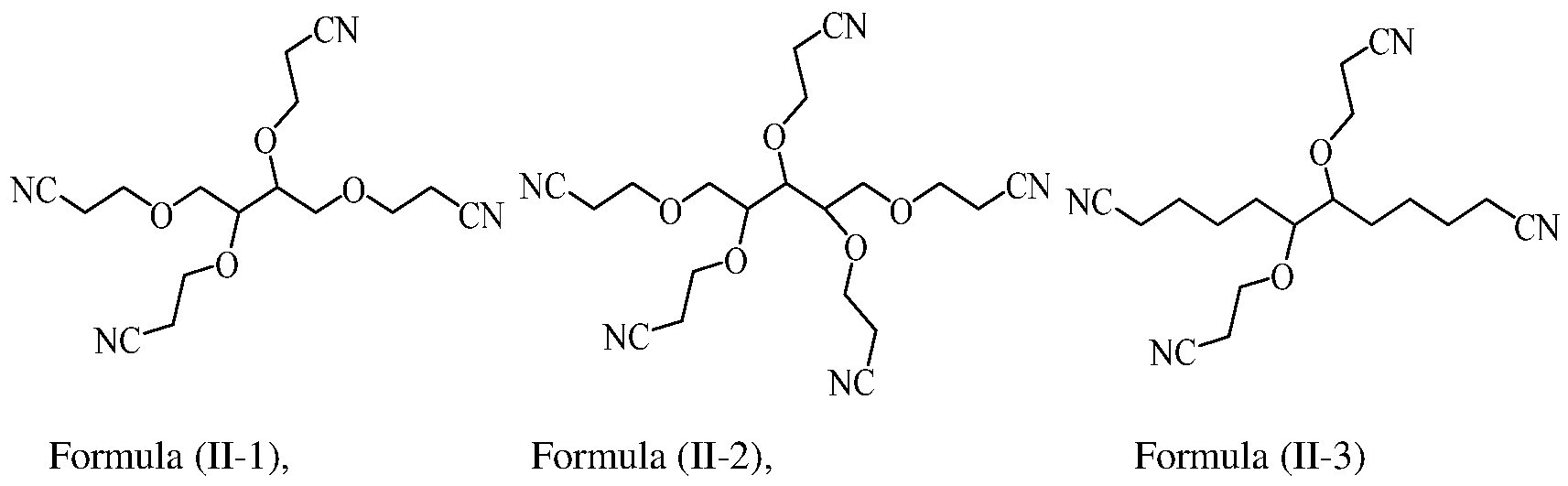


- Based on the mass of the electrolyte, a mass percent of the compound represented by Formula (II) is x%, satisfying: 0.1 ≤ x ≤ 5. For example, the value of x may be 0.1, 0.5, 0.9, 1.5, 2, 2.6, 3, 3.5, 4, 4.5, 5, or a value falling within a range formed by any two thereof. With the electrolyte containing the compound of Formula (II) falling within the above range, by controlling the content of the compound to fall within the above range, this application makes the cathode electrolyte interphase film more stable, makes the transition metals more stable on the surface of the positive active material layer, and reduces the dissolution of the transition metals and the possibility of depositing the transition metals on the surface of the negative electrode plate, thereby further improving the cycle performance, high-temperature intermittent cycle performance, and expansion resistance of the electrochemical device.
- In some embodiments of this application, the electrolyte further includes an electrolyte additive. The electrolyte additive includes at least one of 1,3-propane sultone (PS), vinylene carbonate (VC), 1,3,2-dioxazolethiophene-2,2-dioxide (DTD), or lithium bis(oxalato)borate (LiBOB). Based on the mass of the electrolyte, a mass percent of the electrolyte additive is 0.01% to 7%. For example, the mass percent of the electrolyte additive may be 0.01%, 0.05%, 0.1%, 0.5%, 0.9%, 1.5%, 2.5%, 3.5%, 4.5%, 5.5%, 6.5%, 7%, or a value falling within a range formed by any two thereof. With the electrolyte containing the electrolyte additive falling within the above range, by controlling the content of the additive to fall within the above range, this application makes the cathode electrolyte interphase film more stable, makes the transition metals more stable on the surface of the positive active material layer, and reduces the dissolution of the transition metals and the possibility of depositing the transition metals on the surface of the negative electrode plate, thereby further improving the cycle performance, high-temperature intermittent cycle performance, and expansion resistance of the electrochemical device.
- In some embodiments of this application, the electrolyte additive includes 1,3-propane sultone and vinylene carbonate. Based on the total mass of the electrolyte, an aggregate mass percent of the 1,3-propane sultone and the vinylene carbonate is y%, satisfying: 0.5 ≤ q/y ≤ 1.6. For example, the q/y ratio may be 0.5, 0.75, 0.9, 1, 1.2, 1.3, 1.4, 1.5, 1.6, or a value falling within a range formed by any two thereof. With the electrolyte containing the electrolyte additive falling within the above range, by controlling the value of the q/y ratio to fall within the above range, this application makes the cathode electrolyte interphase film more stable, makes the transition metals more stable on the surface of the positive active material layer, and reduces the dissolution of the transition metals and the possibility of depositing the transition metals on the surface of the negative electrode plate, thereby further improving the cycle performance, high-temperature intermittent cycle performance, and expansion resistance of the electrochemical device.
- In this application, the electrolyte further includes a lithium salt and a nonaqueous solvent. The lithium salt may include at least one of LiPF6, LiBF4, LiClO4, LiB(C6H5)4, LiCH3SO3, LiCF3SO3, LiN(SO2CF3)2, LiC(SO2CF3)3, Li2SiF6, lithium bis(oxalato)borate (LiBOB), or lithium difluoroborate. The mass percent of the lithium salt in the electrolyte is not particularly limited herein, as long as the objectives of this application can be achieved. For example, based on the mass of the electrolyte, the mass percent of the lithium salt is 8% to 15%. For example, the mass percent of the lithium salt is 8%, 9%, 10%, 11%, 13%, 15%, or a value falling within a range formed by any two thereof. The nonaqueous solvent is not particularly limited in this application, as long as the objectives of this application can be achieved. For example, the nonaqueous solvent may include, but is not limited to, at least one of a carbonate compound, a carboxylate compound, an ether compound, or other organic solvents. The carbonate compound may include, but is not limited to, at least one of a chain carbonate compound, a cyclic carbonate compound, or a fluorocarbonate compound. The chain carbonate compound may include, but is not limited to, at least one of dimethyl carbonate (DMC), diethyl carbonate (DEC), dipropyl carbonate (DPC), methyl propyl carbonate (MPC), ethylene propyl carbonate (EPC), or ethyl methyl carbonate (EMC). The cyclic carbonate compound may include, but is not limited to, at least one of ethylene carbonate (EC), propylene carbonate (PC), butylene carbonate (BC), or vinyl ethylene carbonate (VEC). The fluorocarbonate compound may include, but is not limited to, at least one of fluoroethylene carbonate (FEC), 1,2-difluoroethylene carbonate, 1,1-difluoroethylene carbonate, 1,1,2-trifluoroethylene carbonate, 1,1,2,2-tetrafluoroethylene carbonate, 1-fluoro-2-methyl ethylene, 1-fluoro-1-methyl ethylene carbonate, 1,2-difluoro-1-methyl ethylene carbonate, 1,1,2-trifluoro-2-methyl ethylene carbonate, or trifluoromethyl ethylene carbonate. The carboxylate compound may include, but is not limited to, at least one of methyl formate, methyl acetate, ethyl acetate, n-propyl acetate, tert-butyl acetate, methyl propionate, ethyl propionate, propyl propionate, γ-butyrolactone, decanolactone, valerolactone, or caprolactone. The ether compound may include, but is not limited to, at least one of dibutyl ether, tetraglyme, diglyme, 1,2-dimethoxyethane, 1,2-diethoxyethane, 1-ethoxy-1-methoxyethane, 2-methyltetrahydrofuran, or tetrahydrofuran. The other organic solvent may include, but is not limited to, at least one of dimethyl sulfoxide, 1,2-dioxolane, sulfolane, methyl sulfolane, 1,3-dimethyl-2-imidazolidinone, N-methyl-2-pyrrolidone, dimethylformamide, acetonitrile, trimethyl phosphate, triethyl phosphate, or trioctyl phosphate. Based on the mass of the electrolyte, the mass percent of the nonaqueous solvent may be 65% to 90%, for example, may be 65%, 70%, 75%, 80%, 86%, 88%, 90%, or a value falling within a range formed by any two thereof.
- The positive current collector is not particularly limited in this application, as long as the objectives of this application can be achieved. For example, the positive current collector may include aluminum foil, aluminum alloy foil, or the like. The positive active material layer in this application includes a positive active material. The type of the positive active material is not particularly limited in this application, as long as the objectives of this application can be achieved. For example, the positive active material may include at least one of lithium nickel cobalt manganese oxide (NCM811, NCM622, NCM523, NCM111), lithium nickel cobalt aluminum oxide, lithium iron phosphate, a lithium-rich manganese-based material, lithium cobalt oxide (LiCoO2), lithium manganese oxide, lithium manganese iron phosphate, lithium titanium oxide, or the like. In this application, the positive active material may further include a non-metallic element. For example, the non-metallic elements include at least one of fluorine, phosphorus, boron, chlorine, silicon, or sulfur. Such elements can further improve the stability of the positive active material. In this application, the thicknesses of the positive current collector and the positive active material layer are not particularly limited, as long as the objectives of this application can be achieved. For example, the thickness of the positive current collector is 5 µm to 20 µm, and preferably 6 µm to 18 µm. The thickness of the positive active material layer on a single side is 30 µm to 120 µm. In this application, the positive active material layer may be disposed on one surface of the positive current collector in a thickness direction or on both surfaces of the positive current collector in the thickness direction. It is hereby noted that the "surface" here may be the entire region of the positive current collector, or a partial region of the positive current collector, without being particularly limited in this application, as long as the objectives of the application can be achieved. The positive active material layer in this application may include a conductive agent and a binder.
- The electrochemical device in this application further includes a negative electrode plate. The negative electrode plate is not particularly limited herein, as long as the objectives of this application can be achieved. For example, the negative electrode plate includes a negative current collector and a negative active material layer disposed on at least one surface of the negative current collector. The negative current collector is not particularly limited in this application, as long as the objectives of this application can be achieved. For example, the negative current collector may include copper foil, copper alloy foil, nickel foil, titanium foil, foamed nickel, foamed copper, or the like. The negative active material layer in this application includes a negative active material. The type of the negative active material is not particularly limited in this application, as long as the objectives of this application can be achieved. For example, the negative active material may include at least one of natural graphite, artificial graphite, mesocarbon microbead (MCMB), hard carbon, soft carbon, silicon, a silicon-carbon composite, SiOk (0 < k ≤ 2), metallic lithium, or the like. The thicknesses of the negative current collector and the negative active material layer are not particularly limited herein, as long as the objectives of this application can be achieved. For example, the thickness of the negative current collector is 4 µm to 12 µm, and the thickness of the negative active material layer on a single side is 30 µm to 130 µm. In this application, the negative active material layer may be disposed on one surface of the negative current collector in the thickness direction or on both surfaces of the negative current collector in the thickness direction. It is hereby noted that the "surface" here may be the entire region of the negative current collector, or a partial region of the negative current collector, without being particularly limited in this application, as long as the objectives of the application can be achieved. The negative active material layer in this application may include a conductive agent and a binder.
- The conductive agent and binder are not particularly limited as long as the objectives of this application can be achieved. For example, the conductive agent may include at least one of conductive carbon black (Super P), carbon nanotubes (CNTs), carbon nanofibers, flake graphite, carbon dots, graphene, or the like. The binder may include at least one of polypropylene alcohol, sodium polyacrylate, potassium polyacrylate, lithium polyacrylate, polyimide, polyamide imide, styrene butadiene rubber (SBR), polyvinyl alcohol (PVA), polyvinylidene difluoride (PVDF), polytetrafluoroethylene (PTFE), polyvinyl butyral (PVB), water-based acrylic resin, carboxymethyl cellulose (CMC), sodium carboxymethyl cellulose (CMC-Na), or the like.
- The electrochemical device in this application further includes a separator. The separator is disposed between the positive electrode plate and the negative electrode plate, and is configured to separate the positive electrode plate from the negative electrode plate, prevent an internal short circuit of the secondary battery, and allow electrolyte ions to pass freely without affecting the electrochemical charging and discharging processes. The separator is not particularly limited herein, as long as the objectives of this application can be achieved. For example, the separator may include a substrate layer and a surface treatment layer. The substrate layer may be a non-woven fabric, film or composite film, which, in each case, is porous. The material of the substrate layer may include at least one of polyethylene, polypropylene, polyethylene terephthalate, polyimide, or the like. Optionally, the substrate layer may be a polypropylene porous film, a polyethylene porous film, a polypropylene non-woven fabric, a polyethylene non-woven fabric, or a polypropylene-polyethylene-polypropylene porous composite film. Optionally, the surface treatment layer is disposed on at least one surface of the substrate layer. The surface treatment layer may be a polymer layer or an inorganic compound layer, or a layer compounded of a polymer and an inorganic compound. For example, the inorganic compound layer includes inorganic particles and a binder. The inorganic particles are not particularly limited, and may be at least one selected from: aluminum oxide, silicon oxide, magnesium oxide, titanium oxide, hafnium dioxide, tin oxide, ceria, nickel oxide, zinc oxide, calcium oxide, zirconium oxide, yttrium oxide, silicon carbide, boehmite, aluminum hydroxide, magnesium hydroxide, calcium hydroxide, barium sulfate, or the like. The binder is not particularly limited, and may be at least one selected from, for example, polyvinylidene difluoride, poly(vinylidene difluoride-co-hexafluoropropylene), polytetrafluoroethylene, polyhexafluoropropylene, polyamide, polyacrylonitrile, polyacrylate, polyacrylic acid, sodium polyacrylate, potassium polyacrylate, lithium polyacrylate, polyvinylpyrrolidone, polyvinyl ether, polymethylmethacrylate, or the like. The polymer layer includes a polymer. The material of the polymer includes at least one of polyamide, polyacrylonitrile, an acrylate polymer, polyacrylic acid, sodium polyacrylate, potassium polyacrylate, lithium polyacrylate, polyvinylpyrrolidone, polyvinyl ether, polyvinylidene fluoride, poly(vinylidene fluoride-co-hexafluoropropylene), or the like. The thickness of the separator is not particularly limited in this application, as long as the objectives of this application can be achieved. For example, the thickness of the separator may be 5 µm to 500 µm.
- The electrochemical device in this application is not particularly limited, and may be any device in which an electrochemical reaction occurs. In an embodiment of this application, the electrochemical device may be, but is not limited to, a lithium-ion secondary battery (lithium-ion battery), a lithium metal secondary battery, a lithium polymer secondary battery, a lithium-ion polymer secondary battery, or the like.
- The process of preparing the electrochemical device is well known to a person skilled in the art, and is not particularly limited in this application. For example, the preparation process may include, but without being limited to, the following steps: stacking the positive electrode plate, the separator, and the negative electrode plate in sequence, and performing operations such as winding and folding as required to obtain a jelly-roll electrode assembly; putting the electrode assembly into a package, injecting the electrolyte into the package, and sealing the package to obtain an electrochemical device; or, stacking the positive electrode plate, the separator, and the negative electrode plate in sequence, and then fixing the four corners of the entire stacked structure by use of adhesive tape to obtain a stacked-type electrode assembly, putting the electrode assembly into a package, injecting the electrolyte into the package, and sealing the package to obtain an electrochemical device. In addition, an overcurrent prevention element, a guide plate, and the like may be placed into the package as required, so as to prevent the rise of internal pressure, overcharge, and overdischarge of the electrochemical device. The packaging bag is not particularly limited in this application, and may be selected by a person skilled in the art as actually required, as long as the objectives of this application can be achieved. For example, the packaging bag may be an aluminum laminated film.
- A second aspect of this application provides an electronic device. The electronic device includes the electrochemical device according to the first aspect of this application. The electrochemical device provided in this application exhibits good cycle performance and high-temperature intermittent cycle performance. Therefore, the electronic device of this application exhibits a relatively long lifespan.
- The electronic device according to this application is not particularly limited, and may be any electronic device known in the prior art. In some embodiments, the electronic device may include, but is not limited to, a notebook computer, pen-inputting computer, mobile computer, e-book player, portable phone, portable fax machine, portable photocopier, portable printer, stereo headset, video recorder, liquid crystal display television set, handheld cleaner, portable CD player, mini CD-ROM, transceiver, electronic notepad, calculator, memory card, portable voice recorder, radio, backup power supply, motor, automobile, motorcycle, power-assisted bicycle, bicycle, lighting appliance, toy, game console, watch, electric tool, flashlight, camera, large household battery, lithium-ion capacitor, or the like.
- The implementations of this application are described below in more detail with reference to embodiments and comparative embodiments. Various tests and evaluations are performed by the following methods. In addition, unless otherwise specified, the word "parts" means parts by mass, and the symbol "%" means a percentage by mass.
- Taking the lithium-ion batteries (with a capacity of 2000 mAh) prepared in the embodiments and comparative embodiments, charging the battery at a 45 °C ambient temperature and at a constant current of 1 C until the voltage reaches 4.45 V, and then charging the battery at a constant voltage of 4.45 V until the current reaches 0.05 C, recording a charge capacity at this time as a first-cycle charge capacity of the lithium-ion battery; leaving the battery to stand for 5 minutes, and then discharging the battery at a constant current of 0.5 C until the voltage reaches 3.0 V, and leaving the battery to stand for 5 minutes, thereby completing one charge-discharge cycle. Recording the discharge capacity at this time as a first-cycle discharge capacity of the lithium-ion battery, that is, an initial capacity of the lithium-ion battery. Performing the charge-discharge test on the lithium-ion battery for 500 cycles according to the method described above, and recording the 500th-cycle discharge capacity. 500th-cycle capacity retention rate of the battery cycled at 45 °C (%) = 500th-cycle discharge capacity/first-cycle discharge capacity × 100%.
- Putting a lithium-ion battery in a 45 °C thermostat, charging the battery at a constant current of 0.5 C until a voltage of 4.45 V, charging the battery at a constant voltage of 4.45 V until a current of 0.05 C, leaving the battery to stand for 19.5 hours, and then discharging the battery at a constant current of 0.5 C until a voltage of 3.0 V, thereby completing a first charge-discharge cycle. Recording the discharge capacity of the battery in the first cycle as an initial discharge capacity of the lithium-ion battery. Repeating the foregoing charge-discharge operations for 23 cycles. Subsequently, charging the battery at a constant current of 0.5 C until a voltage of 4.4 V, charging the battery at a constant voltage of 4.4 V until a current of 0.05 C, leaving the battery to stand for 19.5 hours, and then discharging the battery at a constant current of 0.5 C until a voltage of 3.0 V, thereby completing a second charge-discharge cycle. Repeating the foregoing operations of the second charge-discharge cycle for 113 cycles, and recording the remaining discharge capacity of the lithium-ion battery. Calculating the capacity retention rate and the thickness growth rate of the lithium-ion battery.
Capacity retention rate = remaining discharge capacity/initial discharge capacity × 100%. - Thickness growth rate = (H1 - H0)/H0 ×100%, where H0 is the initial thickness of the lithium-ion battery fully charged at the end of the first cycle, and H1 is the thickness of the lithium-ion battery fully charged at the end of the 136th cycle. The thickness growth rate serves as a metric for evaluating the expansion resistance of the lithium-ion battery.
- Disassembling and centrifuging a discharged lithium-ion battery to obtain a liquid specimen. Performing an ion chromatography (IC) test on the liquid specimen to obtain the content of the lithium salt in the electrolyte. Testing, by using a gas chromatography mass spectrometry (GC-MS) instrument, the liquid specimen obtained by centrifugation to determine the mass ratio between constituents in the electrolyte. Calculating the mass percent of each constituent in the electrolyte with reference to the content of the lithium salt determined above.
- Cutting the positive electrode plate into specimens of 6 mm × 6 mm in size with scissors, and using a relatively flat side of the specimen as a surface to be cut. Using an ion beam cross-section polisher (IB-09010 CP) to polish the flat side perpendicular to the thickness direction of the positive electrode plate, where the process parameters of the polishing are: voltage 6 kV, duration 2 hours (h), diameter of the ion beam 500 µm, grinding speed 100 µm/h, and a
vacuum degree 10-4 Pa. The resultant polished surface is a CP cutting surface, that is, a cross-section of the positive electrode plate, serving as a specimen ready for surface morphology analysis and surface element testing of the positive electrode plate. - Observing the microscopic morphology of the positive active material layer of the resultant specimen by using a scanning electron microscope (ZEISS SEM), and measuring the particle diameter of the positive electrode additive. Determining the molar ratio between elements in the positive electrode additive at a position between particles of the positive active material distributed in the cross-section of the positive electrode plate by using an energy dispersive X-ray spectrometer (OXFORD EDS) together with the SEM. First, observing the cross-section of the positive electrode plate in the scanning electron microscope, and then determining the molar ratio between elements of the constituent at the position between particles of the positive active material by using the EDS, and confirming the particles of the positive electrode additive. Recording the molar ratio between elements on the surface of the positive electrode additive. Counting the particle diameters of the particles of the positive electrode additive in 5 SEM images at a magnification of 5000×. Counting 50 particles in each image. Calculating the average value of the particle diameters as the particle diameter D of the particles of the positive electrode additive, measured in nm.
- Mixing LiCoO2 as a positive active material, conductive carbon black as a conductive agent, polyvinylidene difluoride (PVDF) as a binder, and lithium aluminum titanium phosphate (Li1.5Al0.5Ti1.5(PO4)3) as a positive electrode additive at a mass ratio of 96.9: 1.4: 1.6: 0.1, adding N-methyl-pyrrolidone (NMP), and stirring well to obtain a positive electrode slurry with a solid content of 72 wt%. Coating one surface of a 9 µm-thick positive current collector aluminum foil with the positive electrode slurry evenly, and drying the aluminum foil at 85 °C for 4 hours to obtain a positive electrode plate coated with a 60 µm-thick 74 mm-wide positive active material layer on a single side. Repeating the foregoing steps on the other surface of the aluminum foil to obtain a positive electrode plate coated with the positive active material layer on both sides. Subsequently, drying the electrode plate for 4 hours in an 85 °C vacuum environment, and performing cold pressing, cutting, and slitting to obtain a positive electrode plate of 74 mm × 867 mm in size.
- Mixing graphite as a negative active material, conductive carbon black as a conductive agent, sodium carboxymethyl cellulose as a thickener, and styrenebutadiene rubber as a binder at a mass ratio of 96.4: 1.5: 0.5: 1.6, adding deionized water, and stirring well to obtain a negative electrode slurry with a solid content of 54 wt%. Coating one surface of 10 µm-thick negative current collector copper foil with the negative electrode slurry evenly, and drying the copper foil at 85 °C for 4 hours to obtain a negative electrode plate coated with a 75 µm-thick 76.6 mm-wide negative active material layer on a single side. Repeating the foregoing steps on the other surface of the copper foil to obtain a negative electrode plate coated with the negative active material layer on both sides. Subsequently, drying the electrode plate for 4 hours in an 85 °C vacuum environment, and performing cold pressing, cutting, and slitting to obtain a negative electrode plate of 78 mm × 875 mm in size.
- Mixing PVDF and alumina ceramics at a mass ratio of 1: 2, and adding NMP as a solvent to formulate a ceramics layer slurry with a solid content of 12 wt%, and stirring well. Applying the slurry evenly onto one surface of a 5 µm-thick polyethylene substrate, and performing drying to obtain a separator coated with a 2 µm-thick alumina ceramics layer on a single side. Adding PVDF into the NMP solvent, stirring well to formulate a PVDF slurry with a solid content of 25 wt%, and then applying the PVDF onto the surface of the alumina ceramics layer at a concentration of 0.08 mg/cm2, and drying the surface at 85 °C for 4 hours. Finally, applying the PVDF onto the other surface of the polyethylene substrate at a concentration of 0.08 mg/cm2, and drying the surface at 85 °C for 4 hours to obtain a separator.
- Mixing EC, PC, and DEC at a mass ratio of 20: 20: 60 in an argon atmosphere glovebox with a moisture content lower than 10 ppm, so as to obtain a base solvent. Adding a lithium salt LiPF6 into the base solvent, adding the compound Formula (I-1) in the category of Formula (I), and stirring well to obtain an electrolyte. Based on the mass of the electrolyte, the mass percent of LiPF6 is 12.5%, the mass percent of the compound represented by Formula (I) is 2%, and the remaining constituent is the base solvent.
- Stacking the above-prepared positive electrode plate, separator, and negative electrode plate in sequence in such a way that the side, coated with the alumina ceramics layer and PVDF, of the separator is oriented toward the positive electrode plate, and the side coated with only the PVDF is oriented toward the negative electrode plate, and that the separator is located between the positive electrode plate and the negative electrode plate to serve a function of separation. Winding the stacked structure to obtain an electrode assembly. Welding tabs to the electrode assembly, and then putting the electrode assembly into an aluminum laminated film packaging bag, dehydrating the packaged electrode assembly in an 85 °C vacuum oven for 12 hours, and then injecting the prepared electrolyte. Performing steps such as vacuum sealing, standing, chemical formation, shaping, capacity test, and secondary packaging to obtain a pouch-type lithium-ion battery of 3.3 mm × 39 mm × 96 mm in size.
- Identical to Embodiment 1-1 except that, in <Preparing a positive electrode plate>, the mass percent of the positive electrode additive is adjusted according to Table 1A and Table 1B, the mass percent of the positive active material LiCoO2 is changed accordingly, and the aggregate mass percent of the conductive agent and the binder remains unchanged.
- Identical to Embodiment 1-3 except that, in <Preparing a positive electrode plate>, the type of the positive electrode additive is adjusted according to Table 1A and Table 1B.
- Identical to Embodiment 1-3 except that, in <Preparing an electrolyte>, the type of the compound represented by Formula (I) is adjusted according to Table 1A and Table 1B.
- Identical to Embodiment 1-3 except: (i) in <Preparing a positive electrode plate>, the type and mass percent of the positive electrode additive are adjusted according to Table 1A and Table 1B, the mass percent of the positive active material LiCoO2 varies with the mass percent of the positive electrode additive, and the aggregate mass percent of the conductive agent and the binder remains unchanged; and (ii) in <Preparing an electrolyte>, the type and mass percent of the compound represented by Formula (I) are adjusted according to Table 1A and Table 1B, the mass percent of the base solvent varies with the mass percent of the compound represented by Formula (I), and the mass percent of the lithium salt remains unchanged.
- Identical to Embodiment 1-3 except that, in <Preparing a positive electrode plate>, the value of D and the type and mass percent of the positive electrode additive are adjusted according to Table 2A and Table 2B to satisfy the molar ratios between elements specified in Table 2A and Table 2B.
- Identical to Embodiment 1-24 except that, in <Preparing a positive electrode plate>, the value of D and the type and mass percent of the positive electrode additive are adjusted according to Table 2A and Table 2B to satisfy the molar ratios between elements specified in Table 2A and Table 2B.
- Identical to Embodiment 1-25 except that, in <Preparing a positive electrode plate>, the value of D and the type and mass percent of the positive electrode additive are adjusted according to Table 2A and Table 2B to satisfy the molar ratios between elements specified in Table 2A and Table 2B.
- Identical to Embodiment 1-3 except that, in <Preparing a positive electrode plate>, the value of D and the type and mass percent of the positive electrode additive are adjusted according to Table 2A and Table 2B to satisfy the molar ratios between elements specified in Table 2A and Table 2B.
- Identical to Embodiment 1-30 except that, in <Preparing an electrolyte>, the compound represented by Formula (II) is further added according to Table 3, the type and mass percent of the compound represented by Formula (II) are adjusted according to Table 3, the mass percent of the base solvent is changed accordingly, and the mass percent of the lithium salt remains unchanged.
- Identical to Embodiment 1-30 except that, in <Preparing an electrolyte>, an electrolyte additive is further added according to Table 4A and Table 4B, the type and mass percent of the electrolyte additive are adjusted according to Table 4A and Table 4B, the mass percent of the base solvent is changed accordingly, and the mass percent of the lithium salt remains unchanged.
- Identical to Embodiment 1-30 except that, in <Preparing an electrolyte>, an electrolyte additive is further added according to Table 4A and Table 4B, the type and mass percent of the compound represented by Formula I as well as the type and mass percent of the electrolyte additive are adjusted according to Table 4A and Table 4B, the mass percent of the base solvent is changed accordingly, and the mass percent of the lithium salt remains unchanged.
- Identical to Embodiment 1-30 except that, in <Preparing an electrolyte>, an electrolyte additive is further added according to Table 4A and Table 4B, the type and mass percent of the electrolyte additive are adjusted according to Table 4A and Table 4B, the mass percent of the base solvent is changed accordingly, and the mass percent of the lithium salt remains unchanged.
- Identical to Embodiment 1-1 except that, in <Preparing a positive electrode plate>, no positive electrode additive is added, the mass percent of the positive active material LiCoO2 is changed accordingly, and the aggregate mass percent of the conductive agent and the binder remains unchanged.
- Identical to Embodiment 1-1 except that, in <Preparing an electrolyte>, no compound represented by Formula (I) is added, the mass percent of the base solvent is changed accordingly, and the mass percent of the lithium salt remains unchanged.
- Identical to Embodiment 1-3 except that, in <Preparing a positive electrode plate>, the mass percent of the positive electrode additive is adjusted according to Table 1A and Table 1B, the mass percent of the positive active material LiCoO2 is changed accordingly, and the aggregate mass percent of the conductive agent and the binder remains unchanged.
- Identical to Embodiment 1-1 except that, in <Preparing an electrolyte>, the mass percent of the compound represented by Formula (I) is adjusted according to Table 1A and Table 1B, the mass percent of the base solvent is changed accordingly, and the mass percent of the lithium salt remains unchanged.
- Identical to Embodiment 1-3 except: (i) in <Preparing a positive electrode plate>, the mass percent of the positive electrode additive is adjusted according to Table 1A and Table 1B, the mass percent of the positive active material LiCoO2 is changed accordingly, and the aggregate mass percent of the conductive agent and the binder remains unchanged; and (ii) in <Preparing an electrolyte>, the mass percent of the compound represented by Formula (I) is adjusted according to Table 1A and Table 1B, the mass percent of the base solvent is changed accordingly, and the mass percent of the lithium salt remains unchanged.
- Table 1A and Table 1B to Table 4A and Table 4B show the preparation parameters and performance parameters of the embodiments and comparative embodiments.
Table 1A Positive electrode additive Molecular formula of positive electrode additive p Compound represented by Formula (I) Embodiment 1-1 Lithium aluminum titanium phosphate Li1.5Al0.5Ti1.5(PO4)3 0.1 Formula (I-1) Embodiment 1-2 Lithium aluminum titanium phosphate Li1.5Al0.5Ti1.5(PO4)3 0.2 Formula (I-1) Embodiment 1-3 Lithium aluminum titanium phosphate Li1.5Al0.5Ti1.5(PO4)3 0.5 Formula (I-1) Embodiment 1-4 Lithium aluminum titanium phosphate Li1.5Al0.5Ti1.5(PO4)3 0.8 Formula (I-1) Embodiment 1-5 Lithium aluminum titanium phosphate Li1.5Al0.5Ti1.5(PO4)3 1 Formula (I-1) Embodiment 1-5 Embodiment 1-6 Lithium aluminum titanium phosphate Li1.3Al0.3Ti1.7(PO4)3 0.5 Formula (I-1) Embodiment 1-7 Lithium lanthanum titanium oxide Li0.33La0.56TiO3 0.5 Formula (I-1) Embodiment 1-8 Lithium lanthanum tantalum oxide Li0.33La0.56Ta0.8O3 0.5 Formula (I-1) Embodiment 1-9 Lithium aluminum germanium phosphate Li1.5A10.5Ge1.5(PO4)3 0.5 Formula (I-1) Embodiment 1-10 Lithium lanthanum zirconium oxide Li7La3Zr2O12 0.5 Formula (I-1) Embodiment 1-11 Tantalum-doped lithium lanthanum zirconium oxide Li6.75La3Zr1.75Ta0.25O12 0.5 Formula (I-1) Embodiment 1-12 Niobium-doped lithium lanthanum zirconium oxide Li6.75La3Zr1.75Nb0.25O12 0.5 Formula (I-1) Embodiment 1-13 Lithium aluminum titanium phosphate Li1.5Al0.5Ti1.5(PO4)3 0.5 Formula (I-4) Embodiment 1-14 Lithium aluminum titanium phosphate Li1.5Al0.5Ti1.5(PO4)3 0.5 Formula (I-6) Embodiment 1-15 Lithium aluminum titanium phosphate Li1.5Al0.5Ti1.5(PO4)3 0.5 Formula (I-8) Embodiment 1-15 Embodiment 1-16 Lithium aluminum titanium phosphate Li1.5Al0.5Ti1.5(PO4)3 0.5 Formula (I-11) Embodiment 1-17 Lithium aluminum titanium phosphate Li1.5Al0.5Ti1.5(PO4)3 0.5 Formula (I-6) Embodiment 1-18 Lithium aluminum titanium phosphate Li1.5Al0.5Ti1.5(PO4)3 0.1 Formula (I-6) Embodiment 1-19 Lithium lanthanum titanium oxide Li0.33La0.56TiO3 0.5 Formula (I-6) Embodiment 1-20 Lithium aluminum titanium phosphate Li1.5Al0.5Ti1.5(PO4)3 0.5 Formula (I-2) Embodiment 1-21 Lithium aluminum titanium phosphate Li1.5Al0.5Ti1.5(PO4)3 0.5 Formula (I-3) Embodiment 1-22 Lithium aluminum germanium phosphate Li1.5Al0.5Ti1.5(PO4)3 0.5 Formula (I-5) Embodiment 1-23 Lithium lanthanum zirconium oxide Li7La3Zr2O12 0.3 Formula (I-7) Embodiment 1-24 Lithium lanthanum titanium oxide Li0.5La0.5TiO3 1 Formula (I-6) Embodiment 1-25 Lithium lanthanum zirconium oxide Li7La3Zr2O12 0.8 Formula (I-9) Embodiment 1-26 Niobium-doped lithium lanthanum zirconium oxide Li6.75La3Zr1.75Nb0.25O12 0.5 Formula (1-10) Embodiment 1-26 Embodiment 1-27 Tantalum-doped lithium lanthanum zirconium oxide Li6.75La3Zr1.75Ta0.25O12 0.8 Formula (I-12) Embodiment 1-28 Tantalum-doped lithium lanthanum zirconium oxide Li6.75La3Zr1.75Ta0.25O12 0.5 Formula (I-11) Embodiment 1-29 Tantalum-doped lithium lanthanum zirconium oxide Li6.75La3Zr1.75Ta0.25O12 1 Formula (I-1) + Formula (I-2) Embodiment 1-30 Lithium aluminum titanium phosphate Li1.5Al0.5Ti1.5(PO4)3 0.5 Formula (I-1) + Formula (I-4) Embodiment 1-31 Niobium-doped lithium lanthanum zirconium oxide Li6.75La3Zr1.75Nb0.25O12 0.5 Formula (I-1) + Formula (I-6) Embodiment 1-32 Lithium lanthanum zirconium oxide Li7La3Zr2O12 0.8 Formula (I-1) + Formula (I-6) + Formula (I-7) Embodiment 1-33 Lithium aluminum titanium phosphate Li1.5Al0.5Ti1.5(PO4)3 0.3 Formula (I-1) + Formula (I-6) + Formula (I-7) + Formula (I-10) Embodiment 1-34 Lithium aluminum titanium phosphate Li1.5Al0.5Ti1.5(PO4)3 0.03 Formula (I-1) + Formula (I-2) + Formula (I-4) + Formula (I-6) + Formula (I-7) + Formula (I-10) Embodiment 1-35 Lithium aluminum titanium phosphate + lithium lanthanum titanium oxide Li1.5Al0.5Ti1.5(PO4)3+Li0.3 3La0.56TiO3 0.5+ 0.3 Formula (I-1) + Formula (I-6) Embodiment 1-35 Embodiment 1-36 Lithium aluminum titanium phosphate + lithium lanthanum zirconium oxide Li1.5Al0.5Ti1.5(PO4)3+Li7L a3Zr2O12 0.3+ 0.5 Formula (I-1) + Formula (I-6) Embodiment 1-37 Lithium lanthanum zirconium oxide + niobium-doped lithium lanthanum zirconium oxide Li7La3Zr2O12+Li6.8La3Zr1 .8Nb0.2O12 0.3+ 0.3 Formula (I-1) + Formula (I-6) Embodiment 1-38 Lithium lanthanum titanium oxide + tantalum-doped lithium lanthanum zirconium oxide Li0.5La0.5TiO3+Li6.5La3Zr 1.5Ta0.5O12 0.3+ 0.5 Formula (I-1) + Formula (I-6) Embodiment 1-39 Lithium aluminum titanium phosphate + lithium lanthanum titanium oxide + tantalum-doped lithium lanthanum zirconium oxide Li1.5Al0.5Ti1.5(PO4)3+ Li0.5La0.5TiO3+Li6.5La3Zr 1.5Ta0.5O12 0.8+ 0.5+ 0.3 Formula (I-1) + Formula (I-6) Comparative Embodiment 1 / / / Formula (I-1) Comparative Embodiment 2 Lithium aluminum titanium phosphate Li1.5Al0.5Ti1.5(PO4)3 0.1 / Comparative Embodiment 3 Lithium aluminum titanium phosphate Li1.5Al0.5Ti1.5(PO4)3 0.01 Formula (I-1) Comparative Embodiment 4 Lithium aluminum titanium phosphate Li1.5Al0.5Ti1.5(PO4)3 1.5 Formula (I-1) Comparative Embodiment 5 Lithium aluminum titanium phosphate Li1.5Al0.5Ti1.5(PO4)3 0.1 Formula (I-1) Comparative Embodiment 6 Lithium aluminum titanium phosphate Li1.5Al0.5Ti1.5(PO4)3 0.1 Formula (I-1) Comparative Embodiment 7 Lithium aluminum titanium phosphate Li1.5Al0.5Ti1.5(PO4)3 1.5 Formula (I-1) Table 1B q p/q High-temperature intermittent capacity retention rate of battery cycled at 45 °C for 136 cycles (%) Thickness growth rate (%) Capacity retention rate of battery cycled at 45 °C for 500 cycles (%) Embodiment 1-1 2 0.05 68 14.5 70.6 Embodiment 1-2 2 0.1 68.3 14.2 71.1 Embodiment 1-3 2 0.25 69.2 13.4 71.9 Embodiment 1-4 2 0.4 69 13.6 71.8 Embodiment 1-5 2 0.5 68.7 13.9 71.5 Embodiment 1-6 2 0.25 69.1 13.5 71.9 Embodiment 1-7 2 0.25 68.5 14.0 71.3 Embodiment 1-8 2 0.25 68.7 13.7 71.7 Embodiment 1-9 2 0.25 68.1 14.2 70.9 Embodiment 1-10 2 0.25 68.4 13.9 70.8 Embodiment 1-11 2 0.25 69.2 13.5 71.2 Embodiment 1-12 2 0.25 69.0 13.6 71.3 Embodiment 1-13 2 0.25 69.1 13.4 71.9 Embodiment 1-14 2 0.25 69.5 13.2 72.3 Embodiment 1-15 2 0.25 68.5 14.0 71.3 Embodiment 1-16 2 0.25 68.9 13.7 71.7 Embodiment 1-17 0.5 1 68 14.1 70.5 Embodiment 1-18 0.1 1 63.7 17.2 61.2 Embodiment 1-19 1 0.5 68.5 14 71.3 Embodiment 1-20 3 0.17 68.9 13.6 71.6 Embodiment 1-21 3 0.2 68.7 14.0 71.5 Embodiment 1-22 1 0.5 68.1 14.2 70.9 Embodiment 1-23 1 0.3 68.3 14.1 71.0 Embodiment 1-24 2 0.5 69.5 13.2 72.3 Embodiment 1-25 1 0.8 68.6 13.8 71.4 Embodiment 1-26 1 0.5 69.1 13.4 71.8 Embodiment 1-27 1 0.8 69.4 13.2 72.2 Embodiment 1-28 1 0.5 68.9 13.7 71.7 Embodiment 1-29 2+2 0.25 69.1 13.6 71.9 Embodiment 1-30 2+1 0.17 69.7 13.3 72.4 Embodiment 1-31 2+2 0.13 69.3 13.2 72.1 Embodiment 1-32 2+2+2 0.13 69.1 13.5 71.9 Embodiment 1-33 2+2+2+1 0.04 69 13.6 71.9 Embodiment 1-34 2+2+1+ 3 + 2 + 2 0.025 68.5 13.8 71.3 Embodiment 1-35 2+2 0.2 69.5 13.2 72.3 Embodiment 1-36 2+2 0.2 69.1 13.4 71.7 Embodiment 1-37 2+2 0.15 69.7 13.5 72.5 Embodiment 1-38 2+2 0.2 69.2 13.3 71.8 Embodiment 1-39 2+2 0.4 68.2 14.3 71 Comparative Embodiment 1 0.5 / 55.2 26.1 51.3 Comparative Embodiment 2 / / 50.4 26.7 53.1 Comparative Embodiment 3 2 0.005 52.6 24.2 55.4 Comparative Embodiment 4 2 0.75 51.5 24.6 52.2 Comparative Embodiment 5 0.01 10 55.2 23.4 54.3 Comparative Embodiment 6 15 0.007 53.1 21.8 51.9 Comparative Embodiment 7 15 0.1 56.3 24.1 54.7 Note: "/" in Table 1A and Table 1B means absence of the constituent or parameter. - As can be seen from Embodiments 1-1 to 1-39 versus Comparative Embodiments 1, 2, and 7, when the positive electrode additive and the compound represented by Formula (I) falling within the range of this application are applied to the lithium-ion battery, by adjusting the content of the additive and the compound to fall within the range specified herein, this application can improve the cycle capacity retention rate of the lithium-ion battery cycled at 45 °C for 500 cycles and the high-temperature intermittent cycle capacity retention rate of the battery cycled for 136 cycles, and reduce the thickness growth rate of the lithium-ion battery. The lithium-ion battery provided in an embodiment of this application is improved in terms of cycle performance, high-temperature intermittent cycle performance, and expansion resistance.
- The value p of the mass percent of the positive electrode additive generally affects the cycle performance, high-temperature intermittent cycle performance, and expansion resistance of the lithium-ion battery. As can be seen from Embodiments 1-1 to 1-5 versus Comparative Embodiments 3 and 4, when the value of p is unduly small, the content of the positive electrode additive is unduly low, and therefore, the cycle capacity retention rate and high-temperature intermittent cycle capacity retention rate of the lithium-ion battery are relatively low, and the thickness growth rate is relatively high. When the value of p is unduly large, the content of the positive electrode additive is unduly high, and therefore, the cycle capacity retention rate and high-temperature intermittent cycle capacity retention rate of the lithium-ion battery are relatively low, and the thickness growth rate is relatively high. When p satisfies 0.1 ≤ p ≤ 1.2, the cycle capacity retention rate and high-temperature intermittent cycle capacity retention rate of the lithium-ion battery are higher, and the thickness growth rate is lower. Therefore, by controlling the value of p to fall within the range specified herein, the lithium-ion battery is improved in terms of cycle performance, high-temperature intermittent cycle performance, and expansion resistance.
- The type of the positive electrode additive generally affects the cycle performance, high-temperature intermittent cycle performance, and expansion resistance of the lithium-ion battery. As can be seen from Embodiments 1-6 to 1-12, when the type of the positive electrode additive falls within the range specified herein, the cycle capacity retention rate and the high-temperature intermittent cycle capacity retention rate of the lithium-ion battery are high, and the thickness growth rate is low, indicating that the lithium-ion battery exhibits good cycle performance, high-temperature intermittent cycle performance, and expansion resistance.
- The type of the compound represented by Formula (I) generally affects the cycle performance, high-temperature intermittent cycle performance, and expansion resistance of the lithium-ion battery. As can be seen from Embodiment 1-6, Embodiment 1-13, and Embodiment 1-16, when the type of the compound represented by Formula (I) falls within the range specified herein, the cycle capacity retention rate and the high-temperature intermittent cycle capacity retention rate of the lithium-ion battery are high, and the thickness growth rate is low, indicating that the lithium-ion battery exhibits good cycle performance, high-temperature intermittent cycle performance, and expansion resistance.
- The value q of the mass percent of the compound represented by Formula (I) generally affects the cycle performance, high-temperature intermittent cycle performance, and expansion resistance of the lithium-ion battery. As can be seen from Embodiment 1-6, Embodiments 1-17 to 1-22, and Embodiments 1-29 to 1-34 versus Comparative Embodiments 5 and 6, when the value of q is unduly small, the content of the compound represented by Formula (I) is unduly low, and therefore, the cycle capacity retention rate and high-temperature intermittent cycle capacity retention rate of the lithium-ion battery are relatively low, and the thickness growth rate is relatively high. When the value of q is unduly large, the content of the compound represented by Formula (I) is unduly high, and therefore, the cycle capacity retention rate and high-temperature intermittent cycle capacity retention rate of the lithium-ion battery are relatively low, and the thickness growth rate is relatively high. When q satisfies 0.1 ≤ q ≤ 12, the cycle capacity retention rate and high-temperature intermittent cycle capacity retention rate of the lithium-ion battery are relatively high, and the thickness growth rate is relatively low. Further, when q satisfies 0.5 ≤ q ≤ 12, the cycle capacity retention rate and high-temperature intermittent cycle capacity retention rate of the lithium-ion battery are even higher, and the thickness growth rate is even lower. Therefore, by controlling the value of q to fall within the range specified herein, the lithium-ion battery is improved in terms of cycle performance, high-temperature intermittent cycle performance, and expansion resistance.
- The ratio of the value p of the mass percent of the positive electrode additive to the value q of the mass percent of the compound represented by Formula (I), denoted as p/q, generally affects the cycle performance, high-temperature intermittent cycle performance, and expansion resistance of the lithium-ion battery. As can be seen from Embodiments 1-1 to 1-5 and Embodiments 1-19 to 1-39, when the p/q ratio satisfies 0.025≤p/q≤1, the cycle capacity retention rate and the high-temperature intermittent cycle capacity retention rate of the lithium-ion battery are high, and the thickness growth rate is low. Therefore, by controlling the value of the p/q ratio to fall within the range specified herein, the lithium-ion battery exhibits good cycle performance, high-temperature intermittent cycle performance, and expansion resistance.
Table 2A Type of positive electrode additive Molecular formula and content of positive electrode additive D (nm) Embodiment 1-3 Lithium aluminum titanium phosphate 0.5% Li1.5Al0.5Ti1.5(PO4)3 350 Embodiment 2-1 Lithium aluminum titanium phosphate 0.75% Li1.3Al0.3Ti1.7(PO4)3 + 0.25%Li1.5Al0.5Ti1.5(PO4)3 350/300a Embodiment 2-2 Lithium aluminum titanium phosphate + lithium aluminum germanium phosphate 0.17% Li1.5Al0.5Ti1.5(PO4)3 + 0.83% Li1.5A10.5Ge1.5(PO4)3 350/400a Embodiment 1-24 Lithium lanthanum titanium oxide 1% Li0.5La0.5TiO3 480 Embodiment 2-3 Lithium aluminum titanium phosphate + lithium lanthanum zirconium oxide 0.25% Li1.5Al0.5Ti1.5(PO4)3 + 0.25%Li7La3Zr2O12 450/350a Embodiment 2-4 Tantalum-doped lithium lanthanum zirconium oxide + lithium lanthanum titanium oxide 0.2% Li6.5La3Zr1.5Ta0.5O12 + 0.3% Li0.5La0.5TiO3 500/400a Embodiment 1-25 Lithium lanthanum zirconium oxide 0.8% Li7La3Zr2O12 470 Embodiment 1-26 Niobium-doped lithium lanthanum zirconium oxide 0.5% Li6.75La3Zr1.75Nb0.25O12 450 Embodiment 1-27 Tantalum-doped lithium lanthanum zirconium oxide 0.8% Li6.75La3Zr1.75Ta0.25O12 490 Embodiment 1-35 Lithium aluminum titanium phosphate + lithium lanthanum titanium oxide 0.5% Li1.5Al0.5Ti1.5(PO4)3 + 0.3% Li0.33La0.56TiO3 350/450a Embodiment 1-36 Lithium aluminum titanium phosphate + lithium lanthanum zirconium oxide 0.5% Li1.5Al0.5Ti1.5(PO4)3 + 0.5% Li7La3Zr2O12 350/450a Embodiment 1-37 Lithium lanthanum zirconium oxide + niobium-doped lithium lanthanum zirconium oxide 0.3% Li7La3Zr2O12 +0.3% Li6.8La3Zr1.8Nb0.2O12 350/450a Embodiment 1-38 Lithium lanthanum titanium oxide + tantalum-doped lithium lanthanum zirconium oxide 0.3% Li0.5La0.5TiO3 + 0.5% Li6.5La3Zr1.5Ta0.5O12 350/450a Embodiment 1-39 Lithium aluminum titanium phosphate + lithium lanthanum titanium oxide + tantalum-doped lithium lanthanum zirconium oxide 0.8% Li1.5Al0.5Ti1.5(PO4)3 + 0.5%Li0.5La0.5TiO3 + 0.3% Li6.5La3Zr1.5Ta0.5O12 350/450/4 50a Embodiment 1-39 Embodiment 2-5 Lithium lanthanum tantalum oxide + lithium lanthanum titanium oxide 0.3% Li0.33La0.56Ta0.8O3 + 0.34%Li0.33La0.56TiO3 350/450a Embodiment 2-6 Lithium lanthanum tantalum oxide + niobium-doped lithium lanthanum zirconium oxide 0.2% Li0.33La0.56Ta0.8O3 + 0.6%Li6.8La3Zr1.8Nb0.2O12 350/500a Embodiment 2-7 Lithium aluminum germanium phosphate + lithium aluminum titanium phosphate 0.1% Li1.5Al0.5Ge1.5(PO4)3 + 0.5%Li1.5Al0.5Ti1.5(PO4)3 400/350a Embodiment 2-8 Lithium aluminum germanium phosphate 0.5% Li1.5A10.5Ge1.5(PO4)3 400 Table 2B Molar ratio between elements High-temperature intermittent capacity retention rate of battery cycled at 45 °C for 136 cycles (%) Thickness growth rate (%) Capacity retention rate of battery cycled at 45 °C for 500 cycles (%) Embodiment 1-3 Ti/Al = 3 69.2 13.4 71.9 Embodiment 2-1 Ti/Al = 4.71 68.7 13.6 71.3 Embodiment 2-2 Ti/Al = 0.51 69 13.7 71.5 Ge/Al = 2.49 Embodiment 1-24 Ti/La = 2 69.5 13.2 72.3 Embodiment 2-3 Ti/La = 0.5 69.7 13.1 72.1 Ti/Al = 3 La/Zr = 1.5 Embodiment 2-4 La/Zr = 2.5 68.8 13.5 71.4 Ti/La = 0.4 Embodiment 1-25 La/Zr = 1.5 68.6 13.8 71.4 Embodiment 1-26 La/Zr = 1.71 69.1 13.4 71.8 Embodiment 1-27 La/Zr = 1.71 69.4 13.2 72.2 Embodiment 1-35 Ti/Al = 4.2 69.5 13.2 72.3 Ti/La = 6.84 Embodiment 1-36 Ti/Al = 3 69.1 13.4 71.7 La/Zr = 1.5 Embodiment 1-37 La/Zr = 1.58 69.7 13.5 72.5 Embodiment 1-38 Ti/La = 0.18 69.2 13.3 71.8 La/Zr = 2.2 La/Ta = 6.6 Embodiment 1-39 Ti/Al = 4.25 68.2 14.3 71 Ti/La = 1.48 La/Zr = 2.56 La/Ta = 7.67 Embodiment 2-5 La/Ta = 1.49 69.3 13.6 72.4 Ti/La = 0.95 Embodiment 2-6 La/Ta = 11.95 68.1 14.2 72.1 La/Zr = 1.77 Embodiment 2-7 Ge/Al = 0.5 67.8 14.3 68.7 Ti/Al = 2.5 Embodiment 2-8 Ge/Al = 3 68.1 14.2 70.9 Note: The data entries separated by "/" in the particle diameter D of the positive electrode additive with a superscript "a" in Table 2A and Table 2B are the particle diameters of two or more positive electrode additives respectively. For example, 350/450 in Embodiment 1-35 means that the particle diameter D of lithium aluminum titanium phosphate is 350 nm, and the particle diameter D of lithium lanthanum titanium oxide is 450 nm. The data entries in other embodiments are understood similarly. - The value of the particle diameter D of the positive electrode additive generally affects the cycle performance, high-temperature intermittent cycle performance, and expansion resistance of the lithium-ion battery. As can be seen from Embodiments 1-24 to 1-27 and Embodiments 2-1 to 2-8, when the value of D falls within the range specified herein, the cycle capacity retention rate and the high-temperature intermittent cycle capacity retention rate of the lithium-ion battery are high, and the thickness growth rate is low. In this way, the lithium-ion battery exhibits good cycle performance, high-temperature intermittent cycle performance, and expansion resistance.
- The molar ratio between elements at the position between particles of the positive active material in the cross-section of the positive electrode plate generally affects the cycle performance, high-temperature intermittent cycle performance, and expansion resistance of the lithium-ion battery. As can be seen from Embodiment 1-3, Embodiments 1-24 to 1-27, Embodiments 1-35 to 1-39, and Embodiments 2-1 to 2-8, when the molar ratio between elements at the position between particles of the positive active material in the cross-section of the positive electrode plate falls within the range specified herein, the cycle capacity retention rate and the high-temperature intermittent cycle capacity retention rate of the lithium-ion battery are high, and the thickness growth rate is low, indicating that the lithium-ion battery exhibits good cycle performance, high-temperature intermittent cycle performance, and expansion resistance.
-
FIG. 1 is a scanning electron microscope image of a positive active material layer according to Embodiment 1-3 of this application. The large-diameter particle inFIG. 1 is the positiveactive material particle 10. Apositive electrode additive 20 exists at a position between the positiveactive material particles 10.FIG. 2 is a distribution diagram of Ti element at the position between particles of the positive active material in a cross-section of a positive electrode plate according to Embodiment 1-3 of this application. The distribution of Ti element at the position indicated by the dashed box inFIG. 2 is sharply different, and this position may be deemed as a position of the positive electrode additive. The Ti/Al molar percent at this position is measured and recorded in Table 2A and Table 2B above.Table 3 Compound represented by Formula (II) x High-temperature intermittent capacity retention rate of battery cycled at 45 °C for 136 cycles (%) Thickness growth rate (%) Capacity retention rate of battery cycled at 45 °C for 500 cycles (%) Embodiment 1-30 / / 69.7 13.3 72.4 Embodiment 3-1 Formula (II-1) 2 71.3 12.5 73.9 Embodiment 3-2 Formula (II-2) 1 71.5 12.7 74.1 Embodiment 3-3 Formula (II-3) 2 70.7 13.1 73.4 Embodiment 3-4 Formula (II-4) 0.5 71.8 12.6 74.5 Embodiment 3-5 Formula (II-5) 0.5 71.4 12.8 73.6 Embodiment 3-6 Formula (II-6) 0.5 71.6 12.5 74.0 Embodiment 3-7 Formula (II-7) 0.5 71.5 12.7 73.8 Embodiment 3-8 Formula (II-8) 3 70.8 13.1 73.5 Embodiment 3-9 Formula (II-9) 2 70.5 12.9 73.2 Embodiment 3-10 Formula (II-10) 1 70.9 12.6 73.2 Embodiment 3-11 Formula (II-11) 2 72.1 11.9 74.5 Embodiment 3-12 Formula (II-6) 0.1 70.5 12.7 73.0 Embodiment 3-13 Formula (II-11) + Formula (II-4) 2+0.5 72.8 11.5 75.6 Embodiment 3-14 Formula (II-8) + Formula (II-11) + Formula (II-6) 2+2.5 +0.5 72.6 11.7 75.5 Embodiment 3-15 Formula (II-6) 3 70.1 11.5 74.5 Embodiment 3-16 Formula (II-6) 5 68.2 11.0 71.4 Note: "/" in Table 3 means absence of the constituent or parameter. - The type of the compound represented by Formula (II) generally affects the cycle performance, high-temperature intermittent cycle performance, and expansion resistance of the lithium-ion battery. As can be seen from Embodiment 1-30 and Embodiments 3-1 to 3-11, when the type of the compound represented by Formula (II) falls within the range specified herein, the cycle capacity retention rate and the high-temperature intermittent cycle capacity retention rate of the lithium-ion battery are higher, and the thickness growth rate is lower. This indicates that, in a case that the positive active material layer of the lithium-ion battery includes the positive electrode additive and the electrolyte includes the compound represented by Formula (I), the compound represented by Formula (II) is further introduced in the electrolyte, thereby making the lithium-ion battery exhibit better cycle performance, high-temperature intermittent cycle performance, and expansion resistance.
- The value x of the mass percent of the compound represented by Formula (II) generally affects the cycle performance, high-temperature intermittent cycle performance, and expansion resistance of the lithium-ion battery. As can be seen from Embodiment 3-6 and Embodiments 3-12 to 3-16, when x satisfies 0.1 ≤ x ≤ 5, the cycle capacity retention rate and the high-temperature intermittent cycle capacity retention rate of the lithium-ion battery are high, and the thickness growth rate is low. Therefore, by controlling the value of x to fall within the range specified herein, the lithium-ion battery exhibits good cycle performance, high-temperature intermittent cycle performance, and expansion resistance.
Table 4A Compound represented by Formula (I) q Compound represented by Formula (II) x Electrolyte additive Embodiment 1-30 Formula (I-1) + Formula (I-4) 2+1 / / / Embodiment 4-1 Formula (I-1) + Formula (I-4) 2+1 / / LiBOB Embodiment 4-2 Formula (I-1) + Formula (I-4) 2+1 / / DTD Embodiment 4-3 Formula (I-1) + Formula (I-4) 2+1 / / VC Embodiment 4-4 Formula (I-1) + Formula (I-4) 2+1 / / PS Embodiment 4-5 Formula (I-1) + Formula (I-4) 2+1 / / VC + LiBOB + PS Embodiment 4-6 Formula (I-1) + Formula (I-6) + Formula (1-10) 2+2+1 / / VC + PS Embodiment 4-7 Formula (1-10) 0.5 / / VC + PS Embodiment 4-8 Formula (I-1) + Formula (I-4) 2+1 Formula II-11 + Formula II-4 2.5+0. 5 VC + LiBOB + PS Table 4B Content of electrolyte additive (%) q/y High-temperature intermittent capacity retention rate of battery cycled at 45 °C for 136 cycles (%) Thickness growth rate (%) Capacity retention rate of battery cycled at 45 °C for 500 cycles (%) Embodiment 1-30 / / 69.7 13.3 72.4 Embodiment 4-1 0.2 / 71.4 12.7 73.6 Embodiment 4-2 0.2 / 70.3 12.5 72.9 Embodiment 4-3 0.2 / 71.6 12.9 74.4 Embodiment 4-4 3 / 71.9 11.9 74.6 Embodiment 4-5 1+1+5 0.5 72.6 12.2 75.0 Embodiment 4-6 0.2+3 1.6 73.5 9.8 76.9 Embodiment 4-7 0.2+2 0.23 71.3 12.5 73.8 Embodiment 4-8 0.5+0.2+3 0.86 74.5 10.4 77.7 Note: "/" in Table 4A and Table 4B means absence of the constituent or parameter. - The type of the electrolyte additive generally affects the cycle performance, high-temperature intermittent cycle performance, and expansion resistance of the lithium-ion battery. As can be seen from Embodiment 1-30 and Embodiments 4-1 to 4-8, when the type of the electrolyte additive falls within the range specified herein, the cycle capacity retention rate and the high-temperature intermittent cycle capacity retention rate of the lithium-ion battery are higher, and the thickness growth rate is lower. This indicates that, in a case that the positive active material layer of the lithium-ion battery includes the positive electrode additive and the electrolyte includes the compound represented by Formula (I), the electrolyte additive is further introduced in the electrolyte, thereby making the lithium-ion battery exhibit better cycle performance, high-temperature intermittent cycle performance, and expansion resistance.
- The ratio of the value q of the mass percent of the compound represented by Formula (I) to the aggregate mass percent y of the 1,3-propane sultone and vinylene carbonate, denoted as q/y, generally affects the cycle performance, high-temperature intermittent cycle performance, and expansion resistance of the lithium-ion battery. As can be seen from Embodiment 4-5 to Embodiment 4-8, when the q/y ratio satisfies 0.5 ≤ q/y ≤ 1.6, the cycle capacity retention rate and the high-temperature intermittent cycle capacity retention rate of the lithium-ion battery are higher, and the thickness growth rate is lower. Therefore, by controlling the q/y ratio to fall within the range specified herein, the lithium-ion battery is improved in terms of cycle performance, high-temperature intermittent cycle performance, and expansion resistance.
- As can be seen from Embodiments 4-3 and 4-4 and Embodiments 4-6 and 4-7, when the electrolyte includes both the 1,3-propane sultone and the vinylene carbonate, by controlling the q/y ratio to fall within the range specified herein, the cycle capacity retention rate and the high-temperature intermittent cycle capacity retention rate of the lithium-ion battery are higher, and the thickness growth rate is lower, indicating that the lithium-ion battery exhibits better cycle performance, high-temperature intermittent cycle performance, and expansion resistance.
- As can be seen from Embodiment 1-30 and Embodiment 4-8, in a case that the positive active material layer of the lithium-ion battery includes the positive electrode additive and the electrolyte includes the compound represented by Formula (I), both the compound represented by Formula (II) and the electrolyte additive are further introduced in the electrolyte. Therefore, the cycle capacity retention rate and high-temperature intermittent cycle capacity retention rate of the lithium-ion battery are higher, and the thickness growth rate is lower, indicating that the lithium-ion battery exhibits better cycle performance, high-temperature intermittent cycle performance, and expansion resistance.
- It is hereby noted that the relational terms herein such as first and second are used only to differentiate an entity or operation from another entity or operation, and do not require or imply any actual relationship or sequence between the entities or operations. Moreover, the terms "include", "comprise", and any variation thereof are intended to cover a non-exclusive inclusion relationship in which a process, method, object, or device that includes or comprises a series of elements not only includes such elements, but also includes other elements not expressly specified or also includes inherent elements of the process, method, object, or device.
- Different embodiments of this application are described in a correlative manner. For the same or similar part in one embodiment, reference may be made to another embodiment. Each embodiment focuses on differences from other embodiments.
- What is described above is merely preferred embodiments of this application, but not intended to limit the protection scope of this application. Any modifications, equivalent replacements, improvements, and the like made without departing from the spirit and principles of this application still fall within the protection scope of this application.
Claims (15)
- An electrochemical device, comprising a positive electrode plate and an electrolyte, wherein the positive electrode plate comprises a positive current collector and a positive active material layer disposed on at least one surface of the positive current collector;characterized in that, the positive active material layer comprises a positive active material and a positive electrode additive, the positive electrode additive comprises at least one selected from the group consisting of lithium titanium aluminum phosphate, lithium lanthanum titanium oxide, lithium lanthanum tantalum oxide, lithium aluminum germanium phosphate, lithium lanthanum zirconium oxide, niobium-doped lithium lanthanum zirconium oxide, and tantalum-doped lithium lanthanum zirconium oxide;based on a mass of the positive active material layer, a mass percent of the positive electrode additive is p%,0.1 ≤ p ≤ 1.2;the electrolyte comprises a compound represented by Formula (I):
 in Formula (I) above, R1 is selected from
 based on a mass of the electrolyte, a mass percent of the compound represented by Formula (I) is q%, 0.1 ≤ q ≤ 12.
 - The electrochemical device according to claim 1, characterized in that, the compound represented by Formula (I) comprises the following compounds:


- The electrochemical device according to claim 1 or 2, characterized in that, 0.5 ≤ q ≤ 12.
- The electrochemical device according to any one of claims 1 to 3, characterized in that, 0.3 ≤ p ≤1
- The electrochemical device according to any one of claims 1 to 4, characterized in that, 0.025 ≤ p/q ≤ 1.
- The electrochemical device according to any one of claims 1 to 5, characterized in that, 0.25 ≤ p/q ≤ 0.8.
- The electrochemical device according to any one of claims 1 to 6, characterized in that, a particle diameter of the positive electrode additive is D nm, 300 ≤ D ≤ 500.
- The electrochemical device according to any one of claims 1 to 7, characterized in that, molar ratios between elements at a position between particles of the positive active material in a cross-section of the positive electrode plate satisfy at least one of the followingconditions:(a)
 (b)
(b) (c)
(c) (d)
(d) (e)
(e)
- The electrochemical device according to any one of claims 1 to 8, characterized in that, the electrolyte further comprises a compound represented by Formula (II), and the compound represented by Formula (II) comprises the following compounds:


- The electrochemical device according to claim 9, characterized in that, 0.5 ≤ x ≤ 3.
- The electrochemical device according to any one of claims 1 to 10, characterized in that, the electrolyte further comprises an electrolyte additive, andthe electrolyte additive comprises at least one selected from the group consisting of 1,3-propane sultone, vinylene carbonate, 1,3,2-dioxazolethiophene-2,2-dioxide, and lithium bis(oxalato)borate; andbased on the mass of the electrolyte, a mass percent of the electrolyte additive is 0.01% to 7%.
- The electrochemical device according to claim 11, characterized in that, the electrolyte additive comprises 1,3-propane sultone and vinylene carbonate; and
based on the total mass of the electrolyte, an aggregate mass percent of the 1,3-propane sultone and the vinylene carbonate is y%,0.5 ≤ q/y ≤ 1.6. - The electrochemical device according to claim 12, 0.86 ≤ q/y ≤ 1.6.
- The electrochemical device according to any one of claims 1 to 13, wherein the electrolyte additive comprises 1,3-propane sultone, vinylene carbonate and lithium bis(oxalato)borate, and
based on the total mass of the electrolyte, an aggregate mass percent of the 1,3-propane sultone, vinylene carbonate and lithium bis(oxalato)borate is 3.5% to 7% - An electronic device, comprising the electrochemical device according to any one of claims 1 to 14.
Applications Claiming Priority (1)
| Application Number | Priority Date | Filing Date | Title |
|---|---|---|---|
| CN202310323533.2A CN116031411B (en) | 2023-03-30 | 2023-03-30 | A kind of electrochemical device and electronic device |
Publications (1)
| Publication Number | Publication Date |
|---|---|
| EP4447143A1 true EP4447143A1 (en) | 2024-10-16 |
Family
ID=86089671
Family Applications (1)
| Application Number | Title | Priority Date | Filing Date |
|---|---|---|---|
| EP24167836.6A Pending EP4447143A1 (en) | 2023-03-30 | 2024-03-29 | Electrochemical device and electronic device |
Country Status (3)
| Country | Link |
|---|---|
| US (1) | US20240332621A1 (en) |
| EP (1) | EP4447143A1 (en) |
| CN (1) | CN116031411B (en) |
Families Citing this family (4)
| Publication number | Priority date | Publication date | Assignee | Title |
|---|---|---|---|---|
| CN119518089A (en) * | 2023-08-24 | 2025-02-25 | 宁德新能源科技有限公司 | Electrochemical devices and electrical equipment |
| CN117525406B (en) * | 2023-11-02 | 2026-01-20 | 宁德新能源科技有限公司 | Electrochemical devices and electronic equipment |
| CN118943290B (en) * | 2024-07-23 | 2026-01-06 | 宁德新能源科技有限公司 | Electrochemical devices and electronic equipment |
| CN118693462B (en) * | 2024-08-23 | 2024-12-27 | 天津国安盟固利新材料科技股份有限公司 | Composite diaphragm for solid-state lithium ion battery, preparation method of composite diaphragm and solid-state lithium ion battery |
Citations (2)
| Publication number | Priority date | Publication date | Assignee | Title |
|---|---|---|---|---|
| US20210083317A1 (en) * | 2019-09-12 | 2021-03-18 | Ming Chi University Of Technology | Lithium ion conductive composite material for all solid-state lithium battery, and solid polymer electrolyte and all solid-state lithium battery including the same |
| CN114784223A (en) * | 2022-04-28 | 2022-07-22 | 广东马车动力科技有限公司 | Positive plate and preparation method and application thereof |
Family Cites Families (5)
| Publication number | Priority date | Publication date | Assignee | Title |
|---|---|---|---|---|
| US10505224B2 (en) * | 2017-12-28 | 2019-12-10 | Industrial Technology Research Institute | Electrolyte, composition for electrolyte and lithium battery employing the same |
| CN112242560A (en) * | 2019-07-19 | 2021-01-19 | 中国科学院物理研究所 | A solid-state lithium battery and its electrode-separator layer interface improvement method and application |
| CN112820937B (en) * | 2019-11-15 | 2022-05-17 | 郑州宇通集团有限公司 | Solid electrolyte and preparation method thereof, high nickel ternary all-solid-state battery |
| CN114388890B (en) * | 2020-03-13 | 2024-10-01 | 宁德新能源科技有限公司 | Electrochemical device and electronic device including the same |
| CN114122519B (en) * | 2021-11-23 | 2024-10-18 | 东莞新能源科技有限公司 | Electrochemical device and electronic device comprising same |
-
2023
- 2023-03-30 CN CN202310323533.2A patent/CN116031411B/en active Active
-
2024
- 2024-03-29 US US18/622,165 patent/US20240332621A1/en active Pending
- 2024-03-29 EP EP24167836.6A patent/EP4447143A1/en active Pending
Patent Citations (2)
| Publication number | Priority date | Publication date | Assignee | Title |
|---|---|---|---|---|
| US20210083317A1 (en) * | 2019-09-12 | 2021-03-18 | Ming Chi University Of Technology | Lithium ion conductive composite material for all solid-state lithium battery, and solid polymer electrolyte and all solid-state lithium battery including the same |
| CN114784223A (en) * | 2022-04-28 | 2022-07-22 | 广东马车动力科技有限公司 | Positive plate and preparation method and application thereof |
Also Published As
| Publication number | Publication date |
|---|---|
| CN116031411A (en) | 2023-04-28 |
| US20240332621A1 (en) | 2024-10-03 |
| CN116031411B (en) | 2023-06-20 |
Similar Documents
| Publication | Publication Date | Title |
|---|---|---|
| US20240332621A1 (en) | Electrochemical device and electronic device | |
| EP4358188A1 (en) | Negative electrode, electrochemical apparatus and electronic apparatus | |
| EP4489109A1 (en) | Electrochemical device, and electronic device comprising same | |
| EP4456230A1 (en) | Electrochemical device and electronic device comprising same | |
| US20260024823A1 (en) | Secondary battery and electronic device | |
| US20260121049A1 (en) | Electrode assembly, electrochemical apparatus, and electric apparatus | |
| EP4350811A1 (en) | Lithium transition metal composite oxide, electrochemical device and electronic device | |
| US20240282940A1 (en) | Positive active material, positive electrode plate and electrochemical device containing same, and electronic device | |
| EP4535466A1 (en) | Electrochemical apparatus and electronic apparatus | |
| US20220223915A1 (en) | Electrolyte, electrochemical device including same, and electronic device | |
| US20250201804A1 (en) | Electrochemical device and electronic device having same | |
| CN115832449A (en) | Electrochemical device and electronic device | |
| EP4657592A1 (en) | Electrochemical device and electronic device | |
| KR20250068777A (en) | Cathode optics, electrochemical devices and electronic devices | |
| US20240162434A1 (en) | Electrochemical apparatus and electric device including same | |
| US20240079635A1 (en) | Electrochemical Apparatus and Electronic Apparatus Containing Same | |
| EP4084127B1 (en) | Electrochemical device and electronic equipment | |
| US20260031479A1 (en) | Separator, electrochemical apparatus, and electronic apparatus | |
| US20260031397A1 (en) | Electrochemical apparatus and electronic apparatus | |
| KR20210059233A (en) | Non-aqueous electrolyte and lithium secondary battery comprising the same | |
| EP4539187A1 (en) | Electrochemical apparatus and electronic apparatus | |
| EP4614655A1 (en) | Secondary battery and electronic apparatus | |
| EP4270540A1 (en) | Negative electrode material, electrode plate comprising the negative electrode material, and electrochemical device | |
| WO2025256216A1 (en) | Electrochemical apparatus and electronic apparatus | |
| US20220320510A1 (en) | Negative electrode, electrochemical device and electronic device |
Legal Events
| Date | Code | Title | Description |
|---|---|---|---|
| PUAI | Public reference made under article 153(3) epc to a published international application that has entered the european phase |
Free format text: ORIGINAL CODE: 0009012 |
|
| STAA | Information on the status of an ep patent application or granted ep patent |
Free format text: STATUS: REQUEST FOR EXAMINATION WAS MADE |
|
| 17P | Request for examination filed |
Effective date: 20240329 |
|
| AK | Designated contracting states |
Kind code of ref document: A1 Designated state(s): AL AT BE BG CH CY CZ DE DK EE ES FI FR GB GR HR HU IE IS IT LI LT LU LV MC ME MK MT NL NO PL PT RO RS SE SI SK SM TR |