EP4447068A1 - Method and system for determining post-exercise recovery score using personalized cardiac model - Google Patents
Method and system for determining post-exercise recovery score using personalized cardiac model Download PDFInfo
- Publication number
- EP4447068A1 EP4447068A1 EP24170013.7A EP24170013A EP4447068A1 EP 4447068 A1 EP4447068 A1 EP 4447068A1 EP 24170013 A EP24170013 A EP 24170013A EP 4447068 A1 EP4447068 A1 EP 4447068A1
- Authority
- EP
- European Patent Office
- Prior art keywords
- cardiac
- subject
- data
- meta
- score
- Prior art date
- Legal status (The legal status is an assumption and is not a legal conclusion. Google has not performed a legal analysis and makes no representation as to the accuracy of the status listed.)
- Pending
Links
Images



Classifications
-
- A—HUMAN NECESSITIES
- A61—MEDICAL OR VETERINARY SCIENCE; HYGIENE
- A61B—DIAGNOSIS; SURGERY; IDENTIFICATION
- A61B5/00—Measuring for diagnostic purposes; Identification of persons
- A61B5/48—Other medical applications
- A61B5/4884—Other medical applications inducing physiological or psychological stress, e.g. applications for stress testing
-
- A—HUMAN NECESSITIES
- A61—MEDICAL OR VETERINARY SCIENCE; HYGIENE
- A61B—DIAGNOSIS; SURGERY; IDENTIFICATION
- A61B5/00—Measuring for diagnostic purposes; Identification of persons
- A61B5/02—Detecting, measuring or recording for evaluating the cardiovascular system, e.g. pulse, heart rate, blood pressure or blood flow
- A61B5/026—Measuring blood flow
- A61B5/029—Measuring blood output from the heart, e.g. minute volume
-
- A—HUMAN NECESSITIES
- A61—MEDICAL OR VETERINARY SCIENCE; HYGIENE
- A61B—DIAGNOSIS; SURGERY; IDENTIFICATION
- A61B5/00—Measuring for diagnostic purposes; Identification of persons
- A61B5/24—Detecting, measuring or recording bioelectric or biomagnetic signals of the body or parts thereof
- A61B5/316—Modalities, i.e. specific diagnostic methods
- A61B5/318—Heart-related electrical modalities, e.g. electrocardiography [ECG]
- A61B5/332—Portable devices specially adapted therefor
-
- A—HUMAN NECESSITIES
- A61—MEDICAL OR VETERINARY SCIENCE; HYGIENE
- A61B—DIAGNOSIS; SURGERY; IDENTIFICATION
- A61B5/00—Measuring for diagnostic purposes; Identification of persons
- A61B5/24—Detecting, measuring or recording bioelectric or biomagnetic signals of the body or parts thereof
- A61B5/316—Modalities, i.e. specific diagnostic methods
- A61B5/318—Heart-related electrical modalities, e.g. electrocardiography [ECG]
- A61B5/346—Analysis of electrocardiograms
-
- A—HUMAN NECESSITIES
- A61—MEDICAL OR VETERINARY SCIENCE; HYGIENE
- A61B—DIAGNOSIS; SURGERY; IDENTIFICATION
- A61B5/00—Measuring for diagnostic purposes; Identification of persons
- A61B5/48—Other medical applications
- A61B5/4866—Evaluating metabolism
-
- A—HUMAN NECESSITIES
- A61—MEDICAL OR VETERINARY SCIENCE; HYGIENE
- A61B—DIAGNOSIS; SURGERY; IDENTIFICATION
- A61B5/00—Measuring for diagnostic purposes; Identification of persons
- A61B5/48—Other medical applications
- A61B5/4869—Determining body composition
- A61B5/4872—Body fat
-
- A—HUMAN NECESSITIES
- A61—MEDICAL OR VETERINARY SCIENCE; HYGIENE
- A61B—DIAGNOSIS; SURGERY; IDENTIFICATION
- A61B5/00—Measuring for diagnostic purposes; Identification of persons
- A61B5/72—Signal processing specially adapted for physiological signals or for diagnostic purposes
- A61B5/7271—Specific aspects of physiological measurement analysis
- A61B5/7275—Determining trends in physiological measurement data; Predicting development of a medical condition based on physiological measurements, e.g. determining a risk factor
-
- G—PHYSICS
- G16—INFORMATION AND COMMUNICATION TECHNOLOGY [ICT] SPECIALLY ADAPTED FOR SPECIFIC APPLICATION FIELDS
- G16H—HEALTHCARE INFORMATICS, i.e. INFORMATION AND COMMUNICATION TECHNOLOGY [ICT] SPECIALLY ADAPTED FOR THE HANDLING OR PROCESSING OF MEDICAL OR HEALTHCARE DATA
- G16H40/00—ICT specially adapted for the management or administration of healthcare resources or facilities; ICT specially adapted for the management or operation of medical equipment or devices
- G16H40/60—ICT specially adapted for the management or administration of healthcare resources or facilities; ICT specially adapted for the management or operation of medical equipment or devices for the operation of medical equipment or devices
- G16H40/67—ICT specially adapted for the management or administration of healthcare resources or facilities; ICT specially adapted for the management or operation of medical equipment or devices for the operation of medical equipment or devices for remote operation
-
- G—PHYSICS
- G16—INFORMATION AND COMMUNICATION TECHNOLOGY [ICT] SPECIALLY ADAPTED FOR SPECIFIC APPLICATION FIELDS
- G16H—HEALTHCARE INFORMATICS, i.e. INFORMATION AND COMMUNICATION TECHNOLOGY [ICT] SPECIALLY ADAPTED FOR THE HANDLING OR PROCESSING OF MEDICAL OR HEALTHCARE DATA
- G16H50/00—ICT specially adapted for medical diagnosis, medical simulation or medical data mining; ICT specially adapted for detecting, monitoring or modelling epidemics or pandemics
- G16H50/30—ICT specially adapted for medical diagnosis, medical simulation or medical data mining; ICT specially adapted for detecting, monitoring or modelling epidemics or pandemics for calculating health indices; for individual health risk assessment
-
- G—PHYSICS
- G16—INFORMATION AND COMMUNICATION TECHNOLOGY [ICT] SPECIALLY ADAPTED FOR SPECIFIC APPLICATION FIELDS
- G16H—HEALTHCARE INFORMATICS, i.e. INFORMATION AND COMMUNICATION TECHNOLOGY [ICT] SPECIALLY ADAPTED FOR THE HANDLING OR PROCESSING OF MEDICAL OR HEALTHCARE DATA
- G16H50/00—ICT specially adapted for medical diagnosis, medical simulation or medical data mining; ICT specially adapted for detecting, monitoring or modelling epidemics or pandemics
- G16H50/50—ICT specially adapted for medical diagnosis, medical simulation or medical data mining; ICT specially adapted for detecting, monitoring or modelling epidemics or pandemics for simulation or modelling of medical disorders
Definitions
- the disclosure herein generally relates to the field of clinician decision support systems and more particularly, to a method and system for determining post-exercise cardiac score in a recovery period using personalized cardiac model.
- Cardiovascular diseases which are the world's leading cause of mortality and serious illness, primarily impact the circulatory system of humans. As a result, healthcare expenditures are significantly affected. Sudden cardiac death (SCD) and coronary artery disorders account for about 50% of cardiac deaths. Moreover, in many of these cases, SCD occurs in people with no history of CVDs and only a few of the usual cardiac risk factors.
- SCD Sudden cardiac death
- the risk of sudden cardiac arrest is higher in obese patients with high body-metabolic index (BMI).
- BMI body-metabolic index
- pathology could increase the cardiac risk of normal people during occasional exercises or exertions and is unnoticed without any cardiac symptoms in daily living conditions.
- stress tests are frequently advised by doctors to detect cardiac risk factors so that the heart's response to stress could be taken into consideration and evaluated effectively.
- the stress test is a common practice, most of the time, they over-exert their cardiac systems, not knowing where to stop, resulting in sudden cardiac arrest. Therefore, it is important to monitor the cardiac condition of an individual, outside the clinic, using wearable physiological sensors. The dynamics of recovery for an individual to the resting state, immediately after exercise, provides a good indication of cardiac condition.
- Embodiments of the disclosure present technological improvements as solutions to one or more of the above-mentioned technical problems recognized by the inventors in conventional systems. For example, in one embodiment, a method and system for determining post-exercise cardiac score in a recovery period using personalized cardiac model is provided.
- a processor-implemented method for determining post-exercise cardiac score in a recovery period using personalized cardiac model comprising receiving, via an input/output interface, a meta-data information of a subject, wherein the meta-data of the subject comprising height, weight, and age of the subject. Further, the processor-implemented method includes collecting wearable electrocardiogram (ECG) data of the subject.
- ECG wearable electrocardiogram
- the processor-implemented method includes estimating one or more cardiac parameters in each cardiac cycle of the wearable ECG data associated with the subject using a cardiovascular simulation (CVS) model.
- the one or more cardiac parameters include an ejection fraction (EF), an arterial blood pressure (BP), cardiac output (CO) and a continuous heart rate (HR).
- the processor-implemented method includes calculating a body-metabolic index (BMI) of the subject using a standard scoring method and a normal BMI range.
- the processor-implemented method includes estimating a meta score by combining the received meta-data information, the estimated one or more cardiac parameters in each cardiac cycle of the wearable ECG data and the calculated BMI of the subject.
- the method includes determining the cardiac score in a recovery period post-exercise from the estimated meta score based on a predefined normalized scale.
- a system for determining post-exercise cardiac score in a recovery period using personalized cardiac model includes at least one memory storing programmed instructions, one or more Input /Output (I/O) interfaces, and one or more hardware processors operatively coupled to the at least one memory, wherein the one or more hardware processors are configured by the programmed instructions to receive a meta-data information of a subject, wherein the meta-data of the subject comprising height, weight, and age of the subject. Further, the one or more hardware processors are configured by the programmed instructions to collect wearable electrocardiogram (ECG) data of the subject.
- ECG wearable electrocardiogram
- the one or more hardware processors are configured by the programmed instructions to estimating one or more cardiac parameters in each cardiac cycle of the wearable ECG data associated with the subject using a cardiovascular simulation (CVS) model.
- the one or more cardiac parameters include an ejection fraction (EF), an arterial blood pressure (BP), cardiac output (CO) and a continuous heart rate (HR).
- the one or more hardware processors are configured by the programmed instructions to calculating a body-metabolic index (BMI) of the subject using a standard scoring method and a normal BMI range.
- BMI body-metabolic index
- the one or more hardware processors are configured by the programmed instructions to estimating a meta score by combining the received meta-data information, the estimated one or more cardiac parameters in each cardiac cycle of the wearable ECG data and the calculated BMI of the subject.
- the one or more hardware processors are configured by the programmed instructions to determining the cardiac score in a recovery period post-exercise from the estimated meta score based on a predefined normalized scale.
- one or more non-transitory machine-readable information storage mediums comprising one or more instructions, which when executed by one or more hardware processors causes a method for determining post-exercise cardiac score in a recovery period using personalized cardiac model.
- the processor-implemented method comprises receiving, via an input/output interface, a meta-data information of a subject, wherein the meta-data of the subject comprises height, weight, and age of the subject. Further, the processor-implemented method includes collecting wearable electrocardiogram (ECG) data of the subject.
- ECG wearable electrocardiogram
- the processor-implemented method includes estimating one or more cardiac parameters in each cardiac cycle of the wearable ECG data associated with the subject using a cardiovascular simulation (CVS) model.
- the one or more cardiac parameters include an ejection fraction (EF), an arterial blood pressure (BP), cardiac output (CO) and a continuous heart rate (HR).
- the processor-implemented method includes calculating a body-metabolic index (BMI) of the subject using a standard scoring method and a normal BMI range.
- the processor-implemented method includes estimating a meta score by combining the received meta-data information, the estimated one or more cardiac parameters in each cardiac cycle of the wearable ECG data and the calculated BMI of the subject.
- the method includes determining the cardiac score in a recovery period post-exercise from the estimated meta score based on a predefined normalized scale.
- the risk of sudden cardiac arrest is higher in obese patients with high body-metabolic index (BMI).
- BMI body-metabolic index
- pathology could increase the cardiac risk of normal people during occasional exercises or exertions and is unnoticed without any cardiac symptoms in daily living conditions.
- stress tests are frequently advised by doctors to detect cardiac risk factors so that the heart's response to stress could be taken into consideration and evaluated effectively.
- the stress test is a common practice.
- they over-exert their cardiac systems, not knowing where to stop and hence suffering from sudden cardiac arrest. Therefore, it is important to monitor the cardiac condition of an individual, outside the clinic, using wearable physiological sensors.
- the dynamics of recovery for an individual to the resting state, immediately after exercise, provides a good indication of cardiac condition.
- embodiments herein provide a method and system for determining post-exercise cardiac score in a recovery period using personalized cardiac model. Initially, the system evaluates scores based on the meta-data of the subject and extracts features from a recorded electrocardiogram (ECG) data (after exercise). Then, a CVS model is used to generate several cardiac parameters, including an ejection fraction (EF), an arterial blood pressure (BP), etc. After that, using those parameters and the previously evaluated features, the system determines post-exercise cardiac score. It would be appreciated that the model-based cardiac scores better correlate with the weight of the subjects, so, it could be utilized as a clinical decision support system for physicians.
- ECG electrocardiogram
- BP arterial blood pressure
- FIG. 1 through FIG. 4 where similar reference characters denote corresponding features consistently throughout the figures, there are shown preferred embodiments and these embodiments are described in the context of the following exemplary system and/or method.
- FIG. 1 illustrates a network diagram of a system 100 for determining post-exercise cardiac score in a recovery period using personalized cardiac model.
- the system 100 comprises one or more computing devices 102, such as a laptop computer, a desktop computer, a notebook, a workstation, a cloud-based computing environment and the like. It will be understood that the system 100 may be accessed through one or more input/output interfaces 104-1, 104-2... 104-N, collectively referred to as I/O interface 104.
- Examples of the I/O interface 104 may include, but are not limited to, a user interface, a portable computer, a personal digital assistant, a handheld device, a smartphone, a tablet computer, a workstation and the like.
- the I/O interface 104 are communicatively coupled to the system 100 through a network 106.
- the network 106 may be a wireless or a wired network, or a combination thereof.
- the network 106 can be implemented as a computer network, as one of the different types of networks, such as virtual private network (VPN), intranet, local area network (LAN), wide area network (WAN), the internet, and such.
- the network 106 may either be a dedicated network or a shared network, which represents an association of the different types of networks that use a variety of protocols, for example, Hypertext Transfer Protocol (HTTP), Transmission Control Protocol/Internet Protocol (TCP/IP), and Wireless Application Protocol (WAP), to communicate with each other.
- the network 106 may include a variety of network devices, including routers, bridges, servers, computing devices, storage devices. The network devices within the network 106 may interact with the system 100 through communication links.
- the system 100 may be implemented in a workstation, a mainframe computer, a server, and a network server.
- the computing device 102 further comprises one or more hardware processors 108, one or more memory 110, hereinafter referred as a memory 110 and a data repository 112, for example, a repository 112.
- the data repository 112 may also be referred as a dynamic knowledge base 112 or a knowledge base 112.
- the data repository 112 may include a plurality of abstracted piece of code for refinement and data that is processed, received, or generated as a result of the execution of the plurality of modules in the module(s).
- the data repository 112 is shown external to the system 100, it will be noted that, in alternate embodiments, the data repository 112 can also be implemented internal to the system 100, and communicatively coupled to the system 100.
- the data contained within such external database may be periodically updated. For example, new data may be added into the database and/or existing data may be modified and/or non-useful data may be deleted from the database.
- the memory 110 is in communication with the one or more hardware processors 108, wherein the one or more hardware processors 108 are configured to execute programmed instructions stored in the memory 110, to perform various functions as explained in the later part of the disclosure.
- the repository 112 may store data processed, received, and generated by the system 100.
- the memory 110 further comprises a plurality of modules (not shown). Further, the plurality of modules can be used by hardware, by computer-readable instructions executed by the one or more hardware processors 108, or by a combination thereof.
- the system 100 supports various connectivity options such as BLUETOOTH ® , USB, ZigBee and other cellular services.
- the network environment enables connection of various components of the system 100 using any communication link including Internet, WAN, MAN, and so on.
- the system 100 is implemented to operate as a stand-alone device.
- the system 100 may be implemented to work as a loosely coupled device to a smart computing environment.
- the components and functionalities of the system 100 are described further in detail. Functions of the components of the system 100 are now explained with reference to FIG. 3 through steps of flow diagram in FIG. 2 .
- FIG. 2 is an exemplary flow diagrams illustrating a processor-implemented method 200 for determining post-exercise cardiac score in a recovery period using personalized cardiac model implemented by the system of FIG. 1 , according to some embodiments of the present disclosure.
- a clinical decision support system (CDSS) scheme is disclosed to predict cardiac recovery score of a subject in post-exercise conditions, employing a hybrid approach using a computational cardiac model and wearable data. Further, several personalized cardiac parameters are simulated using a cardiovascular simulation platform. These parameters, when used along with the wearable electrocardiogram (ECG) data and meta-data information to derive the post-exercise recovery score, demonstrate an improvement in capturing the stochastic nature of underlying cardiac conditions among individuals under stress.
- ECG wearable electrocardiogram
- a meta-data information of a subject is received, via an input/output interface 104, as an input.
- the meta-data of the subject comprising height, weight, and age of the subject.
- the one or more hardware processors 108 are configured by the programmed instructions to collect wearable ECG data of the subject.
- the subject is being instructed to complete a predefined physical activity for a predefined period, sit up straight after completing the predefined physical activity for a predefined period to collect data, and remain stable with no movement during the data collection.
- to collect the data of a subject he/she is requested to run on a treadmill for 3 minute at 8 kilometer/hour speed. After completing the activity, the participant is required to sit up straight so that the data collection may begin. To reduce the effect of motion artifacts, the subject is instructed to remain stable with no movement during data collection. The whole process consumes around 4-5 min per subject. In the end, the meta-data information (such as age, height, and weight) is also noted. Additionally, several reference BPs have been measured during data recording for each subject. The entire dataset contains the post-exercise wearable ECG data, which is used to generate the cardiac recovery score.
- the one or more hardware processors 108 are configured by the programmed instructions to estimate one or more cardiac parameters in each cardiac cycle of the wearable ECG data associated with the subject using a cardiovascular simulation (CVS) model.
- the one or more cardiac parameters include an ejection fraction (EF), an arterial pressure (BP), a cardiac output (CO) and a continuous heart rate (HR) as shown in FIG. 3 .
- the CVS model comprising a pair of atriums and ventricles functioning as a pulsatile pump.
- the left atrium ventricle pair creates the systemic circular path to pump oxygenated blood to all body tissues via the aorta, and the right atrium-ventricle pair drives the deoxygenated blood to the lungs forming the pulmonic circulation.
- the rhythmic unidirectional blood flows across the heart chambers are controlled by the synchronized opening and closing of the four cardiac valves.
- the following variables of the CVS model are estimated from the captured ECG data and the meta-data information of a subject.
- the continuous heart rate (HR) and one or more cardiac compliance parameters are estimated using the wearable ECG data. Based on this information, the pressures-volumes are updated across the cardiac chambers based on the estimated continuous heart rate and one or more cardiac compliance parameters. To determine the HR from the captured wearable ECG data, R-to-R durations are determined in each cardiac cycle.
- the first and last HR readings of the post-activity state reflects how much the elevated HR is and how much the HR is at rest. This is related to age and scores are assigned likewise, 0 in the normal range and increasing score as the HR goes away from the normal range as determined by the American heart association.
- Peak and trough height The peaks are gradually decreasing toward a normal level, ideally following an exponential distribution. This is because the decrease is sharp in the initial stages and then normalizes at the later stage, gradually going to 0 where the HR stabilizes.
- An exponential pdf ⁇ e - ⁇ is fitted to the peaks and estimate ⁇ as ⁇ .
- KS-test Kolmogorov-Smirnov test
- the calculated distance between the empirical distribution function and the reference distribution function tells whether the samples belong to the reference distribution.
- using the 'dgof package in R to assign a score of 0 if the test shows the samples belong to the exponential distribution, and a score 1 otherwise. The procedure is the same for the trough heights.
- a sudden spike means a sharp increase or decrease (more than 10% change of the previous value) in peaks or troughs. These can happen more frequently just after the activity as there is noise in HR and becomes rarer as time goes on.
- the mean number of spikes ⁇ is estimated from the observed values. The KS-test is conducted and 0 and 1 is assigned accordingly as the null hypothesis is accepted or rejected. A similar analysis has been performed for troughs going below 60.
- T ⁇ t 1 ⁇ Var Xt Var Zt ,
- 0 ⁇ T ⁇ t ⁇ 1 0 ⁇ T ⁇ t ⁇ 1
- ideal situation is that there is no long-term change in HR, i.e., the decreasing rate pattern is homogeneous.
- the meta-data information such as height and weight are utilized to define a total blood volume and an unstressed blood volume of the subject.
- Total blood volume is fixed during the simulation, whereas the unstressed blood volume of the subject is auto regulated by a baroreflex autoregulation principle.
- several indicators of the heard such as EF, BP, CO, etc. to assess the cardiac condition of the subject. These are already validated with parameters for healthy and disease conditions including valvular and ischemic diseases.
- the one or more hardware processors 108 are configured by the programmed instructions to calculate a body-metabolic index (BMI) of the subject using a standard scoring method and a normal BMI range.
- BMI body-metabolic index
- the one or more hardware processors 108 are configured by the programmed instructions to estimate a meta score by combining the received meta-data information, the estimated one or more cardiac parameters in each cardiac cycle of the wearable ECG data and the calculated BMI of the subject.
- a high meta score means wellness, and a low score indicates disease, and the normalized scale is between 0 to 10.
- the one or more hardware processors 108 are configured by the programmed instructions to determine the cardiac score in a recovery period post-exercise from the estimated meta score based on a predefined normalized scale.
- a whole wearable ECG data window is divided into 20-sec intervals to calculate a subject's cardiac scores.
- a single score is generated for each of EF and BP from the model for each 20-sec time window.
- cardiac scores are generated in each of the 20-sec windows with and without the model outputs. Comparing the scores with and without the model, it is seen that both scores are approaching a steady-state value at the end of the data collection step. However, based on the initially evaluated scores, the score with the model is more rectified than the without model condition, demonstrating the efficacy of the cardiac score predictor of the model outputs.
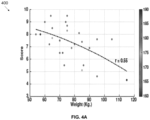
- FIGS. 4A , and 4B schematic diagrams illustrating a plot of weight versus end cardiac scores for all the subjects with and without model outputs respectively. It can be seen from Fig. 4B , the evaluated scores using the wearable data and the CVS model have a better negative correlation (r > 0.93) with the weight than compared to the scores derived using only the wearable data ( Fig. 4A ). Additionally, from Fig. 4B it is observed that there are groups of subjects (reflected in the scores) for whom separate correlations (three in this case) with the weight could be generated. This indicates that by using the model data, individuals can be further segregated who are having different weight score relationships.
- the model-associated cardiac recovery score is able to better capture the variations among the subjects compared to static BMI information.
- Embodiments of present disclosure herein address the problem of generated molecules from the knocked-out gene expression profiles which are significantly unrelated (having low Tanimoto coefficients) with the known inhibitors of the genes.
- Embodiments herein provide a method and a system for a cell specific model where gene expressions are processed via a pretrained SMILES variational autoencoder to produce new molecules.
- the initially evaluated scores are based on the meta-data of the subject and the extracted features from the recorded ECG data (after exercise).
- the CVS model is used to generate several cardiac parameters, including EF, BP, etc. After that, using those parameters and the previously evaluated features, the scores are estimated. Results show that the model-based cardiac scores better correlate with the weight of the subjects, so, it could be utilized as a clinical decision support system for physicians.
- Such computer-readable storage means contain program-code means for implementation of one or more steps of the method, when the program runs on a server or mobile device or any suitable programmable device.
- the hardware device can be any kind of device which can be programmed including e.g., any kind of computer like a server or a personal computer, or the like, or any combination thereof.
- the device may also include means which could be e.g., hardware means like e.g., an application-specific integrated circuit (ASIC), a field-programmable gate array (FPGA), or a combination of hardware and software means, e.g., an ASIC and an FPGA, or at least one microprocessor and at least one memory with software processing components located therein.
- the means can include both hardware means, and software means.
- the method embodiments described herein could be implemented in hardware and software.
- the device may also include software means. Alternatively, the embodiments may be implemented on different hardware devices, e.g., using a plurality of CPUs, GPUs etc.
- the embodiments herein can comprise hardware and software elements.
- the embodiments that are implemented in software include but are not limited to, firmware, resident software, microcode, etc.
- the functions performed by various components described herein may be implemented in other components or combinations of other components.
- a computer-usable or computer readable medium can be any apparatus that can comprise, store, communicate, propagate, or transport the program for use by or in connection with the instruction execution system, apparatus, or device.
- a computer-readable storage medium refers to any type of physical memory on which information or data readable by a processor may be stored.
- a computer-readable storage medium may store instructions for execution by one or more processors, including instructions for causing the processor(s) to perform steps or stages consistent with the embodiments described herein.
- the term "computer-readable medium” should be understood to include tangible items and exclude carrier waves and transient signals, i.e., be non-transitory. Examples include random access memory (RAM), read-only memory (ROM), volatile memory, nonvolatile memory, hard drives, CD ROMs, DVDs, flash drives, disks, and any other known physical storage media.
Landscapes
- Health & Medical Sciences (AREA)
- Life Sciences & Earth Sciences (AREA)
- Engineering & Computer Science (AREA)
- Medical Informatics (AREA)
- Public Health (AREA)
- Biomedical Technology (AREA)
- General Health & Medical Sciences (AREA)
- Pathology (AREA)
- Biophysics (AREA)
- Molecular Biology (AREA)
- Surgery (AREA)
- Animal Behavior & Ethology (AREA)
- Heart & Thoracic Surgery (AREA)
- Physics & Mathematics (AREA)
- Veterinary Medicine (AREA)
- Cardiology (AREA)
- Epidemiology (AREA)
- Primary Health Care (AREA)
- Data Mining & Analysis (AREA)
- Databases & Information Systems (AREA)
- Physiology (AREA)
- Psychiatry (AREA)
- Hematology (AREA)
- General Business, Economics & Management (AREA)
- Business, Economics & Management (AREA)
- Obesity (AREA)
- Child & Adolescent Psychology (AREA)
- Developmental Disabilities (AREA)
- Hospice & Palliative Care (AREA)
- Psychology (AREA)
- Social Psychology (AREA)
- Artificial Intelligence (AREA)
- Computer Vision & Pattern Recognition (AREA)
- Signal Processing (AREA)
- Measurement And Recording Of Electrical Phenomena And Electrical Characteristics Of The Living Body (AREA)
Abstract
It is important to monitor the cardiac condition of an individual, outside the clinic, using wearable physiological sensors. However, existing methods for calculating the cardiac risk score of an individual are primarily based on static information like individual's metadata, lifestyle, family history, clinical assessment, etc. but do not consider the cardiac state in a daily living scenario using wearable-based measurements. Embodiments herein provide a method and a system for determining post-exercise cardiac score in a recovery period using personalized cardiac model. A clinical decision support system (CDSS) is disclosed to predict cardiac recovery score of a subject in post-exercise conditions. The system employs a hybrid approach using a computational cardiac model and wearable data. Further, several personalized cardiac parameters are simulated using a cardiovascular simulation (CVS) platform. These parameters are used along with the wearable ECG data and meta-data information to derive the post-exercise recovery score.
Description
- The present application claims priority from
Indian patent application number 202321017923, filed on April 15, 2023 - The disclosure herein generally relates to the field of clinician decision support systems and more particularly, to a method and system for determining post-exercise cardiac score in a recovery period using personalized cardiac model.
- Cardiovascular diseases (CVDs), which are the world's leading cause of mortality and serious illness, primarily impact the circulatory system of humans. As a result, healthcare expenditures are significantly affected. Sudden cardiac death (SCD) and coronary artery disorders account for about 50% of cardiac deaths. Moreover, in many of these cases, SCD occurs in people with no history of CVDs and only a few of the usual cardiac risk factors.
- The risk of sudden cardiac arrest is higher in obese patients with high body-metabolic index (BMI). Moreover, there could be underlying pathology that could increase the cardiac risk of normal people during occasional exercises or exertions and is unnoticed without any cardiac symptoms in daily living conditions. Hence, stress tests are frequently advised by doctors to detect cardiac risk factors so that the heart's response to stress could be taken into consideration and evaluated effectively. Even for trained athletes, the stress test is a common practice, most of the time, they over-exert their cardiac systems, not knowing where to stop, resulting in sudden cardiac arrest. Therefore, it is important to monitor the cardiac condition of an individual, outside the clinic, using wearable physiological sensors. The dynamics of recovery for an individual to the resting state, immediately after exercise, provides a good indication of cardiac condition.
- Embodiments of the disclosure present technological improvements as solutions to one or more of the above-mentioned technical problems recognized by the inventors in conventional systems. For example, in one embodiment, a method and system for determining post-exercise cardiac score in a recovery period using personalized cardiac model is provided.
- In one aspect, a processor-implemented method for determining post-exercise cardiac score in a recovery period using personalized cardiac model is provided. The processor-implemented method comprising receiving, via an input/output interface, a meta-data information of a subject, wherein the meta-data of the subject comprising height, weight, and age of the subject. Further, the processor-implemented method includes collecting wearable electrocardiogram (ECG) data of the subject. Herein, the subject is being instructed to complete a predefined physical activity for a predefined period, sit up straight after completing the predefined physical activity for a predefined period to collect data, and remain stable with no movement during the data collection.
- Furthermore, the processor-implemented method includes estimating one or more cardiac parameters in each cardiac cycle of the wearable ECG data associated with the subject using a cardiovascular simulation (CVS) model. Herein, the one or more cardiac parameters include an ejection fraction (EF), an arterial blood pressure (BP), cardiac output (CO) and a continuous heart rate (HR). Further, the processor-implemented method includes calculating a body-metabolic index (BMI) of the subject using a standard scoring method and a normal BMI range. Furthermore, the processor-implemented method includes estimating a meta score by combining the received meta-data information, the estimated one or more cardiac parameters in each cardiac cycle of the wearable ECG data and the calculated BMI of the subject. Finally, the method includes determining the cardiac score in a recovery period post-exercise from the estimated meta score based on a predefined normalized scale.
- In another aspect, a system for determining post-exercise cardiac score in a recovery period using personalized cardiac model is provided. The system includes at least one memory storing programmed instructions, one or more Input /Output (I/O) interfaces, and one or more hardware processors operatively coupled to the at least one memory, wherein the one or more hardware processors are configured by the programmed instructions to receive a meta-data information of a subject, wherein the meta-data of the subject comprising height, weight, and age of the subject. Further, the one or more hardware processors are configured by the programmed instructions to collect wearable electrocardiogram (ECG) data of the subject. Herein, the subject is being instructed to complete a predefined physical activity for a predefined period, sit up straight after completing the predefined physical activity for a predefined period to collect data, and remain stable with no movement during the data collection.
- Furthermore, the one or more hardware processors are configured by the programmed instructions to estimating one or more cardiac parameters in each cardiac cycle of the wearable ECG data associated with the subject using a cardiovascular simulation (CVS) model. Herein, the one or more cardiac parameters include an ejection fraction (EF), an arterial blood pressure (BP), cardiac output (CO) and a continuous heart rate (HR). Furthermore, the one or more hardware processors are configured by the programmed instructions to calculating a body-metabolic index (BMI) of the subject using a standard scoring method and a normal BMI range. Furthermore, the one or more hardware processors are configured by the programmed instructions to estimating a meta score by combining the received meta-data information, the estimated one or more cardiac parameters in each cardiac cycle of the wearable ECG data and the calculated BMI of the subject. Finally, the one or more hardware processors are configured by the programmed instructions to determining the cardiac score in a recovery period post-exercise from the estimated meta score based on a predefined normalized scale.
- In yet another aspect, one or more non-transitory machine-readable information storage mediums are provided comprising one or more instructions, which when executed by one or more hardware processors causes a method for determining post-exercise cardiac score in a recovery period using personalized cardiac model. The processor-implemented method comprises receiving, via an input/output interface, a meta-data information of a subject, wherein the meta-data of the subject comprises height, weight, and age of the subject. Further, the processor-implemented method includes collecting wearable electrocardiogram (ECG) data of the subject. Herein, the subject is being instructed to complete a predefined physical activity for a predefined period, sit up straight after completing the predefined physical activity for a predefined period to collect data, and remain stable with no movement during the data collection.
- Furthermore, the processor-implemented method includes estimating one or more cardiac parameters in each cardiac cycle of the wearable ECG data associated with the subject using a cardiovascular simulation (CVS) model. Herein, the one or more cardiac parameters include an ejection fraction (EF), an arterial blood pressure (BP), cardiac output (CO) and a continuous heart rate (HR). Further, the processor-implemented method includes calculating a body-metabolic index (BMI) of the subject using a standard scoring method and a normal BMI range. Furthermore, the processor-implemented method includes estimating a meta score by combining the received meta-data information, the estimated one or more cardiac parameters in each cardiac cycle of the wearable ECG data and the calculated BMI of the subject. Finally, the method includes determining the cardiac score in a recovery period post-exercise from the estimated meta score based on a predefined normalized scale.
- It is to be understood that both the foregoing general description and the following detailed description are exemplary and explanatory only and are not restrictive of the invention, as claimed.
- The accompanying drawings, which are incorporated in and constitute a part of this disclosure, illustrate exemplary embodiments and, together with the description, serve to explain the disclosed principles:
-
FIG. 1 illustrates a network diagram of a system for determining post-exercise cardiac score in a recovery period using personalized cardiac model, in accordance with some embodiments of the present disclosure. -
FIG. 2 is an exemplary flow diagram illustrating a method for determining post-exercise cardiac score in a recovery period using personalized cardiac model, in accordance with some embodiments of the present disclosure. -
FIG. 3 is a block diagram to illustrate a cardiovascular simulation (CVS) model generating simulated cardiac parameters, in accordance with some embodiments of the present disclosure. -
FIGS. 4A and4B (collectively referred asFIG. 4 ) are schematic diagrams to show weight versus end evaluated cardiac score plot with model outputs (FIG. 4A ) and without model outputs (FIG. 4B ), in accordance with some embodiments of the present disclosure. - Exemplary embodiments are described with reference to the accompanying drawings. In the figures, the left-most digit(s) of a reference number identifies the figure in which the reference number first appears. Wherever convenient, the same reference numbers are used throughout the drawings to refer to the same or like parts. While examples and features of disclosed principles are described herein, modifications, adaptations, and other implementations are possible without departing from the scope of the disclosed embodiments.
- The risk of sudden cardiac arrest is higher in obese patients with high body-metabolic index (BMI). Moreover, there could be underlying pathology that could increase the cardiac risk of normal people during occasional exercises or exertions and is unnoticed without any cardiac symptoms in daily living conditions. Hence, stress tests are frequently advised by doctors to detect cardiac risk factors so that the heart's response to stress could be taken into consideration and evaluated effectively. Even for trained athletes, the stress test is a common practice. However, most of the time, they over-exert their cardiac systems, not knowing where to stop and hence suffering from sudden cardiac arrest. Therefore, it is important to monitor the cardiac condition of an individual, outside the clinic, using wearable physiological sensors. The dynamics of recovery for an individual to the resting state, immediately after exercise, provides a good indication of cardiac condition. However, there are a few standard methods for calculating the cardiac risk score of an individual. These are primarily based on static information like individual's metadata, lifestyle, family history, clinical assessment, etc. but do not consider the cardiac state in a daily living scenario using wearable-based measurements.
- Therefore, embodiments herein provide a method and system for determining post-exercise cardiac score in a recovery period using personalized cardiac model. Initially, the system evaluates scores based on the meta-data of the subject and extracts features from a recorded electrocardiogram (ECG) data (after exercise). Then, a CVS model is used to generate several cardiac parameters, including an ejection fraction (EF), an arterial blood pressure (BP), etc. After that, using those parameters and the previously evaluated features, the system determines post-exercise cardiac score. It would be appreciated that the model-based cardiac scores better correlate with the weight of the subjects, so, it could be utilized as a clinical decision support system for physicians.
- Referring now to the drawings, and more particularly to
FIG. 1 through FIG. 4 , where similar reference characters denote corresponding features consistently throughout the figures, there are shown preferred embodiments and these embodiments are described in the context of the following exemplary system and/or method. -
FIG. 1 illustrates a network diagram of asystem 100 for determining post-exercise cardiac score in a recovery period using personalized cardiac model. Although the present disclosure is explained considering that thesystem 100 is implemented on a server, it may also be present elsewhere such as a local machine. It may be understood that thesystem 100 comprises one ormore computing devices 102, such as a laptop computer, a desktop computer, a notebook, a workstation, a cloud-based computing environment and the like. It will be understood that thesystem 100 may be accessed through one or more input/output interfaces 104-1, 104-2... 104-N, collectively referred to as I/O interface 104. Examples of the I/O interface 104 may include, but are not limited to, a user interface, a portable computer, a personal digital assistant, a handheld device, a smartphone, a tablet computer, a workstation and the like. The I/O interface 104 are communicatively coupled to thesystem 100 through anetwork 106. - In an embodiment, the
network 106 may be a wireless or a wired network, or a combination thereof. In an example, thenetwork 106 can be implemented as a computer network, as one of the different types of networks, such as virtual private network (VPN), intranet, local area network (LAN), wide area network (WAN), the internet, and such. Thenetwork 106 may either be a dedicated network or a shared network, which represents an association of the different types of networks that use a variety of protocols, for example, Hypertext Transfer Protocol (HTTP), Transmission Control Protocol/Internet Protocol (TCP/IP), and Wireless Application Protocol (WAP), to communicate with each other. Further, thenetwork 106 may include a variety of network devices, including routers, bridges, servers, computing devices, storage devices. The network devices within thenetwork 106 may interact with thesystem 100 through communication links. - The
system 100 may be implemented in a workstation, a mainframe computer, a server, and a network server. In an embodiment, thecomputing device 102 further comprises one ormore hardware processors 108, one ormore memory 110, hereinafter referred as amemory 110 and adata repository 112, for example, arepository 112. Thedata repository 112 may also be referred as adynamic knowledge base 112 or aknowledge base 112. Thedata repository 112 may include a plurality of abstracted piece of code for refinement and data that is processed, received, or generated as a result of the execution of the plurality of modules in the module(s). Although thedata repository 112 is shown external to thesystem 100, it will be noted that, in alternate embodiments, thedata repository 112 can also be implemented internal to thesystem 100, and communicatively coupled to thesystem 100. The data contained within such external database may be periodically updated. For example, new data may be added into the database and/or existing data may be modified and/or non-useful data may be deleted from the database. - The
memory 110 is in communication with the one ormore hardware processors 108, wherein the one ormore hardware processors 108 are configured to execute programmed instructions stored in thememory 110, to perform various functions as explained in the later part of the disclosure. Therepository 112 may store data processed, received, and generated by thesystem 100. Thememory 110 further comprises a plurality of modules (not shown). Further, the plurality of modules can be used by hardware, by computer-readable instructions executed by the one ormore hardware processors 108, or by a combination thereof. - The
system 100 supports various connectivity options such as BLUETOOTH®, USB, ZigBee and other cellular services. The network environment enables connection of various components of thesystem 100 using any communication link including Internet, WAN, MAN, and so on. In an exemplary embodiment, thesystem 100 is implemented to operate as a stand-alone device. In another embodiment, thesystem 100 may be implemented to work as a loosely coupled device to a smart computing environment. The components and functionalities of thesystem 100 are described further in detail. Functions of the components of thesystem 100 are now explained with reference toFIG. 3 through steps of flow diagram inFIG. 2 . -
FIG. 2 is an exemplary flow diagrams illustrating a processor-implementedmethod 200 for determining post-exercise cardiac score in a recovery period using personalized cardiac model implemented by the system ofFIG. 1 , according to some embodiments of the present disclosure. A clinical decision support system (CDSS) scheme is disclosed to predict cardiac recovery score of a subject in post-exercise conditions, employing a hybrid approach using a computational cardiac model and wearable data. Further, several personalized cardiac parameters are simulated using a cardiovascular simulation platform. These parameters, when used along with the wearable electrocardiogram (ECG) data and meta-data information to derive the post-exercise recovery score, demonstrate an improvement in capturing the stochastic nature of underlying cardiac conditions among individuals under stress. - Initially at
step 202 of themethod 200, a meta-data information of a subject is received, via an input/output interface 104, as an input. The meta-data of the subject comprising height, weight, and age of the subject. - At the
next step 204 of themethod 200, the one ormore hardware processors 108 are configured by the programmed instructions to collect wearable ECG data of the subject. Herein, the subject is being instructed to complete a predefined physical activity for a predefined period, sit up straight after completing the predefined physical activity for a predefined period to collect data, and remain stable with no movement during the data collection. - In one illustration, to collect the data of a subject, he/she is requested to run on a treadmill for 3 minute at 8 kilometer/hour speed. After completing the activity, the participant is required to sit up straight so that the data collection may begin. To reduce the effect of motion artifacts, the subject is instructed to remain stable with no movement during data collection. The whole process consumes around 4-5 min per subject. In the end, the meta-data information (such as age, height, and weight) is also noted. Additionally, several reference BPs have been measured during data recording for each subject. The entire dataset contains the post-exercise wearable ECG data, which is used to generate the cardiac recovery score.
- At the
next step 206 of themethod 200, the one ormore hardware processors 108 are configured by the programmed instructions to estimate one or more cardiac parameters in each cardiac cycle of the wearable ECG data associated with the subject using a cardiovascular simulation (CVS) model. Herein, the one or more cardiac parameters include an ejection fraction (EF), an arterial pressure (BP), a cardiac output (CO) and a continuous heart rate (HR) as shown inFIG. 3 . - In one embodiment, the CVS model comprising a pair of atriums and ventricles functioning as a pulsatile pump. The left atrium ventricle pair creates the systemic circular path to pump oxygenated blood to all body tissues via the aorta, and the right atrium-ventricle pair drives the deoxygenated blood to the lungs forming the pulmonic circulation. The rhythmic unidirectional blood flows across the heart chambers are controlled by the synchronized opening and closing of the four cardiac valves. The following variables of the CVS model are estimated from the captured ECG data and the meta-data information of a subject.
- In another embodiment, the continuous heart rate (HR) and one or more cardiac compliance parameters are estimated using the wearable ECG data. Based on this information, the pressures-volumes are updated across the cardiac chambers based on the estimated continuous heart rate and one or more cardiac compliance parameters. To determine the HR from the captured wearable ECG data, R-to-R durations are determined in each cardiac cycle.
- First and last heart rate readings: The first and last HR readings of the post-activity state reflects how much the elevated HR is and how much the HR is at rest. This is related to age and scores are assigned likewise, 0 in the normal range and increasing score as the HR goes away from the normal range as determined by the American heart association.
- Peak and trough height: The peaks are gradually decreasing toward a normal level, ideally following an exponential distribution. This is because the decrease is sharp in the initial stages and then normalizes at the later stage, gradually going to 0 where the HR stabilizes. An exponential pdf λe-λ is fitted to the peaks and estimate λ as λ. Further, calculating the distance between the empirical distribution function and the reference distribution function using a Kolmogorov-Smirnov test (KS-test). The calculated distance between the empirical distribution function and the reference distribution function tells whether the samples belong to the reference distribution. Furthermore, using the 'dgof package in R, to assign a score of 0 if the test shows the samples belong to the exponential distribution, and a
score 1 otherwise. The procedure is the same for the trough heights. - When peak ≤ 100 for the first time - Ideally, by 120 seconds post-activity, HR becomes normal, i.e., in the range [60, 100]. So, an ideal scoring technique assigns 0 if the time (tN ) is less than 120 and gradually increases when tN is more than 120. Thus, a straight line from 120 to the highest time point such that its value is 0 at or less than 120, 1 for 180 can indicate the scoring technique.
- Sudden spikes in peaks and troughs - A sudden spike means a sharp increase or decrease (more than 10% change of the previous value) in peaks or troughs. These can happen more frequently just after the activity as there is noise in HR and becomes rarer as time goes on. Hence, the distribution of the spikes can be fitted to a Poisson density:

- Trend - A trend pattern in a time series exists when there is a long-term change in the mean level. Let Xt be original data, Then the de-trended data is:


- Similarly, the data can be de-seasonalized as Z t = Xt - St where the seasonal effect St can be found via Box-Cox transformation. This transformation also gives us the de-trended and de-seasonalized component Xt = Xt -Tt-St. Then a suitable measure of trend is

- The meta-data information such as height and weight are utilized to define a total blood volume and an unstressed blood volume of the subject. Total blood volume is fixed during the simulation, whereas the unstressed blood volume of the subject is auto regulated by a baroreflex autoregulation principle. Based on the pressure-volume dynamics of the model, several indicators of the heard such as EF, BP, CO, etc. to assess the cardiac condition of the subject. These are already validated with parameters for healthy and disease conditions including valvular and ischemic diseases.
- Referring back to
FIG. 2 , at thestep 208 of themethod 200, the one ormore hardware processors 108 are configured by the programmed instructions to calculate a body-metabolic index (BMI) of the subject using a standard scoring method and a normal BMI range. - At the
next step 210 of themethod 200, the one ormore hardware processors 108 are configured by the programmed instructions to estimate a meta score by combining the received meta-data information, the estimated one or more cardiac parameters in each cardiac cycle of the wearable ECG data and the calculated BMI of the subject. A high meta score means wellness, and a low score indicates disease, and the normalized scale is between 0 to 10. Hence, the final score would be:
- Finally, at the
last step 212 of themethod 200, the one ormore hardware processors 108 are configured by the programmed instructions to determine the cardiac score in a recovery period post-exercise from the estimated meta score based on a predefined normalized scale. - A whole wearable ECG data window is divided into 20-sec intervals to calculate a subject's cardiac scores. Similarly, a single score is generated for each of EF and BP from the model for each 20-sec time window. Then, cardiac scores are generated in each of the 20-sec windows with and without the model outputs. Comparing the scores with and without the model, it is seen that both scores are approaching a steady-state value at the end of the data collection step. However, based on the initially evaluated scores, the score with the model is more rectified than the without model condition, demonstrating the efficacy of the cardiac score predictor of the model outputs.
-
FIGS. 4A , and4B , schematic diagrams illustrating a plot of weight versus end cardiac scores for all the subjects with and without model outputs respectively. It can be seen fromFig. 4B , the evaluated scores using the wearable data and the CVS model have a better negative correlation (r > 0.93) with the weight than compared to the scores derived using only the wearable data (Fig. 4A ). Additionally, fromFig. 4B it is observed that there are groups of subjects (reflected in the scores) for whom separate correlations (three in this case) with the weight could be generated. This indicates that by using the model data, individuals can be further segregated who are having different weight score relationships. - In another aspect, first evaluate a BMI surface considering the maximum and minimum ranges of the height and weight data. Then, the normal distance of scores is computed from the BMI plane. From the outcomes, it is seen that though the mean absolute distances (MAD) are similar, the standard deviation (STD) of the distance are greater with the model outputs than without model. Thus, it is inferred that the model-associated cardiac recovery score is able to better capture the variations among the subjects compared to static BMI information.
- The written description describes the subj ect matter herein to enable any person skilled in the art to make and use the embodiments. The scope of the subject matter embodiments is defined by the claims and may include other modifications that occur to those skilled in the art. Such other modifications are intended to be within the scope of the claims if they have similar elements that do not differ from the literal language of the claims or if they include equivalent elements with insubstantial differences from the literal language of the claims.
- The embodiments of present disclosure herein address the problem of generated molecules from the knocked-out gene expression profiles which are significantly unrelated (having low Tanimoto coefficients) with the known inhibitors of the genes. Embodiments herein provide a method and a system for a cell specific model where gene expressions are processed via a pretrained SMILES variational autoencoder to produce new molecules. The initially evaluated scores are based on the meta-data of the subject and the extracted features from the recorded ECG data (after exercise). Then, the CVS model is used to generate several cardiac parameters, including EF, BP, etc. After that, using those parameters and the previously evaluated features, the scores are estimated. Results show that the model-based cardiac scores better correlate with the weight of the subjects, so, it could be utilized as a clinical decision support system for physicians.
- It is to be understood that the scope of the protection is extended to such a program and in addition to a computer-readable means having a message therein; such computer-readable storage means contain program-code means for implementation of one or more steps of the method, when the program runs on a server or mobile device or any suitable programmable device. The hardware device can be any kind of device which can be programmed including e.g., any kind of computer like a server or a personal computer, or the like, or any combination thereof. The device may also include means which could be e.g., hardware means like e.g., an application-specific integrated circuit (ASIC), a field-programmable gate array (FPGA), or a combination of hardware and software means, e.g., an ASIC and an FPGA, or at least one microprocessor and at least one memory with software processing components located therein. Thus, the means can include both hardware means, and software means. The method embodiments described herein could be implemented in hardware and software. The device may also include software means. Alternatively, the embodiments may be implemented on different hardware devices, e.g., using a plurality of CPUs, GPUs etc.
- The embodiments herein can comprise hardware and software elements. The embodiments that are implemented in software include but are not limited to, firmware, resident software, microcode, etc. The functions performed by various components described herein may be implemented in other components or combinations of other components. For the purposes of this description, a computer-usable or computer readable medium can be any apparatus that can comprise, store, communicate, propagate, or transport the program for use by or in connection with the instruction execution system, apparatus, or device.
- The illustrated steps are set out to explain the exemplary embodiments shown, and it should be anticipated that ongoing technological development will change the manner in which particular functions are performed. These examples are presented herein for purposes of illustration, and not limitation. Further, the boundaries of the functional building blocks have been arbitrarily defined herein for the convenience of the description. Alternative boundaries can be defined so long as the specified functions and relationships thereof are appropriately performed. Alternatives (including equivalents, extensions, variations, deviations, etc., of those described herein) will be apparent to persons skilled in the relevant art(s) based on the teachings contained herein. Such alternatives fall within the scope of the disclosed embodiments. Also, the words "comprising," "having," "containing," and "including," and other similar forms are intended to be equivalent in meaning and be open ended in that an item or items following any one of these words is not meant to be an exhaustive listing of such item or items or meant to be limited to only the listed item or items. It must also be noted that as used herein and in the appended claims, the singular forms "a," "an," and "the" include plural references unless the context clearly dictates otherwise.
- Furthermore, one or more computer-readable storage media may be utilized in implementing embodiments consistent with the present disclosure. A computer-readable storage medium refers to any type of physical memory on which information or data readable by a processor may be stored. Thus, a computer-readable storage medium may store instructions for execution by one or more processors, including instructions for causing the processor(s) to perform steps or stages consistent with the embodiments described herein. The term "computer-readable medium" should be understood to include tangible items and exclude carrier waves and transient signals, i.e., be non-transitory. Examples include random access memory (RAM), read-only memory (ROM), volatile memory, nonvolatile memory, hard drives, CD ROMs, DVDs, flash drives, disks, and any other known physical storage media.
- It is intended that the disclosure and examples be considered as exemplary only, with a true scope of disclosed embodiments being indicated by the following claims.
Claims (15)
- A processor-implemented method (200) comprising:receiving (202), via an input/output interface, a meta-data information of a subject, wherein the meta-data of the subject comprising height, weight, and age of the subject;collecting (204), via one or more hardware processors, a wearable electrocardiogram (ECG) data of the subject, wherein the subject is being instructed to:
complete a predefined physical activity for a predefined period; sit up straight after completing the predefined physical activity for a predefined period to collect the wearable ECG data; and remain stable with no movement during the data collection;estimating (206), via the one or more hardware processors, one or more cardiac parameters in each cardiac cycle of the wearable ECG data associated with the subject using a cardiovascular simulation (CVS) model, wherein the one or more cardiac parameters include an ejection fraction (EF), an arterial blood pressure (BP), cardiac output (CO) anda continuous heart rate (HR);calculating (208), via the one or more hardware processors, a body-metabolic index (BMI) of the subject using a standard scoring method and a normal BMI range;estimating (210), via the one or more hardware processors, a meta score by combining the received meta-data information, the estimated one or more cardiac parameters in each cardiac cycle of the wearable ECG data and the calculated BMI of the subject; anddetermining (212), via the one or more hardware processors, the cardiac score in a recovery period post-exercise from the estimated meta score based on a predefined normalized scale. - The processor-implemented method (200) as claimed in claim 1, wherein the CVS model comprising a pair of atriums and ventricles functioning as a pulsatile pump.
- The processor-implemented method (200) as claimed in claim 1, wherein the continuous heart rate and one or more cardiac compliance parameters are estimated using the wearable ECG data.
- The processor-implemented method (200) as claimed in claim 1, wherein pressures-volumes are updated across the cardiac chambers based on the estimated continuous heart rate and one or more cardiac compliance parameters.
- The processor-implemented method (200) as claimed in claim 1, wherein the meta-data information is utilized to define a total blood volume and an unstressed blood volume of the subject.
- The processor-implemented method (200) as claimed in claim 5, wherein the unstressed blood volume of the subject is an auto-regulated by a baroreflex autoregulation principle.
- A system (100) comprising:an input/output interface (104) to receive a meta-data information of a subject, wherein the meta-data of the subject comprising height, weight, and age of the subject;a memory (110) in communication with the one or more hardware processors (108), wherein the one or more hardware processors (108) are configured to execute programmed instructions stored in the memory (110) to;collect a wearable electrocardiogram (ECG) data of the subject,wherein the subject is being instructed to:complete a predefined physical activity for a predefined period;sit up straight after completing the predefined physical activity for a predefined period to collect the wearable ECG data; andremain stable with no movement during the data collection;estimate one or more cardiac parameters in each cardiac cycle of the wearable ECG data associated with the subject using a cardiovascular simulation (CVS) model, wherein the one or more cardiac parameters include an ejection fraction (EF), an arterial blood pressure (BP), cardiac output (CO) and a continuous heart rate (HR);calculate a body-metabolic index (BMI) of the subject using a standard scoring method and a normal BMI range;estimate a meta score by combining the received meta-data information, the estimated one or more cardiac parameters in each cardiac cycle of the wearable ECG data and the calculated BMI of the subject; anddetermine the cardiac score in a recovery period post-exercise from the estimated meta score based on a predefined normalized scale.
- The system (100) as claimed in claim 7, wherein the CVS model comprising a pair of atriums and ventricles functioning as a pulsatile pump.
- The system (100) as claimed in claim 7, wherein the continuous heart rate and one or more cardiac compliance parameters are estimated using the wearable ECG data.
- The system (100) as claimed in claim 7, wherein pressures-volumes are updated across the cardiac chambers based on the estimated continuous heart rate and one or more cardiac compliance parameters.
- The system (100) as claimed in claim 7, wherein the meta-data information is utilized to define a total blood volume and an unstressed blood volume of the subject.
- The system (100) as claimed in claim 11, wherein the unstressed blood volume of the subject is auto regulated by a baroreflex autoregulation principle.
- One or more non-transitory machine-readable information storage mediums comprising one or more instructions which when executed by one or more hardware processors cause:receiving, via an input/output interface, a meta-data information of a subject, wherein the meta-data of the subject comprising height, weight, and age of the subject;collecting a wearable electrocardiogram (ECG) data of the subject,wherein the subject is being instructed to:
complete a predefined physical activity for a predefined period; sit up straight after completing the predefined physical activity for a predefined period to collect the wearable ECG data; and remain stable with no movement during the data collection;estimating one or more cardiac parameters in each cardiac cycle of the wearable ECG data associated with the subject using a cardiovascular simulation (CVS) model, wherein the one or more cardiac parameters include an ejection fraction (EF), an arterial blood pressure (BP), cardiac output (CO) and a continuous heart rate (HR) and wherein the CVS model comprises a pair of atriums and ventricles functioning as a pulsatile pump;calculating a body-metabolic index (BMI) of the subject using a standard scoring method and a normal BMI range;estimating a meta score by combining the received meta-data information, the estimated one or more cardiac parameters in each cardiac cycle of the wearable ECG data and the calculated BMI of the subject; anddetermining the cardiac score in a recovery period post-exercise from the estimated meta score based on a predefined normalized scale. - The one or more non-transitory machine-readable information storage mediums as claimed in claim 13, wherein the continuous heart rate and one or more cardiac compliance parameters are estimated using the wearable ECG data and wherein pressures-volumes are updated across the cardiac chambers based on the estimated continuous heart rate and one or more cardiac compliance parameters.
- The one or more non-transitory machine-readable information storage mediums as claimed in claim 13, wherein the meta-data information is utilized to define a total blood volume and an unstressed blood volume of the subject, and wherein the unstressed blood volume of the subject is an auto-regulated by a baroreflex autoregulation principle.
Applications Claiming Priority (1)
| Application Number | Priority Date | Filing Date | Title |
|---|---|---|---|
| IN202321017923 | 2023-04-15 |
Publications (1)
| Publication Number | Publication Date |
|---|---|
| EP4447068A1 true EP4447068A1 (en) | 2024-10-16 |
Family
ID=90730475
Family Applications (1)
| Application Number | Title | Priority Date | Filing Date |
|---|---|---|---|
| EP24170013.7A Pending EP4447068A1 (en) | 2023-04-15 | 2024-04-12 | Method and system for determining post-exercise recovery score using personalized cardiac model |
Country Status (2)
| Country | Link |
|---|---|
| US (1) | US20240366150A1 (en) |
| EP (1) | EP4447068A1 (en) |
Families Citing this family (1)
| Publication number | Priority date | Publication date | Assignee | Title |
|---|---|---|---|---|
| CN119770052B (en) * | 2024-12-16 | 2025-07-18 | 北京三春晖医疗器械有限公司 | Human body electrocardio R wave detection method |
Citations (3)
| Publication number | Priority date | Publication date | Assignee | Title |
|---|---|---|---|---|
| US20150126822A1 (en) * | 2013-11-01 | 2015-05-07 | Medtronic Monitoring, Inc. | Congestive heart failure risk status determination methods and related devices |
| US20150164349A1 (en) * | 2013-12-12 | 2015-06-18 | Alivecor, Inc. | Methods and systems for arrhythmia tracking and scoring |
| US20220384044A1 (en) * | 2021-05-28 | 2022-12-01 | Tempus Labs, Inc. | ECG-Based Cardiovascular Disease Detection Systems and Related Methods |
Family Cites Families (2)
| Publication number | Priority date | Publication date | Assignee | Title |
|---|---|---|---|---|
| WO2015179868A2 (en) * | 2014-05-23 | 2015-11-26 | Dacadoo Ag | Automated health data acquisition, processing and communication system |
| WO2022034045A1 (en) * | 2020-08-10 | 2022-02-17 | Kuck Karl Heinz | Systems and methods for generating health risk assessments |
-
2024
- 2024-04-12 EP EP24170013.7A patent/EP4447068A1/en active Pending
- 2024-04-12 US US18/633,767 patent/US20240366150A1/en active Pending
Patent Citations (3)
| Publication number | Priority date | Publication date | Assignee | Title |
|---|---|---|---|---|
| US20150126822A1 (en) * | 2013-11-01 | 2015-05-07 | Medtronic Monitoring, Inc. | Congestive heart failure risk status determination methods and related devices |
| US20150164349A1 (en) * | 2013-12-12 | 2015-06-18 | Alivecor, Inc. | Methods and systems for arrhythmia tracking and scoring |
| US20220384044A1 (en) * | 2021-05-28 | 2022-12-01 | Tempus Labs, Inc. | ECG-Based Cardiovascular Disease Detection Systems and Related Methods |
Non-Patent Citations (1)
| Title |
|---|
| ROY DIBYENDU ROY DIBYENDU@TCS COM ET AL: "Wearable sensor driven Cardiac model to derive hemodynamic insights during exercise", PROCEEDINGS OF THE 2021 ACM SIGIR INTERNATIONAL CONFERENCE ON THEORY OF INFORMATION RETRIEVAL, ACMPUB27, NEW YORK, NY, USA, 24 June 2021 (2021-06-24), pages 30 - 35, XP058767847, ISBN: 978-1-4503-8620-3, DOI: 10.1145/3469260.3469670 * |
Also Published As
| Publication number | Publication date |
|---|---|
| US20240366150A1 (en) | 2024-11-07 |
Similar Documents
| Publication | Publication Date | Title |
|---|---|---|
| US20230335289A1 (en) | Systems and methods for generating health risk assessments | |
| RU2728855C2 (en) | Quantitative indicator of cardiovascular deterioration warning | |
| US10912508B2 (en) | Method and system for assessing mental state | |
| US9974488B2 (en) | Early detection of hemodynamic decompensation using taut-string transformation | |
| US20030101076A1 (en) | System for supporting clinical decision making through the modeling of acquired patient medical information | |
| US20100057490A1 (en) | Methods, systems, and computer program products for evaluating a patient in a pediatric intensive care unit | |
| KR20180064952A (en) | Apparatus and method for predicting health information using big data | |
| US20240274297A1 (en) | Surgical warning | |
| CN113905663A (en) | Diagnosis and effectiveness of monitoring attention deficit hyperactivity disorder | |
| WO2023133166A9 (en) | System and method for determining a cardiac health status | |
| EP3539464A1 (en) | System and method for classification of coronary artery disease based on metadata and cardiovascular signals | |
| US20220165417A1 (en) | Population-level gaussian processes for clinical time series forecasting | |
| US20170071549A1 (en) | System and Method for Assisting Decisions Associated with Events Relative to Withdrawal of Life-Sustaining Therapy Using Variability Measurements | |
| KR20240009884A (en) | Method, program and apparatus for providing medical emergency patient transport service based on electrocardiogram interpreting | |
| US20240366150A1 (en) | Method and system for determining post-exercise recovery score using personalized cardiac model | |
| EP3605553B1 (en) | Systems and methods for unobtrusive digital health assessment | |
| US20110035233A1 (en) | System for Clinical Research and Clinical Management of Cardiovascular Risk Using Ambulatory Blood Pressure Monitoring and Actigraphy | |
| Umoh et al. | Optimizing Hypertension Risk Classification through Machine Learning | |
| KR101330404B1 (en) | Apparatus and Method for Determining Health State using Pulse Wave | |
| Goldstein et al. | Classifying individuals based on a densely captured sequence of vital signs: An example using repeated blood pressure measurements during hemodialysis treatment | |
| KR102407987B1 (en) | Methdo and apparatus for building bio data hub | |
| JP2025054159A (en) | Information processing device, information processing method, and program | |
| Reddy | An Efficient Healthcare Monitoring System for Cardiovascular Diseases using Deep Modified Neural Networks | |
| CN112397179A (en) | Medical electrocardiogram intelligent analysis system and analysis method | |
| EP4289358B1 (en) | Estimating blood pressure of a subject using an ecg driven cardiovascular model |
Legal Events
| Date | Code | Title | Description |
|---|---|---|---|
| PUAI | Public reference made under article 153(3) epc to a published international application that has entered the european phase |
Free format text: ORIGINAL CODE: 0009012 |
|
| STAA | Information on the status of an ep patent application or granted ep patent |
Free format text: STATUS: THE APPLICATION HAS BEEN PUBLISHED |
|
| AK | Designated contracting states |
Kind code of ref document: A1 Designated state(s): AL AT BE BG CH CY CZ DE DK EE ES FI FR GB GR HR HU IE IS IT LI LT LU LV MC ME MK MT NL NO PL PT RO RS SE SI SK SM TR |
|
| STAA | Information on the status of an ep patent application or granted ep patent |
Free format text: STATUS: REQUEST FOR EXAMINATION WAS MADE |
|
| 17P | Request for examination filed |
Effective date: 20250407 |