EP4447011A1 - Control device, control system, control method, and program - Google Patents
Control device, control system, control method, and program Download PDFInfo
- Publication number
- EP4447011A1 EP4447011A1 EP24168422.4A EP24168422A EP4447011A1 EP 4447011 A1 EP4447011 A1 EP 4447011A1 EP 24168422 A EP24168422 A EP 24168422A EP 4447011 A1 EP4447011 A1 EP 4447011A1
- Authority
- EP
- European Patent Office
- Prior art keywords
- terminal
- locking
- mobile body
- control
- door
- Prior art date
- Legal status (The legal status is an assumption and is not a legal conclusion. Google has not performed a legal analysis and makes no representation as to the accuracy of the status listed.)
- Pending
Links
- 238000000034 method Methods 0.000 title claims description 10
- 230000007704 transition Effects 0.000 claims description 3
- 230000005540 biological transmission Effects 0.000 claims description 2
- 230000006870 function Effects 0.000 description 8
- 238000010586 diagram Methods 0.000 description 6
- 238000004891 communication Methods 0.000 description 4
- 230000000052 comparative effect Effects 0.000 description 3
- 238000005516 engineering process Methods 0.000 description 2
- 230000004075 alteration Effects 0.000 description 1
- 230000003287 optical effect Effects 0.000 description 1
- 238000009964 serging Methods 0.000 description 1
- 230000000153 supplemental effect Effects 0.000 description 1
Images


Classifications
-
- G—PHYSICS
- G07—CHECKING-DEVICES
- G07C—TIME OR ATTENDANCE REGISTERS; REGISTERING OR INDICATING THE WORKING OF MACHINES; GENERATING RANDOM NUMBERS; VOTING OR LOTTERY APPARATUS; ARRANGEMENTS, SYSTEMS OR APPARATUS FOR CHECKING NOT PROVIDED FOR ELSEWHERE
- G07C9/00—Individual registration on entry or exit
- G07C9/00174—Electronically operated locks; Circuits therefor; Nonmechanical keys therefor, e.g. passive or active electrical keys or other data carriers without mechanical keys
- G07C9/00309—Electronically operated locks; Circuits therefor; Nonmechanical keys therefor, e.g. passive or active electrical keys or other data carriers without mechanical keys operated with bidirectional data transmission between data carrier and locks
-
- B—PERFORMING OPERATIONS; TRANSPORTING
- B60—VEHICLES IN GENERAL
- B60R—VEHICLES, VEHICLE FITTINGS, OR VEHICLE PARTS, NOT OTHERWISE PROVIDED FOR
- B60R25/00—Fittings or systems for preventing or indicating unauthorised use or theft of vehicles
- B60R25/20—Means to switch the anti-theft system on or off
- B60R25/24—Means to switch the anti-theft system on or off using electronic identifiers containing a code not memorised by the user
-
- B—PERFORMING OPERATIONS; TRANSPORTING
- B60—VEHICLES IN GENERAL
- B60R—VEHICLES, VEHICLE FITTINGS, OR VEHICLE PARTS, NOT OTHERWISE PROVIDED FOR
- B60R25/00—Fittings or systems for preventing or indicating unauthorised use or theft of vehicles
- B60R25/20—Means to switch the anti-theft system on or off
- B60R25/24—Means to switch the anti-theft system on or off using electronic identifiers containing a code not memorised by the user
- B60R25/245—Means to switch the anti-theft system on or off using electronic identifiers containing a code not memorised by the user where the antenna reception area plays a role
-
- H—ELECTRICITY
- H04—ELECTRIC COMMUNICATION TECHNIQUE
- H04W—WIRELESS COMMUNICATION NETWORKS
- H04W4/00—Services specially adapted for wireless communication networks; Facilities therefor
- H04W4/30—Services specially adapted for particular environments, situations or purposes
- H04W4/40—Services specially adapted for particular environments, situations or purposes for vehicles, e.g. vehicle-to-pedestrians [V2P]
-
- B—PERFORMING OPERATIONS; TRANSPORTING
- B60—VEHICLES IN GENERAL
- B60R—VEHICLES, VEHICLE FITTINGS, OR VEHICLE PARTS, NOT OTHERWISE PROVIDED FOR
- B60R2325/00—Indexing scheme relating to vehicle anti-theft devices
- B60R2325/20—Communication devices for vehicle anti-theft devices
- B60R2325/205—Mobile phones
-
- G—PHYSICS
- G07—CHECKING-DEVICES
- G07C—TIME OR ATTENDANCE REGISTERS; REGISTERING OR INDICATING THE WORKING OF MACHINES; GENERATING RANDOM NUMBERS; VOTING OR LOTTERY APPARATUS; ARRANGEMENTS, SYSTEMS OR APPARATUS FOR CHECKING NOT PROVIDED FOR ELSEWHERE
- G07C9/00—Individual registration on entry or exit
- G07C9/00174—Electronically operated locks; Circuits therefor; Nonmechanical keys therefor, e.g. passive or active electrical keys or other data carriers without mechanical keys
- G07C9/00309—Electronically operated locks; Circuits therefor; Nonmechanical keys therefor, e.g. passive or active electrical keys or other data carriers without mechanical keys operated with bidirectional data transmission between data carrier and locks
- G07C2009/00507—Electronically operated locks; Circuits therefor; Nonmechanical keys therefor, e.g. passive or active electrical keys or other data carriers without mechanical keys operated with bidirectional data transmission between data carrier and locks keyless data carrier having more than one function
- G07C2009/00547—Electronically operated locks; Circuits therefor; Nonmechanical keys therefor, e.g. passive or active electrical keys or other data carriers without mechanical keys operated with bidirectional data transmission between data carrier and locks keyless data carrier having more than one function starting ignition
-
- G—PHYSICS
- G07—CHECKING-DEVICES
- G07C—TIME OR ATTENDANCE REGISTERS; REGISTERING OR INDICATING THE WORKING OF MACHINES; GENERATING RANDOM NUMBERS; VOTING OR LOTTERY APPARATUS; ARRANGEMENTS, SYSTEMS OR APPARATUS FOR CHECKING NOT PROVIDED FOR ELSEWHERE
- G07C2209/00—Indexing scheme relating to groups G07C9/00 - G07C9/38
- G07C2209/60—Indexing scheme relating to groups G07C9/00174 - G07C9/00944
- G07C2209/63—Comprising locating means for detecting the position of the data carrier, i.e. within the vehicle or within a certain distance from the vehicle
Definitions
- the present invention relates to a control device, a control system, a control method, and a program.
- JP 2023-009917A discloses technology that locks a door of a wheeled vehicle on the basis of a signal transmitted from an electronic key serving as the terminal.
- the locking is controlled on the basis of such a signal, such circumstances are sometimes prevented that the terminal is locked inside the mobile body and it is not possible to unlock the door.
- the terminal is positioned inside the mobile body, the locking of the door based on a signal transmitted from the terminal is sometimes restricted.
- the locking of a door of a mobile body is controlled by a plurality of terminals.
- one of the terminals is positioned inside the mobile body to prevent another terminal from locking the door of the mobile body from the outside. This causes an inconvenient situation for a user.
- An object of the present invention is to provide a novel and improved control device, control system, control method, and program that each make it possible to increase convenience for a user in locking a door with a terminal.
- a control device comprising a control unit configured to control locking of a door included in a mobile body on a basis of a first locking request transmitted from any of a first terminal or a second terminal and a position of a terminal that transmits the first locking request, the first terminal and the second terminal being each carriable by a user, wherein the control unit performs control to permit the locking of the door based on the first locking request when the first terminal is determined to be positioned inside the mobile body and the first locking request is transmitted from the second terminal determined to be positioned outside the mobile body.
- a control system comprising: a control device that is included in a mobile body; and a first terminal that is a fob key carriable by a user, wherein the control device includes a control unit that controls locking of a door included in the mobile body on a basis of a first locking request transmitted from any of the first terminal or a second terminal and a position of a terminal that transmits the first locking request, the second terminal being carriable by a user, and the control unit performs control to permit the locking of the door based on the first locking request when the first terminal is determined to be positioned inside the mobile body and the first locking request is transmitted from the second terminal determined to be positioned outside the mobile body.
- a control method that is executed by a computer, the control method comprising controlling locking of a door included in a mobile body on a basis of a first locking request transmitted from any of a first terminal or a second terminal and a position of a terminal that transmits the first locking request, the first terminal and the second terminal being each carriable by a user, wherein the controlling includes performing control to permit the locking of the door based on the first locking request when the first terminal is determined to be positioned inside the mobile body and the first locking request is transmitted from the second terminal determined to be positioned outside the mobile body.
- a program for causing a computer to function as a control unit configured to control locking of a door included in a mobile body on a basis of a first locking request transmitted from any of a first terminal or a second terminal and a position of a terminal that transmits the first locking request, the first terminal and the second terminal being each carriable by a user, wherein the control unit performs control to permit the locking of the door based on the first locking request when the first terminal is determined to be positioned inside the mobile body and the first locking request is transmitted from the second terminal determined to be positioned outside the mobile body.
- FIG. 1 is a block diagram illustrating the configuration example of the control system according to the present embodiment.
- a control system 1 includes a first terminal 10, a second terminal 20, and a mobile body 30.
- the first terminal 10 and the second terminal 20 are terminals carriable by a user (e.g., an owner of the mobile body 30, a person permitted by the owner to use the mobile body 30, or the like) of the mobile body 30.
- a user e.g., an owner of the mobile body 30, a person permitted by the owner to use the mobile body 30, or the like
- the first terminal 10 and the second terminal 20 are herein sometimes referred to simply as a "terminal".
- the first terminal 10 and the second terminal 20 wirelessly communicate with the mobile body 30 to transmit various kinds of information.
- Communication standards used for the communication between the first terminal 10 and the second terminal 20, and the mobile body 30 may be, for example, Bluetooth (registered trademark) Low Energy (BLE), Near Field Communication (NFC), or the like.
- the first terminal 10 and the second terminal 20 may each transmit, for example, a request to execute an operation by the mobile body 30.
- the request to execute an operation by the mobile body 30 may be, for example, a request to lock or a request to unlock a door 315 described below, or a request to start or a request to stop an engine 320 described below.
- the locking request transmitted from a terminal will also be referred to as a first locking request.
- the first terminal 10 may be an electronic key that emits a signal for controlling the mobile body 30. More specifically, the first terminal 10 may be a genuine fob key that accompanies the mobile body 30 when the mobile body 30 is sold. The following description chiefly describes a case where the first terminal 10 is a fob key. It should be noted that the first terminal 10 serving as a fob key will be referred to as a fob key 11.
- the second terminal 20 may be a mobile terminal such as a smartphone in which key information downloaded from a predetermined server is set.
- the second terminal 20 may be a general-purpose mobile terminal and may be manufactured by a source different from that of the mobile body 30.
- An application downloaded from the predetermined server may be installed in the second terminal 20.
- the application is a program for driving a function of the mobile body 30.
- the application receives an operation inputted from a user, the application performs control for transmitting a request corresponding to the operation inputted from the user to the mobile body 30.
- the second terminal 20 is a mobile terminal. It should be noted that the second terminal 20 serving as a mobile terminal will be referred to as a mobile terminal 21.
- the mobile body 30 may be, for example, a vehicle such as a wheeled vehicle, an aircraft, or a vessel.
- a vehicle such as a wheeled vehicle, an aircraft, or a vessel.
- the following description chiefly assumes a case where the mobile body 30 is a wheeled vehicle.
- the mobile body 30 includes a lock device 310, the door 315, the engine 320, a first authentication device 330, a second authentication device 340, and a control device 350.
- the lock device 310 is an electronic lock device that locks and unlocks the door 315 included in the mobile body 30.
- the door 315 is a door that allows a user to get in and out of the mobile body 30.
- the engine 320 is a power engine that generates the power of the mobile body 30.
- the first authentication device 330 wirelessly communicates with the fob key 11.
- the second authentication device 340 wirelessly communicates with the mobile terminal 21.
- the first authentication device 330 and the second authentication device 340 may be control devices (Electronic Control Units: ECUs) each including, for example, a processor, a memory, and the like.
- ECUs Electronic Control Units
- the first authentication device 330 and the second authentication device 340 authenticate the respective terminals that communicate with the first authentication device 330 and the second authentication device 340 on the basis of pieces of key information received from the terminals.
- the first authentication device 330 and the second authentication device 340 each receive, from the terminal, a request to execute an operation by the mobile body 30 such as a first locking request including key information.
- the first authentication device 330 and the second authentication device 340 each control the transmission of a request to the control device 350 on the basis of a result of the authentication of the terminal. For example, when both or any one of the authenticity of the key information and the authenticity of the terminal is proved through the authentication, a request may be transmitted to the control device 350 in accordance with the request from the terminal.
- first authentication device 330 and the second authentication device 340 each receive a first locking request from the terminal and the authenticity of the terminal is proved, a locking request may be transmitted to the control device 350.
- the locking requests transmitted from the first authentication device 330 and the second authentication device 340 will also be each referred to as a second locking request.
- the control device 350 may be an ECU including, for example, a processor, a memory, and the like. As illustrated in FIG. 1 , the control device 350 according to the present embodiment includes a control unit 355.
- the control unit 355 controls operations of the mobile body 30 such as locking and unlocking the door 315 by the lock device 310, and starting and stopping the engine 320.
- the control unit 355 may control an operation of the mobile body 30 on the basis of a request received from the first authentication device 330 or the second authentication device 340.
- control unit 355 may determine the position of each of the terminals. More specifically, the control unit 355 may determine whether each of the terminals is positioned inside or outside the mobile body 30.
- the control unit 355 may determine whether the respective terminals are positioned inside or outside the mobile body 30 on the basis of reception conditions of signals received by the first authentication device 330 and the second authentication device 340 from the terminals.
- the method for determining whether the respective terminals are positioned inside or outside the mobile body 30 is not, however, limited in particular as long as the method is a technique typically used in the field in which the wheeled vehicle is controlled on the basis of wireless communication. For example, it may be determined whether the respective terminals are positioned inside or outside the mobile body 30 on the basis of the RSSIs of signals transmitted from the terminals.
- the control unit 355 may control an operation of the mobile body 30 on the basis of a result of the determination of the position of each of the terminals.
- FIG. 2 is a diagram for describing the control exerted by the control unit 355 over the operation of the mobile body 30 on the basis of the result of the determination of the position of each of terminals.
- operation controls executed when the fob key 11 is positioned inside the mobile body 30 (inside the vehicle) and the mobile terminal 21 is positioned outside the mobile body 30 (outside the vehicle) as illustrated in the upper and lower parts of FIG. 2 will be described.
- the control unit 355 determines that the fob key 11 is positioned inside the vehicle.
- the control unit 355 performs control not to permit the locking of the door 315 by the lock device 310 based on the first locking request. This prevents the fob key 11 that transmits the first locking request from being locked inside the vehicle.
- the control unit 355 determines that the fob key 11 is positioned inside the vehicle and the mobile terminal 21 is positioned outside the vehicle.
- the control unit 355 performs control to permit the locking of the door 315 by the lock device 310 based on the first locking request.
- the possible needs of a user U include taking out only the mobile terminal 21 from the vehicle when the fob key 11 and the mobile terminal 21 are present inside the vehicle. Examples of the possible needs include taking out only the mobile terminal 21 from the vehicle and purchasing something with a payment function of the mobile terminal 21.
- control unit 355 performs control to permit the locking the door 315 by the lock device 310 when a first locking request is transmitted from the mobile terminal 21 and the control unit 355 determines that the mobile terminal 21 is positioned outside the vehicle.
- the user U is able to take out only the mobile terminal 21 with the fob key 11 left inside the vehicle, which increases the convenience for the user U. It should be noted that, when the door 315 is locked through the processing described above, the user U is supposed to be carrying the mobile terminal 21 with which a first locking request is made. The user U is thus able to issue an instruction to unlock the locked door 315 by operating the mobile terminal 21 even when the fob key 11 is locked inside the vehicle.
- control exerted by the control unit 355 over the locking of the door 315 of the mobile body 30 on the basis of a result of a determination of the position of each of the terminals has been described above so far with reference to FIG. 2 .
- the control unit 355 may further execute other control.
- control unit 355 may control the state of the mobile body 30 to transition to a state in which a start of the engine 320 based on an engine start request transmitted from the fob key 11 is not permitted.
- control unit 355 makes it possible to prevent the engine 320 from being started when the fob key 11 is locked inside the vehicle inside which the user U is not present, which increases the security.
- the state in which a start of the engine 320 is not permitted may be canceled, for example, when the door 315 is unlocked from the outside of the mobile body 30 or when the control unit 355 determines that the mobile terminal 21 is positioned inside the mobile body 30.
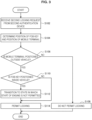
- FIG. 3 is a flowchart illustrating an example of the flow of the control exerted by the control device 350 according to the present embodiment over the operation of the mobile body 30.
- control unit 355 receives a second locking request from the second authentication device 340 (S102). It should be noted that the second locking request is transmitted on the basis of a first locking request received by the second authentication device 340 from the mobile terminal 21.
- control unit 355 When the control unit 355 acquires the second locking request from the second authentication device 340, the control unit 355 determines the positions of the fob key 11 and the mobile terminal 21 (S104).
- control unit 355 may perform control not to permit the locking of the door 315 (S108).
- control unit 355 determines that the mobile terminal 21 is positioned outside the vehicle (S106/YES)
- the control unit 355 advances the processing to S110.
- control unit 355 determines that the fob key 11 is positioned outside the vehicle (S110/NO)
- the control unit 355 then advances the processing to S114.
- control unit 355 determines that the fob key 11 is positioned inside the vehicle (S110/YES)
- the control unit 355 advances the processing to S112.
- the control unit 355 transitions to the state in which a start of the engine 320 based on an engine start request transmitted from the fob key 11 is not permitted (S112).
- the control unit 355 then performs control to permit the locking of the door 315 (S114).
- control device 350 controls the locking of the door 315
- the control device 350 does not, however, have to control the locking of the door 315. In this case, the position of each of the terminals does not have to be determined by the control device 350.
- the second authentication device 340 determines the position of the mobile terminal 21 and controls the locking of the door 315 as another example of the embodiment of the present invention.
- the second authentication device 340 has a function of the control unit that controls the locking of the door 315 on the basis of a first locking request transmitted from the mobile terminal 21 and the position of the mobile terminal 21.
- the second authentication device 340 When the first locking request is transmitted from the mobile terminal 21 positioned outside the vehicle, the second authentication device 340 performs control to permit the locking of the door 315 by transmitting a forced-locking request as a second locking request.
- the control unit 355 of the control device 350 performs control to permit the locking of the door 315 even when the control unit 355 determines that the fob key 11 is positioned inside the vehicle.
- control unit 355 of the control device 350 acquires a second locking request that is not a forced-locking request and determines that the fob key 11 is positioned inside the vehicle, the control unit 355 may perform control not to permit the locking of the door 315.
- the second locking request which is not a forced-locking request will also be referred to as a third locking request.
- the control device 350 that acquires a forced-locking request is an example of a lock control device that controls the lock device 310.
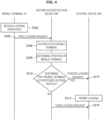
- FIG. 4 is a sequence diagram illustrating an example of the flow of the control exerted by the second authentication device 340 and the control device 350 according to the present embodiment over the locking of the door 315 of the mobile body 30.
- the mobile terminal 21 receives a locking operation on the door 315 by a user (S202).
- the mobile terminal 21 transmits a first locking request to the second authentication device 340 on the basis of the locking operation (S204).
- the second authentication device 340 authenticates the mobile terminal 21 on the basis of key information included in the received first locking request (S206).
- the second authentication device 340 determines the position of the mobile terminal 21 (S208).
- the second authentication device 340 determines that the mobile terminal 21 is positioned outside the vehicle (S210/YES)
- the second authentication device 340 transmits a forced-locking request to the control device 350 (S212).
- control unit 355 of the control device 350 performs control to permit the locking of the door 315 (S214).
- the second authentication device 340 may transmit a third locking request to the control device 350 (S216).
- the example in which the first authentication device 330, the second authentication device 340, and the control device 350 are configured as different devices has been described in the embodiment described above, but some or all of these devices may be configured as one device.
- the first authentication device 330, the second authentication device 340, and the control device 350 may be configured as one device.
- the control device 350 may have a function of the first authentication device 330 and a function of the second authentication device 340.
- the control device 350 is connected to the fob key 11 and the mobile terminal 21. That is, the processing in S102 in the flowchart illustrated in FIG. 3 is performed by the control device 350.
- the first authentication device 330 and the second authentication device 340 are configured as one device, the first authentication device 330 may execute a function executed by the second authentication device 340.
- the series of processing by the respective devices described herein may be achieved by programs stored in a non-transitory computer readable storage medium.
- Each of the programs is read by an RAM and executed by a processor such as a CPU, for example, when executed by a computer.
- the storage medium described above is, for example, a magnetic disk, an optical disc, a magneto-optical disk, a flash memory, or the like.
- the programs described above may be distributed, for example, through a network without using the storage medium.
- control unit configured to control locking of a door included in a mobile body on a basis of a first locking request transmitted from any of a first terminal or a second terminal and a position of a terminal that transmits the first locking request, the first terminal and the second terminal being each carriable by a user, wherein the control unit performs control to permit the locking of the door based on the first locking request when the first terminal is determined to be positioned inside the mobile body and the first locking request is transmitted from the second terminal determined to be positioned outside the mobile body.
Landscapes
- Engineering & Computer Science (AREA)
- Mechanical Engineering (AREA)
- Computer Networks & Wireless Communication (AREA)
- Signal Processing (AREA)
- Physics & Mathematics (AREA)
- General Physics & Mathematics (AREA)
- Lock And Its Accessories (AREA)
Abstract
There is provided a control unit configured to control locking of a door included in a mobile body on a basis of a first locking request transmitted from any of a first terminal or a second terminal and a position of a terminal that transmits the first locking request, the first terminal and the second terminal being each carriable by a user, wherein the control unit performs control to permit the locking of the door based on the first locking request when the first terminal is determined to be positioned inside the mobile body and the first locking request is transmitted from the second terminal determined to be positioned outside the mobile body.
Description
- This application is based upon and claims benefit of priority from
Japanese Patent Application No. 2023-066317, filed on April 14, 2023 - The present invention relates to a control device, a control system, a control method, and a program.
- In recent years, technology has been developed that controls the locking of a door included in a mobile body on the basis of a signal transmitted from a terminal. For example,
JP 2023-009917A - Meanwhile, it is also possible that the locking of a door of a mobile body is controlled by a plurality of terminals. However, when the locking is restricted as described above, one of the terminals is positioned inside the mobile body to prevent another terminal from locking the door of the mobile body from the outside. This causes an inconvenient situation for a user.
- The present invention has been thus devised in view of the problem described above. An object of the present invention is to provide a novel and improved control device, control system, control method, and program that each make it possible to increase convenience for a user in locking a door with a terminal.
- To solve the above described problem, according to an aspect of the present invention, there is provided a control device comprising a control unit configured to control locking of a door included in a mobile body on a basis of a first locking request transmitted from any of a first terminal or a second terminal and a position of a terminal that transmits the first locking request, the first terminal and the second terminal being each carriable by a user, wherein the control unit performs control to permit the locking of the door based on the first locking request when the first terminal is determined to be positioned inside the mobile body and the first locking request is transmitted from the second terminal determined to be positioned outside the mobile body.
- To solve the above described problem, according to another aspect of the present invention, there is provided a control system comprising: a control device that is included in a mobile body; and a first terminal that is a fob key carriable by a user, wherein the control device includes a control unit that controls locking of a door included in the mobile body on a basis of a first locking request transmitted from any of the first terminal or a second terminal and a position of a terminal that transmits the first locking request, the second terminal being carriable by a user, and the control unit performs control to permit the locking of the door based on the first locking request when the first terminal is determined to be positioned inside the mobile body and the first locking request is transmitted from the second terminal determined to be positioned outside the mobile body.
- To solve the above described problem, according to another aspect of the present invention, there is provided a control method that is executed by a computer, the control method comprising controlling locking of a door included in a mobile body on a basis of a first locking request transmitted from any of a first terminal or a second terminal and a position of a terminal that transmits the first locking request, the first terminal and the second terminal being each carriable by a user, wherein the controlling includes performing control to permit the locking of the door based on the first locking request when the first terminal is determined to be positioned inside the mobile body and the first locking request is transmitted from the second terminal determined to be positioned outside the mobile body.
- To solve the above described problem, according to another aspect of the present invention, there is provided a program for causing a computer to function as a control unit configured to control locking of a door included in a mobile body on a basis of a first locking request transmitted from any of a first terminal or a second terminal and a position of a terminal that transmits the first locking request, the first terminal and the second terminal being each carriable by a user, wherein the control unit performs control to permit the locking of the door based on the first locking request when the first terminal is determined to be positioned inside the mobile body and the first locking request is transmitted from the second terminal determined to be positioned outside the mobile body.
- As described above, according to the present invention, it is possible to increase convenience for a user in locking a door with a terminal.
-
-
FIG. 1 is a block diagram illustrating a configuration example of a control system according to the present embodiment. -
FIG. 2 is a diagram for describing control exerted by acontrol unit 355 over an operation of amobile body 30 on the basis of a result of a determination of a position of each of terminals. -
FIG. 3 is a flowchart illustrating an example of a flow of the control exerted by thecontrol device 350 according to the present embodiment over the operation of themobile body 30. -
FIG. 4 is a sequence diagram illustrating an example of a flow of control exerted by asecond authentication device 340 and thecontrol device 350 according to the present embodiment over locking of adoor 315 of themobile body 30. - Hereinafter, referring to the appended drawings, preferred embodiments of the present invention will be described in detail. It should be noted that, in this specification and the appended drawings, structural elements that have substantially the same function and structure are denoted with the same reference numerals, and repeated explanation thereof is omitted.
- First, a configuration example of a control system according an embodiment of the present invention will be described.
FIG. 1 is a block diagram illustrating the configuration example of the control system according to the present embodiment. - As illustrated in
FIG. 1 , acontrol system 1 according to the present embodiment includes afirst terminal 10, asecond terminal 20, and amobile body 30. - The
first terminal 10 and thesecond terminal 20 are terminals carriable by a user (e.g., an owner of themobile body 30, a person permitted by the owner to use themobile body 30, or the like) of themobile body 30. When thefirst terminal 10 and thesecond terminal 20 are not distinguished, thefirst terminal 10 and thesecond terminal 20 are herein sometimes referred to simply as a "terminal". - The
first terminal 10 and thesecond terminal 20 wirelessly communicate with themobile body 30 to transmit various kinds of information. Communication standards used for the communication between thefirst terminal 10 and thesecond terminal 20, and themobile body 30 may be, for example, Bluetooth (registered trademark) Low Energy (BLE), Near Field Communication (NFC), or the like. - The
first terminal 10 and thesecond terminal 20 may each transmit, for example, a request to execute an operation by themobile body 30. The request to execute an operation by themobile body 30 may be, for example, a request to lock or a request to unlock adoor 315 described below, or a request to start or a request to stop anengine 320 described below. The locking request transmitted from a terminal will also be referred to as a first locking request. - The
first terminal 10 may be an electronic key that emits a signal for controlling themobile body 30. More specifically, thefirst terminal 10 may be a genuine fob key that accompanies themobile body 30 when themobile body 30 is sold. The following description chiefly describes a case where thefirst terminal 10 is a fob key. It should be noted that thefirst terminal 10 serving as a fob key will be referred to as afob key 11. - The
second terminal 20 may be a mobile terminal such as a smartphone in which key information downloaded from a predetermined server is set. Thesecond terminal 20 may be a general-purpose mobile terminal and may be manufactured by a source different from that of themobile body 30. - An application downloaded from the predetermined server may be installed in the
second terminal 20. The application is a program for driving a function of themobile body 30. When the application receives an operation inputted from a user, the application performs control for transmitting a request corresponding to the operation inputted from the user to themobile body 30. - The following description chiefly describes a case where the
second terminal 20 is a mobile terminal. It should be noted that thesecond terminal 20 serving as a mobile terminal will be referred to as amobile terminal 21. - The
mobile body 30 according to the present embodiment may be, for example, a vehicle such as a wheeled vehicle, an aircraft, or a vessel. The following description chiefly assumes a case where themobile body 30 is a wheeled vehicle. - As illustrated in
FIG. 1 , themobile body 30 includes alock device 310, thedoor 315, theengine 320, afirst authentication device 330, asecond authentication device 340, and acontrol device 350. - The
lock device 310 is an electronic lock device that locks and unlocks thedoor 315 included in themobile body 30. - The
door 315 is a door that allows a user to get in and out of themobile body 30. - The
engine 320 is a power engine that generates the power of themobile body 30. - The
first authentication device 330 wirelessly communicates with thefob key 11. In addition, thesecond authentication device 340 wirelessly communicates with themobile terminal 21. - The
first authentication device 330 and thesecond authentication device 340 may be control devices (Electronic Control Units: ECUs) each including, for example, a processor, a memory, and the like. - The
first authentication device 330 and thesecond authentication device 340 authenticate the respective terminals that communicate with thefirst authentication device 330 and thesecond authentication device 340 on the basis of pieces of key information received from the terminals. - The
first authentication device 330 and thesecond authentication device 340 each receive, from the terminal, a request to execute an operation by themobile body 30 such as a first locking request including key information. - The
first authentication device 330 and thesecond authentication device 340 each control the transmission of a request to thecontrol device 350 on the basis of a result of the authentication of the terminal. For example, when both or any one of the authenticity of the key information and the authenticity of the terminal is proved through the authentication, a request may be transmitted to thecontrol device 350 in accordance with the request from the terminal. - More specifically, when the
first authentication device 330 and thesecond authentication device 340 each receive a first locking request from the terminal and the authenticity of the terminal is proved, a locking request may be transmitted to thecontrol device 350. The locking requests transmitted from thefirst authentication device 330 and thesecond authentication device 340 will also be each referred to as a second locking request. - The
control device 350 may be an ECU including, for example, a processor, a memory, and the like. As illustrated inFIG. 1 , thecontrol device 350 according to the present embodiment includes acontrol unit 355. - The
control unit 355 controls operations of themobile body 30 such as locking and unlocking thedoor 315 by thelock device 310, and starting and stopping theengine 320. - The
control unit 355 may control an operation of themobile body 30 on the basis of a request received from thefirst authentication device 330 or thesecond authentication device 340. - In addition, the
control unit 355 may determine the position of each of the terminals. More specifically, thecontrol unit 355 may determine whether each of the terminals is positioned inside or outside themobile body 30. - The
control unit 355 may determine whether the respective terminals are positioned inside or outside themobile body 30 on the basis of reception conditions of signals received by thefirst authentication device 330 and thesecond authentication device 340 from the terminals. The method for determining whether the respective terminals are positioned inside or outside themobile body 30 is not, however, limited in particular as long as the method is a technique typically used in the field in which the wheeled vehicle is controlled on the basis of wireless communication. For example, it may be determined whether the respective terminals are positioned inside or outside themobile body 30 on the basis of the RSSIs of signals transmitted from the terminals. - The
control unit 355 may control an operation of themobile body 30 on the basis of a result of the determination of the position of each of the terminals. - Here, control exerted by the
control unit 355 over an operation of themobile body 30 on the basis of a result of a determination of the position of each of the terminals will be described with reference toFIG. 2. FIG. 2 is a diagram for describing the control exerted by thecontrol unit 355 over the operation of themobile body 30 on the basis of the result of the determination of the position of each of terminals. Here, operation controls executed when thefob key 11 is positioned inside the mobile body 30 (inside the vehicle) and themobile terminal 21 is positioned outside the mobile body 30 (outside the vehicle) as illustrated in the upper and lower parts ofFIG. 2 will be described. - In the case of the upper part of
FIG. 2 , thecontrol unit 355 determines that thefob key 11 is positioned inside the vehicle. Here, when a first locking request is transmitted from thefob key 11, thecontrol unit 355 performs control not to permit the locking of thedoor 315 by thelock device 310 based on the first locking request. This prevents thefob key 11 that transmits the first locking request from being locked inside the vehicle. - In the case of the lower part of
FIG. 2 , thecontrol unit 355 determines that thefob key 11 is positioned inside the vehicle and themobile terminal 21 is positioned outside the vehicle. Here, when a first locking request is transmitted from themobile terminal 21, thecontrol unit 355 performs control to permit the locking of thedoor 315 by thelock device 310 based on the first locking request. - As a comparative example, it is also possible that, when it is determined that the
fob key 11 is positioned inside the vehicle, control is performed to uniformly prohibit the locking of thedoor 315 by thelock device 310 based on a first locking request. According to the comparative example, thefob key 11 is constantly prevented from being locked inside the vehicle. - The possible needs of a user U, however, include taking out only the mobile terminal 21 from the vehicle when the
fob key 11 and themobile terminal 21 are present inside the vehicle. Examples of the possible needs include taking out only the mobile terminal 21 from the vehicle and purchasing something with a payment function of themobile terminal 21. - According to the comparative example, when the
fob key 11 is positioned inside the vehicle, control is performed not to permit the locking of thedoor 315 based on a first locking request transmitted from themobile terminal 21. Therefore, although the user U is able to make a request to lock and unlock thedoor 315 by operating themobile terminal 21, the user U has to be constantly carrying thefob key 11. - Meanwhile, even when the
control unit 355 according to the present embodiment determines that thefob key 11 is positioned inside the vehicle, thecontrol unit 355 performs control to permit the locking thedoor 315 by thelock device 310 when a first locking request is transmitted from themobile terminal 21 and thecontrol unit 355 determines that themobile terminal 21 is positioned outside the vehicle. - According to this configuration, the user U is able to take out only the
mobile terminal 21 with thefob key 11 left inside the vehicle, which increases the convenience for the user U. It should be noted that, when thedoor 315 is locked through the processing described above, the user U is supposed to be carrying themobile terminal 21 with which a first locking request is made. The user U is thus able to issue an instruction to unlock the lockeddoor 315 by operating themobile terminal 21 even when thefob key 11 is locked inside the vehicle. - The control exerted by the
control unit 355 over the locking of thedoor 315 of themobile body 30 on the basis of a result of a determination of the position of each of the terminals has been described above so far with reference toFIG. 2 . When it is determined that thefob key 11 is positioned inside themobile body 30 and thedoor 315 is permitted to be locked on the basis of a first locking request transmitted from themobile terminal 21 determined to be positioned outside themobile body 30, thecontrol unit 355 may further execute other control. - For example, in the case as described above, the
control unit 355 may control the state of themobile body 30 to transition to a state in which a start of theengine 320 based on an engine start request transmitted from thefob key 11 is not permitted. - When the control described above is not performed, a third person other than the user U may break a window of the
mobile body 30 to intrude into themobile body 30 and start theengine 320 to steal themobile body 30. Thecontrol unit 355 according to the present embodiment, however, makes it possible to prevent theengine 320 from being started when thefob key 11 is locked inside the vehicle inside which the user U is not present, which increases the security. - The state in which a start of the
engine 320 is not permitted may be canceled, for example, when thedoor 315 is unlocked from the outside of themobile body 30 or when thecontrol unit 355 determines that themobile terminal 21 is positioned inside themobile body 30. - Subsequently, a flow of control exerted by the
control device 350 according to the present embodiment over an operation of themobile body 30 on the basis of a first locking request and results of determinations of the positions of themobile terminal 21 and thefob key 11 will be described with an example with reference toFIG. 3 . -
FIG. 3 is a flowchart illustrating an example of the flow of the control exerted by thecontrol device 350 according to the present embodiment over the operation of themobile body 30. - First, the
control unit 355 receives a second locking request from the second authentication device 340 (S102). It should be noted that the second locking request is transmitted on the basis of a first locking request received by thesecond authentication device 340 from themobile terminal 21. - When the
control unit 355 acquires the second locking request from thesecond authentication device 340, thecontrol unit 355 determines the positions of thefob key 11 and the mobile terminal 21 (S104). - When the
control unit 355 determines that themobile terminal 21 is positioned inside the vehicle (S106/NO), thecontrol unit 355 may perform control not to permit the locking of the door 315 (S108). - When the
control unit 355 determines that themobile terminal 21 is positioned outside the vehicle (S106/YES), thecontrol unit 355 advances the processing to S110. - When the
control unit 355 determines that thefob key 11 is positioned outside the vehicle (S110/NO), thecontrol unit 355 then advances the processing to S114. - In addition, when the
control unit 355 determines that thefob key 11 is positioned inside the vehicle (S110/YES), thecontrol unit 355 advances the processing to S112. - The
control unit 355 transitions to the state in which a start of theengine 320 based on an engine start request transmitted from thefob key 11 is not permitted (S112). - The
control unit 355 then performs control to permit the locking of the door 315 (S114). - The example in which the
control device 350 controls the locking of thedoor 315 has been described above as an example of the embodiment of the present invention. Thecontrol device 350 does not, however, have to control the locking of thedoor 315. In this case, the position of each of the terminals does not have to be determined by thecontrol device 350. - Here, a case where the
second authentication device 340 determines the position of themobile terminal 21 and controls the locking of thedoor 315 will be described as another example of the embodiment of the present invention. - The
second authentication device 340 according to the other example of the embodiment of the present invention has a function of the control unit that controls the locking of thedoor 315 on the basis of a first locking request transmitted from themobile terminal 21 and the position of themobile terminal 21. - When the first locking request is transmitted from the
mobile terminal 21 positioned outside the vehicle, thesecond authentication device 340 performs control to permit the locking of thedoor 315 by transmitting a forced-locking request as a second locking request. - The
control unit 355 of thecontrol device 350 according to the other example of the embodiment of the present invention that acquires the forced-locking request performs control to permit the locking of thedoor 315 even when thecontrol unit 355 determines that thefob key 11 is positioned inside the vehicle. - Meanwhile, when the
control unit 355 of thecontrol device 350 acquires a second locking request that is not a forced-locking request and determines that thefob key 11 is positioned inside the vehicle, thecontrol unit 355 may perform control not to permit the locking of thedoor 315. It should be noted that the second locking request which is not a forced-locking request will also be referred to as a third locking request. Thecontrol device 350 that acquires a forced-locking request is an example of a lock control device that controls thelock device 310. - Subsequently, a flow of the control exerted by the
second authentication device 340 and thecontrol device 350 over the locking of thedoor 315 of themobile body 30 will be described with an example with reference toFIG. 4 . -
FIG. 4 is a sequence diagram illustrating an example of the flow of the control exerted by thesecond authentication device 340 and thecontrol device 350 according to the present embodiment over the locking of thedoor 315 of themobile body 30. - First, the
mobile terminal 21 receives a locking operation on thedoor 315 by a user (S202). Themobile terminal 21 transmits a first locking request to thesecond authentication device 340 on the basis of the locking operation (S204). - The
second authentication device 340 authenticates themobile terminal 21 on the basis of key information included in the received first locking request (S206). - When the authenticity of the
mobile terminal 21 is proved through the authentication, thesecond authentication device 340 determines the position of the mobile terminal 21 (S208). - When the
second authentication device 340 determines that themobile terminal 21 is positioned outside the vehicle (S210/YES), thesecond authentication device 340 transmits a forced-locking request to the control device 350 (S212). - Subsequently, the
control unit 355 of thecontrol device 350 performs control to permit the locking of the door 315 (S214). - Meanwhile, when the
second authentication device 340 determines that themobile terminal 21 is positioned inside the vehicle (S210/NO), thesecond authentication device 340 may transmit a third locking request to the control device 350 (S216). - Heretofore, preferred embodiments of the present invention have been described in detail with reference to the appended drawings, but the present invention is not limited thereto. It should be understood by those skilled in the art that various changes and alterations may be made without departing from the spirit and scope of the appended claims.
- For example, the example in which the
first authentication device 330, thesecond authentication device 340, and thecontrol device 350 are configured as different devices has been described in the embodiment described above, but some or all of these devices may be configured as one device. - For example, the
first authentication device 330, thesecond authentication device 340, and thecontrol device 350 may be configured as one device. In this case, thecontrol device 350 may have a function of thefirst authentication device 330 and a function of thesecond authentication device 340. In this case, thecontrol device 350 is connected to thefob key 11 and themobile terminal 21. That is, the processing in S102 in the flowchart illustrated inFIG. 3 is performed by thecontrol device 350. - In addition, when the
first authentication device 330 and thesecond authentication device 340 are configured as one device, thefirst authentication device 330 may execute a function executed by thesecond authentication device 340. - In addition, the series of processing by the respective devices described herein may be achieved by programs stored in a non-transitory computer readable storage medium. Each of the programs is read by an RAM and executed by a processor such as a CPU, for example, when executed by a computer. The storage medium described above is, for example, a magnetic disk, an optical disc, a magneto-optical disk, a flash memory, or the like. In addition, the programs described above may be distributed, for example, through a network without using the storage medium.
There is provided a control unit configured to control locking of a door included in a mobile body on a basis of a first locking request transmitted from any of a first terminal or a second terminal and a position of a terminal that transmits the first locking request, the first terminal and the second terminal being each carriable by a user, wherein the control unit performs control to permit the locking of the door based on the first locking request when the first terminal is determined to be positioned inside the mobile body and the first locking request is transmitted from the second terminal determined to be positioned outside the mobile body.
Claims (10)
- A control device comprisinga control unit configured to control locking of a door included in a mobile body on a basis of a first locking request transmitted from any of a first terminal or a second terminal and a position of a terminal that transmits the first locking request, the first terminal and the second terminal being each carriable by a user, whereinthe control unit performs control to permit the locking of the door based on the first locking request when the first terminal is determined to be positioned inside the mobile body and the first locking request is transmitted from the second terminal determined to be positioned outside the mobile body.
- The control device according to claim 1, wherein, when the first terminal is determined to be positioned inside the mobile body and the first locking request is transmitted from the first terminal, the control unit performs control not to permit the locking of the door based on the first locking request.
- The control device according to 1, wherein the control device controls the locking of the door by controlling transmission of a second locking request to a lock control device, the lock control device controlling a lock device that locks the door.
- The control device according to any one of claims 1 to 3, wherein the control unit determines whether the first terminal and the second terminal are positioned inside or outside the mobile body.
- The control device according to any one of claims 1 to 3, wherein the control unit authenticates the terminal that transmits the first locking request and controls the locking of the door further on a basis of a result of authentication.
- The control device according to any one of claims 1 to 3, whereinthe control unit controls a start of an engine of the mobile body on a basis of an engine start request transmitted from the first terminal, andthe control unit transitions to a state in which the start of the engine based on the engine start request is not permitted when the first terminal is determined to be positioned inside the mobile body and the locking of the door is permitted on the basis of the first locking request transmitted from the second terminal determined to be positioned outside the mobile body.
- The control device according to any one of claims 1 to 3, whereinthe first terminal is a fob key, andthe second terminal is a mobile terminal that is used by the user.
- A control system comprising:a control device that is included in a mobile body; anda first terminal that is a fob key carriable by a user, whereinthe control device includes a control unit that controls locking of a door included in the mobile body on a basis of a first locking request transmitted from any of the first terminal or a second terminal and a position of a terminal that transmits the first locking request, the second terminal being carriable by a user, andthe control unit performs control to permit the locking of the door based on the first locking request when the first terminal is determined to be positioned inside the mobile body and the first locking request is transmitted from the second terminal determined to be positioned outside the mobile body.
- A control method that is executed by a computer, the control method comprisingcontrolling locking of a door included in a mobile body on a basis of a first locking request transmitted from any of a first terminal or a second terminal and a position of a terminal that transmits the first locking request, the first terminal and the second terminal being each carriable by a user, whereinthe controlling includes performing control to permit the locking of the door based on the first locking request when the first terminal is determined to be positioned inside the mobile body and the first locking request is transmitted from the second terminal determined to be positioned outside the mobile body.
- A program for causing a computer to function asa control unit configured to control locking of a door included in a mobile body on a basis of a first locking request transmitted from any of a first terminal or a second terminal and a position of a terminal that transmits the first locking request, the first terminal and the second terminal being each carriable by a user, whereinthe control unit performs control to permit the locking of the door based on the first locking request when the first terminal is determined to be positioned inside the mobile body and the first locking request is transmitted from the second terminal determined to be positioned outside the mobile body.
Applications Claiming Priority (1)
| Application Number | Priority Date | Filing Date | Title |
|---|---|---|---|
| JP2023066317A JP2024152245A (en) | 2023-04-14 | 2023-04-14 | Control device, control system, control method, and program. |
Publications (1)
| Publication Number | Publication Date |
|---|---|
| EP4447011A1 true EP4447011A1 (en) | 2024-10-16 |
Family
ID=90718237
Family Applications (1)
| Application Number | Title | Priority Date | Filing Date |
|---|---|---|---|
| EP24168422.4A Pending EP4447011A1 (en) | 2023-04-14 | 2024-04-04 | Control device, control system, control method, and program |
Country Status (2)
| Country | Link |
|---|---|
| EP (1) | EP4447011A1 (en) |
| JP (1) | JP2024152245A (en) |
Citations (4)
| Publication number | Priority date | Publication date | Assignee | Title |
|---|---|---|---|---|
| US20150070135A1 (en) * | 2011-09-05 | 2015-03-12 | Jaguar Land Rover Limited | Security system and device therefor |
| US20210370876A1 (en) * | 2019-03-05 | 2021-12-02 | Denso Corporation | Vehicle control system, mobile terminal, and in-vehicle device |
| JP2023009917A (en) | 2021-07-08 | 2023-01-20 | 株式会社東海理化電機製作所 | Key storage unit and sharing system |
| US20230096456A1 (en) * | 2021-09-29 | 2023-03-30 | Toyota Jidosha Kabushiki Kaisha | Information processing device, vehicle, terminal, information processing method, and recording medium storing information processing program |
-
2023
- 2023-04-14 JP JP2023066317A patent/JP2024152245A/en active Pending
-
2024
- 2024-04-04 EP EP24168422.4A patent/EP4447011A1/en active Pending
Patent Citations (4)
| Publication number | Priority date | Publication date | Assignee | Title |
|---|---|---|---|---|
| US20150070135A1 (en) * | 2011-09-05 | 2015-03-12 | Jaguar Land Rover Limited | Security system and device therefor |
| US20210370876A1 (en) * | 2019-03-05 | 2021-12-02 | Denso Corporation | Vehicle control system, mobile terminal, and in-vehicle device |
| JP2023009917A (en) | 2021-07-08 | 2023-01-20 | 株式会社東海理化電機製作所 | Key storage unit and sharing system |
| US20230096456A1 (en) * | 2021-09-29 | 2023-03-30 | Toyota Jidosha Kabushiki Kaisha | Information processing device, vehicle, terminal, information processing method, and recording medium storing information processing program |
Also Published As
| Publication number | Publication date |
|---|---|
| JP2024152245A (en) | 2024-10-25 |
Similar Documents
| Publication | Publication Date | Title |
|---|---|---|
| US12052357B2 (en) | Smart lock unlocking method and related device | |
| US10569740B2 (en) | System and method for smartkey-free vehicle control | |
| US10885731B2 (en) | Mobile telephone capable of automatically pairing with a motor vehicle, and automatic pairing method | |
| KR102394578B1 (en) | System and method for vehicle control | |
| US9855918B1 (en) | Proximity confirming passive access system for vehicle | |
| JP6336931B2 (en) | Vehicle anti-theft device | |
| CN114758432A (en) | Progressive locking strategy and remote lock management interface for device-less vehicle access | |
| WO2015033527A1 (en) | Control device and electronic key system | |
| US12213198B2 (en) | Control device, non-transitory storage medium, and system | |
| CN113715773B (en) | Vehicle control device, vehicle control system, and recording medium | |
| CN114268959B (en) | Communication device and system | |
| US12576811B2 (en) | Information processing device, information processing device-equipped vehicle, information processing method, and recording medium recorded with program | |
| CN103310518A (en) | Method and system for opening vehicle door | |
| CN113068186A (en) | Communication device and system | |
| US11678184B2 (en) | Communication apparatus and communication method | |
| US10249181B2 (en) | Wireless relay device and wireless relay control system having the same | |
| CN113068185A (en) | Communication device and system | |
| CN115380149A (en) | Communication system and communication method | |
| JP6414696B2 (en) | Key lock-in prevention device | |
| JP2024152245A (en) | Control device, control system, control method, and program. | |
| JP6864118B2 (en) | Operation control device and operation control system | |
| KR101962914B1 (en) | Method And Apparatus for Opening Vehicle Door Lock by using Smart-Key | |
| EP4096248A1 (en) | Communication device, non-transitory computer readable storage medium, and system | |
| EP4075307A1 (en) | Control device, non-transitory computer readable storage medium, and system | |
| US20260034963A1 (en) | Vehicle, control method, control program, and digital key system |
Legal Events
| Date | Code | Title | Description |
|---|---|---|---|
| PUAI | Public reference made under article 153(3) epc to a published international application that has entered the european phase |
Free format text: ORIGINAL CODE: 0009012 |
|
| STAA | Information on the status of an ep patent application or granted ep patent |
Free format text: STATUS: THE APPLICATION HAS BEEN PUBLISHED |
|
| AK | Designated contracting states |
Kind code of ref document: A1 Designated state(s): AL AT BE BG CH CY CZ DE DK EE ES FI FR GB GR HR HU IE IS IT LI LT LU LV MC ME MK MT NL NO PL PT RO RS SE SI SK SM TR |
|
| STAA | Information on the status of an ep patent application or granted ep patent |
Free format text: STATUS: REQUEST FOR EXAMINATION WAS MADE |
|
| 17P | Request for examination filed |
Effective date: 20250128 |