EP4443391A1 - Data processing device, data processing method, and program - Google Patents
Data processing device, data processing method, and program Download PDFInfo
- Publication number
- EP4443391A1 EP4443391A1 EP22898451.4A EP22898451A EP4443391A1 EP 4443391 A1 EP4443391 A1 EP 4443391A1 EP 22898451 A EP22898451 A EP 22898451A EP 4443391 A1 EP4443391 A1 EP 4443391A1
- Authority
- EP
- European Patent Office
- Prior art keywords
- data
- posture
- posture data
- direction vector
- vector
- Prior art date
- Legal status (The legal status is an assumption and is not a legal conclusion. Google has not performed a legal analysis and makes no representation as to the accuracy of the status listed.)
- Pending
Links
Images









Classifications
-
- G—PHYSICS
- G06—COMPUTING OR CALCULATING; COUNTING
- G06T—IMAGE DATA PROCESSING OR GENERATION, IN GENERAL
- G06T7/00—Image analysis
-
- G—PHYSICS
- G06—COMPUTING OR CALCULATING; COUNTING
- G06T—IMAGE DATA PROCESSING OR GENERATION, IN GENERAL
- G06T17/00—Three-dimensional [3D] modelling for computer graphics
-
- G—PHYSICS
- G06—COMPUTING OR CALCULATING; COUNTING
- G06T—IMAGE DATA PROCESSING OR GENERATION, IN GENERAL
- G06T13/00—Animation
- G06T13/20—Three-dimensional [3D] animation
- G06T13/40—Three-dimensional [3D] animation of characters, e.g. humans, animals or virtual beings
-
- G—PHYSICS
- G06—COMPUTING OR CALCULATING; COUNTING
- G06T—IMAGE DATA PROCESSING OR GENERATION, IN GENERAL
- G06T7/00—Image analysis
- G06T7/70—Determining position or orientation of objects or cameras
-
- G—PHYSICS
- G06—COMPUTING OR CALCULATING; COUNTING
- G06V—IMAGE OR VIDEO RECOGNITION OR UNDERSTANDING
- G06V10/00—Arrangements for image or video recognition or understanding
- G06V10/40—Extraction of image or video features
- G06V10/44—Local feature extraction by analysis of parts of the pattern, e.g. by detecting edges, contours, loops, corners, strokes or intersections; Connectivity analysis, e.g. of connected components
-
- G—PHYSICS
- G06—COMPUTING OR CALCULATING; COUNTING
- G06V—IMAGE OR VIDEO RECOGNITION OR UNDERSTANDING
- G06V10/00—Arrangements for image or video recognition or understanding
- G06V10/70—Arrangements for image or video recognition or understanding using pattern recognition or machine learning
- G06V10/764—Arrangements for image or video recognition or understanding using pattern recognition or machine learning using classification, e.g. of video objects
-
- G—PHYSICS
- G06—COMPUTING OR CALCULATING; COUNTING
- G06V—IMAGE OR VIDEO RECOGNITION OR UNDERSTANDING
- G06V40/00—Recognition of biometric, human-related or animal-related patterns in image or video data
- G06V40/10—Human or animal bodies, e.g. vehicle occupants or pedestrians; Body parts, e.g. hands
- G06V40/103—Static body considered as a whole, e.g. static pedestrian or occupant recognition
-
- G—PHYSICS
- G06—COMPUTING OR CALCULATING; COUNTING
- G06V—IMAGE OR VIDEO RECOGNITION OR UNDERSTANDING
- G06V40/00—Recognition of biometric, human-related or animal-related patterns in image or video data
- G06V40/20—Movements or behaviour, e.g. gesture recognition
- G06V40/23—Recognition of whole body movements, e.g. for sport training
Definitions
- the present disclosure relates to a data processing device, a data processing method, and a program, and more particularly, to a data processing device, a data processing method, and a program capable of improving the convenience of posture data.
- Patent Document 1 there has been proposed a CG character animation creation device that converts controllable feature amounts extracted from momentarily measured values of a shape of a body into position and posture information representing angles of joints or dimensions of parts of the CG character.
- Patent Document 1 Japanese Patent Application Laid-Open No. 2008-176696
- posture data obtained by capturing a motion of a person includes information that can identify the person, and normalization or generalization of posture data has not been performed. Therefore, there is a demand to handle posture data more uniformly and to deal with taking privacy into consideration, and it is expected that convenience in handling posture data can be improved by dealing with them.
- the present disclosure has been made in view of such a situation, and an object thereof is to improve convenience of posture data.
- a data processing device includes: a direction vector conversion unit that converts 3D posture data represented by a specific feature point of a person into a direction vector and represents the posture data with a direction vector; and a model application unit that applies the posture data represented by the direction vector to a CG model of the person.
- a data processing method or a program includes: converting 3D posture data represented by a specific feature point of a person into a direction vector and representing the posture data by a direction vector; and applying the posture data represented by the direction vector to a CG model of the person.
- the 3D posture data represented by the specific feature point of the person is converted into the direction vector, the posture data is represented by the direction vector, and the posture data represented by the direction vector is applied to the CG model of the person.
- Fig. 1 is a block diagram illustrating a configuration example of a data processing device according to an embodiment of the present technology.
- a data processing device 11 illustrated in Fig. 1 receives, for example, 3D data that is three-dimensional data obtained by measuring a person or 2D data that is two-dimensional data obtained by imaging a person. Furthermore, in a case where data processing is performed on the 2D data in the data processing device 11, for example, TOF data that is data obtained by imaging distance information with respect to a person acquired by a TOF (Time Of Flight) sensor is input to the data processing device 11. Then, as a result of performing data processing on the data, the data processing device 11 outputs, for example, a CG model to which the posture of the person to be subjected to the data processing is applied.
- TOF data Time Of Flight
- the data processing device 11 is configured to include a 3D posture estimation unit 12, a 2D posture estimation unit 13, a 3D conversion unit 14, a time series processing unit 15, a global coordinate transformation unit 16, a direction vector conversion unit 17, a data correction processing unit 18, a posture classification unit 19, a data expansion unit 20, and a model application unit 21.
- the 3D posture estimation unit 12 estimates the posture of the person represented by the 3D data by artificial intelligence (AI) on the basis of the 3D data input to the data processing device 11, and supplies 3D posture data obtained as a result of the estimation to the time series processing unit 15.
- AI artificial intelligence
- the 2D posture estimation unit 13 estimates a posture of a person represented by the 2D data by AI on the basis of the 2D data input to the data processing device 11, and supplies 2D posture data obtained as a result of the estimation to the 3D conversion unit 14.
- the 3D conversion unit 14 converts the 2D posture data supplied from the 2D posture estimation unit 13 into three-dimensional data using the TOF data, and supplies 3D posture data obtained as a result of the conversion to the time series processing unit 15.
- the 3D posture data supplied to the time series processing unit 15 is expressed by three-dimensional coordinates indicating positions of specific joints of a person to be subjected to data processing as feature points.
- the time series processing unit 15 performs time series processing of associating the 3D posture data continuously supplied from the 3D posture estimation unit 12 or the 3D conversion unit 14 over time with each other for each same person. For example, the time series processing unit 15 gives a person identification (ID) for identifying the same person for each piece of 3D posture data in the time series processing.
- ID person identification
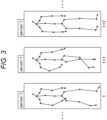
- the time series processing unit 15 can associate 3D posture data at each time of time t, time t+1, time t+2,... with each other for the same person (person ID: person 1).
- the global coordinate transformation unit 16 transforms the coordinates (for example, coordinates corresponding to a position of a device that has measured or captured the person) of the 3D posture data subjected to the time series processing in the time series processing unit 15 into global coordinates used for constructing a CG model in the data processing device 11.
- the direction vector conversion unit 17 converts the 3D posture data converted into the global coordinates by the global coordinate transformation unit 16 into a direction vector and converts the direction vector into posture data represented by a direction vector. With conversion of the 3D posture data into the direction vector in this manner, it is possible to obtain a state in which information that can identify an individual is excluded can be obtained, and the posture of the person can be expressed as normalized data that can be uniformly handled. Note that the direction vectorization of the 3D posture data by the direction vector conversion unit 17 will be described later with reference to Figs. 4 and 5 .
- the data correction processing unit 18 performs data correction processing such as data cleansing processing and data interpolation processing on the posture data converted into the direction vector by the direction vector conversion unit 17.
- data cleansing processing is processing of removing posture data that cannot be taken by a human or deleting posture data due to a time series constraint.
- data interpolation processing is processing of interpolating posture data removed or deleted by the data cleansing processing using posture data before and after the posture data.
- the posture classification unit 19 classifies posture data subjected to data correction processing in the data correction processing unit 18 for each predetermined posture, and supplies posture data to which a label of each posture is attached to the data expansion unit 20 and the model application unit 21.
- the posture classification unit 19 can automatically classify posture data into a stationary posture and a walking posture as described later with reference to Figs. 11 to 13 .
- the data expansion unit 20 expands the posture data by appropriately combining other posture data with the posture data supplied from the posture classification unit 19, for example, by combining an upper body and a lower body as described later with reference to Fig. 14 , and generates new posture data.
- the data expansion unit 20 can generate not only posture data based on 3D data or 2D data input to the data processing device 11 but also a large amount of more various posture data. Then, the data expansion unit 20 supplies the newly generated posture data to the model application unit 21.
- the model application unit 21 applies the posture data supplied from the posture classification unit 19 or the posture data supplied from the data expansion unit 20 to the CG model, and outputs the CG model of the posture corresponding to the posture data.
- the data processing device 11 is configured in this manner, and can output a large number of CG models to which more various posture data is applied, and the posture data is represented by the direction vector, thereby being capable of improving convenience in handling the posture data.
- a process in which the direction vector conversion unit 17 converts 3D posture data into a direction vector will be described with reference to Figs. 4 and 5 .
- the direction vector conversion unit 17 converts 3D posture data represented by specific feature points of a person as illustrated in Fig. 2 into direction vectors and converts the direction vectors into posture data represented by first to 19th direction vectors having 16 points as start points or end points as illustrated in Fig. 4 .
- Fig. 5 a start point and an end point of each of the first to 19th direction vectors and a name thereof are illustrated in association with each other.
- the first direction vector is a LeftLowLeg vector with a point 14 indicating a left knee as a start point and a point 16 indicating a left heel as an end point.
- the second direction vector is a LeftUpLeg vector with a point 12 indicating a left waist as a start point and a point 14 indicating the left knee as an end point.
- the third direction vector is a RightLowLeg vector having a point 15 indicating a right knee as a start point and a point 17 indicating a right heel as an end point.
- the fourth direction vector is a RightUpLeg vector having a point 13 indicating a right waist as a start point and a point 15 indicating a right knee as an end point.
- the fifth direction vector is a Hip vector having a point 12 indicating a left waist as a start point and a point 13 indicating a right waist as an end point.
- the sixth direction vector is a LeftUpBody vector having a point 12 indicating the left waist as a start point and a point 6 indicating a left shoulder as an end point.
- the seventh direction vector is a RightUpBody vector having a point 13 indicating the right waist as a start point and a point 7 indicating a right shoulder as an end point.
- the eighth direction vector is a Shoulder vector having a point 6 indicating the left shoulder as a start point and a point 7 indicating the right shoulder as an end point.
- the ninth direction vector is a LeftArm vector with a point 6 indicating the left shoulder as a start point and a point 8 indicating a left elbow as an end point.
- the 10th direction vector is a RightArm vector having a point 7 indicating the right shoulder as a start point and a point 9 indicating a right elbow as an end point.
- the 11th direction vector is a LeftForeArm vector having a point 8 indicating the left elbow as a start point and a point 10 indicating a left wrist as an end point.
- the 12th direction vector is a RightForeArm vector having a point 9 indicating the right elbow as a start point and a point 11 indicating a right wrist as an end point.
- the 13th direction vector is an Eyes vector having a point 2 indicating a left eye as a start point and a point 3 indicating a right eye as an end point.
- the 14th direction vector is a LeftNose vector having a point 2 indicating the left eye as a start point and point 1 indicating a nose as an end point.
- the 15th direction vector is a RightNose vector having a point 3 indicating the right eye as a start point and point 1 indicating the nose as an end point.
- the 16th direction vector is a RightFace vector having a point 4 indicating a left cheek as a start point and a point 2 indicating the left eye as an end point.
- the directions of the first to 19th direction vectors can be normalized by a Hip vector that is a fifth direction vector.
- the posture data converted into the direction vector can be expressed as a matrix as shown in the following Expression (1) as numerical data excluding personal information.
- the direction vector conversion unit 17 can convert the 3D posture data into direction vectors and convert the direction vectors into posture data represented by a plurality of direction vectors.
- the data processing device 11 introduces data cleansing processing as a mechanism for automatically removing or deleting posture data erroneously estimated.
- the data correction processing unit 18 can remove unnatural posture data such as a direction vector in which the waist or shoulder is excessively inclined with respect to the horizontal or a direction vector in which the upper body is excessively inclined backward by the threshold processing by the data cleansing processing of removing posture data that cannot be taken by a human.
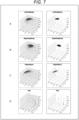
- Figs. 6 to 9 for each direction vector, distribution before the data cleansing processing is performed is illustrated on a left side, and distribution after the data cleansing processing has been performed is illustrated on a right side.
- a of Fig. 6 illustrates a distribution example of the LeftLowLeg vector before and after the data cleansing processing is performed.
- the distribution is spread before the data cleansing processing is performed (left side), whereas the distribution is narrowed after the data cleansing processing is performed (right side), indicating that the LeftLowLeg vector that is too inclined to be taken by a human is removed by the threshold processing.
- a of Fig. 7 illustrates the LeftUpBody vector
- B of Fig. 7 illustrates the RightUpBody vector
- C of Fig. 7 illustrates the RightNeck vector
- D of Fig. 7 illustrates the Hip vector in distribution examples before and after the data cleansing processing is performed for.
- a of Fig. 8 illustrates the Shoulder vector
- B of Fig. 8 illustrates the LeftArm vector
- C of Fig. 8 illustrates the RightArm vector
- FIG. 8 illustrates the RightForeArm vector in distribution examples before and after the data cleansing processing is performed.
- a of Fig. 9 illustrates a distribution example of the LeftForeArm vector and B of Fig. 9 illustrates a distribution example of the LeftNeck vector before and after the data cleansing processing is performed.
- the similarity of the vectors can be determined on the basis of the cos similarity shown in the following Expression (2).
- Expression (2) is an expression for obtaining the cos similarity between a vector a and a vector b.
- the cos similarity takes a value range from -1 to +1, and is +1 when the vector a and the vector b completely match.
- the data correction processing unit 18 evaluates the continuity of the posture data from a previous frame on the basis of the cos similarity of the 12 direction vectors as expressed in the following Expression (3). Then, the data correction processing unit 18 deletes posture data [x t y t z t ] having low similarity in which an average value of the cos similarity is equal to or less than a predetermined threshold (for example, 0.9) as erroneous estimation.
- a predetermined threshold for example, 0.9
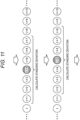
- the cos similarity increases in a case where the posture data at time t is similar to the posture data at time t+1, and the cos similarity increases in a case where the posture data at time t+1 is similar to the posture data at time t+2. Therefore, in this case, the data correction processing unit 18 can determine that the posture data at time t and the posture data at time t+1 have continuity, and the posture data at time t+1 and the posture data at time t+2 have continuity.
- the cos similarity is decreased in a case where the posture data at time t is not similar to the posture data at time t+1, and the cos similarity is decreased in a case where the posture data at time t+1 is not similar to the posture data at time t+2. Therefore, in this case, the data correction processing unit 18 determines that the posture data at time t and the posture data at time t+1 are not continuous and the posture data at time t+1 and the posture data at time t+2 are not continuous, and can delete the posture data at time t+1. As described above, in a case where the small cos similarity continues twice, posture data before and after the deleted posture data is treated as normal.
- the data correction processing unit 18 can remove or delete unnatural posture data by the data cleansing processing, and interpolate the removed or deleted posture data from preceding and subsequent posture data by the data interpolation processing.
- a mechanism for classifying time series posture data and assigning a label by the posture classification unit 19 is introduced in order to enable a processing unit in a subsequent stage to intentionally handle posture data.
- a method of automatically classifying time series posture data into a stationary posture and a walking posture on the basis of rules will be described focusing on a movement standard deviation of each component of a specific direction vector.
- the posture classification unit 19 calculates the movement standard deviation with a predetermined window size for the time series posture data.
- Fig. 11 illustrates a processing example in which the standard deviation is first calculated with a window size 7 from time t+1 to time t+7, and then the standard deviation is calculated with the window size 7 from time t+2 to time t+8.
- the posture classification unit 19 performs determination processing of determining a movement standard deviation according to a threshold by focusing on the Y component and the Z component of the direction vector of a foot. That is, in a case where the Y component and the Z component of the direction vector of the foot are less than the threshold, the posture data is determined to be the walking posture, and in a case where the Y component and the Z component of the direction vector of the foot are equal to or greater than the threshold, the posture data is determined to be the walking posture.
- a of Fig. 12 illustrates an example of the original data (left side) and the movement standard deviation (right side) of the direction vector of the foot in the posture data of the person whose person ID is 2.
- the posture classification unit 19 can determine the posture data as a stationary posture according to the threshold.
- FIG. 12 illustrates an example of the original data (left side) and the movement standard deviation (right side) of the direction vector of the foot in the posture data of the person whose person ID is 11.
- the posture classification unit 19 can determine this posture data as a walking posture according to the threshold.
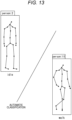
- the posture classification unit 19 can classify the posture data of the person with the person ID of 2 as the still posture and assign a label idle, and classify the posture data of the person with the person ID of 11 as the walking posture and assign the label walk by the threshold determination.
- a mechanism for expanding posture data in the data expansion unit 20 is introduced so that a sufficient number of samples of posture data can be secured even if the amount of input 3D data or 2D data is small. Then, generalization performance of AI learning can be improved by automatically generating posture data.
- the data expansion unit 20 searches posture data having high similarity with a predetermined part of the original posture data supplied from the posture classification unit 19 (posture data having a cos similarity equal to or higher than a threshold) from the acquired posture data, and obtains a posture data group having high similarity of the part. Then, the data expansion unit 20 randomly selects one piece of posture data from the posture data group for expansion, and generates new posture data by combining a direction vector of a predetermined portion of the original posture data with a direction vector of another portion of the posture data for expansion.
- Fig. 14 illustrates a processing example of processing in which the lower body of the original data is set as a predetermined part.
- searching is performed with the similarity of the direction vector of the lower body of the original data to obtain the posture data group of the posture data of the lower body having high similarity with the lower body of the original data.
- posture data for expansion is randomly selected from the posture data group.
- new posture data is generated by combining the direction vector of the upper body of the posture data for expansion with the direction vector of the lower body of the original posture data.
- the data expansion unit 20 expands the posture data to generate new posture data.
- the model application unit 21 calculates a rotation axis of the direction vector of the CG model as an outer product of the direction vector of the posture data and the direction vector of the CG model, and calculates a rotation angle for rotating the direction vector of the CG model as an inner product of the direction vector of the posture data and the direction vector of the CG model. Then, the model application unit 21 can deform the posture of the CG model by the bone rotation processing so as to match the posture of the posture data.
- Fig. 15 illustrates a processing example of processing on the LeftLowLeg vector.
- a rotation axis of the LeftLowLeg vector of the CG model is calculated by an outer product of the LeftLowLeg vector of the posture data and the LeftLowLeg vector of the CG model.
- a rotation angle for rotating the LeftLowLeg vector of the CG model is calculated by an inner product of the LeftLowLeg vector of the posture data and the LeftLowLeg vector of the CG model.
- the LeftLowLeg vector (bone) of the CG model is rotated in quaternion according to the rotation axis and the rotation angle.
- a quaternion q represents rotation of an angle 8 around an arbitrary rotation axis ( ⁇ x , ⁇ y , ⁇ z ) in a three-dimensional space, and can be expressed by four parameters as shown in the following Expression (4).
- model application unit 21 performs processing of sequentially rotating the direction vectors in the order (forward kinematics) according to outlined numbers in black circles in Fig. 16 .
- the LeftUpLeg vector is first rotated, the LeftLowLeg vector is second rotated, the RightUpLeg vector is third rotated, and the RightLowLeg vector is fourth rotated. Then, fifth, a direction vector from the center of the Hip vector toward the center of the Shoulder vector is rotated.
- the LeftArm vector is sixth rotated, the LeftForeArm vector is seventh rotated, the RightArm vector is eighth rotated, and the RightForeArm vector is ninth rotated. Then, tenth, a direction vector from the center of the Shoulder vector toward the point 1 indicating the nose is rotated.
- the model application unit 21 can apply the posture data to the CG model and output the CG model of the posture according to the posture data.
- Fig. 17 is a flowchart illustrating data processing executed by the data processing device 11.
- the 3D posture estimation unit 12 acquires 3D posture data on the basis of the 3D data input to the data processing device 11, and supplies the 3D posture data to the time series processing unit 15.
- the 2D posture estimation unit 13 acquires 2D posture data on the basis of the 2D data input to the data processing device 11 and supplies the 2D posture data to the 3D conversion unit 14, and the 3D conversion unit 14 acquires 3D posture data from the 2D posture data using the TOF data and supplies the 3D posture data to the time series processing unit 15.
- Step S12 the time series processing unit 15 performs time series processing of performing association for each same person on the basis of the 3D posture data supplied from the 3D posture estimation unit 12 or the 3D conversion unit 14 in Step S11, and supplies the association to the global coordinate transformation unit 16.
- the global coordinate transformation unit 16 transforms the coordinates of the 3D posture data supplied from the time series processing unit 15 in Step S12 into global coordinates, and supplies the global coordinates to the direction vector conversion unit 17.
- Step S14 the direction vector conversion unit 17 converts the 3D posture data supplied from the global coordinate transformation unit 16 in Step S13 into a direction vector, converts the direction vector into posture data represented by a direction vector, and supplies the posture data to the data correction processing unit 18.
- Step S15 the data correction processing unit 18 performs data correction processing of performing data cleansing processing and data interpolation processing on the posture data represented by the direction vector supplied from the direction vector conversion unit 17 in Step S14, and supplies the posture data to the posture classification unit 19.
- Step S16 the posture classification unit 19 classifies the posture data supplied from the data correction processing unit 18 in Step S15 for each predetermined posture, and supplies posture data to which a label of each posture is assigned to the data expansion unit 20 and the model application unit 21.
- Step S17 the data expansion unit 20 expands posture data by combining posture data for expansion with the posture data supplied from the posture classification unit 19 in Step S16, and supplies newly generated posture data to the model application unit 21.
- Step S18 the model application unit 21 applies the posture data supplied from the posture classification unit 19 in Step S16 or the posture data supplied from the data expansion unit 20 in Step S17 to the CG model, and outputs the CG model of the posture according to the posture data.
- the data processing is performed as described above, so that the data processing device 11 can output a large number of CG models to which more various posture data is applied.
- the data processing device 11 converts the 3D posture data into a direction vector and handles the direction vector, so that, for example, the direction vector can be automatically applied to the CG model as normalized posture data that does not depend on the position, size, and the like in the 3D data or the 2D data input to the data processing device 11. Therefore, the posture data applied to the CG model is information only in the direction between each joints that have lost the feature related to the size caused by the original person, and is applied to the CG model as posture data excluding the information that can identify the individual.
- the posture of the person imitating a real world can be automatically applied to the CG model of the person using the posture estimation by AI of the 3D posture estimation unit 12 or the 2D posture estimation unit 13 as an input. Then, the data processing device 11 can improve convenience when handling posture data by using posture data excluding information that can identify an individual.
- the data processing device 11 can automatically classify the posture data for each predetermined posture (for example, a stationary posture or a walking posture) by analyzing an X component, a Y component, and a Z component of the direction vector of a specific part of interest (for example, a foot) as a feature amount on the basis of the time series of the posture data represented by the direction vector.
- the accuracy of classifying the posture data can be improved by combining the feature amounts of the parts related to the movement of the classification target.
- the posture data can be handled as highly valuable data personalized for each predetermined posture, and convenience can be improved. For example, a large amount of data can be processed by automatically classifying posture data by the data processing device 11 instead of manually classifying posture data by a human. Furthermore, unlike the classification of posture data based on AI, preparation of a data set including annotation work and the like can be made unnecessary.
- posture estimation by AI of the 3D posture estimation unit 12 or the 2D posture estimation unit 13 is used as an input, but the present technology can be applied to posture data acquired by, for example, a motion capture method.
- the data processing device 11 and the TOF sensor are incorporated into an image sensor, thereby making it possible to realize a configuration in which the CG model to which the posture of the person captured in the image captured by the image sensor is applied is output from the image sensor.
- a series of the processes described above may be performed by hardware or can be performed by software.
- a program configuring the software is installed on a general-purpose computer, and the like.
- Fig. 18 is a block diagram illustrating a configuration example of an embodiment of a computer in which a program for executing the above-described series of processing is installed.
- the program can be recorded in advance on a hard disk 105 or ROM 103 as a recording medium incorporated in the computer.
- the program can also be stored (recorded) in a removable recording medium 111 driven by a drive 109.
- a removable recording medium 111 can be provided as so-called package software.
- examples of the removable recording medium 111 include, for example, a flexible disk, a compact disc read only memory (CD-ROM), a magneto optical (MO) disk, a digital versatile disc (DVD), a magnetic disk, a semiconductor memory, and the like.
- the program can be downloaded to the computer through a communication network or a broadcasting network and installed on the hard disk 105 to be incorporated.
- the program can be wirelessly transferred from a download site to the computer through an artificial satellite for digital satellite broadcasting, or can be transferred by a wire to the computer through a network such as a local area network (LAN) and the Internet.
- LAN local area network
- the computer has a built-in central processing unit (CPU) 102, and an input/output interface 110 is connected to the CPU 102 through a bus 101.
- CPU central processing unit
- the CPU 102 Upon receiving a command input by the user, for example, by operating the input unit 107 through the input/output interface 110, the CPU 102 executes a program stored in the read only memory (ROM) 103 accordingly. Alternatively, the CPU 102 loads a program stored in the hard disk 105 into a random access memory (RAM) 104 to execute the program.
- ROM read only memory
- RAM random access memory
- the CPU 102 performs a process according to the flowchart described above or a process to be performed according to a configuration in the block diagram described above. Then, as necessary, the CPU 102 outputs a processing result from an output unit 106, or transmits the processing result from a communication unit 108, and further, causes the hard disk 105 to record the processing result, and the like, through the input/output interface 110, for example.
- the input unit 107 includes a keyboard, a mouse, a microphone, and the like.
- the output unit 106 includes a liquid crystal display (LCD), a speaker, and the like.
- the process to be performed by the computer in accordance with the program is not necessarily performed in time series according to orders described in the flowcharts.
- the process to be performed by the computer in accordance with the program includes processes to be executed in parallel or independently (for example, a parallel process or an object-based process).
- the program may be processed by one computer (one processor) or processed in a distributed manner by a plurality of computers. Moreover, the program may be transferred to a distant computer to be executed.
- a system means a set of a plurality of components (devices, modules (parts), and the like), and it does not matter whether or not all the components are in the same housing. Consequently, a plurality of the devices housed in separate housings and connected through the network and one device in which a plurality of the modules is housed in one housing are both systems.
- a configuration described as one device may be divided and configured as the plurality of the devices (or the processing units).
- configurations described above as a plurality of devices (or processing units) may be collectively configured as one device (or processing unit).
- a configuration other than the above-described configurations may be added to the configuration of each apparatus (or individual processing unit).
- a part of the configuration of a certain device (or a certain processing unit) may be included in the configuration of another device (or another processing unit).
- the present technology can be configured as cloud computing in which one function is shared and jointly processed by the plurality of the devices through the network.
- the program described above can be executed by any device.
- the device is only required to have a necessary function (a functional block and the like) and obtain necessary information.
- each Step described in the flowcharts described above can be executed by one device, or can be executed in a shared manner by the plurality of the devices.
- the plurality of the processes included in the one Step can be executed by one device or shared and executed by the plurality of the devices.
- the plurality of the processes included in one Step can also be executed as processes of a plurality of Steps.
- the processes described as the plurality of the Steps can also be collectively executed as one Step.
- the processes in Steps describing the program may be executed in time series in the order described in the present description, or may be executed in parallel, or independently at a necessary timing such as when a call is made. That is, unless there is a contradiction, the process in the each Step may also be executed in an order different from the orders described above. Moreover, the processes in the Steps describing the program may be executed in parallel with processes of another program, or may be executed in combination with processes of the other program.
Landscapes
- Engineering & Computer Science (AREA)
- Theoretical Computer Science (AREA)
- Physics & Mathematics (AREA)
- General Physics & Mathematics (AREA)
- Computer Vision & Pattern Recognition (AREA)
- Multimedia (AREA)
- Software Systems (AREA)
- Health & Medical Sciences (AREA)
- General Health & Medical Sciences (AREA)
- Human Computer Interaction (AREA)
- Databases & Information Systems (AREA)
- Medical Informatics (AREA)
- Evolutionary Computation (AREA)
- Computing Systems (AREA)
- Computer Graphics (AREA)
- Geometry (AREA)
- Artificial Intelligence (AREA)
- Psychiatry (AREA)
- Social Psychology (AREA)
- Processing Or Creating Images (AREA)
Abstract
Description
- The present disclosure relates to a data processing device, a data processing method, and a program, and more particularly, to a data processing device, a data processing method, and a program capable of improving the convenience of posture data.
- In recent years, there is a need to prepare computer graphics (CG) models of a person having a large number and variety of postures for the purpose of learning utilizing artificial intelligence or the like. However, conventionally, in modeling a CG model of a person, for example, a posture is set by manually operating bones of the CG model of the person by a CG designer, and there is a concern that time and cost increase in order to prepare a CG model of a person with a large number of various postures.
- Therefore, as disclosed in
Patent Document 1, there has been proposed a CG character animation creation device that converts controllable feature amounts extracted from momentarily measured values of a shape of a body into position and posture information representing angles of joints or dimensions of parts of the CG character. - Patent Document 1:
Japanese Patent Application Laid-Open No. 2008-176696 - Incidentally, conventionally, posture data obtained by capturing a motion of a person includes information that can identify the person, and normalization or generalization of posture data has not been performed. Therefore, there is a demand to handle posture data more uniformly and to deal with taking privacy into consideration, and it is expected that convenience in handling posture data can be improved by dealing with them.
- The present disclosure has been made in view of such a situation, and an object thereof is to improve convenience of posture data.
- A data processing device according to one aspect of the present disclosure includes: a direction vector conversion unit that converts 3D posture data represented by a specific feature point of a person into a direction vector and represents the posture data with a direction vector; and a model application unit that applies the posture data represented by the direction vector to a CG model of the person.
- A data processing method or a program according to one aspect of the present disclosure includes: converting 3D posture data represented by a specific feature point of a person into a direction vector and representing the posture data by a direction vector; and applying the posture data represented by the direction vector to a CG model of the person.
- In one aspect of the present disclosure, the 3D posture data represented by the specific feature point of the person is converted into the direction vector, the posture data is represented by the direction vector, and the posture data represented by the direction vector is applied to the CG model of the person.
-
-
Fig. 1 is a block diagram illustrating a configuration example of a data processing device according to an embodiment of the present technology. -
Fig. 2 is a diagram illustrating an example of 3D posture data. -
Fig. 3 is a diagram illustrating time series processing. -
Fig. 4 is a diagram illustrating an example of direction vectors representing posture data. -
Fig. 5 is a diagram illustrating start points and end points of the direction vectors and names in association with each other. -
Fig. 6 is a diagram illustrating a distribution example of a LeftLowLeg vector, a RightLowLeg vector, a LeftUpLeg vector, and a RightUpLeg vector before and after data cleansing processing. -
Fig. 7 is a diagram illustrating a distribution example of a LeftUpBody vector, a RightUpBody vector, a RightNeck vector, and a Hip vector before and after data cleansing processing. -
Fig. 8 is a diagram illustrating a distribution example of a Shoulder vector, a LeftArm vector, a RightArm vector, and a RightForeArm vector before and after data cleansing processing. -
Fig. 9 is a diagram illustrating a distribution example of a LeftForeArm vector and a LeftNeck vector before and after data cleansing processing. -
Fig. 10 is a diagram illustrating data cleansing processing of deleting posture data according to a time series constraint. -
Fig. 11 is a diagram illustrating a movement standard deviation in awindow size 7. -
Fig. 12 is a diagram illustrating an example of original data of a direction vector of a foot and a movement standard deviation. -
Fig. 13 is a diagram illustrating automatic classification of a stationary posture and a walking posture. -
Fig. 14 is a diagram illustrating expansion of posture data. -
Fig. 15 is a diagram illustrating application of posture data to a CG model. -
Fig. 16 is a diagram illustrating an example of an order of rotating direction vectors. -
Fig. 17 is a flowchart illustrating data processing executed by the data processing device. -
Fig. 18 is a block diagram illustrating a configuration example of a computer according to an embodiment of the present technology. - Hereinafter, specific embodiments according to the present technology will be described in detail with reference to the drawings.
-
Fig. 1 is a block diagram illustrating a configuration example of a data processing device according to an embodiment of the present technology. - A
data processing device 11 illustrated inFig. 1 receives, for example, 3D data that is three-dimensional data obtained by measuring a person or 2D data that is two-dimensional data obtained by imaging a person. Furthermore, in a case where data processing is performed on the 2D data in thedata processing device 11, for example, TOF data that is data obtained by imaging distance information with respect to a person acquired by a TOF (Time Of Flight) sensor is input to thedata processing device 11. Then, as a result of performing data processing on the data, thedata processing device 11 outputs, for example, a CG model to which the posture of the person to be subjected to the data processing is applied. - The
data processing device 11 is configured to include a 3Dposture estimation unit 12, a 2Dposture estimation unit 13, a3D conversion unit 14, a timeseries processing unit 15, a globalcoordinate transformation unit 16, a directionvector conversion unit 17, a datacorrection processing unit 18, aposture classification unit 19, adata expansion unit 20, and amodel application unit 21. - The 3D
posture estimation unit 12 estimates the posture of the person represented by the 3D data by artificial intelligence (AI) on the basis of the 3D data input to thedata processing device 11, and supplies 3D posture data obtained as a result of the estimation to the timeseries processing unit 15. - The 2D
posture estimation unit 13 estimates a posture of a person represented by the 2D data by AI on the basis of the 2D data input to thedata processing device 11, and supplies 2D posture data obtained as a result of the estimation to the3D conversion unit 14. - The
3D conversion unit 14 converts the 2D posture data supplied from the 2Dposture estimation unit 13 into three-dimensional data using the TOF data, and supplies 3D posture data obtained as a result of the conversion to the timeseries processing unit 15. - Here, for example, as illustrated in
Fig. 2 , the 3D posture data supplied to the timeseries processing unit 15 is expressed by three-dimensional coordinates indicating positions of specific joints of a person to be subjected to data processing as feature points. - The time
series processing unit 15 performs time series processing of associating the 3D posture data continuously supplied from the 3Dposture estimation unit 12 or the3D conversion unit 14 over time with each other for each same person. For example, the timeseries processing unit 15 gives a person identification (ID) for identifying the same person for each piece of 3D posture data in the time series processing. - For example, as illustrated in
Fig. 3 , the timeseries processing unit 15 can associate 3D posture data at each time of time t, time t+1, time t+2,... with each other for the same person (person ID: person 1). - The global
coordinate transformation unit 16 transforms the coordinates (for example, coordinates corresponding to a position of a device that has measured or captured the person) of the 3D posture data subjected to the time series processing in the timeseries processing unit 15 into global coordinates used for constructing a CG model in thedata processing device 11. - The direction
vector conversion unit 17 converts the 3D posture data converted into the global coordinates by the globalcoordinate transformation unit 16 into a direction vector and converts the direction vector into posture data represented by a direction vector. With conversion of the 3D posture data into the direction vector in this manner, it is possible to obtain a state in which information that can identify an individual is excluded can be obtained, and the posture of the person can be expressed as normalized data that can be uniformly handled. Note that the direction vectorization of the 3D posture data by the directionvector conversion unit 17 will be described later with reference toFigs. 4 and5 . - The data
correction processing unit 18 performs data correction processing such as data cleansing processing and data interpolation processing on the posture data converted into the direction vector by the directionvector conversion unit 17. For example, as described with reference toFigs. 6 to 10 described later, the data cleansing processing is processing of removing posture data that cannot be taken by a human or deleting posture data due to a time series constraint. The data interpolation processing is processing of interpolating posture data removed or deleted by the data cleansing processing using posture data before and after the posture data. - The
posture classification unit 19 classifies posture data subjected to data correction processing in the datacorrection processing unit 18 for each predetermined posture, and supplies posture data to which a label of each posture is attached to thedata expansion unit 20 and themodel application unit 21. For example, theposture classification unit 19 can automatically classify posture data into a stationary posture and a walking posture as described later with reference toFigs. 11 to 13 . - The
data expansion unit 20 expands the posture data by appropriately combining other posture data with the posture data supplied from theposture classification unit 19, for example, by combining an upper body and a lower body as described later with reference toFig. 14 , and generates new posture data. As a result, thedata expansion unit 20 can generate not only posture data based on 3D data or 2D data input to thedata processing device 11 but also a large amount of more various posture data. Then, thedata expansion unit 20 supplies the newly generated posture data to themodel application unit 21. - The
model application unit 21 applies the posture data supplied from theposture classification unit 19 or the posture data supplied from thedata expansion unit 20 to the CG model, and outputs the CG model of the posture corresponding to the posture data. - The
data processing device 11 is configured in this manner, and can output a large number of CG models to which more various posture data is applied, and the posture data is represented by the direction vector, thereby being capable of improving convenience in handling the posture data. - A process in which the direction
vector conversion unit 17 converts 3D posture data into a direction vector will be described with reference toFigs. 4 and5 . - For example, the direction
vector conversion unit 17 converts 3D posture data represented by specific feature points of a person as illustrated inFig. 2 into direction vectors and converts the direction vectors into posture data represented by first to 19th direction vectors having 16 points as start points or end points as illustrated inFig. 4 . InFig. 5 , a start point and an end point of each of the first to 19th direction vectors and a name thereof are illustrated in association with each other. - For example, the first direction vector is a LeftLowLeg vector with a
point 14 indicating a left knee as a start point and apoint 16 indicating a left heel as an end point. The second direction vector is a LeftUpLeg vector with apoint 12 indicating a left waist as a start point and apoint 14 indicating the left knee as an end point. The third direction vector is a RightLowLeg vector having apoint 15 indicating a right knee as a start point and apoint 17 indicating a right heel as an end point. The fourth direction vector is a RightUpLeg vector having apoint 13 indicating a right waist as a start point and apoint 15 indicating a right knee as an end point. The fifth direction vector is a Hip vector having apoint 12 indicating a left waist as a start point and apoint 13 indicating a right waist as an end point. - The sixth direction vector is a LeftUpBody vector having a
point 12 indicating the left waist as a start point and apoint 6 indicating a left shoulder as an end point. The seventh direction vector is a RightUpBody vector having apoint 13 indicating the right waist as a start point and apoint 7 indicating a right shoulder as an end point. The eighth direction vector is a Shoulder vector having apoint 6 indicating the left shoulder as a start point and apoint 7 indicating the right shoulder as an end point. The ninth direction vector is a LeftArm vector with apoint 6 indicating the left shoulder as a start point and apoint 8 indicating a left elbow as an end point. The 10th direction vector is a RightArm vector having apoint 7 indicating the right shoulder as a start point and apoint 9 indicating a right elbow as an end point. The 11th direction vector is a LeftForeArm vector having apoint 8 indicating the left elbow as a start point and apoint 10 indicating a left wrist as an end point. The 12th direction vector is a RightForeArm vector having apoint 9 indicating the right elbow as a start point and apoint 11 indicating a right wrist as an end point. - The 13th direction vector is an Eyes vector having a
point 2 indicating a left eye as a start point and apoint 3 indicating a right eye as an end point. The 14th direction vector is a LeftNose vector having apoint 2 indicating the left eye as a start point andpoint 1 indicating a nose as an end point. The 15th direction vector is a RightNose vector having apoint 3 indicating the right eye as a start point andpoint 1 indicating the nose as an end point. The 16th direction vector is a RightFace vector having apoint 4 indicating a left cheek as a start point and apoint 2 indicating the left eye as an end point. The 17th direction vector is a LeftFace vector having apoint 5 indicating the right cheek as a start point and apoint 3 indicating the right eye as an end point. The 18th direction vector is a LeftNeck vector having apoint 6 indicating the left shoulder as a start point and apoint 1 indicating the nose as an end point. The 19th direction vector is a RightNeck vector having apoint 7 indicating the right shoulder as a start point and apoint 1 indicating the nose as an end point. - Moreover, the directions of the first to 19th direction vectors can be normalized by a Hip vector that is a fifth direction vector.
- Then, the posture data converted into the direction vector can be expressed as a matrix as shown in the following Expression (1) as numerical data excluding personal information.
-

- As described above, the direction
vector conversion unit 17 can convert the 3D posture data into direction vectors and convert the direction vectors into posture data represented by a plurality of direction vectors. - Data cleansing processing of posture data performed by the data
correction processing unit 18 will be described with reference toFigs. 6 to 10 . - For example, since erroneous estimation may occur in posture estimation from a real world, the
data processing device 11 introduces data cleansing processing as a mechanism for automatically removing or deleting posture data erroneously estimated. - The data
correction processing unit 18 can remove unnatural posture data such as a direction vector in which the waist or shoulder is excessively inclined with respect to the horizontal or a direction vector in which the upper body is excessively inclined backward by the threshold processing by the data cleansing processing of removing posture data that cannot be taken by a human. - In
Figs. 6 to 9 , for each direction vector, distribution before the data cleansing processing is performed is illustrated on a left side, and distribution after the data cleansing processing has been performed is illustrated on a right side. - A of
Fig. 6 illustrates a distribution example of the LeftLowLeg vector before and after the data cleansing processing is performed. The distribution is spread before the data cleansing processing is performed (left side), whereas the distribution is narrowed after the data cleansing processing is performed (right side), indicating that the LeftLowLeg vector that is too inclined to be taken by a human is removed by the threshold processing. - Hereinafter, similarly, distribution examples before and after the data cleansing processing is performed are illustrated for the RightLowLeg vector in B of
Fig. 6 , the LeftUpLeg vector in C ofFig. 6 , and the RightUpLeg vector in D ofFig. 6 . A ofFig. 7 illustrates the LeftUpBody vector, B ofFig. 7 illustrates the RightUpBody vector, C ofFig. 7 illustrates the RightNeck vector, and D ofFig. 7 illustrates the Hip vector in distribution examples before and after the data cleansing processing is performed for. A ofFig. 8 illustrates the Shoulder vector, B ofFig. 8 illustrates the LeftArm vector, C ofFig. 8 illustrates the RightArm vector, and D ofFig. 8 illustrates the RightForeArm vector in distribution examples before and after the data cleansing processing is performed. A ofFig. 9 illustrates a distribution example of the LeftForeArm vector and B ofFig. 9 illustrates a distribution example of the LeftNeck vector before and after the data cleansing processing is performed. - With reference to
Fig. 10 , data cleansing processing of deleting posture data according to a time series constraint will be described. - For example, the similarity of the vectors can be determined on the basis of the cos similarity shown in the following Expression (2).
-

- Here, Expression (2) is an expression for obtaining the cos similarity between a vector a and a vector b. The cos similarity takes a value range from -1 to +1, and is +1 when the vector a and the vector b completely match.
- Then, the data
correction processing unit 18 evaluates the continuity of the posture data from a previous frame on the basis of the cos similarity of the 12 direction vectors as expressed in the following Expression (3). Then, the datacorrection processing unit 18 deletes posture data [xt yt zt] having low similarity in which an average value of the cos similarity is equal to or less than a predetermined threshold (for example, 0.9) as erroneous estimation. -

- For example, as illustrated in A of
Fig. 10 , the cos similarity increases in a case where the posture data at time t is similar to the posture data attime t+ 1, and the cos similarity increases in a case where the posture data at time t+1 is similar to the posture data attime t+ 2. Therefore, in this case, the datacorrection processing unit 18 can determine that the posture data at time t and the posture data at time t+1 have continuity, and the posture data at time t+1 and the posture data at time t+2 have continuity. - On the other hand, as illustrated in B of
Fig. 10 , the cos similarity is decreased in a case where the posture data at time t is not similar to the posture data attime t+ 1, and the cos similarity is decreased in a case where the posture data at time t+1 is not similar to the posture data attime t+ 2. Therefore, in this case, the datacorrection processing unit 18 determines that the posture data at time t and the posture data at time t+1 are not continuous and the posture data at time t+1 and the posture data at time t+2 are not continuous, and can delete the posture data attime t+ 1. As described above, in a case where the small cos similarity continues twice, posture data before and after the deleted posture data is treated as normal. - In this manner, the data
correction processing unit 18 can remove or delete unnatural posture data by the data cleansing processing, and interpolate the removed or deleted posture data from preceding and subsequent posture data by the data interpolation processing. - A process in which the
posture classification unit 19 automatically classifies posture data will be described with reference toFigs. 11 to 13 . - For example, in the
data processing device 11, a mechanism for classifying time series posture data and assigning a label by theposture classification unit 19 is introduced in order to enable a processing unit in a subsequent stage to intentionally handle posture data. Here, a method of automatically classifying time series posture data into a stationary posture and a walking posture on the basis of rules will be described focusing on a movement standard deviation of each component of a specific direction vector. - As illustrated in
Fig. 11 , theposture classification unit 19 calculates the movement standard deviation with a predetermined window size for the time series posture data.Fig. 11 illustrates a processing example in which the standard deviation is first calculated with awindow size 7 from time t+1 totime t+ 7, and then the standard deviation is calculated with thewindow size 7 from time t+2 totime t+ 8. - Then, in a case where posture data is classified into a stationary posture and a walking posture, the
posture classification unit 19 performs determination processing of determining a movement standard deviation according to a threshold by focusing on the Y component and the Z component of the direction vector of a foot. That is, in a case where the Y component and the Z component of the direction vector of the foot are less than the threshold, the posture data is determined to be the walking posture, and in a case where the Y component and the Z component of the direction vector of the foot are equal to or greater than the threshold, the posture data is determined to be the walking posture. - A of
Fig. 12 illustrates an example of the original data (left side) and the movement standard deviation (right side) of the direction vector of the foot in the posture data of the person whose person ID is 2. As illustrated, since the value of the movement standard deviation is small, theposture classification unit 19 can determine the posture data as a stationary posture according to the threshold. - B of
Fig. 12 illustrates an example of the original data (left side) and the movement standard deviation (right side) of the direction vector of the foot in the posture data of the person whose person ID is 11. As illustrated, since the value of the movement standard deviation is large, theposture classification unit 19 can determine this posture data as a walking posture according to the threshold. - In this manner, as illustrated in
Fig. 13 , theposture classification unit 19 can classify the posture data of the person with the person ID of 2 as the still posture and assign a label idle, and classify the posture data of the person with the person ID of 11 as the walking posture and assign the label walk by the threshold determination. - A process in which the
data expansion unit 20 generates new posture data will be described with reference toFig. 14 . - For example, in the
data processing device 11, a mechanism for expanding posture data in thedata expansion unit 20 is introduced so that a sufficient number of samples of posture data can be secured even if the amount ofinput 3D data or 2D data is small. Then, generalization performance of AI learning can be improved by automatically generating posture data. - For example, the
data expansion unit 20 searches posture data having high similarity with a predetermined part of the original posture data supplied from the posture classification unit 19 (posture data having a cos similarity equal to or higher than a threshold) from the acquired posture data, and obtains a posture data group having high similarity of the part. Then, thedata expansion unit 20 randomly selects one piece of posture data from the posture data group for expansion, and generates new posture data by combining a direction vector of a predetermined portion of the original posture data with a direction vector of another portion of the posture data for expansion. -
Fig. 14 illustrates a processing example of processing in which the lower body of the original data is set as a predetermined part. - As illustrated in
Fig. 14 , searching is performed with the similarity of the direction vector of the lower body of the original data to obtain the posture data group of the posture data of the lower body having high similarity with the lower body of the original data. Then, posture data for expansion is randomly selected from the posture data group. Moreover, new posture data is generated by combining the direction vector of the upper body of the posture data for expansion with the direction vector of the lower body of the original posture data. - In this manner, the
data expansion unit 20 expands the posture data to generate new posture data. - Processing in which the
model application unit 21 applies posture data to a CG model will be described with reference toFigs. 15 and16 . - For a predetermined direction vector, the
model application unit 21 calculates a rotation axis of the direction vector of the CG model as an outer product of the direction vector of the posture data and the direction vector of the CG model, and calculates a rotation angle for rotating the direction vector of the CG model as an inner product of the direction vector of the posture data and the direction vector of the CG model. Then, themodel application unit 21 can deform the posture of the CG model by the bone rotation processing so as to match the posture of the posture data. -
Fig. 15 illustrates a processing example of processing on the LeftLowLeg vector. - As illustrated in
Fig. 15 , firstly, a rotation axis of the LeftLowLeg vector of the CG model is calculated by an outer product of the LeftLowLeg vector of the posture data and the LeftLowLeg vector of the CG model. Second, a rotation angle for rotating the LeftLowLeg vector of the CG model is calculated by an inner product of the LeftLowLeg vector of the posture data and the LeftLowLeg vector of the CG model. Third, the LeftLowLeg vector (bone) of the CG model is rotated in quaternion according to the rotation axis and the rotation angle. - Here, a quaternion q represents rotation of an
angle 8 around an arbitrary rotation axis (λx, λy, λz) in a three-dimensional space, and can be expressed by four parameters as shown in the following Expression (4). -

- Furthermore, the
model application unit 21 performs processing of sequentially rotating the direction vectors in the order (forward kinematics) according to outlined numbers in black circles inFig. 16 . - That is, the LeftUpLeg vector is first rotated, the LeftLowLeg vector is second rotated, the RightUpLeg vector is third rotated, and the RightLowLeg vector is fourth rotated. Then, fifth, a direction vector from the center of the Hip vector toward the center of the Shoulder vector is rotated.
- Similarly, the LeftArm vector is sixth rotated, the LeftForeArm vector is seventh rotated, the RightArm vector is eighth rotated, and the RightForeArm vector is ninth rotated. Then, tenth, a direction vector from the center of the Shoulder vector toward the
point 1 indicating the nose is rotated. - In this manner, the
model application unit 21 can apply the posture data to the CG model and output the CG model of the posture according to the posture data. -
Fig. 17 is a flowchart illustrating data processing executed by thedata processing device 11. - In Step S11, the 3D
posture estimation unit 12 acquires 3D posture data on the basis of the 3D data input to thedata processing device 11, and supplies the 3D posture data to the timeseries processing unit 15. Alternatively, the 2Dposture estimation unit 13 acquires 2D posture data on the basis of the 2D data input to thedata processing device 11 and supplies the 2D posture data to the3D conversion unit 14, and the3D conversion unit 14 acquires 3D posture data from the 2D posture data using the TOF data and supplies the 3D posture data to the timeseries processing unit 15. - In Step S12, the time
series processing unit 15 performs time series processing of performing association for each same person on the basis of the 3D posture data supplied from the 3Dposture estimation unit 12 or the3D conversion unit 14 in Step S11, and supplies the association to the global coordinatetransformation unit 16. - In Step S13, the global coordinate
transformation unit 16 transforms the coordinates of the 3D posture data supplied from the timeseries processing unit 15 in Step S12 into global coordinates, and supplies the global coordinates to the directionvector conversion unit 17. - In Step S14, the direction
vector conversion unit 17 converts the 3D posture data supplied from the global coordinatetransformation unit 16 in Step S13 into a direction vector, converts the direction vector into posture data represented by a direction vector, and supplies the posture data to the datacorrection processing unit 18. - In Step S15, the data
correction processing unit 18 performs data correction processing of performing data cleansing processing and data interpolation processing on the posture data represented by the direction vector supplied from the directionvector conversion unit 17 in Step S14, and supplies the posture data to theposture classification unit 19. - In Step S16, the
posture classification unit 19 classifies the posture data supplied from the datacorrection processing unit 18 in Step S15 for each predetermined posture, and supplies posture data to which a label of each posture is assigned to thedata expansion unit 20 and themodel application unit 21. - In Step S17, the
data expansion unit 20 expands posture data by combining posture data for expansion with the posture data supplied from theposture classification unit 19 in Step S16, and supplies newly generated posture data to themodel application unit 21. - In Step S18, the
model application unit 21 applies the posture data supplied from theposture classification unit 19 in Step S16 or the posture data supplied from thedata expansion unit 20 in Step S17 to the CG model, and outputs the CG model of the posture according to the posture data. - The data processing is performed as described above, so that the
data processing device 11 can output a large number of CG models to which more various posture data is applied. At this time, thedata processing device 11 converts the 3D posture data into a direction vector and handles the direction vector, so that, for example, the direction vector can be automatically applied to the CG model as normalized posture data that does not depend on the position, size, and the like in the 3D data or the 2D data input to thedata processing device 11. Therefore, the posture data applied to the CG model is information only in the direction between each joints that have lost the feature related to the size caused by the original person, and is applied to the CG model as posture data excluding the information that can identify the individual. - Therefore, in the
data processing device 11, the posture of the person imitating a real world can be automatically applied to the CG model of the person using the posture estimation by AI of the 3Dposture estimation unit 12 or the 2Dposture estimation unit 13 as an input. Then, thedata processing device 11 can improve convenience when handling posture data by using posture data excluding information that can identify an individual. - Moreover, the
data processing device 11 can automatically classify the posture data for each predetermined posture (for example, a stationary posture or a walking posture) by analyzing an X component, a Y component, and a Z component of the direction vector of a specific part of interest (for example, a foot) as a feature amount on the basis of the time series of the posture data represented by the direction vector. For example, the accuracy of classifying the posture data can be improved by combining the feature amounts of the parts related to the movement of the classification target. - Therefore, the posture data can be handled as highly valuable data personalized for each predetermined posture, and convenience can be improved. For example, a large amount of data can be processed by automatically classifying posture data by the
data processing device 11 instead of manually classifying posture data by a human. Furthermore, unlike the classification of posture data based on AI, preparation of a data set including annotation work and the like can be made unnecessary. - Note that, in the present embodiment, posture estimation by AI of the 3D
posture estimation unit 12 or the 2Dposture estimation unit 13 is used as an input, but the present technology can be applied to posture data acquired by, for example, a motion capture method. Furthermore, thedata processing device 11 and the TOF sensor are incorporated into an image sensor, thereby making it possible to realize a configuration in which the CG model to which the posture of the person captured in the image captured by the image sensor is applied is output from the image sensor. - Next, a series of the processes described above (an information processing method) may be performed by hardware or can be performed by software. In a case where the series of the processes is performed by the software, a program configuring the software is installed on a general-purpose computer, and the like.
-
Fig. 18 is a block diagram illustrating a configuration example of an embodiment of a computer in which a program for executing the above-described series of processing is installed. - The program can be recorded in advance on a
hard disk 105 orROM 103 as a recording medium incorporated in the computer. - Alternatively, further, the program can also be stored (recorded) in a
removable recording medium 111 driven by adrive 109. Such aremovable recording medium 111 can be provided as so-called package software. Here, examples of theremovable recording medium 111 include, for example, a flexible disk, a compact disc read only memory (CD-ROM), a magneto optical (MO) disk, a digital versatile disc (DVD), a magnetic disk, a semiconductor memory, and the like. - Note that, in addition to installing the program on the computer from the
removable recording medium 111 as described above, the program can be downloaded to the computer through a communication network or a broadcasting network and installed on thehard disk 105 to be incorporated. In other words, for example, the program can be wirelessly transferred from a download site to the computer through an artificial satellite for digital satellite broadcasting, or can be transferred by a wire to the computer through a network such as a local area network (LAN) and the Internet. - The computer has a built-in central processing unit (CPU) 102, and an input/
output interface 110 is connected to theCPU 102 through abus 101. - Upon receiving a command input by the user, for example, by operating the
input unit 107 through the input/output interface 110, theCPU 102 executes a program stored in the read only memory (ROM) 103 accordingly. Alternatively, theCPU 102 loads a program stored in thehard disk 105 into a random access memory (RAM) 104 to execute the program. - Therefore, the
CPU 102 performs a process according to the flowchart described above or a process to be performed according to a configuration in the block diagram described above. Then, as necessary, theCPU 102 outputs a processing result from anoutput unit 106, or transmits the processing result from acommunication unit 108, and further, causes thehard disk 105 to record the processing result, and the like, through the input/output interface 110, for example. - Note that, the
input unit 107 includes a keyboard, a mouse, a microphone, and the like. Furthermore, theoutput unit 106 includes a liquid crystal display (LCD), a speaker, and the like. - Here, in the present description, the process to be performed by the computer in accordance with the program is not necessarily performed in time series according to orders described in the flowcharts. In other words, the process to be performed by the computer in accordance with the program includes processes to be executed in parallel or independently (for example, a parallel process or an object-based process).
- Furthermore, the program may be processed by one computer (one processor) or processed in a distributed manner by a plurality of computers. Moreover, the program may be transferred to a distant computer to be executed.
- Moreover, in the present description, a system means a set of a plurality of components (devices, modules (parts), and the like), and it does not matter whether or not all the components are in the same housing. Consequently, a plurality of the devices housed in separate housings and connected through the network and one device in which a plurality of the modules is housed in one housing are both systems.
- Furthermore, for example, a configuration described as one device (or one processing unit) may be divided and configured as the plurality of the devices (or the processing units). Conversely, configurations described above as a plurality of devices (or processing units) may be collectively configured as one device (or processing unit). Furthermore, a configuration other than the above-described configurations may be added to the configuration of each apparatus (or individual processing unit). Moreover, if the configuration and operation of the entire system are substantially the same, a part of the configuration of a certain device (or a certain processing unit) may be included in the configuration of another device (or another processing unit).
- Furthermore, for example, the present technology can be configured as cloud computing in which one function is shared and jointly processed by the plurality of the devices through the network.
- Furthermore, for example, the program described above can be executed by any device. In this case, the device is only required to have a necessary function (a functional block and the like) and obtain necessary information.
- Furthermore, for example, each Step described in the flowcharts described above can be executed by one device, or can be executed in a shared manner by the plurality of the devices. Moreover, in a case where a plurality of processes is included in one Step, the plurality of the processes included in the one Step can be executed by one device or shared and executed by the plurality of the devices. In other words, the plurality of the processes included in one Step can also be executed as processes of a plurality of Steps. On the contrary, the processes described as the plurality of the Steps can also be collectively executed as one Step.
- Note that, in the program to be executed by the computer, the processes in Steps describing the program may be executed in time series in the order described in the present description, or may be executed in parallel, or independently at a necessary timing such as when a call is made. That is, unless there is a contradiction, the process in the each Step may also be executed in an order different from the orders described above. Moreover, the processes in the Steps describing the program may be executed in parallel with processes of another program, or may be executed in combination with processes of the other program.
- Note that, a plurality of the present technologies that has been described in the present description can each be implemented independently as a single unit unless there is a contradiction. Of course, a plurality of arbitrary present technologies can be implemented in combination. For example, part or all of the present technology described in any of the embodiment can be implemented in combination with part or all of the present technology described in other embodiments. Furthermore, a part or all of the present technologies described above may be implemented in combination with another technology not described above.
- <Examples of Configuration Combinations>
- Note that the present technology can also have the following configuration.
- (1) A data processing device including:
- a direction vector conversion unit that converts 3D posture data represented by specific feature points of a person into a direction vector and represents the posture data with a plurality of direction vectors; and
- a model application unit that applies the posture data represented by the direction vector to a CG model of a person.
- (2) The data processing device according to (1) described above, further including
a data correction processing unit that performs data cleansing processing of removing the posture data that cannot be taken by a human from the posture data represented by the direction vector or deleting the posture data according to a time series constraint. - (3) The data processing device according to (2) described above, in which
the data correction processing unit performs a data interpolation process of interpolating the removed or deleted posture data by using preceding and subsequent posture data. - (4) The data processing device according to any one of (1) to (3) described above, further including
a posture classification unit that classifies the posture data for each predetermined posture and gives a label of each posture. - (5) The data processing device according to (4) described above, in which
the posture classification unit classifies the posture data by threshold determination of a movement standard deviation of a specific direction vector. - (6) The data processing device according to any one of (1) to (5) described above, further including
a data expansion unit that generates new posture data by combining a certain posture data with another posture data having high similarity with a predetermined part of the posture data. - (7) A data processing method including:
- by a data processing device,
- converting 3D posture data represented by specific feature points of a person into a direction vector, and representing the posture data with a plurality of direction vectors; and
- applying the posture data represented by the direction vector to a CG model of a person.
- (8) A program causing a computer of a data processing device that performs data processing to execute:
- converting 3D posture data represented by specific feature points of a person into a direction vector;
- representing the posture data with a plurality of direction vectors; and
- applying the posture data represented by the direction vector to a CG model of a person.
- Note that, the present embodiment is not limited to the embodiments described above, and various modifications can be made without departing from the gist of the present disclosure. Furthermore, the effects described herein are merely examples and are not limited, and other effects may be provided.
-
- 11
- Data processing device
- 12
- 3D posture estimation unit
- 13
- 2D posture estimation unit
- 14
- 3D conversion unit
- 15
- Time series processing unit
- 16
- Global coordinate transformation unit
- 17
- Direction vector conversion unit
- 18
- Data correction processing unit
- 19
- Posture classification unit
- 20
- Data expansion unit
- 21
- Model application unit
Claims (8)
- A data processing device comprising:a direction vector conversion unit that converts 3D posture data represented by specific feature points of a person into a direction vector and represents the posture data with a plurality of direction vectors; anda model application unit that applies the posture data represented by the direction vector to a CG model of a person.
- The data processing device according to claim 1, further comprising a data correction processing unit that performs data cleansing processing of removing the posture data that cannot be taken by a human from the posture data represented by the direction vector or deleting the posture data according to a time series constraint.
- The data processing device according to claim 2, wherein the data correction processing unit performs a data interpolation process of interpolating the removed or deleted posture data by using preceding and subsequent posture data.
- The data processing device according to claim 1, further comprising a posture classification unit that classifies the posture data for each predetermined posture and gives a label of each posture.
- The data processing device according to claim 4, wherein the posture classification unit classifies the posture data by threshold determination of a movement standard deviation of a specific direction vector.
- The data processing device according to claim 1, further comprising a data expansion unit that generates new posture data by combining a certain posture data with another posture data having high similarity with a predetermined part of the posture data.
- A data processing method comprising:by a data processing device,converting 3D posture data represented by specific feature points of a person into a direction vector, and representing the posture data with a plurality of direction vectors; andapplying the posture data represented by the direction vector to a CG model of a person.
- A program causing a computer of a data processing device that performs data processing to execute:converting 3D posture data represented by specific feature points of a person into a direction vector;representing the posture data with a plurality of direction vectors; andapplying the posture data represented by the direction vector to a CG model of a person.
Applications Claiming Priority (2)
| Application Number | Priority Date | Filing Date | Title |
|---|---|---|---|
| JP2021192685 | 2021-11-29 | ||
| PCT/JP2022/042322 WO2023095667A1 (en) | 2021-11-29 | 2022-11-15 | Data processing device, data processing method, and program |
Publications (2)
| Publication Number | Publication Date |
|---|---|
| EP4443391A1 true EP4443391A1 (en) | 2024-10-09 |
| EP4443391A4 EP4443391A4 (en) | 2025-03-26 |
Family
ID=86539632
Family Applications (1)
| Application Number | Title | Priority Date | Filing Date |
|---|---|---|---|
| EP22898451.4A Pending EP4443391A4 (en) | 2021-11-29 | 2022-11-15 | DATA PROCESSING DEVICE, DATA PROCESSING METHOD AND PROGRAM |
Country Status (5)
| Country | Link |
|---|---|
| US (1) | US20250316020A1 (en) |
| EP (1) | EP4443391A4 (en) |
| JP (1) | JPWO2023095667A1 (en) |
| CN (1) | CN118302797A (en) |
| WO (1) | WO2023095667A1 (en) |
Family Cites Families (6)
| Publication number | Priority date | Publication date | Assignee | Title |
|---|---|---|---|---|
| JP2004264060A (en) * | 2003-02-14 | 2004-09-24 | Akebono Brake Ind Co Ltd | Error correction method in attitude detector, and action measuring instrument using the same |
| JP2005071182A (en) * | 2003-08-26 | 2005-03-17 | Matsushita Electric Works Ltd | Three-dimensional animation creation support apparatus |
| JP2008176696A (en) | 2007-01-22 | 2008-07-31 | Misae Saito | Cg character animation creation device |
| JP7015152B2 (en) * | 2017-11-24 | 2022-02-15 | Kddi株式会社 | Processing equipment, methods and programs related to key point data |
| CN114616588A (en) * | 2019-10-31 | 2022-06-10 | 日本电气株式会社 | Image processing apparatus, image processing method, and non-transitory computer-readable medium storing image processing program |
| AU2020100998A4 (en) * | 2020-06-12 | 2020-07-16 | Chen, Guoyi Mr | A method of the motion retrival based on DTW algorithm |
-
2022
- 2022-11-15 CN CN202280077079.0A patent/CN118302797A/en active Pending
- 2022-11-15 JP JP2023563630A patent/JPWO2023095667A1/ja active Pending
- 2022-11-15 EP EP22898451.4A patent/EP4443391A4/en active Pending
- 2022-11-15 US US18/701,970 patent/US20250316020A1/en active Pending
- 2022-11-15 WO PCT/JP2022/042322 patent/WO2023095667A1/en not_active Ceased
Also Published As
| Publication number | Publication date |
|---|---|
| CN118302797A (en) | 2024-07-05 |
| US20250316020A1 (en) | 2025-10-09 |
| EP4443391A4 (en) | 2025-03-26 |
| WO2023095667A1 (en) | 2023-06-01 |
| JPWO2023095667A1 (en) | 2023-06-01 |
Similar Documents
| Publication | Publication Date | Title |
|---|---|---|
| CN111414797B (en) | Systems and methods for estimating pose and pose information of a subject | |
| US20190392587A1 (en) | System for predicting articulated object feature location | |
| CN111783506B (en) | Method, device and computer-readable storage medium for determining target characteristics | |
| Pons-Moll et al. | Outdoor human motion capture using inverse kinematics and von mises-fisher sampling | |
| US10204423B2 (en) | Visual odometry using object priors | |
| Slama et al. | Grassmannian representation of motion depth for 3D human gesture and action recognition | |
| JP2016099982A (en) | Behavior recognition device, behaviour learning device, method, and program | |
| KR101925879B1 (en) | Method of tracking motion using depth image and device thereof | |
| Chen et al. | Markerless monocular motion capture using image features and physical constraints | |
| EP1808810A1 (en) | 3d shape estimation system and image generation system | |
| US20150199592A1 (en) | Contour-based classification of objects | |
| JP2010211732A (en) | Object recognition device and method | |
| CN115984944A (en) | Expression information recognition method, device, equipment, readable storage medium and product | |
| Chan et al. | Human motion classification using 2D stick-model matching regression coefficients | |
| JP7364959B2 (en) | Feature point separation device for each subject, feature point separation method for each subject, and computer program | |
| JP6579353B1 (en) | Information processing apparatus, information processing method, dimension data calculation apparatus, and product manufacturing apparatus | |
| EP4443391A1 (en) | Data processing device, data processing method, and program | |
| Bhuyan et al. | Hand gesture recognition and animation for local hand motions | |
| Tarrataca et al. | The current feasibility of gesture recognition for a smartphone using J2ME | |
| JP6282121B2 (en) | Image recognition apparatus, image recognition method, and program | |
| US20240378783A1 (en) | Image processing device, learning device, image processing method, learning method, image processing program, and learning program | |
| JP7207396B2 (en) | Information processing device, information processing method, and program | |
| JP3677253B2 (en) | Video editing method and program | |
| CN113343902B (en) | Palm depth detection method, device, computer equipment and storage medium | |
| US20240212167A1 (en) | Data augmentation apparatus and method for action recognition through self-supervised learning based on object |
Legal Events
| Date | Code | Title | Description |
|---|---|---|---|
| STAA | Information on the status of an ep patent application or granted ep patent |
Free format text: STATUS: THE INTERNATIONAL PUBLICATION HAS BEEN MADE |
|
| PUAI | Public reference made under article 153(3) epc to a published international application that has entered the european phase |
Free format text: ORIGINAL CODE: 0009012 |
|
| STAA | Information on the status of an ep patent application or granted ep patent |
Free format text: STATUS: REQUEST FOR EXAMINATION WAS MADE |
|
| 17P | Request for examination filed |
Effective date: 20240619 |
|
| AK | Designated contracting states |
Kind code of ref document: A1 Designated state(s): AL AT BE BG CH CY CZ DE DK EE ES FI FR GB GR HR HU IE IS IT LI LT LU LV MC ME MK MT NL NO PL PT RO RS SE SI SK SM TR |
|
| DAV | Request for validation of the european patent (deleted) | ||
| DAX | Request for extension of the european patent (deleted) | ||
| A4 | Supplementary search report drawn up and despatched |
Effective date: 20250226 |
|
| RIC1 | Information provided on ipc code assigned before grant |
Ipc: G06V 40/20 20220101ALI20250220BHEP Ipc: G06V 40/10 20220101ALI20250220BHEP Ipc: G06V 10/44 20220101ALI20250220BHEP Ipc: G06T 7/70 20170101ALI20250220BHEP Ipc: G06T 7/00 20170101ALI20250220BHEP Ipc: G06T 13/40 20110101AFI20250220BHEP |