EP4442966A1 - Gas turbine engine temperature measurement system - Google Patents
Gas turbine engine temperature measurement system Download PDFInfo
- Publication number
- EP4442966A1 EP4442966A1 EP24160439.6A EP24160439A EP4442966A1 EP 4442966 A1 EP4442966 A1 EP 4442966A1 EP 24160439 A EP24160439 A EP 24160439A EP 4442966 A1 EP4442966 A1 EP 4442966A1
- Authority
- EP
- European Patent Office
- Prior art keywords
- temperature measurement
- measurement system
- optical
- engine
- section
- Prior art date
- Legal status (The legal status is an assumption and is not a legal conclusion. Google has not performed a legal analysis and makes no representation as to the accuracy of the status listed.)
- Pending
Links
- 238000009529 body temperature measurement Methods 0.000 title claims abstract description 60
- 230000003287 optical effect Effects 0.000 claims abstract description 85
- 239000000446 fuel Substances 0.000 claims abstract description 37
- 239000007921 spray Substances 0.000 claims abstract description 28
- 239000013307 optical fiber Substances 0.000 claims description 55
- 229910052594 sapphire Inorganic materials 0.000 claims description 14
- 239000010980 sapphire Substances 0.000 claims description 14
- 230000008878 coupling Effects 0.000 claims description 13
- 238000010168 coupling process Methods 0.000 claims description 13
- 238000005859 coupling reaction Methods 0.000 claims description 13
- 238000011144 upstream manufacturing Methods 0.000 claims description 13
- 238000007654 immersion Methods 0.000 claims description 12
- 238000012360 testing method Methods 0.000 claims description 12
- 230000005670 electromagnetic radiation Effects 0.000 claims description 4
- 230000005855 radiation Effects 0.000 description 13
- 238000005259 measurement Methods 0.000 description 9
- 230000000875 corresponding effect Effects 0.000 description 8
- 239000000835 fiber Substances 0.000 description 7
- VYPSYNLAJGMNEJ-UHFFFAOYSA-N Silicium dioxide Chemical compound O=[Si]=O VYPSYNLAJGMNEJ-UHFFFAOYSA-N 0.000 description 6
- 230000009977 dual effect Effects 0.000 description 4
- 230000003647 oxidation Effects 0.000 description 4
- 238000007254 oxidation reaction Methods 0.000 description 4
- 239000000463 material Substances 0.000 description 3
- 238000012986 modification Methods 0.000 description 3
- 230000004048 modification Effects 0.000 description 3
- 230000001141 propulsive effect Effects 0.000 description 3
- 238000002485 combustion reaction Methods 0.000 description 2
- 238000001816 cooling Methods 0.000 description 2
- 238000013461 design Methods 0.000 description 2
- 238000000034 method Methods 0.000 description 2
- 239000000377 silicon dioxide Substances 0.000 description 2
- 238000005507 spraying Methods 0.000 description 2
- 238000012546 transfer Methods 0.000 description 2
- 229910000530 Gallium indium arsenide Inorganic materials 0.000 description 1
- 239000000956 alloy Substances 0.000 description 1
- 229910045601 alloy Inorganic materials 0.000 description 1
- 230000015556 catabolic process Effects 0.000 description 1
- 238000006243 chemical reaction Methods 0.000 description 1
- 230000006835 compression Effects 0.000 description 1
- 238000007906 compression Methods 0.000 description 1
- 230000002596 correlated effect Effects 0.000 description 1
- 238000006731 degradation reaction Methods 0.000 description 1
- 238000001514 detection method Methods 0.000 description 1
- 238000009760 electrical discharge machining Methods 0.000 description 1
- 230000003628 erosive effect Effects 0.000 description 1
- 230000007717 exclusion Effects 0.000 description 1
- 238000002474 experimental method Methods 0.000 description 1
- 239000000284 extract Substances 0.000 description 1
- 238000007689 inspection Methods 0.000 description 1
- 239000000203 mixture Substances 0.000 description 1
- 238000012544 monitoring process Methods 0.000 description 1
- 230000008569 process Effects 0.000 description 1
- 238000012545 processing Methods 0.000 description 1
- 230000009467 reduction Effects 0.000 description 1
- 230000004044 response Effects 0.000 description 1
- 230000035945 sensitivity Effects 0.000 description 1
- 239000010935 stainless steel Substances 0.000 description 1
- 229910001220 stainless steel Inorganic materials 0.000 description 1
- WFKWXMTUELFFGS-UHFFFAOYSA-N tungsten Chemical compound [W] WFKWXMTUELFFGS-UHFFFAOYSA-N 0.000 description 1
- 229910052721 tungsten Inorganic materials 0.000 description 1
- 239000010937 tungsten Substances 0.000 description 1
Images




Classifications
-
- G—PHYSICS
- G01—MEASURING; TESTING
- G01K—MEASURING TEMPERATURE; MEASURING QUANTITY OF HEAT; THERMALLY-SENSITIVE ELEMENTS NOT OTHERWISE PROVIDED FOR
- G01K13/00—Thermometers specially adapted for specific purposes
- G01K13/02—Thermometers specially adapted for specific purposes for measuring temperature of moving fluids or granular materials capable of flow
- G01K13/024—Thermometers specially adapted for specific purposes for measuring temperature of moving fluids or granular materials capable of flow of moving gases
-
- F—MECHANICAL ENGINEERING; LIGHTING; HEATING; WEAPONS; BLASTING
- F01—MACHINES OR ENGINES IN GENERAL; ENGINE PLANTS IN GENERAL; STEAM ENGINES
- F01D—NON-POSITIVE DISPLACEMENT MACHINES OR ENGINES, e.g. STEAM TURBINES
- F01D17/00—Regulating or controlling by varying flow
- F01D17/02—Arrangement of sensing elements
- F01D17/08—Arrangement of sensing elements responsive to condition of working-fluid, e.g. pressure
- F01D17/085—Arrangement of sensing elements responsive to condition of working-fluid, e.g. pressure to temperature
-
- F—MECHANICAL ENGINEERING; LIGHTING; HEATING; WEAPONS; BLASTING
- F01—MACHINES OR ENGINES IN GENERAL; ENGINE PLANTS IN GENERAL; STEAM ENGINES
- F01D—NON-POSITIVE DISPLACEMENT MACHINES OR ENGINES, e.g. STEAM TURBINES
- F01D17/00—Regulating or controlling by varying flow
- F01D17/10—Final actuators
-
- F—MECHANICAL ENGINEERING; LIGHTING; HEATING; WEAPONS; BLASTING
- F01—MACHINES OR ENGINES IN GENERAL; ENGINE PLANTS IN GENERAL; STEAM ENGINES
- F01D—NON-POSITIVE DISPLACEMENT MACHINES OR ENGINES, e.g. STEAM TURBINES
- F01D21/00—Shutting-down of machines or engines, e.g. in emergency; Regulating, controlling, or safety means not otherwise provided for
- F01D21/003—Arrangements for testing or measuring
-
- F—MECHANICAL ENGINEERING; LIGHTING; HEATING; WEAPONS; BLASTING
- F01—MACHINES OR ENGINES IN GENERAL; ENGINE PLANTS IN GENERAL; STEAM ENGINES
- F01D—NON-POSITIVE DISPLACEMENT MACHINES OR ENGINES, e.g. STEAM TURBINES
- F01D21/00—Shutting-down of machines or engines, e.g. in emergency; Regulating, controlling, or safety means not otherwise provided for
- F01D21/12—Shutting-down of machines or engines, e.g. in emergency; Regulating, controlling, or safety means not otherwise provided for responsive to temperature
-
- F—MECHANICAL ENGINEERING; LIGHTING; HEATING; WEAPONS; BLASTING
- F02—COMBUSTION ENGINES; HOT-GAS OR COMBUSTION-PRODUCT ENGINE PLANTS
- F02C—GAS-TURBINE PLANTS; AIR INTAKES FOR JET-PROPULSION PLANTS; CONTROLLING FUEL SUPPLY IN AIR-BREATHING JET-PROPULSION PLANTS
- F02C7/00—Features, components parts, details or accessories, not provided for in, or of interest apart form groups F02C1/00 - F02C6/00; Air intakes for jet-propulsion plants
- F02C7/22—Fuel supply systems
-
- G—PHYSICS
- G01—MEASURING; TESTING
- G01J—MEASUREMENT OF INTENSITY, VELOCITY, SPECTRAL CONTENT, POLARISATION, PHASE OR PULSE CHARACTERISTICS OF INFRARED, VISIBLE OR ULTRAVIOLET LIGHT; COLORIMETRY; RADIATION PYROMETRY
- G01J5/00—Radiation pyrometry, e.g. infrared or optical thermometry
- G01J5/0088—Radiation pyrometry, e.g. infrared or optical thermometry in turbines
-
- G—PHYSICS
- G01—MEASURING; TESTING
- G01J—MEASUREMENT OF INTENSITY, VELOCITY, SPECTRAL CONTENT, POLARISATION, PHASE OR PULSE CHARACTERISTICS OF INFRARED, VISIBLE OR ULTRAVIOLET LIGHT; COLORIMETRY; RADIATION PYROMETRY
- G01J5/00—Radiation pyrometry, e.g. infrared or optical thermometry
- G01J5/02—Constructional details
- G01J5/08—Optical arrangements
- G01J5/0818—Waveguides
- G01J5/0821—Optical fibres
-
- G—PHYSICS
- G01—MEASURING; TESTING
- G01J—MEASUREMENT OF INTENSITY, VELOCITY, SPECTRAL CONTENT, POLARISATION, PHASE OR PULSE CHARACTERISTICS OF INFRARED, VISIBLE OR ULTRAVIOLET LIGHT; COLORIMETRY; RADIATION PYROMETRY
- G01J5/00—Radiation pyrometry, e.g. infrared or optical thermometry
- G01J5/10—Radiation pyrometry, e.g. infrared or optical thermometry using electric radiation detectors
-
- G—PHYSICS
- G01—MEASURING; TESTING
- G01K—MEASURING TEMPERATURE; MEASURING QUANTITY OF HEAT; THERMALLY-SENSITIVE ELEMENTS NOT OTHERWISE PROVIDED FOR
- G01K1/00—Details of thermometers not specially adapted for particular types of thermometer
- G01K1/02—Means for indicating or recording specially adapted for thermometers
- G01K1/026—Means for indicating or recording specially adapted for thermometers arrangements for monitoring a plurality of temperatures, e.g. by multiplexing
-
- G—PHYSICS
- G01—MEASURING; TESTING
- G01K—MEASURING TEMPERATURE; MEASURING QUANTITY OF HEAT; THERMALLY-SENSITIVE ELEMENTS NOT OTHERWISE PROVIDED FOR
- G01K11/00—Measuring temperature based upon physical or chemical changes not covered by groups G01K3/00, G01K5/00, G01K7/00 or G01K9/00
- G01K11/32—Measuring temperature based upon physical or chemical changes not covered by groups G01K3/00, G01K5/00, G01K7/00 or G01K9/00 using changes in transmittance, scattering or luminescence in optical fibres
-
- G—PHYSICS
- G01—MEASURING; TESTING
- G01K—MEASURING TEMPERATURE; MEASURING QUANTITY OF HEAT; THERMALLY-SENSITIVE ELEMENTS NOT OTHERWISE PROVIDED FOR
- G01K7/00—Measuring temperature based on the use of electric or magnetic elements directly sensitive to heat ; Power supply therefor, e.g. using thermoelectric elements
- G01K7/02—Measuring temperature based on the use of electric or magnetic elements directly sensitive to heat ; Power supply therefor, e.g. using thermoelectric elements using thermoelectric elements, e.g. thermocouples
-
- F—MECHANICAL ENGINEERING; LIGHTING; HEATING; WEAPONS; BLASTING
- F02—COMBUSTION ENGINES; HOT-GAS OR COMBUSTION-PRODUCT ENGINE PLANTS
- F02C—GAS-TURBINE PLANTS; AIR INTAKES FOR JET-PROPULSION PLANTS; CONTROLLING FUEL SUPPLY IN AIR-BREATHING JET-PROPULSION PLANTS
- F02C7/00—Features, components parts, details or accessories, not provided for in, or of interest apart form groups F02C1/00 - F02C6/00; Air intakes for jet-propulsion plants
- F02C7/22—Fuel supply systems
- F02C7/222—Fuel flow conduits, e.g. manifolds
-
- F—MECHANICAL ENGINEERING; LIGHTING; HEATING; WEAPONS; BLASTING
- F05—INDEXING SCHEMES RELATING TO ENGINES OR PUMPS IN VARIOUS SUBCLASSES OF CLASSES F01-F04
- F05D—INDEXING SCHEME FOR ASPECTS RELATING TO NON-POSITIVE-DISPLACEMENT MACHINES OR ENGINES, GAS-TURBINES OR JET-PROPULSION PLANTS
- F05D2220/00—Application
- F05D2220/30—Application in turbines
- F05D2220/32—Application in turbines in gas turbines
- F05D2220/321—Application in turbines in gas turbines for a special turbine stage
- F05D2220/3212—Application in turbines in gas turbines for a special turbine stage the first stage of a turbine
-
- F—MECHANICAL ENGINEERING; LIGHTING; HEATING; WEAPONS; BLASTING
- F05—INDEXING SCHEMES RELATING TO ENGINES OR PUMPS IN VARIOUS SUBCLASSES OF CLASSES F01-F04
- F05D—INDEXING SCHEME FOR ASPECTS RELATING TO NON-POSITIVE-DISPLACEMENT MACHINES OR ENGINES, GAS-TURBINES OR JET-PROPULSION PLANTS
- F05D2220/00—Application
- F05D2220/30—Application in turbines
- F05D2220/32—Application in turbines in gas turbines
- F05D2220/321—Application in turbines in gas turbines for a special turbine stage
- F05D2220/3213—Application in turbines in gas turbines for a special turbine stage an intermediate stage of the turbine
-
- F—MECHANICAL ENGINEERING; LIGHTING; HEATING; WEAPONS; BLASTING
- F05—INDEXING SCHEMES RELATING TO ENGINES OR PUMPS IN VARIOUS SUBCLASSES OF CLASSES F01-F04
- F05D—INDEXING SCHEME FOR ASPECTS RELATING TO NON-POSITIVE-DISPLACEMENT MACHINES OR ENGINES, GAS-TURBINES OR JET-PROPULSION PLANTS
- F05D2260/00—Function
- F05D2260/83—Testing, e.g. methods, components or tools therefor
-
- F—MECHANICAL ENGINEERING; LIGHTING; HEATING; WEAPONS; BLASTING
- F05—INDEXING SCHEMES RELATING TO ENGINES OR PUMPS IN VARIOUS SUBCLASSES OF CLASSES F01-F04
- F05D—INDEXING SCHEME FOR ASPECTS RELATING TO NON-POSITIVE-DISPLACEMENT MACHINES OR ENGINES, GAS-TURBINES OR JET-PROPULSION PLANTS
- F05D2260/00—Function
- F05D2260/84—Redundancy
-
- F—MECHANICAL ENGINEERING; LIGHTING; HEATING; WEAPONS; BLASTING
- F05—INDEXING SCHEMES RELATING TO ENGINES OR PUMPS IN VARIOUS SUBCLASSES OF CLASSES F01-F04
- F05D—INDEXING SCHEME FOR ASPECTS RELATING TO NON-POSITIVE-DISPLACEMENT MACHINES OR ENGINES, GAS-TURBINES OR JET-PROPULSION PLANTS
- F05D2270/00—Control
- F05D2270/30—Control parameters, e.g. input parameters
- F05D2270/303—Temperature
-
- F—MECHANICAL ENGINEERING; LIGHTING; HEATING; WEAPONS; BLASTING
- F05—INDEXING SCHEMES RELATING TO ENGINES OR PUMPS IN VARIOUS SUBCLASSES OF CLASSES F01-F04
- F05D—INDEXING SCHEME FOR ASPECTS RELATING TO NON-POSITIVE-DISPLACEMENT MACHINES OR ENGINES, GAS-TURBINES OR JET-PROPULSION PLANTS
- F05D2270/00—Control
- F05D2270/30—Control parameters, e.g. input parameters
- F05D2270/303—Temperature
- F05D2270/3032—Temperature excessive temperatures, e.g. caused by overheating
-
- F—MECHANICAL ENGINEERING; LIGHTING; HEATING; WEAPONS; BLASTING
- F05—INDEXING SCHEMES RELATING TO ENGINES OR PUMPS IN VARIOUS SUBCLASSES OF CLASSES F01-F04
- F05D—INDEXING SCHEME FOR ASPECTS RELATING TO NON-POSITIVE-DISPLACEMENT MACHINES OR ENGINES, GAS-TURBINES OR JET-PROPULSION PLANTS
- F05D2270/00—Control
- F05D2270/80—Devices generating input signals, e.g. transducers, sensors, cameras or strain gauges
- F05D2270/804—Optical devices
-
- G—PHYSICS
- G01—MEASURING; TESTING
- G01K—MEASURING TEMPERATURE; MEASURING QUANTITY OF HEAT; THERMALLY-SENSITIVE ELEMENTS NOT OTHERWISE PROVIDED FOR
- G01K2205/00—Application of thermometers in motors, e.g. of a vehicle
-
- G—PHYSICS
- G01—MEASURING; TESTING
- G01K—MEASURING TEMPERATURE; MEASURING QUANTITY OF HEAT; THERMALLY-SENSITIVE ELEMENTS NOT OTHERWISE PROVIDED FOR
- G01K2213/00—Temperature mapping
Definitions
- the present invention relates to a temperature measurement system for a gas turbine engine and a combination of a temperature measurement system and an engine control system.
- thermocouples are arranged circumferentially in the turbine section such that a circumferential temperature profile can be measured.
- Thermocouples are effective at measuring the temperature in the turbine section over a wide range of temperatures. This allows the temperature measuring system to be of use in detecting events at low temperatures such as engine light up and flame out, and also of use in detecting events at the higher temperatures during normal operating conditions. However, thermocouples are easily damaged and can lose accuracy through oxidation.
- the present invention has been devised in light of the above considerations.
- a temperature measurement system for a gas turbine engine comprising, in axial flow sequence, a compressor section, a combustor section having plural fuel spray nozzles, and a turbine section, the temperature measurement system comprising one or more optical thermometers, each optical thermometer configured to measure the temperature of a component washed by the working gas of the engine, the or each component being in the combustor section or the turbine section at a first position along the axis of the engine.
- thermocouples are prone to degradation and oxidation over time and thus have a tendency for their calibration to drift.
- Optical thermometers may be more robust and reliable than the conventional thermocouples used in gas turbine engines for working gas temperature measurement, demonstrating better noise performance and lower calibration drift. Accordingly, a temperature measurement system utilising optical thermometers in place conventional thermocouples can be more robust and has less of a requirement for sensor redundancy (i.e. multiple back-up thermocouples in conventional temperature measurement systems), facilitating a simpler, longer-lived and cheaper temperature measurement system. Measuring the temperature of components of the gas turbine engine washed by the working gas of the engine is of particular importance because it is these components that are most prone to wear due to the high temperatures.
- the one or more optical thermometers may be configured to measure the temperature of a surface within the combustor section or the turbine section.
- the temperature measurement system may be configured to then convert the surface temperature into a working gas temperature. Conversion of the surface temperature into a working gas temperature may be effected by heat transfer modelling.
- the temperature measurement system may further comprise one or more further optical thermometers, each further optical thermometer configured to measure the temperature of a component washed by the working gas of the engine, the or each component being in the combustor section or the turbine section at a second position along the axis of the engine.
- the optical thermometers may be arranged in an optical thermometer array configured to measure a circumferential temperature profile of the engine at the first position.
- the plural optical thermometers may be positioned to measure the temperature of the component(s) at plural circumferential positions, This allows the circumferential temperature profile to be monitored and utilised in control of the gas turbine engine.
- the number of optical thermometers within the optical thermometer array may be equal to the number of fuel spray nozzles.
- the swirl of the gas flow through the engine, the mixing of gas from adjacent sectors down the engine and the fuel spray nozzles spraying fuel into adjacent sectors may mean there is no simple correspondence between a single fuel spray nozzle and a respective optical thermometer.
- the temperature measurement system can correlate the temperature at a certain circumferential position to the performance of one or more fuel spray nozzles. This then allows areas of likely high wear to be identified based on the circumferential sectors of the engine that are exposed to the highest temperatures and the operating conditions for which those areas are rated, meaning that targeted physical inspection can subsequently be conducted.
- the or each optical thermometer may be configured to measure the temperature of a respective nozzle guide vane. This allows the temperature of nozzle guide vanes to be monitored in comparison to their design temperature. This also allows the temperature measured by the or each optical thermometer to be correlated to the performance of a given fuel spray nozzle by accounting for the temperature of a given nozzle vane guide, the spread of the fuel sprayed from the nozzle guide vanes, and the amount of swirl in the gas flow within the engine.
- the or each optical thermometer may be installed within a thermo well in its nozzle guide vane. This helps the or each optical thermometer to accurately measure the temperature of its respective nozzle guide vane.
- the temperature of the nozzle guide vane may be converted into a working gas temperature based on heat transfer modelling in order to indirectly measure the working gas temperature. Monitoring the temperature of a component is important when considering a component's wear rate and lifetime.
- thermo wells may be positioned in a thermo well provided in another component of the gas turbine section and/or engine.
- Possible locations of thermo wells include, for example, the combustor liner and the turbine casing.
- the temperature measurement system may comprise one or more test bodies configured to be disposed in the combustor section or the turbine section such that the or each test body is a component washed by the working gas of the engine.
- the or each test body may comprise a thermo well, and the or each optical thermometer may be configured to be inserted into the thermo well of its respective test body to measure the temperature of said test body.
- thermo well may be defined as a recess or cavity provided in a body that has a geometry such that it is a black body cavity (i.e. has an emissivity approximately equal to one, for example in the range 0.9 to 1.0).
- a thermo well may be formed in a body using electrical discharge machining (EDM).
- the or each optical thermometer may comprise an optical fibre and a respective photodiode, the optical fibre comprising a first end configured to collect electromagnetic radiation emitted from the respective component, and a second end connected to the respective photodiode. Accordingly, the temperature of a body can be measured by the optical fibre collecting electromagnetic radiation emitted from the surface of that body and transmitting that radiation to the photodiode, which can convert the radiation into an electrical signal. This facilitates the location of the photodiode in an environment that is suitable for electrical equipment (i.e. away from the high temperatures of the turbine section) whilst still allowing the optical thermometers to be used to measure the temperatures in the combustion or turbine section.
- the first end of the optical fibre may collect radiation emitted from a surface directly i.e. absent any focussing optics and/or a pyrometer.
- the or each photodiode may be an InGaAs photodiode.
- the or each photodiode may be located in a photodiode sensing unit, the photodiode sensing unit containing additional electronic components for processing the signal from the photodiode.
- the photodiode sensing unit may be configured to convert the electrical signal provided by the or each photodiode into a temperature reading. This arrangement of the optical thermometer does not require a pyrometer.
- the second end of the or each optical fibre may be connected to the respective photodiode by coupling optics comprising one or more lenses.
- Using coupling optics increases the proportion of radiation that leaves the second end of an optical fibre and reaches the photodiode, thereby increasing the signal strength and the measurement accuracy.
- the second end of the or each optical fibre may be connected to the respective diode without lenses interposed therebetween. Omitting coupling lenses can make the temperature measurement system more compact.
- the optical fibre within the optical thermometer may comprise a sapphire optical fibre section.
- Sapphire is highly inert and therefore suitable for use in the high temperature environment of the turbine section, typically being able to withstand ambient temperatures of up to 1900°C.
- the entire length of the optical fibre may be a sapphire optical fibre.
- one portion of the optical fibre's length may be a sapphire optical fibre section and another portion of its length may be formed from another, non-sapphire-based, optical fibre section, for example, a silica optical fibre section. Accordingly, the use of sapphire optical fibre can be confined to sections where the temperature is too high to use other types of optical fibre, for example, a silica optical fibre.
- the sapphire optical fibre section may have a diameter greater than or equal to approximately 100 ⁇ m.
- small diameter optical fibres such as a 100 ⁇ m fibre, have small minimum bend radii, for example, a 100 ⁇ m diameter sapphire fibre has a minimum bend radius of 20 mm. This makes routing of the optical fibre easier.
- small diameter optical fibres are more susceptible to fracturing.
- the sapphire optical fibre section may have a diameter of approximately 450 ⁇ m, Increasing the fibre diameter above 100 ⁇ m increases the minimum bend radius (e.g. a 450 ⁇ m sapphire optical fibre has a minimum bend radius of 80 mm), but also makes the optical fibre more resistant to fracturing.
- the optical fibre may be encased in a sheath to protect the optical fibre from damage, for example, a stainless-steel sheath.
- the or each optical thermometer may have an operational temperature range (e.g. the rated temperature range for the optical thermometer) whose lower bound is greater than or equal to 500°C.
- the or each optical thermometer may have an operational temperature range whose upper bound is less than or equal to 1800°C.
- the operational temperature range be focussed on the upper portion of the range of working gas temperatures seen in the turbine section, greater signal strength and measurement accuracy can be provided at the high temperatures where the greatest challenge exists for the integrity of turbine components and the delivery of internal cooling air.
- the material selected for the test body typically has a high emissivity and also has high resistance to erosion and oxidation. Suitable materials include, for example, tungsten and alloys thereof.
- the temperature measurement system may further comprise one or more thermocouples configured to measure working gas temperatures in the turbine section at a second position along the axis of the engine.
- one or more thermocouples configured to measure working gas temperatures in the turbine section at a second position along the axis of the engine.
- thermocouples conventionally have operational temperature ranges that cover the entire temperature range of the turbine section, meaning that in the case that the or each optical thermometer has an operational temperature range whose lower bound is greater than or equal to approximately 600°C then the thermocouples are able to provide temperature measurement at temperatures below the operational range of the optical thermometer(s).
- the or each thermocouple may be a single immersion thermocouple.
- Single immersion thermocouples comprise a single, e.g. K-type, thermocouple that is disposed at a first immersion depth into the gas path.
- single immersion thermocouples are simpler than dual immersion thermocouples that are conventionally used in measuring temperature in the turbine section.
- Dual immersion thermocouples comprise two, e.g. K-type, thermocouples that are disposed at first and second immersion depths into the gas path, the first and second immersion depths being different to each other.
- the first position may be upstream of the second position.
- the optical thermometers upstream of the thermocouples.
- a more accurate circumferential temperature profile can be obtained in a portion of the turbine section where the temperature profile is likely to be less uniform by having a large number of optical thermometers in this portion.
- the circumferential temperature profile is expected to be more uniform due to the mixing that occurs in the turbine section, meaning that fewer thermocouples are typically required to provide an accurate circumferential temperature profile at this position.
- thermocouples may be arranged in a thermocouple array configured to measure a circumferential temperature profile in the working gas at the second position along the axis of the engine.
- the thermocouple array may comprise four thermocouples, for example, four thermocouples equiangularly spaced about the engine's axis.
- the thermocouples may be circumferentially aligned or circumferentially misaligned with respective fuel spray nozzles.
- the temperature measurement system may further comprise one or more further thermocouples in a further thermocouple array configured to measure a circumferential temperature profile in the working gas at a third position along the axis of the engine, the third position being downstream of the second position.
- the further thermocouple array may have one or more of the optional features set out above in relation to the thermocouple array at the second position along the axis of the engine.
- the total number of thermocouples in the thermocouple array, and/or the number of thermocouples in the further thermocouple array, and/or the number of thermocouples in the temperature measurement system may be less than the number of fuel spray nozzles.
- the temperature measurement system comprise both optical thermometers and thermocouples, it is possible to reduce the number of thermocouples in the system in comparison to conventional temperature measurement systems for gas turbine engines.
- the thermocouples may be positioned further downstream in the turbine section than the optical thermometers, and at this downstream location the working gas temperature is expected to be more uniform due to mixing of the working gas as it flows through the turbine. This reduces the number of thermocouples required to obtain an accurate temperature profile.
- the turbine section may comprise plural turbines, for example, a high-pressure turbine and a low-pressure turbine, the low-pressure turbine being downstream of the high-pressure turbine.
- An intermediate-pressure turbine may be interposed between the high-pressure turbine and the low-pressure turbine.
- Each turbine may comprise one or more circumferential rows of turbine blades.
- a corresponding circumferential row of nozzle guide vanes may be positioned upstream of a given row of turbine blades.
- the first position may at the row of nozzle guide vanes within the high-pressure turbine.
- the second position may be downstream of the first row of turbine blades and corresponding row of nozzle guide vanes in the axial flow direction, but upstream of the final row of turbine blades and corresponding row of nozzle guide vanes in the axial flow direction.
- the second position may be upstream of a row of turbine blades and corresponding row of nozzle guide vanes within the intermediate-pressure turbine in an axial flow direction.
- the third position may be upstream of the final row of turbine blades and corresponding row of nozzle guide vanes in the axial flow direction but downstream of the penultimate row of turbine blades and corresponding row of nozzle guide vanes in the axial flow direction.
- the third position may be interposed between the intermediate-pressure turbine and the low-pressure turbine.
- a gas turbine engine comprising, in axial flow sequence, a compressor section, a combustor section having plural fuel spray nozzles, and a turbine section; and wherein the gas turbine engine further comprises the temperature measurement system according to the first aspect or the combination of the temperature measurement system and engine control system according to the second aspect.
- the invention includes the combination of the aspects and preferred features described except where such a combination is clearly impermissible or expressly avoided.
- a ducted fan gas turbine engine is generally indicated at 10 and has a principal and rotational axis X-X.
- the engine comprises, in axial flow series, an air intake 11, a propulsive fan 12, an intermediate pressure compressor 13, a high-pressure compressor 14, combustor section 15, a high-pressure (HP) turbine 16, an intermediate pressure (IP) turbine 17, a low-pressure (LP) turbine 18 and a core engine exhaust nozzle 19.
- a nacelle generally surrounds the engine 10 and defines the intake 11, a bypass duct 22 and a bypass exhaust nozzle 23.
- air entering the intake 11 is accelerated by the fan 12 to produce two air flows: a first air flow A into the intermediate-pressure compressor 13 and a second air flow B which passes through the bypass duct 22 to provide propulsive thrust.
- the intermediate-pressure compressor 13 compresses the air flow A directed into it before delivering that air to the high-pressure compressor 14 where further compression takes place.
- the compressed air exhausted from the high-pressure compressor 14 is directed into the combustor section 15 where it is mixed with fuel and the mixture combusted.
- the resultant hot combustion products then expand through, and thereby drive the high, intermediate and low-pressure turbines 16, 17, 18 that together form the turbine section 100, before being exhausted through the nozzle 19 to provide additional propulsive thrust.
- the high, intermediate and low-pressure turbines respectively drive the high and intermediate-pressure compressors 14, 13 and the fan 12 by suitable interconnecting shafts.
- gas turbine engines to which the present disclosure may be applied may have alternative configurations.
- such engines may have an alternative number of interconnecting shafts (e.g. two) and/or an alternative number of compressors and/or turbines.
- the engine may comprise a gearbox provided in the drive train from a turbine to a compressor and/or fan.
- FIG. 2 shows schematically part of a longitudinal cross-section through the turbine section 100 of the gas turbine engine 10.
- the turbine section 100 of Figure 2 contains the three turbines: the HP turbine 16, the IP turbine 17, and the LP turbine 18.
- Each turbine 16, 17, 18 connects to a respective interconnecting shaft, with the HP turbine 16 attached at one end of the HP compressor drive shaft 46, the IP turbine 17 connected to the IP drive shaft 47, and the LP turbine 18 connected to the LP shaft 48.
- the shafts are arranged concentrically, with the HP compressor drive shaft 46 outermost, followed by the IP drive shaft 47 and then the LP shaft 48 at the centre.
- the HP and IP turbines 16, 17 in the turbine section 100 of Figure 2 are shown each having just a single circumferential row of turbine blades 36, 37, whereas the LP turbine 18 is shown having two circumferential rows of turbine blades 38, but other numbers of rows in each turbine are possible.
- a corresponding circumferential row of nozzle guide vanes (NGVs) 26, 27, 28 is positioned Immediately upstream of each row of turbine blades 36, 37, 38.
- the NGVs 26, 27, 28 are washed by the working gas of the engine and the rows of NGVs 26, 27, 28 deflect the working gas flow passing through the turbine section 100 so that each row of turbine blades 36, 37, 38 can extract energy the gas flow more efficiently.
- the temperature measurement system comprises both optical thermometers 30 and thermocouples 40,
- the optical thermometers 30 are provided in a circumferential optical thermometer array around the engine 10 and the thermocouples 40 are provided in a circumferential thermocouple array around the engine 10.
- the optical thermometers 30 are configured to measure the temperature of the HP NGVs 26 and the thermocouples 40 are configured to measure the working gas temperatures in the turbine section 100.
- the optical thermometers' measurement points are upstream of those of the thermocouples 40.
- the optical thermometers 30 each comprise an optical fibre 32 and a photodiode 31, the optical fibre comprising a first end that is disposed in a thermo well within a respective HP NGV 26 and a second end connected to the photodiode 31. Since the optical thermometers 30 are configured to measure the temperature of respective HP NGVs 26, the first end of the optical fibre 32 of each optical thermometer 30 is disposed at a first position along the axis X-X of the engine at which the HP NGV 26 is positioned. Electromagnetic radiation is radiated from the surface of the thermo well in each HP NGV 26 and a portion of this radiation is collected by the first end of the respective optical fibre 32.
- the radiation collected by the first end of the optical fibre 32 is transmitted along the fibre to the photodiode 32, which converts the radiation into an electrical signal.
- the photodiodes 32 are located within an electronic photodiode sensing unit (EPSU) 33, with the EPSU 33 configured to determine the temperature of each of the HP NGVs 26 provided with an optical thermometer 30 from the signal generated by the respective photodiode 31.
- the thermo wells provided in the HP NGVs 26 have a geometry that produces a black body cavity i.e. a cavity having an emissivity equal to about one.
- thermo wells approximate a black body cavity when the depth exceeds their diameter by a factor of at least five; by way of example, a thermo well in the HP NGV 26 may be cylindrical, having a diameter of 1.25 mm and a depth of 15 mm.
- the optical fibres 32 each comprise a sapphire optical fibre section and, optionally, a silica glass optical fibre section, the sapphire optical fibre section being used where the optical fibre 32 is exposed to harsh working conditions (primarily high temperatures) of turbine section 100 that a silica glass optical fibre section would not withstand (the same applies to optical thermometers configured to measure the temperature of a component in the combustor section 15).
- Sapphire is used for a section of the optical fibre 32 because it is highly inert and therefore able to withstand the high temperature environment of the turbine section 100.
- thermometers 30 have a measurement range from approximately 500°C to 1800°C, with the highest measurement accuracy generally being provided for temperatures above 800°C. As the temperature of the component in which the thermo well is provided (i.e.
- the HP NGVs 26 in the case of Figure 2 increases, the emissivity of the thermo well increases (typically non-linearly with temperature) and hence the signal strength and the accuracy of the temperature measurement improves at higher temperatures, which coincides with when it is most important to have an accurate measure of temperature, because it is at high temperatures that materials and cooling systems in the combustor section 15 and/or turbine section 100 experience the most exacting conditions.
- thermocouples 40 shown in Figure 2 are single immersion thermocouples and are positioned downstream of the optical thermometers 30, being disposed at a second position along the axis X-X of the engine between the final row of LP NGVs 28 and the penultimate row of LP turbine blades 38.
- the thermocouples 40 have a temperature measurement range that covers the entire temperature range of the working gas at the second position, including at light-up and flame out. Accordingly, although the optical thermometers 30 may be unsuited to determining if the engine is lit, whether flame out has occurred, and what the temperature distribution is at low temperatures, the thermocouples 40 can be used for these tasks.
- Figures 3A - 3C show transverse cross-sections through the combustor section 15 and turbine section 100 of the gas turbine engine 10 in Figure 2 , and provide more detail on the circumferential distribution of components of the temperature measurement system.
- Figure 3A is a transverse cross-section through the combustor section 15 of the gas turbine engine 10.
- a plurality of fuel spray nozzles 50 are arranged circumferentially around the combustor, each fuel spray nozzle 50 generating a spray of fuel from fuel injected by a respective fuel injector 55.
- the combustor section 15 may take the form of a multi-chamber combustor, an annular-chamber combustor or a turbo-annular-chamber combustor.
- the combustor in Figure 3A comprises twelve fuel spray nozzles 50 and respective fuel injectors 55, equiangularly spaced about the axis X-X of the engine.
- An engine electronic controller (EEC) 60 within a control system i.e. a Full Authority Digital Electronic Controller (FADEC)
- FADEC Full Authority Digital Electronic Controller
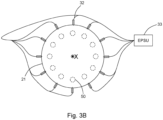
- the temperature measurement system comprises a plurality of optical thermometers 30 (each in the form of an optical fibre 32 having a first end disposed in a thermo well and a second end connected to a respective photodiode (not shown in Figure 3B ) within the EPSU 33) equally spaced circumferentially around the turbine casing 21 in an array.
- the first position is in the HP turbine 16 (see Figure 2 ), with the first end of each optical fibre 32 disposed in a thermo well provided in a respective HP NGV 26 (the HP NGVs 26 are not shown in Figure 3B ).
- the positions of the fuel spray nozzles 50 are projected onto the cross section to indicate their positions relative the first ends of the optical fibres 32.
- the first end of each optical fibre 32 is circumferentially aligned with a respective fuel spray nozzle 50
- the swirl of the gas flow through the engine, the mixing of gas from adjacent sectors down the engine and the fuel spray nozzles 50 spraying fuel into adjacent sectors means that there is not a simple correspondence between a single fuel spray nozzle 50 and a respective optical thermometer 30.
- the temperature measurement system can correlate the temperature at a certain circumferential position to the performance of one or more fuel spray nozzles 50.
- Figure 3C is a transverse cross section through the turbine section 100 at the aforementioned second position that is upstream of the final row of LP NGVs 38, but downstream of the penultimate row of turbine blades 28 in the LP turbine 18 (see Figure 2 ).
- the temperature measurement system further comprises the four thermocouples 40 disposed such as to measure the temperatures of the working gas at this second position.
- the four thermocouples 40 are connected to the EEC 60 such that the temperatures they measure can inform control of the engine 10, and in particular the FMU 65.
- the positions of the fuel spray nozzles 50 are projected onto the cross section to indicate their positions relative the thermocouples 40.
- thermocouples 40 form a thermocouple array configured to measure a circumferential temperature profile in the working gas, with the thermocouples 40 approximately equiangularly spaced around the turbine casing 21.
- thermocouples 40 in the thermocouple array there are fewer thermocouples 40 in the thermocouple array than there are optical thermometers 30 in the optical thermometer array and thus also fewer thermocouples 40 in the thermocouple array than there are fuel spray nozzles 50 in the combustor section 15.
- thermocouples 40 There is no one-to-one correspondence of thermocouples 40 to fuel spray nozzles 50 and in Figure 3C the thermocouples 40 are shown not circumferentially aligned with a respective fuel spray nozzle 50.
- a conventional working gas temperature measurement system for use in the turbine section of a gas turbine engine 10 typically comprises a greater number of thermocouples 40 than are shown in Figure 3C .
- a common arrangement for example, would be 14 dual immersion thermocouples 40 set up in two networks at different positions along the axis of the engine.
- the optical thermometer array disposed upstream of the thermocouple array in the present arrangement shown in Figures 2 and 3A - 3C , it is possible to reduce the number of thermocouples 40 needed to accurately measure the temperature profile of the working gas at the second position in the turbine section 100.
- thermocouple array is positioned further downstream than the optical thermometer array, it is unnecessary to have as large a number of thermocouple measurement points, since the working gas should be well mixed and therefore closer to a homogenous temperature by the time it reaches this second position.
- thermocouples 40 generally have a different measurement range to the measurement range of the optical thermometers 30.
- the low temperature sensitivity of the thermocouples 40 allows them to detect events such as light-up and flame-out.
- the accuracy of the circumferential temperature profiles provided by the thermocouples 40 at low temperatures outside the measurement range of the optical thermometers 30 may be reduced.
- this is not a significant problem because at such low temperatures the rate of wear on engine components is substantially lower than at normal operating temperatures, and consequently variations in the circumferential temperature profile at these low temperatures are unlikely to lead to major damage to the components of the turbine section 100.
- the temperature measurement system may include a further thermocouple array configured to measure a circumferential temperature profile in the working gas at a third position along the axis of the engine, the third position being downstream of the second position.
- the further thermocouple array is typically configured in a similar manner to the thermocouple array illustrated in Figure 3C .
- the further thermocouple array may contain fewer thermocouples than the thermocouple array configured to measure working gas temperatures at the second position. This may be based on the third position being even further downstream along the axis of the engine than the second position (and therefore the temperature profile is expected to be more uniform than at the second position), and/or space constraints within the engine.
- thermo wells into which the first end of the optical fibres 32 of the optical thermometers 30 are disposed are provided in the HP NGVs 26.
- a thermo well for an optical thermometer 30 can also be provided in other components of the gas turbine engine.
- a thermo well can be provided in the lining of the combustor in order to measure the combustor liner temperature.
- a test body may be disposed in the combustor section 15 or the turbine section 100 such that it is washed by the working gas of the engine and a thermo well can be provided in the test body for the first end of an optical fibre 32 to be inserted into.
- Figures 4A - 4C provide schematics of possible couplings between the optical fibre 32 and the photodiode 31 within an optical thermometer 30.
- coupling optics are interposed between the optical fibre 32 and the photodiode 31 to focus the radiation exiting the second end of the optical fibre onto the photodiode 31.
- coupling optics are omitted.
- the second end of the optical fibre 32 is placed up to the photodiode 31 with two lenses 34a and 34b interposed therebetween.
- Lens 34a is a collimating lens and lens 34b then focusses the collimated radiation on to the photodiode 31.
- This arrangement ensures that any minor misalignment in any of the three axes will not result in signal reduction or loss. Likewise, any vibrations should not cause the radiation transmitted by the optical fibre 32 to fall outside detection region of the photodiode 31.
- the arrangement in Figure 4A is versatile in that it allows the photodiode 31 to be changed to a different configuration without needing the coupling optics to be modified.
- the second end of the optical fibre 32 is placed up to the photodiode 31 with a single lens 34 interposed therebetween, which both collects the radiation transmitted by the optical fibre and focusses this onto the photodiode 31.
- the coupling optics illustrated in Figure 4B allow the coupling between the optical fibre 32 and the photodiode 31 to be made much more compact than the arrangement in Figure 4A . However, this is at the expense of versatility - changes to the fibre 32 and/or the detector 32 would likely require modification of the coupling optics.
- the second end of the optical fibre 32 is placed up to the photodiode directly 31, without any lenses interposed therebetween.
- the fibre width, photodiode window and their relative positions are arranged such that the rays of light from the fibre are contained within the window of the photodiode.
- the arrangement in Figure 4C allows the space occupied by the coupling to be reduced in comparison to the arrangements of Figures 4A and 4B .
Landscapes
- Engineering & Computer Science (AREA)
- Physics & Mathematics (AREA)
- General Physics & Mathematics (AREA)
- Mechanical Engineering (AREA)
- General Engineering & Computer Science (AREA)
- Chemical & Material Sciences (AREA)
- Combustion & Propulsion (AREA)
- Spectroscopy & Molecular Physics (AREA)
- Radiation Pyrometers (AREA)
Abstract
A temperature measurement system for a gas turbine engine (10), the gas turbine engine (10) comprising, in axial flow sequence, a compressor section, a combustor section (15) having plural fuel spray nozzles (50), and a turbine section (100). The temperature measurement system comprises one or more optical thermometers (30), each optical thermometer (30) configured to measure the temperature of a component washed by the working gas of the engine (10), the or each component being in the combustor section (15) or the turbine section (100) at a first position along the axis of the engine.
Description
- The present invention relates to a temperature measurement system for a gas turbine engine and a combination of a temperature measurement system and an engine control system.
- It is desirable to measure the temperature in certain sections of a gas turbine engine in order to be able to provide acceptable protection of engine components against over temperature. Exceeding design temperatures within sections of the engine leads to greater oxidation of engine components in those sections and correspondingly shortens the lifespan of such components and the gas turbine engine as a whole.
- Conventionally, temperature is measured using a temperature measuring system comprising a plurality of dual immersion thermocouples positioned in the gas turbine system. Different arrangements of the thermocouples are possible to be able to measure different temperature profiles within the gas turbine system. Often, thermocouples are arranged circumferentially in the turbine section such that a circumferential temperature profile can be measured.
- Thermocouples are effective at measuring the temperature in the turbine section over a wide range of temperatures. This allows the temperature measuring system to be of use in detecting events at low temperatures such as engine light up and flame out, and also of use in detecting events at the higher temperatures during normal operating conditions. However, thermocouples are easily damaged and can lose accuracy through oxidation.
- The present invention has been devised in light of the above considerations.
- In a first aspect there is provided a temperature measurement system for a gas turbine engine, the gas turbine engine comprising, in axial flow sequence, a compressor section, a combustor section having plural fuel spray nozzles, and a turbine section, the temperature measurement system comprising one or more optical thermometers, each optical thermometer configured to measure the temperature of a component washed by the working gas of the engine, the or each component being in the combustor section or the turbine section at a first position along the axis of the engine.
- Thermocouples are prone to degradation and oxidation over time and thus have a tendency for their calibration to drift. Optical thermometers, on the other hand, may be more robust and reliable than the conventional thermocouples used in gas turbine engines for working gas temperature measurement, demonstrating better noise performance and lower calibration drift. Accordingly, a temperature measurement system utilising optical thermometers in place conventional thermocouples can be more robust and has less of a requirement for sensor redundancy (i.e. multiple back-up thermocouples in conventional temperature measurement systems), facilitating a simpler, longer-lived and cheaper temperature measurement system. Measuring the temperature of components of the gas turbine engine washed by the working gas of the engine is of particular importance because it is these components that are most prone to wear due to the high temperatures.
- The one or more optical thermometers may be configured to measure the temperature of a surface within the combustor section or the turbine section. The temperature measurement system may be configured to then convert the surface temperature into a working gas temperature. Conversion of the surface temperature into a working gas temperature may be effected by heat transfer modelling.
- The temperature measurement system may further comprise one or more further optical thermometers, each further optical thermometer configured to measure the temperature of a component washed by the working gas of the engine, the or each component being in the combustor section or the turbine section at a second position along the axis of the engine.
- Where the temperature measurement system comprises plural of the optical thermometers, the optical thermometers may be arranged in an optical thermometer array configured to measure a circumferential temperature profile of the engine at the first position. For example, where a component extends circumferentially around the rotational axis of the gas turbine engine or there is a circumferential row of components around the rotational axis, the plural optical thermometers may be positioned to measure the temperature of the component(s) at plural circumferential positions, This allows the circumferential temperature profile to be monitored and utilised in control of the gas turbine engine.
- Where there are plural optical thermometers arranged in an optical thermometer array, the number of optical thermometers within the optical thermometer array may be equal to the number of fuel spray nozzles. In practice, the swirl of the gas flow through the engine, the mixing of gas from adjacent sectors down the engine and the fuel spray nozzles spraying fuel into adjacent sectors may mean there is no simple correspondence between a single fuel spray nozzle and a respective optical thermometer. Nevertheless, by positioning the optical thermometer array further upstream in the engine than a conventional thermocouple-based array and accounting for the above factors, the temperature measurement system can correlate the temperature at a certain circumferential position to the performance of one or more fuel spray nozzles. This then allows areas of likely high wear to be identified based on the circumferential sectors of the engine that are exposed to the highest temperatures and the operating conditions for which those areas are rated, meaning that targeted physical inspection can subsequently be conducted.
- Where the turbine section comprises a circumferential row of nozzle guide vanes at the entrance into the turbine section from the combustor section, the or each optical thermometer may be configured to measure the temperature of a respective nozzle guide vane. This allows the temperature of nozzle guide vanes to be monitored in comparison to their design temperature. This also allows the temperature measured by the or each optical thermometer to be correlated to the performance of a given fuel spray nozzle by accounting for the temperature of a given nozzle vane guide, the spread of the fuel sprayed from the nozzle guide vanes, and the amount of swirl in the gas flow within the engine.
- The or each optical thermometer may be installed within a thermo well in its nozzle guide vane. This helps the or each optical thermometer to accurately measure the temperature of its respective nozzle guide vane. The temperature of the nozzle guide vane may be converted into a working gas temperature based on heat transfer modelling in order to indirectly measure the working gas temperature. Monitoring the temperature of a component is important when considering a component's wear rate and lifetime.
- Similarly to the possible positioning of optical thermometers in thermo wells in the nozzle guide vane, the or each optical thermometer may be positioned in a thermo well provided in another component of the gas turbine section and/or engine. Possible locations of thermo wells include, for example, the combustor liner and the turbine casing.
- Alternatively, or additionally, the temperature measurement system may comprise one or more test bodies configured to be disposed in the combustor section or the turbine section such that the or each test body is a component washed by the working gas of the engine. The or each test body may comprise a thermo well, and the or each optical thermometer may be configured to be inserted into the thermo well of its respective test body to measure the temperature of said test body.
- A thermo well may be defined as a recess or cavity provided in a body that has a geometry such that it is a black body cavity (i.e. has an emissivity approximately equal to one, for example in the range 0.9 to 1.0). A thermo well may be formed in a body using electrical discharge machining (EDM).
- The or each optical thermometer may comprise an optical fibre and a respective photodiode, the optical fibre comprising a first end configured to collect electromagnetic radiation emitted from the respective component, and a second end connected to the respective photodiode. Accordingly, the temperature of a body can be measured by the optical fibre collecting electromagnetic radiation emitted from the surface of that body and transmitting that radiation to the photodiode, which can convert the radiation into an electrical signal. This facilitates the location of the photodiode in an environment that is suitable for electrical equipment (i.e. away from the high temperatures of the turbine section) whilst still allowing the optical thermometers to be used to measure the temperatures in the combustion or turbine section. The first end of the optical fibre may collect radiation emitted from a surface directly i.e. absent any focussing optics and/or a pyrometer. The or each photodiode may be an InGaAs photodiode. The or each photodiode may be located in a photodiode sensing unit, the photodiode sensing unit containing additional electronic components for processing the signal from the photodiode. The photodiode sensing unit may be configured to convert the electrical signal provided by the or each photodiode into a temperature reading. This arrangement of the optical thermometer does not require a pyrometer.
- The second end of the or each optical fibre may be connected to the respective photodiode by coupling optics comprising one or more lenses. Using coupling optics increases the proportion of radiation that leaves the second end of an optical fibre and reaches the photodiode, thereby increasing the signal strength and the measurement accuracy. According to another option, however, the second end of the or each optical fibre may be connected to the respective diode without lenses interposed therebetween. Omitting coupling lenses can make the temperature measurement system more compact.
- The optical fibre within the optical thermometer may comprise a sapphire optical fibre section. Sapphire is highly inert and therefore suitable for use in the high temperature environment of the turbine section, typically being able to withstand ambient temperatures of up to 1900°C. The entire length of the optical fibre may be a sapphire optical fibre. Alternatively, one portion of the optical fibre's length may be a sapphire optical fibre section and another portion of its length may be formed from another, non-sapphire-based, optical fibre section, for example, a silica optical fibre section. Accordingly, the use of sapphire optical fibre can be confined to sections where the temperature is too high to use other types of optical fibre, for example, a silica optical fibre.
- The sapphire optical fibre section may have a diameter greater than or equal to approximately 100 µm. Advantageously, small diameter optical fibres, such as a 100 µm fibre, have small minimum bend radii, for example, a 100 µm diameter sapphire fibre has a minimum bend radius of 20 mm. This makes routing of the optical fibre easier. However, small diameter optical fibres are more susceptible to fracturing. Optionally, the sapphire optical fibre section may have a diameter of approximately 450 µm, Increasing the fibre diameter above 100 µm increases the minimum bend radius (e.g. a 450 µm sapphire optical fibre has a minimum bend radius of 80 mm), but also makes the optical fibre more resistant to fracturing.
- The optical fibre may be encased in a sheath to protect the optical fibre from damage, for example, a stainless-steel sheath.
- The or each optical thermometer may have an operational temperature range (e.g. the rated temperature range for the optical thermometer) whose lower bound is greater than or equal to 500°C. The or each optical thermometer may have an operational temperature range whose upper bound is less than or equal to 1800°C. By having the operational temperature range be focussed on the upper portion of the range of working gas temperatures seen in the turbine section, greater signal strength and measurement accuracy can be provided at the high temperatures where the greatest challenge exists for the integrity of turbine components and the delivery of internal cooling air. To provide an optical thermometer having an operational temperature range that extends to 1800°C and uses a test body exposed to the gas flow path through the turbine section, the material selected for the test body typically has a high emissivity and also has high resistance to erosion and oxidation. Suitable materials include, for example, tungsten and alloys thereof.
- The temperature measurement system may further comprise one or more thermocouples configured to measure working gas temperatures in the turbine section at a second position along the axis of the engine. By providing two different types of temperature measurement at different axial positions within the turbine section, more accurate temperature measurement can be realised and accordingly tighter control of the temperatures within the turbine section relative to set point temperatures can be achieved. Moreover, by combining one or more optical thermometers with one or more thermocouples within the temperature measurement system, the number of thermocouples required within the turbine section can be reduced compared to a conventional temperature measurement system and the temperature measurements from one type of sensor can corroborate the temperature measurements from the other type of sensor. Furthermore, thermocouples conventionally have operational temperature ranges that cover the entire temperature range of the turbine section, meaning that in the case that the or each optical thermometer has an operational temperature range whose lower bound is greater than or equal to approximately 600°C then the thermocouples are able to provide temperature measurement at temperatures below the operational range of the optical thermometer(s).
- The or each thermocouple may be a single immersion thermocouple. Single immersion thermocouples comprise a single, e.g. K-type, thermocouple that is disposed at a first immersion depth into the gas path. Advantageously, single immersion thermocouples are simpler than dual immersion thermocouples that are conventionally used in measuring temperature in the turbine section. Dual immersion thermocouples comprise two, e.g. K-type, thermocouples that are disposed at first and second immersion depths into the gas path, the first and second immersion depths being different to each other.
- Where the temperature measurement system comprises a combination of one or more optical thermometers and one or more thermocouples, the first position may be upstream of the second position. By positioning the optical thermometers upstream of the thermocouples, a more accurate circumferential temperature profile can be obtained in a portion of the turbine section where the temperature profile is likely to be less uniform by having a large number of optical thermometers in this portion. At the downstream position of the thermocouples, the circumferential temperature profile is expected to be more uniform due to the mixing that occurs in the turbine section, meaning that fewer thermocouples are typically required to provide an accurate circumferential temperature profile at this position.
- Where the temperature system comprises plural thermocouples, the thermocouples may be arranged in a thermocouple array configured to measure a circumferential temperature profile in the working gas at the second position along the axis of the engine. The thermocouple array may comprise four thermocouples, for example, four thermocouples equiangularly spaced about the engine's axis. The thermocouples may be circumferentially aligned or circumferentially misaligned with respective fuel spray nozzles.
- The temperature measurement system may further comprise one or more further thermocouples in a further thermocouple array configured to measure a circumferential temperature profile in the working gas at a third position along the axis of the engine, the third position being downstream of the second position. The further thermocouple array may have one or more of the optional features set out above in relation to the thermocouple array at the second position along the axis of the engine.
- The total number of thermocouples in the thermocouple array, and/or the number of thermocouples in the further thermocouple array, and/or the number of thermocouples in the temperature measurement system, may be less than the number of fuel spray nozzles. By having the temperature measurement system comprise both optical thermometers and thermocouples, it is possible to reduce the number of thermocouples in the system in comparison to conventional temperature measurement systems for gas turbine engines. The thermocouples may be positioned further downstream in the turbine section than the optical thermometers, and at this downstream location the working gas temperature is expected to be more uniform due to mixing of the working gas as it flows through the turbine. This reduces the number of thermocouples required to obtain an accurate temperature profile.
- The turbine section may comprise plural turbines, for example, a high-pressure turbine and a low-pressure turbine, the low-pressure turbine being downstream of the high-pressure turbine. An intermediate-pressure turbine may be interposed between the high-pressure turbine and the low-pressure turbine. Each turbine may comprise one or more circumferential rows of turbine blades. A corresponding circumferential row of nozzle guide vanes may be positioned upstream of a given row of turbine blades. The first position may at the row of nozzle guide vanes within the high-pressure turbine. The second position may be downstream of the first row of turbine blades and corresponding row of nozzle guide vanes in the axial flow direction, but upstream of the final row of turbine blades and corresponding row of nozzle guide vanes in the axial flow direction. Where an intermediate-pressure turbine is present in the turbine section, the second position may be upstream of a row of turbine blades and corresponding row of nozzle guide vanes within the intermediate-pressure turbine in an axial flow direction. The third position may be upstream of the final row of turbine blades and corresponding row of nozzle guide vanes in the axial flow direction but downstream of the penultimate row of turbine blades and corresponding row of nozzle guide vanes in the axial flow direction. Where an intermediate-pressure turbine and a low-pressure turbine are present in the turbine section, the third position may be interposed between the intermediate-pressure turbine and the low-pressure turbine.
- In a second aspect there is provided a gas turbine engine comprising, in axial flow sequence, a compressor section, a combustor section having plural fuel spray nozzles, and a turbine section; and wherein the gas turbine engine further comprises the temperature measurement system according to the first aspect or the combination of the temperature measurement system and engine control system according to the second aspect.
- In a third aspect there is provided an aircraft having a gas turbine engine according to the third aspect.
- The invention includes the combination of the aspects and preferred features described except where such a combination is clearly impermissible or expressly avoided.
- Embodiments and experiments illustrating the principles of the invention will now be discussed with reference to the accompanying figures in which:
-
Figure 1 shows a longitudinal cross-section through a ducted fan gas turbine engine; -
Figure 2 shows schematically part of a longitudinal cross-section through the turbine section of a gas turbine engine; -
Figures 3A - 3C are schematics showing the positions of fuel spray nozzles, optical thermometers and thermocouples at an axial position along the engine in the turbine section, a first axial position in the turbine section, and second axial position in the turbine section, respectively; and -
Figures 4A - 4C show schematics of couplings between an optical fibre and a photodiode. - Aspects and embodiments of the present invention will now be discussed with reference to the accompanying figures. Further aspects and embodiments will be apparent to those skilled in the art.
- With reference to
Figure 1 , a ducted fan gas turbine engine is generally indicated at 10 and has a principal and rotational axis X-X. The engine comprises, in axial flow series, anair intake 11, apropulsive fan 12, anintermediate pressure compressor 13, a high-pressure compressor 14,combustor section 15, a high-pressure (HP)turbine 16, an intermediate pressure (IP)turbine 17, a low-pressure (LP)turbine 18 and a coreengine exhaust nozzle 19. A nacelle generally surrounds theengine 10 and defines theintake 11, a bypass duct 22 and abypass exhaust nozzle 23. - During operation, air entering the
intake 11 is accelerated by thefan 12 to produce two air flows: a first air flow A into the intermediate-pressure compressor 13 and a second air flow B which passes through the bypass duct 22 to provide propulsive thrust. The intermediate-pressure compressor 13 compresses the air flow A directed into it before delivering that air to the high-pressure compressor 14 where further compression takes place. - The compressed air exhausted from the high-
pressure compressor 14 is directed into thecombustor section 15 where it is mixed with fuel and the mixture combusted. The resultant hot combustion products then expand through, and thereby drive the high, intermediate and low-pressure turbines turbine section 100, before being exhausted through thenozzle 19 to provide additional propulsive thrust. The high, intermediate and low-pressure turbines respectively drive the high and intermediate-pressure compressors fan 12 by suitable interconnecting shafts. - Other gas turbine engines to which the present disclosure may be applied may have alternative configurations. By way of example such engines may have an alternative number of interconnecting shafts (e.g. two) and/or an alternative number of compressors and/or turbines. Further the engine may comprise a gearbox provided in the drive train from a turbine to a compressor and/or fan.
-
Figure 2 shows schematically part of a longitudinal cross-section through theturbine section 100 of thegas turbine engine 10. Theturbine section 100 ofFigure 2 contains the three turbines: theHP turbine 16, theIP turbine 17, and theLP turbine 18. Eachturbine HP turbine 16 attached at one end of the HPcompressor drive shaft 46, theIP turbine 17 connected to theIP drive shaft 47, and theLP turbine 18 connected to theLP shaft 48. The shafts are arranged concentrically, with the HPcompressor drive shaft 46 outermost, followed by theIP drive shaft 47 and then theLP shaft 48 at the centre. InFigure 2 , the HP andIP turbines turbine section 100 ofFigure 2 are shown each having just a single circumferential row ofturbine blades LP turbine 18 is shown having two circumferential rows ofturbine blades 38, but other numbers of rows in each turbine are possible. Immediately upstream of each row ofturbine blades NGVs NGVs turbine section 100 so that each row ofturbine blades Figure 2 , there is shown one row ofHP NGVs 26, one row ofIP NGVs 27 and two rows ofLP NGVs 28 corresponding to the respective rows ofblades turbine casing 21. InFigure 2 , the temperature measurement system comprises bothoptical thermometers 30 andthermocouples 40, Theoptical thermometers 30 are provided in a circumferential optical thermometer array around theengine 10 and thethermocouples 40 are provided in a circumferential thermocouple array around theengine 10. Theoptical thermometers 30 are configured to measure the temperature of theHP NGVs 26 and thethermocouples 40 are configured to measure the working gas temperatures in theturbine section 100. The optical thermometers' measurement points are upstream of those of thethermocouples 40. - The
optical thermometers 30 each comprise anoptical fibre 32 and aphotodiode 31, the optical fibre comprising a first end that is disposed in a thermo well within arespective HP NGV 26 and a second end connected to thephotodiode 31. Since theoptical thermometers 30 are configured to measure the temperature ofrespective HP NGVs 26, the first end of theoptical fibre 32 of eachoptical thermometer 30 is disposed at a first position along the axis X-X of the engine at which theHP NGV 26 is positioned. Electromagnetic radiation is radiated from the surface of the thermo well in eachHP NGV 26 and a portion of this radiation is collected by the first end of the respectiveoptical fibre 32. The radiation collected by the first end of theoptical fibre 32 is transmitted along the fibre to thephotodiode 32, which converts the radiation into an electrical signal. Thephotodiodes 32 are located within an electronic photodiode sensing unit (EPSU) 33, with theEPSU 33 configured to determine the temperature of each of theHP NGVs 26 provided with anoptical thermometer 30 from the signal generated by therespective photodiode 31. The thermo wells provided in theHP NGVs 26 have a geometry that produces a black body cavity i.e. a cavity having an emissivity equal to about one. Thermo wells approximate a black body cavity when the depth exceeds their diameter by a factor of at least five; by way of example, a thermo well in theHP NGV 26 may be cylindrical, having a diameter of 1.25 mm and a depth of 15 mm. By conducting calibration tests for the optical thermometers and thermo wells at known temperatures, the electrical signal generated by thephotodiodes 31 in response to the radiation transmitted to them via their respectiveoptical fibres 32 from the surface of the respective thermo wells can be converted into a temperature value. - The
optical fibres 32 each comprise a sapphire optical fibre section and, optionally, a silica glass optical fibre section, the sapphire optical fibre section being used where theoptical fibre 32 is exposed to harsh working conditions (primarily high temperatures) ofturbine section 100 that a silica glass optical fibre section would not withstand (the same applies to optical thermometers configured to measure the temperature of a component in the combustor section 15). Sapphire is used for a section of theoptical fibre 32 because it is highly inert and therefore able to withstand the high temperature environment of theturbine section 100. Transmitting the radiation from the thermo wells to therespective photodiodes 31 usingoptical fibres 32 allows thephotodiodes 31 and theEPSU 33 to be located in a suitable environment where their electronic components will not be damaged by exposure to very high temperatures. Theoptical thermometers 30 have a measurement range from approximately 500°C to 1800°C, with the highest measurement accuracy generally being provided for temperatures above 800°C. As the temperature of the component in which the thermo well is provided (i.e. theHP NGVs 26 in the case ofFigure 2 ) increases, the emissivity of the thermo well increases (typically non-linearly with temperature) and hence the signal strength and the accuracy of the temperature measurement improves at higher temperatures, which coincides with when it is most important to have an accurate measure of temperature, because it is at high temperatures that materials and cooling systems in thecombustor section 15 and/orturbine section 100 experience the most exacting conditions. - The
thermocouples 40 shown inFigure 2 are single immersion thermocouples and are positioned downstream of theoptical thermometers 30, being disposed at a second position along the axis X-X of the engine between the final row ofLP NGVs 28 and the penultimate row ofLP turbine blades 38. Thethermocouples 40 have a temperature measurement range that covers the entire temperature range of the working gas at the second position, including at light-up and flame out. Accordingly, although theoptical thermometers 30 may be unsuited to determining if the engine is lit, whether flame out has occurred, and what the temperature distribution is at low temperatures, thethermocouples 40 can be used for these tasks. -
Figures 3A - 3C show transverse cross-sections through thecombustor section 15 andturbine section 100 of thegas turbine engine 10 inFigure 2 , and provide more detail on the circumferential distribution of components of the temperature measurement system. -
Figure 3A is a transverse cross-section through thecombustor section 15 of thegas turbine engine 10. A plurality offuel spray nozzles 50 are arranged circumferentially around the combustor, eachfuel spray nozzle 50 generating a spray of fuel from fuel injected by arespective fuel injector 55. Thecombustor section 15 may take the form of a multi-chamber combustor, an annular-chamber combustor or a turbo-annular-chamber combustor. The combustor inFigure 3A comprises twelvefuel spray nozzles 50 andrespective fuel injectors 55, equiangularly spaced about the axis X-X of the engine. An engine electronic controller (EEC) 60 within a control system (i.e. a Full Authority Digital Electronic Controller (FADEC)) is able to exert control over fuel valves via a fuel metering unit (FMU) 65. - It is desirable to maintain a circumferential temperature profile within the
combustor section 15 andturbine section 100 of theengine 10 that is as uniform as possible and as close to the set point temperature in the FADEC, so that the rate of wear of engine components is uniform (i.e. avoiding different angular sectors being exposed to substantially different temperatures over extended periods of time) and as low as possible. - Typically, as shown in the transverse cross-section of
Figure 3B through theturbine section 15 at the aforementioned first position, the temperature measurement system comprises a plurality of optical thermometers 30 (each in the form of anoptical fibre 32 having a first end disposed in a thermo well and a second end connected to a respective photodiode (not shown inFigure 3B ) within the EPSU 33) equally spaced circumferentially around theturbine casing 21 in an array. The first position is in the HP turbine 16 (seeFigure 2 ), with the first end of eachoptical fibre 32 disposed in a thermo well provided in a respective HP NGV 26 (theHP NGVs 26 are not shown inFigure 3B ). InFigure 3B , the positions of thefuel spray nozzles 50 are projected onto the cross section to indicate their positions relative the first ends of theoptical fibres 32. Although inFigure 3B the first end of eachoptical fibre 32 is circumferentially aligned with a respectivefuel spray nozzle 50, in practice, the swirl of the gas flow through the engine, the mixing of gas from adjacent sectors down the engine and thefuel spray nozzles 50 spraying fuel into adjacent sectors means that there is not a simple correspondence between a singlefuel spray nozzle 50 and a respectiveoptical thermometer 30. Nevertheless, by positioning the optical thermometer array further upstream in the engine than a conventional thermocouple-based array and accounting for the above factors, the temperature measurement system can correlate the temperature at a certain circumferential position to the performance of one or morefuel spray nozzles 50. -
Figure 3C is a transverse cross section through theturbine section 100 at the aforementioned second position that is upstream of the final row ofLP NGVs 38, but downstream of the penultimate row ofturbine blades 28 in the LP turbine 18 (seeFigure 2 ). The temperature measurement system further comprises the fourthermocouples 40 disposed such as to measure the temperatures of the working gas at this second position. The fourthermocouples 40 are connected to theEEC 60 such that the temperatures they measure can inform control of theengine 10, and in particular theFMU 65. Similarly toFigure 3B , the positions of thefuel spray nozzles 50 are projected onto the cross section to indicate their positions relative thethermocouples 40. The fourthermocouples 40 form a thermocouple array configured to measure a circumferential temperature profile in the working gas, with thethermocouples 40 approximately equiangularly spaced around theturbine casing 21. There arefewer thermocouples 40 in the thermocouple array than there areoptical thermometers 30 in the optical thermometer array and thus alsofewer thermocouples 40 in the thermocouple array than there arefuel spray nozzles 50 in thecombustor section 15. There is no one-to-one correspondence ofthermocouples 40 to fuelspray nozzles 50 and inFigure 3C thethermocouples 40 are shown not circumferentially aligned with a respectivefuel spray nozzle 50. - A conventional working gas temperature measurement system for use in the turbine section of a
gas turbine engine 10 typically comprises a greater number ofthermocouples 40 than are shown inFigure 3C . A common arrangement, for example, would be 14dual immersion thermocouples 40 set up in two networks at different positions along the axis of the engine. However, due to the optical thermometer array disposed upstream of the thermocouple array in the present arrangement shown inFigures 2 and3A - 3C , it is possible to reduce the number ofthermocouples 40 needed to accurately measure the temperature profile of the working gas at the second position in theturbine section 100. In particular, because the thermocouple array is positioned further downstream than the optical thermometer array, it is unnecessary to have as large a number of thermocouple measurement points, since the working gas should be well mixed and therefore closer to a homogenous temperature by the time it reaches this second position. - As discussed above, the
thermocouples 40 generally have a different measurement range to the measurement range of theoptical thermometers 30. In particular, the low temperature sensitivity of thethermocouples 40 allows them to detect events such as light-up and flame-out. However, because there are relativelyfew thermocouples 40 in the temperature measurement system, there may be a concern that the accuracy of the circumferential temperature profiles provided by thethermocouples 40 at low temperatures outside the measurement range of theoptical thermometers 30 may be reduced. However, in practice this is not a significant problem because at such low temperatures the rate of wear on engine components is substantially lower than at normal operating temperatures, and consequently variations in the circumferential temperature profile at these low temperatures are unlikely to lead to major damage to the components of theturbine section 100. - Although not illustrated in
Figures 2 and3A -3C , the temperature measurement system may include a further thermocouple array configured to measure a circumferential temperature profile in the working gas at a third position along the axis of the engine, the third position being downstream of the second position. The further thermocouple array is typically configured in a similar manner to the thermocouple array illustrated inFigure 3C . However, the further thermocouple array may contain fewer thermocouples than the thermocouple array configured to measure working gas temperatures at the second position. This may be based on the third position being even further downstream along the axis of the engine than the second position (and therefore the temperature profile is expected to be more uniform than at the second position), and/or space constraints within the engine. - In the forgoing description of
Figures 3A - 3C , the thermo wells into which the first end of theoptical fibres 32 of theoptical thermometers 30 are disposed are provided in theHP NGVs 26. However, a thermo well for anoptical thermometer 30 can also be provided in other components of the gas turbine engine. By way of example, a thermo well can be provided in the lining of the combustor in order to measure the combustor liner temperature. Alternatively, a test body may be disposed in thecombustor section 15 or theturbine section 100 such that it is washed by the working gas of the engine and a thermo well can be provided in the test body for the first end of anoptical fibre 32 to be inserted into. -
Figures 4A - 4C provide schematics of possible couplings between theoptical fibre 32 and thephotodiode 31 within anoptical thermometer 30. In bothFigure 4A and Figure 4B , coupling optics are interposed between theoptical fibre 32 and thephotodiode 31 to focus the radiation exiting the second end of the optical fibre onto thephotodiode 31. InFigure 4C coupling optics are omitted. - In
Figure 4A , the second end of theoptical fibre 32 is placed up to thephotodiode 31 with twolenses Lens 34a is a collimating lens andlens 34b then focusses the collimated radiation on to thephotodiode 31. This arrangement ensures that any minor misalignment in any of the three axes will not result in signal reduction or loss. Likewise, any vibrations should not cause the radiation transmitted by theoptical fibre 32 to fall outside detection region of thephotodiode 31. The arrangement inFigure 4A is versatile in that it allows thephotodiode 31 to be changed to a different configuration without needing the coupling optics to be modified. - In
Figure 4B , the second end of theoptical fibre 32 is placed up to thephotodiode 31 with asingle lens 34 interposed therebetween, which both collects the radiation transmitted by the optical fibre and focusses this onto thephotodiode 31. The coupling optics illustrated inFigure 4B allow the coupling between theoptical fibre 32 and thephotodiode 31 to be made much more compact than the arrangement inFigure 4A . However, this is at the expense of versatility - changes to thefibre 32 and/or thedetector 32 would likely require modification of the coupling optics. - In
Figure 4C , the second end of theoptical fibre 32 is placed up to the photodiode directly 31, without any lenses interposed therebetween. In order to facilitate this arrangement, the fibre width, photodiode window and their relative positions are arranged such that the rays of light from the fibre are contained within the window of the photodiode. The arrangement inFigure 4C allows the space occupied by the coupling to be reduced in comparison to the arrangements ofFigures 4A and 4B . - The features disclosed in the foregoing description, or in the following claims, or in the accompanying drawings, expressed in their specific forms or in terms of a means for performing the disclosed function, or a method or process for obtaining the disclosed results, as appropriate, may, separately, or in any combination of such features, be utilised for realising the invention in diverse forms thereof.
- While the invention has been described in conjunction with the exemplary embodiments described above, many equivalent modifications and variations will be apparent to those skilled in the art when given this disclosure. It will be understood that the invention is not limited to the embodiments above-described and various modifications and improvements can be made without departing from the concepts described herein. Except where mutually exclusive, any of the features may be employed separately or in combination with any other features and the disclosure extends to and includes all combinations and subcombinations of one or more features described herein. Various changes to the described embodiments may be made without departing from the spirit and scope of the invention.
- For the avoidance of any doubt, any theoretical explanations provided herein are provided for the purposes of improving the understanding of a reader. The inventors do not wish to be bound by any of these theoretical explanations.
- Any section headings used herein are for organizational purposes only and are not to be construed as limiting the subject matter described.
- Throughout this specification, including the claims which follow, unless the context requires otherwise, the word "comprise" and "include", and variations such as "comprises", "comprising", and "including" will be understood to imply the inclusion of a stated integer or step or group of integers or steps but not the exclusion of any other integer or step or group of integers or steps.
- It must be noted that, as used in the specification and the appended claims, the singular forms "a," "an," and "the" include plural referents unless the context clearly dictates otherwise. Ranges may be expressed herein as from "about" one particular value, and/or to "about" another particular value. When such a range is expressed, another embodiment includes from the one particular value and/or to the other particular value. Similarly, when values are expressed as approximations, by the use of the antecedent "about," it will be understood that the particular value forms another embodiment. The terms "about" and "approximately" in relation to a numerical value is optional and means for example +/- 10%.
Claims (15)
- A temperature measurement system for a gas turbine engine (10), the gas turbine engine (10) comprising, in axial flow sequence, a compressor section, a combustor section (15) having plural fuel spray nozzles (50), and a turbine section (100); the temperature measurement system comprising one or more optical thermometers (30), each optical thermometer (30) configured to measure the temperature of a component washed by the working gas of the engine, the or each component being in the combustor section (15) or the turbine section (100) at a first position along the axis of the engine.
- The temperature measurement system according to claim 1 having plural of the optical thermometers (30) in an optical thermometer array, the optical thermometer array configured to measure a circumferential temperature profile of the engine at the first position.
- The temperature measurement system according to claim 2, wherein the number of optical thermometers (30) within the optical thermometer array is equal to the number of fuel spray nozzles (50).
- The temperature measurement system according to any preceding claim, wherein:the turbine section (100) comprises a circumferential row of nozzle guide vanes (26) at the entrance into the turbine section (100) from the combustor section (15); andthe or each optical thermometer (30) is configured to measure the temperature of a respective nozzle guide vane (26).
- The temperature measurement system according to any of claims 1 to 3, wherein:
the temperature measurement system comprises one or more test bodies configured to be disposed in the combustor section (15) or turbine section (100) such that the or each test body is a component washed by the working gas of the engine. - The temperature measurement system according to any preceding claim, wherein:
the or each optical thermometer (30) comprises an optical fibre (32) and a respective photodiode (31), the optical fibre (32) comprising a first end configured to collect electromagnetic radiation emitted from the respective component, and a second end connected to the respective photodiode (31). - The temperature measurement according to claim 6, wherein the second end of the or each optical fibre (32) is connected to the respective photodiode (31) by coupling optics comprising one or more lenses.
- The temperature measurement system according to claim 6 or 7, wherein the or each optical fibre (32) comprises a sapphire optical fibre section.
- The temperature measurement system according to any preceding claim further comprising one or more thermocouples (40) configured to measure working gas temperatures in the turbine section (100) at a second position along the axis of the engine.
- The temperature measurement system according to claim 9, wherein the or each thermocouple (40) is a single immersion thermocouple.
- The temperature measurement system according to claim 9 or 10, wherein the first position is upstream of the second position.
- The temperature measurement system according to any of claims 9 to 11 having plural of the thermocouples (40) in a thermocouple array configured to measure a circumferential temperature profile in the working gas.
- The temperature measurement system according to claim 12, wherein the number of thermocouples (40) in the thermocouple array is less than the number of fuel spray nozzles (50).
- The temperature measurement system according to claim 12 or 13, wherein the temperature measurement system further comprises one or more further thermocouples (40) in a further thermocouple array and configured to measure a circumferential temperature profile in the working gas at a third position along the axis of the engine, the third position being downstream of the second position.
- A gas turbine engine (10) comprising, in axial flow sequence, a compressor section, a combustor section (15) having plural fuel spray nozzles (50), and a turbine section (100); and
wherein the gas turbine engine (10) further comprises the temperature measurement system according to any one of claims 1 to 14.
Applications Claiming Priority (1)
| Application Number | Priority Date | Filing Date | Title |
|---|---|---|---|
| GB202303821 | 2023-03-16 |
Publications (1)
| Publication Number | Publication Date |
|---|---|
| EP4442966A1 true EP4442966A1 (en) | 2024-10-09 |
Family
ID=90123383
Family Applications (1)
| Application Number | Title | Priority Date | Filing Date |
|---|---|---|---|
| EP24160439.6A Pending EP4442966A1 (en) | 2023-03-16 | 2024-02-29 | Gas turbine engine temperature measurement system |
Country Status (2)
| Country | Link |
|---|---|
| US (1) | US12203379B2 (en) |
| EP (1) | EP4442966A1 (en) |
Families Citing this family (1)
| Publication number | Priority date | Publication date | Assignee | Title |
|---|---|---|---|---|
| US12460586B1 (en) * | 2024-09-17 | 2025-11-04 | Solar Turbines Incorporated | System and method for detecting and responding to flameout conditions in gas turbine engines |
Citations (7)
| Publication number | Priority date | Publication date | Assignee | Title |
|---|---|---|---|---|
| GB972394A (en) * | 1962-01-10 | 1964-10-14 | Rolls Royce | Gas turbine engine |
| US20060000219A1 (en) * | 2004-05-07 | 2006-01-05 | Myhre Douglas C | Apparatus for observing combustion conditions in a gas turbine engine |
| US20120002035A1 (en) * | 2010-06-30 | 2012-01-05 | General Electric Company | Multi-spectral system and method for generating multi-dimensional temperature data |
| US9228448B2 (en) * | 2013-09-20 | 2016-01-05 | United Technologies Corporation | Background radiation measurement system |
| US9599514B2 (en) * | 2013-01-24 | 2017-03-21 | General Electric Company | Multi-color pyrometry imaging system and method of operating the same |
| US20170314464A1 (en) * | 2016-04-29 | 2017-11-02 | General Electric Company | Micro thermal imaging system for turbine engines |
| US10697316B2 (en) * | 2017-12-18 | 2020-06-30 | Rolls-Royce North American Technologies Inc. | Apparatus and method for measuring turbine temperature |
Family Cites Families (6)
| Publication number | Priority date | Publication date | Assignee | Title |
|---|---|---|---|---|
| US3580744A (en) * | 1969-02-04 | 1971-05-25 | Us Air Force | Immersion thermocouple for atmospheric and vacuum environments |
| US4362057A (en) * | 1980-10-10 | 1982-12-07 | Electric Power Research Institute, Inc. | Optical fiber temperature sensor |
| JPH0650068B2 (en) | 1988-12-09 | 1994-06-29 | 株式会社日立製作所 | How to start a gas turbine |
| US5828797A (en) * | 1996-06-19 | 1998-10-27 | Meggitt Avionics, Inc. | Fiber optic linked flame sensor |
| US7502538B2 (en) * | 2007-06-14 | 2009-03-10 | Siemens Energy, Inc. | System to monitor a structure within an outer casing of a gas turbine engine |
| US9116055B2 (en) * | 2012-09-05 | 2015-08-25 | Siemens Energy, Inc | Combustion turbine flashback sensing system employing fiber Bragg grating sensors |
-
2024
- 2024-02-29 EP EP24160439.6A patent/EP4442966A1/en active Pending
- 2024-03-04 US US18/594,226 patent/US12203379B2/en active Active
Patent Citations (7)
| Publication number | Priority date | Publication date | Assignee | Title |
|---|---|---|---|---|
| GB972394A (en) * | 1962-01-10 | 1964-10-14 | Rolls Royce | Gas turbine engine |
| US20060000219A1 (en) * | 2004-05-07 | 2006-01-05 | Myhre Douglas C | Apparatus for observing combustion conditions in a gas turbine engine |
| US20120002035A1 (en) * | 2010-06-30 | 2012-01-05 | General Electric Company | Multi-spectral system and method for generating multi-dimensional temperature data |
| US9599514B2 (en) * | 2013-01-24 | 2017-03-21 | General Electric Company | Multi-color pyrometry imaging system and method of operating the same |
| US9228448B2 (en) * | 2013-09-20 | 2016-01-05 | United Technologies Corporation | Background radiation measurement system |
| US20170314464A1 (en) * | 2016-04-29 | 2017-11-02 | General Electric Company | Micro thermal imaging system for turbine engines |
| US10697316B2 (en) * | 2017-12-18 | 2020-06-30 | Rolls-Royce North American Technologies Inc. | Apparatus and method for measuring turbine temperature |
Also Published As
| Publication number | Publication date |
|---|---|
| US20240309777A1 (en) | 2024-09-19 |
| US12203379B2 (en) | 2025-01-21 |
Similar Documents
| Publication | Publication Date | Title |
|---|---|---|
| US5148667A (en) | Gas turbine flame diagnostic monitor | |
| US11346239B2 (en) | Heat flux measurement system | |
| US5106203A (en) | Exhaust gas temperature sensor | |
| AU564325B2 (en) | Optical pyrometer sight tube assembly for controlling a gas turbine | |
| US20090285259A1 (en) | System and method for thermal inspection of objects | |
| US20090297336A1 (en) | Online systems and methods for thermal inspection of parts | |
| JP5981709B2 (en) | System and method for detecting fracturing in a turbine engine | |
| US8570505B2 (en) | One-dimensional coherent fiber array for inspecting components in a gas turbine engine | |
| JPH11142247A (en) | Optical pyrometer for gas turbine | |
| CN102576148A (en) | Flexible imaging fiber bundle monitoring system for combustion turbines | |
| EP4442966A1 (en) | Gas turbine engine temperature measurement system | |
| CN102588119A (en) | Smart radiation thermometry system for real time gas turbine control and prognosis | |
| US20080130708A1 (en) | Fluid temperature measurement device | |
| US6678060B2 (en) | Monitoring distance variations | |
| US20130008180A1 (en) | Method and apparatus for distributed cleft and liberated tile detection achieving full coverage of the turbine combustion chamber | |
| Taniguchi et al. | Application of an optical pyrometer to newly developed industrial gas turbine | |
| US20190032575A1 (en) | Temperature control system for gas combustion engines and method of using the same | |
| US12487124B2 (en) | Systems and methods for measuring temperature | |
| US9228448B2 (en) | Background radiation measurement system | |
| US7003425B2 (en) | Component temperature measuring method | |
| Suarez et al. | Pyrometry for turbine blade development | |
| EP4134643A1 (en) | Non-contact high temperature measurement system | |
| EP3918289A1 (en) | Temperature measuring system | |
| Kroniger et al. | Borescope for Infrared Thermography of Turbine Guide Vanes During Operation | |
| Sellers et al. | The use of optical pyrometers in axial flow turbines |
Legal Events
| Date | Code | Title | Description |
|---|---|---|---|
| PUAI | Public reference made under article 153(3) epc to a published international application that has entered the european phase |
Free format text: ORIGINAL CODE: 0009012 |
|
| STAA | Information on the status of an ep patent application or granted ep patent |
Free format text: STATUS: THE APPLICATION HAS BEEN PUBLISHED |
|
| AK | Designated contracting states |
Kind code of ref document: A1 Designated state(s): AL AT BE BG CH CY CZ DE DK EE ES FI FR GB GR HR HU IE IS IT LI LT LU LV MC ME MK MT NL NO PL PT RO RS SE SI SK SM TR |
|
| STAA | Information on the status of an ep patent application or granted ep patent |
Free format text: STATUS: REQUEST FOR EXAMINATION WAS MADE |
|
| 17P | Request for examination filed |
Effective date: 20250206 |