EP4440149A1 - Method and system for feedback cancellation - Google Patents
Method and system for feedback cancellation Download PDFInfo
- Publication number
- EP4440149A1 EP4440149A1 EP23164678.7A EP23164678A EP4440149A1 EP 4440149 A1 EP4440149 A1 EP 4440149A1 EP 23164678 A EP23164678 A EP 23164678A EP 4440149 A1 EP4440149 A1 EP 4440149A1
- Authority
- EP
- European Patent Office
- Prior art keywords
- audio signal
- signal
- watermark
- processing
- loudspeaker
- Prior art date
- Legal status (The legal status is an assumption and is not a legal conclusion. Google has not performed a legal analysis and makes no representation as to the accuracy of the status listed.)
- Pending
Links
Images

Classifications
-
- H—ELECTRICITY
- H04—ELECTRIC COMMUNICATION TECHNIQUE
- H04R—LOUDSPEAKERS, MICROPHONES, GRAMOPHONE PICK-UPS OR LIKE ACOUSTIC ELECTROMECHANICAL TRANSDUCERS; ELECTRIC HEARING AIDS; PUBLIC ADDRESS SYSTEMS
- H04R3/00—Circuits for transducers
- H04R3/02—Circuits for transducers for preventing acoustic reaction, i.e. acoustic oscillatory feedback
-
- H—ELECTRICITY
- H04—ELECTRIC COMMUNICATION TECHNIQUE
- H04R—LOUDSPEAKERS, MICROPHONES, GRAMOPHONE PICK-UPS OR LIKE ACOUSTIC ELECTROMECHANICAL TRANSDUCERS; ELECTRIC HEARING AIDS; PUBLIC ADDRESS SYSTEMS
- H04R25/00—Electric hearing aids
- H04R25/45—Prevention of acoustic reaction, i.e. acoustic oscillatory feedback
- H04R25/453—Prevention of acoustic reaction, i.e. acoustic oscillatory feedback electronically
-
- H—ELECTRICITY
- H04—ELECTRIC COMMUNICATION TECHNIQUE
- H04R—LOUDSPEAKERS, MICROPHONES, GRAMOPHONE PICK-UPS OR LIKE ACOUSTIC ELECTROMECHANICAL TRANSDUCERS; ELECTRIC HEARING AIDS; PUBLIC ADDRESS SYSTEMS
- H04R27/00—Public address systems
-
- H—ELECTRICITY
- H04—ELECTRIC COMMUNICATION TECHNIQUE
- H04R—LOUDSPEAKERS, MICROPHONES, GRAMOPHONE PICK-UPS OR LIKE ACOUSTIC ELECTROMECHANICAL TRANSDUCERS; ELECTRIC HEARING AIDS; PUBLIC ADDRESS SYSTEMS
- H04R29/00—Monitoring arrangements; Testing arrangements
- H04R29/007—Monitoring arrangements; Testing arrangements for public address systems
-
- H—ELECTRICITY
- H04—ELECTRIC COMMUNICATION TECHNIQUE
- H04R—LOUDSPEAKERS, MICROPHONES, GRAMOPHONE PICK-UPS OR LIKE ACOUSTIC ELECTROMECHANICAL TRANSDUCERS; ELECTRIC HEARING AIDS; PUBLIC ADDRESS SYSTEMS
- H04R2430/00—Signal processing covered by H04R, not provided for in its groups
- H04R2430/01—Aspects of volume control, not necessarily automatic, in sound systems
-
- H—ELECTRICITY
- H04—ELECTRIC COMMUNICATION TECHNIQUE
- H04R—LOUDSPEAKERS, MICROPHONES, GRAMOPHONE PICK-UPS OR LIKE ACOUSTIC ELECTROMECHANICAL TRANSDUCERS; ELECTRIC HEARING AIDS; PUBLIC ADDRESS SYSTEMS
- H04R2430/00—Signal processing covered by H04R, not provided for in its groups
- H04R2430/20—Processing of the output signals of the acoustic transducers of an array for obtaining a desired directivity characteristic
-
- H—ELECTRICITY
- H04—ELECTRIC COMMUNICATION TECHNIQUE
- H04R—LOUDSPEAKERS, MICROPHONES, GRAMOPHONE PICK-UPS OR LIKE ACOUSTIC ELECTROMECHANICAL TRANSDUCERS; ELECTRIC HEARING AIDS; PUBLIC ADDRESS SYSTEMS
- H04R3/00—Circuits for transducers
- H04R3/005—Circuits for transducers for combining the signals of two or more microphones
Definitions
- the invention relates to a method and a system for providing hearing assistance, wherein a microphone arrangement is provided for capturing an audio signal which is processed and then reproduced by a first and a second loudspeaker.
- a microphone arrangement is provided for capturing an audio signal which is processed and then reproduced by a first and a second loudspeaker.
- such system may be used for amplifying the voice of a speaker for an audience in a room.
- acoustic feedback may occur. Having feedback in such a system limits its performance and is inconvenient for people in the room.
- Some systems use tone detection to detect feedback. However, if an audio source outside the feedback loop is providing a constant tone, the system may falsely qualify it as feedback. Some systems require calibration or predefined locations, where the microphones and audio sources cannot freely move, to avoid feedback. Some systems significantly modify the audio signal, for example using frequency shifting, resulting in an audible signal degradation.
- EP 2 574 082 A1 relates to method for feedback cancellation where an adaptive filtering method is applied via injection of an inaudible probe signal into the processed microphone signal supplied to the loudspeaker so as to embed the inaudible probe signal into the loudspeaker output, which can be detected in the signal captured by the microphone.
- EP 4 047 956 A1 relates to a feedback system for a hearing aid using feedback path estimation, wherein an inaudible probe signal may be added to the signal reproduced by the hearing aid loudspeaker.
- EP 2 276 272 A1 relates to a hearing aid which may use several feedback suppression methods, wherein a single method is applied at a time and wherein the selection may be based on a minimization of a watermark signal added to microphone signal reproduced by the hearing aid loudspeaker.
- EP 2 899 997 A1 relates to a method for calibrating a multi-loudspeaker sound system by assigning individual audio watermarks to individual speakers.
- EP 2 899 720 A1 relates a method of determining the positions of loudspeakers in a room by assigning individual audio watermarks to individual speakers.
- EP 2 899 987 A1 relates to a method of synchronizing reproduction of audio content by multiple loudspeakers utilizing audio watermarks.
- the invention is beneficial in that, by embedding an individual acoustic watermark in the signal reproduced by each of the loudspeaker, individual feedback loops can be detected and controlled in a manner, so as allow for a particular precise and reliable feedback control, without degradation of the sound reproduced by the loudspeaker and without limitations of the positions and movements of the microphone arrangement and the loudspeakers.
- the first and second watermark signals may be spread over multiple frequency bins of the first and second output signals, respectively, so as to reduce the watermark signal power per frequency bin.
- the spectrum of the first and second watermark signals may be below a masking threshold as determined by a psychoacoustic model.
- the processing of the captured audio signal may comprise pre-processing of the captured audio signal by the microphone arrangement so as to generate at least one pre-processed audio signal which is further processed for generating the first and second processed audio signals.
- the result of the watermark analysis may be used for control of the pre-processing of the captured audio signal.
- the microphone arrangement may comprise a plurality of microphones for implementing acoustic beamforming as part of the pre-processing of the captured audio signal, wherein the result of the watermark analysis may be used for control of the beamforming.
- the captured audio signal may be split, by the beamforming, into a plurality of sector signals, each being representative for a certain angular sector, wherein each sector signal may be analyzed individually for detecting watermark signals.
- a sector signal of an angular sector for which a critical feedback condition is determined from a detected watermark signal may be muted.
- the gain applied to a sector signal of an angular sector for which a critical feedback condition is determined from a detected watermark signal may be reduced relative to angular sectors for which no critical feedback condition is determined.
- a transfer function applied to a sector signal of an angular sector for which a critical feedback condition is determined from a detected watermark signal may be modified relative to transfer functions applied to angular sectors for which no critical feedback condition is determined.
- a speech enhancement algorithm may be applied to sector signals of angular sectors for which no critical feedback condition is determined.
- the pre-processing of the captured audio signal may include individual pre-processing of the sector signals, wherein the sector signals may be mixed after pre-processing, so as to form a single pre-processed audio signal for further processing for generating the first and second processed audio signals.
- the at least one pre-processed audio signal may be supplied to both the first and the second loudspeaker, where it may be further processed to generate the first and second processed audio signal, respectively, by using the result of the watermark analysis.
- a gain and/or a transfer function depending on the result of the watermark analysis may be applied to the at least pre-processed audio signal by the first loudspeaker and by the second loudspeaker to generate the first processed audio signal and the second processed audio signal, respectively.
- the analyzing of the captured audio signal or the intermediate audio signal so as to detect the first and second watermark signals may be carried out by the microphone arrangement, wherein the result of the analysis may be communicated from the microphone arrangement to the first and second loudspeaker.
- the embedding of the first watermark signal to the first processed audio signal nay be carried out by the first loudspeaker, wherein the embedding of the second watermark signal to the second processed audio signal may be carried out by the second loudspeaker.
- an intensity and/or a power spectral density of the first and second watermark signals in the captured audio signal or in the intermediate audio signal, respectively, may be determined and may be used for control of the processing of the captured audio signal so as to reduce feedback.
- the first loudspeaker may transmit the first watermark signal to the microphone arrangement and the second loudspeaker may transmit the second watermark signal to the microphone arrangement so as to allow the microphone arrangement to identify the respective loudspeaker contribution in the captured audio signal.
- the method may further comprise:
- the at least one pre-processed audio signal may be supplied to the first loudspeaker and second loudspeaker via a wireless link, such as a Bluetooth LE Audio link, or via a cable connection.
- a wireless link such as a Bluetooth LE Audio link
- the microphone arrangement may be a table microphone, a lapel microphone, a hand-held microphone, a lanyard microphone or a network of multiple microphones.
- a "microphone arrangement" as used hereinafter may comprise a single physical microphone (input transducer) or a plurality of spaced apart physical microphones allowing acoustic beamforming.
- the microphone arrangement may include signal processing capabilities allowing for audio signal (pre-)processing and/or signal analyzing capabilities, such as to detect watermark signals in the captured audio signal.
- the microphone arrangement may include an appropriate interface for a wireless or wired connection for communicating with loudspeakers, such as a Bluetooth interface.
- a “loudspeaker” as used hereinafter comprises a physical output transducer for generating sound from an audio signal; in addition, it may include signal processing capabilities allowing for audio signal processing, such as applying gain and/or a transfer function to the audio signal and/or embedding a watermark signal in the audio signal. While typically each loudspeaker will be provided with its own housing, in principle two or more loudspeakers also may share a common housing. Further, the loudspeaker may include an appropriate interface for a wireless or wired connection for communicating with a microphone arrangement, such as a Bluetooth interface.
- an “intermediate audio signal” as used hereinafter is an audio signal obtained during processing of the audio signal captured by the microphone arrangement, i.e., the “intermediate audio signal” is an audio signal which has not yet been fully or completely processed.
- the "intermediate audio signal” may be the result of a pre-processing step included within the full processing.
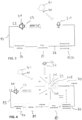
- FIG. 1 and 2 Schematic examples of a hearing assistance system 10 comprising a microphone arrangement 31 connected to a first loudspeaker 21 and a second loudspeaker 22 are illustrated in Figs. 1 and 2 .
- the microphone arrangement 31 is provided for capturing the voice of a speaking person 41, wherein the respective captured audio signal is amplified and reproduced by the loudspeakers 21, 22 to assist other persons (not shown) in listening to the speaking person 41.
- the microphone arrangement 31 may - inadvertently - capture sound 23, 24 reproduced by the loudspeakers 21, 22, so that under certain conditions, in particular when the gain applied to the signal captured by the microphone arrangement 31 is too high, acoustic feedback may occur, resulting in unpleasant feedback noise.
- Feedback issues may be avoided by embedding inaudible acoustic watermarks in the audio signal reproduced by the loudspeakers 21, 22, wherein each loudspeaker 21, 22 uses its own individual watermark signal, so that the respective watermark signal is also present in the audio signal captured by the microphone arrangement 31 from sound reproduced by the respective loudspeaker 21, 22.
- the presence - and strength - of the watermark signal can be detected by analyzing the audio signal captured by the microphone arrangement 31 (such analysis may be based on the audio signal "as captured” or e.g.
- Each loudspeaker 21, 22 may transmit once its individual watermark signal to the microphone arrangement 31, so that the microphone arrangement 31 can find and recognize the respective individual watermark signal and associate it with respective loudspeaker 21, 22.
- Using a unique watermark for each loudspeaker of the system allows to precisely detect different feedback loops and handle them separately. For example, anti-feedback measures, like reducing gain, may be applied on the critical path only (e.g., to the audio signal reproduced by the first loudspeaker 21), without affecting the rest of the system (e.g., the audio signal reproduced by the second loudspeaker 22).
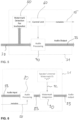
- FIG. 3 Examples of the signal processing in such hearing assistance systems, like that of Fig. 1 , are illustrated in Figs. 3 , 5 and 6 .
- the microphone arrangement 31 picks up an audio signal 30 primarily from the voice of a speaking person 41, but in addition there may be contribution from one or both loudspeakers 21, 22 of the systems (cf. loudspeaker 21 in Fig. 3 ), and from other sources (e.g. noise from the audience or other noise sources).
- the picked up signal i.e. the audio signal 30 captured by the microphone arrangement 31, is analysed for watermark signals (see box 50 in Figs. 3 and 5 ).
- the result of this analysis which may be, for example, an intensity and/or a power spectral density of each individual watermark signal or just an indication that the intensity and/or a power spectral density of an individual watermark signal is below or above a critical feedback threshold may be used in the processing of the captured audio signal 30 in a manner so as to reduce or eliminate feedback.
- the result of the watermark analysis may be distributed as metadata 55, together with the captured - and optionally pre-processed - audio signal 33 to all loudspeakers 21, 22.
- the microphone arrangement 31 may provide metadata like "feedback from loudspeaker with ID 'L1' ", "feedback from loudspeaker with ID 'L2' " or "no feedback”.
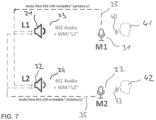
- the metadata 55 also may be distributed to all microphone arrangements (an example with two separate microphone arrangements 31, 32 is illustrated in Fig. 7 ).
- acoustic beamforming which will be discussed in more detail with regard to the example of Figs. 2 and 4 below
- the result of watermark analysis may be used for controlling such audio signal pre-processing (as indicated by a control unit 60 in Fig. 5 ).
- the microphone arrangement 31 provides the pre-processed audio signal 33 as an audio input to the loudspeakers 21, 22, where pre-processed audio signal 33 is further processed as indicated at 80, with the metadata 55 concerning the result of the watermark analysis provided by the microphone arrangement 31 being used for controlling the further audio signal processing in a manner so as to prevent conditions for a critical feedback loop.
- This may include, in particular, an appropriate setting of the gains and/or the transfer function applied to the audio signals at 80. For example, the gain may be reduced in case that the respective loudspeaker has been identified as being critical by the watermark analysis.
- a watermark signal 92 specific for the respective loudspeaker 21 or 22 may be embedded in the processed audio signal 83 at 90 so as to generate an audio output signal 93 to be reproduced by the respective loudspeaker 21 or 22.
- the microphone arrangement 31 may comprise multiple physical microphones 31A, 31B, 31C, allowing the creation of beams in a pre-processing stage 70, wherein the result of the watermark analysis may be used for control of the beamforming.
- the beamforming the captured audio signal 30 may be split into a plurality of sector signals, each being representative for a certain angular sector B1, B2, B3, ...Bx, wherein each sector signal may be analyzed individually for detecting watermark signals, i.e., the detection of watermarks can then be applied to each beam-signal.
- the watermark analysis is indicated in Fig. 4 at 50, where the watermark analysis is based on an audio signal which has already been pre-processed at 70 and hence may be considered as an "intermediate audio signal" which is neither "as captured” nor fully processed (full processing may change the captured audio signal to an extent that no meaningful watermark analysis is possible).
- a sector signal of an angular sector for which a critical feedback condition is determined from a detected watermark signal may be muted. In other words, this gives the possibility to mute a beam-signal where the coupling with the loudspeaker is strong (and therefore might cause feedback).
- the gain applied to a sector signal of an angular sector for which a critical feedback condition is determined from a detected watermark signal may be reduced relative to angular sectors for which no critical feedback condition is determined.
- a transfer function applied to a sector signal of an angular sector for which a critical feedback condition is determined from a detected watermark signal may be modified relative to transfer functions applied to angular sectors for which no critical feedback condition is determined.
- a speech enhancement algorithm may be applied to sector signals of angular sectors for which no critical feedback condition is determined.
- beam-signals for which there is only a weak coupling can be further processed in post-processing to e.g. highlight speech.
- the pre-processing of the captured audio signal may include individual pre-processing of the sector signals, wherein the sector signals are mixed after pre-processing, so as to form a single pre-processed audio signal 33 for further processing for generating the processed audio signal(s) 83.
- the beam-signals can then be again mixed together, before embedding the watermark and feeding the output signal 93 to the respective speaker 21, 22.
- the microphone arrangement 31 picks up the voice 40 of the speaking person 41 on beam / angular sector B2.
- the audio signal captured by the microphone arrangement 31 is processed, e.g., amplified, and then rendered on both loudspeakers 21 and 22.
- a feedback loop may take place between the loudspeaker 21 and beam/angular sector B3 which picks up sound 23 produced by the loudspeaker 21.
- feedback conditions are detected by the microphone 31 by finding a critical level of the watermark signal associated with the loudspeaker 21 in the beam B3, and the loudspeaker 21 can reduce the gain applied to its audio input signal 33 below the feedback threshold, while audio signal captured from the voice 40 can be still fully rendered by the loudspeaker 22 as long as no feedback conditions are detected in the loop formed by the loudspeaker 22 and the beam B1.
- the microphone arrangement 31 may mute or attenuate the respective beam involved in the feedback loop.
- the microphone arrangement 31 may mute or attenuate the beam B3 in its pre-processed audio signal 33 supplied to the loudspeakers 21 and 22.
- both measures may be combined, i.e., the critical beam may be attenuated and the gain applied by the critical loudspeaker may be reduced, or, if both loudspeakers 21, 22 are found to be critical, in one of them the gain may be reduced and in for the other one the respective beam may be muted or attenuated.
- the individual audio signals corresponding to the various beams B1, .., Bx may be mixed, as indicated at 85 in Fig. 4 , before the watermark signal is embedded at 90.
- the individual beam signals may be mixed before being supplied to the loudspeakers 21, 22, or they may be supplied to the loudspeakers 21, 22 separately so that the beam signals may be further processed by the loudspeaker 21, 22 before being mixed.
- the microphone arrangement may be formed by single physical microphone or by an arrangement of multiple microphones (such microphones 31A, 31B, 31C) with applied (pre-)processing (e.g. beamforming).
- the microphone arrangement may be designed, for example, as a table microphone, a lapel or lanyard microphone or a hand-held microphone, or it may form part of a network of multiple microphones (as illustrated in Fig. 7 ).
- the microphone arrangement may be used in a stationary manner or it may be moved around in the room.
- a second microphone arrangement 32 is provided in addition to the microphone arrangement 31, e.g. for capturing the voice 43 a second speaking person 42.
- the second microphone arrangement 32 may work in a manner analogous to the microphone arrangement 31 and it may supply its - eventually per-processed out signal 35 to both loudspeakers 21, 22, where it may be mixed with the output signal provided by the microphone arrangement 31 prior to reproduction by the respective loudspeaker 21, 22 (the respective loudspeaker's watermark signal of course also will be embedded prior to reproduction of the combined signal).
- the two microphone arrangements 31, 32 may communicate with each other concerning the detected watermarks, e.g., they may exchange the respective metadata supplied to the loudspeakers 21, 22.
- the proposed method may be applied to each signal in each device (loudspeakers, table microphones, hand-held microphones and lanyard microphones) in the network.
- Each device may have its own signal processing unit, so that feedback loops can be handled independent of each other. Processing can be done on the microphone arrangement, on the loudspeakers or shared on the microphone arrangement and the loudspeakers.
- Devices which have access to multiple microphone signals may perform mixing of the audio data after watermark detection and before feeding the audio to the output.
- the microphone arrangement(s) may be connected with the loudspeaker by wires or by a wireless link which may be based, for example, on a proprietary protocol or standard protocol, such as Bluetooth standard, in particular Bluetooth Low Energy or Bluetooth Low Energy Audio.
- a proprietary protocol or standard protocol such as Bluetooth standard, in particular Bluetooth Low Energy or Bluetooth Low Energy Audio.
- watermarking usually is used for identifying the content and origin of a signal for copyright protection (for example, for music or video content)
- watermarking is used for a different purpose which is to individually identify the audio source rendering the signal.
- watermarking here is used for discriminating sounds coming from a certain loudspeaker from other acoustic sources such as people voices and room sounds and other loudspeakers.
- the information to be conveyed in the watermark can be limited to device (i.e., loudspeaker) identification. Therefore the amount of data to be detected is very limited which may allow to make use of extra redundancy for improving detection sensitivity.
- robustness against data compression may not be required, allowing the usage of psychoacoustic effects, such as the masking effect, to embed inaudible digital identification data.
- the watermark signal may be spread over multiple frequency bins of the audio signal, respectively, so as to reduce the watermark signal power per frequency bin to render it inaudible.
- the spectrum of the watermark signal may be selected to be below the masking threshold as determined by a psychoacoustic model.
Landscapes
- Physics & Mathematics (AREA)
- Engineering & Computer Science (AREA)
- Acoustics & Sound (AREA)
- Signal Processing (AREA)
- Health & Medical Sciences (AREA)
- General Health & Medical Sciences (AREA)
- Otolaryngology (AREA)
- Neurosurgery (AREA)
- Soundproofing, Sound Blocking, And Sound Damping (AREA)
- Circuit For Audible Band Transducer (AREA)
Abstract
There is provided a of providing hearing assistance, comprising: capturing an audio signal (30) by a microphone arrangement (31, 32); processing the captured audio signal to generate a first processed audio signal (83) and a second processed audio signal, embedding a first watermark signal (92) in the first processed audio signal to generate a first output signal (93), embedding a second watermark signal to the second processed audio signal to generate a second output signal, reproducing the first output signal by a first loudspeaker (21), and reproducing the second output signal by a second loudspeaker (22). The first and second watermark signals are inaudible and distinct in a manner so as to allow to individually identify the first loudspeaker and the second loudspeaker, respectively. The captured audio signal or an intermediate audio signal obtained during the processing of the captured audio signal is analyzed so as to detect the first and second watermark signals. The result (55) of said watermark analysis is used for control of the processing of the captured audio signal so as to reduce feedback.
Description
- The invention relates to a method and a system for providing hearing assistance, wherein a microphone arrangement is provided for capturing an audio signal which is processed and then reproduced by a first and a second loudspeaker. For example, such system may be used for amplifying the voice of a speaker for an audience in a room.
- Depending on the location of the loudspeakers and the microphone arrangement, as well as the system gain, room acoustics and other parameters, acoustic feedback may occur. Having feedback in such a system limits its performance and is inconvenient for people in the room.
- Various approaches for feedback cancellation are known in the art. For example, some systems use tone detection to detect feedback. However, if an audio source outside the feedback loop is providing a constant tone, the system may falsely qualify it as feedback. Some systems require calibration or predefined locations, where the microphones and audio sources cannot freely move, to avoid feedback. Some systems significantly modify the audio signal, for example using frequency shifting, resulting in an audible signal degradation.
-
EP 2 574 082 A1 relates to method for feedback cancellation where an adaptive filtering method is applied via injection of an inaudible probe signal into the processed microphone signal supplied to the loudspeaker so as to embed the inaudible probe signal into the loudspeaker output, which can be detected in the signal captured by the microphone. -
EP 4 047 956 A1 relates to a feedback system for a hearing aid using feedback path estimation, wherein an inaudible probe signal may be added to the signal reproduced by the hearing aid loudspeaker. -
EP 2 276 272 A1 , relates to a hearing aid which may use several feedback suppression methods, wherein a single method is applied at a time and wherein the selection may be based on a minimization of a watermark signal added to microphone signal reproduced by the hearing aid loudspeaker. - The paper "Watermark driven Acoustic Echo Cancellation", by S. Djaziri-Larbi et al., IEEE/ACM Transactions on Audio, Speech and Language Processing, 2018 (https://hal.archives-ouvertes.fr/hal-02520552/document ) describes several methods to improve a standard echo cancelling technique by embedding a watermark in the audio input signal at the far-end.
-
EP 2 899 997 A1 relates to a method for calibrating a multi-loudspeaker sound system by assigning individual audio watermarks to individual speakers.EP 2 899 720 A1 relates a method of determining the positions of loudspeakers in a room by assigning individual audio watermarks to individual speakers.EP 2 899 987 A1 relates to a method of synchronizing reproduction of audio content by multiple loudspeakers utilizing audio watermarks. - It is an object of the invention to provide a hearing assistance method and system, wherein feedback can be avoided in a user friendly and efficient manner.
- According to the invention, these objects are achieved by a method as defined in
claim 1 and a system as defined in claim 15, respectively. - The invention is beneficial in that, by embedding an individual acoustic watermark in the signal reproduced by each of the loudspeaker, individual feedback loops can be detected and controlled in a manner, so as allow for a particular precise and reliable feedback control, without degradation of the sound reproduced by the loudspeaker and without limitations of the positions and movements of the microphone arrangement and the loudspeakers.
- Preferred embodiments of the invention are defined in the dependent claims.
- According to one example, the first and second watermark signals may be spread over multiple frequency bins of the first and second output signals, respectively, so as to reduce the watermark signal power per frequency bin.
- According to one example, the spectrum of the first and second watermark signals may be below a masking threshold as determined by a psychoacoustic model.
- According to one example, the processing of the captured audio signal may comprise pre-processing of the captured audio signal by the microphone arrangement so as to generate at least one pre-processed audio signal which is further processed for generating the first and second processed audio signals. In particular, the result of the watermark analysis may be used for control of the pre-processing of the captured audio signal.
- For example, the microphone arrangement may comprise a plurality of microphones for implementing acoustic beamforming as part of the pre-processing of the captured audio signal, wherein the result of the watermark analysis may be used for control of the beamforming. In particular, the captured audio signal may be split, by the beamforming, into a plurality of sector signals, each being representative for a certain angular sector, wherein each sector signal may be analyzed individually for detecting watermark signals.
- For example, in the pre-processing of the captured audio signal a sector signal of an angular sector for which a critical feedback condition is determined from a detected watermark signal may be muted.
- Alternatively, in the pre-processing of the captured audio signal the gain applied to a sector signal of an angular sector for which a critical feedback condition is determined from a detected watermark signal may be reduced relative to angular sectors for which no critical feedback condition is determined.
- According to a further alternative, in the pre-processing of the captured audio signal a transfer function applied to a sector signal of an angular sector for which a critical feedback condition is determined from a detected watermark signal may be modified relative to transfer functions applied to angular sectors for which no critical feedback condition is determined.
- For example, in the pre-processing of the captured audio signal a speech enhancement algorithm may be applied to sector signals of angular sectors for which no critical feedback condition is determined.
- For example, the pre-processing of the captured audio signal may include individual pre-processing of the sector signals, wherein the sector signals may be mixed after pre-processing, so as to form a single pre-processed audio signal for further processing for generating the first and second processed audio signals.
- For example, the at least one pre-processed audio signal may be supplied to both the first and the second loudspeaker, where it may be further processed to generate the first and second processed audio signal, respectively, by using the result of the watermark analysis. In particular, a gain and/or a transfer function depending on the result of the watermark analysis may be applied to the at least pre-processed audio signal by the first loudspeaker and by the second loudspeaker to generate the first processed audio signal and the second processed audio signal, respectively.
- For example, the analyzing of the captured audio signal or the intermediate audio signal so as to detect the first and second watermark signals may be carried out by the microphone arrangement, wherein the result of the analysis may be communicated from the microphone arrangement to the first and second loudspeaker.
- According to one example, the embedding of the first watermark signal to the first processed audio signal nay be carried out by the first loudspeaker, wherein the embedding of the second watermark signal to the second processed audio signal may be carried out by the second loudspeaker.
- According to one example, when analyzing the captured audio signal or the intermediate audio signal, an intensity and/or a power spectral density of the first and second watermark signals in the captured audio signal or in the intermediate audio signal, respectively, may be determined and may be used for control of the processing of the captured audio signal so as to reduce feedback.
- According to one example, the first loudspeaker may transmit the first watermark signal to the microphone arrangement and the second loudspeaker may transmit the second watermark signal to the microphone arrangement so as to allow the microphone arrangement to identify the respective loudspeaker contribution in the captured audio signal.
- According to one example, the method may further comprise:
- capturing a second audio signal by a second microphone arrangement;
- processing the second captured audio signal to generate a third processed audio signal and a fourth processed audio signal;
- adding the third processed audio signal to the first processed audio signal when generating the first output signal; and
- adding the fourth processed audio signal to the second processed audio signal when generating the second output signal;
- wherein the second captured audio signal or an intermediate audio signal obtained during the processing of the second captured audio signal is analyzed so as to detect the first and second watermark signals, and wherein the result of said watermark analysis is used for control of the processing of the second captured audio signal so as to reduce feedback.
- According to one example, the at least one pre-processed audio signal may be supplied to the first loudspeaker and second loudspeaker via a wireless link, such as a Bluetooth LE Audio link, or via a cable connection.
- According to one example, the microphone arrangement may be a table microphone, a lapel microphone, a hand-held microphone, a lanyard microphone or a network of multiple microphones.
- Hereinafter, examples of the invention will be illustrated by reference to the attached drawings, wherein:
- Fig. 1
- is a schematic illustration of an example of a hearing assistance system according to the invention with a simple microphone arrangement;
- Fig. 2
- is a schematic illustration of another example of a hearing assistance system according to the invention with a beamformer microphone arrangement;
- Fig. 3
- is a schematic illustration of an example of the signal processing in one of the two feedback loops in
Fig. 1 ; - Fig. 4
- is a schematic illustration of an example of the signal processing in one of the two feedback loops in
Fig. 2 ; - Fig. 5
- is a schematic illustration of an example of the signal processing in a microphone arrangement to be used with the invention;
- Fig. 6
- is a schematic illustration of an example of the signal processing in a loudspeaker to be used with the invention; and
- Fig. 7
- is a schematic illustration of an example of a hearing assistance system according to the invention with two microphone arrangements.
- A "microphone arrangement" as used hereinafter may comprise a single physical microphone (input transducer) or a plurality of spaced apart physical microphones allowing acoustic beamforming. In addition to the input transducer(s) the microphone arrangement may include signal processing capabilities allowing for audio signal (pre-)processing and/or signal analyzing capabilities, such as to detect watermark signals in the captured audio signal. Further, the microphone arrangement may include an appropriate interface for a wireless or wired connection for communicating with loudspeakers, such as a Bluetooth interface.
- A "loudspeaker" as used hereinafter comprises a physical output transducer for generating sound from an audio signal; in addition, it may include signal processing capabilities allowing for audio signal processing, such as applying gain and/or a transfer function to the audio signal and/or embedding a watermark signal in the audio signal. While typically each loudspeaker will be provided with its own housing, in principle two or more loudspeakers also may share a common housing. Further, the loudspeaker may include an appropriate interface for a wireless or wired connection for communicating with a microphone arrangement, such as a Bluetooth interface.
- An "intermediate audio signal" as used hereinafter is an audio signal obtained during processing of the audio signal captured by the microphone arrangement, i.e., the "intermediate audio signal" is an audio signal which has not yet been fully or completely processed. For example, the "intermediate audio signal" may be the result of a pre-processing step included within the full processing.
- Schematic examples of a
hearing assistance system 10 comprising amicrophone arrangement 31 connected to afirst loudspeaker 21 and asecond loudspeaker 22 are illustrated inFigs. 1 and 2 . Themicrophone arrangement 31 is provided for capturing the voice of a speakingperson 41, wherein the respective captured audio signal is amplified and reproduced by theloudspeakers person 41. Since themicrophone arrangement 31 and the twoloudspeakers microphone arrangement 31 may - inadvertently -capture sound loudspeakers microphone arrangement 31 is too high, acoustic feedback may occur, resulting in unpleasant feedback noise. - Feedback issues may be avoided by embedding inaudible acoustic watermarks in the audio signal reproduced by the
loudspeakers loudspeaker microphone arrangement 31 from sound reproduced by therespective loudspeaker microphone arrangement 31 prior to reproduction of the processed audio signals by therespective loudspeaker loudspeaker microphone arrangement 31, so that themicrophone arrangement 31 can find and recognize the respective individual watermark signal and associate it withrespective loudspeaker - Through the use of individual watermarks signals, it is possible to detect individual feedback loops by measuring the intensity of the watermark signal as received by the
microphone arrangement 31. In addition, other properties of the received watermark signal may be extracted, such as power spectral density for the steering of pre-processing and post-processing algorithms (gains, transfer functions, equalisations, adaptive filters, etc. ). - Using a unique watermark for each loudspeaker of the system allows to precisely detect different feedback loops and handle them separately. For example, anti-feedback measures, like reducing gain, may be applied on the critical path only (e.g., to the audio signal reproduced by the first loudspeaker 21), without affecting the rest of the system (e.g., the audio signal reproduced by the second loudspeaker 22).
- Examples of the signal processing in such hearing assistance systems, like that of
Fig. 1 , are illustrated inFigs. 3 ,5 and 6 . - The
microphone arrangement 31 picks up anaudio signal 30 primarily from the voice of a speakingperson 41, but in addition there may be contribution from one or bothloudspeakers loudspeaker 21 inFig. 3 ), and from other sources (e.g. noise from the audience or other noise sources). - The picked up signal, i.e. the
audio signal 30 captured by themicrophone arrangement 31, is analysed for watermark signals (seebox 50 inFigs. 3 and5 ). The result of this analysis, which may be, for example, an intensity and/or a power spectral density of each individual watermark signal or just an indication that the intensity and/or a power spectral density of an individual watermark signal is below or above a critical feedback threshold may be used in the processing of the capturedaudio signal 30 in a manner so as to reduce or eliminate feedback. To this end, the result of the watermark analysis may be distributed asmetadata 55, together with the captured - and optionally pre-processed -audio signal 33 to allloudspeakers microphone arrangement 31 may provide metadata like "feedback from loudspeaker with ID 'L1' ", "feedback from loudspeaker with ID 'L2' " or "no feedback". Themetadata 55 also may be distributed to all microphone arrangements (an example with twoseparate microphone arrangements Fig. 7 ). - As illustrated in
Figs. 3 and5 , there may be some pre-processing of theaudio signal 30 captured by themicrophone arrangement 31, such as acoustic beamforming (which will be discussed in more detail with regard to the example ofFigs. 2 and4 below), as indicated at 70 inFigs. 3 and5 . The result of watermark analysis may be used for controlling such audio signal pre-processing (as indicated by acontrol unit 60 inFig. 5 ). - The
microphone arrangement 31 provides thepre-processed audio signal 33 as an audio input to theloudspeakers pre-processed audio signal 33 is further processed as indicated at 80, with themetadata 55 concerning the result of the watermark analysis provided by themicrophone arrangement 31 being used for controlling the further audio signal processing in a manner so as to prevent conditions for a critical feedback loop. This may include, in particular, an appropriate setting of the gains and/or the transfer function applied to the audio signals at 80. For example, the gain may be reduced in case that the respective loudspeaker has been identified as being critical by the watermark analysis. Once the further processing of theaudio input 33, potentially including post-processing, such as sound cleaning (noise reduction algorithms like noise cancellers) and gain adjustment (applying a Gain Model which adjusts the output signal level with regard to speech level and ambient noise level), at 80 has been finished, resulting in a processedaudio signal 83, awatermark signal 92 specific for therespective loudspeaker audio signal 83 at 90 so as to generate anaudio output signal 93 to be reproduced by therespective loudspeaker - As illustrated in
Figs. 2 and4 , themicrophone arrangement 31 may comprise multiplephysical microphones pre-processing stage 70, wherein the result of the watermark analysis may be used for control of the beamforming. - By the beamforming the captured
audio signal 30 may be split into a plurality of sector signals, each being representative for a certain angular sector B1, B2, B3, ...Bx, wherein each sector signal may be analyzed individually for detecting watermark signals, i.e., the detection of watermarks can then be applied to each beam-signal. The watermark analysis is indicated inFig. 4 at 50, where the watermark analysis is based on an audio signal which has already been pre-processed at 70 and hence may be considered as an "intermediate audio signal" which is neither "as captured" nor fully processed (full processing may change the captured audio signal to an extent that no meaningful watermark analysis is possible). - For example, a sector signal of an angular sector for which a critical feedback condition is determined from a detected watermark signal may be muted. In other words, this gives the possibility to mute a beam-signal where the coupling with the loudspeaker is strong (and therefore might cause feedback).
- Alternatively, the gain applied to a sector signal of an angular sector for which a critical feedback condition is determined from a detected watermark signal may be reduced relative to angular sectors for which no critical feedback condition is determined. According to a further alternative, a transfer function applied to a sector signal of an angular sector for which a critical feedback condition is determined from a detected watermark signal may be modified relative to transfer functions applied to angular sectors for which no critical feedback condition is determined. In other words, it would also be possible to adapt audio parameters of a single beam-signal such as gain or transfer function.
- According to a further example, in the pre-processing of the captured audio signal a speech enhancement algorithm may be applied to sector signals of angular sectors for which no critical feedback condition is determined. In other words, beam-signals for which there is only a weak coupling can be further processed in post-processing to e.g. highlight speech. According to one example, the pre-processing of the captured audio signal may include individual pre-processing of the sector signals, wherein the sector signals are mixed after pre-processing, so as to form a single
pre-processed audio signal 33 for further processing for generating the processed audio signal(s) 83. In other words, the beam-signals can then be again mixed together, before embedding the watermark and feeding theoutput signal 93 to therespective speaker - For example, in the configuration illustrated in
Figs. 2 and4 , themicrophone arrangement 31 picks up thevoice 40 of the speakingperson 41 on beam / angular sector B2. The audio signal captured by themicrophone arrangement 31 is processed, e.g., amplified, and then rendered on bothloudspeakers loudspeaker 21 and beam/angular sector B3 which picks upsound 23 produced by theloudspeaker 21. In this case, feedback conditions are detected by themicrophone 31 by finding a critical level of the watermark signal associated with theloudspeaker 21 in the beam B3, and theloudspeaker 21 can reduce the gain applied to itsaudio input signal 33 below the feedback threshold, while audio signal captured from thevoice 40 can be still fully rendered by theloudspeaker 22 as long as no feedback conditions are detected in the loop formed by theloudspeaker 22 and the beam B1. - As an alternative to reducing the gain applied to the audio signals rendered by the respective loudspeaker, the
microphone arrangement 31 may mute or attenuate the respective beam involved in the feedback loop. Hence, in the above example, themicrophone arrangement 31 may mute or attenuate the beam B3 in itspre-processed audio signal 33 supplied to theloudspeakers - As a further alternative, both measures may be combined, i.e., the critical beam may be attenuated and the gain applied by the critical loudspeaker may be reduced, or, if both
loudspeakers - Finally, the individual audio signals corresponding to the various beams B1, .., Bx may be mixed, as indicated at 85 in
Fig. 4 , before the watermark signal is embedded at 90. The individual beam signals may be mixed before being supplied to theloudspeakers loudspeakers loudspeaker - As already mentioned above, the microphone arrangement may be formed by single physical microphone or by an arrangement of multiple microphones (
such microphones Fig. 7 ). In general, the microphone arrangement may be used in a stationary manner or it may be moved around in the room. - In the example of
Fig. 7 , asecond microphone arrangement 32 is provided in addition to themicrophone arrangement 31, e.g. for capturing the voice 43 a second speakingperson 42. Thesecond microphone arrangement 32 may work in a manner analogous to themicrophone arrangement 31 and it may supply its - eventually per-processed outsignal 35 to bothloudspeakers microphone arrangement 31 prior to reproduction by therespective loudspeaker 21, 22 (the respective loudspeaker's watermark signal of course also will be embedded prior to reproduction of the combined signal). The twomicrophone arrangements loudspeakers - In case multiple distinct microphone signals are available, the proposed method may be applied to each signal in each device (loudspeakers, table microphones, hand-held microphones and lanyard microphones) in the network.
- Each device (microphone arrangement(s) and loudspeakers) may have its own signal processing unit, so that feedback loops can be handled independent of each other. Processing can be done on the microphone arrangement, on the loudspeakers or shared on the microphone arrangement and the loudspeakers.
- Devices which have access to multiple microphone signals may perform mixing of the audio data after watermark detection and before feeding the audio to the output.
- It is noted that in some cases it may be useful to embed a watermark signal allowing to identify the respective microphone arrangement to the audio signal captured by that microphone arrangement so that the loudspeakers and/or another microphone arrangement may recognize the origin of the respective audio signal and use that information in the signal processing.
- The microphone arrangement(s) may be connected with the loudspeaker by wires or by a wireless link which may be based, for example, on a proprietary protocol or standard protocol, such as Bluetooth standard, in particular Bluetooth Low Energy or Bluetooth Low Energy Audio.
- There are many different ways of embedding watermarks in an audio signal. Depending on the system it may be needed to use a different way of implementing a watermark to allow a proper detection. The watermark signal may or may not be dependent on the audio signal. An overview of audio watermarking techniques is found, for example, in •S.P.S. Chauhan and S.A.M. Rizvi "A survey: Digital Audio Watermarking Techniques and Applications", ICCCT, 2013.
- While watermarking usually is used for identifying the content and origin of a signal for copyright protection (for example, for music or video content), in the present case watermarking is used for a different purpose which is to individually identify the audio source rendering the signal. In other words, watermarking here is used for discriminating sounds coming from a certain loudspeaker from other acoustic sources such as people voices and room sounds and other loudspeakers.
- Thus, the information to be conveyed in the watermark can be limited to device (i.e., loudspeaker) identification. Therefore the amount of data to be detected is very limited which may allow to make use of extra redundancy for improving detection sensitivity. Depending on the transmission protocol employed, robustness against data compression may not be required, allowing the usage of psychoacoustic effects, such as the masking effect, to embed inaudible digital identification data.
- For example, the watermark signal may be spread over multiple frequency bins of the audio signal, respectively, so as to reduce the watermark signal power per frequency bin to render it inaudible. According to another example, the spectrum of the watermark signal may be selected to be below the masking threshold as determined by a psychoacoustic model.
Claims (15)
- A method of providing hearing assistance, comprising:capturing an audio signal (30) by a microphone arrangement (31, 32);processing the captured audio signal to generate a first processed audio signal (83) and a second processed audio signal,embedding a first watermark signal (92) in the first processed audio signal to generate a first output signal (93),embedding a second watermark signal to the second processed audio signal to generate a second output signal,reproducing the first output signal by a first loudspeaker (21), andreproducing the second output signal by a second loudspeaker (22),wherein the first and second watermark signals are inaudible and distinct in a manner so as to allow to individually identify the first loudspeaker and the second loudspeaker, respectively, wherein the captured audio signal or an intermediate audio signal obtained during the processing of the captured audio signal is analyzed so as to detect the first and second watermark signals, and wherein the result (55) of said watermark analysis is used for control of the processing of the captured audio signal so as to reduce feedback.
- The method of claim 1, wherein the processing of the captured audio signal (30) comprises pre-processing of the captured audio signal by the microphone arrangement so as to generate at least one pre-processed audio signal (33) which is further processed for generating the first and second processed audio signals (83).
- The method of claim 2, wherein the result (55) of the watermark analysis is used for control of the pre-processing of the captured audio signal (30).
- The method of claim 3, wherein the microphone arrangement (31, 32) comprises a plurality of microphones (31A, 31B, 31C) for implementing acoustic beamforming as part of the pre-processing of the captured audio signal (30), and wherein the result (55) of the watermark analysis is used for control of the beamforming.
- The method of claim 4, wherein the captured audio signal (30) is split, by the beamforming, into a plurality of sector signals (B1, .., Bx), each being representative for a certain angular sector, and wherein each sector signal is analyzed individually for detecting watermark signals (92).
- The method of claim 5, wherein in the pre-processing of the captured audio signal (30) a sector signal (B1, .., Bx) of an angular sector for which a critical feedback condition is determined from a detected watermark signal (92) is muted, wherein in the pre-processing of the captured audio signal (30) the gain applied to a sector signal (B1, .., Bx) of an angular sector for which a critical feedback condition is determined from a detected watermark signal (92) is reduced relative to angular sectors for which no critical feedback condition is determined, or wherein in the pre-processing of the captured audio signal (30) a transfer function applied to a sector signal of an angular sector for which a critical feedback condition is determined from a detected watermark signal (92) is modified relative to transfer functions applied to angular sectors for which no critical feedback condition is determined.
- The method of one of claims 5 and 6, wherein the pre-processing of the captured audio signal (30) includes individual pre-processing of the sector signals (B1, .., Bx), and wherein the sector signals are mixed after pre-processing, so as to form a single pre-processed audio signal (33) for further processing for generating the first and second processed audio signals (83).
- The method of one of claims 2 to 7, wherein the at least one pre-processed audio signal (33) is supplied to both the first and the second loudspeaker (21, 22), where it is further processed to generate the first and second processed audio signal (83), respectively, by using the result (55) of the watermark analysis.
- The method of claim 8, wherein a gain and/or a transfer function depending on the result (55) of the watermark analysis are applied to the at least pre-processed audio signal (33) by the first loudspeaker (21) and by the second loudspeaker (22) to generate the first processed audio signal and the second processed audio signal (83), respectively.
- The method of one of claims 2 to 9, wherein the analyzing of the captured audio signal (30) or the intermediate audio signal so as to detect the first and second watermark signals (92) is carried out by the microphone arrangement (31, 32), and wherein the result (55) of the analysis is communicated from the microphone arrangement to the first and second loudspeaker (21, 22).
- The method of one of the preceding claims, wherein the embedding of the first watermark signal (92) to the first processed audio signal (83) is carried out by the first loudspeaker (21), and wherein the embedding of the second watermark signal to the second processed audio signal is carried out by the second loudspeaker (22).
- The method of one of the preceding claims, wherein when analyzing the captured audio signal (30) or the intermediate audio signal an intensity and/or a power spectral density of the first and second watermark signals (92) in the captured audio signal or in the intermediate audio signal, respectively, is determined and is used for control of the processing of the captured audio signal so as to reduce feedback.
- The method of one of the preceding claims, wherein the first loudspeaker (21) transmits the first watermark signal to the microphone arrangement (31, 32) and the second loudspeaker (22) transmits the second watermark signal to the microphone arrangement so as to allow the microphone arrangement to identify the respective loudspeaker contribution in the captured audio signal (30).
- The method of one of the preceding claims, further comprising:capturing a second audio signal by a second microphone arrangement (32);processing the second captured audio signal to generate a third processed audio signal and a fourth processed audio signal;adding the third processed audio signal to the first processed audio signal (83) when generating the first output signal; andadding the fourth processed audio signal to the second processed audio signal when generating the second output signal;wherein the second captured audio signal or an intermediate audio signal obtained during the processing of the second captured audio signal is analyzed so as to detect the first and second watermark signals (92), and wherein the result of said watermark analysis is used for control of the processing of the second captured audio signal so as to reduce feedback.
- A system for providing hearing assistance, comprising:a microphone arrangement (31, 32) for capturing an audio signal (30);a first loudspeaker (21) for reproducing a first output signal (93);a second loudspeaker (22) for reproducing a second output signal;a processing unit (70, 80) configured toprocess the captured audio signal to generate a first processed audio signal (839 and a second processed audio signal andembed a first watermark signal (92) to the first processed audio signal to generate the first output signal and a second watermark signal to the second processed audio signal to generate the second output signal, wherein the first and second watermark signals are inaudible and distinct in a manner so as to allow to individually identify the first loudspeaker and the second loudspeaker, respectively; andan analyzer unit (50) for analyzing the captured audio signal an intermediate audio signal obtained during the processing of the captured audio signal so as to detect the first and second watermark signals;wherein the control unit is configured to use the result (55) of said watermark analysis is for control of the processing of the captured audio signals so as to reduce feedback.
Priority Applications (1)
| Application Number | Priority Date | Filing Date | Title |
|---|---|---|---|
| EP23164678.7A EP4440149A1 (en) | 2023-03-28 | 2023-03-28 | Method and system for feedback cancellation |
Applications Claiming Priority (1)
| Application Number | Priority Date | Filing Date | Title |
|---|---|---|---|
| EP23164678.7A EP4440149A1 (en) | 2023-03-28 | 2023-03-28 | Method and system for feedback cancellation |
Publications (1)
| Publication Number | Publication Date |
|---|---|
| EP4440149A1 true EP4440149A1 (en) | 2024-10-02 |
Family
ID=85778895
Family Applications (1)
| Application Number | Title | Priority Date | Filing Date |
|---|---|---|---|
| EP23164678.7A Pending EP4440149A1 (en) | 2023-03-28 | 2023-03-28 | Method and system for feedback cancellation |
Country Status (1)
| Country | Link |
|---|---|
| EP (1) | EP4440149A1 (en) |
Citations (9)
| Publication number | Priority date | Publication date | Assignee | Title |
|---|---|---|---|---|
| US20050190929A1 (en) * | 2002-11-21 | 2005-09-01 | Fraunhofer-Gesellschaft Zur Foerderung Der Angewandten Forschung E.V. | Apparatus and method for suppressing feedback |
| EP2276272A1 (en) | 2009-06-30 | 2011-01-19 | Siemens Medical Instruments Pte. Ltd. | Hearing aid and method for suppressing feedback |
| US20130070936A1 (en) * | 2011-09-20 | 2013-03-21 | Oticon A/S | Control of an adaptive feedback cancellation system based on probe signal injection |
| EP2899997A1 (en) | 2014-01-22 | 2015-07-29 | Thomson Licensing | Sound system calibration |
| EP2899987A1 (en) | 2014-01-22 | 2015-07-29 | Thomson Licensing | Synchronising a reproduction of audio or audio and video content |
| EP2899720A1 (en) | 2014-01-22 | 2015-07-29 | Thomson Licensing | Real-time position estimation in indoor environment using audio watermarking |
| US20180132037A1 (en) * | 2015-05-15 | 2018-05-10 | Nureva Inc. | System and method for embedding additional information in a sound mask noise signal |
| EP4047956A1 (en) | 2021-02-18 | 2022-08-24 | Oticon A/s | A hearing aid comprising an open loop gain estimator |
| US20230069213A1 (en) * | 2021-09-01 | 2023-03-02 | Acer Incorporated | Conference terminal and feedback suppression method |
-
2023
- 2023-03-28 EP EP23164678.7A patent/EP4440149A1/en active Pending
Patent Citations (10)
| Publication number | Priority date | Publication date | Assignee | Title |
|---|---|---|---|---|
| US20050190929A1 (en) * | 2002-11-21 | 2005-09-01 | Fraunhofer-Gesellschaft Zur Foerderung Der Angewandten Forschung E.V. | Apparatus and method for suppressing feedback |
| EP2276272A1 (en) | 2009-06-30 | 2011-01-19 | Siemens Medical Instruments Pte. Ltd. | Hearing aid and method for suppressing feedback |
| US20130070936A1 (en) * | 2011-09-20 | 2013-03-21 | Oticon A/S | Control of an adaptive feedback cancellation system based on probe signal injection |
| EP2574082A1 (en) | 2011-09-20 | 2013-03-27 | Oticon A/S | Control of an adaptive feedback cancellation system based on probe signal injection |
| EP2899997A1 (en) | 2014-01-22 | 2015-07-29 | Thomson Licensing | Sound system calibration |
| EP2899987A1 (en) | 2014-01-22 | 2015-07-29 | Thomson Licensing | Synchronising a reproduction of audio or audio and video content |
| EP2899720A1 (en) | 2014-01-22 | 2015-07-29 | Thomson Licensing | Real-time position estimation in indoor environment using audio watermarking |
| US20180132037A1 (en) * | 2015-05-15 | 2018-05-10 | Nureva Inc. | System and method for embedding additional information in a sound mask noise signal |
| EP4047956A1 (en) | 2021-02-18 | 2022-08-24 | Oticon A/s | A hearing aid comprising an open loop gain estimator |
| US20230069213A1 (en) * | 2021-09-01 | 2023-03-02 | Acer Incorporated | Conference terminal and feedback suppression method |
Non-Patent Citations (1)
| Title |
|---|
| S. DJAZIRI-LARBI ET AL.: "Watermark driven Acoustic Echo Cancellation", IEEE/ACM TRANSACTIONS ON AUDIO, SPEECH AND LANGUAGE PROCESSING, 2018, Retrieved from the Internet <URL:https://hal.archives-ouvertes.fr/hal-02520552/document> |
Similar Documents
| Publication | Publication Date | Title |
|---|---|---|
| CN1897765B (en) | Hearing device and corresponding method for ownvoices detection | |
| EP2494792B1 (en) | Speech enhancement method and system | |
| CA2560034C (en) | System for selectively extracting components of an audio input signal | |
| US8638961B2 (en) | Hearing aid algorithms | |
| EP1742509B1 (en) | A system and method for eliminating feedback and noise in a hearing device | |
| US9747367B2 (en) | Communication system for establishing and providing preferred audio | |
| US20100329490A1 (en) | Audio device and method of operation therefor | |
| CN108882136A (en) | Binaural hearing aid system with coordinated sound processing | |
| US20170148466A1 (en) | Method and system for reducing background sounds in a noisy environment | |
| CN110956976B (en) | Echo cancellation method, device and equipment and readable storage medium | |
| JP2010530718A (en) | Sound identification method and apparatus | |
| CN107948869B (en) | Audio processing method, audio processing device, audio system, and storage medium | |
| US12223974B2 (en) | Method, hearing system, and computer program for improving a listening experience of a user wearing a hearing device | |
| JP2020202448A (en) | Acoustic device and acoustic processing method | |
| WO2020017518A1 (en) | Audio signal processing device | |
| US12211503B2 (en) | Hearing device system and method for operating same | |
| Maj et al. | Noise reduction results of an adaptive filtering technique for dual-microphone behind-the-ear hearing aids | |
| JP5130298B2 (en) | Hearing aid operating method and hearing aid | |
| US20100046775A1 (en) | Method for operating a hearing apparatus with directional effect and an associated hearing apparatus | |
| KR102113572B1 (en) | Sound reduction system and sound reduction method using the same | |
| KR20250133363A (en) | Method for processing recorded audio content | |
| CN115278500A (en) | Sound amplification time delay measuring method and device and sound amplification system | |
| KR20200054923A (en) | Sound reduction system and sound reduction method using the same | |
| US20250310704A1 (en) | Systems and Methods for Inducing Modulation of User’s Voice Level by a Hearing Device | |
| Sanchez-Bote et al. | DSP-IMPLEMENTED BROADBAND SUPERDIRECTIVE MICROPHONE ARRAY WITH AUDIBLE NOISE SUPPRESSION |
Legal Events
| Date | Code | Title | Description |
|---|---|---|---|
| PUAI | Public reference made under article 153(3) epc to a published international application that has entered the european phase |
Free format text: ORIGINAL CODE: 0009012 |
|
| STAA | Information on the status of an ep patent application or granted ep patent |
Free format text: STATUS: THE APPLICATION HAS BEEN PUBLISHED |
|
| AK | Designated contracting states |
Kind code of ref document: A1 Designated state(s): AL AT BE BG CH CY CZ DE DK EE ES FI FR GB GR HR HU IE IS IT LI LT LU LV MC ME MK MT NL NO PL PT RO RS SE SI SK SM TR |
|
| STAA | Information on the status of an ep patent application or granted ep patent |
Free format text: STATUS: REQUEST FOR EXAMINATION WAS MADE |
|
| 17P | Request for examination filed |
Effective date: 20250331 |