EP4439751A1 - Power storage device - Google Patents
Power storage device Download PDFInfo
- Publication number
- EP4439751A1 EP4439751A1 EP23779179.3A EP23779179A EP4439751A1 EP 4439751 A1 EP4439751 A1 EP 4439751A1 EP 23779179 A EP23779179 A EP 23779179A EP 4439751 A1 EP4439751 A1 EP 4439751A1
- Authority
- EP
- European Patent Office
- Prior art keywords
- spacer
- active material
- material layer
- seal
- electrode active
- Prior art date
- Legal status (The legal status is an assumption and is not a legal conclusion. Google has not performed a legal analysis and makes no representation as to the accuracy of the status listed.)
- Pending
Links
Images





Classifications
-
- H—ELECTRICITY
- H01—ELECTRIC ELEMENTS
- H01G—CAPACITORS; CAPACITORS, RECTIFIERS, DETECTORS, SWITCHING DEVICES, LIGHT-SENSITIVE OR TEMPERATURE-SENSITIVE DEVICES OF THE ELECTROLYTIC TYPE
- H01G11/00—Hybrid capacitors, i.e. capacitors having different positive and negative electrodes; Electric double-layer [EDL] capacitors; Processes for the manufacture thereof or of parts thereof
- H01G11/10—Multiple hybrid or EDL capacitors, e.g. arrays or modules
- H01G11/12—Stacked hybrid or EDL capacitors
-
- H—ELECTRICITY
- H01—ELECTRIC ELEMENTS
- H01G—CAPACITORS; CAPACITORS, RECTIFIERS, DETECTORS, SWITCHING DEVICES, LIGHT-SENSITIVE OR TEMPERATURE-SENSITIVE DEVICES OF THE ELECTROLYTIC TYPE
- H01G11/00—Hybrid capacitors, i.e. capacitors having different positive and negative electrodes; Electric double-layer [EDL] capacitors; Processes for the manufacture thereof or of parts thereof
- H01G11/04—Hybrid capacitors
- H01G11/06—Hybrid capacitors with one of the electrodes allowing ions to be reversibly doped thereinto, e.g. lithium ion capacitors [LIC]
-
- H—ELECTRICITY
- H01—ELECTRIC ELEMENTS
- H01G—CAPACITORS; CAPACITORS, RECTIFIERS, DETECTORS, SWITCHING DEVICES, LIGHT-SENSITIVE OR TEMPERATURE-SENSITIVE DEVICES OF THE ELECTROLYTIC TYPE
- H01G11/00—Hybrid capacitors, i.e. capacitors having different positive and negative electrodes; Electric double-layer [EDL] capacitors; Processes for the manufacture thereof or of parts thereof
- H01G11/78—Cases; Housings; Encapsulations; Mountings
- H01G11/80—Gaskets; Sealings
-
- H—ELECTRICITY
- H01—ELECTRIC ELEMENTS
- H01G—CAPACITORS; CAPACITORS, RECTIFIERS, DETECTORS, SWITCHING DEVICES, LIGHT-SENSITIVE OR TEMPERATURE-SENSITIVE DEVICES OF THE ELECTROLYTIC TYPE
- H01G11/00—Hybrid capacitors, i.e. capacitors having different positive and negative electrodes; Electric double-layer [EDL] capacitors; Processes for the manufacture thereof or of parts thereof
- H01G11/78—Cases; Housings; Encapsulations; Mountings
- H01G11/82—Fixing or assembling a capacitive element in a housing, e.g. mounting electrodes, current collectors or terminals in containers or encapsulations
-
- H—ELECTRICITY
- H01—ELECTRIC ELEMENTS
- H01M—PROCESSES OR MEANS, e.g. BATTERIES, FOR THE DIRECT CONVERSION OF CHEMICAL ENERGY INTO ELECTRICAL ENERGY
- H01M10/00—Secondary cells; Manufacture thereof
- H01M10/04—Construction or manufacture in general
-
- H—ELECTRICITY
- H01—ELECTRIC ELEMENTS
- H01M—PROCESSES OR MEANS, e.g. BATTERIES, FOR THE DIRECT CONVERSION OF CHEMICAL ENERGY INTO ELECTRICAL ENERGY
- H01M10/00—Secondary cells; Manufacture thereof
- H01M10/05—Accumulators with non-aqueous electrolyte
- H01M10/052—Li-accumulators
-
- H—ELECTRICITY
- H01—ELECTRIC ELEMENTS
- H01M—PROCESSES OR MEANS, e.g. BATTERIES, FOR THE DIRECT CONVERSION OF CHEMICAL ENERGY INTO ELECTRICAL ENERGY
- H01M10/00—Secondary cells; Manufacture thereof
- H01M10/05—Accumulators with non-aqueous electrolyte
- H01M10/052—Li-accumulators
- H01M10/0525—Rocking-chair batteries, i.e. batteries with lithium insertion or intercalation in both electrodes; Lithium-ion batteries
-
- H—ELECTRICITY
- H01—ELECTRIC ELEMENTS
- H01M—PROCESSES OR MEANS, e.g. BATTERIES, FOR THE DIRECT CONVERSION OF CHEMICAL ENERGY INTO ELECTRICAL ENERGY
- H01M10/00—Secondary cells; Manufacture thereof
- H01M10/05—Accumulators with non-aqueous electrolyte
- H01M10/056—Accumulators with non-aqueous electrolyte characterised by the materials used as electrolytes, e.g. mixed inorganic/organic electrolytes
- H01M10/0564—Accumulators with non-aqueous electrolyte characterised by the materials used as electrolytes, e.g. mixed inorganic/organic electrolytes the electrolyte being constituted of organic materials only
- H01M10/0566—Liquid materials
-
- H—ELECTRICITY
- H01—ELECTRIC ELEMENTS
- H01M—PROCESSES OR MEANS, e.g. BATTERIES, FOR THE DIRECT CONVERSION OF CHEMICAL ENERGY INTO ELECTRICAL ENERGY
- H01M10/00—Secondary cells; Manufacture thereof
- H01M10/05—Accumulators with non-aqueous electrolyte
- H01M10/058—Construction or manufacture
- H01M10/0585—Construction or manufacture of accumulators having only flat construction elements, i.e. flat positive electrodes, flat negative electrodes and flat separators
-
- H—ELECTRICITY
- H01—ELECTRIC ELEMENTS
- H01M—PROCESSES OR MEANS, e.g. BATTERIES, FOR THE DIRECT CONVERSION OF CHEMICAL ENERGY INTO ELECTRICAL ENERGY
- H01M4/00—Electrodes
- H01M4/02—Electrodes composed of, or comprising, active material
-
- H—ELECTRICITY
- H01—ELECTRIC ELEMENTS
- H01M—PROCESSES OR MEANS, e.g. BATTERIES, FOR THE DIRECT CONVERSION OF CHEMICAL ENERGY INTO ELECTRICAL ENERGY
- H01M4/00—Electrodes
- H01M4/02—Electrodes composed of, or comprising, active material
- H01M4/13—Electrodes for accumulators with non-aqueous electrolyte, e.g. for lithium-accumulators; Processes of manufacture thereof
-
- H—ELECTRICITY
- H01—ELECTRIC ELEMENTS
- H01M—PROCESSES OR MEANS, e.g. BATTERIES, FOR THE DIRECT CONVERSION OF CHEMICAL ENERGY INTO ELECTRICAL ENERGY
- H01M50/00—Constructional details or processes of manufacture of the non-active parts of electrochemical cells other than fuel cells, e.g. hybrid cells
- H01M50/10—Primary casings; Jackets or wrappings
- H01M50/183—Sealing members
- H01M50/184—Sealing members characterised by their shape or structure
-
- H—ELECTRICITY
- H01—ELECTRIC ELEMENTS
- H01M—PROCESSES OR MEANS, e.g. BATTERIES, FOR THE DIRECT CONVERSION OF CHEMICAL ENERGY INTO ELECTRICAL ENERGY
- H01M50/00—Constructional details or processes of manufacture of the non-active parts of electrochemical cells other than fuel cells, e.g. hybrid cells
- H01M50/10—Primary casings; Jackets or wrappings
- H01M50/183—Sealing members
- H01M50/186—Sealing members characterised by the disposition of the sealing members
-
- H—ELECTRICITY
- H01—ELECTRIC ELEMENTS
- H01M—PROCESSES OR MEANS, e.g. BATTERIES, FOR THE DIRECT CONVERSION OF CHEMICAL ENERGY INTO ELECTRICAL ENERGY
- H01M50/00—Constructional details or processes of manufacture of the non-active parts of electrochemical cells other than fuel cells, e.g. hybrid cells
- H01M50/10—Primary casings; Jackets or wrappings
- H01M50/183—Sealing members
- H01M50/19—Sealing members characterised by the material
- H01M50/197—Sealing members characterised by the material having a layered structure
-
- H—ELECTRICITY
- H01—ELECTRIC ELEMENTS
- H01M—PROCESSES OR MEANS, e.g. BATTERIES, FOR THE DIRECT CONVERSION OF CHEMICAL ENERGY INTO ELECTRICAL ENERGY
- H01M50/00—Constructional details or processes of manufacture of the non-active parts of electrochemical cells other than fuel cells, e.g. hybrid cells
- H01M50/40—Separators; Membranes; Diaphragms; Spacing elements inside cells
- H01M50/46—Separators, membranes or diaphragms characterised by their combination with electrodes
-
- H—ELECTRICITY
- H01—ELECTRIC ELEMENTS
- H01M—PROCESSES OR MEANS, e.g. BATTERIES, FOR THE DIRECT CONVERSION OF CHEMICAL ENERGY INTO ELECTRICAL ENERGY
- H01M50/00—Constructional details or processes of manufacture of the non-active parts of electrochemical cells other than fuel cells, e.g. hybrid cells
- H01M50/40—Separators; Membranes; Diaphragms; Spacing elements inside cells
- H01M50/471—Spacing elements inside cells other than separators, membranes or diaphragms; Manufacturing processes thereof
- H01M50/474—Spacing elements inside cells other than separators, membranes or diaphragms; Manufacturing processes thereof characterised by their position inside the cells
-
- H—ELECTRICITY
- H01—ELECTRIC ELEMENTS
- H01M—PROCESSES OR MEANS, e.g. BATTERIES, FOR THE DIRECT CONVERSION OF CHEMICAL ENERGY INTO ELECTRICAL ENERGY
- H01M50/00—Constructional details or processes of manufacture of the non-active parts of electrochemical cells other than fuel cells, e.g. hybrid cells
- H01M50/40—Separators; Membranes; Diaphragms; Spacing elements inside cells
- H01M50/471—Spacing elements inside cells other than separators, membranes or diaphragms; Manufacturing processes thereof
- H01M50/477—Spacing elements inside cells other than separators, membranes or diaphragms; Manufacturing processes thereof characterised by their shape
-
- H—ELECTRICITY
- H01—ELECTRIC ELEMENTS
- H01M—PROCESSES OR MEANS, e.g. BATTERIES, FOR THE DIRECT CONVERSION OF CHEMICAL ENERGY INTO ELECTRICAL ENERGY
- H01M50/00—Constructional details or processes of manufacture of the non-active parts of electrochemical cells other than fuel cells, e.g. hybrid cells
- H01M50/60—Arrangements or processes for filling or topping-up with liquids; Arrangements or processes for draining liquids from casings
- H01M50/609—Arrangements or processes for filling with liquid, e.g. electrolytes
- H01M50/627—Filling ports
-
- H—ELECTRICITY
- H01—ELECTRIC ELEMENTS
- H01G—CAPACITORS; CAPACITORS, RECTIFIERS, DETECTORS, SWITCHING DEVICES, LIGHT-SENSITIVE OR TEMPERATURE-SENSITIVE DEVICES OF THE ELECTROLYTIC TYPE
- H01G11/00—Hybrid capacitors, i.e. capacitors having different positive and negative electrodes; Electric double-layer [EDL] capacitors; Processes for the manufacture thereof or of parts thereof
- H01G11/66—Current collectors
- H01G11/72—Current collectors specially adapted for integration in multiple or stacked hybrid or EDL capacitors
-
- H—ELECTRICITY
- H01—ELECTRIC ELEMENTS
- H01M—PROCESSES OR MEANS, e.g. BATTERIES, FOR THE DIRECT CONVERSION OF CHEMICAL ENERGY INTO ELECTRICAL ENERGY
- H01M4/00—Electrodes
- H01M4/02—Electrodes composed of, or comprising, active material
- H01M2004/026—Electrodes composed of, or comprising, active material characterised by the polarity
- H01M2004/027—Negative electrodes
-
- H—ELECTRICITY
- H01—ELECTRIC ELEMENTS
- H01M—PROCESSES OR MEANS, e.g. BATTERIES, FOR THE DIRECT CONVERSION OF CHEMICAL ENERGY INTO ELECTRICAL ENERGY
- H01M4/00—Electrodes
- H01M4/02—Electrodes composed of, or comprising, active material
- H01M2004/026—Electrodes composed of, or comprising, active material characterised by the polarity
- H01M2004/028—Positive electrodes
-
- Y—GENERAL TAGGING OF NEW TECHNOLOGICAL DEVELOPMENTS; GENERAL TAGGING OF CROSS-SECTIONAL TECHNOLOGIES SPANNING OVER SEVERAL SECTIONS OF THE IPC; TECHNICAL SUBJECTS COVERED BY FORMER USPC CROSS-REFERENCE ART COLLECTIONS [XRACs] AND DIGESTS
- Y02—TECHNOLOGIES OR APPLICATIONS FOR MITIGATION OR ADAPTATION AGAINST CLIMATE CHANGE
- Y02E—REDUCTION OF GREENHOUSE GAS [GHG] EMISSIONS, RELATED TO ENERGY GENERATION, TRANSMISSION OR DISTRIBUTION
- Y02E60/00—Enabling technologies; Technologies with a potential or indirect contribution to GHG emissions mitigation
- Y02E60/10—Energy storage using batteries
-
- Y—GENERAL TAGGING OF NEW TECHNOLOGICAL DEVELOPMENTS; GENERAL TAGGING OF CROSS-SECTIONAL TECHNOLOGIES SPANNING OVER SEVERAL SECTIONS OF THE IPC; TECHNICAL SUBJECTS COVERED BY FORMER USPC CROSS-REFERENCE ART COLLECTIONS [XRACs] AND DIGESTS
- Y02—TECHNOLOGIES OR APPLICATIONS FOR MITIGATION OR ADAPTATION AGAINST CLIMATE CHANGE
- Y02P—CLIMATE CHANGE MITIGATION TECHNOLOGIES IN THE PRODUCTION OR PROCESSING OF GOODS
- Y02P70/00—Climate change mitigation technologies in the production process for final industrial or consumer products
- Y02P70/50—Manufacturing or production processes characterised by the final manufactured product
Definitions
- the present disclosure relates to a power storage device.
- a power storage device including a stacked body including a plurality of electrodes and a sealing body for sealing a side surface of the stacked body (see, for example,
- Patent Literature 1 In such a power storage device, the sealing body has a member including a seal welded to one surface of a current collector of the electrode. A liquid injection port for injecting an electrolyte into an internal space is formed in the seal.
- Patent Literature 1 Japanese Unexamined Patent Publication No. 2019-200955
- the current collector may be deformed due to thermal contraction of the seal when the seal is welded to one surface of the current collector.
- a power storage device of the present disclosure includes a stacked body including a first electrode and a second electrode stacked in a stacking direction; and a sealing body for sealing a side surface of the stacked body.
- the first electrode has a first current collector including a first surface, and a positive electrode active material layer provided on the first surface
- the second electrode has a second current collector including a second surface facing the first surface
- a negative electrode active material layer provided on the second surface
- the sealing body has a first seal including a first seal portion welded to the first surface to surround the positive electrode active material layer as viewed from the stacking direction, a second seal including a second seal portion welded to the second surface to surround the negative electrode active material layer as viewed from the stacking direction, a spacer sandwiched by the first seal portion and the second seal portion, and a welding portion formed by welding outer edge portions of the first seal, the second seal, and the spacer positioned outside of outer edges of the first current collector and the second current collector as viewed from the stacking direction
- the first seal portion is welded to the first surface of the first current collector, and the second seal portion is welded to the second surface of the second current collector.
- the welding portion is formed by welding the outer edge portions of the first seal portion, the second seal portion, and the spacer.
- the thickness of the spacer is larger than the thickness of each of the first seal portion and the second seal portion, and the first liquid injection port is formed in the spacer. As a result, it is possible to sufficiently reduce the thickness of the first seal portion or the second seal portion while sufficiently securing the thickness of the spacer for forming the first liquid injection port. Therefore, according to this power storage device, it is possible to suppress the deformation of the current collector caused by the welding of the first seal portion to the first surface or the welding of the second seal portion to the second surface.
- a width of the second liquid injection port may be smaller than a width of the first liquid injection port.
- the power storage device may further include a separator provided between the positive electrode active material layer and the negative electrode active material layer.
- a peripheral edge portion of the separator may be positioned between the spacer and the second seal portion, and a volume of a first region between the separator and the first electrode among the internal spaces may be larger than a volume of a second region between the separator and the second electrode among the internal spaces.
- an area of the positive electrode active material layer may be smaller than an area of the negative electrode active material layer.
- the volume of the first region can be made larger than the volume of the second region, and as described above, smooth injection can be realized.
- the positive electrode active material layer may include a groove extending in a direction in which the first liquid injection port and the internal space are aligned.
- the spacer may include a first spacer and a second spacer formed in a frame shape and stacked in the stacking direction. As a result, since the thickness of the spacer can be easily adjusted, the power storage device can be easily manufactured.
- the power storage device may further include a separator provided between the positive electrode active material layer and the negative electrode active material layer, the first liquid injection port may be formed in the first spacer, and a peripheral edge portion of the separator may be welded to the second spacer.
- a separator provided between the positive electrode active material layer and the negative electrode active material layer
- the first liquid injection port may be formed in the first spacer
- a peripheral edge portion of the separator may be welded to the second spacer.
- an inner edge of the second spacer may be positioned inside an inner edge of the first spacer.
- a region of the second spacer for welding the separator can be sufficiently secured.
- the peripheral edge portion of the separator can be more reliably fixed, and a short circuit between the first electrode and the second electrode can be more reliably suppressed.
- the spacer may further include a third spacer stacked on a side opposite to the first spacer with respect to the second spacer, and the first liquid injection port may be formed in each of the first spacer and the third spacer.
- the liquid can be injected from both sides of the separator in the stacking direction.
- smooth liquid injection can be realized.
- the power storage device capable of suppressing the deformation of the current collector.
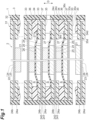
- a power storage device 1 according to a first embodiment illustrated in FIG. 1 is, for example, a power storage module used for a battery of a forklift, a hybrid vehicle, an electric vehicle, or the like.
- the power storage device 1 is, for example, a secondary battery such as a nickel-hydrogen secondary battery or a lithium-ion secondary battery. In the present embodiment, the power storage device 1 is the lithium-ion secondary battery.
- the power storage device 1 includes a stacked body 2 and a sealing body 3.
- the stacked body 2 includes a plurality of bipolar electrodes 21, a positive electrode terminal electrode 22, and a negative electrode terminal electrode 23.
- the plurality of bipolar electrodes 21, the positive electrode terminal electrode 22, and the negative electrode terminal electrode 23 are stacked in a stacking direction D.
- Each bipolar electrode 21 includes a current collector 24, a positive electrode active material layer 25, and a negative electrode active material layer 26.
- the current collector 24 has, for example, a rectangular shape as viewed from the stacking direction D.
- the current collector 24 includes a front surface 24a and a front surface 24b opposite to the front surface 24a.
- the positive electrode active material layer 25 is provided on the front surface 24a.
- the positive electrode active material layer 25 has, for example, a rectangular shape as viewed from the stacking direction D.
- the front surface 24a includes an uncoated region where the positive electrode active material layer 25 is not provided.
- the uncoated region of the front surface 24a surrounds the positive electrode active material layer 25 as viewed from the stacking direction D.
- the negative electrode active material layer 26 is provided on the front surface 24b.
- the negative electrode active material layer 26 has, for example, a rectangular shape as viewed from the stacking direction D.
- the front surface 24b includes an uncoated region where the negative electrode active material layer 26 is not provided.
- the uncoated region of the front surface 24b surrounds the negative electrode active material layer 26 as viewed from the stacking direction D.
- the plurality of bipolar electrodes 21 are stacked such that the positive electrode active material layer 25 of one bipolar electrode 21 and the negative electrode active material layer 26 of the other bipolar electrode 21 face each other. That is, the plurality of bipolar electrodes 21 are stacked such that the front surface 24a of the current collector 24 of one bipolar electrode 21 and the front surface 24b of the current collector 24 of the other bipolar electrode 21 face each other among adjacent bipolar electrodes 21.
- the positive electrode terminal electrode 22 is disposed on one side in the stacking direction D with respect to the plurality of bipolar electrodes 21.
- the positive electrode terminal electrode 22 includes a current collector 24 and a positive electrode active material layer 25.
- the positive electrode terminal electrode 22 is different from the bipolar electrode 21 in that the negative electrode active material layer 26 is not provided.
- Other configurations of the positive electrode terminal electrode 22 may be the same as the configurations of the bipolar electrode 21.
- the positive electrode terminal electrode 22 is disposed such that the positive electrode active material layer 25 of the positive electrode terminal electrode 22 faces the negative electrode active material layer 26 of the bipolar electrode 21. That is, the positive electrode terminal electrode 22 is stacked such that the front surface 24a of the current collector 24 of the positive electrode terminal electrode 22 faces the front surface 24b of the current collector 24 of the bipolar electrode 21 adjacent to the positive electrode terminal electrode 22.
- the negative electrode terminal electrode 23 is disposed on the other side in the stacking direction D with respect to the plurality of bipolar electrodes 21.
- the negative electrode terminal electrode 23 includes a current collector 24 and a negative electrode active material layer 26.
- the negative electrode terminal electrode 23 is different from the bipolar electrode 21 in that the positive electrode active material layer 25 is not provided.
- Other configurations of the negative electrode terminal electrode 23 may be the same as the configurations of the bipolar electrode 21.
- the negative electrode terminal electrode 23 is disposed such that the negative electrode active material layer 26 of the negative electrode terminal electrode 23 faces the positive electrode active material layer 25 of the bipolar electrode 21.
- the negative electrode terminal electrode 23 is stacked such that the front surface 24b of the current collector 24 of the negative electrode terminal electrode 23 faces the front surface 24a of the current collector 24 of the bipolar electrode 21 adjacent to the negative electrode terminal electrode 23.
- Internal spaces S in which an electrolyte is stored are formed between the bipolar electrodes 21, between the bipolar electrode 21 and the positive electrode terminal electrode 22, and between the bipolar electrode 21 and the negative electrode terminal electrode 23.
- the current collector 24 is a chemically inactive electric conductor for causing a current to continuously flow through the positive electrode active material layer 25 and the negative electrode active material layer 26 during discharge or charge of the lithium-ion secondary battery.
- a material of the current collector 24 is, for example, a metal material, a conductive resin material, a conductive inorganic material, or the like.
- the conductive resin material include a resin obtained by adding a conductive filler to a conductive polymer material or a nonconductive polymer material.
- the current collector 24 may include one or more layers containing the above-described metal material or conductive resin material.
- a coating layer by a known method such as plating or spray coating may be formed on the front surface of the current collector 24.
- the current collector 24 may be, for example, a stacked body in which an aluminum layer and a copper layer are integrated by performing copper plating on one surface of an aluminum foil.
- the current collector 24 may be a stacked body in which a plurality of metal foils are integrated by being bonded to each other with a conductive adhesive interposed therebetween.
- the current collector 24 includes a first layer 241 and a second layer 242 stacked in the stacking direction D, and the first layer 241 and the second layer 242 are electrically connected.
- the front surface 24a of the current collector 24 is a front surface of the first layer 241.
- the front surface 24b of the current collector 24 is a front surface of the second layer 242.
- the first layer 241 of the current collector 24 contains aluminum, and is, for example, an aluminum foil.
- the second layer 242 of the current collector 24 contains copper, and is, for example, a copper foil.
- the current collector 24 of the positive electrode terminal electrode 22 may not include the second layer 242.
- the negative electrode active material layer 26 contains a negative electrode active material capable of occluding and releasing charge carriers such as lithium ions.
- a negative electrode active material capable of occluding and releasing charge carriers such as lithium ions.
- the negative electrode active material include graphite, artificial graphite, highly oriented graphite, mesocarbon microbeads, carbon such as hard carbon and soft carbon, metal compounds, elements capable of being alloyed with lithium or compounds thereof, boron-added carbon, and the like.
- Examples of the element capable of being alloyed with lithium include silicon and tin.
- Each of the positive electrode active material layer 25 and the negative electrode active material layer 26 may contain a binder and a conductive assistant in addition to the active material.
- the binder plays a role of connecting the active material or the conductive assistant to each other and maintaining a conductive network in the electrode.
- binder examples include fluorine-containing resins such as polyvinylidene fluoride, polytetrafluoroethylene, and fluororubber, thermoplastic resins such as polypropylene and polyethylene, imide resins such as polyimide and polyamidimide, alkoxysilyl group-containing resins, acrylic resins such as acrylic acid and methacrylic acid, alginates such as styrenebutadiene rubber, carboxymethyl cellulose, sodium alginate, and ammonium alginate, water-soluble cellulose ester crosslinked bodies, and starch-acrylic acid graft polymers.
- the binder thereof can be used alone or in combination.
- the conductive assistant is, for example, a conductive material such as acetylene black, carbon black, or graphite, and can enhance electrical conductivity.
- a conductive material such as acetylene black, carbon black, or graphite
- N-methyl-2-pyrrolidone or the like is used as a viscosity regulation solvent.
- a slurry-state composition for forming an active material layer is manufactured by mixing an active material, a solvent, and a binder and a conductive assistant as necessary, the composition for forming an active material layer is applied to the front surface 24a or the front surface 24b, and the front surface is then dried.
- the solvent is, for example, N-methyl-2-pyrrolidone, methanol, methyl isobutyl ketone, or water.
- the dried front surface may be compressed.
- the separator 27 may be, for example, a porous sheet or a nonwoven fabric containing a polymer that absorbs and holds an electrolyte. Examples of a material of the separator 27 include polypropylene, polyethylene, polyolefin, polyester, and the like.
- the separator 27 may have a single layer structure or a multilayer structure. In a case where the separator 27 has the multilayer structure, the separator 27 may include, for example, a base material layer and a pair of adhesive layers, and may adhere and be fixed to the positive electrode active material layer 25 and the negative electrode active material layer 26 by the pair of adhesive layers.
- the separator 27 may include a ceramic layer serving as a heat resistant layer.
- the separator 27 may be reinforced with a vinylidene fluoride resin compound.
- Examples of the electrolyte with which the separator 27 is impregnated include a liquid containing a nonaqueous solvent and an electrolyte salt dissolved in the nonaqueous solvent.
- Known lithium salts such as LiClO 4 , LiAsF 6 , LiPF 6 , LiBF 4 , LiCF 3 SO 3 , LiN(FSO 2 ) 2 , and LiN(CF 3 SO 2 ) 2 can be used as the electrolyte salt of the electrolyte.
- known solvents such as cyclic carbonates, cyclic esters, chain carbonates, chain esters, and ethers can be used as the nonaqueous solvent. Two or more of these known solvent materials may be used in combination.
- the sealing body 3 is a member that seals the internal space S.
- the sealing body 3 is provided on a side surface of the stacked body 2.
- the sealing body 3 seals the side surface of the stacked body 2.
- the sealing body 3 has, for example, a rectangular cylindrical shape.
- the sealing body 3 has electrical insulation.
- the sealing body 3 includes a body portion 31 and a welding portion 32.
- the body portion 31 is provided at an outer edge portion of the stacked body 2.
- the body portion 31 includes a plurality of independent members.
- the body portion 31 includes a plurality of seals 33 and a plurality of spacers 34.
- the seal 33 includes a seal portion 35 provided on the front surface 24a of the current collector 24, a seal portion 36 provided on the front surface 24b of the current collector 24, and a seal portion 37 provided on a side surface of the current collector 24.
- Each of the seal portions 35 and 36 has, for example, a rectangular frame shape as viewed from the stacking direction.
- the seal portion 35 surrounds the positive electrode active material layer 25 and the negative electrode active material layer 26 as viewed from the stacking direction D.
- An inner edge 35d of the seal portion 35 is separated from the positive electrode active material layer 25.
- An outer edge 35c of the seal portion 35 substantially coincides with an outer edge 24c of the current collector 24 as viewed from the stacking direction D.
- the seal portion 35 is welded to the front surface 24a.
- the seal portion 36 surrounds the positive electrode active material layer 25 and the negative electrode active material layer 26 as viewed from the stacking direction D.
- An inner edge 36d of the seal portion 36 is separated from the negative electrode active material layer 26.
- the inner edge 36d of the seal portion 36 substantially coincides with the inner edge 35d of the seal portion 35 as viewed from the stacking direction D.
- An outer edge 36c of the seal portion 36 substantially coincides with the outer edge 24c of the current collector 24 as viewed from the stacking direction D.
- the seal portion 36 is welded to the front surface 24b.
- the seal portion 37 is provided on the side surface of the current collector 24.
- the seal portion 37 covers the side surface of the current collector 24.
- the seal portion 37 is welded to the side surface of the current collector 24.
- the seal portion 37 seals between the first layer 241 and the second layer 242.
- the seal portion 37 is connected to each of the outer edge 35c of the seal portion 35 and the outer edge 36c of the seal portion 36.
- the seal portions 35, 36, and 37 are partial regions of the seal 33 integrally made of the same material.
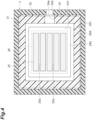
- the spacer 34 has, for example, a rectangular frame shape (see FIG. 4 ) in which a part is cut out for a liquid injection port 34a to be described later.
- the spacer 34 is provided between the pair of seals 33 adjacent to each other in the stacking direction D.
- the inner edge 34d of the spacer 34 may be positioned on a side opposite to the positive electrode active material layer 25 or the negative electrode active material layer 26 with respect to each of the inner edge 35d of the seal portion 35 and the inner edge 36d of the seal portion 36 as viewed from the stacking direction.
- the inner edge 34d of the spacer 34 may be positioned to be separated from the positive electrode active material layer 25 or the negative electrode active material layer 26 than the inner edge 35d of the seal portion 35 and the inner edge 36d of the seal portion 36.
- the outer edge 34c of the spacer 34 substantially coincides with the outer edge 33c of the seal 33 as viewed from the stacking direction D.
- the inner edge 34d of the spacer 34 may be disposed at a position closer to the positive electrode active material layer 25 or the negative electrode active material layer 26 than the inner edge 35d of the seal portion 35 and the inner edge 36d of the seal portion 36.
- a material of each of the seal 33 and the spacer 34 is, for example, acid-modified polyethylene (acid-modified PE), acid-modified polypropylene (acid-modified PP), polyethylene, polypropylene, or the like.
- Each of the seal 33 and the spacer 34 has electrolyte resistant properties.
- the materials of the seal 33 and the spacer 34 may be the same as each other or different from each other.
- the material of the seal 33 is, for example, acid-modified polyethylene or acid-modified polypropylene.
- the material of the spacer 34 is, for example, polyethylene or polypropylene.
- Acid-modified polyethylene and acid-modified polypropylene are easily bonded to metal as compared with polyethylene which is not acid-modified and polypropylene which is not acid-modified.
- bonding strength of the seal portions 35 and 36 to the current collector 24 can be improved by making the seal portions 35 and 36 of acid-modified polyethylene or acid-modified polypropylene.
- the welding portion 32 is provided outside the body portion 31.
- the welding portion 32 is integrated by welding the outer edge portions of each seal 33 and each spacer 34.
- the welding portion 32 has, for example, a rectangular cylindrical shape.
- the welding portion 32 continuously extends from one end to the other end of the stacked body 2 in the stacking direction D.
- the welding portion 32 is formed by welding the outer edge portions of each seal 33 and each spacer 34 positioned outside the outer edge 24c of the current collector 24 (the outer edge 35c of the seal portion 35 and the outer edge 36c of the seal portion 36) as viewed from the stacking direction D.
- the welding portion 32 may be formed such that an inner edge of the welding portion 32 does not overlap each current collector 24 as viewed from the stacking direction D.
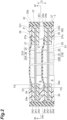
- the power storage device 1 includes a first electrode 21A and a second electrode 21B adjacent to the first electrode 21A.
- the first electrode 21A and the second electrode 21B are a pair of bipolar electrodes 21 adjacent to each other illustrated in FIG. 1 .
- the first electrode 21A includes a first current collector 24A
- the second electrode 21B includes a second current collector 24B.
- Each of the first current collector 24A and the second current collector 24B is the current collector 24 illustrated in FIG. 1 .
- Each of the first current collector 24A and the second current collector 24B includes a front surface 24d and a front surface 24e.
- the front surface 24d is the front surface 24a illustrated in FIG. 1
- the front surface 24e is the front surface 24b illustrated in FIG. 1 .
- the body portion 31 includes a first seal 331 and a second seal 332.
- the first seal 331 is provided on the first current collector 24A
- the second seal 332 is provided on the second current collector 24B.
- Each of the first seal 331 and the second seal 332 is the seal 33 illustrated in FIG. 1 .
- the first seal 331 includes a first seal portion 351.
- the first seal portion 351 is welded to the front surface 24d of the first current collector 24A.
- the first seal portion 351 is the seal portion 35 illustrated in FIG. 1 .
- the second seal 332 includes a second seal portion 362.
- the second seal portion 362 is welded to the front surface 24e of the second current collector 24B.
- the spacer 34 forms the internal space S for storing the electrolyte together with the first electrode 21A, the first seal 331, the second electrode 21B, and the second seal 332.
- the spacer 34 is sandwiched between the first seal portion 351 and the second seal portion 362.
- the spacer 34 is a member separate from the first seal 331 and the second seal 332.
- the spacer 34 is in contact with each of the first seal portion 351 and the second seal portion 362.
- the spacer 34 is not welded to each of the first seal portion 351 and the second seal portion 362.
- a thickness T1 of the spacer 34 is larger than each of a thickness T2 of the first seal portion 351 and a thickness T3 of the second seal portion 362.
- the thickness T1 of the spacer 34 is, for example, twice or more the thickness T2 of the first seal portion 351 or the thickness T3 of the second seal portion 362.
- the thickness T1 of the spacer 34 is smaller than a thickness T4 of the first seal 331 or the second seal 332. That is, the thickness T1 of the spacer 34 is smaller than the sum of the thickness of the current collector 24, the thickness T2 of the first seal portion 351, and the thickness T3 of the second seal portion 362.
- the thickness T2 of the first seal portion 351 and the thickness T3 of the second seal portion 362 may be the same as each other or different from each other.
- a peripheral edge portion 27a of the separator 27 is positioned between the spacer 34 and the second seal portion 362.
- the peripheral edge portion 27a of the separator 27 may be sandwiched between the spacer 34 and the second seal portion 362 in a region excluding the liquid injection port 34a to be described later.
- the peripheral edge portion 27a of the separator 27 may be welded and fixed to the second seal portion 362.
- the separator 27 partitions the internal space S into a first region S1 and a second region S2.
- the first region S1 is a region between the separator 27 and the first electrode 21A among the internal spaces S.
- the second region S2 is a region between the separator 27 and the second electrode 21B among the internal spaces S.
- a volume of the first region S1 is larger than a volume of the second region S2.
- an area of the positive electrode active material layer 25 is smaller than an area of the negative electrode active material layer 26.
- the outer edge of the positive electrode active material layer 25 is positioned inside the outer edge of the negative electrode active material layer 26.
- a plurality of grooves 25a are formed in the positive electrode active material layer 25.
- the peripheral edge portion 27a of the separator 27 is positioned between the spacer 34 and the second seal portion 362.
- the volume of the first region S1 is larger than the volume of the second region S2.
- the thickness of the positive electrode active material layer 25 may be larger than the thickness of the negative electrode active material layer 26. In this case, the volume of the first region S1 is further larger than the volume of the second region S2.
- the spacer 34 includes the liquid injection port (first liquid injection port) 34a.
- the liquid injection port 34a penetrates the spacer 34.
- the liquid injection port 34a is opened to each of the outer edge 34c and the inner edge 34d of the spacer 34.
- the liquid injection port 34a communicates with the internal space S.
- the liquid injection port 34a functions as a path for injecting the electrolyte into the internal space S.
- the liquid injection ports 34a of the plurality of spacers 34 may be formed at different positions as viewed from the stacking direction D.
- the liquid injection ports 34a of the plurality of spacers 34 aligned in the stacking direction D are disposed to be aligned obliquely with respect to the stacking direction D.
- the liquid injection ports 34a communicating with the internal spaces S adjacent to each other in the stacking direction D are disposed at positions shifted from each other not to overlap each other as viewed from the stacking direction D.
- the liquid injection port 34a has, for example, a rectangular shape as viewed from a direction intersecting an outer surface 32b of the welding portion 32.
- the welding portion 32 includes a plurality of liquid injection ports (second liquid injection ports) 32a.
- the liquid injection port 32a penetrates the welding portion 32.
- the liquid injection port 32a is opened in the outer surface 32b of the welding portion 32.
- the liquid injection port 32a communicates with the liquid injection port 34a.
- the liquid injection port 32a functions as a path for injecting the electrolyte into the internal space S via the liquid injection port 34a.
- the liquid injection ports 34a are aligned obliquely with respect to the stacking direction D.
- the liquid injection ports 32a communicating with the internal spaces S adjacent to each other in the stacking direction D are disposed at positions shifted from each other not to overlap each other as viewed from the stacking direction D.
- the liquid injection port 32a has, for example, a rectangular shape as viewed from the direction intersecting the outer surface 32b of the welding portion 32.
- an area of the liquid injection port 32a is smaller than an area of the liquid injection port 34a.
- the liquid injection port 32a may be positioned, for example, inside the liquid injection port 34a.
- a width W1 of the liquid injection port 32a in the stacking direction D is smaller than a width W2 of the liquid injection port 34a in the stacking direction D.
- a width W3 of the liquid injection port 32a in a direction intersecting the stacking direction D is smaller than a width W4 of the liquid injection port 34a in the direction intersecting the stacking direction D.
- a frame portion 38 surrounding the liquid injection port 32a is formed on the outer surface 32b.
- the frame portion 38 protrudes from the outer surface 32b.
- the frame portion 38 has, for example, a rectangular frame shape as viewed from the direction intersecting the outer surface 32b. As viewed from the direction intersecting the outer surface 32b, an inner edge of the frame portion 38 is positioned outside the liquid injection port 32a and the liquid injection port 34a. A region inside the frame portion 38 communicates with the liquid injection port 34a via the liquid injection port 32a.
- the positive electrode active material layer 25 includes the plurality of grooves 25a.
- Each groove 25a extends in a direction in which the liquid injection port 32a, the liquid injection port 34a, and the internal space S are aligned.
- Each groove 25a reaches both ends of the positive electrode active material layer 25 in the extending direction of the groove 25a.
- a depth of each groove 25a in the stacking direction D is the same as a thickness of the positive electrode active material layer 25 in the stacking direction D. That is, each groove 25a is formed to reach the front surface 24d of the first current collector 24A in the stacking direction D.
- the front surface 24d of the first current collector 24A is exposed to each groove 25a.
- Each groove 25a is a part of the first region S1.
- the electrolyte injected from the liquid injection ports 32a and 34a is movable via a region between the positive electrode active material layer 25 and the spacer 34 and each groove 25a in the first region S1.
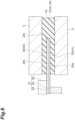
- the bipolar electrode 21, a seal member 41, and a seal member 42 are prepared. Subsequently, the seal member 41 is disposed on the front surface 24a of the current collector 24, and the seal member 42 is disposed on the front surface 24b of the current collector 24. The seal member 41 and the seal member 42 are disposed to protrude from the outer edge 24c of the current collector 24. That is, as viewed from the stacking direction D, the seal member 41 disposed on the front surface 24a of the current collector 24 and the seal member 42 disposed on the front surface 24b of the current collector 24 have a portion overlapping the current collector 24 and a portion not overlapping the current collector 24, respectively.
- front surfaces of the seal member 41 and the seal member 42 are heated by a heater 5.
- the heater 5 is, for example, an impulse sealer.
- the seal member 41 and the seal member 42 are heated in a state where the heater 5 sandwiches the current collector 24 via each of the seal member 41 and the seal member 42.
- a portion of the seal member 41 overlapping the front surface 24a is welded to the front surface 24a to form the seal portion 35
- a portion of the seal member 42 overlapping the front surface 24b is welded to the front surface 24b to form the seal portion 36.
- the seal 33 is formed on the bipolar electrode 21.
- the seal 33 is also formed on the positive electrode terminal electrode 22 and the negative electrode terminal electrode 23.
- the electrodes 21, 22, and 23 on which the seals 33 are formed and each spacer 34 are stacked.
- the spacer 34 is disposed between the seals 33.
- a liquid injection port forming member 6 is inserted into the liquid injection port 34a of the spacer 34.
- the liquid injection port forming member 6 has, for example, a plate shape.
- the liquid injection port forming member 6 extends from an outside of the spacer 34 to the internal space S.
- a width of the liquid injection port forming member 6 is smaller than a width of the liquid injection port 34a. That is, there is a clearance between the liquid injection port forming member 6 and the liquid injection port 34a.
- each seal 33 and each spacer 34 are melted by a heating device 7.
- the heating device 7 is, for example, an infrared heater or the like.
- the heating device 7 irradiates the outer surfaces of each seal 33 and each spacer 34 with infrared rays.
- temperatures of each seal 33 and each spacer 34 increase.
- Each seal 33 and each spacer 34 are controlled to be heated by the heating device 7 to have a temperature equal to or higher than a melting point. As a result, the outer edge portions of each seal 33 and each spacer 34 are melted.
- each seal 33 and each spacer 34 When the outer edge portions of each seal 33 and each spacer 34 are melted, the molten liquid portion flows to fill a gap between the liquid injection port 34a and the liquid injection port forming member 6. When heating by the heating device 7 is stopped, the melted outer edge portions of each seal 33 and each spacer 34 are cooled and solidified to become the welding portions 32.
- each liquid injection port forming member 6 is pulled out from the liquid injection port 34a.
- the liquid injection port 32a is formed in the welding portion 32.
- the frame portion 38 is formed on the outer surface 32b of the welding portion 32 by, for example, injection-molding or the like.
- the electrolyte is injected into each internal space S via each liquid injection port 32a and each liquid injection port 34a.
- a facility-side nozzle 8 is pressed against the frame portion 38.
- the facility-side nozzle 8 includes a support member 81 and a seal member 82.
- the seal member 82 is provided on a front surface of the support member 81.
- the seal member 82 is, for example, an elastic body.
- the seal member 82 is, for example, a packing or the like.
- a plurality of liquid injection ports 8a are formed in the facility-side nozzle 8. Each liquid injection port 8a corresponds to each liquid injection port 32a and each liquid injection port 34a.
- a front surface of the seal member 82 is pressed against the frame portion 38.
- the front surface of the seal member 82 is pressed against the frame portion 38, at least a part of the frame portion 38 bites into the seal member 82.
- a space between the frame portion 38 and the seal member 82 is sealed.
- the electrolyte is injected into the internal space S by using the facility-side nozzle 8.
- each liquid injection port 32a is sealed. Specifically, the liquid injection port 32a surrounded by the frame portion 38 is sealed by bonding the sealing material 9 to the frame portion 38. As a result, the power storage device 1 illustrated in FIG. 1 is manufactured. In FIG. 1 , the illustration of the frame portion 38 and the sealing material 9 is omitted.
- the first seal portion 351 is welded to the front surface 24d of the first current collector 24A, and the second seal portion 362 is welded to the front surface 24e of the second current collector 24B.
- the welding portion 32 is formed by welding the outer edge portions of each seal 33 and each spacer 34.
- the internal space S can be reliably sealed.
- the thickness T1 of the spacer 34 is larger than each of the thickness T2 of the first seal portion 351 and the thickness T3 of the second seal portion 362, and the liquid injection port 34a is formed in the spacer 34.
- the thickness of the first seal portion 351 welded to the first current collector 24A or the second seal portion 362 welded to the second current collector 24B in the stacking direction D can be sufficiently reduced while sufficiently securing the thickness of the spacer 34 for forming the liquid injection port 34a in the stacking direction D. Therefore, according to the power storage device 1, it is possible to suppress the deformation (for example, wrinkles or the like) of the first current collector 24A caused by the welding of the first seal portion 351 to the front surface 24d or the deformation (for example, wrinkles or the like) of the second current collector 24B caused by the welding of the second seal portion 362 to the front surface 24e. In addition, according to the power storage device 1, the width of the liquid injection port 34a which forms a flow path at the time of injecting the electrolyte in the stacking direction D can be increased, and the electrolyte can be efficiently injected into the internal space S.
- the width of the liquid injection port 32a is smaller than the liquid injection port 34a. As a result, it is possible to suppress backflow of the electrolyte stored in the internal space S to the outside.
- the peripheral edge portion 27a of the separator 27 is fixed to the seal portion 36.
- the volume of the first region S1 among the internal spaces S is larger than the volume of the second region S2 among the internal spaces S.
- the area of the positive electrode active material layer 25 is smaller than the area of the negative electrode active material layer 26.
- the volume of the first region S1 can be set to be larger than the volume of the second region S2, and as described above, smooth injection can be realized.
- the thickness of the positive electrode active material layer 25 is larger than the thickness of the negative electrode active material layer 26.
- the volume of the first region S1 can be set to be larger than the volume of the second region S2, and as described above, smooth injection can be realized.
- the positive electrode active material layer 25 includes the groove 25a extending in a direction in which the liquid injection port 34a and the internal space S are aligned. As a result, it is possible to suppress the flow of the electrolyte from being obstructed by the positive electrode active material layer 25, and as a result, it is possible to realize smooth injection of the electrolyte. In addition, since the groove 25a reaches the front surface 24a of the current collector 24, a gas or the like generated when the positive electrode active material layer 25 is formed on the front surface 24a can be efficiently discharged from between the front surface 24a and the positive electrode active material layer 25.
- the current collector 24 includes the first layer 241 and the second layer 242.
- the seal 33 includes the seal portion 35 welded to the front surface 24a, the seal portion 36 welded to the front surface 24b, and the seal portion 37 welded to the side surface of the current collector 24.
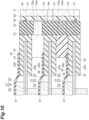
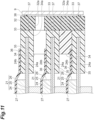
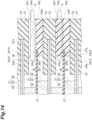
- a power storage device of a second embodiment is mainly different from the power storage device 1 of the first embodiment in that a spacer 34Ais provided instead of the spacer 34.
- the spacer 34A is provided between the first seal 331 and the second seal 332.
- the spacer 34A includes a first spacer 341 and a second spacer 342. Each of the first spacer 341 and the second spacer 342 is a separate member.
- the first spacer 341 has, for example, a rectangular frame shape partially cut out for the liquid injection port 34a to be described later.
- the first spacer 341 is in contact with the first seal portion 351 of the first seal 331.
- the first spacer 341 is not welded to the first seal portion 351.
- An inner edge 341d of the first spacer 341 is positioned on a side opposite to the positive electrode active material layer 25 with respect to the inner edge 35d of the first seal portion 351 as viewed from the stacking direction D. That is, the inner edge 341d of the first spacer 341 is positioned to be separated from the positive electrode active material layer 25 than the inner edge 35d of the first seal portion 351.
- the first spacer 341 includes the liquid injection port (first liquid injection port) 34a. That is, the liquid injection port 34a is formed in the first spacer 341.
- the liquid injection port 34a penetrates the first spacer 341.
- the liquid injection port 34a is opened to each of an outer edge and the inner edge 341d of
- the second spacer 342 has, for example, a rectangular frame shape.
- the second spacer 342 is provided between the first spacer 341 and the second seal 332.
- the second spacer 342 is in contact with the first spacer 341.
- the second spacer 342 is in contact with the second seal portion 362 of the second seal 332.
- the second spacer 342 is not welded to the second seal portion 362.
- An inner edge 342d of the second spacer 342 is positioned on ae side opposite to the negative electrode active material layer 26 with respect to the inner edge 36d of the second seal portion 362 as viewed from the stacking direction D.
- the inner edge 342d of the second spacer 342 is positioned to be separated from the negative electrode active material layer 26 than the inner edge 36d of the second seal portion 362.
- the inner edge 342d of the second spacer 342 substantially coincides with the inner edge 341d of the first spacer 341 as viewed from the stacking direction D.
- the second spacer 342 does not include a liquid injection port. That is, the second spacer 342 has a frame shape continuously connected in a circumferential direction.
- a thickness T11 of the first spacer 341 is larger than each of the thickness T2 of the first seal portion 351 and the thickness T3 of the second seal portion 362.
- a thickness T12 of the second spacer 342 is larger than each of the thickness T2 of the first seal portion 351 and the thickness T3 of the second seal portion 362.
- the thickness T11 of the first spacer 341 and the thickness T12 of the second spacer 342 are the same as each other. That is, each of the thickness T11 of the first spacer 341 and the thickness T12 of the second spacer 342 is about half of the thickness T1 of the spacer 34A.
- the thickness T11 of the first spacer 341 and the thickness T12 of the second spacer 342 may be different from each other.
- the thickness T11 of the first spacer 341 may be larger than the thickness T12 of the second spacer 342.
- the thickness T11 of the first spacer 341 may be smaller than the thickness T12 of the second spacer 342.
- the thickness T11 of the first spacer 341 may be equal to or less than the thickness T2 of the first seal portion 351 or the thickness T3 of the second seal portion 362.
- the thickness T12 of the second spacer 342 may be equal to or less than the thickness T2 of the first seal portion 351 or the thickness T3 of the second seal portion 362.
- the peripheral edge portion 27a of the separator 27 is positioned between the first spacer 341 and the second spacer 342.
- the peripheral edge portion 27a of the separator 27 is welded to the second spacer 342.
- the peripheral edge portion 27a of the separator 27 is welded to a surface of the second spacer 342 facing the first spacer 341.
- the peripheral edge portion 27a of the separator 27 is welded to the second spacer 342 over the entire circumference of the second spacer 342. That is, a portion of the separator 27 welded to the second spacer 342 has a rectangular frame shape as viewed from the stacking direction D.
- the seal 33 is formed in each of the electrodes 21, 22, and 23 (see FIGS. 5 and 6 ).
- the peripheral edge portion 27a of the separator 27 is welded to the second spacer 342. Specifically, after the peripheral edge portion 27a of the separator 27 is disposed on one surface of the second spacer 342, the peripheral edge portion 27a of the separator 27 and the second spacer 342 are heated.
- the electrodes 21, 22, and 23 on which the seals 33 are formed, the second spacer 342 to which the separator 27 is welded, and the first spacer 341 are stacked.
- the first spacer 341 is disposed on one surface of the second spacer 342 to which the peripheral edge portion 27a of the separator 27 is welded.
- the first spacer 341 and the second spacer 342 are disposed between the seals 33.
- the liquid injection port forming member 6 is inserted into the liquid injection port 34a.
- the formation of the welding portion, the injection of the electrolyte, the sealing of the liquid injection port, and the like are performed. As a result, the power storage device of the second embodiment is manufactured.
- each spacer 34A includes the first spacer 341 and the second spacer 342 formed in a frame shape and stacked in the stacking direction D.
- the spacer 34A includes the plurality of spacers, the thicknesses of the spacers 341 and 342 become smaller than a distance between the adjacent seals 33, and as a result, it is possible to set the thickness to be thinner than the case of using a single spacer.
- precursors of the spacers 341 and 342 can be easily wound in a roll shape.
- the precursors of the spacers 341 and 342 can be easily handled, and as a result, the power storage device can be easily manufactured.
- the peripheral edge portion 27a of the separator 27 is welded to the second spacer 342.
- the separator 27 is welded to the first spacer 341 since the separator 27 is not welded to the first spacer 341 in the region where the liquid injection port 34a is formed in the first spacer 341, the fixing of the separator 27 may be insufficient.
- the peripheral edge portion 27a of the separator 27 is welded to the second spacer 342 where the liquid injection port 34a is not formed, the peripheral edge portion 27a of the separator 27 can be more reliably fixed. Thus, a short circuit between the electrodes 21, 22, and 23 can be suppressed.
- the separator 27 may be welded to the first seal portion 351 or the second seal portion 362 after the first seal portion 351 or the second seal portion 362 is welded to the current collector 24.
- the welding strength of the first seal portion 351 or the second seal portion 362 to the current collector 24 may be decreased.
- the peripheral edge portion 27a of the separator 27 is welded to the second spacer 342, the decrease in welding strength of the first seal portion 351 or the second seal portion 362 to the current collector 24 is suppressed.
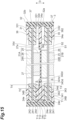
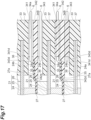
- a power storage device of a third embodiment is mainly different from the power storage device of the second embodiment in that a spacer 34B is provided instead of the spacer 34A. As illustrated in FIG. 15 , the spacer 34B is provided between the first seal 331 and the second seal 332.
- the spacer 34B includes a first spacer 341, a second spacer 342, and a third spacer 343. Each of the first spacer 341, the second spacer 342, and the third spacer 343 is a separate member.
- the thickness T11 of the first spacer 341 is about 1/3 of the thickness T1 of the spacer 34B.
- the other points of the first spacer 341 are the same as the points of the first spacer 341 of the second embodiment.
- the second spacer 342 is provided between the first spacer 341 and the third spacer 343.
- the thickness T12 of the second spacer 342 is the same as the thickness T11 of the first spacer 341. That is, the thickness T12 of the second spacer 342 is about 1/3 of the thickness T1 of the spacer 34B.
- the inner edge 342d of the second spacer 342 is positioned inside the inner edge 341d of the first spacer 341 as viewed from the stacking direction D.
- the inner edge 342d of the second spacer 342 is positioned inside the inner edge 35d of the first seal portion 351 or the inner edge 36d of the second seal portion 362 as viewed from the stacking direction D.
- a width of a side portion of the second spacer 342 is larger than a width of a side portion of the first spacer 341.
- the other points of the second spacer 342 are the same as the points of the second spacer 342 of the second embodiment.
- the third spacer 343 is stacked on a side opposite to the first spacer 341 with respect to the second spacer 342.
- the third spacer 343 has, for example, a rectangular frame shape.
- a thickness T13 of the third spacer 343 is the same as the thickness T11 of the first spacer 341. That is, the thickness T13 of the third spacer 343 is about 1/3 of the thickness T1 of the spacer 34B.
- the third spacer 343 is in contact with the second seal portion 362 of the second seal 332.
- the third spacer 343 is not welded to the second seal portion 362.
- An inner edge 343d of the third spacer 343 is positioned on a side opposite to the negative electrode active material layer 26 with respect to the inner edge 36d of the second seal portion 362 as viewed from the stacking direction D.
- the inner edge 343d of the third spacer 343 substantially coincides with the inner edge 341d of the first spacer 341 as viewed from the stacking direction D.
- the third spacer 343 includes the liquid injection port (first liquid injection port) 34a. That is, the liquid injection port 34a is also formed in the third spacer 343. The liquid injection port 34a penetrates the third spacer 343. The liquid injection port 34a is opened in each of an outer edge and the inner edge 343d of the third spacer 343.
- Each of the thickness T11 of the first spacer 341, the thickness T12 of the second spacer 342, and the thickness T13 of the third spacer 343 is larger than each of the thickness T2 of the first seal portion 351 and the thickness T3 of the second seal portion 362.
- the thickness T11 of the first spacer 341, the thickness T12 of the second spacer 342, and the thickness T13 of the third spacer 343 may be different from each other similarly to the power storage device of the second embodiment.
- the thickness T13 of the third spacer 343 may be equal to or less than the thickness T2 of the first seal portion 351 or the thickness T3 of the second seal portion 362.
- the peripheral edge portion 27a of the separator 27 is welded to the second spacer 342.
- the peripheral edge portion 27a of the separator 27 is welded to a surface of the second spacer 342 facing the first spacer 341.
- the peripheral edge portion 27a of the separator 27 is welded to a portion of the second spacer 342 inside the first spacer 341.
- the peripheral edge portion 27a of the separator 27 is welded to the second spacer 342 over the entire circumference of the second spacer 342. That is, a portion of the separator 27 welded to the second spacer 342 has a rectangular frame shape as viewed from the stacking direction D.
- the peripheral edge portion 27a of the separator 27 may reach between the first spacer 341 and the second spacer 342.
- the seal 33 is formed in each of the electrodes 21, 22, and 23 (see FIGS. 5 and 6 ).
- the peripheral edge portion 27a of the separator 27 is welded to the second spacer 342. Specifically, after the peripheral edge portion 27a of the separator 27 is disposed on one surface of the second spacer 342, the peripheral edge portion 27a of the separator 27 and the second spacer 342 are heated.
- the electrodes 21, 22, and 23 on which the seals 33 are formed, the second spacer 342 to which the separator 27 is welded, the first spacer 341, and the third spacer 343 are stacked.
- the first spacer 341 is disposed on one surface of the second spacer 342 to which the peripheral edge portion 27a of the separator 27 is welded.
- the third spacer 343 is disposed on the side opposite to the first spacer 341 with respect to the second spacer 342.
- the first spacer 341, the second spacer 342, and the third spacer 343 are disposed between the seals 33.
- the liquid injection port forming member 6 is inserted into the liquid injection port 34a.
- the formation of the welding portion, the injection of the electrolyte, the sealing of the liquid injection port, and the like are performed. As a result, the power storage device of the third embodiment is manufactured.
- the inner edge 342d of the second spacer 342 is positioned inside the inner edge 341d of the first spacer 341.
- a region of the second spacer 342 for welding the separator 27 can be sufficiently secured.
- the peripheral edge portion 27a of the separator 27 can be more reliably fixed, and a short circuit between the electrodes 21, 22, and 23 can be more reliably suppressed.
- the spacer 34B includes the third spacer 343 stacked on the side opposite to the first spacer 341 with respect to the second spacer 342.
- the liquid injection port 34a is formed in each of the first spacer 341 and the third spacer 343. As a result, the liquid can be injected from both sides of the separator 27 in the stacking direction D. Thus, smooth liquid injection can be realized.
- the positive electrode terminal electrode 22 and the bipolar electrode 21 adjacent to the positive electrode terminal electrode 22 may be focused.
- the first electrode 21A is the positive electrode terminal electrode 22
- the second electrode 21B is the bipolar electrode 21 adjacent to the positive electrode terminal electrode 22.
- attention may be paid to the negative electrode terminal electrode 23 and the bipolar electrode 21 adjacent to the negative electrode terminal electrode 23.
- the first electrode 21A is the bipolar electrode 21 adjacent to the negative electrode terminal electrode 23, and the second electrode 21B is the negative electrode terminal electrode 23.
- the current collector 24 may include only one layer.
- the peripheral edge portion 27a of the separator 27 may be welded to the second seal portion 362.
- the peripheral edge portion 27a of the separator 27 may be welded to the surface of the second spacer 342 opposite to the first spacer 341.
- the peripheral edge portion 27a of the separator 27 may be welded to the second spacer 342 at predetermined intervals in the circumferential direction of the second spacer 342.
- the peripheral edge portion 27a of the separator 27 may be partially welded to the second spacer 342. Even in this case, since the separator 27 can be welded to the second spacer 342 at intervals not depending on the width of the liquid injection port 34a, the peripheral edge portion 27a of the separator 27 can be reliably fixed. In the second embodiment and the third embodiment, the separator 27 may not be welded to the spacers 34A and 34B. In the second embodiment and the third embodiment, the peripheral edge portion 27a of the separator 27 may be welded to the first seal portion 351 or the second seal portion 362. In the second embodiment and the third embodiment, the separator 27 may not be welded.
- the gist of the present disclosure is as follows [1] to [10].
Landscapes
- Chemical & Material Sciences (AREA)
- Chemical Kinetics & Catalysis (AREA)
- Electrochemistry (AREA)
- General Chemical & Material Sciences (AREA)
- Engineering & Computer Science (AREA)
- Manufacturing & Machinery (AREA)
- Power Engineering (AREA)
- Materials Engineering (AREA)
- Microelectronics & Electronic Packaging (AREA)
- Condensed Matter Physics & Semiconductors (AREA)
- General Physics & Mathematics (AREA)
- Inorganic Chemistry (AREA)
- Physics & Mathematics (AREA)
- Secondary Cells (AREA)
Abstract
Description
- The present disclosure relates to a power storage device.
- In related art, there has been known a power storage device including a stacked body including a plurality of electrodes and a sealing body for sealing a side surface of the stacked body (see, for example,
- Patent Literature 1). In such a power storage device, the sealing body has a member including a seal welded to one surface of a current collector of the electrode. A liquid injection port for injecting an electrolyte into an internal space is formed in the seal.
- Patent Literature 1:
Japanese Unexamined Patent Publication No. 2019-200955 - In the power storage device described above, it may be required to relatively increase a thickness of the seal in order to form the liquid injection port in the seal. However, when the thickness of the seal increases, the current collector may be deformed due to thermal contraction of the seal when the seal is welded to one surface of the current collector.
- An object of the present disclosure is to provide a power storage device capable of suppressing deformation of a current collector.
- A power storage device of the present disclosure includes a stacked body including a first electrode and a second electrode stacked in a stacking direction; and a sealing body for sealing a side surface of the stacked body. The first electrode has a first current collector including a first surface, and a positive electrode active material layer provided on the first surface, the second electrode has a second current collector including a second surface facing the first surface, and a negative electrode active material layer provided on the second surface, the sealing body has a first seal including a first seal portion welded to the first surface to surround the positive electrode active material layer as viewed from the stacking direction, a second seal including a second seal portion welded to the second surface to surround the negative electrode active material layer as viewed from the stacking direction, a spacer sandwiched by the first seal portion and the second seal portion, and a welding portion formed by welding outer edge portions of the first seal, the second seal, and the spacer positioned outside of outer edges of the first current collector and the second current collector as viewed from the stacking direction, the spacer includes a first liquid injection port communicating with internal spaces formed by the first electrode, the second electrode, and the sealing body and in which an electrolyte is stored, the welding portion includes a second liquid injection port communicating with the first liquid injection port, and a thickness of the spacer is larger than a thickness of each of the first seal portion and the second seal portion.
- In this power storage device, the first seal portion is welded to the first surface of the first current collector, and the second seal portion is welded to the second surface of the second current collector. In addition, the welding portion is formed by welding the outer edge portions of the first seal portion, the second seal portion, and the spacer. As a result, the internal space can be reliably sealed. In addition, the thickness of the spacer is larger than the thickness of each of the first seal portion and the second seal portion, and the first liquid injection port is formed in the spacer. As a result, it is possible to sufficiently reduce the thickness of the first seal portion or the second seal portion while sufficiently securing the thickness of the spacer for forming the first liquid injection port. Therefore, according to this power storage device, it is possible to suppress the deformation of the current collector caused by the welding of the first seal portion to the first surface or the welding of the second seal portion to the second surface.
- A width of the second liquid injection port may be smaller than a width of the first liquid injection port. As a result, it is possible to suppress backflow of the electrolyte stored in the internal space to the outside.
- The power storage device may further include a separator provided between the positive electrode active material layer and the negative electrode active material layer. A peripheral edge portion of the separator may be positioned between the spacer and the second seal portion, and a volume of a first region between the separator and the first electrode among the internal spaces may be larger than a volume of a second region between the separator and the second electrode among the internal spaces. In this case, since the first liquid injection port communicates with the first region having a large volume, smooth liquid injection can be realized.
- As viewed from the stacking direction, an area of the positive electrode active material layer may be smaller than an area of the negative electrode active material layer. As a result, the volume of the first region can be made larger than the volume of the second region, and as described above, smooth injection can be realized.
- A thickness of the positive electrode active material layer may be larger than a thickness of the negative electrode active material layer. As a result, the volume of the first region can be made larger than the volume of the second region, and as described above, smooth injection can be realized.
- The positive electrode active material layer may include a groove extending in a direction in which the first liquid injection port and the internal space are aligned. As a result, it is possible to suppress the flow of the electrolyte from being obstructed by the positive electrode active material layer, and as a result, it is possible to realize smooth injection of the electrolyte.
- The spacer may include a first spacer and a second spacer formed in a frame shape and stacked in the stacking direction. As a result, since the thickness of the spacer can be easily adjusted, the power storage device can be easily manufactured.
- The power storage device may further include a separator provided between the positive electrode active material layer and the negative electrode active material layer, the first liquid injection port may be formed in the first spacer, and a peripheral edge portion of the separator may be welded to the second spacer. As a result, for example, the peripheral edge portion of the separator can be more reliably fixed as compared with a case where the peripheral edge portion of the separator is welded to the first spacer. Thus, a short circuit between the first electrode and the second electrode can be suppressed.
- As viewed from the stacking direction, an inner edge of the second spacer may be positioned inside an inner edge of the first spacer. As a result, a region of the second spacer for welding the separator can be sufficiently secured. Thus, the peripheral edge portion of the separator can be more reliably fixed, and a short circuit between the first electrode and the second electrode can be more reliably suppressed.
- The spacer may further include a third spacer stacked on a side opposite to the first spacer with respect to the second spacer, and the first liquid injection port may be formed in each of the first spacer and the third spacer. As a result, the liquid can be injected from both sides of the separator in the stacking direction. Thus, smooth liquid injection can be realized.
- According to the present disclosure, it is possible to provide the power storage device capable of suppressing the deformation of the current collector.
-
-
FIG. 1 is a schematic sectional view of a power storage device according to a first embodiment. -
FIG. 2 is a partially enlarged view ofFIG. 1 . -
FIG. 3 is a side view of the power storage device illustrated inFIG. 1 . -
FIG. 4 is a sectional view taken along line IV-IV ofFIG. 2 . -
FIG. 5 is a diagram illustrating steps of a method for manufacturing the power storage device illustrated inFIG. 1 . -
FIG. 6 is a diagram illustrating steps of the method for manufacturing the power storage device illustrated inFIG. 1 . -
FIG. 7 is a diagram illustrating steps of the method for manufacturing the power storage device illustrated inFIG. 1 . -
FIG. 8 is a diagram illustrating steps of the method for manufacturing the power storage device illustrated inFIG. 1 . -
FIG. 9 is a diagram illustrating steps of the method for manufacturing the power storage device illustrated inFIG. 1 . -
FIG. 10 is a diagram illustrating steps of the method for manufacturing the power storage device illustrated inFIG. 1 . -
FIG. 11 is a diagram illustrating steps of the method for manufacturing the power storage device illustrated inFIG. 1 . -
FIG. 12 is a partially enlarged view of a sectional view of a power storage device according to a second embodiment. -
FIG. 13 is a diagram illustrating steps of a method for manufacturing the power storage device illustrated inFIG. 12 . -
FIG. 14 is a diagram illustrating steps of the method for manufacturing the power storage device illustrated inFIG. 12 . -
FIG. 15 is a partially enlarged view of a sectional view of a power storage device according to a third embodiment. -
FIG. 16 is a diagram illustrating steps of a method for manufacturing the power storage device illustrated inFIG. 15 . -
FIG. 17 is a diagram illustrating steps of the method for manufacturing the power storage device illustrated inFIG. 15 . - Hereinbelow, embodiments of the present disclosure will be described in detail with reference to the drawings. In the drawings, the same or corresponding parts are denoted by the same reference signs, and redundant description will be omitted.
- [First Embodiment] A
power storage device 1 according to a first embodiment illustrated inFIG. 1 is, for example, a power storage module used for a battery of a forklift, a hybrid vehicle, an electric vehicle, or the like. Thepower storage device 1 is, for example, a secondary battery such as a nickel-hydrogen secondary battery or a lithium-ion secondary battery. In the present embodiment, thepower storage device 1 is the lithium-ion secondary battery. - As illustrated in
FIG. 1 , thepower storage device 1 includes astacked body 2 and a sealingbody 3. Thestacked body 2 includes a plurality ofbipolar electrodes 21, a positiveelectrode terminal electrode 22, and a negativeelectrode terminal electrode 23. The plurality ofbipolar electrodes 21, the positiveelectrode terminal electrode 22, and the negativeelectrode terminal electrode 23 are stacked in a stacking direction D. Eachbipolar electrode 21 includes acurrent collector 24, a positive electrodeactive material layer 25, and a negative electrodeactive material layer 26. - The
current collector 24 has, for example, a rectangular shape as viewed from the stacking direction D. Thecurrent collector 24 includes afront surface 24a and afront surface 24b opposite to thefront surface 24a. - The positive electrode
active material layer 25 is provided on thefront surface 24a. The positive electrodeactive material layer 25 has, for example, a rectangular shape as viewed from the stacking direction D. Thefront surface 24a includes an uncoated region where the positive electrodeactive material layer 25 is not provided. The uncoated region of thefront surface 24a surrounds the positive electrodeactive material layer 25 as viewed from the stacking direction D. The negative electrodeactive material layer 26 is provided on thefront surface 24b. The negative electrodeactive material layer 26 has, for example, a rectangular shape as viewed from the stacking direction D. Thefront surface 24b includes an uncoated region where the negative electrodeactive material layer 26 is not provided. The uncoated region of thefront surface 24b surrounds the negative electrodeactive material layer 26 as viewed from the stacking direction D. The plurality ofbipolar electrodes 21 are stacked such that the positive electrodeactive material layer 25 of onebipolar electrode 21 and the negative electrodeactive material layer 26 of the otherbipolar electrode 21 face each other. That is, the plurality ofbipolar electrodes 21 are stacked such that thefront surface 24a of thecurrent collector 24 of onebipolar electrode 21 and thefront surface 24b of thecurrent collector 24 of the otherbipolar electrode 21 face each other among adjacentbipolar electrodes 21. - The positive
electrode terminal electrode 22 is disposed on one side in the stacking direction D with respect to the plurality ofbipolar electrodes 21. The positiveelectrode terminal electrode 22 includes acurrent collector 24 and a positive electrodeactive material layer 25. The positiveelectrode terminal electrode 22 is different from thebipolar electrode 21 in that the negative electrodeactive material layer 26 is not provided. Other configurations of the positiveelectrode terminal electrode 22 may be the same as the configurations of thebipolar electrode 21. The positiveelectrode terminal electrode 22 is disposed such that the positive electrodeactive material layer 25 of the positiveelectrode terminal electrode 22 faces the negative electrodeactive material layer 26 of thebipolar electrode 21. That is, the positiveelectrode terminal electrode 22 is stacked such that thefront surface 24a of thecurrent collector 24 of the positiveelectrode terminal electrode 22 faces thefront surface 24b of thecurrent collector 24 of thebipolar electrode 21 adjacent to the positiveelectrode terminal electrode 22. - The negative
electrode terminal electrode 23 is disposed on the other side in the stacking direction D with respect to the plurality ofbipolar electrodes 21. The negativeelectrode terminal electrode 23 includes acurrent collector 24 and a negative electrodeactive material layer 26. The negativeelectrode terminal electrode 23 is different from thebipolar electrode 21 in that the positive electrodeactive material layer 25 is not provided. Other configurations of the negativeelectrode terminal electrode 23 may be the same as the configurations of thebipolar electrode 21. The negativeelectrode terminal electrode 23 is disposed such that the negative electrodeactive material layer 26 of the negativeelectrode terminal electrode 23 faces the positive electrodeactive material layer 25 of thebipolar electrode 21. That is, the negativeelectrode terminal electrode 23 is stacked such that thefront surface 24b of thecurrent collector 24 of the negativeelectrode terminal electrode 23 faces thefront surface 24a of thecurrent collector 24 of thebipolar electrode 21 adjacent to the negativeelectrode terminal electrode 23. Internal spaces S in which an electrolyte is stored are formed between thebipolar electrodes 21, between thebipolar electrode 21 and the positiveelectrode terminal electrode 22, and between thebipolar electrode 21 and the negativeelectrode terminal electrode 23. - The
stacked body 2 includes a plurality ofseparators 27. Theseparator 27 is disposed between the adjacentbipolar electrodes 21, between thebipolar electrode 21 and the positiveelectrode terminal electrode 22, and between thebipolar electrode 21 and the negativeelectrode terminal electrode 23. Theseparator 27 is positioned between the positive electrodeactive material layer 25 and the negative electrodeactive material layer 26 facing each other. Theseparator 27 has, for example, a sheet shape. Theseparator 27 has, for example, a rectangular shape as viewed from the stacking direction D. As viewed from the stacking direction D, an outer edge of theseparator 27 is positioned outside each o outer edges of the positive electrodeactive material layer 25 and the outer edge of the negative electrodeactive material layer 26. Theseparator 27 is a member that causes charge carriers such as lithium ions to pass therethrough. Theseparator 27 separates theelectrodes electrodes - The
current collector 24 is a chemically inactive electric conductor for causing a current to continuously flow through the positive electrodeactive material layer 25 and the negative electrodeactive material layer 26 during discharge or charge of the lithium-ion secondary battery. A material of thecurrent collector 24 is, for example, a metal material, a conductive resin material, a conductive inorganic material, or the like. Examples of the conductive resin material include a resin obtained by adding a conductive filler to a conductive polymer material or a nonconductive polymer material. Thecurrent collector 24 may include one or more layers containing the above-described metal material or conductive resin material. A coating layer by a known method such as plating or spray coating may be formed on the front surface of thecurrent collector 24. - The
current collector 24 may have, for example, a plate shape, a foil shape, a sheet shape, a film shape, a mesh shape, or the like. In a case where thecurrent collector 24 is a metal foil, thecurrent collector 24 may be, for example, an aluminum foil, a copper foil, a nickel foil, a titanium foil, a stainless steel foil, or the like. Thecurrent collector 24 may be an alloy foil or a clad foil of the above-described metal. In a case where thecurrent collector 24 has a foil shape, a thickness of thecurrent collector 24 may be in a range of 1 µm or more and 100 µm or less. Thecurrent collector 24 may be a stacked body having a plurality of metal layers stacked in the stacking direction D. Thecurrent collector 24 may be, for example, a stacked body in which an aluminum layer and a copper layer are integrated by performing copper plating on one surface of an aluminum foil. Thecurrent collector 24 may be a stacked body in which a plurality of metal foils are integrated by being bonded to each other with a conductive adhesive interposed therebetween. In the present embodiment, thecurrent collector 24 includes afirst layer 241 and asecond layer 242 stacked in the stacking direction D, and thefirst layer 241 and thesecond layer 242 are electrically connected. Thefront surface 24a of thecurrent collector 24 is a front surface of thefirst layer 241. Thefront surface 24b of thecurrent collector 24 is a front surface of thesecond layer 242. In the present embodiment, thefirst layer 241 of thecurrent collector 24 contains aluminum, and is, for example, an aluminum foil. In the present embodiment, thesecond layer 242 of thecurrent collector 24 contains copper, and is, for example, a copper foil. Thecurrent collector 24 of the positiveelectrode terminal electrode 22 may not include thesecond layer 242. - The positive electrode
active material layer 25 contains a positive electrode active material capable of occluding and releasing charge carriers such as lithium ions. Examples of the positive electrode active material include a composite oxide, metal lithium, and sulfur. A composition of the composite oxide includes, for example, at least one of iron, manganese, titanium, nickel, cobalt, and aluminum, and lithium. Examples of the composite oxide include olivine type lithium iron phosphate (LiFePO4), LiCoO2, and LiNiMnCoO2. - The negative electrode
active material layer 26 contains a negative electrode active material capable of occluding and releasing charge carriers such as lithium ions. Examples of the negative electrode active material include graphite, artificial graphite, highly oriented graphite, mesocarbon microbeads, carbon such as hard carbon and soft carbon, metal compounds, elements capable of being alloyed with lithium or compounds thereof, boron-added carbon, and the like. Examples of the element capable of being alloyed with lithium include silicon and tin. - Each of the positive electrode
active material layer 25 and the negative electrodeactive material layer 26 may contain a binder and a conductive assistant in addition to the active material. The binder plays a role of connecting the active material or the conductive assistant to each other and maintaining a conductive network in the electrode. Examples of the binder include fluorine-containing resins such as polyvinylidene fluoride, polytetrafluoroethylene, and fluororubber, thermoplastic resins such as polypropylene and polyethylene, imide resins such as polyimide and polyamidimide, alkoxysilyl group-containing resins, acrylic resins such as acrylic acid and methacrylic acid, alginates such as styrenebutadiene rubber, carboxymethyl cellulose, sodium alginate, and ammonium alginate, water-soluble cellulose ester crosslinked bodies, and starch-acrylic acid graft polymers. The binder thereof can be used alone or in combination. The conductive assistant is, for example, a conductive material such as acetylene black, carbon black, or graphite, and can enhance electrical conductivity. For example, N-methyl-2-pyrrolidone or the like is used as a viscosity regulation solvent. - Known methods in the related art such as a roll coating method, a die coating method, a dip coating method, a doctor blade method, a spray coating method, and a curtain coating method are used for the formation of the positive electrode
active material layer 25 on thefront surface 24a and the formation of the negative electrodeactive material layer 26 on thefront surface 24b. Specifically, a slurry-state composition for forming an active material layer is manufactured by mixing an active material, a solvent, and a binder and a conductive assistant as necessary, the composition for forming an active material layer is applied to thefront surface 24a or thefront surface 24b, and the front surface is then dried. The solvent is, for example, N-methyl-2-pyrrolidone, methanol, methyl isobutyl ketone, or water. In order to increase an electrode density, the dried front surface may be compressed. - The
separator 27 may be, for example, a porous sheet or a nonwoven fabric containing a polymer that absorbs and holds an electrolyte. Examples of a material of theseparator 27 include polypropylene, polyethylene, polyolefin, polyester, and the like. Theseparator 27 may have a single layer structure or a multilayer structure. In a case where theseparator 27 has the multilayer structure, theseparator 27 may include, for example, a base material layer and a pair of adhesive layers, and may adhere and be fixed to the positive electrodeactive material layer 25 and the negative electrodeactive material layer 26 by the pair of adhesive layers. Theseparator 27 may include a ceramic layer serving as a heat resistant layer. Theseparator 27 may be reinforced with a vinylidene fluoride resin compound. - Examples of the electrolyte with which the
separator 27 is impregnated include a liquid containing a nonaqueous solvent and an electrolyte salt dissolved in the nonaqueous solvent. Known lithium salts such as LiClO4, LiAsF6, LiPF6, LiBF4, LiCF3SO3, LiN(FSO2)2, and LiN(CF3SO2)2 can be used as the electrolyte salt of the electrolyte. In addition, known solvents such as cyclic carbonates, cyclic esters, chain carbonates, chain esters, and ethers can be used as the nonaqueous solvent. Two or more of these known solvent materials may be used in combination. - The sealing
body 3 is a member that seals the internal space S. The sealingbody 3 is provided on a side surface of thestacked body 2. The sealingbody 3 seals the side surface of thestacked body 2. The sealingbody 3 has, for example, a rectangular cylindrical shape. The sealingbody 3 has electrical insulation. - The sealing
body 3 includes abody portion 31 and awelding portion 32. Thebody portion 31 is provided at an outer edge portion of thestacked body 2. Thebody portion 31 includes a plurality of independent members. Thebody portion 31 includes a plurality ofseals 33 and a plurality ofspacers 34. Theseal 33 includes aseal portion 35 provided on thefront surface 24a of thecurrent collector 24, aseal portion 36 provided on thefront surface 24b of thecurrent collector 24, and aseal portion 37 provided on a side surface of thecurrent collector 24. - Each of the
seal portions seal portion 35 surrounds the positive electrodeactive material layer 25 and the negative electrodeactive material layer 26 as viewed from the stacking direction D. Aninner edge 35d of theseal portion 35 is separated from the positive electrodeactive material layer 25. Anouter edge 35c of theseal portion 35 substantially coincides with anouter edge 24c of thecurrent collector 24 as viewed from the stacking direction D. Theseal portion 35 is welded to thefront surface 24a. Theseal portion 36 surrounds the positive electrodeactive material layer 25 and the negative electrodeactive material layer 26 as viewed from the stacking direction D. Aninner edge 36d of theseal portion 36 is separated from the negative electrodeactive material layer 26. Theinner edge 36d of theseal portion 36 substantially coincides with theinner edge 35d of theseal portion 35 as viewed from the stacking direction D. Anouter edge 36c of theseal portion 36 substantially coincides with theouter edge 24c of thecurrent collector 24 as viewed from the stacking direction D. Theseal portion 36 is welded to thefront surface 24b. - The
seal portion 37 is provided on the side surface of thecurrent collector 24. Theseal portion 37 covers the side surface of thecurrent collector 24. Theseal portion 37 is welded to the side surface of thecurrent collector 24. Theseal portion 37 seals between thefirst layer 241 and thesecond layer 242. Theseal portion 37 is connected to each of theouter edge 35c of theseal portion 35 and theouter edge 36c of theseal portion 36. Theseal portions seal 33 integrally made of the same material. - The
spacer 34 has, for example, a rectangular frame shape (seeFIG. 4 ) in which a part is cut out for aliquid injection port 34a to be described later. Thespacer 34 is provided between the pair ofseals 33 adjacent to each other in the stacking direction D. Theinner edge 34d of thespacer 34 may be positioned on a side opposite to the positive electrodeactive material layer 25 or the negative electrodeactive material layer 26 with respect to each of theinner edge 35d of theseal portion 35 and theinner edge 36d of theseal portion 36 as viewed from the stacking direction. That is, theinner edge 34d of thespacer 34 may be positioned to be separated from the positive electrodeactive material layer 25 or the negative electrodeactive material layer 26 than theinner edge 35d of theseal portion 35 and theinner edge 36d of theseal portion 36. Theouter edge 34c of thespacer 34 substantially coincides with theouter edge 33c of theseal 33 as viewed from the stacking direction D. Theinner edge 34d of thespacer 34 may be disposed at a position closer to the positive electrodeactive material layer 25 or the negative electrodeactive material layer 26 than theinner edge 35d of theseal portion 35 and theinner edge 36d of theseal portion 36. - A material of each of the
seal 33 and thespacer 34 is, for example, acid-modified polyethylene (acid-modified PE), acid-modified polypropylene (acid-modified PP), polyethylene, polypropylene, or the like. Each of theseal 33 and thespacer 34 has electrolyte resistant properties. The materials of theseal 33 and thespacer 34 may be the same as each other or different from each other. In the present embodiment, the material of theseal 33 is, for example, acid-modified polyethylene or acid-modified polypropylene. In the present embodiment, the material of thespacer 34 is, for example, polyethylene or polypropylene. - Acid-modified polyethylene and acid-modified polypropylene are easily bonded to metal as compared with polyethylene which is not acid-modified and polypropylene which is not acid-modified. In a case where the
current collector 24 is made of metal, bonding strength of theseal portions current collector 24 can be improved by making theseal portions - The
welding portion 32 is provided outside thebody portion 31. Thewelding portion 32 is integrated by welding the outer edge portions of eachseal 33 and eachspacer 34. Thewelding portion 32 has, for example, a rectangular cylindrical shape. Thewelding portion 32 continuously extends from one end to the other end of thestacked body 2 in the stacking direction D. In the present embodiment, as an example, thewelding portion 32 is formed by welding the outer edge portions of eachseal 33 and eachspacer 34 positioned outside theouter edge 24c of the current collector 24 (theouter edge 35c of theseal portion 35 and theouter edge 36c of the seal portion 36) as viewed from the stacking direction D. Thewelding portion 32 may be formed such that an inner edge of thewelding portion 32 does not overlap eachcurrent collector 24 as viewed from the stacking direction D. - Hereinafter, description will be given focusing on a pair of electrodes (for example, a pair of bipolar electrodes 21) adjacent to each other with reference to
FIG. 2 . As illustrated inFIG. 2 , thepower storage device 1 includes afirst electrode 21A and asecond electrode 21B adjacent to thefirst electrode 21A. Thefirst electrode 21A and thesecond electrode 21B are a pair ofbipolar electrodes 21 adjacent to each other illustrated inFIG. 1 . Thefirst electrode 21A includes a firstcurrent collector 24A, and thesecond electrode 21B includes a secondcurrent collector 24B. Each of the firstcurrent collector 24A and the secondcurrent collector 24B is thecurrent collector 24 illustrated inFIG. 1 . Each of the firstcurrent collector 24A and the secondcurrent collector 24B includes afront surface 24d and afront surface 24e. Thefront surface 24d is thefront surface 24a illustrated inFIG. 1 , and thefront surface 24e is thefront surface 24b illustrated inFIG. 1 . Thebody portion 31 includes afirst seal 331 and asecond seal 332. Thefirst seal 331 is provided on the firstcurrent collector 24A, and thesecond seal 332 is provided on the secondcurrent collector 24B. Each of thefirst seal 331 and thesecond seal 332 is theseal 33 illustrated inFIG. 1 . Thefirst seal 331 includes afirst seal portion 351. Thefirst seal portion 351 is welded to thefront surface 24d of the firstcurrent collector 24A. Thefirst seal portion 351 is theseal portion 35 illustrated inFIG. 1 . Thesecond seal 332 includes asecond seal portion 362. Thesecond seal portion 362 is welded to thefront surface 24e of the secondcurrent collector 24B. Thesecond seal portion 362 is theseal portion 36 illustrated inFIG. 1 . - The
spacer 34 forms the internal space S for storing the electrolyte together with thefirst electrode 21A, thefirst seal 331, thesecond electrode 21B, and thesecond seal 332. Thespacer 34 is sandwiched between thefirst seal portion 351 and thesecond seal portion 362. Thespacer 34 is a member separate from thefirst seal 331 and thesecond seal 332. Thespacer 34 is in contact with each of thefirst seal portion 351 and thesecond seal portion 362. Thespacer 34 is not welded to each of thefirst seal portion 351 and thesecond seal portion 362. - A thickness T1 of the
spacer 34 is larger than each of a thickness T2 of thefirst seal portion 351 and a thickness T3 of thesecond seal portion 362. The thickness T1 of thespacer 34 is, for example, twice or more the thickness T2 of thefirst seal portion 351 or the thickness T3 of thesecond seal portion 362. The thickness T1 of thespacer 34 is smaller than a thickness T4 of thefirst seal 331 or thesecond seal 332. That is, the thickness T1 of thespacer 34 is smaller than the sum of the thickness of thecurrent collector 24, the thickness T2 of thefirst seal portion 351, and the thickness T3 of thesecond seal portion 362. The thickness T2 of thefirst seal portion 351 and the thickness T3 of thesecond seal portion 362 may be the same as each other or different from each other. - A
peripheral edge portion 27a of theseparator 27 is positioned between thespacer 34 and thesecond seal portion 362. Theperipheral edge portion 27a of theseparator 27 may be sandwiched between thespacer 34 and thesecond seal portion 362 in a region excluding theliquid injection port 34a to be described later. Theperipheral edge portion 27a of theseparator 27 may be welded and fixed to thesecond seal portion 362. Theseparator 27 partitions the internal space S into a first region S1 and a second region S2. The first region S1 is a region between theseparator 27 and thefirst electrode 21A among the internal spaces S. The second region S2 is a region between theseparator 27 and thesecond electrode 21B among the internal spaces S. - A volume of the first region S1 is larger than a volume of the second region S2. Specifically, as viewed from the stacking direction D, an area of the positive electrode
active material layer 25 is smaller than an area of the negative electrodeactive material layer 26. As viewed from the stacking direction D, the outer edge of the positive electrodeactive material layer 25 is positioned inside the outer edge of the negative electrodeactive material layer 26. In addition, a plurality ofgrooves 25a (seeFIG. 4 ) to be described later are formed in the positive electrodeactive material layer 25. Further, as described above, theperipheral edge portion 27a of theseparator 27 is positioned between thespacer 34 and thesecond seal portion 362. With such a configuration, the volume of the first region S1 is larger than the volume of the second region S2. In addition, in one example, the thickness of the positive electrodeactive material layer 25 may be larger than the thickness of the negative electrodeactive material layer 26. In this case, the volume of the first region S1 is further larger than the volume of the second region S2. - As illustrated in
FIGS. 2 and3 , thespacer 34 includes the liquid injection port (first liquid injection port) 34a. Theliquid injection port 34a penetrates thespacer 34. Theliquid injection port 34a is opened to each of theouter edge 34c and theinner edge 34d of thespacer 34. Theliquid injection port 34a communicates with the internal space S. Theliquid injection port 34a functions as a path for injecting the electrolyte into the internal space S. Theliquid injection ports 34a of the plurality ofspacers 34 may be formed at different positions as viewed from the stacking direction D. As an example, theliquid injection ports 34a of the plurality ofspacers 34 aligned in the stacking direction D are disposed to be aligned obliquely with respect to the stacking direction D. Theliquid injection ports 34a communicating with the internal spaces S adjacent to each other in the stacking direction D are disposed at positions shifted from each other not to overlap each other as viewed from the stacking direction D. Theliquid injection port 34a has, for example, a rectangular shape as viewed from a direction intersecting anouter surface 32b of thewelding portion 32. - The
welding portion 32 includes a plurality of liquid injection ports (second liquid injection ports) 32a. Theliquid injection port 32a penetrates thewelding portion 32. Theliquid injection port 32a is opened in theouter surface 32b of thewelding portion 32. Theliquid injection port 32a communicates with theliquid injection port 34a. Theliquid injection port 32a functions as a path for injecting the electrolyte into the internal space S via theliquid injection port 34a. Similarly to theliquid injection port 32a, theliquid injection ports 34a are aligned obliquely with respect to the stacking direction D. Theliquid injection ports 32a communicating with the internal spaces S adjacent to each other in the stacking direction D are disposed at positions shifted from each other not to overlap each other as viewed from the stacking direction D. Theliquid injection port 32a has, for example, a rectangular shape as viewed from the direction intersecting theouter surface 32b of thewelding portion 32. - As viewed from the direction intersecting the
outer surface 32b, an area of theliquid injection port 32a is smaller than an area of theliquid injection port 34a. As viewed from the direction intersecting theouter surface 32b, theliquid injection port 32a may be positioned, for example, inside theliquid injection port 34a. A width W1 of theliquid injection port 32a in the stacking direction D is smaller than a width W2 of theliquid injection port 34a in the stacking direction D. As viewed from the direction intersecting theouter surface 32b, a width W3 of theliquid injection port 32a in a direction intersecting the stacking direction D is smaller than a width W4 of theliquid injection port 34a in the direction intersecting the stacking direction D. - A
frame portion 38 surrounding theliquid injection port 32a is formed on theouter surface 32b. Theframe portion 38 protrudes from theouter surface 32b. Theframe portion 38 has, for example, a rectangular frame shape as viewed from the direction intersecting theouter surface 32b. As viewed from the direction intersecting theouter surface 32b, an inner edge of theframe portion 38 is positioned outside theliquid injection port 32a and theliquid injection port 34a. A region inside theframe portion 38 communicates with theliquid injection port 34a via theliquid injection port 32a. - As illustrated in
FIG. 4 , the positive electrodeactive material layer 25 includes the plurality ofgrooves 25a. Eachgroove 25a extends in a direction in which theliquid injection port 32a, theliquid injection port 34a, and the internal space S are aligned. Eachgroove 25a reaches both ends of the positive electrodeactive material layer 25 in the extending direction of thegroove 25a. A depth of eachgroove 25a in the stacking direction D is the same as a thickness of the positive electrodeactive material layer 25 in the stacking direction D. That is, eachgroove 25a is formed to reach thefront surface 24d of the firstcurrent collector 24A in the stacking direction D. Thefront surface 24d of the firstcurrent collector 24A is exposed to eachgroove 25a. Eachgroove 25a is a part of the first region S1. The electrolyte injected from theliquid injection ports active material layer 25 and thespacer 34 and eachgroove 25a in the first region S1. - Next, a method for manufacturing the
power storage device 1 will be described. First, as illustrated inFIG. 5 , thebipolar electrode 21, aseal member 41, and aseal member 42 are prepared. Subsequently, theseal member 41 is disposed on thefront surface 24a of thecurrent collector 24, and theseal member 42 is disposed on thefront surface 24b of thecurrent collector 24. Theseal member 41 and theseal member 42 are disposed to protrude from theouter edge 24c of thecurrent collector 24. That is, as viewed from the stacking direction D, theseal member 41 disposed on thefront surface 24a of thecurrent collector 24 and theseal member 42 disposed on thefront surface 24b of thecurrent collector 24 have a portion overlapping thecurrent collector 24 and a portion not overlapping thecurrent collector 24, respectively. - Subsequently, as illustrated in
FIG. 6 , front surfaces of theseal member 41 and theseal member 42 are heated by aheater 5. Theheater 5 is, for example, an impulse sealer. Theseal member 41 and theseal member 42 are heated in a state where theheater 5 sandwiches thecurrent collector 24 via each of theseal member 41 and theseal member 42. As a result, a portion of theseal member 41 overlapping thefront surface 24a is welded to thefront surface 24a to form theseal portion 35, and a portion of theseal member 42 overlapping thefront surface 24b is welded to thefront surface 24b to form theseal portion 36. In addition, a portion of theseal member 41 positioned outside theouter edge 24c of thecurrent collector 24 and a portion of theseal member 42 positioned outside theouter edge 24c of thecurrent collector 24 are melted to form theseal portion 37. That is, theseal 33 is formed on thebipolar electrode 21. By the same step, theseal 33 is also formed on the positiveelectrode terminal electrode 22 and the negativeelectrode terminal electrode 23. - Subsequently, as illustrated in
FIG. 7 , theelectrodes seals 33 are formed and eachspacer 34 are stacked. Thespacer 34 is disposed between theseals 33. Subsequently, a liquid injectionport forming member 6 is inserted into theliquid injection port 34a of thespacer 34. The liquid injectionport forming member 6 has, for example, a plate shape. The liquid injectionport forming member 6 extends from an outside of thespacer 34 to the internal space S. A width of the liquid injectionport forming member 6 is smaller than a width of theliquid injection port 34a. That is, there is a clearance between the liquid injectionport forming member 6 and theliquid injection port 34a. - Subsequently, as illustrated in
FIG. 8 , outer surfaces of eachseal 33 and eachspacer 34 are melted by aheating device 7. Specifically, theheating device 7 is, for example, an infrared heater or the like. Theheating device 7 irradiates the outer surfaces of eachseal 33 and each spacer 34 with infrared rays. When the outer surfaces of eachseal 33 and eachspacer 34 are irradiated with the infrared rays, temperatures of eachseal 33 and eachspacer 34 increase. Eachseal 33 and eachspacer 34 are controlled to be heated by theheating device 7 to have a temperature equal to or higher than a melting point. As a result, the outer edge portions of eachseal 33 and eachspacer 34 are melted. When the outer edge portions of eachseal 33 and eachspacer 34 are melted, the molten liquid portion flows to fill a gap between theliquid injection port 34a and the liquid injectionport forming member 6. When heating by theheating device 7 is stopped, the melted outer edge portions of eachseal 33 and eachspacer 34 are cooled and solidified to become thewelding portions 32. - Subsequently, as illustrated in
FIG. 9 , each liquid injectionport forming member 6 is pulled out from theliquid injection port 34a. As a result, theliquid injection port 32a is formed in thewelding portion 32. Subsequently, theframe portion 38 is formed on theouter surface 32b of thewelding portion 32 by, for example, injection-molding or the like. - Subsequently, as illustrated in
FIG. 10 , the electrolyte is injected into each internal space S via eachliquid injection port 32a and eachliquid injection port 34a. Specifically, a facility-side nozzle 8 is pressed against theframe portion 38. The facility-side nozzle 8 includes asupport member 81 and aseal member 82. Theseal member 82 is provided on a front surface of thesupport member 81. Theseal member 82 is, for example, an elastic body. Theseal member 82 is, for example, a packing or the like. A plurality ofliquid injection ports 8a are formed in the facility-side nozzle 8. Eachliquid injection port 8a corresponds to eachliquid injection port 32a and eachliquid injection port 34a. A front surface of theseal member 82 is pressed against theframe portion 38. When the front surface of theseal member 82 is pressed against theframe portion 38, at least a part of theframe portion 38 bites into theseal member 82. As a result, a space between theframe portion 38 and theseal member 82 is sealed. Subsequently, the electrolyte is injected into the internal space S by using the facility-side nozzle 8. - Subsequently, as illustrated in
FIG. 11 , eachliquid injection port 32a is sealed. Specifically, theliquid injection port 32a surrounded by theframe portion 38 is sealed by bonding the sealingmaterial 9 to theframe portion 38. As a result, thepower storage device 1 illustrated inFIG. 1 is manufactured. InFIG. 1 , the illustration of theframe portion 38 and the sealingmaterial 9 is omitted. - As described above, in the
power storage device 1, thefirst seal portion 351 is welded to thefront surface 24d of the firstcurrent collector 24A, and thesecond seal portion 362 is welded to thefront surface 24e of the secondcurrent collector 24B. In addition, thewelding portion 32 is formed by welding the outer edge portions of eachseal 33 and eachspacer 34. As a result, the internal space S can be reliably sealed. In addition, the thickness T1 of thespacer 34 is larger than each of the thickness T2 of thefirst seal portion 351 and the thickness T3 of thesecond seal portion 362, and theliquid injection port 34a is formed in thespacer 34. As a result, in the sealingbody 3 that defines the internal space S together with the electrodes disposed to face each other, the thickness of thefirst seal portion 351 welded to the firstcurrent collector 24A or thesecond seal portion 362 welded to the secondcurrent collector 24B in the stacking direction D can be sufficiently reduced while sufficiently securing the thickness of thespacer 34 for forming theliquid injection port 34a in the stacking direction D. Therefore, according to thepower storage device 1, it is possible to suppress the deformation (for example, wrinkles or the like) of the firstcurrent collector 24A caused by the welding of thefirst seal portion 351 to thefront surface 24d or the deformation (for example, wrinkles or the like) of the secondcurrent collector 24B caused by the welding of thesecond seal portion 362 to thefront surface 24e. In addition, according to thepower storage device 1, the width of theliquid injection port 34a which forms a flow path at the time of injecting the electrolyte in the stacking direction D can be increased, and the electrolyte can be efficiently injected into the internal space S. - The width of the
liquid injection port 32a is smaller than theliquid injection port 34a. As a result, it is possible to suppress backflow of the electrolyte stored in the internal space S to the outside. - The
peripheral edge portion 27a of theseparator 27 is fixed to theseal portion 36. The volume of the first region S1 among the internal spaces S is larger than the volume of the second region S2 among the internal spaces S. As a result, since theliquid injection port 34a communicates with the first region S1 having a large volume, smooth liquid injection can be realized. - As viewed from the stacking direction D, the area of the positive electrode
active material layer 25 is smaller than the area of the negative electrodeactive material layer 26. As a result, the volume of the first region S1 can be set to be larger than the volume of the second region S2, and as described above, smooth injection can be realized. - The thickness of the positive electrode
active material layer 25 is larger than the thickness of the negative electrodeactive material layer 26. As a result, the volume of the first region S1 can be set to be larger than the volume of the second region S2, and as described above, smooth injection can be realized. - The positive electrode
active material layer 25 includes thegroove 25a extending in a direction in which theliquid injection port 34a and the internal space S are aligned. As a result, it is possible to suppress the flow of the electrolyte from being obstructed by the positive electrodeactive material layer 25, and as a result, it is possible to realize smooth injection of the electrolyte. In addition, since thegroove 25a reaches thefront surface 24a of thecurrent collector 24, a gas or the like generated when the positive electrodeactive material layer 25 is formed on thefront surface 24a can be efficiently discharged from between thefront surface 24a and the positive electrodeactive material layer 25. - The
current collector 24 includes thefirst layer 241 and thesecond layer 242. Theseal 33 includes theseal portion 35 welded to thefront surface 24a, theseal portion 36 welded to thefront surface 24b, and theseal portion 37 welded to the side surface of thecurrent collector 24. As a result, since a seal length between thefirst layer 241 and theseal 33 is secured, it is possible to suppress contact with thesecond layer 242 after the electrolyte enters between theseal portion 35 and thefront surface 24a of thefirst layer 241 and between theseal portion 37 and the side surface of thefirst layer 241. Similarly, since a seal length between thesecond layer 242 and theseal 33 is secured, it is possible to suppress contact with thefirst layer 241 after the electrolyte enters between theseal portion 36 and thefront surface 24b of thesecond layer 242 and between theseal portion 37 and the side surface of thesecond layer 242. - [Second Embodiment] A power storage device of a second embodiment is mainly different from the
power storage device 1 of the first embodiment in that a spacer 34Ais provided instead of thespacer 34. As illustrated inFIG. 12 , thespacer 34A is provided between thefirst seal 331 and thesecond seal 332. Thespacer 34A includes afirst spacer 341 and asecond spacer 342. Each of thefirst spacer 341 and thesecond spacer 342 is a separate member. - The
first spacer 341 has, for example, a rectangular frame shape partially cut out for theliquid injection port 34a to be described later. Thefirst spacer 341 is in contact with thefirst seal portion 351 of thefirst seal 331. Thefirst spacer 341 is not welded to thefirst seal portion 351. Aninner edge 341d of thefirst spacer 341 is positioned on a side opposite to the positive electrodeactive material layer 25 with respect to theinner edge 35d of thefirst seal portion 351 as viewed from the stacking direction D. That is, theinner edge 341d of thefirst spacer 341 is positioned to be separated from the positive electrodeactive material layer 25 than theinner edge 35d of thefirst seal portion 351. Thefirst spacer 341 includes the liquid injection port (first liquid injection port) 34a. That is, theliquid injection port 34a is formed in thefirst spacer 341. Theliquid injection port 34a penetrates thefirst spacer 341. Theliquid injection port 34a is opened to each of an outer edge and theinner edge 341d of thefirst spacer 341. - The
second spacer 342 has, for example, a rectangular frame shape. Thesecond spacer 342 is provided between thefirst spacer 341 and thesecond seal 332. Thesecond spacer 342 is in contact with thefirst spacer 341. Thesecond spacer 342 is in contact with thesecond seal portion 362 of thesecond seal 332. Thesecond spacer 342 is not welded to thesecond seal portion 362. Aninner edge 342d of thesecond spacer 342 is positioned on ae side opposite to the negative electrodeactive material layer 26 with respect to theinner edge 36d of thesecond seal portion 362 as viewed from the stacking direction D. That is, theinner edge 342d of thesecond spacer 342 is positioned to be separated from the negative electrodeactive material layer 26 than theinner edge 36d of thesecond seal portion 362. Theinner edge 342d of thesecond spacer 342 substantially coincides with theinner edge 341d of thefirst spacer 341 as viewed from the stacking direction D. Thesecond spacer 342 does not include a liquid injection port. That is, thesecond spacer 342 has a frame shape continuously connected in a circumferential direction. - A thickness T11 of the
first spacer 341 is larger than each of the thickness T2 of thefirst seal portion 351 and the thickness T3 of thesecond seal portion 362. A thickness T12 of thesecond spacer 342 is larger than each of the thickness T2 of thefirst seal portion 351 and the thickness T3 of thesecond seal portion 362. The thickness T11 of thefirst spacer 341 and the thickness T12 of thesecond spacer 342 are the same as each other. That is, each of the thickness T11 of thefirst spacer 341 and the thickness T12 of thesecond spacer 342 is about half of the thickness T1 of thespacer 34A. The thickness T11 of thefirst spacer 341 and the thickness T12 of thesecond spacer 342 may be different from each other. The thickness T11 of thefirst spacer 341 may be larger than the thickness T12 of thesecond spacer 342. The thickness T11 of thefirst spacer 341 may be smaller than the thickness T12 of thesecond spacer 342. The thickness T11 of thefirst spacer 341 may be equal to or less than the thickness T2 of thefirst seal portion 351 or the thickness T3 of thesecond seal portion 362. The thickness T12 of thesecond spacer 342 may be equal to or less than the thickness T2 of thefirst seal portion 351 or the thickness T3 of thesecond seal portion 362. - The
peripheral edge portion 27a of theseparator 27 is positioned between thefirst spacer 341 and thesecond spacer 342. Theperipheral edge portion 27a of theseparator 27 is welded to thesecond spacer 342. Theperipheral edge portion 27a of theseparator 27 is welded to a surface of thesecond spacer 342 facing thefirst spacer 341. Theperipheral edge portion 27a of theseparator 27 is welded to thesecond spacer 342 over the entire circumference of thesecond spacer 342. That is, a portion of theseparator 27 welded to thesecond spacer 342 has a rectangular frame shape as viewed from the stacking direction D. - Next, a method for manufacturing the power storage device according to the second embodiment will be described. First, as in the first embodiment, the
seal 33 is formed in each of theelectrodes FIGS. 5 and6 ). Subsequently, as illustrated inFIG. 13 , theperipheral edge portion 27a of theseparator 27 is welded to thesecond spacer 342. Specifically, after theperipheral edge portion 27a of theseparator 27 is disposed on one surface of thesecond spacer 342, theperipheral edge portion 27a of theseparator 27 and thesecond spacer 342 are heated. - Subsequently, as illustrated in
FIG. 14 , theelectrodes seals 33 are formed, thesecond spacer 342 to which theseparator 27 is welded, and thefirst spacer 341 are stacked. Thefirst spacer 341 is disposed on one surface of thesecond spacer 342 to which theperipheral edge portion 27a of theseparator 27 is welded. Thefirst spacer 341 and thesecond spacer 342 are disposed between theseals 33. Subsequently, as in the first embodiment, the liquid injectionport forming member 6 is inserted into theliquid injection port 34a. Subsequently, as in the first embodiment, the formation of the welding portion, the injection of the electrolyte, the sealing of the liquid injection port, and the like are performed. As a result, the power storage device of the second embodiment is manufactured. - As described above, each
spacer 34A includes thefirst spacer 341 and thesecond spacer 342 formed in a frame shape and stacked in the stacking direction D. As a result, since the adjustment of the thickness of thespacer 34A becomes easy, the manufacturing of the power storage device becomes easy. In addition, since thespacer 34A includes the plurality of spacers, the thicknesses of thespacers adjacent seals 33, and as a result, it is possible to set the thickness to be thinner than the case of using a single spacer. As a result, for example, precursors of thespacers spacers - The
peripheral edge portion 27a of theseparator 27 is welded to thesecond spacer 342. In a case where theseparator 27 is welded to thefirst spacer 341, since theseparator 27 is not welded to thefirst spacer 341 in the region where theliquid injection port 34a is formed in thefirst spacer 341, the fixing of theseparator 27 may be insufficient. According to the configuration of the power storage device of the second embodiment, since theperipheral edge portion 27a of theseparator 27 is welded to thesecond spacer 342 where theliquid injection port 34a is not formed, theperipheral edge portion 27a of theseparator 27 can be more reliably fixed. Thus, a short circuit between theelectrodes - In a case where the
separator 27 is welded to thefirst seal portion 351 or thesecond seal portion 362, theseparator 27 may be welded to thefirst seal portion 351 or thesecond seal portion 362 after thefirst seal portion 351 or thesecond seal portion 362 is welded to thecurrent collector 24. In such a case, since thefirst seal portion 351 or thesecond seal portion 362 is heated multiple times, the welding strength of thefirst seal portion 351 or thesecond seal portion 362 to thecurrent collector 24 may be decreased. According to the configuration of the power storage device of the second embodiment, since theperipheral edge portion 27a of theseparator 27 is welded to thesecond spacer 342, the decrease in welding strength of thefirst seal portion 351 or thesecond seal portion 362 to thecurrent collector 24 is suppressed. - [Third Embodiment] A power storage device of a third embodiment is mainly different from the power storage device of the second embodiment in that a
spacer 34B is provided instead of thespacer 34A. As illustrated inFIG. 15 , thespacer 34B is provided between thefirst seal 331 and thesecond seal 332. Thespacer 34B includes afirst spacer 341, asecond spacer 342, and athird spacer 343. Each of thefirst spacer 341, thesecond spacer 342, and thethird spacer 343 is a separate member. - The thickness T11 of the
first spacer 341 is about 1/3 of the thickness T1 of thespacer 34B. The other points of thefirst spacer 341 are the same as the points of thefirst spacer 341 of the second embodiment. Thesecond spacer 342 is provided between thefirst spacer 341 and thethird spacer 343. The thickness T12 of thesecond spacer 342 is the same as the thickness T11 of thefirst spacer 341. That is, the thickness T12 of thesecond spacer 342 is about 1/3 of the thickness T1 of thespacer 34B. Theinner edge 342d of thesecond spacer 342 is positioned inside theinner edge 341d of thefirst spacer 341 as viewed from the stacking direction D. Theinner edge 342d of thesecond spacer 342 is positioned inside theinner edge 35d of thefirst seal portion 351 or theinner edge 36d of thesecond seal portion 362 as viewed from the stacking direction D. A width of a side portion of thesecond spacer 342 is larger than a width of a side portion of thefirst spacer 341. The other points of thesecond spacer 342 are the same as the points of thesecond spacer 342 of the second embodiment. - The
third spacer 343 is stacked on a side opposite to thefirst spacer 341 with respect to thesecond spacer 342. Thethird spacer 343 has, for example, a rectangular frame shape. A thickness T13 of thethird spacer 343 is the same as the thickness T11 of thefirst spacer 341. That is, the thickness T13 of thethird spacer 343 is about 1/3 of the thickness T1 of thespacer 34B. Thethird spacer 343 is in contact with thesecond seal portion 362 of thesecond seal 332. Thethird spacer 343 is not welded to thesecond seal portion 362. Aninner edge 343d of thethird spacer 343 is positioned on a side opposite to the negative electrodeactive material layer 26 with respect to theinner edge 36d of thesecond seal portion 362 as viewed from the stacking direction D. Theinner edge 343d of thethird spacer 343 substantially coincides with theinner edge 341d of thefirst spacer 341 as viewed from the stacking direction D. - The
third spacer 343 includes the liquid injection port (first liquid injection port) 34a. That is, theliquid injection port 34a is also formed in thethird spacer 343. Theliquid injection port 34a penetrates thethird spacer 343. Theliquid injection port 34a is opened in each of an outer edge and theinner edge 343d of thethird spacer 343. - Each of the thickness T11 of the
first spacer 341, the thickness T12 of thesecond spacer 342, and the thickness T13 of thethird spacer 343 is larger than each of the thickness T2 of thefirst seal portion 351 and the thickness T3 of thesecond seal portion 362. The thickness T11 of thefirst spacer 341, the thickness T12 of thesecond spacer 342, and the thickness T13 of thethird spacer 343 may be different from each other similarly to the power storage device of the second embodiment. The thickness T13 of thethird spacer 343 may be equal to or less than the thickness T2 of thefirst seal portion 351 or the thickness T3 of thesecond seal portion 362. - The
peripheral edge portion 27a of theseparator 27 is welded to thesecond spacer 342. Theperipheral edge portion 27a of theseparator 27 is welded to a surface of thesecond spacer 342 facing thefirst spacer 341. Theperipheral edge portion 27a of theseparator 27 is welded to a portion of thesecond spacer 342 inside thefirst spacer 341. Theperipheral edge portion 27a of theseparator 27 is welded to thesecond spacer 342 over the entire circumference of thesecond spacer 342. That is, a portion of theseparator 27 welded to thesecond spacer 342 has a rectangular frame shape as viewed from the stacking direction D. Theperipheral edge portion 27a of theseparator 27 may reach between thefirst spacer 341 and thesecond spacer 342. - Next, a method for manufacturing the power storage device according to the third embodiment will be described. First, as in the first embodiment, the
seal 33 is formed in each of theelectrodes FIGS. 5 and6 ). Subsequently, as illustrated inFIG. 16 , theperipheral edge portion 27a of theseparator 27 is welded to thesecond spacer 342. Specifically, after theperipheral edge portion 27a of theseparator 27 is disposed on one surface of thesecond spacer 342, theperipheral edge portion 27a of theseparator 27 and thesecond spacer 342 are heated. - Subsequently, as illustrated in
FIG. 17 , theelectrodes seals 33 are formed, thesecond spacer 342 to which theseparator 27 is welded, thefirst spacer 341, and thethird spacer 343 are stacked. Thefirst spacer 341 is disposed on one surface of thesecond spacer 342 to which theperipheral edge portion 27a of theseparator 27 is welded. Thethird spacer 343 is disposed on the side opposite to thefirst spacer 341 with respect to thesecond spacer 342. Thefirst spacer 341, thesecond spacer 342, and thethird spacer 343 are disposed between theseals 33. Subsequently, as in the first embodiment, the liquid injectionport forming member 6 is inserted into theliquid injection port 34a. Subsequently, as in the first embodiment, the formation of the welding portion, the injection of the electrolyte, the sealing of the liquid injection port, and the like are performed. As a result, the power storage device of the third embodiment is manufactured. - As described above, as viewed from the stacking direction D, the
inner edge 342d of thesecond spacer 342 is positioned inside theinner edge 341d of thefirst spacer 341. As a result, a region of thesecond spacer 342 for welding theseparator 27 can be sufficiently secured. Thus, theperipheral edge portion 27a of theseparator 27 can be more reliably fixed, and a short circuit between theelectrodes - The
spacer 34B includes thethird spacer 343 stacked on the side opposite to thefirst spacer 341 with respect to thesecond spacer 342. Theliquid injection port 34a is formed in each of thefirst spacer 341 and thethird spacer 343. As a result, the liquid can be injected from both sides of theseparator 27 in the stacking direction D. Thus, smooth liquid injection can be realized. - Although the embodiments of the present disclosure have been described above, the present disclosure is not limited to the above-described embodiments.
- In each embodiment, although the description has been given focusing on the pair of
bipolar electrodes 21, the positiveelectrode terminal electrode 22 and thebipolar electrode 21 adjacent to the positiveelectrode terminal electrode 22 may be focused. In this case, thefirst electrode 21A is the positiveelectrode terminal electrode 22, and thesecond electrode 21B is thebipolar electrode 21 adjacent to the positiveelectrode terminal electrode 22. Similarly, attention may be paid to the negativeelectrode terminal electrode 23 and thebipolar electrode 21 adjacent to the negativeelectrode terminal electrode 23. In this case, thefirst electrode 21A is thebipolar electrode 21 adjacent to the negativeelectrode terminal electrode 23, and thesecond electrode 21B is the negativeelectrode terminal electrode 23. - In each embodiment, although the example in which the
current collector 24 includes thefirst layer 241 and thesecond layer 242 has been described, thecurrent collector 24 may include only one layer. - In the first embodiment, the example in which the
peripheral edge portion 27a of theseparator 27 is sandwiched between thespacer 34 and thesecond seal portion 362 has been described, theperipheral edge portion 27a of theseparator 27 may be welded to thesecond seal portion 362. - In the second embodiment and the third embodiment, although the example in which the
peripheral edge portion 27a of theseparator 27 is welded to the surface of thesecond spacer 342 facing thefirst spacer 341 has been described, theperipheral edge portion 27a of theseparator 27 may be welded to the surface of thesecond spacer 342 opposite to thefirst spacer 341. In addition, in the second embodiment and the third embodiment, although the example in which theperipheral edge portion 27a of theseparator 27 is welded to thesecond spacer 342 over the entire circumference of thesecond spacer 342 has been described, theperipheral edge portion 27a of theseparator 27 may be welded to thesecond spacer 342 at predetermined intervals in the circumferential direction of thesecond spacer 342. That is, theperipheral edge portion 27a of theseparator 27 may be partially welded to thesecond spacer 342. Even in this case, since theseparator 27 can be welded to thesecond spacer 342 at intervals not depending on the width of theliquid injection port 34a, theperipheral edge portion 27a of theseparator 27 can be reliably fixed. In the second embodiment and the third embodiment, theseparator 27 may not be welded to thespacers peripheral edge portion 27a of theseparator 27 may be welded to thefirst seal portion 351 or thesecond seal portion 362. In the second embodiment and the third embodiment, theseparator 27 may not be welded. - The gist of the present disclosure is as follows [1] to [10].
- [1] A power storage device includes a stacked body including a first electrode and a second electrode stacked in a stacking direction, and a sealing body for sealing a side surface of the stacked body. The first electrode has a first current collector including a first surface, and a positive electrode active material layer provided on the first surface, the second electrode has a second current collector including a second surface facing the first surface, and a negative electrode active material layer provided on the second surface, the sealing body has a first seal including a first seal portion welded to the first surface to surround the positive electrode active material layer as viewed from the stacking direction, a second seal including a second seal portion welded to the second surface to surround the negative electrode active material layer as viewed from the stacking direction, a spacer sandwiched by the first seal portion and the second seal portion, and a welding portion formed by welding outer edge portions of the first seal, the second seal, and the spacer positioned outside of outer edges of the first current collector and the second current collector as viewed from the stacking direction, the spacer includes a first liquid injection port communicating with internal spaces formed by the first electrode, the second electrode, and the sealing body and in which an electrolyte is stored, the welding portion includes a second liquid injection port communicating with the first liquid injection port, and a thickness of the spacer is larger than a thickness of each of the first seal portion and the second seal portion.
- [2] In the power storage device according to [1], a width of the second liquid injection port is smaller than a width of the first liquid injection port.
- [3] In the power storage device according to [1] or [2] further includes a separator provided between the positive electrode active material layer and the negative electrode active material layer. A peripheral edge portion of the separator is positioned between the spacer and the second seal portion, and a volume of a first region between the separator and the first electrode among the internal spaces is larger than a volume of a second region between the separator and the second electrode among the internal spaces.
- [4] In the power storage device according to [3], as viewed from the stacking direction, an area of the positive electrode active material layer is smaller than an area of the negative electrode active material layer.
- [5] In the power storage device according to [3] or [4], a thickness of the positive electrode active material layer is larger than a thickness of the negative electrode active material layer.
- [6] In the power storage device according to any one of [1] to [5], the positive electrode active material layer includes a groove extending in a direction in which the first liquid injection port and the internal space are aligned.
- [7] In the power storage device according to [1], the spacer includes a first spacer and a second spacer formed in a frame shape and stacked in the stacking direction.
- [8] The power storage device according to [7] further includes a separator provided between the positive electrode active material layer and the negative electrode active material layer. The first liquid injection port is formed in the first spacer, and a peripheral edge portion of the separator is welded to the second spacer.
- [9] In the power storage device according to [8], as viewed from the stacking direction, an inner edge of the second spacer is positioned inside an inner edge of the first spacer.
- [10] In the power storage device according to any one of [7] to [9], the spacer further includes a third spacer stacked on a side opposite to the first spacer with respect to the second spacer, and the first liquid injection port is formed in each of the first spacer and the third spacer.
-
- 1
- power storage device
- 2
- stacked body
- 3
- sealing body
- 21
- bipolar electrode
- 24
- current collector
- 24a, 24b
- front surface
- 25
- positive electrode active material layer
- 25a
- groove
- 26
- negative electrode active material layer
- 27
- separator
- 27a
- peripheral edge portion
- 32
- welding portion
- 34
- spacer
- 32a, 34a
- liquid injection port
- 33
- seal
- 35, 36
- seal portion
- 341
- first spacer
- 342
- second spacer
- 343
- third spacer
- S
- internal space
- S1
- first region
- S2
- second region
Claims (10)
- A power storage device comprising:a stacked body including a first electrode and a second electrode stacked in a stacking direction; anda sealing body for sealing a side surface of the stacked body, whereinthe first electrode has a first current collector including a first surface, and a positive electrode active material layer provided on the first surface,the second electrode has a second current collector including a second surface facing the first surface, and a negative electrode active material layer provided on the second surface,the sealing body hasa first seal including a first seal portion welded to the first surface to surround the positive electrode active material layer as viewed from the stacking direction,a second seal including a second seal portion welded to the second surface to surround the negative electrode active material layer as viewed from the stacking direction,a spacer sandwiched between the first seal portion and the second seal portion, anda welding portion formed by welding outer edge portions of the first seal, the second seal, and the spacer positioned outside of outer edges of the first current collector and the second current collector as viewed from the stacking direction,the spacer includes a first liquid injection port communicating with internal spaces formed by the first electrode, the second electrode, and the sealing body and in which an electrolyte is stored,the welding portion includes a second liquid injection port communicating with the first liquid injection port, anda thickness of the spacer is larger than a thickness of each of the first seal portion and the second seal portion.
- The power storage device according to claim 1, wherein a width of the second liquid injection port is smaller than a width of the first liquid injection port.
- The power storage device according to claim 1 or 2, further comprising:a separator provided between the positive electrode active material layer and the negative electrode active material layer, whereina peripheral edge portion of the separator is positioned between the spacer and the second seal portion, anda volume of a first region between the separator and the first electrode among the internal spaces is larger than a volume of a second region between the separator and the second electrode among the internal spaces.
- The power storage device according to claim 3, wherein as viewed from the stacking direction, an area of the positive electrode active material layer is smaller than an area of the negative electrode active material layer.
- The power storage device according to claim 3, wherein a thickness of the positive electrode active material layer is larger than a thickness of the negative electrode active material layer.
- The power storage device according to claim 1, wherein the positive electrode active material layer includes a groove extending in a direction in which the first liquid injection port and the internal space are aligned.
- The power storage device according to claim 1, wherein the spacer includes a first spacer and a second spacer formed in a frame shape and stacked in the stacking direction.
- The power storage device according to claim 7, further comprising:a separator provided between the positive electrode active material layer and the negative electrode active material layer, whereinthe first liquid injection port is formed in the first spacer, anda peripheral edge portion of the separator is welded to the second spacer.
- The power storage device according to claim 8, wherein as viewed from the stacking direction, an inner edge of the second spacer is positioned inside an inner edge of the first spacer.
- The power storage device according to claim 8, whereinthe spacer further includes a third spacer stacked on a side opposite to the first spacer with respect to the second spacer, andthe first liquid injection port is formed in each of the first spacer and the third spacer.
Applications Claiming Priority (3)
| Application Number | Priority Date | Filing Date | Title |
|---|---|---|---|
| JP2022053493 | 2022-03-29 | ||
| JP2022094629A JP7779204B2 (en) | 2022-03-29 | 2022-06-10 | Power storage device |
| PCT/JP2023/007634 WO2023189149A1 (en) | 2022-03-29 | 2023-03-01 | Power storage device |
Publications (2)
| Publication Number | Publication Date |
|---|---|
| EP4439751A1 true EP4439751A1 (en) | 2024-10-02 |
| EP4439751A4 EP4439751A4 (en) | 2025-09-03 |
Family
ID=88201112
Family Applications (1)
| Application Number | Title | Priority Date | Filing Date |
|---|---|---|---|
| EP23779179.3A Pending EP4439751A4 (en) | 2022-03-29 | 2023-03-01 | ENERGY STORAGE DEVICE |
Country Status (4)
| Country | Link |
|---|---|
| US (1) | US20250132397A1 (en) |
| EP (1) | EP4439751A4 (en) |
| KR (1) | KR102841786B1 (en) |
| WO (1) | WO2023189149A1 (en) |
Cited By (1)
| Publication number | Priority date | Publication date | Assignee | Title |
|---|---|---|---|---|
| EP4507085A4 (en) * | 2022-04-08 | 2025-11-05 | Toyota Jidoshokki Kk | ENERGY STORAGE DEVICE |
Family Cites Families (9)
| Publication number | Priority date | Publication date | Assignee | Title |
|---|---|---|---|---|
| JP2006318662A (en) * | 2005-05-10 | 2006-11-24 | Ngk Spark Plug Co Ltd | Thin battery and manufacturing method thereof |
| JP6805844B2 (en) * | 2017-01-24 | 2020-12-23 | 株式会社豊田自動織機 | Manufacturing method of power storage module |
| JP2019129070A (en) * | 2018-01-24 | 2019-08-01 | 株式会社豊田自動織機 | Manufacturing method of bipolar battery and the bipolar battery |
| JP2019200955A (en) | 2018-05-18 | 2019-11-21 | 株式会社豊田自動織機 | Manufacturing method of power storage module |
| JP7059837B2 (en) * | 2018-07-06 | 2022-04-26 | 株式会社豊田自動織機 | Power storage module manufacturing method and supply device |
| JP2020071951A (en) * | 2018-10-30 | 2020-05-07 | 株式会社豊田自動織機 | Power storage module and manufacturing method of power storage module |
| JP7103272B2 (en) * | 2019-02-28 | 2022-07-20 | 株式会社豊田自動織機 | Power storage module and its manufacturing method |
| JP2021015699A (en) * | 2019-07-11 | 2021-02-12 | 株式会社豊田自動織機 | Power storage module |
| JP2021140971A (en) * | 2020-03-06 | 2021-09-16 | 株式会社豊田自動織機 | Power storage cell and power storage cell manufacturing method |
-
2023
- 2023-03-01 US US18/834,529 patent/US20250132397A1/en active Pending
- 2023-03-01 EP EP23779179.3A patent/EP4439751A4/en active Pending
- 2023-03-01 WO PCT/JP2023/007634 patent/WO2023189149A1/en not_active Ceased
- 2023-03-01 KR KR1020247024881A patent/KR102841786B1/en active Active
Cited By (1)
| Publication number | Priority date | Publication date | Assignee | Title |
|---|---|---|---|---|
| EP4507085A4 (en) * | 2022-04-08 | 2025-11-05 | Toyota Jidoshokki Kk | ENERGY STORAGE DEVICE |
Also Published As
| Publication number | Publication date |
|---|---|
| EP4439751A4 (en) | 2025-09-03 |
| WO2023189149A1 (en) | 2023-10-05 |
| KR20240128944A (en) | 2024-08-27 |
| KR102841786B1 (en) | 2025-08-04 |
| US20250132397A1 (en) | 2025-04-24 |
Similar Documents
| Publication | Publication Date | Title |
|---|---|---|
| JP2009146792A (en) | Non-aqueous electrolyte secondary battery | |
| JP2023000059A (en) | Manufacturing method of power storage device | |
| JP7779204B2 (en) | Power storage device | |
| EP4439751A1 (en) | Power storage device | |
| KR102834032B1 (en) | Storage cells and storage devices | |
| US20260094943A1 (en) | Power storage module and power storage device | |
| US20250105458A1 (en) | Power storage device | |
| EP4507085A1 (en) | Power storage device | |
| WO2023120171A1 (en) | Power storage device | |
| JP7750402B2 (en) | Power storage device | |
| CN118974988A (en) | Power storage device | |
| CN114747061A (en) | Power storage device and method for manufacturing power storage device | |
| JP7852478B2 (en) | Energy storage device | |
| JP7745583B2 (en) | Method for manufacturing an electricity storage device | |
| US20040224226A1 (en) | Electrochemical cell and production method therefor | |
| JP2025097647A (en) | Method for manufacturing power storage module and apparatus for manufacturing power storage module | |
| WO2025249117A1 (en) | Power storage module | |
| JP2025002705A (en) | Power storage device | |
| JP2024113307A (en) | Manufacturing method of power storage device | |
| WO2025249059A1 (en) | Method for manufacturing electric power storage module | |
| WO2023214511A1 (en) | Electric power storage module | |
| JP2025037409A (en) | How to make a bipolar battery | |
| JP2022109062A (en) | power storage device | |
| JP2021082533A (en) | Manufacturing method of power storage cell | |
| JP2021082534A (en) | Manufacturing method of power storage cell and power storage cell |
Legal Events
| Date | Code | Title | Description |
|---|---|---|---|
| STAA | Information on the status of an ep patent application or granted ep patent |
Free format text: STATUS: THE INTERNATIONAL PUBLICATION HAS BEEN MADE |
|
| PUAI | Public reference made under article 153(3) epc to a published international application that has entered the european phase |
Free format text: ORIGINAL CODE: 0009012 |
|
| STAA | Information on the status of an ep patent application or granted ep patent |
Free format text: STATUS: REQUEST FOR EXAMINATION WAS MADE |
|
| 17P | Request for examination filed |
Effective date: 20240626 |
|
| AK | Designated contracting states |
Kind code of ref document: A1 Designated state(s): AL AT BE BG CH CY CZ DE DK EE ES FI FR GB GR HR HU IE IS IT LI LT LU LV MC ME MK MT NL NO PL PT RO RS SE SI SK SM TR |
|
| DAV | Request for validation of the european patent (deleted) | ||
| DAX | Request for extension of the european patent (deleted) | ||
| REG | Reference to a national code |
Ref country code: DE Ref legal event code: R079 Free format text: PREVIOUS MAIN CLASS: H01M0010040000 Ipc: H01G0011800000 |
|
| A4 | Supplementary search report drawn up and despatched |
Effective date: 20250806 |
|
| RIC1 | Information provided on ipc code assigned before grant |
Ipc: H01G 11/80 20130101AFI20250731BHEP Ipc: H01G 11/12 20130101ALI20250731BHEP Ipc: H01G 11/06 20130101ALI20250731BHEP Ipc: H01G 11/82 20130101ALI20250731BHEP Ipc: H01M 10/04 20060101ALI20250731BHEP Ipc: H01M 4/02 20060101ALI20250731BHEP Ipc: H01M 4/13 20100101ALI20250731BHEP Ipc: H01M 50/103 20210101ALI20250731BHEP Ipc: H01M 10/052 20100101ALI20250731BHEP Ipc: H01M 10/0566 20100101ALI20250731BHEP Ipc: H01M 10/0585 20100101ALI20250731BHEP Ipc: H01M 50/184 20210101ALI20250731BHEP Ipc: H01M 50/186 20210101ALI20250731BHEP Ipc: H01M 50/197 20210101ALI20250731BHEP Ipc: H01M 50/627 20210101ALI20250731BHEP Ipc: H01G 11/72 20130101ALN20250731BHEP |
|
| GRAP | Despatch of communication of intention to grant a patent |
Free format text: ORIGINAL CODE: EPIDOSNIGR1 |
|
| STAA | Information on the status of an ep patent application or granted ep patent |
Free format text: STATUS: GRANT OF PATENT IS INTENDED |
|
| RIC1 | Information provided on ipc code assigned before grant |
Ipc: H01G 11/80 20130101AFI20260120BHEP Ipc: H01G 11/12 20130101ALI20260120BHEP Ipc: H01G 11/06 20130101ALI20260120BHEP Ipc: H01G 11/82 20130101ALI20260120BHEP Ipc: H01M 10/04 20060101ALI20260120BHEP Ipc: H01M 4/02 20060101ALI20260120BHEP Ipc: H01M 4/13 20100101ALI20260120BHEP Ipc: H01M 50/103 20210101ALI20260120BHEP Ipc: H01M 10/052 20100101ALI20260120BHEP Ipc: H01M 10/0566 20100101ALI20260120BHEP Ipc: H01M 10/0585 20100101ALI20260120BHEP Ipc: H01M 50/184 20210101ALI20260120BHEP Ipc: H01M 50/186 20210101ALI20260120BHEP Ipc: H01M 50/197 20210101ALI20260120BHEP Ipc: H01M 50/627 20210101ALI20260120BHEP Ipc: H01M 10/0525 20100101ALI20260120BHEP Ipc: H01M 50/46 20210101ALI20260120BHEP Ipc: H01M 50/477 20210101ALI20260120BHEP Ipc: H01M 50/474 20210101ALI20260120BHEP Ipc: H01G 11/72 20130101ALN20260120BHEP |
|
| RIC1 | Information provided on ipc code assigned before grant |
Ipc: H01G 11/80 20130101AFI20260126BHEP Ipc: H01G 11/12 20130101ALI20260126BHEP Ipc: H01G 11/06 20130101ALI20260126BHEP Ipc: H01G 11/82 20130101ALI20260126BHEP Ipc: H01M 10/04 20060101ALI20260126BHEP Ipc: H01M 4/02 20060101ALI20260126BHEP Ipc: H01M 4/13 20100101ALI20260126BHEP Ipc: H01M 50/103 20210101ALI20260126BHEP Ipc: H01M 10/052 20100101ALI20260126BHEP Ipc: H01M 10/0566 20100101ALI20260126BHEP Ipc: H01M 10/0585 20100101ALI20260126BHEP Ipc: H01M 50/184 20210101ALI20260126BHEP Ipc: H01M 50/186 20210101ALI20260126BHEP Ipc: H01M 50/197 20210101ALI20260126BHEP Ipc: H01M 50/627 20210101ALI20260126BHEP Ipc: H01M 10/0525 20100101ALI20260126BHEP Ipc: H01M 50/46 20210101ALI20260126BHEP Ipc: H01M 50/477 20210101ALI20260126BHEP Ipc: H01M 50/474 20210101ALI20260126BHEP Ipc: H01G 11/72 20130101ALN20260126BHEP |
|
| INTG | Intention to grant announced |
Effective date: 20260206 |
|
| GRAS | Grant fee paid |
Free format text: ORIGINAL CODE: EPIDOSNIGR3 |
|
| GRAA | (expected) grant |
Free format text: ORIGINAL CODE: 0009210 |
|
| STAA | Information on the status of an ep patent application or granted ep patent |
Free format text: STATUS: THE PATENT HAS BEEN GRANTED |