EP4439738A1 - Negative electrode for lithium secondary battery and lithium secondary battery comprising same - Google Patents
Negative electrode for lithium secondary battery and lithium secondary battery comprising same Download PDFInfo
- Publication number
- EP4439738A1 EP4439738A1 EP23903812.8A EP23903812A EP4439738A1 EP 4439738 A1 EP4439738 A1 EP 4439738A1 EP 23903812 A EP23903812 A EP 23903812A EP 4439738 A1 EP4439738 A1 EP 4439738A1
- Authority
- EP
- European Patent Office
- Prior art keywords
- negative electrode
- secondary battery
- lithium secondary
- layer
- lithium
- Prior art date
- Legal status (The legal status is an assumption and is not a legal conclusion. Google has not performed a legal analysis and makes no representation as to the accuracy of the status listed.)
- Pending
Links
Images


Classifications
-
- H—ELECTRICITY
- H01—ELECTRIC ELEMENTS
- H01M—PROCESSES OR MEANS, e.g. BATTERIES, FOR THE DIRECT CONVERSION OF CHEMICAL ENERGY INTO ELECTRICAL ENERGY
- H01M4/00—Electrodes
- H01M4/02—Electrodes composed of, or comprising, active material
- H01M4/36—Selection of substances as active materials, active masses, active liquids
- H01M4/38—Selection of substances as active materials, active masses, active liquids of elements or alloys
- H01M4/381—Alkaline or alkaline earth metals elements
- H01M4/382—Lithium
-
- H—ELECTRICITY
- H01—ELECTRIC ELEMENTS
- H01M—PROCESSES OR MEANS, e.g. BATTERIES, FOR THE DIRECT CONVERSION OF CHEMICAL ENERGY INTO ELECTRICAL ENERGY
- H01M4/00—Electrodes
- H01M4/02—Electrodes composed of, or comprising, active material
- H01M4/13—Electrodes for accumulators with non-aqueous electrolyte, e.g. for lithium-accumulators; Processes of manufacture thereof
- H01M4/134—Electrodes based on metals, Si or alloys
-
- H—ELECTRICITY
- H01—ELECTRIC ELEMENTS
- H01M—PROCESSES OR MEANS, e.g. BATTERIES, FOR THE DIRECT CONVERSION OF CHEMICAL ENERGY INTO ELECTRICAL ENERGY
- H01M10/00—Secondary cells; Manufacture thereof
- H01M10/05—Accumulators with non-aqueous electrolyte
- H01M10/052—Li-accumulators
-
- H—ELECTRICITY
- H01—ELECTRIC ELEMENTS
- H01M—PROCESSES OR MEANS, e.g. BATTERIES, FOR THE DIRECT CONVERSION OF CHEMICAL ENERGY INTO ELECTRICAL ENERGY
- H01M4/00—Electrodes
- H01M4/02—Electrodes composed of, or comprising, active material
- H01M4/13—Electrodes for accumulators with non-aqueous electrolyte, e.g. for lithium-accumulators; Processes of manufacture thereof
- H01M4/139—Processes of manufacture
- H01M4/1395—Processes of manufacture of electrodes based on metals, Si or alloys
-
- H—ELECTRICITY
- H01—ELECTRIC ELEMENTS
- H01M—PROCESSES OR MEANS, e.g. BATTERIES, FOR THE DIRECT CONVERSION OF CHEMICAL ENERGY INTO ELECTRICAL ENERGY
- H01M4/00—Electrodes
- H01M4/02—Electrodes composed of, or comprising, active material
- H01M4/64—Carriers or collectors
- H01M4/66—Selection of materials
-
- H—ELECTRICITY
- H01—ELECTRIC ELEMENTS
- H01M—PROCESSES OR MEANS, e.g. BATTERIES, FOR THE DIRECT CONVERSION OF CHEMICAL ENERGY INTO ELECTRICAL ENERGY
- H01M4/00—Electrodes
- H01M4/02—Electrodes composed of, or comprising, active material
- H01M4/64—Carriers or collectors
- H01M4/66—Selection of materials
- H01M4/661—Metal or alloys, e.g. alloy coatings
-
- H—ELECTRICITY
- H01—ELECTRIC ELEMENTS
- H01M—PROCESSES OR MEANS, e.g. BATTERIES, FOR THE DIRECT CONVERSION OF CHEMICAL ENERGY INTO ELECTRICAL ENERGY
- H01M4/00—Electrodes
- H01M4/02—Electrodes composed of, or comprising, active material
- H01M4/64—Carriers or collectors
- H01M4/70—Carriers or collectors characterised by shape or form
-
- H—ELECTRICITY
- H01—ELECTRIC ELEMENTS
- H01M—PROCESSES OR MEANS, e.g. BATTERIES, FOR THE DIRECT CONVERSION OF CHEMICAL ENERGY INTO ELECTRICAL ENERGY
- H01M4/00—Electrodes
- H01M4/02—Electrodes composed of, or comprising, active material
- H01M2004/021—Physical characteristics, e.g. porosity, surface area
-
- H—ELECTRICITY
- H01—ELECTRIC ELEMENTS
- H01M—PROCESSES OR MEANS, e.g. BATTERIES, FOR THE DIRECT CONVERSION OF CHEMICAL ENERGY INTO ELECTRICAL ENERGY
- H01M4/00—Electrodes
- H01M4/02—Electrodes composed of, or comprising, active material
- H01M2004/026—Electrodes composed of, or comprising, active material characterised by the polarity
- H01M2004/027—Negative electrodes
-
- Y—GENERAL TAGGING OF NEW TECHNOLOGICAL DEVELOPMENTS; GENERAL TAGGING OF CROSS-SECTIONAL TECHNOLOGIES SPANNING OVER SEVERAL SECTIONS OF THE IPC; TECHNICAL SUBJECTS COVERED BY FORMER USPC CROSS-REFERENCE ART COLLECTIONS [XRACs] AND DIGESTS
- Y02—TECHNOLOGIES OR APPLICATIONS FOR MITIGATION OR ADAPTATION AGAINST CLIMATE CHANGE
- Y02E—REDUCTION OF GREENHOUSE GAS [GHG] EMISSIONS, RELATED TO ENERGY GENERATION, TRANSMISSION OR DISTRIBUTION
- Y02E60/00—Enabling technologies; Technologies with a potential or indirect contribution to GHG emissions mitigation
- Y02E60/10—Energy storage using batteries
Definitions
- the present invention relates to a negative electrode for a lithium secondary battery and a lithium secondary battery comprising the same.
- Lithium secondary batteries are gaining traction as batteries that meet these needs.
- a lithium secondary battery having a laminated or wound structure of an electrode assembly includes a positive electrode and a negative electrode, and a separator interposed therebetween.
- the electrode assembly is embedded in a battery case and an electrolyte is injected therein.
- the lithium secondary battery produces electrical energy by an oxidation/reduction reaction when lithium ions are introduced/removed from a positive electrode and a negative electrode.
- lithium-sulfur battery which uses sulfur-based materials as the positive-electrode active material
- Sulfur the primary material for positive-electrode active materials, has the advantages of being very abundant, non-toxic, and having a low weight per atom.
- the theoretical discharge capacity of the Li-Sulfur battery is 1,675mAh/g-sulfur, and the theoretical energy density is 2,600Wh/kg, which is higher than the theoretical energy density of other battery systems currently being studied (Ni-MH battery: 450 Wh/kg, Li-FeS battery: 480 Wh/kg, Li-MnO 2 battery: 1,000 Wh/kg, Na-S battery: 800 Wh/kg), making them the most promising batteries being developed to date.
- FIG. 1 is a cross-sectional view of a conventional lithium secondary battery 100.
- a separator 130 is interposed between a positive electrode 110 and a negative electrode 120, in which the size of the negative electrode 120 is larger than the size of the positive electrode 110, and the negative electrode 120 is located in a region that is alighned with the positive electrode 110, so that the negative electrode 120 and the positive electrode 110 are in contact with each other by way of the separator 130 interposed therebetween. Since the size of the negative electrode 120 is larger than the size of the positive electrode 110, there is an area A on the negative electrode 120 that is not in contact with the positive electrode 110.
- the negative electrode 120 may be made of lithium metal.
- the charging and discharging reaction of the lithium secondary battery 100 takes place only in the region where the negative electrode 120 and the positive electrode 110 contact each other by way of the separator 130 interposed therebetween.
- the porosity of the lithium metal that is the negative electrode 120 gradually increases, and the rigidity becomes weaker. Accordingly, the lithium metal can become detached in the area A that is not in contact with the positive electrode 110, which corresponds to the edges of the negative electrode 120.
- the detached lithium metal pieces may move freely inside the pouch cell, and when an external force is applied to the lithium secondary battery 100, the detached lithium metal pieces may cause a short circuit of the lithium secondary battery 100.
- the present inventors conducted various studies and confirmed that, by changing the structure of the negative electrode for a lithium secondary battery, it is possible to prevent the lithium metal from being detached in the area of the negative electrode that is not in contact with the positive electrode by way of a separator, and completed the present invention.
- a lithium secondary battery comprising such a negative electrode for the lithium secondary battery .
- the present invention provides a negative electrode for a lithium secondary battery, comprising: a first layer comprising a lithium metal sheet; a second layer formed on a top surface of the first layer and including a lithium metal sheet and a negative electrode collector surrounding an outer peripheral surface of the lithium metal sheet; and a third layer formed on a top surface of the second layer and including a lithium metal sheet.
- the negative electrode collector may have same or different edge widths in vertical and horizontal directions from a top, bottom, left or right direction.
- the negative electrode collector may have an area of from 10 to 30% of an area of the second layer.
- a surface of the negative electrode collector that abuts the lithium metal sheet of the first to third layer may comprise an undulated structure.
- the negative electrode collector may have a thickness of 1 to 10 ⁇ m.
- the negative electrode collector may have a thickness of 1 or more and less than 5 ⁇ m.
- the first and third layers may have a same size.
- a thickness of the negative electrode collector and a thickness of the lithium metal sheet of the second layer may be same.
- the first layer may have a thickness of 10 to 50 ⁇ m
- the third layer may have a thickness of 10 to 50 ⁇ m
- the negative electrode for a lithium secondary battery may have a thickness of 21 to 110 ⁇ m.
- the negative electrode for the lithium secondary battery may be a negative electrode for a lithium-sulfur battery.
- the present invention also provides a lithium secondary battery, comprising a positive electrode; a negative electrode; a separator interposed between the positive and negative electrodes; and an electrolyte, wherein a size of the negative electrode is larger than a size of the positive electrode, and wherein the negative electrode is the aforementioned negative electrode.
- a size of the lithium metal sheet of the second layer of the negative electrode may be less than or equal to the size of the positive electrode.
- the lithium secondary battery may be a lithium-sulfur battery.
- the negative electrode for the lithium secondary battery of the present invention can prevent the lithium metal from being detached in the area not in contact with the positive electrode with a separator interposed therebetween, minimize the loss of energy density, and improve safety.
- the present invention provides a negative electrode 120 for a lithium secondary battery, comprising: a first layer 121comprising a lithium metal sheet; a second layer 122 formed on a top surface of the first layer and including a lithium metal sheet 124 and a negative electrode collector 125 surrounding an outer peripheral surface of the lithium metal sheet; and a third layer 123 formed on a top surface of the second layer and including a lithium metal sheet.
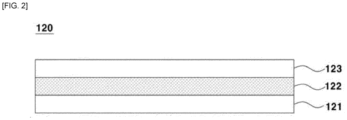
- FIG. 2 is a side view of a negative electrode 120 for a lithium secondary battery according to an embodiment of the present invention
- FIG. 3 is a cross-sectional view of the negative electrode 120 for a lithium secondary battery according to an embodiment of the present invention.
- the negative electrode 120 for a lithium secondary battery according to the present invention includes first to third layers 121, 122, 123, which are stacked from top to bottom.
- the first layer 121 and the third layer 123 may each comprise a lithium metal sheet, preferably comprising only a lithium metal sheet.
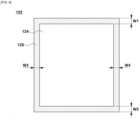
- FIG. 4 is a top view of the second layer 122 of the negative electrode 120 for a lithium secondary battery, according to an embodiment of the present invention.
- the second layer 122 may comprise a lithium metal sheet 124 and a negative electrode collector 125 surrounding an outer peripheral surface of the lithium metal sheet 124. That is, the negative electrode collector 125 may be hollow in the center, with the lithium metal sheet 124 located in the hollow space.
- both the negative electrode collector 125 and the lithium metal sheet 124 may be shown in the second layer 122.
- the area of the negative electrode collector 125 is present only on the outer peripheral surface of the lithium metal sheet 124, such that it is smaller than the area of the lithium metal sheet 124, and can preferably have an area of 10 to 30%, more preferably 10 to 20%, of the area of the second layer 122.
- the negative electrode collector 125 may have the same or different edge widths in vertical and horizontal directions from a top, bottom, left or right direction.
- the widths of collector in the vertical and horizontal directions of the negative electrode collector 125 are W1, W2, W3, and W4, respectively, they may be the same or different from each other, and are preferably defined by any of the following Equations 1 to 3.
- W1 is the vertical width of the upper edge
- W2 is the vertical width of the lower edge
- W3 is the horizontal width of the left edge
- W4 is the horizontal width of the right edge.
- the edge width of the negative electrode collector 125 may be as shown in Equation 1 above.
- the thickness of the negative electrode collector 125 may be between 1 and 10 ⁇ m, preferably 1 ⁇ m or more and less than 5 ⁇ m. Since a thickness of less than 1 ⁇ m is an excessively thin thickness, it is not possible to fabricate a thickness of the negative electrode collector 125 of less than 1 ⁇ m, and, since a thickness of more than 10 ⁇ m may result in a heavy weight of the negative electrode 120 for the lithium secondary battery, thereby reducing the energy density of the lithium secondary battery 100.
- the thickness of the lithium metal sheet 124 and the negative electrode collector 125 forming the second layer 122 may be the same. If the thickness of the lithium metal sheet 124 is thinner than the thickness of the negative electrode collector 125, then the lithium metal sheets of the first layer 121 and the third layer 123 may only contact the negative electrode collector 125 of the second layer 122, and not the lithium metal sheet 124, creating a void. Therefore, in the lithium secondary battery 100 including the negative electrode 120, the negative electrode 120 may not contribute to the generation of the capacitance of the lithium secondary battery 100, and as a result, the overall energy density of the lithium secondary battery 100 may decrease.
- the lithium metal sheets of the first layer 121 and the third layer 123 may only contact the lithium metal sheet 124 of the second layer 122, and not the negative electrode collector 125, creating a void and potentially reducing the conductivity of the negative electrode collector 125.
- the fabrication of the second layer 122 may be accomplished by disposing a sheet of lithium metal on one or both sides of the negative electrode collector 125 and rolling it, although not limited thereto in the present invention.
- the first to third layers 121, 122, 123 may be of the same size.
- the negative electrode collector 125 may comprise an undulated structure on the surface abutting the lithium metal sheets of the first to third layers 121, 122, 123.
- the undulation may be formed regularly or irregularly, for example, the undulation may be formed in the form of polygonal columns protruding or retracted from the surface. More specifically, the undulation may be formed in the form of protruding or retracted serrations.
- the bottom surface of the negative electrode collector 125 contacts the top surface of the lithium metal sheet of the first layer 121, so that the bottom surface of the negative electrode collector 125 may have an undulated structure. Furthermore, since the top surface of the negative electrode collector 125 is in contact with the bottom surface of the lithium metal sheet of the third layer 123, the top surface of the negative electrode collector 125 may have an undulated structure. Also, since the lithium metal sheet 124 of the second layer 122 is located on the inner side of the negative electrode collector 125, the inner circumferential surface of the negative electrode collector 125 in contact therewith may have an undulated structure.
- the negative electrode current collector 125 Due to the undulated structure of the surface of the negative electrode current collector 125 that contacts the lithium metal sheets of the first to third layers 121, 122, 123, it is possible to increase the adhesion strength with the lithium metal sheets. Additionally, it can reduce the weight of the negative electrode 120 used in lithium secondary batteries.
- the negative electrode collector 125 is not particularly limited as long as it has a high conductivity without causing chemical changes in the lithium secondary battery 100.
- copper, stainless steel, aluminum, nickel, titanium, palladium, calcined carbon, copper or stainless steel which is surface treated with carbon, nickel, silver, etc., aluminum-cadmium alloys, and the like may be used.
- the thickness of the first layer 121 may be from 10 to 50 ⁇ m, and the thickness of the third layer may be from 10 to 50 ⁇ m. Furthermore, the thickness of the negative electrode 120 for the lithium secondary battery may be 21 to 110 ⁇ m, preferably 21 ⁇ m or more and less than 105 ⁇ m.
- the negative electrode 120 for a lithium secondary battery may be fabricated by disposing the first layer 121 on the bottom surface of the second layer 122, disposing the third layer 123 on the upper surface of the second layer 122, and rolling the same, but the present invention is not particularly limited thereto.
- the negative electrode 120 for a lithium secondary battery may be fabricated by placing lithium metal sheets on both sides of the negative electrode collector 125 and rolling the same. At this time, the lithium metal sheets 124 are introduced inside the negative electrode collector 125 to form the second layer 122, and the lithium metal sheets that cannot be introduced and remain are present on the upper and the lower surfaces of the second layer 122.
- the lithium metal sheet located on the bottom surface may be the first layer 121, and the lithium metal sheet located on the top surface may be the third layer 123.
- the negative electrode 120 for a lithium secondary battery may be a negative electrode for a lithium-sulfur battery.
- the present invention is directed to a lithium secondary battery 100, comprising: a positive electrode 110; a negative electrode 120; and a separator 130 interposed between the positive and negative electrodes, wherein the size of the negative electrode 120 is larger than the size of the positive electrode 110, and the negative electrode 120 is the aforementioned negative electrode 120 according to an embodiment of the present invention.
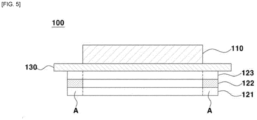
- FIG. 5 is a cross-sectional view of the lithium secondary battery 100 according to an embodiment of the present invention.
- the lithium secondary battery 100 comprises the positive electrode 110, the negative electrode 120, and a separator interposed between the positive electrode 110 and the negative electrode 120.
- the negative electrode 120 and the positive electrode 110 may be located at regions corresponding to each other.
- the negative electrode 120 may have a region A that is not in contact with the positive electrode 110 and a region in contact with the positive electrode 110.
- the region in contact with the positive electrode 110 means that the positive electrode 110 and the negative electrode 120 are not in direct contact, but are in contact with the separator 130 disposed therebetween.
- the size of the lithium metal sheet 124 of the second layer 122 of the negative electrode 120 may be less than or equal to the size of the positive electrode 110.
- the positive electrode 110 may be a positive-electrode collector (not shown) to which a positive-electrode active material is applied, in which the positive-electrode active material may comprise sulfur.
- the positive-electrode active material may be a sulfur-carbon composite which comprises porous carbon material and sulfur on at least some of the inner and outer surfaces of the porous carbon material.
- the lithium secondary battery 100 may be a lithium-sulfur battery.
- the lithium secondary battery 100 solves the problem of detachment of lithium metal occurring in conventional lithium secondary batteries.
- the negative electrode 120 for a lithium secondary battery according to an embodiment of the present invention includes the lithium metal sheet 124 and the negative electrode collector 125 surrounding an outer peripheral surface of the lithium metal sheet 124 in the second layer 122.
- the porosity of the lithium metal gradually increases when charging and discharging reactions are repeatedly performed, and as the stiffness weakens, the detachment of the lithium metal proceeds from the edge of the negative electrode 120, that is, the region (A) where the negative electrode 120 does not contact the positive electrode 110.
- the negative electrode 120 for the lithium secondary battery according to an embodiment of the present invention includes the negative electrode collector 125 in the second layer 122, the detachment of the lithium metal can be prevented by the negative electrode collector 125 even if the rigidity of the lithium metal becomes weaker with repeated charging and discharging.
- the lithium secondary battery 100 according to an embodiment of the present invention can minimize the loss of energy density while securing safety.
- the weight is heavy and may cause a loss of energy density of the lithium secondary battery.
- the thickness of the second layer 122 of the present invention is required to be thicker than the thickness of the second layer 122 of the present invention because only the second layer 122 is required to be used as a negative electrode, and therefore, the weight may be heavier than the negative electrode 120 for the lithium secondary battery of the present invention. Therefore, the negative electrode 120 for the lithium secondary battery according to an embodiment of the present invention may be more advantageous in terms of energy density.
- Lithium secondary battery 110 Positive electrode 120: Negative electrode 121: First layer 122: Second layer 123: Third layer 124: Lithium metal sheet 125: Negative electrode collector 130: Separator
Landscapes
- Chemical & Material Sciences (AREA)
- Chemical Kinetics & Catalysis (AREA)
- Electrochemistry (AREA)
- General Chemical & Material Sciences (AREA)
- Engineering & Computer Science (AREA)
- Materials Engineering (AREA)
- Manufacturing & Machinery (AREA)
- Cell Electrode Carriers And Collectors (AREA)
- Battery Electrode And Active Subsutance (AREA)
- Secondary Cells (AREA)
Abstract
Description
- The present application claims the benefit of priority to
Korean Patent Application No. 10-2022-0176315, filed December 15, 2022 - The present invention relates to a negative electrode for a lithium secondary battery and a lithium secondary battery comprising the same.
- With the rapid development of the electronics, communications, and computer industries, energy storage technology is expanding to camcorders, cell phones, laptops, PCs, and even electric vehicles. This has led to the development of high-performance secondary batteries that are lightweight, long-lasting, and highly reliable.
- Lithium secondary batteries are gaining traction as batteries that meet these needs.
- A lithium secondary battery having a laminated or wound structure of an electrode assembly includes a positive electrode and a negative electrode, and a separator interposed therebetween. The electrode assembly is embedded in a battery case and an electrolyte is injected therein. The lithium secondary battery produces electrical energy by an oxidation/reduction reaction when lithium ions are introduced/removed from a positive electrode and a negative electrode.
- Among lithium secondary batteries, a lithium-sulfur battery, which uses sulfur-based materials as the positive-electrode active material, is a battery that has recently gained attention. Sulfur, the primary material for positive-electrode active materials, has the advantages of being very abundant, non-toxic, and having a low weight per atom. In addition, the theoretical discharge capacity of the Li-Sulfur battery is 1,675mAh/g-sulfur, and the theoretical energy density is 2,600Wh/kg, which is higher than the theoretical energy density of other battery systems currently being studied (Ni-MH battery: 450 Wh/kg, Li-FeS battery: 480 Wh/kg, Li-MnO2 battery: 1,000 Wh/kg, Na-S battery: 800 Wh/kg), making them the most promising batteries being developed to date.
-
FIG. 1 is a cross-sectional view of a conventional lithiumsecondary battery 100. Referring toFIG. 1 , aseparator 130 is interposed between apositive electrode 110 and anegative electrode 120, in which the size of thenegative electrode 120 is larger than the size of thepositive electrode 110, and thenegative electrode 120 is located in a region that is alighned with thepositive electrode 110, so that thenegative electrode 120 and thepositive electrode 110 are in contact with each other by way of theseparator 130 interposed therebetween. Since the size of thenegative electrode 120 is larger than the size of thepositive electrode 110, there is an area A on thenegative electrode 120 that is not in contact with thepositive electrode 110. Thenegative electrode 120 may be made of lithium metal. - The charging and discharging reaction of the lithium
secondary battery 100 takes place only in the region where thenegative electrode 120 and thepositive electrode 110 contact each other by way of theseparator 130 interposed therebetween. When the charging and discharging reactions of the lithiumsecondary battery 100 are repeatedly performed, the porosity of the lithium metal that is thenegative electrode 120 gradually increases, and the rigidity becomes weaker. Accordingly, the lithium metal can become detached in the area A that is not in contact with thepositive electrode 110, which corresponds to the edges of thenegative electrode 120. The detached lithium metal pieces may move freely inside the pouch cell, and when an external force is applied to the lithiumsecondary battery 100, the detached lithium metal pieces may cause a short circuit of the lithiumsecondary battery 100. - Therefore, there is a need for research on lithium secondary batteries that can solve the above problems.
- In order to solve the above problem, the present inventors conducted various studies and confirmed that, by changing the structure of the negative electrode for a lithium secondary battery, it is possible to prevent the lithium metal from being detached in the area of the negative electrode that is not in contact with the positive electrode by way of a separator, and completed the present invention.
- Accordingly, it is an object of the present invention to provide a negative electrode for a lithium secondary battery capable of preventing detachment of lithium metal.
- Further, it is an object of the present invention to provide a lithium secondary battery comprising such a negative electrode for the lithium secondary battery .
- To achieve the above objectives, the present invention provides a negative electrode for a lithium secondary battery, comprising: a first layer comprising a lithium metal sheet; a second layer formed on a top surface of the first layer and including a lithium metal sheet and a negative electrode collector surrounding an outer peripheral surface of the lithium metal sheet; and a third layer formed on a top surface of the second layer and including a lithium metal sheet.
- In an embodiment of the present invention, the negative electrode collector may have same or different edge widths in vertical and horizontal directions from a top, bottom, left or right direction.
- In an embodiment of the present invention, the negative electrode collector may have an area of from 10 to 30% of an area of the second layer.
- In an embodiment of the present invention, a surface of the negative electrode collector that abuts the lithium metal sheet of the first to third layer may comprise an undulated structure.
- In an embodiment of the present invention, the negative electrode collector may have a thickness of 1 to 10 µm.
- In an embodiment of the present invention, the negative electrode collector may have a thickness of 1 or more and less than 5 µm.
- In an embodiment of the present invention, the first and third layers may have a same size.
- In an embodiment of the present invention, a thickness of the negative electrode collector and a thickness of the lithium metal sheet of the second layer may be same.
- In an embodiment of the present invention, the first layer may have a thickness of 10 to 50 µm, the third layer may have a thickness of 10 to 50 µm, and the negative electrode for a lithium secondary battery may have a thickness of 21 to 110 µm.
- In an embodiment of the present invention, the negative electrode for the lithium secondary battery may be a negative electrode for a lithium-sulfur battery.
- The present invention also provides a lithium secondary battery, comprising a positive electrode; a negative electrode; a separator interposed between the positive and negative electrodes; and an electrolyte, wherein a size of the negative electrode is larger than a size of the positive electrode, and wherein the negative electrode is the aforementioned negative electrode.
- In an embodiment of the present invention, a size of the lithium metal sheet of the second layer of the negative electrode may be less than or equal to the size of the positive electrode.
- In an embodiment of the present invention, the lithium secondary battery may be a lithium-sulfur battery.
- The negative electrode for the lithium secondary battery of the present invention can prevent the lithium metal from being detached in the area not in contact with the positive electrode with a separator interposed therebetween, minimize the loss of energy density, and improve safety.
-
-
FIG. 1 is a cross-sectional view of a conventional lithium secondary battery . -
FIG. 2 is a side view of a negative electrode for a lithium secondary battery according to an embodiment of the present invention. -
FIG. 3 is a cross-sectional view of a negative electrode for a lithium secondary battery according to an embodiment of the present invention. -
FIG. 4 is a top view of a second layer of a negative electrode for a lithium secondary battery, according to an embodiment of the present invention. -
FIG. 5 is a cross-sectional view of a lithium secondary battery according to an embodiment of the present invention. - The present invention is hereinafter described in detail with reference to the accompanying drawings so as to facilitate practice by one having ordinary skill in the art to which the present invention belongs. However, the present invention may be implemented in many different forms and is not limited to the embodiments described herein.
- In order to clearly illustrate the present invention, parts not pertinent to the description have been omitted, and identical or similar components are designated by the same reference numerals throughout the specification.
- Furthermore, the terms and words used in this specification and the claims of the patent are not to be construed in their ordinary or dictionary sense, but are to be construed with a meaning and concept consistent with the technical idea of the present invention, based on the principle that the inventor may properly define the concept of a term to best describe his invention.
- Hereinafter, embodiments will be described in detail with reference to the accompanying drawings. However, the present invention can be implemented in many different forms and is not limited to the embodiments described herein.
- The present invention provides a
negative electrode 120 for a lithium secondary battery, comprising: a first layer 121comprising a lithium metal sheet; asecond layer 122 formed on a top surface of the first layer and including alithium metal sheet 124 and anegative electrode collector 125 surrounding an outer peripheral surface of the lithium metal sheet; and athird layer 123 formed on a top surface of the second layer and including a lithium metal sheet. -
FIG. 2 is a side view of anegative electrode 120 for a lithium secondary battery according to an embodiment of the present invention, andFIG. 3 is a cross-sectional view of thenegative electrode 120 for a lithium secondary battery according to an embodiment of the present invention. - Referring to
FIGS. 2 and3 , thenegative electrode 120 for a lithium secondary battery according to the present invention includes first tothird layers - The
first layer 121 and thethird layer 123 may each comprise a lithium metal sheet, preferably comprising only a lithium metal sheet. -
FIG. 4 is a top view of thesecond layer 122 of thenegative electrode 120 for a lithium secondary battery, according to an embodiment of the present invention. - Referring to
FIG. 4 , thesecond layer 122 may comprise alithium metal sheet 124 and anegative electrode collector 125 surrounding an outer peripheral surface of thelithium metal sheet 124. That is, thenegative electrode collector 125 may be hollow in the center, with thelithium metal sheet 124 located in the hollow space. - Therefore, referring to
FIG. 2 , in a side view of thenegative electrode 120 for a lithium secondary battery according to an embodiment of the present invention, only thenegative electrode collector 125 may be shown in thesecond layer 122, and, referring toFIG. 5 , in a side view of thenegative electrode 120 for a lithium secondary battery according to an embodiment of the present invention, both thenegative electrode collector 125 and thelithium metal sheet 124 may be shown in thesecond layer 122. - The area of the
negative electrode collector 125 is present only on the outer peripheral surface of thelithium metal sheet 124, such that it is smaller than the area of thelithium metal sheet 124, and can preferably have an area of 10 to 30%, more preferably 10 to 20%, of the area of thesecond layer 122. - Furthermore, the
negative electrode collector 125 may have the same or different edge widths in vertical and horizontal directions from a top, bottom, left or right direction.. When the widths of collector in the vertical and horizontal directions of thenegative electrode collector 125 are W1, W2, W3, and W4, respectively, they may be the same or different from each other, and are preferably defined by any of the following Equations 1 to 3.


- In the above Equations 1 to 3, W1 is the vertical width of the upper edge, W2 is the vertical width of the lower edge, W3 is the horizontal width of the left edge, and W4 is the horizontal width of the right edge.
- Preferably, the edge width of the
negative electrode collector 125 may be as shown in Equation 1 above. - The thickness of the
negative electrode collector 125 may be between 1 and 10 µm, preferably 1 µm or more and less than 5 µm. Since a thickness of less than 1 µm is an excessively thin thickness, it is not possible to fabricate a thickness of thenegative electrode collector 125 of less than 1 µm, and, since a thickness of more than 10 µm may result in a heavy weight of thenegative electrode 120 for the lithium secondary battery, thereby reducing the energy density of the lithiumsecondary battery 100. - The thickness of the
lithium metal sheet 124 and thenegative electrode collector 125 forming thesecond layer 122 may be the same. If the thickness of thelithium metal sheet 124 is thinner than the thickness of thenegative electrode collector 125, then the lithium metal sheets of thefirst layer 121 and thethird layer 123 may only contact thenegative electrode collector 125 of thesecond layer 122, and not thelithium metal sheet 124, creating a void. Therefore, in the lithiumsecondary battery 100 including thenegative electrode 120, thenegative electrode 120 may not contribute to the generation of the capacitance of the lithiumsecondary battery 100, and as a result, the overall energy density of the lithiumsecondary battery 100 may decrease. Additionally, if the thickness of thelithium metal sheet 124 is thicker than the thickness of thenegative electrode collector 125, the lithium metal sheets of thefirst layer 121 and thethird layer 123 may only contact thelithium metal sheet 124 of thesecond layer 122, and not thenegative electrode collector 125, creating a void and potentially reducing the conductivity of thenegative electrode collector 125. - The fabrication of the
second layer 122 may be accomplished by disposing a sheet of lithium metal on one or both sides of thenegative electrode collector 125 and rolling it, although not limited thereto in the present invention. - The first to
third layers - Furthermore, the
negative electrode collector 125 may comprise an undulated structure on the surface abutting the lithium metal sheets of the first tothird layers - The undulation may be formed regularly or irregularly, for example, the undulation may be formed in the form of polygonal columns protruding or retracted from the surface. More specifically, the undulation may be formed in the form of protruding or retracted serrations.
- Specifically, the bottom surface of the
negative electrode collector 125 contacts the top surface of the lithium metal sheet of thefirst layer 121, so that the bottom surface of thenegative electrode collector 125 may have an undulated structure. Furthermore, since the top surface of thenegative electrode collector 125 is in contact with the bottom surface of the lithium metal sheet of thethird layer 123, the top surface of thenegative electrode collector 125 may have an undulated structure. Also, since thelithium metal sheet 124 of thesecond layer 122 is located on the inner side of thenegative electrode collector 125, the inner circumferential surface of thenegative electrode collector 125 in contact therewith may have an undulated structure. - Due to the undulated structure of the surface of the negative electrode
current collector 125 that contacts the lithium metal sheets of the first tothird layers negative electrode 120 used in lithium secondary batteries. - The
negative electrode collector 125 is not particularly limited as long as it has a high conductivity without causing chemical changes in the lithiumsecondary battery 100. For example, copper, stainless steel, aluminum, nickel, titanium, palladium, calcined carbon, copper or stainless steel which is surface treated with carbon, nickel, silver, etc., aluminum-cadmium alloys, and the like may be used. - The thickness of the
first layer 121 may be from 10 to 50 µm, and the thickness of the third layer may be from 10 to 50 µm. Furthermore, the thickness of thenegative electrode 120 for the lithium secondary battery may be 21 to 110 µm, preferably 21 µm or more and less than 105 µm. - The
negative electrode 120 for a lithium secondary battery may be fabricated by disposing thefirst layer 121 on the bottom surface of thesecond layer 122, disposing thethird layer 123 on the upper surface of thesecond layer 122, and rolling the same, but the present invention is not particularly limited thereto. Alternatively, thenegative electrode 120 for a lithium secondary battery may be fabricated by placing lithium metal sheets on both sides of thenegative electrode collector 125 and rolling the same. At this time, thelithium metal sheets 124 are introduced inside thenegative electrode collector 125 to form thesecond layer 122, and the lithium metal sheets that cannot be introduced and remain are present on the upper and the lower surfaces of thesecond layer 122. The lithium metal sheet located on the bottom surface may be thefirst layer 121, and the lithium metal sheet located on the top surface may be thethird layer 123. - The
negative electrode 120 for a lithium secondary battery according to an embodiment of the present invention may be a negative electrode for a lithium-sulfur battery. - The present invention is directed to a lithium
secondary battery 100, comprising: apositive electrode 110; anegative electrode 120; and aseparator 130 interposed between the positive and negative electrodes, wherein the size of thenegative electrode 120 is larger than the size of thepositive electrode 110, and thenegative electrode 120 is the aforementionednegative electrode 120 according to an embodiment of the present invention. -
FIG. 5 is a cross-sectional view of the lithiumsecondary battery 100 according to an embodiment of the present invention. - Referring to
FIG. 5 , the lithiumsecondary battery 100 according to the present invention comprises thepositive electrode 110, thenegative electrode 120, and a separator interposed between thepositive electrode 110 and thenegative electrode 120. - The
negative electrode 120 and thepositive electrode 110 may be located at regions corresponding to each other. - Further, since the size of the
negative electrode 120 is larger than the size of thepositive electrode 110, thenegative electrode 120 may have a region A that is not in contact with thepositive electrode 110 and a region in contact with thepositive electrode 110. The region in contact with thepositive electrode 110 means that thepositive electrode 110 and thenegative electrode 120 are not in direct contact, but are in contact with theseparator 130 disposed therebetween. - Here, the size of the
lithium metal sheet 124 of thesecond layer 122 of thenegative electrode 120 may be less than or equal to the size of thepositive electrode 110. - The
positive electrode 110 may be a positive-electrode collector (not shown) to which a positive-electrode active material is applied, in which the positive-electrode active material may comprise sulfur. Specifically, the sulfur may be at least one selected from a group consisting of inorganic sulfur (S8), Li-Sn (n≥1), organic sulfur compounds, and carbon-sulfur polymers [(C2Sx)n, x=2.5 to 50, n≥2], and preferably inorganic sulfur (Ss). Further, the positive-electrode active material may be a sulfur-carbon composite which comprises porous carbon material and sulfur on at least some of the inner and outer surfaces of the porous carbon material. - Thus, the lithium
secondary battery 100 according to an embodiment of the present invention may be a lithium-sulfur battery. - The lithium
secondary battery 100 according to an embodiment of the present invention solves the problem of detachment of lithium metal occurring in conventional lithium secondary batteries. In detail, thenegative electrode 120 for a lithium secondary battery according to an embodiment of the present invention includes thelithium metal sheet 124 and thenegative electrode collector 125 surrounding an outer peripheral surface of thelithium metal sheet 124 in thesecond layer 122. In the conventional lithiumsecondary battery 100, the porosity of the lithium metal gradually increases when charging and discharging reactions are repeatedly performed, and as the stiffness weakens, the detachment of the lithium metal proceeds from the edge of thenegative electrode 120, that is, the region (A) where thenegative electrode 120 does not contact thepositive electrode 110. Thenegative electrode 120 for the lithium secondary battery according to an embodiment of the present invention, on the other hand, includes thenegative electrode collector 125 in thesecond layer 122, the detachment of the lithium metal can be prevented by thenegative electrode collector 125 even if the rigidity of the lithium metal becomes weaker with repeated charging and discharging. Thus, the lithiumsecondary battery 100 according to an embodiment of the present invention can minimize the loss of energy density while securing safety. Due to repeated charging and discharging, detachment of lithium metal may occur at the edges of thefirst layer 121 and thethird layer 123 of thenegative electrode 120 for the lithium secondary battery, but due to thenegative electrode collector 125 of thesecond layer 122, the bonding between the lithium metal sheets of the first and third layers can be maintained, thereby solving the same problem as in the prior art. - On the other hand, in the case of a negative electrode having lithium metal sheets laminated to the entire area of the sheet-shaped negative electrode collector, the weight is heavy and may cause a loss of energy density of the lithium secondary battery. Furthermore, in the case of the negative electrode comprising solely the
second layer 122 of the present invention, the thickness of thesecond layer 122 of the present invention is required to be thicker than the thickness of thesecond layer 122 of the present invention because only thesecond layer 122 is required to be used as a negative electrode, and therefore, the weight may be heavier than thenegative electrode 120 for the lithium secondary battery of the present invention. Therefore, thenegative electrode 120 for the lithium secondary battery according to an embodiment of the present invention may be more advantageous in terms of energy density. - While the above has described in detail a preferred embodiment of the present invention, the scope of the present invention is not limited thereto, and various modifications and improvements by those skilled in the art utilizing the basic concepts of the present invention as defined in the following claims are also within the scope of the present invention.
-
100: Lithium secondary battery 110: Positive electrode 120: Negative electrode 121: First layer 122: Second layer 123: Third layer 124: Lithium metal sheet 125: Negative electrode collector 130: Separator
Claims (13)
- A negative electrode for a lithium secondary battery, comprising:a first layer comprising a lithium metal sheet;a second layer formed on a top surface of the first layer and including a lithium metal sheet and a negative electrode collector surrounding an outer peripheral surface of the lithium metal sheet; anda third layer formed on a top surface of the second layer and including a lithium metal sheet.
- The negative electrode for the lithium secondary battery according to claim 1, wherein the negative electrode collector has the same or different edge widths in vertical and horizontal directions from a top, bottom, left or right direction.
- The negative electrode for the lithium secondary battery according to claim 1, wherein the negative electrode collector has an area of from 10 to 30% of an area of the second layer.
- The negative electrode for the lithium secondary battery according to claim 1, wherein a surface of the negative electrode collector that abuts the lithium metal sheet of the first to third layer comprises an undulated structure.
- The negative electrode for the lithium secondary battery according to claim 1, wherein the negative electrode collector has a thickness of 1 to 10 µm.
- The negative electrode for the lithium secondary battery according to claim 5, wherein the negative electrode collector has a thickness of 1 or more and less than 5 µm.
- The negative electrode for the lithium secondary battery according to claim 1, wherein the first and third layers have a same size.
- The negative electrode for the lithium secondary battery according to claim 1, wherein a thickness of the negative electrode collector and a thickness of the lithium metal sheet of the second layer are same.
- The negative electrode for the lithium secondary battery according to claim 1, wherein the first layer has a thickness of 10 to 50 µm, the third layer has a thickness of 10 to 50 µm, and the negative electrode for a lithium secondary battery has a thickness of 21 to 110 µm.
- The negative electrode for the lithium secondary battery according to claim 1, wherein the negative electrode for the lithium secondary battery is a negative electrode for a lithium-sulfur battery.
- A lithium secondary battery, comprising:a positive electrode;a negative electrode;a separator interposed between the positive and negative electrodes; and an electrolyte,wherein a size of the negative electrode is larger than a size of the positive electrode, andwherein the negative electrode is the negative electrode of any one of claims 1 to 10.
- The lithium secondary battery according to claim 11, wherein a size of the lithium metal sheet of the second layer of the negative electrode is less than or equal to the size of the positive electrode.
- The lithium secondary battery according to claim 11, wherein the lithium secondary battery is a lithium-sulfur battery.
Applications Claiming Priority (2)
| Application Number | Priority Date | Filing Date | Title |
|---|---|---|---|
| KR1020220176315A KR20240093241A (en) | 2022-12-15 | 2022-12-15 | Negative electrode for Lithium secondary battery and lithium secondary battery comprising the same |
| PCT/KR2023/018950 WO2024128609A1 (en) | 2022-12-15 | 2023-11-23 | Negative electrode for lithium secondary battery and lithium secondary battery comprising same |
Publications (2)
| Publication Number | Publication Date |
|---|---|
| EP4439738A1 true EP4439738A1 (en) | 2024-10-02 |
| EP4439738A4 EP4439738A4 (en) | 2025-09-24 |
Family
ID=91485160
Family Applications (1)
| Application Number | Title | Priority Date | Filing Date |
|---|---|---|---|
| EP23903812.8A Pending EP4439738A4 (en) | 2022-12-15 | 2023-11-23 | NEGATIVE ELECTRODE FOR LITHIUM SECONDARY BATTERY AND LITHIUM SECONDARY BATTERY THEREFORE |
Country Status (6)
| Country | Link |
|---|---|
| US (1) | US20250149563A1 (en) |
| EP (1) | EP4439738A4 (en) |
| JP (1) | JP2025506542A (en) |
| KR (1) | KR20240093241A (en) |
| CN (1) | CN118511335A (en) |
| WO (1) | WO2024128609A1 (en) |
Family Cites Families (8)
| Publication number | Priority date | Publication date | Assignee | Title |
|---|---|---|---|---|
| KR20140005075A (en) * | 2012-07-03 | 2014-01-14 | 한국전자통신연구원 | Method of manufacturing lithium battery |
| KR101561188B1 (en) * | 2013-02-20 | 2015-10-16 | 에스케이이노베이션 주식회사 | Anode for lithium secondary battery, fabricating method thereof and lithium air battery having the same |
| KR101976174B1 (en) * | 2016-02-24 | 2019-05-09 | 주식회사 엘지화학 | Electrode assembly for lithium secondary battery and electrode module |
| KR102429876B1 (en) | 2016-04-29 | 2022-08-05 | 삼성전자주식회사 | Negative electrode for lithium metal battery and lithium metal battery comprising the same |
| JP7117658B2 (en) * | 2017-05-29 | 2022-08-15 | パナソニックIpマネジメント株式会社 | Lithium metal secondary battery |
| CN208706767U (en) * | 2018-08-21 | 2019-04-05 | 珠海光宇电池有限公司 | Lithium battery cathode plate and lamination type electric core |
| JP7770770B2 (en) * | 2021-01-07 | 2025-11-17 | Tdk株式会社 | Lithium metal secondary battery |
| CN113611871A (en) * | 2021-07-30 | 2021-11-05 | 长沙矿冶研究院有限责任公司 | Lithium battery negative plate, preparation method thereof and lithium battery |
-
2022
- 2022-12-15 KR KR1020220176315A patent/KR20240093241A/en active Pending
-
2023
- 2023-11-23 CN CN202380016072.2A patent/CN118511335A/en active Pending
- 2023-11-23 WO PCT/KR2023/018950 patent/WO2024128609A1/en not_active Ceased
- 2023-11-23 EP EP23903812.8A patent/EP4439738A4/en active Pending
- 2023-11-23 JP JP2024549202A patent/JP2025506542A/en active Pending
- 2023-11-23 US US18/833,877 patent/US20250149563A1/en active Pending
Also Published As
| Publication number | Publication date |
|---|---|
| EP4439738A4 (en) | 2025-09-24 |
| CN118511335A (en) | 2024-08-16 |
| US20250149563A1 (en) | 2025-05-08 |
| WO2024128609A1 (en) | 2024-06-20 |
| JP2025506542A (en) | 2025-03-11 |
| KR20240093241A (en) | 2024-06-24 |
Similar Documents
| Publication | Publication Date | Title |
|---|---|---|
| EP2840638B1 (en) | Electrode assembly, and battery cell and device comprising same | |
| US8426068B2 (en) | Metal foil for secondary battery and secondary battery | |
| KR20210087943A (en) | Intermittent coated dry electrode for energy storage device and method for manufacturing same | |
| US20230318145A1 (en) | Solid-state battery | |
| CN109216754B (en) | All-solid-state battery and method for manufacturing same | |
| US20240030483A1 (en) | Cell assembly and all solid-state battery comprising the same | |
| KR20180058333A (en) | Electrode for Secondary Battery Comprising Layer for Protecting Electrode Layer | |
| KR102403673B1 (en) | Electrode assembly, secondary battery and manufacturing method of electrode assembly | |
| US10804571B2 (en) | Method of manufacturing battery cell comprising electrode having aperture | |
| EP3598555B1 (en) | Electrode, electrode assembly and method for manufacturing the same | |
| US20250149563A1 (en) | Negative electrode for a lithium secondary battery and a lithium secondary battery including the same | |
| KR102869017B1 (en) | Lithium ion secondary battery and manufacturing method of the same | |
| US20240297379A1 (en) | Secondary battery | |
| US20190296399A1 (en) | Secondary battery | |
| JPH1167222A (en) | Current collector for battery and battery using it | |
| CN119601576A (en) | Battery cell, battery, electric device, cathode plate and manufacturing method thereof | |
| EP4123774A1 (en) | Electrode assembly and secondary battery | |
| US20240332604A1 (en) | Solid electrolyte composite | |
| CN223898304U (en) | Electrode assembly, battery and electric equipment | |
| JP7801974B2 (en) | solid state battery | |
| KR100325870B1 (en) | Tap structure of a lithium polymer secondary battery preventing shearing of the tap | |
| EP4654302A1 (en) | Composite substrate, electrode assembly using same, and method of manufacturing the electrode assembly | |
| EP4273981A1 (en) | Jelly-roll electrode assembly and secondary battery comprising same | |
| EP4428983A1 (en) | Electrode assembly and battery cell including same | |
| US20260038926A1 (en) | Battery cell, battery, electric apparatus, and energy storage device |
Legal Events
| Date | Code | Title | Description |
|---|---|---|---|
| STAA | Information on the status of an ep patent application or granted ep patent |
Free format text: STATUS: THE INTERNATIONAL PUBLICATION HAS BEEN MADE |
|
| PUAI | Public reference made under article 153(3) epc to a published international application that has entered the european phase |
Free format text: ORIGINAL CODE: 0009012 |
|
| STAA | Information on the status of an ep patent application or granted ep patent |
Free format text: STATUS: REQUEST FOR EXAMINATION WAS MADE |
|
| 17P | Request for examination filed |
Effective date: 20240626 |
|
| AK | Designated contracting states |
Kind code of ref document: A1 Designated state(s): AL AT BE BG CH CY CZ DE DK EE ES FI FR GB GR HR HU IE IS IT LI LT LU LV MC ME MK MT NL NO PL PT RO RS SE SI SK SM TR |
|
| A4 | Supplementary search report drawn up and despatched |
Effective date: 20250826 |
|
| RIC1 | Information provided on ipc code assigned before grant |
Ipc: H01M 4/70 20060101AFI20250820BHEP Ipc: H01M 4/134 20100101ALI20250820BHEP Ipc: H01M 4/38 20060101ALI20250820BHEP Ipc: H01M 4/66 20060101ALI20250820BHEP Ipc: H01M 10/052 20100101ALI20250820BHEP Ipc: H01M 4/02 20060101ALI20250820BHEP Ipc: H01M 4/1395 20100101ALI20250820BHEP |
|
| DAV | Request for validation of the european patent (deleted) | ||
| DAX | Request for extension of the european patent (deleted) |