EP4439736A1 - Secondary battery and electronic apparatus - Google Patents
Secondary battery and electronic apparatus Download PDFInfo
- Publication number
- EP4439736A1 EP4439736A1 EP24166497.8A EP24166497A EP4439736A1 EP 4439736 A1 EP4439736 A1 EP 4439736A1 EP 24166497 A EP24166497 A EP 24166497A EP 4439736 A1 EP4439736 A1 EP 4439736A1
- Authority
- EP
- European Patent Office
- Prior art keywords
- positive electrode
- active material
- secondary battery
- electrode active
- particles
- Prior art date
- Legal status (The legal status is an assumption and is not a legal conclusion. Google has not performed a legal analysis and makes no representation as to the accuracy of the status listed.)
- Pending
Links
- 239000002245 particle Substances 0.000 claims abstract description 149
- 239000007774 positive electrode material Substances 0.000 claims abstract description 98
- 125000004093 cyano group Chemical group *C#N 0.000 claims abstract description 12
- 150000002894 organic compounds Chemical class 0.000 claims abstract description 12
- KSXHZOTTWSNEHY-UHFFFAOYSA-N 3-[3-(2-cyanoethoxy)-2,2-bis(2-cyanoethoxymethyl)propoxy]propanenitrile Chemical compound N#CCCOCC(COCCC#N)(COCCC#N)COCCC#N KSXHZOTTWSNEHY-UHFFFAOYSA-N 0.000 claims description 14
- 229920002125 Sokalan® Polymers 0.000 claims description 9
- 238000009826 distribution Methods 0.000 claims description 8
- 239000004584 polyacrylic acid Substances 0.000 claims description 8
- 229920002239 polyacrylonitrile Polymers 0.000 claims description 7
- SZWJHJKAKYAICN-UHFFFAOYSA-N 1-nitro-4-[1,2,2-tris(4-nitrophenyl)ethenyl]benzene Chemical group C1=CC([N+](=O)[O-])=CC=C1C(C=1C=CC(=CC=1)[N+]([O-])=O)=C(C=1C=CC(=CC=1)[N+]([O-])=O)C1=CC=C([N+]([O-])=O)C=C1 SZWJHJKAKYAICN-UHFFFAOYSA-N 0.000 claims description 4
- LIEQVZZZYLHNRH-UHFFFAOYSA-N 5-methylpyridine-2-carbonitrile Chemical compound CC1=CC=C(C#N)N=C1 LIEQVZZZYLHNRH-UHFFFAOYSA-N 0.000 claims description 4
- 238000009825 accumulation Methods 0.000 claims description 3
- 239000010410 layer Substances 0.000 description 56
- 238000012360 testing method Methods 0.000 description 27
- 239000003792 electrolyte Substances 0.000 description 26
- 238000004519 manufacturing process Methods 0.000 description 18
- 239000006258 conductive agent Substances 0.000 description 14
- HBBGRARXTFLTSG-UHFFFAOYSA-N Lithium ion Chemical compound [Li+] HBBGRARXTFLTSG-UHFFFAOYSA-N 0.000 description 12
- 229910001416 lithium ion Inorganic materials 0.000 description 12
- 239000007773 negative electrode material Substances 0.000 description 11
- -1 polytetrafluoroethylene Polymers 0.000 description 11
- 229910052744 lithium Inorganic materials 0.000 description 10
- OKTJSMMVPCPJKN-UHFFFAOYSA-N Carbon Chemical group [C] OKTJSMMVPCPJKN-UHFFFAOYSA-N 0.000 description 9
- WHXSMMKQMYFTQS-UHFFFAOYSA-N Lithium Chemical compound [Li] WHXSMMKQMYFTQS-UHFFFAOYSA-N 0.000 description 8
- SECXISVLQFMRJM-UHFFFAOYSA-N N-Methylpyrrolidone Chemical compound CN1CCCC1=O SECXISVLQFMRJM-UHFFFAOYSA-N 0.000 description 8
- 239000011230 binding agent Substances 0.000 description 8
- 230000000052 comparative effect Effects 0.000 description 8
- 239000011267 electrode slurry Substances 0.000 description 8
- 239000000463 material Substances 0.000 description 8
- 230000014759 maintenance of location Effects 0.000 description 7
- 229910052751 metal Inorganic materials 0.000 description 7
- 239000002184 metal Substances 0.000 description 7
- XEKOWRVHYACXOJ-UHFFFAOYSA-N Ethyl acetate Chemical compound CCOC(C)=O XEKOWRVHYACXOJ-UHFFFAOYSA-N 0.000 description 6
- 238000000354 decomposition reaction Methods 0.000 description 6
- 230000003647 oxidation Effects 0.000 description 6
- 238000007254 oxidation reaction Methods 0.000 description 6
- 238000001035 drying Methods 0.000 description 5
- 238000012986 modification Methods 0.000 description 5
- 230000004048 modification Effects 0.000 description 5
- RYGMFSIKBFXOCR-UHFFFAOYSA-N Copper Chemical compound [Cu] RYGMFSIKBFXOCR-UHFFFAOYSA-N 0.000 description 4
- PXHVJJICTQNCMI-UHFFFAOYSA-N Nickel Chemical compound [Ni] PXHVJJICTQNCMI-UHFFFAOYSA-N 0.000 description 4
- 239000011149 active material Substances 0.000 description 4
- FKRCODPIKNYEAC-UHFFFAOYSA-N ethyl propionate Chemical compound CCOC(=O)CC FKRCODPIKNYEAC-UHFFFAOYSA-N 0.000 description 4
- 238000000034 method Methods 0.000 description 4
- 238000003825 pressing Methods 0.000 description 4
- 239000002904 solvent Substances 0.000 description 4
- 229920003048 styrene butadiene rubber Polymers 0.000 description 4
- 239000000126 substance Substances 0.000 description 4
- 239000002562 thickening agent Substances 0.000 description 4
- 239000004698 Polyethylene Substances 0.000 description 3
- 239000004372 Polyvinyl alcohol Substances 0.000 description 3
- XBDQKXXYIPTUBI-UHFFFAOYSA-M Propionate Chemical compound CCC([O-])=O XBDQKXXYIPTUBI-UHFFFAOYSA-M 0.000 description 3
- 229910045601 alloy Inorganic materials 0.000 description 3
- 239000000956 alloy Substances 0.000 description 3
- 238000004364 calculation method Methods 0.000 description 3
- 238000007796 conventional method Methods 0.000 description 3
- 238000005520 cutting process Methods 0.000 description 3
- JBTWLSYIZRCDFO-UHFFFAOYSA-N ethyl methyl carbonate Chemical compound CCOC(=O)OC JBTWLSYIZRCDFO-UHFFFAOYSA-N 0.000 description 3
- 239000011888 foil Substances 0.000 description 3
- VNWKTOKETHGBQD-UHFFFAOYSA-N methane Chemical class C VNWKTOKETHGBQD-UHFFFAOYSA-N 0.000 description 3
- 239000011146 organic particle Substances 0.000 description 3
- 239000003960 organic solvent Substances 0.000 description 3
- 239000002985 plastic film Substances 0.000 description 3
- 229920006255 plastic film Polymers 0.000 description 3
- 229920000573 polyethylene Polymers 0.000 description 3
- 229920000642 polymer Polymers 0.000 description 3
- 229920002451 polyvinyl alcohol Polymers 0.000 description 3
- 150000003839 salts Chemical class 0.000 description 3
- 238000001878 scanning electron micrograph Methods 0.000 description 3
- ZZXUZKXVROWEIF-UHFFFAOYSA-N 1,2-butylene carbonate Chemical compound CCC1COC(=O)O1 ZZXUZKXVROWEIF-UHFFFAOYSA-N 0.000 description 2
- HNAGHMKIPMKKBB-UHFFFAOYSA-N 1-benzylpyrrolidine-3-carboxamide Chemical compound C1C(C(=O)N)CCN1CC1=CC=CC=C1 HNAGHMKIPMKKBB-UHFFFAOYSA-N 0.000 description 2
- IXPNQXFRVYWDDI-UHFFFAOYSA-N 1-methyl-2,4-dioxo-1,3-diazinane-5-carboximidamide Chemical compound CN1CC(C(N)=N)C(=O)NC1=O IXPNQXFRVYWDDI-UHFFFAOYSA-N 0.000 description 2
- YBJCDTIWNDBNTM-UHFFFAOYSA-N 1-methylsulfonylethane Chemical compound CCS(C)(=O)=O YBJCDTIWNDBNTM-UHFFFAOYSA-N 0.000 description 2
- YEJRWHAVMIAJKC-UHFFFAOYSA-N 4-Butyrolactone Chemical compound O=C1CCCO1 YEJRWHAVMIAJKC-UHFFFAOYSA-N 0.000 description 2
- SBLRHMKNNHXPHG-UHFFFAOYSA-N 4-fluoro-1,3-dioxolan-2-one Chemical compound FC1COC(=O)O1 SBLRHMKNNHXPHG-UHFFFAOYSA-N 0.000 description 2
- XKRFYHLGVUSROY-UHFFFAOYSA-N Argon Chemical compound [Ar] XKRFYHLGVUSROY-UHFFFAOYSA-N 0.000 description 2
- OIFBSDVPJOWBCH-UHFFFAOYSA-N Diethyl carbonate Chemical compound CCOC(=O)OCC OIFBSDVPJOWBCH-UHFFFAOYSA-N 0.000 description 2
- KMTRUDSVKNLOMY-UHFFFAOYSA-N Ethylene carbonate Chemical compound O=C1OCCO1 KMTRUDSVKNLOMY-UHFFFAOYSA-N 0.000 description 2
- XEEYBQQBJWHFJM-UHFFFAOYSA-N Iron Chemical compound [Fe] XEEYBQQBJWHFJM-UHFFFAOYSA-N 0.000 description 2
- JGFBQFKZKSSODQ-UHFFFAOYSA-N Isothiocyanatocyclopropane Chemical compound S=C=NC1CC1 JGFBQFKZKSSODQ-UHFFFAOYSA-N 0.000 description 2
- 229910001290 LiPF6 Inorganic materials 0.000 description 2
- RJUFJBKOKNCXHH-UHFFFAOYSA-N Methyl propionate Chemical compound CCC(=O)OC RJUFJBKOKNCXHH-UHFFFAOYSA-N 0.000 description 2
- 229910019142 PO4 Inorganic materials 0.000 description 2
- 239000002033 PVDF binder Substances 0.000 description 2
- 229920002845 Poly(methacrylic acid) Polymers 0.000 description 2
- 239000004743 Polypropylene Substances 0.000 description 2
- RTAQQCXQSZGOHL-UHFFFAOYSA-N Titanium Chemical compound [Ti] RTAQQCXQSZGOHL-UHFFFAOYSA-N 0.000 description 2
- KXKVLQRXCPHEJC-UHFFFAOYSA-N acetic acid trimethyl ester Natural products COC(C)=O KXKVLQRXCPHEJC-UHFFFAOYSA-N 0.000 description 2
- 239000006230 acetylene black Substances 0.000 description 2
- 239000000654 additive Substances 0.000 description 2
- 230000000996 additive effect Effects 0.000 description 2
- 229910052782 aluminium Inorganic materials 0.000 description 2
- XAGFODPZIPBFFR-UHFFFAOYSA-N aluminium Chemical compound [Al] XAGFODPZIPBFFR-UHFFFAOYSA-N 0.000 description 2
- QVGXLLKOCUKJST-UHFFFAOYSA-N atomic oxygen Chemical compound [O] QVGXLLKOCUKJST-UHFFFAOYSA-N 0.000 description 2
- 230000015572 biosynthetic process Effects 0.000 description 2
- OBNCKNCVKJNDBV-UHFFFAOYSA-N butanoic acid ethyl ester Natural products CCCC(=O)OCC OBNCKNCVKJNDBV-UHFFFAOYSA-N 0.000 description 2
- PWLNAUNEAKQYLH-UHFFFAOYSA-N butyric acid octyl ester Natural products CCCCCCCCOC(=O)CCC PWLNAUNEAKQYLH-UHFFFAOYSA-N 0.000 description 2
- 229910052799 carbon Inorganic materials 0.000 description 2
- 239000006229 carbon black Substances 0.000 description 2
- 239000002134 carbon nanofiber Substances 0.000 description 2
- 229910021393 carbon nanotube Inorganic materials 0.000 description 2
- 239000002041 carbon nanotube Substances 0.000 description 2
- 239000003575 carbonaceous material Substances 0.000 description 2
- 229920001940 conductive polymer Polymers 0.000 description 2
- 239000010949 copper Substances 0.000 description 2
- 229910052802 copper Inorganic materials 0.000 description 2
- 239000011889 copper foil Substances 0.000 description 2
- 230000001186 cumulative effect Effects 0.000 description 2
- 230000007423 decrease Effects 0.000 description 2
- 239000008367 deionised water Substances 0.000 description 2
- 229910021641 deionized water Inorganic materials 0.000 description 2
- 230000006866 deterioration Effects 0.000 description 2
- IEJIGPNLZYLLBP-UHFFFAOYSA-N dimethyl carbonate Chemical compound COC(=O)OC IEJIGPNLZYLLBP-UHFFFAOYSA-N 0.000 description 2
- VUPKGFBOKBGHFZ-UHFFFAOYSA-N dipropyl carbonate Chemical compound CCCOC(=O)OCCC VUPKGFBOKBGHFZ-UHFFFAOYSA-N 0.000 description 2
- CYEDOLFRAIXARV-UHFFFAOYSA-N ethyl propyl carbonate Chemical compound CCCOC(=O)OCC CYEDOLFRAIXARV-UHFFFAOYSA-N 0.000 description 2
- 229910002804 graphite Inorganic materials 0.000 description 2
- 239000010439 graphite Substances 0.000 description 2
- 239000003273 ketjen black Substances 0.000 description 2
- 238000007561 laser diffraction method Methods 0.000 description 2
- 229910001496 lithium tetrafluoroborate Inorganic materials 0.000 description 2
- QSZMZKBZAYQGRS-UHFFFAOYSA-N lithium;bis(trifluoromethylsulfonyl)azanide Chemical compound [Li+].FC(F)(F)S(=O)(=O)[N-]S(=O)(=O)C(F)(F)F QSZMZKBZAYQGRS-UHFFFAOYSA-N 0.000 description 2
- 239000002931 mesocarbon microbead Substances 0.000 description 2
- 239000007769 metal material Substances 0.000 description 2
- 229940017219 methyl propionate Drugs 0.000 description 2
- KKQAVHGECIBFRQ-UHFFFAOYSA-N methyl propyl carbonate Chemical compound CCCOC(=O)OC KKQAVHGECIBFRQ-UHFFFAOYSA-N 0.000 description 2
- YKYONYBAUNKHLG-UHFFFAOYSA-N n-Propyl acetate Natural products CCCOC(C)=O YKYONYBAUNKHLG-UHFFFAOYSA-N 0.000 description 2
- UUIQMZJEGPQKFD-UHFFFAOYSA-N n-butyric acid methyl ester Natural products CCCC(=O)OC UUIQMZJEGPQKFD-UHFFFAOYSA-N 0.000 description 2
- 229910052759 nickel Inorganic materials 0.000 description 2
- 239000001301 oxygen Substances 0.000 description 2
- 229910052760 oxygen Inorganic materials 0.000 description 2
- NBIIXXVUZAFLBC-UHFFFAOYSA-K phosphate Chemical compound [O-]P([O-])([O-])=O NBIIXXVUZAFLBC-UHFFFAOYSA-K 0.000 description 2
- 239000010452 phosphate Substances 0.000 description 2
- 229920002401 polyacrylamide Polymers 0.000 description 2
- 229920001155 polypropylene Polymers 0.000 description 2
- 229920002981 polyvinylidene fluoride Polymers 0.000 description 2
- 230000008569 process Effects 0.000 description 2
- 229940090181 propyl acetate Drugs 0.000 description 2
- RUOJZAUFBMNUDX-UHFFFAOYSA-N propylene carbonate Chemical compound CC1COC(=O)O1 RUOJZAUFBMNUDX-UHFFFAOYSA-N 0.000 description 2
- 239000002002 slurry Substances 0.000 description 2
- 239000011734 sodium Substances 0.000 description 2
- 239000000661 sodium alginate Substances 0.000 description 2
- 235000010413 sodium alginate Nutrition 0.000 description 2
- 229940005550 sodium alginate Drugs 0.000 description 2
- HXJUTPCZVOIRIF-UHFFFAOYSA-N sulfolane Chemical compound O=S1(=O)CCCC1 HXJUTPCZVOIRIF-UHFFFAOYSA-N 0.000 description 2
- XOLBLPGZBRYERU-UHFFFAOYSA-N tin dioxide Chemical compound O=[Sn]=O XOLBLPGZBRYERU-UHFFFAOYSA-N 0.000 description 2
- 238000009461 vacuum packaging Methods 0.000 description 2
- NQPDZGIKBAWPEJ-UHFFFAOYSA-N valeric acid Chemical compound CCCCC(O)=O NQPDZGIKBAWPEJ-UHFFFAOYSA-N 0.000 description 2
- XLYOFNOQVPJJNP-UHFFFAOYSA-N water Chemical compound O XLYOFNOQVPJJNP-UHFFFAOYSA-N 0.000 description 2
- MBDUIEKYVPVZJH-UHFFFAOYSA-N 1-ethylsulfonylethane Chemical compound CCS(=O)(=O)CC MBDUIEKYVPVZJH-UHFFFAOYSA-N 0.000 description 1
- UHOPWFKONJYLCF-UHFFFAOYSA-N 2-(2-sulfanylethyl)isoindole-1,3-dione Chemical compound C1=CC=C2C(=O)N(CCS)C(=O)C2=C1 UHOPWFKONJYLCF-UHFFFAOYSA-N 0.000 description 1
- 229910001148 Al-Li alloy Inorganic materials 0.000 description 1
- BTBUEUYNUDRHOZ-UHFFFAOYSA-N Borate Chemical compound [O-]B([O-])[O-] BTBUEUYNUDRHOZ-UHFFFAOYSA-N 0.000 description 1
- 229920002134 Carboxymethyl cellulose Polymers 0.000 description 1
- 229920001661 Chitosan Polymers 0.000 description 1
- IAYPIBMASNFSPL-UHFFFAOYSA-N Ethylene oxide Chemical compound C1CO1 IAYPIBMASNFSPL-UHFFFAOYSA-N 0.000 description 1
- 229920002153 Hydroxypropyl cellulose Polymers 0.000 description 1
- DGAQECJNVWCQMB-PUAWFVPOSA-M Ilexoside XXIX Chemical compound C[C@@H]1CC[C@@]2(CC[C@@]3(C(=CC[C@H]4[C@]3(CC[C@@H]5[C@@]4(CC[C@@H](C5(C)C)OS(=O)(=O)[O-])C)C)[C@@H]2[C@]1(C)O)C)C(=O)O[C@H]6[C@@H]([C@H]([C@@H]([C@H](O6)CO)O)O)O.[Na+] DGAQECJNVWCQMB-PUAWFVPOSA-M 0.000 description 1
- 229910008365 Li-Sn Inorganic materials 0.000 description 1
- 229910008410 Li-Sn-O Inorganic materials 0.000 description 1
- 229910002986 Li4Ti5O12 Inorganic materials 0.000 description 1
- 229910012265 LiPO2F2 Inorganic materials 0.000 description 1
- 229910006759 Li—Sn Inorganic materials 0.000 description 1
- 229910006763 Li—Sn—O Inorganic materials 0.000 description 1
- 239000004677 Nylon Substances 0.000 description 1
- 229920000265 Polyparaphenylene Polymers 0.000 description 1
- 229910000676 Si alloy Inorganic materials 0.000 description 1
- VYPSYNLAJGMNEJ-UHFFFAOYSA-N Silicium dioxide Chemical compound O=[Si]=O VYPSYNLAJGMNEJ-UHFFFAOYSA-N 0.000 description 1
- XUIMIQQOPSSXEZ-UHFFFAOYSA-N Silicon Chemical compound [Si] XUIMIQQOPSSXEZ-UHFFFAOYSA-N 0.000 description 1
- BQCADISMDOOEFD-UHFFFAOYSA-N Silver Chemical compound [Ag] BQCADISMDOOEFD-UHFFFAOYSA-N 0.000 description 1
- 239000002174 Styrene-butadiene Substances 0.000 description 1
- OBNDGIHQAIXEAO-UHFFFAOYSA-N [O].[Si] Chemical compound [O].[Si] OBNDGIHQAIXEAO-UHFFFAOYSA-N 0.000 description 1
- 230000002159 abnormal effect Effects 0.000 description 1
- DPXJVFZANSGRMM-UHFFFAOYSA-N acetic acid;2,3,4,5,6-pentahydroxyhexanal;sodium Chemical compound [Na].CC(O)=O.OCC(O)C(O)C(O)C(O)C=O DPXJVFZANSGRMM-UHFFFAOYSA-N 0.000 description 1
- NIXOWILDQLNWCW-UHFFFAOYSA-N acrylic acid group Chemical group C(C=C)(=O)O NIXOWILDQLNWCW-UHFFFAOYSA-N 0.000 description 1
- 229910052786 argon Inorganic materials 0.000 description 1
- 239000003990 capacitor Substances 0.000 description 1
- 239000001768 carboxy methyl cellulose Substances 0.000 description 1
- 235000010948 carboxy methyl cellulose Nutrition 0.000 description 1
- 239000005466 carboxylated polyvinylchloride Substances 0.000 description 1
- 125000002057 carboxymethyl group Chemical group [H]OC(=O)C([H])([H])[*] 0.000 description 1
- 238000005119 centrifugation Methods 0.000 description 1
- 230000008859 change Effects 0.000 description 1
- 239000003153 chemical reaction reagent Substances 0.000 description 1
- 238000002485 combustion reaction Methods 0.000 description 1
- 239000002131 composite material Substances 0.000 description 1
- 238000012217 deletion Methods 0.000 description 1
- 230000037430 deletion Effects 0.000 description 1
- 229920005994 diacetyl cellulose Polymers 0.000 description 1
- 238000001493 electron microscopy Methods 0.000 description 1
- 238000005516 engineering process Methods 0.000 description 1
- 239000003822 epoxy resin Substances 0.000 description 1
- WBJINCZRORDGAQ-UHFFFAOYSA-N ethyl formate Chemical compound CCOC=O WBJINCZRORDGAQ-UHFFFAOYSA-N 0.000 description 1
- 238000004880 explosion Methods 0.000 description 1
- 238000000605 extraction Methods 0.000 description 1
- 239000000835 fiber Substances 0.000 description 1
- 239000007789 gas Substances 0.000 description 1
- 229910021389 graphene Inorganic materials 0.000 description 1
- 229910021385 hard carbon Inorganic materials 0.000 description 1
- 239000001863 hydroxypropyl cellulose Substances 0.000 description 1
- 235000010977 hydroxypropyl cellulose Nutrition 0.000 description 1
- 230000037427 ion transport Effects 0.000 description 1
- 150000002500 ions Chemical class 0.000 description 1
- 229910052742 iron Inorganic materials 0.000 description 1
- 230000002427 irreversible effect Effects 0.000 description 1
- 239000004973 liquid crystal related substance Substances 0.000 description 1
- DEUISMFZZMAAOJ-UHFFFAOYSA-N lithium dihydrogen borate oxalic acid Chemical compound B([O-])(O)O.C(C(=O)O)(=O)O.C(C(=O)O)(=O)O.[Li+] DEUISMFZZMAAOJ-UHFFFAOYSA-N 0.000 description 1
- 229910001540 lithium hexafluoroarsenate(V) Inorganic materials 0.000 description 1
- MHCFAGZWMAWTNR-UHFFFAOYSA-M lithium perchlorate Chemical compound [Li+].[O-]Cl(=O)(=O)=O MHCFAGZWMAWTNR-UHFFFAOYSA-M 0.000 description 1
- IGILRSKEFZLPKG-UHFFFAOYSA-M lithium;difluorophosphinate Chemical compound [Li+].[O-]P(F)(F)=O IGILRSKEFZLPKG-UHFFFAOYSA-M 0.000 description 1
- MCVFFRWZNYZUIJ-UHFFFAOYSA-M lithium;trifluoromethanesulfonate Chemical compound [Li+].[O-]S(=O)(=O)C(F)(F)F MCVFFRWZNYZUIJ-UHFFFAOYSA-M 0.000 description 1
- 229910021645 metal ion Inorganic materials 0.000 description 1
- 239000000203 mixture Substances 0.000 description 1
- 238000000465 moulding Methods 0.000 description 1
- 229920001778 nylon Polymers 0.000 description 1
- 229920000647 polyepoxide Polymers 0.000 description 1
- 229920001343 polytetrafluoroethylene Polymers 0.000 description 1
- 239000004810 polytetrafluoroethylene Substances 0.000 description 1
- 229920002635 polyurethane Polymers 0.000 description 1
- 239000004814 polyurethane Substances 0.000 description 1
- 229920000915 polyvinyl chloride Polymers 0.000 description 1
- 239000004800 polyvinyl chloride Substances 0.000 description 1
- 229920002620 polyvinyl fluoride Polymers 0.000 description 1
- 229920000973 polyvinylchloride carboxylated Polymers 0.000 description 1
- 229920000036 polyvinylpyrrolidone Polymers 0.000 description 1
- 239000001267 polyvinylpyrrolidone Substances 0.000 description 1
- 235000013855 polyvinylpyrrolidone Nutrition 0.000 description 1
- 239000000843 powder Substances 0.000 description 1
- 238000002360 preparation method Methods 0.000 description 1
- 238000000926 separation method Methods 0.000 description 1
- 238000007493 shaping process Methods 0.000 description 1
- 229910052710 silicon Inorganic materials 0.000 description 1
- 239000010703 silicon Substances 0.000 description 1
- 229910052814 silicon oxide Inorganic materials 0.000 description 1
- 239000002153 silicon-carbon composite material Substances 0.000 description 1
- 229910052709 silver Inorganic materials 0.000 description 1
- 239000004332 silver Substances 0.000 description 1
- 239000002356 single layer Substances 0.000 description 1
- 229910052708 sodium Inorganic materials 0.000 description 1
- 235000019812 sodium carboxymethyl cellulose Nutrition 0.000 description 1
- 229920001027 sodium carboxymethylcellulose Polymers 0.000 description 1
- 229910021384 soft carbon Inorganic materials 0.000 description 1
- 239000007787 solid Substances 0.000 description 1
- HHVIBTZHLRERCL-UHFFFAOYSA-N sulfonyldimethane Chemical compound CS(C)(=O)=O HHVIBTZHLRERCL-UHFFFAOYSA-N 0.000 description 1
- 239000010936 titanium Substances 0.000 description 1
- 229910052719 titanium Inorganic materials 0.000 description 1
- 230000007704 transition Effects 0.000 description 1
- 238000005303 weighing Methods 0.000 description 1
Images
Classifications
-
- H—ELECTRICITY
- H01—ELECTRIC ELEMENTS
- H01M—PROCESSES OR MEANS, e.g. BATTERIES, FOR THE DIRECT CONVERSION OF CHEMICAL ENERGY INTO ELECTRICAL ENERGY
- H01M4/00—Electrodes
- H01M4/02—Electrodes composed of, or comprising, active material
- H01M4/13—Electrodes for accumulators with non-aqueous electrolyte, e.g. for lithium-accumulators; Processes of manufacture thereof
-
- H—ELECTRICITY
- H01—ELECTRIC ELEMENTS
- H01M—PROCESSES OR MEANS, e.g. BATTERIES, FOR THE DIRECT CONVERSION OF CHEMICAL ENERGY INTO ELECTRICAL ENERGY
- H01M4/00—Electrodes
- H01M4/02—Electrodes composed of, or comprising, active material
- H01M4/62—Selection of inactive substances as ingredients for active masses, e.g. binders, fillers
-
- H—ELECTRICITY
- H01—ELECTRIC ELEMENTS
- H01M—PROCESSES OR MEANS, e.g. BATTERIES, FOR THE DIRECT CONVERSION OF CHEMICAL ENERGY INTO ELECTRICAL ENERGY
- H01M10/00—Secondary cells; Manufacture thereof
- H01M10/42—Methods or arrangements for servicing or maintenance of secondary cells or secondary half-cells
- H01M10/4235—Safety or regulating additives or arrangements in electrodes, separators or electrolyte
-
- H—ELECTRICITY
- H01—ELECTRIC ELEMENTS
- H01M—PROCESSES OR MEANS, e.g. BATTERIES, FOR THE DIRECT CONVERSION OF CHEMICAL ENERGY INTO ELECTRICAL ENERGY
- H01M4/00—Electrodes
- H01M4/02—Electrodes composed of, or comprising, active material
- H01M4/62—Selection of inactive substances as ingredients for active masses, e.g. binders, fillers
- H01M4/628—Inhibitors, e.g. gassing inhibitors, corrosion inhibitors
-
- H—ELECTRICITY
- H01—ELECTRIC ELEMENTS
- H01M—PROCESSES OR MEANS, e.g. BATTERIES, FOR THE DIRECT CONVERSION OF CHEMICAL ENERGY INTO ELECTRICAL ENERGY
- H01M10/00—Secondary cells; Manufacture thereof
- H01M10/05—Accumulators with non-aqueous electrolyte
- H01M10/052—Li-accumulators
- H01M10/0525—Rocking-chair batteries, i.e. batteries with lithium insertion or intercalation in both electrodes; Lithium-ion batteries
-
- H—ELECTRICITY
- H01—ELECTRIC ELEMENTS
- H01M—PROCESSES OR MEANS, e.g. BATTERIES, FOR THE DIRECT CONVERSION OF CHEMICAL ENERGY INTO ELECTRICAL ENERGY
- H01M4/00—Electrodes
- H01M4/02—Electrodes composed of, or comprising, active material
- H01M2004/021—Physical characteristics, e.g. porosity, surface area
-
- H—ELECTRICITY
- H01—ELECTRIC ELEMENTS
- H01M—PROCESSES OR MEANS, e.g. BATTERIES, FOR THE DIRECT CONVERSION OF CHEMICAL ENERGY INTO ELECTRICAL ENERGY
- H01M4/00—Electrodes
- H01M4/02—Electrodes composed of, or comprising, active material
- H01M2004/026—Electrodes composed of, or comprising, active material characterised by the polarity
- H01M2004/028—Positive electrodes
-
- H—ELECTRICITY
- H01—ELECTRIC ELEMENTS
- H01M—PROCESSES OR MEANS, e.g. BATTERIES, FOR THE DIRECT CONVERSION OF CHEMICAL ENERGY INTO ELECTRICAL ENERGY
- H01M4/00—Electrodes
- H01M4/02—Electrodes composed of, or comprising, active material
- H01M4/13—Electrodes for accumulators with non-aqueous electrolyte, e.g. for lithium-accumulators; Processes of manufacture thereof
- H01M4/131—Electrodes based on mixed oxides or hydroxides, or on mixtures of oxides or hydroxides, e.g. LiCoOx
-
- Y—GENERAL TAGGING OF NEW TECHNOLOGICAL DEVELOPMENTS; GENERAL TAGGING OF CROSS-SECTIONAL TECHNOLOGIES SPANNING OVER SEVERAL SECTIONS OF THE IPC; TECHNICAL SUBJECTS COVERED BY FORMER USPC CROSS-REFERENCE ART COLLECTIONS [XRACs] AND DIGESTS
- Y02—TECHNOLOGIES OR APPLICATIONS FOR MITIGATION OR ADAPTATION AGAINST CLIMATE CHANGE
- Y02E—REDUCTION OF GREENHOUSE GAS [GHG] EMISSIONS, RELATED TO ENERGY GENERATION, TRANSMISSION OR DISTRIBUTION
- Y02E60/00—Enabling technologies; Technologies with a potential or indirect contribution to GHG emissions mitigation
- Y02E60/10—Energy storage using batteries
Definitions
- This application relates to the field of battery technologies, and in particular, to a secondary battery and an electronic apparatus.
- Batteries have become an indispensable part of mobile devices.
- a battery can usually be used as a power source.
- a battery with good thermal safety performance and rate performance can help to improve user experience of the foregoing device. Therefore, it is urgent to solve the technical problem of ensuring good thermal safety performance and rate performance of batteries.
- This application provides a secondary battery and an electronic apparatus, with good thermal safety performance and rate performance provided.
- this application provides a secondary battery, including a positive electrode plate, where the positive electrode plate has a resistance of R Q, R being 0.5 to 2.
- the positive electrode plate includes a positive electrode current collector and a positive electrode active material layer, where the positive electrode active material layer is arranged on at least one surface of the positive electrode current collector.
- the positive electrode active material layer includes positive electrode active material particles and chelated particles, where the chelated particles include an organic compound containing a cyano group.
- a ratio of a quantity of the chelated particles to a quantity of the positive electrode active material particles ranges from 0.01 to 0.5.
- the positive electrode plate has a resistance of R Q, R being 0.5 to 2
- the chelated particles in the positive electrode active material layer include an organic compound containing a cyano group.
- the organic compound containing the cyano group can be combined with exposed active sites in the positive electrode active material particles. In this way, structural stability of the positive electrode active material particles can be improved, which helps to improve the rate performance of the secondary battery.
- the probability of contact between these exposed active sites and an electrolyte can be reduced, which reduces heat generated by oxidation and decomposition of the electrolyte so as to reduce the occurrence of 3 of the secondary battery, thereby improving the thermal safety performance of the secondary battery.
- the secondary battery when the ratio, within at least one region of 5 ⁇ m ⁇ 5 ⁇ m of the positive electrode active material layer, of the quantity of the chelated particles to the quantity of the positive electrode active material particles is within the foregoing range, the secondary battery has relatively good rate performance. Therefore, the secondary battery provided in this application can have good thermal safety performance and rate performance.
- the positive electrode plate when the ratio, within at least one region of 5 ⁇ m ⁇ 5 ⁇ m of the positive electrode active material layer, of the quantity of the chelated particles to the quantity of the positive electrode active material particles ranges from 0.1 to 0.3 and R ranges from 0.8 to 1.5, the positive electrode plate has a resistance ranging from 0.8 Q to 1.5 Q.
- the resistance of the electrode plate and the ratio of the quantity of the chelated particles to the quantity of the positive electrode active material particles are within the foregoing ranges, good thermal safety performance and rate performance of the secondary battery can be further guaranteed.
- D v 50 ⁇ m is a particle diameter reaching a volume accumulation of 50% from the small particle diameter side in the volume-based particle size distribution of the chelated particles.
- D v 50 ⁇ m of the chelated particles is within the foregoing range, more chelated particles can be distributed on a surface of the positive electrode active material particles, and the probability of combination between the chelated particles and exposed active sites in the positive electrode active material particles is increased.
- a mass percentage of the chelated particles in the positive electrode active material layer is A%, and the positive electrode active material layer has a thickness of H ⁇ m, where A and H satisfy: A ⁇ H ⁇ 10.
- the mass percentage A% of the chelated particles in the positive electrode active material layer ranges from 0.05% to 0.5%.
- the volume-based particle size of the chelated particles is D v 50 ⁇ m
- the resistance of the positive electrode plate is R Q, where D v 50 and R satisfy: D v 50/R ⁇ 2.5.
- the thickness of the positive electrode active material layer is H ⁇ m, where H is 50 to 200.
- H is set within the foregoing range, the energy density of the secondary battery can be increased while improving the thermal safety performance of the secondary battery.
- the chelated particles include one or more selected from a group consisting of polyacrylonitrile and modified polyacrylonitrile, tetra (cyanoethoxymethyl) methane, tetra (4-nitrophenyl) ethylene, and 2-cyano-5-methylpyridine.
- the organic compound included in the chelated particles can coordinate and be chelated with the exposed active sites on the surface of the positive electrode active material particles, so that stability of a surface structure of a positive electrode active material can be improved, which reduces the probability of contact between these exposed active sites and the electrolyte, thereby accordingly reducing heat generated by oxidation and decomposition of the electrolyte so as to reduce the occurrence of thermal runaway of the secondary battery and improve the thermal safety performance of the secondary battery.
- the chelated particles further include polyacrylic acid and modified polyacrylic acid.
- R ranges from 0.8 to 1.2.
- 10 ⁇ A ⁇ H ⁇ 32.5, and H ranges from 80 to 200.
- this application provides an electronic apparatus, including the secondary battery according to the first aspect of this application.
- a CEI film on a surface of a positive electrode plate of a secondary battery may decompose and undergo irreversible phase transition, which leads to deterioration of rate performance of the secondary battery.
- such change on the surface of the positive electrode plate may expose some active sites (metal ions, and the like) on the surface of the positive electrode plate and release oxygen and heat. Once these active sites and the oxygen come into contact with an electrolyte, the electrolyte may be oxidized and decomposed, generating heat and gas. When such heat accumulates to a certain extent, thermal runaway of the secondary battery may occur, leading to thermal safety performance deterioration.
- some embodiments of this application provide a secondary battery and an electronic apparatus, which can guarantee good thermal safety performance and rate performance.
- the secondary battery may include a lithium secondary battery.
- the lithium secondary battery may include, but is not limited to, a lithium metal secondary battery, a lithium-ion secondary battery, a lithium polymer secondary battery, or a lithium-ion polymer secondary battery.
- this application provides a secondary battery, including a positive electrode plate, where the positive electrode plate has a resistance of R Q, R being 0.5 to 2.
- the positive electrode plate includes a positive electrode current collector and a positive electrode active material layer, where the positive electrode active material layer is arranged on at least one surface of the positive electrode current collector.
- the positive electrode active material layer includes positive electrode active material particles and chelated particles, where the chelated particles include an organic compound containing a cyano group.
- a ratio of a quantity of the chelated particles to a quantity of the positive electrode active material particles ranges from 0.01 to 0.5.
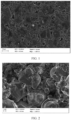
- the chelated particles and active material particles can be observed using an SEM electron microscopy. Because the chelated particles are nonconductive, they are pan-white under the SEM electron microscope, which is obviously different from the color (black) of the active material particles. As shown in FIG. 1 , in an SEM image of a surface of a positive electrode active material layer under 1000 times field of view, a 5 ⁇ m ⁇ 5 ⁇ m region may be taken, from which quantities of white particles and black particles are collected to obtain a range of a ratio of a quantity of chelated particles to a quantity of positive electrode active material particles.
- the resistance of the positive electrode plate is R Q, R being 0.5 to 2
- the chelated particles in the positive electrode active material layer include the organic compound containing the cyano group, where the organic compound containing the cyano group can be combined with exposed active sites in the positive electrode active material particles.
- structural stability of the positive electrode active material particles can be improved, which helps to improve rate performance of the secondary battery.
- the probability of contact between these exposed active sites and an electrolyte can be reduced, which reduces heat generated by oxidation and decomposition of the electrolyte so as to reduce the occurrence of thermal runaway of the secondary battery, thereby improving thermal safety performance of the secondary battery.
- the secondary battery when the ratio, within at least one region of 5 ⁇ m ⁇ 5 ⁇ m of the positive electrode active material layer, of the quantity of the chelated particles to the quantity of the positive electrode active material particles is within the foregoing range, the secondary battery has relatively good rate performance. Therefore, the secondary battery provided in this application can have good thermal safety performance and rate performance.
- the ratio of the quantity of the chelated particles to the quantity of the positive electrode active material particles ranges from 0.1 to 0.3.
- the ratio of the quantity of the chelated particles to the quantity of the positive electrode active material particles is within the foregoing range, good thermal safety performance and rate performance of the secondary battery can be further guaranteed.
- a size of the chelated particles is within a proper range, which can help to improve the thermal safety performance of the secondary battery.
- D v 50 ⁇ m is a particle diameter reaching a volume accumulation of 50% from the small particle diameter side in the volume-based particle size distribution of the chelated particles.
- D v 50 is within the foregoing range, more chelated particles can be distributed on a surface of the positive electrode active material particles, and the probability of combination between the chelated particles and exposed active sites in the positive electrode active material particles is increased.
- D v 50 ⁇ m refers to a corresponding particle size at the 50th percentile of the cumulative volume distribution of the chelated particles, which can be tested using a method or an instrument well known in the art.
- a laser particle size analyzer for example, Master Size 3000 may be used for testing.
- the secondary battery further includes a negative electrode plate and a separator, where the separator is arranged between the positive electrode plate and the negative electrode plate to separate the positive and negative electrode plates.
- the volume-based particle size of the chelated particles is D v 50 ⁇ m
- the resistance of the positive electrode plate is R Q, where D v 50 and R satisfy: D v 50/R ⁇ 2.5.
- the secondary battery can have relatively good rate performance while improving the thermal safety performance of the secondary battery.
- R ranges from 0.8 to 1.5.
- the thermal safety performance of the secondary battery can be further improved.
- a mass percentage of the chelated particles in the positive electrode active material layer is A%, and the positive electrode active material layer has a thickness of H ⁇ m, where A and H satisfy: A ⁇ H ⁇ 10.
- the mass percentage of chelated particles in the positive electrode active material layer ranges from 0.05% to 0.5%.
- the secondary battery can have relatively good rate performance while improving the thermal safety performance of the secondary battery.
- the positive electrode active material layer has a thickness of 50 ⁇ m to 200 ⁇ m.
- the thickness of the positive electrode active material layer is set within the foregoing range, energy density of the secondary battery can be improved while improving the thermal safety performance of the secondary battery.
- the thickness of the positive electrode active material layer refers to the thickness of both sides, that is, H is equal to thickness of the positive electrode plate minus thickness of a current collector, which can be tested using a method or an instrument well known in the art.
- proper chelated particles can further help to improve the thermal safety performance of the secondary battery.
- the chelated particles include one or more selected from a group consisting of polyacrylonitrile and modified polyacrylonitrile, tetra (cyanoethoxymethyl) methane, tetra (4-nitrophenyl) ethylene, and 2-cyano-5-methylpyridine.
- the organic compound included in the chelated particles can coordinate and be chelated with the exposed active sites on the surface of the positive electrode active material particles, so that stability of a surface structure of a positive electrode active material can be improved, which reduces the probability of contact between these exposed active sites and the electrolyte, thereby accordingly reducing heat generated by oxidation and decomposition of the electrolyte so as to reduce the occurrence of thermal runaway of the secondary battery and improve the thermal safety performance of the secondary battery.
- the chelated particles further include polyacrylic acid and modified polyacrylic acid.
- R ranges from 0.8 to 1.2.
- 10 ⁇ A ⁇ H ⁇ 32.5, and H ranges from 80 to 200.
- the positive electrode active material layer further includes a binder, where the binder enhances bonding between the positive electrode active material particles and enhances bonding between the positive electrode active material particles and positive electrode current collector.
- the binder may include one or more selected from a group consisting of polyvinyl alcohol, hydroxypropyl cellulose, diacetyl cellulose, polyvinyl chloride, carboxylated polyvinyl chloride, polyvinyl fluoride, a polymer containing ethylene oxide, polyvinylpyrrolidone, polyurethane, polytetrafluoroethylene, poly(1,1-difluoroethylene), polyethylene, polypropylene, styrene-butadiene rubber, acrylic styrene-butadiene rubber, epoxy resin, and nylon.
- the positive electrode active material layer further includes a conductive agent, where the conductive agent includes one or more selected from a group consisting of a carbon-based material, a metal-based material, a conductive polymer, and a mixture thereof.
- the carbon-based material includes one or more selected from a group consisting of carbon black, acetylene black, Ketjen black, carbon nanofibers, and carbon nanotubes.
- the metal-based material includes one or more selected from a group consisting of metal powder, metal fibers, copper, nickel, aluminum, and silver.
- the conductive polymer includes a polyphenylene derivative.
- the positive electrode plate in this application can be manufactured using a conventional method in the art.
- the positive electrode active material particles, organic particles, the conductive agent, and the binder are dispersed and mixed in N-methylpyrrolidone (NMP) to obtain a uniform positive electrode slurry
- NMP N-methylpyrrolidone
- the positive electrode slurry is applied onto the positive electrode current collector, and then drying, cold pressing, cutting, slitting, and re-drying are performed to obtain the positive electrode plate.
- a secondary battery known in the art usually further includes a negative electrode plate and a separator.
- the negative electrode plate includes a negative electrode current collector and a negative electrode active material layer arranged on at least one surface of the negative electrode current collector, and the separator is arranged between the negative electrode plate and a positive electrode plate.
- a negative electrode plate can be provided with a negative electrode active material layer on one surface of a negative electrode current collector, and can alternatively be provided with the negative electrode active material layer on two surfaces of the negative electrode current collector. This is not particularly limited in some embodiments of this application.
- the negative electrode current collector may be a metal foil or a porous metal plate, for example, copper, nickel, titanium, iron, another metal, and an alloy foil or porous plate thereof. In some embodiments of this application, the negative electrode current collector is a copper foil.
- the negative electrode active material layer includes negative electrode active material particles, where the negative electrode active material particles may include one or more selected from a group consisting of silicon, a silicon-oxygen compound (SiO x , 0 ⁇ x ⁇ 2), a silicon alloy, a silicon-carbon composite, graphite, mesocarbon microbead (MCMB), hard carbon, soft carbon, a Li-Sn alloy, a Li-Sn-O alloy, Sn, SnO, SnO 2 , spinel-structure lithium titanate Li 4 Ti 5 O 12 , a Li-Al alloy, and metallic lithium. Selecting a material from the foregoing range helps to improve the energy density of the secondary battery.
- a silicon-oxygen compound SiO x , 0 ⁇ x ⁇ 2
- MCMB mesocarbon microbead
- the negative electrode active material layer further includes a binder, where the binder may include one or more selected from a group consisting of styrene-butadiene rubber (SBR), polyacrylic acid (PAA), polyacrylic acid sodium (PAAS), polyacrylamide (PAM), polyvinyl alcohol (PVA), sodium alginate (SA), polymethacrylic acid (PMAA), and carboxymethyl chitosan (CMCS).
- SBR styrene-butadiene rubber
- PAA polyacrylic acid
- PAAS polyacrylic acid sodium
- PAM polyacrylamide
- PVA polyvinyl alcohol
- SA sodium alginate
- PMAA polymethacrylic acid
- CMCS carboxymethyl chitosan
- the negative electrode active material layer further includes a conductive agent, where the conductive agent may include one or more selected from a group consisting of superconducting carbon, acetylene black, carbon black, Ketjen black, carbon dots, carbon nanotubes, graphene, and carbon nanofibers.
- the conductive agent may include one or more selected from a group consisting of superconducting carbon, acetylene black, carbon black, Ketjen black, carbon dots, carbon nanotubes, graphene, and carbon nanofibers.
- the negative electrode active material layer may further include another additive, such as a thickener (for example, sodium carboxymethyl cellulose (CMC-Na)).
- a thickener for example, sodium carboxymethyl cellulose (CMC-Na)
- a material in the negative electrode plate is not limited to the foregoing materials.
- Another publicly known material capable of being used as a negative electrode active material, a conductive agent, a binder, and a thickener may also be used.
- the negative electrode plate in this application may be manufactured using a conventional method in the art.
- the negative electrode active material particles, the conductive agent, the binder, and the thickener are dispersed in a solvent, where the solvent may be N-methylpyrrolidone (NMP) or deionized water, to obtain a uniform negative electrode slurry.
- NMP N-methylpyrrolidone
- the negative electrode slurry is applied onto the negative electrode current collector, and then drying and cold pressing are performed to obtain the negative electrode plate.
- the separator may be polyethylene, polypropylene, polyvinylidene fluoride, or a multi-layer composite film thereof.
- the separator is a single-layer separator or a multi-layer separator.
- a shape and thickness of the separator are not particularly limited in some embodiments of this application.
- the manufacturing method of the separator is a publicly known manufacturing method in the art capable of being used for a separator of a secondary battery.
- a secondary battery usually further includes an electrolyte.
- the electrolyte is a carrier for ion transport and can conduct ions between a positive electrode plate and a negative electrode plate, which guarantees advantages such as good rate performance of the secondary battery.
- an electrolyte is also not particularly limited.
- An electrolyte known in the art may be used.
- the electrolyte includes an organic solvent and an electrolytic salt, where the organic solvent may include one or more selected from a group consisting of ethylene carbonate (EC), propylene carbonate (PC), ethyl methyl carbonate (EMC), diethyl carbonate (DEC), dimethyl carbonate (DMC), dipropyl carbonate (DPC), methyl propyl carbonate (MPC), ethyl propyl carbonate (EPC), butylene carbonate (BC), fluoroethylene carbonate (FEC), methylmethyl formate (MF), methyl acetate (MA), ethyl acetate (EA), propyl acetate (PA), methyl propionate (MP), ethyl propionate (EP), propyl propionate (PP), methyl butyrate (MB), ethyl butyrate (EB), 1,4-butyrolactone (
- the electrolytic salt may include one or more selected from a group consisting of lithium hexafluorophosphate (LiPF 6 ), lithium tetrafluoroborate (LiBF 4 ), lithium perchlorate (LiClO 4 ), lithium hexafluoroarsenate (LiAsF 6 ), lithium bistrifluoromethanesulfonimide (LiFSI), lithium bistrifluoromethanesulfonimide (LiTFSI), lithium trifluoromethanesulfonate (LiTFS), lithium difluoro(oxalato)borate (LiDFOB), lithium dioxalate borate (LiBOB), lithium difluorophosphate (LiPO 2 F 2 ), lithium difluorodioxalate phosphate (LiDFOP), and lithium tetrafluoro oxalato phosphate (LiTFOP).
- LiPF 6 lithium hexafluorophosphate
- the electrolyte may be manufactured using a conventional method in that art.
- the organic solvent, the electrolytic salt, and an optional additive can be evenly mixed to obtain the electrolyte.
- An addition sequence of such materials is not particularly limited.
- the positive electrode plate, the separator, and the negative electrode plate are sequentially stacked so that the separator is located between the positive electrode plate and the negative electrode plate. Then the resulting stack is wound to obtain an electrode assembly.
- the electrode assembly is placed into a housing, and then the electrolyte is injected. Processes such as vacuum packaging, standing, formation, air extraction, and molding are then performed to obtain the secondary battery.
- the housing may include a hard housing or a flexible housing.
- a material of the hard housing may include metal
- a material of the flexible housing may include a metal plastic film, for example, an aluminum-plastic film and a steel-plastic film.
- a second aspect of this application provides an electronic apparatus, including the secondary battery provided in the first aspect of this application.
- the secondary battery provided in this application has good rate performance and thermal safety performance, so that the electronic apparatus provided in this application has good rate performance and thermal safety performance.
- the electronic apparatus is not particularly limited in some embodiments of this application, and may be any known electronic apparatus used in the prior art.
- the electronic apparatus may include, but is not limited to, a notebook computer, a pen-input computer, a mobile computer, an electronic book player, a portable telephone, a portable fax machine, a portable copier, a portable printer, a stereo headset, a video recorder, a liquid crystal television, a portable cleaner, a portable CD player, a mini-disc, a transceiver, an electronic notepad, a calculator, a memory card, a portable recorder, a radio, a standby power source, a motor, an automobile, a motorcycle, a power-assisted bicycle, a bicycle, a lighting appliance, a toy, a game console, a clock, an electric tool, a flash lamp, a camera, a large household battery, or a lithium-ion capacitor.
- the secondary battery is a lithium-ion secondary battery, so as to describe in detail the secondary battery and a manufacturing method thereof.
- Lithium cobaltate, tetra (cyanoethoxymethyl) methane, conductive carbon, and PVDF were dispersed in N-methylpyrrolidone (NMP) at a mass ratio of 96.2:0.3:1.5:2 and the foregoing substances were mixed to obtain a uniform positive electrode slurry.
- NMP N-methylpyrrolidone
- the positive electrode slurry was applied onto an aluminum foil. Drying, cold pressing, cutting, and slitting were then performed to obtain a positive electrode plate, where the thickness of the positive electrode active material layer was 100 ⁇ m.
- Graphite, a conductive agent carbon black, SBR, and a thickener CMC were dispersed in deionized water at a mass ratio of 97:1:1.5:0.5 to obtain a uniform negative electrode slurry.
- the negative electrode slurry was applied onto a copper foil. Drying and cold pressing were then performed to obtain a negative electrode plate.
- the separator was a polyethylene separator.
- the positive electrode plate, the separator, and the negative electrode plate were sequentially stacked so that the separator was located between the positive electrode plate and the negative electrode plate to provide separation. Then the resulting stack was wound to obtain an electrode assembly.
- the electrode assembly was placed into a housing, and then the electrolyte prepared above was injected into the housing. Processes such as vacuum packaging, standing, formation, and shaping were then performed to complete the manufacturing of the lithium-ion secondary battery.
- the manufacturing methods here are similar to the manufacturing method of Example 1 except for the chelated particles of the positive electrode plate, ratio a/b of a quantity of the chelated particles to a quantity of positive electrode active material particles within a region of 5 ⁇ m ⁇ 5 ⁇ m, and/or controlling resistance of the positive electrode plate through percentage of a conductive agent.
- the quantity of the chelated particles in the region of 5 ⁇ m ⁇ 5 ⁇ m is a
- the quantity of the positive electrode active material particles in the region of 5 ⁇ m ⁇ 5 ⁇ m is b.
- the manufacturing methods here are similar to the manufacturing method of Example 1 except that no chelated particle was added.
- the manufacturing methods here are similar to the manufacturing method of Example 1 except for the chelated particles of the positive electrode plate, ratio a/b of a quantity of the chelated particles to a quantity of positive electrode active material particles within a region of 5 ⁇ m ⁇ 5 ⁇ m, and/or controlling resistance of the positive electrode plate through percentage of a conductive agent.
- the manufacturing methods here are similar to the manufacturing method of Example 1 except for the ratio a/b of a quantity of chelated particles of a positive electrode plate to a quantity of positive electrode active material particles within a region of 5 ⁇ m ⁇ 5 ⁇ m, mass percentage of the chelated particles in a positive electrode active material layer, and thickness H ⁇ m of the active material layer.
- a percentage of a conductive agent, thickness of the chelated particles, and thickness of an electrode plate were adjusted to control resistance of the positive electrode plate to be the same.
- the manufacturing methods here are similar to the manufacturing method of Example 9 except for the ratio a/b of a quantity of chelated particles of a positive electrode plate to a quantity of positive electrode active material particles within a region of 5 ⁇ m ⁇ 5 ⁇ m, volume-based particle size D v 50 ⁇ m of the chelated particles, and resistance R of the positive electrode plate.
- a lithium-ion secondary battery to be tested was charged to a full-charge voltage at a constant rate of 0.5C, and then charged at the full-charge voltage until the current reached 0.025C (cut-off current) to make the lithium-ion secondary battery enter a fully charged state.
- the appearance of the lithium-ion secondary battery before the test was recorded.
- the battery was placed in an oven at 25°C, the oven was heated to 160°C at a temperature rise velocity of 5°C/min, and then the temperature was kept constant for 60 min. The test stopped after the temperature had dropped to 50°C. 10 lithium-ion secondary batteries were deemed as a group to observe states of the lithium-ion secondary batteries during the test. Combustion and explosion times of the lithium-ion secondary batteries were recorded.
- a battery was charged at a current of 0.5C until the voltage reached 4.5 V, then charged at a constant voltage of 4.5 V until the current reached 0.025C, and then fully discharged at currents of 0.2C and 2C, respectively, to obtain discharge capacities at 0.2C and 2C, respectively.
- a discharge capacity retention rate at 2C/0.2C was obtained by discharge capacity at 2C/discharge capacity at 0.2C.
- a laser particle size analyzer (for example, Master Size 3000) might be used for the test to obtain a volume-based particle size of chelated particles.
- a particle size at the 50th percentile of the cumulative volume distribution is D v 50 ⁇ m.
- Table 1 lists the chelated particles of the positive electrode plate, the ratio a/b of the quantity of the chelated particles to the quantity of the positive electrode active material particles within the region of 5 ⁇ m ⁇ 5 ⁇ m in Examples 1 to 11 and Comparative Examples 1 to 4, test results, and the like. Table 1 No.
- the resistance of the positive electrode plate is R Q, where R is within the range of 0.5 to 2; and the chelated particles in the positive electrode active material layer include an organic compound containing a cyano group, where the organic compound containing the cyano group can be combined with exposed active sites in the positive electrode active material particles.
- This can improve structural stability of the positive electrode active material particles, thereby helping to improve rate performance of the secondary battery and reducing the probability of contact between these exposed active sites and the electrolyte.
- the secondary battery can have relatively good rate performance. Therefore, the secondary battery provided in this application can have good thermal safety performance and rate performance.
- Table 2 lists the quantities of the chelated particles and positive electrode active material particles within the region of 5 ⁇ m ⁇ 5 ⁇ m in Examples 12 to 19, the mass percentage A% of the chelated particles in the positive electrode active material layer, the thickness H ⁇ m of the active material layer, and test results. Table 2 No.
- Example 12 0.5 0.50% 0.4% 50 ⁇ m 1.2 ⁇ 25 11.5 98.1%
- Example 13 0.22 0.45% 0.5% 60 ⁇ m 1.2 ⁇ 27 12.0 98.0%
- Example 14 0.18 0.35% 0.8% 80 ⁇ m 1.2 ⁇ 28 16.0 97.3%
- Example 15 0.13 0.30% 1.0% 100 ⁇ m 1.2 ⁇ 30 18.0 96.5%
- Example 16 0.14 0.25% 1.2% 130 ⁇ m 1.2 ⁇ 32.5 17.5 96.5%
- Example 17 0.13 0.20% 1.4% 150 ⁇ m 1.2 ⁇ 30 15.0 95.9%
- Example 18 0.10 0.15% 1.7% 170 ⁇ m 1.2 ⁇ 25.5 16.0 95.4%
- Example 19 0.09 0.05% 2.0% 200 ⁇ m 1.2 ⁇ 10 15.5 95.6%
- Example 20 0.08 0.08% 1.0% 100
- Table 3 lists the quantities of the chelated particles and positive electrode active material particles within the region of 5 ⁇ m ⁇ 5 ⁇ m in Examples 21 to 26, the volume-based particle size D v 50 ⁇ m of the chelated particles, the resistance R of the positive electrode plate, and test results. Table 3 No.
- Example 21 0.111 0.5 ⁇ m 1.5% 0.5 ⁇ 1.0 17.0 97.1%
- Example 9 0.182 1.0 ⁇ m 1.4% 0.8 ⁇ 1.3 18.5 97.5%
- Example 22 0.083 2.0 ⁇ m 1.2% 1.0 ⁇ 2.0 18.0 96.9%
- Example 23 0.125 2.5 ⁇ m 1.0% 1.2 ⁇ 2.1 18.0 96.5%
- Example 24 0.111 3.0 ⁇ m 0.7% 1.6 ⁇ 1.9 16.0 96.4%
- Example 25 0.10 4.0 ⁇ m 0.5% 1.7 ⁇ 2.4 15.5 95.7%
- Example 26 0.08 5.0 ⁇ m 0.4% 1.9 ⁇ 2.6 10.5 95.3%
Landscapes
- Chemical & Material Sciences (AREA)
- Chemical Kinetics & Catalysis (AREA)
- Electrochemistry (AREA)
- General Chemical & Material Sciences (AREA)
- Engineering & Computer Science (AREA)
- Manufacturing & Machinery (AREA)
- Materials Engineering (AREA)
- Battery Electrode And Active Subsutance (AREA)
- Secondary Cells (AREA)
Abstract
A secondary battery includes a positive electrode plate, where the positive electrode plate has a resistance of R Ω, R ranges from 0.5 to 2. The positive electrode plate includes a positive electrode current collector and a positive electrode active material layer, where the positive electrode active material layer is arranged on at least one surfase of the positive electrode current collector. The positive electrode active material layer includes positive electrode active material particles and chelated particles, where the chelated particles include an organic compound containing a cyano group. Within at least one region of 5 µm × 5 µm of the positive electrode active material layer, a ratio of a quantity of the chelated particles to a quantity of the positive electrode active material particles ranges from 0.01 to 0.5. The secondary battery provided in this application can have good thermal safety performance and rate performance.
Description
- This application relates to the field of battery technologies, and in particular, to a secondary battery and an electronic apparatus.
- Batteries have become an indispensable part of mobile devices. For example, in a mobile device such as a mobile phone, a notebook computer, a tablet computer, and an electric vehicle, a battery can usually be used as a power source. As a power source, a battery with good thermal safety performance and rate performance can help to improve user experience of the foregoing device. Therefore, it is urgent to solve the technical problem of ensuring good thermal safety performance and rate performance of batteries.
- This application provides a secondary battery and an electronic apparatus, with good thermal safety performance and rate performance provided.
- According to a first aspect, this application provides a secondary battery, including a positive electrode plate, where the positive electrode plate has a resistance of R Q, R being 0.5 to 2. The positive electrode plate includes a positive electrode current collector and a positive electrode active material layer, where the positive electrode active material layer is arranged on at least one surface of the positive electrode current collector. The positive electrode active material layer includes positive electrode active material particles and chelated particles, where the chelated particles include an organic compound containing a cyano group. Within at least one region of 5 µm × 5 µm of the positive electrode active material layer, a ratio of a quantity of the chelated particles to a quantity of the positive electrode active material particles ranges from 0.01 to 0.5.
- In the secondary battery provided in this application, the positive electrode plate has a resistance of R Q, R being 0.5 to 2, and the chelated particles in the positive electrode active material layer include an organic compound containing a cyano group. The organic compound containing the cyano group can be combined with exposed active sites in the positive electrode active material particles. In this way, structural stability of the positive electrode active material particles can be improved, which helps to improve the rate performance of the secondary battery. In addition, the probability of contact between these exposed active sites and an electrolyte can be reduced, which reduces heat generated by oxidation and decomposition of the electrolyte so as to reduce the occurrence of 3 of the secondary battery, thereby improving the thermal safety performance of the secondary battery. Moreover, when the ratio, within at least one region of 5 µm × 5 µm of the positive electrode active material layer, of the quantity of the chelated particles to the quantity of the positive electrode active material particles is within the foregoing range, the secondary battery has relatively good rate performance. Therefore, the secondary battery provided in this application can have good thermal safety performance and rate performance.
- According to any one of the forgoing embodiments in the first aspect of this application, when the ratio, within at least one region of 5 µm × 5 µm of the positive electrode active material layer, of the quantity of the chelated particles to the quantity of the positive electrode active material particles ranges from 0.1 to 0.3 and R ranges from 0.8 to 1.5, the positive electrode plate has a resistance ranging from 0.8 Q to 1.5 Q. When the resistance of the electrode plate and the ratio of the quantity of the chelated particles to the quantity of the positive electrode active material particles are within the foregoing ranges, good thermal safety performance and rate performance of the secondary battery can be further guaranteed.
- According to any one of the forgoing embodiments in the first aspect of this application, where Dv50 is ≤ 4, Dv50 µm is a particle diameter reaching a volume accumulation of 50% from the small particle diameter side in the volume-based particle size distribution of the chelated particles. When the volume-based particle size Dv50 µm of the chelated particles is within the foregoing range, more chelated particles can be distributed on a surface of the positive electrode active material particles, and the probability of combination between the chelated particles and exposed active sites in the positive electrode active material particles is increased.
- According to any one of the forgoing embodiments in the first aspect of this application, a mass percentage of the chelated particles in the positive electrode active material layer is A%, and the positive electrode active material layer has a thickness of H µm, where A and H satisfy: A × H ≥ 10. When A and H satisfy the foregoing relationship, good thermal safety performance and high energy density of the secondary battery can be further guaranteed.
- According to any one of the forgoing embodiments in the first aspect of this application, the mass percentage A% of the chelated particles in the positive electrode active material layer ranges from 0.05% to 0.5%.
- According to any one of the forgoing embodiments in the first aspect of this application, the volume-based particle size of the chelated particles is Dv50 µm, and the resistance of the positive electrode plate is R Q, where Dv50 and R satisfy: Dv50/R ≤ 2.5. When R of the positive electrode and Dv50 satisfy the foregoing relationship, the thermal safety performance of the secondary battery can be further improved.
- According to any one of the forgoing embodiments in the first aspect of this application, the thickness of the positive electrode active material layer is H µm, where H is 50 to 200. When H is set within the foregoing range, the energy density of the secondary battery can be increased while improving the thermal safety performance of the secondary battery.
- According to any one of the forgoing embodiments in the first aspect of this application, the chelated particles include one or more selected from a group consisting of polyacrylonitrile and modified polyacrylonitrile, tetra (cyanoethoxymethyl) methane, tetra (4-nitrophenyl) ethylene, and 2-cyano-5-methylpyridine. The organic compound included in the chelated particles can coordinate and be chelated with the exposed active sites on the surface of the positive electrode active material particles, so that stability of a surface structure of a positive electrode active material can be improved, which reduces the probability of contact between these exposed active sites and the electrolyte, thereby accordingly reducing heat generated by oxidation and decomposition of the electrolyte so as to reduce the occurrence of thermal runaway of the secondary battery and improve the thermal safety performance of the secondary battery.
- According to any one of the forgoing embodiments in the first aspect of this application, the chelated particles further include polyacrylic acid and modified polyacrylic acid.
- According to any one of the forgoing embodiments in the first aspect of this application, R ranges from 0.8 to 1.2.
- According to any one of the forgoing embodiments in the first aspect of this application, 10≤A × H ≤ 32.5, and H ranges from 80 to 200.
- According to any one of the forgoing embodiments in the first aspect of this application, 1.0≤ Dv50/R ≤ 2.1.
- According to a second aspect, this application provides an electronic apparatus, including the secondary battery according to the first aspect of this application.
- The foregoing description is merely an overview of the technical solutions of this application. For a better understanding of the technical means in this application such that they can be implemented according to the content of the specification, and to make the above and other objectives, features, and advantages of this application more obvious and easier to understand, the following describes specific embodiments of this application.
-
-
FIG. 1 is an SEM image of a surface of a positive electrode active material layer in a positive electrode plate according to Example 1 of this application. -
FIG. 2 is an SEM image of a surface of a positive electrode active material layer in a positive electrode plate according to Example 5 of this application. - The following embodiments are merely intended for a clearer description of the technical solutions of this application and therefore are used as just examples which do not constitute any limitation on the protection scope of this application.
- Unless otherwise defined, all technical and scientific terms used herein shall have the same meanings as commonly understood by those skilled in the art to which this application relates. The terms used herein are intended to merely describe the specific embodiments rather than to limit this application. The terms "include", "have", and any other variations thereof in the specification and claims of this application are intended to cover non-exclusive inclusions.
- In the description of some embodiments in this application, "a plurality of" means at least two unless otherwise specifically stated.
- In this specification, reference to "embodiment" means that specific features, structures, or characteristics described with reference to some embodiments may be incorporated in at least one embodiment of this application. The word "embodiment" appearing in various places in the specification does not necessarily refer to the same embodiment or an independent or alternative embodiment that is exclusive of other embodiments. It is explicitly or implicitly understood by persons skilled in the art that some embodiments described herein may be combined with other embodiments.
- In the description of some embodiments of this application, unless otherwise stated, "more than" and "less than" are inclusive of the present number, and "more types" in "one or more types" and "more" in "one or more" means more than two.
- The grouping of alternative elements or implementations disclosed herein should not be construed as any limitation. Each group member can be adopted and claimed separately or in any combination with another member of the group or another element in this specification. It can be foreseen that one or more members of a group may be included in or deleted from the group for convenience and/or patentability. When any such inclusion or deletion occurs, the specification is deemed herein to include a changed group, thus satisfying the written description of all Markush groups used in the claims.
- It is obvious to persons skilled in the art that various modifications and variations can be made in this application without departing from the protection scope of this application. Therefore, this application is intended to cover the modifications and variations of this application which fall within the corresponding claims (protection scope) and their equivalents. It should be noted that the implementations provided in some embodiments of this application can be combined in the absence of conflicts.
- Before expounding the protection scope claimed through some embodiments of this application, this application first specifically explains the problems existing in the related art for easy understanding of some embodiments of this application.
- In a high-temperature environment, a CEI film on a surface of a positive electrode plate of a secondary battery may decompose and undergo irreversible phase transition, which leads to deterioration of rate performance of the secondary battery. In addition, such change on the surface of the positive electrode plate may expose some active sites (metal ions, and the like) on the surface of the positive electrode plate and release oxygen and heat. Once these active sites and the oxygen come into contact with an electrolyte, the electrolyte may be oxidized and decomposed, generating heat and gas. When such heat accumulates to a certain extent, thermal runaway of the secondary battery may occur, leading to thermal safety performance deterioration.
- In view of this, some embodiments of this application provide a secondary battery and an electronic apparatus, which can guarantee good thermal safety performance and rate performance.
- In this application, the secondary battery may include a lithium secondary battery. For example, the lithium secondary battery may include, but is not limited to, a lithium metal secondary battery, a lithium-ion secondary battery, a lithium polymer secondary battery, or a lithium-ion polymer secondary battery.
- According to a first aspect, this application provides a secondary battery, including a positive electrode plate, where the positive electrode plate has a resistance of R Q, R being 0.5 to 2. The positive electrode plate includes a positive electrode current collector and a positive electrode active material layer, where the positive electrode active material layer is arranged on at least one surface of the positive electrode current collector. The positive electrode active material layer includes positive electrode active material particles and chelated particles, where the chelated particles include an organic compound containing a cyano group. Within at least one region of 5 µm × 5 µm of the positive electrode active material layer, a ratio of a quantity of the chelated particles to a quantity of the positive electrode active material particles ranges from 0.01 to 0.5.
- In this application, the chelated particles and active material particles can be observed using an SEM electron microscopy. Because the chelated particles are nonconductive, they are pan-white under the SEM electron microscope, which is obviously different from the color (black) of the active material particles. As shown in
FIG. 1 , in an SEM image of a surface of a positive electrode active material layer under 1000 times field of view, a 5 µm × 5 µm region may be taken, from which quantities of white particles and black particles are collected to obtain a range of a ratio of a quantity of chelated particles to a quantity of positive electrode active material particles. - It can be understood that under the SEM electron microscope, with one or more regions having length and width of 5 µm × 5 µm randomly selected, after observation on the region, quantities of chelated particles and positive electrode active material particles are collected and compared to obtain the foregoing ratio range.
- In the secondary battery provided in this application, the resistance of the positive electrode plate is R Q, R being 0.5 to 2, and the chelated particles in the positive electrode active material layer include the organic compound containing the cyano group, where the organic compound containing the cyano group can be combined with exposed active sites in the positive electrode active material particles. In this way, structural stability of the positive electrode active material particles can be improved, which helps to improve rate performance of the secondary battery. In addition, the probability of contact between these exposed active sites and an electrolyte can be reduced, which reduces heat generated by oxidation and decomposition of the electrolyte so as to reduce the occurrence of thermal runaway of the secondary battery, thereby improving thermal safety performance of the secondary battery. Moreover, when the ratio, within at least one region of 5 µm × 5 µm of the positive electrode active material layer, of the quantity of the chelated particles to the quantity of the positive electrode active material particles is within the foregoing range, the secondary battery has relatively good rate performance. Therefore, the secondary battery provided in this application can have good thermal safety performance and rate performance.
- In some embodiments of this application, within at least one region of 5 µm × 5 µm of the positive electrode active material layer, the ratio of the quantity of the chelated particles to the quantity of the positive electrode active material particles ranges from 0.1 to 0.3. When the ratio of the quantity of the chelated particles to the quantity of the positive electrode active material particles is within the foregoing range, good thermal safety performance and rate performance of the secondary battery can be further guaranteed.
- In some embodiments of this application, a size of the chelated particles is within a proper range, which can help to improve the thermal safety performance of the secondary battery.
- Referring to
FIG. 2 , in some embodiments of this application, where Dv50 is ≤ 4, Dv50 µm is a particle diameter reaching a volume accumulation of 50% from the small particle diameter side in the volume-based particle size distribution of the chelated particles. When Dv50 is within the foregoing range, more chelated particles can be distributed on a surface of the positive electrode active material particles, and the probability of combination between the chelated particles and exposed active sites in the positive electrode active material particles is increased. - In this application, Dv50 µm refers to a corresponding particle size at the 50th percentile of the cumulative volume distribution of the chelated particles, which can be tested using a method or an instrument well known in the art. For example, with reference to
GB/T 19077-2016 - In addition, the secondary battery further includes a negative electrode plate and a separator, where the separator is arranged between the positive electrode plate and the negative electrode plate to separate the positive and negative electrode plates. When resistance of a secondary battery decreases under an abnormal condition, temperature of the secondary battery may rise. After the temperature reaches a certain value, a separator shrinks, and then positive and negative electrode plates come into contact, which causes a short circuit, leading to thermal runaway. Therefore, in some embodiments of this application, the volume-based particle size of the chelated particles is Dv50 µm, and the resistance of the positive electrode plate is R Q, where Dv50 and R satisfy: Dv50/R ≤ 2.5. When the resistance of the positive electrode plate decreases to a certain extent which leads to a problem of safety performance of the secondary battery, because R of the positive electrode and Dv50 satisfy the foregoing relationship, the secondary battery can have relatively good rate performance while improving the thermal safety performance of the secondary battery. In some embodiments of this application, R ranges from 0.8 to 1.5. When the resistance R of the positive electrode plate is within the foregoing range, the thermal safety performance of the secondary battery can be further improved.
- In the secondary battery provided in this application, thickness of the positive electrode active material layer has certain influence on the thermal safety performance. When the positive electrode active material layer is relatively thin, positive electrode active material particles inside it are prone to expose active sites, which leads to easy contact with an electrolyte. Heat released by oxidation and decomposition of the electrolyte increases the probability of thermal runaway of the secondary battery. Therefore, in some embodiments of this application, a mass percentage of the chelated particles in the positive electrode active material layer is A%, and the positive electrode active material layer has a thickness of H µm, where A and H satisfy: A × H ≥ 10. When A and H satisfy the foregoing relationship, good thermal safety performance and rate performance of the secondary battery can be further guaranteed.
- In some embodiments of this application, the mass percentage of chelated particles in the positive electrode active material layer ranges from 0.05% to 0.5%. When the mass percentage A% of the chelated particles in the positive electrode active material layer is within the foregoing range, the secondary battery can have relatively good rate performance while improving the thermal safety performance of the secondary battery.
- In some embodiments of this application, the positive electrode active material layer has a thickness of 50 µm to 200 µm. When the thickness of the positive electrode active material layer is set within the foregoing range, energy density of the secondary battery can be improved while improving the thermal safety performance of the secondary battery.
- In this application, the thickness of the positive electrode active material layer refers to the thickness of both sides, that is, H is equal to thickness of the positive electrode plate minus thickness of a current collector, which can be tested using a method or an instrument well known in the art.
- In some embodiments of this application, proper chelated particles can further help to improve the thermal safety performance of the secondary battery. In some embodiments of this application, the chelated particles include one or more selected from a group consisting of polyacrylonitrile and modified polyacrylonitrile, tetra (cyanoethoxymethyl) methane, tetra (4-nitrophenyl) ethylene, and 2-cyano-5-methylpyridine. The organic compound included in the chelated particles can coordinate and be chelated with the exposed active sites on the surface of the positive electrode active material particles, so that stability of a surface structure of a positive electrode active material can be improved, which reduces the probability of contact between these exposed active sites and the electrolyte, thereby accordingly reducing heat generated by oxidation and decomposition of the electrolyte so as to reduce the occurrence of thermal runaway of the secondary battery and improve the thermal safety performance of the secondary battery.
- In some other embodiments of this application, the chelated particles further include polyacrylic acid and modified polyacrylic acid.
- In some other embodiments of this application, R ranges from 0.8 to 1.2.
- In some other embodiments of this application, 10≤A × H ≤ 32.5, and H ranges from 80 to 200.
- In some other embodiments of this application, 1.0≤ Dv50/R ≤ 2.1.
- In some embodiments of this application, the positive electrode active material layer further includes a binder, where the binder enhances bonding between the positive electrode active material particles and enhances bonding between the positive electrode active material particles and positive electrode current collector.
- For example, the binder may include one or more selected from a group consisting of polyvinyl alcohol, hydroxypropyl cellulose, diacetyl cellulose, polyvinyl chloride, carboxylated polyvinyl chloride, polyvinyl fluoride, a polymer containing ethylene oxide, polyvinylpyrrolidone, polyurethane, polytetrafluoroethylene, poly(1,1-difluoroethylene), polyethylene, polypropylene, styrene-butadiene rubber, acrylic styrene-butadiene rubber, epoxy resin, and nylon.
- In some embodiments of this application, the positive electrode active material layer further includes a conductive agent, where the conductive agent includes one or more selected from a group consisting of a carbon-based material, a metal-based material, a conductive polymer, and a mixture thereof.
- For example, the carbon-based material includes one or more selected from a group consisting of carbon black, acetylene black, Ketjen black, carbon nanofibers, and carbon nanotubes. The metal-based material includes one or more selected from a group consisting of metal powder, metal fibers, copper, nickel, aluminum, and silver. The conductive polymer includes a polyphenylene derivative.
- The positive electrode plate in this application can be manufactured using a conventional method in the art. For example, the positive electrode active material particles, organic particles, the conductive agent, and the binder are dispersed and mixed in N-methylpyrrolidone (NMP) to obtain a uniform positive electrode slurry, the positive electrode slurry is applied onto the positive electrode current collector, and then drying, cold pressing, cutting, slitting, and re-drying are performed to obtain the positive electrode plate.
- A secondary battery known in the art usually further includes a negative electrode plate and a separator. The negative electrode plate includes a negative electrode current collector and a negative electrode active material layer arranged on at least one surface of the negative electrode current collector, and the separator is arranged between the negative electrode plate and a positive electrode plate.
- It can be understood that a negative electrode plate can be provided with a negative electrode active material layer on one surface of a negative electrode current collector, and can alternatively be provided with the negative electrode active material layer on two surfaces of the negative electrode current collector. This is not particularly limited in some embodiments of this application.
- In some embodiments of this application, the negative electrode current collector may be a metal foil or a porous metal plate, for example, copper, nickel, titanium, iron, another metal, and an alloy foil or porous plate thereof. In some embodiments of this application, the negative electrode current collector is a copper foil.
- In some embodiments of this application, the negative electrode active material layer includes negative electrode active material particles, where the negative electrode active material particles may include one or more selected from a group consisting of silicon, a silicon-oxygen compound (SiOx, 0 < x ≤ 2), a silicon alloy, a silicon-carbon composite, graphite, mesocarbon microbead (MCMB), hard carbon, soft carbon, a Li-Sn alloy, a Li-Sn-O alloy, Sn, SnO, SnO2, spinel-structure lithium titanate Li4Ti5O12, a Li-Al alloy, and metallic lithium. Selecting a material from the foregoing range helps to improve the energy density of the secondary battery.
- In some embodiments of this application, the negative electrode active material layer further includes a binder, where the binder may include one or more selected from a group consisting of styrene-butadiene rubber (SBR), polyacrylic acid (PAA), polyacrylic acid sodium (PAAS), polyacrylamide (PAM), polyvinyl alcohol (PVA), sodium alginate (SA), polymethacrylic acid (PMAA), and carboxymethyl chitosan (CMCS).
- In some embodiments of this application, the negative electrode active material layer further includes a conductive agent, where the conductive agent may include one or more selected from a group consisting of superconducting carbon, acetylene black, carbon black, Ketjen black, carbon dots, carbon nanotubes, graphene, and carbon nanofibers.
- In some embodiments of this application, the negative electrode active material layer may further include another additive, such as a thickener (for example, sodium carboxymethyl cellulose (CMC-Na)).
- In addition, a material in the negative electrode plate is not limited to the foregoing materials. Another publicly known material capable of being used as a negative electrode active material, a conductive agent, a binder, and a thickener may also be used.
- The negative electrode plate in this application may be manufactured using a conventional method in the art. For example, the negative electrode active material particles, the conductive agent, the binder, and the thickener are dispersed in a solvent, where the solvent may be N-methylpyrrolidone (NMP) or deionized water, to obtain a uniform negative electrode slurry. The negative electrode slurry is applied onto the negative electrode current collector, and then drying and cold pressing are performed to obtain the negative electrode plate.
- In some embodiments of this application, the separator may be polyethylene, polypropylene, polyvinylidene fluoride, or a multi-layer composite film thereof.
- In some embodiments of this application, the separator is a single-layer separator or a multi-layer separator.
- A shape and thickness of the separator are not particularly limited in some embodiments of this application. The manufacturing method of the separator is a publicly known manufacturing method in the art capable of being used for a separator of a secondary battery.
- In addition, a secondary battery usually further includes an electrolyte. The electrolyte is a carrier for ion transport and can conduct ions between a positive electrode plate and a negative electrode plate, which guarantees advantages such as good rate performance of the secondary battery.
- In this application, an electrolyte is also not particularly limited. An electrolyte known in the art may be used. For example, the electrolyte includes an organic solvent and an electrolytic salt, where the organic solvent may include one or more selected from a group consisting of ethylene carbonate (EC), propylene carbonate (PC), ethyl methyl carbonate (EMC), diethyl carbonate (DEC), dimethyl carbonate (DMC), dipropyl carbonate (DPC), methyl propyl carbonate (MPC), ethyl propyl carbonate (EPC), butylene carbonate (BC), fluoroethylene carbonate (FEC), methylmethyl formate (MF), methyl acetate (MA), ethyl acetate (EA), propyl acetate (PA), methyl propionate (MP), ethyl propionate (EP), propyl propionate (PP), methyl butyrate (MB), ethyl butyrate (EB), 1,4-butyrolactone (GBL), sulfolane (SF), methyl sulfone (MSM), ethyl methyl sulfone (EMS), and diethyl sulfone (ESE).
- The electrolytic salt may include one or more selected from a group consisting of lithium hexafluorophosphate (LiPF6), lithium tetrafluoroborate (LiBF4), lithium perchlorate (LiClO4), lithium hexafluoroarsenate (LiAsF6), lithium bistrifluoromethanesulfonimide (LiFSI), lithium bistrifluoromethanesulfonimide (LiTFSI), lithium trifluoromethanesulfonate (LiTFS), lithium difluoro(oxalato)borate (LiDFOB), lithium dioxalate borate (LiBOB), lithium difluorophosphate (LiPO2F2), lithium difluorodioxalate phosphate (LiDFOP), and lithium tetrafluoro oxalato phosphate (LiTFOP).
- The electrolyte may be manufactured using a conventional method in that art. For example, the organic solvent, the electrolytic salt, and an optional additive can be evenly mixed to obtain the electrolyte. An addition sequence of such materials is not particularly limited.
- The positive electrode plate, the separator, and the negative electrode plate are sequentially stacked so that the separator is located between the positive electrode plate and the negative electrode plate. Then the resulting stack is wound to obtain an electrode assembly. The electrode assembly is placed into a housing, and then the electrolyte is injected. Processes such as vacuum packaging, standing, formation, air extraction, and molding are then performed to obtain the secondary battery.
- In some embodiments of this application, the housing may include a hard housing or a flexible housing. For example, a material of the hard housing may include metal, and a material of the flexible housing may include a metal plastic film, for example, an aluminum-plastic film and a steel-plastic film.
- A second aspect of this application provides an electronic apparatus, including the secondary battery provided in the first aspect of this application. The secondary battery provided in this application has good rate performance and thermal safety performance, so that the electronic apparatus provided in this application has good rate performance and thermal safety performance.
- The electronic apparatus is not particularly limited in some embodiments of this application, and may be any known electronic apparatus used in the prior art. In some embodiments of this application, the electronic apparatus may include, but is not limited to, a notebook computer, a pen-input computer, a mobile computer, an electronic book player, a portable telephone, a portable fax machine, a portable copier, a portable printer, a stereo headset, a video recorder, a liquid crystal television, a portable cleaner, a portable CD player, a mini-disc, a transceiver, an electronic notepad, a calculator, a memory card, a portable recorder, a radio, a standby power source, a motor, an automobile, a motorcycle, a power-assisted bicycle, a bicycle, a lighting appliance, a toy, a game console, a clock, an electric tool, a flash lamp, a camera, a large household battery, or a lithium-ion capacitor.
- Examples below more specifically describe the content disclosed in this application, and these embodiments are merely used for explanatory description. It is apparent for persons skilled in the art to make various modifications and variations within the scope of the content disclosed in this application. Unless otherwise stated, all parts, percentages, and ratio ranges reported in the following examples are based on weight, all reagents used in the examples are commercially available or synthesized in a conventional manner, and can be used directly without further treatment. All instruments used in the examples are commercially available.
- For ease of description, in the following examples, the secondary battery is a lithium-ion secondary battery, so as to describe in detail the secondary battery and a manufacturing method thereof.
- Lithium cobaltate, tetra (cyanoethoxymethyl) methane, conductive carbon, and PVDF were dispersed in N-methylpyrrolidone (NMP) at a mass ratio of 96.2:0.3:1.5:2 and the foregoing substances were mixed to obtain a uniform positive electrode slurry.
- The positive electrode slurry was applied onto an aluminum foil. Drying, cold pressing, cutting, and slitting were then performed to obtain a positive electrode plate, where the thickness of the positive electrode active material layer was 100 µm.
- Graphite, a conductive agent carbon black, SBR, and a thickener CMC were dispersed in deionized water at a mass ratio of 97:1:1.5:0.5 to obtain a uniform negative electrode slurry.
- The negative electrode slurry was applied onto a copper foil. Drying and cold pressing were then performed to obtain a negative electrode plate.
- The separator was a polyethylene separator.
- In a dry argon environment, DMC and EMC were mixed at a mass ratio of 7:3. LiPF6 with concentration of 1.3 mol/L was then added and the foregoing substances were evenly mixed to obtain an electrolyte.
- The positive electrode plate, the separator, and the negative electrode plate were sequentially stacked so that the separator was located between the positive electrode plate and the negative electrode plate to provide separation. Then the resulting stack was wound to obtain an electrode assembly. The electrode assembly was placed into a housing, and then the electrolyte prepared above was injected into the housing. Processes such as vacuum packaging, standing, formation, and shaping were then performed to complete the manufacturing of the lithium-ion secondary battery.
- The manufacturing methods here are similar to the manufacturing method of Example 1 except for the chelated particles of the positive electrode plate, ratio a/b of a quantity of the chelated particles to a quantity of positive electrode active material particles within a region of 5 µm × 5 µm, and/or controlling resistance of the positive electrode plate through percentage of a conductive agent. The quantity of the chelated particles in the region of 5 µm × 5 µm is a, and the quantity of the positive electrode active material particles in the region of 5 µm × 5 µm is b.
- The manufacturing methods here are similar to the manufacturing method of Example 1 except that no chelated particle was added.
- The manufacturing methods here are similar to the manufacturing method of Example 1 except for the chelated particles of the positive electrode plate, ratio a/b of a quantity of the chelated particles to a quantity of positive electrode active material particles within a region of 5 µm × 5 µm, and/or controlling resistance of the positive electrode plate through percentage of a conductive agent.
- The manufacturing methods here are similar to the manufacturing method of Example 1 except for the ratio a/b of a quantity of chelated particles of a positive electrode plate to a quantity of positive electrode active material particles within a region of 5 µm × 5 µm, mass percentage of the chelated particles in a positive electrode active material layer, and thickness H µm of the active material layer. A percentage of a conductive agent, thickness of the chelated particles, and thickness of an electrode plate were adjusted to control resistance of the positive electrode plate to be the same.
- The manufacturing methods here are similar to the manufacturing method of Example 9 except for the ratio a/b of a quantity of chelated particles of a positive electrode plate to a quantity of positive electrode active material particles within a region of 5 µm × 5 µm, volume-based particle size Dv50 µm of the chelated particles, and resistance R of the positive electrode plate.
- A lithium-ion secondary battery to be tested was charged to a full-charge voltage at a constant rate of 0.5C, and then charged at the full-charge voltage until the current reached 0.025C (cut-off current) to make the lithium-ion secondary battery enter a fully charged state. The appearance of the lithium-ion secondary battery before the test was recorded. The battery was placed in an oven at 25°C, the oven was heated to 160°C at a temperature rise velocity of 5°C/min, and then the temperature was kept constant for 60 min. The test stopped after the temperature had dropped to 50°C. 10 lithium-ion secondary batteries were deemed as a group to observe states of the lithium-ion secondary batteries during the test. Combustion and explosion times of the lithium-ion secondary batteries were recorded.
- In an environment of (25±3)°C, a battery was charged at a current of 0.5C until the voltage reached 4.5 V, then charged at a constant voltage of 4.5 V until the current reached 0.025C, and then fully discharged at currents of 0.2C and 2C, respectively, to obtain discharge capacities at 0.2C and 2C, respectively. A discharge capacity retention rate at 2C/0.2C was obtained by discharge capacity at 2C/discharge capacity at 0.2C.
- In accordance with the particle size distribution laser diffraction method in
GB/T 19077-2016 -
- (1) A secondary battery to be tested was charged to a full-charge voltage at a constant rate of 0.5C, and then charged at the constant full-charge voltage until the current reached 0.025C (cut-off current) to make the secondary battery enter a fully charged state.
- (2) The secondary battery was disassembled to obtain a positive electrode plate.
- (3) The positive electrode plate was placed in an environment with humidity of 5% to 15%, left standing for 30 min, and then sealed and transferred for the test.
- (4) Resistance of the positive electrode plate at 25°C was tested using a BER1200 resistance tester. An interval between adjacent test points was 2 mm to 3 mm, and at least 15 different points were tested. Resistance values of all test points were recorded, and an average value of these test points was obtained through calculation to be as resistance R of the positive electrode plate. Test parameters: area of an indenter: 153.94 mm2; pressure: 3.5 t; and holding time: 50s.
- (5) Mass percentage test of chelated particle in positive electrode active material layer
In a dry environment with humidity less than 2% at about 25°C, the positive electrode plate was disassembled from the secondary battery, the positive electrode plate was soaked in an NMP solvent to remove a film, and a film layer was uniformly dispersed in the NMP solvent using a disperser to obtain a slurry with a solid content of 30%. Then, the slurry was poured into a centrifuge for centrifugation to obtain organic particles in the film layer. Finally, the organic particles were dried at 85°C, and the mass percentage was obtained through weighing and calculation. - (6) Thickness H test of positive electrode active material layer
In an environment of about 25°C, the positive electrode plate was disassembled from the secondary battery, and a residual electrolyte on a surface of the positive electrode plate was wiped using dust-free paper. Then, the positive electrode plate was placed under a plasma for cutting to obtain its cross section. The cross section of the positive electrode plate was observed under the SEM, and at least 15 different test points were tested with the overall thickness of the electrode plate being H1 µm, thickness of a current collector being H2 µm, and adjacent test points being spaced apart by 2 mm to 3 mm. Thicknesses of all the test points were recorded, and an average value of H1 minus H2 of these test points was obtained through calculation. The average value was used as the thickness H µm of the positive electrode active material layer. - Table 1 lists the chelated particles of the positive electrode plate, the ratio a/b of the quantity of the chelated particles to the quantity of the positive electrode active material particles within the region of 5 µm × 5 µm in Examples 1 to 11 and Comparative Examples 1 to 4, test results, and the like.
Table 1 No. Chelated particle b a/b Conductive agent percentage Resistance of positive electrode plate R Ω Thermal abuse passage time (min) Discharge capacity retention rate at 2C/0.2C Material a Example 1 Tetra (cyanoethoxymethyl) methane 1 8 0.13 1.0% 1.2 Ω 18.0 96.5% Example 2 Tetra (4-nitrophenyl) ethylene 1 8 0.13 1.0% 1.2 Ω 13.0 96.6% Example 3 2-cyano-5-methylpyridine 2 7 0.29 1.0% 1.2 Ω 16.0 94.5% Example 4 Polyacrylonitrile cyano modified organic substance 1 8 0.13 1.0% 1.2 Ω 17.0 96.1% Example 5 Polyacrylic acid cyano modified organic substance 1 10 0.10 1.0% 1.2 Ω 16.5 96.2% Example 6 Tetra (cyanoethoxymethyl) methane 4 10 0.40 1.0% 1.2 Ω 20.0 93.6% Example 7 Tetra (cyanoethoxymethyl) methane 4 8 0.50 1.0% 1.2 Ω 23.0 90.8% Example 8 Tetra (cyanoethoxymethyl) methane 1 5 0.20 1.5% 0.5 Ω 8.0 97.9% Example 9 Tetra (cyanoethoxymethyl) methane 2 11 0.18 1.4% 0.8 Ω 18.5 97.5% Example 10 Tetra (cyanoethoxymethyl) methane 1 5 0.20 0.8% 1.5 Ω 17.0 96.3% Example 11 Tetra (cyanoethoxymethyl) methane 1 5 0.20 0.5% 2.0 Ω 20.0 90.5% Comparative Example 1 l 0 10 0 1.0% 1.2 Ω 0.5 96.5% Comparative Example 2 Tetra (cyanoethoxymethyl) methane 6 10 0.60 1.0% 1.2 Ω 27.0 82.5% Comparative Example 3 Tetra (cyanoethoxymethyl) methane 1 5 0.20 0.4% 2.2 Ω 21.0 81.2% Comparative Example 4 Tetra (cyanoethoxymethyl) methane 1 7 0.14 1.8% 0.3 Ω 7.5 97.8% - According to Table 1, it can be learned from the comparison between the test results of Examples 1 to 11 and Comparative Examples 1 to 4 that the resistance of the positive electrode plate is R Q, where R is within the range of 0.5 to 2; and the chelated particles in the positive electrode active material layer include an organic compound containing a cyano group, where the organic compound containing the cyano group can be combined with exposed active sites in the positive electrode active material particles. This can improve structural stability of the positive electrode active material particles, thereby helping to improve rate performance of the secondary battery and reducing the probability of contact between these exposed active sites and the electrolyte. In this way, heat generated by the oxidation and decomposition of the electrolyte can be reduced, which reduces the occurrence of thermal runaway of the secondary battery, thereby improving thermal safety performance of the secondary battery. Moreover, within at least one region of 5 µm × 5 µm of the positive electrode active material layer, when the ratio a/b of the quantity of the chelated particles to the quantity of the positive electrode active material particles is within the foregoing range, the secondary battery can have relatively good rate performance. Therefore, the secondary battery provided in this application can have good thermal safety performance and rate performance.
- Table 2 lists the quantities of the chelated particles and positive electrode active material particles within the region of 5 µm × 5 µm in Examples 12 to 19, the mass percentage A% of the chelated particles in the positive electrode active material layer, the thickness H µm of the active material layer, and test results.
Table 2 No. a/b A% Conductive agent percentage Thickness H of positive electrode active material layer H µm Resistance of positive electrode plate R Ω A × H Thermal abuse passage time (min) Discharge capacity retention rate at 2C/0.2C Example 12 0.5 0.50% 0.4% 50 µm 1.2 Ω 25 11.5 98.1% Example 13 0.22 0.45% 0.5% 60 µm 1.2 Ω 27 12.0 98.0% Example 14 0.18 0.35% 0.8% 80 µm 1.2 Ω 28 16.0 97.3% Example 15 0.13 0.30% 1.0% 100 µm 1.2 Ω 30 18.0 96.5% Example 16 0.14 0.25% 1.2% 130 µm 1.2 Ω 32.5 17.5 96.5% Example 17 0.13 0.20% 1.4% 150 µm 1.2 Ω 30 15.0 95.9% Example 18 0.10 0.15% 1.7% 170 µm 1.2 Ω 25.5 16.0 95.4% Example 19 0.09 0.05% 2.0% 200 µm 1.2 Ω 10 15.5 95.6% Example 20 0.08 0.08% 1.0% 100 µm 1.2 Ω 8 10 96.8% - According to Table 2, it can be learned from comparison between the test results of Examples 12 to 20 that in a case that the resistance of the positive electrode plates is the same, the rate performance is relatively good, and the mass percentage A% of the chelated particles in the positive electrode active material layer and the thickness H µm of the positive electrode active material layer satisfy A × H ≥ 10, which can further help to make the secondary battery have a relatively high capacity retention rate and make the secondary battery have good thermal safety performance.
- Table 3 lists the quantities of the chelated particles and positive electrode active material particles within the region of 5 µm × 5 µm in Examples 21 to 26, the volume-based particle size Dv50 µm of the chelated particles, the resistance R of the positive electrode plate, and test results.
Table 3 No. a/b Dv50 µm Mass percentage of conductive agent Resistance of positive electrode plate RQ Dv50/R Thermal abuse passage time (min) Discharge capacity retention rate at 2C/0.2C Example 21 0.111 0.5 µm 1.5% 0.5 Ω 1.0 17.0 97.1% Example 9 0.182 1.0 µm 1.4% 0.8 Ω 1.3 18.5 97.5% Example 22 0.083 2.0 µm 1.2% 1.0 Ω 2.0 18.0 96.9% Example 23 0.125 2.5 µm 1.0% 1.2 Ω 2.1 18.0 96.5% Example 24 0.111 3.0 µm 0.7% 1.6 Ω 1.9 16.0 96.4% Example 25 0.10 4.0 µm 0.5% 1.7 Ω 2.4 15.5 95.7% Example 26 0.08 5.0 µm 0.4% 1.9 Ω 2.6 10.5 95.3% - According to Table 3, it can be learned from comparison between the test results of Examples 21 to 26 that when the volume-based particle size of the chelated particles is Dv50 µm, the resistance of the positive electrode plate is R Q, and Dv50 and R satisfy Dv50/R ≤ 2.5, the secondary battery can have a relatively high capacity retention rate, and the thermal safety performance of the secondary battery can be further improved.
- In conclusion, it should be noted that the foregoing embodiments are for description of the technical solutions of this application only rather than for limiting this application. Although this application has been described in detail with reference to the foregoing embodiments, persons of ordinary skill in the art should appreciate that they can still make modifications to the technical solutions described in some embodiments or make equivalent replacements to some or all technical features thereof without departing from the scope of the technical solutions of some embodiments of this application. All such modifications and equivalent replacements shall fall within the scope of claims and specification of this application. In particular, as long as there is no structural conflict, the various technical features mentioned in some embodiments can be combined in any manner. This application is not limited to the specific embodiments disclosed in this specification but includes all technical solutions falling within the scope of the claims.
Claims (13)
- A secondary battery, comprising a positive electrode plate, wherein a resistance of the positive electrode plate is R Q, R ranges from 0.5 to 2; and the positive electrode plate comprises a positive electrode current collector and a positive electrode active material layer, wherein the positive electrode active material layer is arranged on at least one surface of the positive electrode current collector;the positive electrode active material layer comprises positive electrode active material particles and chelated particles, the chelated particles comprising an organic compound containing a cyano group; andwithin at least one region of 5 µm × 5 µm of the positive electrode active material layer, a ratio of a quantity of the chelated particles to a quantity of the positive electrode active material particles ranges from 0.01 to 0.5.
- The secondary battery according to claim 1, wherein within at least one region of 5 µm × 5 µm of the positive electrode active material layer, a ratio of a quantity of the chelated particles to a quantity of the positive electrode active material particles ranges from 0.1 to 0.3, and R ranges from 0.8 to 1.5.
- The secondary battery according to any one of claims 1 to 2, wherein a mass percentage of the chelated particles in the positive electrode active material layer is A%, and a thickness of the positive electrode active material layer is H µm, wherein A × H ≥ 10.
- The secondary battery according to claim 3, wherein A% ranges from 0.05% to 0.5%.
- The secondary battery according to any one of claims 1 to 4, wherein Dv50 µm is ≤ 4, Dv50 µm is a particle diameter reaching a volume accumulation of 50% from the small particle diameter side in the volume-based particle size distribution of the chelated particles.
- The secondary battery according to claim 5, wherein Dv50/R ≤ 2.5.
- The secondary battery according to any one of claims 3 to 6, wherein H ranges from 50 to 200.
- The secondary battery according to any one of claims 1 to 7, wherein the chelated particles comprise one or more selected from the group consisting of polyacrylonitrile, modified polyacrylonitrile, tetra (cyanoethoxymethyl) methane, tetra (4-nitrophenyl) ethylene, and 2-cyano-5-methylpyridine.
- The secondary battery according to any one of claims 1 to 8, wherein the chelated particles further comprise polyacrylic acid and modified polyacrylic acid.
- The secondary battery according to any one of claims 2 to 9, wherein R ranges from 0.8 to 1.2.
- The secondary battery according to any one of claims 3 to 10, wherein 10≤A × H ≤ 32.5, and H ranges from 80 to 200.
- The secondary battery according to any one of claims 5 to 11, wherein 1.0≤ Dv50/R ≤ 2.1.
- An electronic apparatus, comprising the secondary battery according to any one of claims 1 to 12.
Applications Claiming Priority (1)
| Application Number | Priority Date | Filing Date | Title |
|---|---|---|---|
| CN202310332181.7A CN116053407B (en) | 2023-03-31 | 2023-03-31 | Secondary Batteries and Electronic Devices |
Publications (1)
| Publication Number | Publication Date |
|---|---|
| EP4439736A1 true EP4439736A1 (en) | 2024-10-02 |
Family
ID=86133640
Family Applications (1)
| Application Number | Title | Priority Date | Filing Date |
|---|---|---|---|
| EP24166497.8A Pending EP4439736A1 (en) | 2023-03-31 | 2024-03-26 | Secondary battery and electronic apparatus |
Country Status (3)
| Country | Link |
|---|---|
| US (1) | US20240332532A1 (en) |
| EP (1) | EP4439736A1 (en) |
| CN (1) | CN116053407B (en) |
Families Citing this family (1)
| Publication number | Priority date | Publication date | Assignee | Title |
|---|---|---|---|---|
| CN117059735B (en) * | 2023-10-12 | 2024-04-12 | 宁德时代新能源科技股份有限公司 | Electrode sheet, secondary battery, power-consuming device, preparation method and recycling method |
Citations (5)
| Publication number | Priority date | Publication date | Assignee | Title |
|---|---|---|---|---|
| US20090117465A1 (en) * | 2007-11-06 | 2009-05-07 | Sony Corporation | Positive electrode and lithium ion secondary battery |
| US20130095382A1 (en) * | 2011-10-12 | 2013-04-18 | Seon-Hye Kim | Rechargeable lithium battery |
| US20130260207A1 (en) * | 2010-12-14 | 2013-10-03 | Kyoritsu Chemical & Co., Ltd. | Battery electrode or separator surface protective agent composition, battery electrode or separator protected by the composition, and battery having the battery electrode or separator |
| CN111211299A (en) * | 2020-01-07 | 2020-05-29 | 中南大学 | A kind of positive electrode material of modified lithium ion battery coated with strong electronegativity organic matter layer and preparation method thereof |
| EP4019560A1 (en) * | 2019-08-20 | 2022-06-29 | Samsung SDI Co., Ltd. | Ion conductive polymer, and lithium secondary battery electrode and lithium secondary battery which comprise same |
Family Cites Families (11)
| Publication number | Priority date | Publication date | Assignee | Title |
|---|---|---|---|---|
| JP5483092B2 (en) * | 2010-05-11 | 2014-05-07 | トヨタ自動車株式会社 | Battery, battery electrode and method for producing the same |
| JP5411813B2 (en) * | 2010-07-14 | 2014-02-12 | 株式会社日立製作所 | Nonaqueous electrolyte secondary battery and battery system having the same |
| JP6020533B2 (en) * | 2014-10-29 | 2016-11-02 | 日立化成株式会社 | Lithium ion secondary battery |
| CN110098375A (en) * | 2019-05-19 | 2019-08-06 | 中国科学院青岛生物能源与过程研究所 | A kind of modification of cyano sulphur anode and its high-performance lithium-sulfur cell that constitutes |
| CN110931868B (en) * | 2019-11-27 | 2022-04-15 | 惠州锂威新能源科技有限公司 | Non-aqueous electrolyte and lithium ion battery containing same |
| CN116864670A (en) * | 2020-03-18 | 2023-10-10 | 宁德新能源科技有限公司 | Positive electrode active material and electrochemical device including the same |
| CN111668481B (en) * | 2020-05-27 | 2021-12-03 | 北京科技大学 | Preparation method of metal aluminum secondary battery with multi-group organic micromolecules as positive electrode |
| CN112838269B (en) * | 2021-01-11 | 2022-09-23 | 宁德新能源科技有限公司 | Electrolyte solution, electrochemical device and electronic apparatus including the same |
| CN113299973B (en) * | 2021-05-21 | 2023-01-31 | 珠海冠宇电池股份有限公司 | A kind of lithium ion battery and its application |
| CN114300648A (en) * | 2021-12-29 | 2022-04-08 | 合肥国轩高科动力能源有限公司 | Positive pole piece and preparation method thereof, positive pole plate and solid-state battery |
| CN115692716B (en) * | 2022-12-28 | 2023-03-31 | 宁德新能源科技有限公司 | Binder for positive pole piece, positive pole piece and electrochemical device |
-
2023
- 2023-03-31 CN CN202310332181.7A patent/CN116053407B/en active Active
-
2024
- 2024-03-26 EP EP24166497.8A patent/EP4439736A1/en active Pending
- 2024-03-29 US US18/621,163 patent/US20240332532A1/en active Pending
Patent Citations (5)
| Publication number | Priority date | Publication date | Assignee | Title |
|---|---|---|---|---|
| US20090117465A1 (en) * | 2007-11-06 | 2009-05-07 | Sony Corporation | Positive electrode and lithium ion secondary battery |
| US20130260207A1 (en) * | 2010-12-14 | 2013-10-03 | Kyoritsu Chemical & Co., Ltd. | Battery electrode or separator surface protective agent composition, battery electrode or separator protected by the composition, and battery having the battery electrode or separator |
| US20130095382A1 (en) * | 2011-10-12 | 2013-04-18 | Seon-Hye Kim | Rechargeable lithium battery |
| EP4019560A1 (en) * | 2019-08-20 | 2022-06-29 | Samsung SDI Co., Ltd. | Ion conductive polymer, and lithium secondary battery electrode and lithium secondary battery which comprise same |
| CN111211299A (en) * | 2020-01-07 | 2020-05-29 | 中南大学 | A kind of positive electrode material of modified lithium ion battery coated with strong electronegativity organic matter layer and preparation method thereof |
Non-Patent Citations (1)
| Title |
|---|
| WU FENG ET AL: "Polyacrylonitrile-polyvinylidene fluoride as high-performance composite binder for layered Li-rich oxides", JOURNAL OF POWER SOURCES, ELSEVIER, AMSTERDAM, NL, vol. 359, 26 May 2017 (2017-05-26), pages 226 - 233, XP085069979, ISSN: 0378-7753, DOI: 10.1016/J.JPOWSOUR.2017.05.063 * |
Also Published As
| Publication number | Publication date |
|---|---|
| CN116053407B (en) | 2023-06-20 |
| CN116053407A (en) | 2023-05-02 |
| US20240332532A1 (en) | 2024-10-03 |
Similar Documents
| Publication | Publication Date | Title |
|---|---|---|
| KR102362887B1 (en) | Method of pre-lithiating an anode for lithium secondary battery and Lithium metal laminate for being used therefor | |
| EP4593106A1 (en) | Lithium battery and electric device | |
| US9985326B2 (en) | Method for manufacturing a lithiated metal-carbon composite electrode, lithiated metal-carbon composite electrode manufactured thereby, and electrochemical device including the electrode | |
| EP4379836A1 (en) | Positive electrode active material composition, aqueous positive electrode slurry, positive electrode sheet, secondary battery, and electric device | |
| JP2001325988A (en) | Non-aqueous electrolyte secondary battery charging method | |
| EP4550443A1 (en) | Positive electrode plate, secondary battery, battery module, battery pack and electric device | |
| EP4362156A1 (en) | Lithium ion battery, battery module, battery pack, and electric apparatus | |
| CN116826043B (en) | Electrochemical device and electronic device | |
| EP4503173A1 (en) | Negative electrode plate and preparation method therefor, secondary battery, battery module, battery pack, and electric device | |
| EP4216306A1 (en) | Positive electrode plate and secondary battery comprising same, and battery module, battery pack and electric apparatus | |
| EP4287331A1 (en) | Secondary battery, battery module, battery pack, and electrical device | |
| EP4485602A1 (en) | Electrochemical device and electric appliance comprising same | |
| EP4489100A1 (en) | Electrochemical apparatus and electronic device | |
| JP2024539299A (en) | Electrochemical device and electronic device including same | |
| EP4439736A1 (en) | Secondary battery and electronic apparatus | |
| US20260011731A1 (en) | Secondary battery and electronic apparatus | |
| WO2025043666A1 (en) | Electrochemical apparatus and electronic apparatus using same | |
| EP4614625A1 (en) | Electrode, battery, and power consuming device | |
| WO2025091891A1 (en) | Secondary battery and electrical apparatus | |
| EP4489099A1 (en) | Electrochemical apparatus and electronic device | |
| EP4273987A1 (en) | Secondary battery, battery module, battery pack and electric apparatus | |
| KR102783255B1 (en) | Electrode assembly, secondary battery, battery module, battery pack and power consuming device | |
| WO2024212200A1 (en) | Negative electrode sheet, secondary battery comprising same, and electric device | |
| CN116581387A (en) | Electrolyte, battery and electrical equipment | |
| EP4693563A1 (en) | Electrochemical device and electronic device |
Legal Events
| Date | Code | Title | Description |
|---|---|---|---|
| PUAI | Public reference made under article 153(3) epc to a published international application that has entered the european phase |
Free format text: ORIGINAL CODE: 0009012 |
|
| STAA | Information on the status of an ep patent application or granted ep patent |
Free format text: STATUS: REQUEST FOR EXAMINATION WAS MADE |
|
| 17P | Request for examination filed |
Effective date: 20240326 |
|
| AK | Designated contracting states |
Kind code of ref document: A1 Designated state(s): AL AT BE BG CH CY CZ DE DK EE ES FI FR GB GR HR HU IE IS IT LI LT LU LV MC ME MK MT NL NO PL PT RO RS SE SI SK SM TR |