EP4439728A2 - Electrochemical apparatus and electronic apparatus - Google Patents
Electrochemical apparatus and electronic apparatus Download PDFInfo
- Publication number
- EP4439728A2 EP4439728A2 EP24166658.5A EP24166658A EP4439728A2 EP 4439728 A2 EP4439728 A2 EP 4439728A2 EP 24166658 A EP24166658 A EP 24166658A EP 4439728 A2 EP4439728 A2 EP 4439728A2
- Authority
- EP
- European Patent Office
- Prior art keywords
- positive electrode
- lithium
- carbonate
- electrolyte
- electrochemical apparatus
- Prior art date
- Legal status (The legal status is an assumption and is not a legal conclusion. Google has not performed a legal analysis and makes no representation as to the accuracy of the status listed.)
- Pending
Links
- 239000007774 positive electrode material Substances 0.000 claims abstract description 108
- PXHVJJICTQNCMI-UHFFFAOYSA-N Nickel Chemical compound [Ni] PXHVJJICTQNCMI-UHFFFAOYSA-N 0.000 claims abstract description 97
- 239000003792 electrolyte Substances 0.000 claims abstract description 75
- 229910052744 lithium Inorganic materials 0.000 claims abstract description 54
- BTBUEUYNUDRHOZ-UHFFFAOYSA-N Borate Chemical compound [O-]B([O-])[O-] BTBUEUYNUDRHOZ-UHFFFAOYSA-N 0.000 claims abstract description 48
- WHXSMMKQMYFTQS-UHFFFAOYSA-N Lithium Chemical compound [Li] WHXSMMKQMYFTQS-UHFFFAOYSA-N 0.000 claims abstract description 48
- LNLFLMCWDHZINJ-UHFFFAOYSA-N hexane-1,3,6-tricarbonitrile Chemical compound N#CCCCC(C#N)CCC#N LNLFLMCWDHZINJ-UHFFFAOYSA-N 0.000 claims abstract description 47
- 229910052759 nickel Inorganic materials 0.000 claims abstract description 40
- 229910017052 cobalt Inorganic materials 0.000 claims abstract description 12
- 239000010941 cobalt Substances 0.000 claims abstract description 12
- GUTLYIVDDKVIGB-UHFFFAOYSA-N cobalt atom Chemical compound [Co] GUTLYIVDDKVIGB-UHFFFAOYSA-N 0.000 claims abstract description 12
- 150000001875 compounds Chemical class 0.000 claims description 84
- -1 azomalononitrile Chemical compound 0.000 claims description 46
- 229920005554 polynitrile Polymers 0.000 claims description 24
- 229910003002 lithium salt Inorganic materials 0.000 claims description 20
- 159000000002 lithium salts Chemical class 0.000 claims description 20
- 239000003960 organic solvent Substances 0.000 claims description 17
- IAHFWCOBPZCAEA-UHFFFAOYSA-N succinonitrile Chemical compound N#CCCC#N IAHFWCOBPZCAEA-UHFFFAOYSA-N 0.000 claims description 11
- XEKOWRVHYACXOJ-UHFFFAOYSA-N Ethyl acetate Chemical compound CCOC(C)=O XEKOWRVHYACXOJ-UHFFFAOYSA-N 0.000 claims description 9
- 229910052782 aluminium Inorganic materials 0.000 claims description 7
- FKRCODPIKNYEAC-UHFFFAOYSA-N ethyl propionate Chemical compound CCOC(=O)CC FKRCODPIKNYEAC-UHFFFAOYSA-N 0.000 claims description 6
- OIFBSDVPJOWBCH-UHFFFAOYSA-N Diethyl carbonate Chemical compound CCOC(=O)OCC OIFBSDVPJOWBCH-UHFFFAOYSA-N 0.000 claims description 5
- KMTRUDSVKNLOMY-UHFFFAOYSA-N Ethylene carbonate Chemical compound O=C1OCCO1 KMTRUDSVKNLOMY-UHFFFAOYSA-N 0.000 claims description 5
- 229910052802 copper Inorganic materials 0.000 claims description 5
- IEJIGPNLZYLLBP-UHFFFAOYSA-N dimethyl carbonate Chemical compound COC(=O)OC IEJIGPNLZYLLBP-UHFFFAOYSA-N 0.000 claims description 5
- 125000000592 heterocycloalkyl group Chemical group 0.000 claims description 5
- RUOJZAUFBMNUDX-UHFFFAOYSA-N propylene carbonate Chemical compound CC1COC(=O)O1 RUOJZAUFBMNUDX-UHFFFAOYSA-N 0.000 claims description 5
- 125000004183 alkoxy alkyl group Chemical group 0.000 claims description 4
- 125000003545 alkoxy group Chemical group 0.000 claims description 4
- 229910052748 manganese Inorganic materials 0.000 claims description 4
- 125000000008 (C1-C10) alkyl group Chemical group 0.000 claims description 3
- ZZXUZKXVROWEIF-UHFFFAOYSA-N 1,2-butylene carbonate Chemical compound CCC1COC(=O)O1 ZZXUZKXVROWEIF-UHFFFAOYSA-N 0.000 claims description 3
- HFZLSTDPRQSZCQ-UHFFFAOYSA-N 1-pyrrolidin-3-ylpyrrolidine Chemical compound C1CCCN1C1CNCC1 HFZLSTDPRQSZCQ-UHFFFAOYSA-N 0.000 claims description 3
- UHOPWFKONJYLCF-UHFFFAOYSA-N 2-(2-sulfanylethyl)isoindole-1,3-dione Chemical compound C1=CC=C2C(=O)N(CCS)C(=O)C2=C1 UHOPWFKONJYLCF-UHFFFAOYSA-N 0.000 claims description 3
- XBDQKXXYIPTUBI-UHFFFAOYSA-M Propionate Chemical compound CCC([O-])=O XBDQKXXYIPTUBI-UHFFFAOYSA-M 0.000 claims description 3
- KXKVLQRXCPHEJC-UHFFFAOYSA-N acetic acid trimethyl ester Natural products COC(C)=O KXKVLQRXCPHEJC-UHFFFAOYSA-N 0.000 claims description 3
- BTGRAWJCKBQKAO-UHFFFAOYSA-N adiponitrile Chemical compound N#CCCCCC#N BTGRAWJCKBQKAO-UHFFFAOYSA-N 0.000 claims description 3
- 229910052791 calcium Inorganic materials 0.000 claims description 3
- 125000002915 carbonyl group Chemical group [*:2]C([*:1])=O 0.000 claims description 3
- 229910052804 chromium Inorganic materials 0.000 claims description 3
- QLVWOKQMDLQXNN-UHFFFAOYSA-N dibutyl carbonate Chemical compound CCCCOC(=O)OCCCC QLVWOKQMDLQXNN-UHFFFAOYSA-N 0.000 claims description 3
- PKPOVTYZGGYDIJ-UHFFFAOYSA-N dioctyl carbonate Chemical compound CCCCCCCCOC(=O)OCCCCCCCC PKPOVTYZGGYDIJ-UHFFFAOYSA-N 0.000 claims description 3
- HSNQKJVQUFYBBY-UHFFFAOYSA-N dipentyl carbonate Chemical compound CCCCCOC(=O)OCCCCC HSNQKJVQUFYBBY-UHFFFAOYSA-N 0.000 claims description 3
- JMPVESVJOFYWTB-UHFFFAOYSA-N dipropan-2-yl carbonate Chemical compound CC(C)OC(=O)OC(C)C JMPVESVJOFYWTB-UHFFFAOYSA-N 0.000 claims description 3
- VUPKGFBOKBGHFZ-UHFFFAOYSA-N dipropyl carbonate Chemical compound CCCOC(=O)OCCC VUPKGFBOKBGHFZ-UHFFFAOYSA-N 0.000 claims description 3
- 125000004185 ester group Chemical group 0.000 claims description 3
- RZTHZKJOZZSSOV-UHFFFAOYSA-N ethyl 2-methylpropyl carbonate Chemical compound CCOC(=O)OCC(C)C RZTHZKJOZZSSOV-UHFFFAOYSA-N 0.000 claims description 3
- JBTWLSYIZRCDFO-UHFFFAOYSA-N ethyl methyl carbonate Chemical compound CCOC(=O)OC JBTWLSYIZRCDFO-UHFFFAOYSA-N 0.000 claims description 3
- CYEDOLFRAIXARV-UHFFFAOYSA-N ethyl propyl carbonate Chemical compound CCCOC(=O)OCC CYEDOLFRAIXARV-UHFFFAOYSA-N 0.000 claims description 3
- 229910052742 iron Inorganic materials 0.000 claims description 3
- 229910001496 lithium tetrafluoroborate Inorganic materials 0.000 claims description 3
- VDVLPSWVDYJFRW-UHFFFAOYSA-N lithium;bis(fluorosulfonyl)azanide Chemical compound [Li+].FS(=O)(=O)[N-]S(F)(=O)=O VDVLPSWVDYJFRW-UHFFFAOYSA-N 0.000 claims description 3
- QSZMZKBZAYQGRS-UHFFFAOYSA-N lithium;bis(trifluoromethylsulfonyl)azanide Chemical compound [Li+].FC(F)(F)S(=O)(=O)[N-]S(=O)(=O)C(F)(F)F QSZMZKBZAYQGRS-UHFFFAOYSA-N 0.000 claims description 3
- IGILRSKEFZLPKG-UHFFFAOYSA-M lithium;difluorophosphinate Chemical compound [Li+].[O-]P(F)(F)=O IGILRSKEFZLPKG-UHFFFAOYSA-M 0.000 claims description 3
- 229910052749 magnesium Inorganic materials 0.000 claims description 3
- RCIJMMSZBQEWKW-UHFFFAOYSA-N methyl propan-2-yl carbonate Chemical compound COC(=O)OC(C)C RCIJMMSZBQEWKW-UHFFFAOYSA-N 0.000 claims description 3
- KKQAVHGECIBFRQ-UHFFFAOYSA-N methyl propyl carbonate Chemical compound CCCOC(=O)OC KKQAVHGECIBFRQ-UHFFFAOYSA-N 0.000 claims description 3
- YKYONYBAUNKHLG-UHFFFAOYSA-N n-Propyl acetate Natural products CCCOC(C)=O YKYONYBAUNKHLG-UHFFFAOYSA-N 0.000 claims description 3
- BTNXBLUGMAMSSH-UHFFFAOYSA-N octanedinitrile Chemical compound N#CCCCCCCC#N BTNXBLUGMAMSSH-UHFFFAOYSA-N 0.000 claims description 3
- TWSRVQVEYJNFKQ-UHFFFAOYSA-N pentyl propanoate Chemical compound CCCCCOC(=O)CC TWSRVQVEYJNFKQ-UHFFFAOYSA-N 0.000 claims description 3
- 229940090181 propyl acetate Drugs 0.000 claims description 3
- FOWDZVNRQHPXDO-UHFFFAOYSA-N propyl hydrogen carbonate Chemical compound CCCOC(O)=O FOWDZVNRQHPXDO-UHFFFAOYSA-N 0.000 claims description 3
- 229910052701 rubidium Inorganic materials 0.000 claims description 3
- 229910052719 titanium Inorganic materials 0.000 claims description 3
- 125000004417 unsaturated alkyl group Chemical group 0.000 claims description 3
- NQPDZGIKBAWPEJ-UHFFFAOYSA-N valeric acid Chemical compound CCCCC(O)=O NQPDZGIKBAWPEJ-UHFFFAOYSA-N 0.000 claims description 3
- 229910052720 vanadium Inorganic materials 0.000 claims description 3
- 229910052725 zinc Inorganic materials 0.000 claims description 3
- 229910052726 zirconium Inorganic materials 0.000 claims description 3
- NGCJVMZXRCLPRQ-UHFFFAOYSA-N 2-methylidenepentanedinitrile Chemical compound N#CC(=C)CCC#N NGCJVMZXRCLPRQ-UHFFFAOYSA-N 0.000 claims description 2
- BHXFKXOIODIUJO-UHFFFAOYSA-N benzene-1,4-dicarbonitrile Chemical compound N#CC1=CC=C(C#N)C=C1 BHXFKXOIODIUJO-UHFFFAOYSA-N 0.000 claims description 2
- 125000004093 cyano group Chemical group *C#N 0.000 claims description 2
- 229910052731 fluorine Inorganic materials 0.000 claims description 2
- 125000001153 fluoro group Chemical group F* 0.000 claims description 2
- ZTOMUSMDRMJOTH-UHFFFAOYSA-N glutaronitrile Chemical compound N#CCCCC#N ZTOMUSMDRMJOTH-UHFFFAOYSA-N 0.000 claims description 2
- 125000005842 heteroatom Chemical group 0.000 claims description 2
- CUONGYYJJVDODC-UHFFFAOYSA-N malononitrile Chemical compound N#CCC#N CUONGYYJJVDODC-UHFFFAOYSA-N 0.000 claims description 2
- 125000004430 oxygen atom Chemical group O* 0.000 claims description 2
- UVNWMIHXIIMNHU-UHFFFAOYSA-N pent-2-enedinitrile Chemical compound N#CCC=CC#N UVNWMIHXIIMNHU-UHFFFAOYSA-N 0.000 claims description 2
- 125000001424 substituent group Chemical group 0.000 claims description 2
- JTOFSXGLSGTDCB-UHFFFAOYSA-N tetradecanedinitrile Chemical compound N#CCCCCCCCCCCCCC#N JTOFSXGLSGTDCB-UHFFFAOYSA-N 0.000 claims description 2
- 230000001351 cycling effect Effects 0.000 abstract description 57
- 229910001416 lithium ion Inorganic materials 0.000 description 95
- HBBGRARXTFLTSG-UHFFFAOYSA-N Lithium ion Chemical compound [Li+] HBBGRARXTFLTSG-UHFFFAOYSA-N 0.000 description 92
- 239000010410 layer Substances 0.000 description 36
- 230000014759 maintenance of location Effects 0.000 description 22
- 239000010408 film Substances 0.000 description 21
- 238000002360 preparation method Methods 0.000 description 20
- 239000007773 negative electrode material Substances 0.000 description 17
- 239000011230 binding agent Substances 0.000 description 13
- 230000000052 comparative effect Effects 0.000 description 12
- 229910032387 LiCoO2 Inorganic materials 0.000 description 11
- 239000002131 composite material Substances 0.000 description 10
- 239000006258 conductive agent Substances 0.000 description 10
- 239000011572 manganese Substances 0.000 description 10
- 238000004806 packaging method and process Methods 0.000 description 10
- 230000002195 synergetic effect Effects 0.000 description 10
- 230000037427 ion transport Effects 0.000 description 9
- 238000000034 method Methods 0.000 description 8
- 239000004698 Polyethylene Substances 0.000 description 7
- 229910052751 metal Inorganic materials 0.000 description 7
- 229920000573 polyethylene Polymers 0.000 description 7
- 239000004743 Polypropylene Substances 0.000 description 6
- 239000011888 foil Substances 0.000 description 6
- 239000000203 mixture Substances 0.000 description 6
- 229920001155 polypropylene Polymers 0.000 description 6
- OKTJSMMVPCPJKN-UHFFFAOYSA-N Carbon Chemical compound [C] OKTJSMMVPCPJKN-UHFFFAOYSA-N 0.000 description 5
- RYGMFSIKBFXOCR-UHFFFAOYSA-N Copper Chemical compound [Cu] RYGMFSIKBFXOCR-UHFFFAOYSA-N 0.000 description 5
- 239000001768 carboxy methyl cellulose Substances 0.000 description 5
- 239000011777 magnesium Substances 0.000 description 5
- 239000002184 metal Substances 0.000 description 5
- ZULUUIKRFGGGTL-UHFFFAOYSA-L nickel(ii) carbonate Chemical compound [Ni+2].[O-]C([O-])=O ZULUUIKRFGGGTL-UHFFFAOYSA-L 0.000 description 5
- 229920000642 polymer Polymers 0.000 description 5
- 239000000758 substrate Substances 0.000 description 5
- VZSRBBMJRBPUNF-UHFFFAOYSA-N 2-(2,3-dihydro-1H-inden-2-ylamino)-N-[3-oxo-3-(2,4,6,7-tetrahydrotriazolo[4,5-c]pyridin-5-yl)propyl]pyrimidine-5-carboxamide Chemical compound C1C(CC2=CC=CC=C12)NC1=NC=C(C=N1)C(=O)NCCC(N1CC2=C(CC1)NN=N2)=O VZSRBBMJRBPUNF-UHFFFAOYSA-N 0.000 description 4
- 229920002134 Carboxymethyl cellulose Polymers 0.000 description 4
- 239000004642 Polyimide Substances 0.000 description 4
- XAGFODPZIPBFFR-UHFFFAOYSA-N aluminium Chemical compound [Al] XAGFODPZIPBFFR-UHFFFAOYSA-N 0.000 description 4
- 230000015572 biosynthetic process Effects 0.000 description 4
- 239000002041 carbon nanotube Substances 0.000 description 4
- 238000001816 cooling Methods 0.000 description 4
- 239000010949 copper Substances 0.000 description 4
- VNWKTOKETHGBQD-UHFFFAOYSA-N methane Chemical compound C VNWKTOKETHGBQD-UHFFFAOYSA-N 0.000 description 4
- 238000002156 mixing Methods 0.000 description 4
- 229920001721 polyimide Polymers 0.000 description 4
- 230000008569 process Effects 0.000 description 4
- 239000000126 substance Substances 0.000 description 4
- 239000002562 thickening agent Substances 0.000 description 4
- 230000032258 transport Effects 0.000 description 4
- OHVLMTFVQDZYHP-UHFFFAOYSA-N 1-(2,4,6,7-tetrahydrotriazolo[4,5-c]pyridin-5-yl)-2-[4-[2-[[3-(trifluoromethoxy)phenyl]methylamino]pyrimidin-5-yl]piperazin-1-yl]ethanone Chemical compound N1N=NC=2CN(CCC=21)C(CN1CCN(CC1)C=1C=NC(=NC=1)NCC1=CC(=CC=C1)OC(F)(F)F)=O OHVLMTFVQDZYHP-UHFFFAOYSA-N 0.000 description 3
- NIPNSKYNPDTRPC-UHFFFAOYSA-N N-[2-oxo-2-(2,4,6,7-tetrahydrotriazolo[4,5-c]pyridin-5-yl)ethyl]-2-[[3-(trifluoromethoxy)phenyl]methylamino]pyrimidine-5-carboxamide Chemical compound O=C(CNC(=O)C=1C=NC(=NC=1)NCC1=CC(=CC=C1)OC(F)(F)F)N1CC2=C(CC1)NN=N2 NIPNSKYNPDTRPC-UHFFFAOYSA-N 0.000 description 3
- VEQPNABPJHWNSG-UHFFFAOYSA-N Nickel(2+) Chemical compound [Ni+2] VEQPNABPJHWNSG-UHFFFAOYSA-N 0.000 description 3
- 239000002033 PVDF binder Substances 0.000 description 3
- 239000004952 Polyamide Substances 0.000 description 3
- 239000002134 carbon nanofiber Substances 0.000 description 3
- 229910021393 carbon nanotube Inorganic materials 0.000 description 3
- 235000010948 carboxy methyl cellulose Nutrition 0.000 description 3
- 239000008112 carboxymethyl-cellulose Substances 0.000 description 3
- 239000011889 copper foil Substances 0.000 description 3
- 238000010438 heat treatment Methods 0.000 description 3
- 239000000463 material Substances 0.000 description 3
- 239000004745 nonwoven fabric Substances 0.000 description 3
- 238000011056 performance test Methods 0.000 description 3
- 229920000058 polyacrylate Polymers 0.000 description 3
- 229920002647 polyamide Polymers 0.000 description 3
- 239000000843 powder Substances 0.000 description 3
- 238000007086 side reaction Methods 0.000 description 3
- 239000002002 slurry Substances 0.000 description 3
- 239000002335 surface treatment layer Substances 0.000 description 3
- XOLBLPGZBRYERU-UHFFFAOYSA-N tin dioxide Chemical compound O=[Sn]=O XOLBLPGZBRYERU-UHFFFAOYSA-N 0.000 description 3
- 229910052723 transition metal Inorganic materials 0.000 description 3
- 150000003624 transition metals Chemical class 0.000 description 3
- LDXJRKWFNNFDSA-UHFFFAOYSA-N 2-(2,4,6,7-tetrahydrotriazolo[4,5-c]pyridin-5-yl)-1-[4-[2-[[3-(trifluoromethoxy)phenyl]methylamino]pyrimidin-5-yl]piperazin-1-yl]ethanone Chemical compound C1CN(CC2=NNN=C21)CC(=O)N3CCN(CC3)C4=CN=C(N=C4)NCC5=CC(=CC=C5)OC(F)(F)F LDXJRKWFNNFDSA-UHFFFAOYSA-N 0.000 description 2
- WZFUQSJFWNHZHM-UHFFFAOYSA-N 2-[4-[2-(2,3-dihydro-1H-inden-2-ylamino)pyrimidin-5-yl]piperazin-1-yl]-1-(2,4,6,7-tetrahydrotriazolo[4,5-c]pyridin-5-yl)ethanone Chemical compound C1C(CC2=CC=CC=C12)NC1=NC=C(C=N1)N1CCN(CC1)CC(=O)N1CC2=C(CC1)NN=N2 WZFUQSJFWNHZHM-UHFFFAOYSA-N 0.000 description 2
- IHCCLXNEEPMSIO-UHFFFAOYSA-N 2-[4-[2-(2,3-dihydro-1H-inden-2-ylamino)pyrimidin-5-yl]piperidin-1-yl]-1-(2,4,6,7-tetrahydrotriazolo[4,5-c]pyridin-5-yl)ethanone Chemical compound C1C(CC2=CC=CC=C12)NC1=NC=C(C=N1)C1CCN(CC1)CC(=O)N1CC2=C(CC1)NN=N2 IHCCLXNEEPMSIO-UHFFFAOYSA-N 0.000 description 2
- YLZOPXRUQYQQID-UHFFFAOYSA-N 3-(2,4,6,7-tetrahydrotriazolo[4,5-c]pyridin-5-yl)-1-[4-[2-[[3-(trifluoromethoxy)phenyl]methylamino]pyrimidin-5-yl]piperazin-1-yl]propan-1-one Chemical compound N1N=NC=2CN(CCC=21)CCC(=O)N1CCN(CC1)C=1C=NC(=NC=1)NCC1=CC(=CC=C1)OC(F)(F)F YLZOPXRUQYQQID-UHFFFAOYSA-N 0.000 description 2
- 229920000049 Carbon (fiber) Polymers 0.000 description 2
- VEXZGXHMUGYJMC-UHFFFAOYSA-N Hydrochloric acid Chemical compound Cl VEXZGXHMUGYJMC-UHFFFAOYSA-N 0.000 description 2
- SECXISVLQFMRJM-UHFFFAOYSA-N N-Methylpyrrolidone Chemical compound CN1CCCC1=O SECXISVLQFMRJM-UHFFFAOYSA-N 0.000 description 2
- 229920002125 Sokalan® Polymers 0.000 description 2
- XLOMVQKBTHCTTD-UHFFFAOYSA-N Zinc monoxide Chemical compound [Zn]=O XLOMVQKBTHCTTD-UHFFFAOYSA-N 0.000 description 2
- DPXJVFZANSGRMM-UHFFFAOYSA-N acetic acid;2,3,4,5,6-pentahydroxyhexanal;sodium Chemical compound [Na].CC(O)=O.OCC(O)C(O)C(O)C(O)C=O DPXJVFZANSGRMM-UHFFFAOYSA-N 0.000 description 2
- 229910045601 alloy Inorganic materials 0.000 description 2
- 239000000956 alloy Substances 0.000 description 2
- QZPSXPBJTPJTSZ-UHFFFAOYSA-N aqua regia Chemical compound Cl.O[N+]([O-])=O QZPSXPBJTPJTSZ-UHFFFAOYSA-N 0.000 description 2
- 229910021383 artificial graphite Inorganic materials 0.000 description 2
- TZCXTZWJZNENPQ-UHFFFAOYSA-L barium sulfate Chemical compound [Ba+2].[O-]S([O-])(=O)=O TZCXTZWJZNENPQ-UHFFFAOYSA-L 0.000 description 2
- 239000011575 calcium Substances 0.000 description 2
- 239000004917 carbon fiber Substances 0.000 description 2
- 239000011651 chromium Substances 0.000 description 2
- 229920001940 conductive polymer Polymers 0.000 description 2
- 238000004090 dissolution Methods 0.000 description 2
- 239000011267 electrode slurry Substances 0.000 description 2
- 239000006260 foam Substances 0.000 description 2
- XLYOFNOQVPJJNP-UHFFFAOYSA-M hydroxide Chemical compound [OH-] XLYOFNOQVPJJNP-UHFFFAOYSA-M 0.000 description 2
- 238000009616 inductively coupled plasma Methods 0.000 description 2
- 239000010954 inorganic particle Substances 0.000 description 2
- XEEYBQQBJWHFJM-UHFFFAOYSA-N iron Substances [Fe] XEEYBQQBJWHFJM-UHFFFAOYSA-N 0.000 description 2
- 239000007769 metal material Substances 0.000 description 2
- 239000012046 mixed solvent Substances 0.000 description 2
- 229910001453 nickel ion Inorganic materials 0.000 description 2
- GNRSAWUEBMWBQH-UHFFFAOYSA-N nickel(II) oxide Inorganic materials [Ni]=O GNRSAWUEBMWBQH-UHFFFAOYSA-N 0.000 description 2
- 239000004584 polyacrylic acid Substances 0.000 description 2
- 239000005020 polyethylene terephthalate Substances 0.000 description 2
- 229920000139 polyethylene terephthalate Polymers 0.000 description 2
- 229920000098 polyolefin Polymers 0.000 description 2
- 229920002981 polyvinylidene fluoride Polymers 0.000 description 2
- 238000003825 pressing Methods 0.000 description 2
- 238000007789 sealing Methods 0.000 description 2
- 235000019812 sodium carboxymethyl cellulose Nutrition 0.000 description 2
- 229920001027 sodium carboxymethylcellulose Polymers 0.000 description 2
- 239000007787 solid Substances 0.000 description 2
- 239000002904 solvent Substances 0.000 description 2
- 125000006850 spacer group Chemical group 0.000 description 2
- 229920003048 styrene butadiene rubber Polymers 0.000 description 2
- 238000012360 testing method Methods 0.000 description 2
- 239000010936 titanium Substances 0.000 description 2
- 238000004804 winding Methods 0.000 description 2
- 239000011701 zinc Substances 0.000 description 2
- YIWGJFPJRAEKMK-UHFFFAOYSA-N 1-(2H-benzotriazol-5-yl)-3-methyl-8-[2-[[3-(trifluoromethoxy)phenyl]methylamino]pyrimidine-5-carbonyl]-1,3,8-triazaspiro[4.5]decane-2,4-dione Chemical compound CN1C(=O)N(c2ccc3n[nH]nc3c2)C2(CCN(CC2)C(=O)c2cnc(NCc3cccc(OC(F)(F)F)c3)nc2)C1=O YIWGJFPJRAEKMK-UHFFFAOYSA-N 0.000 description 1
- HMUNWXXNJPVALC-UHFFFAOYSA-N 1-[4-[2-(2,3-dihydro-1H-inden-2-ylamino)pyrimidin-5-yl]piperazin-1-yl]-2-(2,4,6,7-tetrahydrotriazolo[4,5-c]pyridin-5-yl)ethanone Chemical compound C1C(CC2=CC=CC=C12)NC1=NC=C(C=N1)N1CCN(CC1)C(CN1CC2=C(CC1)NN=N2)=O HMUNWXXNJPVALC-UHFFFAOYSA-N 0.000 description 1
- CONKBQPVFMXDOV-QHCPKHFHSA-N 6-[(5S)-5-[[4-[2-(2,3-dihydro-1H-inden-2-ylamino)pyrimidin-5-yl]piperazin-1-yl]methyl]-2-oxo-1,3-oxazolidin-3-yl]-3H-1,3-benzoxazol-2-one Chemical compound C1C(CC2=CC=CC=C12)NC1=NC=C(C=N1)N1CCN(CC1)C[C@H]1CN(C(O1)=O)C1=CC2=C(NC(O2)=O)C=C1 CONKBQPVFMXDOV-QHCPKHFHSA-N 0.000 description 1
- DEXFNLNNUZKHNO-UHFFFAOYSA-N 6-[3-[4-[2-(2,3-dihydro-1H-inden-2-ylamino)pyrimidin-5-yl]piperidin-1-yl]-3-oxopropyl]-3H-1,3-benzoxazol-2-one Chemical compound C1C(CC2=CC=CC=C12)NC1=NC=C(C=N1)C1CCN(CC1)C(CCC1=CC2=C(NC(O2)=O)C=C1)=O DEXFNLNNUZKHNO-UHFFFAOYSA-N 0.000 description 1
- 229910000838 Al alloy Inorganic materials 0.000 description 1
- 229910001148 Al-Li alloy Inorganic materials 0.000 description 1
- ZOXJGFHDIHLPTG-UHFFFAOYSA-N Boron Chemical compound [B] ZOXJGFHDIHLPTG-UHFFFAOYSA-N 0.000 description 1
- BVKZGUZCCUSVTD-UHFFFAOYSA-L Carbonate Chemical compound [O-]C([O-])=O BVKZGUZCCUSVTD-UHFFFAOYSA-L 0.000 description 1
- 229910000881 Cu alloy Inorganic materials 0.000 description 1
- 229910008365 Li-Sn Inorganic materials 0.000 description 1
- 229910008410 Li-Sn-O Inorganic materials 0.000 description 1
- 229910001290 LiPF6 Inorganic materials 0.000 description 1
- 229910006759 Li—Sn Inorganic materials 0.000 description 1
- 229910006763 Li—Sn—O Inorganic materials 0.000 description 1
- PWHULOQIROXLJO-UHFFFAOYSA-N Manganese Chemical compound [Mn] PWHULOQIROXLJO-UHFFFAOYSA-N 0.000 description 1
- MKYBYDHXWVHEJW-UHFFFAOYSA-N N-[1-oxo-1-(2,4,6,7-tetrahydrotriazolo[4,5-c]pyridin-5-yl)propan-2-yl]-2-[[3-(trifluoromethoxy)phenyl]methylamino]pyrimidine-5-carboxamide Chemical compound O=C(C(C)NC(=O)C=1C=NC(=NC=1)NCC1=CC(=CC=C1)OC(F)(F)F)N1CC2=C(CC1)NN=N2 MKYBYDHXWVHEJW-UHFFFAOYSA-N 0.000 description 1
- AFCARXCZXQIEQB-UHFFFAOYSA-N N-[3-oxo-3-(2,4,6,7-tetrahydrotriazolo[4,5-c]pyridin-5-yl)propyl]-2-[[3-(trifluoromethoxy)phenyl]methylamino]pyrimidine-5-carboxamide Chemical compound O=C(CCNC(=O)C=1C=NC(=NC=1)NCC1=CC(=CC=C1)OC(F)(F)F)N1CC2=C(CC1)NN=N2 AFCARXCZXQIEQB-UHFFFAOYSA-N 0.000 description 1
- VCUFZILGIRCDQQ-KRWDZBQOSA-N N-[[(5S)-2-oxo-3-(2-oxo-3H-1,3-benzoxazol-6-yl)-1,3-oxazolidin-5-yl]methyl]-2-[[3-(trifluoromethoxy)phenyl]methylamino]pyrimidine-5-carboxamide Chemical compound O=C1O[C@H](CN1C1=CC2=C(NC(O2)=O)C=C1)CNC(=O)C=1C=NC(=NC=1)NCC1=CC(=CC=C1)OC(F)(F)F VCUFZILGIRCDQQ-KRWDZBQOSA-N 0.000 description 1
- GRYLNZFGIOXLOG-UHFFFAOYSA-N Nitric acid Chemical compound O[N+]([O-])=O GRYLNZFGIOXLOG-UHFFFAOYSA-N 0.000 description 1
- 229910019142 PO4 Inorganic materials 0.000 description 1
- 239000004962 Polyamide-imide Substances 0.000 description 1
- 239000002202 Polyethylene glycol Substances 0.000 description 1
- 229920000265 Polyparaphenylene Polymers 0.000 description 1
- 239000004372 Polyvinyl alcohol Substances 0.000 description 1
- VYPSYNLAJGMNEJ-UHFFFAOYSA-N Silicium dioxide Chemical compound O=[Si]=O VYPSYNLAJGMNEJ-UHFFFAOYSA-N 0.000 description 1
- BQCADISMDOOEFD-UHFFFAOYSA-N Silver Chemical compound [Ag] BQCADISMDOOEFD-UHFFFAOYSA-N 0.000 description 1
- 229920002334 Spandex Polymers 0.000 description 1
- 229910010248 TiO2—Li4Ti5O12 Inorganic materials 0.000 description 1
- GWEVSGVZZGPLCZ-UHFFFAOYSA-N Titan oxide Chemical compound O=[Ti]=O GWEVSGVZZGPLCZ-UHFFFAOYSA-N 0.000 description 1
- RTAQQCXQSZGOHL-UHFFFAOYSA-N Titanium Chemical compound [Ti] RTAQQCXQSZGOHL-UHFFFAOYSA-N 0.000 description 1
- 239000004699 Ultra-high molecular weight polyethylene Substances 0.000 description 1
- JAWMENYCRQKKJY-UHFFFAOYSA-N [3-(2,4,6,7-tetrahydrotriazolo[4,5-c]pyridin-5-ylmethyl)-1-oxa-2,8-diazaspiro[4.5]dec-2-en-8-yl]-[2-[[3-(trifluoromethoxy)phenyl]methylamino]pyrimidin-5-yl]methanone Chemical compound N1N=NC=2CN(CCC=21)CC1=NOC2(C1)CCN(CC2)C(=O)C=1C=NC(=NC=1)NCC1=CC(=CC=C1)OC(F)(F)F JAWMENYCRQKKJY-UHFFFAOYSA-N 0.000 description 1
- RQMIWLMVTCKXAQ-UHFFFAOYSA-N [AlH3].[C] Chemical compound [AlH3].[C] RQMIWLMVTCKXAQ-UHFFFAOYSA-N 0.000 description 1
- 125000000217 alkyl group Chemical group 0.000 description 1
- HSFWRNGVRCDJHI-UHFFFAOYSA-N alpha-acetylene Natural products C#C HSFWRNGVRCDJHI-UHFFFAOYSA-N 0.000 description 1
- PPQREHKVAOVYBT-UHFFFAOYSA-H aluminium carbonate Inorganic materials [Al+3].[Al+3].[O-]C([O-])=O.[O-]C([O-])=O.[O-]C([O-])=O PPQREHKVAOVYBT-UHFFFAOYSA-H 0.000 description 1
- WNROFYMDJYEPJX-UHFFFAOYSA-K aluminium hydroxide Chemical compound [OH-].[OH-].[OH-].[Al+3] WNROFYMDJYEPJX-UHFFFAOYSA-K 0.000 description 1
- 239000004760 aramid Substances 0.000 description 1
- 239000012300 argon atmosphere Substances 0.000 description 1
- 229920003235 aromatic polyamide Polymers 0.000 description 1
- 239000012298 atmosphere Substances 0.000 description 1
- QVGXLLKOCUKJST-UHFFFAOYSA-N atomic oxygen Chemical compound [O] QVGXLLKOCUKJST-UHFFFAOYSA-N 0.000 description 1
- 230000009286 beneficial effect Effects 0.000 description 1
- 229910001593 boehmite Inorganic materials 0.000 description 1
- 229910052796 boron Inorganic materials 0.000 description 1
- 125000004369 butenyl group Chemical group C(=CCC)* 0.000 description 1
- 125000000484 butyl group Chemical group [H]C([*])([H])C([H])([H])C([H])([H])C([H])([H])[H] 0.000 description 1
- 125000000480 butynyl group Chemical group [*]C#CC([H])([H])C([H])([H])[H] 0.000 description 1
- AXCZMVOFGPJBDE-UHFFFAOYSA-L calcium dihydroxide Chemical compound [OH-].[OH-].[Ca+2] AXCZMVOFGPJBDE-UHFFFAOYSA-L 0.000 description 1
- 239000000920 calcium hydroxide Substances 0.000 description 1
- 229910001861 calcium hydroxide Inorganic materials 0.000 description 1
- BRPQOXSCLDDYGP-UHFFFAOYSA-N calcium oxide Chemical compound [O-2].[Ca+2] BRPQOXSCLDDYGP-UHFFFAOYSA-N 0.000 description 1
- 239000000292 calcium oxide Substances 0.000 description 1
- ODINCKMPIJJUCX-UHFFFAOYSA-N calcium oxide Inorganic materials [Ca]=O ODINCKMPIJJUCX-UHFFFAOYSA-N 0.000 description 1
- 239000003990 capacitor Substances 0.000 description 1
- 229920002678 cellulose Polymers 0.000 description 1
- 239000001913 cellulose Substances 0.000 description 1
- CETPSERCERDGAM-UHFFFAOYSA-N ceric oxide Chemical compound O=[Ce]=O CETPSERCERDGAM-UHFFFAOYSA-N 0.000 description 1
- 229910000422 cerium(IV) oxide Inorganic materials 0.000 description 1
- 238000007600 charging Methods 0.000 description 1
- 238000010276 construction Methods 0.000 description 1
- OPHUWKNKFYBPDR-UHFFFAOYSA-N copper lithium Chemical compound [Li].[Cu] OPHUWKNKFYBPDR-UHFFFAOYSA-N 0.000 description 1
- YOCUPQPZWBBYIX-UHFFFAOYSA-N copper nickel Chemical compound [Ni].[Cu] YOCUPQPZWBBYIX-UHFFFAOYSA-N 0.000 description 1
- IUYOGGFTLHZHEG-UHFFFAOYSA-N copper titanium Chemical compound [Ti].[Cu] IUYOGGFTLHZHEG-UHFFFAOYSA-N 0.000 description 1
- 230000003247 decreasing effect Effects 0.000 description 1
- 239000008367 deionised water Substances 0.000 description 1
- 229910021641 deionized water Inorganic materials 0.000 description 1
- 238000011161 development Methods 0.000 description 1
- 238000010325 electrochemical charging Methods 0.000 description 1
- 238000010326 electrochemical discharging Methods 0.000 description 1
- 238000005516 engineering process Methods 0.000 description 1
- 125000001301 ethoxy group Chemical group [H]C([H])([H])C([H])([H])O* 0.000 description 1
- 125000001495 ethyl group Chemical group [H]C([H])([H])C([H])([H])* 0.000 description 1
- 125000002534 ethynyl group Chemical group [H]C#C* 0.000 description 1
- 239000000835 fiber Substances 0.000 description 1
- 238000009472 formulation Methods 0.000 description 1
- 229910021389 graphene Inorganic materials 0.000 description 1
- 229910002804 graphite Inorganic materials 0.000 description 1
- 239000010439 graphite Substances 0.000 description 1
- 229910000449 hafnium oxide Inorganic materials 0.000 description 1
- WIHZLLGSGQNAGK-UHFFFAOYSA-N hafnium(4+);oxygen(2-) Chemical compound [O-2].[O-2].[Hf+4] WIHZLLGSGQNAGK-UHFFFAOYSA-N 0.000 description 1
- 229910021385 hard carbon Inorganic materials 0.000 description 1
- 229920001903 high density polyethylene Polymers 0.000 description 1
- 239000004700 high-density polyethylene Substances 0.000 description 1
- 125000004435 hydrogen atom Chemical group [H]* 0.000 description 1
- FAHBNUUHRFUEAI-UHFFFAOYSA-M hydroxidooxidoaluminium Chemical compound O[Al]=O FAHBNUUHRFUEAI-UHFFFAOYSA-M 0.000 description 1
- 230000006872 improvement Effects 0.000 description 1
- 150000002500 ions Chemical class 0.000 description 1
- 239000003273 ketjen black Substances 0.000 description 1
- 239000004973 liquid crystal related substance Substances 0.000 description 1
- RSNHXDVSISOZOB-UHFFFAOYSA-N lithium nickel Chemical compound [Li].[Ni] RSNHXDVSISOZOB-UHFFFAOYSA-N 0.000 description 1
- BFZPBUKRYWOWDV-UHFFFAOYSA-N lithium;oxido(oxo)cobalt Chemical compound [Li+].[O-][Co]=O BFZPBUKRYWOWDV-UHFFFAOYSA-N 0.000 description 1
- 229920001684 low density polyethylene Polymers 0.000 description 1
- 239000004702 low-density polyethylene Substances 0.000 description 1
- 239000001095 magnesium carbonate Substances 0.000 description 1
- ZLNQQNXFFQJAID-UHFFFAOYSA-L magnesium carbonate Chemical compound [Mg+2].[O-]C([O-])=O ZLNQQNXFFQJAID-UHFFFAOYSA-L 0.000 description 1
- 229910000021 magnesium carbonate Inorganic materials 0.000 description 1
- VTHJTEIRLNZDEV-UHFFFAOYSA-L magnesium dihydroxide Chemical compound [OH-].[OH-].[Mg+2] VTHJTEIRLNZDEV-UHFFFAOYSA-L 0.000 description 1
- 239000000347 magnesium hydroxide Substances 0.000 description 1
- 229910001862 magnesium hydroxide Inorganic materials 0.000 description 1
- 239000000395 magnesium oxide Substances 0.000 description 1
- CPLXHLVBOLITMK-UHFFFAOYSA-N magnesium oxide Inorganic materials [Mg]=O CPLXHLVBOLITMK-UHFFFAOYSA-N 0.000 description 1
- AXZKOIWUVFPNLO-UHFFFAOYSA-N magnesium;oxygen(2-) Chemical compound [O-2].[Mg+2] AXZKOIWUVFPNLO-UHFFFAOYSA-N 0.000 description 1
- 239000011656 manganese carbonate Substances 0.000 description 1
- 229910000016 manganese(II) carbonate Inorganic materials 0.000 description 1
- 239000002931 mesocarbon microbead Substances 0.000 description 1
- 125000000956 methoxy group Chemical group [H]C([H])([H])O* 0.000 description 1
- 125000002496 methyl group Chemical group [H]C([H])([H])* 0.000 description 1
- AHADSRNLHOHMQK-UHFFFAOYSA-N methylidenecopper Chemical compound [Cu].[C] AHADSRNLHOHMQK-UHFFFAOYSA-N 0.000 description 1
- 230000005012 migration Effects 0.000 description 1
- 238000013508 migration Methods 0.000 description 1
- 230000004048 modification Effects 0.000 description 1
- 238000012986 modification Methods 0.000 description 1
- 239000002048 multi walled nanotube Substances 0.000 description 1
- SFMJNHNUOVADRW-UHFFFAOYSA-N n-[5-[9-[4-(methanesulfonamido)phenyl]-2-oxobenzo[h][1,6]naphthyridin-1-yl]-2-methylphenyl]prop-2-enamide Chemical compound C1=C(NC(=O)C=C)C(C)=CC=C1N1C(=O)C=CC2=C1C1=CC(C=3C=CC(NS(C)(=O)=O)=CC=3)=CC=C1N=C2 SFMJNHNUOVADRW-UHFFFAOYSA-N 0.000 description 1
- 125000000740 n-pentyl group Chemical group [H]C([H])([H])C([H])([H])C([H])([H])C([H])([H])C([H])([H])* 0.000 description 1
- 229910021382 natural graphite Inorganic materials 0.000 description 1
- 229910000480 nickel oxide Inorganic materials 0.000 description 1
- 229910000008 nickel(II) carbonate Inorganic materials 0.000 description 1
- 229910021508 nickel(II) hydroxide Inorganic materials 0.000 description 1
- 229910017604 nitric acid Inorganic materials 0.000 description 1
- 125000004433 nitrogen atom Chemical group N* 0.000 description 1
- TWNQGVIAIRXVLR-UHFFFAOYSA-N oxo(oxoalumanyloxy)alumane Chemical compound O=[Al]O[Al]=O TWNQGVIAIRXVLR-UHFFFAOYSA-N 0.000 description 1
- SIWVEOZUMHYXCS-UHFFFAOYSA-N oxo(oxoyttriooxy)yttrium Chemical compound O=[Y]O[Y]=O SIWVEOZUMHYXCS-UHFFFAOYSA-N 0.000 description 1
- 239000001301 oxygen Substances 0.000 description 1
- 229910052760 oxygen Inorganic materials 0.000 description 1
- RVTZCBVAJQQJTK-UHFFFAOYSA-N oxygen(2-);zirconium(4+) Chemical compound [O-2].[O-2].[Zr+4] RVTZCBVAJQQJTK-UHFFFAOYSA-N 0.000 description 1
- 125000002255 pentenyl group Chemical group C(=CCCC)* 0.000 description 1
- 125000005981 pentynyl group Chemical group 0.000 description 1
- NBIIXXVUZAFLBC-UHFFFAOYSA-K phosphate Chemical compound [O-]P([O-])([O-])=O NBIIXXVUZAFLBC-UHFFFAOYSA-K 0.000 description 1
- 239000010452 phosphate Substances 0.000 description 1
- 239000002985 plastic film Substances 0.000 description 1
- 229920006255 plastic film Polymers 0.000 description 1
- 229920001495 poly(sodium acrylate) polymer Polymers 0.000 description 1
- 229920005569 poly(vinylidene fluoride-co-hexafluoropropylene) Polymers 0.000 description 1
- 229920001197 polyacetylene Polymers 0.000 description 1
- 229920002239 polyacrylonitrile Polymers 0.000 description 1
- 229920002312 polyamide-imide Polymers 0.000 description 1
- 229920000767 polyaniline Polymers 0.000 description 1
- 229920000728 polyester Polymers 0.000 description 1
- 229920001223 polyethylene glycol Polymers 0.000 description 1
- 229920006254 polymer film Polymers 0.000 description 1
- 229920000128 polypyrrole Polymers 0.000 description 1
- 229920000123 polythiophene Polymers 0.000 description 1
- 229920002451 polyvinyl alcohol Polymers 0.000 description 1
- 235000019422 polyvinyl alcohol Nutrition 0.000 description 1
- 229920001289 polyvinyl ether Polymers 0.000 description 1
- 229920000036 polyvinylpyrrolidone Polymers 0.000 description 1
- 239000001267 polyvinylpyrrolidone Substances 0.000 description 1
- 235000013855 polyvinylpyrrolidone Nutrition 0.000 description 1
- 229920005614 potassium polyacrylate Polymers 0.000 description 1
- 230000002265 prevention Effects 0.000 description 1
- 125000004368 propenyl group Chemical group C(=CC)* 0.000 description 1
- 125000002572 propoxy group Chemical group [*]OC([H])([H])C(C([H])([H])[H])([H])[H] 0.000 description 1
- 125000001436 propyl group Chemical group [H]C([*])([H])C([H])([H])C([H])([H])[H] 0.000 description 1
- 125000002568 propynyl group Chemical group [*]C#CC([H])([H])[H] 0.000 description 1
- 150000003839 salts Chemical class 0.000 description 1
- 238000000926 separation method Methods 0.000 description 1
- 238000007493 shaping process Methods 0.000 description 1
- 229910052710 silicon Inorganic materials 0.000 description 1
- 239000010703 silicon Substances 0.000 description 1
- HBMJWWWQQXIZIP-UHFFFAOYSA-N silicon carbide Chemical compound [Si+]#[C-] HBMJWWWQQXIZIP-UHFFFAOYSA-N 0.000 description 1
- 229910010271 silicon carbide Inorganic materials 0.000 description 1
- 229910052814 silicon oxide Inorganic materials 0.000 description 1
- 239000002153 silicon-carbon composite material Substances 0.000 description 1
- 229910052709 silver Inorganic materials 0.000 description 1
- 239000004332 silver Substances 0.000 description 1
- 239000002109 single walled nanotube Substances 0.000 description 1
- NNMHYFLPFNGQFZ-UHFFFAOYSA-M sodium polyacrylate Chemical compound [Na+].[O-]C(=O)C=C NNMHYFLPFNGQFZ-UHFFFAOYSA-M 0.000 description 1
- 229910021384 soft carbon Inorganic materials 0.000 description 1
- 239000007784 solid electrolyte Substances 0.000 description 1
- 239000004759 spandex Substances 0.000 description 1
- 238000009987 spinning Methods 0.000 description 1
- 239000010935 stainless steel Substances 0.000 description 1
- 229910001220 stainless steel Inorganic materials 0.000 description 1
- 238000003860 storage Methods 0.000 description 1
- 230000009897 systematic effect Effects 0.000 description 1
- KKEYFWRCBNTPAC-UHFFFAOYSA-L terephthalate(2-) Chemical compound [O-]C(=O)C1=CC=C(C([O-])=O)C=C1 KKEYFWRCBNTPAC-UHFFFAOYSA-L 0.000 description 1
- 238000010998 test method Methods 0.000 description 1
- 229910001887 tin oxide Inorganic materials 0.000 description 1
- OGIDPMRJRNCKJF-UHFFFAOYSA-N titanium oxide Inorganic materials [Ti]=O OGIDPMRJRNCKJF-UHFFFAOYSA-N 0.000 description 1
- 229920000785 ultra high molecular weight polyethylene Polymers 0.000 description 1
- 125000000391 vinyl group Chemical group [H]C([*])=C([H])[H] 0.000 description 1
- XLYOFNOQVPJJNP-UHFFFAOYSA-N water Chemical compound O XLYOFNOQVPJJNP-UHFFFAOYSA-N 0.000 description 1
- 239000011787 zinc oxide Substances 0.000 description 1
- 229910001928 zirconium oxide Inorganic materials 0.000 description 1
Classifications
-
- H—ELECTRICITY
- H01—ELECTRIC ELEMENTS
- H01M—PROCESSES OR MEANS, e.g. BATTERIES, FOR THE DIRECT CONVERSION OF CHEMICAL ENERGY INTO ELECTRICAL ENERGY
- H01M10/00—Secondary cells; Manufacture thereof
- H01M10/05—Accumulators with non-aqueous electrolyte
- H01M10/056—Accumulators with non-aqueous electrolyte characterised by the materials used as electrolytes, e.g. mixed inorganic/organic electrolytes
- H01M10/0564—Accumulators with non-aqueous electrolyte characterised by the materials used as electrolytes, e.g. mixed inorganic/organic electrolytes the electrolyte being constituted of organic materials only
- H01M10/0566—Liquid materials
- H01M10/0567—Liquid materials characterised by the additives
-
- H—ELECTRICITY
- H01—ELECTRIC ELEMENTS
- H01M—PROCESSES OR MEANS, e.g. BATTERIES, FOR THE DIRECT CONVERSION OF CHEMICAL ENERGY INTO ELECTRICAL ENERGY
- H01M10/00—Secondary cells; Manufacture thereof
- H01M10/05—Accumulators with non-aqueous electrolyte
- H01M10/052—Li-accumulators
-
- H—ELECTRICITY
- H01—ELECTRIC ELEMENTS
- H01M—PROCESSES OR MEANS, e.g. BATTERIES, FOR THE DIRECT CONVERSION OF CHEMICAL ENERGY INTO ELECTRICAL ENERGY
- H01M10/00—Secondary cells; Manufacture thereof
- H01M10/05—Accumulators with non-aqueous electrolyte
- H01M10/052—Li-accumulators
- H01M10/0525—Rocking-chair batteries, i.e. batteries with lithium insertion or intercalation in both electrodes; Lithium-ion batteries
-
- H—ELECTRICITY
- H01—ELECTRIC ELEMENTS
- H01M—PROCESSES OR MEANS, e.g. BATTERIES, FOR THE DIRECT CONVERSION OF CHEMICAL ENERGY INTO ELECTRICAL ENERGY
- H01M10/00—Secondary cells; Manufacture thereof
- H01M10/05—Accumulators with non-aqueous electrolyte
- H01M10/056—Accumulators with non-aqueous electrolyte characterised by the materials used as electrolytes, e.g. mixed inorganic/organic electrolytes
- H01M10/0564—Accumulators with non-aqueous electrolyte characterised by the materials used as electrolytes, e.g. mixed inorganic/organic electrolytes the electrolyte being constituted of organic materials only
- H01M10/0566—Liquid materials
- H01M10/0568—Liquid materials characterised by the solutes
-
- H—ELECTRICITY
- H01—ELECTRIC ELEMENTS
- H01M—PROCESSES OR MEANS, e.g. BATTERIES, FOR THE DIRECT CONVERSION OF CHEMICAL ENERGY INTO ELECTRICAL ENERGY
- H01M10/00—Secondary cells; Manufacture thereof
- H01M10/05—Accumulators with non-aqueous electrolyte
- H01M10/056—Accumulators with non-aqueous electrolyte characterised by the materials used as electrolytes, e.g. mixed inorganic/organic electrolytes
- H01M10/0564—Accumulators with non-aqueous electrolyte characterised by the materials used as electrolytes, e.g. mixed inorganic/organic electrolytes the electrolyte being constituted of organic materials only
- H01M10/0566—Liquid materials
- H01M10/0569—Liquid materials characterised by the solvents
-
- H—ELECTRICITY
- H01—ELECTRIC ELEMENTS
- H01M—PROCESSES OR MEANS, e.g. BATTERIES, FOR THE DIRECT CONVERSION OF CHEMICAL ENERGY INTO ELECTRICAL ENERGY
- H01M10/00—Secondary cells; Manufacture thereof
- H01M10/42—Methods or arrangements for servicing or maintenance of secondary cells or secondary half-cells
- H01M10/4235—Safety or regulating additives or arrangements in electrodes, separators or electrolyte
-
- H—ELECTRICITY
- H01—ELECTRIC ELEMENTS
- H01M—PROCESSES OR MEANS, e.g. BATTERIES, FOR THE DIRECT CONVERSION OF CHEMICAL ENERGY INTO ELECTRICAL ENERGY
- H01M4/00—Electrodes
- H01M4/02—Electrodes composed of, or comprising, active material
- H01M4/13—Electrodes for accumulators with non-aqueous electrolyte, e.g. for lithium-accumulators; Processes of manufacture thereof
- H01M4/131—Electrodes based on mixed oxides or hydroxides, or on mixtures of oxides or hydroxides, e.g. LiCoOx
-
- H—ELECTRICITY
- H01—ELECTRIC ELEMENTS
- H01M—PROCESSES OR MEANS, e.g. BATTERIES, FOR THE DIRECT CONVERSION OF CHEMICAL ENERGY INTO ELECTRICAL ENERGY
- H01M4/00—Electrodes
- H01M4/02—Electrodes composed of, or comprising, active material
- H01M4/36—Selection of substances as active materials, active masses, active liquids
- H01M4/48—Selection of substances as active materials, active masses, active liquids of inorganic oxides or hydroxides
- H01M4/50—Selection of substances as active materials, active masses, active liquids of inorganic oxides or hydroxides of manganese
- H01M4/505—Selection of substances as active materials, active masses, active liquids of inorganic oxides or hydroxides of manganese of mixed oxides or hydroxides containing manganese for inserting or intercalating light metals, e.g. LiMn2O4 or LiMn2OxFy
-
- H—ELECTRICITY
- H01—ELECTRIC ELEMENTS
- H01M—PROCESSES OR MEANS, e.g. BATTERIES, FOR THE DIRECT CONVERSION OF CHEMICAL ENERGY INTO ELECTRICAL ENERGY
- H01M4/00—Electrodes
- H01M4/02—Electrodes composed of, or comprising, active material
- H01M4/36—Selection of substances as active materials, active masses, active liquids
- H01M4/48—Selection of substances as active materials, active masses, active liquids of inorganic oxides or hydroxides
- H01M4/52—Selection of substances as active materials, active masses, active liquids of inorganic oxides or hydroxides of nickel, cobalt or iron
- H01M4/525—Selection of substances as active materials, active masses, active liquids of inorganic oxides or hydroxides of nickel, cobalt or iron of mixed oxides or hydroxides containing iron, cobalt or nickel for inserting or intercalating light metals, e.g. LiNiO2, LiCoO2 or LiCoOxFy
-
- H—ELECTRICITY
- H01—ELECTRIC ELEMENTS
- H01M—PROCESSES OR MEANS, e.g. BATTERIES, FOR THE DIRECT CONVERSION OF CHEMICAL ENERGY INTO ELECTRICAL ENERGY
- H01M4/00—Electrodes
- H01M4/02—Electrodes composed of, or comprising, active material
- H01M4/62—Selection of inactive substances as ingredients for active masses, e.g. binders, fillers
-
- H—ELECTRICITY
- H01—ELECTRIC ELEMENTS
- H01M—PROCESSES OR MEANS, e.g. BATTERIES, FOR THE DIRECT CONVERSION OF CHEMICAL ENERGY INTO ELECTRICAL ENERGY
- H01M4/00—Electrodes
- H01M4/02—Electrodes composed of, or comprising, active material
- H01M2004/026—Electrodes composed of, or comprising, active material characterised by the polarity
- H01M2004/028—Positive electrodes
-
- H—ELECTRICITY
- H01—ELECTRIC ELEMENTS
- H01M—PROCESSES OR MEANS, e.g. BATTERIES, FOR THE DIRECT CONVERSION OF CHEMICAL ENERGY INTO ELECTRICAL ENERGY
- H01M2300/00—Electrolytes
- H01M2300/0017—Non-aqueous electrolytes
- H01M2300/0025—Organic electrolyte
-
- H—ELECTRICITY
- H01—ELECTRIC ELEMENTS
- H01M—PROCESSES OR MEANS, e.g. BATTERIES, FOR THE DIRECT CONVERSION OF CHEMICAL ENERGY INTO ELECTRICAL ENERGY
- H01M2300/00—Electrolytes
- H01M2300/0017—Non-aqueous electrolytes
- H01M2300/0025—Organic electrolyte
- H01M2300/0028—Organic electrolyte characterised by the solvent
- H01M2300/0037—Mixture of solvents
- H01M2300/004—Three solvents
-
- Y—GENERAL TAGGING OF NEW TECHNOLOGICAL DEVELOPMENTS; GENERAL TAGGING OF CROSS-SECTIONAL TECHNOLOGIES SPANNING OVER SEVERAL SECTIONS OF THE IPC; TECHNICAL SUBJECTS COVERED BY FORMER USPC CROSS-REFERENCE ART COLLECTIONS [XRACs] AND DIGESTS
- Y02—TECHNOLOGIES OR APPLICATIONS FOR MITIGATION OR ADAPTATION AGAINST CLIMATE CHANGE
- Y02E—REDUCTION OF GREENHOUSE GAS [GHG] EMISSIONS, RELATED TO ENERGY GENERATION, TRANSMISSION OR DISTRIBUTION
- Y02E60/00—Enabling technologies; Technologies with a potential or indirect contribution to GHG emissions mitigation
- Y02E60/10—Energy storage using batteries
Definitions
- This application relates to the field of electrochemical technologies, and in particular, to an electrochemical apparatus and an electronic apparatus.
- Lithium-ion batteries have been widely used in consumer batteries due to their advantages such as high specific energy, light weight, and long cycle life. With the development of electronic products toward lightness and portability, people impose higher requirements for energy density, high-temperature cycling, charging speed, and the like of batteries.
- other elements can be doped into the positive electrode active material and/or the negative electrode active material, for example, doping nickel into the positive electrode active material LiCoO 2 .
- Ni doped the gram capacity of the positive electrode active material can be increased, thereby increasing the energy density of lithium-ion batteries.
- nickel is cost-effective and environmentally friendly.
- the inherent lithium-nickel mixing hinders the migration of Li + and accelerates the structural collapse of the positive electrode active material during cycling, making it difficult to balance the energy density and high-temperature cycling performance of lithium-ion batteries.
- This application is intended to provide an electrochemical apparatus and an electronic apparatus, so as to balance energy density and high-temperature cycling performance of the electrochemical apparatus.
- Specific technical solutions are as follows:
- a first aspect of this application provides an electrochemical apparatus, including a positive electrode plate and an electrolyte.
- the positive electrode plate includes a positive electrode current collector and a positive electrode material layer disposed on at least one surface of the positive electrode current collector, the positive electrode material layer includes a positive electrode active material, and the positive electrode active material contains cobalt and nickel, where based on a mass of the positive electrode active material, a mass percentage of the nickel is B%, where 0.05 ⁇ B ⁇ 20. In some embodiments of this application, 0.1 ⁇ B ⁇ 10.
- the mass percentage B% of the nickel may be 0.05%, 0.1%, 0.5%, 1%, 3%, 5%, 8%, 10%, 12%, 15%, 18%, 20%, or a value within a range defined by any two of these values.
- the electrolyte includes lithium bis(oxalato)borate (LiBOB) and 1,3,6-hexanetricarbonitrile (HTCN), where based on a mass of the electrolyte, a mass percentage of the lithium bis(oxalato)borate is C% and a mass percentage of the 1,3,6-hexanetricarbonitrile is D%.
- the electrochemical apparatus satisfies 0.1 ⁇ (C + D)/B ⁇ 23.
- 0.1 ⁇ (C + D)/B ⁇ 4.6 the value of (C + D)/B may be 0.1, 0.5, 1, 3, 4.6, 5, 8, 10, 13, 15, 18, 20, 23, or a value within a range defined by any two of these values.
- the electrochemical apparatus when the mass percentage of the nickel is within the foregoing range, an electrochemical apparatus with high energy density can be obtained.
- the lithium bis(oxalato)borate and the 1,3,6-hexanetricarbonitrile introduced into the electrolyte, the lithium bis(oxalato)borate and the 1,3,6-hexanetricarbonitrile can both participate in construction of a cathode electrolyte interface film (CEI film), suppressing dissolution of transition metals (for example, nickel, cobalt, and manganese) from the positive electrode active material.
- CTI film cathode electrolyte interface film
- boron in the lithium bis(oxalato)borate can bind with oxygen in the positive electrode active material and nitrogen atoms in the 1,3,6-hexanetricarbonitrile can bind with high-valence nickel ions (for example, Ni 2+ and Ni 3+ ), so as to reduce occupation of Li + sites by high-valence nickel ions, improving structural stability of the positive electrode active material.
- high-valence nickel ions for example, Ni 2+ and Ni 3+
- the mass percentage of the nickel is excessively high, for example, higher than 20%, the structural stability of the positive electrode active material reduces and the transition metals are prone to dissolution, thereby affecting the high-temperature cycling performance of the electrochemical apparatus.
- the value of (C + D)/B is excessively small, for example, less than 0.1, the nickel content in the positive electrode active material is high, or the total content of the lithium bis(oxalato)borate and the 1,3,6-hexanetricarbonitrile is low, affecting the high-temperature cycling performance of the electrochemical apparatus.
- a mass percentage of cobalt is A%, where 40 ⁇ A ⁇ 60.
- the mass percentage A% of cobalt may be 40, 42, 45, 48, 50, 52, 55, 58, 60, or a value within a range defined by any two of these values.
- a mass percentage of cobalt is A%, where 0.1 ⁇ A/20B ⁇ 30. In some embodiments of this application, 0.1 ⁇ A/20B ⁇ 3.
- the value of A/20B may be 0.1, 0.5, 1, 3, 5, 10, 15, 20, 25, 30, or a value within a range defined by any two of these values. With the value of A/20B controlled within the foregoing range, the positive electrode active material obtained has high gram capacity, which is conducive to increasing the energy density of the electrochemical apparatus.
- a mass percentage of cobalt is A%, where 40 ⁇ A ⁇ 60 and 0.1 ⁇ A/20B ⁇ 30.
- the positive electrode active material obtained has high gram capacity, which is conducive to increasing the energy density of the electrochemical apparatus. Therefore, a synergistic effect is generated between the foregoing positive electrode active material included in the electrochemical apparatus provided in this application and the electrolyte in the electrochemical apparatus, so as to balance the energy density and high-temperature cycling performance of the electrochemical apparatus provided in this application, improving the comprehensive performance of the electrochemical apparatus.
- the mass percentage C% of the lithium bis(oxalato)borate may be 0.05%, 0.1%, 0.3%, 0.5%, 1%, 2%, 3%, 4%, 5%, or a value within a range defined by any two of these values. With the mass percentage of the lithium bis(oxalato)borate controlled within the foregoing range, the issues of affecting lithium ion transport and unstable structure of the positive electrode active material caused by nickel doping in the positive electrode active material can be alleviated, improving the high-temperature cycling performance of the electrochemical apparatus.
- the mass percentage D% of the 1,3,6-hexanetricarbonitrile may be 0.1%, 0.5%, 1%, 2%, 3%, 4%, 5%, 6%, 7%, 8%, or a value within a range defined by any two of these values.
- the mass percentage of the 1,3,6-hexanetricarbonitrile controlled within the foregoing range the issues of affecting lithium ion transport and unstable structure of the positive electrode active material caused by nickel doping in the positive electrode active material can be alleviated, improving the high-temperature cycling performance of the electrochemical apparatus.
- the mass percentage C% of the lithium bis(oxalato)borate may be 0.05%, 0.1%, 0.3%, 0.5%, 1%, 2%, 3%, 4%, 5%, or a value within a range defined by any two of these values
- the mass percentage D% of the 1,3,6-hexanetricarbonitrile may be 0.1%, 0.5%, 1%, 2%, 3%, 4%, 5%, 6%, 7%, 8%, or a value within a range defined by any two of these values.
- the issues of affecting lithium ion transport and unstable structure of the positive electrode active material caused by nickel doping in the positive electrode active material can be alleviated, improving the high-temperature cycling performance of the electrochemical apparatus. Therefore, a synergistic effect is generated between the foregoing positive electrode active material included in the electrochemical apparatus provided in this application and the electrolyte in the electrochemical apparatus, so as to balance the energy density and high-temperature cycling performance of the electrochemical apparatus provided in this application, improving the comprehensive performance of the electrochemical apparatus.
- the positive electrode active material includes Li ⁇ Co 1-x-y Ni x M y O ⁇ , where 0.95 ⁇ ⁇ ⁇ 1.4, 0.0005 ⁇ x ⁇ 0.4, 0 ⁇ y ⁇ 0.02, and 1.90 ⁇ ⁇ ⁇ 2.10, and M includes at least one of Mg, Al, Ca, Ti, Zr, V, Cr, Fe, Mn, Cu, Zn, Rb, or Sn.
- the positive electrode active material may include but is not limited to at least one of LiCo 0.94 Ni 0.05 Mn 0.01 O 2 , LiCo 0.89 Ni 0.1 Mn 0.01 O 2 , LiCo 0.84 Ni 0.15 Mn 0.01 O 2 , LiCo 0.79 Ni 0.2 Mn 0.01 O 2 , LiCo 0.85 Ni 0.15 O 2 , LiCo 0.83 Ni 0.15 Mn 0.02 O 2 , LiCo 0.83 Ni 0.15 Al 0.02 O 2 , or LiCo 0.83 Ni 0.15 Mg 0.02 O 2 .
- the foregoing positive electrode active material being selected balances the energy density and high-temperature cycling performance of the electrochemical apparatus provided in this application, improving the comprehensive performance of the electrochemical apparatus.
- the electrolyte further includes a compound represented by formula (I):
- R 1 , R 2 , and R 3 are each independently selected from substituted or unsubstituted C1 to C10 alkyl group, substituted or unsubstituted C1 to C10 unsaturated alkyl group, substituted or unsubstituted C1 to C10 alkoxy group, substituted or unsubstituted C2 to C10 alkoxyalkyl group, substituted or unsubstituted C2 to C10 heterocycloalkyl group, substituted or unsubstituted C1 to C10 carbonyl group, and substituted or unsubstituted C2 to C10 ester group, where when the foregoing groups are substituted, a substituent group is fluorine atom or cyano group; and heteroatom in the heterocycloalkyl group is selected from oxygen atom.
- C1 to C10 alkyl group is selected from methyl group, ethyl group, propyl group, butyl group, amyl group, or the like;
- C1 to C10 unsaturated alkyl group is selected from vinyl group, propenyl group, butenyl group, pentenyl group, ethynyl group, propynyl group, butynyl group, pentynyl group, or the like;
- C1 to C10 alkoxy group is selected from methoxy group (CH 3 O-), ethoxy group (C 2 H 5 O-), propoxy group (C 3 H 7 O-), or the like;
- C2 to C10 alkoxyalkyl group is selected from or the like;
- C2 to C10 heterocycloalkyl group is selected from or the like;
- alkoxyalkyl group is named according to the systematic nomenclature, and specifically refers to a group obtained by substituting a hydrogen atom on an alkyl group with an alkoxy group.
- the compound represented by formula (I) includes at least one of the following compounds:
- a mass percentage of the compound represented by formula (I) is E%, where 0.05 ⁇ E ⁇ 1. In some embodiments of this application, 0.1 ⁇ E ⁇ 0.5.
- the mass percentage E% of the compound represented by formula (I) may be 0.05%, 0.1%, 0.2%, 0.3%, 0.4%, 0.5%, 0.6%, 0.7%, 0.8%, 0.9%, 1%, or a value within a range defined by any two of these values.
- the foregoing compound represented by formula (I) can oxidize on a surface of the positive electrode plate to form a CEI film containing phosphate, which facilitates transport of lithium ions and reduces interface impedance between the positive electrode plate and the electrolyte.
- the issues of affecting lithium ion transport and unstable structure of the positive electrode active material caused by nickel doping in the positive electrode active material can be alleviated, which improves the high-temperature cycling performance and kinetic performance of the electrochemical apparatus, so as to balance the energy density, high-temperature cycling performance, and kinetic performance of the electrochemical apparatus provided in this application, improving the comprehensive performance of the electrochemical apparatus.
- the electrolyte further includes a dinitrile compound, where the dinitrile compound includes at least one of malononitrile, succinonitrile, glutaronitrile, adiponitrile, suberonitrile, terephthalonitrile, tetradecanedinitrile, azomalononitrile, methyleneglutaronitrile, or pentenedinitrile; and based on the mass of the electrolyte, a mass percentage of the dinitrile compound is F%, where 0.1 ⁇ F ⁇ 8.
- the mass percentage F% of the dinitrile compound may be 0.1%, 0.5%, 1%, 2%, 3%, 4%, 5%, 6%, 7%, 8%, or a value within a range defined by any two of these values.
- the dinitrile compound can improve interface stability of the CEI film, improving the high-temperature cycling performance of the electrochemical apparatus.
- the issues of affecting lithium ion transport and unstable structure of the positive electrode active material caused by nickel doping in the positive electrode active material can be alleviated, which further improves the high-temperature cycling performance of the electrochemical apparatus, so as to balance the energy density and high-temperature cycling performance of the electrochemical apparatus provided in this application, improving the comprehensive performance of the electrochemical apparatus.
- the electrolyte further includes a polynitrile compound, where the polynitrile compound includes at least one of the following compounds:
- a mass percentage of the polynitrile compound is G%, where 0.1 ⁇ G ⁇ 8.
- the mass percentage G% of the polynitrile compound may be 0.1%, 0.5%, 1%, 2%, 3%, 4%, 5%, 6%, 7%, 8%, or a value within a range defined by any two of these values.
- the polynitrile compound can improve the interface stability of the CEI film, improving the high-temperature cycling performance of the electrochemical apparatus.
- the issues of affecting lithium ion transport and unstable structure of the positive electrode active material caused by nickel doping in the positive electrode active material can be alleviated, which further improves the high-temperature cycling performance of the electrochemical apparatus, so as to balance the energy density and high-temperature cycling performance of the electrochemical apparatus provided in this application, improving the comprehensive performance of the electrochemical apparatus.
- the electrolyte further includes the foregoing dinitrile compound and the foregoing polynitrile compound, which can improve the interface stability of the CEI film, improving the high-temperature cycling performance of the electrochemical apparatus. Therefore, with the foregoing dinitrile compound and the foregoing polynitrile compound added to the electrolyte that includes the lithium bis(oxalato)borate and the 1,3,6-hexanetricarbonitrile and the mass percentages thereof controlled within the foregoing ranges, the issues of affecting lithium ion transport and unstable structure of the positive electrode active material caused by nickel doping in the positive electrode active material can be alleviated, which further improves the high-temperature cycling performance of the electrochemical apparatus, so as to balance the energy density and high-temperature cycling performance of the electrochemical apparatus provided in this application, improving the comprehensive performance of the electrochemical apparatus.
- the electrolyte further includes the foregoing dinitrile compound and the foregoing polynitrile compound, and a sum of the mass percentages of the dinitrile compound and polynitrile compound satisfies 0.1 ⁇ F + G ⁇ 8.
- F + G may be 0.1, 0.5, 1, 2, 3, 4, 5, 6, 7, 8, or a value within a range defined by any two of these values.
- the foregoing dinitrile compound and the foregoing polynitrile compound can synergistically improve the interface stability of the CEI film, improving the high-temperature cycling performance of the electrochemical apparatus.
- the issues of affecting lithium ion transport and unstable structure of the positive electrode active material caused by nickel doping in the positive electrode active material can be alleviated, which further improves the high-temperature cycling performance of the electrochemical apparatus, so as to balance the energy density and high-temperature cycling performance of the electrochemical apparatus provided in this application, improving the comprehensive performance of the electrochemical apparatus.
- the electrolyte includes the lithium bis(oxalato)borate, the 1,3,6-hexanetricarbonitrile, a lithium salt, and an organic solvent.
- the lithium salt includes at least one of lithium hexafluorophosphate, lithium bistrifluoromethanesulfonimide, lithium bis(fluorosulfonyl)imide, lithium tetrafluoroborate, lithium bis(oxalato)borate, lithium difluoro(oxalato)borate, or lithium difluorophosphate.
- a mass percentage of the lithium salt is H%, where 8 ⁇ H ⁇ 20.
- the mass percentage H% of the lithium salt may be 8%, 9%, 10%, 11%, 12%, 12.5%, 15%, 17%, 18%, 20%, or a value within a range defined by any two of these values.
- the organic solvent includes a carbonate compound and a carboxylate compound, where the carbonate compound includes at least one of ethylene carbonate, propylene carbonate, butylene carbonate, dimethyl carbonate, ethyl methyl carbonate, diethyl carbonate, dipropyl carbonate, methyl propyl carbonate, ethyl propyl carbonate, dioctyl carbonate, dipentyl carbonate, ethyl isobutyl carbonate, isopropyl methyl carbonate, di-n-butyl carbonate, diisopropyl carbonate, or propyl carbonate, and the carboxylate compound includes at least one of methyl acetate, ethyl acetate, propyl acetate, ethyl propionate
- a mass percentage of the organic solvent is 67% to 90%
- a mass percentage of the carbonate compound is J%
- a mass percentage of the carboxylate compound is K%, where 14 ⁇ J ⁇ 90 and 0 ⁇ K ⁇ 60.
- the mass percentage of the organic solvent may be 67%, 70%, 75%, 80%, 85%, 90%, or a value within a range defined by any two of these values;
- the mass percentage J% of the carbonate compound may be 14%, 20%, 30%, 40%, 50%, 60%, 70%, 75%, 80%, 85%, 90%, or a value within a range defined by any two of these values;
- the mass percentage K% of the carboxylate compound may be 0%, 10%, 20%, 30%, 40%, 50%, 60%, or a value within a range defined by any two of these values.
- the mass percentages of the lithium bis(oxalato)borate and the 1,3,6-hexanetricarbonitrile are within the foregoing respective ranges.
- the electrolyte including the lithium bis(oxalato)borate, the 1,3,6-hexanetricarbonitrile, the lithium salt, and the organic solvent and the respective mass percentages thereof controlled within the foregoing ranges, it is conducive to increasing the transport rate of lithium ions and reducing side reactions at the interfaces of the positive electrode plate and the negative electrode plate, improving the high-temperature cycling performance and kinetic performance of the electrochemical apparatus. Therefore, a synergistic effect is generated between the foregoing electrolyte included in the electrochemical apparatus provided in this application and the positive electrode active material in the electrochemical apparatus, so as to balance the energy density and high-temperature cycling performance of the electrochemical apparatus provided in this application, improving the comprehensive performance of the electrochemical apparatus.
- the electrolyte includes the lithium bis(oxalato)borate, the 1,3,6-hexanetricarbonitrile, the lithium salt, the organic solvent, and at least one of the compound represented by formula (I), the dinitrile compound, or the polynitrile compound.
- the lithium salt includes at least one of lithium hexafluorophosphate, lithium bistrifluoromethanesulfonimide, lithium bis(fluorosulfonyl)imide, lithium tetrafluoroborate, lithium bis(oxalato)borate, lithium difluoro(oxalato)borate, or lithium difluorophosphate.
- a mass percentage of the lithium salt is H%, where 8 ⁇ H ⁇ 20.
- the mass percentage H% of the lithium salt may be 8%, 9%, 10%, 11%, 12%, 12.5%, 15%, 17%, 18%, 20%, or a value within a range defined by any two of these values.
- the organic solvent includes a carbonate compound and a carboxylate compound, where the carbonate compound includes at least one of ethylene carbonate, propylene carbonate, butylene carbonate, dimethyl carbonate, ethyl methyl carbonate, diethyl carbonate, dipropyl carbonate, methyl propyl carbonate, ethyl propyl carbonate, dioctyl carbonate, dipentyl carbonate, ethyl isobutyl carbonate, isopropyl methyl carbonate, di-n-butyl carbonate, diisopropyl carbonate, or propyl carbonate, and the carboxylate compound includes at least one of methyl acetate, ethyl acetate, propyl acetate, ethyl propionate, propyl propionate, butyl propionate, or amyl propionate.
- the carbonate compound includes at least one of ethylene carbonate, propylene carbonate, butylene carbonate, dimethyl carbonate,
- a mass percentage of the organic solvent is 67% to 90%
- a mass percentage of the carbonate compound is J%
- a mass percentage of the carboxylate compound is K%, where 14 ⁇ J ⁇ 90 and 0 ⁇ K ⁇ 60.
- the mass percentage J% of the organic solvent may be 67%, 70%, 75%, 80%, 85%, 90%, or a value within a range defined by any two of these values;
- the mass percentage J% of the carbonate compound may be 14%, 20%, 30%, 40%, 50%, 60%, 70%, 75%, 80%, 85%, 90%, or a value within a range defined by any two of these values;
- the mass percentage K% of the carboxylate compound may be 0%, 10%, 20%, 30%, 40%, 50%, 60%, or a value within a range defined by any two of these values.
- the mass percentages of the lithium bis(oxalato)borate and the 1,3,6-hexanetricarbonitrile are within the foregoing respective ranges, and when the electrolyte includes at least one of the compound represented by formula (I), the dinitrile compound, or the polynitrile compound, the mass percentages thereof are within the foregoing respective ranges.
- the electrolyte including the lithium bis(oxalato)borate, the 1,3,6-hexanetricarbonitrile, the lithium salt, the organic solvent, and at least one of the compound represented by formula (I), the dinitrile compound, or the polynitrile compound and the respective mass percentages thereof controlled within the foregoing ranges, it is conducive to further increasing the transport rate of lithium ions and reducing side reactions at the interfaces of the positive electrode plate and the negative electrode plate, improving the high-temperature cycling performance and kinetic performance of the electrochemical apparatus.
- a preparation method of positive electrode active material is not particularly limited in this application, provided that the objectives of this application can be achieved.
- the preparation method of positive electrode active material may include but is not limited to the following steps: LiCoO 2 (CAS number: 12190-79-3) and a nickel-containing compound are mixed to uniformity and then subjected to heat treatment in an air atmosphere to produce a positive electrode active material.
- the nickel-containing compound may include but is not limited to at least one of NiCO 3 , NiO, or Ni(OH) 2 .
- Temperature, time, and temperature rise velocity of the foregoing heat treatment are not particularly limited in this application, provided that the objectives of this application can be achieved.
- the heat treatment is performed at a temperature of 650°C to 850°C, a time of 22 h to 26 h, and a temperature rise velocity of 2°C/min to 8°C/min.
- a mass ratio of LiCoO 2 to the nickel-containing compound is not particularly limited in this application, provided that the objectives of this application can be achieved.
- the mass ratio of LiCoO 2 to the nickel-containing compound can be changed to control the mass percentages of Co and Ni in the positive electrode active material. For example, increasing the mass ratio of LiCoO 2 to the nickel-containing compound leads to an increase in the mass percentage of Co and a decrease in the mass percentage of Ni; and decreasing the mass ratio of LiCoO 2 to the nickel-containing compound leads to a decrease in the mass percentage of Co and an increase in the mass percentage of Ni.
- both the nickel-containing compound and a compound containing the element M can be added during preparation of the positive electrode active material.
- the compound containing the element M added accordingly may be an oxide, hydroxide, or carbonate compound that contains the element M.
- the oxide, hydroxide, and carbonate compound that contain the element M are not limited in this application, provided that the objectives of this application can be achieved.
- the content of the element M in the positive electrode active material can be controlled by controlling the added amount of the compound containing the element M.
- the "positive electrode material layer disposed on at least one surface of the positive electrode current collector” means that the positive electrode material layer may be disposed on one surface of the positive electrode current collector in its thickness direction, or on two surfaces of the positive electrode current collector in its thickness direction. It should be noted that the "surface” herein may be an entire region or a partial region of the surface of the positive electrode current collector. This is not particularly limited in this application, provided that the objectives of this application can be achieved.
- the positive electrode current collector is not particularly limited in this application, provided that the objectives of this application can be achieved.
- the positive electrode current collector may include aluminum foil, aluminum alloy foil, a composite current collector (for example, an aluminum-carbon composite current collector), or the like.
- the positive electrode material layer may further include a conductive agent and a binder.
- Types of the conductive agent and the binder are not particularly limited in this application, provided that the objectives of this application can be achieved.
- the conductive agent may include but is not limited to at least one of conductive carbon black (Super P), carbon nanotubes (CNTs), carbon fiber, flake graphite, Ketjen black, graphene, a metal material, or a conductive polymer.
- the carbon nanotubes may include but are not limited to single-walled carbon nanotubes and/or multi-walled carbon nanotubes.
- the carbon fiber may include but is not limited to vapor grown carbon fiber (VGCF) and/or carbon nanofiber.
- the metal material may include but is not limited to metal powder and/or metal fiber, and specifically, the metal may include but is not limited to at least one of copper, nickel, aluminum, or silver.
- the conductive polymer may include but is not limited to at least one of polyphenylene derivative, polyaniline, polythiophene, polyacetylene, or polypyrrole.
- the binder may include but is not limited to at least one of polyacrylic acid, sodium polyacrylate, potassium polyacrylate, lithium polyacrylate, polyimide, polyvinyl alcohol, carboxymethyl cellulose, sodium carboxymethyl cellulose, lithium carboxymethyl cellulose, polyamideimide, styrene-butadiene rubber, or polyvinylidene fluoride.
- a mass ratio of the positive electrode active material, the conductive agent, and the binder in the positive electrode material layer is not particularly limited in this application, and persons skilled in the art can make selection based on actual needs, provided that the objectives of this application can be achieved.
- Thicknesses of the positive electrode current collector and the positive electrode material layer are not particularly limited in this application, provided that the objectives of this application can be achieved.
- the thickness of the positive electrode current collector is 6 ⁇ m to 15 ⁇ m, and the thickness of the positive electrode material layer is 30 ⁇ m to 120 ⁇ m.
- Thickness of the positive electrode plate is not particularly limited in this application, provided that the objectives of this application can be achieved.
- the thickness of the positive electrode plate is 50 ⁇ m to 250 ⁇ m.
- the electrochemical apparatus further includes a negative electrode plate, and the negative electrode plate includes a negative electrode current collector and a negative electrode material layer disposed on at least one surface of the negative electrode current collector.
- the "negative electrode material layer disposed on at least one surface of the negative electrode current collector” means that the negative electrode material layer may be disposed on one surface of the negative electrode current collector in its thickness direction, or on two surfaces of the negative electrode current collector in its thickness direction. It should be noted that the "surface” herein may be an entire region or a partial region of the surface of the negative electrode current collector. This is not particularly limited in this application, provided that the objectives of this application can be achieved.
- the negative electrode current collector is not particularly limited in this application, provided that the objectives of this application can be achieved.
- the negative electrode current collector may include copper foil, copper alloy foil, nickel foil, stainless steel foil, titanium foil, nickel foam, copper foam, a composite current collector (for example, a lithium-copper composite current collector, a carbon-copper composite current collector, a nickel-copper composite current collector, or a titanium-copper composite current collector), or the like.
- the negative electrode current collector may be a metal plate without through holes or a porous metal plate with through holes.
- the negative electrode material layer includes a negative electrode active material, and the negative electrode active material is not particularly limited in this application, provided that the objectives of this application can be achieved.
- the negative electrode active material may include but is not limited to at least one of natural graphite, artificial graphite, mesocarbon microbeads, hard carbon, soft carbon, silicon, a silicon-carbon composite, Li-Sn alloy, Li-Sn-O alloy, Sn, SnO, SnO 2 , spinel-structured lithiated TiO 2 -Li 4 Ti 5 O 12 , or Li-Al alloy.
- the negative electrode material layer may further include a conductive agent, a binder, and a thickener, and types of the conductive agent, the binder, and the thickener are not particularly limited in this application, provided that the objectives of this application can be achieved.
- the conductive agent and the binder may be at least one of the foregoing conductive agents and binders
- the thickener may include but is not limited to at least one of sodium carboxymethyl cellulose or lithium carboxymethyl cellulose.
- a mass ratio of the negative electrode active material, the conductive agent, the binder, and the thickener in the negative electrode material layer is not particularly limited in this application, and persons skilled in the art can make selection based on actual needs, provided that the objectives of this application can be achieved.
- Thickness of the negative electrode material layer is not particularly limited in this application, provided that the objectives of this application can be achieved.
- the thickness of the negative electrode material layer is 30 ⁇ m to 120 ⁇ m.
- Thickness of the negative electrode current collector is not particularly limited in this application, provided that the objectives of this application can be achieved.
- the thickness of the negative electrode current collector is 6 ⁇ m to 12 ⁇ m.
- Thickness of the negative electrode plate is not particularly limited in this application, provided that the objectives of this application can be achieved.
- the thickness of the negative electrode plate is 50 ⁇ m to 250 ⁇ m.
- the electrochemical apparatus further includes a separator.
- the separator is used to separate the positive electrode plate from the negative electrode plate to prevent short circuit inside the electrochemical apparatus and to allow electrolyte ions to pass through freely without affecting the electrochemical charging and discharging processes.
- the separator is not particularly limited in this application, provided that the objectives of this application can be achieved.
- material of the separator may include but is not limited to at least one of polyethylene (PE) and polypropylene (PP)-based polyolefin (PO), polyester (for example, polyethylene terephthalate (PET) film), cellulose, polyimide (PI), polyamide (PA), spandex, or aramid.
- polyethylene includes at least one of high-density polyethylene, low-density polyethylene, or ultra-high-molecular-weight polyethylene.
- Type of the separator may include but is not limited to at least one of woven film, non-woven film, microporous film, composite film, laminated film, or spinning film.
- the separator may include a substrate layer and a surface treatment layer.
- the substrate layer may be a non-woven fabric, film, or composite film having a porous structure, and material of the substrate layer may include at least one of polyethylene, polypropylene, polyethylene glycol terephthalate, or polyimide.
- the substrate layer may be a polypropylene porous film, a polyethylene porous film, a polypropylene non-woven fabric, a polyethylene non-woven fabric, or a polypropylene-polyethylene-polypropylene porous composite film.
- the surface treatment layer is provided on at least one surface of the substrate layer, and the surface treatment layer may be a polymer layer, an inorganic substance layer, or a layer formed by mixing a polymer and an inorganic substance.
- the inorganic substance layer includes inorganic particles and a binder.
- the inorganic particle is not particularly limited, and for example, may include at least one of aluminum oxide, silicon oxide, magnesium oxide, titanium oxide, hafnium oxide, tin oxide, ceria oxide, nickel oxide, zinc oxide, calcium oxide, zirconium oxide, yttrium oxide, silicon carbide, boehmite, aluminum hydroxide, magnesium hydroxide, calcium hydroxide, or barium sulfate.
- the binder is not particularly limited, and may be, for example, at least one of the foregoing binders.
- the polymer layer includes a polymer, and material of the polymer includes at least one of polyamide, polyacrylonitrile, acrylate polymer, polyacrylic acid, polyacrylate salt, polyvinylpyrrolidone, polyvinyl ether, polyvinylidene fluoride, or poly(vinylidene fluoride-hexafluoropropylene).
- a preparation process of the electrochemical apparatus of this application is well known to persons skilled in the art, and is not particularly limited in this application.
- the preparation process may include but is not limited to the following steps: a positive electrode plate, a separator, and a negative electrode plate are stacked in sequence and go through operations such as winding and folding as needed to obtain an electrode assembly with a winding structure, the electrode assembly is put into a packaging bag, an electrolyte is injected into the packaging bag, and the packaging bag is sealed to obtain an electrochemical apparatus.
- a positive electrode plate, a separator, and a negative electrode plate are stacked in sequence, four corners of the entire laminated structure are fixed with tapes to obtain an electrode assembly with a laminated structure, the electrode assembly is put into a packaging bag, an electrolyte is injected into the packaging bag, and the packaging bag is sealed to obtain an electrochemical apparatus.
- an overcurrent prevention element, a guide plate, and the like may also be placed into the packaging bag as needed, so as to prevent pressure increase, overcharge, and overdischarge inside the electrochemical apparatus.
- the packaging bag is a packaging bag known in the art, and is not limited in this application.
- a second aspect of this application provides an electronic apparatus, including the electrochemical apparatus according to any one of the foregoing embodiments. Therefore, the electronic apparatus provided in this application has good use performance.
- the electronic apparatus may be any known electronic apparatus used in the prior art.
- the electronic apparatus may include but is not limited to a notebook computer, a pen-input computer, a mobile computer, an electronic book player, a portable telephone, a portable fax machine, a portable copier, a portable printer, a stereo headset, a video recorder, a liquid crystal television, a portable cleaner, a portable CD player, a mini-disc, a transceiver, an electronic notebook, a calculator, a storage card, a portable recorder, a radio, a standby power source, a motor, an automobile, a motorcycle, a motor bicycle, a bicycle, a lighting appliance, a toy, a game console, a clock, an electric tool, a flash lamp, a camera, a large household battery, or a lithium-ion capacitor.
- the electrochemical apparatus includes a positive electrode plate and an electrolyte.
- the positive electrode plate includes a positive electrode current collector and a positive electrode material layer disposed on at least one surface of the positive electrode current collector, the positive electrode material layer includes a positive electrode active material, and the positive electrode active material contains cobalt and nickel, where based on a mass of the positive electrode active material, a mass percentage of the nickel is B%, where 0.05 ⁇ B ⁇ 20.
- the electrolyte includes lithium bis(oxalato)borate and 1,3,6-hexanetricarbonitrile, where based on a mass of the electrolyte, a mass percentage of the lithium bis(oxalato)borate is C% and a mass percentage of the 1,3,6-hexanetricarbonitrile is D%.
- the electrochemical apparatus satisfies 0.1 ⁇ (C + D)/B ⁇ 23.
- a lithium-ion battery was discharged to 3 V at 0.2C, and then disassembled to take a positive electrode plate.
- a positive electrode material layer of the positive electrode plate washed with DMC (dimethyl carbonate) was scraped off with a scraper to obtain powder of the positive electrode material layer, and 0.4 g of powder of the positive electrode material layer was dissolved by a 12 mL mixed solvent, where the mixed solvent was obtained by mixing aqua regia and HF at a volume ratio of 5:1. Then, the solution was diluted to 100 mL, and contents of metal elements such as Co and Ni in the solution were tested by using an inductively coupled plasma emission spectrometer (ICP) in %. Aqua regia was obtained by mixing concentrated nitric acid and concentrated hydrochloric acid at a volume ratio of 1:1. The contents of Co and Ni in the positive electrode active material were calculated based on a mass percentage of the positive electrode active material in the positive electrode material layer.
- DMC dimethyl carbonate
- Preparation of lithium-ion button battery In a glove box, a negative electrode housing, a spacer, a lithium metal plate, a separator, a positive electrode plate, an elastic sheet, and a positive electrode housing were assembled in sequence and sealed on a sealing machine to obtain a battery. An electrolyte was added dropwise onto the spacer, the lithium metal plate, the separator, and the positive electrode plate to infiltrate them.
- the positive electrode plate, the separator, and the electrolyte were the positive electrode plate, the separator, and the electrolyte in each example or comparative example, where a diameter of the positive electrode plate was 14 mm, a diameter of the lithium metal plate was 16 mm, and a diameter of the separator was 16.5 mm.
- the prepared lithium-ion button battery was charged to a voltage of 4.5 V at 0.2C, further charged to a current lower than 0.05C at a constant voltage of 4.5 V, so that the battery was in a fully charged state of 4.5 V, and then discharged at a constant current of 0.2C until the voltage was 3.0 V, and then a discharge capacity of the lithium-ion battery was tested.
- Discharge gram capacity of lithium-ion battery discharge capacity/mass of positive electrode active material. The mass of the positive electrode active material can be calculated based on the size of the positive electrode plate and the preparation formulation of the positive electrode plate in each example or comparative example.
- the lithium-ion battery was charged to 4.5 V at a constant current of 0.7C, then charged to a current of 0.05C at a constant voltage of 4.5 V, and discharged to 3.0 V at a constant current of 1C. This was one charge and discharge cycle. This was the first cycle, and a discharge capacity of the lithium-ion battery after the first cycle was recorded.
- the lithium-ion battery was subjected to 500 charge and discharge cycles in the foregoing method, and a discharge capacity after 500 cycles was recorded.
- Discharge capacity retention rate discharge capacity after 500 cycles/discharge capacity after the first cycle ⁇ 100%.
- the high-temperature cycling performance of the lithium-ion battery was evaluated based on the discharge capacity retention rate. A higher discharge capacity retention rate means better high-temperature cycling performance, and a lower discharge capacity retention rate means poorer high-temperature cycling performance.
- the lithium-ion battery was charged to 4.5 V at a constant current of 0.7C, then charged to a current of 0.05C at a constant voltage, left standing for 10 min, and discharged at a constant current of 0.1C for 8 h, and a voltage V1 was recorded. The battery was left standing for 15 min, and the voltage was tested again and denoted as V2.
- Impedance Rss (V2 - V1)/0.1C. The impedance was used as an indicator for evaluating the kinetic performance of the lithium-ion battery. Higher impedance means poorer kinetic performance, and lower impedance means better kinetic performance.
- LiCoO 2 and nickel carbonate (NiCO 3 ) were mixed at a mass ratio X of 0.2 in a high-speed mixer at 300 r/min for 20 min.
- the mixture was put into an air kiln, heated to 820°C at 5°C/min and held for 24 h, taken out after natural cooling, and sieved with a 300-mesh sieve to obtain a positive electrode active material.
- the prepared positive electrode active material, conductive agent carbon nanotubes (CNT), and binder polyvinylidene fluoride were mixed at a mass ratio of 95:2:3, N-methylpyrrolidone (NMP) was added as a solvent, and the mixture was stirred by a vacuum stirrer to a uniform system, to obtain a positive electrode slurry with a solid content of 75wt%.
- NMP N-methylpyrrolidone
- the positive electrode slurry was uniformly applied onto one surface of a 12 ⁇ m thick positive electrode current collector aluminum foil and dried at 85°C, followed by cold pressing, to obtain a positive electrode plate with a 100 ⁇ m thick positive electrode material layer.
- the positive electrode plate was cut into a size of 74 mm ⁇ 867 mm and then welded with tabs for use.
- Negative electrode active material artificial graphite, styrene-butadiene rubber (SBR), and carboxymethyl cellulose (CMC) were mixed at a mass ratio of 95:2:3, then deionized water was added as a solvent to obtain a slurry with a solid content of 70wt%, and the slurry was stirred to uniformity.
- the slurry was uniformly applied onto one surface of an 8 ⁇ m thick copper foil and dried at 110°C, followed by cold pressing, to obtain a negative electrode plate with one surface coated with a 150 ⁇ m thick negative electrode material layer. Then, the same steps were repeated on the other surface of the copper foil to obtain a negative electrode plate coated with negative electrode material layers on two surfaces.
- the negative electrode plate was cut into a size of 75 mm ⁇ 867 mm and then welded with tabs for use.
- a 15 ⁇ m thick polyethylene porous polymer film (manufacturer: Celgard, LLC of USA) was used as a separator.
- the positive electrode plate, the separator, and the negative electrode plate were sequentially stacked so that the separator was located between the positive electrode plate and the negative electrode plate to provide separation. Then, the resulting stack was wound to obtain an electrode assembly.
- the electrode assembly was placed into an aluminum-plastic film packaging bag and dehydrated at 80°C, and the prepared electrolyte was injected, followed by processes such as vacuum sealing, standing, formation, and shaping, to obtain a lithium-ion battery.
- An upper limit voltage for formation was 4.15 V
- a formation temperature was 70°C
- a standing time in formation was 2 h.
- Example 1-1 These examples were the same as Example 1-1 except that the related preparation parameters were adjusted according to Table 1, where when the mass percentage of the lithium bis(oxalato)borate and/or the 1,3,6-hexanetricarbonitrile changed, the mass percentage of the organic solvent changed accordingly while the mass percentage of the lithium salt remained unchanged.
- Example 1-15 These examples were the same as Example 1-15 except that in ⁇ Preparation of electrolyte>, the compound represented by formula (I) was added according to Table 2 and the mass percentage thereof was adjusted according to Table 2, where the mass percentage of the organic solvent changed accordingly while the mass percentage of the lithium salt remained unchanged.
- Example 3 These examples were the same as Example 1-3 except that in ⁇ Preparation of electrolyte>, the dinitrile compound and/or the polynitrile compound was added according to Table 3 and the mass percentage thereof was adjusted according to Table 3, where the mass percentage of the organic solvent changed accordingly while the mass percentage of the lithium salt remained unchanged.
- This example was the same as Example 1-5 except that the positive electrode active material was prepared according to the following steps.
- LiCoO 2 , nickel carbonate (NiCO 3 ), and MnCO 3 were mixed at a molar ratio of 0.83:0.15:0.02 in a high-speed mixer at 300 r/min for 20 min.
- the mixture was put into an air kiln, heated to 820°C at 5°C/min and held for 24 h, taken out after natural cooling, and sieved with a 300-mesh sieve to obtain a positive electrode active material.
- This example was the same as Example 1-5 except that the positive electrode active material was prepared according to the following steps.
- LiCoO 2 , nickel carbonate (NiCO 3 ), and Al 2 (CO 3 ) 3 were mixed at a molar ratio of 0.83:0.15:0.02 in a high-speed mixer at 300 r/min for 20 min.
- the mixture was put into an air kiln, heated to 820°C at 5°C/min and held for 24 h, taken out after natural cooling, and sieved with a 300-mesh sieve to obtain a positive electrode active material.
- This example was the same as Example 1-5 except that the positive electrode active material was prepared according to the following steps.
- LiCoO 2 , nickel carbonate (NiCO 3 ), and MgCO 3 were mixed at a molar ratio of 0.83:0.15:0.02 in a high-speed mixer at 300 r/min for 20 min.
- the mixture was put into an air kiln, heated to 820°C at 5°C/min and held for 24 h, taken out after natural cooling, and sieved with a 300-mesh sieve to obtain a positive electrode active material.
- Example 1-1 These comparative examples were the same as Example 1-1 except that the related preparation parameters were adjusted according to Table 1, where when the mass percentage of the lithium bis(oxalato)borate and/or the 1,3,6-hexanetricarbonitrile changed, the mass percentage of the organic solvent changed accordingly while the mass percentage of the lithium salt remained unchanged.
- the positive electrode active materials contain Ni and the mass percentages B% of Ni are within the range of this application
- the electrolytes include the lithium bis(oxalato)borate and the 1,3,6-hexanetricarbonitrile, and the values of the relation (C + D)/B of the mass percentages C% of the lithium bis(oxalato)borate, the mass percentages D% of the 1,3,6-hexanetricarbonitrile, and the mass percentages B% of Ni are within the range of this application; while the lithium-ion batteries in the comparative examples do not meet the foregoing characteristics simultaneously. Therefore, the lithium-ion batteries obtained in the examples have higher discharge gram capacity and higher discharge capacity retention rate, which indicates increased energy density and improved high-temperature cycling performance of the lithium-ion batteries, improving the comprehensive performance of the lithium-ion batteries.
- the mass percentage A% of Co and the value of A/20B generally affect the comprehensive performance of the lithium-ion battery. It can be learned from Examples 1-1 to 1-7 that when the mass percentage A% of Co and A/20B are within the ranges of this application, the obtained lithium-ion battery has higher discharge gram capacity and discharge capacity retention rate, which indicates higher energy density and better high-temperature cycling performance of the lithium-ion battery, namely, better comprehensive performance of the lithium-ion battery.
- the mass percentage C% of the lithium bis(oxalato)borate generally affects the comprehensive performance of the lithium-ion battery. It can be learned from Examples 1-5 and 1-8 to 1-12 that when the mass percentage C% of the lithium bis(oxalato)borate is within the range of this application, the obtained lithium-ion battery has higher discharge gram capacity and discharge capacity retention rate, which indicates higher energy density and better high-temperature cycling performance of the lithium-ion battery, namely, better comprehensive performance of the lithium-ion battery.
- the mass percentage D% of the 1,3,6-hexanetricarbonitrile generally affects the comprehensive performance of the lithium-ion battery. It can be learned from Examples 1-5 and 1-13 to 1-17 that when the mass percentage D% of the 1,3,6-hexanetricarbonitrile is within the range of this application, the obtained lithium-ion battery has higher discharge gram capacity and discharge capacity retention rate, which indicates higher energy density and better high-temperature cycling performance of the lithium-ion battery, namely, better comprehensive performance of the lithium-ion battery.
- Table 2 Compound represented by formula (I) E Discharge gram capacity (mAh/g) Discharge capacity retention rate (%) Rss (m ⁇ ) Example 1-15 / / 182.8 77.2 60.40
- Example 2-1 I-1 0.05 182.9 78.3 59.20
- Example 2-2 I-1 0.1 182.7 79.7 56.80
- Example 2-3 I-1 0.2 182.8 80.1 50.20
- Example 2-4 I-1 0.5 182.6 79.2 42.90
- Example 2-5 I-1 1.0 182.9 77.8 35.10
- Example 2-6 I-3 0.2 182.7 78.3 48.40
- Example 2-7 I-10 0.2 182.8 77.5 53.90 Note: "/" in Table 2 means that a corresponding parameter does not exist.
- the mass percentage E% of the compound represented by formula (I) generally affects the comprehensive performance of the lithium-ion battery. It can be learned from Examples 2-1 to 2-5 that when the mass percentage E% of the compound represented by formula (I) is within the range of this application, the obtained lithium-ion battery has higher discharge gram capacity and discharge capacity retention rate and lower Rss, which indicates higher energy density and better high-temperature cycling performance and kinetic performance of the lithium-ion battery, namely, better comprehensive performance of the lithium-ion battery.
- the type of the compound represented by formula (I) generally affects the comprehensive performance of the lithium-ion battery. It can be learned from Examples 2-3, 2-6, and 2-7 that when the type of the compound represented by formula (I) is within the range of this application, the obtained lithium-ion battery has higher discharge gram capacity and discharge capacity retention rate and lower Rss, which indicates higher energy density and better high-temperature cycling performance and kinetic performance of the lithium-ion battery, namely, better comprehensive performance of the lithium-ion battery.
- Example 3 Dinitrile compound F Polynitrile compound G F+G Discharge gram capacity (mAh/g) Discharge capacity retention rate (%) Example 1-3 / 0 / 0 / 180.5 65.8 Example 3-1 Succinonitrile 0.1 / 0 0.1 180.5 66.5 Example 3-2 Succinonitrile 2 / 0 2 180.4 73.1 Example 3-3 Succinonitrile 8 / 0 8 180.3 66.7 Example 3-4 Adiponitrile 2 / 0 2 180.4 71.7 Example 3-5 Suberonitrile 2 / 0 2 180.6 70.9 Example 3-6 / 0 II-1 0.1 0.10 180.5 66.1 Example 3-7 / 0 II-8 2 2 180.4 76.6 Example 3-8 / 0 II-9 8 8 180.3 66.4 Example 3-9 Succinonitrile 0.1 1,3,6-hexanetricarbonitrile 0.1 0.2 180.5 66.9 Example 3-10 Succinonitrile 0.5 1,3,6-hexanetricarbonitrile 0.5 1 180.5
- the mass percentage F% of the dinitrile compound generally affects the comprehensive performance of the lithium-ion battery. It can be learned from Examples 3-1 to 3-3 that when the mass percentage F% of the dinitrile compound is within the range of this application, the obtained lithium-ion battery has higher discharge gram capacity and discharge capacity retention rate, which indicates higher energy density and better high-temperature cycling performance of the lithium-ion battery, namely, better comprehensive performance of the lithium-ion battery.
- the type of the dinitrile compound generally affects the comprehensive performance of the lithium-ion battery. It can be learned from Examples 3-2, 3-4, and 3-5 that when the type of the dinitrile compound is within the range of this application, the obtained lithium-ion battery has higher discharge gram capacity and discharge capacity retention rate, which indicates higher energy density and better high-temperature cycling performance of the lithium-ion battery, namely, better comprehensive performance of the lithium-ion battery.
- the mass percentage G% and type of the polynitrile compound generally affect the comprehensive performance of the lithium-ion battery. It can be learned from Examples 3-6 to 3-8 that when the mass percentage G% and type of the polynitrile compound are within the ranges of this application, the obtained lithium-ion battery has higher discharge gram capacity and discharge capacity retention rate, which indicates higher energy density and better high-temperature cycling performance of the lithium-ion battery, namely, better comprehensive performance of the lithium-ion battery.
- the value of F + G generally affects the comprehensive performance of the lithium-ion battery. It can be learned from Examples 3-9 to 3-14 that when the value of F + G is within the range of this application, the obtained lithium-ion battery has higher discharge gram capacity and discharge capacity retention rate, which indicates higher energy density and better high-temperature cycling performance of the lithium-ion battery, namely, better comprehensive performance of the lithium-ion battery.
- the type of the positive electrode active material generally affects the comprehensive performance of the lithium-ion battery. It can be learned from Examples 1-5 and 4-1 to 4-3 that when the type of the positive electrode active material is within the range of this application, the obtained lithium-ion battery has higher discharge gram capacity and discharge capacity retention rate, which indicates higher energy density and better high-temperature cycling performance of the lithium-ion battery, namely, better comprehensive performance of the lithium-ion battery.
Landscapes
- Chemical & Material Sciences (AREA)
- General Chemical & Material Sciences (AREA)
- Chemical Kinetics & Catalysis (AREA)
- Electrochemistry (AREA)
- Engineering & Computer Science (AREA)
- Manufacturing & Machinery (AREA)
- Inorganic Chemistry (AREA)
- General Physics & Mathematics (AREA)
- Condensed Matter Physics & Semiconductors (AREA)
- Physics & Mathematics (AREA)
- Materials Engineering (AREA)
- Battery Electrode And Active Subsutance (AREA)
- Secondary Cells (AREA)
- Cell Electrode Carriers And Collectors (AREA)
Abstract
Description
- This application relates to the field of electrochemical technologies, and in particular, to an electrochemical apparatus and an electronic apparatus.
- Lithium-ion batteries have been widely used in consumer batteries due to their advantages such as high specific energy, light weight, and long cycle life. With the development of electronic products toward lightness and portability, people impose higher requirements for energy density, high-temperature cycling, charging speed, and the like of batteries.
- To further increase the energy density of lithium-ion batteries, other elements can be doped into the positive electrode active material and/or the negative electrode active material, for example, doping nickel into the positive electrode active material LiCoO2. With Ni doped, the gram capacity of the positive electrode active material can be increased, thereby increasing the energy density of lithium-ion batteries. In addition, nickel is cost-effective and environmentally friendly. However, after nickel is doped, the inherent lithium-nickel mixing hinders the migration of Li+ and accelerates the structural collapse of the positive electrode active material during cycling, making it difficult to balance the energy density and high-temperature cycling performance of lithium-ion batteries.
- This application is intended to provide an electrochemical apparatus and an electronic apparatus, so as to balance energy density and high-temperature cycling performance of the electrochemical apparatus. Specific technical solutions are as follows:
- It should be noted that in the invention content of this application, an example in which a lithium-ion battery is used as an electrochemical apparatus is used to illustrate this application. However, the electrochemical apparatus of this application is not limited to the lithium-ion battery.
- A first aspect of this application provides an electrochemical apparatus, including a positive electrode plate and an electrolyte. The positive electrode plate includes a positive electrode current collector and a positive electrode material layer disposed on at least one surface of the positive electrode current collector, the positive electrode material layer includes a positive electrode active material, and the positive electrode active material contains cobalt and nickel, where based on a mass of the positive electrode active material, a mass percentage of the nickel is B%, where 0.05 ≤ B ≤ 20. In some embodiments of this application, 0.1 ≤ B ≤ 10. For example, the mass percentage B% of the nickel may be 0.05%, 0.1%, 0.5%, 1%, 3%, 5%, 8%, 10%, 12%, 15%, 18%, 20%, or a value within a range defined by any two of these values. The electrolyte includes lithium bis(oxalato)borate (LiBOB) and 1,3,6-hexanetricarbonitrile (HTCN), where based on a mass of the electrolyte, a mass percentage of the lithium bis(oxalato)borate is C% and a mass percentage of the 1,3,6-hexanetricarbonitrile is D%. The electrochemical apparatus satisfies 0.1 ≤ (C + D)/B ≤ 23. In some embodiments of this application, 0.1 ≤ (C + D)/B ≤ 4.6. For example, the value of (C + D)/B may be 0.1, 0.5, 1, 3, 4.6, 5, 8, 10, 13, 15, 18, 20, 23, or a value within a range defined by any two of these values.
- According to the electrochemical apparatus provided in this application, when the mass percentage of the nickel is within the foregoing range, an electrochemical apparatus with high energy density can be obtained. With both the lithium bis(oxalato)borate and the 1,3,6-hexanetricarbonitrile introduced into the electrolyte, the lithium bis(oxalato)borate and the 1,3,6-hexanetricarbonitrile can both participate in construction of a cathode electrolyte interface film (CEI film), suppressing dissolution of transition metals (for example, nickel, cobalt, and manganese) from the positive electrode active material. In addition, boron in the lithium bis(oxalato)borate can bind with oxygen in the positive electrode active material and nitrogen atoms in the 1,3,6-hexanetricarbonitrile can bind with high-valence nickel ions (for example, Ni2+ and Ni3+), so as to reduce occupation of Li+ sites by high-valence nickel ions, improving structural stability of the positive electrode active material. Moreover, the lithium bis(oxalato)borate can stabilize a lithium salt in the electrolyte, reduce generation of substances such as HF, suppress side reactions at interfaces of the positive electrode plate and a negative electrode plate, and form a solid electrolyte interface film (SEI film) on a surface of the negative electrode plate, alleviating damage of the dissolved transition metals to a negative electrode active material in the negative electrode plate. Therefore, this alleviates the issues of affecting lithium ion transport and unstable structure of the positive electrode active material caused by nickel doping in the positive electrode active material, thereby improving high-temperature cycling performance of the electrochemical apparatus. When the mass percentage of the nickel is excessively low, for example, lower than 0.05%, energy density of the electrochemical apparatus cannot be increased. When the mass percentage of the nickel is excessively high, for example, higher than 20%, the structural stability of the positive electrode active material reduces and the transition metals are prone to dissolution, thereby affecting the high-temperature cycling performance of the electrochemical apparatus. When the value of (C + D)/B is excessively small, for example, less than 0.1, the nickel content in the positive electrode active material is high, or the total content of the lithium bis(oxalato)borate and the 1,3,6-hexanetricarbonitrile is low, affecting the high-temperature cycling performance of the electrochemical apparatus. When the value of (C + D)/B is excessively large, for example, greater than 23, the nickel content in the positive electrode active material is low, leading to low energy density of the electrochemical apparatus, or the total content of the lithium bis(oxalato)borate and the 1,3,6-hexanetricarbonitrile is high, resulting in generation of many interface products at the interface between the positive electrode plate and the electrolyte, and hindering transport of Li+ at the interface, thereby affecting the high-temperature cycling performance of the electrochemical apparatus. With the mass percentage of Ni controlled within the foregoing range, both the lithium bis(oxalato)borate and the 1,3,6-hexanetricarbonitrile introduced into the electrolyte, and the value of (C + D)/B controlled within the foregoing range, a synergistic effect is generated between the positive electrode plate and the electrolyte, so as to balance the energy density and high-temperature cycling performance of the electrochemical apparatus provided in this application, improving comprehensive performance of the electrochemical apparatus. In this application, "high temperature" refers to temperature greater than or equal to 35°C.
- In some embodiments of this application, based on the mass of the positive electrode active material, a mass percentage of cobalt is A%, where 40 ≤ A ≤ 60. For example, the mass percentage A% of cobalt may be 40, 42, 45, 48, 50, 52, 55, 58, 60, or a value within a range defined by any two of these values. With the mass percentage of cobalt controlled within the foregoing range, the positive electrode active material obtained has high gram capacity, which is conducive to increasing the energy density of the electrochemical apparatus. Therefore, a synergistic effect is generated between the foregoing positive electrode active material included in the electrochemical apparatus provided in this application and the electrolyte in the electrochemical apparatus, so as to balance the energy density and high-temperature cycling performance of the electrochemical apparatus provided in this application, improving the comprehensive performance of the electrochemical apparatus.
- In some embodiments of this application, based on the mass of the positive electrode active material, a mass percentage of cobalt is A%, where 0.1 ≤ A/20B ≤ 30. In some embodiments of this application, 0.1 ≤ A/20B ≤ 3. For example, the value of A/20B may be 0.1, 0.5, 1, 3, 5, 10, 15, 20, 25, 30, or a value within a range defined by any two of these values. With the value of A/20B controlled within the foregoing range, the positive electrode active material obtained has high gram capacity, which is conducive to increasing the energy density of the electrochemical apparatus. Therefore, a synergistic effect is generated between the foregoing positive electrode active material included in the electrochemical apparatus provided in this application and the electrolyte in the electrochemical apparatus, so as to balance the energy density and high-temperature cycling performance of the electrochemical apparatus provided in this application, improving the comprehensive performance of the electrochemical apparatus.
- In some embodiments of this application, based on the mass of the positive electrode active material, a mass percentage of cobalt is A%, where 40 ≤ A ≤ 60 and 0.1 ≤ A/20B ≤ 30. With the mass percentage of cobalt and the value of A/20B controlled within the foregoing ranges, the positive electrode active material obtained has high gram capacity, which is conducive to increasing the energy density of the electrochemical apparatus. Therefore, a synergistic effect is generated between the foregoing positive electrode active material included in the electrochemical apparatus provided in this application and the electrolyte in the electrochemical apparatus, so as to balance the energy density and high-temperature cycling performance of the electrochemical apparatus provided in this application, improving the comprehensive performance of the electrochemical apparatus.
- In some embodiments of this application, 0.05 ≤ C ≤ 5. In some embodiments of this application, 0.3 ≤ C ≤ 3. For example, the mass percentage C% of the lithium bis(oxalato)borate may be 0.05%, 0.1%, 0.3%, 0.5%, 1%, 2%, 3%, 4%, 5%, or a value within a range defined by any two of these values. With the mass percentage of the lithium bis(oxalato)borate controlled within the foregoing range, the issues of affecting lithium ion transport and unstable structure of the positive electrode active material caused by nickel doping in the positive electrode active material can be alleviated, improving the high-temperature cycling performance of the electrochemical apparatus. Therefore, a synergistic effect is generated between the foregoing positive electrode active material included in the electrochemical apparatus provided in this application and the electrolyte in the electrochemical apparatus, so as to balance the energy density and high-temperature cycling performance of the electrochemical apparatus provided in this application, improving the comprehensive performance of the electrochemical apparatus.
- In some embodiments of this application, 0.1 ≤ D ≤ 8. In some embodiments of this application, 1 ≤ D ≤ 6. For example, the mass percentage D% of the 1,3,6-hexanetricarbonitrile may be 0.1%, 0.5%, 1%, 2%, 3%, 4%, 5%, 6%, 7%, 8%, or a value within a range defined by any two of these values. With the mass percentage of the 1,3,6-hexanetricarbonitrile controlled within the foregoing range, the issues of affecting lithium ion transport and unstable structure of the positive electrode active material caused by nickel doping in the positive electrode active material can be alleviated, improving the high-temperature cycling performance of the electrochemical apparatus. Therefore, a synergistic effect is generated between the foregoing positive electrode active material included in the electrochemical apparatus provided in this application and the electrolyte in the electrochemical apparatus, so as to balance the energy density and high-temperature cycling performance of the electrochemical apparatus provided in this application, improving the comprehensive performance of the electrochemical apparatus.
- In some embodiments of this application, 0.05 ≤ C ≤ 5 and 0.1 ≤ D ≤ 8. In some embodiments of this application, 0.3 ≤ C ≤ 3 and 1≤ D ≤ 6. For example, the mass percentage C% of the lithium bis(oxalato)borate may be 0.05%, 0.1%, 0.3%, 0.5%, 1%, 2%, 3%, 4%, 5%, or a value within a range defined by any two of these values, and the mass percentage D% of the 1,3,6-hexanetricarbonitrile may be 0.1%, 0.5%, 1%, 2%, 3%, 4%, 5%, 6%, 7%, 8%, or a value within a range defined by any two of these values. With the respective mass percentages of the lithium bis(oxalato)borate and the 1,3,6-hexanetricarbonitrile controlled within the foregoing ranges, the issues of affecting lithium ion transport and unstable structure of the positive electrode active material caused by nickel doping in the positive electrode active material can be alleviated, improving the high-temperature cycling performance of the electrochemical apparatus. Therefore, a synergistic effect is generated between the foregoing positive electrode active material included in the electrochemical apparatus provided in this application and the electrolyte in the electrochemical apparatus, so as to balance the energy density and high-temperature cycling performance of the electrochemical apparatus provided in this application, improving the comprehensive performance of the electrochemical apparatus.
- In some embodiments of this application, the positive electrode active material includes LiαCo1-x-yNixMyOβ, where 0.95 ≤ α ≤ 1.4, 0.0005 < x ≤ 0.4, 0 ≤ y ≤ 0.02, and 1.90 ≤ β ≤ 2.10, and M includes at least one of Mg, Al, Ca, Ti, Zr, V, Cr, Fe, Mn, Cu, Zn, Rb, or Sn. For example, the positive electrode active material may include but is not limited to at least one of LiCo0.94Ni0.05Mn0.01O2, LiCo0.89Ni0.1Mn0.01O2, LiCo0.84Ni0.15Mn0.01O2, LiCo0.79Ni0.2Mn0.01O2, LiCo0.85Ni0.15O2, LiCo0.83Ni0.15Mn0.02O2, LiCo0.83Ni0.15Al0.02O2, or LiCo0.83Ni0.15Mg0.02O2. The foregoing positive electrode active material being selected balances the energy density and high-temperature cycling performance of the electrochemical apparatus provided in this application, improving the comprehensive performance of the electrochemical apparatus.
- In some embodiments of this application, the electrolyte further includes a compound represented by formula (I):

- R1, R2, and R3 are each independently selected from substituted or unsubstituted C1 to C10 alkyl group, substituted or unsubstituted C1 to C10 unsaturated alkyl group, substituted or unsubstituted C1 to C10 alkoxy group, substituted or unsubstituted C2 to C10 alkoxyalkyl group, substituted or unsubstituted C2 to C10 heterocycloalkyl group, substituted or unsubstituted C1 to C10 carbonyl group, and substituted or unsubstituted C2 to C10 ester group, where when the foregoing groups are substituted, a substituent group is fluorine atom or cyano group; and heteroatom in the heterocycloalkyl group is selected from oxygen atom. For example, C1 to C10 alkyl group is selected from methyl group, ethyl group, propyl group, butyl group, amyl group, or the like; C1 to C10 unsaturated alkyl group is selected from vinyl group, propenyl group, butenyl group, pentenyl group, ethynyl group, propynyl group, butynyl group, pentynyl group, or the like; C1 to C10 alkoxy group is selected from methoxy group (CH3O-), ethoxy group (C2H5O-), propoxy group (C3H7O-), or the like; C2 to C10 alkoxyalkyl group is selected from


- For example, the compound represented by formula (I) includes at least one of the following compounds:
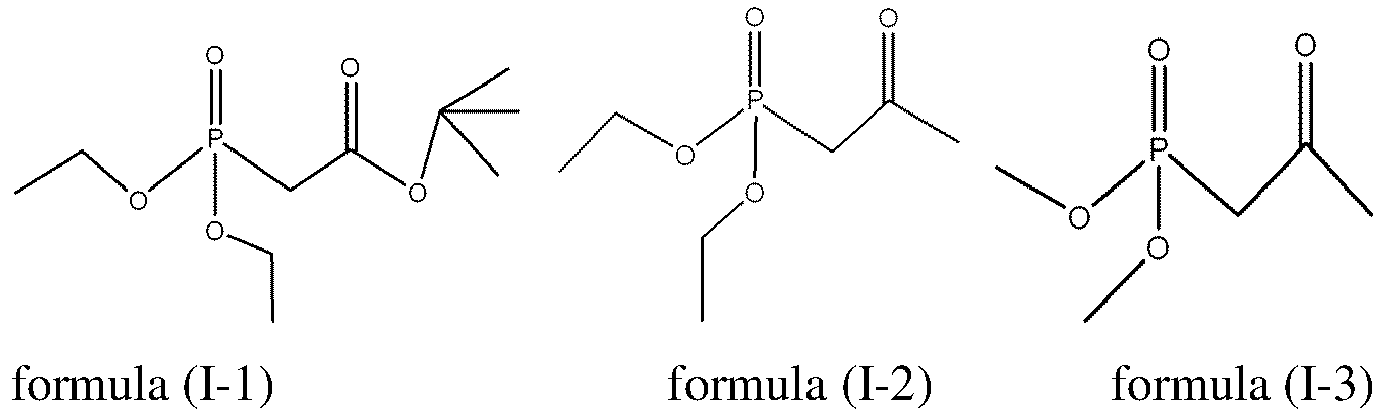


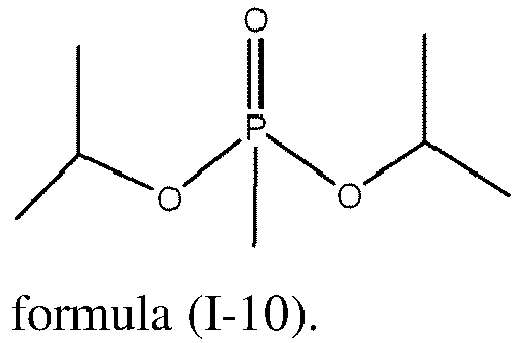
- Based on the mass of the electrolyte, a mass percentage of the compound represented by formula (I) is E%, where 0.05 ≤ E ≤ 1. In some embodiments of this application, 0.1 ≤ E ≤ 0.5. For example, the mass percentage E% of the compound represented by formula (I) may be 0.05%, 0.1%, 0.2%, 0.3%, 0.4%, 0.5%, 0.6%, 0.7%, 0.8%, 0.9%, 1%, or a value within a range defined by any two of these values. The foregoing compound represented by formula (I) can oxidize on a surface of the positive electrode plate to form a CEI film containing phosphate, which facilitates transport of lithium ions and reduces interface impedance between the positive electrode plate and the electrolyte. Therefore, with the foregoing compound represented by formula (I) added to the electrolyte that includes the lithium bis(oxalato)borate and the 1,3,6-hexanetricarbonitrile and the mass percentage thereof controlled within the foregoing range, the issues of affecting lithium ion transport and unstable structure of the positive electrode active material caused by nickel doping in the positive electrode active material can be alleviated, which improves the high-temperature cycling performance and kinetic performance of the electrochemical apparatus, so as to balance the energy density, high-temperature cycling performance, and kinetic performance of the electrochemical apparatus provided in this application, improving the comprehensive performance of the electrochemical apparatus.
- In some embodiments of this application, the electrolyte further includes a dinitrile compound, where the dinitrile compound includes at least one of malononitrile, succinonitrile, glutaronitrile, adiponitrile, suberonitrile, terephthalonitrile, tetradecanedinitrile, azomalononitrile, methyleneglutaronitrile, or pentenedinitrile; and based on the mass of the electrolyte, a mass percentage of the dinitrile compound is F%, where 0.1 ≤ F ≤ 8. For example, the mass percentage F% of the dinitrile compound may be 0.1%, 0.5%, 1%, 2%, 3%, 4%, 5%, 6%, 7%, 8%, or a value within a range defined by any two of these values. The dinitrile compound can improve interface stability of the CEI film, improving the high-temperature cycling performance of the electrochemical apparatus. Therefore, with the foregoing dinitrile compound added to the electrolyte that includes the lithium bis(oxalato)borate and the 1,3,6-hexanetricarbonitrile and the mass percentage thereof controlled within the foregoing range, the issues of affecting lithium ion transport and unstable structure of the positive electrode active material caused by nickel doping in the positive electrode active material can be alleviated, which further improves the high-temperature cycling performance of the electrochemical apparatus, so as to balance the energy density and high-temperature cycling performance of the electrochemical apparatus provided in this application, improving the comprehensive performance of the electrochemical apparatus.
- In some embodiments of this application, the electrolyte further includes a polynitrile compound, where the polynitrile compound includes at least one of the following compounds:


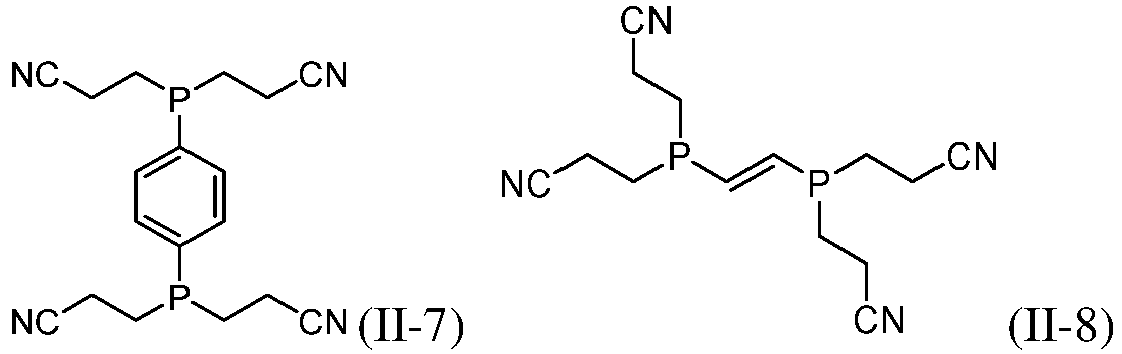

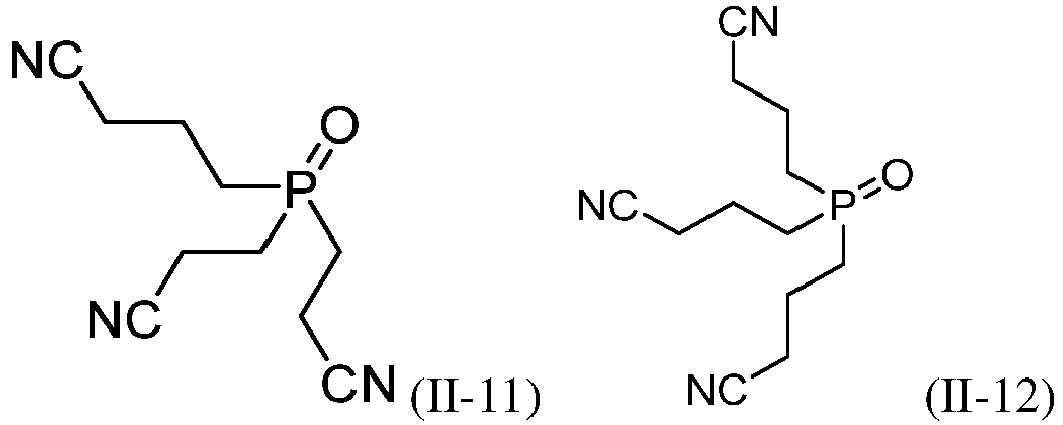
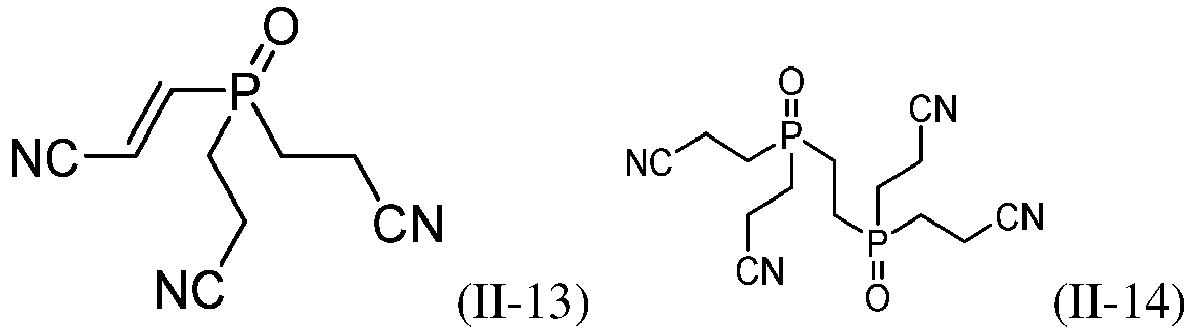
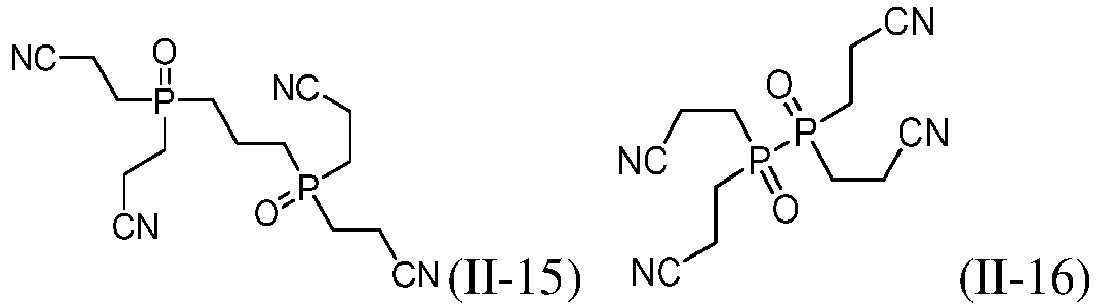


- Based on the mass of the electrolyte, a mass percentage of the polynitrile compound is G%, where 0.1 ≤ G ≤ 8. For example, the mass percentage G% of the polynitrile compound may be 0.1%, 0.5%, 1%, 2%, 3%, 4%, 5%, 6%, 7%, 8%, or a value within a range defined by any two of these values. The polynitrile compound can improve the interface stability of the CEI film, improving the high-temperature cycling performance of the electrochemical apparatus. Therefore, with the foregoing polynitrile compound added to the electrolyte that includes the lithium bis(oxalato)borate and the 1,3,6-hexanetricarbonitrile and the mass percentage thereof controlled within the foregoing range, the issues of affecting lithium ion transport and unstable structure of the positive electrode active material caused by nickel doping in the positive electrode active material can be alleviated, which further improves the high-temperature cycling performance of the electrochemical apparatus, so as to balance the energy density and high-temperature cycling performance of the electrochemical apparatus provided in this application, improving the comprehensive performance of the electrochemical apparatus.
- In some embodiments of this application, the electrolyte further includes the foregoing dinitrile compound and the foregoing polynitrile compound, which can improve the interface stability of the CEI film, improving the high-temperature cycling performance of the electrochemical apparatus. Therefore, with the foregoing dinitrile compound and the foregoing polynitrile compound added to the electrolyte that includes the lithium bis(oxalato)borate and the 1,3,6-hexanetricarbonitrile and the mass percentages thereof controlled within the foregoing ranges, the issues of affecting lithium ion transport and unstable structure of the positive electrode active material caused by nickel doping in the positive electrode active material can be alleviated, which further improves the high-temperature cycling performance of the electrochemical apparatus, so as to balance the energy density and high-temperature cycling performance of the electrochemical apparatus provided in this application, improving the comprehensive performance of the electrochemical apparatus.
- In some embodiments of this application, the electrolyte further includes the foregoing dinitrile compound and the foregoing polynitrile compound, and a sum of the mass percentages of the dinitrile compound and polynitrile compound satisfies 0.1 ≤ F + G ≤ 8. For example, the value of F + G may be 0.1, 0.5, 1, 2, 3, 4, 5, 6, 7, 8, or a value within a range defined by any two of these values. With the value of F + G and the mass percentages of the foregoing dinitrile compound and polynitrile compound controlled within the foregoing ranges, the foregoing dinitrile compound and the foregoing polynitrile compound can synergistically improve the interface stability of the CEI film, improving the high-temperature cycling performance of the electrochemical apparatus. Therefore, with the foregoing dinitrile compound and the foregoing polynitrile compound added to the electrolyte that includes the lithium bis(oxalato)borate and the 1,3,6-hexanetricarbonitrile and the mass percentages thereof controlled within the foregoing ranges, the issues of affecting lithium ion transport and unstable structure of the positive electrode active material caused by nickel doping in the positive electrode active material can be alleviated, which further improves the high-temperature cycling performance of the electrochemical apparatus, so as to balance the energy density and high-temperature cycling performance of the electrochemical apparatus provided in this application, improving the comprehensive performance of the electrochemical apparatus.
- In some embodiments of this application, the electrolyte includes the lithium bis(oxalato)borate, the 1,3,6-hexanetricarbonitrile, a lithium salt, and an organic solvent. The lithium salt includes at least one of lithium hexafluorophosphate, lithium bistrifluoromethanesulfonimide, lithium bis(fluorosulfonyl)imide, lithium tetrafluoroborate, lithium bis(oxalato)borate, lithium difluoro(oxalato)borate, or lithium difluorophosphate. Based on the mass of the electrolyte, a mass percentage of the lithium salt is H%, where 8 ≤ H ≤ 20. For example, the mass percentage H% of the lithium salt may be 8%, 9%, 10%, 11%, 12%, 12.5%, 15%, 17%, 18%, 20%, or a value within a range defined by any two of these values. The organic solvent includes a carbonate compound and a carboxylate compound, where the carbonate compound includes at least one of ethylene carbonate, propylene carbonate, butylene carbonate, dimethyl carbonate, ethyl methyl carbonate, diethyl carbonate, dipropyl carbonate, methyl propyl carbonate, ethyl propyl carbonate, dioctyl carbonate, dipentyl carbonate, ethyl isobutyl carbonate, isopropyl methyl carbonate, di-n-butyl carbonate, diisopropyl carbonate, or propyl carbonate, and the carboxylate compound includes at least one of methyl acetate, ethyl acetate, propyl acetate, ethyl propionate, propyl propionate, butyl propionate, or amyl propionate. Based on the mass of the electrolyte, a mass percentage of the organic solvent is 67% to 90%, a mass percentage of the carbonate compound is J%, and a mass percentage of the carboxylate compound is K%, where 14 ≤ J ≤ 90 and 0 ≤ K ≤ 60. For example, the mass percentage of the organic solvent may be 67%, 70%, 75%, 80%, 85%, 90%, or a value within a range defined by any two of these values; the mass percentage J% of the carbonate compound may be 14%, 20%, 30%, 40%, 50%, 60%, 70%, 75%, 80%, 85%, 90%, or a value within a range defined by any two of these values; and the mass percentage K% of the carboxylate compound may be 0%, 10%, 20%, 30%, 40%, 50%, 60%, or a value within a range defined by any two of these values. The mass percentages of the lithium bis(oxalato)borate and the 1,3,6-hexanetricarbonitrile are within the foregoing respective ranges. With the electrolyte including the lithium bis(oxalato)borate, the 1,3,6-hexanetricarbonitrile, the lithium salt, and the organic solvent and the respective mass percentages thereof controlled within the foregoing ranges, it is conducive to increasing the transport rate of lithium ions and reducing side reactions at the interfaces of the positive electrode plate and the negative electrode plate, improving the high-temperature cycling performance and kinetic performance of the electrochemical apparatus. Therefore, a synergistic effect is generated between the foregoing electrolyte included in the electrochemical apparatus provided in this application and the positive electrode active material in the electrochemical apparatus, so as to balance the energy density and high-temperature cycling performance of the electrochemical apparatus provided in this application, improving the comprehensive performance of the electrochemical apparatus.
- In some embodiments of this application, the electrolyte includes the lithium bis(oxalato)borate, the 1,3,6-hexanetricarbonitrile, the lithium salt, the organic solvent, and at least one of the compound represented by formula (I), the dinitrile compound, or the polynitrile compound. The lithium salt includes at least one of lithium hexafluorophosphate, lithium bistrifluoromethanesulfonimide, lithium bis(fluorosulfonyl)imide, lithium tetrafluoroborate, lithium bis(oxalato)borate, lithium difluoro(oxalato)borate, or lithium difluorophosphate. Based on the mass of the electrolyte, a mass percentage of the lithium salt is H%, where 8 ≤ H ≤ 20. For example, the mass percentage H% of the lithium salt may be 8%, 9%, 10%, 11%, 12%, 12.5%, 15%, 17%, 18%, 20%, or a value within a range defined by any two of these values. The organic solvent includes a carbonate compound and a carboxylate compound, where the carbonate compound includes at least one of ethylene carbonate, propylene carbonate, butylene carbonate, dimethyl carbonate, ethyl methyl carbonate, diethyl carbonate, dipropyl carbonate, methyl propyl carbonate, ethyl propyl carbonate, dioctyl carbonate, dipentyl carbonate, ethyl isobutyl carbonate, isopropyl methyl carbonate, di-n-butyl carbonate, diisopropyl carbonate, or propyl carbonate, and the carboxylate compound includes at least one of methyl acetate, ethyl acetate, propyl acetate, ethyl propionate, propyl propionate, butyl propionate, or amyl propionate. Based on the mass of the electrolyte, a mass percentage of the organic solvent is 67% to 90%, a mass percentage of the carbonate compound is J%, and a mass percentage of the carboxylate compound is K%, where 14 ≤ J ≤ 90 and 0 ≤ K ≤ 60. For example, the mass percentage J% of the organic solvent may be 67%, 70%, 75%, 80%, 85%, 90%, or a value within a range defined by any two of these values; the mass percentage J% of the carbonate compound may be 14%, 20%, 30%, 40%, 50%, 60%, 70%, 75%, 80%, 85%, 90%, or a value within a range defined by any two of these values; and the mass percentage K% of the carboxylate compound may be 0%, 10%, 20%, 30%, 40%, 50%, 60%, or a value within a range defined by any two of these values. The mass percentages of the lithium bis(oxalato)borate and the 1,3,6-hexanetricarbonitrile are within the foregoing respective ranges, and when the electrolyte includes at least one of the compound represented by formula (I), the dinitrile compound, or the polynitrile compound, the mass percentages thereof are within the foregoing respective ranges. With the electrolyte including the lithium bis(oxalato)borate, the 1,3,6-hexanetricarbonitrile, the lithium salt, the organic solvent, and at least one of the compound represented by formula (I), the dinitrile compound, or the polynitrile compound and the respective mass percentages thereof controlled within the foregoing ranges, it is conducive to further increasing the transport rate of lithium ions and reducing side reactions at the interfaces of the positive electrode plate and the negative electrode plate, improving the high-temperature cycling performance and kinetic performance of the electrochemical apparatus. Therefore, a synergistic effect is generated between the foregoing electrolyte included in the electrochemical apparatus provided in this application and the positive electrode active material in the electrochemical apparatus, so as to balance the energy density, high-temperature cycling performance, and kinetic performance of the electrochemical apparatus provided in this application, improving the comprehensive performance of the electrochemical apparatus.
- A preparation method of positive electrode active material is not particularly limited in this application, provided that the objectives of this application can be achieved. For example, the preparation method of positive electrode active material may include but is not limited to the following steps: LiCoO2 (CAS number: 12190-79-3) and a nickel-containing compound are mixed to uniformity and then subjected to heat treatment in an air atmosphere to produce a positive electrode active material. The nickel-containing compound may include but is not limited to at least one of NiCO3, NiO, or Ni(OH)2. Temperature, time, and temperature rise velocity of the foregoing heat treatment are not particularly limited in this application, provided that the objectives of this application can be achieved. For example, the heat treatment is performed at a temperature of 650°C to 850°C, a time of 22 h to 26 h, and a temperature rise velocity of 2°C/min to 8°C/min. A mass ratio of LiCoO2 to the nickel-containing compound is not particularly limited in this application, provided that the objectives of this application can be achieved.
- Typically, the mass ratio of LiCoO2 to the nickel-containing compound can be changed to control the mass percentages of Co and Ni in the positive electrode active material. For example, increasing the mass ratio of LiCoO2 to the nickel-containing compound leads to an increase in the mass percentage of Co and a decrease in the mass percentage of Ni; and decreasing the mass ratio of LiCoO2 to the nickel-containing compound leads to a decrease in the mass percentage of Co and an increase in the mass percentage of Ni.
- When the positive electrode active material contains the foregoing element M, both the nickel-containing compound and a compound containing the element M can be added during preparation of the positive electrode active material. For example, when the element M is Mg, Al, Ca, Ti, Zr, V, Cr, Fe, Mn, Cu, Zn, Rb, or Sn, the compound containing the element M added accordingly may be an oxide, hydroxide, or carbonate compound that contains the element M. The oxide, hydroxide, and carbonate compound that contain the element M are not limited in this application, provided that the objectives of this application can be achieved. The content of the element M in the positive electrode active material can be controlled by controlling the added amount of the compound containing the element M.
- In this application, the "positive electrode material layer disposed on at least one surface of the positive electrode current collector" means that the positive electrode material layer may be disposed on one surface of the positive electrode current collector in its thickness direction, or on two surfaces of the positive electrode current collector in its thickness direction. It should be noted that the "surface" herein may be an entire region or a partial region of the surface of the positive electrode current collector. This is not particularly limited in this application, provided that the objectives of this application can be achieved. The positive electrode current collector is not particularly limited in this application, provided that the objectives of this application can be achieved. For example, the positive electrode current collector may include aluminum foil, aluminum alloy foil, a composite current collector (for example, an aluminum-carbon composite current collector), or the like.
- The positive electrode material layer may further include a conductive agent and a binder. Types of the conductive agent and the binder are not particularly limited in this application, provided that the objectives of this application can be achieved. For example, the conductive agent may include but is not limited to at least one of conductive carbon black (Super P), carbon nanotubes (CNTs), carbon fiber, flake graphite, Ketjen black, graphene, a metal material, or a conductive polymer. The carbon nanotubes may include but are not limited to single-walled carbon nanotubes and/or multi-walled carbon nanotubes. The carbon fiber may include but is not limited to vapor grown carbon fiber (VGCF) and/or carbon nanofiber. The metal material may include but is not limited to metal powder and/or metal fiber, and specifically, the metal may include but is not limited to at least one of copper, nickel, aluminum, or silver. The conductive polymer may include but is not limited to at least one of polyphenylene derivative, polyaniline, polythiophene, polyacetylene, or polypyrrole. For example, the binder may include but is not limited to at least one of polyacrylic acid, sodium polyacrylate, potassium polyacrylate, lithium polyacrylate, polyimide, polyvinyl alcohol, carboxymethyl cellulose, sodium carboxymethyl cellulose, lithium carboxymethyl cellulose, polyamideimide, styrene-butadiene rubber, or polyvinylidene fluoride. A mass ratio of the positive electrode active material, the conductive agent, and the binder in the positive electrode material layer is not particularly limited in this application, and persons skilled in the art can make selection based on actual needs, provided that the objectives of this application can be achieved.
- Thicknesses of the positive electrode current collector and the positive electrode material layer are not particularly limited in this application, provided that the objectives of this application can be achieved. For example, the thickness of the positive electrode current collector is 6 µm to 15 µm, and the thickness of the positive electrode material layer is 30 µm to 120 µm. Thickness of the positive electrode plate is not particularly limited in this application, provided that the objectives of this application can be achieved. For example, the thickness of the positive electrode plate is 50 µm to 250 µm.
- In this application, the electrochemical apparatus further includes a negative electrode plate, and the negative electrode plate includes a negative electrode current collector and a negative electrode material layer disposed on at least one surface of the negative electrode current collector. The "negative electrode material layer disposed on at least one surface of the negative electrode current collector" means that the negative electrode material layer may be disposed on one surface of the negative electrode current collector in its thickness direction, or on two surfaces of the negative electrode current collector in its thickness direction. It should be noted that the "surface" herein may be an entire region or a partial region of the surface of the negative electrode current collector. This is not particularly limited in this application, provided that the objectives of this application can be achieved.
- The negative electrode current collector is not particularly limited in this application, provided that the objectives of this application can be achieved. For example, the negative electrode current collector may include copper foil, copper alloy foil, nickel foil, stainless steel foil, titanium foil, nickel foam, copper foam, a composite current collector (for example, a lithium-copper composite current collector, a carbon-copper composite current collector, a nickel-copper composite current collector, or a titanium-copper composite current collector), or the like. The negative electrode current collector may be a metal plate without through holes or a porous metal plate with through holes.
- The negative electrode material layer includes a negative electrode active material, and the negative electrode active material is not particularly limited in this application, provided that the objectives of this application can be achieved. For example, the negative electrode active material may include but is not limited to at least one of natural graphite, artificial graphite, mesocarbon microbeads, hard carbon, soft carbon, silicon, a silicon-carbon composite, Li-Sn alloy, Li-Sn-O alloy, Sn, SnO, SnO2, spinel-structured lithiated TiO2-Li4Ti5O12, or Li-Al alloy.
- The negative electrode material layer may further include a conductive agent, a binder, and a thickener, and types of the conductive agent, the binder, and the thickener are not particularly limited in this application, provided that the objectives of this application can be achieved. For example, the conductive agent and the binder may be at least one of the foregoing conductive agents and binders, and the thickener may include but is not limited to at least one of sodium carboxymethyl cellulose or lithium carboxymethyl cellulose. A mass ratio of the negative electrode active material, the conductive agent, the binder, and the thickener in the negative electrode material layer is not particularly limited in this application, and persons skilled in the art can make selection based on actual needs, provided that the objectives of this application can be achieved.
- Thickness of the negative electrode material layer is not particularly limited in this application, provided that the objectives of this application can be achieved. For example, the thickness of the negative electrode material layer is 30 µm to 120 µm. Thickness of the negative electrode current collector is not particularly limited in this application, provided that the objectives of this application can be achieved. For example, the thickness of the negative electrode current collector is 6 µm to 12 µm. Thickness of the negative electrode plate is not particularly limited in this application, provided that the objectives of this application can be achieved. For example, the thickness of the negative electrode plate is 50 µm to 250 µm.
- In this application, the electrochemical apparatus further includes a separator. The separator is used to separate the positive electrode plate from the negative electrode plate to prevent short circuit inside the electrochemical apparatus and to allow electrolyte ions to pass through freely without affecting the electrochemical charging and discharging processes. The separator is not particularly limited in this application, provided that the objectives of this application can be achieved. For example, material of the separator may include but is not limited to at least one of polyethylene (PE) and polypropylene (PP)-based polyolefin (PO), polyester (for example, polyethylene terephthalate (PET) film), cellulose, polyimide (PI), polyamide (PA), spandex, or aramid. For example, polyethylene includes at least one of high-density polyethylene, low-density polyethylene, or ultra-high-molecular-weight polyethylene. Type of the separator may include but is not limited to at least one of woven film, non-woven film, microporous film, composite film, laminated film, or spinning film.
- In some embodiments of this application, the separator may include a substrate layer and a surface treatment layer. The substrate layer may be a non-woven fabric, film, or composite film having a porous structure, and material of the substrate layer may include at least one of polyethylene, polypropylene, polyethylene glycol terephthalate, or polyimide. Optionally, the substrate layer may be a polypropylene porous film, a polyethylene porous film, a polypropylene non-woven fabric, a polyethylene non-woven fabric, or a polypropylene-polyethylene-polypropylene porous composite film. Optionally, the surface treatment layer is provided on at least one surface of the substrate layer, and the surface treatment layer may be a polymer layer, an inorganic substance layer, or a layer formed by mixing a polymer and an inorganic substance. For example, the inorganic substance layer includes inorganic particles and a binder. The inorganic particle is not particularly limited, and for example, may include at least one of aluminum oxide, silicon oxide, magnesium oxide, titanium oxide, hafnium oxide, tin oxide, ceria oxide, nickel oxide, zinc oxide, calcium oxide, zirconium oxide, yttrium oxide, silicon carbide, boehmite, aluminum hydroxide, magnesium hydroxide, calcium hydroxide, or barium sulfate. The binder is not particularly limited, and may be, for example, at least one of the foregoing binders. The polymer layer includes a polymer, and material of the polymer includes at least one of polyamide, polyacrylonitrile, acrylate polymer, polyacrylic acid, polyacrylate salt, polyvinylpyrrolidone, polyvinyl ether, polyvinylidene fluoride, or poly(vinylidene fluoride-hexafluoropropylene).
- A preparation process of the electrochemical apparatus of this application is well known to persons skilled in the art, and is not particularly limited in this application. For example, the preparation process may include but is not limited to the following steps: a positive electrode plate, a separator, and a negative electrode plate are stacked in sequence and go through operations such as winding and folding as needed to obtain an electrode assembly with a winding structure, the electrode assembly is put into a packaging bag, an electrolyte is injected into the packaging bag, and the packaging bag is sealed to obtain an electrochemical apparatus. Alternatively, a positive electrode plate, a separator, and a negative electrode plate are stacked in sequence, four corners of the entire laminated structure are fixed with tapes to obtain an electrode assembly with a laminated structure, the electrode assembly is put into a packaging bag, an electrolyte is injected into the packaging bag, and the packaging bag is sealed to obtain an electrochemical apparatus. In addition, an overcurrent prevention element, a guide plate, and the like may also be placed into the packaging bag as needed, so as to prevent pressure increase, overcharge, and overdischarge inside the electrochemical apparatus. The packaging bag is a packaging bag known in the art, and is not limited in this application.
- A second aspect of this application provides an electronic apparatus, including the electrochemical apparatus according to any one of the foregoing embodiments. Therefore, the electronic apparatus provided in this application has good use performance.
- Type of the electronic apparatus is not particularly limited in this application and the electronic apparatus may be any known electronic apparatus used in the prior art. In some embodiments of this application, the electronic apparatus may include but is not limited to a notebook computer, a pen-input computer, a mobile computer, an electronic book player, a portable telephone, a portable fax machine, a portable copier, a portable printer, a stereo headset, a video recorder, a liquid crystal television, a portable cleaner, a portable CD player, a mini-disc, a transceiver, an electronic notebook, a calculator, a storage card, a portable recorder, a radio, a standby power source, a motor, an automobile, a motorcycle, a motor bicycle, a bicycle, a lighting appliance, a toy, a game console, a clock, an electric tool, a flash lamp, a camera, a large household battery, or a lithium-ion capacitor.
- This application has the following beneficial effects:
This application provides an electrochemical apparatus and an electronic apparatus. The electrochemical apparatus includes a positive electrode plate and an electrolyte. The positive electrode plate includes a positive electrode current collector and a positive electrode material layer disposed on at least one surface of the positive electrode current collector, the positive electrode material layer includes a positive electrode active material, and the positive electrode active material contains cobalt and nickel, where based on a mass of the positive electrode active material, a mass percentage of the nickel is B%, where 0.05 ≤ B ≤ 20. The electrolyte includes lithium bis(oxalato)borate and 1,3,6-hexanetricarbonitrile, where based on a mass of the electrolyte, a mass percentage of the lithium bis(oxalato)borate is C% and a mass percentage of the 1,3,6-hexanetricarbonitrile is D%. The electrochemical apparatus satisfies 0.1 ≤ (C + D)/B ≤ 23. According to the electrochemical apparatus provided in this application, with the mass percentage of Ni controlled within the foregoing range, both the lithium bis(oxalato)borate and the 1,3,6-hexanetricarbonitrile introduced into the electrolyte, and the value of (C + D)/B controlled within the foregoing range, a synergistic effect is generated between the positive electrode plate and the electrolyte, so as to balance the energy density and high-temperature cycling performance of the electrochemical apparatus provided in this application, improving the comprehensive performance of the electrochemical apparatus. - Certainly, when any one of the products or methods of this application is implemented, the advantages described above are not necessarily demonstrated all at the same time.
- The following clearly and completely describes the technical solutions in some embodiments of this application. Apparently, the described embodiments are only some but not all of the embodiments of this application. All other embodiments obtained by persons of ordinary skill in the art based on some embodiments of this application shall fall within the protection scope of this application.
- A lithium-ion battery was discharged to 3 V at 0.2C, and then disassembled to take a positive electrode plate. A positive electrode material layer of the positive electrode plate washed with DMC (dimethyl carbonate) was scraped off with a scraper to obtain powder of the positive electrode material layer, and 0.4 g of powder of the positive electrode material layer was dissolved by a 12 mL mixed solvent, where the mixed solvent was obtained by mixing aqua regia and HF at a volume ratio of 5:1. Then, the solution was diluted to 100 mL, and contents of metal elements such as Co and Ni in the solution were tested by using an inductively coupled plasma emission spectrometer (ICP) in %. Aqua regia was obtained by mixing concentrated nitric acid and concentrated hydrochloric acid at a volume ratio of 1:1. The contents of Co and Ni in the positive electrode active material were calculated based on a mass percentage of the positive electrode active material in the positive electrode material layer.
- Preparation of lithium-ion button battery: In a glove box, a negative electrode housing, a spacer, a lithium metal plate, a separator, a positive electrode plate, an elastic sheet, and a positive electrode housing were assembled in sequence and sealed on a sealing machine to obtain a battery. An electrolyte was added dropwise onto the spacer, the lithium metal plate, the separator, and the positive electrode plate to infiltrate them. The positive electrode plate, the separator, and the electrolyte were the positive electrode plate, the separator, and the electrolyte in each example or comparative example, where a diameter of the positive electrode plate was 14 mm, a diameter of the lithium metal plate was 16 mm, and a diameter of the separator was 16.5 mm.
- At 25°C, the prepared lithium-ion button battery was charged to a voltage of 4.5 V at 0.2C, further charged to a current lower than 0.05C at a constant voltage of 4.5 V, so that the battery was in a fully charged state of 4.5 V, and then discharged at a constant current of 0.2C until the voltage was 3.0 V, and then a discharge capacity of the lithium-ion battery was tested. Discharge gram capacity of lithium-ion battery = discharge capacity/mass of positive electrode active material. The mass of the positive electrode active material can be calculated based on the size of the positive electrode plate and the preparation formulation of the positive electrode plate in each example or comparative example.
- At 45°C, the lithium-ion battery was charged to 4.5 V at a constant current of 0.7C, then charged to a current of 0.05C at a constant voltage of 4.5 V, and discharged to 3.0 V at a constant current of 1C. This was one charge and discharge cycle. This was the first cycle, and a discharge capacity of the lithium-ion battery after the first cycle was recorded. The lithium-ion battery was subjected to 500 charge and discharge cycles in the foregoing method, and a discharge capacity after 500 cycles was recorded. Discharge capacity retention rate = discharge capacity after 500 cycles/discharge capacity after the first cycle × 100%. The high-temperature cycling performance of the lithium-ion battery was evaluated based on the discharge capacity retention rate. A higher discharge capacity retention rate means better high-temperature cycling performance, and a lower discharge capacity retention rate means poorer high-temperature cycling performance.
- The lithium-ion battery was charged to 4.5 V at a constant current of 0.7C, then charged to a current of 0.05C at a constant voltage, left standing for 10 min, and discharged at a constant current of 0.1C for 8 h, and a voltage V1 was recorded. The battery was left standing for 15 min, and the voltage was tested again and denoted as V2. Impedance Rss = (V2 - V1)/0.1C. The impedance was used as an indicator for evaluating the kinetic performance of the lithium-ion battery. Higher impedance means poorer kinetic performance, and lower impedance means better kinetic performance.
- LiCoO2 and nickel carbonate (NiCO3) were mixed at a mass ratio X of 0.2 in a high-speed mixer at 300 r/min for 20 min. The mixture was put into an air kiln, heated to 820°C at 5°C/min and held for 24 h, taken out after natural cooling, and sieved with a 300-mesh sieve to obtain a positive electrode active material.
- The prepared positive electrode active material, conductive agent carbon nanotubes (CNT), and binder polyvinylidene fluoride were mixed at a mass ratio of 95:2:3, N-methylpyrrolidone (NMP) was added as a solvent, and the mixture was stirred by a vacuum stirrer to a uniform system, to obtain a positive electrode slurry with a solid content of 75wt%. The positive electrode slurry was uniformly applied onto one surface of a 12 µm thick positive electrode current collector aluminum foil and dried at 85°C, followed by cold pressing, to obtain a positive electrode plate with a 100 µm thick positive electrode material layer. Then, the same steps were repeated on the other surface of the aluminum foil to obtain a positive electrode plate coated with positive electrode material layers on two surfaces. The positive electrode plate was cut into a size of 74 mm × 867 mm and then welded with tabs for use.
- Negative electrode active material artificial graphite, styrene-butadiene rubber (SBR), and carboxymethyl cellulose (CMC) were mixed at a mass ratio of 95:2:3, then deionized water was added as a solvent to obtain a slurry with a solid content of 70wt%, and the slurry was stirred to uniformity. The slurry was uniformly applied onto one surface of an 8 µm thick copper foil and dried at 110°C, followed by cold pressing, to obtain a negative electrode plate with one surface coated with a 150 µm thick negative electrode material layer. Then, the same steps were repeated on the other surface of the copper foil to obtain a negative electrode plate coated with negative electrode material layers on two surfaces. The negative electrode plate was cut into a size of 75 mm × 867 mm and then welded with tabs for use.
- In an argon atmosphere glove box with a moisture content less than 10 ppm, carbonate compound ethylene carbonate (EC), propylene carbonate (PC), and diethyl carbonate (DEC) were evenly mixed at a mass ratio of 20:20:60, lithium bis(oxalato)borate, 1,3,6-hexanetricarbonitrile, and lithium salt LiPF6 were added and stirred to obtain a uniform electrolyte. A mass percentage C% of the lithium bis(oxalato)borate was 0.3%, a mass percentage D% of the 1,3,6-hexanetricarbonitrile was 2%, a mass percentage H% of the lithium salt was 12.5%, and a mass percentage J% of the carbonate compound was 85.2%.
- A 15 µm thick polyethylene porous polymer film (manufacturer: Celgard, LLC of USA) was used as a separator.
- The positive electrode plate, the separator, and the negative electrode plate were sequentially stacked so that the separator was located between the positive electrode plate and the negative electrode plate to provide separation. Then, the resulting stack was wound to obtain an electrode assembly. The electrode assembly was placed into an aluminum-plastic film packaging bag and dehydrated at 80°C, and the prepared electrolyte was injected, followed by processes such as vacuum sealing, standing, formation, and shaping, to obtain a lithium-ion battery. An upper limit voltage for formation was 4.15 V, a formation temperature was 70°C, and a standing time in formation was 2 h.
- These examples were the same as Example 1-1 except that the related preparation parameters were adjusted according to Table 1, where when the mass percentage of the lithium bis(oxalato)borate and/or the 1,3,6-hexanetricarbonitrile changed, the mass percentage of the organic solvent changed accordingly while the mass percentage of the lithium salt remained unchanged.
- These examples were the same as Example 1-15 except that in <Preparation of electrolyte>, the compound represented by formula (I) was added according to Table 2 and the mass percentage thereof was adjusted according to Table 2, where the mass percentage of the organic solvent changed accordingly while the mass percentage of the lithium salt remained unchanged.
- These examples were the same as Example 1-3 except that in <Preparation of electrolyte>, the dinitrile compound and/or the polynitrile compound was added according to Table 3 and the mass percentage thereof was adjusted according to Table 3, where the mass percentage of the organic solvent changed accordingly while the mass percentage of the lithium salt remained unchanged.
- This example was the same as Example 1-5 except that the positive electrode active material was prepared according to the following steps.
- LiCoO2, nickel carbonate (NiCO3), and MnCO3 were mixed at a molar ratio of 0.83:0.15:0.02 in a high-speed mixer at 300 r/min for 20 min. The mixture was put into an air kiln, heated to 820°C at 5°C/min and held for 24 h, taken out after natural cooling, and sieved with a 300-mesh sieve to obtain a positive electrode active material.
- This example was the same as Example 1-5 except that the positive electrode active material was prepared according to the following steps.
- LiCoO2, nickel carbonate (NiCO3), and Al2(CO3)3 were mixed at a molar ratio of 0.83:0.15:0.02 in a high-speed mixer at 300 r/min for 20 min. The mixture was put into an air kiln, heated to 820°C at 5°C/min and held for 24 h, taken out after natural cooling, and sieved with a 300-mesh sieve to obtain a positive electrode active material.
- This example was the same as Example 1-5 except that the positive electrode active material was prepared according to the following steps.
- LiCoO2, nickel carbonate (NiCO3), and MgCO3 were mixed at a molar ratio of 0.83:0.15:0.02 in a high-speed mixer at 300 r/min for 20 min. The mixture was put into an air kiln, heated to 820°C at 5°C/min and held for 24 h, taken out after natural cooling, and sieved with a 300-mesh sieve to obtain a positive electrode active material.
- These comparative examples were the same as Example 1-1 except that the related preparation parameters were adjusted according to Table 1, where when the mass percentage of the lithium bis(oxalato)borate and/or the 1,3,6-hexanetricarbonitrile changed, the mass percentage of the organic solvent changed accordingly while the mass percentage of the lithium salt remained unchanged.
- Preparation parameters and performance tests of the examples and comparative examples are shown in Tables 1 to 4.
Table 1 Mass ratio X A B A/20B C D (C + D)/B Discharge gram capacity (mAh/g) Discharge capacity retention rate (%) Example 1-1 0.2 59.9 0.1 29.95 0.3 2 23.00 180.1 60.2 Example 1-2 1 59.5 0.5 5.95 0.3 2 4.60 180.1 62.1 Example 1-3 2 59 1 2.95 0.3 2 2.30 180.5 65.8 Example 1-4 8 56 4 0.70 0.3 2 0.58 181.5 65.5 Example 1-5 15 50.1 8.8 0.33 0.3 2 0.29 182.8 64.2 Example 1-6 18 50 10 0.25 0.3 2 0.23 183.2 63.9 Example 1-7 34 40 20 0.10 0.3 2 0.12 183.8 62.5 Example 1-8 15 52 8 0.33 0.05 2 0.26 182.8 59.3 Example 1-9 15 52 8 0.33 0.5 2 0.31 182.8 65.1 Example 1-10 15 52 8 0.33 1 2 0.38 182.8 70.3 Example 1-11 15 52 8 0.33 3 2 0.63 182.8 64.8 Example 1-12 15 52 8 0.33 5 2 0.88 182.8 62.9 Example 1-13 15 52 8 0.33 1 0.1 0.14 182.8 64.7 Example 1-14 15 52 8 0.33 1 1 0.25 182.8 68.8 Example 1-15 15 52 8 0.33 1 3 0.50 182.8 77.2 Example 1-16 15 52 8 0.33 1 6 0.88 182.8 66.1 Example 1-17 15 52 8 0.33 1 8 1.13 182.8 63.5 Comparative Example 1 0 60 0 / 0 0 / 180.0 53.2 Comparative Example 2 2 59 1 2.95 0 0 0.00 180.5 52.3 Comparative Example 3 2 59 1 2.95 0.3 0 0.30 180.5 54.7 Comparative Example 4 2 59 1 2.95 0 2 2.00 180.5 56.5 Comparative Example 5 1 59.5 0.5 5.95 5 8 26 180.1 50.1 Note: "/"in Table 1 means that a corresponding parameter does not exist, and the mass ratio X in Table 1 refers to the mass ratio of LiCoO2 and NiCOs. - It can be learned from Examples 1-1 to 1-17 and Comparative Examples 1 to 5 that in the lithium-ion batteries in the examples of this application, the positive electrode active materials contain Ni and the mass percentages B% of Ni are within the range of this application, the electrolytes include the lithium bis(oxalato)borate and the 1,3,6-hexanetricarbonitrile, and the values of the relation (C + D)/B of the mass percentages C% of the lithium bis(oxalato)borate, the mass percentages D% of the 1,3,6-hexanetricarbonitrile, and the mass percentages B% of Ni are within the range of this application; while the lithium-ion batteries in the comparative examples do not meet the foregoing characteristics simultaneously. Therefore, the lithium-ion batteries obtained in the examples have higher discharge gram capacity and higher discharge capacity retention rate, which indicates increased energy density and improved high-temperature cycling performance of the lithium-ion batteries, improving the comprehensive performance of the lithium-ion batteries.
- The mass percentage A% of Co and the value of A/20B generally affect the comprehensive performance of the lithium-ion battery. It can be learned from Examples 1-1 to 1-7 that when the mass percentage A% of Co and A/20B are within the ranges of this application, the obtained lithium-ion battery has higher discharge gram capacity and discharge capacity retention rate, which indicates higher energy density and better high-temperature cycling performance of the lithium-ion battery, namely, better comprehensive performance of the lithium-ion battery.
- The mass percentage C% of the lithium bis(oxalato)borate generally affects the comprehensive performance of the lithium-ion battery. It can be learned from Examples 1-5 and 1-8 to 1-12 that when the mass percentage C% of the lithium bis(oxalato)borate is within the range of this application, the obtained lithium-ion battery has higher discharge gram capacity and discharge capacity retention rate, which indicates higher energy density and better high-temperature cycling performance of the lithium-ion battery, namely, better comprehensive performance of the lithium-ion battery.
- The mass percentage D% of the 1,3,6-hexanetricarbonitrile generally affects the comprehensive performance of the lithium-ion battery. It can be learned from Examples 1-5 and 1-13 to 1-17 that when the mass percentage D% of the 1,3,6-hexanetricarbonitrile is within the range of this application, the obtained lithium-ion battery has higher discharge gram capacity and discharge capacity retention rate, which indicates higher energy density and better high-temperature cycling performance of the lithium-ion battery, namely, better comprehensive performance of the lithium-ion battery.
Table 2 Compound represented by formula (I) E Discharge gram capacity (mAh/g) Discharge capacity retention rate (%) Rss (mΩ) Example 1-15 / / 182.8 77.2 60.40 Example 2-1 I-1 0.05 182.9 78.3 59.20 Example 2-2 I-1 0.1 182.7 79.7 56.80 Example 2-3 I-1 0.2 182.8 80.1 50.20 Example 2-4 I-1 0.5 182.6 79.2 42.90 Example 2-5 I-1 1.0 182.9 77.8 35.10 Example 2-6 I-3 0.2 182.7 78.3 48.40 Example 2-7 I-10 0.2 182.8 77.5 53.90 Note: "/" in Table 2 means that a corresponding parameter does not exist. - It can be learned from Examples 1-15 and 2-1 to 2-7 that further introducing the compound represented by formula (I) into the electrolyte that includes the lithium bis(oxalato)borate and the 1,3,6-hexanetricarbonitrile can further increase the discharge capacity retention rate of the lithium-ion battery and reduce Rss, with the discharge gram capacity remaining essentially unchanged, which indicates further improved high-temperature cycling performance and kinetic performance of the lithium-ion battery and higher energy density of the lithium-ion battery, further improving the comprehensive performance of the lithium-ion battery.
- The mass percentage E% of the compound represented by formula (I) generally affects the comprehensive performance of the lithium-ion battery. It can be learned from Examples 2-1 to 2-5 that when the mass percentage E% of the compound represented by formula (I) is within the range of this application, the obtained lithium-ion battery has higher discharge gram capacity and discharge capacity retention rate and lower Rss, which indicates higher energy density and better high-temperature cycling performance and kinetic performance of the lithium-ion battery, namely, better comprehensive performance of the lithium-ion battery.
- The type of the compound represented by formula (I) generally affects the comprehensive performance of the lithium-ion battery. It can be learned from Examples 2-3, 2-6, and 2-7 that when the type of the compound represented by formula (I) is within the range of this application, the obtained lithium-ion battery has higher discharge gram capacity and discharge capacity retention rate and lower Rss, which indicates higher energy density and better high-temperature cycling performance and kinetic performance of the lithium-ion battery, namely, better comprehensive performance of the lithium-ion battery.
Table 3 Dinitrile compound F Polynitrile compound G F+G Discharge gram capacity (mAh/g) Discharge capacity retention rate (%) Example 1-3 / 0 / 0 / 180.5 65.8 Example 3-1 Succinonitrile 0.1 / 0 0.1 180.5 66.5 Example 3-2 Succinonitrile 2 / 0 2 180.4 73.1 Example 3-3 Succinonitrile 8 / 0 8 180.3 66.7 Example 3-4 Adiponitrile 2 / 0 2 180.4 71.7 Example 3-5 Suberonitrile 2 / 0 2 180.6 70.9 Example 3-6 / 0 II-1 0.1 0.10 180.5 66.1 Example 3-7 / 0 II-8 2 2 180.4 76.6 Example 3-8 / 0 II-9 8 8 180.3 66.4 Example 3-9 Succinonitrile 0.1 1,3,6-hexanetricarbonitrile 0.1 0.2 180.5 66.9 Example 3-10 Succinonitrile 0.5 1,3,6-hexanetricarbonitrile 0.5 1 180.5 70.2 Example 3-11 Succinonitrile 2 1,3,6-hexanetricarbonitrile 2 4 180.4 80.6 Example 3-12 Succinonitrile 3 1,3,6-hexanetricarbonitrile 3 6 180.4 81.1 Example 3-13 Succinonitrile 4 1,3,6-hexanetricarbonitrile 4 8 180.3 74.1 Example 3-14 Succinonitrile 6 1,3,6-hexanetricarbonitrile 6 12 180.1 66.5 Note: "/" in Table 3 means that a corresponding parameter does not exist. - It can be learned from Examples 1-3 and 3-1 to 3-5 that further introducing the dinitrile compound into the electrolyte that includes the lithium bis(oxalato)borate and the 1,3,6-hexanetricarbonitrile can further increase the discharge capacity retention rate of the lithium-ion battery, with the discharge gram capacity remaining essentially unchanged, which indicates further improved high-temperature cycling performance of the lithium-ion battery and higher energy density of the lithium-ion battery, further improving the comprehensive performance of the lithium-ion battery.
- The mass percentage F% of the dinitrile compound generally affects the comprehensive performance of the lithium-ion battery. It can be learned from Examples 3-1 to 3-3 that when the mass percentage F% of the dinitrile compound is within the range of this application, the obtained lithium-ion battery has higher discharge gram capacity and discharge capacity retention rate, which indicates higher energy density and better high-temperature cycling performance of the lithium-ion battery, namely, better comprehensive performance of the lithium-ion battery.
- The type of the dinitrile compound generally affects the comprehensive performance of the lithium-ion battery. It can be learned from Examples 3-2, 3-4, and 3-5 that when the type of the dinitrile compound is within the range of this application, the obtained lithium-ion battery has higher discharge gram capacity and discharge capacity retention rate, which indicates higher energy density and better high-temperature cycling performance of the lithium-ion battery, namely, better comprehensive performance of the lithium-ion battery.
- It can be learned from Examples 1-3 and 3-6 to 3-8 that further introducing the polynitrile compound into the electrolyte that includes the lithium bis(oxalato)borate and the 1,3,6-hexanetricarbonitrile can further increase the discharge capacity retention rate of the lithium-ion battery, with the discharge gram capacity remaining essentially unchanged, which indicates further improved high-temperature cycling performance of the lithium-ion battery and higher energy density of the lithium-ion battery, further improving the comprehensive performance of the lithium-ion battery.
- The mass percentage G% and type of the polynitrile compound generally affect the comprehensive performance of the lithium-ion battery. It can be learned from Examples 3-6 to 3-8 that when the mass percentage G% and type of the polynitrile compound are within the ranges of this application, the obtained lithium-ion battery has higher discharge gram capacity and discharge capacity retention rate, which indicates higher energy density and better high-temperature cycling performance of the lithium-ion battery, namely, better comprehensive performance of the lithium-ion battery.
- The value of F + G generally affects the comprehensive performance of the lithium-ion battery. It can be learned from Examples 3-9 to 3-14 that when the value of F + G is within the range of this application, the obtained lithium-ion battery has higher discharge gram capacity and discharge capacity retention rate, which indicates higher energy density and better high-temperature cycling performance of the lithium-ion battery, namely, better comprehensive performance of the lithium-ion battery.
Table 4 Positive electrode active material Element M y A B Discharge gram capacity (mAh/g) Discharge capacity retention rate (%) Example 1-5 LiCo0.85Ni0.15 O2 / / 50.1 8.8 182.8 64.2 Example 4-1 LiCo0.83Ni0.15 Mn0.02O2 Mn 0.02 49.0 8.8 181.1 66.8 Example 4-2 LiCo0.83Ni0.15 Al0.02O2 Al 0.02 49.3 8.9 182.4 64.8 Example 4-3 LiCo0.83Ni0.15 Mg0.02O2 Mg 0.02 49.3 8.9 182.6 65.2 - The type of the positive electrode active material generally affects the comprehensive performance of the lithium-ion battery. It can be learned from Examples 1-5 and 4-1 to 4-3 that when the type of the positive electrode active material is within the range of this application, the obtained lithium-ion battery has higher discharge gram capacity and discharge capacity retention rate, which indicates higher energy density and better high-temperature cycling performance of the lithium-ion battery, namely, better comprehensive performance of the lithium-ion battery.
- It should be noted that in this specification, the terms "include", "comprise", or any of their variants are intended to cover a non-exclusive inclusion, such that a process, method, article, or device that includes a series of elements includes not only those elements but also other elements that are not expressly listed, or further includes elements inherent to such process, method, article, or device.
- The embodiments in this specification are described in a related manner. For a part that is the same or similar between the embodiments, reference may be made between the embodiments. Each embodiment focuses on differences from other embodiments.
- The foregoing descriptions are merely preferred embodiments of this application, and are not intended to limit the protection scope of this application. Any modification, equivalent replacement, improvement, or the like made without departing from the spirit and principle of this application shall fall within the protection scope of this application.
Claims (12)
- An electrochemical apparatus, comprising a positive electrode plate and an electrolyte; characterized in that,the positive electrode plate comprises a positive electrode current collector and a positive electrode material layer disposed on at least one surface of the positive electrode current collector, the positive electrode material layer comprises a positive electrode active material, and the positive electrode active material contains cobalt and nickel; wherein based on a mass of the positive electrode active material, a mass percentage of the nickel is B%, wherein 0.05 ≤ B ≤ 20; andthe electrolyte comprises lithium bis(oxalato)borate and 1,3,6-hexanetricarbonitrile; wherein based on a mass of the electrolyte, a mass percentage of the lithium bis(oxalato)borate is C% and a mass percentage of the 1,3,6-hexanetricarbonitrile is D%; wherein

- The electrochemical apparatus according to claim 1, characterized in that, 0.1 ≤ B ≤ 10, and/or 0.1 ≤ (C + D)/B ≤ 4.6.
- The electrochemical apparatus according to claim 1, characterized in that, based on the mass of the positive electrode active material, a mass percentage of the cobalt is A%, wherein 40 ≤ A ≤ 60, and/or 0.1 ≤ A/20B ≤ 30.
- The electrochemical apparatus according to claim 3, characterized in that, 0.1 ≤ A/20B ≤ 3.
- The electrochemical apparatus according to claim 1, characterized in that, 0.05 ≤ C ≤ 5, and/or 0.1 ≤ D ≤ 8.
- The electrochemical apparatus according to claim 1, characterized in that, the positive electrode active material comprises LiαCo1-x-yNixMyOβ, wherein 0.95 ≤ α ≤ 1.4, 0.0005 < x ≤ 0.4, 0 ≤ y ≤ 0.02, and 1.90 ≤ β ≤ 2.10; and M comprises at least one of Mg, Al, Ca, Ti, Zr, V, Cr, Fe, Mn, Cu, Zn, Rb, or Sn.
- The electrochemical apparatus according to claim 1, characterized in that, the electrolyte further comprises a compound represented by formula (I):
 wherein R1, R2, and R3 are each independently selected from substituted or unsubstituted C1 to C10 alkyl group, substituted or unsubstituted C1 to C10 unsaturated alkyl group, substituted or unsubstituted C1 to C10 alkoxy group, substituted or unsubstituted C2 to C10 alkoxyalkyl group, substituted or unsubstituted C2 to C10 heterocycloalkyl group, substituted or unsubstituted C1 to C10 carbonyl group, and substituted or unsubstituted C2 to C10 ester group, wherein when the foregoing groups are substituted, a substituent group is fluorine atom or cyano group; and heteroatom in the heterocycloalkyl group is selected from oxygen atom; andbased on the mass of the electrolyte, a mass percentage of the compound represented by formula (I) is E%, wherein 0.05 ≤ E ≤ 1.
 - The electrochemical apparatus according to claim 7, characterized in that, the compound represented by formula (I) comprises at least one of the following compounds:


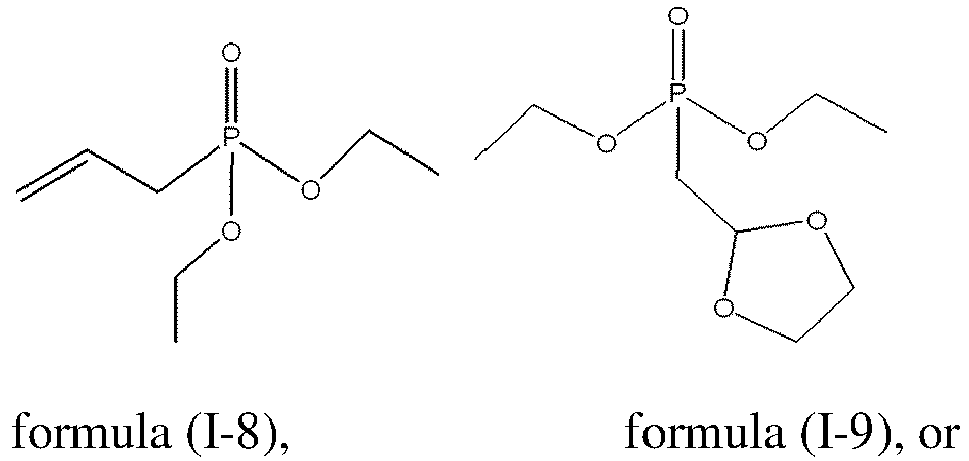

- The electrochemical apparatus according to claim 1, satisfying at least one of the following characteristics:(1) the electrolyte further comprises a dinitrile compound, wherein the dinitrile compound comprises at least one of malononitrile, succinonitrile, glutaronitrile, adiponitrile, suberonitrile, terephthalonitrile, tetradecanedinitrile, azomalononitrile, methyleneglutaronitrile, or pentenedinitrile; and based on the mass of the electrolyte, a mass percentage of the dinitrile compound is F%, wherein 0.1 ≤ F ≤ 8; or(2) the electrolyte further comprises a polynitrile compound, wherein the polynitrile compound comprises at least one of the following compounds:based on the mass of the electrolyte, a mass percentage of the polynitrile compound is G%, wherein 0.1 ≤ G ≤ 8.


- The electrochemical apparatus according to claim 9, characterized in that, 0.1 ≤ F + G ≤ 8.
- The electrochemical apparatus according to any one of claims 1 to 10, characterized in that, the electrolyte comprises a lithium salt and an organic solvent; whereinthe lithium salt comprises at least one of lithium hexafluorophosphate, lithium bistrifluoromethanesulfonimide, lithium bis(fluorosulfonyl)imide, lithium tetrafluoroborate, lithium bis(oxalato)borate, lithium difluoro(oxalato)borate, or lithium difluorophosphate; and based on the mass of the electrolyte, a mass percentage of the lithium salt is H%, wherein 8 ≤ H ≤ 20; andthe organic solvent comprises a carbonate compound and a carboxylate compound, wherein the carbonate compound comprises at least one of ethylene carbonate, propylene carbonate, butylene carbonate, dimethyl carbonate, ethyl methyl carbonate, diethyl carbonate, dipropyl carbonate, methyl propyl carbonate, ethyl propyl carbonate, dioctyl carbonate, dipentyl carbonate, ethyl isobutyl carbonate, isopropyl methyl carbonate, di-n-butyl carbonate, diisopropyl carbonate, or propyl carbonate, and the carboxylate compound comprises at least one of methyl acetate, ethyl acetate, propyl acetate, ethyl propionate, propyl propionate, butyl propionate, or amyl propionate; and based on the mass of the electrolyte, a mass percentage of the organic solvent is 67% to 90%, a mass percentage of the carbonate compound is J%, and a mass percentage of the carboxylate compound is K%, wherein 14 ≤ J ≤ 90 and 0 ≤ K ≤ 60.
- An electronic apparatus, comprising the electrochemical apparatus according to any one of claims 1 to 11.
Applications Claiming Priority (1)
| Application Number | Priority Date | Filing Date | Title |
|---|---|---|---|
| CN202310340512.1A CN116387605A (en) | 2023-03-31 | 2023-03-31 | A kind of electrochemical device and electronic device |
Publications (2)
| Publication Number | Publication Date |
|---|---|
| EP4439728A2 true EP4439728A2 (en) | 2024-10-02 |
| EP4439728A3 EP4439728A3 (en) | 2024-12-04 |
Family
ID=86965108
Family Applications (1)
| Application Number | Title | Priority Date | Filing Date |
|---|---|---|---|
| EP24166658.5A Pending EP4439728A3 (en) | 2023-03-31 | 2024-03-27 | Electrochemical apparatus and electronic apparatus |
Country Status (3)
| Country | Link |
|---|---|
| US (1) | US20240332620A1 (en) |
| EP (1) | EP4439728A3 (en) |
| CN (1) | CN116387605A (en) |
Families Citing this family (5)
| Publication number | Priority date | Publication date | Assignee | Title |
|---|---|---|---|---|
| CN116565292B (en) * | 2023-07-06 | 2023-10-13 | 宁德新能源科技有限公司 | Electrochemical device and electronic device |
| CN117638201B (en) * | 2024-01-24 | 2024-04-09 | 宁德新能源科技有限公司 | Lithium ion battery and electronic device |
| CN119108637B (en) * | 2024-01-26 | 2025-10-31 | 宁德新能源科技有限公司 | Lithium ion battery and electronic device |
| WO2026044703A1 (en) * | 2024-08-30 | 2026-03-05 | 宁德新能源科技有限公司 | Electrochemical apparatus and electronic device |
| CN120184523B (en) * | 2025-05-22 | 2025-08-01 | 温州大学碳材料与氢能产业技术研究院 | A composite interface layer material and its application in the preparation of all-solid-state lithium batteries |
Family Cites Families (4)
| Publication number | Priority date | Publication date | Assignee | Title |
|---|---|---|---|---|
| US11945776B2 (en) * | 2018-01-30 | 2024-04-02 | Daikin Industries, Ltd. | Electrolyte, electrochemical device, lithium ion secondary battery, and module |
| KR102277754B1 (en) * | 2018-08-09 | 2021-07-16 | 동화일렉트로라이트 주식회사 | Electrolyte Solution for Secondary Battery and Secondary Battery Comprising the Same |
| CN115863791B (en) * | 2021-08-31 | 2025-10-31 | 宁德新能源科技有限公司 | Electrochemical device and electronic device |
| CN116417676A (en) * | 2021-09-16 | 2023-07-11 | 宁德新能源科技有限公司 | An electrolytic solution, an electrochemical device and an electronic device comprising the electrolytic solution |
-
2023
- 2023-03-31 CN CN202310340512.1A patent/CN116387605A/en active Pending
-
2024
- 2024-03-27 EP EP24166658.5A patent/EP4439728A3/en active Pending
- 2024-03-29 US US18/621,143 patent/US20240332620A1/en active Pending
Also Published As
| Publication number | Publication date |
|---|---|
| CN116387605A (en) | 2023-07-04 |
| US20240332620A1 (en) | 2024-10-03 |
| EP4439728A3 (en) | 2024-12-04 |
Similar Documents
| Publication | Publication Date | Title |
|---|---|---|
| JP7196364B2 (en) | Secondary batteries and battery modules, battery packs and devices containing such secondary batteries | |
| KR102889485B1 (en) | Electrolytes, secondary batteries, battery modules, battery packs and electrical devices | |
| EP4439728A2 (en) | Electrochemical apparatus and electronic apparatus | |
| EP4350833A1 (en) | Electrolyte, electrochemical device thereof, and electronic device | |
| EP4297138A1 (en) | Electrochemical device and electronic device comprising same | |
| EP4471922A1 (en) | Lithium metal battery and electronic device | |
| EP4160744A1 (en) | Electrochemical device and electronic device | |
| EP4439722A1 (en) | Positive electrode active material, electrochemical device comprising positive electrode active material, and electronic device | |
| EP4693503A1 (en) | Secondary battery and electronic device | |
| CN115832449B (en) | Electrochemical devices and electronic devices | |
| EP4657592A1 (en) | Electrochemical device and electronic device | |
| US20240282943A1 (en) | Electrochemical apparatus and electronic apparatus | |
| US20240243282A1 (en) | Electrochemical device and electronic device | |
| US20240079635A1 (en) | Electrochemical Apparatus and Electronic Apparatus Containing Same | |
| US20260031397A1 (en) | Electrochemical apparatus and electronic apparatus | |
| US20260018607A1 (en) | Electrochemical device and electronic device | |
| EP4560766A2 (en) | Secondary battery and electronic apparatus | |
| EP4629386A1 (en) | Electrochemical apparatus and electronic apparatus | |
| EP4345936A1 (en) | Electrochemical apparatus, and electric device including electrochemical apparatus | |
| EP4675746A1 (en) | Electrochemical device and electronic device | |
| WO2021184247A1 (en) | Positive electrode active material and electrochemical device containing same | |
| WO2025118244A1 (en) | Secondary battery and electronic apparatus | |
| EP4404287A1 (en) | Electrochemical device and electronic device | |
| EP4708440A1 (en) | Electrolyte, electrochemical apparatus, and electronic device | |
| EP4531153A1 (en) | Secondary battery and electronic device |
Legal Events
| Date | Code | Title | Description |
|---|---|---|---|
| PUAI | Public reference made under article 153(3) epc to a published international application that has entered the european phase |
Free format text: ORIGINAL CODE: 0009012 |
|
| STAA | Information on the status of an ep patent application or granted ep patent |
Free format text: STATUS: REQUEST FOR EXAMINATION WAS MADE |
|
| 17P | Request for examination filed |
Effective date: 20240327 |
|
| AK | Designated contracting states |
Kind code of ref document: A2 Designated state(s): AL AT BE BG CH CY CZ DE DK EE ES FI FR GB GR HR HU IE IS IT LI LT LU LV MC ME MK MT NL NO PL PT RO RS SE SI SK SM TR |
|
| PUAL | Search report despatched |
Free format text: ORIGINAL CODE: 0009013 |
|
| AK | Designated contracting states |
Kind code of ref document: A3 Designated state(s): AL AT BE BG CH CY CZ DE DK EE ES FI FR GB GR HR HU IE IS IT LI LT LU LV MC ME MK MT NL NO PL PT RO RS SE SI SK SM TR |
|
| RIC1 | Information provided on ipc code assigned before grant |
Ipc: H01M 10/0568 20100101ALI20241029BHEP Ipc: H01M 10/0567 20100101ALI20241029BHEP Ipc: H01M 10/0525 20100101ALI20241029BHEP Ipc: H01M 4/525 20100101AFI20241029BHEP |