EP4439721A1 - Nickel cobalt lithium manganese oxide high-nickel single-crystal positive electrode material and preparation method therefor - Google Patents
Nickel cobalt lithium manganese oxide high-nickel single-crystal positive electrode material and preparation method therefor Download PDFInfo
- Publication number
- EP4439721A1 EP4439721A1 EP22913338.4A EP22913338A EP4439721A1 EP 4439721 A1 EP4439721 A1 EP 4439721A1 EP 22913338 A EP22913338 A EP 22913338A EP 4439721 A1 EP4439721 A1 EP 4439721A1
- Authority
- EP
- European Patent Office
- Prior art keywords
- nickel
- positive electrode
- electrode material
- lithium
- crystal positive
- Prior art date
- Legal status (The legal status is an assumption and is not a legal conclusion. Google has not performed a legal analysis and makes no representation as to the accuracy of the status listed.)
- Pending
Links
Images


Classifications
-
- H—ELECTRICITY
- H01—ELECTRIC ELEMENTS
- H01M—PROCESSES OR MEANS, e.g. BATTERIES, FOR THE DIRECT CONVERSION OF CHEMICAL ENERGY INTO ELECTRICAL ENERGY
- H01M4/00—Electrodes
- H01M4/02—Electrodes composed of, or comprising, active material
- H01M4/36—Selection of substances as active materials, active masses, active liquids
- H01M4/48—Selection of substances as active materials, active masses, active liquids of inorganic oxides or hydroxides
-
- C—CHEMISTRY; METALLURGY
- C01—INORGANIC CHEMISTRY
- C01G—COMPOUNDS CONTAINING METALS NOT COVERED BY SUBCLASSES C01D OR C01F
- C01G53/00—Compounds of nickel
- C01G53/40—Complex oxides containing nickel and at least one other metal element
- C01G53/42—Complex oxides containing nickel and at least one other metal element containing alkali metals, e.g. LiNiO2
- C01G53/44—Complex oxides containing nickel and at least one other metal element containing alkali metals, e.g. LiNiO2 containing manganese
- C01G53/50—Complex oxides containing nickel and at least one other metal element containing alkali metals, e.g. LiNiO2 containing manganese of the type (MnO2)n-, e.g. Li(NixMn1-x)O2 or Li(MyNixMn1-x-y)O2
-
- C—CHEMISTRY; METALLURGY
- C30—CRYSTAL GROWTH
- C30B—SINGLE-CRYSTAL GROWTH; UNIDIRECTIONAL SOLIDIFICATION OF EUTECTIC MATERIAL OR UNIDIRECTIONAL DEMIXING OF EUTECTOID MATERIAL; REFINING BY ZONE-MELTING OF MATERIAL; PRODUCTION OF A HOMOGENEOUS POLYCRYSTALLINE MATERIAL WITH DEFINED STRUCTURE; SINGLE CRYSTALS OR HOMOGENEOUS POLYCRYSTALLINE MATERIAL WITH DEFINED STRUCTURE; AFTER-TREATMENT OF SINGLE CRYSTALS OR A HOMOGENEOUS POLYCRYSTALLINE MATERIAL WITH DEFINED STRUCTURE; APPARATUS THEREFOR
- C30B1/00—Single-crystal growth directly from the solid state
- C30B1/02—Single-crystal growth directly from the solid state by thermal treatment, e.g. strain annealing
-
- C—CHEMISTRY; METALLURGY
- C30—CRYSTAL GROWTH
- C30B—SINGLE-CRYSTAL GROWTH; UNIDIRECTIONAL SOLIDIFICATION OF EUTECTIC MATERIAL OR UNIDIRECTIONAL DEMIXING OF EUTECTOID MATERIAL; REFINING BY ZONE-MELTING OF MATERIAL; PRODUCTION OF A HOMOGENEOUS POLYCRYSTALLINE MATERIAL WITH DEFINED STRUCTURE; SINGLE CRYSTALS OR HOMOGENEOUS POLYCRYSTALLINE MATERIAL WITH DEFINED STRUCTURE; AFTER-TREATMENT OF SINGLE CRYSTALS OR A HOMOGENEOUS POLYCRYSTALLINE MATERIAL WITH DEFINED STRUCTURE; APPARATUS THEREFOR
- C30B1/00—Single-crystal growth directly from the solid state
- C30B1/10—Single-crystal growth directly from the solid state by solid state reactions or multi-phase diffusion
-
- C—CHEMISTRY; METALLURGY
- C30—CRYSTAL GROWTH
- C30B—SINGLE-CRYSTAL GROWTH; UNIDIRECTIONAL SOLIDIFICATION OF EUTECTIC MATERIAL OR UNIDIRECTIONAL DEMIXING OF EUTECTOID MATERIAL; REFINING BY ZONE-MELTING OF MATERIAL; PRODUCTION OF A HOMOGENEOUS POLYCRYSTALLINE MATERIAL WITH DEFINED STRUCTURE; SINGLE CRYSTALS OR HOMOGENEOUS POLYCRYSTALLINE MATERIAL WITH DEFINED STRUCTURE; AFTER-TREATMENT OF SINGLE CRYSTALS OR A HOMOGENEOUS POLYCRYSTALLINE MATERIAL WITH DEFINED STRUCTURE; APPARATUS THEREFOR
- C30B29/00—Single crystals or homogeneous polycrystalline material with defined structure characterised by the material or by their shape
- C30B29/10—Inorganic compounds or compositions
- C30B29/16—Oxides
- C30B29/22—Complex oxides
-
- H—ELECTRICITY
- H01—ELECTRIC ELEMENTS
- H01M—PROCESSES OR MEANS, e.g. BATTERIES, FOR THE DIRECT CONVERSION OF CHEMICAL ENERGY INTO ELECTRICAL ENERGY
- H01M10/00—Secondary cells; Manufacture thereof
- H01M10/42—Methods or arrangements for servicing or maintenance of secondary cells or secondary half-cells
- H01M10/4235—Safety or regulating additives or arrangements in electrodes, separators or electrolyte
-
- H—ELECTRICITY
- H01—ELECTRIC ELEMENTS
- H01M—PROCESSES OR MEANS, e.g. BATTERIES, FOR THE DIRECT CONVERSION OF CHEMICAL ENERGY INTO ELECTRICAL ENERGY
- H01M4/00—Electrodes
- H01M4/02—Electrodes composed of, or comprising, active material
- H01M4/04—Processes of manufacture in general
- H01M4/0471—Processes of manufacture in general involving thermal treatment, e.g. firing, sintering, backing particulate active material, thermal decomposition, pyrolysis
-
- H—ELECTRICITY
- H01—ELECTRIC ELEMENTS
- H01M—PROCESSES OR MEANS, e.g. BATTERIES, FOR THE DIRECT CONVERSION OF CHEMICAL ENERGY INTO ELECTRICAL ENERGY
- H01M4/00—Electrodes
- H01M4/02—Electrodes composed of, or comprising, active material
- H01M4/13—Electrodes for accumulators with non-aqueous electrolyte, e.g. for lithium-accumulators; Processes of manufacture thereof
- H01M4/139—Processes of manufacture
- H01M4/1391—Processes of manufacture of electrodes based on mixed oxides or hydroxides, or on mixtures of oxides or hydroxides, e.g. LiCoOx
-
- H—ELECTRICITY
- H01—ELECTRIC ELEMENTS
- H01M—PROCESSES OR MEANS, e.g. BATTERIES, FOR THE DIRECT CONVERSION OF CHEMICAL ENERGY INTO ELECTRICAL ENERGY
- H01M4/00—Electrodes
- H01M4/02—Electrodes composed of, or comprising, active material
- H01M4/36—Selection of substances as active materials, active masses, active liquids
-
- H—ELECTRICITY
- H01—ELECTRIC ELEMENTS
- H01M—PROCESSES OR MEANS, e.g. BATTERIES, FOR THE DIRECT CONVERSION OF CHEMICAL ENERGY INTO ELECTRICAL ENERGY
- H01M4/00—Electrodes
- H01M4/02—Electrodes composed of, or comprising, active material
- H01M4/36—Selection of substances as active materials, active masses, active liquids
- H01M4/362—Composites
- H01M4/364—Composites as mixtures
-
- H—ELECTRICITY
- H01—ELECTRIC ELEMENTS
- H01M—PROCESSES OR MEANS, e.g. BATTERIES, FOR THE DIRECT CONVERSION OF CHEMICAL ENERGY INTO ELECTRICAL ENERGY
- H01M4/00—Electrodes
- H01M4/02—Electrodes composed of, or comprising, active material
- H01M4/36—Selection of substances as active materials, active masses, active liquids
- H01M4/362—Composites
- H01M4/366—Composites as layered products
-
- H—ELECTRICITY
- H01—ELECTRIC ELEMENTS
- H01M—PROCESSES OR MEANS, e.g. BATTERIES, FOR THE DIRECT CONVERSION OF CHEMICAL ENERGY INTO ELECTRICAL ENERGY
- H01M4/00—Electrodes
- H01M4/02—Electrodes composed of, or comprising, active material
- H01M4/36—Selection of substances as active materials, active masses, active liquids
- H01M4/48—Selection of substances as active materials, active masses, active liquids of inorganic oxides or hydroxides
- H01M4/50—Selection of substances as active materials, active masses, active liquids of inorganic oxides or hydroxides of manganese
- H01M4/505—Selection of substances as active materials, active masses, active liquids of inorganic oxides or hydroxides of manganese of mixed oxides or hydroxides containing manganese for inserting or intercalating light metals, e.g. LiMn2O4 or LiMn2OxFy
-
- H—ELECTRICITY
- H01—ELECTRIC ELEMENTS
- H01M—PROCESSES OR MEANS, e.g. BATTERIES, FOR THE DIRECT CONVERSION OF CHEMICAL ENERGY INTO ELECTRICAL ENERGY
- H01M4/00—Electrodes
- H01M4/02—Electrodes composed of, or comprising, active material
- H01M4/36—Selection of substances as active materials, active masses, active liquids
- H01M4/48—Selection of substances as active materials, active masses, active liquids of inorganic oxides or hydroxides
- H01M4/52—Selection of substances as active materials, active masses, active liquids of inorganic oxides or hydroxides of nickel, cobalt or iron
- H01M4/525—Selection of substances as active materials, active masses, active liquids of inorganic oxides or hydroxides of nickel, cobalt or iron of mixed oxides or hydroxides containing iron, cobalt or nickel for inserting or intercalating light metals, e.g. LiNiO2, LiCoO2 or LiCoOxFy
-
- H—ELECTRICITY
- H01—ELECTRIC ELEMENTS
- H01M—PROCESSES OR MEANS, e.g. BATTERIES, FOR THE DIRECT CONVERSION OF CHEMICAL ENERGY INTO ELECTRICAL ENERGY
- H01M4/00—Electrodes
- H01M4/02—Electrodes composed of, or comprising, active material
- H01M4/62—Selection of inactive substances as ingredients for active masses, e.g. binders, fillers
-
- C—CHEMISTRY; METALLURGY
- C01—INORGANIC CHEMISTRY
- C01P—INDEXING SCHEME RELATING TO STRUCTURAL AND PHYSICAL ASPECTS OF SOLID INORGANIC COMPOUNDS
- C01P2002/00—Crystal-structural characteristics
- C01P2002/50—Solid solutions
- C01P2002/52—Solid solutions containing elements as dopants
-
- C—CHEMISTRY; METALLURGY
- C01—INORGANIC CHEMISTRY
- C01P—INDEXING SCHEME RELATING TO STRUCTURAL AND PHYSICAL ASPECTS OF SOLID INORGANIC COMPOUNDS
- C01P2004/00—Particle morphology
- C01P2004/01—Particle morphology depicted by an image
- C01P2004/03—Particle morphology depicted by an image obtained by SEM
-
- C—CHEMISTRY; METALLURGY
- C01—INORGANIC CHEMISTRY
- C01P—INDEXING SCHEME RELATING TO STRUCTURAL AND PHYSICAL ASPECTS OF SOLID INORGANIC COMPOUNDS
- C01P2004/00—Particle morphology
- C01P2004/60—Particles characterised by their size
- C01P2004/61—Micrometer sized, i.e. from 1-100 micrometer
-
- C—CHEMISTRY; METALLURGY
- C01—INORGANIC CHEMISTRY
- C01P—INDEXING SCHEME RELATING TO STRUCTURAL AND PHYSICAL ASPECTS OF SOLID INORGANIC COMPOUNDS
- C01P2004/00—Particle morphology
- C01P2004/80—Particles consisting of a mixture of two or more inorganic phases
- C01P2004/82—Particles consisting of a mixture of two or more inorganic phases two phases having the same anion, e.g. both oxidic phases
- C01P2004/84—Particles consisting of a mixture of two or more inorganic phases two phases having the same anion, e.g. both oxidic phases one phase coated with the other
-
- C—CHEMISTRY; METALLURGY
- C01—INORGANIC CHEMISTRY
- C01P—INDEXING SCHEME RELATING TO STRUCTURAL AND PHYSICAL ASPECTS OF SOLID INORGANIC COMPOUNDS
- C01P2006/00—Physical properties of inorganic compounds
- C01P2006/40—Electric properties
-
- H—ELECTRICITY
- H01—ELECTRIC ELEMENTS
- H01M—PROCESSES OR MEANS, e.g. BATTERIES, FOR THE DIRECT CONVERSION OF CHEMICAL ENERGY INTO ELECTRICAL ENERGY
- H01M4/00—Electrodes
- H01M4/02—Electrodes composed of, or comprising, active material
- H01M2004/026—Electrodes composed of, or comprising, active material characterised by the polarity
- H01M2004/028—Positive electrodes
-
- Y—GENERAL TAGGING OF NEW TECHNOLOGICAL DEVELOPMENTS; GENERAL TAGGING OF CROSS-SECTIONAL TECHNOLOGIES SPANNING OVER SEVERAL SECTIONS OF THE IPC; TECHNICAL SUBJECTS COVERED BY FORMER USPC CROSS-REFERENCE ART COLLECTIONS [XRACs] AND DIGESTS
- Y02—TECHNOLOGIES OR APPLICATIONS FOR MITIGATION OR ADAPTATION AGAINST CLIMATE CHANGE
- Y02E—REDUCTION OF GREENHOUSE GAS [GHG] EMISSIONS, RELATED TO ENERGY GENERATION, TRANSMISSION OR DISTRIBUTION
- Y02E60/00—Enabling technologies; Technologies with a potential or indirect contribution to GHG emissions mitigation
- Y02E60/10—Energy storage using batteries
Definitions
- the present application relates to the technical field of lithium batteries, and in particular to a lithium nickel manganese cobalt oxide high-nickel single-crystal positive electrode material and a preparation method thereof.
- LiNi x Co y Mn 1-x-y O 2 ternary positive electrode materials have been widely used in lithium-ion secondary batteries due to their high specific capacity and energy density, low cost and relatively environmentally friendly characteristics. Especially in the current context, they have broad development space in the automotive power battery market. With the increase in cruising range, the current positive electrode materials are gradually developing towards high nickel and high voltage. Single-crystal positive electrode materials have attracted much attention due to their advantages of relatively high electrode plate compaction and low gas production.
- the purpose of the present invention is to overcome the above-mentioned technical deficiencies, propose a lithium nickel manganese cobalt oxide high-nickel single-crystal positive electrode material and a preparation method thereof, and solve the technical issues that high-nickel single-crystal positive electrode materials in the prior art are difficult to balance high capacity, large size and high dispersibility.
- the first aspect of the present invention provides a method for preparing a lithium nickel manganese cobalt oxide high-nickel single-crystal positive electrode material, comprising the following steps:
- the second aspect of the present invention provides a lithium nickel manganese cobalt oxide high-nickel single-crystal positive electrode material, wherein the lithium nickel manganese cobalt oxide high-nickel single-crystal positive electrode material is obtained by the method for preparing the lithium nickel manganese cobalt oxide high-nickel single-crystal positive electrode material according to the first aspect of the present invention.
- the present invention introduces tungsten oxide and sodium carbonate during the primary sintering. Due to the existence of oxygen vacancies inside the high-nickel material and some sodium ions occupying lithium sites, the W-O octahedron will be distorted in different ways such as inclination and rotation, , which will affect the crystal cell and electronic structure of the material to different degrees.
- the conductivity of the material can be enhanced, and particle morphology can also be changed, so that primary particles can be refined, and by using the characteristic of combining the tungsten oxide and sodium carbonate in combination with zirconium oxide doping, a high-nickel single-crystal positive electrode material having high capacity, high dispersibility, and excellent cycle performance is obtained at a high primary sintering temperature.
- the first aspect of the present invention provides a method for preparing a lithium nickel manganese cobalt oxide high-nickel single-crystal positive electrode material, comprising the following steps:
- the present invention introduces tungsten oxide and sodium carbonate as dopant during the primary sintering. Due to the existence of oxygen vacancies inside the high-nickel material and some sodium ions occupying lithium sites, the W-O octahedron will be distorted in different ways such as inclination and rotation, , which will affect the crystal cell and electronic structure of the material to different degrees. the conductivity of the material can be enhanced, and particle morphology can also be changed, so that primary particles can be refined, and by using the characteristic of combining the tungsten oxide and sodium carbonate in combination with zirconium oxide doping, a high-nickel single-crystal positive electrode material having high capacity, high dispersibility, and excellent cycle performance is obtained at a high primary sintering temperature. However, the sintering temperature should not be too high. Too high will lead to excessive growth of single-crystal, longer lithium ion transmission path, reduced ion conductivity, and reduced capacity and rate performance.
- the chemical composition of the nickel cobalt manganese hydroxide is: Ni x Co y Mn 1-x-y (OH) 2 , 0.7 ⁇ x ⁇ 0.95, 0.02 ⁇ y ⁇ 0.25; in some specific embodiments of the present invention, the chemical composition of the lithium nickel manganese cobalt oxide high-nickel single-crystal positive electrode material precursor is: Ni 0.80 Co 0.10 Mn 0.10 (OH) 2 .
- the lithium source is at least one of lithium carbonate, lithium hydroxide, lithium nitrate and lithium chloride; a molar ratio of the nickel cobalt manganese hydroxide to lithium in the lithium source is 1: (1.01 to 1.1).
- a molar ratio of the nickel cobalt manganese hydroxide to zirconium oxide, tungsten oxide, and sodium carbonate is 1: (0.001 to 0.005): (0.001 to 0.005): (0.001 to 0.005), and further 1: 0.002: 0.0016: 0.002.
- the temperature of the primary sintering is T 1
- the normal sintering temperature is T 2
- T 2 is obtained by a primary sintering DOE test of nicke cobalt manganese hydroxide and lithium source
- the nickel cobalt manganese single-crystal positive electrode material-sintered material obtained from the above test has the largest discharge specific capacity after electrochemical testing, the sintering temperature with the best single-crystal dispersibility (i.e, the optimal sintering temperature).
- the optimal sintering temperature is related to the molar ratio of transition metal elements and lithium ratio of nickel cobalt manganese hydroxide, and different nickel cobalt manganese hydroxides and different lithium ratios correspond to different optimal sintering temperatures. For example, when the lithium ratio of Ni 0.8 Co 0.1 Mn 0.1 (OH) 2 to lithium hydroxide is 1.05, the optimal sintering temperature is 870°C.
- a time of the primary sintering is in a range from 10h to 20h.
- the type of coating agent is not limited, and those skilled in the art can select according to actual needs.
- the coating agent can be an oxide or a hydroxide of B, Al, Mg, V, Ti, P, Si and Y
- the amount of the coating agent added is 0.05wt% to 5wt% of the total amount of the lithium nickel manganese cobalt oxide high-nickel single-crystal positive electrode material intermediate; in this process, a temperature of the secondary sintering is in a range from 200°C to 600°C, a time of the secondary sintering is in a range from 6h to 24h.
- the present invention by forming a coating layer on the surface of the lithium nickel manganese cobalt oxide high-nickel single-crystal positive electrode material intermediate, the side reaction between the single-crystal and the electrolyte can be reduced, and the service life of the battery can be further improved.
- both the primary sintering process and the secondary sintering process are carried out under oxygen conditions.
- the second aspect of the present invention provides a lithium nickel manganese cobalt oxide high-nickel single-crystal positive electrode material, wherein the lithium nickel manganese cobalt oxide high-nickel single-crystal positive electrode material is obtained by the method for preparing the lithium nickel manganese cobalt oxide high-nickel single-crystal positive electrode material according to the first aspect of the present invention.
- Example 1 Compared with Example 1, the only difference is that the dopant is zirconia only.
- Example 2 Compared with Example 1, the only difference is that WO 3 is not added into the dopant.
- Example 2 Compared with Example 1, the difference is only that sodium carbonate is not added into the dopant.
- Example 2 Compared with Example 1, the only difference is that zirconia is not added into the dopant.
- Example 2 Compared with Example 1, the only difference is that the temperature of primary sintering is 870°C.
- Example 2 Compared with Example 1, the only difference is that the temperature of primary sintering is 1050°C.
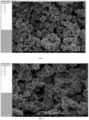
- Example 1 The positive electrode materials prepared in Example 1 and Comparative Examples 1-6 of the present invention were tested by SEM, and the test results were shown in FIGS. 1-7 and Table 1.
- the positive electrode materials prepared in Example 1 and Comparative Examples 1-6 of the present invention was mixed with conductive agent acetylene carbon black and binder PVDF according to the mass ratio of 92:4:4, and an appropriate amount of 1-methyl-2-pyrrolidone were added and ball milled for 1h to form a slurry evenly coated on the aluminum plate, dried and pressed to make a positive electrode plate.
- 2032 button batteries were assembled by using metal lithium plates as the negative electrode, and the WUHAN LAND test system was used for electrical performance testing.
- the charge and discharge voltage was in a range from 3.0V to 4.3V.
- the first cycle was charged and discharged at 0.2C/0.2C, and then cycled 200 cycles at 1C/1C, and the results were shown in Table 1.
- the lithium nickel manganese cobalt oxide high-nickel single-crystal positive electrode material prepared in Example 1 of the present invention has a large single-crystal size, good dispersibility, and high discharge specific capacity, and good cycle stability.
- the high-nickel single-crystal positive electrode material obtained in Comparative Example 1 has a larger average particle size, but it still has poor discharge specific capacity and cycle performance. The reason is that only zirconia is added in Comparative Example 1, and in the absence of tungsten oxide and sodium carbonate, the sintering temperature is relatively high, and the electrochemical performance is still poor.
- the high-nickel single-crystal positive electrode material obtained in Comparative Example 2 has a larger average particle size, but it still has poor discharge specific capacity and cycle performance.
- the reason is that tungsten oxide is not added in Comparative Example 2, and the role of tungsten oxide in enhancing the conductivity and refining the primary particles in the system cannot be exerted, which ultimately leads to the high-nickel single-crystal positive electrode material obtained in Comparative Example 2 having poor electrochemical performance.
- Example 3 Compared with Example 1, the average particle size of the the high-nickel single-crystal positive electrode material obtained in Comparative Example 3 is significantly reduced, at the same time it has poor discharge specific capacity and cycle performance. The reason is that sodium carbonate is not added in Comparative Example 3, which cannot cooperate with tungsten oxide to increase the single-crystal size and improve the dispersibility, ultimately causes the high-nickel single-crystal positive electrode material obtained in Comparative Example 3 to have poor electrochemical performance.
- the high-nickel single-crystal positive electrode material obtained in Comparative Example 4 has a large single-crystal size, good dispersibility, and discharge specific capacity, but poor cycle performance. The reason is that zirconia is not added in Comparative Example 4, resulting in a decrease in the structural stability of the crystal compared with that of Example 1.
- Example 1 Compared with Example 1, the average particle size and cycle performance of the high-nickel single-crystal positive electrode material obtained in Comparative Example 5 were significantly reduced. The reason is that, compared with Example 5, the sintering temperature is not increased, resulting in the a small single crystal size and poor dispersion of the obtained positive electrode material, and a significantly reduced cycle performance.
- Example 1 Compared with Example 1, the average particle size of the high-nickel single-crystal positive electrode material obtained in Comparative Example 6 is significantly increased, but its discharge specific capacity and cycle performance are significantly reduced. The reason is that the sintering temperature of Comparative Example 6 is too high, resulting in excessive growth of single-crystal, longer lithium-ion transmission path, reduced ion conductivity, resulting in a decrease in capacity and rate performance.
Landscapes
- Chemical & Material Sciences (AREA)
- Chemical Kinetics & Catalysis (AREA)
- Electrochemistry (AREA)
- General Chemical & Material Sciences (AREA)
- Inorganic Chemistry (AREA)
- Organic Chemistry (AREA)
- Composite Materials (AREA)
- Engineering & Computer Science (AREA)
- Materials Engineering (AREA)
- Crystallography & Structural Chemistry (AREA)
- Metallurgy (AREA)
- Manufacturing & Machinery (AREA)
- Physics & Mathematics (AREA)
- Thermal Sciences (AREA)
- Battery Electrode And Active Subsutance (AREA)
- Inorganic Compounds Of Heavy Metals (AREA)
Abstract
Description
- The present application relates to the technical field of lithium batteries, and in particular to a lithium nickel manganese cobalt oxide high-nickel single-crystal positive electrode material and a preparation method thereof.
- LiNixCoyMn1-x-yO2 ternary positive electrode materials have been widely used in lithium-ion secondary batteries due to their high specific capacity and energy density, low cost and relatively environmentally friendly characteristics. Especially in the current context, they have broad development space in the automotive power battery market. With the increase in cruising range, the current positive electrode materials are gradually developing towards high nickel and high voltage. Single-crystal positive electrode materials have attracted much attention due to their advantages of relatively high electrode plate compaction and low gas production. However, there are two problems in the sintering process of high-nickel single-crystal materials: first, when the sintering temperature is slightly lower, although the discharge specific capacity is high, the single-crystals are aggregated and the dispersion is poor, resulting in a decreased cycle performance and increased gas production; second, when the sintering temperature is high, the single-crystal size is large and the dispersion is good, but the discharge specific capacity is significantly reduced.
- Therefore, how to prepare high-nickel single-crystal positive electrode materials with high capacity, large size and high dispersibility remains a huge challenge.
- The purpose of the present invention is to overcome the above-mentioned technical deficiencies, propose a lithium nickel manganese cobalt oxide high-nickel single-crystal positive electrode material and a preparation method thereof, and solve the technical issues that high-nickel single-crystal positive electrode materials in the prior art are difficult to balance high capacity, large size and high dispersibility.
- The first aspect of the present invention provides a method for preparing a lithium nickel manganese cobalt oxide high-nickel single-crystal positive electrode material, comprising the following steps:
- mixing and ball milling nickel cobalt manganese hydroxide with a lithium source, zirconium oxide, tungsten oxide and sodium carbonate, then performing primary sintering, pulverizing and then obtaining a lithium nickel manganese cobalt oxide high-nickel single-crystal positive electrode material intermediate; wherein the temperature of the primary sintering is 50°C to 150°C higher than a normal sintering temperature; and
- evenly mixing the lithium nickel manganese cobalt oxide high-nickel single-crystal positive electrode material intermediate and a coating agent, and then performing secondary sintering to obtain a lithium nickel manganese cobalt oxide high-nickel single-crystal positive electrode material.
- The second aspect of the present invention provides a lithium nickel manganese cobalt oxide high-nickel single-crystal positive electrode material, wherein the lithium nickel manganese cobalt oxide high-nickel single-crystal positive electrode material is obtained by the method for preparing the lithium nickel manganese cobalt oxide high-nickel single-crystal positive electrode material according to the first aspect of the present invention.
- Compared with the prior art, the beneficial effects of the present invention include:
The present invention introduces tungsten oxide and sodium carbonate during the primary sintering. Due to the existence of oxygen vacancies inside the high-nickel material and some sodium ions occupying lithium sites, the W-O octahedron will be distorted in different ways such as inclination and rotation, , which will affect the crystal cell and electronic structure of the material to different degrees. the conductivity of the material can be enhanced, and particle morphology can also be changed, so that primary particles can be refined, and by using the characteristic of combining the tungsten oxide and sodium carbonate in combination with zirconium oxide doping, a high-nickel single-crystal positive electrode material having high capacity, high dispersibility, and excellent cycle performance is obtained at a high primary sintering temperature. -
-
FIG. 1 is a SEM image of the lithium nickel manganese cobalt oxide high-nickel single-crystal positive electrode material provided by Example 1 of the present invention; -
FIG. 2 is a SEM image of the lithium nickel manganese cobalt oxide high-nickel single-crystal positive electrode material provided by Comparative Example 1 of the present invention; -
FIG. 3 is a SEM image of the lithium nickel manganese cobalt oxide high-nickel single-crystal positive electrode material provided by Comparative Example 2 of the present invention; -
FIG. 4 is a SEM image of the lithium nickel manganese cobalt oxide high-nickel single-crystal positive electrode material provided by Comparative Example 3 of the present invention; -
FIG. 5 is a SEM image of the lithium nickel manganese cobalt oxide high-nickel single-crystal positive electrode material provided by Comparative Example 4 of the present invention; -
FIG. 6 is a SEM image of the lithium nickel manganese cobalt oxide high-nickel single-crystal positive electrode material provided by Comparative Example 5 of the present invention; -
FIG. 7 is a SEM image of the lithium nickel manganese cobalt oxide high-nickel single-crystal positive electrode material provided by Comparative Example 6 of the present invention. - In order to make the purpose, technical solution and advantages of the present invention more clearly understood, the present invention is further described in detail below in conjunction with the accompanying drawings and embodiments. It should be understood that the specific embodiments described here are only used to explain the present invention and are not used to limit the present invention.
- The first aspect of the present invention provides a method for preparing a lithium nickel manganese cobalt oxide high-nickel single-crystal positive electrode material, comprising the following steps:
- S1, mixing and ball milling nickel cobalt manganese hydroxide with a lithium source, zirconium oxide, tungsten oxide and sodium carbonate, then performing primary sintering, pulverizing and then obtaining a lithium nickel manganese cobalt oxide high-nickel single-crystal positive electrode material intermediate; wherein the temperature of the primary sintering is 50°C to 150°C higher than a normal sintering temperature; and
- S2, evenly mixing the lithium nickel manganese cobalt oxide high-nickel single-crystal positive electrode material intermediate and a coating agent, and then performing secondary sintering to obtain a lithium nickel manganese cobalt oxide high-nickel single-crystal positive electrode material.
- The present invention introduces tungsten oxide and sodium carbonate as dopant during the primary sintering. Due to the existence of oxygen vacancies inside the high-nickel material and some sodium ions occupying lithium sites, the W-O octahedron will be distorted in different ways such as inclination and rotation, , which will affect the crystal cell and electronic structure of the material to different degrees. the conductivity of the material can be enhanced, and particle morphology can also be changed, so that primary particles can be refined, and by using the characteristic of combining the tungsten oxide and sodium carbonate in combination with zirconium oxide doping, a high-nickel single-crystal positive electrode material having high capacity, high dispersibility, and excellent cycle performance is obtained at a high primary sintering temperature. However, the sintering temperature should not be too high. Too high will lead to excessive growth of single-crystal, longer lithium ion transmission path, reduced ion conductivity, and reduced capacity and rate performance.
- In the present invention, the chemical composition of the nickel cobalt manganese hydroxide is: NixCoyMn1-x-y(OH)2, 0.7≤x≤0.95, 0.02≤y≤0.25; in some specific embodiments of the present invention, the chemical composition of the lithium nickel manganese cobalt oxide high-nickel single-crystal positive electrode material precursor is: Ni0.80Co0.10Mn0.10(OH)2.
- In the present invention, the lithium source is at least one of lithium carbonate, lithium hydroxide, lithium nitrate and lithium chloride; a molar ratio of the nickel cobalt manganese hydroxide to lithium in the lithium source is 1: (1.01 to 1.1).
- In the present invention, a molar ratio of the nickel cobalt manganese hydroxide to zirconium oxide, tungsten oxide, and sodium carbonate is 1: (0.001 to 0.005): (0.001 to 0.005): (0.001 to 0.005), and further 1: 0.002: 0.0016: 0.002. By doping and introducing tungsten oxide, sodium carbonate and zirconium oxide into the system, a single-crystal material with good dispersibility, excellent discharge specific capacity and cycle performance is obtained. However, the content of sodium carbonate introduced should not be too high. If too much is added, the amount of residual alkali in the system will increase, which is not conducive to improving battery performance.
- In the present invention, the temperature of the primary sintering is T1, the normal sintering temperature is T2, and ΔT=T1-T2=50°C to 150°C, further 60°C to 100°C, and further 70°C to 80°C. It should be noted that the normal sintering temperature T2 is obtained by a primary sintering DOE test of nicke cobalt manganese hydroxide and lithium source, and the nickel cobalt manganese single-crystal positive electrode material-sintered material obtained from the above test has the largest discharge specific capacity after electrochemical testing, the sintering temperature with the best single-crystal dispersibility (i.e, the optimal sintering temperature). The optimal sintering temperature is related to the molar ratio of transition metal elements and lithium ratio of nickel cobalt manganese hydroxide, and different nickel cobalt manganese hydroxides and different lithium ratios correspond to different optimal sintering temperatures. For example, when the lithium ratio of Ni0.8Co0.1Mn0.1(OH)2 to lithium hydroxide is 1.05, the optimal sintering temperature is 870°C.
- In the present invention, a time of the primary sintering is in a range from 10h to 20h.
- In the present invention, the type of coating agent is not limited, and those skilled in the art can select according to actual needs. For example, the coating agent can be an oxide or a hydroxide of B, Al, Mg, V, Ti, P, Si and Y The amount of the coating agent added is 0.05wt% to 5wt% of the total amount of the lithium nickel manganese cobalt oxide high-nickel single-crystal positive electrode material intermediate; in this process, a temperature of the secondary sintering is in a range from 200°C to 600°C, a time of the secondary sintering is in a range from 6h to 24h. In the present invention, by forming a coating layer on the surface of the lithium nickel manganese cobalt oxide high-nickel single-crystal positive electrode material intermediate, the side reaction between the single-crystal and the electrolyte can be reduced, and the service life of the battery can be further improved.
- In the present invention, both the primary sintering process and the secondary sintering process are carried out under oxygen conditions.
- The second aspect of the present invention provides a lithium nickel manganese cobalt oxide high-nickel single-crystal positive electrode material, wherein the lithium nickel manganese cobalt oxide high-nickel single-crystal positive electrode material is obtained by the method for preparing the lithium nickel manganese cobalt oxide high-nickel single-crystal positive electrode material according to the first aspect of the present invention.
-
- (1) 2.0 kg of Ni0.80Co0.10Mn0.10(OH)2 powder, 0.93 kg of LiOH·H2O, 5.78 g of nano-ZrO2, 8.10 g of WO3 and 4.95g of sodium carbonate were weighted and mixed uniformly in a ball mill mixer, then the mixture was placed in an oxygen atmosphere furnace for calcination at a calcination temperature of 950°C, and a sintering time of 15h. After the reaction was completed, the lithium nickel manganese cobalt oxide high-nickel single-crystal positive electrode material intermediate was obtained through cooling, crushing and sieving;
- (2) 4.65 g of Y2O3 and lithium nickel manganese cobalt oxide high-nickel single-crystal positive electrode material intermediate were mixed evenly, and then heat-treated at 500°C for 10h in a high oxygen atmosphere to obtain yttrium-coated lithium nickel manganese cobalt oxide high-nickel single-crystal positive electrode material.
-
- (1) 2.0 kg of Ni0.80Co0.10Mn0.10(OH)2 powder, 0.93 kg of LiOH·H2O, 5.78 g of nano-ZrO2, 8.10 g of WOs and 4.95g of sodium carbonate were weighted and mixed uniformly in a ball mill mixer, then the mixture was placed in an oxygen atmosphere furnace for calcination at a calcination temperature of 930°C, and a sintering time of 20h. After the reaction was completed, the lithium nickel manganese cobalt oxide high-nickel single-crystal positive electrode material intermediate was obtained through cooling, crushing and sieving;
- (2) 4.65 g of Y2O3 and lithium nickel manganese cobalt oxide high-nickel single-crystal positive electrode material intermediate were mixed evenly, and then heat-treated at 500°C for 10h in a high oxygen atmosphere to obtain yttrium-coated lithium nickel manganese cobalt oxide high-nickel single-crystal positive electrode material.
-
- (1) 2.0 kg of Ni0.80Co0.10Mn0.10(OH)2 powder, 0.93 kg of LiOH·H2O, 5.78 g of nano-ZrO2, 8.10 g of WOs and 4.95g of sodium carbonate were weighted and mixed uniformly in a ball mill mixer, then the mixture was placed in an oxygen atmosphere furnace for calcination at a calcination temperature of 970°C, and a sintering time of 10h. After the reaction was completed, the lithium nickel manganese cobalt oxide high-nickel single-crystal positive electrode material intermediate was obtained through cooling, crushing and sieving;
- (2) 4.65 g of Y2O3 and lithium nickel manganese cobalt oxide high-nickel single-crystal positive electrode material intermediate were mixed evenly, and then heat-treated at 500°C for 10h in a high oxygen atmosphere to obtain yttrium-coated lithium nickel manganese cobalt oxide high-nickel single-crystal positive electrode material.
- Compared with Example 1, the only difference is that the dopant is zirconia only.
- Compared with Example 1, the only difference is that WO3 is not added into the dopant.
- Compared with Example 1, the difference is only that sodium carbonate is not added into the dopant.
- Compared with Example 1, the only difference is that zirconia is not added into the dopant.
- Compared with Example 1, the only difference is that the temperature of primary sintering is 870°C.
- Compared with Example 1, the only difference is that the temperature of primary sintering is 1050°C.
- The positive electrode materials prepared in Example 1 and Comparative Examples 1-6 of the present invention were tested by SEM, and the test results were shown in
FIGS. 1-7 and Table 1. - The positive electrode materials prepared in Example 1 and Comparative Examples 1-6 of the present invention was mixed with conductive agent acetylene carbon black and binder PVDF according to the mass ratio of 92:4:4, and an appropriate amount of 1-methyl-2-pyrrolidone were added and ball milled for 1h to form a slurry evenly coated on the aluminum plate, dried and pressed to make a positive electrode plate. 2032 button batteries were assembled by using metal lithium plates as the negative electrode, and the WUHAN LAND test system was used for electrical performance testing. The charge and discharge voltage was in a range from 3.0V to 4.3V. The first cycle was charged and discharged at 0.2C/0.2C, and then cycled 200 cycles at 1C/1C, and the results were shown in Table 1.
Table 1 Average particle size (µm) Discharge specific capacity (mAh/g) Retention rate after 200 cycles(%) Example 1 3.63 201.5 97.9 Comparative Example 1 4.28 181.9 90.1 Comparative Example2 4.0 192.7 90.8 Comparative Example3 3.05 194.3 92.3 Comparative Example4 3.65 200.1 89.8 Comparative Example5 2.4 203.2 85.3 Comparative Example6 5.20 160.3 60.6 - It can be seen from Table 1 that compared with Comparative Examples 1 to 6, the lithium nickel manganese cobalt oxide high-nickel single-crystal positive electrode material prepared in Example 1 of the present invention has a large single-crystal size, good dispersibility, and high discharge specific capacity, and good cycle stability.
- Compared with Example 1, the high-nickel single-crystal positive electrode material obtained in Comparative Example 1 has a larger average particle size, but it still has poor discharge specific capacity and cycle performance. The reason is that only zirconia is added in Comparative Example 1, and in the absence of tungsten oxide and sodium carbonate, the sintering temperature is relatively high, and the electrochemical performance is still poor.
- Compared with Example 1, the high-nickel single-crystal positive electrode material obtained in Comparative Example 2 has a larger average particle size, but it still has poor discharge specific capacity and cycle performance. The reason is that tungsten oxide is not added in Comparative Example 2, and the role of tungsten oxide in enhancing the conductivity and refining the primary particles in the system cannot be exerted, which ultimately leads to the high-nickel single-crystal positive electrode material obtained in Comparative Example 2 having poor electrochemical performance.
- Compared with Example 1, the average particle size of the the high-nickel single-crystal positive electrode material obtained in Comparative Example 3 is significantly reduced, at the same time it has poor discharge specific capacity and cycle performance. The reason is that sodium carbonate is not added in Comparative Example 3, which cannot cooperate with tungsten oxide to increase the single-crystal size and improve the dispersibility, ultimately causes the high-nickel single-crystal positive electrode material obtained in Comparative Example 3 to have poor electrochemical performance.
- Compared with Example 1, the high-nickel single-crystal positive electrode material obtained in Comparative Example 4 has a large single-crystal size, good dispersibility, and discharge specific capacity, but poor cycle performance. The reason is that zirconia is not added in Comparative Example 4, resulting in a decrease in the structural stability of the crystal compared with that of Example 1.
- Compared with Example 1, the average particle size and cycle performance of the high-nickel single-crystal positive electrode material obtained in Comparative Example 5 were significantly reduced. The reason is that, compared with Example 5, the sintering temperature is not increased, resulting in the a small single crystal size and poor dispersion of the obtained positive electrode material, and a significantly reduced cycle performance.
- Compared with Example 1, the average particle size of the high-nickel single-crystal positive electrode material obtained in Comparative Example 6 is significantly increased, but its discharge specific capacity and cycle performance are significantly reduced. The reason is that the sintering temperature of Comparative Example 6 is too high, resulting in excessive growth of single-crystal, longer lithium-ion transmission path, reduced ion conductivity, resulting in a decrease in capacity and rate performance.
- The specific embodiments of the present invention described above do not constitute limitations to the protection scope of the present invention. Any other corresponding changes and modifications made according to the technical concept of the present invention shall be included in the protection scope of the claims of the present invention.
Claims (10)
- A method for preparing a lithium nickel manganese cobalt oxide high-nickel single-crystal positive electrode material, wherein the method comprises the following steps:mixing and ball milling nickel cobalt manganese hydroxide with a lithium source, zirconium oxide, tungsten oxide and sodium carbonate, then performing primary sintering, pulverizing and then obtaining a lithium nickel manganese cobalt oxide high-nickel single-crystal positive electrode material intermediate; wherein the temperature of the primary sintering is 50°C to 150°C higher than a normal sintering temperature; andevenly mixing the lithium nickel manganese cobalt oxide high-nickel single-crystal positive electrode material intermediate and a coating agent, and then performing secondary sintering to obtain a lithium nickel manganese cobalt oxide high-nickel single-crystal positive electrode material.
- The method for preparing a lithium nickel manganese cobalt oxide high-nickel single-crystal positive electrode material according to claim 1, wherein the normal sintering temperature is the sintering temperature with a highest discharge specific capacity and best single-crystal dispersion of the nickel manganese cobalt single-crystal positive electrode material-sintered material obtained after performing an electrochemical test through a primary sintering DOE test using nickel cobalt manganese hydroxide and the lithium source.
- The method for preparing a lithium nickel manganese cobalt oxide high-nickel single-crystal positive electrode material according to claim 1, wherein the temperature of the primary sintering is 70°C to 80°C higher than the normal sintering temperature.
- The method for preparing a lithium nickel manganese cobalt oxide high-nickel single-crystal positive electrode material according to claim 1, wherein the chemical composition of the nickel cobalt manganese hydroxide is: NixCoyMn1-x-y(OH)2, 0.7≤x≤0.95, 0.02≤y≤0.25; the lithium source is at least one of lithium carbonate, lithium hydroxide, lithium nitrate and lithium chloride; a molar ratio of the nickel cobalt manganese hydroxide to lithium in the lithium source is 1: (1.01 to 1.1).
- The method for preparing a lithium nickel manganese cobalt oxide high-nickel single-crystal positive electrode material according to claim 1, wherein a molar ratio of the nickel cobalt manganese hydroxide to zirconium oxide, tungsten oxide, and sodium carbonate is 1: (0.001 to 0.005): (0.001 to 0.005): (0.001 to 0.005).
- The method for preparing a lithium nickel manganese cobalt oxide high-nickel single-crystal positive electrode material according to claim 5, wherein the molar ratio of the nickel cobalt manganese hydroxide to zirconium oxide, tungsten oxide, and sodium carbonate is 1: 0.002: 0.0016: 0.002.
- The method for preparing a lithium nickel manganese cobalt oxide high-nickel single-crystal positive electrode material according to claim 1, wherein a time of the primary sintering is in a range from 10h to 20h.
- The method for preparing a lithium nickel manganese cobalt oxide high-nickel single-crystal positive electrode material according to claim 1, wherein the coating agent is at least one of an oxide or a hydroxides of B, Al, Mg, V, Ti, P, Si and Y; the amount of the coating agent added is 0.05wt% to 5wt% of the total amount of the lithium nickel manganese cobalt oxide high-nickel single-crystal positive electrode material intermediate; a temperature of the secondary sintering is in a range from 200°C to 600°C, a time of the secondary sintering is in a range from 6h to 24h.
- The method for preparing a lithium nickel manganese cobalt oxide high-nickel single-crystal positive electrode material according to claim 1, wherein the primary sintering process and the secondary sintering process are all preformed under oxygen conditions.
- A lithium nickel manganese cobalt oxide high-nickel single-crystal positive electrode material, wherein the lithium nickel manganese cobalt oxide high-nickel single-crystal positive electrode material is obtained by the method for preparing the lithium nickel manganese cobalt oxide high-nickel single-crystal positive electrode material according to any one of claims 1 to 9.
Applications Claiming Priority (2)
| Application Number | Priority Date | Filing Date | Title |
|---|---|---|---|
| CN202111653919.7A CN114447297B (en) | 2021-12-30 | 2021-12-30 | A kind of lithium nickel cobalt manganate high nickel single crystal cathode material and its preparation method |
| PCT/CN2022/108807 WO2023124051A1 (en) | 2021-12-30 | 2022-07-29 | Nickel cobalt lithium manganese oxide high-nickel single-crystal positive electrode material and preparation method therefor |
Publications (2)
| Publication Number | Publication Date |
|---|---|
| EP4439721A1 true EP4439721A1 (en) | 2024-10-02 |
| EP4439721A4 EP4439721A4 (en) | 2025-07-16 |
Family
ID=81366152
Family Applications (1)
| Application Number | Title | Priority Date | Filing Date |
|---|---|---|---|
| EP22913338.4A Pending EP4439721A4 (en) | 2021-12-30 | 2022-07-29 | POSITIVE NICKEL-COBALT-LITHIUM-MANGANESE OXIDE SINGLE CRYSTAL ELECTRODE MATERIAL WITH HIGH NICKEL CONTENT AND MANUFACTURING METHOD THEREFOR |
Country Status (6)
| Country | Link |
|---|---|
| US (1) | US12479740B2 (en) |
| EP (1) | EP4439721A4 (en) |
| JP (1) | JP7713110B2 (en) |
| KR (1) | KR102821579B1 (en) |
| CN (1) | CN114447297B (en) |
| WO (1) | WO2023124051A1 (en) |
Families Citing this family (8)
| Publication number | Priority date | Publication date | Assignee | Title |
|---|---|---|---|---|
| CN114447297B (en) | 2021-12-30 | 2024-03-29 | 格林美(无锡)能源材料有限公司 | A kind of lithium nickel cobalt manganate high nickel single crystal cathode material and its preparation method |
| CN114784265B (en) * | 2022-05-19 | 2023-11-21 | 巴斯夫杉杉电池材料有限公司 | Modified high-nickel monocrystal nickel cobalt lithium manganate positive electrode material, preparation method thereof and lithium ion battery |
| CN116565163A (en) * | 2023-05-08 | 2023-08-08 | 北京理工大学 | A wet preparation method of titanium carbide-coated modified high-nickel single crystal positive electrode material |
| CN116387495B (en) * | 2023-05-29 | 2023-08-01 | 宜宾锂宝新材料有限公司 | Oxygen vacancy tungsten oxide coated positive electrode material and preparation method and lithium battery |
| CN117285085A (en) * | 2023-08-18 | 2023-12-26 | 山东友邦科思茂新材料有限公司 | Large-particle high-nickel monocrystal positive electrode material and preparation method thereof |
| CN117613213A (en) * | 2023-10-31 | 2024-02-27 | 合肥国轩高科动力能源有限公司 | Layered metal oxide cathode material and preparation method thereof, sodium ion battery |
| CN118326513B (en) * | 2024-06-11 | 2024-09-06 | 贵州振华新材料股份有限公司 | A single crystal positive electrode material and preparation method thereof |
| EP4686703A1 (en) * | 2024-07-30 | 2026-02-04 | Samsung Sdi Co., Ltd. | Positive electrode active material, preparation method thereof, positive electrode, and rechargeable lithium batteries |
Family Cites Families (21)
| Publication number | Priority date | Publication date | Assignee | Title |
|---|---|---|---|---|
| CN103943845A (en) * | 2014-04-18 | 2014-07-23 | 江苏大学 | Preparation method of layered-spinel composite solid solution positive-electrode material |
| CN104201337B (en) | 2014-09-17 | 2017-01-11 | 河北工业大学 | Sodium doped lithium-rich manganese based cathode material for lithium ion battery and preparation method thereof |
| KR20160093817A (en) * | 2015-01-30 | 2016-08-09 | 주식회사 엘 앤 에프 | Positive active material for rechargeable lithium battery, method of preparing the same, and rechargeable lithium battery including the same |
| DE102015210895A1 (en) * | 2015-06-15 | 2016-12-15 | Robert Bosch Gmbh | Na-doped and Nb, W and / or Mo-doped HE-NCM |
| KR102464769B1 (en) * | 2017-07-17 | 2022-11-08 | 주식회사 엘지에너지솔루션 | Positive electrode for lithium secondary battery, method for preparing the same and lithium secondary battery comprising the same |
| WO2019194609A1 (en) | 2018-04-04 | 2019-10-10 | 주식회사 엘지화학 | Method for manufacturing cathode active material for lithium secondary battery, cathode active material for lithium secondary battery, cathode, comprising same, for lithium secondary battery, and lithium secondary battery comprising same |
| CN110867576A (en) | 2018-08-28 | 2020-03-06 | 比亚迪股份有限公司 | Ternary cathode material and preparation method thereof, lithium ion battery and electric vehicle |
| JP7528416B2 (en) * | 2019-01-29 | 2024-08-06 | 住友金属鉱山株式会社 | Positive electrode active material for lithium ion secondary battery, method for producing same, and lithium ion secondary battery |
| KR102195187B1 (en) | 2019-02-18 | 2020-12-28 | 주식회사 에스엠랩 | A cathode active material, method of preparing the same, and lithium secondary battery comprising a cathode comprising the cathode active material |
| KR102195186B1 (en) | 2019-02-18 | 2020-12-28 | 주식회사 에스엠랩 | A cathode active material, method of preparing the same, and lithium secondary battery comprising a cathode comprising the cathode active material |
| WO2020175782A1 (en) | 2019-02-28 | 2020-09-03 | 주식회사 에스엠랩 | Positive active material, method for manufacturing same and lithium secondary battery comprising positive electrode comprising positive active material |
| CN113424340B (en) * | 2019-02-28 | 2024-05-17 | Sm研究所股份有限公司 | Anode active material, method of preparing the same, and lithium secondary battery including anode of the anode active material |
| CN114096486B (en) | 2019-07-08 | 2024-10-11 | 住友金属矿山株式会社 | Method for producing positive electrode active material for lithium ion secondary battery |
| CN110699744A (en) | 2019-09-10 | 2020-01-17 | 龙能科技(苏州)有限责任公司 | Single crystal ternary positive electrode material containing trace elements |
| CN110931768B (en) * | 2019-11-17 | 2022-08-09 | 新乡天力锂能股份有限公司 | High-nickel monocrystal lithium ion battery positive electrode material and preparation method thereof |
| CN111689528B (en) | 2020-07-10 | 2023-03-31 | 湖北亿纬动力有限公司 | Ternary material precursor and preparation method and application thereof |
| CN111952581A (en) * | 2020-08-25 | 2020-11-17 | 湖北融通高科先进材料有限公司 | NCM613 single crystal cathode material and preparation method thereof |
| CN112086628B (en) * | 2020-09-07 | 2022-03-15 | 隆能科技(南通)有限公司 | Preparation method of single-crystal high-voltage multi-element composite cathode material |
| CN112259727B (en) * | 2020-09-29 | 2022-05-17 | 格林美(无锡)能源材料有限公司 | Method for reducing content of miscellaneous lithium in high-nickel cathode material |
| CN113445127B (en) | 2021-06-28 | 2022-07-15 | 中南大学 | Composite metal oxide doped anode material, preparation method thereof and lithium ion battery |
| CN114447297B (en) | 2021-12-30 | 2024-03-29 | 格林美(无锡)能源材料有限公司 | A kind of lithium nickel cobalt manganate high nickel single crystal cathode material and its preparation method |
-
2021
- 2021-12-30 CN CN202111653919.7A patent/CN114447297B/en active Active
-
2022
- 2022-07-29 KR KR1020247025021A patent/KR102821579B1/en active Active
- 2022-07-29 JP JP2024539615A patent/JP7713110B2/en active Active
- 2022-07-29 EP EP22913338.4A patent/EP4439721A4/en active Pending
- 2022-07-29 US US18/723,511 patent/US12479740B2/en active Active
- 2022-07-29 WO PCT/CN2022/108807 patent/WO2023124051A1/en not_active Ceased
Also Published As
| Publication number | Publication date |
|---|---|
| US12479740B2 (en) | 2025-11-25 |
| WO2023124051A1 (en) | 2023-07-06 |
| JP7713110B2 (en) | 2025-07-24 |
| US20240417275A1 (en) | 2024-12-19 |
| JP2024547164A (en) | 2024-12-26 |
| CN114447297A (en) | 2022-05-06 |
| EP4439721A4 (en) | 2025-07-16 |
| KR20240125663A (en) | 2024-08-19 |
| KR102821579B1 (en) | 2025-06-18 |
| CN114447297B (en) | 2024-03-29 |
Similar Documents
| Publication | Publication Date | Title |
|---|---|---|
| EP4439721A1 (en) | Nickel cobalt lithium manganese oxide high-nickel single-crystal positive electrode material and preparation method therefor | |
| EP3296267B1 (en) | Spherical or spherical-like lithium ion battery cathode material, preparation method and application thereof | |
| CN112531158B (en) | High-nickel ternary single crystal material and preparation method thereof | |
| CN108172825B (en) | High-voltage high-compaction low-cost lithium cobalt oxide positive electrode material and preparation method thereof | |
| US20240150197A1 (en) | Cobalt-free high-nickel positive electrode material, preparation method therefor and use thereof | |
| CN114068911B (en) | Modified high-nickel positive electrode material and preparation method thereof | |
| CN115632118B (en) | Nickel cobalt lithium manganate positive electrode material, preparation method and application thereof | |
| CN110699744A (en) | Single crystal ternary positive electrode material containing trace elements | |
| CN113809320A (en) | Quaternary polycrystalline positive electrode material, and preparation method and application thereof | |
| CN107611372A (en) | A kind of high power capacity high-voltage lithium-battery cathode material and preparation method thereof | |
| CN113314700A (en) | Dual-action modified high-nickel positive electrode material of lithium ion battery and preparation method of dual-action modified high-nickel positive electrode material | |
| WO2023165130A1 (en) | Modified monocrystal high-nickel ternary material, preparation method therefor and use thereof | |
| CN113582254B (en) | A layered cathode material and its preparation method and use | |
| CN120887398A (en) | A method for preparing lithium manganese iron phosphate material using lithium iron phosphate as a template agent and its application. | |
| CN117280491B (en) | Lithium-ion battery positive electrode material, preparation method and application | |
| CN115557544A (en) | Preparation method of high-capacity lithium nickel manganese oxide | |
| CN114005955A (en) | Positive pole piece and preparation method and application thereof | |
| CN108682842A (en) | A kind of Y doping CaMnO3Tertiary cathode material of cladding and preparation method thereof | |
| JP6633161B1 (en) | Positive electrode active material, method for producing the same, positive electrode, and lithium ion battery | |
| CN111933929A (en) | F-doped anode material and preparation method thereof | |
| CN113437285B (en) | Positive electrode material of potassium ion secondary battery and preparation method and application thereof | |
| CN117247056A (en) | Preparation and application of cobalt-free positive electrode material of lithium ion battery | |
| CN114538533A (en) | Nickel-cobalt lithium manganate and preparation method and application thereof | |
| CN111342046A (en) | High-capacity lithium ion battery cathode material | |
| CN120511292B (en) | Nickel lithium manganate positive electrode material, preparation method thereof, positive electrode and lithium ion battery |
Legal Events
| Date | Code | Title | Description |
|---|---|---|---|
| STAA | Information on the status of an ep patent application or granted ep patent |
Free format text: STATUS: THE INTERNATIONAL PUBLICATION HAS BEEN MADE |
|
| PUAI | Public reference made under article 153(3) epc to a published international application that has entered the european phase |
Free format text: ORIGINAL CODE: 0009012 |
|
| STAA | Information on the status of an ep patent application or granted ep patent |
Free format text: STATUS: REQUEST FOR EXAMINATION WAS MADE |
|
| 17P | Request for examination filed |
Effective date: 20240625 |
|
| AK | Designated contracting states |
Kind code of ref document: A1 Designated state(s): AL AT BE BG CH CY CZ DE DK EE ES FI FR GB GR HR HU IE IS IT LI LT LU LV MC MK MT NL NO PL PT RO RS SE SI SK SM TR |
|
| DAV | Request for validation of the european patent (deleted) | ||
| DAX | Request for extension of the european patent (deleted) | ||
| REG | Reference to a national code |
Ref country code: DE Ref legal event code: R079 Free format text: PREVIOUS MAIN CLASS: H01M0004505000 Ipc: C01G0053000000 |
|
| A4 | Supplementary search report drawn up and despatched |
Effective date: 20250617 |
|
| RIC1 | Information provided on ipc code assigned before grant |
Ipc: C01G 53/00 20060101AFI20250611BHEP Ipc: H01M 4/505 20100101ALI20250611BHEP Ipc: H01M 4/525 20100101ALI20250611BHEP |
|
| GRAP | Despatch of communication of intention to grant a patent |
Free format text: ORIGINAL CODE: EPIDOSNIGR1 |
|
| STAA | Information on the status of an ep patent application or granted ep patent |
Free format text: STATUS: GRANT OF PATENT IS INTENDED |
|
| INTG | Intention to grant announced |
Effective date: 20251007 |
|
| GRAJ | Information related to disapproval of communication of intention to grant by the applicant or resumption of examination proceedings by the epo deleted |
Free format text: ORIGINAL CODE: EPIDOSDIGR1 |
|
| STAA | Information on the status of an ep patent application or granted ep patent |
Free format text: STATUS: REQUEST FOR EXAMINATION WAS MADE |
|
| GRAP | Despatch of communication of intention to grant a patent |
Free format text: ORIGINAL CODE: EPIDOSNIGR1 |
|
| STAA | Information on the status of an ep patent application or granted ep patent |
Free format text: STATUS: GRANT OF PATENT IS INTENDED |
|
| INTC | Intention to grant announced (deleted) | ||
| INTG | Intention to grant announced |
Effective date: 20260127 |