EP4439706A2 - All-solid-state battery and manufacturing method of all-solidstate battery - Google Patents
All-solid-state battery and manufacturing method of all-solidstate battery Download PDFInfo
- Publication number
- EP4439706A2 EP4439706A2 EP24166464.8A EP24166464A EP4439706A2 EP 4439706 A2 EP4439706 A2 EP 4439706A2 EP 24166464 A EP24166464 A EP 24166464A EP 4439706 A2 EP4439706 A2 EP 4439706A2
- Authority
- EP
- European Patent Office
- Prior art keywords
- anode
- solid
- layer
- compound
- state battery
- Prior art date
- Legal status (The legal status is an assumption and is not a legal conclusion. Google has not performed a legal analysis and makes no representation as to the accuracy of the status listed.)
- Pending
Links
Images

Classifications
-
- H—ELECTRICITY
- H01—ELECTRIC ELEMENTS
- H01M—PROCESSES OR MEANS, e.g. BATTERIES, FOR THE DIRECT CONVERSION OF CHEMICAL ENERGY INTO ELECTRICAL ENERGY
- H01M4/00—Electrodes
- H01M4/02—Electrodes composed of, or comprising, active material
- H01M4/36—Selection of substances as active materials, active masses, active liquids
- H01M4/38—Selection of substances as active materials, active masses, active liquids of elements or alloys
- H01M4/46—Alloys based on magnesium or aluminium
- H01M4/466—Magnesium based
-
- H—ELECTRICITY
- H01—ELECTRIC ELEMENTS
- H01M—PROCESSES OR MEANS, e.g. BATTERIES, FOR THE DIRECT CONVERSION OF CHEMICAL ENERGY INTO ELECTRICAL ENERGY
- H01M10/00—Secondary cells; Manufacture thereof
- H01M10/05—Accumulators with non-aqueous electrolyte
- H01M10/052—Li-accumulators
-
- H—ELECTRICITY
- H01—ELECTRIC ELEMENTS
- H01M—PROCESSES OR MEANS, e.g. BATTERIES, FOR THE DIRECT CONVERSION OF CHEMICAL ENERGY INTO ELECTRICAL ENERGY
- H01M10/00—Secondary cells; Manufacture thereof
- H01M10/04—Construction or manufacture in general
- H01M10/0413—Large-sized flat cells or batteries for motive or stationary systems with plate-like electrodes
-
- H—ELECTRICITY
- H01—ELECTRIC ELEMENTS
- H01M—PROCESSES OR MEANS, e.g. BATTERIES, FOR THE DIRECT CONVERSION OF CHEMICAL ENERGY INTO ELECTRICAL ENERGY
- H01M10/00—Secondary cells; Manufacture thereof
- H01M10/05—Accumulators with non-aqueous electrolyte
- H01M10/056—Accumulators with non-aqueous electrolyte characterised by the materials used as electrolytes, e.g. mixed inorganic/organic electrolytes
- H01M10/0561—Accumulators with non-aqueous electrolyte characterised by the materials used as electrolytes, e.g. mixed inorganic/organic electrolytes the electrolyte being constituted of inorganic materials only
- H01M10/0562—Solid materials
-
- H—ELECTRICITY
- H01—ELECTRIC ELEMENTS
- H01M—PROCESSES OR MEANS, e.g. BATTERIES, FOR THE DIRECT CONVERSION OF CHEMICAL ENERGY INTO ELECTRICAL ENERGY
- H01M10/00—Secondary cells; Manufacture thereof
- H01M10/05—Accumulators with non-aqueous electrolyte
- H01M10/058—Construction or manufacture
- H01M10/0585—Construction or manufacture of accumulators having only flat construction elements, i.e. flat positive electrodes, flat negative electrodes and flat separators
-
- H—ELECTRICITY
- H01—ELECTRIC ELEMENTS
- H01M—PROCESSES OR MEANS, e.g. BATTERIES, FOR THE DIRECT CONVERSION OF CHEMICAL ENERGY INTO ELECTRICAL ENERGY
- H01M10/00—Secondary cells; Manufacture thereof
- H01M10/42—Methods or arrangements for servicing or maintenance of secondary cells or secondary half-cells
- H01M10/44—Methods for charging or discharging
- H01M10/446—Initial charging measures
-
- H—ELECTRICITY
- H01—ELECTRIC ELEMENTS
- H01M—PROCESSES OR MEANS, e.g. BATTERIES, FOR THE DIRECT CONVERSION OF CHEMICAL ENERGY INTO ELECTRICAL ENERGY
- H01M4/00—Electrodes
- H01M4/02—Electrodes composed of, or comprising, active material
- H01M4/04—Processes of manufacture in general
- H01M4/0438—Processes of manufacture in general by electrochemical processing
- H01M4/044—Activating, forming or electrochemical attack of the supporting material
- H01M4/0445—Forming after manufacture of the electrode, e.g. first charge, cycling
- H01M4/0447—Forming after manufacture of the electrode, e.g. first charge, cycling of complete cells or cells stacks
-
- H—ELECTRICITY
- H01—ELECTRIC ELEMENTS
- H01M—PROCESSES OR MEANS, e.g. BATTERIES, FOR THE DIRECT CONVERSION OF CHEMICAL ENERGY INTO ELECTRICAL ENERGY
- H01M4/00—Electrodes
- H01M4/02—Electrodes composed of, or comprising, active material
- H01M4/13—Electrodes for accumulators with non-aqueous electrolyte, e.g. for lithium-accumulators; Processes of manufacture thereof
-
- H—ELECTRICITY
- H01—ELECTRIC ELEMENTS
- H01M—PROCESSES OR MEANS, e.g. BATTERIES, FOR THE DIRECT CONVERSION OF CHEMICAL ENERGY INTO ELECTRICAL ENERGY
- H01M4/00—Electrodes
- H01M4/02—Electrodes composed of, or comprising, active material
- H01M4/13—Electrodes for accumulators with non-aqueous electrolyte, e.g. for lithium-accumulators; Processes of manufacture thereof
- H01M4/131—Electrodes based on mixed oxides or hydroxides, or on mixtures of oxides or hydroxides, e.g. LiCoOx
-
- H—ELECTRICITY
- H01—ELECTRIC ELEMENTS
- H01M—PROCESSES OR MEANS, e.g. BATTERIES, FOR THE DIRECT CONVERSION OF CHEMICAL ENERGY INTO ELECTRICAL ENERGY
- H01M4/00—Electrodes
- H01M4/02—Electrodes composed of, or comprising, active material
- H01M4/13—Electrodes for accumulators with non-aqueous electrolyte, e.g. for lithium-accumulators; Processes of manufacture thereof
- H01M4/134—Electrodes based on metals, Si or alloys
-
- H—ELECTRICITY
- H01—ELECTRIC ELEMENTS
- H01M—PROCESSES OR MEANS, e.g. BATTERIES, FOR THE DIRECT CONVERSION OF CHEMICAL ENERGY INTO ELECTRICAL ENERGY
- H01M4/00—Electrodes
- H01M4/02—Electrodes composed of, or comprising, active material
- H01M4/13—Electrodes for accumulators with non-aqueous electrolyte, e.g. for lithium-accumulators; Processes of manufacture thereof
- H01M4/139—Processes of manufacture
- H01M4/1395—Processes of manufacture of electrodes based on metals, Si or alloys
-
- H—ELECTRICITY
- H01—ELECTRIC ELEMENTS
- H01M—PROCESSES OR MEANS, e.g. BATTERIES, FOR THE DIRECT CONVERSION OF CHEMICAL ENERGY INTO ELECTRICAL ENERGY
- H01M4/00—Electrodes
- H01M4/02—Electrodes composed of, or comprising, active material
- H01M4/36—Selection of substances as active materials, active masses, active liquids
- H01M4/38—Selection of substances as active materials, active masses, active liquids of elements or alloys
- H01M4/40—Alloys based on alkali metals
- H01M4/405—Alloys based on lithium
-
- H—ELECTRICITY
- H01—ELECTRIC ELEMENTS
- H01M—PROCESSES OR MEANS, e.g. BATTERIES, FOR THE DIRECT CONVERSION OF CHEMICAL ENERGY INTO ELECTRICAL ENERGY
- H01M4/00—Electrodes
- H01M4/02—Electrodes composed of, or comprising, active material
- H01M4/64—Carriers or collectors
- H01M4/66—Selection of materials
- H01M4/665—Composites
- H01M4/667—Composites in the form of layers, e.g. coatings
-
- H—ELECTRICITY
- H01—ELECTRIC ELEMENTS
- H01M—PROCESSES OR MEANS, e.g. BATTERIES, FOR THE DIRECT CONVERSION OF CHEMICAL ENERGY INTO ELECTRICAL ENERGY
- H01M4/00—Electrodes
- H01M4/02—Electrodes composed of, or comprising, active material
- H01M2004/026—Electrodes composed of, or comprising, active material characterised by the polarity
- H01M2004/027—Negative electrodes
-
- H—ELECTRICITY
- H01—ELECTRIC ELEMENTS
- H01M—PROCESSES OR MEANS, e.g. BATTERIES, FOR THE DIRECT CONVERSION OF CHEMICAL ENERGY INTO ELECTRICAL ENERGY
- H01M2300/00—Electrolytes
- H01M2300/0017—Non-aqueous electrolytes
- H01M2300/0065—Solid electrolytes
- H01M2300/0068—Solid electrolytes inorganic
-
- Y—GENERAL TAGGING OF NEW TECHNOLOGICAL DEVELOPMENTS; GENERAL TAGGING OF CROSS-SECTIONAL TECHNOLOGIES SPANNING OVER SEVERAL SECTIONS OF THE IPC; TECHNICAL SUBJECTS COVERED BY FORMER USPC CROSS-REFERENCE ART COLLECTIONS [XRACs] AND DIGESTS
- Y02—TECHNOLOGIES OR APPLICATIONS FOR MITIGATION OR ADAPTATION AGAINST CLIMATE CHANGE
- Y02E—REDUCTION OF GREENHOUSE GAS [GHG] EMISSIONS, RELATED TO ENERGY GENERATION, TRANSMISSION OR DISTRIBUTION
- Y02E60/00—Enabling technologies; Technologies with a potential or indirect contribution to GHG emissions mitigation
- Y02E60/10—Energy storage using batteries
-
- Y—GENERAL TAGGING OF NEW TECHNOLOGICAL DEVELOPMENTS; GENERAL TAGGING OF CROSS-SECTIONAL TECHNOLOGIES SPANNING OVER SEVERAL SECTIONS OF THE IPC; TECHNICAL SUBJECTS COVERED BY FORMER USPC CROSS-REFERENCE ART COLLECTIONS [XRACs] AND DIGESTS
- Y02—TECHNOLOGIES OR APPLICATIONS FOR MITIGATION OR ADAPTATION AGAINST CLIMATE CHANGE
- Y02P—CLIMATE CHANGE MITIGATION TECHNOLOGIES IN THE PRODUCTION OR PROCESSING OF GOODS
- Y02P70/00—Climate change mitigation technologies in the production process for final industrial or consumer products
- Y02P70/50—Manufacturing or production processes characterised by the final manufactured product
Definitions
- the present disclosure relates to an all-solid-state battery and a manufacturing method of the all-solid-state battery.
- All-solid-state batteries are batteries having a solid electrolyte layer between a cathode active material layer and an anode active material layer, and have an advantage in that simplifying a safety device is easier as compared to liquid batteries having a liquid electrolyte containing a flammable organic solvent. Also, in all-solid-state batteries, there are known batteries that utilize precipitation and dissolution reactions of metallic lithium as anode reactions.
- JP 2020-184513 A discloses an all-solid-state battery that uses precipitation-dissolution reaction of metallic lithium as an anode reaction, and includes a ⁇ single-phase alloy of metallic lithium and metallic magnesium as an anode active material.
- the elemental proportion of lithium element in the alloy is 81.80 atomic% or more and 99.97 atomic% or less when fully charged.
- JP 2020-184407 A discloses an all-solid-state battery that has, between an anode layer containing at least one selected from a group consisting of metallic lithium or a lithium alloy, and a solid electrolyte layer, a protective layer containing a composite metal oxide expressed by Li-M-O (where M is at least one metallic element selected from a group consisting of Mg, Au, Al, or Sn).
- JP 2021-034199 A discloses an all-solid-state battery that utilizes precipitation-dissolution reaction of metallic lithium as an anode reaction, having an anode current collector, an anode layer, a protective layer containing a Li-Zn-O composite metal oxide, a solid electrolyte layer, and a cathode layer, in this order, when the all-solid battery is fully charged.
- the battery may have good charging and discharging efficiency.
- the present inventors have found that in an all-solid-state battery that utilizes precipitation-dissolution reaction of metallic lithium as an anode reaction, the diffusivity of Li ions decreases as discharging progresses, which will be described in detail later. In particular, when the diffusivity of Li ions at the final stage of discharge is low, sufficient discharge capacity may not be obtained, and there is a concern that charging/discharging efficiency may decrease.
- the present disclosure provides an all-solid-state battery with good Li ion diffusivity during discharge.
- An all-solid-state battery is an all-solid-state battery that utilizes a precipitation-dissolution reaction of metallic Li as an anode reaction, the all-solid-state battery including a cathode including a cathode current collector and a cathode active material layer, an anode including at least an anode current collector, and a solid electrolyte layer disposed between the cathode and the anode.
- the anode includes a compound layer containing a first compound expressed by Li-Mg-X on a face of the anode current collector, the face of the anode current collector facing the solid electrolyte layer, X in Li-Mg-X is an X element, and the X element is at least one selected from Zn, Sn, Ag, Al, Zr, Ni, or P.
- the X element may be at least one selected from Zn, Sn, or Zr.
- the compound layer may contain a second compound containing a Li element and a Mg element.
- a proportion of the Mg element as to the Li element may be 0.01 atomic% or more and 30 atomic% or less.
- a proportion of a count of atoms of the X element as to a total count of atoms of a Mg element and the X element may be 25 atomic% or more and 50 atomic% or less.
- the anode may include a protective layer containing a composite oxide expressed by Li-Mg-X-O, the protective layer being disposed between the compound layer and the solid electrolyte layer, and X in Li-Mg-X-O may be the X element.
- An all-solid-state battery is an all-solid-state battery that utilizes a precipitation-dissolution reaction of metallic Li as an anode reaction, the all-solid-state battery including a cathode including a cathode current collector and a cathode active material layer, an anode including at least an anode current collector, and a solid electrolyte layer disposed between the cathode and the anode.
- the anode includes a modification layer containing a third compound containing a Mg element and an X element on a face of the anode current collector, the face of the anode current collector facing the solid electrolyte layer, and the X element is at least one selected from Zn, Sn, Ag, Al, Zr, Ni, or P.
- a manufacturing method of an all-solid-state battery is a manufacturing method of an all-solid-state battery that utilizes a precipitation-dissolution reaction of metallic Li as an anode reaction, the manufacturing method including preparing a cathode including a cathode current collector and a cathode active material layer, a solid electrolyte layer, and an anode including an anode current collector and a modification layer, and obtaining a laminate including the cathode, the solid electrolyte layer and the anode, in this order.
- the modification layer contains a third compound containing a Mg element and an X element, and the X element is at least one selected from Zn, Sn, Ag, Al, Zr, Ni, or P.
- the manufacturing method according to the third aspect of the present disclosure may further include performing initial charging of the laminate.
- the present disclosure has the effect of enabling provision of an all-solid-state battery with good Li ion diffusivity during discharge.
- FIG. 1 is a schematic sectional view exemplifying an all-solid-state battery according to the present disclosure.
- the upper tier in FIG. 1 illustrates the all-solid-state battery before initial charge
- the middle tier in FIG. 1 illustrates the all-solid-state battery after charging (after the initial charge)
- the lower tier in FIG. 1 illustrates the all-solid-state battery after discharging.
- the all-solid-state battery 10 illustrated in FIG. 1 is a battery that utilizes a precipitation-dissolution reaction of metallic Li as an anode reaction, and has an advantage of high energy density.
- the all-solid-state battery 10 includes a cathode CA having a cathode current collector 1 and a cathode active material layer 2, an anode AN having at least an anode current collector 3, and a solid electrolyte layer SE disposed between the anode AN and the cathode CA.
- a cathode CA having a cathode current collector 1 and a cathode active material layer 2
- an anode AN having at least an anode current collector 3
- a solid electrolyte layer SE disposed between the anode AN and the cathode CA.
- the anode AN may have a compound layer 4 containing a first compound expressed by Li-Mg-X (where X in the formula is at least one selected from Zn, Sn, Ag, Al, Zr, Ni, or P), on a face of the anode current collector 3 on a side toward the solid electrolyte layer SE. Also, as illustrated in the upper tier in FIG.
- the anode AN may have a modification layer 5 containing a third compound containing Mg element and X element (at least one selected from Zn, Sn, Ag, Al, Zr, Ni, or P), on a face of the anode current collector 3 on a side toward the solid electrolyte layer SE.
- a modification layer 5 containing a third compound containing Mg element and X element (at least one selected from Zn, Sn, Ag, Al, Zr, Ni, or P), on a face of the anode current collector 3 on a side toward the solid electrolyte layer SE.
- an aspect including the compound layer 4, as in the all-solid-state battery illustrated in the middle tier in FIG. 1 will be referred to as a "first aspect”
- an aspect including the modification layer 5, as in the all-solid-state battery illustrated in the upper tier in FIG. 1 will be referred to as "second aspect”.
- the all-solid-state battery according to the second aspect upper tier in FIG. 1
- the all-solid-state battery according to the first aspect is obtained.
- the anode in the all-solid-state battery according to the first aspect has the predetermined first compound, and also the anode in the all-solid-state battery of the second aspect contains the predetermined third compound, whereby an all-solid-state battery with good Li ion diffusivity during discharge can be provided.
- the HCP structure has a higher filling rate than the BCC structure, and accordingly there is less room for Li to move within the crystal structure, and diffusivity, such as the diffusion rate of Li, decreases. As a result, the diffusion rate of Li decreases during discharge, and there is a concern that the charging efficiency of the battery will decrease.
- the compound layer of the anode contains the first compound containing the X element.
- the X element is an element that can form a BCC structure with either of the Li element and the Mg element, and accordingly it is presumed that the BCC structure can be maintained even when the Li element in the anode (compound layer) decreases due to discharge.
- decrease in the diffusion rate of Li particularly at the final stage of discharge, can be suppressed, and as a result, decrease in charge/discharge efficiency can be suppressed.
- the all-solid-state battery according to the first aspect is an all-solid-state battery that utilizes precipitation-dissolution reaction of metallic Li as an anode reaction, and includes a cathode including a cathode current collector and a cathode active material layer, an anode including at least an anode current collector, and a solid electrolyte layer disposed between the cathode and the anode.
- the anode includes a compound layer containing a first compound expressed by Li-Mg-X on a face of the anode current collector, the face of the anode current collector facing the solid electrolyte layer.
- X in Li-Mg-X is an X element.
- the X element is at least one selected from Zn, Sn, Ag, Al, Zr, Ni, or P).
- the anode according to the first aspect has at least an anode current collector.
- the anode includes a compound layer containing a first compound expressed by Li-Mg-X (where the X element in the formula is at least one selected from Zn, Sn, Ag, Al, Zr, Ni, or P) on a face of the anode current collector on a side toward the solid electrolyte layer.
- the first compound contains the Li element, the Mg element, and the X element (at least one selected from Zn, Sn, Ag, Al, Zr, Ni, or P).
- the X element is an element that can form a BCC structure with either of the Li element and the Mg element.
- the X element may be at least one selected from Zn, Sn, or Zr.
- the first compound may be a compound containing the Li element, the Mg element, and one X element, or may be a compound containing the Li element, the Mg element, and two or more X elements.
- the first compound contains only a metal element as the element X, i,e,, when the first compound is an alloy, it is conceivable that exchange of Li ions will become difficult at other than an interface of the solid electrolyte layer and the compound layer, due to electron conductivity being faster than ion conduction rate and ion diffusion rate.
- the first compound contains P, which is a nonmetallic element, as the X element, i.e., when the first compound is a semiconductor expressed by Li-Mg-P, it is conceivable that battery resistance can be reduced.
- the first compound may be a metal compound (alloy) containing only a metal element as the X element. Moreover, the first compound preferably has a crystal phase ( ⁇ phase) with a body-centered cubic structure.
- the crystal phase of the first compound may be a single phase of ⁇ phase or may be a mixed phase, but may be the former. When the latter, the proportion of the ⁇ phase as to the entirety of crystal phases in the first compound may be 50% or more.
- the crystal phase (crystal structure) can be confirmed by performing structural analysis such as X-ray diffraction (XRD).
- the compound layer may contain a second compound made up of the Li element and the Mg element.
- the second compound is a binary alloy containing only the Li element and the Mg element.
- the second compound may have a crystal phase ( ⁇ phase) with a body-centered cubic structure.
- the crystal phase of the second compound may be a single phase of ⁇ phase or may be a mixed phase, but may be the former.
- the proportion of the ⁇ phase as to the entirety of crystal phases in the second compound may be 50% or more.
- the proportion of the Mg element as to the Li element may be 0.01 atomic% or more and 30 atomic% or less.
- the second compound can exist as a ⁇ single-phase alloy of Li and Mg, enabling better charging and discharging efficiency. Also, the proportion of the elements can be confirmed, for example, by removing the anode from the all-solid-state battery after charging, and performing high-frequency inductively coupled plasma (ICP) emission spectrometry.
- ICP inductively coupled plasma
- the compound layer may contain a compound other than the first compound and the second compound, and an elemental metal.
- compounds other than the first compound and the second compound include a ternary alloy of Li-Mg-Z (where Z is a metal element other than Li, Mg, and X), and binary alloys such as Mg-X , Li-X, and so forth.
- elemental metals include elemental Li, elemental Mg, and elemental X and elemental Z that are metal elements.
- the first compound may be in a particulate state.
- the first compound when the first compound is an alloy, the first compound may be in a solid solution state.
- the compound layer can be regarded to have an alloy phase such as a Li-Mg-X alloy phase or the like. The same applies to the second compound.
- the total proportion of the first compound and the second compound as to all the compounds and elemental metals in the compound layer may be 100%, or may be less than 100%.
- the proportion is, for example, 50% or more, may be 80% or more, may be 90% or more, or may be 99% or more.
- the proportion of the X element may be the same as or may be different from the proportion of the Mg element. When the latter, the proportion of the X element may be greater than or may be less than the proportion of the Mg element. Also, the proportion of the number of atoms of the X element as to the total number of atoms of the Mg element and the X element (atomic ratio) is, for example, 25 atomic% or more, may be 30 atomic% or more, or may be 35 atomic% or more. On the other hand, this proportion is, for example, 50 atomic% or less, may be 45 atomic% or less, or may be 40 atomic% or less. The atomic ratio can be confirmed by the aforementioned ICP.
- the compound layer in the present disclosure functions as an anode active material layer. That is to say, the first compound and the second compound function as anode active materials. Also, when the all-solid-state battery having the compound layer is discharged, Li is dissolved from the first compound and the second compound, and accordingly the compound layer becomes a layer that contains elemental Mg, elemental X, and an Mg-X compound, as primary components. On the other hand, the above-described first compound and second compound may also be contained in the compound layer after discharge.
- the thickness of the compound layer is, for example, 30 nm or more and 5000 nm or less, although not limited thereto in particular.
- Examples of the material of the anode current collector include copper, stainless steel, nickel, and carbon. Examples of the form of the anode current collector include a foil. The thickness of the anode current collector is, for example, 1 nm or more and 1 mm or less.
- the anode AN may have a protective layer 6 containing a composite oxide expressed by Li-Mg-X-O (where X in the formula is the above X element), between the compound layer 4 and the solid electrolyte layer SE.
- a protective layer 6 containing a composite oxide expressed by Li-Mg-X-O (where X in the formula is the above X element)
- Li-Mg-X-O where X in the formula is the above X element
- the composite oxide is more stable than metallic lithium, functions as a protective layer that suppresses reaction between metallic lithium and the solid electrolyte, and has high lithium ion conductivity due to containing the lithium element. Accordingly, as illustrated in the middle tier and lower tier in FIG. 1 , once the protective layer 6 is formed, the protective layer 6 usually does not disappear even after the all-solid-state battery 10 is discharged.
- the thickness of the compound layer is, for example, 1 nm or more and 5 nm or less, although not limited thereto in particular.
- the cathode according to the present disclosure has a cathode current collector and a cathode active material layer.
- the cathode active material layer contains at least a cathode active material.
- the cathode active material layer may also contain at least one of a solid electrolyte, a conductive material, or a binder, as necessary.
- the cathode active material examples include oxide active materials and sulfur-based active materials, although not limited thereto in particular.
- oxide active material examples include layered rock-salt active materials such as LiCoO 2 , LiMnO 2 , LiNiO 2 , LiVO 2 , LiNi 1/3 Co 1/3 Mn 1/3 O 2 , and so forth, spinel active materials such as LiMn 2 O 4 , Li 4 Ti 5 O 12 , Li(Ni 0.5 Mn 1.5 )O 4 , and so forth, and olivine active materials such as LiFePO 4 , LiMnPO 4 , LiNiPO 4 , LiCoPO 4 , and so forth.
- LiMn spinel active materials expressed by Li 1+x Mn 2-x-y M y O 4 (where M is at least one of Al, Mg, Co, Fe, Ni, or Zn, and 0 ⁇ x+y ⁇ 2), lithium titanate, and so forth, may also be used as the oxide active material.
- a coating layer containing a Li-ion conductive oxide may be formed on the surface of the oxide active material. This is because the coating layer can suppress reaction between the oxide active material and the solid electrolyte.
- the Li-ion conductive oxide include LiNbO 3 , Li 4 Ti 5 O 12 , and Li 3 PO 4 .
- the thickness of the coating layer is, for example, 0.1 nm or more, and may be 1 nm or more. On the other hand, the thickness of the coating layer is, for example, 100 nm or less, and may be 20 nm or less.
- the coverage of the coating layer on the surface of the oxide active material is, for example, 70% or more, and may be 90% or more.
- the sulfur-based active material is an active material containing at least an S element.
- the sulfur-based active material may contain or may not contain the Li element.
- Examples of the sulfur-based active material include elemental sulfur, lithium sulfide (Li 2 S), and lithium polysulfide (Li 2 Sx, 2 ⁇ x ⁇ 8).
- the proportion of the cathode active material in the cathode active material layer is, for example, 50% by weight or more and 99% by weight or less.
- the solid electrolyte is described in "(3) Solid Electrolyte Layer".
- the conductive material include carbon material.
- the carbon material include particle carbon materials such as acetylene black (AB), Ketjen black (KB), and so forth, and fibrous carbon materials such as carbon fibers, carbon nanotubes (CNTs), carbon nanofibers (CNFs), and so forth.
- the binder include rubber-based binders such as butylene rubber (BR), styrene butadiene rubber (SBR), and so forth, and fluoride-based binders such as polyvinylidene fluoride (PVDF) and so forth.
- the thickness of the cathode active material layer is, for example, 0.1 ⁇ m or more and 1000 ⁇ m or less.
- the cathode current collector is a member that collects electrons from the cathode active material layer.
- Examples of the material for the cathode current collector include stainless steel, aluminum, nickel, iron, titanium, and carbon.
- Examples of the form of the cathode current collector include foil and mesh.
- the thickness of the cathode current collector is, for example, 1 ⁇ m or more and 1 mm or less.
- a solid electrolyte layer is disposed between the cathode and the anode.
- the solid electrolyte layer contains at least a solid electrolyte, and may further contain a binder.
- the binder is similar to the content described in "(2) Cathode", and accordingly description thereof will be omitted.
- the solid electrolyte examples include inorganic solid electrolytes such as a sulfide solid electrolyte, an oxide solid electrolyte, a nitride solid electrolyte, a halide solid electrolyte, and so forth.
- the sulfide solid electrolyte preferably contains sulfur (S) as a primary component of anionic elements.
- the oxide solid electrolyte preferably contains oxygen (O) as a primary component of anionic elements.
- the nitride solid electrolyte preferably contains nitrogen (N) as a primary component of anionic elements.
- the halide solid electrolyte preferably contains a halogen as a primary anion component. Out of these, sulfide solid electrolytes are preferred.
- Examples of sulfide solid electrolytes include Li 2 S-P 2 S 5 , Li 2 S-P 2 S 5 -LiI, Li 2 S-P 2 S 5 -GeS 2 , Li 2 S-P 2 S 5 -Li 2 O, Li 2 S-P 2 S 5 -Li 2 O-LiI, Li 2 S-P 2 S 5 -LiI-LiBr, Li 2 S-SiS 2 , Li 2 S-SiS 2 -LiI, Li 2 S-SiS 2 -LiBr, Li 2 S-SiS 2 -LiCl, Li 2 S-SiS 2 -B 2 S 3 -LiI, Li 2 S-SiS 2 -P 2 S 5 -LiI, Li 2 S-B 2 S 3 , Li 2 S-P 2 S 5 -Z m S n (where m and n are positive numerals, and Z is any one of Ge, Zn, and Ga), Li 2
- composition of the sulfide solid electrolyte examples include yLiI.zLiBr.(100-y-z)Li 3 PS 4 (0 ⁇ y ⁇ 30, 0 ⁇ z ⁇ 30) although not limited thereto in particular.
- the thickness of the solid electrolyte layer is, for example, 0.1 ⁇ m or more and 1000 ⁇ m or less.
- the all-solid-state battery according to the present disclosure may further have a constraining jig that applies a constraining pressure to the cathode, the solid electrolyte layer, and the anode, in a thickness direction thereof.
- a constraining jig that applies a constraining pressure to the cathode, the solid electrolyte layer, and the anode, in a thickness direction thereof.
- a known jig may be used as the constraining jig.
- the constraining pressure is, for example, 0.1 MPa or more and 50 MPa or less.
- the all-solid-state battery according to the present disclosure is typically a lithium-ion secondary battery.
- the all-solid-state battery may be a single cell, or may be a stacked battery.
- the stacked battery may be a monopolar stacked battery (parallel-connected stacked battery) or a bipolar stacked battery (series-connected stacked battery). Examples of the shape of the battery include a coin shape, a laminate shape, a cylindrical shape, and a rectangular shape.
- usage of the all-solid-state battery according to the present disclosure include, for example, a power source for vehicles such as hybrid electric vehicles (HEVs), plug-in hybrid electric vehicles (PHEVs), battery electric vehicles (BEVs), gasoline vehicles, diesel vehicles, and so forth.
- a power source for vehicles such as hybrid electric vehicles (HEVs), plug-in hybrid electric vehicles (PHEVs), battery electric vehicles (BEVs), gasoline vehicles, diesel vehicles, and so forth.
- HEVs hybrid electric vehicles
- PHEVs plug-in hybrid electric vehicles
- BEVs battery electric vehicles
- gasoline vehicles diesel vehicles, and so forth.
- the all-solid-state battery according to the present disclosure may also be used as a power source for moving bodies other than vehicles (e.g., trains, ships, and aircrafts), and may be used as power sources for electrical products such as information processing devices and so forth.
- the all-solid-state battery according to the second aspect is an all-solid-state battery that utilizes a precipitation-dissolution reaction of metal Li as an anode reaction, and includes a cathode including a cathode current collector and a cathode active material layer, an anode including at least an anode current collector, and a solid electrolyte layer disposed between the cathode and the anode.
- the anode includes a modification layer containing a third compound containing the Mg element and the X element on a face of the anode current collector, the face of the anode current collector facing the solid electrolyte layer.
- the X element is at least one selected from Zn, Sn, Ag, Al, Zr, Ni, or P.
- the cathode and the solid electrolyte layer in the all-solid-state battery according to the second aspect are the same as those of the all-solid-state battery according to the first aspect described above.
- the anode according to the second aspect includes at least an anode current collector.
- the anode current collector is the same as the first aspect described above.
- the anode according to the second aspect also has the modification layer containing the third compound containing the Mg element and the X element (at least one selected from Zn, Sn, Ag, Al, Zr, Ni, or P), on a face of the anode current collector on a side toward the solid electrolyte layer.
- the X element is usually the same as in the first aspect described above.
- the third compound may be a metal compound (alloy) containing only metal elements as the X element.
- the third compound may be a binary alloy made up of the Mg element and one X element that is a metal element, or a multinary alloy made up of the Mg element and two or more X elements that are metal elements.
- the third compound may be an alloy containing the Mg element, the X element that is a metal element, and the above Z element.
- the third compound may be in a particulate state.
- the third compound when the third compound is an alloy, the third compound may be in a solid solution state.
- the modification layer can be regarded to have an alloy phase such as, for example, a Mg-X alloy phase or the like.
- the proportion (atomic ratio) of the Mg element and the X element in the modification layer usually matches the proportion of the Mg element and the X element in the alloy layer according to the first aspect.
- the modification layer may contain elemental Mg and elemental X, in addition to the third compound.
- the modification layer may contain an alloy containing the above-mentioned Z element, such as, for example, a Mg-X-Z alloy or the like.
- the surface of the modification layer is usually covered with an oxide film. Accordingly, as illustrated in the upper tier and the medium tier in FIG. 1 , the oxide film on the surface of the modification layer and the lithium ions react due to the initial charging of the all-solid-state battery, forming a layer of the composite oxide (protective layer) on the interface between the anode and the solid electrolyte layer. Accordingly, the all-solid-state battery according to the second aspect usually does not have the above-described protective layer.
- the thickness of the modification layer is, for example, 30 nm or more and 5000 nm or less, although not limited thereto in particular.
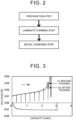
- FIG. 2 is a flowchart exemplifying a manufacturing method of the all-solid-state battery according to the present disclosure.
- a cathode having a cathode current collector and a cathode active material layer, a solid electrolyte layer, and an anode having an anode current collector and a modification layer are prepared (preparation step).
- the modification layer contains a third compound containing the Mg element and the X element (at least one selected from Zn, Sn, Ag, Al, Zr, Ni, or P).
- the manufacturing method of the all-solid-state battery according to the present disclosure may include an initial charging step of initial charging of the laminate.
- the anode in the laminate before the initial charging, has the modification layer containing the third compound containing the Mg element and the X element (at least one selected from Zn, Sn, Ag, Al, Zr, Ni, or P), and accordingly, an all-solid-state battery with good Li ion diffusivity during discharge can be manufactured.
- the modification layer containing the third compound containing the Mg element and the X element at least one selected from Zn, Sn, Ag, Al, Zr, Ni, or P
- the preparation step in the present disclosure is a step of preparing a cathode having a cathode current collector and a cathode active material layer, a solid electrolyte layer, and an anode having an anode current collector and a modification layer. These members are as described in "A. All-solid-state Battery”.
- the cathode and the solid electrolyte layer can each be formed by coating.
- the cathode can be formed, for example, by coating a cathode composite material containing at least a cathode active material onto a cathode current collector, and performing drying thereof.
- the solid electrolyte layer can be formed by coating a composite material containing at least a solid electrolyte onto a substrate and performing drying thereof. Note that the solid electrolyte layer can also be formed by pressure molding, as demonstrated in Examples, which will be described later.
- the anode can be prepared by forming the modification layer on the anode current collector using, for example, physical vapor deposition (PVD) such as ion plating, or chemical vapor deposition (CVD) such as plasma CVD.
- PVD physical vapor deposition
- CVD chemical vapor deposition
- the laminate forming step in the present disclosure is a step of obtaining a laminate having the cathode, the solid electrolyte layer, and the anode, in this order.
- the laminate has the cathode current collector, the cathode active material, the solid electrolyte layer, the modification layer, and the anode current collector, in this order.
- the above laminate can be regarded as the all-solid-state battery according to the second aspect, as illustrated in the upper tier in FIG. 1 .
- the manufacturing method of the all-solid-state battery according to the present disclosure may include an initial charging step in which initial charging of the above laminate is performed.
- the all-solid-state battery as illustrated in the middle tier in FIG. 1 is obtained.
- precipitated Li reacts with the third compound in the modification layer, and accordingly the modification layer becomes the compound layer containing the first compound described above.
- Conditions for the initial charging are not limited in particular, and can be adjusted as appropriate.
- the all-solid-state battery manufactured by the method described above is the same as the content described in "A. All-solid-state Battery", and accordingly description thereof will be omitted here.
- the Mg element and the Zn element were vapor-deposited at an atomic ratio of 50:50 on an Ni foil by ion plating.
- an anode was obtained, in which a Mg-Zn binary alloy layer was formed as a modification layer, on the Ni foil. Note that the thickness of the modification layer was 1 ⁇ m.
- the anode punched out so as to have a diameter of 11.28 mm, was then disposed on the face of the sulfide solid electrolyte layer on a side opposite to the Li metal foil, thereby obtaining a laminate.
- This laminate was constrained using three bolts under a torque of 2 N ⁇ m. Thus, an evaluation battery (Li half cell) was obtained.
- An anode and an evaluation battery were produced in the same manner as in Example 1, except that the Zn element and the atomic ratio were changed as shown in Table 1.
- An evaluation battery was produced in the same manner as in Example 1, except that an anode in which only the Mg element was vapor-deposited on Ni foil was used.
- each of the evaluation batteries produced was discharged at a current density of 0.6 mA/cm 2 until a capacity of 3 mAh/cm 2 was obtained, to precipitate Li metal.
- charging was performed for 30 minutes at a current density of 0.6 mA/cm 2 , to dissolve the precipitated Li metal.
- Charging was then paused for 90 minutes to relax diffusion resistance. This charging operation was repeated until 1 V (vs. Li/Li + ) was attained.
- FIG. 3 is a charge-discharge curve according to Example 1.
- Diffusion resistance S2 ⁇ Voltage V1 (mV) before pausing - Voltage V2 (mV) after pausing ⁇ / Current density (0.6 mA)
Landscapes
- Chemical & Material Sciences (AREA)
- General Chemical & Material Sciences (AREA)
- Chemical Kinetics & Catalysis (AREA)
- Electrochemistry (AREA)
- Engineering & Computer Science (AREA)
- Manufacturing & Machinery (AREA)
- Materials Engineering (AREA)
- Physics & Mathematics (AREA)
- Condensed Matter Physics & Semiconductors (AREA)
- General Physics & Mathematics (AREA)
- Inorganic Chemistry (AREA)
- Composite Materials (AREA)
- Secondary Cells (AREA)
- Battery Electrode And Active Subsutance (AREA)
- Cell Electrode Carriers And Collectors (AREA)
Abstract
Description
- The present disclosure relates to an all-solid-state battery and a manufacturing method of the all-solid-state battery.
- All-solid-state batteries are batteries having a solid electrolyte layer between a cathode active material layer and an anode active material layer, and have an advantage in that simplifying a safety device is easier as compared to liquid batteries having a liquid electrolyte containing a flammable organic solvent. Also, in all-solid-state batteries, there are known batteries that utilize precipitation and dissolution reactions of metallic lithium as anode reactions.
- For example,
Japanese Unexamined Patent Application Publication No. 2020-184513 JP 2020-184513 A - Also,
Japanese Unexamined Patent Application Publication No. 2020-184407 JP 2020-184407 A - Also,
Japanese Unexamined Patent Application Publication No. 2021-034199 JP 2021-034199 A - From the viewpoint of improving battery performance, the battery may have good charging and discharging efficiency. The present inventors have found that in an all-solid-state battery that utilizes precipitation-dissolution reaction of metallic lithium as an anode reaction, the diffusivity of Li ions decreases as discharging progresses, which will be described in detail later. In particular, when the diffusivity of Li ions at the final stage of discharge is low, sufficient discharge capacity may not be obtained, and there is a concern that charging/discharging efficiency may decrease.
- The present disclosure provides an all-solid-state battery with good Li ion diffusivity during discharge.
- An all-solid-state battery according to a first aspect of the present disclosure is an all-solid-state battery that utilizes a precipitation-dissolution reaction of metallic Li as an anode reaction, the all-solid-state battery including a cathode including a cathode current collector and a cathode active material layer, an anode including at least an anode current collector, and a solid electrolyte layer disposed between the cathode and the anode. The anode includes a compound layer containing a first compound expressed by Li-Mg-X on a face of the anode current collector, the face of the anode current collector facing the solid electrolyte layer, X in Li-Mg-X is an X element, and the X element is at least one selected from Zn, Sn, Ag, Al, Zr, Ni, or P.
- In the all-solid-state battery according to the first aspect of the present disclosure, the X element may be at least one selected from Zn, Sn, or Zr.
- In the all-solid-state battery according to the first aspect of the present disclosure, the compound layer may contain a second compound containing a Li element and a Mg element.
- In the all-solid-state battery according to the first aspect of the present disclosure, in the second compound, a proportion of the Mg element as to the Li element may be 0.01 atomic% or more and 30 atomic% or less.
- In the all-solid-state battery according to the first aspect of the present disclosure, in the compound layer, a proportion of a count of atoms of the X element as to a total count of atoms of a Mg element and the X element may be 25 atomic% or more and 50 atomic% or less.
- In the all-solid-state battery according to the first aspect of the present disclosure, the anode may include a protective layer containing a composite oxide expressed by Li-Mg-X-O, the protective layer being disposed between the compound layer and the solid electrolyte layer, and X in Li-Mg-X-O may be the X element.
- An all-solid-state battery according to a second aspect of the present disclosure is an all-solid-state battery that utilizes a precipitation-dissolution reaction of metallic Li as an anode reaction, the all-solid-state battery including a cathode including a cathode current collector and a cathode active material layer, an anode including at least an anode current collector, and a solid electrolyte layer disposed between the cathode and the anode. The anode includes a modification layer containing a third compound containing a Mg element and an X element on a face of the anode current collector, the face of the anode current collector facing the solid electrolyte layer, and the X element is at least one selected from Zn, Sn, Ag, Al, Zr, Ni, or P.
- A manufacturing method of an all-solid-state battery according to a third aspect of the present disclosure is a manufacturing method of an all-solid-state battery that utilizes a precipitation-dissolution reaction of metallic Li as an anode reaction, the manufacturing method including preparing a cathode including a cathode current collector and a cathode active material layer, a solid electrolyte layer, and an anode including an anode current collector and a modification layer, and obtaining a laminate including the cathode, the solid electrolyte layer and the anode, in this order. The modification layer contains a third compound containing a Mg element and an X element, and the X element is at least one selected from Zn, Sn, Ag, Al, Zr, Ni, or P.
- The manufacturing method according to the third aspect of the present disclosure may further include performing initial charging of the laminate.
- The present disclosure has the effect of enabling provision of an all-solid-state battery with good Li ion diffusivity during discharge.
- Features, advantages, and technical and industrial significance of exemplary embodiments of the invention will be described below with reference to the accompanying drawings, in which like signs denote like elements, and wherein:
-
FIG. 1 is a schematic sectional view exemplifying an all-solid-state battery according to the present disclosure; -
FIG. 2 is a flowchart showing a manufacturing method of the all-solid-state battery according to the present disclosure; and -
FIG. 3 is a charge-discharge curve obtained from Example 1. - An all-solid-state battery and a manufacturing method of the all-solid-state battery according to the present disclosure will be described below in detail.
-
FIG. 1 is a schematic sectional view exemplifying an all-solid-state battery according to the present disclosure. The upper tier inFIG. 1 illustrates the all-solid-state battery before initial charge, the middle tier inFIG. 1 illustrates the all-solid-state battery after charging (after the initial charge), and the lower tier inFIG. 1 illustrates the all-solid-state battery after discharging. The all-solid-state battery 10 illustrated inFIG. 1 is a battery that utilizes a precipitation-dissolution reaction of metallic Li as an anode reaction, and has an advantage of high energy density. The all-solid-state battery 10 includes a cathode CA having a cathodecurrent collector 1 and a cathodeactive material layer 2, an anode AN having at least an anodecurrent collector 3, and a solid electrolyte layer SE disposed between the anode AN and the cathode CA. In the all-solid-state battery according to the present disclosure, as illustrated the middle tier inFIG. 1 in the all-solid-state battery 10, the anode AN may have acompound layer 4 containing a first compound expressed by Li-Mg-X (where X in the formula is at least one selected from Zn, Sn, Ag, Al, Zr, Ni, or P), on a face of the anodecurrent collector 3 on a side toward the solid electrolyte layer SE. Also, as illustrated in the upper tier inFIG. 1 , in the all-solid-state battery 10, the anode AN may have amodification layer 5 containing a third compound containing Mg element and X element (at least one selected from Zn, Sn, Ag, Al, Zr, Ni, or P), on a face of the anodecurrent collector 3 on a side toward the solid electrolyte layer SE. - Now, in the present disclosure, an aspect including the
compound layer 4, as in the all-solid-state battery illustrated in the middle tier inFIG. 1 , will be referred to as a "first aspect", and an aspect including themodification layer 5, as in the all-solid-state battery illustrated in the upper tier inFIG. 1 , will be referred to as "second aspect". As illustrated in the upper tier and the middle tier inFIG. 1 , when the all-solid-state battery according to the second aspect (upper tier inFIG. 1 ) is charged for the first time, the all-solid-state battery according to the first aspect (middle tier inFIG. 1 ) is obtained. - According to the present disclosure, the anode in the all-solid-state battery according to the first aspect has the predetermined first compound, and also the anode in the all-solid-state battery of the second aspect contains the predetermined third compound, whereby an all-solid-state battery with good Li ion diffusivity during discharge can be provided.
- As described in
JP 2020-184513 A - On the other hand, in the all-solid-state battery according to the present disclosure, in the all-solid-state battery according to the first aspect (the all-solid-state battery after charging), the compound layer of the anode contains the first compound containing the X element. The X element is an element that can form a BCC structure with either of the Li element and the Mg element, and accordingly it is presumed that the BCC structure can be maintained even when the Li element in the anode (compound layer) decreases due to discharge. Thus, decrease in the diffusion rate of Li, particularly at the final stage of discharge, can be suppressed, and as a result, decrease in charge/discharge efficiency can be suppressed.
- The all-solid-state battery according to the first aspect is an all-solid-state battery that utilizes precipitation-dissolution reaction of metallic Li as an anode reaction, and includes a cathode including a cathode current collector and a cathode active material layer, an anode including at least an anode current collector, and a solid electrolyte layer disposed between the cathode and the anode. The anode includes a compound layer containing a first compound expressed by Li-Mg-X on a face of the anode current collector, the face of the anode current collector facing the solid electrolyte layer. X in Li-Mg-X is an X element. The X element is at least one selected from Zn, Sn, Ag, Al, Zr, Ni, or P).
- The anode according to the first aspect has at least an anode current collector. Also, the anode includes a compound layer containing a first compound expressed by Li-Mg-X (where the X element in the formula is at least one selected from Zn, Sn, Ag, Al, Zr, Ni, or P) on a face of the anode current collector on a side toward the solid electrolyte layer.
- The first compound contains the Li element, the Mg element, and the X element (at least one selected from Zn, Sn, Ag, Al, Zr, Ni, or P). The X element is an element that can form a BCC structure with either of the Li element and the Mg element. The X element may be at least one selected from Zn, Sn, or Zr. The first compound may be a compound containing the Li element, the Mg element, and one X element, or may be a compound containing the Li element, the Mg element, and two or more X elements.
- Here, when the first compound contains only a metal element as the element X, i,e,, when the first compound is an alloy, it is conceivable that exchange of Li ions will become difficult at other than an interface of the solid electrolyte layer and the compound layer, due to electron conductivity being faster than ion conduction rate and ion diffusion rate. On the other hand, when the first compound contains P, which is a nonmetallic element, as the X element, i.e., when the first compound is a semiconductor expressed by Li-Mg-P, it is conceivable that battery resistance can be reduced. This is because when the compound layer contains a semiconductor, conduction of electrons in the compound layer is suppressed (electron conduction is slowed), but when the electron conduction is slowed, Li ions can conceivably be satisfactorily exchanged in the compound layer other than at the aforementioned interface, and consequently, diffusion distance of Li ions can conceivably be shortened.
- The first compound may be a metal compound (alloy) containing only a metal element as the X element. Moreover, the first compound preferably has a crystal phase (β phase) with a body-centered cubic structure. The crystal phase of the first compound may be a single phase of β phase or may be a mixed phase, but may be the former. When the latter, the proportion of the β phase as to the entirety of crystal phases in the first compound may be 50% or more. The crystal phase (crystal structure) can be confirmed by performing structural analysis such as X-ray diffraction (XRD).
- Also, the compound layer may contain a second compound made up of the Li element and the Mg element. The second compound is a binary alloy containing only the Li element and the Mg element. The second compound may have a crystal phase (β phase) with a body-centered cubic structure. The crystal phase of the second compound may be a single phase of β phase or may be a mixed phase, but may be the former. When the latter, the proportion of the β phase as to the entirety of crystal phases in the second compound may be 50% or more. Further, in the second compound, the proportion of the Mg element as to the Li element may be 0.01 atomic% or more and 30 atomic% or less. When the proportion is within the above range, the second compound can exist as a β single-phase alloy of Li and Mg, enabling better charging and discharging efficiency. Also, the proportion of the elements can be confirmed, for example, by removing the anode from the all-solid-state battery after charging, and performing high-frequency inductively coupled plasma (ICP) emission spectrometry.
- Also, the compound layer may contain a compound other than the first compound and the second compound, and an elemental metal. Examples of compounds other than the first compound and the second compound include a ternary alloy of Li-Mg-Z (where Z is a metal element other than Li, Mg, and X), and binary alloys such as Mg-X , Li-X, and so forth. Examples of elemental metals include elemental Li, elemental Mg, and elemental X and elemental Z that are metal elements.
- In the compound layer, the first compound may be in a particulate state. Also, when the first compound is an alloy, the first compound may be in a solid solution state. When the latter, the compound layer can be regarded to have an alloy phase such as a Li-Mg-X alloy phase or the like. The same applies to the second compound.
- The total proportion of the first compound and the second compound as to all the compounds and elemental metals in the compound layer may be 100%, or may be less than 100%. When the latter, the proportion is, for example, 50% or more, may be 80% or more, may be 90% or more, or may be 99% or more.
- Further, in the compound layer, the proportion of the X element may be the same as or may be different from the proportion of the Mg element. When the latter, the proportion of the X element may be greater than or may be less than the proportion of the Mg element. Also, the proportion of the number of atoms of the X element as to the total number of atoms of the Mg element and the X element (atomic ratio) is, for example, 25 atomic% or more, may be 30 atomic% or more, or may be 35 atomic% or more. On the other hand, this proportion is, for example, 50 atomic% or less, may be 45 atomic% or less, or may be 40 atomic% or less. The atomic ratio can be confirmed by the aforementioned ICP.
- The compound layer in the present disclosure functions as an anode active material layer. That is to say, the first compound and the second compound function as anode active materials. Also, when the all-solid-state battery having the compound layer is discharged, Li is dissolved from the first compound and the second compound, and accordingly the compound layer becomes a layer that contains elemental Mg, elemental X, and an Mg-X compound, as primary components. On the other hand, the above-described first compound and second compound may also be contained in the compound layer after discharge.
- The thickness of the compound layer is, for example, 30 nm or more and 5000 nm or less, although not limited thereto in particular.
- Examples of the material of the anode current collector include copper, stainless steel, nickel, and carbon. Examples of the form of the anode current collector include a foil. The thickness of the anode current collector is, for example, 1 nm or more and 1 mm or less.
- Also, as illustrated in the middle tier in
FIG. 1 , in the all-solid-state battery of the first aspect, the anode AN may have aprotective layer 6 containing a composite oxide expressed by Li-Mg-X-O (where X in the formula is the above X element), between thecompound layer 4 and the solid electrolyte layer SE. Having the protective layer enables an increase in resistance at the interface between the anode (compound layer) and the solid electrolyte layer to be suppressed. - The composite oxide is more stable than metallic lithium, functions as a protective layer that suppresses reaction between metallic lithium and the solid electrolyte, and has high lithium ion conductivity due to containing the lithium element. Accordingly, as illustrated in the middle tier and lower tier in
FIG. 1 , once theprotective layer 6 is formed, theprotective layer 6 usually does not disappear even after the all-solid-state battery 10 is discharged. - The thickness of the compound layer is, for example, 1 nm or more and 5 nm or less, although not limited thereto in particular.
- The cathode according to the present disclosure has a cathode current collector and a cathode active material layer.
- The cathode active material layer contains at least a cathode active material. The cathode active material layer may also contain at least one of a solid electrolyte, a conductive material, or a binder, as necessary.
- Examples of the cathode active material include oxide active materials and sulfur-based active materials, although not limited thereto in particular. Examples of the oxide active material include layered rock-salt active materials such as LiCoO2, LiMnO2, LiNiO2, LiVO2, LiNi1/3Co1/3Mn1/3O2, and so forth, spinel active materials such as LiMn2O4, Li4Ti5O12, Li(Ni0.5Mn1.5)O4, and so forth, and olivine active materials such as LiFePO4, LiMnPO4, LiNiPO4, LiCoPO4, and so forth. Also, LiMn spinel active materials expressed by Li1+xMn2-x-yMyO4 (where M is at least one of Al, Mg, Co, Fe, Ni, or Zn, and 0 < x+y < 2), lithium titanate, and so forth, may also be used as the oxide active material.
- Also, a coating layer containing a Li-ion conductive oxide may be formed on the surface of the oxide active material. This is because the coating layer can suppress reaction between the oxide active material and the solid electrolyte. Examples of the Li-ion conductive oxide include LiNbO3, Li4Ti5O12, and Li3PO4. The thickness of the coating layer is, for example, 0.1 nm or more, and may be 1 nm or more. On the other hand, the thickness of the coating layer is, for example, 100 nm or less, and may be 20 nm or less. The coverage of the coating layer on the surface of the oxide active material is, for example, 70% or more, and may be 90% or more.
- Further, the sulfur-based active material is an active material containing at least an S element. The sulfur-based active material may contain or may not contain the Li element. Examples of the sulfur-based active material include elemental sulfur, lithium sulfide (Li2S), and lithium polysulfide (Li2Sx, 2 ≤ x ≤ 8).
- The proportion of the cathode active material in the cathode active material layer is, for example, 50% by weight or more and 99% by weight or less.
- The solid electrolyte is described in "(3) Solid Electrolyte Layer". Examples of the conductive material include carbon material. Examples of the carbon material include particle carbon materials such as acetylene black (AB), Ketjen black (KB), and so forth, and fibrous carbon materials such as carbon fibers, carbon nanotubes (CNTs), carbon nanofibers (CNFs), and so forth. Examples of the binder include rubber-based binders such as butylene rubber (BR), styrene butadiene rubber (SBR), and so forth, and fluoride-based binders such as polyvinylidene fluoride (PVDF) and so forth.
- The thickness of the cathode active material layer is, for example, 0.1 µm or more and 1000 µm or less.
- The cathode current collector is a member that collects electrons from the cathode active material layer. Examples of the material for the cathode current collector include stainless steel, aluminum, nickel, iron, titanium, and carbon. Examples of the form of the cathode current collector include foil and mesh. The thickness of the cathode current collector is, for example, 1 µm or more and 1 mm or less.
- A solid electrolyte layer is disposed between the cathode and the anode. The solid electrolyte layer contains at least a solid electrolyte, and may further contain a binder. The binder is similar to the content described in "(2) Cathode", and accordingly description thereof will be omitted.
- Examples of the solid electrolyte include inorganic solid electrolytes such as a sulfide solid electrolyte, an oxide solid electrolyte, a nitride solid electrolyte, a halide solid electrolyte, and so forth. The sulfide solid electrolyte preferably contains sulfur (S) as a primary component of anionic elements. The oxide solid electrolyte preferably contains oxygen (O) as a primary component of anionic elements. The nitride solid electrolyte preferably contains nitrogen (N) as a primary component of anionic elements. The halide solid electrolyte preferably contains a halogen as a primary anion component. Out of these, sulfide solid electrolytes are preferred.
- Examples of sulfide solid electrolytes include Li2S-P2S5, Li2S-P2S5-LiI, Li2S-P2S5-GeS2, Li2S-P2S5-Li2O, Li2S-P2S5-Li2O-LiI, Li2S-P2S5-LiI-LiBr, Li2S-SiS2, Li2S-SiS2-LiI, Li2S-SiS2-LiBr, Li2S-SiS2-LiCl, Li2S-SiS2-B2S3-LiI, Li2S-SiS2-P2S5-LiI, Li2S-B2S3, Li2S-P2S5-ZmSn (where m and n are positive numerals, and Z is any one of Ge, Zn, and Ga), Li2S-GeS2, Li2S-SiS2-Li3PO4, Li2S-SiS2-LixMOy (where x and y are positive numerals, and M is any one of P, Si, Ge, B, Al, Ga, and In).
- Examples of the composition of the sulfide solid electrolyte include yLiI.zLiBr.(100-y-z)Li3PS4 (0 ≤ y ≤ 30, 0 ≤ z ≤ 30) although not limited thereto in particular.
- The thickness of the solid electrolyte layer is, for example, 0.1 µm or more and 1000 µm or less.
- The all-solid-state battery according to the present disclosure may further have a constraining jig that applies a constraining pressure to the cathode, the solid electrolyte layer, and the anode, in a thickness direction thereof. A known jig may be used as the constraining jig. The constraining pressure is, for example, 0.1 MPa or more and 50 MPa or less.
- The all-solid-state battery according to the present disclosure is typically a lithium-ion secondary battery. The all-solid-state battery may be a single cell, or may be a stacked battery. The stacked battery may be a monopolar stacked battery (parallel-connected stacked battery) or a bipolar stacked battery (series-connected stacked battery). Examples of the shape of the battery include a coin shape, a laminate shape, a cylindrical shape, and a rectangular shape.
- Usages of the all-solid-state battery according to the present disclosure include, for example, a power source for vehicles such as hybrid electric vehicles (HEVs), plug-in hybrid electric vehicles (PHEVs), battery electric vehicles (BEVs), gasoline vehicles, diesel vehicles, and so forth. The all-solid-state battery according to the present disclosure may also be used as a power source for moving bodies other than vehicles (e.g., trains, ships, and aircrafts), and may be used as power sources for electrical products such as information processing devices and so forth.
- The all-solid-state battery according to the second aspect is an all-solid-state battery that utilizes a precipitation-dissolution reaction of metal Li as an anode reaction, and includes a cathode including a cathode current collector and a cathode active material layer, an anode including at least an anode current collector, and a solid electrolyte layer disposed between the cathode and the anode. The anode includes a modification layer containing a third compound containing the Mg element and the X element on a face of the anode current collector, the face of the anode current collector facing the solid electrolyte layer. The X element is at least one selected from Zn, Sn, Ag, Al, Zr, Ni, or P.
- The cathode and the solid electrolyte layer in the all-solid-state battery according to the second aspect are the same as those of the all-solid-state battery according to the first aspect described above.
- The anode according to the second aspect includes at least an anode current collector. The anode current collector is the same as the first aspect described above.
- The anode according to the second aspect also has the modification layer containing the third compound containing the Mg element and the X element (at least one selected from Zn, Sn, Ag, Al, Zr, Ni, or P), on a face of the anode current collector on a side toward the solid electrolyte layer. Note that the X element is usually the same as in the first aspect described above.
- The third compound may be a metal compound (alloy) containing only metal elements as the X element. The third compound may be a binary alloy made up of the Mg element and one X element that is a metal element, or a multinary alloy made up of the Mg element and two or more X elements that are metal elements. Also, the third compound may be an alloy containing the Mg element, the X element that is a metal element, and the above Z element. Also, in the modification layer, the third compound may be in a particulate state. Also, when the third compound is an alloy, the third compound may be in a solid solution state. When the latter, the modification layer can be regarded to have an alloy phase such as, for example, a Mg-X alloy phase or the like.
- The proportion (atomic ratio) of the Mg element and the X element in the modification layer usually matches the proportion of the Mg element and the X element in the alloy layer according to the first aspect.
- Also, the modification layer may contain elemental Mg and elemental X, in addition to the third compound. Also, the modification layer may contain an alloy containing the above-mentioned Z element, such as, for example, a Mg-X-Z alloy or the like.
- Now, the surface of the modification layer is usually covered with an oxide film. Accordingly, as illustrated in the upper tier and the medium tier in
FIG. 1 , the oxide film on the surface of the modification layer and the lithium ions react due to the initial charging of the all-solid-state battery, forming a layer of the composite oxide (protective layer) on the interface between the anode and the solid electrolyte layer. Accordingly, the all-solid-state battery according to the second aspect usually does not have the above-described protective layer. - The thickness of the modification layer is, for example, 30 nm or more and 5000 nm or less, although not limited thereto in particular.
-
FIG. 2 is a flowchart exemplifying a manufacturing method of the all-solid-state battery according to the present disclosure. As shown inFIG. 2 , in the manufacturing method of the all-solid-state battery according to the present disclosure, a cathode having a cathode current collector and a cathode active material layer, a solid electrolyte layer, and an anode having an anode current collector and a modification layer, are prepared (preparation step). Also, the modification layer contains a third compound containing the Mg element and the X element (at least one selected from Zn, Sn, Ag, Al, Zr, Ni, or P). Next, a laminate having the cathode, the solid electrolyte layer, and the anode, in this order is obtained (laminate forming step). Further, as shown inFIG. 2 , the manufacturing method of the all-solid-state battery according to the present disclosure may include an initial charging step of initial charging of the laminate. - According to the present disclosure, in the laminate before the initial charging, the anode has the modification layer containing the third compound containing the Mg element and the X element (at least one selected from Zn, Sn, Ag, Al, Zr, Ni, or P), and accordingly, an all-solid-state battery with good Li ion diffusivity during discharge can be manufactured.
- The preparation step in the present disclosure is a step of preparing a cathode having a cathode current collector and a cathode active material layer, a solid electrolyte layer, and an anode having an anode current collector and a modification layer. These members are as described in "A. All-solid-state Battery".
- The cathode and the solid electrolyte layer can each be formed by coating. The cathode can be formed, for example, by coating a cathode composite material containing at least a cathode active material onto a cathode current collector, and performing drying thereof. Also, the solid electrolyte layer can be formed by coating a composite material containing at least a solid electrolyte onto a substrate and performing drying thereof. Note that the solid electrolyte layer can also be formed by pressure molding, as demonstrated in Examples, which will be described later. Also, the anode can be prepared by forming the modification layer on the anode current collector using, for example, physical vapor deposition (PVD) such as ion plating, or chemical vapor deposition (CVD) such as plasma CVD.
- The laminate forming step in the present disclosure is a step of obtaining a laminate having the cathode, the solid electrolyte layer, and the anode, in this order. The laminate has the cathode current collector, the cathode active material, the solid electrolyte layer, the modification layer, and the anode current collector, in this order. The above laminate can be regarded as the all-solid-state battery according to the second aspect, as illustrated in the upper tier in
FIG. 1 . - Also, the manufacturing method of the all-solid-state battery according to the present disclosure may include an initial charging step in which initial charging of the above laminate is performed. By performing the initial charging, the all-solid-state battery as illustrated in the middle tier in
FIG. 1 is obtained. Specifically, by performing initial charging of the laminate, precipitated Li reacts with the third compound in the modification layer, and accordingly the modification layer becomes the compound layer containing the first compound described above. Conditions for the initial charging are not limited in particular, and can be adjusted as appropriate. - The all-solid-state battery manufactured by the method described above is the same as the content described in "A. All-solid-state Battery", and accordingly description thereof will be omitted here.
- Note that the present disclosure is not limited to the above embodiment. The above embodiment is exemplary, and all arrangements having substantially the same configuration as, and having similar effects and advantages to, the technical idea described in the claims of the present disclosure is included in the technical scope of the present disclosure.
- The Mg element and the Zn element were vapor-deposited at an atomic ratio of 50:50 on an Ni foil by ion plating. Thus, an anode was obtained, in which a Mg-Zn binary alloy layer was formed as a modification layer, on the Ni foil. Note that the thickness of the modification layer was 1 µm.
- An amount of 101.7 mg of a sulfide solid electrolyte (LiBr-LiI-Li2S-P2S5) was placed in a pressurizing cell having a diameter of 11.28 mm. This was then left standing for 1 minute in a state of being pressed under pressure of 6 tons to obtain a solid electrolyte layer (sulfide solid electrolyte layer). Thereafter, a Li metal foil was disposed on the sulfide solid electrolyte layer and left standing for 1 minute in a state of being pressed under pressure of 1 ton. The anode, punched out so as to have a diameter of 11.28 mm, was then disposed on the face of the sulfide solid electrolyte layer on a side opposite to the Li metal foil, thereby obtaining a laminate. This laminate was constrained using three bolts under a torque of 2 N·m. Thus, an evaluation battery (Li half cell) was obtained.
- An anode and an evaluation battery were produced in the same manner as in Example 1, except that the Zn element and the atomic ratio were changed as shown in Table 1.
- An evaluation battery was produced in the same manner as in Example 1, except that an anode in which only the Mg element was vapor-deposited on Ni foil was used.
- First, each of the evaluation batteries produced was discharged at a current density of 0.6 mA/cm2 until a capacity of 3 mAh/cm2 was obtained, to precipitate Li metal. Next, charging was performed for 30 minutes at a current density of 0.6 mA/cm2, to dissolve the precipitated Li metal. Charging was then paused for 90 minutes to relax diffusion resistance. This charging operation was repeated until 1 V (vs. Li/Li+) was attained. Thus, a charge-discharge curve as shown in
FIG. 3 was obtained. Note thatFIG. 3 is a charge-discharge curve according to Example 1. - Next, the diffusion resistance of each evaluation battery was calculated using the following Expression. When the diffusion resistance was 5 Ω or less, it was determined that the diffusion was high (diffusion rate was high). Diffusion resistance S2 = {Voltage V1 (mV) before pausing - Voltage V2 (mV) after pausing} / Current density (0.6 mA)
- The range of the SOC (State of Charge) in which the diffusion resistance calculated using the above expression was 5 Ω or less was then read. The results are shown in Table 1.
Table 1 Modification layer Atomic ratio High diffusion SOC(%) Comparative Example 1 Mg - 31.7 - 100 Example 1 Mg-Zn 50:50 23.3 - 100 Example 2 Mg-Sn 75:25 28.3 - 100 Example 3 Mg-Sn 67:33 20.0 - 100 Example 4 Mg-Sn 50:50 28.3 - 100 Example 5 Mg-Zr 67:33 10.0 - 100 - As shown in Table 1, in each of the Examples, the range of highly diffused SOC during discharge was broader than that in the Comparative Example. This is presumed to be because the modification layer contains the Mg element and the X element facilitating maintenance of the BCC structure formed in the anode by precipitation of the Li even after reduction in the amount of lithium due to dissolution of the Li, thereby suppressing decrease in the diffusion rate of lithium ions. From these results, it was confirmed that in the all-solid-state battery according to the present disclosure, Li ion diffusivity was good even at the final stage of discharge, and charging and discharging efficiency was also good.
Claims (9)
- An all-solid-state battery (10) that utilizes a precipitation-dissolution reaction of metallic Li as an anode reaction, the all-solid-state battery (10) comprising:a cathode (CA) including a cathode current collector (1) and a cathode active material layer (2);an anode (AN) including at least an anode current collector (3); anda solid electrolyte layer (SE) disposed between the cathode (CA) and the anode (AN), whereinthe anode (AN) includes a compound layer (4) containing a first compound expressed by Li-Mg-X on a face of the anode current collector (3), the face of the anode current collector (3) facing the solid electrolyte layer (SE),X in Li-Mg-X is an X element, andthe X element is at least one selected from Zn, Sn, Ag, Al, Zr, Ni, or P.
- The all-solid-state battery (10) according to claim 1, wherein the X element is at least one selected from Zn, Sn, or Zr.
- The all-solid-state battery (10) according to claim 1, wherein the compound layer (4) contains a second compound containing a Li element and a Mg element.
- The all-solid-state battery (10) according to claim 3, wherein in the second compound, a proportion of the Mg element as to the Li element is 0.01 atomic% or more and 30 atomic% or less.
- The all-solid-state battery (10) according to claim 1, wherein in the compound layer (4), a proportion of a count of atoms of the X element as to a total count of atoms of a Mg element and the X element is 25 atomic% or more and 50 atomic% or less.
- The all-solid-state battery (10) according to any one of claims 1 to 5, whereinthe anode (AN) includes a protective layer (6) containing a composite oxide expressed by Li-Mg-X-O, the protective layer (6) being disposed between the compound layer (4) and the solid electrolyte layer (SE), andX in Li-Mg-X-O is the X element.
- An all-solid-state battery (10) that utilizes a precipitation-dissolution reaction of metallic Li as an anode reaction, the all-solid-state battery (10) comprising:a cathode (CA) including a cathode current collector (1) and a cathode active material layer (2);an anode (AN) including at least an anode current collector (3); anda solid electrolyte layer (SE) disposed between the cathode (CA) and the anode (AN), whereinthe anode (AN) includes a modification layer (5) containing a third compound containing a Mg element and an X element on a face of the anode current collector (3), the face of the anode current collector (3) facing the solid electrolyte layer (SE), andthe X element is at least one selected from Zn, Sn, Ag, Al, Zr, Ni, or P.
- A manufacturing method of an all-solid-state battery (10) that utilizes a precipitation-dissolution reaction of metallic Li as an anode reaction, the manufacturing method comprising:preparing a cathode (CA) including a cathode current collector (1) and a cathode active material layer (2), a solid electrolyte layer (SE), and an anode (AN) including an anode current collector (3) and a modification layer (5); andobtaining a laminate including the cathode (CA), the solid electrolyte layer (SE) and the anode (AN), in this order, whereinthe modification layer (5) contains a third compound containing a Mg element and an X element, andthe X element is at least one selected from Zn, Sn, Ag, Al, Zr, Ni, or P.
- The manufacturing method according to claim 8, further comprising performing initial charging of the laminate.
Applications Claiming Priority (1)
| Application Number | Priority Date | Filing Date | Title |
|---|---|---|---|
| JP2023053132A JP7772016B2 (en) | 2023-03-29 | 2023-03-29 | All-solid-state battery and method for manufacturing the same |
Publications (2)
| Publication Number | Publication Date |
|---|---|
| EP4439706A2 true EP4439706A2 (en) | 2024-10-02 |
| EP4439706A3 EP4439706A3 (en) | 2025-01-15 |
Family
ID=90482261
Family Applications (1)
| Application Number | Title | Priority Date | Filing Date |
|---|---|---|---|
| EP24166464.8A Pending EP4439706A3 (en) | 2023-03-29 | 2024-03-26 | All-solid-state battery and manufacturing method of all-solidstate battery |
Country Status (5)
| Country | Link |
|---|---|
| US (1) | US20240332521A1 (en) |
| EP (1) | EP4439706A3 (en) |
| JP (1) | JP7772016B2 (en) |
| KR (1) | KR20240146557A (en) |
| CN (1) | CN118738514A (en) |
Citations (3)
| Publication number | Priority date | Publication date | Assignee | Title |
|---|---|---|---|---|
| JP2020184407A (en) | 2019-04-26 | 2020-11-12 | トヨタ自動車株式会社 | All-solid battery |
| JP2020184513A (en) | 2019-04-26 | 2020-11-12 | トヨタ自動車株式会社 | All-solid battery and method for manufacturing the same |
| JP2021034199A (en) | 2019-08-22 | 2021-03-01 | トヨタ自動車株式会社 | All solid state battery |
Family Cites Families (5)
| Publication number | Priority date | Publication date | Assignee | Title |
|---|---|---|---|---|
| CN111864182A (en) * | 2019-04-26 | 2020-10-30 | 丰田自动车株式会社 | All-solid-state battery and method of making the same |
| EP4190928A4 (en) * | 2020-08-03 | 2025-05-21 | University Public Corporation Osaka | NEGATIVE ELECTRODE COMPOSITE BODY AND SECONDARY BATTERY |
| US20240154182A1 (en) | 2021-03-29 | 2024-05-09 | Nissan Motor Co., Ltd. | Lithium Secondary Battery |
| JP7753681B2 (en) | 2021-06-04 | 2025-10-15 | 日産自動車株式会社 | Lithium secondary battery |
| CN113782733B (en) | 2021-11-09 | 2022-03-25 | 北京理工大学深圳汽车研究院(电动车辆国家工程实验室深圳研究院) | Negative electrode material for solid lithium battery and application thereof |
-
2023
- 2023-03-29 JP JP2023053132A patent/JP7772016B2/en active Active
-
2024
- 2024-03-19 KR KR1020240037811A patent/KR20240146557A/en not_active Ceased
- 2024-03-20 CN CN202410316453.9A patent/CN118738514A/en active Pending
- 2024-03-25 US US18/614,903 patent/US20240332521A1/en active Pending
- 2024-03-26 EP EP24166464.8A patent/EP4439706A3/en active Pending
Patent Citations (3)
| Publication number | Priority date | Publication date | Assignee | Title |
|---|---|---|---|---|
| JP2020184407A (en) | 2019-04-26 | 2020-11-12 | トヨタ自動車株式会社 | All-solid battery |
| JP2020184513A (en) | 2019-04-26 | 2020-11-12 | トヨタ自動車株式会社 | All-solid battery and method for manufacturing the same |
| JP2021034199A (en) | 2019-08-22 | 2021-03-01 | トヨタ自動車株式会社 | All solid state battery |
Also Published As
| Publication number | Publication date |
|---|---|
| US20240332521A1 (en) | 2024-10-03 |
| JP2024141459A (en) | 2024-10-10 |
| CN118738514A (en) | 2024-10-01 |
| JP7772016B2 (en) | 2025-11-18 |
| EP4439706A3 (en) | 2025-01-15 |
| KR20240146557A (en) | 2024-10-08 |
Similar Documents
| Publication | Publication Date | Title |
|---|---|---|
| JP7327005B2 (en) | All-solid-state battery and manufacturing method thereof | |
| CN111864207B (en) | All-solid battery | |
| US9577245B2 (en) | Non-aqueous electrolyte secondary cell containing negative active material including scaly graphite particles and graphite particles coated with amorphous carbon particles and amorphous carbon layer and method of manufacturing the same | |
| TWI508356B (en) | Anode active material for lithium secondary battery, method of preparing the same, and lithium secondary battery including the same | |
| CN112635763A (en) | All-solid-state battery | |
| CN108346774A (en) | Negative electrode layer and lithium all-solid-state battery | |
| KR102818027B1 (en) | All solid state battery and method for producing all solid state battery | |
| JP2023141482A (en) | All-solid-state batteries and all-solid-state battery systems | |
| KR20220044115A (en) | Anode material and solid-state battery | |
| EP4439706A2 (en) | All-solid-state battery and manufacturing method of all-solidstate battery | |
| JP2023135693A (en) | Capacity recovery method for all-solid-state batteries | |
| EP4224571A1 (en) | Secondary battery | |
| EP4459738B1 (en) | Method for charging secondary battery | |
| EP4160736A1 (en) | Secondary battery positive electrode | |
| JP7756257B2 (en) | Lithium secondary battery manufacturing method | |
| JP7704174B2 (en) | solid state battery | |
| CN113036111A (en) | Negative electrode active material and battery | |
| US20250323314A1 (en) | Cathode layer and solid-state battery | |
| US20250158105A1 (en) | Lithium-ion secondary battery | |
| JP2014116127A (en) | All-solid-state battery | |
| CN121646838A (en) | Method for manufacturing all-solid-state battery | |
| JP2025044600A (en) | Battery and manufacturing method thereof | |
| JP2025119688A (en) | Solid-state battery and method for manufacturing the same | |
| JP2025080121A (en) | Manufacturing method for all-solid-state batteries | |
| CN120657201A (en) | Solid battery and solid electrolyte |
Legal Events
| Date | Code | Title | Description |
|---|---|---|---|
| PUAI | Public reference made under article 153(3) epc to a published international application that has entered the european phase |
Free format text: ORIGINAL CODE: 0009012 |
|
| STAA | Information on the status of an ep patent application or granted ep patent |
Free format text: STATUS: REQUEST FOR EXAMINATION WAS MADE |
|
| 17P | Request for examination filed |
Effective date: 20240331 |
|
| AK | Designated contracting states |
Kind code of ref document: A2 Designated state(s): AL AT BE BG CH CY CZ DE DK EE ES FI FR GB GR HR HU IE IS IT LI LT LU LV MC ME MK MT NL NO PL PT RO RS SE SI SK SM TR |
|
| PUAL | Search report despatched |
Free format text: ORIGINAL CODE: 0009013 |
|
| AK | Designated contracting states |
Kind code of ref document: A3 Designated state(s): AL AT BE BG CH CY CZ DE DK EE ES FI FR GB GR HR HU IE IS IT LI LT LU LV MC ME MK MT NL NO PL PT RO RS SE SI SK SM TR |
|
| RIC1 | Information provided on ipc code assigned before grant |
Ipc: H01M 4/02 20060101ALN20241206BHEP Ipc: H01M 4/36 20060101ALN20241206BHEP Ipc: H01M 10/44 20060101ALI20241206BHEP Ipc: H01M 4/1395 20100101ALI20241206BHEP Ipc: H01M 10/0562 20100101ALI20241206BHEP Ipc: H01M 10/052 20100101ALI20241206BHEP Ipc: H01M 4/40 20060101ALI20241206BHEP Ipc: H01M 4/134 20100101AFI20241206BHEP |