EP4439568A1 - Thermal stability determining apparatus and method - Google Patents
Thermal stability determining apparatus and method Download PDFInfo
- Publication number
- EP4439568A1 EP4439568A1 EP23879956.3A EP23879956A EP4439568A1 EP 4439568 A1 EP4439568 A1 EP 4439568A1 EP 23879956 A EP23879956 A EP 23879956A EP 4439568 A1 EP4439568 A1 EP 4439568A1
- Authority
- EP
- European Patent Office
- Prior art keywords
- thermal stability
- target material
- gyration
- instruction configured
- molecular structure
- Prior art date
- Legal status (The legal status is an assumption and is not a legal conclusion. Google has not performed a legal analysis and makes no representation as to the accuracy of the status listed.)
- Pending
Links
Images






Classifications
-
- G—PHYSICS
- G16—INFORMATION AND COMMUNICATION TECHNOLOGY [ICT] SPECIALLY ADAPTED FOR SPECIFIC APPLICATION FIELDS
- G16C—COMPUTATIONAL CHEMISTRY; CHEMOINFORMATICS; COMPUTATIONAL MATERIALS SCIENCE
- G16C20/00—Chemoinformatics, i.e. ICT specially adapted for the handling of physicochemical or structural data of chemical particles, elements, compounds or mixtures
- G16C20/30—Prediction of properties of chemical compounds, compositions or mixtures
-
- G—PHYSICS
- G06—COMPUTING OR CALCULATING; COUNTING
- G06N—COMPUTING ARRANGEMENTS BASED ON SPECIFIC COMPUTATIONAL MODELS
- G06N20/00—Machine learning
-
- G—PHYSICS
- G16—INFORMATION AND COMMUNICATION TECHNOLOGY [ICT] SPECIALLY ADAPTED FOR SPECIFIC APPLICATION FIELDS
- G16C—COMPUTATIONAL CHEMISTRY; CHEMOINFORMATICS; COMPUTATIONAL MATERIALS SCIENCE
- G16C10/00—Computational theoretical chemistry, i.e. ICT specially adapted for theoretical aspects of quantum chemistry, molecular mechanics, molecular dynamics or the like
-
- G—PHYSICS
- G16—INFORMATION AND COMMUNICATION TECHNOLOGY [ICT] SPECIALLY ADAPTED FOR SPECIFIC APPLICATION FIELDS
- G16C—COMPUTATIONAL CHEMISTRY; CHEMOINFORMATICS; COMPUTATIONAL MATERIALS SCIENCE
- G16C20/00—Chemoinformatics, i.e. ICT specially adapted for the handling of physicochemical or structural data of chemical particles, elements, compounds or mixtures
- G16C20/20—Identification of molecular entities, parts thereof or of chemical compositions
-
- G—PHYSICS
- G16—INFORMATION AND COMMUNICATION TECHNOLOGY [ICT] SPECIALLY ADAPTED FOR SPECIFIC APPLICATION FIELDS
- G16C—COMPUTATIONAL CHEMISTRY; CHEMOINFORMATICS; COMPUTATIONAL MATERIALS SCIENCE
- G16C20/00—Chemoinformatics, i.e. ICT specially adapted for the handling of physicochemical or structural data of chemical particles, elements, compounds or mixtures
- G16C20/40—Searching chemical structures or physicochemical data
-
- G—PHYSICS
- G16—INFORMATION AND COMMUNICATION TECHNOLOGY [ICT] SPECIALLY ADAPTED FOR SPECIFIC APPLICATION FIELDS
- G16C—COMPUTATIONAL CHEMISTRY; CHEMOINFORMATICS; COMPUTATIONAL MATERIALS SCIENCE
- G16C20/00—Chemoinformatics, i.e. ICT specially adapted for the handling of physicochemical or structural data of chemical particles, elements, compounds or mixtures
- G16C20/70—Machine learning, data mining or chemometrics
-
- G—PHYSICS
- G16—INFORMATION AND COMMUNICATION TECHNOLOGY [ICT] SPECIALLY ADAPTED FOR SPECIFIC APPLICATION FIELDS
- G16C—COMPUTATIONAL CHEMISTRY; CHEMOINFORMATICS; COMPUTATIONAL MATERIALS SCIENCE
- G16C60/00—Computational materials science, i.e. ICT specially adapted for investigating the physical or chemical properties of materials or phenomena associated with their design, synthesis, processing, characterisation or utilisation
-
- H—ELECTRICITY
- H10—SEMICONDUCTOR DEVICES; ELECTRIC SOLID-STATE DEVICES NOT OTHERWISE PROVIDED FOR
- H10K—ORGANIC ELECTRIC SOLID-STATE DEVICES
- H10K71/00—Manufacture or treatment specially adapted for the organic devices covered by this subclass
- H10K71/10—Deposition of organic active material
- H10K71/16—Deposition of organic active material using physical vapour deposition [PVD], e.g. vacuum deposition or sputtering
- H10K71/164—Deposition of organic active material using physical vapour deposition [PVD], e.g. vacuum deposition or sputtering using vacuum deposition
-
- H—ELECTRICITY
- H10—SEMICONDUCTOR DEVICES; ELECTRIC SOLID-STATE DEVICES NOT OTHERWISE PROVIDED FOR
- H10K—ORGANIC ELECTRIC SOLID-STATE DEVICES
- H10K85/00—Organic materials used in the body or electrodes of devices covered by this subclass
Definitions
- the present invention relates to an apparatus and method for determining thermal stability, and more particularly, to an apparatus and method for determining whether a target material is thermally stable from molecular structure information on the target material.
- An organic light emitting diode is a device that emits light by electroluminescence phenomenon without a separate light source. More specifically, an organic light emitting diode (OLED) includes organic compound layers provided in the form of a thin film between an anode electrode and a cathode electrode. In other words, the organic light emitting diode (OLED) is provided such that multi-layer organic thin films are formed between the anode electrode and the cathode electrode.
- the multi-layer organic thin film includes a hole injection layer (HIL), a hole transport layer (HTL), an emission layer (EML), an electron transport layer (ETL), and an electron injection layer (EIL).
- HIL hole injection layer
- HTL hole transport layer
- EML emission layer
- ETL electron transport layer
- EIL electron injection layer
- OLED organic light emitting diode
- HTL hole transport layer
- ETL electron transport layer
- a method is used to observe the thermal stability in the process of thermal decomposition using indicators such as glass transition temperature (Tg), decomposition temperature (Td), and molecular weight change.
- An object of the present invention to solve the above problems is directed to providing an apparatus for determining thermal stability with high speed, high accuracy, and low cost.
- Another object of the present invention to solve the above problems is directed to providing a method of determining thermal stability with high speed, high accuracy, and low cost.
- the apparatus includes: a memory; and a processor executing at least one instruction in the memory, wherein the at least one instruction comprises: an instruction configured to acquire particle information constituting the target material; an instruction configured to acquire a molecular structure using the particle information; an instruction configured to acquire structural information from the molecular structure; and an instruction configured to determine thermal stability of the target material using the structural information.
- the instruction configured to acquire a molecular structure using the particle information may include an instruction configured to acquire an energy-optimized molecular structure using the particle information.
- the instruction configured to acquire the energy-optimized molecular structure using the particle information may include an instruction configured to acquire an energy-optimized molecular structure using any one of first principles, semi-empirical, or empirical methods, based on the particle information.
- the particle information may include atom information and molecule information on the target material.
- the particle information may include a core moiety forming the target material and at least one functional group that is capable of being substituted to at least one derivative by bonding with the core moiety.
- the structural information may include at least one of radius of gyration (Rg) or asphericity (As).
- the instruction configured to acquire the structural information from the molecular structure may include: an instruction configured to calculate a gyration tensor from the molecular structure; and an instruction configured to calculate at least one of radius of gyration or asphericity from the gyration tensor.
- the gyration tensor may be a matrix that is configured with a mass and position vectors of atoms.
- the instruction configured to calculate at least one of the radius of gyration or asphericity may include: an instruction configured to diagonalize the gyration tensor to be expressed in terms of eigenvalues L1, L2, and L3; an instruction configured to calculate the radius of gyration using the eigenvalues of the gyration tensor; and an instruction configured to calculate the asphericity using the eigenvalues of the gyration tensor.
- the instruction configured to determine thermal stability of the target material may include an instruction configured to determine thermal stability of the target material by comparing the structural information to a threshold value.
- the instruction configured to determine thermal stability of the target material by the comparing may include: an instruction configured to determine that thermal stability of the target material is high when the radius of gyration and asphericity exceed a first threshold and a second threshold, respectively; and an instruction configured to determine that thermal stability of the target material is low when the radius of gyration and asphericity are equal to or less than the first threshold and the second threshold, respectively.
- the instruction configured to determine thermal stability of the target material may include an instruction configured to determine thermal stability of the target material by inputting the structural information to a pre-trained learning model.
- the pre-trained learning model may be a machine learning model using at least one experimental data according to a thermal stability experiment as training data.
- the instruction configured to determine thermal stability of the target material may further include an instruction configured to store result data of the determination of thermal stability in a database.
- the instruction configured to determine thermal stability of the target material may further include an instruction configured to retrain the learning model using the at least one result data stored in the database.
- the target material may be applied to an organic thin film layer of an organic light emitting diode (OLED) .
- OLED organic light emitting diode
- a method of determining thermal stability includes: acquiring particle information constituting a target material; acquiring a molecular structure using the particle information; acquiring structural information from the molecular structure; and determining thermal stability of the target material using the structural information.
- the acquiring of the molecular structure using the particle information may include acquiring an energy-optimized molecular structure using the particle information.
- the acquiring of the energy-optimized molecular structure using the particle information may include acquiring an energy-optimized molecular structure using any one of first principles, semi-empirical, or empirical methods, based on the particle information.
- the particle information may include atom information and molecule information on the target material.
- the particle information may include a core moiety forming the target material and at least one functional group that is capable of being substituted to at least one derivative by bonding with the core moiety.
- the structural information may include at least one of radius of gyration (Rg) or asphericity (As).
- the acquiring of the structural information from the molecular structure may include: calculating a gyration tensor from the molecular structure; and calculating the structural information including at least one of radius of gyration or asphericity from the gyration tensor.
- the gyration tensor may be a matrix that is configured with a mass and position vectors of atoms.
- the calculating of the structural information may include: diagonalizing the gyration tensor to be expressed in terms of eigenvalues L1, L2, and L3; calculating the radius of gyration using the eigenvalues of the gyration tensor; and calculating the asphericity using the eigenvalues of the gyration tensor.
- the determining of thermal stability of the target material may include determining thermal stability of the target material by comparing the structural information to a threshold value.
- the determining of thermal stability of the target material by the comparing may include: determining that thermal stability of the target material is high when the radius of gyration and asphericity exceed a first threshold and a second threshold, respectively; and determining that thermal stability of the target material is low when the radius of gyration and asphericity are equal to or less than the first threshold and the second threshold, respectively.
- the determining of thermal stability of the target material may include determining thermal stability of the target material by inputting the structural information to a pre-trained learning model.
- the pre-trained learning model may be a machine learning model using at least one experimental data according to a thermal stability experiment as training data.
- the determining of thermal stability of the target material may further include storing result data of the determination of thermal stability in a database.
- the determining of thermal stability of the target material may further include retraining the learning model using the at least one result data stored in the database.
- the target material may be applied to an organic thin film layer of an organic light emitting diode (OLED).
- OLED organic light emitting diode
- An apparatus and method for determining thermal stability can easily determine thermal stability of a target material without a separate experiment by inputting particle information constituting the target material to acquire a molecular structure, acquiring structural information from the molecular structure, and determining thermal stability of the target material using the structural information, and can provide expected effects of high speed, high accuracy, and low cost by enabling new molecular design and high-speed selection of candidate materials.
- first first
- second second
- A first
- B second
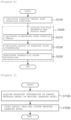
- FIG. 1 is a block diagram of an apparatus for determining thermal stability according to an embodiment of the present invention.
- an apparatus for determining thermal stability may be an apparatus for determining thermal stability by acquiring structural information from particle information on a target material.
- the apparatus for determining thermal stability may be used to select a material for an organic thin film layer of an organic light emitting diode (OLED).
- the apparatus for determining thermal stability may generate a molecular structure from molecular information, which is particle information on an organic material input as a target material, and based on which, acquire structural information to identify whether the organic material is thermally stable.
- the apparatus for determining thermal stability may determine whether to select a material for the organic thin film layer of the organic light emitting diode (OLED) based on thermal stability information on the organic material.
- the apparatus for determining thermal stability may include a memory 100, a processor 200, a transmitting/receiving device 300, an input interface device 400, an output interface device 500, and a storage device 600.
- each of the constituent elements 100, 200, 300, 400, 500, and 600 included in the apparatus for determining thermal stability may be connected by a bus 700 to communicate with each other.
- the memory 100 and storage device 600 among the above configurations 100, 200, 300, 400, 500, and 600 may be configured as at least one of a volatile storage medium or a non-volatile storage medium.
- the memory 100 and storage device 600 may be configured as at least one of a read-only memory (ROM) or a random access memory (RAM).
- the memory 100 may include at least one instruction executed by the processor 200.
- the at least one instruction may include an instruction to acquire particle information constituting a target material, an instruction to acquire a molecular structure using the particle information, an instruction to acquire structural information from the molecular structure, and an instruction to determine thermal stability of the target material using the structural information.
- the instruction to acquire a molecular structure using the particle information may include an instruction to acquire an energy-optimized molecular structure using the particle information.
- the instruction to acquire the molecular structure may include an instruction to acquire an energy-optimized molecular structure using any one of first principles, semi-empirical, or empirical methods, based on the particle information.
- the particle information may include atom information and molecule information on the target material.
- the particle information may include a core moiety forming the target material and at least one functional group that is capable of being substituted to at least one derivative by bonding with the core moiety.
- the structural information may include at least one of radius of gyration (Rg) or asphericity (As) .
- the instruction to acquire structural information from the molecular structure may include an instruction to calculate a gyration tensor from the molecular structure information, and an instruction to calculate at least one of radius of gyration or asphericity from the gyration tensor.
- the gyration tensor may be a matrix that is configured with a mass and position vectors of atoms.
- the instruction to calculate at least one of the radius of gyration or asphericity may include an instruction to diagonalize the gyration tensor to be expressed in terms of eigenvalues L1, L2, and L3, an instruction to calculate the radius of gyration using the eigenvalues of the gyration tensor, and an instruction to calculate the asphericity using the eigenvalues of the gyration tensor.
- the instruction to determine thermal stability of the target material may include an instruction to determine thermal stability of the target material by comparing the structural information to a threshold value.
- the instruction to determine thermal stability of the target material may include an instruction to determine that thermal stability of the target material is high when the radius of gyration and asphericity exceed a first threshold and a second threshold, respectively, and an instruction to determine that thermal stability of the target material is low when the radius of gyration and asphericity are equal to or less than the first threshold and the second threshold, respectively.
- the instruction to determine thermal stability of the target material may include an instruction to determine thermal stability of the target material by inputting the structural information to a pre-trained learning model.
- the pre-trained learning model may be a machine learning model using at least one experimental data according to a thermal stability experiment as training data.
- the instruction to determine thermal stability of the target material may further include an instruction to store result data of the determination of thermal stability in a database.
- the instruction to determine thermal stability of the target material may further include an instruction to retrain the learning model using the at least one result data stored in the database.
- the target material may be applied to an organic thin film layer of an organic light emitting diode (OLED).
- OLED organic light emitting diode
- the processor 200 may mean a central processing unit (CPU), a graphic processing unit (GPU), or an exclusive processor for executing the methods according to the embodiments of the present invention.
- CPU central processing unit
- GPU graphic processing unit
- exclusive processor for executing the methods according to the embodiments of the present invention.
- the processor 200 may execute at least one program instruction stored in the memory 100, as described above.
- the apparatus for determining thermal stability has been described above.
- a method of determining thermal stability performed by an operation of a processor in the apparatus for determining thermal stability will be described.
- FIG. 2 is a flowchart of a method of determining thermal stability performed by a processor operation of the apparatus for determining thermal stability according to an embodiment of the present invention.
- the apparatus for determining thermal stability may acquire particle information of the target material (S1000).
- the target material may be an organic material applied to a multi-layer organic thin film layer of the organic light emitting diode (OLED).
- the target material may be anthracene derivatives.
- FIG. 3 is a molecular structure image for describing particle information on the target material according to an embodiment of the present invention.
- the apparatus for determining thermal stability may acquire particle information constituting the target material from a user.
- the particle information may include atom information or molecule information.
- the particle information may be provided as atom information or molecule information, depending on the target material to be determined for thermal stability.
- the target material is an organic material
- the user may input molecule information of the organic material in the apparatus for determining thermal stability.
- the particle information may include a core moiety C forming the target material and at least one functional group a, a', b, and b' that is capable of being substituted to at least one derivative by bonding with the core moiety.
- a core of the target material may be an anthracene molecule
- the at least one functional group may be at least one of benzene, naphthalene, phenanthrene, dibenzofuran, chrysene, pyrene, fluorene, benzo tetraphene, and benzo(a)pyrene, but is not limited to those disclosed herein.
- a plurality of functional groups may be provided in extended states (a, a', a", ...) (b, b', b", ...) by chemical bonding.
- the plurality of functional groups may be provided by connecting molecules of the same or different structures, regardless of the structure.
- the functional groups participating in the chemical bonding may be either electron-rich groups or electron-deficient groups.
- the functional groups participating in the chemical bonding may be provided as a molecule that serves as an electron donor or an electron acceptor.
- the apparatus for determining thermal stability may acquire a molecular structure using the particle information (S3000).
- the apparatus for determining thermal stability may acquire an energy-optimized molecular structure using at least one particle information.
- the apparatus for determining thermal stability may acquire any one energy-optimized molecular structure based on the particle information, using any one of first principles, semi-empirical, or empirical methods.
- the energy-optimized molecular structure may be defined as a stabilized molecular structure with a minimum energy close to the ground state.
- the apparatus for determining thermal stability may generate at least one derivative that may be generated based on the at least one particle information.
- the apparatus for determining thermal stability may generate at least one derivative by adding at least one functional group to the core moiety.
- the apparatus for determining thermal stability may generate at least one derivative by altering at least one functional group positioned on the core moiety.
- the apparatus for determining thermal stability may generate at least one derivative by removing at least one functional group positioned on the core moiety.
- the apparatus for determining thermal stability may generate at least one derivative by altering a chemical bonding position of at least one functional group positioned on the core moiety.
- the apparatus for determining thermal stability may select a molecular structure of a derivative for which the energy is optimized among the at least one derivative acquired.
- the apparatus for determining thermal stability may acquire structural information from the selected molecular structure (S5000).
- the structural information may include radius of gyration (Rg) and asphericity (As).
- FIG. 4 is a flowchart for describing a step of acquiring structural information in the method of determining thermal stability, according to an embodiment of the present invention.
- the apparatus for determining thermal stability may calculate a gyration tensor from a molecular structure (S5100).
- the gyration tensor may be a physical quantity that mathematically represents the position, orientation, shape, movement, and transformation of a target material in a coordinate space.
- the gyration tensor may be expressed in terms of a mass and position vectors of an each atom of a molecular structure, as shown in [Equation 1] below.
- the apparatus for determining thermal stability may convert the gyration tensor to a matrix form, as shown in [Equation 2] below.
- G G xx G xy G xz G yx G yy G yz G zx G zy G zz G: Gyration tensor in matrix form
- the apparatus for determining thermal stability may calculate structural information including radius of gyration and asphericity from the gyration tensor (S5500).
- the gyration tensor matrix may be diagonalized, as shown in [Equation 3] below.
- G diag L 1 0 0 0 L 2 0 0 0 L 3
- the apparatus for determining thermal stability may calculate eigenvalues L 1 , L 2 , and L 3 of eigenvectors from the gyration tensor matrix (S5510).
- the apparatus for determining thermal stability may calculate radius of gyration using the eigenvalues L 1 , L 2 , and L 3 of the gyration tensor, as shown in [Equation 4] and [Equation 5] (S5530).
- Rg 2 L 1 + L 2 + L 3
- the apparatus for determining thermal stability may determine thermal stability of the target material based on the structural information (S7000).
- the apparatus for determining thermal stability may determine thermal stability of the target material by comparing the structural information with a threshold value.
- the apparatus for determining thermal stability may determine thermal stability of the target material when radius of gyration is equal to or less than a first threshold value and asphericity is equal to or less than a second threshold value.
- the apparatus for determining thermal stability may determine thermal stability of the target material by inputting the structural information into a pre-trained learning model.
- FIG. 5 is a flowchart for describing a method of determining thermal stability using a pre-trained learning model, in the method of determining thermal stability according to an embodiment of the present invention.
- the apparatus for determining thermal stability may determine thermal stability of the target material by inputting structural information to the pre-trained learning model (S7100).
- the apparatus for determining thermal stability may output whether the target material is thermally stable by inputting at least one of radius of gyration or asphericity of the target material to the pre-trained learning model.
- the apparatus for determining thermal stability may output whether the target material is thermally stable by inputting both radius of gyration and asphericity to the pre-trained learning model.
- the pre-trained learning model may be a machine learning model using at least one experimental data according to a thermal stability experiment as training data.
- the apparatus for determining thermal stability may store at least one result data acquired from the pre-trained learning model in a separate database, and update the learning model based on the result data (S7500).
- FIG. 6 is an image of an organic thin film deposition for a thermal stability experiment according to a Comparative Example of the present invention.
- the target material may first be coated on a substrate to be formed into a thin film.
- the target material may be coated on a substrate by a deposition process or a solution process to be formed into a thin film.
- the substrate may include a partition wall C surrounding a partial area A positioned at an upper portion of the substrate. Accordingly, in the thermal stability experiment, the target material may be coated and formed into a thin film only on the partial area A.
- the partition wall C is a configuration that physically separates and distinguishes the partial area A in the substrate and an outer area B excluding the partial area A.
- the target material cannot diffuse and invade between the two areas, but the composition of the target material may be detected in the outer area that is not coated with the target material due to evaporation or scattering by high temperature.
- the thermal stability experiment may be conducted in a manner of gradually increasing a temperature of the thin film coated with the target material in the partial area A, and identifying whether the target material is detected in other areas except the partial area due to evaporation or scattering.
- the thermal stability experiment it is possible to determine whether there is thermal stability based on whether evaporation or scattering occurs in response to temperature.
- the learning model may be a model trained using structural information of the target material and the experimental results as training data.
- the structural information may include at least one of radius of gyration or asphericity of the target material, as described above.
- the apparatus for determining thermal stability according to an embodiment of the present invention was verified using the thermal stability experiment for training the learning model described above.
- At least one target material including a core moiety and functional groups was prepared.
- the at least one target material may be derivatives.
- the temperature of the films was gradually increased to a low temperature of 145°C or less, a medium temperature of 150°C, and a high temperature of 160°C or more, and the outer area of each film was examined for the detection of the corresponding target material.
- radius of gyration and asphericity were calculated for each of the target materials.
- FIG. 7 is a graph of thermal stability experiment results by temperature according to radius of gyration and asphericity of each of a plurality of target materials according to the first Experimental Example of the present invention.
- anthracene derivatives including an anthracene molecule as the core moiety and particle information on benzene, naphthalene, and dibenzofuran as the functional groups were prepared.
- anthracene derivatives More specifically, as a plurality of anthracene derivatives, three derivatives were prepared in which bivalent phenylene group, bivalent naphthalene group, and monovalent dibenzofuranyl group were attached to bivalent anthracene core molecule at different positions.
- radius of gyration and asphericity were calculated for each of the target materials.
- FIG. 8 is an image representing bonding position information of particle information on a target material for verifying thermal stability according to the second Experimental Example of the present invention
- FIG. 9 is an image illustrating thermal stability experiment results of target materials by adjusting bonding positions of functional groups.
- the target materials are provided as first to third derivatives in which the bonding positions of the benzene, naphthalene, and dibenzofuran molecules are linked differently.
- the first derivative is a derivative in which, with respect to the anthracene molecule that is the core moiety, 1 of the anthracene molecule and 3 of the dibenzofuran molecule are bonded, and 2 of the anthracene molecule and 1 of the naphthalene molecule are bonded to para-position of benzene.
- the second derivative is a derivative in which, with respect to the anthracene molecule that is the core moiety, 1 of the anthracene molecule and 2 of the dibenzofuran molecule are bonded, and 2 of the anthracene molecule and 1 of the naphthalene molecule are bonded to para-position of benzene.
- the third derivative is a derivative in which, with respect to the anthracene molecule that is the core moiety, 1 of the anthracene molecule and 3 of the dibenzofuran molecule are bonded, and 2 of the anthracene molecule and 2 of the naphthalene molecule are bonded to para-position of benzene.
- the first and second derivatives are provided with different bonding positions of the anthracene molecule that is the core moiety and the dibenzofuran molecule that is the functional group.
- first derivative and the third derivative are provided with different bonding positions of the benzene linked to the anthracene molecule that is the core moiety and the naphthalene molecule that is the functional group.
- the second derivative and the third derivative are provided with different bonding positions of the dibenzofuran and naphthalene molecules that are functional groups linked to the anthracene molecule that is the core moiety.
- thermal stability can be improved by changing only the bonding positions of the functional groups.
- the apparatus and method for determining thermal stability can determine thermal stability of a target material by acquiring particle information of the target material and measuring radius of gyration and asphericity according to bonding position of at least one molecule, without conducting a separate experiment.
- the apparatus and method for determining thermal stability can also be useful in a technology for designing a molecular structure of a target material having thermal stability because the adjustment of the bonding position and bonding structure of the molecular components of the target material and thereby the thermal stability examination are facilitated.
- the apparatus and method for determining thermal stability can be applied to any one electronic device including an organic light emitting diode (OLED) to examine thermal stability of a target material in an organic thin film layer of the organic light emitting diode, thereby determining a cause in the event of a quality anomaly in the electronic device, or can be used in conjunction with a device to monitor the lifetime of the electronic device.
- OLED organic light emitting diode
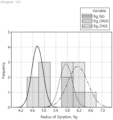
- FIG. 10 is a graph of thermal stability distribution according to radius of gyration of a plurality of organisms according to the second Experimental Example of the present invention
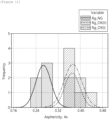
- FIG. 11 is a graph of thermal stability distribution according to asphericity of a plurality of organisms.
- thermal stability distribution according to radius of gyration and thermal stability distribution according to asphericity were measured for the first to third derivatives according to the second Experimental Example of the present invention.
- the apparatus and method for determining thermal stability can provide an apparatus and method for determining thermal stability with improved accuracy by reflecting all information on radius of gyration and asphericity as structural information from particle information of a target material.
- An apparatus and method for determining thermal stability can easily determine thermal stability of a target material without a separate experiment by inputting particle information constituting the target material to acquire a molecular structure, acquiring structural information from the molecular structure, and determining thermal stability of the target material using the structural information, and can provide expected effects of high speed, high accuracy, and low cost by enabling new molecular design and high-speed selection of candidate materials.
- the operation of the method according to the embodiments and Experimental Examples of the present invention may be implemented as a computer-readable program or code on a computer-readable recording medium.
- the computer-readable recording medium includes all kinds of storage devices for storing data readable by a computer system.
- the computer-readable recording medium may be distributed across a computer system that is networked, so that computer-readable program or code may be stored and executed in a distributed manner.
- the computer-readable recording medium may include hardware devices that are specifically configured to store and execute program instructions, such as ROM, RAM, flash memory, and the like.
- the program instructions may include machine language code, such as that created by a compiler, as well as high-level language code that may be executed by a computer using an interpreter, etc.
Landscapes
- Engineering & Computer Science (AREA)
- Theoretical Computer Science (AREA)
- Computing Systems (AREA)
- Bioinformatics & Computational Biology (AREA)
- Bioinformatics & Cheminformatics (AREA)
- Life Sciences & Earth Sciences (AREA)
- Chemical & Material Sciences (AREA)
- Crystallography & Structural Chemistry (AREA)
- Physics & Mathematics (AREA)
- Spectroscopy & Molecular Physics (AREA)
- Health & Medical Sciences (AREA)
- General Health & Medical Sciences (AREA)
- Software Systems (AREA)
- Computer Vision & Pattern Recognition (AREA)
- Data Mining & Analysis (AREA)
- Evolutionary Computation (AREA)
- Artificial Intelligence (AREA)
- Medical Informatics (AREA)
- Databases & Information Systems (AREA)
- Materials Engineering (AREA)
- General Engineering & Computer Science (AREA)
- General Physics & Mathematics (AREA)
- Mathematical Physics (AREA)
- Investigating Or Analyzing Materials Using Thermal Means (AREA)
- Electroluminescent Light Sources (AREA)
Abstract
Description
- This application claims priority to and the benefit of
Korean Patent Application No. 10-2022-0133170 filed in the Korean Intellectual Property Office on October 17, 2022 - The present invention relates to an apparatus and method for determining thermal stability, and more particularly, to an apparatus and method for determining whether a target material is thermally stable from molecular structure information on the target material.
- An organic light emitting diode (OLED) is a device that emits light by electroluminescence phenomenon without a separate light source.
More specifically, an organic light emitting diode (OLED) includes organic compound layers provided in the form of a thin film between an anode electrode and a cathode electrode. In other words, the organic light emitting diode (OLED) is provided such that multi-layer organic thin films are formed between the anode electrode and the cathode electrode. - In general, the multi-layer organic thin film includes a hole injection layer (HIL), a hole transport layer (HTL), an emission layer (EML), an electron transport layer (ETL), and an electron injection layer (EIL).
- Accordingly, in the organic light emitting diode (OLED), when a driving voltage is applied between the anode electrode and the cathode electrode, holes that have passed through the hole transport layer (HTL) and electrons that have passed through the electron transport layer (ETL) are transported to the emission layer (EML) to form excitons, resulting in the emission layer (EML) to emit visible light.
- In this case, when a material with low thermal stability is used in the multi-layer organic thin film, there may be problems such as stress generation due to high-temperature fluidity and material diffusion into adjacent pixel areas, which can cause performance degradation and lifetime reduction of the entire device.
- In this regard, in the related art, to evaluate the thermal stability of a material, a method is used to observe the thermal stability in the process of thermal decomposition using indicators such as glass transition temperature (Tg), decomposition temperature (Td), and molecular weight change.
- However, since the conventional method of determining thermal stability requires actual thin films to be manufactured and evaluated through experiments, there has been a problem of time consuming and high cost.
- An object of the present invention to solve the above problems is directed to providing an apparatus for determining thermal stability with high speed, high accuracy, and low cost.
- Another object of the present invention to solve the above problems is directed to providing a method of determining thermal stability with high speed, high accuracy, and low cost.
- An apparatus for determining thermal stability, according to an embodiment of the present invention to achieve the object described above, the apparatus includes: a memory; and a processor executing at least one instruction in the memory, wherein the at least one instruction comprises: an instruction configured to acquire particle information constituting the target material; an instruction configured to acquire a molecular structure using the particle information; an instruction configured to acquire structural information from the molecular structure; and an instruction configured to determine thermal stability of the target material using the structural information.
- Here, the instruction configured to acquire a molecular structure using the particle information may include an instruction configured to acquire an energy-optimized molecular structure using the particle information.
- Meanwhile, the instruction configured to acquire the energy-optimized molecular structure using the particle information may include an instruction configured to acquire an energy-optimized molecular structure using any one of first principles, semi-empirical, or empirical methods, based on the particle information.
- In addition, the particle information may include atom information and molecule information on the target material.
- For example, the particle information may include a core moiety forming the target material and at least one functional group that is capable of being substituted to at least one derivative by bonding with the core moiety.
- In addition, the structural information may include at least one of radius of gyration (Rg) or asphericity (As).
- Meanwhile, the instruction configured to acquire the structural information from the molecular structure may include: an instruction configured to calculate a gyration tensor from the molecular structure; and an instruction configured to calculate at least one of radius of gyration or asphericity from the gyration tensor.
- In this case, the gyration tensor may be a matrix that is configured with a mass and position vectors of atoms.
- In addition, the instruction configured to calculate at least one of the radius of gyration or asphericity may include: an instruction configured to diagonalize the gyration tensor to be expressed in terms of eigenvalues L1, L2, and L3; an instruction configured to calculate the radius of gyration using the eigenvalues of the gyration tensor; and an instruction configured to calculate the asphericity using the eigenvalues of the gyration tensor.
- Meanwhile, the instruction configured to determine thermal stability of the target material may include an instruction configured to determine thermal stability of the target material by comparing the structural information to a threshold value.
- Here, the instruction configured to determine thermal stability of the target material by the comparing may include: an instruction configured to determine that thermal stability of the target material is high when the radius of gyration and asphericity exceed a first threshold and a second threshold, respectively; and an instruction configured to determine that thermal stability of the target material is low when the radius of gyration and asphericity are equal to or less than the first threshold and the second threshold, respectively.
- In addition, the instruction configured to determine thermal stability of the target material may include an instruction configured to determine thermal stability of the target material by inputting the structural information to a pre-trained learning model.
- In this case, the pre-trained learning model may be a machine learning model using at least one experimental data according to a thermal stability experiment as training data.
- In addition, the instruction configured to determine thermal stability of the target material may further include an instruction configured to store result data of the determination of thermal stability in a database.
- In addition, the instruction configured to determine thermal stability of the target material may further include an instruction configured to retrain the learning model using the at least one result data stored in the database.
- Meanwhile, the target material may be applied to an organic thin film layer of an organic light emitting diode (OLED) .
- A method of determining thermal stability, according to another embodiment of the present invention to achieve another object described above, which is performed in the apparatus for determining thermal stability, the method includes: acquiring particle information constituting a target material; acquiring a molecular structure using the particle information; acquiring structural information from the molecular structure; and determining thermal stability of the target material using the structural information.
- Here, the acquiring of the molecular structure using the particle information may include acquiring an energy-optimized molecular structure using the particle information.
- Meanwhile, the acquiring of the energy-optimized molecular structure using the particle information may include acquiring an energy-optimized molecular structure using any one of first principles, semi-empirical, or empirical methods, based on the particle information.
- In addition, the particle information may include atom information and molecule information on the target material.
- For example, the particle information may include a core moiety forming the target material and at least one functional group that is capable of being substituted to at least one derivative by bonding with the core moiety.
- Meanwhile, the structural information may include at least one of radius of gyration (Rg) or asphericity (As).
- In addition, the acquiring of the structural information from the molecular structure may include: calculating a gyration tensor from the molecular structure; and calculating the structural information including at least one of radius of gyration or asphericity from the gyration tensor.
- In this case, the gyration tensor may be a matrix that is configured with a mass and position vectors of atoms.
- In addition, the calculating of the structural information may include: diagonalizing the gyration tensor to be expressed in terms of eigenvalues L1, L2, and L3; calculating the radius of gyration using the eigenvalues of the gyration tensor; and calculating the asphericity using the eigenvalues of the gyration tensor.
- Meanwhile, the determining of thermal stability of the target material may include determining thermal stability of the target material by comparing the structural information to a threshold value.
- Here, the determining of thermal stability of the target material by the comparing may include: determining that thermal stability of the target material is high when the radius of gyration and asphericity exceed a first threshold and a second threshold, respectively; and determining that thermal stability of the target material is low when the radius of gyration and asphericity are equal to or less than the first threshold and the second threshold, respectively.
- In addition, the determining of thermal stability of the target material may include determining thermal stability of the target material by inputting the structural information to a pre-trained learning model.
- In this case, the pre-trained learning model may be a machine learning model using at least one experimental data according to a thermal stability experiment as training data.
- In addition, the determining of thermal stability of the target material may further include storing result data of the determination of thermal stability in a database.
- In addition, the determining of thermal stability of the target material may further include retraining the learning model using the at least one result data stored in the database.
- Meanwhile, the target material may be applied to an organic thin film layer of an organic light emitting diode (OLED).
- An apparatus and method for determining thermal stability according to embodiments and experimental examples of the present invention, can easily determine thermal stability of a target material without a separate experiment by inputting particle information constituting the target material to acquire a molecular structure, acquiring structural information from the molecular structure, and determining thermal stability of the target material using the structural information, and can provide expected effects of high speed, high accuracy, and low cost by enabling new molecular design and high-speed selection of candidate materials.
-
-
FIG. 1 is a block diagram of an apparatus for determining thermal stability according to an embodiment of the present invention. -
FIG. 2 is a flowchart of a method of determining thermal stability performed by a processor operation of the apparatus for determining thermal stability according to an embodiment of the present invention. -
FIG. 3 is a molecular structure image for describing particle information on a target material according to an embodiment of the present invention. -
FIG. 4 is a flowchart for describing a step of acquiring structural information in the method of determining thermal stability, according to an embodiment of the present invention. -
FIG. 5 is a flowchart for describing a method of determining thermal stability using a pre-trained learning model, in the method of determining thermal stability according to an embodiment of the present invention. -
FIG. 6 is an image of an organic thin film deposition for a thermal stability experiment according to a Comparative Example of the present invention. -
FIG. 7 is a graph of thermal stability experiment results by temperature according to radius of gyration and asphericity of each of a plurality of target materials according to a first Experimental Example of the present invention. -
FIG. 8 is an image representing bonding position information of particle information on a target material for verifying thermal stability according to a second Experimental Example of the present invention. -
FIG. 9 is an image illustrating thermal stability experiment results of target materials by adjusting bonding positions of functional groups according to the second Experimental Example of the present invention. -
FIG. 10 is a graph of thermal stability distribution according to radius of gyration of a plurality of organic materials according to the second Experimental Example of the present invention. -
FIG. 11 is a graph of thermal stability distribution according to asphericity of a plurality of organic materials according to the second Experimental Example of the present invention. -
- 100:
- MEMORY
- 200:
- PROCESSOR
- 300:
- TRANSMITTING/RECEIVING DEVICE
- 400:
- INPUT INTERFACE DEVICE
- 500:
- OUTPUT INTERFACE DEVICE
- 600:
- STORAGE DEVICE
- 700:
- BUS
- The present invention may be variously changed and may have various embodiments, and specific embodiments illustrated in the drawings will be described in the detailed description of the invention in detail. However, the description of the exemplary embodiments is not intended to limit the present invention to the particular exemplary embodiments, but it should be understood that the present invention is to cover all modifications, equivalents and alternatives falling within the spirit and technical scope of the present invention.
In the description of the drawings, similar reference numerals are used for similar constituent elements. - The terms such as "first," "second," "A," "B," and other numerical terms may be used herein only to describe various elements, but these elements should not be limited by these terms. These terms are used only to distinguish one constituent element from another constituent element. For example, a first component may be named a second component, and similarly, the second component may also be named the first component, without departing from the scope of the present invention. The term "and/or" includes any and all combinations of a plurality of the related and listed items.
- When one constituent element is described as being "coupled" or "connected" to another constituent element, it should be understood that one constituent element can be coupled or connected directly to another constituent element, and an intervening constituent element can also be present between the constituent elements. When one constituent element is described as being "coupled directly to" or "connected directly to" another constituent element, it should be understood that no intervening constituent element is present between the constituent elements.
- The terminology used herein is used for the purpose of describing particular embodiments only and is not intended to limit the present invention. Singular expressions include plural expressions unless clearly described as different meanings in the context. The terms "comprises," "comprising," "includes," "including," "containing," "has," "having" or other variations thereof are inclusive and therefore specify the presence of stated features, integers, steps, operations, elements, and/or components, but do not preclude the presence or addition of one or more other features, integers, steps, operations, elements, components, and/or groups thereof.
- Unless otherwise defined, all terms used herein, including technical or scientific terms, have the same meaning as commonly understood by those skilled in the art to which the present invention pertains. The terms such as those defined in a commonly used dictionary should be interpreted as having meanings consistent with meanings in the context of related technologies and should not be interpreted as ideal or excessively formal meanings unless explicitly defined in the present application.
- Hereinafter, exemplary embodiments according to the present invention will be described in detail with reference to the accompanying drawings.
-
FIG. 1 is a block diagram of an apparatus for determining thermal stability according to an embodiment of the present invention. - With reference to
FIG. 1 , an apparatus for determining thermal stability according to an embodiment of the present invention may be an apparatus for determining thermal stability by acquiring structural information from particle information on a target material. - According to an embodiment, the apparatus for determining thermal stability may be used to select a material for an organic thin film layer of an organic light emitting diode (OLED). For example, the apparatus for determining thermal stability may generate a molecular structure from molecular information, which is particle information on an organic material input as a target material, and based on which, acquire structural information to identify whether the organic material is thermally stable. Accordingly, the apparatus for determining thermal stability may determine whether to select a material for the organic thin film layer of the organic light emitting diode (OLED) based on thermal stability information on the organic material.
- Further describing the apparatus for determining thermal stability according to an embodiment of the present invention by hardware configuration, the apparatus for determining thermal stability may include a
memory 100, aprocessor 200, a transmitting/receiving device 300, aninput interface device 400, anoutput interface device 500, and astorage device 600. - According to an embodiment, each of the
constituent elements bus 700 to communicate with each other. - The
memory 100 andstorage device 600 among theabove configurations memory 100 andstorage device 600 may be configured as at least one of a read-only memory (ROM) or a random access memory (RAM). - Among those, the
memory 100 may include at least one instruction executed by theprocessor 200. - According to an embodiment, the at least one instruction may include an instruction to acquire particle information constituting a target material, an instruction to acquire a molecular structure using the particle information, an instruction to acquire structural information from the molecular structure, and an instruction to determine thermal stability of the target material using the structural information.
- Here, the instruction to acquire a molecular structure using the particle information may include an instruction to acquire an energy-optimized molecular structure using the particle information.
- Meanwhile, the instruction to acquire the molecular structure may include an instruction to acquire an energy-optimized molecular structure using any one of first principles, semi-empirical, or empirical methods, based on the particle information.
- In addition, the particle information may include atom information and molecule information on the target material.
- For example, the particle information may include a core moiety forming the target material and at least one functional group that is capable of being substituted to at least one derivative by bonding with the core moiety.
- In addition, the structural information may include at least one of radius of gyration (Rg) or asphericity (As) .
- Meanwhile, the instruction to acquire structural information from the molecular structure may include an instruction to calculate a gyration tensor from the molecular structure information, and an instruction to calculate at least one of radius of gyration or asphericity from the gyration tensor.
- In this case, the gyration tensor may be a matrix that is configured with a mass and position vectors of atoms.
- In addition, the instruction to calculate at least one of the radius of gyration or asphericity may include an instruction to diagonalize the gyration tensor to be expressed in terms of eigenvalues L1, L2, and L3, an instruction to calculate the radius of gyration using the eigenvalues of the gyration tensor, and an instruction to calculate the asphericity using the eigenvalues of the gyration tensor.
- Meanwhile, the instruction to determine thermal stability of the target material may include an instruction to determine thermal stability of the target material by comparing the structural information to a threshold value.
- Here, the instruction to determine thermal stability of the target material may include an instruction to determine that thermal stability of the target material is high when the radius of gyration and asphericity exceed a first threshold and a second threshold, respectively, and an instruction to determine that thermal stability of the target material is low when the radius of gyration and asphericity are equal to or less than the first threshold and the second threshold, respectively.
- In addition, the instruction to determine thermal stability of the target material may include an instruction to determine thermal stability of the target material by inputting the structural information to a pre-trained learning model.
- In this case, the pre-trained learning model may be a machine learning model using at least one experimental data according to a thermal stability experiment as training data.
- In addition, the instruction to determine thermal stability of the target material may further include an instruction to store result data of the determination of thermal stability in a database.
- In addition, the instruction to determine thermal stability of the target material may further include an instruction to retrain the learning model using the at least one result data stored in the database.
- Meanwhile, the target material may be applied to an organic thin film layer of an organic light emitting diode (OLED).
- Meanwhile, the
processor 200 may mean a central processing unit (CPU), a graphic processing unit (GPU), or an exclusive processor for executing the methods according to the embodiments of the present invention. - The
processor 200 may execute at least one program instruction stored in thememory 100, as described above. - The apparatus for determining thermal stability according to an embodiment of the present invention has been described above. Hereinafter, a method of determining thermal stability performed by an operation of a processor in the apparatus for determining thermal stability will be described.
-
FIG. 2 is a flowchart of a method of determining thermal stability performed by a processor operation of the apparatus for determining thermal stability according to an embodiment of the present invention. - With reference to
FIG. 2 , the apparatus for determining thermal stability according to an embodiment of the present invention may acquire particle information of the target material (S1000). For example, the target material may be an organic material applied to a multi-layer organic thin film layer of the organic light emitting diode (OLED). For example, the target material may be anthracene derivatives. -
FIG. 3 is a molecular structure image for describing particle information on the target material according to an embodiment of the present invention. - With reference to
FIG. 3 , the apparatus for determining thermal stability may acquire particle information constituting the target material from a user. - The particle information may include atom information or molecule information. In other words, the particle information may be provided as atom information or molecule information, depending on the target material to be determined for thermal stability. For example, when the target material is an organic material, the user may input molecule information of the organic material in the apparatus for determining thermal stability.
- According to an embodiment, the particle information may include a core moiety C forming the target material and at least one functional group a, a', b, and b' that is capable of being substituted to at least one derivative by bonding with the core moiety. For example, a core of the target material may be an anthracene molecule, and the at least one functional group may be at least one of benzene, naphthalene, phenanthrene, dibenzofuran, chrysene, pyrene, fluorene, benzo tetraphene, and benzo(a)pyrene, but is not limited to those disclosed herein.
- In this case, a plurality of functional groups may be provided in extended states (a, a', a", ...) (b, b', b", ...) by chemical bonding. In this case, the plurality of functional groups may be provided by connecting molecules of the same or different structures, regardless of the structure.
- According to an embodiment, the functional groups participating in the chemical bonding may be either electron-rich groups or electron-deficient groups.
- According to another embodiment, the functional groups participating in the chemical bonding may be provided as a molecule that serves as an electron donor or an electron acceptor.
- With reference back to
FIG. 2 , the apparatus for determining thermal stability may acquire a molecular structure using the particle information (S3000). - More specifically described according to an embodiment, the apparatus for determining thermal stability may acquire an energy-optimized molecular structure using at least one particle information. For example, the apparatus for determining thermal stability may acquire any one energy-optimized molecular structure based on the particle information, using any one of first principles, semi-empirical, or empirical methods. Here, the energy-optimized molecular structure may be defined as a stabilized molecular structure with a minimum energy close to the ground state.
- In other words, the apparatus for determining thermal stability may generate at least one derivative that may be generated based on the at least one particle information. According to an embodiment, the apparatus for determining thermal stability may generate at least one derivative by adding at least one functional group to the core moiety.
- According to another embodiment, the apparatus for determining thermal stability may generate at least one derivative by altering at least one functional group positioned on the core moiety.
- According to still another embodiment, the apparatus for determining thermal stability may generate at least one derivative by removing at least one functional group positioned on the core moiety.
- According to still another embodiment, the apparatus for determining thermal stability may generate at least one derivative by altering a chemical bonding position of at least one functional group positioned on the core moiety.
- Thereafter, the apparatus for determining thermal stability may select a molecular structure of a derivative for which the energy is optimized among the at least one derivative acquired.
- Then, the apparatus for determining thermal stability may acquire structural information from the selected molecular structure (S5000).
- According to an embodiment, the structural information may include radius of gyration (Rg) and asphericity (As).
-
FIG. 4 is a flowchart for describing a step of acquiring structural information in the method of determining thermal stability, according to an embodiment of the present invention. - With reference to
FIG. 4 , the apparatus for determining thermal stability may calculate a gyration tensor from a molecular structure (S5100). - Here, the gyration tensor may be a physical quantity that mathematically represents the position, orientation, shape, movement, and transformation of a target material in a coordinate space.
- According to an embodiment, the gyration tensor may be expressed in terms of a mass and position vectors of an each atom of a molecular structure, as shown in [Equation 1] below.

- G: Gyration tensor
- gij: Mass of atom
- ai, aj: Position vector
- Then, the apparatus for determining thermal stability may convert the gyration tensor to a matrix form, as shown in [Equation 2] below.

- Then, the apparatus for determining thermal stability may calculate structural information including radius of gyration and asphericity from the gyration tensor (S5500).
- More specifically, the gyration tensor matrix may be diagonalized, as shown in [Equation 3] below.

- Gdiag : Diagonalized gyration tensor
- L1, L2, L3: Eigenvalues of gyration tensor
- Accordingly, the apparatus for determining thermal stability may calculate eigenvalues L1, L2, and L3 of eigenvectors from the gyration tensor matrix (S5510).
- Then, the apparatus for determining thermal stability may calculate radius of gyration using the eigenvalues L1, L2, and L3 of the gyration tensor, as shown in [Equation 4] and [Equation 5] (S5530).

- Rg: Radius of gyration
- L1, L2, L3: Eigenvalues of
gyration tensor 
- L1, L2, L3: Eigenvalues of gyration tensor
- In addition, the apparatus for determining thermal stability may calculate asphericity (As) using the eigenvalues L1, L2, and L3 of the gyration tensor, as shown in [Equation 6] below (S5550).

- With reference back to
FIG. 2 , the apparatus for determining thermal stability may determine thermal stability of the target material based on the structural information (S7000). - According to an embodiment, the apparatus for determining thermal stability may determine thermal stability of the target material by comparing the structural information with a threshold value.
- More specifically, the apparatus for determining thermal stability may determine thermal stability of the target material when radius of gyration is equal to or less than a first threshold value and asphericity is equal to or less than a second threshold value.
- According to another embodiment, the apparatus for determining thermal stability may determine thermal stability of the target material by inputting the structural information into a pre-trained learning model.
-
FIG. 5 is a flowchart for describing a method of determining thermal stability using a pre-trained learning model, in the method of determining thermal stability according to an embodiment of the present invention. - With reference to
FIG. 5 , as described above, the apparatus for determining thermal stability may determine thermal stability of the target material by inputting structural information to the pre-trained learning model (S7100). - More specifically, the apparatus for determining thermal stability may output whether the target material is thermally stable by inputting at least one of radius of gyration or asphericity of the target material to the pre-trained learning model. For example, the apparatus for determining thermal stability may output whether the target material is thermally stable by inputting both radius of gyration and asphericity to the pre-trained learning model.
- Here, the pre-trained learning model may be a machine learning model using at least one experimental data according to a thermal stability experiment as training data.
- Then, the apparatus for determining thermal stability may store at least one result data acquired from the pre-trained learning model in a separate database, and update the learning model based on the result data (S7500).
-
FIG. 6 is an image of an organic thin film deposition for a thermal stability experiment according to a Comparative Example of the present invention. - With reference to
FIG. 6 , in the thermal stability experiment, the target material may first be coated on a substrate to be formed into a thin film. For example, the target material may be coated on a substrate by a deposition process or a solution process to be formed into a thin film. - Here, the substrate may include a partition wall C surrounding a partial area A positioned at an upper portion of the substrate. Accordingly, in the thermal stability experiment, the target material may be coated and formed into a thin film only on the partial area A.
- Here, the partition wall C is a configuration that physically separates and distinguishes the partial area A in the substrate and an outer area B excluding the partial area A. The target material cannot diffuse and invade between the two areas, but the composition of the target material may be detected in the outer area that is not coated with the target material due to evaporation or scattering by high temperature.
- Accordingly, the thermal stability experiment may be conducted in a manner of gradually increasing a temperature of the thin film coated with the target material in the partial area A, and identifying whether the target material is detected in other areas except the partial area due to evaporation or scattering. In other words, with the thermal stability experiment, it is possible to determine whether there is thermal stability based on whether evaporation or scattering occurs in response to temperature.
- Accordingly, based on at least one target material having been determined whether there is thermal stability by results of the thermal stability experiment, the learning model may be a model trained using structural information of the target material and the experimental results as training data. Here, the structural information may include at least one of radius of gyration or asphericity of the target material, as described above.
- The apparatus and method for determining thermal stability according to an embodiment of the present invention have been described above.
- Hereinafter, verification experiments of the apparatus for determining thermal stability according to Experimental Examples of the present invention will be described.
- The apparatus for determining thermal stability according to an embodiment of the present invention was verified using the thermal stability experiment for training the learning model described above.
- More specifically, for verification of the apparatus for determining thermal stability, at least one target material including a core moiety and functional groups was prepared. In this case, the at least one target material may be derivatives.
- Then, a plurality of thin films with each of the target materials coated were prepared, as shown in the thermal stability experiment according to
FIG. 6 . - Then, the temperature of the films was gradually increased to a low temperature of 145°C or less, a medium temperature of 150°C, and a high temperature of 160°C or more, and the outer area of each film was examined for the detection of the corresponding target material.
- Then, radius of gyration and asphericity were calculated for each of the target materials.
-
FIG. 7 is a graph of thermal stability experiment results by temperature according to radius of gyration and asphericity of each of a plurality of target materials according to the first Experimental Example of the present invention. - With reference to
FIGS. 6 and7 , from the experimental results, it can be seen that when the temperature of the thin film is 150°C or more, the target materials detected in the outer area B on each substrate are concentrated in thefirst area ① in the graph ofFIG. 7 , where the horizontal axis represents information on radius of gyration and the vertical axis represents information on asphericity. - In addition, it can be seen that when the temperature of the thin film is 145°C or less, the target materials detected in the outer area B on each substrate are concentrated in the
second area ② in the graph ofFIG. 7 . - Therefore, it can be seen that it is possible to determine thermal stability from the information on radius of gyration and asphericity of the target material.
- According to an embodiment, it can be seen that when radius of gyration of the target material exceeds the first threshold value and asphericity exceeds the second threshold value, as shown in the
first area ① in the graph ofFIG. 7 , thermal stability is high. - According to another embodiment, it can be seen that when radius of gyration of the target material is equal to or less than the first threshold value and asphericity is equal to or less than the second threshold value, as shown in the
second area ② in the graph ofFIG. 7 , thermal stability is low. - For the thermal stability experiment, a plurality of anthracene derivatives including an anthracene molecule as the core moiety and particle information on benzene, naphthalene, and dibenzofuran as the functional groups were prepared.
- More specifically, as a plurality of anthracene derivatives, three derivatives were prepared in which bivalent phenylene group, bivalent naphthalene group, and monovalent dibenzofuranyl group were attached to bivalent anthracene core molecule at different positions.
- Then, as in the first verification experiment, individual thin films with the above derivatives being the target material were prepared, and while the temperature of the thin films was gradually increased to a low temperature of 145°C or less, a medium temperature of 150°C, and a high temperature of 160°C or more, the outer area in each thin film was examined for the detection of the corresponding target material.
- Then, radius of gyration and asphericity were calculated for each of the target materials.
-
FIG. 8 is an image representing bonding position information of particle information on a target material for verifying thermal stability according to the second Experimental Example of the present invention, andFIG. 9 is an image illustrating thermal stability experiment results of target materials by adjusting bonding positions of functional groups. - With reference to
FIGS. 8 and9 , the target materials are provided as first to third derivatives in which the bonding positions of the benzene, naphthalene, and dibenzofuran molecules are linked differently. - Here, the first derivative is a derivative in which, with respect to the anthracene molecule that is the core moiety, 1 of the anthracene molecule and 3 of the dibenzofuran molecule are bonded, and 2 of the anthracene molecule and 1 of the naphthalene molecule are bonded to para-position of benzene.
- In addition, the second derivative is a derivative in which, with respect to the anthracene molecule that is the core moiety, 1 of the anthracene molecule and 2 of the dibenzofuran molecule are bonded, and 2 of the anthracene molecule and 1 of the naphthalene molecule are bonded to para-position of benzene.
- Further, the third derivative is a derivative in which, with respect to the anthracene molecule that is the core moiety, 1 of the anthracene molecule and 3 of the dibenzofuran molecule are bonded, and 2 of the anthracene molecule and 2 of the naphthalene molecule are bonded to para-position of benzene.
- In other words, the first and second derivatives are provided with different bonding positions of the anthracene molecule that is the core moiety and the dibenzofuran molecule that is the functional group.
- In addition, the first derivative and the third derivative are provided with different bonding positions of the benzene linked to the anthracene molecule that is the core moiety and the naphthalene molecule that is the functional group.
- Further, the second derivative and the third derivative are provided with different bonding positions of the dibenzofuran and naphthalene molecules that are functional groups linked to the anthracene molecule that is the core moiety.
- In addition, through the thermal stability experiment, it was confirmed that the first derivative was evaporated or scattered at a temperature of 145°C or less, and thus was found to have low thermal stability (NG).
- Meanwhile, it was confirmed that the second derivative and the third derivative were evaporated or scattered at temperatures of 165°C and 150°C or more, respectively, and thus were found to have high thermal stability (OK).
- In other words, through the second experiment of the present invention, it can be seen that thermal stability can be improved by changing only the bonding positions of the functional groups.
- Therefore, the apparatus and method for determining thermal stability according to embodiments of the present invention can determine thermal stability of a target material by acquiring particle information of the target material and measuring radius of gyration and asphericity according to bonding position of at least one molecule, without conducting a separate experiment.
- Accordingly, the apparatus and method for determining thermal stability can also be useful in a technology for designing a molecular structure of a target material having thermal stability because the adjustment of the bonding position and bonding structure of the molecular components of the target material and thereby the thermal stability examination are facilitated.
- In addition, the apparatus and method for determining thermal stability, for example, can be applied to any one electronic device including an organic light emitting diode (OLED) to examine thermal stability of a target material in an organic thin film layer of the organic light emitting diode, thereby determining a cause in the event of a quality anomaly in the electronic device, or can be used in conjunction with a device to monitor the lifetime of the electronic device.
-
FIG. 10 is a graph of thermal stability distribution according to radius of gyration of a plurality of organisms according to the second Experimental Example of the present invention, andFIG. 11 is a graph of thermal stability distribution according to asphericity of a plurality of organisms. - With reference to
FIGS. 10 and11 , thermal stability distribution according to radius of gyration and thermal stability distribution according to asphericity were measured for the first to third derivatives according to the second Experimental Example of the present invention. - As a result of interpreting the results of the second experiment of the first to third derivatives as thermal stability distribution with respect to radius of gyration, it can be seen that the lower thermal stability of the first to third derivatives is clearly distinguished, but it is difficult to distinguish the thermal stability at a high temperature.
- In addition, as a result of interpreting the results of the second experiment of the first and third derivatives as thermal stability distribution with respect to asphericity, it can be seen that it is difficult to clearly distinguish thermal stability of the first and third derivatives in a high temperature area.
- In other words, the apparatus and method for determining thermal stability according to an embodiment of the present invention can provide an apparatus and method for determining thermal stability with improved accuracy by reflecting all information on radius of gyration and asphericity as structural information from particle information of a target material.
- The apparatus and method for determining thermal stability according to the embodiments and the Experimental Examples of the present invention have been described above.
- An apparatus and method for determining thermal stability according to embodiments and Experimental Examples of the present invention, can easily determine thermal stability of a target material without a separate experiment by inputting particle information constituting the target material to acquire a molecular structure, acquiring structural information from the molecular structure, and determining thermal stability of the target material using the structural information, and can provide expected effects of high speed, high accuracy, and low cost by enabling new molecular design and high-speed selection of candidate materials.
- The operation of the method according to the embodiments and Experimental Examples of the present invention may be implemented as a computer-readable program or code on a computer-readable recording medium. The computer-readable recording medium includes all kinds of storage devices for storing data readable by a computer system. In addition, the computer-readable recording medium may be distributed across a computer system that is networked, so that computer-readable program or code may be stored and executed in a distributed manner.
- In addition, the computer-readable recording medium may include hardware devices that are specifically configured to store and execute program instructions, such as ROM, RAM, flash memory, and the like. The program instructions may include machine language code, such as that created by a compiler, as well as high-level language code that may be executed by a computer using an interpreter, etc.
- Some aspects of the present invention have been described in the context of an apparatus, but it may also be described according to a corresponding method, wherein the block or apparatus corresponds to a step of the method or a feature of the step of the method. Similarly, the aspects described in the context of the method may also be represented as features of corresponding blocks or items or corresponding devices. Some or all of the steps of the method may be performed by (or using) hardware devices such as, for example, microprocessors, programmable computers, or electronic circuits. In some embodiments, one or more of the most important steps of the method may be performed by such a device.
- While the present invention has been described above with reference to the exemplary embodiments, it may be understood by those skilled in the art that the present invention may be variously modified and changed without departing from the spirit and scope of the present invention disclosed in the claims.
Claims (32)
- An apparatus for determining thermal stability of a target material, the apparatus comprising:a memory; anda processor executing at least one instruction in the memory,wherein the at least one instruction comprises:an instruction configured to acquire particle information constituting the target material;an instruction configured to acquire a molecular structure using the particle information;an instruction configured to acquire structural information from the molecular structure; andan instruction configured to determine thermal stability of the target material using the structural information.
- The apparatus of claim 1, wherein the instruction configured to acquire a molecular structure using the particle information comprises an instruction configured to acquire an energy-optimized molecular structure using the particle information.
- The apparatus of claim 2, wherein the instruction configured to acquire the energy-optimized molecular structure using the particle information comprises an instruction configured to acquire an energy-optimized molecular structure using any one of first principles, semi-empirical, or empirical methods, based on the particle information.
- The apparatus of claim 1, wherein the particle information comprises atom information and molecule information on the target material.
- The apparatus of claim 1, wherein the particle information comprises a core moiety forming the target material and at least one functional group that is capable of being substituted to at least one derivative by bonding with the core moiety.
- The apparatus of claim 1, wherein the structural information comprises at least one of radius of gyration (Rg) or asphericity (As).
- The apparatus of claim 1, wherein the instruction configured to acquire the structural information from the molecular structure comprises:an instruction configured to calculate a gyration tensor from the molecular structure; andan instruction configured to calculate the structural information including at least one of radius of gyration or asphericity from the gyration tensor.
- The apparatus of claim 7, wherein the gyration tensor is a matrix configured with a mass and position vectors of atoms.
- The apparatus of claim 8, wherein the instruction configured to calculate the structural information comprises:an instruction configured to diagonalize the gyration tensor to be expressed in terms of eigenvalues L1, L2, and L3;an instruction configured to calculate the radius of gyration using the eigenvalues of the gyration tensor; andan instruction configured to calculate the asphericity using the eigenvalues of the gyration tensor.
- The apparatus of claim 1, wherein the instruction configured to determine thermal stability of the target material comprises an instruction configured to determine thermal stability of the target material by comparing the structural information to a threshold value.
- The apparatus of claim 10, wherein the instruction configured to determine thermal stability of the target material by the comparing comprises:an instruction configured to determine that thermal stability of the target material is high when radius of gyration included in the structural information exceeds a first threshold and asphericity included in the structural information exceeds a second threshold; andan instruction configured to determine that thermal stability of the target material is low when the radius of gyration is equal to or less than the first threshold and the asphericity is equal to or less than the second threshold.
- The apparatus of claim 1, wherein the instruction configured to determine thermal stability of the target material comprises an instruction configured to determine thermal stability of the target material by inputting the structural information to a pre-trained learning model.
- The apparatus of claim 12, wherein the pre-trained learning model is a machine learning model using at least one experimental data according to a thermal stability experiment as training data.
- The apparatus of claim 12, wherein the instruction configured to determine thermal stability of the target material further comprises an instruction configured to store result data of the determination of thermal stability in a database.
- The apparatus of claim 14, wherein the instruction configured to determine thermal stability of the target material further comprises an instruction configured to retrain the learning model using at least one result data stored in the database.
- The apparatus of claim 1, wherein the target material is applied to an organic thin film layer of an organic light emitting diode OLED.
- A method of determining thermal stability for a target material, the method comprising:acquiring particle information constituting the target material;acquiring a molecular structure using the particle information;acquiring structural information from the molecular structure; anddetermining thermal stability of the target material using the structural information.
- The method of claim 17, wherein the acquiring of the molecular structure using the particle information comprises acquiring an energy-optimized molecular structure using the particle information.
- The method of claim 18, wherein the acquiring of the energy-optimized molecular structure using the particle information comprises acquiring an energy-optimized molecular structure using any one of first principles, semi-empirical, or empirical methods, based on the particle information.
- The method of claim 17, wherein the particle information comprises atom information and molecule information on the target material.
- The method of claim 17, wherein the particle information comprises a core moiety forming the target material and at least one functional group that is capable of being substituted to at least one derivative by bonding with the core moiety.
- The method of claim 17, wherein the structural information comprises at least one of radius of gyration (Rg) or asphericity (As).
- The method of claim 17, wherein the acquiring of the structural information from the molecular structure comprises:calculating a gyration tensor from the molecular structure; andcalculating the structural information including at least one of radius of gyration or asphericity from the gyration tensor.
- The method of claim 23, wherein the gyration tensor is a matrix configured with a mass and position vectors of atoms.
- The method of claim 24, wherein the calculating of the structural information comprises:diagonalizing the gyration tensor to be expressed in terms of eigenvalues L1, L2, and L3;calculating the radius of gyration using the eigenvalues of the gyration tensor; andcalculating the asphericity using the eigenvalues of the gyration tensor.
- The method of claim 17, wherein the determining of thermal stability of the target material comprises determining thermal stability of the target material by comparing the structural information to a threshold value.
- The method of claim 26, wherein the determining of thermal stability of the target material by the comparing comprises:determining that thermal stability of the target material is high when radius of gyration included in the structural information exceeds a first threshold and asphericity included in the structural information exceeds a second threshold; anddetermining that thermal stability of the target material is low when the radius of gyration is equal to or less than the first threshold and the asphericity is equal to or less than the second threshold.
- The method of claim 17, wherein the determining of thermal stability of the target material comprises determining thermal stability of the target material by inputting the structural information to a pre-trained learning model.
- The method of claim 28, wherein the pre-trained learning model is a machine learning model using at least one experimental data according to a thermal stability experiment as training data.
- The method of claim 28, wherein the determining of thermal stability of the target material further comprises storing result data of the determination of thermal stability in a database.
- The method of claim 30, wherein the determining of thermal stability of the target material further comprises retraining the learning model using at least one result data stored in the database.
- The method of claim 17, wherein the target material is applied to an organic thin film layer of an organic light emitting diode OLED.
Applications Claiming Priority (2)
| Application Number | Priority Date | Filing Date | Title |
|---|---|---|---|
| KR1020220133170A KR20240053272A (en) | 2022-10-17 | 2022-10-17 | Apparatus and method for measuring thermal stability |
| PCT/KR2023/010805 WO2024085373A1 (en) | 2022-10-17 | 2023-07-26 | Thermal stability determining apparatus and method |
Publications (2)
| Publication Number | Publication Date |
|---|---|
| EP4439568A1 true EP4439568A1 (en) | 2024-10-02 |
| EP4439568A4 EP4439568A4 (en) | 2025-06-11 |
Family
ID=90737685
Family Applications (1)
| Application Number | Title | Priority Date | Filing Date |
|---|---|---|---|
| EP23879956.3A Pending EP4439568A4 (en) | 2022-10-17 | 2023-07-26 | Thermal stability determining apparatus and method |
Country Status (6)
| Country | Link |
|---|---|
| US (1) | US20250061976A1 (en) |
| EP (1) | EP4439568A4 (en) |
| JP (1) | JP7742940B2 (en) |
| KR (1) | KR20240053272A (en) |
| CN (1) | CN118475984A (en) |
| WO (1) | WO2024085373A1 (en) |
Family Cites Families (8)
| Publication number | Priority date | Publication date | Assignee | Title |
|---|---|---|---|---|
| JP3743717B2 (en) * | 2002-06-25 | 2006-02-08 | 株式会社日立製作所 | Mass spectrometry data analysis method, mass spectrometry data analysis apparatus, mass spectrometry data analysis program, and solution providing system |
| KR20130050900A (en) | 2011-11-08 | 2013-05-16 | 한국전자통신연구원 | Method for intra prediction and apparatus thereof |
| KR20190129522A (en) * | 2018-05-11 | 2019-11-20 | 한국과학기술연구원 | Method for designing catalyst based on deep-learning and the system thereof |
| JP2020095310A (en) * | 2018-12-10 | 2020-06-18 | 国立研究開発法人物質・材料研究機構 | Method for searching and manufacturing polymer |
| CN111785332B (en) * | 2019-04-04 | 2024-06-11 | 应急管理部化学品登记中心 | Prediction Method of Thermal Stability of Chemical Substances Based on Genetic Algorithm |
| CN116157680B (en) * | 2020-09-30 | 2025-08-26 | 富士胶片株式会社 | Characteristic quantity calculation method, screening method and compound creation method |
| KR20220055059A (en) | 2020-10-26 | 2022-05-03 | 주식회사 에스제이컴퍼니 | OLED Testing Device |
| KR102284532B1 (en) * | 2021-01-11 | 2021-08-03 | 주식회사 스탠다임 | Method for predicting molecular activity and apparatus therefor |
-
2022
- 2022-10-17 KR KR1020220133170A patent/KR20240053272A/en active Pending
-
2023
- 2023-07-26 US US18/724,402 patent/US20250061976A1/en active Pending
- 2023-07-26 JP JP2024532924A patent/JP7742940B2/en active Active
- 2023-07-26 CN CN202380015847.4A patent/CN118475984A/en active Pending
- 2023-07-26 WO PCT/KR2023/010805 patent/WO2024085373A1/en not_active Ceased
- 2023-07-26 EP EP23879956.3A patent/EP4439568A4/en active Pending
Also Published As
| Publication number | Publication date |
|---|---|
| US20250061976A1 (en) | 2025-02-20 |
| EP4439568A4 (en) | 2025-06-11 |
| WO2024085373A1 (en) | 2024-04-25 |
| CN118475984A (en) | 2024-08-09 |
| KR20240053272A (en) | 2024-04-24 |
| JP2025500027A (en) | 2025-01-07 |
| JP7742940B2 (en) | 2025-09-22 |
Similar Documents
| Publication | Publication Date | Title |
|---|---|---|
| US12190236B2 (en) | Predicting properties of materials from physical material structures | |
| US10957419B2 (en) | Method and apparatus for new material discovery using machine learning on targeted physical property | |
| Ueno et al. | COMBO: An efficient Bayesian optimization library for materials science | |
| US20200104688A1 (en) | Methods and systems for neural architecture search | |
| Liu et al. | Generative adversarial construction of parallel portfolios | |
| WO2019048965A1 (en) | Physical property prediction method and physical property prediction system | |
| EP4145328A1 (en) | System that estimates characteristic value of material | |
| Deng et al. | Reduced kernel extreme learning machine | |
| CN108229522A (en) | Training method, attribute detection method, device and the electronic equipment of neural network | |
| US20200043575A1 (en) | Electronic system with a data engine for processing retrieved data in displaying graphical data for a graphical user interface on an external input/output device | |
| Sifain et al. | Predicting phosphorescence energies and inferring wavefunction localization with machine learning | |
| CN113487019A (en) | Circuit fault diagnosis method and device, computer equipment and storage medium | |
| Hughes et al. | A FFLUX water model: Flexible, polarizable and with a multipolar description of electrostatics | |
| Shapeev et al. | Active learning and uncertainty estimation | |
| US20250061976A1 (en) | Thermal Stability Determining Apparatus and Method | |
| Tashiro et al. | De novo generation of optically active small organic molecules using Monte Carlo tree search combined with recurrent neural network | |
| Saravanan et al. | Graph neural networks for idling error mitigation | |
| US12314711B2 (en) | Deriving a custom version of a software package from super positioned qubits | |
| US20250131183A1 (en) | Configuration files to group actions in a single-click environment | |
| Valencia-Marquez et al. | Improving molecular design through a machine learning approach | |
| Bouzidi et al. | Xg-vit: Explainable and generalizable vision transformer for benchmark image classification | |
| Korotkova et al. | Decision algorithm with uncertainties in a multi-purpose flight safety system | |
| Rony et al. | Lemon: Language model for negative sampling of knowledge graph embeddings | |
| Oberoi et al. | Research on Efficient Software Defect Prediction Using Deep Learning Approaches | |
| Ma et al. | Machine learning‐based screening of pesticide adjuvants for reduction of pesticide losses on wheat leaf surfaces |
Legal Events
| Date | Code | Title | Description |
|---|---|---|---|
| STAA | Information on the status of an ep patent application or granted ep patent |
Free format text: STATUS: THE INTERNATIONAL PUBLICATION HAS BEEN MADE |
|
| PUAI | Public reference made under article 153(3) epc to a published international application that has entered the european phase |
Free format text: ORIGINAL CODE: 0009012 |
|
| STAA | Information on the status of an ep patent application or granted ep patent |
Free format text: STATUS: REQUEST FOR EXAMINATION WAS MADE |
|
| 17P | Request for examination filed |
Effective date: 20240625 |
|
| AK | Designated contracting states |
Kind code of ref document: A1 Designated state(s): AL AT BE BG CH CY CZ DE DK EE ES FI FR GB GR HR HU IE IS IT LI LT LU LV MC ME MK MT NL NO PL PT RO RS SE SI SK SM TR |
|
| A4 | Supplementary search report drawn up and despatched |
Effective date: 20250514 |
|
| RIC1 | Information provided on ipc code assigned before grant |
Ipc: H10K 85/00 20230101ALI20250508BHEP Ipc: G16C 20/70 20190101ALI20250508BHEP Ipc: G16C 20/20 20190101AFI20250508BHEP |
|
| DAV | Request for validation of the european patent (deleted) | ||
| DAX | Request for extension of the european patent (deleted) |