EP4439464A1 - Information processing apparatus, orientation estimation method, program, and storage medium - Google Patents
Information processing apparatus, orientation estimation method, program, and storage medium Download PDFInfo
- Publication number
- EP4439464A1 EP4439464A1 EP24164960.7A EP24164960A EP4439464A1 EP 4439464 A1 EP4439464 A1 EP 4439464A1 EP 24164960 A EP24164960 A EP 24164960A EP 4439464 A1 EP4439464 A1 EP 4439464A1
- Authority
- EP
- European Patent Office
- Prior art keywords
- human body
- information
- orientation
- entire human
- processing apparatus
- Prior art date
- Legal status (The legal status is an assumption and is not a legal conclusion. Google has not performed a legal analysis and makes no representation as to the accuracy of the status listed.)
- Pending
Links
Images


Classifications
-
- G—PHYSICS
- G06—COMPUTING OR CALCULATING; COUNTING
- G06T—IMAGE DATA PROCESSING OR GENERATION, IN GENERAL
- G06T7/00—Image analysis
- G06T7/70—Determining position or orientation of objects or cameras
- G06T7/73—Determining position or orientation of objects or cameras using feature-based methods
- G06T7/75—Determining position or orientation of objects or cameras using feature-based methods involving models
-
- G—PHYSICS
- G06—COMPUTING OR CALCULATING; COUNTING
- G06T—IMAGE DATA PROCESSING OR GENERATION, IN GENERAL
- G06T7/00—Image analysis
- G06T7/70—Determining position or orientation of objects or cameras
- G06T7/73—Determining position or orientation of objects or cameras using feature-based methods
-
- G—PHYSICS
- G06—COMPUTING OR CALCULATING; COUNTING
- G06T—IMAGE DATA PROCESSING OR GENERATION, IN GENERAL
- G06T7/00—Image analysis
- G06T7/10—Segmentation; Edge detection
- G06T7/194—Segmentation; Edge detection involving foreground-background segmentation
-
- G—PHYSICS
- G06—COMPUTING OR CALCULATING; COUNTING
- G06T—IMAGE DATA PROCESSING OR GENERATION, IN GENERAL
- G06T7/00—Image analysis
- G06T7/50—Depth or shape recovery
-
- G—PHYSICS
- G06—COMPUTING OR CALCULATING; COUNTING
- G06V—IMAGE OR VIDEO RECOGNITION OR UNDERSTANDING
- G06V10/00—Arrangements for image or video recognition or understanding
- G06V10/40—Extraction of image or video features
- G06V10/44—Local feature extraction by analysis of parts of the pattern, e.g. by detecting edges, contours, loops, corners, strokes or intersections; Connectivity analysis, e.g. of connected components
-
- G—PHYSICS
- G06—COMPUTING OR CALCULATING; COUNTING
- G06T—IMAGE DATA PROCESSING OR GENERATION, IN GENERAL
- G06T2207/00—Indexing scheme for image analysis or image enhancement
- G06T2207/20—Special algorithmic details
- G06T2207/20036—Morphological image processing
- G06T2207/20044—Skeletonization; Medial axis transform
-
- G—PHYSICS
- G06—COMPUTING OR CALCULATING; COUNTING
- G06T—IMAGE DATA PROCESSING OR GENERATION, IN GENERAL
- G06T2207/00—Indexing scheme for image analysis or image enhancement
- G06T2207/20—Special algorithmic details
- G06T2207/20084—Artificial neural networks [ANN]
-
- G—PHYSICS
- G06—COMPUTING OR CALCULATING; COUNTING
- G06T—IMAGE DATA PROCESSING OR GENERATION, IN GENERAL
- G06T2207/00—Indexing scheme for image analysis or image enhancement
- G06T2207/30—Subject of image; Context of image processing
- G06T2207/30196—Human being; Person
-
- G—PHYSICS
- G06—COMPUTING OR CALCULATING; COUNTING
- G06V—IMAGE OR VIDEO RECOGNITION OR UNDERSTANDING
- G06V2201/00—Indexing scheme relating to image or video recognition or understanding
- G06V2201/07—Target detection
Definitions
- the present invention relates to an information processing apparatus, an orientation estimation method, a program, and a storage medium.
- a technique for estimating the orientation of the entire body of a person based on a video image of a monitoring camera has recently been applied to the maintenance of customer security in stores and the monitoring activities in cities.
- WO 2015/186436 discusses a technique for detecting an object, such as a chair, around a person and distinguishing between an "orientation of doing squats" and an “orientation of sitting down on a chair” based on the joints of the target person and the distance to the object.
- an information processing apparatus according to claims 1 to 9.
- a program according to claim 14 there is provided a computer-readable storage medium according to claim 15.
- FIG. 1 is a block diagram illustrating a hardware configuration of an information processing apparatus according to the present embodiment.
- a central processing unit (CPU) 101 executes instructions according to programs stored in a read only memory (ROM) 102 and/or a random access memory (RAM) 103.
- the ROM 102 is a nonvolatile memory for storing programs according to the present invention and other programs and data to be used for control.
- the RAM 103 is a volatile memory for storing frame image data and temporary data such as a pattern determination result.
- An auxiliary storage device 104 is a rewritable auxiliary storage device, such as a hard disk drive and a flash memory, for storing image information, programs, and various settings. These pieces of information are transmitted to the RAM 103 and used to execute a program or used as data by the CPU 101.
- An imaging apparatus 105 includes an imaging lens, an image sensor such as a charge coupled device (CCD) sensor and a complementary metal oxide semiconductor (CMOS) sensor, and a video image signal processing unit.
- the imaging apparatus 105 captures video images.
- An input apparatus 106 which is, for example, a keyboard and/or a mouse, allows input of an instruction from the user.
- a display apparatus 107 which is, for example, a cathode ray tube (CRT) or a liquid crystal display (LCD) displays results of processing to the user.
- a network interface (I/F) 108 which is, for example, a modem or a local area network (LAN) that connects with a network, such as the Internet and an intranet.
- a bus 109 connects the above-described units to enable data input and output with each other.
- the CPU 101 reads software for implementing processing in each step of a flowchart (described below) from the auxiliary storage device 104 and the RAM 103, and then executes the software.
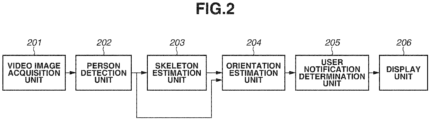
- FIG. 2 illustrates a functional configuration of the information processing apparatus according to the present embodiment.
- a video image acquisition unit 201 includes the imaging apparatus 105 and captures video images (still images).
- a person detection unit 202 detects the region of a person (human body) from a video image acquired by the video image acquisition unit 201. According to the present embodiment, the person detection unit 202 detects the region of an entire human body.
- a skeleton estimation unit 203 estimates the skeleton of the entire human body from the entire body region detected by the person detection unit 202, and generates joint points of the entire body as skeleton information for the entire human body.
- joint point represents a connecting position between human body parts.
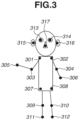
- joint points include the shoulders 301 and 302, elbows 303 and 304, wrists 305 and 306, waists 307 and 308, knees 309 and 310, and ankles 311 and 312 as illustrated in Fig. 3 .
- Facial organs including the eyes 313 and 314, a nose 317, and ears 315 and 316 are also handled as joint points.
- An orientation estimation unit 204 estimates the orientation based on the skeleton information estimated by the skeleton estimation unit 203 and the entire body region detected by the person detection unit 202, where the orientation in which at least three points of detected human body parts are in contact with the ground (hereinafter referred to as a 3-or-more point grounding orientation), such as a lying position and a sitting position, is detected.
- a 3-or-more point grounding orientation such as a lying position and a sitting position
- a user notification determination unit 205 determines whether a notification to the user is to be issued, based on a result of the estimation of the orientation estimation unit 204.
- a display unit 206 includes a display apparatus 107 that displays a notification to the user when the user notification determination unit 205 determines that a notification to the user is to be issued.
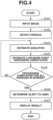
- step S401 the video image acquisition unit 201 acquires a video image from the imaging apparatus 105 on a frame image unit basis.
- step S402 the person detection unit 202 detects the entire body region of a person from among the frame images.
- methods for person detection include a method based on a convolutional neural network (CNN). Applicable methods are not limited thereto, and any other methods with which the entire body region is detectable is applicable. Examples of applicable methods include detecting the contour of the subject and comparing edge information for the contour with prestored information about the contour of the person, to detect the entire body region.
- CNN convolutional neural network
- the entire body region is represented by the x- and y-coordinates of two points, specifically, upper left and lower right points) of a square surrounding the person.
- the skeleton estimation unit 203 estimates the skeleton of the person from the entire body region and outputs a likelihood map of joint points corresponding to the entire body region.
- Examples of specific methods for skeleton estimation include a CNN-based method. With this method, the likelihood of being a joint for each pixel in the entire body region is determined to generate joint likelihood maps for joint points (the likelihood is a value from 0 to 1, and a value closer to 1 indicates higher likelihood). In the present embodiment, 17 different joint points are estimated and therefore 17 different joint likelihood maps are generated. In each joint likelihood map, the coordinates with the highest likelihood become a candidate for joint point coordinates. Although the joint point coordinates may be output, the present embodiment outputs 17 different likelihood maps.
- the present embodiment is not limited to a CNN-based method as long as the coordinates of joint points are estimable. Examples of applicable methods include estimating the coordinates based on the contour of a person and the relative positions of joint points based on the general human body structure.
- the present embodiment is configured to perform skeleton estimation on the entire body region obtained from the entire screen through person detection. However, the present embodiment may be configured to perform skeleton estimation on the full screen to obtain joints first and then sum up the joints for each person based on the relations between joints.
- step S404 the orientation estimation unit 204 estimates whether the person is in a 3-or-more grounding orientation based on the joint likelihood maps and the image of the entire body region.
- the orientation estimation unit 204 outputs the likelihood of a 3- or-more-point grounding orientation in association with the entire body region.
- the likelihood takes a value from 0 to 1. The value closer to 1 indicates higher likelihood that the person is in a 3-or-more-point grounding orientation.
- step S405 the CPU 101 determine whether the operations in steps S403 and S404 have been completed for all persons (entire body regions) included in the current frame image. If the CPU 101 determine that the operations have been completed for all persons, the processing proceeds to step S406. Otherwise, the processing returns to step S403 and repeats the operations from step S403.
- step S406 the user notification determination unit 205 determines whether to issue an alert to the user based on the likelihood output by the orientation estimation unit 204.
- the CPU 101 compares the likelihood of a 3-or-more-point grounding orientation with a predetermined threshold value for all of the entire body regions detected from the frame image. If the likelihood exceeds the threshold value, the CPU 101 determines that an alert is to be issued and outputs (the square coordinates of) the entire body region and the likelihood of a 3-or-more-point grounding orientation.
- step S407 the display unit 206 displays a result of the determination in step S406 to the user.
- the display unit 206 may display a message "There is a person falling down” or superimpose the square surrounding a person falling down, on the camera video image.
- the display unit 206 may display a numerical value indicating the likelihood of a 3-or-more-point grounding orientation or a color or bar chart according to the magnitude of the numerical value.
- the orientation estimation unit 204 will be described in detail below.
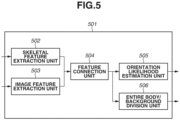
- the orientation estimation unit 204 is implemented by a trained neural network, which is the neural network that has completed learning through a learning method described below. The structure and processing of the network will be described below with reference to Fig. 5 .
- An orientation estimation network 501 configures the orientation estimation unit 204.
- a skeletal feature extraction unit (first extraction unit) 502 includes a plurality of convolutional layers and a plurality of pooling layers.
- the skeletal feature extraction unit 502 extracts a skeletal feature map (first feature quantity) based on the joint likelihood maps output by the skeleton estimation unit 203.
- the joint likelihood maps are input because the orientation of the entire body is determined by the skeleton as a matter of course. In addition, that is because maps are useful as information for distinguishing between the entire body and the background region in a clipped image of the entire body.
- the joint likelihood maps are intended to be reflected to image features (described below) as information about the relation between the entire body and the background.
- Other networks are also applicable as long as a skeletal feature map is extractable.
- Examples of other applicable networks include a residual neural network in which a plurality of residual blocks is connected in series, with the inputs of the convolutional layers skip-connected to their outputs (for addition).
- Examples of applicable networks also include a Visual Transformer (ViT) method in which an image is divided into patches to derive tokens (vectors) and relations between tokens are extracted.
- ViT Visual Transformer
- An image feature extraction unit (second extraction unit) 503 includes a plurality of convolutional layers and a plurality of pooling layers.
- the image feature extraction unit 503 inputs the clipped image including the entire body and the background around the entire body and extracts an image feature map (second feature quantity), based on the entire body region detected by the person detection unit 202.
- the image feature extraction unit 503 may input, as a clipped image, the entire body region detected by the person detection unit 202 with a predetermined margin applied in the vertical and horizontal directions.
- the image feature extraction unit 503 may use a residual neural network or ViT as in the skeletal feature extraction unit 502 and also use any other networks as long as an image feature map is extractable.
- a feature connection unit 504 connects image feature maps with skeletal feature maps.
- the joint likelihood maps to be input to the skeletal feature extraction unit 502 are resized and padded so that all joints have predetermined heights H and widths W, and a skeletal feature map is output with H/K ⁇ W/K (K: predetermined constant) ⁇ C (the number of channels).
- the image feature extraction unit 503 also subjects a clipped image to be input to resizing and padding so that all joints have heights H ⁇ widths W, and obtains an image feature map with H/K ⁇ W/K ⁇ C.
- the feature connection unit 504 connects these maps to generate a connected feature map with H/K ⁇ W/K ⁇ 2 ⁇ C.
- the skeletal feature map and the image feature map have the same size. If the two feature maps have different sizes, the feature connection unit 504 may adjust the sizes of the feature maps, by, for example, downsizing the larger feature map, before connecting these feature maps.
- An orientation likelihood estimation unit 505 estimates the likelihood of a 3-or-more-point grounding orientation in which at least three points of detected human body parts are in contact with the ground, based on the connection feature map.
- the orientation likelihood estimation unit 505 includes Multi Layer Perceptron (MLP), defines binary classification or an orientation class other than 3-or-more-point grounding orientations, such as a standing position, and handles the problem as a multi-class problem.
- MLP Multi Layer Perceptron
- the entire body/background division unit (relation information estimation unit) 506 includes a fully convolutional network (FCN) and determines the likelihood of division categories ("entire body" and "background") for each pixel in the clipped image (the likelihood is a value from 0 to 1, and a value closer to 1 indicates higher likelihood).
- FCN fully convolutional network
- the entire body/background division unit 506 can divide the clipped image into the entire body and the background by selecting the highest likelihood category for each pixel. As a method for category division, finer category division is also effective. This point will be described below.
- Training data will now be described.
- a combination of a clipped image of the entire body to be input to the orientation estimation unit 204 and the skeletal feature map acquired from the clipped image of the entire body via the skeleton estimation unit 203 is prepared.
- Correct answer data is prepared, where the correct date includes a label indicating whether the clipped image of the entire body and the skeletal feature map each indicate a 3-or-more-point grounding orientation, and a label image having a label of the entire body or background for each pixel of the clipped image of the entire body.
- the clipped image of the entire body and the skeletal feature map are input to the orientation estimation network 501, and learns a task for estimating a 3-or-more-point grounding orientation based on the output of the orientation likelihood estimation unit 505 and the correct answer label of a 3-or-more-point grounding orientation.
- the image feature extraction unit 503 may be subjected to pre-training with a general image classification task in advance.
- a task for dividing the clipped image into the entire body and the background is added in addition to the task for estimating a 3-or-more-point grounding orientation to perform multi-task learning.
- This reflects the information about the relation between the person and the background to the image feature map to be extracted by the image feature extraction unit 503. This operation will be described below with reference to Fig. 6 .
- Fig. 6 illustrates a clipped image 601 of a standing position and a clipped image 608 for a 3-or-more-point grounding orientation (lying position).
- contours 602 and 609 indicates the boundary between the person and the background.
- the contours 603 and 610 represented by circles and dotted lines schematically illustrate the skeleton information estimated by the skeleton estimation unit 203. Circles indicate the positions of peaks in each joint likelihood map, and dotted lines indicate portions connecting these positions. It is difficult to determine which is a standing position or a lying position only with the skeleton information (contours 603 and 610). However, the vicinities of the entire bodies include information useful for distinguishing between the two different orientations.
- Fig. 6 illustrates wall surfaces 604, 605, 611, and 612 and floor surfaces 606 and 613. For a standing position (clipped image 601), the floor surface 606 is present only around the lower body. For a lying position (clipped image 608), the floor surface 613 is present around the entire body.
- Fig. 6 also illustrates shadows 607 and 614.
- the shadow 607 is present only around the feet.
- the shadow 614 is present around the entire body.
- the learning of the task for dividing the image into the entire body and the background enables the image feature extraction unit 503 to extract features of the floor surface and shadow around the entire body for the lying position, thus enabling the orientation likelihood estimation unit 505 to estimate the likelihood of a 3-or-more-point grounding orientation.
- the division category "background” may be replaced with division categories "floor surface” and “background other than floor surface” to enable dividing the background into a floor surface and other than the floor surface. This enables the image feature extraction unit 503 to clearly recognize the feature of the floor surface. Adding a division category "shadow” so as to divide a shadow region enables recognizing the shape of the shadow due to a difference in orientation.
- dividing the floor surface, the wall surfaces, and the entire body enables reflecting the relation between the imaging direction and the variation in appearance (ratios of the upper and lower bodies) of the person to the image feature map to be output by the image feature extraction unit 503. Further dividing the entire body region into the upper and lower bodies (dividing the division category "entire body” into “upper body” and “lower body”) enables further clearly reflecting the above-described feature to the image feature map.
- a division category "chair” may be included. If the feature of a "chair” is seen around the person in the image feature map, the learning is performable in such a manner that the likelihood of a 3-or-more-point grounding orientation decreases.
- orientation estimation network 501 that has trained in the above-described manner enables accurately estimating a 3-or-more-point grounding orientation. Since the entire body/background division unit 506 is an essential part in the learning, an omitted network may be used by the orientation estimation unit 204.
- a skeletal feature map is input to the orientation estimation unit 204 as skeleton information
- the present embodiment is not limited thereto.
- each joint peak detected from the skeletal feature map and represented by joint point coordinates may also be input to the orientation estimation unit 204.
- a skeleton image formed by connecting joint points with line segments may also be input to the orientation estimation unit 204.
- the entire body/background division unit 506 adds an image division task so that the information about the relation between the entire body and the background is reflected to the image feature map output from the image feature extraction unit 503, thus estimating a 3-or-more-point grounding orientation.
- the task to be added is not limited to the image division task but any task is applicable as long as the information about the relation between the entire body and the background is reflectable.
- a task for recursively obtaining the imaging angle itself is also applicable. This enables reflecting the relation between the imaging angle and the appearance of the entire body to the image feature map, as described above.
- depth information for each pixel may be estimated. This enables reflecting the depth difference between each portion of the entire body and the floor surface (relation information) to the image feature map.
- the present embodiment makes it possible to extract an image feature reflecting the information about the relation between the entire body and the background from a clipped image including the background around the entire body. This enables estimating the orientation of the entire body even if no background object is present or no background object is detectable. This improves the estimation accuracy for a 3-or-more-point grounding orientation, such as a lying position and a sitting position.
- the present embodiment displays results of processing to the user, it is also possible to start recording a video image in response to detection of a 3-or-more-point grounding orientation, by using a video image recording unit, and apply meta information indicating the detection to the detection time in the video image to be recorded. Applying the meta information in this way enables searching for the video image of a 3-or-more-point grounding orientation at the recording time.
- a video image acquired from the video image acquisition unit 201 may be transmitted to a cloud, and processing of the person detection unit 202, the orientation estimation unit 204, and the user notification determination unit 205 may be performed on the cloud.
- processing of the person detection unit 202, the orientation estimation unit 204, and the user notification determination unit 205 may be performed on the cloud.
- only the processing performed by the neural network according to the present embodiment may be performed on the cloud, and other processing may be performed by the information processing apparatus.
- the processing performed by using the neural network may be executed by a CPU different from the CPU 101 of the information processing apparatus.
- the information processing apparatus may include a plurality of CPUs each of which may take charge of executing either the processing executable through the neural network or other processing.
- a recording medium (storage medium) recording program codes of software for implementing the functions of the above-described embodiments is supplied to a system or apparatus.
- a computer including a CPU, a micro processing unit (MPU), or a graphics processing unit (GPU) of the system or apparatus reads and executes the program codes stored in the recording medium.
- the program codes themselves read from the recording medium implement the functions of the above-described embodiments, and the recording medium recording the program codes is included in the present invention.
- the functions of the above-described embodiments may be implemented not only by the computer executing the read program codes but also by the operating system (OS) that is operating on the computer executing part or whole of actual processing based on instructions of the program codes.
- OS operating system
- the functions of the above-described embodiments may also be implemented with the following method.
- the program codes read from the recording medium are written in a memory included in a function expansion card inserted into the computer or a function expansion unit connected to the computer. Subsequently, the CPU included in the function extension card or the function extension unit may partially or entirely execute actual processing based on instructions of the computer program codes.
- Embodiment(s) of the present invention can also be realized by a computer of a system or apparatus that reads out and executes computer executable instructions (e.g., one or more programs) recorded on a storage medium (which may also be referred to more fully as a 'non-transitory computer-readable storage medium') to perform the functions of one or more of the above-described embodiment(s) and/or that includes one or more circuits (e.g., application specific integrated circuit (ASIC)) for performing the functions of one or more of the above-described embodiment(s), and by a method performed by the computer of the system or apparatus by, for example, reading out and executing the computer executable instructions from the storage medium to perform the functions of one or more of the above-described embodiment(s) and/or controlling the one or more circuits to perform the functions of one or more of the above-described embodiment(s).
- computer executable instructions e.g., one or more programs
- a storage medium which may also be referred to more fully as
- the computer may comprise one or more processors (e.g., central processing unit (CPU), micro processing unit (MPU)) and may include a network of separate computers or separate processors to read out and execute the computer executable instructions.
- the computer executable instructions may be provided to the computer, for example, from a network or the storage medium.
- the storage medium may include, for example, one or more of a hard disk, a random-access memory (RAM), a read only memory (ROM), a storage of distributed computing systems, an optical disk (such as a compact disc (CD), digital versatile disc (DVD), or Blu-ray Disc (BD) TM ), a flash memory device, a memory card, and the like.
Landscapes
- Engineering & Computer Science (AREA)
- Computer Vision & Pattern Recognition (AREA)
- Physics & Mathematics (AREA)
- General Physics & Mathematics (AREA)
- Theoretical Computer Science (AREA)
- Multimedia (AREA)
- Image Analysis (AREA)
Abstract
Description
- The present invention relates to an information processing apparatus, an orientation estimation method, a program, and a storage medium.
- A technique for estimating the orientation of the entire body of a person based on a video image of a monitoring camera has recently been applied to the maintenance of customer security in stores and the monitoring activities in cities.
- As a technique for estimating the orientation of the entire body, there has conventionally been proposed a technique for estimating skeleton information (joints) for the entire body in a video image and estimating the orientation based on joints. However, orientation estimation has been difficult in a case where different orientations are seen as the same orientation based on joints.
-
WO 2015/186436 discusses a technique for detecting an object, such as a chair, around a person and distinguishing between an "orientation of doing squats" and an "orientation of sitting down on a chair" based on the joints of the target person and the distance to the object. - According to a first aspect of the present invention, there is provided an information processing apparatus according to claims 1 to 9. According to a second aspect of the present invention, there is provided a method for estimating an orientation according to claims 10 to 13. According to a third aspect of the present invention, there is provided a program according to claim 14. According to a fourth aspect of the present invention, there is provided a computer-readable storage medium according to claim 15.
- Further features of the present invention will become apparent from the following description of embodiments with reference to the attached drawings.
-
-
Fig. 1 illustrates an example of a hardware configuration of an information processing apparatus according to an embodiment. -
Fig. 2 illustrates a functional configuration of the information processing apparatus according to the embodiment. -
Fig. 3 illustrates an example of a skeleton estimation result. -
Fig. 4 is a flowchart illustrating processing of the information processing apparatus according to the embodiment. -
Fig. 5 illustrates a structure of a neural network of an orientation estimation unit. -
Fig. 6 illustrates examples of entire bodies and backgrounds in clipped images of a standing position and a 3-or-more-point grounding orientation. - Embodiments of the present invention will be described below with reference to the accompanying drawings. The following embodiments are to be considered as illustrative examples for achieving the present invention, and may be corrected and modified as required depending on the configuration of an apparatus according to the present invention and other various conditions. The present invention is not limited to the following embodiments. Parts of the following embodiments may be suitably combined.
- A first embodiment of the present invention will be described below.
Fig. 1 is a block diagram illustrating a hardware configuration of an information processing apparatus according to the present embodiment. A central processing unit (CPU) 101 executes instructions according to programs stored in a read only memory (ROM) 102 and/or a random access memory (RAM) 103. TheROM 102 is a nonvolatile memory for storing programs according to the present invention and other programs and data to be used for control. TheRAM 103 is a volatile memory for storing frame image data and temporary data such as a pattern determination result. - An
auxiliary storage device 104 is a rewritable auxiliary storage device, such as a hard disk drive and a flash memory, for storing image information, programs, and various settings. These pieces of information are transmitted to theRAM 103 and used to execute a program or used as data by theCPU 101. - An
imaging apparatus 105 includes an imaging lens, an image sensor such as a charge coupled device (CCD) sensor and a complementary metal oxide semiconductor (CMOS) sensor, and a video image signal processing unit. Theimaging apparatus 105 captures video images. Aninput apparatus 106, which is, for example, a keyboard and/or a mouse, allows input of an instruction from the user. Adisplay apparatus 107 which is, for example, a cathode ray tube (CRT) or a liquid crystal display (LCD) displays results of processing to the user. A network interface (I/F) 108 which is, for example, a modem or a local area network (LAN) that connects with a network, such as the Internet and an intranet. A bus 109 connects the above-described units to enable data input and output with each other. TheCPU 101 reads software for implementing processing in each step of a flowchart (described below) from theauxiliary storage device 104 and theRAM 103, and then executes the software. -
Fig. 2 illustrates a functional configuration of the information processing apparatus according to the present embodiment. A videoimage acquisition unit 201 includes theimaging apparatus 105 and captures video images (still images). Aperson detection unit 202 detects the region of a person (human body) from a video image acquired by the videoimage acquisition unit 201. According to the present embodiment, theperson detection unit 202 detects the region of an entire human body. - A
skeleton estimation unit 203 estimates the skeleton of the entire human body from the entire body region detected by theperson detection unit 202, and generates joint points of the entire body as skeleton information for the entire human body. - A joint point represents a connecting position between human body parts. According to the present embodiment, joint points include the
shoulders elbows wrists waists knees ankles Fig. 3 . Facial organs including theeyes nose 317, andears - An
orientation estimation unit 204 estimates the orientation based on the skeleton information estimated by theskeleton estimation unit 203 and the entire body region detected by theperson detection unit 202, where the orientation in which at least three points of detected human body parts are in contact with the ground (hereinafter referred to as a 3-or-more point grounding orientation), such as a lying position and a sitting position, is detected. - A user
notification determination unit 205 determines whether a notification to the user is to be issued, based on a result of the estimation of theorientation estimation unit 204. Adisplay unit 206 includes adisplay apparatus 107 that displays a notification to the user when the usernotification determination unit 205 determines that a notification to the user is to be issued. - Processing of the information processing apparatus according to the present embodiment will be described below with reference to the flowchart in
Fig. 4 . In step S401, the videoimage acquisition unit 201 acquires a video image from theimaging apparatus 105 on a frame image unit basis. In step S402, theperson detection unit 202 detects the entire body region of a person from among the frame images. - Specific examples of methods for person detection include a method based on a convolutional neural network (CNN). Applicable methods are not limited thereto, and any other methods with which the entire body region is detectable is applicable. Examples of applicable methods include detecting the contour of the subject and comparing edge information for the contour with prestored information about the contour of the person, to detect the entire body region.
- The entire body region is represented by the x- and y-coordinates of two points, specifically, upper left and lower right points) of a square surrounding the person. In step S403, the
skeleton estimation unit 203 estimates the skeleton of the person from the entire body region and outputs a likelihood map of joint points corresponding to the entire body region. - Examples of specific methods for skeleton estimation include a CNN-based method. With this method, the likelihood of being a joint for each pixel in the entire body region is determined to generate joint likelihood maps for joint points (the likelihood is a value from 0 to 1, and a value closer to 1 indicates higher likelihood). In the present embodiment, 17 different joint points are estimated and therefore 17 different joint likelihood maps are generated. In each joint likelihood map, the coordinates with the highest likelihood become a candidate for joint point coordinates. Although the joint point coordinates may be output, the present embodiment outputs 17 different likelihood maps.
- The present embodiment is not limited to a CNN-based method as long as the coordinates of joint points are estimable. Examples of applicable methods include estimating the coordinates based on the contour of a person and the relative positions of joint points based on the general human body structure. The present embodiment is configured to perform skeleton estimation on the entire body region obtained from the entire screen through person detection. However, the present embodiment may be configured to perform skeleton estimation on the full screen to obtain joints first and then sum up the joints for each person based on the relations between joints.
- In step S404, the
orientation estimation unit 204 estimates whether the person is in a 3-or-more grounding orientation based on the joint likelihood maps and the image of the entire body region. Theorientation estimation unit 204 outputs the likelihood of a 3- or-more-point grounding orientation in association with the entire body region. The likelihood takes a value from 0 to 1. The value closer to 1 indicates higher likelihood that the person is in a 3-or-more-point grounding orientation. A specific method for theorientation estimation unit 204 will be described below. - In step S405, the
CPU 101 determine whether the operations in steps S403 and S404 have been completed for all persons (entire body regions) included in the current frame image. If theCPU 101 determine that the operations have been completed for all persons, the processing proceeds to step S406. Otherwise, the processing returns to step S403 and repeats the operations from step S403. - In step S406, the user
notification determination unit 205 determines whether to issue an alert to the user based on the likelihood output by theorientation estimation unit 204. TheCPU 101 compares the likelihood of a 3-or-more-point grounding orientation with a predetermined threshold value for all of the entire body regions detected from the frame image. If the likelihood exceeds the threshold value, theCPU 101 determines that an alert is to be issued and outputs (the square coordinates of) the entire body region and the likelihood of a 3-or-more-point grounding orientation. - In step S407, the
display unit 206 displays a result of the determination in step S406 to the user. For example, thedisplay unit 206 may display a message "There is a person falling down" or superimpose the square surrounding a person falling down, on the camera video image. Thedisplay unit 206 may display a numerical value indicating the likelihood of a 3-or-more-point grounding orientation or a color or bar chart according to the magnitude of the numerical value. - This completes the description of the processing of the information processing apparatus. The processing up to the display of the result of the orientation estimation has been sequentially described above. The
CPU 101 constantly repeats all the steps until the information processing apparatus is deactivated. - The
orientation estimation unit 204 will be described in detail below. Theorientation estimation unit 204 is implemented by a trained neural network, which is the neural network that has completed learning through a learning method described below. The structure and processing of the network will be described below with reference toFig. 5 . - An
orientation estimation network 501 configures theorientation estimation unit 204. - Component units of the network will be described below according to the order of processing.
- A skeletal feature extraction unit (first extraction unit) 502 includes a plurality of convolutional layers and a plurality of pooling layers. The skeletal
feature extraction unit 502 extracts a skeletal feature map (first feature quantity) based on the joint likelihood maps output by theskeleton estimation unit 203. - The joint likelihood maps are input because the orientation of the entire body is determined by the skeleton as a matter of course. In addition, that is because maps are useful as information for distinguishing between the entire body and the background region in a clipped image of the entire body. The joint likelihood maps are intended to be reflected to image features (described below) as information about the relation between the entire body and the background.
- Other networks are also applicable as long as a skeletal feature map is extractable. Examples of other applicable networks include a residual neural network in which a plurality of residual blocks is connected in series, with the inputs of the convolutional layers skip-connected to their outputs (for addition). Examples of applicable networks also include a Visual Transformer (ViT) method in which an image is divided into patches to derive tokens (vectors) and relations between tokens are extracted.
- An image feature extraction unit (second extraction unit) 503 includes a plurality of convolutional layers and a plurality of pooling layers. The image
feature extraction unit 503 inputs the clipped image including the entire body and the background around the entire body and extracts an image feature map (second feature quantity), based on the entire body region detected by theperson detection unit 202. - To obtain an image feature map reflecting information about the relation between the entire body and the background, it is desirable that the clipped image sufficiently includes the background around the entire body. Thus, the image
feature extraction unit 503 may input, as a clipped image, the entire body region detected by theperson detection unit 202 with a predetermined margin applied in the vertical and horizontal directions. - The image
feature extraction unit 503 may use a residual neural network or ViT as in the skeletalfeature extraction unit 502 and also use any other networks as long as an image feature map is extractable. - A
feature connection unit 504 connects image feature maps with skeletal feature maps. - According to the present embodiment, the joint likelihood maps to be input to the skeletal
feature extraction unit 502 are resized and padded so that all joints have predetermined heights H and widths W, and a skeletal feature map is output with H/K × W/K (K: predetermined constant) × C (the number of channels). The imagefeature extraction unit 503 also subjects a clipped image to be input to resizing and padding so that all joints have heights H × widths W, and obtains an image feature map with H/K × W/K × C. Thefeature connection unit 504 connects these maps to generate a connected feature map with H/K × W/K × 2 × C. - According to the present embodiment, the skeletal feature map and the image feature map have the same size. If the two feature maps have different sizes, the
feature connection unit 504 may adjust the sizes of the feature maps, by, for example, downsizing the larger feature map, before connecting these feature maps. - An orientation
likelihood estimation unit 505 estimates the likelihood of a 3-or-more-point grounding orientation in which at least three points of detected human body parts are in contact with the ground, based on the connection feature map. The orientationlikelihood estimation unit 505 includes Multi Layer Perceptron (MLP), defines binary classification or an orientation class other than 3-or-more-point grounding orientations, such as a standing position, and handles the problem as a multi-class problem. - The entire body/background division unit (relation information estimation unit) 506 includes a fully convolutional network (FCN) and determines the likelihood of division categories ("entire body" and "background") for each pixel in the clipped image (the likelihood is a value from 0 to 1, and a value closer to 1 indicates higher likelihood).
- The entire body/
background division unit 506 can divide the clipped image into the entire body and the background by selecting the highest likelihood category for each pixel. As a method for category division, finer category division is also effective. This point will be described below. - A method that is performed by the
orientation estimation unit 204 to perform learning of a neural network will be described below. - Training data will now be described. A combination of a clipped image of the entire body to be input to the
orientation estimation unit 204 and the skeletal feature map acquired from the clipped image of the entire body via theskeleton estimation unit 203 is prepared. Correct answer data is prepared, where the correct date includes a label indicating whether the clipped image of the entire body and the skeletal feature map each indicate a 3-or-more-point grounding orientation, and a label image having a label of the entire body or background for each pixel of the clipped image of the entire body. - The clipped image of the entire body and the skeletal feature map are input to the
orientation estimation network 501, and learns a task for estimating a 3-or-more-point grounding orientation based on the output of the orientationlikelihood estimation unit 505 and the correct answer label of a 3-or-more-point grounding orientation. Of course, the imagefeature extraction unit 503 may be subjected to pre-training with a general image classification task in advance. - According to the present embodiment, a task for dividing the clipped image into the entire body and the background is added in addition to the task for estimating a 3-or-more-point grounding orientation to perform multi-task learning. This reflects the information about the relation between the person and the background to the image feature map to be extracted by the image
feature extraction unit 503. This operation will be described below with reference toFig. 6 . -
Fig. 6 illustrates a clippedimage 601 of a standing position and a clippedimage 608 for a 3-or-more-point grounding orientation (lying position). Each ofcontours - The
contours skeleton estimation unit 203. Circles indicate the positions of peaks in each joint likelihood map, and dotted lines indicate portions connecting these positions. It is difficult to determine which is a standing position or a lying position only with the skeleton information (contours 603 and 610). However, the vicinities of the entire bodies include information useful for distinguishing between the two different orientations.Fig. 6 illustrates wall surfaces 604, 605, 611, and 612 and floor surfaces 606 and 613. For a standing position (clipped image 601), thefloor surface 606 is present only around the lower body. For a lying position (clipped image 608), thefloor surface 613 is present around the entire body. -
Fig. 6 also illustratesshadows shadow 607 is present only around the feet. For the lying position (clipped image 608), theshadow 614 is present around the entire body. - The learning of the task for dividing the image into the entire body and the background enables the image
feature extraction unit 503 to extract features of the floor surface and shadow around the entire body for the lying position, thus enabling the orientationlikelihood estimation unit 505 to estimate the likelihood of a 3-or-more-point grounding orientation. - The division category "background" may be replaced with division categories "floor surface" and "background other than floor surface" to enable dividing the background into a floor surface and other than the floor surface. This enables the image
feature extraction unit 503 to clearly recognize the feature of the floor surface. Adding a division category "shadow" so as to divide a shadow region enables recognizing the shape of the shadow due to a difference in orientation. - Setting division categories "floor surface" and "wall surface" to divide the background into a floor surface and wall surfaces enables obtaining information about the perspective (imaging angle). As illustrated in
Fig. 6 , there is a difference in appearance (shape) of the entire body between a lying position and a standing position even for images captured from the same high angle. For thecontour 602 captured from a high angle, the upper body appears in a larger size than the lower body in comparison with the entire body captured from the horizontal direction. For thecontour 609, the entire body appears in a size similar to the entire body captured from the horizontal direction. Accordingly, dividing the floor surface, the wall surfaces, and the entire body enables reflecting the relation between the imaging direction and the variation in appearance (ratios of the upper and lower bodies) of the person to the image feature map to be output by the imagefeature extraction unit 503. Further dividing the entire body region into the upper and lower bodies (dividing the division category "entire body" into "upper body" and "lower body") enables further clearly reflecting the above-described feature to the image feature map. - To handle a case where a person sits down while facing the front in an "orientation of sitting down on a chair", a division category "chair" may be included. If the feature of a "chair" is seen around the person in the image feature map, the learning is performable in such a manner that the likelihood of a 3-or-more-point grounding orientation decreases.
- Using the
orientation estimation network 501 that has trained in the above-described manner enables accurately estimating a 3-or-more-point grounding orientation. Since the entire body/background division unit 506 is an essential part in the learning, an omitted network may be used by theorientation estimation unit 204. - Although, in the present embodiment, a skeletal feature map is input to the
orientation estimation unit 204 as skeleton information, the present embodiment is not limited thereto. For example, each joint peak detected from the skeletal feature map and represented by joint point coordinates may also be input to theorientation estimation unit 204. A skeleton image formed by connecting joint points with line segments may also be input to theorientation estimation unit 204. - According to the present embodiment, the entire body/
background division unit 506 adds an image division task so that the information about the relation between the entire body and the background is reflected to the image feature map output from the imagefeature extraction unit 503, thus estimating a 3-or-more-point grounding orientation. However, the task to be added is not limited to the image division task but any task is applicable as long as the information about the relation between the entire body and the background is reflectable. For example, a task for recursively obtaining the imaging angle itself is also applicable. This enables reflecting the relation between the imaging angle and the appearance of the entire body to the image feature map, as described above. In addition, depth information for each pixel may be estimated. This enables reflecting the depth difference between each portion of the entire body and the floor surface (relation information) to the image feature map. - As described above, the present embodiment makes it possible to extract an image feature reflecting the information about the relation between the entire body and the background from a clipped image including the background around the entire body. This enables estimating the orientation of the entire body even if no background object is present or no background object is detectable. This improves the estimation accuracy for a 3-or-more-point grounding orientation, such as a lying position and a sitting position.
- Although the present embodiment displays results of processing to the user, it is also possible to start recording a video image in response to detection of a 3-or-more-point grounding orientation, by using a video image recording unit, and apply meta information indicating the detection to the detection time in the video image to be recorded. Applying the meta information in this way enables searching for the video image of a 3-or-more-point grounding orientation at the recording time.
- In the present embodiment, all functions are built in one apparatus. In another embodiment, a video image acquired from the video
image acquisition unit 201 may be transmitted to a cloud, and processing of theperson detection unit 202, theorientation estimation unit 204, and the usernotification determination unit 205 may be performed on the cloud. Alternatively, only the processing performed by the neural network according to the present embodiment may be performed on the cloud, and other processing may be performed by the information processing apparatus. - As described above, the processing performed by using the neural network may be executed by a CPU different from the
CPU 101 of the information processing apparatus. Alternatively, the information processing apparatus may include a plurality of CPUs each of which may take charge of executing either the processing executable through the neural network or other processing. - The object of the present embodiment may also be achieved by the following method. A recording medium (storage medium) recording program codes of software for implementing the functions of the above-described embodiments is supplied to a system or apparatus. Then, a computer (including a CPU, a micro processing unit (MPU), or a graphics processing unit (GPU)) of the system or apparatus reads and executes the program codes stored in the recording medium. In this case, the program codes themselves read from the recording medium implement the functions of the above-described embodiments, and the recording medium recording the program codes is included in the present invention.
- The functions of the above-described embodiments may be implemented not only by the computer executing the read program codes but also by the operating system (OS) that is operating on the computer executing part or whole of actual processing based on instructions of the program codes.
- The functions of the above-described embodiments may also be implemented with the following method. The program codes read from the recording medium are written in a memory included in a function expansion card inserted into the computer or a function expansion unit connected to the computer. Subsequently, the CPU included in the function extension card or the function extension unit may partially or entirely execute actual processing based on instructions of the computer program codes.
- If the present embodiment is applied to the above-described recording medium, program codes corresponding to the above-described flowchart are to be stored in the recording medium.
- Embodiment(s) of the present invention can also be realized by a computer of a system or apparatus that reads out and executes computer executable instructions (e.g., one or more programs) recorded on a storage medium (which may also be referred to more fully as a 'non-transitory computer-readable storage medium') to perform the functions of one or more of the above-described embodiment(s) and/or that includes one or more circuits (e.g., application specific integrated circuit (ASIC)) for performing the functions of one or more of the above-described embodiment(s), and by a method performed by the computer of the system or apparatus by, for example, reading out and executing the computer executable instructions from the storage medium to perform the functions of one or more of the above-described embodiment(s) and/or controlling the one or more circuits to perform the functions of one or more of the above-described embodiment(s). The computer may comprise one or more processors (e.g., central processing unit (CPU), micro processing unit (MPU)) and may include a network of separate computers or separate processors to read out and execute the computer executable instructions. The computer executable instructions may be provided to the computer, for example, from a network or the storage medium. The storage medium may include, for example, one or more of a hard disk, a random-access memory (RAM), a read only memory (ROM), a storage of distributed computing systems, an optical disk (such as a compact disc (CD), digital versatile disc (DVD), or Blu-ray Disc (BD)™), a flash memory device, a memory card, and the like.
- While the present invention has been described with reference to embodiments, it is to be understood that the invention is not limited to the disclosed embodiments, but is defined by the scope of the following claims.
Claims (15)
- An information processing apparatus comprising:acquisition means (201) configured to acquire an image;detection means (202) configured to detect an entire human body from the image acquired by the acquisition means; andskeleton estimation means (203) configured to estimate a skeleton (603, 610) of the detected entire human body and generating skeleton information about the skeleton of the entire human body;wherein the information processing apparatus is configured to use a neural network provided with:first extraction means (502) configured to extract a first feature quantity based on the skeleton information generated by the skeleton estimation means;second extraction means (503) configured to extract a second feature quantity based on a clipped image including the entire human body detected by the detection means; andorientation estimation means (204) configured to estimate an orientation of the entire human body detected by the detection means based on a third feature quantity in which the first and second feature quantities are connected.
- The information processing apparatus according to claim 1, wherein the orientation estimation means (204) is configured to estimate whether the orientation of the entire human body detected by the detection means is an orientation in which at least three points of the human body are in contact with a ground.
- The information processing apparatus according to claim 1 or 2, wherein the information processing apparatus is configured to use the neural network further provided with relation information estimation means (506) configured to estimate, based on the third feature quantity, relation information about a relation between the entire human body and a background in which the entire human body is excluded from the clipped image.
- The information processing apparatus according to claim 3, wherein the relation information estimation means (506) is configured to estimate, as the relation information, information for dividing the clipped image into the entire human body and the background.
- The information processing apparatus according to claim 3 or 4, wherein the relation information estimation means (506) is configured to divide the clipped image into the entire human body and a floor surface.
- The information processing apparatus according to any one of claims 3 to 5, wherein the relation information estimation means (506) is configured to estimate, as the relation information, information for dividing the clipped image into the entire human body and a shadow of the human body.
- The information processing apparatus according to any one of claims 3 to 6, wherein the relation information estimation means (506) is configured to divide the clipped image into an upper part of the human body, a lower part of the human body, a floor surface, and a wall surface.
- The information processing apparatus according to any one of claims 3 to 7, wherein the relation information estimation means (506) is configured to estimate, as the relation information, an imaging angle of the clipped image.
- The information processing apparatus according to any one of claims 3 to 8, wherein the relation information estimation means is configured to estimate depth information for the clipped image.
- A method for estimating an orientation, the method comprising:acquiring (S401) an image;detecting (S402) an entire human body from the acquired image;estimating (S403) a skeleton of the detected entire human body and generating skeleton information about the skeleton of the entire human body;extracting, as first extracting, a first feature quantity based on the generated skeleton information;extracting, as second extracting, a second feature quantity based on a clipped image including the detected entire human body; andestimating (S404) an orientation of the detected entire human body based on a third feature quantity in which the first and second feature quantities are connected.
- The method according to claim 10, wherein, in the estimating (S404) of the orientation, whether the orientation of the detected entire human body is an orientation in which at least three points of the human body are in contact with a ground is estimated.
- The method according to claim 10 or 11, wherein the method further comprises estimating, based on the third feature quantity, relation information about a relation between the entire human body and a background in which the entire human body is excluded from the clipped image.
- The method according to claim 12, wherein, in the estimating of the relation information, information for dividing the clipped image into the entire human body and the background is estimated as the relation information.
- A program comprising instructions which, when the program is executed by a computer, cause the computer to perform the method for estimating the orientation according to any one of claims 10 to 13.
- A computer-readable storage medium storing a program according to claim 14.
Applications Claiming Priority (1)
| Application Number | Priority Date | Filing Date | Title |
|---|---|---|---|
| JP2023051692A JP2024140519A (en) | 2023-03-28 | 2023-03-28 | Information processing device, posture estimation method, program, and storage medium |
Publications (1)
| Publication Number | Publication Date |
|---|---|
| EP4439464A1 true EP4439464A1 (en) | 2024-10-02 |
Family
ID=90368290
Family Applications (1)
| Application Number | Title | Priority Date | Filing Date |
|---|---|---|---|
| EP24164960.7A Pending EP4439464A1 (en) | 2023-03-28 | 2024-03-20 | Information processing apparatus, orientation estimation method, program, and storage medium |
Country Status (3)
| Country | Link |
|---|---|
| US (1) | US20240331192A1 (en) |
| EP (1) | EP4439464A1 (en) |
| JP (1) | JP2024140519A (en) |
Families Citing this family (1)
| Publication number | Priority date | Publication date | Assignee | Title |
|---|---|---|---|---|
| JP7735603B1 (en) * | 2025-03-26 | 2025-09-08 | Pux株式会社 | Image processing method, image processing program, and image processing device |
Citations (1)
| Publication number | Priority date | Publication date | Assignee | Title |
|---|---|---|---|---|
| WO2015186436A1 (en) | 2014-06-06 | 2015-12-10 | コニカミノルタ株式会社 | Image processing device, image processing method, and image processing program |
Family Cites Families (6)
| Publication number | Priority date | Publication date | Assignee | Title |
|---|---|---|---|---|
| GB0326374D0 (en) * | 2003-11-12 | 2003-12-17 | British Telecomm | Object detection in images |
| US10438370B2 (en) * | 2016-06-14 | 2019-10-08 | Disney Enterprises, Inc. | Apparatus, systems and methods for shadow assisted object recognition and tracking |
| JP6853156B2 (en) * | 2017-09-29 | 2021-03-31 | 株式会社日立製作所 | Posture estimation system, posture estimation device, and distance image camera |
| TWI733616B (en) * | 2020-11-04 | 2021-07-11 | 財團法人資訊工業策進會 | Reconition system of human body posture, reconition method of human body posture, and non-transitory computer readable storage medium |
| US12106486B2 (en) * | 2021-02-24 | 2024-10-01 | Snap Inc. | Whole body visual effects |
| US11790531B2 (en) * | 2021-02-24 | 2023-10-17 | Snap Inc. | Whole body segmentation |
-
2023
- 2023-03-28 JP JP2023051692A patent/JP2024140519A/en active Pending
-
2024
- 2024-03-20 EP EP24164960.7A patent/EP4439464A1/en active Pending
- 2024-03-25 US US18/615,824 patent/US20240331192A1/en active Pending
Patent Citations (1)
| Publication number | Priority date | Publication date | Assignee | Title |
|---|---|---|---|---|
| WO2015186436A1 (en) | 2014-06-06 | 2015-12-10 | コニカミノルタ株式会社 | Image processing device, image processing method, and image processing program |
Non-Patent Citations (4)
| Title |
|---|
| ABHINAV GUPTA ET AL: "From 3D scene geometry to human workspace", COMPUTER VISION AND PATTERN RECOGNITION (CVPR), 2011 IEEE CONFERENCE ON, IEEE, 20 June 2011 (2011-06-20), pages 1961 - 1968, XP032037950, ISBN: 978-1-4577-0394-2, DOI: 10.1109/CVPR.2011.5995448 * |
| ALEXANDRU O BALAN ET AL: "Shining a Light on Human Pose: On Shadows, Shading and the Estimation of Pose and Shape", ICCV 2007. IEEE 11TH INTERNATIONAL CONFERENCE ON COMPUTER VISION, 2007, IEEE, 31 October 2007 (2007-10-31), pages 1 - 8, XP031194494, ISBN: 978-1-4244-1630-1, DOI: 10.1109/ICCV.2007.4409141 * |
| SOSHI SHIMADA ET AL: "HULC: 3D Human Motion Capture with Pose Manifold Sampling and Dense Contact Guidance", ARXIV.ORG, CORNELL UNIVERSITY LIBRARY, 201 OLIN LIBRARY CORNELL UNIVERSITY ITHACA, NY 14853, 26 July 2022 (2022-07-26), XP091279537 * |
| TAO JI'AN ET AL: "Scene-Perception Graph Convolutional Networks for Human Action Prediction", 2021 INTERNATIONAL JOINT CONFERENCE ON NEURAL NETWORKS (IJCNN), IEEE, 18 July 2021 (2021-07-18), pages 1 - 8, XP033975208, DOI: 10.1109/IJCNN52387.2021.9534132 * |
Also Published As
| Publication number | Publication date |
|---|---|
| US20240331192A1 (en) | 2024-10-03 |
| JP2024140519A (en) | 2024-10-10 |
Similar Documents
| Publication | Publication Date | Title |
|---|---|---|
| JP7094702B2 (en) | Image processing device and its method, program | |
| JP6125188B2 (en) | Video processing method and apparatus | |
| US9721153B2 (en) | Image processing apparatus, image processing method, and storage medium that recognize an image based on a designated object type | |
| US11647152B2 (en) | Image processing apparatus, image processing method, and non-transitory computer-readable storage medium | |
| CN110211021B (en) | Image processing apparatus, image processing method, and storage medium | |
| US20240331192A1 (en) | Information processing apparatus, orientation estimation method, and storage medium | |
| US10593044B2 (en) | Information processing apparatus, information processing method, and storage medium | |
| JP2024138079A (en) | Program, image processing method and system | |
| US12197497B2 (en) | Image processing apparatus for search of an image, image processing method and storage medium | |
| WO2022190206A1 (en) | Skeletal recognition method, skeletal recognition program, and gymnastics scoring assistance system | |
| WO2023171184A1 (en) | Moving image integration device, moving image integration method, and moving image integration program | |
| CN119672766B (en) | Methods, storage media, electronic devices, and products for hand joint detection in eyeglasses | |
| US20250182528A1 (en) | Image processing apparatus, image processing method, and storage medium | |
| JP2007233871A (en) | Image processor, control method for computer, and program | |
| US20240119087A1 (en) | Image processing apparatus, image processing method, and non-transitory storage medium | |
| US12423939B2 (en) | Information processing apparatus and method for candidate region merging | |
| US20230410361A1 (en) | Image processing system, processing method, and non-transitory storage medium | |
| JP7566586B2 (en) | Estimation device, estimation system, estimation method, and program | |
| JP3963789B2 (en) | Eye detection device, eye detection program, recording medium for recording the program, and eye detection method | |
| EP3496390B1 (en) | Information processing device, information processing method, and storage medium | |
| JP5419925B2 (en) | Passing object number measuring method, passing object number measuring apparatus, and program | |
| KR20100081099A (en) | Apparatus and method for out-focasing | |
| EP4459571A1 (en) | Image processing apparatus, method of controlling image processing apparatus, program, and storage medium | |
| US20240428443A1 (en) | Video image processing apparatus, posture determination method, and storage medium | |
| US20260024303A1 (en) | Image processing apparatus for pose estimation with reduced errors, control method therefor, and computer program product |
Legal Events
| Date | Code | Title | Description |
|---|---|---|---|
| PUAI | Public reference made under article 153(3) epc to a published international application that has entered the european phase |
Free format text: ORIGINAL CODE: 0009012 |
|
| STAA | Information on the status of an ep patent application or granted ep patent |
Free format text: STATUS: THE APPLICATION HAS BEEN PUBLISHED |
|
| AK | Designated contracting states |
Kind code of ref document: A1 Designated state(s): AL AT BE BG CH CY CZ DE DK EE ES FI FR GB GR HR HU IE IS IT LI LT LU LV MC ME MK MT NL NO PL PT RO RS SE SI SK SM TR |
|
| STAA | Information on the status of an ep patent application or granted ep patent |
Free format text: STATUS: REQUEST FOR EXAMINATION WAS MADE |
|
| 17P | Request for examination filed |
Effective date: 20250402 |
|
| STAA | Information on the status of an ep patent application or granted ep patent |
Free format text: STATUS: EXAMINATION IS IN PROGRESS |
|
| 17Q | First examination report despatched |
Effective date: 20260129 |