EP4439281A1 - Device management system and program management method thereof - Google Patents
Device management system and program management method thereof Download PDFInfo
- Publication number
- EP4439281A1 EP4439281A1 EP23897952.0A EP23897952A EP4439281A1 EP 4439281 A1 EP4439281 A1 EP 4439281A1 EP 23897952 A EP23897952 A EP 23897952A EP 4439281 A1 EP4439281 A1 EP 4439281A1
- Authority
- EP
- European Patent Office
- Prior art keywords
- program
- area
- storage area
- memory
- stored
- Prior art date
- Legal status (The legal status is an assumption and is not a legal conclusion. Google has not performed a legal analysis and makes no representation as to the accuracy of the status listed.)
- Granted
Links
Images



Classifications
-
- H—ELECTRICITY
- H01—ELECTRIC ELEMENTS
- H01M—PROCESSES OR MEANS, e.g. BATTERIES, FOR THE DIRECT CONVERSION OF CHEMICAL ENERGY INTO ELECTRICAL ENERGY
- H01M10/00—Secondary cells; Manufacture thereof
- H01M10/42—Methods or arrangements for servicing or maintenance of secondary cells or secondary half-cells
-
- G—PHYSICS
- G06—COMPUTING OR CALCULATING; COUNTING
- G06F—ELECTRIC DIGITAL DATA PROCESSING
- G06F8/00—Arrangements for software engineering
- G06F8/70—Software maintenance or management
- G06F8/71—Version control; Configuration management
-
- G—PHYSICS
- G06—COMPUTING OR CALCULATING; COUNTING
- G06F—ELECTRIC DIGITAL DATA PROCESSING
- G06F21/00—Security arrangements for protecting computers, components thereof, programs or data against unauthorised activity
- G06F21/60—Protecting data
- G06F21/64—Protecting data integrity, e.g. using checksums, certificates or signatures
-
- G—PHYSICS
- G06—COMPUTING OR CALCULATING; COUNTING
- G06F—ELECTRIC DIGITAL DATA PROCESSING
- G06F3/00—Input arrangements for transferring data to be processed into a form capable of being handled by the computer; Output arrangements for transferring data from processing unit to output unit, e.g. interface arrangements
- G06F3/06—Digital input from, or digital output to, record carriers, e.g. RAID, emulated record carriers or networked record carriers
- G06F3/0601—Interfaces specially adapted for storage systems
- G06F3/0602—Interfaces specially adapted for storage systems specifically adapted to achieve a particular effect
- G06F3/062—Securing storage systems
-
- G—PHYSICS
- G06—COMPUTING OR CALCULATING; COUNTING
- G06F—ELECTRIC DIGITAL DATA PROCESSING
- G06F3/00—Input arrangements for transferring data to be processed into a form capable of being handled by the computer; Output arrangements for transferring data from processing unit to output unit, e.g. interface arrangements
- G06F3/06—Digital input from, or digital output to, record carriers, e.g. RAID, emulated record carriers or networked record carriers
- G06F3/0601—Interfaces specially adapted for storage systems
- G06F3/0628—Interfaces specially adapted for storage systems making use of a particular technique
- G06F3/0638—Organizing or formatting or addressing of data
- G06F3/0644—Management of space entities, e.g. partitions, extents, pools
-
- G—PHYSICS
- G06—COMPUTING OR CALCULATING; COUNTING
- G06F—ELECTRIC DIGITAL DATA PROCESSING
- G06F3/00—Input arrangements for transferring data to be processed into a form capable of being handled by the computer; Output arrangements for transferring data from processing unit to output unit, e.g. interface arrangements
- G06F3/06—Digital input from, or digital output to, record carriers, e.g. RAID, emulated record carriers or networked record carriers
- G06F3/0601—Interfaces specially adapted for storage systems
- G06F3/0668—Interfaces specially adapted for storage systems adopting a particular infrastructure
- G06F3/0671—In-line storage system
-
- G—PHYSICS
- G06—COMPUTING OR CALCULATING; COUNTING
- G06F—ELECTRIC DIGITAL DATA PROCESSING
- G06F8/00—Arrangements for software engineering
- G06F8/60—Software deployment
- G06F8/65—Updates
-
- H—ELECTRICITY
- H01—ELECTRIC ELEMENTS
- H01M—PROCESSES OR MEANS, e.g. BATTERIES, FOR THE DIRECT CONVERSION OF CHEMICAL ENERGY INTO ELECTRICAL ENERGY
- H01M10/00—Secondary cells; Manufacture thereof
- H01M10/42—Methods or arrangements for servicing or maintenance of secondary cells or secondary half-cells
- H01M10/425—Structural combination with electronic components, e.g. electronic circuits integrated to the outside of the casing
- H01M2010/4271—Battery management systems including electronic circuits, e.g. control of current or voltage to keep battery in healthy state, cell balancing
Definitions
- the present invention relates to a device management system and a program management method thereof, and more particularly, to a device management system including a partitioned memory and a program management method system using the memory.
- An energy storage system relates to various technologies, including renewable energy, a battery that stores electric power, and a power grid. Recently, as supply of smart grid and renewable energy is expanding, and efficiency and stability of power systems are emphasized, a demand for energy storage systems for power supply and demand control and power quality improvement is increasing. Depending on a purpose of use, energy storage systems may have different output and capacity. In order to configure a large-capacity energy storage system, a plurality of battery systems may be connected to provide the large-capacity energy storage system.
- an energy storage system applied to a photovoltaic (PV) system may include a battery section composed of a plurality of batteries, a battery management system (BMS) for battery management, a power conversion system (PCS), an energy management system (EMS), a DC-DC converter, and the like.
- BMS battery management system
- PCS power conversion system
- EMS energy management system
- DC-DC converter DC-DC converter
- the battery management system is a core component for managing batteries which collects state information of batteries included in the battery system, diagnoses failure based on the state information, and controls the operating state of the battery through interworking with a higher controller.
- the battery management system may perform predefined operations through a management program (e.g., firmware) stored in a memory.
- a management program e.g., firmware
- a management program may be updated to change or add a specific function.
- the battery management system is subject to functional safety certification in accordance with relevant laws and regulations, and additional certification is required when the management program is updated. In this case, there arises a problem in that unnecessary time and cost are consumed because a functional safety certification procedure should be performed even when a function unrelated to the functional safety item is updated.
- embodiments of the present disclosure provide a device management system that manages a device management program using a partitioned memory.
- embodiments of the present disclosure also provide a program management method of the device management system.
- a device management system that is interconnected with and manages the device may include at least one processor; and a memory configured to store a device management program including at least one instruction executed by the at least one processor.
- the at least one processor may store a first program and a second program separately in independently partitioned areas in the memory, wherein the first program is related to functional safety of the device and the second program is unrelated to the functional safety of the device.
- the at least one processor separately may store version information of the first program and version information of the second program in the memory.
- the at least one processor independently may update only version information of an updated program, when any one of the first program and the second program is updated.
- the at least one processor may update only one of the first program and the second program, or sequentially updates the first program and the second program.
- the memory may include: a first area in which the first program is stored; and a second area in which the second program is stored.
- the first area may be defined to be assigned to a fixed specific location on the memory.
- Each of the first area and the second area may include: a verification information storage area in which verification information for verifying whether data stored in each area is changed is stored; a code storage area for storing control logic for the device; and data storage area for storing data necessary for management or control of the device.
- a first code storage area included in the first area may store diagnosis logic related to the functional safety of the device, and a first data storage area included in the first area may store set values related to the diagnosis logic.
- the at least one processor may update verification information stored in a first verification information storage area of the first area in the instance that data stored in at least one of the first code storage area and the first data storage area is changed.
- the memory may correspond to a non-volatile memory.
- the device management system may correspond to a battery management system located within a battery system.
- a program management method of a device management system including at least one processor and a memory for storing a device management program
- the method may include :separately storing, by the processor, a first program and a second program in independently partitioned areas in the memory, wherein the first program is related to a functional safety of the device and the second program is unrelated to the functional safety of the device; and separately storing, by the processor, version information of the first program and version information of the second program, in the memory.
- the method may further include independently updating only version information of an updated program, when any one of the first program and the second program is updated.
- the method may further include determining one of the first program and the second program as an update target program when an update mode of the device management program is entered; and independently updating the determined update target program.
- the separately storing the first program and the second program in independently partitioned areas may include allocating an area where the first program is stored to a fixed specific location on the memory.
- the memory may include a first area in which the first program is stored; and a second area in which the second program is stored.
- each of the first area and the second area may include: a verification information storage area in which verification information for verifying whether data stored in each area is changed is stored; a code storage area for storing control logic for the device; and data storage area for storing data necessary for management or control of the device.
- the separately storing the first program and the second program in independently partitioned areas may include storing diagnosis logic related to the functional safety of the device in a first code storage area included in the first area and storing set values related to the diagnosis logic in a first data storage area included in the first area.
- the method may further include updating verification information stored in a first verification information storage area of the first area in the instance that data stored in at least one of the first code storage area and the first data storage area is changed.
- unnecessary certification procedures can be minimized by performing a functional safety certification procedure only when a functional safety related program included in the device management program is updated.
- first, second, A, B, and the like may be used herein to describe various elements, these elements should not be limited by these terms. These terms are only used to distinguish one element from another. For example, a first element could be termed a second element, and, similarly, a second element could be termed a first element, without departing from the scope of the present invention.
- the term "and/or" includes combinations of a plurality of associated listed items or any of the plurality of associated listed items.
- Nominal Capacity refers to a set capacity [Ah] of the battery which is set by a battery manufacturer during development.
- State of Charge refers to a current state of charge of a battery, represented in percent points [%]
- SOH State of Health
- a battery rack refers to a system of a single structure assembled by connecting packs (or modules) set by a battery manufacturer in series/parallel, which can be monitored and controlled by a battery management system (BMS).
- BMS battery management system
- a battery rack may include several battery packs (or modules) and a battery protection unit or any other protection device.
- a battery bank refers to a group of large-scale battery rack systems configured by connecting several racks in parallel.
- a bank BMS for a battery bank may monitor and control several rack BMSs, each of which manages a battery rack.
- a battery section controller refers to a device that controls the topmost level of a battery system including a bank level battery system and is also used as a control device in a battery system with a multiple bank level structure.
- FIG. 1 is a block diagram of an energy storage system to which the present invention may be applied.
- FIG. 1 shows an example of a DC coupled system in which an output terminal of a photovoltaic system (PV) 7 is connected to an output terminal of a DC/DC converter 5 and an input terminal of a PCS 4.
- PV photovoltaic system
- a battery In an energy storage system (ESS), a battery is used for storing energy or power, and multiple battery modules may form a battery rack and multiple battery racks may form a battery bank.
- ESS energy storage system
- a battery rack may be referred to as a battery pack.
- Battery #1, battery #2,..., battery #N shown in FIG. 1 may be in a form of a battery pack or battery rack.
- a battery management system may be installed for each battery 1.
- the BMS may monitor a current, a voltage and a temperature of each battery rack (or pack) to be managed, calculate a state of charge (SOC) of the battery based on monitoring results to control charging and discharging.
- SOC state of charge
- the BMS may be a rack BMS (RBMS).
- a battery section controller (BSC) 2 may be located in each battery section which includes a plurality of batteries, peripheral circuits, and devices to monitor and control objects such as a voltage, a current, a temperature, and a circuit breaker.
- a power conversion/conditioning system (PCS) 4 installed in each battery section controls power supplied from the outside and power supplied from the battery section to the outside and may include a DC/AC inverter.
- the output of the DC/DC converter 5 may be connected to the power conversion system 4 and the power conversion system 400 may be connected to a power grid 6.
- the PCS 4 normally operates in a constant power mode.
- a power management system (PMS) or an energy management system (EMS) 3 connected to the power conversion system may control output of the power conversion system based on monitoring and control results of the BMS or BSC.
- CAN Controller Area Network
- Ethernet may be used for communication (indicated by a dotted line in FIG. 1 ) between the BMS, the BSC 2, the PMS 3 and the power conversion system 4.
- FIG. 2 is a block diagram of a memory included in a typical battery management system.
- the battery management system is a core component for managing batteries which collects state information of the batteries included in the battery system, diagnoses failure based on the state information, and controls the operating state of the battery through interworking with a high level controller.
- the battery management system may perform predefined operations through a management program (eg, firmware) stored in a memory.
- a management program eg, firmware
- a memory included in the battery management system may include a header area 10 and an application area 20.
- the header area 10 may store verification information (e.g., a checksum value) for verifying whether data stored in the application area 20 is changed and the application area 20 may store control logic for battery management and data necessary for control.
- the battery management system may operate according to a management program stored in the memory.
- the battery management system must be certified to meet requirements for functional safety in accordance with relevant laws and regulations. Here, even when the management program of the battery management system is updated during operation of the energy storage system, additional certification is required.
- the present invention is presented to solve the problems and proposes a device management system and a program management method thereof, which can improve program management efficiency and minimize unnecessary certification procedures at the same time.
- FIG. 3 is a block diagram of a device management system according to embodiments of the present invention.
- a device management system may be a battery management system (BMS) located in a battery system included in an energy storage system.
- BMS battery management system
- the scope of the present invention is not limited to this, and any apparatus that manages a specific device using a device management program installed in a memory in association with the specific device should be interpreted as a device management system according to the present invention.
- the device management system may include at least one processor 100, a memory 200 for storing a device management program including at least one command executed through the at least one processor, and a transceiver 300 connected to a network to perform communication.
- the device management program may include a first program related to functional safety of the device and a second program irrelevant to the functional safety of the device.
- the first program may include a state diagnosis program for diagnosing a state of the battery by measuring voltage, current, and temperature of the battery.
- the at least one command executed by the at least one processor may include a command to separately store the first program and the second program in independently partitioned areas within a memory.
- the command to store may further include a command to allocate an area where the first program is stored to a fixed location on the memory.
- the at least one command may further include a command for separately storing version information of the first program and version information of the second program in the memory.
- the at least one command may further include a command to determine one of the first program and the second program as an update target program when the device management program enters an update mode; and a command to independently update the determined update target program.
- the at least one command may further include a command to independently update only version information of an updated program, when any one of the first program and the second program is updated.
- the device management system may further include an input interface 400, an output interface 500, a storage device 600, and the like. Respective components included in the device management system may be connected by a bus 700 to communicate with each other.
- the processor 100 may execute program commands stored in at least one of the memory 200 and the storage device 600.
- the processor may mean a central processing unit (CPU), a graphics processing unit (GPU), or a dedicated processor on which methods according to embodiments of the present invention are performed.
- the memory (or storage device) may include at least one of a volatile storage medium and a non-volatile storage medium.
- the memory may include at least one of read only memory (ROM) and random access memory (RAM).
- the device management program according to the present invention may be stored and managed in a non-volatile memory.
- the device management program may be stored and managed in a read-only memory (ROM).
- FIG. 4 is a block diagram of a memory included in a device management system according to embodiments of the present invention.
- the memory 200 may include a first area 210 and a second area 220.
- the first and second areas may correspond to specific areas which are independently partitioned in the memory.
- the device management program according to the present invention may include a first program related to functional safety of the device and a second program unrelated to the functional safety of the device.
- the processor may separately store the first program in the first area 210 and the second program in the second area 220.
- device management programs according to the present invention may be configured to be separated into a safety-related program and a general program and the device management system may be configured to store and manage them independently.
- the first area 210 may be defined to be fixedly allocated to a specific location on a memory.
- safety-related programs may be defined to be stored in a fixed location in ROM.
- Version information for the first program and version information for the second program may be separately stored in the memory 200.
- version information for the first program may be stored in the first area 210 and version information for the second program may be stored in the second area 220. Accordingly, even if one of the version information of the first and second programs is changed, the version information of the other program whose version is not changed may be maintained.
- the first and second programs may be independently updated. In other words, the first and second programs may not be updated simultaneously, but only one of them may be updated or they may be updated sequentially.
- the processor may determine any one of the first and second programs as an update target program.
- the update target program may be determined based on an identifier included in an update file being input. Thereafter, the processor may independently update only the determined update target program.
- only version information of the updated program may be independently updated.
- the processor may change only the version information of the second program (from V1 to V2).
- version information of the first program which is a functional safety-related program, is maintained, a separate functional safety certification procedure for the device may not be performed.
- FIG. 5 illustrates partitioned areas of memory according to embodiments of the present invention
- FIG. 6 shows an example of a memory according to embodiments of the present invention.
- the memory 200 may include a first area and a second area.
- the first area may be configured to store a first program related to functional safety of the device, and the second area may be configured to store a second program unrelated to the functional safety.
- the first area may include a first verification information storage area 211, a first code storage area 212, and a first data storage area 213, and a second area may include a second verification information storage area 221, a second code storage area 222, and a second data storage area 223.
- the verification information storage area may store verification information for verifying whether data stored in another area is changed.
- the verification information storage area may store a checksum value for a cyclic redundancy check (CRC).
- CRC cyclic redundancy check
- the code storage area may store logic for managing or controlling the device.
- the code storage area may store codes for monitoring, diagnosing, or controlling the device.
- the data storage area may store data required for device management or control.
- the first verification information storage area 211 and the second verification information storage area 221 are included in a header area of the memory 200, and the first code storage area 212, the first data storage area 213, the second code storage area 222, and the second data storage area 223 may be included in an application area of the memory 200.
- the first code storage area 212 may store diagnosis logic related to functional safety of the device, and the first data storage area 213 may store set values related to the diagnosis logic stored in the first code storage area 212.
- the first code storage area 212 may store measurement logic of voltage, current, and temperature for diagnosing a state of the battery and state diagnosis logic based on measured values.
- the first data storage area 213 may store set values of diagnosis (eg, a reference threshold value, etc.) for diagnosing a battery state.
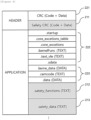
- the memory 200 may include a first verification information storage area 211 and a second verification information storage area 221 in the header area, and include a first code storage area 212, a first data storage area 213, a second code storage area 222, and a second data storage area 223 in the application area.
- the first verification information storage area 211 may store verification information (e.g., [Safety CRC (Code + Data)]) for verifying whether the first program stored in the first areas 212 and 213 is changed.
- verification information e.g., [Safety CRC (Code + Data)]
- the first verification information storage area 211 may store a checksum value for a cyclic redundancy check (CRC).
- the second verification information storage area 221 may store verification information (e.g., [CRC (Code + Data)]) for verifying whether the second programs stored in the second areas 222 and 223 are changed.
- verification information e.g., [CRC (Code + Data)]
- the first code storage area 212 may store diagnosis logic (e.g., [.satety_functions (TEXT)]) related to functional safety of the device, and the first data storage area 213 may store set values (eg, [.satety_data (TEXT)]) related to the diagnosis logic stored in the first code storage area 212.
- diagnosis logic e.g., [.satety_functions (TEXT)]
- set values eg, [.satety_data (TEXT)]
- the second code storage area 222 may store control logic unrelated to the functional safety of the device (e.g., [.startup], [.core_excetions_table], [.core_excetions], [.kernelFunc (TEXT)], [.text_vle (TEXT) ],
- control logic unrelated to the functional safety of the device (e.g., [.startup], [.core_excetions_table], [.core_excetions], [.kernelFunc (TEXT)], [.text_vle (TEXT) ]
- the second data storage area 223 may store data related to the control logic stored in the second code storage area 222 ( For example, [.kerne_data (DATA)], [.ramcode (TEXT)], [.data (DATA)]).
- the first program according to the present invention is stored in the first areas 211, 212, and 213, and the second program is stored in the second areas 221, 222, and 223, and thus, they may be managed independently.
- the processor may update the verification information stored in the first verification information storage area 211 of the first area. For example, when data stored in the first code storage area 212 and the first data storage area 213 is changed due to an update of the first program, the processor may create a new value for a checksum stored in the first verification information storage area 211 based on the changed data and update the version information of the first program.
- the processor may update the verification information stored in the second verification information storage area 221 of the second area. For example, when data stored in the second code storage area 222 and the second data storage area 223 is changed due to an update of the second program, the processor may create a new value for a checksum stored in the second verification information storage area 221 based on the changed data and update the version information of the second program.
- FIG. 7 is an operation flowchart of a program management method according to embodiments of the present invention.
- the processor may perform partitioning the memory into a first area and a second area (S710).
- the first area may be defined to be fixedly allocated to a specific location on a non-volatile memory.
- the processor may store a first program related to functional safety of the device in the first area, and store a second program unrelated to the functional safety of the device in the second area (S720).
- the processor may store version information of the first program and version information of the second program in the first area and the second area, respectively.
- the processor may independently update the first and second programs (S730). For example, when the device management system enters an update mode of the device management program, the processor may determine any one of the first and second programs as an update target program based on an identifier included in an update file being input. Thereafter, the processor may independently update only the determined update target program.
- the processor may independently update only the version information of the updated program (S740). For example, when a second program unrelated to functional safety is updated, the processor may change only the version information of the second program (from V1 to V2).
- the version information of the first program which is a functional safety-related program, is maintained, a separate functional safety certification procedure for the device may not be performed.
- the operations of the method according to the embodiments of the present invention may be implemented as a computer-readable program or code on a computer-readable recording medium.
- the computer-readable recording medium includes all types of recording devices in which data readable by a computer system is stored.
- the computer-readable recording medium may be distributed in a network-connected computer system to store and execute computer-readable programs or codes in a distributed manner.
- a block or apparatus corresponds to a method step or feature of a method step.
- aspects described in the context of a method may also represent a feature of a corresponding block or item or a corresponding apparatus.
- Some or all of the method steps may be performed by (or using) a hardware device, such as, for example, a microprocessor, a programmable computer, or an electronic circuit. In some embodiments, one or more of the most important method steps may be performed by such an apparatus.
Landscapes
- Engineering & Computer Science (AREA)
- Theoretical Computer Science (AREA)
- General Engineering & Computer Science (AREA)
- Software Systems (AREA)
- General Physics & Mathematics (AREA)
- Physics & Mathematics (AREA)
- Computer Security & Cryptography (AREA)
- Human Computer Interaction (AREA)
- General Health & Medical Sciences (AREA)
- Computer Hardware Design (AREA)
- Bioethics (AREA)
- Health & Medical Sciences (AREA)
- Manufacturing & Machinery (AREA)
- Chemical & Material Sciences (AREA)
- Chemical Kinetics & Catalysis (AREA)
- Electrochemistry (AREA)
- General Chemical & Material Sciences (AREA)
- Stored Programmes (AREA)
- Techniques For Improving Reliability Of Storages (AREA)
Abstract
Description
- This application claims priority to and the benefit of
Korean Patent Application No.10-2022- 0164431 filed in the Korean Intellectual Property Office on November 30, 2022 - The present invention relates to a device management system and a program management method thereof, and more particularly, to a device management system including a partitioned memory and a program management method system using the memory.
- An energy storage system relates to various technologies, including renewable energy, a battery that stores electric power, and a power grid. Recently, as supply of smart grid and renewable energy is expanding, and efficiency and stability of power systems are emphasized, a demand for energy storage systems for power supply and demand control and power quality improvement is increasing. Depending on a purpose of use, energy storage systems may have different output and capacity. In order to configure a large-capacity energy storage system, a plurality of battery systems may be connected to provide the large-capacity energy storage system.
- For example, an energy storage system applied to a photovoltaic (PV) system may include a battery section composed of a plurality of batteries, a battery management system (BMS) for battery management, a power conversion system (PCS), an energy management system (EMS), a DC-DC converter, and the like.
- Among them, the battery management system is a core component for managing batteries which collects state information of batteries included in the battery system, diagnoses failure based on the state information, and controls the operating state of the battery through interworking with a higher controller.
- The battery management system may perform predefined operations through a management program (e.g., firmware) stored in a memory. During operation of the battery system, a management program may be updated to change or add a specific function.
- The battery management system is subject to functional safety certification in accordance with relevant laws and regulations, and additional certification is required when the management program is updated. In this case, there arises a problem in that unnecessary time and cost are consumed because a functional safety certification procedure should be performed even when a function unrelated to the functional safety item is updated.
- To obviate one or more problems of the related art, embodiments of the present disclosure provide a device management system that manages a device management program using a partitioned memory.
- To obviate one or more problems of the related art, embodiments of the present disclosure also provide a program management method of the device management system.
- In order to achieve the objective of the present disclosure, a device management system that is interconnected with and manages the device may include at least one processor; and a memory configured to store a device management program including at least one instruction executed by the at least one processor.
- Here, the at least one processor may store a first program and a second program separately in independently partitioned areas in the memory, wherein the first program is related to functional safety of the device and the second program is unrelated to the functional safety of the device.
- The at least one processor separately may store version information of the first program and version information of the second program in the memory.
- The at least one processor independently may update only version information of an updated program, when any one of the first program and the second program is updated.
- When an update mode of the device management program is entered, the at least one processor may update only one of the first program and the second program, or sequentially updates the first program and the second program.
- The memory may include: a first area in which the first program is stored; and a second area in which the second program is stored.
- Here, the first area may be defined to be assigned to a fixed specific location on the memory.
- Each of the first area and the second area may include: a verification information storage area in which verification information for verifying whether data stored in each area is changed is stored; a code storage area for storing control logic for the device; and data storage area for storing data necessary for management or control of the device.
- Here, a first code storage area included in the first area may store diagnosis logic related to the functional safety of the device, and a first data storage area included in the first area may store set values related to the diagnosis logic.
- The at least one processor may update verification information stored in a first verification information storage area of the first area in the instance that data stored in at least one of the first code storage area and the first data storage area is changed.
- The memory may correspond to a non-volatile memory.
- The device management system may correspond to a battery management system located within a battery system.
- According to another embodiment of the present disclosure, a program management method of a device management system including at least one processor and a memory for storing a device management program, the method may include :separately storing, by the processor, a first program and a second program in independently partitioned areas in the memory, wherein the first program is related to a functional safety of the device and the second program is unrelated to the functional safety of the device; and separately storing, by the processor, version information of the first program and version information of the second program, in the memory.
- The method may further include independently updating only version information of an updated program, when any one of the first program and the second program is updated.
- The method may further include determining one of the first program and the second program as an update target program when an update mode of the device management program is entered; and independently updating the determined update target program.
- The separately storing the first program and the second program in independently partitioned areas may include allocating an area where the first program is stored to a fixed specific location on the memory.
- The memory may include a first area in which the first program is stored; and a second area in which the second program is stored. Here, each of the first area and the second area may include: a verification information storage area in which verification information for verifying whether data stored in each area is changed is stored; a code storage area for storing control logic for the device; and data storage area for storing data necessary for management or control of the device.
- The separately storing the first program and the second program in independently partitioned areas may include storing diagnosis logic related to the functional safety of the device in a first code storage area included in the first area and storing set values related to the diagnosis logic in a first data storage area included in the first area.
- The method may further include updating verification information stored in a first verification information storage area of the first area in the instance that data stored in at least one of the first code storage area and the first data storage area is changed.
- According to embodiments of the present disclosure, when updating a device management program, it is possible to independently update only some of the functions that need to be changed, by separating the device management program into a functional safety related program and a general program and managing them independently, thereby improving program management efficiency.
- In addition, according to embodiments of the present invention, unnecessary certification procedures can be minimized by performing a functional safety certification procedure only when a functional safety related program included in the device management program is updated.
-
-
FIG. 1 is a block diagram of an energy storage system to which the present invention may be applied. -
FIG. 2 is a block diagram of a memory included in a typical battery management system. -
FIG. 3 is a block diagram of a device management system according to embodiments of the present invention. -
FIG. 4 is a block diagram of a memory included in a device management system according to embodiments of the present invention. -
FIG. 5 illustrates partitioned areas of memory according to embodiments of the present invention. -
FIG. 6 shows an example of a memory according to embodiments of the present invention. -
FIG. 7 is an operation flowchart of a program management method according to embodiments of the present invention. -
- 100:
- processor
- 200:
- memory
- 210:
- first area
- 211:
- first verification information storage area
- 212:
- first code storage area
- 213:
- first data storage area
- 220:
- second area
- 221:
- second verification information storage area
- 222:
- second code storage area
- 223:
- second data storage area
- 300:
- transceiver
- 400:
- input interface
- 500:
- output interface
- 600:
- storage device
- 700:
- bus
- The present invention may be modified in various forms and have various embodiments, and specific embodiments thereof are shown by way of example in the drawings and will be described in detail below. It should be understood, however, that there is no intent to limit the present invention to the specific embodiments, but on the contrary, the present invention is to cover all modifications, equivalents, and alternatives falling within the spirit and technical scope of the present invention. Like reference numerals refer to like elements throughout the description of the figures.
- It will be understood that, although the terms such as first, second, A, B, and the like may be used herein to describe various elements, these elements should not be limited by these terms. These terms are only used to distinguish one element from another. For example, a first element could be termed a second element, and, similarly, a second element could be termed a first element, without departing from the scope of the present invention. As used herein, the term "and/or" includes combinations of a plurality of associated listed items or any of the plurality of associated listed items.
- It will be understood that when an element is referred to as being "coupled" or "connected" to another element, it can be directly coupled or connected to the other element or an intervening element may be present. In contrast, when an element is referred to as being "directly coupled" or "directly connected" to another element, there is no intervening element present.
- The terms used herein is for the purpose of describing specific embodiments only and are not intended to limit the present invention. As used herein, the singular forms "a", "an" and "the" are intended to include the plural forms as well, unless the context clearly indicates otherwise. It will be further understood that the terms "comprises", "comprising", "includes", "including" and/or "having", when used herein, specify the presence of stated features, integers, steps, operations, constitutional elements, components and/or combinations thereof, but do not preclude the presence or addition of one or more other features, integers, steps, operations, constitutional elements, components, and/or combinations thereof.
- Unless otherwise defined, all terms used herein, including technical and scientific terms, have the same meanings as commonly understood by one skilled in the art to which the present invention belongs. It will be further understood that terms, such as those defined in commonly used dictionaries, should be interpreted as having meanings that are consistent with their meanings in the context of the relevant art and will not be interpreted in an idealized or overly formal sense unless expressly so defined herein.
- Some terms used herein are defined as follows.
- Nominal Capacity (Nominal Capa.) refers to a set capacity [Ah] of the battery which is set by a battery manufacturer during development.
- State of Charge (SOC) refers to a current state of charge of a battery, represented in percent points [%], and State of Health (SOH) may be a current condition of a battery compared to its ideal or original conditions, represented in percent points [%].
- A battery rack refers to a system of a single structure assembled by connecting packs (or modules) set by a battery manufacturer in series/parallel, which can be monitored and controlled by a battery management system (BMS). A battery rack may include several battery packs (or modules) and a battery protection unit or any other protection device.
- A battery bank refers to a group of large-scale battery rack systems configured by connecting several racks in parallel. A bank BMS for a battery bank may monitor and control several rack BMSs, each of which manages a battery rack.
- A battery section controller (BSC) refers to a device that controls the topmost level of a battery system including a bank level battery system and is also used as a control device in a battery system with a multiple bank level structure.
-
FIG. 1 is a block diagram of an energy storage system to which the present invention may be applied. -
FIG. 1 shows an example of a DC coupled system in which an output terminal of a photovoltaic system (PV) 7 is connected to an output terminal of a DC/DC converter 5 and an input terminal of aPCS 4. - In an energy storage system (ESS), a battery is used for storing energy or power, and multiple battery modules may form a battery rack and multiple battery racks may form a battery bank. Here, depending on a device or a system in which the battery is used, a battery rack may be referred to as a battery pack.
Battery # 1,battery # 2,..., battery #N shown inFIG. 1 may be in a form of a battery pack or battery rack. - Here, a battery management system (BMS) may be installed for each
battery 1. The BMS may monitor a current, a voltage and a temperature of each battery rack (or pack) to be managed, calculate a state of charge (SOC) of the battery based on monitoring results to control charging and discharging. When each battery is a battery rack in the system ofFIG. 1 , the BMS may be a rack BMS (RBMS). - A battery section controller (BSC) 2 may be located in each battery section which includes a plurality of batteries, peripheral circuits, and devices to monitor and control objects such as a voltage, a current, a temperature, and a circuit breaker.
- Furthermore, a power conversion/conditioning system (PCS) 4 installed in each battery section controls power supplied from the outside and power supplied from the battery section to the outside and may include a DC/AC inverter. In addition, the output of the DC/
DC converter 5 may be connected to thepower conversion system 4 and thepower conversion system 400 may be connected to apower grid 6. ThePCS 4 normally operates in a constant power mode. A power management system (PMS) or an energy management system (EMS) 3 connected to the power conversion system may control output of the power conversion system based on monitoring and control results of the BMS or BSC. - Meanwhile, CAN (Controller Area Network) or Ethernet may be used for communication (indicated by a dotted line in
FIG. 1 ) between the BMS, theBSC 2, thePMS 3 and thepower conversion system 4. -
FIG. 2 is a block diagram of a memory included in a typical battery management system. - Among components included in an energy storage system, the battery management system (BMS) is a core component for managing batteries which collects state information of the batteries included in the battery system, diagnoses failure based on the state information, and controls the operating state of the battery through interworking with a high level controller.
- The battery management system may perform predefined operations through a management program (eg, firmware) stored in a memory.
- Referring to
FIG. 2 , a memory included in the battery management system may include aheader area 10 and anapplication area 20. Theheader area 10 may store verification information (e.g., a checksum value) for verifying whether data stored in theapplication area 20 is changed and theapplication area 20 may store control logic for battery management and data necessary for control. The battery management system may operate according to a management program stored in the memory. - The battery management system must be certified to meet requirements for functional safety in accordance with relevant laws and regulations. Here, even when the management program of the battery management system is updated during operation of the energy storage system, additional certification is required.
- As shown in
FIG. 2 , in a case of a typical battery management system, even when an item irrelevant to functional safety is updated, a functional safety certification procedure must be performed, since management programs are not functionally separated on memory. Whenever an update of the management program is performed, a certification procedure should be performed, resulting in unnecessary time and expense. - The present invention is presented to solve the problems and proposes a device management system and a program management method thereof, which can improve program management efficiency and minimize unnecessary certification procedures at the same time.
- Hereinafter, preferred embodiments according to the present invention will be described in detail with reference to the accompanying drawings.
-
FIG. 3 is a block diagram of a device management system according to embodiments of the present invention. - A device management system according to embodiments of the present invention may be a battery management system (BMS) located in a battery system included in an energy storage system. However, the scope of the present invention is not limited to this, and any apparatus that manages a specific device using a device management program installed in a memory in association with the specific device should be interpreted as a device management system according to the present invention.
- The device management system may include at least one
processor 100, amemory 200 for storing a device management program including at least one command executed through the at least one processor, and atransceiver 300 connected to a network to perform communication. - The device management program may include a first program related to functional safety of the device and a second program irrelevant to the functional safety of the device. For example, the first program may include a state diagnosis program for diagnosing a state of the battery by measuring voltage, current, and temperature of the battery.
- The at least one command executed by the at least one processor may include a command to separately store the first program and the second program in independently partitioned areas within a memory.
- The command to store may further include a command to allocate an area where the first program is stored to a fixed location on the memory.
- The at least one command may further include a command for separately storing version information of the first program and version information of the second program in the memory.
- The at least one command may further include a command to determine one of the first program and the second program as an update target program when the device management program enters an update mode; and a command to independently update the determined update target program.
- The at least one command may further include a command to independently update only version information of an updated program, when any one of the first program and the second program is updated.
- The device management system may further include an
input interface 400, anoutput interface 500, astorage device 600, and the like. Respective components included in the device management system may be connected by abus 700 to communicate with each other. - The
processor 100 may execute program commands stored in at least one of thememory 200 and thestorage device 600. Here, the processor may mean a central processing unit (CPU), a graphics processing unit (GPU), or a dedicated processor on which methods according to embodiments of the present invention are performed. The memory (or storage device) may include at least one of a volatile storage medium and a non-volatile storage medium. For example, the memory may include at least one of read only memory (ROM) and random access memory (RAM). - In embodiments, the device management program according to the present invention may be stored and managed in a non-volatile memory. For example, the device management program may be stored and managed in a read-only memory (ROM).
-
FIG. 4 is a block diagram of a memory included in a device management system according to embodiments of the present invention. - Referring to
FIG. 4 , thememory 200 may include afirst area 210 and asecond area 220. Here, the first and second areas may correspond to specific areas which are independently partitioned in the memory. - The device management program according to the present invention may include a first program related to functional safety of the device and a second program unrelated to the functional safety of the device. Here, the processor may separately store the first program in the
first area 210 and the second program in thesecond area 220. In other words, device management programs according to the present invention may be configured to be separated into a safety-related program and a general program and the device management system may be configured to store and manage them independently. - In the embodiments, the
first area 210 may be defined to be fixedly allocated to a specific location on a memory. For example, safety-related programs may be defined to be stored in a fixed location in ROM. - Version information for the first program and version information for the second program may be separately stored in the
memory 200. In an embodiment, version information for the first program may be stored in thefirst area 210 and version information for the second program may be stored in thesecond area 220. Accordingly, even if one of the version information of the first and second programs is changed, the version information of the other program whose version is not changed may be maintained. - The first and second programs may be independently updated. In other words, the first and second programs may not be updated simultaneously, but only one of them may be updated or they may be updated sequentially.
- For example, when the device management system enters an update mode of the device management program, the processor may determine any one of the first and second programs as an update target program. Here, the update target program may be determined based on an identifier included in an update file being input. Thereafter, the processor may independently update only the determined update target program.
- When any one of the first program and the second program is updated, only version information of the updated program may be independently updated. For example, when a second program unrelated to functional safety is updated, the processor may change only the version information of the second program (from V1 to V2). Here, since version information of the first program, which is a functional safety-related program, is maintained, a separate functional safety certification procedure for the device may not be performed.
-
FIG. 5 illustrates partitioned areas of memory according to embodiments of the present invention andFIG. 6 shows an example of a memory according to embodiments of the present invention. - The
memory 200 may include a first area and a second area. Here, the first area may be configured to store a first program related to functional safety of the device, and the second area may be configured to store a second program unrelated to the functional safety. - Referring to
FIG. 5 , the first area may include a first verificationinformation storage area 211, a firstcode storage area 212, and a firstdata storage area 213, and a second area may include a second verificationinformation storage area 221, a secondcode storage area 222, and a seconddata storage area 223. - The verification information storage area may store verification information for verifying whether data stored in another area is changed. For example, the verification information storage area may store a checksum value for a cyclic redundancy check (CRC).
- The code storage area may store logic for managing or controlling the device. For example, the code storage area may store codes for monitoring, diagnosing, or controlling the device.
- The data storage area may store data required for device management or control.
- The first verification
information storage area 211 and the second verificationinformation storage area 221 are included in a header area of thememory 200, and the firstcode storage area 212, the firstdata storage area 213, the secondcode storage area 222, and the seconddata storage area 223 may be included in an application area of thememory 200. - The first
code storage area 212 may store diagnosis logic related to functional safety of the device, and the firstdata storage area 213 may store set values related to the diagnosis logic stored in the firstcode storage area 212. For example, when the device management system according to the present invention is a battery management system located in a battery system, the firstcode storage area 212 may store measurement logic of voltage, current, and temperature for diagnosing a state of the battery and state diagnosis logic based on measured values. Furthermore, the firstdata storage area 213 may store set values of diagnosis (eg, a reference threshold value, etc.) for diagnosing a battery state. - Referring to
FIG. 6 , thememory 200 according to embodiments of the present invention may include a first verificationinformation storage area 211 and a second verificationinformation storage area 221 in the header area, and include a firstcode storage area 212, a firstdata storage area 213, a secondcode storage area 222, and a seconddata storage area 223 in the application area. - The first verification
information storage area 211 may store verification information (e.g., [Safety CRC (Code + Data)]) for verifying whether the first program stored in thefirst areas information storage area 211 may store a checksum value for a cyclic redundancy check (CRC). - In addition, the second verification
information storage area 221 may store verification information (e.g., [CRC (Code + Data)]) for verifying whether the second programs stored in thesecond areas - The first
code storage area 212 may store diagnosis logic (e.g., [.satety_functions (TEXT)]) related to functional safety of the device, and the firstdata storage area 213 may store set values (eg, [.satety_data (TEXT)]) related to the diagnosis logic stored in the firstcode storage area 212. - In addition, the second
code storage area 222 may store control logic unrelated to the functional safety of the device (e.g., [.startup], [.core_excetions_table], [.core_excetions], [.kernelFunc (TEXT)], [.text_vle (TEXT) ], - [.sdata]), and the second
data storage area 223 may store data related to the control logic stored in the second code storage area 222 ( For example, [.kerne_data (DATA)], [.ramcode (TEXT)], [.data (DATA)]). - Referring to
FIGS. 5 and6 , the first program according to the present invention is stored in thefirst areas second areas - When data stored in at least one of the first
code storage area 212 and the firstdata storage area 213 is changed, the processor may update the verification information stored in the first verificationinformation storage area 211 of the first area. For example, when data stored in the firstcode storage area 212 and the firstdata storage area 213 is changed due to an update of the first program, the processor may create a new value for a checksum stored in the first verificationinformation storage area 211 based on the changed data and update the version information of the first program. - In addition, when data stored in at least one of the second
code storage area 222 and the seconddata storage area 223 is changed, the processor may update the verification information stored in the second verificationinformation storage area 221 of the second area. For example, when data stored in the secondcode storage area 222 and the seconddata storage area 223 is changed due to an update of the second program, the processor may create a new value for a checksum stored in the second verificationinformation storage area 221 based on the changed data and update the version information of the second program. -
FIG. 7 is an operation flowchart of a program management method according to embodiments of the present invention. - The processor may perform partitioning the memory into a first area and a second area (S710). Here, the first area may be defined to be fixedly allocated to a specific location on a non-volatile memory.
- The processor may store a first program related to functional safety of the device in the first area, and store a second program unrelated to the functional safety of the device in the second area (S720). Here, the processor may store version information of the first program and version information of the second program in the first area and the second area, respectively.
- The processor may independently update the first and second programs (S730). For example, when the device management system enters an update mode of the device management program, the processor may determine any one of the first and second programs as an update target program based on an identifier included in an update file being input. Thereafter, the processor may independently update only the determined update target program.
- When any one of the first program and the second program is updated, the processor may independently update only the version information of the updated program (S740). For example, when a second program unrelated to functional safety is updated, the processor may change only the version information of the second program (from V1 to V2). Here, since the version information of the first program, which is a functional safety-related program, is maintained, a separate functional safety certification procedure for the device may not be performed.
- The operations of the method according to the embodiments of the present invention may be implemented as a computer-readable program or code on a computer-readable recording medium. The computer-readable recording medium includes all types of recording devices in which data readable by a computer system is stored. In addition, the computer-readable recording medium may be distributed in a network-connected computer system to store and execute computer-readable programs or codes in a distributed manner.
- Although some aspects of the invention have been described in the context of the apparatus, it may also represent a description according to a corresponding method, wherein a block or apparatus corresponds to a method step or feature of a method step. Similarly, aspects described in the context of a method may also represent a feature of a corresponding block or item or a corresponding apparatus. Some or all of the method steps may be performed by (or using) a hardware device, such as, for example, a microprocessor, a programmable computer, or an electronic circuit. In some embodiments, one or more of the most important method steps may be performed by such an apparatus.
- In the forgoing, the present invention has been described with reference to the exemplary embodiment of the present invention, but those skilled in the art may appreciate that the present invention may be variously corrected and changed within the range without departing from the spirit and the area of the present invention described in the appending claims.
Claims (18)
- A device management system that is interconnected with and manages the device, the system comprising:at least one processor; anda memory configured to store a device management program including at least one instruction executed by the at least one processor,wherein the at least one processor stores a first program and a second program separately in independently partitioned areas in the memory, wherein the first program is related to functional safety of the device and the second program is unrelated to the functional safety of the device.
- The system of claim 1, wherein the at least one processor separately stores version information of the first program and version information of the second program in the memory.
- The system of claim 2, wherein the at least one processor independently updates only version information of an updated program, when any one of the first program and the second program is updated.
- The system of claim 1, wherein, when an update mode of the device management program is entered, the at least one processor updates only one of the first program and the second program, or sequentially updates the first program and the second program.
- The system of claim 1, wherein the memory includes:a first area in which the first program is stored; anda second area in which the second program is stored.
- The system of claim 5, wherein the first area is defined to be assigned to a fixed specific location on the memory.
- The system of claim 5, wherein each of the first area and the second area includes:a verification information storage area in which verification information for verifying whether data stored in each area is changed is stored;a code storage area for storing control logic for the device; anddata storage area for storing data necessary for management or control of the device.
- The system of claim 7, wherein a first code storage area included in the first area stores diagnosis logic related to the functional safety of the device, and
a first data storage area included in the first area stores set values related to the diagnosis logic. - The system of claim 8, wherein the at least one processor updates verification information stored in a first verification information storage area of the first area in the instance that data stored in at least one of the first code storage area and the first data storage area is changed.
- The system of claim 1, wherein the memory is a non-volatile memory.
- The system of claim 1, wherein the device management system is a battery management system located within a battery system.
- A program management method of a device management system including at least one processor and a memory for storing a device management program, the method comprising:separately storing, by the processor, a first program and a second program in independently partitioned areas in the memory, wherein the first program is related to a functional safety of the device and the second program is unrelated to the functional safety of the device; andseparately storing, by the processor, version information of the first program and version information of the second program, in the memory.
- The method of claim 12, further comprising independently updating only version information of an updated program, when any one of the first program and the second program is updated.
- The method of claim 12, further comprising:determining one of the first program and the second program as an update target program when an update mode of the device management program is entered; andindependently updating the determined update target program.
- The method of claim 12, wherein the separately storing the first program and the second program in independently partitioned areas includes allocating an area where the first program is stored to a fixed specific location on the memory.
- The method of claim 12, wherein the memory includes a first area in which the first program is stored; and a second area in which the second program is stored, and
each of the first area and the second area includes:a verification information storage area in which verification information for verifying whether data stored in each area is changed is stored;a code storage area for storing control logic for the device; anddata storage area for storing data necessary for management or control of the device. - The method of claim 16, wherein the separately storing the first program and the second program in independently partitioned areas includes storing diagnosis logic related to the functional safety of the device in a first code storage area included in the first area and storing set values related to the diagnosis logic in a first data storage area included in the first area.
- The method of claim 17, wherein, further comprising, updating verification information stored in a first verification information storage area of the first area in the instance that data stored in at least one of the first code storage area and the first data storage area is changed.
Applications Claiming Priority (2)
| Application Number | Priority Date | Filing Date | Title |
|---|---|---|---|
| KR1020220164431A KR20240080785A (en) | 2022-11-30 | 2022-11-30 | Device management system and program management method thereof |
| PCT/KR2023/008431 WO2024117412A1 (en) | 2022-11-30 | 2023-06-19 | Device management system and program management method thereof |
Publications (3)
| Publication Number | Publication Date |
|---|---|
| EP4439281A1 true EP4439281A1 (en) | 2024-10-02 |
| EP4439281A4 EP4439281A4 (en) | 2025-04-23 |
| EP4439281B1 EP4439281B1 (en) | 2026-02-18 |
Family
ID=91324315
Family Applications (1)
| Application Number | Title | Priority Date | Filing Date |
|---|---|---|---|
| EP23897952.0A Active EP4439281B1 (en) | 2022-11-30 | 2023-06-19 | Device management system and program management method thereof |
Country Status (7)
| Country | Link |
|---|---|
| US (1) | US20250085966A1 (en) |
| EP (1) | EP4439281B1 (en) |
| JP (1) | JP2025501400A (en) |
| KR (1) | KR20240080785A (en) |
| CN (1) | CN118451397A (en) |
| ES (1) | ES3064325T3 (en) |
| WO (1) | WO2024117412A1 (en) |
Family Cites Families (12)
| Publication number | Priority date | Publication date | Assignee | Title |
|---|---|---|---|---|
| KR100880783B1 (en) * | 2003-09-03 | 2009-02-02 | 휴렛-팩커드 디벨롭먼트 컴퍼니, 엘 피 | 3-step boot process on electronics |
| KR100719131B1 (en) * | 2005-10-31 | 2007-05-17 | 삼성전자주식회사 | Program update method and image processing device performing the same |
| KR101498756B1 (en) * | 2011-10-26 | 2015-03-04 | 주식회사 엘지화학 | Embedded device for managing battery, software installation device and method thereof |
| JP6020159B2 (en) * | 2012-12-27 | 2016-11-02 | 株式会社リコー | Information processing apparatus and information processing method |
| JP6145345B2 (en) * | 2013-07-22 | 2017-06-07 | 日立オートモティブシステムズ株式会社 | Electronic control unit for automobile |
| WO2018142751A1 (en) * | 2017-02-01 | 2018-08-09 | 住友電気工業株式会社 | Control device, program update method, and computer program |
| US20190258812A1 (en) * | 2018-02-20 | 2019-08-22 | Sensata Technologies, Inc. | Memory security for automotive functional safety compliance with independent downstream processes |
| CN112394965B (en) * | 2019-08-13 | 2022-08-09 | 比亚迪股份有限公司 | Battery management system upgrade and operation method, controller, battery management system and storage medium |
| KR102844878B1 (en) | 2019-10-30 | 2025-08-11 | 주식회사 엘지에너지솔루션 | Battery management system and memory managing method thereof |
| KR20210070803A (en) * | 2019-12-05 | 2021-06-15 | 주식회사 엘지에너지솔루션 | Method for automatic updating bootloader and battery management system |
| KR20220164431A (en) | 2021-06-04 | 2022-12-13 | 삼성전자주식회사 | Electronic device including a touchscreen and method of operating the same |
| CN113608757B (en) * | 2021-06-17 | 2024-12-13 | 深圳市元征未来汽车技术有限公司 | Data processing method and related device of tire pressure sensor |
-
2022
- 2022-11-30 KR KR1020220164431A patent/KR20240080785A/en active Pending
-
2023
- 2023-06-19 CN CN202380015730.6A patent/CN118451397A/en active Pending
- 2023-06-19 ES ES23897952T patent/ES3064325T3/en active Active
- 2023-06-19 US US18/728,508 patent/US20250085966A1/en active Pending
- 2023-06-19 JP JP2024542057A patent/JP2025501400A/en active Pending
- 2023-06-19 WO PCT/KR2023/008431 patent/WO2024117412A1/en not_active Ceased
- 2023-06-19 EP EP23897952.0A patent/EP4439281B1/en active Active
Also Published As
| Publication number | Publication date |
|---|---|
| US20250085966A1 (en) | 2025-03-13 |
| EP4439281B1 (en) | 2026-02-18 |
| JP2025501400A (en) | 2025-01-17 |
| CN118451397A (en) | 2024-08-06 |
| EP4439281A4 (en) | 2025-04-23 |
| ES3064325T3 (en) | 2026-04-23 |
| KR20240080785A (en) | 2024-06-07 |
| WO2024117412A1 (en) | 2024-06-06 |
Similar Documents
| Publication | Publication Date | Title |
|---|---|---|
| EP2629391A1 (en) | Method and system for setting up sequential ids for multiple slaves of a battery pack | |
| CN112005425A (en) | Data center's stand-by power supply system, stand-by battery frame | |
| CN115664932B (en) | Energy block parallel communication method and device | |
| US20240030710A1 (en) | Power distribution method and energy storage system using same | |
| US20250085966A1 (en) | Device Management System and Program Management Method Thereof | |
| EP4415209A1 (en) | Battery control device for responding to loss of communication situation, and energy storage system comprising same | |
| EP4414727B1 (en) | Battery diagnosis apparatus and method for leakage current detection | |
| AU2023240741A1 (en) | Energy storage system for optimal operation of newly installed battery rack and control method therefor | |
| EP4546607A1 (en) | Battery management device, battery system, and battery module assembly balancing method | |
| AU2025260165A1 (en) | Battery system and interworking method in battery system | |
| EP4407832A1 (en) | Apparatus and method for establishing operation plan for battery system comprising newly installed batteries | |
| US20240204272A1 (en) | Battery control system for preventing cell imbalance and operating method thereof | |
| EP4414730B1 (en) | Energy storage system for responding to abnormal communication situation and method thereof | |
| JP7673894B2 (en) | Battery system for sequential charging of batteries and control method thereof | |
| EP4693809A1 (en) | Battery system and operating method thereof | |
| US20240313549A1 (en) | Circuit For Battery Storage Management And Method For Battery Storage Management In This Circuit | |
| AU2022342981A1 (en) | Energy storage system comprising new installation battery rack, and method for controlling same | |
| CN122003613A (en) | Battery abnormality diagnosis apparatus and method | |
| CN117791764A (en) | Storage system | |
| CN121336340A (en) | Battery control device and method | |
| CN118140378A (en) | Battery control device for communication loss and energy storage system including the same | |
| KR20250085138A (en) | Battery charging method and battery management apparatus using the same | |
| AU2025300925A1 (en) | Battery management device and bms data replication method | |
| CN118159857A (en) | Battery control device for communication loss and energy storage system including the battery control device |
Legal Events
| Date | Code | Title | Description |
|---|---|---|---|
| STAA | Information on the status of an ep patent application or granted ep patent |
Free format text: STATUS: THE INTERNATIONAL PUBLICATION HAS BEEN MADE |
|
| PUAI | Public reference made under article 153(3) epc to a published international application that has entered the european phase |
Free format text: ORIGINAL CODE: 0009012 |
|
| STAA | Information on the status of an ep patent application or granted ep patent |
Free format text: STATUS: REQUEST FOR EXAMINATION WAS MADE |
|
| 17P | Request for examination filed |
Effective date: 20240625 |
|
| AK | Designated contracting states |
Kind code of ref document: A1 Designated state(s): AL AT BE BG CH CY CZ DE DK EE ES FI FR GB GR HR HU IE IS IT LI LT LU LV MC ME MK MT NL NO PL PT RO RS SE SI SK SM TR |
|
| A4 | Supplementary search report drawn up and despatched |
Effective date: 20250324 |
|
| RIC1 | Information provided on ipc code assigned before grant |
Ipc: H01M 10/42 20060101ALI20250318BHEP Ipc: G06F 21/64 20130101ALI20250318BHEP Ipc: G06F 3/06 20060101ALI20250318BHEP Ipc: G06F 8/65 20180101ALI20250318BHEP Ipc: G06F 8/71 20180101AFI20250318BHEP |
|
| STAA | Information on the status of an ep patent application or granted ep patent |
Free format text: STATUS: EXAMINATION IS IN PROGRESS |
|
| 17Q | First examination report despatched |
Effective date: 20250702 |
|
| GRAP | Despatch of communication of intention to grant a patent |
Free format text: ORIGINAL CODE: EPIDOSNIGR1 |
|
| STAA | Information on the status of an ep patent application or granted ep patent |
Free format text: STATUS: GRANT OF PATENT IS INTENDED |
|
| INTG | Intention to grant announced |
Effective date: 20251016 |
|
| GRAS | Grant fee paid |
Free format text: ORIGINAL CODE: EPIDOSNIGR3 |
|
| GRAA | (expected) grant |
Free format text: ORIGINAL CODE: 0009210 |
|
| STAA | Information on the status of an ep patent application or granted ep patent |
Free format text: STATUS: THE PATENT HAS BEEN GRANTED |
|
| P01 | Opt-out of the competence of the unified patent court (upc) registered |
Free format text: CASE NUMBER: UPC_APP_0019690_4439281/2025 Effective date: 20251230 |
|
| AK | Designated contracting states |
Kind code of ref document: B1 Designated state(s): AL AT BE BG CH CY CZ DE DK EE ES FI FR GB GR HR HU IE IS IT LI LT LU LV MC ME MK MT NL NO PL PT RO RS SE SI SK SM TR |
|
| DAV | Request for validation of the european patent (deleted) | ||
| DAX | Request for extension of the european patent (deleted) | ||
| REG | Reference to a national code |
Ref country code: CH Ref legal event code: F10 Free format text: ST27 STATUS EVENT CODE: U-0-0-F10-F00 (AS PROVIDED BY THE NATIONAL OFFICE) Effective date: 20260218 Ref country code: GB Ref legal event code: FG4D |
|
| REG | Reference to a national code |
Ref country code: DE Ref legal event code: R096 Ref document number: 602023012373 Country of ref document: DE |
|
| REG | Reference to a national code |
Ref country code: IE Ref legal event code: FG4D |
|
| REG | Reference to a national code |
Ref country code: ES Ref legal event code: FG2A Ref document number: 3064325 Country of ref document: ES Kind code of ref document: T3 Effective date: 20260423 |