EP4439195A1 - Watch component and method of decorating watch component - Google Patents
Watch component and method of decorating watch component Download PDFInfo
- Publication number
- EP4439195A1 EP4439195A1 EP24167244.3A EP24167244A EP4439195A1 EP 4439195 A1 EP4439195 A1 EP 4439195A1 EP 24167244 A EP24167244 A EP 24167244A EP 4439195 A1 EP4439195 A1 EP 4439195A1
- Authority
- EP
- European Patent Office
- Prior art keywords
- pattern
- base material
- watch component
- expressed
- displayed
- Prior art date
- Legal status (The legal status is an assumption and is not a legal conclusion. Google has not performed a legal analysis and makes no representation as to the accuracy of the status listed.)
- Pending
Links
Images



Classifications
-
- G—PHYSICS
- G04—HOROLOGY
- G04D—APPARATUS OR TOOLS SPECIALLY DESIGNED FOR MAKING OR MAINTAINING CLOCKS OR WATCHES
- G04D3/00—Watchmakers' or watch-repairers' machines or tools for working materials
- G04D3/0069—Watchmakers' or watch-repairers' machines or tools for working materials for working with non-mechanical means, e.g. chemical, electrochemical, metallising, vapourising; with electron beams, laser beams
-
- G—PHYSICS
- G04—HOROLOGY
- G04B—MECHANICALLY-DRIVEN CLOCKS OR WATCHES; MECHANICAL PARTS OF CLOCKS OR WATCHES IN GENERAL; TIME PIECES USING THE POSITION OF THE SUN, MOON OR STARS
- G04B19/00—Indicating the time by visual means
- G04B19/06—Dials
-
- G—PHYSICS
- G04—HOROLOGY
- G04B—MECHANICALLY-DRIVEN CLOCKS OR WATCHES; MECHANICAL PARTS OF CLOCKS OR WATCHES IN GENERAL; TIME PIECES USING THE POSITION OF THE SUN, MOON OR STARS
- G04B19/00—Indicating the time by visual means
- G04B19/06—Dials
- G04B19/10—Ornamental shape of the graduations or the surface of the dial; Attachment of the graduations to the dial
-
- G—PHYSICS
- G04—HOROLOGY
- G04B—MECHANICALLY-DRIVEN CLOCKS OR WATCHES; MECHANICAL PARTS OF CLOCKS OR WATCHES IN GENERAL; TIME PIECES USING THE POSITION OF THE SUN, MOON OR STARS
- G04B19/00—Indicating the time by visual means
- G04B19/06—Dials
- G04B19/12—Selection of materials for dials or graduations markings
-
- G—PHYSICS
- G04—HOROLOGY
- G04B—MECHANICALLY-DRIVEN CLOCKS OR WATCHES; MECHANICAL PARTS OF CLOCKS OR WATCHES IN GENERAL; TIME PIECES USING THE POSITION OF THE SUN, MOON OR STARS
- G04B45/00—Time pieces of which the indicating means or cases provoke special effects, e.g. aesthetic effects
- G04B45/0076—Decoration of the case and of parts thereof, e.g. as a method of manufacture thereof
-
- G—PHYSICS
- G04—HOROLOGY
- G04D—APPARATUS OR TOOLS SPECIALLY DESIGNED FOR MAKING OR MAINTAINING CLOCKS OR WATCHES
- G04D3/00—Watchmakers' or watch-repairers' machines or tools for working materials
Definitions
- the present disclosure relates to a watch component and a method of decorating a watch component.
- JP-A-2000-111660 discloses a dial on which a character or an image is formed by subjecting a metal plate with plating to ink-jet printing.
- JP-A-2000-111660 a transparent ink reception layer is formed on a surface of the metal plate with plating, and hence manufacturing of a film or a printing plate is not required. With this, a variety of dials in small quantities can be produced in a short time at a low cost.
- JP-A-2000-111660 a character or an image is simply formed through ink-jet on the surface of the metal plate with plating. Thus, it is difficult to express an innovative design.
- a watch component of the present disclosure includes a base material having a first pattern, wherein a second pattern is displayed by dot-forming a binarized pattern with ink composed of metal nanoparticles on a front surface of the base material, and a desired design is expressed with the first pattern and the second pattern.
- a method of decorating a watch component of the present disclosure includes a first pattern display step for displaying a first pattern on a base material, and a second pattern display step for displaying a second pattern on a surface of the base material by dot-forming a binarized pattern with ink composed of metal nanoparticles.
- a watch 1 according to an embodiment of the present disclosure is described below with reference to the drawings.
- FIG. 1 is a front view illustrating the watch 1.
- the watch 1 is configured as a wristwatch worn on a wrist of a user.
- the watch 1 includes a metal case 2. Further, the case 2 includes, in the inside, a disk-shaped dial 10, a seconds hand 3, a minute hand 4, an hour hand 5, a crown 7, a button A 8, and a button B 9. Note that the dial 10 is an example of the watch component of the present disclosure.
- FIG. 2 is a cross-sectional view illustrating a main part of the dial 10. Note that FIG. 2 is a cross-sectional view taken along a base material 30 of the dial 10 in a thickness direction.
- a plurality of recessed portions 32 are formed in the surface 31 of the base material 30.
- the recessed portions 32 are formed by subjecting the surface 31 of the base material 30 to streak forming processing. More specifically, the surface 31 of the base material 30 is subjected to streak forming processing so that the recessed portions 32 are formed radially from the center.
- the recessed portions 32 are formed so that a first pattern 40 is displayed on the surface 31 of the base material 30.
- the recessed portions 32 are not limited to the above-mentioned configuration.
- the recessed portions 32 may be formed by cutting, laser processing, chemical removal processing, polishing, forging and casting, or the like.
- dots 33 are formed on the surface 31 of the base material 30.
- ink composed of metal nanoparticles impacts on the surface 31 of the base material 30 in accordance with a binarized pattern. In this manner, the dots 33 are formed.
- a second pattern 50 is displayed with the dots 33 on the surface 31 of the base material 30. More specifically, in accordance with the binarized pattern in which the dots are formed radially from the center, the ink composed of the metal nanoparticles is printed onto the surface 31 of the base material 30 through ink-jet printing. With this, the second pattern 50 is displayed.
- the ink composed of the metal nanoparticles is a composition in which the metal nanoparticles are dispersed in a dispersion medium.
- the metal nanoparticles indicates metal particles each having a particle diameter falling within a range of 1 nm or more and 1 ⁇ m or less, and may be configured to contain any one of gold, silver, copper, and platinum.
- the second pattern 50 having luster can be expressed, and a more luxurious design can be expressed.
- the dots 33 are formed to have a diameter D of 11 ⁇ m or more and 60 ⁇ m or less.
- the dots 33 are formed so that the diameter D is 11 ⁇ m or more and 60 ⁇ m or less. With this, the second pattern 50 with the visually-recognizable and fine dots 33 can be expressed.
- FIG. 3 is a view illustrating a decoration step of the dial 10
- FIG. 4 is a front view illustrating an outline of the dial 10.
- the recessed portions 32 are formed by subjecting the surface 31 of the base material 30 to streak forming processing and punching to display the first pattern 40.
- a second pattern display step in accordance with the binarized pattern that is prepared in advance, the surface 31 of the base material 30 is subjected to ink-jet printing with the ink composed of the metal nanoparticles. With this, the dots 33 are formed to display the second pattern 50.
- a transparent film is applied on the surface 31 of the base material 30 on which the dots 33 are formed, and the transparent film is polished.
- the transparent film applied to the surface 31 of the base material 30 is polished.
- the dial 10 is decorated as described above. With this, as illustrated in FIG. 4 , a desired design with the first pattern 40 and the second pattern 50 can be achieved.
- the second pattern can easily be changed by changing the binarized pattern.
- a dial having an impression different from FIG. 4 can easily be provided.
- both the first pattern 40 expressed on the base material 30 and the second pattern 50 displayed by dot-forming the binarized pattern can be recognized visually.
- an innovative design with complexity can be expressed.
- the second pattern 50 is dot-formed with the ink composed of the metal nanoparticles having luster.
- the ink composed of the metal nanoparticles having luster can be obtained.
- the first pattern 40 is displayed by forming the recessed portions 32 radially with respect to the surface 31 of the base material 30, and the second pattern 50 is displayed by forming the dots 33 in accordance with the binarized pattern in which the dots are formed radially.
- the first pattern 40 and the second pattern 50 are associated with each other. With this, as illustrated in FIG. 4 , the first pattern 40 is emphasized by the second pattern 50. Thus, the design that highlights the first pattern 40 can be expressed.
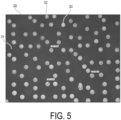
- FIG. 5 is a view illustrating the dots 33 formed by causing the ink composed of the metal nanoparticles to impact on the surface 31 of the base material 30.
- the ink composed of the metal nanoparticles impacts on the surface 31 of the base material 30 to form the dots 33.
- Such dots each has a diameter of approximately 20 ⁇ m, and is formed to have a diameter of 11 ⁇ m or more and 60 ⁇ m or less. Note that this is not limitative when impact positions overlap with each other. In other words, in the present embodiment, at the position at which the ink impact positions do not overlap with each other, the dots 33 are formed to have the diameter D of 11 ⁇ m or more and 60 ⁇ m or less.
- the ink is composed of the metal nanoparticles having an extremely small particle diameter and the surface 31 of the base material 30 is not subjected to water repellent treatment. Consequently, the ink impacting on the surface 31 of the base material 30 spreads to a moderate degree.
- the ink composed of the metal nanoparticles having an extremely small particle diameter impacts on the surface 31 of the base material 30 in a hydrophilic state or a hydrophobic state.
- the dots 33 can be formed to have the diameter D of 11 ⁇ m or more and 60 ⁇ m or less.
- a state in which a contact angle formed between the surface and a tangent to a contour curve of a liquid droplet adhering to the surface is 40 degrees or less is a hydrophilic state.
- a state in which the contact angle is approximately from 40 degrees to 90 degrees is a hydrophobic state.
- a state in which the contact angle exceeds 90 degrees is a water-repellent state.
- the second pattern 50 that is visually recognizable and fine can be expressed by forming the dots 33 described above.
- both the first pattern 40 expressed on the base material 30 and the second pattern 50 displayed by dot-forming the binarized pattern can be recognized visually.
- an innovative design with complexity can be expressed.
- the second pattern 50 is dot-formed with the ink composed of the metal nanoparticles having luster.
- an external appearance with a sense of luxury can be obtained.
- the watch component having a different impression can easily be provided by changing the second pattern 50 formed on the surface 31 of the base material 30.
- the base material 30 is formed of any one of a seashell, a resin, and metal, and hence the texture of those materials can be expressed.
- the first pattern 40 and the second pattern 50 are associated with each other, and the second pattern 50 is dot-formed to emphasize the first pattern 40.
- the design that highlights the first pattern 40 can be expressed.
- the metal nanoparticles for dot-forming the second pattern 50 is configured to contain any one of gold, silver, copper, and platinum.
- the second pattern 50 having luster can be expressed, and a more luxurious design can be expressed.
- the diameter D of the dot formed by causing the ink composed of the metal nanoparticles to impact on the surface 31 of the base material 30 is 11 ⁇ m or more and 60 ⁇ m or less.
- the second pattern 50 with the visually-recognizable and fine dots 33 can be expressed, and a more delicate design can be expressed.
- the surface 31 of the base material 30 is polished.
- the design aesthetics can further be improved.
- the second embodiment is different from the first embodiment described above in that a first pattern 40A is displayed in a matte finish and a second pattern 50A is displayed by forming dots 33A in accordance with a binarized pattern in which dots are formed in a lattice shape.
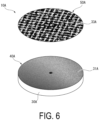
- FIG. 6 is a view illustrating a decoration step of a dial 10A of the second embodiment
- FIG. 7 is a front view illustrating an outline of the dial 10A.
- the first pattern 40A in a matte finish is displayed on a surface 31A of a base material 30A.
- the ink composed of the metal nanoparticles impacts on the surface 31A of the base material 30A on which the first pattern 40A is displayed, in accordance with the binarized pattern in a lattice shape.
- the dots 33A are formed to display the second pattern 50A.
- the complex design in which the first pattern 40A in a matte finish is blurred by the second pattern 50A in a lattice shape can be expressed.
- the dots 33A forming the second pattern 50A are formed with gradation.
- the first pattern 40A in a matte finish is displayed on the surface 31A of the base material 30A, and the second pattern 50A is displayed by forming the dots 33A in accordance with the binarized pattern in a lattice shape.
- the complex design in which the first pattern 40A in a matte finish is blurred by the second pattern 50A in a lattice shape can be expressed.
- the dots 33A forming the second pattern 50A are formed with gradation.
- the design having the part where the first pattern 40A in a matte finish is recognized relatively clearly and the part where the first pattern 40A in a matte finish is recognized relatively unclearly can be expressed.
- the first pattern 40, 40A and the second pattern 50A are displayed on a base body of the base material 30, 30A formed of any one of a seashell, a resin, and metal or a combination thereof, but this is not limitative.
- the base material may be subjected to plating treatment or coating with a coating material. With this, luster and a color of the base material can freely be expressed.
- the first pattern 40 is displayed by forming the recessed portions 32 in the surface 31 of the base material 30, but this is not limitative.
- the first pattern may be displayed by printing or transferring the first pattern with respect to the surface of the base material.
- the base material is formed of a resin having transparency such as polycarbonate, or glass, and the first pattern is displayed on a movement or the like arranged on the back side of the dial. With this, the first pattern may be displayed in a visually recognizable manner through the base material. With this, the design expressed with the first pattern and the second pattern has a sense of depth. Thus, an innovative design with more complexity can be expressed.
- the design expressed with the first pattern 40, 40A and the second pattern 50, 50A may be configured to change in accordance with a visual recognition angle. More specifically, with gradation of the dots 33, 33A forming the second pattern 50, 50A, the design may be configured to change in accordance with a visual recognition angle. With this, the design expressed with the first pattern and the second pattern changes in accordance with a visual recognition angle. Thus, an innovative design with more complexity can be expressed.
- a dark color may be added to the base material 30, 30A, and the second pattern 50, 50A may be displayed with ink having metallic luster.
- a deep color is added to the base material 30, 30A, and hence the second pattern 50, 50A having metallic luster can be highlighted.
- a luxurious design such as gold leaf lacquerware can be expressed.
- the watch component of the present disclosure is configured as the dial 10, 10A, but this is not limitative.
- the watch component of the present disclosure may be configured as one of a case, a dial ring, a glass edge, a movement and a main plate thereof, a hand, an abbreviation, and an oscillating weight.
- a watch component of the present disclosure includes a base material having a first pattern, wherein a second pattern is displayed by dot-forming a binarized pattern with ink composed of metal nanoparticles on a front surface of the base material, and a desired design is expressed with the first pattern and the second pattern.
- both the first pattern expressed on the base material and the second pattern displayed by dot-forming the binarized pattern can be recognized visually.
- an innovative design with complexity can be expressed.
- the second pattern is dot-formed with the ink composed of the metal nanoparticles having luster.
- an external appearance with a sense of luxury can be obtained.
- the watch component having a different impression can easily be provided by changing the second pattern formed on the surface of the base material.
- the base material may be formed of any one of a seashell, a resin, and metal or a combination thereof.
- the base material is formed of any one of a seashell, a resin, and metal or a combination thereof.
- the texture of those materials can be expressed.
- the base material may be subjected to plating treatment or coating with a coating material.
- the base material is subjected to plating treatment or coating with a coating material.
- luster and a color of the vase material can freely be expressed.
- the base material may be formed of a resin having transparency or glass, and the first pattern may be displayed on the surface of the base material or may be displayed in a visually recognizable manner through the base material.
- the base material is formed of a resin having transparency or glass.
- the first pattern can be visually recognizable by displaying the first pattern on a member arranged on the back side of the base material instead of displaying the first pattern directly on the base material.
- the design expressed with the first pattern and the second pattern has a sense of depth, and hence an innovative design with more complexity can be expressed.
- the ink may impact on the surface of the base material to form the dots.
- the second pattern may be displayed.
- the first pattern may be displayed on the member arranged on the back side of the base material.
- the watch component of the present disclosure and the member arranged on the back side of the base material may be assembled with each other. In other words, the order of performing the first pattern display step and the second pattern display step may be switched.
- the first pattern and the second pattern may be associated with each other, and the second pattern may be obtained through dot formation to emphasize the first pattern.
- the first pattern is emphasized more than the second pattern.
- the design that highlights the first pattern can be expressed.
- dots forming the second pattern may be formed with gradation.
- the dots forming the second pattern are formed with gradation, and the design having the part where the first pattern is recognized relatively clearly and the part where the first pattern is recognized relatively unclearly can be expressed.
- the design expressed with the first pattern and the second pattern may be configured to change in accordance with a visual recognition angle.
- the design expressed with the first pattern and the second pattern changes in accordance with a visual recognition angle.
- an innovative design with more complexity can be expressed.
- the metal nanoparticles may be configured to contain any one of gold, silver, copper, and platinum.
- the metal nanoparticles for dot-forming the second pattern is configured to contain any one of gold, silver, copper, and platinum.
- the second patter having luster can be expressed, and a more luxurious design can be expressed.
- a diameter of a dot may be 11 ⁇ m or more and 60 ⁇ m or less, the dot being formed by causing the ink composed of the metal nanoparticles to impact on the surface of the base material.
- a deep color may be added to the base material, and the second pattern may be displayed with the ink having metallic luster.
- the base material is black, and the second pattern is displayed with ink configured to contain gold or silver, a luxurious design such as gold leaf lacquerware can be expressed.
- a method of decorating a watch component of the present disclosure includes a first pattern display step for displaying a first pattern on a base material, and a second pattern display step for displaying a second pattern on a surface of the base material by dot-forming a binarized pattern with ink composed of metal nanoparticles.
- both the first pattern expressed on the base material and the second pattern displayed by dot-forming the binarized pattern can be recognized visually.
- an innovative design with complexity can be expressed.
- the second pattern is dot-formed with the ink composed of the metal nanoparticles having luster.
- an external appearance with a sense of luxury can be obtained.
- the watch component having a different impression can easily be provided by changing the second pattern formed on the surface of the base material.
- the method of decorating a watch component of the present disclosure may include a lapping step for applying a transparent film on the surface of the base material on which dots are formed and polishing the transparent film, the lapping step being performed after the second pattern display step.
- the transparent film applied to the surface of the base material is polished.
- the design aesthetics can further be improved.
Landscapes
- Physics & Mathematics (AREA)
- General Physics & Mathematics (AREA)
- Engineering & Computer Science (AREA)
- Optics & Photonics (AREA)
- Plasma & Fusion (AREA)
- Other Surface Treatments For Metallic Materials (AREA)
- Ink Jet (AREA)
Abstract
A watch component includes a base material having a first pattern, wherein a second pattern is displayed by dot-forming a binarized pattern with ink composed of metal nanoparticles on a front surface of the base material, and a desired design is expressed with the first pattern and the second pattern.
Description
- The present disclosure relates to a watch component and a method of decorating a watch component.
-
JP-A-2000-111660 - In
JP-A-2000-111660 - In
JP-A-2000-111660 - A watch component of the present disclosure includes a base material having a first pattern, wherein a second pattern is displayed by dot-forming a binarized pattern with ink composed of metal nanoparticles on a front surface of the base material, and a desired design is expressed with the first pattern and the second pattern.
- A method of decorating a watch component of the present disclosure includes a first pattern display step for displaying a first pattern on a base material, and a second pattern display step for displaying a second pattern on a surface of the base material by dot-forming a binarized pattern with ink composed of metal nanoparticles.
-
-
FIG. 1 is a front view illustrating a watch according to a first embodiment. -
FIG. 2 is a cross-sectional view illustrating a main part of a dial of the first embodiment. -
FIG. 3 is a view illustrating a decoration step of a dial of the first embodiment. -
FIG. 4 is a front view illustrating an outline of the dial of the first embodiment. -
FIG. 5 is a view illustrating dots formed by causing ink composed of metal nanoparticles to impact on a surface of a base material. -
FIG. 6 is a view illustrating a manufacturing step of a dial of a second embodiment. -
FIG. 7 is a front view illustrating an outline of the dial of the second embodiment. - A watch 1 according to an embodiment of the present disclosure is described below with reference to the drawings.
-
FIG. 1 is a front view illustrating the watch 1. In the present embodiment, the watch 1 is configured as a wristwatch worn on a wrist of a user. - As illustrated in
FIG. 1 , the watch 1 includes ametal case 2. Further, thecase 2 includes, in the inside, a disk-shaped dial 10, aseconds hand 3, a minute hand 4, anhour hand 5, acrown 7, abutton A 8, and abutton B 9. Note that thedial 10 is an example of the watch component of the present disclosure. -
FIG. 2 is a cross-sectional view illustrating a main part of thedial 10. Note thatFIG. 2 is a cross-sectional view taken along abase material 30 of thedial 10 in a thickness direction. - As illustrated in
FIG. 2 , thedial 10 is configured to include thebase material 30. In the present embodiment, thebase material 30 is formed of any one of a seashell, a resin, and metal or a combination thereof. With this, the texture of those materials can be expressed. For example, the design in which a color tone changes with variation in light can be expressed by carving a pearl mother shell to form thebase material 30. Further, a sense of luxury can be obtained by forming thebase material 30 with noble metal such as platinum. - Further, a plurality of recessed
portions 32 are formed in thesurface 31 of thebase material 30. In the present embodiment, therecessed portions 32 are formed by subjecting thesurface 31 of thebase material 30 to streak forming processing. More specifically, thesurface 31 of thebase material 30 is subjected to streak forming processing so that therecessed portions 32 are formed radially from the center. - In this manner, in the present embodiment, the
recessed portions 32 are formed so that afirst pattern 40 is displayed on thesurface 31 of thebase material 30. - Note that the
recessed portions 32 are not limited to the above-mentioned configuration. For example, therecessed portions 32 may be formed by cutting, laser processing, chemical removal processing, polishing, forging and casting, or the like. - Further,
dots 33 are formed on thesurface 31 of thebase material 30. In the present embodiment, ink composed of metal nanoparticles impacts on thesurface 31 of thebase material 30 in accordance with a binarized pattern. In this manner, thedots 33 are formed. With this, in the present embodiment, asecond pattern 50 is displayed with thedots 33 on thesurface 31 of thebase material 30. More specifically, in accordance with the binarized pattern in which the dots are formed radially from the center, the ink composed of the metal nanoparticles is printed onto thesurface 31 of thebase material 30 through ink-jet printing. With this, thesecond pattern 50 is displayed. - Herein, the ink composed of the metal nanoparticles is a composition in which the metal nanoparticles are dispersed in a dispersion medium. Further, the metal nanoparticles indicates metal particles each having a particle diameter falling within a range of 1 nm or more and 1 µm or less, and may be configured to contain any one of gold, silver, copper, and platinum. With this, the
second pattern 50 having luster can be expressed, and a more luxurious design can be expressed. - Further, in the present embodiment, the
dots 33 are formed to have a diameter D of 11 µm or more and 60 µm or less. - In general, even when a pattern is expressed with dots each having a diameter of 10 µm or less, which is an excessively small dot diameter, it is less likely to be visually recognized that the pattern is expressed with the dots. In the present embodiment, the
dots 33 are formed so that the diameter D is 11 µm or more and 60 µm or less. With this, thesecond pattern 50 with the visually-recognizable andfine dots 33 can be expressed. -
FIG. 3 is a view illustrating a decoration step of thedial 10, andFIG. 4 is a front view illustrating an outline of thedial 10. - As illustrated in
FIG. 3 , in a first pattern display step, first, therecessed portions 32 are formed by subjecting thesurface 31 of thebase material 30 to streak forming processing and punching to display thefirst pattern 40. - Next, in a second pattern display step, in accordance with the binarized pattern that is prepared in advance, the
surface 31 of thebase material 30 is subjected to ink-jet printing with the ink composed of the metal nanoparticles. With this, thedots 33 are formed to display thesecond pattern 50. - Further, finally, in a lapping step, a transparent film is applied on the
surface 31 of thebase material 30 on which thedots 33 are formed, and the transparent film is polished. With this, in a finishing step, the transparent film applied to thesurface 31 of thebase material 30 is polished. Thus, the design aesthetics can further be improved. - The
dial 10 is decorated as described above. With this, as illustrated inFIG. 4 , a desired design with thefirst pattern 40 and thesecond pattern 50 can be achieved. - Note that, in the present embodiment, even when the same
first pattern 40 is expressed on thebase material 30, the second pattern can easily be changed by changing the binarized pattern. Thus, a dial having an impression different fromFIG. 4 can easily be provided. - Further, in the present embodiment, both the
first pattern 40 expressed on thebase material 30 and thesecond pattern 50 displayed by dot-forming the binarized pattern can be recognized visually. Thus, an innovative design with complexity can be expressed. - Moreover, in the present embodiment, the
second pattern 50 is dot-formed with the ink composed of the metal nanoparticles having luster. Thus, an external appearance with a sense of luxury can be obtained. - Further, in the present embodiment, as described above, the
first pattern 40 is displayed by forming the recessedportions 32 radially with respect to thesurface 31 of thebase material 30, and thesecond pattern 50 is displayed by forming thedots 33 in accordance with the binarized pattern in which the dots are formed radially. In other words, in the present embodiment, thefirst pattern 40 and thesecond pattern 50 are associated with each other. With this, as illustrated inFIG. 4 , thefirst pattern 40 is emphasized by thesecond pattern 50. Thus, the design that highlights thefirst pattern 40 can be expressed. -
FIG. 5 is a view illustrating thedots 33 formed by causing the ink composed of the metal nanoparticles to impact on thesurface 31 of thebase material 30. - As illustrated in
FIG. 5 , the ink composed of the metal nanoparticles impacts on thesurface 31 of thebase material 30 to form thedots 33. Such dots each has a diameter of approximately 20 µm, and is formed to have a diameter of 11 µm or more and 60 µm or less. Note that this is not limitative when impact positions overlap with each other. In other words, in the present embodiment, at the position at which the ink impact positions do not overlap with each other, thedots 33 are formed to have the diameter D of 11 µm or more and 60 µm or less. - The reason for this is assumed that, in the present embodiment, the ink is composed of the metal nanoparticles having an extremely small particle diameter and the
surface 31 of thebase material 30 is not subjected to water repellent treatment. Consequently, the ink impacting on thesurface 31 of thebase material 30 spreads to a moderate degree. In other words, the ink composed of the metal nanoparticles having an extremely small particle diameter impacts on thesurface 31 of thebase material 30 in a hydrophilic state or a hydrophobic state. With this, thedots 33 can be formed to have the diameter D of 11 µm or more and 60 µm or less. - Note that, as evaluation on wettability in general, a state in which a contact angle formed between the surface and a tangent to a contour curve of a liquid droplet adhering to the surface is 40 degrees or less is a hydrophilic state. A state in which the contact angle is approximately from 40 degrees to 90 degrees is a hydrophobic state. Moreover, a state in which the contact angle exceeds 90 degrees is a water-repellent state.
- In the present embodiment, the
second pattern 50 that is visually recognizable and fine can be expressed by forming thedots 33 described above. - According to the present embodiment described above, the following effects can be achieved.
- In the present embodiment, both the
first pattern 40 expressed on thebase material 30 and thesecond pattern 50 displayed by dot-forming the binarized pattern can be recognized visually. Thus, an innovative design with complexity can be expressed. Further, thesecond pattern 50 is dot-formed with the ink composed of the metal nanoparticles having luster. Thus, an external appearance with a sense of luxury can be obtained. - Moreover, in the present embodiment, the watch component having a different impression can easily be provided by changing the
second pattern 50 formed on thesurface 31 of thebase material 30. - In the present embodiment, the
base material 30 is formed of any one of a seashell, a resin, and metal, and hence the texture of those materials can be expressed. - In the present embodiment, the
first pattern 40 and thesecond pattern 50 are associated with each other, and thesecond pattern 50 is dot-formed to emphasize thefirst pattern 40. Thus, the design that highlights thefirst pattern 40 can be expressed. - In the present embodiment, the metal nanoparticles for dot-forming the
second pattern 50 is configured to contain any one of gold, silver, copper, and platinum. Thus, thesecond pattern 50 having luster can be expressed, and a more luxurious design can be expressed. - In the present embodiment, the diameter D of the dot formed by causing the ink composed of the metal nanoparticles to impact on the
surface 31 of thebase material 30 is 11 µm or more and 60 µm or less. Thus, thesecond pattern 50 with the visually-recognizable andfine dots 33 can be expressed, and a more delicate design can be expressed. - In the present embodiment, in the finishing step, the
surface 31 of thebase material 30 is polished. Thus, the design aesthetics can further be improved. - Next, a second embodiment of the present disclosure is described with reference to
FIG. 6 andFIG. 7 . The second embodiment is different from the first embodiment described above in that afirst pattern 40A is displayed in a matte finish and asecond pattern 50A is displayed by formingdots 33A in accordance with a binarized pattern in which dots are formed in a lattice shape. - Note that, in the second embodiment, the same or similar components to those of the first embodiment are denoted with the same reference symbols, and the description is omitted or simplified.
-
FIG. 6 is a view illustrating a decoration step of adial 10A of the second embodiment, andFIG. 7 is a front view illustrating an outline of thedial 10A. - As illustrated in
FIG. 6 andFIG. 7 , in the present embodiment, thefirst pattern 40A in a matte finish is displayed on asurface 31A of abase material 30A. Moreover, the ink composed of the metal nanoparticles impacts on thesurface 31A of thebase material 30A on which thefirst pattern 40A is displayed, in accordance with the binarized pattern in a lattice shape. With this, thedots 33A are formed to display thesecond pattern 50A. - With this, as illustrated in
FIG, 7 , the complex design in which thefirst pattern 40A in a matte finish is blurred by thesecond pattern 50A in a lattice shape can be expressed. - Moreover, in the present embodiment, the
dots 33A forming thesecond pattern 50A are formed with gradation. With this, the design having the part where thefirst pattern 40A in a matte finish is recognized relatively clearly and the part where thefirst pattern 40A in a matte finish is recognized relatively unclearly can be expressed. - According to the present embodiment described above, the following effects can be achieved.
- In the present embodiment, the
first pattern 40A in a matte finish is displayed on thesurface 31A of thebase material 30A, and thesecond pattern 50A is displayed by forming thedots 33A in accordance with the binarized pattern in a lattice shape. Thus, the complex design in which thefirst pattern 40A in a matte finish is blurred by thesecond pattern 50A in a lattice shape can be expressed. - In the present embodiment, the
dots 33A forming thesecond pattern 50A are formed with gradation. Thus, the design having the part where thefirst pattern 40A in a matte finish is recognized relatively clearly and the part where thefirst pattern 40A in a matte finish is recognized relatively unclearly can be expressed. - Note that the present disclosure is not limited to each of the embodiments described above, and may be modified and changed as far as the advantages of the present disclosure can be achieved.
- In each of the embodiments described above, the
first pattern second pattern 50A are displayed on a base body of thebase material - In the first embodiment described above, the
first pattern 40 is displayed by forming the recessedportions 32 in thesurface 31 of thebase material 30, but this is not limitative. For example, the first pattern may be displayed by printing or transferring the first pattern with respect to the surface of the base material. - Moreover, the base material is formed of a resin having transparency such as polycarbonate, or glass, and the first pattern is displayed on a movement or the like arranged on the back side of the dial. With this, the first pattern may be displayed in a visually recognizable manner through the base material. With this, the design expressed with the first pattern and the second pattern has a sense of depth. Thus, an innovative design with more complexity can be expressed.
- In each of the embodiments described above, the design expressed with the
first pattern second pattern dots second pattern - Further, in each of the embodiments described above, a dark color may be added to the
base material second pattern base material second pattern - In each of the embodiments described above, the watch component of the present disclosure is configured as the
dial - A watch component of the present disclosure includes a base material having a first pattern, wherein a second pattern is displayed by dot-forming a binarized pattern with ink composed of metal nanoparticles on a front surface of the base material, and a desired design is expressed with the first pattern and the second pattern.
- In the present embodiment, both the first pattern expressed on the base material and the second pattern displayed by dot-forming the binarized pattern can be recognized visually. Thus, an innovative design with complexity can be expressed. Further, the second pattern is dot-formed with the ink composed of the metal nanoparticles having luster. Thus, an external appearance with a sense of luxury can be obtained.
- Moreover, in the present disclosure, the watch component having a different impression can easily be provided by changing the second pattern formed on the surface of the base material.
- In the watch component of the present disclosure, the base material may be formed of any one of a seashell, a resin, and metal or a combination thereof.
- With this, the base material is formed of any one of a seashell, a resin, and metal or a combination thereof. Thus, the texture of those materials can be expressed.
- In the watch component of the present disclosure, the base material may be subjected to plating treatment or coating with a coating material.
- With this, the base material is subjected to plating treatment or coating with a coating material. Thus, luster and a color of the vase material can freely be expressed.
- In the watch component of the present disclosure, the base material may be formed of a resin having transparency or glass, and the first pattern may be displayed on the surface of the base material or may be displayed in a visually recognizable manner through the base material.
- With this, the base material is formed of a resin having transparency or glass. Thus, for example, the first pattern can be visually recognizable by displaying the first pattern on a member arranged on the back side of the base material instead of displaying the first pattern directly on the base material. Thus, the design expressed with the first pattern and the second pattern has a sense of depth, and hence an innovative design with more complexity can be expressed.
- Note that, in this case, first, the ink may impact on the surface of the base material to form the dots. With this, the second pattern may be displayed. Subsequently, the first pattern may be displayed on the member arranged on the back side of the base material. After that, the watch component of the present disclosure and the member arranged on the back side of the base material may be assembled with each other. In other words, the order of performing the first pattern display step and the second pattern display step may be switched.
- In the watch component of the present disclosure, the first pattern and the second pattern may be associated with each other, and the second pattern may be obtained through dot formation to emphasize the first pattern.
- With this, the first pattern is emphasized more than the second pattern. Thus, the design that highlights the first pattern can be expressed.
- In the watch component of the present disclosure, dots forming the second pattern may be formed with gradation.
- With this, the dots forming the second pattern are formed with gradation, and the design having the part where the first pattern is recognized relatively clearly and the part where the first pattern is recognized relatively unclearly can be expressed.
- In the watch component of the present disclosure, the design expressed with the first pattern and the second pattern may be configured to change in accordance with a visual recognition angle.
- With this, the design expressed with the first pattern and the second pattern changes in accordance with a visual recognition angle. Thus, an innovative design with more complexity can be expressed.
- In the watch component of the present disclosure, the metal nanoparticles may be configured to contain any one of gold, silver, copper, and platinum.
- With this, the metal nanoparticles for dot-forming the second pattern is configured to contain any one of gold, silver, copper, and platinum. Thus, the second patter having luster can be expressed, and a more luxurious design can be expressed.
- In the watch component of the present disclosure, a diameter of a dot may be 11 µm or more and 60 µm or less, the dot being formed by causing the ink composed of the metal nanoparticles to impact on the surface of the base material.
- With this, the second pattern with the visually-recognizable and fine dots is displayed. With this, a more delicate design can be expressed.
- In the watch component of the present disclosure, a deep color may be added to the base material, and the second pattern may be displayed with the ink having metallic luster.
- With this, a deep color is added to the base material, and hence the second pattern having metallic luster can be highlighted. In particular, when the base material is black, and the second pattern is displayed with ink configured to contain gold or silver, a luxurious design such as gold leaf lacquerware can be expressed.
- A method of decorating a watch component of the present disclosure includes a first pattern display step for displaying a first pattern on a base material, and a second pattern display step for displaying a second pattern on a surface of the base material by dot-forming a binarized pattern with ink composed of metal nanoparticles.
- In the present embodiment, both the first pattern expressed on the base material and the second pattern displayed by dot-forming the binarized pattern can be recognized visually. Thus, an innovative design with complexity can be expressed. Moreover, the second pattern is dot-formed with the ink composed of the metal nanoparticles having luster. Thus, an external appearance with a sense of luxury can be obtained.
- Further, in the present disclosure, the watch component having a different impression can easily be provided by changing the second pattern formed on the surface of the base material.
- The method of decorating a watch component of the present disclosure may include a lapping step for applying a transparent film on the surface of the base material on which dots are formed and polishing the transparent film, the lapping step being performed after the second pattern display step.
- With this, in the finishing step, the transparent film applied to the surface of the base material is polished. Thus, the design aesthetics can further be improved.
Claims (12)
- A watch component comprising:a base material having a first pattern, whereina second pattern is displayed through dot formation with ink composed of metal nanoparticles on a surface of the base material, anda desired design is expressed with the first pattern and the second pattern.
- A watch component according to claim 1, wherein
the base material is formed of any one of a seashell, a resin, and metal or a combination thereof. - A watch component according to claim 2, wherein
the base material is subjected to plating treatment or coating with a coating material. - A watch component according to claim 2, whereinthe base material is formed of a resin having transparency or glass, andthe first pattern is displayed on the surface of the base material, or is displayed in a visually recognizable manner through the base material.
- A watch component according to claim 1, whereinthe first pattern and the second pattern are associated with each other, andthe second pattern is obtained through dot formation to emphasize the first pattern.
- A watch component according to claim 1, wherein
dots forming the second pattern are formed with gradation. - A watch component according to claim 1, wherein
the design expressed with the first pattern and the second pattern is configured to change in accordance with a visual recognition angle. - A watch component according to claim 1, wherein
the metal nanoparticles are configured to contain any one of gold, silver, copper, and platinum. - A watch component according to claim 1, wherein
a diameter of a dot is 11 µm or more and 60 µm or less, the dot being formed by causing the ink composed of the metal nanoparticles to impact on the surface of the base material. - A watch component according to claim 1, whereinthe watch component is configured as a dial, anda deep color is added to the base material, and the second pattern is displayed with the ink having metallic luster.
- A method of decorating a watch component, comprising:a first pattern display step for displaying a first pattern on a base material; anda second pattern display step for displaying a second pattern on a surface of the base material by dot-forming a binarized pattern with ink composed of metal nanoparticles.
- A method of decorating a watch component according to claim 11, comprising:
a lapping step for applying a transparent film on the surface of the base material on which dots are formed and polishing the transparent film, the lapping step being performed after the second pattern display step.
Applications Claiming Priority (1)
| Application Number | Priority Date | Filing Date | Title |
|---|---|---|---|
| JP2023054648A JP2024142494A (en) | 2023-03-30 | 2023-03-30 | Watch component and method for decorating watch component |
Publications (1)
| Publication Number | Publication Date |
|---|---|
| EP4439195A1 true EP4439195A1 (en) | 2024-10-02 |
Family
ID=90544794
Family Applications (1)
| Application Number | Title | Priority Date | Filing Date |
|---|---|---|---|
| EP24167244.3A Pending EP4439195A1 (en) | 2023-03-30 | 2024-03-28 | Watch component and method of decorating watch component |
Country Status (3)
| Country | Link |
|---|---|
| EP (1) | EP4439195A1 (en) |
| JP (1) | JP2024142494A (en) |
| CN (1) | CN118732468A (en) |
Citations (4)
| Publication number | Priority date | Publication date | Assignee | Title |
|---|---|---|---|---|
| JP2000111660A (en) | 1998-10-07 | 2000-04-21 | Citizen Watch Co Ltd | Dial for timepiece and its manufacture |
| JP2009216517A (en) * | 2008-03-10 | 2009-09-24 | Seiko Epson Corp | Method for manufacturing timepiece dial, timepiece dial, and timepiece |
| WO2022129229A1 (en) * | 2020-12-17 | 2022-06-23 | CSEM Centre Suisse d'Electronique et de Microtechnique SA - Recherche et Développement | Process for printing a functional element on a timepiece component |
| US20230297032A1 (en) * | 2022-03-16 | 2023-09-21 | Seiko Epson Corporation | Dial Decoration Method And Dial |
-
2023
- 2023-03-30 JP JP2023054648A patent/JP2024142494A/en active Pending
-
2024
- 2024-03-28 CN CN202410363993.2A patent/CN118732468A/en active Pending
- 2024-03-28 EP EP24167244.3A patent/EP4439195A1/en active Pending
Patent Citations (4)
| Publication number | Priority date | Publication date | Assignee | Title |
|---|---|---|---|---|
| JP2000111660A (en) | 1998-10-07 | 2000-04-21 | Citizen Watch Co Ltd | Dial for timepiece and its manufacture |
| JP2009216517A (en) * | 2008-03-10 | 2009-09-24 | Seiko Epson Corp | Method for manufacturing timepiece dial, timepiece dial, and timepiece |
| WO2022129229A1 (en) * | 2020-12-17 | 2022-06-23 | CSEM Centre Suisse d'Electronique et de Microtechnique SA - Recherche et Développement | Process for printing a functional element on a timepiece component |
| US20230297032A1 (en) * | 2022-03-16 | 2023-09-21 | Seiko Epson Corporation | Dial Decoration Method And Dial |
Also Published As
| Publication number | Publication date |
|---|---|
| CN118732468A (en) | 2024-10-01 |
| JP2024142494A (en) | 2024-10-11 |
Similar Documents
| Publication | Publication Date | Title |
|---|---|---|
| JP7005667B2 (en) | Outer element or front panel for timekeepers or ornaments made of conductive material | |
| US9150978B2 (en) | Device for fixedly securing a metallic inlay | |
| JP3143605U (en) | Surface decoration structure of articles | |
| CN104516256B (en) | It is inlaid with the ceramic component of at least one ceramic decorative piece | |
| EP0853141B1 (en) | Method for surface treatment | |
| EP4439196A1 (en) | Watch component and method of decorating watch component | |
| CN110268337A (en) | The timepiece dial or outer member being made from a material that be electrically non-conductive | |
| KR100944568B1 (en) | Manufacturing method of pseudo-inlaid decorative body and pseudo-inlaid decorative body produced by the manufacturing method | |
| JP2016114597A (en) | Method of producing decorated component for timepiece or jewellery, and component made by said method | |
| JP7647274B2 (en) | Clock dials, clocks | |
| US11914331B2 (en) | Method for manufacturing decorative parts | |
| JP2024142494A (en) | Watch component and method for decorating watch component | |
| JP2017166005A (en) | Plated ornament, writing instrument and method for manufacturing plated ornament | |
| EP4589391A1 (en) | Watch part, watch, and method for producing a watch part | |
| CN111338199A (en) | Clock dial | |
| JP2007263718A (en) | Clock-use pointer and clock using the same | |
| JP2007130600A (en) | Creation method of decorative pattern with metallic taste, and decorative body embossed with the same | |
| JP2007046984A (en) | Decorative member, display board provided with the same decorative member, and its manufacturing method | |
| CN120447324A (en) | Timepiece component, timepiece, and method for manufacturing a timepiece component | |
| JP2000111660A5 (en) | How to make a clock face | |
| JPH0427301B2 (en) | ||
| KR200432842Y1 (en) | Glyph Formation Structure of Ring | |
| JP2024142494A5 (en) | ||
| JP3144446U (en) | Plastic glasses decoration temple | |
| KR100668984B1 (en) | Method for manufacturing decopan for wireless terminal with multi-color |
Legal Events
| Date | Code | Title | Description |
|---|---|---|---|
| PUAI | Public reference made under article 153(3) epc to a published international application that has entered the european phase |
Free format text: ORIGINAL CODE: 0009012 |
|
| STAA | Information on the status of an ep patent application or granted ep patent |
Free format text: STATUS: THE APPLICATION HAS BEEN PUBLISHED |
|
| AK | Designated contracting states |
Kind code of ref document: A1 Designated state(s): AL AT BE BG CH CY CZ DE DK EE ES FI FR GB GR HR HU IE IS IT LI LT LU LV MC ME MK MT NL NO PL PT RO RS SE SI SK SM TR |
|
| STAA | Information on the status of an ep patent application or granted ep patent |
Free format text: STATUS: REQUEST FOR EXAMINATION WAS MADE |
|
| 17P | Request for examination filed |
Effective date: 20250318 |