EP4439102A1 - Secondary cell state diagnosis method, and state diagnosis device - Google Patents
Secondary cell state diagnosis method, and state diagnosis device Download PDFInfo
- Publication number
- EP4439102A1 EP4439102A1 EP22898284.9A EP22898284A EP4439102A1 EP 4439102 A1 EP4439102 A1 EP 4439102A1 EP 22898284 A EP22898284 A EP 22898284A EP 4439102 A1 EP4439102 A1 EP 4439102A1
- Authority
- EP
- European Patent Office
- Prior art keywords
- state
- secondary cell
- charge
- electrode
- relationship
- Prior art date
- Legal status (The legal status is an assumption and is not a legal conclusion. Google has not performed a legal analysis and makes no representation as to the accuracy of the status listed.)
- Pending
Links
Images




Classifications
-
- H—ELECTRICITY
- H01—ELECTRIC ELEMENTS
- H01M—PROCESSES OR MEANS, e.g. BATTERIES, FOR THE DIRECT CONVERSION OF CHEMICAL ENERGY INTO ELECTRICAL ENERGY
- H01M10/00—Secondary cells; Manufacture thereof
- H01M10/42—Methods or arrangements for servicing or maintenance of secondary cells or secondary half-cells
-
- G—PHYSICS
- G01—MEASURING; TESTING
- G01R—MEASURING ELECTRIC VARIABLES; MEASURING MAGNETIC VARIABLES
- G01R31/00—Arrangements for testing electric properties; Arrangements for locating electric faults; Arrangements for electrical testing characterised by what is being tested not provided for elsewhere
- G01R31/36—Arrangements for testing, measuring or monitoring the electrical condition of accumulators or electric batteries, e.g. capacity or state of charge [SoC]
-
- G—PHYSICS
- G01—MEASURING; TESTING
- G01R—MEASURING ELECTRIC VARIABLES; MEASURING MAGNETIC VARIABLES
- G01R31/00—Arrangements for testing electric properties; Arrangements for locating electric faults; Arrangements for electrical testing characterised by what is being tested not provided for elsewhere
- G01R31/36—Arrangements for testing, measuring or monitoring the electrical condition of accumulators or electric batteries, e.g. capacity or state of charge [SoC]
- G01R31/367—Software therefor, e.g. for battery testing using modelling or look-up tables
-
- G—PHYSICS
- G01—MEASURING; TESTING
- G01R—MEASURING ELECTRIC VARIABLES; MEASURING MAGNETIC VARIABLES
- G01R31/00—Arrangements for testing electric properties; Arrangements for locating electric faults; Arrangements for electrical testing characterised by what is being tested not provided for elsewhere
- G01R31/36—Arrangements for testing, measuring or monitoring the electrical condition of accumulators or electric batteries, e.g. capacity or state of charge [SoC]
- G01R31/378—Arrangements for testing, measuring or monitoring the electrical condition of accumulators or electric batteries, e.g. capacity or state of charge [SoC] specially adapted for the type of battery or accumulator
-
- G—PHYSICS
- G01—MEASURING; TESTING
- G01R—MEASURING ELECTRIC VARIABLES; MEASURING MAGNETIC VARIABLES
- G01R31/00—Arrangements for testing electric properties; Arrangements for locating electric faults; Arrangements for electrical testing characterised by what is being tested not provided for elsewhere
- G01R31/36—Arrangements for testing, measuring or monitoring the electrical condition of accumulators or electric batteries, e.g. capacity or state of charge [SoC]
- G01R31/382—Arrangements for monitoring battery or accumulator variables, e.g. SoC
- G01R31/3842—Arrangements for monitoring battery or accumulator variables, e.g. SoC combining voltage and current measurements
-
- G—PHYSICS
- G01—MEASURING; TESTING
- G01R—MEASURING ELECTRIC VARIABLES; MEASURING MAGNETIC VARIABLES
- G01R31/00—Arrangements for testing electric properties; Arrangements for locating electric faults; Arrangements for electrical testing characterised by what is being tested not provided for elsewhere
- G01R31/36—Arrangements for testing, measuring or monitoring the electrical condition of accumulators or electric batteries, e.g. capacity or state of charge [SoC]
- G01R31/389—Measuring internal impedance, internal conductance or related variables
-
- G—PHYSICS
- G01—MEASURING; TESTING
- G01R—MEASURING ELECTRIC VARIABLES; MEASURING MAGNETIC VARIABLES
- G01R31/00—Arrangements for testing electric properties; Arrangements for locating electric faults; Arrangements for electrical testing characterised by what is being tested not provided for elsewhere
- G01R31/36—Arrangements for testing, measuring or monitoring the electrical condition of accumulators or electric batteries, e.g. capacity or state of charge [SoC]
- G01R31/392—Determining battery ageing or deterioration, e.g. state of health
-
- H—ELECTRICITY
- H01—ELECTRIC ELEMENTS
- H01M—PROCESSES OR MEANS, e.g. BATTERIES, FOR THE DIRECT CONVERSION OF CHEMICAL ENERGY INTO ELECTRICAL ENERGY
- H01M10/00—Secondary cells; Manufacture thereof
- H01M10/42—Methods or arrangements for servicing or maintenance of secondary cells or secondary half-cells
- H01M10/48—Accumulators combined with arrangements for measuring, testing or indicating the condition of cells, e.g. the level or density of the electrolyte
-
- Y—GENERAL TAGGING OF NEW TECHNOLOGICAL DEVELOPMENTS; GENERAL TAGGING OF CROSS-SECTIONAL TECHNOLOGIES SPANNING OVER SEVERAL SECTIONS OF THE IPC; TECHNICAL SUBJECTS COVERED BY FORMER USPC CROSS-REFERENCE ART COLLECTIONS [XRACs] AND DIGESTS
- Y02—TECHNOLOGIES OR APPLICATIONS FOR MITIGATION OR ADAPTATION AGAINST CLIMATE CHANGE
- Y02E—REDUCTION OF GREENHOUSE GAS [GHG] EMISSIONS, RELATED TO ENERGY GENERATION, TRANSMISSION OR DISTRIBUTION
- Y02E60/00—Enabling technologies; Technologies with a potential or indirect contribution to GHG emissions mitigation
- Y02E60/10—Energy storage using batteries
Definitions
- the present invention relates to a secondary cell state diagnosis method, and a state diagnosis device.
- lithium ion batteries have been used as driving power sources mounted in vehicles and as power sources for power storage in smart houses or the like, and advances have been made in equipment energy efficiency. It is known that the battery characteristics of lithium ion batteries or the like deteriorate during repeated charge and discharge or during storage in a high-temperature environment. Because driving power sources and power sources for power storage are used for long periods, deterioration must be minimized and safety secured for long periods of time.
- the active material used for a lithium ion battery may be selected not only from the viewpoint of performance such as capacitance and voltage, but also from the standpoint of suppressing deterioration and improving safety.
- Li(Ni, Mn, Co)O 2 , LiFePO 4 , or the like is used as the positive electrode active material.
- As the negative electrode active material graphite, Li 4 Ti 5 O 12 , or the like is used.
- deterioration of a secondary cell such as a lithium ion battery progresses quickly in a high potential region having a high state of charge or a low potential region having a low state of charge.
- Deterioration of the secondary cell occurs due to a change in characteristics of the constituent elements of the positive electrode, the negative electrode, the electrolytic solution, and so forth.
- a charge/discharge curve, an operating voltage range, and the like change, which affects safety.
- PTL 1 discloses a method for detecting internal information of a secondary cell. Using this method, the state of the positive electrode and the state of the negative electrode are quantitatively evaluated in a non-destructive manner by using the charge/discharge curve of the positive electrode alone or the negative electrode alone. The charge/discharge curve of the negative electrode alone and the charge/discharge curve of the positive electrode alone are superimposed and calculated to reproduce the charge/discharge curve of the secondary cell.
- the relationship between the discharge amount and the potential change rate is used for both the positive electrode and the negative electrode.
- an active material which has a potential that hardly changes in response to a change in the state of charge.
- the electrode potential of lithium iron phosphate (LiFePO 4 ) or the like which is used as a positive electrode active material, hardly changes even if the discharge is continued within a general operating voltage range, and thus it is not possible to use the relationship between the discharge amount and the potential change rate in the diagnosis of the deterioration state.
- an object of the present invention is to provide a secondary cell state diagnosis method and a secondary cell state diagnosis device that, even in a case where an active material having a potential that hardly changes in response to a change in a state of charge is used for the electrodes of a secondary cell, enable diagnosis of the deterioration of a secondary cell or each electrode.
- the secondary cell state diagnosis method is a secondary cell state diagnosis method for diagnosing the deterioration state of a secondary cell that includes evaluating, for one electrode of a positive electrode and a negative electrode, a deterioration state of the electrode on the basis of the relationship between a state of charge and an open-circuit potential of the positive electrode and the negative electrode and the relationship between a state of charge and an open-circuit voltage of the secondary cell; and evaluating, for the other electrode of the positive electrode and the negative electrode, the deterioration state of the electrode on the basis of the relationship between the state of charge and an internal resistance of the positive electrode and the negative electrode and the relationship between the state of charge and an internal resistance of the secondary cell.
- the secondary cell state diagnosis device is a state diagnosis device that diagnoses a deterioration state of a secondary cell, the device including an arithmetic unit that reads data indicating the relationship between a state of charge and an open-circuit voltage of the secondary cell and data indicating the relationship between the state of charge and an internal resistance of the secondary cell, and that evaluates a deterioration state of an electrode; and a storage unit that stores data indicating the relationship between a state of charge and an open-circuit voltage of the electrode, and data indicating the relationship between the state of charge and an internal resistance of the electrode, in which, for one electrode of a positive electrode and a negative electrode, the deterioration state of the electrode is evaluated on the basis of the relationship between the state of charge and the open-circuit potential of the positive electrode and the negative electrode and the relationship between the state of charge and the open-circuit voltage of the secondary cell, and in which, for the other electrode of the positive electrode and the negative electrode, the deterioration state of the electrode is evaluated on the
- the present invention it is possible to provide a secondary cell state diagnosis method and a secondary cell state diagnosis device that, even in a case where an active material having a potential that hardly changes in response to a change in a state of charge is used for the electrodes of a secondary cell, enable diagnosis of the deterioration of a secondary cell or each electrode.
- a secondary cell state diagnosis method relates to a method for diagnosing a deterioration state of a secondary cell.
- a secondary cell having an unknown deterioration state is to be diagnosed, and the secondary cell is diagnosed in a non-destructive manner.
- the deterioration state of the secondary cell and the deterioration state of each of the positive electrode and the negative electrode electrodes included in the secondary cell can be individually diagnosed by measuring the open-circuit voltage and the internal resistance of the secondary cell to be diagnosed.
- the secondary cell state diagnosis method it is preferable to take, as a diagnosis target, a secondary cell in which an active material having a potential which hardly changes in response to a change in a state of charge is used for one of the positive electrode and the negative electrode.
- one electrode of the positive electrode and the negative electrode is an electrode in which the open-circuit potential is constant except close to a fully charged state and close to a completely discharged state
- the other electrode is an electrode in which the open-circuit potential is not constant from close to the fully charged state to close to the completely discharged state, diagnosis can be performed highly accurately.
- the fact that the open-circuit potential of the electrode is constant except close to the fully charged state and close to the completely discharged state means that the range of change in the open-circuit potential of the electrode in response to a change in the state of charge is 30 mV or less within the used voltage range of the secondary cell except close to a fully charged state or close to a completely discharged state.
- SOC state of charge
- Examples of an electrode in which the open-circuit potential is constant except close to the fully charged state and close to the completely discharged state include electrodes which use lithium iron phosphate (LiFePO 4 ), lithium titanate (Li 4 Ti 5 O 12 , Li 2 TiO 3 ), and the like.
- Examples of electrodes in which the open-circuit potential is not constant include electrodes using other materials such as graphite, lithium cobalt oxide (LiCoO 2 ), or the like.
- the open-circuit voltage and the internal resistance of the secondary cell to be diagnosed are measured at the time of performing diagnosis.
- the relationship between the state of charge and the open-circuit voltage of the secondary cell and the relationship between the state of charge and the internal resistance of the secondary cell are calculated on the basis of the measurement result of the open-circuit voltage and the measurement result of the internal resistance. Data representing these relationships is stored in a storage unit of a device that diagnoses the state of the secondary cell.
- Diagnostic processing is performed for each of the positive electrode and the negative electrode electrodes.
- the deterioration state of the electrode is evaluated on the basis of the relationship between the state of charge and the open-circuit potential of the electrode stored in the storage unit and the measurement-based relationship between the state of charge and the open-circuit voltage of the secondary cell.
- the electrode deterioration state is evaluated on the basis of the relationship between the state of charge and the internal resistance stored in the storage unit and the relationship between the state of charge and the internal resistance of the secondary cell on the basis of the measurement.
- the relationship between the state of charge and the open-circuit potential of the electrode stored in the storage unit and the relationship between the state of charge and the internal resistance of the electrode stored in the storage unit are corrected by assuming the deterioration state of each electrode of the secondary cell to be diagnosed.
- the relationship between the state of charge and the open-circuit potential of the electrode and the corrected relationship between the state of charge and the internal resistance of the electrode are calculated.
- the relationship between the state of charge and the open-circuit potential of the electrode As the relationship between the state of charge and the open-circuit potential of the electrode, the relationship between the state of charge and the open-circuit potential of the electrode having a known deterioration state can be used.
- the electrode having a known deterioration state is, for example, an electrode in an initial state.
- the calculated relationship between the state of charge and the open-circuit voltage of the secondary cell and the calculated relationship between the state of charge and the internal resistance of the secondary cell are compared with the measurement-based relationship between the state of charge and the open-circuit voltage of the secondary cell and the measurement-based relationship between the state of charge and the internal resistance of the secondary cell.
- the state of charge means an electrochemical state determined by the ratio of the dischargeable amount of electricity to the amount of electricity that can be discharged from the fully charged state.
- the state of charge can be expressed by mutually convertible appropriate state quantities, such as the depth of charge SOC[%], the discharge amount [Ah] from a fully charged state, the charge amount [Ah] from a completely discharged state, and the composition ratio of the electrical charge carrier elements contained in the active material.
- FIG. 1 is a diagram illustrating a configuration of a secondary cell state diagnosis device according to the present embodiment.
- the secondary cell state diagnosis device 100 includes an arithmetic unit 10, a storage unit 20, an input unit 30, an output unit 40, and a communication unit 50.
- the state diagnosis device 100 can be constituted by hardware such as a computer.
- the state diagnosis device 100 reads measurement data obtained by actual measurement or reference data prepared in advance for each type of active material to execute, according to a predetermined program, a secondary cell state diagnosis method for diagnosing a deterioration state of the secondary cell.
- the arithmetic unit 10, the storage unit 20, the input unit 30, the output unit 40, and the communication unit 50 of the state diagnosis device 100 are connected to a bus.
- the arithmetic unit 10 reads various data and programs, executes programs, calculates states, and the like.
- the arithmetic unit 10 includes, for example, a computation device such as a central processing unit (CPU).
- the storage unit 20 stores various data and programs.
- the storage unit 20 includes, for example, a storage device such as a random access memory (RAM) or a read only memory (ROM) .
- RAM random access memory
- ROM read only memory
- Various data and programs may be stored in a writable and readable hard disk, a flash memory, a magnetic disk, an optical disk, or the like.
- the input unit 30 is a device that receives an input made by an operator.
- the input unit 30 includes, for example, a keyboard, a mouse, a touch panel, and the like.
- the input unit 30 can be connected via an input interface (not illustrated).
- the output unit 40 is a device that outputs operation information of the state diagnosis device 100, the content of various data, a diagnostic condition, a diagnosis result, and the like.
- the output unit 40 includes, for example, a liquid crystal display, an organic EL display, a positive electrode ray tube, or the like.
- the output unit 40 can be connected via an output interface (not illustrated).
- the communication unit 50 transmits and receives various data and control signals to and from an external measurement device or the like.
- the communication unit 50 can be connected via a communication interface, an input/output interface, and the like (not illustrated).
- a measurement device a battery tester based on the four-terminal method or the like can be connected.
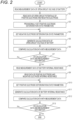
- FIG. 2 is a flowchart showing processing of a secondary cell state diagnosis method.
- the deterioration state of the secondary cell is evaluated by sequentially evaluating the deterioration state of each of the positive electrode and the negative electrode electrodes on the basis of the relationship between the state of charge and the open-circuit voltage and the relationship between the state of charge and the internal resistance.
- FIG. 2 illustrates a case where the positive electrode is an electrode in which the open-circuit potential is constant except close to the fully charged state and close to the completely discharged state, and the negative electrode is an electrode in which the open-circuit potential is not constant from close to the fully charged state to close to the completely discharged state.
- the deterioration state of each electrode is evaluated in the order of the negative electrode and then the positive electrode.
- the state diagnosis device 100 receives, as an input, measurement data indicating the relationship between the state of charge and the open-circuit voltage of the secondary cell to be diagnosed, and measurement data indicating the relationship between the state of charge and the internal resistance of the secondary cell to be diagnosed, and performs processing to evaluate the deterioration state for each electrode.
- the deterioration state of each electrode of the secondary cell to be diagnosed for which the deterioration state is unknown can be evaluated by taking, as an input, measurement data that can be acquired in a manner which is nondestructive for the secondary cell.
- measurement data indicating the relationship between the state of charge and the open-circuit voltage of the secondary cell to be diagnosed, and measurement data indicating the relationship between the state of charge and the internal resistance of the secondary cell to be diagnosed are obtained on the basis of actual measurement and then stored in the storage unit 20.
- These pieces of measurement data may be represented by a relational expression or a data table.
- the secondary cell to be diagnosed can include an electrode using an active material of a known type, or may include an electrode for which an active material of an unknown type is used.
- reference data indicating the relationship between the state of charge and the open-circuit potential of the electrode having a known deterioration state and reference data indicating the relationship between the state of charge and the internal resistance of the electrode having a known deterioration state are stored in the storage unit 20.
- These pieces of reference data may be represented by a relational expression or may be represented by a data table.
- the reference data for example, data of an electrode in an initial state in which deterioration does not substantially progress can be used.
- the reference data can be obtained by actually measuring the open-circuit potential and the internal resistance of the electrode in the initial state in advance of diagnosing the deterioration state.
- the reference data is used as basic data to be applied to the measurement data of the secondary cell to be diagnosed when the deterioration state of the secondary cell to be diagnosed is broken down into the deterioration state for each electrode and evaluated.
- the reference data is prepared for each of the positive electrode and the negative electrode electrodes.
- As the reference data it is preferable to prepare a plurality of data for each type of active material used for the electrodes.
- As the reference data it is preferable to prepare data of the various electrodes using an active material of a known type according to the type of the active material used in the secondary cell to be diagnosed and the type of active material assumed to be used in the secondary cell to be diagnosed.
- the measurement data and the reference data may be acquired through measurement in a charging process or may be acquired through measurement in a discharging process.
- the measurement data and the reference data are preferably acquired through measurement in a mutually common process.
- the measurement data and the reference data may be data indicating the relationship between the state of charge and the numerical value of the open-circuit potential, data indicating the relationship between the state of charge and the numerical value of the internal resistance, data indicating the relationship between the state of charge and the differential value of the open-circuit potential, or data indicating the relationship between the state of charge and the differential value of the internal resistance.
- the deterioration state can be diagnosed between pieces of data using differential values.
- the differential value of the open-circuit potential is used, a relationship inversely proportional to the effective active material amount is obtained, and hence the correctness of the effective active material amount can be secured.
- the differential value of the internal resistance is used, the influence of a constant voltage drop derived from the metal member or the like can be reduced.
- the arithmetic unit 10 reads, from the storage unit 20, measurement data indicating the relationship between the state of charge and the open-circuit voltage of the secondary cell to be diagnosed (step S1).
- the measurement data indicating the relationship between the state of charge and the open-circuit voltage of the secondary cell can be obtained, for example, by measuring the open-circuit voltage in each state of charge while repeating the operation of charging or discharging the secondary cell to a predetermined state of charge, then charging or discharging the secondary cell at a minute constant current for a certain time, and pausing for a predetermined time until another predetermined state of charge is reached.
- the measurement data indicating the relationship between the state of charge and the open-circuit voltage of the secondary cell is preferably measured by repeating charging for 5 seconds or more, discharging for 5 seconds or more, and pausing for 5 seconds or more.
- the time during which charging and discharging are suspended is preferably 10 minutes or more, and more preferably 30 minutes or more.
- the arithmetic unit 10 reads, from the storage unit 20, reference data indicating the relationship between the state of charge and the open-circuit potential of the negative electrode having a known deterioration state and reference data indicating the relationship between the state of charge and the open-circuit potential of the positive electrode having a known deterioration state (step S2) .
- reference data indicating the relationship between the state of charge and the open-circuit potential reference data of an arbitrary electrode among the positive electrode and the negative electrode, or reference data of an electrode using an arbitrary active material among various active materials can be read. Even if the type of the electrode and the type of the active material are unknown at this stage, the deterioration state of each electrode can be appropriately evaluated by converging the subsequent calculations. However, in a case where the type of the electrode or the type of the active material is known or can be predicted, it is preferable to read the reference data of the corresponding electrode.
- the deterioration state of the secondary cell can be evaluated using the method disclosed in PTL 1.
- LiFePO 4 which is an active material having a flat potential except close to the fully charged state and close to the completely discharged state
- graphite which is an active material having a potential that changes even other than close to the fully charged state and close to the completely discharged state
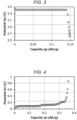
- FIG. 3 is a diagram showing an example of the relationship between a state of charge and an open-circuit potential of an electrode.
- FIG. 3 corresponds to reference data of a positive electrode using LiFePO 4 as an active material.
- the horizontal axis represents, as an example of the state of charge of the electrode, a discharge amount qp[Ah/g] from a fully charged state per unit mass of the positive electrode active material.
- the vertical axis represents the open-circuit potential Vp[V] of the positive electrode with respect to a reference electrode.
- FIG. 4 is a diagram showing an example of the relationship between the state of charge and the open-circuit potential of an electrode.
- FIG. 4 corresponds to reference data of a negative electrode that uses graphite as an active material.
- the horizontal axis represents, as an example of the state of charge of the electrode, a discharge amount qn[Ah/g] from a fully charged state per unit mass of the negative electrode active material.
- the vertical axis represents the open-circuit potential Vn[V] of the negative electrode with respect to the reference electrode.
- the open-circuit potential fluctuates in response to a change in the state of charge of the electrode. Because the deterioration state of the electrode using such an active material is reflected in the open-circuit potential, the evaluation can be performed on the basis of the relationship between the state of charge and the open-circuit potential of the electrode. Based on the open-circuit potential, the deterioration state can be diagnosed more easily and accurately in comparison with a case based on the internal resistance, which is influenced by a large number of factors.
- the arithmetic unit 10 provisionally sets a deterioration state parameter of the positive electrode, which is a counter electrode to the evaluation target electrode (step S3).
- deterioration state parameters related to capacitance that serve to correct the relationship between the state of charge and the open-circuit potential are provisionally set.
- the deterioration state parameter is a parameter quantitatively representing a deterioration state of an electrode.
- a deterioration state parameter related to capacitance a coefficient or a constant of a state quantity representing the state of charge can be set, as a parameter representing a capacitance-dependent deterioration state, in a function representing the relationship between the state of charge and the open-circuit potential or a function representing the relationship between the state of charge and the internal resistance.
- the positive electrode active material utilization rate mpr, the positive electrode out-of-range capacitance dp, and the like can be set.
- the negative electrode the negative electrode active material utilization rate mnr, the negative electrode out-of-range capacitance dn, and the like, can be set.
- the negative electrode active material utilization rate mnr represents the ratio of the negative electrode active material utilized for the charge-discharge reaction of the negative electrode active material contained in the negative electrode.
- the negative electrode out-of-range capacitance dn represents the capacitance, of the capacitance of the negative electrode, which can be obtained only in a state of charge higher than the fully charged state of the secondary cell.
- deterioration state parameters related to capacitance arbitrary numerical values for a predetermined interval are defined as an upper limit value and a lower limit value representing a state in which there is no deterioration of the electrode and a state in which the electrode has completely deteriorated.
- the deterioration state parameters related to capacitance may be associated on the data with a coefficient or a constant of a state quantity representing the state of charge or a degree of deterioration representing the deterioration state of the electrode.
- Such deterioration state parameters can be stored in the storage unit 20 as a parameter table.
- step S4 the arithmetic unit 10 sets a deterioration state parameter of the negative electrode which is the electrode to be evaluated.
- a deterioration state parameter related to capacitance and serving to correct the relationship between the state of charge and the open-circuit potential is set. Note that either step S3 or step S4 may be executed first.
- An arbitrary value can be set as the deterioration state parameter related to capacitance of the electrode to be evaluated.
- a parameter representing a deterioration state corresponding to the deterioration state parameter of the counter electrode may be set, or any parameter independent of the counter electrode may be set.
- the arithmetic unit 10 generates calculation data indicating the relationship between the state of charge and the open-circuit voltage of the secondary cell on the basis of reference data indicating the relationship between the state of charge and the open-circuit potential of the negative electrode, reference data indicating the relationship between the state of charge and the open-circuit potential of the positive electrode, the set deterioration state parameters of the negative electrode, and the provisionally set deterioration state parameters of the positive electrode (step S5).
- the relationship between the state of charge and the open-circuit voltage of the secondary cell can be calculated by combining functions of the open-circuit potential with respect to the state of charge by using the relationship between the state of charge and the open-circuit potential of the negative electrode and the relationship between the state of charge and the open-circuit potential of the positive electrode.
- the relationships between the state of charge and the open-circuit potential for each of the electrodes are corrected using the deterioration state parameters and then combined. When the correction is performed using the deterioration state parameters, calculation data indicating the behavior of the open-circuit voltage and for which a deterioration state is assumed is generated.
- the discharge capacitance of the secondary cell from the fully charged state is Qc[Ah]
- the open-circuit voltage of the secondary cell in the state of charge x is Vc(x)[V]
- the open-circuit potential of the positive electrode in the state of charge x is Vp(x) [V]
- the open-circuit potential of the negative electrode in the state of charge x is Vn(x)[V]
- the relationship between the state of charge and the open-circuit voltage of the secondary cell can be calculated by the following formulas (1) to (3).
- Qc mpr ⁇ mp 0 ⁇ qp ⁇ dp
- Qc mnr ⁇ mn 0 ⁇ qn ⁇ dn
- Vc Qc Vp qp ⁇ Vn qn
- the arithmetic unit 10 compares the calculation data indicating the relationship between the state of charge and the open-circuit voltage of the secondary cell and calculated by assuming the deterioration state with the measurement data indicating the relationship between the state of charge and the open-circuit voltage of the secondary cell to be diagnosed (step S6) . In the comparison processing, it is determined whether or not the calculation data assuming the deterioration state and the measurement data match (step S7) .
- the determination of whether the pieces of data match may be performed using an arbitrary determination method. For example, it can be performed on the basis of the residual sum of squares between data.
- the sum of squares of difference between the calculation data and the measurement data is calculated, and the sum of squares of difference is compared with an arbitrarily set threshold value to determine consistency between the data.
- the calculation data indicating the relationship between the state of charge and the open-circuit voltage of the secondary cell is a set of discrete data obtained by combining a calculated value Qcc of the discharge capacitance from the fully charged state of the secondary cell and a calculated value Vcc of the open-circuit voltage of the secondary cell.
- a set of calculation data can be stored in the storage unit 20 as a data table.
- the data table of the calculation data includes data such as (Qcc_1, Vcc_1), (Qcc_2, Vcc_2), ⁇ , and (Qcc_M, Vcc_M) .
- the measurement data indicating the relationship between the state of charge and the open-circuit voltage of the secondary cell to be diagnosed is a set of discrete data obtained by combining a measured value Qce of the discharge capacitance from the fully charged state of the secondary cell and a measured value Vce of the open-circuit voltage of the secondary cell.
- a set of measurement data can be stored in the storage unit 20 as a data table.
- the data table of the measurement data includes data such as (Qce_1, Vce_1), (Qce_2, Vce_2), ⁇ , and (Qce_N, Vce_N) .
- the calculation data corresponding to the state of charge of the measurement data is extracted from the data table of the calculation data.
- the same or approximate calculation data Qcc_1, Vcc_1), (Qcc_2, Vcc_2), ⁇ , (Qcc_N, Vcc_N), and the like of the discharge capacitance Qc can be extracted.
- the square of the difference between the calculated value in the calculation data and the measured value in the measurement data is calculated between the mutually corresponding data of the states of charge, and the square of the difference is summed among all the data.
- the sum of squares of difference thus calculated is compared with a preset threshold value for consistency.
- a threshold value for consistency of the open-circuit potentials an arbitrary value can be set such that the degree of similarity between the pieces of data increases according to accuracy required for diagnosis, the number of calculation iterations, and the like.
- interpolation may be used to interpolate the calculation data corresponding to the measurement data.
- step S7 NO
- the deterioration state parameter of the electrode to be evaluated is reset, and the calculation data is regenerated and re-compared.
- step S7 the set deterioration state parameter of the electrode to be evaluated is adopted, and the deterioration state of the other electrode is evaluated.
- the adopted deterioration state parameter is registered in the storage unit 20 in association with an identifier for identifying the secondary cell to be diagnosed or an identifier for identifying the electrode to be evaluated.
- the deterioration state parameters related to capacitance for determining the open-circuit voltage which are mnr and dn in the present embodiment, are determined using the above procedure, and the determined values are used in the subsequent procedure. Because the deterioration state parameter of the electrode to be evaluated is calculated by provisionally setting the deterioration state parameter of the counter electrode, the deterioration state parameter is updated according to the evaluation result of the deterioration state of the counter electrode.
- the resetting of the deterioration state parameter related to capacitance of one of the positive electrode and the negative electrode and regeneration and re-comparison of the calculation data based on the deterioration state parameter related to the reset capacitance can be repeated any number of times until it is determined that the calculation data and the measurement data match.
- previously unset values can be sequentially set.
- the determination of whether the pieces of data match can also be made by comparing a reduction range for each calculation of the sum of squares of difference between the calculation data and the measurement data with a predetermined threshold value instead of comparing the sum of squares of difference between the calculation data and the measurement data with a predetermined threshold value.
- a reduction range of the sum of squares of a current difference with respect to the sum of squares of the previous difference becomes a predetermined value or less, it can also be determined that the pieces of data match.
- the diagnosis processing can be stopped.
- the reference data can be replaced with the reference data of an electrode using another active material, and the resetting of the deterioration state parameter related to capacitance, and the regeneration and re-comparison of the calculation data based on the reset deterioration state parameter can be performed again.
- the reference data is preferably stored in the storage unit 20 as a database in association with identifiers for identifying the positive electrode and the negative electrode and identifiers for identifying the types of active materials used for the electrodes.
- a database is prepared, even if the type of the active material used in the secondary cell to be diagnosed is unknown, an appropriate evaluation can be performed through regeneration and re-comparison of calculation data in which the reference data has been replaced.
- steps S1 to S5 the relationship between the state of charge and the open-circuit voltage of a secondary cell using an active material of a known type is obtained on the basis of the relationship between the state of charge and the open-circuit potential of the positive electrode using an active material of a known type and the relationship between the state of charge and the open-circuit potential of the negative electrode using an active material of a known type.
- Reference data indicating these relationships is read from the storage unit 20, and calculation data indicating the relationship between the state of charge and the open-circuit voltage of the secondary cell is generated.
- step S6 the calculation data indicating the relationship between the state of charge and the open-circuit voltage of the secondary cell using the active material of the known type is compared with the measurement data indicating the relationship between the state of charge and the open-circuit voltage of the secondary cell using the active material of the unknown type to specify the type of the active material for which the type is unknown.
- the active material used in the secondary cell to be diagnosed is of the same type as the active material of the reference data.
- diagnosis can be performed highly accurately. Therefore, the processing to evaluate the deterioration state for each electrode can be continued on the basis of the selected reference data and the set deterioration state parameters related to capacitance.
- the reference data can be replaced with the reference data of the electrode using another active material, and the resetting of the deterioration state parameter related to capacitance, and the regeneration and re-comparison of the calculation data based on the reset deterioration state parameter can be performed again.
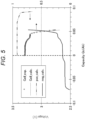
- FIG. 5 is a diagram showing an example of the evaluation result of the relationship between the state of charge and the open-circuit potential of the secondary cell at the stage where the evaluation of one electrode is complete (at the end of step S7).
- FIG. 5 illustrates the horizontal axis represents the discharge capacitance [Ah] of the secondary cell or the electrode from the fully charged state.
- the vertical axis represents the open-circuit potential [V].
- FIG. 5 illustrates the result (see steps S1 to S7) of evaluating the deterioration state of the negative electrode by using a secondary cell in which the deterioration has progressed as a diagnosis target. The secondary cell to be diagnosed is used until the discharge capacitance reaches about 0.04Ah.
- the plot represents measurement results indicating the relationship between the state of charge and the open-circuit voltage of the secondary cell.
- the broken line represents a computation result indicating the relationship between the state of charge and the open-circuit voltage of the secondary cell.
- the two-dot chain line represents a reference result indicating the relationship between the state of charge and the open-circuit potential of the positive electrode.
- the deterioration state parameter related to capacitance of the positive electrode is a provisionally set value, and the relationship between the state of charge and the open-circuit potential of the positive electrode is also provisional.
- the solid line represents a reference result indicating the relationship between the state of charge and the open-circuit potential of the negative electrode. The deterioration state parameter related to capacitance of the negative electrode is determined at this stage, and the relationship between the state of charge and the open-circuit potential of the negative electrode is also determined.
- a measurement result (see plot) indicating the relationship between the state of charge and the open-circuit voltage of the secondary cell to be diagnosed is obtained.
- the open-circuit voltage of the secondary cell is periodically measured at micro-time intervals until the discharge capacitance reaches about 0.04Ah, but is measured at the time of diagnosis after about 0.04Ah.
- the arithmetic unit 10 After the deterioration state parameter related to capacitance of one electrode is registered, the arithmetic unit 10 reads the measurement data indicating the relationship between the state of charge and the internal resistance of the secondary cell to be diagnosed from the storage unit 20 (step S8).
- the measurement data indicating the relationship between the state of charge and the internal resistance of the secondary cell can be obtained by measuring the internal resistance in each state of charge while repeating the operation of charging or discharging the secondary cell to a predetermined state of charge, then charging or discharging the secondary cell with a minute constant current for a certain period of time, and pausing for a predetermined period of time until another predetermined state of charge is reached.
- the measurement data indicating the relationship between the state of charge and the internal resistance of the secondary cell is preferably measured by repeating charging for 5 seconds or more, discharging for 5 seconds or more, and pausing for 5 seconds or more.
- the internal resistance is preferably obtained on the basis of a closed circuit voltage when five seconds or more have elapsed since the start of energization from an open circuit state, and is more preferably obtained on the basis of the closed circuit voltage when 30 seconds or more have elapsed. The longer the energization time for measuring the internal resistance, the more easily the electrochemical state of the active material and the voltage change accompanying the diffusion of charge carriers are reflected in the measurement results, and hence the internal resistance can be measured more accurately.
- the arithmetic unit 10 reads, from the storage unit 20, reference data indicating the relationship between the state of charge and the internal resistance of a positive electrode having a known deterioration state, and reference data indicating the relationship between the state of charge and the internal resistance of the negative electrode having a known deterioration state (step S9).
- both the electrode evaluated thus far and the reference data of the counter electrode are read.
- reference data reference data of an electrode using an arbitrary active material among various active materials can be read. However, in a case where the type of the electrode or the type of the active material is known or can be predicted, it is preferable to read the reference data of the corresponding electrode.
- FIG. 6 is a diagram illustrating an example of the relationship between a state of charge and internal resistance of an electrode.
- FIG. 6 corresponds to the reference data of the positive electrode using LiFePO 4 as the active material.
- the horizontal axis represents, as an example of the state of charge of the electrode, a discharge amount qp[Ah/g] from a fully charged state per unit mass of the positive electrode active material.
- the vertical axis represents the internal resistance Rp (product of mass resistivity and surface area) [m ⁇ g] of the positive electrode.
- the internal resistance continuously fluctuates in response to a change in the state of charge of the electrode.
- the deterioration state of the electrode using such an active material can be diagnosed on the basis of the relationship between the state of charge and the internal resistance of the electrode. Based on the internal resistance, it is possible to diagnose the deterioration state, which is difficult in the case of being based on the open-circuit potential in which the resistance factor is not reflected.
- FIG. 7 is a diagram showing an example of the relationship between the state of charge and internal resistance of an electrode.
- FIG. 7 corresponds to reference data of a negative electrode that uses graphite as an active material.
- the horizontal axis represents, as an example of the state of charge of the electrode, a discharge amount qn[Ah/g] from a fully charged state per unit mass of the negative electrode active material.
- the vertical axis represents the internal resistance Rn (product of mass resistivity and area) [m ⁇ g] of the negative electrode.
- the open-circuit potential and the internal resistance fluctuate with respect to a change in the state of charge of the electrode according to the state of charge.
- the relationship between the state of charge and the internal resistance of the secondary cell is diagnosed, it is necessary to utilize the relationship between the state of charge and the internal resistance of the positive electrode and the negative electrode.
- the arithmetic unit 10 sets a deterioration state parameter related to capacitance of the positive electrode which is the electrode to be evaluated (step S10).
- the deterioration state parameter related to capacitance of the negative electrode which is a counter electrode to the electrode to be evaluated
- the deterioration state parameter registered in the previous steps is set.
- deterioration state parameters related to internal resistance which have not been determined in the previous steps, are set.
- Examples of the parameters for the deterioration state that have not been determined in the previous step include a deterioration state parameter related to capacitance of the electrode to be evaluated and other deterioration state parameters.
- Other deterioration state parameters include deterioration state parameters related to internal resistance corresponding to the internal resistances of the positive electrode, the negative electrode, and members other than the positive electrode and the negative electrode.
- a coefficient of a resistance term for each electrode dependent on the state of charge or a constant corresponding to the internal resistance of a member other than the positive electrode and the negative electrode can be set in a function indicating the relationship between the state of charge and the internal resistance.
- an internal resistance R0 of members other than the positive electrode and the negative electrode a correction coefficient ap for the internal resistance of the positive electrode, the correction coefficient an for the internal resistance of the negative electrode, and the like, can be set.
- the internal resistance R0 of a member other than the positive electrode and the negative electrode a value between 0 and the internal resistance of the secondary cell can be set.
- a value of 0 or more can be set as the correction coefficients ap and an of the internal resistances of the positive electrode and the negative electrode.
- the arithmetic unit 10 generates calculation data indicating the relationship between the state of charge and the internal resistance of the secondary cell on the basis of the reference data indicating the relationship between the state of charge and the internal resistance of the positive electrode, reference data indicating the relationship between the state of charge and the internal resistance of the negative electrode, the set deterioration state parameter, and the registered deterioration state parameter (step S11).
- the relationship between the state of charge and the internal resistance of the secondary cell can be calculated by combining functions of the internal resistance with respect to the state of charge by utilizing the relationship between the state of charge and the internal resistance of the positive electrode and the relationship between the state of charge and the internal resistance of the negative electrode.
- the relationships between the state of charge and the internal resistance for each of the electrodes are corrected using the deterioration state parameters and then combined. When the correction is performed using the deterioration state parameters, calculation data indicating the behavior of the internal resistance for which a deterioration state is assumed is generated.
- the arithmetic unit 10 compares the calculation data indicating the relationship between the state of charge and the internal resistance of the secondary cell calculated assuming the deterioration state with the measurement data indicating the relationship between the state of charge and the internal resistance of the secondary cell to be diagnosed (step S12). In the comparison processing, it is determined whether or not the calculation data, for which a deterioration state is assumed, and the actually measured measurement data match (step S13).
- the determination of whether the pieces of data match may be performed using an arbitrary determination method. For example, it can be performed on the basis of the residual sum of squares between data.
- the sum of squares of difference between the calculation data and the measurement data is calculated, and the sum of squares of difference is compared with an arbitrarily set threshold value to determine consistency between the data.
- the measurement data indicating the relationship between the state of charge and the internal resistance of the secondary cell to be diagnosed is a set of discrete data obtained by combining a measured value Qce of the discharge capacitance from the fully charged state of the secondary cell and the measured value Rce of the internal resistance of the secondary cell.
- a set of measurement data can be stored in the storage unit 20 as a data table.
- the data table of the measurement data includes data such as (Qce_1, Rce_1), (Qce_2, Rce_2), ⁇ , and (Qce_N, Rce_N) .
- the calculation data corresponding to the state of charge of the measurement data is extracted from the data table of the calculation data.
- the same or approximate calculation data Qcc_1, Rcc_1), (Qcc_2, Rcc_2), ⁇ , (Qcc_N, Rcc_N), and the like of the discharge capacitance Qc can be extracted.
- the square of the difference between the calculated value in the calculation data and the measured value in the measurement data is calculated between the mutually corresponding data of the states of charge, and the square of the difference is summed among all the data.
- the sum of squares of difference thus calculated is compared with a preset threshold value for consistency.
- a preset threshold value for consistency of internal resistance an arbitrary value can be set such that the degree of similarity between the data is increased according to the accuracy required for diagnosis, the number of calculation iterations, and the like.
- interpolation may be used to interpolate the calculation data corresponding to the measurement data.
- step S13 NO
- the deterioration state parameter is reset, and the calculation data is regenerated and re-compared.
- step S13 the provisionally set deterioration state parameter is adopted, and the evaluation of the deterioration state for each electrode is terminated.
- the adopted deterioration state parameter is registered in the storage unit 20 in association with an identifier for identifying the secondary cell to be diagnosed or an identifier for identifying the electrode to be evaluated.
- the deterioration state parameters related to capacitance and the deterioration state parameters related to internal resistance adopted for each of the positive electrode and negative electrode electrodes are registered in association with each other.
- the output unit 40 displays the diagnosis results of the deterioration states for each electrode.
- diagnosis results of the deterioration states for each electrode calculation data indicating the relationship between the state of charge and the open-circuit potential of the electrode as corrected using the adopted deterioration state parameters, and calculation data indicating the relationship between the state of charge and the internal resistance of the electrode as corrected by the adopted deterioration state parameter can be displayed as a graph, a table, or the like, for each of the positive electrode and negative electrode electrodes.
- the output unit 40 can display the diagnosis result of the deterioration state of the secondary cell synthesized on the basis of the diagnosis results for each of the electrodes.
- diagnosis result of the deterioration state of the secondary cell calculation data indicating the relationship between the state of charge and the open-circuit voltage of the secondary cell combined using the calculation data for each electrode, and calculation data indicating the relationship between the state of charge and the internal resistance of the secondary cell combined using the calculation data for each electrode can be displayed as a graph, a table, or the like.
- the output unit 40 may display the types of the active materials used for the electrodes, the degree of similarity indicating consistency between the calculation data and the measurement data, and the like, together with the calculation data indicating the deterioration states for each of the electrodes.
- the degree of deterioration corresponding to the value of a deterioration state parameter may be converted into a percentage display or the like and displayed.
- only the final result based on the adopted deterioration state parameter may be displayed, or an intermediate result for each calculation iteration may be displayed together with the final result.
- the resetting of the deterioration state parameter related to capacitance of the other electrode of the positive electrode and the negative electrode, the resetting of the deterioration state parameter related to internal resistance, and the regeneration and re-comparison of the calculation data based on the reset deterioration state parameter can be repeated any number of times until it is determined that the calculation data and the measurement data match.
- previously unset values can be sequentially set.
- the determination of whether the pieces of data match can also be made by comparing a reduction range for each calculation of the sum of squares of difference between the calculation data and the measurement data with a predetermined threshold value instead of comparing the sum of squares of difference between the calculation data and the measurement data with a predetermined threshold value.
- a reduction range of the sum of squares of a current difference with respect to the sum of squares of the previous difference becomes a predetermined value or less, it can also be determined that the pieces of data match.
- the diagnosis processing can be stopped.
- the reference data can be replaced with the reference data of the electrode using another active material, and the resetting of the deterioration state parameter, and the regeneration and re-comparison of the calculation data based on the reset deterioration state parameter can be performed again.
- the evaluation based on the open-circuit voltage may be performed again using the deterioration state parameters which were set based on the internal resistance.
- FIG. 8 is a diagram illustrating an example of a calculation result of the relationship between the state of charge and the internal resistance of the secondary cell at the stage where the deterioration state of the other electrode is assumed (at the end of step S11).
- FIG. 8 illustrates a calculation result (see steps S8 to S11) obtained by determining, for the secondary cell to be diagnosed illustrated in FIG. 5 , the relationship between the state of charge and the internal resistance of the secondary cell by assuming a deterioration state of the positive electrode.
- the plot shows measurement results indicating the relationship between the state of charge and the internal resistance of the secondary cell.
- the broken line indicates a calculation result indicating the relationship between the state of charge and the internal resistance of the secondary cell.
- the two-dot chain line indicates a reference result indicating the relationship between the state of charge and the internal resistance of the positive electrode.
- the solid line indicates a reference result indicating the relationship between the state of charge and the internal resistance of the negative electrode.
- the constant R0 and the correction coefficients ap and an are provisionally set values, and the relationship between the state of charge and the internal resistance of the positive electrode and the relationship between the state of charge and the internal resistance of the negative electrode are also provisional.
- the calculation results indicating the relationship between the state of charge and the internal resistance of the positive electrode can be enlarged or reduced in the capacitance axis direction and the resistance axis direction. Adjusting the correction coefficients ap and an can also shift the curve along the resistance axis.
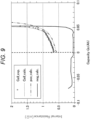
- FIG. 9 illustrates the horizontal axis represents the discharge capacitance [Ah] of the secondary cell or the electrode from the fully charged state.
- the vertical axis represents the internal resistance [ ⁇ ].
- FIG. 9 illustrates the result of optimizing the deterioration state parameters of the positive electrode on the basis of the internal resistance by repeating resetting, recalculation, and re-comparison for the secondary cell to be diagnosed illustrated in FIG. 8 .
- the plot shows measurement results indicating the relationship between the state of charge and the internal resistance of the secondary cell.
- the broken line indicates a calculation result indicating the relationship between the state of charge and the internal resistance of the secondary cell.
- the two-dot chain line indicates a reference result indicating the relationship between the state of charge and the internal resistance of the positive electrode.
- the solid line indicates a reference result indicating the relationship between the state of charge and the internal resistance of the negative electrode.
- the reference result (see the two-dot chain line) indicating the relationship between the state of charge and the internal resistance of the positive electrode can be shifted along the capacitance axis.
- the reference results (see the two-dot chain line) indicating the relationship between the state of charge and the internal resistance of the positive electrode are shifted to the low discharge amount side (left side) in comparison with FIG. 8 .
- the calculation data (see the broken line) indicating the relationship between the state of charge and the internal resistance of the secondary cell matches the measurement results (see the plot) indicating the relationship between the state of charge and the internal resistance of the secondary cell to be diagnosed by repeating the resetting, recalculation, and re-comparison of the deterioration state parameters.
- the calculation data corrected by the deterioration state parameters are easily fitted to the measurement data, and thus the deterioration state of an electrode using an active material in which the open-circuit potential is not constant from close to the fully charged state to close to the completely discharged state can be easily estimated.
- FIG. 10 is a diagram showing an example of the relationship between the state of charge and the open-circuit potential of the secondary cell.
- FIG. 10 illustrates the horizontal axis represents the discharge capacitance [Ah] of the secondary cell or the electrode from the fully charged state.
- the vertical axis represents the open-circuit potential [V].
- FIG. 10 illustrates the result of optimizing, for the secondary cell to be diagnosed illustrated in FIG. 9 , the deterioration state parameters of the positive electrode on the basis of the internal resistance and then optimizing the deterioration state parameters of the positive electrode again on the basis of the open-circuit voltage.
- the plot shows measurement results showing the relationship between the state of charge and the open-circuit voltage of the secondary cell.
- the broken line represents a computation result indicating the relationship between the state of charge and the open-circuit voltage of the secondary cell.
- the two-dot chain line represents a reference result indicating the relationship between the state of charge and the open-circuit potential of the positive electrode.
- the solid line represents a reference result indicating the relationship between the state of charge and the open-circuit potential of the negative electrode.
- the reference result (see the two-dot chain line) indicating the relationship between the state of charge and the open-circuit potential of the positive electrode can be shifted along the capacitance axis.
- the reference results (see the two-dot chain line) indicating the relationship between the state of charge and the open-circuit potential of the positive electrode are shifted to the low discharge amount side (left side) in comparison with FIG. 5 .
- the internal resistance is not reflected in the relationship between the state of charge and the open-circuit voltage of the secondary cell, it is difficult to diagnose the deterioration state for each electrode highly accurately based only on the relationship between the state of charge and the open-circuit voltage of the secondary cell.
- the electrode using the active material in which the open-circuit potential is not constant from close to the fully charged state to close to the completely discharged state when the deterioration state parameters are optimized on the basis of the internal resistance and then optimized again on the basis of the open-circuit potential, the accuracy of the deterioration state diagnosis can be improved.
- the secondary cell state diagnosis method and the secondary cell state diagnosis device described above because the relationship between the state of charge and the open-circuit potential of the electrode and the relationship between the state of charge and the internal resistance of the electrode are used in the diagnosis of the deterioration states of each of the electrodes, the deterioration state of the secondary cell and the deterioration states of each electrode can be diagnosed highly accurately even in a case where an electrode using an active material in which potential does not change in response to a change in the state of charge is provided as one of the positive electrode and the negative electrode.
- the measurement result of the open-circuit voltage of the secondary cell to be diagnosed and the measurement result of the internal resistance of the secondary cell to be diagnosed are used in the diagnosis of the deterioration states of each of the electrodes, the deterioration states of the secondary cell or each electrode can be diagnosed in a non-destructive manner.
- one or more of the evaluation results of the deterioration states of each electrode and the evaluation results of the deterioration states of the secondary cell calculated on the basis of the evaluation results of the deterioration states of each electrode can be stored in the storage unit 20 for each diagnosis. These evaluation results can be collected by performing the diagnosis at different times on the same secondary cell to be analyzed. These evaluation results can be stored in the storage unit 20 as time-series evaluation results data.
- Examples of the evaluation results data include the adopted deterioration state parameters, calculation data indicating the relationship between the state of charge and the open-circuit potential of the electrodes as corrected using the adopted deterioration state parameters, calculation data indicating the relationship between the state of charge and the internal resistance of the electrodes as corrected using the adopted deterioration state parameters, calculation data indicating the relationship between the state of charge and the open-circuit voltage of the secondary cell combined using the calculation data for each electrode, and calculation data indicating the relationship between the state of charge and the internal resistance of the secondary cell combined using the calculation data for each electrode.
- the evaluation results data can be accumulated in the storage unit 20 in association with information such as the date and time of diagnosis, the secondary cell usage time, the amount of cumulative energization of the secondary cell, and the like.
- the usage time of the secondary cell the time from the initial charge/discharge of the secondary cell to be diagnosed to the present time, the number of charge/discharge cycles, and the like, can be inputted to the state diagnosis device 100.
- the cumulative energization amount of the secondary cell the energization amount obtained by adding the operating time of the secondary cell and the energization amount from the time of the initial reception/discharge of the secondary cell to the present time as calculated on the basis of the rated current can be inputted to the state diagnosis device 100.
- One or more of the accumulated evaluation results of the deterioration states of each electrode and the evaluation results of the deterioration state of the secondary cell calculated on the basis of the evaluation results of the deterioration states of each electrode are read by the arithmetic unit 10 in order to change the post-diagnosis operating conditions of the secondary cell.
- the operating conditions of the secondary cell include an upper limit and a lower limit of a state of charge of the secondary cell, an upper limit and a lower limit of a charge current to the secondary cell, and an upper limit and a lower limit of a discharge current from the secondary cell.
- One or more of these operating conditions can be changed on the basis of the accumulated evaluation results data.
- the post-diagnosis operating conditions of the secondary cell can be changed by using, as an index, (1) the deterioration state of each electrode, (2) the rate of change in the deterioration state of each electrode, or (3) the remaining life of the secondary cell. These indices are compared with predetermined threshold values, and when it is determined that progression of the deterioration of each electrode or the deterioration of the secondary cell is highly likely, the operating conditions range of the secondary cell is changed to conditions ensuring safety.
- Examples of operations for changing the operating conditions of the secondary cell to conditions ensuring safety include a change to lower the upper limit of the state of charge of the secondary cell, a change to raise the lower limit of the state of charge of the secondary cell, a change to lower the upper limit or the lower limit of the charge current to the secondary cell, and a change to lower the upper limit or the lower limit of the discharge current from the secondary cell.
- the present invention is not limited to or by the above-described embodiment, and various modifications can be made without departing from the spirit of the present invention.
- the present invention is not necessarily limited to an embodiment having all the configurations included in the above-described embodiment.
- a part of the configuration of a certain embodiment can be replaced with another configuration, a part of the configuration of a certain embodiment can be added to another embodiment, or a part of the configuration of a certain embodiment can be omitted.
Landscapes
- Physics & Mathematics (AREA)
- General Physics & Mathematics (AREA)
- Engineering & Computer Science (AREA)
- Manufacturing & Machinery (AREA)
- Chemical & Material Sciences (AREA)
- Chemical Kinetics & Catalysis (AREA)
- Electrochemistry (AREA)
- General Chemical & Material Sciences (AREA)
- Secondary Cells (AREA)
- Tests Of Electric Status Of Batteries (AREA)
- Charge And Discharge Circuits For Batteries Or The Like (AREA)
Abstract
Description
- The present invention relates to a secondary cell state diagnosis method, and a state diagnosis device.
- In recent years, secondary cells such as lithium ion batteries have been used as driving power sources mounted in vehicles and as power sources for power storage in smart houses or the like, and advances have been made in equipment energy efficiency. It is known that the battery characteristics of lithium ion batteries or the like deteriorate during repeated charge and discharge or during storage in a high-temperature environment. Because driving power sources and power sources for power storage are used for long periods, deterioration must be minimized and safety secured for long periods of time.
- The active material used for a lithium ion battery may be selected not only from the viewpoint of performance such as capacitance and voltage, but also from the standpoint of suppressing deterioration and improving safety. For example, Li(Ni, Mn, Co)O2, LiFePO4, or the like is used as the positive electrode active material. As the negative electrode active material, graphite, Li4Ti5O12, or the like is used.
- It is known that deterioration of a secondary cell such as a lithium ion battery progresses quickly in a high potential region having a high state of charge or a low potential region having a low state of charge. Deterioration of the secondary cell occurs due to a change in characteristics of the constituent elements of the positive electrode, the negative electrode, the electrolytic solution, and so forth. As the deterioration progresses, a charge/discharge curve, an operating voltage range, and the like change, which affects safety. In order to suppress the deterioration of the secondary cell, it is necessary to accurately detect the deterioration of the positive electrode and the negative electrode and select an optimum control method and usage conditions according to the detected state.
-
PTL 1 discloses a method for detecting internal information of a secondary cell. Using this method, the state of the positive electrode and the state of the negative electrode are quantitatively evaluated in a non-destructive manner by using the charge/discharge curve of the positive electrode alone or the negative electrode alone. The charge/discharge curve of the negative electrode alone and the charge/discharge curve of the positive electrode alone are superimposed and calculated to reproduce the charge/discharge curve of the secondary cell. - PTL 1:
JP 2009-080093 A - In
PTL 1, the relationship between the discharge amount and the potential change rate is used for both the positive electrode and the negative electrode. However, there is a problem that such a method cannot be used in a case where an active material is used which has a potential that hardly changes in response to a change in the state of charge. For example, the electrode potential of lithium iron phosphate (LiFePO4) or the like, which is used as a positive electrode active material, hardly changes even if the discharge is continued within a general operating voltage range, and thus it is not possible to use the relationship between the discharge amount and the potential change rate in the diagnosis of the deterioration state. - In the technique of
PTL 1, when an active material having a potential which is less likely to change in response to a change in a state of charge is used for one electrode of the positive electrode and the negative electrode, only a deterioration state of the other electrode can be diagnosed, and thus there is a problem in that deterioration of the electrode which cannot be diagnosed potentially progresses. When the deterioration potentially progresses, the secondary cell rapidly deteriorates at the stage where the deterioration becomes apparent after a certain time elapses, and thus the safety of the secondary cell is a concern. - Therefore, an object of the present invention is to provide a secondary cell state diagnosis method and a secondary cell state diagnosis device that, even in a case where an active material having a potential that hardly changes in response to a change in a state of charge is used for the electrodes of a secondary cell, enable diagnosis of the deterioration of a secondary cell or each electrode.
- In order to solve the above problems, the secondary cell state diagnosis method according to the present invention is a secondary cell state diagnosis method for diagnosing the deterioration state of a secondary cell that includes evaluating, for one electrode of a positive electrode and a negative electrode, a deterioration state of the electrode on the basis of the relationship between a state of charge and an open-circuit potential of the positive electrode and the negative electrode and the relationship between a state of charge and an open-circuit voltage of the secondary cell; and evaluating, for the other electrode of the positive electrode and the negative electrode, the deterioration state of the electrode on the basis of the relationship between the state of charge and an internal resistance of the positive electrode and the negative electrode and the relationship between the state of charge and an internal resistance of the secondary cell.
- The secondary cell state diagnosis device according to the present invention is a state diagnosis device that diagnoses a deterioration state of a secondary cell, the device including an arithmetic unit that reads data indicating the relationship between a state of charge and an open-circuit voltage of the secondary cell and data indicating the relationship between the state of charge and an internal resistance of the secondary cell, and that evaluates a deterioration state of an electrode; and a storage unit that stores data indicating the relationship between a state of charge and an open-circuit voltage of the electrode, and data indicating the relationship between the state of charge and an internal resistance of the electrode, in which, for one electrode of a positive electrode and a negative electrode, the deterioration state of the electrode is evaluated on the basis of the relationship between the state of charge and the open-circuit potential of the positive electrode and the negative electrode and the relationship between the state of charge and the open-circuit voltage of the secondary cell, and in which, for the other electrode of the positive electrode and the negative electrode, the deterioration state of the electrode is evaluated on the basis of the relationship between the state of charge and the internal resistance of the positive electrode and the negative electrode and the relationship between the state of charge and the internal resistance of the secondary cell.
- According to the present invention, it is possible to provide a secondary cell state diagnosis method and a secondary cell state diagnosis device that, even in a case where an active material having a potential that hardly changes in response to a change in a state of charge is used for the electrodes of a secondary cell, enable diagnosis of the deterioration of a secondary cell or each electrode.
-
- [
FIG. 1] FIG. 1 is a diagram illustrating a configuration of a state diagnosis device for a secondary cell according to the present embodiment. - [
FIG. 2] FIG. 2 is a flowchart showing processing of a secondary cell state diagnosis method. - [
FIG. 3] FIG. 3 is a diagram showing an example of the relationship between a state of charge and an open-circuit potential of an electrode. - [
FIG. 4] FIG. 4 is a diagram showing an example of the relationship between the state of charge and the open-circuit potential of an electrode. - [
FIG. 5] FIG. 5 is a diagram showing an example of an evaluation result of the relationship between the state of charge and the open-circuit potential of the secondary cell at the stage where evaluation of one electrode is complete. - [
FIG. 6] FIG. 6 is a diagram showing an example of the relationship between the state of charge and internal resistance of an electrode. - [
FIG. 7] FIG. 7 is a diagram showing an example of the relationship between the state of charge and internal resistance of an electrode. - [
FIG. 8] FIG. 8 is a diagram showing an example of an evaluation result of the relationship between the state of charge and internal resistance of the secondary cell at the stage where a deterioration state of the other electrode is assumed. - [
FIG. 9] FIG. 9 is a diagram showing an example of an evaluation result of the relationship between the state of charge and the internal resistance of the secondary cell at the stage where the evaluation of the other electrode is complete. - [
FIG. 10] FIG. 10 is a diagram showing an example of the relationship between the state of charge and the open-circuit potential of the secondary cell. - Hereinafter, a secondary cell state diagnosis method and a secondary cell state diagnosis device according to an embodiment of the present invention will be described. Note that the same reference numerals are assigned to the same configurations in the following drawings, and thus redundant descriptions will be omitted.
- A secondary cell state diagnosis method according to the present embodiment relates to a method for diagnosing a deterioration state of a secondary cell. Using this state diagnosis method, a secondary cell having an unknown deterioration state is to be diagnosed, and the secondary cell is diagnosed in a non-destructive manner. Using this state diagnosis method, the deterioration state of the secondary cell and the deterioration state of each of the positive electrode and the negative electrode electrodes included in the secondary cell can be individually diagnosed by measuring the open-circuit voltage and the internal resistance of the secondary cell to be diagnosed.
- Using the secondary cell state diagnosis method according to the present embodiment, it is preferable to take, as a diagnosis target, a secondary cell in which an active material having a potential which hardly changes in response to a change in a state of charge is used for one of the positive electrode and the negative electrode. In a case where one electrode of the positive electrode and the negative electrode is an electrode in which the open-circuit potential is constant except close to a fully charged state and close to a completely discharged state, and the other electrode is an electrode in which the open-circuit potential is not constant from close to the fully charged state to close to the completely discharged state, diagnosis can be performed highly accurately.
- In the present specification, the fact that the open-circuit potential of the electrode is constant except close to the fully charged state and close to the completely discharged state means that the range of change in the open-circuit potential of the electrode in response to a change in the state of charge is 30 mV or less within the used voltage range of the secondary cell except close to a fully charged state or close to a completely discharged state. When a state of charge (SOC) [%] is used, the region close to the fully charged state is defined as a region where the SOC is on the order of 80% or more, and the region close to the completely discharged state is defined as a region where the SOC is on the order of 20% or less.
- Examples of an electrode in which the open-circuit potential is constant except close to the fully charged state and close to the completely discharged state include electrodes which use lithium iron phosphate (LiFePO4), lithium titanate (Li4Ti5O12, Li2TiO3), and the like. Examples of electrodes in which the open-circuit potential is not constant include electrodes using other materials such as graphite, lithium cobalt oxide (LiCoO2), or the like.
- Using the secondary cell state diagnosis method according to the present embodiment, the open-circuit voltage and the internal resistance of the secondary cell to be diagnosed are measured at the time of performing diagnosis. The relationship between the state of charge and the open-circuit voltage of the secondary cell and the relationship between the state of charge and the internal resistance of the secondary cell are calculated on the basis of the measurement result of the open-circuit voltage and the measurement result of the internal resistance. Data representing these relationships is stored in a storage unit of a device that diagnoses the state of the secondary cell.
- Diagnostic processing is performed for each of the positive electrode and the negative electrode electrodes. First, for one electrode of the positive electrode and the negative electrode, the deterioration state of the electrode is evaluated on the basis of the relationship between the state of charge and the open-circuit potential of the electrode stored in the storage unit and the measurement-based relationship between the state of charge and the open-circuit voltage of the secondary cell. Thereafter, for the other electrode, the electrode deterioration state is evaluated on the basis of the relationship between the state of charge and the internal resistance stored in the storage unit and the relationship between the state of charge and the internal resistance of the secondary cell on the basis of the measurement.
- In the evaluation of the deterioration state for each electrode, the relationship between the state of charge and the open-circuit potential of the electrode stored in the storage unit and the relationship between the state of charge and the internal resistance of the electrode stored in the storage unit are corrected by assuming the deterioration state of each electrode of the secondary cell to be diagnosed. On the basis of the corrected relationship between the state of charge and the open-circuit potential of the electrode and the corrected relationship between the state of charge and the internal resistance of the electrode, the relationship between the state of charge and the open-circuit voltage of the secondary cell and the relationship between the state of charge and the internal resistance of the secondary cell are calculated. As the relationship between the state of charge and the open-circuit potential of the electrode, the relationship between the state of charge and the open-circuit potential of the electrode having a known deterioration state can be used. The electrode having a known deterioration state is, for example, an electrode in an initial state.
- Subsequently, the calculated relationship between the state of charge and the open-circuit voltage of the secondary cell and the calculated relationship between the state of charge and the internal resistance of the secondary cell are compared with the measurement-based relationship between the state of charge and the open-circuit voltage of the secondary cell and the measurement-based relationship between the state of charge and the internal resistance of the secondary cell. By fitting the computation result to the measurement result by using the deterioration states of each electrode of the secondary cell as variables, the correction performed by assuming the deterioration states of each electrode is optimized toward the true values. Therefore, it is possible to diagnose the deterioration state of each electrode and the deterioration state of the secondary cell from the content of the correction.
- In the present specification, the state of charge means an electrochemical state determined by the ratio of the dischargeable amount of electricity to the amount of electricity that can be discharged from the fully charged state. The state of charge can be expressed by mutually convertible appropriate state quantities, such as the depth of charge SOC[%], the discharge amount [Ah] from a fully charged state, the charge amount [Ah] from a completely discharged state, and the composition ratio of the electrical charge carrier elements contained in the active material.
-
FIG. 1 is a diagram illustrating a configuration of a secondary cell state diagnosis device according to the present embodiment. - As illustrated in
FIG. 1 , the secondary cellstate diagnosis device 100 according to the present embodiment includes anarithmetic unit 10, astorage unit 20, aninput unit 30, anoutput unit 40, and acommunication unit 50. Thestate diagnosis device 100 can be constituted by hardware such as a computer. - The
state diagnosis device 100 reads measurement data obtained by actual measurement or reference data prepared in advance for each type of active material to execute, according to a predetermined program, a secondary cell state diagnosis method for diagnosing a deterioration state of the secondary cell. Thearithmetic unit 10, thestorage unit 20, theinput unit 30, theoutput unit 40, and thecommunication unit 50 of thestate diagnosis device 100 are connected to a bus. - The
arithmetic unit 10 reads various data and programs, executes programs, calculates states, and the like. Thearithmetic unit 10 includes, for example, a computation device such as a central processing unit (CPU). - The
storage unit 20 stores various data and programs. Thestorage unit 20 includes, for example, a storage device such as a random access memory (RAM) or a read only memory (ROM) . Various data and programs may be stored in a writable and readable hard disk, a flash memory, a magnetic disk, an optical disk, or the like. - The
input unit 30 is a device that receives an input made by an operator. Theinput unit 30 includes, for example, a keyboard, a mouse, a touch panel, and the like. Theinput unit 30 can be connected via an input interface (not illustrated). - The
output unit 40 is a device that outputs operation information of thestate diagnosis device 100, the content of various data, a diagnostic condition, a diagnosis result, and the like. Theoutput unit 40 includes, for example, a liquid crystal display, an organic EL display, a positive electrode ray tube, or the like. Theoutput unit 40 can be connected via an output interface (not illustrated). - The
communication unit 50 transmits and receives various data and control signals to and from an external measurement device or the like. Thecommunication unit 50 can be connected via a communication interface, an input/output interface, and the like (not illustrated). As a measurement device, a battery tester based on the four-terminal method or the like can be connected. -
FIG. 2 is a flowchart showing processing of a secondary cell state diagnosis method. - As shown in
FIG. 2 , using the secondary cell state diagnosis method according to the present embodiment, the deterioration state of the secondary cell is evaluated by sequentially evaluating the deterioration state of each of the positive electrode and the negative electrode electrodes on the basis of the relationship between the state of charge and the open-circuit voltage and the relationship between the state of charge and the internal resistance. -
FIG. 2 illustrates a case where the positive electrode is an electrode in which the open-circuit potential is constant except close to the fully charged state and close to the completely discharged state, and the negative electrode is an electrode in which the open-circuit potential is not constant from close to the fully charged state to close to the completely discharged state. In this example, the deterioration state of each electrode is evaluated in the order of the negative electrode and then the positive electrode. - The
state diagnosis device 100 receives, as an input, measurement data indicating the relationship between the state of charge and the open-circuit voltage of the secondary cell to be diagnosed, and measurement data indicating the relationship between the state of charge and the internal resistance of the secondary cell to be diagnosed, and performs processing to evaluate the deterioration state for each electrode. The deterioration state of each electrode of the secondary cell to be diagnosed for which the deterioration state is unknown can be evaluated by taking, as an input, measurement data that can be acquired in a manner which is nondestructive for the secondary cell. - When the deterioration state is to be diagnosed, measurement data indicating the relationship between the state of charge and the open-circuit voltage of the secondary cell to be diagnosed, and measurement data indicating the relationship between the state of charge and the internal resistance of the secondary cell to be diagnosed are obtained on the basis of actual measurement and then stored in the
storage unit 20. These pieces of measurement data may be represented by a relational expression or a data table. - These pieces of measurement data can be obtained for the secondary cell to be diagnosed by repeating measurement of the open-circuit voltage in an arbitrary state of charge and measurement of the internal resistance in an arbitrary state of charge while changing the state of charge. The measurement of the open-circuit voltage and the internal resistance is preferably performed for a plurality of states of charge within the used voltage range of the secondary cell. The secondary cell to be diagnosed may include an electrode using an active material of a known type, or may include an electrode for which an active material of an unknown type is used.
- The charge/discharge current for adjustment to a predetermined state of charge is preferably at least 10C or less, and more preferably 1C or less. When charging and discharging are performed at a low rate, a more accurate open-circuit voltage and internal resistance can be measured. The number of measurement points of the state of charge is preferably 10 points or more from the viewpoint of performing an accurate diagnosis, and is preferably from 10 points to 50 points from the viewpoint of reducing the number of measurements.
- When the deterioration state is diagnosed, reference data indicating the relationship between the state of charge and the open-circuit potential of the electrode having a known deterioration state and reference data indicating the relationship between the state of charge and the internal resistance of the electrode having a known deterioration state are stored in the
storage unit 20. These pieces of reference data may be represented by a relational expression or may be represented by a data table. - As the reference data, for example, data of an electrode in an initial state in which deterioration does not substantially progress can be used. The reference data can be obtained by actually measuring the open-circuit potential and the internal resistance of the electrode in the initial state in advance of diagnosing the deterioration state. The reference data is used as basic data to be applied to the measurement data of the secondary cell to be diagnosed when the deterioration state of the secondary cell to be diagnosed is broken down into the deterioration state for each electrode and evaluated.
- The reference data is prepared for each of the positive electrode and the negative electrode electrodes. As the reference data, it is preferable to prepare a plurality of data for each type of active material used for the electrodes. As the reference data, it is preferable to prepare data of the various electrodes using an active material of a known type according to the type of the active material used in the secondary cell to be diagnosed and the type of active material assumed to be used in the secondary cell to be diagnosed.
- Note that the measurement data and the reference data may be acquired through measurement in a charging process or may be acquired through measurement in a discharging process. However, in general, there is hysteresis in behavior in the charging process and behavior in the discharging process. Therefore, the measurement data and the reference data are preferably acquired through measurement in a mutually common process.
- In addition, the measurement data and the reference data may be data indicating the relationship between the state of charge and the numerical value of the open-circuit potential, data indicating the relationship between the state of charge and the numerical value of the internal resistance, data indicating the relationship between the state of charge and the differential value of the open-circuit potential, or data indicating the relationship between the state of charge and the differential value of the internal resistance. The deterioration state can be diagnosed between pieces of data using differential values. When the differential value of the open-circuit potential is used, a relationship inversely proportional to the effective active material amount is obtained, and hence the correctness of the effective active material amount can be secured. When the differential value of the internal resistance is used, the influence of a constant voltage drop derived from the metal member or the like can be reduced.
- As illustrated in
FIG. 2 , first, thearithmetic unit 10 reads, from thestorage unit 20, measurement data indicating the relationship between the state of charge and the open-circuit voltage of the secondary cell to be diagnosed (step S1). - The measurement data indicating the relationship between the state of charge and the open-circuit voltage of the secondary cell can be obtained, for example, by measuring the open-circuit voltage in each state of charge while repeating the operation of charging or discharging the secondary cell to a predetermined state of charge, then charging or discharging the secondary cell at a minute constant current for a certain time, and pausing for a predetermined time until another predetermined state of charge is reached.
- The measurement data indicating the relationship between the state of charge and the open-circuit voltage of the secondary cell is preferably measured by repeating charging for 5 seconds or more, discharging for 5 seconds or more, and pausing for 5 seconds or more. The time during which charging and discharging are suspended is preferably 10 minutes or more, and more preferably 30 minutes or more. When time for stopping charging and discharging is adequately secured, the electrochemical state of the active material and the movement of the charge carriers easily reach equilibrium, and hence a more accurate open-circuit voltage can be measured.
- Subsequently, the
arithmetic unit 10 reads, from thestorage unit 20, reference data indicating the relationship between the state of charge and the open-circuit potential of the negative electrode having a known deterioration state and reference data indicating the relationship between the state of charge and the open-circuit potential of the positive electrode having a known deterioration state (step S2) . - As the reference data indicating the relationship between the state of charge and the open-circuit potential, reference data of an arbitrary electrode among the positive electrode and the negative electrode, or reference data of an electrode using an arbitrary active material among various active materials can be read. Even if the type of the electrode and the type of the active material are unknown at this stage, the deterioration state of each electrode can be appropriately evaluated by converging the subsequent calculations. However, in a case where the type of the electrode or the type of the active material is known or can be predicted, it is preferable to read the reference data of the corresponding electrode. For an electrode using an active material having an open-circuit potential that changes even in a state of charge other than close to the fully charged state and close to the completely discharged state, the deterioration state of the secondary cell can be evaluated using the method disclosed in
PTL 1. In the present embodiment, a case will be described in which LiFePO4, which is an active material having a flat potential except close to the fully charged state and close to the completely discharged state, is used for the positive electrode, and graphite, which is an active material having a potential that changes even other than close to the fully charged state and close to the completely discharged state, is used for the negative electrode. -
FIG. 3 is a diagram showing an example of the relationship between a state of charge and an open-circuit potential of an electrode. -
FIG. 3 corresponds to reference data of a positive electrode using LiFePO4 as an active material. The horizontal axis represents, as an example of the state of charge of the electrode, a discharge amount qp[Ah/g] from a fully charged state per unit mass of the positive electrode active material. The vertical axis represents the open-circuit potential Vp[V] of the positive electrode with respect to a reference electrode. - As shown in
FIG. 3 , in the active material in which the open-circuit potential is constant except close to the fully charged state and close to the completely discharged state, there is a plateau region in which the open-circuit potential does not substantially fluctuate with respect to a change in the state of charge of the electrode. Because the deterioration state of the electrode using such an active material is not reflected in the open-circuit potential, it is difficult to perform an evaluation on the basis of the relationship between the state of charge and the open-circuit potential of the electrode. Such an electrode is preferably evaluated on the basis of the relationship between the state of charge and the internal resistance of the electrode. -
FIG. 4 is a diagram showing an example of the relationship between the state of charge and the open-circuit potential of an electrode. -
FIG. 4 corresponds to reference data of a negative electrode that uses graphite as an active material. The horizontal axis represents, as an example of the state of charge of the electrode, a discharge amount qn[Ah/g] from a fully charged state per unit mass of the negative electrode active material. The vertical axis represents the open-circuit potential Vn[V] of the negative electrode with respect to the reference electrode. - As shown in
FIG. 4 , in an active material in which the open-circuit potential is not constant except close to the fully charged state and close to the completely discharged state, the open-circuit potential fluctuates in response to a change in the state of charge of the electrode. Because the deterioration state of the electrode using such an active material is reflected in the open-circuit potential, the evaluation can be performed on the basis of the relationship between the state of charge and the open-circuit potential of the electrode. Based on the open-circuit potential, the deterioration state can be diagnosed more easily and accurately in comparison with a case based on the internal resistance, which is influenced by a large number of factors. - Subsequently, the
arithmetic unit 10 provisionally sets a deterioration state parameter of the positive electrode, which is a counter electrode to the evaluation target electrode (step S3). In this step, deterioration state parameters related to capacitance that serve to correct the relationship between the state of charge and the open-circuit potential are provisionally set. - The deterioration state parameter is a parameter quantitatively representing a deterioration state of an electrode. As a deterioration state parameter related to capacitance, a coefficient or a constant of a state quantity representing the state of charge can be set, as a parameter representing a capacitance-dependent deterioration state, in a function representing the relationship between the state of charge and the open-circuit potential or a function representing the relationship between the state of charge and the internal resistance. For example, for the positive electrode, the positive electrode active material utilization rate mpr, the positive electrode out-of-range capacitance dp, and the like, can be set. For the negative electrode, the negative electrode active material utilization rate mnr, the negative electrode out-of-range capacitance dn, and the like, can be set.
- The positive electrode active material utilization rate mpr represents the ratio of the positive electrode active material utilized for the charge-discharge reaction among the positive electrode active materials contained in the positive electrode. The positive electrode active material utilization rate mpr is expressed by mpr = mp/mp0, where the amount of the positive electrode active material contained in the positive electrode is mp0[g], and the amount of the positive electrode active material utilized in the charge-discharge reaction is mp[g].
- The positive electrode out-of-range capacitance dp represents a capacitance, of the capacitance of the positive electrode, which can be obtained only in a state of charge higher than the fully charged state of the secondary cell. In a fully charged state in which the secondary cell reaches the upper limit voltage of the operating voltage range, the charging operation is stopped, but the actual positive electrode itself has room for charging equivalent to the positive electrode out-of-range capacitance dp. The capacitance Qp[Ah] of the positive electrode is represented by Qp = mp × qp_max, where mp[g] is the amount of the positive electrode active material utilized in the charge-discharge reaction, and qp_max[Ah/g] is the capacitance of the positive electrode per unit mass.
- The negative electrode active material utilization rate mnr represents the ratio of the negative electrode active material utilized for the charge-discharge reaction of the negative electrode active material contained in the negative electrode. The negative electrode active material utilization rate mnr is expressed by mnr = mn/mn0, where the amount of the negative electrode active material contained in the negative electrode is mn0[g] and the amount of the negative electrode active material utilized in the charge-discharge reaction is mn[g].
- The negative electrode out-of-range capacitance dn represents the capacitance, of the capacitance of the negative electrode, which can be obtained only in a state of charge higher than the fully charged state of the secondary cell. The capacitance Qn[Ah] of the negative electrode is represented by Qn = mn × qn_max, where mn[g] is the amount of the negative electrode active material utilized in the charge-discharge reaction, and qn_max[Ah/g] is the capacitance of the negative electrode per unit mass.
- As deterioration state parameters related to capacitance, arbitrary numerical values for a predetermined interval are defined as an upper limit value and a lower limit value representing a state in which there is no deterioration of the electrode and a state in which the electrode has completely deteriorated. The deterioration state parameters related to capacitance may be associated on the data with a coefficient or a constant of a state quantity representing the state of charge or a degree of deterioration representing the deterioration state of the electrode. Such deterioration state parameters can be stored in the
storage unit 20 as a parameter table. - Any value can be provisionally set as the deterioration state parameter related to capacitance of the counter electrode with respect to the electrode to be evaluated. Because the deterioration state of the counter electrode with respect to the electrode to be evaluated cannot be evaluated at this stage, an arbitrary value is provisionally set to evaluate the electrode to be evaluated. For example, it is possible to provisionally set mpr = 1, dp = 0, and the like, on the assumption that there is no deterioration, for the positive electrode which is a counter electrode to the electrode to be evaluated.
- Subsequently, the
arithmetic unit 10 sets a deterioration state parameter of the negative electrode which is the electrode to be evaluated (step S4). In this step, a deterioration state parameter related to capacitance and serving to correct the relationship between the state of charge and the open-circuit potential is set. Note that either step S3 or step S4 may be executed first. - An arbitrary value can be set as the deterioration state parameter related to capacitance of the electrode to be evaluated. As the deterioration state parameter of the electrode to be evaluated, a parameter representing a deterioration state corresponding to the deterioration state parameter of the counter electrode may be set, or any parameter independent of the counter electrode may be set. For example, mnr = 1, dn = 0, and the like can be set, on the assumption of no deterioration, for the negative electrode which is the electrode to be evaluated.
- Subsequently, the
arithmetic unit 10 generates calculation data indicating the relationship between the state of charge and the open-circuit voltage of the secondary cell on the basis of reference data indicating the relationship between the state of charge and the open-circuit potential of the negative electrode, reference data indicating the relationship between the state of charge and the open-circuit potential of the positive electrode, the set deterioration state parameters of the negative electrode, and the provisionally set deterioration state parameters of the positive electrode (step S5). - The relationship between the state of charge and the open-circuit voltage of the secondary cell can be calculated by combining functions of the open-circuit potential with respect to the state of charge by using the relationship between the state of charge and the open-circuit potential of the negative electrode and the relationship between the state of charge and the open-circuit potential of the positive electrode. The relationships between the state of charge and the open-circuit potential for each of the electrodes are corrected using the deterioration state parameters and then combined. When the correction is performed using the deterioration state parameters, calculation data indicating the behavior of the open-circuit voltage and for which a deterioration state is assumed is generated.
- For example, when the discharge capacitance of the secondary cell from the fully charged state is Qc[Ah], the open-circuit voltage of the secondary cell in the state of charge x is Vc(x)[V], the open-circuit potential of the positive electrode in the state of charge x is Vp(x) [V], and the open-circuit potential of the negative electrode in the state of charge x is Vn(x)[V], the relationship between the state of charge and the open-circuit voltage of the secondary cell can be calculated by the following formulas (1) to (3).


- Subsequently, the
arithmetic unit 10 compares the calculation data indicating the relationship between the state of charge and the open-circuit voltage of the secondary cell and calculated by assuming the deterioration state with the measurement data indicating the relationship between the state of charge and the open-circuit voltage of the secondary cell to be diagnosed (step S6) . In the comparison processing, it is determined whether or not the calculation data assuming the deterioration state and the measurement data match (step S7) . - The determination of whether the pieces of data match may be performed using an arbitrary determination method. For example, it can be performed on the basis of the residual sum of squares between data. The sum of squares of difference between the calculation data and the measurement data is calculated, and the sum of squares of difference is compared with an arbitrarily set threshold value to determine consistency between the data.
- In a case where the discharge capacitance Qc is used as the state of charge, the calculation data indicating the relationship between the state of charge and the open-circuit voltage of the secondary cell is a set of discrete data obtained by combining a calculated value Qcc of the discharge capacitance from the fully charged state of the secondary cell and a calculated value Vcc of the open-circuit voltage of the secondary cell. A set of calculation data can be stored in the
storage unit 20 as a data table. The data table of the calculation data includes data such as (Qcc_1, Vcc_1), (Qcc_2, Vcc_2), ···, and (Qcc_M, Vcc_M) . - In a case where the discharge capacitance Qc is used as the state of charge, the measurement data indicating the relationship between the state of charge and the open-circuit voltage of the secondary cell to be diagnosed is a set of discrete data obtained by combining a measured value Qce of the discharge capacitance from the fully charged state of the secondary cell and a measured value Vce of the open-circuit voltage of the secondary cell. A set of measurement data can be stored in the
storage unit 20 as a data table. The data table of the measurement data includes data such as (Qce_1, Vce_1), (Qce_2, Vce_2), ···, and (Qce_N, Vce_N) . - In the determination of whether the pieces of data match, the calculation data corresponding to the state of charge of the measurement data is extracted from the data table of the calculation data. For the measurement data (Qce_1, Vce_1), (Qce_2, Vce_2), ···, and (Qce_N, Vce_N), the same or approximate calculation data (Qcc_1, Vcc_1), (Qcc_2, Vcc_2), ···, (Qcc_N, Vcc_N), and the like of the discharge capacitance Qc can be extracted.
- The square of the difference between the calculated value in the calculation data and the measured value in the measurement data is calculated between the mutually corresponding data of the states of charge, and the square of the difference is summed among all the data. As the sum of squares of difference between the calculated values Vcc_1 to Vcc_N in the calculation data and the measured values Vce_1 to Vce_N in the measurement data, Σ(Vcc_1 - Vce_i)2 can be calculated for i = 1 to N.
- The sum of squares of difference thus calculated is compared with a preset threshold value for consistency. As a threshold value for consistency of the open-circuit potentials, an arbitrary value can be set such that the degree of similarity between the pieces of data increases according to accuracy required for diagnosis, the number of calculation iterations, and the like. At the time of the sum of squares of difference is calculated, in a case where there is no calculation data for the discharge capacitance Qc corresponding to the measurement data, interpolation may be used to interpolate the calculation data corresponding to the measurement data.
- As a result of the comparison, when the sum of squares of difference between the calculation data and the measurement data exceeds a preset threshold value, it can be determined that the calculation data indicating the relationship between the state of charge and the open-circuit voltage of the secondary cell, which is calculated by assuming a deterioration state, and the measurement data indicating the relationship between the state of charge and the open-circuit voltage of the secondary cell to be diagnosed do not match. In this case (step S7: NO), the deterioration state parameter of the electrode to be evaluated is reset, and the calculation data is regenerated and re-compared.
- On the other hand, when, as a result of the comparison, the sum of squares of difference between the calculation data and the measurement data is equal to or less than a preset threshold value, it can be determined that the calculation data indicating the relationship between the state of charge and the open-circuit voltage of the secondary cell, which is calculated by assuming a deterioration state, and the measurement data indicating the relationship between the state of charge and the open-circuit voltage of the secondary cell to be diagnosed match. In this case (step S7: YES), the set deterioration state parameter of the electrode to be evaluated is adopted, and the deterioration state of the other electrode is evaluated.
- The adopted deterioration state parameter is registered in the
storage unit 20 in association with an identifier for identifying the secondary cell to be diagnosed or an identifier for identifying the electrode to be evaluated. Among the deterioration state parameters of the electrode to be evaluated, the deterioration state parameters related to capacitance for determining the open-circuit voltage, which are mnr and dn in the present embodiment, are determined using the above procedure, and the determined values are used in the subsequent procedure. Because the deterioration state parameter of the electrode to be evaluated is calculated by provisionally setting the deterioration state parameter of the counter electrode, the deterioration state parameter is updated according to the evaluation result of the deterioration state of the counter electrode. - Note that the resetting of the deterioration state parameter related to capacitance of one of the positive electrode and the negative electrode and regeneration and re-comparison of the calculation data based on the deterioration state parameter related to the reset capacitance can be repeated any number of times until it is determined that the calculation data and the measurement data match. As the deterioration state parameters related to capacitance, previously unset values can be sequentially set.
- In addition, the determination of whether the pieces of data match can also be made by comparing a reduction range for each calculation of the sum of squares of difference between the calculation data and the measurement data with a predetermined threshold value instead of comparing the sum of squares of difference between the calculation data and the measurement data with a predetermined threshold value. For repetition of regeneration and re-comparison of calculation data, when a reduction range of the sum of squares of a current difference with respect to the sum of squares of the previous difference becomes a predetermined value or less, it can also be determined that the pieces of data match.
- In a case where the calculation data and the measurement data for one of the positive electrode and the negative electrode do not match at a predetermined number of calculations or a predetermined calculation time, the diagnosis processing can be stopped. Alternatively, the reference data can be replaced with the reference data of an electrode using another active material, and the resetting of the deterioration state parameter related to capacitance, and the regeneration and re-comparison of the calculation data based on the reset deterioration state parameter can be performed again.
- The reference data is preferably stored in the
storage unit 20 as a database in association with identifiers for identifying the positive electrode and the negative electrode and identifiers for identifying the types of active materials used for the electrodes. When such a database is prepared, even if the type of the active material used in the secondary cell to be diagnosed is unknown, an appropriate evaluation can be performed through regeneration and re-comparison of calculation data in which the reference data has been replaced. - In a case where the type of active material used in the secondary cell to be diagnosed is unknown, in steps S1 to S5, the relationship between the state of charge and the open-circuit voltage of a secondary cell using an active material of a known type is obtained on the basis of the relationship between the state of charge and the open-circuit potential of the positive electrode using an active material of a known type and the relationship between the state of charge and the open-circuit potential of the negative electrode using an active material of a known type. Reference data indicating these relationships is read from the
storage unit 20, and calculation data indicating the relationship between the state of charge and the open-circuit voltage of the secondary cell is generated. - Subsequently, in step S6, the calculation data indicating the relationship between the state of charge and the open-circuit voltage of the secondary cell using the active material of the known type is compared with the measurement data indicating the relationship between the state of charge and the open-circuit voltage of the secondary cell using the active material of the unknown type to specify the type of the active material for which the type is unknown.
- As a result of the comparison, in a case where the calculation data and the measurement data match, it can be determined that the active material used in the secondary cell to be diagnosed is of the same type as the active material of the reference data. When the open-circuit potential of one of the positive electrode and the negative electrode is constant except close to the fully charged state and close to the completely discharged state, and the open-circuit potential of the other electrode is not constant from close to the fully charged state to close to the completely discharged state, diagnosis can be performed highly accurately. Therefore, the processing to evaluate the deterioration state for each electrode can be continued on the basis of the selected reference data and the set deterioration state parameters related to capacitance.
- On the other hand, in a case where, as a result of the comparison, the calculation data and the measurement data do not match, it can be determined that the active material used in the secondary cell to be diagnosed is of a different type than the active material of the reference data. In this case, the reference data can be replaced with the reference data of the electrode using another active material, and the resetting of the deterioration state parameter related to capacitance, and the regeneration and re-comparison of the calculation data based on the reset deterioration state parameter can be performed again.
-
FIG. 5 is a diagram showing an example of the evaluation result of the relationship between the state of charge and the open-circuit potential of the secondary cell at the stage where the evaluation of one electrode is complete (at the end of step S7). - In
FIG. 5 , the horizontal axis represents the discharge capacitance [Ah] of the secondary cell or the electrode from the fully charged state. The vertical axis represents the open-circuit potential [V].FIG. 5 illustrates the result (see steps S1 to S7) of evaluating the deterioration state of the negative electrode by using a secondary cell in which the deterioration has progressed as a diagnosis target. The secondary cell to be diagnosed is used until the discharge capacitance reaches about 0.04Ah. - In
FIG. 5 , the plot represents measurement results indicating the relationship between the state of charge and the open-circuit voltage of the secondary cell. The broken line represents a computation result indicating the relationship between the state of charge and the open-circuit voltage of the secondary cell. The two-dot chain line represents a reference result indicating the relationship between the state of charge and the open-circuit potential of the positive electrode. However, at this stage, the deterioration state parameter related to capacitance of the positive electrode is a provisionally set value, and the relationship between the state of charge and the open-circuit potential of the positive electrode is also provisional. The solid line represents a reference result indicating the relationship between the state of charge and the open-circuit potential of the negative electrode. The deterioration state parameter related to capacitance of the negative electrode is determined at this stage, and the relationship between the state of charge and the open-circuit potential of the negative electrode is also determined. - As illustrated in
FIG. 5 , when the open-circuit voltage is measured for the secondary cell to be diagnosed while changing the state of charge, a measurement result (see plot) indicating the relationship between the state of charge and the open-circuit voltage of the secondary cell to be diagnosed is obtained. The open-circuit voltage of the secondary cell is periodically measured at micro-time intervals until the discharge capacitance reaches about 0.04Ah, but is measured at the time of diagnosis after about 0.04Ah. - In addition, when Formula (3) is calculated on the basis of the reference result (see the two-dot chain line) indicating the relationship between the state of charge and the open-circuit potential of the positive electrode and the reference result (see the solid line) indicating the relationship between the state of charge and the open-circuit potential of the negative electrode, a calculation result (see the broken line) indicating the relationship between the state of charge and the open-circuit voltage of the secondary cell is obtained. When the deterioration state parameter related to capacitance is set, the curve can be shifted along the capacitance axis, as indicated by the arrow in
FIG. 5 . Because the calculation data corrected by the deterioration state parameter is fitted to the measurement data, deterioration of the charge/discharge capacitance can be particularly diagnosed. - After the deterioration state parameter related to capacitance of one electrode is registered, the
arithmetic unit 10 reads the measurement data indicating the relationship between the state of charge and the internal resistance of the secondary cell to be diagnosed from the storage unit 20 (step S8). - The measurement data indicating the relationship between the state of charge and the internal resistance of the secondary cell can be obtained by measuring the internal resistance in each state of charge while repeating the operation of charging or discharging the secondary cell to a predetermined state of charge, then charging or discharging the secondary cell with a minute constant current for a certain period of time, and pausing for a predetermined period of time until another predetermined state of charge is reached.
- The measurement data indicating the relationship between the state of charge and the internal resistance of the secondary cell is preferably measured by repeating charging for 5 seconds or more, discharging for 5 seconds or more, and pausing for 5 seconds or more. The internal resistance is preferably obtained on the basis of a closed circuit voltage when five seconds or more have elapsed since the start of energization from an open circuit state, and is more preferably obtained on the basis of the closed circuit voltage when 30 seconds or more have elapsed. The longer the energization time for measuring the internal resistance, the more easily the electrochemical state of the active material and the voltage change accompanying the diffusion of charge carriers are reflected in the measurement results, and hence the internal resistance can be measured more accurately.
- Subsequently, the
arithmetic unit 10 reads, from thestorage unit 20, reference data indicating the relationship between the state of charge and the internal resistance of a positive electrode having a known deterioration state, and reference data indicating the relationship between the state of charge and the internal resistance of the negative electrode having a known deterioration state (step S9). - As the reference data indicating the relationship between the state of charge and the internal resistance, both the electrode evaluated thus far and the reference data of the counter electrode are read. As the reference data, reference data of an electrode using an arbitrary active material among various active materials can be read. However, in a case where the type of the electrode or the type of the active material is known or can be predicted, it is preferable to read the reference data of the corresponding electrode.
-
FIG. 6 is a diagram illustrating an example of the relationship between a state of charge and internal resistance of an electrode. -
FIG. 6 corresponds to the reference data of the positive electrode using LiFePO4 as the active material. The horizontal axis represents, as an example of the state of charge of the electrode, a discharge amount qp[Ah/g] from a fully charged state per unit mass of the positive electrode active material. The vertical axis represents the internal resistance Rp (product of mass resistivity and surface area) [mΩ·g] of the positive electrode. - As can be seen from a comparison between
FIG. 6 andFIG. 3 , even when the open-circuit potential is constant, the internal resistance continuously fluctuates in response to a change in the state of charge of the electrode. The deterioration state of the electrode using such an active material can be diagnosed on the basis of the relationship between the state of charge and the internal resistance of the electrode. Based on the internal resistance, it is possible to diagnose the deterioration state, which is difficult in the case of being based on the open-circuit potential in which the resistance factor is not reflected. -
FIG. 7 is a diagram showing an example of the relationship between the state of charge and internal resistance of an electrode. -
FIG. 7 corresponds to reference data of a negative electrode that uses graphite as an active material. The horizontal axis represents, as an example of the state of charge of the electrode, a discharge amount qn[Ah/g] from a fully charged state per unit mass of the negative electrode active material. The vertical axis represents the internal resistance Rn (product of mass resistivity and area) [mΩ·g] of the negative electrode. - As can be seen from a comparison between
FIG. 7 andFIG. 4 , in the negative electrode using graphite, the open-circuit potential and the internal resistance fluctuate with respect to a change in the state of charge of the electrode according to the state of charge. When the relationship between the state of charge and the internal resistance of the secondary cell is diagnosed, it is necessary to utilize the relationship between the state of charge and the internal resistance of the positive electrode and the negative electrode. - Subsequently, the
arithmetic unit 10 sets a deterioration state parameter related to capacitance of the positive electrode which is the electrode to be evaluated (step S10). In addition, as the deterioration state parameter related to capacitance of the negative electrode, which is a counter electrode to the electrode to be evaluated, the deterioration state parameter registered in the previous steps is set. In addition, deterioration state parameters related to internal resistance, which have not been determined in the previous steps, are set. - Examples of the parameters for the deterioration state that have not been determined in the previous step include a deterioration state parameter related to capacitance of the electrode to be evaluated and other deterioration state parameters. Other deterioration state parameters include deterioration state parameters related to internal resistance corresponding to the internal resistances of the positive electrode, the negative electrode, and members other than the positive electrode and the negative electrode. As the deterioration state parameters related to internal resistance, a coefficient of a resistance term for each electrode dependent on the state of charge or a constant corresponding to the internal resistance of a member other than the positive electrode and the negative electrode can be set in a function indicating the relationship between the state of charge and the internal resistance. For example, an internal resistance R0 of members other than the positive electrode and the negative electrode, a correction coefficient ap for the internal resistance of the positive electrode, the correction coefficient an for the internal resistance of the negative electrode, and the like, can be set.
- Any values can be provisionally set as the deterioration state parameters related to capacitance or the deterioration state parameters related to internal resistance of the electrode to be evaluated. For example, it is possible to set mpr = 1, dp = 0, or the like by assuming no deterioration for the positive electrode which is an electrode to be evaluated. In addition, as the internal resistance R0 of a member other than the positive electrode and the negative electrode, a value between 0 and the internal resistance of the secondary cell can be set. In addition, a value of 0 or more can be set as the correction coefficients ap and an of the internal resistances of the positive electrode and the negative electrode.
- Subsequently, the
arithmetic unit 10 generates calculation data indicating the relationship between the state of charge and the internal resistance of the secondary cell on the basis of the reference data indicating the relationship between the state of charge and the internal resistance of the positive electrode, reference data indicating the relationship between the state of charge and the internal resistance of the negative electrode, the set deterioration state parameter, and the registered deterioration state parameter (step S11). - The relationship between the state of charge and the internal resistance of the secondary cell can be calculated by combining functions of the internal resistance with respect to the state of charge by utilizing the relationship between the state of charge and the internal resistance of the positive electrode and the relationship between the state of charge and the internal resistance of the negative electrode. The relationships between the state of charge and the internal resistance for each of the electrodes are corrected using the deterioration state parameters and then combined. When the correction is performed using the deterioration state parameters, calculation data indicating the behavior of the internal resistance for which a deterioration state is assumed is generated.
- For example, when the discharge capacitance of the secondary cell from the fully charged state is Qc[Ah], the internal resistance of the secondary cell in the state of charge x is Rc (x) [Ω], the internal resistance of the positive electrode in the state of charge x is rp(x) [Ω·g], the internal resistance of the negative electrode in the state of charge x is rn(x) [Ω·g], the internal resistance of members other than the positive electrode and the negative electrode is R0[Ω], the correction coefficient of the internal resistance of the positive electrode is ap, and the correction coefficient of the internal resistance of the negative electrode is an, the relationship between the state of charge and the internal resistance of the secondary cell can be calculated by the following formulas (1) to (2), and (4) .


- Subsequently, the
arithmetic unit 10 compares the calculation data indicating the relationship between the state of charge and the internal resistance of the secondary cell calculated assuming the deterioration state with the measurement data indicating the relationship between the state of charge and the internal resistance of the secondary cell to be diagnosed (step S12). In the comparison processing, it is determined whether or not the calculation data, for which a deterioration state is assumed, and the actually measured measurement data match (step S13). - The determination of whether the pieces of data match may be performed using an arbitrary determination method. For example, it can be performed on the basis of the residual sum of squares between data. The sum of squares of difference between the calculation data and the measurement data is calculated, and the sum of squares of difference is compared with an arbitrarily set threshold value to determine consistency between the data.
- In a case where the discharge capacitance Qc is used as the state of charge, the calculation data indicating the relationship between the state of charge and the internal resistance of the secondary cell is a set of discrete data obtained by combining the calculation value Qcc of the discharge capacitance from the fully charged state of the secondary cell and the calculation value Rcc of the internal resistance of the secondary cell. A set of calculation data can be stored in the
storage unit 20 as a data table. The data table of the calculation data includes data such as (Qcc_1, Rcc_1), (Qcc_2, Rcc_2), ···, and (Qcc_M, Rcc_M) . - In a case where the discharge capacitance Qc is used as the state of charge, the measurement data indicating the relationship between the state of charge and the internal resistance of the secondary cell to be diagnosed is a set of discrete data obtained by combining a measured value Qce of the discharge capacitance from the fully charged state of the secondary cell and the measured value Rce of the internal resistance of the secondary cell. A set of measurement data can be stored in the
storage unit 20 as a data table. The data table of the measurement data includes data such as (Qce_1, Rce_1), (Qce_2, Rce_2), ···, and (Qce_N, Rce_N) . - In the determination of whether the pieces of data match, the calculation data corresponding to the state of charge of the measurement data is extracted from the data table of the calculation data. For the measurement data (Qce_1, Rce_1), (Qce_2, Rce_2), ···, and (Qce_N, Rce_N), the same or approximate calculation data (Qcc_1, Rcc_1), (Qcc_2, Rcc_2), ···, (Qcc_N, Rcc_N), and the like of the discharge capacitance Qc can be extracted.
- The square of the difference between the calculated value in the calculation data and the measured value in the measurement data is calculated between the mutually corresponding data of the states of charge, and the square of the difference is summed among all the data. As the sum of squares of difference between the calculated values Rcc_1 to Rcc_N in the calculation data and the measured values Rce_1 to Rce_N in the measurement data, Σ(Rcc_i - Rce_i)2 can be calculated for i = 1 to N.
- The sum of squares of difference thus calculated is compared with a preset threshold value for consistency. As the threshold value for consistency of internal resistance, an arbitrary value can be set such that the degree of similarity between the data is increased according to the accuracy required for diagnosis, the number of calculation iterations, and the like. At the time of the sum of squares of difference is calculated, in a case where there is no calculation data for the discharge capacitance Qc corresponding to the measurement data, interpolation may be used to interpolate the calculation data corresponding to the measurement data.
- As a result of the comparison, when the sum of squares of difference between the calculation data and the measurement data exceeds a preset threshold value, it can be determined that the calculation data indicating the relationship between the state of charge and the internal resistance of the secondary cell, which is calculated by assuming a deterioration state, and the measurement data indicating the relationship between the state of charge and the internal resistance of the secondary cell to be diagnosed do not match. In this case (step S13: NO), the deterioration state parameter is reset, and the calculation data is regenerated and re-compared.
- On the other hand, when, as a result of the comparison, the sum of squares of difference between the calculation data and the measurement data is equal to or less than the preset threshold value, it can be determined that the calculation data indicating the relationship between the state of charge and the internal resistance of the secondary cell, which is calculated by assuming a deterioration state, and the measurement data indicating the relationship between the state of charge and the internal resistance of the secondary cell to be diagnosed match. In this case (step S13: YES), the provisionally set deterioration state parameter is adopted, and the evaluation of the deterioration state for each electrode is terminated.
- The adopted deterioration state parameter is registered in the
storage unit 20 in association with an identifier for identifying the secondary cell to be diagnosed or an identifier for identifying the electrode to be evaluated. The deterioration state parameters related to capacitance and the deterioration state parameters related to internal resistance adopted for each of the positive electrode and negative electrode electrodes are registered in association with each other. - When the evaluation of the deterioration state for each electrode is complete, the
output unit 40 displays the diagnosis results of the deterioration states for each electrode. As the diagnosis results of the deterioration states for each electrode, calculation data indicating the relationship between the state of charge and the open-circuit potential of the electrode as corrected using the adopted deterioration state parameters, and calculation data indicating the relationship between the state of charge and the internal resistance of the electrode as corrected by the adopted deterioration state parameter can be displayed as a graph, a table, or the like, for each of the positive electrode and negative electrode electrodes. - In addition, the
output unit 40 can display the diagnosis result of the deterioration state of the secondary cell synthesized on the basis of the diagnosis results for each of the electrodes. As the diagnosis result of the deterioration state of the secondary cell, calculation data indicating the relationship between the state of charge and the open-circuit voltage of the secondary cell combined using the calculation data for each electrode, and calculation data indicating the relationship between the state of charge and the internal resistance of the secondary cell combined using the calculation data for each electrode can be displayed as a graph, a table, or the like. - The
output unit 40 may display the types of the active materials used for the electrodes, the degree of similarity indicating consistency between the calculation data and the measurement data, and the like, together with the calculation data indicating the deterioration states for each of the electrodes. In addition, the degree of deterioration corresponding to the value of a deterioration state parameter may be converted into a percentage display or the like and displayed. Furthermore, only the final result based on the adopted deterioration state parameter may be displayed, or an intermediate result for each calculation iteration may be displayed together with the final result. - The resetting of the deterioration state parameter related to capacitance of the other electrode of the positive electrode and the negative electrode, the resetting of the deterioration state parameter related to internal resistance, and the regeneration and re-comparison of the calculation data based on the reset deterioration state parameter can be repeated any number of times until it is determined that the calculation data and the measurement data match. As the deterioration state parameters related to capacitance and the deterioration state parameters related to internal resistance, previously unset values can be sequentially set.
- In addition, the determination of whether the pieces of data match can also be made by comparing a reduction range for each calculation of the sum of squares of difference between the calculation data and the measurement data with a predetermined threshold value instead of comparing the sum of squares of difference between the calculation data and the measurement data with a predetermined threshold value. For repetition of regeneration and re-comparison of calculation data, when a reduction range of the sum of squares of a current difference with respect to the sum of squares of the previous difference becomes a predetermined value or less, it can also be determined that the pieces of data match.
- In a case where the calculation data and the measurement data for the other electrode of the positive electrode and the negative electrode do not match at a predetermined number of calculations or a predetermined calculation time, the diagnosis processing can be stopped. Alternatively, the reference data can be replaced with the reference data of the electrode using another active material, and the resetting of the deterioration state parameter, and the regeneration and re-comparison of the calculation data based on the reset deterioration state parameter can be performed again. The evaluation based on the open-circuit voltage may be performed again using the deterioration state parameters which were set based on the internal resistance.
-
FIG. 8 is a diagram illustrating an example of a calculation result of the relationship between the state of charge and the internal resistance of the secondary cell at the stage where the deterioration state of the other electrode is assumed (at the end of step S11). - In
FIG. 8 , the horizontal axis represents the discharge capacitance [Ah] of the secondary cell or the electrode from the fully charged state. The vertical axis represents the internal resistance (Ω).FIG. 8 illustrates a calculation result (see steps S8 to S11) obtained by determining, for the secondary cell to be diagnosed illustrated inFIG. 5 , the relationship between the state of charge and the internal resistance of the secondary cell by assuming a deterioration state of the positive electrode. - In
FIG. 8 , the plot shows measurement results indicating the relationship between the state of charge and the internal resistance of the secondary cell. The broken line indicates a calculation result indicating the relationship between the state of charge and the internal resistance of the secondary cell. The two-dot chain line indicates a reference result indicating the relationship between the state of charge and the internal resistance of the positive electrode. The solid line indicates a reference result indicating the relationship between the state of charge and the internal resistance of the negative electrode. However, at this stage, the constant R0 and the correction coefficients ap and an are provisionally set values, and the relationship between the state of charge and the internal resistance of the positive electrode and the relationship between the state of charge and the internal resistance of the negative electrode are also provisional. - As illustrated in
FIG. 8 , when the internal resistance of the secondary cell to be diagnosed is measured while the state of charge is changed, measurement results (see the plot) indicating the relationship between the state of charge and the internal resistance of the secondary cell to be diagnosed is obtained. The internal resistance of the secondary cell is periodically measured at micro-time intervals until the discharge capacitance reaches about 0.04Ah, but is measured at the time of diagnosis after about 0.04Ah. - In addition, when Formula (4) is calculated on the basis of the reference results (see the two-dot chain line) indicating the relationship between the state of charge and the internal resistance of the positive electrode and the reference results (see the solid line) indicating the relationship between the state of charge and the internal resistance of the negative electrode, calculation results (see the broken line) indicating the relationship between the state of charge and the internal resistance of the secondary cell are obtained. At this stage, due to the fact that the deterioration state parameters of the positive electrode differ from the true values, there is a large difference between the secondary cell and the calculation results indicating the relationship between the state of charge and the internal resistance of the secondary cell. When the deterioration state parameter mpr of the positive electrode is to be adjusted, the calculation results indicating the relationship between the state of charge and the internal resistance of the positive electrode can be enlarged or reduced in the capacitance axis direction and the resistance axis direction. Adjusting the correction coefficients ap and an can also shift the curve along the resistance axis.
-
FIG. 9 is a diagram showing an example of the evaluation result of the relationship between the state of charge and the internal resistance of the secondary cell at the stage where the evaluation of the other electrode is complete (at the end of step S13). - In
FIG. 9 , the horizontal axis represents the discharge capacitance [Ah] of the secondary cell or the electrode from the fully charged state. The vertical axis represents the internal resistance [Ω].FIG. 9 illustrates the result of optimizing the deterioration state parameters of the positive electrode on the basis of the internal resistance by repeating resetting, recalculation, and re-comparison for the secondary cell to be diagnosed illustrated inFIG. 8 . - In
FIG. 9 , the plot shows measurement results indicating the relationship between the state of charge and the internal resistance of the secondary cell. The broken line indicates a calculation result indicating the relationship between the state of charge and the internal resistance of the secondary cell. The two-dot chain line indicates a reference result indicating the relationship between the state of charge and the internal resistance of the positive electrode. The solid line indicates a reference result indicating the relationship between the state of charge and the internal resistance of the negative electrode. - As illustrated in
FIG. 9 , when, for the secondary cell to be diagnosed, the deterioration state parameters of the electrodes are optimized on the basis of the internal resistance by repeating resetting, recalculation, and re-comparison, the reference result (see the two-dot chain line) indicating the relationship between the state of charge and the internal resistance of the positive electrode can be shifted along the capacitance axis. InFIG. 9 , the reference results (see the two-dot chain line) indicating the relationship between the state of charge and the internal resistance of the positive electrode are shifted to the low discharge amount side (left side) in comparison withFIG. 8 . - The calculation data (see the broken line) indicating the relationship between the state of charge and the internal resistance of the secondary cell matches the measurement results (see the plot) indicating the relationship between the state of charge and the internal resistance of the secondary cell to be diagnosed by repeating the resetting, recalculation, and re-comparison of the deterioration state parameters. When the deterioration state parameters are set, the calculation data corrected by the deterioration state parameters are easily fitted to the measurement data, and thus the deterioration state of an electrode using an active material in which the open-circuit potential is not constant from close to the fully charged state to close to the completely discharged state can be easily estimated.
-
FIG. 10 is a diagram showing an example of the relationship between the state of charge and the open-circuit potential of the secondary cell. - In
FIG. 10 , the horizontal axis represents the discharge capacitance [Ah] of the secondary cell or the electrode from the fully charged state. The vertical axis represents the open-circuit potential [V].FIG. 10 illustrates the result of optimizing, for the secondary cell to be diagnosed illustrated inFIG. 9 , the deterioration state parameters of the positive electrode on the basis of the internal resistance and then optimizing the deterioration state parameters of the positive electrode again on the basis of the open-circuit voltage. - In
FIG. 10 , the plot shows measurement results showing the relationship between the state of charge and the open-circuit voltage of the secondary cell. The broken line represents a computation result indicating the relationship between the state of charge and the open-circuit voltage of the secondary cell. The two-dot chain line represents a reference result indicating the relationship between the state of charge and the open-circuit potential of the positive electrode. The solid line represents a reference result indicating the relationship between the state of charge and the open-circuit potential of the negative electrode. - As illustrated in
FIG. 10 , when the deterioration state parameter of the electrode of the secondary cell to be diagnosed is optimized again based on the open-circuit potential by repeating resetting, recalculation, and re-comparison, the reference result (see the two-dot chain line) indicating the relationship between the state of charge and the open-circuit potential of the positive electrode can be shifted along the capacitance axis. InFIG. 10 , the reference results (see the two-dot chain line) indicating the relationship between the state of charge and the open-circuit potential of the positive electrode are shifted to the low discharge amount side (left side) in comparison withFIG. 5 . - Because the internal resistance is not reflected in the relationship between the state of charge and the open-circuit voltage of the secondary cell, it is difficult to diagnose the deterioration state for each electrode highly accurately based only on the relationship between the state of charge and the open-circuit voltage of the secondary cell. However, for the electrode using the active material in which the open-circuit potential is not constant from close to the fully charged state to close to the completely discharged state, when the deterioration state parameters are optimized on the basis of the internal resistance and then optimized again on the basis of the open-circuit potential, the accuracy of the deterioration state diagnosis can be improved.
- According to the secondary cell state diagnosis method and the secondary cell state diagnosis device described above, because the relationship between the state of charge and the open-circuit potential of the electrode and the relationship between the state of charge and the internal resistance of the electrode are used in the diagnosis of the deterioration states of each of the electrodes, the deterioration state of the secondary cell and the deterioration states of each electrode can be diagnosed highly accurately even in a case where an electrode using an active material in which potential does not change in response to a change in the state of charge is provided as one of the positive electrode and the negative electrode. Because the measurement result of the open-circuit voltage of the secondary cell to be diagnosed and the measurement result of the internal resistance of the secondary cell to be diagnosed are used in the diagnosis of the deterioration states of each of the electrodes, the deterioration states of the secondary cell or each electrode can be diagnosed in a non-destructive manner.
- In the secondary cell state diagnosis method and the secondary cell state diagnosis device described above, the deterioration state evaluation results for each electrode can be used to change the post-diagnosis operating conditions range of the secondary cell. The post-diagnosis operating conditions range of the secondary cell is changed using a history of diagnosis results which are accumulated due to the diagnosis processing.
- When the evaluation of the deterioration states of each of the electrodes is complete, one or more of the evaluation results of the deterioration states of each electrode and the evaluation results of the deterioration states of the secondary cell calculated on the basis of the evaluation results of the deterioration states of each electrode can be stored in the
storage unit 20 for each diagnosis. These evaluation results can be collected by performing the diagnosis at different times on the same secondary cell to be analyzed. These evaluation results can be stored in thestorage unit 20 as time-series evaluation results data. - Examples of the evaluation results data include the adopted deterioration state parameters, calculation data indicating the relationship between the state of charge and the open-circuit potential of the electrodes as corrected using the adopted deterioration state parameters, calculation data indicating the relationship between the state of charge and the internal resistance of the electrodes as corrected using the adopted deterioration state parameters, calculation data indicating the relationship between the state of charge and the open-circuit voltage of the secondary cell combined using the calculation data for each electrode, and calculation data indicating the relationship between the state of charge and the internal resistance of the secondary cell combined using the calculation data for each electrode.
- The evaluation results data can be accumulated in the
storage unit 20 in association with information such as the date and time of diagnosis, the secondary cell usage time, the amount of cumulative energization of the secondary cell, and the like. As the usage time of the secondary cell, the time from the initial charge/discharge of the secondary cell to be diagnosed to the present time, the number of charge/discharge cycles, and the like, can be inputted to thestate diagnosis device 100. As the cumulative energization amount of the secondary cell, the energization amount obtained by adding the operating time of the secondary cell and the energization amount from the time of the initial reception/discharge of the secondary cell to the present time as calculated on the basis of the rated current can be inputted to thestate diagnosis device 100. - One or more of the accumulated evaluation results of the deterioration states of each electrode and the evaluation results of the deterioration state of the secondary cell calculated on the basis of the evaluation results of the deterioration states of each electrode are read by the
arithmetic unit 10 in order to change the post-diagnosis operating conditions of the secondary cell. Examples of the operating conditions of the secondary cell include an upper limit and a lower limit of a state of charge of the secondary cell, an upper limit and a lower limit of a charge current to the secondary cell, and an upper limit and a lower limit of a discharge current from the secondary cell. One or more of these operating conditions can be changed on the basis of the accumulated evaluation results data. - The post-diagnosis operating conditions of the secondary cell can be changed by using, as an index, (1) the deterioration state of each electrode, (2) the rate of change in the deterioration state of each electrode, or (3) the remaining life of the secondary cell. These indices are compared with predetermined threshold values, and when it is determined that progression of the deterioration of each electrode or the deterioration of the secondary cell is highly likely, the operating conditions range of the secondary cell is changed to conditions ensuring safety.
-
- (1) As the deterioration state for each electrode, the latest deterioration state parameter registered in the above processing can be used as an index. When the degree of deterioration of the positive electrode represented by the deterioration state parameter related to capacitance, the degree of deterioration of the negative electrode represented by the deterioration state parameter related to capacitance, or the degree of resistance increase represented by the deterioration state parameter related to internal resistance is equal to or greater than a preset threshold value, the operating conditions range of the secondary cell can be changed to conditions ensuring safety.
- (2) As the rate of change in the deterioration state for each electrode, the rate of change (change rate) with respect to a cumulative load amount of the deterioration state of the positive electrode or the rate of change (change rate) with respect to the cumulative load amount of the deterioration state of the negative electrode can be used as an index. When the degree of deterioration of the positive electrode represented by the deterioration state parameter related to capacitance, the degree of deterioration of the negative electrode represented by the deterioration state parameter related to capacitance, or the degree of resistance increase represented by the deterioration state parameter related to internal resistance is equal to or greater than a preset threshold value in response to the application of the predetermined cumulative load amount, the operating conditions range of the secondary cell can be changed to conditions ensuring safety.
The cumulative load amount can be calculated from a usage time of the secondary cell, an amount of energization of the secondary cell, or a combination of two or more of the usage time, the energization amount, a temperature, and a current. A model function indicating the relationship between the cumulative load amount and the deterioration states of the electrodes is formulated using, as variables, one or more of the usage time and the energization amount of the secondary cell, the temperature, and the current. The deterioration states of the electrodes with respect to various cumulative load amounts is actually measured, and the coefficient and the constant of the model function can be obtained by performing fitting using the actual measurement results. - (3) As the remaining life of the secondary cell, the usage time of the secondary cell until the discharge capacity of the secondary cell decreases to a predetermined discharge capacity due to the progress of deterioration can be used as an index. When the remaining life of the secondary cell is equal to or less than a preset threshold value with respect to an assumed predetermined usage time, the operating conditions range of the secondary cell can be changed to conditions ensuring safety.
- The rate of change (change rate) of the deterioration state of the secondary cell with respect to the cumulative load amount is calculated on the basis of the rate of change (change rate) of the deterioration state of the positive electrode with respect to the cumulative load amount and the rate of change (change rate) of the deterioration state of the negative electrode with respect to the cumulative load amount, and the usage time of the secondary cell until the discharge capacity decreases to the predetermined discharge capacity can be estimated on the basis of the rate of change (change rate) of the deterioration state of the secondary cell with respect to the cumulative load amount, the current discharge capacity of the secondary cell, and the discharge capacity at the end of the life of the secondary cell.
- Examples of operations for changing the operating conditions of the secondary cell to conditions ensuring safety include a change to lower the upper limit of the state of charge of the secondary cell, a change to raise the lower limit of the state of charge of the secondary cell, a change to lower the upper limit or the lower limit of the charge current to the secondary cell, and a change to lower the upper limit or the lower limit of the discharge current from the secondary cell.
- When this post-diagnosis changing of the operating conditions range of the secondary cell is performed, the progress of the deterioration of the secondary cell can be suppressed, and thus the life of the secondary cell can be extended. Because the history of diagnosis results used to change the operating conditions range of the secondary cell is obtained as data indicating the deterioration states of each of the electrodes by means of the above-described secondary cell state diagnosis method and secondary cell state diagnosis device, it is possible to detect the deterioration of either the positive electrode or the negative electrode at an early stage and secure the safety of the secondary cell.
- Although an embodiment of the present invention has been described above, the present invention is not limited to or by the above-described embodiment, and various modifications can be made without departing from the spirit of the present invention. For example, the present invention is not necessarily limited to an embodiment having all the configurations included in the above-described embodiment. A part of the configuration of a certain embodiment can be replaced with another configuration, a part of the configuration of a certain embodiment can be added to another embodiment, or a part of the configuration of a certain embodiment can be omitted.
-
- 100
- state diagnosis device (secondary cell state diagnosis device)
- 10
- arithmetic unit
- 20
- storage unit
- 30
- input unit
- 40
- output unit
- 50
- communication unit
Claims (9)
- A secondary cell state diagnosis method for diagnosing a deterioration state of a secondary cell, the method comprising:evaluating, for one electrode of a positive electrode and a negative electrode, a deterioration state of the electrode on the basis of the relationship between a state of charge and an open-circuit potential of the positive electrode and the negative electrode and the relationship between a state of charge and an open-circuit voltage of the secondary cell; andevaluating, for the other electrode of the positive electrode and the negative electrode, the deterioration state of the electrode on the basis of the relationship between the state of charge and an internal resistance of the positive electrode and the negative electrode and the relationship between the state of charge and an internal resistance of the secondary cell.
- The secondary cell state diagnosis method according to claim 1, whereinan open circuit potential of the positive electrode or the negative electrode is constant except close to a fully charged state and close to a completely discharged state, andfor the electrode having a constant open circuit potential, the deterioration state of the electrode is evaluated on the basis of the relationship between the state of charge and the internal resistance of the positive electrode and the negative electrode and the relationship between the state of charge and the internal resistance of the secondary cell.
- The secondary cell state diagnosis method according to claim 1 or 2, wherein the internal resistance is obtained on the basis of a closed circuit voltage when five seconds or more have elapsed since the start of energization from an open circuit state.
- The secondary cell state diagnosis method according to any one of claims 1 to 3, further comprising:measuring the relationship between a state of charge and an open-circuit voltage of a secondary cell using an active material of an unknown type;determining the relationship between a state of charge and an open-circuit voltage of a secondary cell using an active material of a known type on the basis of the relationship between a state of charge and an open circuit potential of a positive electrode using an active material of a known type and the relationship between a state of charge and an open circuit potential of a negative electrode using an active material of a known type;comparing the relationship between the state of charge and the open-circuit voltage of the secondary cell using the active material of the known type with the relationship between the state of charge and the open-circuit voltage of the secondary cell using an active material of the unknown type to specify the type of the active material of the unknown type; andwhen the open circuit potential of one electrode of the positive electrode and the negative electrode is constant except close to a fully charged state and close to a completely discharged state, and the open circuit potential of the other electrode of the positive electrode and the negative electrode is not constant from close to the fully charged state to close to the completely discharged state,evaluating the deterioration state for an electrode using an active material for which the open circuit potential is constant except close to a fully charged state and close to a completely discharged state, and an electrode using an active material for which the open circuit potential is not constant from close to the fully charged state to close to the completely discharged state.
- The secondary cell state diagnosis method according to any one of claims 1 to 4, wherein the relationship between the state of charge and the open-circuit voltage of the secondary cell, and the relationship between the state of charge and the internal resistance of the secondary cell are repeatedly measured by charging for five seconds or more, discharging for five seconds or more, and pausing for five seconds or more.
- The secondary cell state diagnosis method according to any one of claims 1 to 5, further comprising accumulating one or more of the evaluation results of the deterioration states of each of the electrodes and the evaluation results of the deterioration state of the secondary cell calculated on the basis of the evaluation results of the deterioration states of each of the electrodes,wherein the accumulated evaluation results are used in a post-diagnosis change to an operating conditions range of the secondary cell, andthe operating conditions range of the secondary cell is one or more of an upper limit and a lower limit of the state of charge of the secondary cell, an upper limit and a lower limit of a current charging the secondary cell, and an upper limit and a lower limit of a discharge current from the secondary cell.
- The secondary cell state diagnosis method according to claim 6, wherein, when the deterioration state of the positive electrode or the deterioration state of the negative electrode is equal to or greater than a threshold value, or when a rate of change in the deterioration state of the positive electrode or a rate of change in the deterioration state of the negative electrode with respect to a cumulative load amount of the secondary cell, which is calculated from a usage time of the secondary cell, an amount of energization of the secondary cell, or a combination of two or more of the usage time, the energization amount, a temperature, and a current, is equal to or greater than a threshold value, or when a remaining life of the secondary cell evaluated from the rate of change in the deterioration state, a current value of the deterioration state, and a threshold value of the deterioration state is equal to or less than a threshold value, the post-diagnosis operating conditions of the secondary cell are changed.
- A state diagnosis device that diagnoses a deterioration state of a secondary cell, the device comprising:an arithmetic unit that reads data indicating the relationship between a state of charge and an open-circuit voltage of the secondary cell and data indicating the relationship between the state of charge and an internal resistance of the secondary cell, and that evaluates a deterioration state of an electrode; anda storage unit that stores data indicating the relationship between a state of charge and an open-circuit voltage of a positive electrode and a negative electrode, and data indicating the relationship between the state of charge and an internal resistance of the positive electrode and the negative electrode,wherein, for one electrode of the positive electrode and a negative electrode, the deterioration state of the electrode is evaluated on the basis of the relationship between the state of charge and the open-circuit potential of the positive electrode and the negative electrode and the relationship between the state of charge and the open-circuit voltage of the secondary cell, andfor the other electrode of the positive electrode and the negative electrode, the deterioration state of the electrode is evaluated on the basis of the relationship between the state of charge and the internal resistance of the positive electrode and the negative electrode and the relationship between the state of charge and the internal resistance of the secondary cell.
- The secondary cell state diagnosis device according to claim 8, wherein a relational expression or a data table indicating the relationship between the state of charge and the open-circuit voltage of the secondary cell, and a relational expression or a data table indicating the relationship between the state of charge and the internal resistance of the secondary cell are inputted to evaluate the deterioration state of the electrode.
Applications Claiming Priority (2)
| Application Number | Priority Date | Filing Date | Title |
|---|---|---|---|
| JP2021191298A JP7809496B2 (en) | 2021-11-25 | 2021-11-25 | Secondary battery state diagnosis method and state diagnosis device |
| PCT/JP2022/039154 WO2023095500A1 (en) | 2021-11-25 | 2022-10-20 | Secondary cell state diagnosis method, and state diagnosis device |
Publications (2)
| Publication Number | Publication Date |
|---|---|
| EP4439102A1 true EP4439102A1 (en) | 2024-10-02 |
| EP4439102A4 EP4439102A4 (en) | 2025-11-12 |
Family
ID=86539233
Family Applications (1)
| Application Number | Title | Priority Date | Filing Date |
|---|---|---|---|
| EP22898284.9A Pending EP4439102A4 (en) | 2021-11-25 | 2022-10-20 | METHOD FOR DIAGNOSTIC SECONDARY CELL CONDITION AND CONDITION DIAGNOSTIC DEVICE |
Country Status (3)
| Country | Link |
|---|---|
| EP (1) | EP4439102A4 (en) |
| JP (1) | JP7809496B2 (en) |
| WO (1) | WO2023095500A1 (en) |
Families Citing this family (6)
| Publication number | Priority date | Publication date | Assignee | Title |
|---|---|---|---|---|
| JP2024176252A (en) * | 2023-06-08 | 2024-12-19 | 株式会社日立製作所 | Secondary battery deterioration prediction system and secondary battery deterioration prediction method |
| JP2025010856A (en) * | 2023-07-10 | 2025-01-23 | 株式会社日立ハイテク | Lithium-ion battery deterioration estimation method and lithium-ion battery deterioration notification method |
| WO2025048463A1 (en) * | 2023-08-31 | 2025-03-06 | 주식회사 엘지에너지솔루션 | Apparatus and method for estimating soh |
| CN120731379A (en) * | 2023-08-31 | 2025-09-30 | 株式会社Lg新能源 | Apparatus and method for estimating SOH |
| CN121013993A (en) * | 2023-08-31 | 2025-11-25 | 株式会社Lg新能源 | Apparatus and methods for estimating SO₄² |
| CN120993252B (en) * | 2025-10-27 | 2026-03-13 | 宁德时代新能源科技股份有限公司 | Method, apparatus, device, storage medium and program product for detecting internal resistance of battery |
Family Cites Families (9)
| Publication number | Priority date | Publication date | Assignee | Title |
|---|---|---|---|---|
| JP6239241B2 (en) | 2013-02-04 | 2017-11-29 | 株式会社東芝 | Battery performance estimation method and battery performance estimation apparatus |
| JP6113523B2 (en) | 2013-02-20 | 2017-04-12 | 株式会社東芝 | Secondary battery device control method and secondary battery device |
| JP2015230817A (en) | 2014-06-05 | 2015-12-21 | 株式会社日立製作所 | Secondary battery system and method for controlling secondary battery |
| KR101610906B1 (en) * | 2014-11-17 | 2016-04-08 | 현대오트론 주식회사 | Apparatus for measuring isolation resistance using capacitor and method thereof |
| CN105242212B (en) | 2015-09-28 | 2018-01-30 | 哈尔滨工业大学 | The ferric phosphate lithium cell health status characteristic parameter extraction method utilized for battery echelon |
| JP6784731B2 (en) * | 2018-08-06 | 2020-11-11 | ミネベアミツミ株式会社 | Deterioration judgment system and deterioration judgment method for secondary batteries |
| JP7039499B2 (en) | 2019-01-04 | 2022-03-22 | 株式会社東芝 | Internal state estimation device and method, as well as battery control device |
| US11585862B2 (en) | 2020-02-28 | 2023-02-21 | Denso Corporation | Battery deterioration prediction system |
| US20230014689A1 (en) | 2020-03-10 | 2023-01-19 | Mitsubishi Electric Corporation | Deterioration degree diagnosis device |
-
2021
- 2021-11-25 JP JP2021191298A patent/JP7809496B2/en active Active
-
2022
- 2022-10-20 EP EP22898284.9A patent/EP4439102A4/en active Pending
- 2022-10-20 WO PCT/JP2022/039154 patent/WO2023095500A1/en not_active Ceased
Also Published As
| Publication number | Publication date |
|---|---|
| JP2023077830A (en) | 2023-06-06 |
| EP4439102A4 (en) | 2025-11-12 |
| JP7809496B2 (en) | 2026-02-02 |
| WO2023095500A1 (en) | 2023-06-01 |
Similar Documents
| Publication | Publication Date | Title |
|---|---|---|
| EP4439102A1 (en) | Secondary cell state diagnosis method, and state diagnosis device | |
| Tran et al. | A comprehensive equivalent circuit model for lithium-ion batteries, incorporating the effects of state of health, state of charge, and temperature on model parameters | |
| US7612532B2 (en) | Method for controlling and monitoring using a state estimator having variable forgetting factors | |
| JP5058814B2 (en) | Battery state and parameter estimation system and method | |
| Berecibar et al. | State of health estimation algorithm of LiFePO4 battery packs based on differential voltage curves for battery management system application | |
| CN114585936B (en) | Method and apparatus for determining state of charge and state of health of a rechargeable battery | |
| JP5442583B2 (en) | State detection device for power supply and power supply device | |
| US8531158B2 (en) | Method and apparatus for assessing battery state of health | |
| EP2321663B1 (en) | Apparatus and method for estimating state of health of battery based on battery voltage variation pattern | |
| JP5936711B2 (en) | Storage device life prediction apparatus and storage device life prediction method | |
| CN115684956B (en) | Methods, apparatus, and computer programs for estimating battery memory life. | |
| EP2980595A1 (en) | Battery life estimation method and battery life estimation device | |
| US20220196754A1 (en) | Method for detecting abnormal battery cell | |
| Li et al. | A mathematical method for open-circuit potential curve acquisition for lithium-ion batteries | |
| CN108717164A (en) | The state-of-charge SOC scaling methods and system of battery | |
| CN113484762B (en) | Battery state of health estimation method, device, equipment and storage medium | |
| CN117388737A (en) | Battery health status assessment methods, devices, equipment and storage media | |
| EP2053414B1 (en) | Method and apparatus for detecting internal information of secondary battery | |
| KR20240121779A (en) | Method, device and storage medium for determining battery capacity | |
| CN105717455A (en) | Selection method for single battery SOC (State of Charge) and capacity estimation algorithm of battery pack | |
| EP1649538B1 (en) | Battery float management | |
| CN112394290A (en) | Method and device for estimating SOH of battery pack, computer equipment and storage medium | |
| JP7660540B2 (en) | Secondary battery state diagnostic method and state diagnostic device | |
| CN120380358A (en) | Battery data management apparatus and method of operating the same | |
| CN117825961A (en) | Method for calculating discharge capacity of battery, energy storage product, equipment and storage medium |
Legal Events
| Date | Code | Title | Description |
|---|---|---|---|
| STAA | Information on the status of an ep patent application or granted ep patent |
Free format text: STATUS: THE INTERNATIONAL PUBLICATION HAS BEEN MADE |
|
| PUAI | Public reference made under article 153(3) epc to a published international application that has entered the european phase |
Free format text: ORIGINAL CODE: 0009012 |
|
| STAA | Information on the status of an ep patent application or granted ep patent |
Free format text: STATUS: REQUEST FOR EXAMINATION WAS MADE |
|
| 17P | Request for examination filed |
Effective date: 20240625 |
|
| AK | Designated contracting states |
Kind code of ref document: A1 Designated state(s): AL AT BE BG CH CY CZ DE DK EE ES FI FR GB GR HR HU IE IS IT LI LT LU LV MC ME MK MT NL NO PL PT RO RS SE SI SK SM TR |
|
| DAV | Request for validation of the european patent (deleted) | ||
| DAX | Request for extension of the european patent (deleted) | ||
| A4 | Supplementary search report drawn up and despatched |
Effective date: 20251010 |
|
| RIC1 | Information provided on ipc code assigned before grant |
Ipc: G01R 31/392 20190101AFI20251006BHEP Ipc: G01R 31/378 20190101ALI20251006BHEP Ipc: G01R 31/389 20190101ALI20251006BHEP Ipc: H01M 10/42 20060101ALI20251006BHEP Ipc: H01M 10/48 20060101ALI20251006BHEP Ipc: H02J 7/00 20060101ALI20251006BHEP Ipc: G01R 31/36 20200101ALI20251006BHEP Ipc: G01R 31/367 20190101ALI20251006BHEP Ipc: G01R 31/3842 20190101ALI20251006BHEP |
|
| GRAP | Despatch of communication of intention to grant a patent |
Free format text: ORIGINAL CODE: EPIDOSNIGR1 |
|
| STAA | Information on the status of an ep patent application or granted ep patent |
Free format text: STATUS: GRANT OF PATENT IS INTENDED |