EP4438744A1 - A method for removing finishing layers from tanned and finished leather - Google Patents
A method for removing finishing layers from tanned and finished leather Download PDFInfo
- Publication number
- EP4438744A1 EP4438744A1 EP24167883.8A EP24167883A EP4438744A1 EP 4438744 A1 EP4438744 A1 EP 4438744A1 EP 24167883 A EP24167883 A EP 24167883A EP 4438744 A1 EP4438744 A1 EP 4438744A1
- Authority
- EP
- European Patent Office
- Prior art keywords
- leather
- finished leather
- inert material
- polymeric layer
- finished
- Prior art date
- Legal status (The legal status is an assumption and is not a legal conclusion. Google has not performed a legal analysis and makes no representation as to the accuracy of the status listed.)
- Pending
Links
Images


Classifications
-
- C—CHEMISTRY; METALLURGY
- C14—SKINS; HIDES; PELTS; LEATHER
- C14B—MECHANICAL TREATMENT OR PROCESSING OF SKINS, HIDES OR LEATHER IN GENERAL; PELT-SHEARING MACHINES; INTESTINE-SPLITTING MACHINES
- C14B1/00—Manufacture of leather; Machines or devices therefor
- C14B1/44—Mechanical treatment of leather surfaces
-
- B—PERFORMING OPERATIONS; TRANSPORTING
- B24—GRINDING; POLISHING
- B24C—ABRASIVE OR RELATED BLASTING WITH PARTICULATE MATERIAL
- B24C1/00—Methods for use of abrasive blasting for producing particular effects; Use of auxiliary equipment in connection with such methods
- B24C1/003—Methods for use of abrasive blasting for producing particular effects; Use of auxiliary equipment in connection with such methods using material which dissolves or changes phase after the treatment, e.g. ice, CO2
Definitions
- the technical field to which the invention pertains is that of methods for removing finishing layers from tanned and finished leathers.
- the technical task underlying the present invention is to provide a process for removing a finishing layer from finished leather which overcomes the drawbacks of the known art.
- An object of the present invention is thus a process for removing a finishing layer from leather comprising the following steps:
- the process of the invention allows to remove the finishing layer from tanned and finished leathers.
- the process according to the invention allows to remove thin finishing layers, even in the range of microns, without impairing the underlying tanned leather layer.
- the removal of the finishing layer consists, therefore, in a reconditioning process allowing the basic tanned leather to be recovered without a significant reduction in the commercial value of the product.
- This advantage proves to be even more remarkable when the inventive process is applied to leathers with high commercial value, such as those intended for high fashion.
- the inventive process fits fully in the perspective of a circular economy, since it allows to recondition and, therefore, to reuse products based on tanned and finished leather as well as the production waste thereof, otherwise allocated for disposal.
- finished leather means a leather that has undergone finishing operations and is usable or has already been used for manufacturing a final product, such as shoes, bags, or clothes.
- the finished leather on which the process is carried out is a tanned leather.
- tanning means any leather that has undergone a tanning treatment.
- the tanning treatments include: chrome tanning, vegetable tanning, aldehyde tanning, synthetic tannin tanning, sulphochloride tanning, resin tanning, oil tanning.
- the finished leather used in the inventive process is preferably eco-leather or vegan leather.
- eco-leather refers to a type of leather or hide with reduced environmental impact, meeting the requirements of the UNI 11427:2011 standard.
- This definition also includes artificial leather comprising or consisting of polyester fibres, and vegan leather consisting of natural fibres, in particular cotton fibres.
- the object of the present invention is a process for removing a finishing layer from finished leather comprising the steps described below.
- step A of the removal process a finished leather comprising a surface polymeric layer disposed on said leather is provided.
- the finished leather has a thickness of between 1 and 6 mm, preferably between 1 and 3 mm, preferably of 2 mm, and the process can be carried out on leathers with a surface area between 0.5 m 2 and more than 1 m 2 .
- the finishing surface polymeric layer has a thickness of between 1 and 20 microns, preferably between 1 and 18 microns, preferably between 1 and 10 microns.
- the surface polymeric layer comprises a mixture of different polymers, preferably polyurethanes and/or acrylic resins.
- the surface polymeric layer comprises polymer matrices, preferably a polyester matrix.
- step B of the removal process the finished leather is subjected to a quick freezing.
- the quick freezing of the finished leather causes the surface polymeric layer to break and detach from the leather.
- This is essentially ascribable to the different glass transition temperature and the different coefficient of thermal expansion of the polymeric layer and the leather, determined by the complex structural divergences of the materials of the two layers.
- the quick-freezing leads to a stress pressure state in the tanned leather and to an expansion stress state in the surface polymeric layer ( Figure 1 ).
- step B is carried out by employing a cryogenic inert material.
- the cryogenic inert material is selected from: liquid nitrogen, dry ice, or carbon dioxide snow.
- the cryogenic inert material is liquid nitrogen.
- step B of the removal process is preferably carried out at a temperature below -10 °C, preferably ranging from -210 °C to -10 °C, preferably ranging from - 198 °C to -78 °C, preferably of -198 °C.
- the weight ratio of the amount of cryogenic material used in stage B to that of finished leather is between 0.5 and 2, preferably of 0.75.
- step B comprises pouring said cryogenic inert material on the finished leather.
- this step consists in spraying the liquid nitrogen in jets onto the finished leather, as highlighted in Figure 2 , the difference being that the outflow rate required using liquid nitrogen is lower than when using carbon dioxide snow.
- the finished leather is preferably moved. Handling is achieved by means of a suitable conveyor belt system, where the leather is transported horizontally, the finishing polymeric layer being applied on the leather, which in turn contacts the conveyor belt.
- step B comprises contacting the cryogenic inert material with the finished leather.
- this step consists in loading the dry ice and the finished leather into a designated ball mill, or in rubbing the dry ice directly on the finished leather surface, until the detachment of the polymeric layer is detached.
- step B comprises depositing said cryogenic inert material on the surface polymeric layer of the finished leather.
- this step consists in spraying jets of carbon dioxide snow, preferably by means of a suitable spraying device provided with a nozzle, in which the snow is placed under pressure.
- a suitable spraying device provided with a nozzle
- the carbon dioxide snow solidifies, generating particles 1-2 microns thick. These particles are sprayed onto the finished leather surface and vaporize when impacting on the same, absorbing the sublimation heat that they subtract from the leather surface which, in turn, cools.
- the carbon dioxide snow cooling reduces the surface polymeric layer to chips.
- step C of the process the surface polymeric layer is removed from the finished leather.
- the surface polymeric layer is removed while maintaining the finished leather from step B subjected to quick cooling.
- the surface polymeric layer from step B is removed by applying an air jet on the finished leather subjected to quick cooling
- the air jet is applied after a time ranging from a few seconds to one minute has elapsed, preferably within 30 seconds after the dry ice is applied.
- the removal of the surface polymeric layer occurs directly following the application of the cryogenic inert material on the surface polymeric layer of the finished leather.
- the carbon dioxide snow particles when impacting the leather surface pass from a solid state to a gaseous state.
- the gas formed has a volume about 1.000 times larger than that of the solid particles. This expansion moves the surface polymeric layer, reduced to chips, away from the leather ( Figure 2 ).
- the removal of the surface layer also occurs by means of a suitable suction system.
- the rotating brushes are able, by friction with the leather surface, to remove even the smallest residues of the polymeric layer.
- SEM scanning electron microscopy
Landscapes
- Engineering & Computer Science (AREA)
- Mechanical Engineering (AREA)
- Manufacturing & Machinery (AREA)
- Chemical & Material Sciences (AREA)
- Organic Chemistry (AREA)
- Treatment And Processing Of Natural Fur Or Leather (AREA)
Abstract
A. providing a finished leather comprising a surface polymeric layer applied on said leather;
B. subjecting the finished leather to a quick freezing;
C. removing the surface polymeric layer from the finished leather,
wherein
step B is carried out by employing a cryogenic inert material.
Description
- The technical field to which the invention pertains is that of methods for removing finishing layers from tanned and finished leathers.
- Most leather goods, deriving from tanned animal skins, are subjected to surface finishing treatments which modify the surface appearance of the leather and often impart waterproof properties. Such a characteristic is obtained by depositing a thin polymeric film having a thickness of a few microns.
- However, not all finished leathers get a commercial placement and, as a result, they accumulate in tannery warehouses until they have to be disposed of in landfills. Indeed, the surface finishing is affected by seasonality and current trends; therefore, the commercial value of the finished leathers may suffer sudden declines.
- In this regard, techniques for removing the surface layer, such as shaving processes, are known, which result in removing a thickness of even 1 mm and, therefore, do not allow sufficiently thin layers of material to be removed. Indeed, especially on leathers intended for high fashion, which usually have thicknesses of about 3-4 mm, such processing loss involves a significant reduction in the commercial value of the product, to the extent that it is often preferred to allocate everything to the landfill for disposal.
- Although the disposal of such products is not critical in itself, it nevertheless makes the large amount of water, which can reach up to 40 L/kg of product, and of chemicals used in the processing from raw leather to tanned and finished leather, useless.
- In this context, the technical task underlying the present invention is to provide a process for removing a finishing layer from finished leather which overcomes the drawbacks of the known art.
- An object of the present invention is thus a process for removing a finishing layer from leather comprising the following steps:
- A. providing a finished leather comprising a surface polymeric layer disposed on said leather;
- B. subjecting the finished leather to a quick freezing;
- C. removing the surface polymeric layer from the finished leather,
- The process of the invention allows to remove the finishing layer from tanned and finished leathers.
- Advantageously, the process according to the invention allows to remove thin finishing layers, even in the range of microns, without impairing the underlying tanned leather layer.
- The removal of the finishing layer consists, therefore, in a reconditioning process allowing the basic tanned leather to be recovered without a significant reduction in the commercial value of the product. This advantage proves to be even more remarkable when the inventive process is applied to leathers with high commercial value, such as those intended for high fashion. Once the basic tanned leather has been recovered by removing the finishing layer, it can be consequently reused, for example by subjecting it to further surface finishing processes.
- Thus, the inventive process fits fully in the perspective of a circular economy, since it allows to recondition and, therefore, to reuse products based on tanned and finished leather as well as the production waste thereof, otherwise allocated for disposal.
-
-
Figure 1 shows a block diagram of the process according to the present invention which highlights the detachment of the surface polymeric layer (film) from the leather. -
Figure 2 shows a diagram of an embodiment of the deposition process, wherein carbon dioxide snow is used as the cryogenic inert material. The CO2 snow is deposited by means of a suitable sprayer on the surface of the finished leather (substrate) resulting in the removal of the surface polymeric layer. -
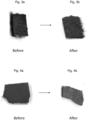
Figures 3a and 3b illustrate two photos of a first sample of finished leather, before (3a) and after (3b) being subjected to the removal process according to the present invention, respectively. -
Figures 4a and 4b illustrate two photos of a second sample of finished leather, before (4a) and after (4b) being subjected to the removal process according to the present invention, respectively. -
Figures 5a and 5b illustrate two photos of a third sample of finished leather, before (5a) and after (5b) being subjected to the removal process according to the present invention, respectively. -
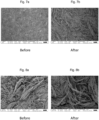
Figures 6a and 6b illustrate two photos of the microstructure of the profile of a sample of finished leather, before (6a) and after (6b) being subjected to the removal process according to the present invention using liquid nitrogen as cryogenic inert material, respectively. Both photos were obtained using a SEM microscope with 100 µm resolution. -
Figures 7a and 7b illustrate two photos of the microstructure of the upper surface, i.e. - the contact surface between the polymeric layer and the leather, of a sample of finished leather, before (6a) and after (6b) having been subjected to the removal process according to the present invention using liquid nitrogen as cryogenic inert material,
- respectively. Both photos were obtained using a SEM microscope with 100 µm resolution.
-
Figures 8a and 8b illustrate two photos of the microstructure of the lower surface, opposed to the upper surface, of a sample of finished leather, before (8a) and after (8b) having been subjected to the removal process according to the present invention using liquid nitrogen as cryogenic inert material, respectively. Both photos were obtained using a SEM microscope with 100 µm resolution. - For the purposes of the present invention, the term "comprising" does not exclude the possibility of further components and/or stages existing in addition to those expressly listed after such term; conversely, the term "consisting of" excludes the possibility of further components existing in addition to those expressly listed after such term.
- For the purposes of the present invention, the term "finished leather" means a leather that has undergone finishing operations and is usable or has already been used for manufacturing a final product, such as shoes, bags, or clothes.
- For the purposes of the present invention, the finished leather on which the process is carried out is a tanned leather.
- The term "tanned leather" means any leather that has undergone a tanning treatment. By way of example, the tanning treatments include: chrome tanning, vegetable tanning, aldehyde tanning, synthetic tannin tanning, sulphochloride tanning, resin tanning, oil tanning.
- The finished leather used in the inventive process is preferably eco-leather or vegan leather.
- For the purposes of the present invention, eco-leather refers to a type of leather or hide with reduced environmental impact, meeting the requirements of the UNI 11427:2011 standard.
- This definition also includes artificial leather comprising or consisting of polyester fibres, and vegan leather consisting of natural fibres, in particular cotton fibres.
- As mentioned above, the object of the present invention is a process for removing a finishing layer from finished leather comprising the steps described below.
- In step A of the removal process, a finished leather comprising a surface polymeric layer disposed on said leather is provided.
- Preferably, the finished leather has a thickness of between 1 and 6 mm, preferably between 1 and 3 mm, preferably of 2 mm, and the process can be carried out on leathers with a surface area between 0.5 m2 and more than 1 m2.
- Preferably, the finishing surface polymeric layer has a thickness of between 1 and 20 microns, preferably between 1 and 18 microns, preferably between 1 and 10 microns.
- Preferably, the surface polymeric layer comprises a mixture of different polymers, preferably polyurethanes and/or acrylic resins.
- Preferably, when the finished leather is vegan leather, the surface polymeric layer comprises polymer matrices, preferably a polyester matrix.
- In step B of the removal process, the finished leather is subjected to a quick freezing.
- Advantageously, the quick freezing of the finished leather causes the surface polymeric layer to break and detach from the leather. This is essentially ascribable to the different glass transition temperature and the different coefficient of thermal expansion of the polymeric layer and the leather, determined by the complex structural divergences of the materials of the two layers. Indeed, the quick-freezing leads to a stress pressure state in the tanned leather and to an expansion stress state in the surface polymeric layer (
Figure 1 ). - The removal process according to the present invention is characterized in that step B is carried out by employing a cryogenic inert material.
- Preferably, the cryogenic inert material is selected from: liquid nitrogen, dry ice, or carbon dioxide snow. Preferably, the cryogenic inert material is liquid nitrogen.
- Accordingly, step B of the removal process is preferably carried out at a temperature below -10 °C, preferably ranging from -210 °C to -10 °C, preferably ranging from - 198 °C to -78 °C, preferably of -198 °C.
- Preferably, the weight ratio of the amount of cryogenic material used in stage B to that of finished leather is between 0.5 and 2, preferably of 0.75.
- This ratio is justified by the energy balance in which the latent heat removed by the evaporation of the cryogenic fluid is balanced by the sensible heat required for cooling, as expressed by the following equation:

- Preferably, when the cryogenic inert material is liquid nitrogen, step B comprises pouring said cryogenic inert material on the finished leather. Preferably, this step consists in spraying the liquid nitrogen in jets onto the finished leather, as highlighted in
Figure 2 , the difference being that the outflow rate required using liquid nitrogen is lower than when using carbon dioxide snow. - During the application of liquid nitrogen, the finished leather is preferably moved. Handling is achieved by means of a suitable conveyor belt system, where the leather is transported horizontally, the finishing polymeric layer being applied on the leather, which in turn contacts the conveyor belt.
- Preferably, when the cryogenic inert material is dry ice, step B comprises contacting the cryogenic inert material with the finished leather.
- Preferably, this step consists in loading the dry ice and the finished leather into a designated ball mill, or in rubbing the dry ice directly on the finished leather surface, until the detachment of the polymeric layer is detached.
- Preferably, when the cryogenic inert material is carbon dioxide snow, step B comprises depositing said cryogenic inert material on the surface polymeric layer of the finished leather.
- Preferably, this step consists in spraying jets of carbon dioxide snow, preferably by means of a suitable spraying device provided with a nozzle, in which the snow is placed under pressure. As a result of the lamination, the carbon dioxide snow solidifies, generating particles 1-2 microns thick. These particles are sprayed onto the finished leather surface and vaporize when impacting on the same, absorbing the sublimation heat that they subtract from the leather surface which, in turn, cools. The carbon dioxide snow cooling reduces the surface polymeric layer to chips.
- In step C of the process, the surface polymeric layer is removed from the finished leather.
- Preferably, when the cryogenic inert material is liquid nitrogen, the surface polymeric layer is removed while maintaining the finished leather from step B subjected to quick cooling.
- Preferably, when the cryogenic inert material is dry ice, the surface polymeric layer from step B is removed by applying an air jet on the finished leather subjected to quick cooling
- Preferably, the air jet is applied after a time ranging from a few seconds to one minute has elapsed, preferably within 30 seconds after the dry ice is applied.
- Preferably, when the cryogenic inert material is carbon dioxide snow, the removal of the surface polymeric layer occurs directly following the application of the cryogenic inert material on the surface polymeric layer of the finished leather. Indeed, the carbon dioxide snow particles when impacting the leather surface, pass from a solid state to a gaseous state. During this sublimation process, the gas formed has a volume about 1.000 times larger than that of the solid particles. This expansion moves the surface polymeric layer, reduced to chips, away from the leather (
Figure 2 ). - Preferably, when the finished leather is moved on a conveyor belt, the removal of the surface layer also occurs by means of a suitable suction system.
- Preferably, in addition to the suction system, there can also be a system of rotating brushes, placed above the finished leather. Advantageously, the rotating brushes are able, by friction with the leather surface, to remove even the smallest residues of the polymeric layer.
- By comparing
Figures 3a vs. 3b, 4a vs. 4b, and 5a vs. 5b, it is clear that the removal process according to the present invention allows to remove completely only the thin surface polymeric layer or finishing layer, the surface of which appears smoother and more homogeneous, while leaving the leather structure, the surface of which appears coarser and rougher, substantially unaltered. - In this regard, the thickness values before (initial) and after (final) the treatment by the inventive process are reported below in Table 1 for
samples 1, 2, 3, depicted inFigures 3a-3b (sample 1), 4a-4b (sample 2), and 5a-5b (sample 3), respectively.Table 1: "initial and final thickness of 3 finished leather samples" Sample Initial thickness (mm) Final thickness (mm) Removed thickness (initial thickness - final thickness) (mm) 1 1.64 1.54 0.10 2 1.56 1.36 0.20 3 1.29 1.11 0.18 - To confirm what has been discussed above, scanning electron microscopy (SEM) analysis were conducted on a sample of finished leather, photographing the structure of the sample before and after the application of the removal process according to the present invention.
- By comparing
Figures 6a vs 6b, 7a vs 7b, and 8a vs 8b, characterized by similar levels of magnification, it is clear that the process according to the present invention allows to remove only the thin finishing layer, which exhibits a definitely finer and more homogeneous structure (Figures 6a and7a ), while leaving the leather, which exhibits a definitely coarser and heterogeneous structure instead, substantially unaltered. (Figures 8a-8b ).
step B is carried out by employing a cryogenic inert material.
Claims (8)
- A process for removing a finishing layer from leather, comprising the following steps:A. providing a finished leather comprising a surface polymeric layer disposed on said leather;B. subjecting the finished leather to a quick freezing;C. removing the surface polymeric layer from the finished leather,wherein
step B is carried out by employing a cryogenic inert material. - The process according to claim 1, wherein step B is carried out at a temperature below -10 °C, preferably ranging from -210 °C to -10 °C, preferably ranging from -198 °C to -78 °C, preferably of -198 °C.
- The process according to claim 1 or 2, wherein the finished leather is eco-leather.
- The process according to any one of claims 1 to 3, wherein the surface polymeric layer comprises a mixture of different polymers, preferably polyurethanes and/or acrylic resins.
- The process according to any one of claims 1 to 4, wherein the cryogenic inert material is selected from: liquid nitrogen, dry ice, or carbon dioxide snow, preferably liquid nitrogen.
- The process according to any one of claims 1 to 5, wherein, when the cryogenic inert material is liquid nitrogen, step B comprises pouring, preferably spraying said cryogenic inert material on the surface polymeric layer of the finished leather.
- The process according to any one of claims 1 to 6, wherein, when the cryogenic inert material is dry ice, step B comprises contacting said cryogenic inert material with the finished leather.
- The process according to any one of claims 1 to 6, wherein, when the cryogenic inert material is carbon dioxide snow, step B comprises depositing said cryogenic inert material on the surface polymeric layer of the finished leather.
Applications Claiming Priority (1)
| Application Number | Priority Date | Filing Date | Title |
|---|---|---|---|
| IT102023000006228A IT202300006228A1 (en) | 2023-03-30 | 2023-03-30 | METHOD OF REMOVING FINISHING LAYERS FROM TANNED AND FINISHED LEATHER |
Publications (1)
| Publication Number | Publication Date |
|---|---|
| EP4438744A1 true EP4438744A1 (en) | 2024-10-02 |
Family
ID=86851978
Family Applications (1)
| Application Number | Title | Priority Date | Filing Date |
|---|---|---|---|
| EP24167883.8A Pending EP4438744A1 (en) | 2023-03-30 | 2024-03-29 | A method for removing finishing layers from tanned and finished leather |
Country Status (2)
| Country | Link |
|---|---|
| EP (1) | EP4438744A1 (en) |
| IT (1) | IT202300006228A1 (en) |
Citations (2)
| Publication number | Priority date | Publication date | Assignee | Title |
|---|---|---|---|---|
| DE202014101465U1 (en) * | 2014-03-28 | 2014-04-03 | Tq-Systems Gmbh | Dry ice blasting unit with comminution module |
| CN110565389A (en) * | 2019-09-05 | 2019-12-13 | 兴业皮革科技股份有限公司 | Coating method for improving water washing resistance and cold bending resistance of leather coating |
-
2023
- 2023-03-30 IT IT102023000006228A patent/IT202300006228A1/en unknown
-
2024
- 2024-03-29 EP EP24167883.8A patent/EP4438744A1/en active Pending
Patent Citations (2)
| Publication number | Priority date | Publication date | Assignee | Title |
|---|---|---|---|---|
| DE202014101465U1 (en) * | 2014-03-28 | 2014-04-03 | Tq-Systems Gmbh | Dry ice blasting unit with comminution module |
| CN110565389A (en) * | 2019-09-05 | 2019-12-13 | 兴业皮革科技股份有限公司 | Coating method for improving water washing resistance and cold bending resistance of leather coating |
Non-Patent Citations (1)
| Title |
|---|
| M�SA V�TEZSLAV ET AL: "Industrial use of dry ice blasting in surface cleaning", JOURNAL OF CLEANER PRODUCTION, ELSEVIER, AMSTERDAM, NL, vol. 329, 12 November 2021 (2021-11-12), XP086891778, ISSN: 0959-6526, [retrieved on 20211112], DOI: 10.1016/J.JCLEPRO.2021.129630 * |
Also Published As
| Publication number | Publication date |
|---|---|
| IT202300006228A1 (en) | 2024-09-30 |
Similar Documents
| Publication | Publication Date | Title |
|---|---|---|
| EP0239040B1 (en) | Pad material for grinding, lapping and polishing | |
| EP1568071B1 (en) | Wafer comprising a separation layer and a support layer and its manufacturing method | |
| US7972396B2 (en) | Method of producing polishing pad | |
| US20090258187A1 (en) | Protective coating for glass manufacturing and processing into articles | |
| DE102017200191B4 (en) | Method and device for smoothing a surface of an article made of a plastic and articles produced by means of the method | |
| JP7127971B2 (en) | Thermoplastic poromeric polishing pad | |
| US7507297B2 (en) | Cleaning method and cleaning apparatus | |
| US5542982A (en) | Method of removing coating films | |
| Masi et al. | A METHOD FOR REMOVING FINISHING LAYERS FROM TANNED AND FINISHED LEATHER | |
| EP1146551A1 (en) | Process for reclaiming a semiconductor wafer | |
| Yue et al. | The morphology, character and strength of the interface in glass fibre-polypropylene composites | |
| TW202140200A (en) | Method of forming leveraged poromeric polishing pad | |
| US9925637B2 (en) | Tapered poromeric polishing pad | |
| US10259099B2 (en) | Tapering method for poromeric polishing pad | |
| IT202300006228A1 (en) | METHOD OF REMOVING FINISHING LAYERS FROM TANNED AND FINISHED LEATHER | |
| TW202140201A (en) | Offset pore poromeric polishing pad | |
| US6652787B2 (en) | Process for the production of a wiping material for a vacuum chamber | |
| JPH08258142A (en) | Manufacture of biaxially drawn film,and device to perform said method | |
| EP0492268A1 (en) | Method for removing paint from products | |
| JPH06246744A (en) | Removing method for coating film of resin molded form | |
| KR100763732B1 (en) | Processing Method of Polyolefin-Based Multi-Layered Film for Scanning Electron Microscopy | |
| US10688621B2 (en) | Low-defect-porous polishing pad | |
| CN113524024B (en) | Lever type porous polishing pad | |
| EP4563368A1 (en) | Composite film, decorative film, and method of decorating target substrate | |
| KR101428545B1 (en) | Method of recycling coated plastic products |
Legal Events
| Date | Code | Title | Description |
|---|---|---|---|
| PUAI | Public reference made under article 153(3) epc to a published international application that has entered the european phase |
Free format text: ORIGINAL CODE: 0009012 |
|
| STAA | Information on the status of an ep patent application or granted ep patent |
Free format text: STATUS: THE APPLICATION HAS BEEN PUBLISHED |
|
| AK | Designated contracting states |
Kind code of ref document: A1 Designated state(s): AL AT BE BG CH CY CZ DE DK EE ES FI FR GB GR HR HU IE IS IT LI LT LU LV MC ME MK MT NL NO PL PT RO RS SE SI SK SM TR |
|
| STAA | Information on the status of an ep patent application or granted ep patent |
Free format text: STATUS: REQUEST FOR EXAMINATION WAS MADE |
|
| 17P | Request for examination filed |
Effective date: 20250401 |
|
| GRAP | Despatch of communication of intention to grant a patent |
Free format text: ORIGINAL CODE: EPIDOSNIGR1 |
|
| STAA | Information on the status of an ep patent application or granted ep patent |
Free format text: STATUS: GRANT OF PATENT IS INTENDED |
|
| RIC1 | Information provided on ipc code assigned before grant |
Ipc: C14B 1/44 20060101AFI20251104BHEP Ipc: B24C 1/00 20060101ALI20251104BHEP |
|
| INTG | Intention to grant announced |
Effective date: 20251114 |