EP4438636A1 - Polyolefin having excellent processability and process for preparing same - Google Patents
Polyolefin having excellent processability and process for preparing same Download PDFInfo
- Publication number
- EP4438636A1 EP4438636A1 EP22898979.4A EP22898979A EP4438636A1 EP 4438636 A1 EP4438636 A1 EP 4438636A1 EP 22898979 A EP22898979 A EP 22898979A EP 4438636 A1 EP4438636 A1 EP 4438636A1
- Authority
- EP
- European Patent Office
- Prior art keywords
- substituted
- transition metal
- unsubstituted
- group
- olefin
- Prior art date
- Legal status (The legal status is an assumption and is not a legal conclusion. Google has not performed a legal analysis and makes no representation as to the accuracy of the status listed.)
- Pending
Links
Images



Classifications
-
- C—CHEMISTRY; METALLURGY
- C08—ORGANIC MACROMOLECULAR COMPOUNDS; THEIR PREPARATION OR CHEMICAL WORKING-UP; COMPOSITIONS BASED THEREON
- C08F—MACROMOLECULAR COMPOUNDS OBTAINED BY REACTIONS ONLY INVOLVING CARBON-TO-CARBON UNSATURATED BONDS
- C08F210/00—Copolymers of unsaturated aliphatic hydrocarbons having only one carbon-to-carbon double bond
- C08F210/16—Copolymers of ethene with alpha-alkenes, e.g. EP rubbers
-
- C—CHEMISTRY; METALLURGY
- C08—ORGANIC MACROMOLECULAR COMPOUNDS; THEIR PREPARATION OR CHEMICAL WORKING-UP; COMPOSITIONS BASED THEREON
- C08F—MACROMOLECULAR COMPOUNDS OBTAINED BY REACTIONS ONLY INVOLVING CARBON-TO-CARBON UNSATURATED BONDS
- C08F2/00—Processes of polymerisation
- C08F2/34—Polymerisation in gaseous state
-
- C—CHEMISTRY; METALLURGY
- C08—ORGANIC MACROMOLECULAR COMPOUNDS; THEIR PREPARATION OR CHEMICAL WORKING-UP; COMPOSITIONS BASED THEREON
- C08F—MACROMOLECULAR COMPOUNDS OBTAINED BY REACTIONS ONLY INVOLVING CARBON-TO-CARBON UNSATURATED BONDS
- C08F210/00—Copolymers of unsaturated aliphatic hydrocarbons having only one carbon-to-carbon double bond
- C08F210/14—Monomers containing five or more carbon atoms
-
- C—CHEMISTRY; METALLURGY
- C08—ORGANIC MACROMOLECULAR COMPOUNDS; THEIR PREPARATION OR CHEMICAL WORKING-UP; COMPOSITIONS BASED THEREON
- C08F—MACROMOLECULAR COMPOUNDS OBTAINED BY REACTIONS ONLY INVOLVING CARBON-TO-CARBON UNSATURATED BONDS
- C08F4/00—Polymerisation catalysts
- C08F4/02—Carriers therefor
- C08F4/025—Metal oxides
-
- C—CHEMISTRY; METALLURGY
- C08—ORGANIC MACROMOLECULAR COMPOUNDS; THEIR PREPARATION OR CHEMICAL WORKING-UP; COMPOSITIONS BASED THEREON
- C08F—MACROMOLECULAR COMPOUNDS OBTAINED BY REACTIONS ONLY INVOLVING CARBON-TO-CARBON UNSATURATED BONDS
- C08F4/00—Polymerisation catalysts
- C08F4/42—Metals; Metal hydrides; Metallo-organic compounds; Use thereof as catalyst precursors
- C08F4/44—Metals; Metal hydrides; Metallo-organic compounds; Use thereof as catalyst precursors selected from light metals, zinc, cadmium, mercury, copper, silver, gold, boron, gallium, indium, thallium, rare earths or actinides
- C08F4/60—Metals; Metal hydrides; Metallo-organic compounds; Use thereof as catalyst precursors selected from light metals, zinc, cadmium, mercury, copper, silver, gold, boron, gallium, indium, thallium, rare earths or actinides together with refractory metals, iron group metals, platinum group metals, manganese, rhenium technetium or compounds thereof
- C08F4/60003—Metals; Metal hydrides; Metallo-organic compounds; Use thereof as catalyst precursors selected from light metals, zinc, cadmium, mercury, copper, silver, gold, boron, gallium, indium, thallium, rare earths or actinides together with refractory metals, iron group metals, platinum group metals, manganese, rhenium technetium or compounds thereof the metallic compound containing a multidentate ligand, i.e. a ligand capable of donating two or more pairs of electrons to form a coordinate or ionic bond
- C08F4/60082—Tridentate ligand
- C08F4/6011—Monoanionic ligand
- C08F4/60113—NNN
-
- C—CHEMISTRY; METALLURGY
- C08—ORGANIC MACROMOLECULAR COMPOUNDS; THEIR PREPARATION OR CHEMICAL WORKING-UP; COMPOSITIONS BASED THEREON
- C08F—MACROMOLECULAR COMPOUNDS OBTAINED BY REACTIONS ONLY INVOLVING CARBON-TO-CARBON UNSATURATED BONDS
- C08F4/00—Polymerisation catalysts
- C08F4/42—Metals; Metal hydrides; Metallo-organic compounds; Use thereof as catalyst precursors
- C08F4/44—Metals; Metal hydrides; Metallo-organic compounds; Use thereof as catalyst precursors selected from light metals, zinc, cadmium, mercury, copper, silver, gold, boron, gallium, indium, thallium, rare earths or actinides
- C08F4/60—Metals; Metal hydrides; Metallo-organic compounds; Use thereof as catalyst precursors selected from light metals, zinc, cadmium, mercury, copper, silver, gold, boron, gallium, indium, thallium, rare earths or actinides together with refractory metals, iron group metals, platinum group metals, manganese, rhenium technetium or compounds thereof
- C08F4/60003—Metals; Metal hydrides; Metallo-organic compounds; Use thereof as catalyst precursors selected from light metals, zinc, cadmium, mercury, copper, silver, gold, boron, gallium, indium, thallium, rare earths or actinides together with refractory metals, iron group metals, platinum group metals, manganese, rhenium technetium or compounds thereof the metallic compound containing a multidentate ligand, i.e. a ligand capable of donating two or more pairs of electrons to form a coordinate or ionic bond
- C08F4/60168—Tetra- or multi-dentate ligand
- C08F4/60186—Dianionic ligand
- C08F4/60193—OOOO
-
- C—CHEMISTRY; METALLURGY
- C08—ORGANIC MACROMOLECULAR COMPOUNDS; THEIR PREPARATION OR CHEMICAL WORKING-UP; COMPOSITIONS BASED THEREON
- C08F—MACROMOLECULAR COMPOUNDS OBTAINED BY REACTIONS ONLY INVOLVING CARBON-TO-CARBON UNSATURATED BONDS
- C08F4/00—Polymerisation catalysts
- C08F4/42—Metals; Metal hydrides; Metallo-organic compounds; Use thereof as catalyst precursors
- C08F4/44—Metals; Metal hydrides; Metallo-organic compounds; Use thereof as catalyst precursors selected from light metals, zinc, cadmium, mercury, copper, silver, gold, boron, gallium, indium, thallium, rare earths or actinides
- C08F4/60—Metals; Metal hydrides; Metallo-organic compounds; Use thereof as catalyst precursors selected from light metals, zinc, cadmium, mercury, copper, silver, gold, boron, gallium, indium, thallium, rare earths or actinides together with refractory metals, iron group metals, platinum group metals, manganese, rhenium technetium or compounds thereof
- C08F4/62—Refractory metals or compounds thereof
- C08F4/64—Titanium, zirconium, hafnium or compounds thereof
- C08F4/64003—Titanium, zirconium, hafnium or compounds thereof the metallic compound containing a multidentate ligand, i.e. a ligand capable of donating two or more pairs of electrons to form a coordinate or ionic bond
- C08F4/64082—Tridentate ligand
- C08F4/64141—Dianionic ligand
- C08F4/64148—NN(R)N
-
- C—CHEMISTRY; METALLURGY
- C08—ORGANIC MACROMOLECULAR COMPOUNDS; THEIR PREPARATION OR CHEMICAL WORKING-UP; COMPOSITIONS BASED THEREON
- C08F—MACROMOLECULAR COMPOUNDS OBTAINED BY REACTIONS ONLY INVOLVING CARBON-TO-CARBON UNSATURATED BONDS
- C08F4/00—Polymerisation catalysts
- C08F4/42—Metals; Metal hydrides; Metallo-organic compounds; Use thereof as catalyst precursors
- C08F4/44—Metals; Metal hydrides; Metallo-organic compounds; Use thereof as catalyst precursors selected from light metals, zinc, cadmium, mercury, copper, silver, gold, boron, gallium, indium, thallium, rare earths or actinides
- C08F4/60—Metals; Metal hydrides; Metallo-organic compounds; Use thereof as catalyst precursors selected from light metals, zinc, cadmium, mercury, copper, silver, gold, boron, gallium, indium, thallium, rare earths or actinides together with refractory metals, iron group metals, platinum group metals, manganese, rhenium technetium or compounds thereof
- C08F4/62—Refractory metals or compounds thereof
- C08F4/64—Titanium, zirconium, hafnium or compounds thereof
- C08F4/642—Component covered by group C08F4/64 with an organo-aluminium compound
- C08F4/6428—Component covered by group C08F4/64 with an organo-aluminium compound with an aluminoxane, i.e. a compound containing an Al-O-Al- group
-
- C—CHEMISTRY; METALLURGY
- C08—ORGANIC MACROMOLECULAR COMPOUNDS; THEIR PREPARATION OR CHEMICAL WORKING-UP; COMPOSITIONS BASED THEREON
- C08F—MACROMOLECULAR COMPOUNDS OBTAINED BY REACTIONS ONLY INVOLVING CARBON-TO-CARBON UNSATURATED BONDS
- C08F4/00—Polymerisation catalysts
- C08F4/42—Metals; Metal hydrides; Metallo-organic compounds; Use thereof as catalyst precursors
- C08F4/44—Metals; Metal hydrides; Metallo-organic compounds; Use thereof as catalyst precursors selected from light metals, zinc, cadmium, mercury, copper, silver, gold, boron, gallium, indium, thallium, rare earths or actinides
- C08F4/60—Metals; Metal hydrides; Metallo-organic compounds; Use thereof as catalyst precursors selected from light metals, zinc, cadmium, mercury, copper, silver, gold, boron, gallium, indium, thallium, rare earths or actinides together with refractory metals, iron group metals, platinum group metals, manganese, rhenium technetium or compounds thereof
- C08F4/62—Refractory metals or compounds thereof
- C08F4/64—Titanium, zirconium, hafnium or compounds thereof
- C08F4/659—Component covered by group C08F4/64 containing a transition metal-carbon bond
- C08F4/65904—Component covered by group C08F4/64 containing a transition metal-carbon bond in combination with another component of C08F4/64
-
- C—CHEMISTRY; METALLURGY
- C08—ORGANIC MACROMOLECULAR COMPOUNDS; THEIR PREPARATION OR CHEMICAL WORKING-UP; COMPOSITIONS BASED THEREON
- C08F—MACROMOLECULAR COMPOUNDS OBTAINED BY REACTIONS ONLY INVOLVING CARBON-TO-CARBON UNSATURATED BONDS
- C08F4/00—Polymerisation catalysts
- C08F4/42—Metals; Metal hydrides; Metallo-organic compounds; Use thereof as catalyst precursors
- C08F4/44—Metals; Metal hydrides; Metallo-organic compounds; Use thereof as catalyst precursors selected from light metals, zinc, cadmium, mercury, copper, silver, gold, boron, gallium, indium, thallium, rare earths or actinides
- C08F4/60—Metals; Metal hydrides; Metallo-organic compounds; Use thereof as catalyst precursors selected from light metals, zinc, cadmium, mercury, copper, silver, gold, boron, gallium, indium, thallium, rare earths or actinides together with refractory metals, iron group metals, platinum group metals, manganese, rhenium technetium or compounds thereof
- C08F4/62—Refractory metals or compounds thereof
- C08F4/64—Titanium, zirconium, hafnium or compounds thereof
- C08F4/659—Component covered by group C08F4/64 containing a transition metal-carbon bond
- C08F4/65908—Component covered by group C08F4/64 containing a transition metal-carbon bond in combination with an ionising compound other than alumoxane, e.g. (C6F5)4B-X+
-
- C—CHEMISTRY; METALLURGY
- C08—ORGANIC MACROMOLECULAR COMPOUNDS; THEIR PREPARATION OR CHEMICAL WORKING-UP; COMPOSITIONS BASED THEREON
- C08F—MACROMOLECULAR COMPOUNDS OBTAINED BY REACTIONS ONLY INVOLVING CARBON-TO-CARBON UNSATURATED BONDS
- C08F4/00—Polymerisation catalysts
- C08F4/42—Metals; Metal hydrides; Metallo-organic compounds; Use thereof as catalyst precursors
- C08F4/44—Metals; Metal hydrides; Metallo-organic compounds; Use thereof as catalyst precursors selected from light metals, zinc, cadmium, mercury, copper, silver, gold, boron, gallium, indium, thallium, rare earths or actinides
- C08F4/60—Metals; Metal hydrides; Metallo-organic compounds; Use thereof as catalyst precursors selected from light metals, zinc, cadmium, mercury, copper, silver, gold, boron, gallium, indium, thallium, rare earths or actinides together with refractory metals, iron group metals, platinum group metals, manganese, rhenium technetium or compounds thereof
- C08F4/62—Refractory metals or compounds thereof
- C08F4/64—Titanium, zirconium, hafnium or compounds thereof
- C08F4/659—Component covered by group C08F4/64 containing a transition metal-carbon bond
- C08F4/65912—Component covered by group C08F4/64 containing a transition metal-carbon bond in combination with an organoaluminium compound
-
- C—CHEMISTRY; METALLURGY
- C08—ORGANIC MACROMOLECULAR COMPOUNDS; THEIR PREPARATION OR CHEMICAL WORKING-UP; COMPOSITIONS BASED THEREON
- C08F—MACROMOLECULAR COMPOUNDS OBTAINED BY REACTIONS ONLY INVOLVING CARBON-TO-CARBON UNSATURATED BONDS
- C08F4/00—Polymerisation catalysts
- C08F4/42—Metals; Metal hydrides; Metallo-organic compounds; Use thereof as catalyst precursors
- C08F4/44—Metals; Metal hydrides; Metallo-organic compounds; Use thereof as catalyst precursors selected from light metals, zinc, cadmium, mercury, copper, silver, gold, boron, gallium, indium, thallium, rare earths or actinides
- C08F4/60—Metals; Metal hydrides; Metallo-organic compounds; Use thereof as catalyst precursors selected from light metals, zinc, cadmium, mercury, copper, silver, gold, boron, gallium, indium, thallium, rare earths or actinides together with refractory metals, iron group metals, platinum group metals, manganese, rhenium technetium or compounds thereof
- C08F4/62—Refractory metals or compounds thereof
- C08F4/64—Titanium, zirconium, hafnium or compounds thereof
- C08F4/659—Component covered by group C08F4/64 containing a transition metal-carbon bond
- C08F4/65916—Component covered by group C08F4/64 containing a transition metal-carbon bond supported on a carrier, e.g. silica, MgCl2, polymer
-
- C—CHEMISTRY; METALLURGY
- C08—ORGANIC MACROMOLECULAR COMPOUNDS; THEIR PREPARATION OR CHEMICAL WORKING-UP; COMPOSITIONS BASED THEREON
- C08F—MACROMOLECULAR COMPOUNDS OBTAINED BY REACTIONS ONLY INVOLVING CARBON-TO-CARBON UNSATURATED BONDS
- C08F4/00—Polymerisation catalysts
- C08F4/42—Metals; Metal hydrides; Metallo-organic compounds; Use thereof as catalyst precursors
- C08F4/44—Metals; Metal hydrides; Metallo-organic compounds; Use thereof as catalyst precursors selected from light metals, zinc, cadmium, mercury, copper, silver, gold, boron, gallium, indium, thallium, rare earths or actinides
- C08F4/60—Metals; Metal hydrides; Metallo-organic compounds; Use thereof as catalyst precursors selected from light metals, zinc, cadmium, mercury, copper, silver, gold, boron, gallium, indium, thallium, rare earths or actinides together with refractory metals, iron group metals, platinum group metals, manganese, rhenium technetium or compounds thereof
- C08F4/62—Refractory metals or compounds thereof
- C08F4/64—Titanium, zirconium, hafnium or compounds thereof
- C08F4/659—Component covered by group C08F4/64 containing a transition metal-carbon bond
- C08F4/6592—Component covered by group C08F4/64 containing a transition metal-carbon bond containing at least one cyclopentadienyl ring, condensed or not, e.g. an indenyl or a fluorenyl ring
- C08F4/65922—Component covered by group C08F4/64 containing a transition metal-carbon bond containing at least one cyclopentadienyl ring, condensed or not, e.g. an indenyl or a fluorenyl ring containing at least two cyclopentadienyl rings, fused or not
- C08F4/65925—Component covered by group C08F4/64 containing a transition metal-carbon bond containing at least one cyclopentadienyl ring, condensed or not, e.g. an indenyl or a fluorenyl ring containing at least two cyclopentadienyl rings, fused or not two cyclopentadienyl rings being mutually non-bridged
-
- C—CHEMISTRY; METALLURGY
- C08—ORGANIC MACROMOLECULAR COMPOUNDS; THEIR PREPARATION OR CHEMICAL WORKING-UP; COMPOSITIONS BASED THEREON
- C08F—MACROMOLECULAR COMPOUNDS OBTAINED BY REACTIONS ONLY INVOLVING CARBON-TO-CARBON UNSATURATED BONDS
- C08F4/00—Polymerisation catalysts
- C08F4/42—Metals; Metal hydrides; Metallo-organic compounds; Use thereof as catalyst precursors
- C08F4/44—Metals; Metal hydrides; Metallo-organic compounds; Use thereof as catalyst precursors selected from light metals, zinc, cadmium, mercury, copper, silver, gold, boron, gallium, indium, thallium, rare earths or actinides
- C08F4/60—Metals; Metal hydrides; Metallo-organic compounds; Use thereof as catalyst precursors selected from light metals, zinc, cadmium, mercury, copper, silver, gold, boron, gallium, indium, thallium, rare earths or actinides together with refractory metals, iron group metals, platinum group metals, manganese, rhenium technetium or compounds thereof
- C08F4/62—Refractory metals or compounds thereof
- C08F4/64—Titanium, zirconium, hafnium or compounds thereof
- C08F4/659—Component covered by group C08F4/64 containing a transition metal-carbon bond
- C08F4/6592—Component covered by group C08F4/64 containing a transition metal-carbon bond containing at least one cyclopentadienyl ring, condensed or not, e.g. an indenyl or a fluorenyl ring
- C08F4/65922—Component covered by group C08F4/64 containing a transition metal-carbon bond containing at least one cyclopentadienyl ring, condensed or not, e.g. an indenyl or a fluorenyl ring containing at least two cyclopentadienyl rings, fused or not
- C08F4/65927—Component covered by group C08F4/64 containing a transition metal-carbon bond containing at least one cyclopentadienyl ring, condensed or not, e.g. an indenyl or a fluorenyl ring containing at least two cyclopentadienyl rings, fused or not two cyclopentadienyl rings being mutually bridged
-
- C—CHEMISTRY; METALLURGY
- C08—ORGANIC MACROMOLECULAR COMPOUNDS; THEIR PREPARATION OR CHEMICAL WORKING-UP; COMPOSITIONS BASED THEREON
- C08F—MACROMOLECULAR COMPOUNDS OBTAINED BY REACTIONS ONLY INVOLVING CARBON-TO-CARBON UNSATURATED BONDS
- C08F2500/00—Characteristics or properties of obtained polyolefins; Use thereof
- C08F2500/055—Monomodal/unimodal molecular weight distribution
-
- C—CHEMISTRY; METALLURGY
- C08—ORGANIC MACROMOLECULAR COMPOUNDS; THEIR PREPARATION OR CHEMICAL WORKING-UP; COMPOSITIONS BASED THEREON
- C08F—MACROMOLECULAR COMPOUNDS OBTAINED BY REACTIONS ONLY INVOLVING CARBON-TO-CARBON UNSATURATED BONDS
- C08F2500/00—Characteristics or properties of obtained polyolefins; Use thereof
- C08F2500/12—Melt flow index or melt flow ratio
-
- C—CHEMISTRY; METALLURGY
- C08—ORGANIC MACROMOLECULAR COMPOUNDS; THEIR PREPARATION OR CHEMICAL WORKING-UP; COMPOSITIONS BASED THEREON
- C08F—MACROMOLECULAR COMPOUNDS OBTAINED BY REACTIONS ONLY INVOLVING CARBON-TO-CARBON UNSATURATED BONDS
- C08F2500/00—Characteristics or properties of obtained polyolefins; Use thereof
- C08F2500/18—Bulk density
Definitions
- the present invention relates to an olefin-based polymer having excellent processability and a method for preparing the same. Specifically, the present invention relates to an olefin-based polymer which is polymerized in the presence of a hybrid metallocene catalyst, has a broad unimodal molecular weight distribution having a shoulder, and has excellent processability, and a method for preparing the same.
- Polyolefin-based polymers are used in various ways in real life as materials for shopping bags, greenhouses, fishing nets, cigarette wrappers, ramen bags, yogurt bottles, battery cases, car bumpers, interior materials, shoe soles, washing machines, and the like.
- polyolefin-based polymers such as polyethylene, polypropylene, and ethylene ⁇ -olefin copolymers and copolymer thereof are prepared by heterogeneous catalysts such as a Ziegler-Natta catalyst formed of a titanium compound and an alkyl aluminum compound.
- a metallocene catalyst is a compound in which a ligand such as cyclopentadienyl, indenyl, or cycloheptadienyl is coordinated to a transition metal or a transition metal halogen compound, and has a sandwich structure as a basic form. Herein, it has various molecular structures depending on a ligand form and the type of center metal.
- a Ziegler-Natta catalyst which is a heterogeneous catalyst has an active site having heterogeneous properties, since a metal component as the active site is dispersed on an inert solid surface; however, the metallocene catalyst is known as a single-site catalyst having identical polymerization properties in all active sites, since it is one compound having a certain structure.
- the metallocene catalyst as such is easily used for copolymerization and may adjust a stereostructure of a polymer depending on catalyst symmetry, and a polymer prepared therefrom has a narrow molecular weight distribution and a uniform comonomer distribution.
- a polymer prepared by the metallocene catalyst has excellent mechanical strength, but low processability, due to the narrow molecular weight distribution.
- a polyolefin obtained using a chrome or Zigler-Natta catalyst has been mainly used in the manufacture of local area network (LAN) cables.
- LAN local area network
- a polyolefin prepared by the metallocene catalyst has low processability, it is known that the polyolefin is not appropriate for LAN cable manufacture.
- the molecular weight of a polyolefin has better processability as the bimodal shape is clearer in some cases, but has poor processability as compared with a polyolefin having a unimodal shape, in other cases.
- An object of the present invention is to provide an olefin-based polymer which is polymerized in the presence of a hybrid metallocene catalyst, has a broad unimodal molecular weight distribution having a shoulder, and has excellent high-speed processability, and a method for preparing the same.
- an olefin-based polymer which has a density of 0.930 to 0.970 g/cm3, a melt index (I 2.16 ) measured with a load of 2.16 kg at 190°C of 0.1 to 5.0 g/10 min, a ratio (melt flow ratio; MFR) between a melt index (I 21.6 ) measured with a load of 21.6 kg and a melt index (I 2.16 ) measured with a load of 2.16 kg at 190°C of 30 to 200, a unimodal molecular weight distribution having a shoulder when measured by gel permeation chromatography (GPC), and a shear rate defined by the following Equation 1 at which a melt fracture or shark skin is shown when measured with a capillary rheometer, of 500 sec -1 or more is provided.
- MFR melt flow ratio
- ⁇ ap 4 V ⁇ R 3 wherein ⁇ ap is an apparent shear rate (sec -1 ), V is a volume flow (mm 3 /sec) produced by a piston, and R is a radius (mm) of a round hole capillary.
- an olefin-based polymer which is prepared by polymerization of ethylene and at least one ⁇ -olefin in the presence of a hybrid metallocene catalyst, and has a density of 0.930 to 0.970 g/cm 3 , a melt index (I 2.16 ) measured with a load of 2.16 kg at 190°C of 0.1 to 5.0 g/10 min, a ratio (melt flow ratio; MFR) between a melt index (I 21.6 ) measured with a load of 21.6 kg and a melt index (I 2.16 ) measured with a load of 2.16 kg at 190°C of 30 to 200, a unimodal molecular weight distribution when measured by gel permeation chromatography (GPC), and a shear rate defined by Equation 1 at which a melt fracture or shark skin is shown when measured with a capillary rheometer, of 500 sec -1 or more is provided.
- MFR melt flow ratio
- an olefin-based polymer which is prepared by polymerization of ethylene and at least one ⁇ -olefin in the presence of a hybrid metallocene catalyst, and has a density of 0.930 to 0.970 g/cm3, a melt index (I 2.16 ) measured with a load of 2.16 kg at 190°C of 0.1 to 5.0 g/10 min, a ratio (melt flow ratio; MFR) between a melt index (I 21.6 ) measured with a load of 21.6 kg and a melt index (I 2.16 ) measured with a load of 2.16 kg at 190°C of 30 to 200, a unimodal molecular weight distribution when measured by gel permeation chromatography (GPC), and a shear rate defined by Equation 1 at which a melt fracture or shark skin is shown when measured with a capillary rheometer, of 500 sec -1 or more is provided.
- MFR melt flow ratio
- the olefin-based polymer may have the density of 0.930 to 0.965 g/cm3, preferably 0.935 to 0.960 g/cm3, the melt index (I 2.16 ) measured with a load of 2.16 kg at 190°C of 0.5 to 4.5 g/10 min, preferably 0.5 to 4.0 g/10 min, the ratio (MFR) between the melt index (I 21.6 ) measured with a load of 21.6 kg and the melt index (I 2.16 ) measured with a load of 2.16 kg at 190°C of 30 to 150, preferably 40 to 135, and the shear rate at which a melt fracture or shark skin is shown when measured with a capillary rheometer, of 700 sec -1 or more, preferably 750 sec -1 or more.
- the olefin-based polymer may be prepared by polymerization of ethylene and at least one ⁇ -olefin in the presence of a hybrid metallocene catalyst
- the hybrid metallocene catalyst may include: (a) at least one first transition metal compound selected from transition metal compounds represented by the following Chemical Formula 1 and transition metal compounds represented by the following Chemical Formula 2; (b) at least one second transition metal compound selected from transition metal compounds represented by the following Chemical Formula 3; (c) at least one third transition metal compound selected from transition metal compounds represented by the following Chemical Formula 4, transition metal compounds represented by the following Chemical Formula 5a, and transition metal compounds represented by the following Chemical Formula 5b; and (d) a cocatalyst compound:
- the transition metal compound of Chemical Formula 1 may be at least one of transition metal compounds represented by the following Chemical Formulae 1-1 to 1-8, and the transition metal compound of Chemical Formula 2 may be a transition metal compound represented by the following Chemical Formula 2-1: wherein Me is methyl.
- the transition metal compound of Chemical Formula 3 may be at least one of transition metal compounds represented by the following Chemical Formulae 3-1 to 3-10: wherein Me is methyl, n-Bu is n-butyl, t-Bu is t-butyl, Ph is phenyl, and p-Tol is p-tolyl.
- the transition metal compound of Chemical Formula 4 may be at least one of transition metal compounds represented by the following Chemical Formulae 4-1 and 4-2
- the transition metal compound of Chemical Formula 5a may be at least one of transition metal compounds represented by the following Chemical Formulae 5-1 to 5-4
- the compound of Chemical Formula 5b may be at least one of transition metal compounds represented by the following Chemical Formulae 5-5 and 5-6: wherein Me is methyl, t-Bu is t-butyl, and Ph is phenyl.
- the cocatalyst compound may include at least one selected from the group consisting of a compound represented by the following Chemical Formula 6, a compound represented by the following Chemical Formula 7, and a compound represented by Chemical Formula 8: [Chemical Formula 8] [L-H] + [Z(A) 4 ] - or [L] + [Z(A) 4 ] -
- the compound represented by Chemical Formula 6 may be at least one selected from the group consisting of methylaluminoxane, ethylaluminoxane, isobutylaluminoxane, and butylaluminoxane.
- the compound represented by Chemical Formula 7 may be at least one selected from the group consisting of trimethylaluminum, triethylaluminum, triisobutylaluminum, tripropylaluminum, tributylaluminum, dimethylchloroaluminum, triisopropylaluminum, tri-s-butylaluminum, tricyclopentylaluminum, tripentylaluminum, triisopentylaluminum, trihexylaluminum, trioctylaluminum, ethyldimethylaluminum, methyldiethylaluminum, triphenylaluminum, tri-p-tolylaluminum, dimethylaluminummethoxide, dimethylaluminumethoxide, trimethylboron, triethylboron, triisobutylboron, tripropylboron, and tributylboron.
- the compound represented by Chemical Formula 8 may be at least one selected from the group consisting of triethylammonium tetraphenylboron, tributylammonium tetraphenylboron, trimethylammonium tetraphenylboron, tripropylammonium tetraphenylboron, trimethylammonium tetra(p-tolyl)boron, trimethylammonium tetra(o,p-dimethylphenyl)boron, tributylammonium tetra(p-trifluoromethylphenyl)boron, trimethylammonium tetra(p-trifluoromethylphenyl)boron, tributylammonium tetrapentafluorophenylboron, N,N-diethylanilinium tetraphenylboron, N,N-diethylanilinium tetrapentafluorophenylboron, N,N
- the hybrid metallocene catalyst may further include a carrier which supports the hybrid transition metal compound, the cocatalyst compound, or both.
- the carrier may include at least one selected from the group consisting of silica, alumina, and magnesia.
- a total amount of the hybrid transition metal compound supported on the carrier may be 0.001 to 1 mmol based on 1 g of the carrier, and a total amount of the cocatalyst compound supported on the carrier may be 2 to 15 mmol based on 1 g of the carrier.
- a method for preparing an olefin-based polymer includes: polymerizing ethylene and at least one ⁇ -olefin in the presence of a hybrid metallocene catalyst including: (a) at least one first transition metal compound selected from transition metal compounds represented by the following Chemical Formula 1 and transition metal compounds represented by the following Chemical Formula 2; (b) at least one second transition metal compound selected from transition metal compounds represented by the following Chemical Formula 3; (c) at least one third transition metal compound selected from transition metal compounds represented by the following Chemical Formula 4, transition metal compounds represented by the following Chemical Formula 5a, and transition metal compounds represented by the following Chemical Formula 5b; and (d) a cocatalyst compound, thereby obtaining an olefin-based polymer, wherein the olefin-based polymer has a density of 0.930 to 0.970 g/cm3, a melt index (I 2.16 ) measured with a load of 2.16 kg at 190°C of 0.1 to 5.0 g/10 min, a ratio (I 2.16
- the ⁇ -olefin may be at least one selected from the group consisting of propylene, 1-butene, 1-pentene, 4-methyl-1-pentene, 1-hexene, 1-heptene, 1-octene, 1-decene, 1-undecene, 1-dodecene, 1-tetradecene, and 1-hexadecene.
- the ⁇ -olefin may be 1-hexene.
- the olefin-based polymer prepared by a hybrid metallocene catalyst has a broad unimodal molecular weight distribution having a shoulder and excellent high-speed processability.
- an olefin-based polymer which has a density of 0.930 to 0.970 g/cm3, a melt index (I 2.16 ) measured with a load of 2.16 kg at 190°C of 0.1 to 5.0 g/10 min, and a ratio (melt flow ratio; MFR) between a melt index (I 21.6 ) measured with a load of 21.6 kg and a melt index (I 2.16 ) measured with a load of 2.16 kg at 190°C of 30 to 200 is provided.
- the olefin-based polymer according to an exemplary embodiment of the present invention has a density of 0.930 to 0.970 g/cm 3 .
- the density of the olefin-based polymer may be preferably 0.930 to 0.965 g/cm3, more preferably 0.935 to 0.960 g/cm3, and particularly preferably 0.940 to 0.950 g/cm 3 .
- the olefin-based polymer according to an exemplary embodiment of the present invention may have a melt index (I 2.16 ) as measured with a load of 2.16 kg at 190°C of 0.1 to 5.0 g/10 min.
- the melt index of the olefin-based polymer measured with a load of 2.16 kg at 190°C may be preferably 0.5 to 4.5 g/10 min, more preferably 0.5 to 4.0 g/10 min, and particularly preferably 0.5 to 2.0 g/10 min.
- the olefin-based polymer according to an exemplary embodiment of the present invention has a unimodal molecular weight distribution when measured by gel permeation chromatography (GPC).
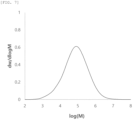
- FIG. 1 showing a general GPC graph of a polymer
- the olefin-based polymer shows a unimodal molecular weight distribution having one peak.
- the olefin-based polymer according to an exemplary embodiment of the present invention has a shoulder in the GPC graph, as shown in FIGS. 2 to 5 .
- the shoulder may refer to a section in which the absolute value of the positive slope toward a low molecular weight component (left of the peak) increases and then decreases but does not change to a negative value, or a section in which the absolute value of the negative slope toward a high molecular weight component (right of the peak) decreases and then increases but does not change to a positive value, as the molecular weight increases in the GPC graph.
- this is not classified as a peak as long as the value of the tangent line of the graph does not change from positive to negative or negative to positive.
- the GPC of the olefin-based polymer according to an exemplary embodiment of the present invention is measured, the value of a fraction (vertical axis) to a molecular weight (horizontal axis) is converted into a numerical value and the change in value is checked, thereby confirming the presence of the peak and the number of peaks on the GPC graph.
- a melt fracture or shark skin commonly refers to an occurrence of irregular bumps or shark scales or loss of surface gloss on the surface of the polymer during extrusion of the polymer. As the shear rate at which the melt fracture or shark skin occurs is higher, the processability of the corresponding polymer may be said to be excellent.
- the olefin-based polymer according to an exemplary embodiment of the present invention is prepared by polymerization of ethylene and at least one ⁇ -olefin.
- the olefin-based polymer may be prepared by polymerization of ethylene and at least one ⁇ -olefin in the presence of a hybrid metallocene catalyst including: (a) at least one first transition metal compound selected from transition metal compounds represented by the following Chemical Formula 1 and transition metal compounds represented by the following Chemical Formula 2; (b) at least one second transition metal compound selected from transition metal compounds represented by the following Chemical Formula 3; (c) at least one third transition metal compound selected from transition metal compounds represented by the following Chemical Formula 4, transition metal compounds represented by the following Chemical Formula 5a, and transition metal compounds represented by the following Chemical Formula 5b; and (d) a cocatalyst compound:
- n3 and o1 are independently of each other an integer of 0 to 2.
- each m3 is 1 and each o1 is 0.
- q is a formal charge of a YZL ligand, and is 0, -1, - 2, or -3.
- M is a Group 4 transition metal of a periodic table of elements. Specifically, M may be titanium (Ti), zirconium (Zr), or hafnium (Hf), more specifically zirconium or hafnium.
- X is independently of each other a halogen, C 1-20 alkyl, C 2-20 alkenyl, C 2-20 alkynyl, C 6-20 aryl, C 1-20 alkyl C 6-20 aryl, C 6-20 aryl C 1-20 alkyl, C 1-20 alkylamido, or C 6-20 arylamido.
- X may be independently of each other halogen or C 1-20 alkyl, more specifically chlorine (Cl) or methyl.
- R 1 to R 4 , R 7 , R 8 , R 11 , and R 12 are independently of one another substituted or unsubstituted C 1-20 alkyl, substituted or unsubstituted C 2-20 alkenyl, substituted or unsubstituted C 6-20 aryl, substituted or unsubstituted C 1-20 alkyl C 6-20 aryl, substituted or unsubstituted C 6-20 aryl C 1-20 alkyl, substituted or unsubstituted C 1-20 heteroalkyl, substituted or unsubstituted C 3-20 heteroaryl, substituted or unsubstituted C 1-20 alkylamido, substituted or unsubstituted C 6-20 arylamido, or substituted or unsubstituted C 1-20 silyl, but these may or may not be independently of each other connected to an adjacent group to form a substituted or unsubstituted, saturated or unsaturated C 4-20 ring.
- R 5 , R 6 , R 9 , R 10 , R 13 , and R 14 are independently of one another substituted or unsubstituted C 1-20 alkyl, substituted or unsubstituted C 2-20 alkenyl, substituted or unsubstituted C 6-20 aryl, substituted or unsubstituted C 1-20 alkyl C 6-20 aryl, substituted or unsubstituted C 6-20 aryl C 1-20 alkyl, substituted or unsubstituted C 1-20 heteroalkyl, substituted or unsubstituted C 3-20 heteroaryl, substituted or unsubstituted C 1-20 alkylamido, substituted or unsubstituted C 6-20 arylamido, or substituted or unsubstituted C 1-20 silyl, but R 5 and R 6 , R 9 and R 10 , R 13 and R 14 may or may not be independently of one another connected to each other to form a substituted or unsubstituted,
- R 5 , R 6 , R 9 , R 10 , R 13 , and R 14 may be independently of one another substituted or unsubstituted C 1-20 alkyl, substituted or unsubstituted C 2-20 alkenyl, or substituted or unsubstituted C 6-20 aryl.
- R 17 does not exist, or is hydrogen, C 1-20 alkyl, a halogen, or a heteroatom-containing group. Specifically, R 17 may be hydrogen or methyl.
- the transition metal compound of Chemical Formula 3 may be at least one of transition metal compounds represented by the following Chemical Formulae 3-1 to 3-10: wherein Me is methyl, n -Bu is n -butyl, t -Bu is t -butyl, Ph is phenyl, and p -Tol is p -tolyl.
- the transition metal compound of Chemical Formula 4 may be at least one of transition metal compounds represented by the following Chemical Formulae 4-1 and 4-2
- the transition metal compound of Chemical Formula 5a may be at least one of transition metal compounds represented by the following Chemical Formulae 5-1 to 5-4
- the compound of Chemical Formula 5b may be at least one of transition metal compounds represented by the following Chemical Formulae 5-5 and 5-6: wherein Me is methyl, t-Bu is t-butyl, and Ph is phenyl.
- the cocatalyst compound may include at least one selected from the group consisting of a compound represented by the following Chemical Formula 6, a compound represented by the following Chemical Formula 7, and a compound represented by Chemical Formula 8: wherein n is an integer of 2 or more, and R a is a halogen atom, a hydrocarbon having 1 to 20 carbon atoms, or a hydrocarbon having 1 to 20 carbon atoms substituted by a halogen.
- R a may be methyl, ethyl, n -butyl, or isobutyl.
- D is aluminum (Al) or boron (B)
- R b , R c , and R d are independently of one another a halogen atom, a hydrocarbon group having 1 to 20 carbon atoms, a hydrocarbon group having 1 to 20 carbon atoms substituted by a halogen, or an alkoxy group having 1 to 20 carbon atoms.
- D aluminum (Al)
- R b , R c , and R d may be independently of one another methyl or isobutyl
- D is boron (B)
- R b , R c , and R d may be pentafluorophenyl, respectively.
- [L-H] + may be dimethylanilinium cation
- [Z(A) 4 ] - may be [B(C 6 F 5 ) 4 ] -
- [L] + may be [(C 6 H 5 ) 3 C] + .
- An example of the compound represented by Chemical Formula 6 may include methylaluminoxane, ethylaluminoxane, isobutylaluminoxane, butylaluminoxane, and the like, and is preferably methylaluminoxane, but is not limited thereto.
- An example of the compound represented by Chemical Formula 7 includes trimethylaluminum, triethylaluminum, triisobutylaluminum, tripropylaluminum, tributylaluminum, dimethylchloroaluminum, triisopropylaluminum, tri-s-butylaluminum, tricyclopentylaluminum, tripentylaluminum, triisopentylaluminum, trihexylaluminum, trioctylaluminum, ethyldimethylaluminum, methyldiethylaluminum, triphenylaluminum, tri-p-tolylaluminum, dimethylaluminummethoxide, dimethylaluminumethoxide, trimethylboron, triethylboron, triisobutylboron, tripropylboron, tributylboron, and the like, and is preferably trimethylaluminum, triethylalumin
- An example of the compound represented by Chemical Formula 8 may include triethylammonium tetraphenylboron, tributylammonium tetraphenylboron, trimethylammonium tetraphenylboron, tripropylammonium tetraphenylboron, trimethylammonium tetra( p -tolyl)boron, trimethylammonium tetra( o , p -dimethylphenyl)boron, tributylammonium tetra( p- trifluoromethylphenyl)boron, trimethylammonium tetra( p- trifluoromethylphenyl)boron, tributylammonium tetrapentafluorophenylboron, N,N-diethylanilinium tetraphenylboron, N,N-diethylanilinium tetrapentafluorophenylboron, dieth
- the hybrid metallocene catalyst for olefin polymerization may further include a carrier which supports the hybrid transition metal compound, the cocatalyst compound, or both.
- the carrier may include a material containing a hydroxyl group on the surface, and preferably, may use a material having highly reactive hydroxyl and siloxane groups, which is dried to remove moisture from the surface.
- the carrier may include at least one selected from the group consisting of silica, alumina, and magnesia.
- silica, silica-alumina, silica-magnesia, and the like which are dried at a high temperature may be used as the carrier, and these may usually contain oxide, carbonate, sulfate, and nitrate components such as Na 2 O, K 2 CO 3 , BaSO 4 , and Mg(NO 3 ) 2 .
- these may include carbon, zeolite, magnesium chloride, and the like.
- the carrier is not particularly limited thereto.
- the carrier may have an average particle size of 10 to 250 um, preferably 10 to 150 ⁇ m, and more preferably 20 to 100 ⁇ m.
- the carrier may have a micropore volume of 0.1 to 10 ml/g, preferably 0.5 to 5 ml/g, and more preferably 1.0 to 3.0 ml/g.
- the carrier may have a specific surface area of 1 to 1,000 m 2 /g, preferably 100 to 800 m 2 /g, and more preferably 200 to 600 m 2 /g.
- a drying temperature of silica may be 200 to 900°C.
- the drying temperature may be preferably 300 to 800°C, and more preferably 400 to 700°C.
- the drying temperature is lower than 200°C, silica has too much moisture so that the moisture on the surface reacts with a first cocatalyst compound, and when the drying temperature is higher than 900°C, the structure of the carrier may collapse.
- a concentration of a hydroxyl group in dried silica may be 0.1 to 5 mmol/g, preferably 0.7 to 4 mmol/g, and more preferably 1.0 to 2 mmol/g.
- concentration of the hydroxyl group is less than 0.1 mmol/g, the supported amount of the cocatalyst is lowered, and when the concentration is more than 5 mmol/g, the catalyst component becomes inactive.
- the total amount of the hybrid transition metal compound supported on the carrier may be 0.001 to 1 mmol based on 1 g of the carrier.
- the total amount of the cocatalyst compound supported on the carrier may be 2 to 15 mmol based on 1 g of the carrier.
- One or two or more carriers may be used.
- both the hybrid transition metal compound and the cocatalyst compound may be supported on one carrier, and each of the hybrid transition metal compound and the cocatalyst compound may be supported on two or more carriers.
- only one of the hybrid transition metal compound and the cocatalyst compound may be supported on the carrier.
- the olefin-based polymer may be a homopolymer of an olefin-based monomer or a copolymer of olefin-based monomer and comonomer.
- the olefin-based polymer is a copolymer of an olefin-based monomer and an olefin-based comonomer.
- the olefin-based monomer is at least one selected from the group consisting of C 2-20 ⁇ -olefin, C 1-20 diolefin, C 3-20 cycloolefin, and C 3-20 cyclodiolefin.
- the olefin-based monomer may be ethylene, propylene, 1-butene, 1-pentene, 4-methyl-1-pentene, 1-hexene, 1-heptene, 1-octene, 1-decene, 1-undecene, 1-dodecene, 1-tetradecene, 1-hexadecene, or the like and the olefin-based polymer may be a homopolymer including only one of the olefin-based monomers exemplified above or a copolymer including two or more thereof.
- the olefin-based polymer may be a copolymer of ethylene and C 3-20 ⁇ -olefin.
- the olefin-based polymer may be a linear low-density polyethylene in which the olefin-based monomer is ethylene and the olefin-based comonomer is 1-hexene.
- the content of ethylene is preferably 55 to 99.9 wt%, and more preferably 90 to 99.9 wt%.
- the content of the ⁇ -olefin-based comonomer is preferably 0.1 to 45 wt%, and more preferably 0.1 to 10 wt%.
- a method for preparing an olefin-based polymer including: polymerizing ethylene and at least one ⁇ -olefin in the presence of a hybrid metallocene catalyst including: (a) at least one first transition metal compound selected from transition metal compounds represented by the following Chemical Formula 1 and transition metal compounds represented by the following Chemical Formula 2; (b) at least one second transition metal compound selected from transition metal compounds represented by the following Chemical Formula 3; (c) at least one third transition metal compound selected from transition metal compounds represented by the following Chemical Formula 4, transition metal compounds represented by the following Chemical Formula 5a, and transition metal compounds represented by the following Chemical Formula 5b; and (d) a cocatalyst compound is provided: wherein l1, l2, l3, m1, m2, m3, n1, o1, p, q, M, M', X, X', Q, Q', L, Y, Z, Z', R 1 to R 21 , R x , R y ,
- the olefin-based polymer prepared by the preparation method according to an exemplary embodiment of the present invention has a density of 0.930 to 0.970 g/cm 3 , preferably 0.935 to 0.965 g/cm 3 , more preferably 0.935 to 0.960 g/cm 3 , and particularly preferably 0.940-0.950 g/cm 3 , a melt index (I 2.16 ) measured with a load of 2.16 kg at 190°C of 0.1 to 5.0 g/10 min, preferably 0.5 to 4.5 g/10 min, more preferably 0.5 to 4.0 g/10 min, and particularly preferably 0.5 to 2.0 g/10 min, a ratio (melt flow ratio; MFR) between a melt index (I 21.6 ) measured with a load of 21.6 kg and a melt index (I 2.16 ) measured with a load of 2.16 kg at 190°C of 30 to 200, preferably 30 to 150, more preferably 40 to 135, and particularly preferably 50 to 120
- the olefin-based polymer may be polymerized by a polymerization reaction such as free radical, cationic, coordination, condensation, and addition polymerization, but is not limited thereto.
- the olefin-based polymer may be produced by a gas phase polymerization method, a solution polymerization method, a slurry polymerization method, or the like.
- the polymerization of the olefin-based monomer may be gas phase polymerization, and specifically, the polymerization of the olefin-based monomer may be performed in a gas phase fluidized bed reactor.
- an example of the solvent to be used may include a C 5-12 aliphatic hydrocarbon solvent such as pentane, hexane, heptane, nonane, decane, and isomers thereof; an aromatic hydrocarbon solvent such as toluene and benzene; a hydrocarbon solvent substituted by a chlorine atom such as dichloromethane and chlorobenzene; and a mixture thereof, but is not limited thereto.
- a C 5-12 aliphatic hydrocarbon solvent such as pentane, hexane, heptane, nonane, decane, and isomers thereof
- an aromatic hydrocarbon solvent such as toluene and benzene
- a hydrocarbon solvent substituted by a chlorine atom such as dichloromethane and chlorobenzene
- a mixture thereof but is not limited thereto.
- MAO methylaluminoxane
- the supporting catalyst was washed 3 times using toluene, and drying was performed in vacuum at 30°C for 10 hours to obtain 320 g of a hybrid supported catalyst in a free flow powder form.
- 280 g of a hybrid supported catalyst in a free flow powder form was obtained in the same manner as in Preparation Example 2, except that 1.3 g of the transition metal compound of Chemical Formula 2-1, 0.63 g of the transition metal compound of Chemical Formula 3-1, 2.72 g of the transition metal compound of Chemical Formula 4-1, and 824 g of a toluene solution of 10 wt% of methylaluminoxane (MAO) were used.
- MAO methylaluminoxane
- Ethylene and 1-hexene were copolymerized in a continuous fluidized bed gas phase reactor, using each supported catalyst obtained in the above exemplary embodiments. Hydrogen was added for adjusting the molecular weight of the polymer. Polymerization conditions are summarized in the following Table 1: For comparison, a 8380 resin (Hanwha Solutions) prepared with a non-metallocene catalyst was used as Comparative Example 2.
- Each melt index was measured with a load of 21.6 kg and a load of 2.16 kg at 190°C in accordance with ASTM D 1238, and the ratio (MI 21.6/ MI 2.16 ) was calculated.
- Density was measured according to ASTM D 1505.
- Shear rate was measured using a Gottfert RG25 capillary rheometer. Measurement conditions were a round hole, a length of 20 mm, an effective length of 20 mm, diameter/width of 2, a height of 0 mm, a run angle of 180°C, and at 230°C, a piston diameter of 15 mm and a capillary diameter of 2 mm. Measurement was performed based on a shear rate at which shark skin or a melt fracture occurred, and the shear rate was calculated from the above Equation 1. It was observed on the polymers of Examples 1 to 4 and Comparative Examples 1 and 2 whether the shark skin or the melt fracture occurred depending on the shear rate, and the results are shown in FIGS. 8 and 9 .
- the olefin-based polymer of the example belonging to the scope of the present invention ( FIGS. 2 to 5 and FIG. 8 ) having a broad unimodal molecular weight distribution having a shoulder had excellent high-speed processability due to its high shear rate at which a melt fracture or shark skin were shown.
- the olefin-based polymer of Comparative Example 1 ( FIGS. 6 and 9 ) having a bimodal molecular weight distribution had not-good high-speed processability since a melt fracture occurred at a low shear rate.
- the olefin-based polymer of the example showed high-speed processability similar to or better than a commercial product (Comparative Example 2; FIGS. 7 and 9 ).
- the olefin-based polymer prepared by a hybrid metallocene catalyst has a broad unimodal molecular weight distribution having a shoulder and excellent high-speed processability.
Landscapes
- Chemical & Material Sciences (AREA)
- Health & Medical Sciences (AREA)
- Chemical Kinetics & Catalysis (AREA)
- Medicinal Chemistry (AREA)
- Polymers & Plastics (AREA)
- Organic Chemistry (AREA)
- Engineering & Computer Science (AREA)
- Materials Engineering (AREA)
- Crystallography & Structural Chemistry (AREA)
- Transition And Organic Metals Composition Catalysts For Addition Polymerization (AREA)
- Polymerization Catalysts (AREA)
- Addition Polymer Or Copolymer, Post-Treatments, Or Chemical Modifications (AREA)
Abstract
Description
- The present invention relates to an olefin-based polymer having excellent processability and a method for preparing the same. Specifically, the present invention relates to an olefin-based polymer which is polymerized in the presence of a hybrid metallocene catalyst, has a broad unimodal molecular weight distribution having a shoulder, and has excellent processability, and a method for preparing the same.
- Polyolefin-based polymers are used in various ways in real life as materials for shopping bags, greenhouses, fishing nets, cigarette wrappers, ramen bags, yogurt bottles, battery cases, car bumpers, interior materials, shoe soles, washing machines, and the like.
- Conventionally, polyolefin-based polymers such as polyethylene, polypropylene, and ethylene α-olefin copolymers and copolymer thereof are prepared by heterogeneous catalysts such as a Ziegler-Natta catalyst formed of a titanium compound and an alkyl aluminum compound.
- Recently, a method for preparing polyolefin using a metallocene catalyst which is a homogeneous catalyst having very high catalytic activity has been studied. A metallocene catalyst is a compound in which a ligand such as cyclopentadienyl, indenyl, or cycloheptadienyl is coordinated to a transition metal or a transition metal halogen compound, and has a sandwich structure as a basic form. Herein, it has various molecular structures depending on a ligand form and the type of center metal.
- A Ziegler-Natta catalyst which is a heterogeneous catalyst has an active site having heterogeneous properties, since a metal component as the active site is dispersed on an inert solid surface; however, the metallocene catalyst is known as a single-site catalyst having identical polymerization properties in all active sites, since it is one compound having a certain structure.
- The metallocene catalyst as such is easily used for copolymerization and may adjust a stereostructure of a polymer depending on catalyst symmetry, and a polymer prepared therefrom has a narrow molecular weight distribution and a uniform comonomer distribution.
- However, a polymer prepared by the metallocene catalyst has excellent mechanical strength, but low processability, due to the narrow molecular weight distribution.
- Meanwhile, a polyolefin obtained using a chrome or Zigler-Natta catalyst has been mainly used in the manufacture of local area network (LAN) cables. In order to increase production in LAN cable manufacture, high-speed processing is needed, and a melt fracture or shark skin occurs during the high-speed processing, in some cases. Besides, since a polyolefin prepared by the metallocene catalyst has low processability, it is known that the polyolefin is not appropriate for LAN cable manufacture.
- In order to improve processability of the polyolefin prepared by the metallocene catalyst, there was an attempt to mix different kinds of metallocene catalysts to prepare a supported catalyst. For example,
U.S. Patent Nos. 4,935,474 ,6,828,394 , and6,894,128 ,Korean Patent No. 1437509 U.S. Patent No. 6,841,631 disclose a method for preparing polyolefin having a bimodal molecular weight distribution by mixing catalysts having different reactivities to a comonomer. - However, since there is a significant difference in molecular weight of resins by the two catalysts, a molecular weight distribution is too broad or a difference in the molecular weight is insignificant, and thus, sometimes, there is no significant difference as compared with a single metallocene catalyst. In addition, the molecular weight of a polyolefin has better processability as the bimodal shape is clearer in some cases, but has poor processability as compared with a polyolefin having a unimodal shape, in other cases.
- An object of the present invention is to provide an olefin-based polymer which is polymerized in the presence of a hybrid metallocene catalyst, has a broad unimodal molecular weight distribution having a shoulder, and has excellent high-speed processability, and a method for preparing the same.
- In one general aspect, an olefin-based polymer which has a density of 0.930 to 0.970 g/cm3, a melt index (I2.16) measured with a load of 2.16 kg at 190°C of 0.1 to 5.0 g/10 min, a ratio (melt flow ratio; MFR) between a melt index (I21.6) measured with a load of 21.6 kg and a melt index (I2.16) measured with a load of 2.16 kg at 190°C of 30 to 200, a unimodal molecular weight distribution having a shoulder when measured by gel permeation chromatography (GPC), and a shear rate defined by the following
Equation 1 at which a melt fracture or shark skin is shown when measured with a capillary rheometer, of 500 sec-1 or more is provided.
wherein γap is an apparent shear rate (sec-1), V is a volume flow (mm3/sec) produced by a piston, and R is a radius (mm) of a round hole capillary. - In another general aspect, an olefin-based polymer which is prepared by polymerization of ethylene and at least one α-olefin in the presence of a hybrid metallocene catalyst, and has a density of 0.930 to 0.970 g/cm3, a melt index (I2.16) measured with a load of 2.16 kg at 190°C of 0.1 to 5.0 g/10 min, a ratio (melt flow ratio; MFR) between a melt index (I21.6) measured with a load of 21.6 kg and a melt index (I2.16) measured with a load of 2.16 kg at 190°C of 30 to 200, a unimodal molecular weight distribution when measured by gel permeation chromatography (GPC), and a shear rate defined by
Equation 1 at which a melt fracture or shark skin is shown when measured with a capillary rheometer, of 500 sec-1 or more is provided. - In another general aspect, an olefin-based polymer which is prepared by polymerization of ethylene and at least one α-olefin in the presence of a hybrid metallocene catalyst, and has a density of 0.930 to 0.970 g/cm3, a melt index (I2.16) measured with a load of 2.16 kg at 190°C of 0.1 to 5.0 g/10 min, a ratio (melt flow ratio; MFR) between a melt index (I21.6) measured with a load of 21.6 kg and a melt index (I2.16) measured with a load of 2.16 kg at 190°C of 30 to 200, a unimodal molecular weight distribution when measured by gel permeation chromatography (GPC), and a shear rate defined by
Equation 1 at which a melt fracture or shark skin is shown when measured with a capillary rheometer, of 500 sec-1 or more is provided. - In a specific example of the present invention, the olefin-based polymer may have the density of 0.930 to 0.965 g/cm3, preferably 0.935 to 0.960 g/cm3, the melt index (I2.16) measured with a load of 2.16 kg at 190°C of 0.5 to 4.5 g/10 min, preferably 0.5 to 4.0 g/10 min, the ratio (MFR) between the melt index (I21.6) measured with a load of 21.6 kg and the melt index (I2.16) measured with a load of 2.16 kg at 190°C of 30 to 150, preferably 40 to 135, and the shear rate at which a melt fracture or shark skin is shown when measured with a capillary rheometer, of 700 sec-1 or more, preferably 750 sec-1 or more.
- In a specific example of the present invention, the olefin-based polymer may be prepared by polymerization of ethylene and at least one α-olefin in the presence of a hybrid metallocene catalyst, and the hybrid metallocene catalyst may include: (a) at least one first transition metal compound selected from transition metal compounds represented by the following Chemical Formula 1 and transition metal compounds represented by the following Chemical Formula 2; (b) at least one second transition metal compound selected from transition metal compounds represented by the following Chemical Formula 3; (c) at least one third transition metal compound selected from transition metal compounds represented by the following Chemical Formula 4, transition metal compounds represented by the following Chemical Formula 5a, and transition metal compounds represented by the following Chemical Formula 5b; and (d) a cocatalyst compound:


- wherein l1 and m1 are independently of each other an integer of 0 to 5,
- l2, l3, m2, and n1 are independently of one another an integer of 0 to 4;
- m3 and o1 are independently of each other an integer of 0 to 2,
- p is an oxidation state of M, and is +3, +4, or +5,
- q is a formal charge of a YZL ligand, and is 0, -1, - 2, or -3,
- M is independently of each other titanium (Ti), zirconium (Zr), or hafnium (Hf),
- M' is titanium, zirconium, or hafnium, and is in a formal oxidation state of +2, +3, or +4,
- X is independently of each other a halogen, C1-20 alkyl, C2-20 alkenyl, C2-20 alkynyl, C6-20 aryl, C1-20 alkyl C6-20 aryl, C6-20 aryl C1-20 alkyl, C1-20 alkylamido, or C6-20 arylamido,
- X' is independently of each other alkyl,
- Q is independently of each other carbon (C), silicon (Si), germanium (Ge), or tin (Sn),
- Q' is an anionic leaving group and is independently of each other hydrogen, a substituted or unsubstituted C1-40 hydrocarbon group, a substituted or unsubstituted C1-40 heterohydrocarbon group, a heteroatom, or a halogen,
- L is a Group 15 or group 16 element, and preferably nitrogen,
- Y is a Group 15 element, preferably nitrogen or phosphorus, and more preferably nitrogen,
- Z is a Group 15 element, preferably nitrogen or phosphorus, and more preferably nitrogen,
- Z' is independently of each other -O-, -S-, -N(C1-40 hydrocarbon group)-, or -P(C1-40 hydrocarbon group)-,
- R1 to R4, R7, R8, R11, and R12 are independently of one another substituted or unsubstituted C1-20 alkyl, substituted or unsubstituted C2-20 alkenyl, substituted or unsubstituted C6-20 aryl, substituted or unsubstituted C1-20 alkyl C6-20 aryl, substituted or unsubstituted C6-20 aryl C1-20 alkyl, substituted or unsubstituted C1-20 heteroalkyl, substituted or unsubstituted C3-20 heteroaryl, substituted or unsubstituted C1-20 alkylamido, substituted or unsubstituted C6-20 arylamido, or substituted or unsubstituted C1-20 silyl, but these may or may not be independently of each other connected to an adjacent group to form a substituted or unsubstituted, saturated or unsaturated C4-20 ring,
- R5, R6, R9, R10, R13, and R14 are independently of each other substituted or unsubstituted C1-20 alkyl, substituted or unsubstituted C2-20 alkenyl, substituted or unsubstituted C6-20 aryl, substituted or unsubstituted C1-20 alkyl C6-20 aryl, substituted or unsubstituted C6-20 aryl C1-20 alkyl, substituted or unsubstituted C1-20 heteroalkyl, substituted or unsubstituted C3-20 heteroaryl, substituted or unsubstituted C1-20 alkylamido, substituted or unsubstituted C6-20 arylamido, or substituted or unsubstituted C1-20 silyl, but R5 and R6, R9 and R10, and R13 and R14 may or may not be independently of one another connected to each other to form a substituted or unsubstituted, saturated or unsaturated C2-20 ring,
- R15 and R16 are independently of each other a C1-20 hydrocarbon group or a heteroatom-containing group, in which the heteroatom is silicon, germanium, tin, lead, or phosphorus, or R15 and R16 may be connected to each other,
- R17 does not exist, or is hydrogen, C1-20 alkyl, a halogen, or a heteroatom-containing group,
- R18 and R19 are independently of each other an alkyl group, an aryl group, a substituted aryl group, a cyclic alkyl group, a substituted cyclic alkyl group, or a polycyclic system,
- R20 and R21 independently of each other do not exist, or may be hydrogen, an alkyl group, a halogen, a heteroatom, a hydrocarbon group, or a heteroatom-containing group,
- Rx and Ry are independently of each other a substituted or unsubstituted C1-40 hydrocarbon group, a substituted or unsubstituted C1-40 heterohydrocarbon group, a halogen, or a hydrogen, and
- R22a, R23a, R24a, R25a, R22b, R23b, R24b, R25b, R26c, R27c, R28c, R29c, R26d, R27d, R28d, and R29d are independently of one another selected from a substituted or unsubstituted C1-40 hydrocarbon group, a substituted or unsubstituted C1-40 heterohydrocarbon group, -Si(Re)3, -OSi(Re)3, -Ge(Re)3, -P(Re)2, -N(Re)2, -ORe, - SRe, -NO2, -CN, -CF3, -OCF3, -S(O)Re, -S(O)2Re, -N=C(Re)2, - OC(O)Re, -C(O)ORe, -N(R)C(O)Re, -C(O)N(Re)2, a halogen, and hydrogen, in which Re is independently of each other a substituted or unsubstituted C1-30 hydrocarbon group or a substituted or unsubstituted C1-30 heterohydrocarbon group, but two or more of R22a, R23a, R24a, R25a, R22b, R23b, R24b, R25b, R26c, R27c, R28c, R29c, R26d, R27d, R28d, and R29d may or may not form one or more cyclic structures.
- In a specific example of the present invention, the transition metal compound of Chemical Formula 1 may be at least one of transition metal compounds represented by the following Chemical Formulae 1-1 to 1-8, and the transition metal compound of Chemical Formula 2 may be a transition metal compound represented by the following Chemical Formula 2-1:


- In a specific example of the present invention, the transition metal compound of Chemical Formula 3 may be at least one of transition metal compounds represented by the following Chemical Formulae 3-1 to 3-10:


- In a specific example of the present invention, the transition metal compound of Chemical Formula 4 may be at least one of transition metal compounds represented by the following Chemical Formulae 4-1 and 4-2, the transition metal compound of Chemical Formula 5a may be at least one of transition metal compounds represented by the following Chemical Formulae 5-1 to 5-4, and the compound of Chemical Formula 5b may be at least one of transition metal compounds represented by the following Chemical Formulae 5-5 and 5-6:


- In a specific example of the present invention, the cocatalyst compound may include at least one selected from the group consisting of a compound represented by the following Chemical Formula 6, a compound represented by the following Chemical Formula 7, and a compound represented by Chemical Formula 8:


[Chemical Formula 8] [L-H]+[Z(A)4]- or [L]+[Z(A)4]-
- wherein n is an integer of 2 or more, and Ra is a halogen atom, a hydrocarbon group having 1 to 20 carbon atoms, or a hydrocarbon group having 1 to 20 carbon atoms substituted by a halogen,
- D is aluminum (Al) or boron (B), and Rb, Rc, and Rd are independently of one another a halogen atom, a hydrocarbon group having 1 to 20 carbon atoms, a hydrocarbon group having 1 to 20 carbon atoms substituted by a halogen, or an alkoxy group having 1 to 20 carbon atoms, and
- L is a neutral or cationic Lewis base, [L-H]+ and [L]+ are a Bronsted acid, Z is a Group 13 element, and A is independently of each other a substituted or unsubstituted aryl group having 6 to 20 carbon atoms or a substituted or unsubstituted alkyl group having 1 to 20 carbon atoms.
- In a preferred specific example of the present invention, the compound represented by Chemical Formula 6 may be at least one selected from the group consisting of methylaluminoxane, ethylaluminoxane, isobutylaluminoxane, and butylaluminoxane.
- In a preferred specific example of the present invention, the compound represented by
Chemical Formula 7 may be at least one selected from the group consisting of trimethylaluminum, triethylaluminum, triisobutylaluminum, tripropylaluminum, tributylaluminum, dimethylchloroaluminum, triisopropylaluminum, tri-s-butylaluminum, tricyclopentylaluminum, tripentylaluminum, triisopentylaluminum, trihexylaluminum, trioctylaluminum, ethyldimethylaluminum, methyldiethylaluminum, triphenylaluminum, tri-p-tolylaluminum, dimethylaluminummethoxide, dimethylaluminumethoxide, trimethylboron, triethylboron, triisobutylboron, tripropylboron, and tributylboron. - In a preferred specific example of the present invention, the compound represented by Chemical Formula 8 may be at least one selected from the group consisting of triethylammonium tetraphenylboron, tributylammonium tetraphenylboron, trimethylammonium tetraphenylboron, tripropylammonium tetraphenylboron, trimethylammonium tetra(p-tolyl)boron, trimethylammonium tetra(o,p-dimethylphenyl)boron, tributylammonium tetra(p-trifluoromethylphenyl)boron, trimethylammonium tetra(p-trifluoromethylphenyl)boron, tributylammonium tetrapentafluorophenylboron, N,N-diethylanilinium tetraphenylboron, N,N-diethylanilinium tetrapentafluorophenylboron, diethylammonium tetrapentafluorophenylboron, triphenylphosphonium tetraphenylboron, trimethylphosphonium tetraphenylboron, triethylammonium tetraphenylaluminum, tributylammonium tetraphenylaluminum, trimethylammonium tetraphenylaluminum, tripropylammonium tetraphenylaluminum, trimethylammonium tetra(p-tolyl)aluminum, tripropylammonium tetra(p-tolyl)aluminum, triethylammonium tetra(o,p-dimethylphenyl)aluminum, tributylammonium tetra(p-trifluoromethylphenyl)aluminum, trimethylammonium tetra(p-trifluoromethylphenyl)aluminum, tributylammonium tetrapentafluorophenylaluminum, N,N-diethylanilinium tetraphenylaluminum, N,N-diethylanilinium tetrapentafluorophenylaluminum, diethylammonium tetrapentatetraphenylaluminum, triphenylphosphonium tetraphenylaluminum, trimethylphosphonium tetraphenylaluminum, tripropylammonium tetra(p-tolyl)boron, triethylammonium tetra(o,p-dimethylphenyl)boron, triphenylcarbonium tetra(p-trifluoromethylphenyl)boron, and triphenylcarbonium tetrapentafluorophenylboron.
- In a specific example, the hybrid metallocene catalyst may further include a carrier which supports the hybrid transition metal compound, the cocatalyst compound, or both.
- In a specific example of the present invention, the carrier may include at least one selected from the group consisting of silica, alumina, and magnesia.
- Herein, a total amount of the hybrid transition metal compound supported on the carrier may be 0.001 to 1 mmol based on 1 g of the carrier, and a total amount of the cocatalyst compound supported on the carrier may be 2 to 15 mmol based on 1 g of the carrier.
- In another general aspect, a method for preparing an olefin-based polymer includes: polymerizing ethylene and at least one α-olefin in the presence of a hybrid metallocene catalyst including: (a) at least one first transition metal compound selected from transition metal compounds represented by the following Chemical Formula 1 and transition metal compounds represented by the following Chemical Formula 2; (b) at least one second transition metal compound selected from transition metal compounds represented by the following Chemical Formula 3; (c) at least one third transition metal compound selected from transition metal compounds represented by the following Chemical Formula 4, transition metal compounds represented by the following Chemical Formula 5a, and transition metal compounds represented by the following Chemical Formula 5b; and (d) a cocatalyst compound, thereby obtaining an olefin-based polymer, wherein the olefin-based polymer has a density of 0.930 to 0.970 g/cm3, a melt index (I2.16) measured with a load of 2.16 kg at 190°C of 0.1 to 5.0 g/10 min, a ratio (melt flow ratio; MFR) between a melt index (I21.6) measured with a load of 21.6 kg and a melt index (I2.16) measured with a load of 2.16 kg at 190°C of 30 to 200, a unimodal molecular weight distribution having a shoulder when measured by gel permeation chromatography (GPC), and a shear rate defined by Equation 1 at which a melt fracture or shark skin is shown when measured with a capillary rheometer, of 500 sec-1 or more.
- In a specific example of the present invention, the α-olefin may be at least one selected from the group consisting of propylene, 1-butene, 1-pentene, 4-methyl-1-pentene, 1-hexene, 1-heptene, 1-octene, 1-decene, 1-undecene, 1-dodecene, 1-tetradecene, and 1-hexadecene. Preferably, the α-olefin may be 1-hexene.
- In a specific example of the present invention, polymerization of ethylene and at least one α-olefin may be performed by gas phase polymerization, and specifically, the polymerization of ethylene and at least one α-olefin may be performed in a gas phase fluidized bed reactor.
- According to an exemplary embodiment of the present invention, the olefin-based polymer prepared by a hybrid metallocene catalyst has a broad unimodal molecular weight distribution having a shoulder and excellent high-speed processability.
-
-
FIG. 1 is a GPC-FTIR graph for describing a unimodal molecular weight distribution. -
FIGS. 2 to 5 are GPC graphs of olefin-based polymers of the examples of the present invention, respectively. -
FIGS. 6 and7 are GPC graphs of olefin-based polymers of the comparative examples of the present invention, respectively. -
FIG. 8 is a photograph in which it was observed whether there was a melt fracture or shark skin due to a shear rate of the olefin-based polymer of the example of the present invention. -
FIG. 9 is a photograph in which it was observed whether there was a melt fracture or shark skin due to a shear rate of the olefin-based polymer of the comparative example of the present invention. - Hereinafter, the present invention will be described in more detail.
- According to an exemplary embodiment of the present invention, an olefin-based polymer which has a density of 0.930 to 0.970 g/cm3, a melt index (I2.16) measured with a load of 2.16 kg at 190°C of 0.1 to 5.0 g/10 min, and a ratio (melt flow ratio; MFR) between a melt index (I21.6) measured with a load of 21.6 kg and a melt index (I2.16) measured with a load of 2.16 kg at 190°C of 30 to 200 is provided.
- The olefin-based polymer according to an exemplary embodiment of the present invention has a density of 0.930 to 0.970 g/cm3. The density of the olefin-based polymer may be preferably 0.930 to 0.965 g/cm3, more preferably 0.935 to 0.960 g/cm3, and particularly preferably 0.940 to 0.950 g/cm3.
- The olefin-based polymer according to an exemplary embodiment of the present invention may have a melt index (I2.16) as measured with a load of 2.16 kg at 190°C of 0.1 to 5.0 g/10 min. Preferably, the melt index of the olefin-based polymer measured with a load of 2.16 kg at 190°C may be preferably 0.5 to 4.5 g/10 min, more preferably 0.5 to 4.0 g/10 min, and particularly preferably 0.5 to 2.0 g/10 min.
- The olefin-based polymer according to an exemplary embodiment of the present invention may have a ratio (melt flow ratio; MFR) between a melt index (I21.6) measured with a load of 21.6 kg and a melt index (I2.16) measured with a load of 2.16 kg at 190°C of 30 to 200. Preferably, the MFR of the olefin-based polymer may be preferably 30 to 50, more preferably 40 to 135, and particularly preferably 50 to 120.
- The olefin-based polymer according to an exemplary embodiment of the present invention has a unimodal molecular weight distribution when measured by gel permeation chromatography (GPC).
- Specifically, referring to
FIG. 1 showing a general GPC graph of a polymer, in the GPC graph of the polymer, when a point at which the slope of a tangent line changes from positive to negative (a and c) is referred to as "peak", and a point at which the slope of a tangent line changes from negative to positive (b) is referred to as "valley", the olefin-based polymer according to an exemplary embodiment of the present invention shows a unimodal molecular weight distribution having one peak. - The olefin-based polymer according to an exemplary embodiment of the present invention has a shoulder in the GPC graph, as shown in
FIGS. 2 to 5 . The shoulder may refer to a section in which the absolute value of the positive slope toward a low molecular weight component (left of the peak) increases and then decreases but does not change to a negative value, or a section in which the absolute value of the negative slope toward a high molecular weight component (right of the peak) decreases and then increases but does not change to a positive value, as the molecular weight increases in the GPC graph. At this point, this is not classified as a peak as long as the value of the tangent line of the graph does not change from positive to negative or negative to positive. - When the GPC of the olefin-based polymer according to an exemplary embodiment of the present invention is measured, the value of a fraction (vertical axis) to a molecular weight (horizontal axis) is converted into a numerical value and the change in value is checked, thereby confirming the presence of the peak and the number of peaks on the GPC graph.
- The olefin-based polymer according to an exemplary embodiment of the present invention has a shear rate defined by the following
Equation 1 at which a melt fracture or shark skin is shown when measured with a capillary rheometer of 500 sec-1 or more. Preferably, the shear rate at which a melt fracture or shark skin is shown may be 700 sec-1 or more, more preferably 750 sec-1 or more, 1,050 sec-1 or more, or 1,100 sec-1 or more.
wherein γap is an apparent shear rate (sec-1), V is a volume flow (mm3/sec) produced by a piston, and R is a radius (mm) of a round hole capillary. - A melt fracture or shark skin commonly refers to an occurrence of irregular bumps or shark scales or loss of surface gloss on the surface of the polymer during extrusion of the polymer. As the shear rate at which the melt fracture or shark skin occurs is higher, the processability of the corresponding polymer may be said to be excellent.
- The olefin-based polymer according to an exemplary embodiment of the present invention is prepared by polymerization of ethylene and at least one α-olefin.
- In a specific example of the present invention, the olefin-based polymer may be prepared by polymerization of ethylene and at least one α-olefin in the presence of a hybrid metallocene catalyst including: (a) at least one first transition metal compound selected from transition metal compounds represented by the following
Chemical Formula 1 and transition metal compounds represented by the followingChemical Formula 2; (b) at least one second transition metal compound selected from transition metal compounds represented by the followingChemical Formula 3; (c) at least one third transition metal compound selected from transition metal compounds represented by the followingChemical Formula 4, transition metal compounds represented by the following Chemical Formula 5a, and transition metal compounds represented by the following Chemical Formula 5b; and (d) a cocatalyst compound:


- wherein l1 and m1 are independently of each other an integer of 0 to 5. Preferably, l1 is 1, and m1 is independently of each other an integer of 1 to 5,
- l2, l3, m2, and n1 are independently of one another an integer of 0 to 4. Preferably, l2, l3, and m2 are 1, respectively, and each n1 is 0.
- m3 and o1 are independently of each other an integer of 0 to 2. Preferably, each m3 is 1 and each o1 is 0.
- P is an oxidation state of M, and is +3, +4, or +5.
- q is a formal charge of a YZL ligand, and is 0, -1, - 2, or -3.
- M is a
Group 4 transition metal of a periodic table of elements. Specifically, M may be titanium (Ti), zirconium (Zr), or hafnium (Hf), more specifically zirconium or hafnium. - M' is titanium, zirconium, or hafnium, and is in a formal oxidation state of +2, +3, or +4. Specifically, M' may be zirconium or hafnium.
- X is independently of each other a halogen, C1-20 alkyl, C2-20 alkenyl, C2-20 alkynyl, C6-20 aryl, C1-20 alkyl C6-20 aryl, C6-20 aryl C1-20 alkyl, C1-20 alkylamido, or C6-20 arylamido. Specifically, X may be independently of each other halogen or C1-20 alkyl, more specifically chlorine (Cl) or methyl.
- X' is independently of each other alkyl. Specifically, X' is independently of each other methyl.
- Q is independently of each other carbon (C), silicon (Si), germanium (Ge), or tin (Sn). Specifically, Q is independently of each other carbon (C) or silicon (Si).
- Q' is an anionic leaving group and is independently of each other hydrogen, a substituted or unsubstituted C1-40 hydrocarbon group, a substituted or unsubstituted C1-40 heterohydrocarbon group, a heteroatom, or a halogen. Specifically, Q' may be a linear or branched alkyl group, an alkeny group, an alkynyl group, a cycloalkyl group, an aryl group, an alkylaryl group, an arylalkyl group, an acyl group, an aroyl group, an alkoxy group, an aryloxy group, an alkylthio group, a dialkylamino group, an alkoxycarbonyl group, an aryloxycarbonyl group, a carbamoyl group, an alkyl- or dialkyl-carbamoyl group, an acyloxy group, an acylamino group, an aroylamino group, a linear, branched, or cyclic alkylene group, or a combination thereof.
- L is a Group 15 or Group 16 element, and preferably nitrogen.
- Y is a Group 15 element, preferably nitrogen or phosphorus, and more preferably nitrogen.
- Z is a Group 15 element, preferably nitrogen or phosphorus, and more preferably nitrogen.
- Z' is independently of each other -O-, -S-, -N(C1-40 hydrocarbon group)- or -P(C1-40 hydrocarbon group)-. Specifically, Z' may be independently of each other -O-.
- R1 to R4, R7, R8, R11, and R12 are independently of one another substituted or unsubstituted C1-20 alkyl, substituted or unsubstituted C2-20 alkenyl, substituted or unsubstituted C6-20 aryl, substituted or unsubstituted C1-20 alkyl C6-20 aryl, substituted or unsubstituted C6-20 aryl C1-20 alkyl, substituted or unsubstituted C1-20 heteroalkyl, substituted or unsubstituted C3-20 heteroaryl, substituted or unsubstituted C1-20 alkylamido, substituted or unsubstituted C6-20 arylamido, or substituted or unsubstituted C1-20 silyl, but these may or may not be independently of each other connected to an adjacent group to form a substituted or unsubstituted, saturated or unsaturated C4-20 ring. Specifically, R1 to R4, R7, R8, R11, R12 may be independently of one another substituted or unsubstituted C1-20 alkyl or substituted or unsubstituted C6-20 aryl.
- R5, R6, R9, R10, R13, and R14 are independently of one another substituted or unsubstituted C1-20 alkyl, substituted or unsubstituted C2-20 alkenyl, substituted or unsubstituted C6-20 aryl, substituted or unsubstituted C1-20 alkyl C6-20 aryl, substituted or unsubstituted C6-20 aryl C1-20 alkyl, substituted or unsubstituted C1-20 heteroalkyl, substituted or unsubstituted C3-20 heteroaryl, substituted or unsubstituted C1-20 alkylamido, substituted or unsubstituted C6-20 arylamido, or substituted or unsubstituted C1-20 silyl, but R5 and R6, R9 and R10, R13 and R14 may or may not be independently of one another connected to each other to form a substituted or unsubstituted, saturated or unsaturated C2-20 ring. Specifically, R5, R6, R9, R10, R13, and R14 may be independently of one another substituted or unsubstituted C1-20 alkyl, substituted or unsubstituted C2-20 alkenyl, or substituted or unsubstituted C6-20 aryl.
- R15 and R16 are independently of each other a C1-20 hydrocarbon group or a heteroatom-containing group, in which the heteroatom is silicon, germanium, tin, lead, or phosphorus, or R15 and R16 may be connected to each other. Specifically, R15 and R16 may be independently of each other a C1-6 hydrocarbon group.
- R17 does not exist, or is hydrogen, C1-20 alkyl, a halogen, or a heteroatom-containing group. Specifically, R17 may be hydrogen or methyl.
- R18 and R19 are independently of each other an alkyl group, an aryl group, a substituted aryl group, a cyclic alkyl group, a substituted cyclic alkyl group, or a polycyclic system. Specifically, R18 and R19 may be independently of each other a substituted aryl group.
- R20 and R21 independently of each other do not exist, or may be hydrogen, an alkyl group, a halogen, a heteroatom, a hydrocarbon group, or a heteroatom-containing group.
- Rx and Ry are independently of each other a substituted or unsubstituted C1-40 hydrocarbon group, a substituted or unsubstituted C1-40 heterohydrocarbon group, a halogen, or hydrogen. Rx and Ry may be independently of each other methyl or hydrogen.
- R22a, R23a, R24a, R25a, R22b, R23b, R24b, R25b, R26c, R27c, R28c, R29c, R26d, R27d, R28d, and R29d are independently of one another selected from a substituted or unsubstituted C1-40 hydrocarbon group, a substituted or unsubstituted C1-40 heterohydrocarbon group, -Si(Re)3, -OSi(Re)3, -Ge(Re)3, -P(Re)2, -N(Re)2, -ORe, - SRe, -NO2, -CN, -CF3, -OCF3, -S(O)Re, -S(O)2Re, -N=C(Re)2, - OC(O)Re, -C(O)ORe, -N(R)C(O)Re, -C(O)N(Re)2, a halogen, and hydrogen, in which Re is independently of each other a substituted or unsubstituted C1-30 hydrocarbon group or a substituted or unsubstituted C1-30 heterohydrocarbon group, but two or more of R22a, R23a, R24a, R25a, R22b, R23b, R24b, R25b, R26c, R27c, R28c, R29c, R26d, R27d, R28d, and R29d may or may not form one or more cyclic structures.
- In the hybrid metallocene catalyst for olefin polymerization according to an exemplary embodiment of the present invention, contents of the first transition metal compound, the second transition metal compound, and the third transition metal compound may be determined depending on the activity of each catalyst. Preferably, each of the first transition metal compound, the second transition metal compound, and the third transition metal compound may be contained at 10 wt% or more, based on the total amount of the transition metal compound in the hybrid metallocene catalyst for olefin polymerization.
- In a specific example of the present invention, the transition metal compound of
Chemical Formula 1 may be at least one of transition metal compounds represented by the following Chemical Formulae 1-1 to 1-8, and the transition metal compound ofChemical Formula 2 may be a transition metal compound represented by the following Chemical Formula 2-1:


- In a specific example of the present invention, the transition metal compound of
Chemical Formula 3 may be at least one of transition metal compounds represented by the following Chemical Formulae 3-1 to 3-10:


- In a specific example of the present invention, the transition metal compound of
Chemical Formula 4 may be at least one of transition metal compounds represented by the following Chemical Formulae 4-1 and 4-2, the transition metal compound of Chemical Formula 5a may be at least one of transition metal compounds represented by the following Chemical Formulae 5-1 to 5-4, and the compound of Chemical Formula 5b may be at least one of transition metal compounds represented by the following Chemical Formulae 5-5 and 5-6:


- In a specific example of the present invention, the cocatalyst compound may include at least one selected from the group consisting of a compound represented by the following
Chemical Formula 6, a compound represented by the followingChemical Formula 7, and a compound represented by Chemical Formula 8:


[Chemical Formula 8] [L-H]+[Z(A)4]- or [L]+[Z(A)4]-
wherein L is a neutral or cationic Lewis base, [L-H]+ and [L]+ are a Bronsted acid, Z is a Group 13 element, and A is independently of each other a substituted or unsubstituted aryl group having 6 to 20 carbon atoms or a substituted or unsubstituted alkyl group having 1 to 20 carbon atoms. Specifically, [L-H]+ may be dimethylanilinium cation, [Z(A)4]- may be [B(C6F5)4]-, and [L]+ may be [(C6H5)3C]+. - An example of the compound represented by
Chemical Formula 6 may include methylaluminoxane, ethylaluminoxane, isobutylaluminoxane, butylaluminoxane, and the like, and is preferably methylaluminoxane, but is not limited thereto. - An example of the compound represented by
Chemical Formula 7 includes trimethylaluminum, triethylaluminum, triisobutylaluminum, tripropylaluminum, tributylaluminum, dimethylchloroaluminum, triisopropylaluminum, tri-s-butylaluminum, tricyclopentylaluminum, tripentylaluminum, triisopentylaluminum, trihexylaluminum, trioctylaluminum, ethyldimethylaluminum, methyldiethylaluminum, triphenylaluminum, tri-p-tolylaluminum, dimethylaluminummethoxide, dimethylaluminumethoxide, trimethylboron, triethylboron, triisobutylboron, tripropylboron, tributylboron, and the like, and is preferably trimethylaluminum, triethylaluminum, and triisobutylaluminum, but is not limited thereto. - An example of the compound represented by
Chemical Formula 8 may include triethylammonium tetraphenylboron, tributylammonium tetraphenylboron, trimethylammonium tetraphenylboron, tripropylammonium tetraphenylboron, trimethylammonium tetra(p-tolyl)boron, trimethylammonium tetra(o,p-dimethylphenyl)boron, tributylammonium tetra(p-trifluoromethylphenyl)boron, trimethylammonium tetra(p-trifluoromethylphenyl)boron, tributylammonium tetrapentafluorophenylboron, N,N-diethylanilinium tetraphenylboron, N,N-diethylanilinium tetrapentafluorophenylboron, diethylammonium tetrapentafluorophenylboron, triphenylphosphonium tetraphenylboron, trimethylphosphonium tetraphenylboron, triethylammonium tetraphenylaluminum, tributylammonium tetraphenylaluminum, trimethylammonium tetraphenylaluminum, tripropylammonium tetraphenylaluminum, trimethylammonium tetra(p-tolyl)aluminum, tripropylammonium tetra(p-tolyl)aluminum, triethylammonium tetra(o,p-dimethylphenyl)aluminum, tributylammonium tetra(p-trifluoromethylphenyl)aluminum, trimethylammonium tetra(p-trifluoromethylphenyl)aluminum, tributylammonium tetrapentafluorophenylaluminum, N,N-diethylanilinium tetraphenylaluminum, N,N-diethylanilinium tetrapentafluorophenylaluminum, diethylammonium tetrapentatetraphenylaluminum, triphenylphosphonium tetraphenylaluminum, trimethylphosphonium tetraphenylaluminum, tripropylammonium tetra(p-tolyl)boron, triethylammonium tetra(o,p-dimethylphenyl)boron, triphenylcarbonium tetra(p-trifluoromethylphenyl)boron, triphenylcarbonium tetrapentafluorophenylboron, and the like. - In a specific example, the hybrid metallocene catalyst for olefin polymerization may further include a carrier which supports the hybrid transition metal compound, the cocatalyst compound, or both.
- Herein, the carrier may include a material containing a hydroxyl group on the surface, and preferably, may use a material having highly reactive hydroxyl and siloxane groups, which is dried to remove moisture from the surface. For example, the carrier may include at least one selected from the group consisting of silica, alumina, and magnesia. Specifically, silica, silica-alumina, silica-magnesia, and the like which are dried at a high temperature may be used as the carrier, and these may usually contain oxide, carbonate, sulfate, and nitrate components such as Na2O, K2CO3, BaSO4, and Mg(NO3)2. In addition, these may include carbon, zeolite, magnesium chloride, and the like. However, the carrier is not particularly limited thereto.
- The carrier may have an average particle size of 10 to 250 um, preferably 10 to 150 µm, and more preferably 20 to 100 µm.
- The carrier may have a micropore volume of 0.1 to 10 ml/g, preferably 0.5 to 5 ml/g, and more preferably 1.0 to 3.0 ml/g.
- The carrier may have a specific surface area of 1 to 1,000 m2/g, preferably 100 to 800 m2/g, and more preferably 200 to 600 m2/g.
- In a preferred example, when the carrier is silica, a drying temperature of silica may be 200 to 900°C. The drying temperature may be preferably 300 to 800°C, and more preferably 400 to 700°C. When the drying temperature is lower than 200°C, silica has too much moisture so that the moisture on the surface reacts with a first cocatalyst compound, and when the drying temperature is higher than 900°C, the structure of the carrier may collapse.
- A concentration of a hydroxyl group in dried silica may be 0.1 to 5 mmol/g, preferably 0.7 to 4 mmol/g, and more preferably 1.0 to 2 mmol/g. When the concentration of the hydroxyl group is less than 0.1 mmol/g, the supported amount of the cocatalyst is lowered, and when the concentration is more than 5 mmol/g, the catalyst component becomes inactive.
- The total amount of the hybrid transition metal compound supported on the carrier may be 0.001 to 1 mmol based on 1 g of the carrier. When a ratio between the hybrid transition metal compound and the carrier satisfies the above range, appropriate supported catalyst activity is shown, which is advantageous in terms of the activity maintenance and economic feasibility of a catalyst.
- The total amount of the cocatalyst compound supported on the carrier may be 2 to 15 mmol based on 1 g of the carrier. When the ratio of the cocatalyst compound and the carrier satisfies the above range, it is advantageous in terms of the activity maintenance and economic feasibility of a catalyst.
- One or two or more carriers may be used. For example, both the hybrid transition metal compound and the cocatalyst compound may be supported on one carrier, and each of the hybrid transition metal compound and the cocatalyst compound may be supported on two or more carriers. In addition, only one of the hybrid transition metal compound and the cocatalyst compound may be supported on the carrier.
- In a specific example of the present invention, the olefin-based polymer may be a homopolymer of an olefin-based monomer or a copolymer of olefin-based monomer and comonomer. Preferably, the olefin-based polymer is a copolymer of an olefin-based monomer and an olefin-based comonomer.
- Herein, the olefin-based monomer is at least one selected from the group consisting of C2-20 α-olefin, C1-20 diolefin, C3-20 cycloolefin, and C3-20 cyclodiolefin.
- For example, the olefin-based monomer may be ethylene, propylene, 1-butene, 1-pentene, 4-methyl-1-pentene, 1-hexene, 1-heptene, 1-octene, 1-decene, 1-undecene, 1-dodecene, 1-tetradecene, 1-hexadecene, or the like and the olefin-based polymer may be a homopolymer including only one of the olefin-based monomers exemplified above or a copolymer including two or more thereof.
- In an exemplary embodiment, the olefin-based polymer may be a copolymer of ethylene and C3-20 α-olefin. Preferably, the olefin-based polymer may be a linear low-density polyethylene in which the olefin-based monomer is ethylene and the olefin-based comonomer is 1-hexene.
- In this case, the content of ethylene is preferably 55 to 99.9 wt%, and more preferably 90 to 99.9 wt%. The content of the α-olefin-based comonomer is preferably 0.1 to 45 wt%, and more preferably 0.1 to 10 wt%.
- According to an exemplary embodiment of the present invention, a method for preparing an olefin-based polymer including: polymerizing ethylene and at least one α-olefin in the presence of a hybrid metallocene catalyst including: (a) at least one first transition metal compound selected from transition metal compounds represented by the following Chemical Formula 1 and transition metal compounds represented by the following Chemical Formula 2; (b) at least one second transition metal compound selected from transition metal compounds represented by the following Chemical Formula 3; (c) at least one third transition metal compound selected from transition metal compounds represented by the following Chemical Formula 4, transition metal compounds represented by the following Chemical Formula 5a, and transition metal compounds represented by the following Chemical Formula 5b; and (d) a cocatalyst compound is provided:


- As described above, the olefin-based polymer prepared by the preparation method according to an exemplary embodiment of the present invention has a density of 0.930 to 0.970 g/cm3, preferably 0.935 to 0.965 g/cm3, more preferably 0.935 to 0.960 g/cm3, and particularly preferably 0.940-0.950 g/cm3, a melt index (I2.16) measured with a load of 2.16 kg at 190°C of 0.1 to 5.0 g/10 min, preferably 0.5 to 4.5 g/10 min, more preferably 0.5 to 4.0 g/10 min, and particularly preferably 0.5 to 2.0 g/10 min, a ratio (melt flow ratio; MFR) between a melt index (I21.6) measured with a load of 21.6 kg and a melt index (I2.16) measured with a load of 2.16 kg at 190°C of 30 to 200, preferably 30 to 150, more preferably 40 to 135, and particularly preferably 50 to 120, a unimodal molecular weight distribution having a shoulder when measured by gel permeation chromatography (GPC), and has a shear rate defined by the following Equation 1 at which a melt fracture or shark skin is shown when measured with a capillary rheometer, of 500 sec-1 or more, preferably 700 sec-1 or more, more preferably 750 sec-1 or more, 1,050 sec-1 or more, or 1,100 sec-1 or more.

wherein γ ap' . V, and R are as defined in the above description of the olefin-based polymer. - In an illustrative example of the present invention, the olefin-based polymer may be polymerized by a polymerization reaction such as free radical, cationic, coordination, condensation, and addition polymerization, but is not limited thereto.
- In an exemplary embodiment of the present invention, the olefin-based polymer may be produced by a gas phase polymerization method, a solution polymerization method, a slurry polymerization method, or the like. Preferably, the polymerization of the olefin-based monomer may be gas phase polymerization, and specifically, the polymerization of the olefin-based monomer may be performed in a gas phase fluidized bed reactor.
- When the olefin-based polymer is prepared by a solution polymerization method or a slurry polymerization method, an example of the solvent to be used may include a C5-12 aliphatic hydrocarbon solvent such as pentane, hexane, heptane, nonane, decane, and isomers thereof; an aromatic hydrocarbon solvent such as toluene and benzene; a hydrocarbon solvent substituted by a chlorine atom such as dichloromethane and chlorobenzene; and a mixture thereof, but is not limited thereto.
- Hereinafter, the present invention will be described in more detail through the examples and the comparative examples. However, the following examples are only illustrative of the present invention, and do not limit the scope of the present invention.
- 1.7 g of the transition metal compound of Chemical Formula 1-1, 0.76 g of the transition metal compound of Chemical Formula 3-1, and 3.5 g of the transition metal compound of Chemical Formula 5-2 were mixed with 951.2 g of a toluene solution of 10 wt% of methylaluminoxane (MAO) (Al/Zr = 150) in a glove box and stirred at room temperature for 1 hour. Meanwhile, 230 g of silica (XP2402) was added to a reactor, and 1,000 ml of purified toluene was added and mixed. A solution of the transition metal compound was injected into the obtained silica slurry and stirring was performed for 3 hours in an oil bath at 75°C. After completion of supporting and sufficient separation of solid/liquid, a supernatant was removed. The supporting catalyst was washed 3 times using toluene, and drying was performed in vacuum at 30°C for 10 hours to obtain 320 g of a hybrid supported catalyst in a free flow powder form.
- 1.4 g of the transition metal compound of Chemical Formula 1-1, 0.63 g of the transition metal compound of Chemical Formula 3-1, and 2.72 g of the transition metal compound of Chemical Formula 4-1 were mixed with 825 g of a toluene solution of 10 wt% of methylaluminoxane (MAO) in a glove box and stirred at room temperature for 1 hour. Meanwhile, 200 g of silica (XP2402) was added to a reactor, and 1,000 ml of purified toluene was added and mixed. A solution of the transition metal compound was injected into the obtained silica slurry and stirring was performed for 3 hours in an oil bath at 75°C. After completion of supporting and sufficient complete separation of solid/liquid, a supernatant was removed. The supporting catalyst was washed 3 times using toluene, and drying was performed in vacuum at 60°C for 10 hours to obtain 280 g of a hybrid supported catalyst in a free flow powder form.
- 280 g of a hybrid supported catalyst in a free flow powder form was obtained in the same manner as in Preparation Example 2, except that 1.4 g of the transition metal compound of Chemical Formula 1-1, 1.25 g of the transition metal compound of Chemical Formula 3-1, and 2.2 g of the transition metal compound of Chemical Formula 4-1 were used.
- 280 g of a hybrid supported catalyst in a free flow powder form was obtained in the same manner as in Preparation Example 2, except that 1.3 g of the transition metal compound of Chemical Formula 2-1, 0.63 g of the transition metal compound of Chemical Formula 3-1, 2.72 g of the transition metal compound of Chemical Formula 4-1, and 824 g of a toluene solution of 10 wt% of methylaluminoxane (MAO) were used.
- 280 g of a hybrid supported catalyst in a free flow powder form was obtained in the same manner as in Preparation Example 1, except that 1.4 g of the transition metal compound of Chemical Formula 1-1, 0.63 g of the transition metal compound of Chemical Formula 3-1, and 2.72 g of the transition metal compound of Chemical Formula 5-2 were used.
- Ethylene and 1-hexene were copolymerized in a continuous fluidized bed gas phase reactor, using each supported catalyst obtained in the above exemplary embodiments. Hydrogen was added for adjusting the molecular weight of the polymer. Polymerization conditions are summarized in the following Table 1: For comparison, a 8380 resin (Hanwha Solutions) prepared with a non-metallocene catalyst was used as Comparative Example 2.
[Table 1] Classification Example 1 Example 2 Example 3 Example 4 Comparative Example 1 Catalyst Preparation Example 1 Preparation Example 2 Preparation Example 3 Preparation Example 4 Preparation Example 5 Polymerization temperature (°C) 89.73 89.79 90.32 90.24 89.25 Catalyst injection amount (g/h) 2.41 2.06 1.91 3.75 1.70 Hydrogen injection amount (g/h) 4.23 7.51 10.60 11.79 7.38 1-Hexene injection amount (kg/h) 200.1 205.6 403.3 273.8 109.0 Hydrogen/ethylene concentration ratio (%) 0.08 0.11 0.21 0.29 0.10 1-Hexene/ethylene concentration ratio (%) 0.75 0.79 1.04 0.80 0.59 - Physical properties of the olefin-based polymers prepared using each supported catalyst obtained in the examples and the comparative examples were measured as follows. The measurement results are shown in the following Tables 2 and 3.
- Each melt index was measured with a load of 21.6 kg and a load of 2.16 kg at 190°C in accordance with ASTM D 1238, and the ratio (MI21.6/MI2.16) was calculated.
- Density was measured according to ASTM D 1505.
- Gel permeation chromatography-FTIR (GPC-FTIR) of model name GPC-6 available from Polymer Char was used. The measurement was performed at a temperature of 160°C, and trichlorobenzene was used as a solvent. The measurement results of Examples 1 to 4 and Comparative Examples 1 and 2 are sequentially shown in
FIGS. 2 to 7 . - Shear rate was measured using a Gottfert RG25 capillary rheometer. Measurement conditions were a round hole, a length of 20 mm, an effective length of 20 mm, diameter/width of 2, a height of 0 mm, a run angle of 180°C, and at 230°C, a piston diameter of 15 mm and a capillary diameter of 2 mm. Measurement was performed based on a shear rate at which shark skin or a melt fracture occurred, and the shear rate was calculated from the
above Equation 1. It was observed on the polymers of Examples 1 to 4 and Comparative Examples 1 and 2 whether the shark skin or the melt fracture occurred depending on the shear rate, and the results are shown inFIGS. 8 and 9 .[Table 2] Classification Example 1 Example 2 Example 3 Example 4 Comparative Example 1 Comparative Example 2 I2.16 (g/10 min) 0.60 0.78 0.73 0.62 0.18 0.74 I21.6 (g/10 min) 66.2 65.7 70.8 41.9 18.3 48.5 MFR (I2.16/I21.6) 110 84 97 68 102 65 Density (kg/m3 ) 0.948 0.946 0.946 0.946 0.951 0.945 [Table 3] CFC(GPC-IR) Shear rate (1/sec) Mn (g/mol) Mw (g/mol) PDI Example 1 12,067 150,835 12.5 2,250 Example 2 10,019 121,815 12.2 1,750 Example 3 6,208 116,840 18.8 750 Example 4 6, 123 121,565 19.9 1,250 Comparative Example 1 5,575 192,959 34.6 250 Comparative Example 2 8,365 105,050 12.6 1,000 - As confirmed from Tables 2 and 3 and
FIGS. 2 to 9 , the olefin-based polymer of the example belonging to the scope of the present invention (FIGS. 2 to 5 andFIG. 8 ) having a broad unimodal molecular weight distribution having a shoulder had excellent high-speed processability due to its high shear rate at which a melt fracture or shark skin were shown. However, the olefin-based polymer of Comparative Example 1 (FIGS. 6 and9 ) having a bimodal molecular weight distribution had not-good high-speed processability since a melt fracture occurred at a low shear rate. In addition, the olefin-based polymer of the example showed high-speed processability similar to or better than a commercial product (Comparative Example 2;FIGS. 7 and9 ). - According to an exemplary embodiment of the present invention, the olefin-based polymer prepared by a hybrid metallocene catalyst has a broad unimodal molecular weight distribution having a shoulder and excellent high-speed processability.
Claims (17)
- An olefin-based polymer which has a density of 0.930 to 0.970 g/cm3, a melt index (I2.16) measured with a load of 2.16 kg at 190°C of 0.1 to 5.0 g/10 min, a ratio (melt flow ratio; MFR) between a melt index (I21.6) measured with a load of 21.6 kg and a melt index (I2.16) measured with a load of 2.16 kg at 190°C of 30 to 200, a unimodal molecular weight distribution having a shoulder when measured by gel permeation chromatography (GPC), and a shear rate defined by the following Equation 1 at which a melt fracture or shark skin is shown when measured with a capillary rheometer, of 500 sec-1 or more:

- The olefin-based polymer of claim 1, wherein the olefin-based polymer has the density of 0.930 to 0.965 g/cm3, the melt index (I2.16) measured with a load of 2.16 kg at 190°C of 0.5 to 4.5 g/10 min, the ratio (MFR) between the melt index (I21.6) measured with a load of 21.6 kg and the melt index (I2.16) measured with a load of 2.16 kg at 190°C of 30 to 150, and the shear rate at which a melt fracture or shark skin is shown when measured with a capillary rheometer, of 700 sec-1 or more.
- The olefin-based polymer of claim 1, wherein the olefin-based polymer is prepared by polymerization of ethylene and at least one α-olefin in the presence of a hybrid metallocene catalyst, and the hybrid metallocene catalyst includes: (a) at least one first transition metal compound selected from transition metal compounds represented by the following Chemical Formula 1 and transition metal compounds represented by the following Chemical Formula 2; (b) at least one second transition metal compound selected from transition metal compounds represented by the following Chemical Formula 3; (c) at least one third transition metal compound selected from transition metal compounds represented by the following Chemical Formula 4, transition metal compounds represented by the following Chemical Formula 5a, and transition metal compounds represented by the following Chemical Formula 5b; and (d) a cocatalyst compound:


 wherein l1 and m1 are independently of each other an integer of 0 to 5,l2, l3, m2, and n1 are independently of one another an integer of 0 to 4,m3 and o1 are independently of each other an integer of 0 to 2,p is an oxidation state of M, and is +3, +4, or +5,q is a formal charge of a YZL ligand, and is 0, -1, - 2, or -3,M is independently of each other titanium (Ti), zirconium (Zr), or hafnium (Hf),M' is titanium, zirconium, or hafnium, and is in a formal oxidation state of +2, +3, or +4,X is independently of each other a halogen, C1-20 alkyl, C2-20 alkenyl, C2-20 alkynyl, C6-20 aryl, C1-20 alkyl C6-20 aryl, C6-20 aryl C1-20 alkyl, C1-20 alkylamido, or C6-20 arylamido,X' is independently of each other alkyl,Q is independently of each other carbon (C), silicon (Si), germanium (Ge), or tin (Sn),Q' is an anionic leaving group and is independently of each other hydrogen, a substituted or unsubstituted C1-40 hydrocarbon group, a substituted or unsubstituted C1-40 heterohydrocarbon group, a heteroatom, or a halogen,L is a Group 15 or Group 16 element,Y is a Group 15 element,Z is a Group 15 element,Z' is independently of each other -O-, -S-, -N(C1-40 hydrocarbon group)-, or -P(C1-40 hydrocarbon group)-,R1 to R4, R7, R8, R11, and R12 are independently of one another substituted or unsubstituted C1-20 alkyl, substituted or unsubstituted C2-20 alkenyl, substituted or unsubstituted C6-20 aryl, substituted or unsubstituted C1-20 alkyl C6-20 aryl, substituted or unsubstituted C6-20 aryl C1-20 alkyl, substituted or unsubstituted C1-20 heteroalkyl, substituted or unsubstituted C3-20 heteroaryl, substituted or unsubstituted C1-20 alkylamido, substituted or unsubstituted C6-20 arylamido, or substituted or unsubstituted C1-20 silyl, but these may or may not be independently of each other connected to an adjacent group to form a substituted or unsubstituted, saturated or unsaturated C4-20 ring,R5, R6, R9, R10, R13, and R14 are independently of each other substituted or unsubstituted C1-20 alkyl, substituted or unsubstituted C2-20 alkenyl, substituted or unsubstituted C6-20 aryl, substituted or unsubstituted C1-20 alkyl C6-20 aryl, substituted or unsubstituted C6-20 aryl C1-20 alkyl, substituted or unsubstituted C1-20 heteroalkyl, substituted or unsubstituted C3-20 heteroaryl, substituted or unsubstituted C1-20 alkylamido, substituted or unsubstituted C6-20 arylamido, or substituted or unsubstituted C1-20 silyl, but R5 and R6, R9 and R10, and R13 and R14 may or may not be independently of one another connected to each other to form a substituted or unsubstituted, saturated or unsaturated C2-20 ring,R15 and R16 are independently of each other a C1-20 hydrocarbon group or a heteroatom-containing group, in which the heteroatom is silicon, germanium, tin, lead, or phosphorus, or R15 and R16 may be connected to each other,R17 does not exist, or is hydrogen, C1-20 alkyl, a halogen, or a heteroatom-containing group,R18 and R19 are independently of each other an alkyl group, an aryl group, a substituted aryl group, a cyclic alkyl group, a substituted cyclic alkyl group, or a polycyclic system,R20 and R21 independently of each other do not exist, or may be hydrogen, an alkyl group, a halogen, a heteroatom, a hydrocarbon group, or a heteroatom-containing group,Rx and Ry are independently of each other a substituted or unsubstituted C1-40 hydrocarbon group, a substituted or unsubstituted C1-40 heterohydrocarbon group, a halogen, or a hydrogen, andR22a, R23a, R24a, R25a, R22b, R23b, R24b, R25b, R26c, R27c, R28c, R29c, R26d, R27d, R28d, and R29d are independently of one another selected from a substituted or unsubstituted C1-40 hydrocarbon group, a substituted or unsubstituted C1-40 heterohydrocarbon group, -Si(Re)3, -OSi(Re)3, -Ge(Re)3, -P(Re)2, -N(Re)2, -ORe, - SRe, -NO2, -CN, -CF3, -OCF3, -S(O)Re, -S(O)2Re, -N=C(Re)2, - OC(O)Re, -C(O)ORe, -N(R)C(O)Re, -C(O)N(Re)2, a halogen, and hydrogen, in which Re is independently of each other a substituted or unsubstituted C1-30 hydrocarbon group or a substituted or unsubstituted C1-30 heterohydrocarbon group, but two or more of R22a, R23a, R24a, R25a, R22b, R23b, R24b, R25b, R26c, R27c, R28c, R29c, R26d, R27d, R28d, and R29d may or may not form one or more cyclic structures.
 - The olefin-based polymer of claim 3, wherein the transition metal compound of Chemical Formula 1 is at least one of transition metal compounds represented by the following Chemical Formulae 1-1 to 1-8, and the transition metal compound of Chemical Formula 2 is a transition metal compound represented by the following Chemical Formula 2-1:


- The olefin-based polymer of claim 3, wherein the transition metal compound of Chemical Formula 3 is at least one of transition metal compounds represented by the following Chemical Formulae 3-1 to 3-10:





- The olefin-based polymer of claim 3, wherein the transition metal compound of Chemical Formula 4 is at least one of transition metal compounds represented by the following Chemical Formulae 4-1 and 4-2, the transition metal compound of Chemical Formula 5a is at least one of transition metal compounds represented by the following Chemical Formulae 5-1 to 5-4, and the compound Chemical Formula 5b is at least one of transition metal compounds represented by the following Chemical Formulae 5-5 and 5-6:


- The olefin-based polymer of claim 3, wherein the cocatalyst compound includes at least one selected from the group consisting of a compound represented by the following Chemical Formula 6, a compound represented by the following Chemical Formula 7, and a compound represented by Chemical Formula 8:


[Chemical Formula 8] [L-H]+[Z(A)4]- or [L]+[Z(A)4]-
wherein n is an integer of 2 or more, and Ra is a halogen atom, a hydrocarbon group having 1 to 20 carbon atoms, or a hydrocarbon group having 1 to 20 carbon atoms substituted by a halogen,D is aluminum (Al) or boron (B), and Rb, Rc, and Rd are independently of one another a halogen atom, a hydrocarbon group having 1 to 20 carbon atoms, a hydrocarbon group having 1 to 20 carbon atoms substituted by a halogen, or an alkoxy group having 1 to 20 carbon atoms, andL is a neutral or cationic Lewis base, [L-H]+ and [L]+ are a Bronsted acid, Z is a Group 13 element, and A is independently of each other a substituted or unsubstituted aryl group having 6 to 20 carbon atoms or a substituted or unsubstituted alkyl group having 1 to 20 carbon atoms. - The olefin-based polymer of claim 7, wherein the compound represented by Chemical Formula 6 is at least one selected from the group consisting of methylaluminoxane, ethylaluminoxane, isobutylaluminoxane, and butylaluminoxane.
- The olefin-based polymer of claim 7, wherein the compound represented by Chemical Formula 7 is at least one selected from the group consisting of trimethylaluminum, triethylaluminum, triisobutylaluminum, tripropylaluminum, tributylaluminum, dimethylchloroaluminum, triisopropylaluminum, tri-s-butylaluminum, tricyclopentylaluminum, tripentylaluminum, triisopentylaluminum, trihexylaluminum, trioctylaluminum, ethyldimethylaluminum, methyldiethylaluminum, triphenylaluminum, tri-p-tolylaluminum, dimethylaluminummethoxide, dimethylaluminumethoxide, trimethylboron, triethylboron, triisobutylboron, tripropylboron, and tributylboron.
- The olefin-based polymer of claim 7, wherein the compound represented by Chemical Formula 8 is at least one selected from the group consisting of triethylammonium tetraphenylboron, tributylammonium tetraphenylboron, trimethylammonium tetraphenylboron, tripropylammonium tetraphenylboron, trimethylammonium tetra(p-tolyl)boron, trimethylammonium tetra(o,p-dimethylphenyl)boron, tributylammonium tetra(p-trifluoromethylphenyl)boron, trimethylammonium tetra(p-trifluoromethylphenyl)boron, tributylammonium tetrapentafluorophenylboron, N,N-diethylanilinium tetraphenylboron, N,N-diethylanilinium tetrapentafluorophenylboron, diethylammonium tetrapentafluorophenylboron, triphenylphosphonium tetraphenylboron, trimethylphosphonium tetraphenylboron, triethylammonium tetraphenylaluminum, tributylammonium tetraphenylaluminum, trimethylammonium tetraphenylaluminum, tripropylammonium tetraphenylaluminum, trimethylammonium tetra(p-tolyl)aluminum, tripropylammonium tetra(p-tolyl)aluminum, triethylammonium tetra(o,p-dimethylphenyl)aluminum, tributylammonium tetra(p-trifluoromethylphenyl)aluminum, trimethylammonium tetra(p-trifluoromethylphenyl)aluminum, tributylammonium tetrapentafluorophenylaluminum, N,N-diethylanilinium tetraphenylaluminum, N,N-diethylanilinium tetrapentafluorophenylaluminum, diethylammonium tetrapentatetraphenylaluminum, triphenylphosphonium tetraphenylaluminum, trimethylphosphonium tetraphenylaluminum, tripropylammonium tetra(p-tolyl)boron, triethylammonium tetra(o,p-dimethylphenyl)boron, triphenylcarbonium tetra(p-trifluoromethylphenyl)boron, and triphenylcarbonium tetrapentafluorophenylboron.
- The olefin-based polymer of claim 3, wherein the hybrid metallocene catalyst further includes a carrier which supports the hybrid transition metal compound, the cocatalyst compound, or both of them.
- The olefin-based polymer of claim 11, wherein the carrier includes at least one selected from the group consisting of silica, alumina, and magnesia.
- The olefin-based polymer of claim 11, wherein a total amount of the hybrid transition metal compound supported on the carrier is 0.001 to 1 mmol based on 1 g of the carrier, and a total amount of the cocatalyst compound supported on the carrier is 2 to 15 mmol based on 1 g of the carrier.
- A method for preparing an olefin-based polymer, the method comprising: polymerizing ethylene and at least one α-olefin in the presence of a hybrid metallocene catalyst including: (a) at least one first transition metal compound selected from transition metal compounds represented by the following Chemical Formula 1 and transition metal compounds represented by the following Chemical Formula 2; (b) at least one second transition metal compound selected from transition metal compounds represented by the following Chemical Formula 3; (c) at least one third transition metal compound selected from transition metal compounds represented by the following Chemical Formula 4, transition metal compounds represented by the following Chemical Formula 5a, and transition metal compounds represented by the following Chemical Formula 5b; and (d) a cocatalyst compound, thereby obtaining an olefin-based polymer, wherein the olefin-based polymer has a density of 0.930 to 0.970 g/cm3, a melt index (I2.16) measured with a load of 2.16 kg at 190°C of 0.1 to 5.0 g/10 min, a ratio (melt flow ratio; MFR) between a melt index (I21.6) measured with a load of 21.6 kg and a melt index (I2.16) measured with a load of 2.16 kg at 190°C of 30 to 200, a unimodal molecular weight distribution having a shoulder when measured by gel permeation chromatography (GPC), and a shear rate defined by Equation 1 at which a melt fracture or shark skin is shown when measured with a capillary rheometer, of 500 sec-1 or more:


- The method for preparing an olefin-based polymer of claim 14, wherein the α-olefin is at least one selected from the group consisting of propylene, 1-butene, 1-pentene, 4-methyl-1-pentene, 1-hexene, 1-heptene, 1-octene, 1-decene, 1-undecene, 1-dodecene, 1-tetradecene, and 1-hexadecene.
- The method for preparing an olefin-based polymer of claim 15, wherein the α-olefin is 1-hexene.
- The method for preparing an olefin-based polymer of claim 14, wherein the polymerization of ethylene and at least one α-olefin is performed by gas phase polymerization.
Applications Claiming Priority (2)
| Application Number | Priority Date | Filing Date | Title |
|---|---|---|---|
| KR20210162175 | 2021-11-23 | ||
| PCT/KR2022/018463 WO2023096297A1 (en) | 2021-11-23 | 2022-11-22 | Polyolefin having excellent processability and process for preparing same |
Publications (2)
| Publication Number | Publication Date |
|---|---|
| EP4438636A1 true EP4438636A1 (en) | 2024-10-02 |
| EP4438636A4 EP4438636A4 (en) | 2025-03-19 |
Family
ID=86540007
Family Applications (1)
| Application Number | Title | Priority Date | Filing Date |
|---|---|---|---|
| EP22898979.4A Pending EP4438636A4 (en) | 2021-11-23 | 2022-11-22 | POLYOLEFIN HAVING EXCELLENT PROCESSABILITY AND ITS PREPARATION PROCESS |
Country Status (6)
| Country | Link |
|---|---|
| US (1) | US20250019474A1 (en) |
| EP (1) | EP4438636A4 (en) |
| JP (1) | JP2024541729A (en) |
| KR (1) | KR102892783B1 (en) |
| CN (1) | CN118284631A (en) |
| WO (1) | WO2023096297A1 (en) |
Families Citing this family (2)
| Publication number | Priority date | Publication date | Assignee | Title |
|---|---|---|---|---|
| WO2026049554A1 (en) * | 2024-08-29 | 2026-03-05 | 한화솔루션 주식회사 | High-density polyethylene biaxially stretched film with excellent optical properties and method for manufacturing same |
| KR20260032713A (en) * | 2024-08-29 | 2026-03-10 | 한화솔루션 주식회사 | High-density polyethylene biaxially stretched film with excellent strength characteristics and method for manufacturing the same |
Family Cites Families (15)
| Publication number | Priority date | Publication date | Assignee | Title |
|---|---|---|---|---|
| US4935474A (en) | 1983-06-06 | 1990-06-19 | Exxon Research & Engineering Company | Process and catalyst for producing polyethylene having a broad molecular weight distribution |
| ES2155492T3 (en) * | 1991-05-27 | 2001-05-16 | Basell Polyolefine Gmbh | PROCEDURE FOR OBTAINING POLYOLEFINS WITH A LARGE DISTRIBUTION OF MOLECULAR WEIGHTS. |
| EP0893454A4 (en) * | 1997-02-07 | 2001-01-24 | Mitsui Chemicals Inc | Olefin polymerization catalyst and process for the production of olefin polymers |
| JP2000191719A (en) * | 1998-12-28 | 2000-07-11 | Mitsui Chemicals Inc | Olefin polymerization catalyst and polymerization of olefin |
| US6274684B1 (en) | 1999-10-22 | 2001-08-14 | Univation Technologies, Llc | Catalyst composition, method of polymerization, and polymer therefrom |
| JP4020862B2 (en) | 2001-07-19 | 2007-12-12 | ユニベーション・テクノロジーズ・エルエルシー | Mixed metallocene catalyst system containing comonomer minor incorporation catalyst and comonomer major incorporation catalyst |
| KR101087179B1 (en) * | 2003-03-28 | 2011-11-25 | 미쓰이 가가쿠 가부시키가이샤 | Polyolefin resin composition |
| WO2009066689A1 (en) * | 2007-11-19 | 2009-05-28 | Mitsui Chemicals, Inc. | Bridged metallocene compound, olefin polymerization catalyst using the compound and ethylene polymer obtained by using the catalyst |
| US8932975B2 (en) * | 2010-09-07 | 2015-01-13 | Chevron Phillips Chemical Company Lp | Catalyst systems and methods of making and using same |
| KR101437509B1 (en) | 2012-12-03 | 2014-09-03 | 대림산업 주식회사 | Catalyst composition for preparing multimodal polyolefin resin having superior moldability and mechanical properties and polymerization method using the same |
| KR101617870B1 (en) * | 2014-09-05 | 2016-05-03 | 주식회사 엘지화학 | Olefin based polymer having excellent processibility |
| KR101747401B1 (en) * | 2014-12-08 | 2017-06-14 | 주식회사 엘지화학 | Ethylene/alpha-olefin copolymer having excellent processibility |
| WO2019070329A1 (en) * | 2017-10-06 | 2019-04-11 | Exxonmobil Chemical Patents Inc. | Polyethylene extrudates and methods of making the same |
| KR102272245B1 (en) * | 2018-12-18 | 2021-07-02 | 한화솔루션 주식회사 | Catalyst for polymerizing an olefin and polyolefin prepared using the same |
| KR102547229B1 (en) * | 2019-10-16 | 2023-06-26 | 한화솔루션 주식회사 | Process for Preparing a Hybrid Catalyst for Polymerizing an Olefin, Hybrid Catalyst for Polymerizing an Olefin, and Polyolefin |
-
2022
- 2022-11-22 WO PCT/KR2022/018463 patent/WO2023096297A1/en not_active Ceased
- 2022-11-22 KR KR1020220156910A patent/KR102892783B1/en active Active
- 2022-11-22 US US18/711,634 patent/US20250019474A1/en active Pending
- 2022-11-22 CN CN202280077609.1A patent/CN118284631A/en active Pending
- 2022-11-22 JP JP2024529893A patent/JP2024541729A/en active Pending
- 2022-11-22 EP EP22898979.4A patent/EP4438636A4/en active Pending
Also Published As
| Publication number | Publication date |
|---|---|
| CN118284631A (en) | 2024-07-02 |
| EP4438636A4 (en) | 2025-03-19 |
| KR102892783B1 (en) | 2025-12-01 |
| JP2024541729A (en) | 2024-11-11 |
| US20250019474A1 (en) | 2025-01-16 |
| KR20230076779A (en) | 2023-05-31 |
| WO2023096297A1 (en) | 2023-06-01 |
Similar Documents
| Publication | Publication Date | Title |
|---|---|---|
| EP3274380B1 (en) | Catalyst composition comprising fluorided support and processes for use thereof | |
| EP3492498A1 (en) | High-processability high-density ethylene-based polymer using hybrid supported metallocene catalyst, and preparation method therefor | |
| EP3851463A1 (en) | Olefinic polymer | |
| EP3071609B1 (en) | Catalyst systems containing boron-bridged cyclopentadienyl-fluorenyl metallocene compounds with an alkenyl substituent | |
| EP4249531A1 (en) | Olefin-based polymer, film prepared therefrom, and preparation methods therefor | |
| EP3851462A1 (en) | Catalyst for olefin polymerization | |
| EP4249530A1 (en) | Olefin-based polymer, film prepared therefrom, and preparation methods therefor | |
| EP3070108A1 (en) | Ethylene/alpha-olefin copolymer having excellent processability | |
| US6395669B1 (en) | Catalyst component and system | |
| CN116113648A (en) | Thermoplastic compositions comprising recycled polymers and articles made therefrom | |
| EP3932957A1 (en) | Hybrid supported metallocene catalyst and process for preparing polyethylene copolymer using same | |
| EP3653653A1 (en) | High-density ethylene-based polymer using hybrid supported metallocene catalyst, and pipe using same | |
| EP4265654A1 (en) | Olefin-based polymer and preparation method therefor | |
| US20250019474A1 (en) | Polyolefin having excellent processability and process for preparing same | |
| CA2122903C (en) | Process for producing polyolefin | |
| US12534545B2 (en) | Process for preparing a hybrid catalyst for olefin polymerization, hybrid catalyst for olefin polymerization, and polyolefin | |
| EP1448633B1 (en) | Two-step polymerization process | |
| JP7603162B2 (en) | Olefin-based polymer, film produced therefrom, and method for producing same | |
| EP4431535A1 (en) | Catalyst for olefin polymerization comprising hybrid catalyst composition and olefinic polymer prepared using same | |
| EP4261236A1 (en) | Olefinic polymer, and method for preparing same | |
| EP4201970A1 (en) | Catalyst containing hybrid transition metal compound, olefin-based polymer produced by using same, and methods for producing catalyst and polymer | |
| EP4400521A1 (en) | Method for preparing olefin-based polymer and olefin-based polymer prepared using same | |
| EP4635991A1 (en) | Olefin-based polymer preparation method and olefin-based polymer, which is prepared thereby and has excellent processability | |
| EP4249532A1 (en) | Olefin-based polymer and method for preparing same | |
| KR102968126B1 (en) | Catalyst for Polymerizing an Olefin Comprising a Hybrid Catalyst Composition and Polyolefin Prepared Using the Same |
Legal Events
| Date | Code | Title | Description |
|---|---|---|---|
| STAA | Information on the status of an ep patent application or granted ep patent |
Free format text: STATUS: THE INTERNATIONAL PUBLICATION HAS BEEN MADE |
|
| PUAI | Public reference made under article 153(3) epc to a published international application that has entered the european phase |
Free format text: ORIGINAL CODE: 0009012 |
|
| STAA | Information on the status of an ep patent application or granted ep patent |
Free format text: STATUS: REQUEST FOR EXAMINATION WAS MADE |
|
| 17P | Request for examination filed |
Effective date: 20240523 |
|
| AK | Designated contracting states |
Kind code of ref document: A1 Designated state(s): AL AT BE BG CH CY CZ DE DK EE ES FI FR GB GR HR HU IE IS IT LI LT LU LV MC ME MK MT NL NO PL PT RO RS SE SI SK SM TR |
|
| DAV | Request for validation of the european patent (deleted) | ||
| DAX | Request for extension of the european patent (deleted) | ||
| A4 | Supplementary search report drawn up and despatched |
Effective date: 20250218 |
|
| RIC1 | Information provided on ipc code assigned before grant |
Ipc: C08F 4/60 20060101ALI20250212BHEP Ipc: C08F 4/6592 20060101ALI20250212BHEP Ipc: C08F 4/659 20060101ALI20250212BHEP Ipc: C08F 210/14 20060101ALI20250212BHEP Ipc: C08F 210/16 20060101AFI20250212BHEP |