EP4435935A1 - Encapsulated battery cell and battery cell arrangement - Google Patents
Encapsulated battery cell and battery cell arrangement Download PDFInfo
- Publication number
- EP4435935A1 EP4435935A1 EP23163590.5A EP23163590A EP4435935A1 EP 4435935 A1 EP4435935 A1 EP 4435935A1 EP 23163590 A EP23163590 A EP 23163590A EP 4435935 A1 EP4435935 A1 EP 4435935A1
- Authority
- EP
- European Patent Office
- Prior art keywords
- battery cell
- battery
- encapsulated
- insulating material
- cell
- Prior art date
- Legal status (The legal status is an assumption and is not a legal conclusion. Google has not performed a legal analysis and makes no representation as to the accuracy of the status listed.)
- Pending
Links
Images




Classifications
-
- H—ELECTRICITY
- H01—ELECTRIC ELEMENTS
- H01M—PROCESSES OR MEANS, e.g. BATTERIES, FOR THE DIRECT CONVERSION OF CHEMICAL ENERGY INTO ELECTRICAL ENERGY
- H01M50/00—Constructional details or processes of manufacture of the non-active parts of electrochemical cells other than fuel cells, e.g. hybrid cells
- H01M50/10—Primary casings; Jackets or wrappings
- H01M50/116—Primary casings; Jackets or wrappings characterised by the material
- H01M50/122—Composite material consisting of a mixture of organic and inorganic materials
-
- H—ELECTRICITY
- H01—ELECTRIC ELEMENTS
- H01M—PROCESSES OR MEANS, e.g. BATTERIES, FOR THE DIRECT CONVERSION OF CHEMICAL ENERGY INTO ELECTRICAL ENERGY
- H01M50/00—Constructional details or processes of manufacture of the non-active parts of electrochemical cells other than fuel cells, e.g. hybrid cells
- H01M50/20—Mountings; Secondary casings or frames; Racks, modules or packs; Suspension devices; Shock absorbers; Transport or carrying devices; Holders
- H01M50/289—Mountings; Secondary casings or frames; Racks, modules or packs; Suspension devices; Shock absorbers; Transport or carrying devices; Holders characterised by spacing elements or positioning means within frames, racks or packs
- H01M50/291—Mountings; Secondary casings or frames; Racks, modules or packs; Suspension devices; Shock absorbers; Transport or carrying devices; Holders characterised by spacing elements or positioning means within frames, racks or packs characterised by their shape
-
- H—ELECTRICITY
- H01—ELECTRIC ELEMENTS
- H01M—PROCESSES OR MEANS, e.g. BATTERIES, FOR THE DIRECT CONVERSION OF CHEMICAL ENERGY INTO ELECTRICAL ENERGY
- H01M10/00—Secondary cells; Manufacture thereof
- H01M10/60—Heating or cooling; Temperature control
- H01M10/61—Types of temperature control
- H01M10/617—Types of temperature control for achieving uniformity or desired distribution of temperature
-
- H—ELECTRICITY
- H01—ELECTRIC ELEMENTS
- H01M—PROCESSES OR MEANS, e.g. BATTERIES, FOR THE DIRECT CONVERSION OF CHEMICAL ENERGY INTO ELECTRICAL ENERGY
- H01M10/00—Secondary cells; Manufacture thereof
- H01M10/60—Heating or cooling; Temperature control
- H01M10/65—Means for temperature control structurally associated with the cells
- H01M10/653—Means for temperature control structurally associated with the cells characterised by electrically insulating or thermally conductive materials
-
- H—ELECTRICITY
- H01—ELECTRIC ELEMENTS
- H01M—PROCESSES OR MEANS, e.g. BATTERIES, FOR THE DIRECT CONVERSION OF CHEMICAL ENERGY INTO ELECTRICAL ENERGY
- H01M10/00—Secondary cells; Manufacture thereof
- H01M10/60—Heating or cooling; Temperature control
- H01M10/65—Means for temperature control structurally associated with the cells
- H01M10/655—Solid structures for heat exchange or heat conduction
-
- H—ELECTRICITY
- H01—ELECTRIC ELEMENTS
- H01M—PROCESSES OR MEANS, e.g. BATTERIES, FOR THE DIRECT CONVERSION OF CHEMICAL ENERGY INTO ELECTRICAL ENERGY
- H01M10/00—Secondary cells; Manufacture thereof
- H01M10/60—Heating or cooling; Temperature control
- H01M10/65—Means for temperature control structurally associated with the cells
- H01M10/658—Means for temperature control structurally associated with the cells by thermal insulation or shielding
-
- H—ELECTRICITY
- H01—ELECTRIC ELEMENTS
- H01M—PROCESSES OR MEANS, e.g. BATTERIES, FOR THE DIRECT CONVERSION OF CHEMICAL ENERGY INTO ELECTRICAL ENERGY
- H01M10/00—Secondary cells; Manufacture thereof
- H01M10/60—Heating or cooling; Temperature control
- H01M10/65—Means for temperature control structurally associated with the cells
- H01M10/659—Means for temperature control structurally associated with the cells by heat storage or buffering, e.g. heat capacity or liquid-solid phase changes or transition
-
- H—ELECTRICITY
- H01—ELECTRIC ELEMENTS
- H01M—PROCESSES OR MEANS, e.g. BATTERIES, FOR THE DIRECT CONVERSION OF CHEMICAL ENERGY INTO ELECTRICAL ENERGY
- H01M50/00—Constructional details or processes of manufacture of the non-active parts of electrochemical cells other than fuel cells, e.g. hybrid cells
- H01M50/10—Primary casings; Jackets or wrappings
- H01M50/102—Primary casings; Jackets or wrappings characterised by their shape or physical structure
- H01M50/107—Primary casings; Jackets or wrappings characterised by their shape or physical structure having curved cross-section, e.g. round or elliptic
-
- H—ELECTRICITY
- H01—ELECTRIC ELEMENTS
- H01M—PROCESSES OR MEANS, e.g. BATTERIES, FOR THE DIRECT CONVERSION OF CHEMICAL ENERGY INTO ELECTRICAL ENERGY
- H01M50/00—Constructional details or processes of manufacture of the non-active parts of electrochemical cells other than fuel cells, e.g. hybrid cells
- H01M50/20—Mountings; Secondary casings or frames; Racks, modules or packs; Suspension devices; Shock absorbers; Transport or carrying devices; Holders
- H01M50/202—Casings or frames around the primary casing of a single cell or a single battery
-
- H—ELECTRICITY
- H01—ELECTRIC ELEMENTS
- H01M—PROCESSES OR MEANS, e.g. BATTERIES, FOR THE DIRECT CONVERSION OF CHEMICAL ENERGY INTO ELECTRICAL ENERGY
- H01M50/00—Constructional details or processes of manufacture of the non-active parts of electrochemical cells other than fuel cells, e.g. hybrid cells
- H01M50/20—Mountings; Secondary casings or frames; Racks, modules or packs; Suspension devices; Shock absorbers; Transport or carrying devices; Holders
- H01M50/204—Racks, modules or packs for multiple batteries or multiple cells
- H01M50/207—Racks, modules or packs for multiple batteries or multiple cells characterised by their shape
- H01M50/213—Racks, modules or packs for multiple batteries or multiple cells characterised by their shape adapted for cells having curved cross-section, e.g. round or elliptic
-
- H—ELECTRICITY
- H01—ELECTRIC ELEMENTS
- H01M—PROCESSES OR MEANS, e.g. BATTERIES, FOR THE DIRECT CONVERSION OF CHEMICAL ENERGY INTO ELECTRICAL ENERGY
- H01M50/00—Constructional details or processes of manufacture of the non-active parts of electrochemical cells other than fuel cells, e.g. hybrid cells
- H01M50/20—Mountings; Secondary casings or frames; Racks, modules or packs; Suspension devices; Shock absorbers; Transport or carrying devices; Holders
- H01M50/218—Mountings; Secondary casings or frames; Racks, modules or packs; Suspension devices; Shock absorbers; Transport or carrying devices; Holders characterised by the material
- H01M50/22—Mountings; Secondary casings or frames; Racks, modules or packs; Suspension devices; Shock absorbers; Transport or carrying devices; Holders characterised by the material of the casings or racks
- H01M50/222—Inorganic material
-
- H—ELECTRICITY
- H01—ELECTRIC ELEMENTS
- H01M—PROCESSES OR MEANS, e.g. BATTERIES, FOR THE DIRECT CONVERSION OF CHEMICAL ENERGY INTO ELECTRICAL ENERGY
- H01M50/00—Constructional details or processes of manufacture of the non-active parts of electrochemical cells other than fuel cells, e.g. hybrid cells
- H01M50/20—Mountings; Secondary casings or frames; Racks, modules or packs; Suspension devices; Shock absorbers; Transport or carrying devices; Holders
- H01M50/218—Mountings; Secondary casings or frames; Racks, modules or packs; Suspension devices; Shock absorbers; Transport or carrying devices; Holders characterised by the material
- H01M50/22—Mountings; Secondary casings or frames; Racks, modules or packs; Suspension devices; Shock absorbers; Transport or carrying devices; Holders characterised by the material of the casings or racks
- H01M50/227—Organic material
-
- H—ELECTRICITY
- H01—ELECTRIC ELEMENTS
- H01M—PROCESSES OR MEANS, e.g. BATTERIES, FOR THE DIRECT CONVERSION OF CHEMICAL ENERGY INTO ELECTRICAL ENERGY
- H01M50/00—Constructional details or processes of manufacture of the non-active parts of electrochemical cells other than fuel cells, e.g. hybrid cells
- H01M50/20—Mountings; Secondary casings or frames; Racks, modules or packs; Suspension devices; Shock absorbers; Transport or carrying devices; Holders
- H01M50/233—Mountings; Secondary casings or frames; Racks, modules or packs; Suspension devices; Shock absorbers; Transport or carrying devices; Holders characterised by physical properties of casings or racks, e.g. dimensions
-
- H—ELECTRICITY
- H01—ELECTRIC ELEMENTS
- H01M—PROCESSES OR MEANS, e.g. BATTERIES, FOR THE DIRECT CONVERSION OF CHEMICAL ENERGY INTO ELECTRICAL ENERGY
- H01M50/00—Constructional details or processes of manufacture of the non-active parts of electrochemical cells other than fuel cells, e.g. hybrid cells
- H01M50/20—Mountings; Secondary casings or frames; Racks, modules or packs; Suspension devices; Shock absorbers; Transport or carrying devices; Holders
- H01M50/289—Mountings; Secondary casings or frames; Racks, modules or packs; Suspension devices; Shock absorbers; Transport or carrying devices; Holders characterised by spacing elements or positioning means within frames, racks or packs
- H01M50/293—Mountings; Secondary casings or frames; Racks, modules or packs; Suspension devices; Shock absorbers; Transport or carrying devices; Holders characterised by spacing elements or positioning means within frames, racks or packs characterised by the material
-
- H—ELECTRICITY
- H01—ELECTRIC ELEMENTS
- H01M—PROCESSES OR MEANS, e.g. BATTERIES, FOR THE DIRECT CONVERSION OF CHEMICAL ENERGY INTO ELECTRICAL ENERGY
- H01M50/00—Constructional details or processes of manufacture of the non-active parts of electrochemical cells other than fuel cells, e.g. hybrid cells
- H01M50/30—Arrangements for facilitating escape of gases
-
- Y—GENERAL TAGGING OF NEW TECHNOLOGICAL DEVELOPMENTS; GENERAL TAGGING OF CROSS-SECTIONAL TECHNOLOGIES SPANNING OVER SEVERAL SECTIONS OF THE IPC; TECHNICAL SUBJECTS COVERED BY FORMER USPC CROSS-REFERENCE ART COLLECTIONS [XRACs] AND DIGESTS
- Y02—TECHNOLOGIES OR APPLICATIONS FOR MITIGATION OR ADAPTATION AGAINST CLIMATE CHANGE
- Y02E—REDUCTION OF GREENHOUSE GAS [GHG] EMISSIONS, RELATED TO ENERGY GENERATION, TRANSMISSION OR DISTRIBUTION
- Y02E60/00—Enabling technologies; Technologies with a potential or indirect contribution to GHG emissions mitigation
- Y02E60/10—Energy storage using batteries
Definitions
- the invention relates to an encapsulated battery cell according to appended claim 1.
- the invention also relates to a battery cell arrangement comprising a plurality of encapsulated battery cells, according to claim 10.
- Battery cells such as lithium-ion battery cells, can go into thermal runaway (TR) due to external influences or internal faults, during which they may release large amounts of heat, gases and debris.
- TR thermal runaway
- some form of thermal runaway containment of the battery cells is required.
- US 2017/271643 A1 proposes to place battery cells into compartments within a honeycomb element that is divided into two equally shaped parts with different heights, the longer one of which functions as a battery separating element to prevent short circuits.
- Said element is assumed to be made from an electrically insulating plastics material, such as PC, ABS, PP, PE, PET or PA, and suffers from the fact that it lacks thermal conductivity and is of rather high weight.
- CN 214153004 U discloses encapsulated battery cells contained in a honeycomb structure. Between said honeycomb structure and the actual battery cell is located a heat absorption layer followed by, in a radial direction, a barrier explosion proof material, a cooling layer and a heat insulation.
- said heat absorption layer requires a material with high heat capacity, like a phase change material, which presents the disadvantage of rather high weight.
- said barrier explosion proof material due to its hexagonal shape, presents a poor geometry to prevent battery explosion. If the material in said heat absorption layer is not stiff enough, the battery cell can induce a sidewall rupture which will impact the explosion proof material that is likely to fail unless a huge amount of material or a material with high strength retention is used, which will make the overall solution overweighted and not suitable for electric mobility, especially for aircraft.
- the outermost material is described as a heat insulation which is disadvantageous for preventing thermal runaway.
- US 2013/183566 A1 discloses architectures of battery cells arrangements with special components that are designed to remove heat as fast as possible from the battery cells to the atmosphere. These components are described to be made of graphite which can be extruded, laminated and/or compressed and shall have an in-plane thermal conductivity of at least 150 W/(m*K), depending on the manufacturing method.
- an encapsulated battery cell comprises: a battery cell of cylindrical shape; a structure, preferably a polygonal structure, most preferably a hexagonal structure, surrounding said battery cell in a plane transverse to a longitudinal axis of said battery cell; an insulating material located in a space between said structure and said battery cell; wherein said insulating material has a relatively low thermal conductivity of less than 0,3 W/(m*K) at 800°C; and wherein said structure is made from a heat distributing material having a relatively high thermal conductivity of more than 150 W/(m*K) at 25°C.
- the battery cells (or "cells”) in battery pack applications are arranged preferably in a staggered manner.
- a honeycomb or hexagonal arrangement is a shape or form that provides ideal bordering for heat transfer purposes in staggered applications, creating equal distance of a common cell border between neighbouring cells. Due to the efficiency of this shape or form both in mechanical and thermal applications along with its high market availability makes these hexagonal structures the preferred structures in the context of the present invention.
- the invention is not limited to such shapes or configurations. Other forms such as (regular) polygons or semi-circles may also be used, as long as they provide said heat distributing material around each one of the battery cells.
- a battery cell arrangement comprises a plurality of encapsulated battery cells according to said first aspect of the invention, which battery cells are arranged side by side on a common plane, with parallel longitudinal axes, wherein a plurality of said encapsulated battery cells, preferably all of said plurality of battery cells, are arranged in a meta structure, preferably a polygonal structure, most preferably a honeycomb structure, that consists of interconnected respective structures (e.g., hexagonal structures) of individual battery cells.
- a meta structure preferably a polygonal structure, most preferably a honeycomb structure, that consists of interconnected respective structures (e.g., hexagonal structures) of individual battery cells.
- the basic idea underlying the present invention deploys two different heat conductance mechanisms via two principal elements, i.e., said conductive structure, preferably of honeycomb of hexagonal shape, which is preferably made, e.g., of pure aluminium or any other material with a thermal conductivity of at least 150 W/(m*K) at 25°C, preferably 230 W/(m*K) at 25°C, and an insulating material, e.g., an aerogel, an intumescent paint or any other material with thermal conductivity of of less than 0,3 W/(m*K) at 800°C, preferably less than 0,02 W/(m*K) at 25°C.
- a magnitude of the respective thermal conductance ratio is proportional to a thickness and conductivity of the heat carrying materials, which leaves room for performance versus weight trade-offs.
- the first thermal conduction mechanism i.e., the one to describe the flow of heat through the boundaries of the battery cells, is of higher resistance and is defined by the insulating material.
- the second thermal conduction mechanism i.e., the one to describe the flow of heat in the distribution network (e.g., the honeycomb structure), is of lower resistance and is defined by the highly conducting heat distributing material (e.g., by the honeycomb or hexagonal structure, which functions as a heat distributor).
- the high resistance heat diffusion mechanism ensures that any high temperature heat load of a battery cell in a thermal runaway condition (temperatures ranging from 200°C up to 800°C) is travelling slowly out of the malfunctioning battery cells, thus delaying the neighbouring battery cells to reach critical temperatures.
- "neighbouring” shall refer to battery cells that are adjacent (or at least close) to a battery cell in thermal runaway ("triggered cell” or "TR cell”).
- triggered cell or "TR cell”
- the low resistance heat diffusion mechanism rapidly distributes a lower temperature heat load (ranging from 80°C to 200°C) away from the impacted region and hence allows an exchange of energy with those battery cells in the arrangement (or pack) that are still at even lower temperatures.
- the components of the proposed encapsulated battery cell and the battery cell arrangement can be manufactured easier than in the prior art and have lower cost of procurement and processing.
- the aluminium honeycomb structures used in preferred embodiments of the invention can easily be manufactured by expansion or extrusion methods for smaller thickness values, for example 0,1 mm thickness, which makes them significantly less expensive than the irregular shapes and/or graphite materials used in the prior art.
- the battery cell is enclosed in an anti-rupture container, which container is located between the battery cell and said insulating material.
- Such a container may be required if the battery cell (in short also referred to as "cell”) is not able to prevent sidewall rupture by itself to prevent catastrophic events.
- the battery cell in short also referred to as "cell”
- such an anti-sidewall rupture container is made of a high stress retention (high strength at high temperature) anti-sidewall rupture tube, although other forms may be used as well.
- said container is made from Carbon Fibre Reinforced Plastic, CFRP, or Ceramic Fibric Reinforced Plastic, CerFRP, via pull-winding, prepreg wrapping or braidtrusion, in particular in the form of a tube, as stated, wherein preferably a pullwinding tube has a filament angle of up to 10° in relation to a circumferential direction of the tube and a braidtrusion tube has an angle of at most 35° in relation to a circumferential direction of the tube.
- the above conditions preferably apply to a tube of at least 0,2 mm thickness per each 21 mm of tube diameter, and 30 kJ of radial heat release. Hence, the bigger the diameter and/or the greater the heat release, the bigger the preferred thickness.
- the battery cell is in operative contact with a phase change material, PCM, preferable a low temperature phase change material, LTPCM, that changes phase from solid to liquid between 25°C and 55°C, most preferably at around 45°C.
- PCM phase change material
- LTPCM low temperature phase change material
- Said PCM is preferably a non-flammable, most preferably inorganic material which changes phase from solid to liquid at a temperature below the maximum working temperature recommended by the cell manufacturer and above the operational starting temperature of the cells, i.e., of each individual battery cell, which cells are typically of identical type.
- An LTPCM will typically and preferably liquify at around 45°C, which is a standard battery operating temperature.
- the battery cells used by the applicant should not exceed 80°C. If the temperature exceeds this limit, thermal runaway may be imminent. If TR occurs, the heat load at elevated temperatures (more than 200°C) will no longer be managed with the PCM but with the proposed insulation/distribution function according to the above-defined basic idea of the present invention.
- the phase change should preferably happen somewhere in between those values (e.g., at 45°C). If it happened below 25°C or above 55°C then it would occur out of the cell's operational window, which should be avoided. This motivates the above choice of PCM phase changing temperature.
- the PCM is positioned at a bottom of the battery cell, preferably opposite to the battery cell's positive pole.
- the PCM is positioned at the bottom of the cells to stop the temperature increase such that the temperature measured at the top of the cell, resulting of a temperature gradient across the cell, does not exceed the manufacturer's recommendation.
- the PCM is contained by a protection layer or protection film, e.g., silicone, that remedies any corrosive properties of the PCM, wherein preferably the PCM and the protection layer are combined in a common matrix material, e.g., by way of macro encapsulation.
- Said macro encapsulation can be of a silicone or epoxy compound solid enclosure (non-electrically conductive, high thermally conductive material) forming a container, in which the PCM resides, thus keeping it from flowing away while melted.
- the insulating material has at least one of a density of less than 200 kg/m 3 and a heat capacity of more than 1 kJ/(kg*K).
- the insulating material consists of a coating of at least one of the heat distributing material, the battery cell and the container, said coating preferably being an intumescent paint, which coating is devised to expand in volume when a temperature exceeds normal operation values above 80°C and when expanded fills the space between said (e.g., hexagonal) structure and the cell or between said (e.g., hexagonal) structure and said container.
- Such types of insulating materials are particularly lightweight and thus well suited for mobility applications, especially in aircraft.
- the heat distributing material has at least one of a thickness of less than 0,7 mm, preferably less than 0,1 mm, a density of less than 3000 kg/m 3 and a thermal diffusivity of more than 90 mm 2 /s.
- a highly preferred material in this respect is aluminium.
- thermal conductance (W/K) along a thickness direction (i.e., not through) of the heat distributing material is dependent on the through thickness conductance of the insulating material on one of the complete inner faces of the structure, e.g., the hexagon.
- thermal conductance along a length of the heat distributing material should be maximized while the conductance through its thickness should be minimized.
- the relation between the thermal conductivity of the insulating material on the one hand and the heat distributing material on the other hand preferably requires that thermal conductivity and diffusivity of the heat distributing material (heat distributor, e.g., hexagonal structure or honeycomb) be sufficiently bigger than the thermal conductivity and diffusivity of the insulating material.
- the heat conductance of the heat distributing material (expressed in W/K) that allows heat to dissipate along any walls of the structure over a given path length (that should be at least twice long as a cell pitch or cell pitch distance, i.e., a distance between the axes of neighbouring cells) can be at least twice (or more) the heat conductance through an area of a given surface region of the structure, e.g., a facet of the hexagonal structure, and over a length of the insulating material, said length being measured between the outer surface of a cell and said surface area - most preferably for each 30 kJ of energy emitted by a battery cell and per every two battery cells being triggered simultaneous in thermal runaway.
- the thermal conductivity and thermal diffusivity of the insulating material and the thermal conductivity and thermal diffusivity of the heat distributing material are chosen such that a thermal conductance of the heat distributing material k h ⁇ A h L h is at least twice as big as a thermal conductance of the insulating material k i ⁇ A i L i , wherein denotes: k h the thermal conductivity of the heat distributing material; A h an area of a cross section through the (e.g., hexagonal) structure in a radial direction with respect to said longitudinal axis of said battery cell; L h a path length in the (e.g., hexagonal) structure in a plane transverse to said longitudinal axis of said battery cell; k i the thermal conductivity of the insulating material; A i an area of a surface region of the structure, e.g., of one of the six facets
- a positive pole of the battery cell and a negative pole of the battery cell protrude from the insulating material and from the (e.g., hexagonal) structure, wherein preferably, for a given battery cell, the negative pole is of circular shape and surrounds the positive pole, and wherein most preferably a ring-shaped space between the negative pole and the positive pole is filled with a top insulator, in particular made from an inorganic material, preferably incorporating high temperature phase change material.
- a top insulator is preferably made of a material with low thermal conductivity (for example 0,1 W/(m*K)), high heat capacity (for example 3000 J/(kg*K)), low density (for example 800 kg/m 3 ), preferably inorganic media with high temperature phase change materials, and can serve to avoid ejecta from a neighbouring triggered cell (TR cell), which may have become trapped between any additional cover elements, e.g., a lid, and the top of the cell, to transfer enough heat to induce TR propagation.
- TR cell neighbouring triggered cell
- said battery cell arrangement further comprises a battery enclosure with a bottom wall located below said common plane, preferably on a side opposite to the battery cells' positive poles, and with side walls that rise from said bottom wall and surround the battery cells, said enclosure most preferably made of Carbon Fibre Reinforced Plastic, CFRP, with a Glass Fibre Reinforce Plastic (GFRP) isolating film between the battery cells and the CFRP.
- CFRP Carbon Fibre Reinforced Plastic
- GFRP Glass Fibre Reinforce Plastic
- said battery cell arrangement further comprises, for preferably each of the battery cells, a bottom venting hole located in the battery enclosure, preferably in prolongation of the longitudinal axis of a given battery cell, wherein most preferably a diameter of said venting hole measures between 20% and 60% of a cell pitch distance, which can be equal to a distance between the longitudinal axes of neighbouring battery cells.
- said venting hole is big enough to allow hot gasses and flames to escape from a triggered cell in a bottom rupture event, i.e., in the case of a ruptured bottom wall of a battery cell, but small enough to affect the battery cell's structural properties only slightly, e.g., by choosing the above values.
- said battery cell arrangement further comprises at least one battery cell holder (for example, made from UL94-V0 plastic, or from an electrically non-conductive and inorganic (non-flammable) material, e.g., ceramic based, most preferably made of PEI, Cell or similar flame retardant or non-flammable material) in the form of a plate having a plurality of openings or through-holes, a size and location of which correspond to a size and location of the positive and negative poles of the battery cells, wherein said poles are located within said openings or through-holes.
- a battery cell holder for example, made from UL94-V0 plastic, or from an electrically non-conductive and inorganic (non-flammable) material, e.g., ceramic based, most preferably made of PEI, Cell or similar flame retardant or non-flammable material
- Such a cell holder advantageously provides for a stable location of individual cells in the cell arrangement. It can be made from a high strength (for example 100 MPa tensile strength), low thermal conductivity (for example 0,1 W/(m*K)), electrically isolated material, preferably inorganic (flame retardancy preferably according to an accepted certification, e.g., UL94-V0).
- a high strength for example 100 MPa tensile strength
- low thermal conductivity for example 0,1 W/(m*K)
- electrically isolated material preferably inorganic (flame retardancy preferably according to an accepted certification, e.g., UL94-V0).
- said battery cell arrangement further comprises an Electro Magnetic Interference, EMI, protection (for example a layer with thickness 0,02 mm-0,04 mm of copper or 0,1-0,2 mm of aluminium) at least on one side of the battery cell arrangement, preferably located on the same side as the battery cell poles, said EMI protection most preferably comprising at least one of: an electrically conductive material with attenuation greater than 60 dB for the 0,7-18 GHz frequency range; a stiffness and strength below 170 GPa and 220 MPa respectively; a thickness between 0,02 mm and 0,04 mm (copper) or between 0,1 mm and 0,2 mm (aluminium); and impregnation with an electrically conductive flame-retardant adhesive.
- EMI Electro Magnetic Interference
- said battery cell arrangement further comprises a separator in the form a plate having a plurality of openings or through-holes, a size and location of which correspond to a size and location of the positive and negative poles of the battery cells, wherein said poles are located in respective regions of said openings or through-holes, which openings or through-holes preferably match with the openings or through-holes of the above-described battery cell holder.
- Said separator is preferably made from an inorganic material (for example aerogel) and preferably has at least one of a thermal conductivity below 0,3 W/(m*K) at 1000°C, a high heat capacity of 1 kJ/(kg*K) and a density below 200 kg/m 3 .
- a preferred function of said separator is to prevent oxygen flow between the cells while allowing space for any electrical cell interconnectors to be placed and connected between the cells.
- said battery cell arrangement further comprises a lid, preferably from an inorganic material (for example titanium or stainless steel), which closes the battery enclosure on a top side thereof opposite said bottom wall, which lid preferably supports the above-described EMI protection.
- a lid preferably from an inorganic material (for example titanium or stainless steel), which closes the battery enclosure on a top side thereof opposite said bottom wall, which lid preferably supports the above-described EMI protection.
- the lid is made from a material with low thermal conductivity (less than 20 W/(m*K)) and/or of high strength (at least 400 MPa at 600°C) in order to be able to withstand internal and external damaging effects.
- said battery cell arrangement further comprises, for preferably each of the battery cells, a top primary venting hole arranged in the lid, preferably more than 80% of a battery cell diameter in size.
- said battery cell arrangement further comprises a plurality of interconnectors, each of them connecting a given battery cell's negative pole to the positive pole of another battery cell, said interconnectors preferably made of aluminium or coated, e.g., tin coated, copper, most preferably connected to said poles by wire bonding or step-welding process with preferably ohmic, ultrasonic or laser welding techniques.
- interconnectors are made of highly electrically conductive (e.g., 3.5 ⁇ 10 7 S/m), low density (e.g., 2700 kg/m 3 ), corrosion-resistant connectors (for example made of aluminium) that can be connected directly between pairs of battery cells or with an intermediate step for voltage reading or similar.
- highly electrically conductive e.g., 3.5 ⁇ 10 7 S/m
- low density e.g., 2700 kg/m 3
- corrosion-resistant connectors for example made of aluminium
- said battery cell arrangement further comprises a thermal shield located in a gap between said meta (e.g., honeycomb) structure and the battery enclosure, which thermal shield has further properties as defined above for the insulating material.
- Said thermal shield can be made of a material with low thermal conductivity (e.g., 0,02 W/(m*K)), preferably a light density (e.g., 200 kg/m 3 ) solid material with a high heat capacity (1 kJ/(kg*K)).
- the thermal shield can be made of a coating which respects the principles mentioned above, preferably an intumescent paint with a reaction temperature as close to 80°C as possible, and, when expanded, fills the gap between the heat distributing material (said structure) and the battery enclosure (or housing).
- said battery cell arrangement further comprises a temperature and voltage Printed Circuit Board, TV-PCB, preferably a laminated plastic printed circuit board, most preferably made of FR4 material, with electrical bonds to the interconnectors for voltage balancing, which TV-PCB is preferably located in a plane orthogonal to the battery cells' longitudinal axes above the battery cells' poles.
- TV-PCB preferably a laminated plastic printed circuit board, most preferably made of FR4 material
- FIG. 1 is a top view of a battery cell arrangement BCA according to the present invention.
- Individual battery cells (or “cells”) in the arrangement are denoted 1, 2 and are depicted by means of filled circular areas.
- An open circle with a plus sign denotes a positive pole of a given cell 1, 2, whereas an area surrounding said circle denotes a negative pole of a given cell 1, 2.
- cell 1 is a triggered cell; its negative pole is denoted 1a, and its positive pole is denoted 1b (only shown for one cell 1).
- Reference numerals 2a, 2b denoted respective negative and positive poles of a "normal" cell 2, which is only shown for one such normal cell 2 for reason of clarity.
- Each cell 1, 2 is of cylindrical shape (longitudinal axes perpendicular to the plane of the drawing) and is surrounded by an insulating material 3, which insulating material 3 is itself located within a hexagonal structure 4 made from a heat distributing material (so-called heat distributor).
- the hexagonal structures 4 of the individual cells 1, 2 are interconnected and thus form a honeycomb structure 4' (meta structure) as shown in Figure 1 .
- said insulating material 3 has a relatively low thermal conductivity of less than 0,3 W/(m*K) at 800°C; and said hexagonal structure 4 is made from a heat distributing material having a relatively high thermal conductivity of more than 150 W/(m*K) at 25°C.
- Battery cell arrangement BCA thus comprises a plurality of (encapsulated) battery cells 1, 2 (i.e., battery cells together with at least insulating material 3 and hexagonal structure 4), which battery cells 1, 2 are arranged side by side on a common plane, i.e., the drawing plane of Figure 1 , with parallel longitudinal axes, wherein all of said plurality of battery cells 1, 2 are arranged in said honeycomb structure 4' that consists of interconnected respective hexagonal structures 4 of individual battery cells 1, 2.
- a common plane i.e., the drawing plane of Figure 1
- an optional anti-sidewall rupture container 5 (white rings in Figure 1 ). If the cell 1, 2 is not able to prevent sidewall rupture by itself, then the anti-sidewall rupture container 5 is preferably provided, as shown. It can be made of a high stress retention (high strength at high temperature) anti-sidewall rupture tube that extends parallel to the cell's axis. Preferably, it is made of Carbon Fibre Reinforced Plastic (CFRP) or Ceramic Fibric Reinforced Plastic (CerFRP) via pull-winding, prepreg wrapping or braidtrusion.
- CFRP Carbon Fibre Reinforced Plastic
- CerFRP Ceramic Fibric Reinforced Plastic
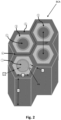
- Figure 2 shows a detail from Figure 1 in a perspective view, some basic geometrical aspects shall be explained in further detail.
- reference numeral 1 again denotes a triggered cell, while reference numeral 2 stands for a normal cell.
- the hexagonal structure 4 around each cell 1, 2 is regularly shaped and has six equal sides or facets 4a with width a and height b.
- Reference numeral c denotes a wall thickness of said facets 4a, while d is the (minimum) distance between a given cell 1, 2 (i.e., its anti-rupture container 5) and facet 4a.
- Reference numeral e denotes a path (shown as a dotted line) along the hexagonal structure 4 in a plane perpendicular to the cells' longitudinal axis (cf. Figure 3 ), a length of which path (also denoted e for simplicity) is at least twice as long as a cell pitch CP, i.e., the distance between two neighbouring cells 1, 2, measured from centre to centre for any pair of cells 1, 2.
- CP cell pitch
- the relation between the thermal conductivity of the materials at 3 and 4 requires that thermal conductivity and diffusivity of the material making up the hexagonal structure 4 (heat distributor honeycomb) is sufficiently bigger than the thermal conductivity and diffusivity of insulating material 3 such that the heat conductance of the heat distributing material in hexagonal structure 4 (expressed in W/K) allows an amount of heat to flow through the cross-section c*b (also denoted A h ) and along said path of length e (or at least two cell pitches CP away; also denotes L h ), which amount should at least two times bigger than the heat flow through the cross-section a*b (also denoted A i ) of facet 4a and along said length d of insulating material 3 (also denoted L i ) - preferably for each 30 kJ of energy emitted by a cell 1, 2 and per every two cells being triggered simultaneous in thermal runaway (cf. cells 1 in Figure 1 ).
- the thermal conductance of the heat conducting material in hexagonal structure 4 will be twice the thermal conductance of insulating material 3, as preferred.
- section A-A (cf. Figure 1 ) as shown in Fig-ure 3 .
- thermal management elements Located below every battery cell 1, 2 are thermal management elements in the form of PCM 6a and protection film 6b, which elements are contained with rupture container 5, with protection film 6b located below and above PCM 6a.
- both elements can be combined and trapped in a single matrix (not shown).
- PCM 6a is preferably a non-flammable, preferably inorganic material that changes phase from solid to liquid at a temperature below the maximum working temperature recommended by the cell manufacturer and above the operational starting temperature of the cells 1, 2.
- Protection film 6b is preferably a highly conductive compound (like silicone, for example) that is compatible with the materials in contact. Protection film 6b prevents corrosion that could result from the potentially corrosive properties of the (LT)PCM 6a.
- Reference numeral 7 denotes a battery enclosure or housing, which housing is preferable made of a high strength, low weight material with a balanced thermal conductivity as described above. Highly preferred materials are CFRP with a thin Glass Fiber Reinforce Plastic (GFRP) isolating film (not shown) between the cells and the CFRP. Housing 7 is not restricted to the bottom of arrangement BCA, as shown in Figure 3 , but can also cover the sides of it (cf. Figure 7 ).
- GFRP Glass Fiber Reinforce Plastic
- Reference numeral 8 denotes a (battery) cell holder made from a high strength, low thermal conductivity, electrically isolated material, preferably inorganic (flame retardancy is advantageous, e.g., UL94-V0).
- said battery cell holder 8 generally takes the form of a plate having a plurality of openings or through-holes 8a, a size and location of which holes 8a correspond to a size and location of the positive 1b, 2b and negative poles 1a, 2a of the battery cells 1, 2 (cf. Figure 1 ), wherein said poles are located within said openings or through-holes 8a.
- reference numeral 9 denotes a bottom venting hole.
- the bottom venting hole 9 is actually a set of holes in the battery enclosure 7 which is (are) big enough to allow hot gasses and flames to escape the cells 1, 2 in a bottom rupture event, but small enough to only slightly affect the battery's structural properties.
- a diameter of each of said venting holes 9 is between 20% and 60% of the cell pitch distance CP (cf. Figure 2 ).
- each venting hole 9 is located in prolongation of the longitudinal axis LA of a given battery cell 1, 2.
- Reference numeral 10 denotes a burstable EMI protection which serves as a topmost cover for the battery cell arrangement BCA in order to allow venting of the cell's gases and ejecta during a thermal runaway while providing electromagnetic shielding.
- EMI protection 10 comprises an electrically conductive flame-retardant adhesive.
- Reference numeral 11 denotes a top burstable insulator made from a high thermal resistance, high heat capacity, low density, preferably inorganic medium with high temperature phase change materials, to avoid ejecta from neighbouring triggered cells 1, 2 to transfer enough heat to induce a TR propagation.
- the positive pole 2b of a given battery cell 2 and the negative pole 2a of the battery cell 2 protrude from the insulating material 3 and from the hexagonal structure 4 (but not from the rupture container 5), wherein a ring-shaped space between the negative pole 2a and the positive pole 2b is filled with said top insulator 11.
- Reference numeral 12 denotes a so-called suffocating and separator medium with low thermal conductivity (preferably below 0,3 W/(m*K) at 1000°C), high heat capacity, low density (preferably below 200 kg/m 3 ), made from inorganic material, to prevent oxygen to flow between the cells while allowing space for cell interconnectors to be placed and connected between cells 1, 2.
- Said separator medium (or just “separator”) 12 can take the form of a plate having a plurality of openings or through-holes 12a as can best be seen from Figure 4 , a size and location of which holes correspond to a size and location of the positive and negative poles of the battery cells 1, 2, wherein said poles are located in respective regions of said openings or through-holes, which openings or through-holes 12a match with the openings or through-holes 8a of the battery cell holder 8.
- reference numeral 13 denotes a top primary venting hole, which is a hole on lid 14, preferably as big as possible without compromising a mechanical stability of the lid 14, preferably measuring more than 80% of the diameter of a battery cell 1, 2.
- Lid 14 is made of high thermal resistance, high strength, preferably inorganic material and is used to cover the battery cell arrangement BCA by closing battery enclosure 7 and to hold the burstable EMI protection 10 mentioned earlier.
- Reference numeral 15 denotes the electrical cell interconnectors (dashed lines in Figure 3 ; cf. also Figure 4 ) mentioned earlier.
- Said interconnectors 15 are highly electrically conductive, low weight, corrosive resistant connectors. Preferably made of aluminium or coated copper, they are connected between a given cell's negative pole, e.g., 2a, to a next cell's positive pole, e.g., 1b. There can be an intermediate step for voltage reading or similar (not shown in Figure 3 ).
- the interconnectors 15 are devised by wire bonding or a step-welding process with ohmic, ultrasonic or laser welding techniques. They pass within corresponding recesses of separator 12, as mentioned (cf. Figure 4 ).
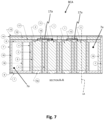
- Figure 5 shows a perspective view of battery cell arrangement BCA with enclosure 7. Section A-A is shown Figure 7 , while section B-B is depicted in Figure 8 .
- Figure 6 shows a battery cell arrangement similar to Figure 5 in a top view with cell holder 8 and separator 12 in place (cf. Figures 3 and 4 ).
- FIG. 7 further shows, at reference numeral 16, a so-called thermal shield.
- Thermal shield 16 can be a low thermal conductivity, light weight solid medium, preferably with a high heat capacity, and is provided as a cladding at least of an interior face of side walls of enclosure 7.
- the thermal shield 16 can be made of a coating of an inner side of enclosure 7, which coating respects the principles mentioned above, preferably an intumescent paint that reacts when the temperature elevates to thermal runaway initiation levels and, when expanded, fills a gap or space 7a between the heat distributor (hexagonal structure 4) and housing (enclosure) 7.
- thermal shield 16 is located in said gap 7a between said honeycomb structure 4' (cf. Figure 1 or Figure 8 ) (hexagonal structure 4) and the battery enclosure 7, which thermal shield 16 has further properties as defined above for the insulating material 3.
- This laminated plastic printed circuit board is preferably made of FR4 material and has electrical bonds with the interconnectors 15 for voltage balancing (cf. reference numeral 17a). It is located between cell holder 8 and separator 12 on top of insulator 11.
- FIGS. 7 and 8 show a Cell Management Unit Printed Circuit Board (CMU-PCB).
- This laminated plastic printed circuit board preferably made of FR4 material, is mechanically attached to the cell holder(s) 8.
- CMU-PCB 18 is located in a plane parallel to the battery cell's longitudinal axes.
- the CMU-PCB allows to host various sensitive electronic components such as chipsets, cabling and control boards vital for the battery management and operation.
Landscapes
- Chemical & Material Sciences (AREA)
- Chemical Kinetics & Catalysis (AREA)
- Electrochemistry (AREA)
- General Chemical & Material Sciences (AREA)
- Engineering & Computer Science (AREA)
- Manufacturing & Machinery (AREA)
- Inorganic Chemistry (AREA)
- Composite Materials (AREA)
- Materials Engineering (AREA)
- Sealing Battery Cases Or Jackets (AREA)
Abstract
a battery cell (1, 2) of cylindrical shape;
a structure (4), preferably polygonal, most preferably hexagonal, surrounding said battery cell (1, 2) in a plane transverse to a longitudinal axis of said battery cell (1, 2);
an insulating material (3) located in a space between said structure (4) and said battery cell (1, 2);
wherein said insulating material (3) has a relatively low thermal conductivity of less than 0,3 W/(m*K) at 800°C; and
wherein said structure (4) is made from a heat distributing material having a relatively high thermal conductivity of more than 150 W/(m*K) at 25°C.
Description
- The invention relates to an encapsulated battery cell according to appended
claim 1. - The invention also relates to a battery cell arrangement comprising a plurality of encapsulated battery cells, according to
claim 10. - Battery cells, such as lithium-ion battery cells, can go into thermal runaway (TR) due to external influences or internal faults, during which they may release large amounts of heat, gases and debris. In order to limit the potentially dangerous effects of such an event, in particular when used onboard of an aircraft, some form of thermal runaway containment of the battery cells is required.
-
US 2017/271643 A1 proposes to place battery cells into compartments within a honeycomb element that is divided into two equally shaped parts with different heights, the longer one of which functions as a battery separating element to prevent short circuits. Said element is assumed to be made from an electrically insulating plastics material, such as PC, ABS, PP, PE, PET or PA, and suffers from the fact that it lacks thermal conductivity and is of rather high weight. -
CN 214153004 U discloses encapsulated battery cells contained in a honeycomb structure. Between said honeycomb structure and the actual battery cell is located a heat absorption layer followed by, in a radial direction, a barrier explosion proof material, a cooling layer and a heat insulation. - In this approach, said heat absorption layer requires a material with high heat capacity, like a phase change material, which presents the disadvantage of rather high weight. Furthermore, said barrier explosion proof material, due to its hexagonal shape, presents a poor geometry to prevent battery explosion. If the material in said heat absorption layer is not stiff enough, the battery cell can induce a sidewall rupture which will impact the explosion proof material that is likely to fail unless a huge amount of material or a material with high strength retention is used, which will make the overall solution overweighted and not suitable for electric mobility, especially for aircraft. Furthermore, the outermost material is described as a heat insulation which is disadvantageous for preventing thermal runaway.
-
US 2013/183566 A1 discloses architectures of battery cells arrangements with special components that are designed to remove heat as fast as possible from the battery cells to the atmosphere. These components are described to be made of graphite which can be extruded, laminated and/or compressed and shall have an in-plane thermal conductivity of at least 150 W/(m*K), depending on the manufacturing method. - The different architectures proposed in
US 2013/183566 A1 are intended to be used for thermal management during normal operation in contrast to a thermal runaway emergency condition. All the configurations shown present a highly conductive material in direct contact with the battery cell which may be counterproductive to preventing thermal runaway propagation as it will spread excess heat too fast, such that neighbouring battery cells reach critical temperatures thus inducing a thermal runaway cascade. - It is the object of the present invention to provide an encapsulated battery cell for use in a battery cell arrangement, in particular for electric mobility, especially in an aircraft, that is lightweight, easy and cheap to manufacture, and which presents enhanced capabilities to prevent thermal runaway propagation. Furthermore, it is an object of the present invention to provide a battery cell arrangement with enhanced thermal runaway propagation prevention capabilities, especially for use onboard an aircraft.
- These objects are achieved by means of an encapsulated battery cell as defined in
claim 1 and by means of a battery cell arrangement as defined inclaim 10. - Advantageous further embodiments of the invention are defined in the sub-claims.
- According to a first aspect of the invention, an encapsulated battery cell, comprises: a battery cell of cylindrical shape; a structure, preferably a polygonal structure, most preferably a hexagonal structure, surrounding said battery cell in a plane transverse to a longitudinal axis of said battery cell; an insulating material located in a space between said structure and said battery cell; wherein said insulating material has a relatively low thermal conductivity of less than 0,3 W/(m*K) at 800°C; and wherein said structure is made from a heat distributing material having a relatively high thermal conductivity of more than 150 W/(m*K) at 25°C.
- In general, to achieve good packing efficiency, the battery cells (or "cells") in battery pack applications are arranged preferably in a staggered manner. A honeycomb or hexagonal arrangement is a shape or form that provides ideal bordering for heat transfer purposes in staggered applications, creating equal distance of a common cell border between neighbouring cells. Due to the efficiency of this shape or form both in mechanical and thermal applications along with its high market availability makes these hexagonal structures the preferred structures in the context of the present invention. However, the invention is not limited to such shapes or configurations. Other forms such as (regular) polygons or semi-circles may also be used, as long as they provide said heat distributing material around each one of the battery cells.
- According to a second aspect of the invention, a battery cell arrangement, comprises a plurality of encapsulated battery cells according to said first aspect of the invention, which battery cells are arranged side by side on a common plane, with parallel longitudinal axes, wherein a plurality of said encapsulated battery cells, preferably all of said plurality of battery cells, are arranged in a meta structure, preferably a polygonal structure, most preferably a honeycomb structure, that consists of interconnected respective structures (e.g., hexagonal structures) of individual battery cells.
- The prior art cited above tries to manage thermal runaway temperature loads with one single thermal conductance mechanism. This single conductance mechanism impacts the neighbouring cells in a uniform manner affecting firstly and mostly the cells in the direct vicinity of the thermal runaway spot, which cells may suffer from said temperature loads and go into thermal runaway themselves, which should be avoided.
- The basic idea underlying the present invention deploys two different heat conductance mechanisms via two principal elements, i.e., said conductive structure, preferably of honeycomb of hexagonal shape, which is preferably made, e.g., of pure aluminium or any other material with a thermal conductivity of at least 150 W/(m*K) at 25°C, preferably 230 W/(m*K) at 25°C, and an insulating material, e.g., an aerogel, an intumescent paint or any other material with thermal conductivity of of less than 0,3 W/(m*K) at 800°C, preferably less than 0,02 W/(m*K) at 25°C. A magnitude of the respective thermal conductance ratio is proportional to a thickness and conductivity of the heat carrying materials, which leaves room for performance versus weight trade-offs.
- The first thermal conduction mechanism, i.e., the one to describe the flow of heat through the boundaries of the battery cells, is of higher resistance and is defined by the insulating material. The second thermal conduction mechanism, i.e., the one to describe the flow of heat in the distribution network (e.g., the honeycomb structure), is of lower resistance and is defined by the highly conducting heat distributing material (e.g., by the honeycomb or hexagonal structure, which functions as a heat distributor).
- The high resistance heat diffusion mechanism ensures that any high temperature heat load of a battery cell in a thermal runaway condition (temperatures ranging from 200°C up to 800°C) is travelling slowly out of the malfunctioning battery cells, thus delaying the neighbouring battery cells to reach critical temperatures. Here and in the following, "neighbouring" shall refer to battery cells that are adjacent (or at least close) to a battery cell in thermal runaway ("triggered cell" or "TR cell"). For aircraft applications, the proposed solution offers enough time for continued safe flight and landing following a thermal runaway event. The low resistance heat diffusion mechanism rapidly distributes a lower temperature heat load (ranging from 80°C to 200°C) away from the impacted region and hence allows an exchange of energy with those battery cells in the arrangement (or pack) that are still at even lower temperatures.
- With the above mechanism, the battery cells directly next to a thermal runaway region experience lower temperature than in the previous art. An amount of thermal energy that would have caused a critical local temperature in the vicinity of the affected battery cell(s) in all the previous art, can slowly be transferred to battery cells farther away, which will increase their respective temperatures significantly, but not to a critical level.
- Furthermore, the components of the proposed encapsulated battery cell and the battery cell arrangement can be manufactured easier than in the prior art and have lower cost of procurement and processing. For example, the aluminium honeycomb structures used in preferred embodiments of the invention can easily be manufactured by expansion or extrusion methods for smaller thickness values, for example 0,1 mm thickness, which makes them significantly less expensive than the irregular shapes and/or graphite materials used in the prior art.
- The following embodiments of the invention have proven to be particularly advantageous:
In an embodiment of the encapsulated battery cell according to said first aspect of the invention, the battery cell is enclosed in an anti-rupture container, which container is located between the battery cell and said insulating material. - Such a container may be required if the battery cell (in short also referred to as "cell") is not able to prevent sidewall rupture by itself to prevent catastrophic events. Preferably, such an anti-sidewall rupture container is made of a high stress retention (high strength at high temperature) anti-sidewall rupture tube, although other forms may be used as well.
- In a further embodiment of the encapsulated battery cell according to said first aspect of the invention, said container is made from Carbon Fibre Reinforced Plastic, CFRP, or Ceramic Fibric Reinforced Plastic, CerFRP, via pull-winding, prepreg wrapping or braidtrusion, in particular in the form of a tube, as stated, wherein preferably a pullwinding tube has a filament angle of up to 10° in relation to a circumferential direction of the tube and a braidtrusion tube has an angle of at most 35° in relation to a circumferential direction of the tube.
- The above conditions preferably apply to a tube of at least 0,2 mm thickness per each 21 mm of tube diameter, and 30 kJ of radial heat release. Hence, the bigger the diameter and/or the greater the heat release, the bigger the preferred thickness.
- In a further embodiment of the encapsulated battery cell according to said first aspect of the invention, the battery cell is in operative contact with a phase change material, PCM, preferable a low temperature phase change material, LTPCM, that changes phase from solid to liquid between 25°C and 55°C, most preferably at around 45°C.
- Said PCM is preferably a non-flammable, most preferably inorganic material which changes phase from solid to liquid at a temperature below the maximum working temperature recommended by the cell manufacturer and above the operational starting temperature of the cells, i.e., of each individual battery cell, which cells are typically of identical type.
- An LTPCM will typically and preferably liquify at around 45°C, which is a standard battery operating temperature. The battery cells used by the applicant should not exceed 80°C. If the temperature exceeds this limit, thermal runaway may be imminent. If TR occurs, the heat load at elevated temperatures (more than 200°C) will no longer be managed with the PCM but with the proposed insulation/distribution function according to the above-defined basic idea of the present invention.
- If the ambient (initial) temperature is, e.g., 25°C and the maximum operational allowed temperature of the cell is, e.g., 55°C, the phase change should preferably happen somewhere in between those values (e.g., at 45°C). If it happened below 25°C or above 55°C then it would occur out of the cell's operational window, which should be avoided. This motivates the above choice of PCM phase changing temperature.
- In a further embodiment of the encapsulated battery cell according to said first aspect of the invention, the PCM is positioned at a bottom of the battery cell, preferably opposite to the battery cell's positive pole.
- Ideally, the PCM is positioned at the bottom of the cells to stop the temperature increase such that the temperature measured at the top of the cell, resulting of a temperature gradient across the cell, does not exceed the manufacturer's recommendation.
- In a further embodiment of the encapsulated battery cell according to said first aspect of the invention, the PCM is contained by a protection layer or protection film, e.g., silicone, that remedies any corrosive properties of the PCM, wherein preferably the PCM and the protection layer are combined in a common matrix material, e.g., by way of macro encapsulation. Said macro encapsulation can be of a silicone or epoxy compound solid enclosure (non-electrically conductive, high thermally conductive material) forming a container, in which the PCM resides, thus keeping it from flowing away while melted.
- This allows for easier manufacture and can avoid any potentially detrimental effect of the PCM on the other battery components.
- In a further embodiment of the encapsulated battery cell according to said first aspect of the invention, the insulating material has at least one of a density of less than 200 kg/m3 and a heat capacity of more than 1 kJ/(kg*K).
- Such values have proven particularly well suited to achieve the desired effect.
- In a further embodiment of the encapsulated battery cell according to said first aspect of the invention, the insulating material consists of a coating of at least one of the heat distributing material, the battery cell and the container, said coating preferably being an intumescent paint, which coating is devised to expand in volume when a temperature exceeds normal operation values above 80°C and when expanded fills the space between said (e.g., hexagonal) structure and the cell or between said (e.g., hexagonal) structure and said container.
- Such types of insulating materials are particularly lightweight and thus well suited for mobility applications, especially in aircraft.
- In a further embodiment of the encapsulated battery cell according to said first aspect of the invention, the heat distributing material has at least one of a thickness of less than 0,7 mm, preferably less than 0,1 mm, a density of less than 3000 kg/m3 and a thermal diffusivity of more than 90 mm2/s.
- A highly preferred material in this respect is aluminium.
- In the context of the present invention, applicant has found that specific thermal conductance (W/K) along a thickness direction (i.e., not through) of the heat distributing material is dependent on the through thickness conductance of the insulating material on one of the complete inner faces of the structure, e.g., the hexagon. Hence, thermal conductance along a length of the heat distributing material should be maximized while the conductance through its thickness should be minimized.
- In a specific embodiment, the relation between the thermal conductivity of the insulating material on the one hand and the heat distributing material on the other hand preferably requires that thermal conductivity and diffusivity of the heat distributing material (heat distributor, e.g., hexagonal structure or honeycomb) be sufficiently bigger than the thermal conductivity and diffusivity of the insulating material. In this way, the heat conductance of the heat distributing material (expressed in W/K) that allows heat to dissipate along any walls of the structure over a given path length (that should be at least twice long as a cell pitch or cell pitch distance, i.e., a distance between the axes of neighbouring cells) can be at least twice (or more) the heat conductance through an area of a given surface region of the structure, e.g., a facet of the hexagonal structure, and over a length of the insulating material, said length being measured between the outer surface of a cell and said surface area - most preferably for each 30 kJ of energy emitted by a battery cell and per every two battery cells being triggered simultaneous in thermal runaway. This will be explained in more detail below with reference to the drawings.
- In a corresponding further embodiment of the encapsulated battery cell according to said first aspect of the invention, the thermal conductivity and thermal diffusivity of the insulating material and the thermal conductivity and thermal diffusivity of the heat distributing material are chosen such that a thermal conductance of the heat distributing material


- Furthermore, it is advantageously assumed that if the thermal conductance of the heat distributing material is much bigger or at least twice than the thermal conductance of the insulating material, then:
- the thermal conductivity of the heat distributing material can be lowered;
- the thickness of the heat distributing material (i.e., a wall thickness of the (e.g., hexagonal) structure) can be thinned;
- the heat diffusivity of the heat distributing material can be lowered (i.e., heat capacity and/or density);
- the thickness of the insulating material can be reduced;
- the thermal conductivity of the insulating material can be increased;
- the heat capacity of the insulating material can be lowered.
- This can result in further weight and/or cost reduction.
- In a further embodiment of the encapsulated battery cell according to said first aspect of the invention, a positive pole of the battery cell and a negative pole of the battery cell protrude from the insulating material and from the (e.g., hexagonal) structure, wherein preferably, for a given battery cell, the negative pole is of circular shape and surrounds the positive pole, and wherein most preferably a ring-shaped space between the negative pole and the positive pole is filled with a top insulator, in particular made from an inorganic material, preferably incorporating high temperature phase change material.
- Applicant has found that such a top insulator is preferably made of a material with low thermal conductivity (for example 0,1 W/(m*K)), high heat capacity (for example 3000 J/(kg*K)), low density (for example 800 kg/m3), preferably inorganic media with high temperature phase change materials, and can serve to avoid ejecta from a neighbouring triggered cell (TR cell), which may have become trapped between any additional cover elements, e.g., a lid, and the top of the cell, to transfer enough heat to induce TR propagation.
- In a further embodiment of the battery cell arrangement according to said second aspect of the invention, said battery cell arrangement further comprises a battery enclosure with a bottom wall located below said common plane, preferably on a side opposite to the battery cells' positive poles, and with side walls that rise from said bottom wall and surround the battery cells, said enclosure most preferably made of Carbon Fibre Reinforced Plastic, CFRP, with a Glass Fibre Reinforce Plastic (GFRP) isolating film between the battery cells and the CFRP.
- In a further embodiment of the battery cell arrangement according to said second aspect of the invention, said battery cell arrangement further comprises, for preferably each of the battery cells, a bottom venting hole located in the battery enclosure, preferably in prolongation of the longitudinal axis of a given battery cell, wherein most preferably a diameter of said venting hole measures between 20% and 60% of a cell pitch distance, which can be equal to a distance between the longitudinal axes of neighbouring battery cells.
- Preferably, said venting hole is big enough to allow hot gasses and flames to escape from a triggered cell in a bottom rupture event, i.e., in the case of a ruptured bottom wall of a battery cell, but small enough to affect the battery cell's structural properties only slightly, e.g., by choosing the above values.
- In a further embodiment of the battery cell arrangement according to said second aspect of the invention, said battery cell arrangement further comprises at least one battery cell holder (for example, made from UL94-V0 plastic, or from an electrically non-conductive and inorganic (non-flammable) material, e.g., ceramic based, most preferably made of PEI, Macron or similar flame retardant or non-flammable material) in the form of a plate having a plurality of openings or through-holes, a size and location of which correspond to a size and location of the positive and negative poles of the battery cells, wherein said poles are located within said openings or through-holes.
- Such a cell holder advantageously provides for a stable location of individual cells in the cell arrangement. It can be made from a high strength (for example 100 MPa tensile strength), low thermal conductivity (for example 0,1 W/(m*K)), electrically isolated material, preferably inorganic (flame retardancy preferably according to an accepted certification, e.g., UL94-V0).
- In a further embodiment of the battery cell arrangement according to said second aspect of the invention, said battery cell arrangement further comprises an Electro Magnetic Interference, EMI, protection (for example a layer with thickness 0,02 mm-0,04 mm of copper or 0,1-0,2 mm of aluminium) at least on one side of the battery cell arrangement, preferably located on the same side as the battery cell poles, said EMI protection most preferably comprising at least one of: an electrically conductive material with attenuation greater than 60 dB for the 0,7-18 GHz frequency range; a stiffness and strength below 170 GPa and 220 MPa respectively; a thickness between 0,02 mm and 0,04 mm (copper) or between 0,1 mm and 0,2 mm (aluminium); and impregnation with an electrically conductive flame-retardant adhesive.
- This allows venting of the cell's gases and ejecta during a thermal runaway while providing sufficient electromagnetic shielding.
- In a further embodiment of the battery cell arrangement according to said second aspect of the invention, said battery cell arrangement further comprises a separator in the form a plate having a plurality of openings or through-holes, a size and location of which correspond to a size and location of the positive and negative poles of the battery cells, wherein said poles are located in respective regions of said openings or through-holes, which openings or through-holes preferably match with the openings or through-holes of the above-described battery cell holder. Said separator is preferably made from an inorganic material (for example aerogel) and preferably has at least one of a thermal conductivity below 0,3 W/(m*K) at 1000°C, a high heat capacity of 1 kJ/(kg*K) and a density below 200 kg/m3.
- A preferred function of said separator is to prevent oxygen flow between the cells while allowing space for any electrical cell interconnectors to be placed and connected between the cells.
- In a further embodiment of the battery cell arrangement according to said second aspect of the invention, said battery cell arrangement further comprises a lid, preferably from an inorganic material (for example titanium or stainless steel), which closes the battery enclosure on a top side thereof opposite said bottom wall, which lid preferably supports the above-described EMI protection.
- Most preferably, the lid is made from a material with low thermal conductivity (less than 20 W/(m*K)) and/or of high strength (at least 400 MPa at 600°C) in order to be able to withstand internal and external damaging effects.
- In a further embodiment of the battery cell arrangement according to said second aspect of the invention, said battery cell arrangement further comprises, for preferably each of the battery cells, a top primary venting hole arranged in the lid, preferably more than 80% of a battery cell diameter in size.
- This allows venting of cell gases without overmuch affecting mechanical stability.
- In a further embodiment of the battery cell arrangement according to said second aspect of the invention, said battery cell arrangement further comprises a plurality of interconnectors, each of them connecting a given battery cell's negative pole to the positive pole of another battery cell, said interconnectors preferably made of aluminium or coated, e.g., tin coated, copper, most preferably connected to said poles by wire bonding or step-welding process with preferably ohmic, ultrasonic or laser welding techniques.
- Most preferably, such interconnectors are made of highly electrically conductive (e.g., 3.5×10⁷ S/m), low density (e.g., 2700 kg/m3), corrosion-resistant connectors (for example made of aluminium) that can be connected directly between pairs of battery cells or with an intermediate step for voltage reading or similar.
- In a further embodiment of the battery cell arrangement according to said second aspect of the invention, said battery cell arrangement further comprises a thermal shield located in a gap between said meta (e.g., honeycomb) structure and the battery enclosure, which thermal shield has further properties as defined above for the insulating material.
- Said thermal shield can be made of a material with low thermal conductivity (e.g., 0,02 W/(m*K)), preferably a light density (e.g., 200 kg/m3) solid material with a high heat capacity (1 kJ/(kg*K)). Alternatively, the thermal shield can be made of a coating which respects the principles mentioned above, preferably an intumescent paint with a reaction temperature as close to 80°C as possible, and, when expanded, fills the gap between the heat distributing material (said structure) and the battery enclosure (or housing).
- In a further embodiment of the battery cell arrangement according to said second aspect of the invention, said battery cell arrangement further comprises a temperature and voltage Printed Circuit Board, TV-PCB, preferably a laminated plastic printed circuit board, most preferably made of FR4 material, with electrical bonds to the interconnectors for voltage balancing, which TV-PCB is preferably located in a plane orthogonal to the battery cells' longitudinal axes above the battery cells' poles.
- This allows for battery operation and health status data readings such as voltage and temperature.
- Further characteristics and advantages of the invention will now be described by way of example in connection with the appended drawings.
-
Figure 1 shows a top view of a battery cell arrangement according to the invention; -
Figure 2 shows a detailed perspective view of the battery cell arrangement inFig- ;ure 1 -
Figure 3 shows a sectional view along line A-A inFigure 1 ; -
Figure 4 shows a perspective view of a battery cell arrangement according to the invention with additional components; -
Figure 5 shows a simplified perspective view of another battery cell arrangement according to the invention; -
Figure 6 shows a top view of a battery cell arrangement similar toFigure 5 ; -
Figure 7 shows a sectional view along line A-A of a battery cell arrangement similar toFigure 6 ; and -
Figure 8 shows another top view of a battery cell arrangement similar toFigure 5 . -
Figure 1 is a top view of a battery cell arrangement BCA according to the present invention. Individual battery cells (or "cells") in the arrangement are denoted 1, 2 and are depicted by means of filled circular areas. An open circle with a plus sign denotes a positive pole of a givencell cell cell 1 is a triggered cell; its negative pole is denoted 1a, and its positive pole is denoted 1b (only shown for one cell 1).Reference numerals cell 2, which is only shown for one suchnormal cell 2 for reason of clarity. - Each
cell material 3, which insulatingmaterial 3 is itself located within ahexagonal structure 4 made from a heat distributing material (so-called heat distributor). Thehexagonal structures 4 of theindividual cells Figure 1 . As described above, said insulatingmaterial 3 has a relatively low thermal conductivity of less than 0,3 W/(m*K) at 800°C; and saidhexagonal structure 4 is made from a heat distributing material having a relatively high thermal conductivity of more than 150 W/(m*K) at 25°C. - Battery cell arrangement BCA thus comprises a plurality of (encapsulated)
battery cells 1, 2 (i.e., battery cells together with at least insulatingmaterial 3 and hexagonal structure 4), whichbattery cells Figure 1 , with parallel longitudinal axes, wherein all of said plurality ofbattery cells hexagonal structures 4 ofindividual battery cells - Immediately surrounding each of the
cells Figure 1 ). If thecell anti-sidewall rupture container 5 is preferably provided, as shown. It can be made of a high stress retention (high strength at high temperature) anti-sidewall rupture tube that extends parallel to the cell's axis. Preferably, it is made of Carbon Fibre Reinforced Plastic (CFRP) or Ceramic Fibric Reinforced Plastic (CerFRP) via pull-winding, prepreg wrapping or braidtrusion. - Referring now to
Figure 2 , which shows a detail fromFigure 1 in a perspective view, some basic geometrical aspects shall be explained in further detail. - Please note that in all of the drawings, identical reference signs denote identical elements or elements that have at least a common function.
- In
Figure 2 ,reference numeral 1 again denotes a triggered cell, whilereference numeral 2 stands for a normal cell. Thehexagonal structure 4 around eachcell facets 4a with width a and height b. Reference numeral c denotes a wall thickness of saidfacets 4a, while d is the (minimum) distance between a givencell 1, 2 (i.e., its anti-rupture container 5) andfacet 4a. Reference numeral e denotes a path (shown as a dotted line) along thehexagonal structure 4 in a plane perpendicular to the cells' longitudinal axis (cf.Figure 3 ), a length of which path (also denoted e for simplicity) is at least twice as long as a cell pitch CP, i.e., the distance between twoneighbouring cells cells - As already explained in the introductory part, specific thermal conductance (unit W/K) along a thickness (not through) of the heat distributing material (in said hexagonal structure 4) is dependent on the through thickness conductance of insulating
material 3 on one of the complete inner faces orfacets 4a of the hexagon. Hence, the conductance along the heat distributor's length should be maximized while the conductance through its thickness should be minimized. - The relation between the thermal conductivity of the materials at 3 and 4 requires that thermal conductivity and diffusivity of the material making up the hexagonal structure 4 (heat distributor honeycomb) is sufficiently bigger than the thermal conductivity and diffusivity of insulating
material 3 such that the heat conductance of the heat distributing material in hexagonal structure 4 (expressed in W/K) allows an amount of heat to flow through the cross-section c*b (also denoted Ah ) and along said path of length e (or at least two cell pitches CP away; also denotes Lh ), which amount should at least two times bigger than the heat flow through the cross-section a*b (also denoted Ai ) offacet 4a and along said length d of insulating material 3 (also denoted Li ) - preferably for each 30 kJ of energy emitted by acell cells 1 inFigure 1 ). - If, as a numerical example, the thermal conductivity kh of the heat conducting material in
hexagonal structure 4 is 0,24 W/(mm*K) and dimension c is 0,1 mm, while b is 60 mm and e is 50 mm, then the thermal conductance will be equal to
- On the other hand, if the thermal conductivity ki of insulating
material 3 is 0,000025 W/(mm*K) and dimension a is 11 mm, while b is 60 mm and d is 1.1 mm, then its thermal conductance will be equal to
hexagonal structure 4 will be twice the thermal conductance of insulatingmaterial 3, as preferred. - Further details can be gathered from section A-A (cf.
Figure 1 ) as shown inFig- .ure 3 - Located below every
battery cell PCM 6a andprotection film 6b, which elements are contained withrupture container 5, withprotection film 6b located below and abovePCM 6a. Alternatively, both elements can be combined and trapped in a single matrix (not shown). -
PCM 6a is preferably a non-flammable, preferably inorganic material that changes phase from solid to liquid at a temperature below the maximum working temperature recommended by the cell manufacturer and above the operational starting temperature of thecells -
Protection film 6b is preferably a highly conductive compound (like silicone, for example) that is compatible with the materials in contact.Protection film 6b prevents corrosion that could result from the potentially corrosive properties of the (LT)PCM 6a. -
Reference numeral 7 denotes a battery enclosure or housing, which housing is preferable made of a high strength, low weight material with a balanced thermal conductivity as described above. Highly preferred materials are CFRP with a thin Glass Fiber Reinforce Plastic (GFRP) isolating film (not shown) between the cells and the CFRP.Housing 7 is not restricted to the bottom of arrangement BCA, as shown inFigure 3 , but can also cover the sides of it (cf.Figure 7 ). -
Reference numeral 8 denotes a (battery) cell holder made from a high strength, low thermal conductivity, electrically isolated material, preferably inorganic (flame retardancy is advantageous, e.g., UL94-V0). - As can best be seen from
Figure 4 , saidbattery cell holder 8 generally takes the form of a plate having a plurality of openings or through-holes 8a, a size and location of which holes 8a correspond to a size and location of the positive 1b, 2b andnegative poles battery cells 1, 2 (cf.Figure 1 ), wherein said poles are located within said openings or through-holes 8a. - Back to
Figure 3 , reference numeral 9 denotes a bottom venting hole. The bottom venting hole 9 is actually a set of holes in thebattery enclosure 7 which is (are) big enough to allow hot gasses and flames to escape thecells Figure 2 ). As can be seen, each venting hole 9 is located in prolongation of the longitudinal axis LA of a givenbattery cell -
Reference numeral 10 denotes a burstable EMI protection which serves as a topmost cover for the battery cell arrangement BCA in order to allow venting of the cell's gases and ejecta during a thermal runaway while providing electromagnetic shielding. Preferably, a highly electrically conductive material with attenuation greater than 60 dB for the 0,7-18 GHz frequency range and a stiffness and strength (UTS) preferably below 170 GPa and 220 MPa, respectively, is used, which can have between 0,02 mm and 0,04 mm in thickness. This can provide enough strength to avoid finger poking into the battery pack, but is weak enough to allow easy bursting for pressure relief. Preferably,EMI protection 10 comprises an electrically conductive flame-retardant adhesive. -
Reference numeral 11 denotes a top burstable insulator made from a high thermal resistance, high heat capacity, low density, preferably inorganic medium with high temperature phase change materials, to avoid ejecta from neighbouring triggeredcells - As can be seen from, e.g.,
Figure 3 orFigure 4 , thepositive pole 2b of a givenbattery cell 2 and thenegative pole 2a of thebattery cell 2 protrude from the insulatingmaterial 3 and from the hexagonal structure 4 (but not from the rupture container 5), wherein a ring-shaped space between thenegative pole 2a and thepositive pole 2b is filled with saidtop insulator 11. The same holds forbattery cell 1. -
Reference numeral 12 denotes a so-called suffocating and separator medium with low thermal conductivity (preferably below 0,3 W/(m*K) at 1000°C), high heat capacity, low density (preferably below 200 kg/m3), made from inorganic material, to prevent oxygen to flow between the cells while allowing space for cell interconnectors to be placed and connected betweencells - Said separator medium (or just "separator") 12 can take the form of a plate having a plurality of openings or through-
holes 12a as can best be seen fromFigure 4 , a size and location of which holes correspond to a size and location of the positive and negative poles of thebattery cells holes 12a match with the openings or through-holes 8a of thebattery cell holder 8. - Referring again to
Figure 3 ,reference numeral 13 denotes a top primary venting hole, which is a hole onlid 14, preferably as big as possible without compromising a mechanical stability of thelid 14, preferably measuring more than 80% of the diameter of abattery cell top venting hole 13 perbattery cell -
Lid 14 is made of high thermal resistance, high strength, preferably inorganic material and is used to cover the battery cell arrangement BCA by closingbattery enclosure 7 and to hold theburstable EMI protection 10 mentioned earlier. -
Reference numeral 15 denotes the electrical cell interconnectors (dashed lines inFigure 3 ; cf. alsoFigure 4 ) mentioned earlier. Saidinterconnectors 15 are highly electrically conductive, low weight, corrosive resistant connectors. Preferably made of aluminium or coated copper, they are connected between a given cell's negative pole, e.g., 2a, to a next cell's positive pole, e.g., 1b. There can be an intermediate step for voltage reading or similar (not shown inFigure 3 ). Preferably, theinterconnectors 15 are devised by wire bonding or a step-welding process with ohmic, ultrasonic or laser welding techniques. They pass within corresponding recesses ofseparator 12, as mentioned (cf.Figure 4 ). -
Figure 5 shows a perspective view of battery cell arrangement BCA withenclosure 7. Section A-A is shownFigure 7 , while section B-B is depicted inFigure 8 . -
Figure 6 shows a battery cell arrangement similar toFigure 5 in a top view withcell holder 8 andseparator 12 in place (cf.Figures 3 and4 ). -
Figure 7 further shows, atreference numeral 16, a so-called thermal shield.Thermal shield 16 can be a low thermal conductivity, light weight solid medium, preferably with a high heat capacity, and is provided as a cladding at least of an interior face of side walls ofenclosure 7. Alternatively, thethermal shield 16 can be made of a coating of an inner side ofenclosure 7, which coating respects the principles mentioned above, preferably an intumescent paint that reacts when the temperature elevates to thermal runaway initiation levels and, when expanded, fills a gap orspace 7a between the heat distributor (hexagonal structure 4) and housing (enclosure) 7. - In other words:
thermal shield 16 is located in saidgap 7a between said honeycomb structure 4' (cf.Figure 1 orFigure 8 ) (hexagonal structure 4) and thebattery enclosure 7, whichthermal shield 16 has further properties as defined above for the insulatingmaterial 3. - Further visible in
Figure 7 is Temperature and Voltage Printed Circuit Board (TV-PCB) 17. This laminated plastic printed circuit board is preferably made of FR4 material and has electrical bonds with theinterconnectors 15 for voltage balancing (cf. reference numeral 17a). It is located betweencell holder 8 andseparator 12 on top ofinsulator 11. - At
reference numeral 18,Figures 7 and8 show a Cell Management Unit Printed Circuit Board (CMU-PCB). This laminated plastic printed circuit board, preferably made of FR4 material, is mechanically attached to the cell holder(s) 8. As can be seen from the drawings, CMU-PCB 18 is located in a plane parallel to the battery cell's longitudinal axes. - The CMU-PCB allows to host various sensitive electronic components such as chipsets, cabling and control boards vital for the battery management and operation.
Claims (15)
- An encapsulated battery cell, comprising:a battery cell (1, 2) of cylindrical shape;a structure (4), preferably a polygonal structure (4), most preferably a hexagonal structure (4), surrounding said battery cell (1, 2) in a plane transverse to a longitudinal axis (LA) of said battery cell (1, 2);an insulating material (3) located in a space between said structure (4) andsaid battery cell (1, 2);wherein said insulating material (3) has a relatively low thermal conductivity of less than 0,3 W/(m*K) at 800°C; andwherein said structure (4) is made from a heat distributing material having a relatively high thermal conductivity of more than 150 W/(m*K) at 25°C.
- The encapsulated battery cell of claim 1, wherein
the battery cell (1, 2) is enclosed in an anti-rupture container (5), which container (5) is located between the battery cell (1, 2) and said insulating material (3). - The encapsulated battery cell of claim 2, wherein
said container (5) is made from Carbon Fibre Reinforced Plastic, CFRP, or Ceramic Fibric Reinforced Plastic, CerFRP, via pull-winding, prepreg wrapping or braidtrusion, in particular in the form of a tube, wherein preferably a pullwinding tube has a filament angle of up to 10° in relation to a circumferential direction of the tube and a braidtrusion tube has an angle of at most 35° in relation to a circumferential direction of the tube, and wherein most preferably a thickness of the tube is at least 0,2 mm. - The encapsulated battery cell of any one of claims 1 through 3, wherein the battery cell (1, 2) is in operative contact with a phase change material (6a), PCM, preferable a low temperature phase change material, LTPCM, that changes phase from solid to liquid between 25°C and 55°C, most preferably at around 45°C.
- The encapsulated battery cell of claim 4, wherein
the PCM (6a) is at least one of:positioned at a bottom of the battery cell (1, 2), preferably opposite to the battery cell's positive pole (1b, 2b); andcontained by a protection layer or protection film (6b) that remedies any corrosive properties of the PCM (6a), wherein preferably the PCM (6a) and the protection layer (6b) are combined in a common matrix material. - The encapsulated battery cell of any one of claims 1 through 5, wherein the insulating material (3) has at least one of a density of less than 200 kg/m3 and a heat capacity of more than 1 kJ/(kg*K).
- The encapsulated battery cell of any one of claims 1 through 5, wherein the insulating material (3) consists of a coating of at least one of the heat distributing material, the battery cell (1, 2) and the container according to claim 2 or 3, said coating preferably being an intumescent paint, which coating is devised to expand in volume when a temperature exceeds normal operation values above 80°C and when expanded fills the space between said structure (4) and the cell (1, 2) or, with reference to claim 2 or 3, between said structure (4) and said container (5).
- The encapsulated battery cell of any one of claims 1 through 7, wherein the heat distributing material has at least one of a thickness of less than 0,7 mm, preferably less than 0,2 mm, a density of less than 3000 kg/m3 and a thermal diffusivity of more than 90 mm2/s.
- The encapsulated battery cell of any one of claims 1 through 8, wherein the thermal conductivity and thermal diffusivity of the insulating material (3) and the thermal conductivity and thermal diffusivity of the heat distributing material are chosen such that a thermal conductance of the heat distributing material

 kh the thermal conductivity of the heat distributing material;Ah an area of a cross section through the structure (4) in a radial direction with respect to said longitudinal axis (LA) of said battery cell (1, 2);Lh a path length (e) in the structure (4) in a plane transverse to said longitudinal axis (LA) of said battery cell (1, 2);ki the thermal conductivity of the insulating material (3);Ai an area of one of a surface region of the structure (4), e.g., one of the six facets (4a) of a hexagonal structure (4), facing said space; andLi a minimum distance between said battery cell (1, 2) or the container (5) according to claim 2 or 3 and said facet (4a);wherein preferably said path length (e) is equal to at least twice a cell pitch distance (CP) between centres of neighbouring battery cells (1, 2).
 - A battery cell arrangement (BCA), comprising a plurality of encapsulated battery cells according to any one of the preceding claims, which encapsulated battery cells are arranged side by side on a common plane, with parallel longitudinal axes (LA), wherein a plurality of said encapsulated battery cells, preferably all of said plurality of encapsulated battery cells, are arranged in a meta structure (4'), preferably a polygonal structure (4'), most preferably a honeycomb structure (4'), that consists of interconnected respective structures (4) of individual battery cells (1, 2).
- The battery cell arrangement (BCA) of claim 10, further comprising:a battery enclosure (7);for preferably each of the battery cells (1, 2) at least one of:a bottom venting hole (9) located in the battery enclosure (7), preferably in prolongation of the longitudinal axis (LA) of a given battery cell (1, 2),wherein most preferably a diameter of said venting hole (9) measures between 20% and 60% of a cell pitch distance (CP), which is equal to a distance between the longitudinal axes (LA) of neighbouring battery cells (1, 2); anda top primary venting hole (13) arranged in the battery enclosure (7) or in a lid (14) for closing the battery enclosure (7), said top primary venting hole (13) preferably being more than 80% of a battery cell diameter in size.
- The battery cell arrangement (BCA) of claim 10 or 11, with reference to claim 11, further comprising:
at least one battery cell holder (8) in the form of a plate having a plurality of openings or through-holes (8a), a size and location of which correspond to a size and location of positive poles (1b, 2b) and negative poles (1a, 2a) of the battery cells (1, 2), respectively, wherein said poles (1a, 1b, 2a, 2b) are located within said openings or through-holes (8a). - The battery cell arrangement (BCA) of any one of claims 10 through 12, further comprising:
a burstable Electro Magnetic Interference, EMI, protection (10) at least on one side of the battery cell arrangement (BCA), preferably located on the same side as the battery cell poles (1a, 1b, 2a, 2b) with reference to claim 12, said EMI protection (10) most preferably comprising at least one of:an electrically conductive material with attenuation greater than 60 dB for the 0,7-18 GHz frequency range;a stiffness and strength below 170 GPa and 220 MPa, respectively;a thickness between 0,02 mm and 0,2 mm; andimpregnation with an electrically conductive flame-retardant adhesive. - The battery cell arrangement (BCA) of any one of claims 10 through 13, further comprising:
a separator (12) in the form of a plate having a plurality of openings or through-holes (12a), a size and location of which correspond to a size and location of the positive poles (1b, 2b) and the negative poles (1a, 2a) of the battery cells (1, 2), respectively, wherein said poles (1a, 1b, 2a, 2b) are located in respective regions of said openings or through-holes (12a), which openings or through-holes (12a) preferably match with the openings or through-holes (8a) of the battery cell holder (8) with reference to claim 13, said separator (12) preferably made from an inorganic material and preferably having at least one of a thermal conductivity below 0,3 W/(m*K) at 1000°C, a high heat capacity of more than 1 kJ/(kg*K) and a density below 200 kg/m3. - The battery cell arrangement (BCA) of any one of claims 10 through 14, further comprising:
a thermal shield (16) located in a gap (7a) between said meta structure (4') and a battery enclosure (7), which thermal shield (16) has further properties as defined in claims 1, 6 or 7 for the insulating material (3).
Priority Applications (2)
| Application Number | Priority Date | Filing Date | Title |
|---|---|---|---|
| EP23163590.5A EP4435935A1 (en) | 2023-03-22 | 2023-03-22 | Encapsulated battery cell and battery cell arrangement |
| US18/428,148 US20240322306A1 (en) | 2023-03-22 | 2024-01-31 | Encapsulated Battery Cell and Battery Cell Arrangement |
Applications Claiming Priority (1)
| Application Number | Priority Date | Filing Date | Title |
|---|---|---|---|
| EP23163590.5A EP4435935A1 (en) | 2023-03-22 | 2023-03-22 | Encapsulated battery cell and battery cell arrangement |
Publications (1)
| Publication Number | Publication Date |
|---|---|
| EP4435935A1 true EP4435935A1 (en) | 2024-09-25 |
Family
ID=85726809
Family Applications (1)
| Application Number | Title | Priority Date | Filing Date |
|---|---|---|---|
| EP23163590.5A Pending EP4435935A1 (en) | 2023-03-22 | 2023-03-22 | Encapsulated battery cell and battery cell arrangement |
Country Status (2)
| Country | Link |
|---|---|
| US (1) | US20240322306A1 (en) |
| EP (1) | EP4435935A1 (en) |
Cited By (1)
| Publication number | Priority date | Publication date | Assignee | Title |
|---|---|---|---|---|
| US12555994B2 (en) | 2022-10-07 | 2026-02-17 | Archer Aviation Inc. | Systems and methods for improved battery assemblies for eVTOL aircraft |
Citations (5)
| Publication number | Priority date | Publication date | Assignee | Title |
|---|---|---|---|---|
| US20130183566A1 (en) | 2010-10-01 | 2013-07-18 | Graftech International Holdings Inc. | Thermal Management Structures for Battery Packs |
| US20170271643A1 (en) | 2015-07-17 | 2017-09-21 | Atieva, Inc. | Battery Assembly with Linear Bus Bar Configuration |
| EP3680950A1 (en) * | 2019-01-08 | 2020-07-15 | The Boeing Company | System and method for maintaining thermal control of battery cells |
| CN214153004U (en) | 2020-12-16 | 2021-09-07 | 广东工业大学 | Battery thermal management system applying barrier explosion-proof technology |
| US20220149457A1 (en) * | 2019-07-19 | 2022-05-12 | Murata Manufacturing Co., Ltd. | Battery, battery pack, electronic device, electric vehicle, power storage apparatus, and power system |
-
2023
- 2023-03-22 EP EP23163590.5A patent/EP4435935A1/en active Pending
-
2024
- 2024-01-31 US US18/428,148 patent/US20240322306A1/en active Pending
Patent Citations (5)
| Publication number | Priority date | Publication date | Assignee | Title |
|---|---|---|---|---|
| US20130183566A1 (en) | 2010-10-01 | 2013-07-18 | Graftech International Holdings Inc. | Thermal Management Structures for Battery Packs |
| US20170271643A1 (en) | 2015-07-17 | 2017-09-21 | Atieva, Inc. | Battery Assembly with Linear Bus Bar Configuration |
| EP3680950A1 (en) * | 2019-01-08 | 2020-07-15 | The Boeing Company | System and method for maintaining thermal control of battery cells |
| US20220149457A1 (en) * | 2019-07-19 | 2022-05-12 | Murata Manufacturing Co., Ltd. | Battery, battery pack, electronic device, electric vehicle, power storage apparatus, and power system |
| CN214153004U (en) | 2020-12-16 | 2021-09-07 | 广东工业大学 | Battery thermal management system applying barrier explosion-proof technology |
Cited By (1)
| Publication number | Priority date | Publication date | Assignee | Title |
|---|---|---|---|---|
| US12555994B2 (en) | 2022-10-07 | 2026-02-17 | Archer Aviation Inc. | Systems and methods for improved battery assemblies for eVTOL aircraft |
Also Published As
| Publication number | Publication date |
|---|---|
| US20240322306A1 (en) | 2024-09-26 |
Similar Documents
| Publication | Publication Date | Title |
|---|---|---|
| US20240380036A1 (en) | Thermal runaway mitigation system for high capacity energy cell | |
| EP3201974B1 (en) | Battery module | |
| US20210288379A1 (en) | High density battery module with thermal isolation | |
| JP7745999B2 (en) | Fire prevention structure for pouch lithium battery packs | |
| US20240322306A1 (en) | Encapsulated Battery Cell and Battery Cell Arrangement | |
| CN117203823A (en) | Accumulator | |
| EP4357179A1 (en) | Battery cell arrangement | |
| CN218919066U (en) | Battery pack and battery system | |
| KR20240072246A (en) | Materials, systems, and methods for incorporating an insulating layer within the encapsulation layer of a pouch cell | |
| CN111864292B (en) | Battery modules and battery packs | |
| CN209730091U (en) | Battery modules and battery packs | |
| US20230327177A1 (en) | Battery cell module and arrangement | |
| US20240405314A1 (en) | Method and Apparatus to Prevent Cell-to-cell Thermal-runaway Propagation | |
| WO2025222610A1 (en) | Battery box body and battery system | |
| CN219553799U (en) | Battery compartment and vehicle | |
| CN218101644U (en) | Battery module and battery pack | |
| EP4602670A1 (en) | A barrier for separating cells of a battery | |
| US11581607B1 (en) | Thermal management for a conformal wearable battery | |
| TW202320397A (en) | Battery module and battery pack | |
| CN224217653U (en) | A battery cell and a battery pack | |
| JP6855088B2 (en) | Board and battery for connecting battery cells | |
| CN221828103U (en) | Battery device | |
| US20260088195A1 (en) | Wire for Electrical Connection and Battery Module in Which Electrical Connection is Formed Using the Same | |
| US20250279515A1 (en) | Thermal runaway proof battery connector | |
| WO2026038273A1 (en) | Thermal insulating separator assembly for battery modules |
Legal Events
| Date | Code | Title | Description |
|---|---|---|---|
| PUAI | Public reference made under article 153(3) epc to a published international application that has entered the european phase |
Free format text: ORIGINAL CODE: 0009012 |
|
| STAA | Information on the status of an ep patent application or granted ep patent |
Free format text: STATUS: THE APPLICATION HAS BEEN PUBLISHED |
|
| AK | Designated contracting states |
Kind code of ref document: A1 Designated state(s): AL AT BE BG CH CY CZ DE DK EE ES FI FR GB GR HR HU IE IS IT LI LT LU LV MC ME MK MT NL NO PL PT RO RS SE SI SK SM TR |
|
| STAA | Information on the status of an ep patent application or granted ep patent |
Free format text: STATUS: REQUEST FOR EXAMINATION WAS MADE |
|
| 17P | Request for examination filed |
Effective date: 20250303 |
|
| 19U | Interruption of proceedings before grant |
Effective date: 20250301 |
|
| 19W | Proceedings resumed before grant after interruption of proceedings |
Effective date: 20250801 |
|
| RAP3 | Party data changed (applicant data changed or rights of an application transferred) |
Owner name: VOLOCOPTER TECHNOLOGIES GMBH |