EP4435702A1 - Agent system for simultaneously servicing multiple customer devices - Google Patents
Agent system for simultaneously servicing multiple customer devices Download PDFInfo
- Publication number
- EP4435702A1 EP4435702A1 EP24165688.3A EP24165688A EP4435702A1 EP 4435702 A1 EP4435702 A1 EP 4435702A1 EP 24165688 A EP24165688 A EP 24165688A EP 4435702 A1 EP4435702 A1 EP 4435702A1
- Authority
- EP
- European Patent Office
- Prior art keywords
- agent
- customer
- server
- customer devices
- text
- Prior art date
- Legal status (The legal status is an assumption and is not a legal conclusion. Google has not performed a legal analysis and makes no representation as to the accuracy of the status listed.)
- Pending
Links
Images




Classifications
-
- G—PHYSICS
- G06—COMPUTING OR CALCULATING; COUNTING
- G06Q—INFORMATION AND COMMUNICATION TECHNOLOGY [ICT] SPECIALLY ADAPTED FOR ADMINISTRATIVE, COMMERCIAL, FINANCIAL, MANAGERIAL OR SUPERVISORY PURPOSES; SYSTEMS OR METHODS SPECIALLY ADAPTED FOR ADMINISTRATIVE, COMMERCIAL, FINANCIAL, MANAGERIAL OR SUPERVISORY PURPOSES, NOT OTHERWISE PROVIDED FOR
- G06Q30/00—Commerce
- G06Q30/01—Customer relationship services
- G06Q30/015—Providing customer assistance, e.g. assisting a customer within a business location or via helpdesk
-
- G—PHYSICS
- G06—COMPUTING OR CALCULATING; COUNTING
- G06Q—INFORMATION AND COMMUNICATION TECHNOLOGY [ICT] SPECIALLY ADAPTED FOR ADMINISTRATIVE, COMMERCIAL, FINANCIAL, MANAGERIAL OR SUPERVISORY PURPOSES; SYSTEMS OR METHODS SPECIALLY ADAPTED FOR ADMINISTRATIVE, COMMERCIAL, FINANCIAL, MANAGERIAL OR SUPERVISORY PURPOSES, NOT OTHERWISE PROVIDED FOR
- G06Q30/00—Commerce
- G06Q30/06—Buying, selling or leasing transactions
- G06Q30/0601—Electronic shopping [e-shopping]
-
- G—PHYSICS
- G06—COMPUTING OR CALCULATING; COUNTING
- G06T—IMAGE DATA PROCESSING OR GENERATION, IN GENERAL
- G06T15/00—Three-dimensional [3D] image rendering
-
- G—PHYSICS
- G10—MUSICAL INSTRUMENTS; ACOUSTICS
- G10L—SPEECH ANALYSIS TECHNIQUES OR SPEECH SYNTHESIS; SPEECH RECOGNITION; SPEECH OR VOICE PROCESSING TECHNIQUES; SPEECH OR AUDIO CODING OR DECODING
- G10L13/00—Speech synthesis; Text to speech systems
- G10L13/02—Methods for producing synthetic speech; Speech synthesisers
- G10L13/04—Details of speech synthesis systems, e.g. synthesiser structure or memory management
-
- G—PHYSICS
- G10—MUSICAL INSTRUMENTS; ACOUSTICS
- G10L—SPEECH ANALYSIS TECHNIQUES OR SPEECH SYNTHESIS; SPEECH RECOGNITION; SPEECH OR VOICE PROCESSING TECHNIQUES; SPEECH OR AUDIO CODING OR DECODING
- G10L15/00—Speech recognition
- G10L15/22—Procedures used during a speech recognition process, e.g. man-machine dialogue
-
- G—PHYSICS
- G10—MUSICAL INSTRUMENTS; ACOUSTICS
- G10L—SPEECH ANALYSIS TECHNIQUES OR SPEECH SYNTHESIS; SPEECH RECOGNITION; SPEECH OR VOICE PROCESSING TECHNIQUES; SPEECH OR AUDIO CODING OR DECODING
- G10L15/00—Speech recognition
- G10L15/26—Speech to text systems
-
- G—PHYSICS
- G10—MUSICAL INSTRUMENTS; ACOUSTICS
- G10L—SPEECH ANALYSIS TECHNIQUES OR SPEECH SYNTHESIS; SPEECH RECOGNITION; SPEECH OR VOICE PROCESSING TECHNIQUES; SPEECH OR AUDIO CODING OR DECODING
- G10L15/00—Speech recognition
- G10L15/28—Constructional details of speech recognition systems
- G10L15/30—Distributed recognition, e.g. in client-server systems, for mobile phones or network applications
-
- H—ELECTRICITY
- H04—ELECTRIC COMMUNICATION TECHNIQUE
- H04M—TELEPHONIC COMMUNICATION
- H04M3/00—Automatic or semi-automatic exchanges
- H04M3/42—Systems providing special services or facilities to subscribers
- H04M3/50—Centralised arrangements for answering calls; Centralised arrangements for recording messages for absent or busy subscribers ; Centralised arrangements for recording messages
- H04M3/51—Centralised call answering arrangements requiring operator intervention, e.g. call or contact centers for telemarketing
- H04M3/5133—Operator terminal details
-
- H—ELECTRICITY
- H04—ELECTRIC COMMUNICATION TECHNIQUE
- H04M—TELEPHONIC COMMUNICATION
- H04M3/00—Automatic or semi-automatic exchanges
- H04M3/42—Systems providing special services or facilities to subscribers
- H04M3/50—Centralised arrangements for answering calls; Centralised arrangements for recording messages for absent or busy subscribers ; Centralised arrangements for recording messages
- H04M3/51—Centralised call answering arrangements requiring operator intervention, e.g. call or contact centers for telemarketing
- H04M3/5183—Call or contact centers with computer-telephony arrangements
-
- G—PHYSICS
- G06—COMPUTING OR CALCULATING; COUNTING
- G06T—IMAGE DATA PROCESSING OR GENERATION, IN GENERAL
- G06T2200/00—Indexing scheme for image data processing or generation, in general
- G06T2200/24—Indexing scheme for image data processing or generation, in general involving graphical user interfaces [GUIs]
-
- H—ELECTRICITY
- H04—ELECTRIC COMMUNICATION TECHNIQUE
- H04M—TELEPHONIC COMMUNICATION
- H04M2201/00—Electronic components, circuits, software, systems or apparatus used in telephone systems
- H04M2201/39—Electronic components, circuits, software, systems or apparatus used in telephone systems using speech synthesis
-
- H—ELECTRICITY
- H04—ELECTRIC COMMUNICATION TECHNIQUE
- H04M—TELEPHONIC COMMUNICATION
- H04M2201/00—Electronic components, circuits, software, systems or apparatus used in telephone systems
- H04M2201/42—Graphical user interfaces
Definitions
- This disclosure relates to a system and devices that enable a single customer service representative to simultaneously communicate with multiple customers.
- the system and devices could function in a virtual reality (VR or metaverse) environment, or on a telephonic or non-VR computer network.
- the metaverse is a virtual space in which users can create an avatar and virtually interact with others from essentially any location using devices such as a 3D screen, a VR headset, a mobile phone, or a personal computer (PC).
- Customer service agents may also choose to operate a device that enables them to enter the metaverse.
- each avatar may be unique to a certain person. This means that even though the metaverse is virtual, when a customer visits a metaverse store, unless there is someone such as a virtual customer service agent present who can assist the customer, the customer must wait until a customer service representative (also called an agent, representative, or contact center agent) is available.
- a customer service representative also called an agent, representative, or contact center agent
- Contact center agents receive interactions from customers in many forms, such as email, chat, SMS, or voice.
- an agent can handle many chat, SMS, or email interactions simultaneously, because the interactions are asynchronous.
- voice interactions an agent is basically limited to a single interaction with one customer.
- TTS text-to-speech
- ASR automatic speech recognition
- customers While in the metaverse, customers (also called users) may visit a store to speak to a representative about a product or service.
- a user could visit a bank in order to obtain help with his/her account or learn about the bank's services.
- the bank will have staff that are able to assist the user, but similar to the real world, where there are limited number of staff, there are also a limited number of metaverse staff.
- the customer may be required to wait in line (virtually) while waiting for a free customer service agent.
- a business may also choose to allow a bot to handle simple customer queries, but if a customer wants to speak directly to an agent, he/she may have to wait.
- Meeting online is presently limited in its ability to enhance the customer experience, because of, for example, the shortcomings of pretext markup language (HTML) or codecs to increase the clarity of the audio and video.
- call centers primarily focus only on resource management (such as automatic call distribution (ACD) or agent routing) and knowledge management (selecting and/or preparing an agent for the customer call) in tailoring the experience for a customer.
- resource management such as automatic call distribution (ACD) or agent routing
- knowledge management selecting and/or preparing an agent for the customer call
- Contact call center systems are thus equipped to route incoming calls to the proper agents.
- Interactive voice responses can implement a user-interface design that uses audio prompts.
- the situational reality however, at either end of the call remains unchanged; the agent is at a call center with a computer screen and/or phone, and the customer is on his/her computer and/or phone.
- a metaverse-based customer call center aims to make the customer experience personal and enjoyable. Today, such metaverses are constrained due to static support practices, such as communications between a customer and the customer service center being through a website or telephone call.
- This disclosure proposes utilizing technologies to allow for interaction with multiple customers and a single agent, wherein the interactions can occur in the metaverse or otherwise.
- an agent can enter into a voice conversation with a customer utilizing a telephony system, or by using a VR headset if the communication is occurring in the metaverse.
- a limitation is that the agent can realistically only handle one customer voice communication at a time.
- the agent would instead use a traditional chat interface to "speak" to customers by converting text to a voice and in that manner service multiple customers simultaneously.
- the customer(s)' voice responses to the agent could be converted to text.
- the communications could take place in a VR commerce environment or take place using a traditional telephonic or computer system.
- the system could include a speech generator programmed to (1) identify and answer some customer questions in order to provide more available time for the agent, and/or (2) interject typical speech-related nuances in order to simulate actual conversation if the agent is engaged in another communication. This would help allow the agent to serve multiple customers simultaneously because the system could fill in gaps or delays in the agent's speech while the agent is researching an answer or communicating with another customer. For example, the system may automatically generate voice communications to a customer(s) such as "give me a minute to look that up" or "Let me think about that.” The goal is to create a natural conversation, and to allow an agent to simultaneously handle multiple customers.
- a system and method of this disclosure thus enables a single agent to simultaneously communicate with multiple customers, which could be represented by multiple avatars if in a VR commerce space.
- the agent would preferably use a text medium to communicate in real-time with customers who are using voice communications.
- agents can choose to enter the metaverse with their own likeness, or to use a virtual avatar (selected by the agent or by the customer) that can communicate with the customer.
- This disclosure leverages TTS and ASR in order to create a relatively seamless experience for a customer even though the agent and the customer are initially communicating in different mediums.
- the system converts text typed by the agent to voice, which the customer would hear, and converts speech by a customer to text, which the agent would read.
- a first aspect disclosed herein provides a computer system configured to create a virtual reality (VR) commerce space in which an agent can simultaneously interact with multiple customers, the computer system comprising: a VR server configured to create a VR commerce space for one or more business products or services; a call center server in communication with the VR server and configured to communicate with (a) a plurality of customer devices, and (b) an agent device having a graphical user interface (GUI) configured to permit an agent to enter text into the agent device; a text-to-speech (TTS) engine that converts text entered into the agent device into speech that is transmitted by the call center server to one or more of the plurality of customer devices; and the call center server being further configured to position each customer having one of the plurality of customer devices into the VR commerce space and to permit the agent device to communicate simultaneously with each of the plurality of customer devices.
- GUI graphical user interface
- TTS text-to-speech
- the TTS engine may be configured to convert SMS messages, email messages, and/or chat messages from the agent device to speech on each of the plurality of customer devices.
- the computer system may further comprise an avatar library in communication with the VR server, wherein the avatar library comprises a plurality of avatars.
- the conference call center server may be configured to receive a command from a customer of any of the plurality of customer devices to select a unique avatar from the avatar library and transmit the command to the VR server, which selects the unique avatar from the avatar library and places the unique avatar into the VR commerce space to represent the customer.
- the call center server may be configured to generate typical speech-related nuances that are included in the speech generated by the TTS engine.
- the computer system may further include the plurality of customer devices and wherein each of the plurality of customer devices may include an electronic display configured to display the VR commerce space in three dimensions (3D).
- a second aspect disclosed herein provides a computer-implemented method for creating a VR commerce space in which a plurality of customer devices can simultaneously interact with an agent device, the method comprising the steps of: utilizing a VR server to create the VR commerce space; utilizing a call center server in communication with the VR server to communicate with the plurality of customer devices, and with an agent device, in order to permit each of the plurality of customer devices to communicate simultaneously with the agent device, and to also communicate with the VR server; utilizing an avatar library, permitting each of the plurality of customer devices to select a unique avatar from the avatar library and placing the unique avatar in the VR commerce space to represent the customer associated with a particular customer device; and utilizing a text-to-voice translator, permitting the agent to communicate via the agent device with text or symbols entered into a UPI of the agent device, wherein the text-to-voice translator translates the symbols or text into voice on each of the plurality of customer devices in communication with the agent device.
- the text-to-voice translator may utilize TTS.
- the agent may have the option to utilize voice communications sent from the agent device to any of the plurality of customer devices.
- the call center server If the call center server detects a pause or interruption in a communication from the agent device to one of the plurality of customer devices, it fills the pause or interruption with a voice filler.
- the call center server may be further configured to answer some questions posed by a customer without input from the agent.
- the VR server may be in communication with an avatar library and may be configured to select an avatar for each of the customers and for the agent and place the avatars in the VR commerce space.
- Speech by a customer may be converted by the call center server to text on the agent device utilizing an automatic speech recognition (ASR) engine.
- ASR automatic speech recognition
- the VR server may further generate bots in the VR commerce space that are configured to communicate with one or more of the plurality of customer devices, wherein one or both of the VR server and the call center server may be configured to control the bots' communications.
- a third aspect disclosed herein provides a computer system configured to create a virtual reality (VR) commerce space in which an agent can simultaneously conduct multiple customer interactions
- the computer system comprising: a VR server configured to create a VR commerce space for one or more business products or services; a call center server in communication with the VR server and configured to communicate with (a) a plurality of customer devices, and (b) an agent device having a graphical user interface (GUI) configured to permit an agent to enter text into the agent device; a text-to-speech (TTS) engine that converts text entered into the agent device into speech that is received by one or more of the plurality of customer devices; an avatar library in communication with the VR server; and via the agent device or one of the plurality of customer devices, a unique avatar for the agent and for the customer can be selected and placed in the VR commerce space.
- GUI graphical user interface
- TTS text-to-speech
- the call center server may be configured to permit (a) a plurality of customer devices to simultaneously view one VR commerce space, and/or (b) a plurality of agent devices to simultaneously view one VR commerce space, such that a plurality of customers and/or a plurality of agents can simultaneously interact within the VR commerce space.
- At least one of the plurality of customer devices may be configured to communicate with the call center server by voice.
- One or more of the plurality of customer devices may be configured to communicate to the agent device by TTS.
- the call center server may be further configured to pause the conversation if it detects that the agent needs additional time to answer a question.
- the customer device may communicate via the unique avatar for the customer and the agent communicates via the unique avatar for the agent.
- This disclosure describes systems and methods that, among other things, permits a single agent to communicate with multiple customers simultaneously in a metaverse commerce space. This is preferably accomplished by the agent receiving voice communications from a plurality (i.e., two or more) of customers, wherein the voice is preferably converted to text via an automatic speech recognition (ASR) device.
- ASR automatic speech recognition
- the agent communicates with the plurality customers by entering text that is converted to voice via a text-to-speech (TTS) device.
- TTS text-to-speech
- engine refers to a data-processing apparatus, such as a processor, configured to execute computer program instructions, encoded on computer storage medium, wherein the instructions control the operation of the engine.
- program instructions can be encoded on an artificially-generated propagated signal, e.g., a machine-generated electrical, optical, or electromagnetic signal, which is generated to encode information for transmission to suitable receiver apparatus for execution by a data processing apparatus.
- a computer storage medium can be, or be included in, a computer-readable storage device, a computer-readable storage substrate, a random or serial access memory array or device, or a combination of one or more of the substrates and devices.
- a computer storage medium is not a propagated signal, a computer storage medium can be a source or destination of computer program instructions encoded in an artificially-generated propagated signal.
- the computer storage medium can also be, or be included in, one or more separate physical components or media (e.g., solid-state memory that forms part of a device, disks, or other storage devices).
- a non-transient computer readable medium containing program can perform functions of one or more methods, modules, engines and/or other system components as described herein.
- database or “library” refers to any suitable database for storing information, electronic files or code to be utilized to practice embodiments of this disclosure.
- server refers to any suitable server, computer or computing device for performing functions utilized to practice embodiments of this disclosure.
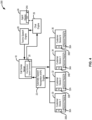
- FIG. 1 shows an exemplary system 10 according to this disclosure.
- FIG. 1 shows a computer system 10 configured to create a virtual reality (VR), or metaverse, commerce space 14 in which an agent can simultaneously interact with multiple (or a plurality of) customers.
- System 10 includes a VR server 12 that is configured to create the VR commerce space 14.
- VR server 12 is in communication with an avatar library 16 from which a customer can select an avatar for himself/herself and for the agent. Alternatively, the agent may be permitted to select his/her avatar, or VR server 12 may select an avatar for the agent, or the agent may not have a presence in the VR commerce space.
- a call center server 18 is in communication with (1) VR server 12, (2) an agent device 24, either directly or via a text-to-speech (TTS) engine 28 or a chat engine 26, (3) a plurality of customer devices 1-N, designated by reference characters 30, 32, 34, and 36, and (4) an ASR engine 22.
- Call center server 18 is any computer(s), processor(s), server(s), other device, or combination thereof that can route customer communications, agent communications, and interact with the VR server 12 as set forth herein.
- the agent device 24, as shown, has a graphical user interface ("GUI") 24A that permits the agent to enter text (or communicate via voice if desired).
- GUI 24A is any type of data entry device that permits such communications.
- a chat engine 26 as shown is a separate electronic device with appropriate software and is positioned between the agent device 24 and the TTS 28. Alternatively, the chat engine may be part of the same computing device on which agent device 24 and/or TTS 28 operates. Or, chat engine 26 may be part of call center server 18. Chat engine 26 is configured to relay text messages between agent device 24 and TTS engine 28 and to receive text messages from call center server 18 and route them to agent device 24.
- TTS engine 28 converts text generated by agent device 24 via chat engine 26 into speech and transmits the speech to call center server 18, which then transmits the speech to one or more of the plurality of the customer devices 30, 32, 34, 36 where customers can hear the speech.
- Each customer device 30, 32, 34, and 36 as shown has an electronic display designated by 30A, 32A, 34A, and 36A, each of which permit the user to enter the VR commerce space 14 via the call center server 18 and VR server 12.
- a customer may need to use VR glasses or goggles, or augmented reality (AR) glasses or goggles, to properly view the VR commerce space 14 through the electronic display 30A, 32A, 34A, or 36A.
- Each of the plurality of customer devices 30, 32, 34, and 36 as shown has a voice communicator (VC) designated as 30B, 32B, 34B, and 36B.
- Each VC enables the customer device to send and receive voice communications.
- voice (or speech) transmissions by a customer through a voice communicator 30B, 32B, 34B, or 36B are converted to text by an automatic speech recognition (ASR) engine 22, which as shown is a separate electronic device.
- ASR engine 22 can be at any suitable position in system 10. For example, it may be part of call center server 18 or be between call center server 18 and chat engine 26. Text generated by ASR engine 22 is communicated (in this example) by call center server 18 to chat engine 26, which communicates the text to agent device 24.
- a speech generator 20 is a computing device that is programmed to (1) identify and answer some customer questions in order to provide more available time for the agent, and/or (2) interject typical speech-related nuances to one or more of the plurality of customer devices in order to simulate actual conversation if the agent is engaged in another communication or otherwise distracted.
- speech generator 20 may recognize and be able to answer customer questions such as "what is the shipping address?,” “what is the price?,” “what is the lead time to ship?,” or “where can I see an image of the product?” If the agent is busy with another matter, speech generator 20 may fill in gaps in the conversation with any suitable phrases, such as "I'm still looking,” “please give me a few more minutes,” “don't hang up, please, I'm still researching the answer.” Speech generator 20 as shown is part of call center server 18, but could be a separate computing device or software resident at any suitable location in system 10. Speech generator 20 may also have an artificial intelligence component that learns the answers to customer questions by comparing questions asked and agent's answers.
- a chat monitor is shown as being part of speech generator 20, although it could be a separate device. The chat monitor detects gaps in the agent's speech for the speech generator 20 to fill.
- FIG. 2 a computer method 100 of this disclosure is shown.
- the customer or user has selected a customer avatar 110 from avatar library 16 and avatar 110 is positioned in the VR commerce space 14.
- Audio 112 is communicated by a voice communicator 30B, 32B, 34B, or 36B to ASR engine 22 at step 114.
- the ASR engine 22 converts the audio (or speech) into text which is transmitted at step 114 via call center server 18 to chat engine 26, which transmits the text to the agent device 24.
- the agent is represented by agent avatar 118 in VR commerce space 14 although the agent need not have a presence in the VR commerce space 14.
- a delay is detected in the agent's response chat monitor 20 at step 124, detects the delay and fills the delay with speech such as “still checking,” “looking that up now,” “just give me another minute, please” or similar language that lets the user know that the agent is still in communication.
- the agent responds to the customer by typing a chat message on agent device 24, preferably by using GUI 24A.
- the chat message is transmitted through chat engine 26, through TTS engine 28 where it is converted to an audio (or voice) message at step 122, which is communicated to customer avatar 110 via a customer device 30, 32, 34, or 36.
- FIG. 3 shows computer method 200 according to aspects of this disclosure.
- an agent avatar 118 generates chat messages, although the agent may choose not to have an avatar or be present in VR commerce space 14.
- the chat messages are converted to voice using a TTS device at step 204 and the voice is transmitted to customer avatar 110, which is present inside of VR commerce space 14 as is agent avatar 118 if utilized.
- Customer avatar 110 generates speech at step 206, which is converted to text by a suitable device, such as an ASR engine, and then sent to agent avatar 118 or just to the agent if the agent is not utilizing an avatar.
- a suitable device such as an ASR engine
- Chat conversation monitor 20 may be used to monitor the communications between the customer and the agent and the speech generator (also shown as 20) may be configured to answer simple questions or fill in gaps in the conversation if the agent is delayed.
- FIG. 4 shows a computer system 300 that is in all respects the same as system 10 except that it does not utilize a VR commerce space. Thus, it lacks VR server 12, VR commerce space 14, and avatar library 16. In all other respects, the structure and function of system 300 is the same as system 10.
- FIG. 5 illustrates a computer method 400 that is in all respects the same as method 100 except that there is no VR commerce space and no avatars.
- FIG. 6 illustrates a computer method 500 that is in all respects the same as method 200 except that the is no VR commerce space and no avatars.
Landscapes
- Engineering & Computer Science (AREA)
- Business, Economics & Management (AREA)
- Physics & Mathematics (AREA)
- Marketing (AREA)
- Multimedia (AREA)
- Health & Medical Sciences (AREA)
- Audiology, Speech & Language Pathology (AREA)
- Human Computer Interaction (AREA)
- Computational Linguistics (AREA)
- Acoustics & Sound (AREA)
- Theoretical Computer Science (AREA)
- General Physics & Mathematics (AREA)
- Signal Processing (AREA)
- Accounting & Taxation (AREA)
- Finance (AREA)
- Development Economics (AREA)
- Economics (AREA)
- Strategic Management (AREA)
- General Business, Economics & Management (AREA)
- Computer Graphics (AREA)
- Information Transfer Between Computers (AREA)
- Telephonic Communication Services (AREA)
Abstract
A computer system and method are configured to create a virtual reality (VR) commerce space in which a single agent can simultaneously interact with multiple customers. The computer system includes a VR server configured to create a VR commerce space; a call center server in communication with the VR server and configured to communicate with (a) a plurality of customer devices, and (b) an agent device; a text-to-speech (TTS) engine that converts text entered into the agent device into speech that is transmitted by the call center server to at least some of the plurality of customer devices. The call center server is further configured to position each customer having one of the plurality of customer devices into the VR commerce space and to permit the agent device to communicate simultaneously with the plurality of customer devices.
Description
- This disclosure relates to a system and devices that enable a single customer service representative to simultaneously communicate with multiple customers. The system and devices could function in a virtual reality (VR or metaverse) environment, or on a telephonic or non-VR computer network.
- Many companies are beginning to create a presence in the metaverse through virtual stores, which are meant for customers to visit as they would brick and mortar stores. The metaverse is a virtual space in which users can create an avatar and virtually interact with others from essentially any location using devices such as a 3D screen, a VR headset, a mobile phone, or a personal computer (PC). Customer service agents may also choose to operate a device that enables them to enter the metaverse.
- In a commerce metaverse each avatar may be unique to a certain person. This means that even though the metaverse is virtual, when a customer visits a metaverse store, unless there is someone such as a virtual customer service agent present who can assist the customer, the customer must wait until a customer service representative (also called an agent, representative, or contact center agent) is available.
- Contact center agents receive interactions from customers in many forms, such as email, chat, SMS, or voice. Typically for a customer contact center, an agent can handle many chat, SMS, or email interactions simultaneously, because the interactions are asynchronous. For voice interactions, an agent is basically limited to a single interaction with one customer. There are currently many tools that permit a type of a conversation to change, such as TTS (text-to-speech) or ASR (automatic speech recognition).
- While in the metaverse, customers (also called users) may visit a store to speak to a representative about a product or service. As an example, a user could visit a bank in order to obtain help with his/her account or learn about the bank's services. The bank will have staff that are able to assist the user, but similar to the real world, where there are limited number of staff, there are also a limited number of metaverse staff. Thus, the customer may be required to wait in line (virtually) while waiting for a free customer service agent. A business may also choose to allow a bot to handle simple customer queries, but if a customer wants to speak directly to an agent, he/she may have to wait.
- Meeting online (chat or video) is presently limited in its ability to enhance the customer experience, because of, for example, the shortcomings of pretext markup language (HTML) or codecs to increase the clarity of the audio and video. Additionally, call centers primarily focus only on resource management (such as automatic call distribution (ACD) or agent routing) and knowledge management (selecting and/or preparing an agent for the customer call) in tailoring the experience for a customer.
- Contact call center systems (or "call centers") are thus equipped to route incoming calls to the proper agents. Interactive voice responses (IVRs) can implement a user-interface design that uses audio prompts. The situational reality, however, at either end of the call remains unchanged; the agent is at a call center with a computer screen and/or phone, and the customer is on his/her computer and/or phone. A metaverse-based customer call center aims to make the customer experience personal and enjoyable. Today, such metaverses are constrained due to static support practices, such as communications between a customer and the customer service center being through a website or telephone call.
- This disclosure proposes utilizing technologies to allow for interaction with multiple customers and a single agent, wherein the interactions can occur in the metaverse or otherwise. Currently, an agent can enter into a voice conversation with a customer utilizing a telephony system, or by using a VR headset if the communication is occurring in the metaverse. As mentioned above, a limitation is that the agent can realistically only handle one customer voice communication at a time. According to aspects of this disclosure, the agent would instead use a traditional chat interface to "speak" to customers by converting text to a voice and in that manner service multiple customers simultaneously. The customer(s)' voice responses to the agent could be converted to text. The communications could take place in a VR commerce environment or take place using a traditional telephonic or computer system.
- The customer would believe he/she is speaking to an agent, but in fact the agent would be typing chat messages to the customer which are spoken using text-to-speech (TTS) technology. To make the conversation flow better, the system could include a speech generator programmed to (1) identify and answer some customer questions in order to provide more available time for the agent, and/or (2) interject typical speech-related nuances in order to simulate actual conversation if the agent is engaged in another communication. This would help allow the agent to serve multiple customers simultaneously because the system could fill in gaps or delays in the agent's speech while the agent is researching an answer or communicating with another customer. For example, the system may automatically generate voice communications to a customer(s) such as "give me a minute to look that up" or "Let me think about that." The goal is to create a natural conversation, and to allow an agent to simultaneously handle multiple customers.
- A system and method of this disclosure thus enables a single agent to simultaneously communicate with multiple customers, which could be represented by multiple avatars if in a VR commerce space. The agent would preferably use a text medium to communicate in real-time with customers who are using voice communications.
- If a metaverse is utilized, agents can choose to enter the metaverse with their own likeness, or to use a virtual avatar (selected by the agent or by the customer) that can communicate with the customer. This disclosure leverages TTS and ASR in order to create a relatively seamless experience for a customer even though the agent and the customer are initially communicating in different mediums. The system converts text typed by the agent to voice, which the customer would hear, and converts speech by a customer to text, which the agent would read.
- A first aspect disclosed herein provides a computer system configured to create a virtual reality (VR) commerce space in which an agent can simultaneously interact with multiple customers, the computer system comprising: a VR server configured to create a VR commerce space for one or more business products or services; a call center server in communication with the VR server and configured to communicate with (a) a plurality of customer devices, and (b) an agent device having a graphical user interface (GUI) configured to permit an agent to enter text into the agent device; a text-to-speech (TTS) engine that converts text entered into the agent device into speech that is transmitted by the call center server to one or more of the plurality of customer devices; and the call center server being further configured to position each customer having one of the plurality of customer devices into the VR commerce space and to permit the agent device to communicate simultaneously with each of the plurality of customer devices.
- The TTS engine may be configured to convert SMS messages, email messages, and/or chat messages from the agent device to speech on each of the plurality of customer devices.
- The computer system may further comprise an avatar library in communication with the VR server, wherein the avatar library comprises a plurality of avatars.
- The conference call center server may be configured to receive a command from a customer of any of the plurality of customer devices to select a unique avatar from the avatar library and transmit the command to the VR server, which selects the unique avatar from the avatar library and places the unique avatar into the VR commerce space to represent the customer.
- The call center server may be configured to generate typical speech-related nuances that are included in the speech generated by the TTS engine.
- The computer system may further include the plurality of customer devices and wherein each of the plurality of customer devices may include an electronic display configured to display the VR commerce space in three dimensions (3D).
- A second aspect disclosed herein provides a computer-implemented method for creating a VR commerce space in which a plurality of customer devices can simultaneously interact with an agent device, the method comprising the steps of: utilizing a VR server to create the VR commerce space; utilizing a call center server in communication with the VR server to communicate with the plurality of customer devices, and with an agent device, in order to permit each of the plurality of customer devices to communicate simultaneously with the agent device, and to also communicate with the VR server; utilizing an avatar library, permitting each of the plurality of customer devices to select a unique avatar from the avatar library and placing the unique avatar in the VR commerce space to represent the customer associated with a particular customer device; and utilizing a text-to-voice translator, permitting the agent to communicate via the agent device with text or symbols entered into a UPI of the agent device, wherein the text-to-voice translator translates the symbols or text into voice on each of the plurality of customer devices in communication with the agent device.
- The text-to-voice translator may utilize TTS.
- The agent may have the option to utilize voice communications sent from the agent device to any of the plurality of customer devices.
- If the call center server detects a pause or interruption in a communication from the agent device to one of the plurality of customer devices, it fills the pause or interruption with a voice filler.
- The call center server may be further configured to answer some questions posed by a customer without input from the agent.
- The VR server may be in communication with an avatar library and may be configured to select an avatar for each of the customers and for the agent and place the avatars in the VR commerce space.
- Speech by a customer may be converted by the call center server to text on the agent device utilizing an automatic speech recognition (ASR) engine.
- The VR server may further generate bots in the VR commerce space that are configured to communicate with one or more of the plurality of customer devices, wherein one or both of the VR server and the call center server may be configured to control the bots' communications.
- A third aspect disclosed herein provides a computer system configured to create a virtual reality (VR) commerce space in which an agent can simultaneously conduct multiple customer interactions, the computer system comprising: a VR server configured to create a VR commerce space for one or more business products or services; a call center server in communication with the VR server and configured to communicate with (a) a plurality of customer devices, and (b) an agent device having a graphical user interface (GUI) configured to permit an agent to enter text into the agent device; a text-to-speech (TTS) engine that converts text entered into the agent device into speech that is received by one or more of the plurality of customer devices; an avatar library in communication with the VR server; and via the agent device or one of the plurality of customer devices, a unique avatar for the agent and for the customer can be selected and placed in the VR commerce space.
- The call center server may be configured to permit (a) a plurality of customer devices to simultaneously view one VR commerce space, and/or (b) a plurality of agent devices to simultaneously view one VR commerce space, such that a plurality of customers and/or a plurality of agents can simultaneously interact within the VR commerce space.
- At least one of the plurality of customer devices may be configured to communicate with the call center server by voice.
- One or more of the plurality of customer devices may be configured to communicate to the agent device by TTS.
- The call center server may be further configured to pause the conversation if it detects that the agent needs additional time to answer a question.
- The customer device may communicate via the unique avatar for the customer and the agent communicates via the unique avatar for the agent.
- The subject matter of the present disclosure is particularly pointed out and distinctly claimed in the concluding portion of the specification. A more complete understanding of the present disclosure, however, may best be obtained by referring to the detailed description and claims when considered in connection with the drawing figures, wherein like numerals denote like elements and wherein:
-
FIG. 1 shows a computer system for a VR-commerce space according to aspects of this disclosure. -
FIG. 2 shows a computer method according to aspects of the system ofFIG. 1 . -
FIG. 3 shows a computer method according to aspects of the system ofFIG. 1 . -
FIG. 4 shows an alternate computer system according to aspects of this disclosure. -
FIG. 5 shows a computer method according to aspects of the system ofFIG. 4 . -
FIG. 6 shows a computer method according to aspects of the system ofFIG. 4 . - It will be appreciated that elements in the figures are illustrated for simplicity and clarity and have not necessarily been drawn to scale. For example, the dimensions of some of the elements in the figures may be exaggerated relative to other elements to help to improve understanding of illustrated embodiments of the present invention.
- This disclosure describes systems and methods that, among other things, permits a single agent to communicate with multiple customers simultaneously in a metaverse commerce space. This is preferably accomplished by the agent receiving voice communications from a plurality (i.e., two or more) of customers, wherein the voice is preferably converted to text via an automatic speech recognition (ASR) device. The agent communicates with the plurality customers by entering text that is converted to voice via a text-to-speech (TTS) device.
- The description of embodiments provided herein is merely exemplary and is intended for purposes of illustration only; the following description is not intended to limit the scope of the claims. Moreover, recitation of multiple embodiments having stated features is not intended to exclude other embodiments having additional or fewer features or other embodiments incorporating different combinations of the stated features. The methods and systems according to this disclosure and claims can operate in a premise, cloud-based, or hybrid environment.
- As used herein, "engine" refers to a data-processing apparatus, such as a processor, configured to execute computer program instructions, encoded on computer storage medium, wherein the instructions control the operation of the engine. Alternatively or additionally, the program instructions can be encoded on an artificially-generated propagated signal, e.g., a machine-generated electrical, optical, or electromagnetic signal, which is generated to encode information for transmission to suitable receiver apparatus for execution by a data processing apparatus.
- A computer storage medium can be, or be included in, a computer-readable storage device, a computer-readable storage substrate, a random or serial access memory array or device, or a combination of one or more of the substrates and devices. Moreover, while a computer storage medium is not a propagated signal, a computer storage medium can be a source or destination of computer program instructions encoded in an artificially-generated propagated signal. The computer storage medium can also be, or be included in, one or more separate physical components or media (e.g., solid-state memory that forms part of a device, disks, or other storage devices). In accordance with examples of the disclosure, a non-transient computer readable medium containing program can perform functions of one or more methods, modules, engines and/or other system components as described herein.
- As used herein, "database" or "library" refers to any suitable database for storing information, electronic files or code to be utilized to practice embodiments of this disclosure. As used herein, "server" refers to any suitable server, computer or computing device for performing functions utilized to practice embodiments of this disclosure.
- Turning now to the Figures, wherein the purpose is to describe embodiments of this disclosure and not to limit the scope of the claims,
FIG. 1 shows anexemplary system 10 according to this disclosure. -
FIG. 1 shows acomputer system 10 configured to create a virtual reality (VR), or metaverse,commerce space 14 in which an agent can simultaneously interact with multiple (or a plurality of) customers.System 10 includes aVR server 12 that is configured to create theVR commerce space 14.VR server 12 is in communication with anavatar library 16 from which a customer can select an avatar for himself/herself and for the agent. Alternatively, the agent may be permitted to select his/her avatar, orVR server 12 may select an avatar for the agent, or the agent may not have a presence in the VR commerce space. - A
call center server 18 is in communication with (1)VR server 12, (2) anagent device 24, either directly or via a text-to-speech (TTS)engine 28 or achat engine 26, (3) a plurality of customer devices 1-N, designated byreference characters ASR engine 22.Call center server 18 is any computer(s), processor(s), server(s), other device, or combination thereof that can route customer communications, agent communications, and interact with theVR server 12 as set forth herein. - The
agent device 24, as shown, has a graphical user interface ("GUI") 24A that permits the agent to enter text (or communicate via voice if desired).GUI 24A is any type of data entry device that permits such communications. Achat engine 26 as shown is a separate electronic device with appropriate software and is positioned between theagent device 24 and theTTS 28. Alternatively, the chat engine may be part of the same computing device on whichagent device 24 and/orTTS 28 operates. Or, chatengine 26 may be part ofcall center server 18.Chat engine 26 is configured to relay text messages betweenagent device 24 andTTS engine 28 and to receive text messages fromcall center server 18 and route them toagent device 24. -
TTS engine 28 converts text generated byagent device 24 viachat engine 26 into speech and transmits the speech to callcenter server 18, which then transmits the speech to one or more of the plurality of thecustomer devices - Each
customer device VR commerce space 14 via thecall center server 18 andVR server 12. A customer may need to use VR glasses or goggles, or augmented reality (AR) glasses or goggles, to properly view theVR commerce space 14 through theelectronic display customer devices - In this embodiment, voice (or speech) transmissions by a customer through a
voice communicator engine 22, which as shown is a separate electronic device. Alternatively,ASR engine 22 can be at any suitable position insystem 10. For example, it may be part ofcall center server 18 or be betweencall center server 18 andchat engine 26. Text generated byASR engine 22 is communicated (in this example) bycall center server 18 to chatengine 26, which communicates the text toagent device 24. - A
speech generator 20 is a computing device that is programmed to (1) identify and answer some customer questions in order to provide more available time for the agent, and/or (2) interject typical speech-related nuances to one or more of the plurality of customer devices in order to simulate actual conversation if the agent is engaged in another communication or otherwise distracted. For example,speech generator 20 may recognize and be able to answer customer questions such as "what is the shipping address?," "what is the price?," "what is the lead time to ship?," or "where can I see an image of the product?" If the agent is busy with another matter,speech generator 20 may fill in gaps in the conversation with any suitable phrases, such as "I'm still looking," "please give me a few more minutes," "don't hang up, please, I'm still researching the answer."Speech generator 20 as shown is part ofcall center server 18, but could be a separate computing device or software resident at any suitable location insystem 10.Speech generator 20 may also have an artificial intelligence component that learns the answers to customer questions by comparing questions asked and agent's answers. A chat monitor is shown as being part ofspeech generator 20, although it could be a separate device. The chat monitor detects gaps in the agent's speech for thespeech generator 20 to fill. - Turning to
FIG. 2 , acomputer method 100 of this disclosure is shown. Here, the customer (or user) has selected acustomer avatar 110 fromavatar library 16 andavatar 110 is positioned in theVR commerce space 14.Audio 112 is communicated by avoice communicator ASR engine 22 atstep 114. TheASR engine 22 converts the audio (or speech) into text which is transmitted atstep 114 viacall center server 18 to chatengine 26, which transmits the text to theagent device 24. Here the agent is represented byagent avatar 118 inVR commerce space 14 although the agent need not have a presence in theVR commerce space 14. If a delay is detected in the agent's response chat monitor 20 atstep 124, detects the delay and fills the delay with speech such as "still checking," "looking that up now," "just give me another minute, please" or similar language that lets the user know that the agent is still in communication. - At
step 120 the agent responds to the customer by typing a chat message onagent device 24, preferably by usingGUI 24A. The chat message is transmitted throughchat engine 26, throughTTS engine 28 where it is converted to an audio (or voice) message atstep 122, which is communicated tocustomer avatar 110 via acustomer device -
FIG. 3 showscomputer method 200 according to aspects of this disclosure. Atstep 202 anagent avatar 118 generates chat messages, although the agent may choose not to have an avatar or be present inVR commerce space 14. The chat messages are converted to voice using a TTS device atstep 204 and the voice is transmitted tocustomer avatar 110, which is present inside ofVR commerce space 14 as isagent avatar 118 if utilized. -
Customer avatar 110 generates speech atstep 206, which is converted to text by a suitable device, such as an ASR engine, and then sent toagent avatar 118 or just to the agent if the agent is not utilizing an avatar. - Chat conversation monitor 20, not shown in
FIG. 3 , may be used to monitor the communications between the customer and the agent and the speech generator (also shown as 20) may be configured to answer simple questions or fill in gaps in the conversation if the agent is delayed. -
FIG. 4 shows acomputer system 300 that is in all respects the same assystem 10 except that it does not utilize a VR commerce space. Thus, it lacksVR server 12,VR commerce space 14, andavatar library 16. In all other respects, the structure and function ofsystem 300 is the same assystem 10. -
FIG. 5 illustrates acomputer method 400 that is in all respects the same asmethod 100 except that there is no VR commerce space and no avatars.FIG. 6 illustrates acomputer method 500 that is in all respects the same asmethod 200 except that the is no VR commerce space and no avatars. - The features of the various embodiments described herein may be stand alone or combined in any combination. Further, unless otherwise noted, various illustrated steps of a method can be performed sequentially or at the same time, and not necessarily be performed in the order illustrated. It will be recognized that changes and modifications may be made to the exemplary embodiments without departing from the scope of the present invention. These and other changes or modifications are intended to be included within the scope of the present invention, as expressed in the following claims.
Claims (15)
- A computer system configured to create a virtual reality, VR, commerce space in which an agent can simultaneously interact with multiple customers, the computer system comprising:a VR server configured to create a VR commerce space for one or more business products or services;a call center server in communication with the VR server and configured to communicate with (a) a plurality of customer devices, and (b) an agent device having a graphical user interface configured to permit an agent to enter text into the agent device;a text-to-speech (TTS) engine that converts text entered into the agent device into speech that is transmitted by the call center server to one or more of the plurality of customer devices; andthe call center server being further configured to position each customer having one of the plurality of customer devices into the VR commerce space and to permit the agent device to communicate simultaneously with each of the plurality of customer devices.
- The computer system of claim 1, wherein the text-to-speech engine is configured to convert SMS messages, email messages, and/or chat messages from the agent device to speech on each of the plurality of customer devices.
- The computer system of claim 1 or claim 2, that further comprises an avatar library in communication with the VR server, wherein the avatar library comprises a plurality of avatars.
- The computer system of claim 3, wherein the conference call center server is configured to:receive a command from a customer of any of the plurality of customer devices to select a unique avatar from the avatar library and;transmit the command to the VR server,and wherein the VR server is configured to select the unique avatar from the avatar library and place the unique avatar into the VR commerce space to represent the customer.
- The computer system of any preceding claim, wherein the call center server is configured to generate typical speech-related nuances that are included in the speech generated by the text-to-speech engine.
- The computer system of any preceding claim, that further includes the plurality of customer devices and wherein each of the plurality of customer devices includes an electronic display configured to display the VR commerce space in three dimensions.
- A computer-implemented method for creating a VR commerce space in which a plurality of customer devices can simultaneously interact with an agent device, the method comprising the steps of:utilizing a VR server to create the VR commerce space;utilizing a call center server in communication with the VR server to communicate with the plurality of customer devices, and with an agent device, in order to permit each of the plurality of customer devices to communicate simultaneously with the agent device, and to also communicate with the VR server;utilizing an avatar library, permitting each of the plurality of customer devices to select a unique avatar from the avatar library and placing the unique avatar in the VR commerce space to represent the customer associated with a particular customer device;utilizing a text-to-voice translator, permitting the agent to communicate via the agent device with text or symbols entered into a UPI of the agent device, wherein the text-to-voice translator translates the symbols or text into voice on each of the plurality of customer devices in communication with the agent device.
- The computer-implemented method of claim 7, comprising providing the agent with the option to utilize voice communications sent from the agent device to any of the plurality of customer devices.
- The computer-implemented method of claim 7 or claim 8, further comprising, if the call center server detects a pause or interruption in a communication from the agent device to one of the plurality of customer devices, filling the pause or interruption with a voice filler.
- The computer-implemented of method of any of claims 7 to 9, wherein the VR server is in communication with an avatar library and the method further comprises selecting an avatar for each of the customers and for the agent and placing the avatars in the VR commerce space.
- The computer-implemented method of any of claims 7 to 10, further comprising the call center server converting speech by a customer to text on the agent device utilizing an automatic speech recognition engine.
- The computer implemented method of any of claims 7 to 11, further comprising the VR server generating bots in the VR commerce space that are configured to communicate with one or more of the plurality of customer devices, wherein one or both of the VR server and the call center server are configured to control the bots' communications.
- A computer system configured to create a virtual reality (VR) commerce space in which an agent can simultaneously conduct multiple customer interactions, the computer system comprising:a VR server configured to create a VR commerce space for one or more business products or services;a call center server in communication with the VR server and configured to communicate with (a) a plurality of customer devices, and (b) an agent device having a graphical user interface (GUI) configured to permit an agent to enter text into the agent device;a text-to-speech (TTS) engine that converts text entered into the agent device into speech that is received by one or more of the plurality of customer devices;an avatar library in communication with the VR server; andvia the agent device or one of the plurality of customer devices, a unique avatar for the agent and for the customer can be selected and placed in the VR commerce space.
- The computer system of claim 13, wherein the call center server is configured to permit (a) a plurality of customer devices to simultaneously view one VR commerce space, and/or (b) a plurality of agent devices to simultaneously view one VR commerce space, such that a plurality of customers and/or a plurality of agents can simultaneously interact within the VR commerce space.
- The computer system of claim 13 or claim 14, wherein the call center server is further configured to pause the conversation if it detects that the agent needs additional time to answer a question.
Applications Claiming Priority (1)
| Application Number | Priority Date | Filing Date | Title |
|---|---|---|---|
| US18/125,086 US20240320720A1 (en) | 2023-03-22 | 2023-03-22 | Agent system for simultaneously servicing multiple customer devices |
Publications (1)
| Publication Number | Publication Date |
|---|---|
| EP4435702A1 true EP4435702A1 (en) | 2024-09-25 |
Family
ID=90571866
Family Applications (1)
| Application Number | Title | Priority Date | Filing Date |
|---|---|---|---|
| EP24165688.3A Pending EP4435702A1 (en) | 2023-03-22 | 2024-03-22 | Agent system for simultaneously servicing multiple customer devices |
Country Status (3)
| Country | Link |
|---|---|
| US (1) | US20240320720A1 (en) |
| EP (1) | EP4435702A1 (en) |
| CA (1) | CA3232398A1 (en) |
Cited By (1)
| Publication number | Priority date | Publication date | Assignee | Title |
|---|---|---|---|---|
| EP4507287A1 (en) * | 2023-08-08 | 2025-02-12 | Mitel Networks Corporation | System for an agent to simultaneously service multiple customer devices |
Citations (2)
| Publication number | Priority date | Publication date | Assignee | Title |
|---|---|---|---|---|
| US20110075819A1 (en) * | 2009-09-30 | 2011-03-31 | International Business Machines Corporation | Customer support center with virtual world enhancements |
| CN115330415A (en) * | 2022-08-18 | 2022-11-11 | 中国银行股份有限公司 | Bank investment advisor service system based on virtual scene |
-
2023
- 2023-03-22 US US18/125,086 patent/US20240320720A1/en active Pending
-
2024
- 2024-03-18 CA CA3232398A patent/CA3232398A1/en active Pending
- 2024-03-22 EP EP24165688.3A patent/EP4435702A1/en active Pending
Patent Citations (2)
| Publication number | Priority date | Publication date | Assignee | Title |
|---|---|---|---|---|
| US20110075819A1 (en) * | 2009-09-30 | 2011-03-31 | International Business Machines Corporation | Customer support center with virtual world enhancements |
| CN115330415A (en) * | 2022-08-18 | 2022-11-11 | 中国银行股份有限公司 | Bank investment advisor service system based on virtual scene |
Non-Patent Citations (2)
| Title |
|---|
| BOUKARAM HALIM-ANTOINE HBOUKARAM@AUST EDU LB ET AL: "Mitigating the Effects of Delayed Virtual Agent Response Time Using Conversational Fillers", MULTIMEDIA UNDERSTANDING WITH LESS LABELING ON MULTIMEDIA UNDERSTANDING WITH LESS LABELING, ACMPUB27, NEW YORK, NY, USA, 9 November 2021 (2021-11-09), pages 130 - 138, XP058661415, ISBN: 978-1-4503-8685-2, DOI: 10.1145/3472307.3484181 * |
| LINGYUN QIU ET AL: "An investigation into the effects of Text-To-Speech voice and 3D avatars on the perception of presence and flow of live help in electronic commerce", ACM TRANSACTIONS ON COMPUTER-HUMAN INTERACTION, ACM, NEW YORK, NY, US, vol. 12, no. 4, 1 December 2005 (2005-12-01), pages 329 - 355, XP058250375, ISSN: 1073-0516, DOI: 10.1145/1121112.1121113 * |
Cited By (1)
| Publication number | Priority date | Publication date | Assignee | Title |
|---|---|---|---|---|
| EP4507287A1 (en) * | 2023-08-08 | 2025-02-12 | Mitel Networks Corporation | System for an agent to simultaneously service multiple customer devices |
Also Published As
| Publication number | Publication date |
|---|---|
| CA3232398A1 (en) | 2025-06-23 |
| US20240320720A1 (en) | 2024-09-26 |
Similar Documents
| Publication | Publication Date | Title |
|---|---|---|
| US10812655B1 (en) | Methods and systems for seamless outbound cold calls using virtual agents | |
| US7573985B2 (en) | Systems and methods for facilitating communications involving hearing-impaired parties | |
| AU2020346044B2 (en) | Systems and methods facilitating bot communications | |
| US7315612B2 (en) | Systems and methods for facilitating communications involving hearing-impaired parties | |
| US8737598B2 (en) | Customer support center with virtual world enhancements | |
| US8509408B2 (en) | Voice and text communication system | |
| JP2021144228A (en) | User programmable automatic assistant | |
| EP2864941B1 (en) | Method and apparatus for diverting callers to web sessions | |
| US20130124631A1 (en) | Apparatus, system, and method for digital communications driven by behavior profiles of participants | |
| US12093660B2 (en) | Intent matching engine | |
| US11663791B1 (en) | Dynamic avatars for customer support applications | |
| EP4507287B1 (en) | System for an agent to simultaneously service multiple customer devices | |
| CN114582339A (en) | Voice interaction method and device, electronic equipment and medium | |
| US11659092B2 (en) | Enhancing agent's efficiency in a contact center by using a multi-agent to multi-contact routing orchestration | |
| CN113850898A (en) | Scene rendering method and device, storage medium and electronic equipment | |
| US20240320720A1 (en) | Agent system for simultaneously servicing multiple customer devices | |
| US11776546B1 (en) | Intelligent agent for interactive service environments | |
| US12131125B2 (en) | Automated outcome classification systems in contact interactions, and methods | |
| US12499155B2 (en) | System and method facilitating a multi mode bot capability in a single experience | |
| EP4553739A1 (en) | Customization of a metaverse environment based on customer preferences | |
| KR20000072073A (en) | Method of Practicing Automatic Simultaneous Interpretation Using Voice Recognition and Text-to-Speech, and System thereof | |
| EP4557202A1 (en) | Metaverse service center queuing using an avatar | |
| US20250317518A1 (en) | Systems and methods for multimodal conversation support at a contact center | |
| US20250150533A1 (en) | Customization of a metaverse environment based on customer preferences | |
| WO2013067365A1 (en) | Apparatus, system, and method for digital communications driven by behavior profiles of participants |
Legal Events
| Date | Code | Title | Description |
|---|---|---|---|
| PUAI | Public reference made under article 153(3) epc to a published international application that has entered the european phase |
Free format text: ORIGINAL CODE: 0009012 |
|
| STAA | Information on the status of an ep patent application or granted ep patent |
Free format text: STATUS: THE APPLICATION HAS BEEN PUBLISHED |
|
| AK | Designated contracting states |
Kind code of ref document: A1 Designated state(s): AL AT BE BG CH CY CZ DE DK EE ES FI FR GB GR HR HU IE IS IT LI LT LU LV MC ME MK MT NL NO PL PT RO RS SE SI SK SM TR |
|
| STAA | Information on the status of an ep patent application or granted ep patent |
Free format text: STATUS: REQUEST FOR EXAMINATION WAS MADE |
|
| 17P | Request for examination filed |
Effective date: 20250325 |