EP4435576A1 - Video switching method and apparatus, electronic device, and storage medium - Google Patents
Video switching method and apparatus, electronic device, and storage medium Download PDFInfo
- Publication number
- EP4435576A1 EP4435576A1 EP22909809.0A EP22909809A EP4435576A1 EP 4435576 A1 EP4435576 A1 EP 4435576A1 EP 22909809 A EP22909809 A EP 22909809A EP 4435576 A1 EP4435576 A1 EP 4435576A1
- Authority
- EP
- European Patent Office
- Prior art keywords
- touch event
- event
- determining
- sliding
- video
- Prior art date
- Legal status (The legal status is an assumption and is not a legal conclusion. Google has not performed a legal analysis and makes no representation as to the accuracy of the status listed.)
- Pending
Links
Images




Classifications
-
- G—PHYSICS
- G06—COMPUTING OR CALCULATING; COUNTING
- G06F—ELECTRIC DIGITAL DATA PROCESSING
- G06F3/00—Input arrangements for transferring data to be processed into a form capable of being handled by the computer; Output arrangements for transferring data from processing unit to output unit, e.g. interface arrangements
- G06F3/01—Input arrangements or combined input and output arrangements for interaction between user and computer
- G06F3/048—Interaction techniques based on graphical user interfaces [GUI]
- G06F3/0484—Interaction techniques based on graphical user interfaces [GUI] for the control of specific functions or operations, e.g. selecting or manipulating an object, an image or a displayed text element, setting a parameter value or selecting a range
- G06F3/04847—Interaction techniques to control parameter settings, e.g. interaction with sliders or dials
-
- G—PHYSICS
- G06—COMPUTING OR CALCULATING; COUNTING
- G06F—ELECTRIC DIGITAL DATA PROCESSING
- G06F3/00—Input arrangements for transferring data to be processed into a form capable of being handled by the computer; Output arrangements for transferring data from processing unit to output unit, e.g. interface arrangements
- G06F3/01—Input arrangements or combined input and output arrangements for interaction between user and computer
- G06F3/048—Interaction techniques based on graphical user interfaces [GUI]
- G06F3/0487—Interaction techniques based on graphical user interfaces [GUI] using specific features provided by the input device, e.g. functions controlled by the rotation of a mouse with dual sensing arrangements, or of the nature of the input device, e.g. tap gestures based on pressure sensed by a digitiser
- G06F3/0488—Interaction techniques based on graphical user interfaces [GUI] using specific features provided by the input device, e.g. functions controlled by the rotation of a mouse with dual sensing arrangements, or of the nature of the input device, e.g. tap gestures based on pressure sensed by a digitiser using a touch-screen or digitiser, e.g. input of commands through traced gestures
-
- G—PHYSICS
- G06—COMPUTING OR CALCULATING; COUNTING
- G06F—ELECTRIC DIGITAL DATA PROCESSING
- G06F3/00—Input arrangements for transferring data to be processed into a form capable of being handled by the computer; Output arrangements for transferring data from processing unit to output unit, e.g. interface arrangements
- G06F3/01—Input arrangements or combined input and output arrangements for interaction between user and computer
- G06F3/048—Interaction techniques based on graphical user interfaces [GUI]
- G06F3/0487—Interaction techniques based on graphical user interfaces [GUI] using specific features provided by the input device, e.g. functions controlled by the rotation of a mouse with dual sensing arrangements, or of the nature of the input device, e.g. tap gestures based on pressure sensed by a digitiser
- G06F3/0488—Interaction techniques based on graphical user interfaces [GUI] using specific features provided by the input device, e.g. functions controlled by the rotation of a mouse with dual sensing arrangements, or of the nature of the input device, e.g. tap gestures based on pressure sensed by a digitiser using a touch-screen or digitiser, e.g. input of commands through traced gestures
- G06F3/04883—Interaction techniques based on graphical user interfaces [GUI] using specific features provided by the input device, e.g. functions controlled by the rotation of a mouse with dual sensing arrangements, or of the nature of the input device, e.g. tap gestures based on pressure sensed by a digitiser using a touch-screen or digitiser, e.g. input of commands through traced gestures for inputting data by handwriting, e.g. gesture or text
-
- G—PHYSICS
- G06—COMPUTING OR CALCULATING; COUNTING
- G06F—ELECTRIC DIGITAL DATA PROCESSING
- G06F9/00—Arrangements for program control, e.g. control units
- G06F9/06—Arrangements for program control, e.g. control units using stored programs, i.e. using an internal store of processing equipment to receive or retain programs
- G06F9/44—Arrangements for executing specific programs
- G06F9/451—Execution arrangements for user interfaces
Definitions
- Embodiments of the present disclosure relate to the technical field of intelligent terminals, for example, to a video switching method and apparatus, an electronic device, and a storage medium.
- the embodiments of the present disclosure provide a video switching method and apparatus, an electronic device, and a storage medium, which may reduce the probability of accidental operation events caused by nonstandard sliding operation gestures, improve the accuracy of recognition of user's operation intentions, and improve the user experience.
- the embodiments of the present disclosure provide a video switching method, including:
- the embodiments of the present disclosure provide a video switching apparatus, including:
- the embodiments of the present disclosure provide an electronic device, and the electronic device includes:
- the embodiments of the present disclosure provide a storage medium, which includes computer-executable instructions, and the computer-executable instructions, when executed by a computer processor, are configured to execute the video switching method according to any one of the embodiments of the present disclosure.
- the term “include,” “comprise,” and variations thereof are openended inclusions, i.e., “including but not limited to.”
- the term “based on” is “based, at least in part, on.”
- the term “an embodiment” represents “at least one embodiment,” the term “another embodiment” represents “at least one additional embodiment,” and the term “some embodiments” represents “at least some embodiments.” Relevant definitions of other terms will be given in the description below.
- Fig. 1 is a schematic flow diagram of a video switching method provided by an embodiment of the present disclosure.
- the embodiments of the present disclosure are suitable for a scenario of video stream data switching, especially for a situation of a video stream switching operation on a short video playing platform.
- the method may be executed by a video switching apparatus, which may be implemented in the form of software and/or hardware, and may be configured in an electronic device, such as a mobile terminal or a server device.
- the video switching method provided by this embodiment includes: S 110: acquiring a touch event on a video information display interface, and determining whether a start position of the touch event is located at a preset feature position.
- the video information display interface may be any application client interface for video playback.
- this video information display interface not only a video may be played, but also video information may be switched by a sliding operation.
- the video information display interface is also referred to as a Feed stream browsing interface, and users may also interact with video information by clicking interactive buttons such as a like button, a share button, a comment button, a favorite button and an avatar button, or video description text and other information.
- the video description text includes a video introduction, topic tags related to video content and other information.
- the user may switch video information by a gesture of sliding up and down, i.e., sliding up to switch to a next video of a current video and sliding down to switch to a previous video of the current video.
- the sliding direction may be in opposite correspondence or other correspondence with a sequence rule of video switching. It should be noted here that in this embodiment, it is exemplified by sliding up to switch to the next video of the current video and sliding down to switch to the previous video of the current video, and the sliding gesture for video switching may be shown as Fig. 2 , where Fig. 2 shows a specific example of a video information interface.
- an arrow in a vertical direction in the video information display interface indicates the sliding in the vertical direction, but it is not necessary to execute the sliding operation absolutely vertically in a process of a sliding operation by the user, and the sliding operation of the user may be recognized as long as it is within a range of a preset compatible angle, and an action instruction corresponding to the sliding operation may be executed.
- a default compatible angle of the sliding operation is 45 degrees, that is, sliding up between 0 degree and 45 degrees can trigger Feed stream switching.
- an included angle between a dashed arrow and a solid arrow is an included angle between the sliding operation at different angles and the vertical direction of the video information display interface.
- the video information interface in addition to the specific video content display, it also includes interactive buttons such as an avatar of a video content creator, a like button, a share button, a comment button, a favorite button and an avatar button, or video description text, and other information.
- the touch event on the video information display interface may be acquired.
- the user touches and slides on the video information display interface the user often touches interactive buttons or video description text and other information.
- a client needs to identify what the user's real operation intention is, whether it is to slide to switch video information or click a button or trigger a corresponding operation. In this case, the possibility of an accidental touch operation is high.
- each preset interactive function button is a view at an upper layer of a Feed stream view, and all the video information description content is on one view.
- the coordinate position of a touch point on a client display interface may be determined.
- the preset feature position is position information recorded when video information is initialized.
- the coordinate position information of the start position of the touch event may be matched with the position information of the preset feature position, so as to determine whether the start position of the touch event is at the preset feature position according to a matching result.
- S 120 determining whether the touch event is a sliding event according to a sliding recognition strategy corresponding to the preset feature position, in response to determining that the start position of the touch event is located at the preset feature position.
- the preset feature position where the start position of the touch event is located is taken as the position where the preset interactive function button is located.
- the user performs a touch operation on the video information display interface through a gesture and a corresponding sliding trajectory is generated, but the start position of the sliding trajectory falls within the scope of the like button.
- an included angle between a moving trajectory and a vertical direction of the video information display interface may be determined according to the coordinate position of the moving trajectory of the touch event.
- a straight line may be determined by position coordinates of first few touch points in the moving trajectory, and the included angle between the straight line and the vertical direction of the video information display interface is determined; or an included angle between a tangent line of the moving trajectory of the touch operation and the vertical direction of the video information display interface is calculated.
- a preset included angle threshold is greater than a default sliding angle threshold in a scenario using the preset view page-turning toolkit, which may be 50 or 60 degrees, etc.
- the video sliding operation may be triggered in response to determining that the included angle between the moving trajectory of the touch event and the vertical direction of the video information display interface is less than 60 degrees, that is, the angle is enlarged, so that the touch event is more easily intercepted by the Feed stream view layer and the probability of button accidental touch is reduced.
- S130 triggering a video switching instruction according to a sliding parameter of the touch event to switch video, in response to determining that the touch event is the sliding event.
- the sliding event can trigger the switching of the video stream. For example, it may be determined according to the distance and speed of the video information display interface moving with the sliding gesture. For example, during a process of executing the sliding event, when a moving distance of the video information display interface is greater than a first moving distance reference value (for example, 40% of the distance in the vertical direction of a terminal screen), or, when the moving distance of the video information display interface is greater than a second moving distance reference value and the moving speed is greater than a preset speed reference value, a video switching instruction is triggered to switch video.
- a first moving distance reference value for example, 40% of the distance in the vertical direction of a terminal screen
- the moving distance reference value and the preset speed reference value may be set statistically according to empirical values. As shown in Fig. 4 , under the operation of the sliding gesture, a currently displayed video streaming interface is moved upward, and a next video streaming interface (pattern filling interface) is also moved upward. When the distance and/or speed of upward movement meet the preset conditions, the video switching operation may be executed.
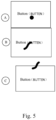
- the condition that the Feed stream view layer intercepts the sliding event is not met, and the touch event is transmitted to the view layer to which the preset interactive function button belongs; then, whether the touch event is a button click event is determined according to the moving range of the touch event; and in response to determining that the touch event is a button click event, the target interactive function button is triggered and the button click operation is executed.
- a rectangular interface in part A is a BUTTON, and a circle in it indicates the start position of the touch operation of the user on the video information display interface.
- the moving trajectory of the touch operation is shown in part B, and the moving trajectory is kept inside the button, so that the button click event may still be triggered when the finger is lifted.
- the moving trajectory in part C is beyond the button (rectangle) range, so that the button click event will not be triggered when the finger is lifted.
- the touch event on the video information display interface when the touch event on the video information display interface is acquired, it may be determined whether the start position of the touch event is at the preset feature position which is prone to an accidental touch operation; in response to determining that the start position of the touch event is at the preset feature position, a corresponding sliding recognition strategy is matched for the touch event to determine whether the touch event is a sliding event; finally, in response to determining that the touch event is a sliding event according to the corresponding sliding recognition strategy, the video switching instruction is triggered according to the sliding parameter of the touch event to switch video.
- the situations of low accuracy and high accidental operation rate in identifying user operations on the video information display interface in the related art are avoided, the probability of accidental operation events caused by nonstandard sliding operation gestures is reduced, the accuracy of recognition of user's operation intentions is improved, and the user experience is improved.
- the embodiment of the present disclosure may be combined with a plurality of example solutions in the video switching method provided in the above embodiments.
- the video switching method provided by this embodiment describes the process of video switching in the case where the start position of the touch event falls in the feature position corresponding to the clickable description text.
- Fig. 6 is a schematic flow diagram of a video switching method provided by another embodiment of the present disclosure.
- the video switching method provided by this embodiment includes: S210: acquiring a touch event on a video information display interface, and determining whether a start position of the touch event is located at a preset feature position.
- S220 in response to determining that the start position of the touch event is at the preset feature position and the preset feature position is a position where the video information description content is located, determining an included angle between a moving trajectory of the touch event and a vertical direction of the video information display interface according to the coordinate position of the moving trajectory of the touch event, determining whether the included angle is less than a preset included angle threshold, and determining whether an end position of the touch event is at the position where the video information description content is located.
- the text (indicated by X) led by a number sign (#) is the video information description content, which may also be referred to as a hash tag, which is a clickable element in the video description.
- the multiple hash tags in Fig. 7 are on the same view layer. Clicking on each hash tag will jump to a details page associated with different hash tags. However, because all hash tags are on one view, when the sliding operation is performed to move from one hash tag to another, the event will not be cancelled. Therefore, in response to determining that the start position of the touch event falls in the feature position where the video information description content is located, it is necessary to analyze whether the obtained touch event is a sliding event or a click event of the hash tag according to a corresponding strategy.
- the included angle between the moving trajectory of the touch event and the vertical direction of the video information display interface according to the coordinate position of the moving trajectory of the touch event, and determine whether the included angle is less than the preset included angle threshold, and it is also necessary to determine whether the end position of the touch event also falls within an area of the video information description content. That is, it is determined whether the moving trajectory of this touch event meets the requirements under the condition of enlarging the compatible angle and whether the moving trajectory has moved.
- step S250 may be directly executed.
- the process may be directly ended and the touch event may be processed as a click event of the hash tag.
- step S230 is executed.
- S230 determining whether a hash code value of the start position is identical to a hash code value of the end position, in response to determining that the end position of the touch event is at the position where the video information description content is located.
- step S240 Whether the start position and the end position of the moving trajectory of the touch event are at different hash tag positions is determined in this step. For example, when a hash tag is touched, a hash code of the hash tag is identified and obtained, and whether it is the same hash tag is determined through the hash code. In response to determining that it is the same, a click event of the hash tag will be triggered to receive the flow, otherwise, step S240 may be executed.
- S240 determining that the touch event is the sliding event, in response to determining that the included angle is less than the preset included angle threshold, the hash code value of the start position is different from the hash code value of the end position, and a duration of the touch event is less than a preset time threshold.
- the duration refers to a time difference between when a user presses with a finger or other operating tool and when the user lifts the finger or other operating tool during user operation on the video information interface.
- a judgment condition of the time difference is additionally adopted in consideration of a fact that both the sliding distance and sliding time are often short with respect to an accidental touch caused by sliding.
- the preset time threshold may be set to 500 ms, for example. In response to determining that the duration is greater than 500 ms, the click event is processed.
- S250 triggering a video switching instruction according to a sliding parameter of the touch event to switch video, in response to determining that the touch event is the sliding event.
- the situations of low accuracy and high accidental operation rate in identifying user operations on the video information display interface in the related art are avoided, the probability of accidental operation events caused by nonstandard sliding operation gestures is reduced, the accuracy of recognition of user's operation intentions is improved, and the user experience is improved.
- Fig. 8 is a schematic structural diagram of a video switching apparatus provided by an embodiment of the present disclosure.
- the video switching apparatus provided by this embodiment is suitable for a scenario of video stream data switching, especially for a situation of a video stream switching operation on a short video playing platform.
- the video switching apparatus includes an operation position determination module 310, a sliding event determination module 320, and a video switching module 330.
- the operation position determination module 310 is configured to acquire a touch event on a video information display interface, and determine whether a start position of the touch event is located at a preset feature position; the sliding event determination module 320 is configured to determine whether the touch event is a sliding event according to a sliding recognition strategy corresponding to the preset feature position, in response to determining that the start position of the touch event is located at the preset feature position; and the video switching module 330 is configured to trigger a video switching instruction according to a sliding parameter of the touch event to switch video, in response to determining that the touch event is the sliding event.
- the touch event on the video information display interface when the touch event on the video information display interface is acquired, it is determined whether the start position of the touch event is at the preset feature position which is prone to an accidental touch operation; in response to determining that the start position of the touch event is at the preset feature position, a corresponding sliding recognition strategy is matched for the touch event to determine whether the touch event is a sliding event; finally, in response to determining that the touch event is a sliding event according to the corresponding sliding recognition strategy, the video switching instruction is triggered according to the sliding parameter of the touch event to switch video.
- the situations of low accuracy and high accidental operation rate in identifying user operations on the video information display interface in the related art are avoided, the probability of accidental operation events caused by nonstandard sliding operation gestures is reduced, the accuracy of recognition of user's operation intentions is improved, and the user experience is improved.
- the preset feature position includes a position where a preset interactive function button is located and a position where video information description content is located, on the video information display interface.
- the sliding event determination module 320 is configured to:
- the sliding event determination module 320 is configured to:
- the video switching apparatus includes a non-video switching event processing module configured to:
- non-video switching event processing module may also be configured to:
- the video switching module 330 is configured to: trigger a video switching instruction to switch video, in response to determining that a moving distance of the video information display interface is greater than a first moving distance reference value, or in response to determining that the moving distance of the video information display interface is greater than a second moving distance reference value and a moving speed is greater than a preset speed reference value, during a process of executing the sliding event.
- the video switching apparatus provided by the embodiments of the present disclosure can execute the video switching method provided by any embodiment of the present disclosure, and has corresponding functional modules for executing the method and beneficial effects.
- Fig. 9 illustrates a schematic structural diagram of an electronic device 400 (for example, a terminal device or a server) suitable for implementing the embodiments of the present disclosure.
- the electronic devices in the embodiments of the present disclosure may include but are not limited to mobile terminals such as a mobile phone, a notebook computer, a digital broadcasting receiver, a personal digital assistant (PDA), a portable Android device (PAD), a portable media player (PMP), a vehicle-mounted terminal (e.g., a vehicle-mounted navigation terminal), and fixed terminals such as a digital TV, a desktop computer, or the like.
- PDA personal digital assistant
- PAD portable Android device
- PMP portable media player
- vehicle-mounted terminal e.g., a vehicle-mounted navigation terminal
- fixed terminals such as a digital TV, a desktop computer, or the like.
- the electronic device illustrated in Fig. 9 is merely an example, and should not pose any limitation to the functions and the range of use of the embodiments of the present disclosure.
- the electronic device 400 may include a processing apparatus 401 (e.g., a central processing unit, a graphics processing unit, etc.), which can perform various suitable actions and processing according to a program stored in a read-only memory (ROM) 402 or a program loaded from a storage apparatus 408 into a random-access memory (RAM) 403.
- the RAM 403 further stores various programs and data required for operations of the electronic device 400.
- the processing apparatus 401, the ROM 402, and the RAM 403 are interconnected through a bus 404.
- An input/output (I/O) interface 405 is also connected to the bus 404.
- the following apparatuses may be connected to the I/O interface 405: an input apparatus 406 including, for example, a touch screen, a touch pad, a keyboard, a mouse, a camera, a microphone, an accelerometer, a gyroscope, or the like; an output apparatus 407 including, for example, a liquid crystal display (LCD), a loudspeaker, a vibrator, or the like; a storage apparatus 408 including, for example, a magnetic tape, a hard disk, or the like; and a communication apparatus 409.
- the communication apparatus 409 may allow the electronic device 400 to be in wireless or wired communication with other devices to exchange data. While Fig. 9 illustrates the electronic device 400 having various apparatuses, it should be understood that not all of the illustrated apparatuses are necessarily implemented or included. More or fewer apparatuses may be implemented or included alternatively.
- the processes described above with reference to the flowcharts may be implemented as a computer software program.
- the embodiments of the present disclosure include a computer program product, which includes a computer program carried by a non-transitory computer-readable medium.
- the computer program includes program code for performing the methods shown in the flowcharts.
- the computer program may be downloaded online through the communication apparatus 409 and installed, or may be installed from the storage apparatus 408, or may be installed from the ROM 402.
- the processing apparatus 401 When the computer program is executed by the processing apparatus 401, the above-mentioned functions defined in the methods of some embodiments of the present disclosure are performed.
- the electronic device provided by the embodiment of the present disclosure belongs to the same disclosed concept as the video switching method provided by the embodiment above, technical details that are not described in detail in the present embodiment may be referred to the embodiments above, and the present embodiment has the same advantageous effects as the embodiments above.
- the embodiments of the present disclosure provide a computer storage medium, on which a computer program is stored, and the computer program, when executed by a processor, implements the video switching method provided in the embodiments above.
- the above-mentioned computer-readable medium in the present disclosure may be a computer-readable signal medium or a computer-readable storage medium or any combination thereof.
- the computer-readable storage medium may be, but not limited to, an electric, magnetic, optical, electromagnetic, infrared, or semiconductor system, apparatus or device, or any combination thereof.
- the computer-readable storage medium may include but not be limited to: an electrical connection with one or more wires, a portable computer disk, a hard disk, a random-access memory (RAM), a read-only memory (ROM), an erasable programmable read-only memory (EPROM or flash memory), an optical fiber, a compact disk read-only memory (CD-ROM), an optical storage device, a magnetic storage device, or any appropriate combination of them.
- the computer-readable storage medium may be any tangible medium containing or storing a program that can be used by or in combination with an instruction execution system, apparatus or device.
- the computer-readable signal medium may include a data signal that propagates in a baseband or as a part of a carrier and carries computer-readable program code.
- the data signal propagating in such a manner may take a plurality of forms, including but not limited to an electromagnetic signal, an optical signal, or any appropriate combination thereof.
- the computer-readable signal medium may also be any other computer-readable medium than the computer-readable storage medium.
- the computer-readable signal medium may send, propagate or transmit a program used by or in combination with an instruction execution system, apparatus or device.
- the program code contained on the computer-readable medium may be transmitted by using any suitable medium, including but not limited to an electric wire, a fiber-optic cable, radio frequency (RF) and the like, or any appropriate combination of them.
- RF radio frequency
- the client and the server may communicate with any network protocol currently known or to be researched and developed in the future such as hypertext transfer protocol (HTTP), and may communicate (via a communication network) and interconnect with digital data in any form or medium.
- HTTP hypertext transfer protocol
- Examples of communication networks include a local area network (LAN), a wide area network (WAN), the Internet, and an end-to-end network (e.g., an ad hoc end-to-end network), as well as any network currently known or to be researched and developed in the future.
- the above-mentioned computer-readable medium may be included in the above-mentioned electronic device, or may also exist alone without being assembled into the electronic device.
- the computer program code for performing the operations of the present disclosure may be written in one or more programming languages or a combination thereof.
- the above-mentioned programming languages include but are not limited to object-oriented programming languages such as Java, Smalltalk, C++, and also include conventional procedural programming languages such as the "C" programming language or similar programming languages.
- the program code may be executed entirely on the user's computer, partly on the user's computer, as a stand-alone software package, partly on the user's computer and partly on a remote computer, or entirely on the remote computer or server.
- the remote computer may be connected to the user's computer through any type of network, including a local area network (LAN) or a wide area network (WAN), or the connection may be made to an external computer (for example, through the Internet using an Internet service provider).
- LAN local area network
- WAN wide area network
- each block in the flowcharts or block diagrams may represent a module, a program segment, or a portion of code, including one or more executable instructions for implementing specified logical functions.
- the functions noted in the blocks may also occur out of the order noted in the drawings. For example, two blocks shown in succession may, in fact, can be executed substantially concurrently, or the two blocks may sometimes be executed in a reverse order, depending upon the functionality involved.
- each block of the block diagrams and/or flowcharts, and combinations of blocks in the block diagrams and/or flowcharts may be implemented by a dedicated hardware-based system that performs the specified functions or operations, or may also be implemented by a combination of dedicated hardware and computer instructions.
- modules or units involved in the embodiments of the present disclosure may be implemented in software or hardware.
- the name of the module or unit does not constitute a limitation of the unit itself under certain circumstances.
- a data generation module may also be described as a "video data generation module”.
- FPGA field programmable gate array
- ASIC application specific integrated circuit
- ASSP application specific standard product
- SOC system on chip
- CPLD complex programmable logical device
- the machine-readable medium may be a tangible medium that may include or store a program for use by or in combination with an instruction execution system, apparatus or device.
- the machine-readable medium may be a machine-readable signal medium or a machine-readable storage medium.
- the machine-readable medium includes, but is not limited to, an electrical, magnetic, optical, electromagnetic, infrared, or semi-conductive system, apparatus or device, or any suitable combination of the foregoing.
- machine-readable storage medium include electrical connection with one or more wires, portable computer disk, hard disk, random-access memory (RAM), read-only memory (ROM), erasable programmable read-only memory (EPROM or flash memory), optical fiber, portable compact disk read-only memory (CD-ROM), optical storage device, magnetic storage device, or any suitable combination of the foregoing.
- RAM random-access memory
- ROM read-only memory
- EPROM or flash memory erasable programmable read-only memory
- CD-ROM compact disk read-only memory
- magnetic storage device or any suitable combination of the foregoing.
- Example 1 provides a video switching method, and the method includes:
- Example 2 provides a video switching method, further including: for example, the preset feature position comprises a position where a preset interactive function button is located and a position where video information description content is located, on the video information display interface.
- Example 3 provides a video switching method, further including:
- Example 5 provides a video switching method, further including:
- Example 6 provides a video switching method, further including:
- Example 7 provides a video switching method, further including:
- Example 8 provides a video switching apparatus, further including:
- Example 9 provides a video switching apparatus, further including: for example, the preset feature position includes a position where a preset interactive function button is located and a position where video information description content is located, on the video information display interface.
- Example 10 provides a video switching apparatus, further including:
- Example 11 provides a video switching apparatus, further including:
- Example 12 provides a video switching apparatus, further including:
- Example 13 provides a video switching apparatus, further including: for example, the non-video switching event processing module may also be configured to:
- Example 14 provides a video switching apparatus, further including: for example, the video switching module is configured to: trigger a video switching instruction to switch video, in response to determining that a moving distance of the video information display interface is greater than a first moving distance reference value, or in response to determining that the moving distance of the video information display interface is greater than a second moving distance reference value and a moving speed is greater than a preset speed reference value, during a process of executing the sliding event.
- the video switching module is configured to: trigger a video switching instruction to switch video, in response to determining that a moving distance of the video information display interface is greater than a first moving distance reference value, or in response to determining that the moving distance of the video information display interface is greater than a second moving distance reference value and a moving speed is greater than a preset speed reference value, during a process of executing the sliding event.
Landscapes
- Engineering & Computer Science (AREA)
- Theoretical Computer Science (AREA)
- General Engineering & Computer Science (AREA)
- Human Computer Interaction (AREA)
- Physics & Mathematics (AREA)
- General Physics & Mathematics (AREA)
- Software Systems (AREA)
- User Interface Of Digital Computer (AREA)
- Two-Way Televisions, Distribution Of Moving Picture Or The Like (AREA)
Abstract
Description
- The present application claims the priority to
Chinese Patent Application No. 202111597471.1, filed on December 24, 2021 - Embodiments of the present disclosure relate to the technical field of intelligent terminals, for example, to a video switching method and apparatus, an electronic device, and a storage medium.
- In the field of short videos, users are provided with browsing content with a continuously updated information stream. In a browsing interface of the video information stream, there are usually many operable elements, such as a like button, a comment button, video description content and so on. However, when the user slides up and down a screen of a mobile phone to switch between videos, an accidental touch event is likely to occur after the user accidentally clicks an operable element on the video, which causes accidental touch and affects the short video browsing experience.
- The embodiments of the present disclosure provide a video switching method and apparatus, an electronic device, and a storage medium, which may reduce the probability of accidental operation events caused by nonstandard sliding operation gestures, improve the accuracy of recognition of user's operation intentions, and improve the user experience.
- In a first aspect, the embodiments of the present disclosure provide a video switching method, including:
- acquiring a touch event on a video information display interface, and determining whether a start position of the touch event is located at a preset feature position;
- determining whether the touch event is a sliding event according to a sliding recognition strategy corresponding to the preset feature position, in response to determining that the start position of the touch event is located at the preset feature position; and
- triggering a video switching instruction according to a sliding parameter of the touch event to switch video, in response to determining that the touch event is the sliding event.
- In a second aspect, the embodiments of the present disclosure provide a video switching apparatus, including:
- an operation position determination module, configured to acquire a touch event on a video information display interface, and determine whether a start position of the touch event is located at a preset feature position;
- a sliding event determination module, configured to determine whether the touch event is a sliding event according to a sliding recognition strategy corresponding to the preset feature position, in response to determining that the start position of the touch event is located at the preset feature position; and
- a video switching module, configured to trigger a video switching instruction according to a sliding parameter of the touch event to switch video, in response to determining that the touch event is the sliding event.
- In a third aspect, the embodiments of the present disclosure provide an electronic device, and the electronic device includes:
- one or more processors; and
- a storage apparatus, configured to store one or more programs,
- the one or more programs, when executed by the one or more processors, enable the one or more processors to implement the video switching method according to any one of the embodiments of the present disclosure.
- In a fourth aspect, the embodiments of the present disclosure provide a storage medium, which includes computer-executable instructions, and the computer-executable instructions, when executed by a computer processor, are configured to execute the video switching method according to any one of the embodiments of the present disclosure.
- Throughout the drawings, the same or similar reference numerals indicate the same or similar elements. It should be understood that the drawings are illustrative and the components and elements are not necessarily drawn to scale.
-
Fig. 1 is a schematic flow diagram of a video switching method provided by an embodiment of the present disclosure; -
Fig. 2 is a schematic diagram of a sliding gesture on a video information interface provided by an embodiment of the present disclosure; -
Fig. 3 is a schematic diagram of a start position of a touch operation being at a preset feature position provided by an embodiment of the present disclosure; -
Fig. 4 is a schematic diagram of movement of a video information display interface provided by an embodiment of the present disclosure; -
Fig. 5 is a schematic diagram of a button click event judgment strategy provided by an embodiment of the present disclosure; -
Fig. 6 is a schematic flow diagram of a video switching method provided by another embodiment of the present disclosure; -
Fig. 7 is a schematic diagram of a start position of a touch operation being at a preset feature position provided by another embodiment of the present disclosure; -
Fig. 8 is a schematic structural diagram of a video switching apparatus provided by an embodiment of the present disclosure; and -
Fig. 9 is a schematic structural diagram of an electronic device provided by an embodiment of the present disclosure. - It should be understood that the various steps described in the method embodiments of the present disclosure may be performed in different orders and/or in parallel. Furthermore, the method embodiments may include additional steps and/or omit performing the illustrated steps. The protection scope of the present disclosure is not limited in this aspect.
- As used herein, the term "include," "comprise," and variations thereof are openended inclusions, i.e., "including but not limited to." The term "based on" is "based, at least in part, on." The term "an embodiment" represents "at least one embodiment," the term "another embodiment" represents "at least one additional embodiment," and the term "some embodiments" represents "at least some embodiments." Relevant definitions of other terms will be given in the description below.
- It should be noted that concepts such as the "first," "second," or the like mentioned in the present disclosure are only used to distinguish different devices, modules or units, and are not used to limit the interdependence relationship or the order of functions performed by these devices, modules or units.
- It should be noted that the modifications of "a," "an," "a plurality of," or the like mentioned in the present disclosure are illustrative rather than restrictive, and those skilled in the art should understand that unless the context clearly indicates otherwise, these modifications should be understood as "one or more."
-
Fig. 1 is a schematic flow diagram of a video switching method provided by an embodiment of the present disclosure. The embodiments of the present disclosure are suitable for a scenario of video stream data switching, especially for a situation of a video stream switching operation on a short video playing platform. The method may be executed by a video switching apparatus, which may be implemented in the form of software and/or hardware, and may be configured in an electronic device, such as a mobile terminal or a server device. - As shown in
Fig. 1 , the video switching method provided by this embodiment includes:
S 110: acquiring a touch event on a video information display interface, and determining whether a start position of the touch event is located at a preset feature position. - The video information display interface may be any application client interface for video playback. In this video information display interface, not only a video may be played, but also video information may be switched by a sliding operation. Especially in the field of short video technologies, the video information display interface is also referred to as a Feed stream browsing interface, and users may also interact with video information by clicking interactive buttons such as a like button, a share button, a comment button, a favorite button and an avatar button, or video description text and other information. The video description text includes a video introduction, topic tags related to video content and other information.
- Usually, the user may switch video information by a gesture of sliding up and down, i.e., sliding up to switch to a next video of a current video and sliding down to switch to a previous video of the current video. The sliding direction may be in opposite correspondence or other correspondence with a sequence rule of video switching. It should be noted here that in this embodiment, it is exemplified by sliding up to switch to the next video of the current video and sliding down to switch to the previous video of the current video, and the sliding gesture for video switching may be shown as
Fig. 2 , whereFig. 2 shows a specific example of a video information interface. - For example, in
Fig. 2 , an arrow in a vertical direction in the video information display interface indicates the sliding in the vertical direction, but it is not necessary to execute the sliding operation absolutely vertically in a process of a sliding operation by the user, and the sliding operation of the user may be recognized as long as it is within a range of a preset compatible angle, and an action instruction corresponding to the sliding operation may be executed. Usually, when using View pager as a view page-turning toolkit, in video switching, a default compatible angle of the sliding operation is 45 degrees, that is, sliding up between 0 degree and 45 degrees can trigger Feed stream switching. InFig. 2 , an included angle between a dashed arrow and a solid arrow is an included angle between the sliding operation at different angles and the vertical direction of the video information display interface. - In the video information interface, in addition to the specific video content display, it also includes interactive buttons such as an avatar of a video content creator, a like button, a share button, a comment button, a favorite button and an avatar button, or video description text, and other information. When the user directly contacts with the video information display interface or indirectly contacts with the video information display interface with other tools, the touch event on the video information display interface may be acquired. When the user touches and slides on the video information display interface, the user often touches interactive buttons or video description text and other information. At this time, a client needs to identify what the user's real operation intention is, whether it is to slide to switch video information or click a button or trigger a corresponding operation. In this case, the possibility of an accidental touch operation is high.
- For example, in this embodiment, when a touch event is acquired, considering the possibility of accidental touch, it is necessary to first determine whether the start position of the touch event is at the preset feature position, that is, a position of a preset interactive function button and a position of video information description content on the video information display interface. Each preset interactive function button is a view at an upper layer of a Feed stream view, and all the video information description content is on one view.
- For example, when a touch event is acquired, the coordinate position of a touch point on a client display interface may be determined. The preset feature position is position information recorded when video information is initialized. The coordinate position information of the start position of the touch event may be matched with the position information of the preset feature position, so as to determine whether the start position of the touch event is at the preset feature position according to a matching result.
- S 120: determining whether the touch event is a sliding event according to a sliding recognition strategy corresponding to the preset feature position, in response to determining that the start position of the touch event is located at the preset feature position.
- In response to determining that the start position of the touch event is located at the feature position, it is necessary to consider whether the transfer of the touch event is processed by the Feed stream view layer or by the view layer where the button or video text description content is located. Then it is necessary to perform separate processing and analysis according to specific types of preset feature positions, and the possibility of accidental touch of the sliding operation may be reduced by enlarging the compatible angle of the sliding operation and/or by other measures.
- Exemplarily, the preset feature position where the start position of the touch event is located is taken as the position where the preset interactive function button is located. In
Fig. 3 , the user performs a touch operation on the video information display interface through a gesture and a corresponding sliding trajectory is generated, but the start position of the sliding trajectory falls within the scope of the like button. Firstly, an included angle between a moving trajectory and a vertical direction of the video information display interface may be determined according to the coordinate position of the moving trajectory of the touch event. For example, a straight line may be determined by position coordinates of first few touch points in the moving trajectory, and the included angle between the straight line and the vertical direction of the video information display interface is determined; or an included angle between a tangent line of the moving trajectory of the touch operation and the vertical direction of the video information display interface is calculated. In response to determining that the obtained included angle is less than a preset included angle threshold, it is determined that the touch event is a sliding event rather than a button click triggering event. The preset included angle threshold is greater than a default sliding angle threshold in a scenario using the preset view page-turning toolkit, which may be 50 or 60 degrees, etc. Assuming that 60 degrees is taken as the preset included angle threshold, the video sliding operation may be triggered in response to determining that the included angle between the moving trajectory of the touch event and the vertical direction of the video information display interface is less than 60 degrees, that is, the angle is enlarged, so that the touch event is more easily intercepted by the Feed stream view layer and the probability of button accidental touch is reduced. - S130: triggering a video switching instruction according to a sliding parameter of the touch event to switch video, in response to determining that the touch event is the sliding event.
- In response to determining that the touch event is a sliding event, that is, the sliding event is successfully intercepted by the Feed stream view layer, then it may be determined whether the sliding event can trigger the switching of the video stream. For example, it may be determined according to the distance and speed of the video information display interface moving with the sliding gesture. For example, during a process of executing the sliding event, when a moving distance of the video information display interface is greater than a first moving distance reference value (for example, 40% of the distance in the vertical direction of a terminal screen), or, when the moving distance of the video information display interface is greater than a second moving distance reference value and the moving speed is greater than a preset speed reference value, a video switching instruction is triggered to switch video. The moving distance reference value and the preset speed reference value may be set statistically according to empirical values. As shown in
Fig. 4 , under the operation of the sliding gesture, a currently displayed video streaming interface is moved upward, and a next video streaming interface (pattern filling interface) is also moved upward. When the distance and/or speed of upward movement meet the preset conditions, the video switching operation may be executed. - For example, in response to determining that the included angle between the moving trajectory of the touch event and the vertical direction of the video information display interface is greater than the preset included angle threshold, the condition that the Feed stream view layer intercepts the sliding event is not met, and the touch event is transmitted to the view layer to which the preset interactive function button belongs; then, whether the touch event is a button click event is determined according to the moving range of the touch event; and in response to determining that the touch event is a button click event, the target interactive function button is triggered and the button click operation is executed. In the schematic diagram of button touch shown in
Fig. 5 , a rectangular interface in part A is a BUTTON, and a circle in it indicates the start position of the touch operation of the user on the video information display interface. The moving trajectory of the touch operation is shown in part B, and the moving trajectory is kept inside the button, so that the button click event may still be triggered when the finger is lifted. The moving trajectory in part C is beyond the button (rectangle) range, so that the button click event will not be triggered when the finger is lifted. - According to technical solutions of the embodiments of the present disclosure, when the touch event on the video information display interface is acquired, it may be determined whether the start position of the touch event is at the preset feature position which is prone to an accidental touch operation; in response to determining that the start position of the touch event is at the preset feature position, a corresponding sliding recognition strategy is matched for the touch event to determine whether the touch event is a sliding event; finally, in response to determining that the touch event is a sliding event according to the corresponding sliding recognition strategy, the video switching instruction is triggered according to the sliding parameter of the touch event to switch video. According to the technical solutions disclosed in the embodiments of the present disclosure, the situations of low accuracy and high accidental operation rate in identifying user operations on the video information display interface in the related art are avoided, the probability of accidental operation events caused by nonstandard sliding operation gestures is reduced, the accuracy of recognition of user's operation intentions is improved, and the user experience is improved.
- The embodiment of the present disclosure may be combined with a plurality of example solutions in the video switching method provided in the above embodiments. The video switching method provided by this embodiment describes the process of video switching in the case where the start position of the touch event falls in the feature position corresponding to the clickable description text.
-
Fig. 6 is a schematic flow diagram of a video switching method provided by another embodiment of the present disclosure. As shown inFig. 6 , the video switching method provided by this embodiment includes:
S210: acquiring a touch event on a video information display interface, and determining whether a start position of the touch event is located at a preset feature position. - S220: in response to determining that the start position of the touch event is at the preset feature position and the preset feature position is a position where the video information description content is located, determining an included angle between a moving trajectory of the touch event and a vertical direction of the video information display interface according to the coordinate position of the moving trajectory of the touch event, determining whether the included angle is less than a preset included angle threshold, and determining whether an end position of the touch event is at the position where the video information description content is located.
- In
Fig. 7 , the text (indicated by X) led by a number sign (#) is the video information description content, which may also be referred to as a hash tag, which is a clickable element in the video description. The multiple hash tags inFig. 7 are on the same view layer. Clicking on each hash tag will jump to a details page associated with different hash tags. However, because all hash tags are on one view, when the sliding operation is performed to move from one hash tag to another, the event will not be cancelled. Therefore, in response to determining that the start position of the touch event falls in the feature position where the video information description content is located, it is necessary to analyze whether the obtained touch event is a sliding event or a click event of the hash tag according to a corresponding strategy. - For example, in response to determining that the start position of the touch event is at the position where the video information description content is located, it is necessary to determine the included angle between the moving trajectory of the touch event and the vertical direction of the video information display interface according to the coordinate position of the moving trajectory of the touch event, and determine whether the included angle is less than the preset included angle threshold, and it is also necessary to determine whether the end position of the touch event also falls within an area of the video information description content. That is, it is determined whether the moving trajectory of this touch event meets the requirements under the condition of enlarging the compatible angle and whether the moving trajectory has moved. In response to determining that the included angle between the moving trajectory and the vertical direction of the video information display interface is less than a compatible angle threshold, and the end position of the touch event is beyond the area of the video information description content, step S250 may be directly executed. In response to determining that the included angle between the moving trajectory and the vertical direction of the video information display interface is greater than the compatible angle threshold, the process may be directly ended and the touch event may be processed as a click event of the hash tag. In response to determining that the included angle between the moving trajectory and the vertical direction of the video information display interface is less than the compatible angle threshold, and the end position of the touch event is at the position where the video information description content is located, step S230 is executed.
- S230: determining whether a hash code value of the start position is identical to a hash code value of the end position, in response to determining that the end position of the touch event is at the position where the video information description content is located.
- Whether the start position and the end position of the moving trajectory of the touch event are at different hash tag positions is determined in this step. For example, when a hash tag is touched, a hash code of the hash tag is identified and obtained, and whether it is the same hash tag is determined through the hash code. In response to determining that it is the same, a click event of the hash tag will be triggered to receive the flow, otherwise, step S240 may be executed.
- S240: determining that the touch event is the sliding event, in response to determining that the included angle is less than the preset included angle threshold, the hash code value of the start position is different from the hash code value of the end position, and a duration of the touch event is less than a preset time threshold.
- For example, the duration refers to a time difference between when a user presses with a finger or other operating tool and when the user lifts the finger or other operating tool during user operation on the video information interface. A judgment condition of the time difference is additionally adopted in consideration of a fact that both the sliding distance and sliding time are often short with respect to an accidental touch caused by sliding. The preset time threshold may be set to 500 ms, for example. In response to determining that the duration is greater than 500 ms, the click event is processed.
- S250: triggering a video switching instruction according to a sliding parameter of the touch event to switch video, in response to determining that the touch event is the sliding event.
- According to the technical solutions of the embodiments of the present disclosure, when the touch event on the video information display interface is acquired, it is determined whether the start position of the touch event is at the preset feature position which is prone to an accidental touch operation; in response to determining that the start position of the touch event is at the preset feature position where the video information description content is located, the corresponding sliding recognition strategy is adopted to determine whether the touch event is a sliding event from the included angle between the sliding trajectory of the touch event and the vertical direction of the interface, the end position of the touch operation, the duration of the touch operation and the like; finally, in response to determining that the touch event is one sliding event according to the corresponding sliding recognition strategy, the video switching instruction is triggered according to the sliding parameter of the touch event to switch video. According to the technical solutions disclosed in the embodiments of the present disclosure, the situations of low accuracy and high accidental operation rate in identifying user operations on the video information display interface in the related art are avoided, the probability of accidental operation events caused by nonstandard sliding operation gestures is reduced, the accuracy of recognition of user's operation intentions is improved, and the user experience is improved.
-
Fig. 8 is a schematic structural diagram of a video switching apparatus provided by an embodiment of the present disclosure. The video switching apparatus provided by this embodiment is suitable for a scenario of video stream data switching, especially for a situation of a video stream switching operation on a short video playing platform. - As shown in
Fig. 8 , the video switching apparatus includes an operationposition determination module 310, a slidingevent determination module 320, and avideo switching module 330. - The operation
position determination module 310 is configured to acquire a touch event on a video information display interface, and determine whether a start position of the touch event is located at a preset feature position; the slidingevent determination module 320 is configured to determine whether the touch event is a sliding event according to a sliding recognition strategy corresponding to the preset feature position, in response to determining that the start position of the touch event is located at the preset feature position; and thevideo switching module 330 is configured to trigger a video switching instruction according to a sliding parameter of the touch event to switch video, in response to determining that the touch event is the sliding event. - According to the technical solutions of the embodiments of the present disclosure, when the touch event on the video information display interface is acquired, it is determined whether the start position of the touch event is at the preset feature position which is prone to an accidental touch operation; in response to determining that the start position of the touch event is at the preset feature position, a corresponding sliding recognition strategy is matched for the touch event to determine whether the touch event is a sliding event; finally, in response to determining that the touch event is a sliding event according to the corresponding sliding recognition strategy, the video switching instruction is triggered according to the sliding parameter of the touch event to switch video. According to the technical solutions disclosed in the embodiments of the present disclosure, the situations of low accuracy and high accidental operation rate in identifying user operations on the video information display interface in the related art are avoided, the probability of accidental operation events caused by nonstandard sliding operation gestures is reduced, the accuracy of recognition of user's operation intentions is improved, and the user experience is improved.
- For example, the preset feature position includes a position where a preset interactive function button is located and a position where video information description content is located, on the video information display interface.
- For example, in response to determining that the preset feature position is the position where the preset interactive function button is located, the sliding
event determination module 320 is configured to: - determine an included angle between a moving trajectory of the touch event and a vertical direction of the video information display interface, according to the coordinate position of the moving trajectory of the touch event;
- and determine that the touch event is the sliding event in response to determining that the included angle is less than a preset included angle threshold, where the preset included angle threshold is greater than a default sliding angle threshold in a scenario using a preset view page-turning toolkit.
- For example, in response to determining that the preset feature position is the position where the video information description content is located, the sliding
event determination module 320 is configured to: - determine whether an end position of the touch event is at the position where the video information description content is located;
- determine whether a hash code value of the start position is identical to a hash code value of the end position, in response to determining that the end position of the touch event is at the position where the video information description content is located;
- and determine that the touch event is the sliding event, in response to determining that the included angle is less than the preset included angle threshold, the hash code value of the start position is different from the hash code value of the end position, and a duration of the touch event is less than a preset time threshold.
- For example, the video switching apparatus includes a non-video switching event processing module configured to:
- transmit the touch event to a view layer to which the preset interactive function button belongs in response to determining that the included angle is greater than the preset included angle threshold;
- determine whether the touch event is a button click event according to a moving range of the touch event;
- and trigger a target interactive function button and execute a button click operation in response to determining that the touch event is a button click event.
- For example, the non-video switching event processing module may also be configured to:
- transmit the touch event to the view layer to which the video information description content belongs, in response to determining that the included angle is greater than the preset included angle threshold, or in response to determining that the hash code value of the start position is identical to the hash code value of the end position, or in response to determining that the duration of the touch event is greater than the preset time threshold;
- and determine that the touch event is a video information description content click event, and take the video information description content at the end position as a click object of the video information description content click event.
- For example, the
video switching module 330 is configured to:
trigger a video switching instruction to switch video, in response to determining that a moving distance of the video information display interface is greater than a first moving distance reference value, or in response to determining that the moving distance of the video information display interface is greater than a second moving distance reference value and a moving speed is greater than a preset speed reference value, during a process of executing the sliding event. - The video switching apparatus provided by the embodiments of the present disclosure can execute the video switching method provided by any embodiment of the present disclosure, and has corresponding functional modules for executing the method and beneficial effects.
- It should be noted that the multiple units and modules included in the above apparatus are only divided according to functional logics, but not limited thereto, as long as the corresponding functions can be implemented; in addition, the specific names of the multiple functional units are only for the convenience of distinguishing between each other, and are not used to limit the protection scope of the disclosed embodiments.
- Referring to
Fig. 9, Fig. 9 illustrates a schematic structural diagram of an electronic device 400 (for example, a terminal device or a server) suitable for implementing the embodiments of the present disclosure. The electronic devices in the embodiments of the present disclosure may include but are not limited to mobile terminals such as a mobile phone, a notebook computer, a digital broadcasting receiver, a personal digital assistant (PDA), a portable Android device (PAD), a portable media player (PMP), a vehicle-mounted terminal (e.g., a vehicle-mounted navigation terminal), and fixed terminals such as a digital TV, a desktop computer, or the like. The electronic device illustrated inFig. 9 is merely an example, and should not pose any limitation to the functions and the range of use of the embodiments of the present disclosure. - As illustrated in
Fig. 9 , theelectronic device 400 may include a processing apparatus 401 (e.g., a central processing unit, a graphics processing unit, etc.), which can perform various suitable actions and processing according to a program stored in a read-only memory (ROM) 402 or a program loaded from astorage apparatus 408 into a random-access memory (RAM) 403. TheRAM 403 further stores various programs and data required for operations of theelectronic device 400. Theprocessing apparatus 401, theROM 402, and theRAM 403 are interconnected through abus 404. An input/output (I/O)interface 405 is also connected to thebus 404. - Usually, the following apparatuses may be connected to the I/O interface 405: an
input apparatus 406 including, for example, a touch screen, a touch pad, a keyboard, a mouse, a camera, a microphone, an accelerometer, a gyroscope, or the like; anoutput apparatus 407 including, for example, a liquid crystal display (LCD), a loudspeaker, a vibrator, or the like; astorage apparatus 408 including, for example, a magnetic tape, a hard disk, or the like; and acommunication apparatus 409. Thecommunication apparatus 409 may allow theelectronic device 400 to be in wireless or wired communication with other devices to exchange data. WhileFig. 9 illustrates theelectronic device 400 having various apparatuses, it should be understood that not all of the illustrated apparatuses are necessarily implemented or included. More or fewer apparatuses may be implemented or included alternatively. - Particularly, according to the embodiments of the present disclosure, the processes described above with reference to the flowcharts may be implemented as a computer software program. For example, the embodiments of the present disclosure include a computer program product, which includes a computer program carried by a non-transitory computer-readable medium. The computer program includes program code for performing the methods shown in the flowcharts. In such embodiments, the computer program may be downloaded online through the
communication apparatus 409 and installed, or may be installed from thestorage apparatus 408, or may be installed from theROM 402. When the computer program is executed by theprocessing apparatus 401, the above-mentioned functions defined in the methods of some embodiments of the present disclosure are performed. - The electronic device provided by the embodiment of the present disclosure belongs to the same disclosed concept as the video switching method provided by the embodiment above, technical details that are not described in detail in the present embodiment may be referred to the embodiments above, and the present embodiment has the same advantageous effects as the embodiments above.
- The embodiments of the present disclosure provide a computer storage medium, on which a computer program is stored, and the computer program, when executed by a processor, implements the video switching method provided in the embodiments above.
- It should be noted that the above-mentioned computer-readable medium in the present disclosure may be a computer-readable signal medium or a computer-readable storage medium or any combination thereof. For example, the computer-readable storage medium may be, but not limited to, an electric, magnetic, optical, electromagnetic, infrared, or semiconductor system, apparatus or device, or any combination thereof. More specific examples of the computer-readable storage medium may include but not be limited to: an electrical connection with one or more wires, a portable computer disk, a hard disk, a random-access memory (RAM), a read-only memory (ROM), an erasable programmable read-only memory (EPROM or flash memory), an optical fiber, a compact disk read-only memory (CD-ROM), an optical storage device, a magnetic storage device, or any appropriate combination of them. In the present disclosure, the computer-readable storage medium may be any tangible medium containing or storing a program that can be used by or in combination with an instruction execution system, apparatus or device. In the present disclosure, the computer-readable signal medium may include a data signal that propagates in a baseband or as a part of a carrier and carries computer-readable program code. The data signal propagating in such a manner may take a plurality of forms, including but not limited to an electromagnetic signal, an optical signal, or any appropriate combination thereof. The computer-readable signal medium may also be any other computer-readable medium than the computer-readable storage medium. The computer-readable signal medium may send, propagate or transmit a program used by or in combination with an instruction execution system, apparatus or device. The program code contained on the computer-readable medium may be transmitted by using any suitable medium, including but not limited to an electric wire, a fiber-optic cable, radio frequency (RF) and the like, or any appropriate combination of them.
- In some implementations, the client and the server may communicate with any network protocol currently known or to be researched and developed in the future such as hypertext transfer protocol (HTTP), and may communicate (via a communication network) and interconnect with digital data in any form or medium. Examples of communication networks include a local area network (LAN), a wide area network (WAN), the Internet, and an end-to-end network (e.g., an ad hoc end-to-end network), as well as any network currently known or to be researched and developed in the future.
- The above-mentioned computer-readable medium may be included in the above-mentioned electronic device, or may also exist alone without being assembled into the electronic device.
- The above-mentioned computer-readable medium carries one or more programs, which, when executed by the electronic device, enable the electronic device to:
- acquire a touch event on a video information display interface, and determine whether a start position of the touch event is located at a preset feature position;
- determine whether the touch event is a sliding event according to a sliding recognition strategy corresponding to the preset feature position, in response to determining that the start position of the touch event is located at the preset feature position;
- and trigger a video switching instruction according to a sliding parameter of the touch event to switch video, in response to determining that the touch event is the sliding event.
- The computer program code for performing the operations of the present disclosure may be written in one or more programming languages or a combination thereof. The above-mentioned programming languages include but are not limited to object-oriented programming languages such as Java, Smalltalk, C++, and also include conventional procedural programming languages such as the "C" programming language or similar programming languages. The program code may be executed entirely on the user's computer, partly on the user's computer, as a stand-alone software package, partly on the user's computer and partly on a remote computer, or entirely on the remote computer or server. In the scenario related to the remote computer, the remote computer may be connected to the user's computer through any type of network, including a local area network (LAN) or a wide area network (WAN), or the connection may be made to an external computer (for example, through the Internet using an Internet service provider).
- The flowcharts and block diagrams in the drawings illustrate the architecture, function, and operation of possible implementations of systems, methods, and computer program products according to various embodiments of the present disclosure. In this regard, each block in the flowcharts or block diagrams may represent a module, a program segment, or a portion of code, including one or more executable instructions for implementing specified logical functions. It should also be noted that, in some alternative implementations, the functions noted in the blocks may also occur out of the order noted in the drawings. For example, two blocks shown in succession may, in fact, can be executed substantially concurrently, or the two blocks may sometimes be executed in a reverse order, depending upon the functionality involved. It should also be noted that, each block of the block diagrams and/or flowcharts, and combinations of blocks in the block diagrams and/or flowcharts, may be implemented by a dedicated hardware-based system that performs the specified functions or operations, or may also be implemented by a combination of dedicated hardware and computer instructions.
- The modules or units involved in the embodiments of the present disclosure may be implemented in software or hardware. Among them, the name of the module or unit does not constitute a limitation of the unit itself under certain circumstances. For example, a data generation module may also be described as a "video data generation module".
- The functions described herein above may be performed, at least partially, by one or more hardware logic components. For example, without limitation, available exemplary types of hardware logic components include: a field programmable gate array (FPGA), an application specific integrated circuit (ASIC), an application specific standard product (ASSP), a system on chip (SOC), a complex programmable logical device (CPLD), etc.
- In the context of the present disclosure, the machine-readable medium may be a tangible medium that may include or store a program for use by or in combination with an instruction execution system, apparatus or device. The machine-readable medium may be a machine-readable signal medium or a machine-readable storage medium. The machine-readable medium includes, but is not limited to, an electrical, magnetic, optical, electromagnetic, infrared, or semi-conductive system, apparatus or device, or any suitable combination of the foregoing. More specific examples of machine-readable storage medium include electrical connection with one or more wires, portable computer disk, hard disk, random-access memory (RAM), read-only memory (ROM), erasable programmable read-only memory (EPROM or flash memory), optical fiber, portable compact disk read-only memory (CD-ROM), optical storage device, magnetic storage device, or any suitable combination of the foregoing.
- According to one or more embodiments of the present disclosure, [Example 1] provides a video switching method, and the method includes:
- acquiring a touch event on a video information display interface, and determining whether a start position of the touch event is located at a preset feature position;
- determining whether the touch event is a sliding event according to a sliding recognition strategy corresponding to the preset feature position, in response to determining that the start position of the touch event is located at the preset feature position;
- and triggering a video switching instruction according to a sliding parameter of the touch event to switch video, in response to determining that the touch event is the sliding event.
- According to one or more embodiments of the present disclosure, [Example 2] provides a video switching method, further including:
for example, the preset feature position comprises a position where a preset interactive function button is located and a position where video information description content is located, on the video information display interface. - According to one or more embodiments of the present disclosure, [Example 3] provides a video switching method, further including:
- for example, determining whether the touch event is a sliding event according to a sliding recognition strategy corresponding to the preset feature position, in response to determining that the start position of the touch event is located at the preset feature position, includes:
- determining an included angle between a moving trajectory of the touch event and a vertical direction of the video information display interface, according to a coordinate position of the moving trajectory of the touch event;
- and determining that the touch event is the sliding event in response to determining that the included angle is less than a preset included angle threshold, where the preset included angle threshold is greater than a default sliding angle threshold in a scenario using a preset view page-turning toolkit.
- According to one or more embodiments of the present disclosure, [Example 4] provides a video switching method, further including:
- for example, in response to determining that the preset feature position is the position where the video information description content is located, determining whether the touch event is the sliding event according to a sliding recognition strategy corresponding to the preset feature position, further includes:
- determining whether an end position of the touch event is at the position where the video information description content is located;
- determining whether a hash code value of the start position is identical to a hash code value of the end position, in response to determining that the end position of the touch event is at the position where the video information description content is located;
- and determining that the touch event is the sliding event, in response to determining that the included angle is less than the preset included angle threshold, the hash code value of the start position is different from the hash code value of the end position, and a duration of the touch event is less than a preset time threshold.
- According to one or more embodiments of the present disclosure, [Example 5] provides a video switching method, further including:
- for example, transmitting the touch event to a view layer to which a preset interactive function button belongs in response to determining that the included angle is greater than the preset included angle threshold;
- determining whether the touch event is a button click event according to a moving range of the touch event;
- and triggering a target interactive function button and executing a button click operation, in response to determining that the touch event is the button click event.
- According to one or more embodiments of the present disclosure, [Example 6] provides a video switching method, further including:
- transmitting the touch event to a view layer to which the video information description content belongs, in response to determining that the included angle is greater than the preset included angle threshold, or in response to determining that the hash code value of the start position is identical to the hash code value of the end position, or in response to determining that the duration of the touch event is greater than the preset time threshold;
- and determining that the touch event is a video information description content click event, and taking video information description content at the end position as a click object of the video information description content click event.
- According to one or more embodiments of the present disclosure, [Example 7] provides a video switching method, further including:
- for example, triggering the video switching instruction according to the sliding parameter of the sliding event to switch video, includes:
- triggering the video switching instruction to switch video, in response to determining that a moving distance of the video information display interface is greater than a first moving distance reference value, or in response to determining that the moving distance of the video information display interface is greater than a second moving distance reference value and a moving speed is greater than a preset speed reference value, during a process of executing the sliding event.
- According to one or more embodiments of the present disclosure, [Example 8] provides a video switching apparatus, further including:
- an operation position determination module, configured to acquire a touch event on a video information display interface, and determine whether a start position of the touch event is located at a preset feature position;
- a sliding event determination module, configured to determine whether the touch event is a sliding event according to a sliding recognition strategy corresponding to the preset feature position, in response to determining that the start position of the touch event is located at the preset feature position;
- and a video switching module, configured to trigger a video switching instruction according to a sliding parameter of the touch event to switch video, in response to determining that the touch event is the sliding event.
- According to one or more embodiments of the present disclosure, [Example 9] provides a video switching apparatus, further including:
for example, the preset feature position includes a position where a preset interactive function button is located and a position where video information description content is located, on the video information display interface. - According to one or more embodiments of the present disclosure, [Example 10] provides a video switching apparatus, further including:
- for example, in response to determining that the preset feature position is the position where the preset interactive function button is located, the sliding event determination module is configured to:
- determine an included angle between a moving trajectory of the touch event and a vertical direction of the video information display interface, according to the coordinate position of the moving trajectory of the touch event;
- and determine that the touch event is the sliding event in response to determining that the included angle is less than a preset included angle threshold, where the preset included angle threshold is greater than a default sliding angle threshold in a scenario using a preset view page-turning toolkit.
- According to one or more embodiments of the present disclosure, [Example 11] provides a video switching apparatus, further including:
- for example, in response to determining that the preset feature position is the position where the video information description content is located, the sliding event determination module is configured to:
- determine whether an end position of the touch event is at the position where the video information description content is located;
- determine whether a hash code value of the start position is identical to a hash code value of the end position, in response to determining that the end position of the touch event is at the position where the video information description content is located;
- and determine that the touch event is the sliding event, in response to determining that the included angle is less than the preset included angle threshold, the hash code value of the start position is different from the hash code value of the end position, and a duration of the touch event is less than a preset time threshold.
- According to one or more embodiments of the present disclosure, [Example 12] provides a video switching apparatus, further including:
- for example, the video switching apparatus includes a non-video switching event processing module configured to:
- transmit the touch event to a view layer to which the preset interactive function button belongs in response to determining that the included angle is greater than the preset included angle threshold;
- determine whether the touch event is a button click event according to a moving range of the touch event;
- and trigger a target interactive function button and execute a button click operation in response to determining that the touch event is a button click event.
- According to one or more embodiments of the present disclosure, [Example 13] provides a video switching apparatus, further including:
for example, the non-video switching event processing module may also be configured to: - transmit the touch event to the view layer to which the video information description content belongs, in response to determining that the included angle is greater than the preset included angle threshold, or in response to determining that the hash code value of the start position is identical to the hash code value of the end position, or in response to determining that the duration of the touch event is greater than the preset time threshold;
- and determine that the touch event is a video information description content click event, and take the video information description content at the end position as a click object of the video information description content click event.
- According to one or more embodiments of the present disclosure, [Example 14] provides a video switching apparatus, further including:
for example, the video switching module is configured to:
trigger a video switching instruction to switch video, in response to determining that a moving distance of the video information display interface is greater than a first moving distance reference value, or in response to determining that the moving distance of the video information display interface is greater than a second moving distance reference value and a moving speed is greater than a preset speed reference value, during a process of executing the sliding event. - Additionally, although operations are depicted in a particular order, it should not be understood that these operations are required to be performed in a specific order as illustrated or in a sequential order. Under certain circumstances, multitasking and parallel processing may be advantageous. Likewise, although the above discussion includes several specific implementation details, these should not be interpreted as limitations on the scope of the present disclosure. Certain features that are described in the context of separate embodiments may also be implemented in combination in a single embodiment. Conversely, various features that are described in the context of a single embodiment may also be implemented in multiple embodiments separately or in any suitable subcombinations.
Claims (10)
- A video switching method, comprising:acquiring a touch event on a video information display interface, and determining whether a start position of the touch event is located at a preset feature position;determining whether the touch event is a sliding event according to a sliding recognition strategy corresponding to the preset feature position, in response to determining that the start position of the touch event is located at the preset feature position; andtriggering a video switching instruction according to a sliding parameter of the touch event to switch video, in response to determining that the touch event is the sliding event.
- The method according to claim 1, wherein the preset feature position comprises a position where a preset interactive function button is located and a position where video information description content is located, on the video information display interface.
- The method according to claim 1 or 2, wherein in response to determining that the preset feature position is the position where the preset interactive function button is located, the determining whether the touch event is the sliding event according to a sliding recognition strategy corresponding to the preset feature position, comprises:determining an included angle between a moving trajectory of the touch event and a vertical direction of the video information display interface, according to a coordinate position of the moving trajectory of the touch event; anddetermining that the touch event is the sliding event in response to determining that the included angle is less than a preset included angle threshold, wherein the preset included angle threshold is greater than a default sliding angle threshold in a scenario using a preset view page-turning toolkit.
- The method according to claim 3, wherein in response to determining that the preset feature position is the position where the video information description content is located, the determining whether the touch event is the sliding event according to a sliding recognition strategy corresponding to the preset feature position, further comprises:determining whether an end position of the touch event is at the position where the video information description content is located;determining whether a hash code value of the start position is identical to a hash code value of the end position, in response to determining that the end position of the touch event is at the position where the video information description content is located; anddetermining that the touch event is the sliding event, in response to determining that the included angle is less than the preset included angle threshold, that the hash code value of the start position is different from the hash code value of the end position, and that a duration of the touch event is less than a preset time threshold.
- The method according to claim 3, further comprising:transmitting the touch event to a view layer to which a preset interactive function button belongs in response to determining that the included angle is greater than the preset included angle threshold;determining whether the touch event is a button click event according to a moving range of the touch event; andtriggering a target interactive function button and executing a button click operation, in response to determining that the touch event is the button click event.
- The method according to claim 4, further comprising:transmitting the touch event to a view layer to which the video information description content belongs in response to determining that one of the following conditions is met: the included angle being greater than the preset included angle threshold, the hash code value of the start position being identical to the hash code value of the end position, and the duration of the touch event being greater than the preset time threshold; anddetermining that the touch event is a video information description content click event, and taking video information description content at the end position as a click object of the video information description content click event.
- The method according to claim 1, for example, the triggering the video switching instruction according to the sliding parameter of the sliding event to switch video, comprises: triggering the video switching instruction to switch video in response to determining that a moving distance of the video information display interface is greater than a first moving distance reference value, or in response to determining that the moving distance of the video information display interface is greater than a second moving distance reference value and a moving speed is greater than a preset speed reference value, during a process of executing the sliding event.
- A video switching apparatus, comprising:an operation position determination module, configured to acquire a touch event on a video information display interface, and determine whether a start position of the touch event is located at a preset feature position;a sliding event determination module, configured to determine whether the touch event is a sliding event according to a sliding recognition strategy corresponding to the preset feature position, in response to determining that the start position of the touch event is located at the preset feature position; anda video switching module, configured to trigger a video switching instruction according to a sliding parameter of the touch event to switch video, in response to determining that the touch event is the sliding event.
- An electronic device, comprising:one or more processors; anda storage apparatus, configured to store one or more programs,wherein the one or more programs, when executed by the one or more processors, enable the one or more processors to implement the video switching method according to any one of claims 1 to 7.
- A storage medium, comprising computer-executable instructions, wherein the computer-executable instructions, when executed by a computer processor, are configured to execute the video switching method according to any one of claims 1-7.
Applications Claiming Priority (2)
| Application Number | Priority Date | Filing Date | Title |
|---|---|---|---|
| CN202111597471.1A CN116339596B (en) | 2021-12-24 | 2021-12-24 | A video switching method, apparatus, electronic device, and storage medium |
| PCT/CN2022/138521 WO2023116495A1 (en) | 2021-12-24 | 2022-12-13 | Video switching method and apparatus, electronic device, and storage medium |
Publications (2)
| Publication Number | Publication Date |
|---|---|
| EP4435576A1 true EP4435576A1 (en) | 2024-09-25 |
| EP4435576A4 EP4435576A4 (en) | 2025-03-12 |
Family
ID=86877706
Family Applications (1)
| Application Number | Title | Priority Date | Filing Date |
|---|---|---|---|
| EP22909809.0A Pending EP4435576A4 (en) | 2021-12-24 | 2022-12-13 | Video switching method and device, electronic device and storage medium |
Country Status (5)
| Country | Link |
|---|---|
| US (1) | US20250060867A1 (en) |
| EP (1) | EP4435576A4 (en) |
| JP (1) | JP7801038B2 (en) |
| CN (1) | CN116339596B (en) |
| WO (1) | WO2023116495A1 (en) |
Family Cites Families (21)
| Publication number | Priority date | Publication date | Assignee | Title |
|---|---|---|---|---|
| US20100097322A1 (en) * | 2008-10-16 | 2010-04-22 | Motorola, Inc. | Apparatus and method for switching touch screen operation |
| US8315672B2 (en) * | 2008-12-01 | 2012-11-20 | Research In Motion Limited | Portable electronic device and method of controlling same |
| CN102033682B (en) * | 2009-09-28 | 2014-09-10 | 中国移动通信集团公司 | Input method and input equipment |
| US20130275924A1 (en) * | 2012-04-16 | 2013-10-17 | Nuance Communications, Inc. | Low-attention gestural user interface |
| US9772700B2 (en) * | 2012-04-30 | 2017-09-26 | Blackberry Limited | Device and method for processing user input |
| US10255227B2 (en) * | 2012-05-21 | 2019-04-09 | Oath Inc. | Computerized system and method for authoring, editing, and delivering an interactive social media video |
| JP5505550B1 (en) | 2013-08-06 | 2014-05-28 | 富士ゼロックス株式会社 | Image display apparatus and program |
| US9063640B2 (en) * | 2013-10-17 | 2015-06-23 | Spotify Ab | System and method for switching between media items in a plurality of sequences of media items |
| CN105528173A (en) * | 2015-12-08 | 2016-04-27 | 深圳市金立通信设备有限公司 | Multimedia operation method and terminal |
| US20170192642A1 (en) * | 2015-12-31 | 2017-07-06 | Opentv, Inc. | Systems and methods for enabling transitions between items of content based on swipe gestures |
| US10397632B2 (en) * | 2016-02-16 | 2019-08-27 | Google Llc | Touch gesture control of video playback |
| JP6701070B2 (en) | 2016-12-26 | 2020-05-27 | キヤノン株式会社 | Display control device and method |
| CN107340910B (en) * | 2017-06-26 | 2020-09-01 | Oppo广东移动通信有限公司 | A method, device, storage medium and electronic device for responding to a touch key |
| US10423320B2 (en) * | 2017-11-13 | 2019-09-24 | Philo, Inc. | Graphical user interface for navigating a video |
| CN109508219A (en) * | 2018-11-09 | 2019-03-22 | 周鹏飞 | It instructs and determines method, apparatus and touch apparatus |
| CN111294637A (en) | 2020-02-11 | 2020-06-16 | 北京字节跳动网络技术有限公司 | Video playback method, apparatus, electronic device and computer readable medium |
| CN113552994A (en) * | 2020-04-23 | 2021-10-26 | 华为技术有限公司 | A touch operation method and device |
| CN111770384A (en) * | 2020-06-28 | 2020-10-13 | 百度在线网络技术(北京)有限公司 | Video switching method and device, electronic equipment and storage medium |
| CN112379814A (en) | 2020-10-14 | 2021-02-19 | 广州市百果园网络科技有限公司 | Picture preview sliding processing method and system, electronic equipment and storage medium |
| CN113110783B (en) * | 2021-04-16 | 2022-05-20 | 北京字跳网络技术有限公司 | Control display method, device, electronic device and storage medium |
| CN113535063A (en) * | 2021-08-12 | 2021-10-22 | 腾讯音乐娱乐科技(深圳)有限公司 | Live broadcast page switching method, video page switching method, electronic device and storage medium |
-
2021
- 2021-12-24 CN CN202111597471.1A patent/CN116339596B/en active Active
-
2022
- 2022-12-13 JP JP2024538024A patent/JP7801038B2/en active Active
- 2022-12-13 WO PCT/CN2022/138521 patent/WO2023116495A1/en not_active Ceased
- 2022-12-13 EP EP22909809.0A patent/EP4435576A4/en active Pending
- 2022-12-13 US US18/723,808 patent/US20250060867A1/en active Pending
Also Published As
| Publication number | Publication date |
|---|---|
| JP2025500055A (en) | 2025-01-07 |
| WO2023116495A1 (en) | 2023-06-29 |
| CN116339596A (en) | 2023-06-27 |
| JP7801038B2 (en) | 2026-01-16 |
| US20250060867A1 (en) | 2025-02-20 |
| EP4435576A4 (en) | 2025-03-12 |
| CN116339596B (en) | 2026-05-05 |
Similar Documents
| Publication | Publication Date | Title |
|---|---|---|
| US11853543B2 (en) | Method and apparatus for controlling display of video call interface, storage medium and device | |
| CN112540740B (en) | Split-screen display method, device, electronic device, and readable storage medium | |
| CN110865734B (en) | Target object display method and device, electronic equipment and computer readable medium | |
| JP2025522504A (en) | Content display method, device, equipment, storage medium, and program | |
| US20230276079A1 (en) | Live streaming room page jump method and apparatus, live streaming room page return method and apparatus, and electronic device | |
| CN107678658A (en) | Data inputting method and device for terminal device | |
| CN114968038A (en) | Multimedia content display method, device, device and medium | |
| CN104765525A (en) | Operation interface switching method and device | |
| WO2022151870A1 (en) | Interaction method and apparatus, electronic device, and computer-readable storage medium | |
| WO2020135010A1 (en) | Method and device for processing hosted application, and computer readable storage medium | |
| US20230251777A1 (en) | Target object display method and apparatus, electronic device and non-transitory computer-readable medium | |
| US20240411438A1 (en) | Display method and apparatus, electronic device, and storage medium | |
| US20250060867A1 (en) | Video switching method and apparatus, electronic device, and storage medium | |
| CN114489418A (en) | Message processing method, message processing device and electronic equipment | |
| US20240288997A1 (en) | Method, apparatus, device and storage medium for interface switching | |
| US20230289051A1 (en) | Interacting method and apparatus, device and medium | |
| CN118349159A (en) | Multimedia resource collection method, device, electronic device and storage medium | |
| CN113157197B (en) | Touch pad control method and device | |
| CN110069183A (en) | The method and apparatus of information for rendering | |
| CN114489457A (en) | Control method, device, readable medium and electronic device for virtual object | |
| CN113342440A (en) | Screen splicing method and device, electronic equipment and storage medium | |
| US20230376122A1 (en) | Interface displaying method, apparatus, device and medium | |
| WO2024051601A1 (en) | Multimedia component triggering method and apparatus, electronic device and storage medium | |
| CN116974442A (en) | Vehicle and machine control methods, devices, systems, electronic equipment, media and vehicle and machine | |
| CN117666910A (en) | Interactive control method, device, electronic equipment and storage medium |
Legal Events
| Date | Code | Title | Description |
|---|---|---|---|
| STAA | Information on the status of an ep patent application or granted ep patent |
Free format text: STATUS: THE INTERNATIONAL PUBLICATION HAS BEEN MADE |
|
| PUAI | Public reference made under article 153(3) epc to a published international application that has entered the european phase |
Free format text: ORIGINAL CODE: 0009012 |
|
| STAA | Information on the status of an ep patent application or granted ep patent |
Free format text: STATUS: REQUEST FOR EXAMINATION WAS MADE |
|
| 17P | Request for examination filed |
Effective date: 20240621 |
|
| AK | Designated contracting states |
Kind code of ref document: A1 Designated state(s): AL AT BE BG CH CY CZ DE DK EE ES FI FR GB GR HR HU IE IS IT LI LT LU LV MC ME MK MT NL NO PL PT RO RS SE SI SK SM TR |
|
| REG | Reference to a national code |
Ref country code: DE Ref legal event code: R079 Free format text: PREVIOUS MAIN CLASS: G06F0003048470 Ipc: G06F0003048830 |
|
| A4 | Supplementary search report drawn up and despatched |
Effective date: 20250212 |
|
| RIC1 | Information provided on ipc code assigned before grant |
Ipc: G06F 3/04847 20220101ALI20250206BHEP Ipc: G06F 3/04883 20220101AFI20250206BHEP |
|
| DAV | Request for validation of the european patent (deleted) | ||
| DAX | Request for extension of the european patent (deleted) | ||
| STAA | Information on the status of an ep patent application or granted ep patent |
Free format text: STATUS: EXAMINATION IS IN PROGRESS |
|
| 17Q | First examination report despatched |
Effective date: 20251028 |
|
| GRAP | Despatch of communication of intention to grant a patent |
Free format text: ORIGINAL CODE: EPIDOSNIGR1 |
|
| STAA | Information on the status of an ep patent application or granted ep patent |
Free format text: STATUS: GRANT OF PATENT IS INTENDED |