EP4435563A1 - Brain information transmission system - Google Patents
Brain information transmission system Download PDFInfo
- Publication number
- EP4435563A1 EP4435563A1 EP22910474.0A EP22910474A EP4435563A1 EP 4435563 A1 EP4435563 A1 EP 4435563A1 EP 22910474 A EP22910474 A EP 22910474A EP 4435563 A1 EP4435563 A1 EP 4435563A1
- Authority
- EP
- European Patent Office
- Prior art keywords
- brain
- information
- user
- brain information
- users
- Prior art date
- Legal status (The legal status is an assumption and is not a legal conclusion. Google has not performed a legal analysis and makes no representation as to the accuracy of the status listed.)
- Granted
Links
Images



Classifications
-
- G—PHYSICS
- G06—COMPUTING OR CALCULATING; COUNTING
- G06F—ELECTRIC DIGITAL DATA PROCESSING
- G06F3/00—Input arrangements for transferring data to be processed into a form capable of being handled by the computer; Output arrangements for transferring data from processing unit to output unit, e.g. interface arrangements
- G06F3/01—Input arrangements or combined input and output arrangements for interaction between user and computer
-
- G—PHYSICS
- G06—COMPUTING OR CALCULATING; COUNTING
- G06F—ELECTRIC DIGITAL DATA PROCESSING
- G06F3/00—Input arrangements for transferring data to be processed into a form capable of being handled by the computer; Output arrangements for transferring data from processing unit to output unit, e.g. interface arrangements
- G06F3/01—Input arrangements or combined input and output arrangements for interaction between user and computer
- G06F3/011—Arrangements for interaction with the human body, e.g. for user immersion in virtual reality
- G06F3/015—Input arrangements based on nervous system activity detection, e.g. brain waves [EEG] detection, electromyograms [EMG] detection, electrodermal response detection
-
- A—HUMAN NECESSITIES
- A61—MEDICAL OR VETERINARY SCIENCE; HYGIENE
- A61B—DIAGNOSIS; SURGERY; IDENTIFICATION
- A61B5/00—Measuring for diagnostic purposes; Identification of persons
- A61B5/05—Detecting, measuring or recording for diagnosis by means of electric currents or magnetic fields; Measuring using microwaves or radio waves
- A61B5/055—Detecting, measuring or recording for diagnosis by means of electric currents or magnetic fields; Measuring using microwaves or radio waves involving electronic [EMR] or nuclear [NMR] magnetic resonance, e.g. magnetic resonance imaging
-
- A—HUMAN NECESSITIES
- A61—MEDICAL OR VETERINARY SCIENCE; HYGIENE
- A61B—DIAGNOSIS; SURGERY; IDENTIFICATION
- A61B5/00—Measuring for diagnostic purposes; Identification of persons
- A61B5/16—Devices for psychotechnics; Testing reaction times ; Devices for evaluating the psychological state
-
- A—HUMAN NECESSITIES
- A61—MEDICAL OR VETERINARY SCIENCE; HYGIENE
- A61B—DIAGNOSIS; SURGERY; IDENTIFICATION
- A61B5/00—Measuring for diagnostic purposes; Identification of persons
- A61B5/24—Detecting, measuring or recording bioelectric or biomagnetic signals of the body or parts thereof
- A61B5/316—Modalities, i.e. specific diagnostic methods
- A61B5/369—Electroencephalography [EEG]
-
- A—HUMAN NECESSITIES
- A61—MEDICAL OR VETERINARY SCIENCE; HYGIENE
- A61B—DIAGNOSIS; SURGERY; IDENTIFICATION
- A61B5/00—Measuring for diagnostic purposes; Identification of persons
- A61B5/24—Detecting, measuring or recording bioelectric or biomagnetic signals of the body or parts thereof
- A61B5/316—Modalities, i.e. specific diagnostic methods
- A61B5/369—Electroencephalography [EEG]
- A61B5/377—Electroencephalography [EEG] using evoked responses
-
- A—HUMAN NECESSITIES
- A61—MEDICAL OR VETERINARY SCIENCE; HYGIENE
- A61B—DIAGNOSIS; SURGERY; IDENTIFICATION
- A61B5/00—Measuring for diagnostic purposes; Identification of persons
- A61B5/40—Detecting, measuring or recording for evaluating the nervous system
- A61B5/4058—Detecting, measuring or recording for evaluating the nervous system for evaluating the central nervous system
- A61B5/4064—Evaluating the brain
-
- A—HUMAN NECESSITIES
- A61—MEDICAL OR VETERINARY SCIENCE; HYGIENE
- A61B—DIAGNOSIS; SURGERY; IDENTIFICATION
- A61B5/00—Measuring for diagnostic purposes; Identification of persons
- A61B5/16—Devices for psychotechnics; Testing reaction times ; Devices for evaluating the psychological state
- A61B5/165—Evaluating the state of mind, e.g. depression, anxiety
Definitions
- the present disclosure relates to a brain information transmission system.
- Patent Literature 1 Japanese Laid-open Patent Publication No. 2014-92561
- one aspect of an embodiment of the present disclosure has been conceived in light of the circumstances described above and an object thereof is to provide a brain information transmission system capable of appropriately grasping a processing capacity of each of users with respect to brain information in the case where intention conveyance is performed among the plurality of users on the basis of the brain information.
- a brain information transmission system includes a plurality of BMI devices each of which performs intention conveyance based on brain information among a plurality of users, and includes a processing unit configured to calculate a processing capacity of each of the users with respect to the brain information based on a degree of activity of a brain of each of the users indicated when a common stimulus is provided to the brain of each of the users.
- FIG. 1 is a schematic diagram illustrating one example of a brain information transmission system 100 according to the present embodiment.
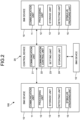
- FIG. 2 is a functional block diagram illustrating one example of the brain information transmission system 100.
- the brain information transmission system 100 performs intention conveyance on the basis of brain information among a plurality of users.
- the intention conveyance performed on the basis of the brain information includes a process of converting an intention, an emotion, and a sense of each of the users to data and a process of transmitting the data.
- the brain information transmission system 100 includes a plurality of BMI devices 10 and a control device 20.
- the BMI device 10 is an interface between the brain and the outside using a brain-machine interface (BMI) technology.
- Each of the BMI device 10 includes a communication unit 11, a processing unit 12, and a storage unit 13.
- the communication unit 11 transmits and receives information.
- the communication unit 11 transmits, to the control device 20, various kinds of information including the brain information that is acquired from the brain of each of the users and information on the processing capacity of each of the users with respect to the brain information, which will be described later.
- the communication unit 11 receives various kinds of information including the brain information that is stored in another user and that is transmitted from the control device 20.
- the brain information is information that includes brain activation information and stimulus information, which will be described later.
- the processing unit 12 controls a communication operation performed in the communication unit 11.
- the processing unit 12 acquires the brain information that is detected by a detecting unit 14.
- the detecting unit 14 detects, for example, brain activation information as the brain information.
- the intra-brain activation information include concentration of an oxygenated hemoglobin concentration, a deoxidized hemoglobin concentration, a total hemoglobin concentration that are included in the cerebral blood flow of, for example, a user.
- the detecting unit 14 examples include a measuring device for performing measurement on the basis of the principles of, for example, functional magnetic resonance imaging (fMRI) or functional near-infrared spectroscopy (fNIRS), a measuring device using invasive electrodes, a measuring device for performing measurement by using micromachine arranged in a cerebral blood vessel, and the like. Furthermore, the detecting unit 14 is not limited to the above described devices, and another type of device may also be used.
- fMRI functional magnetic resonance imaging
- fNIRS functional near-infrared spectroscopy
- the intra-brain activation information is able to be indicated as the magnitude of the degree of activity for each voxel.
- the processing unit 12 generates, on the basis of the acquired brain activation information, stimulus information for providing a stimulus to the brain of the other user by a stimulus providing unit 15.
- the processing unit 12 extracts an intention, an emotion, and a sense of the user as data, by analyzing, for example, the brain activation information, and generates the stimulus information that provides a stimulus that allows the other user to recall an intention, an emotion, and a sense.
- the processing unit 12 supplies the stimulus information that has been extracted from the brain information stored in the other user received by the communication unit 11 to the stimulus providing unit 15.
- the stimulus providing unit 15 provides a stimulus to the user by activating a target portion by irradiating the target portion of the brain of the user with an electromagnetic wave signal.
- the stimulus providing unit 15 divides the brain of the user into sections on the basis of the three-dimensional matrix constituted by, for example, voxels each having the size of a few millimeters or less, and irradiates the brain of the user with electromagnetic waves for each voxel.
- the stimulus information includes information indicating which voxel included in the three-dimensional matrix is to be irradiated with electromagnetic waves of what intensity.
- Sizes and positions of voxels in the three-dimensional matrix of the stimulus information may correspond to the sizes and position of voxels included in a three-dimensional matrix of, for example, the intra-brain activation information.
- an emotion, and a sense are generated when which voxel of the brain of the user is irradiated with electromagnetic waves of what intensity, it is possible to obtain an association relationship by performing experiments in advance.
- the learning model is able to be stored in, for example, the storage unit 13 included in the BMI device 10.
- the stimulus providing unit 15 is able to provide a common stimulus to the brain of each of the users in order to measure the processing capacity of the respective users with respect to the brain information, which will be described later.
- the stimulus providing unit 15 is able to provide a stimulus to the user by using a sense of hearing stimulus pulse.
- FIG. 3 is a diagram illustrating one example of the sense of hearing stimulus pulse that is provided to the user.
- the horizontal axis indicates time, whereas the vertical axis indicates signal values.
- the stimulus providing unit 15 may also periodically provide a sense of hearing stimulus pulse during a period of, for example, intention conveyance performed among a plurality of users. In this case, the processing capacity of each of the users with respect to the brain information is periodically needed.
- the processing unit 12 calculates the degree of activity of the user on the basis of the intra-brain activation information acquired by the detecting unit 14 at the time of measurement of the processing capacity of the user.
- FIG. 4 are diagrams each illustrating an example of the degree of activity of the each of the users obtained when the sense of hearing stimulus pulse illustrated in FIG. 3 is provided to different users.
- the horizontal axis indicates time
- the vertical axis indicates the degree of activity.
- the horizontal axis (time axis) illustrated in FIG. 4 agrees with the horizontal axis (time axis) illustrated in FIG. 3 .
- the processing unit 12 defines a relaxed state of the user to whom a stimulus is not provided as a stationary state.
- the processing unit 12 defines the degree of activity in the stationary state as a reference value S, and is able to calculate the processing capacity of the user on the basis of the peak value of the degree of activity indicated when a sense of hearing stimulus is provided.
- the peak value of the degree of activity is A1
- the peak value of the degree of activity is A2
- the peak value of the degree of activity is A3
- the peak value of the degree of activity is A3. It is possible to obtain in advance such peak values of the degree of activity as the values each of which indicates the processing capacity, and it is possible to store the peak values in a storage unit 16.
- the processing unit 12 is able to easily calculate the processing capacity corresponding to the degree of activity by using the data stored in the storage unit 16.
- the degree of activity of each of the user 1 and the user 2 is increased at the same timing.
- the peak value A1 of the user 1 is higher than the peak value A2 of the user 2, so that it is possible to determine that the processing capacity of the user 1 is higher than that of the user 2.
- the processing unit 12 is able to calculate the processing capacity of the user on the basis of an earlier start time of a rise in the degree of activity.
- the peak value of the degree of activity is low in the user 3
- the degree of activity of the user 3 is increased at earlier timing indicated by the time axis than the timing of an increase in the degree of activity exhibited by each of the user 1 and the user 2.
- the degree of activity is increased with a small pulse at a time point before the sense of hearing stimulus pulse indicates the maximum amplitude. Accordingly, when the processing capacity is calculated on the basis of the reaction speed of the stimulus, it is possible to determine that the processing capacity of the user 3 is higher than that of each of the user 1 and the user 2.
- the processing capacity may be calculated on the basis of one of the peak value and the earlier start time of a rise in the degree of activity, or may be calculated on the basis of the indices that are calculated from both.
- the common stimulus for measuring the processing capacity of the user with respect to the brain information is not limited to the sense of hearing stimulus, but another stimulus, such as a visual stimulus, may be used.
- the processing unit 12 allows the obtained value of the processing capacity to be transmitted from the communication unit 11.
- the processing unit 12 is able to allow, for example, the communication unit 11 to transmit the obtained processing capacity to the control device 20.
- the transmission speed of the brain information is set on the basis of the processing capacity for each user.
- the set transmission speed is transmitted from the control device 20 to each of the BMI devices 10.
- the processing unit 12 may also allow, for example, the communication unit 11 to broadcast the obtained processing capacity to each of the BMI devices 10.
- the processing unit 12 is able to use H.323 that is the protocol for performing voice and moving image communication in real time.
- TCS terminal capability set
- the processing unit 12 controls the transmission operation of transmitting the brain information to be transmitted from the communication unit 11 so as to be equivalent to the set value of the transmission speed transmitted from the control device 20.
- the processing unit 12 is able to control the transmission speed by inserting, for example, invalid information into the brain information that is transmitted and received. In the case where the invalid information is inserted into the brain information and is transmitted and received, an amount of information related to the brain information that is transmitted and received per unit time is decreased. Accordingly, it is possible to easily set the transmission speed to the transmission speed of the user whose processing capacity is low.
- the processing unit 12 allows the generated stimulus information to be transmitted from the communication unit 11 to the control device 20 as the brain information.
- the storage unit 13 stores therein various kinds of information.
- the storage unit 13 includes a storage, such as a hard disk drive or a solid state drive. Furthermore, as the storage unit 13, an external storage medium, such as a removable disk, may be used.
- the storage unit 13 stores therein the processing capacity of each of the users with respect to the brain information that is transmitted from, for example, the control device 20 or that is broadcasted from the communication unit 11 included in each of the BMI devices 10 that are used by the respective users.
- the control device 20 controls the plurality of BMI devices 10.
- the control device 20 includes a communication unit 21, a communication control unit 22, a setting unit 23, and a storage unit 24.
- the communication unit 21 is an interface for performing wire communication or wireless communication.
- the communication unit 21 receives the brain information that is transmitted from each of the BMI devices 10 and the value of the processing capacity of each of the users.
- the communication unit 21 transmits the received brain information to the associated BMI device 10.
- the communication control unit 22 controls the communication operation performed in the communication unit 21.
- the setting unit 23 allows the brain information received by the communication unit 21 to be transferred to the other BMI device 10 that is different from the BMI device 10 that corresponds to the sending source.
- the setting unit 23 sets the transmission speed of the brain information between the BMI devices 10 on the basis of the value of the processing capacity of each of the users received by the communication unit 21. It is estimated that the user having a relatively high value of the processing capacity of the brain information stores therein a relatively larger amount of information related to the brain information that is able to be processed per unit time. Furthermore, it is estimated that the user having a relatively low processing capacity of the brain information stores therein a relatively small amount of information related to the brain information that is able to be processed per unit time. In the case where the brain information is input to the brain of the user, if an amount of the information per unit time is too large with respect to the processing capacity, the process is not likely to smoothly proceed in real time.
- the setting unit 23 is able to set the transmission speed in which all of the users are able to smoothly perform the processes in real time by setting the transmission speed such that an amount of information related to the brain information transmitted per unit time is equal.
- the setting unit 23 may set the transmission speed to a transmission speed equivalent to the transmission speed of the user who has the lowest value of the processing capacity, or may set the transmission speed to a transmission speed that is lower than the transmission speed equivalent to the transmission speed of the user who has the lowest value of the processing capacity.
- the storage unit 24 stores therein various kinds of information.
- the storage unit 24 includes a storage, such as a hard disk drive, or a solid state drive. Furthermore, an external storage medium, such as a removable disk, may be used as the storage unit 24.
- the processing unit 12 acquires the degree of activity of the brain of each of the users in the case where a common stimulus is provided to each of the first user A and the second user B.
- the processing unit 12 is able to provide a stimulus to each of the first user A and the second user B in advance.
- the processing unit 12 calculates the processing capacity of the user with respect to the brain information on the basis of the acquired degree of activity.
- the processing unit 12 allows the communication unit 11 to transmit the value of the processing capacity that is the obtained result to the control device 20.
- the processing unit 12 may also allow the communication unit 11 to broadcast the value of the processing capacity that is the obtained result to the other BMI device 10.
- the communication unit 21 receives the value of the processing capacity acquired from each of the BMI devices 10.
- the setting unit 23 sets, on the basis of the received value of each of the processing capacities, the transmission speed of the brain information that is transmitted between the two BMI devices 10. In this case, the setting unit 23 may set the transmission speed to the transmission speed associated with the user who has the lowest value of the processing capacity, or may set the transmission speed to the transmission speed that is lower than the transmission speed associated with the user who has the lowest value of the processing capacity.
- the setting unit 23 allows the communication unit 21 to transmit the set value of the transmission speed to each of the BMI devices 10.
- the processing unit 12 generates, on the basis of the set value of the transmission speed transmitted from the control device 20, stimulus information that is to be transmitted to the control device 20.
- FIG. 5 is a diagram schematically illustrating one example of the stimulus information that is generated in the processing unit 12.
- the processing unit 12 packetizes the stimulus information for, for example, each sense, such as a sense of sight, a sense of hearing, a sense of touch, a sense of taste, a sense of smell, and a somatic sensation.
- the size of each of the packets may be set to a value that is set in advance.
- a sense of sight packet includes a packet header, sense of sight data, and invalid data. The same configuration may be used for the packets of the other senses.
- the processing unit 12 performs time division multiplexing on each of the packets generated for the plurality of senses, the processing unit 12 is able to generate stimulus information on the plurality of senses as a single piece of information.
- the processing unit 12 multiplexes the pieces of stimulus information
- the processing unit 12 is able to use the technology conforming to the multiplexing standard that is the same standard as the moving picture experts group (MPEG) standard used when, for example, an elementary stream is packetized.
- MPEG moving picture experts group
- the processing unit 12 allows the pieces of stimulus information that are packetized for each sense to be synchronized by, for example, a signal, such as a reference clock. At this time, the processing unit 12 adjusts, on the basis of the set value of the transmission speed received from the control device 20, an amount of information related to the stimulus information that is transmitted per unit time.
- FIG. 6 is a diagram schematically illustrating one example of a process of controlling the transmission operation of transmitting the brain information.
- FIG. 6 (a) indicates one example of a transmission speed and transmission time of each of the first user A and the second user B. As illustrated in FIG.
- the first user A has the processing capacity corresponding to a transmission speed F A and the second user B has the processing capacity corresponding to a transmission speed F B .
- Each of the transmission speeds F A and F B is calculated on the basis of transmission time T A and T B , respectively, at the time at which N packets P each having the same amount of information are transmitted.
- the transmission time is represented by T A > T B .
- the transmission speed is represented F A ⁇ F B
- the second user B has the processing capacity that is higher than that of the first user A.
- the transmission speed is set so as to conform to the processing capacity of the first user A that is a relatively low processing capacity and is set so as to have the same amount of information related to the brain information transmitted per unit time.
- FIG. 6 (b) illustrates one example of a process of controlling the transmission operation performed in the case where the set value of the transmission speed is F A .
- the invalid information such as a null packet NP
- the BMI device 10 that is used by the second user B is inserted such that the transmission speed becomes F A .
- invalid data may be inserted into a single packet as the invalid information.
- a null packet may be inserted in the plurality of packets P as invalid information in units of packets.
- FIG. 6 (c) illustrated an example of a process of controlling the transmission operation performed in the case where the set value of the transmission speed is F C that is lower than F A .
- the invalid information such as a null packet NP or invalid data, is inserted such that each of the transmission speeds becomes F C .
- the processing unit 12 is able to control the transmission speed by inserting the invalid information, such as a null packet, between, for example, the packets P of the brain information to be transmitted.
- the invalid information such as a null packet
- the amount of information related to the brain information that is transmitted and received per unit time is reduced. Consequently, it is possible to easily set the transmission speed of the user whose processing capacity is low.
- the processing unit 12 may only adjust the entire transmission speed of the brain information to be transmitted.
- the processing unit 12 is able to appropriately set, for example, the timing of insertion of the packet of the invalid information and the amount of information related to the invalid information for each packet as long as the entire transmission speed of the brain information is an appropriate transmission speed.
- the processing unit 12 allows the control device 20 to transmit the generated brain information from the communication unit 11.
- the brain information is received by the communication unit 21.
- the received brain information is transferred to the other BMI device 10 by the communication control unit 22.
- the brain information that has been transferred by the control device 20 is received by the communication unit 11.
- the brain information is transferred between the BMI devices 10 at the transmission speed corresponding to the set value of the transmission speed that has been set by the control device 20.
- the processing unit 12 supplies the received brain information to the stimulus providing unit 15.
- the stimulus providing unit 15 provides the stimulus corresponding to the supplied brain information to the second user B.
- the second user B is able to vicariously experience an intention, an emotion, and a sense, or the like recalled by the first user A by a stimulus provided from the stimulus providing unit 15.
- FIG. 7 is a flowchart illustrating the flow of the process performed in the brain information transmission system 100.
- the processing unit 12 included in each of the BMI devices 10 calculates the processing capacity of the user with respect to the brain information on the basis of the degree of activity of the brain of the user in the case where a common stimulus is provided to the brain of each of the users (Step S101).
- the setting unit 23 included in the control device 20 sets, on the basis of the processing capacity of the user with respect to the brain information, the transmission speed of the brain information between the plurality of BMI devices 10 (Step S102).
- the processing unit 12 generates the brain information in which, for example, the invalid information is inserted, and controls the transmission operation of transmitting the generated brain information or the like in accordance with the set transmission speed (Step S103).
- the brain information transmission system 100 is the brain information transmission system 100 that includes the plurality of BMI devices 10 each of which performs intention conveyance on the basis of the brain information among the plurality of users, and includes the processing unit 12 that calculates the processing capacity of each of the users with respect to the brain information on the basis of the degree of activity of the brain of each of the users indicated in the case where a common stimulus is provided to the brain of each of the users.
- the processing capacity of the user with respect to the brain information is calculated on the basis of the degree of activity of the brain of each of the users indicated in the case where the common stimulus is provided to the brain of each of the users, so that it is possible to appropriately grasp the processing capacity of each of the users with respect to the brain information in the case where the intention conveyance is performed among the plurality of users on the basis of the brain information.
- the brain information transmission system 100 further includes the setting unit 23 that sets the transmission speed of the brain information transmitted among the plurality of BMI devices 10 on the basis of the processing capacity of the user with respect to the brain information.
- the transmission speed of the brain information among the plurality of BMI devices 10 is set on the basis of the processing capacity of the user with respect to the brain information, it is possible to smoothly perform the intention conveyance in real time even in the case where there is a difference between the processing capacities of the brain information stored in the users.
- each of the plurality of BMI devices 10 inserts the invalid information into the brain information in accordance with the transmission speed that is set by the setting unit 23. According to this configuration, it is possible to easily adjust the transmission speed in the case where there is a difference between the processing capacities of the users with respect to the pieces of respective brain information.
- the brain information is information related to a plurality of senses each of which provides a stimulus to the brain of each of the users, and each of the plurality of BMI devices 10 multiplexes and synchronizes the pieces of information provided by the plurality of senses. According to this configuration, it is possible to efficiently transmit the brain information including the information provided by the plurality of senses.
- each of the plurality of BMI devices 10 acquires the processing capacity of the respective users when the intention conveyance is started. According to this configuration, each of the BMI devices 10 is able to acquire the processing capacities of the other users.
- the technical scope of the present disclosure is not limited to the embodiment described above and various modifications are possible as long as they do not depart from the spirit of the present disclosure.
- a sense of hearing stimulus is provided to the user when the processing capacity of the user with respect to the brain information is calculated, but the embodiment is not limited to this.
- the processing capacity may be calculated by providing a stimulus corresponding to the sense recalled by the user.
- each of the BMI devices 10 calculates the processing capacity
- the configuration may be constituted such that the control device 20 transmits a common stimulus to each of the BMI devices 10, each of the BMI devices 10 acquires the degree of activity and transmits the acquired degree of activity to the control device 20, and the processing capacity of each of the users is calculated in the control device 20 on the basis of the degree of activity that is transmitted from each of the BMI devices 10.
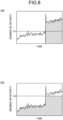
- FIG. 8 is a diagram illustrating another example of an operation of adjusting the transmission speed.
- FIG. 8 (a) and FIG. 8 (b) illustrate the relationship between the degree of activity of the brain information and the time, and the vertical axis indicates the degree of activity, whereas the horizontal axis indicates the time.
- the BMI device 10 is able to extract, for example, a portion in which the value of the degree of activity is equal to or larger than a threshold S1 included in the brain information (the hatched area in FIG. 8 (a) ), and table to transmit the extracted portion.
- the BMI device 10 is able to thin out and transmit a portion in which the value of the degree of activity is less than the threshold S1 included in the brain information.
- the portion in which the degree of activity is high included in the brain information is the portion having a high intensity of a sense, an emotion, or the like recalled by the user. Consequently, by extracting or thinning out the information by using the threshold S1 of the degree of activity, it is possible to transmit a rough sense except for a detailed portion and share the brain information with the other users while suppressing an amount of transmission of the brain information.
- the BMI device 10 is able to extract, for example, a portion in which the value of the degree of activity is equal to or less than a threshold S2 included in the brain information (the hatched area in FIG. 8 (b) ), and is able to transmit the extracted portion.
- the BMI device 10 is able to thin out and transmit a portion in which the value of the degree of activity exceeds the threshold S2 included in the brain information.
- a change in the amplitude at the portion equal to or larger than the threshold S2 is smoothened, but the configuration is not limited to this, and the entire portion may be smoothened. In this way, by extracting or thinning out the information by using the threshold S2 of the degree of activity, it is possible to transmit a sense except for a sensitive responded portion and share the brain information with the other users while suppressing an amount of transmission of the brain information.
- the stimulus providing unit 15 may irradiates the target portion of the brain of the user with an electromagnetic wave signal, and may recall an intention, an emotion, and a sense by using a method other than the method of activating the target portion. It may be possible to recall the stimulus information on a sense of sight, a sense of hearing, a sense of touch, a sense of taste, a sense of smell, a somatic sensation, or the like by a device that provides each of the senses. For example, a display that provides an image corresponding to the stimulus information on a sense of sight, a speaker that provide voice corresponding to the stimulus information on a sense of hearing, and the like may be used. It may be possible to provide a stimulus of a sense of hearing stimulus pulse that is used to measure the processing capacity of the user with respect to the brain information to the ears of the user from a sound emitting device, such as a speaker or headphones.
- a sound emitting device such as a speaker or headphones.
- the brain information transmission system is able to be used for, for example, a processing device, such as a computer.
Landscapes
- Health & Medical Sciences (AREA)
- Engineering & Computer Science (AREA)
- Life Sciences & Earth Sciences (AREA)
- Physics & Mathematics (AREA)
- Biomedical Technology (AREA)
- General Health & Medical Sciences (AREA)
- General Engineering & Computer Science (AREA)
- Theoretical Computer Science (AREA)
- Neurology (AREA)
- Biophysics (AREA)
- Heart & Thoracic Surgery (AREA)
- Medical Informatics (AREA)
- Molecular Biology (AREA)
- Surgery (AREA)
- Animal Behavior & Ethology (AREA)
- Pathology (AREA)
- Public Health (AREA)
- Veterinary Medicine (AREA)
- Psychology (AREA)
- Neurosurgery (AREA)
- General Physics & Mathematics (AREA)
- Human Computer Interaction (AREA)
- Psychiatry (AREA)
- Dermatology (AREA)
- Nuclear Medicine, Radiotherapy & Molecular Imaging (AREA)
- Social Psychology (AREA)
- Physiology (AREA)
- Child & Adolescent Psychology (AREA)
- Hospice & Palliative Care (AREA)
- Educational Technology (AREA)
- High Energy & Nuclear Physics (AREA)
- Developmental Disabilities (AREA)
- Radiology & Medical Imaging (AREA)
- Measurement And Recording Of Electrical Phenomena And Electrical Characteristics Of The Living Body (AREA)
- Magnetic Resonance Imaging Apparatus (AREA)
- User Interface Of Digital Computer (AREA)
Abstract
Description
- The present disclosure relates to a brain information transmission system.
- In recent years, techniques, such as a functional magnetic resonance technique and near-infrared spectroscopy, for measuring intra-brain activation information in a non-invasive manner have been developed, and the technology related to a brain-machine interface (BMI) that is an interface between the brain and the outside is becoming more realistic. As an example using this type of technology, there is a disclosed intention conveyance support device that computes information for specifying a visual stimulus imaged by a subject on the basis of information that includes both a feature value derived from a brain surface signal and a feature value derived from an intra-brain signal (for example, Patent Literature 1).
- Patent Literature 1:
Japanese Laid-open Patent Publication No. 2014-92561 - In the case where intention conveyance is performed on the basis of brain information among a plurality of users, when the brain information is input to the brain of the user, if an amount of information per unit time is too large with respect to the processing capacity of the user, there is a possibility that the intention conveyance do not smoothly performed in real time.
- Accordingly, one aspect of an embodiment of the present disclosure has been conceived in light of the circumstances described above and an object thereof is to provide a brain information transmission system capable of appropriately grasping a processing capacity of each of users with respect to brain information in the case where intention conveyance is performed among the plurality of users on the basis of the brain information.
- A brain information transmission system according to the present disclosure includes a plurality of BMI devices each of which performs intention conveyance based on brain information among a plurality of users, and includes a processing unit configured to calculate a processing capacity of each of the users with respect to the brain information based on a degree of activity of a brain of each of the users indicated when a common stimulus is provided to the brain of each of the users.
- According to the present disclosure, it is possible to appropriately grasp the processing capacity of each of the users with respect to the brain information in the case where intention conveyance is performed among the plurality of users on the basis of the brain information.
-
-
FIG. 1 is a schematic diagram illustrating one example of a brain information transmission system according to a present embodiment. -
FIG. 2 is a functional block diagram illustrating one example of the brain information transmission system. -
FIG. 3 is a diagram illustrating one example of a sense of hearing stimulus pulse that is provided to a user. -
FIG. 4 are diagrams each illustrating an example of a degree of activity of each of the users obtained when the sense of hearing stimulus pulse illustrated inFIG. 3 is provided to different users. -
FIG. 5 is a diagram schematically illustrating one example of stimulus information that is generated by a processing unit. -
FIG. 6 is a diagram schematically illustrating one example of control of a transmission operation of transmitting brain information. -
FIG. 7 is a flowchart illustrating the flow of operation performed in the brain information transmission system. -
FIG. 8 is a diagram illustrating another example of an operation of adjusting a transmission speed. - Preferred embodiments of a brain information transmission system according to the present disclosure will be explained with reference to the accompanying drawings. Furthermore, the present invention is not limited to the embodiments described below. Furthermore, the components described in the embodiment include one that can easily be replaced by those skilled in the art or one that is substantially identical.
-
FIG. 1 is a schematic diagram illustrating one example of a braininformation transmission system 100 according to the present embodiment.FIG. 2 is a functional block diagram illustrating one example of the braininformation transmission system 100. As illustrated inFIG. 1 andFIG. 2 , the braininformation transmission system 100 performs intention conveyance on the basis of brain information among a plurality of users. The intention conveyance performed on the basis of the brain information includes a process of converting an intention, an emotion, and a sense of each of the users to data and a process of transmitting the data. The braininformation transmission system 100 includes a plurality ofBMI devices 10 and acontrol device 20. - The
BMI device 10 is an interface between the brain and the outside using a brain-machine interface (BMI) technology. Each of theBMI device 10 includes acommunication unit 11, aprocessing unit 12, and astorage unit 13. Thecommunication unit 11 transmits and receives information. Thecommunication unit 11 transmits, to thecontrol device 20, various kinds of information including the brain information that is acquired from the brain of each of the users and information on the processing capacity of each of the users with respect to the brain information, which will be described later. Thecommunication unit 11 receives various kinds of information including the brain information that is stored in another user and that is transmitted from thecontrol device 20. The brain information is information that includes brain activation information and stimulus information, which will be described later. - The
processing unit 12 controls a communication operation performed in thecommunication unit 11. Theprocessing unit 12 acquires the brain information that is detected by a detectingunit 14. In the present embodiment, the detectingunit 14 detects, for example, brain activation information as the brain information. Examples of the intra-brain activation information include concentration of an oxygenated hemoglobin concentration, a deoxidized hemoglobin concentration, a total hemoglobin concentration that are included in the cerebral blood flow of, for example, a user. Examples of the detectingunit 14 that may be used include a measuring device for performing measurement on the basis of the principles of, for example, functional magnetic resonance imaging (fMRI) or functional near-infrared spectroscopy (fNIRS), a measuring device using invasive electrodes, a measuring device for performing measurement by using micromachine arranged in a cerebral blood vessel, and the like. Furthermore, the detectingunit 14 is not limited to the above described devices, and another type of device may also be used. In the case where, for example, the brain of a user is divided into sections on the basis of a three-dimensional matrix constituted by voxels each having the size of a few millimeters or less, the intra-brain activation information is able to be indicated as the magnitude of the degree of activity for each voxel. - The
processing unit 12 generates, on the basis of the acquired brain activation information, stimulus information for providing a stimulus to the brain of the other user by astimulus providing unit 15. Theprocessing unit 12 extracts an intention, an emotion, and a sense of the user as data, by analyzing, for example, the brain activation information, and generates the stimulus information that provides a stimulus that allows the other user to recall an intention, an emotion, and a sense. In this case, it may be possible to store the brain activation information in an associated manner with an intention, an emotion, and a sense, and store the stimulus information in an associated manner with an intention, an emotion, and a sense in thestorage unit 13. Furthermore, theprocessing unit 12 supplies the stimulus information that has been extracted from the brain information stored in the other user received by thecommunication unit 11 to thestimulus providing unit 15. - The
stimulus providing unit 15 provides a stimulus to the user by activating a target portion by irradiating the target portion of the brain of the user with an electromagnetic wave signal. Thestimulus providing unit 15 divides the brain of the user into sections on the basis of the three-dimensional matrix constituted by, for example, voxels each having the size of a few millimeters or less, and irradiates the brain of the user with electromagnetic waves for each voxel. The stimulus information includes information indicating which voxel included in the three-dimensional matrix is to be irradiated with electromagnetic waves of what intensity. Sizes and positions of voxels in the three-dimensional matrix of the stimulus information may correspond to the sizes and position of voxels included in a three-dimensional matrix of, for example, the intra-brain activation information. As for what kind of an intention, an emotion, and a sense are generated when which voxel of the brain of the user is irradiated with electromagnetic waves of what intensity, it is possible to obtain an association relationship by performing experiments in advance. For example, it is possible to generate a learning model that is obtained by performing machine learning on learning data sets that are obtained by associating the stimulus information with respect to the user with an intention, an emotion, and a sense that are generated in the brain of the user as a single learning data set in the case where the brain is irradiated with electromagnetic waves on the basis of the stimulus information. The learning model is able to be stored in, for example, thestorage unit 13 included in theBMI device 10. - Furthermore, the
stimulus providing unit 15 is able to provide a common stimulus to the brain of each of the users in order to measure the processing capacity of the respective users with respect to the brain information, which will be described later. As one example, thestimulus providing unit 15 is able to provide a stimulus to the user by using a sense of hearing stimulus pulse.FIG. 3 is a diagram illustrating one example of the sense of hearing stimulus pulse that is provided to the user. InFIG. 3 , the horizontal axis indicates time, whereas the vertical axis indicates signal values. By providing the sense of hearing stimulus pulse illustrated inFIG. 3 , a portion of the brain related to a sense of hearing of the user becomes activated. In this case, the intra-brain activation information stored in the user is able to be acquired by the detectingunit 14. Thestimulus providing unit 15 may also periodically provide a sense of hearing stimulus pulse during a period of, for example, intention conveyance performed among a plurality of users. In this case, the processing capacity of each of the users with respect to the brain information is periodically needed. - The
processing unit 12 calculates the degree of activity of the user on the basis of the intra-brain activation information acquired by the detectingunit 14 at the time of measurement of the processing capacity of the user.FIG. 4 are diagrams each illustrating an example of the degree of activity of the each of the users obtained when the sense of hearing stimulus pulse illustrated inFIG. 3 is provided to different users. InFIG. 4 , the horizontal axis indicates time, whereas the vertical axis indicates the degree of activity. Moreover, the horizontal axis (time axis) illustrated inFIG. 4 agrees with the horizontal axis (time axis) illustrated inFIG. 3 . As illustrated inFIG. 4 , theprocessing unit 12 defines a relaxed state of the user to whom a stimulus is not provided as a stationary state. Theprocessing unit 12 defines the degree of activity in the stationary state as a reference value S, and is able to calculate the processing capacity of the user on the basis of the peak value of the degree of activity indicated when a sense of hearing stimulus is provided. In the example of auser 1 indicated by (a) illustrated inFIG. 4 , the peak value of the degree of activity is A1, in the example of auser 2 indicated by (b) illustrated inFIG. 4 , the peak value of the degree of activity is A2, and in the example of a user 3 indicated by (c) illustrated inFIG. 4 , the peak value of the degree of activity is A3. It is possible to obtain in advance such peak values of the degree of activity as the values each of which indicates the processing capacity, and it is possible to store the peak values in a storage unit 16. In this case, theprocessing unit 12 is able to easily calculate the processing capacity corresponding to the degree of activity by using the data stored in the storage unit 16. In the following, one example of a process of determining the processing capacity performed by theprocessing unit 12 will be described. For example, the degree of activity of each of theuser 1 and theuser 2 is increased at the same timing. When the processing capacity is calculated on the basis of the peak value of the degree of activity, the peak value A1 of theuser 1 is higher than the peak value A2 of theuser 2, so that it is possible to determine that the processing capacity of theuser 1 is higher than that of theuser 2. - Furthermore, the
processing unit 12 is able to calculate the processing capacity of the user on the basis of an earlier start time of a rise in the degree of activity. As compared with theuser 1 and theuser 2, the peak value of the degree of activity is low in the user 3, whereas the degree of activity of the user 3 is increased at earlier timing indicated by the time axis than the timing of an increase in the degree of activity exhibited by each of theuser 1 and theuser 2. Specifically, the degree of activity is increased with a small pulse at a time point before the sense of hearing stimulus pulse indicates the maximum amplitude. Accordingly, when the processing capacity is calculated on the basis of the reaction speed of the stimulus, it is possible to determine that the processing capacity of the user 3 is higher than that of each of theuser 1 and theuser 2. Moreover, the processing capacity may be calculated on the basis of one of the peak value and the earlier start time of a rise in the degree of activity, or may be calculated on the basis of the indices that are calculated from both. Furthermore, the common stimulus for measuring the processing capacity of the user with respect to the brain information is not limited to the sense of hearing stimulus, but another stimulus, such as a visual stimulus, may be used. - The
processing unit 12 allows the obtained value of the processing capacity to be transmitted from thecommunication unit 11. Theprocessing unit 12 is able to allow, for example, thecommunication unit 11 to transmit the obtained processing capacity to thecontrol device 20. In this case, in thecontrol device 20, as will be described later, the transmission speed of the brain information is set on the basis of the processing capacity for each user. The set transmission speed is transmitted from thecontrol device 20 to each of theBMI devices 10. Furthermore, theprocessing unit 12 may also allow, for example, thecommunication unit 11 to broadcast the obtained processing capacity to each of theBMI devices 10. In the case where the processing capacity is broadcasted, theprocessing unit 12 is able to use H.323 that is the protocol for performing voice and moving image communication in real time. In this case, it is possible to broadcast the processing capacity of each of the users with respect to the brain information by using a terminal capability set (TCS) that is a communication control message for performing mutual acknowledgement of the ability of each of the terminals of therespective BMI devices 10. - The
processing unit 12 controls the transmission operation of transmitting the brain information to be transmitted from thecommunication unit 11 so as to be equivalent to the set value of the transmission speed transmitted from thecontrol device 20. Theprocessing unit 12 is able to control the transmission speed by inserting, for example, invalid information into the brain information that is transmitted and received. In the case where the invalid information is inserted into the brain information and is transmitted and received, an amount of information related to the brain information that is transmitted and received per unit time is decreased. Accordingly, it is possible to easily set the transmission speed to the transmission speed of the user whose processing capacity is low. Theprocessing unit 12 allows the generated stimulus information to be transmitted from thecommunication unit 11 to thecontrol device 20 as the brain information. - The
storage unit 13 stores therein various kinds of information. Thestorage unit 13 includes a storage, such as a hard disk drive or a solid state drive. Furthermore, as thestorage unit 13, an external storage medium, such as a removable disk, may be used. Thestorage unit 13 stores therein the processing capacity of each of the users with respect to the brain information that is transmitted from, for example, thecontrol device 20 or that is broadcasted from thecommunication unit 11 included in each of theBMI devices 10 that are used by the respective users. - The
control device 20 controls the plurality ofBMI devices 10. Thecontrol device 20 includes acommunication unit 21, acommunication control unit 22, asetting unit 23, and astorage unit 24. Thecommunication unit 21 is an interface for performing wire communication or wireless communication. Thecommunication unit 21 receives the brain information that is transmitted from each of theBMI devices 10 and the value of the processing capacity of each of the users. Thecommunication unit 21 transmits the received brain information to the associatedBMI device 10. - The
communication control unit 22 controls the communication operation performed in thecommunication unit 21. - The setting
unit 23 allows the brain information received by thecommunication unit 21 to be transferred to theother BMI device 10 that is different from theBMI device 10 that corresponds to the sending source. - The setting
unit 23 sets the transmission speed of the brain information between theBMI devices 10 on the basis of the value of the processing capacity of each of the users received by thecommunication unit 21. It is estimated that the user having a relatively high value of the processing capacity of the brain information stores therein a relatively larger amount of information related to the brain information that is able to be processed per unit time. Furthermore, it is estimated that the user having a relatively low processing capacity of the brain information stores therein a relatively small amount of information related to the brain information that is able to be processed per unit time. In the case where the brain information is input to the brain of the user, if an amount of the information per unit time is too large with respect to the processing capacity, the process is not likely to smoothly proceed in real time. In the present embodiment, the settingunit 23 is able to set the transmission speed in which all of the users are able to smoothly perform the processes in real time by setting the transmission speed such that an amount of information related to the brain information transmitted per unit time is equal. The settingunit 23 may set the transmission speed to a transmission speed equivalent to the transmission speed of the user who has the lowest value of the processing capacity, or may set the transmission speed to a transmission speed that is lower than the transmission speed equivalent to the transmission speed of the user who has the lowest value of the processing capacity. - The
storage unit 24 stores therein various kinds of information. Thestorage unit 24 includes a storage, such as a hard disk drive, or a solid state drive. Furthermore, an external storage medium, such as a removable disk, may be used as thestorage unit 24. - In the following, one example of an operation of the brain
information transmission system 100 having the configuration described above will be described. In the example described below, a case will be described as an example in which intention conveyance is performed on the basis of the brain information between two users of a first user A and a second user B. Moreover, the same explanation is also available in the case where intention conveyance is performed on the basis of the brain information among three or more users. - First, in each of the
BMI devices 10, theprocessing unit 12 acquires the degree of activity of the brain of each of the users in the case where a common stimulus is provided to each of the first user A and the second user B. Theprocessing unit 12 is able to provide a stimulus to each of the first user A and the second user B in advance. Theprocessing unit 12 calculates the processing capacity of the user with respect to the brain information on the basis of the acquired degree of activity. Theprocessing unit 12 allows thecommunication unit 11 to transmit the value of the processing capacity that is the obtained result to thecontrol device 20. Moreover, theprocessing unit 12 may also allow thecommunication unit 11 to broadcast the value of the processing capacity that is the obtained result to theother BMI device 10. - In the
control device 20, thecommunication unit 21 receives the value of the processing capacity acquired from each of theBMI devices 10. The settingunit 23 sets, on the basis of the received value of each of the processing capacities, the transmission speed of the brain information that is transmitted between the twoBMI devices 10. In this case, the settingunit 23 may set the transmission speed to the transmission speed associated with the user who has the lowest value of the processing capacity, or may set the transmission speed to the transmission speed that is lower than the transmission speed associated with the user who has the lowest value of the processing capacity. The settingunit 23 allows thecommunication unit 21 to transmit the set value of the transmission speed to each of theBMI devices 10. - The
processing unit 12 generates, on the basis of the set value of the transmission speed transmitted from thecontrol device 20, stimulus information that is to be transmitted to thecontrol device 20.FIG. 5 is a diagram schematically illustrating one example of the stimulus information that is generated in theprocessing unit 12. As illustrated inFIG. 5 , theprocessing unit 12 packetizes the stimulus information for, for example, each sense, such as a sense of sight, a sense of hearing, a sense of touch, a sense of taste, a sense of smell, and a somatic sensation. The size of each of the packets may be set to a value that is set in advance. For example, a sense of sight packet includes a packet header, sense of sight data, and invalid data. The same configuration may be used for the packets of the other senses. - The
processing unit 12 performs time division multiplexing on each of the packets generated for the plurality of senses, theprocessing unit 12 is able to generate stimulus information on the plurality of senses as a single piece of information. When theprocessing unit 12 multiplexes the pieces of stimulus information, theprocessing unit 12 is able to use the technology conforming to the multiplexing standard that is the same standard as the moving picture experts group (MPEG) standard used when, for example, an elementary stream is packetized. In this case, it is preferable that theprocessing unit 12 performs multiplexing in the form of, for example, program streams, but theprocessing unit 12 may also perform multiplexing in the form of transport streams. - The
processing unit 12 allows the pieces of stimulus information that are packetized for each sense to be synchronized by, for example, a signal, such as a reference clock. At this time, theprocessing unit 12 adjusts, on the basis of the set value of the transmission speed received from thecontrol device 20, an amount of information related to the stimulus information that is transmitted per unit time.FIG. 6 is a diagram schematically illustrating one example of a process of controlling the transmission operation of transmitting the brain information.FIG. 6 (a) indicates one example of a transmission speed and transmission time of each of the first user A and the second user B. As illustrated inFIG. 6 (a) , it is assumed that the first user A has the processing capacity corresponding to a transmission speed FA and the second user B has the processing capacity corresponding to a transmission speed FB. Each of the transmission speeds FA and FB is calculated on the basis of transmission time TA and TB, respectively, at the time at which N packets P each having the same amount of information are transmitted. Here, the transmission time is represented by TA > TB. In other words, it is assumed that the transmission speed is represented FA < FB, and the second user B has the processing capacity that is higher than that of the first user A. In this case, in thecontrol device 20, the transmission speed is set so as to conform to the processing capacity of the first user A that is a relatively low processing capacity and is set so as to have the same amount of information related to the brain information transmitted per unit time. -
FIG. 6 (b) illustrates one example of a process of controlling the transmission operation performed in the case where the set value of the transmission speed is FA. As illustrated inFIG. 6 (b) , in the case where the set value of the transmission speed is FA, in theBMI device 10 that is used by the first user A, it is possible to transmit the brain information without inserting the invalid information. Furthermore, in theBMI device 10 that is used by the second user B, the invalid information, such as a null packet NP, is inserted such that the transmission speed becomes FA. In theBMI device 10 that is used by the second user B, as illustrated in the middle part indicated by (B1) illustrated inFIG. 6 (b) , invalid data may be inserted into a single packet as the invalid information. Furthermore, as illustrated in the lower part indicated by (B2) illustrated inFIG. 6 (b) , a null packet may be inserted in the plurality of packets P as invalid information in units of packets. -
FIG. 6 (c) illustrated an example of a process of controlling the transmission operation performed in the case where the set value of the transmission speed is FC that is lower than FA. As illustrated inFIG. 6 (c) , in the case where the set value of the transmission speed is FC that is lower than FA, in theBMI device 10 that is used by the first user A and in theBMI device 10 that is used by the second user B, the invalid information, such as a null packet NP or invalid data, is inserted such that each of the transmission speeds becomes FC. - The
processing unit 12 is able to control the transmission speed by inserting the invalid information, such as a null packet, between, for example, the packets P of the brain information to be transmitted. When the invalid information is inserted into the brain information and transmitted and received, the amount of information related to the brain information that is transmitted and received per unit time is reduced. Consequently, it is possible to easily set the transmission speed of the user whose processing capacity is low. - The
processing unit 12 may only adjust the entire transmission speed of the brain information to be transmitted. Theprocessing unit 12 is able to appropriately set, for example, the timing of insertion of the packet of the invalid information and the amount of information related to the invalid information for each packet as long as the entire transmission speed of the brain information is an appropriate transmission speed. Theprocessing unit 12 allows thecontrol device 20 to transmit the generated brain information from thecommunication unit 11. - In the
control device 20, the brain information is received by thecommunication unit 21. The received brain information is transferred to theother BMI device 10 by thecommunication control unit 22. - In the
other BMI device 10, the brain information that has been transferred by thecontrol device 20 is received by thecommunication unit 11. As a result of this, the brain information is transferred between theBMI devices 10 at the transmission speed corresponding to the set value of the transmission speed that has been set by thecontrol device 20. Theprocessing unit 12 supplies the received brain information to thestimulus providing unit 15. Thestimulus providing unit 15 provides the stimulus corresponding to the supplied brain information to the second user B. The second user B is able to vicariously experience an intention, an emotion, and a sense, or the like recalled by the first user A by a stimulus provided from thestimulus providing unit 15. -
FIG. 7 is a flowchart illustrating the flow of the process performed in the braininformation transmission system 100. As illustrated inFIG. 7 , theprocessing unit 12 included in each of theBMI devices 10 calculates the processing capacity of the user with respect to the brain information on the basis of the degree of activity of the brain of the user in the case where a common stimulus is provided to the brain of each of the users (Step S101). - Then, the setting
unit 23 included in thecontrol device 20 sets, on the basis of the processing capacity of the user with respect to the brain information, the transmission speed of the brain information between the plurality of BMI devices 10 (Step S102). - Then, in each of the
BMI devices 10, theprocessing unit 12 generates the brain information in which, for example, the invalid information is inserted, and controls the transmission operation of transmitting the generated brain information or the like in accordance with the set transmission speed (Step S103). - As described above, the brain
information transmission system 100 according to the present embodiment is the braininformation transmission system 100 that includes the plurality ofBMI devices 10 each of which performs intention conveyance on the basis of the brain information among the plurality of users, and includes theprocessing unit 12 that calculates the processing capacity of each of the users with respect to the brain information on the basis of the degree of activity of the brain of each of the users indicated in the case where a common stimulus is provided to the brain of each of the users. - According to this configuration, the processing capacity of the user with respect to the brain information is calculated on the basis of the degree of activity of the brain of each of the users indicated in the case where the common stimulus is provided to the brain of each of the users, so that it is possible to appropriately grasp the processing capacity of each of the users with respect to the brain information in the case where the intention conveyance is performed among the plurality of users on the basis of the brain information.
- The brain
information transmission system 100 according to the present embodiment further includes the settingunit 23 that sets the transmission speed of the brain information transmitted among the plurality ofBMI devices 10 on the basis of the processing capacity of the user with respect to the brain information. According to this configuration, the transmission speed of the brain information among the plurality ofBMI devices 10 is set on the basis of the processing capacity of the user with respect to the brain information, it is possible to smoothly perform the intention conveyance in real time even in the case where there is a difference between the processing capacities of the brain information stored in the users. - In the brain
information transmission system 100 according to the present embodiment, each of the plurality ofBMI devices 10 inserts the invalid information into the brain information in accordance with the transmission speed that is set by the settingunit 23. According to this configuration, it is possible to easily adjust the transmission speed in the case where there is a difference between the processing capacities of the users with respect to the pieces of respective brain information. - In the brain
information transmission system 100 according to the present embodiment, the brain information is information related to a plurality of senses each of which provides a stimulus to the brain of each of the users, and each of the plurality ofBMI devices 10 multiplexes and synchronizes the pieces of information provided by the plurality of senses. According to this configuration, it is possible to efficiently transmit the brain information including the information provided by the plurality of senses. - In the brain
information transmission system 100 according to the present embodiment, each of the plurality ofBMI devices 10 acquires the processing capacity of the respective users when the intention conveyance is started. According to this configuration, each of theBMI devices 10 is able to acquire the processing capacities of the other users. - The technical scope of the present disclosure is not limited to the embodiment described above and various modifications are possible as long as they do not depart from the spirit of the present disclosure. For example, in the above described embodiment, a case has been described as one example in which a sense of hearing stimulus is provided to the user when the processing capacity of the user with respect to the brain information is calculated, but the embodiment is not limited to this. For example, as a stimulus provided to the user, the processing capacity may be calculated by providing a stimulus corresponding to the sense recalled by the user.
- Furthermore, in the above described embodiment, a case has been described as one example in which each of the
BMI devices 10 calculates the processing capacity, but the embodiment is not limited to this. For example, the configuration may be constituted such that thecontrol device 20 transmits a common stimulus to each of theBMI devices 10, each of theBMI devices 10 acquires the degree of activity and transmits the acquired degree of activity to thecontrol device 20, and the processing capacity of each of the users is calculated in thecontrol device 20 on the basis of the degree of activity that is transmitted from each of theBMI devices 10. - Furthermore, in the above described embodiment, a case has been described as one example in which the invalid information is inserted into the brain information when the transmission speed is adjusted, but the embodiment is not limited to this, and the entire transmission speed of the brain information may be adjusted by transmitting only a part of the brain information.
FIG. 8 is a diagram illustrating another example of an operation of adjusting the transmission speed.FIG. 8 (a) and FIG. 8 (b) illustrate the relationship between the degree of activity of the brain information and the time, and the vertical axis indicates the degree of activity, whereas the horizontal axis indicates the time. - As illustrated in
FIG. 8 (a) , theBMI device 10 is able to extract, for example, a portion in which the value of the degree of activity is equal to or larger than a threshold S1 included in the brain information (the hatched area inFIG. 8 (a) ), and table to transmit the extracted portion. In other words, theBMI device 10 is able to thin out and transmit a portion in which the value of the degree of activity is less than the threshold S1 included in the brain information. It can be said that the portion in which the degree of activity is high included in the brain information is the portion having a high intensity of a sense, an emotion, or the like recalled by the user. Consequently, by extracting or thinning out the information by using the threshold S1 of the degree of activity, it is possible to transmit a rough sense except for a detailed portion and share the brain information with the other users while suppressing an amount of transmission of the brain information. - Furthermore, as illustrated in
FIG. 8 (b) , theBMI device 10 is able to extract, for example, a portion in which the value of the degree of activity is equal to or less than a threshold S2 included in the brain information (the hatched area inFIG. 8 (b) ), and is able to transmit the extracted portion. In other words, theBMI device 10 is able to thin out and transmit a portion in which the value of the degree of activity exceeds the threshold S2 included in the brain information. Furthermore, in the example illustrated inFIG. 8 (b) , a change in the amplitude at the portion equal to or larger than the threshold S2 is smoothened, but the configuration is not limited to this, and the entire portion may be smoothened. In this way, by extracting or thinning out the information by using the threshold S2 of the degree of activity, it is possible to transmit a sense except for a sensitive responded portion and share the brain information with the other users while suppressing an amount of transmission of the brain information. - Furthermore, in the above description, as an example of the transmission operation of transmitting only a portion of the brain information in accordance with the set transmission speed, a configuration in which the information is extracted or thinned out by using the threshold of the degree of activity in the brain information has been described, but the embodiment is not limited to this. It may be possible to extract and thin out the information by using another mode.
- Furthermore, in the above described, the
stimulus providing unit 15 may irradiates the target portion of the brain of the user with an electromagnetic wave signal, and may recall an intention, an emotion, and a sense by using a method other than the method of activating the target portion. It may be possible to recall the stimulus information on a sense of sight, a sense of hearing, a sense of touch, a sense of taste, a sense of smell, a somatic sensation, or the like by a device that provides each of the senses. For example, a display that provides an image corresponding to the stimulus information on a sense of sight, a speaker that provide voice corresponding to the stimulus information on a sense of hearing, and the like may be used. It may be possible to provide a stimulus of a sense of hearing stimulus pulse that is used to measure the processing capacity of the user with respect to the brain information to the ears of the user from a sound emitting device, such as a speaker or headphones. - The brain information transmission system according to the present disclosure is able to be used for, for example, a processing device, such as a computer.
-
- NP
- Null packet
- P
- Packet
- 10
- BMI device
- 11,
- 21 Communication unit
- 12
- Processing unit
- 13, 16, 24
- Storage unit
- 14
- Detecting unit
- 15
- Stimulus providing unit
- 20
- Control device
- 22
- Communication control unit
- 23
- Setting unit
- 100
- Brain information transmission system
Claims (5)
- A brain information transmission system including a plurality of BMI devices each of which performs intention conveyance based on brain information among a plurality of users, the brain information transmission system comprising:
a processing unit configured to calculate a processing capacity of each of the users with respect to the brain information based on a degree of activity of a brain of each of the users indicated when a common stimulus is provided to the brain of each of the users. - The brain information transmission system according to claim 1, further comprising a setting unit configured to set, based on the processing capacity of each of the users with respect to the brain information, a transmission speed of the brain information transmitted among the plurality of BMI devices.
- The brain information transmission system according to claim 2, wherein each of the plurality of BMI devices is configured to insert invalid information into the brain information in accordance with the transmission speed that is set by the setting unit.
- The brain information transmission system according to claim 2, wherein each of the plurality of BMI devices is configured to transmit only a part of the brain information in accordance with the transmission speed that is set by the setting unit.
- The brain information transmission system according to any one of claims 2 to 4, whereinthe brain information is information about a plurality of senses each of which provides a stimulus to the brain of each of the users, andeach of the plurality of BMI devices is configured to multiplex and synchronize the pieces of information provided by the plurality of senses.
Applications Claiming Priority (2)
| Application Number | Priority Date | Filing Date | Title |
|---|---|---|---|
| JP2021209664A JP7709046B2 (en) | 2021-12-23 | 2021-12-23 | Brain information transmission system |
| PCT/JP2022/034178 WO2023119748A1 (en) | 2021-12-23 | 2022-09-13 | Brain information transmission system |
Publications (3)
| Publication Number | Publication Date |
|---|---|
| EP4435563A1 true EP4435563A1 (en) | 2024-09-25 |
| EP4435563A4 EP4435563A4 (en) | 2025-03-05 |
| EP4435563B1 EP4435563B1 (en) | 2026-03-11 |
Family
ID=86901869
Family Applications (1)
| Application Number | Title | Priority Date | Filing Date |
|---|---|---|---|
| EP22910474.0A Active EP4435563B1 (en) | 2021-12-23 | 2022-09-13 | Brain information transmission system |
Country Status (5)
| Country | Link |
|---|---|
| US (1) | US12596434B2 (en) |
| EP (1) | EP4435563B1 (en) |
| JP (1) | JP7709046B2 (en) |
| CN (1) | CN118382851A (en) |
| WO (1) | WO2023119748A1 (en) |
Family Cites Families (11)
| Publication number | Priority date | Publication date | Assignee | Title |
|---|---|---|---|---|
| JP5119726B2 (en) | 2007-05-08 | 2013-01-16 | 株式会社日立製作所 | Biological measuring device |
| JP5280494B2 (en) * | 2011-07-13 | 2013-09-04 | 株式会社日立製作所 | Multiple brain activation observation system |
| JP2014092561A (en) | 2012-10-31 | 2014-05-19 | Niigata Univ | Intention transmission support device, intention transmission support method, and program |
| JP6236620B2 (en) | 2012-12-11 | 2017-11-29 | 株式会社国際電気通信基礎技術研究所 | Brain information processing apparatus, brain information processing method, and program |
| EP2972662A4 (en) * | 2013-03-15 | 2017-03-01 | Intel Corporation | Brain computer interface (bci) system based on gathered temporal and spatial patterns of biophysical signals |
| JP6473658B2 (en) | 2015-05-13 | 2019-02-20 | 株式会社国際電気通信基礎技術研究所 | Estimation system, estimation method, and estimation apparatus |
| JP6755507B2 (en) | 2016-01-20 | 2020-09-16 | 国立大学法人大阪大学 | How to operate the brain activity training system and the brain activity training system |
| US11735960B2 (en) * | 2017-10-09 | 2023-08-22 | Voice Life FZCO | Systems, methods, apparatuses, and devices for facilitating wireless energy transmissions |
| US20220133194A1 (en) * | 2020-05-24 | 2022-05-05 | Optios, Inc. | Measuring and strengthening physiological/neurophysiological states predictive of superior performance |
| US12118148B1 (en) * | 2021-02-14 | 2024-10-15 | Snap Inc. | EMG-based speech detection and communication |
| US12340019B2 (en) * | 2022-11-30 | 2025-06-24 | Korea University Research And Business Foundation | Multi-modal communication performance improvement system and method designed using similarities between voice and brain signal |
-
2021
- 2021-12-23 JP JP2021209664A patent/JP7709046B2/en active Active
-
2022
- 2022-09-13 WO PCT/JP2022/034178 patent/WO2023119748A1/en not_active Ceased
- 2022-09-13 EP EP22910474.0A patent/EP4435563B1/en active Active
- 2022-09-13 CN CN202280081950.4A patent/CN118382851A/en active Pending
-
2024
- 2024-06-14 US US18/743,191 patent/US12596434B2/en active Active
Also Published As
| Publication number | Publication date |
|---|---|
| US20240338077A1 (en) | 2024-10-10 |
| EP4435563A4 (en) | 2025-03-05 |
| JP2023094276A (en) | 2023-07-05 |
| US12596434B2 (en) | 2026-04-07 |
| CN118382851A (en) | 2024-07-23 |
| WO2023119748A1 (en) | 2023-06-29 |
| JP7709046B2 (en) | 2025-07-16 |
| EP4435563B1 (en) | 2026-03-11 |
Similar Documents
| Publication | Publication Date | Title |
|---|---|---|
| US10814095B2 (en) | Apparatus, sound data generation method, and non-transitory computer readable storage medium | |
| US20220210583A1 (en) | Detecting user's eye movement using sensors in hearing instruments | |
| Jessen et al. | The temporal dynamics of processing emotions from vocal, facial, and bodily expressions | |
| US9288593B2 (en) | Visually-based fitting of hearing devices | |
| Carlile et al. | Accommodating to new ears: the effects of sensory and sensory-motor feedback | |
| Fiedler et al. | Ear-EEG allows extraction of neural responses in challenging listening scenarios—A future technology for hearing aids? | |
| CN102034404A (en) | Information processing apparatus, information processing method, and information processing system | |
| JP7692879B2 (en) | System and method for generating head-related transfer functions | |
| CN103493512A (en) | Binaural hearing aid system and a method of providing binaural beats | |
| Jin et al. | The effects of aging on speech perception in noise: comparison between normal-hearing and cochlear-implant listeners | |
| EP3570740B1 (en) | Apparatus and method for using imagined direction to perform at least one action | |
| CN105939507A (en) | Method, device and system for increasing a person's ability to suppress non-wanted auditory percepts | |
| US20250213868A1 (en) | Assessing responses to sensory events and performing treatment actions based thereon | |
| JP2016194612A (en) | Visual recognition support device and visual recognition support program | |
| Bonacci et al. | Weak neural signatures of spatial selective auditory attention in hearing-impaired listeners | |
| EP1799106A4 (en) | Method and apparatus for generating an indication of a level of vigilance of an individual | |
| EP4435563B1 (en) | Brain information transmission system | |
| EP4408025B1 (en) | Method of self-fitting of a binaural hearing system | |
| Song et al. | Benefits of spatial hearing to speech recognition in young people with normal hearing | |
| EP3896555B1 (en) | Information processing device, information processing system, information processing method, and program | |
| EP4429276A1 (en) | Synchronous binaural user controls for hearing instruments | |
| van Besouw et al. | Simulating the effect of interaural mismatch in the insertion depth of bilateral cochlear implants on speech perception | |
| Mesgarani | Brain-controlled hearing aids for better speech perception in noisy settings | |
| EP4626039A1 (en) | Hearing device-based systems and methods for monitoring a listening state of a user | |
| US20190287544A1 (en) | Information processing apparatus, and information processing method, program |
Legal Events
| Date | Code | Title | Description |
|---|---|---|---|
| STAA | Information on the status of an ep patent application or granted ep patent |
Free format text: STATUS: THE INTERNATIONAL PUBLICATION HAS BEEN MADE |
|
| PUAI | Public reference made under article 153(3) epc to a published international application that has entered the european phase |
Free format text: ORIGINAL CODE: 0009012 |
|
| STAA | Information on the status of an ep patent application or granted ep patent |
Free format text: STATUS: REQUEST FOR EXAMINATION WAS MADE |
|
| 17P | Request for examination filed |
Effective date: 20240617 |
|
| AK | Designated contracting states |
Kind code of ref document: A1 Designated state(s): AL AT BE BG CH CY CZ DE DK EE ES FI FR GB GR HR HU IE IS IT LI LT LU LV MC MK MT NL NO PL PT RO RS SE SI SK SM TR |
|
| A4 | Supplementary search report drawn up and despatched |
Effective date: 20250203 |
|
| RIC1 | Information provided on ipc code assigned before grant |
Ipc: A61B 5/00 20060101ALI20250128BHEP Ipc: A61B 5/377 20210101ALI20250128BHEP Ipc: A61B 5/369 20210101ALI20250128BHEP Ipc: A61B 5/16 20060101ALI20250128BHEP Ipc: A61B 10/00 20060101ALI20250128BHEP Ipc: A61B 5/055 20060101ALI20250128BHEP Ipc: G06F 3/01 20060101AFI20250128BHEP |
|
| DAV | Request for validation of the european patent (deleted) | ||
| DAX | Request for extension of the european patent (deleted) | ||
| GRAP | Despatch of communication of intention to grant a patent |
Free format text: ORIGINAL CODE: EPIDOSNIGR1 |
|
| STAA | Information on the status of an ep patent application or granted ep patent |
Free format text: STATUS: GRANT OF PATENT IS INTENDED |
|
| RIC1 | Information provided on ipc code assigned before grant |
Ipc: G06F 3/01 20060101AFI20250922BHEP Ipc: A61B 5/055 20060101ALI20250922BHEP Ipc: A61B 10/00 20060101ALI20250922BHEP Ipc: A61B 5/16 20060101ALI20250922BHEP Ipc: A61B 5/369 20210101ALI20250922BHEP Ipc: A61B 5/377 20210101ALI20250922BHEP Ipc: A61B 5/00 20060101ALI20250922BHEP |
|
| INTG | Intention to grant announced |
Effective date: 20251006 |
|
| GRAS | Grant fee paid |
Free format text: ORIGINAL CODE: EPIDOSNIGR3 |
|
| GRAA | (expected) grant |
Free format text: ORIGINAL CODE: 0009210 |
|
| STAA | Information on the status of an ep patent application or granted ep patent |
Free format text: STATUS: THE PATENT HAS BEEN GRANTED |
|
| AK | Designated contracting states |
Kind code of ref document: B1 Designated state(s): AL AT BE BG CH CY CZ DE DK EE ES FI FR GB GR HR HU IE IS IT LI LT LU LV MC MK MT NL NO PL PT RO RS SE SI SK SM TR |
|
| RAP3 | Party data changed (applicant data changed or rights of an application transferred) |
Owner name: JVCKENWOOD CORPORATION |
|
| REG | Reference to a national code |
Ref country code: CH Ref legal event code: F10 Free format text: ST27 STATUS EVENT CODE: U-0-0-F10-F00 (AS PROVIDED BY THE NATIONAL OFFICE) Effective date: 20260311 Ref country code: GB Ref legal event code: FG4D |
|
| REG | Reference to a national code |
Ref country code: DE Ref legal event code: R096 Ref document number: 602022032349 Country of ref document: DE |
|
| REG | Reference to a national code |
Ref country code: IE Ref legal event code: FG4D |