EP4435543A1 - Optimizing the execution of industrial processes on modular plants - Google Patents
Optimizing the execution of industrial processes on modular plants Download PDFInfo
- Publication number
- EP4435543A1 EP4435543A1 EP23162878.5A EP23162878A EP4435543A1 EP 4435543 A1 EP4435543 A1 EP 4435543A1 EP 23162878 A EP23162878 A EP 23162878A EP 4435543 A1 EP4435543 A1 EP 4435543A1
- Authority
- EP
- European Patent Office
- Prior art keywords
- resource
- service
- program
- services
- modules
- Prior art date
- Legal status (The legal status is an assumption and is not a legal conclusion. Google has not performed a legal analysis and makes no representation as to the accuracy of the status listed.)
- Pending
Links
Images

Classifications
-
- G—PHYSICS
- G05—CONTROLLING; REGULATING
- G05B—CONTROL OR REGULATING SYSTEMS IN GENERAL; FUNCTIONAL ELEMENTS OF SUCH SYSTEMS; MONITORING OR TESTING ARRANGEMENTS FOR SUCH SYSTEMS OR ELEMENTS
- G05B19/00—Program-control systems
- G05B19/02—Program-control systems electric
- G05B19/418—Total factory control, i.e. centrally controlling a plurality of machines, e.g. direct or distributed numerical control [DNC], flexible manufacturing systems [FMS], integrated manufacturing systems [IMS] or computer integrated manufacturing [CIM]
- G05B19/41835—Total factory control, i.e. centrally controlling a plurality of machines, e.g. direct or distributed numerical control [DNC], flexible manufacturing systems [FMS], integrated manufacturing systems [IMS] or computer integrated manufacturing [CIM] characterised by program execution
-
- G—PHYSICS
- G05—CONTROLLING; REGULATING
- G05B—CONTROL OR REGULATING SYSTEMS IN GENERAL; FUNCTIONAL ELEMENTS OF SUCH SYSTEMS; MONITORING OR TESTING ARRANGEMENTS FOR SUCH SYSTEMS OR ELEMENTS
- G05B19/00—Program-control systems
- G05B19/02—Program-control systems electric
- G05B19/418—Total factory control, i.e. centrally controlling a plurality of machines, e.g. direct or distributed numerical control [DNC], flexible manufacturing systems [FMS], integrated manufacturing systems [IMS] or computer integrated manufacturing [CIM]
- G05B19/41865—Total factory control, i.e. centrally controlling a plurality of machines, e.g. direct or distributed numerical control [DNC], flexible manufacturing systems [FMS], integrated manufacturing systems [IMS] or computer integrated manufacturing [CIM] characterised by job scheduling, process planning, material flow
-
- G—PHYSICS
- G05—CONTROLLING; REGULATING
- G05B—CONTROL OR REGULATING SYSTEMS IN GENERAL; FUNCTIONAL ELEMENTS OF SUCH SYSTEMS; MONITORING OR TESTING ARRANGEMENTS FOR SUCH SYSTEMS OR ELEMENTS
- G05B19/00—Program-control systems
- G05B19/02—Program-control systems electric
- G05B19/418—Total factory control, i.e. centrally controlling a plurality of machines, e.g. direct or distributed numerical control [DNC], flexible manufacturing systems [FMS], integrated manufacturing systems [IMS] or computer integrated manufacturing [CIM]
- G05B19/41845—Total factory control, i.e. centrally controlling a plurality of machines, e.g. direct or distributed numerical control [DNC], flexible manufacturing systems [FMS], integrated manufacturing systems [IMS] or computer integrated manufacturing [CIM] characterised by system universality, reconfigurability, modularity
-
- G—PHYSICS
- G05—CONTROLLING; REGULATING
- G05B—CONTROL OR REGULATING SYSTEMS IN GENERAL; FUNCTIONAL ELEMENTS OF SUCH SYSTEMS; MONITORING OR TESTING ARRANGEMENTS FOR SUCH SYSTEMS OR ELEMENTS
- G05B2219/00—Program-control systems
- G05B2219/30—Nc systems
- G05B2219/33—Director till display
- G05B2219/33273—DCS distributed, decentralised controlsystem, multiprocessor
Definitions
- the invention relates to the execution of industrial processes on modular process plants that are composed from a pool of available modules.
- Modular process plants allow a plant operator to switch between producing different products. For example, it might take only a few weeks to produce a year's supply of each particular product. In this case, it is not economical in terms of hardware and in terms of space to have a fixed plant for each product. Rather, when switching to manufacturing a new product, the right process modules are picked from a pool of available modules to form a plant that produces this product. This means that some process modules in the pool of available modules might be re-used in multiple different plants. This also means that, depending on the size of the pool of modules, there may be multiple configurations of modules that produce a particular desired product.
- the invention provides a computer-implemented method for optimizing the execution of a given industrial process on a modular industrial plant.
- the modular industrial plant comprises a plurality of modules selected from a pool of available process modules.
- Each process module is configured to provide one or more services.
- a service can be any action that works towards the completion of the process, such as milling, heating or stirring of a substance, or reacting two or more educt substances to form a product substance.
- a service can also be something that provides a prerequisite for actions that work towards the completion of the process. That is, most services perform some work on a substance or other medium that is part of the process and will eventually go into the final product of the process. But this is not required.
- a cooling module may provide cooling water to other modules without directly affecting a substance that goes into the final product.
- Each service has a state.
- the state can be "active" or "inactive".
- More complex services may involve several stages, and each such stage may correspond to another distinct state of the module.
- a process module that reacts two educt substances with each other may first fill in batches of the educt substances, heat the mixture to the intended reaction temperature, transition to a state where the exothermic reaction supports itself and requires no further heating, and then proceed to the discharging of the product.
- the fact that the service is in a particular state manifests itself in the service (and thus the process module) requiring and/or producing different kinds of resources.
- a washing machine has the states of filling, heating, washing, pumping and spinning.
- the machine draws water from the tap. In the heating state, it draws much electricity from the mains to heat the water. During washing, much less electricity is required because there is mainly the motor for rotating the drum to power, at a low speed. During pumping, the machine emits waste water as a "product". During spinning, waste water is produced as well, and the motor consumes more energy for rotating the drum at high speed.
- the analogy of the washing machine also illustrates that, by modifying the sequence of states, resource consumption may be impacted.
- Today's washing machines have an energy saver program. In this program, less water is used, meaning that the machine remains in the filling state and in the heating state for a shorter time. But on the other hand, the machine will then remain in the washing state for a much longer time.
- the analogy also shows that the possibility to modify the sequence of states is limited: in this example, it does not make sense to change the order of the sequence of states.
- Each resource indicator is indicative of an amount of a resource that is required and/or produced by virtue of this particular service being in this particular state.
- a resource can be any property or commodity that is required for the service to operate in the particular state.
- the resource may comprise a state quantity, such as a temperature or a pressure of a medium inputted into the module, an environment temperature at the location of the process module, or a base pressure of a vacuum generated inside the process module.
- the resource may also comprise any consumable required by the process module, such as electricity, gas or water.
- an energy model may be applied to every state of a service. For example, if it is already known how much energy the process module will consume in which state, this energy model may be pre-defined. But there are other ways to determine the energy model. For example, it may be estimated by measuring the energy balance during the process, or in similar processes in similar plants.
- Energy models could be developed manually but could also be created from historical data of already in use process modules. Possibly additional measurements might be required (e.g., electrical meter or temperature sensor) which could be just applied temporarily to retrieve the model. An algorithm could propose where to put these sensors and where to make these measurements to get a good/sufficient energy model. Here, non-invasive measurement methods might be a good fit.
- Energy models can be developed for several procedures of a service (or a single procedure having pre-defined parameter sets). A variant could for example be implemented to save energy, but in turn take longer for a certain task. Then the engineer or a supervisory control system, such as the manufacturing execution system, MES, scheduling system, a process control system, PCS, or a distributed control system, DCS, could decide whether this procedure or the faster one should be used.
- MES manufacturing execution system
- scheduling system scheduling system
- PCS process control system
- DCS distributed control system
- Modeled runs can be compared with the actual monitored process values from the module.
- the difference between the predicted and the actual values can be used 1) to tune/improve the model and 2) to detect/predict changes in the physical module, e.g., due to aging.
- a set of candidate programs for execution of the process is provided.
- Each such program comprises a sequence of states of services of process modules that meets the following two criteria:
- the first condition depends only on the sequence of states of events itself.
- the second condition may also depend on the availability of resources on site, such as a maximum amount of electricity or a maximum available cooling power.
- a set of overall resource requirements for executing the given industrial process according to the candidate program is determined. Based at least in part on these overall resource requirements, a figure of merit for the candidate program is determined. For example, different resource requirements may be weighted with respect to one another according to cost and/or scarcity.
- the overall resource requirements may be time-dependent. That is, they may indicate how much of particular resources is needed at any one time. In this manner, resource bottlenecks may be identified.
- a candidate program with the best figure of merit is determined as the optimal program for executing the given industrial process.
- the basic course of action is that, from the given industrial process, one or more time programs of states of particular services needed to execute the industrial process follow.
- Each such time program has a well-defined set of overall requirements for resources, and this in turn determines the figure of merit that decides which time program, i.e., which candidate program for execution of the process, is optimal.
- the coupling of process modules for the sake of executing the process has two effects.
- the resource requirements of the new process module come on top of the resource requirements of the already present modules.
- one module may already produce what the other module needs. For example, if one process module already heats a certain substance up for performing one step of the process, and another step of the process requires the substance to be hot as well, it is beneficial to perform this other step at a time where the substance is still hot, without expending additional energy to re-heat it.
- a process module benefits from a warm environment temperature, it should be placed in a plant area where other process modules already generate such a warm environment temperature.
- the total set of requirements compiled across the whole process can be understood as a big resource vector with a lot of components, each of which may have a different physical dimension.
- a service provides, depending on its state, source and sink terms.
- the optimization problem is a discrete problem because the possible configuration of process modules, as well as services provided by each process module, are discrete. You can have the service, e.g., in state 2 or 3 out of 5, but you cannot have it in state 2.5. Such discrete problems are more difficult to solve than continuous problems because many numerical optimization methods that search for a global optimum cannot be used.
- search strategies There are a number of search strategies that may be applied in the space of discrete configurations of process modules, and thus in the space of candidate programs for execution of the process. However, it is hard to guarantee that a global optimum, rather than a local optimum, will be found. But this is not a problem. Whatever search strategy is used, it can be expected to yield an improvement of at least a few percent in resource efficiency. This is the same order of magnitude as the margin of profit for many processes. This means that said small difference in resource efficiency can already make the difference between profit and loss.
- one way of optimizing the program for a better figure of merit is to focus the overall resource requirements onto certain resources, and/or on certain times. For example, if one resource is much more abundant than another one, then the process execution may be modified such that more of the abundant resource is used. For example, if natural gas for a heating process in a process module runs scarce, this may be exchanged for a process module that uses oil or electricity as heating energy. Also, resource requirements may be focused on particular times where costs for resources are low. For example, electricity prices may vary greatly during the day based on the difference between supply and demand. To postpone a requirement of a high electricity usage at a time of day where prices are highest, it may, for example, be advantageous to store a product of one process module until a time where electricity is cheaper again.
- At least one resource is energy
- the following exemplary strategies may be applied to improve energy efficiency:
- At least one resource is a state quantity that relates to the process module, to a medium that is inputted into the process module, and/or to the environment of the process module.
- An amount of a requirement and/or production of this resource comprises a value of the state quantity. As discussed before, this may be used to bring process modules that need particular values of the state quantity together with process modules that cause these values of the state quantity, such as environment temperature.
- the determining of overall resource requirements comprises:
- At least one resource indicator is dependent on at least one continuous parameter that characterizes a manner of executing the service.
- a parameter may be a process parameter of a chemical reaction.
- the parameters may be changed without substantially changing the end result.
- there may be a certain area in a space spanned by the temperature and the pressure of a chemical reaction such that the result of the reaction remains substantially the same. But the concrete value of temperature and pressure may, for example, impact the speed and the resource consumption.
- the amount of water used for the washing process and the duration of the main washing phase define a similar area. Of course, the size of the area is limited. It is neither feasible to wash without any water nor to wait 24 hours for the machine to finish.
- the at least one continuous parameter may determine a balance between a higher speed of executing a service and a lower resource requirement of this service.
- the speed of a chemical reaction may increase with the temperature, but this increases the energy consumption for heating.
- the determining of a candidate program with the best figure of merit comprises optimizing the at least one continuous parameter to maximize the figure of merit.
- any suitable numerical optimization algorithm may be used. For example, a search in the space of the discrete parameters of candidate programs (such as which state to move to next) may be combined with this numerical optimization.
- the figure of merit may be used to express different goals with respect to optimizing the execution of the process, and also to weigh these goals against one another.
- the figure of merit depends on one or more of:
- maintenance One resource that is always consumed when an industrial process is executed is maintenance of the process modules and other hardware.
- This resource can be seamlessly integrated into the determining of the figure or merit. In this manner, for example, maintenance can be scheduled intelligently, such that the cost is minimized. The maintenance itself cannot be avoided, but part of the cost can.
- At least one process module comprises at least one further nested process module.
- models for describing the execution of services and the behavior of process modules may be re-used in more instances.
- the determining of a set of candidate programs comprises: modifying a previous candidate program such that
- a direction in which to modify the candidate program may be determined based at least in part on figures of merit obtained for multiple candidate programs. In this manner, at least a general direction may be established without requiring that the dependency of the figure of merit on the parameters be differentiable.
- the present method may be embodied in the form of a software.
- the invention therefore also relates to a computer program with machine-readable instructions that, when executed by one or more computers and/or compute instances, cause the one or more computers and/or compute instances to perform the method described above.
- Examples for compute instances include virtual machines, containers or serverless execution environments in a cloud.
- the invention also relates to a machine-readable data carrier and/or a download product with the computer program.
- a download product is a digital product with the computer program that may, e.g., be sold in an online shop for immediate fulfilment and download to one or more computers.
- the invention also relates to one or more compute instances with the computer program, and/or with the machine-readable data carrier and/or download product.
- FIG. 1 is a schematic flow chart of an exemplary embodiment of the method 100 for for optimizing the execution of a given industrial process 1a on a modular industrial plant 1.
- the modular industrial plant 1 is made of a plurality of process modules 21-25 that are selected from a pool 2 of available process modules.
- Each process module 21-25 is configured to provide one or more services 31-33.
- the same reference numerals 31-33 are used for the services provided by the different process modules 21-25, even though, e.g., the service 31 provided by process module 21 may do something completely different than the service 31 provided by process module 22.
- Each service 31-33 has multiple states 41-43 that it can go through while providing the service 31-33.
- a set of resource indicators 51-53 is provided.
- Each resource indicator 51-53 is indicative of an amount of a resource that is required and/or produced by virtue of this particular service 31-33 being in this particular state 41-43.
- the "industrial process" 1a of doing the laundry may be performed by a washing machine as the first process module 21 and a dryer as the second process module 22.
- the washing machine as the first process module 21 may have filling, heating, washing, pumping and spinning as states 41-43.
- the dryer as the second process module 22 may have drying and cooling as states 41-43.
- a set of candidate programs 61-69 for execution of the process 1a is determined.
- Each program 61-69 comprises a sequence of states 41-43 of services 31-33 of process modules 21-25 that accomplishes the given industrial process 1a, while at the same time the resource requirements 51-53 of all services 31-33 in the sequence are fulfilled.
- step 130 based on the sequence of states 41-43 of services 31-33 and their respective resource indicators 51-53, a set of overall resource requirements 61a-69a for executing the given industrial process 1a according to the candidate program 61-69 is determined.
- the process of doing the laundry consumes electricity, water, detergent and time. As discussed above, using less water will also lead to less electricity usage, but more time consumption. Also, in the determining of the overall resource requirements 61a-69a, interdependencies between services 31-33 come into play. For example, it may be attempted to save some electricity by spinning the motor of the washing machine at a lower RPM speed during the final spinning stage. But then the laundry will be wetter, so the savings will likely be over-compensated by an increased electricity usage of the dryer.
- requirements of multiple services 31-33 for at least one resource may be added.
- amounts of this resource provided by at least one service 31-33 to at least one other service may then be subtracted from the requirement. For example, if the water for the washing machine is pre-heated by solar-thermal panels, then the washing machine will use less electricity for heating the water.
- step 140 based at least in part on said overall resource requirements 61a-69a, a figure of merit 61b-69b for the candidate program 61-69 is determined.
- the figure of merit 61b-69b may depend on one or more of:
- a previous candidate program 61-69 may be modified such that
- a direction in which to modify the candidate program 61-69 may then be is determined based at least in part on figures of merit 61b-69b obtained for multiple candidate programs 61-69.
- step 150 a candidate program 61-69 with the best figure of merit 61b-69b is determined as the optimal program 7 for executing the given industrial process 1a.
- the determining of a candidate program 61-69 with the best figure of merit 61b-69b may comprise optimizing the at least one continuous parameter 31a-33a to maximize the figure of merit 61b-69b.
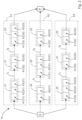
- Figure 2 illustrates three different candidate programs 61-63 for executing one and the same given industrial process 1a that leads from one or more educts E to a product P.
- the educts E are processed into a first intermediate product I 1 by means of service 31 of process module 21.
- this service 31 proceeds from state 41(31) through state 42(31) and finally to state 43(31).
- the first intermediate product I 1 is then processed into a second intermediate product I 2 by means of service 32 of process module 22.
- This service 32 moves through only two states 41(32) and 42(32).
- the second intermediate product I 2 is processed into the final product P by means of service 33 of process module 23.
- This service 33 again has three states 41(33), 42(33) and 43(33) through which it will move until completion.
- the educts E are processed into the first intermediate product I 1 by means of service 31 provided by another process module 24.
- Service 31 has only two states 41(31) and 42(31).
- the first intermediate product I 1 is processed into the second intermediate product I 2 by means of another service 31 provided by another process module 25.
- This service 31 has three states 41(31), 42(31) and 43(31).
- the second intermediate product I 2 is processed into the final product P by means of service 32 provided by process module 22.
- This service 32 has two states 41(32) and 42(32).
- the third candidate program 63 uses a rearrangement of the process modules 21-25. Rather than using service 31 provided by process module 25 to go from the first intermediate product I 1 to the second intermediate product I 2 , another service 32 of this process module 25 having three states 41(32), 42(32) and 43(32) is now used to process the educts E into the first intermediate product I 1 . Like in the first candidate program 61, service 32 of process module 21 having states 41(32) and 42(32) is used for processing the first intermediate product I 1 into the second intermediate product I 2 . Like in the second candidate program 62, service 32 provided by process module 22 is used for processing the second intermediate product I 2 into the final product P.
- the third candidate program 63 comprises
Landscapes
- Engineering & Computer Science (AREA)
- General Engineering & Computer Science (AREA)
- Manufacturing & Machinery (AREA)
- Quality & Reliability (AREA)
- Physics & Mathematics (AREA)
- General Physics & Mathematics (AREA)
- Automation & Control Theory (AREA)
- Management, Administration, Business Operations System, And Electronic Commerce (AREA)
Abstract
A computer-implemented method (100) for optimizing the execution of a given industrial process (1a) on a modular industrial plant (1) comprising a plurality of process modules (21-25) selected from a pool (2) of available process modules, wherein each process module (21-25) is configured to provide one or more services (31-33), the method (100) comprising the steps of:
• providing (110), for each state (41-43) of each service (31-33) provided by each of the available process modules (21-25), a set of resource indicators (51-53), wherein each resource indicator (51-53) is indicative of an amount of a resource that is required and/or produced by virtue of this particular service (31-33) being in this particular state (41-43);
• determining (120), based at least in part on the given industrial process (1a) and on the pool (2) of available process modules, a set of candidate programs (61-69) for execution of the process (1a), wherein each program (61-69) comprises a sequence of states (41-43) of services (31-33) of process modules (21-25) such that:
∘ this sequence accomplishes the given industrial process (1a); and
∘ the resource requirements (51-53) of all services (31-33) in the sequence are fulfilled;
• determining (130), based on the sequence of states (41-43) of services (31-33) and their respective resource indicators (51-53), a set of overall resource requirements (61a-69a) for executing the given industrial process (1a) according to the candidate program (61-69);
• determining (140), based at least in part on said overall resource requirements (61a-69a), a figure of merit (61b-69b) for the candidate program (61-69); and
• determining (150) a candidate program (61-69) with the best figure of merit (61b-69b) as the optimal program (7) for executing the given industrial process (1a).
• providing (110), for each state (41-43) of each service (31-33) provided by each of the available process modules (21-25), a set of resource indicators (51-53), wherein each resource indicator (51-53) is indicative of an amount of a resource that is required and/or produced by virtue of this particular service (31-33) being in this particular state (41-43);
• determining (120), based at least in part on the given industrial process (1a) and on the pool (2) of available process modules, a set of candidate programs (61-69) for execution of the process (1a), wherein each program (61-69) comprises a sequence of states (41-43) of services (31-33) of process modules (21-25) such that:
∘ this sequence accomplishes the given industrial process (1a); and
∘ the resource requirements (51-53) of all services (31-33) in the sequence are fulfilled;
• determining (130), based on the sequence of states (41-43) of services (31-33) and their respective resource indicators (51-53), a set of overall resource requirements (61a-69a) for executing the given industrial process (1a) according to the candidate program (61-69);
• determining (140), based at least in part on said overall resource requirements (61a-69a), a figure of merit (61b-69b) for the candidate program (61-69); and
• determining (150) a candidate program (61-69) with the best figure of merit (61b-69b) as the optimal program (7) for executing the given industrial process (1a).
Description
- The invention relates to the execution of industrial processes on modular process plants that are composed from a pool of available modules.
- Modular process plants allow a plant operator to switch between producing different products. For example, it might take only a few weeks to produce a year's supply of each particular product. In this case, it is not economical in terms of hardware and in terms of space to have a fixed plant for each product. Rather, when switching to manufacturing a new product, the right process modules are picked from a pool of available modules to form a plant that produces this product. This means that some process modules in the pool of available modules might be re-used in multiple different plants. This also means that, depending on the size of the pool of modules, there may be multiple configurations of modules that produce a particular desired product.
- It is therefore the objective of the invention to exploit this flexibility for optimizing the execution of a given process on a modular industrial plant towards a given goal.
- This objective is achieved by a method according to the independent claim. Further advantageous embodiments are detailed in the dependent claims.
- The invention provides a computer-implemented method for optimizing the execution of a given industrial process on a modular industrial plant. The modular industrial plant comprises a plurality of modules selected from a pool of available process modules. Each process module is configured to provide one or more services. A service can be any action that works towards the completion of the process, such as milling, heating or stirring of a substance, or reacting two or more educt substances to form a product substance. A service can also be something that provides a prerequisite for actions that work towards the completion of the process. That is, most services perform some work on a substance or other medium that is part of the process and will eventually go into the final product of the process. But this is not required. For example, a cooling module may provide cooling water to other modules without directly affecting a substance that goes into the final product.
- Each service has a state. In a simple example, the state can be "active" or "inactive". More complex services may involve several stages, and each such stage may correspond to another distinct state of the module. For example, a process module that reacts two educt substances with each other may first fill in batches of the educt substances, heat the mixture to the intended reaction temperature, transition to a state where the exothermic reaction supports itself and requires no further heating, and then proceed to the discharging of the product. The fact that the service is in a particular state manifests itself in the service (and thus the process module) requiring and/or producing different kinds of resources. In a simple analogy, a washing machine has the states of filling, heating, washing, pumping and spinning. In the filling state, the machine draws water from the tap. In the heating state, it draws much electricity from the mains to heat the water. During washing, much less electricity is required because there is mainly the motor for rotating the drum to power, at a low speed. During pumping, the machine emits waste water as a "product". During spinning, waste water is produced as well, and the motor consumes more energy for rotating the drum at high speed.
- The analogy of the washing machine also illustrates that, by modifying the sequence of states, resource consumption may be impacted. Today's washing machines have an energy saver program. In this program, less water is used, meaning that the machine remains in the filling state and in the heating state for a shorter time. But on the other hand, the machine will then remain in the washing state for a much longer time. The analogy also shows that the possibility to modify the sequence of states is limited: in this example, it does not make sense to change the order of the sequence of states.
- Therefore, in the course of the method, for each state of each service provided by each of the available process modules, a set of resource indicators is provided. Each resource indicator is indicative of an amount of a resource that is required and/or produced by virtue of this particular service being in this particular state.
- A resource can be any property or commodity that is required for the service to operate in the particular state. For example, the resource may comprise a state quantity, such as a temperature or a pressure of a medium inputted into the module, an environment temperature at the location of the process module, or a base pressure of a vacuum generated inside the process module. But the resource may also comprise any consumable required by the process module, such as electricity, gas or water.
- For example, if the resource comprises energy, an energy model may be applied to every state of a service. For example, if it is already known how much energy the process module will consume in which state, this energy model may be pre-defined. But there are other ways to determine the energy model. For example, it may be estimated by measuring the energy balance during the process, or in similar processes in similar plants.
- Energy models could be developed manually but could also be created from historical data of already in use process modules. Possibly additional measurements might be required (e.g., electrical meter or temperature sensor) which could be just applied temporarily to retrieve the model. An algorithm could propose where to put these sensors and where to make these measurements to get a good/sufficient energy model. Here, non-invasive measurement methods might be a good fit.
- Energy models can be developed for several procedures of a service (or a single procedure having pre-defined parameter sets). A variant could for example be implemented to save energy, but in turn take longer for a certain task. Then the engineer or a supervisory control system, such as the manufacturing execution system, MES, scheduling system, a process control system, PCS, or a distributed control system, DCS, could decide whether this procedure or the faster one should be used.
- Modeled runs can be compared with the actual monitored process values from the module. The difference between the predicted and the actual values can be used 1) to tune/improve the model and 2) to detect/predict changes in the physical module, e.g., due to aging.
- In case the pipes between the modules influence a commodity exchanged between the modules or a resource indicator, some equation for in between, and/or some way to add this piece to the predecessor or successor module, might even help to fine-tune the modelling. Something like an energy-loss per meter tube with respect to specific tube materials/isolation. For example, if the pipes are long and possibly not insulated, heat from a heated fluid exchanged between modules is lost. Also, if the pipes have a smaller diameter, fluid may flow slower, and/or at a higher pressure, between modules.
- Based at least in part on the given industrial process and on the pool of available process modules, a set of candidate programs for execution of the process is provided. Each such program comprises a sequence of states of services of process modules that meets the following two criteria:
- The sequence accomplishes the given industrial process; and
- the resource requirements of all services in the sequence are fulfilled.
- The first condition depends only on the sequence of states of events itself. The second condition may also depend on the availability of resources on site, such as a maximum amount of electricity or a maximum available cooling power.
- Based on the sequence of states of services and their respective resource indicators, a set of overall resource requirements for executing the given industrial process according to the candidate program is determined. Based at least in part on these overall resource requirements, a figure of merit for the candidate program is determined. For example, different resource requirements may be weighted with respect to one another according to cost and/or scarcity. In particular, the overall resource requirements may be time-dependent. That is, they may indicate how much of particular resources is needed at any one time. In this manner, resource bottlenecks may be identified.
- A candidate program with the best figure of merit is determined as the optimal program for executing the given industrial process.
- Thus, the basic course of action is that, from the given industrial process, one or more time programs of states of particular services needed to execute the industrial process follow. Each such time program has a well-defined set of overall requirements for resources, and this in turn determines the figure of merit that decides which time program, i.e., which candidate program for execution of the process, is optimal.
- It was found that the coupling of process modules for the sake of executing the process has two effects. On the one hand, when adding a new process module, the resource requirements of the new process module come on top of the resource requirements of the already present modules. On the other hand, one module may already produce what the other module needs. For example, if one process module already heats a certain substance up for performing one step of the process, and another step of the process requires the substance to be hot as well, it is beneficial to perform this other step at a time where the substance is still hot, without expending additional energy to re-heat it. Also, if a process module benefits from a warm environment temperature, it should be placed in a plant area where other process modules already generate such a warm environment temperature.
- Such considerations have not been made in the prior art. It has not even be systematically established which resources, and in particular which quantities of which resources, a process module needs when a service provided by the process module is in a particular state.
- Basically, the total set of requirements compiled across the whole process can be understood as a big resource vector with a lot of components, each of which may have a different physical dimension. For each component, a service provides, depending on its state, source and sink terms.
- The optimization problem is a discrete problem because the possible configuration of process modules, as well as services provided by each process module, are discrete. You can have the service, e.g., in state 2 or 3 out of 5, but you cannot have it in state 2.5. Such discrete problems are more difficult to solve than continuous problems because many numerical optimization methods that search for a global optimum cannot be used. There are a number of search strategies that may be applied in the space of discrete configurations of process modules, and thus in the space of candidate programs for execution of the process. However, it is hard to guarantee that a global optimum, rather than a local optimum, will be found. But this is not a problem. Whatever search strategy is used, it can be expected to yield an improvement of at least a few percent in resource efficiency. This is the same order of magnitude as the margin of profit for many processes. This means that said small difference in resource efficiency can already make the difference between profit and loss.
- Apart from arranging that one process module produces or causes what another one needs, one way of optimizing the program for a better figure of merit is to focus the overall resource requirements onto certain resources, and/or on certain times. For example, if one resource is much more abundant than another one, then the process execution may be modified such that more of the abundant resource is used. For example, if natural gas for a heating process in a process module runs scarce, this may be exchanged for a process module that uses oil or electricity as heating energy. Also, resource requirements may be focused on particular times where costs for resources are low. For example, electricity prices may vary greatly during the day based on the difference between supply and demand. To postpone a requirement of a high electricity usage at a time of day where prices are highest, it may, for example, be advantageous to store a product of one process module until a time where electricity is cheaper again.
- If at least one resource is energy, the following exemplary strategies may be applied to improve energy efficiency:
- predict the process energy balance during a specific process operation state;
- suggest coupling of process modules to the engineer in a way that sector coupling and/or heat recovery / heat exchange is achieved; process modules producing heat, for example, by exothermic reaction or similar, are somehow coupled with process modules requiring heat for e.g., heat exchangers. This case would count as "circular economy" in the plant setup and could help achieve plant owners' KPIs in this context (e.g., in a Mission2Zero political campaign, etc.);
- suggest good physical arrangement (E.g., have short ways for heat recovery? Reduce ways according to heat level transferred? Suggest insulation of intermodule connections depending on distance and heat level or other?) of process module instances. This use case allows the involvement of 1) physical models of piping and 2) additional models of the environment, its cooling capacity; and
- suggest heat recovery (or process energy recovery in general) arrangements of the process modules.
- In a particularly advantageous embodiment, at least one resource is a state quantity that relates to the process module, to a medium that is inputted into the process module, and/or to the environment of the process module. An amount of a requirement and/or production of this resource comprises a value of the state quantity. As discussed before, this may be used to bring process modules that need particular values of the state quantity together with process modules that cause these values of the state quantity, such as environment temperature.
- In another particularly advantageous embodiment, at least one resource is a consumable of the industrial process. Notable examples are energy (such as electricity or fuel), water, cooling power, and materials used in the industrial process itself (such as educts of a chemical process).
- Chemical processes are prime examples for application of the present method. Other prime examples are mining operations. Here, the industrial process is the conversion of rock with embedded resources into raw resources, such as ore or coal. The process modules are the many machines that need to work hand in hand in order to make this conversion happen. A similar example is oil and gas production, where a large park of machinery collaborates towards the final product (crude oil, respectively natural gas), as well.
- In a further particularly advantageous embodiment, the determining of overall resource requirements comprises:
- adding requirements of multiple services for at least one resource; and
- subtracting amounts of this resource provided by at least one service to at least one other service.
- In this manner, it can be encouraged that process modules help each other out with resources, rather than requiring that all needed resources be fed into the process from the outside.
- In a further advantageous embodiment, at least one resource indicator is dependent on at least one continuous parameter that characterizes a manner of executing the service. For example, such a parameter may be a process parameter of a chemical reaction. For some process, there is a certain amount of freedom in the space of parameters; within these limits, the parameters may be changed without substantially changing the end result. For example, there may be a certain area in a space spanned by the temperature and the pressure of a chemical reaction such that the result of the reaction remains substantially the same. But the concrete value of temperature and pressure may, for example, impact the speed and the resource consumption. In the example of the washing machine presented above, the amount of water used for the washing process and the duration of the main washing phase define a similar area. Of course, the size of the area is limited. It is neither feasible to wash without any water nor to wait 24 hours for the machine to finish.
- In particular, like in the example of the washing machine, the at least one continuous parameter may determine a balance between a higher speed of executing a service and a lower resource requirement of this service. For example, the speed of a chemical reaction may increase with the temperature, but this increases the energy consumption for heating.
- In a further particularly advantageous embodiment, the determining of a candidate program with the best figure of merit comprises optimizing the at least one continuous parameter to maximize the figure of merit. To this end, any suitable numerical optimization algorithm may be used. For example, a search in the space of the discrete parameters of candidate programs (such as which state to move to next) may be combined with this numerical optimization.
- The figure of merit may be used to express different goals with respect to optimizing the execution of the process, and also to weigh these goals against one another.
- Therefore, in a particularly advantageous embodiment, the figure of merit depends on one or more of:
- a total amount, and/or a total cost, of at least one resource that is needed for executing the industrial process;
- a maximum amount of at least one resource that is needed at any one time during execution of the industrial process;
- a total cost for all resources consumed by execution of the industrial process; and
- a total time for execution of the industrial process.
- One resource that is always consumed when an industrial process is executed is maintenance of the process modules and other hardware. This resource can be seamlessly integrated into the determining of the figure or merit. In this manner, for example, maintenance can be scheduled intelligently, such that the cost is minimized. The maintenance itself cannot be avoided, but part of the cost can.
- In a furher particularly advantageous embodiment, at least one process module comprises at least one further nested process module. In this manner, models for describing the execution of services and the behavior of process modules may be re-used in more instances.
- As discussed above, a search for an optimal figure of merit in a space spanned by discrete parameters and decisions is more difficult than a search in a space spanned by continuous parameters for which many numerical optimization methods are available. But the search in the discrete parameter space may still built on previous experience in order to improve further. To this end, in a further particularly advantageous embodiment, the determining of a set of candidate programs comprises: modifying a previous candidate program such that
- its sequence of states still accomplishes the given industrial process; and
- the resource requirements of all services in the sequence are still fulfilled.
- In particular, a direction in which to modify the candidate program may be determined based at least in part on figures of merit obtained for multiple candidate programs. In this manner, at least a general direction may be established without requiring that the dependency of the figure of merit on the parameters be differentiable.
- In a further particularly advantageous embodiment, physical process modules from the pool of available process modules are linked together according to the optimal program. This forms the modular industrial plant. The given industrial process is executed on the so-obtained modular industrial plant. In this manner, the projected improvement that is reflected in the figure of merit is realized.
- Because it is computer-implemented, the present method may be embodied in the form of a software. The invention therefore also relates to a computer program with machine-readable instructions that, when executed by one or more computers and/or compute instances, cause the one or more computers and/or compute instances to perform the method described above. Examples for compute instances include virtual machines, containers or serverless execution environments in a cloud. The invention also relates to a machine-readable data carrier and/or a download product with the computer program. A download product is a digital product with the computer program that may, e.g., be sold in an online shop for immediate fulfilment and download to one or more computers. The invention also relates to one or more compute instances with the computer program, and/or with the machine-readable data carrier and/or download product.
- In the following, the invention will be described using Figures without any intention to limit the scope of the invention. The Figures show:
-
Figure 1 : Exemplary embodiment of themethod 100 for optimizing the execution of a givenindustrial process 1a; -
Figure 2 : Exemplary illustration of different candidate programs 61-63 for executing one and the sameindustrial process 1a. -
Figure 1 is a schematic flow chart of an exemplary embodiment of themethod 100 for for optimizing the execution of a givenindustrial process 1a on a modularindustrial plant 1. The modularindustrial plant 1 is made of a plurality of process modules 21-25 that are selected from a pool 2 of available process modules. Each process module 21-25 is configured to provide one or more services 31-33. For the sake of readability, the same reference numerals 31-33 are used for the services provided by the different process modules 21-25, even though, e.g., theservice 31 provided byprocess module 21 may do something completely different than theservice 31 provided byprocess module 22. Each service 31-33 has multiple states 41-43 that it can go through while providing the service 31-33. - In
step 110, for each state 41-43 of each service 31-33 provided by each of the available process modules 21-25, a set of resource indicators 51-53 is provided. Each resource indicator 51-53 is indicative of an amount of a resource that is required and/or produced by virtue of this particular service 31-33 being in this particular state 41-43. For example, the "industrial process" 1a of doing the laundry may be performed by a washing machine as thefirst process module 21 and a dryer as thesecond process module 22. The washing machine as thefirst process module 21 may have filling, heating, washing, pumping and spinning as states 41-43. The dryer as thesecond process module 22 may have drying and cooling as states 41-43. - According to block 111, at least one resource indicator 51-53 may be dependent on at least one
continuous parameter 31a-33a that characterizes a manner of executing the service 31-33. According toblock 111a, the at least onecontinuous parameter 31a-33a may then determine a balance between a higher speed of executing a service 31-33 and a lower resource requirement of this service 31-33. In the example of doing the laundry, thecontinuous parameter 31a-33a may be the amount of water that is used. The more water is used, the faster the washing cycle can finish, at the price of using more energy to heat the increased amount of water. The RPM rotation speed of the drum during spinning is another continuous parameter that determines energy consumption of the motor during spinning. - In
step 120, based at least in part on the givenindustrial process 1a and on the pool 2 of available process modules, a set of candidate programs 61-69 for execution of theprocess 1a is determined. Each program 61-69 comprises a sequence of states 41-43 of services 31-33 of process modules 21-25 that accomplishes the givenindustrial process 1a, while at the same time the resource requirements 51-53 of all services 31-33 in the sequence are fulfilled. - In the example of doing the laundry, swapping the order of washing and drying will not successfully accomplish the given
process 1a, because the end result is clean but wet laundry. - In
step 130, based on the sequence of states 41-43 of services 31-33 and their respective resource indicators 51-53, a set ofoverall resource requirements 61a-69a for executing the givenindustrial process 1a according to the candidate program 61-69 is determined. - For example, the process of doing the laundry consumes electricity, water, detergent and time. As discussed above, using less water will also lead to less electricity usage, but more time consumption. Also, in the determining of the
overall resource requirements 61a-69a, interdependencies between services 31-33 come into play. For example, it may be attempted to save some electricity by spinning the motor of the washing machine at a lower RPM speed during the final spinning stage. But then the laundry will be wetter, so the savings will likely be over-compensated by an increased electricity usage of the dryer. - According to block 131, when determining
overall resource requirements 61a-69a, requirements of multiple services 31-33 for at least one resource may be added. According to block 132, amounts of this resource provided by at least one service 31-33 to at least one other service may then be subtracted from the requirement. For example, if the water for the washing machine is pre-heated by solar-thermal panels, then the washing machine will use less electricity for heating the water. - In
step 140, based at least in part on saidoverall resource requirements 61a-69a, a figure ofmerit 61b-69b for the candidate program 61-69 is determined. - According to block 141, the figure of
merit 61b-69b may depend on one or more of: - a total amount, and/or a total cost, of at least one resource that is needed for executing the
industrial process 1a; - a maximum amount of at least one resource that is needed at any one time during execution of the
industrial process 1a; - a total cost for all resources consumed by execution of the
industrial process 1a; and - a total time for execution of the
industrial process 1a. - According to block 121, to obtain a new candidate program 61-69, a previous candidate program 61-69 may be modified such that
- its sequence of states 41-43 still accomplishes the given
industrial process 1a; and - the resource requirements of all services 31-33 in the sequence are still fulfilled.
- According to
block 121a, a direction in which to modify the candidate program 61-69 may then be is determined based at least in part on figures ofmerit 61b-69b obtained for multiple candidate programs 61-69. - In
step 150, a candidate program 61-69 with the best figure ofmerit 61b-69b is determined as theoptimal program 7 for executing the givenindustrial process 1a. - According to block 151, provided that at least one resource indicator 51-53 depends on a
continuous parameter 31a-33a according to block 111, the determining of a candidate program 61-69 with the best figure ofmerit 61b-69b may comprise optimizing the at least onecontinuous parameter 31a-33a to maximize the figure ofmerit 61b-69b. - In the example shown in
Figure 1 , instep 160, physical process modules 21-25 from the pool 2 of available process modules 21-25 are linked together according to theoptimal program 7, so as to form the modularindustrial plant 1. Instep 170, the givenindustrial process 1a is then executed on the so-obtained modularindustrial plant 1. -
Figure 2 illustrates three different candidate programs 61-63 for executing one and the same givenindustrial process 1a that leads from one or more educts E to a product P. - According to the
first candidate program 61, the educts E are processed into a first intermediate product I1 by means ofservice 31 ofprocess module 21. On its way from start to finish, thisservice 31 proceeds from state 41(31) through state 42(31) and finally to state 43(31). The first intermediate product I1 is then processed into a second intermediate product I2 by means ofservice 32 ofprocess module 22. Thisservice 32 moves through only two states 41(32) and 42(32). The second intermediate product I2 is processed into the final product P by means ofservice 33 ofprocess module 23. Thisservice 33 again has three states 41(33), 42(33) and 43(33) through which it will move until completion. - According to the
second candidate program 62, the educts E are processed into the first intermediate product I1 by means ofservice 31 provided by anotherprocess module 24.Service 31 has only two states 41(31) and 42(31). The first intermediate product I1 is processed into the second intermediate product I2 by means of anotherservice 31 provided by anotherprocess module 25. Thisservice 31 has three states 41(31), 42(31) and 43(31). The second intermediate product I2 is processed into the final product P by means ofservice 32 provided byprocess module 22. Thisservice 32 has two states 41(32) and 42(32). - The
third candidate program 63 uses a rearrangement of the process modules 21-25. Rather than usingservice 31 provided byprocess module 25 to go from the first intermediate product I1 to the second intermediate product I2, anotherservice 32 of thisprocess module 25 having three states 41(32), 42(32) and 43(32) is now used to process the educts E into the first intermediate product I1. Like in thefirst candidate program 61,service 32 ofprocess module 21 having states 41(32) and 42(32) is used for processing the first intermediate product I1 into the second intermediate product I2. Like in thesecond candidate program 62,service 32 provided byprocess module 22 is used for processing the second intermediate product I2 into the final product P. Thus, thethird candidate program 63 comprises - an element from the
first candidate program 61, namely the use ofservice 32 ofprocess module 21 to go from I1 to I2; - an element from the
second candidate program 62, namely the use ofservice 32 ofprocess module 22 to go from I2 to P; and - a variation of another element from the
second candidate program 62, namely the use of service 32 (instead of service 31) ofprocess module 25 to go from E to I1 (instead of from I1 to I2). -
- 1
- modular industrial plant
- 1a
- given industrial process
- 2
- pool of available process modules 21-25
- 21-25
- process modules
- 31-33
- services provided by process modules 21-25
- 31a-33a
- continuous parameter of service 31-33
- 41-43
- state of service 31-33
- 51-53
- resource indicators of states 41-43
- 61-69
- candidate programs for executing
industrial process 1a - 61a-69a
- overall resource requirements for candidate programs 61-69
- 61b-69b
- figures of merit for candidate programs 61-69
- 7
- optimal program for executing
process 1a - 100
- method for optimizing execution of
process 1a - 110
- providing resource indicators 51-53
- 111
- considering
continuous parameter 31a-33a - 111a
- choosing
parameter 31a-33a that determines a balance - 120
- determining candidate programs 61-69
- 121
- modifying previous candidate program 61-69
- 121a
- modifying based on previous figures of
merits 61b-69b - 130
- determining
overall resource requirements 61a-69a - 131
- adding requirements of multiple services 31-33
- 132
- subtracting resources provided by other services 31-33
- 140
- determining figures of
merit 61b-69b - 141
- choosing particular figures of
merit 61b-69b - 150
- determining
optimal program 7 - 151
- optimizing
continuous parameter 31a-33a - 160
- linking process modules 21-25 together as per
optimal program 7 - 170
- executing
industrial process 1a on modularindustrial plant 1 - E
- educts of
process 1a - I1, I2
- intermediate products of
process 1a - P
- final product of
process 1a
Claims (15)
- A computer-implemented method (100) for optimizing the execution of a given industrial process (1a) on a modular industrial plant (1) comprising a plurality of process modules (21-25) selected from a pool (2) of available process modules, wherein each process module (21-25) is configured to provide one or more services (31-33), the method (100) comprising the steps of:• providing (110), for each state (41-43) of each service (31-33) provided by each of the available process modules (21-25), a set of resource indicators (51-53), wherein each resource indicator (51-53) is indicative of an amount of a resource that is required and/or produced by virtue of this particular service (31-33) being in this particular state (41-43);• determining (120), based at least in part on the given industrial process (1a) and on the pool (2) of available process modules, a set of candidate programs (61-69) for execution of the process (1a), wherein each program (61-69) comprises a sequence of states (41-43) of services (31-33) of process modules (21-25) such that:∘ this sequence accomplishes the given industrial process (1a); and∘ the resource requirements (51-53) of all services (31-33) in the sequence are fulfilled;• determining (130), based on the sequence of states (41-43) of services (31-33) and their respective resource indicators (51-53), a set of overall resource requirements (61a-69a) for executing the given industrial process (1a) according to the candidate program (61-69);• determining (140), based at least in part on said overall resource requirements (61a-69a), a figure of merit (61b-69b) for the candidate program (61-69); and• determining (150) a candidate program (61-69) with the best figure of merit (61b-69b) as the optimal program (7) for executing the given industrial process (1a).
- The method (100) of claim 1, wherein• at least one resource is a state quantity that relates to the process module (21-25), to a medium that is inputted into the process module (21-25), and/or to the environment of the process module (21-25); and• an amount of a requirement and/or production of this resource comprises a value of the state quantity.
- The method (100) of any one of claims 1 to 2, wherein at least one resource is a consumable of the industrial process (1a).
- The method (100) of any one of claims 1 to 3, wherein the determining (130) of overall resource requirements (61a-69a) comprises• adding (131) requirements of multiple services (31-33) for at least one resource; and• subtracting (132) amounts of this resource provided by at least one service (31-33) to at least one other service.
- The method (100) of any one of claims 1 to 4, wherein at least one resource indicator (51-53) is dependent (111) on at least one continuous parameter (31a-33a) that characterizes a manner of executing the service (31-33).
- The method (100) of claim 5, wherein the at least one continuous parameter (31a-33a) determines (111a) a balance between a higher speed of executing a service (31-33) and a lower resource requirement of this service (31-33).
- The method (100) of any one of claims 5 to 6, wherein the determining of a candidate program (61-69) with the best figure of merit (61b-69b) comprises optimizing (151) the at least one continuous parameter (31a-33a) to maximize the figure of merit (61b-69b).
- The method (100) of any one of claims 1 to 7, wherein the figure of merit (61b-69b) depends (141) on one or more of:• a total amount, and/or a total cost, of at least one resource that is needed for executing the industrial process (1a);• a maximum amount of at least one resource that is needed at any one time during execution of the industrial process (1a);• a total cost for all resources consumed by execution of the industrial process (1a); and• a total time for execution of the industrial process (1a).
- The method (100) of any one of claims 1 to 8, wherein at least one process module (21-25) comprises at least one further nested process module (21-25).
- The method (100) of any one of claims 1 to 9, wherein the determining (120) of a set of candidate programs (61-69) comprises: modifying (121) a previous candidate program (61-69) such that∘ its sequence of states (41-43) still accomplishes the given industrial process (1a); and∘ the resource requirements of all services (31-33) in the sequence are still fulfilled;
- The method (100) of claim 10, wherein a direction in which to modify the candidate program (61-69) is determined (121a) based at least in part on figures of merit (61b-69b) obtained for multiple candidate programs (61-69).
- The method (100) of any one of claims 1 to 11, further comprising:• linking together (160) physical process modules (21-25) from the pool (2) of available process modules (21-25) according to the optimal program (7), so as to form the modular industrial plant (1); and• executing (170) the given industrial process (1a) on the so-obtained modular industrial plant (1).
- One or more computer programs comprising machine-readable instructions that, when executed on one or more computers and/or compute instances, causes the computer and/or compute instances to perform the method (100) of any one of claims 1 to 12.
- A non-transitory machine-readable data carrier and/or a download product with the one or more computer programs of claim 13.
- One or more computers and/or compute instances with the one or more computer programs of claim 13, and/or with the data carrier and/or download product of claim 14.
Priority Applications (3)
| Application Number | Priority Date | Filing Date | Title |
|---|---|---|---|
| EP23162878.5A EP4435543A1 (en) | 2023-03-20 | 2023-03-20 | Optimizing the execution of industrial processes on modular plants |
| US18/606,696 US20240319716A1 (en) | 2023-03-20 | 2024-03-15 | Optimizing the Execution of Industrial Processes on Modular Plants |
| CN202410314787.2A CN118672212A (en) | 2023-03-20 | 2024-03-19 | Optimizing the execution of industrial processes on modular factories |
Applications Claiming Priority (1)
| Application Number | Priority Date | Filing Date | Title |
|---|---|---|---|
| EP23162878.5A EP4435543A1 (en) | 2023-03-20 | 2023-03-20 | Optimizing the execution of industrial processes on modular plants |
Publications (1)
| Publication Number | Publication Date |
|---|---|
| EP4435543A1 true EP4435543A1 (en) | 2024-09-25 |
Family
ID=85724936
Family Applications (1)
| Application Number | Title | Priority Date | Filing Date |
|---|---|---|---|
| EP23162878.5A Pending EP4435543A1 (en) | 2023-03-20 | 2023-03-20 | Optimizing the execution of industrial processes on modular plants |
Country Status (3)
| Country | Link |
|---|---|
| US (1) | US20240319716A1 (en) |
| EP (1) | EP4435543A1 (en) |
| CN (1) | CN118672212A (en) |
Citations (3)
| Publication number | Priority date | Publication date | Assignee | Title |
|---|---|---|---|---|
| US20050154625A1 (en) * | 2004-01-14 | 2005-07-14 | Agency For Science, Technology And Research | Finite capacity scheduling using job prioritization and machine selection |
| US20220121181A1 (en) * | 2019-09-12 | 2022-04-21 | Patrick Sobalvarro | Optimized factory schedule and layout generation |
| US20220164725A1 (en) * | 2020-11-26 | 2022-05-26 | Abb Schweiz Ag | Resource management for modular plants |
Family Cites Families (2)
| Publication number | Priority date | Publication date | Assignee | Title |
|---|---|---|---|---|
| WO2023288088A1 (en) * | 2021-07-16 | 2023-01-19 | Honeywell International Inc. | Apparatus and method for managing industrial process optimization related to batch operations |
| US12613826B2 (en) * | 2023-12-13 | 2026-04-28 | Unifabrix Ltd. | Streamlined CXL memory fabric with lightweight scalable provisioning |
-
2023
- 2023-03-20 EP EP23162878.5A patent/EP4435543A1/en active Pending
-
2024
- 2024-03-15 US US18/606,696 patent/US20240319716A1/en active Pending
- 2024-03-19 CN CN202410314787.2A patent/CN118672212A/en active Pending
Patent Citations (3)
| Publication number | Priority date | Publication date | Assignee | Title |
|---|---|---|---|---|
| US20050154625A1 (en) * | 2004-01-14 | 2005-07-14 | Agency For Science, Technology And Research | Finite capacity scheduling using job prioritization and machine selection |
| US20220121181A1 (en) * | 2019-09-12 | 2022-04-21 | Patrick Sobalvarro | Optimized factory schedule and layout generation |
| US20220164725A1 (en) * | 2020-11-26 | 2022-05-26 | Abb Schweiz Ag | Resource management for modular plants |
Also Published As
| Publication number | Publication date |
|---|---|
| US20240319716A1 (en) | 2024-09-26 |
| CN118672212A (en) | 2024-09-20 |
Similar Documents
| Publication | Publication Date | Title |
|---|---|---|
| Sou et al. | Scheduling smart home appliances using mixed integer linear programming | |
| Merkert et al. | Scheduling and energy–Industrial challenges and opportunities | |
| US20240118683A1 (en) | Module for a technical facility and method for controlling a technical facility | |
| US9649009B2 (en) | Method for controlling a domestic appliance, using smart metering | |
| Petek et al. | Comprehensive approach to increase energy efficiency based on versatile industrial practices | |
| Li et al. | A system-level energy-efficient digital twin framework for runtime control of batch manufacturing processes | |
| EP4435543A1 (en) | Optimizing the execution of industrial processes on modular plants | |
| Fabianova et al. | Operative production planning utilising quantitative forecasting and Monte Carlo simulations | |
| Mhanna et al. | Energy-efficient flexible flow shop scheduling under time-of-use rates with renewable energy sources | |
| US20190219989A1 (en) | Method for monitoring and controlling the energy cost for the production of a product lot | |
| Lei et al. | Extensive concept, state-of-the art developing trends of remanufacturing service | |
| WO2005010783A1 (en) | Improved system and computer software for modelling energy consumption | |
| Ahmad et al. | Model for establishing theoretical targets at the shop floor level in specialty chemicals manufacturing organizations | |
| CN100498608C (en) | Method for effectively improving integral energy consumption of dyeing machine and system for implementing method | |
| JP6237321B2 (en) | Operation plan creation program, operation plan creation method, and operation plan creation device | |
| JP5654690B2 (en) | Control device, integrated circuit, control method, program | |
| Zaidi et al. | Demand response for industrial facilities | |
| Khan et al. | An energy efficient architecture for IoT based automated smart micro-grid | |
| Aghelinejad et al. | Multi-state two-machine permutation flow shop scheduling optimisation with time-dependent energy costs | |
| Najafi-Ghalelou et al. | Solar thermal energy storage for residential sector | |
| Alix et al. | Reconfigurable manufacturing system design: The case of mobile manufacturing system | |
| Jayakumar | Role of Industry 4.0 in energy management systems | |
| JP2019522281A (en) | Method for managing power supply in a computer cluster | |
| Ismayir et al. | Performance Evaluation of a Production Control Architectures for Flexible Manufacturing System | |
| WO2026077518A1 (en) | Energy-optimized operation of modular industrial plants |
Legal Events
| Date | Code | Title | Description |
|---|---|---|---|
| PUAI | Public reference made under article 153(3) epc to a published international application that has entered the european phase |
Free format text: ORIGINAL CODE: 0009012 |
|
| STAA | Information on the status of an ep patent application or granted ep patent |
Free format text: STATUS: THE APPLICATION HAS BEEN PUBLISHED |
|
| AK | Designated contracting states |
Kind code of ref document: A1 Designated state(s): AL AT BE BG CH CY CZ DE DK EE ES FI FR GB GR HR HU IE IS IT LI LT LU LV MC ME MK MT NL NO PL PT RO RS SE SI SK SM TR |
|
| STAA | Information on the status of an ep patent application or granted ep patent |
Free format text: STATUS: REQUEST FOR EXAMINATION WAS MADE |
|
| 17P | Request for examination filed |
Effective date: 20250310 |