EP4435133A1 - Hot-rolled steel for enameling having enameling and firing strengthening property, and manufacturing method therefor - Google Patents
Hot-rolled steel for enameling having enameling and firing strengthening property, and manufacturing method therefor Download PDFInfo
- Publication number
- EP4435133A1 EP4435133A1 EP22894826.1A EP22894826A EP4435133A1 EP 4435133 A1 EP4435133 A1 EP 4435133A1 EP 22894826 A EP22894826 A EP 22894826A EP 4435133 A1 EP4435133 A1 EP 4435133A1
- Authority
- EP
- European Patent Office
- Prior art keywords
- hot
- enameling
- rolled steel
- steel
- enamel
- Prior art date
- Legal status (The legal status is an assumption and is not a legal conclusion. Google has not performed a legal analysis and makes no representation as to the accuracy of the status listed.)
- Pending
Links
Images

Classifications
-
- C—CHEMISTRY; METALLURGY
- C22—METALLURGY; FERROUS OR NON-FERROUS ALLOYS; TREATMENT OF ALLOYS OR NON-FERROUS METALS
- C22C—ALLOYS
- C22C38/00—Ferrous alloys, e.g. steel alloys
- C22C38/18—Ferrous alloys, e.g. steel alloys containing chromium
- C22C38/38—Ferrous alloys, e.g. steel alloys containing chromium with more than 1.5% by weight of manganese
-
- C—CHEMISTRY; METALLURGY
- C21—METALLURGY OF IRON
- C21D—MODIFYING THE PHYSICAL STRUCTURE OF FERROUS METALS; GENERAL DEVICES FOR HEAT TREATMENT OF FERROUS OR NON-FERROUS METALS OR ALLOYS; MAKING METAL MALLEABLE, e.g. BY DECARBURISATION OR TEMPERING
- C21D9/00—Heat treatment, e.g. annealing, hardening, quenching or tempering, adapted for particular articles; Furnaces therefor
- C21D9/46—Heat treatment, e.g. annealing, hardening, quenching or tempering, adapted for particular articles; Furnaces therefor for sheet metals
-
- C—CHEMISTRY; METALLURGY
- C21—METALLURGY OF IRON
- C21D—MODIFYING THE PHYSICAL STRUCTURE OF FERROUS METALS; GENERAL DEVICES FOR HEAT TREATMENT OF FERROUS OR NON-FERROUS METALS OR ALLOYS; MAKING METAL MALLEABLE, e.g. BY DECARBURISATION OR TEMPERING
- C21D1/00—General methods or devices for heat treatment, e.g. annealing, hardening, quenching or tempering
- C21D1/02—Hardening articles or materials formed by forging or rolling, with no further heating beyond that required for the formation
-
- C—CHEMISTRY; METALLURGY
- C21—METALLURGY OF IRON
- C21D—MODIFYING THE PHYSICAL STRUCTURE OF FERROUS METALS; GENERAL DEVICES FOR HEAT TREATMENT OF FERROUS OR NON-FERROUS METALS OR ALLOYS; MAKING METAL MALLEABLE, e.g. BY DECARBURISATION OR TEMPERING
- C21D1/00—General methods or devices for heat treatment, e.g. annealing, hardening, quenching or tempering
- C21D1/18—Hardening; Quenching with or without subsequent tempering
-
- C—CHEMISTRY; METALLURGY
- C21—METALLURGY OF IRON
- C21D—MODIFYING THE PHYSICAL STRUCTURE OF FERROUS METALS; GENERAL DEVICES FOR HEAT TREATMENT OF FERROUS OR NON-FERROUS METALS OR ALLOYS; MAKING METAL MALLEABLE, e.g. BY DECARBURISATION OR TEMPERING
- C21D1/00—General methods or devices for heat treatment, e.g. annealing, hardening, quenching or tempering
- C21D1/84—Controlled slow cooling
-
- C—CHEMISTRY; METALLURGY
- C21—METALLURGY OF IRON
- C21D—MODIFYING THE PHYSICAL STRUCTURE OF FERROUS METALS; GENERAL DEVICES FOR HEAT TREATMENT OF FERROUS OR NON-FERROUS METALS OR ALLOYS; MAKING METAL MALLEABLE, e.g. BY DECARBURISATION OR TEMPERING
- C21D6/00—Heat treatment of ferrous alloys
- C21D6/002—Heat treatment of ferrous alloys containing Cr
-
- C—CHEMISTRY; METALLURGY
- C21—METALLURGY OF IRON
- C21D—MODIFYING THE PHYSICAL STRUCTURE OF FERROUS METALS; GENERAL DEVICES FOR HEAT TREATMENT OF FERROUS OR NON-FERROUS METALS OR ALLOYS; MAKING METAL MALLEABLE, e.g. BY DECARBURISATION OR TEMPERING
- C21D6/00—Heat treatment of ferrous alloys
- C21D6/005—Heat treatment of ferrous alloys containing Mn
-
- C—CHEMISTRY; METALLURGY
- C21—METALLURGY OF IRON
- C21D—MODIFYING THE PHYSICAL STRUCTURE OF FERROUS METALS; GENERAL DEVICES FOR HEAT TREATMENT OF FERROUS OR NON-FERROUS METALS OR ALLOYS; MAKING METAL MALLEABLE, e.g. BY DECARBURISATION OR TEMPERING
- C21D6/00—Heat treatment of ferrous alloys
- C21D6/008—Heat treatment of ferrous alloys containing Si
-
- C—CHEMISTRY; METALLURGY
- C21—METALLURGY OF IRON
- C21D—MODIFYING THE PHYSICAL STRUCTURE OF FERROUS METALS; GENERAL DEVICES FOR HEAT TREATMENT OF FERROUS OR NON-FERROUS METALS OR ALLOYS; MAKING METAL MALLEABLE, e.g. BY DECARBURISATION OR TEMPERING
- C21D7/00—Modifying the physical properties of iron or steel by deformation
- C21D7/02—Modifying the physical properties of iron or steel by deformation by cold working
- C21D7/04—Modifying the physical properties of iron or steel by deformation by cold working of the surface
- C21D7/06—Modifying the physical properties of iron or steel by deformation by cold working of the surface by shot-peening or the like
-
- C—CHEMISTRY; METALLURGY
- C21—METALLURGY OF IRON
- C21D—MODIFYING THE PHYSICAL STRUCTURE OF FERROUS METALS; GENERAL DEVICES FOR HEAT TREATMENT OF FERROUS OR NON-FERROUS METALS OR ALLOYS; MAKING METAL MALLEABLE, e.g. BY DECARBURISATION OR TEMPERING
- C21D8/00—Modifying the physical properties of ferrous metals or ferrous alloys by deformation combined with, or followed by, heat treatment
-
- C—CHEMISTRY; METALLURGY
- C21—METALLURGY OF IRON
- C21D—MODIFYING THE PHYSICAL STRUCTURE OF FERROUS METALS; GENERAL DEVICES FOR HEAT TREATMENT OF FERROUS OR NON-FERROUS METALS OR ALLOYS; MAKING METAL MALLEABLE, e.g. BY DECARBURISATION OR TEMPERING
- C21D8/00—Modifying the physical properties of ferrous metals or ferrous alloys by deformation combined with, or followed by, heat treatment
- C21D8/02—Modifying the physical properties of ferrous metals or ferrous alloys by deformation combined with, or followed by, heat treatment during manufacturing of plates or strips
-
- C—CHEMISTRY; METALLURGY
- C21—METALLURGY OF IRON
- C21D—MODIFYING THE PHYSICAL STRUCTURE OF FERROUS METALS; GENERAL DEVICES FOR HEAT TREATMENT OF FERROUS OR NON-FERROUS METALS OR ALLOYS; MAKING METAL MALLEABLE, e.g. BY DECARBURISATION OR TEMPERING
- C21D8/00—Modifying the physical properties of ferrous metals or ferrous alloys by deformation combined with, or followed by, heat treatment
- C21D8/02—Modifying the physical properties of ferrous metals or ferrous alloys by deformation combined with, or followed by, heat treatment during manufacturing of plates or strips
- C21D8/0221—Modifying the physical properties of ferrous metals or ferrous alloys by deformation combined with, or followed by, heat treatment during manufacturing of plates or strips characterised by the working steps
- C21D8/0226—Hot rolling
-
- C—CHEMISTRY; METALLURGY
- C21—METALLURGY OF IRON
- C21D—MODIFYING THE PHYSICAL STRUCTURE OF FERROUS METALS; GENERAL DEVICES FOR HEAT TREATMENT OF FERROUS OR NON-FERROUS METALS OR ALLOYS; MAKING METAL MALLEABLE, e.g. BY DECARBURISATION OR TEMPERING
- C21D8/00—Modifying the physical properties of ferrous metals or ferrous alloys by deformation combined with, or followed by, heat treatment
- C21D8/02—Modifying the physical properties of ferrous metals or ferrous alloys by deformation combined with, or followed by, heat treatment during manufacturing of plates or strips
- C21D8/0247—Modifying the physical properties of ferrous metals or ferrous alloys by deformation combined with, or followed by, heat treatment during manufacturing of plates or strips characterised by the heat treatment
- C21D8/0263—Modifying the physical properties of ferrous metals or ferrous alloys by deformation combined with, or followed by, heat treatment during manufacturing of plates or strips characterised by the heat treatment following hot rolling
-
- C—CHEMISTRY; METALLURGY
- C21—METALLURGY OF IRON
- C21D—MODIFYING THE PHYSICAL STRUCTURE OF FERROUS METALS; GENERAL DEVICES FOR HEAT TREATMENT OF FERROUS OR NON-FERROUS METALS OR ALLOYS; MAKING METAL MALLEABLE, e.g. BY DECARBURISATION OR TEMPERING
- C21D8/00—Modifying the physical properties of ferrous metals or ferrous alloys by deformation combined with, or followed by, heat treatment
- C21D8/02—Modifying the physical properties of ferrous metals or ferrous alloys by deformation combined with, or followed by, heat treatment during manufacturing of plates or strips
- C21D8/0278—Modifying the physical properties of ferrous metals or ferrous alloys by deformation combined with, or followed by, heat treatment during manufacturing of plates or strips involving a particular surface treatment
-
- C—CHEMISTRY; METALLURGY
- C22—METALLURGY; FERROUS OR NON-FERROUS ALLOYS; TREATMENT OF ALLOYS OR NON-FERROUS METALS
- C22C—ALLOYS
- C22C33/00—Making ferrous alloys
- C22C33/04—Making ferrous alloys by melting
-
- C—CHEMISTRY; METALLURGY
- C22—METALLURGY; FERROUS OR NON-FERROUS ALLOYS; TREATMENT OF ALLOYS OR NON-FERROUS METALS
- C22C—ALLOYS
- C22C38/00—Ferrous alloys, e.g. steel alloys
- C22C38/02—Ferrous alloys, e.g. steel alloys containing silicon
-
- C—CHEMISTRY; METALLURGY
- C22—METALLURGY; FERROUS OR NON-FERROUS ALLOYS; TREATMENT OF ALLOYS OR NON-FERROUS METALS
- C22C—ALLOYS
- C22C38/00—Ferrous alloys, e.g. steel alloys
- C22C38/04—Ferrous alloys, e.g. steel alloys containing manganese
-
- C—CHEMISTRY; METALLURGY
- C22—METALLURGY; FERROUS OR NON-FERROUS ALLOYS; TREATMENT OF ALLOYS OR NON-FERROUS METALS
- C22C—ALLOYS
- C22C38/00—Ferrous alloys, e.g. steel alloys
- C22C38/06—Ferrous alloys, e.g. steel alloys containing aluminium
-
- C—CHEMISTRY; METALLURGY
- C22—METALLURGY; FERROUS OR NON-FERROUS ALLOYS; TREATMENT OF ALLOYS OR NON-FERROUS METALS
- C22C—ALLOYS
- C22C38/00—Ferrous alloys, e.g. steel alloys
- C22C38/18—Ferrous alloys, e.g. steel alloys containing chromium
- C22C38/20—Ferrous alloys, e.g. steel alloys containing chromium with copper
-
- C—CHEMISTRY; METALLURGY
- C22—METALLURGY; FERROUS OR NON-FERROUS ALLOYS; TREATMENT OF ALLOYS OR NON-FERROUS METALS
- C22C—ALLOYS
- C22C38/00—Ferrous alloys, e.g. steel alloys
- C22C38/18—Ferrous alloys, e.g. steel alloys containing chromium
- C22C38/22—Ferrous alloys, e.g. steel alloys containing chromium with molybdenum or tungsten
-
- C—CHEMISTRY; METALLURGY
- C22—METALLURGY; FERROUS OR NON-FERROUS ALLOYS; TREATMENT OF ALLOYS OR NON-FERROUS METALS
- C22C—ALLOYS
- C22C38/00—Ferrous alloys, e.g. steel alloys
- C22C38/18—Ferrous alloys, e.g. steel alloys containing chromium
- C22C38/24—Ferrous alloys, e.g. steel alloys containing chromium with vanadium
-
- C—CHEMISTRY; METALLURGY
- C22—METALLURGY; FERROUS OR NON-FERROUS ALLOYS; TREATMENT OF ALLOYS OR NON-FERROUS METALS
- C22C—ALLOYS
- C22C38/00—Ferrous alloys, e.g. steel alloys
- C22C38/18—Ferrous alloys, e.g. steel alloys containing chromium
- C22C38/28—Ferrous alloys, e.g. steel alloys containing chromium with titanium or zirconium
-
- C—CHEMISTRY; METALLURGY
- C22—METALLURGY; FERROUS OR NON-FERROUS ALLOYS; TREATMENT OF ALLOYS OR NON-FERROUS METALS
- C22C—ALLOYS
- C22C38/00—Ferrous alloys, e.g. steel alloys
- C22C38/18—Ferrous alloys, e.g. steel alloys containing chromium
- C22C38/32—Ferrous alloys, e.g. steel alloys containing chromium with boron
-
- C—CHEMISTRY; METALLURGY
- C23—COATING METALLIC MATERIAL; COATING MATERIAL WITH METALLIC MATERIAL; CHEMICAL SURFACE TREATMENT; DIFFUSION TREATMENT OF METALLIC MATERIAL; COATING BY VACUUM EVAPORATION, BY SPUTTERING, BY ION IMPLANTATION OR BY CHEMICAL VAPOUR DEPOSITION, IN GENERAL; INHIBITING CORROSION OF METALLIC MATERIAL OR INCRUSTATION IN GENERAL
- C23D—ENAMELLING OF, OR APPLYING A VITREOUS LAYER TO, METALS
- C23D5/00—Coating with enamels or vitreous layers
- C23D5/02—Coating with enamels or vitreous layers by wet methods
-
- C—CHEMISTRY; METALLURGY
- C21—METALLURGY OF IRON
- C21D—MODIFYING THE PHYSICAL STRUCTURE OF FERROUS METALS; GENERAL DEVICES FOR HEAT TREATMENT OF FERROUS OR NON-FERROUS METALS OR ALLOYS; MAKING METAL MALLEABLE, e.g. BY DECARBURISATION OR TEMPERING
- C21D2211/00—Microstructure comprising significant phases
- C21D2211/002—Bainite
-
- C—CHEMISTRY; METALLURGY
- C21—METALLURGY OF IRON
- C21D—MODIFYING THE PHYSICAL STRUCTURE OF FERROUS METALS; GENERAL DEVICES FOR HEAT TREATMENT OF FERROUS OR NON-FERROUS METALS OR ALLOYS; MAKING METAL MALLEABLE, e.g. BY DECARBURISATION OR TEMPERING
- C21D2211/00—Microstructure comprising significant phases
- C21D2211/005—Ferrite
-
- C—CHEMISTRY; METALLURGY
- C21—METALLURGY OF IRON
- C21D—MODIFYING THE PHYSICAL STRUCTURE OF FERROUS METALS; GENERAL DEVICES FOR HEAT TREATMENT OF FERROUS OR NON-FERROUS METALS OR ALLOYS; MAKING METAL MALLEABLE, e.g. BY DECARBURISATION OR TEMPERING
- C21D2211/00—Microstructure comprising significant phases
- C21D2211/009—Pearlite
-
- C—CHEMISTRY; METALLURGY
- C23—COATING METALLIC MATERIAL; COATING MATERIAL WITH METALLIC MATERIAL; CHEMICAL SURFACE TREATMENT; DIFFUSION TREATMENT OF METALLIC MATERIAL; COATING BY VACUUM EVAPORATION, BY SPUTTERING, BY ION IMPLANTATION OR BY CHEMICAL VAPOUR DEPOSITION, IN GENERAL; INHIBITING CORROSION OF METALLIC MATERIAL OR INCRUSTATION IN GENERAL
- C23D—ENAMELLING OF, OR APPLYING A VITREOUS LAYER TO, METALS
- C23D5/00—Coating with enamels or vitreous layers
Definitions
- the present disclosure relates to a steel and a method for manufacturing the same, in particular to a hot-rolled steel plate for enameling and a method for manufacturing the same.
- Hot-rolled enameled steel is a composite material made by applying an enamel glaze to the surface of a pretreated hot-rolled steel plate and sintering at high temperature, which has the strength and toughness of a hot-rolled steel plate and the corrosion resistance and easy cleaning characteristics of an enamel glaze.
- the steel plate as a substrate directly affects the quality of enameled steel products. Fish-scaling is one of the most common and serious defects of enameled steel products.
- the fish-scaling defect is mainly caused by hydrogen.
- Hydrogen mainly enters the steel plate in the process of pickling (the metal is dissolved in an acid to produce hydrogen) and enamel firing (the crystalline water contained in the enamel grinding material or the water vapor in the furnace atmosphere reacts with metal to form hydrogen).
- the solubility of hydrogen in the steel decreases and reaches a supersaturated state.
- hydrogen accumulates in the form of a gas between the steel plate and the enamel layer, and thus forms a certain pressure. When the pressure increases to a certain critical value, it will cause fish-scaling defects.
- the final strength of the enameled product depends on the strength of the steel for enameling after high temperature enamel firing.
- the strength of the steel plate will decrease significantly after such high-temperature heat treatment, because the microstructure of the steel plate will experience the reduction of dislocation density, the growth of ferrite grains, and the coarsening of nano-precipitated phases during the high-temperature heat treatment, which will lead to the weakening of dislocation strengthening, fine-grained strengthening, and precipitation strengthening at the same time.
- How to improve the strength of steel plate after high-temperature enamel firing has always been a key research issue in the development field of steel for enameling, and it also has important practical application value.
- the existing patented technology for hot-rolled steel for enameling adopts the design of adding Ti elements in the composition and forms TiC, Ti (C, N) and other precipitated phases with C and N, which serves as hydrogen storage traps and plays the role of precipitation strengthening.
- Chinese patent publication CN101812630A published on August 25, 2010 with a title of "a hot-rolled high-strength enameled steel plate for deep drawing and a manufacturing method thereof" discloses a hot-rolled high-strength enameled steel plate for deep drawing and its manufacturing method, which uses the composition of C: 0.02-0.10%, Si ⁇ 0.10%, Mn: 0.05-1.00%, P ⁇ 0.05%, S: 0.005-0.035%, Al: 0.01-0.10%, N ⁇ 0.015%, Ti ⁇ 0.10% with a balance of iron and unavoidable impurities.
- FIG. 10 Another example is Chinese patent publication CN102181805A, published on September 14, 2011 with a title of "a steel plate for producing water heater liner enameling with thin slab continuous casting and rolling line and a method thereof", which discloses a steel plate for producing water heater liner enameling with thin slab continuous casting and rolling line and a method thereof. It uses the composition of carbon 0.03-0.10, manganese 0.15-0.40, silicon ⁇ 0.06, sulfur 0.004-0.040, phosphorus ⁇ 0.15, aluminum 0.03-0.05, nitrogen 0.002-0.008, titanium 0.02-0.10, and a balance of iron and unavoidable impurities.
- the present disclosure intends to obtain a new hot-rolled steel for enameling having enamel firing strengthening properties, wherein the hot-rolled steel for enameling has low strength and good forming properties in the hot-rolled state, and increased yield strength rather than decreased yield strength after high-temperature enamel firing, thereby effectively improving the strength of the final enameled product.
- One of the objects of the present disclosure is to provide a hot-rolled steel for enameling having enamel firing strengthening properties.
- the hot-rolled enameled steel has low strength and good forming properties in the hot-rolled state. After high-temperature enamel firing, the yield strength of the hot-rolled enameled steel increases through the mechanism of phase change strengthening, so that the strength of the final enameled product is increased and the service life of the enameled product is extended.
- the hot-rolled steel for enameling can be used to prepare products with high yield strength performance requirements after enamel firing at high temperature, such as liners of large-volume water heater, water heater accessories, barbecue grills, etc., and it has very significant application value.
- the present disclosure provides a hot-rolled steel for enameling having enamel firing strengthening properties, which comprises Fe and unavoidable impurities, and further comprises the following chemical elements in mass percentages: C: 0.03-0.07%, Si ⁇ 0.05%, Mn: 1.5-2.5%, Al: 0.01-0.05%, Cr: 0.25-0.65%, Cu: 0.02-0.20%, Ti: 0.01-0.08%, V: 0.01-0.10%, Mo: 0.01-0.10%.
- the hot-rolled steel for enameling of the present disclosure comprises the following chemical elements in mass percentages: C: 0.03-0.07%, Si ⁇ 0.05%, Mn: 1.5-2.5%, Al: 0.01-0.05%, Cr: 0.25-0.65%, Cu: 0.02-0.20%, Ti: 0.01-0.08%, V: 0.01-0.10%, Mo: 0.01-0.10%, with a balance of Fe and unavoidable impurities.
- the addition of the Mn, Mo and Cr elements can significantly improve the stability of supercooled austenite.
- the combination of these three elements allows the occurrence of bainite phase transformation of the steel plate at a lower cooling rate, so as to provide high-strength performance.
- Al in the hot-rolled steel for enameling of the present disclosure, Al is a strong deoxidizing element. It is often required to use Al element for deoxidation in medium and low carbon steel to ensure that the O content in the steel is kept at a low value. Therefore, in the hot-rolled steel for enameling of the present disclosure, the mass percentage of Al is controlled at 0.01-0.05%.
- the addition of an appropriate amount of Cu in the steel is conducive to surface deposition and improves the adhesion between the steel and the enamel glaze, thereby improving the fish-scaling resistance of the steel. Therefore, in the hot-rolled steel for enameling of the present disclosure, the mass percentage of Cu is controlled at 0.02-0.20%.
- Ti, V in the hot-rolled steel for enameling of the present disclosure, the combined addition of Ti and V elements is the main factor that makes the steel have good hydrogen storage properties. They can form fine, diffused TiC and VC precipitated phases under an appropriate controlled cooling process, and these precipitated phases can serve as irreversible hydrogen storage traps and effectively improve the hydrogen storage performance of steel plates, thereby playing the role of enamel fish-scaling resistance. Therefore, comprehensively considering the mechanical performance and the cost of the stee, in the hot-rolled steel for enameling of the present disclosure, the mass percentage of Ti is controlled at 0.01-0.08% and the mass percentage of V is controlled at 0.01-0.10%.
- the hot-rolled steel for enameling of the present disclosure also comprises B: 0.0006-0.003%.
- an appropriate amount of B element may also be preferably added to the hot-rolled steel for enameling.
- B in the hot-rolled steel for enameling of the present disclosure, B has a very low solubility in steel. B mainly combines with the residual nitrogen in steel and precipitates in the form of BN, which can be used as hydrogen storage traps to play the role of enamel fish-scaling resistance. Therefore, in order to achieve the beneficial effects of the B element, in the hot-rolled steel for enameling of the present disclosure, the mass percentage of B is controlled at 0.0006-0.003%.
- each chemical element also satisfies (C-Ti/4 -V/4.25) ⁇ (Mn+Cr)>0.05, wherein each of C, Ti, V, Cr and Mn represents the value of mass percentage of the corresponding element.
- the mass percentage of C, Ti, V, Cr and Mn is further controlled to satisfy: C ⁇ Ti / 4 ⁇ V / 4.25 ⁇ Mn + Cr > 0.05 .
- the steel plate can have the enamel firing strengthening performance. That is, the strength of the steel plate will not decrease, but will increase after high temperature enamel firing.
- the remaining C element and the Mn and Cr elements in the steel can act together after the formation of the precipitated phase of Ti and V, so that after the steel plate is subjected to enamel firing at high temperature and air-cooling, the microstructure is transformed from ferrite + pearlite to ferrite + bainite.
- the steel plate has higher strength properties than that in the hot-rolled state, which is one of the key innovations in the composition design of the present disclosure.
- the microstructure comprises ferrite +pearlite. Further, in the microstructure, the proportion of pearlite is 10-45% by area ratio.
- the hot-rolled steel for enameling of the present disclosure has a ferrite grain size of Grade 8-10.
- the hot-rolled steel for enameling of the present disclosure has a thickness of 1.5-3.5mm.
- the hot-rolled steel for enameling of the present disclosure has a yield strength of 345 ⁇ 389Mpa in the hot-rolled state, and a yield strength of 402 ⁇ 439Mpa after high temperature enamel firing at a temperature in a range of 870 ⁇ 950°C.
- the hot-rolled steel for enameling of the present disclosure has a yield strength 340 ⁇ 400MPa, a tensile strength of 550 ⁇ 630MPa, and an elongation A 50 of 25-35%.
- the hot-rolled enameled steel of the present disclosure has a yield strength 345 ⁇ 390MPa, a tensile strength of 550 ⁇ 630MPa, and an elongation A 50 of 28-35%.
- the present disclosure provides an enameled steel comprising a substrate and an enamel layer on one or two surfaces of the substrate, wherein the elemental composition of the substrate is the same as that of the hot-rolled steel for enameling having enamel firing strengthening properties in any embodiment of the present disclosure.
- the enameled steel has a yield strength of 400 ⁇ 450MPa, a tensile strength of 610 ⁇ 660MPa, an elongation A 50 of ⁇ 18% (such as 18-25%).
- the microstructure of the substrate is ferrite + bainite. Preferably, in the microstructure, the proportion of bainite is 10-40% by area ratio.
- the material used in the enamel layer can be well-known enamel glazes in the art.
- An exemplary material is a high-temperature glaze of FULU EMP6515 type.
- another object of the present disclosure is to provide a simple method for manufacturing the hot-rolled steel for enameling.
- the hot-rolled steel for enameling prepared by the manufacturing method has low strength and good forming performance in the hot-rolled state, and the yield strength of the hot-rolled steel for enameling does not decrease but increases through the mechanism of phase change strengthening after high-temperature enamel firing.
- the present disclosure provides a manufacturing method for the hot-rolled steel for enameling, comprising steps of:
- the hot-rolled process parameters of step (3) and the laminar flow cooling parameters of step (4) are strictly controlled in the present disclosure, and the performance of the hot-rolled steel for enameling of the present disclosure can be ensured by controlled rolling and cooling process.
- the heated casting billet is first rough-rolled into an intermediate billet, and then the obtained intermediate billet is subjected to finish rolling, and the required slab is finally obtained by finish rolling, wherein a rough rolling temperature is controlled at higher than 850°C, an initial finish rolling temperature is controlled at 900 ⁇ 1050°C, and a final finish rolling temperature is controlled at 840 ⁇ 900°C.
- the rough rolling temperature is controlled at 850 ⁇ 1080°C or 880 ⁇ 1080°C.
- step (4) of the present disclosure the steel is water cooled to the coiling temperature under a cooling rate of 10-35 °C/s, and then air cooled to room temperature.
- the present disclousre adopts such a controlled rolling and cooling process, which is conducive to obtaining fine ferrite and pearlite grain structure, so that the steel plate has good processing and forming properties.
- the hot-rolled steel for enameling prepared by the above manufacturing method can be further used to provide an enameled product by one-sided enameling or double-sided enameling.
- the casting step may be in the mode of continuous casting or mold casting, which can ensure that the internal composition of the casting billet is uniform and the surface quality is good.
- the mold casting may also be adopted and the molded ingots also need to be rolled into billets by a primary rolling mill.
- a heating temperature is 1150 ⁇ 1260°C.
- step (5) a coiling temperature is controlled at 550 ⁇ 680°C.
- the coiling temperature is preferably controlled at 550 ⁇ 680°C.
- the steel is not only conducive to the refinement of ferrite grains, but also conducive to the homogenization of TiC and VC precipitated phases in the steel, so as to provide the hot-rolled steel for enameling with excellent mechanical properties and fish-scaling resistance.
- the present disclsoure further provides a method for manufacturing an enameled steel, which comprises a step of manufacturing the hot-rolled steel for enameling by the method according to any embodiment described herein, and a step of enamel firing the obtained hot-rolled steel for enameling.
- the steel in the step of enamel firing, is enamel-fired at 870 ⁇ 950°C for 5 ⁇ 15min.
- it further comprises a shot blasting treatment and other treatments for the hot-rolled steel for enameling before the step of enamel firing.
- enamel firing treatment is carried out by one enamel coating/one firing or two enamel coatings/two firings.
- the manufacturing method of the hot-rolled steel for enameling of the present disclosure has the following advantages and beneficial effects: While the chemical composition is reasonably designed, the present disclosure further combines and optimizes the controlled rolling and cooling process of rapid cooling after rolling, so as to effectively prepare the hot-rolled steel for enameling with excellent properties in the hot-rolled state.
- the manufacturing process is simple and the obtained hot-rolled steel for enameling has lower strength and good forming performance in the hot-rolled state.
- the hot-rolled steel for enameling can have a yield strength that does not decrease but increases through the mechanism of phase change strengthening after high-temperature enamel firing, which can not only improve the strength of enameled products, but also prolong the service life of enameled products.
- the hot-rolled steel for enameling has a yield strength of 345 ⁇ 389MPa in the hot-rolled state. After high-temperature enamel firing in the temperature range of 870 ⁇ 950°C, its yield strength can be increased to 402 ⁇ 439MPa. It can be used to prepare products with high yield strength performance requirements after enamel firing at high temperature, such as liners of large-volume water heater, water heater accessories, barbecue grills, etc., and has very significant application value.
- the hot-rolled steels for enameling of Examples 1-7 according to the present disclosure was prepared by the above steps, and its chemical composition and related process parameters all met the control requirements of the design specification of the present disclosure.
- Table 1 lists the mass percentages of various chemical elements in the hot-rolled steels for enameling of Examples 1-7 and the comparative steels of Comparative Examples 1-2. Table 1 a balance of Fe and other unavoidable impurities) No. C (wt%) Si (wt%) Mn (wt%) Al (wt%) Cr (wt%) Cu (wt%) Ti (wt%) V (wt%) Mo (wt%) B (wt%) M* Ex. 1 0.052 0.008 1.9 0.032 0.53 0.05 0.04 0.04 0.05 - 0.079 Ex. 2 0.057 0.015 1.5 0.03 0.52 0.2 0.05 0.056 0.01 - 0.063 Ex.
- M* (C-Ti/4-V/4.25) ⁇ (Mn+Cr); wherein each of C, Ti, V, Cr and Mn represents the value of mass percentage of the corresponding element.
- Table 2 lists the specific process parameters of the hot-rolled steels for enameling of Examples 1-7 and the control steels of Comparative Examples 1-2.
- Table 2 No. Thickness t (mm) Step (2) Step (3) Step (4) Step (5) Heating temperature (°C) Rough rolling temperature (°C) Initial finish rolling temperature (°C) Final finish rolling temperature (°C) Cooling rate (°C/s) Coiling temperature (°C) Ex. 1 2.5 1230 1050 1000 855 20 610 Ex. 2 1.5 1220 880 910 860 32 680 Ex. 3 2 1230 1060 1020 850 12 560 Ex. 4 3.5 1180 1050 1030 880 12 640 Ex. 5 3 1230 1080 1050 860 25 580 Ex. 6 4 1150 920 960 840 13 600 Ex. 7 2.5 1200 1050 1020 850 30 630 Comp. Ex. 1 2.5 1200 1050 1000 845 10 610 Comp. Ex. 2 1.8 1230 1050 1030 850 15 620
- the hot-rolled steels for enameling in the hot-rolled state of Examples 1-7 and the control steels of Comparative Examples 1-2 were sampled and tested for its performance in the hot-rolled state and the test results were recorded in the following Table 3.
- the test method and technical means for relevant performance were as follows: Tensile test: according to GB/T 228.1-2010 Metallic material-Tensile testing-Method of test at room temperature, the samples were tested by SCL233 room temperature tensile testing machine, wherein the tensile speed was 3mm/min and the tensile specimen was JIS5 tensile specimen, so as to obtain the yield strength, tensile strength and elongation A 50 of the hot-rolled steels of Examples 1-7 and Comparative Examples 1-2.
- the hot-rolled steels for enameling of Examples 1-7 in the hot-rolled state had lower yield strength and good forming performance.
- the yield strength was 345-389MPa
- the tensile strength was 558-625MPa
- a 50 was 28-32%.
- the lower yield strength was conducive to the stamping and cold-bending formation processing of the steel plate in use by the user.
- it can avoid resilience after cold-bending and edge coiling, which was conducive to the welding process.
- the yield strength of the control steels of Comparative Examples 1-2 was higher, which was not conducive to the processing in use by the user.
- the steel plate of each Example and Comparative Example was subjected to wet double-sided enamel coating with a high-temperature glaze of FULU EMP6515 type.
- the enamel firing process was controlled as follows: the enamel firing temperature was controlled at 870 ⁇ 950°C and hold for 10 min, then the steel plates were air cooled to obtain the steel plates of Examples 1-7 and Comparative Examples 1-2 after enameling.
- Examples 1-7 and Comparative Examples 1-2 were all controlled to be subjected to enamel firing at high temperature in the range of 870 ⁇ 950°C and kept for 10 minutes.
- the specific enamel firing temperature of each Example and Comparative Example is listed in Table 4 below. Table 4 No. High temperature enamel firing temperature (°C) Ex. 1 870 Ex. 2 890 Ex. 3 870 Ex. 4 950 Ex. 5 900 Ex. 6 910 Ex. 7 920 Comp. Ex. 1 870 Comp. Ex. 2 870
- Table 5 lists the mechanical property and enameling performance test results of the hot-rolled steels for enameling of Examples 1-7 and the control steels of Comparative Examples 1-2 after enameling. Table 5.
- No. Yield strength (MPa) Tensile strength (MPa) Elongation A 50 (%) Fish-scaling resistance
- Adhesion performance Ex. 1 410 621 20 No fish-scaling good Ex. 2 402 610 22 No fish-scaling good Ex. 3 436 657 18 No fish-scaling good Ex. 4 439 660 19 No fish-scaling good Ex. 5 415 633 20 No fish-scaling good Ex. 6 417 632 19 No fish-scaling good Ex. 7 420 640 20 No fish-scaling good Comp. Ex. 1 396 430 32 No fish-scaling good Comp. Ex.2 300 372 33 Fish-scaling good
- the thickness range of the hot-rolled steels for enameling of Example 1-7 may be between 1.5 mm and 3.5mm, and the strength of the steel plates of Example 1-7 did not decrease but increased after high-temperature enamel firing treatment at a temperature in the range of 870-950 °C. Its yield strength increased to 402 ⁇ 439MPa, the tensile strength increased to 610-660MPa, and the elongation A 50 was 18-22%.
- the finally obtained enameled steel plate of Examples 1-7 was observed after 48 hours, and no fish-scaling phenomenon occurred on the enamel surface. After the drop weight test, the adhesion performance between the steel plate and the glaze layer was excellent, which fully met the use requirements of the users.
- Fig. 1 shows the effect of different enamel firing temperatures on the yield strength performance of the steel of Example 1 of the present disclosure and Comparative Example 1 after enamel firing.
- the yield strength of the steel in Example 1 showed an increasing trend.
- the yield strength may be up to 425MPa.
- the yield strength of the steel in Comparative Example 1 showed a decreasing trend.
- the yield strength of the steel in Comparative Example 1 decreased to 289MPa.
- Fig. 2 shows the metallographic structure of the hot-rolled steel for enameling of Example 1 in a hot-rolled state.
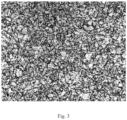
- Fig. 3 shows the metallographic structure of the hot-rolled steel for enameling of Example 1 after it is subjected to high temperature enamel firing at 870°C and kept for 10 min and air-cooled.
- the hot-rolled steel for enameling of Example 1 has a microstructure of ferrite + pearlite, which was transformed into ferrite + bainite after high-temperature enamel firing.
Landscapes
- Chemical & Material Sciences (AREA)
- Engineering & Computer Science (AREA)
- Mechanical Engineering (AREA)
- Materials Engineering (AREA)
- Metallurgy (AREA)
- Organic Chemistry (AREA)
- Crystallography & Structural Chemistry (AREA)
- Physics & Mathematics (AREA)
- Thermal Sciences (AREA)
- Heat Treatment Of Sheet Steel (AREA)
Abstract
Description
- The present disclosure relates to a steel and a method for manufacturing the same, in particular to a hot-rolled steel plate for enameling and a method for manufacturing the same.
- Hot-rolled enameled steel is a composite material made by applying an enamel glaze to the surface of a pretreated hot-rolled steel plate and sintering at high temperature, which has the strength and toughness of a hot-rolled steel plate and the corrosion resistance and easy cleaning characteristics of an enamel glaze.
- It is certain that not all steel plates are suitable for enamel uses, the steel plate as a substrate directly affects the quality of enameled steel products. Fish-scaling is one of the most common and terrible defects of enameled steel products.
- At present, it is believed in relatively mature theory that the fish-scaling defect is mainly caused by hydrogen. Hydrogen mainly enters the steel plate in the process of pickling (the metal is dissolved in an acid to produce hydrogen) and enamel firing (the crystalline water contained in the enamel grinding material or the water vapor in the furnace atmosphere reacts with metal to form hydrogen). As the temperature drops, the solubility of hydrogen in the steel decreases and reaches a supersaturated state. As a result, hydrogen accumulates in the form of a gas between the steel plate and the enamel layer, and thus forms a certain pressure. When the pressure increases to a certain critical value, it will cause fish-scaling defects.
- Therefore, in addition to improving the enamel process, it is also necessary to improve the hydrogen storage performance of the steel plate itself. When the hydrogen storage capacity of the steel plate is strong, the diffusion of hydrogen in the steel plate is slow, and the hydrogen entering the steel plate is less under the same enamel process, and the ability of holding hydrogen after enameling of the steel plate is also strong, which will be conducive to preventing the fish-scaling of enameled products. Grain boundaries, dislocations, holes, inclusions and precipitated phases in steel are all good hydrogen storage traps. For enameled steel, it is necessary to adjust the composition and production process of the steel for different enamel uses to ensure that there are enough hydrogen storage traps in the steel to achieve good fish-scaling resistance.
- In addition, because the enamel sintering process is usually completed by holding at a high temperature above 820 °C for a period of time, the final strength of the enameled product depends on the strength of the steel for enameling after high temperature enamel firing. Under normal circumstances, the strength of the steel plate will decrease significantly after such high-temperature heat treatment, because the microstructure of the steel plate will experience the reduction of dislocation density, the growth of ferrite grains, and the coarsening of nano-precipitated phases during the high-temperature heat treatment, which will lead to the weakening of dislocation strengthening, fine-grained strengthening, and precipitation strengthening at the same time. How to improve the strength of steel plate after high-temperature enamel firing has always been a key research issue in the development field of steel for enameling, and it also has important practical application value.
- In the prior art, the existing patented technology for hot-rolled steel for enameling adopts the design of adding Ti elements in the composition and forms TiC, Ti (C, N) and other precipitated phases with C and N, which serves as hydrogen storage traps and plays the role of precipitation strengthening.
- For example, Chinese patent publication
CN101812630A, published on August 25, 2010 with a title of "a hot-rolled high-strength enameled steel plate for deep drawing and a manufacturing method thereof" discloses a hot-rolled high-strength enameled steel plate for deep drawing and its manufacturing method, which uses the composition of C: 0.02-0.10%, Si≤0.10%, Mn: 0.05-1.00%, P≤0.05%, S: 0.005-0.035%, Al: 0.01-0.10%, N≤0.015%, Ti<0.10% with a balance of iron and unavoidable impurities. - Another example is Chinese patent publication
CN103540845A, published on January 29, 2014 with a title of "a hot-rolled enameled steel sheet having a yield strength of 330MPa grade and a manufacturing method thereof", which also discloses a hot-rolled enameled steel sheet having a composition of C: 0.02-0.07%, Si≤0.05%, Mn: 0.10-0.50%, P≤0.020%, S≤0.010%, Ti: 0.04-0.10% , Al: 0.02-0.08%, N≤0.008%, with a balance of Fe and unavoidable inclusions, and Ti/C=1.0-1.5. - Another example is Chinese patent publication
CN102181805A, published on September 14, 2011 with a title of "a steel plate for producing water heater liner enameling with thin slab continuous casting and rolling line and a method thereof", which discloses a steel plate for producing water heater liner enameling with thin slab continuous casting and rolling line and a method thereof. It uses the composition of carbon 0.03-0.10, manganese 0.15-0.40, silicon ≤ 0.06, sulfur 0.004-0.040, phosphorus ≤ 0.15, aluminum 0.03-0.05, nitrogen 0.002-0.008, titanium 0.02-0.10, and a balance of iron and unavoidable impurities. - However, it should be noted that the above-mentioned technical solutions have a common shortcoming that the yield strength of the enameled steel obtained after high-temperature enamel firing is lower than that of the hot-rolled one.
- Based on the above, with respect to the defects in the above existing technologies, the present disclosure intends to obtain a new hot-rolled steel for enameling having enamel firing strengthening properties, wherein the hot-rolled steel for enameling has low strength and good forming properties in the hot-rolled state, and increased yield strength rather than decreased yield strength after high-temperature enamel firing, thereby effectively improving the strength of the final enameled product.
- One of the objects of the present disclosure is to provide a hot-rolled steel for enameling having enamel firing strengthening properties. The hot-rolled enameled steel has low strength and good forming properties in the hot-rolled state. After high-temperature enamel firing, the yield strength of the hot-rolled enameled steel increases through the mechanism of phase change strengthening, so that the strength of the final enameled product is increased and the service life of the enameled product is extended.
- The hot-rolled steel for enameling can be used to prepare products with high yield strength performance requirements after enamel firing at high temperature, such as liners of large-volume water heater, water heater accessories, barbecue grills, etc., and it has very significant application value.
- In order to realize the above purposes, the present disclosure provides a hot-rolled steel for enameling having enamel firing strengthening properties, which comprises Fe and unavoidable impurities, and further comprises the following chemical elements in mass percentages:
C: 0.03-0.07%, Si≤0.05%, Mn: 1.5-2.5%, Al: 0.01-0.05%, Cr: 0.25-0.65%, Cu: 0.02-0.20%, Ti: 0.01-0.08%, V: 0.01-0.10%, Mo: 0.01-0.10%. - Further, the hot-rolled steel for enameling of the present disclosure comprises the following chemical elements in mass percentages:
C: 0.03-0.07%, Si≤0.05%, Mn: 1.5-2.5%, Al: 0.01-0.05%, Cr: 0.25-0.65%, Cu: 0.02-0.20%, Ti: 0.01-0.08%, V: 0.01-0.10%, Mo: 0.01-0.10%, with a balance of Fe and unavoidable impurities. - For the hot-rolled steel for enameling of the present disclosure, the principles for designing the various chemical elements will be described in detail as follows:
- C: in the hot-rolled steel for enameling of the present disclosure, C is the most basic reinforcement element, which can be solidly dissolved in ferrite or form a pearlite structure under certain conditions, thereby strengthening the matrix structure and improving the yield strength of the steel plate. At the same time, C element can also be combined with strong carbide forming elements such as Ti and V to form a certain number of precipitated phases with a certain size, which can improve the hydrogen storage performance of the steel plate and play the role of enamel fish-scaling resistance. However, it should be noted that the content of C element in the steel should not be too high. When the content of C element in the steel is too high and the proportion of solid dissolved carbon or pearlite structure in the steel is too high, a large amount of CO and other gases will be produced during enamel firing, resulting in poor bubble structure of the enamel layer, and then the occurence of defects such as pinholes and bubbles, which affects the surface quality of the enamel layer. Thus, in the hot-rolled steel for enameling of the present disclosure, the mass percentage of C element is 0.03-0.07%.
- Si: in the hot-rolled steel for enameling of the present disclosure, Si is present as a residual element in steel. When the content of Si in steel is too high, the plasticity of steel will deteriorate. In addition, especially when one enamel coating/one firing process is adopted, higher Si content also affects the adhesion between the steel plate and the enamel glaze. Therefore, considering the adverse effects of Si on the properties of the steel plate, in the hot-rolled steel for enameling of the present disclosure, the mass percentage of Si is controlled to satisfy: Si≤ 0.05%. In some embodiments, the mass percentage of Si element is 0.005-0.05%.
- Mn, Cr: in the hot-rolled steel for enameling of the present disclosure, Mn and Cr are important elements to ensure the high-strength properties of the steel after high-temperature enamel firing. The combination of these two elements allows the bainite phase transformation of the steel plate at a lower cooling rate, thereby improving the strength of the matrix structure. Therefore, in the hot-rolled steel for enameling of the present disclosure, the mass percentage of Mn is controlled at 1.5-2.5%, and the mass percentage of Cr is controlled at 0.25-0.65%.
- Mo: in the hot-rolled steel for enameling of the present disclosure, Mo can solidly dissolve in ferrite, austenite and carbide and play a role in solid solution strengthening, and at the same time, it can also improve the stability of carbides and reduce the coarsening of carbide precipitated phase caused by high-temperature enamel firing, so as to improve the high-temperature stability of the steel. In addition, the addition of an appropriate amount of Mo element to the steel can also promote the phase transformation under the condition of air cooling after the steel plate is subjected to high temperature enamel firing. Therefore, in the hot-rolled steel for enameling of the present disclosure, the mass percentage of Mo is controlled at 0.01-0.10%.
- It should be noted that, in the hot-rolled steel for enameling of the present disclosure, the addition of the Mn, Mo and Cr elements can significantly improve the stability of supercooled austenite. When the steel plate is subjected to enamel firing at high temperature and air-cooled to room temperature, the combination of these three elements allows the occurrence of bainite phase transformation of the steel plate at a lower cooling rate, so as to provide high-strength performance.
- Al: in the hot-rolled steel for enameling of the present disclosure, Al is a strong deoxidizing element. It is often required to use Al element for deoxidation in medium and low carbon steel to ensure that the O content in the steel is kept at a low value. Therefore, in the hot-rolled steel for enameling of the present disclosure, the mass percentage of Al is controlled at 0.01-0.05%.
- Cu: in the hot-rolled steel for enameling of the present disclosure, the addition of an appropriate amount of Cu in the steel is conducive to surface deposition and improves the adhesion between the steel and the enamel glaze, thereby improving the fish-scaling resistance of the steel. Therefore, in the hot-rolled steel for enameling of the present disclosure, the mass percentage of Cu is controlled at 0.02-0.20%.
- Ti, V: in the hot-rolled steel for enameling of the present disclosure, the combined addition of Ti and V elements is the main factor that makes the steel have good hydrogen storage properties. They can form fine, diffused TiC and VC precipitated phases under an appropriate controlled cooling process, and these precipitated phases can serve as irreversible hydrogen storage traps and effectively improve the hydrogen storage performance of steel plates, thereby playing the role of enamel fish-scaling resistance. Therefore, comprehensively considering the mechanical performance and the cost of the stee, in the hot-rolled steel for enameling of the present disclosure, the mass percentage of Ti is controlled at 0.01-0.08% and the mass percentage of V is controlled at 0.01-0.10%.
- Further, the hot-rolled steel for enameling of the present disclosure also comprises B: 0.0006-0.003%.
- In the above technical solution of the present disclosure, in order to achieve better implementing effect, an appropriate amount of B element may also be preferably added to the hot-rolled steel for enameling.
- B: in the hot-rolled steel for enameling of the present disclosure, B has a very low solubility in steel. B mainly combines with the residual nitrogen in steel and precipitates in the form of BN, which can be used as hydrogen storage traps to play the role of enamel fish-scaling resistance. Therefore, in order to achieve the beneficial effects of the B element, in the hot-rolled steel for enameling of the present disclosure, the mass percentage of B is controlled at 0.0006-0.003%.
- Further, in the hot-rolled steel for enameling of the present disclosure, each chemical element also satisfies (C-Ti/4 -V/4.25)×(Mn+Cr)>0.05, wherein each of C, Ti, V, Cr and Mn represents the value of mass percentage of the corresponding element.
- In the hot-rolled steel for enameling of the present disclosure, when the content of a single element is controlled, the mass percentage of C, Ti, V, Cr and Mn is further controlled to satisfy:

- It is found by the inventors through experimental researches that when the contents of C, Ti, V, Cr and Mn in the steel are controlled to meet the above formula, the steel plate can have the enamel firing strengthening performance. That is, the strength of the steel plate will not decrease, but will increase after high temperature enamel firing.
- This is because, when these elements in the steel satisfy this formula, the remaining C element and the Mn and Cr elements in the steel can act together after the formation of the precipitated phase of Ti and V, so that after the steel plate is subjected to enamel firing at high temperature and air-cooling, the microstructure is transformed from ferrite + pearlite to ferrite + bainite. Through this phase transformation strengthening effect, the steel plate has higher strength properties than that in the hot-rolled state, which is one of the key innovations in the composition design of the present disclosure.
- Further, in the hot-rolled steel for enameling of the present disclosure, the microstructure comprises ferrite +pearlite. Further, in the microstructure, the proportion of pearlite is 10-45% by area ratio.
- Further, the hot-rolled steel for enameling of the present disclosure has a ferrite grain size of Grade 8-10.
- Further, the hot-rolled steel for enameling of the present disclosure has a thickness of 1.5-3.5mm.
- Further, the hot-rolled steel for enameling of the present disclosure has a yield strength of 345~389Mpa in the hot-rolled state, and a yield strength of 402~439Mpa after high temperature enamel firing at a temperature in a range of 870~950°C.
- Further, the hot-rolled steel for enameling of the present disclosure has a
yield strength 340~400MPa, a tensile strength of 550~630MPa, and an elongation A50 of 25-35%. In some embodiments, the hot-rolled enameled steel of the present disclosure has a yield strength 345~390MPa, a tensile strength of 550~630MPa, and an elongation A50 of 28-35%. - In some embodiments, the present disclosure provides an enameled steel comprising a substrate and an enamel layer on one or two surfaces of the substrate, wherein the elemental composition of the substrate is the same as that of the hot-rolled steel for enameling having enamel firing strengthening properties in any embodiment of the present disclosure. In some embodiments, the enameled steel has a yield strength of 400~450MPa, a tensile strength of 610~660MPa, an elongation A50 of ≥18% (such as 18-25%). In some embodiments, the microstructure of the substrate is ferrite + bainite. Preferably, in the microstructure, the proportion of bainite is 10-40% by area ratio. The material used in the enamel layer can be well-known enamel glazes in the art. An exemplary material is a high-temperature glaze of FULU EMP6515 type.
- Accordingly, another object of the present disclosure is to provide a simple method for manufacturing the hot-rolled steel for enameling. The hot-rolled steel for enameling prepared by the manufacturing method has low strength and good forming performance in the hot-rolled state, and the yield strength of the hot-rolled steel for enameling does not decrease but increases through the mechanism of phase change strengthening after high-temperature enamel firing.
- To achieve the above purpose, the present disclosure provides a manufacturing method for the hot-rolled steel for enameling, comprising steps of:
- (1) smelting and casting;
- (2) heating;
- (3) hot-rolling: wherein a rough rolling temperature is controlled at more than 850°C, an initial finish rolling temperature is controlled at 900~1050°C, and a final finish rolling temperature is controlled at 840~900°C;
- (4) laminar flow cooling: wherein a cooling rate is controlled at 10~35°C/s;
- (5) coiling.
- In the above technical solution of the present disclosure, in order to obtain a structure with suitable hot-rolled state so as to provide the hot-rolled steel lower strength and higher forming performance, the hot-rolled process parameters of step (3) and the laminar flow cooling parameters of step (4) are strictly controlled in the present disclosure, and the performance of the hot-rolled steel for enameling of the present disclosure can be ensured by controlled rolling and cooling process.
- In the hot-rolling process of step (3) of the present disclosure, the heated casting billet is first rough-rolled into an intermediate billet, and then the obtained intermediate billet is subjected to finish rolling, and the required slab is finally obtained by finish rolling, wherein a rough rolling temperature is controlled at higher than 850°C, an initial finish rolling temperature is controlled at 900~1050°C, and a final finish rolling temperature is controlled at 840~900°C. In some embodiments, the rough rolling temperature is controlled at 850~1080°C or 880~1080°C.
- Correspondingly, in step (4) of the present disclosure, the steel is water cooled to the coiling temperature under a cooling rate of 10-35 °C/s, and then air cooled to room temperature. The present disclousre adopts such a controlled rolling and cooling process, which is conducive to obtaining fine ferrite and pearlite grain structure, so that the steel plate has good processing and forming properties.
- The hot-rolled steel for enameling prepared by the above manufacturing method can be further used to provide an enameled product by one-sided enameling or double-sided enameling.
- It should be noted that, in the above step (1) of the present disclosure, the casting step may be in the mode of continuous casting or mold casting, which can ensure that the internal composition of the casting billet is uniform and the surface quality is good. In some other embodiments, the mold casting may also be adopted and the molded ingots also need to be rolled into billets by a primary rolling mill.
- Further, in the manufacturing method of the present disclosure, in step (2), a heating temperature is 1150~1260°C.
- Further, in the manufacturing method of the present disclosure, in step (5), a coiling temperature is controlled at 550~680°C.
- In the above techncial solution, the coiling temperature is preferably controlled at 550~680°C. When the steel is coiled in this temperature range, it is not only conducive to the refinement of ferrite grains, but also conducive to the homogenization of TiC and VC precipitated phases in the steel, so as to provide the hot-rolled steel for enameling with excellent mechanical properties and fish-scaling resistance.
- In some embodiments, the present disclsoure further provides a method for manufacturing an enameled steel, which comprises a step of manufacturing the hot-rolled steel for enameling by the method according to any embodiment described herein, and a step of enamel firing the obtained hot-rolled steel for enameling. In some embodiments, in the step of enamel firing, the steel is enamel-fired at 870~950°C for 5~15min. In some embodiments, it further comprises a shot blasting treatment and other treatments for the hot-rolled steel for enameling before the step of enamel firing. In some embodiments, enamel firing treatment is carried out by one enamel coating/one firing or two enamel coatings/two firings.
- Compared with the prior art, the manufacturing method of the hot-rolled steel for enameling of the present disclosure has the following advantages and beneficial effects:
While the chemical composition is reasonably designed, the present disclosure further combines and optimizes the controlled rolling and cooling process of rapid cooling after rolling, so as to effectively prepare the hot-rolled steel for enameling with excellent properties in the hot-rolled state. The manufacturing process is simple and the obtained hot-rolled steel for enameling has lower strength and good forming performance in the hot-rolled state. The hot-rolled steel for enameling can have a yield strength that does not decrease but increases through the mechanism of phase change strengthening after high-temperature enamel firing, which can not only improve the strength of enameled products, but also prolong the service life of enameled products. - The hot-rolled steel for enameling has a yield strength of 345~389MPa in the hot-rolled state. After high-temperature enamel firing in the temperature range of 870~950°C, its yield strength can be increased to 402~439MPa. It can be used to prepare products with high yield strength performance requirements after enamel firing at high temperature, such as liners of large-volume water heater, water heater accessories, barbecue grills, etc., and has very significant application value.
-
-
Fig. 1 shows the effect of different enamel firing temperatures on the yield strength performance of the steel of Example 1 of the present disclosure and Comparative Example 1 (Comp. Ex. 1) after enamel firing. -
Fig. 2 shows the metallographic structure of the hot-rolled steel for enameling of Example 1 in a hot-rolled state. -
Fig. 3 shows the metallographic structure of the hot-rolled steel for enameling of Example 1 after it is subjected to high temperature enamel firing at 870°C and kept for 10 min and air-cooled. - The hot-rolled steel for enameling and the manufacturing method therefor will be further interpreted and explained below in combination with specific embodiments and figures, but the interpretation and explanation do not constitute an undue limitation to the technical solution of the present disclosure.
- The hot-rolled steels for enameling of Examples 1-7 and the comparative steels of Comparative Examples 1-2 were prepared by the following steps:
- (1) Smelting and casting were performed according to the chemical compositions shown in Table 1: The molten steel after the completion of smelting was subjected to continuous casting after vacuum degassing treatment to obtain a continuous casting slab.
- (2) heating: the continuous casting slab was heated and the heating temperature was controlled at 1150~1260°C.
- (3) hot-rolling: the rough rolling temperature was controlled at higher than 850°C, the initial finish rolling temperature was controlled at 900~1050°C, and the final finish rolling temperature was controlled at 840~900°C.
- (4) laminar flow cooling: the steel was subjected to laminar flow cooling and the cooling rate was controlled at 10~35°C/s.
- (5) coiling: the coiling temperature was controlled at 550~680°C.
- The hot-rolled steels for enameling of Examples 1-7 according to the present disclosure was prepared by the above steps, and its chemical composition and related process parameters all met the control requirements of the design specification of the present disclosure.
- It should be noted that, different from the above hot-rolled steels for enameling of Examples 1-7, although the comparative steels of Comparative Examples 1-2 were also prepared by the above steps (1)-(5), there were parameters in the chemical composition that did not meet the design requirements of the present disclosure.
- Table 1 lists the mass percentages of various chemical elements in the hot-rolled steels for enameling of Examples 1-7 and the comparative steels of Comparative Examples 1-2.
Table 1 a balance of Fe and other unavoidable impurities) No. C (wt%) Si (wt%) Mn (wt%) Al (wt%) Cr (wt%) Cu (wt%) Ti (wt%) V (wt%) Mo (wt%) B (wt%) M* Ex. 1 0.052 0.008 1.9 0.032 0.53 0.05 0.04 0.04 0.05 - 0.079 Ex. 2 0.057 0.015 1.5 0.03 0.52 0.2 0.05 0.056 0.01 - 0.063 Ex. 3 0.066 0.042 2.5 0.01 0.65 0.16 0.07 0.09 0.045 - 0.086 Ex. 4 0.07 0.035 2.1 0.025 0.39 0.09 0.08 0.06 0.07 0.0015 0.089 Ex. 5 0.04 0.048 2.3 0.05 0.48 0.11 0.045 0.01 0.1 - 0.073 Ex. 6 0.042 0.019 2.2 0.038 0.25 0.02 0.02 0.055 0.053 0.0025 0.059 Ex. 7 0.032 0.026 2.1 0.02 0.6 0.08 0.022 0.025 0.06 0.0008 0.056 Comp. Ex. 1 0.058 0.032 0.32 0.033 0.04 0.06 0.16 - - 0.0018 0.006 Comp. Ex. 2 0.06 0.016 0.65 0.018 0.03 0.01 0.12 - - - 0.020 Note: M*=(C-Ti/4-V/4.25)×(Mn+Cr); wherein each of C, Ti, V, Cr and Mn represents the value of mass percentage of the corresponding element. - Table 2 lists the specific process parameters of the hot-rolled steels for enameling of Examples 1-7 and the control steels of Comparative Examples 1-2.
Table 2 No. Thickness t (mm) Step (2) Step (3) Step (4) Step (5) Heating temperature (°C) Rough rolling temperature (°C) Initial finish rolling temperature (°C) Final finish rolling temperature (°C) Cooling rate (°C/s) Coiling temperature (°C) Ex. 1 2.5 1230 1050 1000 855 20 610 Ex. 2 1.5 1220 880 910 860 32 680 Ex. 3 2 1230 1060 1020 850 12 560 Ex. 4 3.5 1180 1050 1030 880 12 640 Ex. 5 3 1230 1080 1050 860 25 580 Ex. 6 4 1150 920 960 840 13 600 Ex. 7 2.5 1200 1050 1020 850 30 630 Comp. Ex. 1 2.5 1200 1050 1000 845 10 610 Comp. Ex. 2 1.8 1230 1050 1030 850 15 620 - The hot-rolled steels for enameling in the hot-rolled state of Examples 1-7 and the control steels of Comparative Examples 1-2 were sampled and tested for its performance in the hot-rolled state and the test results were recorded in the following Table 3. The test method and technical means for relevant performance were as follows:
Tensile test: according toGB/T 228.1-2010 Table 3 No. Yield strength (MPa) Tensile strength (MPa) Elongation A50 (%) Ex. 1 352 561 30 Ex. 2 345 558 32 Ex. 3 380 606 28 Ex. 4 389 625 28 Ex. 5 376 582 30 Ex. 6 364 570 29 Ex. 7 370 575 31 Comp. Ex. 1 537 594 24 Comp. Ex. 2 456 535 30 - As shown in Table 3, in the present disclosure, the hot-rolled steels for enameling of Examples 1-7 in the hot-rolled state had lower yield strength and good forming performance. The yield strength was 345-389MPa, the tensile strength was 558-625MPa and A50 was 28-32%.
- The lower yield strength was conducive to the stamping and cold-bending formation processing of the steel plate in use by the user. For example, in the processing of the inner barrel body of the water heater, it can avoid resilience after cold-bending and edge coiling, which was conducive to the welding process. Compared with Examples 1-7, the yield strength of the control steels of Comparative Examples 1-2 was higher, which was not conducive to the processing in use by the user.
- In order to further verify the properties of the hot-rolled steels for enameling of Examples 1-7 of the present disclosure and the control steels of Comparative Examples 1-2 after enameling, it is necessary to perform enamel treatment for the steel plate of each Example and Comparative Example:
- The steel plate of each Example and Comparative Example was subjected to wet double-sided enamel coating with a high-temperature glaze of FULU EMP6515 type. The enamel firing process was controlled as follows: the enamel firing temperature was controlled at 870~950°C and hold for 10 min, then the steel plates were air cooled to obtain the steel plates of Examples 1-7 and Comparative Examples 1-2 after enameling.
- It should be noted that, in the present embodiment, Examples 1-7 and Comparative Examples 1-2 were all controlled to be subjected to enamel firing at high temperature in the range of 870~950°C and kept for 10 minutes. In the present disclosure, the specific enamel firing temperature of each Example and Comparative Example is listed in Table 4 below.
Table 4 No. High temperature enamel firing temperature (°C) Ex. 1 870 Ex. 2 890 Ex. 3 870 Ex. 4 950 Ex. 5 900 Ex. 6 910 Ex. 7 920 Comp. Ex. 1 870 Comp. Ex. 2 870 - After the completion of the above high-temperature enameling, the hot-rolled steels for enameling in Examples 1-7 and the control steels of Comparative Examples 1-2 that were treated by high-temperature enameling were further observed, analyzed and tested:
After standing for 48 hours, the steel plates of Examples 1-7 and the steel plates of Comparative Examples 1-2 were observed to determine whether the fish-scaling phenomenon occurs on the surface. The adhesion between the steel plate and the enamel glaze was tested by the drop weight test. The yield strength, tensile strength and elongation A50 of the steel plate in each Example and Comparative Example after enameling were determined by the tensile test, and the results of the test were listed in Table 5. - Table 5 lists the mechanical property and enameling performance test results of the hot-rolled steels for enameling of Examples 1-7 and the control steels of Comparative Examples 1-2 after enameling.
Table 5. No. Yield strength (MPa) Tensile strength (MPa) Elongation A50 (%) Fish-scaling resistance Adhesion performance Ex. 1 410 621 20 No fish-scaling good Ex. 2 402 610 22 No fish-scaling good Ex. 3 436 657 18 No fish-scaling good Ex. 4 439 660 19 No fish-scaling good Ex. 5 415 633 20 No fish-scaling good Ex. 6 417 632 19 No fish-scaling good Ex. 7 420 640 20 No fish-scaling good Comp. Ex. 1 396 430 32 No fish-scaling good Comp. Ex.2 300 372 33 Fish-scaling good - As shown in Table 4 in combination with Table 1-3, it can be seen that the thickness range of the hot-rolled steels for enameling of Example 1-7 may be between 1.5 mm and 3.5mm, and the strength of the steel plates of Example 1-7 did not decrease but increased after high-temperature enamel firing treatment at a temperature in the range of 870-950 °C. Its yield strength increased to 402~439MPa, the tensile strength increased to 610-660MPa, and the elongation A50 was 18-22%.
- The finally obtained enameled steel plate of Examples 1-7 was observed after 48 hours, and no fish-scaling phenomenon occurred on the enamel surface. After the drop weight test, the adhesion performance between the steel plate and the glaze layer was excellent, which fully met the use requirements of the users.
- Correspondingly, the performance of the control steel plates of Comparative Examples 1-2 was significantly worse than the hot-rolled steels for enameling of Examples 1-7. With respect to Comparative Examples 1-2, after high temperature enamel firing, the yield strength of the steels of Comparative Examples 1-2 decreased dramatically. The large decrease in the yield strength of the steel plate before and after enamel firing will lead to problems such as bending and deformation of the steel plate, which was not conducive to the processing and use by the users. At the same time, the fish-scaling defect appeared after Comparative Example 2 was subjected to double-sided enameling, which could not meet the requirements of the fish-scaling resistance of double-sided enameling.
-
Fig. 1 shows the effect of different enamel firing temperatures on the yield strength performance of the steel of Example 1 of the present disclosure and Comparative Example 1 after enamel firing. - As shown in
Fig. 1 , with the increase of the enamel firing temperature, the yield strength of the steel in Example 1 showed an increasing trend. When the enamel firing temperature was 930°C, the yield strength may be up to 425MPa. With the increase of the enamel firing temperature, the yield strength of the steel in Comparative Example 1 showed a decreasing trend. When the enamel firing temperature was 930°C, the yield strength of the steel in Comparative Example 1 decreased to 289MPa. -
Fig. 2 shows the metallographic structure of the hot-rolled steel for enameling of Example 1 in a hot-rolled state. -
Fig. 3 shows the metallographic structure of the hot-rolled steel for enameling of Example 1 after it is subjected to high temperature enamel firing at 870°C and kept for 10 min and air-cooled. - As shown in
Figs. 2 and3 , in the present disclosure, the hot-rolled steel for enameling of Example 1 has a microstructure of ferrite + pearlite, which was transformed into ferrite + bainite after high-temperature enamel firing. - It should be noted that the combination of the technical features in the present disclosure is not limited to the combination described in the claims or the specific embodiments, and all the technical features recorded herein may be freely combined or combined in any way, unless there is a contradiction between them.
- It should also be noted that the examples listed above are only specific embodiments of the present disclosure. Obviously, the present disclosure is not limited to the above embodiments, and similar changes can be made thereby. All the modifications directly derived from the contents disclosed in the present disclosure or easily envisaged by those skilled in the art shall fall within the protection scope of the present disclosure.
Claims (15)
- A hot-rolled steel for enameling having enamel firing strengthening properties, wherein, in addition to Fe and unavoidable impurities, it further comprises the following chemical elements in mass percentages:
C: 0.03-0.07%, Si≤0.05%, Mn: 1.5-2.5%, Al: 0.01-0.05%, Cr: 0.25-0.65%, Cu: 0.02-0.20%, Ti: 0.01-0.08%, V: 0.01-0.10%, Mo: 0.01-0.10%. - The hot-rolled steel for enameling according to claim 1, wherein it comprises the following chemical elements in mass percentages:
C: 0.03-0.07%, Si≤0.05%, Mn: 1.5-2.5%, Al: 0.01-0.05%, Cr: 0.25-0.65%, Cu: 0.02-0.20%, Ti: 0.01-0.08%, V: 0.01-0.10%, Mo: 0.01-0.10%, with a balance of Fe and other unavoidable impurities. - The hot-rolled steel for enameling according to claim 1 or 2, wherein it further comprises B: 0.0006-0.003%.
- The hot-rolled steel for enameling according to claim 1 or 2, wherein each chemical element satisfies: (C-Ti/4-V/4.25)×(Mn+Cr)>0.05; wherein each of C, Ti, V, Cr and Mn represents the value of mass percentage of the corresponding element.
- The hot-rolled steel for enameling according to claim 1 or 2, wherein it has a microstructure of ferrite + pearlite; preferably, the proportion of pearlite is 10-45% by area ratio.
- The hot-rolled steel for enameling according to claim 5, wherein it has a ferrite grain size of Grade 8-10.
- The hot-rolled steel for enameling according to claim 1 or 2, wherein it has a thickness of 1.5-3.5mm.
- The hot-rolled steel for enameling according to claim 1 or 2, wherein it has a yield strength of 345-389MPa in a hot-rolled state, and a yield strength of 402~439Mpa after high temperature enamel firing at a temperature in a range of 870~950°C.
- An enameled steel comprising a substrate and an enamel layer on one or two surfaces of the substrate, wherein the substrate is the hot-rolled steel for enameling according to any of claims 1-8.
- The enameled steel according to claim 9, wherein the enameled steel has a yield strength of 400~450MPa, a tensile strength of 610~660MPa, an elongation A50 of ≥18%; and/or, the substrate has a microstructure of ferrite + bainite; preferably, the proportion of bainite is 10-40% by area ratio.
- A manufacturing method for the hot-rolled steel for enameling according to any of claims 1-8, comprising steps of:(1) smelting and casting;(2) heating;(3) hot-rolling: wherein a rough rolling temperature is controlled at more than 850°C, an initial finish rolling temperature is controlled at 900~1050°C, and a final finish rolling temperature is controlled at 840~900°C;(4) laminar flow cooling: wherein a cooling rate is controlled at 10~35°C/s;(5) coiling.
- The manufacturing method according to claim 9, wherein, in step (2), a heating temperature is 1150~1260°C.
- The manufacturing method according to claim 9, wherein, in step (5), a coiling temperature is controlled at 550~680°C.
- A manufacturing method for the enameled steel according to claim 9 or 10, comprising a step of manufacturing the hot-rolled steel for enameling by the method according to any of claims 11-13, and a step of enamel firing the hot-rolled steel for enameling as a substrate.
- The manufacturing method according to claim 14, wherein, in the step of enamel firing, the steel is enamel-fired at 870~950°C for 5~15min; preferably, it further comprises a shot blasting treatment for the hot-rolled steel for enameling before the step of enamel firing; preferably, the enamel firing treatment is carried out by one enamel coating/one firing or two enamel coatings/two firings.
Applications Claiming Priority (2)
| Application Number | Priority Date | Filing Date | Title |
|---|---|---|---|
| CN202111351890.7A CN116136009B (en) | 2021-11-16 | 2021-11-16 | Hot-rolled enameling steel with enameling strengthening property and manufacturing method thereof |
| PCT/CN2022/132223 WO2023088294A1 (en) | 2021-11-16 | 2022-11-16 | Hot-rolled steel for enameling having enameling and firing strengthening property, and manufacturing method therefor |
Publications (2)
| Publication Number | Publication Date |
|---|---|
| EP4435133A1 true EP4435133A1 (en) | 2024-09-25 |
| EP4435133A4 EP4435133A4 (en) | 2025-07-09 |
Family
ID=86332502
Family Applications (1)
| Application Number | Title | Priority Date | Filing Date |
|---|---|---|---|
| EP22894826.1A Pending EP4435133A4 (en) | 2021-11-16 | 2022-11-16 | Hot-rolled steel for enamelling with enamelling and firing strengthening properties and manufacturing process therefor |
Country Status (5)
| Country | Link |
|---|---|
| US (1) | US20250003040A1 (en) |
| EP (1) | EP4435133A4 (en) |
| CN (1) | CN116136009B (en) |
| MX (1) | MX2024005957A (en) |
| WO (1) | WO2023088294A1 (en) |
Families Citing this family (1)
| Publication number | Priority date | Publication date | Assignee | Title |
|---|---|---|---|---|
| CN114908285B (en) * | 2021-02-09 | 2023-04-11 | 宝山钢铁股份有限公司 | Low-cost hot rolled steel plate for high-temperature enameling and manufacturing method thereof |
Family Cites Families (16)
| Publication number | Priority date | Publication date | Assignee | Title |
|---|---|---|---|---|
| JPS54134017A (en) * | 1978-04-11 | 1979-10-18 | Nippon Steel Corp | Steel plate for enamelling |
| US20030129444A1 (en) * | 2000-11-28 | 2003-07-10 | Saiji Matsuoka | Composite structure type high tensile strength steel plate, plated plate of composite structure type high tensile strength steel and method for their production |
| CN100453678C (en) * | 2005-11-16 | 2009-01-21 | 鞍钢股份有限公司 | A hot-rolled double-sided enamel steel plate and its manufacturing method |
| CN100547104C (en) * | 2006-09-05 | 2009-10-07 | 宝山钢铁股份有限公司 | A hot-rolled high-strength enamel steel plate and its manufacturing method |
| US8236111B2 (en) * | 2006-09-19 | 2012-08-07 | Nippon Steel Corporation | Product for enameling and enameled product |
| JP4937816B2 (en) * | 2007-04-06 | 2012-05-23 | 新日本製鐵株式会社 | Cold rolled steel sheet for enamel processing and method for producing enamel processed product |
| CN101812630B (en) | 2009-02-25 | 2012-02-29 | 宝山钢铁股份有限公司 | Hot-rolling high-strength enamel sheet for deep drawing and manufacturing method thereof |
| CN102181805B (en) | 2011-04-07 | 2012-10-31 | 河北钢铁股份有限公司唐山分公司 | A thin slab continuous casting and rolling line to produce steel plates for water heater inner tank enamel and method |
| CN102758137A (en) * | 2011-04-25 | 2012-10-31 | 宝山钢铁股份有限公司 | Alloy material, enameled steel, manufacturing method thereof, and purpose thereof |
| CN103540845B (en) | 2013-11-07 | 2016-01-20 | 武汉钢铁(集团)公司 | Yield strength is latten Glassed Steel and the manufacture method of 330MPa level |
| US20150267284A1 (en) * | 2014-03-21 | 2015-09-24 | Am/Ns Calvert Llc | Methods for production of highly formable extra deep draw enameling steel -- product and process for manufacture thereof |
| CN105316579B (en) * | 2014-07-29 | 2017-05-24 | 上海梅山钢铁股份有限公司 | Thin hot rolled pickled steel plate and fabrication method thereof for water heater enamel liner |
| CN108396235A (en) * | 2017-02-05 | 2018-08-14 | 鞍钢股份有限公司 | Hot-rolled thick steel plate for enamel matrix and manufacturing method thereof |
| CN108950423B (en) * | 2017-05-27 | 2020-06-23 | 宝山钢铁股份有限公司 | High-strength steel for hot rolling double-sided enamel, double-sided enamel steel and manufacturing method thereof |
| JP6683294B1 (en) * | 2018-05-17 | 2020-04-15 | 日本製鉄株式会社 | Steel plate and enamel products |
| CN111996468B (en) * | 2020-09-18 | 2022-03-01 | 山西太钢不锈钢股份有限公司 | Enamel steel and preparation method and application thereof |
-
2021
- 2021-11-16 CN CN202111351890.7A patent/CN116136009B/en active Active
-
2022
- 2022-11-16 EP EP22894826.1A patent/EP4435133A4/en active Pending
- 2022-11-16 WO PCT/CN2022/132223 patent/WO2023088294A1/en not_active Ceased
- 2022-11-16 US US18/709,077 patent/US20250003040A1/en active Pending
- 2022-11-16 MX MX2024005957A patent/MX2024005957A/en unknown
Also Published As
| Publication number | Publication date |
|---|---|
| US20250003040A1 (en) | 2025-01-02 |
| MX2024005957A (en) | 2024-08-15 |
| WO2023088294A1 (en) | 2023-05-25 |
| CN116136009A (en) | 2023-05-19 |
| CN116136009B (en) | 2025-05-02 |
| EP4435133A4 (en) | 2025-07-09 |
Similar Documents
| Publication | Publication Date | Title |
|---|---|---|
| EP4527965A1 (en) | High-strength and high-plasticity hot-rolled strip steel with high weather resistance and manufacturing method therefor | |
| EP4527966A1 (en) | High-strength hot-rolled strip steel with high weather resistance, and manufacturing method therefor | |
| KR102818967B1 (en) | Ferritic stainless steel sheet | |
| CN110295320A (en) | A kind of big wall thickness X52MS acid-resistant pipeline steel plate and its manufacturing method of the production of LF-RH refinery practice | |
| KR101766550B1 (en) | Lean duplex stainless steel and method for manufacturing the same | |
| CN116949357B (en) | An 850MPa grade environmentally friendly pickling-free low-density high-strength steel and its preparation method | |
| CN118241117B (en) | High corrosion resistance weather-resistant steel, preparation method and application thereof | |
| JP2025527310A (en) | Hot-pressed parts with excellent resistance to low-temperature embrittlement and manufacturing method thereof | |
| KR102877013B1 (en) | Low-cost hot-rolled steel plate for high-temperature enameling and its manufacturing method | |
| US20250003040A1 (en) | Hot-rolled steel for enameling having enameling and firing strengthening property, and manufacturing method therefor | |
| CN107815593A (en) | A kind of economical high-aluminum low-silicon TRIP steel of automobile using and preparation method thereof | |
| CN108660383A (en) | It is a kind of suitable for -100 DEG C without the economical low-temperature steel of nickel, steel pipe, steel plate and its manufacturing method | |
| CN115852245B (en) | A cold-rolled bainite weathering steel and preparation method thereof | |
| CN118726830B (en) | A steel with high surface quality aluminum-coated sheet/strip substrate and yield strength of 300 MPa and its production method. | |
| CN119194288B (en) | Steel coil for photovoltaic bracket and preparation method thereof | |
| CN118726834B (en) | A high surface quality steel suitable for nitriding aluminum-coated sheet substrate and its production method | |
| EP4624619A1 (en) | Glass lined steel having yield strength of 345mpa or above, and manufacturing method therefor | |
| WO2025087223A1 (en) | Hot-rolled steel plate suitable for electrostatic dry powder enamel and having enamel-firing reinforcing performance, and manufacturing method therefor | |
| JP3224732B2 (en) | Cold rolled steel sheet having good aging resistance and method for producing the same | |
| JP2026071285A (en) | Hot-forming steel materials, hot-forming members, and methods for manufacturing the same. | |
| CN120624773A (en) | A steel coil for photovoltaic support and preparation method thereof | |
| CN121759800A (en) | A low-cost, high-hole-expansion-performance duplex steel and its preparation method | |
| CN119553182A (en) | A cold-rolled hot-dip galvanized steel sheet with a tensile strength of 440MPa for stamping | |
| JP3300639B2 (en) | Cold rolled steel sheet excellent in workability and method for producing the same | |
| CN117448704A (en) | Economical 450MPa grade cold-rolled steel resistant to environmental corrosion and production method |
Legal Events
| Date | Code | Title | Description |
|---|---|---|---|
| STAA | Information on the status of an ep patent application or granted ep patent |
Free format text: STATUS: THE INTERNATIONAL PUBLICATION HAS BEEN MADE |
|
| PUAI | Public reference made under article 153(3) epc to a published international application that has entered the european phase |
Free format text: ORIGINAL CODE: 0009012 |
|
| STAA | Information on the status of an ep patent application or granted ep patent |
Free format text: STATUS: REQUEST FOR EXAMINATION WAS MADE |
|
| 17P | Request for examination filed |
Effective date: 20240521 |
|
| AK | Designated contracting states |
Kind code of ref document: A1 Designated state(s): AL AT BE BG CH CY CZ DE DK EE ES FI FR GB GR HR HU IE IS IT LI LT LU LV MC ME MK MT NL NO PL PT RO RS SE SI SK SM TR |
|
| DAV | Request for validation of the european patent (deleted) | ||
| DAX | Request for extension of the european patent (deleted) | ||
| REG | Reference to a national code |
Ref country code: DE Ref legal event code: R079 Free format text: PREVIOUS MAIN CLASS: C22C0038380000 Ipc: C21D0001020000 |
|
| A4 | Supplementary search report drawn up and despatched |
Effective date: 20250605 |
|
| RIC1 | Information provided on ipc code assigned before grant |
Ipc: C23D 5/02 20060101ALI20250602BHEP Ipc: C22C 38/38 20060101ALI20250602BHEP Ipc: C22C 38/32 20060101ALI20250602BHEP Ipc: C22C 38/28 20060101ALI20250602BHEP Ipc: C22C 38/24 20060101ALI20250602BHEP Ipc: C22C 38/22 20060101ALI20250602BHEP Ipc: C22C 38/20 20060101ALI20250602BHEP Ipc: C22C 38/04 20060101ALI20250602BHEP Ipc: C22C 38/02 20060101ALI20250602BHEP Ipc: C21D 9/46 20060101ALI20250602BHEP Ipc: C21D 8/02 20060101ALI20250602BHEP Ipc: C21D 7/06 20060101ALI20250602BHEP Ipc: C21D 6/00 20060101ALI20250602BHEP Ipc: C21D 1/02 20060101AFI20250602BHEP |