EP4434982A1 - (s)-2-(2-methylazetidin-1-yl)pyrimidine derivative and pharmaceutical composition comprising same - Google Patents
(s)-2-(2-methylazetidin-1-yl)pyrimidine derivative and pharmaceutical composition comprising same Download PDFInfo
- Publication number
- EP4434982A1 EP4434982A1 EP22912011.8A EP22912011A EP4434982A1 EP 4434982 A1 EP4434982 A1 EP 4434982A1 EP 22912011 A EP22912011 A EP 22912011A EP 4434982 A1 EP4434982 A1 EP 4434982A1
- Authority
- EP
- European Patent Office
- Prior art keywords
- piperazin
- pyrimidin
- methylazetidin
- difluoro
- dihydro
- Prior art date
- Legal status (The legal status is an assumption and is not a legal conclusion. Google has not performed a legal analysis and makes no representation as to the accuracy of the status listed.)
- Pending
Links
- -1 (s)-2-(2-methylazetidin-1-yl)pyrimidine derivative Chemical class 0.000 title claims abstract description 387
- 239000008194 pharmaceutical composition Substances 0.000 title claims abstract description 30
- 150000001875 compounds Chemical class 0.000 claims abstract description 130
- 150000003839 salts Chemical class 0.000 claims abstract description 49
- 102100023418 Ketohexokinase Human genes 0.000 claims abstract description 47
- 108010062852 Ketohexokinase Proteins 0.000 claims abstract description 47
- 239000004480 active ingredient Substances 0.000 claims abstract description 16
- 230000002401 inhibitory effect Effects 0.000 claims abstract description 10
- 238000000034 method Methods 0.000 claims description 94
- 229910052739 hydrogen Inorganic materials 0.000 claims description 29
- 239000001257 hydrogen Substances 0.000 claims description 29
- 208000030159 metabolic disease Diseases 0.000 claims description 29
- 125000006273 (C1-C3) alkyl group Chemical group 0.000 claims description 28
- 125000005843 halogen group Chemical group 0.000 claims description 25
- 125000000592 heterocycloalkyl group Chemical group 0.000 claims description 25
- 206010012601 diabetes mellitus Diseases 0.000 claims description 23
- 208000008338 non-alcoholic fatty liver disease Diseases 0.000 claims description 21
- 206010053219 non-alcoholic steatohepatitis Diseases 0.000 claims description 21
- 125000004527 pyrimidin-4-yl group Chemical group N1=CN=C(C=C1)* 0.000 claims description 17
- 150000002431 hydrogen Chemical group 0.000 claims description 14
- 125000002947 alkylene group Chemical group 0.000 claims description 13
- 229940119490 Ketohexokinase inhibitor Drugs 0.000 claims description 12
- 208000008589 Obesity Diseases 0.000 claims description 11
- 208000006454 hepatitis Diseases 0.000 claims description 11
- 231100000283 hepatitis Toxicity 0.000 claims description 11
- 235000020824 obesity Nutrition 0.000 claims description 11
- UFHFLCQGNIYNRP-UHFFFAOYSA-N Hydrogen Chemical compound [H][H] UFHFLCQGNIYNRP-UHFFFAOYSA-N 0.000 claims description 10
- 125000001931 aliphatic group Chemical group 0.000 claims description 10
- 125000004122 cyclic group Chemical group 0.000 claims description 10
- 125000001424 substituent group Chemical group 0.000 claims description 10
- 125000002915 carbonyl group Chemical group [*:2]C([*:1])=O 0.000 claims description 9
- 239000000203 mixture Substances 0.000 claims description 9
- 229910052757 nitrogen Inorganic materials 0.000 claims description 9
- IWELDVXSEVIIGI-UHFFFAOYSA-N piperazin-2-one Chemical compound O=C1CNCCN1 IWELDVXSEVIIGI-UHFFFAOYSA-N 0.000 claims description 9
- 208000016097 disease of metabolism Diseases 0.000 claims description 8
- 239000003937 drug carrier Substances 0.000 claims description 7
- 125000002887 hydroxy group Chemical group [H]O* 0.000 claims description 7
- 241000124008 Mammalia Species 0.000 claims description 5
- 125000004435 hydrogen atom Chemical group [H]* 0.000 claims description 5
- 238000002156 mixing Methods 0.000 claims description 5
- 125000004482 piperidin-4-yl group Chemical group N1CCC(CC1)* 0.000 claims description 5
- IKHGUXGNUITLKF-UHFFFAOYSA-N Acetaldehyde Chemical compound CC=O IKHGUXGNUITLKF-UHFFFAOYSA-N 0.000 claims description 4
- 125000004567 azetidin-3-yl group Chemical group N1CC(C1)* 0.000 claims description 4
- 125000004448 alkyl carbonyl group Chemical group 0.000 claims description 3
- 229910052705 radium Inorganic materials 0.000 claims description 3
- 229910052701 rubidium Inorganic materials 0.000 claims description 3
- 229910052727 yttrium Inorganic materials 0.000 claims description 3
- 125000000218 acetic acid group Chemical group C(C)(=O)* 0.000 claims 1
- 239000000126 substance Substances 0.000 abstract description 2
- XEKOWRVHYACXOJ-UHFFFAOYSA-N Ethyl acetate Chemical compound CCOC(C)=O XEKOWRVHYACXOJ-UHFFFAOYSA-N 0.000 description 504
- 238000006243 chemical reaction Methods 0.000 description 300
- 239000000243 solution Substances 0.000 description 278
- 238000005160 1H NMR spectroscopy Methods 0.000 description 270
- YMWUJEATGCHHMB-UHFFFAOYSA-N Dichloromethane Chemical compound ClCCl YMWUJEATGCHHMB-UHFFFAOYSA-N 0.000 description 255
- HEDRZPFGACZZDS-MICDWDOJSA-N Trichloro(2H)methane Chemical compound [2H]C(Cl)(Cl)Cl HEDRZPFGACZZDS-MICDWDOJSA-N 0.000 description 210
- 238000002360 preparation method Methods 0.000 description 187
- VLKZOEOYAKHREP-UHFFFAOYSA-N n-Hexane Chemical compound CCCCCC VLKZOEOYAKHREP-UHFFFAOYSA-N 0.000 description 177
- 238000004458 analytical method Methods 0.000 description 134
- 239000000706 filtrate Substances 0.000 description 125
- CSNNHWWHGAXBCP-UHFFFAOYSA-L Magnesium sulfate Chemical compound [Mg+2].[O-][S+2]([O-])([O-])[O-] CSNNHWWHGAXBCP-UHFFFAOYSA-L 0.000 description 123
- 239000012044 organic layer Substances 0.000 description 123
- FAPWRFPIFSIZLT-UHFFFAOYSA-M Sodium chloride Chemical compound [Na+].[Cl-] FAPWRFPIFSIZLT-UHFFFAOYSA-M 0.000 description 110
- 238000004440 column chromatography Methods 0.000 description 102
- 238000003756 stirring Methods 0.000 description 97
- 239000012141 concentrate Substances 0.000 description 87
- 230000015572 biosynthetic process Effects 0.000 description 83
- 238000003786 synthesis reaction Methods 0.000 description 83
- OKKJLVBELUTLKV-UHFFFAOYSA-N Methanol Chemical compound OC OKKJLVBELUTLKV-UHFFFAOYSA-N 0.000 description 63
- XLYOFNOQVPJJNP-UHFFFAOYSA-N water Substances O XLYOFNOQVPJJNP-UHFFFAOYSA-N 0.000 description 54
- 239000011780 sodium chloride Substances 0.000 description 46
- WEVYAHXRMPXWCK-UHFFFAOYSA-N Acetonitrile Chemical compound CC#N WEVYAHXRMPXWCK-UHFFFAOYSA-N 0.000 description 45
- VEXZGXHMUGYJMC-UHFFFAOYSA-N Hydrochloric acid Chemical compound Cl VEXZGXHMUGYJMC-UHFFFAOYSA-N 0.000 description 38
- ZMXDDKWLCZADIW-UHFFFAOYSA-N N,N-Dimethylformamide Chemical compound CN(C)C=O ZMXDDKWLCZADIW-UHFFFAOYSA-N 0.000 description 36
- UIIMBOGNXHQVGW-UHFFFAOYSA-M Sodium bicarbonate Chemical class [Na+].OC([O-])=O UIIMBOGNXHQVGW-UHFFFAOYSA-M 0.000 description 36
- BWHMMNNQKKPAPP-UHFFFAOYSA-L potassium carbonate Chemical compound [K+].[K+].[O-]C([O-])=O BWHMMNNQKKPAPP-UHFFFAOYSA-L 0.000 description 36
- QTBSBXVTEAMEQO-UHFFFAOYSA-N Acetic acid Chemical compound CC(O)=O QTBSBXVTEAMEQO-UHFFFAOYSA-N 0.000 description 33
- 229920006395 saturated elastomer Polymers 0.000 description 31
- ZMANZCXQSJIPKH-UHFFFAOYSA-N Triethylamine Chemical compound CCN(CC)CC ZMANZCXQSJIPKH-UHFFFAOYSA-N 0.000 description 30
- AFVFQIVMOAPDHO-UHFFFAOYSA-N Methanesulfonic acid Chemical compound CS(O)(=O)=O AFVFQIVMOAPDHO-UHFFFAOYSA-N 0.000 description 28
- DTQVDTLACAAQTR-UHFFFAOYSA-N Trifluoroacetic acid Chemical compound OC(=O)C(F)(F)F DTQVDTLACAAQTR-UHFFFAOYSA-N 0.000 description 28
- 125000000999 tert-butyl group Chemical group [H]C([H])([H])C(*)(C([H])([H])[H])C([H])([H])[H] 0.000 description 28
- DLBWPRNUXWYLRN-BYPYZUCNSA-N (2s)-2-methylazetidine Chemical compound C[C@H]1CCN1 DLBWPRNUXWYLRN-BYPYZUCNSA-N 0.000 description 25
- 125000002777 acetyl group Chemical group [H]C([H])([H])C(*)=O 0.000 description 22
- CDBYLPFSWZWCQE-UHFFFAOYSA-L Sodium Carbonate Chemical compound [Na+].[Na+].[O-]C([O-])=O CDBYLPFSWZWCQE-UHFFFAOYSA-L 0.000 description 21
- ZUVZPMDOVWOBTL-UHFFFAOYSA-N ClC=1C2=C(N=C(N1)SC)C(CC2)(F)F Chemical compound ClC=1C2=C(N=C(N1)SC)C(CC2)(F)F ZUVZPMDOVWOBTL-UHFFFAOYSA-N 0.000 description 19
- OKKJLVBELUTLKV-MZCSYVLQSA-N Deuterated methanol Chemical compound [2H]OC([2H])([2H])[2H] OKKJLVBELUTLKV-MZCSYVLQSA-N 0.000 description 18
- 238000000605 extraction Methods 0.000 description 18
- 229910000027 potassium carbonate Inorganic materials 0.000 description 18
- LFJTTZCBJLCUIV-UHFFFAOYSA-N tert-butyl 4-(2-bromoacetyl)piperazine-1-carboxylate Chemical compound CC(C)(C)OC(=O)N1CCN(C(=O)CBr)CC1 LFJTTZCBJLCUIV-UHFFFAOYSA-N 0.000 description 18
- XQIQBLXIEZUUQN-UHFFFAOYSA-N ClC=1C2=C(N=C(N1)S(=O)(=O)C)C(CC2)(F)F Chemical compound ClC=1C2=C(N=C(N1)S(=O)(=O)C)C(CC2)(F)F XQIQBLXIEZUUQN-UHFFFAOYSA-N 0.000 description 16
- JGFZNNIVVJXRND-UHFFFAOYSA-N N,N-Diisopropylethylamine (DIPEA) Chemical compound CCN(C(C)C)C(C)C JGFZNNIVVJXRND-UHFFFAOYSA-N 0.000 description 16
- 125000001797 benzyl group Chemical group [H]C1=C([H])C([H])=C(C([H])=C1[H])C([H])([H])* 0.000 description 16
- CBHOOMGKXCMKIR-UHFFFAOYSA-N azane;methanol Chemical compound N.OC CBHOOMGKXCMKIR-UHFFFAOYSA-N 0.000 description 14
- CWXPZXBSDSIRCS-UHFFFAOYSA-N tert-butyl piperazine-1-carboxylate Chemical compound CC(C)(C)OC(=O)N1CCNCC1 CWXPZXBSDSIRCS-UHFFFAOYSA-N 0.000 description 14
- RYHBNJHYFVUHQT-UHFFFAOYSA-N 1,4-Dioxane Chemical compound C1COCCO1 RYHBNJHYFVUHQT-UHFFFAOYSA-N 0.000 description 12
- IAZDPXIOMUYVGZ-WFGJKAKNSA-N Dimethyl sulfoxide Chemical compound [2H]C([2H])([2H])S(=O)C([2H])([2H])[2H] IAZDPXIOMUYVGZ-WFGJKAKNSA-N 0.000 description 12
- WYURNTSHIVDZCO-UHFFFAOYSA-N Tetrahydrofuran Chemical compound C1CCOC1 WYURNTSHIVDZCO-UHFFFAOYSA-N 0.000 description 12
- HTZCNXWZYVXIMZ-UHFFFAOYSA-M benzyl(triethyl)azanium;chloride Chemical compound [Cl-].CC[N+](CC)(CC)CC1=CC=CC=C1 HTZCNXWZYVXIMZ-UHFFFAOYSA-M 0.000 description 12
- XHXFXVLFKHQFAL-UHFFFAOYSA-N phosphoryl trichloride Chemical compound ClP(Cl)(Cl)=O XHXFXVLFKHQFAL-UHFFFAOYSA-N 0.000 description 12
- 235000011054 acetic acid Nutrition 0.000 description 11
- 238000004949 mass spectrometry Methods 0.000 description 11
- 230000000694 effects Effects 0.000 description 10
- 229910000029 sodium carbonate Inorganic materials 0.000 description 10
- AKHNMLFCWUSKQB-UHFFFAOYSA-L sodium thiosulfate Chemical class [Na+].[Na+].[O-]S([O-])(=O)=S AKHNMLFCWUSKQB-UHFFFAOYSA-L 0.000 description 10
- NHQDETIJWKXCTC-UHFFFAOYSA-N 3-chloroperbenzoic acid Chemical compound OOC(=O)C1=CC=CC(Cl)=C1 NHQDETIJWKXCTC-UHFFFAOYSA-N 0.000 description 9
- SPXQHAXDCYYVFX-UHFFFAOYSA-N 4,5-dichloro-2-methylsulfanyl-6-(trifluoromethyl)pyrimidine Chemical compound CSC1=NC(Cl)=C(Cl)C(C(F)(F)F)=N1 SPXQHAXDCYYVFX-UHFFFAOYSA-N 0.000 description 9
- 238000000746 purification Methods 0.000 description 9
- FPMMELFOLPHKFK-UHFFFAOYSA-N 5-O-tert-butyl 1-O-ethyl 2,2-difluoropentanedioate Chemical compound CCOC(=O)C(F)(F)CCC(=O)OC(C)(C)C FPMMELFOLPHKFK-UHFFFAOYSA-N 0.000 description 8
- WUJSIXQPDRHPMB-UHFFFAOYSA-N 5-ethoxy-4,4-difluoro-5-oxopentanoic acid Chemical compound C(C)OC(C(CCC(=O)O)(F)F)=O WUJSIXQPDRHPMB-UHFFFAOYSA-N 0.000 description 8
- UQUPQEUNHVVNKW-UHFFFAOYSA-N azetidin-1-ium-3-ol;chloride Chemical compound Cl.OC1CNC1 UQUPQEUNHVVNKW-UHFFFAOYSA-N 0.000 description 8
- 125000002496 methyl group Chemical group [H]C([H])([H])* 0.000 description 8
- NFHFRUOZVGFOOS-UHFFFAOYSA-N palladium;triphenylphosphane Chemical compound [Pd].C1=CC=CC=C1P(C=1C=CC=CC=1)C1=CC=CC=C1.C1=CC=CC=C1P(C=1C=CC=CC=1)C1=CC=CC=C1.C1=CC=CC=C1P(C=1C=CC=CC=1)C1=CC=CC=C1.C1=CC=CC=C1P(C=1C=CC=CC=1)C1=CC=CC=C1 NFHFRUOZVGFOOS-UHFFFAOYSA-N 0.000 description 8
- NLXLAEXVIDQMFP-UHFFFAOYSA-N Ammonia chloride Chemical compound [NH4+].[Cl-] NLXLAEXVIDQMFP-UHFFFAOYSA-N 0.000 description 7
- 238000007872 degassing Methods 0.000 description 7
- 238000005259 measurement Methods 0.000 description 7
- OKKJLVBELUTLKV-VMNATFBRSA-N methanol-d1 Chemical compound [2H]OC OKKJLVBELUTLKV-VMNATFBRSA-N 0.000 description 7
- 125000000472 sulfonyl group Chemical group *S(*)(=O)=O 0.000 description 7
- YLQBMQCUIZJEEH-UHFFFAOYSA-N tetrahydrofuran Natural products C=1C=COC=1 YLQBMQCUIZJEEH-UHFFFAOYSA-N 0.000 description 7
- CRRPNEOISALFQW-UHFFFAOYSA-N CCOC(C(CCCO)(F)F)=O Chemical compound CCOC(C(CCCO)(F)F)=O CRRPNEOISALFQW-UHFFFAOYSA-N 0.000 description 6
- SCVFZCLFOSHCOH-UHFFFAOYSA-M potassium acetate Chemical compound [K+].CC([O-])=O SCVFZCLFOSHCOH-UHFFFAOYSA-M 0.000 description 6
- SCYULBFZEHDVBN-UHFFFAOYSA-N 1,1-Dichloroethane Chemical compound CC(Cl)Cl SCYULBFZEHDVBN-UHFFFAOYSA-N 0.000 description 5
- ZTNFYAJHLPMNSN-UHFFFAOYSA-N 2,4-dichloro-6-(trifluoromethyl)pyrimidine Chemical compound FC(F)(F)C1=CC(Cl)=NC(Cl)=N1 ZTNFYAJHLPMNSN-UHFFFAOYSA-N 0.000 description 5
- 229930091371 Fructose Natural products 0.000 description 5
- 239000005715 Fructose Substances 0.000 description 5
- RFSUNEUAIZKAJO-ARQDHWQXSA-N Fructose Chemical compound OC[C@H]1O[C@](O)(CO)[C@@H](O)[C@@H]1O RFSUNEUAIZKAJO-ARQDHWQXSA-N 0.000 description 5
- KEAYESYHFKHZAL-UHFFFAOYSA-N Sodium Chemical compound [Na] KEAYESYHFKHZAL-UHFFFAOYSA-N 0.000 description 5
- 125000000217 alkyl group Chemical group 0.000 description 5
- SNRCKKQHDUIRIY-UHFFFAOYSA-L cyclopenta-1,4-dien-1-yl(diphenyl)phosphane;dichloromethane;dichloropalladium;iron(2+) Chemical compound [Fe+2].ClCCl.Cl[Pd]Cl.C1=C[CH-]C(P(C=2C=CC=CC=2)C=2C=CC=CC=2)=C1.C1=C[CH-]C(P(C=2C=CC=CC=2)C=2C=CC=CC=2)=C1 SNRCKKQHDUIRIY-UHFFFAOYSA-L 0.000 description 5
- 239000003085 diluting agent Substances 0.000 description 5
- 201000010099 disease Diseases 0.000 description 5
- 208000037265 diseases, disorders, signs and symptoms Diseases 0.000 description 5
- 239000000047 product Substances 0.000 description 5
- 239000012312 sodium hydride Substances 0.000 description 5
- 229910000104 sodium hydride Inorganic materials 0.000 description 5
- 238000010189 synthetic method Methods 0.000 description 5
- PAQZWJGSJMLPMG-UHFFFAOYSA-N 2,4,6-tripropyl-1,3,5,2$l^{5},4$l^{5},6$l^{5}-trioxatriphosphinane 2,4,6-trioxide Chemical compound CCCP1(=O)OP(=O)(CCC)OP(=O)(CCC)O1 PAQZWJGSJMLPMG-UHFFFAOYSA-N 0.000 description 4
- IFRPHIQLGFZWKZ-UHFFFAOYSA-N 4-chloro-8,8-difluoro-2-methylsulfanyl-6,7-dihydro-5H-quinazoline Chemical compound CSC1=NC2=C(CCCC2(F)F)C(=N1)Cl IFRPHIQLGFZWKZ-UHFFFAOYSA-N 0.000 description 4
- LQYHVMXPPNMSCM-UHFFFAOYSA-N 7,7-difluoro-2-methylsulfanyl-5,6-dihydro-3H-cyclopenta[d]pyrimidin-4-one Chemical compound FC1(CCC2=C1N=C(N=C2O)SC)F LQYHVMXPPNMSCM-UHFFFAOYSA-N 0.000 description 4
- NGQNMEBYBUQRTG-UHFFFAOYSA-N CCOC(C(CCCOS(C)(=O)=O)(F)F)=O Chemical compound CCOC(C(CCCOS(C)(=O)=O)(F)F)=O NGQNMEBYBUQRTG-UHFFFAOYSA-N 0.000 description 4
- XTHFKEDIFFGKHM-UHFFFAOYSA-N Dimethoxyethane Chemical compound COCCOC XTHFKEDIFFGKHM-UHFFFAOYSA-N 0.000 description 4
- IAZDPXIOMUYVGZ-UHFFFAOYSA-N Dimethylsulphoxide Chemical compound CS(C)=O IAZDPXIOMUYVGZ-UHFFFAOYSA-N 0.000 description 4
- JRNVZBWKYDBUCA-UHFFFAOYSA-N N-chlorosuccinimide Chemical compound ClN1C(=O)CCC1=O JRNVZBWKYDBUCA-UHFFFAOYSA-N 0.000 description 4
- CZPWVGJYEJSRLH-UHFFFAOYSA-N Pyrimidine Chemical compound C1=CN=CN=C1 CZPWVGJYEJSRLH-UHFFFAOYSA-N 0.000 description 4
- 150000003863 ammonium salts Chemical class 0.000 description 4
- 150000001805 chlorine compounds Chemical class 0.000 description 4
- BCAZPZIWHSVWKB-UHFFFAOYSA-N diethyl 2,2-difluorohexanedioate Chemical compound CCOC(=O)CCCC(F)(F)C(=O)OCC BCAZPZIWHSVWKB-UHFFFAOYSA-N 0.000 description 4
- WSQORLAUCBRAJH-UHFFFAOYSA-N ethyl 5-cyano-2,2-difluoropentanoate Chemical compound CCOC(=O)C(F)(F)CCCC#N WSQORLAUCBRAJH-UHFFFAOYSA-N 0.000 description 4
- 230000005764 inhibitory process Effects 0.000 description 4
- 229930195734 saturated hydrocarbon Natural products 0.000 description 4
- KEOKNTUCMARFFV-UHFFFAOYSA-N tert-butyl 4-(2-hydroxyacetyl)piperazine-1-carboxylate Chemical compound CC(C)(C)OC(=O)N1CCN(C(=O)CO)CC1 KEOKNTUCMARFFV-UHFFFAOYSA-N 0.000 description 4
- ALEORDOGLPASLQ-UHFFFAOYSA-N tert-butyl 4-[2-(5-bromopyridin-2-yl)acetyl]piperazine-1-carboxylate Chemical compound N1(CCN(CC1)C(=O)OC(C)(C)C)C(=O)CC1=NC=C(Br)C=C1 ALEORDOGLPASLQ-UHFFFAOYSA-N 0.000 description 4
- 238000002877 time resolved fluorescence resonance energy transfer Methods 0.000 description 4
- JHHZLHWJQPUNKB-BYPYZUCNSA-N (3s)-pyrrolidin-3-ol Chemical compound O[C@H]1CCNC1 JHHZLHWJQPUNKB-BYPYZUCNSA-N 0.000 description 3
- LSTRKXWIZZZYAS-UHFFFAOYSA-N 2-bromoacetyl bromide Chemical compound BrCC(Br)=O LSTRKXWIZZZYAS-UHFFFAOYSA-N 0.000 description 3
- 125000004105 2-pyridyl group Chemical group N1=C([*])C([H])=C([H])C([H])=C1[H] 0.000 description 3
- 125000004575 3-pyrrolidinyl group Chemical group [H]N1C([H])([H])C([H])([H])C([H])(*)C1([H])[H] 0.000 description 3
- GOORQLLDZBAQIW-UHFFFAOYSA-N 4-chloro-2-methylsulfanyl-6-(trifluoromethyl)pyrimidine Chemical compound CSC1=NC(Cl)=CC(C(F)(F)F)=N1 GOORQLLDZBAQIW-UHFFFAOYSA-N 0.000 description 3
- WFDIJRYMOXRFFG-UHFFFAOYSA-N Acetic anhydride Chemical compound CC(=O)OC(C)=O WFDIJRYMOXRFFG-UHFFFAOYSA-N 0.000 description 3
- QGZKDVFQNNGYKY-UHFFFAOYSA-O Ammonium Chemical compound [NH4+] QGZKDVFQNNGYKY-UHFFFAOYSA-O 0.000 description 3
- HUNSDVGYQQEKFK-UHFFFAOYSA-N CS(C1=NC(C(CCC2)(F)F)=C2C(Cl)=N1)(=O)=O Chemical compound CS(C1=NC(C(CCC2)(F)F)=C2C(Cl)=N1)(=O)=O HUNSDVGYQQEKFK-UHFFFAOYSA-N 0.000 description 3
- 208000004930 Fatty Liver Diseases 0.000 description 3
- VYPSYNLAJGMNEJ-UHFFFAOYSA-N Silicium dioxide Chemical compound O=[Si]=O VYPSYNLAJGMNEJ-UHFFFAOYSA-N 0.000 description 3
- 239000003153 chemical reaction reagent Substances 0.000 description 3
- KRKNYBCHXYNGOX-UHFFFAOYSA-N citric acid Chemical compound OC(=O)CC(O)(C(O)=O)CC(O)=O KRKNYBCHXYNGOX-UHFFFAOYSA-N 0.000 description 3
- 239000003112 inhibitor Substances 0.000 description 3
- 238000004519 manufacturing process Methods 0.000 description 3
- 230000004060 metabolic process Effects 0.000 description 3
- 229910052760 oxygen Inorganic materials 0.000 description 3
- RFIOZSIHFNEKFF-UHFFFAOYSA-N piperazine-1-carboxylic acid Chemical compound OC(=O)N1CCNCC1 RFIOZSIHFNEKFF-UHFFFAOYSA-N 0.000 description 3
- 235000011056 potassium acetate Nutrition 0.000 description 3
- 238000000926 separation method Methods 0.000 description 3
- 229910000030 sodium bicarbonate Inorganic materials 0.000 description 3
- 235000017557 sodium bicarbonate Nutrition 0.000 description 3
- 229910052717 sulfur Inorganic materials 0.000 description 3
- 208000024891 symptom Diseases 0.000 description 3
- 239000003826 tablet Substances 0.000 description 3
- MWZDGYKRDSJZEB-UHFFFAOYSA-N tert-butyl 4-(2-bromoacetyl)-1,4-diazepane-1-carboxylate Chemical compound CC(C)(C)OC(=O)N1CCCN(C(=O)CBr)CC1 MWZDGYKRDSJZEB-UHFFFAOYSA-N 0.000 description 3
- KGZFOZKAGZDAAM-VWMHFEHESA-N (7,7-dimethyl-2-oxo-1-bicyclo[2.2.1]heptanyl)methanesulfonate (2S)-2-methylazetidin-1-ium Chemical compound CC1(C2(C(CC1CC2)=O)CS(=O)(=O)[O-])C.C[C@@H]1[NH2+]CC1 KGZFOZKAGZDAAM-VWMHFEHESA-N 0.000 description 2
- DNCYBUMDUBHIJZ-UHFFFAOYSA-N 1h-pyrimidin-6-one Chemical compound O=C1C=CN=CN1 DNCYBUMDUBHIJZ-UHFFFAOYSA-N 0.000 description 2
- GNDCBYXPXVMIEY-UHFFFAOYSA-N 4-chloro-2-methylsulfanyl-6,7-dihydro-5h-cyclopenta[d]pyrimidine Chemical compound ClC1=NC(SC)=NC2=C1CCC2 GNDCBYXPXVMIEY-UHFFFAOYSA-N 0.000 description 2
- 208000017667 Chronic Disease Diseases 0.000 description 2
- RYGMFSIKBFXOCR-UHFFFAOYSA-N Copper Chemical compound [Cu] RYGMFSIKBFXOCR-UHFFFAOYSA-N 0.000 description 2
- RGHNJXZEOKUKBD-SQOUGZDYSA-N D-gluconic acid Chemical compound OC[C@@H](O)[C@@H](O)[C@H](O)[C@@H](O)C(O)=O RGHNJXZEOKUKBD-SQOUGZDYSA-N 0.000 description 2
- 108090000790 Enzymes Proteins 0.000 description 2
- 102000004190 Enzymes Human genes 0.000 description 2
- VZCYOOQTPOCHFL-OWOJBTEDSA-N Fumaric acid Chemical compound OC(=O)\C=C\C(O)=O VZCYOOQTPOCHFL-OWOJBTEDSA-N 0.000 description 2
- AEMRFAOFKBGASW-UHFFFAOYSA-N Glycolic acid Chemical compound OCC(O)=O AEMRFAOFKBGASW-UHFFFAOYSA-N 0.000 description 2
- ZRALSGWEFCBTJO-UHFFFAOYSA-N Guanidine Chemical compound NC(N)=N ZRALSGWEFCBTJO-UHFFFAOYSA-N 0.000 description 2
- 206010019708 Hepatic steatosis Diseases 0.000 description 2
- KWYHDKDOAIKMQN-UHFFFAOYSA-N N,N,N',N'-tetramethylethylenediamine Chemical compound CN(C)CCN(C)C KWYHDKDOAIKMQN-UHFFFAOYSA-N 0.000 description 2
- KDLHZDBZIXYQEI-UHFFFAOYSA-N Palladium Chemical compound [Pd] KDLHZDBZIXYQEI-UHFFFAOYSA-N 0.000 description 2
- NBIIXXVUZAFLBC-UHFFFAOYSA-N Phosphoric acid Chemical compound OP(O)(O)=O NBIIXXVUZAFLBC-UHFFFAOYSA-N 0.000 description 2
- 108091000080 Phosphotransferase Proteins 0.000 description 2
- QAOWNCQODCNURD-UHFFFAOYSA-N Sulfuric acid Chemical compound OS(O)(=O)=O QAOWNCQODCNURD-UHFFFAOYSA-N 0.000 description 2
- 239000007864 aqueous solution Substances 0.000 description 2
- 125000004429 atom Chemical group 0.000 description 2
- WPYMKLBDIGXBTP-UHFFFAOYSA-N benzoic acid Chemical compound OC(=O)C1=CC=CC=C1 WPYMKLBDIGXBTP-UHFFFAOYSA-N 0.000 description 2
- XJWSNDGCJMGHSR-UHFFFAOYSA-N benzyl 3-hydroxyazetidine-1-carboxylate Chemical compound C1C(O)CN1C(=O)OCC1=CC=CC=C1 XJWSNDGCJMGHSR-UHFFFAOYSA-N 0.000 description 2
- 230000004071 biological effect Effects 0.000 description 2
- IPWKHHSGDUIRAH-UHFFFAOYSA-N bis(pinacolato)diboron Chemical compound O1C(C)(C)C(C)(C)OB1B1OC(C)(C)C(C)(C)O1 IPWKHHSGDUIRAH-UHFFFAOYSA-N 0.000 description 2
- MCQRPQCQMGVWIQ-UHFFFAOYSA-N boron;methylsulfanylmethane Chemical compound [B].CSC MCQRPQCQMGVWIQ-UHFFFAOYSA-N 0.000 description 2
- 239000007853 buffer solution Substances 0.000 description 2
- 239000002775 capsule Substances 0.000 description 2
- 150000007942 carboxylates Chemical class 0.000 description 2
- 239000000969 carrier Substances 0.000 description 2
- 238000007796 conventional method Methods 0.000 description 2
- 229910052802 copper Inorganic materials 0.000 description 2
- 239000010949 copper Substances 0.000 description 2
- 238000004821 distillation Methods 0.000 description 2
- 239000003814 drug Substances 0.000 description 2
- 229940079593 drug Drugs 0.000 description 2
- IRSJDVYTJUCXRV-UHFFFAOYSA-N ethyl 2-bromo-2,2-difluoroacetate Chemical compound CCOC(=O)C(F)(F)Br IRSJDVYTJUCXRV-UHFFFAOYSA-N 0.000 description 2
- JKZSCAIDDGNUKA-UHFFFAOYSA-N ethyl 3,3-difluoro-2-oxocyclopentane-1-carboxylate Chemical compound CCOC(=O)C1CCC(F)(F)C1=O JKZSCAIDDGNUKA-UHFFFAOYSA-N 0.000 description 2
- 230000001747 exhibiting effect Effects 0.000 description 2
- 235000019197 fats Nutrition 0.000 description 2
- 208000010706 fatty liver disease Diseases 0.000 description 2
- 125000000524 functional group Chemical group 0.000 description 2
- 239000004615 ingredient Substances 0.000 description 2
- 238000002347 injection Methods 0.000 description 2
- 239000007924 injection Substances 0.000 description 2
- JVTAAEKCZFNVCJ-UHFFFAOYSA-N lactic acid Chemical compound CC(O)C(O)=O JVTAAEKCZFNVCJ-UHFFFAOYSA-N 0.000 description 2
- 210000004185 liver Anatomy 0.000 description 2
- HQKMJHAJHXVSDF-UHFFFAOYSA-L magnesium stearate Chemical compound [Mg+2].CCCCCCCCCCCCCCCCCC([O-])=O.CCCCCCCCCCCCCCCCCC([O-])=O HQKMJHAJHXVSDF-UHFFFAOYSA-L 0.000 description 2
- BDAGIHXWWSANSR-UHFFFAOYSA-N methanoic acid Natural products OC=O BDAGIHXWWSANSR-UHFFFAOYSA-N 0.000 description 2
- 239000000546 pharmaceutical excipient Substances 0.000 description 2
- 230000026731 phosphorylation Effects 0.000 description 2
- 238000006366 phosphorylation reaction Methods 0.000 description 2
- 102000020233 phosphotransferase Human genes 0.000 description 2
- 239000006187 pill Substances 0.000 description 2
- 239000000843 powder Substances 0.000 description 2
- JHHZLHWJQPUNKB-UHFFFAOYSA-N pyrrolidin-3-ol Chemical compound OC1CCNC1 JHHZLHWJQPUNKB-UHFFFAOYSA-N 0.000 description 2
- YGSDEFSMJLZEOE-UHFFFAOYSA-N salicylic acid Chemical compound OC(=O)C1=CC=CC=C1O YGSDEFSMJLZEOE-UHFFFAOYSA-N 0.000 description 2
- 235000019345 sodium thiosulphate Nutrition 0.000 description 2
- 239000007909 solid dosage form Substances 0.000 description 2
- 239000007858 starting material Substances 0.000 description 2
- 231100000240 steatosis hepatitis Toxicity 0.000 description 2
- 238000006467 substitution reaction Methods 0.000 description 2
- ISXSCDLOGDJUNJ-UHFFFAOYSA-N tert-butyl prop-2-enoate Chemical compound CC(C)(C)OC(=O)C=C ISXSCDLOGDJUNJ-UHFFFAOYSA-N 0.000 description 2
- JOXIMZWYDAKGHI-UHFFFAOYSA-N toluene-4-sulfonic acid Chemical compound CC1=CC=C(S(O)(=O)=O)C=C1 JOXIMZWYDAKGHI-UHFFFAOYSA-N 0.000 description 2
- VZCYOOQTPOCHFL-UHFFFAOYSA-N trans-butenedioic acid Natural products OC(=O)C=CC(O)=O VZCYOOQTPOCHFL-UHFFFAOYSA-N 0.000 description 2
- QIFJASJJDSEUFV-IUYQGCFVSA-N (2s,3r)-2-methylazetidin-3-ol Chemical compound C[C@@H]1NC[C@H]1O QIFJASJJDSEUFV-IUYQGCFVSA-N 0.000 description 1
- ZLSDOFHBADFRMF-UHFFFAOYSA-N (3,5-difluoro-4-hydroxyphenyl)boronic acid Chemical compound OB(O)C1=CC(F)=C(O)C(F)=C1 ZLSDOFHBADFRMF-UHFFFAOYSA-N 0.000 description 1
- WWQIKFZZILXJHG-UHFFFAOYSA-N (3-chloro-4-hydroxyphenyl)boronic acid Chemical compound OB(O)C1=CC=C(O)C(Cl)=C1 WWQIKFZZILXJHG-UHFFFAOYSA-N 0.000 description 1
- OYNDLOJPYURCJG-UHFFFAOYSA-N (3-fluoro-4-hydroxyphenyl)boronic acid Chemical compound OB(O)C1=CC=C(O)C(F)=C1 OYNDLOJPYURCJG-UHFFFAOYSA-N 0.000 description 1
- QPMSJEFZULFYTB-PGMHMLKASA-N (3r)-pyrrolidin-3-ol;hydrochloride Chemical compound Cl.O[C@@H]1CCNC1 QPMSJEFZULFYTB-PGMHMLKASA-N 0.000 description 1
- COIQUVGFTILYGA-UHFFFAOYSA-N (4-hydroxyphenyl)boronic acid Chemical compound OB(O)C1=CC=C(O)C=C1 COIQUVGFTILYGA-UHFFFAOYSA-N 0.000 description 1
- BZZXQZOBAUXLHZ-UHFFFAOYSA-N (c-methylsulfanylcarbonimidoyl)azanium;sulfate Chemical compound CSC(N)=N.CSC(N)=N.OS(O)(=O)=O BZZXQZOBAUXLHZ-UHFFFAOYSA-N 0.000 description 1
- PVOAHINGSUIXLS-UHFFFAOYSA-N 1-Methylpiperazine Chemical compound CN1CCNCC1 PVOAHINGSUIXLS-UHFFFAOYSA-N 0.000 description 1
- LEYDKCPBGIGXPQ-UHFFFAOYSA-N 2,4-dichloro-5-methyl-6-(trifluoromethyl)pyrimidine Chemical compound CC1=C(Cl)N=C(Cl)N=C1C(F)(F)F LEYDKCPBGIGXPQ-UHFFFAOYSA-N 0.000 description 1
- JYWKEVKEKOTYEX-UHFFFAOYSA-N 2,6-dibromo-4-chloroiminocyclohexa-2,5-dien-1-one Chemical compound ClN=C1C=C(Br)C(=O)C(Br)=C1 JYWKEVKEKOTYEX-UHFFFAOYSA-N 0.000 description 1
- ATKULCGQSLCGEK-UHFFFAOYSA-N 2-(5-bromopyridin-2-yl)acetic acid Chemical compound OC(=O)CC1=CC=C(Br)C=N1 ATKULCGQSLCGEK-UHFFFAOYSA-N 0.000 description 1
- LLLQAMNGYJQUKK-UHFFFAOYSA-N 2-bromo-1-morpholin-4-ylethanone Chemical compound BrCC(=O)N1CCOCC1 LLLQAMNGYJQUKK-UHFFFAOYSA-N 0.000 description 1
- BMYNFMYTOJXKLE-UHFFFAOYSA-N 3-azaniumyl-2-hydroxypropanoate Chemical compound NCC(O)C(O)=O BMYNFMYTOJXKLE-UHFFFAOYSA-N 0.000 description 1
- OSWFIVFLDKOXQC-UHFFFAOYSA-N 4-(3-methoxyphenyl)aniline Chemical compound COC1=CC=CC(C=2C=CC(N)=CC=2)=C1 OSWFIVFLDKOXQC-UHFFFAOYSA-N 0.000 description 1
- XWSCOGPKWVNQSV-UHFFFAOYSA-N 5-bromo-2,3-dichloropyridine Chemical compound ClC1=CC(Br)=CN=C1Cl XWSCOGPKWVNQSV-UHFFFAOYSA-N 0.000 description 1
- PEAOEIWYQVXZMB-UHFFFAOYSA-N 5-bromo-2-chloropyridine Chemical compound ClC1=CC=C(Br)C=N1 PEAOEIWYQVXZMB-UHFFFAOYSA-N 0.000 description 1
- UWMJDWDHTQCLJK-UHFFFAOYSA-N 8,8-difluoro-2-methylsulfanyl-3,5,6,7-tetrahydroquinazolin-4-one Chemical compound CSC1=NC2=C(CCCC2(F)F)C(=O)N1 UWMJDWDHTQCLJK-UHFFFAOYSA-N 0.000 description 1
- GUBGYTABKSRVRQ-XLOQQCSPSA-N Alpha-Lactose Chemical compound O[C@@H]1[C@@H](O)[C@@H](O)[C@@H](CO)O[C@H]1O[C@@H]1[C@@H](CO)O[C@H](O)[C@H](O)[C@H]1O GUBGYTABKSRVRQ-XLOQQCSPSA-N 0.000 description 1
- VHUUQVKOLVNVRT-UHFFFAOYSA-N Ammonium hydroxide Chemical compound [NH4+].[OH-] VHUUQVKOLVNVRT-UHFFFAOYSA-N 0.000 description 1
- 239000004475 Arginine Substances 0.000 description 1
- 239000005711 Benzoic acid Substances 0.000 description 1
- RGHNJXZEOKUKBD-UHFFFAOYSA-N D-gluconic acid Natural products OCC(O)C(O)C(O)C(O)C(O)=O RGHNJXZEOKUKBD-UHFFFAOYSA-N 0.000 description 1
- FEWJPZIEWOKRBE-JCYAYHJZSA-N Dextrotartaric acid Chemical compound OC(=O)[C@H](O)[C@@H](O)C(O)=O FEWJPZIEWOKRBE-JCYAYHJZSA-N 0.000 description 1
- XBPCUCUWBYBCDP-UHFFFAOYSA-N Dicyclohexylamine Chemical compound C1CCCCC1NC1CCCCC1 XBPCUCUWBYBCDP-UHFFFAOYSA-N 0.000 description 1
- 241000588724 Escherichia coli Species 0.000 description 1
- 206010019668 Hepatic fibrosis Diseases 0.000 description 1
- DGAQECJNVWCQMB-PUAWFVPOSA-M Ilexoside XXIX Chemical compound C[C@@H]1CC[C@@]2(CC[C@@]3(C(=CC[C@H]4[C@]3(CC[C@@H]5[C@@]4(CC[C@@H](C5(C)C)OS(=O)(=O)[O-])C)C)[C@@H]2[C@]1(C)O)C)C(=O)O[C@H]6[C@@H]([C@H]([C@@H]([C@H](O6)CO)O)O)O.[Na+] DGAQECJNVWCQMB-PUAWFVPOSA-M 0.000 description 1
- 206010061218 Inflammation Diseases 0.000 description 1
- ODKSFYDXXFIFQN-BYPYZUCNSA-P L-argininium(2+) Chemical compound NC(=[NH2+])NCCC[C@H]([NH3+])C(O)=O ODKSFYDXXFIFQN-BYPYZUCNSA-P 0.000 description 1
- KDXKERNSBIXSRK-YFKPBYRVSA-N L-lysine Chemical compound NCCCC[C@H](N)C(O)=O KDXKERNSBIXSRK-YFKPBYRVSA-N 0.000 description 1
- GUBGYTABKSRVRQ-QKKXKWKRSA-N Lactose Natural products OC[C@H]1O[C@@H](O[C@H]2[C@H](O)[C@@H](O)C(O)O[C@@H]2CO)[C@H](O)[C@@H](O)[C@H]1O GUBGYTABKSRVRQ-QKKXKWKRSA-N 0.000 description 1
- WHXSMMKQMYFTQS-UHFFFAOYSA-N Lithium Chemical compound [Li] WHXSMMKQMYFTQS-UHFFFAOYSA-N 0.000 description 1
- KDXKERNSBIXSRK-UHFFFAOYSA-N Lysine Natural products NCCCCC(N)C(O)=O KDXKERNSBIXSRK-UHFFFAOYSA-N 0.000 description 1
- 239000004472 Lysine Substances 0.000 description 1
- FYYHWMGAXLPEAU-UHFFFAOYSA-N Magnesium Chemical compound [Mg] FYYHWMGAXLPEAU-UHFFFAOYSA-N 0.000 description 1
- 241001465754 Metazoa Species 0.000 description 1
- 239000012359 Methanesulfonyl chloride Substances 0.000 description 1
- KQJQICVXLJTWQD-UHFFFAOYSA-N N-Methylthiourea Chemical compound CNC(N)=S KQJQICVXLJTWQD-UHFFFAOYSA-N 0.000 description 1
- CHJJGSNFBQVOTG-UHFFFAOYSA-N N-methyl-guanidine Natural products CNC(N)=N CHJJGSNFBQVOTG-UHFFFAOYSA-N 0.000 description 1
- MBBZMMPHUWSWHV-BDVNFPICSA-N N-methylglucamine Chemical compound CNC[C@H](O)[C@@H](O)[C@H](O)[C@H](O)CO MBBZMMPHUWSWHV-BDVNFPICSA-N 0.000 description 1
- GRYLNZFGIOXLOG-UHFFFAOYSA-N Nitric acid Chemical compound O[N+]([O-])=O GRYLNZFGIOXLOG-UHFFFAOYSA-N 0.000 description 1
- ZLMJMSJWJFRBEC-UHFFFAOYSA-N Potassium Chemical compound [K] ZLMJMSJWJFRBEC-UHFFFAOYSA-N 0.000 description 1
- OFOBLEOULBTSOW-UHFFFAOYSA-N Propanedioic acid Natural products OC(=O)CC(O)=O OFOBLEOULBTSOW-UHFFFAOYSA-N 0.000 description 1
- 102000001253 Protein Kinase Human genes 0.000 description 1
- UIIMBOGNXHQVGW-DEQYMQKBSA-M Sodium bicarbonate-14C Chemical class [Na+].O[14C]([O-])=O UIIMBOGNXHQVGW-DEQYMQKBSA-M 0.000 description 1
- 229920002472 Starch Polymers 0.000 description 1
- 229930006000 Sucrose Natural products 0.000 description 1
- CZMRCDWAGMRECN-UGDNZRGBSA-N Sucrose Chemical compound O[C@H]1[C@H](O)[C@@H](CO)O[C@@]1(CO)O[C@@H]1[C@H](O)[C@@H](O)[C@H](O)[C@@H](CO)O1 CZMRCDWAGMRECN-UGDNZRGBSA-N 0.000 description 1
- FEWJPZIEWOKRBE-UHFFFAOYSA-N Tartaric acid Natural products [H+].[H+].[O-]C(=O)C(O)C(O)C([O-])=O FEWJPZIEWOKRBE-UHFFFAOYSA-N 0.000 description 1
- 238000009825 accumulation Methods 0.000 description 1
- 239000002253 acid Substances 0.000 description 1
- 239000000654 additive Substances 0.000 description 1
- 239000000443 aerosol Substances 0.000 description 1
- 229910052783 alkali metal Inorganic materials 0.000 description 1
- 150000001340 alkali metals Chemical class 0.000 description 1
- 229910052784 alkaline earth metal Inorganic materials 0.000 description 1
- 229910000147 aluminium phosphate Inorganic materials 0.000 description 1
- 235000019270 ammonium chloride Nutrition 0.000 description 1
- 239000000908 ammonium hydroxide Substances 0.000 description 1
- 150000001450 anions Chemical class 0.000 description 1
- 230000006907 apoptotic process Effects 0.000 description 1
- 239000012736 aqueous medium Substances 0.000 description 1
- ODKSFYDXXFIFQN-UHFFFAOYSA-N arginine Natural products OC(=O)C(N)CCCNC(N)=N ODKSFYDXXFIFQN-UHFFFAOYSA-N 0.000 description 1
- 238000003149 assay kit Methods 0.000 description 1
- 125000002393 azetidinyl group Chemical group 0.000 description 1
- SRSXLGNVWSONIS-UHFFFAOYSA-N benzenesulfonic acid Chemical compound OS(=O)(=O)C1=CC=CC=C1 SRSXLGNVWSONIS-UHFFFAOYSA-N 0.000 description 1
- 229940092714 benzenesulfonic acid Drugs 0.000 description 1
- 235000010233 benzoic acid Nutrition 0.000 description 1
- JKIUUDJOCYHIGY-UHFFFAOYSA-N benzyl 4-hydroxypiperidine-1-carboxylate Chemical compound C1CC(O)CCN1C(=O)OCC1=CC=CC=C1 JKIUUDJOCYHIGY-UHFFFAOYSA-N 0.000 description 1
- 239000011230 binding agent Substances 0.000 description 1
- 210000001124 body fluid Anatomy 0.000 description 1
- 239000010839 body fluid Substances 0.000 description 1
- 239000000872 buffer Substances 0.000 description 1
- 239000000337 buffer salt Substances 0.000 description 1
- 125000000484 butyl group Chemical group [H]C([*])([H])C([H])([H])C([H])([H])C([H])([H])[H] 0.000 description 1
- 229910052799 carbon Inorganic materials 0.000 description 1
- 239000007795 chemical reaction product Substances 0.000 description 1
- 239000003795 chemical substances by application Substances 0.000 description 1
- OEYIOHPDSNJKLS-UHFFFAOYSA-N choline Chemical compound C[N+](C)(C)CCO OEYIOHPDSNJKLS-UHFFFAOYSA-N 0.000 description 1
- 229960001231 choline Drugs 0.000 description 1
- 208000019425 cirrhosis of liver Diseases 0.000 description 1
- 235000015165 citric acid Nutrition 0.000 description 1
- 229940110456 cocoa butter Drugs 0.000 description 1
- 235000019868 cocoa butter Nutrition 0.000 description 1
- 238000001816 cooling Methods 0.000 description 1
- NXQGGXCHGDYOHB-UHFFFAOYSA-L cyclopenta-1,4-dien-1-yl(diphenyl)phosphane;dichloropalladium;iron(2+) Chemical compound [Fe+2].Cl[Pd]Cl.[CH-]1C=CC(P(C=2C=CC=CC=2)C=2C=CC=CC=2)=C1.[CH-]1C=CC(P(C=2C=CC=CC=2)C=2C=CC=CC=2)=C1 NXQGGXCHGDYOHB-UHFFFAOYSA-L 0.000 description 1
- 230000001419 dependent effect Effects 0.000 description 1
- 238000011161 development Methods 0.000 description 1
- ZBCBWPMODOFKDW-UHFFFAOYSA-N diethanolamine Chemical compound OCCNCCO ZBCBWPMODOFKDW-UHFFFAOYSA-N 0.000 description 1
- 238000007865 diluting Methods 0.000 description 1
- SWSQBOPZIKWTGO-UHFFFAOYSA-N dimethylaminoamidine Natural products CN(C)C(N)=N SWSQBOPZIKWTGO-UHFFFAOYSA-N 0.000 description 1
- LOKCTEFSRHRXRJ-UHFFFAOYSA-I dipotassium trisodium dihydrogen phosphate hydrogen phosphate dichloride Chemical compound P(=O)(O)(O)[O-].[K+].P(=O)(O)([O-])[O-].[Na+].[Na+].[Cl-].[K+].[Cl-].[Na+] LOKCTEFSRHRXRJ-UHFFFAOYSA-I 0.000 description 1
- 239000002270 dispersing agent Substances 0.000 description 1
- 239000002552 dosage form Substances 0.000 description 1
- 239000000839 emulsion Substances 0.000 description 1
- CCIVGXIOQKPBKL-UHFFFAOYSA-N ethanesulfonic acid Chemical compound CCS(O)(=O)=O CCIVGXIOQKPBKL-UHFFFAOYSA-N 0.000 description 1
- FIKFUEMZJCKRDJ-UHFFFAOYSA-N ethyl 2-piperidin-4-yloxyacetate;hydrochloride Chemical compound Cl.CCOC(=O)COC1CCNCC1 FIKFUEMZJCKRDJ-UHFFFAOYSA-N 0.000 description 1
- YLRGPBKEZVHOAW-UHFFFAOYSA-N ethyl 4,4,4-trifluoro-2-methyl-3-oxobutanoate Chemical compound CCOC(=O)C(C)C(=O)C(F)(F)F YLRGPBKEZVHOAW-UHFFFAOYSA-N 0.000 description 1
- OCJKUQIPRNZDTK-UHFFFAOYSA-N ethyl 4,4,4-trifluoro-3-oxobutanoate Chemical compound CCOC(=O)CC(=O)C(F)(F)F OCJKUQIPRNZDTK-UHFFFAOYSA-N 0.000 description 1
- 125000001495 ethyl group Chemical group [H]C([H])([H])C([H])([H])* 0.000 description 1
- 238000002474 experimental method Methods 0.000 description 1
- 235000019253 formic acid Nutrition 0.000 description 1
- 238000009472 formulation Methods 0.000 description 1
- 239000001530 fumaric acid Substances 0.000 description 1
- 235000011087 fumaric acid Nutrition 0.000 description 1
- 239000000174 gluconic acid Substances 0.000 description 1
- 235000012208 gluconic acid Nutrition 0.000 description 1
- 230000004153 glucose metabolism Effects 0.000 description 1
- 125000005456 glyceride group Chemical group 0.000 description 1
- 239000008187 granular material Substances 0.000 description 1
- 206010073071 hepatocellular carcinoma Diseases 0.000 description 1
- 125000005842 heteroatom Chemical group 0.000 description 1
- XMBWDFGMSWQBCA-UHFFFAOYSA-N hydrogen iodide Chemical compound I XMBWDFGMSWQBCA-UHFFFAOYSA-N 0.000 description 1
- 229940071870 hydroiodic acid Drugs 0.000 description 1
- 239000005457 ice water Substances 0.000 description 1
- 125000002636 imidazolinyl group Chemical group 0.000 description 1
- 238000000338 in vitro Methods 0.000 description 1
- 238000001727 in vivo Methods 0.000 description 1
- 230000001939 inductive effect Effects 0.000 description 1
- 239000003701 inert diluent Substances 0.000 description 1
- 230000004054 inflammatory process Effects 0.000 description 1
- 125000001449 isopropyl group Chemical group [H]C([H])([H])C([H])(*)C([H])([H])[H] 0.000 description 1
- 238000011813 knockout mouse model Methods 0.000 description 1
- 239000004310 lactic acid Substances 0.000 description 1
- 235000014655 lactic acid Nutrition 0.000 description 1
- 239000008101 lactose Substances 0.000 description 1
- 229910052744 lithium Inorganic materials 0.000 description 1
- 208000014018 liver neoplasm Diseases 0.000 description 1
- 239000000314 lubricant Substances 0.000 description 1
- 229910052749 magnesium Inorganic materials 0.000 description 1
- 239000011777 magnesium Substances 0.000 description 1
- 235000019359 magnesium stearate Nutrition 0.000 description 1
- VZCYOOQTPOCHFL-UPHRSURJSA-N maleic acid Chemical compound OC(=O)\C=C/C(O)=O VZCYOOQTPOCHFL-UPHRSURJSA-N 0.000 description 1
- 239000011976 maleic acid Substances 0.000 description 1
- 239000000463 material Substances 0.000 description 1
- 229940098779 methanesulfonic acid Drugs 0.000 description 1
- QARBMVPHQWIHKH-UHFFFAOYSA-N methanesulfonyl chloride Chemical compound CS(Cl)(=O)=O QARBMVPHQWIHKH-UHFFFAOYSA-N 0.000 description 1
- NBPODFADVLNXKO-UHFFFAOYSA-N methyl 2-[4-(4,4,5,5-tetramethyl-1,3,2-dioxaborolan-2-yl)phenyl]acetate Chemical compound C1=CC(CC(=O)OC)=CC=C1B1OC(C)(C)C(C)(C)O1 NBPODFADVLNXKO-UHFFFAOYSA-N 0.000 description 1
- 150000007522 mineralic acids Chemical class 0.000 description 1
- 125000002757 morpholinyl group Chemical group 0.000 description 1
- 125000001971 neopentyl group Chemical group [H]C([*])([H])C(C([H])([H])[H])(C([H])([H])[H])C([H])([H])[H] 0.000 description 1
- 229910017604 nitric acid Inorganic materials 0.000 description 1
- 231100000252 nontoxic Toxicity 0.000 description 1
- 230000003000 nontoxic effect Effects 0.000 description 1
- 238000005457 optimization Methods 0.000 description 1
- 150000007524 organic acids Chemical class 0.000 description 1
- 235000005985 organic acids Nutrition 0.000 description 1
- 150000002894 organic compounds Chemical class 0.000 description 1
- 230000002018 overexpression Effects 0.000 description 1
- QJPQVXSHYBGQGM-UHFFFAOYSA-N palladium;triphenylphosphane Chemical compound [Pd].C1=CC=CC=C1P(C=1C=CC=CC=1)C1=CC=CC=C1.C1=CC=CC=C1P(C=1C=CC=CC=1)C1=CC=CC=C1 QJPQVXSHYBGQGM-UHFFFAOYSA-N 0.000 description 1
- FJKROLUGYXJWQN-UHFFFAOYSA-N papa-hydroxy-benzoic acid Natural products OC(=O)C1=CC=C(O)C=C1 FJKROLUGYXJWQN-UHFFFAOYSA-N 0.000 description 1
- 239000002953 phosphate buffered saline Substances 0.000 description 1
- 230000000704 physical effect Effects 0.000 description 1
- 125000004193 piperazinyl group Chemical group 0.000 description 1
- 125000003386 piperidinyl group Chemical group 0.000 description 1
- 125000003367 polycyclic group Chemical group 0.000 description 1
- 229920000642 polymer Polymers 0.000 description 1
- 229910052700 potassium Inorganic materials 0.000 description 1
- 239000011591 potassium Substances 0.000 description 1
- 230000002265 prevention Effects 0.000 description 1
- 125000001436 propyl group Chemical group [H]C([*])([H])C([H])([H])C([H])([H])[H] 0.000 description 1
- 108060006633 protein kinase Proteins 0.000 description 1
- 125000000719 pyrrolidinyl group Chemical group 0.000 description 1
- 238000001953 recrystallisation Methods 0.000 description 1
- 229960004889 salicylic acid Drugs 0.000 description 1
- 125000002914 sec-butyl group Chemical group [H]C([H])([H])C([H])([H])C([H])(*)C([H])([H])[H] 0.000 description 1
- 238000010898 silica gel chromatography Methods 0.000 description 1
- 229910052708 sodium Inorganic materials 0.000 description 1
- 239000011734 sodium Substances 0.000 description 1
- 239000007787 solid Substances 0.000 description 1
- 239000003381 stabilizer Substances 0.000 description 1
- 239000008107 starch Substances 0.000 description 1
- 235000019698 starch Nutrition 0.000 description 1
- 239000000758 substrate Substances 0.000 description 1
- 239000005720 sucrose Substances 0.000 description 1
- 150000003460 sulfonic acids Chemical class 0.000 description 1
- 239000000829 suppository Substances 0.000 description 1
- 239000002511 suppository base Substances 0.000 description 1
- 239000000375 suspending agent Substances 0.000 description 1
- 239000000725 suspension Substances 0.000 description 1
- 239000011975 tartaric acid Substances 0.000 description 1
- 235000002906 tartaric acid Nutrition 0.000 description 1
- WDPWEXWMQDRXAL-UHFFFAOYSA-N tert-butyl 1,4-diazepane-1-carboxylate Chemical compound CC(C)(C)OC(=O)N1CCCNCC1 WDPWEXWMQDRXAL-UHFFFAOYSA-N 0.000 description 1
- VVDCRJGWILREQH-UHFFFAOYSA-N tert-butyl 4-(4,4,5,5-tetramethyl-1,3,2-dioxaborolan-2-yl)-3,6-dihydro-2h-pyridine-1-carboxylate Chemical compound C1N(C(=O)OC(C)(C)C)CCC(B2OC(C)(C)C(C)(C)O2)=C1 VVDCRJGWILREQH-UHFFFAOYSA-N 0.000 description 1
- 125000000383 tetramethylene group Chemical group [H]C([H])([*:1])C([H])([H])C([H])([H])C([H])([H])[*:2] 0.000 description 1
- 238000002560 therapeutic procedure Methods 0.000 description 1
- YNJBWRMUSHSURL-UHFFFAOYSA-N trichloroacetic acid Chemical compound OC(=O)C(Cl)(Cl)Cl YNJBWRMUSHSURL-UHFFFAOYSA-N 0.000 description 1
- LENZDBCJOHFCAS-UHFFFAOYSA-N tris Chemical compound OCC(N)(CO)CO LENZDBCJOHFCAS-UHFFFAOYSA-N 0.000 description 1
- 229930195735 unsaturated hydrocarbon Natural products 0.000 description 1
Classifications
-
- A—HUMAN NECESSITIES
- A61—MEDICAL OR VETERINARY SCIENCE; HYGIENE
- A61P—SPECIFIC THERAPEUTIC ACTIVITY OF CHEMICAL COMPOUNDS OR MEDICINAL PREPARATIONS
- A61P1/00—Drugs for disorders of the alimentary tract or the digestive system
- A61P1/16—Drugs for disorders of the alimentary tract or the digestive system for liver or gallbladder disorders, e.g. hepatoprotective agents, cholagogues, litholytics
-
- A—HUMAN NECESSITIES
- A61—MEDICAL OR VETERINARY SCIENCE; HYGIENE
- A61K—PREPARATIONS FOR MEDICAL, DENTAL OR TOILETRY PURPOSES
- A61K31/00—Medicinal preparations containing organic active ingredients
- A61K31/33—Heterocyclic compounds
- A61K31/395—Heterocyclic compounds having nitrogen as a ring hetero atom, e.g. guanethidine or rifamycins
- A61K31/495—Heterocyclic compounds having nitrogen as a ring hetero atom, e.g. guanethidine or rifamycins having six-membered rings with two or more nitrogen atoms as the only ring heteroatoms, e.g. piperazine or tetrazines
- A61K31/505—Pyrimidines; Hydrogenated pyrimidines, e.g. trimethoprim
- A61K31/506—Pyrimidines; Hydrogenated pyrimidines, e.g. trimethoprim not condensed and containing further heterocyclic rings
-
- A—HUMAN NECESSITIES
- A61—MEDICAL OR VETERINARY SCIENCE; HYGIENE
- A61K—PREPARATIONS FOR MEDICAL, DENTAL OR TOILETRY PURPOSES
- A61K31/00—Medicinal preparations containing organic active ingredients
- A61K31/33—Heterocyclic compounds
- A61K31/395—Heterocyclic compounds having nitrogen as a ring hetero atom, e.g. guanethidine or rifamycins
- A61K31/495—Heterocyclic compounds having nitrogen as a ring hetero atom, e.g. guanethidine or rifamycins having six-membered rings with two or more nitrogen atoms as the only ring heteroatoms, e.g. piperazine or tetrazines
- A61K31/505—Pyrimidines; Hydrogenated pyrimidines, e.g. trimethoprim
- A61K31/517—Pyrimidines; Hydrogenated pyrimidines, e.g. trimethoprim ortho- or peri-condensed with carbocyclic ring systems, e.g. quinazoline, perimidine
-
- A—HUMAN NECESSITIES
- A61—MEDICAL OR VETERINARY SCIENCE; HYGIENE
- A61K—PREPARATIONS FOR MEDICAL, DENTAL OR TOILETRY PURPOSES
- A61K31/00—Medicinal preparations containing organic active ingredients
- A61K31/33—Heterocyclic compounds
- A61K31/395—Heterocyclic compounds having nitrogen as a ring hetero atom, e.g. guanethidine or rifamycins
- A61K31/535—Heterocyclic compounds having nitrogen as a ring hetero atom, e.g. guanethidine or rifamycins having six-membered rings with at least one nitrogen and one oxygen as the ring hetero atoms, e.g. 1,2-oxazines
- A61K31/5375—1,4-Oxazines, e.g. morpholine
- A61K31/5377—1,4-Oxazines, e.g. morpholine not condensed and containing further heterocyclic rings, e.g. timolol
-
- A—HUMAN NECESSITIES
- A61—MEDICAL OR VETERINARY SCIENCE; HYGIENE
- A61K—PREPARATIONS FOR MEDICAL, DENTAL OR TOILETRY PURPOSES
- A61K31/00—Medicinal preparations containing organic active ingredients
- A61K31/33—Heterocyclic compounds
- A61K31/395—Heterocyclic compounds having nitrogen as a ring hetero atom, e.g. guanethidine or rifamycins
- A61K31/55—Heterocyclic compounds having nitrogen as a ring hetero atom, e.g. guanethidine or rifamycins having seven-membered rings, e.g. azelastine, pentylenetetrazole
- A61K31/551—Heterocyclic compounds having nitrogen as a ring hetero atom, e.g. guanethidine or rifamycins having seven-membered rings, e.g. azelastine, pentylenetetrazole having two nitrogen atoms, e.g. dilazep
-
- A—HUMAN NECESSITIES
- A61—MEDICAL OR VETERINARY SCIENCE; HYGIENE
- A61P—SPECIFIC THERAPEUTIC ACTIVITY OF CHEMICAL COMPOUNDS OR MEDICINAL PREPARATIONS
- A61P3/00—Drugs for disorders of the metabolism
-
- A—HUMAN NECESSITIES
- A61—MEDICAL OR VETERINARY SCIENCE; HYGIENE
- A61P—SPECIFIC THERAPEUTIC ACTIVITY OF CHEMICAL COMPOUNDS OR MEDICINAL PREPARATIONS
- A61P3/00—Drugs for disorders of the metabolism
- A61P3/04—Anorexiants; Antiobesity agents
-
- A—HUMAN NECESSITIES
- A61—MEDICAL OR VETERINARY SCIENCE; HYGIENE
- A61P—SPECIFIC THERAPEUTIC ACTIVITY OF CHEMICAL COMPOUNDS OR MEDICINAL PREPARATIONS
- A61P3/00—Drugs for disorders of the metabolism
- A61P3/08—Drugs for disorders of the metabolism for glucose homeostasis
- A61P3/10—Drugs for disorders of the metabolism for glucose homeostasis for hyperglycaemia, e.g. antidiabetics
-
- C—CHEMISTRY; METALLURGY
- C07—ORGANIC CHEMISTRY
- C07D—HETEROCYCLIC COMPOUNDS
- C07D401/00—Heterocyclic compounds containing two or more hetero rings, having nitrogen atoms as the only ring hetero atoms, at least one ring being a six-membered ring with only one nitrogen atom
- C07D401/14—Heterocyclic compounds containing two or more hetero rings, having nitrogen atoms as the only ring hetero atoms, at least one ring being a six-membered ring with only one nitrogen atom containing three or more hetero rings
-
- C—CHEMISTRY; METALLURGY
- C07—ORGANIC CHEMISTRY
- C07D—HETEROCYCLIC COMPOUNDS
- C07D403/00—Heterocyclic compounds containing two or more hetero rings, having nitrogen atoms as the only ring hetero atoms, not provided for by group C07D401/00
- C07D403/02—Heterocyclic compounds containing two or more hetero rings, having nitrogen atoms as the only ring hetero atoms, not provided for by group C07D401/00 containing two hetero rings
- C07D403/04—Heterocyclic compounds containing two or more hetero rings, having nitrogen atoms as the only ring hetero atoms, not provided for by group C07D401/00 containing two hetero rings directly linked by a ring-member-to-ring-member bond
-
- C—CHEMISTRY; METALLURGY
- C07—ORGANIC CHEMISTRY
- C07D—HETEROCYCLIC COMPOUNDS
- C07D403/00—Heterocyclic compounds containing two or more hetero rings, having nitrogen atoms as the only ring hetero atoms, not provided for by group C07D401/00
- C07D403/14—Heterocyclic compounds containing two or more hetero rings, having nitrogen atoms as the only ring hetero atoms, not provided for by group C07D401/00 containing three or more hetero rings
-
- C—CHEMISTRY; METALLURGY
- C07—ORGANIC CHEMISTRY
- C07D—HETEROCYCLIC COMPOUNDS
- C07D491/00—Heterocyclic compounds containing in the condensed ring system both one or more rings having oxygen atoms as the only ring hetero atoms and one or more rings having nitrogen atoms as the only ring hetero atoms, not provided for by groups C07D451/00 - C07D459/00, C07D463/00, C07D477/00 or C07D489/00
- C07D491/02—Heterocyclic compounds containing in the condensed ring system both one or more rings having oxygen atoms as the only ring hetero atoms and one or more rings having nitrogen atoms as the only ring hetero atoms, not provided for by groups C07D451/00 - C07D459/00, C07D463/00, C07D477/00 or C07D489/00 in which the condensed system contains two hetero rings
- C07D491/04—Ortho-condensed systems
- C07D491/044—Ortho-condensed systems with only one oxygen atom as ring hetero atom in the oxygen-containing ring
- C07D491/052—Ortho-condensed systems with only one oxygen atom as ring hetero atom in the oxygen-containing ring the oxygen-containing ring being six-membered
Definitions
- the present invention relates to a novel (S)-2-(2-methylazetidin-1-yl)pyrimidine derivative compound having ketohexokinase (KHK) inhibitory activity, a pharmaceutically acceptable salt thereof, or an isomer thereof, and a pharmaceutical composition comprising same as an active ingredient.
- KHK ketohexokinase
- the causes of disease of nonalcoholic steatohepatitis that is one of metabolic diseases are known to be largely divided into fatty liver production, increased inflammation, apoptosis, or the like.
- the nonalcoholic steatohepatitis as a chronic disease may progress to hepatic fibrosis, hepatic cirrhosis, or hepatocellular cancer.
- ketohexokinase is an enzyme involved in fructose metabolism and is a type of kinase responsible for the phosphorylation of fructose during fructose metabolism. Different from glucose metabolism, the fructose metabolism does not receive energy dependent inhibition and induces the rapid accumulation of fat in the liver to influence the production of a fat liver. Accordingly, if the ketohexokinase (KHK) is inhibited, effects of suppressing the production of a fatty liver which is a factor of inducing steatohepatitis, could be expected.
- ketohexokinase (KHK) activity In animal experiment models, it was observed that overall indicators on metabolic diseases were improved in case of suppressing ketohexokinase (KHK) activity, and no major side effects are expected due to ketohexokinase (KHK) inhibition, because no difference was found in the phenotype of a ketohexokinase (KHK) knockout mouse from a normal mouse.
- KHK ketohexokinase
- ketohexokinase (KHK) is responsible for phosphorylation using ATP
- ketohexokinase (KHK) is inhibited
- KHK ketohexokinase
- there are possibilities of inhibiting other types of kinases and it is true that there are many concerns in terms of safety as a cure for chronic diseases. Accordingly, it is important that a ketohexokinase (KHK) inhibitor is required to have selectivity with other kinases.
- ketohexokinase (KHK) inhibitor Study on a ketohexokinase (KHK) inhibitor is recently actively conducted, and the development of therapies effectively used for preventing or treating metabolic diseases such as diabetes, complications of diabetes, obesity, nonalcoholic steatohepatitis, and fatty hepatitis, is still needed.
- metabolic diseases such as diabetes, complications of diabetes, obesity, nonalcoholic steatohepatitis, and fatty hepatitis
- Patent Document 1 US Registration Patent No. 9,809,579
- the present invention is made to solve the above-described problems of the conventional technique and an object is to provide a novel compound having inhibition activity on ketohexokinase (KHK), a pharmaceutically acceptable salt thereof or an isomer thereof.
- KHK ketohexokinase
- Another object of the present invention is to provide a pharmaceutical composition for inhibiting ketohexokinase, containing the compound as an active ingredient.
- Another object of the present invention is to provide a pharmaceutical composition for preventing or treating metabolic diseases, containing the compound as an active ingredient.
- Another object of the present invention is to provide a method for treating metabolic diseases including nonalcoholic steatohepatitis in mammals, comprising a step of administering the compound.
- the present invention provides a compound of Formula 1, a pharmaceutically acceptable salt thereof, or an isomer thereof.
- A is a C 3 -C 8 heterocycloalkyl group, unsubstituted or substituted with a C 1 -C 3 alkyl group or a carbonyl group, or X and Y are each independently N or C-R a , R a is hydrogen or a halogen group, Z is a direct linkage, a C 1 -C 3 alkylene group, -O-, or -C(O)-, R 1 and R 2 are each independently hydrogen, a halogen group, or a C 1 -C 3 alkyl group, unsubstituted or substituted with 1 to 5 halogen groups, or R 1 and R 2 are connected with each other to form a C 3 -C 6 aliphatic cyclic group, unsubstituted or substituted with 1 to 3 halogen groups, or a C 3 -C 6 heterocycloalkyl group, unsubstituted or substituted with 1 to 3 halogen groups, R 3 is -(
- the present invention provides a pharmaceutical composition for inhibiting ketohexokinase (KHK), comprising the compound, the pharmaceutically acceptable salt thereof, or the isomer thereof, as an active ingredient.
- KHK ketohexokinase
- the present invention provides a pharmaceutical composition for preventing or treating metabolic diseases, comprising the compound, the pharmaceutically acceptable salt thereof, or the isomer thereof, as an active ingredient.
- the present invention provides a method for preparing a pharmaceutical composition for preventing or treating diabetes, complications of diabetes, obesity, nonalcoholic steatohepatitis, or fatty hepatitis, comprising a step of mixing the compound, the pharmaceutically acceptable salt thereof, or the isomer thereof, as an active ingredient with a pharmaceutically acceptable carrier.
- the present invention provides a method for treating a metabolic disease comprising nonalcoholic steatohepatitis in a mammal, comprising administering the compound, the pharmaceutically acceptable salt thereof, or the isomer thereof.
- the (S)-2-(2-methylazetidin-1-yl)pyrimidine derivative compound of Formula 1 according to the present invention plays the role of a ketohexokinase (KHK) inhibitor, and may be effectively used for preventing or treating metabolic diseases such as diabetes, complications of diabetes, obesity, nonalcoholic steatohepatitis, and fatty hepatitis.
- KHK ketohexokinase
- substitution in the present disclosure may mean the substitution of the hydrogen of a functional group, an atomic terminal or a compound with a specific substituent.
- the hydrogen of a functional group, an atomic terminal or a compound is substituted with a specific substituent, there may be present multiple substituents of one or two or more according to the number of hydrogen, and in case where multiple substituents are present, the substituents may be the same or different from each other.
- alkyl group in the present disclosure may mean a monovalent aliphatic saturated hydrocarbon and may mean including all of: a linear alkyl group such as methyl, ethyl, propyl and butyl; a branch type alkyl group such as isopropyl, sec-butyl, tert-butyl and neo-pentyl; and a cyclic saturated hydrocarbon, or a cyclic unsaturated hydrocarbon including one or two or more unsaturated bonds.
- alkylene group in the present disclosure may mean a divalent aliphatic saturated hydrocarbon such as methylene, ethylene, propylene and butylene.
- heterocycloalkyl group in the present disclosure means a partially or fully saturated hydrocarbon including N, S or O as a heteroatom as a ring-forming atom and forming a single or fused ring, and may mean a monocycle forming one ring and a polycyclic structure of two or more fused rings.
- direct linkage in the present disclosure may mean a single covalent bond itself not including a separate atom or a molecular moiety.
- compositions claimed by using the term “comprising” may include optional additional additives, auxiliaries, or compounds, including a polymer or any other materials, unless otherwise described to the contrary.
- compositions claimed by using the term “comprising” may include optional additional additives, auxiliaries, or compounds, including a polymer or any other materials, unless otherwise described to the contrary.
- the term “consisting essentially of ⁇ ” excludes unnecessary ones for operation and precludes optional other components, steps or processes from the scope of optional continuous description.
- the term “consisting of ⁇ ” precludes optional components, steps or processes, which are not particularly described or illustrated.
- pharmaceutically acceptable salt in the present disclosure includes acid-addition salts which are formed from inorganic acids such as hydrochloric acid, sulfuric acid, nitric acid, phosphoric acid, hydrobromic acid, and hydroiodic acid; organic acids such as tartaric acid, formic acid, citric acid, acetic acid, trichloroacetic acid, trifluoroacetic acid, gluconic acid, benzoic acid, lactic acid, fumaric acid, maleic acid and salicylic acid; or sulfonic acids such as methanesulfonic acid, ethansulfonic acid, benzenesulfonic acid, and p-toluenesulfonic acid, which form non-toxic acid-addition salts containing pharmaceutically acceptable anions.
- inorganic acids such as hydrochloric acid, sulfuric acid, nitric acid, phosphoric acid, hydrobromic acid, and hydroiodic acid
- organic acids such as tartaric acid, formic acid,
- the "pharmaceutically acceptable salt” includes carboxylates
- the carboxylate includes, for example, alkali metal or alkaline earth metal salts formed by lithium, sodium, potassium, or magnesium, amino acid salts such as lysine, arginine and guanidine, and organic salts such as dicyclohexylamine, N-methyl-D-glucamine, tris(hydroxymethyl)methylamine, diethanolamine, choline, and triethylamine.
- the term “pharmaceutically acceptable salt” in the present invention means converted types of the compound of Formula 1 into pharmaceutically acceptable salts as described above.
- isomer in the present disclosure means a molecule having the same molecular formula but different atomic arrangement or three-dimensional structure, and may have an achiral carbon center and an asymmetric axis or asymmetric plane, and accordingly, may include all of E or Z isomers, R or S isomers, racemates, stereoisomer mixtures and individual stereoisomers. Accordingly, “the isomer thereof” in the present disclosure may mean that the compound of Formula 1 includes such isomers and mixtures as described above.
- the present invention provides the (S)-2-(2-methylazetidin-1-yl)pyrimidine derivative compound of Formula 1, a pharmaceutically acceptable salt thereof or an isomer thereof, which plays the role of a ketohexokinase (KHK) inhibitor and is effective for preventing or treating metabolic diseases such as diabetes, complications of diabetes, obesity, nonalcoholic steatohepatitis, and fatty hepatitis.
- KHK ketohexokinase
- R 1 and R 2 may be each independently any one selected from the group consisting of hydrogen, a halogen group, and a C 1 -C 3 alkyl group, or connected with each other to form a C 3 -C 6 aliphatic cyclic group or a C 3 -C 6 heterocycloalkyl group.
- R 1 and R 2 may be each independently hydrogen or a C 1 -C 3 alkyl group, or connected with each other to form a C 3 -C 6 aliphatic cyclic group.
- the alkyl group, the aliphatic cyclic group or the heterocycloalkyl group may be substituted with 1 to 5, particularly, 1 to 3 halogen groups, and the halogen group may be F or Cl.
- R 3 may be -(CR 4 R 5 ) n -B-R 6 .
- n may be an integer of 0 to 3, particularly, an integer of 0 to 2, for example, an integer of 0 to 1.
- R 4 and R 5 may be each independently hydrogen or a C 1 -C 3 alkyl group. Particularly, R 4 and R 5 may be each independently hydrogen or a C 1 -C 2 alkyl group.
- B may be a direct linkage, or any one among -C(O)- and -S(O) 2 -.
- R 6 may be hydrogen, a hydroxyl group, or a C 3 -C 7 heterocycloalkyl group, and particularly, R 6 may be a hydroxyl group, or a C 3 -C 7 heterocycloalkyl group.
- the C 3 -C 7 heterocycloalkyl group may include N, O or S, particularly N.
- the C 3 -C 7 heterocycloalkyl group may be substituted with a C 1 -C 3 alkyl group, a carbonyl group or a C 1 -C 3 alkylcarbonyl group.
- R 6 may be a C 3 -C 7 heterocycloalkyl group containing N, particularly, azetidinyl, pyrrolidinyl, piperidinyl, morpholinyl, imidazolinyl, piperazinyl, or the like.
- Z may be a direct linkage, a C 1 -C 3 alkylene group, -O- or -C(O)-.
- A may be a C 3 -C 8 heterocycloalkyl group.
- the C 3 -C 8 heterocycloalkyl group may include N, O or S, particularly N.
- the C 3 -C 8 heterocycloalkyl group may be substituted with a C 1 -C 3 alkyl group or a carbonyl group.
- A may be a substituent represented by Formula 1a or Formula 1b.
- X and Y may be each independently CH or N
- R a and R b may be each independently a C 1 -C 3 alkylene group
- R c may be a C 1 -C 3 alkyl group or a carbonyl group
- m may be 0 or 1
- R d may be a direct linkage or CH 2 .
- A may be any organic compound.
- X and Y may be each independently N or C-R a , R a may be hydrogen or a halogen group, Z may be a C 1 -C 3 alkylene group or -O-, R 1 and R 2 may be connected with each other to form a C 3 -C 6 aliphatic cyclic group, unsubstituted or substituted with 1 to 3 halogen groups, R 3 may be -(CR 4 R 5 ) n -A-R 6 , R 4 and R 5 may be hydrogen, n may be an integer of 0 to 3, A may be -C (O)-, and R 6 may be a hydroxyl group, or a C 4 -C 6 heterocycloalkyl group containing N, unsubstituted or substituted with a C 1 -C 3 alkyl group, wherein the halogen group may be F or Cl.
- X may be N
- Y may be C-R a
- R a may be hydrogen
- Z may be a C 1 -C 3 alkylene group or -O-
- R 1 may be a C 1 -C 3 alkyl group substituted with 1 to 3 halogen groups
- R 2 may be hydrogen or a C 1 -C 3 alkyl group
- R 3 may be -(CR 4 R 5 ) n -A-R 6
- R 4 and R 5 may be hydrogen
- n may be an integer of 0 to 3
- A may be -C(O)-
- R 6 may be a C 4 -C 6 heterocycloalkyl group containing N, unsubstituted or substituted with a C 1 -C 3 alkyl group.
- the compound of Formula 1 according to the present invention may be one or more selected from the following group:
- the compound of Formula 1, the pharmaceutically acceptable salt thereof or the isomer thereof according to the present invention has effects as a ketohexokinase (KHK) inhibitor. Accordingly, the compound of Formula 1, the pharmaceutically acceptable salt thereof or the isomer thereof according to the present invention may be used as a ketohexokinase (KHK) inhibitor, and in another embodiment, may be suitably used for preventing or treating metabolic diseases involving ketohexokinase (KHK).
- the present invention provides a pharmaceutical composition for inhibiting ketohexokinase (KHK), comprising the compound of Formula 1, the pharmaceutically acceptable salt thereof or the isomer thereof, as an active ingredient.
- KHK ketohexokinase
- various types of predrugs converted into the compound of Formula 1 according to the purpose in vivo are included in the scope of the present invention.
- the pharmaceutical composition according to the present invention may be used for preventing or treating metabolic diseases involved in ketohexokinase (KHK).
- KHK ketohexokinase
- the metabolic diseases involved in the ketohexokinase (KHK) may be induced by the overexpression or overactivation of the ketohexokinase.
- the metabolic diseases prevented or treated by the pharmaceutical composition according to the present invention may include diabetes, complications of diabetes, obesity, nonalcoholic steatohepatitis, and fatty hepatitis, without limitation, and preferably, the pharmaceutical composition may be used for preventing or treating nonalcoholic steatohepatitis.
- the present invention provides a method for preparing a pharmaceutical composition for preventing or treating diabetes, complications of diabetes, obesity, nonalcoholic steatohepatitis, and fatty hepatitis, including a step of mixing the compound of Formula 1, the pharmaceutically acceptable salt thereof or the isomer thereof, as an active ingredient, with a pharmaceutically acceptable carrier.
- the "pharmaceutical composition” may include the compound of the present invention and other chemical components such as diluents, carriers, or the like. Accordingly, the pharmaceutical composition may include pharmaceutically acceptable carriers, diluents, excipients, or combinations thereof, as necessary.
- the pharmaceutical composition facilitates the administration of the compound into an organism.
- Various methods for administering the compound exist and include, but are not limited to, oral, injection, aerosol, parenteral, and local administration.
- the “carrier” means a compound that facilitates the introduction of a compound into a cell or tissue.
- DMSO dimethylsulfoxide
- DMSO dimethylsulfoxide
- the "diluent” is defined as a compound that not only stabilizes a biologically active form of a compound of interest but is also diluted in water dissolving the compound. Dissolved salts in a buffer solution are used as diluents in this technical field.
- a commonly used buffer solution is phosphate buffered saline mimicking a salt form of the human body fluid. Since a buffer salt may control the pH of a solution at low concentration, a buffer diluent hardly modify the biological activity of the compound.
- the “pharmaceutically acceptable” means properties that do not impair the biological activities and physical properties of the compound.
- the compound of the present invention may be formulated as various pharmaceutical dosage forms depending on the purpose.
- an effective ingredient particularly, the compound of Formula 1, the pharmaceutically acceptable salt thereof or the isomer thereof, is mixed together with various pharmaceutically acceptable carriers which may be selected according to the formulation to be prepared.
- the pharmaceutical composition according to the present invention may be formulated as preparations for injection, oral preparations, or the like, depending on the purpose.
- the compound of the present invention may be formulated by known methods using known pharmaceutical carriers and excipients, and inserted into a unit dose form or a multi-dose container.
- the preparation may be a solution in oil or aqueous medium, a suspension or an emulsion type, and may include common dispersing agents, suspending agents, or stabilizing agents.
- the preparation may be, for example, a dry powder form, which is used by dissolving in sterilized, pyrogen-free water before use.
- the compound of the present invention may be formulated into suppositories by using a common suppository base such as cocoa butter and other glycerides.
- Solid dosage forms for oral administration capsules, tablets, pills, powders, and granules may be prepared, and capsules and tablets are especially useful. Tablets and pills are preferably enteric-coated.
- Solid dosage forms may be manufactured by mixing the compound of the present invention with carriers including one or more inert diluents, such as sucrose, lactose, and starch, lubricants such as magnesium stearate, disintegrating agents, binders, or the like.
- the compound or the pharmaceutical composition containing the same, according to the present invention may be administered in combination with other drugs, for example, other diabetes treatment drugs, as required.
- the present invention provides a method for preventing or treating a metabolic disease involved in ketohexokinase (KHK) in mammals, by administering the compound of Formula 1, the pharmaceutically acceptable salt thereof, or the isomer thereof as an effective ingredient.
- Typical examples for treating through the ketohexokinase (KHK) inhibitor may include metabolic diseases including the above-described diabetes, complications of diabetes, obesity, nonalcoholic steatohepatitis, and fatty hepatitis, without limitation, but may preferably include nonalcoholic steatohepatitis.
- the "treatment” means stopping, delaying or ameliorating the progress of diseases in a subject exhibiting symptoms of diseases.
- the “prevention” means stopping, delaying or ameliorating the sign of diseases in a subject at risk of exhibiting symptoms of diseases, even if he or she does not exhibit the symptoms.
- the compound of Formula 1 according to an embodiment of the present invention may be prepared through the particular methods as illustrated in Reaction 1 to Reaction 12 below.
- the method for preparing the compound of Formula 1 will be explained based on exemplary reactions to assist the understanding of the present invention.
- a person skilled in the art could prepare the compound of Formula 1 by various methods based on the structure of Formula 1, and such methods should be interpreted as being within the scope of the present invention. That is, the compound of Formula 1 may be prepared by the synthetic methods described herein or by optionally combining various synthetic methods disclosed in the prior art, which should be interpreted as being within the scope of the present invention.
- the method for preparing the compound of Formula 1 is not limited only to those described below.
- Steps A to C were performed in sequence to prepare (4,5-dichloro-2-(methylthio)-6-(trifluoromethyl)pyrimidine of Formula a.
- Ethyl 2-bromo-2,2-difluoroacetate (20 g, 99 mmol), tert-butyl acrylate (11.1 ml, 76 mmol), copper (9.6 g, 152 mmol), N1,N1,N2,N2-tetramethylethan-1,2-diamine (5.7 ml, 37.9 mmol) and acetic acid (4.8 ml, 83 mmol) were dissolved in 100 ml of tetrahydrofuran, and stirred at 50°C for 4 hours. After finishing the reaction, a saturated aqueous ammonium chloride solution was added to the reaction solution, and extraction was performed with ethyl acetate.
- the 5-(tert-butyl) 1-ethyl 2,2-difluoropentanedioate obtained in Step A was dissolved in trifluoroacetic acid (30 ml) and dichloromethane (70 ml), and stirred at room temperature for 8 hours. After finishing the reaction, the resultant was concentrated under a reduced pressure. An aqueous saturated sodium bicarbonate solution was added to the concentrate, and extraction was performed with ethyl acetate. An organic layer was washed with an aqueous sodium chloride solution, dried over anhydrous magnesium sulfate, and filtered.
- the 5-ethoxy-4,4-difluoro-5-oxopentanoic acid (12.0 g, 61 mmol) and a borane dimethylsulfide tetrahydrofuran solution (2 M, 36.6 ml. 73 mmol) were dissolved in 300 ml of tetrahydrofuran, followed by stirring at 50°C for 12 hours. After finishing the reaction, water (10 ml) was added to the reaction solution, and stirring was performed at 60°C for 1 hour. After finishing the reaction, water was added to the reaction solution, and extraction was performed with ethyl acetate. An organic layer was washed with an aqueous sodium chloride solution, dried over anhydrous magnesium sulfate, and filtered.
- Step G Preparation of ethyl 3,3-difluoro-2-oxocyclopentan-1-carboxylate
- the diethyl 2,2-difluorohexanedioate (51.57 g, 216 mmol) prepared in Step F was dissolved in tetrahydrofuran (1000 ml), and potassium tert-butoxide (26.7 g, 238 mmol) was slowly added thereto, followed by stirring at room temperature for 4 hours. After finishing the reaction, 240 ml of an aqueous 1 N hydrochloric acid solution was slowly added at 0°C, followed by stirring for about 10 minutes. After diluting the reaction product with ethyl acetate, and an organic layer was washed with an aqueous sodium chloride solution.
- tert-butyl 4-(2-bromoacetyl)piperazin-1-carboxylate (6.62 g, 21.5 mmol, yield 66%) of Formula g.
- the synthesis of the tert-butyl 4-(2-bromoacetyl)piperazin-1-carboxylate thus obtained was confirmed through 1 H NMR analysis.
- Step A Preparation of benzyl 4-(2-((1-tert-butoxycarbonyl)azetidin-3-ylol)acetyl)piperazin-1-carboxylate
- Step B Preparation of tert-butyl 4-(2-(azetidin-3-ylol)acetyl)piperazin-1-carboxylate
- Benzyl 4-(2-((1-tert-butoxycarbonyl)azetidin-3-ylol)acetyl)piperazin-1-carboxylate (51.01 g, 117.66 mmol) prepared in Step A was dissolved in 300 ml of methanol, and palladium/charcoal (10 wt%, 3 g) was added thereto, followed by stirring at room temperature for 18 hours. After finishing the reaction, the resultant was filtered using celite and washed with methanol.
- tert-butyl 4-(2-(azetidin-3-ylol)acetyl)piperazin-1-carboxylate 38.81 g, 129.63 mmol, yield 110%).
- the synthesis of the tert-butyl 4-(2-(azetidin-3-ylol)acetyl)piperazin-1-carboxylate thus obtained was confirmed through 1 H NMR analysis.
- Steps A and B in Preparation Example 8 were performed in sequence except for using benzyl 4-hydroxypiperidin-1-carboxylate (750 mg, 3.19 mmol) instead of benzyl 3-hydroxyazetidin-1-carboxylate in Step A to prepare tert-butyl 4-(2-(piperidin-2-4-ylol)acetyl)piperazin-1-carboxylate (800 mg, 2.44 mmol, yield 76%) of Formula i.
- the synthesis of the tert-butyl 4-(2-(piperidin-2-4-ylol)acetyl)piperazin-1-carboxylate thus obtained was confirmed through 1 H NMR analysis.
- Step A Preparation of benzyl (1R,5S,6R)-6-(((methylsulfonyl)oxy)methyl)-3-azabicyclo[3.1.0]hexan-3-carboxylate
- Benzyl (1R,5S,6R)-6-(hydroxymethyl)-3-azabicyclo[3.1.0]hexan-3-carboxylate (862 mg, 3.49 mmol) was dissolved in 20 ml of dichloromethane and cooled using ice water, and triethylamine (0.73 ml, 5.23 mmol) was added thereto. Methanesulfonyl chloride (0.35 ml, 4.53 mmol) was slowly added thereto, followed by stirring for 1 hour. After finishing the reaction, water was added to the reaction solution, and extraction was performed with dichloromethane. An organic layer was dried over anhydrous magnesium sulfate and filtered.
- Step B Preparation of benzyl (1R,5S,6R)-6-((acetylthio)methyl)-3-azabicyclo[3.1.0]hexan-3-carboxylate
- Step C Preparation of benzyl (1R,5S,6R)-6-((chlorosulfonyl)methyl)-3-azabicyclo[3.1.0]hexan-3-carboxylate
- Step B Benzyl (1R,5S,6R)-6-((acetylthio)methyl)-3-azabicyclo[3.1.0]hexan-3-carboxylate (93 mg, 0.305 mmol) prepared in Step B was dissolved in 10 ml of acetonitrile, and the resultant was cooled to 0°C. N-chlorosuccinimide (163 mg, 1.218 mmol) and a 1 N hydrochloric acid solution (0.365 ml, 0.365 mmol) were added thereto, followed by stirring at room temperature for 18 hours.
- Step E Preparation of tert-butyl 4-((((1R,5S,6R)-3-azabicyclo[3.1.0]hexan-6-yl)methyl)sulfonyl)piperazin-1-carboxylate
- 2,4-Dichloro-6-(trifluoromethyl)pyrimidine 500 mg, 2.30 mmol
- azetidin-3-ol hydrochloride 252 mg, 2.30 mmol
- diisopropylethylamine 1.2 ml, 6.91 mmol
- a 1 N aqueous hydrochloric acid solution was added to the reaction solution, and the resultant was extracted with dichloromethane.
- An organic layer was dried over anhydrous magnesium sulfate and filtered.
- Step C Preparation of tert-butyl (S)-4-(2-((1-(2-(2-methylazetidin-1-yl)-6-(trifluoromethyl)pyrimidin-4-yl)azetidin-3-yl)oxy)acetyl)piperazin-1-carboxylate
- Steps A to D were performed in sequence to prepare the title compound of Formula 1-2.
- Step A Preparation of tert-butyl 4-(2-((1-(5-chloro-2-(methylthio)-6-(trifluoromethyl)pyrimidin-4-yl)azetidin-3-yl)oxy)acetyl)piperazin-1-carboxylate
- Step B Preparation of tert-butyl 4-(2-((1-(5-chloro-2-(methylsulfonyl)-6-(trifluoromethyl)pyrimidin-4-yl)azetidin-3-yl)oxy)acetyl)piperazin-1-carboxylate
- Step C Preparation of tert-butyl (S)-4-(2-((1-(5-chloro-2-(2-methylazetidin-1-yl)-6-(trifluoromethyl)pyrimidin-4-yl)azetidin-3-yl)oxy)acetyl)piperazin-1-carboxylate
- Steps A to E were performed in sequence to prepare the title compound of Formula 1-3.
- reaction solution was concentrated under a reduced pressure, a saturated sodium bicarbonate solution was added thereto, and the resultant was extracted with ethyl acetate. An organic layer was dried over anhydrous magnesium sulfate and filtered.
- reaction solution was concentrated under a reduced pressure, an aqueous saturated ammonium chloride solution was added, and the resultant was extracted with ethyl acetate. An organic layer was dried over anhydrous magnesium sulfate and filtered.
- Step E Preparation of (S)-2-((1-(7,7-difluoro-2-(2-methylazetidin-1-yl)-6,7-dihydro-5H-cyclopenta[d]pyrimidin-4-yl)azetidin-3-yl)oxy)-1-(piperazin-1-yl)ethan-1-one
- Steps A to E were performed in sequence to prepare the title compound of Formula 1-4.
- Step A of Example 3 The same procedure in Step A of Example 3 was performed except for using 4-chloro-8,8-difluoro-2-(methylthio)-5,6,7,8-tetrahydroquinazoline (89 mg, 0.35 mmol) instead of 4-chloro-7,7-difluoro-2-(methylthio)-6,7-dihydro-5H-cyclopenta[d]pyrimidine in Step A of Example 3, to prepare 4-chloro-8,8-difluoro-2-(methylsulfonyl)-5,6,7,8-tetrahydroquinazoline.
- Step B of Example 3 The same procedure in Step B of Example 3 was performed except for reacting 4-chloro-8,8-difluoro-2-(methylsulfonyl)-5,6,7,8-tetrahydroquinazoline prepared in Step A instead of 4-chloro-7,7-difluoro-2-(methylsulfonyl)-6,7-dihydro-5H-cyclopenta[d]pyrimidine with azetidin-3-ol hydrochloride (41 mg, 0.38 mmol) in Step B of Example 3, to prepare 1-(8,8-difluoro-2-(methylsulfonyl)-5,6,7,8-tetrahydroquinazolin-4-yl)azetidin-3-ol.
- Step C of Example 3 The same procedure in Step C of Example 3 was performed except for reacting 1-(8,8-difluoro-2-(methylsulfonyl)-5,6,7,8-tetrahydroquinazolin-4-yl)azetidin-3-ol prepared in Step B instead of 1-(7,7-difluoro-2-(methylsulfonyl)-6,7-dihydro-5H-cyclopenta[d]pyrimidin-4-yl)azetidin-3-ol with (2S)-2-methylazetidine[(1R,4S)-7,7-dimethyl-2-oxo-norbornan-1-yl]methanesulfonate (105 mg, 0.41 mmol) in Step C of Example 3, to prepare (S)-1-(8,8-difluoro-2-(2-methylazetidin-1-yl)-5,6,7,8-tetrahydroquinazolin-4-yl)a
- Step E of Example 3 The same procedure in Step E of Example 3 was performed except for using tert-butyl (S)-4-(2-((1-(8,8-difluoro-2-(2-methylazetidin-1-yl)-5,6,7,8-tetrahydroquinazolin-4-yl)azetidin-3-yl)oxy)acetyl)piperazin-1-carboxylate prepared in Step D instead of tert-butyl (S)-4-(2-((1-(7,7-difluoro-2-(2-methylazetidin-1-yl)-6,7-dihydro-5H-cyclopenta[d]pyrimidin-4-yl)azetidin-3-yl)oxy)acetyl)piperazin-1-carboxylate in Step E of Example 3, to prepare (S)-2-((1-(8,8-difluoro-2-(2-methylazetidin-1-yl)-5,6,
- Step A of Example 3 The same procedure in Step A of Example 3 was performed except for using 4-chloro-7,7-difluoro-2-(methylthio)-6,7-dihydro-5H-cyclopenta[d]pyrimidine in 94 mg (0.40 mmol) in Step A of Example 3, to prepare 4-chloro-7,7-difluoro-2-(methylsulfonyl)-6,7-dihydro-5H-cyclopenta[d]pyrimidine.
- Step B of Example 3 The same procedure in Step B of Example 3 was performed except for using (2S,3R)-2-methylazetidin-3-ol(7,7-dimethyl-2-oxobicyclo[2.2.1]heptan-1-yl)methanesulfonate (142 mg, 0.44 mmol) instead of azetidin-3-ol hydrochloride in Step B of Example 3, to prepare (2S)-1-(7,7-difluoro-2-(methylsulfonyl)-6,7-dihydro-5H-cyclopenta[d]pyrimidin-4-yl)-2-methylazetidin-3-ol.
- Step D Preparation of tert-butyl 4-(2-(((2S)-1-(7,7-difluoro-2-((S)-2-methylazetidin-1-yl)-6,7-dihydro-5H-cyclopenta[d]pyrimidin-4-yl)-2-methylazetidin-3-yl)oxy)acetyl)piperazin-1-carboxylate
- Step D of Example 3 The same procedure in Step D of Example 3 was performed except for reacting (2S)-1-(7,7-difluoro-2-((S)-2-methylazetidin-1-yl)-6,7-dihydro-5H-cyclopenta[d]pyrimidin-4-yl)-2-methylazetidin-3-ol prepared in Step C instead of (S)-1-(7,7-difluoro-2-(2-methylazetidin-1-yl)-6,7-dihydro-5H-cyclopenta[d]pyrimidin-4-yl)azetidin-3-ol with tert-butyl 4-(2-bromoacetyl)piperazin-1-carboxylate (149 mg, 0.48 mmol) prepared in Preparation Example 7 in Step D of Example 3, to prepare tert-butyl 4-(2-(((2S)-1-(7,7-difluoro-2-((S)-2-methyla
- Step E Preparation of 2-(((2S,3R)-1-(7,7-difluoro-2-((S)-2-methylazetidin-1-yl)-6,7-dihydro-5H-cyclopenta[d]pyrimidin-4-yl)-2-methylazetidin-3-yl)oxy)-1-(piperazin-1-yl)ethan-1-one
- Step E of Example 3 The same procedure in Step E of Example 3 was performed except for using tert-butyl 4-(2-(((2S)-1-(7,7-difluoro-2-((S)-2-methylazetidin-1-yl)-6,7-dihydro-5H-cyclopenta[d]pyrimidin-4-yl)-2-methylazetidin-3-yl)oxy)acetyl)piperazin-1-carboxylate prepared in Step D instead of tert-butyl (S)-4-(2-((1-(7,7-difluoro-2-(2-methylazetidin-1-yl)-6,7-dihydro-5H-cyclopenta[d]pyrimidin-4-yl)azetidin-3-yl)oxy)acetyl)piperazin-1-carboxylate in Step E of Example 3, to obtain 2-(((2S,3R)-1-(7,7-difluoro-2-
- Step A of Example 1 The same procedure in Step A of Example 1 was performed except for reacting 2,4-dichloro-6-(trifluoromethyl)pyrimidine (45 mg, 0.17 mmol) with (S)-pyrrolidin-3-ol (14 mg, 0.17 mmol) instead of azetidin-3-ol hydrochloride in Step A of Example 1, to prepare 1-(2-chloro-6-(trifluoromethyl)pyrimidin-4-yl)pyrrolidin-3-ol.
- Step B of Example 1 The same procedure in Step B of Example 1 was performed except for reacting 1-(2-chloro-6-(trifluoromethyl)pyrimidin-4-yl)pyrrolidin-3-ol prepared in Step A instead of 1-(2-chloro-6-(trifluoromethyl)pyrimidin-4-yl)azetidin-3-ol with (S)-2-methylazetidine(7,7-dimethyl-2-oxobicyclo[2.2.1]heptan-1-yl)methanesulfonate (62 mg, 0.20 mmol) in Step B of Example 1, to prepare 1-(2-((S)-2-methylazetidin-1-yl)-6-(trifluoromethyl)pyrimidin-4-yl)pyrrolidin-3-ol.
- Step C Preparation of tert-butyl 4-(2-((1-(2-((S)-2-methylazetidin-1-yl)-6-(trifluoromethyl)pyrimidin-4-yl)pyrrolidin-3-yl)oxy)acetyl)piperazin-1-carboxylate
- Step C of Example 1 The same procedure in Step C of Example 1 was performed except for reacting 1-(2-((S)-2-methylazetidin-1-yl)-6-(trifluoromethyl)pyrimidin-4-yl)pyrrolidin-3-ol prepared in Step B instead of (S)-1-(2-(2-methylazetidin-1-yl)-6-(trifluoromethyl)pyrimidin-4-yl)azetidin-3-ol with tert-butyl 4-(2-bromoacetyl)piperazin-1-carboxylate (61 mg, 0.19 mmol) prepared in Preparation Example 7 in Step C of Example 1, to prepare tert-butyl 4-(2-((1-(2-((S)-2-methylazetidin-1-yl)-6-(trifluoromethyl)pyrimidin-4-yl)pyrrolidin-3-yl)oxy)acetyl)piperazin-1-carboxylate.
- Step D of Example 1 The same procedure in Step D of Example 1 was performed except for using tert-butyl 4-(2-((1-(2-((S)-2-methylazetidin-1-yl)-6-(trifluoromethyl)pyrimidin-4-yl)pyrrolidin-3-yl)oxy)acetyl)piperazin-1-carboxylate prepared in Step C instead of tert-butyl (S)-4-(2-((1-(2-(2-methylazetidin-1-yl)-6-(trifluoromethyl)pyrimidin-4-yl)azetidin-3-yl)oxy)acetyl)piperazin-1-carboxylate in Step D of Example 1, to prepare 2-(((S)-1-(2-((s)-2-methylazetidin-1-yl)-6-(trifluoromethyl)pyrimidin-4-yl)pyrrolidin-3-yl)oxy)-1-(piperazin-1-yl)ethan-1-
- Step A of Example 3 The same procedure in Step A of Example 3 was performed except for using 4-chloro-7,7-difluoro-2-(methylthio)-6,7-dihydro-5H-cyclopenta[d]pyrimidine in 141 mg (0.60 mmol) in Step A of Example 3, to prepare 4-chloro-7,7-difluoro-2-(methylsulfonyl)-6,7-dihydro-5H-cyclopenta[d]pyrimidine.
- Step B of Example 3 The same procedure in Step B of Example 3 was performed except for using (S)-pyrrolidin-3-ol (53 mg, 0.61 mmol) instead of azetidin-3-ol hydrochloride in Step B of Example 3, to prepare 1-(7,7-difluoro-2-(methylsulfonyl)-6,7-dihydro-5H-cyclopenta[d]pyrimidin-4-yl)pyrrolidin-3-ol.
- Step C of Example 3 The same procedure in Step C of Example 3 was performed except for reacting 1-(7,7-difluoro-2-(methylsulfonyl)-6,7-dihydro-5H-cyclopenta[d]pyrimidin-4-yl)pyrrolidin-3-ol prepared in Step B instead of 1-(7,7-difluoro-2-(methylsulfonyl)-6,7-dihydro-5H-cyclopenta[d]pyrimidin-4-yl)azetidin-3-ol with (2S)-2-methylazetidine[(1R,4S)-7,7-dimethyl-2-oxo-norbornan-1-yl]methanesulfonate (203 mg, 0.67 mmol) in Step C of Example 3, to prepare 1-(7,7-difluoro-2-((S)-2-methylsulfonyl-1-yl)-6,7-dihydro-5H-cyclopenta[d
- Step D Preparation of tert-butyl 4-(2-((1-(7,7-difluoro-2-((S)-2-methylazetidin-1-yl)-6,7-dihydro-5H-cyclopenta[d]pyrimidin-4-yl)pyrrolidin-3-ol)oxy)acetyl)piperazin-1-carboxylate
- Step D of Example 3 The same procedure in Step D of Example 3 was performed except for reacting 1-(7,7-difluoro-2-((S)-2-methylsulfonyl-1-yl)-6,7-dihydro-5H-cyclopenta[d]pyrimidin-4-yl)pyrrolidin-3-ol prepared in Step C instead of (S)-1-(7,7-difluoro-2-(2-methylazetidin-1-yl)-6,7-dihydro-5H-cyclopenta[d]pyrimidin-4-yl)azetidin-3-ol with tert-butyl 4-(2-bromoacetyl)piperazin-1-carboxylate (204 mg, 0.66 mmol) prepared in Preparation Example 7 in Step D of Example 3, to prepare tert-butyl 4-(2-((1-(7,7-difluoro-2-((S)-2-methylazetidin-1-yl)-6,
- Step E Preparation of 2-(((S)-1-(7,7-difluoro-2-((S)-2-methylazetidin-1-yl)-6,7-dihydro-5H-cyclopenta[d]pyrimidin-4-yl)pyrrolidin-3-yl)oxy)-1-(piperazin-1-yl)ethan-1-one
- Step E of Example 3 The same procedure in Step E of Example 3 was performed except for using tert-butyl 4-(2-((1-(7,7-difluoro-2-((S)-2-methylazetidin-1-yl)-6,7-dihydro-5H-cyclopenta[d]pyrimidin-4-yl)pyrrolidin-3-ol)oxy)acetyl)piperazin-1-carboxylate prepared in Step D instead of tert-butyl (S)-4-(2-((1-(7,7-difluoro-2-(2-methylazetidin-1-yl)-6,7-dihydro-5H-cyclopenta[d]pyrimidin-4-yl)azetidin-3-yl)oxy)acetyl)piperazin-1-carboxylate in Step E of Example 3, to obtain 2-(((S)-1-(7,7-difluoro-2-((S)-2-methylazetidin
- Example 7 The same procedure in Example 7 was performed except for using (R)-pyrrolidin-3-ol hydrochloride (75 mg, 0.61 mmol) instead of (S)-pyrrolidin-3-ol in Step B, using (2S)-2-methylazetidine[(1R,4S)-7,7-dimethyl-2-oxo-norbornan-1-yl]methanesulfonate in 188 mg (0.62 mmol) in Step C, and using tert-butyl 4-(2-bromoacetyl)piperazin-1-carboxylate in 194 mg (0.63 mmol) in Step D in Example 7, to prepare the title compound of Formula 1-8 (108 mg, 0.25 mmol, yield 41%), which is the isomer of the compound of Formula 1-7.
- Step A Preparation of ethyl (R)-2-(1-(7,7-difluoro-2-(methylsulfonyl)-6,7-dihydro-5H-cyclopenta[d]pyrimidin-4-yl)pyrrolidin-3-yl)acetate
- Step B Preparation of ethyl 2-((R)-1-(7,7-difluoro-2-((S)-2-methylazetidin-1-yl)-6,7-dihydro-5H-cyclopenta[d]pyrimidin-4-yl)pyrrolidin-3-yl)acetate
- reaction solution was concentrated under a reduced pressure.
- an aqueous saturated sodium chloride solution was added, and the resultant was extracted with ethyl acetate. An organic layer was dried over anhydrous magnesium sulfate and filtered.
- Step D Preparation of tert-butyl 4-(2-((R)-1-(7,7-difluoro-2-((S)-2-methylazetidin-1-yl)-6,7-dihydro-5H-cyclopenta[d]pyrimidin-4-yl)pyrrolidin-3-yl)acetyl)piperazin-1-carboxylate
- Step A Preparation of tert-butyl 4-(2-chloro-6-(trifluoro)pyrimidin-4-yl)piperazin-1-carboxylate
- 2,4-Dichloro-6-(trifluoro)pyrimidine (5 g, 23.04 mmol), tert-butyl piperazin-1-carboxylate (4.3 g, 23.04 mmol) and diisopropylethylamine (12 ml, 69.12 mmol) were dissolved in 200 ml of dichloromethane, followed by stirring at room temperature for 2 hours. After finishing the reaction, a 1 N aqueous hydrochloric acid solution was added to the reaction solution, and the resultant was extracted with dichloromethane. An organic layer was dried over anhydrous magnesium sulfate and filtered.
- Step B Preparation of tert-butyl (S)-4-(2-(2-methylazetidin-1-yl)-6-(trifluoromethyl)pyrimidin-4-yl)piperazin-1-carboxylate
- reaction solution was cooled to room temperature, and the resultant was concentrated under a reduced pressure, dissolved in ethyl acetate, and then, washed with a saturated chloride solution. An organic layer was dried over anhydrous magnesium sulfate and filtered.
- reaction solution was concentrated under a reduced pressure, the resultant was dissolved in ethyl acetate, and the resultant was washed with a saturated sodium chloride solution. An organic layer was dried over anhydrous magnesium sulfate and filtered.
- Step E Preparation of ((S)-2-(4-(2-(2-methylazetidin-1-yl)-6-(trifluoromethyl)pyrimidin-4-yl)piperazin-1-yl)-1-(piperazin-1-yl)ethan-1-one
- Step A to Step D in Example 1 The same procedures in Step A to Step D in Example 1 were performed in sequence except for using 2,4-dichloro-6-(trifluoromethyl)pyrimidine in 104 mg (0.48 mmol) and using piperazin-2-one (48 mg, 0.48 mmol) instead of azetidin-3-ol hydrochloride in Step A, using (2S)-2-methylazetidine[(1R,4S)-7,7-methyl-2-oxo-norbornan-1-yl]methanesulfonate in 181 mg (0.59 mmol) in Step B, and using tert-butyl 4-(2-bromoacetyl)piperazin-1-carboxylate in 166 mg (0.54 mmol) in Step C in Example 1, to prepare the title compound of Formula 1-13 (71 mg, 0.16 mmol, yield 34%), which was confirmed through 1 H NMR analysis.
- Step A to Step F were performed in sequence to prepare the title compound of Formula 1-13.
- Step A and B in Reaction 12 followed Step A and B of Example 2, and Step C to Step F in Reaction 12 followed Step B to E of Example 11.
- Step A and Step B of Example 2 were performed except for using 4-chloro-2-(methylthio)-6,7-dihydro-5H-cyclopenta[d]pyrimidine in 20 mg (0.07 mmol) instead of 4,5-dichloro-2-(methylthio)-6-(trifluoromethyl)pyrimidine, and tert-butyl piperazin-1-carboxylate in 15 mg (0.11 mmol) instead of tert-butyl 4-(2-(azetidin-3-yloxy)acetyl)piperazin-1-carboxylate to perform Step A and Step B of Reaction 12, and then, the same procedures in Step B to Step E of Example 11 were continuously performed except for using (2S)-2-methylazetidine[(1R,4S)-7,7-methyl-2-oxo-norbornan-1-yl]methanesulfonate in 25 mg (0.08 mmol) in Step B, using tert-buty
- Step A to Step E of Reaction 13 followed Step A to Step E of Example 13.
- Step A to Step E in Example 13 were performed in sequence except for using 4-chloro-2-(methylthio)-6,7-dihydro-5H-cyclopenta[d]pyrimidine in 10 mg (0.04 mmol) and tert-butyl piperazin-1-carboxylate in 8 mg (0.06 mmol) in Step A, using (2S)-2-methylazetidine[(1R,4S)-7,7-methyl-2-oxo-norbornan-1-yl]methanesulfonate in 12 mg (0.04 mmol) in Step C, and using 2-bromo-1-morpholinoethan-1-one (10 mg, 0.05 mmol) instead of tert-butyl 4-(2-bromoacetyl)piperazin-1-carboxylate in Step D in Example 13, to prepare the title compound of Formula 1-14 (10 mg, 0.02 mmol, yield 50%), which was confirmed through 1 H NMR analysis.
- Step A to Step D were performed in sequence to prepare the title compound of Formula 1-15.
- Step A Preparation of tert-butyl 4-(7,7-difluoro-2-(methylsulfonyl)-6,7-dihydro-5H-cyclopenta[d]pyrimidin-4-yl)piperazin-1-carboxylate
- Step B Preparation of tert-butyl (S)-4-(7,7-difluoro-2-(2-methylazetidin-1-yl)-6,7-dihydro-5H-cyclopenta[d]pyrimidin-4-yl)piperazin-1-carboxylate
- Step B of Example 3 The same procedure in Step B of Example 3 was performed except for using 4-chloro-7,7-difluoro-2-(methylsulfonyl)-6,7-dihydro-5H-cyclopenta[d]pyrimidine (100 mg, 0.37 mmol) and using piperazin-2-one (224 mg, 2.23 mmol) instead of azetidin-3-ol hydrochloride in Step B of Example 3.
- Step C of Example 3 The same procedure in Step C of Example 3 was performed except for using (S)-2-methylazetidine(7,7-dimethyl-2-oxobicyclo[2.2.1]heptan-1-yl)methanesulfonate (209 mg, 0.45 mmol) instead of (2S)-2-methylazetidine[(1R,4S)-7,7-methyl-2-oxo-norbornan-1-yl]methanesulfonate in Step C of Example 3.
- Step D of Example 3 The same procedure in Step D of Example 3 was performed except for using tert-butyl 4-(2-bromoacetyl)piperazin-1-carboxylate in 125 mg (0.41 mmol) in Step D of Example 3.
- Step E of Example 3 The same procedure in Step E of Example 3 was performed except for using the compound prepared in Step C instead of tert-butyl (S)-4-(2-((1-(7,7-difluoro-2-(2-methylazetidin-1-yl)-6,7-dihydro-5H-cyclopenta[d]pyrimidin-4-yl)azetidin-3-yl)oxy)acetyl)piperazin-1-carboxylate in Step E of Example 3, to prepare the title compound of Formula 1-16 (25 mg, 0.06 mmol, yield 15%), which was confirmed through 1 H NMR analysis.
- Step A Preparation of tert-butyl 4-(7,7-difluoro-2-(methylthio)-6,7-dihydro-5H-cyclopenta[d]pyrimidin-4-yl)-3,6-dihydropyridin-1(2H)-carboxylate
- Step B Preparation of tert-butyl 4-(7,7-difluoro-2-(methylsulfonyl)-6,7-dihydro-5H-cyclopenta[d]pyrimidin-4-yl)-3,6-dihydropyridin-1(2H)-carboxylate
- Step C Preparation of tert-butyl 4-(7,7-difluoro-2-(methylsulfonyl)-6,7-dihydro-5H-cyclopenta[d]pyrimidin-4-yl)piperidin-1-carboxylate
- reaction solution was cooled to room temperature and extracted with water and ethyl acetate. An organic layer was dried over anhydrous magnesium sulfate and filtered. The filtrate was concentrated under a reduced pressure and purified by column chromatography to obtain tert-butyl (S)-4-(7,7-difluoro-2-(2-methylazetidin-1-yl)-6,7-dihydro-5H-cyclopenta[d]pyrimidin-4-yl)piperidin-1-carboxylate (140 mg, yield 95%), which was confirmed through 1 H NMR analysis.
- Step A Preparation of tert-butyl 4-(2-((1R,5S,6R)-2-(7,7-difluoro-2-((S)-2-methylazetidin-1-yl)-6,7-dihydro-5H-cyclopenta[d]pyrimidin-4-yl)-3-azabicyclo[3.1.0]hexan-6-yl)acetyl)piperazin-1-carboxylate
- Step B Preparation of 2-((1R,5S,6R)-2-(7,7-difluoro-2-((S)-2-methylazetidin-1-yl)-6,7-dihydro-5H-cyclopenta[d]pyrimidin-4-yl)-3-azabicyclo[3.1.0]hexan-6-yl)-1-(piperazin-1-yl)ethan-1-one
- reaction solution was concentrated under a reduced pressure, and the resultant was neutralized using an aqueous saturated sodium bicarbonate solution and extracted with dichloromethane. An organic layer was dried over anhydrous magnesium sulfate and filtered. The filtrate was concentrated under a reduced pressure, and the concentrate under a reduced pressure was purified by column chromatography to obtain 2-((1R,5S,6R)-2-(7,7-difluoro-2-((S)-2-methylazetidin-1-yl)-6,7-dihydro-5H-cyclopenta[d]pyrimidin-4-yl)-3-azabicyclo[3.1.0]hexan-6-yl)-1-(piperazin-1-yl)ethan-1-one (67 mg, yield 88%), which was confirmed through 1 H NMR analysis.
- Step A of Example 18 The same procedure in Step A of Example 18 was performed except for using 2-((1R,5S,6R)-3-(7,7-difluoro-2-((S)-2-methylazetidin-1-yl)-6,7-dihydro-5H-cyclopenta[d]pyrimidin-4-yl)-3-azabicyclo[3.1.0]hexan-6-yl)acetate in 50 mg (0.13 mmol), and using 1-methylpiperazine (19 mg, 0.19 mmol) instead of piperazin-1-carboxylate in Step A of Example 18, to obtain 2-((1R,5S,6R)-3-(7,7-difluoro-2-((S)-2-methylazetidin-1-yl)-6,7-dihydro-5H-cyclopenta[d]pyrimidin-4-yl)-3-azabicyclo[3.1.0]hexan-6-yl)-1-(4-methylpiperazin-1-yl)
- Step A of Example 18 The same procedure in Step A of Example 18 was performed except for using 2-((1R,5S,6R)-3-(7,7-difluoro-2-((S)-2-methylazetidin-1-yl)-6,7-dihydro-5H-cyclopenta[d]pyrimidin-4-yl)-3-azabicyclo[3.1.0]hexan-6-yl)acetate in 50 mg (0.13 mmol), and using 2-oxopiperazine (19 mg, 0.19 mmol) instead of piperazin-1-carboxylate in Step A of Example 18, to obtain 4-(2-((1R,5S,6R)-3-(7,7-difluoro-2-((S)-2-methylazetidin-1-yl)-6,7-dihydro-5H-cyclopenta[d]pyrimidin-4-yl)-3-azabicyclo[3.1.0]hexan-6-yl)acetyl)piperazin-2-
- Step A Preparation of tert-butyl 4- (2-((1R,5S,6S)-3-(7,7-difluoro-2-((S)-2-methylazetidin-1-yl)-6,7-dihydro-5H-cyclopenta[d]pyrimidin-4-yl)-3-azabicyclo[3.1.0]heptan-6-yl)acetyl)piperazin-1-carboxylate
- Step B Preparation of 2-((1R,5S,6S)-3-(7,7-difluoro-2-((S)-2-methylazetidin-1-yl)-6,7-dihydro-5H-cyclopenta[d]pyrimidin-4-yl)-3-azabicyclo[3.1.1]heptan-6-yl)-1-(piperazin-1-yl)ethan-1-one
- reaction solution was concentrated under a reduced pressure, and the resultant was neutralized and extracted using dichloromethane and an aqueous saturated sodium bicarbonate solution. An organic layer was dried over anhydrous magnesium sulfate and filtered. The filtrate was concentrated under a reduced pressure, and the concentrate under a reduced pressure was purified by column chromatography to obtain 2-((1R,5S,6S)-3-(7,7-difluoro-2-((S)-2-methylazetidin-1-yl)-6,7-dihydro-5H-cyclopenta[d]pyrimidin-4-yl)-3-azabicyclo[3.1.1]heptan-6-yl)-1-(piperazin-1-yl)ethan-1-one (210 mg, yield 95%), which was confirmed through 1 H NMR analysis.
- Example 22 Preparation of 1-(4-acetylpiperazin-1-yl)-2-((1R,5S,6S)-3-(7,7-difluoro-2-((S)-2-methylazetidin-1-yl)-6,7-dihydro-5H-cyclopenta[d]pyrimidin-4-yl)-3-azabicyclo[3.1.1]heptan-6-yl)ethan-1-one
- Triethylamine (18.73 ul, 0.134 mmol) was added thereto, followed by stirring at room temperature for 1 hour. After finishing the reaction, dichloromethane and an aqueous saturated sodium bicarbonate solution were added to the reaction solution, and extraction was performed. An organic layer was dried over anhydrous magnesium sulfate and filtered. The filtrate was concentrated under a reduced pressure, and the concentrate under a reduced pressure was purified by column chromatography to obtain the title compound of Formula 1-22 (17 mg, yield 52%), which was confirmed through 1 H NMR analysis.
- Example 21 The same procedure in Example 21 was performed except for using 2-((1R,5S,6S)-3-(8,8-difluoro-2-((S)-2-methylazetidin-1-yl)-5,6,7,8-tetrahydroquinazolin-4-yl)-3-azabicyclo[3.1.1]heptan-6-yl)acetic acid (68 mg, 0.164 mmol) instead of 2-((1R,5S,6S)-3-(7,7-difluoro-2-((S)-2-methylazetidin-1-yl)-6,7-dihydro-5H-cyclopenta[d]pyrimidin-4-yl)-3-azabicyclo[3.1.1]heptan-6-yl)acetic acid, and using tert-butyl piperazin-1-carboxylate in 33.6 mg (0.180 mmol) in Step A of Example 21, to prepare the title compound of Formula 1-23 (69 mg. 0.150 mmol
- Example 21 The same procedure in Example 21 was performed except for using 2-((1R,5S,6S)-3-(8,8-difluoro-2-((S)-2-methylazetidin-1-yl)-5,8-dihydro-6H-pyrano[3,4-d]pyrimidin-4-yl)-3-azabicyclo[3.1.1]heptan-6-yl)acetic acid (160 mg, 0.384 mmol) instead of 2-((1R,5S,6S)-3-(7,7-difluoro-2-((S)-2-methylazetidin-1-yl)-6,7-dihydro-5H-cyclopenta[d]pyrimidin-4-yl)-3-azabicyclo[3.1.1]heptan-6-yl)acetic acid, and using tert-butyl piperazin-1-carboxylate in 75 mg (0.403 mmol) in Step A of Example 21, to prepare the title compound of Formula 1-24 (69 mg
- Step A Preparation of tert-butyl 4-((((1R,5S,6R)-3-(7,7-difluoro-2-(methylsulfonyl)-6,7-dihydro-5H-cyclopenta[d]pyrimidin-4-yl)-3-azabicyclo[3.1.0]hexan-6-yl)methyl)sulfonyl)piperazin-1-carboxylate
- Step B Preparation of tert-butyl 4-((((1R,5S,6R)-3-(7,7-difluoro-2-((S)-2-methylazetidin-1-yl)-6,7-dihydro-5H-cyclopenta[d]pyrimidin-4-yl)-3-azabicyclo[3.1.0]hexan-6-yl)methyl)sulfonyl)piperazin-1-carboxylate
- Step B of Example 16 The same procedure in Step B of Example 16 was applied except for reacting the tert-butyl 4-((((1R,5S,6R)-3-(7,7-difluoro-2-(methylsulfonyl)-6,7-dihydro-5H-cyclopenta[d]pyrimidin-4-yl)-3-azabicyclo[3.1.0]hexan-6-yl)methyl)sulfonyl)piperazin-1-carboxylate (135 mg, 0.234 mmol) prepared in Step A with (2S)-2-methylazetidine[(1R,4S)-7,7-dimethyl-2-oxo-norbornan-1-yl] methanesulfonate in Step B of Example 16, to prepare the title compound (95 mg, 0.167 mmol), which was confirmed through 1 H NMR analysis.
- Step D of Example 16 The same procedure in Step D of Example 16 was performed except for using the tert-butyl 4-((((1R,5S,6R)-3-(7,7-difluoro-2-((S)-2-methylazetidin-1-yl)-6,7-dihydro-5H-cyclopenta[d]pyrimidin-4-yl)-3-azabicyclo[3.1.0]hexan-6-yl)methyl)sulfonyl)piperazin-1-carboxylate (95 mg, 0.167 mmol) prepared in Step B, in Step D of Example 16 to prepare the title compound of Formula 1-25 (61 mg, 0.130 mmol), which was confirmed through 1 H NMR analysis.
- Example 2 the same procedure in Example 2 was performed except for reacting 4-chloro-5-methyl-2-(methylthio)-6-(trifluoro)pyrimidine (12.0 g, 49.45 mmol) instead of 4,5-dichloro-2-(methylthio)-6-(trifluoromethyl)pyrimidine with tert-butyl 4-(2-(azetidin-3-yloxy)acetyl)piperazin-1-carboxylate (14.8 g, 49.45 mmol) in Step A, and using (2S)-2-methylazetidine[(1R,4S)-7,7-dimethyl-2-oxo-norbornan-1-yl]methanesulfonate in 18.0 g (59.28 mmol) in Step C in Example 2, to prepare the title compound of Formula 1-26 (12.1 g, 28.31 mmol, yield 57%), which was confirmed through 1 H NMR analysis.
- Example 2 the same procedure of Example 2 was performed except for reacting 4-chloro-2-(methylthio)-6-(trifluoro)pyrimidine (229 mg, 1.00 mmol) instead of 4,5-dichloro-2-(methylthio)-6-(trifluoromethyl)pyrimidine with tert-butyl 4-(2-(piperidin-4-yloxy)acetyl)piperazin-1-carboxylate (354 mg, 1.08 mmol) prepared in Preparation Example 9 instead of tert-butyl 4-(2-(azetidin-3-yloxy)acetyl)piperazin-1-carboxylate in Step A, and using (2S)-2-methylazetidine[(1R,4S)-7,7-dimethyl-2-oxo-norbornan-1-yl]methanesulfonate in 225 mg (0.744 mmol) in Example 2, to prepare the title compound of Formula 1-27 (219 mg, 0.50 mmol,
- Example 2 the same procedure in Example 2 was performed except for reacting 4-chloro-5-methyl-2-(methylthio)-6-(trifluoro)pyrimidine (243 mg, 1.00 mmol) instead of 4,5-dichloro-2-(methylthio)-6-(trifluoromethyl)pyrimidine with tert-butyl 4-(2-(piperidin-4-yloxy)acetyl)piperazin-1-carboxylate (354 mg, 1.08 mmol) prepared in Preparation Example 9 instead of tert-butyl 4-(2-(azetidin-3-yloxy)acetyl)piperazin-1-carboxylate in Step A, and using (2S)-2-methylazetidine[(1R,4S)-7,7-dimethyl-2-oxo-norbornan-1-yl]methanesulfonate in 264 mg (0.87 mmol) in Example 2, to prepare the title compound of Formula 1-28 (213 mg, 0.47
- Step A to Step K were performed in sequence to prepare 4-chloro-7,7-difluoro-2-(methylthio)-6,7-dihydro-5H-cyclopenta[d]pyrimidine of Formula k.
- Ethyl 2-bromo-2,2-difluoroacetate (20 g, 99 mmol), tert-butyl acrylate (11.1 ml, 76 mmol), copper (9.6 g, 152 mmol), N1,N1,N2,N2-tetramethylethan-1,2-diamine (5.7 ml, 37.9 mmol) and acetic acid (4.8 ml, 83 mmol) were dissolved in 100 ml of tetrahydrofuran, followed by stirring at 50°C for 4 hours. After finishing the reaction, an aqueous saturated ammonium chloride solution was added to the reaction solution, and the resultant was extracted with ethyl acetate.
- the 5-(tert-butyl) 1-ethyl 2,2-difluoropentanedioate obtained in Step A was dissolved in trifluoroacetic acid (30 ml) and dichloromethane (70 ml), followed by stirring at room temperature for 8 hours. After finishing the reaction, the resultant was concentrated under a reduced pressure. To the concentrate, an aqueous saturated sodium bicarbonate solution was added, and the resultant was extracted with ethyl acetate. An organic layer was washed with an aqueous sodium chloride solution, dried over anhydrous magnesium sulfate and filtered.
- Step G Preparation of ethyl 3,3-difluoro-2-oxocyclopentan-1-carboxylate
- the diethyl 2,2-difluorohexanedioate (51.57 g, 216 mmol) prepared in Step F was dissolved in tetrahydrofuran (1000 ml), and potassium tert-butoxide (26.7 g, 238 mmol) was slowly added thereto, followed by stirring at room temperature for 4 hours. After finishing the reaction, 240 ml of a 1 N hydrochloric acid solution was slowly added to the reaction solution at 0°C, followed by stirring for about 10 minutes. The reaction solution was diluted in ethyl acetate, and an organic layer was washed with an aqueous sodium chloride solution.
- Glycolic acid (5.00 g, 65.74 mmol), N-[(dimethylamino)-1H-1,2,3-triazol-[4-5-b]pyridin-1-ylmethylene]-N-methylmethanaminium hexafluorophosphate N-oxide (37.47 g, 98.54 mmol), tert-butyl piperazin-1-carboxylate (12.24 g, 65.71 mmol) and triethylamine (13.29 g, 131.33 mmol) were dissolved in 200 ml of dimethylformamide, followed by stirring at room temperature for 18 hours. After finishing the reaction, the reaction solution was concentrated under a reduced pressure.
- Step A Preparation of tert-butyl 4-(2-(5-bromopyridin-2-yl)acetyl)piperazin-1-carboxylate
- Step B Preparation of tert-butyl 4-(2-(5-(4,4,5,5-tetramethyl-1,3,2-dioxaborolan-2-yl)pyridin-2-yl)acetyl)piperazin-1-carboxylate
- reaction solution was cooled to room temperature and extracted with ethyl acetate. An organic layer was dried over anhydrous magnesium sulfate and filtered. The filtrate was concentrated under a reduced pressure to obtain tert-butyl 4-(2-(5-(4,4,5,5-tetramethyl-1,3,2-dioxaborolan-2-yl)pyridin-2-yl)acetyl)piperazin-1-carboxylate (1.74 g, 4.03 mmol, crude).
- Step A and B were performed in sequence to prepare tert-butyl 4-(2-((5-(4,4,5,5-tetramethyl-1,3,2-dioxaborolan-2-yl)pyridin-2-yl)oxy)acetyl)piperazin-1-carboxylate of Formula q.
- Step A Preparation of tert-butyl 4-(2-((5-bromopyridin-2-yl)oxy)acetyl)piperazin-1-carboxylate
- the synthesis of the tert-butyl 4(2-((5-bromopyridin-2-yl)oxy)acetyl)piperazin-1-carboxylate thus obtained was confirmed through 1 H NMR analysis.
- Step B Preparation of tert-butyl 4-(2-((5-(4,4,5,5-tetramethyl-1,3,2-dioxaborolan-2-yl)pyridin-2-yl)oxy)acetyl)piperazin-1-carboxylate
- Step A and B were performed in sequence to prepare tert-butyl 4-(2-((3-chloro-5-(4,4,5,5-tetramethyl-1,3,2-dioxaborolan-2-yl)pyridin-2-yl)oxy)acetyl)piperazin-1-carboxylate of Formula r.
- Step A Preparation of tert-butyl 4-(2-((5-bromo-3-chloropyridin-2-yl)oxy)acetyl)piperazin-1-carboxylate
- Step B Preparation of tert-butyl 4-(2-((3-chloro-5-(4,4,5,5-tetramethyl-1,3,2-dioxaborolan-2-yl)pyridin-2-yl)oxy)acetyl)piperazin-1-carboxylate
- Step A Preparation of methyl 2-(4-(7,7-difluoro-2-(methylthio)-6,7-dihydro-5H-cyclopenta[d]pyrimidin-4-yl)phenyl)acetate
- the resultant was stirred at 80°C for 2 hours. After finishing the reaction, the reaction solution was washed with water, ethyl acetate was added thereto, and the resultant was washed with water and a saturated aqueous sodium chloride solution, dried over anhydrous magnesium sulfate and filtered.
- Step B Preparation of methyl 2-(4-(7,7-difluoro-2-(methylsulfonyl)-6,7-dihydro-5H-cyclopenta[d]pyrimidin-4-yl)phenyl)acetate
- Step C Preparation of methyl (S)-2-(4-(7,7-difluoro-2-(2-methylazetidin-1-yl)-6,7-dihydro-5H-cyclopenta[d]pyrimidin-4-yl)phenyl)acetate
- Step A Preparation of tert-butyl (S)-4-(2-(4-(7,7-difluoro-2-(2-methylazetidin-1-yl)-6,7-dihydro-5H-cyclopenta[d]pyrimidin-4-yl)phenyl)acetyl)piperazin-1-carboxylate
- Step B Preparation of (S)-2-(4-(7,7-difluoro-2-(2-methylazetidin-1-yl)-6,7-dihydro-5H-cyclopenta[d]pyrimidin-4-yl)phenyl)-1-(piperazin-1-yl)ethan-1-one
- Step A Preparation of tert-butyl 4-(2-(5-(2-chloro-6-(trifluoromethyl)pyrimidin-4-yl)pyridin-2-yl)acetyl)piperazin-1-carboxylate
- Step B Preparation of tert-butyl (S)-4-(2-(5-(2-methylazetidin-1-yl)-6-(trifluoromethyl)pyrimidin-4-yl)pyridin-2-yl)acetyl)piperazin-1-carboxylate
- Step B Preparation of tert-butyl 4-(2-(4-(7,7-difluoro-2-(methylthio)-6,7-dihydro-5H-cyclopenta[d]pyrimidin-4-yl)phenoxy)acetyl)piperazin-1-carboxylate
- Step C Preparation of tert-butyl 4-(2-(4-(7,7-difluoro-2-(methylsulfonyl)-6,7-dihydro-5H-cyclopenta[d]pyrimidin-4-yl)phenoxy)acetyl)piperazin-1-carboxylate
- Step B Preparation of tert-butyl 4-(2-(4-(7,7-difluoro-2-(methylthio)-6,7-dihydro-5H-cyclopenta[d]pyrimidin-4-yl)-2-fluorophenoxy)acetyl)piperazin-1-carboxylate
- Step C Preparation of tert-butyl 4-(2-(4-(7,7-difluoro-2-(methylsulfonyl)-6,7-dihydro-5H-cyclopenta[d]pyrimidin-4-yl)-2-fluorophenoxy)acetyl)piperazin-1-carboxylate
- Step B Preparation of tert-butyl 4-(2-(4-(7,7-difluoro-2-(methylthio)-6,7-dihydro-5H-cyclopenta[d]pyrimidin-4-yl)-2,6-difluorophenoxy)acetyl)piperazin-1-carboxylate
- Step C Preparation of tert-butyl 4-(2-(4-(7,7-difluoro-2-(methylsulfonyl)-6,7-dihydro-5H-cyclopenta[d]pyrimidin-4-yl)-2,6-difluorophenoxy)acetyl)piperazin-1-carboxylate
- Step B Preparation of tert-butyl 4-(2-(2-chloro-4-(7,7-difluoro-2-(methylthio)-6,7-dihydro-5H-cyclopenta[d]pyrimidin-4-yl)phenoxy)acetyl)piperazin-1-carboxylate
- Step C Preparation of tert-butyl 4-(2-(2-chloro-4-(7,7-difluoro-2-(methylsulfonyl)-6,7-dihydro-5H-cyclopenta[d]pyrimidin-4-yl)phenoxy)acetyl)piperazin-1-carboxylate
- Step B Preparation of tert-butyl 4-(2-(2-chloro-4-(7,7-difluoro-2-(methylthio)-6,7-dihydro-5H-cyclopenta[d]pyrimidin-4-yl)phenoxy)acetyl)-1,4-diazepan-1-carboxylate
- Step C Preparation of tert-butyl 4-(2-(2-chloro-4-(7,7-difluoro-2-(methylsulfonyl)-6,7-dihydro-5H-cyclopenta[d]pyrimidin-4-yl)phenoxy)acetyl)-1,4-azepan-1-carboxylate
- Step A Preparation of tert-butyl 4-(2-((5-(7,7-difluoro-2-(methylsulfonyl)-6,7-dihydro-5H-cyclopenta[d]pyrimidin-4-yl)pyridin-2-yl)oxy)acetyl)piperazin-1-carboxylate
- Step B Preparation of tert-butyl (S)-4-(2-((5-(7,7-difluoro-2-(2-methylazetidin-1-yl)-6,7-dihydro-5H-cyclopenta[d]pyrimidin-4-yl)pyridin-2-yl)oxy)acetyl)piperazin-1-carboxylate
- reaction solution was concentrated under a reduced pressure.
- ethyl acetate was added, and the resultant was washed with a saturated aqueous sodium chloride solution.
- An organic layer was dried over anhydrous magnesium sulfate and filtered.
- Step A Preparation of tert-butyl 4-(2-((3-chloro-5-(7,7-difluoro-2-(methylsulfonyl)-6,7-dihydro-5H-cyclopenta[d]pyrimidin-4-yl)pyridin-2-yl)oxy)acetyl)piperazin-1-carboxylate
- Step B Preparation of tert-butyl (S)-4-(2-((3-chloro-5-(7,7-difluoro-2-(2-methylazetidin-1-yl)-6,7-dihydro-5H-cyclopenta[d]pyrimidin-4-yl)pyridin-2-yl)oxy)acetyl)piperazin-1-carboxylate
- reaction solution was concentrated under a reduced pressure.
- ethyl acetate was added, and the resultant was washed with a saturated aqueous sodium chloride solution.
- An organic layer was dried over anhydrous magnesium sulfate and filtered.
- Step A Preparation of tert-butyl 4-(2-((5-(2-chloro-6-(trifluoromethyl)pyrimidin-4-yl)pyridin-2-yl)oxy)acetyl)piperazin-1-carboxylate
- 1,1'-bis(diphenylphosphino)ferrocene-palladium(II) dichloride (44 mg, 0.063 mmol) was added thereto, followed by stirring at 60°C for 1 hour. After finishing the reaction, the reaction solution was diluted in ethyl acetate, and the resultant was washed with water and a saturated aqueous sodium chloride solution. An organic layer was dried over anhydrous magnesium sulfate and filtered.
- Step B Preparation of tert-butyl (S)-4-(2-((5-(2-(2-methylazetidin-1-yl)-6-(trifluoromethyl)pyrimidin-4-yl)pyridin-2-yl)oxy)acetyl)piperazin-1-carboxylate
- reaction solution was concentrated under a reduced pressure.
- ethyl acetate was added and washed with a saturated aqueous sodium chloride solution.
- An organic layer was dried over anhydrous magnesium sulfate and filtered.
- Step C Preparation of (S)-2-((5-2-(2-methylazetidin-1-yl)-6-(trifluoromethyl) pyrimidin-4-yl)pyridin-2-yl)oxy)-1-(piperazin-1-yl)ethan-1-one
- Step A Preparation of tert-butyl 4-(2-((5-(2-chloro-5-methyl-6-(trifluoromethyl)pyrimidin-4-yl)pyridin-2-yl)oxy)acetyl)piperazin-1-carboxylate
- Step B Preparation of tert-butyl (S)-4-(2-((5-(5-methyl-2-(2-methylazetidin-1-yl)-6-(trifluoromethyl)pyrimidin-4-yl)pyridin-2-yl)oxy)acetyl)piperazin-1-carboxylate
- Ketohexokinase was expressed in E. Coli and purified using His tag.
- Transcreener ADP2 TR-FRET Red Assay kit of BellBrook Labs was used.
- a method of measuring the amount of ADP produced was used using TR-FRET after reacting a solution including a suitable concentration of KHK protein and ATP, and fructose for 15 minutes.
- ketohexokinase (KHK) inhibitor ketohexokinase (KHK) and a suitable concentration of an inhibitor were reacted first for 30 minutes, and then, reacted with a solution including the substrate of ketohexokinase (KHK) for 15 minutes.
- reaction for TR-FRET was performed for 1 hour, and fluorescence was measured using Envision equipment of PerkinElmer. According to the optimization procedure of TR-FRET published by BellBrook Lab, the set value of the Envision equipment was determined.
- the result values by concentration of the ketohexokinase (KHK) inhibitor were determined as the ratio of a wavelength of 665 nm and a wavelength of 615nm.
- the 665/615 ratio value by concentration of each inhibitor was converted to ADP concentration based on ADP standard curve, and inhibition activity Ki value was obtained using Morrison equation by statistical software (Prizm). Meanwhile, the Ki value is a value representing the binding affinity of the inhibitor and an enzyme, and a lower value means better inhibitory activity.
Landscapes
- Health & Medical Sciences (AREA)
- Chemical & Material Sciences (AREA)
- Organic Chemistry (AREA)
- Pharmacology & Pharmacy (AREA)
- Public Health (AREA)
- Veterinary Medicine (AREA)
- General Health & Medical Sciences (AREA)
- Animal Behavior & Ethology (AREA)
- Life Sciences & Earth Sciences (AREA)
- Medicinal Chemistry (AREA)
- Diabetes (AREA)
- Bioinformatics & Cheminformatics (AREA)
- Nuclear Medicine, Radiotherapy & Molecular Imaging (AREA)
- General Chemical & Material Sciences (AREA)
- Chemical Kinetics & Catalysis (AREA)
- Engineering & Computer Science (AREA)
- Epidemiology (AREA)
- Hematology (AREA)
- Obesity (AREA)
- Gastroenterology & Hepatology (AREA)
- Emergency Medicine (AREA)
- Endocrinology (AREA)
- Child & Adolescent Psychology (AREA)
- Pharmaceuticals Containing Other Organic And Inorganic Compounds (AREA)
- Plural Heterocyclic Compounds (AREA)
Abstract
Description
- The present application claims the benefit of priority based on
Korean Patent Application No. 10-2021-0187602, filed on December 24, 2021 Korean Patent Application No. 10-2021-0187603, filed on December 24, 2021 - The present invention relates to a novel (S)-2-(2-methylazetidin-1-yl)pyrimidine derivative compound having ketohexokinase (KHK) inhibitory activity, a pharmaceutically acceptable salt thereof, or an isomer thereof, and a pharmaceutical composition comprising same as an active ingredient.
- The causes of disease of nonalcoholic steatohepatitis that is one of metabolic diseases are known to be largely divided into fatty liver production, increased inflammation, apoptosis, or the like. The nonalcoholic steatohepatitis as a chronic disease may progress to hepatic fibrosis, hepatic cirrhosis, or hepatocellular cancer.
- Meanwhile, ketohexokinase (KHK) is an enzyme involved in fructose metabolism and is a type of kinase responsible for the phosphorylation of fructose during fructose metabolism. Different from glucose metabolism, the fructose metabolism does not receive energy dependent inhibition and induces the rapid accumulation of fat in the liver to influence the production of a fat liver. Accordingly, if the ketohexokinase (KHK) is inhibited, effects of suppressing the production of a fatty liver which is a factor of inducing steatohepatitis, could be expected.
- In animal experiment models, it was observed that overall indicators on metabolic diseases were improved in case of suppressing ketohexokinase (KHK) activity, and no major side effects are expected due to ketohexokinase (KHK) inhibition, because no difference was found in the phenotype of a ketohexokinase (KHK) knockout mouse from a normal mouse.
- However, in the way that ketohexokinase (KHK) is responsible for phosphorylation using ATP, if ketohexokinase (KHK) is inhibited, there are possibilities of inhibiting other types of kinases, and it is true that there are many concerns in terms of safety as a cure for chronic diseases. Accordingly, it is important that a ketohexokinase (KHK) inhibitor is required to have selectivity with other kinases.
- Study on a ketohexokinase (KHK) inhibitor is recently actively conducted, and the development of therapies effectively used for preventing or treating metabolic diseases such as diabetes, complications of diabetes, obesity, nonalcoholic steatohepatitis, and fatty hepatitis, is still needed.
- (Patent Document 1)
US Registration Patent No. 9,809,579 - The present invention is made to solve the above-described problems of the conventional technique and an object is to provide a novel compound having inhibition activity on ketohexokinase (KHK), a pharmaceutically acceptable salt thereof or an isomer thereof.
- In addition, another object of the present invention is to provide a pharmaceutical composition for inhibiting ketohexokinase, containing the compound as an active ingredient.
- In addition, another object of the present invention is to provide a pharmaceutical composition for preventing or treating metabolic diseases, containing the compound as an active ingredient.
- Also, another object of the present invention is to provide a method for treating metabolic diseases including nonalcoholic steatohepatitis in mammals, comprising a step of administering the compound.
- In order to solve the tasks, the present invention provides a compound of Formula 1, a pharmaceutically acceptable salt thereof, or an isomer thereof.

- In Formula 1,
A is a C3-C8 heterocycloalkyl group, unsubstituted or substituted with a C1-C3 alkyl group or a carbonyl group, or
- In addition, the present invention provides a pharmaceutical composition for inhibiting ketohexokinase (KHK), comprising the compound, the pharmaceutically acceptable salt thereof, or the isomer thereof, as an active ingredient.
- In addition, the present invention provides a pharmaceutical composition for preventing or treating metabolic diseases, comprising the compound, the pharmaceutically acceptable salt thereof, or the isomer thereof, as an active ingredient.
- In addition, the present invention provides a method for preparing a pharmaceutical composition for preventing or treating diabetes, complications of diabetes, obesity, nonalcoholic steatohepatitis, or fatty hepatitis, comprising a step of mixing the compound, the pharmaceutically acceptable salt thereof, or the isomer thereof, as an active ingredient with a pharmaceutically acceptable carrier.
- In addition, the present invention provides a method for treating a metabolic disease comprising nonalcoholic steatohepatitis in a mammal, comprising administering the compound, the pharmaceutically acceptable salt thereof, or the isomer thereof.
- (1) The present invention provides the compound of Formula 1, the pharmaceutically acceptable salt thereof, or the isomer thereof:
- (2) The present invention provides the compound, the pharmaceutically acceptable salt thereof, or the isomer thereof according to (1), wherein, in Formula 1, in case where A is the heterocycloalkyl group, A is a substituent represented by the following Formula 1a or Formula 1b:

- X and Y are each independently CH or N,
- Ra and Rb are each independently a C1-C3 alkylene group,
- Rc is a C1-C3 alkyl group or a carbonyl group, and
- m is 0 or 1,

Rd is a direct linkage or CH2.
- (3) The present invention provides the compound, the pharmaceutically acceptable salt thereof, or the isomer thereof according to (1), wherein, in case where A is the

X and Y are each independently N or C-Ra, Ra is hydrogen or a halogen group, Z is a C1-C3 alkylene group or - O-, R1 and R2 are connected with each other to form a C3-C6 aliphatic cyclic group, unsubstituted or substituted with 1 to 3 halogen group, R3 is -(CR4R5)n-A-R6, R4 and R5 are hydrogen, n is an integer of 0 to 3, A is -C(O)-, and R6 is a hydroxyl group, or a C4-C6 heterocycloalkyl group containing N, unsubstituted or substituted with a C1-C3 alkyl group. - (4) The present invention provides the compound, the pharmaceutically acceptable salt thereof, or the isomer thereof according to (1) or (3), wherein, in case where A is the

X is N, Y is C-Ra, where Ra is hydrogen, Z is a C1-C3 alkylene group or -O-, R1 is a C1-C3 alkyl group substituted with 1 to 3 halogen groups, R2 is hydrogen or a C1-C3 alkyl group, R3 is -(CR4R5)n-A-R6, R4 and R5 are hydrogen, n is an integer of 0 to 3, A is -C(O)-, and R6 is a C4-C6 heterocycloalkyl group containing N, unsubstituted or substituted with a C1-C3 alkyl group. - (5) The present invention provides the compound, the pharmaceutically acceptable salt thereof, or the isomer thereof according to any one among (1) to (4), wherein the halogen group is F or Cl.
- (6) The present invention provides the compound, the pharmaceutically acceptable salt thereof, or the isomer thereof according to any one among (1) to (5), wherein the compound of Formula 1 is one or more selected from the group consisting of the following group:
- (S)-2-((1-(2-(2-methylazetidin-2-yl)-6-(trifluoromethyl)pyrimidin-4-yl)azetidin-3-yl)oxy)-1-(piperazin-1-yl)ethan-1-one;
- (S)-2-((1-(5-chloro-2-(2-methylazetidin-1-yl)-6-(trifluoromethyl)pyrimidin-4-yl)azetidin-3-yl)oxy)-1-(piperazin-1-yl)ethyn-1-one;
- (S)-2-((1-(7,7-difluoro-2-(2-(methylazetidin-1-yl)-6,7-dihydro-5H-cyclopenta[d]pyrimidin-4-yl)azetidin-3-yl)oxy)-1-(piperazin-1-yl)ethan-1-one;
- (S)-2-((1-(8,8-difluoro-2-(2-methylazetidin-1-yl)-5,6,7,8-tetrahydroquinazolin-4-yl)azetidin-3-yl)oxy)-1-(piperazin-1-yl)ethan-1-one;
- 2-(((2S,3R)-1-(7,7-difluoro-2-((S)-2-methylazetidin-1-yl)-6,7-dihydro-5H-cyclopenta[d]pyrimidin-4-yl)-2-methylazetidin-3-yl)oxy)-1-(piperazin-1-yl)ethan-1-one;
- 2-(((S)-1-(2-((S)-2-methylazetidin-1-yl)-6-(trifluoromethyl)pyrimidin-4-yl)pyrrolidin-3-yl)oxy)-1-(piperazin-1-yl)ethan-1-one;
- 2-(((S)-1-(7,7-difluoro-2-((S)-2-methylazetidin-1-yl)-6,7-dihydro-5H-cyclopenta[d]pyrimidin-4-yl)pyrrolidin-3-yl)oxy)-1-(piperazin-1-yl)ethan-1one;
- 2-(((R)-1-(7,7-difluoro-2-((S)-2-methylazetidin-1-yl)-6,7-dihydro-5H-cyclopenta[d]pyrimidin-4-yl)pyrrolidin-3-yl)oxy)-1-(piperazin-1-yl)ethan-1one;
- 2-((R)-1-(7,7-difluoro-2-((S)-2-methylazetidin-1-yl)-6,7-dihydro-5H-cyclopenta[d]pyrimidin-4-yl)pyrrolidin-3-yl)-1-(piperazin-1-yl)ethan-1one;
- (S)-2-((1-(7,7-difluoro-2-(2-methylazetidin-1-yl)-6,7-dihydro-5H-cyclopenta[d]pyrimidin-4-yl)piperizin-4-yl)oxy)-1-(piperazin-1-yl)ethan-1-one;
- (S)-2-(4-(2-(2-methylazetidin-1-yl)-6-(trifluoromethyl)pyrimidin-4-yl)piperazin-1-yl)-1-(piperazin-1-yl)ethan-1-one;
- (S)-2-(4-(5-chloro-2-(2-methylazetidin-1-yl)-6-(trifluoromethyl)pyrimidin-4-yl)piperazin-1-yl)-1-(piperazin-1-yl)ethan-1-one;
- (S)-2-(4-(2-(2-methylazetidin-1-yl)-6-(trifluoromethyl)pyrimidin-4-yl)-1-(2-oxo-2-(piperazin-1-yl)ethyl)piperazin-2-one;
- (S)-2-(4-(7,7-difluoro-2-(2-methylazetidin-1-yl)-6,7-dihydro-5H-cyclopenta[d]pyrimidin-4-yl)piperazin-1-yl)-1-(piperazin-1-yl)ethan-1-one;
- (S)-2-(4-(7,7-difluoro-2-(2-methylazetidin-1-yl)-6,7-dihydro-5H-cyclopenta[d]pyrimidin-4-yl)piperazin-1-yl)-1-morpholinoethan-1-one;
- (S)-1-(4-(7,7-difluoro-2-(2-methylazetidin-1-yl)-6,7-dihydro-5H-cyclopenta[d]pyrimidin-4-yl)piperazin-1-yl)-3-(piperazin-1-yl)propan-1,3-dione;
- (S)-(4-(7,7-difluoro-2-(2-methylazetidin-1-yl)-6,7-dihydro-5H-cyclopenta[d]pyrimidin-4-yl)-1-(2-oxo-2-(piperazin-1-yl)ethyl)piperazin-2-one;
- (S)-2(4-(7,7-difluoro-2-(2-methylazetidin-1-yl)-6,7-dihydro-5H-cyclopenta[d]-pyrimidin-4-yl)piperidin-1-yl)-1-(piperazin-1-yl)ethan-1-one;
- 2-((1R,5S,6R)-3-(7,7-difluoro-2-((S)-2-methylazetidin-1-yl)-6,7-dihydro-5H-cyclopenta[d]pyrimidin-4-yl)-3-azabicyclo[3.1.0]hexan-6-yl)-1-(piperazin-1-yl)ethan-1-one;
- 2-((1R,5S,6R)-3-(7,7-difluoro-2-((S)-2-methylazetidin-1-yl)-6,7-dihydro-5H-cyclopenta[d]pyrimidin-4-yl)-3-azabicyclo[3.1.0]hexan-6-yl)-1-(4-methylpiperazin-1-yl)ethan-1-one;
- 4-(2-((1R,5S,6R)-3-(7,7-difluoro-2-((S)-2-methylazetidin-1-yl)-6,7-dihydro-5H-cyclopenta[d]pyrimidin-4-yl)-3-azabicyclo[3.1.0]hexan-6-yl)acetyl)piperazin-2-one;
- 2-((1R,5S,6S)-3-(7,7-difluoro-2-((S)-2-methylazetidin-1-yl)-6,7-dihydro-5H-cyclopenta[d]pyrimidin-4-yl)-3-azabicyclo[3.1.0]hexan-6-yl)-1-(piperazin-1-yl)ethan-1-one;
- 1-(4-acetylpiperazin-1-yl)-2-((1R,5S,6S)-3-(7,7-difluoro-2-((S)-2-methylazetidin-1-yl)-6,7-dihydro-5H-cyclopenta[d]pyrimidin-4-yl)-3-azabicyclo[3.1.1]heptan-6-yl)ethan-1-one;
- 2-((1R,5S,6S)-3-(8,8-difluoro-2-((S)-2-methylazetidin-1-yl)-5,6,7,8-tetrahydroquinazol-4-yl)-3-azabicyclo[3.1.1]heptan-6-yl)-1-(piperazin-1-yl)ethan-1-one;
- 2-((1R,5S,6S)-3-(8,8-difluoro-2-((S)-2-methylazetidin-1-yl)-5,8-dihydro-6H-pyrazol[3,4-d]pyrimidin-4-yl)-3-azabicyclo[3.1.1]heptan-6-yl)-1-(piperazin-1-yl)ethan-1-one;
- 7,7-difluoro-2-((S)-2-methylazetidin-1-yl)-4-((1R,5S,6S)-6-((piperazin-1-ylsulfonyl)methyl)-3-azabicyclo[3.1.0]hexan-3-yl)-6,7-dihydro-5H-cyclopenta[d]pyrimidine;
- (S)-2-((1-(5-methyl-2-(2-methylazetidin-1-yl)-6-(trifluoro)pyrimidin-4-yl)azetidin-3-yl)oxy)-1-(piperazin-1-yl)ethan-1-one;
- (S)-2-((1-(2-(2-methylazetidin-1-yl)-6-(trifluoromethyl)pyrimidin-4-yl)piperidin-4-yl)oxy)-1-(piperazin-1-yl)ethan-1-one;
- (S)-2-((1-(5-methyl-2-(2-methylazetidin-1-yl)-6-(trifluoro)pyrimidin-4-yl)piperidin-4-yl)oxy)-1-(piperazin-1-yl)ethan-1-one;
- (S)-2-(4-(7,7-difluoro-2-(2-methylazetidin-1-yl)-6,7-dihydro-5H-cyclopenta[d]-pyrimidin-4-yl)phenyl)acetic acid;
- (S)-2-(4-(7,7-difluoro-2-(2-methylazetidin-1-yl)-6,7-dihydro-5H-cyclopenta[d]-pyrimidin-4-yl)phenyl)-1-(piperazin-1-yl)ethan-1-one;
- (S)-2-(5-(2-(2-methylazetidin-1-yl)-6-(trifluoromethyl)pyrimidin-4-yl)pyridin-2-yl)-1-(piperazin-1-yl)ethan-1-one;
- (S)-2-(4-(7,7-difluoro-2-(2-methylazetidin-1-yl)-6,7-dihydro-5H-cyclopenta[d]pyrimidin-4-yl)phenoxy)-1-(piperazin-1-yl)ethan-1-one;
- (S)-2-(4-(7,7-difluoro-2-(2-methylazetidin-1-yl)-6,7-dihydro-5H-cyclopenta[d]pyrimidin-4-yl)-2-fluorophenoxy)-1-(piperazin-1-yl)ethan-1-one;
- (S)-2-(4-(7,7-difluoro-2-(2-methylazetidin-1-yl)-6,7-dihydro-5H-cyclopenta[d]pyrimidin-4-yl)-2,6-difluorophenoxy)-1-(piperazin-1-yl)ethan-1-one;
- (S)-2-(2-chloro-4-(7,7-difluoro-2-(2-methylazetidin-1-yl)-6,7-dihydro-5H-cyclopenta[d]pyrimidin-4-yl)phenoxy)-1-(piperazin-1-yl)ethan-1-one;
- (S)-2-(2-chloro-4-(7,7-difluoro-2-(2-methylazetidin-1-yl)-6,7-dihydro-5H-cyclopenta[d]pyrimidin-4-yl)phenoxy)-1-(1,4-diazepan-1-yl)ethan-1-one;
- (S)-2-((5-(7,7-difluoro-2-(2-methylazetidin-1-yl)-6,7-dihydro-5H-cyclopenta[d]pyrimidin-4-yl)pyridin-2-yl)oxy)-1-(piperazin-1-yl)ethan-1-one;
- (S)-2-((3-chloro-5-(7,7-difluoro-2-(2-methylazetidin-1-yl)-6,7-dihydro-5H-cyclopenta[d]pyrimidin-4-yl)pyridin-2-yl)oxy)-1-(piperazin-1-yl)ethan-1-one;
- (S)-2-((5-(2-(2-methylazetidin-1-yl)-6-(trifluoromethyl)pyrimidin-4-yl)pyridin-2-yl)oxy)-1-(piperazin-1-yl)ethan-1-one;
- (S)-2-((5-(5-methyl-2-(2-methylazetidin-1-yl)-6-(trifluoromethyl)pyrimidin-4-yl)pyridin-2-yl)oxy)-1-(piperazin-1-yl)ethan-1-one.
- (7) The present invention provides the compound, the pharmaceutically acceptable salt thereof, or the isomer thereof according to any one among (1) to (6), being a ketohexokinase (KHK) inhibitor.
- (8) The present invention provides the compound, the pharmaceutically acceptable salt thereof, or the isomer thereof according to any one among (1) to (6), being used for preventing or treating metabolic diseases.
- (9) The present invention provides a pharmaceutical composition for inhibiting ketohexokinase (KHK), the composition comprising the compound, the pharmaceutically acceptable salt thereof, or the isomer thereof according to any one among (1) to (6), as an active ingredient.
- (10) The present invention provides a pharmaceutical composition for preventing or treating metabolic diseases, the composition comprising the compound, the pharmaceutically acceptable salt thereof, or the isomer thereof according to any one among (1) to (6), as an active ingredient.
- (11) The present invention provides the pharmaceutical composition for preventing or treating metabolic diseases according to (10), wherein the metabolic disease is diabetes, complications of diabetes, obesity, nonalcoholic steatohepatitis, or fatty hepatitis.
- (12) The present invention provides the pharmaceutical composition for preventing or treating metabolic diseases according to (10) or (11), wherein the metabolic disease is nonalcoholic steatohepatitis.
- (13) The present invention provides a method for preparing a pharmaceutical composition for preventing or treating diabetes, complications of diabetes, obesity, nonalcoholic steatohepatitis, or fatty hepatitis, the method comprising a step of mixing the compound, the pharmaceutically acceptable salt thereof, or the isomer thereof according to any one among (1) to (6), as an active ingredient with a pharmaceutically acceptable carrier.
- (14) The present invention provides a method for treating a metabolic disease comprising nonalcoholic steatohepatitis in a mammal, the method comprising administering the compound, the pharmaceutically acceptable salt thereof, or the isomer thereof according to any one among (1) to (6).
- The (S)-2-(2-methylazetidin-1-yl)pyrimidine derivative compound of Formula 1 according to the present invention plays the role of a ketohexokinase (KHK) inhibitor, and may be effectively used for preventing or treating metabolic diseases such as diabetes, complications of diabetes, obesity, nonalcoholic steatohepatitis, and fatty hepatitis.
- Hereinafter, embodiments will be described in more detail to assist the understanding of the present invention.
- It will be understood that words or terms used in the present disclosure and claims shall not be interpreted as the meaning defined in commonly used dictionaries. It will be further understood that the words or terms should be interpreted as having a meaning that is consistent with their meaning in the context of the relevant art and the technical idea of the invention, based on the principle that an inventor may properly define the meaning of the words or terms to best explain the invention.
- The term "substitution" in the present disclosure may mean the substitution of the hydrogen of a functional group, an atomic terminal or a compound with a specific substituent. In case where the hydrogen of a functional group, an atomic terminal or a compound is substituted with a specific substituent, there may be present multiple substituents of one or two or more according to the number of hydrogen, and in case where multiple substituents are present, the substituents may be the same or different from each other.
- The term "alkyl group" in the present disclosure may mean a monovalent aliphatic saturated hydrocarbon and may mean including all of: a linear alkyl group such as methyl, ethyl, propyl and butyl; a branch type alkyl group such as isopropyl, sec-butyl, tert-butyl and neo-pentyl; and a cyclic saturated hydrocarbon, or a cyclic unsaturated hydrocarbon including one or two or more unsaturated bonds.
- The term "alkylene group" in the present disclosure may mean a divalent aliphatic saturated hydrocarbon such as methylene, ethylene, propylene and butylene.
- The term "heterocycloalkyl group" in the present disclosure means a partially or fully saturated hydrocarbon including N, S or O as a heteroatom as a ring-forming atom and forming a single or fused ring, and may mean a monocycle forming one ring and a polycyclic structure of two or more fused rings.
- The term "direct linkage" in the present disclosure may mean a single covalent bond itself not including a separate atom or a molecular moiety.
- In the present disclosure, the terms "comprising", and "having" and the derivatives thereof, though these terms are particularly disclosed or not, do not intended to preclude the presence of optional additional components, steps, or processes. In order to avoid any uncertainty, all compositions claimed by using the term "comprising" may include optional additional additives, auxiliaries, or compounds, including a polymer or any other materials, unless otherwise described to the contrary. In contrast, the term "consisting essentially of ~" excludes unnecessary ones for operation and precludes optional other components, steps or processes from the scope of optional continuous description. The term "consisting of ~" precludes optional components, steps or processes, which are not particularly described or illustrated.
- The term "pharmaceutically acceptable salt" in the present disclosure includes acid-addition salts which are formed from inorganic acids such as hydrochloric acid, sulfuric acid, nitric acid, phosphoric acid, hydrobromic acid, and hydroiodic acid; organic acids such as tartaric acid, formic acid, citric acid, acetic acid, trichloroacetic acid, trifluoroacetic acid, gluconic acid, benzoic acid, lactic acid, fumaric acid, maleic acid and salicylic acid; or sulfonic acids such as methanesulfonic acid, ethansulfonic acid, benzenesulfonic acid, and p-toluenesulfonic acid, which form non-toxic acid-addition salts containing pharmaceutically acceptable anions. In addition, the "pharmaceutically acceptable salt" includes carboxylates, and the carboxylate includes, for example, alkali metal or alkaline earth metal salts formed by lithium, sodium, potassium, or magnesium, amino acid salts such as lysine, arginine and guanidine, and organic salts such as dicyclohexylamine, N-methyl-D-glucamine, tris(hydroxymethyl)methylamine, diethanolamine, choline, and triethylamine. Accordingly, the term "pharmaceutically acceptable salt" in the present invention means converted types of the compound of Formula 1 into pharmaceutically acceptable salts as described above.
- The term "isomer" in the present disclosure means a molecule having the same molecular formula but different atomic arrangement or three-dimensional structure, and may have an achiral carbon center and an asymmetric axis or asymmetric plane, and accordingly, may include all of E or Z isomers, R or S isomers, racemates, stereoisomer mixtures and individual stereoisomers. Accordingly, "the isomer thereof" in the present disclosure may mean that the compound of Formula 1 includes such isomers and mixtures as described above.
- The present invention provides the (S)-2-(2-methylazetidin-1-yl)pyrimidine derivative compound of Formula 1, a pharmaceutically acceptable salt thereof or an isomer thereof, which plays the role of a ketohexokinase (KHK) inhibitor and is effective for preventing or treating metabolic diseases such as diabetes, complications of diabetes, obesity, nonalcoholic steatohepatitis, and fatty hepatitis.


- In Formula 1, R1 and R2 may be each independently any one selected from the group consisting of hydrogen, a halogen group, and a C1-C3 alkyl group, or connected with each other to form a C3-C6 aliphatic cyclic group or a C3-C6 heterocycloalkyl group. Particularly, R1 and R2 may be each independently hydrogen or a C1-C3 alkyl group, or connected with each other to form a C3-C6 aliphatic cyclic group. In this case, the alkyl group, the aliphatic cyclic group or the heterocycloalkyl group may be substituted with 1 to 5, particularly, 1 to 3 halogen groups, and the halogen group may be F or Cl.
- In addition, in Formula 1, R3 may be -(CR4R5)n-B-R6.
- In this case, n may be an integer of 0 to 3, particularly, an integer of 0 to 2, for example, an integer of 0 to 1.
- In addition, R4 and R5 may be each independently hydrogen or a C1-C3 alkyl group. Particularly, R4 and R5 may be each independently hydrogen or a C1-C2 alkyl group.
- In addition, B may be a direct linkage, or any one among -C(O)- and -S(O)2-.
- In addition, R6 may be hydrogen, a hydroxyl group, or a C3-C7 heterocycloalkyl group, and particularly, R6 may be a hydroxyl group, or a C3-C7 heterocycloalkyl group. In this case, the C3-C7 heterocycloalkyl group may include N, O or S, particularly N. In addition, the C3-C7 heterocycloalkyl group may be substituted with a C1-C3 alkyl group, a carbonyl group or a C1-C3 alkylcarbonyl group. For example, R6 may be a C3-C7 heterocycloalkyl group containing N, particularly, azetidinyl, pyrrolidinyl, piperidinyl, morpholinyl, imidazolinyl, piperazinyl, or the like.
- In addition, in Formula 1, Z may be a direct linkage, a C1-C3 alkylene group, -O- or -C(O)-.
- In addition, in Formula 1, A may be a C3-C8 heterocycloalkyl group. In this case, the C3-C8 heterocycloalkyl group may include N, O or S, particularly N. In addition, the C3-C8 heterocycloalkyl group may be substituted with a C1-C3 alkyl group or a carbonyl group.
- Particularly, A may be a substituent represented by Formula 1a or Formula 1b.


- In Formula 1a, X and Y may be each independently CH or N, Ra and Rb may be each independently a C1-C3 alkylene group, Rc may be a C1-C3 alkyl group or a carbonyl group, and m may be 0 or 1,

- Meanwhile, in Formula 1, A may be

- X and Y may be each independently N or C-Ra, Ra may be hydrogen or a halogen group, Z may be a C1-C3 alkylene group or -O-, R1 and R2 may be connected with each other to form a C3-C6 aliphatic cyclic group, unsubstituted or substituted with 1 to 3 halogen groups, R3 may be -(CR4R5)n-A-R6, R4 and R5 may be hydrogen, n may be an integer of 0 to 3, A may be -C (O)-, and R6 may be a hydroxyl group, or a C4-C6 heterocycloalkyl group containing N, unsubstituted or substituted with a C1-C3 alkyl group, wherein the halogen group may be F or Cl.
- In another embodiment, in case where A is

- In an embodiment, the compound of Formula 1 according to the present invention may be one or more selected from the following group:
- (S)-2-((1-(2-(2-methylazetidin-2-yl)-6-(trifluoromethyl)pyrimidin-4-yl)azetidin-3-yl)oxy)-1-(piperazin-1-yl)ethan-1-one;
- (S)-2-((1-(5-chloro-2-(2-methylazetidin-1-yl)-6-(trifluoromethyl)pyrimidin-4-yl)azetidin-3-yl)oxy)-1-(piperazin-1-yl)ethyn-1-one;
- (S)-2-((1-(7,7-difluoro-2-(2-(methylazetidin-1-yl)-6,7-dihydro-5H-cyclopenta[d]pyrimidin-4-yl)azetidin-3-yl)oxy)-1-(piperazin-1-yl)ethan-1-one;
- (S)-2-((1-(8,8-difluoro-2-(2-methylazetidin-1-yl)-5,6,7,8-tetrahydroquinazolin-4-yl)azetidin-3-yl)oxy)-1-(piperazin-1-yl)ethan-1-one;
- 2-(((2S,3R)-1-(7,7-difluoro-2-((S)-2-methylazetidin-1-yl)-6,7-dihydro-5H-cyclopenta[d]pyrimidin-4-yl)-2-methylazetidin-3-yl)oxy)-1-(piperazin-1-yl)ethan-1-one;
- 2-(((S)-1-(2-((S)-2-methylazetidin-1-yl)-6-(trifluoromethyl)pyrimidin-4-yl)pyrrolidin-3-yl)oxy)-1-(piperazin-1-yl)ethan-1-one;
- 2-(((S)-1-(7,7-difluoro-2-((S)-2-methylazetidin-1-yl)-6,7-dihydro-5H-cyclopenta[d]pyrimidin-4-yl)pyrrolidin-3-yl)oxy)-1-(piperazin-1-yl)ethan-1one;
- 2-(((R)-1-(7,7-difluoro-2-((S)-2-methylazetidin-1-yl)-6,7-dihydro-5H-cyclopenta[d]pyrimidin-4-yl)pyrrolidin-3-yl)oxy)-1-(piperazin-1-yl)ethan-1one;
- 2-((R)-1-(7,7-difluoro-2-((S)-2-methylazetidin-1-yl)-6,7-dihydro-5H-cyclopenta[d]pyrimidin-4-yl)pyrrolidin-3-yl)-1-(piperazin-1-yl)ethan-1one;
- (S)-2-((1-(7,7-difluoro-2-(2-methylazetidin-1-yl)-6,7-dihydro-5H-cyclopenta[d]pyrimidin-4-yl)piperazin-4-yl)oxy)-1-(piperazin-1-yl)ethan-1-one;
- (S)-2-(4-(2-(2-methylazetidin-1-yl)-6-(trifluoromethyl)pyrimidin-4-yl)piperazin-1-yl)-1-(piperazin-1-yl)ethan-1-one;
- (S)-2-(4-(5-chloro-2-(2-methylazetidin-1-yl)-6-(trifluoromethyl)pyrimidin-4-yl)piperazin-1-yl)-1-(piperazin-1-yl)ethan-1-one;
- (S)-2-(4-(2-(2-methylazetidin-1-yl)-6-(trifluoromethyl)pyrimidin-4-yl)-1-(2-oxo-2-(piperazin-1-yl)ethyl)piperazin-2-one;
- (S)-2-(4-(7,7-difluoro-2-(2-methylazetidin-1-yl)-6,7-dihydro-5H-cyclopenta[d]pyrimidin-4-yl)piperazin-1-yl)-1-(piperazin-1-yl)ethan-1-one;
- (S)-2-(4-(7,7-difluoro-2-(2-methylazetidin-1-yl)-6,7-dihydro-5H-cyclopenta[d]pyrimidin-4-yl)piperazin-1-yl)-1-morpholinoethan-1-one;
- (S)-1-(4-(7,7-difluoro-2-(2-methylazetidin-1-yl)-6,7-dihydro-5H-cyclopenta[d]pyrimidin-4-yl)piperazin-1-yl)-3-(piperazin-1-yl)propan-1,3-dione;
- (S)-(4-(7,7-difluoro-2-(2-methylazetidin-1-yl)-6,7-dihydro-5H-cyclopenta[d]pyrimidin-4-yl)-1-(2-oxo-2-(piperazin-1-yl)ethyl)piperazin-2-one;
- (S)-2(4-(7,7-difluoro-2-(2-methylazetidin-1-yl)-6,7-dihydro-5H-cyclopenta[d]-pyrimidin-4-yl)piperidin-1-yl)-1-(piperazin-1-yl)ethan-1-one;
- 2-((1R,5S,6R)-3-(7,7-difluoro-2-((S)-2-methylazetidin-1-yl)-6,7-dihydro-5H-cyclopenta[d]pyrimidin-4-yl)-3-azabicyclo[3.1.0]hexan-6-yl)-1-(piperazin-1-yl)ethan-1-one;
- 2-((1R,5S,6R)-3-(7,7-difluoro-2-((S)-2-methylazetidin-1-yl)-6,7-dihydro-5H-cyclopenta[d]pyrimidin-4-yl)-3-azabicyclo[3.1.0]hexan-6-yl)-1-(4-methylpiperazin-1-yl)ethan-1-one;
- 4-(2-((1R,5S,6R)-3-(7,7-difluoro-2-((S)-2-methylazetidin-1-yl)-6,7-dihydro-5H-cyclopenta[d]pyrimidin-4-yl)-3-azabicyclo[3.1.0]hexan-6-yl)acetyl)piperazin-2-one;
- 2-((1R,5S,6S)-3-(7,7-difluoro-2-((S)-2-methylazetidin-1-yl)-6,7-dihydro-5H-cyclopenta[d]pyrimidin-4-yl)-3-azabicyclo[3.1.0]hexan-6-yl)-1-(piperazin-1-yl)ethan-1-one;
- 1-(4-acetylpiperazin-1-yl)-2-((1R,5S,6S)-3-(7,7-difluoro-2-((S)-2-methylazetidin-1-yl)-6,7-dihydro-5H-cyclopenta[d]pyrimidin-4-yl)-3-azabicyclo[3.1.1]heptan-6-yl)ethan-1-one;
- 2-((1R,5S,6S)-3-(8,8-difluoro-2-((S)-2-methylazetidin-1-yl)-5,6,7,8-tetrahydroquinazol-4-yl)-3-azabicyclo[3.1.1]heptan-6-yl)-1-(piperazin-1-yl)ethan-1-one;
- 2-((1R,5S,6S)-3-(8,8-difluoro-2-((S)-2-methylazetidin-1-yl)-5,8-dihydro-6H-pyrazol[3,4-d]pyrimidin-4-yl)-3-azabicyclo[3.1.1]heptan-6-yl)-1-(piperazin-1-yl)ethan-1-one;
- 7,7-difluoro-2-((S)-2-methylazetidin-1-yl)-4-((1R,5S,6S)-6-((piperazin-1-ylsulfonyl)methyl)-3-azabicyclo[3.1.0]hexan-3-yl)-6,7-dihydro-5H-cyclopenta[d]pyrimidine;
- (S)-2-((1-(5-methyl-2-(2-methylazetidin-1-yl)-6-(trifluoro)pyrimidin-4-yl)azetidin-3-yl)oxy)-1-(piperazin-1-yl)ethan-1-one;
- (S)-2-((1-(2-(2-methylazetidin-1-yl)-6-(trifluoromethyl)pyrimidin-4-yl)piperidin-4-yl)oxy)-1-(piperazin-1-yl)ethan-1-one;
- (S)-2-((1-(5-methyl-2-(2-methylazetidin-1-yl)-6-(trifluoro)pyrimidin-4-yl)piperidin-4-yl)oxy)-1-(piperazin-1-yl)ethan-1-one;
- (S)-2-(4-(7,7-difluoro-2-(2-methylazetidin-1-yl)-6,7-dihydro-5H-cyclopenta[d]-pyrimidin-4-yl)phenyl)acetic acid;
- (S)-2-(4-(7,7-difluoro-2-(2-methylazetidin-1-yl)-6,7-dihydro-5H-cyclopenta[d]-pyrimidin-4-yl)phenyl)-1-(piperazin-1-yl)ethan-1-one;
- (S)-2-(5-(2-(2-methylazetidin-1-yl)-6-(trifluoromethyl)pyrimidin-4-yl)pyridin-2-yl)-1-(piperazin-1-yl)ethan-1-one;
- (S)-2-(4-(7,7-difluoro-2-(2-methylazetidin-1-yl)-6,7-dihydro-5H-cyclopenta[d]pyrimidin-4-yl)phenoxy)-1-(piperazin-1-yl)ethan-1-one;
- (S)-2-(4-(7,7-difluoro-2-(2-methylazetidin-1-yl)-6,7-dihydro-5H-cyclopenta[d]pyrimidin-4-yl)-2-fluorophenoxy)-1-(piperazin-1-yl)ethan-1-one;
- (S)-2-(4-(7,7-difluoro-2-(2-methylazetidin-1-yl)-6,7-dihydro-5H-cyclopenta[d]pyrimidin-4-yl)-2,6-difluorophenoxy)-1-(piperazin-1-yl)ethan-1-one;
- (S)-2-(2-chloro-4-(7,7-difluoro-2-(2-methylazetidin-1-yl)-6,7-dihydro-5H-cyclopenta[d]pyrimidin-4-yl)phenoxy)-1-(piperazin-1-yl)ethan-1-one;
- (S)-2-(2-chloro-4-(7,7-difluoro-2-(2-methylazetidin-1-yl)-6,7-dihydro-5H-cyclopenta[d]pyrimidin-4-yl)phenoxy)-1-(1,4-diazepan-1-yl)ethan-1-one;
- (S)-2-((5-(7,7-difluoro-2-(2-methylazetidin-1-yl)-6,7-dihydro-5H-cyclopenta[d]pyrimidin-4-yl)pyridin-2-yl)oxy)-1-(piperazin-1-yl)ethan-1-one;
- (S)-2-((3-chloro-5-(7,7-difluoro-2-(2-methylazetidin-1-yl)-6,7-dihydro-5H-cyclopenta[d]pyrimidin-4-yl)pyridin-2-yl)oxy)-1-(piperazin-1-yl)ethan-1-one;
- (S)-2-((5-(2-(2-methylazetidin-1-yl)-6-(trifluoromethyl)pyrimidin-4-yl)pyridin-2-yl)oxy)-1-(piperazin-1-yl)ethan-1-one;
- (S)-2-((5-(5-methyl-2-(2-methylazetidin-1-yl)-6-(trifluoromethyl)pyrimidin-4-yl)pyridin-2-yl)oxy)-1-(piperazin-1-yl)ethan-1-one.
- The compound of Formula 1, the pharmaceutically acceptable salt thereof or the isomer thereof according to the present invention has effects as a ketohexokinase (KHK) inhibitor. Accordingly, the compound of Formula 1, the pharmaceutically acceptable salt thereof or the isomer thereof according to the present invention may be used as a ketohexokinase (KHK) inhibitor, and in another embodiment, may be suitably used for preventing or treating metabolic diseases involving ketohexokinase (KHK).
- In addition, the present invention provides a pharmaceutical composition for inhibiting ketohexokinase (KHK), comprising the compound of Formula 1, the pharmaceutically acceptable salt thereof or the isomer thereof, as an active ingredient. In addition, various types of predrugs converted into the compound of Formula 1 according to the purpose in vivo are included in the scope of the present invention.
- The pharmaceutical composition according to the present invention may be used for preventing or treating metabolic diseases involved in ketohexokinase (KHK). The metabolic diseases involved in the ketohexokinase (KHK) may be induced by the overexpression or overactivation of the ketohexokinase. Particularly, the metabolic diseases prevented or treated by the pharmaceutical composition according to the present invention may include diabetes, complications of diabetes, obesity, nonalcoholic steatohepatitis, and fatty hepatitis, without limitation, and preferably, the pharmaceutical composition may be used for preventing or treating nonalcoholic steatohepatitis.
- In addition, the present invention provides a method for preparing a pharmaceutical composition for preventing or treating diabetes, complications of diabetes, obesity, nonalcoholic steatohepatitis, and fatty hepatitis, including a step of mixing the compound of Formula 1, the pharmaceutically acceptable salt thereof or the isomer thereof, as an active ingredient, with a pharmaceutically acceptable carrier.
- The "pharmaceutical composition" may include the compound of the present invention and other chemical components such as diluents, carriers, or the like. Accordingly, the pharmaceutical composition may include pharmaceutically acceptable carriers, diluents, excipients, or combinations thereof, as necessary. The pharmaceutical composition facilitates the administration of the compound into an organism. Various methods for administering the compound exist and include, but are not limited to, oral, injection, aerosol, parenteral, and local administration.
- The "carrier" means a compound that facilitates the introduction of a compound into a cell or tissue. For example, dimethylsulfoxide (DMSO) is a common carrier facilitating the introduction of many organic compounds into cells or tissues in an organism.
- The "diluent" is defined as a compound that not only stabilizes a biologically active form of a compound of interest but is also diluted in water dissolving the compound. Dissolved salts in a buffer solution are used as diluents in this technical field. A commonly used buffer solution is phosphate buffered saline mimicking a salt form of the human body fluid. Since a buffer salt may control the pH of a solution at low concentration, a buffer diluent hardly modify the biological activity of the compound.
- The "pharmaceutically acceptable" means properties that do not impair the biological activities and physical properties of the compound.
- The compound of the present invention may be formulated as various pharmaceutical dosage forms depending on the purpose. For the preparation of the pharmaceutical composition according to the present invention, an effective ingredient, particularly, the compound of Formula 1, the pharmaceutically acceptable salt thereof or the isomer thereof, is mixed together with various pharmaceutically acceptable carriers which may be selected according to the formulation to be prepared. For example, the pharmaceutical composition according to the present invention may be formulated as preparations for injection, oral preparations, or the like, depending on the purpose.
- The compound of the present invention may be formulated by known methods using known pharmaceutical carriers and excipients, and inserted into a unit dose form or a multi-dose container. The preparation may be a solution in oil or aqueous medium, a suspension or an emulsion type, and may include common dispersing agents, suspending agents, or stabilizing agents. In addition, the preparation may be, for example, a dry powder form, which is used by dissolving in sterilized, pyrogen-free water before use. The compound of the present invention may be formulated into suppositories by using a common suppository base such as cocoa butter and other glycerides. As solid dosage forms for oral administration, capsules, tablets, pills, powders, and granules may be prepared, and capsules and tablets are especially useful. Tablets and pills are preferably enteric-coated. Solid dosage forms may be manufactured by mixing the compound of the present invention with carriers including one or more inert diluents, such as sucrose, lactose, and starch, lubricants such as magnesium stearate, disintegrating agents, binders, or the like. The compound or the pharmaceutical composition containing the same, according to the present invention, may be administered in combination with other drugs, for example, other diabetes treatment drugs, as required.
- In addition, the present invention provides a method for preventing or treating a metabolic disease involved in ketohexokinase (KHK) in mammals, by administering the compound of Formula 1, the pharmaceutically acceptable salt thereof, or the isomer thereof as an effective ingredient. Typical examples for treating through the ketohexokinase (KHK) inhibitor may include metabolic diseases including the above-described diabetes, complications of diabetes, obesity, nonalcoholic steatohepatitis, and fatty hepatitis, without limitation, but may preferably include nonalcoholic steatohepatitis. In the disclosure, the "treatment" means stopping, delaying or ameliorating the progress of diseases in a subject exhibiting symptoms of diseases. The "prevention" means stopping, delaying or ameliorating the sign of diseases in a subject at risk of exhibiting symptoms of diseases, even if he or she does not exhibit the symptoms.
- Meanwhile, the compound of Formula 1 according to an embodiment of the present invention may be prepared through the particular methods as illustrated in Reaction 1 to Reaction 12 below.
- Hereinafter, the method for preparing the compound of Formula 1 will be explained based on exemplary reactions to assist the understanding of the present invention. However, a person skilled in the art could prepare the compound of Formula 1 by various methods based on the structure of Formula 1, and such methods should be interpreted as being within the scope of the present invention. That is, the compound of Formula 1 may be prepared by the synthetic methods described herein or by optionally combining various synthetic methods disclosed in the prior art, which should be interpreted as being within the scope of the present invention. The method for preparing the compound of Formula 1 is not limited only to those described below.
- When preparing the compound of the present invention, it is possible to appropriately change the reaction sequence. That is, it is possible to run first optional processes or insert optional processes to change substituents, and use any reagents other than the exemplified reagents as needed. Compounds obtained in each process could be separated or purified by conventional methods, such as recrystallization, distillation, or silica gel column chromatography. Furthermore, the compound obtained in each process could be used in the next step without further purification or separation.
- In the reactions below, unless indicated otherwise, all substituents are as previously defined. Reagents and starting materials could be obtained readily commercially. Others could be produced by synthetic methods described in the Preparation Examples and Examples below, including known synthetic methods for structurally similar compounds. Unless otherwise noted, compounds used as starting materials are known ones or those which could be prepared by known synthetic methods or similar methods from known compounds.
- Hereinafter, embodiments of the present invention will be explained in detail so that a person skilled in this technical field in which the present invention belongs to may easily perform. However, the present invention could be accomplished in various different forms and is not limited by the embodiments explained herein.
- Steps A to C were performed in sequence to prepare (4,5-dichloro-2-(methylthio)-6-(trifluoromethyl)pyrimidine of Formula a.

- Ethyl 4,4,4-trifluoro-3-oxobutanoate (4.0 g, 21.7 mmol), S-methylisothiourea hemisulfate (6.0 g, 43.4 mmol) and sodium carbonate (9.2 g, 86.9 mmol) were dissolved in 50 ml of water, followed by stirring at room temperature for 12 hours. After finishing the reaction, a 1 N hydrochloric acid solution was slowly added to the reaction solution at 0°C. The solid thus produced was filtered, washed with water, and dried to obtain 2-(methylthio)-6-(trifluoromethyl)pyrimidinyl-4-ol (2.5 g, 11.9 mmol, yield 55%). The synthesis of the 2-(methylthio)-6-(trifluoromethyl)pyrimidinyl-4-ol thus obtained was confirmed through 1H NMR analysis.
- 1H NMR (400 MHz, DMSO-d6) δ 2.51 (s, 3H).
- The 2-(methylthio)-6-(trifluoromethyl)pyrimidinyl-4-ol (9.3 g, 44.2 mmol) obtained in Step A, N-chlorosuccinimide (8.9 g, 66.4 mmol) and acetic acid (5.1 ml, 88.0 mmol) were dissolved in 300 ml of acetonitrile, and stirred at 80°C for 12 hours. After finishing the reaction, distillation under a reduced pressure was performed to obtain concentrated 5-chloro-2-(methylthio)-6-(trifluoromethyl)pyrimidinyl-4-ol, and this product was used in the next reaction without a separate purification process. In addition, the synthesis of the 5-chloro-2-(methylthio)-6-(trifluoromethyl)pyrimidinyl-4-ol thus obtained was confirmed through 1H NMR analysis.
- 1H NMR (500MHz, DMSO-d6) δ 2.51 (s, 3H).
- The 5-chloro-2-(methylthio)-6-(trifluoromethyl)pyrimidinyl-4-ol obtained in Step B, phosphoryl trichloride (20.6 ml, 221 mmol) and benzyltriethylammonium chloride (10.1 g, 44.2 mmol) were dissolved in 200 ml of dichloroethane, and stirred at 80°C for 3 hours. After finishing the reaction, the reaction solution was distilled under a reduced pressure to concentrate, a saturated sodium bicarbonate solution was added to the concentrate, and the resultant was extracted with ethyl acetate. An organic layer was washed with an aqueous sodium chloride solution, dried over anhydrous magnesium sulfate, and filtered. A filtrate was concentrated under a reduced pressure and purified by column chromatography (ethyl acetate/hexane = 1/10 weight ratio) to obtain 4,5-dichloro-2-(methylthio)-6-(trifluoromethyl)pyrimidine (8.63 g, 32.8 mmol, yield 740). The synthesis of the 4,5-dichloro-2-(methylthio)-6-(trifluoromethyl)pyrimidine thus obtained was confirmed through 1H NMR analysis.
- 1H NMR (500MHz, DMSO-d6) δ 2.54 (s, 3H).
- 4-Chloro-7,7-difluoro-2-(methylthio)-6,7-dihydro-5H-cyclopenta[d]pyrimidine of Formula b below was prepared by performing Steps A to K in sequence.


- Ethyl 2-bromo-2,2-difluoroacetate (20 g, 99 mmol), tert-butyl acrylate (11.1 ml, 76 mmol), copper (9.6 g, 152 mmol), N1,N1,N2,N2-tetramethylethan-1,2-diamine (5.7 ml, 37.9 mmol) and acetic acid (4.8 ml, 83 mmol) were dissolved in 100 ml of tetrahydrofuran, and stirred at 50°C for 4 hours. After finishing the reaction, a saturated aqueous ammonium chloride solution was added to the reaction solution, and extraction was performed with ethyl acetate. An organic layer was washed with an aqueous sodium chloride solution, dried over anhydrous magnesium sulfate, and filtered. The filtrate was concentrated under a reduced pressure to obtain 5-(tert-butyl) 1-ethyl 2,2-difluoropentanedioate. The synthesis of the 5-(tert-butyl) 1-ethyl 2,2-difluoropentanedioate thus obtained was confirmed through 1H NMR analysis.
- 1H NMR (400 MHz, CDCl3) δ 4.31 (q, J=7.0 Hz, 2H), 2.32-2.47 (m, 4H), 1.43 (s, 9H), 1.34 (t, J=7.3 Hz, 3H).
- The 5-(tert-butyl) 1-ethyl 2,2-difluoropentanedioate obtained in Step A was dissolved in trifluoroacetic acid (30 ml) and dichloromethane (70 ml), and stirred at room temperature for 8 hours. After finishing the reaction, the resultant was concentrated under a reduced pressure. An aqueous saturated sodium bicarbonate solution was added to the concentrate, and extraction was performed with ethyl acetate. An organic layer was washed with an aqueous sodium chloride solution, dried over anhydrous magnesium sulfate, and filtered. The filtrate was concentrated under a reduced pressure to obtain 5-ethoxy-4,4-difluoro-5-oxopentanoic acid (15 g, 76 mmol, yield 100%). The synthesis of the 5-ethoxy-4,4-difluoro-5-oxopentanoic acid thus obtained was confirmed through 1H NMR analysis.
- 1H NMR (500MHz, CDCl3) δ 4.36 (q, J=7.2 Hz, 2H), 2.66 (t, J=7.6 Hz, 2H), 2.42-2.51 (m, 2H), 1.39 (t, J=7.2 Hz, 3H).
- The 5-ethoxy-4,4-difluoro-5-oxopentanoic acid (12.0 g, 61 mmol) and a borane dimethylsulfide tetrahydrofuran solution (2 M, 36.6 ml. 73 mmol) were dissolved in 300 ml of tetrahydrofuran, followed by stirring at 50°C for 12 hours. After finishing the reaction, water (10 ml) was added to the reaction solution, and stirring was performed at 60°C for 1 hour. After finishing the reaction, water was added to the reaction solution, and extraction was performed with ethyl acetate. An organic layer was washed with an aqueous sodium chloride solution, dried over anhydrous magnesium sulfate, and filtered. The filtrate was concentrated under a reduced pressure to obtain ethyl 2,2-difluoro-5-hydroxypentanoate (6.5 g, 35.7 mmol, yield 590). The synthesis of the ethyl 2,2-difluoro-5-hydroxypentanoate thus obtained was confirmed through 1H NMR analysis.
- 1H NMR (500MHz, CDCl3) δ 4.35 (q, J=7.1 Hz, 2H), 3.74 (t, J=6.3 Hz, 2H), 2.16-2.26 (m, 2H), 1.72-1.81 (m, 2H), 1.38 (t, J=7.2 Hz, 3H).
- The ethyl 2,2-difluoro-5-hydroxypentanoate (9.4 g, 51.6 mmol) obtained in Step C, methanesulfonyl chloride (4.42 ml, 56.8 mmol), diisopropylethylamine (18.0 ml, 103 mmol) and 4-dimethylaminopyridine (315 mg, 2.58 mmol) were dissolved in dichloromethane (200 ml), followed by stirring at room temperature for 3 hours. After finishing the reaction, a N hydrochloric acid solution was added to the reaction solution, and the resultant was extracted with ethyl acetate. An organic layer was washed with an aqueous sodium chloride solution, dried over anhydrous magnesium sulfate, and filtered. The filtrate was concentrated under a reduced pressure and purified by column chromatography (ethyl acetate/hexane = 1/3 by a weight ratio) to obtain ethyl 2,2-difluoro-5-((methanesulfonyl)oxy)pentanoate (13.3 g, 51.1 mmol, yield 99%). The synthesis of the ethyl 2,2-difluoro-5-((methanesulfonyl)oxy)pentanoate thus obtained was confirmed through 1H NMR analysis.
- 1H NMR (500MHz, CDCl3) δ 4.37 (q, J=7.1 Hz, 2H), 4.31 (t, J=6.3 Hz, 2H), 3.06 (s, 3H), 2.20-2.29 (m, 2H), 1.99-2.05 (m, 2H), 1.38-1.40 (m, 3H).
- The ethyl 2,2-difluoro-5-((methanesulfonyl)oxy)pentanoate (13.3 g, 51.1 mmol) prepared in Step D, and potassium cyanate (10,0 g, 153.3 mmol) were dissolved in a mixture solution of 150 ml of tetrahydrofuran and 150 ml of dimethylformamide, followed by stirring at 70°C for 18 hours. After finishing the reaction, the reaction solution was concentrated under a reduced pressure. To the concentrate, an aqueous saturated ammonium chloride solution was added, and the resultant was extracted with ethyl acetate. An organic layer was washed with an aqueous sodium chloride solution, dried over anhydrous magnesium sulfate, and filtered. The filtrate was concentrated under a reduced pressure and purified by column chromatography (ethyl acetate/hexane = 1/1 by a weight ratio) to obtain ethyl 5-cyano-2,2-difluoropentanoate (7.1 g, 37.1 mmol, yield 730). The synthesis of the ethyl 5-cyano-2,2-difluoropentanoate thus obtained was confirmed through 1H NMR analysis.
- 1H NMR (400MHz, CDCl3) δ 4.27-4.35 (m, 2H), 2.45 (t, J=7.1 Hz, 2H), 2.15-2.29 (m, 2H), 1.91 (t, 7.1 Hz, 2H), 1.31-1.37 (m, 3H).
- The ethyl 5-cyano-2,2-difluoropentanoate (7.1 g, 37.7 mmol) prepared in Step E and acetyl chloride (30 ml) were dissolved in 60 ml of ethanol, followed by refluxing for 48 hours. After finishing the reaction, the resultant was concentrated under a reduced pressure. To the concentrate, an aqueous saturated sodium bicarbonate solution was added, and the resultant was extracted with ethyl acetate. An organic layer was washed with an aqueous sodium chloride solution, dried over anhydrous magnesium sulfate, and filtered. The filtrate was concentrated under a reduced pressure to obtain diethyl 2,2-difluorohexanedioate (6.5 g, 27.3 mmol, yield 740). The synthesis of the diethyl 2,2-difluorohexanedioate thus obtained was confirmed through 1H NMR analysis.
- 1H NMR (500MHz, CDCl3) δ 4.35 (q. J=7.1 Hz, 2H), 4.16 (q, J=7.1 Hz, 2H), 2.40 (t, J=7.3 Hz, 2H), 2.07-2.20 (m, 2H), 1.86 (m, 2H), 1.38 (t, J=7.2 Hz, 3H), 1.28 (t, J=7.2 Hz, 3H).
- The diethyl 2,2-difluorohexanedioate (51.57 g, 216 mmol) prepared in Step F was dissolved in tetrahydrofuran (1000 ml), and potassium tert-butoxide (26.7 g, 238 mmol) was slowly added thereto, followed by stirring at room temperature for 4 hours. After finishing the reaction, 240 ml of an aqueous 1 N hydrochloric acid solution was slowly added at 0°C, followed by stirring for about 10 minutes. After diluting the reaction product with ethyl acetate, and an organic layer was washed with an aqueous sodium chloride solution. An aqueous solution was extracted with ethyl acetate, and an organic layer collected was dried over anhydrous magnesium sulfate and filtered. The filtrate was concentrated under a reduced pressure and sufficiently dried under a reduced pressure to obtain ethyl 3,3-difluoro-2-oxocyclopentan-1-carboxylate (41.6 g, 216 mmol, yield 99%), and this compound was used in the next reaction without a separate purification.
- The ethyl 3,3-difluoro-2-oxocyclopentan-1-carboxylate (540 mg, 2.41 mmol) prepared in Step G, methylisothiourea hemisulfate (672 mg, 4.82 mmol), and sodium carbonate (767 mg, 7.24 mmol) were dissolved in 50 ml of water, followed by stirring at room temperature for 12 hours. After finishing the reaction, an excessive amount of water was added to the reaction solution, and extraction was performed with ethyl acetate. An organic layer was washed with an aqueous sodium chloride solution, dried over anhydrous magnesium sulfate, and filtered. The filtrate was concentrated under a reduced pressure and purified by column chromatography (ethyl acetate/hexane = 1/1 by a weight ratio) to obtain 7,7-difluoro-2-(methylthio)-6,7-dihydro-5H-yclopenta[d]pyrimidin-4-ol (250 mg, 1.15 mmol, yield 480). The synthesis of the 7,7-difluoro-2-(methylthio)-6,7-dihydro-5H-yclopenta[d]pyrimidin-4-ol thus obtained was confirmed through 1H NMR analysis.
- 1H NMR (500MHz, DMSO-D6) δ 1.92-1.97 (m, 2H), 1.81 (s, 3H), 1.71-1.79 (m, 2H).
- The 7,7-difluoro-2-(methylthio)-6,7-dihydro-5H-cyclopenta[d]pyrimidin-4-ol (5.2 g, 23.83 mmol) prepared in Step H, phosphoryl trichloride (22.21 ml, 238 mmol) and benzyltriethylammonium chloride (5.43 g, 23.93 mmol) were dissolved in 150 ml of dichloroethane, followed by stirring at 80°C for 3 hours. After finishing the reaction, the reaction solution was distilled under a reduced pressure. To the concentrate, a saturated sodium bicarbonate solution was added, and the resultant was extracted with ethyl acetate. An organic layer was washed with an aqueous sodium chloride solution, dried over anhydrous magnesium sulfate, and filtered. The filtrate was concentrated under a reduced pressure and purified by column chromatography (ethyl acetate/hexane = 1/10 by a weight ratio) to obtain 4-chloro-7,7-difluoro-2-(methylthio)-6,7-dihydro-5H-cyclopenta[d]pyrimidine (5.00 g, 23.83 mmol, yield 89%). The synthesis of the 4-chloro-7,7-difluoro-2-(methylthio)-6,7-dihydro-5H-cyclopenta[d]pyrimidine thus obtained was confirmed through 1H NMR analysis.
- 1H NMR (500MHz, CDCl3) δ 2.99-3.03 (m, 2H), 2.62-2.71 (m, 5H).
- 4-Chloro-8,8-difluoro-2-(methylthio)-5,6,7,8-tetrahydroquinazoline of Formula c below was prepared by performing the reaction below.
- 8,8-Difluoro-2-(methylthio)-5,6,7,8-tetrahydroquinazolin-4-ol (1.5 g, 6.45 mmol), and benzyltriethylammonium chloride (1.4 g, 6.45 mmol) were dissolved in 50 ml of dichloroethane, and the temperature was reduced to 0°C. Phosphoryl trichloride (4.95 g, 32.29 mmol) was added thereto, and the temperature was raised to 90°C, followed by stirring for 1 hour. After finishing the reaction, the reaction solution was concentrated under a reduced pressure. An excessive amount of water and ethyl acetate were added, an organic layer was dried over anhydrous magnesium sulfate and filtered. The filtrate was concentrated under a reduced pressure and purified by column chromatography (ethyl acetate/hexane = 1/1 by a weight ratio) to obtain 4-chloro-8,8-difluoro-2-(methylthio)-5,6,7,8-tetrahydroquinazoline (0.95 g, 3.82 mmol, yield 59%) of Formula c. The synthesis of the 4-chloro-8,8-difluoro-2-(methylthio)-5,6,7,8-tetrahydroquinazoline thus obtained was confirmed through 1H NMR analysis.

- 1H NMR (500MHz, CDCl3) δ 2.86-2.68 (m, 2H), 2.69-2.51 (m, 3H), 2.50-2.23 (m, 2H), 2.04 (tt, J=9.4, 3.2 Hz, 2H).
- 4-Chloro-8,8-difluoro-2-(methylthio)-5,8-dihydro-6H-pyrano[3,4-d]pyrimidine of Formula d was prepared by performing the reaction below.
- 8,8-Difluoro-2-(methylthio)-5,8-dihydro-6H-pyrano[3,4-d]pyrimidin-4-ol (3.13 g, 13.36 mmol) and benzyltriethylammonium chloride (3.03 g, 13.36 mmol) were dissolved in 50 ml of dichloroethane, and the temperature was reduced to 0°C. Phosphoryl trichloride (10.24 g, 66.78 mmol) was added, and the temperature was raised to 90°C, followed by stirring for 1 hour. After finishing the reaction, the reaction solution was concentrated under a reduced pressure. An excessive amount of water and ethyl acetate were added, and an organic layer was dried over anhydrous magnesium sulfate and filtered. The filtrate was concentrated under a reduced pressure and purified by column chromatography (ethyl acetate/hexane = 1/1 by a weight ratio) to obtain 4-chloro-8,8-difluoro-2-(methylthio)-5,8-dihydro-6H-pyrano[3,4-d]pyrimidine (2.60 g, 10.29 mmol, yield 77%) of Formula d. The synthesis of the 4-chloro-8,8-difluoro-2-(methylthio)-5,8-dihydro-6H-pyrano[3,4-d]pyrimidine thus obtained was confirmed through 1H NMR analysis.
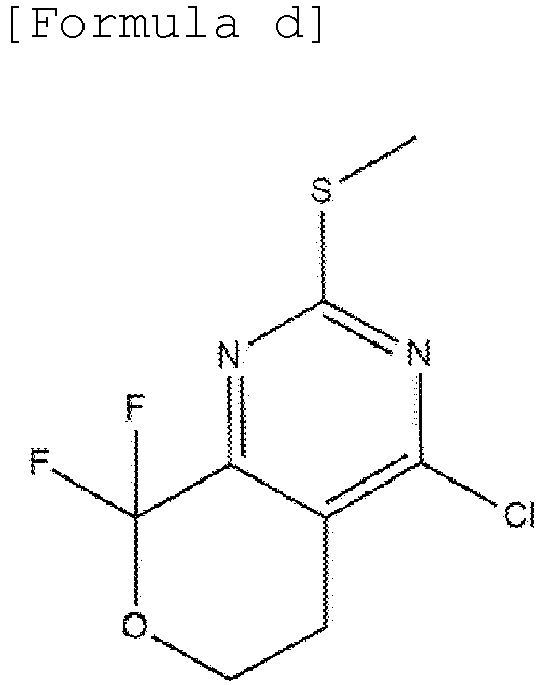
- 1H NMR (500MHz, CDCl3) δ 4.37 (t, J=6.0 Hz, 2H), 3.01-2.87 (m, 2H), 2.60 (s, 3H).
- 4-Chloro-2-(methylthio)-6-(trifluoromethyl)pyrimidine of Formula e was prepared by performing the reaction below.
- 2-(Methylthio)-6-(trifluoromethyl)pyrimidinyl-4-ol (44 g, 209 mmol), phosphoryl trichloride (66 ml, 837 mmol) and benzyltriethylammonium chloride (23.8 g, 104.7 mmol) were stirred at 80°C for 3 hours. After finishing the reaction, the reaction solution was distilled under a reduced pressure to concentrate. To the concentrate, a saturated sodium bicarbonate solution was added, and the resultant was extracted with ethyl acetate. An organic layer was washed with an aqueous sodium chloride solution, dried over anhydrous magnesium sulfate and filtered. The filtrate was concentrated under a reduced pressure and purified by column chromatography (ethyl acetate/hexane = 1/10 by a weight ratio) to obtain 4-chloro-2-(methylthio)-6-(trifluoromethyl)pyrimidine (38.9 g, 170 mmol, yield 81%) of Formula e. The synthesis of the 4-chloro-2-(methylthio)-6-(trifluoromethyl)pyrimidine thus obtained was confirmed through 1H NMR analysis.


- 1H NMR (500MHz, CDCl3) δ 7.27 (s, 1H), 2.60 (s, 3H).
- 4-Chloro-5-methyl-2-(methylthio)-6-(trifluoromethyl)pyrimidine of Formula f was prepared by performing Steps A and B in sequence.

- Ethyl 4,4,4-trifluoro-2-methyl-3-oxobutanoate (5.0 g, 25.2 mmol), methylisothiourea hemisulfate (7.0 g, 50.3 mmol) and sodium carbonate (5.3 g, 50 mmol) were dissolved in 40 ml of water, followed by stirring at room temperature for 12 hours. After finishing the reaction, an excessive amount of water was added to the reaction solution, and extraction was performed with ethyl acetate. An organic layer was washed with an aqueous sodium chloride solution, dried over anhydrous magnesium sulfate and filtered. The filtrate was concentrated under a reduced pressure and purified by column chromatography (ethyl acetate/hexane = 1/1 by a weight ratio) to obtain 5-methyl-2-(methylthio)-6-(trifluoromethyl)pyrimidin-4-ol (4.0 g, 17.8 mmol, yield 71%). The synthesis of the 5-methyl-2-(methylthio)-6-(trifluoromethyl)pyrimidin-4-ol thus obtained was confirmed through 1H NMR analysis.
- 1H NMR (500MHz, DMSO-d6) δ 13.29 (s, 1H), 2.49 (s, 3H), 2.03 (s, 3H).
- In Preparation Example 5, 5-methyl-2-(methylthio)-6-(trifluoromethyl)pyrimidin-4-ol (18 g, 80 mmol) prepared in Step A was used instead of 2-(methylthio)-6-(trifluoromethyl)pyrimidinyl-4-ol to obtain the title compound of 4-chloro-5-methyl-2-(methylthio)-6-(trifluoromethyl)pyrimidine (16.46 g, 67.8 mmol, yield 840). The synthesis of the 4-chloro-5-methyl-2-(methylthio)-6-(trifluoromethyl)pyrimidine thus obtained was confirmed through 1H NMR analysis.
- 1H NMR (500MHz, CDCl3) δ 2.57 (s, 3H), 2.42 (q, J=1.5 Hz, 3H).
- Tert-butyl 4-(2-bromoacetyl)piperazin-1-carboxylate of Formula g was prepared by performing the reaction below.
- Tert-butyl piperazin-1-carboxylate (6.00 g, 32.21 mmol) and diisopropylethylamine (8.32 g, 64.37 mmol) were dissolved in 200 ml of dichloromethane, and the temperature was reduced to -78°C. Bromoacetyl bromide (7.15 g, 35.43 mmol) was slowly added thereto, the temperature was slowly raised to a room temperature state, and stirring was performed for 1 hour. After finishing the reaction, the reaction solution was concentrated under a reduced pressure. A 1 N aqueous hydrochloric acid solution was added, and the resultant was extracted with ethyl acetate. An organic layer was dried over anhydrous magnesium sulfate and filtered. The filtrate was concentrated under a reduced pressure and purified by column chromatography (ethyl acetate/hexane = 1/1 by a weight ratio) to obtain tert-butyl 4-(2-bromoacetyl)piperazin-1-carboxylate (6.62 g, 21.5 mmol, yield 66%) of Formula g. The synthesis of the tert-butyl 4-(2-bromoacetyl)piperazin-1-carboxylate thus obtained was confirmed through 1H NMR analysis.


- 1H NMR (400MHz, CDCl3) δ 3.87 (s, 2H), 3.77-3.55 (m, 2H), 3.51 (dd, J=16.2, 5.8 Hz, 4H), 3.47-3.32 (m, 2H), 1.49 (d, J=18.3 Hz, 9H).
- Tert-butyl 4-(2-(azetidin-3-ylol)acetyl)piperazin-1-carboxylate of Formula h was prepared by performing Steps A and B in sequence.

- Benzyl 3-hydroxyazetidin-1-carboxylate (15 g, 72.34 mmol) was dissolved in 200 ml of dimethylformamide, and the temperature was reduced to 0°C. Sodium hydride (60%, 3.18 g, 79.57 mmol) was added thereto, and the resultant was stirred for 30 minutes. Tert-butyl 4-(2-bromoacetyl)piperazin-1-carboxylate (26.67 g, 86.81 mmol) was slowly added thereto, and the temperature was slowly raised to a room temperature state, while stirring for 18 hours. After finishing the reaction, the reaction solution was concentrated under a reduced pressure. The resultant was extracted using water and ethyl acetate. An organic layer was dried over anhydrous magnesium sulfate and filtered. The filtrate was concentrated under a reduced pressure and purified by column chromatography (ethyl acetate/hexane = 1/1 by a weight ratio) to obtain benzyl 4-(2-((1-tert-butoxycarbonyl)azetidin-3-ylol)acetyl)piperazin-1-carboxylate (27.61 g, 63.68 mmol, yield 88%). The synthesis of the benzyl 4-(2-((1-tert-butoxycarbonyl)azetidin-3-ylol)acetyl)piperazin-1-carboxylate thus obtained was confirmed through 1H NMR analysis.
- 1H NMR (400MHz, MeOD) δ 7.32 (d, J=16.2 Hz, 5H), 5.07 (s, 2H), 4.38 (d, J=4.6 Hz, 1H), 4.20 (d, J=27.2 Jz. 4H), 3.93 (s, 2H), 3.63-3.49 (m, 2H), 3.43 (s, 6H), 1.64-1.35 (m, 9H) .
- Benzyl 4-(2-((1-tert-butoxycarbonyl)azetidin-3-ylol)acetyl)piperazin-1-carboxylate (51.01 g, 117.66 mmol) prepared in Step A was dissolved in 300 ml of methanol, and palladium/charcoal (10 wt%, 3 g) was added thereto, followed by stirring at room temperature for 18 hours. After finishing the reaction, the resultant was filtered using celite and washed with methanol. The filtrate was concentrated under a reduced pressure to obtain tert-butyl 4-(2-(azetidin-3-ylol)acetyl)piperazin-1-carboxylate (38.81 g, 129.63 mmol, yield 110%). The synthesis of the tert-butyl 4-(2-(azetidin-3-ylol)acetyl)piperazin-1-carboxylate thus obtained was confirmed through 1H NMR analysis.
- 1H NMR (400MHz, MeOD) δ 4.48-4.32 (m, 1H), 4.19 (s, 2H), 32.77-3.66 (m, 2H), 3.63 (t, J=7.3 Hz, 2H), 3.55 (s, 2H), 3.50-3.38 (m, 6H), 1.64-1.38 (m, 9H).
- Steps A and B in Preparation Example 8 were performed in sequence except for using benzyl 4-hydroxypiperidin-1-carboxylate (750 mg, 3.19 mmol) instead of benzyl 3-hydroxyazetidin-1-carboxylate in Step A to prepare tert-butyl 4-(2-(piperidin-2-4-ylol)acetyl)piperazin-1-carboxylate (800 mg, 2.44 mmol, yield 76%) of Formula i. The synthesis of the tert-butyl 4-(2-(piperidin-2-4-ylol)acetyl)piperazin-1-carboxylate thus obtained was confirmed through 1H NMR analysis.


- 1H NMR (400MHz, CDCl3) δ 7.37-7.28 (m, 5H), 5.14 (s, 2H), 4.61 (s, 2H), 3.82 (m, 2H), 3.59-3.44 (m, 9H), 3.25 (m, 2H), 1.88 (m, 2H), 1.59 (m, 2H), 1.49 (s, 9H).
- Tert-butyl 4-((((1R,5S,6R)-3-azabicyclo[3.1.0]hexan-5-yl)methyl)sulfonyl)piperazin-1-carboxylate of Formula j was prepared by performing Steps A to E in sequence.

- Benzyl (1R,5S,6R)-6-(hydroxymethyl)-3-azabicyclo[3.1.0]hexan-3-carboxylate (862 mg, 3.49 mmol) was dissolved in 20 ml of dichloromethane and cooled using ice water, and triethylamine (0.73 ml, 5.23 mmol) was added thereto. Methanesulfonyl chloride (0.35 ml, 4.53 mmol) was slowly added thereto, followed by stirring for 1 hour. After finishing the reaction, water was added to the reaction solution, and extraction was performed with dichloromethane. An organic layer was dried over anhydrous magnesium sulfate and filtered. The filtrate was concentrated under a reduced pressure to obtain benzyl (1R,5S,6R)-6-(((methylsulfonyl)oxy)methyl)-3-azabicyclo[3.1.0]hexan-3-carboxylate (1.174 g, yield 99%). This product was used in the next reaction without a separation purification process. The synthesis of the benzyl (1R,5S,6R)-6-(((methylsulfonyl)oxy)methyl)-3-azabicyclo[3.1.0]hexan-3-carboxylate thus obtained was confirmed through 1H NMR analysis.
- 1H NMR (500MHz, CDCl3) δ 7.32-7.40 (m, 5H), 5.13 (d, J=2.1 Hz, 2H), 4.10-4.20 (m, 2H), 3.73 (m, 2H), 3.46-3.50 (m, 2H), 3.04 (s, 3H), 1.66 (s, 2H), 1.12-1.16 (m, 1H).
- Benzyl (1R,5S,6R)-6-(((methylsulfonyl)oxy)methyl)-3-azabicyclo[3.1.0]hexan-3-carboxylate (135 mg, 0.145 mmol) prepared in Step A, and potassium thioacetate (62 mg, 0.539 mmol) were dissolved in acetonitrile, followed by stirring at 60°C for 2 hours. After finishing the reaction, the resultant was extracted with ethyl acetate and washed using water and a saturated sodium chloride solution, and an organic layer was dried over anhydrous magnesium sulfate and filtered. The filtrate was concentrated under a reduced pressure and purified by column chromatography (ethyl acetate/hexane) to obtain benzyl (1R,5S,6R)-6-((acetylthio)methyl)-3-azabicyclo[3.1.0]hexan-3-carboxylate (93 mg, yield 73%). The synthesis of the benzyl (1R,5S, 6R)-6-((acetylthio)methyl)-3-azabicyclo[3.1.0]hexan-3-carboxylate thus obtained was confirmed through 1H NMR analysis.
- 1H NMR (400MHz, CDCl3) δ 7.27-7.36 (m, 5H), 5.08 (d, J=2.3 Hz, 2H), 3.63 (dd, J=17.8, 11.0 Hz, 2H), 3.38 (t, J=9.1 Hz, 2H), 2.80-2.87 (m, 2H), 2.32 (s, 3H), 1.46 (s, 2H), 0.81-0.86 (m, 1H).
- Benzyl (1R,5S,6R)-6-((acetylthio)methyl)-3-azabicyclo[3.1.0]hexan-3-carboxylate (93 mg, 0.305 mmol) prepared in Step B was dissolved in 10 ml of acetonitrile, and the resultant was cooled to 0°C. N-chlorosuccinimide (163 mg, 1.218 mmol) and a 1 N hydrochloric acid solution (0.365 ml, 0.365 mmol) were added thereto, followed by stirring at room temperature for 18 hours. After finishing the reaction, the resultant was concentrated under a reduced pressure, dissolved in ethyl acetate and washed with a saturated sodium chloride solution, and an organic layer was dried over anhydrous magnesium sulfate and filtered. The filtrate was concentrated under a reduced pressure to obtain benzyl (1R,5S,6R)-6-((chlorosulfonyl)methyl)-3-azabicyclo[3.1.0]hexan-3-carboxylate (151 mg), and this product was used in the next reaction without purification.
- Benzyl (1R,5S,6R)-6-((chlorosulfonyl)methyl)-3-azabicyclo[3.1.0]hexan-3-carboxylate (100 mg, 0.303 mmol) prepared in Step C was dissolved in 10 ml of dichloromethane and cooled to 0°C. Tert-butyl piperazin-1-carboxylate (68 mg, 0.364 mmol) and diisopropylethylamine (0.11 ml, 0.606 mmol) were added thereto, followed by stirring at room temperature for 3 hours. After finishing the reaction, the resultant was extracted with dichloromethane, and an organic layer was dried over anhydrous magnesium sulfate and filtered. The filtrate was concentrated under a reduced pressure and purified by column chromatography (ethyl acetate/hexane = 1/1 by a weight ratio) to obtain benzyl (1R,5S,6R)-6-(((4-(tert-butoxycarbonyl)piperazin-1-yl)sulfonyl)methyl)-3-azabicyclo[3.1.0]hexan-3-carboxylate (145 mg, yield 86%), and which was confirmed through 1H NMR analysis.
- 1H NMR (400MHz, CDCl3) δ 7.27-7.37 (m, 5H), 5.09 (m, 2H), 3.70 (dd, J=15.6, 11.0 Hz, 2H), 3.42-3.50 (m, 6H), 3.24 (t, J=5.0 Hz, 4H), 2.88 (m, 2H), 1.58-1.62 (m, 2H), 1.48 (d, J=14.6 Hz, 9H), 0.92-0.97 (m, 1H).
- Benzyl (1R,5S,6R)- 6-(((4-(tert-butoxycarbonyl)piperazin-1-yl)sulfonyl)methyl)-3-azabicyclo[3.1.0]hexan-3-carboxylate (125 mg, 0.261 mmol) prepared in Step D was dissolved in 10 ml of methanol, and 10 wt% of palladium/charcoal (27 mg, 0.026 mmol) was added thereto, followed by stirring together with a hydrogen gas. After finishing the reaction, the resultant was filtered using celite and concentrated under a reduced pressure to obtain tert-butyl 4-((((1R,5S,6R)-3-azabicyclo[3.1.0]hexan-6-yl)methyl)sulfonyl)piperazin-1-carboxylate (89 mg, yield 99%), and which was confirmed through 1H NMR analysis.
- 1H NMR (400MHz, CDCl3) δ 3.50 (t, J=5.0 Hz, 4H), 3.25 (t, J=4.8 Hz, 4H), 3.00-3.05 (m, 2H), 2.90 (d, J=7.3 Hz, 4H), 1.59 (br, 2H), 1.46 (s, 9H), 0.90-0.95 (m, 1H).
- As in Reaction 1, the processes of Steps A to D were performed in sequence to prepare the title compound of Formula 1-1.

- 2,4-Dichloro-6-(trifluoromethyl)pyrimidine (500 mg, 2.30 mmol), azetidin-3-ol hydrochloride (252 mg, 2.30 mmol) and diisopropylethylamine (1.2 ml, 6.91 mmol) were dissolved in 50 ml of dichloromethane, followed by stirring at room temperature for 2 hours. After finishing the reaction, a 1 N aqueous hydrochloric acid solution was added to the reaction solution, and the resultant was extracted with dichloromethane. An organic layer was dried over anhydrous magnesium sulfate and filtered. The filtrate was concentrated under a reduced pressure and purified by column chromatography to obtain 1-(2-chloro-6-(trifluoromethyl)pyrimidin-4-yl)azetidin-3-ol (550 mg, 2.17 mmol, yield 94%) (mass [M+H] = 254.6), and which was confirmed through 1H NMR analysis.
- 1H NMR (500MHz, CDCl3) δ 6.40 (d, J=12.5 Hz, 1H), 4.90 (d, J=4.9 Hz, 1H), 4.63-4.27 (m, 2H), 4.08 (s, 2H), 2.43 (d, J=5.2 Hz, 1H).
- 1-(2-Chloro-6-(trifluoromethyl)pyrimidin-4-yl)azetidin-3-ol (200 mg, 0.78 mmol) prepared in Step A, (2S)-2-methylazetidine[(1R,4S)-7,7-methyl-2-oxo-norbornan-1-yl]methanesulfonate (285 mg, 0.94 mmol) and triethylamine (236 mg, 2.36 mmol) were dissolved in 10 ml of acetonitrile, followed by stirring at 80°C for 1 hour. After finishing the reaction, the temperature was cooled to room temperature, and the resultant was concentrated under a reduced pressure, dissolved in ethyl acetate, and washed with a saturated chloride solution. An organic layer was dried over anhydrous magnesium sulfate and filtered. The filtrate was concentrated under a reduced pressure, and the concentrate under a reduced pressure was purified by column chromatography (ethyl acetate/hexane = 1/1 by a weight ratio) to obtain (S)-1-(2-(2-methylazetidin-1-yl)-6-(trifluoromethyl)pyrimidin-4-yl)azetidin-3-ol (219 mg, 0.75 mmol, yield 96%), which was confirmed through 1H NMR analysis.
- 1H NMR (500MHz, CDCl3) δ 5.84 (d, J=2.4 Hz, 1H), 4.85-4.70 (m, 1H), 4.51-4.37 (m, 1H), 4.37-4.21 (m, 2H), 4.03 (td, J=8.9, 5.0 Hz, 1H), 3.99-3.81 (m, 3H), 2.47-2.30 (m, 1H), 2.23 (d, J=6.1 Hz, 1H), 2.02-1.85 (m, 1H), 1.48 (t, J=5.6 Hz, 3H) .
- (S)-1-(2-(2-methylazetidin-1-yl)-6-(trifluoromethyl)pyrimidin-4-yl)azetidin-3-ol (50 mg, 0.17 mmol) prepared in Step B was dissolved in 10 ml of dimethylformamide, followed by cooling to 0°C. Sodium hydride (60%, 8 mg, 0.20 mmol) was added thereto, followed by stirring for 30 minutes. Tert-butyl 4-(2-bromoacetyl)piperazin-1-carboxylate (64 mg, 0.21 mmol) prepared in Preparation Example 7 was added thereto, followed by stirring at room temperature for 16 hours. After finishing the reaction, the reaction solution was concentrated under a reduced pressure. The resultant was dissolved in ethyl acetate and washed with a saturated sodium chloride solution. An organic layer was dried over anhydrous magnesium sulfate and filtered. The filtrate was concentrated under a reduced pressure, and the concentrate under a reduced pressure was purified by column chromatography (ethyl acetate/hexane = 1/1 by a weight ratio) to obtain tert-butyl (S)-4-(2-((1-(2-(2-methylazetidin-1-yl)-6-(trifluoromethyl)pyrimidin-4-yl)azetidin-3-yl)oxy)acetyl)piperazin-1-carboxylate (29 mg, 0.05 mmol, yield 21%), which was confirmed through 1H NMR analysis.
- 1H NMR (500MHz, CDCl3) δ 5.84 (d, J=3.1 Hz, 1H), 4.51 (dd, J=10.4, 4.3 Hz, 1H), 4.48-4.36 (m, 1H), 4.32-4.21 (m, 2H), 4.18 (s, 2H), 4.09-3.95 (m, 2H), 3.66-3.57 (m, 2H), 3.55-3.31 (m, 8H), 2.46-2.30 (m, 1H), 2.01-1.85 (m, 1H), 1.49-1.40 (m, 12H).
- Tert-butyl (S)-4-(2-((1-(2-(2-methylazetidin-1-yl)-6-(trifluoromethyl)pyrimidin-4-yl)azetidin-3-yl)oxy)acetyl)piperazin-1-carboxylate (29 mg, 0.056 mmol) prepared in Step C and 1 ml of trifluoroacetic acid were dissolved in 5 ml of dichloromethane, followed by stirring for 18 hours. After finishing the reaction, the reaction solution was dried under a reduced pressure, ethyl acetate and an aqueous saturated ammonium solution were added thereto, and the resultant was extracted with ethyl acetate. An organic layer was dried over anhydrous magnesium sulfate and filtered. The filtrate was concentrated under a reduced pressure, and the concentrate under a reduced pressure was purified by column chromatography (dichloromethane/7 N ammonia methanol = 10/1 by a weight ratio) to obtain (S)-2-((1-(2-(2-methylazetidin-1-yl)-6-(trifluoromethyl)pyrimidin-4-yl)azetidin-3-yl)oxy)-1-(piperazin-1-yl)ethan-1-one (23 mg, 0.056 mmol, yield 100%), which was confirmed through 1H NMR analysis.
- 1H NMR (500MHz, MeOH-d4) δ 5.79 (d, J=2.7 Hz, 1H), 4.59-4.35 (m, 2H), 4.33-4.18 (m, 4H), 4.07-3.83 (m, 4H), 3.64-3.37 (m, 4H), 2.89-2.74 (m, 4H), 2.49-2.32 (m, 1H), 1.96 (d, J=6.4 Hz, 1H), 1.55-1.39 (m, 3H).
- As in Reaction 2, the processes of Steps A to D were performed in sequence to prepare the title compound of Formula 1-2.


- 4,5-Dichloro-2-(methylthio)-6-(trifluoromethyl)pyrimidine (1.0 g, 3.80 mmol), tert-butyl 4-(2-(azetidin-3-yloxy)acetyl)piperazin-1-carboxylate (1.7 g, 5.70 mmol) and diisopropylethylamine (2.0 ml, 11.4 mmol) were dissolved in 100 ml of dichloromethane, followed by stirring at room temperature for 2 hours. After finishing the reaction, an excessive amount of water was added to the reaction solution, and the resultant was extracted with dichloromethane. An organic layer was washed with an aqueous saturated chloride solution, and the organic layer was dried over anhydrous magnesium sulfate and filtered. The filtrate was concentrated under a reduced pressure and purified by column chromatography (ethyl acetate/hexane = 1/1 by a weight ratio) to obtain tert-butyl 4-(2-((1-(5-chloro-2-(methylthio)-6-(trifluoromethyl)pyrimidin-4-yl)azetidin-3-yl)oxy)acetyl)piperazin-1-carboxylate (1.2 g, 2.28 mmol, yield 60%), which was confirmed through 1H NMR analysis.
- 1H NMR (500MHz, CDCl3) δ 4.62 (br, s, 2H), 4.67 (m, 1H), 4.36 (br, s, 2H), 4.18 (s, 2H), 3.58 (br, s, 2H), 3.44 (br, s, 6H), 2.47 (s, 3H), 1.46 (s, 9H).
- Tert-butyl 4-(2-((1-(5-chloro-2-(methylthio)-6-(trifluoromethyl)pyrimidin-4-yl)azetidin-3-yl)oxy)acetyl)piperazin-1-carboxylate (1.2 g, 2.28 mmol) prepared in Step A and 3-chloroperbenzoic acid (70%, 1.41 g, 5.70 mmol) were dissolved in 100 ml of dichloromethane, followed by stirring at room temperature for 10 hours. After finishing the reaction, a saturated sodium thiosulfate solution and a saturated sodium bicarbonate solution were added to the reaction solution in sequence, and the resultant was extracted with ethyl acetate. An organic layer was washed with an aqueous saturated sodium chloride solution, dried over anhydrous magnesium sulfate and filtered. The filtrate was concentrated under a reduced pressure, and the concentrate under a reduced pressure was purified by column chromatography (methanol/dichloromethane = 1/9 by a weight ratio) to obtain tert-butyl 4-(2-((1-(5-chloro-2-(methylsulfonyl)-6-(trifluoromethyl)pyrimidin-4-yl)azetidin-3-yl)oxy)acetyl)piperazin-1-carboxylate (1.2 g, 2.28 mmol, yield 94%), which was confirmed through 1H NMR analysis.
- 1H NMR (500MHz, CDCl3) δ 5.11-4.90 (1H), 4.48-4.53 (m, 2H), 4.21 (s, 2H), 3.58 (s, 2H), 3.39-3.44 (m, 6H), 3.29 (d, J=6.9 Hz, 3H), 1.46 (s, 9H).
- Tert-butyl 4-(2-((1-(5-chloro-2-(methylsulfonyl)-6-(trifluoromethyl)pyrimidin-4-yl)azetidin-3-yl)oxy)acetyl)piperazin-1-carboxylate (200 mg, 0.36 mmol) prepared in Step B, (2S)-2-methylazetidine[(1R,4S)-7,7-dimethyl-2-oxo-norbornan-1-yl]methanesulfonate (253 mg, 0.54 mmol) and potassium carbonate (149 mg, 1.08 mmol) were dissolved in 20 ml of acetonitrile, followed by stirring at 80°C for 2 hours. After finishing the reaction, an excessive amount of water was added to the reaction solution, and the resultant was extracted with ethyl acetate. An organic layer was washed with an aqueous saturated sodium chloride solution, dried over anhydrous magnesium sulfate and filtered. The filtrate was concentrated under a reduced pressure, and the concentrate under a reduced pressure was purified by column chromatography (ethyl acetate/hexane = 1/1 by a weight ratio) to obtain tert-butyl (S)-4-(2-((1-(5-chloro-2-(2-methylazetidin-1-yl)-6-(trifluoromethyl)pyrimidin-4-yl)azetidin-3-yl)oxy)acetyl)piperazin-1-carboxylate (140 mg, 0.26 mmol, yield 72%), which was confirmed through 1H NMR analysis.
- 1H NMR (500MHz, CDCl3) δ 4.59 (m, 2H), 4.45 (m, 2H), 4.26 (m, 2H), 4.19 (s, 2H), 4.01 (m, 1H), 3.03 (m, 1H), 3.61 (s, 2H), 3.48 (br s, 6H), 2.40 (m, 1H), 1.95 (m, 1H), 1.60 (s, 9H), 1.59 (d, 3H).
- Tert-butyl (S)-4-(2-((1-(5-chloro-2-(2-methylazetidin-1-yl)-6-(trifluoromethyl)pyrimidin-4-yl)azetidin-3-yl)oxy)acetyl)piperazin-1-carboxylate (140 mg, 0.26 mmol) prepared in Step C and 1 ml of trifluoroacetic acid were dissolved in 3 ml of dichloromethane, followed by stirring at room temperature for 10 hours. After finishing the reaction, a saturated sodium bicarbonate solution was added to the reaction solution, and the resultant was extracted with ethyl acetate. An organic layer was washed with an aqueous saturated sodium chloride solution, dried over anhydrous magnesium sulfate and filtered. The filtrate was concentrated under a reduced pressure, and the concentrate under a reduced pressure was purified by column chromatography (7 N ammonia methanol solution/dichloromethane = 1/9 by a weight ratio) to obtain (S)-4-(2-((1-(5-chloro-2-(2-methylazetidin-1-yl)-6-(trifluoromethyl)pyrimidin-4-yl)azetidin-3-yl)oxy)-1-(piperazin-1-yl)ethan-1-one (100 mg, 0.22 mmol, yield 87%), which was confirmed through 1H NMR analysis.
- 1H NMR (500MHz, CDCl3) δ 4.50 (d, J=6.4 Hz, 2H), 4.36-4.44 (m, 2H), 4.23 (d, J=10.1 Hz, 2H), 4.16 (s, 2H), 3.86-4.00 (m, 2H), 3.64 (s, 2H), 3.51 (s, 2H), 2.91 (s, 4H), 2.32-2.41 (m, 1H), 1.88-1.96 (m, 1H), 1.46 (t, J=6.4 Hz, 3H).
- As in Reaction 3, the processes of Steps A to E were performed in sequence to prepare the title compound of Formula 1-3.


- 4-Chloro-7,7-difluoro-2-(methylthio)-6,7-dihydro-5H-cyclopenta[d]pyrimidine (3.00 g, 12.73 mmol), and 3-chloroperbenzoic acid (5.51 g, 31.82 mmol) was dissolved in 200 ml of dichloromethane, followed by stirring at room temperature for 16 hours. After finishing the reaction, a saturated sodium thiosulfate solution and a saturated sodium bicarbonate solution were added in sequence to the reaction solution, and the resultant was extracted with ethyl acetate. An organic layer was washed with an aqueous saturated chloride solution, dried over anhydrous magnesium sulfate and filtered. The filtrate was concentrated under a reduced pressure and purified by column chromatography (ethyl acetate/hexane = 1/1 by a weight ratio) to obtain 4-chloro-7,7-difluoro-2-(methylsulfonyl)-6,7-dihydro-5H-cyclopenta[d]pyrimidine (3.21 g, 11.94 mmol, yield 93%), which was confirmed through 1H NMR analysis.
- 1H NMR (500MHz, CDCl3) δ 3.44 (d, J=12.5 Hz, 3H), 3.34-3.11 (m, 2H), 2.88-2.68 (m, 2H).
- 4-Chloro-7,7-difluoro-2-(methylsulfonyl)-6,7-dihydro-5H-cyclopenta[d]pyrimidine (348 mg, 1.29 mmol) prepared in Step A, azetidin-3-ol hydrochloride (156 mg, 1.42 mmol) and triethylamine (393 mg, 3.88 mmol) were dissolved in 20 ml of dichloromethane, followed by stirring at room temperature for 2 hours. After finishing the reaction, a 1 N aqueous hydrochloric acid solution was added to the reaction solution, and the resultant was extracted with dichloromethane. An organic layer was dried over anhydrous magnesium sulfate and filtered. The filtrate was concentrated under a reduced pressure, and the concentrate under a reduced pressure was purified by column chromatography (methanol/dichloromethane = 1/10 by a weight ratio) to obtain 1-(7,7-difluoro-2-(methylsulfonyl)-6,7-dihydro-5H-cyclopenta[d]pyrimidin-4-yl)azetidin-3-ol (257 mg, 0.84 mmol, yield 65%), which was confirmed through 1H NMR analysis.
- 1H NMR (500MHz, CDCl3) δ 4.89 (s, 1H), 4.66 (s, 1H), 4.31 (s, 1H), 3.35 (s, 3H), 3.03 (d, J=7.6 Hz, 2H), 2.72-2.55 (m, 2H), 1.37-1.26 (m, 2H).
- 1-(7,7-Difluoro-2-(methylsulfonyl)-6,7-dihydro-5H-cyclopenta[d]pyrimidin-4-yl)azetidin-3-ol (257 mg, 0.84 mmol) prepared in Step B, (2S)-2-methylazetidine[(1R,4S)-7,7-dimethyl-2-oxo-norbornan-1-yl]methanesulfonate (306 mg, 1.01 mmol) and potassium carbonate (348 mg, 2.52 mmol) were dissolved in 30 ml of acetonitrile, followed by stirring at 80°C for 1 hour. After finishing the reaction, the reaction solution was concentrated under a reduced pressure, a saturated sodium bicarbonate solution was added thereto, and the resultant was extracted with ethyl acetate. An organic layer was dried over anhydrous magnesium sulfate and filtered. The filtrate was concentrated under a reduced pressure, and the concentrate under a reduced pressure was purified by column chromatography (ethyl acetate/hexane = 1/1 by a weight ratio) to obtain (S)-1-(7,7-difluoro-2-(2-methylazetidin-1-yl)-6,7-dihydro-5H-cyclopenta[d]pyrimidin-4-yl)azetidin-3-ol (182 mg, 0.61 mmol, yield 72%), which was confirmed through 1H NMR analysis.
- 1H NMR (500MHz, MeOH-d4) δ 4.73-4.59 (m, 1H), 4.51-4.33 (m, 3H), 4.00 (td, J=8.7, 4.9 Hz, 3H), 3.88 (dd, J=16.0, 8.7 Hz, 1H), 2.85 (d, J=4.3 Hz, 2H), 2.55-2.30 (m, 3H), 2.01-1.84 (m, 1H), 1.52 (dd, J=48.1, 6.3 Hz, 3H).
- (S)-1-(7,7-difluoro-2-(2-methylazetidin-1-yl)-6,7-dihydro-5H-cyclopenta[d]pyrimidin-4-yl)azetidin-3-ol (182 mg, 0.61 mmol) prepared in Step C was dissolved in 10 ml of dimethylformamide and cooled to 0°C. Sodium hydride (60%, 30 mg, 0.73 mmol) was added thereto, followed by stirring for 30 minutes. Tert-butyl 4-(2-bromoacetyl)piperazin-1-carboxylate (283 mg, 0.92 mmol) prepared in Preparation Example 7 was added thereto, followed by stirring at room temperature for 16 hours. After finishing the reaction, the reaction solution was concentrated under a reduced pressure, an aqueous saturated ammonium chloride solution was added, and the resultant was extracted with ethyl acetate. An organic layer was dried over anhydrous magnesium sulfate and filtered. The filtrate was concentrated under a reduced pressure, and the concentrate under a reduced pressure was purified by column chromatography (ethyl acetate/hexane = 2/1 by a weight ratio) to obtain tert-butyl (S)-4-(2-((1-(7,7-difluoro-2-(2-methylazetidin-1-yl)-6,7-dihydro-5H-cyclopenta[d]pyrimidin-4-yl)azetidin-3-yl)oxy)acetyl)piperazin-1-carboxylate (171 mg, 0.32 mmol, yield 53%), which was confirmed through 1H NMR analysis.
- 1H NMR (500MHz, CDCl3) δ 4.58-4.47 (m, 1H), 4.39 (s, 1H), 4.20 (s, 2H), 4.14 (s, 3H), 4.04-3.90 (m, 1H), 3.76-3.56 (m, 2H), 3.48 (s, 8H), 2.80 (d, J=4.3 Hz, 2H), 2.57-2.42 (m, 2H), 2.42-2.29 (m, 1H), 2.01-1.86 (m, 1H), 1.50 (d, J=6.4 Hz, 12H) .
- Tert-butyl (S)-4-(2-((1-(7,7-difluoro-2-(2-methylazetidin-1-yl)-6,7-dihydro-5H-cyclopenta[d]pyrimidin-4-yl)azetidin-3-yl)oxy)acetyl)piperazin-1-carboxylate (133 mg, 0.25 mmol) prepared in Step D and 1 ml of trifluoroacetic acid were dissolved in 5 ml of dichloromethane, followed by stirring for 18 hours. After finishing the reaction, the reaction solution was concentrated under a reduced pressure, an aqueous saturated ammonium chloride solution was added thereto, and the resultant was extracted with ethyl acetate. An organic layer was dried over anhydrous magnesium sulfate and filtered. The filtrate was concentrated under a reduced pressure, and the concentrate under a reduced pressure was purified by column chromatography (dichloromethane/7 N ammonia methanol = 10/1 by a weight ratio) to obtain (S)-2-((1-(7,7-difluoro-2-(2-methylazetidin-1-yl)-6,7-dihydro-5H-cyclopenta[d]pyrimidin-4-yl)azetidin-3-yl)oxy)-1-(piperazin-1-yl)ethan-1-one (68 mg, 0.16 mmol, yield 63%), which was confirmed through 1H NMR analysis.
- 1H NMR (500MHz, MeOH-d4) δ 4.52-4.25 (m, 4H), 4.21 (s, 2H), 4.07 (s, 2H), 4.00-3.75 (m, 2H), 3.44 (dt, J=58.6, 4.9 Hz, 4H), 2.85-2.67 (m, 6H), 2.49-2.24 (m, 3H), 1.96-1.79 (m, 1H), 1.42 (d, J=6.4 Hz, 3H).
- As in Reaction 4, the processes of Steps A to E were performed in sequence to prepare the title compound of Formula 1-4.

- The same procedure in Step A of Example 3 was performed except for using 4-chloro-8,8-difluoro-2-(methylthio)-5,6,7,8-tetrahydroquinazoline (89 mg, 0.35 mmol) instead of 4-chloro-7,7-difluoro-2-(methylthio)-6,7-dihydro-5H-cyclopenta[d]pyrimidine in Step A of Example 3, to prepare 4-chloro-8,8-difluoro-2-(methylsulfonyl)-5,6,7,8-tetrahydroquinazoline.
- The same procedure in Step B of Example 3 was performed except for reacting 4-chloro-8,8-difluoro-2-(methylsulfonyl)-5,6,7,8-tetrahydroquinazoline prepared in Step A instead of 4-chloro-7,7-difluoro-2-(methylsulfonyl)-6,7-dihydro-5H-cyclopenta[d]pyrimidine with azetidin-3-ol hydrochloride (41 mg, 0.38 mmol) in Step B of Example 3, to prepare 1-(8,8-difluoro-2-(methylsulfonyl)-5,6,7,8-tetrahydroquinazolin-4-yl)azetidin-3-ol.
- The same procedure in Step C of Example 3 was performed except for reacting 1-(8,8-difluoro-2-(methylsulfonyl)-5,6,7,8-tetrahydroquinazolin-4-yl)azetidin-3-ol prepared in Step B instead of 1-(7,7-difluoro-2-(methylsulfonyl)-6,7-dihydro-5H-cyclopenta[d]pyrimidin-4-yl)azetidin-3-ol with (2S)-2-methylazetidine[(1R,4S)-7,7-dimethyl-2-oxo-norbornan-1-yl]methanesulfonate (105 mg, 0.41 mmol) in Step C of Example 3, to prepare (S)-1-(8,8-difluoro-2-(2-methylazetidin-1-yl)-5,6,7,8-tetrahydroquinazolin-4-yl)azetidin-3-ol.
- The same procedure in Step D of Example 3 was performed except for reacting (S)-1-(8,8-difluoro-2-(2-methylazetidin-1-yl)-5,6,7,8-tetrahydroquinazolin-4-yl)azetidin-3-ol prepared in Step C instead of (S)-1-(7,7-difluoro-2-(2-methylazetidin-1-yl)-6,7-dihydro-5H-cyclopenta[d]pyrimidin-4-yl)azetidin-3-ol with tert-butyl 4-(2-bromoacetyl)piperazin-1-carboxylate (105 mg, 0.34 mmol) prepared in Preparation Example 7 in Step D of Example 3, to prepare tert-butyl (S)-4-(2-((1-(8,8-difluoro-2-(2-methylazetidin-1-yl)-5,6,7,8-tetrahydroquinazolin-4-yl)azetidin-3-yl)oxy)acetyl)piperazin-1-carboxylate.
- The same procedure in Step E of Example 3 was performed except for using tert-butyl (S)-4-(2-((1-(8,8-difluoro-2-(2-methylazetidin-1-yl)-5,6,7,8-tetrahydroquinazolin-4-yl)azetidin-3-yl)oxy)acetyl)piperazin-1-carboxylate prepared in Step D instead of tert-butyl (S)-4-(2-((1-(7,7-difluoro-2-(2-methylazetidin-1-yl)-6,7-dihydro-5H-cyclopenta[d]pyrimidin-4-yl)azetidin-3-yl)oxy)acetyl)piperazin-1-carboxylate in Step E of Example 3, to prepare (S)-2-((1-(8,8-difluoro-2-(2-methylazetidin-1-yl)-5,6,7,8-tetrahydroquinazolin-4-yl)azetidin-3-yl)oxy)-1-(piperazin-1-yl)ethan-1-one (73 mg, 0.13 mmol, yield 39%), which was confirmed through 1H NMR analysis.
- 1H NMR (500MHz, MeOH-d4) δ 4.49-4.30 (m, 4H), 4.24 (s, 2H), 4.19-4.01 (m, 2H), 4.02-3.92 (m, 1H), 3.85 (q, J=8.3 Hz, 1H), 3.63-3.50 (m, 2H), 3.43 (t, J=4.9 Hz, 2H), 2.89-2.73 (m, 4H), 2.55 (s, 2H), 2.43-2.31 (m, 1H), 2.31-2.10 (m, 2H), 2.00-1.89 (m, 1H), 1.85 (q, J=6.1 Hz, 2H), 1.55-1.37 (m, 3H).
- As in Reaction 5, the processes of Steps A to E were performed in sequence to prepare the title compound of Formula 1-5.


- The same procedure in Step A of Example 3 was performed except for using 4-chloro-7,7-difluoro-2-(methylthio)-6,7-dihydro-5H-cyclopenta[d]pyrimidine in 94 mg (0.40 mmol) in Step A of Example 3, to prepare 4-chloro-7,7-difluoro-2-(methylsulfonyl)-6,7-dihydro-5H-cyclopenta[d]pyrimidine.
- The same procedure in Step B of Example 3 was performed except for using (2S,3R)-2-methylazetidin-3-ol(7,7-dimethyl-2-oxobicyclo[2.2.1]heptan-1-yl)methanesulfonate (142 mg, 0.44 mmol) instead of azetidin-3-ol hydrochloride in Step B of Example 3, to prepare (2S)-1-(7,7-difluoro-2-(methylsulfonyl)-6,7-dihydro-5H-cyclopenta[d]pyrimidin-4-yl)-2-methylazetidin-3-ol.
- The same procedure in Strep C of Example 3 was performed except for reacting (2S)-1-(7,7-difluoro-2-(methylsulfonyl)-6,7-dihydro-5H-cyclopenta[d]pyrimidin-4-yl)-2-methylazetidin-3-ol prepared in Step B instead of 1-(7,7-difluoro-2-(methylsulfonyl)-6,7-dihydro-5H-cyclopenta[d]pyrimidin-4-yl)azetidin-3-ol with (2S)-2-methylazetidine[(1R,4S)-7,7-dimethyl-2-oxo-norbornan-1-yl]methanesulfonate (134 mg, 0.44 mmol) in Step C of Example 3, to prepare (2S)-1-(7,7-difluoro-2-((S)-2-methylazetidin-1-yl)-6,7-dihydro-5H-cyclopenta[d]pyrimidin-4-yl)-2-methylazetidin-3-ol.
- The same procedure in Step D of Example 3 was performed except for reacting (2S)-1-(7,7-difluoro-2-((S)-2-methylazetidin-1-yl)-6,7-dihydro-5H-cyclopenta[d]pyrimidin-4-yl)-2-methylazetidin-3-ol prepared in Step C instead of (S)-1-(7,7-difluoro-2-(2-methylazetidin-1-yl)-6,7-dihydro-5H-cyclopenta[d]pyrimidin-4-yl)azetidin-3-ol with tert-butyl 4-(2-bromoacetyl)piperazin-1-carboxylate (149 mg, 0.48 mmol) prepared in Preparation Example 7 in Step D of Example 3, to prepare tert-butyl 4-(2-(((2S)-1-(7,7-difluoro-2-((S)-2-methylazetidin-1-yl)-6,7-dihydro-5H-cyclopenta[d]pyrimidin-4-yl)-2-methylazetidin-3-yl)oxy)acetyl)piperazin-1-carboxylate.
- The same procedure in Step E of Example 3 was performed except for using tert-butyl 4-(2-(((2S)-1-(7,7-difluoro-2-((S)-2-methylazetidin-1-yl)-6,7-dihydro-5H-cyclopenta[d]pyrimidin-4-yl)-2-methylazetidin-3-yl)oxy)acetyl)piperazin-1-carboxylate prepared in Step D instead of tert-butyl (S)-4-(2-((1-(7,7-difluoro-2-(2-methylazetidin-1-yl)-6,7-dihydro-5H-cyclopenta[d]pyrimidin-4-yl)azetidin-3-yl)oxy)acetyl)piperazin-1-carboxylate in Step E of Example 3, to obtain 2-(((2S,3R)-1-(7,7-difluoro-2-((S)-2-methylazetidin-1-yl)-6,7-dihydro-5H-cyclopenta[d]pyrimidin-4-yl)-2-methylazetidin-3-yl)oxy)-1-(piperazin-1-yl)ethan-1-one (59 mg, 0.13 mmol, yield 32%), which was confirmed through 1H NMR analysis.
- 1H NMR (500MHz, MeOH-d4) δ 4.52-4.35 (m, 3H), 4.35-4.19 (m, 2H), 4.13-3.96 (m, 3H), 3.89 (q, J=8.2 Hz, 1H), 3.54 (d, J=4.3 Hz, 2H), 3.44 (s, 2H), 2.95-2.86 (m, 1H), 2.86-2.70 (m, 5H), 2.54-2.30 (m, 3H), 2.01-1.86 (m, 1H), 1.59-1.50 (m, 3H), 1.47 (dd, J=14.8, 6.3 Hz, 3H).
- As in Reaction 6, the processes of Steps A to D were performed in sequence to prepare the title compound of Formula 1-6.

- The same procedure in Step A of Example 1 was performed except for reacting 2,4-dichloro-6-(trifluoromethyl)pyrimidine (45 mg, 0.17 mmol) with (S)-pyrrolidin-3-ol (14 mg, 0.17 mmol) instead of azetidin-3-ol hydrochloride in Step A of Example 1, to prepare 1-(2-chloro-6-(trifluoromethyl)pyrimidin-4-yl)pyrrolidin-3-ol.
- The same procedure in Step B of Example 1 was performed except for reacting 1-(2-chloro-6-(trifluoromethyl)pyrimidin-4-yl)pyrrolidin-3-ol prepared in Step A instead of 1-(2-chloro-6-(trifluoromethyl)pyrimidin-4-yl)azetidin-3-ol with (S)-2-methylazetidine(7,7-dimethyl-2-oxobicyclo[2.2.1]heptan-1-yl)methanesulfonate (62 mg, 0.20 mmol) in Step B of Example 1, to prepare 1-(2-((S)-2-methylazetidin-1-yl)-6-(trifluoromethyl)pyrimidin-4-yl)pyrrolidin-3-ol.
- The same procedure in Step C of Example 1 was performed except for reacting 1-(2-((S)-2-methylazetidin-1-yl)-6-(trifluoromethyl)pyrimidin-4-yl)pyrrolidin-3-ol prepared in Step B instead of (S)-1-(2-(2-methylazetidin-1-yl)-6-(trifluoromethyl)pyrimidin-4-yl)azetidin-3-ol with tert-butyl 4-(2-bromoacetyl)piperazin-1-carboxylate (61 mg, 0.19 mmol) prepared in Preparation Example 7 in Step C of Example 1, to prepare tert-butyl 4-(2-((1-(2-((S)-2-methylazetidin-1-yl)-6-(trifluoromethyl)pyrimidin-4-yl)pyrrolidin-3-yl)oxy)acetyl)piperazin-1-carboxylate.
- The same procedure in Step D of Example 1 was performed except for using tert-butyl 4-(2-((1-(2-((S)-2-methylazetidin-1-yl)-6-(trifluoromethyl)pyrimidin-4-yl)pyrrolidin-3-yl)oxy)acetyl)piperazin-1-carboxylate prepared in Step C instead of tert-butyl (S)-4-(2-((1-(2-(2-methylazetidin-1-yl)-6-(trifluoromethyl)pyrimidin-4-yl)azetidin-3-yl)oxy)acetyl)piperazin-1-carboxylate in Step D of Example 1, to prepare 2-(((S)-1-(2-((s)-2-methylazetidin-1-yl)-6-(trifluoromethyl)pyrimidin-4-yl)pyrrolidin-3-yl)oxy)-1-(piperazin-1-yl)ethan-1-one (28 mg, 0.07 mmol, yield 41%), which was confirmed through 1H NMR analysis.
- 1H NMR (500MHz, CDCl3) δ 5.96 (s, 1H), 4.52-4.36 (m, 1H), 4.28 (s, 1H), 4.18 (s, 2H), 4.10-3.86 (m, 2H), 3.67-3.35 (m, 7H), 2.84 (d, J=4.1 Hz, 4H), 2.46-2.29 (m, 1H), 2.30-1.85 (m, 3H), 1.72 (s, 1H), 1.56-1.41 (m, 3H).
- As in Reaction 7, the processes of Steps A to E were performed in sequence to prepare the title compound of Formula 1-7.

- The same procedure in Step A of Example 3 was performed except for using 4-chloro-7,7-difluoro-2-(methylthio)-6,7-dihydro-5H-cyclopenta[d]pyrimidine in 141 mg (0.60 mmol) in Step A of Example 3, to prepare 4-chloro-7,7-difluoro-2-(methylsulfonyl)-6,7-dihydro-5H-cyclopenta[d]pyrimidine.
- The same procedure in Step B of Example 3 was performed except for using (S)-pyrrolidin-3-ol (53 mg, 0.61 mmol) instead of azetidin-3-ol hydrochloride in Step B of Example 3, to prepare 1-(7,7-difluoro-2-(methylsulfonyl)-6,7-dihydro-5H-cyclopenta[d]pyrimidin-4-yl)pyrrolidin-3-ol.
- The same procedure in Step C of Example 3 was performed except for reacting 1-(7,7-difluoro-2-(methylsulfonyl)-6,7-dihydro-5H-cyclopenta[d]pyrimidin-4-yl)pyrrolidin-3-ol prepared in Step B instead of 1-(7,7-difluoro-2-(methylsulfonyl)-6,7-dihydro-5H-cyclopenta[d]pyrimidin-4-yl)azetidin-3-ol with (2S)-2-methylazetidine[(1R,4S)-7,7-dimethyl-2-oxo-norbornan-1-yl]methanesulfonate (203 mg, 0.67 mmol) in Step C of Example 3, to prepare 1-(7,7-difluoro-2-((S)-2-methylsulfonyl-1-yl)-6,7-dihydro-5H-cyclopenta[d]pyrimidin-4-yl)pyrrolidin-3-ol.
- The same procedure in Step D of Example 3 was performed except for reacting 1-(7,7-difluoro-2-((S)-2-methylsulfonyl-1-yl)-6,7-dihydro-5H-cyclopenta[d]pyrimidin-4-yl)pyrrolidin-3-ol prepared in Step C instead of (S)-1-(7,7-difluoro-2-(2-methylazetidin-1-yl)-6,7-dihydro-5H-cyclopenta[d]pyrimidin-4-yl)azetidin-3-ol with tert-butyl 4-(2-bromoacetyl)piperazin-1-carboxylate (204 mg, 0.66 mmol) prepared in Preparation Example 7 in Step D of Example 3, to prepare tert-butyl 4-(2-((1-(7,7-difluoro-2-((S)-2-methylazetidin-1-yl)-6,7-dihydro-5H-cyclopenta[d]pyrimidin-4-yl)pyrrolidin-3-ol)oxy)acetyl)piperazin-1-carboxylate.
- The same procedure in Step E of Example 3 was performed except for using tert-butyl 4-(2-((1-(7,7-difluoro-2-((S)-2-methylazetidin-1-yl)-6,7-dihydro-5H-cyclopenta[d]pyrimidin-4-yl)pyrrolidin-3-ol)oxy)acetyl)piperazin-1-carboxylate prepared in Step D instead of tert-butyl (S)-4-(2-((1-(7,7-difluoro-2-(2-methylazetidin-1-yl)-6,7-dihydro-5H-cyclopenta[d]pyrimidin-4-yl)azetidin-3-yl)oxy)acetyl)piperazin-1-carboxylate in Step E of Example 3, to obtain 2-(((S)-1-(7,7-difluoro-2-((S)-2-methylazetidin-1-yl)-6,7-dihydro-5H-cyclopenta[d]pyrimidin-4-yl)pyrrolidin-3-yl)oxy)-1-(piperazin-1-yl)ethan-1-one (93 mg, 0.17 mmol, yield 28%), which was confirmed through 1H NMR analysis.
- 1H NMR (500MHz, MeOH-d4) δ 4.41 (q, J=6.5 Hz, 1H), 4.25 (q, J=13.6 Hz, 3H), 4.07-3.56 (m, 6H), 3.48 (dt, J=36.5, 4.7 Hz, 4H), 3.09 (d, J=23.2 Hz, 2H), 2.86-2.68 (m, 4H), 2.53-2.29 (m, 3H), 2.17 (s, 1H), 2.04 (s, 1H), 1.97-1.89 (m, 1H), 1.48 (d, J=6.4 Hz, 3H).
- The same procedure in Example 7 was performed except for using (R)-pyrrolidin-3-ol hydrochloride (75 mg, 0.61 mmol) instead of (S)-pyrrolidin-3-ol in Step B, using (2S)-2-methylazetidine[(1R,4S)-7,7-dimethyl-2-oxo-norbornan-1-yl]methanesulfonate in 188 mg (0.62 mmol) in Step C, and using tert-butyl 4-(2-bromoacetyl)piperazin-1-carboxylate in 194 mg (0.63 mmol) in Step D in Example 7, to prepare the title compound of Formula 1-8 (108 mg, 0.25 mmol, yield 41%), which is the isomer of the compound of Formula 1-7.
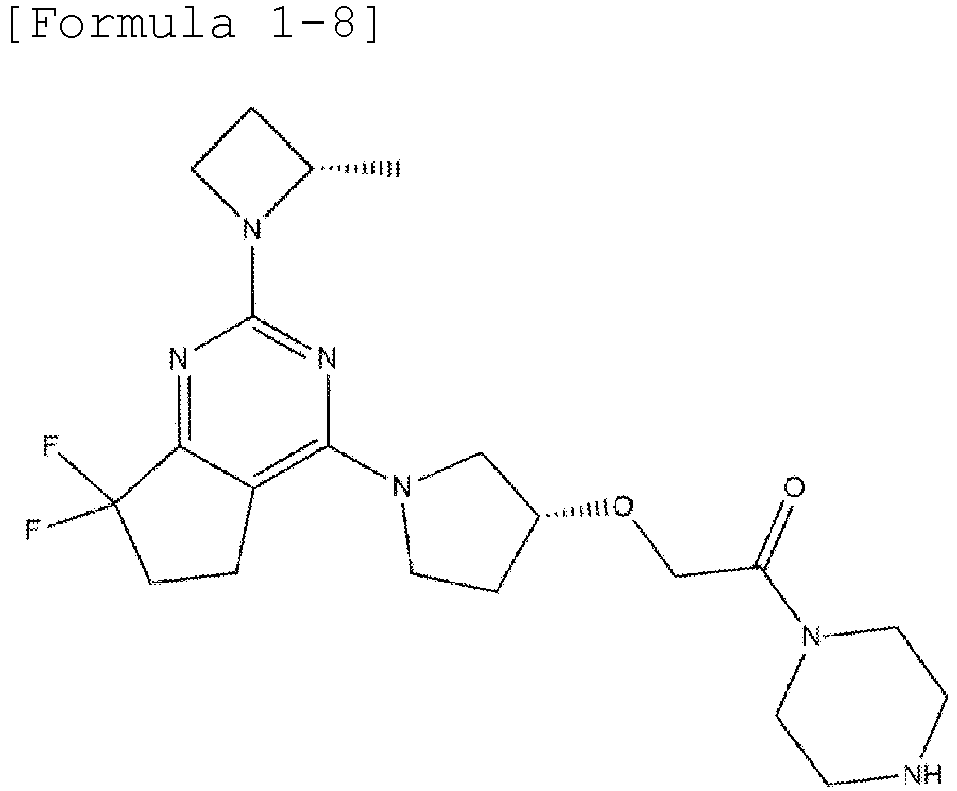
- The synthesis was confirmed through 1H NMR analysis.
- 1H NMR (500MHz, MeOH-d4) δ 4.40 (q, J=6.5 Hz, 1H), 4.24 (q, J=14.0 Hz, 3H), 4.07-3.59 (m, 6H), 3.58-3.38 (m, 4H), 3.08 (dd, J=33.9, 15.0 Hz, 2H), 2.86-2.68 (m, 4H), 2.53-2.29 (m, 3H), 2.17 (s, 1H), 2.03 (d, J=8.8 Hz, 1H), 1.97-1.85 (m, 1H), 1.48 (d, J=6.1 Hz, 3H).
- As in Reaction 8, the processes of Steps A to E were performed in sequence to prepare the title compound of Formula 1-9.


- The 4-chloro-7,7-difluoro-2-(methylsulfonyl)-6,7-dihydro-5H-cyclopenta[d]pyrimidine (100 mg, 0.37 mmol) prepared in Step A of Example 3, ethyl (R)-2-(pyrrolidin-3-yl)acetate hydrochloride (86 mg, 0.44 mmol), and triethylamine (113 mg, 1.11 mmol) were dissolved in 10 ml of dichloromethane, followed by stirring at room temperature for 16 hours. After finishing the reaction, the reaction solution was concentrated under a reduced pressure, a 1 N aqueous hydrochloric acid solution was added thereto, and the resultant was extracted with ethyl acetate. An organic layer was dried over anhydrous magnesium sulfate and filtered. The filtrate was concentrated under a reduced pressure, and the concentrate under a reduced pressure was purified by column chromatography (ethyl acetate/hexane = 1/1 by a weight ratio) to obtain (R)-2-(1-(7,7-difluoro-2-(methylsulfonyl)-6,7-dihydro-5H-cyclopenta[d]pyrimidin-4-yl)pyrrolidin-3-yl)acetate (129 mg, 0.33 mmol, yield 89%), which was confirmed through 1H NMR analysis.
- 1H NMR (400MHz, CDCl3) δ 4.28-4.06 (m, 2H), 4.08-3.62 (m, 3H), 3.59-3.34 (m, 1H), 3.31 (d, J=11.3 Hz, 3H), 3.30-3.17 (m, 2H), 2.73 (s, 1H), 2.64-2.49 (s, 3H), 2.49-2.14 (m, 2H), 1.82-1.58 (m, 1H), 1.37-1.23 (m, 3H).
- The (R)-2-(1-(7,7-difluoro-2-(methylsulfonyl)-6,7-dihydro-5H-cyclopenta[d]pyrimidin-4-yl)pyrrolidin-3-yl)acetate (129 mg, 0.33 mmol) prepared in Step A, (2S)-2-methylazetidine[(1R,4S)-7,7-dimethyl-2-oxo-norbornan-1-yl]methanesulfonate (120 mg, 0.39 mmol) and potassium carbonate (137 mg, 0.99 mmol) were dissolved in 10 ml of acetonitrile, followed by stirring at 80°C for 1 hour. After finishing the reaction the reaction solution was concentrated under a reduced pressure. To the concentrate under a reduced pressure, an aqueous saturated sodium chloride solution was added, and the resultant was extracted with ethyl acetate. An organic layer was dried over anhydrous magnesium sulfate and filtered. The filtrate was concentrated under a reduced pressure, and the concentrate under a reduced pressure was purified by column chromatography (ethyl acetate/hexane = 1/1 by a weight ratio) to obtain ethyl 2-((R)-1-(7,7-difluoro-2-((S)-2-methylazetidin-1-yl)-6,7-dihydro-5H-cyclopenta[d]pyrimidin-4-yl)pyrrolidin-3-yl)acetate (103 mg, 0.27 mmol, yield 81%), which was confirmed through 1H NMR analysis.
- 1H NMR (400MHz, CDCl3) δ 4.28-4.32 (m, 1H), 4.24-4.08 (m, 2H), 4.06-3.99 (m, 1H), 3.95 (q, J=8.2 Hz, 2H), 3.87-3.69 (m, 1H), 3.62 (q, J=8.7 Hz, 1H), 3.37-3.22 (m, 1H), 3.13-2.93 (m, 2H), 2.71-2.54 (m, 1H), 2.53-2.37 (m, 4H), 2.16 (dd, J=10.8, 4.7 Hz, 1H), 2.01-1.84 (m, 1H), 1.63 (dt, J=20.5, 8.7 Hz, 1H), 1.49 (d, J=6.1 Hz, 3H), 1.24 (dt, J=30.2, 7.0 Hz, 3H) .
- The ethyl 2-((R)-1-(7,7-difluoro-2-((S)-2-methylazetidin-1-yl)-6,7-dihydro-5H-cyclopenta[d]pyrimidin-4-yl)pyrrolidin-3-yl)acetate (103 mg, 0.27 mmol) prepared in Step B and lithium hydride monohydrate (45 mg, 1.08 mmol) were dissolved in a mixture of tetrahydrofuran/water/methanol (4/1/1 by a weight ratio, 24 ml), followed by stirring at room temperature for 16 hours. After finishing the reaction, a 1 N hydrochloric acid solution was added to the reaction solution, and the resultant was extracted with ethyl acetate. An organic layer was washed with an aqueous sodium chloride solution, dried over anhydrous magnesium sulfate and filtered. The filtrate was concentrated under a reduced pressure, and the concentrate under a reduced pressure was purified by column chromatography (dichloromethane/methanol = 20/1 by a weight ratio) to obtain S-((R)-1-(7,7-difluoro-2-((S)-2-methylazetidin-1-yl)-6,7-dihydro-5H-cyclopenta[d]pyrimidin-4-yl)pyrrolidin-3-yl)acetic acid (75 mg, 0.21 mmol, yield 78%), which was confirmed through 1H NMR analysis.
- 1H NMR (500MHz, MeOH-d4) δ 4.42 (td, J=13.3, 6.7 Hz, 1H), 4.12-3.92 (m, 2H), 3.92-3.55 (m, 3H), 3.34 (s, 1H), 3.19-2.99 (m, 2H), 2.59 (q, J=7.4 Hz, 1H), 2.53-2.41 (m, 4H), 2.41-2.29 (m, 1H), 2.17 (d, J=5.8 Hz, 1H), 2.03-1.84 (m, 1H), 1.66 (dd, J=19.1, 9.0 Hz, 1H), 1.55-1.40 (m, 3H).
- The S-((R)-1-(7,7-difluoro-2-((S)-2-methylazetidin-1-yl)-6,7-dihydro-5H-cyclopenta[d]pyrimidin-4-yl)pyrrolidin-3-yl)acetic acid (75 mg, 0.21 mmol) prepared in Step C, N-[(dimethylamino)-1H-1,2,3-triazol-[4-5-b]pyridin-1-ylmethylene]-N-methylmethanaminium hexafluorophosphate N-oxide (121 mg, 0.31 mmol), tert-butyl piperazin-1-carboxylate (59 mg, 0.31 mmol) and N,N-diisopropylethylamine (82 mg, 0.63 mmol) were dissolved in 10 ml of dimethylformamide, followed by stirring at room temperature for 18 hours. After finishing the reaction, the reaction solution was concentrated under a reduced pressure, water was added thereto, and the resultant was extracted with ethyl acetate. An organic layer was dried over anhydrous magnesium sulfate and filtered. The filtrate was concentrated under a reduced pressure, and the concentrate under a reduced pressure was purified by column chromatography (dichloromethane/methanol = 20/1 by a weight ratio) to obtain tert-butyl 4-(2-((R)-1-(7,7-difluoro-2-((S)-2-methylazetidin-1-yl)-6,7-dihydro-5H-cyclopenta[d]pyrimidin-4-yl)pyrrolidin-3-yl)acetyl)piperazin-1-carboxylate (109 mg, 0.20 mmol, yield 98%), which was confirmed through 1H NMR analysis.
- 1H NMR (500MHz, CDCl3) δ 4.41 (dd, J=13.9, 6.3 Hz, 1H), 4.05 (td, J=8.7, 4.6 Hz, 1H), 3.96 (q, J=8.2 Hz, 2H), 3.78 (s, 1H), 3.62 (d, J=21.4 Hz, 3H), 3.53-3.34 (m, 6H), 3.34-3.23 (m, 1H), 3.12-2.98 (m, 2H), 2.76-2.63 (m, 1H), 2.54-2.26 (m, 6H), 2.16 (d, J=47.0 Hz, 1H), 2.01-1.84 (m, 1H), 1.71-1.55 (m, 1H), 1.55-1.30 (m, 12H).
- The tert-butyl 4-(2-((R)-1-(7,7- difluoro-2-((S)-2-methylazetidin-1-yl)-6,7-dihydro-5H-cyclopenta[d]pyrimidin-4-yl)pyrrolidin-3-yl)acetyl)piperazin-1-carboxylate (109 mg, 0.20 mmol) prepared in Step D and 1 ml of trifluoroacetic acid were dissolved in 10 ml of dichloromethane, followed by stirring for 18 hours. After finishing the reaction, the reaction solution was concentrated under a reduced pressure, an aqueous saturated ammonium solution was added thereto, and the resultant was extracted with ethyl acetate. An organic layer was dried over anhydrous magnesium sulfate and filtered. The filtrate was concentrated under a reduced pressure, and the concentrate under a reduced pressure was purified by column chromatography (dichloromethane/7 N ammonia methanol = 10/1 by a weight ratio) to obtain 2-((R)-1-(7,7-difluoro-2-((S)-2-methylazetidin-1-yl)-6,7-dihydro-5H-cyclopenta[d]pyrimidin-4-yl)pyrrolidin-3-yl)-1-(piperazin-1-yl)ethan-1-one (80 mg, 0.19 mmol, yield 90%), which was confirmed through 1H NMR analysis.
- 1H NMR (500MHz, MeOH-d4) δ 4.39 (q, J=6.7 Hz, 1H), 3.99 (td, J=8.7, 4.7 Hz, 2H), 3.87 (t, J=8.1 Hz, 1H), 3.84-3.60 (m, 1H), 3.60-3.45 (m, 4H), 3.15-2.98 (m, 2H), 2.79 (dt, J=18.4, 5.0 Hz, 4H), 2.67-2.49 (m, 3H), 2.48-2.27 (m, 3H), 2.15 (s, 1H), 1.91 (dd, J=17.2, 7.5 Hz, 1 H), 1.65 (s, 1H), 1.53-1.39 (m, 3H).
- As in Reaction 9, the processes of Steps A to E were performed in sequence prepare the title compound of Formula 1-10.

- The same procedures in Step A to Step E in Example 9 were performed in sequence except for using 4-chloro-7,7-difluoro-2-(methylsulfonyl)-6,7-dihydro-5H-cyclopenta[d]pyrimidine prepared in 200 mg (0.74 mmol) and using ethyl 2-(piperidin-4-yloxy)acetate hydrochloride (251 mg, 1.12 mmol) instead of ethyl (R)-2-(pyrrolidin-3-yl)acetate hydrochloride in Step A, and using (2S)-2-methylazetidine[(1R,4S)-7,7-dimethyl-2-oxo-norbornan-1-yl]methanesulfonate in 302 mg (0.64 mmol) in Step B in Example 9, to prepare the title compound of Formula 1-10 (110 mg, 0.24 mmol, yield 33%), which was confirmed through 1H NMR analysis.
- 1H NMR (400MHz, CDCl3) δ 4.40 (q, J=6.9 Hz, 1H), 4.18 (s, 2H), 3.91-4.07 (m, 4H), 3.67 (td, J=7.9, 4.0, 1H), 3.57 (t, J=4.8 Hz, 2H), 3.50 (t, J=5.0 Hz, 2H), 3.31-3.38 (m, 2H), 2.83-2.91 (m, 6H), 2.31-2.49 (m, 3H), 1.88-1.96 (m, 3H), 1.61 (m, 2H), 1.47 (d, J=5.9 Hz, 3H).
- As in Reaction 10, the processes of Steps A to E were performed in sequence to prepare the title compound of Formula 1-11.


- 2,4-Dichloro-6-(trifluoro)pyrimidine (5 g, 23.04 mmol), tert-butyl piperazin-1-carboxylate (4.3 g, 23.04 mmol) and diisopropylethylamine (12 ml, 69.12 mmol) were dissolved in 200 ml of dichloromethane, followed by stirring at room temperature for 2 hours. After finishing the reaction, a 1 N aqueous hydrochloric acid solution was added to the reaction solution, and the resultant was extracted with dichloromethane. An organic layer was dried over anhydrous magnesium sulfate and filtered. The filtrate was concentrated under a reduced pressure, and the concentrate under a reduced pressure was purified by column chromatography to obtain tert-butyl 4-(2-chloro-6-(trifluoro)pyrimidin-4-yl)piperazin-1-carboxylate (7.28 g, 19.84 mmol, yield 86%), which was confirmed through 1H NMR analysis.
- 1H NMR (400MHz, CDCl3) δ 6.71 (s, 1H), 3.78 (s, 4H), 3.56 (s, 4H), 1.49 (s, 9H).
- The tert-butyl 4-(2-chloro-6-(trifluoro)pyrimidin-4-yl)piperazin-1-carboxylate (7.28 g, 19.84 mmol) prepared in Step A, (2S)-2-methylazetidine[(1R,4S)-7,7-dimethyl-2-oxo-norbornan-1-yl]methanesulfonate (7.23 g, 23.81 mmol) and potassium carbonate (8.23 g, 59.52 mmol) were dissolved in 300 ml of acetonitrile, followed by stirring at 80°C for 1 hour. After finishing the reaction, the reaction solution was cooled to room temperature, and the resultant was concentrated under a reduced pressure, dissolved in ethyl acetate, and then, washed with a saturated chloride solution. An organic layer was dried over anhydrous magnesium sulfate and filtered. The filtrate was concentrated under a reduced pressure, and the concentrate under a reduced pressure was purified by column chromatography (ethyl acetate/hexane = 1/1 by a weight ratio) to obtain tert-butyl (S)-4-(2-(2-methylazetidin-1-yl)-6-(trifluoromethyl)pyrimidin-4-yl)piperazin-1-carboxylate (7.48 g, 18.63 mol, yield 93%), which was confirmed through 1H NMR analysis.
- 1H NMR (400MHz, CDCl3) δ 6.15 (s, 1H), 4.45 (td, J=13.0, 6.5 Hz, 1H), 4.12-3.87 (m, 2H), 3.61 (s, 4H), 3.50 (d, J=4.6 Hz, 4H), 2.49-2.31 (m, 1H), 2.03-1.86 (m, 1H), 1.53-1.30 (m, 12H).
- The tert-butyl (S)-4-(2-(2-methylazetidin-1-yl)-6-(trifluoromethyl)pyrimidin-4-yl)piperazin-1-carboxylate (7.48 g, 18.63 mmol) prepared in Step B and 14 ml of trifluoroacetic acid were dissolved in 10 ml of dichloromethane, followed by stirring at room temperature for 18 hours. After finishing the reaction, the reaction solution was concentrated under a reduced pressure, an aqueous saturated ammonium solution was added thereto, and the resultant was extracted with ethyl acetate. An organic layer was dried over anhydrous magnesium sulfate and filtered. The filtrate was concentrated under a reduced pressure to obtain (S)-2-(2-methylazetidin-1-yl)-4-(piperazin-1-yl)-6-(trifluoromethyl)pyrimidine (5.6 g, 18.63 mmol, yield 100%), which was confirmed through 1H NMR analysis.
- 1H NMR (400MHz, CDCl3) δ 6.18 (s, 1H), 4.50 (s, 1H), 4.21-3.94 (m, 2H), 3.89 (d, J=4.0 Hz, 4H), 3.29-3.16 (m, 4H), 2.55-2.36 (m, 1H), 2.02-1.88 (m, 1H), 1.51 (d, J=6.4 Hz, 3H).
- The (S)-2-(2-methylazetidin-1-yl)-4-(piperazin-1-yl)-6-(trifluoromethyl)pyrimidine (5.6 g, 18.63 mmol) prepared in Step C was dissolved in 100 ml of dimethylformamide, potassium carbonate (6.86 g, 22.36 mmol) was added thereto, and the tert-butyl 4-(2-bromoacetyl)piperazin-1-carboxylate (7.72 g, 55.89 mmol) prepared in Preparation Example 7 was added thereto, followed by stirring at room temperature for 16 hours. After finishing the reaction, the reaction solution was concentrated under a reduced pressure, the resultant was dissolved in ethyl acetate, and the resultant was washed with a saturated sodium chloride solution. An organic layer was dried over anhydrous magnesium sulfate and filtered. The filtrate was concentrated under a reduced pressure, and the concentrate under a reduced pressure was purified by column chromatography (ethyl acetate/hexane = 1/1 by a weight ratio) to obtain tert-butyl (S)-4-(2-(4-(2-(2-methylazetidin-1-yl)-6-(trifluoromethyl)pyrimidin-4-yl)piperazin-1-yl)acetyl)piperazin-1-carboxylate (10.22 g, 19.37 mmol, yield 104%), which was confirmed through 1H NMR analysis.
- 1H NMR (500MHz, CDCl3) δ 6.15 (s, 1H), 4.44 (q, J=6.5 Hz, 1H), 4.03 (dd, J=13.7, 8.8 Hz, 1H), 3.95 (q, J=8.2 Hz, 1H), 3.61 (d, J=28.4 Hz, 8H), 3.44 (d, J=22.3 Hz, 4H), 3.25 (d, J=12.8 Hz, 2H), 2.56 (s, 4H), 2.39 (dd, J=23.7, 9.3 Hz, 1H), 1.93 (dd, J=17.5, 8.4 Hz, 1H), 1.53-1.42 (m, 12H).
- The tert-butyl (S)-4-(2-(4-(2-(2-methylazetidin-1-yl)-6-(trifluoromethyl)pyrimidin-4-yl)piperazin-1-yl)acetyl)piperazin-1-carboxylate (10.22 g, 19.37 mmol) prepared in Step D and 4 ml of trifluoroacetic acid were dissolved in 20 ml of dichloromethane, followed by stirring for 18 hours. After finishing the reaction, the reaction solution was concentrated under a reduced pressure, ethyl acetate and an aqueous saturated ammonium solution were added thereto, and the resultant was extracted with ethyl acetate. An organic layer was dried over anhydrous magnesium sulfate and filtered. The filtrate was concentrated under a reduced pressure, and the concentrate under a reduced pressure was purified by column chromatography (dichloromethane/7 N ammonia methanol = 10/1 by a weight ratio) to obtain ((S)-2-(4-(2-(2-methylazetidin-1-yl)-6-(trifluoromethyl)pyrimidin-4-yl)piperazin-1-yl)-1-(piperazin-1-yl)ethan-1-one (8.28 g, 19.37 mmol, yield 100%), which was confirmed through 1H NMR analysis.
- 1H NMR (400MHz, MeOH-d4) δ 6.35 (s, 1H), 4.42 (d, J=7.3 Hz, 1H), 4.05-3.85 (m, 2H), 3.69 (s, 4H), 3.64-3.49 (m, 4H), 3.27 (s, 2H), 2.81 (dt, J=24.9, 5.0 Hz, 4H), 2.55 (t, J=5.0 Hz, 4H), 2.40 (s, 1H), 1.95 (s, 1H), 1.54-1.41 (m, 3H).
- As in Reaction 11, the processes of Step A to Step D were performed in sequence to prepare the title compound of Formula 1-12.

- The same procedures in Step A to Step D in Example 1 were performed in sequence except for using 2,4-dichloro-6-(trifluoromethyl)pyrimidine in 104 mg (0.48 mmol) and using piperazin-2-one (48 mg, 0.48 mmol) instead of azetidin-3-ol hydrochloride in Step A, using (2S)-2-methylazetidine[(1R,4S)-7,7-methyl-2-oxo-norbornan-1-yl]methanesulfonate in 181 mg (0.59 mmol) in Step B, and using tert-butyl 4-(2-bromoacetyl)piperazin-1-carboxylate in 166 mg (0.54 mmol) in Step C in Example 1, to prepare the title compound of Formula 1-13 (71 mg, 0.16 mmol, yield 34%), which was confirmed through 1H NMR analysis.
- 1H NMR (400MHz, MeOH-d4) δ 6.38 (s, 1H), 4.60-4.41 (m, 1H), 4.34 (d, J=11.6 Hz, 4H), 3.95 (s, 4H), 3.61-3.43 (m, 6H), 2.92-2.75 (m, 4H), 2.47-2.37 (m, 1H), 2.02-1.84 (m, 1H), 1.50 (d, J=6.1 Hz, 3H).
- As in Reaction 12, the processes of Step A to Step F were performed in sequence to prepare the title compound of Formula 1-13.


- Step A and B in Reaction 12 followed Step A and B of Example 2, and Step C to Step F in Reaction 12 followed Step B to E of Example 11.
- Particularly, the same procedures in Step A and Step B of Example 2 were performed except for using 4-chloro-2-(methylthio)-6,7-dihydro-5H-cyclopenta[d]pyrimidine in 20 mg (0.07 mmol) instead of 4,5-dichloro-2-(methylthio)-6-(trifluoromethyl)pyrimidine, and tert-butyl piperazin-1-carboxylate in 15 mg (0.11 mmol) instead of tert-butyl 4-(2-(azetidin-3-yloxy)acetyl)piperazin-1-carboxylate to perform Step A and Step B of Reaction 12, and then, the same procedures in Step B to Step E of Example 11 were continuously performed except for using (2S)-2-methylazetidine[(1R,4S)-7,7-methyl-2-oxo-norbornan-1-yl]methanesulfonate in 25 mg (0.08 mmol) in Step B, using tert-butyl 4-(2-bromoacetyl)piperazin-1-carboxylate in 18 mg (0.12 mmol) in Step D to perform Step C to Step F in Reaction 12, to prepare the title compound of Formula 1-13 (29 mg, 0.06 mmol, yield 95%), which was confirmed through 1H NMR analysis.
- 1H NMR (400MHz, MeOH-d4) δ 4.48-4.33 (m, 1H), 4.01 (td, J=8.7, 4.8 Hz, 1H), 3.89 (q, J=8.2 Hz, 1H), 3.78 (t, J=4.7 Hz, 4H), 3.58 (dt, J=23.8, 4.9 Hz, 4H), 3.26 (s, 2H), 2.96 (s, 2H), 2.82 (dt, J=26.5, 4.9 Hz, 4H), 2.57 (t, J=4.7 Hz, 4H), 2.53-2.32 (m, 3H), 1.94 (dd, J=19.1, 7.2 Hz, 1H), 1.55-1.40 (m, 3H).
- As in Reaction 13, the processes of Step A to Step E were performed in sequence to prepare the title compound of Formula 1-14.


- Step A to Step E of Reaction 13 followed Step A to Step E of Example 13.
- Particularly, the same procedures in Step A to Step E in Example 13 were performed in sequence except for using 4-chloro-2-(methylthio)-6,7-dihydro-5H-cyclopenta[d]pyrimidine in 10 mg (0.04 mmol) and tert-butyl piperazin-1-carboxylate in 8 mg (0.06 mmol) in Step A, using (2S)-2-methylazetidine[(1R,4S)-7,7-methyl-2-oxo-norbornan-1-yl]methanesulfonate in 12 mg (0.04 mmol) in Step C, and using 2-bromo-1-morpholinoethan-1-one (10 mg, 0.05 mmol) instead of tert-butyl 4-(2-bromoacetyl)piperazin-1-carboxylate in Step D in Example 13, to prepare the title compound of Formula 1-14 (10 mg, 0.02 mmol, yield 50%), which was confirmed through 1H NMR analysis.
- 1H NMR (400MHz, MeOH-d4) δ 4.41 (q, J=6.8 Hz, 1H), 4.01 (td, J=8.8, 4.9 Hz, 1H), 3.89 (q, J=8.2 Hz, 1H), 3.78 (t, J=4.9 Hz, 4H), 3.73-3.61 (m, 6H), 3.57 (t, J=4.6 Hz, 2H), 3.27 (s, 2H), 2.96 (d, J=3.1 Hz, 2H), 2.64-2.53 (m, 4H), 2.53-2.31 (m, 3H), 2.02-1.85 (m, 1H), 1.47 (d, J=6.1 Hz, 3H).
- As in Reaction 14, the processes of Step A to Step D were performed in sequence to prepare the title compound of Formula 1-15.


- 4-Chloro-7,7-difluoro-2-(methylsulfonyl)-6,7-dihydro-5H-cyclopenta[d]pyrimidine (385 mg, 1.433 mmol), tert-butyl piperazin-1-carboxylate (294 mg, 1.576 mmol) and triethylamine (0.3 ml, 2.150 mmol) were dissolved in 20 ml of dichloromethane, followed by stirring at room temperature for 18 hours. After finishing the reaction, dichloromethane and water were added to the reaction solution, and extraction was performed. An organic layer was dried over anhydrous magnesium sulfate and filtered. The filtrate was concentrated under a reduced pressure and purified by column chromatography (ethyl acetate/hexane = 1/1 by a weight ratio) to obtain tert-butyl 4-(7,7-difluoro-2-(methylsulfonyl)-6,7-dihydro-5H-cyclopenta[d]pyrimidin-4-yl)piperazin-1-carboxylate (555.8 mg, yield 93%), which was confirmed through 1H NMR analysis.
- 1H NMR (400MHz, CDCl3) δ 3.88 (t, J=5.3 Hz, 4H), 3.55 (t, J=5.3 Hz, 4H), 3.33 (s, 3H), 3.11-3.14 (m, 2H), 2.59 (dt, J=21.0, 7.5 Hz, 2H), 1.47 (s, 9H).
- The tert-butyl 4-(7,7-difluoro-2-(methylsulfonyl)-6,7-dihydro-5H-cyclopenta[d]pyrimidin-4-yl)piperazin-1-carboxylate (555 mg, 1.326 mmol) prepared in Step A, (2S)-2-methylazetidine[(1R,4S)-7,7-dimethyl-2-oxo-norbornan-1-yl]methanesulfonate (443 mg, 1.459 mmol) and potassium carbonate (458 mg, 3.32 mmol) were dissolved in 50 ml of acetonitrile, followed by stirring at 80°C for 6 hours. After finishing the reaction, ethyl acetate and water were added to the reaction solution, followed by extracting. An organic layer was dried over anhydrous magnesium sulfate and filtered. The filtrate was concentrated under a reduced pressure and purified by column chromatography (0-50% ethyl acetate/hexane = 1/1 by a weight ratio) to obtain tert-butyl (S)-4-(7,7-difluoro-2-(2-methylazetidin-1-yl)-6,7-dihydro-5H-cyclopenta[d]pyrimidin-4-yl)piperazin-1-carboxylate (395 mg, yield 72%), which was confirmed through 1H NMR analysis.
- 1H NMR (400MHz, CDCl3) δ 4.42 (dd, J=14.2, 5.9 Hz, 1H), 4.05 (td, J=8.7, 4.6 Hz, 1H), 3.96 (q, J=8.2 Hz, 1H), 3.66 (t, J=5.3 Hz, 4H), 3.47 (t, J=5.3 Hz, 4H), 2.88-2.91 (m, 2H), 2.33-2.51 (m, 3H), 1.89-1.97 (m, 1H), 1.47-1.49 (m, 12H).
- The tert-butyl (S)-4-(7,7-difluoro-2-(2-methylazetidin-1-yl)-6,7-dihydro-5H-cyclopenta[d]pyrimidin-4-yl)piperazin-1-carboxylate (390 mg, 0.952 mmol) prepared in Step B was dissolved in 12 ml of dichloromethane, and 3 ml of trifluoroacetic acid was added thereto, followed by stirring at room temperature for 18 hours. After finishing the reaction, the reaction solution was concentrated under a reduced pressure. The concentrate was dissolved in dichloromethane, neutralized with saturated sodium bicarbonate, and then, extracted with ethyl acetate. An organic layer was dried over anhydrous magnesium sulfate and filtered. The filtrate was concentrated under a reduced pressure to obtain (S)-4-(7,7-difluoro-2-(2-methylazetidin-1-yl)-4-(piperazin-1-yl)-6,7-dihydro-5H-cyclopenta[d]pyrimidine (308 mg), which was used in the next reaction without separation and purification.
- The (S)-4-(7,7-difluoro-2-(2-methylazetidin-1-yl)-4-(piperazin-1-yl)-6,7-dihydro-5H-cyclopenta[d]pyrimidine (106 mg, 0.343 mmol) prepared in Step C, 3-(4-(tert-butoxycarbonyl)piperazin-1-yl)-3-oxopropanoic acid (103 mg, 0.377 mmol) and triethylamine (0.096 ml, 0.685 mmol) were dissolved in 10 ml of dichloromethane, and propylphosphonic anhydride (50 wt%, 0.255 ml, 0.428 mmol) was added thereto, followed by stirring at room temperature for 4 hours. After finishing the reaction, dichloromethane and water were added to the reaction solution, and extraction was performed. An organic layer was dried over anhydrous magnesium sulfate and filtered. The filtrate was concentrated under a reduced pressure and purified by column chromatography to obtain tert-butyl (S)-3-(4-(7,7-difluoro-2-(2-methylazetidin-1-yl)-6,7-dihydro-5H-cyclopenta[d]pyrimidin-4-yl)piperazin-1-yl)-3-oxopropanoyl)piperazin-1-carboxylate (122 mg, yield 63%).
- The tert-butyl (S)-3-(4-(7,7-difluoro-2-(2-methylazetidin-1-yl)-6,7-dihydro-5H-cyclopenta[d]pyrimidin-4-yl)piperazin-1-yl)-3-oxopropanoyl)piperazin-1-carboxylate thus prepared and 1 ml of trifluoroacetic acid were dissolved in 4 ml of dichloromethane, followed by stirring at room temperature for 3 hours. After finishing the reaction, the resultant was concentrated under a reduced pressure. The concentrate was neutralized with an aqueous saturated sodium bicarbonate solution, and the resultant was extracted with dichloromethane. An organic layer was dried over anhydrous magnesium sulfate and filtered. The filtrate was concentrated under a reduced pressure and purified by column chromatography to obtain (S)-(3-(4-(7,7-difluoro-2-(2-methylazetidin-1-yl)-6,7-dihydro-5H-cyclopenta[d]pyrimidin-4-yl)piperazin-1-yl)-3-(piperazin-1-yl)propan-1,3-dione (88 mg, yield 88%), which was confirmed through 1H NMR analysis.
- 1H NMR (500MHz, CDCl3) δ 4.38-4.43 (m, 1H), 4.02-4.06 (m, 1H), 3.95 (q, J=8.2 Hz, 1H), 3.74 (m, 2H), 3.68 (m, 6H), 3.60 (m, 4H), 3.55 (s, 2H), 2.85-2.90 (m, 6H), 2.55 (s, 1H), 2.41-2.49 (m, 2H), 2.34-2.39 (m, 1H), 1.90-1.97 (m, 1H), 1.48 (d, J=6.1 Hz, 3H).
-


- By applying Step B to Step E of Example 3, the title compound of Formula 1-16 was prepared according to Reaction 15.
- The same procedure in Step B of Example 3 was performed except for using 4-chloro-7,7-difluoro-2-(methylsulfonyl)-6,7-dihydro-5H-cyclopenta[d]pyrimidine (100 mg, 0.37 mmol) and using piperazin-2-one (224 mg, 2.23 mmol) instead of azetidin-3-ol hydrochloride in Step B of Example 3.
- The same procedure in Step C of Example 3 was performed except for using (S)-2-methylazetidine(7,7-dimethyl-2-oxobicyclo[2.2.1]heptan-1-yl)methanesulfonate (209 mg, 0.45 mmol) instead of (2S)-2-methylazetidine[(1R,4S)-7,7-methyl-2-oxo-norbornan-1-yl]methanesulfonate in Step C of Example 3.
- The same procedure in Step D of Example 3 was performed except for using tert-butyl 4-(2-bromoacetyl)piperazin-1-carboxylate in 125 mg (0.41 mmol) in Step D of Example 3.
- The same procedure in Step E of Example 3 was performed except for using the compound prepared in Step C instead of tert-butyl (S)-4-(2-((1-(7,7-difluoro-2-(2-methylazetidin-1-yl)-6,7-dihydro-5H-cyclopenta[d]pyrimidin-4-yl)azetidin-3-yl)oxy)acetyl)piperazin-1-carboxylate in Step E of Example 3, to prepare the title compound of Formula 1-16 (25 mg, 0.06 mmol, yield 15%), which was confirmed through 1H NMR analysis.
- 1H NMR (400MHz, CDCl3) δ 4.40-4.45 (m, 1H), 4.32-4.38 (m, 2H), 4.22 (s, 2H), 4.06 (m, 1H), 3.93-4.01 (m, 3H), 3.60 (t, J=5.0 Hz, 2H), 3.53 (t, J=5.3 Hz, 2H), 3.45 (t, J=4.8 Hz, 2H), 3.93-2.98 (m, 2H), 2.89 (td, J=9.4, 4.3 Hz, 4H), 2.34-2.51 (m, 3H), 1.89-1.97 (m, 1H), 1.48 (d, J=6.4 Hz, 3H).
- As in Reaction 16, the processes of Step A to Step G were performed in sequence to prepare the title compound of Formula 1-17.

- 4-Chloro-7,7-difluoro-2-(methylthio)-6,7-dihydro-5H-cyclopenta[d]pyrimidine (577 mg, 2.438 mmol), tert-butyl 4-(4,4,5,5-tetramethyl-1,3,2-dioxaborolan-2-yl)-3,6-dihydropyridin-1(2H)-carboxylate (1131 mg, 3.66 mmol), tetrakis(triphenylphosphine)palladium(O) (141 mg, 0.122 mmol) and a 2 M aqueous sodium carbonate solution (3.66 ml, 7.31 mmol) were dissolved in 30 ml of 1,4-dioxane, followed by stirring at 80°C for 18 hours. After finishing the reaction, the reaction solution was cooled to room temperature and extracted with ethyl acetate. An organic layer was dried over anhydrous magnesium sulfate and filtered. The filtrate was concentrated under a reduced pressure and purified by column chromatography (ethyl acetate/hexane=4/1 by a weight ratio) to obtain tert-butyl 4-(7,7-difluoro-2-(methylthio)-6,7-dihydro-5H-cyclopenta[d]pyrimidin-4-yl)-3,6-dihydropyridin-1(2H)-carboxylate (1.104 g, yield 99%), which was confirmed through 1H NMR analysis.
- 1H NMR (400MHz, CDCl3) δ 6.52 (m, 1H), 4.17 (d, J=2.3 Hz, 2H), 3.61 (t, J=5.7 Hz, 2H), 3.05-3.10 (m, 2H), 2.68 (d, J=1.4 Hz, 2H), 2.53-2.64 (m, 5H), 1.48 (s, 9H).
- The tert-butyl 4-(7,7-difluoro-2-(methylthio)-6,7-dihydro-5H-cyclopenta[d]pyrimidin-4-yl)-3,6-dihydropyridin-1(2H)-carboxylate (1.1 g, 2.87 mmol) prepared in Step A, and m-chlorobenzoicperoxy acid (70 wt%, 1.556 mg, 6.31 mmol) were dissolved in 100 ml of dichloromethane, followed by stirring at room temperature for 18 hours. After finishing the reaction, water and sodium thiosulfate were added to the reaction solution, and the resultant was stirred. Dichloromethane and an aqueous saturated sodium bicarbonate solution were added thereto, and extraction was performed. An organic layer was dried over anhydrous magnesium sulfate and filtered. The filtrate was concentrated under a reduced pressure to obtain tert-butyl 4-(7,7-difluoro-2-(methylsulfonyl)-6,7-dihydro-5H-cyclopenta[d]pyrimidin-4-yl)-3,6-dihydropyridin-1(2H)-carboxylate (552 mg, yield 46%), which was confirmed through 1H NMR analysis.
- 1H NMR (400MHz, CDCl3) δ 6.74 (s, 1H), 4.23 (br, s, 2H), 3.64 (t, J=5.5 Hz, 2H), 3.41 (s, 3H), 3.25 (m, 2H), 2.65-2.76 (m, 4H), 1.48 (s, 9H).
- The tert-butyl 4-(7,7-difluoro-2-(methylsulfonyl)-6,7-dihydro-5H-cyclopenta[d]pyrimidin-4-yl)-3,6-dihydropyridin-1(2H)-carboxylate (456 mg, 1.098 mmol) prepared in Step C was dissolved in 20 ml of methanol, and palladium/charcoal (10 wt%, 50 mg) was added thereto, followed by stirring at room temperature for 18 hours. After finishing the reaction, the reaction solution was filtered using celite and then, washed with methanol. The filtrate was concentrated under a reduced pressure to obtain tert-butyl 4-(7,7-difluoro-2-(methylsulfonyl)-6,7-dihydro-5H-cyclopenta[d]pyrimidin-4-yl)piperidin-1-carboxylate (473 mg, yield 99%), which was confirmed through 1H NMR analysis.
- 1H NMR (400MHz, CDCl3) δ 4.30 (m, 2H), 3.40 (s, 3H), 3.12-3.15 (m, 2H), 2.98-3.04 (m, 1H), 2.67-2.86 (m, 4H), 1.95 (m, 2H), 1.80 (m, 2H), 1.47 (s, 9H).
- The tert-butyl 4-(7,7-difluoro-2-(methylsulfonyl)-6,7-dihydro-5H-cyclopenta[d]pyrimidin-4-yl)piperidin-1-carboxylate (150 mg, 0.359 mmol) prepared in Step C, (2S)-2-methylazetidine[(1R,4S)-7,7-dimethyl-2-oxo-norbornan-1-yl]methanesulfonate (120 mg, 0.395 mmol), and potassium carbonate (124 mg, 0.898 mmol) were dissolved in 20 ml of acetonitrile, followed by stirring at 80°C for 4 hours. After finishing the reaction, the reaction solution was cooled to room temperature and extracted with water and ethyl acetate. An organic layer was dried over anhydrous magnesium sulfate and filtered. The filtrate was concentrated under a reduced pressure and purified by column chromatography to obtain tert-butyl (S)-4-(7,7-difluoro-2-(2-methylazetidin-1-yl)-6,7-dihydro-5H-cyclopenta[d]pyrimidin-4-yl)piperidin-1-carboxylate (140 mg, yield 95%), which was confirmed through 1H NMR analysis.
- 1H NMR (400MHz, CDCl3) δ 4.48 (m, 1H), 3.98-4.20 (m, 5H), 2.81 (m, 4H), 2.69 (m, 1H), 2.44-2.57 (m, 3H), 2.01 (m, 1H), 1.71-1.82 (m, 4H), 1.50 (d, J=5.9 Hz, 3H), 1.47 (s, 9H).
- The tert-butyl (S)-4-(7,7-difluoro-2-(2-methylazetidin-1-yl)-6,7-dihydro-5H-cyclopenta[d]pyrimidin-4-yl)piperidin-1-carboxylate (140 mg, 0.343 mmol) prepared in Step D was dissolved in 4 ml of dichloromethane, and 0.5 ml of trifluoroacetic acid was added thereto, followed by stirring. After finishing the reaction, the reaction solution was concentrated under a reduced pressure, and the concentrate was neutralized with an aqueous saturated sodium bicarbonate solution and extracted with dichloromethane. An organic layer was dried over anhydrous magnesium sulfate and filtered. The filtrate was concentrated under a reduced pressure to obtain (S)-7,7-difluoro-2-(2-methylazetidin-1-yl)-4-(piperidin-4-yl)-6,7-dihydro-5H-cyclopenta[d]pyrimidine (86 mg, yield 82%), which was confirmed through 1H NMR analysis.
- 1H NMR (400MHz, CDCl3) δ 4.48 (q, J=6.9 Hz, 1H), 3.96-4.12 (m, 2H), 3.20 (d, J=13.3 Hz, 2H), 2.80 (m, 2H), 2.66-2.76 (m, 3H), 2.37-2.57 (m, 3H), 1.93-2.01 (m, 1H), 1.76-1.86 (m, 2H), 1.70 (m, 2H), 1.52 (d, J=6.4 Hz, 3H).
- The (S)-7,7-difluoro-2-(2-methylazetidin-1-yl)-4-(piperidin-4-yl)-6,7-dihydro-5H-cyclopenta[d]pyrimidine (34 mg, 0.110 mmol) prepared in Step E and tert-butyl 4-(2-bromoacetyl)piperazin-1-carboxylate (45 mg, 0.331 mmol) were dissolved in N,N-dimethylformamide (5 ml), followed by stirring at room temperature for 8 hours. After finishing the reaction, the reaction solution was concentrated under a reduced pressure and extracted with ethyl acetate and water. An organic layer was dried over anhydrous magnesium sulfate and filtered. The filtrate was concentrated under a reduced pressure and purified by column chromatography to obtain tert-butyl (S)-4-(2-(7,7-difluoro-2-(2-methylazetidin-1-yl)-6,7-dihydro-5H-cyclopenta[d]pyrimidin-4-yl)piperidin-1-yl)acetyl)piperazin-1-carboxylate (58 mg, yield 99%), which was confirmed through 1H NMR analysis.
- 1H NMR (400MHz, CDCl3) δ 4.47 (q, J=6.9 Hz, 1H), 4.06-4.11 (m, 1H), 3.98 (m, 1H), 3.57-3.65 (m, 4H), 3.39-3.46 (m, 4H), 3.20 (s, 2H), 2.93-2.97 (m, 2H), 2.78-2.81 (m, 2H), 2.36-2.57 (m, 4H), 2.15-2.21 (m, 2H), 1.85-2.01 (m, 3H), 1.71 (m, 2H), 1.50 (d, J=6.4 Hz, 3H), 1.45 (s, 9H).
- The tert-butyl (S)-4-(2-(7,7-difluoro-2-(2-methylazetidin-1-yl)-6,7-dihydro-5H-cyclopenta[d]pyrimidin-4-yl)piperidin-1-yl)acetyl)piperazin-1-carboxylate (58 mg, 0.108 mmol) prepared in Step F was dissolved in 4 ml of dichloromethane, and 1 ml of trifluoroacetic acid was added thereto, followed by stirring. After finishing the reaction, the reaction solution was concentrated under a reduced pressure, and the resultant was neutralized with an aqueous saturated sodium bicarbonate solution and extracted with dichloromethane. An organic layer was dried over anhydrous magnesium sulfate and filtered, and the filtrate was concentrated under a reduced pressure and purified by column chromatography to obtain (S)-2-(4-(7,7-difluoro-2-(2-methylazetidin-1-yl)-6,7-dihydro-5H-cyclopenta[d]pyrimidin-4-yl)piperidin-1-yl)-1-(piperazin-1-yl)ethan-1-one (32 mg, yield 68%), which was confirmed through 1H NMR analysis.
- 1H NMR (400MHz, CDCl3) δ 4.70 (br, 1H), 4.46 (q, J=6.7 Hz, 1H), 4.07 (td, J=8.9, 5.0 Hz, 1H), 3.97 (q, J=8.2 Hz, 1H), 3.59-3.72 (m, 4H), 3.20 (s, 2H), 2.95-2.98 (m, 4H), 2.78 (t, J=3.4 Hz, 2H), 2.35-2.57 (m, 6H), 2.19 (t, J=11.7 Hz, 2H), 1.87-2.00 (m, 3H), 1.71 (d, J=12.8 Hz, 2H), 1.49 (q, J=2.9 Hz, 3H).
- As in Reaction 17, the processes of Steps A and B were performed in sequence to prepare the title compound of Formula 1-18.

- 2-((1R,5S,6R)-3-(7,7-difluoro-2-((S)-2-methylazetidin-1-yl)-6,7-dihydro-5H-cyclopenta[d]pyrimidin-4-yl)-3-azabicyclo[3.1.0]hexan-6-yl)acetate (200 mg, 0.518 mmol, prepared according to Example 9 of
KR10-2021-0129607A - 1H NMR (400MHz, CDCl3) δ 4.38 (q, J=6.9 Hz, 1H), 3.90-4.05 (m, 4H), 3.58-3.63 (m, 4H), 3.42 (s, 6H), 2.94-3.01 (m, 2H), 2.28-2.46 (m, 5H), 1.87-1.95 (m, 1H), 1.50 (s, 2H), 1.42-1.48 (m, 12H), 0.94 (td, J=6.9, 3.2 Hz, 1H).
- The tert-butyl 4-(2-((1R,5S,6R)-2-(7,7-difluoro-2-((S)-2-methylazetidin-1-yl)-6,7-dihydro-5H-cyclopenta[d]pyrimidin-4-yl)-3-azabicyclo[3.1.0]hexan-6-yl)acetyl)piperazin-1-carboxylate (93 mmol, 0.175 mmol) prepared in Step A was dissolved in 4 ml of dichloromethane, and 0.5 ml of trifluoroacetic acid was added thereto, followed by stirring at room temperature. After finishing the reaction, the reaction solution was concentrated under a reduced pressure, and the resultant was neutralized using an aqueous saturated sodium bicarbonate solution and extracted with dichloromethane. An organic layer was dried over anhydrous magnesium sulfate and filtered. The filtrate was concentrated under a reduced pressure, and the concentrate under a reduced pressure was purified by column chromatography to obtain 2-((1R,5S,6R)-2-(7,7-difluoro-2-((S)-2-methylazetidin-1-yl)-6,7-dihydro-5H-cyclopenta[d]pyrimidin-4-yl)-3-azabicyclo[3.1.0]hexan-6-yl)-1-(piperazin-1-yl)ethan-1-one (67 mg, yield 88%), which was confirmed through 1H NMR analysis.
- 1H NMR (500MHz, CDCl3) δ 4.41 (q, J=6.7 Hz, 1H), 3.93-4.07 (m, 4H), 3.61-3.74 (m, 4H), 3.45-3.50 (m, 2H), 3.01 (t, J=3.8 Hz, 2H), 2.93 (d, J=4.3 Hz, 4H), 2.32-2.51 (m, 5H), 1.90-1.97 (m, 1H), 1.54 (s, 2H), 1.50 (d, J=6.1 Hz, 3H), 0.95 (td, J=6.7, 3.5 Hz, 1H).
- The same procedure in Step A of Example 18 was performed except for using 2-((1R,5S,6R)-3-(7,7-difluoro-2-((S)-2-methylazetidin-1-yl)-6,7-dihydro-5H-cyclopenta[d]pyrimidin-4-yl)-3-azabicyclo[3.1.0]hexan-6-yl)acetate in 50 mg (0.13 mmol), and using 1-methylpiperazine (19 mg, 0.19 mmol) instead of piperazin-1-carboxylate in Step A of Example 18, to obtain 2-((1R,5S,6R)-3-(7,7-difluoro-2-((S)-2-methylazetidin-1-yl)-6,7-dihydro-5H-cyclopenta[d]pyrimidin-4-yl)-3-azabicyclo[3.1.0]hexan-6-yl)-1-(4-methylpiperazin-1-yl)ethan-1-one of Formula 1-19 (5.0 mg, 0.01 mmol, yield 8%), which was confirmed through 1H NMR analysis.

- 1H NMR (400MHz, MeOH-d4) δ 4.40 (q, J=6.7 Hz, 1H), 4.12-3.96 (m, 3H), 3.87 (q, J=8.2 Hz, 1H), 3.61 (s, 4H), 3.58-3.47 (m, 2H), 3.06 (d, J=3.7 Hz, 2H), 2.52-2.34 (m, 9H), 2.31 (s, 3H), 1.93 (t, J=9.5 Hz, 1H), 1.62-1.49 (m, 2H), 1.49-1.40 (m, 3H), 0.94-0.79 (m, 1H).
- The same procedure in Step A of Example 18 was performed except for using 2-((1R,5S,6R)-3-(7,7-difluoro-2-((S)-2-methylazetidin-1-yl)-6,7-dihydro-5H-cyclopenta[d]pyrimidin-4-yl)-3-azabicyclo[3.1.0]hexan-6-yl)acetate in 50 mg (0.13 mmol), and using 2-oxopiperazine (19 mg, 0.19 mmol) instead of piperazin-1-carboxylate in Step A of Example 18, to obtain 4-(2-((1R,5S,6R)-3-(7,7-difluoro-2-((S)-2-methylazetidin-1-yl)-6,7-dihydro-5H-cyclopenta[d]pyrimidin-4-yl)-3-azabicyclo[3.1.0]hexan-6-yl)acetyl)piperazin-2-one of Formula 1-20 (47 mg, 0.10 mmol, yield 81%), which was confirmed through 1H NMR analysis.


- 1H NMR (400MHz, MeOH-d4) δ 4.39 (t, J=7.0 Hz, 1H), 4.14 (s, 2H), 4.10-3.93 (m, 3H), 3.87 (d, J=7.6 Hz, 1H), 3.74 (dt, J=27.5, 5.3 Hz, 2H), 3.64 (s, 2H), 3.43-3.32 (m, 1H), 3.07 (d, J=12.2 Hz, 2H), 2.55-2.21 (m, 5H), 1.93 (s, 1H), 1.57 (s, 2H), 1.48 (d, J=6.1 Hz, 3H), 1.37 (d, J=7.0 Hz, 1H), 0.90 (s, 1H).
- As in Reaction 18, the processes of Steps A and B were performed in sequence to prepare the title compound of Formula 1-21.


- 2-((1R,5S,6S)-3-(7,7-difluoro-2-((S)-2-methylazetidin-1-yl)-6,7-dihydro-5H-cyclopenta[d]pyrimidin-4-yl)-3-azabicyclo[3.1.1]heptan-6-yl)acetic acid (177 mg, 0.468 mmol, prepared according to Example 8 of
KR10-2021-0129607A - 1H NMR (400MHz, CDCl3) δ 4.40 (q, J=6.9 Hz, 1H), 3.92-4.10 (m, 5H), 3.58 (m, 2H), 3.39-3.46 (m, 6H), 3.14 (m, 2H), 2.68 (d, J=7.8 Hz, 2 H), 2.29-2.46 (m, 6H), 2.11 (m, 1H), 1.87-1.96 (m, 1H), 1.46-1.51 (m, 12H), 1.41 (m, 1H).
- The tert-butyl 4-(2-((1R,5S,6S)-3-(7,7-difluoro-2-((S)-2-methylazetidin-1-yl)-6,7-dihydro-5H-cyclopenta[d]pyrimidin-4-yl)-3-azabicyclo[3.1.1]heptan-6-yl)acetyl)piperazin-1-carboxylate (270 mg, 0.464 mmol) prepared in Step A was dissolved in 1 ml of dichloromethane, and 1 ml of trifluoroacetic acid was added thereto, followed by stirring at room temperature. After finishing the reaction, the reaction solution was concentrated under a reduced pressure, and the resultant was neutralized and extracted using dichloromethane and an aqueous saturated sodium bicarbonate solution. An organic layer was dried over anhydrous magnesium sulfate and filtered. The filtrate was concentrated under a reduced pressure, and the concentrate under a reduced pressure was purified by column chromatography to obtain 2-((1R,5S,6S)-3-(7,7-difluoro-2-((S)-2-methylazetidin-1-yl)-6,7-dihydro-5H-cyclopenta[d]pyrimidin-4-yl)-3-azabicyclo[3.1.1]heptan-6-yl)-1-(piperazin-1-yl)ethan-1-one (210 mg, yield 95%), which was confirmed through 1H NMR analysis.
- 1H NMR (500MHz, CDCl3) δ 4.40 (m, 1H), 3.92-4.07 (m, 6H), 3.73 (m, 2H), 3.63 (s, 2H), 3.15 (m, 2H), 2.94-3.02 (m, 4H), 2.67 (d, J=7.8 Hz, 2H), 2.29-2.46 (m, 6H), 2.10 (m, 1H), 1.88-1.96 (m, 1H), 1.48 (d, J=5.9 Hz, 3H), 1.42 (dd, J=9.1, 5.5 Hz, 1H).
- The 2-((1R,5S,6S)-3-(7,7-difluoro-2-((S)-2-methylazetidin-1-yl)-6,7-dihydro-5H-cyclopenta[d]pyrimidin-4-yl)-3-azabicyclo[3.1.1]heptan-6-yl)-1-(piperazin-1-yl)ethan-1-one (30 mg, 0.067 mmol) prepared according to Example 21 and acetic anhydride (9.51 ul, l 0.101 mmol) were dissolved in 4 ml of dichloromethane and cooled to 0°C. Triethylamine (18.73 ul, 0.134 mmol) was added thereto, followed by stirring at room temperature for 1 hour. After finishing the reaction, dichloromethane and an aqueous saturated sodium bicarbonate solution were added to the reaction solution, and extraction was performed. An organic layer was dried over anhydrous magnesium sulfate and filtered. The filtrate was concentrated under a reduced pressure, and the concentrate under a reduced pressure was purified by column chromatography to obtain the title compound of Formula 1-22 (17 mg, yield 52%), which was confirmed through 1H NMR analysis.

- 1H NMR (500MHz, CDCl3) δ 4.42-4.47 (m, 1H), 3.97-4.10 (m, 6H), 3.66 (m, 4H), 3.49-3.55 (m, 4H), 3.18 (m, 2H), 2.73 (d, J=7.6 Hz, 2H), 2.34-2.48 (m, 6H), 2.16 (s, 3H), 1.92-1.99 (m, 1H), 1.51 (d, J=6.1 Hz, 3H), 1.46 (q, J=4.8 Hz, 1H).
- The same procedure in Example 21 was performed except for using 2-((1R,5S,6S)-3-(8,8-difluoro-2-((S)-2-methylazetidin-1-yl)-5,6,7,8-tetrahydroquinazolin-4-yl)-3-azabicyclo[3.1.1]heptan-6-yl)acetic acid (68 mg, 0.164 mmol) instead of 2-((1R,5S,6S)-3-(7,7-difluoro-2-((S)-2-methylazetidin-1-yl)-6,7-dihydro-5H-cyclopenta[d]pyrimidin-4-yl)-3-azabicyclo[3.1.1]heptan-6-yl)acetic acid, and using tert-butyl piperazin-1-carboxylate in 33.6 mg (0.180 mmol) in Step A of Example 21, to prepare the title compound of Formula 1-23 (69 mg. 0.150 mmol, yield 91%), which was confirmed through 1H NMR analysis.

- 1H NMR (500MHz, CDCl3) δ 4.39-4.44 (m, 1H), 3.88-4.09 (m, 6H), 3.65 (t, J=4.9 Hz, 2H), 3.54 (t, J=4.9 Hz, 2H), 3.19 (s, br, 1H), 2.92 (m, 4H), 2.77 (m, 2H), 2.68 (d, J=7.6 Hz, 2H), 2.30-2.38 (m, 4H), 2.19-2.30 (m, 2H), 2.15 (dd, J=13.1, 7.6 Hz, 1H), 1.91-1.97 (m, 1H), 1.83 (d, J=5.8 Hz, 2H), 1.50 (d, J=6.1 Hz, 3H), 1.44 (dd, J=9.0, 5.3 Hz, 1H).
- The same procedure in Example 21 was performed except for using 2-((1R,5S,6S)-3-(8,8-difluoro-2-((S)-2-methylazetidin-1-yl)-5,8-dihydro-6H-pyrano[3,4-d]pyrimidin-4-yl)-3-azabicyclo[3.1.1]heptan-6-yl)acetic acid (160 mg, 0.384 mmol) instead of 2-((1R,5S,6S)-3-(7,7-difluoro-2-((S)-2-methylazetidin-1-yl)-6,7-dihydro-5H-cyclopenta[d]pyrimidin-4-yl)-3-azabicyclo[3.1.1]heptan-6-yl)acetic acid, and using tert-butyl piperazin-1-carboxylate in 75 mg (0.403 mmol) in Step A of Example 21, to prepare the title compound of Formula 1-24 (69 mg. 0.150 mmol, yield 91%), which was confirmed through 1H NMR analysis.


- 1H NMR (500MHz, CDCl3) δ 4.40-4.46 (m, 1H), 4.14 (t, J=5.3 Hz, 2H), 3.94-4.09 (m, 6H), 3.52-3.82 (m, 4H), 2.99-3.11 (m, 6H), 2.70 (d, J=7.3 Hz, 2H), 2.34-2.40 (m, 4H), 2.15 (dd, J=12.4, 7.2 Hz, 1H), 1.92-1.99 (m, 1H), 1.50 (d, J=6.1 Hz, 3H),. 1.42-1.46 (m, 1H).
-

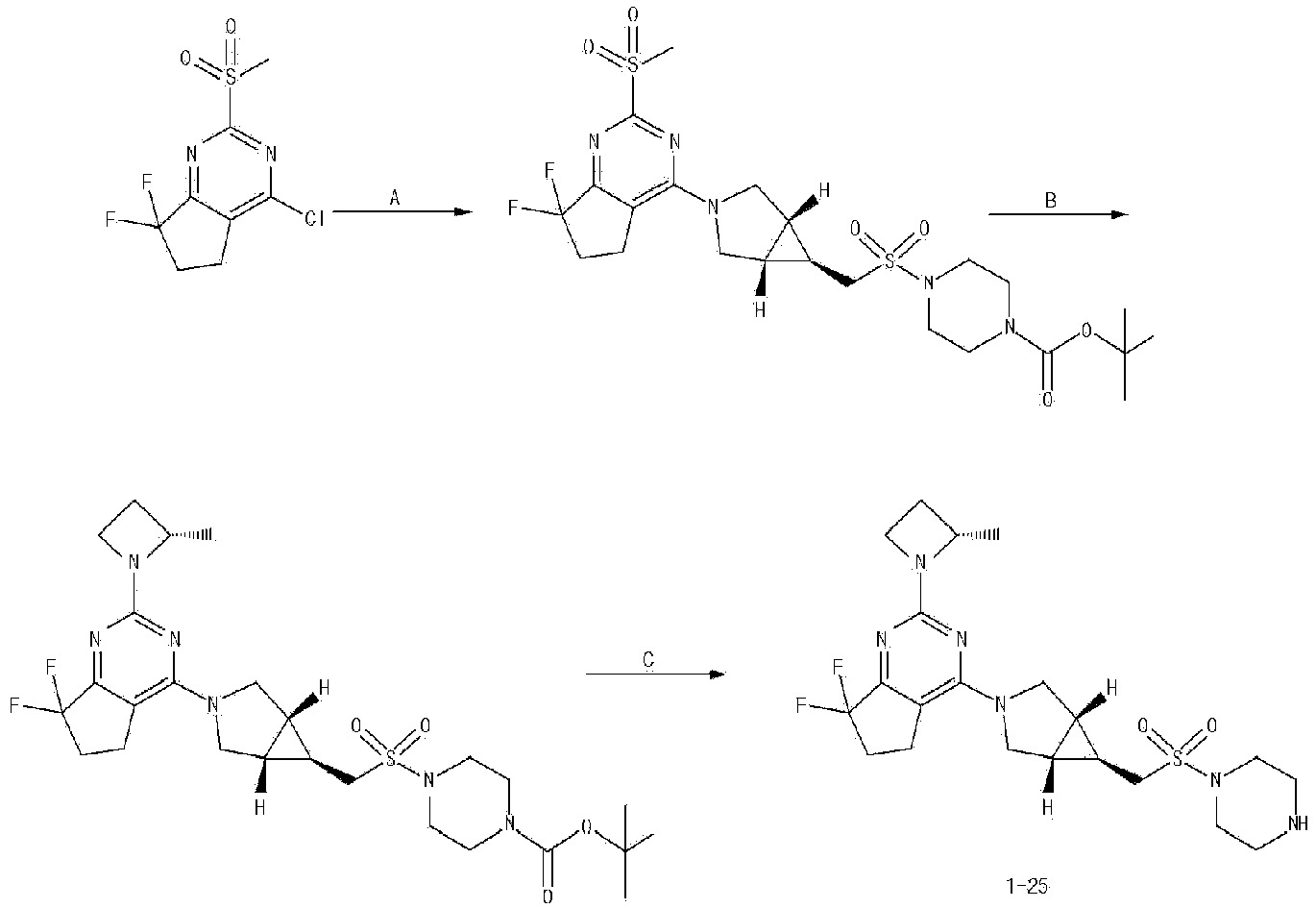
- By applying the methods of Step A, Step B and Step D of Example 16, but following Reaction 19 in sequence, the title compound of Formula 1-25 was prepared.
- The same procedure in Step A of Example 16 was performed except for using the tert-butyl 4-((((1R,5S,6R)-3-azabicyclo[3.1.0]hexan-6-yl)methyl)sulfonyl)piperazin-1-carboxylate (89 mg, 0.258 mmol) prepared in Preparation Example 10 instead of piperazin-2-one in Step A of Example 16, to prepare the title compound (135 mg, 0.234 mmol), which was confirmed through mass analysis (mass [M+H]=522.1).
- The same procedure in Step B of Example 16 was applied except for reacting the tert-butyl 4-((((1R,5S,6R)-3-(7,7-difluoro-2-(methylsulfonyl)-6,7-dihydro-5H-cyclopenta[d]pyrimidin-4-yl)-3-azabicyclo[3.1.0]hexan-6-yl)methyl)sulfonyl)piperazin-1-carboxylate (135 mg, 0.234 mmol) prepared in Step A with (2S)-2-methylazetidine[(1R,4S)-7,7-dimethyl-2-oxo-norbornan-1-yl] methanesulfonate in Step B of Example 16, to prepare the title compound (95 mg, 0.167 mmol), which was confirmed through 1H NMR analysis.
- 1H NMR (500MHz, CDCl3) δ 4.43 (q, J=6.7 Hz, 1H), 3.97-4.09 (m, 4H), 3.64-3.69 (m, 2H), 3.54 (s, 4H), 3.29 (s, 4H), 3.01 (d, J=3.7 Hz, 2H), 2.92-2.95 (m, 2H), 2.43-2.50 (m, 2H), 2.38 (s, 1H), 1.96 (d, J=9.5 Hz, 1H), 1.75 (s, 2H), 1.51 (d, J=6.4 Hz, 3H), 1.49 (s, 8H). 1.07 (dd, J=6.6, 3.6 Hz, 1H).
- The same procedure in Step D of Example 16 was performed except for using the tert-butyl 4-((((1R,5S,6R)-3-(7,7-difluoro-2-((S)-2-methylazetidin-1-yl)-6,7-dihydro-5H-cyclopenta[d]pyrimidin-4-yl)-3-azabicyclo[3.1.0]hexan-6-yl)methyl)sulfonyl)piperazin-1-carboxylate (95 mg, 0.167 mmol) prepared in Step B, in Step D of Example 16 to prepare the title compound of Formula 1-25 (61 mg, 0.130 mmol), which was confirmed through 1H NMR analysis.
- 1H NMR (500MHz, CDCl3) δ 4.42 (td, J=13.2, 6.5 Hz, 1H), 4.01-4.08 (m, 3H), 3.97 (q, J=8.2 Hz, 1H), 3.66 (t, J=12.2 Hz, 2H), 3.30 (t, J=4.7 Hz, 4H), 2.98-3.01 (m, 2H), 2.95-2.98 (m, 4H), 2.88-2.93 (m, 2H), 2.40-2.49 (m, 2H), 2.34-2.39 (m, 1H), 1.91-1.98 (m, 1H), 1.79 (s, 1H), 1.75 (s, 2H), 1.46-1.51 (m, 3H), 1.06-1.10 (m, 1H).
-

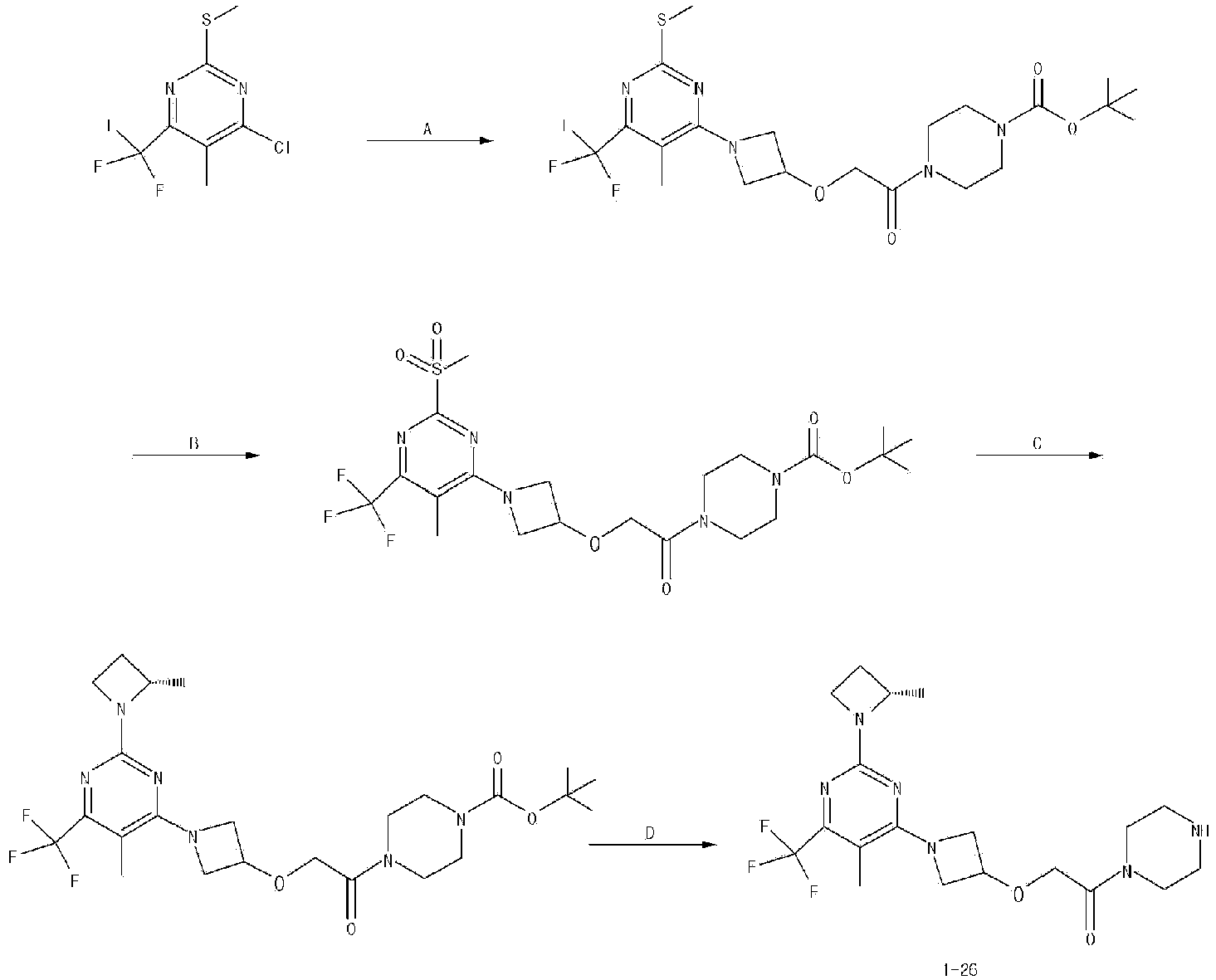
- By applying Step A to Step D of Example 2, but following Reaction 20 in sequence, the title compound of Formula 1-26 was prepared.
- Particularly, the same procedure in Example 2 was performed except for reacting 4-chloro-5-methyl-2-(methylthio)-6-(trifluoro)pyrimidine (12.0 g, 49.45 mmol) instead of 4,5-dichloro-2-(methylthio)-6-(trifluoromethyl)pyrimidine with tert-butyl 4-(2-(azetidin-3-yloxy)acetyl)piperazin-1-carboxylate (14.8 g, 49.45 mmol) in Step A, and using (2S)-2-methylazetidine[(1R,4S)-7,7-dimethyl-2-oxo-norbornan-1-yl]methanesulfonate in 18.0 g (59.28 mmol) in Step C in Example 2, to prepare the title compound of Formula 1-26 (12.1 g, 28.31 mmol, yield 57%), which was confirmed through 1H NMR analysis.
- 1H NMR (500MHz, MeOH-d4) δ 4.84 (br, s, 3H), 4.42 (m, 1H). 4.35 (s, 2H), 4.14 (m, 2H), 3.95 (m, 1H), 3.87 (m, 1H), 3.55 (br, s, 2H), 3.44 (br, s, 2H), 2.81 (br, s, 4H), 2.37 (m, 1H). 2.09 (m, 1H), 1.47 (d, 3H).
-

- By applying Step A to Step D of Example 2, but performing Reaction 21 in sequence, the title compound of Formula 1-27 was prepared.
- Particularly, the same procedure of Example 2 was performed except for reacting 4-chloro-2-(methylthio)-6-(trifluoro)pyrimidine (229 mg, 1.00 mmol) instead of 4,5-dichloro-2-(methylthio)-6-(trifluoromethyl)pyrimidine with tert-butyl 4-(2-(piperidin-4-yloxy)acetyl)piperazin-1-carboxylate (354 mg, 1.08 mmol) prepared in Preparation Example 9 instead of tert-butyl 4-(2-(azetidin-3-yloxy)acetyl)piperazin-1-carboxylate in Step A, and using (2S)-2-methylazetidine[(1R,4S)-7,7-dimethyl-2-oxo-norbornan-1-yl]methanesulfonate in 225 mg (0.744 mmol) in Step C in Example 2, to prepare the title compound of Formula 1-27 (219 mg, 0.50 mmol, yield 50%), which was confirmed through 1H NMR analysis.
- 1H NMR (500MHz, MeOH-d4) δ 6.37 (s, 1H), 4.42 (q, J=6.5 Hz, 1H), 4.27 (s, 2H), 4.11-3.83 (m, 4H), 3.70 (s, 1H), 3.53 (d, J=23.8 Hz, 4 H), 3.40 (t, J=10.2 Hz, 2H), 2.81 (d, J=14.0 Hz, 4H), 2.49-2.32 (m, 1H), 2.03-1.84 (m, 3H), 1.60 (d, J=8.8 Hz, 2H), 1.48 (d, J=6.1 Hz, 3H).
-


- By applying the methods of Step A to Step D of Example 2, but performing Reaction 22 in sequence, the title compound of Formula 1-28 was prepared.
- Particularly, the same procedure in Example 2 was performed except for reacting 4-chloro-5-methyl-2-(methylthio)-6-(trifluoro)pyrimidine (243 mg, 1.00 mmol) instead of 4,5-dichloro-2-(methylthio)-6-(trifluoromethyl)pyrimidine with tert-butyl 4-(2-(piperidin-4-yloxy)acetyl)piperazin-1-carboxylate (354 mg, 1.08 mmol) prepared in Preparation Example 9 instead of tert-butyl 4-(2-(azetidin-3-yloxy)acetyl)piperazin-1-carboxylate in Step A, and using (2S)-2-methylazetidine[(1R,4S)-7,7-dimethyl-2-oxo-norbornan-1-yl]methanesulfonate in 264 mg (0.87 mmol) in Step C in Example 2, to prepare the title compound of Formula 1-28 (213 mg, 0.47 mmol, yield 47%), which was confirmed through 1H NMR analysis.
- 1H NMR (500MHz, MeOH-d4) δ 4.48-4.32 (m, 1H), 4.26 (s, 2H), 4.04-3.81 (m, 2H), 3.65 (s, 3H), 3.53 (d, J=18.9 Hz, 4H), 3.11 (t, J=9.6 Hz, 2H), 2.82 (d, J=16.2 Hz, 4H), 2.41 (d, J=13.7 Hz, 1H), 2.14 (s, 3H), 2.09-1.84 (m, 3H), 1.71 (q, J=8.8 Hz, 2H), 1.48 (d, J=6.1 Hz, 3H).
- Step A to Step K were performed in sequence to prepare 4-chloro-7,7-difluoro-2-(methylthio)-6,7-dihydro-5H-cyclopenta[d]pyrimidine of Formula k.

- Ethyl 2-bromo-2,2-difluoroacetate (20 g, 99 mmol), tert-butyl acrylate (11.1 ml, 76 mmol), copper (9.6 g, 152 mmol), N1,N1,N2,N2-tetramethylethan-1,2-diamine (5.7 ml, 37.9 mmol) and acetic acid (4.8 ml, 83 mmol) were dissolved in 100 ml of tetrahydrofuran, followed by stirring at 50°C for 4 hours. After finishing the reaction, an aqueous saturated ammonium chloride solution was added to the reaction solution, and the resultant was extracted with ethyl acetate. An organic layer was washed with an aqueous sodium chloride solution, dried over anhydrous magnesium sulfate and filtered. The filtrate was concentrated under a reduced pressure to obtain 5-(tert-butyl) 1-ethyl 2,2-difluoropentanedioate. The synthesis of the 5-(tert-butyl) 1-ethyl 2,2-difluoropentanedioate thus obtained was confirmed through 1H NMR analysis.
- 1H NMR (400 MHz, CDCl3) δ 4.31 (q, J=7.0 Hz, 2H), 2.32-2.47 (m, 4H), 1.43 (s, 9H), 1.34 (t, J=7.3 Hz, 3H).
- The 5-(tert-butyl) 1-ethyl 2,2-difluoropentanedioate obtained in Step A was dissolved in trifluoroacetic acid (30 ml) and dichloromethane (70 ml), followed by stirring at room temperature for 8 hours. After finishing the reaction, the resultant was concentrated under a reduced pressure. To the concentrate, an aqueous saturated sodium bicarbonate solution was added, and the resultant was extracted with ethyl acetate. An organic layer was washed with an aqueous sodium chloride solution, dried over anhydrous magnesium sulfate and filtered. The filtrate was concentrated under a reduced pressure to obtain 5-ethoxy-4,4-difluoro-5-oxopentanoic acid (15 g, 76 mmol, yield 100%). The synthesis of the 5-ethoxy-4,4-difluoro-5-oxopentanoic acid thus obtained was confirmed through 1H NMR analysis.
- 1H NMR (500MHz, CDCl3) δ 4.36 (q, J=7.2 Hz, 2H), 2.66 (t, J=7.6 Hz, 2H), 2.42-2.51 (m, 2H), 1.39 (t, J=7.2 Hz, 3H).
- The 5-ethoxy-4,4-difluoro-5-oxopentanoic acid (12.0 g, 61 mmol) prepared in Step B and a borane dimethylsulfide tetrahydrofuran solution (2 M 36.6 ml. 73 mmol) were dissolved in 300 ml of tetrahydrofuran, followed by stirring at 50°C for 12 hours. After finishing the reaction, water (10 ml) was added to the reaction solution, followed by stirring at 60°C for 1 hour. After finishing the reaction, water was added to the reaction solution, and the resultant was extracted with ethyl acetate. An organic layer was washed with an aqueous sodium chloride solution, dried over anhydrous magnesium sulfate and filtered. The filtrate was concentrated under a reduced pressure to obtain ethyl 2,2-difluoro-5-hydroxypentanoate (6.5 g, 35.7 mmol, yield 59%). The synthesis of the ethyl 2,2-difluoro-5-hydroxypentanoate thus obtained was confirmed through 1H NMR analysis.
- 1H NMR (500MHz, CDCl3) δ 4.35 (q, J=7.1 Hz, 2H), 3.74 (t, J=6.3 Hz, 2H), 2.16-2.26 (m, 2H), 1.72-1.81 (m, 2H), 1.38 (t, J=7.2 Hz, 3H).
- The ethyl 2,2-difluoro-5-hydroxypentanoate (9.4 g, 51.6 mmol) obtained in Step C, methanesulfonyl chloride (4.42 ml, 56.8 mmol), diisopropylethylamine (18.0 ml, 103 mmol) and 4-dimethylaminopyridine (315 mg, 2.58 mmol) were dissolved in dichloromethane (200 ml), followed by stirring at room temperature for 3 hours. After finishing the reaction, a N hydrochloric acid solution was added to the reaction solution, followed by extracting with ethyl acetate. An organic layer was washed with an aqueous sodium chloride solution, dried over anhydrous magnesium sulfate and filtered. The filtrate was concentrated under a reduced pressure and purified by column chromatography (ethyl acetate/hexane = 1/3 by a weight ratio) to obtain ethyl 2,2-difluoro-5-((methanesulfonyl)oxy)pentanoate (13.3 g, 51.1 mmol, yield 99%). The synthesis of the ethyl 2,2-difluoro-5-((methanesulfonyl)oxy)pentanoate thus obtained was confirmed through 1H NMR analysis.
- 1H NMR (500MHz, CDCl3) δ 4.37 (q, J=7.1 Hz, 2H), 4.31 (t, J=6.3 Hz, 2H), 3.06 (s, 3H), 2.20-2.29 (m, 2H), 1.99-2.05 (m, 2H), 1.38-1.40 (m, 3H).
- The ethyl 2,2-difluoro-5-((methanesulfonyl)oxy)pentanoate (13.3 g, 51.1 mmol) prepared in Step D, and potassium cyanate (10,0 g, 153.3 mmol) were dissolved in a mixture solution of 150 ml of tetrahydrofuran and 150 ml of dimethylformamide, followed by stirring at 70°C for 18 hours. After finishing the reaction, the reaction solution was concentrated under a reduced pressure. To the concentrate, an aqueous saturated ammonium chloride solution was added, and extraction with ethyl acetate was performed. An organic layer was washed with aqueous sodium chloride solution, dried over anhydrous magnesium sulfate and filtered. The filtrate was concentrated under a reduced pressure and purified by column chromatography (ethyl acetate/hexane = 1/1 by a weight ratio) to obtain ethyl 5-cyano-2,2-difluoropentanoate (7.1 g, 37.1 mmol, yield 73%). The synthesis of the ethyl 5-cyano-2,2-difluoropentanoate thus obtained was confirmed through 1H NMR analysis.
- 1H NMR (400MHz, CDCl3) δ 4.27-4.35 (m, 2H), 2.45 (t, J=7.1 Hz, 2H), 2.15-2.29 (m, 2H), 1.91 (t, 7.1 Hz, 2H), 1.31-1.37 (m, 3H).
- The ethyl 5-cyano-2,2-difluoropentanoate (7.1 g, 37.7 mmol) prepared in Step E and acetyl chloride (30 ml) were dissolved in 60 ml of ethanol, followed by refluxing for 48 hours. After finishing the reaction, the resultant was concentrated under a reduced pressure. To the concentrate, an aqueous saturated sodium bicarbonate solution was added, and extraction with ethyl acetate was performed. An organic layer was washed with aqueous sodium chloride solution, dried over anhydrous magnesium sulfate and filtered. The filtrate was concentrated under a reduced pressure to obtain diethyl 2,2-difluorohexanedioate (6.5 g, 27.3 mmol, yield 74%). The synthesis of the diethyl 2,2-difluorohexanedioate thus obtained was confirmed through 1H NMR analysis.
- 1H NMR (500MHz, CDCl3) δ 4.35 (q. J=7.1 Hz, 2H), 4.16 (q, J=7.1 Hz, 2H), 2.40 (t, J=7.3 Hz, 2H), 2.07-2.20 (m, 2H), 1.86 (m, 2H), 1.38 (t, J=7.2 Hz, 3H), 1.28 (t, J=7.2 Hz, 3H).
- The diethyl 2,2-difluorohexanedioate (51.57 g, 216 mmol) prepared in Step F was dissolved in tetrahydrofuran (1000 ml), and potassium tert-butoxide (26.7 g, 238 mmol) was slowly added thereto, followed by stirring at room temperature for 4 hours. After finishing the reaction, 240 ml of a 1 N hydrochloric acid solution was slowly added to the reaction solution at 0°C, followed by stirring for about 10 minutes. The reaction solution was diluted in ethyl acetate, and an organic layer was washed with an aqueous sodium chloride solution. An aqueous solution was extracted with ethyl acetate, and an organic layer collected was dried over anhydrous magnesium sulfate and filtered. The filtrate was concentrated under a reduced pressure and sufficiently dried under a reduced pressure state to obtain ethyl 3,3-difluoro-2-oxocyclopentan-1-carboxylate (41.6 g, 216 mmol, yield 99%), and this product was used in the next reaction without separate purification.
- The ethyl 3,3-difluoro-2-oxocyclopentan-1-carboxylate (540 mg, 2.41 mmol) prepared in Step G, methylisothioura hemisulfate (672 mg, 4.82 mmol) and sodium carbonate (767 mg, 7.24 mmol) were dissolved in 50 ml of water, followed by stirring at room temperature for 12 hours. After finishing the reaction, an excessive amount of water was added to the reaction solution, and extraction with ethyl acetate was performed. An organic layer was washed with an aqueous sodium chloride solution, dried over anhydrous magnesium sulfate and filtered. The filtrate was concentrated under a reduced pressure and purified by column chromatography (ethyl acetate/hexane = 1/1 by a weight ratio) to obtain 7,7-difluoro-2-(methylthio)-6,7-dihydro-5H-cyclopenta[d]pyrimidin-4-ol (250 mg, 1.15 mmol, yield 48%). The synthesis of the 7,7-difluoro-2-(methylthio)-6,7-dihydro-5H-cyclopenta[d]pyrimidin-4-ol thus obtained was confirmed through 1H NMR analysis.
- 1H NMR (500MHz, DMSO-D6) δ 1.92-1.97 (m, 2H), 1.81 (s, 3H), 1.71-1.79 (m, 2H).
- The 7,7-difluoro-2-(methylthio)-6,7-dihydro-5H-cyclopenta[d]pyrimidin-4-ol (5.2 g, 23.83 mmol) prepared in Step H, phosphoryl trichloride (22.21 ml, 238 mmol) and benzyltriethylammonium chloride (5.43 g, 23.93 mmol) were dissolved in 150 ml of dichloroethane, followed by stirring at 80°C for 3 hours. After finishing the reaction, the reaction solution was distilled under a reduced pressure. To the concentrate, a saturated sodium bicarbonate solution was added, and extraction with ethyl acetate was performed. An organic layer was washed with an aqueous sodium chloride solution, dried over anhydrous magnesium sulfate and filtered. The filtrate was concentrated under a reduced pressure and purified by column chromatography (ethyl acetate/hexane = 1/10 by a weight ratio) to obtain 4-chloro-7,7-difluoro-2-(methylthio)-6,7-dihydro-5H-cyclopenta[d]pyrimidine (5.00 g, 23.83 mmol, yield 89%). The synthesis of the 4-chloro-7,7-difluoro-2-(methylthio)-6,7-dihydro-5H-cyclopenta[d]pyrimidine thus obtained was confirmed through 1H NMR analysis.
- 1H NMR (500MHz, CDCl3) δ 2.99-3.03 (m, 2H), 2.62-2.71 (m, 5H).
- The 4-chloro-7,7-difluoro-2-(methylthio)-6,7-dihydro-5H-cyclopenta[d]pyrimidine (26.84 g, 113 mmol) prepared in Preparation Example 11, and 3-chloroperbenzoic acid (61.5 g, 250 mmol) were dissolved in 500 ml of dichloromethane, followed by stirring at room temperature for 18 hours. To the reaction solution after finishing the reaction, sodium thiosulfate (3.6 g, 22.68 mmol) was added, and water and a saturated sodium carbonate solution were added in sequence, followed by stirring. An organic layer extracted with dichloromethane was dried over anhydrous magnesium sulfate and filtered. The filtrate was concentrated under a reduced pressure to obtain 4-chloro-7,7-difluoro-2-(methylsulfonyl)-6,7-dihydro-5H-cyclopenta[d]pyrimidine of Formula 1 (30.5 g, yield >99%), and this product was used in the next reaction without separate purification. The synthesis of the 4-chloro-7,7-difluoro-2-(methylsulfonyl)-6,7-dihydro-5H-cyclopenta[d]pyrimidine thus obtained was confirmed through 1H NMR analysis.

- 1H NMR (400MHz, CDCl3) δ 2.80 (m, 2H), 2.65 (s, 3H), 2.49-2.60 (m, 2H).
- Tert-butyl piperazin-1-carboxylate (6.00 g, 32.21 mmol) and diisopropylethylamine (8.32 g, 64.37 mmol) were dissolved in 200 ml of dichloromethane, and the temperature was reduced to -78°C. Bromoacetyl bromide (7.15 g, 35.43 mmol) was slowly added thereto, followed by stirring for 1 hour, while slowly raising the temperature to room temperature. After finishing the reaction, the reaction solution was concentrated under a reduced pressure. A 1 N aqueous hydrochloric acid solution was added thereto, and the resultant was extracted with ethyl acetate. An organic layer was dried over anhydrous magnesium sulfate and filtered. The filtrate was concentrated under a reduced pressure and purified by column chromatography (ethyl acetate/hexane = 1/1 by a weight ratio) to obtain tert-butyl 4(2-bromoacetyl)piperazin-1-carboxylate of Formula m (6.62 g, 21.5 mmol, yield 66%). The synthesis of the tert-butyl 4(2-bromoacetyl)piperazin-1-carboxylate thus obtained was confirmed through 1H NMR analysis.

- 1H NMR (400MHz, CDCl3) δ 3.87 (s, 2H), 3.77-3.55 (m, 2H), 3.51 (dd, J=16.2, 5.8 Hz, 4H), 3.47-3.32 (m, 2H), 1.49 (d, J=18.3 Hz, 9H).
- Tert-butyl 1,4-diazepane-1-carboxylate (3.00 g, 14.97 mmol) and diisopropylethylamine (3.86 g, 29.94 mmol) were dissolved in 100 ml of dichloromethane, and the temperature was reduced to -78°C. Bromoacetyl bromide (3.32 g, 16.47 mmol) was slowly added thereto, followed by stirring for 1 hour, while raising the temperature to room temperature. After finishing the reaction, the reaction solution was concentrated under a reduced pressure. A 1 N aqueous hydrochloric acid solution was added thereto, and the resultant was extracted with ethyl acetate. An organic layer was dried over anhydrous magnesium sulfate and filtered. The filtrate was concentrated under a reduced pressure and purified by column chromatography (ethyl acetate/hexane = 1/1 by a weight ratio) to obtain tert-butyl 4-(2-bromoacetyl)-1,4-diazepane-1-carboxylate of Formula n (2.21 g, 6.88 mmol, yield 45%). The synthesis of the tert-butyl 4-(2-bromoacetyl)-1,4-diazepane-1-carboxylate thus obtained was confirmed through 1H NMR analysis.

- 1H NMR (400MHz, CDCl3) δ 3.87 (d, J=8.8 Hz, 2H), 3.72-3.34 (m, 8H), 2.01-1.77 (m, 2H), 1.45 (d, J=8.8 Hz, 9H).
- Glycolic acid (5.00 g, 65.74 mmol), N-[(dimethylamino)-1H-1,2,3-triazol-[4-5-b]pyridin-1-ylmethylene]-N-methylmethanaminium hexafluorophosphate N-oxide (37.47 g, 98.54 mmol), tert-butyl piperazin-1-carboxylate (12.24 g, 65.71 mmol) and triethylamine (13.29 g, 131.33 mmol) were dissolved in 200 ml of dimethylformamide, followed by stirring at room temperature for 18 hours. After finishing the reaction, the reaction solution was concentrated under a reduced pressure. Water was added thereto, and extraction with ethyl acetate was performed. An organic layer was dried over anhydrous magnesium sulfate and filtered. The filtrate was concentrated under a reduced pressure and purified by column chromatography (ethyl acetate/hexane = 1/1 by a weight ratio) to obtain tert-butyl 4-(2-hydroxyacetyl)piperazin-1-carboxylate of Formula o (4.81 g, 19.68 mmol, yield 29%). The tert-butyl 4-(2-hydroxyacetyl)piperazin-1-carboxylate thus obtained was confirmed through 1H NMR analysis.

- 1H NMR (400MHz, CDCl3) δ 4.19 (s, 2H), 3.66 (br, s, 2H), 3.59 (s, 1H), 3.48 (br, s, 4H), 2.27 (br s, 2H), 1.49 (s, 9H) .
- By performing Steps A and B in sequence, tert-butyl 4-(2-(5-(4,4,5,5-tetramethyl-1,3,2-dioxaborolan-2-yl)pyridin-2-yl)acetyl)piperazin-1-carboxylate of Formula p was prepared.


- 2-(5-Bromopyridin-2-yl)acetic acid (1 g, 4.63 mmol), tert-butyl-piperazin-1-carboxylate (862 mg, 4.63 mmol), and 1-[bis(dimethylamino)methylene]-1H-1,2,3-triazolo[4,5-b]pyridinium 3-oxide hexafluorophosphate (1.2 g, 3.16 mmol) were dissolved in 20 ml of dimethylformamide, and diisopropylethylamine (2.7 ml, 15.47 mmol) was added thereto, followed by stirring at room temperature for 18 hours. After finishing the reaction, the reaction solution was concentrated under a reduced pressure. An organic layer obtained by adding water and extracting with ethyl acetate was dried over anhydrous magnesium sulfate and filtered. The filtrate was concentrated under a reduced pressure and purified by column chromatography (ethyl acetate/hexane = 1/1 by a weight ratio) to obtain tert-butyl 4-(2-(5-bromopyridin-2-yl)acetyl)piperazin-1-carboxylate (884.8 mg, 2.303 mmol, yield 50%). The synthesis of the tert-butyl 4-(2-(5-bromopyridin-2-yl)acetyl)piperazin-1-carboxylate thus obtained was confirmed through 1H NMR analysis.
- 1H NMR (400MHz, CDCl3) δ 8.57 (d, J=2.3 Hz, 1H), 7.76 (dd, J=8.2, 2.3 Hz, 1H), 7.25 (d, J=8.0 Hz, 1H), 3.87 (s, 2H), 3.57 (dd, J=10.7, 7.1 Hz, 4H), 3.35 (dt, J=13.1, 5.1 Hz, 4H), 1.44 (d, J=7.8 Hz, 9H).
- The tert-butyl 4-(2-(5-bromopyridin-2-yl)acetyl)piperazin-1-carboxylate (1.18 g, 3.07 mmol) prepared in Step A, 4,4,4',4'5,5,5',5'-octamethyl-2,2-bi(1,3,2-dioxaborolane) (1.17 g, 4.61 mmol), and potassium acetate (904 mg, 9.21 mmol) were dissolved in 30 ml of 1,4-dioxane, and a [1,1'-bis(diphenylphosphino)ferrocene]dichloropalladium dichloromethane complex (251 mg, 0.307 mmol) was added thereto, followed by stirring at 100°C for 18 hours. After finishing the reaction, the reaction solution was cooled to room temperature and extracted with ethyl acetate. An organic layer was dried over anhydrous magnesium sulfate and filtered. The filtrate was concentrated under a reduced pressure to obtain tert-butyl 4-(2-(5-(4,4,5,5-tetramethyl-1,3,2-dioxaborolan-2-yl)pyridin-2-yl)acetyl)piperazin-1-carboxylate (1.74 g, 4.03 mmol, crude). The synthesis of the tert-butyl 4-(2-(5-(4,4,5,5-tetramethyl-1,3,2-dioxaborolan-2-yl)pyridin-2-yl)acetyl)piperazin-1-carboxylate thus obtained was confirmed through 1H NMR analysis.
- 1H NMR (400MHz, CDCl3) δ 8.33 (s, 1H), 8.01 (dd, J=7.5, 1.6 Hz, 1H), 7.33 (d, J=7.8 Hz, 1H). 3.94 (s, 2H), 3.53-3.59 (m, 4H), 3.34 (t, J=5.0 Hz, 2H), 3.24 (t, J=5.3 Hz, 2H), 1.43 (s, 9H), 1.34 (s, 12H).
- Step A and B were performed in sequence to prepare tert-butyl 4-(2-((5-(4,4,5,5-tetramethyl-1,3,2-dioxaborolan-2-yl)pyridin-2-yl)oxy)acetyl)piperazin-1-carboxylate of Formula q.

- Tert-butyl 4(2-hydroxyacetyl)piperazin-1-carboxylate (2,3 g, 9.35 mmol) and sodium hydride (60%, 374 mg, 9.35 mmol) were dissolved in 30 ml of dimethylformamide, followed by stirring at 0°C for 30 minutes. Then, 5-bromo-2-chloropyridine (1.5 g, 7.79 mmol) was added thereto, followed by stirring at 50°C for 2 hours. After finishing the reaction, the reaction solution was concentrated under a reduced pressure. An organic layer obtained by adding a 1 N hydrochloric acid solution and extracting with ethyl acetate was dried over anhydrous magnesium sulfate and filtered. The filtrate was concentrated under a reduced pressure and purified by column chromatography (ethyl acetate/hexane = 1/1 by a weight ratio) to obtain tert-butyl 4(2-((5-bromopyridin-2-yl)oxy)acetyl)piperazin-1-carboxylate (1.58 g, 3.95 mmol, yield 51%). The synthesis of the tert-butyl 4(2-((5-bromopyridin-2-yl)oxy)acetyl)piperazin-1-carboxylate thus obtained was confirmed through 1H NMR analysis.
- 1H NMR (400MHz, CDCl3) δ 8.15 (s, 1H), 7.70 (d, 1H), 6.83 (d, 1H), 5.00 (s, 2H), 3.62 (br, s, 2H), 3.50 (br s, 4H), 3.45 (br s, 2H), 1.49 (s, 9H).
- The tert-butyl 4(2-((5-bromopyridin-2-yl)oxy)acetyl)piperazin-1-carboxylate (6 g, 14.99 mmol) prepared in Step A, bis(pinacolato)diboron (4.19 g, 16.49 mmol), and potassium acetate (3.68 g, 37.5 mmol) were dissolved in 20 ml of 1,4-dioxane, followed by degassing for 5 minutes. A 1,1'-bis(diphenylphosphino)ferrocene-palladium(II) dichloridedichloromethane complex (612 mg, 0.749 mmol) was added thereto, followed by stirring at 80°C for 18 hours. After finishing the reaction, ethyl acetate was added to the reaction solution, and the resultant was washed with water and a saturated aqueous sodium chloride solution, dried over anhydrous magnesium sulfate and filtered. The filtrate was concentrated under a reduced pressure to obtain tert-butyl 4-(2-((5-(4,4,5,5-tetramethyl-1,3,2-dioxaborolan-2-yl)pyridin-2-yl)oxy)acetyl)piperazin-1-carboxylate (6.71 g, 23.96 mmol, crude). The synthesis of the tert-butyl 4-(2-((5-(4,4,5,5-tetramethyl-1,3,2-dioxaborolan-2-yl)pyridin-2-yl)oxy)acetyl)piperazin-1-carboxylate was confirmed by mass spectrometry (MS) measurement.
MS 448.3, 470.2(Na+) - Step A and B were performed in sequence to prepare tert-butyl 4-(2-((3-chloro-5-(4,4,5,5-tetramethyl-1,3,2-dioxaborolan-2-yl)pyridin-2-yl)oxy)acetyl)piperazin-1-carboxylate of Formula r.


- Tert-butyl 4(2-hydroxyacetyl)piperazin-1-carboxylate (2.5 g, 10.1 mmol) and sodium hydride (60%, 402 mg, 10.1 mmol) were dissolved in 30 ml of dimethylformamide, followed by stirring at 0°C for 30 minutes. 5-Bromo-2,3-dichloropyridine (1.5 g, 7.79 mmol) was added thereto, followed by stirring at 50°C for 2 hours. After finishing the reaction, the reaction solution was concentrated under a reduced pressure. An organic layer obtained by adding a 1 N hydrochloric acid solution and extracting with ethyl acetate was dried over anhydrous magnesium sulfate and filtered. The filtrate was concentrated under a reduced pressure and purified by column chromatography (ethyl acetate/hexane = 1/1 by a weight ratio) to obtain tert-butyl 4-(2-((5-bromo-3-chloropyridin-2-yl)oxy)acetyl)piperazin-1-carboxylate (2.1 g, 4.83 mmol, yield 58%). The synthesis of the tert-butyl 4-(2-((5-bromo-3-chloropyridin-2-yl)oxy)acetyl)piperazin-1-carboxylate thus obtained was confirmed through 1H NMR analysis.
- 1H NMR (400MHz, CDCl3) δ 8.05 (s, 1H), 7.80 (d, J=5.5 Hz, 1H), 5.08 (d, J=11.6 Hz, 2H), 3.60 (s, 2H), 3.47 (d, J=30.5 Hz, 6H), 1.48 (s, 9H).
- The tert-butyl 4-(2-((5-bromo-3-chloropyridin-2-yl)oxy)acetyl)piperazin-1-carboxylate (700 mg, 1.61 mmol) prepared in Step A, bis(pinacolato)diboron (450 mg, 1.77 mmol), and potassium acetate (395 mg, 4.03 mmol) were dissolved in 20 ml of 1,4-dioxane, followed by degassing for 5 minutes. A 1,1'-bis(diphenylphosphino)ferrocene-palladium(II) dichloridedichloromethane complex (66 mg, 0.08 mmol) was added thereto, followed by stirring at 80°C for 18 hours. After finishing the reaction, ethyl acetate was added to the reaction solution, and the resultant was washed with water and a saturated aqueous sodium chloride solution, dried over anhydrous magnesium sulfate and filtered. The filtrate was concentrated under a reduced pressure to obtain tert-butyl 4-(2-((3-chloro-5-(4,4,5,5-tetramethyl-1,3,2-dioxaborolan-2-yl)pyridin-2-yl)oxy)acetyl)piperazin-1-carboxylate. The synthesis of the tert-butyl 4-(2-((3-chloro-5-(4,4,5,5-tetramethyl-1,3,2-dioxaborolan-2-yl)pyridin-2-yl)oxy)acetyl)piperazin-1-carboxylate was confirmed through mass spectrometry (MS) measurement.
- As in Reaction 23, the processes of Steps A to D were performed in sequence to prepare the title compound of Formula 1-29.

- The 4-chloro-7,7-difluoro-2-(methylthio)-6,7-dihydro-cyclopenta[d]pyrimidine of Formula (a) (200 mg, 0.845 mmol) prepared in Preparation Example 11, methyl 2-(4-(4,4,5,5-tetramethyl-1,3,2-dioxaborolan-2-yl)phenyl)acetate (350 mg, 1.268 mmol), tetrakis(triphenylphosphine)palladium(O) (49 mg, 0.04 mmol) and a sodium bicarbonate solution (2 M, 27 ml, 2.54 mmol) were dissolved in 20 ml of 1,4-dioxane, followed by degassing for 5 minutes. Then, the resultant was stirred at 80°C for 2 hours. After finishing the reaction, the reaction solution was washed with water, ethyl acetate was added thereto, and the resultant was washed with water and a saturated aqueous sodium chloride solution, dried over anhydrous magnesium sulfate and filtered. The filtrate was concentrated under a reduced pressure and purified by column chromatography (ethyl acetate/hexane = 1/3 by a weight ratio) to obtain methyl 2-(4-(7,7-difluoro-2-(methylthio)-6,7-dihydro-5H-cyclopenta[d]pyrimidin-4-yl)phenyl)acetate (200 mg, 0.57 mmol, yield 98%). The synthesis of the methyl 2-(4-(7,7-difluoro-2-(methylthio)-6,7-dihydro-5H-cyclopenta[d]pyrimidin-4-yl)phenyl)acetate thus obtained was confirmed through 1H NMR analysis.
- 1H NMR (500MHz, CDCl3) δ 7.93 (d, 2H), 7.44 (d, 2H), 3.71 (s, 3H), 3.70 (s, 2H), 3.21 (m, 2H), 2.64 (s, 3H), 2.62 (m, 2H).
- The methyl 2-(4-(7,7-difluoro-2-(methylthio)-6,7-dihydro-5H-cyclopenta[d]pyrimidin-4-yl)phenyl)acetate (200 mg, 0.57 mmol) prepared in Step A and 3-chloroperbenzoic acid (70%, 352 mg, 1.43 mmol) were dissolved in 20 ml of dichloromethane, followed by stirring at room temperature for 10 hours. After finishing the reaction, a saturated sodium thiosulfate solution and a saturated sodium bicarbonate solution were added to the reaction solution in sequence, and the resultant was extracted with ethyl acetate. An organic layer was washed with a saturated aqueous sodium chloride solution, dried over anhydrous magnesium sulfate and filtered. The filtrate was concentrated under a reduced pressure, and the concentrate under a reduced pressure was purified by column chromatography (ethyl acetate/hexane = 1/1 by a weight ratio) to obtain methyl 2-(4-(7,7-difluoro-2-(methylsulfonyl)-6,7-dihydro-5H-cyclopenta[d]pyrimidin-4-yl)phenyl)acetate (150 mg, 0.39 mmol, yield 68%). The synthesis of the methyl 2-(4-(7,7-difluoro-2-(methylsulfonyl)-6,7-dihydro-5H-cyclopenta[d]pyrimidin-4-yl)phenyl)acetate thus obtained was confirmed through 1H NMR analysis.
- 1H NMR (500MHz, CDCl3) δ 8.03 (d, 2H), 7.49 (d, 2H), 3.73 (s, 3H), 3.72 (s, 2H), 3.45 (s, 3H), 3.38 (m, 2H), 2.74 (m, 2H).
- The methyl 2-(4-(7,7-difluoro-2-(methylsulfonyl)-6,7-dihydro-5H-cyclopenta[d]pyrimidin-4-yl)phenyl)acetate (130 mg, 0.34 mmol) prepared in Step B, (2S)-2-methylazetidine[(1R,4S)-7,7-dimethyl-2-oxo-norbornan-1-yl]methanesulfonate (239 mg, 0.51 mmol) and potassium carbonate (141 mg, 1.02 mmol) were dissolved in 20 ml of acetonitrile, followed by stirring at 80°C for 2 hours. After finishing the reaction, water was added to the reaction solution, and the resultant was extracted with ethyl acetate. An organic layer was washed with a saturated aqueous sodium chloride solution, dried over anhydrous magnesium sulfate and filtered. The filtrate was concentrated under a reduced pressure, and the concentrate under a reduced pressure was purified by column chromatography(ethyl acetate/hexane = 1/1 by a weight ratio) to obtain methyl (S)-2-(4-(7,7-difluoro-2-(2-methylazetidin-1-yl)-6,7-dihydro-5H-cyclopenta[d]pyrimidin-4-yl)phenyl)acetate (110 mg, 0.30 mmol, yield 88%). The synthesis of the methyl (S)-2-(4-(7,7-difluoro-2-(2-methylazetidin-1-yl)-6,7-dihydro-5H-cyclopenta[d]pyrimidin-4-yl)phenyl)acetate thus obtained was confirmed through 1H NMR analysis.
- 1H NMR (500MHz, CDCl3) δ 7.87 (d, 2H), 7.39 (d, 2H), 4.59 (m, 1H), 4.15 (m, 1H), 4.08 (m, 1H), 3.70 (s, 3H), 3.68 (s, 2H), 3.08 (m, 2H), 2.53 (m, 2H), 2.47 (m, 1H), 2.01 (m, 1H), 1.59 (d, 3H).
- The methyl (S)-2-(4-(7,7-difluoro-2-(2-methylazetidin-1-yl)-6,7-dihydro-5H-cyclopenta[d]pyrimidin-4-yl)phenyl)acetate (110 mg, 0.30 mmol) prepared in Step C and 1 ml of a 1 N aqueous sodium hydroxide solution were dissolved in 3 ml of tetrahydrofuran, followed by stirring at room temperature for 10 hours. After finishing the reaction, a 1 N hydrochloric acid solution was added to the reaction solution, and the resultant was extracted with ethyl acetate. An organic layer was washed with a saturated aqueous sodium chloride solution, dried over anhydrous magnesium sulfate and filtered. The filtrate was concentrated under a reduced pressure, and the concentrate under a reduced pressure was purified by column chromatography(methanol/dichloromethane = 1/9 by a weight ratio) to obtain (S)-2-(4-(7,7-difluoro-2-(2-methylazetidin-1-yl)-6,7-dihydro-5H-cyclopenta[d]pyrimidin-4-yl)phenyl) acetic acid (38 mg, 0.11 mmol, yield 38%) . The synthesis of the (S)-2-(4-(7,7-difluoro-2-(2-methylazetidin-1-yl)-6,7-dihydro-5H-cyclopenta[d]pyrimidin-4-yl)phenyl)acetic acid thus obtained was confirmed through 1H NMR analysis.
- 1H NMR (500MHz, CDCl3) δ 7.87 (d, 2H), 7.40 (d, 2H), 4.59 (m, 1H), 4.16 (m, 1H), 4.06 (m, 1H), 3.70 (s, 3H), 3.07 (s, 2H), 2.55 (m, 2H), 2.47 (m, 1H), 2.01 (m, 1H), 1.58 (d, 3H) .
- As in Reaction 24, the processes of Steps A and B were performed in sequence to prepare the title compound of Formula 1-30.

- The (S)-2-(4-(7,7-difluoro-2-(2-methylazetidin-1-yl)-6,7-dihydro-5H-cyclopenta[d]pyrimidin-4-yl)phenyl)acetic acid of Formula 1-29 (38 mg, 0.11 mmol) prepared in Example 29, 2,4,6-tripropyl-1,3,5,2,4,6-trioxatriphosphinane-2,4,6-trioxide (40.4 mg, 0.13 mmol), tert-butyl piperazin-1-carboxylate (24 mg, 0.13 mmol) and triethylamine (0.04 ml, 0.32 mmol) were dissolved in 5 ml of dichloromethane, followed by stirring at room temperature for 2 hours. After finishing the reaction, a 1 N hydrochloric acid solution was added, and extraction with ethyl acetate was performed. An organic layer was dried over anhydrous magnesium sulfate and filtered. The filtrate was concentrated under a reduced pressure and purified by column chromatography (dichloromethane/methanol=9/1 by a weight ratio) to obtain tert-butyl (S)-4-(2-(4-(7,7-difluoro-2-(2-methylazetidin-1-yl)-6,7-dihydro-5H-cyclopenta[d]pyrimidin-4-yl)phenyl)acetyl)piperazin-1-carboxylate (55 mg, 0.10 mmol, yield 99%). The tert-butyl (S)-4-(2-(4-(7,7-difluoro-2-(2-methylazetidin-1-yl)-6,7-dihydro-5H-cyclopenta[d]pyrimidin-4-yl)phenyl)acetyl)piperazin-1-carboxylate thus obtained was confirmed through 1H NMR analysis.
- 1H NMR (500MHz, CDCl3) δ 7.88 (d, 2H), 7.34 (d, 2H), 4.57 (m, 1H), 4.10 (m, 1H), 3.78 (s, 2H), 3.60 (s, 2H), 3.40 (m, 4H), 3.20 (m, 2H), 3.07 (m, 2H), 2.52 (m, 2H), 2.49 (m, 1H), 2.00 (m, 1H), 1.57 (d, 23H), 1.43 (s, 9H).
- The tert-butyl (S)-4-(2-(4-(7,7-difluoro-2-(2-methylazetidin-1-yl)-6,7-dihydro-5H-cyclopenta[d]pyrimidin-4-yl)phenyl)acetyl) piperazin-1-carboxylate (55 mg, 0.10 mmol) prepared in Step A and 1 ml of trifluoroacetic acid were dissolved in 4 ml of dichloromethane, followed by stirring at room temperature for 8 hours. After finishing the reaction, the resultant was concentrated under a reduced pressure. To the concentrate, a saturated aqueous ammonium hydroxide solution was added, and the resultant was extracted with ethyl acetate. An organic layer was dried over anhydrous magnesium sulfate and filtered. The filtrate was concentrated under a reduced pressure, and the concentrate under a reduced pressure was purified by column chromatography (dichloromethane/methanol=9/1 by a weight ratio) to obtain (S)-2-(4-(7,7-difluoro-2-(2-methylazetidin-1-yl)-6,7-dihydro-5H-cyclopenta[d]pyrimidin-4-yl)phenyl)-1-(piperazin-1-yl)ethan-1-one (32 mg, 0.075 mmol, yield 75%). The synthesis of the (S)-2-(4-(7,7-difluoro-2-(2-methylazetidin-1-yl)-6,7-dihydro-5H-cyclopenta[d]pyrimidin-4-yl)phenyl)-1-(piperazin-1-yl)ethan-1-one thus obtained was confirmed through 1H NMR analysis.
- 1H NMR (500MHz, CDCl3) δ 7.87 (d, 2H), 7.34 (d, 2H), 4.59 (m, 1H), 4.15 (m, 1H), 4.06 (m, 1H), 3.76 (s, 2H), 3.61 (m, 2H), 3.43 (m, 2H), 3.08 (m, 2H), 2.83 (m, 2H), 2.72 (m, 2H), 3.60 (m, 2H), 3.50 (m, 1H), 2.00 (m, 1H), 1.57 (d, 3H).
- As in Reaction 25, the processes of Steps A to C were performed in sequence to prepare the title compound of Formula 1-31.

- The 2,4-dichloro-6-(trifluoromethyl)pyrimidine (98 mg, 0.450 mmol), the tert-butyl 4-(2-(5-(4,4,5,5-tetramethyl-1,3,2-dioxaborolan-2-yl)pyridin-2-yl)acetyl)piperazin-1-carboxylate of Formula p (388 mg, 0.900 mmol) prepared in Preparation Example 16, a sodium carbonate solution (2 M, 0.675 ml, 1.349 mmol) and tetrakis(triphenylphosphine)palladium (52 mg, 0.045 mmol) were dissolved in 10 ml of 1,4-dioxane, followed by stirring at 80°C for 18 hours. After finishing the reaction, water was added, and the resultant was extracted with ethyl acetate. An organic layer was dried over anhydrous magnesium sulfate and filtered. The filtrate was concentrated under a reduced pressure and purified by column chromatography to obtain tert-butyl 4-(2-(5-(2-chloro-6-(trifluoromethyl)pyrimidin-4-yl)pyridin-2-yl)acetyl)piperazin-1-carboxylate (140 mg, yield 64%). The synthesis of the tert-butyl 4-(2-(5-(2-chloro-6-(trifluoromethyl)pyrimidin-4-yl)pyridin-2-yl)acetyl)piperazin-1-carboxylate thus obtained was confirmed through 1H NMR analysis.
- 1H NMR (400MHz, CDCl3) δ 9.23 (d, J=1.8 Hz, 1H), 8.42 (dd, J=8.2, 2.3 Hz, 1H), 7.95 (s, 1H), 4.03 (s, 2H), 3.61 (t, J=5.0 Hz, 4H), 3.35-3.40 (m, 4H), 1.45 (s, 9H).
- The tert-butyl 4-(2-(5-(2-chloro-6-(trifluoromethyl)pyrimidin-4-yl)pyridin-2-yl)acetyl)piperazin-1-carboxylate (140 mg, 0.29 mmol) prepared in Step A, (2S)-2-methylazetidine[(1R,4S)-7,7-dimethyl-2-oxo-norbornan-1-yl]methanesulfonate (105 mg, 0.35 mmol) and potassium carbonate (120 mg, 0.87 mmol) were dissolved in 20 ml of acetonitrile, followed by stirring at 80°C for 3 hours. After finishing the reaction, water was added, and the resultant was extracted with ethyl acetate. An organic layer was dried over anhydrous magnesium sulfate and filtered. The filtrate was concentrated under a reduced pressure, and the concentrate under a reduced pressure was purified by column chromatography (ethyl acetate/hexane = 1/1 by a weight ratio) to obtain tert-butyl (S)-4-(2-(5-(2-methylazetidin-1-yl)-5-(trifluoromethyl)pyrimidin-4-yl)pyridin-2-yl)acetyl)piperazin-1-carboxylate (135 mg, yield 90%) . The synthesis of the tert-butyl (S)-4-(2-(5-(2-methylazetidin-1-yl)-6-(trifluoromethyl)pyrimidin-4-yl)pyridin-2-yl)acetyl)piperazin-1-carboxylate thus obtained was confirmed through 1H NMR analysis.
- 1H NMR (400MHz, CDCl3) δ 9.17 (d, J=2.3 Hz, 1H), 8.27 (dd, J=8.2, 2.3 Hz, 1H), 7.53 (dd, J=7.5, 1.6 Hz, 1H), 7.16 (s, 1H), 4.61 (dd, J=14.4, 6.2 Hz, 1H), 4.06-4.20 (m, 2H), 3.99 (s, 2H), 3.60 (t, J=5.3 Hz, 4H), 3.37 (dd, J=13.3, 5.5 Hz, 4H), 2.47-2.55 (m, 1H), 2.00-2.08 (m, 1H), 1.58 (d, J=6.4 Hz, 3H), 1.44 (s, 9H).
- The tert-butyl (S)-4-(2-(5-(2-methylazetidin-1-yl)-6-(trifluoromethyl)pyrimidin-4-yl)pyridin-2-yl)acetyl)piperazin-1-carboxylate (135 mg, 0.259 mmol) prepared in Step B and 1 ml of trifluoroacetic acid were dissolved in 4 ml of dichloromethane, followed by stirring at room temperature for 4 hours. After finishing the reaction, the resultant was concentrated under a reduced pressure. The concentrate under a reduced pressure was neutralized using a saturated aqueous sodium bicarbonate solution, and then, extracted with dichloromethane. An organic layer was dried over anhydrous magnesium sulfate and filtered. The filtrate was concentrated under a reduced pressure, and the concentrate under a reduced pressure was purified by column chromatography (methanol/dichloromethane = 1/9 by a weight ratio) to obtain (S)-2-(5-(2-(2-methylazetidin-1-yl)-6-(trifluoromethyl)pyrimidin-4-yl)pyridin-2-yl)-1-(piperazin-1-yl)ethan-1-one (78 mg, yield 72%). The synthesis of the (S)-2-(5-(2-(2-methylazetidin-1-yl)-6-(trifluoromethyl)pyrimidin-4-yl)pyridin-2-yl)-1-(piperazin-1-yl)ethan-1-one thus obtained was confirmed through 1H NMR analysis.
- 1H NMR (400MHz, CDCl3) δ 9.16 (d, J=1.8 Hz, 1H), 8.27 (dd, J=8.2, 2.3 Hz, 1H), 7.46 (d, J=8.2 Hz, 1H), 7.16 (s, 1H), 4.60 (dd, J=14.0, 6.2 Hz, 1H), 4.06-4.19 (m, 2H), 3.98 (s, 2H), 3.59 (td, J=9.6, 4.7 Hz, 4H), 2.79 (dt, J=22.0, 5.0 Hz, 4H), 2.46-2.55 (m, 1H), 1.99-2.08 (m, 1H), 1.58 (d, J=6.4 Hz, 3H) .
- As in Reaction 26, the processes of Steps A to E were performed in sequence to prepare the title compound of Formula 1-32.

- The 4-chloro-7,7-difluoro-2-(methylthio)-6,7-dihydro-cyclopenta[d]pyrimidine of Formula k (200 mg, 0.845 mmol) prepared in Preparation Example 11, (4-hydroxyphenyl)boronic acid (175 mg, 1.268 mmol), tetrakis(triphenylphosphine)palladium(O) (49 mg, 0.042 mmol) and a sodium carbonate solution (2 M, 1.27 ml, 2.54 mmol) were dissolved in 20 ml of 1,4-dioxane, followed by stirring at 80°C for 2 hours. After finishing the reaction, water was added to the reaction solution, and the resultant was extracted with ethyl acetate. An organic layer was dried over anhydrous magnesium sulfate and filtered. The filtrate was concentrated under a reduced pressure and purified by column chromatography (ethyl acetate/hexane = 1/3 by a weight ratio) to obtain 4-(7,7-difluoro-2-(methylthio)-6,7-dihydro-5H-cyclopenta[d]pyrimidin-4-yl)phenol (130 mg, 0.44 mmol, yield 52%). The synthesis of the 4-(7,7-difluoro-2-(methylthio)-6,7-dihydro-5H-cyclopenta[d]pyrimidin-4-yl)phenol thus obtained was confirmed through 1H NMR analysis.
- 1H NMR (500MHz, CDCl3) δ 7.69 (d, 2H), 6.70 (d, 2H), 3.24 (m, m, 2H), 2.69 (s, 3H), 2.65 (m, 2H).
- The 4-(7,7-difluoro-2-(methylthio)-6,7-dihydro-5H-cyclopenta[d]pyrimidin-4-yl)phenol (130 mg, 0.44 mmol) prepared in Step A, the tert-butyl 4-(2-bromoacetyl)piperazin-1-carboxylate of Formula c (203 mg, 0.66 mmol) prepared in Preparation Example 3 and potassium carbonate (183 mg, 1.33 mmol) were dissolved in 10 ml of dimethylformamide, followed by stirring at room temperature for 2 hours. After finishing the reaction, the reaction solution was concentrated under a reduced pressure. The resultant was dissolved in ethyl acetate and then, washed with a saturated sodium chloride solution. Then, an organic layer was dried over anhydrous magnesium sulfate and filtered. The filtrate was concentrated under a reduced pressure, and the concentrate under a reduced pressure was purified by column chromatography (ethyl acetate/hexane = 1/1 by a weight ratio) to obtain tert-butyl 4-(2-(4-(7,7-difluoro-2-(methylthio)-6,7-dihydro-5H-cyclopenta[d]pyrimidin-4-yl)phenoxy)acetyl)piperazin-1-carboxylate (160 mg, 0.31 mmol, yield 70%). The synthesis of the tert-butyl 4-(2-(4-(7,7-difluoro-2-(methylthio)-6,7-dihydro-5H-cyclopenta[d]pyrimidin-4-yl)phenoxy)acetyl)piperazin-1-carboxylate thus obtained was confirmed through 1H NMR analysis.
- 1H NMR (400MHz, CDCl3) δ 7.97 (dd, J=6.9, 2.3 Hz, 2H), 7.07 (dd, J=6.9, 1.8 Hz, 2H), 4.78 (s, 2H), 3.57 (q, J=5.6 Hz, 4H), 3.39-3.44 (m, 4H), 3.18-3.22 (m, 2H), 2.66 (s, 3H), 2.63 (m, 2H), 1.46 (s, 9H).
- The tert-butyl 4-(2-(4-(7,7-difluoro-2-(methylthio)-6,7-dihydro-5H-cyclopenta[d]pyrimidin-4-yl)phenoxy)acetyl)piperazin-1-carboxylate (160 mg, 0.31 mmol) prepared in Step B and 3-chloroperbenzoic acid (70%, 189 mg, 0.77 mmol) were dissolved in 20 ml of dichloromethane, followed by stirring at room temperature for 10 hours. After finishing the reaction, a saturated sodium thiosulfate solution and a saturated sodium bicarbonate solution were added to the reaction solution in sequence, and the resultant was extracted with ethyl acetate. An organic layer was washed with an aqueous saturated sodium chloride solution, dried over anhydrous magnesium sulfate and filtered. The filtrate was concentrated under a reduced pressure, and the concentrate under a reduced pressure was purified by column chromatography (methanol/dichloromethane = 1/9 by a weight ratio) to obtain tert-butyl 4-(2-(4-(7,7-difluoro-2-(methylsulfonyl)-6,7-dihydro-5H-cyclopenta[d]pyrimidin-4-yl)phenoxy)acetyl)piperazin-1-carboxylate (141 mg, 0.26 mmol, yield 84%). The synthesis of the tert-butyl 4-(2-(4-(7,7-difluoro-2-(methylsulfonyl)-6,7-dihydro-5H-cyclopenta[d]pyrimidin-4-yl)phenoxy)acetyl)piperazin-1-carboxylate thus obtained was confirmed through mass spectrometry (MS) measurement.
MS 552.6, 574.6 (Na+) - The tert-butyl 4-(2-(4-(7,7-difluoro-2-(methylsulfonyl)-6,7-dihydro-5H-cyclopenta[d]pyrimidin-4-yl)phenoxy)acetyl)piperazin-1-carboxylate (141 mg, 0.26 mmol) prepared in Step C, (2S)-2-methylazetidine[(1R,4S)-7,7-dimethyl-2-oxo-norbornan-1-yl]methanesulfonate (173 mg, 0.37 mmol) and potassium carbonate (127 mg, 0.92 mmol) were dissolved in 20 ml of acetonitrile, followed by stirring at 80°C for 2 hours. After finishing the reaction, an excessive amount of water was added to the reaction solution, and the resultant was extracted with ethyl acetate. An organic layer was washed with a saturated aqueous sodium chloride solution, dried over anhydrous magnesium sulfate and filtered. The filtrate was concentrated under a reduced pressure, and the concentrate under a reduced pressure was purified by column chromatography (ethyl acetate/hexane = 1/1 by a weight ratio) to obtain tert-butyl (S)-4-(2-(4-(7,7-difluoro-2-(2-methylazetidin-1-yl)-6,7-dihydro-5H-cyclopenta[d]pyrimidin-4-yl)phenoxy)acetyl)piperazin-1-carboxylate (95 mg, 0.18 mmol, yield 58%). The synthesis of the tert-butyl (S)-4-(2-(4-(7,7-difluoro-2-(2-methylazetidin-1-yl)-6,7-dihydro-5H-cyclopenta[d]pyrimidin-4-yl)phenoxy)acetyl)piperazin-1-carboxylate thus obtained was confirmed through 1H NMR analysis.
- 1H NMR (500MHz, CDCl3) δ 7.90 (d, 2H), 7.02 (d, 2H), 4.75 (s, 2H), 4.55 (m, 1H), 4.13 (m, 1H), 4.05 (m, 1H), 3.57 (m, 2H), 3.40 (m, 4H), 3.05 (m, 2H), 2.50 (m, 3H), 2.00 (m, 1H), 1.56 (d, 3H), 1.43 (s, 9H).
- The tert-butyl (S)-4-(2-(4-(7,7-difluoro-2-(2-methylazetidin-1-yl)-6,7-dihydro-5H-cyclopenta[d]pyrimidin-4-yl)phenoxy)acetyl)piperazin-1-carboxylate (95 mg, 0.18 mmol) prepared in Step D and 1 ml of trifluoroacetic acid were dissolved in 3 ml of dichloromethane, followed by stirring at room temperature for 10 hours. After finishing the reaction, a saturated sodium bicarbonate solution was added to the reaction solution, and the resultant was extracted with ethyl acetate. An organic layer was washed with a saturated aqueous sodium chloride solution, dried over anhydrous magnesium sulfate and filtered. The filtrate was concentrated under a reduced pressure, and the concentrate under a reduced pressure was purified by column chromatography (7 N ammonia methanol solution/dichloromethane = 1/9 by a weight ratio) to obtain (S)-4-(2-(4-(7,7-difluoro-2-(2-methylazetidin-1-yl)-6,7-dihydro-5H-cyclopenta[d]pyrimidin-4-yl)phenoxy)-1-(piperazin-1-yl)ethan-1-one (55 mg, 0.12 mmol, yield 69%). The synthesis of the (S)-4-(2-(4-(7,7-difluoro-2-(2-methylazetidin-1-yl)-6,7-dihydro-5H-cyclopenta[d]pyrimidin-4-yl)phenoxy)-1-(piperazin-1-yl)ethan-1-one thus obtained was confirmed through 1H NMR analysis.
- 1H NMR (500MHz, CDCl3) δ 7.88 (d, 2H), 7.01 (d, 2H), 4.71 (s, 2H), 4.54 (m, 1H), 4.13 (m, 1H), 4.03 (m, 1H), 3.56 (m, 2H), 3.51 (m, 2H), 3.05 (m, 2H), 2.81 (m, 4H), 2.52 (m, 2H), 2.48 (m, 1H), 1.97 (m, 1H), 1.55 (d, 3H).
- As in Reaction 27, the processes of Steps A to E were performed in sequence to prepare the title compound of Formula 1-33.


- The 4-chloro-7,7-difluoro-2-(methylthio)-6,7-dihydro-cyclopenta[d]pyrimidine of Formula k (200 mg, 0.845 mmol) prepared in Preparation Example 11, (3-fluoro-4-hydroxyphenyl)boronic acid (198 mg, 1.27 mmol), tetrakis(triphenylphosphine)palladium(O) (49 mg, 0.042 mmol) and a sodium carbonate solution (2 M, 1.27 ml, 2.54 mmol) were dissolved in 20 ml of 1,4-dioxane, followed by stirring at 80°C for 2 hours. After finishing the reaction, water was added to the reaction solution, and the resultant was extracted with ethyl acetate. An organic layer was dried over anhydrous magnesium sulfate and filtered. The filtrate was concentrated under a reduced pressure and purified by column chromatography (ethyl acetate/hexane = 1/3 by a weight ratio) to obtain 4-(7,7-difluoro-2-(methylthio)-6,7-dihydro-5H-cyclopenta[d]pyrimidin-4-yl)-2-fluorophenol (260 mg, 0.83 mmol, yield 98%). The synthesis of the 4-(7,7-difluoro-2-(methylthio)-6,7-dihydro-5H-cyclopenta[d]pyrimidin-4-yl)-2-fluorophenol thus obtained was confirmed through 1H NMR analysis.
- 1H NMR (500MHz, CDCl3) δ 7.8 (d, 1H), 7.72 (2H, 1H), 7.13 (t, 1H), 3.24 (m, 2H), 2.67 (s, 3H), 2.66 (m, 2H).
- The 4-(7,7-difluoro-2-(methylthio)-6,7-dihydro-5H-cyclopenta[d]pyrimidin-4-yl)-2-fluorophenol (260 mg, 0.83 mmol) prepared in Step A, the tert-butyl 4-(2-bromoacetyl)piperazin-1-carboxylate of Formula c (307 mg, 1.00 mmol) prepared in Preparation Example 3 and potassium carbonate (345 mg, 345 mmol) were dissolved in 10 ml of dimethylformamide, followed by stirring at room temperature for 2 hours. After finishing the reaction, the reaction solution was concentrated under a reduced pressure. The resultant was dissolved in ethyl acetate and washed with a saturated sodium chloride solution. Then, an organic layer was dried over anhydrous magnesium sulfate and filtered. The filtrate was concentrated under a reduced pressure, and the concentrate under a reduced pressure was purified by column chromatography (ethyl acetate/hexane = 1/1 by a weight ratio) to obtain tert-butyl 4-(2-(4-(7,7-difluoro-2-(methylthio)-6,7-dihydro-5H-cyclopenta[d]pyrimidin-4-yl)-2-fluorophenoxy)acetyl)piperazin-1-carboxylate (447 mg, 0.83 mmol, yield 100%). The synthesis of the tert-butyl 4-(2-(4-(7,7-difluoro-2-(methylthio)-6,7-dihydro-5H-cyclopenta[d]pyrimidin-4-yl)-2-fluorophenoxy)acetyl)piperazin-1-carboxylate thus obtained was confirmed by mass spectrometry (MS) measurement.
MS 538.6, 560.6 (Na+) - The tert-butyl 4-(2-(4-(7,7-difluoro-2-(methylthio)-6,7-dihydro-5H-cyclopenta[d]pyrimidin-4-yl)-2-fluorophenoxy)acetyl)piperazin-1-carboxylate (447 mg, 0.83 mmol) prepared in Step B and 3-chloroperbenzoic acid (70%, 512 mg, 2.08 mmol) were dissolved in 20 ml of dichloromethane, followed by stirring at room temperature for 10 hours. After finishing the reaction, a saturated sodium thiosulfate solution and a saturated sodium bicarbonate solution were added in sequence to the reaction solution, and the resultant was extracted with ethyl acetate. An organic layer was washed with an aqueous saturated sodium chloride solution, dried over anhydrous magnesium sulfate and filtered. The filtrate was concentrated under a reduced pressure, and the concentrate under a reduced pressure was purified by column chromatography (methanol/dichloromethane = 1/9 by a weight ratio) to obtain tert-butyl 4-(2-(4-(7,7-difluoro-2-(methylsulfonyl)-6,7-dihydro-5H-cyclopenta[d]pyrimidin-4-yl)-2-fluorophenoxy)acetyl)piperazin-1-carboxylate (420 mg, 0.74 mmol, yield 89%). The synthesis of the tert-butyl 4-(2-(4-(7,7-difluoro-2-(methylsulfonyl)-6,7-dihydro-5H-cyclopenta[d]pyrimidin-4-yl)-2-fluorophenoxy)acetyl)piperazin-1-carboxylate thus obtained was confirmed through mass spectrometry (MS) measurement.
MS 570.6, 592.6 (Na+) - The tert-butyl 4-(2-(4-(7,7-difluoro-2-(methylsulfonyl)-6,7-dihydro-5H-cyclopenta[d]pyrimidin-4-yl)-2-fluorophenoxy)acetyl)piperazin-1-carboxylate (420 mg, 0.74mmol) prepared in Step C, (2S)-2-methylazetidine[(1R,4S)-7,7-dimethyl-2-oxo-norbornan-1-yl]methanesulfonate (481 mg, 1.02 mmol) and potassium carbonate (127 mg, 0.92 mmol) were dissolved in 20 ml of acetonitrile, followed by stirring at 80°C for 2 hours. After finishing the reaction, an excessive amount of water was added to the reaction solution, and the resultant was extracted with ethyl acetate. An organic layer was washed with a saturated aqueous sodium chloride solution, dried over anhydrous magnesium sulfate and filtered. The filtrate was concentrated under a reduced pressure, and the concentrate under a reduced pressure was purified by column chromatography (ethyl acetate/hexane = 1/1 by a weight ratio) to obtain tert-butyl (S)-4-(2-(4-(7,7-difluoro-2-(2-methylazetidin-1-yl)-6,7-dihydro-5H-cyclopenta[d]pyrimidin-4-yl)-2-fluorophenoxy)acetyl)piperazin-1-carboxylate (320 mg, 0.57 mmol, yield 77%). The synthesis of the tert-butyl (S)-4-(2-(4-(7,7-difluoro-2-(2-methylazetidin-1-yl)-6,7-dihydro-5H-cyclopenta[d]pyrimidin-4-yl)-2-fluorophenoxy)acetyl)piperazin-1-carboxylate thus obtained was confirmed through 1H NMR analysis.
- 1H NMR (500MHz, CDCl3) δ 7.79 (d, 1H), 7.66 (d, 1H). 7.13 (t, 1H), 4.83 (s, 2H), 4.58 (m, 1H), 4.16 (m, 1H), 4.08 (m, 1H), 3.59 (m, 4H), 3.50 (m, 2H), 3.40 (m, 2H), 2.59-2.40 (m, 3H), 2.03 (m, 1H), 1.58 (d, 3H), 1.45 (s, 9H).
- The tert-butyl (S)-4-(2-(4-(7,7-difluoro-2-(2-methylazetidin-1-yl)-6,7-dihydro-5H-cyclopenta[d]pyrimidin-4-yl)-2-fluorophenoxy)acetyl)piperazin-1-carboxylate (320 mg, 0.57 mmol) prepared in Step D and 1 ml of trifluoroacetic acid were dissolved in 3 ml of dichloromethane, followed by stirring at room temperature for 10 hours. After finishing the reaction, a saturated sodium bicarbonate solution was added to the reaction solution, and the resultant was extracted with ethyl acetate. An organic layer was washed with a saturated aqueous sodium chloride solution, dried over anhydrous magnesium sulfate and filtered. The filtrate was concentrated under a reduced pressure, and the concentrate under a reduced pressure was purified by column chromatography (7 N ammonia methanol solution/dichloromethane = 1/9 by a weight ratio) to obtain (S)-4-(2-(4-(7,7-difluoro-2-(2-methylazetidin-1-yl)-6,7-dihydro-5H-cyclopenta[d]pyrimidin-4-yl)-2-fluorophenoxy)-1-(piperazin-1-yl)ethan-1-one (150 mg, 0.33 mmol, yield 58%). The synthesis of the (S)-4-(2-(4-(7,7-difluoro-2-(2-methylazetidin-1-yl)-6,7-dihydro-5H-cyclopenta[d]pyrimidin-4-yl)-2-fluorophenoxy)-1-(piperazin-1-yl)ethan-1-one thus obtained was confirmed through 1H NMR analysis.
- 1H NMR (500MHz, CDCl3) δ 7.73 (dd, 1H), 7.62 (d, 1H), 7.08 (t, 1H), 4.80 (s, 2H), 4.53 (m, 1H), 4.12 (m, 1H), 4.04 (m, 1H), 3.55 (m, 4H), 3.04 (m, 2H), 2.85 (m, 4H), 2.51 (m, 2H), 2.48 (m, 1H), 1.99 (m, 1H), 1.54 (d, 3H).
- As in Reaction 28, the processes of Steps A to E were performed in sequence to prepare the title compound of Formula 1-34.

- The 4-chloro-7,7-difluoro-2-(methylthio)-6,7-dihydro-cyclopenta[d]pyrimidine of Formula k (200 mg, 0.845 mmol) prepared in Preparation Example 11, (3,5-difluoro-4-hydroxyphenyl)boronic acid (176 mg, 1.01 mmol), tetrakis(triphenylphosphine)palladium(O) (49 mg, 0.042 mmol) and a sodium carbonate solution (2 M, 1.27 ml, 2.54 mmol) were dissolved in 20 ml of 1,4-dioxane, followed by stirring at 80°C for 2 hours. After finishing the reaction, water was added to the reaction solution, and the resultant was extracted with ethyl acetate. An organic layer was dried over anhydrous magnesium sulfate and filtered. The filtrate was concentrated under a reduced pressure and purified by column chromatography (ethyl acetate/hexane = 1/3 by a weight ratio) to obtain 4-(7,7-difluoro-2-(methylthio)-6,7-dihydro-5H-cyclopenta[d]pyrimidin-4-yl)-2,6-fluorophenol (214 mg, 0.647 mmol, yield 76%). The synthesis of the 4-(7,7-difluoro-2-(methylthio)-6,7-dihydro-5H-cyclopenta[d]pyrimidin-4-yl)-2,6-difluorophenol thus obtained was confirmed through 1H NMR analysis.
- 1H NMR (500MHz, CDCl3) δ 7.66 (dd, J=16.3, 7.8 Hz, 2H), 3.73 (s, 1H), 3.32-3.18 (m, 2H), 2.07 (s, 1H), 1.58 (s, 3H), 1.28 (t, J=7.0 Hz, 1H).
- The 4-(7,7-difluoro-2-(methylthio)-6,7-dihydro-5H-cyclopenta[d]pyrimidin-4-yl)-2,6-difluorophenol (214 mg, 0.647 mmol) prepared in Step A, the tert-butyl 4-(2-bromoacetyl)piperazin-1-carboxylate of Formula c (238 mg, 0.77 mmol) prepared in Preparation Example 3, and potassium carbonate (282 mg, 2.04 mmol) were dissolved in 10 ml of dimethylformamide, followed by stirring at room temperature for 2 hours. After finishing the reaction, the reaction solution was concentrated under a reduced pressure. The resultant was dissolved in ethyl acetate and washed with a saturated sodium chloride solution. Then, an organic layer was dried over anhydrous magnesium sulfate and filtered. The filtrate was concentrated under a reduced pressure, and the concentrate under a reduced pressure was purified by column chromatography (ethyl acetate/hexane = 1/1 by a weight ratio) to obtain tert-butyl 4-(2-(4-(7,7-difluoro-2-(methylthio)-6,7-dihydro-5H-cyclopenta[d]pyrimidin-4-yl)-2,6-difluorophenoxy)acetyl)piperazin-1-carboxylate (310 mg, 0.556 mmol, yield 85%). The synthesis of the tert-butyl 4-(2-(4-(7,7-difluoro-2-(methylthio)-6,7-dihydro-5H-cyclopenta[d]pyrimidin-4-yl)-2,6-difluorophenoxy)acetyl)piperazin-1-carboxylate thus obtained was confirmed through 1H NMR analysis.
- 1H NMR (400MHz, CDCl3) δ 7.63 (d, J=9.2 Hz, 2H), 5.01-4.91 (m, 3H), 3.63 (d, J=4.0 Hz, 2H), 3.52 (d, J=35.4 Hz, 10H), 3.24 (t, J=6.6 Hz, 2H), 1.50 (d, J=3.1 Hz, 9H).
- The tert-butyl 4-(2-(4-(7,7-difluoro-2-(methylthio)-6,7-dihydro-5H-cyclopenta[d]pyrimidin-4-yl)-2,6-difluorophenoxy)acetyl)piperazin-1-carboxylate (310 mg, 0.556 mmol) prepared in Step B and 3-chloroperbenzoic acid (70%, 288 mg, 1.67 mmol) were dissolved in 20 ml of dichloromethane, followed by stirring at room temperature for 10 hours. After finishing the reaction, a saturated sodium thiosulfate solution and a saturated sodium bicarbonate solution were added in sequence to the reaction solution, and the resultant was extracted with ethyl acetate. An organic layer was washed with an aqueous saturated sodium chloride solution, dried over anhydrous magnesium sulfate and filtered. The filtrate was concentrated under a reduced pressure, and the concentrate under a reduced pressure was purified by column chromatography (methanol/dichloromethane = 1/9 by a weight ratio) to obtain tert-butyl 4-(2-(4-(7,7-difluoro-2-(methylsulfonyl)-6,7-dihydro-5H-cyclopenta[d]pyrimidin-4-yl)-2,6-difluorophenoxy)acetyl)piperazin-1-carboxylate(244 mg, 0.414 mmol, yield 74%) . The synthesis of the tert-butyl 4-(2-(4-(7,7-difluoro-2-(methylsulfonyl)-6,7-dihydro-5H-cyclopenta[d]pyrimidin-4-yl)-2,6-difluorophenoxy)acetyl)piperazin-1-carboxylate thus obtained was confirmed through 1H NMR analysis.
- 1H NMR (500MHz, CDCl3) δ 7.81-7.67 (m, 2H), 5.04 (s, 2H), 3.63 (s, 2H), 3.54 (d, J=8.5 Hz, 4H), 3.49 (s, 3H), 3.42 (t, J=6.6 Hz, 2H), 2.90-2.71 (m, 2H), 1.51 (s, 9H).
- The tert-butyl 4-(2-(4-(7,7-difluoro-2-(methylsulfonyl)-6,7-dihydro-5H-cyclopenta[d]pyrimidin-4-yl)-2,6-difluorophenoxy)acetyl)piperazin-1-carboxylate (244 mg, 0.41 mmol) prepared in Step C, (2S)-2-methylazetidine[(1R,2S)-7,7-dimethyl-2-oxo-norbornan-1-yl]methanesulfonate (150 mg, 0.49 mmol) and potassium carbonate (171 mg, 1.24 mmol) were dissolved in 20 ml of acetonitrile, followed by stirring at 80°C for 2 hours. After finishing the reaction, an excessive amount of water was added to the reaction solution and extracted with ethyl acetate. An organic layer was washed with a saturated aqueous sodium chloride solution, dried over anhydrous magnesium sulfate and filtered. The filtrate was concentrated under a reduced pressure, and the concentrate under a reduced pressure was purified by column chromatography (ethyl acetate/hexane = 1/1 by a weight ratio) to obtain tert-butyl (S)-4-(2-(4-(7,7-difluoro-2-(2-methylazetidin-1-yl)-6,7-dihydro-5H-cyclopenta[d]pyrimidin-4-yl)-2,6-difluorophenoxy)acetyl)piperazin-1-carboxylate (228 mg, 0.39 mmol, yield 94%). The synthesis of the tert-butyl (S)-4-(2-(4-(7,7-difluoro-2-(2-methylazetidin-1-yl)-6,7-dihydro-5H-cyclopenta[d]pyrimidin-4-yl)-2,6-difluorophenoxy)acetyl)piperazin-1-carboxylate thus obtained was confirmed through 1H NMR analysis.
- 1H NMR (500MHz, CDCl3) δ 7.62-7.48 (m, 2H), 4.91 (s, 2H), 4.58 (q, J=6.7 Hz, 1H), 4.25-4.01 (m, 2H), 3.69-3.39 (m, 8H), 3.09 (d. J=3.7 Hz, 2H), 2.67-2.42 (m, 3H), 1.62-1.55 (m, 3H), 1.47 (d, J=12.8 Hz, 10H), 1.26 (t, J=7.2 Hz, 1H).
- The tert-butyl (S)-4-(2-(4-(7,7-difluoro-2-(2-methylazetidin-1-yl)-6,7-dihydro-5H-cyclopenta[d]pyrimidin-4-yl)-2,6-difluorophenoxy)acetyl)piperazin-1-carboxylate (0.18 mmol) prepared in Step D and 1 ml of trifluoroacetic acid were dissolved in 3 ml of dichloromethane, followed by stirring at room temperature for 10 hours. After finishing the reaction, a saturated sodium bicarbonate solution was added to the reaction solution, and the resultant was extracted with ethyl acetate. An organic layer was washed with a saturated aqueous sodium chloride solution, dried over anhydrous magnesium sulfate and filtered. The filtrate was concentrated under a reduced pressure, and the concentrate under a reduced pressure was purified by column chromatography (7 N ammonia methanol solution/dichloromethane = 1/9 by a weight ratio) to obtain (S)-4-(2-(4-(7,7-difluoro-2-(2-methylazetidin-1-yl)-6,7-dihydro-5H-cyclopenta[d]pyrimidin-4-yl)-2,6-difluorophenoxy)-1-(piperazin-1-yl)ethan-1-one (139 mg, 0.2828 mmol, yield 73%). The synthesis of the (S)-4-(2-(4-(7,7-difluoro-2-(2-methylazetidin-1-yl)-6,7-dihydro-5H-cyclopenta[d]pyrimidin-4-yl)-2,6-difluorophenoxy)-1-(piperazin-1-yl)ethan-1-one thus obtained was confirmed through 1H NMR analysis.
- 1H NMR (500MHz, MeOD) δ 7.55 (dd, J=15.3, 5.5 Hz, 2H), 5.00 (s, 2H), 4.60-4.45 (m, 1H), 4.17-3.93 (m, 2H), 3.64-3.44 (m, 4H), 3.15-2.99 (m, 2H), 2.95-2.75 (m, 4H), 2.64-2.40 (m, 3H), 2.11-1.89 (m, 1H), 1.61-1.47 (m, 3H).
- As in Reaction 29, the processes of Steps A to E were performed in sequence to prepare the title compound of Formula 1-35.
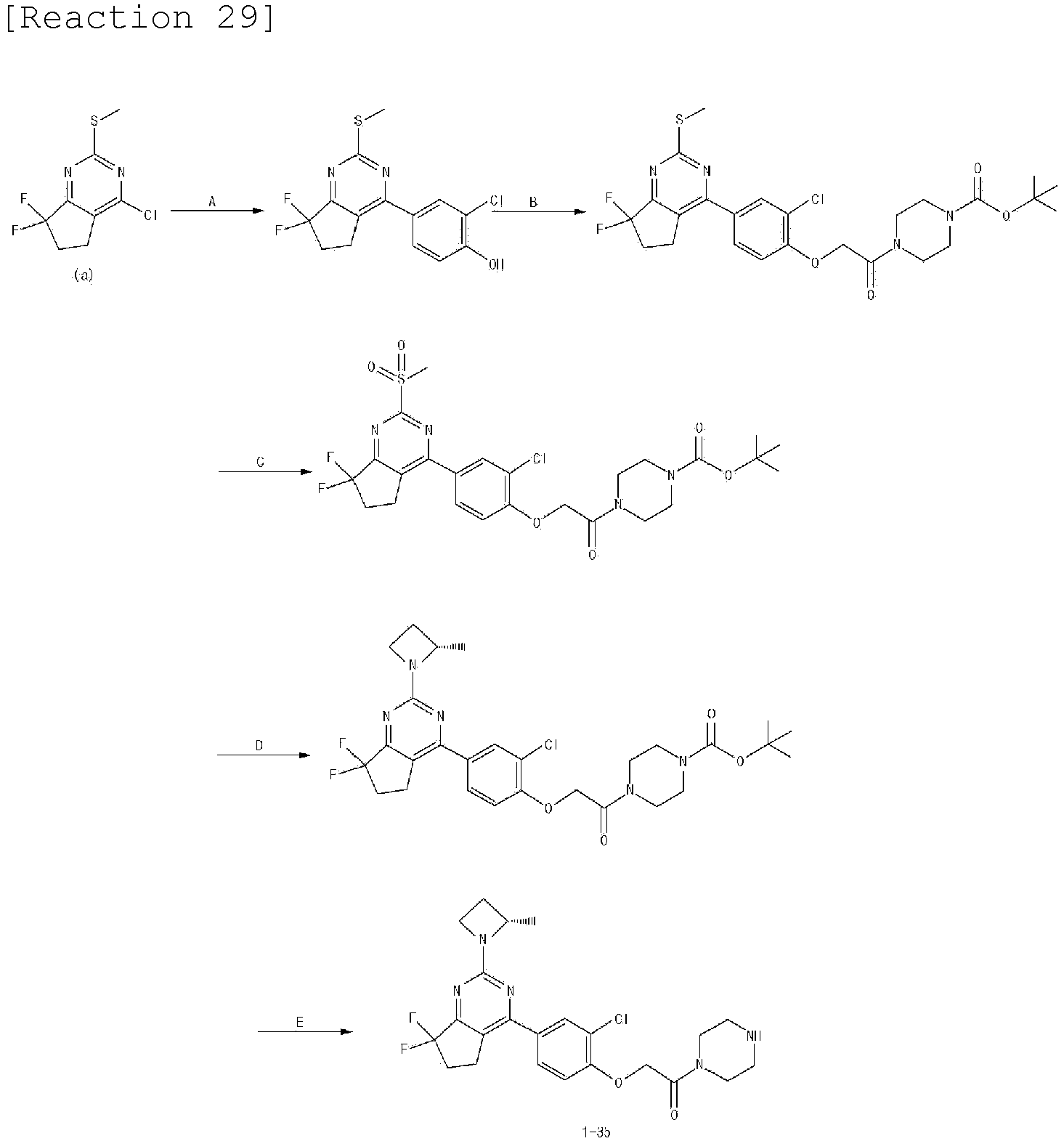
- The 4-chloro-7,7-difluoro-2-(methylthio)-6,7-dihydro-cyclopenta[d]pyrimidine of Formula k (200 mg, 0.845 mmol) prepared in Preparation Example 11, (3-chloro-4-hydroxyphenyl)boronic acid (174 mg, 1.01 mmol), tetrakis(triphenylphosphine)palladium(O) (49 mg, 0.042 mmol) and a sodium carbonate solution (2 M, 1.27 ml, 2.54 mmol) were dissolved in 20 ml of 1,4-dioxane, followed by stirring at 80°C for 2 hours. After finishing the reaction, water was added to the reaction solution, and the resultant was extracted with ethyl acetate. An organic layer was dried over anhydrous magnesium sulfate and filtered. The filtrate was concentrated under a reduced pressure and purified by column chromatography (ethyl acetate/hexane = 1/3 by a weight ratio) to obtain 2-chloro-4-(7,7-difluoro-2-(methylthio)-6,7-dihydro-5H-cyclopenta[d]pyrimidin-4-yl)phenol (224 mg, 0.68 mmol, yield 80%). The synthesis of the 2-chloro-4-(7,7-difluoro-2-(methylthio)-6,7-dihydro-5H-cyclopenta[d]pyrimidin-4-yl)phenol thus obtained was confirmed through 1H NMR analysis.
- 1H NMR (500MHz, CDCl3) δ 8.07 (d, J=1.7 Hz, 1H), 7.84 (dd, J=8.5, 2.1 Hz, 1H), 7.22-7.02 (m, 1H), 3.22 (t, J=6.6 Hz, 2H), 2.75-2.55 (m, 5H).
- The 4-(7,7-difluoro-2-(methylthio)-6,7-dihydro-5H-cyclopenta[d]pyrimidin-4-yl)-2,6-difluorophenol (224 mg, 0.681 mmol) prepared in Step A, the tert-butyl 4-(2-bromoacetyl)piperazin-1-carboxylate of Formula c (251 mg, 0.81 mmol) prepared in Preparation Example 3 and potassium carbonate (282 mg, 2.04 mmol) were dissolved in 10 ml of dimethylformamide, followed by stirring at room temperature for 2 hours. After finishing the reaction, the reaction solution was concentrated under a reduced pressure. The resultant was dissolved in ethyl acetate and washed with a saturated sodium chloride solution. Then, an organic layer was dried over anhydrous magnesium sulfate and filtered. The filtrate was concentrated under a reduced pressure, and the concentrate under a reduced pressure was purified by column chromatography (ethyl acetate/hexane = 1/1 by a weight ratio) to obtain tert-butyl 4-(2-(2-chloro-4-(7,7-difluoro-2-(methylthio)-6,7-dihydro-5H-cyclopenta[d]pyrimidin-4-yl)phenoxy)acetyl)piperazin-1-carboxylate (333 mg, 0.59 mmol, yield 88 %). The synthesis of the tert-butyl 4-(2-(2-chloro-4-(7,7-difluoro-2-(methylthio)-6,7-dihydro-5H-cyclopenta[d]pyrimidin-4-yl)phenoxy)acetyl)piperazin-1-carboxylate thus obtained was confirmed through 1H NMR analysis.
- 1H NMR (400MHz, CDCl3) δ 8.22 (s, 1H), 8.01 (d, J=7.9 Hz, 1H), 7.21 (d, J=8.8 Hz, 1H), 4.93 (s, 2H), 3.72-3.55 (m, 4H), 3.57-3.46 (m, 5H), 3.46-3.34 (m, 4H), 2.88-2.70 (m, 2H), 1.49 (s, 9H).
- The tert-butyl 4-(2-(2-chloro-4-(7,7-difluoro-2-(methylthio)-6,7-dihydro-5H-cyclopenta[d]pyrimidin-4-yl)phenoxy)acetyl)piperazin-1-carboxylate (333 mg, 0.559 mmol) prepared in Step B and 3-chloroperbenzoic acid (70%, 310 mg, 1.779 mmol) were dissolved in 20 ml of dichloromethane, followed by stirring at room temperature for 10 hours. After finishing the reaction, a saturated sodium thiosulfate solution and a saturated sodium bicarbonate solution were added in sequence to the reaction solution, and the resultant was extracted with ethyl acetate. An organic layer was washed with an aqueous saturated sodium chloride solution, dried over anhydrous magnesium sulfate and filtered. The filtrate was concentrated under a reduced pressure, and the concentrate under a reduced pressure was purified by column chromatography (methanol/dichloromethane = 1/9 by a weight ratio) to obtain tert-butyl 4-(2-(2-chloro-4-(7,7-difluoro-2-(methylsulfonyl)-6,7-dihydro-5H-cyclopenta[d]pyrimidin-4-yl)phenoxy)acetyl)piperazin-1-carboxylate (329 mg, 0.566 mmol, yield 93%). The synthesis of the tert-butyl 4-(2-(2-chloro-4-(7,7-difluoro-2-(methylsulfonyl)-6,7-dihydro-5H-cyclopenta[d]pyrimidin-4-yl)phenoxy)acetyl)piperazin-1-carboxylate thus obtained was confirmed through 1H NMR analysis.
- 1H NMR (500MHz, CDCl3) δ 8.22 (s, 1H), 8.01 (d, J=7.9 Hz, 1H), 7.21 (d, J=8.8 Hz, 1H), 4.93 (s, 2H), 3.72-3.55 (m, 4H), 3.57-3.46 (m, 5H), 3.46-3.34 (m, 4H), 2.88-2.70 (m, 2H), 1.49 (s, 9H).
- The tert-butyl 4-(2-(2-chloro-4-(7,7-difluoro-2-(methylsulfonyl)-6,7-dihydro-5H-cyclopenta[d]pyrimidin-4-yl)phenoxy)acetyl)piperazin-1-carboxylate (329 mg, 0.56 mmol) prepared in Step C, (2S)-2-methylazetidine[(1R,4S)-7,7-dimethyl-2-oxo-norbornan-1-yl] methanesulfonate (204 mg, 0.67 mmol) and potassium carbonate (232 mg, 1.68 mmol) were dissolved in 20 ml of acetonitrile, followed by stirring at 80°C for 2 hours. After finishing the reaction, an excessive amount of water was added to the reaction solution, and the resultant was extracted with ethyl acetate. An organic layer was washed with a saturated aqueous sodium chloride solution, dried over anhydrous magnesium sulfate and filtered. The filtrate was concentrated under a reduced pressure, and the concentrate under a reduced pressure was purified by column chromatography (ethyl acetate/hexane = 1/1 by a weight ratio) to obtain tert-butyl 4-(2-(2-chloro-4-(7,7-difluoro-2-(2-methylazetidin-1-yl)-6,7-dihydro-5H-cyclopenta[d]pyrimidin-4-yl)phenoxy)acetyl)piperazin-1-carboxylate (299 mg, 0.51 mmol, yield 92%). The synthesis of the tert-butyl 4-(2-(2-chloro-4-(7,7-difluoro-2-(2-methylazetidin-1-yl)-6,7-dihydro-5H-cyclopenta[d]pyrimidin-4-yl)phenoxy)acetyl)piperazin-1-carboxylate thus obtained was confirmed through 1H NMR analysis.
- 1H NMR (500MHz, CDCl3) δ 8.03 (d, J=1.8 Hz, 1H), 7.81 (d, J=8.5 Hz, 1H), 7.11 (d, J=8.5 Hz, 1H), 4.86 (s, 2H), 4.59 (dt, J=20.0, 6.3 Hz, 1H), 4.26-4.01 (m, 3H), 3.72-3.51 (m, 4H), 3.44 (d, J=35.1 Hz, 4H), 3.20-2.99 (m, 2H), 2.66-2.39 (m, 3H), 2.12-1.94 (m, 1H), 1.61-1.57 (m, 3H), 1.52-1.38 (m, 9H).
- The tert-butyl 4-(2-(2-chloro-4-(7,7-difluoro-2-(2-methylazetidin-1-yl)-6,7-dihydro-5H-cyclopenta[d]pyrimidin-4-yl)phenoxy)acetyl)piperazin-1-carboxylate (299 mg, 0.51 mmol) prepared in Step D and 1 ml of trifluoroacetic acid were dissolved in 3 ml of dichloromethane, followed by stirring at room temperature for 10 hours. After finishing the reaction, a saturated sodium bicarbonate solution was added to the reaction solution, and the resultant was extracted with ethyl acetate. An organic layer was washed with a saturated aqueous sodium chloride solution, dried over anhydrous magnesium sulfate and filtered. The filtrate was concentrated under a reduced pressure, and the concentrate under a reduced pressure was purified by column chromatography (7 N ammonia methanol solution/dichloromethane = 1/9 by a weight ratio) to obtain (S)-2-(2-chloro-4-(7,7-difluoro-2-(2-methylazetidin-1-yl)-6,7-dihydro-5H-cyclopenta[d]pyrimidin-4-yl)phenoxy)-1-(piperazin-1-yl) ethan-1-one (179 mg, 0.37 mmol, yield 72%) . The synthesis of the (S)-2-(2-chloro-4-(7,7-difluoro-2-(2-methylazetidin-1-yl)-6,7-dihydro-5H-cyclopenta[d]pyrimidin-4-yl)phenoxy)-1-(piperazin-1-yl)ethan-1-one thus obtained was confirmed through 1H NMR analysis.
- 1H NMR (500MHz, MeOD) δ 7.97 (d, J=1.8 Hz, 1H), 7.85-7.66 (m, 1H), 7.08-6.91 (m, 1H), 5.12-4.87 (m, 2H), 4.49 (dt, J=19.8, 6.3 Hz, 1H), 4.17-3.88 (m, 2H), 3.71-3.40 (m, 4H), 3.14-2.93 (m, 2H), 2.93-2.60 (m, 4H), 2.65-2.35 (m, 3H), 2.10-1.89 (m, 1H), 1.72-1.18 (m, 3H).
- As in Reaction 30, the processes of Steps A to E were performed in sequence to prepare the title compound of Formula 1-36.

- The same procedure in (1) of Example 35 was performed to prepare 2-chloro-4-(7,7-difluoro-2-(methylthio)-6,7-dihydro-5H-cyclopenta[d]pyrimidin-4-yl)phenol.
- The 2-chloro-4-(7,7-difluoro-2-(methylthio)-6,7-dihydro-5H-cyclopenta[d]pyrimidin-4-yl)phenol (205 mg, 0.62 mmol) prepared in Step A, the tert-butyl 4-(2-bromoacetyl)-1,4-diazepan-1-carboxylate of Formula d (240 mg, 0.74 mmol) prepared in Preparation Example 4, and potassium carbonate (258 mg, 1.87 mmol) were dissolved in 10 ml of dimethylformamide, followed by stirring at room temperature for 2 hours. After finishing the reaction, the reaction solution was concentrated under a reduced pressure. The resultant was dissolved in ethyl acetate and washed with a saturated sodium chloride solution. Then, an organic layer was dried over anhydrous magnesium sulfate and filtered. The filtrate was concentrated under a reduced pressure, and the concentrate under a reduced pressure was purified by column chromatography (ethyl acetate/hexane = 1/1 by a weight ratio) to obtain tert-butyl 4-(2-(2-chloro-4-(7,7-difluoro-2-(methylthio)-6,7-dihydro-5H-cyclopenta[d]pyrimidin-4-yl)phenoxy)acetyl)-1,4-diazepan-1-carboxylate (303 mg, 0.53 mmol, yield 85%) . The synthesis of the tert-butyl 4-(2-(2-chloro-4-(7,7-difluoro-2-(methylthio)-6,7-dihydro-5H-cyclopenta[d]pyrimidin-4-yl)phenoxy)acetyl)-1,4-diazepan-1-carboxylate thus obtained was confirmed through 1H NMR analysis.
- 1H NMR (400MHz, CDCl3) δ 8.11 (s, 1H), 7.88 (d, J=8.5 Hz, 1H), 7.14 (d, J=8.8 Hz, 1H), 4.90 (d, J=7.9 Hz, 2H), 3.78-3.11 (m, 12H), 2.76-2.57 (m, 5H), 2.03-1.81 (m, 2H), 1.60 (d, J=11.0 Hz, 6H), 1.48 (s, 6H), 1.46 (s, 4H).
- The tert-butyl 4-(2-(2-chloro-4-(7,7-difluoro-2-(methylthio)-6,7-dihydro-5H-cyclopenta[d]pyrimidin-4-yl)phenoxy)acetyl)-1,4-diazepan-1-carboxylate (303 mg. 0.532 mmol) prepared in Step B and 3-chloroperbenzoic acid (70%, 189 mg, 0.77 mmol) were dissolved in 20 ml of dichloromethane, followed by stirring at room temperature for 10 hours. After finishing the reaction, a saturated sodium thiosulfate solution and a saturated sodium bicarbonate solution were added in sequence to the reaction solution, and the resultant was extracted with ethyl acetate. An organic layer was washed with an aqueous saturated sodium chloride solution, dried over anhydrous magnesium sulfate and filtered. The filtrate was concentrated under a reduced pressure, and the concentrate under a reduced pressure was purified by column chromatography (methanol/dichloromethane = 1/9 by a weight ratio) to obtain tert-butyl 4-(2-(2-chloro-4-(7,7-difluoro-2-(methylsulfonyl)-6,7-dihydro-5H-cyclopenta[d]pyrimidin-4-yl)phenoxy)acetyl)-1,4-diazepan-1-carboxylate (281 mg, 0.467 mmol, yield 87%) . The synthesis of the tert-butyl 4-(2- (2-chloro-4-(7,7-difluoro-2-(methylsulfonyl)-6,7-dihydro-5H-cyclopenta[d]pyrimidin-4-yl)phenoxy)acetyl)-1,4-diazepan-1-carboxylate thus obtained was confirmed through 1H NMR analysis.
- 1H NMR (500MHz, CDCl3) δ 8.22 (d, J=22.3 Hz, 1H), 8.06-7.93 (m, 1H), 7.17 (d, J=8.8 Hz, 1H), 4.93 (d, J=6.7 Hz, 2H), 3.79-3.29 (m, 12H), 2.88-2.69 (m, 2H), 2.05-1.81 (m, 2H), 1.47 (d, J=10.1 Hz, 9H).
- The tert-butyl 4-(2-(2-chloro-4-(7,7-difluoro-2-(methylsulfonyl)-6,7-dihydro-5H-cyclopenta[d]pyrimidin-4-yl)phenoxy)acetyl)-1,4-diazepan-1-carboxylate (281 mg, 0.24 mmol) prepared in Step C, (2S)-2-methylazetidine[(1R,4S)-7,7-dimethyl-2-oxo-norbornan-1-yl]heptan-methanesulfonate (170 mg, 0.56 mmol) and potassium carbonate (193 mg, 1.40 mmol) were dissolved in 20 ml of acetonitrile, followed by stirring at 80°C for 2 hours. After finishing the reaction, an excessive amount of water was added to the reaction solution, and the resultant was extracted with ethyl acetate. An organic layer was washed with a saturated aqueous sodium chloride solution, dried over anhydrous magnesium sulfate and filtered. The filtrate was concentrated under a reduced pressure, and the concentrate under a reduced pressure was purified by column chromatography (ethyl acetate/hexane = 1/1 by a weight ratio) to obtain (S)-tert-butyl 4-(2-(2-chloro-4-(7,7-difluoro-2-(2-methylazetidin-1-yl)-6,7-dihydro-5H-cyclopenta[d]pyrimidin-4-yl)phenoxy)acetyl)-1,4-diazepan-1-carboxylate (255 mg, 0.43 mmol, yield 92%) . The synthesis of the (S)-tert-butyl 4-(2-(2-chloro-4-(7,7-difluoro-2-(2-methylazetidin-1-yl)-6,7-dihydro-5H-cyclopenta[d]pyrimidin-4-yl)phenoxy)acetyl)-1,4-diazepan-1-carboxylate thus obtained was confirmed through 1H NMR analysis.
- 1H NMR (500MHz, CDCl3) δ 8.04 (s, 1H), 7.82 (d, J=7.9 Hz, 1H), 7.13 (s, 1H), 4.61 (s, 1H), 4.26-4.04 (m, 4H), 3.72 (s, 3H), 3.66-3.42 (m, 1H), 3.44-3.27 (m, 2H), 3.12 (s, 3H), 2.67-2.48 (m, 2H), 2.02 (d, J=49.4 Hz, 4H), 1.61 (d, J=6.4 Hz, 5H), 1.47 (d, J=9.5 Hz, 12H).
- The (S)-tert-butyl 4-(2-(2-chloro-4-(7,7-difluoro-2-(2-methylazetidin-1-yl)-6,7-dihydro-5H-cyclopenta[d]pyrimidin-4-yl)phenoxy)acetyl)-1,4-diazepan-1-carboxylate (255 mg, 0.43 mmol) prepared in Step D and 1 ml of trifluoroacetic acid were dissolved in 3 ml of dichloromethane, followed by stirring at room temperature for 10 hours. After finishing the reaction, a saturated sodium bicarbonate solution was added to the reaction solution, and the resultant was extracted with ethyl acetate. An organic layer was washed with a saturated aqueous sodium chloride solution, dried over anhydrous magnesium sulfate and filtered. The filtrate was concentrated under a reduced pressure, and the concentrate under a reduced pressure was purified by column chromatography (7 N ammonia methanol solution/dichloromethane = 1/9 by a weight ratio) to obtain (S)-2-(2-chloro-4-(7,7-difluoro-2-(2-methylazetidin-1-yl)-6,7-dihydro-5H-cyclopenta[d]pyrimidin-4-yl)phenoxy)-1-(piperazin-1-yl)ethan-1-one (190 mg, 0.368 mmol, yield 90%). The synthesis of the (S)-2-(2-chloro-4-(7,7-difluoro-2-(2-methylazetidin-1-yl)-6,7-dihydro-5H-cyclopenta[d]pyrimidin-4-yl)phenoxy)-1-(1,4-diazepan-1-yl)ethan-1-one thus obtained was confirmed through 1H NMR analysis.
- 1H NMR (500MHz, MeOD) δ 8.07 (s, 1H), 7.88 (d, J=8.8 Hz, 1H), 7.16 (t, J=8.2 Hz, 1H), 5.02 (d, J=9.5 Hz, 2H), 4.57 (q, J=6.6 Hz, 1H), 4.19-3.98 (m, 2H), 3.75-3.57 (m, 4H), 3.14 (t, J=6.4 Hz, 2H), 3.03 (t, J=5.3 Hz, 1H), 2.97-2.79 (m, 3H), 2.66-2.43 (m, 3H), 2.05 (d, J=9.5 Hz, 1H), 1.94 (d, J=11.3 Hz, 1H), 1.80 (t, J=5.8 Hz, 1H), 1.57 (d, J=6.4 Hz, 3H).
- As in Reaction 31, the processes of Steps A to C were performed in sequence to prepare the title compound of Formula 1-37.
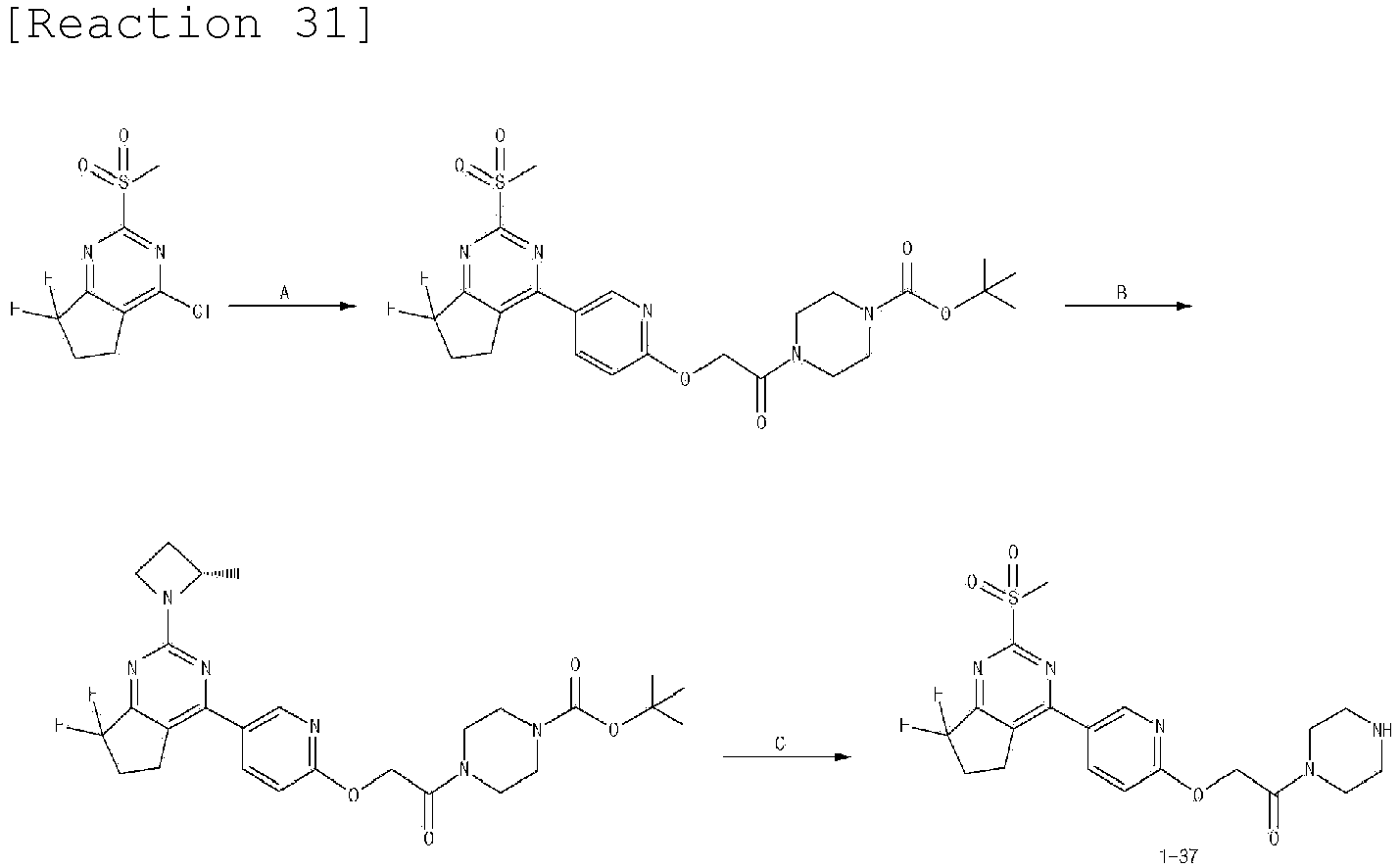
- 4-Chloro-7,7-difluoro-2-(methylsulfonyl)-6,7-dihydro-5H-cyclopenta[d]pyrimidine (317 mg, 1.18 mmol), the tert-butyl 4-(2-((5-(4,4,5,5-tetramethyl-1,3,2-dioxaborolan-2-yl)pyridin-2-yl)oxy)acetyl)piperazin-1-carboxylate (792 mg, 1.77 mmol) prepared in Preparation Example 17, and potassium carbonate (489 mg, 3.54 mmol) were dissolved in 20 ml of 1,2-dimethoxyethane/water (4/1 by a weight ratio), followed by degassing for 5 minutes. A 1,1'-bis(diphenylphosphino)ferrocene-palladium (II) dichloridedichloromethane complex (48 mg, 0.059 mmol) was added thereto, followed by stirring at 60°C for 1 hour. After finishing the reaction, the reaction solution was diluted in ethyl acetate and washed with water and a saturated aqueous sodium chloride solution. An organic layer was dried over anhydrous magnesium sulfate and filtered. The filtrate was concentrated under a reduced pressure, and the concentrate under a reduced pressure was purified by column chromatography (dichloromethane/methanol = 19/1 by a weight ratio) to obtain tert-butyl 4-(2-((5-(7,7-difluoro-2-(methylsulfonyl)-6,7-dihydro-5H-cyclopenta[d]pyrimidin-4-yl)pyridin-2-yl)oxy)acetyl)piperazin-1-carboxylate (367 mg, 0.66 mmol, yield 56%). The synthesis of the tert-butyl 4-(2-((5-(7,7-difluoro-2-(methylsulfonyl)-6,7-dihydro-5H-cyclopenta[d]pyrimidin-4-yl)pyridin-2-yl)oxy)acetyl)piperazin-1-carboxylate thus obtained was confirmed through 1H NMR analysis.
- 1H NMR (400MHz, DMSO-d6) δ 8.87 (d, J=2.1 Hz, 1H), 8.48 (dd, J=8.7, 2.3 Hz, 1H), 7.16 (d, J=8.8 Hz, 1H), 5.23 (s, 2H), 3.54 (s, 3H), 3.45 (d, J=24.1 Hz, 8H), 3.29-3.23 (m, 2H), 2.87-2.67 (m, 2H), 1.41 (d, J=12.8 Hz, 9H).
- The tert-butyl 4-(2-((5-(7,7-difluoro-2-(methylsulfonyl)-6,7-dihydro-5H-cyclopenta[d]pyrimidin-4-yl)pyridin-2-yl)oxy)acetyl)piperazin-1-carboxylate (367 mg, 0.66 mmol) prepared in Step A, (2S)-2-methylazetidine[(1R,4S)-7,7-dimethyl-2-oxo-norbornan-1-yl]methanesulfonate (241 mg, 0.79 mmol), and potassium carbonate (274 mg, 1.98 mmol) were dissolved in 20 ml of acetonitrile, followed by stirring at 80°C for 1 hour. After finishing the reaction, the reaction solution was concentrated under a reduced pressure. To the concentrate under a reduced pressure, ethyl acetate was added, and the resultant was washed with a saturated aqueous sodium chloride solution. An organic layer was dried over anhydrous magnesium sulfate and filtered. The filtrate was concentrated under a reduced pressure, and the concentrate under a reduced pressure was purified by column chromatography (ethyl acetate/hexane = 1/1 by a weight ratio) to obtain tert-butyl (S)-4-(2-((5-(7,7-difluoro-2-(2-methylazetidin-1-yl)-6,7-dihydro-5H-cyclopenta[d]pyrimidin-4-yl)pyridin-2-yl)oxy)acetyl)piperazin-1-carboxylate (332 mg, 0.60 mmol, yield 91%). The synthesis of the tert-butyl (S)-4-(2-((5-(7,7-difluoro-2-(2-methylazetidin-1-yl)-6,7-dihydro-5H-cyclopenta[d]pyrimidin-4-yl)pyridin-2-yl)oxy)acetyl)piperazin-1-carboxylate thus obtained was confirmed through 1H NMR analysis.
- 1H NMR (500MHz, CDCl3) δ 8.88 (d, J=2.1 Hz, 1H), 8.25 (dd, J=8.7, 2.3 Hz, 1H), 7.00 (d, J=8.5 Hz, 1H), 5.10 (s, 2H), 4.71-4.47 (m, 1H), 4.10 (dd, J=21.8, 2.1 Hz, 3H), 3.62 (s, 2H), 3.48 (d, J=30.5 Hz, 6H), 3.09 (d, J=6.7 Hz, 2H), 2.57 (s, 2H), 2.04-1.99 (m, 1H), 1.58 (d, J=6.1 Hz, 3H), 1.48 (s, 9H).
- The tert-butyl (S)-4-(2-((5-(7,7-difluoro-2-(2-methylazetidin-1-yl)-6,7-dihydro-5H-cyclopenta[d]pyrimidin-4-yl)pyridin-2-yl)oxy)acetyl)piperazin-1-carboxylate (332 mg, 0.60 mmol) prepared in Step B and 2 ml of trifluoroacetic acid were dissolved in 20 ml of dichloromethane, followed by stirring at room temperature for 18 hours. After finishing the reaction, the reaction solution was concentrated under a reduced pressure. To the concentrate under a reduced pressure, a saturated aqueous ammonium solution was added, and the resultant was extracted with ethyl acetate. An organic layer was dried over anhydrous magnesium sulfate and filtered. The filtrate was concentrated under a reduced pressure, and the concentrate under a reduced pressure was purified by column chromatography (7 N ammonia methanol solution/dichloromethane = 1/10 by a weight ratio) to obtain (S)-2-((5-(7,7-difluoro-2-(2-methylazetidin-1-yl)-6,7-dihydro-5H-cyclopenta[d]pyrimidin-4-yl)pyridin-2-yl)oxy)-1-(piperazin-1-yl)ethan-1-one (230 mg, 0.51 mmol, yield 84%). The synthesis of the (S)-2-((5-(7,7-difluoro-2-(2-methylazetidin-1-yl)-6,7-dihydro-5H-cyclopenta[d]pyrimidin-4-yl)pyridin-2-yl)oxy)-1-(piperazin-1-yl)ethan-1-one thus obtained was confirmed through 1H NMR analysis.
- 1H NMR (500MHz, MeOD) δ 8.72 (s, 1H), 8.35 (d, J=8.5 Hz, 1H), 7.02 (d, J=8.8 Hz, 1H), 5.17 (s, 2H), 4.57 (q, J=7.0 Hz, 1H), 4.19-3.98 (m, 2H), 3.55 (d. J=4.9 Hz, 4H), 3.13 (d, J=4.6 Hz, 2H), 2.96-2.75 (m, 4H), 2.66-2.44 (m, 3H), 2.05 (d, J=9.8 Hz, 1H), 1.57 (d, J=6.1 Hz, 3H).
- As in Reaction 32, the processes of Steps A to C were performed in sequence to prepare the title compound of Formula 1-38.


- 4-Chloro-7,7-difluoro-2-(methylsulfonyl)-6,7-dihydro-5H-cyclopenta[d]pyrimidine (260 mg, 0.97 mmol), the tert-butyl 4-(2-((3-chloro-5-(4,4,5,5-tetramethyl-1,3,2-dioxaborolan-2-yl)pyridin-2-yl)oxy)acetyl)piperazin-1-carboxylate (776 mg, 1.61 mmol) prepared in Preparation Example 18, and potassium carbonate (416 mg, 3.00 mmol) were dissolved in 20 ml of 1,2-dimethoxyethane/water (4/1 by a weight ratio), followed by degassing for 5 minutes. A 1,1'-bis(diphenylphosphino)ferrocene-palladium(II) dichloridedichloromethane complex (41 mg, 0.05 mmol) was added thereto, followed by stirring at 60°C for 1 hour. After finishing the reaction, the reaction solution was diluted with ethyl acetate, and the resultant was washed with water and a saturated aqueous sodium chloride solution. An organic layer was dried over anhydrous magnesium sulfate and filtered. The filtrate was concentrated under a reduced pressure, and the concentrate under a reduced pressure was purified by column chromatography (dichloromethane/methanol = 19/1 by a weight ratio) to obtain tert-butyl 4-(2-((3-chloro-5-(7,7-difluoro-2-(methylsulfonyl)-6,7-dihydro-5H-cyclopenta[d]pyrimidin-4-yl)pyridin-2-yl)oxy)acetyl)piperazin-1-carboxylate (560 mg, 0.95 mmol, yield 98%). The synthesis of the tert-butyl 4-(2-((3-chloro-5-(7,7-difluoro-2-(methylsulfonyl)-6,7-dihydro-5H-cyclopenta[d]pyrimidin-4-yl)pyridin-2-yl)oxy)acetyl)piperazin-1-carboxylate thus obtained was confirmed through mass spectrometry (MS) measurement.
MS 588.0, 610.0 (Na+) - The tert-butyl 4-(2-((3-chloro-5-(7,7-difluoro-2-(methylsulfonyl)-6,7-dihydro-5H-cyclopenta[d]pyrimidin-4-yl)pyridin-2-yl)oxy)acetyl)piperazin-1-carboxylate (560 mg, 0.95 mmol) prepared in Step A, (2S)-2-methylazetidine[(1R,4S)-7,7-dimethyl-2-oxo-norbornan-1-yl]methanesulfonate (490 mg, 1.62 mmol), and potassium carbonate (525 mg, 3.80 mmol) were dissolved in 20 ml of acetonitrile, followed by stirring at 80°C for 1 hour. After finishing the reaction, the reaction solution was concentrated under a reduced pressure. To the concentrate under a reduced pressure, ethyl acetate was added, and the resultant was washed with a saturated aqueous sodium chloride solution. An organic layer was dried over anhydrous magnesium sulfate and filtered. The filtrate was concentrated under a reduced pressure, and the concentrate under a reduced pressure was purified by column chromatography (ethyl acetate/hexane = 1/1 by a weight ratio) to obtain tert-butyl (S)-4-(2-((3-chloro-5-(7,7-difluoro-2-(2-methylazetidin-1-yl)-6,7-dihydro-5H-cyclopenta[d]pyrimidin-4-yl)pyridin-2-yl)oxy)acetyl)piperazin-1-carboxylate (299 mg, 0.51 mmol, yield 54%). The synthesis of the tert-butyl (S)-4-(2-((3-chloro-5-(7,7-difluoro-2-(2-methylazetidin-1-yl)-6,7-dihydro-5H-cyclopenta[d]pyrimidin-4-yl)pyridin-2-yl)oxy)acetyl)piperazin-1-carboxylate thus obtained was confirmed through 1H NMR analysis.
- 1H NMR (500MHz, CDCl3) δ 8.55 (s, 1H), 8.32 (s, 1H), 5.17 (s, 2H), 4.59 (td, J=13.4, 6.7 Hz, 1H), 4.18-4.00 (m, 2H), 3.70-3.37 (m, 8H), 3.09 (d, J=3.1 Hz, 2H), 2.68-2.40 (m, 3H), 1.53-1.41 (m, 9H).
- The tert-butyl (S)-4-(2-((3-chloro-5-(7,7-difluoro-2-(2-methylazetidin-1-yl)-6,7-dihydro-5H-cyclopenta[d]pyrimidin-4-yl)pyridin-2-yl)oxy)acetyl)piperazin-1-carboxylate (299 mg, 0.52 mmol) prepared in Step B and 2 ml of trifluoroacetic acid were dissolved in 20 ml of dichloromethane, followed by stirring at room temperature for 18 hours. After finishing the reaction, the reaction solution was concentrated under a reduced pressure. To the concentrate under a reduced pressure, a saturated aqueous ammonium solution was added, and the resultant was extracted with ethyl acetate. An organic layer was dried over anhydrous magnesium sulfate and filtered. The filtrate was concentrated under a reduced pressure, and the concentrate under a reduced pressure was purified by column chromatography (7 N ammonia methanol solution/dichloromethane = 1/10 by a weight ratio) to obtain (S)-2-((3-chloro-5-(7,7-difluoro-2-(2-methylazetidin-1-yl)-6,7-dihydro-5H-cyclopenta[d]pyrimidin-4-yl)pyridin-2-yl)oxy)-1-(piperazin-1-yl)ethan-1-one (214 mg, 0.44 mmol, yield 86%). The synthesis of the (S)-2-((3-chloro-5-(7,7-difluoro-2-(2-methylazetidin-1-yl)-6,7-dihydro-5H-cyclopenta[d]pyrimidin-4-yl)pyridin-2-yl)oxy)-1-(piperazin-1-yl)ethan-1-one thus obtained was confirmed through 1H NMR analysis.
- 1H NMR (500MHz, MeOD) δ 8.62 (s, 1H), 8.41 (d, J=1.8 Hz, 1H), 5.30-5.19 (m, 2H), 4.58 (q, J=6.7 Hz, 1H), 4.21 - 3.98 (m, 2H), 3.56 (d, J=4.3 Hz, 4H), 3.14 (d, J=3.1 Hz, 2H), 2.97-2.74 (m, 4H), 2.68-2.44 (m, 3H), 2.20-1.98 (m, 1H), 1.57 (d, J=6.1 Hz, 3H).
- As in Reaction 33, the processes of Steps A to C were performed in sequence to prepare the title compound of Formula 1-39.

- 2,4-Dichloro-6-(trifluoromethyl)pyrimidine (456 mg, 2.10 mmol), the tert-butyl 4-(2-((5- (4,4,5,5-tetramethyl-1,3,2-dioxaborolan-2-yl)pyridin-2-yl)oxy)acetyl)piperazin-1-carboxylate (1128 mg, 2.52 mmol) prepared in Preparation Example 17, and sodium carbonate (2 M, 3.15 ml, 6.30 mmol) were dissolved in 20 ml of 1,4-dioxane, followed by degassing for 5 minutes. 1,1'-bis(diphenylphosphino)ferrocene-palladium(II) dichloride (44 mg, 0.063 mmol) was added thereto, followed by stirring at 60°C for 1 hour. After finishing the reaction, the reaction solution was diluted in ethyl acetate, and the resultant was washed with water and a saturated aqueous sodium chloride solution. An organic layer was dried over anhydrous magnesium sulfate and filtered. The filtrate was concentrated under a reduced pressure to obtain tert-butyl 4-(2-((5-(2-chloro-6-(trifluoromethyl)pyrimidin-4-yl)pyridin-2-yl)oxy)acetyl)piperazin-1-carboxylate (976 mg, 1.945 mmol, crude), and the next reaction was performed without a separate purification process.
- The tert-butyl 4-(2-((5-(2-chloro-6-(trifluoromethyl)pyrimidin-4-yl)pyridin-2-yl)oxy)acetyl)piperazin-1-carboxylate (976 mg, 1.945 mmol) prepared in Step A, (2S)-2-methylazetidine[(1R,4S)-7,7-dimethyl-2-oxo-norbornan-1-yl]methanesulfonate (708 mg, 2.334 mmol), and potassium carbonate (274 mg, 1.98 mmol) were dissolved in 20 ml of acetonitrile, followed by stirring at 80°C for 1 hour. After finishing the reaction, the reaction solution was concentrated under a reduced pressure. To the concentrate under a reduced pressure, ethyl acetate was added and washed with a saturated aqueous sodium chloride solution. An organic layer was dried over anhydrous magnesium sulfate and filtered. The filtrate was concentrated under a reduced pressure, and the concentrate under a reduced pressure was purified by column chromatography (ethyl acetate/hexane = 1/1 by a weight ratio) to obtain tert-butyl (S)-4-(2-((5-(2-(2-methylazetidin-1-yl)-6-(trifluoromethyl)pyrimidin-4-yl)pyridin-2-yl)oxy)acetyl)piperazin-1-carboxylate (558 mg, 1.041 mmol, yield 53%). The synthesis of the tert-butyl (S)-4-(2-((5-(2-(2-methylazetidin-1-yl)-6-(trifluoromethyl)pyrimidin-4-yl)pyridin-2-yl)oxy)acetyl)piperazin-1-carboxylate thus obtained was confirmed through 1H NMR analysis.
- 1H NMR (500MHz, CDCl3) δ 8.84 (s, 1H), 8.31 (d, J=8.8 Hz, 1H), 7.13 (s, 1H), 7.01 (d, J=8.5 Hz, 1H), 5.12 (s, 2H), 4.62 (q, J=6.6 Hz, 1H), 4.10-4.19 (m, 2H), 3.47-3.64 (m, 8H), 2.52 (m, 1H), 2.06 (m, 1H), 1.60 (d, J=7.6 Hz, 3H), 1.49 (s, 9H) .
- The tert-butyl (S)-4-(2-((5-(2-(2-methylazetidin-1-yl)-6-(trifluoromethyl)pyrimidin-4-yl)pyridin-2-yl)oxy)acetyl)piperazin-1-carboxylate (558 mg, 1.040 mmol) prepared in Step B and 2 ml of trifluoroacetic acid were dissolved in 20 ml of dichloromethane, followed by stirring at room temperature for 18 hours. After finishing the reaction, the reaction solution was concentrated under a reduced pressure. To the concentrate under a reduced pressure, a saturated aqueous sodium bicarbonate solution was added, and the resultant was extracted with ethyl acetate. An organic layer was dried over anhydrous magnesium sulfate and filtered. The filtrate was concentrated under a reduced pressure, and the concentrate under a reduced pressure was purified by column chromatography (7 N ammonia methanol solution/dichloromethane = 1/10 by a weight ratio) to obtain (S)-2-((5-2-(2-methylazetidin-1-yl)-6-(trifluoromethyl)pyrimidin-4-yl)pyridin-2-yl)oxy)-1-(piperazin-1-yl)ethan-1-one (230 mg, 0.528 mmol, yield 50%). The synthesis of the (S)-2-((5-2-(2-methylazetidin-1-yl)-6-(trifluoromethyl)pyrimidin-4-yl)pyridin-2-yl)oxy)-1-(piperazin-1-yl)ethan-1-one thus obtained was confirmed through 1H NMR analysis.
- 1H NMR (500MHz, CDCl3) δ 8.84 (s, 1H), 8.30 (d, J=8.5 Hz, 1H), 7.13 (s, 1H), 7.02 (d, J=8.5 Hz, 1H), 5.12 (s, 2H), 4.62 (q, J=6.6 Hz, 1H), 4.08-4.21 (m, 2H), 3.65 (s, 2H), 3.53 (s, 2H), 2.93 (d, J = 24 . 7 Hz, 4H), 2.53 (dd, J=8.5, 5.5 Hz, 1H), 2.03-2.08 (m, 1H), 1.61 (d, J=5.8 Hz, 3H).
- As in Reaction 34, the processes of Steps A to C were performed in sequence to prepare the title compound of Formula 1-40.

- 2,4-Dichloro-5-methyl-6-(trifluoromethyl)pyrimidine (253 mg, 1.095 mmol), the tert-butyl 4-(2-((5- (4,4,5,5-tetramethyl-1,3,2-dioxaborolan-2-yl)pyridin-2-yl)oxy)acetyl)piperazin-1-carboxylate (588 mg, 1.314 mmol) prepared in Preparation Example 17, and sodium carbonate (2 M, 1.64 ml, 3.29 mmol) were dissolved in 20 ml of 1,4-dioxane, followed by degassing for 5 minutes. Bis(triphenylphosphine) palladium(II) (23 mg, 0.033 mmol) was added thereto, followed by stirring at 60°C for 1 hour. After finishing the reaction, the reaction solution was diluted in ethyl acetate, and the resultant was washed with water and a saturated aqueous sodium chloride solution. An organic layer was dried over anhydrous magnesium sulfate and filtered. The filtrate was concentrated under a reduced pressure, and the concentrate under a reduced pressure was purified by column chromatography (dichloromethane/methanol=2/1 by a weight ratio) to obtain tert-butyl 4-(2-((5-(2-chloro-5-methyl-6-(trifluoromethyl)pyrimidin-4-yl)pyridin-2-yl)oxy)acetyl)piperazin-1-carboxylate (275 mg, 0.533 mmol, yield 48%). The synthesis of the tert-butyl 4-(2-((5-(2-chloro-5-methyl-6-(trifluoromethyl)pyrimidin-4-yl)pyridin-2-yl)oxy)acetyl)piperazin-1-carboxylate thus obtained was confirmed through 1H NMR analysis.
- 1H NMR (400MHz, CDCl3) δ 8.39 (d, J=1.8 HZ, 1H), 7.91 (dd, J=8.7, 2.3 Hz, 1H), 7.03 (d, J=8.7 Hz, 1H), 5.09 (s, 2H), 3.44-3.60 (m, 8H), 2.50 (d, J=1.8 Hz, 3H), 1.46 (s, 9H).
- The tert-butyl 4-(2-((5-(2-chloro-5-methyl-6-(trifluoromethyl)pyrimidin-4-yl)pyridin-2-yl)oxy)acetyl)piperazin-1-carboxylate (0.533 mmol) prepared in Step A, (2S)-2-methylazetidine[(1R,4S)-7,7-dimethyl-2-oxo-norbornan--1-yl]methanesulfonate (0.64 mmol), and potassium carbonate (221 mg, 1.60 mmol) were dissolved in 20 ml of acetonitrile, followed by stirring at 80°C for 1 hour. After finishing the reaction, the reaction solution was concentrated under a reduced pressure. To the concentrate under a reduced pressure, ethyl acetate was added, and the resultant was washed with a saturated aqueous sodium chloride solution. An organic layer was dried over anhydrous magnesium sulfate and filtered. The filtrate was concentrated under a reduced pressure, and the concentrate under a reduced pressure was purified by column chromatography (ethyl acetate/hexane = 1/1 by a weight ratio) to obtain tert-butyl (S)-4-(2-((5-(5-methyl-2-(2-methylazetidin-1-yl)-6-(trifluoromethyl)pyrimidin-4-yl)pyridin-2-yl)oxy)acetyl)piperazin-1-carboxylate (232 mg, 0.42 mmol, yield 79%). The synthesis of the tert-butyl (S)-4-(2-((5-(5-methyl-2-(2-methylazetidin-1-yl)-6-(trifluoromethyl)pyrimidin-4-yl)pyridin-2-yl)oxy)acetyl)piperazin-1-carboxylate thus obtained was confirmed through 1H NMR analysis.
- 1H NMR (400MHz, CDCl3) δ 8.32 (d, J=2.7 Hz, 1H), 7.82 (dd, J=8.5, 2.5 Hz, 1H), 6.95-6.98 (m, 1H), 5.07 (s, 2H), 4.51 (m, 1H), 3.98-4.12 (m, 2H), 3.56 (m, 8H), 2.50-2.34 (1H), 2.02 (m, 2H), 1.47 (s, 9H).
- The tert-butyl (S)-4-(2-((5-(5-methyl-2-(2-methylazetidin-1-yl)-6-(trifluoromethyl)pyrimidin-4-yl)pyridin-2-yl)oxy)acetyl)piperazin-1-carboxylate (0.60 mmol) prepared in Step B and 2 ml of trifluoroacetic acid were dissolved in 20 ml of dichloromethane, followed by stirring at room temperature for 18 hours. After finishing the reaction, the reaction solution was concentrated under a reduced pressure. To the concentrate under a reduced pressure, a saturated aqueous ammonium solution was added, and the resultant was extracted with ethyl acetate. An organic layer was dried over anhydrous magnesium sulfate and filtered. The filtrate was concentrated under a reduced pressure, and the concentrate under a reduced pressure was purified by column chromatography (7 N ammonia methanol solution/dichloromethane = 1/10 by a weight ratio) to obtain (S)-2-((5-(5-methyl-2-(2-methylazetidin-1-yl)-6-(trifluoromethyl)pyrimidin-4-yl)pyridin-2-yl)oxy)-1-(piperazin-1-yl)ethan-1-one (95.4 mg, 0.212 mmol, yield 50%). The synthesis of the (S)-2-((5-(5-methyl-2-(2-methylazetidin-1-yl)-6-(trifluoromethyl)pyrimidin-4-yl)pyridin-2-yl)oxy)-1-(piperazin-1-yl)ethan-1-one thus obtained was confirmed through 1H NMR analysis.
- 1H NMR (400MHz, CDCl3) δ 8.32 (d, J=2.3 Hz, 1H), 7.81 (dd, J=8.7, 2.3 Hz, 1H), 6.97 (d, J=8.2 Hz, 1H), 5.07 (s, 2H), 4.50 (q, J=6.9 Hz, 1H), 3.96-4.10 (m, 2H), 3.55 (m, 4H), 2.89 (m, 4H), 2.39-2.48 (m, 1H), 2.25 (d, J=1.8 Hz, 3H), 1.96-2.06 (m, 1H), 1.52 (d, J=6.4 Hz, 3H).
- Ketohexokinase (KHK) was expressed in E. Coli and purified using His tag. In order to measure the activity of the purified KHK, Transcreener ADP2 TR-FRET Red Assay kit of BellBrook Labs was used. A method of measuring the amount of ADP produced was used using TR-FRET after reacting a solution including a suitable concentration of KHK protein and ATP, and fructose for 15 minutes. In order to see the activity of a ketohexokinase (KHK) inhibitor, ketohexokinase (KHK) and a suitable concentration of an inhibitor were reacted first for 30 minutes, and then, reacted with a solution including the substrate of ketohexokinase (KHK) for 15 minutes. Then, reaction for TR-FRET was performed for 1 hour, and fluorescence was measured using Envision equipment of PerkinElmer. According to the optimization procedure of TR-FRET published by BellBrook Lab, the set value of the Envision equipment was determined.
- The result values by concentration of the ketohexokinase (KHK) inhibitor were determined as the ratio of a wavelength of 665 nm and a wavelength of 615nm. The 665/615 ratio value by concentration of each inhibitor was converted to ADP concentration based on ADP standard curve, and inhibition activity Ki value was obtained using Morrison equation by statistical software (Prizm). Meanwhile, the Ki value is a value representing the binding affinity of the inhibitor and an enzyme, and a lower value means better inhibitory activity.
[Table 1] Divi sion Example 1 2 3 4 5 6 7 8 9 10 11 12 13 14 Ki C D D C C B D D D D D C D C Divi sion Example 15 16 17 18 19 20 21 22 23 24 25 26 27 28 Ki D D D D D D D B C C D D C C Divi sion Example 29 30 31 32 33 34 35 36 37 38 39 40 Ki C D D C C D D D D D D D - In Table 1, A ≥ 1 µM, B = 1-0.1 µM, C = 0.1-0.01 µM, and D ≤ 0.01 µM. Through the results of Table 1, it could be confirmed that the compounds of Example 1 to Example 40 according to the present invention have excellent inhibitory activity with respect to ketohexokinase.
Claims (14)
- A compound of the following Formula 1, a pharmaceutically acceptable salt thereof, or an isomer thereof:
 A is a C3-C8 heterocycloalkyl group, unsubstituted or substituted with a C1-C3 alkyl group or a carbonyl group, or
 X and Y are each independently N or C-Ra,Ra is hydrogen or a halogen group,Z is a direct linkage, a C1-C3 alkylene group, -O-, or - C(O)-,R1 and R2 are each independently hydrogen, a halogen group, or a C1-C3 alkyl group, unsubstituted or substituted with 1 to 5 halogen groups, or R1 and R2 are connected with each other to form a C3-C6 aliphatic cyclic group, unsubstituted or substituted with 1 to 3 halogen groups, or a C3-C6 heterocycloalkyl group, unsubstituted or substituted with 1 to 3 halogen groups,R3 is -(CR4R5)n-B-R6,R4 and R5 are each independently hydrogen or a C1-C3 alkyl group,n is an integer of 0 to 3,B is a direct linkage, -C(O)-, or -S(O)2-, andR6 is a hydroxyl group, or a C3-C7 heterocycloalkyl group containing N, unsubstituted or substituted with a C1-C3 alkyl group, a carbonyl group or a C1-C3 alkylcarbonyl group.
 - The compound, the pharmaceutically acceptable salt thereof, or the isomer thereof according to claim 1, wherein, in the Formula 1, in case where A is the heterocycloalkyl group, A is a substituent represented by the following Formula 1a or Formula 1b:
 X and Y are each independently CH or N,Ra and Rb are each independently a C1-C3 alkylene group,Rc is a C1-C3 alkyl group or a carbonyl group, andm is 0 or 1,
Rd is a direct linkage or CH2. - The compound, the pharmaceutically acceptable salt thereof, or the isomer thereof according to claim 1, wherein, in the Formula 1, in case where A is the
 X and Y are each independently N or C-Ra,Ra is hydrogen or a halogen group,Z is a C1-C3 alkylene group or -O-,R1 and R2 are connected with each other to form a C3-C6 aliphatic cyclic group, unsubstituted or substituted with 1 to 3 halogen group,R3 is - (CR4R5)n-A-R6,R4 and R5 are hydrogen,n is an integer of 0 to 3,A is -C(O)-, andR6 is a hydroxyl group, or a C4-C6 heterocycloalkyl group containing N, unsubstituted or substituted with a C1-C3 alkyl group.
 - The compound, the pharmaceutically acceptable salt thereof, or the isomer thereof according to claim 1, wherein, in the Formula 1, in case where A is the
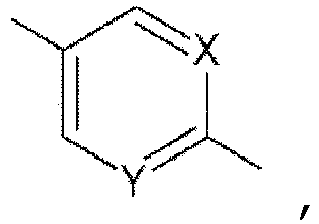 X is N,Y is C-Ra, where Ra is hydrogen,Z is a C1-C3 alkylene group or -O-,R1 is a C1-C3 alkyl group substituted with 1 to 3 halogen groups,R2 is hydrogen or a C1-C3 alkyl group,R3 is -(CR4R5)n-A-R6,R4 and R5 are hydrogen,n is an integer of 0 to 3,A is -C(O)-, andR6 is a C4-C6 heterocycloalkyl group containing N, unsubstituted or substituted with a C1-C3 alkyl group.
 - The compound, the pharmaceutically acceptable salt thereof, or the isomer thereof according to claim 1, wherein the halogen group is F or Cl.
- The compound, the pharmaceutically acceptable salt thereof, or the isomer thereof according to claim 1, wherein the compound of Formula 1 is one or more selected from the group consisting of the following group:(S)-2-((1-(2-(2-methylazetidin-2-yl)-6-(trifluoromethyl)pyrimidin-4-yl)azetidin-3-yl)oxy)-1-(piperazin-1-yl)ethan-1-one;(S)-2-((1-(5-chloro-2-(2-methylazetidin-1-yl)-6-(trifluoromethyl)pyrimidin-4-yl)azetidin-3-yl)oxy)-1-(piperazin-1-yl)ethyn-1-one;(S)-2-((1-(7,7-difluoro-2-(2-(methylazetidin-1-yl)-6,7-dihydro-5H-cyclopenta[d]pyrimidin-4-yl)azetidin-3-yl)oxy)-1-(piperazin-1-yl)ethan-1-one;(S)-2-((1-(8,8-difluoro-2-(2-methylazetidin-1-yl)-5,6,7,8-tetrahydroquinazolin-4-yl)azetidin-3-yl)oxy)-1-(piperazin-1-yl)ethan-1-one;2-(((2S,3R)-1-(7,7-difluoro-2-((S)-2-methylazetidin-1-yl)-6,7-dihydro-5H-cyclopenta[d]pyrimidin-4-yl)-2-methylazetidin-3-yl)oxy)-1-(piperazin-1-yl)ethan-1-one;2-(((S)-1-(2-((S)-2-methylazetidin-1-yl)-6-(trifluoromethyl)pyrimidin-4-yl)pyrrolidin-3-yl)oxy)-1-(piperazin-1-yl)ethan-1-one;2-(((S)-1-(7,7-difluoro-2-((S)-2-methylazetidin-1-yl)-6,7-dihydro-5H-cyclopenta[d]pyrimidin-4-yl)pyrrolidin-3-yl)oxy)-1-(piperazin-1-yl)ethan-1one;2-(((R)-1-(7,7-difluoro-2-((S)-2-methylazetidin-1-yl)-6,7-dihydro-5H-cyclopenta[d]pyrimidin-4-yl)pyrrolidin-3-yl)oxy)-1-(piperazin-1-yl)ethan-1one;2-((R)-1-(7,7-difluoro-2-((S)-2-methylazetidin-1-yl)-6,7-dihydro-5H-cyclopenta[d]pyrimidin-4-yl)pyrrolidin-3-yl)-1-(piperazin-1-yl)ethan-1one;(S)-2-((1-(7,7-difluoro-2-(2-methylazetidin-1-yl)-6,7-dihydro-5H-cyclopenta[d]pyrimidin-4-yl)piperizin-4-yl)oxy)-1-(piperazin-1-yl)ethan-1-one;(S)-2-(4-(2-(2-methylazetidin-1-yl)-6-(trifluoromethyl)pyrimidin-4-yl)piperazin-1-yl)-1-(piperazin-1-yl)ethan-1-one;(S)-2-(4-(5-chloro-2-(2-methylazetidin-1-yl)-6-(trifluoromethyl)pyrimidin-4-yl)piperazin-1-yl)-1-(piperazin-1-yl)ethan-1-one;(S)-2-(4-(2-(2-methylazetidin-1-yl)-6-(trifluoromethyl)pyrimidin-4-yl)-1-(2-oxo-2-(piperazin-1-yl)ethyl)piperazin-2-one;(S)-2-(4-(7,7-difluoro-2-(2-methylazetidin-1-yl)-6,7-dihydro-5H-cyclopenta[d]pyrimidin-4-yl)piperazin-1-yl)-1-(piperazin-1-yl)ethan-1-one;(S)-2-(4-(7,7-difluoro-2-(2-methylazetidin-1-yl)-6,7-dihydro-5H-cyclopenta[d]pyrimidin-4-yl)piperazin-1-yl)-1-morpholinoethan-1-one;(S)-1-(4-(7,7-difluoro-2-(2-methylazetidin-1-yl)-6,7-dihydro-5H-cyclopenta[d]pyrimidin-4-yl)piperazin-1-yl)-3-(piperazin-1-yl)propan-1,3-dione;(S)-(4-(7,7-difluoro-2-(2-methylazetidin-1-yl)-6,7-dihydro-5H-cyclopenta[d]pyrimidin-4-yl)-1-(2-oxo-2-(piperazin-1-yl)ethyl)piperazin-2-one;(S)-2(4-(7,7-difluoro-2-(2-methylazetidin-1-yl)-6,7-dihydro-5H-cyclopenta[d]-pyrimidin-4-yl)piperidin-1-yl)-1-(piperazin-1-yl)ethan-1-one;2-((1R,5S,6R)-3-(7,7-difluoro-2-((S)-2-methylazetidin-1-yl)-6,7-dihydro-5H-cyclopenta[d]pyrimidin-4-yl)-3-azabicyclo[3.1.0]hexan-6-yl)-1-(piperazin-1-yl)ethan-1-one;2-((1R,5S,6R)-3-(7,7-difluoro-2-((S)-2-methylazetidin-1-yl)-6,7-dihydro-5H-cyclopenta[d]pyrimidin-4-yl)-3-azabicyclo[3.1.0]hexan-6-yl)-1-(4-methylpiperazin-1-yl)ethan-1-one;4-(2-((1R,5S,6R)-3-(7,7-difluoro-2-((S)-2-methylazetidin-1-yl)-6,7-dihydro-5H-cyclopenta[d]pyrimidin-4-yl)-3-azabicyclo[3.1.0]hexan-6-yl)acetyl)piperazin-2-one;2-((1R,5S,6S)-3-(7,7-difluoro-2-((S)-2-methylazetidin-1-yl)-6,7-dihydro-5H-cyclopenta[d]pyrimidin-4-yl)-3-azabicyclo[3.1.0]hexan-6-yl)-1-(piperazin-1-yl)ethan-1-one;1-(4-acetylpiperazin-1-yl)-2-((1R,5S,6S)-3-(7,7-difluoro-2-((S)-2-methylazetidin-1-yl)-6,7-dihydro-5H-cyclopenta[d]pyrimidin-4-yl)-3-azabicyclo[3.1.1]heptan-6-yl)ethan-1-one;2-((1R,5S,6S)-3-(8,8-difluoro-2-((S)-2-methylazetidin-1-yl)-5,6,7,8-tetrahydroquinazol-4-yl)-3-azabicyclo[3.1.1]heptan-6-yl)-1-(piperazin-1-yl)ethan-1-one;2-((1R,5S,6S)-3-(8,8-difluoro-2-((S)-2-methylazetidin-1-yl)-5,8-dihydro-6H-pyrazol[3,4-d]pyrimidin-4-yl)-3-azabicyclo[3.1.1]heptan-6-yl)-1-(piperazin-1-yl)ethan-1-one;7,7-difluoro-2-((S)-2-methylazetidin-1-yl)-4-((1R,5S,6S)-6-((piperazin-1-ylsulfonyl)methyl)-3-azabicyclo[3.1.0]hexan-3-yl)-6,7-dihydro-5H-cyclopenta[d]pyrimidine;(S)-2-((1-(5-methyl-2-(2-methylazetidin-1-yl)-6-(trifluoro)pyrimidin-4-yl)azetidin-3-yl)oxy)-1-(piperazin-1-yl)ethan-1-one;(S)-2-((1-(2-(2-methylazetidin-1-yl)-6-(trifluoromethyl)pyrimidin-4-yl)piperidin-4-yl)oxy)-1-(piperazin-1-yl)ethan-1-one;(S)-2-((1-(5-methyl-2-(2-methylazetidin-1-yl)-6-(trifluoro)pyrimidin-4-yl)piperidin-4-yl)oxy)-1-(piperazin-1-yl)ethan-1-one;(S)-2-(4-(7,7-difluoro-2-(2-methylazetidin-1-yl)-6,7-dihydro-5H-cyclopenta[d]-pyrimidin-4-yl)phenyl)acetic acid;(S)-2-(4-(7,7-difluoro-2-(2-methylazetidin-1-yl)-6,7-dihydro-5H-cyclopenta[d]-pyrimidin-4-yl)phenyl)-1-(piperazin-1-yl)ethan-1-one;(S)-2-(5-(2-(2-methylazetidin-1-yl)-6-(trifluoromethyl)pyrimidin-4-yl)pyridin-2-yl)-1-(piperazin-1-yl)ethan-1-one;(S)-2-(4-(7,7-difluoro-2-(2-methylazetidin-1-yl)-6,7-dihydro-5H-cyclopenta[d]pyrimidin-4-yl)phenoxy)-1-(piperazin-1-yl)ethan-1-one;(S)-2-(4-(7,7-difluoro-2-(2-methylazetidin-1-yl)-6,7-dihydro-5H-cyclopenta[d]pyrimidin-4-yl)-2-fluorophenoxy)-1-(piperazin-1-yl)ethan-1-one;(S)-2-(4-(7,7-difluoro-2-(2-methylazetidin-1-yl)-6,7-dihydro-5H-cyclopenta[d]pyrimidin-4-yl)-2,6-difluorophenoxy)-1-(piperazin-1-yl)ethan-1-one;(S)-2-(2-chloro-4-(7,7-difluoro-2-(2-methylazetidin-1-yl)-6,7-dihydro-5H-cyclopenta[d]pyrimidin-4-yl)phenoxy)-1-(piperazin-1-yl)ethan-1-one;(S)-2-(2-chloro-4-(7,7-difluoro-2-(2-methylazetidin-1-yl)-6,7-dihydro-5H-cyclopenta[d]pyrimidin-4-yl)phenoxy)-1-(1,4-diazepan-1-yl)ethan-1-one;(S)-2-((5-(7,7-difluoro-2-(2-methylazetidin-1-yl)-6,7-dihydro-5H-cyclopenta[d]pyrimidin-4-yl)pyridin-2-yl)oxy)-1-(piperazin-1-yl)ethan-1-one;(S)-2-((3-chloro-5-(7,7-difluoro-2-(2-methylazetidin-1-yl)-6,7-dihydro-5H-cyclopenta[d]pyrimidin-4-yl)pyridin-2-yl)oxy)-1-(piperazin-1-yl)ethan-1-one;(S)-2-((5-(2-(2-methylazetidin-1-yl)-6-(trifluoromethyl)pyrimidin-4-yl)pyridin-2-yl)oxy)-1-(piperazin-1-yl)ethan-1-one; and(S)-2-((5-(5-methyl-2-(2-methylazetidin-1-yl)-6-(trifluoromethyl)pyrimidin-4-yl)pyridin-2-yl)oxy)-1-(piperazin-1-yl)ethan-1-one.
- The compound, the pharmaceutically acceptable salt thereof, or the isomer thereof according to claim 1, being a ketohexokinase (KHK) inhibitor.
- The compound, the pharmaceutically acceptable salt thereof, or the isomer thereof according to claim 1, being used for preventing or treating metabolic diseases.
- A pharmaceutical composition for inhibiting ketohexokinase (KHK), the composition comprising the compound, the pharmaceutically acceptable salt thereof, or the isomer thereof according to claim 1, as an active ingredient.
- A pharmaceutical composition for preventing or treating metabolic diseases, the composition comprising the compound, the pharmaceutically acceptable salt thereof, or the isomer thereof according to claim 1, as an active ingredient.
- The pharmaceutical composition for preventing or treating metabolic diseases according to claim 10, wherein the metabolic disease is diabetes, complications of diabetes, obesity, nonalcoholic steatohepatitis, or fatty hepatitis.
- The pharmaceutical composition for preventing or treating metabolic diseases according to claim 10, wherein the metabolic disease is nonalcoholic steatohepatitis.
- A method for preparing a pharmaceutical composition for preventing or treating diabetes, complications of diabetes, obesity, nonalcoholic steatohepatitis, or fatty hepatitis, the method comprising a step of mixing the compound, the pharmaceutically acceptable salt thereof, or the isomer thereof according to claim 1, as an active ingredient with a pharmaceutically acceptable carrier.
- A method for treating a metabolic disease comprising nonalcoholic steatohepatitis in a mammal, the method comprising administering the compound, the pharmaceutically acceptable salt thereof, or the isomer thereof according to claim 1.
Applications Claiming Priority (3)
| Application Number | Priority Date | Filing Date | Title |
|---|---|---|---|
| KR20210187603 | 2021-12-24 | ||
| KR20210187602 | 2021-12-24 | ||
| PCT/KR2022/021153 WO2023121378A1 (en) | 2021-12-24 | 2022-12-23 | (s)-2-(2-methylazetidin-1-yl)pyrimidine derivative and pharmaceutical composition comprising same |
Publications (2)
| Publication Number | Publication Date |
|---|---|
| EP4434982A1 true EP4434982A1 (en) | 2024-09-25 |
| EP4434982A4 EP4434982A4 (en) | 2025-03-12 |
Family
ID=86903117
Family Applications (1)
| Application Number | Title | Priority Date | Filing Date |
|---|---|---|---|
| EP22912011.8A Pending EP4434982A4 (en) | 2021-12-24 | 2022-12-23 | (S)-2-(2-METHYLAZETIDIN-1-YL)PYRIMIDINE DERIVATIVE AND PHARMACEUTICAL COMPOSITION COMPRISING IT |
Country Status (5)
| Country | Link |
|---|---|
| EP (1) | EP4434982A4 (en) |
| JP (1) | JP2024544794A (en) |
| KR (1) | KR20230098069A (en) |
| TW (1) | TW202340174A (en) |
| WO (1) | WO2023121378A1 (en) |
Families Citing this family (1)
| Publication number | Priority date | Publication date | Assignee | Title |
|---|---|---|---|---|
| WO2024125482A1 (en) * | 2022-12-13 | 2024-06-20 | 华领医药技术(上海)有限公司 | Compound used as ketohexokinase inhibitor, use thereof, and composition containing same |
Family Cites Families (13)
| Publication number | Priority date | Publication date | Assignee | Title |
|---|---|---|---|---|
| SI3397631T1 (en) * | 2015-12-29 | 2022-01-31 | Pfizer Inc. | Substituted 3-azabicyclo(3.1.0)hexanes as ketohexokinase inhibitors |
| KR102558308B1 (en) * | 2018-09-27 | 2023-07-24 | 주식회사 엘지화학 | 3-azabicyclo[3,1,1]heptane derivatives and pharmaceutical composition comprising the same |
| CN113412260B (en) * | 2019-01-29 | 2022-08-02 | 山东轩竹医药科技有限公司 | Ketohexokinase inhibitors and uses thereof |
| TWI750685B (en) * | 2019-06-17 | 2021-12-21 | 美商美國禮來大藥廠 | Disubstituted pyrazole compounds |
| CN114846009B (en) * | 2019-12-24 | 2023-12-12 | 杭州中美华东制药有限公司 | Compounds with KHK inhibitory effect |
| CN114846008B (en) * | 2019-12-25 | 2024-05-28 | 杭州中美华东制药有限公司 | Pyrimidine compounds with fructokinase (KHK) inhibitory activity |
| GB202001856D0 (en) * | 2020-02-11 | 2020-03-25 | Inorbit Therapeutics Ab | Compounds useful in inhibiting ketohexokinase and methods of making and using the same |
| WO2021162943A1 (en) * | 2020-02-13 | 2021-08-19 | Eli Lilly And Company | 2-[2-methylazetidin-1-yl]-4-phenyl-6-(trifluoromethyl)-pyrimidine compounds |
| TWI810550B (en) | 2020-04-20 | 2023-08-01 | 南韓商Lg化學股份有限公司 | 3-azabicycloalkyl derivatives and pharmaceutical composition comprising the same |
| CN111423420A (en) * | 2020-04-30 | 2020-07-17 | 广州博济医药生物技术股份有限公司 | Fused ring compounds as ketohexokinase inhibitors |
| EP4190776A4 (en) * | 2020-07-28 | 2024-02-28 | Shandong Xuanzhu Pharma Co., Ltd. | SALT AND CRYSTAL FORM OF A KETOHEXOCINASE INHIBITOR AND USE THEREOF |
| JP2024501507A (en) * | 2020-12-25 | 2024-01-12 | スーチュアン ハイスーク ファーマシューティカル カンパニー リミテッド | Ketohexokinase inhibitors and their uses |
| EP4681774A3 (en) * | 2021-03-29 | 2026-03-25 | Gilead Sciences, Inc. | Khk inhibitors |
-
2022
- 2022-12-23 KR KR1020220182787A patent/KR20230098069A/en active Pending
- 2022-12-23 EP EP22912011.8A patent/EP4434982A4/en active Pending
- 2022-12-23 WO PCT/KR2022/021153 patent/WO2023121378A1/en not_active Ceased
- 2022-12-23 JP JP2024538456A patent/JP2024544794A/en active Pending
- 2022-12-23 TW TW111149702A patent/TW202340174A/en unknown
Also Published As
| Publication number | Publication date |
|---|---|
| KR20230098069A (en) | 2023-07-03 |
| JP2024544794A (en) | 2024-12-04 |
| WO2023121378A1 (en) | 2023-06-29 |
| TW202340174A (en) | 2023-10-16 |
| EP4434982A4 (en) | 2025-03-12 |
Similar Documents
| Publication | Publication Date | Title |
|---|---|---|
| JP7248256B2 (en) | JAK Kinase Inhibitors, Preparation Methods Thereof, and Uses Thereof in the Pharmaceutical Field | |
| US20240199584A1 (en) | Kras inhibitors | |
| CN107484415B (en) | 1-cyanopyrrolidine compounds as USP30 inhibitors | |
| EP2857404B1 (en) | IMIDAZO[1,2-b]PYRIDAZINE DERIVATIVES AS KINASE INHIBITORS | |
| EP3068785B1 (en) | Substituted 4,5,6,7-tetrahydropyrazolo[1,5-a]pyrazine derivatives as casein kinase 1 d/e inhibitors | |
| EP3166608B1 (en) | Aminopyridazinone compounds as protein kinase inhibitors | |
| EP4610263A1 (en) | Pan-kras inhibitor compound | |
| EP4596551A1 (en) | Compounds with anti-kras mutant tumor activity | |
| US20250250271A1 (en) | Kras inhibitors | |
| JP2022523274A (en) | JAK inhibitor compounds and their use | |
| AU2018290511B2 (en) | Dihydropyrimidine compounds and uses thereof in medicine | |
| EP3571198B1 (en) | Bicyclic amines as jak kinase inhibitors | |
| EP4238974A1 (en) | High-activity wnt pathway inhibitor compound | |
| AU2019296085A1 (en) | Heterocyclic compound as TRK inhibitor | |
| EP3971176A1 (en) | Aromatic amine ar and bet targeting protein degradation chimera compound and use | |
| US20230399327A1 (en) | High activity hpk1 kinase inhibitor | |
| EP4209485A1 (en) | Compound having antitumor activity and use thereof | |
| EP4079733A1 (en) | Heterocyclic compound, and pharmaceutical composition thereof, preparation method therefor, intermediate thereof and application thereof | |
| US20240246961A1 (en) | Autotaxin inhibitor compounds | |
| EP4434982A1 (en) | (s)-2-(2-methylazetidin-1-yl)pyrimidine derivative and pharmaceutical composition comprising same | |
| JP2023505485A (en) | ATM kinase inhibitors and compositions and methods of their use | |
| US20240317748A1 (en) | Carbonyl substituted diazaspiro compounds and its use | |
| KR20240021923A (en) | PARP7 inhibitors and their uses | |
| CN121487953A (en) | A pan-RAS inhibitor compound | |
| EP4722207A1 (en) | Oxoisoindolinyl-substituted tetrahydropyrimidinedione derivative and use thereof |
Legal Events
| Date | Code | Title | Description |
|---|---|---|---|
| STAA | Information on the status of an ep patent application or granted ep patent |
Free format text: STATUS: THE INTERNATIONAL PUBLICATION HAS BEEN MADE |
|
| PUAI | Public reference made under article 153(3) epc to a published international application that has entered the european phase |
Free format text: ORIGINAL CODE: 0009012 |
|
| STAA | Information on the status of an ep patent application or granted ep patent |
Free format text: STATUS: REQUEST FOR EXAMINATION WAS MADE |
|
| 17P | Request for examination filed |
Effective date: 20240620 |
|
| AK | Designated contracting states |
Kind code of ref document: A1 Designated state(s): AL AT BE BG CH CY CZ DE DK EE ES FI FR GB GR HR HU IE IS IT LI LT LU LV MC ME MK MT NL NO PL PT RO RS SE SI SK SM TR |
|
| A4 | Supplementary search report drawn up and despatched |
Effective date: 20250212 |
|
| RIC1 | Information provided on ipc code assigned before grant |
Ipc: C07D 239/38 20060101ALI20250206BHEP Ipc: C07D 401/04 20060101ALI20250206BHEP Ipc: C07D 403/14 20060101ALI20250206BHEP Ipc: C07D 401/14 20060101ALI20250206BHEP Ipc: A61P 1/16 20060101ALI20250206BHEP Ipc: A61P 3/00 20060101ALI20250206BHEP Ipc: A61K 31/551 20060101ALI20250206BHEP Ipc: A61K 31/506 20060101ALI20250206BHEP Ipc: A61K 31/517 20060101ALI20250206BHEP Ipc: C07D 403/04 20060101AFI20250206BHEP |
|
| DAV | Request for validation of the european patent (deleted) | ||
| DAX | Request for extension of the european patent (deleted) |