EP4434980A1 - Multifunctional compound capable of degrading btk kinase, and composition and use - Google Patents
Multifunctional compound capable of degrading btk kinase, and composition and use Download PDFInfo
- Publication number
- EP4434980A1 EP4434980A1 EP22895006.9A EP22895006A EP4434980A1 EP 4434980 A1 EP4434980 A1 EP 4434980A1 EP 22895006 A EP22895006 A EP 22895006A EP 4434980 A1 EP4434980 A1 EP 4434980A1
- Authority
- EP
- European Patent Office
- Prior art keywords
- piperidin
- amino
- alkyl
- compound
- cycloalkyl
- Prior art date
- Legal status (The legal status is an assumption and is not a legal conclusion. Google has not performed a legal analysis and makes no representation as to the accuracy of the status listed.)
- Pending
Links
Classifications
-
- C—CHEMISTRY; METALLURGY
- C07—ORGANIC CHEMISTRY
- C07D—HETEROCYCLIC COMPOUNDS
- C07D401/00—Heterocyclic compounds containing two or more hetero rings, having nitrogen atoms as the only ring hetero atoms, at least one ring being a six-membered ring with only one nitrogen atom
- C07D401/14—Heterocyclic compounds containing two or more hetero rings, having nitrogen atoms as the only ring hetero atoms, at least one ring being a six-membered ring with only one nitrogen atom containing three or more hetero rings
-
- A—HUMAN NECESSITIES
- A61—MEDICAL OR VETERINARY SCIENCE; HYGIENE
- A61K—PREPARATIONS FOR MEDICAL, DENTAL OR TOILETRY PURPOSES
- A61K31/00—Medicinal preparations containing organic active ingredients
- A61K31/33—Heterocyclic compounds
- A61K31/395—Heterocyclic compounds having nitrogen as a ring hetero atom, e.g. guanethidine or rifamycins
- A61K31/53—Heterocyclic compounds having nitrogen as a ring hetero atom, e.g. guanethidine or rifamycins having six-membered rings with three nitrogens as the only ring hetero atoms, e.g. chlorazanil, melamine
-
- A—HUMAN NECESSITIES
- A61—MEDICAL OR VETERINARY SCIENCE; HYGIENE
- A61P—SPECIFIC THERAPEUTIC ACTIVITY OF CHEMICAL COMPOUNDS OR MEDICINAL PREPARATIONS
- A61P1/00—Drugs for disorders of the alimentary tract or the digestive system
-
- A—HUMAN NECESSITIES
- A61—MEDICAL OR VETERINARY SCIENCE; HYGIENE
- A61P—SPECIFIC THERAPEUTIC ACTIVITY OF CHEMICAL COMPOUNDS OR MEDICINAL PREPARATIONS
- A61P1/00—Drugs for disorders of the alimentary tract or the digestive system
- A61P1/16—Drugs for disorders of the alimentary tract or the digestive system for liver or gallbladder disorders, e.g. hepatoprotective agents, cholagogues, litholytics
-
- A—HUMAN NECESSITIES
- A61—MEDICAL OR VETERINARY SCIENCE; HYGIENE
- A61P—SPECIFIC THERAPEUTIC ACTIVITY OF CHEMICAL COMPOUNDS OR MEDICINAL PREPARATIONS
- A61P13/00—Drugs for disorders of the urinary system
- A61P13/10—Drugs for disorders of the urinary system of the bladder
-
- A—HUMAN NECESSITIES
- A61—MEDICAL OR VETERINARY SCIENCE; HYGIENE
- A61P—SPECIFIC THERAPEUTIC ACTIVITY OF CHEMICAL COMPOUNDS OR MEDICINAL PREPARATIONS
- A61P15/00—Drugs for genital or sexual disorders; Contraceptives
-
- A—HUMAN NECESSITIES
- A61—MEDICAL OR VETERINARY SCIENCE; HYGIENE
- A61P—SPECIFIC THERAPEUTIC ACTIVITY OF CHEMICAL COMPOUNDS OR MEDICINAL PREPARATIONS
- A61P17/00—Drugs for dermatological disorders
- A61P17/06—Antipsoriatics
-
- A—HUMAN NECESSITIES
- A61—MEDICAL OR VETERINARY SCIENCE; HYGIENE
- A61P—SPECIFIC THERAPEUTIC ACTIVITY OF CHEMICAL COMPOUNDS OR MEDICINAL PREPARATIONS
- A61P19/00—Drugs for skeletal disorders
- A61P19/02—Drugs for skeletal disorders for joint disorders, e.g. arthritis, arthrosis
-
- A—HUMAN NECESSITIES
- A61—MEDICAL OR VETERINARY SCIENCE; HYGIENE
- A61P—SPECIFIC THERAPEUTIC ACTIVITY OF CHEMICAL COMPOUNDS OR MEDICINAL PREPARATIONS
- A61P21/00—Drugs for disorders of the muscular or neuromuscular system
- A61P21/04—Drugs for disorders of the muscular or neuromuscular system for myasthenia gravis
-
- A—HUMAN NECESSITIES
- A61—MEDICAL OR VETERINARY SCIENCE; HYGIENE
- A61P—SPECIFIC THERAPEUTIC ACTIVITY OF CHEMICAL COMPOUNDS OR MEDICINAL PREPARATIONS
- A61P25/00—Drugs for disorders of the nervous system
-
- A—HUMAN NECESSITIES
- A61—MEDICAL OR VETERINARY SCIENCE; HYGIENE
- A61P—SPECIFIC THERAPEUTIC ACTIVITY OF CHEMICAL COMPOUNDS OR MEDICINAL PREPARATIONS
- A61P25/00—Drugs for disorders of the nervous system
- A61P25/28—Drugs for disorders of the nervous system for treating neurodegenerative disorders of the central nervous system, e.g. nootropic agents, cognition enhancers, drugs for treating Alzheimer's disease or other forms of dementia
-
- A—HUMAN NECESSITIES
- A61—MEDICAL OR VETERINARY SCIENCE; HYGIENE
- A61P—SPECIFIC THERAPEUTIC ACTIVITY OF CHEMICAL COMPOUNDS OR MEDICINAL PREPARATIONS
- A61P27/00—Drugs for disorders of the senses
- A61P27/02—Ophthalmic agents
-
- A—HUMAN NECESSITIES
- A61—MEDICAL OR VETERINARY SCIENCE; HYGIENE
- A61P—SPECIFIC THERAPEUTIC ACTIVITY OF CHEMICAL COMPOUNDS OR MEDICINAL PREPARATIONS
- A61P29/00—Non-central analgesic, antipyretic or antiinflammatory agents, e.g. antirheumatic agents; Non-steroidal antiinflammatory drugs [NSAID]
-
- A—HUMAN NECESSITIES
- A61—MEDICAL OR VETERINARY SCIENCE; HYGIENE
- A61P—SPECIFIC THERAPEUTIC ACTIVITY OF CHEMICAL COMPOUNDS OR MEDICINAL PREPARATIONS
- A61P3/00—Drugs for disorders of the metabolism
- A61P3/08—Drugs for disorders of the metabolism for glucose homeostasis
- A61P3/10—Drugs for disorders of the metabolism for glucose homeostasis for hyperglycaemia, e.g. antidiabetics
-
- A—HUMAN NECESSITIES
- A61—MEDICAL OR VETERINARY SCIENCE; HYGIENE
- A61P—SPECIFIC THERAPEUTIC ACTIVITY OF CHEMICAL COMPOUNDS OR MEDICINAL PREPARATIONS
- A61P35/00—Antineoplastic agents
-
- A—HUMAN NECESSITIES
- A61—MEDICAL OR VETERINARY SCIENCE; HYGIENE
- A61P—SPECIFIC THERAPEUTIC ACTIVITY OF CHEMICAL COMPOUNDS OR MEDICINAL PREPARATIONS
- A61P35/00—Antineoplastic agents
- A61P35/02—Antineoplastic agents specific for leukemia
-
- A—HUMAN NECESSITIES
- A61—MEDICAL OR VETERINARY SCIENCE; HYGIENE
- A61P—SPECIFIC THERAPEUTIC ACTIVITY OF CHEMICAL COMPOUNDS OR MEDICINAL PREPARATIONS
- A61P37/00—Drugs for immunological or allergic disorders
-
- A—HUMAN NECESSITIES
- A61—MEDICAL OR VETERINARY SCIENCE; HYGIENE
- A61P—SPECIFIC THERAPEUTIC ACTIVITY OF CHEMICAL COMPOUNDS OR MEDICINAL PREPARATIONS
- A61P37/00—Drugs for immunological or allergic disorders
- A61P37/02—Immunomodulators
-
- A—HUMAN NECESSITIES
- A61—MEDICAL OR VETERINARY SCIENCE; HYGIENE
- A61P—SPECIFIC THERAPEUTIC ACTIVITY OF CHEMICAL COMPOUNDS OR MEDICINAL PREPARATIONS
- A61P37/00—Drugs for immunological or allergic disorders
- A61P37/02—Immunomodulators
- A61P37/06—Immunosuppressants, e.g. drugs for graft rejection
-
- A—HUMAN NECESSITIES
- A61—MEDICAL OR VETERINARY SCIENCE; HYGIENE
- A61P—SPECIFIC THERAPEUTIC ACTIVITY OF CHEMICAL COMPOUNDS OR MEDICINAL PREPARATIONS
- A61P7/00—Drugs for disorders of the blood or the extracellular fluid
- A61P7/04—Antihaemorrhagics; Procoagulants; Haemostatic agents; Antifibrinolytic agents
-
- A—HUMAN NECESSITIES
- A61—MEDICAL OR VETERINARY SCIENCE; HYGIENE
- A61P—SPECIFIC THERAPEUTIC ACTIVITY OF CHEMICAL COMPOUNDS OR MEDICINAL PREPARATIONS
- A61P9/00—Drugs for disorders of the cardiovascular system
-
- C—CHEMISTRY; METALLURGY
- C07—ORGANIC CHEMISTRY
- C07D—HETEROCYCLIC COMPOUNDS
- C07D413/00—Heterocyclic compounds containing two or more hetero rings, at least one ring having nitrogen and oxygen atoms as the only ring hetero atoms
- C07D413/14—Heterocyclic compounds containing two or more hetero rings, at least one ring having nitrogen and oxygen atoms as the only ring hetero atoms containing three or more hetero rings
-
- C—CHEMISTRY; METALLURGY
- C07—ORGANIC CHEMISTRY
- C07D—HETEROCYCLIC COMPOUNDS
- C07D417/00—Heterocyclic compounds containing two or more hetero rings, at least one ring having nitrogen and sulfur atoms as the only ring hetero atoms, not provided for by group C07D415/00
- C07D417/14—Heterocyclic compounds containing two or more hetero rings, at least one ring having nitrogen and sulfur atoms as the only ring hetero atoms, not provided for by group C07D415/00 containing three or more hetero rings
-
- C—CHEMISTRY; METALLURGY
- C07—ORGANIC CHEMISTRY
- C07D—HETEROCYCLIC COMPOUNDS
- C07D471/00—Heterocyclic compounds containing nitrogen atoms as the only ring hetero atoms in the condensed system, at least one ring being a six-membered ring with one nitrogen atom, not provided for by groups C07D451/00 - C07D463/00
- C07D471/02—Heterocyclic compounds containing nitrogen atoms as the only ring hetero atoms in the condensed system, at least one ring being a six-membered ring with one nitrogen atom, not provided for by groups C07D451/00 - C07D463/00 in which the condensed system contains two hetero rings
- C07D471/04—Ortho-condensed systems
-
- C—CHEMISTRY; METALLURGY
- C07—ORGANIC CHEMISTRY
- C07D—HETEROCYCLIC COMPOUNDS
- C07D471/00—Heterocyclic compounds containing nitrogen atoms as the only ring hetero atoms in the condensed system, at least one ring being a six-membered ring with one nitrogen atom, not provided for by groups C07D451/00 - C07D463/00
- C07D471/02—Heterocyclic compounds containing nitrogen atoms as the only ring hetero atoms in the condensed system, at least one ring being a six-membered ring with one nitrogen atom, not provided for by groups C07D451/00 - C07D463/00 in which the condensed system contains two hetero rings
- C07D471/10—Spiro-condensed systems
-
- C—CHEMISTRY; METALLURGY
- C07—ORGANIC CHEMISTRY
- C07D—HETEROCYCLIC COMPOUNDS
- C07D487/00—Heterocyclic compounds containing nitrogen atoms as the only ring hetero atoms in the condensed system, not provided for by groups C07D451/00 - C07D477/00
- C07D487/02—Heterocyclic compounds containing nitrogen atoms as the only ring hetero atoms in the condensed system, not provided for by groups C07D451/00 - C07D477/00 in which the condensed system contains two hetero rings
- C07D487/04—Ortho-condensed systems
-
- C—CHEMISTRY; METALLURGY
- C07—ORGANIC CHEMISTRY
- C07D—HETEROCYCLIC COMPOUNDS
- C07D487/00—Heterocyclic compounds containing nitrogen atoms as the only ring hetero atoms in the condensed system, not provided for by groups C07D451/00 - C07D477/00
- C07D487/02—Heterocyclic compounds containing nitrogen atoms as the only ring hetero atoms in the condensed system, not provided for by groups C07D451/00 - C07D477/00 in which the condensed system contains two hetero rings
- C07D487/10—Spiro-condensed systems
Definitions
- the invention belongs to the technical field of pharmaceutical synthesis, and specifically relates to a multifunctional compound that can degrade BTK kinases, and its composition and application thereof.
- BTK Bruton's tyrosine kinase
- BCR cell surface B-cell receptor
- BTK plays a role in numerous other hematopoietic cells signaling pathways, such as Toll like receptor (TLR) and cytokine receptor-mediated TNF- ⁇ production in macrophages, and immunoglobulin E receptor (Fc ⁇ R1) signaling in mast cells, inhibition of Fas/APO-1 cell apoptosis signaling and collagen-stimulated platelet aggregation in B-lineage lymphoid cells.
- TLR Toll like receptor
- Fc ⁇ R1 immunoglobulin E receptor
- BTK signaling pathway is a new hot spot in the clinical treatment research of non-Hodgkin lymphoma (NHL), especially chronic lymphocytic leukemia (CLL), B-cell lymphoma and autoimmune diseases.
- NDL non-Hodgkin lymphoma
- CLL chronic lymphocytic leukemia
- B-cell lymphoma B-cell lymphoma
- autoimmune diseases By acting on the BCR signaling pathway, small molecule BTK inhibitors bind to BTK to inhibit BTK autophosphorylation, prevent BTK activation, and thereby block cell conduction and induce apoptosis.
- BTK inhibition As BTK inhibition is used in the clinical setting, some CLL patients have developed acquired resistance to covalent BTK drugs caused by BTK C481 mutations. A new generation of BTK drugs is urgently needed to solve this acquired resistance.
- the purpose of the present invention is to provide a novel, unreported BTK degradation molecule with excellent oral PK property or its optical isomers, stereoisomers, or its stereoisomers mixture, or its pharmacologically acceptable salt or solvent compounds, prodrugs, and in BTK-related diseases B cell or plasma cell proliferative diseases and autoimmune diseases.
- a first aspect of the present invention provides a compound as shown in the formula I, or its pharmaceutically acceptable salt thereof, prodrugs: wherein:
- Y 1 , Y 2 and Y 3 are N at the same time.
- a preferred compound of the present invention has the structure of the general formula II(a) ⁇ II(i): or its stereoisomer thereof, or its stereoisomer mixture thereof, or its pharmaceutically acceptable salt thereof, prodrugs;
- a preferred compound of the present invention has the structure of the general formula III(a)-III(c): or its stereoisomer thereof, or its stereoisomer mixture thereof, or its pharmaceutically acceptable salt thereof, prodrugs;
- R 2 is preferably selected from: H, F.
- fragments in the general formula (I), II (a) ⁇ II (i), III (a), III (b), or III (c) preferably selected from: Further preferably selected from:
- R 1 is preferably selected from: still further, as a preferred embodiment:
- the compound or the stereoisomer thereof, or the stereoisomer mixture thereof, or the pharmaceutically acceptable salt thereof, prodrugs is selected from the following compounds: No. Structure No. Structure 001 002 003 004 005 006 007 008 009 010 011 012 013 014 015 016 017 018 019 020 021 022 023 024 025 026 027 028 029 030 031 032 033 034 035 036 037 038 039 040 041 042 043 044 045 046 047 048 049 050 051 052 053 054 055 056 057 058 059 060 061 062 063 064 065 066 067 068 069 070 071 072 073 074 075 076 077 078 079 080 081 082 083 084 085 086 087 088 089 090 091 092 093 094 094 090
- Substituted means that a hydrogen atom is substituted with a substituent. It should be noted that the substituent on a specific atom is constrained by its valence.
- C i-j means a range including the starting point and the end point, where i and j are both integers, indicating the number of carbon atoms. For example, C 1-4 , C 1-10 , C 3-10 , etc.
- C, H, O, S, N, F, Cl, Br, I, etc. involved in the groups and compounds of the present invention all include their isotopes.
- C, H, 0, S, N, F, Cl, Br, and I involved in the groups and compounds of the present invention may be optionally substituted with one or more of their corresponding isotopes, including but not limited to isotopes of carbon 21 C, 13 C, and 14 C, isotopes of hydrogen protium (H), deuterium (D), and tritium (T), isotopes of oxygen 16 O, 17 O, and 18 O, isotopes of sulfur 32 S, 33 S, 34 S, and 36 S, isotopes of nitrogen 14 N and 15 N, isotopes of fluorine 17 F and 19 F, isotopes of chlorine 35 Cl and 37 Cl, isotopes of bromine 79 Br and 81 Br, etc.
- alkyl used in the present invention means a straight or branched saturated hydrocarbon group containing 1 to 8 carbon atoms, including but not limited to methyl, ethyl, propyl, isopropyl, n-butyl, isobutyl, sec-butyl, tert-butyl, n-amyl, isoamyl, neoamyl, tert-amyl, n-hexyl, isohexyl, neohexyl, heptyl, isoheptyl, neoheptyl, octyl, isooctyl, etc.
- the alkyl can be substituted with one or more substituents.
- thesubstituents can be the same or different; the substituents are independently D (deuterium), oxo, halogen, cyano, nitro, hydroxy, amino, aminoalkyl, alkenyl, alkynyl, carboxyl, carboxylic ester group, acyl, amido, methylsulfuryl, alkylamido, Ci-Cs alkyl, Ci-Cs alkoxy, Ci-Cs hydroxyalkyl, Ci-Cs alkylamino, haloC 1 -C 8 alkyl, haloCi-Cs alkoxy, haloC 1 -C 8 hydroxyalkyl, haloCi-Cs alkylamino, C 3 -C 12 cycloalkyl, haloC 3 -C 12 cycloalkyl, cycloalkenyl, cycloalkynyl,
- the alkenyl can be substituted with one or more substituents.
- the substituents can be the same or different; the substituents are independently D, alkyl, haloalkyl, alkoxy, haloalkoxy, hydroxyalkyl, halohydroxyalkyl, alkylamino, haloalkylamino, cycloalkyl, halocycloalkyl, heterocyclyl, aryl, heteroaryl, hydroxyl, halogen, cyano, nitro, amino, aminoalkyl, carboxyl, amido, sulfonamido, spiralyl.
- alkynyl " alkyne” used in the present invention means a straight or branched hydrocarbon chain group containing 1 to 8 carbon atoms and at least one C ⁇ C triple bond, including but not limited to ethynyl, 1-propynyl, 2-propynyl, 1-butynyl, 2-butynyl, 3-butynyl, 1-pentynyl, 2-pentynyl, 3-pentynyl, 4-pentynyl, 3-methyl -1-butynyl, 4-methyl-i-butynyl, 2-methyl-3-butynyl, 1-methyl-4-butynyl, 1-hexynyl, 2-hexynyl, 3-hexynyl, 4-hexynyl, 1-methyl-2-pentynyl, 1-methyl-3-pentynyl, 1-methyl-4-pentynyl, 2-methyl-3-pentynyl, 2,2-dimethyl-4
- the alkynyl can be substituted with one or more substituents.
- the substituents can be the same or different; the substituents are independently D, alkyl, haloalkyl, alkoxy, haloalkoxy, hydroxyalkyl, halohydroxyalkyl, alkylamino, haloalkylamino, cycloalkyl, halocycloalkyl, heterocyclyl, aryl, heteroaryl, hydroxyl, halogen, cyano, nitro, amino, aminoalkyl, carboxyl, amido, sulfonamido, spiralyl.
- cycloalkyl used in the present invention means a monocyclic or polycyclic (two monocyclic rings connected by chemical bonds or bridged ring or spiro ring or fused ring) non-aromatic monovalent hydrocarbon group having 3 to 12 carbon atoms, and possibly one or more chemical bonds that are double or triple bonds.
- Cycloalkyl includes, but is not limited to, cyclopropyl, cyclobutyl, cyclopentyl, cyclohexyl, cycloheptyl, cyclooctyl, cyclononyl, cyclodecyl, Octahydroindene, decalin, bicyclo [1.1.0] butylyl, bicyclo[2.1.0] pentyl, bicyclo[2.2.0] exyl, bicyclo[3.2.0]heptyl, bicyclo[4.2.0]octyl, bicyclo[1.1.1] pentyl, bicyclo[2.1.1] exyl, bicyclo[3.1.1]heptyl, bicyclo[2.2.1]heptyl, bicyclo[4.1.1]octyl, bicyclo[3.2.1]octyl, bicyclo[5.1.1]nonyl, bicyclo[4.2.1]nonyl, bicyclo[4.3.1]non
- the cycloalkyl can be substituted with one or more substituents.
- the substituents can be the same or different; the substituents are independently D (deuterium), oxo, halogen, cyano, nitro, hydroxyl, amino, aminoalkyl, alkenyl, alkynyl, carboxyl, carboxylic ester group, acyl, amido, methylsulfuryl, alkylamido, C 1 -C 8 alkyl, C 1 -C 8 alkoxy, C 1 -C 8 hydroxyalkyl, C 1 -C 8 alkylamino, haloC 1 -C 8 alkyl, haloCi-Cs alkoxy, haloC 1 -C 8 hydroxyalkyl, haloC 1 -C 8 alkylamino, C 3 -C 12 cycloalkyl, haloC 3 -C 12 cycloalkyl, haloC 3 -C 12 cyclo
- the cycloalkene or cycloalkenyl can be substituted with one or more substituents.
- the substituents can be the same or different; the substituents are independently D (deuterium), oxo, halogen, cyano, nitro, hydroxyl, aminoalkyl, alkenyl, alkynyl, carboxyl, carboxylic ester group, acyl, amido, methylsulfuryl, alkylamido, C 1 -C 8 alkyl, C 1 -C 8 alkoxy, C 1 -C 8 hydroxyalkyl, C 1 -C 8 alkylamino, haloC 1 -C 8 alkyl, haloC 1 -C 8 alkoxy, haloCi-Cs hydroxyalkyl, haloCi-Cs alkylamino, C 3 -C 12 cycloalkyl, haloC 3 -C 2 cycloalkyl, cycl
- cycloalkyne group used in the present invention means a monocyclic or polycyclic (two monocyclic rings connected by chemical bonds or bridged ring or spiro ring or fused ring) non-aromatic monovalent hydrocarbon group having 4 to 12 carbon atoms, and contains at least one triple bonds, preferably as cyclobutyylene, cyclopentynyl, cyclohexynyl, etc, one or two carbon atoms can be replaced by one oxygen atom.
- the cycloalkyne group can be substituted or substituted, the substituents are independently D (deuterium), oxo, halogen, cyano, nitro, hydroxyl, aminoalkyl, alkenyl, alkynyl, carboxyl, carboxylic ester group, acyl, amido, methylsulfuryl, alkylamido, C 1 -C 8 alkyl, C 1 -C 8 alkoxy, C
- halogen used in the present invention means fluorine, chlorine, bromine and iodine, preferably, fluorine, chlorine and bromine.
- alkoxy used in the present invention means alkyl -O-, in which the alkyl is as defined above.
- alkoxy used in the present invention include, but are not limited to, methoxy, ethoxy, n-propoxy, isopropoxy, n-butoxy, sec-butoxy, tert-butoxy, pentoxy, isopentyloxy, neopentyloxy, etc.
- Alkoxy also includes substituted alkoxy, the substituents of which may be D, halogen, oxo, amino, hydroxyl, cyano, nitro, carboxyl, amido, sulfonamido, C 1 -C 8 alkyl, C 1 -C 8 hydroxyalkyl, C 1 -C 8 alkoxy, C 1 -C 8 alkylamino, haloC 1 -C 8 alkyl, haloC 1 -C 8 hydroxyalkyl, haloC 1 -C 8 alkoxy, haloC 1 -C 8 alkylamino, C 3 -C 12 cycloalkyl, C 3 -C 12 heterocyclyl, C 6 -C 12 aryl, C 5 -C 14 heteroaryl.
- hydroxyalkyl used in the present invention means -alkyl-OH, in which the alkyl is as defined above.
- Examples of “hydroxyalkyl” used in the present invention include, but are not limited to, hydroxymethyl, hydroxyethyl, hydroxypropyl, hydroxyisopropyl, etc.
- Haldroxyalkyl also includes substituted hydroxyalkyl, the substituents of which may be D, halogen, oxo, amino, hydroxy, cyano, nitro, carboxyl, amido, sulfonamido, C 1 -C 8 alkyl, C 1 -C 8 hydroxyalkyl, C 1 -C 8 alkoxy, C 1 -C 8 alkylamino, haloC 1 -C 8 alkyl, haloC 1 -C 8 hydroxyalkyl, haloC 1 -C 8 alkoxy, haloC 1 -C 8 alkylamino, C 3 -C 12 cycloalkyl, C 3 -C 12 heterocyclyl, C 6 -C 12 aryl, Cs-Ciaheteroaryl.
- alkylamino used in the present invention means -NH-alkyl, in which the alkyl is as defined above.
- alkylamino used in the present invention include, but are not limited to, methylamino, ethylamino, propylamino, isopropylamino, etc.
- Alkylamino also includes substituted alkylamino, the substituents of which may be D, halogen, oxo, amino, hydroxyl, cyano, nitro, carboxyl, amido, sulfonamido, spirally, C 1 -C 8 alkyl, C 1 -C 8 hydroxyalkyl, C 1 -C 8 alkoxy, C 1 -C 8 alkylamino, haloC 1 -C 8 alkyl, haloC 1 -C 8 hydroxyalkyl, haloC 1 -C 8 alkoxy, haloC 1 -C 8 alkylamino, C 3 -C 12 cycloalkyl, C 3 -C 12 heterocyclyl, C 6 -C 12 aryl, C 5 -C 14 heteroaryl, and the substituents of which can be on alkyl or on N.
- aminoalkyl used in the present invention means -alkyl-NH 2 , in which the alkyl is as defined above.
- aminoalkyl used in the present invention include, but are not limited to, aminomethyl, aminoethyl, aminopropyl, aminoisopropyl, etc.
- Aminoalkyl also includes substituted aminoalkyl, the substituents of which may be D, halogen, oxo, amino, hydroxyl, cyano, nitro, carboxyl, amido, sulfonamido,spiralyl C 1 -C 8 alkyl, C 1 -C 8 hydroxyalkyl, C 1 -C 8 alkoxy, C 1 -C 8 alkylamino, haloC 1 -C 8 alkyl, haloC 1 -C 8 hydroxyalkyl, haloC 1 -C 8 alkoxy, haloCi-Cs alkylamino, C 3 -C 12 cycloalkyl, C 3 -C 12 heterocyclyl, C 6 -C 12 aryl,C 5 -C 14 heteroaryl, and the substituents of which can be on alkyl or on N.
- Cycloalkoxy used in the present invention means cycloalkyll substituted with One or more carbon atom are replaced by one or more oxygen, in which the "cycloalkyl” is as defined above.
- alkylamino used in the present invention include but are not limited to oxyheterocyclic butane, tetrahydrofuran, tetrahydropyran, dioxane, and so like.
- aromatic ring means an all-carbon monocyclic or fused polycyclic aromatic ring group (in the case of fused polycyclic rings, one of the fused rings can be partially saturated) having 6 to 12 carbon atoms, including but not limited to benzene ring, naphthalene ring, anthracene ring, indene ring, dihydroindenyl (indanyl), dihydronaphthalene ring, tetrahydronaphthalene ring, etc.
- Aryl can be unsubstituted or substituted, can be monosubstituted (such as ortho-, meta-, or para-substituted), can also be di-substituted or tri-substituted, etc.
- the substituents can be the same or different; the substituents are independently D (deuterium), halogen, cyano, nitro, hydroxyl, amino, aminoalkyl, alkenyl, alkynyl, carboxyl, acyl, amido, alkylamido, C 1 -C 8 alkyl, C 1 -C 8 alkoxy, C 1 -C 8 hydroxyalkyl, C 1 -C 8 alkylamino, haloC 1 -C 8 alkyl, haloC 1 -C 8 alkoxy, haloC 1 -C 8 hydroxyalkyl, haloC 1 -C 8 alkylamino, C3-C12 cycloalkyl,
- heteroaryl used in the present invention means a monocyclic or fused polycyclic aromatic ring group (in the case of fused polycyclic rings, one of the fused rings can be partially saturated) having 5 to 14 ring atoms, which is equivalent to that one or more carbons in the above “aryl” are replaced by heteroatoms such as N, 0, S, etc.
- Heteroaromatic rings can bemonocyclic ring or bicyclic ring, i.e., formed by the fusion of two rings.
- Heteroaryl includes, but are not limited to, pyridyl, pyrimidinyl, pyrazinyl, pyridazinyl, triazinyl, isoxazolyl, isothiazolyl, pyrazolyl, thiazolyl, thienyl, furanyl, triazolyl, oxazolyl, imidazolyl, indazolyl, indolizinyl, indolyl, dihydroindolyl, isoindolinyl, quinolyl, isoquinolyl, quinoxalinyl, quinazolinyl, dihydroquinolinyl, tetrahydroquinolinyl, dihydroisoquinolinyl, dihydroisoquinolinyl, tetrahydroisoquinolinyl, pteridinyl, purinyl, benzoimidazolyl, benzofuranyl, benzothieny
- Heteroaryl can be unsubstituted or monosubstituted or polysubstituted.
- the substituents can be the same or different; the substituents are independently D (deuterium), halogen, cyano, nitro, amino, aminoalkyl, hydroxyl, carboxyl, carboxylic ester group, acyl, amido, alkylamido, alkoxycarbonyl, alkylthio, alkylsulfonyl, hydroxyalkylamido, sulfonamido, Ci-Cs alkyl, Ci-Cs hydroxyalkyl, Ci-Cs alkoxy, Ci-Cs alkylamino, haloC 1 -C 8 alkyl, haloC 1 -C 8 hydroxyalkyl, haloC 1 -C 8 alkoxy, haloC 1 -C 8 alkylamino, C 3 -C 12 cycloalkyl, haloC 3
- heterocyclyl used in the present invention means a monocyclic or polycyclic (two monocyclic rings connected by chemical bonds or bridged ring or spiro ring or fused ring) non-aromatic ring group having 3 to 12 ring atoms, one or more heteroatoms selected from N, O, S, and possibly one or more chemical bonds that are double or triple bonds.
- Heterocyclyl includes but are not limited to, pyranyl, piperidinyl, piperazinyl, morpholinyl, dioxanyl, oxacyclopropyl, oxacyclobutyl, oxacyclohexyl, oxacycloheptyl, oxacyclooctyl, azacyclopropyl, azacyclobutyl, azacyclopentyl, azacycloheptyl, azacyclooctyl, thiocyclobutyl, thiocyclopropyl, azacyclooctane group, oxazepinyl, diazepinyl, thiazepinyl, dihydrofuranyl, dihydrothienyl, dihydropyranyl, tetrahydrofuranyl, tetrahydrothienyl, tetrahydropyranyl, tetrahydrothiopyr
- the heterocyclyl can be substituted with one or more substituents.
- the substituents can be the same or different; the substituents are independently D (deuterium), oxo, halogen, cyano, nitro, hydroxyl, amino, aminoalkyl, alkenyl, alkynyl, carboxyl, carboxylic ester group, acyl, amido, methylsulfuryl, alkylamido, C 1 -C 8 alkyl, C 1 -C 8 alkoxy, C 1 -C 8 hydroxyalkyl, C 1 -C 8 alkylamino, haloC 1 -C 8 alkyl, haloC 1 -C 8 alkoxy, haloC 1 -C 8 hydroxyalkyl, haloC 1 -C 8 alkylamino, C 3 -C 12 cycloalkyl, haloC 3 -C 12 cycloalkyl, cycloalkenyl,
- spiro ring and spiro ring group used in the present invention mean a polycyclic structure, in which at least two rings share one atom (usually a C atom). In this polycyclic structure, one or more chemical bonds can be double bonds or triple bonds, and one or more heteroatoms can be present.
- the spiro ring group can be unsubstituted or monosubstituted or polysubstituted.
- the substituents can be the same or different; the substituents are independently D (deuterium), oxo, halogen, cyano, nitro, hydroxyl, amino, aminoalkyl, alkenyl, alkynyl, carboxyl, carboxylic ester group, acyl, amido, methylsulfuryl, alkylamido, C 1 -C 8 alkyl, C 1 -C 8 alkoxy, C 1 -C 8 hydroxyalkyl, C 1 -C 8 alkylamino, haloC 1 -C 8 alkyl, haloC 1 -C 8 alkoxy, haloC 1 -C 8 hydroxyalkyl, haloC 1 -C 8 alkylamino, C 3 -C 12 cycloalkyl, haloC 3 -C 12 cycloalkyl, cycloalkenyl, cycloalkynyl, alkoxycarbonyl, alkoxycarbonyl, al
- bridged ring group used in the present invention means a polycyclic structure, in which at least two rings share two or more atoms. In this polycyclic structure, one or more chemical bonds can be double bonds or triple bonds, and one or more heteroatoms can be present.
- the bridged ring group can be unsubstituted or monosubstituted or polysubstituted.
- the substituents can be the same or different; the substituents are independently D (deuterium), oxo, halogen, cyano, nitro, hydroxyl, amino, aminoalkyl, alkenyl, alkynyl, carboxyl, carboxylic ester group, acyl, amido, methylsulfuryl, alkylamido, C 1 -C 8 alkyl, C 1 -C salkoxy, C 1 -C 8 hydroxyalkyl, C 1 -C 8 alkylamino, haloC 1 -C 8 alkyl, haloC 1 -C 8 alkoxy, haloC 1 -C 8 hydroxyalkyl, haloC 1 -C 8 alkylamino, C 3 -C 12 cycloalkyl, haloC 3 -C 12 cycloalkyl, cycloalkenyl, cycloalkynyl, alkoxycarbonyl, alkyl
- haloalkyl used in the present invention means a straight or branched alkyl group substituted with halogens (preferably fluorine, chlorine, bromine, iodine), in which the "alkyl” is as defined above.
- halogens preferably fluorine, chlorine, bromine, iodine
- alkyl as defined above.
- haloalkyl used in the present invention include, but are not limited to, fluoromethyl, difluoromethyl, trifluoromethyl, chloromethyl, dichloromethyl, trichloromethyl, 2,2,2-trifluoroethyl, 2-fluoroethyl, 2-chloroethyl, tetrafluoroethyl, pentafluoroethyl, 1,1,1-trifluoroprop-2-yl, etc.
- halocycloalkyl used in the present invention means halocycloalkyl substituted with One or more hydrogens are replaced by one or more halogens (preferably fluorine, chlorine, bromine, iodine), in which the "cycloalkyl" is as defined above.
- the salts of the compound of the invention may be prepared by a method known to those skilled in the art.
- “Pharmaceutically acceptable salt” refers to a salt formed by the compound of the present invention with an acid or a base, and is suitable for use as a dug.
- Pharmaceutically acceptable salts include inorganic salts and organic salts.
- One preferred class of salts are the salts formed by the compounds of the invention with acids.
- Suitable salt-forming acids include, but are not limited to: inorganic acids such as hydrochloric acid, hydrobromic acid, hydrofluoric acid, hydroiodic acid, sulfuric acid, nitric acid, phosphoric acid, carbonic acid, organic acids such as formic acid, acetic acid, trifluoroacetic acid, propionic acid, oxalic acid, malonic acid, succinic acid, fumaric acid, maleic acid, lactic acid, malic acid, tartaric acid, citric acid, picric acid, methanesulfonic acid, p-toluenesulfonic acid, ethanesulfonic acid, benzenesulfonic acid, camphorsulfonic acid, 2-O- ⁇ -D-glucopyranosyl-L-ascorbic acid, isonicotinic acid, salicylic acid, ascorbic acid, gentisic acid, gluconic acid, pyruvic acid, naphthalenesulfonic
- salts formed by the compounds of the invention are the salts formed by the compounds of the invention with bases.
- Suitable salt-forming bases include, but are not limited to: inorganic bases such as sodium hydroxide, potassium hydroxide, sodium carbonate, sodium bicarbonate, and sodium phosphate, and organic bases such as ammonia, riethylamine, diethylamine, piperazine, guanidine, and diethanolamine.
- the second object of the present invention is to provide a pharmaceutical composition including one or more of the compounds described in any of the above technical solutions.
- the pharmaceutical composition of the present invention can be composed of one or more of the compounds described in any of the above technical solutions and other compounds, or composed of one or more of the compounds described in any of the above technical solutions.
- the present invention provides a pharmaceutical preparation, which comprises at least one active component, and the active component is one or more of the compounds described in any of the above technical solutions.
- the pharmaceutical preparation comprises at least one active component and one or more pharmaceutically acceptable carriers or excipients.
- the active component can be any one or more of the BTK inhibitor compound of the present invention, an optical isomer of the compound, a pharmaceutically acceptable salt of the compound or its optical isomer, a solvate of the compound or its optical isomer.
- the carriers include conventional diluents, excipients, fillers, binders, wetting agents, disintegrants, absorption accelerators, surfactants, adsorption carriers, lubricants, etc. in the pharmaceutical field, and when necessary, flavoring agents, sweeteners, etc. can also be added.
- the drug of the present invention can be formulated into various forms such as tablets, powders, granules, capsules, oral liquids, and injections.
- the drugs in each of the above dosage forms can be formulated according to conventional methods in the pharmaceutical field.
- the present invention provides the use of the compound of the general formula I to formula III disclosed herein and its optical isomers or pharmaceutically acceptable salts or solvates thereof to inhibit Bruton's tyrosine kinase (Btk) activity, or to treat diseases, disorders, or conditions that would benefit from the inhibition of Bruton's tyrosine kinase (Btk) activity.
- the present invention provides a method for inhibiting the Bruton's tyrosine kinase activity in a subject in need by administering a composition containing a therapeutically effective amount of at least one compound to the subject, wherein the structural formula of the compound is set forth in the general formula I to formula III.
- the subject in need thereof suffers from an autoimmune disease, such as inflammatory bowel disease, arthritis, lupus, rheumatoid arthritis, psoriatic arthritis, osteoarthritis, Still's disease, juvenile arthritis, diabetes, myasthenia gravis, Hashimoto's thyroiditis, Ord's thyroiditis, Graves' disease, Sgögren's syndrome, multiple sclerosis, Guillain-Barré syndrome, acute disseminated encephalomyelitis, Addison's disease, optic opsoclonus-myoclonus syndrome, ankylosing spondylitis, antiphospholipid antibody syndrome, aplastic anemia, autoimmune hepatitis, coeliac disease, Goodpasture's syndrome, immune thrombocytopenic purpura (ITP), optic neuritis, scleroderma, primary biliary cirrhosis, Reiter's syndrome, Takayasu's arteritis, temporal art
- the subject in need suffers from a cancer.
- the cancer is a B cell or plasma cell proliferative disease, such as diffuse large B cell lymphoma, follicular lymphoma, chronic lymphocytic lymphoma, chronic lymphocytic leukemia, B cell prolymphocytic leukemia, lymphoplasmacytic lymphoma/Waldenström macroglobulinemia, splenic marginal zone lymphoma, plasma cell myeloma, plasmacytoma, extranodal marginal zone B cell lymphoma, lymph node marginal zone B cell lymphoma, mantle cell lymphoma, mediastinum (thymus) large B cell lymphoma, intravascular large B cell lymphoma, primary effusion lymphoma, Burkitt lymphoma/leukemia, multiple myeloma, or lymphomatoid granulomatosis.
- B cell or plasma cell proliferative disease such as diffuse large B cell lymphoma, folli
- the present invention also provides the use of the compounds of the present invention or pharmaceutically acceptable salts thereof in the preparation of BTK inhibitors, especially their use in the treatment of cell proliferation diseases.
- the cell proliferative diseases include cancers.
- the invention also provides the use of the compound of the general formula I to formula III, its optical isomers or pharmaceutically acceptable salts or solvates thereof alone or in combination with other drugs in the treatment of proliferative diseases (such as cancers).
- Antitumor drugs that can be used in combination with the compounds provided by the present invention or their pharmaceutically acceptable salts thereof include, but are not limited to, at least one of the following types: mitotic inhibitors (such as vinblastine, vindesine, and vinorelbine); tubulin breakdown inhibitors (such as Taxol)); alkylating reagents (such as cisplatin, carboplatin and cyclophosphamide); antimetabolites (such as 5-fluorouracil, tegafur, methotrexate, cytarabine, and hydroxyurea); antibiotics can be inserted (such as doxorubicin, mitomycin and bleomycin)); enzymes (such as aspartase); topoisomerase inhibitors (such as etoposide and camptothecin); biological response modifiers (such as interferons); immune checkpoint inhibitors (such as PD-1 inhibitors, PD-L inhibitors, CTLA-4 inhibitors); CD20 monoclonal antibody; B
- the inventors of the present invention have confirmed through experiments that the compounds of the present invention have a degradation activity against BTK.
- the inventors of the present invention have confirmed through experiments that the compounds of the present invention have anti-proliferation inhibitory effects on Mino, OCI-LY10 tumor cell lines.
- the inventors of the present invention have confirmed through experiments that the compounds of the present invention are metabolically stable in the liver microparticles.
- the inventors of the present invention have confirmed through experiments that the compounds of the present invention may be taken orally.
- the inventors of the present invention have confirmed through experiments that the compounds of the present invention have a better effect on tumor growth inhibition in the in vivo efficacy model of OCI-LY10.
- Synthesis step 2 4-(1,3-dioxanecyclo-2-yl)-1-(2-fluoro-4-nitrophenyl) piperidine (intermediate 16-2)
- Synthesis step 3 4-(4-(1,3-dioxanecyclo-2-yl) piperidin-1-yl)-3-fluoroaniline (intermediate 16-3)
- the intermediate 16-2 (7 g, 23.64 mmol) was dissolved in 70 mL of tetrahydrofuran, and ammonium chloride (13 g, 236.48 mmol), water (10 mL) and iron powder (12 g, 236.48 mmol) were added to the system for 12 h at 70°C.
- Step 4 5-((4-(4-(1,3-dioxanecyclo-2-yl) piperidin-1-yl)-3-fluorophenyl) amino)-3-(methylthio)-1,2,4-triazine-6-carboxamide (intermediate 16-4)
- the intermediate 16-3 (1.5 g, 5.63 mmol) was dissolved in 15 mL of acetonitrile, and DIPEA (1.81 g, 14.07 mmol) and 5-chloro-3-(methylthio)-1,2,4-triazine-6-carboxylic acid ethyl ester (1.3 g, 5.63 mmol) were added to the system sequentially, and after 30 min of reaction at room temperature, methanol solution of ammonia (7 mol/L, 15 mL) was added to the system, and the system became turbid within 10 min, and the reaction continued at room temperature for 2 h.
- Step 5 5-((4-(4-(1,3-dioxancyclo-2-yl) piperidin-1-yl)-3- fluorophenyl) amino)-3-(piperidin-1-yl)-1,2,4-triazine-6-carboxamide (intermediate 16-5)
- the intermediate 16-5 (690 mg, 1.46 mmol) was dissolved in 3 mL of tetrahydrofuran, and 3N HCl (7 mL) was added to the system for 3 h at 80°C.
- saturated sodium bicarbonate aqueous solution was added to the system to adjust to alkaline, DCM extracted three times, organic phases were combined, anhydrous sodium sulfate was dried, concentrated under reduced pressure, and 380 mg of intermediate 16 yellow solid was obtained by column chromatography (methanol/dichloromethane system) with a yield of 57%.
- ESI-MS(M+H) + 428.
- the intermediate 23-2 (150 mg, 0.55 mmol) was dissolved in 3 mL of 1,4-dioxane solution, and tert-butyl piperazine-1-carboxylic acid (156 mg, 0.83 mmol), sodium tert-butoxide (162 mg, 1.65 mmol), cesium carbonate (536 mg, 1.65 mmol), palladium acetate (12 mg, 0.05 mmol), tris(dibenzylacetone) palladium (45 mg, 0.05 mmol), X-phos (52 mg, 0.11 mmol), reacted at 90°C for 12 h.
- Synthesis step 1 5-(4-(1,3-dioxopentacyclo-2-yl) piperidin-1-yl)-2-nitroaniline (intermediate 27-1)
- 5-fluoro-2-nitroaniline (1 g, 6.41 mmol) was dissolved in 10 mL of DMF, and 4-(1,3-dioxanecyclo-2-yl) piperidine (1.2 g, 7.69 mmol) and cesium carbonate (6.2 g, 19.23 mmol) were added to the system for 3 hours at 80°C.
- Synthesis step 2 4-(1,3-dioxanecyclo-2-yl)-1-(3-fluoro-4-nitrophenyl) piperidine (intermediate 27-2)
- the intermediate 27-1 (1.5 g, 5.11 mmol) was dissolved in 15 mL of concentrated hydrochloric acid, HF (70%, 30 mL) was added to the system at 0 °C, the reaction was carried out at room temperature until the reaction was completely dissolved, NaNO 2 (423 mg, 6.13 mmol) was added to the system at -78 °C, and the reaction was heated to 60 °C for 15-30 min after the reaction was heated to 60 °C for 30 min.
- Synthesis step 3 4-(4-(1,3-dioxancyclo-2-yl) piperidin-1-yl)-2-fluoroaniline (intermediate 27-3)
- the intermediate 27-2 (1 g, 3.37 mmol) was dissolved in 10mL of tetrahydrofuran, and ammonium chloride (2 g, 33.78 mmol), water (10 mL) and iron powder (1.9 g, 33.78 mmol) were added to the system for 12 h at 70°C.
- Synthesis step 4 3-(4-(4-(1,3-dioxanecyclo-2-yl) piperidin-1-yl)-2-fluorophenyl) amino) propionic acid (intermediate 27-4)
- Synthesis step 5 1-(4-(4-(1,3-dioxancyclo-2-yl) piperidin-1-yl)-2-fluorophenyl) dihydropyrimidine -2,4(1H,3H)-dione (intermediate 27-5)
- the intermediate 27-5 (540 mg, 1.68 mmol) was dissolved in 6 mL of TFA, reacted at 80°C for 1 h, and then added 0.5 mL of concentrated hydrochloric acid to the system for 3 h at 80 °C.
- the saturated sodium carbonate aqueous solution was adjusted to alkaline, MeOH/DCM was extracted five times, the organic phases were combined, the anhydrous sodium sulfate was dried, concentrated under reduced pressure, and the 490 mg of the intermediate 27 was obtained by column chromatography with a yield of 91%.
- ESI-MS(M+H) + 320.
- Methyl 5-fluoropyridine-2-carboxylic acid (2.2 g, 14.18 mmol) was dissolved in 20 mL of DMF, and 4-(1,3-dioxanecyclo-2-yl) piperidine (2.7 g, 17.02 mmol) and potassium carbonate (5.8 g, 42.54 mmol) were added to the system for 2 h at 90°C.
- Synthesis step 2 5-(4-(1,3-dioxopentacyclo-2-yl) piperidin-1-yl) picolinic acid (intermediate 33-2)
- the intermediate 33-1 (1.5 g, 5.13 mmol) was dissolved in 20 mL of tetrahydrofuran, lithium hydroxide (615 mg, 25.67 mmol) and water (7.5 mL) were added to the system, the reaction was carried out at room temperature for 2h, the reaction was completed, concentrated to solvent-free, DCM beating, filtration, and concentrated filtrate to obtain 1.3g of white solid 5-(4-(1,3-dioxancyclo-2-yl)piperidin-1-yl)pyridine-2-carboxylic acid in a yield of 93%.
- ESI-MS(M+H) + 279.
- Step 3 5-(4-(1,3-dioxancyclo-2-yl) piperidin-1-yl)-N-(2,6-dioxopridin-3-yl) picolimide (intermediate 33-3)
- the intermediate 33-2 (500 mg, 1.08 mmol) was dissolved in 10 mL of DMF, and 3-aminopiperidin-2,6-dione (255 mg, 1.97 mmol), HATU (752 mg, 1.97 mmol) and triethylamine (0.75 mL, 5.39 mmol) were added to the system for 1 h at room temperature.
- Step 4 N-(2,6-dioxopridin-3-yl)-5-(4-formylpiperidin-1-yl) pyridinamide (intermediate 33)
- the intermediate 33-3 (100 mg, 0.26 mmol) was dissolved in 2 mL of TFA and reacted at 80°C for 1 h, and then 1 mL of concentrated hydrochloric acid was added to the system for 3 h at 80°C.
- saturated sodium carbonate aqueous solution was added to adjust the system to alkaline, DCM extraction was carried out five times, organic phases were combined, anhydrous sodium sulfate was dried, and concentrated under reduced pressure to obtain 75 mg of intermediate 33 yellow solid with a yield of 84%.
- ESI-MS(M+H) + 345.
- the intermediate 36-1 (2 g, 7.31 mmol) was dissolved in 25 mL of tetrahydrofuran, and ammonium chloride (3.9 g, 73.12 mmol), water (5 mL) and iron powder (4.1 g, 73.12 mmol) were added to the system for 12 h at 70°C.
- Step 3 3-((5-(4-(1,3-dioxanecyclo-2-yl) piperidin-1-yl) pyridin-2-yl) amino) piperidin-2,6-dione (intermediate 36-3)
- the intermediate 36-2 (1.6 g, 6.49 mmol) was dissolved in 20 mL of DMF, and 3-bromopiperidine-2, 6-dione (1.9 g, 9.74 mmol), Pd(dppf) Cl 2 (472 mg, 0.65 mmol), and Na 2 CO 3 (2.1 g, 19.47 mmol) were added to the system for 3 h at 100°C.
- 5-bromo-2-chloro-3-(trifluoromethyl) pyridine (5 g, 19.20 mmol) was dissolved in 50 mL of 1,4-dioxane, and bis(pinacolato)diboron (4.8 g, 19.20 mmol), potassium acetate (4.7 g, 48.12 mmol), and Pd(dppt)Cl 2 (1.39 g, 1.92 mmol) were added to the system, and the reaction was completed at 100°C for 6 h in an argon atmosphere.
- Synthesis step 2 3-chloro-6-(6-chloro-5-(trifluoromethyl) pyridine-3-yl) pyridazine (intermediate 39-2)
- Synthesis step 4 6-(6-(4-(1,3-dioxancyclo-2-yl) piperidin-1-yl)-5-(trifluoromethyl) pyridin-3-yl) pyridazine-3(2H)-one (intermediate 39-4)
- the intermediate 39-4 (140 mg, 0.35 mmol) was dissolved in 2 mL of TFA, and after the reaction was at 80°C for 1h, 0.1 mL of concentrated hydrochloric acid was added to the system, and the reaction was continued at 80°C for 1h, and the reaction was completed.
- Example 41 tert-butyl ester of 4-(5-(2,6-dioxopridin-3-yl) pyridin-2-yl) piperazine-1-carboxylate
- Synthesis step 1 (6-(4-(tert-butoxycarbonyl) piperazine-1-yl) pyridine-3-yl) boronic acid (intermediate 40-1)
- Synthesis step 2 4-(2',6'-bis(benzyloxy)-[3,3'-bipyridine]-6-yl) piperazine-1-carboxylic acid tert-butyl ester (intermediate 40-2)
- Example 1 5-((4-(1-((1-(2-(2,6-dioxopiperidin-3-yl)-1,3-dioxoisoindolin-5-yl) pyrrolidin-3-yl) methyl) piperidin-4-yl)-3-fluorophenyl) amino)-3-(piperidin-1-yl)-1,2,4-triazine-6-carboxamide (002)
- Step 1 4-(4-((6-carbamoyl-3-hydroxy-1,2,4-triazine-5-yl) amino)-2-fluorophenylpiperidin-1- carboxylate tert-butyl ester (002-1)
- Synthesis step 2 tert-butyl (4-(4-((6-carbamoyl-3-hydroxy-1,2,4-triazine-5-yl) amino)-2- fluorophenyl) piperidine-1-yl) methyl) pyrrolidine-1-carboxylate (002-2)
- Step 3 5-((4-(1-((1-(2-(2-(2,6-dioxopridin-3-yl)-1,3-dioxoisoindolin-5-yl)pyrrolidin-3-yl) methyl) piperidin -4-yl) -3-fluorophenyl)amino)-3-hydroxy-1,2,4-triazine-6-carboxamide (002-3)
- the solid precipitation is precipitated by adding water, the yellow solid is filtered, the DCM is added to dissolve, the anhydrous sodium sulfate is dried, and the concentration is reduced pressure.
- Step 4 3-chloro-5-((4-(1-(1-(2-(2-(2,6-dioxopridin-3-yl)-1,3-dioxoisoindolin-5-yl) pyrrolidin-3-yl) methyl) piperidin-4-yl)-3-fluorophenyl) amino)-1,2,4-triazin-6-carboxamide (002-4)
- Synthesis step 5 5-((4-(1-((1-(2-(2,6-dioxopiperidin-3-yl)-1,3-dioxoisoindolin-5-yl) pyrrolidin-3-yl) methyl) piperidin-4-yl)-3-fluorophenyl) amino)-3-(piperidin-1-yl)-1,2,4-triazine-6-carboxamide (002)
- Example 3 5-((4-(4-((1-(2-(2,6-dioxopiperidin-3-yl)-1,3-dioxoisoindolin-5-yl)pyrrolidin-3-yl) methyl) piperazin-1-yl)-3-fluorophenyl) amino)-3-(piperidin-1-yl)-1,2,4-triazine-6-carboxamide (003)
- 1 H-NMR 400 MHz, CDCl 3 ) ⁇ 10.88 (brs, 1H), 8.37 (s, 1H), 7.60 -7.71 (m, 3H), 7.18 - 7.22 (m, 1H), 6.92 - 6.96 (m, 2H), 6.68 - 6.70 (m, 1H), 5.53 (brs, 1H), 4.91 - 4.96 (m, 1H), 3.38 - 3.91 (m, 6H), 3.09 - 3.23 (m, 5H), 2.61 - 2.91 (m, 6H), 2.40 - 2.53 (m, 2H), 1.99 - 2.26 (m, 2H), 1.68 - 1.89 (m, 7H), 1.24 - 1.33 (m, 3H).
- Example 6 3-((R)-3-acetamidopiperidin-1-yl)-5-((4-(1-((1-(2-(2,6- dioxopiperidin-3-yl)-1,3- dioxoisoindolin-5-yl) pyrrolidin-3-yl) methyl) piperidin-4-yl) phenyl) amino)-1,2,4-triazine-6-carboxamide (016)
- Synthesis step 2 3-chloro-5-((4-(1-(1-(2-(2-(2,6-dioxoppiperidin-3-yl)-1,3- dioxoisoindolin-5-yl) pyrrolidin- 3-yl) methyl) piperidin-4-yl) phenyl) amino)-1,2,4-triazine-6- carboxamide (016-2)
- Example 7 3-((R)-3-aminopiperidin-1-yl)-5-((4-(1-((1-(2-(2,6-dioxopiperidin-3-yl)-1,3- dioxoisoindolin -5-yl) pyrrolidin-3-yl) methyl) piperidin-4-yl) phenyl) amino)-1,2,4-triazine-6-carboxamide (029)
- Example 39 5-((4-(1-((1-(2-(2,6-dioxopiperidin-3-yl)-1,3-dioxoisoindolin-5-yl) pyrrolidin-3-yl) methyl) piperidin-4-yl) phenyl) amino)-3-(thiazol-2-yl)-1,2,4-triazine-6-carboxamide (024)
- Example 42 5-((4-(1-((1-(2-(2,6-dioxopiperidin-3-yl)-1,3-dioxoisoindolin-5-yl) pyrrolidin-3-yl) methyl) piperidin-4-yl) phenyl) amino)-3-(3-hydroxyphenoxy)-1,2,4-triazine-6-carboxamide (027)
- Example 43 3-(2,3-difluorophenoxy)-5-((4-(1-((1-(2-(2,6-dioxopiperidin-3-yl)-1,3- dioxoisoindolin-5-yl) pyrrolidin-3-yl)methyl)piperidin-4-yl)phenyl)amino)-1,2,4-triazine-6-carboxamide (028)
- Example 44 5-((4-(4-((1-(4-(2,4-dioxotetrahydropyrimidin-1(2H)-yl)-3-methylphenyl) piperidin-4-yl) methyl) piperazin-1-yl)-3-fluorophenyl) amino)-3-(piperidin-1-yl)-1,2,4-triazine-6-carboxamide (075)
- Step 1 4-(4-((6-carbamoyl-3-(piperidin-1-yl)-1,2,4-triazine-5-yl) amino)-2-fluorophenyl) piperazine -1-carboxylate tert-butyl ester (075-1)
- Step 2 5-((4-(4-((1-(4-(2,4-dioxotetrahydropyrimidin-1(2H)-yl)-3-methylphenyl) piperidin-4-yl) methyl) piperazin-1-yl)-3-fluorophenyl) amino)-3-(piperidin-1-yl)-1,2,4-triazine-6-carboxamide (075)
- Example 45 5-((4-(4-((1-(6-((2,6-dioxopiperidin-3-yl) amino) pyridin-3-yl) piperidin-4-yl) methyl) piperazin-1-yl)-3-fluorophenyl) amino)-3-(piperidin-1-yl)-1,2,4-triazine-6-carboxamide (077)
- 1 H-NMR 400 MHz, DMSO-d 6 ) ⁇ 11.30 (brs, 1H), 10.73 (s, 1H), 8.35 (s, 1H), 7.61 - 7.72 (m, 3H), 7.19 - 7.28 (m, 2H), 7.01 - 7.04 (m, 1H), 6.51 - 6.53 (m, 1H), 6.37 - 6.39 (m, 1H), 4.60 - 4.66 (m, 1H), 3.79 - 3.
- Example 46 5-((4-(4-((4-(2-(2,6-dioxopiperidin-3-yl)-1,3-dioxoisoindolin-5-yl) piperazin-1-yl) methyl) piperidin-1-yl)-3- fluorophenyl) amino)-3-(piperidin-1-yl)-1,2,4-triazine-6-carboxamide (044)
- Example Compound No. Structural formula Characterization data 47 014 ESI-MS(M+H) + 668 48 045 1 H-NMR (400 MHz, CCl 3 D) ⁇ 10.85 (brs, 1H), 7.98 (brs, 1H), 7.60 - 7.69 (m, 2H), 7.46 - 7.48 (m, 1H), 7.38 - 7.39 (m, 1H), 7.16 - 7.19 (m, 1H), 6.92 - 6.99 (m, 1H), 5.34 - 5.35 (m, 1H), 4.91 - 4.95 (m, 1H), 3.43 - 3.46 (m, 2H), 3.28 - 3.31 (m, 5H), 2.59 - 2.93 (m, 11H), 2.31 - 2.32 (m, 2H), 2.11 - 2.16 (m, 1H), 1.86-2.04 (m, 3H), 1.66 - 1.
- Example 87 5-((4-(1-(1-(2-(2,6-dioxopiperidin-3-yl)-1,3-dioxoisoindolin-5-yl) pyrrolidine-3-carbonyl) piperidin-4-yl) phenyl) amino)-3-(piperidin-1-yl)-1,2,4-triazine-6-carboxamide (055)
- Step 1 4-(4-((6-carbamoyl-3-(piperidin-1-yl)-1,2,4-triazine-5-yl) amino) phenyl) piperidin-1-carboxylic acid tert-butyl ester (055-1)
- the intermediate 4 is replaced with intermediate 2, and the tert-butyl ester of 4-(4-((6-carbamoyl-3-(piperidin-1-yl)-1,2,4-triazin-5-yl) amino) phenyl) piperidin-1-carboxylic acid is synthesized.
- ESI-MS(M+H) + 482.
- Step 2 5-((4-(1-(1-(2-(2,6-dioxopiperidin-3-yl)-1,3-dioxoisoindolin-5-yl) pyrrolidine-3- carbonyl) piperidin-4-yl) phenyl) amino) -3-(piperidin-1-yl)-1,2,4- triazine-6- carboxamide (055)
- 055-1 was dissolved in 3 mL of DCM, 1.5 mL of trifluoroacetic acid was added to the system, and the reaction was carried out at room temperature for 30 min. At the end of the reaction, the obtained product (102mg, 0.27mmol) was dissolved in 5 mL of DMF, and intermediates 24 (100mg, 0.27mmol), HATU (112mg, 0.29mmol) and TEA (81mg, 0.80mmol) were added to the system in turn, and the reaction was completed at 30°C for 2h.
- Example 94 (3-(5-(3-((4-(4-((6-carbamoyl-3-(piperidin-1-yl)-1,2,4-triazin-5-yl) amino) phenyl) piperidin -1-yl) methyl) pyrrolidin-1-yl)-1,3-dioxoisoindolin-2-yl)-2,6-dioxopiperidin-1-yl) methyl pivalate (062)
- the Mino cell line cells are 0.5 ⁇ 1 million/well in 6-well plates. The compounds are diluted to different concentrations, added to the plate, and after 24-72 h of incubation, the cells are collected. After the cells were lysed, the total protein concentration in each well was determined with a BCA kit. The amount of BTK is determined using the Westemblot or Elisa method. Table 1 BTK degradation activity Compound No. DC 50 Compound No. DC 50 Compound No.
- OCI-LY10 and Mino cells were cultured in RPMI-1640 medium containing 10% fetal calf serum.
- OCI-LY10 and Mino cells were digested, inoculated in a 96-well plate at a cell concentration of 10000 cells/well, and incubated overnight at 37°C, 5% CO 2 .
- Compounds of different concentrations 1000 nM, 4-fold dilution, 8 points) were added to the 96-well plate and incubated for 72 h or 168 h at 37°C and 5% CO 2 , and then 20 uL of MTS was added to each well.
- Example 108 Liver microsomal metabolic stability
- mice were used as experimental animals, and drugs were administered intragastrically at 10 mg/kg (5% DMSO + 5% Solutol + 90% saline).
- the blood collection time points for intragastric administration were 0.25, 0.5, 1, 2, 4, 6, 8, and 24 h.
- 0.3ml of whole blood was taken, and 0.1ml of plasma was taken after centrifugation and analyzed by LC-MS.
- Table 5 Mice absorption results of compounds of the present invention Compound No. DNAUC 001 2300 002 2223 003 1648 007 1955 044 1941 045 1686 046 1867
- Compound b 1088 Note: DNAUC indicates AUC (h*ng/mL)/dose (mg/kg).
- Example 111 Antitumor efficacy in vivo
- NOD/SCID mice were inoculated subcutaneously with OCL-LY10 cells to establish a tumor model, and when the tumor grew to about 100 mm 3 , it was administered in groups as follows: the control group of group A was gavaged with the corresponding volume of CMC-Na solution; Group B was given 3mg/kg of the test compound by gavage; Group C was given 10mg/kg of the test compound by gavage; Group D was given 30 mg/kg of the test compound by gavage. The weight and tumor size changes of the mice were weighed twice a week, and after 3 weeks, the mice were sacrificed with cervical dislocation method, and the efficacy of the compound on the xenograft of OCL-LY10 mice was investigated.
Landscapes
- Health & Medical Sciences (AREA)
- Chemical & Material Sciences (AREA)
- Organic Chemistry (AREA)
- Animal Behavior & Ethology (AREA)
- Pharmacology & Pharmacy (AREA)
- Life Sciences & Earth Sciences (AREA)
- General Health & Medical Sciences (AREA)
- Public Health (AREA)
- Veterinary Medicine (AREA)
- Medicinal Chemistry (AREA)
- Nuclear Medicine, Radiotherapy & Molecular Imaging (AREA)
- Chemical Kinetics & Catalysis (AREA)
- General Chemical & Material Sciences (AREA)
- Engineering & Computer Science (AREA)
- Bioinformatics & Cheminformatics (AREA)
- Immunology (AREA)
- Neurology (AREA)
- Hematology (AREA)
- Diabetes (AREA)
- Neurosurgery (AREA)
- Biomedical Technology (AREA)
- Endocrinology (AREA)
- Physical Education & Sports Medicine (AREA)
- Orthopedic Medicine & Surgery (AREA)
- Oncology (AREA)
- Rheumatology (AREA)
- Heart & Thoracic Surgery (AREA)
- Ophthalmology & Optometry (AREA)
- Pain & Pain Management (AREA)
- Gastroenterology & Hepatology (AREA)
- Hospice & Palliative Care (AREA)
- Psychiatry (AREA)
- Cardiology (AREA)
- Reproductive Health (AREA)
- Emergency Medicine (AREA)
- Obesity (AREA)
- Dermatology (AREA)
- Urology & Nephrology (AREA)
- Transplantation (AREA)
- Epidemiology (AREA)
Abstract
Description
- The invention belongs to the technical field of pharmaceutical synthesis, and specifically relates to a multifunctional compound that can degrade BTK kinases, and its composition and application thereof.
- Bruton's tyrosine kinase (BTK), a member of the Tec protein family (BTK, Tec, Txk, Itk & Bmx), is a key signaling enzyme expressed in all hematopoietic cell types except T lymphocytes cells, BTK plays a critical role in the B cell signaling pathway linking cell surface B-cell receptor (BCR) stimulation to downstream intracellular responses, it has been clinically confirmed as an important drug target. BTK is a key regulator of B cell development, activation, signaling and survival. In addition, BTK plays a role in numerous other hematopoietic cells signaling pathways, such as Toll like receptor (TLR) and cytokine receptor-mediated TNF-α production in macrophages, and immunoglobulin E receptor (FcεR1) signaling in mast cells, inhibition of Fas/APO-1 cell apoptosis signaling and collagen-stimulated platelet aggregation in B-lineage lymphoid cells. See, for example, C.A. Jeffries et al., J. Bio. Chem. (2003) 278: 26258-26264, N. J. Horwood et al., J. Exp. Med. (2003) 197: 1603-1611. Research in recent years has shown that the BTK signaling pathway is a new hot spot in the clinical treatment research of non-Hodgkin lymphoma (NHL), especially chronic lymphocytic leukemia (CLL), B-cell lymphoma and autoimmune diseases. By acting on the BCR signaling pathway, small molecule BTK inhibitors bind to BTK to inhibit BTK autophosphorylation, prevent BTK activation, and thereby block cell conduction and induce apoptosis.
- As BTK inhibition is used in the clinical setting, some CLL patients have developed acquired resistance to covalent BTK drugs caused by BTK C481 mutations. A new generation of BTK drugs is urgently needed to solve this acquired resistance.
- Significant progress has been made in the targeted protein degradation technology (PROTAC), which achieves target protein degradation by inducing ubiquitination of target proteins. Drugs using this technology do not need to continuously occupy the target proteins, and the catalytic concentration can achieve target degradation. Therefore, the development of targeting degradation molecules for BTK is expected to solve the problem of acquired resistance to BTK.
- The purpose of the present invention is to provide a novel, unreported BTK degradation molecule with excellent oral PK property or its optical isomers, stereoisomers, or its stereoisomers mixture, or its pharmacologically acceptable salt or solvent compounds, prodrugs, and in BTK-related diseases B cell or plasma cell proliferative diseases and autoimmune diseases.
- A first aspect of the present invention provides a compound as shown in the formula I, or its pharmaceutically acceptable salt thereof, prodrugs:

- L is selected from: a chemical group or a chemical bond connecting the ring A and the E3;
- E3 is selected from: E3 ubiquitin ligase ligand;
- ring A is selected from :3-12 membered heterocyclic ring, 6-10 membered aromatic ring, 5-12 membered heteroaromatic ring, 3-12 membered cycloalkane, 4-12 membered cycloalkyne, 3-12 membered cycloalkene, wherein the heterocyclic ring, heteroaromatic ring have 1-3 heteroatoms independently selected from N, O or S;
- R2 is selected from: H, halogen, cyano, C1-C6 alkyl, Ci-Ce haloalkyl, C3-C8 cycloalkyl, C1-C4 alkoxy, C3-C8 cycloalkoxy, C3-C8 heterocyclyl, C1-C4 alkylamino, -COOH, -NH2, OH, NOz;
- n is selected from: 0, 1, 2, 3, 4;
- Y1 is selected from: N, CR4;
- Y2 is selected from: N, CR5;
- Y3 is selected from: N, CR5;
- R4 is selected from: halogen, C1-C4 alkyl, C3-C8 cycloalkyl, C1-C4 haloalkyl, C3-C8 halocycloalkyl, C1-C4 alkoxy, amino, carboxy, hydroxyl, cyano;
- R5 is selected from: H, halogen, C1-C4 alkyl, C3-C8 cycloalkyl, C1-C4 haloalkyl, C3-C8 halocycloalkyl, C1-C4 alkoxy, amino, carboxy, hydroxyl, cyano;
- R3 is selected from: H, C1-C8 alkyl, Ci-Ce haloalkyl, C3-C8 alkene, C3-C8 alkyne, cycloalkyl, heterocyclic, aryl;
- R1 is selected from: NR6R7, OR6, SR6, -C(O)R6, -C(O)OR6, -C(O)NR6R7, OC(O)R6, OC(O)NR6R7, S(O)R6, S(O)=NH)R6, S(O)2NR6R7, N(R6)C(O)R7, N(R6)C(O)OR7, C1-C8 alkyl, 3-12 membered heterocyclic ring, 5-6 membered heteroaromatic ring, C3-C8 cycloalkyl, aryl, where in the alkyl, heterocyclyl, heteroaromatic ring, cycloalky, aryl can be further substituted with one or more substituents selected from Rs;
- R8 is selected from: H, halogen, hydroxyl, amino, cyano, oxo, carboxy, Ci-Cs alkyl, Ci-Cs haloalkyl, Ci-Cs alkoxy, C3-C8 cycloalkyl, -C(O)Ra, -C(O)ORa, -C(O)NRaRb, ORa, OC(O)Ra, OC(O)NRaRb, SRa, S(O)Ra, S(O)(=NH)Ra, S(O)2NRaRb, NRaRb, N(Ra)C(O)Rb, N(Ra)C(O)ORb, N(Rc )C(O)NRaRb, -N(Ra)S(O) 2Rb, -N(Ra)S(O)2NRbRc;wherein the alkyl, alkoxy and cycloalkyl can be further substituted with one or more substituents selected from: H, halogen, hydroxyl, amino, cyano, oxo, carboxyl, Ci-Cs alkyl, Ci-Cs haloalkyl, Ci-Cs alkoxy, C3-C8 cycloalkyl;
- R6 and R7 are each independently selected from: H, Ci-Cs alkyl, aminoalky, hydroxyalkyl, C3-C8 cycloalkyl, heterocyclyl, aryl, heteroaryl; wherein the alkyl, aminoalky, hydroxyalkyl, cycloalkyl, heterocyclyl, aryl, heteroaryl can be further substituted with one or more substituents selected from: H, halogen, hydroxyl, amino, cyano, oxo, carboxyl, Ci-Cs alkyl, Ci-Cs haloalkyl, Ci-Cs alkoxy, C3-C8 cycloalkyl, -C(O)Ra, -C(O)ORa, -C(O)NRaRb, ORa, OC(O)Ra, OC(O)NRaRb, SRa, S(O)Ra, S(O)(=NH)Ra, S(O)2NRaRb, NRaRb, N(Ra)C(O)Rb, N(Ra)C(O)ORb, N(Rc )C(O)NRaRb, -N(Ra)S(O) 2Rb, -N(Ra)S(O)2NRbRc;
- Ra, Rb and Rc are each independently selected from: H, halogen, alkyl, amino, hydroxyl, cyano, C3-C8 cycloalkyl, alkylamino, alkoxy.
- When Y2 and Y3 are selected from CR5; CR5 is independent of each other in both substitutions and may or may not be the same.
- As preferred, Y1, Y2 and Y3 are N at the same time.
- Still further, a preferred compound of the present invention;
- ring A is selected from: 6-10 membered aromatic ring, 5-12 membered heteroaromatic ring, wherein the heteroaromatic ring have 1-3 heteroatoms independently selected from N, O or S, wherein:
- ring A is selected from:


- Still further, a preferred compound of the present invention has the structure of the general formula II(a)~II(i):


- Still further, a preferred compound of the present invention has the structure of the general formula III(a)-III(c):

- R1 is selected from: NR6R7, OR6, C1-C8 alkyl, 3-12 membered heterocyclic ring, 5-6 membered heteroaromatic ring, C3-C8 cycloalkyl, aryl, where in the alkyl, heterocyclyl, heteroaromatic ring, cycloalky, aryl can be further substituted with one or more substituents selected from Rs;
- R8 is selected from: H, halogen, hydroxyl, amino, cyano, oxo, carboxyl, Ci-Cs alkyl, Ci-Cs haloalkyl, Ci-Cs alkoxy, C3-C8 cycloalkyl, -C(O)Ra, -C(O)ORa, -C(O)NRaRb, ORa, OC(O)Ra, OC(O)NRaRb, SRa, S(O)Ra, S(O)(=NH)Ra, S(O)2NRaRb, NRaRb, N(Ra)C(O)Rb, N(Ra)C(O)ORb, N(Rc )C(O)NRaRb, -N(Ra)S(O) 2Rb, -N(Ra)S(O)2NRbRc; wherein the alkyl, alkoxy and cycloalkyl can be further substituted with one or more substituents selected from: H, halogen, hydroxyl, amino, cyano, oxo, carboxyl, Ci-Cs alkyl, Ci-Cs haloalkyl, Ci-Cs alkoxy, C3-C8 cycloalkyl;
- R6 and R7 are each independently selected from: H, C1-C8 alkyl, aminoalky, hydroxyalkyl, C3-C8 cycloalkyl, heterocyclyl, aryl, heteroaryl; wherein the alkyl, aminoalky, hydroxyalkyl, cycloalkyl, heterocyclyl, aryl, heteroaryl can be further substituted with one or more substituents selected from: H, halogen, hydroxyl, amino, cyano, oxo, carboxyl, Ci-Cs alkyl, Ci-Cs haloalkyl, C1-C8 alkoxy, C3-C8 cycloalkyl, -C(O)Ra, -C(O)ORa, -C(O)NRaRb, ORa, OC(O)Ra, OC(O)NRaRb, SRa, S(O)Ra, S(O)(=NH)Ra, S(O)2NRaRb, NRaRb, N(Ra)C(O)Rb, N(Ra)C(O)ORb, N(Rc )C(O)NRaRb, -N(Ra)S(O) 2Rb, -N(Ra)S(O)2NRbRc;
- Ra, Rb and Rc are each independently selected from: H, halogen, alkyl, amino, hydroxyl, cyano, C3-C8 cycloalkyl, alkylamino, alkoxy.
- In some embodiments, R2 is preferably selected from: H, F.
- In some embodiments, fragments in the general formula (I), II (a)~II (i), III (a), III (b), or III (c)


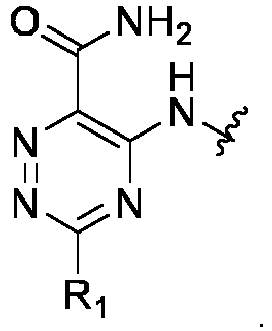
- In some embodiments, R1 is preferably selected from:


- L is selected from:





- E3 is selected from:


- Re is selected from: H, F, Cl, -GH3, -OMe, -CN, -CF3;
- Rd is selected from: H, L2Rg;
- L2 is selected from:


- R9 is selected from: H, C1-C5 alkyl (preferably methyl);
- q is selected from: 1, 2, 3, 4 or 5;
- Rg is selected from: H, C1-C8 alkyl, substituted or not substituted C1-C8 alkyl (preferably tert-butyl, isobutyl, etc); substituents selected from: amino, hydroxyl, cyano, halogen.
- still further, E3 is preferably selected from:


- Preferably, the compound or the stereoisomer thereof, or the stereoisomer mixture thereof, or the pharmaceutically acceptable salt thereof, prodrugs is selected from the following compounds:
No. Structure No. Structure 001 
002 
003 
004 
005 
006 
007 
008 
009 
010 
011 
012 
013 
014 
015 
016 
017 
018 
019 
020 
021 
022 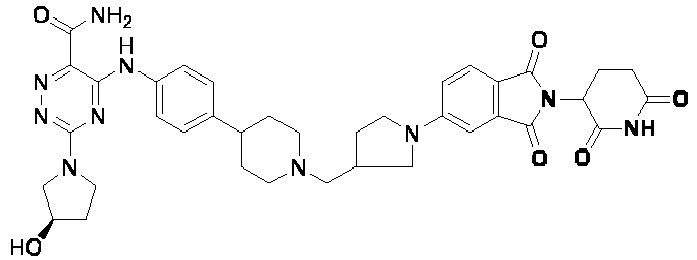
023 
024 
025 
026 
027 
028 
029 
030 
031 
032 
033 
034 
035 
036 
037 
038 
039 
040 
041 
042 
043 
044 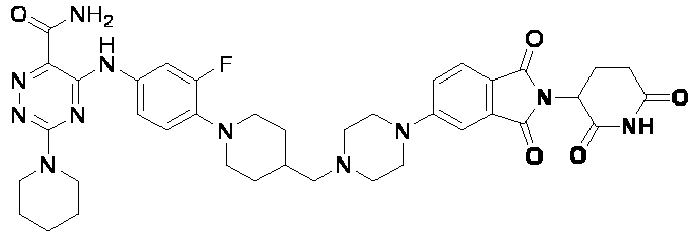
045 
046 
047 
048 
049 
050 
051 
052 
053 
054 
055 
056 
057 
058 
059 
060 
061 
062 
063 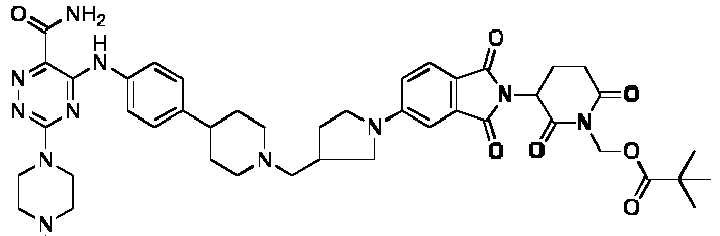
064 
065 
066 
067 
068 
069 
070 
071 
072 
073 
074 
075 
076 
077 
078 
079 
080 
081 
082 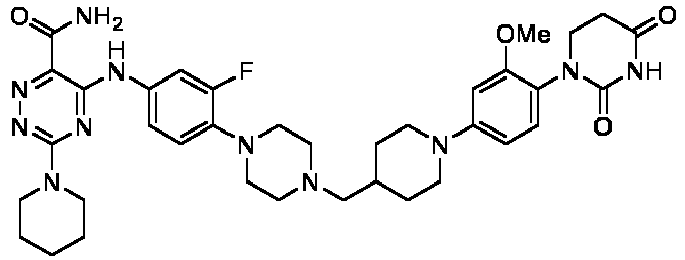
083 
084 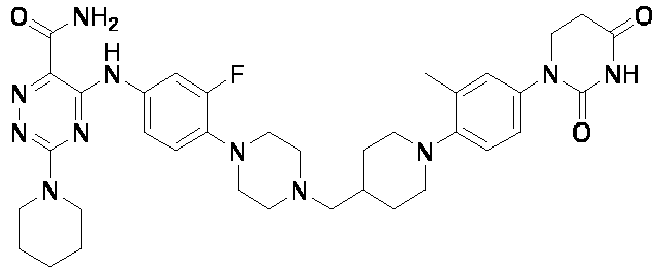
085 
086 
087 
088 
089 
090 
091 
092 
093 
094 
095 
096 
097 
098 
099 
100 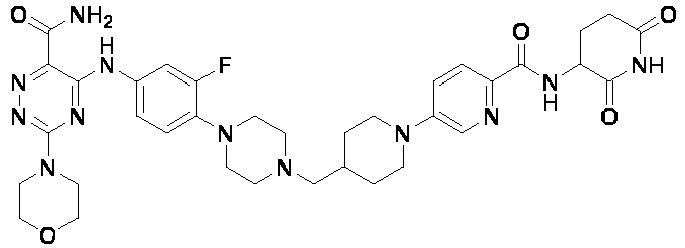
101 
102 
103 
104 
105 
- 5-((4-(1-((1-(2-(2,6-dioxopiperidin-3-yl)-1,3-dioxoisoindolin-5-yl) pyrrolidin-3-yl) methyl) piperidin-4-yl) phenyl) amino)-3-(piperidin-1-yl)-1,2,4-triazine-6-carboxamide 001
- 5-((4-(1-((1-(2-(2,6-dioxopiperidin-3-yl)-1,3-dioxoisoindolin-5-yl) pyrrolidin-3-yl) methyl) piperidin-4- yl)-3-fluorophenyl) amino)-3-(piperidin-1-yl)-1,2,4-triazine-6-carboxamide 002
- 5-((4-(4-((1-(2-(2,6-dioxopiperidin-3-yl)-1,3-dioxoisoindolin-5-yl) pyrrolidin-3-yl) methyl) piperazin-1-yl) -3-fluorophenyl) amino)-3-(piperidin-1-yl)-1,2,4-triazine-6-carboxamide 003
- 5-((6-(1-((1-(2-(2,6-dioxopiperidin-3-yl)-1,3-dioxoisoindolin-5-yl) pyrrolidin-3-yl) methyl) piperidin-4-yl) pyridazin-3-yl) amino)-3-(piperidin-1-yl)-1,2,4-triazine-6-carboxamide 004
- 5-((2-(1-((1-(2-(2,6-dioxopiperidin-3-yl)-1,3-dioxoisoindolin-5-yl) pyrrolidin-3-yl) methyl) piperidin-4-yl) pyrimidin-5-yl) amino)-3-(piperidin-1-yl)-1,2,4-triazine-6-carboxamide 005
- 5-((4-(4-((1-(2-(2,6-dioxopiperidin-3-yl)-1,3-dioxoisoindolin-5-yl)azetidin-3-yl) methyl) piperazin-1-yl) phenyl) amino)-3-(piperidin-1-yl)-1,2,4-triazine-6-carboxamide 006
- 5-((4-(1-((1-(2-(2,6-dioxopiperidin-3-yl)-1,3-dioxoisoindolin-5-yl) piperidin-4-yl) methyl) piperidin-4-yl)-3-fluorophenyl) amino)-3-(piperidin-1-yl)-1,2,4-triazine-6-carboxamide 007
- 5-((4-(1-((1-(2-(2,6-dioxopiperidin-3-yl)-1,3-dioxoisoindolin-5-yl) azetidin-3-yl) methyl) piperidin-4-yl) phenyl) amino)-3-(piperidin-1-yl)-1,2,4-triazine-6-carboxamide 008
- 5-((4-(1-((1-(2-(2,6-dioxopiperidin-3-yl)-1-oxoisoindolin-5-yl)pyrrolidin-3-yl) methyl) piperidin-4-yl) phenyl) amino)-3-(piperidin-1-yl)-1,2,4-triazine-6-carboxamide 009
- 5-((4-(1-((1-(2-(2,6-dioxopiperidin-3-yl)-6-fluoro-1-oxoisoindolin-5-yl) pyrrolidin-3-yl) methyl) piperidin-4-yl) phenyl) amino)-3-(piperidin-1-yl)-1,2,4-triazine-6-carboxamide 010
- 5-((4-(1-((1-(1-(2,6-dioxopiperidin-3-yl)-3-methyl-2-oxo-2,3-dihydro-1H-benzo[d]imidazol-5-yl) pyrrolidine -3-yl) methyl) piperidin-4-yl) phenyl) amino)-3-(piperidin-1-yl)-1,2,4-triazine-6-carboxamide 011
- 5-((4-(1-((1-(2-(2,6-dioxopiperidin-3-yl)-1-oxo-1,2-dihydroisoquinolin-6-yl)pyrrolidin-3-yl) methyl) piperidin-4-yl) phenyl) amino)-3-(piperidin-1-yl)-1,2,4-triazine-6-carboxamide 012
- 5-((4-(1-((1-(2-(2,6-dioxopiperidin-3-yl)-1-oxo-1,2,3,4-tetrahydroisoquinolin-6-yl)pyrrolidin-3-yl) methyl) piperidin-4-yl) phenyl) amino)-3-(piperidin-1-yl)-1,2,4-triazine-6-carboxamide 013
- 5-((4-(1-((1-(5-((2,6-dioxopiperidin-3-yl) amino) pyridin-2-yl) pyrrolidin-3-yl) methyl) piperidin-4-yl) phenyl) amino)-3-(piperidin-1-yl)-1,2,4-triazine-6-carboxamide 014
- 5-((4-(1-((1-(2-(2,6-dioxopiperidin-3-yl)-1,3-dioxoisoindolin-5-yl) pyrrolidin-3-yl) methyl) piperidin-4-yl) phenyl) amino)-3-((R)-3-hydroxypiperidin-1-yl)-1,2,4-triazine-6-carboxamide 015
- 3-((R)-3-acetamidopiperidin-1-yl)-5-((4-(1-((1-(2-(2,6-dioxopiperidin-3-yl)-1,3-dioxoisoindolin-5-yl) pyrrolidin-3-yl) methyl) piperidin-4-yl) phenyl) amino)-1,2,4-triazine-6-carboxamide 016
- 3-(((S)-1-amino-1-oxobutan-2-yl) amino)-5-((4-(1-((1-(2-(2,6-dioxopiperidin-3-yl)-1,3-dioxoisoindolin-5-yl) pyrrolidin-3-yl) methyl) piperidin-4-yl) phenyl) amino)-1,2,4-triazine-6-carboxamide 017
- 5-((4-(1-((1-(2-(2,6-dioxopiperidin-3-yl)-1,3-dioxoisoindolin-5-yl) pyrrolidin-3-yl) methyl) piperidin-4-yl) phenyl) amino)-3-(4-methylpiperazin-1-yl)-1,2,4-triazine-6-carboxamide 018
- 5-((4-(1-((1-(2-(2,6-dioxopiperidin-3-yl)-1,3-dioxoisoindolin-5-yl) pyrrolidin-3-yl) methyl) piperidin-4-yl) phenyl) amino)-3-morpholino-1,2,4-triazine-6-carboxamide 019
- 3-((3-cyanophenyl) amino)-5-((4-(1-((1-(2-(2,6-dioxopiperidin-3-yl)-1,3-dioxoisoindolin-5-yl) pyrrolidin-3-yl) methyl) piperidin-4-yl) phenyl) amino)-1,2,4-triazine-6-carboxamide 020
- 5-((4-(1-((1-(2-(2,6-dioxopiperidin-3-yl)-1,3-dioxoisoindolin-5-yl) pyrrolidin-3-yl) methyl) piperidin-4-yl) phenyl) amino)-3-(pyridin-2-ylamino)-1,2,4-triazine-6-carboxamide 021
- 5-((4-(1-((1-(2-(2,6-dioxopiperidin-3-yl)-1,3-dioxoisoindolin-5-yl) pyrrolidin-3-yl) methyl) piperidin-4-yl) phenyl) amino)-3-((R)-3-hydroxypyrrolidin-1-yl)-1,2,4-triazine-6-carboxamide 022
- 3-((R)-3-acetamidopiperidin-1-yl)-5-((4-(1-((1-(2-(2,6-dioxopiperidin-3-yl)-1,3-dioxoisoindolin-5-yl)piperidin-4-yl) methyl) piperidin-4-yl) phenyl) amino)-1,2,4-triazine-6-carboxamide 023
- 5-((4-(1-((1-(2-(2,6-dioxopiperidin-3-yl)-1,3-dioxoisoindolin-5-yl) pyrrolidin-3-yl) methyl) piperidin-4-yl) phenyl) amino)-3-(thiazol-2-yl)-1,2,4-triazine-6-carboxamide 024
- 5-((4-(1-((1-(2-(2,6-dioxopiperidin-3-yl)-1,3-dioxoisoindolin-5-yl) pyrrolidin-3-yl) methyl) piperidin-4-yl) phenyl) amino)-3-(1H-imidazol-2-yl)-1,2,4-triazine-6-carboxamide 025
- 5-((4-(1-((1-(2-(2,6-dioxopiperidin-3-yl)-1,3-dioxoisoindolin-5-yl) pyrrolidin-3-yl) methyl) piperidin-4-yl) phenyl) amino)-3-(pyridin-3-yl)-1,2,4-triazine-6-carboxamide 026
- 5-((4-(1-((1-(2-(2,6-dioxopiperidin-3-yl)-1,3-dioxoisoindolin-5-yl) pyrrolidin-3-yl) methyl) piperidin-4-yl) phenyl) amino)-3-(3-hydroxyphenoxy)-1,2,4-triazine-6-carboxamide 027
- 3-(2,3-difluorophenoxy)-5-((4-(1-((1-(2-(2,6-dioxopiperidin-3-yl)-1,3-dioxoisoindolin-5-yl)pyrrolidin-3-yl) methyl) piperidin-4-yl) phenyl) amino)-1,2,4-triazine-6-carboxamide 028
- 3-((R)-3-aminopiperidin-1-yl)-5-((4-(1-((1-(2-(2,6-dioxopiperidin-3-yl)-1,3-dioxoisoindolin-5-yl) pyrrolidin-3-yl) methyl) piperidin-4-yl) phenyl) amino)-1,2,4-triazine-6-carboxamide 029
- 3-(((1S,2R)-2-aminocyclohexyl)amino)-5-((4-(1-((1-(2-(2,6-dioxopiperidin-3-yl)-1,3-dioxoisoindolin-5-yl)pyrrolidin-3-yl) methyl) piperidin-4-yl) phenyl) amino)-1,2,4-triazine-6-carboxamide 030
- 5-((4-(1-((1-(2-(2,6-dioxopiperidin-3-yl)-1,3-dioxoisoindolin-5-yl) pyrrolidin-3-yl) methyl) piperidin-4-yl) phenyl) amino)-3-(piperazin-1-yl)-1,2,4-triazine-6-carboxamide 031
- 2-(((1S,2R)-2-aminocyclohexyl)amino)-4-((4-(1-((1-(2-(2,6-dioxopiperidin-3-yl)-1,3-dioxoisoindolin-5-yl)pyrrolidin-3-yl) methyl) piperidin-4-yl) phenyl) amino) pyrimidine-5-carboxamide 032
- 4-((4-(1-((1-(2-(2,6-dioxopiperidin-3-yl)-1,3-dioxoisoindolin-5-yl) pyrrolidin-3-yl) methyl) piperidin-4-yl) phenyl) amino)-2-(piperidin-1-yl) pyrimidine-5-carboxamide 033
- 4-((4-(4-((1-(2-(2,6-dioxopiperidin-3-yl)-1,3-dioxoisoindolin-5-yl) pyrrolidin-3-yl) methyl) piperazin-1-yl)-3-fluorophenyl) amino)-2-(piperidin-1-yl) pyrimidine-5-carboxamide 034
- 4-((4-(1-((1-(2-(2,6-dioxopiperidin-3-yl)-1,3-dioxoisoindolin-5-yl) pyrrolidin-3-yl) methyl) piperidin-4-yl) phenyl) amino)-2-((R)-3-hydroxypiperidin-1-yl)pyrimidine-5-carboxamide 035
- 4-((4-(1-((1-(2-(2,6-dioxopiperidin-3-yl)-1,3-dioxoisoindolin-5-yl) pyrrolidin-3-yl) methyl) piperidin-4-yl)-3-fluorophenyl) amino)-2-(piperidin-1-yl) pyrimidine-5-carboxamide 036
- 4-((4-(4-((1-(2-(2,6-dioxopiperidin-3-yl)-1,3-dioxoisoindolin-5-yl) pyrrolidin-3-yl) methyl) piperazin-1-yl)-3-fluorophenyl) amino)-6-(piperidin-1-yl) nicotinamide 037
- 4-((4-(1-((1-(2-(2,6-dioxopiperidin-3-yl)-1,3-dioxoisoindolin-5-yl) pyrrolidin-3-yl) methyl) piperidin-4-yl) phenyl) amino)-6-(piperidin-1-yl) nicotinamide 038
- 3-((4-(1-((1-(2-(2,6-dioxopiperidin-3-yl)-1,3-dioxoisoindolin-5-yl) pyrrolidin-3-yl) methyl) piperidin-4-yl) phenyl) amino)-6-methyl-5-(piperidin-1-yl) pyrazine-2-carboxamide 039
- 4-((4-(1-((1-(2-(2,6-dioxopiperidin-3-yl)-1,3-dioxoisoindolin-5-yl) pyrrolidin-3-yl) methyl) piperidin-4-yl) phenyl) amino)-6-(piperidin-1-yl) pyridazine-3-carboxamide 040
- 4-((4-(1-((1-(2-(2,6-dioxopiperidin-3-yl)-1,3-dioxoisoindolin-5-yl) pyrrolidin-3-yl) methyl) piperidin-4-yl) phenyl) amino)-6-((R)-3-hydroxypiperidin-1-yl) pyridazine-3-carboxamide 041
- 3-((4-(1-((1-(2-(2,6-dioxopiperidin-3-yl)-1,3-dioxoisoindolin-5-yl)pyrrolidin-3-yl) methyl) piperidin-4-yl) phenyl) amino)-6-fluoro-5-(piperidin-1-yl) pyrazine-2-carboxamide 042
- 3-((4-(1-((1-(2-(2,6-dioxopiperidin-3-yl)-1,3-dioxoisoindolin-5-yl) pyrrolidin-3-yl) methyl) piperidin-4-yl) phenyl) amino)-6-methoxy-5-(piperidin-1-yl) pyrazine-2-carboxamide 043
- 5-((4-(4-((4-(2-(2,6-dioxopiperidin-3-yl)-1,3-dioxoisoindolin-5-yl) perazin-1-yl) ethyl) iperidin-1-yl)-3- fluorophenyl) amino)-3-(piperidin-1-yl)-1,2,4-triazine-6-carboxamide 044
- 5-((4-(4-((4-(2-(2,6-dioxopiperidin-3-yl)-6-fluoro-1,3-dioxoisoindolin-5-yl) piperazin-1-yl) methyl) piperidin-1-yl)-3-fluorophenyl)amino)-3-(piperidin-1-yl)-1,2,4-triazine-6-carboxamide 045
- 5-((4-(4-((4-(2-(2,6-dioxopiperidin-3-yl)-6-fluoro-1,3-dioxoisoindolin-5-yl) piperazin-1-yl) methyl) piperidin-1-yl) phenyl) amino)-3-(piperidin-1-yl)-1,2,4-triazine-6-carboxamide 046
- 5-((6-(4-((4-(4-(2,4-dioxotetrahydropyrimidin-1(2H)-yl) phenyl) piperazin-1-yl) methyl) piperidin-1-yl) pyridin-3-yl) amino)-3-(4-methylpiperazin-1-yl)-1,2,4-triazine-6-carboxamide 047
- 5-((6-(4-((4-(4-(2,4-dioxotetrahydropyrimidin-1(2H)-yl) phenyl) piperazin-1-yl) methyl) piperidin-1-yl) pyridin-3-yl) amino)-3-(piperidin-1-yl)-1,2,4-triazine-6-carboxamide 048
- 5-((4-(3-((4-(2-(2,6-dioxopiperidin-3-yl)-1,3-dioxoisoindolin-5-yl) piperazin-1-yl) methyl) azetidin-1-yl) phenyl) amino)-3-(piperidin-1-yl)-1,2,4-triazine-6-carboxamide 049
- 5-((4-(4-((4-(4-(2,4-dioxotetrahydropyrimidin-1(2H)-yl) phenyl) piperazin-1-yl) methyl) piperidin-1-yl)-3-fluorophenyl) amino)-3-(piperidin-1-yl)-1,2,4-triazine-6-carboxamide 050
- 4-((4-(4-((4-(2-(2,6-dioxopiperidin-3-yl)-1,3-dioxoisoindolin-5-yl) piperazin-1-yl) methyl) piperidin-1-yl)-3-fluorophenyl) amino)-2-(piperidin-1-yl) pyrimidine-5-carboxamide 51
- 5-((4-(4-((4-(4-(2,6-dioxopiperidin-3-yl) phenyl) piperazin-1-yl) methyl) piperidin-1-yl)-3-fluorophenyl) amino)-3-(piperidin-1-yl)-1,2,4-triazine-6-carboxamide 052
- 5-((4-(4-((4-(5-(2,6-dioxopiperidin-3-yl) pyridin-2-yl) piperazin-1-yl) methyl) piperidin-1-yl)-3-fluorophenyl) amino)-3-(piperidin-1-yl)-1,2,4-triazine-6-carboxamide 053
- 5-((4-(4-((4-(4-(2,4-dioxotetrahydropyrimidin-1(2H)-yl)phenyl) piperazin-1-yl) methyl) piperidin-1-yl)-3-fluorophenyl) amino)-3-(4-methylpiperazin-1-yl)-1,2,4-triazine-6-carboxamide 054
- 5-((4-(1-(1-(2-(2,6-dioxopiperidin-3-yl)-1,3-dioxoisoindolin-5-yl)pyrrolidine-3-carbonyl) piperidin-4-yl) phenyl) amino)-3-(piperidin-1-yl)-1,2,4-triazine-6-carboxamide 055
- 5-((4-(4-(1-(2-(2,6-dioxopiperidin-3-yl)-1,3-dioxoisoindolin-5-yl) pyrrolidine-3-carbonyl) piperazin-1-yl) phenyl) amino)-3-(piperidin-1-yl)-1,2,4-triazine-6-carboxamide 056
- 5-((4-(1-(1-(2-(2,6-dioxopiperidin-3-yl)-1,3-dioxoisoindolin-5-yl) piperidine-4-carbonyl) piperidin-4-yl) phenyl) amino)-3-(piperidin-1-yl)-1,2,4-triazine-6-carboxamide 057
- 5-((4-(4-(1-(2-(2,6-dioxopiperidin-3-yl)-1,3-dioxoisoindolin-5-yl) piperidine-4-carbonyl) piperazin-1-yl) phenyl) amino)-3-(piperidin-1-yl)-1,2,4-triazine-6-carboxamide 058
- 5-((4-(1-(1-(2-(2,6-dioxopiperidin-3-yl)-1,3-dioxoisoindolin-5-yl) azetidine-3-carbonyl) piperidin-4-yl) phenyl) amino)-3-(piperidin-1-yl)-1,2,4-triazine-6-carboxamide 059
- 5-((4-(4-(4-(2-(2,6-dioxopiperidin-3-yl)-1,3-dioxoisoindolin-5-yl) piperazine-1-carbonyl) piperidin-1-yl) phenyl) amino)-3-(piperidin-1-yl)-1,2,4-triazine-6-carboxamide 060
- 5-((4-(4-(1-(2-(2,6-dioxopiperidin-3-yl)-1,3-dioxoisoindolin-5-yl) azetidine-3-carbonyl) piperazin-1-yl) phenyl) amino)-3-(piperidin-1-yl)-1,2,4-triazine-6-carboxamide 061
- (3-(5-(3-((4-(4-((6-carbamoyl-3-(piperidin-1-yl)-1,2,4-triazin-5-yl) amino) phenyl) piperidin-1-yl) methyl) pyrrolidin-1-yl)-1,3-dioxoisoindolin-2-yl)-2,6-dioxopiperidin-1-yl) methyl pivalate 062
- (3-(5-(3-((4-(4-((6-carbamoyl-3-(4-methylpiperazin-1-yl)-1,2,4-triazin-5-yl) amino) phenyl) piperidin-1-yl) methyl) pyrrolidin-1-yl)-1,3-dioxoisoindolin-2-yl)-2,6-dioxopiperidin-1-yl) methyl pivalate 063
- (3-(5-(3-((4-(4-((6-carbamoyl-3-(piperidin-1-yl)-1,2,4-triazin-5-yl) amino)-2-fluorophenyl) piperazin-1-yl) methyl) pyrrolidin-1-yl)-1,3-dioxoisoindolin-2-yl)-2,6-dioxopiperidin-1-yl) methyl pivalate 064
- (3-(5-(3-((4-(4-((5-carbamoyl-2-(piperidin-1-yl) pyrimidin-4-yl) amino) phenyl) piperidin-1-yl) methyl) pyrrolidin-1-yl)-1,3-dioxoisoindolin-2-yl)-2,6-dioxopiperidin-1-yl) methyl pivalate 065
- (3-(4-(4-((1-(4-((6-carbamoyl-3-(piperidin-1-yl)-1,2,4-triazin-5-yl) amino)-2-fluorophenyl) piperidin-4-yl) methyl) piperazin-1-yl) phenyl)-2,6-dioxotetrahydropyrimidin-1(2H)-yl) methyl pivalate 066
- 5-((4-(1-((1-(2-(2,6-dioxopiperidin-3-yl)-1,3-dioxoisoindolin-5-yl) pyrrolidin-3-yl) methyl) piperidin-4-yl)-3-fluorophenyl) amino)-3-((R)-3-hydroxypiperidin-1-yl)-1,2,4-triazine-6-carboxamide 067
- (3-(5-(3-((4-(4-((6-carbamoyl-3-(piperidin-1-yl)-1,2,4-triazin-5-yl) amino)-2-fluorophenyl) piperidin-1-yl) methyl) pyrrolidin-1-yl)-1,3-dioxoisoindolin-2-yl)-2,6-dioxopiperidin-1-yl) methyl pivalate 068
- 1-(3-(5-(3-((4-(4-((6-carbamoyl-3-(piperidin-1-yl)-1,2,4-triazin-5-yl) amino) phenyl) piperidin-1-yl) methyl) pyrrolidin-1-yl)-1,3-dioxoisoindolin-2-yl)-2,6-dioxopiperidin-1-yl) ethyl pivalate 069
- 1-(3-(5-(3-((4-(4-((6-carbamoyl-3-(4-methylpiperazin-1-yl)-1,2,4-triazin-5-yl) amino) phenyl) piperidin-1-yl) methyl) pyrrolidin-1-yl)-1,3-dioxoisoindolin-2-yl)-2,6-dioxopiperidin-1-yl) ethyl pivalate 070
- 1-(3-(5-(3-((4-(4-((6-carbamoyl-3-(piperidin-1-yl)-1,2,4-triazin-5-yl) amino)-2-fluorophenyl) piperazin-1-yl) methyl) pyrrolidin-1-yl)-1,3-dioxoisoindolin-2-yl)-2,6-dioxopiperidin-1-yl) ethyl pivalate 071
- 1-(3-(4-(4-((1-(4-((6-carbamoyl-3-(piperidin-1-yl)-1,2,4-triazin-5-yl) amino)-2-fluorophenyl) piperidin-4-yl) methyl) piperazin-1-yl) phenyl)-2,6-dioxotetrahydropyrimidin-1(2H)-yl) ethyl pivalate 072
- (3-(5-(3-((4-(4-((6-carbamoyl-3-(piperidin-1-yl)-1,2,4-triazin-5-yl) amino) phenyl) piperidin-1-yl) methyl) pyrrolidin-1-yl)-1,3-dioxoisoindolin-2-yl)-2,6-dioxopiperidin-1-yl) methyl L-valinate 073
- (3-(5-(3-((4-(4-((6-carbamoyl-3-(piperidin-1-yl)-1,2,4-triazin-5-yl) amino)-2-fluorophenyl) piperazin-1-yl) methyl) pyrrolidin-1-yl)-1,3-dioxoisoindolin-2-yl)-2,6-dioxopiperidin-1-yl) methyl L-valinate 074
- 5-((4-(4-((1-(4-(2,4-dioxotetrahydropyrimidin-1(2H)-yl)-3-methylphenyl) piperidin-4-yl) methyl) piperazin-1 -yl)-3-fluorophenyl)amino)-3-(piperidin-1-yl)-1,2,4-triazine-6-carboxamide 075
- 5-((4-(4-((4-(4-(2,4-dioxotetrahydropyrimidin-1(2H)-yl)-3-methylphenyl) piperazin-1-yl) methyl) piperidin-1-yl)-3-fluorophenyl) amino)-3-(piperidin-1-yl)-1,2,4-triazine-6-carboxamide 076
- 5-((4-(4-((1-(6-((2,6-dioxopiperidin-3-yl) amino) pyridin-3-yl) piperidin-4-yl) methyl) piperazin-1-yl)-3- fluorophenyl) amino)-3-(piperidin-1-yl)-1,2,4-triazine-6-carboxamide 077
- 5-((4-(4-((1-(4-(2,4-dioxotetrahydropyrimidin-1(2H)-yl)-3-fluorophenyl)piperidin-4-yl) methyl) piperazin-1 -yl)-3-fluorophenyl) amino)-3-(piperidin-1-yl)-1,2,4-triazine-6-carboxamide 078
- 5-((4-(4-((1-(6-((2,6-dioxopiperidin-3-yl) carbamoyl) pyridin-3-yl) pyrrolidin-3-yl) methyl) piperazin-1-yl)- 3-fluorophenyl) amino)-3-(piperidin-1-yl)-1,2,4-triazine-6-carboxamide 079
- 5-((4-(4-((1-(4-(2,4-dioxotetrahydropyrimidin-1(2H)-yl)phenyl) piperidin-4-yl) methyl) piperazin-1-yl)-3- fluorophenyl) amino)-3-(piperidin-1-yl)-1,2,4-triazine-6-carboxamide 080
- 5-((3-fluoro-4-(4-((1-(5-(6-oxo-1,6-dihydropyridazin-3-yl)-3-(trifluoromethyl) pyridin-2-yl) piperidin-4-yl) methyl) piperazin-1-yl) phenyl) amino)-3-(piperidin-1-yl)-1,2,4-triazine-6-carboxamide 081
- 5-((4-(4-((1-(4-(2,4-dioxotetrahydropyrimidin-1(2H)-yl)-3-methoxyphenyl)piperidin-4-yl) methyl) piperazin-1-yl)-3-fluorophenyl) amino)-3-(piperidin-1-yl)-1,2,4-triazine-6-carboxamide 082
- 5-((4-(4-((1-(4-((2,6-dioxopiperidin-3-yl) carbamoyl)-3-fluorophenyl) piperidin-4-yl) methyl) piperazin-1-yl) -3-fluorophenyl) amino)-3-(piperidin-1-yl)-1,2,4-triazine-6-carboxamide 083
- 5-((4-(4-((1-(4-(2,4-dioxotetrahydropyrimidin-1(2H)-yl)-2-methylphenyl)piperidin-4-yl) methyl) piperazin-1 -yl)-3-fluorophenyl) amino)-3-(piperidin-1-yl)-1,2,4-triazine-6-carboxamide 084
- 5-((4-(4-((1-(6-((2,6-dioxopiperidin-3-yl) carbamoyl) pyridin-3-yl) piperidin-4-yl) methyl) piperazin-1-yl)-3- fluorophenyl) amino)-3-(piperidin-1-yl)-1,2,4-triazine-6-carboxamide 085
- 5-((4-(4-((1-(4-(2,4-dioxotetrahydropyrimidin-1(2H)-yl)-2-fluorophenyl)piperidin-4-yl) methyl) piperazin-1-yl)-3-fluorophenyl) amino)-3-(piperidin-1-yl)-1,2,4-triazine-6-carboxamide 086
- 5-((3-fluoro-4-(4-((1-(4-(6-oxo-1,6-dihydropyridazin-3-yl)-2-(trifluoromethyl) phenyl) piperidin-4-yl) methyl) piperazin-1-yl) phenyl) amino)-3-(piperidin-1-yl)-1,2,4-triazine-6-carboxamide 087
- 5-((4-(4-((1-(4-((2,6-dioxopiperidin-3-yl) amino)-3-fluorophenyl) piperidin-4-yl) methyl) piperazin-1-yl)-3- fluorophenyl) amino)-3-(piperidin-1-yl)-1,2,4-triazine-6-carboxamide 088
- 5-((3-fluoro-4-(4-((4-(4-(6-oxo-1,6-dihydropyridazin-3-yl)-2-(trifluoromethyl) phenyl) piperazin-1-yl) methyl) piperidin-1-yl) phenyl) amino)-3-(piperidin-1-yl)-1,2,4-triazine-6-carboxamide 089
- (R)-3-(3-acetamidopiperidin-1-yl)-5-((4-(4-((1-(4-(2,4-dioxotetrahydropyrimidin-1(2H)-yl)-3-methylphenyl) piperidin-4-yl) methyl) piperazin-1-yl)-3-fluorophenyl) amino)-1,2,4-triazine-6-carboxamide 090
- (R)-3-(3-acetamidopiperidin-1-yl)-5-((4-(4-((1-(4-(2,4-dioxotetrahydropyrimidin-1(2H)-yl) phenyl) piperidin -4-yl) methyl) piperazin-1-yl)-3-fluorophenyl) amino)-1,2,4-triazine-6-carboxamide 091
- 3-((R)-3-acetamidopiperidin-1-yl)-5-((4-(4-((1-(6-((2,6-dioxopiperidin-3-yl) carbamoyl) pyridin-3-yl) piperidin-4-yl) methyl) piperazin-1-yl)-3-fluorophenyl) amino)-1,2,4-triazine-6-carboxamide 092
- 3-((R)-3-acetamidopiperidin-1-yl)-5-((4-(4-((1-(4-((2,6-dioxopiperidin-3-yl) carbamoyl)-3-fluorophenyl) piperidin-4-yl) methyl) piperazin-1-yl)-3-fluorophenyl) amino)-1,2,4-triazine-6-carboxamide 093
- (R)-3-(3-acetamidopiperidin-1-yl)-5-((3-fluoro-4-(4-((1-(5-(6-oxo-1,6-dihydropyridazin-3-yl)-3-(trifluoromethyl) pyridin-2-yl) piperidin-4-yl) methyl) piperazin-1-yl) phenyl) amino)-1,2,4-triazine-6-carboxamide 094
- (R)-3-(3-acetamidopiperidin-1-yl)-5-((3-fluoro-4-(4-((1-(4-(6-oxo-1,6-dihydropyridazin-3-yl)-2-(trifluoromethyl)phenyl) piperidin-4-yl) methyl) piperazin-1-yl) phenyl) amino)-1,2,4-triazine-6-carboxamide 095
- 3-((R)-3-acetamidopiperidin-1-yl)-5-((4-(4-((1-(6-((2,6-dioxopiperidin-3-yl)amino) pyridin-3-yl) piperidin-4- yl) methyl) piperazin-1-yl)-3-fluorophenyl) amino)-1,2,4-triazine-6-carboxamide 096
- 3-((R)-3-acetamidopiperidin-1-yl)-5-((4-(4-((1-(4-((2,6-dioxopiperidin-3-yl) amino)-3-fluorophenyl) piperidin-4-yl) methyl) piperazin-1-yl)-3-fluorophenyl) amino)-1,2,4-triazine-6-carboxamide 097
- 5-((4-(4-((1-(4-(2,4-dioxotetrahydropyrimidin-1(2H)-yl)-3-methylphenyl)piperidin-4-yl) methyl) piperazin-1-yl)-3-fluorophenyl) amino)-3-morpholino-1,2,4-triazine-6-carboxamide 098
- 5-((4-(4-((1-(4-(2,4-dioxotetrahydropyrimidin-1(2H)-yl)phenyl) piperidin-4-yl) methyl) piperazin-1-yl)-3- fluorophenyl) amino)-3-morpholino-1,2,4-triazine-6-carboxamide 099
- 5-((4-(4-((1-(6-((2,6-dioxopiperidin-3-yl) carbamoyl) pyridin-3-yl) piperidin-4-yl) methyl) piperazin-1-yl)-3- fluorophenyl) amino)-3-morpholino-1,2,4-triazine-6-carboxamide 100
- 5-((4-(4-((1-(4-((2,6-dioxopiperidin-3-yl) carbamoyl)-3-fluorophenyl) piperidin-4-yl) methyl) piperazin-1-yl) -3-fluorophenyl) amino)-3-morpholino-1,2,4-triazine-6-carboxamide 101
- 5-((3-fluoro-4-(4-((1-(5-(6-oxo-1,6-dihydropyridazin-3-yl)-3-(trifluoromethyl) pyridin-2-yl) piperidin-4-yl) methyl) piperazin-1-yl) phenyl) amino)-3-morpholino-1,2,4-triazine-6-carboxamide 102
- 5-((3-fluoro-4-(4-((1-(4-(6-oxo-1,6-dihydropyridazin-3-yl)-2-(trifluoromethyl) phenyl) piperidin-4-yl) methyl) piperazin-1-yl) phenyl) amino)-3-morpholino-1,2,4-triazine-6-carboxamide 103
- 5-((4-(4-((1-(6-((2,6-dioxopiperidin-3-yl)amino) pyridin-3-yl) piperidin-4-yl) methyl) piperazin-1-yl)-3- fluorophenyl) amino)-3-morpholino-1,2,4-triazine-6-carboxamide 104
- 5-((4-(4-((1-(4-((2,6-dioxopiperidin-3-yl) amino)-3-fluorophenyl) piperidin-4-yl) methyl) piperazin-1-yl)-3- fluorophenyl) amino)-3-morpholino-1,2,4-triazine-6-carboxamide 105
- Unless otherwise defined, all technical and scientific terms used herein have the same meaning as commonly understood by those skilled in the art. Unless otherwise specified, all patent documents, publicly disclosed materials, etc. referred to in the present invention are incorporated herein in their entirety. If there are multiple definitions for the same term in the present invention, the definition in this section shall prevail.
- It should be understood that the foregoing general description and the following detailed description are merely exemplary and explanatory, and are not interpreted as limitations on any claim. It should be noted that in the specification and the appended claims, singular references such as "a", "an" and "the" include plural references unless the context specifies otherwise. It should also be noted that "or" means "and/ or" unless specified otherwise. Furthermore, "comprise", "include", and similar terms are not limiting.
- "Substituted" means that a hydrogen atom is substituted with a substituent. It should be noted that the substituent on a specific atom is constrained by its valence. In the definition part, "Ci-j" means a range including the starting point and the end point, where i and j are both integers, indicating the number of carbon atoms. For example, C1-4, C1-10, C3-10, etc.
- C, H, O, S, N, F, Cl, Br, I, etc. involved in the groups and compounds of the present invention all include their isotopes. At the same time, C, H, 0, S, N, F, Cl, Br, and I involved in the groups and compounds of the present invention may be optionally substituted with one or more of their corresponding isotopes, including but not limited to isotopes of carbon 21 C, 13C, and 14C, isotopes of hydrogen protium (H), deuterium (D), and tritium (T), isotopes of oxygen 16O, 17O, and 18O, isotopes of sulfur 32S, 33S, 34S, and 36S, isotopes of nitrogen 14N and 15N, isotopes of fluorine 17F and 19F, isotopes of chlorine 35 Cl and 37 Cl, isotopes of bromine 79Br and81Br, etc.
- The term "alkyl" used in the present invention means a straight or branched saturated hydrocarbon group containing 1 to 8 carbon atoms, including but not limited to methyl, ethyl, propyl, isopropyl, n-butyl, isobutyl, sec-butyl, tert-butyl, n-amyl, isoamyl, neoamyl, tert-amyl, n-hexyl, isohexyl, neohexyl, heptyl, isoheptyl, neoheptyl, octyl, isooctyl, etc. The alkyl can be substituted with one or more substituents. When there are multiple substitutions occurring, thesubstituents can be the same or different; the substituents are independently D (deuterium), oxo, halogen, cyano, nitro, hydroxy, amino, aminoalkyl, alkenyl, alkynyl, carboxyl, carboxylic ester
group, acyl, amido, methylsulfuryl, alkylamido, Ci-Cs alkyl, Ci-Cs alkoxy, Ci-Cs hydroxyalkyl, Ci-Cs alkylamino, haloC1-C8 alkyl, haloCi-Cs alkoxy, haloC1-C8hydroxyalkyl, haloCi-Cs alkylamino, C3-C12 cycloalkyl, haloC3-C12 cycloalkyl, cycloalkenyl, cycloalkynyl, alkoxycarbonyl, alkylthio, alkylsulfonyl, hydroxyalkylamido, sulfonamido, Spiralyl, C6-C12 aryl, C5-C14 heteroaryl, C3-C12heterocyclyl. - The term " alkenyl" " alkene" used in the present invention means a straight or branched hydrocarbon chain group containing 1 to 8 carbon atoms and at least one C=C double bond, including but not limited to vinyl, 1-propenyl, 2-propenyl, 1-butenyl, 2-butenyl, 3-butenyl, 1-pentenyl, 2-pentenyl, 3-pentenyl, 4-pentenyl, 1-methyl -1-butenyl, 1-methyl-2-butenyl, 1-hexenyl, 2-hexenyl, 3-hexenyl, 4-hexenyl, 5-hexenyl, 1-methyl-1-pentenyl, 2-methyl-1-pentenyl, 1-heptenyl, 2-heptenyl, 3-heptenyl, 1-methyl-2-hexenyl, 2-methyl-2-hexenyl, 2-methyl-3 -hexenyl, 3,5-dimethyl-2-hexenyl, 3,3-dimethyl-1-pentenyl, 3-methyl-2-ethyl-1-butenyl, 1-octenyl, 2-octenyl, etc. The alkenyl can be substituted with one or more substituents. When there are multiple substitutions occurring, the substituents can be the same or different; the substituents are independently D, alkyl, haloalkyl, alkoxy, haloalkoxy, hydroxyalkyl, halohydroxyalkyl, alkylamino, haloalkylamino, cycloalkyl, halocycloalkyl, heterocyclyl, aryl, heteroaryl, hydroxyl, halogen, cyano, nitro, amino, aminoalkyl, carboxyl, amido, sulfonamido, spiralyl.
- The term " alkynyl" " alkyne" used in the present invention means a straight or branched hydrocarbon chain group containing 1 to 8 carbon atoms and at least one C≡C triple bond, including but not limited to ethynyl, 1-propynyl, 2-propynyl, 1-butynyl, 2-butynyl, 3-butynyl, 1-pentynyl, 2-pentynyl, 3-pentynyl, 4-pentynyl, 3-methyl -1-butynyl, 4-methyl-i-butynyl, 2-methyl-3-butynyl, 1-methyl-4-butynyl, 1-hexynyl, 2-hexynyl, 3-hexynyl, 4-hexynyl, 1-methyl-2-pentynyl, 1-methyl-3-pentynyl, 1-methyl-4-pentynyl, 2-methyl-3-pentynyl, 2,2-dimethyl-4- pentynyl, 1-heptynyl, 2-heptynyl, 3-heptynyl, 4-heptynyl, 5-heptynyl, 2-methyl-3-hexynyl, 3-methyl-1-hexynyl, 3,3-dimethyl-1-hexynyl, 4-methyl-1-hexynyl, etc. The alkynyl can be substituted with one or more substituents. When there are multiple substitutions occurring, the substituents can be the same or different; the substituents are independently D, alkyl, haloalkyl, alkoxy, haloalkoxy, hydroxyalkyl, halohydroxyalkyl, alkylamino, haloalkylamino, cycloalkyl, halocycloalkyl, heterocyclyl, aryl, heteroaryl, hydroxyl, halogen, cyano, nitro, amino, aminoalkyl, carboxyl, amido, sulfonamido, spiralyl.
- The term "cycloalkyl""cycloalkane" used in the present invention means a monocyclic or polycyclic (two monocyclic rings connected by chemical bonds or bridged ring or spiro ring or fused ring) non-aromatic monovalent hydrocarbon group having 3 to 12 carbon atoms, and possibly one or more chemical bonds that are double or triple bonds. "Cycloalkyl" includes, but is not limited to, cyclopropyl, cyclobutyl, cyclopentyl, cyclohexyl, cycloheptyl, cyclooctyl, cyclononyl, cyclodecyl, Octahydroindene, decalin, bicyclo [1.1.0] butylyl, bicyclo[2.1.0] pentyl, bicyclo[2.2.0] exyl, bicyclo[3.2.0]heptyl, bicyclo[4.2.0]octyl, bicyclo[1.1.1] pentyl, bicyclo[2.1.1] exyl, bicyclo[3.1.1]heptyl, bicyclo[2.2.1]heptyl, bicyclo[4.1.1]octyl, bicyclo[3.2.1]octyl, bicyclo[5.1.1]nonyl, bicyclo[4.2.1]nonyl, bicyclo[4.3.1]nonyl, bicyclo[3.2.2]nonyl, bicyclo[5.2.1]decyl, bicyclo[4.2.2]decyl, spiro [2.2] penty, spiro [2.3] exyl, spiro [2.4] heptyl, spiro [2.5] octyl, spiro [2.6] nonyl, spiro [3.5] nonyl, spiro [3.4] octyl, spiro [3.3] heptyl, spiro [4.5] decyl, spiro [4. 4] nonyl, etc. The cycloalkyl can be substituted with one or more substituents. When there are multiple substitutions occurring, the substituents can be the same or different; the substituents are independently D (deuterium), oxo, halogen, cyano, nitro, hydroxyl, amino, aminoalkyl, alkenyl, alkynyl, carboxyl, carboxylic ester group, acyl, amido, methylsulfuryl, alkylamido, C1-C8 alkyl, C1-C8 alkoxy, C1-C8 hydroxyalkyl, C1-C8alkylamino, haloC1-C8 alkyl, haloCi-Cs alkoxy, haloC1-C8hydroxyalkyl, haloC1-C 8alkylamino, C3-C12 cycloalkyl, haloC3-C12 cycloalkyl, cycloalkenyl, cycloalkynyl, alkoxycarbonyl, alkylthio, alkylsulfonyl, hydroxyalkylamido, sulfonamido, spiralyl, C6-C12 aryl, C5-C14 heteroaryl, C3-C12 heterocyclyl.
- The term "cycloalkenyl" " cycloalkene " used in the present invention means a monocyclic or polycyclic (two monocyclic rings connected by chemical bonds or bridged ring or spiro ring or fused ring) non-aromatic monovalent hydrocarbon group having 3 to 12 carbon atoms and at least one C=C double bond, including but not limited to cyclopropenyl, cyclobutenyl, cyclopentenyl, cyclohexenyl, cycloheptenyl, cycloalkenyl, spiro[2.2]pent -1-enyl, spiro[2.2]pent-1,4-dienyl, spiro[2.3]hex-1-enyl, spiro[2.3]hex-1,4-dienyl, spiro[3.3]hept-1-enyl, spiro[3.3] hept-1,5-dienyl, spiro[3.4]oct-1-enyl, spiro[3.4]oct-1,6-dienyl, spiro[3.4]oct-5-enyl, spiro[3.4]oct-6-enyl, spiro[3.4] oct-1-enyl, bicyclo[2.1.1]hex-1-enyl, bicyclo[2.1.1]hex-2-enyl, bicyclo[3.1.1]hept 1-enyl, bicyclo[3.1.1]hept-2- enyl, bicyclo[2.2.1]hept-1-enyl, bicyclo[2.2.1]hept-2-enyl, etc. The cycloalkene or cycloalkenyl can be substituted with one or more substituents. When there are multiple substitutions occurring, the substituents can be the same or different; the substituents are independently D (deuterium), oxo, halogen, cyano, nitro, hydroxyl, aminoalkyl, alkenyl, alkynyl, carboxyl, carboxylic ester group, acyl, amido, methylsulfuryl, alkylamido, C1-C8 alkyl, C1-C8 alkoxy, C1-C8 hydroxyalkyl, C1-C8 alkylamino, haloC1-C8 alkyl, haloC1-C8 alkoxy, haloCi-Cs hydroxyalkyl, haloCi-Cs alkylamino, C3-C12 cycloalkyl, haloC3-C2 cycloalkyl, cycloalkenyl, cycloalkynyl, alkoxycarbonyl, alkylthio, alkylsulfonyl, hydroxyalkylamido, sulfonamido, spirally, C6-C12 aryl, C5-C12 heteroaryl, C3-C12 heterocyclyl.
- The term "cycloalkyne ""cycloalkyne group" used in the present invention means a monocyclic or polycyclic (two monocyclic rings connected by chemical bonds or bridged ring or spiro ring or fused ring) non-aromatic monovalent hydrocarbon group having 4 to 12 carbon atoms, and contains at least one triple bonds, preferably as cyclobutyylene, cyclopentynyl, cyclohexynyl, etc, one or two carbon atoms can be replaced by one oxygen atom.The cycloalkyne group can be substituted or substituted, the substituents are independently D (deuterium), oxo, halogen, cyano, nitro, hydroxyl, aminoalkyl, alkenyl, alkynyl, carboxyl, carboxylic ester group, acyl, amido, methylsulfuryl, alkylamido, C1-C8 alkyl, C1-C8 alkoxy, C1-C8 hydroxyalkyl, C1-C8 alkylamino, haloC1-C8 alkyl, haloCi-Cs alkoxy, haloCi-Cs hydroxyalkyl, haloCi-Cs alkylamino, C3-C12 cycloalkyl, haloC3-C12 cycloalkyl, cycloalkenyl, cycloalkynyl, alkoxycarbonyl, alkylthio, alkylsulfonyl, hydroxyalkylamido, sulfonamido, C6-C12 aryl, C5-C12 heteroaryl, C3-C12 heterocyclyl.
- The term "halogen" used in the present invention means fluorine, chlorine, bromine and iodine, preferably, fluorine, chlorine and bromine.
- The term "alkoxy" used in the present invention means alkyl -O-, in which the alkyl is as defined above. Examples of "alkoxy" used in the present invention include, but are not limited to, methoxy, ethoxy, n-propoxy, isopropoxy, n-butoxy, sec-butoxy, tert-butoxy, pentoxy, isopentyloxy, neopentyloxy, etc. "Alkoxy" also includes substituted alkoxy, the substituents of which may be D, halogen, oxo, amino, hydroxyl, cyano, nitro, carboxyl, amido, sulfonamido, C1-C8 alkyl, C1-C8 hydroxyalkyl, C1-C8 alkoxy, C1-C8 alkylamino, haloC1-C8 alkyl, haloC1-C8hydroxyalkyl, haloC1-C8 alkoxy, haloC1-C8 alkylamino, C3-C12 cycloalkyl, C3-C12 heterocyclyl, C6-C12aryl, C5-C14heteroaryl.
- The term "hydroxyalkyl" used in the present invention means -alkyl-OH, in which the alkyl is as defined above. Examples of "hydroxyalkyl" used in the present invention include, but are not limited to, hydroxymethyl, hydroxyethyl, hydroxypropyl, hydroxyisopropyl, etc. "Hydroxyalkyl" also includes substituted hydroxyalkyl, the substituents of which may be D, halogen, oxo, amino, hydroxy, cyano, nitro, carboxyl, amido, sulfonamido, C1-C8 alkyl, C1-C8 hydroxyalkyl, C1-C8 alkoxy, C1-C8 alkylamino, haloC1-C8 alkyl, haloC1-C8hydroxyalkyl, haloC1-C8 alkoxy, haloC1-C8 alkylamino, C3-C12 cycloalkyl, C3-C12 heterocyclyl, C6-C12 aryl, Cs-Ciaheteroaryl.
- The term "alkylamino" used in the present invention means -NH-alkyl, in which the alkyl is as defined above. Examples of "alkylamino" used in the present invention include, but are not limited to, methylamino, ethylamino, propylamino, isopropylamino, etc. "Alkylamino" also includes substituted alkylamino, the substituents of which may be D, halogen, oxo, amino, hydroxyl, cyano, nitro, carboxyl, amido, sulfonamido, spirally, C1-C8 alkyl, C1-C8 hydroxyalkyl, C1-C8 alkoxy, C1-C8 alkylamino, haloC1-C8 alkyl, haloC1-C8hydroxyalkyl, haloC1-C8 alkoxy, haloC1-C8 alkylamino, C3-C12 cycloalkyl, C3-C12 heterocyclyl, C6-C12 aryl, C5-C14 heteroaryl, and the substituents of which can be on alkyl or on N.
- The term "aminoalkyl" used in the present invention means -alkyl-NH2, in which the alkyl is as defined above. Examples of "aminoalkyl" used in the present invention include, but are not limited to, aminomethyl, aminoethyl, aminopropyl, aminoisopropyl, etc. "Aminoalkyl" also includes substituted aminoalkyl, the substituents of which may be D, halogen, oxo, amino, hydroxyl, cyano, nitro, carboxyl, amido, sulfonamido,spiralyl C1-C8 alkyl, C1-C8 hydroxyalkyl, C1-C8 alkoxy, C1-C8 alkylamino, haloC1-C8 alkyl, haloC1-C8hydroxyalkyl, haloC1-C8 alkoxy, haloCi-Cs alkylamino, C3-C12 cycloalkyl, C3-C12 heterocyclyl, C6-C12 aryl,C5-C14 heteroaryl, and the substituents of which can be on alkyl or on N.
- The term "Cycloalkoxy" used in the present invention means cycloalkyll substituted with One or more carbon atom are replaced by one or more oxygen, in which the "cycloalkyl" is as defined above. Examples of the "alkylamino" used in the present invention include but are not limited to oxyheterocyclic butane, tetrahydrofuran, tetrahydropyran, dioxane, and so like.
- The term "aromatic ring" "aryl" used in the present invention means an all-carbon monocyclic or fused polycyclic aromatic ring group (in the case of fused polycyclic rings, one of the fused rings can be partially saturated) having 6 to 12 carbon atoms, including but not limited to benzene ring, naphthalene ring, anthracene ring, indene ring, dihydroindenyl (indanyl), dihydronaphthalene ring, tetrahydronaphthalene ring, etc. Aryl can be unsubstituted or substituted, can be monosubstituted (such as ortho-, meta-, or para-substituted), can also be di-substituted or tri-substituted, etc. When there are multiple substitutions occurring, the substituents can be the same or different; the substituents are independently D (deuterium), halogen, cyano, nitro, hydroxyl, amino, aminoalkyl, alkenyl, alkynyl, carboxyl, acyl, amido, alkylamido, C1-C8 alkyl, C1-C8 alkoxy, C1-C8 hydroxyalkyl, C1-C8 alkylamino, haloC1-C8 alkyl, haloC1-C8 alkoxy, haloC1-C8 hydroxyalkyl, haloC1-C8 alkylamino, C3-C12 cycloalkyl, haloC3-C12 cycloalkyl, alkoxycarbonyl, alkylthio, alkylsulfonyl, hydroxyalkylamido, sulfonamido, spiralyl, C6-C12 aryl, C5-C14 heteroaryl, C3-C12 heterocyclyl.
- The term "heteroaryl" used in the present invention means a monocyclic or fused polycyclic aromatic ring group (in the case of fused polycyclic rings, one of the fused rings can be partially saturated) having 5 to 14 ring atoms, which is equivalent to that one or more carbons in the above "aryl" are replaced by heteroatoms such as N, 0, S, etc. Heteroaromatic rings can bemonocyclic ring or bicyclic ring, i.e., formed by the fusion of two rings. Heteroaryl includes, but are not limited to, pyridyl, pyrimidinyl, pyrazinyl, pyridazinyl, triazinyl, isoxazolyl, isothiazolyl, pyrazolyl, thiazolyl, thienyl, furanyl, triazolyl, oxazolyl, imidazolyl, indazolyl, indolizinyl, indolyl, dihydroindolyl, isoindolinyl, quinolyl, isoquinolyl, quinoxalinyl, quinazolinyl, dihydroquinolinyl, tetrahydroquinolinyl, dihydroisoquinolinyl, dihydroisoquinolinyl, tetrahydroisoquinolinyl, pteridinyl, purinyl, benzoimidazolyl, benzofuranyl, benzothienyl, benzothiazolyl, benzotriazolyl, benzotriazinyl, benzoxadiazolyl, benzoxazolyl, benzoisoxazolyl, imidazopyridyl, imidazothiazolyl, pyrrolopyridyl, thienopyrrolyl, thienothienyl, thienopyridyl, thienopyrimidinyl, pyrazolopyrimidinyl, pyrrolopyrrolyl, pyrrolopyrimidinyl, pyrrolopyridazinyl, pyrrolopyrazinyl, imidazopyrimidinyl, imidazopyrazinyl, imidazopyridazinyl, pyrazolopyridyl, pyrazolopyridazinyl, pyrazolopyrazinyl, pyrimidopyridyl, pyrimidopyrazinyl, pyrimidopyridazinyl, pyrimidopyrimidinyl, pyridopyridyl, pyridopyrazinyl, pyridopyridazinyl, pyridazinopyridazinyl, pyridazinopyrazinyl, pyrazinopyrazinyl, etc. Heteroaryl can be unsubstituted or monosubstituted or polysubstituted. In the case of polysubstitution, the substituents can be the same or different; the substituents are independently D (deuterium), halogen, cyano, nitro, amino, aminoalkyl, hydroxyl, carboxyl, carboxylic ester group, acyl, amido, alkylamido, alkoxycarbonyl, alkylthio, alkylsulfonyl, hydroxyalkylamido, sulfonamido, Ci-Cs alkyl, Ci-Cs hydroxyalkyl, Ci-Cs alkoxy, Ci-Cs alkylamino, haloC1-C8 alkyl, haloC1-C8 hydroxyalkyl, haloC1-C8 alkoxy, haloC1-C8 alkylamino, C3-C12 cycloalkyl, haloC3-C12 cycloalkyl, C3-C12heterocyclyl, C6-C12 aryl, C5-C14 heteroaryl.
- The term "heterocyclyl" used in the present invention means a monocyclic or polycyclic (two monocyclic rings connected by chemical bonds or bridged ring or spiro ring or fused ring) non-aromatic ring group having 3 to 12 ring atoms, one or more heteroatoms selected from N, O, S, and possibly one or more chemical bonds that are double or triple bonds. Heterocyclyl, includes but are not limited to, pyranyl, piperidinyl, piperazinyl, morpholinyl, dioxanyl, oxacyclopropyl, oxacyclobutyl, oxacyclohexyl, oxacycloheptyl, oxacyclooctyl, azacyclopropyl, azacyclobutyl, azacyclopentyl, azacycloheptyl, azacyclooctyl, thiocyclobutyl, thiocyclopropyl, azacyclooctane group, oxazepinyl, diazepinyl, thiazepinyl, dihydrofuranyl, dihydrothienyl, dihydropyranyl, tetrahydrofuranyl, tetrahydrothienyl, tetrahydropyranyl, tetrahydrothiopyranyl, tetrahydrothiazolyl, tetrahydroimidazolyl, hexahydropyridazinyl, hexahydropyrimidinyl, 1-azaspiro [2.2]pentyl, 1-azaspiro[2.3]hexyl, 4-azaspiro[2.3]hexyl, 5-azaspiro[2.3]hexyl, 2-azaspiro[3.3]heptyl, 2,6-diazaspiro[3.3]heptyl, 2-oxa-6-azaspiro[3.3]heptane, 1-azaspiro [2.5] octyl, 2-azaspiro[3.4]octyl, 6-azaspiro[3.4]octyl, 2,6-diazaspiro[3.4]octyl, 2-azaspiro[3.5]nonyl,6-azaspiro [3.5]nonyl, 7-azaspiro[3.5]nonyl, 2,7-diazaspiro[3.5]nonyl, 2-oxa-7-azaspiro[3.5] nonyl, 1-azaspiro[4.4]nonyl, 2-azaspiro[4.4]nonyl, 8-azaspiro[4.5]decyl, 2,8-diazaspiro[4.5] decyl, 1-oxaspiro[2.2]pentyl, 1-oxaspiro[2.3]hexyl, 4-oxaspiro[2.3]hexyl, 5-oxaspiro[2.3]hexyl, 2-oxaspiro[3.3]heptyl, 1-oxaspiro[2.5]octyl, 2-oxaspiro[3.4]octyl, 6-oxaspiro[3.4]octyl, 2-oxaspiro[3.5]nonyl, 6-oxaspiro[3.5]nonyl, 7-oxaspiro[3.5]nonyl, 1-oxaspiro[4.4]nonyl, 2-oxaspiro[4.4]nonyl, 8-oxaspiro[4.5]decyl, decahydroquinolyl, decahydroisoquinolyl, 2-azabicyclo[1.1.1]pentyl, 2-oxabicyclo[1.1.1]pentyl, azabicyclo[2.1.1]hexyl, oxabicyclo[2.1.1]hexyl, azabicyclo[3.1.1]heptyl, oxabicyclo [3.1.1]heptyl, azabicyclo[2.2.1]heptyl, azabicyclo[4.1.1]octyl, azabicyclo[3.2.1]octyl, azabicyclo[3.2.1]octyl, etc. The heterocyclyl can be substituted with one or more substituents. When there are multiple substitutions occurring, the substituents can be the same or different; the substituents are independently D (deuterium), oxo, halogen, cyano, nitro, hydroxyl, amino, aminoalkyl, alkenyl, alkynyl, carboxyl, carboxylic ester group, acyl, amido, methylsulfuryl, alkylamido, C1-C8 alkyl, C1-C8alkoxy, C1-C8 hydroxyalkyl, C1-C8 alkylamino, haloC1-C8 alkyl, haloC1-C8 alkoxy, haloC1-C8hydroxyalkyl, haloC1-C8 alkylamino, C3-C12 cycloalkyl, haloC3-C12 cycloalkyl, cycloalkenyl, cycloalkynyl, alkoxycarbonyl, alkylthio, alkylsulfonyl, hydroxyalkylamido, sulfonamido, C6-C12aryl, C5-C14heteroaryl, C3-C12heterocyclyl.
- The terms "spiro ring" and "spiro ring group" used in the present invention mean a polycyclic structure, in which at least two rings share one atom (usually a C atom). In this polycyclic structure, one or more chemical bonds can be double bonds or triple bonds, and one or more heteroatoms can be present. The spiro ring group can be unsubstituted or monosubstituted or polysubstituted. In the case of polysubstitution, the substituents can be the same or different; the substituents are independently D (deuterium), oxo, halogen, cyano, nitro, hydroxyl, amino, aminoalkyl, alkenyl, alkynyl, carboxyl, carboxylic ester group, acyl, amido, methylsulfuryl, alkylamido, C1-C8 alkyl, C1-C 8alkoxy, C1-C8 hydroxyalkyl, C1-C8 alkylamino, haloC1-C8 alkyl, haloC1-C8 alkoxy, haloC1-C8hydroxyalkyl, haloC1-C8 alkylamino, C3-C12 cycloalkyl, haloC3-C12 cycloalkyl, cycloalkenyl, cycloalkynyl, alkoxycarbonyl, alkylthio, alkylsulfonyl, hydroxyalkylamido, sulfonamido, spiralyl, C6-C12 aryl, C5-C14 heteroaryl, C3-C12 heterocyclyl.
- The term "bridged ring group" used in the present invention means a polycyclic structure, in which at least two rings share two or more atoms. In this polycyclic structure, one or more chemical bonds can be double bonds or triple bonds, and one or more heteroatoms can be present. The bridged ring group can be unsubstituted or monosubstituted or polysubstituted. In case of polysubstitution, the substituents can be the same or different; the substituents are independently D (deuterium), oxo, halogen, cyano, nitro, hydroxyl, amino, aminoalkyl, alkenyl, alkynyl, carboxyl, carboxylic ester group, acyl, amido, methylsulfuryl, alkylamido, C1-C8 alkyl, C1-C salkoxy, C1-C8 hydroxyalkyl, C1-C8 alkylamino, haloC1-C8 alkyl, haloC1-C8 alkoxy, haloC1-C8hydroxyalkyl, haloC1-C8 alkylamino, C3-C12 cycloalkyl, haloC3-C12 cycloalkyl, cycloalkenyl, cycloalkynyl, alkoxycarbonyl, alkylthio, alkylsulfonyl, hydroxyalkylamido, sulfonamido, C6-C12aryl, C5-C14heteroaryl, C3-C12heterocyclyl.
- The term "haloalkyl" used in the present invention means a straight or branched alkyl group substituted with halogens (preferably fluorine, chlorine, bromine, iodine), in which the "alkyl" is as defined above. Examples of "haloalkyl" used in the present invention include, but are not limited to, fluoromethyl, difluoromethyl, trifluoromethyl, chloromethyl, dichloromethyl, trichloromethyl, 2,2,2-trifluoroethyl, 2-fluoroethyl, 2-chloroethyl, tetrafluoroethyl, pentafluoroethyl, 1,1,1-trifluoroprop-2-yl, etc.
- The term "halocycloalkyl" used in the present invention means halocycloalkyl substituted with One or more hydrogens are replaced by one or more halogens (preferably fluorine, chlorine, bromine, iodine), in which the "cycloalkyl" is as defined above.
- The salts of the compound of the invention may be prepared by a method known to those skilled in the art.
- "Pharmaceutically acceptable salt" refers to a salt formed by the compound of the present invention with an acid or a base, and is suitable for use as a dug. Pharmaceutically acceptable salts include inorganic salts and organic salts. One preferred class of salts are the salts formed by the compounds of the invention with acids. Suitable salt-forming acids include, but are not limited to: inorganic acids such as hydrochloric acid, hydrobromic acid, hydrofluoric acid, hydroiodic acid, sulfuric acid, nitric acid, phosphoric acid, carbonic acid, organic acids such as
formic acid, acetic acid, trifluoroacetic acid, propionic acid, oxalic acid, malonic acid, succinic acid, fumaric acid, maleic acid, lactic acid, malic acid, tartaric acid, citric acid, picric acid, methanesulfonic acid, p-toluenesulfonic acid, ethanesulfonic acid, benzenesulfonic acid, camphorsulfonic acid, 2-O-β-D-glucopyranosyl-L-ascorbic acid, isonicotinic acid, salicylic acid, ascorbic acid, gentisic acid, gluconic acid, pyruvic acid, naphthalenesulfonic acid, stearic acid, phenylacetic acid, p-aminobenzenesulfonic acid, isethionic acid, pamoic acid, tannic acid; and acidic amino acids such as aspartic acid,glutamic acid. One preferred class of salts are the salts formed by the compounds of the invention with bases. Suitable salt-forming bases include, but are not limited to: inorganic bases such as sodium hydroxide, potassium hydroxide, sodium carbonate, sodium bicarbonate, and sodium phosphate, and organic bases such as ammonia, riethylamine, diethylamine, piperazine, guanidine, and diethanolamine. - The second object of the present invention is to provide a pharmaceutical composition including one or more of the compounds described in any of the above technical solutions. The pharmaceutical composition of the present invention can be composed of one or more of the compounds described in any of the above technical solutions and other compounds, or composed of one or more of the compounds described in any of the above technical solutions.
- The present invention provides a pharmaceutical preparation, which comprises at least one active component, and the active component is one or more of the compounds described in any of the above technical solutions. The pharmaceutical preparation comprises at least one active component and one or more pharmaceutically acceptable carriers or excipients. The active component can be any one or more of the BTK inhibitor compound of the present invention, an optical isomer of the compound, a pharmaceutically acceptable salt of the compound or its optical isomer, a solvate of the compound or its optical isomer.
- The carriers include conventional diluents, excipients, fillers, binders, wetting agents, disintegrants, absorption accelerators, surfactants, adsorption carriers, lubricants, etc. in the pharmaceutical field, and when necessary, flavoring agents, sweeteners, etc. can also be added.
- The drug of the present invention can be formulated into various forms such as tablets, powders, granules, capsules, oral liquids, and injections. The drugs in each of the above dosage forms can be formulated according to conventional methods in the pharmaceutical field.
- On the other hand, the present invention provides the use of the compound of the general formula I to formula III disclosed herein and its optical isomers or pharmaceutically acceptable salts or solvates thereof to inhibit Bruton's tyrosine kinase (Btk) activity, or to treat diseases, disorders, or conditions that would benefit from the inhibition of Bruton's tyrosine kinase (Btk) activity.
- In a further preferred embodiment, the present invention provides a method for inhibiting the Bruton's tyrosine kinase activity in a subject in need by administering a composition containing a therapeutically effective amount of at least one compound to the subject, wherein the structural formula of the compound is set forth in the general formula I to formula III. In some embodiments, the subject in need thereof suffers from an autoimmune disease, such as inflammatory bowel disease, arthritis, lupus, rheumatoid arthritis, psoriatic arthritis, osteoarthritis, Still's disease, juvenile arthritis, diabetes, myasthenia gravis, Hashimoto's thyroiditis, Ord's thyroiditis, Graves' disease, Sgögren's syndrome, multiple sclerosis, Guillain-Barré syndrome, acute disseminated encephalomyelitis, Addison's disease, optic opsoclonus-myoclonus syndrome, ankylosing spondylitis, antiphospholipid antibody syndrome, aplastic anemia, autoimmune hepatitis, coeliac disease, Goodpasture's syndrome, immune thrombocytopenic purpura (ITP), optic neuritis, scleroderma, primary biliary cirrhosis, Reiter's syndrome, Takayasu's arteritis, temporal arteritis, warm autoimmune hemolytic anemia, Wegener's granulomatosis, psoriasis, alopecia universalis, Behçet's disease, chronic fatigue, familial dysautonomia, endometriosis, interstitial cystitis, neuromyotonia, scleroderma or vulvodynia and chronic graft-versus-host disease (cGvHD).
- In a further embodiment, the subject in need suffers from a cancer. In one embodiment, the cancer is a B cell or plasma cell proliferative disease, such as diffuse large B cell lymphoma, follicular lymphoma, chronic lymphocytic lymphoma, chronic lymphocytic leukemia, B cell prolymphocytic leukemia, lymphoplasmacytic lymphoma/Waldenström macroglobulinemia, splenic marginal zone lymphoma, plasma cell myeloma, plasmacytoma, extranodal marginal zone B cell lymphoma, lymph node marginal zone B cell lymphoma, mantle cell lymphoma, mediastinum (thymus) large B cell lymphoma, intravascular large B cell lymphoma, primary effusion lymphoma, Burkitt lymphoma/leukemia, multiple myeloma, or lymphomatoid granulomatosis.
- The present invention also provides the use of the compounds of the present invention or pharmaceutically acceptable salts thereof in the preparation of BTK inhibitors, especially their use in the treatment of cell proliferation diseases. The cell proliferative diseases include cancers. In other words, the invention also provides the use of the compound of the general formula I to formula III, its optical isomers or pharmaceutically acceptable salts or solvates thereof alone or in combination with other drugs in the treatment of proliferative diseases (such as cancers). Antitumor drugs that can be used in combination with the compounds provided by the present invention or their pharmaceutically acceptable salts thereof include, but are not limited to, at least one of the following types: mitotic inhibitors (such as vinblastine, vindesine, and vinorelbine); tubulin breakdown inhibitors (such as Taxol)); alkylating reagents (such as cisplatin, carboplatin and cyclophosphamide); antimetabolites (such as 5-fluorouracil, tegafur, methotrexate, cytarabine, and hydroxyurea); antibiotics can be inserted (such as doxorubicin, mitomycin and bleomycin)); enzymes (such as aspartase); topoisomerase inhibitors (such as etoposide and camptothecin); biological response modifiers (such as interferons); immune checkpoint inhibitors (such as PD-1 inhibitors, PD-L inhibitors, CTLA-4 inhibitors); CD20 monoclonal antibody; BCL2 inhibitors.
- The inventors of the present invention have confirmed through experiments that the compounds of the present invention have a degradation activity against BTK.
- The inventors of the present invention have confirmed through experiments that the compounds of the present invention have anti-proliferation inhibitory effects on Mino, OCI-LY10 tumor cell lines.
- The inventors of the present invention have confirmed through experiments that the compounds of the present invention are metabolically stable in the liver microparticles.
- The inventors of the present invention have confirmed through experiments that the compounds of the present invention may be taken orally.
- The inventors of the present invention have confirmed through experiments that the compounds of the present invention have a better effect on tumor growth inhibition in the in vivo efficacy model of OCI-LY10.
-

- Ethyl 5-chloro-3-(methylthio)-1,2,4-triazine-6-carboxylic acid ethyl ester (760 mg, 3.40 mmol) was dissolved in 10 mL of acetonitrile, and 4-(4-amino-2-fluorophenyl)piperidin-1-carboxylic acid tert-butyl ester (1.0g, 3.40 mmol) and N,N-diisopropylethylamine (1.2mL, 6.80mmol) were added to the system for a reaction of 0.5h at room temperature, and then methanol solution of ammonia (25mL, 1mmol/mL) was added to the system. React at room temperature for 0.5h. After the end of the reaction, water was added and filtered, and 1.3g of intermediate 1 solid was obtained by reducing pressure and concentration, with a yield of 86%. ESI-MS(M+H)+=463.
-

- Referring to the synthesis route and method of intermediate 1, the tert-butyl ester of 4-(4-amino-2- fluorophenyl) piperidin-1-carboxylic acid was replaced with 4-(4-aminophenyl) piperidin-1-carboxylic acid tert-butyl ester to synthesize intermediate 2. ESI-MS(M+H) +=445.
-

- Referring to the synthesis route and method of intermediate 1, ethyl 5-chloro-3-( methylthio)-1,2,4- triazine -6-carboxylic acid was replaced with ethyl 4-chloro-2-methylthiopyrimidine-5-carboxylic acid to synthesize intermediate 3. ESI-MS(M+H) +=462.
- Referring to the synthesis route and method of intermediate 1, the following intermediate structure is obtained:
Intermediate No. Intermediate structure LC-MS (ESI-MS) m/z [M+H] + 4 
464 5 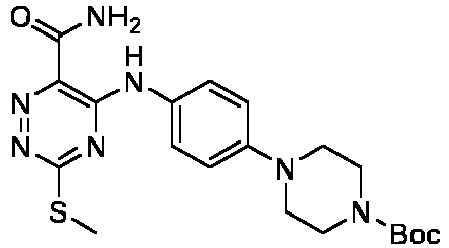
446 6 
447 7 
447 8 
444 9 
463 10 
462 11 
443 12 
458 13 
462 14 
474 15 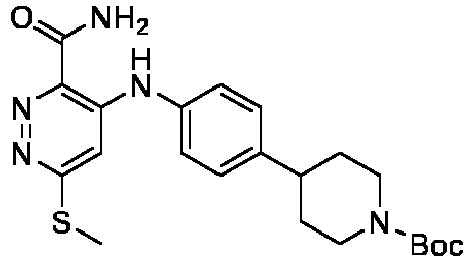
444 -

- Tert-butyl 4-formipperidine-1-carboxylic acid (7.3 g, 34.27 mmol) was dissolved in 20 mL of DCM, trifluoroacetic acid (30 mL) was added to the system, and stirred for one hour at room temperature. At the end of the reaction, it was concentrated under reduced pressure to obtain yellow liquid piperidinine-4-carboxaldehyde. The above products were dissolved in 50 mL of DMF, and cesium carbonate (3.0 g, 9.21 mmol) and 2,4- difluoro -1-nitrobenzene (5.5 g, 31.44 mmol) were added to the system for 2 h at 90°C. At the end of the reaction, water was added to quench it, EA was extracted three times, organic phases were combined, anhydrous sodium sulfate was dried, and concentrated under reduced pressure to obtain 7.5g of yellow liquid 1-(2-fluoro-4-nitrophenyl) piperidin -4-carboxaldehyde with a yield of 94%. ESI-MS(M+H)+ =253.
- Intermediate 16-1 (7.5 g, 29.64 mmol) was dissolved in 50 mL of toluene, and p-toluenesulfonic acid (563 mg, 2.96 mmol) and ethylene glycol (18 mL, 296.40 mmol) were added to the system for 12 h at 120°C. End of reaction. Water was added to quench, concentrated under reduced pressure, solid precipitation was precipitated by adding water, and filtration was obtained to obtain 7 g of brown-black solid 4-(1,3-dioxanecyclo-2-yl) -1-(2- fluoro-4-nitrophenyl) piperidine in a yield of 80%. ESI-MS(M+H)+=297.
- The intermediate 16-2 (7 g, 23.64 mmol) was dissolved in 70 mL of tetrahydrofuran, and ammonium chloride (13 g, 236.48 mmol), water (10 mL) and iron powder (12 g, 236.48 mmol) were added to the system for 12 h at 70°C. At the end of the reaction, EA was extracted three times, organic phases were combined, anhydrous sodium sulfate was dried, concentrated under reduced pressure, and 3.4 g of yellow solid 4-(4-(1,3-dioxanecyclo-2-yl) piperidin-1-yl)-3-fluoroaniline was obtained by column chromatography (ethyl acetate/petroleum ether) in a yield of 54%. ESI-MS(M+H)+ =267.
- The intermediate 16-3 (1.5 g, 5.63 mmol) was dissolved in 15 mL of acetonitrile, and DIPEA (1.81 g, 14.07 mmol) and 5-chloro-3-(methylthio)-1,2,4-triazine-6-carboxylic acid ethyl ester (1.3 g, 5.63 mmol) were added to the system sequentially, and after 30 min of reaction at room temperature, methanol solution of ammonia (7 mol/L, 15 mL) was added to the system, and the system became turbid within 10 min, and the reaction continued at room temperature for 2 h. At the end of the reaction, the petroleum ether was pulped and filtered to obtain 2.1 g of yellow solid 5-((4-(4-(1,3-dioxanecyclo-2-yl) piperidin-1-yl)-3-fluorophenyl) amino)-3-( methylthio)-1, 2, 4- triazine-6-carboxamide in a yield of 83%. ESI-MS(M+H)+=435.
- Intermediate 16-4 (1 g, 2.00 mmol) was dissolved in 10 mL of NMP, mCPBA (85%, 1.8 g, 10.00 mmol) was added to the system, and stirred at room temperature for 2 h. At the end of the reaction, DIPEA (1.1 mL, 6.00 mmol) and piperidine (653 mg, 3.00 mmol) were added to the system for 2 h at 80°C. At the end of the reaction, water was added to quench, EA was extracted five times, the organic phases were combined, the organic phases were washed twice with saturated sodium chloride aqueous solution, the anhydrous sodium sulfate was dried, and the crude products were concentrated under reduced pressure, and the obtained crude product was subjected to column chromatography (dichloromethane/methanol elution) to obtain 690 mg of yellow solid 5-((4-(4-(1,3- dioxanecyclo-2-yl) piperidin-1-yl)-3-fluorophenyl)-3-(piperidin-1-yl)-1,2,4-triazine-6-carboxamide in a yield of 73%. ESI-MS(M+H)+=472.
- The intermediate 16-5 (690 mg, 1.46 mmol) was dissolved in 3 mL of tetrahydrofuran, and 3N HCl (7 mL) was added to the system for 3 h at 80°C. At the end of the reaction, saturated sodium bicarbonate aqueous solution was added to the system to adjust to alkaline, DCM extracted three times, organic phases were combined, anhydrous sodium sulfate was dried, concentrated under reduced pressure, and 380 mg of intermediate 16 yellow solid was obtained by column chromatography (methanol/dichloromethane system) with a yield of 57%. ESI-MS(M+H)+ =428.
- Referring to the synthesis route and method of intermediate 16, the following intermediate structure is obtained:
Intermediate No. Intermediate structure LC-MS (ESI-MS) m/z [M+H] + 17 
410 18 
382 19 
411 20 
426 21 
443 22 
427 -

- 4-Bromoaniline (5.00 g, 29.06 mmol) was dissolved in 40 mL of toluene, and acrylic acid (2.50 g, 34.87 mmol) was added to the system for 12 h at 100°C. At the end of the reaction, water was added to quench, concentrated under reduced pressure, and 2.8 g of yellow solid 3-((4-bromophenyl) amino) propionic acid was obtained by column chromatography (PE/EA elution) with a yield of 39%. ESI-MS: m/z =244[M+H]+.
- Intermediate 23-1 (2.80 g, 11.52 mmol) was dissolved in 30 mL of acetic acid, urea (1.40 g, 23.04 mmol) was added to the system, and the reaction was carried out at 120°C for 12 h. At the end of the reaction, the solid precipitation was precipitated by adding water, and the yellow solid was filtered, dissolved by adding DCM, dried with anhydrous sodium sulfate, concentrated under reduced pressure, and 1.1 g of solid 1-(4-bromophenyl) dihydropyrimidine-2,4(1H,3H)-dione was obtained by column chromatography (DCM/MeOH elution) with a yield of 35%. ESI-MS: m/z = 269[M+H]+.
- The intermediate 23-2 (150 mg, 0.55 mmol) was dissolved in 3 mL of 1,4-dioxane solution, and tert-butyl piperazine-1-carboxylic acid (156 mg, 0.83 mmol), sodium tert-butoxide (162 mg, 1.65 mmol), cesium carbonate (536 mg, 1.65 mmol), palladium acetate (12 mg, 0.05 mmol), tris(dibenzylacetone) palladium (45 mg, 0.05 mmol), X-phos (52 mg, 0.11 mmol), reacted at 90°C for 12 h. At the end of the reaction, water was added and quenched, extracted with EA for 3 times, organic phases were combined, anhydrous sodium sulfate was dried, and 80 mg of 4-(4-(2,4-dioxotetrahydropyrimidine-1(2H)-yl) phenyl) piperazine-1-carboxylic acid tert-butyl ester was obtained by column chromatography (PE/EA elution) in a yield of 38%. ESI-MS: m/z = 375 [M+H]+.
-

- 2-(2,6-dioxoppiperidin-3-yl)-5-fluoroisoindoline-1,3-dione (500 mg, 1.81 mmol) was dissolved in 8 mL DMSO, and pyrrolidin-3-carboxylic acid (312 mg, 2.72 mmol) and DIPEA (701 mg, 5.43 mmol) were added to the system for 12 h at 90°C. At the end of the reaction, water was added, DCM extracted three times, the organic phase was combined, the organic phase was washed with saturated ammonium chloride aqueous solution, the anhydrous sodium sulfate was dried, and the intermediate was concentrated under reduced pressure, 550 mg of intermediate 24 was obtained by column chromatography with a yield of 81%. ESI-MS(M+H) +=372.
-

- Referring to the synthesis route and method of intermediate 24, pyrrolidine-3-carboxylic acid was replaced with tert-butyl piperazine-1-carboxylic acid to synthesize intermediate 25. ESI-MS(M+H)+ =443.
-

- Referring to the synthesis route and method of intermediate 25, 2-(2,6-dioxopridin-3-yl)-5- fluoroisoindolin -1,3- dione was replaced with 2-(2,6-dioxopperidine-3-yl)-5,6-difluoroisoindolin-1,3-dione, and the intermediate 26 was synthesized. ESI-MS(M+H) + =461.
-

- 5-fluoro-2-nitroaniline (1 g, 6.41 mmol) was dissolved in 10 mL of DMF, and 4-(1,3-dioxanecyclo-2-yl) piperidine (1.2 g, 7.69 mmol) and cesium carbonate (6.2 g, 19.23 mmol) were added to the system for 3 hours at 80°C. At the end of the reaction, water was added to quench, DCM extracted three times, organic phases were combined, anhydrous sodium sulfate was dried, concentrated under reduced pressure, and 5-(4-(1,3-dioxanecyclo-2-yl) piperidin-1-yl)-2-nitroaniline 1.5 g was obtained by column chromatography with a yield of 79% and ESI-MS(M+H)+=294.
- The intermediate 27-1 (1.5 g, 5.11 mmol) was dissolved in 15 mL of concentrated hydrochloric acid, HF (70%, 30 mL) was added to the system at 0 °C, the reaction was carried out at room temperature until the reaction was completely dissolved, NaNO2 (423 mg, 6.13 mmol) was added to the system at -78 °C, and the reaction was heated to 60 °C for 15-30 min after the reaction was heated to 60 °C for 30 min. At the end of the reaction, water was added to quench, DCM was extracted three times, organic phases were combined, anhydrous sodium sulfate was dried, concentrated under reduced pressure, and 1 g of 4-(1,3-dioxancyclo-2-yl)-1-(3-fluoro-4-nitrophenyl) piperidine was obtained by column chromatography with a yield of 66%. ESI-MS(M+H) + =297.
- The intermediate 27-2 (1 g, 3.37 mmol) was dissolved in 10mL of tetrahydrofuran, and ammonium chloride (2 g, 33.78 mmol), water (10 mL) and iron powder (1.9 g, 33.78 mmol) were added to the system for 12 h at 70°C. At the end of the reaction, the iron powder was removed by diatomaceous earth filtration, the filtrate was extracted three times with DCM, the organic phase was combined, the anhydrous sodium sulfate was dried, concentrated under reduced pressure, and 4-(4-(1,3-dioxancyclo-2-yl) piperidin-1-yl)-2-fluoroaniline 750 mg was purified by column chromatography (EA/PE elution) with a yield of 83%. ESI-MS(M+H) + =267.
- The intermediate 27-3 (750 mg, 2.81 mmol) was dissolved in 10 mL of toluene, and acrylic acid (243 mg, 3.38 mmol) was added to the system for 12 h at 100°C, and the reaction was completed. DCM extraction was carried out five times, organic phases were combined, anhydrous sodium sulfate was dried, concentrated under reduced pressure, and 860 mg of yellow liquid 3-(4-(4-(1,3-dioxocyclo-2-yl) piperidin-1-yl)-2-fluorophenyl) amino) propionic acid was obtained by column chromatography with a yield of 90%. ESI-MS(M+H)+ =339.
- The intermediate 27-4 (860 mg, 2.54 mmol) was dissolved in 10 mL of acetic acid, urea (315 mg, 5.08 mmol) was added to the system for 12h at 120°C. At the end of the reaction, DCM was extracted three times, organic phases were combined, anhydrous sodium sulfate was dried, concentrated under reduced pressure, and 540 mg of brown-yellow solid 1-(4-(4-(4-(1,3-dioxanecyclo-2-yl) piperidin-1-yl)-2- fluorophenyl) dihydropyrimidine-2,4 (1H,3H)-dione was obtained by column chromatography (DCM/MeOH elution) in a yield of 58%. ESI-MS (M+H)+ =364.
- The intermediate 27-5 (540 mg, 1.68 mmol) was dissolved in 6 mL of TFA, reacted at 80°C for 1 h, and then added 0.5 mL of concentrated hydrochloric acid to the system for 3 h at 80 °C. At the end of the reaction, the saturated sodium carbonate aqueous solution was adjusted to alkaline, MeOH/DCM was extracted five times, the organic phases were combined, the anhydrous sodium sulfate was dried, concentrated under reduced pressure, and the 490 mg of the intermediate 27 was obtained by column chromatography with a yield of 91%. ESI-MS(M+H)+ =320.
- Referring to the synthesis route and method of intermediate 27, the following intermediate structure is obtained:
Intermediate No. Intermediate structure LC-MS (ESI-MS) m/z [M+H] + 28 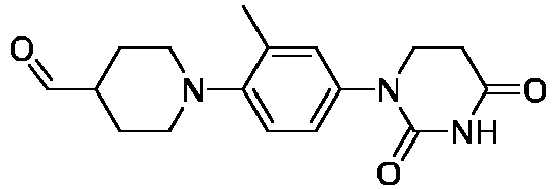
316 29 
316 30 
320 31 
302 32 
332 -
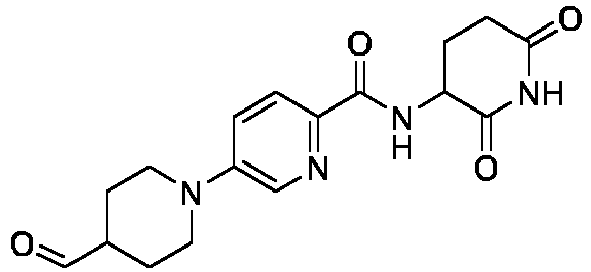
- Methyl 5-fluoropyridine-2-carboxylic acid (2.2 g, 14.18 mmol) was dissolved in 20 mL of DMF, and 4-(1,3-dioxanecyclo-2-yl) piperidine (2.7 g, 17.02 mmol) and potassium carbonate (5.8 g, 42.54 mmol) were added to the system for 2 h at 90°C. At the end of the reaction, water was added to quench, DCM was extracted three times, organic phases were combined, anhydrous sodium sulfate was dried, concentrated under reduced pressure, and 3.2g of yellow solid methyl 5-(4-(1,3-dioxopentacyclo-2-yl) piperidin-1-yl) pyridin-2-carboxylic acid was obtained by column chromatography with a yield of 78%. ESI-MS(M+H)+ =293.
- The intermediate 33-1 (1.5 g, 5.13 mmol) was dissolved in 20 mL of tetrahydrofuran, lithium hydroxide (615 mg, 25.67 mmol) and water (7.5 mL) were added to the system, the reaction was carried out at room temperature for 2h, the reaction was completed, concentrated to solvent-free, DCM beating, filtration, and concentrated filtrate to obtain 1.3g of white solid 5-(4-(1,3-dioxancyclo-2-yl)piperidin-1-yl)pyridine-2-carboxylic acid in a yield of 93%. ESI-MS(M+H)+ =279.
- The intermediate 33-2 (500 mg, 1.08 mmol) was dissolved in 10 mL of DMF, and 3-aminopiperidin-2,6-dione (255 mg, 1.97 mmol), HATU (752 mg, 1.97 mmol) and triethylamine (0.75 mL, 5.39 mmol) were added to the system for 1 h at room temperature. At the end of the reaction, DCM was extracted three times, organic phases were combined, anhydrous sodium sulfate was dried, concentrated under reduced pressure, and 350 g of gray solid 5-(4-(1,3-dioxopentacyclo-2-yl) piperidin-1-yl)-N-(2,6-dioxopridin-3-yl) pyridinamide was obtained by column chromatography (DCM/MeOH elution) in a yield of 51%. ESI-MS(M+H)+ =389.
- The intermediate 33-3 (100 mg, 0.26 mmol) was dissolved in 2 mL of TFA and reacted at 80°C for 1 h, and then 1 mL of concentrated hydrochloric acid was added to the system for 3 h at 80°C. At the end of the reaction, saturated sodium carbonate aqueous solution was added to adjust the system to alkaline, DCM extraction was carried out five times, organic phases were combined, anhydrous sodium sulfate was dried, and concentrated under reduced pressure to obtain 75 mg of intermediate 33 yellow solid with a yield of 84%. ESI-MS(M+H)+ =345.
- Referring to the synthesis route and method of intermediate 33, the following intermediate structure is synthesized:
Intermediate No. Intermediate structure LC-MS (ESI-MS) m/z [M+H] + 34 
331 35 
362 -

- 5-fluoro-2-nitropyridine (1.5 g, 10.56 mmol) was dissolved in 20 mL of DMF, and 4-(1,3-dioxanecyclo-2-yl) piperidine (1.8 g, 12.67 mmol) and cesium carbonate (10 g, 31.68 mmol) were added to the system for 2 h at 80°C. At the end of the reaction, water was added to quench and DCM extracted three times, organic phases were combined, anhydrous sodium sulfate was dried, concentrated under reduced pressure, and solid 5-(4-(1,3-dioxanecyclo-2-yl) piperidin-1-yl)-2-nitropyridine 2 g was obtained by column chromatography with a yield of 69%. ESI-MS(M+H)+ = 280.
- The intermediate 36-1 (2 g, 7.31 mmol) was dissolved in 25 mL of tetrahydrofuran, and ammonium chloride (3.9 g, 73.12 mmol), water (5 mL) and iron powder (4.1 g, 73.12 mmol) were added to the system for 12 h at 70°C. At the end of the reaction, a large amount of iron powder was filtered out while it was hot, DCM extracted three times, organic phases were combined, anhydrous sodium sulfate was dried, concentrated under reduced pressure, and 1.6 g of 5-(4-(1,3-dioxanecyclo-2-yl) piperidin-1-yl) pyridin-2-amine was obtained by column chromatography with a yield of 89%. ESI-MS(M+H)+ =250.
- The intermediate 36-2 (1.6 g, 6.49 mmol) was dissolved in 20 mL of DMF, and 3-bromopiperidine-2, 6-dione (1.9 g, 9.74 mmol), Pd(dppf) Cl2 (472 mg, 0.65 mmol), and Na2CO3 (2.1 g, 19.47 mmol) were added to the system for 3 h at 100°C. At the end of the reaction, water was added and quenched, DCM extracted three times, organic phases were combined, anhydrous sodium sulfate was dried, concentrated under reduced pressure, and 1.9 g of 3-((5-(4-(1,3-dioxanecyclo-2-yl) piperidin-1-yl) pyridin-2-yl) amino) piperidin-2,6-dione was obtained by column chromatography with a yield of 82%. ESI-MS(M+H)+ =361.
- The intermediate 36-3 (1.9 g, 5.35 mmol) was dissolved in 10 mL of TFA and reacted at 80°C for 1h. Then 2 mL of concentrated hydrochloric acid was added to the system and reacted at 80°C for 3 h. At the end of the reaction, the saturated sodium carbonate aqueous solution was adjusted to alkaline, DCM extracted five times, the organic phase was combined, the anhydrous sodium sulfate was dried, and the intermediate 36 solid 1.4 g was obtained under reduced pressure with a yield of 8 3%. ESI-MS(M+H) + =317.
- Referring to the synthesis route and method of intermediate 36, the following intermediate structure is obtained:
Intermediate No. Intermediate structure LC-MS (ESI-MS) m/z [M+H]+ 37 
334 38 
303 -

- 5-bromo-2-chloro-3-(trifluoromethyl) pyridine (5 g, 19.20 mmol) was dissolved in 50 mL of 1,4-dioxane, and bis(pinacolato)diboron (4.8 g, 19.20 mmol), potassium acetate (4.7 g, 48.12 mmol), and Pd(dppt)Cl2 (1.39 g, 1.92 mmol) were added to the system, and the reaction was completed at 100°C for 6 h in an argon atmosphere. DCM was extracted three times, organic phases were combined, anhydrous sodium sulfate was dried, and concentrated under reduced pressure to obtain 4 g of (6-chloro-5-(trifluoromethyl) pyridin-3-yl) boric acid in a yield of 92%, ESI-MS(M+H)+=226.
- The intermediate 39-1 (2 g, 8.88 mmol) was dissolved in 20 mL acetonitrile, and 3,6-dichloropyridazine (1.7 g, 11.54 mmol), potassium carbonate (3.4 g, 26.64 mmol), water (2 mL), and PdCl2(pph3)2 (616 mg, 0.88 mmol) were added to the system for 4 h at 80°C. After the reaction, it was concentrated under reduced pressure to obtain 700 mg of 3-chloro-6-(6-chloro-5-(trifluoromethyl) pyridin-3-yl) pyridazine in yield of 26% and ESI-MS (M+H)+=294.
- The intermediate 39-2 (700 mg, 2.38 mmol) was dissolved in 9 mL of 1,4-dioxane, 3M HCl was added to the system, and the reaction was completed at 110°C for 4h. DCM was extracted three times, organic phases were combined, anhydrous sodium sulfate was dried, and concentrated under reduced pressure to obtain 6-(6-chloro -5-(trifluoromethyl) pyridin-3-yl) pyridazine-3-ol 440 mg in yield 67%, ESI-MS(M+H)+=276.
- The intermediate 39-3 (440 mg, 1.60 mmol) was dissolved in 5 mL of DMF, and 4-(1,3-dioxanecyclo-2-yl) piperidine (376 mg, 2.40 mmol) and cesium carbonate (1.5 g, 4.80 mmol) were added to the system, and the reaction was completed at 120°C for 12 h. 6-(6-(4-(1,3-dioxanecyclo-2-yl)piperidin-1-yl)-5-(trifluoromethyl) pyridine-3-yl)pyridazine-3(2H)-one was obtained with a yield of 54% and ESI-MS(M+H)+=397.
- The intermediate 39-4 (140 mg, 0.35 mmol) was dissolved in 2 mL of TFA, and after the reaction was at 80°C for 1h, 0.1 mL of concentrated hydrochloric acid was added to the system, and the reaction was continued at 80°C for 1h, and the reaction was completed. Saturated sodium carbonate aqueous solution was adjusted to neutral or alkaline, DCM extracted five times, organic phases were combined, anhydrous sodium sulfate was dried, and concentrated under reduced pressure to obtain 100 mg of 1-(5-(6-oxo-1,6- dihydropyridazine -3-yl)-3- (trifluoromethyl) pyridin-2-yl) piperidin-4-carboxaldehyde in a yield of 81%. ESI-MS(M+H) + =353.
- Referring to the synthesis route and method of intermediate 39, the following intermediate structure is synthesized:
Intermediate No. Intermediate structure LC-MS (ESI-MS) m/z [M+H] + 40 
352 -

- 4-(5-bromopyridine-2-yl) piperazine-1-carboxylic acid tert-butyl ester (1.4 g, 4.09 mmol) was dissolved in 15 mL of 1,4-dioxane, and bis(pinacolato)diboron (1.0 g, 4.09 mmol), potassium acetate (1.2 g, 12.27 mmol) and Pd(dppf)Cl2 (232 mg, 0.32 mmol) were added to the system in a argon atmosphere at 100°C for 6 h, and the reaction was completed. After filtration, the filtrate was added with water, extracted by DCM for three times, the organic phase was combined, the anhydrous sodium sulfate was dried, concentrated under reduced pressure, and 1.0 g of (6-(4-(tert-butoxycarbonyl) piperazine-1-yl) pyridin-3-yl) boric acid was obtained by column chromatography with a yield of 79%. ESI-MS(M+H)+ =308.
- 5-The intermediate 40-1 (950 mg, 3.09 mmol) was dissolved in 15 mL of 1,4-dioxane, and 2,6-bis(benzyloxy) -3-bromopyridine (2.29 g, 6.19 mmol), cesium acetate (3.0 g, 9.28 mmol), Pd(dppf)Cl2 (224 mg, 0.30 mmol) were added to the system, and the reaction was completed at 100°C for 12 h in argon atmosphere. After filtration, the filtrate was added with water, extracted by DCM for three times, combined with organic phases, dried with anhydrous sodium sulfate, concentrated under reduced pressure, and obtained 1.2 g of 4-(2',6'-bis(benzyloxy)- [3,3'-bipyridine]-6-yl) piperazine-1-carboxylic acid tert-butyl ester by column chromatography with a yield of 70%. ESI-MS(M+H)+ =553.
- The intermediate 40-2 (1.0 g, 1.81 mmol) was dissolved in 20 mL of methanol, Pd/C (400 mg) was added to the system sequentially, and the reaction was carried out at room temperature in a hydrogen environment for 24 h. After the reaction, 320 mg of tert-butyl piperazine-1-carboxylic acid was obtained by filtration, concentration under reduced pressure, and column chromatography to obtain 320 mg of tert-butyl ester of 4-(5-(2,6- dioxopridin -3-yl) pyridine-2-yl) piperazine-1-carboxylate in yield of 47%, ESI-MS(M+H)+=375.
Referring to the synthesis route and method of intermediate 41, the following intermediate structure is obtained:Intermediate No. Intermediate structure LC-MS (ESI-MS)m/z [M+H]+ 42 
374 -

- Intermediate 1 (1.3 g, 2.81 mmol) was dissolved in 20 mL of NMP, mCPBA (85%, 5.0 g, 28.93 mmol) was added to the system, stirred at room temperature for 2 h, and then DIPEA (4.5 g, 34.82 mmol) and water (10 mL) were added to the system to continue the reaction at room temperature for 2 h. At the end of the reaction, 25 mL of water was added, filtered, and the filter cake was subjected to column chromatography (dichloromethane/methanol elution) to obtain 350 mg of orange-yellow solid 4-(4-((6-carbamoyl-3-hydroxy-1,2,4-triazine-5-yl) amino) -2-fluorophenyl) piperidin-1-carboxylic acid tert-butyl ester in a yield of 30%. ESI-MS(M+H)+ =433.
- 002-1 (350 mg, 0.81 mmol) was dissolved in 5 mL DCM, trifluoroacetic acid (3 mL) was added to the system, and stirred for 1 h at room temperature. At the end of the reaction, it is concentrated under reduced pressure to obtain a yellow liquid. The above products were dissolved in 10 mL DCM, DIPEA (314 mg, 2.43 mmol) and 3-formylpyrrolidin-1-carboxylic acid tert-butyl ester (323 mg, 1.62 mmol) were added sequentially, stirred at room temperature for 10 min, acetic acid (0.5 mL) and sodium cyanoborohydride (101 mg, 1.62 mmol) were added to the system, and the reaction was continued at room temperature for 1 h. At the end of the reaction, saturated sodium bicarbonate aqueous solution was quenched, DCM extracted three times, organic phases were combined, anhydrous sodium sulfate was dried, concentrated under reduced pressure, and 210 mg of yellow solid 3-((4-(4-((6-carbamoyl-3-hydroxy-1,2,4-triazin-5-yl)amino)-2-fluorophenyl)piperidin-1-yl)methyl)pyrrolidin-1-carboxylic acid tert-butyl ester was obtained by column chromatography (DCM/MeOH elution) in yield of 50%. ESI-MS(M+H)+=516.
- 002-2 (210 mg, 0.41 mmol) was dissolved in 5 mL of DCM, trifluoroacetic acid (2 mL) was added to the system, and stirred for 1h at room temperature. At the end of the reaction, it is concentrated under reduced pressure to obtain a yellow liquid. The above products were dissolved in 5 mL of DMSO, and DIPEA (1.48 g, 11.44 mmol), 2-(2,6-dioxopiidin-3-yl)-5-fluoroisoindoline-1,3-dione (280 mg, 1.02 mmol) were added to the system for 12 h at 95°C. At the end of the reaction, the solid precipitation is precipitated by adding water, the yellow solid is filtered, the DCM is added to dissolve, the anhydrous sodium sulfate is dried, and the concentration is reduced pressure. The yellow solid 5-((4-(1-((1-(2-(2,6-dioxopridin-3-yl)-1,3-dioxoisoindolin-5-yl) pyrrolidin-3-yl) methyl) piperidin -4-yl)-3-fluorophenyl) amino)-3-hydroxy-1,2,4-triazine-6-carboxamide 200 mg was obtained by column chromatography (DCM/MeOH elution, yield: 73%. ESI-MS(M+H) +=672.
- 002-3 (200 mg, 0.29 mmol) was dissolved in 10 mL of 1,4-dioxane, and N, N-diisopropylethylamine (1.5 g, 11.50 mmol) and phosphorus oxychloride (2 mL) were added to the system for 0.2 h at 105°C. After the reaction, slowly pour 20 mL of water, add sodium bicarbonate to adjust to pH value greater than 7, filter, and filter cake, the crude product 3-chloro-5-((4-(1-(1-(2-(2-(2,6-dioxopiperidin-3-yl)-1,3-dioxoisoindolin-5-yl) pyrrolidin-3-yl) methyl) piperidin-4-yl)-3-fluorophenyl) amino)-1,2,4-triazine-6-carboxamide 200 mg, yield: 99%. ESI-MS (M+H)+=690.
- 002-4 (100 mg, 0.14 mmol) was dissolved in 3 mL of DMF, piperidine (18 mg, 0.20 mmol) and N, N-diisopropylethylamine (40 mg, 0.31 mmol) were added to the system for 0.5 h at 75°C. After the end of the reaction, water was added until there was no longer yellow solid precipitation in the system, and the solid was obtained by column chromatography to obtain 54 mg of compound 002 solid in a yield of 53%. ESI-MS(M+H) + =739. 1H-NMR (400 MHz, CCl3D) δ 11.00 (brs, 1H), 8.20 (brs, 1H), 7.57 - 7.72 (m, 3H), 7.22 - 7.23 (m, 2H), 6.96 - 6.97 (m, 1H), 6.68 - 6.71 (m, 1H), 5.45 (brs, 1H), 4.92 - 4.96 (m, 1H), 3.70 - 4.01 (m, 4H), 3.40 - 3.61 (m, 3H), 3.17 - 3.22 (m, 1H), 2.60 - 3.19 (m, 6H), 2.41 - 2.48 (m, 2H), 2.08 - 2.25 (m, 3H), 1.73 - 1.89 (m, 10H), 1.25 - 1.29 (m, 3H).
-

- Referring to the synthesis route and method of embodiment 1, the intermediate 1 in the synthesis step 1 is replaced with intermediate 2, and the target compound 001 is synthesized to obtain ESI-MS(M+H) +=721. 1H-NMR (400 MHz, CCl3D) δ 10.89 (brs, 1H), 8.02 (brs, 1H), 7.60 - 7.71 (m, 4H), 7.23 - 7.25 (m, 2H), 6.97 - 6.98 (m, 1H), 6.68 - 6.71 (m, 1H), 5.36 - 5.38 (m, 1H), 4.91 - 4.96 (m, 1H), 3.77 - 4.02 (m, 4H), 3. 38 - 3.62 (m, 3H), 3.19 - 3.24 (m, 1H), 2.94 - 3.08 (m, 2H), 2.64 - 2.92 (m, 4H), 2.41 - 2.51 (m, 3H), 2.00 - 2.23 (m, 7H), 1.71 - 1.86 (m, 8H).
-

- Referring to the synthesis route and method of embodiment 1, intermediate 1 in synthesis step 1 is replaced with intermediate 4, and the target compound 003 is synthesized to obtain ESI-MS(M+H)+=740. 1H-NMR (400 MHz, CDCl3) δ 10.88 (brs, 1H), 8.37 (s, 1H), 7.60 -7.71 (m, 3H), 7.18 - 7.22 (m, 1H), 6.92 - 6.96 (m, 2H), 6.68 - 6.70 (m, 1H), 5.53 (brs, 1H), 4.91 - 4.96 (m, 1H), 3.38 - 3.91 (m, 6H), 3.09 - 3.23 (m, 5H), 2.61 - 2.91 (m, 6H), 2.40 - 2.53 (m, 2H), 1.99 - 2.26 (m, 2H), 1.68 - 1.89 (m, 7H), 1.24 - 1.33 (m, 3H).
-

- Referring to the synthesis route and method of embodiment 1, the tert-butyl ester of 3-formylpyrrolidine-1- carboxylic acid in the synthesis step 2 was replaced with 4-formylpiperidin-1-carboxylate tert-butyl ester, and the target compound 007 was synthesized, ESI-MS(M+H) +=753. 1H-NMR (400 MHz, CDCl3) δ 11.00 (brs, 1H), 8.34 (s, 1H), 7.60 - 7.72 (m, 3H), 7.28 - 7.29 (m, 1H), 7.20 - 7.23 (m, 2H), 7.03 - 7.05 (m, 1H), 5.51 (brs, 1H), 4.92 - 4.96 (m, 1H), 3.94 - 3.96 (m, 4H), 2.77 - 3. 01 (m, 9H), 1.91 - 2.27 (m, 6H), 1.68 - 1.81 (m, 11H), 1.28 - 1.35 (m, 4H).
-

- Referring to the synthesis route and method of embodiment 1, 2-(2,6-dioxopridin-3-yl)-5- fluoroisoindoline -1,3-dione in the synthesis step 3 was replaced with 3-(5-fluoro-3-methyl-2-oxo-2,3-dihydro-1H-benzo [d]imidazo-1-yl) piperidin-2,6-dione, and the target compound 011 was synthesized, ESI-MS(M+H)+=722.
-
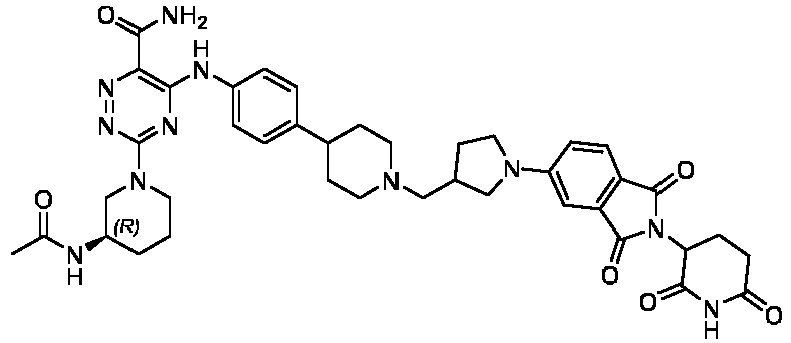
- (R)-3-aminopiperidine-1-carboxylic acid tert-butyl ester (100 mg, 0.50 mmol) was dissolved in 3 mL DCM, and acetic anhydride (76 mg, 0.75 mmol) and triethylamine (86 mg, 0.85 mmol) were added to the system for 0.5 h at room temperature. At the end of the reaction, DCM extraction, combined organic phases, saturated sodium bicarbonate aqueous solution washing, saturated ammonium chloride aqueous solution washing, saturated sodium chloride aqueous solution washing, anhydrous sodium sulfate drying, reduced pressure concentration, colorless liquid (R)-3-acetamidopiperidine-1-carboxylic acid tert-butyl ester 110 mg was obtained, the yield was 90%. ESI-MS(M+H)+ =243.
- Referring to the synthesis route and method of the synthesis step 1-4 in embodiment 1, the intermediate 1 in the synthesis step 1 is replaced with the intermediate 2, and 3-chloro-5-((4-(1-(1-(2-(2-(2,6-dioxopridin-3-yl)-1,3- dioxoisoindolin-5-yl) pyrrolidin-3-yl) methyl)piperidin-4-yl)phenyl)amino)-1,2,4-triazine-6-carboxamide, ESI-MS(M+H)+=672.
- Compound 016-1 was dissolved in 5 mL DCM, trifluoroacetic acid (1 mL) was added to the system, the reaction was carried out at room temperature for 1h, and concentrated under reduced pressure to obtain a colorless liquid (R)-N-(piperidin-3-yl) acetamide, which was directly used in the next step of the reaction. 016-2 (50 mg, 0.07 mmol) was dissolved in 3 mL of DMF, and (R)-N-(piperidin-3-yl) acetamide (50 mg, 0.21 mmol) and N, N-diisopropylethylamine (40 mg, 0.31 mmol) were added to the system for 0.5 h at room temperature. After the end of the reaction, water was added until there was no longer yellow solid precipitation in the system, and the solid was obtained by column chromatography to obtain 35 mg of compound 016 solid in 60% yield. ESI-MS(M+H)+=778. 1H-NMR (400 MHz, CCl3D) δ 10.95 (brs, 1H), 8.37 (brs, 1H), 7.73 (brs, 1H), 7.58 - 7.66 (m, 3H), 7.24 - 7.27 (m, 2H), 6.96 - 6.97 (m, 1H), 6.68 - 6.70 (m, 1H), 5.71 - 5.73 (m, 1H), 5.57 (brs, 1H), 4.92 - 4.96 (m, 1H), 3.78 - 4.13 (m, 4H), 3.38 - 3.61 (m, 3H), 2.63 - 3.23 (m, 6H), 2.38 - 2.51 (m, 3H), 2.03 - 2.23 (m, 4H), 1.93 (s, 3H), 1.77 - 1.85 (m, 8H), 1.27 - 1.31 (m, 3H).
-

- 016-2 (145 mg, 0.22 mmol) was dissolved in 5mL DCM, and (R)-piperidine-3-ylcarbamate tert-butyl ester (65 mg, 0.32 mmol) and N, N-diisopropylethylamine (40 mg, 0.31 mmol) were added to the system for 0.5 h at room temperature. After the reaction, water was added to quench, DCM extracted, saturated ammonium chloride aqueous solution washed, concentrated and purified by column chromatography to obtain purified solids. The above solids were dissolved in 3 mL DCM, and 1,4-dioxane solution of hydrogen chloride (0.3 mL, 4.0 mol/L) was added dropwise, and stirred for 0.5h at room temperature. At the end of the reaction, it was concentrated under reduced pressure to obtain 35 mg of compound 029 yellow solid with a yield of 97%. ESI-MS(M+H)+=736. 1H-NMR (400 MHz, DMSO-d6) δ 11.52 (brs, 1H), 11.07 (brs, 1H), 8.31 - 8.39 (m, 3H), 7.85 (s, 1H), 7.65 - 7.70 (m, 3H), 7.32 - 7.33 (m, 2H), 6.95 (s, 1H), 6.83 - 6.85 (m, 1H), 5.03 - 5.08 (m, 1H), 3.78 - 3.82 (m, 1H), 3.60 - 3.68 (m, 4H), 3.05 - 3.24 (m, 6H), 2.83 - 2.92 (m, 3H), 2.54 - 2.63 (m, 2H), 2.16 - 2.32 (m, 2H), 1.62 - 2.02 (m, 10H), 1.23 - 1.27 (m, 3H). Referring to the synthesis route and method of embodiment 1-7, the following target compounds are synthesized:
Example Compound No. Structural formula Characterization data 8 004 
ESI-MS(M+H) +=723 9 005 
ESI-MS(M+H) +=723 10 006 
ESI-MS(M+H) +=708 11 008 
ESI-MS(M+H) +=707 12 009 
ESI-MS(M+H) +=707 13 010 
ESI-MS(M+H) +=725 14 012 
ESI-MS(M+H) +=719 15 013 
ESI-MS(M+H) +=721 16 015 
1H-NMR (400 MHz, CDCl3) δ 10.92 (brs, 1H), 8.01 (s, 1H), 7.59 -7.71 (m, 4H), 7.24 - 7.25 (m, 2H), 6.97 - 6.98 (m, 1H), 6.68 - 6.71 (m, 1H), 5.40 (brs, 1H), 4.91 - 4.96 (m, 1H), 3.89 - 3.91 (m, 1H), 3.41 - 3.72 (m, 6H), 2.68 - 3.24 (m, 4H), 2.42 - 2.51 (m, 3H), 1.98 - 2.23 (m, 5H), 1.66 -1.87 (m, 9H), 1.29 - 1.32 (m, 4H). ESI-MS(M+H) +=737 17 017 
ESI-MS(M+H) +=738 18 018 
1H-NMR (400 MHz, CDCl3) δ 10.93 (brs, 1H), 8.12 - 8.16 (m, 1H), 7.58 -7.71 (m, 4H), 7.22 - 7.24 (m, 2H), 6.97 (s, 1H), 6.69 - 6.71 (m, 1H), 5.40 (brs, 1H), 4.91 - 4.96 (m, 1H), 3.93 - 4.01 (m, 4H), 3.41 - 3.63 (m, 3H), 2.69 - 3.25 (m, 6H), 2.52 - 2.55 (m, 4H), 2.37 (s, 3H), 2.21 - 2.23 (m, 4H), 1.83 - 2.02 (m, 6H), 1.29 - 1.33 (m, 3H). ESI-MS(M+H) +=736 19 019 
1H-NMR (400 MHz, CDCl3) δ 10.96 (brs, 1H), 8.13 (s, 1H), 7.56 -7.73 (m, 4H), 7.24 - 7.25 (m, 2H), 6.97 - 6.98 (m, 1H), 6.67 - 6.70 (m, 1H), 5.46 (brs, 1H), 4.91 - 4.96 (m, 1H), 3.79 - 3.94 (m, 8H), 3.39 - 3.61 (m, 2H), 3.19 - 3.24 (m, 1H), 2.66 - 3.10 (m, 6H), 2.42 - 2.51 (m, 2H), 2.07 - 2.24 (m, 2H), 1.83 - 1.88 (m, 6H), 1.27 - 1.34 (m, 3H). ESI-MS(M+H) +=723 20 020 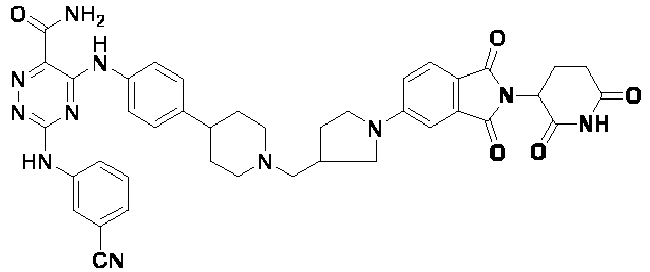
ESI-MS(M+H) +=754 21 021 
ESI-MS(M+H) +=730 22 022 
ESI-MS(M+H) +=723 23 023 
1H-NMR (400 MHz, CDCl3) δ 10.88 (brs, 1H), 8.33(s, 1H), 7.65 - 7.66 (m, 1H), 7.59 - 7.62 (m, 1H), 7.51 - 7.53 (m, 2H), 7.20 - 7.21 (m, 2H), 7.16 - 7.17 (m, 1H), 6.96 - 6.98 (m, 1H), 5.59 - 5.61 (m, 1H), 5.47 (brs, 1H), 4.84 - 4.89 (m, 1H), 3.86 - 4.05 (m, 4H), 3.24 - 3.26 (m, 2H), 2.64 - 2.94 (m, 6H), 2.46 - 2.53 (m, 3H), 2.24 - 2.30 (m, 4H), 1.91 - 2.18 (m, 4H), 1.62 - 1.74 (m, 8H), 1.25 - 1.27 (m, 5H). ESI-MS(M+H) +=792 24 030 
ESI-MS(M+H) +=750 25 031 
1H-NMR (400 MHz, DMSO-d6) δ 11.54 (brs, 1H), 11.08 (brs, 1H), 9.38 (s, 1H), 8.46 (s, 1H), 7.90 (s, 1H), 7.63 - 7.69 (m, 3H), 7.28 - 7.31 (m, 2H), 6.95 - 6.96 (m, 1H), 6.82 - 6.85 (m, 1H), 5.04 - 5.08 (m, 1H), 4.06 - 4.08 (m, 4H), 3.24 - 3.32 (m, 8H), 3.06 - 3.10 (m, 2H), 2.81 - 2.93 (m, 3H), 2.55 - 2.66 (m, 2H), 2.18 - 2.33 (m, 3H), 1.87 - 2.02 (m, 5H), 1.24 - 1.30 (m, 3H).ESI-MS(M+H)+=722 26 032 
ESI-MS(M+H) +=749 27 033 
1H-NMR (400 MHz, CCl3D) δ 10.89 (brs, 1H), 8.32 (s, 1H), 7.95 (brs, 1H), 7.59 - 7.66 (m, 3H), 7.18 - 7.22 (m, 2H), 6.96 - 6.97 (m, 1H), 6.68 - 6.70 (m, 1H), 5.33 - 5.50 (m, 2H), 4.92 - 4.95 (m, 1H), 3.80 - 3.84 (m, 4H), 3.39 - 3.61 (m, 3H), 3.17 - 3.22 (m, 1H), 2.64 - 3.09 (m, 4H), 2.38 - 2.49 (m, 3H), 2.01 - 2.23 (m, 4H), 1.62 - 1.87 (m, 10H), 1.30 - 1.32 (m, 3H). ESI-MS(M+H) +=720 28 034 
ESI-MS(M+H) +=739 29 035 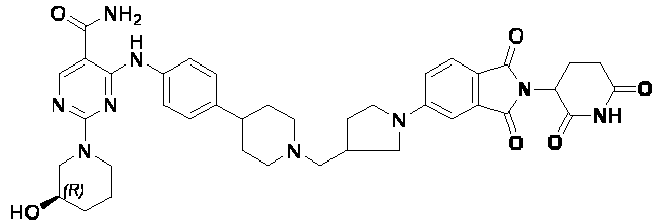
ESI-MS(M+H) +=736 30 036 
ESI-MS(M+H) +=738 31 037 
ESI-MS(M+H) +=738 32 038 
ESI-MS(M+H) +=719 33 039 
ESI-MS(M+H) +=734 34 040 
ESI-MS(M+H) +=720 35 041 
ESI-MS(M+H) +=736 36 042 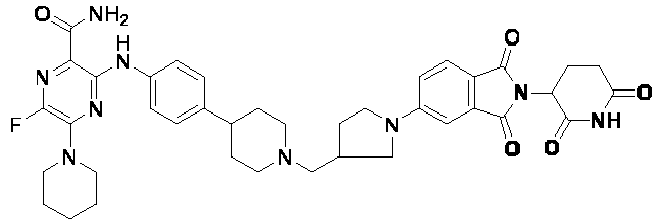
ESI-MS(M+H) +=738 37 043 
ESI-MS(M+H) +=750 38 067 
ESI-MS(M+H) +=755 -

- A mixture of 016-2 (50 mg, 0.07 mmol), 2-(tributyl tinyl) thiazole (45 mg, 0.12 mmol), sodium carbonate (22 mg, 0.21 mmol), tetras(triphenylphosphine)palladium (0) (25 mg), and 1,4-dioxane solution (1 mL) were stirred overnight at 50°C for the reaction. At the end of the reaction, water and DCM were added to extract, the organic phase was separated, the anhydrous magnesium sulfate was dried, filtered and concentrated, and the compound 024 solid 21 mg was purified by column chromatography in a yield of 43%. ESI-MS(M+H) += 721.
- Referring to the synthesis route and method of embodiment 39, the following target compounds are synthesized and obtained:
Example Compound No. Structural formula Characterization data 40 025 
ESI-MS(M+H) +=704 41 026 
ESI-MS(M+H) +=715 -

- 016-2 (50 mg, 0.07 mmol) was dissolved in 2 mL of DMSO, and resorcinol (13 mg, 0.12 mmol) and cesium carbonate (39 mg, 0.12 mmol) were added to the system for 3 h at 50°C. At the end of the reaction, water and DCM were added to extract, the organic phase was separated, the anhydrous magnesium sulfate was dried, filtered and concentrated, and the compound 027 solid 37 mg was purified by column chromatography in a yield of 70%. ESI-MS(M+H) += 746.
-

- Referring to the synthesis method and route of embodiment 42, resorcinol is replaced with 2,3-difluorophenol, and compound 028 can be synthesized to obtain ESI-MS(M+H) +=766.
-
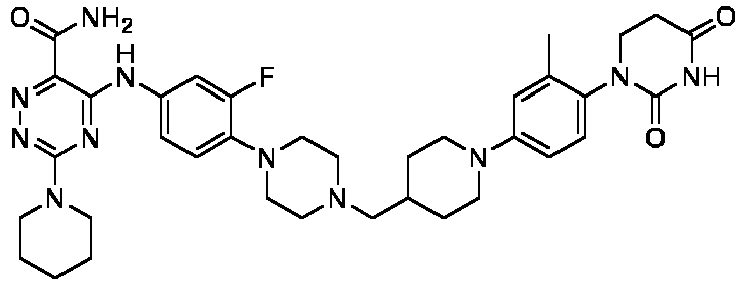
- Intermediate 4 (1.6 g, 3.45 mmol) was dissolved in 25 mL of NMP, mCPBA (85%, 2.9 g, 17.25 mmol) was added to the system, and stirred for 2 h at room temperature. At the end of the reaction, DIPEA (1.3 g, 10.35 mmol) and piperidine (439 mg, 5.17 mmol) were added to the system for 2 h at 80°C. At the end of the reaction, the solid precipitation is precipitated by adding water, the yellow solid is filtered, the DCM is added to dissolve, the anhydrous sodium sulfate is dried, and the concentration is reduced pressure. Tert-butyl piperazine-1-carboxylic acid 1.7 g was obtained by column chromatography (DCM/MeOH elution) in yellow solid 4-(4-(6-carbamoyl- 3-(piperidin-1-yl)-1,2,4-triazine-5-yl) amino)-2-fluorophenyl) piperazine-1-carboxylic acid in a yield of 98%. ESI-MS(M+H) + =501.5.
- Intermediate 075-1 (100 mg, 0.25 mmol) was dissolved in 3 mL DCM, 1.5 mL trifluoroacetic acid was added to the system, and the reaction was carried out at room temperature for 30 min. At the end of the reaction, 5-((3- fluoro-4- (piperazine-1-yl) phenyl) amino)-3-(pipeiidin-1-yl)-1,2,4-triazine-6-carboxamide was obtained under reduced pressure. The obtained product was dissolved in 2mL DCM, intermediate 29 (118mg, 0.37mmol) was added to the system, stirred at room temperature for 10min, acetic acid (0.1mL) and sodium cyanoboron hydride (47mg, 0.75mmol) were added to the system, and the reaction was carried out at room temperature for 0.5h. At the end of the reaction, water was added to quench, DCM extraction, organic phases were combined, anhydrous sodium sulfate was dried, and concentrated under reduced pressure. Compound 075 was obtained by column chromatography (DCM/MeOH elution) with a yield of 28%. ESI-MS(M+H)+ =700. 1H-NMR (400 MHz, DMSO-d6) δ 11.30 (brs, 1H), 10.25 (s, 1H), 8.35 (s, 1H), 7.62 - 7.72 (m, 2H), 7.25 - 7.28 (m, 1H), 7.01 - 7.06 (m, 2H), 6.76 - 6.80 (m, 2H), 3.62 - 3.83 (m, 7H), 3.32 - 3.48 (m, 1H), 2.98 - 3. 00 (m, 4H), 2.62 - 2.71 (m, 4H), 2.49 - 2.52 (m, 4H), 2.20 - 2.22 (m, 2H), 2.11 (s, 3H), 1.77 - 1.81 (m, 2H), 1.59 - 1.67 (m, 6H), 1.16 - 1.23 (m, 3H).
-

- Referring to the synthesis route and method of embodiment 44, the intermediate 29 in the synthesis step 2 is replaced with the intermediate 36, and the target compound 077 is synthesized and ESI-MS(M+H) +=701. 1H-NMR (400 MHz, DMSO-d6) δ 11.30 (brs, 1H), 10.73 (s, 1H), 8.35 (s, 1H), 7.61 - 7.72 (m, 3H), 7.19 - 7.28 (m, 2H), 7.01 - 7.04 (m, 1H), 6.51 - 6.53 (m, 1H), 6.37 - 6.39 (m, 1H), 4.60 - 4.66 (m, 1H), 3.79 - 3. 83 (m, 4H), 3.34 - 3.36 (m, 3H), 2.97 - 3.00 (m, 4H), 2.68 - 2.77 (m, 1H), 2.51 - 2.54 (m, 3H), 2.20 - 2.22 (m, 2H), 1.93 - 2.10 (m, 3H), 1.75 - 1.81 (m, 2H), 1.58 - 1.67 (m, 6H), 1.22 - 1.26 (m, 5H).
-

- Referring to the synthesis route and method of the synthesis step 2 of embodiment 44, 075-1 is replaced with intermediate 16, intermediate 29 is replaced with intermediate 25, and compound 044 yellow solid 40 mg is synthesized in a yield of 15%. ESI-MS(M+H) + =754. 1H-NMR (400 MHz, CCl3D) δ 10.85 (brs, 1H), 8.04 (brs, 1H), 7.69 - 7.70 (m, 2H), 7.60 - 7.65 (m, 1H), 7.28 - 7.29 (m, 1H), 7.16 - 7.19 (m, 1H), 7.05 - 7.08 (m, 1H), 6.92 - 6.96 (m, 1H), 5.38 (brs, 1H), 4.92 - 4.97 (m, 1H), 3.41 - 3.47 (m, 6H), 2.59 - 2.92 (m, 9H), 2.29 - 2.31 (m, 2H), 2.11 - 2.17 (m, 3H), 1.87 - 2.01 (m, 2H), 1.65 - 1.74 (m, 8H), 1.29 - 1.46 (m, 3H).
Referring to the synthesis route and method of embodiment 44-46, the following target compounds are synthesized:Example Compound No. Structural formula Characterization data 47 014 
ESI-MS(M+H)+=668 48 045 
1H-NMR (400 MHz, CCl3D) δ 10.85 (brs, 1H), 7.98 (brs, 1H), 7.60 - 7.69 (m, 2H), 7.46 - 7.48 (m, 1H), 7.38 - 7.39 (m, 1H), 7.16 - 7.19 (m, 1H), 6.92 - 6.99 (m, 1H), 5.34 - 5.35 (m, 1H), 4.91 - 4.95 (m, 1H), 3.43 - 3.46 (m, 2H), 3.28 - 3.31 (m, 5H), 2.59 - 2.93 (m, 11H), 2.31 - 2.32 (m, 2H), 2.11 - 2.16 (m, 1H), 1.86-2.04 (m, 3H), 1.66 - 1.72 (m, 9H).ESI-MS(M+H)+=772 49 046 
1H-NMR (400 MHz, CDCl3) δ 10.72 (brs, 1H), 8.04 (s, 1H), 7.68 - 7.70 (m, 1H), 7.52 - 7.55 (m, 2H), 7.46 - 7.49 (m, 1H), 7.38 - 7.39 (m, 1H), 6.93 - 6.96 (m, 2H), 5.34 (brs, 1H), 4.91 - 4.96 (m, 1H), 3.85 - 3.93 (m, 4H), 3.66 - 3.69 (m, 2H), 3.30 (s, 4H), 2.62 - 2.92 (m, 7H), 2.29 - 2.34 (m, 2H), 2.11 - 2.16 (m, 1H), 1.88 - 1.92 (m, 2H), 1.65 - 1.72 (m, 8H), 1.29 - 1.40 (m, 3H). ESI-MS(M+H)+=754 50 047 
ESI-MS(M+H)+=684 51 048 
ESI-MS(M+H)+=669 52 049 
ESI-MS(M+H)+=708 53 050 
1H-NMR (400 MHz, DMSO-d6) δ 11.30 (brs, 1H), 10.26 (s, 1H), 8.32 (s, 1H), 7.59 - 7.70 (m, 2H), 7.23 - 7.26 (m, 1H), 7.12 - 7.15 (m, 2H), 7.01 - 7.05 (m, 1H), 6.91 - 6.93 (m, 2H), 3.66 - 3.83 (m, 6H), 3.00 - 3.12 (m, 6H), 2.60 - 2.68 (m, 4H), 2.21 - 2.31 (m, 3H), 1.93 - 2.02 (m, 1H), 1.78 - 1.83 (m, 2H),1.56 - 1.66 (m, 7H), 1.24 - 1.29 (m, 4H).ESI-MS(M+H)+=686 54 051 
ESI-MS(M+H)+=753 55 052 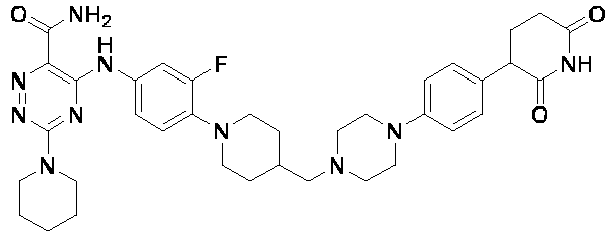
ESI-MS(M+H)+=685 56 053 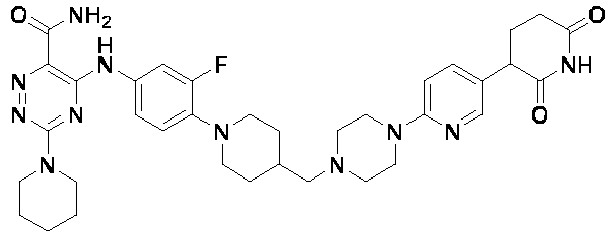
ESI-MS(M+H)+=686 57 054 
ESI-MS(M+H)+=701 58 076 
ESI-MS(M+H)+=700 59 078 
ESI-MS(M+H)+=704 60 079 
1H-NMR (400 MHz, DMSO-d6) δ 11.30 (brs, 1H), 10.84 (s, 1H), 8.61 - 8.63 (m, 1H), 8.34 (s, 1H), 7.90 - 7.91 (m, 1H), 7.81 - 7.83 (m, 1H), 7.61 - 7.70 (m, 2H), 7.26 - 7.29 (m, 1H), 6.95 - 7.06 (m, 2H), 4.68 - 4.76 (m, 1H), 3.82 - 3.83 (m, 3H), 3.44 - 3.52 (m, 2H), 3.00 - 3.10 (m, 5H), 2.72 - 2.82 (m, 1H), 2.53 - 2.65 (m, 5H), 2.39 - 2.41 (m, 2H), 1.96 - 2.17 (m, 3H), 1.56 - 1.76 (m, 8H), 1.21 - 1.24 (m, 2H).ESI-MS(M+H)+=715 61 080 
ESI-MS M+H)+=686 62 081 
1H-NMR (400 MHz, DMSO-d6) δ 11.35 (brs, 1H), 8.81 - 8.91 (m, 2H), 8.35 - 8.37 (m, 2H), 8.09 - 8.12 (m, 1H), 7.65 - 7.72 (m, 2H), 7.31 - 7.34 (m, 1H), 6.99 - 7.11 (m, 2H), 4.09 - 4.11 (m, 2H), 3.69 - 3.86 (m, 6H), 3.56 - 3.61 (m, 3H), 2.92 - 3.11 (m, 7H), 1.89 - 1.99 (m, 2H), 1.57 - 1.65 (m, 7H), 1.27 - 1.29 (m, 2H).ESI-MS(M+H)+=737 63 082 
ESI-MS(M+H)+=716 64 083 
ESI-MS(M+H)+=746 65 084 
ESI-MS(M+H)+=700 66 085 
ESI-MS(M+H)+=729 67 086 
ESI-MS(M+H)+=704 68 087 
ESI-MS(M+H)+=736 69 088 
ESI-MS(M+H)+=718 70 089 
ESI-MS(M+H)+=736 71 090 
ESI-MS(M+H)+=757 72 091 
ESI-MS(M+H)+=743 73 092 
ESI-MS(M+H)+=786 74 093 
ESI-MS(M+H)+=803 75 094 
ESI-MS(M+H)+=794 76 095 
ESI-MS(M+H)+=793 77 096 
ESI-MS(M+H)+=758 78 097 
ESI-MS(M+H)+=775 79 098 
ESI-MS(M+H)+=702 80 099 
ESI-MS(M+H)+=688 81 100 
ESI-MS(M+H)+=731 82 101 
ESI-MS(M+H)+=748 83 102 
ESI-MS(M+H)+=739 84 103 
ESI-MS(M+H)+=738 85 104 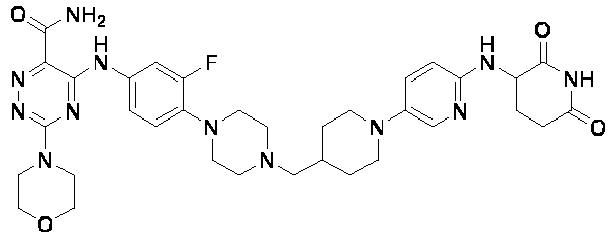
ESI-MS(M+H)+=703 86 105 
ESI-MS(M+H)+=720 -

- Referring to the synthesis route and method of the synthesis step 1 of embodiment 44, the intermediate 4 is replaced with intermediate 2, and the tert-butyl ester of 4-(4-((6-carbamoyl-3-(piperidin-1-yl)-1,2,4-triazin-5-yl) amino) phenyl) piperidin-1-carboxylic acid is synthesized. ESI-MS(M+H) +=482.
- 055-1 was dissolved in 3 mL of DCM, 1.5 mL of trifluoroacetic acid was added to the system, and the reaction was carried out at room temperature for 30 min. At the end of the reaction, the obtained product (102mg, 0.27mmol) was dissolved in 5 mL of DMF, and intermediates 24 (100mg, 0.27mmol), HATU (112mg, 0.29mmol) and TEA (81mg, 0.80mmol) were added to the system in turn, and the reaction was completed at 30°C for 2h. Water was added to quench, DCM was extracted three times, the organic phase was combined, the organic phase was washed with saturated ammonium chloride aqueous solution, the anhydrous sodium sulfate was dried, and the compound 055 solid was 60 mg by column chromatography with a yield of 30%, ESI-MS(M+H)+=735.
Referring to the synthesis route and method of embodiment 87, the following compounds are synthesized and obtained:Example Compound No. Structural formula Characterization data 88 056 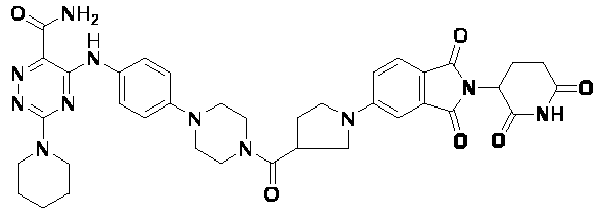
ESI-MS(M+H)+=736 89 057 
ESI-MS(M+H)+=749 90 058 
ESI-MS(M+H)+=750 91 059 
ESI-MS(M+H)+=721 92 060 
ESI-MS(M+H)+=750 93 061 
ESI-MS(M+H)+=722 -

- Compound 001 (100 mg, 0.12 mmol) was dissolved in 2 mL of DMF, and cesium carbonate (46 mg, 0.14 mmol) and chloromethyl neovalerate (18 mg, 0.12 mmol) were added to the system for 12 h at room temperature. At the end of the reaction, water was added to quench, EA was extracted three times, organic phases were combined, anhydrous sodium sulfate was dried, and concentrated under reduced pressure to obtain compound 062 yellow solid 30 mg, yield: 26%. ESI-MS(M+H) += 835. 1H-NMR (400 MHz, CDCl3) δ 10.89 (brs, 1H), 7.60 - 7.70 (m, 4H), 7.23 - 7.24 (m, 2H), 6.96 - 6.97 (m, 1H), 6.68 - 6.71 (m, 1H), 5.79 - 5.84 (m, 2H), 5.40 (brs, 1H), 4.97 - 5.01 (m, 1H), 3.86 - 3.95 (m, 4H), 3. 44 - 3.61 (m, 2H), 3.19 - 3.23 (m, 1H), 2.99 - 3.03 (m, 2H), 2.79 - 2.86 (m, 2H), 2.44 - 2.51 (m, 3H), 2.03 - 2.24 (m, 5H), 1.70 - 1.85 (m, 10H), 1.25 - 1.32 (m, 3H), 1.18 (s, 9H).
Referring to the synthesis route and method of embodiment 94, the following target compound is synthesized and obtained:Example Compound No. Structural formula Characterization data 95 063 
ESI-MS(M+H)+=850 96 064 
ESI-MS(M+H)+=854 97 065 
ESI-MS(M+H)+=834 98 066 
ESI-MS(M+H)+=800 99 068 
ESI-MS(M+H)+=853 100 069 
ESI-MS(M+H)+=849 101 070 
ESI-MS(M+H)+=864 102 071 
ESI-MS(M+H)+=868 103 072 
ESI-MS(M+H)+=814 104 073 
ESI-MS(M+H)+=850 105 074 
ESI-MS(M+H)+=869 - The Mino cell line cells are 0.5~1 million/well in 6-well plates. The compounds are diluted to different concentrations, added to the plate, and after 24-72 h of incubation, the cells are collected. After the cells were lysed, the total protein concentration in each well was determined with a BCA kit. The amount of BTK is determined using the Westemblot or Elisa method.
Table 1 BTK degradation activity Compound No. DC50 Compound No. DC50 Compound No. DC50 001 A 002 A 003 A 004 A 005 A 006 A 007 A 008 A 009 A 010 A 011 A 012 A 013 A 014 A 015 A 016 A 017 A 018 A 019 A 020 A 021 A 022 A 023 A 024 A 025 A 026 A 027 A 028 A 029 A 030 A 031 A 032 A 033 A 034 A 035 A 036 A 037 A 038 A 039 A 040 A 041 A 042 A 043 A 044 A 045 A 046 A 047 A 048 A 049 A 050 A 051 A 052 A 053 A 054 A 055 A 056 A 057 A 058 A 059 A 060 A 061 A 062 A 063 A 064 A 065 A 066 A 067 A 068 A 069 A 070 A 071 A 072 A 073 A 074 A 075 A 076 A 077 A 078 A 079 A 080 A 081 A 082 A 083 A 084 A 085 A 086 A 087 A 088 A 089 A 090 A 091 A 092 A 093 A 094 A 095 A 096 A 097 A 098 A 099 A 100 A 101 A 102 A 103 A 104 A Compound a A Compound b A Note: A: DC50 < 10 nM, - Compound a is derived from Compound 149 in the patent
WO2021113557A1 ; - Compound b is derived from Compound 44 in the patent
WO2021113557A1 :
The compounds of the present invention have a degrading effect on BTK. - The anti-tumor efficacy of the compounds was tested by measuring their inhibitory effects on OCI-LY10 and Mino cell proliferation. OCI-LY10 and Mino cells were cultured in RPMI-1640 medium containing 10% fetal calf serum. OCI-LY10 and Mino cells were digested, inoculated in a 96-well plate at a cell concentration of 10000 cells/well, and incubated overnight at 37°C, 5% CO2. Compounds of different concentrations (1000 nM, 4-fold dilution, 8 points) were added to the 96-well plate and incubated for 72 h or 168 h at 37°C and 5% CO2, and then 20 uL of MTS was added to each well. After incubation for 2 h, 25 µl of 10% SDS was added to each well to terminate the reaction. The absorbance at 490 nm and 650 nm were measured with a microplate reader. IC50 was calculated using GraphPad Prism 5.0.
Table 2 Inhibitory activity on Mino cell proliferation Compound No. Mino IC50 (nM) Compound No. Mino IC50 (nM) 001 5.50 044 3.46 004 1.15 045 3.91 005 2.47 050 6.05 007 5.31 075 1.42 011 4.20 082 2.30 012 1.22 084 3.30 013 3.37 087 4.31 014 4.14 090 1.94 016 1.45 092 3.28 019 2.13 098 3.11 023 6.75 100 3.83 033 9.10 Compound a 10.56 Table 3 Inhibitory activity on OCI-LY10 cell proliferation Compound No. OCI-1y10 IC50 (nM) Compound No. OCI-1y10 IC50 (nM) 001 3.00 077 1.59 004 0.18 078 0.70 005 0.41 079 1.15 014 0.67 082 0.64 016 0.32 083 1.24 019 1.10 085 0.57 023 0.69 086 0.70 048 0.61 088 0.66 052 1.39 090 0.89 053 1.73 092 0.24 075 0.51 100 0.39 076 1.09 Compound a 10.96 - Under the condition of ice bath, 1 mg of human or Mouse liver microparticles was add to PBS (1 mL) buffer, then NADPH (20 µL) was added, and incubated at 37°C for 5 min. 10 µL of the compound to be tested was added, then suck several times with a pipette and divide into 3 aliquots of 330 µL;eachand then samples were taken at 0, 15, 30, 60 and 120 min respectively. 10µL of the solution was taken with a pipette each time and added to 490µL of the solution containing the internal standard compound. The resulting solution was vortexed and then placed on ice, and then sampling at another time point continues. All samples were centrifuged at 10,000 rpm for 10 min, and the supernatant was taken for LC/MS testing. The metabolism of the compound in liver microsomes was calculated based on the peak area.
Table 4 Tests of the metabolic stability of compounds on liver particles Compound No. Thalf (min) Human Mouse 001 71.37 47.13 002 120 54 016 37 49 023 20 59 045 38 120 077 57 79 090 78 63 092 41 90 Compound b 12.4 47.1 - Experimental method: mice were used as experimental animals, and drugs were administered intragastrically at 10 mg/kg (5% DMSO + 5% Solutol + 90% saline). The blood collection time points for intragastric administration were 0.25, 0.5, 1, 2, 4, 6, 8, and 24 h. 0.3ml of whole blood was taken, and 0.1ml of plasma was taken after centrifugation and analyzed by LC-MS.
Table 5 Mice absorption results of compounds of the present invention Compound No. DNAUC 001 2300 002 2223 003 1648 007 1955 044 1941 045 1686 046 1867 Compound b 1088 Note: DNAUC indicates AUC (h*ng/mL)/dose (mg/kg). - It can be seen from Table 5, the compounds of the present invention have good oral absorption in mice.
- SD Rats were used as experimental animals, and drugs were administered intragastrically at 10 mg/kg (5% DMSO + 5% Solutol + 90% normal saline). The blood collection time points for intragastric administration were 0.25, 0.5, 1, 2, 4, 6, 8, and 24 h. 0.3ml of whole blood was taken, and 0. 1ml of plasma was taken after centrifugation and analyzed by LC-MS.
Table 6 Rat absorption results of compounds of the present invention Compound No. DNAUC 002 252 003 456 045 716 075 1125 077 285 079 6611 081 372 085 579 Compound a 164 Note: DNAUC indicates AUC (h*ng/mL)/dose (mg/kg). - NOD/SCID mice were inoculated subcutaneously with OCL-LY10 cells to establish a tumor model, and when the tumor grew to about 100 mm3, it was administered in groups as follows: the control group of group A was gavaged with the corresponding volume of CMC-Na solution; Group B was given 3mg/kg of the test compound by gavage; Group C was given 10mg/kg of the test compound by gavage; Group D was given 30 mg/kg of the test compound by gavage. The weight and tumor size changes of the mice were weighed twice a week, and after 3 weeks, the mice were sacrificed with cervical dislocation method, and the efficacy of the compound on the xenograft of OCL-LY10 mice was investigated.
Claims (13)
- A compound, characterized in that, the compound has a structure shown in the general formula (I):
 or its stereoisomer thereof, or its stereoisomer mixture thereof, or its pharmaceutically acceptable salt thereof, prodrugs;wherein:L is selected from: a chemical group or a chemical bond connecting the ring A and the E3;E3 is selected from: E3 ubiquitin ligase ligand;ring A is selected from: 3-12 membered heterocyclic ring, 6-10 membered aromatic ring, 5-12 membered heteroaromatic ring, 3-12 membered cycloalkane, 4-12 membered cycloalkyne, 3-12 membered cycloalkene, wherein the heterocyclic ring, heteroaromatic ring have 1-3 heteroatoms independently selected from N, O or S;R2 is selected from: H, halogen, cyano, Ci-Ce alkyl, Ci-Ce haloalkyl, C3-C8 cycloalkyl, C1-C4 alkoxy, C3-C8 cycloalkoxy, C3-C8 heterocyclyl, C1-C4 alkylamino, -COOH, -NH2, OH, NO2;n is selected from: 0, 1, 2, 3, 4;Y1 is selected from: N, CR4;Y2 is selected from: N, CR5,Y3 is selected from: N, CR5,R4 is selected from: halogen, C1-C4 alkyl, C3-C8 cycloalkyl, C1-C4 haloalkyl, C3-C8 halocycloalkyl, C1-C4 alkoxy, amino, carboxy, hydroxyl, cyano;R5 is selected from: H, halogen, C1-C4 alkyl, C3-C8 cycloalkyl, C1-C4 haloalkyl, C3-C8 halocycloalkyl, C1-C4 alkoxy, amino, carboxy, hydroxyl, cyano;R3 is selected from: H, C1-C8 alkyl, C1-C6 haloalkyl, C3-C8 alkenyl, C3-C8 alkynyl, cycloalkyl, heterocyclyl, aryl;R1 is selected from: NR6R7, OR6, SR6, -C(O)R6, -C(O)OR6 , -C(O)NR6R7, OC(O)R6, OC(O)NR6R7, S(O)R6, S(OX=NH)R6, S(O)2NR6R7, N(R6)C(O)R7, N(R6)C(O)OR7, Ci-Cs alkyl, 3-12 membered heterocyclic ring, 5-6 membered heteroaromatic ring, C3-C8 cycloalkyl, aryl, where in the alkyl, heterocyclyl, heteroaromatic ring, cycloalkyl, aryl can be further substituted with one or more substituents selected from Rs;R8 is selected from: H, halogen, hydroxyl, amino, cyano, oxo, carboxyl, C1-C8 alkyl, C1-C8 haloalkyl, Ci-Cs alkoxy, C3-C8 cycloalkyl, -C(O)Ra, -C(O)ORa, -C(O)NRaRb, ORa, OC(O)Ra, OC(O)NRaRb, SRa, S(O)Ra, S(O)(=NH)Ra, S(O)2NRaRb, NRaRb, N(Ra)C(O)Rb, N(Ra)C(O)ORb, N(Rc)C(O)NRaRb, -N(Ra)S(O)2Rb, -N(Ra) S(O)2NRbRc; wherein the alkyl, alkoxy and cycloalkyl can be further substituted with one or more substituents selected from: H, halogen, hydroxyl, amino, cyano, oxo, carboxyl, Ci-Cs alkyl, Ci-Cs haloalkyl, Ci-Cs alkoxy, C3-C8 cycloalkyl;R6 and R7 are each independently selected from: H, C1-C8 alkyl, aminoalkyl, hydroxyalkyl, C3-C8 cycloalkyl, heterocyclyl, aryl, heteroaryl; wherein the alkyl, aminoalky, hydroxyalkyl, cycloalkyl, heterocyclyl, aryl, heteroaryl can be further substituted with one or more substituents selected from: H, halogen, hydroxyl, amino, cyano, oxo, carboxyl, Ci-Cs alkyl, Ci-Cs haloalkyl, Ci-Cs alkoxy, C3-C8 cycloalkyl, -C(O)Ra, -C(O)ORa, -C(O)NRaRb, ORa, OC(O)Ra, OC(O)NRaRb, SRa, S(O)Ra, S(O)(=NH)Ra, S(O)2NRaRb, NRaRb, N(Ra)C(O)Rb, N(Ra)C(O)ORb, N(Rc)C(O)NRaRb, -N(Ra)S(O) 2Rb, -N(Ra)S(O)2NRbRc;Ra, Rb and Rc are each independently selected from: H, halogen, alkyl, amino, hydroxyl, cyano, C3-C8 cycloalkyl, alkylamino, alkoxy.
 - The compound of claim 1, characterized in that:Y1 is selected from: N;Y2 is selected from: N;Y3 is selected from: N;
- The compound of claim 2, characterized in that:ring A is selected from: 6-10 membered aromatic ring, 5-12 membered heteroaromatic ring, wherein the heteroaromatic ring have 1-3 heteroatoms independently selected from N, O or S, wherein:ring A is selected from:


- The compound of claim 3, characterized in that, the compound has a structure shown in the general formula II(a)~II(i):


- The compound of claim 4, characterized in that, the compound has a structure shown in the general formula III(a)-III(c):
 or its stereoisomer thereof, or its stereoisomer mixture thereof, or its pharmaceutically acceptable salt thereof, prodrugs;R1 is selected from: NR6R7, OR6, C1-C8 alkyl, 3-12 membered heterocyclic ring, 5-6 membered heteroaromatic ring, C3-C8 cycloalkyl, aryl, where in the alkyl, heterocyclyl, heteroaromatic ring, cycloalkyl, aryl can be further substituted with one or more substituents selected from Rs;
 - The compound of claim 1-5, characterized in that:L is selected from:


 E3 is selected from:


 Re is selected from: H, F, Cl, -CH3, -OMe, -CN, -CF3;Rd is selected from: H, L2Rg;L2 is selected from:
 R9 is selected from: H, C1-C5 alkyl;q is selected from: 1, 2, 3, 4 or 5;Rg is selected from: H, substituted or not substituted C1-C8 alkyl; substituents selected from: amino, hydroxyl, cyano, halogen.
 - The compound of claim 1, characterized in that, the compound is selected from the following compounds:
















- A pharmaceutical composition, characterized in that, the pharmaceutical composition comprises one or more of the compounds of any one of claims 1 to 7.
- Use of the compound of any one of claims 1 to 7 or claim 8 in the preparation of a drug alone or a drug that is used in combination with other drugs for treating a disease, a disorder or a condition that would benefit from the inhibition or degradation of Bruton's tyrosine kinase activity.
- The use of claim 9, characterized in that, the disease, disorder or condition is that one that would benefit from the inhibition or degradation of Bruton's tyrosine kinase mutation.
- The use of claim 9, characterized in that, the disease is selected from one or more of B cell or plasma cell proliferative diseases, and autoimmune diseases.
- The use of claim 11, characterized in that, the B cell or plasma cell proliferative diseases include diffuse large B cell lymphoma, follicular lymphoma, chronic lymphocytic lymphoma, chronic lymphocytic leukemia, B cell prolymphocytic leukemia, lymphoplasmacytic lymphoma/Waldenström macroglobulinemia, splenic marginal zone lymphoma, plasma cell myeloma, plasmacytoma, extranodal marginal zone B cell lymphoma, lymph node marginal zone B cell lymphoma, mantle cell lymphoma, mediastinum (thymus) large B cell lymphoma, intravascular large B cell lymphoma, primary effusion lymphoma, Burkitt lymphoma/leukemia or lymphomatoid granulomatosis, multiple myeloma.
- The use of claim 11, characterized in that, the autoimmune diseases include inflammatory bowel disease, arthritis, lupus, rheumatoid arthritis, psoriatic arthritis, osteoarthritis, Still's disease, juvenile arthritis, diabetes, myasthenia gravis, Hashimoto's thyroiditis, Ord's thyroiditis, Graves' disease, Sjögren's syndrome, multiple sclerosis, Guillain-Barré syndrome, acute disseminated encephalomyelitis, Addison's disease, optic opsoclonus-myoclonus syndrome, ankylosing spondylitis, antiphospholipid antibody syndrome, aplastic anemia, autoimmune hepatitis, coeliac disease, Goodpasture's syndrome, immune thrombocytopenic purpura, optic neuritis, scleroderma, primary biliary cirrhosis, Reiter's syndrome, Takayasu's arteritis, temporal arteritis, warm autoimmune hemolytic anemia, Wegener's granulomatosis, psoriasis, alopecia universalis, Behçet's disease, chronic fatigue, familial dysautonomia, endometriosis, interstitial cystitis, neuromyotonia, scleroderma or vulvodynia, and chronic graft versus host.
Applications Claiming Priority (2)
| Application Number | Priority Date | Filing Date | Title |
|---|---|---|---|
| CN202111383481 | 2021-11-22 | ||
| PCT/CN2022/133404 WO2023088477A1 (en) | 2021-11-22 | 2022-11-22 | Multifunctional compound capable of degrading btk kinase, and composition and use |
Publications (2)
| Publication Number | Publication Date |
|---|---|
| EP4434980A1 true EP4434980A1 (en) | 2024-09-25 |
| EP4434980A4 EP4434980A4 (en) | 2025-07-09 |
Family
ID=86351473
Family Applications (1)
| Application Number | Title | Priority Date | Filing Date |
|---|---|---|---|
| EP22895006.9A Pending EP4434980A4 (en) | 2021-11-22 | 2022-11-22 | Multifunctional compound for degrading BTK kinase, as well as composition and use |
Country Status (3)
| Country | Link |
|---|---|
| EP (1) | EP4434980A4 (en) |
| CN (2) | CN116143757B (en) |
| WO (1) | WO2023088477A1 (en) |
Families Citing this family (6)
| Publication number | Priority date | Publication date | Assignee | Title |
|---|---|---|---|---|
| CA3223769A1 (en) * | 2021-07-01 | 2023-01-05 | Xinglu ZHOU | Bruton's tyrosine kinase and mutant degrader, composition and application thereof |
| TW202510854A (en) | 2023-08-03 | 2025-03-16 | 大陸商西藏海思科製藥有限公司 | Polycyclic BTK degraders and their applications in medicine |
| CN118164959A (en) * | 2023-09-28 | 2024-06-11 | 杭州市第一人民医院 | A pyrrole degradation agent and its pharmaceutical application |
| CN117777102A (en) * | 2023-12-05 | 2024-03-29 | 南方医科大学 | A BTK inhibitor and its preparation method and application |
| CN121335894A (en) * | 2024-02-04 | 2026-01-13 | 上海超阳药业有限公司 | A compound possessing activity in degrading tyrosine protein kinase BTK, its preparation method and uses. |
| WO2025232885A1 (en) * | 2024-05-10 | 2025-11-13 | Beigene (Suzhou) Co., Ltd. | Preparation method of a bruton's tyrosine kinase degrader thereof |
Family Cites Families (9)
| Publication number | Priority date | Publication date | Assignee | Title |
|---|---|---|---|---|
| EP3077388A1 (en) * | 2013-12-05 | 2016-10-12 | Pharmacyclics, LLC | Inhibitors of bruton's tyrosine kinase |
| CN105777759B (en) * | 2016-04-29 | 2018-01-26 | 杭州和正医药有限公司 | A kind of bruton's tyrosine kinase inhibitor |
| MA42623A (en) * | 2015-06-02 | 2018-06-20 | Pharmacyclics Llc | BRUTON TYROSINE KINASE INHIBITORS |
| GB201614134D0 (en) * | 2016-08-18 | 2016-10-05 | Glaxosmithkline Ip Dev Ltd | Novel compounds |
| CN110483521B (en) * | 2018-05-14 | 2022-06-07 | 杭州和正医药有限公司 | Reversible covalent Bruton's tyrosine kinase inhibitor, pharmaceutical composition and application thereof |
| CN113412259B (en) * | 2018-10-15 | 2024-07-16 | 紐力克斯治疗公司 | Bifunctional compounds that degrade BTK via the ubiquitin proteasome pathway |
| WO2020167518A1 (en) * | 2019-02-13 | 2020-08-20 | Nurix Therapeutics, Inc. | Bifunctional compounds for degrading btk via ubiquitin proteosome pathway |
| MX2022006672A (en) * | 2019-12-04 | 2022-08-08 | Nurix Therapeutics Inc | Bifunctional compounds for degrading btk via ubiquitin proteosome pathway. |
| CN111285851A (en) * | 2020-03-23 | 2020-06-16 | 沈阳药科大学 | Compounds targeting degrading focal adhesion kinase and their application in medicine |
-
2022
- 2022-11-22 WO PCT/CN2022/133404 patent/WO2023088477A1/en not_active Ceased
- 2022-11-22 CN CN202211467110.XA patent/CN116143757B/en active Active
- 2022-11-22 EP EP22895006.9A patent/EP4434980A4/en active Pending
- 2022-11-22 CN CN202410677814.2A patent/CN118598858A/en active Pending
Also Published As
| Publication number | Publication date |
|---|---|
| CN116143757B (en) | 2024-07-05 |
| EP4434980A4 (en) | 2025-07-09 |
| CN116143757A (en) | 2023-05-23 |
| WO2023088477A1 (en) | 2023-05-25 |
| CN118598858A (en) | 2024-09-06 |
Similar Documents
| Publication | Publication Date | Title |
|---|---|---|
| CN116143757B (en) | A multifunctional compound capable of degrading BTK kinase, composition and application thereof | |
| US12110291B2 (en) | Glutarimide-containing pan-KRAS-mutant degrader compounds and uses thereof | |
| CN112778276B (en) | Compounds as SHP2 inhibitors and uses thereof | |
| EP4342892A1 (en) | Bruton's tyrosine kinase and mutant degrader, composition and application thereof | |
| JP6726677B2 (en) | Substituted 2-H-pyrazole derivatives as anticancer agents | |
| AU2011253003B2 (en) | Heteroaryloxyheterocyclyl compounds as PDE10 inhibitors | |
| EP3647311A1 (en) | Rho-associated protein kinase inhibitor, pharmaceutical composition comprising same, and preparation method and use thereof | |
| AU2011253003A1 (en) | Heteroaryloxyheterocyclyl compounds as PDE10 inhibitors | |
| US20240216357A1 (en) | Polycyclic compound and application thereof | |
| CN116113626B (en) | A compound with anti-tumor activity and its use | |
| JP2022530371A (en) | Pyrimid 5-membered heterocyclic compound and its use as a mutant IDH2 inhibitor | |
| JP2024511389A (en) | Uses and methods of heterocyclic compounds to treat diseases associated with kinase drug resistance mutations | |
| EP4105207A1 (en) | Quinolyl phosphine oxide compound, and composition and application thereof | |
| HK40113483A (en) | Multifunctional compound capable of degrading btk kinase, and composition and use | |
| EP4442685A1 (en) | Anti-apoptotic protein bcl-2 inhibitor, pharmaceutical composition and uses thereof | |
| EP4310081A1 (en) | Ctla-4 small molecule degradation agent and application thereof | |
| HK40106882A (en) | Bruton's tyrosine kinase and mutant degrader, composition and application thereof | |
| TWI904875B (en) | Fused heterocyclic compound and composition comprising the same and use thereof | |
| RU2859550C2 (en) | Bruton's tyrosine kinase and mutant degrader, compositions and use thereof | |
| WO2025255156A1 (en) | Treatment of inflammatory bowel disease | |
| WO2026072991A1 (en) | Hpk1 targeting compounds and uses thereof | |
| US20260055108A1 (en) | Triazine compounds and uses thereof |
Legal Events
| Date | Code | Title | Description |
|---|---|---|---|
| STAA | Information on the status of an ep patent application or granted ep patent |
Free format text: STATUS: THE INTERNATIONAL PUBLICATION HAS BEEN MADE |
|
| PUAI | Public reference made under article 153(3) epc to a published international application that has entered the european phase |
Free format text: ORIGINAL CODE: 0009012 |
|
| STAA | Information on the status of an ep patent application or granted ep patent |
Free format text: STATUS: REQUEST FOR EXAMINATION WAS MADE |
|
| 17P | Request for examination filed |
Effective date: 20240617 |
|
| AK | Designated contracting states |
Kind code of ref document: A1 Designated state(s): AL AT BE BG CH CY CZ DE DK EE ES FI FR GB GR HR HU IE IS IT LI LT LU LV MC ME MK MT NL NO PL PT RO RS SE SI SK SM TR |
|
| P01 | Opt-out of the competence of the unified patent court (upc) registered |
Free format text: CASE NUMBER: APP_53836/2024 Effective date: 20240929 |
|
| REG | Reference to a national code |
Ref country code: HK Ref legal event code: DE Ref document number: 40113483 Country of ref document: HK |
|
| DAV | Request for validation of the european patent (deleted) | ||
| DAX | Request for extension of the european patent (deleted) | ||
| RIC1 | Information provided on ipc code assigned before grant |
Ipc: A61P 37/00 20060101ALI20250213BHEP Ipc: A61P 35/00 20060101ALI20250213BHEP Ipc: A61K 31/4427 20060101ALI20250213BHEP Ipc: A61K 31/5377 20060101ALI20250213BHEP Ipc: A61K 31/497 20060101ALI20250213BHEP Ipc: C07D 487/10 20060101ALI20250213BHEP Ipc: C07D 487/04 20060101ALI20250213BHEP Ipc: C07D 471/10 20060101ALI20250213BHEP Ipc: C07D 471/04 20060101ALI20250213BHEP Ipc: C07D 417/14 20060101ALI20250213BHEP Ipc: C07D 413/14 20060101ALI20250213BHEP Ipc: C07D 401/14 20060101AFI20250213BHEP |
|
| A4 | Supplementary search report drawn up and despatched |
Effective date: 20250606 |
|
| RIC1 | Information provided on ipc code assigned before grant |
Ipc: A61P 37/00 20060101ALI20250602BHEP Ipc: A61P 35/00 20060101ALI20250602BHEP Ipc: A61K 31/4427 20060101ALI20250602BHEP Ipc: A61K 31/5377 20060101ALI20250602BHEP Ipc: A61K 31/497 20060101ALI20250602BHEP Ipc: C07D 487/10 20060101ALI20250602BHEP Ipc: C07D 487/04 20060101ALI20250602BHEP Ipc: C07D 471/10 20060101ALI20250602BHEP Ipc: C07D 471/04 20060101ALI20250602BHEP Ipc: C07D 417/14 20060101ALI20250602BHEP Ipc: C07D 413/14 20060101ALI20250602BHEP Ipc: C07D 401/14 20060101AFI20250602BHEP |